EP3316913B1 - Systeme, verfahren und vorrichtungen zur sterilisation antiseptischer lösungen - Google Patents
Systeme, verfahren und vorrichtungen zur sterilisation antiseptischer lösungen Download PDFInfo
- Publication number
- EP3316913B1 EP3316913B1 EP16818701.1A EP16818701A EP3316913B1 EP 3316913 B1 EP3316913 B1 EP 3316913B1 EP 16818701 A EP16818701 A EP 16818701A EP 3316913 B1 EP3316913 B1 EP 3316913B1
- Authority
- EP
- European Patent Office
- Prior art keywords
- purity
- sterilization
- solution
- time
- chlorhexidine gluconate
- Prior art date
- Legal status (The legal status is an assumption and is not a legal conclusion. Google has not performed a legal analysis and makes no representation as to the accuracy of the status listed.)
- Active
Links
Images

Classifications
-
- A—HUMAN NECESSITIES
- A61—MEDICAL OR VETERINARY SCIENCE; HYGIENE
- A61L—METHODS OR APPARATUS FOR STERILISING MATERIALS OR OBJECTS IN GENERAL; DISINFECTION, STERILISATION OR DEODORISATION OF AIR; CHEMICAL ASPECTS OF BANDAGES, DRESSINGS, ABSORBENT PADS OR SURGICAL ARTICLES; MATERIALS FOR BANDAGES, DRESSINGS, ABSORBENT PADS OR SURGICAL ARTICLES
- A61L2/00—Disinfection or sterilisation of materials or objects, in general; Accessories therefor
- A61L2/02—Disinfection or sterilisation of materials or objects, in general; Accessories therefor using physical processes
- A61L2/04—Heat
-
- A—HUMAN NECESSITIES
- A01—AGRICULTURE; FORESTRY; ANIMAL HUSBANDRY; HUNTING; TRAPPING; FISHING
- A01N—PRESERVATION OF BODIES OF HUMANS OR ANIMALS OR PLANTS OR PARTS THEREOF; BIOCIDES, e.g. AS DISINFECTANTS, AS PESTICIDES OR AS HERBICIDES; PEST REPELLANTS OR ATTRACTANTS; PLANT GROWTH REGULATORS
- A01N43/00—Biocides, pest repellants or attractants, or plant growth regulators containing heterocyclic compounds
- A01N43/34—Biocides, pest repellants or attractants, or plant growth regulators containing heterocyclic compounds having rings with one nitrogen atom as the only ring hetero atom
- A01N43/40—Biocides, pest repellants or attractants, or plant growth regulators containing heterocyclic compounds having rings with one nitrogen atom as the only ring hetero atom six-membered rings
-
- A—HUMAN NECESSITIES
- A01—AGRICULTURE; FORESTRY; ANIMAL HUSBANDRY; HUNTING; TRAPPING; FISHING
- A01N—PRESERVATION OF BODIES OF HUMANS OR ANIMALS OR PLANTS OR PARTS THEREOF; BIOCIDES, e.g. AS DISINFECTANTS, AS PESTICIDES OR AS HERBICIDES; PEST REPELLANTS OR ATTRACTANTS; PLANT GROWTH REGULATORS
- A01N47/00—Biocides, pest repellants or attractants, or plant growth regulators containing organic compounds containing a carbon atom not being member of a ring and having no bond to a carbon or hydrogen atom, e.g. derivatives of carbonic acid
- A01N47/40—Biocides, pest repellants or attractants, or plant growth regulators containing organic compounds containing a carbon atom not being member of a ring and having no bond to a carbon or hydrogen atom, e.g. derivatives of carbonic acid the carbon atom having a double or triple bond to nitrogen, e.g. cyanates, cyanamides
- A01N47/42—Biocides, pest repellants or attractants, or plant growth regulators containing organic compounds containing a carbon atom not being member of a ring and having no bond to a carbon or hydrogen atom, e.g. derivatives of carbonic acid the carbon atom having a double or triple bond to nitrogen, e.g. cyanates, cyanamides containing —N=CX2 groups, e.g. isothiourea
- A01N47/44—Guanidine; Derivatives thereof
-
- A—HUMAN NECESSITIES
- A61—MEDICAL OR VETERINARY SCIENCE; HYGIENE
- A61L—METHODS OR APPARATUS FOR STERILISING MATERIALS OR OBJECTS IN GENERAL; DISINFECTION, STERILISATION OR DEODORISATION OF AIR; CHEMICAL ASPECTS OF BANDAGES, DRESSINGS, ABSORBENT PADS OR SURGICAL ARTICLES; MATERIALS FOR BANDAGES, DRESSINGS, ABSORBENT PADS OR SURGICAL ARTICLES
- A61L2103/00—Materials or objects being the target of disinfection or sterilisation
- A61L2103/05—Living organisms or biological materials
Definitions
- aspects of the present invention relate to the field of sterilization, and in particular, to sterilization of topical antiseptic solutions.
- a known antiseptic solution containing 2% w / v chlorhexidine gluconate in 70% v/v isopropanol in water i.e., an alcoholic solution
- CareFusion Corp. is sterilized for EU countries using a known sterilization method.
- a known method of sterilization involves heat treating glass ampoules containing the chlorhexidine gluconate alcoholic solution in a convection oven at 76-80°C for 24-31 hours. It was believed that relatively low temperature and relatively long processing time is necessary to sufficiently sterilize the antiseptic alcoholic solution without overly degrading the antimicrobial molecules, thereby avoiding reducing the concentration and purity of the chlorhexidine gluconate contained therein as an antiseptic. Applicant's copending U.S. Application No. 14/150,488 describes an alternative method for sterilizing an alcoholic solution.
- aspects of the present invention overcome the above identified problems, as well as others, by providing systems, methods, and devices for efficiently sterilizing antimicrobial solutions while maintaining antimicrobial efficacy as an aqueous antiseptic and purity of the active drug moiety to comply with regulatory requirements.
- the invention as defined in claim 1 is a method for sterilizing an aqueous antiseptic solution, the method comprising providing a container containing the aqueous antiseptic solution, the aqueous antiseptic solution comprising about 2.0% w / v chlorhexidine gluconate and a solvent containing 100%v/v water, heating the aqueous antiseptic solution to a predetermined temperature, maintaining the aqueous antiseptic solution at the predetermined temperature for a predetermined time, and terminating the heating of the aqueous antiseptic solution when the predetermined time expires; wherein the predetermined temperature and the predetermined time are selected such that after terminating the heating, the aqueous antiseptic solution is sterile; characterized in that wherein the sterilization temperature and the sterilization time are selected such that after terminating the heating, the antiseptic solution has a post-sterilization purity of at least about 90% and the percentage point change in purity from the initial purity to the post-sterilization purity is at most about 8%, the pre
- the selected sterilization temperature and the selected sterilization time are chosen such that after terminating the heating, the antiseptic solution has a post-sterilization purity of at least about 93% and the percentage point change in purity from the initial purity to the post-sterilization purity is at most about 5%.
- the selected sterilization temperature and the selected sterilization time are chosen such that after terminating the heating, the antiseptic solution has a post-sterilization purity of at least about 95% and the percentage point change in purity from the initial purity to the post-sterilization purity is at most about 3%.
- aspects of the present invention overcome the above identified problems, as well as others, by providing systems, methods, and devices for sterilizing an aqueous antiseptic solution while maintaining antimicrobial efficacy and while complying with regulatory requirements.
- an antiseptic applicator may be illustrated with reference to one or more exemplary embodiments.
- the term "exemplary” means “serving as an example, instance, or illustration,” and should not necessarily be construed as preferred or advantageous over other embodiments of sterilization methods disclosed herein.
- aspects of the present invention include a method of sterilizing aqueous antiseptic solution contained in a container.
- the method may include heating aqueous antiseptic solution contained within a container or ampoule to a certain predetermined temperature and maintaining the temperature for a certain amount of predetermined time sufficient to sterilize the solution while maintaining sufficient purity of the antiseptic solution to comply with regulatory requirements.
- the antimicrobial efficacy directly relates to the purity of the antiseptic solution. Generally, when the purity of the antiseptic molecules is too low, the solution is not as effective in serving the function of an antimicrobial solution. Furthermore, higher levels of impurities within an antiseptic solution can have a deleterious impact on patient health.
- the container is preferably a self-contained structure, formed of a material suitable for containing the antiseptic solution.
- the container may be made of a frangible material such that upon application of sufficient force the container fractures.
- the material may comprise plastic or glass.
- the terms "container” and “ampoule” are used interchangeably herein.
- the wall of the container may have a thickness sufficient to withstand the sterilization process, transport, and storage. When the container is frangible, the material and thickness may also be sufficient to allow the container to be fractured upon the application of localized pressure. The thickness range may vary depending on the container size. Example thicknesses for glass or plastic containers include from about 0.15 mm to about 0.45 mm.
- the container may comprise a non-frangible material, such as a metal (steel, aluminum, etc.) or such as a pouch comprising or consisting of a polymeric and/or foil material capable of withstanding the sterilization process.
- a non-frangible material such as a metal (steel, aluminum, etc.) or such as a pouch comprising or consisting of a polymeric and/or foil material capable of withstanding the sterilization process.
- the container may be a retort-like foil pouch having a composite material of polymeric and foil.
- An example thickness of the pouch may be about 0.002 inches to 0.010 inches (0.051 to 0.254 mm).
- the container may alternatively contain medicaments, chemical compositions, cleansing agents, cosmetics, or the like.
- the container may be filled with antiseptic compositions (e.g., compositions comprising one or more antiseptic molecules), preferably an antimicrobial liquid or gel composition.
- antiseptic compositions e.g., compositions comprising one or more antiseptic molecules
- the antiseptic solution may contain non-active ingredients/agents with functions that include moisturizing, skin smoothing, visualization, solubility, stability, viscosity, wetting, etc.
- the antiseptic solution is aqueous. That is, the solvent of the solution is primarily water. It is disclosed that aqueous means at least about 50% v/v water, more preferably at least about 60% v/v water, more preferably at least about 70% v/v water, more preferably at least about 80% v/v water, more preferably at least about 90% v/v water, more preferably at least about 95% v/v, up to 100% v/v water. As used herein, aqueous means 100% v/v water. It is disclosed that, when the solution is less than 100% v/v water, the remaining volume may include one or more additional solvents, for example, alcoholic solvents.
- Example alcoholic solvents include ethanol, isopropanol, and n-propanol.
- the solution may contain less than about 50% v/v, more preferably less than about 40% v/v, more preferably less than about 30% v/v, more preferably less than about 20% v/v, more preferably less than about 10% v/v, down to 0% v/v alcohol.
- a preferred alcohol may be isopropanol.
- the container may contain antiseptic solution of a sufficient amount, sufficient concentration, and sufficient purity to be applied to a desired surface and have an antimicrobial effect on the desired surface.
- the desired surface is a patient's skin.
- the amount of antiseptic solution may vary. In one aspect the amount of antiseptic solution may be 0.01-100 mL of antiseptic. More preferably, the amount of antiseptic solution needed may be about 0.5-60 mL and still preferably may be about 0.5-30 mL. Examples include 0.67, 1, 1.5, 3, 10.5, 25 and 26 mL of antiseptic. In a situation where a larger amount of solution is desired, e.g., 26 mL, multiple smaller containers may be implemented in a single applicator (e.g., two 13mL containers).
- antiseptic molecules which include bis-(dihydropyridinyl)-decane derivatives (e.g. octenidine salts) and/or biguanides (e.g., chlorhexidine salts) according to the invention.
- bis-(dihydropyridinyl)-decane derivatives e.g. octenidine salts
- biguanides e.g., chlorhexidine salts
- the term "derivative” refers to a) a chemical substance that is related structurally to a first chemical substance and derivable from it; b) a compound that is formed from a similar first compound or a compound that can be imagined to arise from another first compound, if one atom of the first compound is replaced with another atom or group of atoms; c) a compound derived or obtained from a parent compound and containing essential elements of the parent compound; or d) a chemical compound that may be produced from first compound of similar structure in one or more steps.
- aspects of the disclosure are examples of biguanides/biguanide derivatives other than chlorhexidine/chlorhexidine salts including alexidine, alexidine salts, polyhexamide, polyhexamide salts, polyaminopropyl biguanide, polyaminopropyl biguanide salts, and other alkyl biguanides.
- aspects of the disclosure are antiseptic agents including octenidine salts, such as octenidine dihydrochloride (a bis-(dihydropyridinyl)-decane derivative and a cationic surfactant), and chlorhexidine salts.
- the antiseptic molecule is chlorhexidine gluconate (a cationic biguanide). It is disclosed that the concentration of the antiseptic may vary depending on the specific antiseptic species used or the desired antimicrobial effect that is desired. For example, when using octenidine or an octenidine salt the concentration may vary from about 0.0001 % w/v to about 2.0% w/v, more preferably from about 0.01% w/v to about 1.0% w/v, and still more preferably from about 0.1% w/v to about 0.6% w/v.
- the concentration may be from about 0.1% w/v to about 5.0% w/v , more preferably from about 0.5% w/v to about 3.0% w/v, and still more preferably about 1.0% w/v to about 2.0% w/v .
- the purity of the solution when applied to the skin (e.g., after the sterilization method described herein), may be at least about 90% pure, more preferably at least about 93% pure, still more preferably at least about 95% pure.
- purity means the percent concentration of antiseptic molecules in solution relative to the total concentration of antiseptic molecules plus concentration of substances that are derived from or related to the antiseptic molecule.
- a 95% pure antiseptic solution means that if there are 100 molecules that are either antiseptic molecules or molecules derived from or related to the antiseptic molecule, 95 of the molecules are the antiseptic molecule and 5 of those molecules are derived from or related to the antiseptic molecule. These molecules derived from or relating to the antiseptic molecule have reduced or no antimicrobial activity. Thus, a lower purity solution will have lower antimicrobial efficacy as fewer of the target antiseptic molecules are delivered to the patient's skin. Further, a lower purity solution will not comply with regulatory requirements. By measuring the concentration of antiseptic molecules in solution as compared to concentration of antiseptic molecules and molecules derived from or related to the antiseptic molecule, one can determine the purity of the solution and whether the purity is sufficient to comply with regulatory requirements.
- the antiseptic solution provided in the container comprises, consists essentially of, or consists of water as the only solvent and about 2.0% w/v antiseptic molecule which is chlorhexidine gluconate.
- the antiseptic solution is brought to a particular temperature and maintained at that temperature for a particular amount of time, the solution is sufficiently sterilized while maintaining sufficient antimicrobial efficacy as an antiseptic and while satisfying regulatory requirements.
- the antiseptic solution is brought to a temperature (also referred to herein as the "sterilization temperature") from about 100°C to about 125°C.
- the term "predetermined sterilization time” means the length of time at which the solution is at the sterilization temperature. That is, the "sterilization time” does not include the time it takes for a solution to reach the sterilization temperature (i.e., does not include “ramp up” time) and also does not include the time it takes for the solution to return to the temperature the solution was at prior to the heating (i.e., does not include “cool down” time).
- the time it takes for the temperature of the solution to reach the sterilization temperature is referred herein as the "ramp up” time and the time to return to the starting temperature is referred herein as the "cool down” time.
- predetermined sterilization temperature means the temperature or temperature range that the solution reaches and maintains during the sterilization time, independent of the starting temperature of the solution.
- a sterilization time of 60 minutes and a sterilization temperature of 110°C for a solution starting at 21°C would mean that the period of time starting from the moment the solution reaches 110°C and ending the moment the solution falls below 110°C during the beginning of the cool down process is 60 minutes.
- the time it takes from the solution to rise from 21°C to 110°C i.e., ramp-up time
- the time it takes for the solution to return to 21°C i.e., cool-down time
- the predetermined sterilization time and sterilization temperature generally assume the thermal exposure during the ramp-up and the cool-down does not contribute to the sterilization of the drug product as on a small scale these processes can be considered instantaneous. However, on a commercial scale, the time spent heating the product up will contribute to the overall lethality of the sterilization process, allowing the steady-state sterilization time to be decreased.
- a sterilization temperature of 121°C with a predetermined sterilization time of 6 minutes corresponds to a minimum F-value of 15 minutes at 121°C (F 121 ) in order to sterilize the drug product.
- combinations of sterilization temperature and sterilization time can be selected to provide a sterilized aqueous antiseptic solution having sufficient purity to comply with regulatory requirements when used as an antiseptic.
- the sterilization time is from about 20 minutes to about 33 hours.
- the sterilization time is at least about 6 minutes and up to about 11 hours.
- the sterilization time is at least about 3.5 minutes to about 6 hours.
- the sterilization time is at least about 1 minute and up to about 2 hours.
- the amount of degradation of the antiseptic molecule can be quantified by measuring the initial purity of antiseptic solution prior to the ramp up time (i.e., prior to the process of bringing the solution up to the sterilization temperature) and measuring the post-sterilized purity of antiseptic solution after the cool down time (i.e., after the antiseptic solution returns to the temperature the solution was at prior to the process of bringing the solution up to the sterilization temperature).
- the "initial purity” is the purity prior to ramp up and “post-sterilization purity” is the purity of the solution after cool down.
- the initial purity of the antiseptic solution, chlorhexidine gluconate may be at least about 90%, preferably at least about 93%, and more preferably at least about 95%. The meaning of purity is provided above.
- the resulting post-sterilized solution is found to have sufficient purity to provide the desired antimicrobial efficacy as an antiseptic and to comply with regulatory requirements.
- chlorhexidine gluconate molecules degrade into one or more the following molecules when heat treated: N-[[6-[[[(4-chlorophenyl)carbamimidoyl]carbamimidoyl]-amino]hexyl]carbamimidoyljurea, N -(4-chlorophenyl)guanidine, N- (4-chlorophenyl)urea, 1-(6-aminohexyl)-5-(4-chlorophenyl) biguanide, N-(4-chlorophenyl)-N'-[[6-[[[(4-chlorophenyl)carbamimidoyl]carbamimidoyl] amino]hexyl]carbamimidoyljurea, 1-(4-chlorophenyl)-5-[6-[[(phenylcarbamimidoyl) carbamimidoyl]lamino]he
- the purity of the solution can be determined by comparing the amount of chlorhexidine gluconate to all of the above-listed chlorhexidine gluconate related substances.
- the above list is not exhaustive. One having ordinary skill in the art would be able to determine which molecules are degradants of the antiseptic molecule after the sterilization process.
- the purity of the antiseptic solution after the heating has been terminated and when the solution has returned to the temperature the solution was at prior to the process of bringing the solution up to the sterilization temperature is referred herein as the post-sterilization purity.
- the post-sterilization purity is preferably measured when the antiseptic solution has cooled because degradation may occur during cooling.
- the post-sterilization purity may be maintained relatively close to the initial purity, while still being sterile.
- the combination of sterilization temperature and sterilization time are chosen such that the percentage point change in purity from the initial purity to the post-sterilization purity is at most about 8%, more preferably at most about 5%, more preferably at most about 4%, and most preferably at most about 3%.
- the percentage point change refers to the absolute percentage point difference between the initial purity and the post-sterilization purity. For example, a change in initial purity of 95% to a post-sterilization purity of 90% is a percentage point change of 5%.
- sterile means "7 day sterility" as tested following the procedures described in U.S. Pharmacopeial Convention (USP) Chapter 55 "Biological Indicators - Resistance Performance Tests," USP 36; Official from May 1, 2013 . Sterile also means completely free of microbes, immediately following sterilization.
- Bacillus subtilis may be used as a test microbe.
- a sterile solution would have no growth of Bacillus subtilis shown by the '7 day sterility' testing described above.
- a solution inoculated with Bacillus subtilis would be completely free of viable Bacillus subtilis immediately following the sterilization method.
- the inventive method has a sterility assurance level (SAL) of at least about 10 -6 under particular combination of sterilization temperature and sterilization time.
- SAL is a measurement of probability of a microorganism occurring on an item following a sterilization procedure.
- a SAL of 10 -6 means there is a 1 in 1,000,000 chance of a viable microorganism occurring in a sterilized product.
- the SAL measures the probability of a sterilization method resulting in a non-sterilized product. The calculation to determine SAL is described in more detail in the below examples.
- a method of exposing the aqueous antiseptic solution to a temperature of 105°C for about 11 minutes, a temperature of 115°C for about 2.3 minutes, or 121°C for about 1.8 minutes would each have a SAL of at least 10 -6 (i.e., a 1/1,000,000 chance that a viable microbe will be present in a sterilized solution).
- the solution may be cooled. For example, it may take about 10 to about 40 minutes to cool the antiseptic solution following the sterilization time.
- the time can be shortened using a cooling device. This additional time correlates with the particular sterilization temperature. For examples, a higher sterilization temperature (e.g., 125°C) as compared to a lower sterilization (e.g., 100°C) would take longer to return to room temperature after sterilization.
- the overall processing time, including cool down may include an additional about 10 to about 20 minutes longer than the sterilization time.
- any machine capable of heating the antiseptic solution to the sterilization temperature and maintaining the solution at the sterilization temperature for the sterilization time may be used, while preferably limiting the ramp up time.
- Example equipment may include a water bath, oil bath, autoclave, convection oven, cascading water sterilizer, and the like.
- the ramp up time may be about 15 minutes, while the cool down time may be about 25 minutes.
- the cascading water sterilizer provides a constant stream of water which heats the solution to the sterilization temperature, maintains the sterilization temperature over the entirety of the sterilization time, and finally cools the solution.
- the sterile aqueous solution after undertaking the above-described sterilization process, may be implemented in a variety of situations.
- the original container in which the solution was sterilized may be placed into an antiseptic applicator.
- the sterile solution in the original container may be placed within a multi-product kit, or a subcomponent of another final product.
- a sample of aqueous antiseptic solution of 100% v/v water and 2.0% w / v chlorhexidine gluconate contained in a glass ampoule was tested in each of the following examples.
- the below experiments were performed by heating the indicated type of bath (e.g., water or oil) to the temperature indicated (e.g., 70°C - 114°C).
- the solution had the initial purity indicated and the purity was tested at the times indicated in the tables.
- the purity percent values listed in the tables are the absolute purity of the chlorhexidine gluconate after heat treatment and cooling to ambient temperature. Each temperature was tested in duplicate.
- the ⁇ purity percent values are the percentage point change relative to the baseline purity.
- Table 10 summarizes the change in % purity for the chlorhexidine gluconate after exposure to various sterilization temperatures and sterilization times.
- the percent change in purity is made by comparing the purity of solution prior to the ramp up time (i.e., prior to the process of bringing the solution up to the sterilization temperature) with the purity of solution after the cool down time (i.e., after the solution returns ambient temperature).
- the 'X', 'Y' and 'Z' indicate that the sterilization temperature and sterilization time would result in a change of purity of not more than 3%, 5% and 8%, respectively.
- threshold values e.g., changes in purity below or higher than 8%, such as 2%, 4%, and 6%.
- SAL Sterility Assurance Level
- the USP 55 "Biological Indicators - Resistance Performance Tests" procedures were followed to determine the SAL. Greater than or equal to 1,000,000 test spores of Bacillus subtilis, but less than 10,000,000, were inserted into a 5 mL sample of an aqueous solution comprising 2.0% w/v chlorhexidine gluconate in 100% v/v water. The samples were tested at 105°C, 115°C, and 121°C for various times.
- D-value has the normal meaning as used in microbiology. Specifically, it refers to decimal reduction time and is the time required at a certain temperature to kill 90% of the organisms being studied. Thus after a colony is reduced by 1 D, only 10% of the original organisms remain, i.e., the population number has been reduced by one decimal place in the counting scheme. D-values can be calculated using the Survivor Curve Method, which is a data analysis known in the art (based on methods described in ISO 11138-1:2006).
- the D-values can be used to calculate a sterility assurance Level (SAL) (see USP 55 procedures).
- SAL is a term used in microbiology to describe the probability of a single unit being non-sterile after it has been subjected to a sterilization process.
- a 10 -6 SAL means there is a 1/1,000,000 chance that a single viable microbe will remain in sterilized items.
- the D-values were used to calculate the following time to achieve 10 -6 SAL: Table 15 - SAL 10 -6 Time Temp (°C) Time to achieve SAL 10 -6 (minutes) 105 10.5 115 2.30 121 1.76
- exposing the antiseptic solution to a temperature of 105°C for about 10.5 minutes, a temperature of 115°C for about 2.3 minutes, or 121°C for about 1.8 minutes could each have a SAL of 10 -6 (i.e., a 1/1,000,000 chance that a viable microbe will be present following the sterilization process).
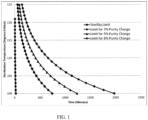
- FIG. 1 illustrates the sterilization times and temperatures fit to functions which capture the parameter space (time and temperature) to maintain a specific change in purity following the sterilization process (area between curves).
- the data points in FIG. 1 include data points from Table 9 and Table 16 above.
- the black squares represent the data points from 100°C to 125°C where the corresponding times were sterile.
- the data points found in Table 9 above were also plotted in FIG 1 .
- the black diamonds represent the data points from 100°C to 125°C where the corresponding times had at most a percent change in purity of 8%.
- the black triangles represent the data points from 100°C to 125°C where the corresponding times had at most a percent change in purity of 5%.
- the black circles represent data points from 100°C to 125°C where the corresponding times had at most a percent change in purity of 3%.
- T 4.588 ⁇ 10 7 ⁇ e ⁇ 0.155 t for 100 ⁇ T ⁇ 125 where T is the temperature in degrees Celsius and t is the time in minutes.
- T 2.753 ⁇ 10 7 ⁇ e ⁇ 0.155 t for 100 ⁇ T ⁇ 125 where T is the temperature in degrees Celsius and t is the time in minutes.
- the area bounded by the functions defined in Formula (II) and Formula (III), for temperatures between 100°C to 125°C, represents temperature and time combinations that provide a sterile solution with at most a 8% change in purity.
- the area bounded by the functions defined in Formula (II) and Formula (IV), for temperatures between 100°C to 125°C, represents temperature and time combinations that provide a sterile solution with at most a 5% change in purity.
- the area bounded by the functions defined in Formula (II) and Formula (V), for temperatures between 100°C to 125°C, represents temperature and time combinations that provide a sterile solution with at most a 3% change in purity.
- the Arrhenius equations for the two aqueous 2% w/v chlorhexidine gluconate were compared to the Arrhenius equations for aqueous 20% w/v chlorhexidine gluconate, and the alcoholic solution having 2% w/v chlorhexidine gluconate.
- the results are shown in FIG. 2 .
- the degradation rate of both aqueous 2% chlorhexidine gluconate solution from Manufacturer A and Manufacturer B is significantly slower than both the alcoholic 2% w/v chlorhexidine gluconate and the aqueous 20% w/v aqueous chlorhexidine gluconate.
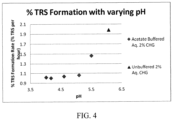
- aqueous 2% w/v chlorhexidine gluconate formulations were prepared at various pHs using an 50 mM acetate buffer (see FIG. 4 ).
- the chlorhexidine gluconate degradation rate is independent of pH, when the aqueous solution pH in the range of approximately 4.0-5.0. As the solution pH increases above pH 5, the chlorhexidine gluconate degradation rate also increases.
Landscapes
- Life Sciences & Earth Sciences (AREA)
- Health & Medical Sciences (AREA)
- General Health & Medical Sciences (AREA)
- Wood Science & Technology (AREA)
- Environmental Sciences (AREA)
- Engineering & Computer Science (AREA)
- Dentistry (AREA)
- Pest Control & Pesticides (AREA)
- Agronomy & Crop Science (AREA)
- Zoology (AREA)
- Plant Pathology (AREA)
- Epidemiology (AREA)
- Animal Behavior & Ethology (AREA)
- Public Health (AREA)
- Veterinary Medicine (AREA)
- Agricultural Chemicals And Associated Chemicals (AREA)
- Acyclic And Carbocyclic Compounds In Medicinal Compositions (AREA)
- Apparatus For Disinfection Or Sterilisation (AREA)
Claims (6)
- Verfahren zum Sterilisieren einer wässrigen antiseptischen Lösung, wobei das Verfahren umfasst:Bereitstellen eines Behälters, der die wässrige antiseptische Lösung enthält, wobei die wässrige antiseptische Lösung etwa 2,0% G/V Chlorhexidingluconat und ein Lösungsmittel umfasst, das 100% V/V Wasser enthält;Erwärmen der wässrigen antiseptischen Lösung auf eine vorbestimmte Temperatur;Halten der wässrigen antiseptischen Lösung bei der vorbestimmten Temperatur für eine vorbestimmte Zeit; undBeenden des Erwärmens der wässrigen antiseptischen Lösung, wenn die vorbestimmte Zeit abläuft,wobei die vorbestimmte Temperatur und die vorbestimmte Zeit so ausgewählt sind, dass nach dem Beenden des Erwärmens die wässrige antiseptische Lösung steril ist;dadurch gekennzeichnet, dasswobei die vorbestimmte Temperatur und die vorbestimmte Zeit so ausgewählt sind, dass die Reinheit nach der Sterilisation mindestens etwa 90% beträgt und eine prozentuale Punktänderung der Reinheit von der Anfangsreinheit zur Reinheit nach der Sterilisation höchstens etwa 8% beträgt,die vorbestimmte Temperatur zwischen etwa 100 und 125°C beträgt,die Sterilisationszeit beträgt:1) von etwa 20 Minuten bis etwa 33 Stunden bei 100°C,2) mindestens etwa 6 Minuten und bis zu etwa 11 Stunden bei 110°C,3) mindestens etwa 3,5 Minuten und bis zu etwa 6 Stunden bei 115°C,4) mindestens etwa 1 Minute und bis zu etwa 2 Stunden bei 125°C; undwobei die Reinheit definiert ist als die prozentuale Konzentration von Chlorhexidingluconatmolekülen in Lösung relativ zur Gesamtkonzentration von Chlorhexidingluconatmolekülen plus Konzentration von Substanzen, die von den Chlorhexidingluconatmolekülen abgeleitet sind oder damit in Beziehung stehen, und"etwa" ±5% des angegebenen Wertes bedeutet.
- Verfahren nach Anspruch 1, wobei die Reinheit nach der Sterilisation mindestens etwa 93% beträgt und eine prozentuale Punktänderung der Reinheit von der Anfangsreinheit zur Reinheit nach der Sterilisation höchstens etwa 5% beträgt; vorzugsweise die Reinheit nach der Sterilisation mindestens etwa 95% beträgt und eine prozentuale Punktänderung der Reinheit von der Anfangsreinheit zur Reinheit nach der Sterilisation höchstens etwa 3% beträgt.
- Verfahren nach Anspruch 1, wobei die vorbestimmte Temperatur von etwa 115°C bis etwa 125°C beträgt.
- Verfahren nach Anspruch 1, wobei nach dem Beenden des Erwärmens die wässrige antiseptische Lösung vollständig frei von Mikroben ist.
- Verfahren nach Anspruch 1, wobei die wässrige antiseptische Lösung einen nichtaktiven Bestandteil umfasst, der aus der Gruppe ausgewählt ist, die aus einem Befeuchtungsmittel, einem Hautglättungsmittel, einem Visualisierungsmittel, einem Löslichkeitsmittel, einem Stabilitätsmittel, einem Viskositätsmittel und einem Benetzungsmittel besteht.
- Sterile wässrige antiseptische Lösung, die gemäß dem Verfahren nach Anspruch 1 hergestellt ist.
Applications Claiming Priority (2)
| Application Number | Priority Date | Filing Date | Title |
|---|---|---|---|
| US14/788,316 US9895455B2 (en) | 2015-06-30 | 2015-06-30 | Systems, methods, and devices for sterilizing antiseptic solutions |
| PCT/US2016/040124 WO2017004223A1 (en) | 2015-06-30 | 2016-06-29 | Systems, methods, and devices for sterilizing antiseptic solutions |
Publications (4)
| Publication Number | Publication Date |
|---|---|
| EP3316913A1 EP3316913A1 (de) | 2018-05-09 |
| EP3316913A4 EP3316913A4 (de) | 2019-02-06 |
| EP3316913B1 true EP3316913B1 (de) | 2025-06-11 |
| EP3316913C0 EP3316913C0 (de) | 2025-06-11 |
Family
ID=57609116
Family Applications (1)
| Application Number | Title | Priority Date | Filing Date |
|---|---|---|---|
| EP16818701.1A Active EP3316913B1 (de) | 2015-06-30 | 2016-06-29 | Systeme, verfahren und vorrichtungen zur sterilisation antiseptischer lösungen |
Country Status (7)
| Country | Link |
|---|---|
| US (1) | US9895455B2 (de) |
| EP (1) | EP3316913B1 (de) |
| CN (2) | CN106310300A (de) |
| AU (1) | AU2016287486B2 (de) |
| CA (1) | CA2990196C (de) |
| MX (1) | MX2017016382A (de) |
| WO (1) | WO2017004223A1 (de) |
Citations (2)
| Publication number | Priority date | Publication date | Assignee | Title |
|---|---|---|---|---|
| EP0055515B1 (de) * | 1980-12-18 | 1985-02-20 | Smith and Nephew Associated Companies p.l.c. | Sterilisationszubereitungen für Linsen und ihre Anwendung |
| EP3092013A1 (de) * | 2014-01-08 | 2016-11-16 | CareFusion 2200 Inc. | Sterilisation von topischen antiseptischen lösungen |
Family Cites Families (15)
| Publication number | Priority date | Publication date | Assignee | Title |
|---|---|---|---|---|
| US3689673A (en) * | 1970-11-10 | 1972-09-05 | Barnes Hind Pharm Inc | The process of soaking and sterilizing hydrophilic soft contact lenses with chlorhexidene |
| US4106654A (en) | 1977-03-10 | 1978-08-15 | American Hospital Supply Corporation | Container with side sealing closure and method of forming the seal thereof |
| US4646629A (en) | 1984-02-10 | 1987-03-03 | Fmc Corporation | Sterilizing apparatus |
| US6582711B1 (en) | 1997-01-09 | 2003-06-24 | 3M Innovative Properties Company | Hydroalcoholic compositions thickened using polymers |
| AUPP427398A0 (en) * | 1998-06-23 | 1998-07-16 | Novapharm Research (Australia) Pty Ltd | Improved disinfection |
| GB0410995D0 (en) | 2004-05-17 | 2004-06-23 | Norton Healthcare Ltd | Heat sterilization of glucocorticosteroids |
| US8110144B2 (en) | 2004-09-17 | 2012-02-07 | Chemence Medical, Inc. | Process for sterilization of and cyanoacrylate adhesives compositions and devices |
| US7868016B2 (en) | 2005-07-13 | 2011-01-11 | Baxter International Inc. | Pharmaceutical formulations of endo-N-(9-methyl-9-azabicyclo[3,3.1]non-3-yl)-1-methyl-1H-indazole-3-carboxamide hydrochloride |
| US20070178051A1 (en) | 2006-01-27 | 2007-08-02 | Elan Pharma International, Ltd. | Sterilized nanoparticulate glucocorticosteroid formulations |
| EP2474352A4 (de) | 2009-09-03 | 2015-05-06 | Univ Osaka | Verfahren und vorrichtung zur zufuhr von ionen in eine flüssigkeit sowie sterilisierungsverfahren und -vorrichtung |
| CN103071167B (zh) * | 2011-10-06 | 2014-08-27 | 佳能市场营销日本株式会社 | 灭菌装置、灭菌方法、程序 |
| WO2014022933A1 (en) | 2012-08-07 | 2014-02-13 | Scican Ltd. | Container for washing, sterilization, transportation and sterile storage of articles |
| CN102993056A (zh) | 2012-12-04 | 2013-03-27 | 甘肃省化工研究院 | 一种双氯苯双胍己烷化合物的制备方法 |
| CN103202827A (zh) | 2013-03-30 | 2013-07-17 | 江苏健裕健康医疗器械有限公司 | 葡萄糖酸洗必泰和异丙醇混合杀菌消毒剂 |
| US9724437B2 (en) | 2013-08-08 | 2017-08-08 | Lernapharm (Loris) Inc. | Heat sterilization techniques for chlorhexidine based antiseptic formulations |
-
2015
- 2015-06-30 US US14/788,316 patent/US9895455B2/en active Active
-
2016
- 2016-06-29 WO PCT/US2016/040124 patent/WO2017004223A1/en not_active Ceased
- 2016-06-29 AU AU2016287486A patent/AU2016287486B2/en active Active
- 2016-06-29 MX MX2017016382A patent/MX2017016382A/es unknown
- 2016-06-29 EP EP16818701.1A patent/EP3316913B1/de active Active
- 2016-06-29 CA CA2990196A patent/CA2990196C/en active Active
- 2016-06-30 CN CN201610513056.6A patent/CN106310300A/zh active Pending
- 2016-06-30 CN CN201911363962.2A patent/CN110935044A/zh active Pending
Patent Citations (2)
| Publication number | Priority date | Publication date | Assignee | Title |
|---|---|---|---|---|
| EP0055515B1 (de) * | 1980-12-18 | 1985-02-20 | Smith and Nephew Associated Companies p.l.c. | Sterilisationszubereitungen für Linsen und ihre Anwendung |
| EP3092013A1 (de) * | 2014-01-08 | 2016-11-16 | CareFusion 2200 Inc. | Sterilisation von topischen antiseptischen lösungen |
Non-Patent Citations (1)
| Title |
|---|
| "Disinfection, sterilization, and preservation (5th ed.)", 1 January 2001, LIPPINCOTT WILLIAMS & WILKINS, PHILADELPHIA, US, ISBN: 978-0-683-30740-5, article GRAHAM W. DENTON: "Chlorhexidine", pages: 321 - 336, XP055519208 * |
Also Published As
| Publication number | Publication date |
|---|---|
| WO2017004223A1 (en) | 2017-01-05 |
| CA2990196A1 (en) | 2017-01-05 |
| US9895455B2 (en) | 2018-02-20 |
| AU2016287486B2 (en) | 2020-05-21 |
| EP3316913A4 (de) | 2019-02-06 |
| CA2990196C (en) | 2023-10-10 |
| US20170000914A1 (en) | 2017-01-05 |
| MX2017016382A (es) | 2018-03-02 |
| EP3316913C0 (de) | 2025-06-11 |
| CN110935044A (zh) | 2020-03-31 |
| EP3316913A1 (de) | 2018-05-09 |
| CN106310300A (zh) | 2017-01-11 |
| AU2016287486A1 (en) | 2018-01-04 |
Similar Documents
| Publication | Publication Date | Title |
|---|---|---|
| EP3092013B1 (de) | Verfahren zur herstellung einer sterilen antseptischen lösung | |
| US9511156B2 (en) | Systems, methods, and devices for sterilizing antiseptic solutions | |
| US10603396B2 (en) | Methods and system for disinfection | |
| EP3871503A1 (de) | Systeme und verfahren zur sterilisation von iodophorzusammensetzungen | |
| US20160160261A1 (en) | Method for establishing resistance characteristics of a biological indicator | |
| US9895455B2 (en) | Systems, methods, and devices for sterilizing antiseptic solutions | |
| EP3316914B1 (de) | Systeme, verfahren und vorrichtungen zur sterilisation antiseptischer lösungen | |
| Chojecka et al. | Neutralization efficiency of alcohol based products used for rapid hand disinfection | |
| WO2025032506A1 (en) | Methods of sterilization |
Legal Events
| Date | Code | Title | Description |
|---|---|---|---|
| STAA | Information on the status of an ep patent application or granted ep patent |
Free format text: STATUS: THE INTERNATIONAL PUBLICATION HAS BEEN MADE |
|
| PUAI | Public reference made under article 153(3) epc to a published international application that has entered the european phase |
Free format text: ORIGINAL CODE: 0009012 |
|
| STAA | Information on the status of an ep patent application or granted ep patent |
Free format text: STATUS: REQUEST FOR EXAMINATION WAS MADE |
|
| 17P | Request for examination filed |
Effective date: 20180119 |
|
| AK | Designated contracting states |
Kind code of ref document: A1 Designated state(s): AL AT BE BG CH CY CZ DE DK EE ES FI FR GB GR HR HU IE IS IT LI LT LU LV MC MK MT NL NO PL PT RO RS SE SI SK SM TR |
|
| AX | Request for extension of the european patent |
Extension state: BA ME |
|
| DAV | Request for validation of the european patent (deleted) | ||
| DAX | Request for extension of the european patent (deleted) | ||
| RIC1 | Information provided on ipc code assigned before grant |
Ipc: A01N 43/40 20060101ALI20181220BHEP Ipc: A01N 47/44 20060101ALI20181220BHEP Ipc: A61L 2/00 20060101AFI20181220BHEP |
|
| A4 | Supplementary search report drawn up and despatched |
Effective date: 20190108 |
|
| STAA | Information on the status of an ep patent application or granted ep patent |
Free format text: STATUS: EXAMINATION IS IN PROGRESS |
|
| 17Q | First examination report despatched |
Effective date: 20220311 |
|
| GRAP | Despatch of communication of intention to grant a patent |
Free format text: ORIGINAL CODE: EPIDOSNIGR1 |
|
| STAA | Information on the status of an ep patent application or granted ep patent |
Free format text: STATUS: GRANT OF PATENT IS INTENDED |
|
| INTG | Intention to grant announced |
Effective date: 20250107 |
|
| GRAS | Grant fee paid |
Free format text: ORIGINAL CODE: EPIDOSNIGR3 |
|
| GRAA | (expected) grant |
Free format text: ORIGINAL CODE: 0009210 |
|
| STAA | Information on the status of an ep patent application or granted ep patent |
Free format text: STATUS: THE PATENT HAS BEEN GRANTED |
|
| AK | Designated contracting states |
Kind code of ref document: B1 Designated state(s): AL AT BE BG CH CY CZ DE DK EE ES FI FR GB GR HR HU IE IS IT LI LT LU LV MC MK MT NL NO PL PT RO RS SE SI SK SM TR |
|
| REG | Reference to a national code |
Ref country code: GB Ref legal event code: FG4D |
|
| REG | Reference to a national code |
Ref country code: CH Ref legal event code: EP |
|
| REG | Reference to a national code |
Ref country code: IE Ref legal event code: FG4D |
|
| REG | Reference to a national code |
Ref country code: DE Ref legal event code: R096 Ref document number: 602016092544 Country of ref document: DE |
|
| U01 | Request for unitary effect filed |
Effective date: 20250704 |
|
| U07 | Unitary effect registered |
Designated state(s): AT BE BG DE DK EE FI FR IT LT LU LV MT NL PT RO SE SI Effective date: 20250711 |
|
| U20 | Renewal fee for the european patent with unitary effect paid |
Year of fee payment: 10 Effective date: 20250731 |
|
| PG25 | Lapsed in a contracting state [announced via postgrant information from national office to epo] |
Ref country code: ES Free format text: LAPSE BECAUSE OF FAILURE TO SUBMIT A TRANSLATION OF THE DESCRIPTION OR TO PAY THE FEE WITHIN THE PRESCRIBED TIME-LIMIT Effective date: 20250611 |
|
| PG25 | Lapsed in a contracting state [announced via postgrant information from national office to epo] |
Ref country code: GR Free format text: LAPSE BECAUSE OF FAILURE TO SUBMIT A TRANSLATION OF THE DESCRIPTION OR TO PAY THE FEE WITHIN THE PRESCRIBED TIME-LIMIT Effective date: 20250912 Ref country code: NO Free format text: LAPSE BECAUSE OF FAILURE TO SUBMIT A TRANSLATION OF THE DESCRIPTION OR TO PAY THE FEE WITHIN THE PRESCRIBED TIME-LIMIT Effective date: 20250911 |
|
| PG25 | Lapsed in a contracting state [announced via postgrant information from national office to epo] |
Ref country code: HR Free format text: LAPSE BECAUSE OF FAILURE TO SUBMIT A TRANSLATION OF THE DESCRIPTION OR TO PAY THE FEE WITHIN THE PRESCRIBED TIME-LIMIT Effective date: 20250611 |
|
| PG25 | Lapsed in a contracting state [announced via postgrant information from national office to epo] |
Ref country code: RS Free format text: LAPSE BECAUSE OF FAILURE TO SUBMIT A TRANSLATION OF THE DESCRIPTION OR TO PAY THE FEE WITHIN THE PRESCRIBED TIME-LIMIT Effective date: 20250911 |
|
| PG25 | Lapsed in a contracting state [announced via postgrant information from national office to epo] |
Ref country code: IS Free format text: LAPSE BECAUSE OF FAILURE TO SUBMIT A TRANSLATION OF THE DESCRIPTION OR TO PAY THE FEE WITHIN THE PRESCRIBED TIME-LIMIT Effective date: 20251011 |
|
| PG25 | Lapsed in a contracting state [announced via postgrant information from national office to epo] |
Ref country code: SM Free format text: LAPSE BECAUSE OF FAILURE TO SUBMIT A TRANSLATION OF THE DESCRIPTION OR TO PAY THE FEE WITHIN THE PRESCRIBED TIME-LIMIT Effective date: 20250611 |
|
| PG25 | Lapsed in a contracting state [announced via postgrant information from national office to epo] |
Ref country code: CZ Free format text: LAPSE BECAUSE OF FAILURE TO SUBMIT A TRANSLATION OF THE DESCRIPTION OR TO PAY THE FEE WITHIN THE PRESCRIBED TIME-LIMIT Effective date: 20250611 |
|
| PG25 | Lapsed in a contracting state [announced via postgrant information from national office to epo] |
Ref country code: PL Free format text: LAPSE BECAUSE OF FAILURE TO SUBMIT A TRANSLATION OF THE DESCRIPTION OR TO PAY THE FEE WITHIN THE PRESCRIBED TIME-LIMIT Effective date: 20250611 |
|
| PG25 | Lapsed in a contracting state [announced via postgrant information from national office to epo] |
Ref country code: SK Free format text: LAPSE BECAUSE OF FAILURE TO SUBMIT A TRANSLATION OF THE DESCRIPTION OR TO PAY THE FEE WITHIN THE PRESCRIBED TIME-LIMIT Effective date: 20250611 |
|
| REG | Reference to a national code |
Ref country code: CH Ref legal event code: H13 Free format text: ST27 STATUS EVENT CODE: U-0-0-H10-H13 (AS PROVIDED BY THE NATIONAL OFFICE) Effective date: 20260127 |
|
| PG25 | Lapsed in a contracting state [announced via postgrant information from national office to epo] |
Ref country code: MC Free format text: LAPSE BECAUSE OF FAILURE TO SUBMIT A TRANSLATION OF THE DESCRIPTION OR TO PAY THE FEE WITHIN THE PRESCRIBED TIME-LIMIT Effective date: 20250611 |
|
| PG25 | Lapsed in a contracting state [announced via postgrant information from national office to epo] |
Ref country code: IE Free format text: LAPSE BECAUSE OF NON-PAYMENT OF DUE FEES Effective date: 20250629 |
|
| PLBE | No opposition filed within time limit |
Free format text: ORIGINAL CODE: 0009261 |
|
| STAA | Information on the status of an ep patent application or granted ep patent |
Free format text: STATUS: NO OPPOSITION FILED WITHIN TIME LIMIT |
|
| PG25 | Lapsed in a contracting state [announced via postgrant information from national office to epo] |
Ref country code: CH Free format text: LAPSE BECAUSE OF NON-PAYMENT OF DUE FEES Effective date: 20250630 |
|
| REG | Reference to a national code |
Ref country code: CH Ref legal event code: L10 Free format text: ST27 STATUS EVENT CODE: U-0-0-L10-L00 (AS PROVIDED BY THE NATIONAL OFFICE) Effective date: 20260423 |
|
| 26N | No opposition filed |
Effective date: 20260312 |
|
| U20 | Renewal fee for the european patent with unitary effect paid |
Year of fee payment: 11 Effective date: 20260520 |
|
| PGFP | Annual fee paid to national office [announced via postgrant information from national office to epo] |
Ref country code: GB Payment date: 20260520 Year of fee payment: 11 |
|
| PG25 | Lapsed in a contracting state [announced via postgrant information from national office to epo] |
Ref country code: CY Free format text: LAPSE BECAUSE OF FAILURE TO SUBMIT A TRANSLATION OF THE DESCRIPTION OR TO PAY THE FEE WITHIN THE PRESCRIBED TIME-LIMIT Effective date: 20250611 |