EP3318232B1 - Absorbierender einweg-bekleidungsartikel - Google Patents
Absorbierender einweg-bekleidungsartikel Download PDFInfo
- Publication number
- EP3318232B1 EP3318232B1 EP16817588.3A EP16817588A EP3318232B1 EP 3318232 B1 EP3318232 B1 EP 3318232B1 EP 16817588 A EP16817588 A EP 16817588A EP 3318232 B1 EP3318232 B1 EP 3318232B1
- Authority
- EP
- European Patent Office
- Prior art keywords
- elastic
- lateral direction
- wearing article
- panel
- diaper
- Prior art date
- Legal status (The legal status is an assumption and is not a legal conclusion. Google has not performed a legal analysis and makes no representation as to the accuracy of the status listed.)
- Active
Links
Images




Classifications
-
- A—HUMAN NECESSITIES
- A61—MEDICAL OR VETERINARY SCIENCE; HYGIENE
- A61F—FILTERS IMPLANTABLE INTO BLOOD VESSELS; PROSTHESES; DEVICES PROVIDING PATENCY TO, OR PREVENTING COLLAPSING OF, TUBULAR STRUCTURES OF THE BODY, e.g. STENTS; ORTHOPAEDIC, NURSING OR CONTRACEPTIVE DEVICES; FOMENTATION; TREATMENT OR PROTECTION OF EYES OR EARS; BANDAGES, DRESSINGS OR ABSORBENT PADS; FIRST-AID KITS
- A61F13/00—Bandages or dressings; Absorbent pads
- A61F13/15—Absorbent pads, e.g. sanitary towels, swabs or tampons for external or internal application to the body; Supporting or fastening means therefor; Tampon applicators
- A61F13/45—Absorbent pads, e.g. sanitary towels, swabs or tampons for external or internal application to the body; Supporting or fastening means therefor; Tampon applicators characterised by the shape
- A61F13/49—Absorbent pads, e.g. sanitary towels, swabs or tampons for external or internal application to the body; Supporting or fastening means therefor; Tampon applicators characterised by the shape specially adapted to be worn around the waist, e.g. diapers, nappies
- A61F13/49007—Form-fitting, self-adjusting disposable diapers
- A61F13/49009—Form-fitting, self-adjusting disposable diapers with elastic means
-
- A—HUMAN NECESSITIES
- A61—MEDICAL OR VETERINARY SCIENCE; HYGIENE
- A61F—FILTERS IMPLANTABLE INTO BLOOD VESSELS; PROSTHESES; DEVICES PROVIDING PATENCY TO, OR PREVENTING COLLAPSING OF, TUBULAR STRUCTURES OF THE BODY, e.g. STENTS; ORTHOPAEDIC, NURSING OR CONTRACEPTIVE DEVICES; FOMENTATION; TREATMENT OR PROTECTION OF EYES OR EARS; BANDAGES, DRESSINGS OR ABSORBENT PADS; FIRST-AID KITS
- A61F13/00—Bandages or dressings; Absorbent pads
- A61F13/15—Absorbent pads, e.g. sanitary towels, swabs or tampons for external or internal application to the body; Supporting or fastening means therefor; Tampon applicators
- A61F13/45—Absorbent pads, e.g. sanitary towels, swabs or tampons for external or internal application to the body; Supporting or fastening means therefor; Tampon applicators characterised by the shape
- A61F13/49—Absorbent pads, e.g. sanitary towels, swabs or tampons for external or internal application to the body; Supporting or fastening means therefor; Tampon applicators characterised by the shape specially adapted to be worn around the waist, e.g. diapers, nappies
- A61F13/49007—Form-fitting, self-adjusting disposable diapers
- A61F13/49009—Form-fitting, self-adjusting disposable diapers with elastic means
- A61F13/49011—Form-fitting, self-adjusting disposable diapers with elastic means the elastic means is located at the waist region
-
- A—HUMAN NECESSITIES
- A61—MEDICAL OR VETERINARY SCIENCE; HYGIENE
- A61F—FILTERS IMPLANTABLE INTO BLOOD VESSELS; PROSTHESES; DEVICES PROVIDING PATENCY TO, OR PREVENTING COLLAPSING OF, TUBULAR STRUCTURES OF THE BODY, e.g. STENTS; ORTHOPAEDIC, NURSING OR CONTRACEPTIVE DEVICES; FOMENTATION; TREATMENT OR PROTECTION OF EYES OR EARS; BANDAGES, DRESSINGS OR ABSORBENT PADS; FIRST-AID KITS
- A61F13/00—Bandages or dressings; Absorbent pads
- A61F13/15—Absorbent pads, e.g. sanitary towels, swabs or tampons for external or internal application to the body; Supporting or fastening means therefor; Tampon applicators
- A61F13/45—Absorbent pads, e.g. sanitary towels, swabs or tampons for external or internal application to the body; Supporting or fastening means therefor; Tampon applicators characterised by the shape
- A61F13/49—Absorbent pads, e.g. sanitary towels, swabs or tampons for external or internal application to the body; Supporting or fastening means therefor; Tampon applicators characterised by the shape specially adapted to be worn around the waist, e.g. diapers, nappies
- A61F13/49007—Form-fitting, self-adjusting disposable diapers
- A61F13/49009—Form-fitting, self-adjusting disposable diapers with elastic means
- A61F13/49017—Form-fitting, self-adjusting disposable diapers with elastic means the elastic means being located at the crotch region
-
- A—HUMAN NECESSITIES
- A61—MEDICAL OR VETERINARY SCIENCE; HYGIENE
- A61F—FILTERS IMPLANTABLE INTO BLOOD VESSELS; PROSTHESES; DEVICES PROVIDING PATENCY TO, OR PREVENTING COLLAPSING OF, TUBULAR STRUCTURES OF THE BODY, e.g. STENTS; ORTHOPAEDIC, NURSING OR CONTRACEPTIVE DEVICES; FOMENTATION; TREATMENT OR PROTECTION OF EYES OR EARS; BANDAGES, DRESSINGS OR ABSORBENT PADS; FIRST-AID KITS
- A61F13/00—Bandages or dressings; Absorbent pads
- A61F13/15—Absorbent pads, e.g. sanitary towels, swabs or tampons for external or internal application to the body; Supporting or fastening means therefor; Tampon applicators
- A61F13/45—Absorbent pads, e.g. sanitary towels, swabs or tampons for external or internal application to the body; Supporting or fastening means therefor; Tampon applicators characterised by the shape
- A61F13/49—Absorbent pads, e.g. sanitary towels, swabs or tampons for external or internal application to the body; Supporting or fastening means therefor; Tampon applicators characterised by the shape specially adapted to be worn around the waist, e.g. diapers, nappies
- A61F13/49007—Form-fitting, self-adjusting disposable diapers
- A61F13/49009—Form-fitting, self-adjusting disposable diapers with elastic means
- A61F13/49019—Form-fitting, self-adjusting disposable diapers with elastic means the elastic means being placed longitudinally, transversely or diagonally over the article
-
- A—HUMAN NECESSITIES
- A61—MEDICAL OR VETERINARY SCIENCE; HYGIENE
- A61F—FILTERS IMPLANTABLE INTO BLOOD VESSELS; PROSTHESES; DEVICES PROVIDING PATENCY TO, OR PREVENTING COLLAPSING OF, TUBULAR STRUCTURES OF THE BODY, e.g. STENTS; ORTHOPAEDIC, NURSING OR CONTRACEPTIVE DEVICES; FOMENTATION; TREATMENT OR PROTECTION OF EYES OR EARS; BANDAGES, DRESSINGS OR ABSORBENT PADS; FIRST-AID KITS
- A61F13/00—Bandages or dressings; Absorbent pads
- A61F13/15—Absorbent pads, e.g. sanitary towels, swabs or tampons for external or internal application to the body; Supporting or fastening means therefor; Tampon applicators
- A61F13/45—Absorbent pads, e.g. sanitary towels, swabs or tampons for external or internal application to the body; Supporting or fastening means therefor; Tampon applicators characterised by the shape
- A61F13/49—Absorbent pads, e.g. sanitary towels, swabs or tampons for external or internal application to the body; Supporting or fastening means therefor; Tampon applicators characterised by the shape specially adapted to be worn around the waist, e.g. diapers, nappies
- A61F13/49058—Absorbent pads, e.g. sanitary towels, swabs or tampons for external or internal application to the body; Supporting or fastening means therefor; Tampon applicators characterised by the shape specially adapted to be worn around the waist, e.g. diapers, nappies characterised by the modular concept of constructing the diaper
- A61F13/4906—Absorbent pads, e.g. sanitary towels, swabs or tampons for external or internal application to the body; Supporting or fastening means therefor; Tampon applicators characterised by the shape specially adapted to be worn around the waist, e.g. diapers, nappies characterised by the modular concept of constructing the diaper the diaper having an outer chassis forming the diaper and an independent absorbent structure attached to the chassis
- A61F13/49061—Absorbent pads, e.g. sanitary towels, swabs or tampons for external or internal application to the body; Supporting or fastening means therefor; Tampon applicators characterised by the shape specially adapted to be worn around the waist, e.g. diapers, nappies characterised by the modular concept of constructing the diaper the diaper having an outer chassis forming the diaper and an independent absorbent structure attached to the chassis the diaper having one or two waist members forming the diaper waist region and an independent absorbent structure attached to the one or two waist members forming the crotch region
-
- A—HUMAN NECESSITIES
- A61—MEDICAL OR VETERINARY SCIENCE; HYGIENE
- A61F—FILTERS IMPLANTABLE INTO BLOOD VESSELS; PROSTHESES; DEVICES PROVIDING PATENCY TO, OR PREVENTING COLLAPSING OF, TUBULAR STRUCTURES OF THE BODY, e.g. STENTS; ORTHOPAEDIC, NURSING OR CONTRACEPTIVE DEVICES; FOMENTATION; TREATMENT OR PROTECTION OF EYES OR EARS; BANDAGES, DRESSINGS OR ABSORBENT PADS; FIRST-AID KITS
- A61F13/00—Bandages or dressings; Absorbent pads
- A61F13/15—Absorbent pads, e.g. sanitary towels, swabs or tampons for external or internal application to the body; Supporting or fastening means therefor; Tampon applicators
- A61F13/45—Absorbent pads, e.g. sanitary towels, swabs or tampons for external or internal application to the body; Supporting or fastening means therefor; Tampon applicators characterised by the shape
- A61F13/49—Absorbent pads, e.g. sanitary towels, swabs or tampons for external or internal application to the body; Supporting or fastening means therefor; Tampon applicators characterised by the shape specially adapted to be worn around the waist, e.g. diapers, nappies
- A61F13/495—Absorbent pads, e.g. sanitary towels, swabs or tampons for external or internal application to the body; Supporting or fastening means therefor; Tampon applicators characterised by the shape specially adapted to be worn around the waist, e.g. diapers, nappies with faecal cavity
-
- A—HUMAN NECESSITIES
- A61—MEDICAL OR VETERINARY SCIENCE; HYGIENE
- A61F—FILTERS IMPLANTABLE INTO BLOOD VESSELS; PROSTHESES; DEVICES PROVIDING PATENCY TO, OR PREVENTING COLLAPSING OF, TUBULAR STRUCTURES OF THE BODY, e.g. STENTS; ORTHOPAEDIC, NURSING OR CONTRACEPTIVE DEVICES; FOMENTATION; TREATMENT OR PROTECTION OF EYES OR EARS; BANDAGES, DRESSINGS OR ABSORBENT PADS; FIRST-AID KITS
- A61F13/00—Bandages or dressings; Absorbent pads
- A61F13/15—Absorbent pads, e.g. sanitary towels, swabs or tampons for external or internal application to the body; Supporting or fastening means therefor; Tampon applicators
- A61F13/45—Absorbent pads, e.g. sanitary towels, swabs or tampons for external or internal application to the body; Supporting or fastening means therefor; Tampon applicators characterised by the shape
- A61F13/49—Absorbent pads, e.g. sanitary towels, swabs or tampons for external or internal application to the body; Supporting or fastening means therefor; Tampon applicators characterised by the shape specially adapted to be worn around the waist, e.g. diapers, nappies
- A61F13/496—Absorbent pads, e.g. sanitary towels, swabs or tampons for external or internal application to the body; Supporting or fastening means therefor; Tampon applicators characterised by the shape specially adapted to be worn around the waist, e.g. diapers, nappies in the form of pants or briefs
-
- A—HUMAN NECESSITIES
- A61—MEDICAL OR VETERINARY SCIENCE; HYGIENE
- A61F—FILTERS IMPLANTABLE INTO BLOOD VESSELS; PROSTHESES; DEVICES PROVIDING PATENCY TO, OR PREVENTING COLLAPSING OF, TUBULAR STRUCTURES OF THE BODY, e.g. STENTS; ORTHOPAEDIC, NURSING OR CONTRACEPTIVE DEVICES; FOMENTATION; TREATMENT OR PROTECTION OF EYES OR EARS; BANDAGES, DRESSINGS OR ABSORBENT PADS; FIRST-AID KITS
- A61F13/00—Bandages or dressings; Absorbent pads
- A61F13/15—Absorbent pads, e.g. sanitary towels, swabs or tampons for external or internal application to the body; Supporting or fastening means therefor; Tampon applicators
- A61F13/51—Absorbent pads, e.g. sanitary towels, swabs or tampons for external or internal application to the body; Supporting or fastening means therefor; Tampon applicators characterised by the outer layers of the pads
- A61F13/511—Topsheet, i.e. the permeable cover or layer facing the skin
- A61F13/513—Topsheet, i.e. the permeable cover or layer facing the skin characterised by its function or properties, e.g. stretchability, breathability, rewet, visual effect; having areas of different permeability
-
- A—HUMAN NECESSITIES
- A61—MEDICAL OR VETERINARY SCIENCE; HYGIENE
- A61F—FILTERS IMPLANTABLE INTO BLOOD VESSELS; PROSTHESES; DEVICES PROVIDING PATENCY TO, OR PREVENTING COLLAPSING OF, TUBULAR STRUCTURES OF THE BODY, e.g. STENTS; ORTHOPAEDIC, NURSING OR CONTRACEPTIVE DEVICES; FOMENTATION; TREATMENT OR PROTECTION OF EYES OR EARS; BANDAGES, DRESSINGS OR ABSORBENT PADS; FIRST-AID KITS
- A61F13/00—Bandages or dressings; Absorbent pads
- A61F13/15—Absorbent pads, e.g. sanitary towels, swabs or tampons for external or internal application to the body; Supporting or fastening means therefor; Tampon applicators
- A61F13/45—Absorbent pads, e.g. sanitary towels, swabs or tampons for external or internal application to the body; Supporting or fastening means therefor; Tampon applicators characterised by the shape
- A61F13/49—Absorbent pads, e.g. sanitary towels, swabs or tampons for external or internal application to the body; Supporting or fastening means therefor; Tampon applicators characterised by the shape specially adapted to be worn around the waist, e.g. diapers, nappies
- A61F13/49007—Form-fitting, self-adjusting disposable diapers
- A61F2013/49042—Form-fitting, self-adjusting disposable diapers with only stretchable part, i.e. part being not elastic but only extensible with not a full recovery of its original length
Definitions
- the present disclosure relates to a disposable absorbent wearing article such as a disposable diaper.
- disposable absorbent wearing articles such as a disposable diaper includes a front waist region, a rear waist region and a crotch region positioned between the front and the rear waist regions wherein an absorbent structure extends over the crotch region and the front and the rear waist regions, and at least either one of the front and the rear waist regions and the crotch region is curved outward when an elastic member is contracted.
- an absorbent article disclosed in Patent Literature 1 includes an elongated absorbent chassis having a waist region and a crotch region. The article has both side edges extending in a vertical direction, and both upper and lower ends extending in a lateral direction, provided with barrier flaps with which elastic members are attached. The absorbent chassis assumes a cup-like shape when the elastic members of the barrier flaps are contracted.
- US 2013/0041340 A1 seeks to provide a disposable wearing article having a cup-shaped portion adapted for temporary collection of bodily fluids such as urine without irritating a wearer's skin.
- At least one of front and rear waist regions includes a first sub-region provided with first waist elastics, a third sub-region provided with third waist elastics and a second sub-region lying between the first and third sub-regions, wherein a tensile stress in the first and third sub-regions is higher than that in the second sub-region and leg cuff elastics extend at least to the second sub-region.
- An object of the present invention is to provide an improved disposable absorbent wearing article such as a disposable diaper having a given part in front and rear waist regions and a crotch region curved to protrude outward so that a space that may contain body exudates is formed on the inner side of the wearing article.
- the present invention for solving the problems described above is directed to a disposable absorbent wearing article having an upper and lower direction and a lateral direction crossing each other in a worn state of the article, the article including a front waist region defined by a front waist panel, a rear waist region defined by a rear waist panel and a crotch region positioned between the front and rear waist regions and defined by a crotch panel.
- the front waist region, the rear waist region and the crotch region each have a skin-facing surface and a clothing-facing surface respectively facing the skin and clothing of a wearer.
- An absorbent structure including an absorbent core material extends to the front and the rear waist regions centering on the crotch region.
- At least one waist region of the front and the rear waist regions includes an elastic band forming a part of the skin-facing surface and has a middle part in the lateral direction and elastically contracted in the lateral direction.
- an elastic contraction amount in the middle part of the elastic band in the lateral direction is larger than an elastic contraction amount of a component part of the article facing the middle part without being joined to the middle part in a thickness direction of the middle part in the lateral direction.
- a deformation guide is formed that extends in a direction to cross the elastic band and facilitates curving of the core material in the lateral direction.
- the present invention includes at least the following embodiments, which may be taken in isolation or in combination.
- a disposable absorbent wearing article has at least one of front and rear waist regions curved to protrude outward from the wearing article together with a core material at a part where a deformation guide is formed when an elastic band is elastically contracted in a lateral direction.
- a space into which body exudates may flow may be formed between the part where the deformation guide is formed and the skin of a wearer.
- Fig. 1 is a diagram illustrating a shape of a pull-on diaper 10 which is one example of a disposable absorbent wearing article according to the present invention in a worn state of the article.
- Fig. 1(a) is a front view of the diaper 10.
- Fig. 1(b) is a rear view of the diaper 10. A wearer is omitted in these figures.
- the diaper 10 illustrated in Fig. 1 has a vertical direction Y, a lateral direction X crossing the vertical direction Y, and a vertical center line P extending in the vertical direction Y and dividing equally the length in the lateral direction X.
- the diaper 10 has a symmetrical shape relative to the vertical center line P.
- the vertical direction Y is also referred to an upper and lower direction.
- the diaper 10 may include a front waist panel 20 defining a front waist region 11, a rear waist panel 30 defining a rear waist region 12, and a crotch panel 40 defining a crotch region 13.
- the front and the rear waist panels 20 and 30 have both side edges joined to each other at seams 14 and define a waist opening 15.
- the crotch panel 40 is joined to the front and the rear waist panels 20 and 30.
- a pair of leg openings 16 is defined by the crotch panel 40 and the front and the rear waist panels 20 and 30.
- the front and the rear waist panels 20 and 30 and the crotch panel 40 each may include a skin-facing surface SS (see Fig.
- the pull-on diaper 10 is what has the waist opening 15 and the leg openings 16 respectively preformed and is worn by inserting both legs in the leg openings 16 and pulling up the diaper 10 to the wearer's waist.
- the diaper 10 of this type is also known as a pant diaper.
- the front waist panel 20 of the diaper 10 illustrated in Fig. 1(a) has a bulging part 100a protruding outward from the diaper 10 formed over the vertical center line P.
- the rear waist panel 30 illustrated in Fig. 1(b) also has a bulging part 100b protruding outward from the diaper 10 (see Fig. 6 ).
- the bulging parts 100a and 100b are described later.
- Figs. 2 is a partially cutaway plan view of the diaper 10 in a flatly opened state with the front and rear waist panels 20 and 30 joined at the seams 14 being separated from each other and expanded to be to be in a planar state to the extent that gathers formed thereon disappears.
- Fig. 3 is an exploded view of the diaper 10 in Fig. 2 .
- a double sided arrow Y in the figures indicates the vertical direction in Fig. 1 .
- the front and the rear waist panels 20 and 30 illustrated in Figs. 2 and 3 have lower edges 20A and 30A extending in the lateral direction X, upper edges 20B and 30B opposed to the lower edges 20A and 30A extending in the lateral direction X, both side edges 20C extending in the vertical direction Y between the lower edge 20A and the upper edge 20B, and both side edges 30C extending in the vertical direction Y between the lower edge 30A and the upper edge 30B.
- the upper edges 20B and 30B are top edges of the front and the rear waist panels 20 and 30, respectively. Parts extending along both side edges 20C of the front waist panel 20 and both side edges 30C of the rear waist panel 30 are overlapped with each other as illustrated in Fig. 1 , and coupled to each other in the seams 14 continually made in the vertical direction Y to define the waist opening 15.
- the crotch panel 40 extends between the lower edge 20A of the front waist panel 20 and the lower edge 30A of the rear waist panel 30.
- the front waist panel 20 may include an outer sheet 21 and an inner sheet 22 respectively forming the clothing-facing surface CS and the skin-facing surface SS of the front waist region 11.
- a plurality of thread-like or strip-like front waist elastic members 24 are contractibly provided between the outer sheet 21 and the inner sheet 22 extending in the lateral direction X.
- a front waist elastic region 25 that is elastically contractible is defined in a part of the front waist panel 20 extending along the upper edge 20B.
- the front waist panel 20 is provided with an inner elastic strip 44 covering a part of the inner sheet 22 and extending across the crotch panel 40 toward both seams 14, preferably, to both seams 14.
- the inner elastic strip 44 has at least a middle part 44b (see Fig.
- the elastic band 1a has a part in the crotch panel 40 positioned across at least an absorbent structure 42 (described later)without being joined to the crotch panel 40 and is elastically contractible in the lateral direction X.
- the rear waist panel 30 may include an outer sheet 31 and an inner sheet 32 respectively forming the clothing-facing surface CS and the skin-facing surface SS in the rear waist region 12.
- a plurality of thread-like or strip-like rear waist elastic members 34 are contractibly provided between the outer sheet 31 and the inner sheet 32 extending in the lateral direction X.
- a rear waist elastic area 35 that is elastically contractible is formed in a part of the rear waist panel 30 extending along the upper edge 30B.
- the rear waist panel 30 is provided with an inner elastic strip 55 covering a part of the inner sheet 32 on the inner side of the diaper 10 and extending toward both seams 14, preferably, to both seams 14.
- the inner elastic strip 55 functions as an elastic band 1b in the rear waist region 12 of the diaper 10.
- the elastic band 1b is an example of an elastic band according to the present invention.
- the inner elastic strip 55 functioning as an elastic band 1b has at least a lower part 55c in a middle part 55b in the lateral direction X without being joined to a component part of the diaper facing the lower part 55c in a thickness direction of the inner elastic strip 55, and is elastically contractible in the lateral direction X.
- the crotch panel 40 has a front edge 40A, a rear edge 40B, and both side edges 40C positioned between the front and the rear edges 40A and 40B.
- the crotch panel 40 may include the absorbent structure 42 having absorbability, which is provided between a top sheet 41a and a back sheet 41b.
- the top sheet may be formed of a liquid permeable sheet such as a liquid permeable fibrous nonwoven fabric defining the skin-facing surface SS.
- the back sheet 41b may be formed of a liquid-impermeable or hardly liquid permeable sheet (see Fig. 1 and Figs. 5(a) and 5(b) ), defining the clothing-facing surface CS.
- a leakage-barrier sheet 43 formed of a plastic film is provided between the absorbent structure 42 and the back sheet 41b (see Fig. 5 ).
- the absorbent structure 42 has a front edge 42A and a rear edge 42B extending in the lateral direction X and both side edges 42C extending between the front and the rear edges 42A and 42B.
- the absorbent structure 42 may include a core material 46a formed of a mixture of fluff pulp and superabsorbent polymer particles and a liquid permeable wrapping sheet 46b formed of tissue paper or a nonwoven fabric covering the core material 46a.
- the core material 46a is curved to protrude from both side edges 46c toward outward on centering the vertical center line P.
- the back sheet 41b of the crotch panel 40 has both side parts 45 extending in the lateral direction X from both side edges 42C of the absorbent structure 42. Both side parts 45 are each folded toward the vertical center line P along a corresponding one of fold lines 60, which are adjacent to both side edges of a leakage prevention sheet 43 and extend in the vertical direction Y, to have parts overlapping with each other.
- the overlapping parts are joined to each other with hot-melt adhesive HA2 (see Fig. 6 ) for example, in an end 51 in the upper and lower direction Y.
- the back sheet 41b has parts overlapping with each other joined to the front waist panel 20 and the rear waist panel 30 using hot-melt adhesive HA3 for example (see Fig. 6 ).
- Both side parts 45 further have leg surrounding flaps 45a and barrier cuffs 48 formed (see also Fig. 1 ).
- the leg surrounding flaps 45a each have a leg elastic member 49a extending in the vertical direction Y
- the barrier cuffs 48 each have a cuff elastic member 49b extending in the vertical direction Y.
- Fig. 4 is an enlarged view of the front waist panel 20 in Fig. 2 and a part of the crotch panel 40 overlapping with the front waist panel 20.
- the front waist panel 20 is provided with the plurality of front waist elastic members 24 extending in the lateral direction X, a plurality of first auxiliary elastic members 24A that are provided on the lower side of the front waist elastic member 24 and linearly extend along the lower edge 20A, and linearly extending second auxiliary elastic members 24B positioned between the front waist elastic members 24 and the first auxiliary elastic members 24A.
- the front waist elastic members 24, the first auxiliary elastic members 24A, and the second auxiliary elastic members 24B are in a string-like or strip-like form.
- the front waist panel 20 has the plurality of front waist elastic members 24 provided more on the upper side than the front edge 40A of the crotch panel 40 and defining a front waist elastic area 25 extending in the lateral direction X along the upper edge 20B.
- the first auxiliary elastic members 24A do not extend across the core material 46a and are contractibly attached to both side parts of the front waist panel 20 and define a first auxiliary elastic areas 27 extending in the lateral direction X.
- the second auxiliary elastic members 24B contractibly extends between both seams 14 and defines a second auxiliary elastic area 28.
- the first auxiliary elastic areas 27 are a pair of elastic areas defined on both side parts in the lateral direction X with the absorbent structure 42 of the crotch panel 40 positioned therebetween, and is elastically contractible in the lateral direction X.
- a non-elastic area 29 that is not elastically contractible is defined between the pair of first auxiliary elastic areas 27 (see also Fig. 3 ).
- a second auxiliary elastic area 28 is positioned between the front waist elastic area 25 and the first auxiliary elastic area 27 and extends across the crotch panel 40. When the second auxiliary elastic members 24B are contracted, the second auxiliary elastic area 28 and the part of the crotch panel 40 overlapping with the second auxiliary elastic area 28 are contracted in the lateral direction X. The contraction of the front waist elastic area 25, the first auxiliary elastic area 27 and the second auxiliary elastic area 28 results in the multiple gathers 5 formed in the front waist panel 20 (see Fig. 1 ).
- spandex with 310 to 620 dtex may be stretched by a stretching ratio of 220 to 290% to be used as the front waist elastic member 24.
- Spandex with 310 to 620 dtex may be stretched by a stretch ratio of 270 to 370% to be used as the first auxiliary elastic members 24A.
- Spandex with 310 to 620 dtex may be stretched by a stretch ratio of 220 to 290% to be used as the second auxiliary elastic members 24B.
- the inner elastic strip 44 illustrated in Fig. 4 has both side parts 44a in the lateral direction X joined to the inner sheet 22 of the front waist panel 20 and to both side partsportions 52a of the crotch panel 40 with hot-melt adhesive (not illustrated). Shaded areas 49 of the inner elastic strip 44 represent an example of the parts thus joined.
- the inner elastic strip 44 has at least the middle part 44b elastically stretched in the lateral direction, functioning as the elastic band 1a for forming the bulging part 100a (see Fig. 1 and Fig. 5 described later) in the front waist panel 20 and the crotch panel 40 upon being elastically contracted.
- the middle part 44b of the inner elastic strip 44 in the state described above has an elastic contraction amount in the lateral direction X larger than that of a component part of the diaper (except for the inner elastic strip) facing the middle part 44b in the thickness direction of the inner elastic sheet 44 without being joined to the middle part 44b in the lateral direction X.
- this facing component part may include each part of the front waist panel 20 and the crotch panel 40.
- the diaper 10 may be a diaper for infants. In such an example, a difference between the length of the middle part 44b in Fig.
- the bulging part 100a is formed by such a difference in the contraction amount and deformation guides 81 (described later) .
- the inner elastic strip 44 may be formed of a nonwoven fabric containing elastic yarns such as urethane elastic yarns to be capable of repeatedly elastically stretching and contracting, or a nonwoven fabric having an elastic member extending in the lateral direction X and attached thereto in the stretched state to be capable of repeatedly elastically stretching and contracting.
- the figure illustrates an example of the inner elastic sheet 44 containing the elastic yarns.
- the core material 46a of the absorbent structure 42 has the deformation guides 81 extending from a front edge 46d toward the crotch region 13.
- the deformation guides 81 in the illustrated example are slits formed through the core material 46a and are positioned to overlap with the non-elastic area 29 of the front waist panel 20 in planary view of the diaper 10 in the stretched state.
- the deformation guides 81 in the illustrated example may include a center deformation guide 81a formed on and along the vertical center line P, and side deformation guides 81b and 81b positioned on both sides of the center deformation guide 81a in the lateral direction X.
- the deformation guides 81 have upper ends 87a positioned at the front edge 46d of the core material 46a and lower ends 86a extending beyond the lower edge 20A of the front waist panel 20 without reaching a lateral center line Q (see Fig. 2 ) dividing equally the length of the diaper 10 in the stretched state in the upper and lower direction Y.
- the deformation guides 81 have the lower ends 86a positioned more on the upper side than the lateral center line Q, and an area 89 including no deformation guides 81 in the example illustrated in Fig. 4 is formed in a lowermost part of the crotch region 13 in Fig. 1 .
- the diaper 10 may include the front waist panel 20 having the inner elastic strip 44 extending in the lateral direction X in the stretched state while covering a part of the skin-facing surface SS of the front waist panel 20.
- the inner elastic strip 44 has both side parts 44a in the lateral direction X, joined to both side parts 52a of the crotch panel 40 and to both side parts 23 of the front waist panel 20 on outer side parts of the side deformation guides 81b and 81b.
- the middle part 44b is positioned between both side parts 44a and is elastically contractible in the lateral direction X.
- the middle part 44b overlaps with the crotch panel 40 but is not joined to the crotch panel 40 at a part between the side deformation guides 81b and 81b to function as the elastic band 1a for forming the bulging part 100a in the front waist panel 20 and the crotch panel 40.
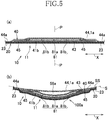
- Fig. 5(a) is a cross-sectional view taken along a line indicated by arrows V-V in Fig. 4
- Fig. 5(b) is a schematic view illustrating a state illustrated in Fig. 5(a) when the diaper 10 is in the worn state.
- This Fig. 5(b) may also be regarded as a cross-sectional view taken along a line indicated by arrows b-b in Fig. 1(a) .
- the crotch panel 40 overlapping with the front waist panel 20 has an upper part provided with the deformation guides 81.
- the inner elastic strip 44 functioning the elastic band 1a contracts in the lateral direction X
- the part of the front waist panel 20 overlapping with the deformation guides 81 and the part between the side deformation guides 81b and 81b are convexly curved outward from the diaper 10, whereby the bulging part 100a in a round shape is formed.
- a wearer in a standing posture may change to a sitting posture to have the abdominal region protruding forward without being oppressed due to the bulging part 100a formed in the diaper 10.
- the front waist panel 20 and the crotch panel 40 overlapping thereon deform in a protruding manner to be spaced apart from the wearer's body with the inner elastic strip 44 being in close contact with the skin S, whereby a space 59a that may allow body exudates to flow thereinto is formed between the skin S and the crotch panel 40 (see Fig. 5(b) ).
- the bulging part 100a is formed in the part of the crotch panel 40 where the deformation guides 81 are provided.
- the contraction amount of the inner elastic strip 44 is substantially consistent among wearers.
- Both side parts 23 of the front waist panel 20 adjacent to the bulging part 100a (see also Fig. 4 ) and both side parts 45 of the crotch panel 40 are integrated with both side parts 44a of the inner elastic strip 44 to be in close contact with the skin S of the wearer (see Fig. 5 ).
- the diaper 10 does not have an outer view giving a bulky impression as a whole, and may prevent body exudates contained in the space 59a from spreading in the lateral direction X.
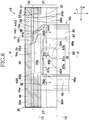
- Fig. 6 is an enlarged view of a part of the crotch panel 40 and the rear waist panel 30 in Fig. 2 .
- the rear waist panel 30 illustrated in Fig. 6 has the rear waist elastic members 34 provided between a peripheral edge 15a of the waist opening 15 and the rear edge 40B of the crotch panel 40, and defines the rear waist elastic area 35 extending in the lateral direction X along the peripheral edge 15a.
- the rear waist panel 30 has a plurality of first auxiliary elastic members 34A and a plurality of second auxiliary elastic members 34B provided on the lower side of the rear waist elastic members 34 in the stretched state.
- the first and the second auxiliary elastic members 34A and 34B form a pair of auxiliary elastic areas 37 provided on both side parts of the rear waist panel 30 without extending across the absorbent structure 42 to face each other in the lateral direction X with the absorbent members 42 provided in between.
- a non-elastic area 39 including no elastic member in the stretched state is formed between the auxiliary elastic areas 37.
- the first and the second auxiliary elastic members 34A and 34B respectively have inner ends 36A and 36B facing the vertical center line P.
- a length D1 between the vertical center line P and the inner end 36A is shorter than a length D2 between the vertical center line P and the inner end 36B.
- a distance between the inner ends 36A facing each other in the lateral direction X that is, a length obtained by doubling D1 is smaller than a distance between the inner ends 36B, that is, a length obtained by doubling D2.
- the inner elastic strip 55 in the rear waist panel 30 is formed of a nonwoven fabric containing elastic yarns such as urethane elastic yarns capable of elastically stretching and contracting or a nonwoven fabric having an elastic member extending in the lateral direction X attached thereto in the stretched state capable of elastically extending.
- the inner elastic strip 55 has a part overlapped with the rear waist elastic area 35 and has both side parts 55a, in the lateral direction X, joined to the inner sheet 32 and both side parts 45 of the crotch panel 40 with hot-melt adhesive HA1 for example.
- the shaded area 49 represent the parts of the inner elastic strip 55 joined to the inner sheet 32 and the crotch panel 40 for easy understanding.
- the inner elastic strip 55 may include the middle part 55b positioned between the both side parts 55a and 55a in the lateral direction X.
- the middle part 55b has the lower part 55c not joined to the rear waist panel 30 and the crotch panel 40 overlapping with the lower part 55c, and has an upper part 55d positioned immediately above the lower part 55c, joined to the rear waist panel 30 with the hot-melt adhesive HA1 for example.
- the lower part 55c is a part of the middle part 55b spreading below the rear waist elastic area 35.
- the middle part 55b illustrated in Fig. 6 has the elastic contraction amount of the lower part 55c in the lateral direction X set to be larger than that of a part of rear waist panel 30 facing the lower part 55c in the thickness direction of the inner elastic strip 55 without being joined to the lower part 55c.
- the difference between the length of the lower part 55c in the lateral direction X and the length of the part of the rear waist panel 30 facing the lower part 55c in the lateral direction X is preferably in a range of 15 to 35 mm in the elastically contracted state, when the length of the middle part 55b in the lateral direction X is in a range of 50 to 100 mm.
- the absorbent structure 42 illustrated in Fig. 6 has deformation guides 82 formed in the core material 46a.
- the deformation guides 82 in the illustrated example overlaps with the non-elastic area 39 of the rear waist panel 30 and may or may not overlap with the inner elastic strip 55 in planary view of the diaper 10 in the stretched state.
- the figure illustrates the non-overlapping state.
- the deformation guides 82 which are slits formed in the core material 46a, extends toward the lower side from a rear edge 46e of the core material 46a, and the lower ends 86b may or may not extend beyond the lower edge 30A of the rear waist panel 30.
- the figure illustrates the state where the lower end 86b does not extend beyond the lower edge 30A.
- the lower end part 86b does not reach the lateral center line Q (see Fig. 2 ).
- the crotch region 13 has the area 89 without the deformation guides 82 formed between the lateral center line Q and the lower end 86b.
- the deformation guides 82 in the illustrated example may include a center deformation guide 82a positioned on the vertical center line P and a pair of side deformation guides 82b and 82b that are on both sides of the center deformation guide 82a in the lateral direction X, and are symmetrical relative to the vertical center line P.
- Fig. 7(a) is a cross-sectional view taken along a line indicated by arrows VII-VII in Fig. 6 and Fig. 7(b) is a schematic view illustrating a state illustrated in Fig. 7(a) , when the diaper 10 is in the worn state.
- the inner elastic strip 55 is illustrated with a dotted line.
- the line indicated by the arrows VII-VII extends across the non-elastic area 39 of the rear waist panel 30.
- the non-elastic area 39 of the rear waist panel 30, which is in a flat state and does not elastically contract, and the part of the crotch panel 40 overlapping with the non-elastic area 39 are curved to protrude toward the clothing-facing surface CS from the skin-facing surface SS by the deformation guides 82 in the crotch panel 40.
- the bulging part 100b in a round shape is formed, and a space 59b is formed between the skin S of the wearer and the bulging part 100b.
- the rear waist panel 30 and the crotch panel 40 are each in contact with the skin S on both outer side parts of the space 59b in the lateral direction X under the contraction of the rear waist elastic members 34, the first auxiliary elastic members 34A, and the second auxiliary elastic members 34B in the rear waist panel 30 (see Fig. 6 ).
- the core material 46a in the crotch panel 40 is sectionalized in the lateral direction X with the deformation guides 82, and thus may easily deform. Thus, a part more on the outer side than the side deformation guides 82b may easily fit a shape of the buttocks.
- the inner elastic strip 55, the lower part 55c of the inner elastic strip 55 functions as the elastic band 1b for forming the bulging part 100b in the rear waist panel 30 and the crotch panel 40.
- a length W of the space 59b in a part where the rear waist panel 30 and the crotch panel 40 overlap with each other in the lateral direction X may be affected by a length (the length that is double the length D1 in Fig. 6 ) between the first auxiliary elastic members 34A in the lateral direction X and by a length (the length that is double the length D2 in Fig. 6 ) between the second auxiliary elastic members 34B.
- the bulging part 100b may be formed with the crotch panel 40 having a part between the side deformation guides 82b and the first auxiliary elastic members 34A and a part between the side deformation guides 82b and the second auxiliary elastic members 34B curving as well, instead of sharply curving at the side deformation guides 82b and 82b.
- the lengths satisfy relationship D1 ⁇ D2.
- the bulging part 100a defining the space 59b has a round shape with the length W gradually increasing from the lower side toward the upper side.
- spandex with 310 to 620 dtex may be stretched by a stretch ratio of 220 to 290% to be used as the rear waist elastic members 34.
- Spandex with 310 to 620 dtex may be stretched by a stretch ratio of 280 to 380% to be used as the first and the second auxiliary elastic members 34A and 34B.
- the deformation guides according to the present invention including the deformation guides 81 and 82 for example may include the deformation guides 81 only or the deformation guides 82 only.
- the quantity, the length in the vertical direction Y, and the length in the lateral direction X of the deformation guides to be formed may be freely set as long as the operations and effects as described above may be achieved.
- the deformation guides 81 and 82 may each have the length in the vertical direction Y set to be 15 to 60 mm, and have the length in the lateral direction X set to be 2 to 10 mm.
- the deformation guides 81a and 81b and/or the deformation guides 82a and 82b may have the same lengths and shape as in the illustrated example, or may have different lengths and shapes.
- the deformation guides 81 and 82 according to the present embodiment are slits extending toward the lower side from the front edge 46d and the rear edge 46e of the core material 46a, but may also be through holes formed on the lower side of the front edge 46d and/or the rear edge 46e.
- the deformation guides may be a bottomed groove formed by partially compressing the core material 46a.
- the groove thus formed in the core material 46a preferably has a depth direction extending from the skin-facing surface SS toward the clothing-facing surface CS.
- the deformation guides may be formed by setting the density of the core material 46a formed of superabsorbent polymer particles, fluff pulp or the like to be higher or lower than the density in a part other than the deformation guides. These deformation guides may be formed to include or not include the wrapping sheet 46b.
- the deformation guides 81 according to the present embodiment extends beyond the lower edge 20A of the front waist panel 20, but may not extend beyond the lower edge 20A.
- the length D1 and the length D2 according to the present embodiment may be the same value. Still, when the length D1 is set to be smaller than the length D2 as described above, the space 59b formed in the rear waist region 12 may be designed to be larger on the inner side than on the opening side so that the accommodated body exudates may be prevented from flowing back toward the opening side of the space 59b.
- the deformation guides 81 and the inner elastic strip 44 provided in the front waist panel 20 in the illustrated example may be used for the rear waist panel 30 instead of the deformation guides82 and the inner elastic strip 55 in the rear waist panel 30.
- the deformation guides 82 and the inner elastic strip 55 may be used for the front waist panel 20.
- the positional relationship between the deformation guides 81 and the inner elastic strip 44 is not limited to the illustrated example.
- the deformation guides 81 and the inner elastic sheet 44, in Figs. 2 and 4 may not overlap with each other.
- the inner elastic strip 44 in the front waist panel 20 may be positioned to be more on the upper or lower side than the position illustrated in the figure.
- the inner elastic strip 55 in the rear waist panel 30 illustrated in Fig. 6 may extend toward the lower side to be overlapped with the absorbent structure 42.
- the disposable absorbent wearing article according to present invention has the configuration as described above so as to be suitably used as disposable diapers not only for infants but also for incontinent male patients or the like.
- the space 59a illustrated in Fig. 5(b) serves as a space suitable for containing the penis or a urine absorbent pad.
- Fig. 8 is a diagram, similar to Fig. 3 , illustrating one exemplary embodiment.
- the front waist panel 20 illustrated in Fig. 8 has the first auxiliary elastic members 24A in the example illustrated in Fig. 3 , extending in the lateral direction X to extend across the core material 46a.
- the first auxiliary elastic members 24A may be in an elastically stretched and contracted state or in a state of not being capable of contracting due to the loss of elasticity in a part provided over the core material 46a.
- the front waist panel 20 is designed to have the elastic contraction amount in the lateral direction X in the part facing the center part 44b of the inner elastic strip 44 set to be smaller than the elastic contraction amount of the middle part 44b of the inner elastic strip 44 in the lateral direction X.
- the first auxiliary elastic members 24A and the second auxiliary elastic members 24B needs not to be distinguished from each other, and thus may be simply and collectively referred to auxiliary elastic members.
- Fig. 9 is a diagram similar to Fig. 2 illustrating another exemplary embodiment.
- a diaper with an outer view similar to that of the diaper 10 in Fig. 1 may be obtained from the diaper 10 in the stretched state in Fig. 9 .
- the core material 46a of the diaper 10 in the stretched state has the deformation guides 81 with the shape and the position that are the same as those in Figs. 2 and 4 , but has the deformation guides 82, which are slits, with the shape and the position that are different from those in Figs. 2 and 6 .
- the deformation guides 82 in Fig. 9 has both upper and lower ends 86b and 86c in the vertical direction Y positioned between the rear edge 46e and the lateral center line Q and not crossing the rear edge 46e of the core material 46a.
- the absorbent structure 42 deforms to be convexly curved in a round shape, and the deformation guides 82 each deform to have a width increasing in the lateral direction X.
- the rear waist panel 30 and the crotch panel 40 form a bulging part similar to the bulging part 100b in the example illustrated in Fig.
- the deformation guides. 81 of the core material 46a may be positioned between the front edge 46d and the lateral center line Q without crossing the front edge 46d of the core material 46a.
- Fig. 10 (a) is a back view of a disposable diaper 10 according to one exemplary embodiment.
- Elastic members such as a later-described rear waist elastic member 34 used in the diaper 10 is in a state of being stretched in the lateral direction X or in the vertical direction Y.
- Fig. 10 (b) is a back view of the diaper 10 in the worn state in Fig. 10 (a) .
- the diaper 10 may include the front waist panel 20, the rear waist panel 30, and the crotch panel 40.
- the rear waist panel 30 has a foldpart 92 (see also Figs. 11 (a) and 11(b) ) extending in the lateral direction X.
- a pair of joining lines 108 and a pair of folding guide lines 109 extending toward the lower side from the fold part 92.
- an inner part 104, an outer part 105, and an intermediate part 106 in a middle part 101 between the joining lines 108 and 108 overlap with each other without being joined to each other.
- the inner part 104, the outer part 105 and the intermediate part 106 are joined to each other in a side 103 between the joining line 108 and the seam 14.
- the diaper 10 further has a folded part 102 formed in the middle part 101.
- the diaper 10 illustrated in Fig. 11(b) has the folded part 102 expanding outward from the diaper 10 so that a bulging part 100c is formed.
- the bulging part 100c is likely to be a substantially consistent shape, as in the illustrated example due to folding guide lines 109 formed in the rear waist panel 30.
- the bending guide lines 109 are not necessarily required in the rear waist panel 30 but are provided to facilitate the formation of the bulging part 100c in particular. These parts may be obtained by creasing the rear waist panel 30 in advance, in a process of manufacturing the rear waist panel 30 for example.
- the diaper 10 further has the side 103 in the rear waist panel 30 coming into contact with the skin S of the wearer (see Fig. 11(b) and Fig. 12 ) under a contracting action of the first and the second auxiliary elastic members 34A and 34B in the side portions 103.
- the front waist panel 20 in Fig. 10(b) is the same as the front waist panel 20 illustrated in Figs. 2 to 4 .
- the rear waist panel 30 is as described later.
- the front waist panel 20 and the rear waist panel 30 further have the front and rear waist elastic areas 25 and 35 coming into contact with the skin S of the wearer.
- the front and rear waist elastic areas 25 and 35 extend along the top edges of the front and the rear waist panels 20 and 30 serving as the peripheral edge 15a of the waist opening 15.
- Figs. 11(a) and 11(b) are partial cross-sectional views taken along lines XI a -XI a and XI b -XI b in Figs. 10(a) and 10(b) respectively.
- Fig. 11(a) illustrates the rear waist panel 30 including the outer sheet 31 and the inner sheet 32 joined to each other with hot-melt adhesives (not illustrated) as the rear waist panel 30 illustrated in Fig. 2 , and further may include the rear waist elastic member 34 that is provided between the outer sheet 31 and the inner sheet 32 and is joined to at least one of the outer sheet 31 and the inner sheet 32 while being in a stretched state.
- the crotch panel 40 is joined to the skin-facing surface SS of the inner sheet 32 with hot-melt adhesive (not illustrated).
- the core material 46a in the absorbent member 42 of the crotch panel 40 has slits serving as the deformation guides 82 as in the crotch panel 40 in the example illustrated in Fig. 9 .
- the figure illustrates a plurality of slits extending in the vertical direction Y on the lower side of the rear edge 46e of the core material 46a.
- the slits serve as the deformation guides that facilitates the rearward bulging of the crotch panel 40 in the front and rear direction of the diaper 10 and folding of the rear waist panel 30 and the crotch panel 40 in the lateral direction X.
- the deformation guides 82 in the illustrated example is an example of a part not overlapping with the inner part 104 of an elastic band 1c (described later) in the thickness direction of the core material 46a.
- the rear waist panel 30 is folded at the fold parts 91 and 92 formed in parts more on the lower side than the rear waist elastic area 35 to have parts overlapping with each other, whereby the folded part 102 is formed that is folded into a Z shape together with the rear waist elastic area 35.
- the folded part 102 is formed by a part of the rear waist elastic area 35 may include the inner part 104 that is elastically contractible in the lateral direction X, and further may include the outer portion 105 and the intermediate part 106 formed of the non-elastic area 39 (see Fig. 3 ) that is an area in the rear waist panel 30, including no elastic member.
- the auxiliary elastic member 34C may be used in the intermediate part 106.
- the auxiliary elastic member 34C has spandex of 310 to 620 dtex stretched by a stretch ratio of 140 to 180%, so that the intermediate part 106 in the state illustrated in Fig. 11(b) may be prevented from further leaning outward of the diaper 10.
- the outer portion 105 is not elastically contractible in the lateral direction X.
- the intermediate part 106 is not elastically stretchable in the lateral direction X.
- Fig. 12 is a cross-sectional view of the rear waist panel 30 taken along line XII-XII in Fig. 10(b) .
- the line XII-XII is a cutting line passing through the side parts 103 of the rear waist panel 30.
- the side part 103 in Fig. 12 has a folded part 112 having a cross-sectional shape, along the upper and lower direction Y in a shape of the letter Z.
- the inner part 104, the outer part 105 and the intermediate part 106 overlap with each other and are joined to each other with hot-melt adhesive (not illustrated), and continues to the inner part 104, the outer part 105 and the intermediate part 106 in Fig. 11 .
- the first and the second auxiliary elastic members 34A and 34B extending in the lateral direction X in the stretched state are provided between the outer sheet 31 and the inner sheet 32.
- the intermediate part 106 facing the inner part 104 without being joined to the inner part 104 in the thickness direction of the inner part 104 has a part 106a connected to the inner part 104, contracted to follow the contacting the movement of the inner part 104.
- the intermediate part 106 further has a part 106b that is connected to the outer part 105 and is difficult to follow the movement of the inner part 104.
- the length of the intermediate part 106 in the lateral direction X does not substantially change even when the length of the intermediate part 106 in the lateral direction X is reduced by the same level as the length of the inner part 104.
- the outer part 105 facing the inner part 104 with the intermediate part 106 provided in between is connected to the rear waist elastic region 35 via the fold parts 91 and 92, and is joined to the crotch panel 40 with high bending stiffness.
- the length of the outer part 105 in the lateral direction X almost does not change or does not change at all, when the inner portion 104 is contracted.
- the contraction amount as a result of the elastic contraction of the inner part 104 is larger than the contraction amount as a result of the contraction of at least the outer portion 105 in the outer part 105 and the intermediate part 106.
- the contraction amounts are compared with each other as described later.
- the inner part 104 with a large contraction amount is contractible in the lateral direction X
- the outer part 105 and the part 106b of the intermediate part 106 with a small elastic contraction amount form the bulging part 100c illustrated in Fig. 10(b) that is protruded outward in a radial direction of the waist opening 15 and curved in the lateral direction X.
- a space 159 from the skin S of the diaper wearer is formed as illustrated in Fig. 11(b) .
- the diaper 10 illustrated in Fig. 11(b) has the bulging part 100c further expanding in a direction indicated by an arrow F when the contraction amount of the inner part 104 increases from that in the illustrated example.
- the space 159 may contain body exudates from a wearer, as in the space 59b in Fig. 7 .
- the outer part 105 and the intermediate part 106 form a pocket 159c with a downward opening.
- the pocket 159c is a part of the space 159.
- the inner part 104 with the configuration described above functions as the elastic band 1c of the diaper 10 in Fig. 10(a) .
- the diaper 10 in the example illustrated in Figs. 10 to 12 also has the side parts 103 positioned on both sides of the space 159 formed in the middle part in the lateral direction X, coming into contact with the skin S of a wearer when elastic contracting force is applied (see Fig. 10 (b) and Fig. 12 ).
- the diaper 10 may have a consistent expanding part of the rear waist panel 30 for forming the space 159 on the inner side of the part, even when the diaper 10 is repeatedly worn and taken off.
- the rear waist panel 30 comes into contact with the skin S, whereby body exudates may be prevented from spreading out from the space 159 in the lateral direction X.
- the front waist panel 20 and the crotch panel 40 of this diaper 10 may be those in the exemplary mode illustrated in Fig. 4 .
- the elastic contraction amounts of the elastic bands 1a, 1b, and 1c and other parts may be measured and compared in the following manner.
- the middle part 44b of the inner elastic strip 44 in Fig. 4 and a component part of the diaper facing the middle part 44b in the thickness direction of the middle part 44b are compared with each other as follows. First of all, the diaper 10 in the stretched state, as a result of stretching the diaper 10 in the lateral direction X and the upper and lower direction Y until the gather disappears is prepared. In the diaper 10 in the stretched state, a straight line, for obtaining an entire length of a contraction amount measurement target range in the lateral direction X, is drawn on each of the middle part 44b and the part facing the middle part 44b.
- a length (entire length) is L 1 measured on each straight line.
- measurement samples are obtained by cutting away the middle part 44b and the part facing the middle part 44b from the diaper 10 in the stretched state.
- the measurement samples are placed on a flat surface to be contracted.
- a length L 2 of the straight line drawn on each of the contracted measurement samples is measured with the samples each held with a scale or the finger to be maintained in a linear form.
- An elastic contraction amount L 3 is obtained as a difference between the length L 1 and the length L 2 .
- the elastic contraction amounts L 3 of the samples are compared with each other.
- the center part 44b and the part facing the center part 44b are joined to each other with hot-melt adhesive and thus may be difficult to cut away from the diaper 10 in the stretched state.
- the hot-melt adhesive may be dissolved with a toluene solution.
- the length L 1 and the length L 2 are preferably accurately measured in an order of 0.1 mm.
- a length of one part over the entire length may be measured and the entire length may be derived from the length thus measured.
Landscapes
- Health & Medical Sciences (AREA)
- Epidemiology (AREA)
- Engineering & Computer Science (AREA)
- Biomedical Technology (AREA)
- Heart & Thoracic Surgery (AREA)
- Vascular Medicine (AREA)
- Life Sciences & Earth Sciences (AREA)
- Animal Behavior & Ethology (AREA)
- General Health & Medical Sciences (AREA)
- Public Health (AREA)
- Veterinary Medicine (AREA)
- Absorbent Articles And Supports Therefor (AREA)
Claims (15)
- Tragbarer absorbierender Einwegartikel (10), der eine Oben-unten-Richtung (Y) und eine laterale Richtung (X) aufweist, die einander schneiden, wenn der tragbare absorbierende Einwegartikel in einem getragenen Zustand vorliegt, wobei der tragbare absorbierende Einwegartikel Folgendes umfasst:einen vorderen Taillenbereich (11), der durch eine vordere Taillenblende (20) definiert ist;einen hinteren Taillenbereich (12), der durch eine hintere Taillenblende (30) definiert ist;einen Schrittbereich (13), der zwischen dem vorderen und dem hinteren Taillenbereich positioniert ist und durch einen Schritteinsatz (40) definiert ist, wobeider vordere Taillenbereich, der hintere Taillenbereich und der Schrittbereich jeweils eine der Haut zugewandte Oberfläche und eine der Kleidung zugewandte Oberfläche aufweisen, die einer Haut bzw. einer Kleidung eines Trägers zugewandt sind,sich eine absorbierende Struktur (42), die ein Saugkernmaterial (46a) in dem Schritteinsatz einschließt, in den vorderen und den hinteren Taillenbereich erstreckt,mindestens ein Taillenbereich des vorderen und des hinteren Taillenbereichs ein elastisches Band (1a, 1b) einschließt, das einen Teil der der Haut zugewandten Oberfläche bildet und einen mittleren Teil in der lateralen Richtung aufweist, der sich in der lateralen Richtung (x) elastisch zusammenzieht,dadurch gekennzeichnet, dassin dem mindestens einen Taillenbereich ein Ausmaß des elastischen Zusammenziehens des mittleren Teils des elastischen Bands in der lateralen Richtung größer ist als ein Ausmaß des elastischen Zusammenziehens eines Komponententeils des Artikels, der dem mittleren Teil zugewandt ist, ohne mit dem mittleren Teil verbunden zu sein, in der Dickenrichtung (Z) des mittleren Teils in der lateralen Richtung undin dem Kernmaterial in dem mindestens einen Taillenbereich eine Verformungsführung (81, 82) ausgebildet ist, die sich in einer Richtung erstreckt, um das elastische Band zu schneiden und das Biegen des Kernmaterials in der lateralen Richtung zu ermöglichen.
- Tragbarer Artikel nach Anspruch 1, wobei das elastische Band (1a, 1b) aus einem elastischen Streifen ausgebildet ist, dessen beide Seitenanschlüsse in der lateralen Richtung mit dem mindestens einen Taillenbereich verbunden sind und der mindestens einen unteren Teil des mittleren Teils aufweist, der nicht mit dem mindestens einen Taillenbereich verbunden ist.
- Tragbarer Artikel nach Anspruch 1 oder 2, wobei der mindestens eine Taillenbereich Folgendes einschließt: eine äußere Lage (21, 31), die die der Bekleidung zugewandte Oberfläche bildet, eine innere Lage (22, 23), die die der Haut zugewandte Oberfläche bildet, und ein elastisches Element (24, 34), das zwischen der äußeren Lage und der inneren Lage bereitgestellt ist und sich in der lateralen Richtung dehnt.
- Tragbarer Artikel nach Anspruch 3, wobei in dem mindestens einen Taillenbereich eine unelastische Fläche (29, 39) in dem Teil, der dem mittleren Teil zugewandt ist, ausgebildet ist.
- Tragbarer Artikel nach Anspruch 1, wobei
der mindestens eine Taillenbereich eine elastische Taillenfläche (25, 35) einschließt, die sich entlang eines oberen Rands des Taillenbereichs erstreckt und sich in der lateralen Richtung elastisch zusammenziehen kann, und einen Teil aufweist, der weiter auf einer unteren Seite positioniert ist als der elastische Taillenbereich, der in der Oben-unten-Richtung überlappend gefaltet ist, sodass ein Z-förmiger gefalteter Teil ausgebildet wird, und
in dem Z-förmigen gefalteten Teil beide Seitenteile, die an beiden Seiten in der lateralen Richtung positioniert sind, überlappend gefaltet sind und miteinander verbunden sind, ein Teil zwischen beiden Seitenteilen in einem nicht verbundenen Zustand vorliegt und ein Teil der elastischen Taillenfläche das elastische Band ausbildet. - Tragbarer Artikel nach einem der Ansprüche 1 bis 5, wobei die Verformungsführung (81, 82) an einer Position vorliegt, die mit dem elastischen Band (1a, 1b) in planarer Ansicht der Windel überlappt.
- Tragbarer Artikel nach einem der Ansprüche 1 bis 5, wobei die Verformungsführung (81, 82) an einer Position vorliegt, die nicht mit dem elastischen Band in planarer Ansicht der Windel überlappt.
- Tragbarer Artikel nach einem der Ansprüche 1 bis 7, wobei das elastische Band (1a, 1b) aus einem Vliesstoff ausgebildet ist, der elastische Garne einschließt, und der Vliesstoff in einem Zustand vorliegt, in dem er in der lateralen Richtung zumindest in der Mitte des elastischen Bands elastisch gedehnt ist.
- Tragbarer Artikel nach einem der Ansprüche 1 bis 7, wobei das elastische Band aus einem Vliesstoff ausgebildet ist, an dem ein schnurähnliches oder streifenähnliches elastische Element, das sich linear in der lateralen Richtung erstreckt, zusammenziehbar angebracht ist.
- Tragbarer Artikel nach einem der Ansprüche 1 bis 9, wobei
eine Vielzahl von schnurähnlichen oder streifenähnlichen elastischen Elementen, die sich linear in der lateralen Richtung erstrecken, an dem mindestens einen Taillenbereich zusammenziehbar angebracht ist, während sie nebeneinander entlang der Oben-unten-Richtung angeordnet sind, und
die Vielzahl von elastischen Elementen (36A, 36B) ein elastisches Element einschließt, das ein inneres Ende aufweist, das einer vertikalen Mittellinie zugewandt ist, die eine Länge der Windel in der lateralen Richtung gleichmäßig teilt. - Tragbarer Artikel nach Anspruch 10, wobei eine Länge eines Abstands zwischen der vertikalen Mittellinie und dem inneren Ende von mindestens einem der Vielzahl von elastischen Elementen (34A), die in einem untersten Teil in der Oben-unten-Richtung positioniert sind, kleiner ist als eine Länge eines Abstands zwischen der vertikalen Mittellinie und dem inneren Ende von einem der elastischen Elemente (34B), die mehr an einer oberen Seite als das mindestens eine elastische Element positioniert sind.
- Tragbarer Artikel nach einem der Ansprüche 1 bis 11, wobei die Verformungsführung (81, 82) mindestens ein Schlitz oder eine Rille ist, der/die in dem Kernmaterial des Schritteinsatzes (40) ausgebildet ist, und sich in der Oben-unten-Richtung (Y) erstreckt.
- Tragbarer Artikel nach Anspruch 12, wobei der Schlitz einen Schlitz (81a, 82a) einschließt, der auf einer vertikalen Mittellinie positioniert ist, die eine Länge des tragbaren Artikels in der lateralen Richtung und Schlitze (81b, 82b), die symmetrisch um die vertikale Mittellinie ausgebildet sind, gleichmäßig teilt.
- Tragbarer Artikel nach Anspruch 12 oder 13, wobei der Schlitz beide Enden (86a, 86b, 87a, 87b) in der Oben-unten-Richtung aufweist, die in mindestens einem von einem Teil zwischen einem vorderen Rand des Kernmaterials und einer lateralen Mittellinie des tragbaren Materials und einem Teil zwischen einem hinteren Rand des Kernmaterials und der lateralen Mittellinie ausgebildet sind.
- Tragbarer Artikel nach einem der Ansprüche 1 bis 14, wobei das Kernmaterial (46a) mindestens eine von einer Dicke und einer Dichte aufweist, die zwischen Teilen, die an die Verformungsführung in der lateralen Richtung (X) angrenzen, und der Verformungsführung (81, 82) variieren.
Applications Claiming Priority (2)
| Application Number | Priority Date | Filing Date | Title |
|---|---|---|---|
| JP2015132229A JP5946568B1 (ja) | 2015-06-30 | 2015-06-30 | 使い捨ての体液吸収性着用物品 |
| PCT/JP2016/064842 WO2017002479A1 (ja) | 2015-06-30 | 2016-05-19 | 使い捨て体液吸収性着用物品 |
Publications (3)
| Publication Number | Publication Date |
|---|---|
| EP3318232A4 EP3318232A4 (de) | 2018-05-09 |
| EP3318232A1 EP3318232A1 (de) | 2018-05-09 |
| EP3318232B1 true EP3318232B1 (de) | 2020-09-30 |
Family
ID=56329465
Family Applications (1)
| Application Number | Title | Priority Date | Filing Date |
|---|---|---|---|
| EP16817588.3A Active EP3318232B1 (de) | 2015-06-30 | 2016-05-19 | Absorbierender einweg-bekleidungsartikel |
Country Status (7)
| Country | Link |
|---|---|
| US (1) | US10813795B2 (de) |
| EP (1) | EP3318232B1 (de) |
| JP (1) | JP5946568B1 (de) |
| KR (1) | KR102539926B1 (de) |
| CN (1) | CN107613928B (de) |
| EA (1) | EA033732B1 (de) |
| WO (1) | WO2017002479A1 (de) |
Families Citing this family (4)
| Publication number | Priority date | Publication date | Assignee | Title |
|---|---|---|---|---|
| US11096835B2 (en) * | 2016-12-19 | 2021-08-24 | The Procter & Gamble Company | Methods for sealing absorbent cores on absorbent articles |
| JP6976129B2 (ja) * | 2017-10-12 | 2021-12-08 | ユニ・チャーム株式会社 | 着用物品 |
| CN212166013U (zh) * | 2018-12-29 | 2020-12-18 | 尤妮佳股份有限公司 | 短裤型尿布 |
| JP7509637B2 (ja) * | 2020-09-25 | 2024-07-02 | 大王製紙株式会社 | 使い捨ておむつ |
Family Cites Families (13)
| Publication number | Priority date | Publication date | Assignee | Title |
|---|---|---|---|---|
| JP2511428Y2 (ja) * | 1990-07-11 | 1996-09-25 | 株式会社資生堂 | 使捨ておむつ |
| US5662636A (en) * | 1994-08-31 | 1997-09-02 | The Procter & Gamble Company | Absorbent article having cuffs with unsecured rear distal edges |
| JP3406232B2 (ja) * | 1998-11-06 | 2003-05-12 | ユニ・チャーム株式会社 | 使い捨ておむつ |
| US6280426B1 (en) * | 1999-02-19 | 2001-08-28 | Kimberly-Clark Worldwide, Inc. | Absorbent article with a flap and biasing spacer |
| JP2000288016A (ja) | 1999-04-07 | 2000-10-17 | Kao Corp | 吸収性物品 |
| JP3734720B2 (ja) * | 2001-05-18 | 2006-01-11 | ユニ・チャーム株式会社 | パンツ型の使い捨て着用物品 |
| CA2712018A1 (en) * | 2008-01-16 | 2009-07-23 | Uni-Charm Corporation | Pants type disposable diaper |
| JP5328203B2 (ja) * | 2008-03-31 | 2013-10-30 | ユニ・チャーム株式会社 | 使い捨て吸収性着用物品 |
| JP5530252B2 (ja) * | 2010-05-20 | 2014-06-25 | ユニ・チャーム株式会社 | 使い捨て着用物品 |
| JP5855901B2 (ja) * | 2010-11-02 | 2016-02-09 | 花王株式会社 | 使い捨ておむつ |
| JP6228794B2 (ja) * | 2013-09-26 | 2017-11-08 | 大王製紙株式会社 | テープ式使い捨て紙おむつ |
| JP6219691B2 (ja) * | 2013-11-14 | 2017-10-25 | 花王株式会社 | パンツ型使い捨ておむつ |
| WO2015072218A1 (ja) | 2013-11-14 | 2015-05-21 | 花王株式会社 | パンツ型吸収性物品 |
-
2015
- 2015-06-30 JP JP2015132229A patent/JP5946568B1/ja active Active
-
2016
- 2016-05-19 EP EP16817588.3A patent/EP3318232B1/de active Active
- 2016-05-19 US US15/740,855 patent/US10813795B2/en active Active
- 2016-05-19 EA EA201792557A patent/EA033732B1/ru not_active IP Right Cessation
- 2016-05-19 CN CN201680030055.4A patent/CN107613928B/zh active Active
- 2016-05-19 KR KR1020177034264A patent/KR102539926B1/ko active Active
- 2016-05-19 WO PCT/JP2016/064842 patent/WO2017002479A1/ja not_active Ceased
Non-Patent Citations (1)
| Title |
|---|
| None * |
Also Published As
| Publication number | Publication date |
|---|---|
| EA033732B1 (ru) | 2019-11-20 |
| WO2017002479A1 (ja) | 2017-01-05 |
| JP2017012460A (ja) | 2017-01-19 |
| EA201792557A1 (ru) | 2018-07-31 |
| EP3318232A4 (de) | 2018-05-09 |
| JP5946568B1 (ja) | 2016-07-06 |
| US10813795B2 (en) | 2020-10-27 |
| KR20180023896A (ko) | 2018-03-07 |
| KR102539926B1 (ko) | 2023-06-02 |
| CN107613928B (zh) | 2020-11-20 |
| CN107613928A (zh) | 2018-01-19 |
| US20180193206A1 (en) | 2018-07-12 |
| EP3318232A1 (de) | 2018-05-09 |
Similar Documents
| Publication | Publication Date | Title |
|---|---|---|
| EP2760407B1 (de) | Einwegbekleidungsartikel | |
| KR100426507B1 (ko) | 흡수체 제품 | |
| EP2540269B1 (de) | Einweg tragbarer artikel | |
| JP6364213B2 (ja) | 吸収性物品 | |
| JP5988620B2 (ja) | 使い捨て着用物品 | |
| EP3351222B1 (de) | Einweg-gebrauchsartikel | |
| EA022153B1 (ru) | Предмет одежды | |
| JP5383018B2 (ja) | 使い捨ておむつ | |
| EA023356B1 (ru) | Предмет одежды одноразового использования | |
| CN107613926B (zh) | 一次性穿用物品 | |
| WO2009122801A1 (ja) | 使い捨て吸収性着用物品 | |
| US10813795B2 (en) | Disposable absorbent wearing article | |
| WO2016208255A1 (ja) | 吸収性物品 | |
| EP3342384B1 (de) | Einwegkleidungsartikel | |
| JP5907603B2 (ja) | 使い捨て着用物品 | |
| JP7178172B2 (ja) | 吸収性物品 | |
| CN212662100U (zh) | 吸收性物品 | |
| US8377026B2 (en) | Absorbent wearing article and method for making the same | |
| JP2019118574A (ja) | 吸収性物品 | |
| CN111542293A (zh) | 吸收性物品 | |
| JP6150875B2 (ja) | 使い捨て着用物品 | |
| JP2021132700A (ja) | パンツ型使い捨ておむつ |
Legal Events
| Date | Code | Title | Description |
|---|---|---|---|
| STAA | Information on the status of an ep patent application or granted ep patent |
Free format text: STATUS: THE INTERNATIONAL PUBLICATION HAS BEEN MADE |
|
| PUAI | Public reference made under article 153(3) epc to a published international application that has entered the european phase |
Free format text: ORIGINAL CODE: 0009012 |
|
| STAA | Information on the status of an ep patent application or granted ep patent |
Free format text: STATUS: REQUEST FOR EXAMINATION WAS MADE |
|
| 17P | Request for examination filed |
Effective date: 20171222 |
|
| A4 | Supplementary search report drawn up and despatched |
Effective date: 20180320 |
|
| AK | Designated contracting states |
Kind code of ref document: A1 Designated state(s): AL AT BE BG CH CY CZ DE DK EE ES FI FR GB GR HR HU IE IS IT LI LT LU LV MC MK MT NL NO PL PT RO RS SE SI SK SM TR |
|
| AX | Request for extension of the european patent |
Extension state: BA ME |
|
| DAV | Request for validation of the european patent (deleted) | ||
| DAX | Request for extension of the european patent (deleted) | ||
| GRAP | Despatch of communication of intention to grant a patent |
Free format text: ORIGINAL CODE: EPIDOSNIGR1 |
|
| STAA | Information on the status of an ep patent application or granted ep patent |
Free format text: STATUS: GRANT OF PATENT IS INTENDED |
|
| INTG | Intention to grant announced |
Effective date: 20200527 |
|
| GRAS | Grant fee paid |
Free format text: ORIGINAL CODE: EPIDOSNIGR3 |
|
| GRAA | (expected) grant |
Free format text: ORIGINAL CODE: 0009210 |
|
| STAA | Information on the status of an ep patent application or granted ep patent |
Free format text: STATUS: THE PATENT HAS BEEN GRANTED |
|
| AK | Designated contracting states |
Kind code of ref document: B1 Designated state(s): AL AT BE BG CH CY CZ DE DK EE ES FI FR GB GR HR HU IE IS IT LI LT LU LV MC MK MT NL NO PL PT RO RS SE SI SK SM TR |
|
| REG | Reference to a national code |
Ref country code: CH Ref legal event code: EP Ref country code: GB Ref legal event code: FG4D |
|
| REG | Reference to a national code |
Ref country code: AT Ref legal event code: REF Ref document number: 1318016 Country of ref document: AT Kind code of ref document: T Effective date: 20201015 |
|
| REG | Reference to a national code |
Ref country code: DE Ref legal event code: R096 Ref document number: 602016045096 Country of ref document: DE |
|
| REG | Reference to a national code |
Ref country code: IE Ref legal event code: FG4D |
|
| REG | Reference to a national code |
Ref country code: NL Ref legal event code: FP |
|
| REG | Reference to a national code |
Ref country code: SE Ref legal event code: TRGR |
|
| PG25 | Lapsed in a contracting state [announced via postgrant information from national office to epo] |
Ref country code: HR Free format text: LAPSE BECAUSE OF FAILURE TO SUBMIT A TRANSLATION OF THE DESCRIPTION OR TO PAY THE FEE WITHIN THE PRESCRIBED TIME-LIMIT Effective date: 20200930 Ref country code: BG Free format text: LAPSE BECAUSE OF FAILURE TO SUBMIT A TRANSLATION OF THE DESCRIPTION OR TO PAY THE FEE WITHIN THE PRESCRIBED TIME-LIMIT Effective date: 20201230 Ref country code: FI Free format text: LAPSE BECAUSE OF FAILURE TO SUBMIT A TRANSLATION OF THE DESCRIPTION OR TO PAY THE FEE WITHIN THE PRESCRIBED TIME-LIMIT Effective date: 20200930 Ref country code: NO Free format text: LAPSE BECAUSE OF FAILURE TO SUBMIT A TRANSLATION OF THE DESCRIPTION OR TO PAY THE FEE WITHIN THE PRESCRIBED TIME-LIMIT Effective date: 20201230 Ref country code: GR Free format text: LAPSE BECAUSE OF FAILURE TO SUBMIT A TRANSLATION OF THE DESCRIPTION OR TO PAY THE FEE WITHIN THE PRESCRIBED TIME-LIMIT Effective date: 20201231 |
|
| REG | Reference to a national code |
Ref country code: AT Ref legal event code: MK05 Ref document number: 1318016 Country of ref document: AT Kind code of ref document: T Effective date: 20200930 |
|
| PG25 | Lapsed in a contracting state [announced via postgrant information from national office to epo] |
Ref country code: RS Free format text: LAPSE BECAUSE OF FAILURE TO SUBMIT A TRANSLATION OF THE DESCRIPTION OR TO PAY THE FEE WITHIN THE PRESCRIBED TIME-LIMIT Effective date: 20200930 Ref country code: LV Free format text: LAPSE BECAUSE OF FAILURE TO SUBMIT A TRANSLATION OF THE DESCRIPTION OR TO PAY THE FEE WITHIN THE PRESCRIBED TIME-LIMIT Effective date: 20200930 |
|
| REG | Reference to a national code |
Ref country code: LT Ref legal event code: MG4D |
|
| PG25 | Lapsed in a contracting state [announced via postgrant information from national office to epo] |
Ref country code: EE Free format text: LAPSE BECAUSE OF FAILURE TO SUBMIT A TRANSLATION OF THE DESCRIPTION OR TO PAY THE FEE WITHIN THE PRESCRIBED TIME-LIMIT Effective date: 20200930 Ref country code: SM Free format text: LAPSE BECAUSE OF FAILURE TO SUBMIT A TRANSLATION OF THE DESCRIPTION OR TO PAY THE FEE WITHIN THE PRESCRIBED TIME-LIMIT Effective date: 20200930 Ref country code: LT Free format text: LAPSE BECAUSE OF FAILURE TO SUBMIT A TRANSLATION OF THE DESCRIPTION OR TO PAY THE FEE WITHIN THE PRESCRIBED TIME-LIMIT Effective date: 20200930 Ref country code: CZ Free format text: LAPSE BECAUSE OF FAILURE TO SUBMIT A TRANSLATION OF THE DESCRIPTION OR TO PAY THE FEE WITHIN THE PRESCRIBED TIME-LIMIT Effective date: 20200930 Ref country code: PT Free format text: LAPSE BECAUSE OF FAILURE TO SUBMIT A TRANSLATION OF THE DESCRIPTION OR TO PAY THE FEE WITHIN THE PRESCRIBED TIME-LIMIT Effective date: 20210201 Ref country code: RO Free format text: LAPSE BECAUSE OF FAILURE TO SUBMIT A TRANSLATION OF THE DESCRIPTION OR TO PAY THE FEE WITHIN THE PRESCRIBED TIME-LIMIT Effective date: 20200930 |
|
| PG25 | Lapsed in a contracting state [announced via postgrant information from national office to epo] |
Ref country code: PL Free format text: LAPSE BECAUSE OF FAILURE TO SUBMIT A TRANSLATION OF THE DESCRIPTION OR TO PAY THE FEE WITHIN THE PRESCRIBED TIME-LIMIT Effective date: 20200930 Ref country code: IS Free format text: LAPSE BECAUSE OF FAILURE TO SUBMIT A TRANSLATION OF THE DESCRIPTION OR TO PAY THE FEE WITHIN THE PRESCRIBED TIME-LIMIT Effective date: 20210130 Ref country code: ES Free format text: LAPSE BECAUSE OF FAILURE TO SUBMIT A TRANSLATION OF THE DESCRIPTION OR TO PAY THE FEE WITHIN THE PRESCRIBED TIME-LIMIT Effective date: 20200930 Ref country code: AL Free format text: LAPSE BECAUSE OF FAILURE TO SUBMIT A TRANSLATION OF THE DESCRIPTION OR TO PAY THE FEE WITHIN THE PRESCRIBED TIME-LIMIT Effective date: 20200930 Ref country code: AT Free format text: LAPSE BECAUSE OF FAILURE TO SUBMIT A TRANSLATION OF THE DESCRIPTION OR TO PAY THE FEE WITHIN THE PRESCRIBED TIME-LIMIT Effective date: 20200930 |
|
| PG25 | Lapsed in a contracting state [announced via postgrant information from national office to epo] |
Ref country code: SK Free format text: LAPSE BECAUSE OF FAILURE TO SUBMIT A TRANSLATION OF THE DESCRIPTION OR TO PAY THE FEE WITHIN THE PRESCRIBED TIME-LIMIT Effective date: 20200930 |
|
| REG | Reference to a national code |
Ref country code: DE Ref legal event code: R097 Ref document number: 602016045096 Country of ref document: DE |
|
| PLBE | No opposition filed within time limit |
Free format text: ORIGINAL CODE: 0009261 |
|
| STAA | Information on the status of an ep patent application or granted ep patent |
Free format text: STATUS: NO OPPOSITION FILED WITHIN TIME LIMIT |
|
| PG25 | Lapsed in a contracting state [announced via postgrant information from national office to epo] |
Ref country code: DK Free format text: LAPSE BECAUSE OF FAILURE TO SUBMIT A TRANSLATION OF THE DESCRIPTION OR TO PAY THE FEE WITHIN THE PRESCRIBED TIME-LIMIT Effective date: 20200930 |
|
| 26N | No opposition filed |
Effective date: 20210701 |
|
| PG25 | Lapsed in a contracting state [announced via postgrant information from national office to epo] |
Ref country code: IT Free format text: LAPSE BECAUSE OF FAILURE TO SUBMIT A TRANSLATION OF THE DESCRIPTION OR TO PAY THE FEE WITHIN THE PRESCRIBED TIME-LIMIT Effective date: 20200930 |
|
| PG25 | Lapsed in a contracting state [announced via postgrant information from national office to epo] |
Ref country code: SI Free format text: LAPSE BECAUSE OF FAILURE TO SUBMIT A TRANSLATION OF THE DESCRIPTION OR TO PAY THE FEE WITHIN THE PRESCRIBED TIME-LIMIT Effective date: 20200930 |
|
| REG | Reference to a national code |
Ref country code: CH Ref legal event code: PL |
|
| PG25 | Lapsed in a contracting state [announced via postgrant information from national office to epo] |
Ref country code: LI Free format text: LAPSE BECAUSE OF NON-PAYMENT OF DUE FEES Effective date: 20210531 Ref country code: LU Free format text: LAPSE BECAUSE OF NON-PAYMENT OF DUE FEES Effective date: 20210519 Ref country code: MC Free format text: LAPSE BECAUSE OF FAILURE TO SUBMIT A TRANSLATION OF THE DESCRIPTION OR TO PAY THE FEE WITHIN THE PRESCRIBED TIME-LIMIT Effective date: 20200930 Ref country code: CH Free format text: LAPSE BECAUSE OF NON-PAYMENT OF DUE FEES Effective date: 20210531 |
|
| REG | Reference to a national code |
Ref country code: BE Ref legal event code: MM Effective date: 20210531 |
|
| PG25 | Lapsed in a contracting state [announced via postgrant information from national office to epo] |
Ref country code: IE Free format text: LAPSE BECAUSE OF NON-PAYMENT OF DUE FEES Effective date: 20210519 |
|
| PG25 | Lapsed in a contracting state [announced via postgrant information from national office to epo] |
Ref country code: IS Free format text: LAPSE BECAUSE OF FAILURE TO SUBMIT A TRANSLATION OF THE DESCRIPTION OR TO PAY THE FEE WITHIN THE PRESCRIBED TIME-LIMIT Effective date: 20210130 |
|
| PG25 | Lapsed in a contracting state [announced via postgrant information from national office to epo] |
Ref country code: BE Free format text: LAPSE BECAUSE OF NON-PAYMENT OF DUE FEES Effective date: 20210531 |
|
| PG25 | Lapsed in a contracting state [announced via postgrant information from national office to epo] |
Ref country code: CY Free format text: LAPSE BECAUSE OF FAILURE TO SUBMIT A TRANSLATION OF THE DESCRIPTION OR TO PAY THE FEE WITHIN THE PRESCRIBED TIME-LIMIT Effective date: 20200930 |
|
| PG25 | Lapsed in a contracting state [announced via postgrant information from national office to epo] |
Ref country code: HU Free format text: LAPSE BECAUSE OF FAILURE TO SUBMIT A TRANSLATION OF THE DESCRIPTION OR TO PAY THE FEE WITHIN THE PRESCRIBED TIME-LIMIT; INVALID AB INITIO Effective date: 20160519 |
|
| PG25 | Lapsed in a contracting state [announced via postgrant information from national office to epo] |
Ref country code: MK Free format text: LAPSE BECAUSE OF FAILURE TO SUBMIT A TRANSLATION OF THE DESCRIPTION OR TO PAY THE FEE WITHIN THE PRESCRIBED TIME-LIMIT Effective date: 20200930 |
|
| PG25 | Lapsed in a contracting state [announced via postgrant information from national office to epo] |
Ref country code: MT Free format text: LAPSE BECAUSE OF FAILURE TO SUBMIT A TRANSLATION OF THE DESCRIPTION OR TO PAY THE FEE WITHIN THE PRESCRIBED TIME-LIMIT Effective date: 20200930 |
|
| PGFP | Annual fee paid to national office [announced via postgrant information from national office to epo] |
Ref country code: NL Payment date: 20250409 Year of fee payment: 10 |
|
| PGFP | Annual fee paid to national office [announced via postgrant information from national office to epo] |
Ref country code: DE Payment date: 20250402 Year of fee payment: 10 |
|
| PGFP | Annual fee paid to national office [announced via postgrant information from national office to epo] |
Ref country code: FR Payment date: 20250401 Year of fee payment: 10 |
|
| PGFP | Annual fee paid to national office [announced via postgrant information from national office to epo] |
Ref country code: SE Payment date: 20250411 Year of fee payment: 10 |
|
| PG25 | Lapsed in a contracting state [announced via postgrant information from national office to epo] |
Ref country code: TR Free format text: LAPSE BECAUSE OF FAILURE TO SUBMIT A TRANSLATION OF THE DESCRIPTION OR TO PAY THE FEE WITHIN THE PRESCRIBED TIME-LIMIT Effective date: 20200930 |
|
| PGFP | Annual fee paid to national office [announced via postgrant information from national office to epo] |
Ref country code: GB Payment date: 20260317 Year of fee payment: 11 |