EP3318340A1 - Procédé de lavage de récipient de stockage de sévoflurane et procédé de stockage de sévoflurane - Google Patents
Procédé de lavage de récipient de stockage de sévoflurane et procédé de stockage de sévoflurane Download PDFInfo
- Publication number
- EP3318340A1 EP3318340A1 EP16206444.8A EP16206444A EP3318340A1 EP 3318340 A1 EP3318340 A1 EP 3318340A1 EP 16206444 A EP16206444 A EP 16206444A EP 3318340 A1 EP3318340 A1 EP 3318340A1
- Authority
- EP
- European Patent Office
- Prior art keywords
- sevoflurane
- storage container
- liquid
- washing
- water
- Prior art date
- Legal status (The legal status is an assumption and is not a legal conclusion. Google has not performed a legal analysis and makes no representation as to the accuracy of the status listed.)
- Withdrawn
Links
- DFEYYRMXOJXZRJ-UHFFFAOYSA-N sevoflurane Chemical compound FCOC(C(F)(F)F)C(F)(F)F DFEYYRMXOJXZRJ-UHFFFAOYSA-N 0.000 title claims abstract description 485
- 229960002078 sevoflurane Drugs 0.000 title claims abstract description 478
- 238000003860 storage Methods 0.000 title claims abstract description 371
- 238000005406 washing Methods 0.000 title claims abstract description 172
- 238000000034 method Methods 0.000 title claims abstract description 103
- 239000007788 liquid Substances 0.000 claims abstract description 289
- XLYOFNOQVPJJNP-UHFFFAOYSA-N water Substances O XLYOFNOQVPJJNP-UHFFFAOYSA-N 0.000 claims abstract description 224
- 238000001035 drying Methods 0.000 claims abstract description 64
- 229920000570 polyether Polymers 0.000 claims description 157
- 239000004721 Polyphenylene oxide Substances 0.000 claims description 155
- 238000011049 filling Methods 0.000 claims description 26
- 239000007924 injection Substances 0.000 claims description 23
- 238000002347 injection Methods 0.000 claims description 23
- 239000000203 mixture Substances 0.000 claims description 20
- 239000010935 stainless steel Substances 0.000 claims description 16
- 229910001220 stainless steel Inorganic materials 0.000 claims description 16
- 239000007921 spray Substances 0.000 claims description 15
- 239000000825 pharmaceutical preparation Substances 0.000 claims description 13
- 229940127557 pharmaceutical product Drugs 0.000 claims description 13
- 238000004817 gas chromatography Methods 0.000 claims description 10
- 150000001875 compounds Chemical class 0.000 claims description 9
- 238000007789 sealing Methods 0.000 claims description 9
- 239000011521 glass Substances 0.000 claims description 6
- 238000004519 manufacturing process Methods 0.000 claims description 6
- 239000000463 material Substances 0.000 claims description 6
- 239000011347 resin Substances 0.000 claims description 5
- 229920005989 resin Polymers 0.000 claims description 5
- 238000005507 spraying Methods 0.000 claims description 3
- 239000007789 gas Substances 0.000 description 84
- OKKJLVBELUTLKV-UHFFFAOYSA-N Methanol Chemical compound OC OKKJLVBELUTLKV-UHFFFAOYSA-N 0.000 description 63
- RTZKZFJDLAIYFH-UHFFFAOYSA-N Diethyl ether Chemical compound CCOCC RTZKZFJDLAIYFH-UHFFFAOYSA-N 0.000 description 33
- CSCPPACGZOOCGX-UHFFFAOYSA-N Acetone Chemical compound CC(C)=O CSCPPACGZOOCGX-UHFFFAOYSA-N 0.000 description 28
- 239000012071 phase Substances 0.000 description 22
- 239000000047 product Substances 0.000 description 21
- 239000000126 substance Substances 0.000 description 19
- IJGRMHOSHXDMSA-UHFFFAOYSA-N Atomic nitrogen Chemical compound N#N IJGRMHOSHXDMSA-UHFFFAOYSA-N 0.000 description 16
- BYEAHWXPCBROCE-UHFFFAOYSA-N 1,1,1,3,3,3-hexafluoropropan-2-ol Chemical compound FC(F)(F)C(O)C(F)(F)F BYEAHWXPCBROCE-UHFFFAOYSA-N 0.000 description 13
- 239000002904 solvent Substances 0.000 description 13
- 239000003814 drug Substances 0.000 description 10
- 238000004458 analytical method Methods 0.000 description 9
- 230000000694 effects Effects 0.000 description 8
- 239000012535 impurity Substances 0.000 description 8
- 239000002356 single layer Substances 0.000 description 8
- 239000011261 inert gas Substances 0.000 description 7
- 239000007791 liquid phase Substances 0.000 description 7
- 229910052757 nitrogen Inorganic materials 0.000 description 7
- 239000003960 organic solvent Substances 0.000 description 7
- 229920006395 saturated elastomer Polymers 0.000 description 7
- 238000012360 testing method Methods 0.000 description 7
- 230000007423 decrease Effects 0.000 description 6
- 238000000605 extraction Methods 0.000 description 6
- 238000005259 measurement Methods 0.000 description 6
- KRHYYFGTRYWZRS-UHFFFAOYSA-N Fluorane Chemical compound F KRHYYFGTRYWZRS-UHFFFAOYSA-N 0.000 description 5
- 239000006227 byproduct Substances 0.000 description 5
- 238000004587 chromatography analysis Methods 0.000 description 5
- 239000000470 constituent Substances 0.000 description 5
- 238000005342 ion exchange Methods 0.000 description 5
- 238000000275 quality assurance Methods 0.000 description 5
- LFQSCWFLJHTTHZ-UHFFFAOYSA-N Ethanol Chemical compound CCO LFQSCWFLJHTTHZ-UHFFFAOYSA-N 0.000 description 4
- 239000008186 active pharmaceutical agent Substances 0.000 description 4
- 239000008346 aqueous phase Substances 0.000 description 4
- 238000006243 chemical reaction Methods 0.000 description 4
- 238000006731 degradation reaction Methods 0.000 description 4
- 238000001514 detection method Methods 0.000 description 4
- 229910000040 hydrogen fluoride Inorganic materials 0.000 description 4
- 239000012074 organic phase Substances 0.000 description 4
- 238000003908 quality control method Methods 0.000 description 4
- WEVYAHXRMPXWCK-UHFFFAOYSA-N Acetonitrile Chemical compound CC#N WEVYAHXRMPXWCK-UHFFFAOYSA-N 0.000 description 3
- LYCAIKOWRPUZTN-UHFFFAOYSA-N Ethylene glycol Chemical compound OCCO LYCAIKOWRPUZTN-UHFFFAOYSA-N 0.000 description 3
- KFZMGEQAYNKOFK-UHFFFAOYSA-N Isopropanol Chemical compound CC(C)O KFZMGEQAYNKOFK-UHFFFAOYSA-N 0.000 description 3
- 239000002841 Lewis acid Substances 0.000 description 3
- HEMHJVSKTPXQMS-UHFFFAOYSA-M Sodium hydroxide Chemical compound [OH-].[Na+] HEMHJVSKTPXQMS-UHFFFAOYSA-M 0.000 description 3
- ZMANZCXQSJIPKH-UHFFFAOYSA-N Triethylamine Chemical compound CCN(CC)CC ZMANZCXQSJIPKH-UHFFFAOYSA-N 0.000 description 3
- 229910021536 Zeolite Inorganic materials 0.000 description 3
- 239000004411 aluminium Substances 0.000 description 3
- 229910052782 aluminium Inorganic materials 0.000 description 3
- XAGFODPZIPBFFR-UHFFFAOYSA-N aluminium Chemical compound [Al] XAGFODPZIPBFFR-UHFFFAOYSA-N 0.000 description 3
- 238000009835 boiling Methods 0.000 description 3
- 230000015556 catabolic process Effects 0.000 description 3
- 230000000052 comparative effect Effects 0.000 description 3
- HNPSIPDUKPIQMN-UHFFFAOYSA-N dioxosilane;oxo(oxoalumanyloxy)alumane Chemical compound O=[Si]=O.O=[Al]O[Al]=O HNPSIPDUKPIQMN-UHFFFAOYSA-N 0.000 description 3
- 239000012153 distilled water Substances 0.000 description 3
- 239000003983 inhalation anesthetic agent Substances 0.000 description 3
- 150000007517 lewis acids Chemical class 0.000 description 3
- 238000010926 purge Methods 0.000 description 3
- 239000000243 solution Substances 0.000 description 3
- 239000003381 stabilizer Substances 0.000 description 3
- 238000010200 validation analysis Methods 0.000 description 3
- 239000010457 zeolite Substances 0.000 description 3
- OOKYWAXNZYBZER-UHFFFAOYSA-N 3-amino-3-(4-ethoxy-3-methoxyphenyl)propanoic acid Chemical compound CCOC1=CC=C(C(N)CC(O)=O)C=C1OC OOKYWAXNZYBZER-UHFFFAOYSA-N 0.000 description 2
- XKRFYHLGVUSROY-UHFFFAOYSA-N Argon Chemical compound [Ar] XKRFYHLGVUSROY-UHFFFAOYSA-N 0.000 description 2
- LRHPLDYGYMQRHN-UHFFFAOYSA-N N-Butanol Chemical compound CCCCO LRHPLDYGYMQRHN-UHFFFAOYSA-N 0.000 description 2
- WYURNTSHIVDZCO-UHFFFAOYSA-N Tetrahydrofuran Chemical compound C1CCOC1 WYURNTSHIVDZCO-UHFFFAOYSA-N 0.000 description 2
- PNEYBMLMFCGWSK-UHFFFAOYSA-N aluminium oxide Inorganic materials [O-2].[O-2].[O-2].[Al+3].[Al+3] PNEYBMLMFCGWSK-UHFFFAOYSA-N 0.000 description 2
- 239000003708 ampul Substances 0.000 description 2
- 125000004432 carbon atom Chemical group C* 0.000 description 2
- 239000003795 chemical substances by application Substances 0.000 description 2
- 238000012790 confirmation Methods 0.000 description 2
- 229910001873 dinitrogen Inorganic materials 0.000 description 2
- 230000005484 gravity Effects 0.000 description 2
- JEGUKCSWCFPDGT-UHFFFAOYSA-N h2o hydrate Chemical compound O.O JEGUKCSWCFPDGT-UHFFFAOYSA-N 0.000 description 2
- 238000010438 heat treatment Methods 0.000 description 2
- 230000002209 hydrophobic effect Effects 0.000 description 2
- 150000002894 organic compounds Chemical class 0.000 description 2
- 239000004033 plastic Substances 0.000 description 2
- 229920003023 plastic Polymers 0.000 description 2
- -1 polyethylene naphthalate Polymers 0.000 description 2
- 238000000746 purification Methods 0.000 description 2
- 230000009467 reduction Effects 0.000 description 2
- 230000003252 repetitive effect Effects 0.000 description 2
- 238000003756 stirring Methods 0.000 description 2
- QAOWNCQODCNURD-UHFFFAOYSA-N sulfuric acid Substances OS(O)(=O)=O QAOWNCQODCNURD-UHFFFAOYSA-N 0.000 description 2
- 238000003786 synthesis reaction Methods 0.000 description 2
- 230000009466 transformation Effects 0.000 description 2
- 239000012780 transparent material Substances 0.000 description 2
- GETQZCLCWQTVFV-UHFFFAOYSA-N trimethylamine Chemical compound CN(C)C GETQZCLCWQTVFV-UHFFFAOYSA-N 0.000 description 2
- OHHWIUWMPLFBMA-UHFFFAOYSA-N 1,1,1,3,3,3-hexafluoro-2-(1,1,1,3,3,3-hexafluoropropan-2-yloxymethoxy)propane Chemical compound FC(F)(F)C(C(F)(F)F)OCOC(C(F)(F)F)C(F)(F)F OHHWIUWMPLFBMA-UHFFFAOYSA-N 0.000 description 1
- FIWUUJIBWKPLLB-UHFFFAOYSA-N 1,1,1,3,3,3-hexafluoro-2-(1,1,1,3,3,3-hexafluoropropan-2-yloxymethoxymethoxy)propane Chemical compound FC(F)(F)C(C(F)(F)F)OCOCOC(C(F)(F)F)C(F)(F)F FIWUUJIBWKPLLB-UHFFFAOYSA-N 0.000 description 1
- VNXYDFNVQBICRO-UHFFFAOYSA-N 1,1,1,3,3,3-hexafluoro-2-methoxypropane Chemical compound COC(C(F)(F)F)C(F)(F)F VNXYDFNVQBICRO-UHFFFAOYSA-N 0.000 description 1
- NWUYHJFMYQTDRP-UHFFFAOYSA-N 1,2-bis(ethenyl)benzene;1-ethenyl-2-ethylbenzene;styrene Chemical compound C=CC1=CC=CC=C1.CCC1=CC=CC=C1C=C.C=CC1=CC=CC=C1C=C NWUYHJFMYQTDRP-UHFFFAOYSA-N 0.000 description 1
- 239000007848 Bronsted acid Substances 0.000 description 1
- YCKRFDGAMUMZLT-UHFFFAOYSA-N Fluorine atom Chemical compound [F] YCKRFDGAMUMZLT-UHFFFAOYSA-N 0.000 description 1
- 229910000990 Ni alloy Inorganic materials 0.000 description 1
- 229930040373 Paraformaldehyde Natural products 0.000 description 1
- 239000004743 Polypropylene Substances 0.000 description 1
- 239000004793 Polystyrene Substances 0.000 description 1
- 229910000831 Steel Inorganic materials 0.000 description 1
- 239000002253 acid Substances 0.000 description 1
- NIXOWILDQLNWCW-UHFFFAOYSA-N acrylic acid group Chemical group C(C=C)(=O)O NIXOWILDQLNWCW-UHFFFAOYSA-N 0.000 description 1
- 239000004480 active ingredient Substances 0.000 description 1
- 230000003444 anaesthetic effect Effects 0.000 description 1
- 239000007864 aqueous solution Substances 0.000 description 1
- 229910052786 argon Inorganic materials 0.000 description 1
- 229910001566 austenite Inorganic materials 0.000 description 1
- 230000015572 biosynthetic process Effects 0.000 description 1
- 230000008859 change Effects 0.000 description 1
- 239000013626 chemical specie Substances 0.000 description 1
- BIJOYKCOMBZXAE-UHFFFAOYSA-N chromium iron nickel Chemical compound [Cr].[Fe].[Ni] BIJOYKCOMBZXAE-UHFFFAOYSA-N 0.000 description 1
- 238000001816 cooling Methods 0.000 description 1
- 238000005260 corrosion Methods 0.000 description 1
- 230000007797 corrosion Effects 0.000 description 1
- 230000003247 decreasing effect Effects 0.000 description 1
- 238000007791 dehumidification Methods 0.000 description 1
- 210000003298 dental enamel Anatomy 0.000 description 1
- 239000002274 desiccant Substances 0.000 description 1
- 238000013461 design Methods 0.000 description 1
- 238000011161 development Methods 0.000 description 1
- BNIILDVGGAEEIG-UHFFFAOYSA-L disodium hydrogen phosphate Chemical compound [Na+].[Na+].OP([O-])([O-])=O BNIILDVGGAEEIG-UHFFFAOYSA-L 0.000 description 1
- 229910000397 disodium phosphate Inorganic materials 0.000 description 1
- 235000019800 disodium phosphate Nutrition 0.000 description 1
- 238000004821 distillation Methods 0.000 description 1
- 229940079593 drug Drugs 0.000 description 1
- 238000002474 experimental method Methods 0.000 description 1
- 239000012467 final product Substances 0.000 description 1
- 229910052731 fluorine Inorganic materials 0.000 description 1
- 239000011737 fluorine Substances 0.000 description 1
- 239000003193 general anesthetic agent Substances 0.000 description 1
- 239000001257 hydrogen Substances 0.000 description 1
- 229910052739 hydrogen Inorganic materials 0.000 description 1
- 239000003112 inhibitor Substances 0.000 description 1
- 239000003456 ion exchange resin Substances 0.000 description 1
- 229920003303 ion-exchange polymer Polymers 0.000 description 1
- 239000004922 lacquer Substances 0.000 description 1
- 230000007774 longterm Effects 0.000 description 1
- 238000012423 maintenance Methods 0.000 description 1
- 230000007246 mechanism Effects 0.000 description 1
- 229910052751 metal Inorganic materials 0.000 description 1
- 239000002184 metal Substances 0.000 description 1
- 238000012986 modification Methods 0.000 description 1
- 230000004048 modification Effects 0.000 description 1
- 238000012544 monitoring process Methods 0.000 description 1
- 229920002866 paraformaldehyde Polymers 0.000 description 1
- 229920003207 poly(ethylene-2,6-naphthalate) Polymers 0.000 description 1
- 239000011112 polyethylene naphthalate Substances 0.000 description 1
- 229920000306 polymethylpentene Polymers 0.000 description 1
- 239000011116 polymethylpentene Substances 0.000 description 1
- 229920001155 polypropylene Polymers 0.000 description 1
- 229920002223 polystyrene Polymers 0.000 description 1
- 230000002265 prevention Effects 0.000 description 1
- 238000013441 quality evaluation Methods 0.000 description 1
- 239000011541 reaction mixture Substances 0.000 description 1
- 238000001223 reverse osmosis Methods 0.000 description 1
- 238000000926 separation method Methods 0.000 description 1
- 238000007086 side reaction Methods 0.000 description 1
- 238000009751 slip forming Methods 0.000 description 1
- 239000010959 steel Substances 0.000 description 1
- 238000001308 synthesis method Methods 0.000 description 1
- 239000008399 tap water Substances 0.000 description 1
- 235000020679 tap water Nutrition 0.000 description 1
- BFKJFAAPBSQJPD-UHFFFAOYSA-N tetrafluoroethene Chemical group FC(F)=C(F)F BFKJFAAPBSQJPD-UHFFFAOYSA-N 0.000 description 1
- YLQBMQCUIZJEEH-UHFFFAOYSA-N tetrahydrofuran Natural products C=1C=COC=1 YLQBMQCUIZJEEH-UHFFFAOYSA-N 0.000 description 1
- 230000036962 time dependent Effects 0.000 description 1
- 239000011800 void material Substances 0.000 description 1
- 239000002699 waste material Substances 0.000 description 1
Images


Classifications
-
- B—PERFORMING OPERATIONS; TRANSPORTING
- B08—CLEANING
- B08B—CLEANING IN GENERAL; PREVENTION OF FOULING IN GENERAL
- B08B9/00—Cleaning hollow articles by methods or apparatus specially adapted thereto
- B08B9/08—Cleaning containers, e.g. tanks
-
- A—HUMAN NECESSITIES
- A61—MEDICAL OR VETERINARY SCIENCE; HYGIENE
- A61K—PREPARATIONS FOR MEDICAL, DENTAL OR TOILETRY PURPOSES
- A61K31/00—Medicinal preparations containing organic active ingredients
- A61K31/075—Ethers or acetals
- A61K31/08—Ethers or acetals acyclic, e.g. paraformaldehyde
-
- B—PERFORMING OPERATIONS; TRANSPORTING
- B08—CLEANING
- B08B—CLEANING IN GENERAL; PREVENTION OF FOULING IN GENERAL
- B08B9/00—Cleaning hollow articles by methods or apparatus specially adapted thereto
- B08B9/08—Cleaning containers, e.g. tanks
- B08B9/093—Cleaning containers, e.g. tanks by the force of jets or sprays
-
- B—PERFORMING OPERATIONS; TRANSPORTING
- B08—CLEANING
- B08B—CLEANING IN GENERAL; PREVENTION OF FOULING IN GENERAL
- B08B9/00—Cleaning hollow articles by methods or apparatus specially adapted thereto
- B08B9/08—Cleaning containers, e.g. tanks
- B08B9/093—Cleaning containers, e.g. tanks by the force of jets or sprays
- B08B9/0936—Cleaning containers, e.g. tanks by the force of jets or sprays using rotating jets
-
- B—PERFORMING OPERATIONS; TRANSPORTING
- B65—CONVEYING; PACKING; STORING; HANDLING THIN OR FILAMENTARY MATERIAL
- B65B—MACHINES, APPARATUS OR DEVICES FOR, OR METHODS OF, PACKAGING ARTICLES OR MATERIALS; UNPACKING
- B65B3/00—Packaging plastic material, semiliquids, liquids or mixed solids and liquids, in individual containers or receptacles, e.g. bags, sacks, boxes, cartons, cans, or jars
- B65B3/04—Methods of, or means for, filling the material into the containers or receptacles
-
- B—PERFORMING OPERATIONS; TRANSPORTING
- B65—CONVEYING; PACKING; STORING; HANDLING THIN OR FILAMENTARY MATERIAL
- B65B—MACHINES, APPARATUS OR DEVICES FOR, OR METHODS OF, PACKAGING ARTICLES OR MATERIALS; UNPACKING
- B65B55/00—Preserving, protecting or purifying packages or package contents in association with packaging
- B65B55/02—Sterilising, e.g. of complete packages
- B65B55/04—Sterilising wrappers or receptacles prior to, or during, packaging
- B65B55/10—Sterilising wrappers or receptacles prior to, or during, packaging by liquids or gases
-
- C—CHEMISTRY; METALLURGY
- C07—ORGANIC CHEMISTRY
- C07C—ACYCLIC OR CARBOCYCLIC COMPOUNDS
- C07C41/00—Preparation of ethers; Preparation of compounds having groups, groups or groups
-
- F—MECHANICAL ENGINEERING; LIGHTING; HEATING; WEAPONS; BLASTING
- F26—DRYING
- F26B—DRYING SOLID MATERIALS OR OBJECTS BY REMOVING LIQUID THEREFROM
- F26B3/00—Drying solid materials or objects by processes involving the application of heat
- F26B3/02—Drying solid materials or objects by processes involving the application of heat by convection, i.e. heat being conveyed from a heat source to the materials or objects to be dried by a gas or vapour, e.g. air
- F26B3/06—Drying solid materials or objects by processes involving the application of heat by convection, i.e. heat being conveyed from a heat source to the materials or objects to be dried by a gas or vapour, e.g. air the gas or vapour flowing through the materials or objects to be dried
Definitions
- the present invention relates to a method for washing a storage container for a medicine and especially fluoromethyl-1,1,1,3,3,3-hexafluoroisopropyl ether (sevoflurane) which has been widely used as inhalation anesthetic, and a method for storing sevoflurane.
- Fluoromethyl-1,1,1,3,3,3-hexafluoroisopropyl ether has been widely used as a safe inhalation anesthetic for use.
- sevoflurane can be synthesized by adding concentrated sulfuric acid and hydrogen fluoride to paraformaldehyde, heating the obtained reaction mixture, and adding 1,1,1,3,3,3-hexafluoroisopropyl alcohol (HFIP) dropwise to the mixture.
- a substance of interest i.e., sevoflurane
- can be collected together with an unreacted substance e.g., HFIP
- Patent Literature 4 JP Patent No. 2786108 . Accordingly, high-purity sevoflurane can be obtained. It is also known that long-term storage stability of sevoflurane can be significantly improved with the addition of a small amount of water (206 ppm to 1400 ppm) to the thus purified sevoflurane (high-purity sevoflurane) (Patent Literature 5: JP Patent No. 3664648 ).
- Patent Literature 6 JP Patent No. 3183520 discloses that a storage container made of glass, plastic, steel, or the like can be used as a sevoflurane storage container.
- Patent Literature 7 JP Patent No. 3524060 discloses that particular plastic members of polyethylene naphthalate, polymethylpentene, polypropylene, polystyrene, and the like are preferably used for a storage container
- Patent Literature 8 JP Patent No. 5801024 ) discloses that an aluminium container with an inert lining of lacquer or enamel can be used preferably as a storage container.
- sevoflurane is an ether in the form of volatile liquid
- a hermetically sealed container is used as a sevoflurane storage container.
- a large-size hermetically sealed container e.g., a container with an inner volume of 500 dm 3
- sevoflurane is produced as an active pharmaceutical ingredient, filled into such large-scale hermetically sealed container, and then shipped.
- a consumer conducts a sevoflurane consumption step (referred to as a step of evaluating quality of sevoflurane as a medicine and dispensing sevoflurane as a medicine into glass ampules and the like) and then returns a storage container containing a minute amount of sevoflurane to a manufacturer.
- the manufacturer fills the container with newly synthesized sevoflurane for a new lot and ships the product again.
- a hermetically sealed container is filled with sevoflurane that accounts for a large part of the active pharmaceutical ingredient, which preferably means that a gas phase (i.e., a void in the container) is filled with an inert gas (e.g., nitrogen gas).
- an inert gas e.g., nitrogen gas.
- a small amount of water 206 to 1400 ppm is added as a stabilizer to sevoflurane so that sevoflurane falls under conditions with improved stability. Under such strictly controlled conditions, sevoflurane is highly stable, and therefore, it is not a substance that can be easily degraded.
- sevoflurane is subjected to the consumption step, a small amount of sevoflurane in the liquid or gas form remains in the sevoflurane storage container and coexists with a gas phase (filled with an inert gas or air) with a relatively high volume until the sevoflurane storage container is returned to the manufacturer.
- sevoflurane After sevoflurane is left under such conditions for a long period of time, it may behave differently than sevoflurane in the usual state of "being filled into the hermetically sealed container.”
- the present inventors have found that if sevoflurane in a liquid phase has been in contact with a large amount of drying gas for a long period of time, moisture in sevoflurane preferentially evaporates, resulting in a distinctive behavior of liquid sevoflurane, which is a gradual decrease in the moisture content (see “Reference Example 1" below).
- impurities are mainly assumed to be by-products generated in sevoflurane synthesis and purification steps. That is, such impurities are not assumed to be compounds that are generated from sevoflurane for the previous lot in the storage container.
- Sevoflurane is originally a highly stable compound. However, in consideration of the above circumstances, it might be impossible to prevent undesirable side reactions from taking place after the completion of the "consumption step" until the return of the container. For such reason, in order to guarantee quality of sevoflurane with certainty, when the manufacturer refills a container with sevoflurane for a new lot, it is essentially necessary to wash well the inside of the container so as to completely wash away sevoflurane filled into the container for the previous lot outside of the system.
- washing with a "liquid identical to the liquid” is often carried out.
- Such washing operation is usually called “rinsing,” which is widely used in container washing methods especially for solution analysis.
- the analogs have high affinity for sevoflurane. Therefore, the present inventors thought that rinsing with "purified sevoflurane” (also referred to as “rinsing with sevoflurane”) is particularly preferable.
- Such washing method has been employed for many years in a manufacturing setting.
- a "method for using an organic solvent as a washing liquid” has been known as a method for washing a container.
- sevoflurane is an "inhalation anesthetic," and therefore, it must not be mixed with even a minute amount of an organic solvent.
- solvents having high affinity for sevoflurane and its analogs include methanol, acetone, and diethyl ether. These examples are solvents having relatively low boiling points. Such solvents might be considered to be easily removed by drying means. However, in fact, it is rather difficult to wash a sevoflurane storage container using the above solvents.
- an object of the present invention is to provide a novel method for washing a sevoflurane storage container.
- the present inventors have found an excellent method for washing a used "sevoflurane storage container" with a "liquid containing water as a major component.”
- the present invention relates to a method for washing a used "sevoflurane storage container," the method comprising the steps of:
- a "sevoflurane storage container” that is an object to be washed is a sevoflurane storage container, which is repeatedly used for a series of lots, the storage container having been subjected to a step of consuming at least a portion of sevoflurane filled into the storage container for a previous lot (typically, substantially all or all of sevoflurane filled into the container).
- step A is characterized by “step A” described above, that is to say, the step of creating a state in which at least sevoflurane vapor is present in the storage container.
- step A it is possible to continuously keep the inner wall of the sevoflurane storage container in contact with sevoflurane molecules, thereby making it possible to effectively conduct washing with a "liquid containing water as a major component" in step B.
- step A it has been attempted to allow the sevoflurane storage container (in particular, the inner wall thereof) to have affinity for sevoflurane molecules by "step A,” bring a "liquid containing water as a major component” into contact with the inner wall of the storage container in a state in which sevoflurane vapor is present in the storage container in “step B,” and then drain the liquid outside of the storage container.
- step B it has been revealed that washing can be achieved to such an extent that substantially none of sevoflurane and hydrophobic "polyether 1 and polyether 2" remains (at less than 1 ppm) in the washed container.
- sevoflurane, polyether 1, and polyether 2 were not found to accumulate in the storage container (see the "Examples” below).
- the present inventors have attempted to conduct a washing step corresponding to "step B" while placing sevoflurane in a stringent environment in an intended manner in the storage container so as to forcibly convert a portion of sevoflurane into “polyether 1 and polyether 2" and storing the obtained "sevoflurane containing the polyethers dissolved therein at relatively high concentrations" in the storage container.
- the present inventors have found that it is possible to wash not only sevoflurane but also "polyether 1 and polyether 2" obtained as by-products away from the sevoflurane storage container using a "liquid containing water as a major component" to a level below a detection limit of 1 ppm for gas chromatography (FID).
- FID gas chromatography
- the present inventors have found that it is possible to use a "liquid substantially consisting of water" as the "liquid containing water as a major component” in a particularly preferable manner. That is, the present inventors have confirmed that sevoflurane can be drained outside of the system to an extent such that none of sevoflurane and "polyether 1 and polyether 2" can be detected (at a level below 1 ppm) by washing a storage container containing "sevoflurane containing polyether 1 and polyether 2 dissolved therein" with a "liquid substantially consisting of water” several times as described in the Examples below.
- Sevoflurane is a fluorine-containing chain ether. Also, sevoflurane is a substance having low polarity and thus has low affinity for water. As disclosed in Patent Literature 5, sevoflurane can be mixed with a minute amount of water, thereby improving stability of sevoflurane, which is known as a specific effect. However, the upper limit of the amount of water that can be mixed with sevoflurane is about 1400 ppm. If the amount of water exceeds such level, water and sevoflurane tend to be strongly repulsive to each other.
- polyether 1 and polyether 2 described above contain more carbon atoms than sevoflurane and therefore they have intensified hydrophobic characteristics. That is, each of polyether 1 and polyether 2 is a substance having greater polarity (stronger hydrophobicity) than sevoflurane.
- water is a liquid having very high polarity (permittivity of vacuum: about 80) and therefore it has low affinity for organic compounds (and especially compounds having low polarity and containing many carbon atoms). For such reason, it has been expected that "water” is obviously an inappropriate washing liquid for washing sevoflurane and its analogs. Specifically, it has been considered that when water is used as a washing liquid, sevoflurane and especially "polyether 1 and polyether 2" having lower polarity than sevoflurane would remain on the inner wall of a storage container.
- JP Patent No. 3612590 discloses that "polyether 1" forms an azeotropic mixture when mixed with butanol.
- JP Patent No. 5244109 discloses an experimental example in which an organic compound composition including "polyether 1" was washed with water (Example 3); however, the content of "polyether 1" remained unchanged before and after water washing. Both references merely support that "polyether 1" is a substance having very low affinity for water.
- a used "sevoflurane storage container” i.e., a sevoflurane storage container subjected to the consumption step
- a used container i.e., a sevoflurane storage container subjected to the consumption step
- sevoflurane in a "used container” is unlikely to be converted into its analogs such as "polyether 1 and polyether 2" described above.
- quality control must always be carried out for the worst-case scenario. Specifically, it is essential to completely drain sevoflurane outside of the storage container by the time of filling sevoflurane for the next lot, even in case that sevoflurane is converted into polyether 1 and polyether 2 for some reason. That is, the washing means is indispensable to completely eliminate sevoflurane product-related risks and ensure quality of sevoflurane with certainty.
- the present inventors have found that a "liquid containing water as a major component" and especially a “liquid substantially consisting of water” can be preferably used as washing means, thereby making it possible to stably carry out container washing many times while sufficiently ensuring quality assurance required for pharmaceutical products. Accordingly, economic burden to conventional washing of sevoflurane storage containers could be remarkably reduced.
- liquid containing water as a major component refers to a "single-layer liquid containing 50% by mass or more of water.” Specifically, such liquid is preferably either a “liquid forming a single layer of a mixture of water and a non-water liquid” or "liquid substantially consisting of water.” A “liquid substantially consisting of water” is particularly preferable. That is, the present inventors have found that even a “liquid substantially consisting of water” can be used for container washing so that washing can be carried out to a level comparable to "rinsing with sevoflurane.”
- the washing operation used herein is not particularly limited. However, it is preferable to perform the operation by directly injecting a "liquid containing water as a major component" to the inner wall of a storage container using a spray nozzle. Particularly preferably, the temperature of the liquid is a relatively high temperature of 60°C to 90°C.
- the present invention is also characterized by carrying out a step of introducing a drying gas into the storage container so as to drain the liquid remaining on the storage container inner wall together with the drying gas outside of the storage container (step C) after step B above.
- Step C above allows a portion of the "liquid containing water as a major component" used for washing of the sevoflurane storage container, which is adhering to (remaining on) the container inner wall, to be drained together with the drying gas outside of the container, thereby drying the container inner wall.
- sevoflurane vapor might remain in a gas phase of the storage container after step B. However, such sevoflurane vapor can be completely drained outside of the container by carrying out step C. This allows the storage container to be suitable for refilling of sevoflurane for a new lot.
- the present invention is also advantageous for the following reasons.
- “rinsing with sevoflurane” is performed without washing with a "liquid containing water as a major component”
- the present invention encompasses the following inventions.
- a method for washing a sevoflurane storage container wherein the storage container is a sevoflurane storage container, which is repeatedly used for a series of lots, the storage container having been subjected to a step of consuming at least a portion of sevoflurane filled into the storage container for a previous lot, the method comprising the steps of:
- the washing method according to Invention 1, wherein the state in which at least sevoflurane vapor is present in the storage container in step A is a state that is achieved by consuming substantially all liquid sevoflurane filled into the storage container in the step of consuming sevoflurane filled into the storage container for a previous lot and then hermetically sealing the storage container while allowing at least a portion of sevoflurane vapor to remain in a gas phase in the storage container.
- the washing method according to Invention 1, wherein the state in which at least sevoflurane vapor is present in the storage container in step A is a state that is achieved by consuming a portion of liquid sevoflurane filled into the storage container in the step of consuming sevoflurane filled into the storage container for a previous lot and then hermetically sealing the storage container.
- washing method according to any one of Inventions 1 to 6, wherein a part of or all of the inner wall of the storage container is made of at least one material selected from the group consisting of stainless steel, resin lining, and glass.
- step C is dry air at 30°C to 150°C.
- step C includes confirming that the drying gas discharged from the storage container has a dew point at or lower than a predetermined temperature.
- a method for washing a sevoflurane storage container wherein the storage container is a sevoflurane storage container, which is repeatedly used for a series of lots, the storage container having been subjected to a step of consuming at least a portion of sevoflurane filled into the storage container for a previous lot, the method comprising the steps of:
- step B or step b includes a step of washing the storage container using purified sevoflurane.
- a method for producing a pharmaceutical product, which is sevoflurane filled into a storage container comprising filling a storage container washed by the method according to any one of Inventions 1 to 13 with sevoflurane for a new lot.
- a pharmaceutical product of sevoflurane filled into a storage container which is produced by the method according to Invention 14 or 15.
- a method for storing sevoflurane comprising the following 1st to 3rd steps:
- the present invention is advantageous in that it is possible to effectively wash a used "sevoflurane storage container" with an inexpensive liquid containing water as a major component. That is, washing can be carried out to such an extent that substantially none of sevoflurane and its analogs (polyether 1 and polyether 2) can be detected inside of a storage container.
- the "washing method invention” is defined as including the “1st step” described above as a constituent feature. Specifically, the “1st step” includes “step A” to "step C.”
- the "production method invention” is defined as including the “1st step” and the “2nd step” as constituent features.
- the “storage method invention” is defined as including the “1st step,” the “2nd step,” and the “3rd step” described above as constituent features.
- the 1st step is a step of washing a "sevoflurane storage container" with a "liquid containing water as a major component.”
- sevoflurane product widely used as a general anesthetic can be employed as sevoflurane in the present invention.
- a sevoflurane synthesis method is not particularly limited. However, sevoflurane produced by any of the methods disclosed in Patent Literature 1 to 5 can be preferably used.
- a "sevoflurane storage container” that is an object to be washed is a sevoflurane storage container which is repeatedly used for a series of lots, in which at least a portion of sevoflurane filled into the storage container for a previous lot has been consumed.
- Sevoflurane is an ether and thus it is highly volatile.
- a storage container is required to have a structure in which sevoflurane can be hermetically stored.
- the shape or material of the storage container is not particularly limited; however, the container body is preferably made of a metal such as stainless steel.
- a part of or all of the inner wall of the storage container is preferably made of at least one material selected from the group consisting of stainless steel (i.e., iron-chromium-nickel alloy), resin lining, and glass.
- a storage container having an inner wall made of stainless steel or resin lining is characterized by high physical strength and chemical durability (corrosion resistance), and therefore, it is suitable for storing sevoflurane under hermetically sealed conditions.
- a storage container having an inner wall made of stainless steel is particularly preferable because it has a simple structure and very high durability.
- Particularly preferable examples of stainless steel include austenite-based stainless steel products known as SUS304, SUS316, and SUS316L.
- Sevoflurane is in the form of volatile liquid.
- its vapor pressure is about 0.026 MPa at 25°C, about 0.041 MPa at 35°C, and about 0.061 MPa at 45°C.
- an inert gas e.g., nitrogen
- the inside of the storage container is slightly pressurized if the temperature does not change in most cases. If the ambient temperature significantly decreases after filling, the inside of the storage container may become a negative pressure state (less than 1 atmosphere).
- a sevoflurane storage container it is therefore preferable for a sevoflurane storage container to have a structure durable for internal pressure variation (increase or decrease). Specifically, if a storage container is filled with sevoflurane under such conditions, the internal pressure would vary from about 0.08 MPa to 0.13 MPa. That is, a "container capable of bearing an internal pressure (absolute pressure) of 0.17 MPa" would be sufficiently able to cope with such pressure variation, which is preferable. There is no upper limit of pressure resistance for the container. However, if a "container capable of bearing an absolute pressure of 0.3 MPa or more" is used, design and maintenance would be complicated. In addition, as the internal pressure of a sevoflurane storage container usually does not exceed 0.3 MPa, it is not necessary to use a storage container capable of bearing an absolute pressure of 0.3 MPa or more in most cases.
- the "sevoflurane consumption step” is specifically a step of, for example, conducting quality evaluation of sevoflurane filled into a storage container, collecting sevoflurane from the storage container, and dispensing it as a medicine into glass ampules or the like.
- a dip tube for sevoflurane collection is inserted from the outside of a storage container into the liquid phase of sevoflurane in the storage container, and an inert gas (e.g., nitrogen) is introduced into the gas phase of the storage container via a different port for pressurization, thereby slightly pressuring the inside of the storage container. By doing so, it is possible to collect liquid sevoflurane through the dip tube.
- an inert gas e.g., nitrogen
- the inner volume of a sevoflurane storage container is not particularly limited.
- the sevoflurane storage container may have a size appropriate for transportation of a reasonably large amount of sevoflurane.
- a storage container having a large inner volume of 100 dm 3 to 10000 dm 3 can be used.
- Such container may have a larger inner volume or a smaller inner volume.
- a "sevoflurane storage container" having an inner volume of 300 dm 3 to 1000 dm 3 is particularly preferable.
- the "liquid containing water as a major component" used as a washing agent may be a "single-layer liquid containing 50% by mass or more of water.” Specifically, it is preferably either a “liquid forming a single layer of a mixture of water and a non-water liquid” or a “liquid substantially consisting of water.” A “liquid substantially consisting of water” is particularly preferable.
- non-water liquid used herein is a liquid capable of forming a single-layer liquid when mixed with water (e.g., alcohol or acetone).
- water e.g., alcohol or acetone
- a liquid that has a low affinity for water but forms a single-layer liquid when mixed in a very small amount with water can be used as the "non-water liquid” in the present invention as long as the liquid composition allows such liquid to form a single-layer liquid when mixed with water.
- non-water liquid examples include, but are not particularly limited to, known hydrophilic solvents such as methanol, ethanol, 2-propanol, acetone, acetonitrile, tetrahydrofuran, ethylene glycol, trimethylamine, and triethylamine. If a liquid mixture comprising "water and a non-water liquid” is used, the mass of water may be 50% by mass or more, preferably 80% by mass or more, and 90% by mass or more of the total mass of the liquid mixture.
- the present inventors have found that the a "liquid substantially consisting of water” can be preferably used as a "liquid containing water as a major component.” It is therefore particularly preferable to use a "liquid substantially consisting of water” as a "liquid containing water as a major component” in the 1 st step of the present invention.
- Type of water used herein is not particularly limited from the technical viewpoint. It is possible to appropriately use normal tap water, ion-exchange water, distilled water, reverse osmosis water (RO water), or the like. Note that as sevoflurane is a substance that may be used as a medicine, it is preferable to use containing fewer impurities. It is particularly preferable to use ion-exchange water or distilled water. In a particularly preferable embodiment, ion-exchange water having an electric conductivity at or lower than a predetermine level of 1 ⁇ S/cm, which is obtained by allowing water to pass through ion-exchange resin, is used.
- Step A in the 1 st step is a step of creating a state in which at least sevoflurane vapor is present in a sevoflurane storage container.
- the storage container that is an object to be washed is described in detail above.
- Means of creating the "state in which at least sevoflurane vapor is present in a sevoflurane storage container" in step A is not particularly limited. This means is explained in the “1st embodiment” to the “3rd embodiment” below.
- the "1st embodiment” corresponds to a technique of collecting almost all liquid sevoflurane in a "step of consuming” sevoflurane filled into a storage container for a previous lot and then hermetically sealing the storage container while allowing sevoflurane vapor to remain in a gas phase in the storage container. Specifically, when almost all liquid sevoflurane is consumed (collected) in the "step of consuming” sevoflurane, a large amount of sevoflurane vapor still remains in a gas phase in the container.
- sevoflurane vapor pressure is about 0.026 MPa at 25°C under atmospheric pressure
- sevoflurane vapor pressure is about 0.026 MPa at 25°C under atmospheric pressure
- about 1 kg of sevoflurane would remain in a gas phase in the container, provided that loss of sevoflurane in the gas phase is negligible.
- sevoflurane vapor in a gas phase does not necessarily correspond to saturated vapor pressure.
- sevoflurane may be present at 0.0026 MPa (10% of saturated vapor pressure at 25°C) or more, preferably 0.010 MPa (40% of saturated vapor pressure at 25°C) or more, and more preferably at 0.020 MPa (80% of saturated vapor pressure at 25°C) or more in the gas phase at 25°C.
- step A is a technique of consuming (collecting) a portion of sevoflurane in the step of consuming sevoflurane filled into a storage container for a previous lot (in other words, keeping a portion of sevoflurane in the liquid form in the storage container) and hermetically sealing the storage container.
- This technique allows "liquid sevoflurane" to remain in the storage container, resulting in the establishment of vapor-liquid equilibrium. Accordingly, the storage container can be filled with saturated sevoflurane vapor.
- step A a technique of purging all sevoflurane vapor remaining in the storage container for some reason after the consumption step for a previous lot and then additionally supply sevoflurane from the outside into the container" can also be employed.
- a large amount of sevoflurane is required to allow a predetermined volume of sevoflurane vapor to be present in a gas phase in a high-capacity storage container. This may result in wasteful use of sevoflurane.
- the technique for the "3rd embodiment” is not the best technique in the present invention.
- the present inventors have found that it is certainly possible to allow the inner wall of the storage container to have affinity for sevoflurane even in the case of the "1st embodiment.” In view of the maximum prevention of wasteful use of sevoflurane, the "1st embodiment" is considered more preferable.
- step A When step A is conducted by any of the techniques for the 1st to 3rd embodiments, it is preferable to create a state in which sevoflurane vapor is present in a gas phase in the container in step A and maintain the state for at least 60 minutes in order to allow the container inner wall to have affinity for sevoflurane vapor. It is further preferable to maintain the state for 24 hours (one day).
- step A when the "sevoflurane consumption step" is completed and the container is hermetically sealed, "step A" is usually completed in the present invention. The used sevoflurane storage container in such state is returned (transported) to a manufacturer.
- step B after the completion of step A, a "liquid containing water as a major component" is brought into contact with the inner wall of the sevoflurane storage container while sevoflurane vapor is present in the storage container and then the liquid is drained outside of the storage container drain.
- sevoflurane in the storage container is washed away from the storage container with the use of the liquid.
- sevoflurane contains "polyether 1 and polyether 2,” these analogs can be drained together with sevoflurane from the storage container with certainty. This is surprisingly advantageous.
- step A it is preferable to carry out step A so as to create a state in which sevoflurane vapor is present in the storage container in advance and then carry out step B while maintaining such state (that is to say, while the inner wall is in into contact with sevoflurane vapor).
- step B it is possible to achieve significant washing performance in step B of the present invention.
- a special operation for carrying out step B is not necessary. It is only necessary to provide a small port (inlet) for introducing a "liquid containing water as a major component" after step A to the storage container, provide different depressurization means, and immediately start to introduce the liquid.
- a "liquid containing water as a major component" When a "liquid containing water as a major component" is brought into contact with the inner wall of the sevoflurane storage container while sevoflurane vapor is present in the storage container in step B of the present invention, it means that sevoflurane vapor remains in the storage container at the beginning of bringing the liquid into contact with the inner wall of the storage container. It is also preferable for sevoflurane vapor to be present in the container thereafter while washing with the liquid is continued. In particular, in the case of the "2nd embodiment” described below, the amount of liquid used can be reduced, resulting in a decrease in the rate of draining sevoflurane outside of the system. Accordingly, sevoflurane vapor tends to remain in the container while the liquid is brought into contact with the inner wall, which is preferable.
- liquid sevoflurane may be drained from the liquid drain port (drainpipe) at the lower part of the storage container before the start of step B.
- step B is started after liquid sevoflurane is drained, which is preferable because wasteful use of sevoflurane can be prevented.
- step B It is usually difficult to "introduce a liquid containing water as a major component" in step B while keeping the storage container completely hermetically sealed (because of an increase in internal pressure). It is therefore preferable to apply depressurization means to the storage container.
- the "liquid containing water as a major component” needs to be a "single-layer liquid containing 50% by mass or more of water” and preferably a "liquid substantially consisting of water.”
- the main feature of the present invention is that a sevoflurane storage container can be washed effectively even with the use of a "liquid substantially consisting of water.” This feature makes it possible to avoid complexity of control/management of a residual "non-water solvent" in the container.
- liquid substantially consisting of water refers to a liquid composed of a substance comprising, for example, water molecules that account for 99.9% by mass of the substance. As stated above, it is particularly preferable to use ion-exchange water or distilled water. With the use of such water, the requirement that "liquid is composed of a substance comprising water molecules that account for 99.9% by mass of the substance" is sufficiently satisfied.
- the temperature of the "liquid containing water as a major component" used in step B is not particularly limited. It is particularly preferable to use a liquid within a temperature range of 60°C to 90°C for warm or hot water. If the temperature is excessively low, sufficient washing effects cannot be exerted, which may result in an increase in the amount of the liquid necessary for washing. Meanwhile, if the temperature exceeds 90°C, it becomes complicated to handle the liquid at an excessively high temperature.
- step B it is desirable to bring the "liquid containing water as a major component" into contact with the entire inner wall of the sevoflurane storage container in order to remove chemical species left on the container inner wall with sufficient washing.
- a technique for such purpose is not limited; however, representative techniques are described in the 1st embodiment and the 2nd embodiment below
- Step B of the "1st embodiment” corresponds to a technique of completely filling a storage container with a "liquid containing water as a major component,” if preferred, stirring the liquid for a predetermined time period, and draining the liquid from the drainpipe.
- This technique does not require a complicated operation and allows a "liquid containing water as a major component” to come into contact with the entire inner wall of the storage container with certainty. That is, in this embodiment, sufficient washing can be carried out by a convenient operation.
- the technique of completely filling a storage container with a "liquid containing water as a major component,” stirring the liquid for a predetermined time period, and draining the liquid is repeated preferably at least 3 times and more preferably at least 5 times.
- the “1st embodiment” is advantageous in that washing can be carried out by a convenient operation. Meanwhile, it is disadvantageous in that the amount of the "liquid containing water as a major component" must be adjusted to the inner volume of the storage container in order to carry out step B once. In particular, in order to wash, for example, a high-capacity storage container with a volume of 500 dm 3 , a large amount of the "liquid containing water as a major component" is necessary, which might be economically disadvantageous.
- Step B of the "2nd embodiment” corresponds to a technique of directly injecting a "liquid containing water as a major component" to the entire inner wall of a storage container by liquid injection means.
- liquid injection means include conventional means such as a spray nozzle or a shower.
- this technique requires a certain operation, it is an excellent technique because sufficient washing can be carried out, although the amount of water used is significantly smaller than that used in the 1st embodiment.
- sevoflurane vapor tends to remain in a gas phase for long time. Even if "polyether 1 and polyether 2" are present, these substances can be removed by powerful washing, which is advantageous.
- the “2nd embodiment” it is particularly preferable to carry out an operation of injecting the liquid from the spray nozzle to allow droplets of the liquid injected from the nozzle to directly collide against the container inner wall while gradually changing the angle of the nozzle until the droplets have collided against the entire container inner wall.
- a washing liquid injection method is not particularly limited.
- a wide range of manual or automatic methods can be employed.
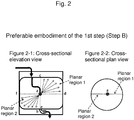
- step B in the "2nd embodiment” using a "horizontally rotatable spray nozzle” as shown in Figure 2 .
- Figure 2-1 is a cross-sectional elevation view of the sevoflurane storage container viewed from the horizontal direction.
- Figure 2-2 is a cross-sectional plan view of the same viewed from the top face of the storage container.
- a "horizontally rotatable spray nozzle ⁇ a>” is placed near the center of the inside of the storage container (e.g., at the center position viewed from either the horizontal direction or the vertical direction).
- the nozzle ⁇ a> is connected to an external tank, from which the "liquid containing water as a major component" is supplied to the nozzle ⁇ a>.
- the nozzle ⁇ a> functions to inject water supplied in the direction "obliquely upward to the right by an angle of 90° with respect to the nozzle ⁇ a>" and in the direction “obliquely downward to the left by an angle of 90° with respect to the nozzle ⁇ a>" at the same time.
- ⁇ b> denotes a drain port (or drainpipe) for draining liquid, which also functions to depressurize in the "2nd embodiment.” Therefore, the drain port ⁇ b> should be opened during liquid injection.
- ⁇ c> and ⁇ d> respectively denote the upper end and the lower end of a curve that is formed when the "planar region 1" intersects with the container inner wall.
- the lower end ⁇ c> overlaps the top center point of the storage container.
- ⁇ e> and ⁇ f> respectively denote the upper end and the lower end of a curve that is formed when the "planar region 2" intersects with the container inner wall.
- the upper end ⁇ e> overlaps the bottom center point of the storage container.
- Figure 2-1 shows that the washing liquid injected from the nozzle ⁇ a> passes through the "planar region 1" and the "planar region 2" and directly collides against the curve extending from ⁇ c> to ⁇ d> and the curve extending from ⁇ e> to ⁇ f>.
- the nozzle ⁇ a> is rotated by 360° in the horizontal direction at a constant rotation rate, during which the state in which water is injected in the direction "obliquely upward to the right by an angle of 90° with respect to the nozzle ⁇ a>" and in the direction "obliquely downward to the left by an angle of 90° with respect to the nozzle ⁇ a>" at the same time shown in Figure 2-1 is maintained.
- a curve that corresponds to the curve extending from ⁇ c> to ⁇ d> and a curve that corresponds to the curve extending from ⁇ e> to ⁇ f> are continuously formed in the direction along the inner wall in the storage container in a 360-degree view.
- the sprayed "liquid containing water as a major component" directly collides against the entire container inner wall. Accordingly, the inside of the container can be sufficiently washed using the "liquid containing water as a major component” in an amount that is significantly smaller than that used in the "1st embodiment.”
- the pressure of water injected from the nozzle ⁇ a> always exceed ordinary pressure because it is necessary to allow the "liquid” to directly collide against the entire container inner wall with certainty.
- the pressure is preferably 0.2 to 1 MPa (absolute pressure).
- the horizontal rotation rate of the nozzle ⁇ a> is not particularly limited; however, the rotation is performed within a cycle of 0.1 second to 10 seconds in one preferable embodiment. Note that the rotation rate of nozzle ⁇ a> is not necessarily critical. As long as the "liquid” is sprayed over the entire container inner wall, the rotation rate is not particularly limited (the rotation of nozzle ⁇ a> generates a driving force of "liquid injection pressure").
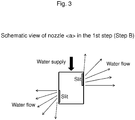
- the nozzle ⁇ a> having the above liquid injection function is not particularly limited. However, it is preferable to use a commercially available nozzle such as "CERJET (registered trademark) (H. Ikeuchi & Co., Ltd.)."
- Figure 3 schematically shows such nozzle ⁇ a>. As shown in Figure 3 , a slit is formed on faces of the nozzle, which are opposed each other. Supplied water is injected through each slit. Water is injected to form a "planar region 1" from one slit, while water is injected to form a "planar region 2" from the other slit (the nozzle ⁇ a> horizontally rotates to generate a driving force of "liquid injection pressure" in the example illustrated in Figure 3 ).
- each slit Water is supplied from an external reservoir.
- the position, length, and width of each slit are determined so that the liquid is injected in desired directions.
- the slit width is preferably 0.4 mm to 1 mm (and particularly preferably 0.5 to 0.7 mm).
- a transparent material such as acrylic is used around a flange so that the inside of the container can be monitored from the outside, or a monitor camera is provided inside of the container.
- a transparent material such as acrylic is used around a flange so that the inside of the container can be monitored from the outside, or a monitor camera is provided inside of the container.
- a method for continuously “injecting the liquid by liquid injection means” may be carried out. Meanwhile, it is also possible to employ a method comprising repeating an operation of injecting the liquid for a predetermined time period (e.g., 15 seconds), waiting a predetermined time period (e.g., 30 seconds), and restarting injection at a timing after most of liquid present on the inner wall has been drained from the drainpipe. In order to save a washing liquid, the latter is preferable.
- step B is carried out using the "liquid substantially consisting of water” in the "2nd embodiment," the necessary amount of the liquid is usually 30 dm 3 to 500 dm 3 and preferably 50 dm 3 to 200 dm 3 for a 500-dm 3 container.
- the "amount of water” itself is not a critical factor that constitutes the present invention. Specifically, how to determine the amount of "liquid substantially consisting of water” and the number of times of washing depends on the material or shape of the storage container, meaning that there are different optimum conditions. Those skilled in the art can optimize the above conditions based on their technical knowledge. It is required to validate and comply with the optimized conditions for carrying out the present invention.
- One option for the validation described above is to carefully pour a predetermined volume of methanol (note that sevoflurane and its analog (polyether) can be easily dissolved in methanol) into a storage container after carrying out step B in the "2nd embodiment" in a predetermined manner so as to bring methanol into contact with the entire inner wall of the storage container, collect the methanol wash liquid via a drainpipe provided to the lower part of the storage container after the elapse of a predetermined time period, and analyze the liquid by gas chromatography. More specifically, given that the inner volume of the storage container is 100, the volume of methanol to be poured is preferably 0.1 to 0.5 (and particularly preferably 0.2 to 0.4).
- the methanol wash liquid (usually in an amount that accounts for about 50% of the amount of methanol introduced) is collected as much as possible via the drainpipe after the elapse of 1 hour, for example.
- the collected methanol wash liquid can be assayed by gas chromatography.
- the present inventors confirmed that after validation of the optimum conditions, as long as step B was carried out in strict compliance with the conditions, sevoflurane and its analogs (polyether 1 and polyether 2) were not detected at a level of the detection limit (1 ppm) in the subsequent steps as a result of collection and analysis of the methanol wash liquid.
- the wash liquid that has been brought into contact with the inner wall of the storage container is directly drained from the drainpipe, which also serves as depressurization means.
- the drainpipe which also serves as depressurization means.
- one option is to provide a depressurization port to the upper part of the storage container and open the depressurization port while closing the drainpipe during washing liquid injection. Those skilled in the art can select such option according to need.
- Step B is a step of washing a sevoflurane storage container using a "liquid containing water as a major component" as a washing solvent.
- a liquid containing water as a major component as a washing solvent.
- a "liquid containing water as a major component” and particularly preferably a “liquid substantially consisting of water" for washing of the storage container itself in step B.
- polyether 1 and polyether 2 would not be concentrated in the storage container even after washing is carried out a plurality of times (for plurality of lots). Therefore, it is usually not necessary to combine "rinsing with sevoflurane” and washing with sevoflurane.
- step B the order of "rinsing with sevoflurane” in step B is not particularly limited.
- the filling step the 2nd step
- Step B and the subsequent step C may be conducted alternately a plurality of times. If the two steps are conducted alternately a plurality of times, it would result in complexity of the steps. The present inventors have found that it is not necessary to conduct both steps a plurality of times in most cases because sufficient effects can be obtained by conducting steps B and C alternately once.
- Step C is a step of introducing a drying gas into the storage container after step B and draining the liquid remaining on the inner wall of the storage container together with the drying gas outside of the storage container.
- sevoflurane vapor is drained together with the flowing drying gas outside of the container in step C.
- steps B and C may be conducted once in most cases.
- step B is conducted after step C
- step C must be conducted again after step B, thereby draining liquid components remaining on the container inner wall outside of the container.
- drying gas used in step C is not particularly limited. However, dry air is preferably used. It is also possible to use dry nitrogen or dry argon, which tends to be chemically inactive. However, it is enough to use inexpensive dry air in the present invention because sevoflurane and sevoflurane analogs, which are present in the liquid form on the inner wall, are completely drained outside of the storage container in step B, which is particularly preferable.
- the way of obtaining dry air is not particularly limited. However, for example, it is convenient and preferable to pressurize air using a compressor so as to turn moisture into liquid, collect a residual gas phase, and allow the gas phase to pass through a "dehumidifier containing, as an active ingredient, a drying agent such as zeolite or oxidized aluminium" for further dehumidification.
- a drying gas is not particularly limited. However, if the dryness of a drying gas is higher, step C can be completed within a shorter period of time.
- the dew point of a drying gas is preferably -30°C or less and more preferably -40°C or less.
- a drying gas is introduced at preferably 30°C to 150°C and more preferably 40°C to 100°C.
- the way of introducing a drying gas in step C is not particularly limited. However, as the specific gravity of sevoflurane vapor is greater than 1, it is preferable to introduce a drying gas from the upper part of a storage container and drain the drying gas from the lower part thereof in step C. For instance, in a case in which a washing liquid has been introduced from an inlet at the upper part of a storage container in step B, the inlet may be used as an inlet for a drying gas in step C. It is also possible to use a liquid drain port (drainpipe) used in step B as a drying gas discharge port in step C.
- a liquid drain port drainpipe
- the flow rate of a drying gas in step C is not particularly limited. However, the flow rate is preferably 100 dm 3 /minute to 200 dm 3 /minute and more preferably 150 dm 3 /minute to 200 dm 3 /minute in a 500-dm 3 container.
- the introduction time may vary depending on conditions. However, the introduction time is typically 60 to 300 minutes when a "liquid substantially consisting of water" is used in step B and hot air at 30°C to 150°C is introduced in step C.
- step C the optimum conditions for step C would vary depending on the material or shape of container. It is desirable for those skilled in the art to optimize and validate the conditions based on their technical knowledge. Once the optimum conditions are established, it is possible to smoothly conduct step C in compliance with the established conditions.
- Step C may comprise determining the dew point of a drying gas discharged from the storage container after the above steps and confirming whether the dew point is at or below a predetermined temperature (e.g., -20°C when using a drying gas having a dew point of -30°C or less or -30°C when using a drying gas having a dew point of -40°C or less).
- a predetermined temperature e.g., -20°C when using a drying gas having a dew point of -30°C or less or -30°C when using a drying gas having a dew point of -40°C or less.
- step C it is further preferable to temporarily suspend the continuous introduction of a drying gas, hermetically seal the container, inject a dry compressed gas into the container, keep the container pressurized for a predetermined time period, and purge the drying gas, thereby determining the dew point of the purged drying gas. It is possible to confirm with certainty whether there is no moisture deep inside of the inner wall in the latter case. Even after validation of the conditions for step C, it is preferable to determine the dew point upon the completion of step C for all batches. This is because step C is a step immediately before the "2nd step" of filling a container with sevoflurane for a new lot.
- Figure 4 shows a preferable embodiment of step C.
- Such method is a method for washing a sevoflurane storage container, wherein the storage container is a sevoflurane storage container, which is repeatedly used for a series of lots, the storage container having been subjected to a step of consuming at least a portion of sevoflurane filled into the storage container for a previous lot, the method comprising the steps of:
- a part of or all of the inner wall of the storage container be made of stainless steel and the temperature of the "liquid substantially consisting of water" be 60°C to 90°C.
- the "state in which sevoflurane and its analogs (polyether 1 and polyether 2) are substantially not detected in the storage container” means as follows.
- a sevoflurane storage container washed by the washing method of the present invention is filled with sevoflurane for a new lot (the 2nd step) so as to prepare a pharmaceutical product
- polyether 1 and polyether 2 derived from the storage container are not substantially contained in the product.
- polyether 1 and polyether 2 do not substantially increase after the repetitive use of the sevoflurane storage container for a plurality of lots. Accordingly, sevoflurane product specifications can be stably satisfied.
- the above state means that when the contents of polyether 1 and polyether 2 in sevoflurane immediately before filling a storage container with the sevoflurane for a new lot are determined to be ⁇ 1 (ppm) and ⁇ 2 (ppm) and the contents of polyether 1 and polyether 2 in sevoflurane immediately after filling the storage container with the sevoflurane are determined to be ⁇ 1 (ppm) and ⁇ 2 (ppm), both ( ⁇ 1- ⁇ 1) and ( ⁇ 2- ⁇ 2) are less than 1 ppm.
- both ⁇ 1 (ppm) and ⁇ 2 (ppm) often become “less than 1 ppm" during production of sevoflurane. In this case, both ⁇ 1 (ppm) and ⁇ 2 (ppm) become "less than 1 ppm.”
- an organic solvent capable of dissolving sevoflurane e.g., methanol or diethyl ether
- Another option is to extract a wash liquid collected in each washing operation in step B or b with a predetermined volume of diethyl ether so as to quantitatively determine polyether 1 and polyether 2 as explained in the Examples below. In this case, it is possible to confirm "washing effects of each washing operation" (see the Examples below).
- the 2nd step is a step of filling the sevoflurane storage container, in which sevoflurane and its analogs (polyether 1 and polyether 2) become substantially not detected as a result of the 1 st step, with fresh sevoflurane.
- a pharmaceutical product of sevoflurane filled into a storage container can be produced by conducting the 2nd step, in addition to the 1st step.
- Sevoflurane is in the form of liquid with a boiling point of 58.6°C. It may be filled into a container as in the case of a common liquid substance. It is preferable for sevoflurane to contain water at 206 ppm to 1400 ppm as disclosed in Patent Literature 5 so that stability of sevoflurane can be further improved.
- the 2nd step by, for example, replacing the air inside of a storage container by an inert gas (e.g., dry nitrogen) at atmospheric pressure in advance and filling the storage container with a predetermined volume of sevoflurane for a new lot.
- an inert gas e.g., dry nitrogen
- This operation allows the inert gas present in the container to be discharged from a depressurization port.
- sevoflurane gradually forms vapor in a gas phase, thereby causing the inside of the container to be slightly pressurized as stated above.
- Another option is to evacuate the air from a storage container in advance and introduce sevoflurane thereinto, which also falls within the scope of the present invention.
- the thus obtained pharmaceutical product produced can be subjected to gas chromatographic analysis by collecting a small amount of sevoflurane filled into the container (i.e., "product analysis"). There are substantially no impurities in the sevoflurane storage container after the 1st step (steps A to C or a to c). After the completion of the 2nd step, sevoflurane filled into the container is analyzed again, thereby making it possible to confirm whether washing has been completed for each batch and ensure quality assurance.
- the 3rd step is a step of continuously storing the sevoflurane storage container filled with sevoflurane as described in the 2nd step.
- the storage temperature is not particularly limited. However, in consideration of the use of sevoflurane as a medicine, it is preferable to store sevoflurane at a low temperature below the boiling point (58.6°C). Sevoflurane is stored at preferably 0°C to 35°C and more preferably at a temperature close to room temperature (e.g., 10°C to 30°C).
- liquid substantially consisting of water (simply referred to as “water” in some cases) was used as a washing agent in the following Examples, Comparative Examples, and Reference Examples. Specifically, the liquid is "ion-exchange water having an electric conductivity of 1 ⁇ S/cm or less.”
- Example 1 sevoflurane was treated under conditions more stringent than actual sevoflurane storage conditions so that "polyether" was forcibly generated. Specifically, according to the disclosure of Patent Literature 5, the water content of sevoflurane was adjusted to be lower than that of sevoflurane obtained as a final product (6 ppm). Further, sevoflurane was heated to 50°C under the presence of oxidized aluminium (alumina) serving as Lewis acid (i.e., a substance that is considered to catalyze sevoflurane degradation in Patent Literature 5). As a result, a portion of sevoflurane was degraded into polyether, resulting in generation of "sevoflurane containing polyether" in the system. It was attempted to wash the obtained "sevoflurane containing polyether" with water.
- oxidized aluminium alumina serving as Lewis acid
- Sevoflurane (used as a pharmaceutical product) (100 cm 3 ) was placed in a erlenmeyer flask and cooled to 10°C in a refrigerator. Then, synthetic zeolite was introduced into the erlenmeyer flask so that the weight ratio of synthetic zeolite : sevoflurane became 1:4. Next, the erlenmeyer flask was allowed to stand still in a refrigerator at 10°C for 2 hours and 30 minutes for drying of sevoflurane (reduction of water content). Thereafter, the moisture of sevoflurane was determined using a Karl Fischer moisture meter and it was found to be 6 ppm.
- Alumina 50 mg was placed in a 50-cm 3 brown bottle with a narrow mouth. Sevoflurane having a moisture content of 6 ppm prepared in (1-1) (20 cm 3 , 29.9 g) was added thereto.
- the cap of the brown bottle with a narrow mouth was closed and the bottle was heated in a thermostatic bath at 50°C for 64 hours. After heating for 64 hours, the bottle was cooled in a refrigerator (10°C) for 1 hour.
- the gas chromatographic composition of the organic phase was detected as follows: sevoflurane: about 87%; polyether 1: 8.4% (84000 ppm); and polyether 2: 4.0% (40000 ppm).
- 190 ppm of hexafluoroisopropyl alcohol (HFIP) was detected.
- Patent Literature 5 discloses that HFIP (hexafluoroisopropyl alcohol) is also generated in the degradation reaction.
- HFIP hexafluoroisopropyl alcohol
- HFIP is a water-soluble substance and is also an "amphipathic substance" having lipophilicity. It is therefore considered that a large portion of HFIP could be released into the aqueous phase by repeating water washing (back extraction) 3 times in the above manner, which allowed only a portion of HFIP to remain in the organic phase and resulted in the above HFIP content ("190 ppm").
- both polyether 1 and polyether 2 are characterized by very high lipophilicity and very low affinity for water as described herein (meaning that it is impossible to treat polyether 1 and polyether 2 by back extraction with water).
- polyether 1 and polyether 2 were forcibly generated by treating sevoflurane under conditions more stringent than actual conditions, and the obtained "sevoflurane containing polyether 1 and polyether 2" was subjected to water washing in Example 1.
- the results support that even if "polyether 1 and polyether 2" having poor affinity for water are generated, they can be reduced to a level that is pharmaceutically safe with the use of "liquid substantially consisting of water,” which was unpredictable in the past.
- a predetermined volume (500 dm 3 ) of a sevoflurane product filled into a stainless-steel (SUS304) storage container (inner volume: 500 dm 3 ) (i.e., a sevoflurane product filled into the container for a previous lot) was pressurized using dry nitrogen and collected via a dip tube. When it was found that no more liquid could be collected, both the nitrogen gas inlet port and the dip tube inlet were immediately closed.
- a "horizontally rotatable spray nozzle ⁇ a>” was attached to the "storage container in which at least sevoflurane vapor was present" treated in step A as shown in Figure 2 , followed by water injection.
- the width of a water injection slit of the spray nozzle ⁇ a> was determined to be about 0.6 mm.
- the water pressure of water injected by a spray nozzle was set to 0.4 MPa (absolute pressure) and the water flow rate was set to 13.6 dm 3 /minute.
- the spray nozzle ⁇ a> is horizontally rotatable when water pressure is applied. Thus, its rotational rate was 30 to 40 rpm (0.50 to 0.67 rotations/second) under the above conditions.
- the water temperature i.e., water temperature in a water reservoir attached to the spray nozzle ⁇ a> at the position adjacent to the storage container) was set to 80°C.
- a drainpipe ⁇ b> provided to the lower part of the storage container was kept open from the beginning of step B so that water injection and water discharge were carried out therethrough.
- water injection was carried out for 3 minutes and then the storage container was allowed to stand still for 60 seconds.
- an operation of "washing for 15 seconds and allowing the storage container to stand still for 30 seconds" was repeated 10 times.
- water injection was carried out for 330 seconds in total.
- the total volume of water injected during 330 seconds was 75 dm 3 .
- step B the storage container was subjected to step C in the embodiment shown in Figure 3 .
- step C was carried out in a manner such that a drying gas was introduced from the upper part and discharged from the drainpipe provided to the lower part.
- the drying gas used herein was "dry air having a dew point of -40°C or less (-40°C to -50°C)."
- the drying gas was heated with a heater so as to adjust the temperature of the drying gas (immediately before being introduced into the storage container) to 60°C to 80°C.
- the flow rate of the drying gas to be introduced was set to 170 dm 3 /minute.
- the drying gas was continuously introduced into/discharged from the storage container for 2 hours and 40 minutes.
- the storage container was filled with sevoflurane for a new lot. Sevoflurane was collected from the storage container after filling, followed by analysis. It was found that the collected sevoflurane satisfied all test standards.
- the container was cooled to room temperature. Then, the cap of the container was opened and 1.5 dm 3 of methanol (room temperature) was directly applied to the entire inner wall of the container, instead of carrying out "refilling and analysis" described in Example 2. Subsequently, methanol wash liquid that was being drained from the drainpipe was collected and analyzed.
- the sevoflurane storage container was filled with sevoflurane (500 dm 3 ) for a new lot. Then, after the completion of a step of consuming (collecting) sevoflurane, the storage container was subjected to steps A to C by the means used in Example 2. A series of these operations was repeated using the same container for 20 lots.
- a 1-dm 3 autoclave (SUS304) used as a sevoflurane storage container was filled with dry nitrogen.
- Liquid sevoflurane i.e., a sevoflurane product containing 400 ppm of water
- the autoclave was hermetically closed and stored at room temperature for 1 month. Then, moisture content was measured using a Karl Fischer moisture meter. The moisture content was found to be 360 ppm.
- the liquid sevoflurane was stored for another month in the autoclave in the same manner. Then, the moisture content was measured again. The moisture content was found to be 350 ppm.
- Example 1 the procedures of (a) and (b) in (1-4) of "Example 1" were performed as in Example 1. Then, washing was carried out 3 times using 12.5 cm 3 of a "sevoflurane product" (room temperature) instead of using 12.5 cm 3 of water in (c) in (1-4) of “Example 1.” The resulting sevoflurane wash liquid was drained from the drainpipe and the sevoflurane wash liquid was subjected to gas chromatographic analysis. As a result, the concentrations of "polyether 1" and “polyether 2" in sevoflurane drained from the drainpipe were 4 ppm and 5 ppm, respectively, for the first measurement.
- concentrations of "polyether 1" and “polyether 2" in sevoflurane drained from the drainpipe were 4 ppm and 5 ppm, respectively, for the first measurement.
- the concentration of "polyether 2" in sevoflurane drained for the second measurement was 1 ppm while no “polyether 1" was detected. Neither "polyether 1" nor “polyether 2" was detected from sevoflurane drained for the third measurement.
- polyether 1 and polyether 2 can be sufficiently washed away using expensive sevoflurane as a washing liquid due to lipophilicity of sevoflurane.
- Example 1 The procedures of Example 1 were conducted in the same manner except that the procedures of (a) and (b) in (1-4) were changed as described below.
- step A the cover of the autoclave was kept open and left at room temperature for 3 days. Accordingly, sevoflurane in the sample evaporated, and therefore, the inner wall of the container was dried.
- the first water washing was carried out in the manner described above, followed by ice cooling and extraction into diethyl ether.
- concentrations of "polyether 1" and “polyether 2" were 7 ppm and 12 ppm, respectively.
- the concentrations of "polyether 1" and “polyether 2” were 5 ppm and 9 ppm, respectively.
- the concentrations of "polyether 1" and “polyether 2" were 3 ppm and 7 ppm, respectively.
- Example 1 the procedures of (a) and (b) in (1-4) of "Example 1" were performed as in Example 1. Then, washing was carried out 3 times using 12.5 cm 3 of acetone (room temperature) instead of using 12.5 cm 3 of water in (c) in (1-4) of “Example 1.” The resulting acetone wash liquid was drained from the drainpipe and the acetone wash liquid was subjected to gas chromatographic analysis. As a result, the concentrations of "polyether 1" and “polyether 2" in acetone drained from the drainpipe were 3 ppm and 2 ppm, respectively, for the second measurement. Neither "polyether 1" nor “polyether 2" was detected from acetone drained for the third measurement.
- washing can be carried out to such an extent that substantially none of sevoflurane and its analogs (polyether 1 and polyether 2) can be detected inside of a storage container.
Landscapes
- Engineering & Computer Science (AREA)
- Mechanical Engineering (AREA)
- Health & Medical Sciences (AREA)
- Chemical & Material Sciences (AREA)
- Life Sciences & Earth Sciences (AREA)
- Organic Chemistry (AREA)
- Animal Behavior & Ethology (AREA)
- Epidemiology (AREA)
- Pharmacology & Pharmacy (AREA)
- General Health & Medical Sciences (AREA)
- Public Health (AREA)
- Veterinary Medicine (AREA)
- Medicinal Chemistry (AREA)
- Microbiology (AREA)
- General Engineering & Computer Science (AREA)
- Medical Preparation Storing Or Oral Administration Devices (AREA)
- Cleaning By Liquid Or Steam (AREA)
- Filling Or Discharging Of Gas Storage Vessels (AREA)
Applications Claiming Priority (2)
| Application Number | Priority Date | Filing Date | Title |
|---|---|---|---|
| JP2016215676 | 2016-11-02 | ||
| JP2016246253A JP2018075346A (ja) | 2016-11-02 | 2016-12-20 | セボフルラン貯蔵容器の洗浄方法およびセボフルランの貯蔵方法 |
Publications (1)
| Publication Number | Publication Date |
|---|---|
| EP3318340A1 true EP3318340A1 (fr) | 2018-05-09 |
Family
ID=57758450
Family Applications (1)
| Application Number | Title | Priority Date | Filing Date |
|---|---|---|---|
| EP16206444.8A Withdrawn EP3318340A1 (fr) | 2016-11-02 | 2016-12-22 | Procédé de lavage de récipient de stockage de sévoflurane et procédé de stockage de sévoflurane |
Country Status (7)
| Country | Link |
|---|---|
| US (1) | US20180117644A1 (fr) |
| EP (1) | EP3318340A1 (fr) |
| CN (1) | CN106994455B (fr) |
| BE (1) | BE1024432B1 (fr) |
| CA (1) | CA2952552C (fr) |
| FR (1) | FR3058076A1 (fr) |
| NL (1) | NL2018046B1 (fr) |
Families Citing this family (1)
| Publication number | Priority date | Publication date | Assignee | Title |
|---|---|---|---|---|
| CN115703122A (zh) * | 2021-08-07 | 2023-02-17 | 广州谷森制药有限公司 | 一种含奥达特罗药品制剂和除醛包材容器的组合 |
Citations (11)
| Publication number | Priority date | Publication date | Assignee | Title |
|---|---|---|---|---|
| US4250334A (en) | 1979-12-26 | 1981-02-10 | Baxter Travenol Laboratories, Inc. | Method of synthesizing fluoromethylhexafluoroisopropyl ether |
| FR2704782A1 (fr) * | 1993-05-07 | 1994-11-10 | Montanier Sa | Installation pour le lavage intérieur et extérieur de conteneurs. |
| JP2786108B2 (ja) | 1994-03-31 | 1998-08-13 | セントラル硝子株式会社 | フルオロメチル−1,1,1,3,3,3−ヘキサフルオロイソプロピルエーテルの精製方法 |
| JP2786106B2 (ja) | 1994-03-28 | 1998-08-13 | セントラル硝子株式会社 | フルオロメチル−1,1,1,3,3,3−ヘキサフルオロイソプロピルエーテルの精製方法 |
| JP3183520B2 (ja) | 1997-01-27 | 2001-07-09 | アボツト・ラボラトリーズ | フルオロエーテル組成物及び、ルイス酸の存在下におけるその組成物の分解抑制法 |
| WO2002022195A2 (fr) * | 2000-09-15 | 2002-03-21 | Baxter International Inc. | Conteneur pour anesthesique administre par inhalation |
| JP3524060B2 (ja) | 1998-01-09 | 2004-04-26 | アボット・ラボラトリーズ | 吸入麻酔剤用容器 |
| JP3612590B2 (ja) | 2002-02-06 | 2005-01-19 | 独立行政法人産業技術総合研究所 | 含フッ素アセタールとブタノール類からなる共沸又は共沸様組成物 |
| JP4087488B2 (ja) | 1998-03-03 | 2008-05-21 | セントラル硝子株式会社 | フルオロメチル−1,1,1,3,3,3−ヘキサフルオロイソプロピルエーテルの精製方法 |
| US20090275785A1 (en) * | 2008-05-01 | 2009-11-05 | Barry Jones | Distillation Method For The Purification Of Sevoflurane And The Maintenance Of Certain Equipment That May Be Used In The Distillation Process |
| JP5244109B2 (ja) | 2006-09-29 | 2013-07-24 | クリスタリア プロデュトス キミコス ファーマシューティコス リミターダ | クロロメチル2,2,2―トリフロオロ−1−(トリフルオロメチル)エチルエーテルの製造方法 |
Family Cites Families (3)
| Publication number | Priority date | Publication date | Assignee | Title |
|---|---|---|---|---|
| JP2865554B2 (ja) * | 1994-04-08 | 1999-03-08 | セントラル硝子株式会社 | フルオロメチル−1,1,1,3,3,3−ヘキサフルオロイソプロピルエーテルのガスクロマトグラフ分析 |
| US20080087283A1 (en) * | 2006-10-16 | 2008-04-17 | Abbott Laboratories | Apparatus for and related method of inhibiting lewis acid degradation in a vaporizer |
| CN103804151A (zh) * | 2012-11-07 | 2014-05-21 | 东莞市长安东阳光铝业研发有限公司 | 一种七氟醚的制备方法 |
-
2016
- 2016-12-21 BE BE2016/5954A patent/BE1024432B1/fr active IP Right Grant
- 2016-12-21 CA CA2952552A patent/CA2952552C/fr active Active
- 2016-12-22 CN CN201611200081.5A patent/CN106994455B/zh active Active
- 2016-12-22 NL NL2018046A patent/NL2018046B1/en active
- 2016-12-22 EP EP16206444.8A patent/EP3318340A1/fr not_active Withdrawn
- 2016-12-22 US US15/388,631 patent/US20180117644A1/en not_active Abandoned
- 2016-12-30 FR FR1663538A patent/FR3058076A1/fr not_active Withdrawn
Patent Citations (13)
| Publication number | Priority date | Publication date | Assignee | Title |
|---|---|---|---|---|
| US4250334A (en) | 1979-12-26 | 1981-02-10 | Baxter Travenol Laboratories, Inc. | Method of synthesizing fluoromethylhexafluoroisopropyl ether |
| FR2704782A1 (fr) * | 1993-05-07 | 1994-11-10 | Montanier Sa | Installation pour le lavage intérieur et extérieur de conteneurs. |
| JP2786106B2 (ja) | 1994-03-28 | 1998-08-13 | セントラル硝子株式会社 | フルオロメチル−1,1,1,3,3,3−ヘキサフルオロイソプロピルエーテルの精製方法 |
| JP2786108B2 (ja) | 1994-03-31 | 1998-08-13 | セントラル硝子株式会社 | フルオロメチル−1,1,1,3,3,3−ヘキサフルオロイソプロピルエーテルの精製方法 |
| JP3183520B2 (ja) | 1997-01-27 | 2001-07-09 | アボツト・ラボラトリーズ | フルオロエーテル組成物及び、ルイス酸の存在下におけるその組成物の分解抑制法 |
| JP3664648B2 (ja) | 1997-01-27 | 2005-06-29 | アボット・ラボラトリーズ | フルオロエーテル組成物及び、ルイス酸の存在下におけるその組成物の分解抑制法 |
| JP3524060B2 (ja) | 1998-01-09 | 2004-04-26 | アボット・ラボラトリーズ | 吸入麻酔剤用容器 |
| JP4087488B2 (ja) | 1998-03-03 | 2008-05-21 | セントラル硝子株式会社 | フルオロメチル−1,1,1,3,3,3−ヘキサフルオロイソプロピルエーテルの精製方法 |
| WO2002022195A2 (fr) * | 2000-09-15 | 2002-03-21 | Baxter International Inc. | Conteneur pour anesthesique administre par inhalation |
| JP5801024B2 (ja) | 2000-09-15 | 2015-10-28 | バクスター・インターナショナル・インコーポレイテッドBaxter International Incorp0Rated | 吸入麻酔薬用の容器 |
| JP3612590B2 (ja) | 2002-02-06 | 2005-01-19 | 独立行政法人産業技術総合研究所 | 含フッ素アセタールとブタノール類からなる共沸又は共沸様組成物 |
| JP5244109B2 (ja) | 2006-09-29 | 2013-07-24 | クリスタリア プロデュトス キミコス ファーマシューティコス リミターダ | クロロメチル2,2,2―トリフロオロ−1−(トリフルオロメチル)エチルエーテルの製造方法 |
| US20090275785A1 (en) * | 2008-05-01 | 2009-11-05 | Barry Jones | Distillation Method For The Purification Of Sevoflurane And The Maintenance Of Certain Equipment That May Be Used In The Distillation Process |
Non-Patent Citations (1)
| Title |
|---|
| "Japanese Pharmacopoeia, 17th ed.", ., pages: 996 |
Also Published As
| Publication number | Publication date |
|---|---|
| NL2018046A (en) | 2017-01-19 |
| CA2952552A1 (fr) | 2017-02-23 |
| CN106994455A (zh) | 2017-08-01 |
| BE1024432B1 (fr) | 2018-02-19 |
| NL2018046B1 (en) | 2017-12-13 |
| CA2952552C (fr) | 2018-05-15 |
| FR3058076A1 (fr) | 2018-05-04 |
| US20180117644A1 (en) | 2018-05-03 |
| CN106994455B (zh) | 2019-08-30 |
Similar Documents
| Publication | Publication Date | Title |
|---|---|---|
| JP4763805B2 (ja) | 揮発性物質留去用栓、揮発性物質留去用容器及び揮発性物質留去装置 | |
| Elpa et al. | Rapid extraction and analysis of volatile solutes with an effervescent tablet | |
| WO2011107924A1 (fr) | Solvant de nettoyage et procédé de nettoyage destinés à un composé métallique | |
| NL2018046B1 (en) | Method for washing sevoflurane storage container and method for storing sevoflurane | |
| Lin et al. | Mass transfer performance of rotating packed beds with blade packings in carbon dioxide absorption into sodium hydroxide solution | |
| RU2685412C2 (ru) | Способ для промывки контейнера для хранения севофлурана и способ для хранения севофлурана | |
| Sowden et al. | Carbonylation of methanol in supercritical CO 2 catalysed by a supported rhodium complex | |
| TW201026572A (en) | Container containing fluorinated organic carbonates | |
| CN104431663B (zh) | 一种降解果蔬农残的方法及装置 | |
| AU2011353205A2 (en) | Dehydration process that employs an ionic liquid choline salt | |
| JP4430977B2 (ja) | 超臨界流体クロマトグラフィーによる光学異性体の製造方法 | |
| JP2015121535A (ja) | 放射性廃棄物のための輸送容器及び/又は貯蔵容器の乾燥方法 | |
| BR112016008813B1 (pt) | Método para a preparação de 1,4-butanodiol | |
| BRPI0903275A2 (pt) | processo de extração e purificação de artemisinina a partir de massa sólida de artemisia annua utilizando dióxido de carbono | |
| JP7717742B2 (ja) | 貯蔵装置 | |
| EP3610893A1 (fr) | Procédé de stérilisation et appareil de stérilisation | |
| CA2850512C (fr) | Systeme de reapprovisionnement en fluide automatise et ses utilisations | |
| EP3610892A1 (fr) | Procédé de stérilisation et dispositif de stérilisation | |
| JP7477730B1 (ja) | イソプロピルアルコール収容体及び該収容体の製造方法、並びにイソプロピルアルコール収容体の品質管理方法 | |
| Song et al. | Supramolecular Gelation of Hydrogen Peroxide: Reconciling Safety and Reactivity | |
| Ngo et al. | Processing behaviors of thin-film pentacene and benzene-1, 4-diboronic acid in supercritical carbon dioxide | |
| TWM662262U (zh) | 用於分離異構物的套組 | |
| FI89324C (fi) | Foerfarande och anordning foer semikontinuerlig separation av nikotin fraon ett loesningsmedel | |
| JPH08117706A (ja) | 凹状構造空間に液体を充填する方法 | |
| JPH0454185Y2 (fr) |
Legal Events
| Date | Code | Title | Description |
|---|---|---|---|
| PUAI | Public reference made under article 153(3) epc to a published international application that has entered the european phase |
Free format text: ORIGINAL CODE: 0009012 |
|
| STAA | Information on the status of an ep patent application or granted ep patent |
Free format text: STATUS: REQUEST FOR EXAMINATION WAS MADE |
|
| 17P | Request for examination filed |
Effective date: 20161222 |
|
| AK | Designated contracting states |
Kind code of ref document: A1 Designated state(s): AL AT BE BG CH CY CZ DE DK EE ES FI FR GB GR HR HU IE IS IT LI LT LU LV MC MK MT NL NO PL PT RO RS SE SI SK SM TR |
|
| AX | Request for extension of the european patent |
Extension state: BA ME |
|
| STAA | Information on the status of an ep patent application or granted ep patent |
Free format text: STATUS: EXAMINATION IS IN PROGRESS |
|
| 17Q | First examination report despatched |
Effective date: 20180912 |
|
| STAA | Information on the status of an ep patent application or granted ep patent |
Free format text: STATUS: THE APPLICATION HAS BEEN WITHDRAWN |
|
| 18W | Application withdrawn |
Effective date: 20181019 |
|
| P01 | Opt-out of the competence of the unified patent court (upc) registered |
Effective date: 20230330 |