EP3318502A1 - Behälter für giessbare produkte und verfahren zur herstellung von behältern für giessbare produkte - Google Patents
Behälter für giessbare produkte und verfahren zur herstellung von behältern für giessbare produkte Download PDFInfo
- Publication number
- EP3318502A1 EP3318502A1 EP17199237.3A EP17199237A EP3318502A1 EP 3318502 A1 EP3318502 A1 EP 3318502A1 EP 17199237 A EP17199237 A EP 17199237A EP 3318502 A1 EP3318502 A1 EP 3318502A1
- Authority
- EP
- European Patent Office
- Prior art keywords
- container
- web
- wall
- shape
- top wall
- Prior art date
- Legal status (The legal status is an assumption and is not a legal conclusion. Google has not performed a legal analysis and makes no representation as to the accuracy of the status listed.)
- Pending
Links
- 238000004519 manufacturing process Methods 0.000 title claims abstract description 6
- 239000005022 packaging material Substances 0.000 claims abstract description 15
- 239000002699 waste material Substances 0.000 claims abstract description 10
- 238000007789 sealing Methods 0.000 claims abstract description 4
- 238000000034 method Methods 0.000 claims description 16
- 239000000463 material Substances 0.000 description 5
- 241000826860 Trapezium Species 0.000 description 3
- 235000013305 food Nutrition 0.000 description 2
- 235000015203 fruit juice Nutrition 0.000 description 2
- 235000013336 milk Nutrition 0.000 description 2
- 239000008267 milk Substances 0.000 description 2
- 210000004080 milk Anatomy 0.000 description 2
- 239000004698 Polyethylene Substances 0.000 description 1
- XAGFODPZIPBFFR-UHFFFAOYSA-N aluminium Chemical compound [Al] XAGFODPZIPBFFR-UHFFFAOYSA-N 0.000 description 1
- 229910052782 aluminium Inorganic materials 0.000 description 1
- 239000004411 aluminium Substances 0.000 description 1
- 235000013361 beverage Nutrition 0.000 description 1
- 230000015572 biosynthetic process Effects 0.000 description 1
- 230000000694 effects Effects 0.000 description 1
- 239000000945 filler Substances 0.000 description 1
- 239000004033 plastic Substances 0.000 description 1
- 229920003023 plastic Polymers 0.000 description 1
- -1 polyethylene Polymers 0.000 description 1
- 229920000573 polyethylene Polymers 0.000 description 1
- 235000015067 sauces Nutrition 0.000 description 1
- 239000010902 straw Substances 0.000 description 1
Images


Classifications
-
- B—PERFORMING OPERATIONS; TRANSPORTING
- B65—CONVEYING; PACKING; STORING; HANDLING THIN OR FILAMENTARY MATERIAL
- B65D—CONTAINERS FOR STORAGE OR TRANSPORT OF ARTICLES OR MATERIALS, e.g. BAGS, BARRELS, BOTTLES, BOXES, CANS, CARTONS, CRATES, DRUMS, JARS, TANKS, HOPPERS, FORWARDING CONTAINERS; ACCESSORIES, CLOSURES, OR FITTINGS THEREFOR; PACKAGING ELEMENTS; PACKAGES
- B65D5/00—Rigid or semi-rigid containers of polygonal cross-section, e.g. boxes, cartons or trays, formed by folding or erecting one or more blanks made of paper
- B65D5/02—Rigid or semi-rigid containers of polygonal cross-section, e.g. boxes, cartons or trays, formed by folding or erecting one or more blanks made of paper by folding or erecting a single blank to form a tubular body with or without subsequent folding operations, or the addition of separate elements, to close the ends of the body
- B65D5/029—Rigid or semi-rigid containers of polygonal cross-section, e.g. boxes, cartons or trays, formed by folding or erecting one or more blanks made of paper by folding or erecting a single blank to form a tubular body with or without subsequent folding operations, or the addition of separate elements, to close the ends of the body the tubular body presenting a special shape
-
- B—PERFORMING OPERATIONS; TRANSPORTING
- B65—CONVEYING; PACKING; STORING; HANDLING THIN OR FILAMENTARY MATERIAL
- B65D—CONTAINERS FOR STORAGE OR TRANSPORT OF ARTICLES OR MATERIALS, e.g. BAGS, BARRELS, BOTTLES, BOXES, CANS, CARTONS, CRATES, DRUMS, JARS, TANKS, HOPPERS, FORWARDING CONTAINERS; ACCESSORIES, CLOSURES, OR FITTINGS THEREFOR; PACKAGING ELEMENTS; PACKAGES
- B65D5/00—Rigid or semi-rigid containers of polygonal cross-section, e.g. boxes, cartons or trays, formed by folding or erecting one or more blanks made of paper
- B65D5/008—Rigid or semi-rigid containers of polygonal cross-section, e.g. boxes, cartons or trays, formed by folding or erecting one or more blanks made of paper the container body having a pyramidal shape
-
- B—PERFORMING OPERATIONS; TRANSPORTING
- B65—CONVEYING; PACKING; STORING; HANDLING THIN OR FILAMENTARY MATERIAL
- B65D—CONTAINERS FOR STORAGE OR TRANSPORT OF ARTICLES OR MATERIALS, e.g. BAGS, BARRELS, BOTTLES, BOXES, CANS, CARTONS, CRATES, DRUMS, JARS, TANKS, HOPPERS, FORWARDING CONTAINERS; ACCESSORIES, CLOSURES, OR FITTINGS THEREFOR; PACKAGING ELEMENTS; PACKAGES
- B65D5/00—Rigid or semi-rigid containers of polygonal cross-section, e.g. boxes, cartons or trays, formed by folding or erecting one or more blanks made of paper
- B65D5/02—Rigid or semi-rigid containers of polygonal cross-section, e.g. boxes, cartons or trays, formed by folding or erecting one or more blanks made of paper by folding or erecting a single blank to form a tubular body with or without subsequent folding operations, or the addition of separate elements, to close the ends of the body
- B65D5/06—Rigid or semi-rigid containers of polygonal cross-section, e.g. boxes, cartons or trays, formed by folding or erecting one or more blanks made of paper by folding or erecting a single blank to form a tubular body with or without subsequent folding operations, or the addition of separate elements, to close the ends of the body with end-closing or contents-supporting elements formed by folding inwardly a wall extending from, and continuously around, an end of the tubular body
- B65D5/064—Rectangular containers having a body with gusset-flaps folded outwardly or adhered to the side or the top of the container
-
- B—PERFORMING OPERATIONS; TRANSPORTING
- B65—CONVEYING; PACKING; STORING; HANDLING THIN OR FILAMENTARY MATERIAL
- B65D—CONTAINERS FOR STORAGE OR TRANSPORT OF ARTICLES OR MATERIALS, e.g. BAGS, BARRELS, BOTTLES, BOXES, CANS, CARTONS, CRATES, DRUMS, JARS, TANKS, HOPPERS, FORWARDING CONTAINERS; ACCESSORIES, CLOSURES, OR FITTINGS THEREFOR; PACKAGING ELEMENTS; PACKAGES
- B65D5/00—Rigid or semi-rigid containers of polygonal cross-section, e.g. boxes, cartons or trays, formed by folding or erecting one or more blanks made of paper
- B65D5/40—Rigid or semi-rigid containers of polygonal cross-section, e.g. boxes, cartons or trays, formed by folding or erecting one or more blanks made of paper specially constructed to contain liquids
-
- B—PERFORMING OPERATIONS; TRANSPORTING
- B65—CONVEYING; PACKING; STORING; HANDLING THIN OR FILAMENTARY MATERIAL
- B65D—CONTAINERS FOR STORAGE OR TRANSPORT OF ARTICLES OR MATERIALS, e.g. BAGS, BARRELS, BOTTLES, BOXES, CANS, CARTONS, CRATES, DRUMS, JARS, TANKS, HOPPERS, FORWARDING CONTAINERS; ACCESSORIES, CLOSURES, OR FITTINGS THEREFOR; PACKAGING ELEMENTS; PACKAGES
- B65D5/00—Rigid or semi-rigid containers of polygonal cross-section, e.g. boxes, cartons or trays, formed by folding or erecting one or more blanks made of paper
- B65D5/42—Details of containers or of foldable or erectable container blanks
- B65D5/72—Contents-dispensing means
- B65D5/74—Spouts
- B65D5/746—Spouts formed separately from the container
Definitions
- This invention addresses the technical field of containers for pourable food products. More in detail, the invention relates to a method for the production, without waste, of non-parallelepiped shaped containers for pourable products from a single continuous web of packaging material, and to a container obtained with this method.
- containers for pourable food products obtained from a single continuous web of packaging material. These containers are generally used to contain milk, fruit juices, sauces or beverages of other kinds.
- the web of packaging material from which the containers are formed are composed of a plurality of layers of different materials coupled to each other (generally paper, aluminium, and heat-sealable plastic material such as polyethylene, for example).
- the web of packaging material is processed in a dedicated automatic machine which comprises, in cascade, different stations through which the web is conveyed until single, filled and sealed containers are obtained.
- Containers obtained from a continuous web of material generally have the shape of a parallelepiped. Containers having this shape, however, may be unergonomic for consumers and/or may not guarantee optimum pourability of the product from the container itself.
- Containers with shapes different from parallelepipeds are, instead, usually obtained from corresponding blanks which are individually folded, filled and sealed, and are thus not obtained from a continuous web of material.
- making containers of a shape other than parallelepiped from a web of packaging material involves creating waste material, even in significant amounts, with all the costs associated therewith.
- This invention has for an aim to overcome the drawbacks described above.
- This aim is achieved by proposing a method for the production, without waste, of non-parallelepiped shaped containers for pourable products from a single continuous web of packaging material, and to a container obtained with this method, according to the accompanying claims.
- this invention allows using a continuous web of packaging material for producing containers for pourable products, without waste, where such containers are ergonomic and have a shape different from the shape of a parallelepiped.
- the container 1 comprises: two side walls 4, 40, opposite to each other and transverse to the top wall 3 and the bottom wall 2; a front wall 5 and a rear wall 50 disposed between the two side walls 4, 40 and connected to the side walls by means of corresponding perimetral edges 54, 540.
- the container 1 also comprises two side seals 6 (only one of which is shown in the drawings), each positioned at a corresponding side wall 4, 40.
- the container 1 has, on each side wall 4, 40, two first fold lines S (only one of which is shown in Figures 1 and 2 ).
- the first two fold lines S are formed when the side seals 6 are made by the sealers usually present in dedicated automatic machines.
- the first fold line S illustrated is located at the centre line of the corresponding side wall 4.
- the front wall 5 and the rear wall 50 each have, in particular, a trapezoidal shape.
- the perimetral edges 54, 540 are inclined with respect to the axis of extension H of the container 1.
- side seals 6 are inclined with respect to the perimetral edges 54, 540 (and also with respect to the axis of extension H).
- the top wall 3 and the bottom wall 2 of the container 1 clearly differ in size.
- the top wall 3 is smaller than the bottom wall 2, that is to say, the minor bases of the trapeziums of the front wall 5 and rear wall 50 are connected to the top wall 3, while the major bases of the trapeziums of the front wall 5 and rear wall 50 are connected to the bottom wall 2 of the container 1.
- This preferred embodiment facilitates dispensing of the product, which is conveyed towards the part of the container 1 with the smaller cross section, that is, the top wall 3, where suitable dispensing means 30 are provided to allow pouring the product out.
- the container 1 On its top wall 3, the container 1 has a second fold line P created by the process by which the container 1 itself is formed, as will become clearer in the description of the method which follows.
- the top wall 3 and the bottom wall 2 of the container are both rectangular in shape.
- the top wall 3 is square and the bottom wall 2 is rectangular (as in the case illustrated in the drawings).
- top wall 3 and the bottom wall 2 of the container 1 are both trapezoidal in shape.
- top wall 3 is trapezoidal in shape and the bottom wall 2 is rectangular, or vice versa.
- the side seals 6 on the side walls 4, 40 of the container 1 do not run along the centre line of the corresponding side wall 4, 40 but, instead, are proximal to one of the perimetral edges 54, 540.
- this aspect increases the size of the printable surface of the side walls 4, 40 compared to prior art containers in which the side seals are located centrally of the side walls of the containers.
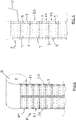
- the method according to the invention used to make a container 1 like the one described above, comprises providing a continuous web N of packaging material extending mainly longitudinally and comprising (with reference in particular to Figure 3 ): two longitudinal edges B1, B2 parallel to each other, and a plurality of zones Z1, Z2 adjacent to each other and consecutive along the extension of the web N.
- the zones Z1, Z2 are perpendicular to the longitudinal edges B1, B2 and each is intended to form a container 1. That means each zone Z1, Z2 defines the length of web N used to form one container 1.
- the web N is, for example, unwound from a roll B, as shown by way of an example in Figure 3 .
- the method comprises the step of making first longitudinal and transverse crease lines 8 and 7 on the web N, in order to define, in each zone Z1, Z2, at least: a first portion 70 intended to form the rear wall 50 of the container 1 (once formed), a second portion 80 intended to form the front wall 5 of the container 1 (once formed); and a third portion 90, interposed between the first portion 70 and the second portion 80, intended to form the top wall 3 of the container 1 (once formed).
- the step of making the first crease lines may be carried out before the web N is fed to the machine or after the web N is fed to the machine.
- the step of making the first crease lines may or may or may not be carried out by the same automatic machine which makes the containers 1.
- the method further comprises the step of folding the web N on itself (specifically at the third portion of each zone Z1, Z2, that is, along the axis of extension of the web N), closing it (by sealing) in such a way as to form a continuous tube I that is open at one end (see Figure 4 ).
- the step of folding the web N makes, on the formed containers 1, a second fold line P running along the top wall 3 (see Figure 1 ), specifically along the centre line of the top wall 3. For greater clarity, the second fold line P is also shown in Figure 4 .
- the continuous tube I is filled with a pourable product (milk, fruit juice, etc.) and then sealed in such a way as to form closed and filled packages (not illustrated) adjacent to each other (and each coinciding with a zone Z1, Z2 of the web N).
- a pourable product milk, fruit juice, etc.
- Figure 4 schematically illustrates, by way of example, a filler pipe F used to fill the continuous tube I with the pourable product.
- the packages, once filled and closed, are then separated by cutting the continuous tube I perpendicularly to the longitudinal edges B1, B2 of the web N.
- the cut by which each package is separated from the continuous tube I is made substantially half way along the sealed part so that a single seal closes two packages.
- the web N is cut at the edges which delimit each zone Z1, Z2 from an adjacent zone Z1, Z2.
- the cutting lines T of the tube I coincide with the separating lines of the zones Z1, Z2 of the web N (see Figure 4 ).
- each container 1 is defined by folding each package at the first transverse and longitudinal crease lines 7 and 8 previously made on the web N of packaging material.
- first transverse and longitudinal crease lines 7 and 8 on the web N are made in such a way that the first portion 70 and the second portion 80 of each zone Z1, Z2 have a trapezoidal shape.
- the first transverse and longitudinal crease lines 7 and 8 define two trapezoidal shapes bilaterally with respect to the axis of extension of the web N.
- the two respective non-parallel sides, which are inclined and convergent, will constitute the aforementioned perimetral edges 54, 540 (described above) of the container 1 when formed.
- the transverse and longitudinal crease lines 7 and 8 on the web N are made in such a way that the first portion 70 and the second portion 80 of each zone Z1, Z2 have a trapezoidal shape, the perimetral edges 54, 540 of the container 1 obtained (that is, the side edges, that is, the transverse crease lines 7 themselves) will be inclined with respect to the line of cutting the web N and with respect to the side seals 6.
- containers 1 which are not in the shape of parallelepipeds and which are thus ergonomic are made without producing any waste material. This is guaranteed by the fact that the cut is not shaped to make seals which are parallel to the perimetral edges of the container but is made perpendicularly to the longitudinal edges B1, B2 of the web N.
- second transverse and longitudinal crease lines 11 and 10 can be made on the web N (see detail of Figure 5 ).
- Some of the second crease lines 11, for example, are such as to define in each portion Z1, Z2 of the web N, side portions 400 adjacent to the first portion 70 and the second portion 80 along the direction of extension of the web N; again with reference to the drawings, the second transverse crease lines 11 are parallel to the first transverse crease lines 7.
- the side portions 400 thus defined can be intended to constitute the side walls 4, 40 of the container 1, once formed (see detail of Figure 5 ).
- the second longitudinal crease lines 10 can define the fold lines for what will become the corners Z of the container 1.
- each corner of the individual "pillow" package is folded (for example, along the aforesaid second longitudinal crease lines 11) and sealed along one wall of the container 1 being formed. More in detail, two corners (not illustrated in the accompanying drawings) are folded and sealed for example on the bottom wall 2 of the container 1 and the other two corners Z (only one of which is shown in Figures 1 and 2 ) are folded and sealed along the side walls 4, 40 of the container 1.
- the first transverse and longitudinal crease lines 7, 8 of each zone Z1, Z2 of the web N are shaped in such a way that once the corners of the corresponding package have been folded onto the side walls 4, 40 of the container 1, they do not protrude beyond the perimetral edges 5, 540.
- the inclination of the crease lines (hence of the perimetral edges) of the trapezoidal shapes is thus limited by this aspect.
Landscapes
- Engineering & Computer Science (AREA)
- Mechanical Engineering (AREA)
- Cartons (AREA)
- Containers And Plastic Fillers For Packaging (AREA)
- Package Frames And Binding Bands (AREA)
Applications Claiming Priority (1)
| Application Number | Priority Date | Filing Date | Title |
|---|---|---|---|
| IT102016000110444A IT201600110444A1 (it) | 2016-11-03 | 2016-11-03 | Metodo di realizzazione senza sfridi di contenitori per prodotti versabili di forma diversa da quella parallelepipeda a partire da un nastro di materiale di confezionamento, e contenitore così ottenuto |
Publications (1)
| Publication Number | Publication Date |
|---|---|
| EP3318502A1 true EP3318502A1 (de) | 2018-05-09 |
Family
ID=58609703
Family Applications (1)
| Application Number | Title | Priority Date | Filing Date |
|---|---|---|---|
| EP17199237.3A Pending EP3318502A1 (de) | 2016-11-03 | 2017-10-30 | Behälter für giessbare produkte und verfahren zur herstellung von behältern für giessbare produkte |
Country Status (2)
| Country | Link |
|---|---|
| EP (1) | EP3318502A1 (de) |
| IT (1) | IT201600110444A1 (de) |
Cited By (2)
| Publication number | Priority date | Publication date | Assignee | Title |
|---|---|---|---|---|
| EP3608243A1 (de) * | 2018-08-06 | 2020-02-12 | Tetra Laval Holdings & Finance S.A. | Kartonverpackung und zuschnitt für eine kartonverpackung |
| WO2020181725A1 (zh) * | 2019-03-14 | 2020-09-17 | 山东碧海包装材料有限公司 | 一种用于制造液体包装容器的坯料及其包装容器 |
Citations (4)
| Publication number | Priority date | Publication date | Assignee | Title |
|---|---|---|---|---|
| DE20023038U1 (de) * | 1999-09-30 | 2002-10-24 | SIG Combibloc Systems GmbH, 52441 Linnich | Behälter |
| EP1316508A1 (de) * | 2001-11-30 | 2003-06-04 | Tetra Laval Holdings & Finance S.A. | Verpackung für fliessfähige Lebensmittel |
| EP2650223A1 (de) * | 2010-12-06 | 2013-10-16 | Tetra Laval Holdings & Finance SA | Herstellungsverfahren für einen verpackungsbehälter und verpackungsbehälter |
| WO2014118813A1 (en) * | 2013-01-29 | 2014-08-07 | Ipi S.R.L. | Container and related blank |
-
2016
- 2016-11-03 IT IT102016000110444A patent/IT201600110444A1/it unknown
-
2017
- 2017-10-30 EP EP17199237.3A patent/EP3318502A1/de active Pending
Patent Citations (4)
| Publication number | Priority date | Publication date | Assignee | Title |
|---|---|---|---|---|
| DE20023038U1 (de) * | 1999-09-30 | 2002-10-24 | SIG Combibloc Systems GmbH, 52441 Linnich | Behälter |
| EP1316508A1 (de) * | 2001-11-30 | 2003-06-04 | Tetra Laval Holdings & Finance S.A. | Verpackung für fliessfähige Lebensmittel |
| EP2650223A1 (de) * | 2010-12-06 | 2013-10-16 | Tetra Laval Holdings & Finance SA | Herstellungsverfahren für einen verpackungsbehälter und verpackungsbehälter |
| WO2014118813A1 (en) * | 2013-01-29 | 2014-08-07 | Ipi S.R.L. | Container and related blank |
Cited By (6)
| Publication number | Priority date | Publication date | Assignee | Title |
|---|---|---|---|---|
| EP3608243A1 (de) * | 2018-08-06 | 2020-02-12 | Tetra Laval Holdings & Finance S.A. | Kartonverpackung und zuschnitt für eine kartonverpackung |
| WO2020030446A1 (en) * | 2018-08-06 | 2020-02-13 | Tetra Laval Holdings & Finance S.A. | A carton package and a blank for a carton package |
| CN110803366A (zh) * | 2018-08-06 | 2020-02-18 | 利乐拉瓦尔集团及财务有限公司 | 用于液体消耗品的纸盒包装和用于纸盒包装的坯材 |
| JP2021533045A (ja) * | 2018-08-06 | 2021-12-02 | テトラ ラバル ホールディングス アンド ファイナンス エス エイ | カートンパッケージ及びカートンパッケージ用のブランク |
| US11352164B2 (en) | 2018-08-06 | 2022-06-07 | Tetra Laval Holdings & Finance S.A. | Carton package and a blank for a carton package |
| WO2020181725A1 (zh) * | 2019-03-14 | 2020-09-17 | 山东碧海包装材料有限公司 | 一种用于制造液体包装容器的坯料及其包装容器 |
Also Published As
| Publication number | Publication date |
|---|---|
| IT201600110444A1 (it) | 2018-05-03 |
Similar Documents
| Publication | Publication Date | Title |
|---|---|---|
| EP2576362B1 (de) | Versiegelte Packung für gießbare Lebensmittelprodukte und Verpackungsmaterial zur Herstellung von versiegelten Packungen für gießbare Lebensmittelprodukte | |
| EP2650223B1 (de) | Herstellungsverfahren für einen verpackungsbehälter und verpackungsbehälter | |
| JP7262483B2 (ja) | 流動食品を収容する密封されたパッケージを作るためのシート包装材料及びシート包装材料から得られる密封されたパッケージ | |
| US8528807B2 (en) | Packaging container, and pouring plug fitted thereto | |
| JPWO2002010020A1 (ja) | 紙製包装容器の製造法及び紙製包装容器 | |
| US20200317390A1 (en) | A packaging material, and a package | |
| US8950655B2 (en) | Method of manufacturing packaging container and packaging container | |
| KR20140010005A (ko) | 포장 용기의 제조 방법 및 포장 용기 | |
| US20160340099A1 (en) | Packaging container with opening device and method for manufacturing the same | |
| US10829254B2 (en) | Method and a machine for producing a sealed package | |
| US8739504B2 (en) | Packaging method and apparatus | |
| US20160325872A1 (en) | Sealed package for pourable food products and a basic unit of sheet packaging material for producing sealed packages for pourable food products | |
| US4338766A (en) | Apparatus and method for producing a container for foods and the like | |
| EP3835224B1 (de) | Verpackungsmaterial zur bildung von verpackungsbehältern und aus dem verpackungsmaterial gebildeter verpackungsbehälter | |
| EP3318502A1 (de) | Behälter für giessbare produkte und verfahren zur herstellung von behältern für giessbare produkte | |
| US20190077527A1 (en) | A method of operating a packaging machine | |
| CN119562924A (zh) | 用于形成包装的包装坯料和由包装坯料形成的包装 | |
| JP2025524801A (ja) | パッケージを形成するための包装ブランク及び包装ブランクから形成されるパッケージ |
Legal Events
| Date | Code | Title | Description |
|---|---|---|---|
| PUAI | Public reference made under article 153(3) epc to a published international application that has entered the european phase |
Free format text: ORIGINAL CODE: 0009012 |
|
| STAA | Information on the status of an ep patent application or granted ep patent |
Free format text: STATUS: THE APPLICATION HAS BEEN PUBLISHED |
|
| AK | Designated contracting states |
Kind code of ref document: A1 Designated state(s): AL AT BE BG CH CY CZ DE DK EE ES FI FR GB GR HR HU IE IS IT LI LT LU LV MC MK MT NL NO PL PT RO RS SE SI SK SM TR |
|
| AX | Request for extension of the european patent |
Extension state: BA ME |