EP3318648A1 - Alliage de cuivre, et procédé de fabrication de celui-ci - Google Patents
Alliage de cuivre, et procédé de fabrication de celui-ci Download PDFInfo
- Publication number
- EP3318648A1 EP3318648A1 EP17770436.8A EP17770436A EP3318648A1 EP 3318648 A1 EP3318648 A1 EP 3318648A1 EP 17770436 A EP17770436 A EP 17770436A EP 3318648 A1 EP3318648 A1 EP 3318648A1
- Authority
- EP
- European Patent Office
- Prior art keywords
- copper alloy
- phase
- alloy according
- producing
- recovery
- Prior art date
- Legal status (The legal status is an assumption and is not a legal conclusion. Google has not performed a legal analysis and makes no representation as to the accuracy of the status listed.)
- Granted
Links
Images


Classifications
-
- C—CHEMISTRY; METALLURGY
- C22—METALLURGY; FERROUS OR NON-FERROUS ALLOYS; TREATMENT OF ALLOYS OR NON-FERROUS METALS
- C22C—ALLOYS
- C22C9/00—Alloys based on copper
- C22C9/02—Alloys based on copper with tin as the next major constituent
-
- C—CHEMISTRY; METALLURGY
- C22—METALLURGY; FERROUS OR NON-FERROUS ALLOYS; TREATMENT OF ALLOYS OR NON-FERROUS METALS
- C22C—ALLOYS
- C22C9/00—Alloys based on copper
- C22C9/05—Alloys based on copper with manganese as the next major constituent
-
- C—CHEMISTRY; METALLURGY
- C22—METALLURGY; FERROUS OR NON-FERROUS ALLOYS; TREATMENT OF ALLOYS OR NON-FERROUS METALS
- C22F—CHANGING THE PHYSICAL STRUCTURE OF NON-FERROUS METALS AND NON-FERROUS ALLOYS
- C22F1/00—Changing the physical structure of non-ferrous metals or alloys by heat treatment or by hot or cold working
-
- C—CHEMISTRY; METALLURGY
- C22—METALLURGY; FERROUS OR NON-FERROUS ALLOYS; TREATMENT OF ALLOYS OR NON-FERROUS METALS
- C22F—CHANGING THE PHYSICAL STRUCTURE OF NON-FERROUS METALS AND NON-FERROUS ALLOYS
- C22F1/00—Changing the physical structure of non-ferrous metals or alloys by heat treatment or by hot or cold working
- C22F1/006—Resulting in heat recoverable alloys with a memory effect
-
- C—CHEMISTRY; METALLURGY
- C22—METALLURGY; FERROUS OR NON-FERROUS ALLOYS; TREATMENT OF ALLOYS OR NON-FERROUS METALS
- C22F—CHANGING THE PHYSICAL STRUCTURE OF NON-FERROUS METALS AND NON-FERROUS ALLOYS
- C22F1/00—Changing the physical structure of non-ferrous metals or alloys by heat treatment or by hot or cold working
- C22F1/08—Changing the physical structure of non-ferrous metals or alloys by heat treatment or by hot or cold working of copper or alloys based thereon
-
- C—CHEMISTRY; METALLURGY
- C22—METALLURGY; FERROUS OR NON-FERROUS ALLOYS; TREATMENT OF ALLOYS OR NON-FERROUS METALS
- C22C—ALLOYS
- C22C9/00—Alloys based on copper
- C22C9/01—Alloys based on copper with aluminium as the next major constituent
Definitions
- the disclosure in the present description relates to a copper alloy and a method for producing same.
- Cu-Zn-Al, Cu-Zn-Sn, and Cu-Al-Mn copper alloys are advantageous in terms of cost due to their low raw material cost; however, they do not have as high a recovery rate as Ni-Ti alloys, which are common shape memory alloys.
- Ni-Ti alloys have excellent SME properties, in other words, a high recovery rate, but are expensive due to high Ti contents.
- Ni-Ti alloys have low thermal and electrical conductivity and can only be used at a low temperature, 100°C or lower.
- the problem has been that the internal structure changes with time due to room-temperature aging, and the shape memory properties change as a result.
- the s and L phases are Sn-rich phases and can give precipitates such as ⁇ CuSn, ⁇ CuSn, and ⁇ CuSn with progress of eutectoid transformation.
- Cu-Sn alloys undergo significant changes in their properties with time, such as significant changes in transformation temperatures upon being left to stand at a relatively low temperature near room temperature, Cu-Sn alloys have been subject of basic research but not practical applications. As such, copper alloys that undergo reverse transformation in a high temperature range of about 500°C to 700°C and stress-induced martensitic transformation have not achieved the practical use so far.
- a main object thereof is to provide a novel Cu-Sn copper alloy that stably exhibits shape memory properties and to provide a method for producing same.
- the copper alloy and method for producing same disclosed in the present description have taken the following measures to achieve the main object described above.
- a copper alloy disclosed in the present description has a basic alloy composition represented by Cu 100-(x+y) Sn x Al y (where 8 ⁇ x ⁇ 12 and 8 ⁇ y ⁇ 9 are satisfied), in which a main phase is a ⁇ CuSn phase with Al dissolved therein, and the ⁇ CuSn phase undergoes martensitic transformation when heat-treated or worked.
- a method for producing a copper alloy disclosed in the present description is a method for producing a copper alloy that undergoes martensitic transformation when heat-treated or worked.
- a homogenization step of homogenizing the cast material in a temperature range of a ⁇ CuSn phase so as to obtain a homogenized material
- the method includes at least the casting step.
- the copper alloy and method for producing same according to the present disclosure can provide a novel Cu-Sn copper alloy that stably exhibits shape memory properties and a method for producing same.
- the reason behind such effects is presumably as follows.
- the additive element Al presumably further stabilizes the ⁇ phase of the alloy at room temperature.
- addition of Al presumably suppresses slip deformation caused by dislocation and inhibits plastic deformation, thereby further improving the recovery rate.
- the copper alloy disclosed in the present description has a basic alloy composition represented by Cu 100-(x+y) Sn x Al y (where 8 ⁇ x ⁇ 12 and 8 ⁇ y ⁇ 9 are satisfied), a main phase thereof is a ⁇ CuSn phase with Al dissolved therein, and the ⁇ CuSn phase undergoes martensitic transformation when heat-treated or worked.
- the main phase refers to the phase that accounts for the largest proportion in the entirety.
- the main phase may be a phase that accounts for 50% by mass or more, may be a phase that accounts for 80% by mass or more, or may be a phase that accounts for 90% by mass or more.
- the ⁇ CuSn phase accounts for 95% by mass or more and more preferably 98% by mass or more.
- the copper alloy may be treated at a temperature of 500°C or higher and then cooled, and may have at least one selected from a shape memory effect and a super elastic effect at a temperature equal to or lower than the melting point. Since the main phase of the copper alloy is the ⁇ CuSn phase, a shape memory effect or a super elastic effect can be exhibited.
- the area ratio of the ⁇ CuSn phase contained in the copper alloy may be in the range of 50% or more and 100% or less in surface observation. The main phase may be determined by surface observation as such.
- the area ratio of the ⁇ CuSn phase may be 95% or more and is more preferably 98% or more.
- the copper alloy most preferably contains the ⁇ CuSn phase as a single phase, but may contain other phases.
- the copper alloy may contain 8 at% or more and 12 at% or less of Sn, 8 at% or more and 9 at% or less of Al, and the balance being Cu and unavoidable impurities.
- the self recovery rate can be further increased.
- 9 at% or less of Al is contained, the decrease in electrical conductivity and the decrease in self recovery rate can be further suppressed.
- the self recovery rate can be further increased.
- 12 at% or less of Sn the decrease in electrical conductivity and the decrease in self recovery rate can be further suppressed.
- Examples of the unavoidable impurities can be at least one selected from Fe, Pb, Bi, Cd, Sb, S, As, Se, and Te, and the total amount of the unavoidable impurities is preferably 0.5 at% or less, more preferably 0.2 at% or less, and yet more preferably 0.1 at% or less.
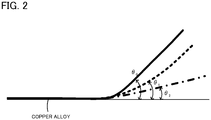
- the elastic recovery (%) of the copper alloy determined from an angle ⁇ 1 observed when a flat plate of the copper alloy is unloaded after being bent at a bending angle of ⁇ 0 is preferably 40% or more.
- the preferable elastic recovery for shape memory alloys and super elastic alloys is 40% or more.
- An elastic recovery of 18% or more indicates that there has been recovery (shape memory properties) induced by reverse transformation of martensite, not mere plastic deformation.
- the elastic recovery is preferably high, for example, is preferably 45% or more and more preferably 50% or more.
- the bending angle ⁇ 0 is to be 45°.
- Elastic recovery R E % 1 ⁇ ⁇ 1 / ⁇ 0 ⁇ 100
- the thermal recovery (%) of the copper alloy obtained from an angle ⁇ 2 observed when a flat plate of the copper alloy is heated to a particular recovery temperature, which is determined on the basis of the ⁇ CuSn phase, after being bent at a bending angle of ⁇ 0 is preferably 40% or more.
- the preferable thermal recovery of shape memory alloys and super elastic alloys is 40% or more.
- the thermal recovery may be determined from the formula below by using the aforementioned angle ⁇ 1 observed at the time of unloading.
- the thermal recovery is preferably high, for example, preferably 45% or more and more preferably 50% or more.
- the heat treatment for recovery is preferably conducted in the range of 500°C or higher and 800°C or lower, for example.
- the time for the heat treatment depends on the shape and size of the copper alloy, and may be a short time, for example, 10 seconds or shorter.
- Thermal recovery R T % 1 ⁇ ⁇ 2 / ⁇ 1 ⁇ 100
- the elastic thermal recovery (%) of the copper alloy determined from an angle ⁇ 1 , which is observed when a flat plate of the copper alloy is unloaded after being bent at a bending angle of ⁇ 0 , and an angle ⁇ 2 , which is observed when the flat plate is further heated to a particular recovery temperature determined on the basis of the ⁇ CuSn phase, is preferably 80% or more.
- the preferable elastic thermal recovery of shape memory alloys and super elastic alloys is 80% or more.
- the elastic thermal recovery [%] may be determined from the formula below by using the average elastic recovery.
- the elastic thermal recovery is preferably high, for example, is preferably 85% or more and more preferably 90% or more.
- Elastic thermal recovery R E + T % average elastic recovery + 1 ⁇ ⁇ 2 / ⁇ 1 ⁇ 1 ⁇ average elastic recovery
- the copper alloy may be a polycrystal or a single crystal.
- the copper alloy may have a crystal grain diameter of 100 ⁇ m or more.
- the crystal grain diameter is preferably large, and a single crystal is preferred over a polycrystal. This is because the shape memory effect and the super elastic effect easily emerge.
- the cast material for the copper alloy is preferably a homogenized material subjected to homogenization. Since the copper alloy after casting sometimes has a residual solidification structure, homogenization treatment is preferably conducted.
- the copper alloy may have an Ms point (the start point temperature of martensitic transformation during cooling) and an As point (the start point temperature of reverse transformation from martensite to the ⁇ CuSn phase) that change with the Sn and Al contents. Since the Ms point and the As point of such a copper alloy change according to the Al content, various properties, such as emergence of various effects, can be easily adjusted.
- the method for producing a copper alloy that undergoes martensitic transformation when heat-treated or worked includes, among a casting step and a homogenization step, at least the casting step.
- a raw material containing Cu, Sn, and Al and having a basic alloy composition represented by Cu 100-(x+y) Sn x Al y (where 8 ⁇ x ⁇ 12 and 8 ⁇ y ⁇ 9 are satisfied) is melted and casted to obtain a cast material.
- the raw material may be melted and casted to obtain a cast material having a ⁇ CuSn phase as the main phase.
- the raw materials for Cu, Sn, and Al that can be used include single-metal materials thereof and alloys containing two or more of Cu, Sn, and Al.
- the blend ratio of the raw material may be adjusted according to the desired basic alloy composition.
- the raw materials are preferably added so that the order of melting is Cu, Al, and then Sn, and casted.
- the melting method is not particularly limited, but a high frequency melting method is preferred for its efficiency and industrial viability.
- the casting step is preferably conducted in an inert gas atmosphere such as in nitrogen, Ar, or vacuum. Oxidation of the cast product can be further suppressed.
- the raw material is preferably melted in the temperature range of 750°C or higher and 1300°C or lower, and cooled at a cooling rate of -50 °C/s to -500 °C/s from 800°C to 400°C.
- the cooling rate is preferably high in order to obtain a stable ⁇ CuSn phase.
- the cast material is homogenized within the temperature range of the ⁇ CuSn phase to obtain a homogenized material.
- the cast material is preferably held in the temperature range of 600°C or higher and 850°C or lower and then cooled at a cooling rate of -50 °C/s to -500 °C/s.
- the cooling rate is preferably high in order to obtain a stable ⁇ CuSn phase.
- the homogenization temperature is, for example, preferably 650°C or higher and more preferably 700°C or higher.
- the homogenization temperature is preferably 800°C or lower and more preferably 750°C or lower.
- the homogenization time may be, for example, 20 minutes or longer or 30 minutes or longer.
- the homogenization time may be, for example, 48 hours or shorter or 24 hours or shorter.
- the homogenization treatment is also preferably conducted in an inert atmosphere such as in nitrogen, Ar, or vacuum.
- the method for producing a copper alloy may further include at least one working step of cold-working or hot-working at least one selected from a cast material and a homogenized material into at least one shape selected from a plate shape, a foil shape, a bar shape, a line shape, and a particular shape.
- hot working may be conducted in the temperature range of 500°C or higher and 700°C or lower and then cooling may be conducted at a cooling rate of -50 °C/s to -500 °C/s.
- working may be conducted by a method that suppresses occurrence of shear deformation so that a reduction in area is 50% or less.
- the method for producing a copper alloy may further include an aging step of subjecting at least one selected from the cast material and the homogenized material to an age hardening treatment so as to obtain an age-hardened material.
- the method for producing a copper alloy may further include an ordering step of subjecting at least one selected from the cast material and the homogenized material to an ordering treatment so as to obtain an ordered material.
- the age-hardening treatment or the ordering treatment may be conducted in the temperature range of 100°C or higher and 400°C or lower for a time period of 0.5 hours or longer and 24 hours or shorter.
- the present disclosure described in detail above can provide a novel Cu-Sn copper alloy that stably exhibits the shape memory properties and a method for producing same.
- the reason behind these effects is, for example, presumed to be as follows.
- the additive element Al presumably makes the ⁇ phase of the alloy more stable at room temperature.
- addition of Al presumably suppresses slip deformation caused by dislocation and inhibits plastic deformation, thereby further improving the recovery rate.
- CuSn alloys have excellent castability and are considered to rarely undergo eutectoid transformation, which is one cause for degradation of shape memory properties, because the eutectic point of ⁇ CuSn is high.
- eutectoid transformation which is one cause for degradation of shape memory properties, because the eutectic point of ⁇ CuSn is high.
- a Cu-Sn-Al alloy was prepared.
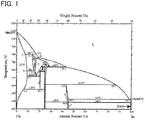
- a composition with which a ⁇ CuSn single phase was formed as the constituent phase of the subject sample at high temperature was set to be the target composition.
- the phase diagram referred is an experimental phase diagram derived from ASM International DESK HANDBOOK Phase Diagrams for Binary Alloys, Second Edition (5) and ASM International Handbook of Ternary Alloy Phase Diagrams. Pure Cu, pure Sn, and pure Al were weighed so that the molten alloy would have a composition close to the target composition, and then alloy samples were prepared by melting and casting the raw material while blowing N 2 gas in an air high-frequency melting furnace.
- the alloy ingot was cut to a thickness of 0.2 to 0.3 mm with a fine cutter and a micro cutter, and the cut piece was mechanically polished with a rotating polisher equipped with waterproof abrasive paper No. 100 to 2000. Then the resulting piece was buff-polished with an alumina solution (alumina diameter: 0.3 ⁇ m), and a mirror surface was obtained as a result. Since optical microscope observation samples were also handled as bending test samples, the sample thickness was made uniform and then the samples were heat-treated (supercooled high-temperature phase formation treatment). The sample thickness was set to 0.1 mm. In the optical microscope observation, a digital microscope, VH-8000 produced by Keyence Corporation was used. The possible magnification of this device was 450X to 3000X, but observation was basically conducted at a magnification of 450X.
- XRD measurement samples were prepared as follows. The alloy ingot was cut with a fine cutter, and edges were filed with a metal file to obtain a powder sample. The sample was heat-treated to prepare an XRD measurement sample. In quenching, the quartz tube was left unbroken during cooling since if the quartz tube was caused to break in water as with normal samples, the powder sample may contain moisture and may become oxidized.
- the XRD diffractometer used was RINT2500 produced by Rigaku Corporation. The diffractometer was a rotating-anode X-ray diffractometer.
- the measurement was conducted under the following conditions: rotor target serving as rotating anode: Cu, tube voltage: 40 kV, tube current: 200 mA, measurement range: 10° to 120°, sampling width: 0.02°, measurement rate: 2 °/minute, divergence slit angle: 1°, scattering slit angle: 1°, receiving slit width: 0.3 mm.
- a powder diffraction analysis software suite Rigaku PDXL was used to analyze the peaks emerged, identify the phases, and calculate the phase volume fractions. Note that PDXL employs the Hanawalt method for peak identification.
- TEM observation samples were prepared as follows.
- the melted and casted alloy ingot was cut with a fine cutter and a micro cutter to a thickness of 0.2 to 0.3 mm, and the cut piece was mechanically polished with a rotating polisher equipped with a No. 2000 waterproof abrasive paper to a thickness of 0.15 to 0.25 mm.
- This thin-film sample was shaped into a 3 mm square, heat-treated, and electrolytically polished under the following conditions.
- electrolytic polishing nital was used as the electrolytic polishing solution, and jet polishing was conducted while keeping the temperature at about -20°C to - 10°C (253 to 263 K).
- the electrolytic polisher used was TenuPol produced by STRUERS, and polishing was conducted under the following conditions: voltage: 10 to 15 V, current: 0.5 A, flow rate: 2.5. The sample was observed immediately after completion of electrolytic polishing. In TEM observation, Hitachi H-800 (side entry analysis mode) TEM (accelerating voltage: 175 kV) was used.
- the alloy ingot was cut with a fine cutter and a micro cutter to a thickness of 0.3 mm, and the cut piece was mechanically polished with a rotating polisher equipped with waterproof abrasive paper No. 100 to 2000 so that the thickness was 0.1 mm.
- the bending angle ⁇ 0 (45°) of the sample, the angle ⁇ 1 after unloading, and the angle ⁇ 2 after the heat treatment at 750°C (1023 K) for 1 minute were measured, and the elastic recovery and the thermal recovery were determined from the following formulae.
- FIG. 2 is a diagram illustrating angles involved in recovery measurement.
- Elastic recovery % 1 ⁇ ⁇ 1 / ⁇ 0 ⁇
- Thermal recovery % 1 ⁇ ⁇ 2 / ⁇ 1 ⁇
- Elastic + thermal recovery % average elastic recovery + 1 ⁇ ⁇ 2 / ⁇ 1 ⁇ 1 ⁇ average elastic recovery
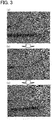
- Fig. 3 shows macroscopic observation results of the shape memory properties of the alloy foil of Experimental Example 1.
- Fig. 3(a) is a photograph taken after the homogenization treatment
- Fig. 3(b) is a photograph taken during bending deformation
- Fig. 3(c) is a photograph taken after thermal recovery.
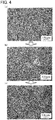
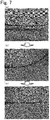
- Fig. 4 shows optical microscope observation results of the alloy foil of Experimental Example 1.
- Fig. 4(a) is a photograph taken after the homogenization treatment
- Fig. 4(b) is a photograph taken during bending deformation
- Fig. 4(c) is a photograph taken after thermal recovery.
- Fig. 4(a) is a photograph taken after the homogenization treatment
- Fig. 4(b) is a photograph taken during bending deformation
- Fig. 4(c) is a photograph taken after thermal recovery.
- FIG. 5 is a graph showing the relationship between the temperatures and the elastic + thermal recovery of Experimental Example 1.
- Fig. 6 is a graph showing the relationship between the temperatures and the thermal recovery of Experimental Example 1.
- Table 1 the measurement results of Experimental Example 1 are summarized. As shown in Fig. 3(b) , when the sample of Experimental Example 1 was deformed by bending, permanent strain remained; and, as shown in Fig. 3(c) , when the sample was heat-treated at 750°C (1023 K) for 1 minute, the shape was recovered. After the homogenization treatment and during bending deformation, thermal martensite was observed ( Figs. 4(a) and (b) ). No significant change was observed between after the homogenization treatment and during bending deformation.
- Fig. 7 shows macroscopic observation results of the shape memory properties of the alloy foil of Experimental Example 2.
- Fig. 7(a) is a photograph taken after the homogenization treatment
- Fig. 7(b) is a photograph taken during bending deformation
- Fig. 7(c) is a photograph taken after thermal recovery.
- Fig. 8 shows the optical microscope observation results of the alloy foil of Experimental Example 2.
- Fig. 8(a) is a photograph taken after the homogenization treatment
- Fig. 8(b) is a photograph taken during bending deformation
- Fig. 8(c) is a photograph taken after thermal recovery.
- Fig. 8(a) is a photograph taken after the homogenization treatment
- Fig. 8(b) is a photograph taken during bending deformation
- Fig. 8(c) is a photograph taken after thermal recovery.
- Experimental Example 2 exhibited superelasticity, and thermal martensite was observed after the homogenization treatment and during deformation. No significant difference was observed between after the homogenization treatment and during deformation. The martensite remained after unloading. Whether the superelasticity is brought by the thermal martensite is not clear, but possibly, the change in shape memory properties is induced by room-temperature aging for the same reason as that for the Cu-14 at% Sn alloy involving stress-induced martensite not detectable under the optical microscope observation. In Experimental Example 1, although the thermal martensite was observed, the reverse transformation temperature (500°C (773 K) or higher) and changes in shape memory properties due to room-temperature aging were very similar to the shape memory properties brought by the stress-induced martensite in the Cu-14 at% Sn alloy. If Experimental Example 1 contained ⁇ CuSn, it is possible that stress-induced martensite not detectable under the optical microscope observation may be present in Experimental Example 1 also.
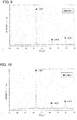
- Fig. 9 shows XRD measurement results of Experimental Example 1.
- the intensity profile of the Experimental Example 1 was analyzed, and it was found that the constituent phase was ⁇ CuSn. In other words, almost all of the phases were ⁇ CuSn.
- the lattice constant was 2.97 ⁇ , which was slightly smaller than the literature value, 3.03 ⁇ . This lattice constant was small even when compared a Cu-13 at% Sn-3.8 at% Al alloy composed of ⁇ CuSn and belonging to the same Cu-Sn-Al copper alloy.
- Fig. 10 shows XRD measurement results of Experimental Example 2.
- the intensity profile of the Experimental Example 2 was analyzed, and it was found that the constituent phase was ⁇ CuSn. In other words, almost all of the phases were ⁇ CuSn.
- the lattice constant of Experimental Example 2 was also 2.97 ⁇ , which was slightly smaller than the literature value, 3.03 ⁇ and was not much different from Experimental Example 1. This shows that in the Cu-Sn-Al copper alloy with Al dissolved therein, ⁇ CuSn is stably present even after passage of time.
- the lattice constant was smaller because Cu and Al, which have smaller atomic radii than Sn, were dissolved in ⁇ CuSn.
- the lattice constant was smaller than Cu-13 at% Sn-3.8 at% Al, which belonged to the same Cu-Sn-Al group and was constituted by ⁇ CuSn, probably because the sample composition was further deviated from ⁇ CuSn (Cu 85 Sn 15 ).
- the constituent phase of Experimental Example 2 was ⁇ CuSn. The result that this sample exhibits the shape memory effect and has thermal martensite emerged therein is reasonable.
- the intensity profile was not much different from Experimental Example 1 probably because the precipitates, such as the s phase and the L phase reported to be the cause for room-temperature aging, were so fine that they did not affect the intensity.
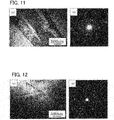
- Fig. 11 shows the TEM observation results of Experimental Example 1.
- thermal martensite was observed.
- electron diffraction pattern many superfluous wing-shaped diffraction mottles were observed.
- Fig. 12 shows the TEM observation results of Experimental Example 2.
- thermal martensite was observed as in Experimental Example 1.
- electron diffraction pattern many superfluous wing-shaped diffraction mottles were observed.
- Experimental Example 1 many superfluous wing-shaped diffraction mottles were observed in the electron diffraction pattern. This is presumably due to the s phase and the L phase that emerge by room-temperature aging.
- the disclosure in this description is applicable to the fields related to copper alloys.
Landscapes
- Chemical & Material Sciences (AREA)
- Engineering & Computer Science (AREA)
- Materials Engineering (AREA)
- Mechanical Engineering (AREA)
- Metallurgy (AREA)
- Organic Chemistry (AREA)
- Physics & Mathematics (AREA)
- Thermal Sciences (AREA)
- Crystallography & Structural Chemistry (AREA)
- Conductive Materials (AREA)
- Heat Treatment Of Sheet Steel (AREA)
Applications Claiming Priority (2)
| Application Number | Priority Date | Filing Date | Title |
|---|---|---|---|
| US201662313228P | 2016-03-25 | 2016-03-25 | |
| PCT/JP2017/012129 WO2017164396A1 (fr) | 2016-03-25 | 2017-03-24 | Alliage de cuivre, et procédé de fabrication de celui-ci |
Publications (3)
| Publication Number | Publication Date |
|---|---|
| EP3318648A1 true EP3318648A1 (fr) | 2018-05-09 |
| EP3318648A4 EP3318648A4 (fr) | 2019-05-08 |
| EP3318648B1 EP3318648B1 (fr) | 2020-02-19 |
Family
ID=59899601
Family Applications (2)
| Application Number | Title | Priority Date | Filing Date |
|---|---|---|---|
| EP17770436.8A Active EP3318648B1 (fr) | 2016-03-25 | 2017-03-24 | Alliage de cuivre, et procédé de fabrication de celui-ci |
| EP17770435.0A Not-in-force EP3441487B1 (fr) | 2016-03-25 | 2017-03-24 | Alliage de cuivre, et procédé de fabrication de celui-ci |
Family Applications After (1)
| Application Number | Title | Priority Date | Filing Date |
|---|---|---|---|
| EP17770435.0A Not-in-force EP3441487B1 (fr) | 2016-03-25 | 2017-03-24 | Alliage de cuivre, et procédé de fabrication de celui-ci |
Country Status (6)
| Country | Link |
|---|---|
| US (2) | US10954586B2 (fr) |
| EP (2) | EP3318648B1 (fr) |
| JP (2) | JP6832547B2 (fr) |
| KR (2) | KR102215220B1 (fr) |
| CN (2) | CN108779515B (fr) |
| WO (2) | WO2017164395A1 (fr) |
Families Citing this family (6)
| Publication number | Priority date | Publication date | Assignee | Title |
|---|---|---|---|---|
| WO2017164395A1 (fr) * | 2016-03-25 | 2017-09-28 | 日本碍子株式会社 | Alliage de cuivre, et procédé de fabrication de celui-ci |
| JP6810939B2 (ja) * | 2018-03-22 | 2021-01-13 | 国立大学法人横浜国立大学 | Cu−Sn−Si系超弾性合金及びその製造方法 |
| CN111172442B (zh) * | 2020-01-09 | 2021-05-25 | 西安建筑科技大学 | 一种3d打印的稀土镁合金粉体及其制备方法 |
| CN111304487B (zh) * | 2020-03-24 | 2021-05-25 | 安新县华昌合金厂 | 一种铜基形状记忆合金及其制备方法和应用 |
| CN111521622B (zh) * | 2020-04-10 | 2022-04-19 | 燕山大学 | 一种采用金属薄膜透射电镜样品研究其氧化过程的方法 |
| CN119464831A (zh) * | 2025-01-16 | 2025-02-18 | 国工恒昌新材料(义乌)有限公司 | 一种耐高温锰铜合金材料的制备方法 |
Family Cites Families (15)
| Publication number | Priority date | Publication date | Assignee | Title |
|---|---|---|---|---|
| US484073A (en) * | 1892-10-11 | Egbert weigel and bruno waechtler | ||
| NL7002632A (fr) * | 1970-02-25 | 1971-08-27 | ||
| SU484073A1 (ru) * | 1973-12-11 | 1975-09-15 | Предприятие П/Я Р-6205 | Металлическа св зка мв 5-10 |
| US4036669A (en) * | 1975-02-18 | 1977-07-19 | Raychem Corporation | Mechanical preconditioning method |
| GB8305610D0 (en) * | 1983-03-01 | 1983-03-30 | Imi Kynoch Ltd | Alloy |
| JPH109294A (ja) * | 1996-06-19 | 1998-01-13 | Sumitomo Electric Ind Ltd | 二輪車用ローラーブレーキとその製造方法 |
| JP3761741B2 (ja) * | 1999-05-07 | 2006-03-29 | 株式会社キッツ | 黄銅とこの黄銅製品 |
| JP3300684B2 (ja) * | 1999-07-08 | 2002-07-08 | 清仁 石田 | 形状記憶特性及び超弾性を有する銅系合金、それからなる部材ならびにそれらの製造方法 |
| JP4424810B2 (ja) | 2000-03-27 | 2010-03-03 | 株式会社小松製作所 | 焼結材料 |
| DE10308779B8 (de) * | 2003-02-28 | 2012-07-05 | Wieland-Werke Ag | Bleifreie Kupferlegierung und deren Verwendung |
| MY181261A (en) * | 2012-08-27 | 2020-12-21 | Nippon Steel Corp | Negative electrode active material |
| KR20140102846A (ko) * | 2013-02-15 | 2014-08-25 | 한국산업기술대학교산학협력단 | 냉간 가공성이 우수한 형상 기억 합금 |
| HUE050836T2 (hu) * | 2014-02-25 | 2021-01-28 | Nippon Steel Corp | Negatív elektródaktív anyag, negatív elektród és elem |
| CN105369043B (zh) * | 2015-10-23 | 2017-08-08 | 北京科技大学 | 高超弹性高马氏体相变临界应力形状记忆合金及制备方法 |
| WO2017164395A1 (fr) * | 2016-03-25 | 2017-09-28 | 日本碍子株式会社 | Alliage de cuivre, et procédé de fabrication de celui-ci |
-
2017
- 2017-03-24 WO PCT/JP2017/012128 patent/WO2017164395A1/fr not_active Ceased
- 2017-03-24 WO PCT/JP2017/012129 patent/WO2017164396A1/fr not_active Ceased
- 2017-03-24 CN CN201780019318.6A patent/CN108779515B/zh not_active Expired - Fee Related
- 2017-03-24 KR KR1020187027621A patent/KR102215220B1/ko not_active Expired - Fee Related
- 2017-03-24 JP JP2018507456A patent/JP6832547B2/ja not_active Expired - Fee Related
- 2017-03-24 EP EP17770436.8A patent/EP3318648B1/fr active Active
- 2017-03-24 CN CN201780002584.8A patent/CN107923000B/zh not_active Expired - Fee Related
- 2017-03-24 JP JP2017545975A patent/JP6358609B2/ja not_active Expired - Fee Related
- 2017-03-24 KR KR1020187027620A patent/KR102364117B1/ko not_active Expired - Fee Related
- 2017-03-24 EP EP17770435.0A patent/EP3441487B1/fr not_active Not-in-force
-
2018
- 2018-02-22 US US15/902,230 patent/US10954586B2/en not_active Expired - Fee Related
- 2018-09-20 US US16/136,684 patent/US10774401B2/en active Active
Also Published As
| Publication number | Publication date |
|---|---|
| US10774401B2 (en) | 2020-09-15 |
| EP3441487B1 (fr) | 2021-03-03 |
| JP6358609B2 (ja) | 2018-07-18 |
| KR102215220B1 (ko) | 2021-02-16 |
| CN108779515B (zh) | 2020-12-22 |
| CN107923000B (zh) | 2021-02-12 |
| EP3441487A4 (fr) | 2019-10-23 |
| US20190017148A1 (en) | 2019-01-17 |
| CN107923000A (zh) | 2018-04-17 |
| KR20180125484A (ko) | 2018-11-23 |
| JP6832547B2 (ja) | 2021-02-24 |
| JPWO2017164396A1 (ja) | 2018-03-29 |
| EP3318648A4 (fr) | 2019-05-08 |
| US10954586B2 (en) | 2021-03-23 |
| WO2017164395A1 (fr) | 2017-09-28 |
| KR102364117B1 (ko) | 2022-02-18 |
| KR20180119615A (ko) | 2018-11-02 |
| JPWO2017164395A1 (ja) | 2019-02-14 |
| EP3318648B1 (fr) | 2020-02-19 |
| US20180209025A1 (en) | 2018-07-26 |
| WO2017164396A1 (fr) | 2017-09-28 |
| CN108779515A (zh) | 2018-11-09 |
| EP3441487A1 (fr) | 2019-02-13 |
Similar Documents
| Publication | Publication Date | Title |
|---|---|---|
| EP3318648B1 (fr) | Alliage de cuivre, et procédé de fabrication de celui-ci | |
| EP2570505B1 (fr) | Alliage de cuivre et matériau d'alliage de cuivre laminé pour dispositif électronique et procédé pour la production de cet alliage | |
| JP6758746B2 (ja) | 電子・電気機器用銅合金、電子・電気機器用銅合金板条材、電子・電気機器用部品、端子、及び、バスバー | |
| EP2554693A1 (fr) | Alliage de cuivre contenant cu-ni-si-co pour un matériau électronique et procédé de fabrication de ce dernier | |
| EP3085799B1 (fr) | Alliage de cuivre et son procédé de fabrication | |
| Moghaddam et al. | Kinetic grain growth, shape memory and corrosion behavior of two Cu-based shape memory alloys after thermomechanical treatment | |
| EP3375898B1 (fr) | Matériau d'alliage de cuivre | |
| JP2021055129A (ja) | 電子・電気機器用銅合金、電子・電気機器用銅合金板条材、電子・電気機器用部品、端子、及び、バスバー | |
| EP3085798A1 (fr) | Alliage de cuivre | |
| Deyong et al. | Microstructural and mechanical properties of rapidly solidified Cu Ni Sn alloys | |
| EP3375897B1 (fr) | Matériau d'alliage de cuivre | |
| Kang et al. | Microstructures and shape memory characteristics of a Ti–20Ni–30Cu (at.%) alloy strip fabricated by the melt overflow process | |
| Hills et al. | The mechanical properties of quenched uranium-molybdenum alloys: Part I: Tensile tests on polycbystalline specimens | |
| JP5010841B2 (ja) | Ni3Si−Ni3Ti−Ni3Nb系複相金属間化合物,その製造方法,高温構造材料 | |
| JP5929251B2 (ja) | 鉄合金 | |
| ZHANG et al. | Full shape memory effect of Cu-13.5 Al-4Ni-6Fe shape memory martensite single crystal | |
| JP6736631B2 (ja) | チタン銅、チタン銅の製造方法及び電子部品 | |
| US9371574B2 (en) | Ni3(Si, Ti)-based intermetallic compound to which W is added, and method for producing same | |
| JP6810939B2 (ja) | Cu−Sn−Si系超弾性合金及びその製造方法 | |
| Kim et al. | Microstructure control in two-phase (B2+ L12) Ni–Al–Fe alloys by addition of carbon | |
| JP2025060134A (ja) | Mg合金及びMg合金の製造方法 | |
| Hashimoto et al. | Processing, Microstructure, and Thermal Expansion Measurements for High Temperature Ru-Al-Cr B2 Alloys |
Legal Events
| Date | Code | Title | Description |
|---|---|---|---|
| STAA | Information on the status of an ep patent application or granted ep patent |
Free format text: STATUS: THE INTERNATIONAL PUBLICATION HAS BEEN MADE |
|
| PUAI | Public reference made under article 153(3) epc to a published international application that has entered the european phase |
Free format text: ORIGINAL CODE: 0009012 |
|
| STAA | Information on the status of an ep patent application or granted ep patent |
Free format text: STATUS: REQUEST FOR EXAMINATION WAS MADE |
|
| 17P | Request for examination filed |
Effective date: 20180320 |
|
| AK | Designated contracting states |
Kind code of ref document: A1 Designated state(s): AL AT BE BG CH CY CZ DE DK EE ES FI FR GB GR HR HU IE IS IT LI LT LU LV MC MK MT NL NO PL PT RO RS SE SI SK SM TR |
|
| AX | Request for extension of the european patent |
Extension state: BA ME |
|
| RIC1 | Information provided on ipc code assigned before grant |
Ipc: C22F 1/00 20060101ALI20190321BHEP Ipc: C22C 9/01 20060101ALI20190321BHEP Ipc: C22F 1/08 20060101ALI20190321BHEP Ipc: C22C 9/02 20060101AFI20190321BHEP |
|
| RIC1 | Information provided on ipc code assigned before grant |
Ipc: C22C 9/01 20060101ALI20190326BHEP Ipc: C22F 1/00 20060101ALI20190326BHEP Ipc: C22C 9/02 20060101AFI20190326BHEP Ipc: C22F 1/08 20060101ALI20190326BHEP |
|
| A4 | Supplementary search report drawn up and despatched |
Effective date: 20190408 |
|
| RIC1 | Information provided on ipc code assigned before grant |
Ipc: C22C 9/01 20060101ALI20190402BHEP Ipc: C22C 9/02 20060101AFI20190402BHEP Ipc: C22F 1/00 20060101ALI20190402BHEP Ipc: C22F 1/08 20060101ALI20190402BHEP |
|
| DAV | Request for validation of the european patent (deleted) | ||
| DAX | Request for extension of the european patent (deleted) | ||
| GRAP | Despatch of communication of intention to grant a patent |
Free format text: ORIGINAL CODE: EPIDOSNIGR1 |
|
| STAA | Information on the status of an ep patent application or granted ep patent |
Free format text: STATUS: GRANT OF PATENT IS INTENDED |
|
| RIC1 | Information provided on ipc code assigned before grant |
Ipc: C22C 9/05 20060101ALI20190905BHEP Ipc: C22C 9/01 20060101ALI20190905BHEP Ipc: C22F 1/00 20060101ALI20190905BHEP Ipc: C22F 1/08 20060101ALI20190905BHEP Ipc: C22C 9/02 20060101AFI20190905BHEP |
|
| INTG | Intention to grant announced |
Effective date: 20190925 |
|
| GRAS | Grant fee paid |
Free format text: ORIGINAL CODE: EPIDOSNIGR3 |
|
| GRAA | (expected) grant |
Free format text: ORIGINAL CODE: 0009210 |
|
| STAA | Information on the status of an ep patent application or granted ep patent |
Free format text: STATUS: THE PATENT HAS BEEN GRANTED |
|
| AK | Designated contracting states |
Kind code of ref document: B1 Designated state(s): AL AT BE BG CH CY CZ DE DK EE ES FI FR GB GR HR HU IE IS IT LI LT LU LV MC MK MT NL NO PL PT RO RS SE SI SK SM TR |
|
| REG | Reference to a national code |
Ref country code: CH Ref legal event code: EP |
|
| REG | Reference to a national code |
Ref country code: DE Ref legal event code: R096 Ref document number: 602017012065 Country of ref document: DE |
|
| REG | Reference to a national code |
Ref country code: AT Ref legal event code: REF Ref document number: 1235034 Country of ref document: AT Kind code of ref document: T Effective date: 20200315 |
|
| REG | Reference to a national code |
Ref country code: IE Ref legal event code: FG4D |
|
| REG | Reference to a national code |
Ref country code: NL Ref legal event code: MP Effective date: 20200219 |
|
| PG25 | Lapsed in a contracting state [announced via postgrant information from national office to epo] |
Ref country code: FI Free format text: LAPSE BECAUSE OF FAILURE TO SUBMIT A TRANSLATION OF THE DESCRIPTION OR TO PAY THE FEE WITHIN THE PRESCRIBED TIME-LIMIT Effective date: 20200219 Ref country code: RS Free format text: LAPSE BECAUSE OF FAILURE TO SUBMIT A TRANSLATION OF THE DESCRIPTION OR TO PAY THE FEE WITHIN THE PRESCRIBED TIME-LIMIT Effective date: 20200219 Ref country code: NO Free format text: LAPSE BECAUSE OF FAILURE TO SUBMIT A TRANSLATION OF THE DESCRIPTION OR TO PAY THE FEE WITHIN THE PRESCRIBED TIME-LIMIT Effective date: 20200519 |
|
| REG | Reference to a national code |
Ref country code: LT Ref legal event code: MG4D |
|
| PG25 | Lapsed in a contracting state [announced via postgrant information from national office to epo] |
Ref country code: BG Free format text: LAPSE BECAUSE OF FAILURE TO SUBMIT A TRANSLATION OF THE DESCRIPTION OR TO PAY THE FEE WITHIN THE PRESCRIBED TIME-LIMIT Effective date: 20200519 Ref country code: GR Free format text: LAPSE BECAUSE OF FAILURE TO SUBMIT A TRANSLATION OF THE DESCRIPTION OR TO PAY THE FEE WITHIN THE PRESCRIBED TIME-LIMIT Effective date: 20200520 Ref country code: HR Free format text: LAPSE BECAUSE OF FAILURE TO SUBMIT A TRANSLATION OF THE DESCRIPTION OR TO PAY THE FEE WITHIN THE PRESCRIBED TIME-LIMIT Effective date: 20200219 Ref country code: LV Free format text: LAPSE BECAUSE OF FAILURE TO SUBMIT A TRANSLATION OF THE DESCRIPTION OR TO PAY THE FEE WITHIN THE PRESCRIBED TIME-LIMIT Effective date: 20200219 Ref country code: IS Free format text: LAPSE BECAUSE OF FAILURE TO SUBMIT A TRANSLATION OF THE DESCRIPTION OR TO PAY THE FEE WITHIN THE PRESCRIBED TIME-LIMIT Effective date: 20200619 Ref country code: SE Free format text: LAPSE BECAUSE OF FAILURE TO SUBMIT A TRANSLATION OF THE DESCRIPTION OR TO PAY THE FEE WITHIN THE PRESCRIBED TIME-LIMIT Effective date: 20200219 |
|
| PG25 | Lapsed in a contracting state [announced via postgrant information from national office to epo] |
Ref country code: NL Free format text: LAPSE BECAUSE OF FAILURE TO SUBMIT A TRANSLATION OF THE DESCRIPTION OR TO PAY THE FEE WITHIN THE PRESCRIBED TIME-LIMIT Effective date: 20200219 |
|
| PG25 | Lapsed in a contracting state [announced via postgrant information from national office to epo] |
Ref country code: ES Free format text: LAPSE BECAUSE OF FAILURE TO SUBMIT A TRANSLATION OF THE DESCRIPTION OR TO PAY THE FEE WITHIN THE PRESCRIBED TIME-LIMIT Effective date: 20200219 Ref country code: CZ Free format text: LAPSE BECAUSE OF FAILURE TO SUBMIT A TRANSLATION OF THE DESCRIPTION OR TO PAY THE FEE WITHIN THE PRESCRIBED TIME-LIMIT Effective date: 20200219 Ref country code: DK Free format text: LAPSE BECAUSE OF FAILURE TO SUBMIT A TRANSLATION OF THE DESCRIPTION OR TO PAY THE FEE WITHIN THE PRESCRIBED TIME-LIMIT Effective date: 20200219 Ref country code: EE Free format text: LAPSE BECAUSE OF FAILURE TO SUBMIT A TRANSLATION OF THE DESCRIPTION OR TO PAY THE FEE WITHIN THE PRESCRIBED TIME-LIMIT Effective date: 20200219 Ref country code: SM Free format text: LAPSE BECAUSE OF FAILURE TO SUBMIT A TRANSLATION OF THE DESCRIPTION OR TO PAY THE FEE WITHIN THE PRESCRIBED TIME-LIMIT Effective date: 20200219 Ref country code: PT Free format text: LAPSE BECAUSE OF FAILURE TO SUBMIT A TRANSLATION OF THE DESCRIPTION OR TO PAY THE FEE WITHIN THE PRESCRIBED TIME-LIMIT Effective date: 20200712 Ref country code: LT Free format text: LAPSE BECAUSE OF FAILURE TO SUBMIT A TRANSLATION OF THE DESCRIPTION OR TO PAY THE FEE WITHIN THE PRESCRIBED TIME-LIMIT Effective date: 20200219 Ref country code: SK Free format text: LAPSE BECAUSE OF FAILURE TO SUBMIT A TRANSLATION OF THE DESCRIPTION OR TO PAY THE FEE WITHIN THE PRESCRIBED TIME-LIMIT Effective date: 20200219 Ref country code: RO Free format text: LAPSE BECAUSE OF FAILURE TO SUBMIT A TRANSLATION OF THE DESCRIPTION OR TO PAY THE FEE WITHIN THE PRESCRIBED TIME-LIMIT Effective date: 20200219 |
|
| REG | Reference to a national code |
Ref country code: CH Ref legal event code: PL |
|
| REG | Reference to a national code |
Ref country code: AT Ref legal event code: MK05 Ref document number: 1235034 Country of ref document: AT Kind code of ref document: T Effective date: 20200219 |
|
| REG | Reference to a national code |
Ref country code: DE Ref legal event code: R097 Ref document number: 602017012065 Country of ref document: DE |
|
| PG25 | Lapsed in a contracting state [announced via postgrant information from national office to epo] |
Ref country code: MC Free format text: LAPSE BECAUSE OF FAILURE TO SUBMIT A TRANSLATION OF THE DESCRIPTION OR TO PAY THE FEE WITHIN THE PRESCRIBED TIME-LIMIT Effective date: 20200219 |
|
| REG | Reference to a national code |
Ref country code: BE Ref legal event code: MM Effective date: 20200331 |
|
| PLBE | No opposition filed within time limit |
Free format text: ORIGINAL CODE: 0009261 |
|
| STAA | Information on the status of an ep patent application or granted ep patent |
Free format text: STATUS: NO OPPOSITION FILED WITHIN TIME LIMIT |
|
| PG25 | Lapsed in a contracting state [announced via postgrant information from national office to epo] |
Ref country code: LU Free format text: LAPSE BECAUSE OF NON-PAYMENT OF DUE FEES Effective date: 20200324 |
|
| 26N | No opposition filed |
Effective date: 20201120 |
|
| PG25 | Lapsed in a contracting state [announced via postgrant information from national office to epo] |
Ref country code: AT Free format text: LAPSE BECAUSE OF FAILURE TO SUBMIT A TRANSLATION OF THE DESCRIPTION OR TO PAY THE FEE WITHIN THE PRESCRIBED TIME-LIMIT Effective date: 20200219 Ref country code: IT Free format text: LAPSE BECAUSE OF FAILURE TO SUBMIT A TRANSLATION OF THE DESCRIPTION OR TO PAY THE FEE WITHIN THE PRESCRIBED TIME-LIMIT Effective date: 20200219 Ref country code: LI Free format text: LAPSE BECAUSE OF NON-PAYMENT OF DUE FEES Effective date: 20200331 Ref country code: IE Free format text: LAPSE BECAUSE OF NON-PAYMENT OF DUE FEES Effective date: 20200324 Ref country code: CH Free format text: LAPSE BECAUSE OF NON-PAYMENT OF DUE FEES Effective date: 20200331 |
|
| PG25 | Lapsed in a contracting state [announced via postgrant information from national office to epo] |
Ref country code: PL Free format text: LAPSE BECAUSE OF FAILURE TO SUBMIT A TRANSLATION OF THE DESCRIPTION OR TO PAY THE FEE WITHIN THE PRESCRIBED TIME-LIMIT Effective date: 20200219 Ref country code: BE Free format text: LAPSE BECAUSE OF NON-PAYMENT OF DUE FEES Effective date: 20200331 Ref country code: SI Free format text: LAPSE BECAUSE OF FAILURE TO SUBMIT A TRANSLATION OF THE DESCRIPTION OR TO PAY THE FEE WITHIN THE PRESCRIBED TIME-LIMIT Effective date: 20200219 |
|
| PG25 | Lapsed in a contracting state [announced via postgrant information from national office to epo] |
Ref country code: TR Free format text: LAPSE BECAUSE OF FAILURE TO SUBMIT A TRANSLATION OF THE DESCRIPTION OR TO PAY THE FEE WITHIN THE PRESCRIBED TIME-LIMIT Effective date: 20200219 Ref country code: MT Free format text: LAPSE BECAUSE OF FAILURE TO SUBMIT A TRANSLATION OF THE DESCRIPTION OR TO PAY THE FEE WITHIN THE PRESCRIBED TIME-LIMIT Effective date: 20200219 Ref country code: CY Free format text: LAPSE BECAUSE OF FAILURE TO SUBMIT A TRANSLATION OF THE DESCRIPTION OR TO PAY THE FEE WITHIN THE PRESCRIBED TIME-LIMIT Effective date: 20200219 |
|
| PG25 | Lapsed in a contracting state [announced via postgrant information from national office to epo] |
Ref country code: MK Free format text: LAPSE BECAUSE OF FAILURE TO SUBMIT A TRANSLATION OF THE DESCRIPTION OR TO PAY THE FEE WITHIN THE PRESCRIBED TIME-LIMIT Effective date: 20200219 Ref country code: AL Free format text: LAPSE BECAUSE OF FAILURE TO SUBMIT A TRANSLATION OF THE DESCRIPTION OR TO PAY THE FEE WITHIN THE PRESCRIBED TIME-LIMIT Effective date: 20200219 |
|
| PGFP | Annual fee paid to national office [announced via postgrant information from national office to epo] |
Ref country code: DE Payment date: 20240130 Year of fee payment: 8 Ref country code: GB Payment date: 20240201 Year of fee payment: 8 |
|
| PGFP | Annual fee paid to national office [announced via postgrant information from national office to epo] |
Ref country code: FR Payment date: 20240213 Year of fee payment: 8 |
|
| REG | Reference to a national code |
Ref country code: DE Ref legal event code: R119 Ref document number: 602017012065 Country of ref document: DE |
|
| GBPC | Gb: european patent ceased through non-payment of renewal fee |
Effective date: 20250324 |
|
| PG25 | Lapsed in a contracting state [announced via postgrant information from national office to epo] |
Ref country code: DE Free format text: LAPSE BECAUSE OF NON-PAYMENT OF DUE FEES Effective date: 20251001 |
|
| PG25 | Lapsed in a contracting state [announced via postgrant information from national office to epo] |
Ref country code: GB Free format text: LAPSE BECAUSE OF NON-PAYMENT OF DUE FEES Effective date: 20250324 |
|
| PG25 | Lapsed in a contracting state [announced via postgrant information from national office to epo] |
Ref country code: FR Free format text: LAPSE BECAUSE OF NON-PAYMENT OF DUE FEES Effective date: 20250331 |