EP3319038A1 - Procédé et appareil de génération d'image panoramique pour un terminal d'utilisateur - Google Patents
Procédé et appareil de génération d'image panoramique pour un terminal d'utilisateur Download PDFInfo
- Publication number
- EP3319038A1 EP3319038A1 EP15897011.1A EP15897011A EP3319038A1 EP 3319038 A1 EP3319038 A1 EP 3319038A1 EP 15897011 A EP15897011 A EP 15897011A EP 3319038 A1 EP3319038 A1 EP 3319038A1
- Authority
- EP
- European Patent Office
- Prior art keywords
- images
- image
- adjacent images
- camera parameter
- adjacent
- Prior art date
- Legal status (The legal status is an assumption and is not a legal conclusion. Google has not performed a legal analysis and makes no representation as to the accuracy of the status listed.)
- Withdrawn
Links
Images



Classifications
-
- G—PHYSICS
- G06—COMPUTING OR CALCULATING; COUNTING
- G06T—IMAGE DATA PROCESSING OR GENERATION, IN GENERAL
- G06T7/00—Image analysis
- G06T7/10—Segmentation; Edge detection
-
- G—PHYSICS
- G06—COMPUTING OR CALCULATING; COUNTING
- G06T—IMAGE DATA PROCESSING OR GENERATION, IN GENERAL
- G06T3/00—Geometric image transformations in the plane of the image
- G06T3/40—Scaling of whole images or parts thereof, e.g. expanding or contracting
- G06T3/4038—Image mosaicing, e.g. composing plane images from plane sub-images
-
- G—PHYSICS
- G06—COMPUTING OR CALCULATING; COUNTING
- G06T—IMAGE DATA PROCESSING OR GENERATION, IN GENERAL
- G06T3/00—Geometric image transformations in the plane of the image
- G06T3/40—Scaling of whole images or parts thereof, e.g. expanding or contracting
-
- G—PHYSICS
- G06—COMPUTING OR CALCULATING; COUNTING
- G06T—IMAGE DATA PROCESSING OR GENERATION, IN GENERAL
- G06T5/00—Image enhancement or restoration
- G06T5/50—Image enhancement or restoration using two or more images, e.g. averaging or subtraction
-
- G—PHYSICS
- G06—COMPUTING OR CALCULATING; COUNTING
- G06T—IMAGE DATA PROCESSING OR GENERATION, IN GENERAL
- G06T5/00—Image enhancement or restoration
- G06T5/90—Dynamic range modification of images or parts thereof
- G06T5/92—Dynamic range modification of images or parts thereof based on global image properties
-
- G—PHYSICS
- G06—COMPUTING OR CALCULATING; COUNTING
- G06T—IMAGE DATA PROCESSING OR GENERATION, IN GENERAL
- G06T2207/00—Indexing scheme for image analysis or image enhancement
- G06T2207/20—Special algorithmic details
- G06T2207/20212—Image combination
- G06T2207/20221—Image fusion; Image merging
-
- H—ELECTRICITY
- H04—ELECTRIC COMMUNICATION TECHNIQUE
- H04N—PICTORIAL COMMUNICATION, e.g. TELEVISION
- H04N23/00—Cameras or camera modules comprising electronic image sensors; Control thereof
- H04N23/60—Control of cameras or camera modules
- H04N23/698—Control of cameras or camera modules for achieving an enlarged field of view, e.g. panoramic image capture
Definitions
- the present disclosure relates to a field of image processing technology, and more particularly, to a panoramic image generation method and apparatus for a user terminal.
- a panoramic image may be obtained by a wide-angle shot. However, limited by the hardware, most panoramic images are obtained by mosaicking a plurality of images such that surrounding environments may be shown as much as possible.
- a panoramic image is generally obtained by mosaicking a plurality of images in following manners.
- One is a general mosaicking method which uses a scale-invariant feature transform (SIFT) feature and a bundle adjustment optimization to perform image mosaic
- another one is a mosaicking method for a mobile phone, in which movement tracks of the mobile phone can be recorded by an built-in sensor of the mobile phone to accelerate the image mosaic, or a color compensation and an illumination compensation can be performed on an overlapped area to improve quality of a mosaicked image.
- SIFT scale-invariant feature transform
- both the general mosaicking method and the mosaicking method for a mobile phone have a low mosaicking speed.
- the present disclosure aims to solve at least one of the technical problems existing in the related art to at least some extent.
- an objective of the present disclosure is to provide a panoramic image generation method for a user terminal which can improve an image mosaicking speed.
- Another objective of the present disclosure is to provide a panoramic image generation apparatus for a user terminal.
- embodiments according to a first aspect of the present disclosure provide a panoramic image generation method for a user terminal, which includes: obtaining a plurality of images shot by a user terminal, determining an adjacence relationship among the plurality of images, and performing feature matching on adjacent images to obtain matched feature-point-pairs; obtaining an optimized camera parameter according to the matched feature-point-pairs and an initial camera parameter; performing a color adjustment on the adjacent images, to obtain color adjusted adjacent images; mosaicking the color adjusted adjacent images according to the optimized camera parameter to generate a panoramic image.
- the panoramic image generation method for a user terminal by determining the adjacence relationship among the plurality of images and performing feature extraction on the adjacent images, the requirement of accuracy can be satisfied and workload for the feature extraction can be reduced, thus improving the image mosaicking speed.
- a panoramic image generation apparatus for a user terminal, which includes: a matching module, configured to obtain a plurality of images shot by a user terminal, to determine an adjacence relationship among the plurality of images, and to perform feature matching on adjacent images to obtain matched feature-point-pairs; an optimizing module, configured to obtain an optimized camera parameter according to the matched feature-point-pairs and an initial camera parameter; an adjusting module, configured to perform a color adjustment on the adjacent images to obtain color adjusted adjacent images; and a mosaicking module, configured to mosaic the color adjusted adjacent images according to the optimized camera parameter to generate the panoramic image.
- a matching module configured to obtain a plurality of images shot by a user terminal, to determine an adjacence relationship among the plurality of images, and to perform feature matching on adjacent images to obtain matched feature-point-pairs
- an optimizing module configured to obtain an optimized camera parameter according to the matched feature-point-pairs and an initial camera parameter
- an adjusting module configured to perform a color adjustment on the adjacent images
- the panoramic image generation apparatus for a user terminal by determining the adjacence relationship among the plurality of images and performing feature extraction on the adjacent images, the requirement of accuracy can be satisfied and workload for the feature extraction can be reduced, thus improving the image mosaicking speed.
- Embodiments of the present disclosure also provide a user terminal, which includes: one or more processors, a memory, and one or more programs stored in the memory and configured to perform the method according to any one of the embodiments of the first aspect of the present disclosure when executed by the one or more processors.
- Embodiments of the present disclosure also provide a non-transitory computer storage medium having stored therein one or more modules that, when executed, performing the method according to any one of the embodiments of the first aspect of the present disclosure.
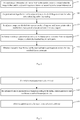
- Fig. 1 is a flow chart of a panoramic image generation method for a user terminal according to an embodiment of the present disclosure, the method includes following acts.
- a plurality of images shot by a user terminal is obtained, an adjacence relationship among the plurality of images is determined, and feature matching is performed on adjacent images to obtain matched feature-point-pairs.
- Surrounding environments may be shot by a camera of the user terminal, so as to obtain a plurality of images in different states (for example an angle, illumination, etc.).
- the adjacent images may be determined first.
- determining the adjacent images from the plurality of images may include following acts.
- the senor may be a gyroscope, a magnetometer, or a gravity sensor, etc.
- sensor information corresponding to the image may be recorded and then the adjacent images are determined according to the information.
- an angle corresponding to a first image is a first angle
- an angle corresponding to a second image is a second angle
- an angle corresponding to a third image is a third angle.
- a difference between the first angle and the second angle is less than a difference between the third angle and the first angle
- it is determined that the first image and the second image are adjacent.
- feature extraction may be performed on each image in the adjacent images to accomplish the feature matching.
- performing the feature matching on the adjacent images to obtain the matched feature-point-pairs may include following acts.
- the adjacent images are divided into a preset number of regions, and feature points with a number less than a preset value are extracted from each region.
- each of the adjacent images may be divided into 4 regions, and a certain number of feature points are extracted from each region.
- the feature point may be a SIFT feature point.
- the feature matching is performed according to the feature points extracted from the adjacent images, to obtain the matched feature-point-pairs.
- matching of the SIFT feature points of the adjacent images may be performed using a random sample consensus (RANSAC) algorithm to obtain the matched feature-point-pairs.
- RANSAC random sample consensus
- the computation may be cut down by limiting the number of the feature points, thus improving the mosaicking speed.
- a pretreatment may be performed on the images before the feature points are extracted, and/or some mis-matched feature-point-pairs may be removed after the feature-point-pairs are matched.
- the method may further include following acts.
- the pretreatment is performed on the adjacent images, in which the pretreatment includes color enhancing and/or size scaling.
- the color enhancing refers to enhancing relatively dark images. For example, when a brightness value of a pixel in one image is less than a preset value, a preset increment may be added to the brightness value.
- the size scaling refers to zooming an original image to a size suitable for the mobile device to process, in which, the size may be determined according to different kinds of the mobile device.
- the feature extraction and the feature matching may be performed on the pretreated images, details of which may refer to above related descriptions, which will not be elaborated here.
- the process may be more effective and the images are suitable for the mobile device.
- the mis-matched feature-point-pair can be removed after that.
- the method may further include block S25.
- filtration processing is performed on the matched feature-point-pairs to remove the mis-matched feature-point-pair.
- a heuristic algorithm may be used for the filtration processing.
- A may be connected to B to obtain a segment AB
- a segment CD and a segment EF may be obtained.
- these segments are compared, and feature-point-pairs corresponding to segments which basically have a same length and are parallel are remained, and other feature-point-pair(s) are removed.
- the removed feature-point-pair usually includes a mis-matched SIFT feature-point-pair which does not satisfy a basic parallel condition and wrong RANSAC inliers. Generally, these wrong RANSAC inliers do not satisfy a condition that lengths are basically same.
- Filtered matched feature-point-pairs are obtained via the filtration processing, thereafter the matched feature-point-pairs used in later processing refer to the filtered matched feature-point-pairs.
- an optimized camera parameter is obtained according to the matched feature-point-pairs and an initial camera parameter.
- a bundle adjustment algorithm may be utilized to perform a global optimization on the camera parameter.
- the bundle adjustment algorithm involves a nonlinear equation, and the camera parameter is optimized by minimizing a projection difference of all the matched feature-point-pairs among the images.
- a Levenberg-Marquardt iteration algorithm may be used to obtain a solution in the bundle adjustment algorithm. Since nonlinear optimization is very sensitive to an initial value, if a given initial value is not appropriate, only a local optimal solution may be obtained, which may cause dislocation or ghost in a mosaicked panoramic image.
- the flow path of global optimization of the camera parameter may include following acts.
- the initial camera parameter is determined, in which determining the initial camera parameter includes a following act.
- the camera parameter may include a focal length, a rotation matrix, etc.
- the initial camera parameter obtained according to the sensor information according to the present embodiment may have a better optimal solution, thus reducing the dislocation and the ghost.
- the optimized camera parameter is obtained according to the initial camera parameter and the filtered matched feature-point-pairs.
- the Levenberg-Marquardt iteration algorithm may be used to obtain the optimized camera parameter.
- the method may further include block S33.
- the failure solution includes following acts.
- the ideal camera parameter may be determined by: determining an image format of each layer of the image shot by the user terminal (e.g. the mobile device), averagely estimating an angle of each image, and obtaining the ideal camera parameter according to the angle.
- each of the plurality of images includes three layers, a bottom layer is removed and the optimization is performed according to two upper layers.
- the feature-point-pair(s) corresponding to parts of the images may be removed.
- the mobile phone is used for shooting, three layers of images may be usually obtained.
- the bottom layer of images may be removed first and the upper two layers of images are optimized, such that it ensures that the two upper layers of images can be correctly mosaicked.
- the optimization may also be performed according to feature-point-pairs of the two upper layers and the initial camera parameter.
- the initial camera parameter determined according to the sensor information according to this embodiment may be selected as the initial camera parameter first, and then the ideal camera parameter is selected.
- the middle layer of images can be ensured to be optimized and be mosaicked correctly.
- the initial camera parameter determined according to the sensor information according to this embodiment may be selected as the initial camera parameter first, and then the ideal camera parameter is selected.
- a color adjustment is performed on the adjacent images, to obtain color adjusted adjacent images.
- a parameter of each image such as an exposure or a white balance
- Illumination changes at different regions of a scenario may lead to different exposures in the adjacent images.
- objects of different colors in different parts of the scenario may also affect the white balance, thus leading to different appearances of a same object in the adjacent images, some being brighter, while some being darker.
- the color of an overlapped area in the panoramic image will be non-uniform. Therefore before the original images are mosaicked, a color compensation and an exposure compensation may be performed on the original images.
- performing the color adjustment on the adjacent images to obtain the color adjusted adjacent images may include following acts.
- Algorithms for determining an overlapped area of two images in the related art may be utilized.
- the adjacent images are A and B, and an overlapped area of A and B is D. Then a set of pixel values of pixel points in area D of image A and a set of pixel values of pixel points in area D of image B are obtained. After that, the adjustment parameters corresponding to A and B are obtained via a least square method when a difference between the two sets of pixel values is minimum.
- the adjustment parameters may be gamma adjustment parameters.
- the color adjustment is performed on the adjacent images utilizing the adjustment parameters, to obtain the color adjusted adjacent images.
- the color adjustment may be performed on image A using the adjustment parameter corresponding to A, and the color adjustment may be performed on image B using the adjustment parameter corresponding to B.
- the color adjusted adjacent images are mosaicked according to the optimized camera parameter to generate the panoramic image.
- the adjacent images may be mosaicked, to generate the panoramic image.
- mosaicking the color adjusted adjacent images according to the optimized camera parameter to generate the panoramic image may include following acts.
- the color adjusted adjacent images are zoomed out to obtain corresponding zoomed-out images.
- each image of the adjacent images may be zoomed out to 1/8 of its original size.
- a mosaic-seam in each zoomed-out image is determined according to the optimized camera parameter.
- a mask-image corresponding to each of the adjacent images is generated according to the optimized camera parameter and the mosaic-seam, in which the mask-image includes a component part and a connection part.
- a position of each image in the panoramic image may be determined according to the optimized camera parameter. After the position and the mosaic-seam are determined, the mask-image corresponding to an image may be determined.
- the mask-image includes a component part and a connection part.
- Fig. 6a For example, four images to be mosaicked are shown as Fig. 6a .
- the mask-images corresponding to the four images may be shown in Fig. 6b , in which the component part is illustrated as a white area and the connection part is illustrated as a black area.
- a multilayer hybrid fusion is performed on the connection parts of the adjacent images to obtain a fused part, and the panoramic image is generated according to the component part and the fused part.
- the component part of the mask-image may be directly used as a corresponding part of the panoramic image. Since there is an overlap in the connection parts of the adjacent images, the connection parts may be processed.
- the multilayer hybrid fusion technology in the related art can be utilized and then the component part and the fused part constitute the panoramic image.
- the size of the mask-image is usually selected to be identical with a size (i.e. a same resolution) of the panoramic image, so that the panoramic image may be constituted by the component part and the fused part directly.
- the mosaicked panoramic image may be as the image shown in Fig. 6c .
- the connection part of a mask-image of one image is very large, and the component part is scattered in two ends of the connection part. In this case the following process may be performed.
- the mask-image is divided into two sub images, so that each sub image may be processed respectively.
- each of the sub images may be treated as an independent image in subsequent multilayer hybrid fusion and when the constituent part and the fused part are constituted.
- a processing time may be reduced. For example, 1 ⁇ 2 seconds may be saved for each mask-image, since there are usually 7 ⁇ 8 mask-images, the mosaicking speed may be significantly improved.
- the above embodiments of the present disclosure may be used in image mosaicking for the mobile phone. It should be understood that the above solutions of the present disclosure may also be applied to other mobile devices, for example, applied in mosaicking in a vehicle-mounted system. Furthermore, in other scenarios, such as a vehicle-mounted scenario, the parameters may be adjusted according to an actual scenario.
- the above method according to embodiments of the present disclosure is suitable for the mobile device, by improvements of the pretreatment of the images, the feature matching, the global optimization, global color adjustment and the multilayer hybrid fusion, panoramic mosaicking of multilayer images may be quickly performed on the mobile device with a high quality. According to experiments, it shows that the success rate of mosaicking is larger than 80%, and the time is within 40 seconds. Furthermore, the solutions according to embodiments of the present disclosure may be applied to different kinds of user terminals to improve their performance.
- Fig. 7 is a block diagram of a panoramic image generation apparatus for a user terminal according to another embodiment of the present disclosure.
- the apparatus may be arranged in the user terminal, and may include a matching module 71, an optimization module 72, an adjusting module 73 and a mosaicking module 74.
- the matching module 71 is configured to obtain a plurality of images shot by a user terminal, to determine an adjacence relationship among the plurality of images, and to perform feature matching on adjacent images to obtain matched feature-point-pairs.
- Surrounding environments may be shot by a camera of the user terminal about surrounding environments, so as to obtain a plurality of images in different states (for example an angle, illumination, etc.).
- the adjacent images may be determined first.
- determining adjacent images from the plurality of images by the matching module 71 may include following acts.
- information of a sensor built-in the mobile device is obtained when the image is shot, and the adjacent images are determined according to the sensor information.
- the senor may be a gyroscope, a magnetometer, or a gravity sensor, etc.
- sensor information corresponding to the image may be recorded and then the adjacent images are determined according to the information.
- an angle corresponding to a first image is a first angle
- an angle corresponding to a second image is a second angle
- an angle corresponding to a third image is a third angle.
- a difference between the first angle and the second angle is less than a difference between the third angle and the first angle
- it is determined that the first image and the second image are adjacent.
- feature extraction may be performed on each image in the adjacent images to accomplish the feature matching.
- the matching module 71 is configured to perform feature matching on the adjacent images to obtain matched feature-point-pairs by following acts.
- the adjacent images are divided into a preset number of regions, and feature points with a number less than a preset value are extracted from each region.
- each of the adjacent images may be divided into 4 regions, and a certain number of feature points are extracted from each region.
- the feature point may be a SIFT feature point.
- Feature matching is performed according to the feature points extracted from the adjacent images, to obtain matched feature-point-pairs.
- matching of the SIFT feature points of the adjacent images may be performed using a RANSAC algorithm to obtain the matched feature-point-pairs.
- the computation may be cut down by limiting the number of the feature points, thus improving the mosaicking speed.
- the matching module is further configured to pretreat the images before the feature points are extracted, and/or to remove some mis-matched feature-point-pairs after the feature-point-pairs are matched. Details may refer to descriptions of the method embodiments, which is not elaborated here.
- the optimization module 72 is configured to obtain an optimized camera parameter according to the matched feature-point-pairs and an initial camera parameter.
- a bundle adjustment algorithm may be utilized to perform a global optimization on the camera parameter.
- the bundle adjustment algorithm involves a nonlinear equation, and the camera parameter is optimized by minimizing a projection difference of all the matched feature-point-pairs among the images.
- a Levenberg-Marquardt iteration algorithm may be used to obtain a solution in the bundle adjustment algorithm. Since nonlinear optimization is very sensitive to an initial value, if a given initial value is not appropriate, only a local optimal solution may be obtained, which may cause dislocation or ghost in a mosaicked panoramic image.
- the apparatus 70 further includes a determining module 75 configured to determine the initial value.
- the determining module 75 is configured to obtain information of the sensor built-in the mobile device when each image is shot, and to determine the initial camera parameter according to the information.
- the camera parameter may include a focal length, a rotation matrix, etc.
- the initial camera parameter obtained according to the sensor information according to the present embodiment may have a better optimal solution, thus reducing the dislocation and the ghost.
- the apparatus may also include a processing module 76 configured to take a pre-determined ideal camera parameter as the initial camera parameter, and to perform the optimization again when the camera parameter optimization is failed. If the optimization is failed again, and each of the plurality of images includes three layers, a bottom layer is removed and the optimization is performed according to two upper layers. If the optimization utilizing the two upper layers is failed, an optimization utilizing a middle layer of images is performed.
- a processing module 76 configured to take a pre-determined ideal camera parameter as the initial camera parameter, and to perform the optimization again when the camera parameter optimization is failed. If the optimization is failed again, and each of the plurality of images includes three layers, a bottom layer is removed and the optimization is performed according to two upper layers. If the optimization utilizing the two upper layers is failed, an optimization utilizing a middle layer of images is performed.
- the ideal camera parameter may be determined by: determing an image format of each layer of the image shot by the user terminal (e.g. the mobile device), averagely estimating an angle of each image, and obtaining the ideal camera parameter according to the angle.
- the feature-point-pair(s) corresponding to parts of the images may be removed.
- the mobile phone is used for shooting, three layers of images may be usually obtained.
- the bottom layer of images may be removed first and the upper two layers of images are optimized, such that it ensures that the two upper layers of images can be correctly mosaicked.
- the camera parameter may include a focal length, a rotation matrix, etc.
- the initial camera parameter determined according to the sensor information according to this embodiment may be selected as the initial camera parameter first, and then the ideal camera parameter is selected.
- the middle layer of images can be ensured to be optimized and be mosaicked correctly.
- only feature-point-pairs corresponding to the middle layer of images and the initial camera parameter are utilized in computation.
- the initial camera parameter determined according to the sensor information according to this embodiment may be selected as the initial camera parameter first, and then the ideal camera parameter is selected.
- the adjusting module 73 is configured to perform a color adjustment on the adjacent images, to obtain color adjusted adjacent images.
- a parameter of each image such as an exposure or a white balance
- Illumination changes at different regions of a scenario may lead to different exposures in the adjacent images.
- objects of different colors in different parts of the scenario may also affect the white balance, thus leading to different appearances of a same object in the adjacent images, some being brighter, while some being darker.
- the color of an overlapped area in the panoramic image will be non-uniform. Therefore before the original images are mosaicked, a color compensation and an exposure compensation may be performed on the original images.
- the adjusting module 73 is specifically configured to determine an overlapped area of the adjacent images, to obtain an adjustment parameter which can minimize the difference between two sets of pixel values based on the two sets of pixel values of pixels in the overlapped area of the adjacent images, and to perform the color adjustment on the adjacent images utilizing the adjustment parameters, to obtain the color adjusted adjacent images.
- Algorithms for determining an overlapped area of two images in the related art may be utilized.
- the adjacent images are A and B, and an overlapped area of A and B is D. Then a set of pixel values of pixel points in area D of image A and a set of pixel values of pixel points in area D of image B are obtained. After that, the adjustment parameters corresponding to A and B are obtained via a least square method when a difference between the two sets of pixel values is minimum.
- the adjustment parameters may be gamma adjustment parameters.
- the color adjustment may be performed on image A using the adjustment parameter corresponding to A, and the color adjustment may be performed on image B using the adjustment parameter corresponding to B.
- the mosaicking module 74 is configured to mosaic the color adjusted adjacent images according to the optimized camera parameter to generate the panoramic image.
- the adjacent images may be mosaicked, to generate the panoramic image.
- the mosaicking module 74 is configured to perform following acts.
- the color adjusted adjacent images are zoomed out to obtain corresponding zoomed-out images.
- each image of the adjacent images may be zoomed out to 1/8 of its original size.
- a mosaic-seam in each zoomed-out image is determined according to the optimized camera parameter.
- technologies in the related art may be used to determine the technologies in each image according to the adjacent images.
- a mask-image corresponding to each of the adjacent images is generated according to the optimized camera parameter and the mosaic-seam, in which the mask-image includes a component part and a connection part.
- a position of each image in the panoramic image may be determined according to the optimized camera parameter. After the position and the mosaic-seam are determined, the mask-image corresponding to an image may be determined.
- the mask-image includes a component part and a connection part.
- Fig. 6a For example, four images to be mosaicked are shown as Fig. 6a .
- the mask-images corresponding to the four images may be shown in Fig. 6b , in which the component part is illustrated as a white area and the connection part is illustrated as a black area.
- a multilayer hybrid fusion is performed on the connection parts of the adjacent images to obtain a fused part, and the panoramic image is generated according to the component part and the fused part.
- the component part of the mask-image may be directly used as a corresponding part of the panoramic image. Since there is an overlap in the connection parts of the adjacent images, the connection parts may be processed.
- the multilayer hybrid fusion technology in the related art can be utilized and then the component part and the fused part constitute the panoramic image.
- the size of the mask-image is usually selected to be identical with a size (i.e. having the same resolution) of the panoramic image, so that the panoramic image may be constituted by the component part and the fused part directly.
- the mosaicked panoramic image may be as the image shown in Fig. 6c .
- the mosaicking module 74 is further configured to divide the mask-image into two sub images when the component part of the mask-image includes two parts which are scattered in two ends of the connection part, so that each sub image may be processed respectively.
- each of the sub images may be treated as an independent image in subsequent multilayer hybrid fusion and when the constituent part and the fused part are constituted.
- a processing time may be reduced. For example, 1 ⁇ 2 seconds may be saved for each mask-image, since there are usually 7 ⁇ 8 mask-images, the mosaicking speed may be significantly improved.
- the above embodiments of the present disclosure may be applied in image mosaicking for the mobile phone. It should be understood that the above solutions of the present disclosure may also be applied to other user devices, for example, applied in mosaicking in a vehicle-mounted system. Furthermore, in other scenarios, such as a vehicle-mounted scenario, the parameters may be adjusted according to an actual scenario.
- the above method according to embodiments of the present disclosure is suitable for the mobile device, by improvements of the pretreatment of the images, the feature matching, the global optimization, global color adjustment and the multilayer hybrid fusion, panoramic mosaicking of multilayer images may be quickly performed on the mobile device with a high quality. According to experiments, it shows that the success rate of mosaicking is larger than 80%, and the time is within 40 seconds. Furthermore, the solutions according to embodiments of the present disclosure may be applied to different kinds of user terminals to improve their performance.
- Embodiments of the present disclosure also provide a user terminal, which includes: one or more processors, a memory, and one or more programs stored in the memory and configured to perform the method according to any one of the embodiments of the first aspect of the present disclosure when executed by the one or more processors.
- Embodiments of the present disclosure also provide a non-transitory computer storage medium having stored therein one or more modules, which when executed, performing the method according to any one of the embodiments of the first aspect of the present disclosure.
- Any process or method described in a flow chart or described herein in other ways may be understood to include one or more modules, segments or portions of codes of executable instructions for achieving specific logical functions or steps in the process, and the scope of a preferred embodiment of the present disclosure includes other implementations, wherein the order of execution may differ from that which is depicted or discussed, including according to involved function, executing concurrently or with partial concurrence or in the contrary order to perform the function, which should be understood by those skilled in the art.
- each part of the present disclosure may be realized by hardware, software, firmware or their combination.
- a plurality of steps or methods may be realized by the software or firmware stored in the memory and executed by the appropriate instruction execution system.
- the steps or methods may be realized by one or a combination of the following techniques known in the art: a discrete logic circuit having a logic gate circuit for realizing a logic function of a data signal, an application-specific integrated circuit having an appropriate combination logic gate circuit, a programmable gate array (PGA), a field programmable gate array (FPGA), etc..
- each function cell of the embodiments of the present disclosure may be integrated into a processing module, or these cells may be separate physical existence, or two or more cells are integrated into a processing module.
- the integrated module as described above may be achieved in a form of hardware, or may be achieved in a form of software functional module. When the integrated module is realized in a form of software function module and is sold or used as a standalone product, the integrated module may be stored in a computer-readable storage medium.
- the storage medium mentioned above may be read-only memories, magnetic disks, CD, etc.
Landscapes
- Engineering & Computer Science (AREA)
- Physics & Mathematics (AREA)
- General Physics & Mathematics (AREA)
- Theoretical Computer Science (AREA)
- Computer Vision & Pattern Recognition (AREA)
- Studio Devices (AREA)
- Image Processing (AREA)
- Stereoscopic And Panoramic Photography (AREA)
- Image Analysis (AREA)
Applications Claiming Priority (2)
| Application Number | Priority Date | Filing Date | Title |
|---|---|---|---|
| CN201510377251.6A CN104992408B (zh) | 2015-06-30 | 2015-06-30 | 用于用户终端的全景图像生成方法和装置 |
| PCT/CN2015/095070 WO2017000484A1 (fr) | 2015-06-30 | 2015-11-19 | Procédé et appareil de génération d'image panoramique pour un terminal d'utilisateur |
Publications (2)
| Publication Number | Publication Date |
|---|---|
| EP3319038A1 true EP3319038A1 (fr) | 2018-05-09 |
| EP3319038A4 EP3319038A4 (fr) | 2019-01-23 |
Family
ID=54304216
Family Applications (1)
| Application Number | Title | Priority Date | Filing Date |
|---|---|---|---|
| EP15897011.1A Withdrawn EP3319038A4 (fr) | 2015-06-30 | 2015-11-19 | Procédé et appareil de génération d'image panoramique pour un terminal d'utilisateur |
Country Status (6)
| Country | Link |
|---|---|
| US (1) | US10395341B2 (fr) |
| EP (1) | EP3319038A4 (fr) |
| JP (1) | JP6605049B2 (fr) |
| KR (1) | KR101956151B1 (fr) |
| CN (1) | CN104992408B (fr) |
| WO (1) | WO2017000484A1 (fr) |
Cited By (1)
| Publication number | Priority date | Publication date | Assignee | Title |
|---|---|---|---|---|
| CN110363706A (zh) * | 2019-06-26 | 2019-10-22 | 杭州电子科技大学 | 一种大面积桥面图像拼接方法 |
Families Citing this family (24)
| Publication number | Priority date | Publication date | Assignee | Title |
|---|---|---|---|---|
| CN104992408B (zh) * | 2015-06-30 | 2018-06-05 | 百度在线网络技术(北京)有限公司 | 用于用户终端的全景图像生成方法和装置 |
| KR20170124814A (ko) | 2016-05-03 | 2017-11-13 | 삼성전자주식회사 | 영상 표시 장치 및 그 동작 방법 |
| CN106254844B (zh) * | 2016-08-25 | 2018-05-22 | 成都易瞳科技有限公司 | 一种全景拼接颜色校正方法 |
| CN108573470B (zh) * | 2017-03-08 | 2020-10-16 | 北京大学 | 图像拼接方法及装置 |
| CN107424179A (zh) * | 2017-04-18 | 2017-12-01 | 微鲸科技有限公司 | 一种图像均衡方法及装置 |
| CN108122199A (zh) * | 2017-12-19 | 2018-06-05 | 歌尔科技有限公司 | 一种全景相机的原始图像颜色调整方法及装置 |
| CN109978761B (zh) * | 2017-12-28 | 2023-06-27 | 杭州海康威视系统技术有限公司 | 一种生成全景图片的方法、装置及电子设备 |
| US10764496B2 (en) * | 2018-03-16 | 2020-09-01 | Arcsoft Corporation Limited | Fast scan-type panoramic image synthesis method and device |
| CN108805799B (zh) * | 2018-04-20 | 2021-04-23 | 平安科技(深圳)有限公司 | 全景图像合成装置、方法及计算机可读存储介质 |
| TWI696147B (zh) | 2018-09-05 | 2020-06-11 | 宅妝股份有限公司 | 全景圖形成方法及系統 |
| CN111260698B (zh) * | 2018-12-03 | 2024-01-02 | 北京魔门塔科技有限公司 | 双目图像特征匹配方法及车载终端 |
| CN111489288B (zh) * | 2019-01-28 | 2023-04-07 | 北京魔门塔科技有限公司 | 一种图像的拼接方法和装置 |
| CN111031243A (zh) * | 2019-12-16 | 2020-04-17 | 河南铭视科技股份有限公司 | 一种全景图像的生成方法及装置 |
| CN113012052B (zh) * | 2019-12-19 | 2022-09-20 | 浙江商汤科技开发有限公司 | 图像处理方法及装置、电子设备和存储介质 |
| CN113411488A (zh) * | 2020-03-17 | 2021-09-17 | 长沙智能驾驶研究院有限公司 | 全景图像生成方法、装置、存储介质及计算机设备 |
| CN111833250B (zh) * | 2020-07-13 | 2024-09-03 | 北京爱笔科技有限公司 | 一种全景图像拼接方法、装置、设备及存储介质 |
| CN112102307B (zh) * | 2020-09-25 | 2023-10-20 | 杭州海康威视数字技术股份有限公司 | 全局区域的热度数据确定方法、装置及存储介质 |
| CN113096043B (zh) * | 2021-04-09 | 2023-02-17 | 杭州睿胜软件有限公司 | 图像处理方法及装置、电子设备和存储介质 |
| CN114066731B (zh) * | 2021-11-11 | 2025-02-25 | 百度在线网络技术(北京)有限公司 | 生成全景图的方法、装置、电子设备及存储介质 |
| CN114399429B (zh) * | 2021-12-30 | 2026-01-09 | 无锡安科迪智能技术有限公司 | 图像拼接方法、装置、电子设备和存储介质 |
| JP7501559B2 (ja) * | 2022-03-17 | 2024-06-18 | 株式会社リコー | 表示端末、表示方法、通信システム、通信方法、及びプログラム |
| CN116452426B (zh) * | 2023-06-16 | 2023-09-05 | 广汽埃安新能源汽车股份有限公司 | 一种全景图拼接方法及装置 |
| CN118015004B (zh) * | 2024-04-10 | 2024-07-05 | 宝鸡康盛精工精密制造有限公司 | 一种激光切割扫描系统及方法 |
| CN119048520B (zh) * | 2024-11-04 | 2025-01-28 | 浙江国遥地理信息技术有限公司 | 基于卫星影像和vgg模型微调的影像镶嵌错位点的检测方法 |
Family Cites Families (19)
| Publication number | Priority date | Publication date | Assignee | Title |
|---|---|---|---|---|
| WO1997046677A1 (fr) * | 1996-06-05 | 1997-12-11 | Bml, Inc. | PROTEINE SPECIFIQUE DU Th2 HUMAIN, GENE (B19) CODANT POUR CETTE PROTEINE, TRANSFORMANT, VECTEUR DE RECOMBINAISON ET ANTICORPS MONOCLONAL S'Y RAPPORTANT |
| JP3408117B2 (ja) * | 1997-06-26 | 2003-05-19 | 日本電信電話株式会社 | カメラ操作推定方法およびカメラ操作推定プログラムを記録した記録媒体 |
| US6639596B1 (en) * | 1999-09-20 | 2003-10-28 | Microsoft Corporation | Stereo reconstruction from multiperspective panoramas |
| JP2006113807A (ja) * | 2004-10-14 | 2006-04-27 | Canon Inc | 多視点画像の画像処理装置および画像処理プログラム |
| WO2007138007A1 (fr) | 2006-05-29 | 2007-12-06 | Bit-Side Gmbh | Procédé et système de traitement d'enregistrements de données de capteurs de formation d'images, ainsi que programme informatique correspondant et support d'enregistrement correspondant pouvant être lu informatiquement |
| US8368720B2 (en) * | 2006-12-13 | 2013-02-05 | Adobe Systems Incorporated | Method and apparatus for layer-based panorama adjustment and editing |
| GB0625455D0 (en) * | 2006-12-20 | 2007-01-31 | Mitsubishi Electric Inf Tech | Graph-based multiple panorama extraction from unordered image sets |
| US10080006B2 (en) * | 2009-12-11 | 2018-09-18 | Fotonation Limited | Stereoscopic (3D) panorama creation on handheld device |
| CN101877140A (zh) * | 2009-12-18 | 2010-11-03 | 北京邮电大学 | 一种基于全景图的全景虚拟游方法 |
| JP2014068080A (ja) | 2012-09-24 | 2014-04-17 | Canon Inc | 撮像装置及び撮像方法 |
| CN103793891A (zh) | 2012-10-26 | 2014-05-14 | 海法科技有限公司 | 低复杂度的全景影像接合方法 |
| JP6091172B2 (ja) * | 2012-11-15 | 2017-03-08 | オリンパス株式会社 | 特徴点検出装置およびプログラム |
| US9286656B2 (en) * | 2012-12-20 | 2016-03-15 | Chung-Ang University Industry-Academy Cooperation Foundation | Homography estimation apparatus and method |
| CN103226822B (zh) | 2013-05-15 | 2015-07-29 | 清华大学 | 医疗影像拼接方法 |
| US10096114B1 (en) * | 2013-11-27 | 2018-10-09 | Google Llc | Determining multiple camera positions from multiple videos |
| CN104143182A (zh) * | 2014-08-05 | 2014-11-12 | 乐视致新电子科技(天津)有限公司 | 一种全景图拼接方法和终端设备 |
| WO2016103621A1 (fr) * | 2014-12-24 | 2016-06-30 | パナソニックIpマネジメント株式会社 | Dispositif de restauration d'informations en trois dimensions, système de restauration d'informations en trois dimensions et procédé de restauration d'informations en trois dimensions |
| CN104992408B (zh) * | 2015-06-30 | 2018-06-05 | 百度在线网络技术(北京)有限公司 | 用于用户终端的全景图像生成方法和装置 |
| JP6976733B2 (ja) * | 2017-06-14 | 2021-12-08 | キヤノン株式会社 | 画像処理装置、画像処理方法、およびプログラム |
-
2015
- 2015-06-30 CN CN201510377251.6A patent/CN104992408B/zh active Active
- 2015-11-19 WO PCT/CN2015/095070 patent/WO2017000484A1/fr not_active Ceased
- 2015-11-19 JP JP2017565747A patent/JP6605049B2/ja not_active Expired - Fee Related
- 2015-11-19 EP EP15897011.1A patent/EP3319038A4/fr not_active Withdrawn
- 2015-11-19 US US15/739,801 patent/US10395341B2/en active Active
- 2015-11-19 KR KR1020177031584A patent/KR101956151B1/ko not_active Expired - Fee Related
Cited By (2)
| Publication number | Priority date | Publication date | Assignee | Title |
|---|---|---|---|---|
| CN110363706A (zh) * | 2019-06-26 | 2019-10-22 | 杭州电子科技大学 | 一种大面积桥面图像拼接方法 |
| CN110363706B (zh) * | 2019-06-26 | 2023-03-21 | 杭州电子科技大学 | 一种大面积桥面图像拼接方法 |
Also Published As
| Publication number | Publication date |
|---|---|
| JP6605049B2 (ja) | 2019-11-13 |
| CN104992408B (zh) | 2018-06-05 |
| US20180365803A1 (en) | 2018-12-20 |
| EP3319038A4 (fr) | 2019-01-23 |
| US10395341B2 (en) | 2019-08-27 |
| CN104992408A (zh) | 2015-10-21 |
| WO2017000484A1 (fr) | 2017-01-05 |
| JP2018524710A (ja) | 2018-08-30 |
| KR101956151B1 (ko) | 2019-03-08 |
| KR20170131694A (ko) | 2017-11-29 |
Similar Documents
| Publication | Publication Date | Title |
|---|---|---|
| US10395341B2 (en) | Panoramic image generation method and apparatus for user terminal | |
| EP3698316B1 (fr) | Procédés et systèmes de traitement d'image | |
| EP3328058B1 (fr) | Appareil de capture à base multi-lentille et procédé | |
| CN107087107B (zh) | 基于双摄像头的图像处理装置及方法 | |
| US9118846B2 (en) | Apparatus for generating an image with defocused background and method thereof | |
| US10237473B2 (en) | Depth map calculation in a stereo camera system | |
| CN102959586B (zh) | 深度推测装置以及深度推测方法 | |
| CN108335323B (zh) | 一种图像背景的虚化方法及移动终端 | |
| CN110246081B (zh) | 一种图像拼接方法、装置及可读存储介质 | |
| CN110650288A (zh) | 对焦控制方法和装置、电子设备、计算机可读存储介质 | |
| US11475240B2 (en) | Configurable keypoint descriptor generation | |
| KR20210133472A (ko) | 이미지 병합 방법 및 이를 수행하는 데이터 처리 장치 | |
| CN110278366A (zh) | 一种全景图像虚化方法、终端及计算机可读存储介质 | |
| WO2018058476A1 (fr) | Procédé et dispositif de correction d'image | |
| JP2019175112A (ja) | 画像処理装置、撮像装置、画像処理方法、及びプログラム | |
| CN108010005B (zh) | 调节图像亮度的方法、装置及车辆 | |
| CN113395434B (zh) | 一种预览图像虚化方法、存储介质及终端设备 | |
| WO2025117391A1 (fr) | Techniques de fusion basées sur l'apprentissage profond pour images à haute résolution | |
| CN119599881A (zh) | 图像处理方法、装置、电子设备、芯片和存储介质 | |
| US10497104B2 (en) | Empirical exposure normalization | |
| US11893704B2 (en) | Image processing method and device therefor | |
| CN114862934A (zh) | 十亿像素成像的场景深度估计方法及装置 | |
| Zheng et al. | EvRAW: Event-guided Structural and Color Modeling for RAW-to-sRGB Image Reconstruction | |
| CN113992857B (zh) | 基于十亿级像素的图像采集、识别与分类存储方法和装置 | |
| US12262117B2 (en) | Sensor cropped video image stabilization (VIS) |
Legal Events
| Date | Code | Title | Description |
|---|---|---|---|
| STAA | Information on the status of an ep patent application or granted ep patent |
Free format text: STATUS: THE INTERNATIONAL PUBLICATION HAS BEEN MADE |
|
| PUAI | Public reference made under article 153(3) epc to a published international application that has entered the european phase |
Free format text: ORIGINAL CODE: 0009012 |
|
| STAA | Information on the status of an ep patent application or granted ep patent |
Free format text: STATUS: REQUEST FOR EXAMINATION WAS MADE |
|
| 17P | Request for examination filed |
Effective date: 20171218 |
|
| AK | Designated contracting states |
Kind code of ref document: A1 Designated state(s): AL AT BE BG CH CY CZ DE DK EE ES FI FR GB GR HR HU IE IS IT LI LT LU LV MC MK MT NL NO PL PT RO RS SE SI SK SM TR |
|
| AX | Request for extension of the european patent |
Extension state: BA ME |
|
| DAV | Request for validation of the european patent (deleted) | ||
| DAX | Request for extension of the european patent (deleted) | ||
| A4 | Supplementary search report drawn up and despatched |
Effective date: 20181221 |
|
| RIC1 | Information provided on ipc code assigned before grant |
Ipc: H04N 5/00 20110101ALI20181217BHEP Ipc: G06T 3/40 20060101AFI20181217BHEP |
|
| STAA | Information on the status of an ep patent application or granted ep patent |
Free format text: STATUS: EXAMINATION IS IN PROGRESS |
|
| 17Q | First examination report despatched |
Effective date: 20200813 |
|
| STAA | Information on the status of an ep patent application or granted ep patent |
Free format text: STATUS: THE APPLICATION IS DEEMED TO BE WITHDRAWN |
|
| 18D | Application deemed to be withdrawn |
Effective date: 20250603 |