EP3319081A1 - Procédé et appareil d'identification de commande vocale embarqué et support d'informations - Google Patents
Procédé et appareil d'identification de commande vocale embarqué et support d'informations Download PDFInfo
- Publication number
- EP3319081A1 EP3319081A1 EP15897016.0A EP15897016A EP3319081A1 EP 3319081 A1 EP3319081 A1 EP 3319081A1 EP 15897016 A EP15897016 A EP 15897016A EP 3319081 A1 EP3319081 A1 EP 3319081A1
- Authority
- EP
- European Patent Office
- Prior art keywords
- user
- voice command
- user intention
- intention
- confidence level
- Prior art date
- Legal status (The legal status is an assumption and is not a legal conclusion. Google has not performed a legal analysis and makes no representation as to the accuracy of the status listed.)
- Ceased
Links
Images



Classifications
-
- G—PHYSICS
- G10—MUSICAL INSTRUMENTS; ACOUSTICS
- G10L—SPEECH ANALYSIS TECHNIQUES OR SPEECH SYNTHESIS; SPEECH RECOGNITION; SPEECH OR VOICE PROCESSING TECHNIQUES; SPEECH OR AUDIO CODING OR DECODING
- G10L15/00—Speech recognition
- G10L15/22—Procedures used during a speech recognition process, e.g. man-machine dialogue
-
- B—PERFORMING OPERATIONS; TRANSPORTING
- B60—VEHICLES IN GENERAL
- B60R—VEHICLES, VEHICLE FITTINGS, OR VEHICLE PARTS, NOT OTHERWISE PROVIDED FOR
- B60R16/00—Electric or fluid circuits specially adapted for vehicles and not otherwise provided for; Arrangement of elements of electric or fluid circuits specially adapted for vehicles and not otherwise provided for
- B60R16/02—Electric or fluid circuits specially adapted for vehicles and not otherwise provided for; Arrangement of elements of electric or fluid circuits specially adapted for vehicles and not otherwise provided for electric constitutive elements
- B60R16/037—Electric or fluid circuits specially adapted for vehicles and not otherwise provided for; Arrangement of elements of electric or fluid circuits specially adapted for vehicles and not otherwise provided for electric constitutive elements for occupant comfort, e.g. for automatic adjustment of appliances according to personal settings, e.g. seats, mirrors, steering wheel
- B60R16/0373—Voice control
-
- G—PHYSICS
- G10—MUSICAL INSTRUMENTS; ACOUSTICS
- G10L—SPEECH ANALYSIS TECHNIQUES OR SPEECH SYNTHESIS; SPEECH RECOGNITION; SPEECH OR VOICE PROCESSING TECHNIQUES; SPEECH OR AUDIO CODING OR DECODING
- G10L15/00—Speech recognition
- G10L15/08—Speech classification or search
- G10L15/16—Speech classification or search using artificial neural networks
-
- G—PHYSICS
- G10—MUSICAL INSTRUMENTS; ACOUSTICS
- G10L—SPEECH ANALYSIS TECHNIQUES OR SPEECH SYNTHESIS; SPEECH RECOGNITION; SPEECH OR VOICE PROCESSING TECHNIQUES; SPEECH OR AUDIO CODING OR DECODING
- G10L15/00—Speech recognition
- G10L15/08—Speech classification or search
- G10L15/18—Speech classification or search using natural language modelling
- G10L15/1815—Semantic context, e.g. disambiguation of the recognition hypotheses based on word meaning
-
- G—PHYSICS
- G10—MUSICAL INSTRUMENTS; ACOUSTICS
- G10L—SPEECH ANALYSIS TECHNIQUES OR SPEECH SYNTHESIS; SPEECH RECOGNITION; SPEECH OR VOICE PROCESSING TECHNIQUES; SPEECH OR AUDIO CODING OR DECODING
- G10L15/00—Speech recognition
- G10L15/26—Speech to text systems
-
- G—PHYSICS
- G10—MUSICAL INSTRUMENTS; ACOUSTICS
- G10L—SPEECH ANALYSIS TECHNIQUES OR SPEECH SYNTHESIS; SPEECH RECOGNITION; SPEECH OR VOICE PROCESSING TECHNIQUES; SPEECH OR AUDIO CODING OR DECODING
- G10L25/00—Speech or voice analysis techniques not restricted to a single one of groups G10L15/00 - G10L21/00
- G10L25/27—Speech or voice analysis techniques not restricted to a single one of groups G10L15/00 - G10L21/00 characterised by the analysis technique
- G10L25/30—Speech or voice analysis techniques not restricted to a single one of groups G10L15/00 - G10L21/00 characterised by the analysis technique using neural networks
-
- G—PHYSICS
- G10—MUSICAL INSTRUMENTS; ACOUSTICS
- G10L—SPEECH ANALYSIS TECHNIQUES OR SPEECH SYNTHESIS; SPEECH RECOGNITION; SPEECH OR VOICE PROCESSING TECHNIQUES; SPEECH OR AUDIO CODING OR DECODING
- G10L25/00—Speech or voice analysis techniques not restricted to a single one of groups G10L15/00 - G10L21/00
- G10L25/48—Speech or voice analysis techniques not restricted to a single one of groups G10L15/00 - G10L21/00 specially adapted for particular use
- G10L25/51—Speech or voice analysis techniques not restricted to a single one of groups G10L15/00 - G10L21/00 specially adapted for particular use for comparison or discrimination
-
- G—PHYSICS
- G10—MUSICAL INSTRUMENTS; ACOUSTICS
- G10L—SPEECH ANALYSIS TECHNIQUES OR SPEECH SYNTHESIS; SPEECH RECOGNITION; SPEECH OR VOICE PROCESSING TECHNIQUES; SPEECH OR AUDIO CODING OR DECODING
- G10L25/00—Speech or voice analysis techniques not restricted to a single one of groups G10L15/00 - G10L21/00
- G10L25/48—Speech or voice analysis techniques not restricted to a single one of groups G10L15/00 - G10L21/00 specially adapted for particular use
- G10L25/51—Speech or voice analysis techniques not restricted to a single one of groups G10L15/00 - G10L21/00 specially adapted for particular use for comparison or discrimination
- G10L25/63—Speech or voice analysis techniques not restricted to a single one of groups G10L15/00 - G10L21/00 specially adapted for particular use for comparison or discrimination for estimating an emotional state
-
- G—PHYSICS
- G10—MUSICAL INSTRUMENTS; ACOUSTICS
- G10L—SPEECH ANALYSIS TECHNIQUES OR SPEECH SYNTHESIS; SPEECH RECOGNITION; SPEECH OR VOICE PROCESSING TECHNIQUES; SPEECH OR AUDIO CODING OR DECODING
- G10L15/00—Speech recognition
- G10L15/22—Procedures used during a speech recognition process, e.g. man-machine dialogue
- G10L2015/223—Execution procedure of a spoken command
-
- G—PHYSICS
- G10—MUSICAL INSTRUMENTS; ACOUSTICS
- G10L—SPEECH ANALYSIS TECHNIQUES OR SPEECH SYNTHESIS; SPEECH RECOGNITION; SPEECH OR VOICE PROCESSING TECHNIQUES; SPEECH OR AUDIO CODING OR DECODING
- G10L15/00—Speech recognition
- G10L15/22—Procedures used during a speech recognition process, e.g. man-machine dialogue
- G10L2015/225—Feedback of the input speech
-
- G—PHYSICS
- G10—MUSICAL INSTRUMENTS; ACOUSTICS
- G10L—SPEECH ANALYSIS TECHNIQUES OR SPEECH SYNTHESIS; SPEECH RECOGNITION; SPEECH OR VOICE PROCESSING TECHNIQUES; SPEECH OR AUDIO CODING OR DECODING
- G10L15/00—Speech recognition
- G10L15/22—Procedures used during a speech recognition process, e.g. man-machine dialogue
- G10L2015/226—Procedures used during a speech recognition process, e.g. man-machine dialogue using non-speech characteristics
- G10L2015/227—Procedures used during a speech recognition process, e.g. man-machine dialogue using non-speech characteristics of the speaker; Human-factor methodology
-
- G—PHYSICS
- G10—MUSICAL INSTRUMENTS; ACOUSTICS
- G10L—SPEECH ANALYSIS TECHNIQUES OR SPEECH SYNTHESIS; SPEECH RECOGNITION; SPEECH OR VOICE PROCESSING TECHNIQUES; SPEECH OR AUDIO CODING OR DECODING
- G10L25/00—Speech or voice analysis techniques not restricted to a single one of groups G10L15/00 - G10L21/00
- G10L25/03—Speech or voice analysis techniques not restricted to a single one of groups G10L15/00 - G10L21/00 characterised by the type of extracted parameters
- G10L25/09—Speech or voice analysis techniques not restricted to a single one of groups G10L15/00 - G10L21/00 characterised by the type of extracted parameters the extracted parameters being zero crossing rates
-
- G—PHYSICS
- G10—MUSICAL INSTRUMENTS; ACOUSTICS
- G10L—SPEECH ANALYSIS TECHNIQUES OR SPEECH SYNTHESIS; SPEECH RECOGNITION; SPEECH OR VOICE PROCESSING TECHNIQUES; SPEECH OR AUDIO CODING OR DECODING
- G10L25/00—Speech or voice analysis techniques not restricted to a single one of groups G10L15/00 - G10L21/00
- G10L25/03—Speech or voice analysis techniques not restricted to a single one of groups G10L15/00 - G10L21/00 characterised by the type of extracted parameters
- G10L25/21—Speech or voice analysis techniques not restricted to a single one of groups G10L15/00 - G10L21/00 characterised by the type of extracted parameters the extracted parameters being power information
-
- G—PHYSICS
- G10—MUSICAL INSTRUMENTS; ACOUSTICS
- G10L—SPEECH ANALYSIS TECHNIQUES OR SPEECH SYNTHESIS; SPEECH RECOGNITION; SPEECH OR VOICE PROCESSING TECHNIQUES; SPEECH OR AUDIO CODING OR DECODING
- G10L25/00—Speech or voice analysis techniques not restricted to a single one of groups G10L15/00 - G10L21/00
- G10L25/03—Speech or voice analysis techniques not restricted to a single one of groups G10L15/00 - G10L21/00 characterised by the type of extracted parameters
- G10L25/24—Speech or voice analysis techniques not restricted to a single one of groups G10L15/00 - G10L21/00 characterised by the type of extracted parameters the extracted parameters being the cepstrum
Definitions
- Embodiments of the present disclosure relate to the field of computer data processing technology, and particularly to an in-vehicle voice command recognition method and apparatus, and a storage medium.
- in-vehicle intelligent terminal has gradually become an important ancillary device for the automobile.
- the developed economy also leads to a sharp increase in the number of cars in China.
- One's travel habits also change accordingly, and more and more time is spent in the car.
- the functions of the in-vehicle intelligent terminal have also changed from simple driving navigation to multiple functions.
- the recognition and implementation of voice commands are highly conspicuous.
- the voice command from a user often cannot be recognized accurately.
- the recognition rate for a voice command in Mandarin Chinese by an existing in-vehicle intelligent terminal is high, but low for a voice command in local dialect. Due to the low adaptability to different accents of the users, the recognition rate is low, causing impediments to the users during the use. Consequently, the practical utilization rate by the user for the voice command recognition function of the in-vehicle intelligent terminal is quite low.
- embodiments of the present disclosure provide an in-vehicle voice command recognition method and apparatus, and a storage medium, to improve the correct recognition rate of voice commands.
- an embodiment of the present disclosure provides an in-vehicle voice command recognition method.
- the method comprises: acquiring a voice command inputted by a user; acquiring a voice command inputted by a user; determining basic information of the user according to a pre-trained deep neural network (DNN) model; recognizing contents of the voice command according to the basic information of the user, and determining at least one potential user intention according to the identified contents and a scenario page context at the time when the user inputs the voice command; determining a confidence level of the potential user intention according to the DNN model; determining a real user intention from the potential user intention according to the confidence level; and executing a corresponding action according to the real user intention.
- DNN deep neural network
- an embodiment of the present disclosure further provides an in-vehicle voice command recognition apparatus.
- the apparatus comprises: a command acquisition module, configured to acquire a voice command inputted by a user; a basic information determination module, configured to determine basic information of the user according to a pre-trained deep neural network (DNN) model; a user intention recognition module, configured to identify contents of the voice command according to the basic information of the user, and determine at least one potential user intention according to the identified contents and a scenario page context at the time when the user inputs the voice command; a confidence level determination module, configured to determine a confidence level of the potential user intention according to the DNN model; an intention determination module, configured to determine a real user intention from the potential user intention according to the confidence level; and an action execution module, configured to execute a corresponding action according to the real user intention.
- a command acquisition module configured to acquire a voice command inputted by a user
- a basic information determination module configured to determine basic information of the user according to a pre-trained deep neural network (DNN
- an embodiment of the present disclosure provides a storage medium comprising computer executable instructions, the computer executable instructions are configured to execute an in-vehicle voice command recognition method when executed by a computer processor.
- the method comprises : acquiring a voice command inputted by a user; determining basic information of the user according to a pre-trained deep neural network (DNN) model; identifying contents of the voice command according to the basic information of the user, and determining at least one potential user intention according to the identified contents and a context of a page at the time when the user inputs the voice command; determining a confidence level of the potential user intention according to the DNN model; determining a real user intention from the potential user intention according to the confidence level; and executing a corresponding action according to the real user intention.
- DNN deep neural network
- basic information of a user is acquired by using a pre-trained deep neural network (DNN) model
- a potential user intention is determined according to a scene page context at the time when the user inputs the voice command
- the confidence level of the potential user intention is calculated by using the DNN model
- a real user intention is determined according to the confidence level and a corresponding operation is executed, whereby the correct recognition rate of voice commands of the user is effectively improved.
- DNN deep neural network
- a technical solution of an in-vehicle voice command recognition method is provided in this embodiment.
- This technical solution can be executed by an in-vehicle voice command recognition apparatus.
- the in-vehicle voice command recognition apparatus may be integrated in a server at the network side.
- the server receives a voice command inputted by a user on a vehicular machine through the Internet, processes the received voice command, and instructs the vehicular machine about the next action to be executed through the Internet according to the processing result.
- the in-vehicle voice command recognition apparatus may also be integrated in a computing device at the terminal side. In this case, the computing device does not need to acquire the voice command through the Internet.
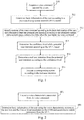
- an in-vehicle voice command recognition method comprises the following.
- S11 Acquire a voice command inputted by a user.
- cars are generally provided with a vehicular machine having network connection function, and a user can input a voice command through the vehicular machine arranged inside the car.
- the voice command may indicate a next operation to be implemented by the vehicular machine as required by the user. For example, if the voice command is to "review Jay Chou's songs", then the vehicular machine will implements an action of playing all Jay Chou's songs in the next step.
- S12 Determine basic information of the user according to a pre-trained deep neural network (DNN) model.
- DNN deep neural network
- some basic information of the user needs to be determined according to the voice inputted by the user.
- the basic information includes the time at which the voice command is inputted, the position where the voice command is inputted, and the age, gender, place of origin, and even the occupation of the user implementing the voice input action.
- a "persona” of the user is defined.
- the "persona” is a profile-type data structure for storing the basic information.
- the attribute of each kind of the basic information of the user is stored as a field of the "persona”.
- a DNN model In order to determine the basic information of the user according to the voice inputted by the user, a DNN model needs to be pre-trained. During the training process, the zero-crossing rate, the short-time energy, the cepstral coefficient, the base frequency, and other characteristics in a trained voice are extracted as characteristic parameters of the trained voice, and then inputted to the DNN model as input parameters. Model parameters of the DNN model are determined according to the difference between output parameters of the DNN model and annotation parameters of the trained voice. After training, the basic information of the user including the age, gender, place of origin, and occupation etc. can be accurately determined by the DNN model according to the characteristics of the input voice after the voice inputted by the user is received.
- S13 Identify contents of the voice command according to the basic information of the user, and determine at least one potential user intention according to the identified contents and a scenario page context when the user inputs the voice command.
- the recognition of the contents of the voice command is the speech recognition of the voice command.
- the speech recognition of the voice command is speech recognition made with reference to the basic information of the user.
- the speech recognition of the voice command of the user may be made with reference to the place-of-origin attribute and the accent characteristic in the region corresponding to the place of origin of the user.
- a potential user intention of the voice command is further determined.
- the potential user intention is the potential purpose of the user when he inputs the voice command.
- the potential user intention corresponds to at least one operation needed to be implemented by the vehicular machine in a next step.
- a potential user intention obtained after the intention recognition of the voice command to "review Jay Chou's songs” corresponds to the operations of selecting Jay Chou's songs and playing the selected songs by the vehicular machine.
- the confidence level of each potential user intention is determined according to the DNN model. Further, the confidence level of different potential user intentions can be obtained by analyzing the recognition result of the content of the voice command, and inputting the result to the DNN model.
- a potential user intention with a confidence level best matched with a predetermined confidence interval is selected from the potential user intentions and used as a real user intention corresponding to the voice command.
- an action corresponding to the real user intention is executed.
- the action may be playing an audio, playing a video, displaying pictures, or opening a webpage.
- a voice command inputted by a user is acquired; basic information of the user is determined according to a pre-trained deep neural network (DNN) model; contents of the voice command are identified according to the basic information of the user, and at least one potential user intention is determined according to the identified contents and a scenario page context at the time when the user inputs the voice command; the confidence level of the potential user intention is determined according to the DNN model; a real user intention is determined from the potential user intention according to the confidence level; and a corresponding action is executed according to the real user intention, whereby the correct recognition rate of voice commands is effectively improved.
- DNN deep neural network
- this embodiment further provides a technical solution for determining basic information in the in-vehicle voice command recognition method.
- the determination of basic information of the user according to a pre-trained deep neural network (DNN) model comprises: extracting a voice characteristic parameter from the voice command, the voice characteristic parameter comprises at least one of a zero-crossing rate, short-time energy, a cepstral coefficient, and a base frequency; and determining basic information of the user using the voice characteristic parameter, the position and the time as input parameters to the DNN, and according to output parameters from the DNN, the basic information comprising at least one of the gender, age, place of origin, and occupation of the user.
- DNN deep neural network
- the determination of basic information of the user according to a pre-trained DNN model comprises: S21: Extract a voice characteristic parameter from the voice command.
- voice characteristic parameters may be extracted from the voice command inputted by the user.
- the voice characteristic parameters include at least one of a zero-crossing rate, short-time energy, a cepstral coefficient, and a base frequency.
- the voice characteristic parameters extracted from the voice command can be inputted, as characteristics of the voice command, to the DNN model.
- S22 Determine basic information of the user using the voice characteristic parameter, the position and the time as input parameters to the DNN, and according to output parameters from the DNN.
- the DNN is a model obtained by pre-training according to the DNN theory and used to determine the basic information of the user.
- the basic information includes the gender, age, place of origin, and occupation of the user.
- the DNN comprises an input layer, a hidden layer, and an output layer.
- the input layer is configured to receive an input parameter.
- the output layer is configured to output an operation result.
- the hidden layer is configured to calculate the operation result according to the value of the input parameter.
- the input parameters include the voice characteristic parameter, the position where the user locates when the voice command is inputted, and the time at which the voice command is inputted.
- the input parameters may also include a called user recognition number (CUID).
- CUID is of important reference value in determining the basic information such as the gender and age of the user.
- a voice characteristic parameter is extracted from the voice command, and basic information of the user is determined using the voice characteristic parameter, the position and the time as input parameters to the DNN and according to output parameters from the DNN, thereby accomplishing the determination of the basic information of the user through the DNN.
- this embodiment further provides a technical solution of the in-vehicle voice command recognition method.
- the recognition of contents of the voice command according to the basic information of the user, and the determination of at least one potential user intention according to the identified contents and a scenario page context at the time when the user inputs the voice command comprise: acquiring pages appeared within a predetermined length of time before the user inputs the voice command, and determining a potential user intention according to the pages appeared within the predetermined length of time, the halt duration of each page, and critical voice recognition information in the voice command.
- the in-vehicle voice command recognition method comprises the following.
- S31 Acquire a voice command inputted by a user.
- S32 Determine basic information of the user according to a pre-trained deep neural network (DNN) model.
- DNN deep neural network
- S33 Acquire pages appeared within a predetermined length of time before the user inputs the voice command, and determine a potential user intention according to the pages appeared within the predetermined length of time, the halt duration of each of the pages, and critical voice recognition information in the voice command.
- a session object may be set, and pages appeared within the predetermined length of time before the user inputs the voice command and the halt duration of the user on the appeared pages are stored in the session object.
- the potential user intention is determined comprehensively according to the pages appeared within the predetermined length of time before the user inputs the voice command and the halt duration of the user in each of the page acquired from the session object, in combination with the recognition voice material of the voice command.
- a practical intention of the user may be probably to re-plan the navigation route.
- re-planning the navigation route is determined as a potential user intention.
- S34 Determine the confidence level of the potential user intention according to the DNN model.
- S35 Determine a real user intention from the potential user intention according to the confidence level.
- this embodiment further provides a technical solution of the in-vehicle voice command recognition method.
- the recognition of contents of the voice command according to the basic information of the user, and the determination of at least one potential user intention according to the identified contents and a scenario page context at the time when the user inputs the voice command comprise: acquiring a predetermined number of pages appearing before the user inputs the voice command, and determining a potential user intention according to the predetermined number of appeared pages, the halt duration of each of the pages, and critical voice recognition information in the voice command.
- the in-vehicle voice command recognition method comprises:
- a session object may be set, and a predetermined number of pages appearing before the user inputs the voice command and the halt duration of the user on the appeared pages are stored in the session object.
- the potential user intention is determined comprehensively according to the previously stored page and halt duration parameters acquired from the session object, in combination with the recognition voice material of the voice command.
- the two pages appearing before the voice command is inputted are respectively a music playing page and a map navigation page.
- the halt durations of the user on the music playing page and on the map navigation page are 3 minutes, and 2 to 10 minutes respectively, and the recognition voice material comprises the key word "navigation.”
- a practical intention of the user in this situation may likely be to plan the navigation route anew.
- re-planning the navigation route is determined as a potential user intention.
- S45 Determine a real user intention from the potential user intention according to the confidence level.
- a predetermined number of pages appearing before the user inputs the voice command are acquired, and a potential user intention is determined according to the predetermined number of appeared pages, the halt duration of each of the pages, and critical voice recognition information in the voice command, thereby accomplishing the accurate determination of potential user intentions.
- this embodiment further provides a technical solution for confidence level determination in the in-vehicle voice command recognition method.
- the determination of the confidence level of the potential user intention according to the DNN model comprises: evaluating an emotional state of the user at the time when he inputs the voice command by using the DNN model using the voice characteristic parameter of the voice command as an input parameter; and obtaining the confidence level of the potential user intention according to the emotional state.
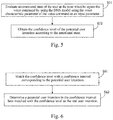
- the determination of the confidence level of the potential user intention according to the DNN model comprises:
- S51 Evaluate an emotional state of the user at the time when he inputs the voice command by using the DNN model using the voice characteristic parameter of the voice command as an input parameter.
- the DNN model can be used not only to determine the basic information of the user, but also to evaluate the emotional state of the user at the time when he inputs the voice command in determining the confidence level of the potential user intention.
- the emotional state of the user may include happy, sad, angry, and others.
- output units corresponding to different emotional states are arranged on the output layer of the DNN model. In this manner, the DNN can be used in the evaluation of the emotional state after the training of the DNN is completed.
- the value of the confidence level corresponding to a different emotional state of the user may be designated based on empirical values. For example, the value of the confidence level is the highest when the emotional state is empirically designated to be happy. The value of the confidence level is the lowest when the emotional state is empirically designated to be sad.
- an emotional state of the user at the time when he inputs the voice command is evaluated by using the DNN model using the voice characteristic parameter of the voice command as an input parameter, and the confidence level of the potential user intention is obtained according to the emotional state. Therefore, the emotional state of the user at the time when he inputs the voice command is evaluated by using the DNN model and the confidence level of the potential user intention is further determined according to the emotional state.
- this embodiment further provides a technical solution for intention determination in the in-vehicle voice command recognition method.
- the determination of a real user intention from the potential user intention according to the confidence level comprises: matching the confidence level with a confidence interval corresponding to the potential user intention; and determining a potential user intention in the confidence interval best matched with the confidence level as the real user intention.
- the determination of a real user intention from the potential user intention according to the confidence level comprises: S61: Match the confidence level with a confidence interval corresponding to the potential user intention.
- Each potential intention corresponds to a respective confidence interval.
- a confidence interval of the potential intention to "re-plan the navigation route" is between 0.45 to 0.6.
- Confidence intervals corresponding to each potential intention are acquired first.
- the confidence levels are matched to each acquired confidence interval, after the potential intention corresponding to the voice command and the confidence level of the potential intention are obtained.
- the potential intention may also additionally include corresponding parameters.
- the intention to "change the play mode" may additionally have parameters including loop play, sequential play, random play and other target play modes.
- each of the additionally included parameters is used as an independent solution, a confidence interval corresponding thereto is acquired separately, and after the confidence level is obtained, the confidence level is matched with the acquired confidence interval separately.
- S62 Determine a potential user intention in the confidence interval best matched with the confidence level as the real user intention.
- a potential intention in the confidence interval best matched is determined as the real user intention.
- the confidence level is matched with a confidence interval corresponding to the potential user intention, and a potential intention in the confidence interval best matched with the confidence level is determined as the real user intention, thus accomplishing the recognition of a real user intention according to the parameter confidence level.
- this embodiment further provides a technical solution for action execution in the in-vehicle voice command recognition method.
- the execution of a corresponding action according to the real user intention comprises: if the execution condition of the real user intention is satisfied, executing an action corresponding to the real user intention; if the execution condition of the real user intention is unsatisfied, terminating the execution of an action corresponding to the real user intention, and alerting the user; and if the execution condition of the real user intention is uncertain, executing an action similar to that corresponding to the real user intention.
- the execution of a corresponding action according to the real user intention comprises: S71: If the execution condition of the real user intention is satisfied, execute an action corresponding to the real user intention.
- the real user intention determines whether to execute an action corresponding to the real intention depends on whether the execution condition of the real intention is satisfied. For example, the real intention is to "view the WeChat", the corresponding execution condition should be that the car is in a stopped state. If a voice command is received and a real intention to "view the WeChat" is recognized at the time when the car is in a stopped state, an action corresponding to the real intention is executed, that is, to view the WeChat.
- the recognition of the execution condition of the real user intention may be uncertain. In this case, an action similar to that corresponding to the real user intention is executed. However, it is important to ensure that the similar action is safe.
- the in-vehicle voice command recognition method comprises: determining basic information of a user; acquiring a potential user intention according to session processing; acquiring the confidence level of different potential user intentions according to intention confidence level processing; determining an action to be executed according to safety processing; and determining whether to execute the corresponding action according to a result of comprehensive determination.
- the in-vehicle voice command recognition method comprises: S81: Determine basic information of a user.
- basic information of a user is identified through a pre-trained DNN.
- the basic information includes the age, gender, place of origin, and occupation etc. of the user.
- a potential user intention is acquired according to pages stored in a session object once used by the user before he gives a voice command.
- the confidence level of different potential intentions is identified according to the pre-trained DNN.
- S84 Determine an action to be executed according to safety processing.
- Whether an action to be executed is a safe action is determined through the recognition of a current state of the car, to further determine the action to be executed.
- Whether to execute the corresponding action is determined according to comprehensive determination of the results obtained in preceding steps.
- basic information of a user is determined; a potential user intention is acquired according to session processing; the confidence level of different potential user intentions is acquired according to intension confidence level processing; an action to be executed is determined according to safety processing; and whether to execute the corresponding action is determined according to a result of comprehensive determination, thus completing the whole process from the acquisition of a voice command to the execution of a corresponding action.
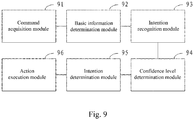
- the in-vehicle voice command recognition apparatus includes a command acquisition module 91, a basic information determination module 92, a user intention recognition module 93, a confidence level determination module 94, an intention determination module 95, and an action execution module 96.
- the command acquisition module 91 is configured to acquire a voice command inputted by a user.
- the basic information determination module 92 is configured to determine basic information of the user according to a pre-trained deep neural network (DNN) model.
- DNN deep neural network
- the user intention recognition module 93 is configured to identify contents of the voice command according to the basic information of the user, and determine at least one potential user intention according to the identified contents and a scenario page context at the time when the user inputs the voice command.
- the confidence level determination module 94 is configured to determine the confidence level of the potential user intention according to the DNN model.
- the intention determination module 95 is configured to determine a real user intention from the potential user intention according to the confidence level.
- the action execution module 96 is configured to execute a corresponding action according to the real user intention.
- the basic information determination module 92 includes a characteristic extraction unit and a DNN recognition unit.
- the characteristic extraction unit is configured to extract a voice characteristic parameter from the voice command.
- the voice characteristic parameter includes at least one of a zero-crossing rate, short-time energy, a cepstral coefficient, and a base frequency.
- the DNN recognition unit is configured to determine basic information of the user using the voice characteristic parameter, the position and the time as input parameters to the DNN and according to output parameters from the DNN.
- the basic information includes at least one of the gender, age, place of origin, and occupation of the user.
- the user intention recognition module 93 includes a first intention recognition unit or a second intention recognition unit.
- the first intention recognition unit is configured to acquire pages appeared within a predetermined length of time before the user inputs the voice command, and determine a potential user intention according to the pages appeared within the predetermined length of time, the halt duration of each of the pages, and critical voice recognition information in the voice command.
- the second intention recognition unit is configured to acquire a predetermined number of pages appearing before the user inputs the voice command, and determine a potential user intention according to the predetermined number of appeared pages, the halt duration of each of the pages, and critical voice recognition information in the voice command.
- the confidence level determination module 94 includes an emotion evaluation unit and a confidence level acquisition unit.
- the emotion evaluation unit is configured to evaluate an emotional state of the user at the time when he inputs the voice command by using the DNN model using the voice characteristic parameter of the voice command as an input parameter.
- the confidence level acquisition unit is configured to obtain the confidence level of the potential user intention according to the emotional state.
- the intention determination module 95 includes a matching unit and a real intention acquisition unit.
- the matching unit is configured to match the confidence level with a confidence interval corresponding to the potential user intention.
- the real intention acquisition unit is configured to determine a potential user intention in the confidence interval best matched with the confidence level as the real user intention.
- the action execution module 96 includes a first action execution unit, a second action execution unit, and a third action execution unit.
- the first action execution unit is configured to execute an action corresponding to the real user intention, when the execution condition of the real user intention is satisfied.
- the second action execution unit is configured to terminate the execution of an action corresponding to the real user intention, and prompt the user, when the execution condition of the real user intention is unsatisfied.
- the third action execution unit is configured to execute an action similar to that corresponding to the real user intention, when the execution condition of the real user intention is uncertain.
- the in-vehicle voice command recognition apparatus can execute the in-vehicle voice command recognition method provided in any of the embodiments of the present disclosure and has corresponding function modules for and beneficial effects in executing the method.
- modules or steps of the present disclosure can be implemented by universal computing devices, and can be centralized on a single computing device or distributed on a network consisting of multiple computing devices, and optionally can be implemented by program codes executable to computing devices. Therefore, all the modules or steps can be stored in a storage device to be executed by computing devices, or it can be implemented by making all the modules or steps into integrated circuit modules respectively, or making multiple modules or steps of them into a single integrated circuit module. Therefore, the present disclosure is not limited to the combination of any specific hardware and software.
- a storage medium comprising computer executable instructions.
- the computer executable instructions are configured to execute an in-vehicle voice command recognition method when executed by a computer processor.
- the method comprises the steps of:
- the present disclosure may be implemented by means of software and required general hardware, or naturally only by hardware, however, the former is preferred in many situations.
- the technical solutions in the present disclosure essentially, or the part contributing to the conventional art may be implemented in the form of a software product.
- the computer software product may be stored in a computer readable storage medium, such as a magnetic disk, an optical disc, a read-only memory (ROM), or a random access memory (RAM), and includes several instructions for instructing a computer device (which may be a personal computer, a server, a network device, or the like) to perform the method described in the embodiments of the present disclosure.
- the units and modules included are divided merely in accordance with functional logics. However, the division is not limited as above, rather permissible as long as corresponding functions can be implemented. Moreover, specific names of the functional units are provided only for ease of distinction, and not intended to limit the protection scope of the present disclosure.
Landscapes
- Engineering & Computer Science (AREA)
- Health & Medical Sciences (AREA)
- Computational Linguistics (AREA)
- Audiology, Speech & Language Pathology (AREA)
- Human Computer Interaction (AREA)
- Physics & Mathematics (AREA)
- Acoustics & Sound (AREA)
- Multimedia (AREA)
- Signal Processing (AREA)
- Artificial Intelligence (AREA)
- Evolutionary Computation (AREA)
- Child & Adolescent Psychology (AREA)
- General Health & Medical Sciences (AREA)
- Hospice & Palliative Care (AREA)
- Psychiatry (AREA)
- Mechanical Engineering (AREA)
- User Interface Of Digital Computer (AREA)
- Navigation (AREA)
Applications Claiming Priority (2)
| Application Number | Priority Date | Filing Date | Title |
|---|---|---|---|
| CN201510382215.9A CN105070288B (zh) | 2015-07-02 | 2015-07-02 | 车载语音指令识别方法和装置 |
| PCT/CN2015/095269 WO2017000489A1 (fr) | 2015-07-02 | 2015-11-23 | Procédé et appareil d'identification de commande vocale embarqué et support d'informations |
Publications (2)
| Publication Number | Publication Date |
|---|---|
| EP3319081A1 true EP3319081A1 (fr) | 2018-05-09 |
| EP3319081A4 EP3319081A4 (fr) | 2018-07-04 |
Family
ID=54499641
Family Applications (1)
| Application Number | Title | Priority Date | Filing Date |
|---|---|---|---|
| EP15897016.0A Ceased EP3319081A4 (fr) | 2015-07-02 | 2015-11-23 | Procédé et appareil d'identification de commande vocale embarqué et support d'informations |
Country Status (6)
| Country | Link |
|---|---|
| US (1) | US10446150B2 (fr) |
| EP (1) | EP3319081A4 (fr) |
| JP (1) | JP6458149B2 (fr) |
| KR (1) | KR101955958B1 (fr) |
| CN (1) | CN105070288B (fr) |
| WO (1) | WO2017000489A1 (fr) |
Cited By (2)
| Publication number | Priority date | Publication date | Assignee | Title |
|---|---|---|---|---|
| CN110276072A (zh) * | 2019-06-10 | 2019-09-24 | 湖北亿咖通科技有限公司 | 电子设备、存储介质及基于神经网络的语义意图识别方法 |
| CN115056746A (zh) * | 2022-06-10 | 2022-09-16 | 浙江吉利控股集团有限公司 | 应用于车辆的用户意图识别方法、装置、设备 |
Families Citing this family (57)
| Publication number | Priority date | Publication date | Assignee | Title |
|---|---|---|---|---|
| CN105070288B (zh) | 2015-07-02 | 2018-08-07 | 百度在线网络技术(北京)有限公司 | 车载语音指令识别方法和装置 |
| CN105376416A (zh) * | 2015-12-04 | 2016-03-02 | 广东小天才科技有限公司 | 一种通话终端的控制方法和装置 |
| CN106910513A (zh) * | 2015-12-22 | 2017-06-30 | 微软技术许可有限责任公司 | 情绪智能聊天引擎 |
| CN105529030B (zh) * | 2015-12-29 | 2020-03-03 | 百度在线网络技术(北京)有限公司 | 语音识别处理方法和装置 |
| CN106940998B (zh) * | 2015-12-31 | 2021-04-16 | 阿里巴巴集团控股有限公司 | 一种设定操作的执行方法及装置 |
| CN105931642B (zh) * | 2016-05-31 | 2020-11-10 | 北京京东尚科信息技术有限公司 | 语音识别方法、设备及系统 |
| CN106228989A (zh) * | 2016-08-05 | 2016-12-14 | 易晓阳 | 一种语音交互识别控制方法 |
| CN106601231A (zh) * | 2016-12-22 | 2017-04-26 | 深圳市元征科技股份有限公司 | 车辆控制方法和装置 |
| US11100384B2 (en) | 2017-02-14 | 2021-08-24 | Microsoft Technology Licensing, Llc | Intelligent device user interactions |
| US10467509B2 (en) | 2017-02-14 | 2019-11-05 | Microsoft Technology Licensing, Llc | Computationally-efficient human-identifying smart assistant computer |
| US11010601B2 (en) | 2017-02-14 | 2021-05-18 | Microsoft Technology Licensing, Llc | Intelligent assistant device communicating non-verbal cues |
| CN107316643B (zh) * | 2017-07-04 | 2021-08-17 | 科大讯飞股份有限公司 | 语音交互方法及装置 |
| CN107424607B (zh) * | 2017-07-04 | 2023-06-06 | 珠海格力电器股份有限公司 | 语音控制模式切换方法、装置及具有该装置的设备 |
| CN107464115A (zh) * | 2017-07-20 | 2017-12-12 | 北京小米移动软件有限公司 | 个人特征信息验证方法及装置 |
| CN107507621B (zh) * | 2017-07-28 | 2021-06-22 | 维沃移动通信有限公司 | 一种噪声抑制方法及移动终端 |
| CN107590123B (zh) * | 2017-08-07 | 2022-07-05 | 大众问问(北京)信息科技有限公司 | 车载中地点上下文指代消解方法及装置 |
| CN107945796B (zh) * | 2017-11-13 | 2021-05-25 | 百度在线网络技术(北京)有限公司 | 语音识别方法、装置、设备及计算机可读介质 |
| CN108564374A (zh) * | 2018-04-12 | 2018-09-21 | 出门问问信息科技有限公司 | 支付认证方法、装置、设备及存储介质 |
| CN108648752A (zh) * | 2018-04-17 | 2018-10-12 | 重庆物奇科技有限公司 | 一种基于云处理的智能语音控制系统及其控制方法 |
| CN110390938A (zh) * | 2018-04-20 | 2019-10-29 | 比亚迪股份有限公司 | 基于声纹的语音处理方法、装置和终端设备 |
| CN110019740B (zh) * | 2018-05-23 | 2021-10-01 | 京东方科技集团股份有限公司 | 车载终端的交互方法、车载终端、服务器和存储介质 |
| CN109263649B (zh) * | 2018-08-21 | 2021-09-17 | 北京汽车股份有限公司 | 车辆及其自动驾驶模式下的物体识别方法和物体识别系统 |
| CN110875038A (zh) * | 2018-09-03 | 2020-03-10 | 蔚来汽车有限公司 | 意图行为关系的定义方法及意图转换为行为的执行方法 |
| KR102920786B1 (ko) * | 2018-10-16 | 2026-02-02 | 삼성전자주식회사 | 전자 장치 및 그 제어 방법 |
| CN109618204B (zh) * | 2018-12-12 | 2021-04-23 | 百度在线网络技术(北京)有限公司 | 多媒体资源播放方法和装置 |
| CN111508482A (zh) * | 2019-01-11 | 2020-08-07 | 阿里巴巴集团控股有限公司 | 语义理解及语音交互方法、装置、设备及存储介质 |
| KR102041617B1 (ko) * | 2019-03-07 | 2019-11-27 | 주식회사 다이얼로그디자인에이전시 | 인공 지능의 다양한 스타일의 응답 제공 방법 및 장치 |
| CN109948537A (zh) * | 2019-03-19 | 2019-06-28 | 苏州宏裕千智能设备科技有限公司 | 基于用户意图识别的车载设备操控方法及其系统 |
| CN109878441B (zh) * | 2019-03-21 | 2021-08-17 | 百度在线网络技术(北京)有限公司 | 车辆控制方法和装置 |
| CN111796926B (zh) * | 2019-04-09 | 2025-01-21 | Oppo广东移动通信有限公司 | 指令执行方法、装置、存储介质及电子设备 |
| KR102017229B1 (ko) * | 2019-04-15 | 2019-09-02 | 미디어젠(주) | 발화 패턴의 무한성 개선을 위한 딥러닝 기반의 텍스트 문장 자동 생성시스템 |
| CN110400563A (zh) * | 2019-07-18 | 2019-11-01 | 平安科技(深圳)有限公司 | 车载语音指令识别方法、装置、计算机设备及存储介质 |
| US11568239B2 (en) * | 2019-08-13 | 2023-01-31 | Lg Electronics Inc. | Artificial intelligence server and method for providing information to user |
| CN110534093A (zh) * | 2019-08-26 | 2019-12-03 | 河北微幼趣教育科技有限公司 | 对幼儿语音识别的请假方法、服务器、客户端 |
| CN110534098A (zh) * | 2019-10-09 | 2019-12-03 | 国家电网有限公司客户服务中心 | 一种年龄增强的语音识别增强方法和装置 |
| CN110853621B (zh) * | 2019-10-09 | 2024-02-13 | 科大讯飞股份有限公司 | 语音顺滑方法、装置、电子设备及计算机存储介质 |
| CN110648654A (zh) * | 2019-10-09 | 2020-01-03 | 国家电网有限公司客户服务中心 | 一种引入语言向量的语音识别增强方法和装置 |
| CN110795532A (zh) * | 2019-10-18 | 2020-02-14 | 珠海格力电器股份有限公司 | 一种语音信息的处理方法、装置、智能终端以及存储介质 |
| US11676586B2 (en) * | 2019-12-10 | 2023-06-13 | Rovi Guides, Inc. | Systems and methods for providing voice command recommendations |
| CN111081225B (zh) * | 2019-12-31 | 2022-04-01 | 思必驰科技股份有限公司 | 技能语音唤醒方法及装置 |
| CN111261196A (zh) * | 2020-01-17 | 2020-06-09 | 厦门快商通科技股份有限公司 | 一种年龄预估方法和装置以及设备 |
| CN111210821A (zh) * | 2020-02-07 | 2020-05-29 | 普强时代(珠海横琴)信息技术有限公司 | 一种基于互联网应用的智能语音识别系统 |
| US11722324B2 (en) * | 2020-03-11 | 2023-08-08 | Pricewaterhousecoopers Llp | Secure and accountable execution of robotic process automation |
| CN111737544A (zh) * | 2020-05-13 | 2020-10-02 | 北京三快在线科技有限公司 | 搜索意图识别方法、装置、电子设备和存储介质 |
| CN111767021A (zh) * | 2020-06-28 | 2020-10-13 | 广州小鹏车联网科技有限公司 | 语音交互方法、车辆、服务器、系统和存储介质 |
| KR102491119B1 (ko) * | 2020-09-17 | 2023-01-25 | 주식회사 인텔로이드 | 차량용 음성 인식 장치, 이를 이용한 차량 문제상황 처리 방법 및 컴퓨터 프로그램 |
| CN112489639A (zh) * | 2020-11-26 | 2021-03-12 | 北京百度网讯科技有限公司 | 音频信号处理方法及装置、系统、电子设备、可读介质 |
| CN112466280B (zh) * | 2020-12-01 | 2021-12-24 | 北京百度网讯科技有限公司 | 语音交互方法、装置、电子设备和可读存储介质 |
| CN114093357B (zh) * | 2021-11-10 | 2025-02-25 | 上海传英信息技术有限公司 | 控制方法、智能终端及可读存储介质 |
| DE102021129535A1 (de) * | 2021-11-12 | 2023-05-17 | Ford Global Technologies, Llc | System und Verfahren zum Steuern von autonom steuerbaren Fahrzeugfunktionen eines mit Partnersubjekten kooperierenden autonomen Fahrzeugs, Computerprogrammprodukt, computerlesbarer Datenträger und Fahrzeug |
| CN116153301A (zh) * | 2021-11-23 | 2023-05-23 | 深圳市大族数控科技股份有限公司 | 自动化设备控制方法、移动终端、设备及存储介质 |
| CN114120972B (zh) * | 2022-01-28 | 2022-04-12 | 科大讯飞华南有限公司 | 一种基于场景化的语音智能识别方法及系统 |
| KR20230132259A (ko) | 2022-03-08 | 2023-09-15 | 현대자동차주식회사 | 대화 시스템 및 그 제어 방법 |
| CN115294976A (zh) * | 2022-06-23 | 2022-11-04 | 中国第一汽车股份有限公司 | 一种基于车载语音场景的纠错交互方法、系统及其车辆 |
| US20250296574A1 (en) * | 2024-03-22 | 2025-09-25 | GM Global Technology Operations LLC | Uwb-based intention detection for vehicular applications |
| KR102755384B1 (ko) | 2024-04-03 | 2025-01-21 | 주식회사 씨아이 | 음성 인식 작동 시스템 |
| CN120998196A (zh) * | 2025-08-28 | 2025-11-21 | 武义锐匠科技有限公司 | 用于电动滑板车的语音交互控制方法及系统 |
Family Cites Families (21)
| Publication number | Priority date | Publication date | Assignee | Title |
|---|---|---|---|---|
| JPH05157311A (ja) * | 1991-12-03 | 1993-06-22 | Matsushita Electric Ind Co Ltd | 空調制御装置 |
| KR100775006B1 (ko) * | 2005-11-30 | 2007-11-08 | 한국정보통신대학교 산학협력단 | 상황인지 기반의 이동 서비스를 제공하는 단말 장치 및 그방법과, 그 단말 장치와 협력하여 옥내 이동 서비스를제공하는 서버 시스템 |
| KR100764174B1 (ko) * | 2006-03-03 | 2007-10-08 | 삼성전자주식회사 | 음성 대화 서비스 장치 및 방법 |
| JP4427530B2 (ja) * | 2006-09-21 | 2010-03-10 | 株式会社東芝 | 音声認識装置、プログラムおよび音声認識方法 |
| US9502025B2 (en) * | 2009-11-10 | 2016-11-22 | Voicebox Technologies Corporation | System and method for providing a natural language content dedication service |
| US8972253B2 (en) * | 2010-09-15 | 2015-03-03 | Microsoft Technology Licensing, Llc | Deep belief network for large vocabulary continuous speech recognition |
| US9190057B2 (en) * | 2012-12-12 | 2015-11-17 | Amazon Technologies, Inc. | Speech model retrieval in distributed speech recognition systems |
| CN103024530A (zh) * | 2012-12-18 | 2013-04-03 | 天津三星电子有限公司 | 智能电视语音应答系统及方法 |
| WO2014107186A1 (fr) * | 2013-01-04 | 2014-07-10 | Kopin Corporation | Affichages informatiques pilotés par un casque |
| DE112014000709B4 (de) * | 2013-02-07 | 2021-12-30 | Apple Inc. | Verfahren und vorrichtung zum betrieb eines sprachtriggers für einen digitalen assistenten |
| US9177550B2 (en) * | 2013-03-06 | 2015-11-03 | Microsoft Technology Licensing, Llc | Conservatively adapting a deep neural network in a recognition system |
| US9666188B2 (en) * | 2013-10-29 | 2017-05-30 | Nuance Communications, Inc. | System and method of performing automatic speech recognition using local private data |
| DE112014005354T5 (de) * | 2013-11-25 | 2016-08-04 | Mitsubishi Electric Corporation | Dialog-management-system und dialog-management-verfahren |
| CN104751842B (zh) * | 2013-12-31 | 2019-11-15 | 科大讯飞股份有限公司 | 深度神经网络的优化方法及系统 |
| CN104021373B (zh) * | 2014-05-27 | 2017-02-15 | 江苏大学 | 一种半监督语音特征可变因素分解方法 |
| US9338493B2 (en) * | 2014-06-30 | 2016-05-10 | Apple Inc. | Intelligent automated assistant for TV user interactions |
| CN105070288B (zh) | 2015-07-02 | 2018-08-07 | 百度在线网络技术(北京)有限公司 | 车载语音指令识别方法和装置 |
| WO2017071619A1 (fr) * | 2015-10-27 | 2017-05-04 | Beijing Didi Infinity Technology And Development Co., Ltd. | Systèmes et procédés permettant de délivrer un message |
| US20170357521A1 (en) * | 2016-06-13 | 2017-12-14 | Microsoft Technology Licensing, Llc | Virtual keyboard with intent-based, dynamically generated task icons |
| US20180046470A1 (en) * | 2016-08-11 | 2018-02-15 | Google Inc. | Methods, systems, and media for presenting a user interface customized for a predicted user activity |
| US10176808B1 (en) * | 2017-06-20 | 2019-01-08 | Microsoft Technology Licensing, Llc | Utilizing spoken cues to influence response rendering for virtual assistants |
-
2015
- 2015-07-02 CN CN201510382215.9A patent/CN105070288B/zh active Active
- 2015-11-23 EP EP15897016.0A patent/EP3319081A4/fr not_active Ceased
- 2015-11-23 JP JP2017530131A patent/JP6458149B2/ja not_active Expired - Fee Related
- 2015-11-23 KR KR1020177014756A patent/KR101955958B1/ko active Active
- 2015-11-23 US US15/738,946 patent/US10446150B2/en active Active
- 2015-11-23 WO PCT/CN2015/095269 patent/WO2017000489A1/fr not_active Ceased
Cited By (2)
| Publication number | Priority date | Publication date | Assignee | Title |
|---|---|---|---|---|
| CN110276072A (zh) * | 2019-06-10 | 2019-09-24 | 湖北亿咖通科技有限公司 | 电子设备、存储介质及基于神经网络的语义意图识别方法 |
| CN115056746A (zh) * | 2022-06-10 | 2022-09-16 | 浙江吉利控股集团有限公司 | 应用于车辆的用户意图识别方法、装置、设备 |
Also Published As
| Publication number | Publication date |
|---|---|
| KR20170078788A (ko) | 2017-07-07 |
| JP2018503857A (ja) | 2018-02-08 |
| WO2017000489A1 (fr) | 2017-01-05 |
| EP3319081A4 (fr) | 2018-07-04 |
| CN105070288A (zh) | 2015-11-18 |
| US10446150B2 (en) | 2019-10-15 |
| US20180190283A1 (en) | 2018-07-05 |
| KR101955958B1 (ko) | 2019-03-08 |
| JP6458149B2 (ja) | 2019-01-23 |
| CN105070288B (zh) | 2018-08-07 |
Similar Documents
| Publication | Publication Date | Title |
|---|---|---|
| US10446150B2 (en) | In-vehicle voice command recognition method and apparatus, and storage medium | |
| US9582757B1 (en) | Scalable curation system | |
| KR101719278B1 (ko) | 비주얼 콘텐츠기반 영상 인식을 위한 딥러닝 프레임워크 및 영상 인식 방법 | |
| EP4481741A2 (fr) | Apprentissage instantané en matière de synthèse de la parole à partir du texte pendant un dialogue | |
| CN109741734B (zh) | 一种语音评测方法、装置和可读介质 | |
| KR20140042994A (ko) | 가상 에이전트와의 대화 내용에서 자동으로 추출되는 개인 프로파일링 정보를 이용한 자동학습 기반의 인공지능 대화 시스템 | |
| CN110738998A (zh) | 基于语音的个人信用评估方法、装置、终端及存储介质 | |
| CN106558252B (zh) | 由计算机实现的口语练习方法及装置 | |
| CN110322895B (zh) | 语音评测方法及计算机存储介质 | |
| CN113821620B (zh) | 多轮对话任务处理方法、装置及电子设备 | |
| CN118467780A (zh) | 一种基于大模型的影视搜索推荐方法、系统、设备及介质 | |
| CN115512696A (zh) | 模拟训练方法及车辆 | |
| CN110059174B (zh) | 问询指引方法及装置 | |
| CN109062944A (zh) | 一种基于语音搜索的生字词巩固方法及电子设备 | |
| CN116844555A (zh) | 车辆语音交互的方法及装置、车辆、电子设备和存储介质 | |
| CN116208712A (zh) | 一种提升用户意向的智能外呼方法、系统、设备及介质 | |
| US11176943B2 (en) | Voice recognition device, voice recognition method, and computer program product | |
| CN113763962A (zh) | 音频处理方法、装置、存储介质及计算机设备 | |
| CN111933107A (zh) | 语音识别方法、装置、存储介质和处理器 | |
| CN119399663A (zh) | 基于人工智能的自动面试方法、装置、计算机设备及存储介质 | |
| CN112669833A (zh) | 一种语音交互的纠错方法及装置 | |
| CN117744609A (zh) | 简历及其文本内容生成方法、装置、设备及存储介质 | |
| CN111949775B (zh) | 一种引导对话的生成的方法、装置、设备及介质 | |
| CN116996620A (zh) | 一种外呼拦截的处理方法、装置及电子设备 | |
| CN110110048A (zh) | 问询指引方法及装置 |
Legal Events
| Date | Code | Title | Description |
|---|---|---|---|
| STAA | Information on the status of an ep patent application or granted ep patent |
Free format text: STATUS: THE INTERNATIONAL PUBLICATION HAS BEEN MADE |
|
| PUAI | Public reference made under article 153(3) epc to a published international application that has entered the european phase |
Free format text: ORIGINAL CODE: 0009012 |
|
| STAA | Information on the status of an ep patent application or granted ep patent |
Free format text: STATUS: REQUEST FOR EXAMINATION WAS MADE |
|
| 17P | Request for examination filed |
Effective date: 20171221 |
|
| AK | Designated contracting states |
Kind code of ref document: A1 Designated state(s): AL AT BE BG CH CY CZ DE DK EE ES FI FR GB GR HR HU IE IS IT LI LT LU LV MC MK MT NL NO PL PT RO RS SE SI SK SM TR |
|
| AX | Request for extension of the european patent |
Extension state: BA ME |
|
| A4 | Supplementary search report drawn up and despatched |
Effective date: 20180604 |
|
| RIC1 | Information provided on ipc code assigned before grant |
Ipc: G10L 25/51 20130101ALI20180528BHEP Ipc: G10L 25/09 20130101ALI20180528BHEP Ipc: G10L 25/24 20130101ALI20180528BHEP Ipc: G10L 25/21 20130101ALI20180528BHEP Ipc: G10L 25/30 20130101ALI20180528BHEP Ipc: G10L 15/22 20060101ALI20180528BHEP Ipc: G10L 15/26 20060101ALI20180528BHEP Ipc: G10L 25/63 20130101ALI20180528BHEP Ipc: G10L 15/16 20060101AFI20180528BHEP |
|
| DAV | Request for validation of the european patent (deleted) | ||
| DAX | Request for extension of the european patent (deleted) | ||
| STAA | Information on the status of an ep patent application or granted ep patent |
Free format text: STATUS: EXAMINATION IS IN PROGRESS |
|
| 17Q | First examination report despatched |
Effective date: 20191002 |
|
| REG | Reference to a national code |
Ref country code: DE Ref legal event code: R003 |
|
| STAA | Information on the status of an ep patent application or granted ep patent |
Free format text: STATUS: THE APPLICATION HAS BEEN REFUSED |
|
| 18R | Application refused |
Effective date: 20230529 |