EP3319264B1 - Lücke in ressourcenzuweisung mit verschiedenen numerologien - Google Patents
Lücke in ressourcenzuweisung mit verschiedenen numerologien Download PDFInfo
- Publication number
- EP3319264B1 EP3319264B1 EP17305326.5A EP17305326A EP3319264B1 EP 3319264 B1 EP3319264 B1 EP 3319264B1 EP 17305326 A EP17305326 A EP 17305326A EP 3319264 B1 EP3319264 B1 EP 3319264B1
- Authority
- EP
- European Patent Office
- Prior art keywords
- subcarriers
- subcarrier spacing
- riv
- frequency
- carrier
- Prior art date
- Legal status (The legal status is an assumption and is not a legal conclusion. Google has not performed a legal analysis and makes no representation as to the accuracy of the status listed.)
- Active
Links
Images


Classifications
-
- H—ELECTRICITY
- H04—ELECTRIC COMMUNICATION TECHNIQUE
- H04L—TRANSMISSION OF DIGITAL INFORMATION, e.g. TELEGRAPHIC COMMUNICATION
- H04L5/00—Arrangements affording multiple use of the transmission path
- H04L5/0001—Arrangements for dividing the transmission path
- H04L5/0003—Two-dimensional division
- H04L5/0005—Time-frequency
- H04L5/0007—Time-frequency the frequencies being orthogonal, e.g. OFDM(A) or DMT
-
- H—ELECTRICITY
- H04—ELECTRIC COMMUNICATION TECHNIQUE
- H04L—TRANSMISSION OF DIGITAL INFORMATION, e.g. TELEGRAPHIC COMMUNICATION
- H04L5/00—Arrangements affording multiple use of the transmission path
- H04L5/003—Arrangements for allocating sub-channels of the transmission path
- H04L5/0037—Inter-user or inter-terminal allocation
- H04L5/0039—Frequency-contiguous, i.e. with no allocation of frequencies for one user or terminal between the frequencies allocated to another
-
- H—ELECTRICITY
- H04—ELECTRIC COMMUNICATION TECHNIQUE
- H04L—TRANSMISSION OF DIGITAL INFORMATION, e.g. TELEGRAPHIC COMMUNICATION
- H04L5/00—Arrangements affording multiple use of the transmission path
- H04L5/003—Arrangements for allocating sub-channels of the transmission path
- H04L5/0058—Allocation criteria
- H04L5/0066—Requirements on out-of-channel emissions
-
- H—ELECTRICITY
- H04—ELECTRIC COMMUNICATION TECHNIQUE
- H04L—TRANSMISSION OF DIGITAL INFORMATION, e.g. TELEGRAPHIC COMMUNICATION
- H04L5/00—Arrangements affording multiple use of the transmission path
- H04L5/0091—Signalling for the administration of the divided path, e.g. signalling of configuration information
- H04L5/0094—Indication of how sub-channels of the path are allocated
-
- H—ELECTRICITY
- H04—ELECTRIC COMMUNICATION TECHNIQUE
- H04L—TRANSMISSION OF DIGITAL INFORMATION, e.g. TELEGRAPHIC COMMUNICATION
- H04L5/00—Arrangements affording multiple use of the transmission path
- H04L5/0001—Arrangements for dividing the transmission path
- H04L5/0003—Two-dimensional division
- H04L5/0005—Time-frequency
- H04L5/0007—Time-frequency the frequencies being orthogonal, e.g. OFDM(A) or DMT
- H04L5/001—Time-frequency the frequencies being orthogonal, e.g. OFDM(A) or DMT the frequencies being arranged in component carriers
-
- H—ELECTRICITY
- H04—ELECTRIC COMMUNICATION TECHNIQUE
- H04L—TRANSMISSION OF DIGITAL INFORMATION, e.g. TELEGRAPHIC COMMUNICATION
- H04L5/00—Arrangements affording multiple use of the transmission path
- H04L5/003—Arrangements for allocating sub-channels of the transmission path
- H04L5/0037—Inter-user or inter-terminal allocation
-
- H—ELECTRICITY
- H04—ELECTRIC COMMUNICATION TECHNIQUE
- H04W—WIRELESS COMMUNICATION NETWORKS
- H04W72/00—Local resource management
- H04W72/04—Wireless resource allocation
-
- H—ELECTRICITY
- H04—ELECTRIC COMMUNICATION TECHNIQUE
- H04W—WIRELESS COMMUNICATION NETWORKS
- H04W72/00—Local resource management
- H04W72/20—Control channels or signalling for resource management
Definitions
- the present invention generally relates to resource allocation to terminals in a telecommunication system which comprises a carrier when this carrier supports multiple subcarrier spacing configurations.
- the present invention applies in multicarrier telecommunication systems such using OFDMA, or SC-FDMA or other OFDM-based waveform.
- Some OFDM-based systems allow several parameters sets, sometimes referred to as "numerology", to coexist onto the same carrier. This is especially the case in the 5G systems such as the NR (New Radio) standard under definition in 3GPP.
- a numerology may include parameters such as the subcarrier spacing configuration, the size of the cyclic prefix, the number of symbols, etc. Thus on a carrier with a given bandwidth, different subcarrier spacing configurations can coexist, in a frequency domain multiplexing manner.
- carriers are allocated with a certain granularity N.
- Groups of N subcarriers are called resource blocks.
- resource blocks we refer more generally to the smallest scheduling unit of the carrier, which in this example contains 12 subcarriers in the frequency domain across a fixed number of OFDM symbols in the time domain.
- guard bands can be inserted, during the scheduling process, in the frequency domain between two resource blocks of two different numerologies. That is by leaving unallocated resources between these two resource blocks.
- inserting a guard band leads to loss of resources in the carrier. Indeed, when allocating a resource block contiguously to a resource block with a different numerology the possibility in setting the size of the guard band depends on the subcarrier spacing configuration of the resource block being scheduled, which can strongly affect the spectral efficiency.
- each numerology and more specifically for each subcarrier spacing configuration there is a raster in the frequency domain defining the possible positions of the subcarriers in the said subcarrier spacing configuration.
- the pitch of the raster corresponds to the size of a resource block of the same numerology in the frequency domain.
- the scheduling in such a carrier is done taking into account the raster of each numerology, indeed each resource block of a defined numerology fills a socket of the same numerology raster.
- the guard band (represented by shaded areas in Figure 2B ) is at least the size of one of the resource blocks on either side of the guard band. Therefore it can lead to an excessive resource waste when inserting a guard band, especially when the two different subcarrier spacing configurations of the resource blocks on either side of the guard band are both high. Examples and embodiments of the prior art may be found in documents " Mixed numerology in an OFDM System", 3GPP R1-165833 by Ericsson , and " Resource allocation of PDSCH for Rel.13 MTC", 3GPP R1-156946 by Panasonic .
- EP 2 830 378 A1 discloses a method for indicating resource assignment.
- the present invention aims to improve the situation.
- the object of the present invention can be achieved by providing a method, a transmitter, a terminal and a computer program according to claims 1, 12, 14 and 15. Further embodiments are described in dependent claims 2 to 11 and 13. In the following, embodiments not falling within the scope of the claims should be understood as examples useful for understanding the invention.
- the present invention within the resource allocation in a carrier which supports several subcarrier spacing configurations, enables to allocate to the terminal only some subcarriers of a resource block. More specifically, allocating to the terminal, among the N subcarriers of the resource block, only the subcarriers after the n th . This enables to define a guard band between two allocations of resource of different subcarrier spacing configurations by not allocating the first subcarriers of the resource block of subcarrier spacing configuration ⁇ f 1 . More specifically, when allocating resource blocks of a specific subcarrier spacing configurations, aligned on their own raster, to a terminal a guard band is implemented when the previous resources, in frequency, are allocated in a different subcarrier spacing configuration to avoid inter-numerology interference.
- the method enables the first subcarrier allocated to the terminal to be different from the first subcarrier of the resource block of the same subcarrier spacing configuration, to which the first subcarrier allocated belongs. That is the firsts subcarriers of this resource block are not allocated to the terminal.
- this enables to give some flexibility in the size of the guard band, therefore it enables to reduce the inter-numerology interference while leaving vacant only a small appropriate amount of frequency resources.
- the present invention enables to set the size of a guard band with a granularity of N* ⁇ f 0 in contrary to a granularity of N* ⁇ f 1 , therefore it enables to have a better spectral efficiency.
- the present invention enables to set the size of a guard band with a granularity of N ⁇ ⁇ f 0 in contrary to a granularity of min(N ⁇ ⁇ f 1 , N ⁇ ⁇ f 2 ) with ⁇ f 0 ⁇ min( ⁇ f 1 , ⁇ f 2 ) between users using subcarrier spacings ⁇ f 1 and ⁇ f 2 ; therefore it enables to have a better spectral efficiency.
- the subcarrier spacing configuration ⁇ f 0 may or may not be used effectively for resource allocation.
- ⁇ f 0 may be smaller than ⁇ f 1 and ⁇ f 2 or the smallest subcarrier spacing configuration supported for resource allocation on the carrier.
- ⁇ f 0 may be the smallest subcarrier spacing configuration defined in the telecommunication system, even if it is not used on the carrier.
- the present invention matches the fact of allocating contiguous resource blocks to the same terminal with the fact of defining a guard band with respect to the previous adjacent frequency domain allocation by leaving vacant the first subcarriers of the first resource block allocated to the terminal.
- Such an allocation scheme which allocates a specific number L of contiguous resource blocks to the same terminal, is done by specifying the position of the first subcarrier not vacant in the first resource block allocated to the terminal and the number L of the resource blocks allocated. Only the first resource block allocated to the terminal according to the method is not complete in regard to the number of subcarrier allocated through it.
- resource blocks refers as well to virtual resource blocks or to physical resource blocks.
- Resource blocks also refer to any other resource allocation unit, such as resource block groups which encompass several resource blocks, or to a group of any pre-defined number of subcarriers.
- the integer m is determined such as at least one subcarrier of subcarrier spacing configurations ⁇ f 1 , having a frequency of at least f ref + m.N. ⁇ f 1 and at the most f ref + (m+1).N. ⁇ f 1 - ⁇ f 1 , can be allocated to the terminal.
- This enables to avoid leaving an unnecessary number of unallocated subcarriers of the subcarrier spacing configuration ⁇ f 1 when resource blocks of a smaller subcarrier spacing configuration than ⁇ f 1 are allocated.
- the subcarriers of subcarrier spacing configuration ⁇ f 1 between these small resource blocks and the following resource block of subcarrier spacing configuration ⁇ f 1 due to the invention can be allocated. Therefore this enables to maximize the spectral efficiency.
- the integer k is determined such as f start - f near is greater than G, G being a strictly positive threshold, and f near being a frequency of a subcarrier of a subcarrier spacing configuration different from ⁇ f 1 , said subcarrier having the highest frequency among frequencies of subcarriers allocated in the carrier having subcarrier spacing configurations different from ⁇ f 1 and having lower frequencies than f ref + (m+1).N. ⁇ f 1 .
- This enables to implement the required size of the guard band to maintain the orthogonality property between two subcarriers of different subcarrier spacing configuration.
- the subcarrier spacing configuration ⁇ f 0 is the smallest subcarrier spacing configuration among the subcarrier spacing configurations supported by the carrier. This enables to implement guard bands, whose size can be define with high flexibility. More specifically, the subcarrier spacing configuration ⁇ f 0 will always be at least equal or smaller than the subcarrier spacing configurations of any of two subcarriers between which a guard band is inserted. Therefore the size of the guard band can be set short enough to maximize the spectral efficiency.
- the number L, L ⁇ 1, satisfies to: q . L + NRB start 0 ⁇ N RB 0 where :
- NRB start 0 ⁇ f start ⁇ f ref N .
- ⁇ f 0 ⁇ mq + k .
- the reference frequency (f ref (i) ) of each numerology can be different, these cases are covered by the present invention.
- the size L could be understood as excluding the resource block containing the guard band. Therefore in this specific case the L values starts with the value 0. Deducing equivalent formulae when L is understood as excluding the resource block containing the guard band based on the current description which considers L as including the resource block containing the guard band is straightforward.
- the method further comprises the step of sending to the terminal allocation information based on the subcarriers allocated to the terminal. This enables the terminal to be informed of which subcarriers of the subcarrier spacing configuration ⁇ f 1 are allocated to it.
- the allocation information sent to the terminal is a resource indication value, RIV, which is an integer and a function of L and NRB start 0 . Since for a f start there is one NRB start 0 and for a f last , depending on the f start there is a L, for each allocation of contiguous subcarriers of the same subcarrier spacing configuration achieved according to the invention there exist one couple NRB start 0 and L an therefore at least a RIV value.
- the RIV function is an injective function of any couple comprising L and NRB start 0 values. This enables the terminal which receives a RIV value according to the resources that have been allocated to it, to decode a unique couple NRB start 0 and L.
- the RIV is a surjective function among the integers from 0 to the maximum value taken by RIV. This ensure that the maximum value taken by RIV when going through the different possible resource allocation according to the invention, that is the different pairs of L and NRB start 0 values with qL + NRB start 0 ⁇ N RB 0 , is the lowest possible. This enables to reduce the number of bits necessary for signaling all the possible resource allocations achieved according to the invention.
- the terminal obtains data related to the subcarrier spacing configuration (for example : ⁇ f 1 and ⁇ f 0 , ⁇ f 1 and q or ⁇ f 0 and q) of the resource blocks that are allocated to it and of the carrier band with respect to another numerology N RB 0 .
- the terminal can then decode the couple NRB start 0 and the L as it follows:
- the terminal can determine a unique f start and a unique f last as shown above.
- ⁇ RIV L ⁇ 1 r 1 + 1 + ⁇ p 1 ⁇ 1 ⁇ q 2 ⁇ + 1 + r 1 + 1 + N 0 ⁇ q ⁇ NRB start 0 otherwise
- the terminal obtains data related to the subcarrier spacing configuration (for example : ⁇ f 1 and ⁇ f 0 , ⁇ f 1 and q or ⁇ f 0 and q) of the resource blocks that are allocated to it and of the carrier band with respect to another numerology N RB 0 .
- the terminal can then decode the couple NRB start 0 and the L as follows:
- the terminal can determine a unique f start and a unique f last as shown above.
- the terminal obtains data related to the subcarrier spacing configuration (for example : ⁇ f 1 and ⁇ f 0 , ⁇ f 1 and q or ⁇ f 0 and q) of the resource blocks that are allocated to it and of the carrier band with respect to another numerology N RB 0 .
- the terminal can then decode the couple NRB start 0 and the L as follows:
- the terminal can determine a unique f start and a unique f last as shown above.
- the terminal obtains data related to the subcarrier spacing configuration (for example : ⁇ f 1 and ⁇ f 0 , ⁇ f 1 and q or ⁇ f 0 and q) of the resource blocks that are allocated to it and of the carrier band with respect to another numerology N RB 0 .
- the terminal can then decode the couple NRB start 0 and the L as follows:
- the terminal can determine a unique f start and a unique f last as shown above.
- the carrier, the resource allocation and the terminal are defined according to a wireless communication protocol being a 5G protocol.
- the carrier, the resource allocation and the terminal are defined according to a wireless communication protocol being a New Radio standard according to 3GPP standard.
- the transmitter comprises a memory unit storing, for each couple of possible values of a number NRB start 0 and said L a unique resource indication value RIV, NRB start 0 being a maximum number of resource blocks comprising N subcarriers of the subcarrier spacing configuration ⁇ f 0 that are allowable in said carrier during a time period of a resource block comprising N subcarriers of said subcarrier spacing configuration ⁇ f 0 , said resource blocks having all their subcarriers frequencies lower than said frequency f start .
- the transmitter is further configured to:
- the processor of the transmitter can enter the values of a number NRB start 0 and L in a lookup table corresponding to the subcarrier spacing configuration ⁇ f 0 of the subcarriers that are allocated to it and to the carrier band with respect to another numerology N RB 0 , which provides in return the corresponding RIV value.
- the processor can calculate the RIV by applying the formulas mentioned above.
- a third aspect of the invention concerns a terminal, in a telecommunication system, configured to use allocated resources in a carrier, said resources having been allocated according to the previously described aspects of the invention, comprises:
- the terminal further comprises a memory unit storing for each couple of possible values of a number NRB start 0 and said L a unique resource indication value RIV, NRB start 0 being a maximum number of resource blocks comprising N subcarriers of the first subcarrier spacing configuration ⁇ f 0 that are allowable in said carrier during a time period of a resource block comprising N subcarriers of said subcarrier spacing configuration ⁇ f 0 , said resource blocks having all their subcarriers frequencies lower than said frequency f start , and more particularly the processing module is configured to read said memory unit and determine the couple values L and NRB start 0 and recover f start and f last , upon reception of an RIV value in said resource allocation information.
- the processing module of the terminal enters the RIV value that he received in a lookup table corresponding to the subcarrier spacing configuration ⁇ f 0 of the subcarriers that are allocated to it, and to the carrier band with respect to another numerology N RB 0 , which provides in return the corresponding couple of a number NRB start 0 and L values.
- the terminal encompasses all types of terminals, for instance mobile phones, vehicle communication systems and all kinds of connected devices and more generally all end systems.
- the processing module can calculate the couple of a number NRB start 0 and L values by applying the calculating steps mentioned above which enables to calculate a number NRB start 0 and a number L corresponding to a specific RIV.
- the terminal can determine a unique f start and a unique f last as shown above.
- a fourth aspect of the invention concerns a computer program product comprising code instructions to perform the method as describe previously when said instructions are run by a processor.
- a transmitter 1 for example in the OFDM-based 5G system like NR, a base station BS and a terminal in the cell of the transmitter.
- the terminal 2 for example in the OFDM-based 5G system like NR a user equipment UE, is allocated resources by the base station.
- the transmitter 1 comprises one communication module (COM_trans) 3, one processing module (PROC_trans) 4 and a memory unit (MEMO_trans) 5.
- the MEMO_trans 5 comprises a non-volatile unit which retrieves the computer program and a volatile unit which retrieves the allocation parameters.
- the PROC_trans which is configured to determine the resource allocation information, such as a RIV value, according to the resource blocks that are allocated to the terminal.
- the COM_trans is configured to transmit to the terminal the resource allocation information.
- the terminal comprises one communication module (COM_term) 6, one processing module (PROC_term) 7 and a memory unit (MEMO_term) 8.
- the MEMO_term 8 comprises a non-volatile unit which retrieves the computer program and a volatile unit which retrieves the parameters of the carrier and the resource allocation information.
- the PROC_term 7 is configured to determine the subcarriers that are allocated to the terminal according to the resource allocation information.
- the COM_term 6 is configured to receive from the transmitter a resource allocation information.
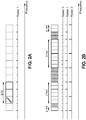
- FIG. 2A there is shown part of a carrier where only one numerology is defined and where resource blocks from this numerology are scheduled.
- the boxes represent resource blocks containing 12 subcarriers in the frequency domain across a fixed number of OFDM symbols in the time domain.
- a carrier may have a bandwidth of 1.4MHz, 3MHz, 5MHz, 10MHz, 15MHz, or 20MHz. Around 90% of this bandwidth is effectively used for the communication needs.
- groups of subcarriers are allocated to a terminal in the resource allocation process.
- the LTE/LTE-Advanced subcarriers are grouped into resource blocks (RB) of 12 subcarriers each.
- the resource block defines the resource allocation granularity, in the sense where a user is allocated a certain number of resource blocks, and therefore a certain bandwidth.
- the subcarrier spacing that is the frequency spacing between two adjacent subcarrier, is fixed to 15kHz. Therefore the frequency bandwidth of a resource block is fixed and the possible number of resource blocks in a carrier is only dependent on the carrier bandwidth.
- a raster In which the socket of the raster corresponds to the size of a resource block of the same numerology in the frequency domain. All the resource blocks are scheduled aligned on this raster. Each potential resource block aligned on the raster is indexed to an integer number. For example in the logical region each of the N RB virtual resource blocks is numbered from 0 to N RB - 1.
- resource allocation type 2 is a compact format indicating to a terminal a set of contiguously virtual resource blocks which are allocated to it for downlink or uplink transfer.
- RIV resource indication value corresponding to the number NRB start of the first contiguous resource block RB start allocated to the terminal and a length L in terms of virtually contiguously allocated resource blocks.
- NRB start is the number corresponding to the position of RB start .
- the RIV value enables the terminal to decode the position of the first virtual resource block RB start which is allocated to it and the number of virtually contiguous resource blocks that are allocated to the terminal. Once RB start and L are decoded the terminal is able to define the resource blocks that where allocated to it. In the example of figure 2A , L is equal to 3 and only 3 resource blocks are allocated, the potential resource blocks are materialized by dotted line squares.
- FIG. 2B there is shown part of a carrier where several subcarrier spacing configurations coexists and where resource blocks from three of these different numerologies are scheduled.
- This is especially possible in a OFDM-based 5G system like NR (New Radio) standard.
- three subcarrier spacing configurations coexists which are ⁇ f 0 , ⁇ f 1 and ⁇ f 2 .
- BW is the effectively occupied bandwidth of the carrier.
- Boxes of one rectangle and with fine outlines represent resource blocks of subcarrier spacing configuration ⁇ f 0
- boxes of two rectangles and with medium outlines represent resource blocks of subcarrier spacing configuration ⁇ f 1
- boxes of four rectangles and with thick outlines represent resource blocks of subcarrier spacing configuration ⁇ f 2 .
- Each resource block is aligned on its raster. Therefore, the first subcarrier of each resource block is on the raster of the corresponding subcarrier spacing configuration. All the subcarriers of the resource block are then allocated to a same terminal. If the allocation is compact, then the L contiguous resource blocks are allocated to the same terminal, that is all the subcarriers starting from the first subcarrier of the first resource block to the last subcarrier of the L th resource block are allocated to the same terminal.
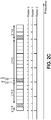
- a guard band (represented on Figure 2B and Figure 2C by the shaded areas) is necessary to avoid interference inter-numerology.
- two subcarriers of the same subcarrier spacing configuration are spaced to respect an orthogonality property, that is the sinc-shaped subcarrier spectra exhibit zero-crossings at all the positions of the other subcarriers with a same subcarrier spacing.
- the sinc-shaped spectra of subcarriers with a given subcarrier spacing do not exhibit zero crossings at all the positions of subcarriers with a different subcarrier spacing, which engenders inter-numerology interference.
- guard bands are included through the scheduling process, that is by avoiding allocating a resource block contiguously to another resource block when their numerologies are different. By doing so when scheduling resource blocks of a high subcarrier spacing configuration like ⁇ f 2 , aligned on their raster, important loss of resources in the carrier can occur.
- this gap is at least the size of a resource block of subcarrier spacing configuration ⁇ f 1 and can even be the size of a resource block of subcarrier spacing configuration ⁇ f 2 , if no more resource blocks of subcarrier spacing configuration ⁇ f 1 is left to schedule to reduce this gap, which is beyond what is necessary to avoid interference inter-numerology.
- the first subcarrier of each resource allocation of a subcarrier spacing configuration can be different from the first subcarrier of a resource block of the same subcarrier spacing configuration, aligned on its raster. This enables to set guard bands in a flexible manner, thus avoiding unnecessary large guard band to prevent inter-numerology interference.
- the first subcarrier of the resource allocation (namely SC start ) of subcarrier spacing configuration ⁇ f 2 is on the raster of the subcarrier spacing configuration ⁇ f 0 at N. ⁇ f 0 from the first subcarrier (namely SC first ) of the potential resource block of subcarrier spacing configuration ⁇ f 2 , aligned on its raster, to which the first subcarrier of the resource allocation belongs.
- the subcarriers of subcarrier spacing configuration ⁇ f 2 between the first subcarrier of said potential resource block and the first subcarrier of the resource allocation are not allocated.
- Only the fourth subcarrier of said potential resource block and the following subcarriers are allocated.
- the following subcarriers of this resource allocation are allocated in respect to the raster, that is, the last subcarrier of such a resource allocation is the last subcarrier of a resource block of a subcarrier spacing configuration ⁇ f 2 .
- the situation is similar between the last subcarrier of the resource allocation of subcarrier spacing configuration ⁇ f 2 and the following subcarrier of subcarrier spacing configuration ⁇ f 1 .
- the first subcarrier of the resource allocation of subcarriers of subcarrier spacing configuration ⁇ f 2 is made according to the raster of subcarrier spacing configuration ⁇ f 0 .
- This enables to set the size of the guard band with a scale of N. ⁇ f 0 , which is more flexible than a scale of N. ⁇ f 2 . Therefore, the transmitter can determine a guard band of N. ⁇ f 0 , 2.N. ⁇ f 0 or 3.N. ⁇ f 0 .
- the transmitter defines the number NRB start 0 of resource blocks of subcarrier spacing configuration ⁇ f 0 containing subcarriers with frequencies lower than the frequency of the end of the guard band.
- the transmitter defines the number L, L-1 corresponding to the resource block of subcarrier spacing configuration ⁇ f 2 (L (2) on figure 2C ) allocated contiguously and in addition to the uncompleted resource block starting with SC start .
- RIV is defined as a function of L and NRB start 0 .
- ⁇ RIV L ⁇ 1 + p 2 ⁇ NRB start 0 if NRB start 0 ⁇ r 2 + 1 + ⁇ 2 .
- p 2 ⁇ 2 ⁇ RIV ⁇ N RB 0 4 ⁇ ⁇ r 2 + N RB 0 ⁇ 3 ⁇ NRB start 0 + p 2 ⁇ L otherwise
- FIG. 3A there is shown a flowchart representing the steps according to an aspect of the invention, to allocate subcarriers of subcarrier spacing configuration in the carrier by the transmitter to a terminal.
- the transmitter sends to the terminal parameters concerning the cell settings including the carrier bandwidth BW and information on supported numerologies. More specifically the transmitter sends to the terminal information allowing the terminal to know directly or deduce at least the following parameters: ⁇ f 0 , ⁇ f 2 , N RB 0 .
- the transmitter sends to the terminal the allocation parameters, for example, indications allowing the terminal to deduce which type of subcarriers (subcarrier spacing configuration of the resource blocks) will be allocated to the terminal and therefore which set of formulae or lookup table will be necessary to decode the RIV value, if several sets are possible.
- the allocation parameters for example, indications allowing the terminal to deduce which type of subcarriers (subcarrier spacing configuration of the resource blocks) will be allocated to the terminal and therefore which set of formulae or lookup table will be necessary to decode the RIV value, if several sets are possible.
- the transmitter defines the contiguous subcarriers it allocates to the terminal.
- the transmitter sends the RIV value through a control channel.
- the RIV value is calculated with the RIV formula mentioned above based on the contiguous subcarriers the transmitter allocates to the terminal.
- FIG. 3B there is shown a flowchart representing the steps according to an aspect of the invention, to define by the terminal the subcarriers that are allocated to it.
- the terminal receives from the transmitter the parameters concerning the cell settings including the carrier bandwidth BW and information on supported numerologies. More specifically the terminal receives from the transmitter information allowing the terminal to know directly or deduce at least the following parameters: ⁇ f 0 , ⁇ f 2 , N RB 0 .
- the terminal receives from the transmitter the allocation parameters, for example indications allowing the terminal to deduce which type of subcarriers (subcarrier spacing configuration of the resource blocks) will be allocated to it and therefore which set of formula or lookup table will be necessary to decode the RIV value, if several sets are possible.
- the allocation parameters for example indications allowing the terminal to deduce which type of subcarriers (subcarrier spacing configuration of the resource blocks) will be allocated to it and therefore which set of formula or lookup table will be necessary to decode the RIV value, if several sets are possible.
- the terminal receives from the transmitter through a control channel, the RIV value corresponding to the subcarriers allocated to the terminal.
- the terminal can determine a unique f start and a unique f last as shown above.
- the present invention refers to carrier band of a specific bandwidth but the invention can also be implemented on a pre-defined portion of the entire carrier band, more specifically the pre-defined portion seen by a terminal as the maximum band where its own resource allocation and control signaling can occur.
Landscapes
- Engineering & Computer Science (AREA)
- Signal Processing (AREA)
- Computer Networks & Wireless Communication (AREA)
- Mobile Radio Communication Systems (AREA)
Claims (15)
- Verfahren zum Zuordnen von Ressourcen zu einem Endgerät in einem Telekommunikationssystem, umfassend wenigstens einen Träger, umfassend mehrere Unterträger, wobei der Träger wenigstens eine Unterträger-Beabstandungskonfiguration Δf0 und eine Unterträger-Beabstandungskonfiguration Δf1 unterstützt, wobei Δf1 = q.Δf0, q eine positive Ganzzahl ist, wobei das Verfahren umfasst:a) Auswählen der Unterträger-Beabstandungskonfiguration Δf1;b) Bestimmen einer Anzahl L von Ressourcenblöcken, welche Unterträger der Unterträger-Beabstandungskonfiguration Δf1 aufweisen;c) Zuordnen eines Unterträgers aus den Unterträgern des Trägers von Unterträger-Beabstandungskonfigurationen Δf1 zu dem Träger, welche ihre Frequenzen aufweisen:- größer oder gleich einer Frequenz, nämlich fstart, zu sein, welche die unterste Frequenz unter Frequenzen von Unterträgern einer Unterträger-Beabstandungskonfiguration Δf1 ist, welche eine Frequenz aufweist, welche größer oder gleich fref + m.N.Δf1 + k.N.Δf0 ist,∘ wobei fref die unterste Frequenz unter den Unterträgern ist, welche für eine Unterträger-Beabstandung Δf1 in dem Träger erlaubbar sind,∘ wobei k eine Ganzzahl größer oder gleich 1 und kleiner oder gleich (q -1) ist,∘ wobei N die Anzahl von Unterträgern in einem Ressourcenblock ist,∘ wobei m eine Ganzzahl größer oder gleich 0 und kleiner als eine maximale Anzahl von Ressourcenblöcken ist, welche in dem Träger erlaubbar sind, welche Unterträger einer Unterträger-Beabstandungskonfiguration Δf1 aufweisen;- kleiner oder gleich einer Frequenz fref + m.N.Δf1 + (L.N - 1).Δf1, nämlich flast, zu sein;wobei m derart bestimmt wird, dass wenigstens ein Unterträger von Unterträger-Beabstandungskonfigurationen Δf1, welcher eine Frequenz von wenigstens fref + m.N.Δf1 und höchstens fref + (m+1).N.Δf1 - Δf1 aufweist, dem Endgerät zugeordnet werden kann; und
wobei k derart bestimmt wird, dass fstart - fnear größer ist als G, wobei G ein strikt positiver Schwellenwert ist, und wobei fnear eine Frequenz eines Unterträgers mit einer Unterträger-Beabstandungskonfiguration ist, welche von Δf1 verschieden ist, wobei der Unterträger die höchste Frequenz unter Frequenzen von Unterträgern aufweist, welche in dem Träger zugeordnet sind, welcher Unterträger-Beabstandungskonfigurationen aufweist, welche von Δf1 verschieden sind und geringere Frequenzen aufweisen als fref + (m+1).N.Δf1. - Verfahren nach Anspruch 1, wobei die Unterträger-Beabstandungskonfiguration Δf0 die kleinste Unterträger-Beabstandungskonfiguration aus der Unterträger-Beabstandungskonfiguration ist, welche durch den Träger unterstützt wird.
- Verfahren nach einem der Ansprüche 1 oder 2, wobei die Anzahl L, L≥1, erfüllt:
 - NRB (0) eine maximale Anzahl von Ressourcenblöcken ist, umfassend N Unterträger der Unterträger-Beabstandungskonfiguration Δf0, welche in dem Träger erlaubbar sind,-
- Verfahren nach Anspruch 3, ferner umfassend ein Senden von Zuordnungsinformationen an das Endgerät auf Grundlage der Unterträger, welche dem Endgerät zugeordnet werden.
- Verfahren nach Anspruch 4, wobei die Zuordnungsinformationen, welche dem Endgerät auf Grundlage der Unterträger zugeordnet werden, ein Ressourcen-Anzeigewert, RIV, sind, welcher eine Ganzzahl und eine Funktion von L und

- Verfahren nach Anspruch 5, wobei die RIV-Funktion eine injektive Funktion eines beliebigen Paares ist, umfassen L und

- Verfahren nach einem der Ansprüche 5 oder 6, wobei der RIV eine surjektive Funktion unter den Ganzzahlen von 0 bis zu einem maximalen Wert ist, welcher durch den RIV eingenommen wird.
- Verfahren nach einem der Ansprüche 5 bis 7, wobei der RIV definiert ist durch:
 - r 1 ein Rest der Teilung von
 -
-
- Verfahren nach einem der Ansprüche 5 bis 7, wobei der RIV definiert ist durch:
 - r 1 ein Rest der Teilung von
 -
-
- Verfahren nach einem der Ansprüche 5 bis 7, wobei der RIV definiert ist durch:
 - r 1 ein Rest der Teilung von
 -
-
- Verfahren nach einem der Ansprüche 5 bis 7, wobei der RIV definiert ist durch:
 -
-
- Transmitter, umfassend Mittel zum Zuordnen von Ressourcen zu einem Endgerät in einem Telekommunikationssystem, umfassend wenigstens einen Träger, umfassend mehrere Unterträger, wobei der Träger wenigstens eine Unterträger-Beabstandungskonfiguration Δf0 und eine Unterträger-Beabstandungskonfiguration Δf1 unterstützt, wobei Δf1 = q.Δf0, q eine positive Ganzzahl ist, wobei der Transmitter dazu eingerichtet ist, das Folgende durchzuführen:a) Auswählen der Unterträger-Beabstandungskonfiguration Δf1;b) Bestimmen einer Anzahl L von Ressourcenblöcken, welche Unterträger der Unterträger-Beabstandungskonfiguration Δf1 aufweisen;c) Zuordnen eines Unterträgers aus den Unterträgern des Trägers von Unterträger-Beabstandungskonfigurationen Δf1 zu dem Träger, welche ihre Frequenzen aufweisen:- größer oder gleich einer Frequenz, nämlich fstart, zu sein, welche die unterste Frequenz unter Frequenzen von Unterträgern einer Unterträger-Beabstandungskonfiguration Δf1 ist, welche eine Frequenz aufweist, welche größer oder gleich fref + m.N.Δf1 + k.N.Δf0 ist,∘ wobei fref die unterste Frequenz unter den Unterträgern ist, welche für eine Unterträger-Beabstandung Δf1 in dem Träger erlaubbar sind,∘ wobei k eine Ganzzahl größer oder gleich 1 und kleiner oder gleich (q -1) ist,∘ wobei N die Anzahl von Unterträgern in einem Ressourcenblock ist,∘ wobei m eine Ganzzahl größer oder gleich 0 und kleiner als eine maximale Anzahl von Ressourcenblöcken ist, welche in dem Träger erlaubbar sind, welche Unterträger einer Unterträger-Beabstandungskonfiguration Δf1 aufweisen;- kleiner oder gleich einer Frequenz fref + m.N.Δf1 + (L.N - 1).Δf1, nämlich flast, zu sein;wobei m derart bestimmt wird, dass wenigstens ein Unterträger von Unterträger-Beabstandungskonfigurationen Δf1, welcher eine Frequenz von wenigstens fref + m.N.Δf1 und höchstens fref + (m+1).N.Δf1 - Δf1 aufweist, dem Endgerät zugeordnet werden kann; und
wobei k derart bestimmt wird, dass fstart - fnear größer ist als G, wobei G ein strikt positiver Schwellenwert ist, und wobei fnear eine Frequenz eines Unterträgers mit einer Unterträger-Beabstandungskonfiguration ist, welche von Δf1 verschieden ist, wobei der Unterträger die höchste Frequenz unter Frequenzen von Unterträgern aufweist, welche in dem Träger zugeordnet sind, welcher Unterträger-Beabstandungskonfigurationen aufweist, welche von Δf1 verschieden sind und geringere Frequenzen aufweisen als fref + (m+1).N.Δf1. - Transmitter nach Anspruch 12, umfassend eine Speichereinheit, welche für jedes Paar von möglichen Werten einer Anzahl von

 - einen RIV-Wert auf Grundlage eines Paares von L und
 - den RIV an das Endgerät zu übertragen.
 - Endgerät in einem Telekommunikationssystem, welches Mittel zum Zuordnen von Ressourcen in einem Träger umfasst, wobei der Träger wenigstens eine Unterträger-Beabstandungskonfiguration Δf0 und eine Unterträger-Beabstandungskonfiguration Δf1 unterstützt, wobei Δf1 = q.Δf0, q eine positive Ganzzahl ist, umfasst:- ein Kommunikationsmodul, welches dazu eingerichtet ist, Zuordnung-Ressourcenblock-Informationen durch einen Steuerkanal zu empfangen,- ein Verarbeitungsmodul, welches dazu eingerichtet ist, die Unterträger zu bestimmen, welche dem Endgerät gemäß den Zuordnung-Ressourcenblock-Informationen zugeordnet sind, eine Speichereinheit, welche für jedes Paar von möglichen Werten einer Anzahl von
 - auf einen Empfang eines RIV-Werts in den Zuordnung-Ressourcenblock-Informationen hin, die Speichereinheit auszulesen und ein Paar von Werten L und
 - und eine Frequenz fstart und eine Frequenz flast wiederherzustellen, wobei

wobei N eine Anzahl von Unterträgern in einem Ressourcenblock ist, wobei fref die unterste Frequenz unter den Unterträgern ist, welche für eine Unterträger-Beabstandung Δf1 in dem Träger erlaubbar sind, und m = └(fstart - fref)/N.Δf1┘ ist,- die Unterträger der Unterträger-Beabstandungskonfigurationen Δf1, welche dem Endgerät zugeordnet sind, zu bestimmen:o als ihre Frequenzen größer oder gleich fstart aufweisend, undo als ihre Frequenzen kleiner oder gleich flast aufweisend. - Computerprogrammprodukt, umfassend Codeanweisungen, um das Verfahren nach einem der Ansprüche 1 bis 11 durchzuführen, wenn die Anweisungen durch einen Prozessor ausgeführt werden.
Priority Applications (5)
| Application Number | Priority Date | Filing Date | Title |
|---|---|---|---|
| PCT/JP2017/040341 WO2018084322A1 (en) | 2016-11-04 | 2017-11-01 | Method and transmitter for allocating resources to terminal in telecommunication system |
| US16/335,601 US10873943B2 (en) | 2016-11-04 | 2017-11-01 | Method and transmitter for allocating resources to terminal in telecommunication system |
| CN201780065570.0A CN109863715B (zh) | 2016-11-04 | 2017-11-01 | 用于在通信系统中向终端分配资源的方法和发送器 |
| JP2018568985A JP6837502B2 (ja) | 2016-11-04 | 2017-11-01 | 電気通信システムにおいて端末にリソースを割り当てる方法及び送信機 |
| KR1020197011966A KR102213313B1 (ko) | 2016-11-04 | 2017-11-01 | 전기 통신 시스템에 있어서 단말에 리소스를 할당하는 방법 및 송신기 |
Applications Claiming Priority (2)
| Application Number | Priority Date | Filing Date | Title |
|---|---|---|---|
| EP16306449 | 2016-11-04 | ||
| EP17305171.5A EP3319263B1 (de) | 2016-11-04 | 2017-02-15 | Resourceszuweisung mit unterschiedlichen numerologien in demselben band |
Publications (2)
| Publication Number | Publication Date |
|---|---|
| EP3319264A1 EP3319264A1 (de) | 2018-05-09 |
| EP3319264B1 true EP3319264B1 (de) | 2020-03-04 |
Family
ID=58488937
Family Applications (1)
| Application Number | Title | Priority Date | Filing Date |
|---|---|---|---|
| EP17305326.5A Active EP3319264B1 (de) | 2016-11-04 | 2017-03-22 | Lücke in ressourcenzuweisung mit verschiedenen numerologien |
Country Status (1)
| Country | Link |
|---|---|
| EP (1) | EP3319264B1 (de) |
Cited By (1)
| Publication number | Priority date | Publication date | Assignee | Title |
|---|---|---|---|---|
| US11064489B2 (en) * | 2016-11-04 | 2021-07-13 | Mitsubishi Electric Corporation | Method and transmitter for resource allocation in carrier |
Families Citing this family (1)
| Publication number | Priority date | Publication date | Assignee | Title |
|---|---|---|---|---|
| CN117835425A (zh) * | 2022-09-29 | 2024-04-05 | 华为技术有限公司 | 一种通信方法及装置 |
Family Cites Families (1)
| Publication number | Priority date | Publication date | Assignee | Title |
|---|---|---|---|---|
| CN103327615B (zh) * | 2012-03-20 | 2016-04-20 | 华为技术有限公司 | 资源分配指示方法、资源分配方法及设备 |
-
2017
- 2017-03-22 EP EP17305326.5A patent/EP3319264B1/de active Active
Non-Patent Citations (1)
| Title |
|---|
| None * |
Cited By (1)
| Publication number | Priority date | Publication date | Assignee | Title |
|---|---|---|---|---|
| US11064489B2 (en) * | 2016-11-04 | 2021-07-13 | Mitsubishi Electric Corporation | Method and transmitter for resource allocation in carrier |
Also Published As
| Publication number | Publication date |
|---|---|
| EP3319264A1 (de) | 2018-05-09 |
Similar Documents
| Publication | Publication Date | Title |
|---|---|---|
| US10873943B2 (en) | Method and transmitter for allocating resources to terminal in telecommunication system | |
| US11330581B2 (en) | Base station, terminal apparatus, first terminal apparatus, method, program, recording medium and system | |
| CN113115463B (zh) | 下一代蜂窝网络中的数据传输的方法和装置 | |
| US8184585B2 (en) | Method for allocating resource, and method for transmitting resource allocation information | |
| EP3404973B1 (de) | Datensendeverfahren, datenempfangsverfahren, benutzergerät und basisstation | |
| CN112204911B (zh) | 用于新无线电的数字方案选项 | |
| EP3319264B1 (de) | Lücke in ressourcenzuweisung mit verschiedenen numerologien | |
| WO2021203413A1 (en) | Method and apparatus for uplink resource allocation | |
| CN102970709B (zh) | 一种配置分片载波后rbg大小和编号的确定方法和装置 | |
| WO2020198965A1 (en) | Method and apparatus for resource allocation on unlicensed spectrum | |
| CN114144989B (zh) | 分配无线电资源的方法和分配单元 | |
| KR102954703B1 (ko) | 업링크 자원 할당을 위한 방법 및 장치 |
Legal Events
| Date | Code | Title | Description |
|---|---|---|---|
| PUAI | Public reference made under article 153(3) epc to a published international application that has entered the european phase |
Free format text: ORIGINAL CODE: 0009012 |
|
| STAA | Information on the status of an ep patent application or granted ep patent |
Free format text: STATUS: THE APPLICATION HAS BEEN PUBLISHED |
|
| AK | Designated contracting states |
Kind code of ref document: A1 Designated state(s): AL AT BE BG CH CY CZ DE DK EE ES FI FR GB GR HR HU IE IS IT LI LT LU LV MC MK MT NL NO PL PT RO RS SE SI SK SM TR |
|
| AX | Request for extension of the european patent |
Extension state: BA ME |
|
| STAA | Information on the status of an ep patent application or granted ep patent |
Free format text: STATUS: REQUEST FOR EXAMINATION WAS MADE |
|
| 17P | Request for examination filed |
Effective date: 20180711 |
|
| RBV | Designated contracting states (corrected) |
Designated state(s): AL AT BE BG CH CY CZ DE DK EE ES FI FR GB GR HR HU IE IS IT LI LT LU LV MC MK MT NL NO PL PT RO RS SE SI SK SM TR |
|
| STAA | Information on the status of an ep patent application or granted ep patent |
Free format text: STATUS: EXAMINATION IS IN PROGRESS |
|
| 17Q | First examination report despatched |
Effective date: 20180924 |
|
| GRAP | Despatch of communication of intention to grant a patent |
Free format text: ORIGINAL CODE: EPIDOSNIGR1 |
|
| STAA | Information on the status of an ep patent application or granted ep patent |
Free format text: STATUS: GRANT OF PATENT IS INTENDED |
|
| RIC1 | Information provided on ipc code assigned before grant |
Ipc: H04W 72/04 20090101ALN20190911BHEP Ipc: H04L 5/00 20060101AFI20190911BHEP Ipc: H04W 72/12 20090101ALN20190911BHEP |
|
| RIC1 | Information provided on ipc code assigned before grant |
Ipc: H04W 72/04 20090101ALN20190913BHEP Ipc: H04W 72/12 20090101ALN20190913BHEP Ipc: H04L 5/00 20060101AFI20190913BHEP |
|
| INTG | Intention to grant announced |
Effective date: 20191011 |
|
| GRAS | Grant fee paid |
Free format text: ORIGINAL CODE: EPIDOSNIGR3 |
|
| GRAA | (expected) grant |
Free format text: ORIGINAL CODE: 0009210 |
|
| STAA | Information on the status of an ep patent application or granted ep patent |
Free format text: STATUS: THE PATENT HAS BEEN GRANTED |
|
| AK | Designated contracting states |
Kind code of ref document: B1 Designated state(s): AL AT BE BG CH CY CZ DE DK EE ES FI FR GB GR HR HU IE IS IT LI LT LU LV MC MK MT NL NO PL PT RO RS SE SI SK SM TR |
|
| REG | Reference to a national code |
Ref country code: GB Ref legal event code: FG4D |
|
| REG | Reference to a national code |
Ref country code: CH Ref legal event code: EP |
|
| REG | Reference to a national code |
Ref country code: AT Ref legal event code: REF Ref document number: 1241639 Country of ref document: AT Kind code of ref document: T Effective date: 20200315 |
|
| REG | Reference to a national code |
Ref country code: DE Ref legal event code: R096 Ref document number: 602017012538 Country of ref document: DE |
|
| REG | Reference to a national code |
Ref country code: IE Ref legal event code: FG4D |
|
| PG25 | Lapsed in a contracting state [announced via postgrant information from national office to epo] |
Ref country code: RS Free format text: LAPSE BECAUSE OF FAILURE TO SUBMIT A TRANSLATION OF THE DESCRIPTION OR TO PAY THE FEE WITHIN THE PRESCRIBED TIME-LIMIT Effective date: 20200304 Ref country code: FI Free format text: LAPSE BECAUSE OF FAILURE TO SUBMIT A TRANSLATION OF THE DESCRIPTION OR TO PAY THE FEE WITHIN THE PRESCRIBED TIME-LIMIT Effective date: 20200304 Ref country code: NO Free format text: LAPSE BECAUSE OF FAILURE TO SUBMIT A TRANSLATION OF THE DESCRIPTION OR TO PAY THE FEE WITHIN THE PRESCRIBED TIME-LIMIT Effective date: 20200604 |
|
| REG | Reference to a national code |
Ref country code: NL Ref legal event code: MP Effective date: 20200304 |
|
| PG25 | Lapsed in a contracting state [announced via postgrant information from national office to epo] |
Ref country code: BG Free format text: LAPSE BECAUSE OF FAILURE TO SUBMIT A TRANSLATION OF THE DESCRIPTION OR TO PAY THE FEE WITHIN THE PRESCRIBED TIME-LIMIT Effective date: 20200604 Ref country code: GR Free format text: LAPSE BECAUSE OF FAILURE TO SUBMIT A TRANSLATION OF THE DESCRIPTION OR TO PAY THE FEE WITHIN THE PRESCRIBED TIME-LIMIT Effective date: 20200605 Ref country code: HR Free format text: LAPSE BECAUSE OF FAILURE TO SUBMIT A TRANSLATION OF THE DESCRIPTION OR TO PAY THE FEE WITHIN THE PRESCRIBED TIME-LIMIT Effective date: 20200304 Ref country code: LV Free format text: LAPSE BECAUSE OF FAILURE TO SUBMIT A TRANSLATION OF THE DESCRIPTION OR TO PAY THE FEE WITHIN THE PRESCRIBED TIME-LIMIT Effective date: 20200304 Ref country code: SE Free format text: LAPSE BECAUSE OF FAILURE TO SUBMIT A TRANSLATION OF THE DESCRIPTION OR TO PAY THE FEE WITHIN THE PRESCRIBED TIME-LIMIT Effective date: 20200304 |
|
| REG | Reference to a national code |
Ref country code: LT Ref legal event code: MG4D |
|
| PG25 | Lapsed in a contracting state [announced via postgrant information from national office to epo] |
Ref country code: NL Free format text: LAPSE BECAUSE OF FAILURE TO SUBMIT A TRANSLATION OF THE DESCRIPTION OR TO PAY THE FEE WITHIN THE PRESCRIBED TIME-LIMIT Effective date: 20200304 |
|
| PG25 | Lapsed in a contracting state [announced via postgrant information from national office to epo] |
Ref country code: SK Free format text: LAPSE BECAUSE OF FAILURE TO SUBMIT A TRANSLATION OF THE DESCRIPTION OR TO PAY THE FEE WITHIN THE PRESCRIBED TIME-LIMIT Effective date: 20200304 Ref country code: IS Free format text: LAPSE BECAUSE OF FAILURE TO SUBMIT A TRANSLATION OF THE DESCRIPTION OR TO PAY THE FEE WITHIN THE PRESCRIBED TIME-LIMIT Effective date: 20200704 Ref country code: RO Free format text: LAPSE BECAUSE OF FAILURE TO SUBMIT A TRANSLATION OF THE DESCRIPTION OR TO PAY THE FEE WITHIN THE PRESCRIBED TIME-LIMIT Effective date: 20200304 Ref country code: SM Free format text: LAPSE BECAUSE OF FAILURE TO SUBMIT A TRANSLATION OF THE DESCRIPTION OR TO PAY THE FEE WITHIN THE PRESCRIBED TIME-LIMIT Effective date: 20200304 Ref country code: EE Free format text: LAPSE BECAUSE OF FAILURE TO SUBMIT A TRANSLATION OF THE DESCRIPTION OR TO PAY THE FEE WITHIN THE PRESCRIBED TIME-LIMIT Effective date: 20200304 Ref country code: PT Free format text: LAPSE BECAUSE OF FAILURE TO SUBMIT A TRANSLATION OF THE DESCRIPTION OR TO PAY THE FEE WITHIN THE PRESCRIBED TIME-LIMIT Effective date: 20200729 Ref country code: ES Free format text: LAPSE BECAUSE OF FAILURE TO SUBMIT A TRANSLATION OF THE DESCRIPTION OR TO PAY THE FEE WITHIN THE PRESCRIBED TIME-LIMIT Effective date: 20200304 Ref country code: CZ Free format text: LAPSE BECAUSE OF FAILURE TO SUBMIT A TRANSLATION OF THE DESCRIPTION OR TO PAY THE FEE WITHIN THE PRESCRIBED TIME-LIMIT Effective date: 20200304 Ref country code: LT Free format text: LAPSE BECAUSE OF FAILURE TO SUBMIT A TRANSLATION OF THE DESCRIPTION OR TO PAY THE FEE WITHIN THE PRESCRIBED TIME-LIMIT Effective date: 20200304 |
|
| REG | Reference to a national code |
Ref country code: CH Ref legal event code: PL |
|
| REG | Reference to a national code |
Ref country code: AT Ref legal event code: MK05 Ref document number: 1241639 Country of ref document: AT Kind code of ref document: T Effective date: 20200304 |
|
| REG | Reference to a national code |
Ref country code: DE Ref legal event code: R097 Ref document number: 602017012538 Country of ref document: DE |
|
| REG | Reference to a national code |
Ref country code: BE Ref legal event code: MM Effective date: 20200331 |
|
| PG25 | Lapsed in a contracting state [announced via postgrant information from national office to epo] |
Ref country code: LU Free format text: LAPSE BECAUSE OF NON-PAYMENT OF DUE FEES Effective date: 20200322 Ref country code: MC Free format text: LAPSE BECAUSE OF FAILURE TO SUBMIT A TRANSLATION OF THE DESCRIPTION OR TO PAY THE FEE WITHIN THE PRESCRIBED TIME-LIMIT Effective date: 20200304 |
|
| PLBE | No opposition filed within time limit |
Free format text: ORIGINAL CODE: 0009261 |
|
| STAA | Information on the status of an ep patent application or granted ep patent |
Free format text: STATUS: NO OPPOSITION FILED WITHIN TIME LIMIT |
|
| PG25 | Lapsed in a contracting state [announced via postgrant information from national office to epo] |
Ref country code: DK Free format text: LAPSE BECAUSE OF FAILURE TO SUBMIT A TRANSLATION OF THE DESCRIPTION OR TO PAY THE FEE WITHIN THE PRESCRIBED TIME-LIMIT Effective date: 20200304 Ref country code: LI Free format text: LAPSE BECAUSE OF NON-PAYMENT OF DUE FEES Effective date: 20200331 Ref country code: IT Free format text: LAPSE BECAUSE OF FAILURE TO SUBMIT A TRANSLATION OF THE DESCRIPTION OR TO PAY THE FEE WITHIN THE PRESCRIBED TIME-LIMIT Effective date: 20200304 Ref country code: AT Free format text: LAPSE BECAUSE OF FAILURE TO SUBMIT A TRANSLATION OF THE DESCRIPTION OR TO PAY THE FEE WITHIN THE PRESCRIBED TIME-LIMIT Effective date: 20200304 Ref country code: CH Free format text: LAPSE BECAUSE OF NON-PAYMENT OF DUE FEES Effective date: 20200331 Ref country code: IE Free format text: LAPSE BECAUSE OF NON-PAYMENT OF DUE FEES Effective date: 20200322 |
|
| 26N | No opposition filed |
Effective date: 20201207 |
|
| PG25 | Lapsed in a contracting state [announced via postgrant information from national office to epo] |
Ref country code: SI Free format text: LAPSE BECAUSE OF FAILURE TO SUBMIT A TRANSLATION OF THE DESCRIPTION OR TO PAY THE FEE WITHIN THE PRESCRIBED TIME-LIMIT Effective date: 20200304 Ref country code: PL Free format text: LAPSE BECAUSE OF FAILURE TO SUBMIT A TRANSLATION OF THE DESCRIPTION OR TO PAY THE FEE WITHIN THE PRESCRIBED TIME-LIMIT Effective date: 20200304 Ref country code: BE Free format text: LAPSE BECAUSE OF NON-PAYMENT OF DUE FEES Effective date: 20200331 |
|
| PGFP | Annual fee paid to national office [announced via postgrant information from national office to epo] |
Ref country code: FR Payment date: 20210325 Year of fee payment: 5 |
|
| PGFP | Annual fee paid to national office [announced via postgrant information from national office to epo] |
Ref country code: DE Payment date: 20210310 Year of fee payment: 5 Ref country code: GB Payment date: 20210318 Year of fee payment: 5 |
|
| PG25 | Lapsed in a contracting state [announced via postgrant information from national office to epo] |
Ref country code: TR Free format text: LAPSE BECAUSE OF FAILURE TO SUBMIT A TRANSLATION OF THE DESCRIPTION OR TO PAY THE FEE WITHIN THE PRESCRIBED TIME-LIMIT Effective date: 20200304 Ref country code: MT Free format text: LAPSE BECAUSE OF FAILURE TO SUBMIT A TRANSLATION OF THE DESCRIPTION OR TO PAY THE FEE WITHIN THE PRESCRIBED TIME-LIMIT Effective date: 20200304 Ref country code: CY Free format text: LAPSE BECAUSE OF FAILURE TO SUBMIT A TRANSLATION OF THE DESCRIPTION OR TO PAY THE FEE WITHIN THE PRESCRIBED TIME-LIMIT Effective date: 20200304 |
|
| PG25 | Lapsed in a contracting state [announced via postgrant information from national office to epo] |
Ref country code: MK Free format text: LAPSE BECAUSE OF FAILURE TO SUBMIT A TRANSLATION OF THE DESCRIPTION OR TO PAY THE FEE WITHIN THE PRESCRIBED TIME-LIMIT Effective date: 20200304 Ref country code: AL Free format text: LAPSE BECAUSE OF FAILURE TO SUBMIT A TRANSLATION OF THE DESCRIPTION OR TO PAY THE FEE WITHIN THE PRESCRIBED TIME-LIMIT Effective date: 20200304 |
|
| REG | Reference to a national code |
Ref country code: DE Ref legal event code: R119 Ref document number: 602017012538 Country of ref document: DE |
|
| GBPC | Gb: european patent ceased through non-payment of renewal fee |
Effective date: 20220322 |
|
| PG25 | Lapsed in a contracting state [announced via postgrant information from national office to epo] |
Ref country code: GB Free format text: LAPSE BECAUSE OF NON-PAYMENT OF DUE FEES Effective date: 20220322 Ref country code: FR Free format text: LAPSE BECAUSE OF NON-PAYMENT OF DUE FEES Effective date: 20220331 Ref country code: DE Free format text: LAPSE BECAUSE OF NON-PAYMENT OF DUE FEES Effective date: 20221001 |