EP3319697B1 - Fitnesssystem, fitnessanordnung und funktionale fitnesselemente - Google Patents
Fitnesssystem, fitnessanordnung und funktionale fitnesselemente Download PDFInfo
- Publication number
- EP3319697B1 EP3319697B1 EP16738141.7A EP16738141A EP3319697B1 EP 3319697 B1 EP3319697 B1 EP 3319697B1 EP 16738141 A EP16738141 A EP 16738141A EP 3319697 B1 EP3319697 B1 EP 3319697B1
- Authority
- EP
- European Patent Office
- Prior art keywords
- fitness
- weight
- elements
- elongated structure
- elongated
- Prior art date
- Legal status (The legal status is an assumption and is not a legal conclusion. Google has not performed a legal analysis and makes no representation as to the accuracy of the status listed.)
- Active
Links
Images





Classifications
-
- A—HUMAN NECESSITIES
- A63—SPORTS; GAMES; AMUSEMENTS
- A63B—APPARATUS FOR PHYSICAL TRAINING, GYMNASTICS, SWIMMING, CLIMBING, OR FENCING; BALL GAMES; TRAINING EQUIPMENT
- A63B9/00—Climbing poles, frames, or stages
-
- A—HUMAN NECESSITIES
- A63—SPORTS; GAMES; AMUSEMENTS
- A63B—APPARATUS FOR PHYSICAL TRAINING, GYMNASTICS, SWIMMING, CLIMBING, OR FENCING; BALL GAMES; TRAINING EQUIPMENT
- A63B1/00—Horizontal bars
-
- A—HUMAN NECESSITIES
- A63—SPORTS; GAMES; AMUSEMENTS
- A63B—APPARATUS FOR PHYSICAL TRAINING, GYMNASTICS, SWIMMING, CLIMBING, OR FENCING; BALL GAMES; TRAINING EQUIPMENT
- A63B17/00—Exercising apparatus combining several parts such as ladders, rods, beams, slides
- A63B17/04—Exercising apparatus combining several parts such as ladders, rods, beams, slides separable
-
- A—HUMAN NECESSITIES
- A63—SPORTS; GAMES; AMUSEMENTS
- A63B—APPARATUS FOR PHYSICAL TRAINING, GYMNASTICS, SWIMMING, CLIMBING, OR FENCING; BALL GAMES; TRAINING EQUIPMENT
- A63B21/00—Exercising apparatus for developing or strengthening the muscles or joints of the body by working against a counterforce, with or without measuring devices
- A63B21/02—Exercising apparatus for developing or strengthening the muscles or joints of the body by working against a counterforce, with or without measuring devices using resilient force-resisters
- A63B21/023—Wound springs
-
- A—HUMAN NECESSITIES
- A63—SPORTS; GAMES; AMUSEMENTS
- A63B—APPARATUS FOR PHYSICAL TRAINING, GYMNASTICS, SWIMMING, CLIMBING, OR FENCING; BALL GAMES; TRAINING EQUIPMENT
- A63B21/00—Exercising apparatus for developing or strengthening the muscles or joints of the body by working against a counterforce, with or without measuring devices
- A63B21/02—Exercising apparatus for developing or strengthening the muscles or joints of the body by working against a counterforce, with or without measuring devices using resilient force-resisters
- A63B21/055—Exercising apparatus for developing or strengthening the muscles or joints of the body by working against a counterforce, with or without measuring devices using resilient force-resisters extension element type
-
- A—HUMAN NECESSITIES
- A63—SPORTS; GAMES; AMUSEMENTS
- A63B—APPARATUS FOR PHYSICAL TRAINING, GYMNASTICS, SWIMMING, CLIMBING, OR FENCING; BALL GAMES; TRAINING EQUIPMENT
- A63B21/00—Exercising apparatus for developing or strengthening the muscles or joints of the body by working against a counterforce, with or without measuring devices
- A63B21/02—Exercising apparatus for developing or strengthening the muscles or joints of the body by working against a counterforce, with or without measuring devices using resilient force-resisters
- A63B21/055—Exercising apparatus for developing or strengthening the muscles or joints of the body by working against a counterforce, with or without measuring devices using resilient force-resisters extension element type
- A63B21/0552—Elastic ropes or bands
- A63B21/0557—Details of attachments, e.g. clips or clamps
-
- A—HUMAN NECESSITIES
- A63—SPORTS; GAMES; AMUSEMENTS
- A63B—APPARATUS FOR PHYSICAL TRAINING, GYMNASTICS, SWIMMING, CLIMBING, OR FENCING; BALL GAMES; TRAINING EQUIPMENT
- A63B21/00—Exercising apparatus for developing or strengthening the muscles or joints of the body by working against a counterforce, with or without measuring devices
- A63B21/06—User-manipulated weights
- A63B21/062—User-manipulated weights including guide for vertical or non-vertical weights or array of weights to move against gravity forces
- A63B21/0626—User-manipulated weights including guide for vertical or non-vertical weights or array of weights to move against gravity forces with substantially vertical guiding means
-
- A—HUMAN NECESSITIES
- A63—SPORTS; GAMES; AMUSEMENTS
- A63B—APPARATUS FOR PHYSICAL TRAINING, GYMNASTICS, SWIMMING, CLIMBING, OR FENCING; BALL GAMES; TRAINING EQUIPMENT
- A63B21/00—Exercising apparatus for developing or strengthening the muscles or joints of the body by working against a counterforce, with or without measuring devices
- A63B21/15—Arrangements for force transmissions
- A63B21/151—Using flexible elements for reciprocating movements, e.g. ropes or chains
-
- A—HUMAN NECESSITIES
- A63—SPORTS; GAMES; AMUSEMENTS
- A63B—APPARATUS FOR PHYSICAL TRAINING, GYMNASTICS, SWIMMING, CLIMBING, OR FENCING; BALL GAMES; TRAINING EQUIPMENT
- A63B21/00—Exercising apparatus for developing or strengthening the muscles or joints of the body by working against a counterforce, with or without measuring devices
- A63B21/40—Interfaces with the user related to strength training; Details thereof
- A63B21/4023—Interfaces with the user related to strength training; Details thereof the user operating the resistance directly, without additional interface
-
- A—HUMAN NECESSITIES
- A63—SPORTS; GAMES; AMUSEMENTS
- A63B—APPARATUS FOR PHYSICAL TRAINING, GYMNASTICS, SWIMMING, CLIMBING, OR FENCING; BALL GAMES; TRAINING EQUIPMENT
- A63B21/00—Exercising apparatus for developing or strengthening the muscles or joints of the body by working against a counterforce, with or without measuring devices
- A63B21/40—Interfaces with the user related to strength training; Details thereof
- A63B21/4027—Specific exercise interfaces
- A63B21/4033—Handles, pedals, bars or platforms
- A63B21/4035—Handles, pedals, bars or platforms for operation by hand
-
- A—HUMAN NECESSITIES
- A63—SPORTS; GAMES; AMUSEMENTS
- A63B—APPARATUS FOR PHYSICAL TRAINING, GYMNASTICS, SWIMMING, CLIMBING, OR FENCING; BALL GAMES; TRAINING EQUIPMENT
- A63B21/00—Exercising apparatus for developing or strengthening the muscles or joints of the body by working against a counterforce, with or without measuring devices
- A63B21/40—Interfaces with the user related to strength training; Details thereof
- A63B21/4041—Interfaces with the user related to strength training; Details thereof characterised by the movements of the interface
- A63B21/4045—Reciprocating movement along, in or on a guide
-
- A—HUMAN NECESSITIES
- A63—SPORTS; GAMES; AMUSEMENTS
- A63B—APPARATUS FOR PHYSICAL TRAINING, GYMNASTICS, SWIMMING, CLIMBING, OR FENCING; BALL GAMES; TRAINING EQUIPMENT
- A63B22/00—Exercising apparatus specially adapted for conditioning the cardio-vascular system, for training agility or co-ordination of movements
- A63B22/0002—Exercising apparatus specially adapted for conditioning the cardio-vascular system, for training agility or co-ordination of movements involving an exercising of arms
-
- A—HUMAN NECESSITIES
- A63—SPORTS; GAMES; AMUSEMENTS
- A63B—APPARATUS FOR PHYSICAL TRAINING, GYMNASTICS, SWIMMING, CLIMBING, OR FENCING; BALL GAMES; TRAINING EQUIPMENT
- A63B22/00—Exercising apparatus specially adapted for conditioning the cardio-vascular system, for training agility or co-ordination of movements
- A63B22/0002—Exercising apparatus specially adapted for conditioning the cardio-vascular system, for training agility or co-ordination of movements involving an exercising of arms
- A63B22/0005—Exercising apparatus specially adapted for conditioning the cardio-vascular system, for training agility or co-ordination of movements involving an exercising of arms with particular movement of the arms provided by handles moving otherwise than pivoting about a horizontal axis parallel to the body-symmetrical-plane
-
- A—HUMAN NECESSITIES
- A63—SPORTS; GAMES; AMUSEMENTS
- A63B—APPARATUS FOR PHYSICAL TRAINING, GYMNASTICS, SWIMMING, CLIMBING, OR FENCING; BALL GAMES; TRAINING EQUIPMENT
- A63B22/00—Exercising apparatus specially adapted for conditioning the cardio-vascular system, for training agility or co-ordination of movements
- A63B22/06—Exercising apparatus specially adapted for conditioning the cardio-vascular system, for training agility or co-ordination of movements with support elements performing a rotating cycling movement, i.e. a closed path movement
-
- A—HUMAN NECESSITIES
- A63—SPORTS; GAMES; AMUSEMENTS
- A63B—APPARATUS FOR PHYSICAL TRAINING, GYMNASTICS, SWIMMING, CLIMBING, OR FENCING; BALL GAMES; TRAINING EQUIPMENT
- A63B23/00—Exercising apparatus specially adapted for particular parts of the body
- A63B23/035—Exercising apparatus specially adapted for particular parts of the body for limbs, i.e. upper or lower limbs, e.g. simultaneously
- A63B23/03516—For both arms together or both legs together; Aspects related to the co-ordination between right and left side limbs of a user
- A63B23/03525—Supports for both feet or both hands performing simultaneously the same movement, e.g. single pedal or single handle
-
- A—HUMAN NECESSITIES
- A63—SPORTS; GAMES; AMUSEMENTS
- A63B—APPARATUS FOR PHYSICAL TRAINING, GYMNASTICS, SWIMMING, CLIMBING, OR FENCING; BALL GAMES; TRAINING EQUIPMENT
- A63B23/00—Exercising apparatus specially adapted for particular parts of the body
- A63B23/035—Exercising apparatus specially adapted for particular parts of the body for limbs, i.e. upper or lower limbs, e.g. simultaneously
- A63B23/12—Exercising apparatus specially adapted for particular parts of the body for limbs, i.e. upper or lower limbs, e.g. simultaneously for upper limbs or related muscles, e.g. chest, upper back or shoulder muscles
-
- A—HUMAN NECESSITIES
- A63—SPORTS; GAMES; AMUSEMENTS
- A63B—APPARATUS FOR PHYSICAL TRAINING, GYMNASTICS, SWIMMING, CLIMBING, OR FENCING; BALL GAMES; TRAINING EQUIPMENT
- A63B7/00—Freely-suspended gymnastic apparatus
-
- A—HUMAN NECESSITIES
- A63—SPORTS; GAMES; AMUSEMENTS
- A63B—APPARATUS FOR PHYSICAL TRAINING, GYMNASTICS, SWIMMING, CLIMBING, OR FENCING; BALL GAMES; TRAINING EQUIPMENT
- A63B7/00—Freely-suspended gymnastic apparatus
- A63B7/02—Swinging rings; Trapezes
-
- A—HUMAN NECESSITIES
- A63—SPORTS; GAMES; AMUSEMENTS
- A63B—APPARATUS FOR PHYSICAL TRAINING, GYMNASTICS, SWIMMING, CLIMBING, OR FENCING; BALL GAMES; TRAINING EQUIPMENT
- A63B71/00—Games or sports accessories not covered in groups A63B1/00 - A63B69/00
- A63B71/0054—Features for injury prevention on an apparatus, e.g. shock absorbers
-
- A—HUMAN NECESSITIES
- A63—SPORTS; GAMES; AMUSEMENTS
- A63G—MERRY-GO-ROUNDS; SWINGS; ROCKING-HORSES; CHUTES; SWITCHBACKS; SIMILAR DEVICES FOR PUBLIC AMUSEMENT
- A63G31/00—Amusement arrangements
-
- A—HUMAN NECESSITIES
- A63—SPORTS; GAMES; AMUSEMENTS
- A63G—MERRY-GO-ROUNDS; SWINGS; ROCKING-HORSES; CHUTES; SWITCHBACKS; SIMILAR DEVICES FOR PUBLIC AMUSEMENT
- A63G31/00—Amusement arrangements
- A63G31/02—Amusement arrangements with moving substructures
-
- A—HUMAN NECESSITIES
- A63—SPORTS; GAMES; AMUSEMENTS
- A63B—APPARATUS FOR PHYSICAL TRAINING, GYMNASTICS, SWIMMING, CLIMBING, OR FENCING; BALL GAMES; TRAINING EQUIPMENT
- A63B9/00—Climbing poles, frames, or stages
- A63B2009/002—Flat climbing nets
-
- A—HUMAN NECESSITIES
- A63—SPORTS; GAMES; AMUSEMENTS
- A63B—APPARATUS FOR PHYSICAL TRAINING, GYMNASTICS, SWIMMING, CLIMBING, OR FENCING; BALL GAMES; TRAINING EQUIPMENT
- A63B9/00—Climbing poles, frames, or stages
- A63B2009/006—Playground structures
-
- A—HUMAN NECESSITIES
- A63—SPORTS; GAMES; AMUSEMENTS
- A63B—APPARATUS FOR PHYSICAL TRAINING, GYMNASTICS, SWIMMING, CLIMBING, OR FENCING; BALL GAMES; TRAINING EQUIPMENT
- A63B71/00—Games or sports accessories not covered in groups A63B1/00 - A63B69/00
- A63B71/0054—Features for injury prevention on an apparatus, e.g. shock absorbers
- A63B2071/0063—Shock absorbers
-
- A—HUMAN NECESSITIES
- A63—SPORTS; GAMES; AMUSEMENTS
- A63B—APPARATUS FOR PHYSICAL TRAINING, GYMNASTICS, SWIMMING, CLIMBING, OR FENCING; BALL GAMES; TRAINING EQUIPMENT
- A63B21/00—Exercising apparatus for developing or strengthening the muscles or joints of the body by working against a counterforce, with or without measuring devices
- A63B21/02—Exercising apparatus for developing or strengthening the muscles or joints of the body by working against a counterforce, with or without measuring devices using resilient force-resisters
- A63B21/04—Exercising apparatus for developing or strengthening the muscles or joints of the body by working against a counterforce, with or without measuring devices using resilient force-resisters attached to static foundation, e.g. a user
- A63B21/0442—Anchored at one end only, the other end being manipulated by the user
-
- A—HUMAN NECESSITIES
- A63—SPORTS; GAMES; AMUSEMENTS
- A63B—APPARATUS FOR PHYSICAL TRAINING, GYMNASTICS, SWIMMING, CLIMBING, OR FENCING; BALL GAMES; TRAINING EQUIPMENT
- A63B2208/00—Characteristics or parameters related to the user or player
- A63B2208/02—Characteristics or parameters related to the user or player posture
- A63B2208/0204—Standing on the feet
-
- A—HUMAN NECESSITIES
- A63—SPORTS; GAMES; AMUSEMENTS
- A63B—APPARATUS FOR PHYSICAL TRAINING, GYMNASTICS, SWIMMING, CLIMBING, OR FENCING; BALL GAMES; TRAINING EQUIPMENT
- A63B2208/00—Characteristics or parameters related to the user or player
- A63B2208/12—Characteristics or parameters related to the user or player specially adapted for children
-
- A—HUMAN NECESSITIES
- A63—SPORTS; GAMES; AMUSEMENTS
- A63B—APPARATUS FOR PHYSICAL TRAINING, GYMNASTICS, SWIMMING, CLIMBING, OR FENCING; BALL GAMES; TRAINING EQUIPMENT
- A63B2225/00—Miscellaneous features of sport apparatus, devices or equipment
- A63B2225/10—Multi-station exercising machines
- A63B2225/105—Multi-station exercising machines each station having its own resisting device, e.g. for training multiple users simultaneously
Definitions
- the current invention relates to a fitness assembly comprising a frame element and two or three weight lifting based functional fitness elements.
- a fitness system should be understood as a collection of fitness elements which can be manufactured, sold and used as a system to provide different fitness activities.
- fit is used throughout.
- fitness when related to an element, a system, an arrangement etc should be understood as describing an element, a system, an arrangement, etc which provides or makes possible some form of physical training activity. This could be, for example, for training balance, strength, explosiveness, endurance, etc...
- a functional fitness element should be understood as an element which comprises different mechanical components to provide an element on which a user can train one or more fitness exercises.
- a frame element is understood as a mechanical structure which is designed to be erected on a support surface in order to provide support to a functional fitness element mounted to the frame element. It should be mentioned that the frame element should be a clearly identifiable unique component of the system.
- fitness structures in the prior art which are made up of different components which can be assembled into frames to support functional fitness elements.
- US 1,126,082 discloses a system comprising a frame structure which is composed of a number of different elongated elements connected with corner pieces. The elongated elements are connected into a frame structure.
- a fitness assembly should be understood as an assembly which comprises both a frame element and a functional fitness element mounted to the frame element.
- the term fitness machine is also sometimes used to refer to a fitness assembly, but the term fitness assembly should be understood broader than the term fitness machine.
- the current invention also relates to a fitness assembly arrangement which comprises multiple fitness assemblies made up of different functional fitness elements.
- the term “fitness assembly arrangement” should be understood as a collection of different fitness assemblies erected together in a common location. For example, a group of fitness machines placed in a single room would be considered a fitness assembly arrangement. Likewise, a group of fitness assemblies erected outside in a park would be considered a fitness assembly arrangement. Instead of the term “fitness assembly arrangement” the term “arrangement of fitness assemblies” could also be used.
- the invention comprises a weight lifting based functional fitness element comprising an elongated structure having a first end and a second end, and a weight element designed to be lifted directly by a user, said elongated structure being designed to be supported such that the first end is above the second end whereby the first end becomes an upper end and the second end becomes a lower end and such that an axis passing through the upper and lower ends of said elongated structure is arranged at an angle of less than 15 degrees, less than 10 degrees, or less than 5 degrees to the vertical, said weight element being displaceably fastened to the elongated structure such that the weight element is displaceable along the elongated structure.
- weight element should be understood as an object which is to be lifted by a user as a form of exercise.
- the weight element has a certain weight which is suitable for the exercise being performed.
- the weight element is "designed to be lifted directly by a user". This should be understood in that the user will be lifting the actual weight element directly without any further mechanisms between the user and the weight element. For example, a user will lift the weight element via a handle connected directly to the weight element. In contrast, in many prior art systems, the user lifts a weight element via a pulley mechanism of some sort via a cable.
- the weight element is displaceably fastened to an "elongated structure".
- the term "elongated structure” should be understood as a mechanical structure which controls the displacement of the weight element.
- a weight lifting barbell is arranged between two vertically arranged elongated elements which catch the barbell if the user drops the barbell.
- the two elongated elements would be considered to form an elongated structure together according to the current invention. It could be interpreted that both elongated elements of the prior art systems could be understood as an independent elongated structure, however, according to the current invention, it is understood that the two elements together control the motion of the weight element and as such they are both parts of a single elongated structure.
- upper and lower ends should be understood as the upper and lower ends of the elongated structure.
- the claims refer to an axis passing through the upper and lower ends.
- the centre point of the cross sectional area of the upper and lower ends should be used.
- fitness machines are well known and many different arrangements of fitness machines are known. Typically fitness machines are part of a fitness system which comprises many different fitness machines, each providing different training exercises. For example a fitness system could comprise one fitness machine which trains the upper body and another fitness machine which trains the lower body.
- These fitness machines are typically provided as a fitness assembly which comprises a frame and a functional fitness element.
- the frame is designed to support the functional fitness element on a support surface.
- the different functional fitness elements have different frames.
- Each frame is optimized for the specific functional fitness element mounted to the frame.
- a fitness system can often be identified by common graphical elements or common structural elements which are shared between the different fitness machines. Such common graphical or structural elements provide a visual impression of unity to the fitness machines when they are erected as a group of fitness machines.
- a fitness system can also often be identified by reviewing the marketing materials of the manufacturer of fitness machines. Typically different fitness machines will be marketed and sold as part of a system of fitness machines.
- Weight lifting based functional fitness elements are known in the art, see for example US2007/184941 , US4456246 and US 6361481 .
- WO2012/172098 shows a rugby lineout training apparatus comprising a weight on a vertically arranged pole.
- the known types of elements are for single users and comprise many moving parts, complex assemblies and/or adjustment mechanisms making the known devices less suitable for outdoor environments.
- the current invention relates to a weight lifting based functional fitness element according to claim 1.
- the elongated structure can be provided by a single narrow element.
- the forces on the structure are minimized and there is less risk that the weight element "binds" on the elongated structure.
- the user instead of having the user stand “in” the elongated structure as in the prior art, in the current setup, the user will be typically be standing around the elongated structure, and typically be facing the elongated structure with his or her upper body depending on the specific exercise.
- linear elongated structure is meant a structure which is arranged as a straight line between the two ends.
- the linear structure could either be provided by a stiff elongated element in the form of a rod, pole, pipe, etc. or it could be provided by a flexible element which is held in a manner so that the element is stretched out and held in a straight line.
- a structure which is simple, cheap and robust. Furthermore, the structure is then also flexile and can absorb shock loads and other forces without being damaged or without becoming permanently bent.
- a structure is provided which allows the weight element to displace sideways with respect to the elongated structure. This provides for a more natural motion for the user. Instead of being limited to a purely linear motion, a much more "free" motion is allowed.
- this more free motion is provided in a simple and elegant way without requiring complex mechanisms.
- damage to the weight element can be prevented while also reducing undesired shocks to the fitness element as a whole. This will increase the life expectancy of the fitness element significantly and increase the user friendliness of the element.
- a weight element is provided which allows the user to hold onto the weight element with one hand on either side of the elongated structure.
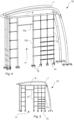
- the standard frame element shown in figures 1-3 is one embodiment of a standard frame element. In this embodiment, it is meant that the standard frame element of figures 1-3 can be erected on a support surface and then different functional fitness elements can be mounted to and supported by the standard frame element.
- the standard frame element provides support for the different functional fitness elements. Different embodiments of different functional fitness elements which can be mounted to the standard frame element are disclosed later on in this specification.
- a virtual rectangular box is defined (dotted lines in figures 2 and 3 ) which encloses the standard frame element.
- the box has a volume which is defined by a length (L), a width (W) and a height (H).
- L length
- W width
- H height
- the virtual rectangular box is found by finding the rectangular box which has the minimum volume while still containing the entire frame.
- the height is then the dimension between the top and bottom of the box.
- the length is the dimension between the two vertical sides of the rectangular box which are farthest apart from each other and the width is the distance between the two sides of the rectangular box which are closest together. In certain cases, the length and the width can be the same.
- the length is greater than the width. In the actual embodiment the length is about 3.5 times greater than the width. However other ratios could also be used, for example 2 times greater, 2.5 times greater, 3 times greater, 4 times greater or even larger.
- the local width (W1) at one side of the frame is greater than the local width (W2) at the other side of the frame.
- the local width is defined as the distance between the outer most portions of the frame along a vector which is perpendicular to the long side plane of the virtual rectangular box which contains the frame.
- the torque loads which can be supported by the frame are higher than a frame having the same narrow width throughout but the material usage of the frame is lower than a frame having the same wide width throughout.
- the visual impression provided by the tapered frame is smaller than a non-tapered frame since both sides of the non-tapered frame would have to be made larger to support the same torque loads.
- a visual impression can be achieved where the frames seem to be pointing towards each other. This provides an impression of a connected fitness assembly arrangement, even though the frames are not necessarily physically connected.
- standard frame element 1 has some very characteristic visual features. While additional details could be read from the figures and added to the claims if desired, it should also be noted that standard frame elements according to the current invention could be formed in many different ways and provide many different types of visual impressions.
- the current embodiment 1 of a standard frame element comprises a main frame element 2 which has a generally upwards projecting portion 3 and a generally sideways projecting portion 4.
- the generally upwards projecting portion 3 is arranged at one side of the frame and is mounted to the ground via mounting plates 5.
- the mounting plates could in certain cases, depending on the underlying surface, be screwed into foundations which are placed into the supporting surface prior to erecting the frame element.
- the generally sideways projecting portion 4 is arranged along the top of the frame and is connected at one end to the upper end of the generally upwards projecting portion 3.
- a vertical frame element 6 is arranged at the side of the frame opposite to the generally upwards projecting portion 3 and is connected to the ground via mounting plates 7 at one end and to the generally sideways projecting portion 4 at its other end.
- a horizontal beam 8 is furthermore provided along the top of the frame for providing a connection beam for different functional fitness elements.
- the frame element 1 of the current embodiment also has a plate element 9 which is fastened to the generally upwards projecting portion 3.
- the plate element is a metal plate having a surface area which is suitable for applying printed material which explains the use of the functional fitness element arranged in the standard frame element.
- the generally upwards projecting portion is formed from two adjacent pipes offset from each other. The plate element is then fasted between the two adjacent pipes. In this way, the plate element 9 can also provide extra stiffness to the frame itself.
- the vertical frame element 6 is in the current embodiment formed from two vertically arranged tubes which are offset from each other.
- the two tubes are connected by smaller tubes which function as a ladder element. These smaller tubes also provide extra stiffness to the vertical frame element 6.
- a first fitness assembly 10 which comprises a standard frame element 1 as shown in figures 1-3 and a functional fitness element 11 which in this embodiment is a net based functional fitness element.
- a functional fitness element which comprises a net like structure which can be used for many different purposes.
- the net based functional fitness element 11 shown in the figures comprises a mix of stiff elements 12, flexible rope like elements 13 and plastic covered rope like elements 14.
- the stiff elements are in the current embodiment made from vertical metal pipes 12b of about 48 mm in diameter and from horizontal metal pipes 12a of about 38 mm in diameter.
- the rope like elements 13 are flexible and have a thickness of about 16 mm in diameter.
- the plastic covered rope like elements 14 are coated with a thick layer of plastic which increases the stiffness of the rope like element while also increasing the diameter thereof to about 38 mm.
- the net based functional fitness element is arranged as a mix of stiff and flexible elements.
- a net based functional fitness element could be provided comprising only flexible rope like elements or only stiff elements or only plastic coated flexible rope like elements.
- the net based functional fitness element 11 shown is fastened along its upper side to the horizontal element 8 of the standard frame element and is fastened along its lower side to the ground via plates 15 screwed into the supporting surface.
- the net based functional fitness element 11 shown here is arranged as a planar element and is arranged vertically. However, in other embodiments a net based functional fitness element could be provided which is arranged at an angle to the vertical. In another embodiment, two net based functional fitness elements could be arranged connected along their upper edges to a common support element but then angled outwardly to form a tent like structure with their lower edges connected to the ground at different spaced apart locations.
- a net based functional fitness element 11 as shown in figures 4 and 5 can be used for many different exercises.
- the stiff horizontal elements 12a in the middle of the structure can be used for example for pull ups and other exercises which need a stiff horizontal bar.
- the rope like elements 13 can, for example, be used for climbing exercises.
- the plastic covered rope like elements can for example be used as an elevated support for a user's feet when doing for example pushups with raised feet and other exercises which require support points raised from the ground.
- Net based functional fitness elements can therefore be arranged in many different configurations to support many different exercise forms.
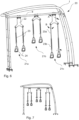
- the fitness assembly shown in figures 6 and 7 is an example of a fitness assembly.
- the functional fitness element is a suspension training based functional fitness element.
- Suspension training in its traditional form uses a strap having a handle at each end. The strap is then hung on an upper support point such that the handles dangle down below the upper support point. The handles can then be used to either support the hands or feet of a user in different exercises.
- straps for suspension training come in different lengths or are adjustable in length to support different types of exercises and/or different sizes of users.
- Other forms of traditional suspension trainers are available as two different straps which can be supported individually on an upper support element or suspension trainers are available having an upper strap portion which splits into two separate straps.
- the three suspension training based functional fitness elements 21a, 21b, 21c have been provided on a single standard frame element 1. This will allow three users to simultaneously use a suspension training based functional fitness element each. Furthermore, it can be seen that the three suspension training based functional fitness elements are arranged adjacent to each other and in line with each other. In the current embodiment, the three elements are arranged along the central vertical plane of the standard frame element. In this way, three users can use the suspension training elements while standing beside each other. It can also be seen that the fitness elements are arranged such that the users can use the fitness elements while standing with their bodies facing in a direction which is perpendicular to a vertical plane passing through the two side edges of the standard frame element. In this way, the users will not necessarily be facing each other while using the suspension training elements. This will reduce the risk that a user's personal space is invaded by another user of the fitness assembly while still allowing a high user density on the standard frame element.
- the suspension training element comprises a planar element 22 and two elongated elements 23.
- the planar element is pivotably attached to the upper horizontal beam 8 and the elongated elements 23 are attached at the lower edge of the planar element.
- a handle 24 is arranged at the end of each of the elongated elements 23.
- the pivotable connection between the planar element and the upper support element is, designed to only allow pivotable motion about an axis which is parallel to the upper horizontal beam 8 of the frame.
- the connections between the elongated elements 23 and the planar element are arranged to only allow pivotable motion about an axis which is perpendicular to the planar element.
- the range of motion of the planar element about said axis is limited to prevent the planar element and/or the elongated elements from becoming wrapped around the upper horizontal beam 8.
- the handles 24 are attached to the elongated elements such that the handles can rotate with respect to the elongated element about an axis which is parallel with the elongated element 23.
- the elongated elements are rope like elements 23a covered by plastic sheath 23b. In this way, high strength is provided to the elongated element via the rope like element and increased stiffness is provided via the plastic covering.
- a stiff element for example a metal pipe could have been used as the elongated element instead.
- a pure flexible rope like element could be used.
- One advantage of a stiffer elongated element is that the elongated elements will not twist around each other so much if the element is stiffer.
- connection between the elongated element and the planar element is pivotable, but in another embodiment, if the elongated elements are flexible enough, then the connection could be fixed. Furthermore, the connection between the elongated element and the planar element is controlled to only allow motion about a single axis, however, in other embodiments, a more free motion could be provided.
- the planar element 22 in the current fitness assembly has an upside down Y shape where the base of the Y is pivotably attached to the horizontal beam 8 of the standard frame and the tips of the Y are each connected to an elongated element.
- the distance between the two lower connection points is around 400mm. This provides a good distance between the elongated elements which ensures that the force which is applied to the user by the elongated elements is mainly vertical. This is in contrast to the traditional strap suspension training arrangement where the strap is hung from a point. For short straps or for exercises which require a short strap length, the straps will have a large component of force acting inwards due to the angle the straps will have to the vertical during use. While the current fitness assembly has a distance of 400mm, other distances could also be used, either shorter or longer which fulfil the same purpose of providing a more vertical load on the straps.
- the planar element 22 is made from a stiff plate element.
- the planar element could be made from a flexible element.
- the planar element is made from an element which has a surface area which is large enough for printing graphical information thereon.
- a planar element could be imagined with an open frame construction which would not be suitable for printing graphical information such as usage instructions or advertising.
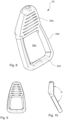
- a handle 24 of the type used in the fitness assembly of figures 6-7 is shown in more detail in figures 8-10 .
- the handle 24 comprises a planar portion 24a and a loop portion 24b.
- the loop portion defines an opening 24c and has a lower grip portion 24d.
- the loop portion is arranged to be suitable for supporting a user's hand or foot on the grip portion 24d.
- the opening is specified to be smaller than a human being's head to avoid having a child place his or her head inside the loop and getting caught. Standard sizes are defined by appropriate standards.
- the planar portion 24a and the loop portion 24b form an angle A to each other of about 150 degrees. Due to this, a user can hold onto the grip portion with his or her hand and place a load on it without having the elongated element attached to the handle contact the user's arm. This effect will be further increased by increasing the stiffness of the connection between the handle and the elongated element.
- the arrangement also allows a user to place his or her heel on the grip portion 24d with their toes pointing upwards and then support the ball of their foot on the planar portion. This will increase the effectiveness of the support which the handle provides to the user's foot.
- ridges are provided on the surface of the planar portion which gives increased friction and thereby better support. While the current handle shows an angle of about 150 degrees between the loop portion 24b and the planar portion 24a, other angles are also possible, though typically they will be between 130 and 170 degrees, in another embodiment between 140 and 160 degrees.
- the planar area is solid and has a surface area with ridges.
- the planar area could be provided as an open frame structure. This will still provide support for the user's foot and still prevent the strap portion from contacting the user's arm during the exercise.
- the fitness assembly 30 shown in figures 11 to 15 is an embodiment of a fitness assembly which is made possible by the current invention.
- the functional fitness element 31 is based on a weight lifting based functional fitness element.
- three functional fitness elements 31a, 31b, 31c have been placed inline along the longitudinal axis of the standard frame element 1.
- the basic principle of this functional fitness element is to use an elongated element 32 and support it between the ground 33 and an upper support element 34 which in this case is the upper horizontal beam 8 of the standard frame element.
- the elongated element is a flexible rope like element which is supported such that the rope like element is stretched out such that it forms a linear elongated element between an upper support point 34 and a lower support point 33.
- a weight element 35 is fastened to the rope like element such that it is slideable up and down along the rope like element.
- an opening in the form of a through going hole is made through the weight element 35.
- the rope like element 32 is then fed through the through going hole. In this way, a user cannot remove the weight element from the rope like element 32.
- a user can then train weight lifting by lifting the weight element up and then letting it slide back down again.
- the user's action is shown schematically in figures 12 and 13 which show a lower position in figure 12 and a raised position in figure 13 .
- handles 37 are provided on either side of the weight element 35. Due to the arrangement of the weight element in the current embodiment, one handle is provided on either side of the elongated element 32. When the user uses the fitness element, the user will therefore have one hand on either side of the elongated element.
- the weight element could be formed without any handles and the user will hold the weight element directly, for example like a medicine ball. Again, the user could be holding onto the weight element with one hand on either side of the elongated element.
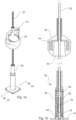
- a shock absorbing element 36 is arranged at the bottom of the rope like element 32.
- the shock absorbing element 36 is arranged in the current embodiment as a spring based system which can absorb the energy from a falling weight. If the user lets go of the weight element while it is in a raised position, the shock absorbing element will absorb the energy from the falling weight without risking that the weight element crashes into the ground.
- the shock absorbing element In the current embodiment of the shock absorbing system, two springs are provided in the shock absorbing element, a shorter stiff spring 38 and a longer softer spring 39.
- the weight When the weight falls down, the weight first engages the first spring 39 which starts to compress. Then the weight will engage the second spring 38 which further compresses.
- the springs When the weight has stopped moving, the springs are all compressed and will push the weight back up. If there was only a single spring, the weight would be shot back up almost to the same height as it had fallen down. However, with the two spring system, the weight will not be sent so far up.
- the weight element When the rope like element is lengthened, the weight element will be able to displace in a direction which is perpendicular to the axis between the upper and lower end of the rope like element. This provides a much more natural motion of the weight for the user and makes the exercise more useful.
- the lower end of the rope like element is allowed to displace upwards due to the spring mechanism.
- the upper end of the rope like element or both ends of the rope like element could be allowed to be displaced.
- a spring system instead of allowing the end of the rope like element to displace upwards or downwards, a spring system could be provided which allows one or both ends of the rope like element to displace in a direction which has a vector component which is perpendicular to the longitudinal axis of the rope like element.
- the control of the motion of the weight is provided by a spring which catches the falling weight via a spring system.
- a spring could be built into the weight element itself.
- a damper could be arranged in the weight or at the bottom of the rope like element which can absorb the energy from the falling weight.
- an oil damper could be arranged in the shock absorbing element.
- the weight element could also be provided with braking means which brake the motion of the weight element when it is dropped. These braking means could provide braking in one direction, but not the other. For example when lifting the weight, no braking is applied, but when moving the weight down, braking is applied.
- the bottom of the weight is provided with a large opening 43 which extends a significant portion of the way (in this embodiment greater than 50% of the height of the weight element) along the inside of the weight element.
- the inner diameter of this opening is greater than the outer diameter of the shock absorbing mechanism (in the current embodiment greater than 20%) and the height of the opening is less than the height of the shock absorbing mechanism. In this way, it is possible to prevent a user's hand or foot from being squeezed in the case where the weight element falls down.
- weight elements 44 are embedded in the body of the weight element to provide the weight to the weight element.
- lead elements 44 are embedded in the body of the weight element to provide the weight to the weight element.
- a weight element could be provided where different weight blocks could be added or removed from the weight element to provide an adjustable weight element.
- the gripping area of the weight element can be arranged lower than 50 cm from the supporting surface.
- the gripping area of the weight element can be arranged lower than 40 cm, lower than 30cm or lower than 20cm from the supporting surface.
- the term "gripping area" should be understood as the area on the weight element which is held by the user during the exercise.
- the weight element has multiple gripping areas. One area is the handles and another area is the lower edge of the weight element. In the case of a weight element with multiple gripping areas, all the gripping areas could be arranged as described above, or just one or more of the areas could be arranged as described above.
- the fitness assembly 50 in figure 16 is an example of a fitness assembly.
- the functional fitness element is based on a twisting action functional fitness element 51.
- three functional fitness elements 51a, 51b, 51c are arranged in line with each other to provide the same benefits as with the previous embodiments.
- the basic principle of operation of the current embodiment is that an elongated element 52 is twisted by a user against a resistance force.
- An elongated element in the form of a bent metal pipe 52 is provided which is pivotably supported at its upper end 53 and its lower end 54.
- a portion 55 of the elongated element is offset from the axis between the upper and lower ends. A user can then hold the offset portion 55 and twist the elongated element about its rotational axis.
- the elongated portion 55 is a form of gripping element according to the language of the claims.
- a load providing element, in the current fitness assembly called a braking element 56 is arranged at the upper end of the elongated element to provide resistance to the rotational motion of the elongated element.
- the braking element is provided at the top of the elongated element, but in another embodiment (not shown) a braking element could also be provided at the lower end of the elongated element or at both the top and bottom ends.
- Figures 17 and 18 show the basic principle of operation with a single twisting action functional fitness element 51.
- the braking element 56 could take many forms.
- an electrical machine based braking device is used. By adjusting the load on the machine, the effort required to turn the machine will increase or decrease.
- a friction based brake could be used where the user can control the frictional level to control how much effort is required to twist the elongated element.
- the force will be independent of rotational position.
- the braking device could comprise an elastic element whereby an elastic effect is provided similar to a spring. In such an embodiment, the force becomes larger and larger as the elongated element is rotated more and more.
- the current example of the elongated element 52 has a first elongated portion 55 offset from the axis of rotation as well as a second elongated portion 57 which is also offset from the axis of rotation, but not as much as the first elongated portion 55.
- the first and second elongated portions 55 and 57 could be considered first and second gripping elements.
- a user can choose to hold onto the first or the second elongated portion. When the user holds onto the first elongated portion, the load provided by the braking element will be smaller than when the user holds onto the second elongated portion due to the difference in moment arms provided by the two elongated portions. This can be used to provide different exercises and loads to different users. Stronger users will be able to hold the inner element while weaker users will hold the outer element.
- the elongated element comprises gripping elements arranged with a vertical axis and offset from the rotation axis of the elongated element.
- the elongated element could comprise gripping elements which are arranged extending perpendicular to the rotational axis of the elongated element.
- the elongated element could be a straight metal tubular element connecting the upper and lower ends of the elongated element. A straight bar could then be fastened to the elongated element such that it extends perpendicularly to the longitudinal axis of the elongated element. A user could then hold onto the straight bar and apply a moment to the elongated element.
- the elongated element By holding onto the straight bar in different positions, different moments can be applied to the bar.
- multiple straight bars could be mounted to the elongated element at different heights.
- the elongated element would comprise multiple gripping elements in the form of bars connected to the elongated element at different heights.
- the fitness element shown in figures 16-18 has an overall height which extends from the lower end 54 to the upper end 53.
- the fitness element also has a "working fitness range" which extends from about 75 cm above the support surface to about 180 cm above the support surface. In other words, a user can hold onto the first elongated and offset portion from about 75 cm above the support surface to about 180 cm above the support surface. This allows users of many different heights to use the fitness element.
- a working fitness range of at least 100 cm to 150 cm can be beneficial
- a working fitness range of at least 75 cm to 180 cm is more beneficial
- a working fitness range of at least 50 cm to 200 cm is also more beneficial.
- the fitness range starts at a position of less than 100 cm from the support surface and goes to a position greater than 150 cm from the support surface.
- FIG 19 shows a fitness assembly arrangement which comprises three different standard frame elements 1a, 1b, 1c, each with their own functional fitness elements 21, 31, 51 arranged in the standard frame element. Furthermore, the arrangement in this case comprises floor elements which can be a part of the fitness system.
- the floor elements have a surface which is provided with markings, said floor elements being designed to allow creation of an assembly comprising one standard frame element, one functional fitness element mounted to and supported by the standard frame element and one floor element arranged underneath the functional fitness element where the markings of the floor element further enhance the use of the functional fitness element.
- the three standard frame elements are set up in a circular arrangement with the wide ends of the frames arranged at the outside of the circle and the narrow ends of the frames arranged at the inside of the circle.
- the three standard frame elements are arranged such that they point towards each other whereby planes going through the different standard frame elements will intersect and meet at a common axis.
- the different fitness elements of the fitness system are specifically designed to be used outdoors in an outdoor fitness arrangement. Designing the system for use in an outdoor environment places specific demands on the components of the system due to environmental factors which will be known to the person skilled in the art of outdoor structures. Furthermore, in an outdoor environment, the fitness elements will typically be unsupervised which also places extra demands on safety considerations. This is discussed in the section on the suspension training based functional fitness elements where a traditional fitness element could be dangerous for unsupervised use if children play on it in an un-planned way. Likewise issues such as theft and vandalism are also more relevant in an outdoor environment. Therefore all components of the system need to be fastened in some way to prevent removal when used outdoors. This is clear in the weight lifting based functional fitness element. However, it should also be noted that the inventive concepts provided in the current specification could also be used in indoor fitness systems.
- figure 20 shows another fitness assembly arrangement comprising two standard frame elements 1a, 1b.
- the two standard frame elements are arranged adjacent each other and in line with each other. It could be said that a vertical plane will pass through all the side edges of the inline frames.
- a link element 60 has been provided between the two standard frame elements 1a, 1b.
- the link element 60 comprises a horizontal beam 61 which connects the narrow ends of the two adjacent standard frame elements. It could also be said that the link element connects to the vertical side edges of the standard frame elements.
- vertical side edge should be understood the vertical side surface in the case where one side of the frame has a significant area, rather than just an edge.
- suspension training based functional fitness elements 21 are connected to the link element.
- a simple structure comprising just two standard frame elements can host three separate stations.
- Such link elements can also be used when there are more than two standard frame elements.
- One example (not shown) is a structure similar to the one shown in figure 19 with three standard frame elements, but where the standard frame elements are moved slightly outwards and then a link element is added between adjacent frames. In this case, three link elements could be arranged in a triangular configuration.
- Some different non limiting examples of functional fitness elements which could be connected to the link element is a rope mesh based functional fitness element similar to the arrangement of figure 4 , a weight lifting based functional fitness element similar to figure 11 and a twisting based functional fitness element similar to figure 16 .
- the link element is a single horizontal beam which connects the two adjacent standard frame elements.
- the link element could also be a flexible link element.
- a net based functional fitness element similar to the one shown in figure 4 but with only flexible elements could be provided.
- an upper link element could be provided in the form of a thick rope like element.
- a standard frame element could be provided which had connected thereto, a twisting action functional fitness element, a suspension training based functional fitness element and a weight lifting based functional fitness element.
Landscapes
- Health & Medical Sciences (AREA)
- General Health & Medical Sciences (AREA)
- Physical Education & Sports Medicine (AREA)
- Orthopedic Medicine & Surgery (AREA)
- Life Sciences & Earth Sciences (AREA)
- Biophysics (AREA)
- Cardiology (AREA)
- Vascular Medicine (AREA)
- Rehabilitation Tools (AREA)
- Pivots And Pivotal Connections (AREA)
Claims (9)
- Fitnessbaugruppe (30), die ein Rahmenelement (1) und zwei oder drei gewichtshebebasierte funktionelle Fitnesselemente (31a, 31b, 31c) umfasst, wobei jedes der zwei oder drei gewichtshebebasierten funktionellen Fitnesselemente umfasst:a. eine längliche Struktur (32) mit einem ersten Ende (34) und einem zweiten Ende (33), undb. ein Gewichtselement (35),c. wobei die längliche Struktur so konzipiert ist, dass sie derart gehalten wird, dass sich das erste Ende über dem zweiten Ende befindet, wodurch das erste Ende ein oberes Ende (34) wird und das zweite Ende ein unteres Ende (33) wird, und derart, dass eine Achse, die durch das obere und das untere Ende der länglichen Struktur verläuft, in einem Winkel von weniger als 15 Grad, weniger als 10 Grad, oder weniger als 5 Grad zur Vertikalen angeordnet ist,d. wobei das Gewichtselement verlagerbar an der länglichen Struktur befestigt ist, derart, dass das Gewichtselement entlang der länglichen Struktur verlagert werden kann,e. wobei die längliche Struktur so konzipiert ist und in derartiger Weise an dem oberen und dem unteren Ende gehalten wird, dass die längliche Struktur im Wesentlichen als lineare längliche Struktur zwischen dem oberen und dem unteren Ende angeordnet ist,f. wobei die längliche Struktur zwischen dem Boden und einem oberen Halteelement (8) des Rahmenelements gehalten wird,g. wobei die längliche Struktur eine Abmessung senkrecht zu der Achse von weniger als 20 cm, weniger als 15 cm, oder weniger als 10 cm aufweist, undh. wobei das Gewichtselement so konzipiert ist, dass es von einem Benutzer direkt gehoben wird, indem er das Gewichtselement auf beiden Seiten des länglichen Elements mit einer Hand festhält,i. wobei die zwei oder drei gewichtshebebasierten funktionellen Fitnesselemente (31a, 31b, 31c) so entlang der Längsachse des Rahmenelements nebeneinander an dem Rahmenelement angebracht sind und derart von diesem gehalten werden, dass es Platz für zwei bzw. drei Personen gibt, um die gewichtshebebasierten Funktionsfitnesselemente gleichzeitig zu verwenden, während ihre Körper senkrecht zur Längsachse des Rahmenelements gewandt sind, und dadurch, dassj. zwei bzw. drei verschiedene Gewichtselemente vorgesehen sind.
- Fitnessbaugruppe (30) nach Anspruch 1, dadurch gekennzeichnet, dass die längliche Struktur (32) einen flexiblen seilartigen Abschnitt umfasst.
- Fitnessbaugruppe (30) nach einem der Ansprüche 1 bis 2, dadurch gekennzeichnet, dass das Fitnesselement weiter ein elastisches Element (36) umfasst, das an dem oberen und/oder unteren Ende (33) der länglichen Struktur (32) angeordnet ist, wobei das elastische Element so konzipiert ist, dass es dem Gewichtselement (35) ermöglicht, sich in einer Richtung zu verlagern, die eine Vektorkomponente aufweist, welche senkrecht zu der Achse zwischen dem oberen und dem unteren Ende der länglichen Struktur verläuft.
- Fitnessbaugruppe nach Anspruch 3, dadurch gekennzeichnet, dass das elastische Element so konzipiert ist, dass es dem oberen und/oder unteren Ende der länglichen Struktur ermöglicht, sich elastisch entlang eines Vektors zu verlagern, der eine Vektorkomponente aufweist, die parallel zu der durch das obere und das untere Ende verlaufenden Achse verläuft.
- Fitnessbaugruppe (30) nach einem der Ansprüche 1-4, dadurch gekennzeichnet, dass das Fitnesselement weiter ein stoßabsorbierendes Glied (36) umfasst, das so konzipiert ist, dass es kinetische Energie von dem Gewichtselement (35) absorbiert, wenn dieses von einer Stelle an der länglichen Struktur (32), die sich oberhalb des unteren Endes (33) befindet, fallengelassen wird.
- Fitnessbaugruppe (30) nach Anspruch 5, dadurch gekennzeichnet, dass das stoßabsorbierende Glied (36) eine Feder (38, 39) und einen Dämpfungsmechanismus umfasst.
- Fitnessbaugruppe (30) nach den Ansprüchen 5 oder 6, dadurch gekennzeichnet, dass das stoßabsorbierende Glied (36) eine erste Feder (39) und eine zweite Feder (38) umfasst, wobei die zweite Feder kürzer ist als die erste Feder und einen höheren Federkoeffizienten aufweist als die erste Feder.
- Fitnessbaugruppe (30) nach einem der Ansprüche 5 bis 7, dadurch gekennzeichnet, dass das stoßabsorbierende Glied (36) am unteren Ende (33) der länglichen Struktur (32) oder an der unteren Seite des Gewichtselements angeordnet ist.
- Fitnessbaugruppe (30) nach einem der Ansprüche 1 bis 8, dadurch gekennzeichnet, dass das Gewichtselement (35) Griffe (37) umfasst, die auf beiden Seiten der länglichen Struktur (32) angeordnet sind.
Priority Applications (1)
| Application Number | Priority Date | Filing Date | Title |
|---|---|---|---|
| EP23181759.4A EP4234048A3 (de) | 2015-07-10 | 2016-07-11 | Fitnesssystem, fitnessanordnung und funktionale fitnesselemente |
Applications Claiming Priority (2)
| Application Number | Priority Date | Filing Date | Title |
|---|---|---|---|
| EP15176288.7A EP3115085B1 (de) | 2015-07-10 | 2015-07-10 | Fitnesssystem, fitnessanordnung und funktionale fitnesselemente |
| PCT/EP2016/066436 WO2017009289A1 (en) | 2015-07-10 | 2016-07-11 | Fitness system, fitness assembly arrangement and functional fitness elements |
Related Child Applications (1)
| Application Number | Title | Priority Date | Filing Date |
|---|---|---|---|
| EP23181759.4A Division EP4234048A3 (de) | 2015-07-10 | 2016-07-11 | Fitnesssystem, fitnessanordnung und funktionale fitnesselemente |
Publications (3)
| Publication Number | Publication Date |
|---|---|
| EP3319697A1 EP3319697A1 (de) | 2018-05-16 |
| EP3319697C0 EP3319697C0 (de) | 2023-06-28 |
| EP3319697B1 true EP3319697B1 (de) | 2023-06-28 |
Family
ID=53761947
Family Applications (3)
| Application Number | Title | Priority Date | Filing Date |
|---|---|---|---|
| EP15176288.7A Active EP3115085B1 (de) | 2015-07-10 | 2015-07-10 | Fitnesssystem, fitnessanordnung und funktionale fitnesselemente |
| EP16738141.7A Active EP3319697B1 (de) | 2015-07-10 | 2016-07-11 | Fitnesssystem, fitnessanordnung und funktionale fitnesselemente |
| EP23181759.4A Pending EP4234048A3 (de) | 2015-07-10 | 2016-07-11 | Fitnesssystem, fitnessanordnung und funktionale fitnesselemente |
Family Applications Before (1)
| Application Number | Title | Priority Date | Filing Date |
|---|---|---|---|
| EP15176288.7A Active EP3115085B1 (de) | 2015-07-10 | 2015-07-10 | Fitnesssystem, fitnessanordnung und funktionale fitnesselemente |
Family Applications After (1)
| Application Number | Title | Priority Date | Filing Date |
|---|---|---|---|
| EP23181759.4A Pending EP4234048A3 (de) | 2015-07-10 | 2016-07-11 | Fitnesssystem, fitnessanordnung und funktionale fitnesselemente |
Country Status (5)
| Country | Link |
|---|---|
| US (4) | US11344762B2 (de) |
| EP (3) | EP3115085B1 (de) |
| AU (1) | AU2016292873B2 (de) |
| PL (2) | PL3115085T3 (de) |
| WO (1) | WO2017009289A1 (de) |
Families Citing this family (9)
| Publication number | Priority date | Publication date | Assignee | Title |
|---|---|---|---|---|
| USD806817S1 (en) * | 2015-09-02 | 2018-01-02 | Kompan A/S | Exercising apparatus |
| ITUB20155609A1 (it) * | 2015-11-16 | 2017-05-16 | Metalco Active S R L | Palestra modulare personalizzabile. |
| DE102017002398A1 (de) * | 2017-03-14 | 2018-09-20 | Conradi + Kaiser Gmbh | Outdoor-Fitnessgerät |
| US20210027652A1 (en) * | 2019-07-26 | 2021-01-28 | Krystian Sands | Stretching facility and method for stretching, strengthening, and balancing muscles |
| US11684814B2 (en) | 2020-09-10 | 2023-06-27 | Kompan A/S | Playground equipment with rolls |
| AU2021104526A4 (en) * | 2020-11-30 | 2021-08-26 | Growplay Pty Ltd | Playground apparatus |
| US12551749B2 (en) * | 2021-04-21 | 2026-02-17 | Marco A Parrilla | Physical workout system and method |
| US20250025729A1 (en) * | 2023-07-19 | 2025-01-23 | Fit2Flaunt | Exercise Pole |
| US20250367491A1 (en) * | 2024-05-28 | 2025-12-04 | Pyramide USA Inc | Climbing systems and methods of making and using the same |
Citations (9)
| Publication number | Priority date | Publication date | Assignee | Title |
|---|---|---|---|---|
| US3912263A (en) * | 1973-04-30 | 1975-10-14 | Stephen John Yatso | Exercising machine |
| US4456246A (en) * | 1980-07-07 | 1984-06-26 | William Szabo | Weight lifting exercising apparatus |
| US4744560A (en) * | 1986-07-18 | 1988-05-17 | John Azari | Exercising and body fitness assembly |
| US5158518A (en) * | 1992-01-13 | 1992-10-27 | Pizzuto Robert C | Exercise machine for lower extremeties |
| US6361481B1 (en) * | 2000-03-30 | 2002-03-26 | Jam'n Fitness Corp. | Weight lifting simulator |
| WO2003047701A1 (en) * | 2001-11-30 | 2003-06-12 | Max Rack, Inc. | Standing weightlifting apparatus |
| US20070184941A1 (en) * | 2006-02-07 | 2007-08-09 | Mark Krietzman | Guided rocking exercise device and method |
| US20100137112A1 (en) * | 2008-12-03 | 2010-06-03 | Harker Shon L | Bi-directional Cam Buckle |
| WO2012172098A1 (en) * | 2011-06-15 | 2012-12-20 | Patterson Philip James | A rugby training apparatus |
Family Cites Families (143)
| Publication number | Priority date | Publication date | Assignee | Title |
|---|---|---|---|---|
| US426944A (en) | 1890-04-29 | The art of boxing | ||
| US1126082A (en) * | 1910-03-18 | 1915-01-26 | Spalding & Bros Mfg Co Ag | Playground apparatus. |
| US1386206A (en) * | 1919-05-26 | 1921-08-02 | Samuelson Otto Ludvig | Exercising apparatus |
| US1554409A (en) | 1924-06-23 | 1925-09-22 | James A Coffee | Batting device |
| US2249309A (en) | 1937-08-14 | 1941-07-15 | Benko Ivan | Physical training appliance |
| US2929627A (en) * | 1958-05-13 | 1960-03-22 | Elizabeth A Scanlon | Playground equipment |
| US2977118A (en) * | 1959-09-09 | 1961-03-28 | Lucien L Farkas | Gymnastic apparatus |
| US3058742A (en) * | 1960-12-12 | 1962-10-16 | Jaffe Sarah | Adjustable muscle building apparatus and manipulator |
| US3526399A (en) * | 1967-04-21 | 1970-09-01 | George Hjelte | Rotatably mounted exercising device with support frames |
| US3545121A (en) | 1968-08-14 | 1970-12-08 | Stephen R Misko | Toy and exercising captive ball |
| US3547435A (en) * | 1968-12-30 | 1970-12-15 | Robert S Scott | Collapsible agility climber |
| US3640528A (en) * | 1969-08-22 | 1972-02-08 | Richard Proctor | Pull-type variable weight exercising device |
| ES158299Y (es) * | 1970-05-06 | 1971-04-01 | Godia Alvarez | Aparato extensor, funcional, de la columna vertebral. |
| US3756593A (en) * | 1971-06-09 | 1973-09-04 | Sheila Berkley Inc | Playground equipment |
| US3849933A (en) * | 1972-08-11 | 1974-11-26 | D Kuntz | Device with unbalanced rotatable members |
| US3850428A (en) * | 1972-11-15 | 1974-11-26 | Porter Equipment Co | Gymnastic apparatus |
| US3937461A (en) * | 1973-12-26 | 1976-02-10 | Lew Hyok S | Exerciser for aerial calisthenics |
| US3957266A (en) * | 1975-04-18 | 1976-05-18 | Max Rice | Exercising post and platform |
| US4084812A (en) * | 1975-10-31 | 1978-04-18 | Game Time, Inc. | Playground swing apparatus |
| US4149714A (en) | 1977-07-28 | 1979-04-17 | Lambert Jr Lloyd J | Seated weight lifting leg press exercise machine |
| US4169591A (en) * | 1977-12-05 | 1979-10-02 | Douglas Ormond S | Exercise device for invalids |
| US4278250A (en) * | 1979-08-13 | 1981-07-14 | Turco Manufacturing Co. | Gymnasium set |
| US4456245A (en) * | 1981-12-11 | 1984-06-26 | Nautilus Sports/Medical Industries, Inc. | Rotary torso exercise apparatus |
| US4487413A (en) | 1982-09-28 | 1984-12-11 | Fall James R | Exercise device and method |
| US4531729A (en) * | 1983-03-18 | 1985-07-30 | Fitness Products, Inc. | Exercise bar |
| US4627617A (en) * | 1985-06-03 | 1986-12-09 | Douglas D. Gilmore | Exercise device with opponent supplied resistance |
| US4729561A (en) * | 1986-10-31 | 1988-03-08 | Desjardins Charles J | Weightlifting power station |
| US4832631A (en) * | 1988-04-25 | 1989-05-23 | Gag Marvin N | Swimming aid |
| JPH045176Y2 (de) | 1988-07-15 | 1992-02-14 | ||
| US4902002A (en) * | 1988-10-28 | 1990-02-20 | Huang Kou Min | Exercise apparatus |
| US5054713A (en) * | 1989-04-03 | 1991-10-08 | Langley Lawrence W | Circular airplane |
| US5474511A (en) | 1989-05-22 | 1995-12-12 | Dantolan; Harry E. | Reciprocating weight exercise device |
| US4966367A (en) | 1989-08-28 | 1990-10-30 | Oyarzabal Hector A | Ball striking practice apparatus |
| US5162030A (en) * | 1990-09-24 | 1992-11-10 | John Tanski | Vertical balance bar exercise apparatus |
| US5253639A (en) | 1991-01-07 | 1993-10-19 | Mechanical Advantage Ltd. | Therapeutic leveraging device |
| US5184992A (en) | 1991-03-05 | 1993-02-09 | Banks Gary S | Multi-station physical exercise apparatus |
| US5145472A (en) * | 1991-05-03 | 1992-09-08 | Johnson Iii David S | Physical fitness exercise machine |
| US5334098A (en) * | 1993-02-25 | 1994-08-02 | Specialty Products Incorporated | Playground device |
| US5354249A (en) * | 1993-11-16 | 1994-10-11 | Raley Teresa M | Exercise apparatus |
| US5421797A (en) * | 1993-11-16 | 1995-06-06 | Fletcher; Michael G. | Combination weight plate and dumbbell and bar for use with the same |
| US5536229A (en) * | 1995-01-06 | 1996-07-16 | Phsyical Success, Inc. | Adjustable stretching exercise device |
| US5921895A (en) | 1998-01-30 | 1999-07-13 | Lynch; John R. | Martial arts striking device |
| US6234938B1 (en) | 1999-06-03 | 2001-05-22 | Lai-Hao Chen | Magnetic device for use in exercise bicycle or other exercise machines |
| DE60023095T2 (de) * | 2000-01-08 | 2006-07-20 | Intex Marketing, Ltd. | Miteinander verbindbare aufblasbare Spielstrukturen |
| US6315702B1 (en) | 2000-02-18 | 2001-11-13 | Anna Ikonomopoulos | Exercise machine |
| US6464619B1 (en) * | 2000-03-31 | 2002-10-15 | Anthony Bondi | Tactile play structure |
| US6348028B1 (en) * | 2000-04-27 | 2002-02-19 | Brandon Cragg | Multi-purpose training apparatus |
| US6503174B2 (en) * | 2001-01-09 | 2003-01-07 | Playcore, Inc. | Pivoting overhead hand-over-hand climbing device |
| TW457964U (en) | 2001-01-16 | 2001-10-01 | Ren E Sport Goods Co Ltd | Structure for boxing sack |
| US6491609B2 (en) * | 2001-01-30 | 2002-12-10 | Randall T. Webber | Exercise arm apparatus with pivotal linkage system |
| US20020198085A1 (en) | 2001-05-22 | 2002-12-26 | Wen-Ching Wang | Punching bag assembly |
| US6551216B2 (en) * | 2001-07-12 | 2003-04-22 | Brian G. Rennex | Ultra-light rock-climbing wall |
| US7056266B2 (en) * | 2001-09-06 | 2006-06-06 | Everlast Climbing Industries, Inc. | Climbing wall assembly |
| US6736764B1 (en) | 2001-09-10 | 2004-05-18 | Stephen Kapustka | Device for training a martial artist to kick |
| US7094185B2 (en) | 2002-01-17 | 2006-08-22 | Darrell Greenland | Versatile exercise machine |
| US6663542B1 (en) * | 2002-06-28 | 2003-12-16 | Michael Jon Trabbic | Adjustable, body circumfusion barbell with off-centerline moment and rotating grip |
| US6767314B2 (en) | 2002-09-20 | 2004-07-27 | Patrick A. Thompson | Exercise apparatus and method of collapsing the same |
| US7060002B1 (en) * | 2002-10-21 | 2006-06-13 | Boehme Theodore F | Physical fitness course |
| US7238127B2 (en) | 2002-11-12 | 2007-07-03 | Hussain Saleh Al-Harbi | Limited contact athletic game |
| US20040110607A1 (en) | 2002-12-06 | 2004-06-10 | Jose Crespo | Vertically adjustable boxing bag |
| ITBO20030403A1 (it) * | 2003-06-30 | 2005-01-01 | Technogym Spa | Macchina ginnica. |
| US7594880B2 (en) * | 2003-08-04 | 2009-09-29 | Hoist Fitness Systems, Inc. | Self-aligning pivoting seat exercise machine |
| ITRA20030024A1 (it) * | 2003-08-11 | 2005-02-12 | Technogym Spa | Macchina ginnica. |
| USD515166S1 (en) * | 2004-07-26 | 2006-02-14 | Compagnie Plastic Onmium | Playground structure |
| US7833131B2 (en) * | 2005-04-04 | 2010-11-16 | Rote James E | Rebounder exercise system |
| WO2006110412A1 (en) | 2005-04-07 | 2006-10-19 | Stamina Products, Inc. | Exercise apparatus and method |
| US7331904B2 (en) | 2005-04-28 | 2008-02-19 | David Wayne Hall | Trampoline having substantially similar mat deflection under varying loads |
| WO2006132802A2 (en) * | 2005-06-07 | 2006-12-14 | Bvp Holding, Inc. | User-defined exercise apparatus |
| US20070078014A1 (en) * | 2005-06-07 | 2007-04-05 | Nye Stephen F | Playground equipment |
| US20070082791A1 (en) * | 2005-10-06 | 2007-04-12 | Playpower Lt Farmington, Inc. | Playground climbing structures |
| KR200421998Y1 (ko) * | 2006-05-09 | 2006-07-20 | 황선주 | 다중 사용자형 운동기구 |
| US20080026918A1 (en) * | 2006-07-27 | 2008-01-31 | Michael Lemke | Athletic training device with multi-directional movement |
| US20080051257A1 (en) * | 2006-08-23 | 2008-02-28 | Kevin Hamblin | Playground equipment |
| KR20090073126A (ko) * | 2006-09-08 | 2009-07-02 | 비엘디 오리엔탈 가부시키가이샤 | 유희장치 |
| JP4667333B2 (ja) * | 2006-09-12 | 2011-04-13 | ビーエルデーオリエンタル株式会社 | 遊戯装置 |
| US20080081741A1 (en) * | 2006-09-29 | 2008-04-03 | Sargen James P | Multiple-person elliptical trainer |
| US20080146423A1 (en) * | 2006-12-14 | 2008-06-19 | David Ammon | Portable exercise pole and method of use |
| US20080176724A1 (en) * | 2007-01-19 | 2008-07-24 | Philip Chrysanthus | Adjustable - sold dumbbells |
| US20080234116A1 (en) * | 2007-03-23 | 2008-09-25 | Paula Elzerman | Exercise system and method for its use |
| US8147389B1 (en) | 2007-06-11 | 2012-04-03 | Hoole Richard J | Adjustable weight-loaded dip-chin machine |
| US8057368B1 (en) | 2007-08-06 | 2011-11-15 | Grzegorz Lyszczarz | Three-point adjustable multi-purpose exercise machine |
| US7789811B2 (en) * | 2008-01-24 | 2010-09-07 | Cooper Scott R | Method and apparatus for a mobile training device for simultaneous use by multiple users |
| US8241182B2 (en) * | 2008-01-31 | 2012-08-14 | Kompan A/S | Playground equipment |
| US8012047B2 (en) | 2008-06-09 | 2011-09-06 | Borg Unlimited Inc. | Football pass receiving trainer |
| US7695411B2 (en) * | 2008-08-06 | 2010-04-13 | Raffaele Martini Pandozy | Multimotion exercise apparatus and method |
| US9308427B2 (en) | 2008-09-19 | 2016-04-12 | Tracy A. Garner | Basketball training aid |
| JP4680303B2 (ja) * | 2008-10-06 | 2011-05-11 | 幹夫 福永 | 脊椎矯正装置 |
| WO2010105113A2 (en) * | 2009-03-11 | 2010-09-16 | Douglas Brendle | Vertical fitness apparatus and method of exercising |
| USD629472S1 (en) * | 2009-08-06 | 2010-12-21 | Ronald Frank Rhodes | Octagon shaped cross-fitness trainer |
| US9295872B2 (en) * | 2009-09-21 | 2016-03-29 | Millennium Fitness Ltd | Group exercise program utilizing free weight, machine fitness accessory and body movement exercise combination |
| US7927260B1 (en) | 2009-11-18 | 2011-04-19 | Stalka Timothy M | Double-end punching and exercise bag |
| US8882641B2 (en) * | 2010-01-13 | 2014-11-11 | Elizabeth P. Cutler | Exercise apparatus and method of using |
| DE202010000094U1 (de) | 2010-01-28 | 2010-05-12 | Meyer, Eric | Freibeweglich aufhängbares Übungsgerät zur Stärkung der Muskulatur |
| KR200451111Y1 (ko) | 2010-02-17 | 2010-11-25 | 임동규 | 회전형 타격 연습기 |
| US8210995B2 (en) * | 2010-03-25 | 2012-07-03 | Graa Innovations, Llc | Shoulder flexion apparatus and method |
| WO2012023167A1 (ja) * | 2010-08-19 | 2012-02-23 | ビーエルデーオリエンタル株式会社 | 遊具装置 |
| US8834332B2 (en) * | 2010-08-27 | 2014-09-16 | Total Gym Global Corp. | Collapsible inclinable exercise device and method of using same |
| MX2010011483A (es) * | 2010-10-19 | 2012-04-19 | Manuel Jesus Rios Garcia Prieto | Juego de accesorios con soportes para ejercitar el cuerpo humano y las estructuras donde se soportan. |
| US20140073496A1 (en) * | 2010-11-24 | 2014-03-13 | David BANNERMAN | Exercise apparatus |
| US20120142503A1 (en) | 2010-12-02 | 2012-06-07 | Mardig Sevadjian | Pulley Apparatus for Resistance Exercises |
| US8814756B2 (en) * | 2010-12-20 | 2014-08-26 | Agatsuma Co., Ltd. | Household jungle gym |
| US8678982B2 (en) | 2011-03-28 | 2014-03-25 | Rene Pellot | Height adjustable double end training bag |
| ITMI20110126U1 (it) * | 2011-04-13 | 2012-10-14 | Afo S R L | Struttura modulare per palestre o simili e apparato ginnico comprendente detta struttura |
| US8979720B2 (en) * | 2011-06-06 | 2015-03-17 | Surge Performance Training Llc | Strength and balance exercise apparatus |
| US9050496B2 (en) | 2011-07-11 | 2015-06-09 | Powerblock Holdings, Inc. | Exercise machine for providing weight lifting exercises similar to those provided by a free weight barbell |
| US8721505B2 (en) | 2011-09-14 | 2014-05-13 | Brent Conarty | Training assembly |
| US20130109543A1 (en) * | 2011-10-27 | 2013-05-02 | Gil Reyes | Multiple pulley system exercise device |
| US20150141205A1 (en) * | 2011-11-07 | 2015-05-21 | Troy Garland | Challenge course for children |
| CN202409978U (zh) * | 2011-12-01 | 2012-09-05 | 成都三士达科技有限公司 | 组合太极轮 |
| US20130324372A1 (en) | 2012-06-04 | 2013-12-05 | Xavier A. Cuadrado | Multi-function striking bag |
| GB201214599D0 (en) * | 2012-08-16 | 2012-10-03 | Beaverfit Ltd | Functional training rig kit |
| TWD159016S (zh) * | 2012-08-16 | 2014-02-21 | 泰諾吉S P A 公司 | 多站式運動器材 |
| US9011297B2 (en) | 2012-09-29 | 2015-04-21 | Jason Sagall | Universal punching bag support apparatus |
| US9545555B2 (en) * | 2012-10-15 | 2017-01-17 | Everlast Climbing Industries, Inc. | Climbing walls |
| US9011298B2 (en) | 2012-11-05 | 2015-04-21 | Rhiannon Corp. | Exercise apparatus having spring assemblies capable of engaging a slidable weight bar assembly for enhanced concentric and eccentric working of muscle |
| DE202013100237U1 (de) | 2013-01-17 | 2013-01-25 | Hartmut Rählmann | Therapeutisches Übungsgerät |
| US9114298B2 (en) | 2013-03-12 | 2015-08-25 | Robert P. Ruggiero | Punching bag and suspension system |
| WO2014153016A1 (en) | 2013-03-14 | 2014-09-25 | Alterg, Inc. | Cantilevered unweighting systems |
| US9370682B2 (en) * | 2013-03-15 | 2016-06-21 | Chaise23 Corp. | Exercise equipment assembly for overhead resistance |
| DE102013010849A1 (de) * | 2013-06-28 | 2015-01-15 | Besil Özkaya | Chaotisches Trainingsgerät zum Trainieren von Reaktionsvermögen, Reflexen etc. |
| US9694230B2 (en) | 2013-08-28 | 2017-07-04 | Corey Anderson Cooper | Medicine ball |
| US20150196119A1 (en) * | 2013-09-21 | 2015-07-16 | Coulter Ventures, Llc, D/B/A Rogue Fitness | A-frame exercise rack system |
| ES1092330Y (es) * | 2013-10-03 | 2014-01-23 | Muñoz Saez Cesar Juan (100 0%) | Estructura de pared para realizar ejercicio y acoplar elementos de gimnasia y actividad física |
| US9457219B2 (en) | 2013-10-18 | 2016-10-04 | Icon Health & Fitness, Inc. | Squat exercise apparatus |
| CN203634716U (zh) * | 2013-10-29 | 2014-06-11 | 南通华隆机械制造有限公司 | 一种新型积木式综合训练器 |
| US20150118670A1 (en) * | 2013-10-31 | 2015-04-30 | Kompan A/S | Interactive Educational System |
| WO2015070350A1 (en) * | 2013-11-18 | 2015-05-21 | Avantgarde Sport Inc. | Method of manufacturing an exercise punching ball |
| US9220938B2 (en) * | 2013-12-05 | 2015-12-29 | Playworld Systems, Inc. | Playground assembly |
| US9492706B1 (en) * | 2013-12-20 | 2016-11-15 | Stuck Outside The Box Consulting, Llc | Method and portable apparatus for exercising the upper extremities |
| WO2015134826A2 (en) | 2014-03-07 | 2015-09-11 | Innovative Sports Designs, Llc | Improved weight lifting system and device for fixing positions of weights on bars |
| CA2890969A1 (en) * | 2014-05-09 | 2015-11-09 | Adam L. Ross | Rope machine |
| WO2015178956A1 (en) | 2014-05-19 | 2015-11-26 | Nexersys Corporation | Adjustable double end bag |
| US9233268B2 (en) * | 2014-05-21 | 2016-01-12 | Ya-Chi CHEN | Metal sport and entertainment framework with multiple configurations |
| DE202014006737U1 (de) | 2014-08-19 | 2014-10-16 | Klaus Dresch | Adapter für Multifunktionswerkzeug zur Schwingungsübertragung auf Seil, Gurt, Schlaufe, Zughilfe und Fitnessgerät |
| WO2016039752A1 (en) * | 2014-09-11 | 2016-03-17 | Sam Sann | Versatile frame assembly for fixed and mobile obstacle courses |
| TWI515700B (zh) | 2014-10-14 | 2016-01-01 | 巨大機械工業股份有限公司 | 自行車訓練器 |
| US20160184164A1 (en) | 2014-11-25 | 2016-06-30 | Johnny C. Browning | Physical Therapy and Patient Movement System |
| US9889363B1 (en) | 2015-07-06 | 2018-02-13 | KI-ZEN Power Systems LLC | Power jump exercise equipment |
| US20170087395A1 (en) | 2015-09-29 | 2017-03-30 | Michael L. Kinziger | Kinzi |
| US10357689B2 (en) | 2016-02-01 | 2019-07-23 | Terri L. McCoy | Selectable speed bag support apparatus |
| KR101764532B1 (ko) | 2016-03-10 | 2017-08-03 | 임재환 | 문틀설치식 운동기구 |
| WO2018026885A1 (en) * | 2016-08-02 | 2018-02-08 | Maxx Bench | Rotary exercise system |
| US20200261765A1 (en) * | 2019-02-19 | 2020-08-20 | Barcycle LLC | Exercise Device and Method |
-
2015
- 2015-07-10 PL PL15176288.7T patent/PL3115085T3/pl unknown
- 2015-07-10 EP EP15176288.7A patent/EP3115085B1/de active Active
-
2016
- 2016-07-11 WO PCT/EP2016/066436 patent/WO2017009289A1/en not_active Ceased
- 2016-07-11 US US15/742,942 patent/US11344762B2/en active Active
- 2016-07-11 EP EP16738141.7A patent/EP3319697B1/de active Active
- 2016-07-11 PL PL16738141.7T patent/PL3319697T3/pl unknown
- 2016-07-11 AU AU2016292873A patent/AU2016292873B2/en active Active
- 2016-07-11 EP EP23181759.4A patent/EP4234048A3/de active Pending
-
2019
- 2019-09-20 US US16/577,463 patent/US20200016444A1/en not_active Abandoned
-
2022
- 2022-05-02 US US17/661,633 patent/US11850502B2/en active Active
-
2023
- 2023-10-27 US US18/496,695 patent/US12576298B2/en active Active
Patent Citations (9)
| Publication number | Priority date | Publication date | Assignee | Title |
|---|---|---|---|---|
| US3912263A (en) * | 1973-04-30 | 1975-10-14 | Stephen John Yatso | Exercising machine |
| US4456246A (en) * | 1980-07-07 | 1984-06-26 | William Szabo | Weight lifting exercising apparatus |
| US4744560A (en) * | 1986-07-18 | 1988-05-17 | John Azari | Exercising and body fitness assembly |
| US5158518A (en) * | 1992-01-13 | 1992-10-27 | Pizzuto Robert C | Exercise machine for lower extremeties |
| US6361481B1 (en) * | 2000-03-30 | 2002-03-26 | Jam'n Fitness Corp. | Weight lifting simulator |
| WO2003047701A1 (en) * | 2001-11-30 | 2003-06-12 | Max Rack, Inc. | Standing weightlifting apparatus |
| US20070184941A1 (en) * | 2006-02-07 | 2007-08-09 | Mark Krietzman | Guided rocking exercise device and method |
| US20100137112A1 (en) * | 2008-12-03 | 2010-06-03 | Harker Shon L | Bi-directional Cam Buckle |
| WO2012172098A1 (en) * | 2011-06-15 | 2012-12-20 | Patterson Philip James | A rugby training apparatus |
Also Published As
| Publication number | Publication date |
|---|---|
| US11344762B2 (en) | 2022-05-31 |
| AU2016292873B2 (en) | 2022-02-24 |
| PL3115085T3 (pl) | 2024-01-29 |
| EP4234048A2 (de) | 2023-08-30 |
| EP4234048A3 (de) | 2023-11-08 |
| EP3319697A1 (de) | 2018-05-16 |
| US20190001173A1 (en) | 2019-01-03 |
| EP3115085C0 (de) | 2023-09-27 |
| EP3319697C0 (de) | 2023-06-28 |
| WO2017009289A1 (en) | 2017-01-19 |
| US11850502B2 (en) | 2023-12-26 |
| AU2016292873A1 (en) | 2018-02-22 |
| US12576298B2 (en) | 2026-03-17 |
| US20240066342A1 (en) | 2024-02-29 |
| EP3115085A1 (de) | 2017-01-11 |
| PL3319697T3 (pl) | 2023-10-09 |
| US20220266081A1 (en) | 2022-08-25 |
| EP3115085B1 (de) | 2023-09-27 |
| US20200016444A1 (en) | 2020-01-16 |
Similar Documents
| Publication | Publication Date | Title |
|---|---|---|
| US12576298B2 (en) | Fitness system, fitness assembly arrangement and functional fitness elements | |
| US10080920B2 (en) | Rotational fitness apparatus | |
| US10398930B2 (en) | Strength and exercise apparatus | |
| US20150297942A1 (en) | Weight bar T-handle and pivot anchor assembly | |
| KR200470891Y1 (ko) | 필라테스용 복합 운동기구 | |
| CN1185032C (zh) | 球类运动练习装置 | |
| US20110224051A1 (en) | Indoor-outdoor exercise sled apparatus | |
| US20130035216A1 (en) | Rowing machine simulator | |
| US20090023562A1 (en) | Plyometric training device and method | |
| US20110224050A1 (en) | Indoor-outdoor exercise sled apparatus | |
| CN107530570A (zh) | 锻炼装置 | |
| US20160016032A1 (en) | Exercise Device for Supporting Weight From Hand Grips Using Straps | |
| US20160051854A1 (en) | Physical training apparatus | |
| US9017228B2 (en) | Stable multi-purpose exercise and training device | |
| CA2957016C (en) | Standup paddle board core activator | |
| KR20180002205U (ko) | 조립식 다용도 운동기구 | |
| KR20110059026A (ko) | 팔과 다리 운동기구 | |
| CN202015449U (zh) | 跳舞机 | |
| US20100323851A1 (en) | Multi-purpose exercise and training device | |
| CN110090402B (zh) | 一种用于体育健身的安全减震型可调速的深蹲架 | |
| DE202019104029U1 (de) | Trainingsgerät | |
| JPS586444Y2 (ja) | 跳躍運動用トレ−ニング器具 | |
| CN205867437U (zh) | 上肢力量训练器 | |
| KR20230106357A (ko) | 운동기구 | |
| NZ728783B2 (en) | Standup paddle board core activator |
Legal Events
| Date | Code | Title | Description |
|---|---|---|---|
| STAA | Information on the status of an ep patent application or granted ep patent |
Free format text: STATUS: THE INTERNATIONAL PUBLICATION HAS BEEN MADE |
|
| PUAI | Public reference made under article 153(3) epc to a published international application that has entered the european phase |
Free format text: ORIGINAL CODE: 0009012 |
|
| STAA | Information on the status of an ep patent application or granted ep patent |
Free format text: STATUS: REQUEST FOR EXAMINATION WAS MADE |
|
| 17P | Request for examination filed |
Effective date: 20180212 |
|
| AK | Designated contracting states |
Kind code of ref document: A1 Designated state(s): AL AT BE BG CH CY CZ DE DK EE ES FI FR GB GR HR HU IE IS IT LI LT LU LV MC MK MT NL NO PL PT RO RS SE SI SK SM TR |
|
| AX | Request for extension of the european patent |
Extension state: BA ME |
|
| DAV | Request for validation of the european patent (deleted) | ||
| DAX | Request for extension of the european patent (deleted) | ||
| STAA | Information on the status of an ep patent application or granted ep patent |
Free format text: STATUS: EXAMINATION IS IN PROGRESS |
|
| PUAG | Search results despatched under rule 164(2) epc together with communication from examining division |
Free format text: ORIGINAL CODE: 0009017 |
|
| 17Q | First examination report despatched |
Effective date: 20190314 |
|
| B565 | Issuance of search results under rule 164(2) epc |
Effective date: 20190314 |
|
| RIC1 | Information provided on ipc code assigned before grant |
Ipc: A63B 21/055 20060101ALI20190311BHEP Ipc: A63B 21/00 20060101ALI20190311BHEP Ipc: A63B 7/00 20060101AFI20190311BHEP |
|
| GRAP | Despatch of communication of intention to grant a patent |
Free format text: ORIGINAL CODE: EPIDOSNIGR1 |
|
| STAA | Information on the status of an ep patent application or granted ep patent |
Free format text: STATUS: GRANT OF PATENT IS INTENDED |
|
| INTG | Intention to grant announced |
Effective date: 20230119 |
|
| GRAS | Grant fee paid |
Free format text: ORIGINAL CODE: EPIDOSNIGR3 |
|
| GRAA | (expected) grant |
Free format text: ORIGINAL CODE: 0009210 |
|
| STAA | Information on the status of an ep patent application or granted ep patent |
Free format text: STATUS: THE PATENT HAS BEEN GRANTED |
|
| AK | Designated contracting states |
Kind code of ref document: B1 Designated state(s): AL AT BE BG CH CY CZ DE DK EE ES FI FR GB GR HR HU IE IS IT LI LT LU LV MC MK MT NL NO PL PT RO RS SE SI SK SM TR |
|
| REG | Reference to a national code |
Ref country code: CH Ref legal event code: EP |
|
| REG | Reference to a national code |
Ref country code: AT Ref legal event code: REF Ref document number: 1582200 Country of ref document: AT Kind code of ref document: T Effective date: 20230715 |
|
| REG | Reference to a national code |
Ref country code: IE Ref legal event code: FG4D |
|
| REG | Reference to a national code |
Ref country code: DE Ref legal event code: R096 Ref document number: 602016080619 Country of ref document: DE |
|
| REG | Reference to a national code |
Ref country code: NO Ref legal event code: T2 Effective date: 20230628 |
|
| U01 | Request for unitary effect filed |
Effective date: 20230718 |
|
| U07 | Unitary effect registered |
Designated state(s): AT BE BG DE DK EE FI FR IT LT LU LV MT NL PT SE SI Effective date: 20230724 |
|
| REG | Reference to a national code |
Ref country code: LT Ref legal event code: MG9D |
|
| U20 | Renewal fee for the european patent with unitary effect paid |
Year of fee payment: 8 Effective date: 20230914 |
|
| PG25 | Lapsed in a contracting state [announced via postgrant information from national office to epo] |
Ref country code: RS Free format text: LAPSE BECAUSE OF FAILURE TO SUBMIT A TRANSLATION OF THE DESCRIPTION OR TO PAY THE FEE WITHIN THE PRESCRIBED TIME-LIMIT Effective date: 20230628 Ref country code: HR Free format text: LAPSE BECAUSE OF FAILURE TO SUBMIT A TRANSLATION OF THE DESCRIPTION OR TO PAY THE FEE WITHIN THE PRESCRIBED TIME-LIMIT Effective date: 20230628 Ref country code: GR Free format text: LAPSE BECAUSE OF FAILURE TO SUBMIT A TRANSLATION OF THE DESCRIPTION OR TO PAY THE FEE WITHIN THE PRESCRIBED TIME-LIMIT Effective date: 20230929 |
|
| PG25 | Lapsed in a contracting state [announced via postgrant information from national office to epo] |
Ref country code: SK Free format text: LAPSE BECAUSE OF FAILURE TO SUBMIT A TRANSLATION OF THE DESCRIPTION OR TO PAY THE FEE WITHIN THE PRESCRIBED TIME-LIMIT Effective date: 20230628 |
|
| PG25 | Lapsed in a contracting state [announced via postgrant information from national office to epo] |
Ref country code: ES Free format text: LAPSE BECAUSE OF FAILURE TO SUBMIT A TRANSLATION OF THE DESCRIPTION OR TO PAY THE FEE WITHIN THE PRESCRIBED TIME-LIMIT Effective date: 20230628 |
|
| PG25 | Lapsed in a contracting state [announced via postgrant information from national office to epo] |
Ref country code: IS Free format text: LAPSE BECAUSE OF FAILURE TO SUBMIT A TRANSLATION OF THE DESCRIPTION OR TO PAY THE FEE WITHIN THE PRESCRIBED TIME-LIMIT Effective date: 20231028 |
|
| PG25 | Lapsed in a contracting state [announced via postgrant information from national office to epo] |
Ref country code: SM Free format text: LAPSE BECAUSE OF FAILURE TO SUBMIT A TRANSLATION OF THE DESCRIPTION OR TO PAY THE FEE WITHIN THE PRESCRIBED TIME-LIMIT Effective date: 20230628 Ref country code: SK Free format text: LAPSE BECAUSE OF FAILURE TO SUBMIT A TRANSLATION OF THE DESCRIPTION OR TO PAY THE FEE WITHIN THE PRESCRIBED TIME-LIMIT Effective date: 20230628 Ref country code: RO Free format text: LAPSE BECAUSE OF FAILURE TO SUBMIT A TRANSLATION OF THE DESCRIPTION OR TO PAY THE FEE WITHIN THE PRESCRIBED TIME-LIMIT Effective date: 20230628 Ref country code: IS Free format text: LAPSE BECAUSE OF FAILURE TO SUBMIT A TRANSLATION OF THE DESCRIPTION OR TO PAY THE FEE WITHIN THE PRESCRIBED TIME-LIMIT Effective date: 20231028 Ref country code: ES Free format text: LAPSE BECAUSE OF FAILURE TO SUBMIT A TRANSLATION OF THE DESCRIPTION OR TO PAY THE FEE WITHIN THE PRESCRIBED TIME-LIMIT Effective date: 20230628 Ref country code: CZ Free format text: LAPSE BECAUSE OF FAILURE TO SUBMIT A TRANSLATION OF THE DESCRIPTION OR TO PAY THE FEE WITHIN THE PRESCRIBED TIME-LIMIT Effective date: 20230628 |
|
| REG | Reference to a national code |
Ref country code: CH Ref legal event code: PL |
|
| PG25 | Lapsed in a contracting state [announced via postgrant information from national office to epo] |
Ref country code: MC Free format text: LAPSE BECAUSE OF FAILURE TO SUBMIT A TRANSLATION OF THE DESCRIPTION OR TO PAY THE FEE WITHIN THE PRESCRIBED TIME-LIMIT Effective date: 20230628 |
|
| PG25 | Lapsed in a contracting state [announced via postgrant information from national office to epo] |
Ref country code: MC Free format text: LAPSE BECAUSE OF FAILURE TO SUBMIT A TRANSLATION OF THE DESCRIPTION OR TO PAY THE FEE WITHIN THE PRESCRIBED TIME-LIMIT Effective date: 20230628 |
|
| REG | Reference to a national code |
Ref country code: DE Ref legal event code: R097 Ref document number: 602016080619 Country of ref document: DE |
|
| REG | Reference to a national code |
Ref country code: IE Ref legal event code: MM4A |
|
| U1N | Appointed representative for the unitary patent procedure changed after the registration of the unitary effect |
Representative=s name: MUENZER, MARC ERIC; DK |
|
| PG25 | Lapsed in a contracting state [announced via postgrant information from national office to epo] |
Ref country code: CH Free format text: LAPSE BECAUSE OF NON-PAYMENT OF DUE FEES Effective date: 20230731 |
|
| PLBE | No opposition filed within time limit |
Free format text: ORIGINAL CODE: 0009261 |
|
| STAA | Information on the status of an ep patent application or granted ep patent |
Free format text: STATUS: NO OPPOSITION FILED WITHIN TIME LIMIT |
|
| 26N | No opposition filed |
Effective date: 20240402 |
|
| PG25 | Lapsed in a contracting state [announced via postgrant information from national office to epo] |
Ref country code: IE Free format text: LAPSE BECAUSE OF NON-PAYMENT OF DUE FEES Effective date: 20230711 |
|
| PG25 | Lapsed in a contracting state [announced via postgrant information from national office to epo] |
Ref country code: IE Free format text: LAPSE BECAUSE OF NON-PAYMENT OF DUE FEES Effective date: 20230711 |
|
| U20 | Renewal fee for the european patent with unitary effect paid |
Year of fee payment: 9 Effective date: 20240724 |
|
| PG25 | Lapsed in a contracting state [announced via postgrant information from national office to epo] |
Ref country code: CY Free format text: LAPSE BECAUSE OF FAILURE TO SUBMIT A TRANSLATION OF THE DESCRIPTION OR TO PAY THE FEE WITHIN THE PRESCRIBED TIME-LIMIT; INVALID AB INITIO Effective date: 20160711 |
|
| PG25 | Lapsed in a contracting state [announced via postgrant information from national office to epo] |
Ref country code: HU Free format text: LAPSE BECAUSE OF FAILURE TO SUBMIT A TRANSLATION OF THE DESCRIPTION OR TO PAY THE FEE WITHIN THE PRESCRIBED TIME-LIMIT; INVALID AB INITIO Effective date: 20160711 |
|
| U20 | Renewal fee for the european patent with unitary effect paid |
Year of fee payment: 10 Effective date: 20250728 |
|
| PGFP | Annual fee paid to national office [announced via postgrant information from national office to epo] |
Ref country code: NO Payment date: 20250725 Year of fee payment: 10 |
|
| PGFP | Annual fee paid to national office [announced via postgrant information from national office to epo] |
Ref country code: PL Payment date: 20250707 Year of fee payment: 10 |
|
| PGFP | Annual fee paid to national office [announced via postgrant information from national office to epo] |
Ref country code: GB Payment date: 20250722 Year of fee payment: 10 |
|
| PG25 | Lapsed in a contracting state [announced via postgrant information from national office to epo] |
Ref country code: TR Free format text: LAPSE BECAUSE OF FAILURE TO SUBMIT A TRANSLATION OF THE DESCRIPTION OR TO PAY THE FEE WITHIN THE PRESCRIBED TIME-LIMIT Effective date: 20230628 |