EP3319964B1 - Dithioalkylpyrrolopyrroles et leur utilisation en tant que colorants - Google Patents
Dithioalkylpyrrolopyrroles et leur utilisation en tant que colorants Download PDFInfo
- Publication number
- EP3319964B1 EP3319964B1 EP16733295.6A EP16733295A EP3319964B1 EP 3319964 B1 EP3319964 B1 EP 3319964B1 EP 16733295 A EP16733295 A EP 16733295A EP 3319964 B1 EP3319964 B1 EP 3319964B1
- Authority
- EP
- European Patent Office
- Prior art keywords
- formula
- mixture
- light
- layer
- independently
- Prior art date
- Legal status (The legal status is an assumption and is not a legal conclusion. Google has not performed a legal analysis and makes no representation as to the accuracy of the status listed.)
- Active
Links
- 0 *C1=NC(c2ccc[s]2)=C2C1=C(c1ccc[s]1)N=C2* Chemical compound *C1=NC(c2ccc[s]2)=C2C1=C(c1ccc[s]1)N=C2* 0.000 description 4
- CSNYIKJHWFLGOO-UHFFFAOYSA-N CCCCC(CC)CSC1=NC(c([s]2)ccc2Br)=C2C(SCC(CC)CCCC)=NC(c([s]3)ccc3Br)=C12 Chemical compound CCCCC(CC)CSC1=NC(c([s]2)ccc2Br)=C2C(SCC(CC)CCCC)=NC(c([s]3)ccc3Br)=C12 CSNYIKJHWFLGOO-UHFFFAOYSA-N 0.000 description 1
- DXYHIEUNDKGMLY-UHFFFAOYSA-N CCCCC(CC)CSC1=NC(c2ccc[s]2)=C2C(SCC(CC)CCCC)=NC(c3ccc[s]3)=C12 Chemical compound CCCCC(CC)CSC1=NC(c2ccc[s]2)=C2C(SCC(CC)CCCC)=NC(c3ccc[s]3)=C12 DXYHIEUNDKGMLY-UHFFFAOYSA-N 0.000 description 1
- INXXVGFSXYJGHI-UHFFFAOYSA-N CCOc1ccc(cc(B(O)O)cc2)c2c1 Chemical compound CCOc1ccc(cc(B(O)O)cc2)c2c1 INXXVGFSXYJGHI-UHFFFAOYSA-N 0.000 description 1
- LZZKGDBUNGXSAU-UHFFFAOYSA-N NN(C(c1ccc[s]1)=C(C1=C(c2ccc[s]2)N2)C2=O)C1=O Chemical compound NN(C(c1ccc[s]1)=C(C1=C(c2ccc[s]2)N2)C2=O)C1=O LZZKGDBUNGXSAU-UHFFFAOYSA-N 0.000 description 1
- YDPLFMFXWAJVRV-UHFFFAOYSA-N OC(C(C12)=C(c3ccc[s]3)NC1=O)NC2c1ccc[s]1 Chemical compound OC(C(C12)=C(c3ccc[s]3)NC1=O)NC2c1ccc[s]1 YDPLFMFXWAJVRV-UHFFFAOYSA-N 0.000 description 1
- JNBDVGXUMTZIIA-UHFFFAOYSA-N S=C(C1=C(c2ccc[s]2)N2)NC(c3ccc[s]3)=C1C2=S Chemical compound S=C(C1=C(c2ccc[s]2)N2)NC(c3ccc[s]3)=C1C2=S JNBDVGXUMTZIIA-UHFFFAOYSA-N 0.000 description 1
Classifications
-
- H—ELECTRICITY
- H10—SEMICONDUCTOR DEVICES; ELECTRIC SOLID-STATE DEVICES NOT OTHERWISE PROVIDED FOR
- H10K—ORGANIC ELECTRIC SOLID-STATE DEVICES
- H10K85/00—Organic materials used in the body or electrodes of devices covered by this subclass
- H10K85/60—Organic compounds having low molecular weight
- H10K85/649—Aromatic compounds comprising a hetero atom
- H10K85/657—Polycyclic condensed heteroaromatic hydrocarbons
- H10K85/6572—Polycyclic condensed heteroaromatic hydrocarbons comprising only nitrogen in the heteroaromatic polycondensed ring system, e.g. phenanthroline or carbazole
-
- C—CHEMISTRY; METALLURGY
- C07—ORGANIC CHEMISTRY
- C07D—HETEROCYCLIC COMPOUNDS
- C07D487/00—Heterocyclic compounds containing nitrogen atoms as the only ring hetero atoms in the condensed system, not provided for by groups C07D451/00 - C07D477/00
- C07D487/02—Heterocyclic compounds containing nitrogen atoms as the only ring hetero atoms in the condensed system, not provided for by groups C07D451/00 - C07D477/00 in which the condensed system contains two hetero rings
- C07D487/04—Ortho-condensed systems
-
- C—CHEMISTRY; METALLURGY
- C07—ORGANIC CHEMISTRY
- C07D—HETEROCYCLIC COMPOUNDS
- C07D487/00—Heterocyclic compounds containing nitrogen atoms as the only ring hetero atoms in the condensed system, not provided for by groups C07D451/00 - C07D477/00
- C07D487/22—Heterocyclic compounds containing nitrogen atoms as the only ring hetero atoms in the condensed system, not provided for by groups C07D451/00 - C07D477/00 in which the condensed system contains four or more hetero rings
-
- C—CHEMISTRY; METALLURGY
- C09—DYES; PAINTS; POLISHES; NATURAL RESINS; ADHESIVES; COMPOSITIONS NOT OTHERWISE PROVIDED FOR; APPLICATIONS OF MATERIALS NOT OTHERWISE PROVIDED FOR
- C09K—MATERIALS FOR MISCELLANEOUS APPLICATIONS, NOT PROVIDED FOR ELSEWHERE
- C09K19/00—Liquid crystal materials
- C09K19/04—Liquid crystal materials characterised by the chemical structure of the liquid crystal components, e.g. by a specific unit
- C09K19/06—Non-steroidal liquid crystal compounds
- C09K19/34—Non-steroidal liquid crystal compounds containing at least one heterocyclic ring
- C09K19/3441—Non-steroidal liquid crystal compounds containing at least one heterocyclic ring having nitrogen as hetero atom
- C09K19/3477—Non-steroidal liquid crystal compounds containing at least one heterocyclic ring having nitrogen as hetero atom the heterocyclic ring being a five-membered aromatic ring containing at least one nitrogen atom
-
- C—CHEMISTRY; METALLURGY
- C09—DYES; PAINTS; POLISHES; NATURAL RESINS; ADHESIVES; COMPOSITIONS NOT OTHERWISE PROVIDED FOR; APPLICATIONS OF MATERIALS NOT OTHERWISE PROVIDED FOR
- C09K—MATERIALS FOR MISCELLANEOUS APPLICATIONS, NOT PROVIDED FOR ELSEWHERE
- C09K19/00—Liquid crystal materials
- C09K19/04—Liquid crystal materials characterised by the chemical structure of the liquid crystal components, e.g. by a specific unit
- C09K19/06—Non-steroidal liquid crystal compounds
- C09K19/34—Non-steroidal liquid crystal compounds containing at least one heterocyclic ring
- C09K19/3441—Non-steroidal liquid crystal compounds containing at least one heterocyclic ring having nitrogen as hetero atom
- C09K19/3488—Non-steroidal liquid crystal compounds containing at least one heterocyclic ring having nitrogen as hetero atom the heterocyclic ring having more than 6 members, e.g. macrocycles, phthalocyanines
-
- C—CHEMISTRY; METALLURGY
- C09—DYES; PAINTS; POLISHES; NATURAL RESINS; ADHESIVES; COMPOSITIONS NOT OTHERWISE PROVIDED FOR; APPLICATIONS OF MATERIALS NOT OTHERWISE PROVIDED FOR
- C09K—MATERIALS FOR MISCELLANEOUS APPLICATIONS, NOT PROVIDED FOR ELSEWHERE
- C09K19/00—Liquid crystal materials
- C09K19/52—Liquid crystal materials characterised by components which are not liquid crystals, e.g. additives with special physical aspect: solvents, solid particles
- C09K19/60—Pleochroic dyes
-
- G—PHYSICS
- G02—OPTICS
- G02B—OPTICAL ELEMENTS, SYSTEMS OR APPARATUS
- G02B5/00—Optical elements other than lenses
- G02B5/20—Filters
- G02B5/22—Absorbing filters
- G02B5/223—Absorbing filters containing organic substances, e.g. dyes, inks or pigments
-
- H—ELECTRICITY
- H10—SEMICONDUCTOR DEVICES; ELECTRIC SOLID-STATE DEVICES NOT OTHERWISE PROVIDED FOR
- H10K—ORGANIC ELECTRIC SOLID-STATE DEVICES
- H10K50/00—Organic light-emitting devices
- H10K50/10—OLEDs or polymer light-emitting diodes [PLED]
- H10K50/11—OLEDs or polymer light-emitting diodes [PLED] characterised by the electroluminescent [EL] layers
- H10K50/125—OLEDs or polymer light-emitting diodes [PLED] characterised by the electroluminescent [EL] layers specially adapted for multicolour light emission, e.g. for emitting white light
- H10K50/13—OLEDs or polymer light-emitting diodes [PLED] characterised by the electroluminescent [EL] layers specially adapted for multicolour light emission, e.g. for emitting white light comprising stacked EL layers within one EL unit
-
- H—ELECTRICITY
- H10—SEMICONDUCTOR DEVICES; ELECTRIC SOLID-STATE DEVICES NOT OTHERWISE PROVIDED FOR
- H10K—ORGANIC ELECTRIC SOLID-STATE DEVICES
- H10K85/00—Organic materials used in the body or electrodes of devices covered by this subclass
- H10K85/60—Organic compounds having low molecular weight
- H10K85/649—Aromatic compounds comprising a hetero atom
- H10K85/655—Aromatic compounds comprising a hetero atom comprising only sulfur as heteroatom
-
- Y—GENERAL TAGGING OF NEW TECHNOLOGICAL DEVELOPMENTS; GENERAL TAGGING OF CROSS-SECTIONAL TECHNOLOGIES SPANNING OVER SEVERAL SECTIONS OF THE IPC; TECHNICAL SUBJECTS COVERED BY FORMER USPC CROSS-REFERENCE ART COLLECTIONS [XRACs] AND DIGESTS
- Y02—TECHNOLOGIES OR APPLICATIONS FOR MITIGATION OR ADAPTATION AGAINST CLIMATE CHANGE
- Y02E—REDUCTION OF GREENHOUSE GAS [GHG] EMISSIONS, RELATED TO ENERGY GENERATION, TRANSMISSION OR DISTRIBUTION
- Y02E10/00—Energy generation through renewable energy sources
- Y02E10/50—Photovoltaic [PV] energy
- Y02E10/549—Organic PV cells
Definitions
- the invention is in the field of organic dye chemistry and relates to the use of dichroic dyes based on dithioalkylpyrrolopyrroles in liquid-crystalline mixtures.
- An advantageous approach for these devices is the use of switching layers containing a mixture of at least one liquid-crystalline compound in combination with at least one dichroic dye.
- a voltage By applying a voltage, a change in the spatial orientation of the dye molecules can be achieved in these switching layers, which causes a change in their absorption and thus the transmission through the switching layer.
- a corresponding device is for example in WO 2009/141295 described.
- So-called rylene dyes especially perylene and terrylene derivatives, have already been described for use in the devices mentioned, for example in WO 2009 141295 A1 and WO 2013 004677 A1 (UNIV EINDHOVEN), whose stability, however, does not meet the extreme requirements for use in windows.
- Benzothiadiazole and diketopyrroloprrol derivatives are also known as building blocks for such dyes. However, these connections are more suitable for covering the red and yellow color spaces. Blue and green dyes with sufficient lightfastness and strong dichroism are generally based on rylene structures, which are problematic in terms of their solubility in liquid crystal mixtures.
- thermochromic dyes which can be used, for example, for a wide variety of uses, from colors and textiles to light filters and biosensors.
- the substances are manufactured from dithiophene pyrrolopyrrole ions, which are first treated with Lawesson's reagent and then with a brominating agent.
- the dithiopyrrolopyrrole dithiones obtained in this way can then be derivatized with a boric acid derivative in the presence of a palladium complex.
- the reaction is illustrated in Scheme A below:
- dichroic dyes for use in devices for regulating the entry of light into rooms, there is a continuous need for improvement, in particular with regard to light stability, long-term stability of the solution and high degree of anisotropy of the absorption.
- the object of the present invention was therefore to provide dyes with dichroic properties which are superior to the substances of the prior art and are distinguished in particular by improved light fastness and high solubility.
- the substances of the formula (1) fully meet the requirement profile.
- the substances in solution in a liquid-crystalline host show extreme lightfastness, which in particular significantly exceeds that of rylene derivatives in general and perylene diimide derivatives in particular. At the same time, they show a high dichroism and a very good solubility.
- the radicals methyl, ethyl, n-propyl, i-propyl, n-butyl, i-butyl, s-butyl, t-butyl, 2-methylbutyl are preferred under an alkyl group having 1 to 20 carbon atoms , n-pentyl, s-pentyl, cyclopentyl, neo-pentyl, n-hexyl, cyclohexyl, neo-hexyl, n-heptyl, cycloheptyl, n-octyl, cyclooctyl, 2-ethylhexyl, trifluoromethyl, pentafluoroethyl, 2,2,2 -Trifluoroethyl, ethenyl, propenyl, butenyl, pentenyl, cyclopentenyl, hexenyl, 2-methylbutyl group having
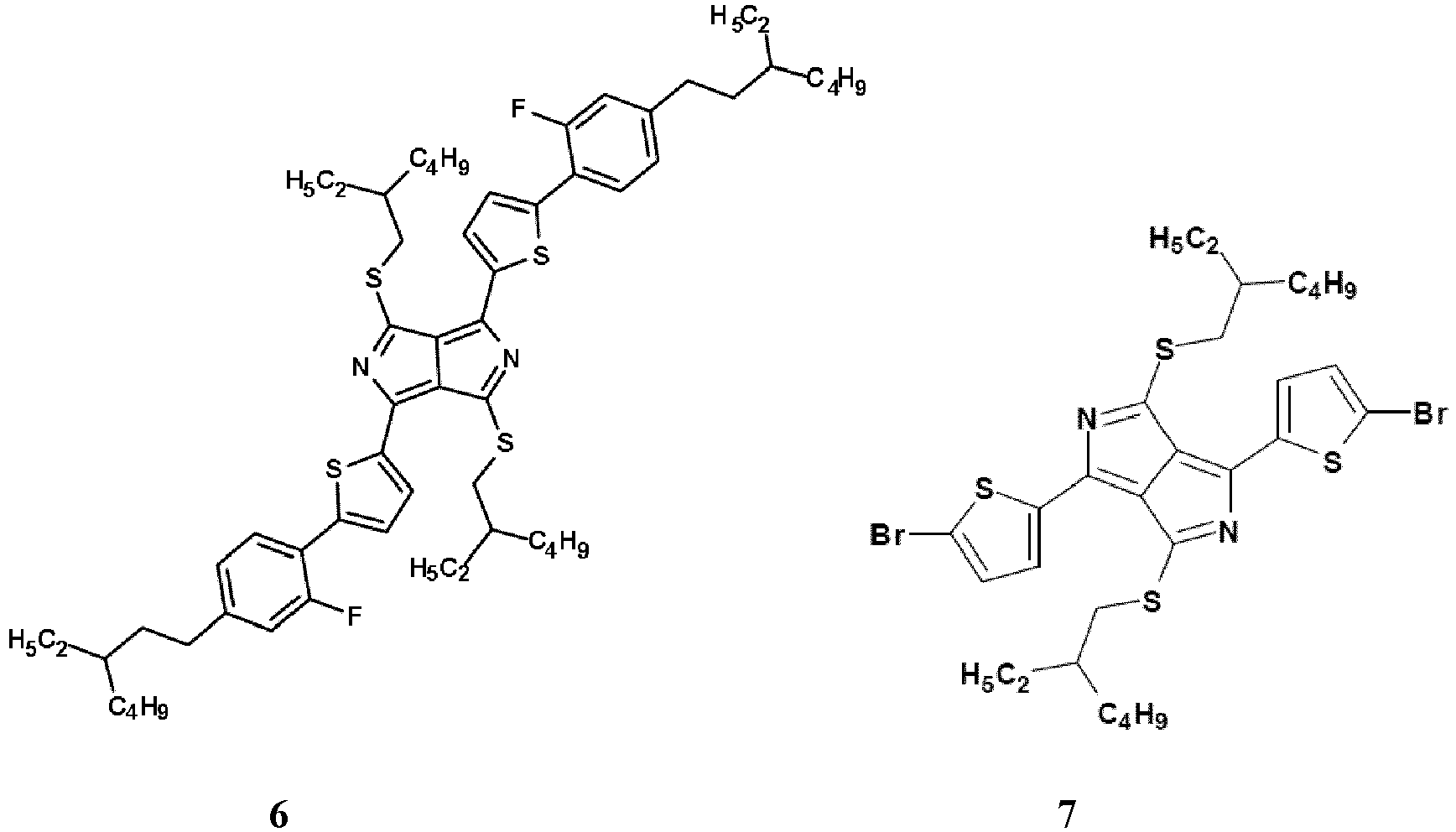
- Structures which have mesophases at temperatures below about 200 ° C. are particularly preferred. These substances include in particular the following compounds 2, 3, 4, 6 and 7: with the proviso that the radicals R have the meaning given above.
- the first step of the synthesis sequence can be carried out by reacting 2-thiophene carbonitrile with dimethyl succinate in the presence of sodium hydride and tert-amyl alcohol as a solvent.
- branched substrate such as diisopropyl succinate is preferably used, since this can be used to achieve a higher yield.
- the second step is thionation, for which the Laweson reagent known from the prior art is used.
- a corresponding alkyl bromide is used for the S-alkylation, which is the third step, acetone is an example of a suitable solvent.
- the reaction product can, for example, be freed from excess alkylating agent with the aid of silica gel and then recrystallized from heptane.
- the bromination follows which is carried out, for example, by reaction with N-bromosuccinimide.
- the last step in the process is a Suzuki clutch, in which the group that replaces the bromide is introduced via a boric acid compound.
- Transition metal complexes based on palladium or platinum, which contain phosphines or phosphites as ligands, are suitable as catalysts.
- the dithiopyrrolopyrrole derivatives are used as a constituent of liquid-crystalline mixtures.
- Liquid crystalline compounds contain, in particular, liquid-crystalline compounds. They preferably contain 3 to 25 different liquid-crystalline compounds, preferably 8 to 18, particularly preferably 12 to 16 different liquid-crystalline compounds.
- the liquid-crystalline compounds are preferably the main components of the mixture. They are particularly preferably taken together in a proportion of 90 to 99.99% by weight, particularly preferably 93 to 99.9% by weight and very particularly preferably 95 to 99.8% by weight present in the mixture.
- the compounds of the formula (1) are preferably present in solution in the mixtures according to the invention. Their orientation is preferably influenced by the orientation of the liquid-crystalline compounds.
- the mixtures according to the invention are preferably liquid-crystalline materials.
- the mixtures are furthermore preferably thermotropic liquid-crystalline materials, but not lyotropic liquid-crystalline materials.
- the mixtures according to the invention preferably have a clearing point, particularly preferably a phase transition from a nematic liquid-crystalline state to an isotropic state, in the temperature range from 70 ° C. to 170 ° C., preferably from 90 ° C. to 160 ° C., particularly preferably from 95 ° C. up to 150 ° C and very particularly preferably from 105 ° C to 140 ° C.
- the dielectric anisotropy of the mixtures according to the invention is greater than 3, particularly preferably greater than 7.
- the dielectric anisotropy of the mixtures according to the invention can also be negative. In this case, they preferably have a value from -0.5 to -10, particularly preferably from -1 to -8 and very particularly preferably from -2 to -6.
- the mixtures according to the invention furthermore preferably have an optical anisotropy ( ⁇ n) from 0.01 to 0.3, particularly preferably from 0.04 to 0.27.
- ⁇ n optical anisotropy
- the mixtures according to the invention contain, as liquid-crystalline compounds, one or more compounds which have a nitrile group. It is further preferred that the mixtures according to the invention as liquid-crystalline compounds contain at least one compound which Have structural elements based on 1,4-phenylenes and 1,4-cyclohexylenes. It is particularly preferred that the mixtures according to the invention have at least one compound as the liquid-crystalline compound which has 2, 3 or 4, particularly preferably 3 or 4 structural elements based on 1,4-phenylenes and 1,4-cyclohexylenes.
- Chiral dopants It is further preferred that the mixtures according to the invention contain one or more chiral dopants. Chiral dopants are preferably used in the mixtures according to the invention in a total concentration of 0.01 to 3% by weight, particularly preferably of 0.05 to 1% by weight. In order to obtain high values for the twist when using the mixture in a device, the total concentration of the chiral dopants can also be selected to be higher than 3% by weight, preferably up to a maximum of 10% by weight.
- the mixture according to the invention contains no chiral dopants.
- the mixtures according to the invention furthermore preferably contain one or more stabilizers.
- the total concentration of the stabilizers is preferably between 0.00001 and 10% by weight, particularly preferably between 0.0001 and 1% by weight of the mixture.
- Dye compounds The mixtures according to the invention preferably contain, in addition to the at least one compound of the formula (1) and the at least one liquid-crystalline compound, one or more dye compounds having a structure other than formula (1). It particularly preferably contains one, two, three or four dye compounds with a structure other than formula (1), very particularly preferably two or three dye compounds with a structure other than formula (1). These dye compounds are preferably dichroic dye compounds. Furthermore, they are preferably fluorescent dye compounds.
- the preferred properties described for the compound of the formula (1) are also preferred for the optional further dye compounds having a structure other than formula (1).
- the absorption spectra of the dye compounds of the mixtures according to the invention preferably complement one another in such a way that the eye is given the impression of black color.
- the dye compounds of the mixture according to the invention preferably cover a large part of the visible spectrum. How Exactly a mixture of dye compounds can be produced which appears black or gray to the eye is known to the person skilled in the art and is, for example, in Manfred Richter, Introduction to Colorimetry, 2nd Edition, 1981, ISBN 3-11-008209-8, Verlag Walter de Gruyter & Co. , described.
- the setting of the color locus of a mixture of dye compounds is described in the context of colorimetry.
- the spectra of the individual dyes are calculated taking into account the Lambert-Beer law for a total spectrum and under the associated lighting, e.g. for daylight the light type D65, converted into the corresponding color locations and brightness values according to the rules of colorimetry.
- the position of the white point is determined by the type of light, e.g. D65 defined and listed in tables (e.g. reference above). Different color locations can be set by changing the proportions of the different dye compounds.
- the proportion of all dye compounds in the mixtures according to the invention, including the at least one compound of the formula (1), is preferably a total of 0.01 to 10% by weight, particularly preferably 0.1 to 7% by weight and very particularly preferably 0.2 to 5% by weight. -%.
- the dye compounds with a structure other than formula (1) are preferably selected from the in B. Bahadur, Liquid Crystals - Applications and Uses, Vol. 3, 1992, World Scientific Publishing , Section 11.2.1 indicated dye classes and particularly preferably from the explicit compounds listed in the table there.
- the dye compounds with a structure other than formula (1) are preferably selected from azo compounds, anthraquinones, methine compounds, azomethine compounds, merocyanine compounds, naphthoquinones, tetrazines, perylenes, terrylenes, quaterrylenes, higher rylenes, benzothiadiazoles and pyrromethenes. Perylenes, terrylenes, benzothiadiazoles and azo dyes are particularly preferred.
- the dyes mentioned belong to the classes of dichroic dyes known to the person skilled in the art, which have been described many times in the literature.
- anthraquinone dyes are described in EP 34832 , EP 44893 , EP 48583 , EP 54217 , EP 56492 , EP 59036 , GB 2065158 , GB 2065695 , GB 2081736 , GB 2082196 , GB 2094822 , GB 2094825 , JP-OS 55-123673 , DE 3017877 , DE 3040102 , DE 3115147 , DE 3115762 , DE 3150803 and DE 3201120 , Naphthoquinone dyes described in DE 3126108 and DE 3202761 , Azo dyes in EP 43904 , DE 3123519 , WO 82/2054 , GB 2079770 , JP-OS 56-57850 , JP-OS 56-104984 , US 430
- the invention comprises the use of the mixtures according to the invention in a device for regulating the entry of light into a room.
- a second embodiment is aimed in the same way at a device for regulating the entry of light into a room which contains the mixtures according to the invention.
- the device according to the invention is preferably suitable for regulating the entry of light in the form of light emanating from the sun from the surroundings into a room.
- the light to be regulated enters from the environment (the outside space) into a room.
- the room can be any room largely closed off from the surroundings, for example a building, a vehicle or a container.
- the device can be used in general for any rooms, especially if they have only limited air exchange with the environment and have translucent boundary surfaces through which energy input from outside can take place in the form of light energy.
- the use of the device is particularly relevant for rooms which are exposed to strong solar radiation through translucent surfaces, for example through window surfaces.
- the device for regulating the incidence of light on the eyes is used, for example in protective glasses, visors or sunglasses, the device keeping the incidence of light on the eyes low in one switching state and reducing the incidence of light less strongly in another switching state.
- the device according to the invention is preferably arranged in an opening of a larger flat structure, the flat structure itself not or only slightly permitting light to enter, and the opening being relatively more translucent.
- the flat structure is preferably a wall or another Delimitation of a room to the outside.
- the flat structure preferably covers an area which is at least as large, particularly preferably an area which is at least twice as large as the opening in it in which the device according to the invention is arranged.
- the device according to the invention is preferably characterized in that it has a surface area of at least 0.05 m 2 , preferably at least 0.1 m 2 , particularly preferably at least 0.5 m 2 and very particularly preferably at least 0.8 m 2 .
- the device according to the invention is switchable. Circuit is understood to mean a change in the passage of light through the device.
- the device according to the invention is preferably electrically switchable.
- the device preferably comprises two or more electrodes which are attached to both sides of the switching layer containing the mixture according to the invention.
- the electrodes preferably consist of ITO or of a thin, preferably transparent metal and / or metal oxide layer, for example of silver or FTO (fluorine-doped tin oxide) or an alternative material known to the person skilled in the art for this use.
- the electrodes are preferably provided with electrical connections.
- the voltage is preferably provided by a battery, an accumulator, or by an external power supply.
- the switching process takes place by aligning the molecules of the mixture according to the invention by applying voltage.
- the device is switched from a state with high absorption, ie. H. low light transmittance, which is without voltage, in a state with lower absorption, i. H. higher light transmission.
- the mixture according to the invention is preferably nematic in the layer in the device in both states.
- the de-energized state is preferably characterized in that the molecules of the mixture, and thus the molecules of the compound of the formula (1), are aligned parallel to the level of the switching layer. This is preferably achieved by an appropriately chosen orientation layer.
- the state under tension is preferably characterized in that the molecules of the mixture, and thus the molecules of the compound of the formula (1), are perpendicular to the level of the switching layer.
- the device is converted from a state with low absorption, ie high light transmission, which is without voltage, to a state with higher absorption, ie lower light transmission, by applying a voltage.
- The is preferred Mixture according to the invention in the layer in the device in both states nematic.
- the de-energized state is preferably characterized in that the molecules of the mixture, and thus the molecules of the compound of the formula (1), are oriented perpendicular to the level of the switching layer. This is preferably achieved by an appropriately chosen orientation layer.
- the state under tension is preferably characterized in that the molecules of the mixture, and thus the molecules of the compound of the formula (1), are present parallel to the level of the switching layer.
- the device can be operated without an external power supply, in that the necessary energy is provided by a solar cell or another device for converting light and / or thermal energy into electrical energy, which is connected to the device.
- the energy provided by the solar cell can be direct or indirect, ie via an interposed battery or accumulator or other unit for storing energy.
- the solar cell is preferably attached to the outside of the device or it is an internal component of the device, as for example in FIG WO 2009 141295 A1 disclosed. In particular, preference is given to solar cells, which are particularly efficient in diffuse light, and transparent solar cells.
- the device according to the invention preferably comprises one or more, particularly preferably two, orientation layers.
- the orientation layers are preferably directly adjacent to the two sides of the layer containing the mixture according to the invention.
- orientation layers of the device according to the invention Any layers known to the person skilled in the art for this purpose can be used as orientation layers of the device according to the invention.
- Polyimide layers are preferred, layers of rubbed polyimide are particularly preferred.
- Polyimide rubbed in a certain manner known to the person skilled in the art leads to an alignment of the molecules of the liquid-crystalline medium in the rubbing direction if the molecules are parallel to the orientation layer (planar alignment). It is preferred that the molecules of the liquid-crystalline medium are not completely planar on the orientation layer, but have a slight angle of inclination (pretilt).
- polyimide treated in a certain way is preferably used as the material for the orientation layer (polyimide for very high pretilt angles).
- polymers obtained by an exposure process with polarized light can be used as an orientation layer to achieve an alignment of the connections of the liquid-crystalline medium according to an orientation axis (photoalignment).
- the layer containing the mixture according to the invention is arranged between two substrate layers or enclosed by them.
- the substrate layers can for example consist of glass or a polymer, preferably a translucent polymer.
- the device is preferably characterized in that it does not comprise a polymer-based polarizer, particularly preferably no polarizer present in the solid material phase and very particularly preferably no polarizer at all.
- the device can also have one or more polarizers.
- the polarizers are preferably linear polarizers.
- its absorption direction is preferably perpendicular to the orientation axis of the connections of the liquid-crystalline medium of the device according to the invention on that side of the switching layer on which the polarizer is located.
- Both absorptive and reflective polarizers can be used in the device according to the invention.
- Polarizers which are present as thin optical films are preferably used.
- Examples of reflective polarizers that can be used in the device according to the invention are DRPF (diffusive reflective polarizer film, 3M), DBEF (dual brightness enhanced film, 3M), DBR (layered polymer distributed Bragg reflectors, as in US 7,038,745 and US 6,099,758 described) and APF films (advanced polariser film, 3M, cf. Technical Digest SID 2006, 45.1 , US 2011/0043732 and US 7023602 ).
- polarizers based on wire grids (WGP, wire-grid-polarisers) that reflect infrared light.
- WGP wire grids
- absorptive polarizers which can be used in the devices according to the invention are the Itos XP38 polarizer film and the Nitto Denko GU-1220DUN polarizer film.
- An example of a circular polarizer which can be used according to the invention is the polarizer APNCP37-035-STD (American Polarizers).
- Another example is the polarizer CP42 (ITOS).
- the device according to the invention preferably contains a light guide system that guides light to a solar cell or another device for converting light and / or thermal energy into electrical energy, preferably as in FIG WO 2009/141295 described.
- the light guide system collects and concentrates light that hits the device. It preferably collects and concentrates light that is emitted by fluorescent dichroic dyes in the switching layer.
- the light guide system is in contact with a device for converting light energy into electrical energy, preferably a solar cell, so that the collected light hits it in a concentrated manner.
- the device for converting light energy into electrical energy is attached to the edge of the device, integrated into it and electrically connected to means for electrically switching the device according to the invention.
- the device according to the invention is part of a window, particularly preferably a window containing at least one glass surface, very particularly preferably a window which contains multi-pane insulating glass.
- Window is understood in particular to mean a structure in a building which contains a frame and at least one glass pane enclosed by this frame. It preferably contains a heat-insulating frame and two or more glass panes (multi-pane insulating glass).
- the device according to the invention is applied directly to a glass surface of a window, particularly preferably in the space between two glass panes of multi-pane insulating glass.
- the resulting violet solution is then refluxed for a further 14 hours and then cooled to room temperature.
- the reaction mixture is then slowly stirred into 3 L of methanol and 160 ml of glacial acetic acid are added, the mixture is stirred for a further 2 hours and the precipitated solid is filtered off.
- the filter cake is washed with 3 L water until the filtrate is colorless and rinsed again with 1 L OP IMS.
- the filter cake is then dried under high vacuum at 80 ° C. overnight, 52 g of DKPP (2) corresponding to a yield of 71% of theory being obtained.
- the product can be classified as analytically pure.
- the remaining solution is placed on a bed of silica gel (40-63 ⁇ , 1 kg, 19 cm ⁇ ), which is moistened with heptane.
- the bed is eluted with a 3: 1 mixture of heptane and dichloromethane, 5 x 3 fractions being obtained; the process is stopped when the eluate begins to change color.
- the purest fractions 2 and 3 are combined and evaporated to dryness, giving 48.3 g of a black residue, corresponding to 54% of theory.
- the residue is resuspended in 100 ml of dichloromethane and a further 500 ml of heptane are added at 40.degree.
- the dichloromethane is then separated off again on a rotary evaporator at 70 ° C. and the remaining solution is filtered into 50 ml of hot heptane.
- the heptane is distilled off, leaving 500 ml of solution which is left to stand overnight.
- the crystals precipitated during this time are filtered off and washed on the filter first with two portions of 30 ml of cold heptane (-20 ° C.) and then with two portions of 30 ml of acetonitrile. After drying, the precursor (4) is obtained as black-violet crystals in an amount of 28.0 g, corresponding to 31% of theory.
- the mixture is again concentrated to half its volume, a further 700 ml of methanol are added, the mixture is quickly heated to 60 ° C. for 5 minutes and filtered hot. The residue is washed on the filter with 4 portions of 300 ml of methanol until the originally brownish filtrate becomes colorless. After drying, the precursor (5) is obtained as a black powder in an amount of 23.4 g, corresponding to 65% of theory.
- the flask is fitted with a reflux condenser and the mixture is refluxed under nitrogen for 6 hours before cooling overnight. After filtration, the solution is transferred to a separatory funnel and the lower aqueous phase is separated off and discarded. The organic phase is dried with sodium sulfate and then evaporated to dryness, giving a green-black oily, semi-solid mass.
- This residue is taken up in a minimal amount of a 50:50 mixture of dichloromethane / heptane and passed over a silica column (40-63 ⁇ , 200 g, 5 cm ⁇ ), which is packed with the same solvent.
- the column is eluted with the eluent and 50 ml fractions are removed until the eluate begins to turn green.
- the product-rich fractions 2 to 4 are combined and freed from the solvent, 2.1 g of a black solid being obtained, corresponding to 79% of theory.
- the solid is recrystallized from 50 ml of 2-butanone, the residue is filtered off and washed on the filter with HPLC-pure acetone before it is freed from residual solvent in a drying cabinet at 40 ° C.
- the dye (6) according to the invention is obtained as bronze-colored microcrystals in an amount of 1.56 g, corresponding to 59% of theory.
- the mixture shows in a 25 micron thick 90 ° twisted TN cell in the dark state a light transmittance according to EN410 of 40% and in the light state a light transmittance according to EN410 of 71.5%.
- the mixture shows in a structure of two 25 micron thick 90 ° twisted TN cells in series in the dark state a light transmittance according to EN410 of 30% and in the light state a light transmittance according to EN410 of 73%.
Landscapes
- Chemical & Material Sciences (AREA)
- Organic Chemistry (AREA)
- Engineering & Computer Science (AREA)
- Materials Engineering (AREA)
- Crystallography & Structural Chemistry (AREA)
- Physics & Mathematics (AREA)
- Optics & Photonics (AREA)
- General Physics & Mathematics (AREA)
- Spectroscopy & Molecular Physics (AREA)
- Plural Heterocyclic Compounds (AREA)
- Liquid Crystal (AREA)
- Nitrogen Condensed Heterocyclic Rings (AREA)
- Heterocyclic Carbon Compounds Containing A Hetero Ring Having Oxygen Or Sulfur (AREA)
Claims (11)
- Utilisation d'au moins un dérivé de dithiopyrrolopyrrole de formule (1)
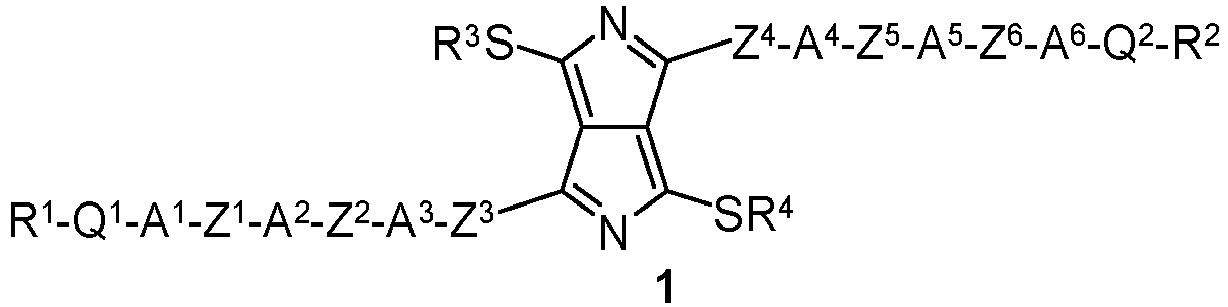
dans lequel, dans la formule (1),R1, R2, R3 et R4, indépendamment les uns des autres, représentent des groupements alkyle linéaires ou ramifiés, éventuellement à substitution halogène, ayant de 1 à 20 atomes de carbone ou halogène ;Q1 et Q2 désignent chacun des liaisons simples ou représentent, indépendamment l'un de l'autre, O, OCF2, CF2, CF2CF2 ou CO ;A1, A2, A3 et A4 désignent chacun des liaisons simples ou représentent, indépendamment les uns des autres, un groupement formé par phénylène, pyridine, pyrimidine, pyridazine, naphtylène, thiophène, sélénophène et thiazole, à condition que(i) au moins A3 et A4 doivent représenter des structures de cycles aromatiques et(ii) les structures de cycles aromatiques sont éventuellement substituées par halogénure ; etZ1, Z2, Z3, Z4, Z5 et Z6 désignent chacun des liaisons simples ou représentent, indépendamment les uns des autres, un radical choisi dans le groupe constitué par C≡C, CH=CH, CF=CF, CF=CH, CH2CH2, CF2-CF2 et CF2O, à condition que
(iii) au moins Z3 et Z4 représentent des liaisons simples ou bien un groupement π-conjugué. - Utilisation selon la revendication 1, dans laquelle R1, R2, R3 et R4 dans la formule (1) représentent, indépendamment les uns des autres, des radicaux alkyle ramifiés ayant de 6 à 12 atomes de carbone.
- Utilisation selon les revendications 1 ou 2, dans laquelle le au moins un dérivé de formule (1) contient 3, 4 ou 5 structures de cycles aromatiques.
- Utilisation selon l'une ou plusieurs parmi les revendications 1 à 3, dans laquelle les structures de cycles aromatiques dans le au moins un dérivé de formule (1) sont substituées par fluorure.
- Utilisation selon la revendication 1, dans laquelle le au moins un dérivé de formule (1) est choisi dans le groupe constitué par les composés 2, 3, 4, 6 et 7 :


- Mélange comprenant(a) le au moins un dérivé de dithiopyrrolopyrrole de formule (1) selon l'une ou plusieurs parmi les revendications 1 à 5 et(b1) au moins un composé liquide-cristallin.
- Mélange selon la revendication 6, comprenant en outre
(b2) au moins un dopant chiral et/ou
(b3) au moins un stabilisant et/ou
(b4) au moins un colorant, de même de préférence dichroïque, qui est diffèrent de ceux de formule (1). - Utilisation du mélange selon la revendication 6 ou 7 dans un dispositif destiné à réguler l'entrée de la lumière dans une pièce.
- Dispositif destiné à réguler l'entrée de la lumière dans une pièce, contenant le mélange selon la revendication 6 ou 7.
- Dispositif selon la revendication 9, caractérisé en ce qu'il possède la séquence de couches suivante, où d'autres couches peuvent en outre être présentes :• une couche de substrat ;• une couche transparente électriquement conductrice ;• une couche d'alignement ;• une couche de commutation comprenant le mélange selon la revendication 6 ou 7;• une couche d'alignement ;• une couche transparente électriquement conductrice ;• une couche de substrat.
- Fenêtre contenant un dispositif selon la revendication 9 ou 10.
Applications Claiming Priority (2)
| Application Number | Priority Date | Filing Date | Title |
|---|---|---|---|
| EP15002069 | 2015-07-10 | ||
| PCT/EP2016/001048 WO2017008880A1 (fr) | 2015-07-10 | 2016-06-20 | Dithioalkylpyrrolopyrroles et leur utilisation en tant que colorants |
Publications (2)
| Publication Number | Publication Date |
|---|---|
| EP3319964A1 EP3319964A1 (fr) | 2018-05-16 |
| EP3319964B1 true EP3319964B1 (fr) | 2020-07-22 |
Family
ID=53783008
Family Applications (1)
| Application Number | Title | Priority Date | Filing Date |
|---|---|---|---|
| EP16733295.6A Active EP3319964B1 (fr) | 2015-07-10 | 2016-06-20 | Dithioalkylpyrrolopyrroles et leur utilisation en tant que colorants |
Country Status (7)
| Country | Link |
|---|---|
| US (1) | US10868257B2 (fr) |
| EP (1) | EP3319964B1 (fr) |
| JP (1) | JP6884748B2 (fr) |
| KR (1) | KR102602326B1 (fr) |
| CN (1) | CN107849048B (fr) |
| TW (1) | TWI717368B (fr) |
| WO (1) | WO2017008880A1 (fr) |
Families Citing this family (2)
| Publication number | Priority date | Publication date | Assignee | Title |
|---|---|---|---|---|
| JP6884748B2 (ja) * | 2015-07-10 | 2021-06-09 | メルク パテント ゲゼルシャフト ミット ベシュレンクテル ハフツングMerck Patent Gesellschaft mit beschraenkter Haftung | ジチオアルキルピロロピロール類および色素としてのその使用 |
| JP7160536B2 (ja) * | 2018-01-24 | 2022-10-25 | スタンレー電気株式会社 | 照明装置 |
Citations (2)
| Publication number | Priority date | Publication date | Assignee | Title |
|---|---|---|---|---|
| WO2009141295A1 (fr) * | 2008-05-21 | 2009-11-26 | Technische Universiteit Eindhoven | Dispositif optique doté d'un matériau luminescent anisotrope |
| WO2013004677A1 (fr) * | 2011-07-05 | 2013-01-10 | Peer+ B.V. | Mélange de colorant et de cristaux liquides |
Family Cites Families (52)
| Publication number | Priority date | Publication date | Assignee | Title |
|---|---|---|---|---|
| JPS55123673A (en) | 1979-03-16 | 1980-09-24 | Mitsui Toatsu Chem Inc | Liquid crystal color display device |
| JPS55152875A (en) | 1979-05-14 | 1980-11-28 | Mitsubishi Chem Ind | Anthraquinone dyestuff for cellulose containing fibers |
| JPS5652440U (fr) | 1979-09-29 | 1981-05-09 | ||
| GB2065695B (en) | 1979-10-12 | 1984-07-25 | Hitachi Ltd | Guest-host type liquid crystal composition and liquid crystal display device using the same |
| JPS5657850A (en) | 1979-10-18 | 1981-05-20 | Nippon Kanko Shikiso Kenkyusho:Kk | Azo compound and dichromatic dye for liquid crystal consisting of the same |
| GB2065158A (en) | 1979-12-13 | 1981-06-24 | Standard Telephones Cables Ltd | Anthraquinone Dichroic Dyes |
| JPS56104984A (en) | 1980-01-24 | 1981-08-21 | Nippon Kanko Shikiso Kenkyusho:Kk | Bichromic pigment for yellow liquid crystal |
| DE3007198A1 (de) | 1980-02-26 | 1981-09-03 | Siemens AG, 1000 Berlin und 8000 München | Pleochroitischer anthrachinon-farbstoff, verfahren zu seiner herstellung und verwendung des farbstoffs |
| US4350603A (en) | 1980-06-30 | 1982-09-21 | General Electric Company | Novel tris-azo dyes and liquid crystal compositions made therewith |
| EP0043904A3 (fr) | 1980-07-10 | 1982-03-31 | F. HOFFMANN-LA ROCHE & CO. Aktiengesellschaft | Mélanges contenant des colorants et leur utilisation en mélanges de cristaux liquides |
| GB2081736B (en) | 1980-07-29 | 1985-02-20 | Secr Defence | Liquid crystal materials containing diamino-dihydroxy anthraquinone pleochroic dyes |
| GB2082196B (en) | 1980-07-29 | 1985-01-23 | Secr Defence | Liquid crystal materials containing anthraquinone pleochroic dyes |
| EP0044893B1 (fr) | 1980-07-29 | 1984-09-19 | Imperial Chemical Industries Plc | Composés anthraquinoniques et procédé pour leur préparation |
| US4308161A (en) | 1980-08-04 | 1981-12-29 | General Electric Company | Novel yellow azo dyes and dichroic liquid crystal compositions made therewith |
| EP0047027A1 (fr) | 1980-08-22 | 1982-03-10 | BBC Aktiengesellschaft Brown, Boveri & Cie. | Mélange de cristaux liquides |
| JPS5755984A (en) | 1980-09-22 | 1982-04-03 | Hitachi Ltd | Liquid crystal composition |
| JPS5763377A (en) | 1980-10-03 | 1982-04-16 | Mitsui Toatsu Chem Inc | Liquid crystal composition for color display |
| DE3040102A1 (de) | 1980-10-24 | 1982-06-03 | Merck Patent Gmbh, 6100 Darmstadt | Dichroitische anthrachinonfarbstoffe, diese enthaltende fluessigkristalline dielektrika und elektrooptisches anzeigeelement |
| US4308162A (en) | 1980-12-08 | 1981-12-29 | General Electric Company | Novel yellow azo dyes and dichroic liquid crystal compositions made therewith |
| DE3046904A1 (de) | 1980-12-12 | 1982-07-15 | Bayer Ag, 5090 Leverkusen | Anthrachinonfarbstoffe, verfahren zu ihrer herstellung ihre verwendung sowie fluessigkristalline materialien enthaltend anthrachinonfarbstoffe |
| DE3115147A1 (de) | 1981-04-15 | 1982-11-04 | Basf Ag, 6700 Ludwigshafen | Farbstoffe fuer fluessigkristallmischungen |
| EP0056492B1 (fr) | 1981-01-10 | 1984-12-12 | BASF Aktiengesellschaft | Colorants pour mélanges de cristaux liquides |
| JPS57126879A (en) | 1981-01-12 | 1982-08-06 | Sumitomo Chem Co Ltd | Liquid crystal display element |
| DE3201120A1 (de) | 1981-01-17 | 1982-10-21 | Hitachi, Ltd., Tokyo | Fluessigkristall-zusammensetzung |
| EP0142617B1 (fr) | 1981-02-25 | 1987-07-22 | Imperial Chemical Industries Plc | Colorants anthraquinoniques pléochroiques |
| GB2094822B (en) | 1981-02-25 | 1986-03-05 | Ici Plc | Anthraquinone dyes |
| DE3110960A1 (de) | 1981-03-20 | 1982-09-30 | Basf Ag, 6700 Ludwigshafen | Elektrophotographisches aufzeichnungsmaterial |
| DE3115762A1 (de) | 1981-04-18 | 1982-11-11 | Merck Patent Gmbh, 6100 Darmstadt | "dichroitische anthrachinonfarbstoffe, diese enthaltende fluessigkristalline dielektrika und elektrooprisches anzeigeelement" |
| DE3123519A1 (de) | 1981-06-13 | 1982-12-30 | Bayer Ag, 5090 Leverkusen | Fluessigkristallines material enthaltend azofarbstoffe |
| JPS581775A (ja) | 1981-06-26 | 1983-01-07 | Mitsubishi Chem Ind Ltd | 液晶組成物 |
| DE3126108A1 (de) | 1981-07-02 | 1983-01-20 | Merck Patent Gmbh, 6100 Darmstadt | "fluessigkristallines dielektrikum, neue dichroitische naphthochinonfarbstoffe und elektrooptisches anzeigeelement" |
| DE3202761A1 (de) | 1982-01-28 | 1983-08-04 | Merck Patent Gmbh, 6100 Darmstadt | Fluessigkristallines dielektrikum, neue farbstoffe, verfahren zu ihrer herstellung und elektrooptisches anzeigeelement |
| ATE22104T1 (de) | 1982-05-17 | 1986-09-15 | Ciba Geigy Ag | Herstellung von pyrrolo-(3,4-c)-pyrrolen. |
| US6025897A (en) | 1993-12-21 | 2000-02-15 | 3M Innovative Properties Co. | Display with reflective polarizer and randomizing cavity |
| EP0698649A1 (fr) | 1994-08-26 | 1996-02-28 | Basf Aktiengesellschaft | Utilisation de matériaux électroluminescents d'une stabilité de longue durée, façonnables à chaud |
| US6099758A (en) | 1997-09-17 | 2000-08-08 | Merck Patent Gesellschaft Mit Beschrankter Haftung | Broadband reflective polarizer |
| US7023602B2 (en) | 1999-05-17 | 2006-04-04 | 3M Innovative Properties Company | Reflective LCD projection system using wide-angle Cartesian polarizing beam splitter and color separation and recombination prisms |
| DE10028104A1 (de) * | 2000-06-07 | 2001-12-13 | Clariant Gmbh | Verfahren zur Herstellung von Diketopyrrologyrrol-Pigmenten |
| MXPA05010866A (es) | 2003-04-10 | 2006-06-05 | Ciba Sc Holding Ag | Dicetopirrolopirroles fluorescentes. |
| WO2004106460A1 (fr) * | 2003-05-27 | 2004-12-09 | Merck Patent Gmbh | Composes de cristaux liquides presentant un cycle de tetrahydropyrane |
| EP1843407A1 (fr) | 2006-04-07 | 2007-10-10 | Basf Aktiengesellschaft | Derivés d'acides rylenetetracarboxyliques et ses utilisations |
| US7826009B2 (en) | 2006-12-21 | 2010-11-02 | 3M Innovative Properties Company | Hybrid polarizer |
| EP2033707B1 (fr) * | 2007-09-07 | 2011-03-09 | Merck Patent GmbH | Procédé de fabrication d'un mélange liquide homogène |
| EP2166040A1 (fr) | 2008-09-22 | 2010-03-24 | Radiant Color N.V. | Nouveaux colorants fluorescents lipophiles et un procédé pour leur production |
| KR101933248B1 (ko) * | 2011-10-24 | 2018-12-27 | 메르크 파텐트 게엠베하 | 액정 매질을 포함하는 스위치 소자 |
| PL397479A1 (pl) * | 2011-12-21 | 2013-06-24 | Instytut Chemii Organicznej Polskiej Akademii Nauk | Nowe, fluorescencyjne barwniki heterocykliczne i sposób ich otrzymywania |
| EP2703468A1 (fr) * | 2012-09-03 | 2014-03-05 | Ecole Polytechnique Fédérale de Lausanne (EPFL) | Sensibilisateurs à base de diketopyrrolopyrole (DPP) pour dispositifs électrochimiques ou optoélectroniques |
| CN105377995B (zh) * | 2013-05-24 | 2018-09-04 | 默克专利股份有限公司 | 包含二色性染料化合物的用于调节能量穿透量的器件 |
| JP2016536634A (ja) | 2013-10-17 | 2016-11-24 | メルク パテント ゲゼルシャフト ミット ベシュレンクテル ハフツングMerck Patent Gesellschaft mit beschraenkter Haftung | 光の進入を制御するためのデバイス |
| WO2015090497A1 (fr) | 2013-12-19 | 2015-06-25 | Merck Patent Gmbh | Composés colorants |
| EP3083885B1 (fr) * | 2013-12-19 | 2019-10-09 | Merck Patent GmbH | Fenêtre |
| JP6884748B2 (ja) * | 2015-07-10 | 2021-06-09 | メルク パテント ゲゼルシャフト ミット ベシュレンクテル ハフツングMerck Patent Gesellschaft mit beschraenkter Haftung | ジチオアルキルピロロピロール類および色素としてのその使用 |
-
2016
- 2016-06-20 JP JP2018500740A patent/JP6884748B2/ja active Active
- 2016-06-20 US US15/742,918 patent/US10868257B2/en active Active
- 2016-06-20 WO PCT/EP2016/001048 patent/WO2017008880A1/fr not_active Ceased
- 2016-06-20 EP EP16733295.6A patent/EP3319964B1/fr active Active
- 2016-06-20 CN CN201680040828.7A patent/CN107849048B/zh active Active
- 2016-06-20 KR KR1020187003760A patent/KR102602326B1/ko active Active
- 2016-07-07 TW TW105121641A patent/TWI717368B/zh active
Patent Citations (2)
| Publication number | Priority date | Publication date | Assignee | Title |
|---|---|---|---|---|
| WO2009141295A1 (fr) * | 2008-05-21 | 2009-11-26 | Technische Universiteit Eindhoven | Dispositif optique doté d'un matériau luminescent anisotrope |
| WO2013004677A1 (fr) * | 2011-07-05 | 2013-01-10 | Peer+ B.V. | Mélange de colorant et de cristaux liquides |
Also Published As
| Publication number | Publication date |
|---|---|
| TWI717368B (zh) | 2021-02-01 |
| WO2017008880A1 (fr) | 2017-01-19 |
| JP2018528932A (ja) | 2018-10-04 |
| KR20180027569A (ko) | 2018-03-14 |
| TW201710262A (zh) | 2017-03-16 |
| CN107849048A (zh) | 2018-03-27 |
| KR102602326B1 (ko) | 2023-11-16 |
| JP6884748B2 (ja) | 2021-06-09 |
| CN107849048B (zh) | 2021-05-25 |
| EP3319964A1 (fr) | 2018-05-16 |
| US20180375030A1 (en) | 2018-12-27 |
| US10868257B2 (en) | 2020-12-15 |
Similar Documents
| Publication | Publication Date | Title |
|---|---|---|
| EP3004251B1 (fr) | Dispositif de régulation du passage d'énergie contenant un composé de colorant dichroïque | |
| EP3083835B1 (fr) | Composés colorants | |
| EP3292182B1 (fr) | Dérivés de thiadiazoloquinoxaline | |
| EP2994795B1 (fr) | Dispositif ayant deux couches de commutation aux cristaux liquides pour réguler le passage d'énergie optique | |
| EP3230406B1 (fr) | Dispositif pour réguler le passage d'énergie | |
| EP3083885B1 (fr) | Fenêtre | |
| EP2965147B1 (fr) | Fenêtre comprenant un dispositif servant à réguler le passage d'énergie | |
| DE3046904A1 (de) | Anthrachinonfarbstoffe, verfahren zu ihrer herstellung ihre verwendung sowie fluessigkristalline materialien enthaltend anthrachinonfarbstoffe | |
| WO2017118464A1 (fr) | Mélanges cristallins liquides | |
| DD202301A5 (de) | Fluessigkristallines dielektrikum mit dichroitischen naphthochinonfarbstoffen | |
| DE102012000065B4 (de) | Vorrichtung enthaltend ein flüssigkristallines Medium, ihre Verwendung, Verfahren zu ihrer Herstellung und Verfahren zur temperaturabhängigen Steuerung der Lichttransmission mit ihr | |
| EP3186334B1 (fr) | Dispositif pour la régulation du passage de l'énergie | |
| WO2017008880A1 (fr) | Dithioalkylpyrrolopyrroles et leur utilisation en tant que colorants | |
| EP3458549B1 (fr) | Matériau à cristaux liquides | |
| DE19924382B4 (de) | Triphenodioxazinverbindung, Herstellungsverfahren dafür und Flüssigkristallzusammensetzung | |
| DD219498A5 (de) | Fluessigkristallzusammensetzungen fuer guest-host-fluessigkristallanzeigevorrichtungen | |
| CH640257A5 (de) | Nematische kristallin-fluessige substanzen. | |
| CH645400A5 (de) | Elektrooptisches material vom wirts-gast-typ. |
Legal Events
| Date | Code | Title | Description |
|---|---|---|---|
| STAA | Information on the status of an ep patent application or granted ep patent |
Free format text: STATUS: THE INTERNATIONAL PUBLICATION HAS BEEN MADE |
|
| PUAI | Public reference made under article 153(3) epc to a published international application that has entered the european phase |
Free format text: ORIGINAL CODE: 0009012 |
|
| STAA | Information on the status of an ep patent application or granted ep patent |
Free format text: STATUS: REQUEST FOR EXAMINATION WAS MADE |
|
| 17P | Request for examination filed |
Effective date: 20171228 |
|
| AK | Designated contracting states |
Kind code of ref document: A1 Designated state(s): AL AT BE BG CH CY CZ DE DK EE ES FI FR GB GR HR HU IE IS IT LI LT LU LV MC MK MT NL NO PL PT RO RS SE SI SK SM TR |
|
| AX | Request for extension of the european patent |
Extension state: BA ME |
|
| DAV | Request for validation of the european patent (deleted) | ||
| DAX | Request for extension of the european patent (deleted) | ||
| STAA | Information on the status of an ep patent application or granted ep patent |
Free format text: STATUS: EXAMINATION IS IN PROGRESS |
|
| 17Q | First examination report despatched |
Effective date: 20190812 |
|
| GRAP | Despatch of communication of intention to grant a patent |
Free format text: ORIGINAL CODE: EPIDOSNIGR1 |
|
| STAA | Information on the status of an ep patent application or granted ep patent |
Free format text: STATUS: GRANT OF PATENT IS INTENDED |
|
| INTG | Intention to grant announced |
Effective date: 20200403 |
|
| GRAS | Grant fee paid |
Free format text: ORIGINAL CODE: EPIDOSNIGR3 |
|
| GRAA | (expected) grant |
Free format text: ORIGINAL CODE: 0009210 |
|
| STAA | Information on the status of an ep patent application or granted ep patent |
Free format text: STATUS: THE PATENT HAS BEEN GRANTED |
|
| AK | Designated contracting states |
Kind code of ref document: B1 Designated state(s): AL AT BE BG CH CY CZ DE DK EE ES FI FR GB GR HR HU IE IS IT LI LT LU LV MC MK MT NL NO PL PT RO RS SE SI SK SM TR |
|
| REG | Reference to a national code |
Ref country code: GB Ref legal event code: FG4D Free format text: NOT ENGLISH |
|
| REG | Reference to a national code |
Ref country code: CH Ref legal event code: EP |
|
| REG | Reference to a national code |
Ref country code: DE Ref legal event code: R096 Ref document number: 502016010590 Country of ref document: DE |
|
| REG | Reference to a national code |
Ref country code: AT Ref legal event code: REF Ref document number: 1293281 Country of ref document: AT Kind code of ref document: T Effective date: 20200815 |
|
| REG | Reference to a national code |
Ref country code: IE Ref legal event code: FG4D Free format text: LANGUAGE OF EP DOCUMENT: GERMAN |
|
| REG | Reference to a national code |
Ref country code: NL Ref legal event code: FP |
|
| REG | Reference to a national code |
Ref country code: LT Ref legal event code: MG4D |
|
| PG25 | Lapsed in a contracting state [announced via postgrant information from national office to epo] |
Ref country code: GR Free format text: LAPSE BECAUSE OF FAILURE TO SUBMIT A TRANSLATION OF THE DESCRIPTION OR TO PAY THE FEE WITHIN THE PRESCRIBED TIME-LIMIT Effective date: 20201023 Ref country code: ES Free format text: LAPSE BECAUSE OF FAILURE TO SUBMIT A TRANSLATION OF THE DESCRIPTION OR TO PAY THE FEE WITHIN THE PRESCRIBED TIME-LIMIT Effective date: 20200722 Ref country code: NO Free format text: LAPSE BECAUSE OF FAILURE TO SUBMIT A TRANSLATION OF THE DESCRIPTION OR TO PAY THE FEE WITHIN THE PRESCRIBED TIME-LIMIT Effective date: 20201022 Ref country code: LT Free format text: LAPSE BECAUSE OF FAILURE TO SUBMIT A TRANSLATION OF THE DESCRIPTION OR TO PAY THE FEE WITHIN THE PRESCRIBED TIME-LIMIT Effective date: 20200722 Ref country code: PT Free format text: LAPSE BECAUSE OF FAILURE TO SUBMIT A TRANSLATION OF THE DESCRIPTION OR TO PAY THE FEE WITHIN THE PRESCRIBED TIME-LIMIT Effective date: 20201123 Ref country code: BG Free format text: LAPSE BECAUSE OF FAILURE TO SUBMIT A TRANSLATION OF THE DESCRIPTION OR TO PAY THE FEE WITHIN THE PRESCRIBED TIME-LIMIT Effective date: 20201022 Ref country code: FI Free format text: LAPSE BECAUSE OF FAILURE TO SUBMIT A TRANSLATION OF THE DESCRIPTION OR TO PAY THE FEE WITHIN THE PRESCRIBED TIME-LIMIT Effective date: 20200722 Ref country code: HR Free format text: LAPSE BECAUSE OF FAILURE TO SUBMIT A TRANSLATION OF THE DESCRIPTION OR TO PAY THE FEE WITHIN THE PRESCRIBED TIME-LIMIT Effective date: 20200722 Ref country code: SE Free format text: LAPSE BECAUSE OF FAILURE TO SUBMIT A TRANSLATION OF THE DESCRIPTION OR TO PAY THE FEE WITHIN THE PRESCRIBED TIME-LIMIT Effective date: 20200722 |
|
| PG25 | Lapsed in a contracting state [announced via postgrant information from national office to epo] |
Ref country code: LV Free format text: LAPSE BECAUSE OF FAILURE TO SUBMIT A TRANSLATION OF THE DESCRIPTION OR TO PAY THE FEE WITHIN THE PRESCRIBED TIME-LIMIT Effective date: 20200722 Ref country code: RS Free format text: LAPSE BECAUSE OF FAILURE TO SUBMIT A TRANSLATION OF THE DESCRIPTION OR TO PAY THE FEE WITHIN THE PRESCRIBED TIME-LIMIT Effective date: 20200722 Ref country code: PL Free format text: LAPSE BECAUSE OF FAILURE TO SUBMIT A TRANSLATION OF THE DESCRIPTION OR TO PAY THE FEE WITHIN THE PRESCRIBED TIME-LIMIT Effective date: 20200722 Ref country code: IS Free format text: LAPSE BECAUSE OF FAILURE TO SUBMIT A TRANSLATION OF THE DESCRIPTION OR TO PAY THE FEE WITHIN THE PRESCRIBED TIME-LIMIT Effective date: 20201122 |
|
| REG | Reference to a national code |
Ref country code: DE Ref legal event code: R097 Ref document number: 502016010590 Country of ref document: DE |
|
| PG25 | Lapsed in a contracting state [announced via postgrant information from national office to epo] |
Ref country code: EE Free format text: LAPSE BECAUSE OF FAILURE TO SUBMIT A TRANSLATION OF THE DESCRIPTION OR TO PAY THE FEE WITHIN THE PRESCRIBED TIME-LIMIT Effective date: 20200722 Ref country code: IT Free format text: LAPSE BECAUSE OF FAILURE TO SUBMIT A TRANSLATION OF THE DESCRIPTION OR TO PAY THE FEE WITHIN THE PRESCRIBED TIME-LIMIT Effective date: 20200722 Ref country code: RO Free format text: LAPSE BECAUSE OF FAILURE TO SUBMIT A TRANSLATION OF THE DESCRIPTION OR TO PAY THE FEE WITHIN THE PRESCRIBED TIME-LIMIT Effective date: 20200722 Ref country code: SM Free format text: LAPSE BECAUSE OF FAILURE TO SUBMIT A TRANSLATION OF THE DESCRIPTION OR TO PAY THE FEE WITHIN THE PRESCRIBED TIME-LIMIT Effective date: 20200722 Ref country code: DK Free format text: LAPSE BECAUSE OF FAILURE TO SUBMIT A TRANSLATION OF THE DESCRIPTION OR TO PAY THE FEE WITHIN THE PRESCRIBED TIME-LIMIT Effective date: 20200722 Ref country code: CZ Free format text: LAPSE BECAUSE OF FAILURE TO SUBMIT A TRANSLATION OF THE DESCRIPTION OR TO PAY THE FEE WITHIN THE PRESCRIBED TIME-LIMIT Effective date: 20200722 |
|
| PLBE | No opposition filed within time limit |
Free format text: ORIGINAL CODE: 0009261 |
|
| STAA | Information on the status of an ep patent application or granted ep patent |
Free format text: STATUS: NO OPPOSITION FILED WITHIN TIME LIMIT |
|
| PG25 | Lapsed in a contracting state [announced via postgrant information from national office to epo] |
Ref country code: AL Free format text: LAPSE BECAUSE OF FAILURE TO SUBMIT A TRANSLATION OF THE DESCRIPTION OR TO PAY THE FEE WITHIN THE PRESCRIBED TIME-LIMIT Effective date: 20200722 |
|
| 26N | No opposition filed |
Effective date: 20210423 |
|
| PG25 | Lapsed in a contracting state [announced via postgrant information from national office to epo] |
Ref country code: SK Free format text: LAPSE BECAUSE OF FAILURE TO SUBMIT A TRANSLATION OF THE DESCRIPTION OR TO PAY THE FEE WITHIN THE PRESCRIBED TIME-LIMIT Effective date: 20200722 |
|
| PG25 | Lapsed in a contracting state [announced via postgrant information from national office to epo] |
Ref country code: SI Free format text: LAPSE BECAUSE OF FAILURE TO SUBMIT A TRANSLATION OF THE DESCRIPTION OR TO PAY THE FEE WITHIN THE PRESCRIBED TIME-LIMIT Effective date: 20200722 |
|
| PG25 | Lapsed in a contracting state [announced via postgrant information from national office to epo] |
Ref country code: MC Free format text: LAPSE BECAUSE OF FAILURE TO SUBMIT A TRANSLATION OF THE DESCRIPTION OR TO PAY THE FEE WITHIN THE PRESCRIBED TIME-LIMIT Effective date: 20200722 |
|
| REG | Reference to a national code |
Ref country code: CH Ref legal event code: PL |
|
| GBPC | Gb: european patent ceased through non-payment of renewal fee |
Effective date: 20210620 |
|
| REG | Reference to a national code |
Ref country code: BE Ref legal event code: MM Effective date: 20210630 |
|
| PG25 | Lapsed in a contracting state [announced via postgrant information from national office to epo] |
Ref country code: LU Free format text: LAPSE BECAUSE OF NON-PAYMENT OF DUE FEES Effective date: 20210620 |
|
| PG25 | Lapsed in a contracting state [announced via postgrant information from national office to epo] |
Ref country code: LI Free format text: LAPSE BECAUSE OF NON-PAYMENT OF DUE FEES Effective date: 20210630 Ref country code: IE Free format text: LAPSE BECAUSE OF NON-PAYMENT OF DUE FEES Effective date: 20210620 Ref country code: GB Free format text: LAPSE BECAUSE OF NON-PAYMENT OF DUE FEES Effective date: 20210620 Ref country code: CH Free format text: LAPSE BECAUSE OF NON-PAYMENT OF DUE FEES Effective date: 20210630 |
|
| PG25 | Lapsed in a contracting state [announced via postgrant information from national office to epo] |
Ref country code: BE Free format text: LAPSE BECAUSE OF NON-PAYMENT OF DUE FEES Effective date: 20210630 |
|
| REG | Reference to a national code |
Ref country code: AT Ref legal event code: MM01 Ref document number: 1293281 Country of ref document: AT Kind code of ref document: T Effective date: 20210620 |
|
| PG25 | Lapsed in a contracting state [announced via postgrant information from national office to epo] |
Ref country code: AT Free format text: LAPSE BECAUSE OF NON-PAYMENT OF DUE FEES Effective date: 20210620 |
|
| P01 | Opt-out of the competence of the unified patent court (upc) registered |
Effective date: 20230518 |
|
| PG25 | Lapsed in a contracting state [announced via postgrant information from national office to epo] |
Ref country code: CY Free format text: LAPSE BECAUSE OF FAILURE TO SUBMIT A TRANSLATION OF THE DESCRIPTION OR TO PAY THE FEE WITHIN THE PRESCRIBED TIME-LIMIT Effective date: 20200722 |
|
| PG25 | Lapsed in a contracting state [announced via postgrant information from national office to epo] |
Ref country code: HU Free format text: LAPSE BECAUSE OF FAILURE TO SUBMIT A TRANSLATION OF THE DESCRIPTION OR TO PAY THE FEE WITHIN THE PRESCRIBED TIME-LIMIT; INVALID AB INITIO Effective date: 20160620 |
|
| PG25 | Lapsed in a contracting state [announced via postgrant information from national office to epo] |
Ref country code: MK Free format text: LAPSE BECAUSE OF FAILURE TO SUBMIT A TRANSLATION OF THE DESCRIPTION OR TO PAY THE FEE WITHIN THE PRESCRIBED TIME-LIMIT Effective date: 20200722 |
|
| PGFP | Annual fee paid to national office [announced via postgrant information from national office to epo] |
Ref country code: NL Payment date: 20240515 Year of fee payment: 9 |
|
| PG25 | Lapsed in a contracting state [announced via postgrant information from national office to epo] |
Ref country code: TR Free format text: LAPSE BECAUSE OF FAILURE TO SUBMIT A TRANSLATION OF THE DESCRIPTION OR TO PAY THE FEE WITHIN THE PRESCRIBED TIME-LIMIT Effective date: 20200722 |
|
| PGFP | Annual fee paid to national office [announced via postgrant information from national office to epo] |
Ref country code: FR Payment date: 20240408 Year of fee payment: 9 |
|
| PG25 | Lapsed in a contracting state [announced via postgrant information from national office to epo] |
Ref country code: MT Free format text: LAPSE BECAUSE OF FAILURE TO SUBMIT A TRANSLATION OF THE DESCRIPTION OR TO PAY THE FEE WITHIN THE PRESCRIBED TIME-LIMIT Effective date: 20200722 |
|
| PGFP | Annual fee paid to national office [announced via postgrant information from national office to epo] |
Ref country code: DE Payment date: 20250520 Year of fee payment: 10 |
|
| REG | Reference to a national code |
Ref country code: NL Ref legal event code: MM Effective date: 20250701 |
|
| PG25 | Lapsed in a contracting state [announced via postgrant information from national office to epo] |
Ref country code: NL Free format text: LAPSE BECAUSE OF NON-PAYMENT OF DUE FEES Effective date: 20250701 |
|
| PG25 | Lapsed in a contracting state [announced via postgrant information from national office to epo] |
Ref country code: FR Free format text: LAPSE BECAUSE OF NON-PAYMENT OF DUE FEES Effective date: 20250630 |