EP3320410B1 - Contrôle électronique du ph d'une solution à proximité d'une surface d'électrode - Google Patents
Contrôle électronique du ph d'une solution à proximité d'une surface d'électrode Download PDFInfo
- Publication number
- EP3320410B1 EP3320410B1 EP16733549.6A EP16733549A EP3320410B1 EP 3320410 B1 EP3320410 B1 EP 3320410B1 EP 16733549 A EP16733549 A EP 16733549A EP 3320410 B1 EP3320410 B1 EP 3320410B1
- Authority
- EP
- European Patent Office
- Prior art keywords
- solution
- electrode
- ito
- electrodes
- target
- Prior art date
- Legal status (The legal status is an assumption and is not a legal conclusion. Google has not performed a legal analysis and makes no representation as to the accuracy of the status listed.)
- Active
Links
Images



















Classifications
-
- G—PHYSICS
- G01—MEASURING; TESTING
- G01N—INVESTIGATING OR ANALYSING MATERIALS BY DETERMINING THEIR CHEMICAL OR PHYSICAL PROPERTIES
- G01N27/00—Investigating or analysing materials by the use of electric, electrochemical, or magnetic means
- G01N27/26—Investigating or analysing materials by the use of electric, electrochemical, or magnetic means by investigating electrochemical variables; by using electrolysis or electrophoresis
- G01N27/416—Systems
- G01N27/4166—Systems measuring a particular property of an electrolyte
- G01N27/4167—Systems measuring a particular property of an electrolyte pH
-
- C—CHEMISTRY; METALLURGY
- C12—BIOCHEMISTRY; BEER; SPIRITS; WINE; VINEGAR; MICROBIOLOGY; ENZYMOLOGY; MUTATION OR GENETIC ENGINEERING
- C12Q—MEASURING OR TESTING PROCESSES INVOLVING ENZYMES, NUCLEIC ACIDS OR MICROORGANISMS; COMPOSITIONS OR TEST PAPERS THEREFOR; PROCESSES OF PREPARING SUCH COMPOSITIONS; CONDITION-RESPONSIVE CONTROL IN MICROBIOLOGICAL OR ENZYMOLOGICAL PROCESSES
- C12Q1/00—Measuring or testing processes involving enzymes, nucleic acids or microorganisms; Compositions therefor; Processes of preparing such compositions
- C12Q1/001—Enzyme electrodes
-
- G—PHYSICS
- G01—MEASURING; TESTING
- G01N—INVESTIGATING OR ANALYSING MATERIALS BY DETERMINING THEIR CHEMICAL OR PHYSICAL PROPERTIES
- G01N27/00—Investigating or analysing materials by the use of electric, electrochemical, or magnetic means
- G01N27/26—Investigating or analysing materials by the use of electric, electrochemical, or magnetic means by investigating electrochemical variables; by using electrolysis or electrophoresis
- G01N27/28—Electrolytic cell components
- G01N27/30—Electrodes, e.g. test electrodes; Half-cells
- G01N27/302—Electrodes, e.g. test electrodes; Half-cells pH sensitive, e.g. quinhydron, antimony or hydrogen electrodes
-
- G—PHYSICS
- G01—MEASURING; TESTING
- G01N—INVESTIGATING OR ANALYSING MATERIALS BY DETERMINING THEIR CHEMICAL OR PHYSICAL PROPERTIES
- G01N27/00—Investigating or analysing materials by the use of electric, electrochemical, or magnetic means
- G01N27/26—Investigating or analysing materials by the use of electric, electrochemical, or magnetic means by investigating electrochemical variables; by using electrolysis or electrophoresis
- G01N27/28—Electrolytic cell components
- G01N27/30—Electrodes, e.g. test electrodes; Half-cells
- G01N27/34—Dropping-mercury electrodes
-
- G—PHYSICS
- G01—MEASURING; TESTING
- G01N—INVESTIGATING OR ANALYSING MATERIALS BY DETERMINING THEIR CHEMICAL OR PHYSICAL PROPERTIES
- G01N27/00—Investigating or analysing materials by the use of electric, electrochemical, or magnetic means
- G01N27/26—Investigating or analysing materials by the use of electric, electrochemical, or magnetic means by investigating electrochemical variables; by using electrolysis or electrophoresis
- G01N27/28—Electrolytic cell components
- G01N27/30—Electrodes, e.g. test electrodes; Half-cells
- G01N27/36—Glass electrodes
-
- G—PHYSICS
- G05—CONTROLLING; REGULATING
- G05D—SYSTEMS FOR CONTROLLING OR REGULATING NON-ELECTRIC VARIABLES
- G05D21/00—Control of chemical or physico-chemical variables, e.g. pH value
- G05D21/02—Control of chemical or physico-chemical variables, e.g. pH value characterised by the use of electric means
Definitions
- the invention relates to a method for controlling a pH of a solution and a device for controlling a pH of a solution.
- the two main limitations in a detection assay include sensitivity and cross-reactivity. Both of these factors affect the minimum detectable concentration and therefore the diagnostic error rate.
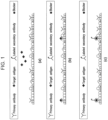
- the sensitivity in such tests is generally limited by label detection accuracy, association factor of the probe-analyte pair (for example an antibody-antigen pair), and the effective density of probe molecule (for example probe antibody) on the surface (as shown in Figure 1 ).
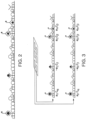
- Other molecules in the biological sample can also affect the minimum detectable concentration by binding to the probe molecule (for example the primary antibody), or by physisorption of the analyte to the surface at the test site (as shown in Figure 2 ).
- the detection agent for example a secondary antibody
- Solving the cross-reactivity and background problem can take a significant amount of time in the assay development of a new test and increases the cost and complexity of the overall test.
- the assay is typically optimized by finding the best reagents and conditions and also by manufacturing the most specific probe molecule (for example antibody). This results in a long development time, the infeasibility of tests in some cases, and a higher manufacturing cost. For example a typical development of an ELISA assay requires several scientists working for more than a year finding the correct antibody as part of the assay development. Cross-reactivity of the proteins may be the source of the failure of such an effort.
- biosensor providing a multiple site testing platform was thought to provide a solution to some of the above described limitations in assay development.
- US Published Patent Applications US2011/0091870 and US2012/0115236 describe such biosensors having multiple sites that could be subjected to different reaction conditions to modulate the binding of the biomolecular analyte (for example proteins) to the probe molecule.
- the signal detected in a biosensor having four sites also can have several components, e.g. four.
- US2014/0008244 describes a biosensor capable of modulating the pH or ionic concentration gradient near electrodes in the biosensor in order to modulate the binding interactions of biological samples of interest.
- US2014/0274760 describes an improved biosensor with increased accuracy, reliability, and reproducibility.
- Electrochemically triggered release of biotin from a modified gold electrode surface via reduction and subsequent lactonization of quinone tether was demonstrated ( Hodneland et al., "Biomolecular surfaces that release ligands under electrochemical control," J. Am. Chem. Soc. 122, pp. 4235-36 (2000 )). Electrochemical control of self-assembly and release of antibodies from the surface into solution was achieved by reduction and oxidation of n-decanethiol-benzoquinones (Artzy-Schnirman et al., " Artzy-Schnirman et al., Nano Lett.
- Electrochemical pH modulation in biological solutions presents a significant challenge due to complex nature of the system.
- the limitations include: presence of buffer components that restrict pH changes, limitations on co-solvents that can be used, presence of strong nucleophiles, such as amines and thiols, and presence of interfering electrochemically active components, such as DNA bases, ascorbic acid and glutathione.
- Quinones are one of the most widely studied classes of electrochemically active molecules (See Thomas Finley, "Quinones,” Kirk-Othmer Encyclopedia of Chemical Technology, 1-35 (2005 ). See also, Chambers, J. Q. Chem. Quinonoid Compd. 1974, Pt. 2:737-91 ; Chambers, J. Q. Chem. Quinonoid Compd. 1988, 2:719-57 ; Evans, D. H. Encycl. Electrochem. Elem. 1978, 12: 1-259 ). Hydroquinone/benzoquinone transformation has been used as a model system to produce proton gradients at electrode surface ( Cannan et al., Electrochem. Communications 2002, 4:886-92 ).
- the open circuit potential of an electrode surface is a function of the ionic concentration in a solution, including the H + concentration in the solution, and therefore of the pH of the solution ( Yin et al., "Study of indium tin oxide thin film for separative extended gate ISFET,” Mat. Chem. Phys. 70(1), pp. 12-16 (2001 )).
- the redox reaction rates of electrochemical species are also pH dependent ( Quan et al., "Voltammetry of quinones in unbuffered aqueous solution: reassessing the roles of proton transfer and hydrogen bonding in the aqueous electrochemistry of quinones,” J. Am. Chem. Soc. 129(42), pp.
- Glass slides are used as a substrate for performing experiments.
- glass slides include protein microarrays, lysate arrays, DNA microarrays and cell culture platforms.
- One use of a protein microarray is to analyze biological substances (e.g., blood serum) from patients with a specific disease in comparison to corresponding substances from healthy or control subjects.
- the biological substances are applied to a microarray containing many (often thousands of) human proteins.
- Antibodies in diseased substances may react (bind) with certain antigens in the microarray, thereby identifying the antigens as disease-specific biomarkers.
- other types of detection such as colorimetric, chemiluminescence and fluorescence detection are also possible with glass slides.
- the experiments are performed under aqueous conditions, in which a substance-of-interest is combined with water or a water-containing liquid and placed onto a slide for analysis.
- a substance-of-interest is combined with water or a water-containing liquid and placed onto a slide for analysis.
- bubbles formed of air or other gases
- the presence of bubbles disturbs the experiment, adversely affecting the results.
- One example of an adverse effect is when a bubble causes the test solution to dry out. This can create a false binding event where the substance-of-interest (e.g., a biomolecular analyte) fails to bind with a molecule with which the biomolecular analyte is supposed to interact.
- the bubbles change the effective flow rate of the test solution and the flow rate is being measured as part of the experiment. Therefore, it is desirable to detect bubbles and to output an indication of their presence, so that experiment results can be interpreted correctly.
- Katsuya Morimoto et al "Automatic Electrochemical Micro-pH-Stat for Biomicrosystems" (ANALYTICAL CHEMISTRY, vol. 80, no. 4, 11 January 2008 (2008-01-11), pages 905-914, XP055300793, ISSN: 0003-2700, DOI: 10.1021/ac071286u ) describes a three-electrode system used for controlling a pH of a solution, wherein the three-electrode system comprises a working electrode, a reference electrode and an auxiliary electrode.
- the present invention provides a method for controlling a pH of a solution with the features of claim 1 and a device for controlling a pH of a solution with the features of claim 11.
- each test site in the subarray/subset of the multiplesite array comprises a support onto which one or more electrodes are placed and onto which solid surface the biomolecular probe(s) are immobilized or bound.
- This immobilization of biomolecular probes to a solid surface or support assists in reducing the amount of probe needed for the analytical method and also localizes the detection area to make accurate measurements.
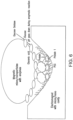
- the biomolecular probes are therefore attached to solid surfaces of the support and/or electrodes such as those of silicon, glass, metal and semiconductor materials (as shown in Figure 4 ).
- the biomolecular probe is attached or immobilized onto the support and/or electrode(s) within a biomolecular interface layer (as shown in Figure 4 ).
- the biomolecular layer includes a layer of immobilized polymers, preferably a silane immobilized polyethylene glycol (PEG).
- PEG silane immobilized polyethylene glycol
- Surface-immobilized polyethylene glycol (PEG) can be used to prevent non-specific adsorption of biomolecular analytes onto surfaces.
- At least a portion of the surface-immobilized PEG can comprise terminal functional groups such as N-hydroxysuccinimide (NHS) ester, maleimide, alkynes, azides, streptavidin or biotin that are capable of conjugating.
- NHS N-hydroxysuccinimide
- the biomolecular probe may be immobilized by conjugating with the surface-immobilized PEG. It is important that the method used to change the pH does not impair the covalent binding of for example the PEG onto the surface of a solid support, or the linker that conjugated the biomolecular probe to the PEG (as shown in Figure 5 ).
- the method of modulating the pH or ionic concentration as described herein can protect these surface chemistries, while affecting a pH/ionic concentration change in the environment of the biomolecular probe.
- a suitable biomolecular probe can be a carbohydrate, a protein, a glycoprotein, a glycoconjugate, a nucleic acid, a cell, or a ligand for which the analyte of interest has a specific affinity.
- Such probe can for example be an antibody, an antibody fragment, a peptide, an oligonucleotide, a DNA oligonucleotide, a RNA oligonucleotide, a lipid, a lectin that binds with glycoproteins and glycolipids on the surface of a cell, a sugar, an agonist, or antagonist.
- the biomolecular probe is a protein antibody which interacts with an antigen that is present for example in a biological sample, the antigen being a biomolecular analyte of interest.
- the analyte of interest in a biological sample can be for example a protein, such as an antigen or enzyme or peptide, a whole cell, components of a cell membrane, a nucleic acid, such as DNA or RNA, or a DNA oligonucleotide, or a RNA oligonucleotide.
- a biomolecular analyte can be for example a protein, such as an antigen or enzyme or peptide, a whole cell, components of a cell membrane, a nucleic acid, such as DNA or RNA, or a DNA oligonucleotide, or a RNA oligonucleotide.
- Suitable enzymes for immobilization in the biomolecular interface layer or onto the magnetic micro- or nano-particles include for example oxidases, ureases, or dehydrogenases.
- immobilized oxidase is for example a glucose oxidase and the enzyme substrate is glucose.
- the amounts of immobilized enzyme and enzyme substrate added can be varied in the different test sites in each of the subsets of the multisite array so as to provide a pH or ionic concentration gradient in the such subset of the multisite array.
- the enzyme is not immobilized onto a solid surface such as in the above methods being immobilized into a biomolecular interface layer or onto a magnetic micro- or nano-particle but is added to the aqueous solution in the test sites of subsets of a multisite array.
- electrolysis the enzyme undergoes a redox reaction at the electrode surface and perturbs the local pH.
- the pH or ionic concentration can be further modulated by adding a buffer inhibitor to the aqueous solution.
- a buffer inhibitor either assists in diffusing the produced ions of interest to the location of the biomolecular probe or detection agent or inhibits the interaction of such produced ions with buffering salts.
- the buffer inhibitor is added to the aqueous solution of the test site of subsets of a multisite array in the absence of an electrochemical active agent or immobilized enzyme.
- the buffer inhibitor is added to the aqueous solution, and facilitates the diffusion of H + ions or OH - ions that are produced at the electrodes in the test site or inhibits the interaction between H + ions or OH - ions and buffering salts.
- Suitable buffer inhibitors include soluble polymers selected from poly(allylamine hydrochloride), poly (diallyldimethyl ammonium chloride), poly(vinylpyrrolidone), poly(ethyleneimine), poly(vinylamine), poly(4-vinylpyridine) and tris(2-carboxyethyl)phosphine hydrochloride.
- the amounts of buffer inhibitor added can be varied in the different test sites in each of the subsets of the multisite array so as to provide a pH or ionic concentration gradient in the such subset of the multisite array.
- the modulation of the pH at each test site may vary between subsequent uses.
- the pH at each test site needs to be accurately modulated or controlled.
- the immobilized fluorescent protein is selected from an immobilized green fluorescent protein, an immobilized yellow fluorescent protein, and an immobilized cyan fluorescent protein. More preferably, the immobilized fluorescent protein is immobilized Green Fluorescent Protein (GFP). Immobilized pH sensitive dyes may be used on the support substrate instead of an immobilized pH sensitive fluorescent protein. Immobilized pH sensitive binding proteins may be used on the substrate instead of an immobilized pH sensitive fluorescent protein. In a multisite array of test sites in a biosensor the immobilized fluorescent protein covers on the substrate an area that is also covered by an electrode and an area that is not covered with an electrode. The electrode covered by the immobilized fluorescent protein is either a working electrode or a counter electrode.
- GFP Green Fluorescent Protein
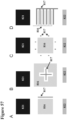
- the immobilized fluorescent protein is applied onto the substrate as distinct spots, wherein each spot overlaps with only one test site and an area not covered by an electrode as shown in Figure 12A .
- the presence of fluorescent protein on an area that is not covered by an electrode allows for the determination, within the biosensor, of fluorescence intensity when the pH is not modulated by the electrode.
- This fluorescence intensity can be used as a standard and control in determining whether, after ceasing modulation of the pH by an electrode the fluorescence intensity will revert back to its original intensity.
- the fluorescent protein not located on or near an electrode can be used as an internal reference for signal normalization.
- Figure 9 shows a side view of a part of the device which includes a substrate (1) for example glass or plastic.
- a substrate (1) for example glass or plastic.
- One or more electrodes (2) are covered onto the substrate (1) which is also covered with a biomolecular interface layer (10).
- the biomolecular interface layer (10) comprises immobilized PEG (3), immobilized probe (4) and immobilized pH sensitive fluorescent protein in the form of Green Fluorescent Protein spots (5).
- the GFP spots (5) overlap with an electrode (2) and an area that is not covered by an electrode.
- the electrodes (2) and the GFP spots (5) are arranged in a multisite array so as to provide multiple test sites on the device.
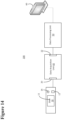
- Figure 14 shows an example system 100 for detecting bubbles.
- the system 100 includes a slide 30 that includes an area 10 in which a test solution containing a substance-of-interest is placed for analysis, a control unit 12 and a power source 14.
- the slide 30 can be formed of any electrically insulating material.
- glass would typically be used for this purpose and to serve as a substrate, on top of which the area 10, control unit 12 and power source 14 are formed.
- the glass can be formed, for example, of silicon dioxide (SiO 2 ), possibly with additives. Alternatively, other types of silicate glasses may be used.
- the area 10 includes an array of electrodes used for bubble detection. At least some of the electrodes in the area 10 are used for adjusting (also referred to herein as modulating) a pH level of the test solution. These pH modulating electrodes can be dedicated exclusively to adjusting the pH level or, alternatively, switched between pH modulating and bubble detecting modes of operation, as will subsequently be explained. (For example, U.S. Pat. App. Ser. No. 13/543,300 , mentioned earlier, describes the use of electrodes for pH modulation in a biosensor, which modulation can be performed using the electrodes discussed herein.)
- Figure 15 shows a top view of an example electrode array, in which a set of column electrodes X01 to X12 are arranged at regularly spaced distances from each other. A set of row electrodes Y01 to Y09 are also arranged at regularly spaced distances and are separated from the column electrodes X01 to X12, e.g., by an intervening layer of glass.
- Each electrode includes one or more contact pads 31, 32 for use in bubble detection and/or pH modulation. The shape of the pads is variable and is substantially square.
- Figure 16 shows a close-up view of example square-shaped pads.
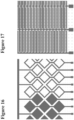
- Figure 17 shows an alternative in which the pads form an interdigitated structure, and are therefore frame-shaped.
- control unit 12 is electrically connected to the electrode array 10 and controls the array 10 to perform bubble detection and pH modulation.
- the control unit 12 can be, for example, a microprocessor or an application specific integrated circuit (ASIC).
- ASIC application specific integrated circuit
- the control unit 12 is located on an electronic circuit board that is detachably connected to the slide 30, e.g., using pogo pins.
- the control unit 12 can be located within a packaged chip bonded directly to a rigid glass substrate, e.g., using a chip-on-glass process.
- the slide 30 is formed of a flexible foil-type substrate and the control unit 12 is glued to the slide 30 using a z-axis adhesive to form a chip-on-foil, in a manner similar to how chips are bonded in certain liquid crystal displays.
- the control unit 12 can include, for example, a non-transitory computer readable storage medium containing program code that implements the example bubble detection and pH modulation techniques described herein.
- the control unit 12 can control the electrodes to perform other types of sensing or to control other sensing structures, as is known in the art of biosensors.
- the control unit 12 transmits control signals that cause input pulses to be applied at specified electrodes. Capacitance values can be measured at the control unit 12 based on the responses of the electrodes to the input pulses. The measurement of capacitance is known in the art of touch screen displays, which utilize measurements of self-capacitance (e.g., a single electrode) or mutual capacitance (e.g., between two electrodes). To support bubble detection, the control unit 12 has a capacitance detection range that is greater than that of typical control units that measure capacitance in life science experiments. Control signals can also be used to apply input pulses for pH modulation. Control signals for pH modulation can be initiated by the control unit 12, e.g., in accordance with a predefined program sequence designed for pH modulation.
- control signals for pH modulation is initiated externally, e.g., in response to a command from a data processing unit 50.
- the control unit 12 includes hardware and/or software components that perform preliminary signal processing on the measured capacitance values, including converting the measurements from analog to digital format and/or filtering the measurements.
- the processed measurements are then output as raw data to the data acquisition unit 40.
- the power source 14 provides power to the control unit 12 and to the electrode array 10.
- the power source 14 is a battery such as a coin-cell or a printed battery.
- the slide 30 is designed for one-time use and is disposable, the battery therefore being provided with a small energy capacity, e.g., sufficient for a single measurement, and the battery can be permanently attached to the slide, e.g., bonded or glued to the glass surface.
- the battery can be rechargeable or user replaceable.
- Other forms of electric power delivery may alternatively be used.
- electrical power is delivered wirelessly through magnetic coupling between an external power supply (e.g., the data acquisition unit 40) and one or more resonant coils in the slide.
- the external power supply may couple to the resonant coil using radio-frequency (RF) signals.
- RF radio-frequency
- the slide 30 receives power through a wired connection to the data acquisition unit 40.
- the data acquisition unit 40 is a device that communicates with the slide 30 to receive the measured capacitance values from the control unit 12, in the form of raw data.
- the data acquisition unit 40 includes a wired communication interface 20 to a corresponding interface in the slide 30.
- the raw data is output from the control unit 12 in parallel.
- the control unit 12 includes a plurality of output channels, with data from a single row or a single column being output on a corresponding channel.
- the interface 20, for example, converts the parallel data into a format suitable for transmission to the data processing unit 50. The conversion may involve parallel-to-serial conversion using a Universal Asynchronous Receiver/Transmitter (UART) or other conventional data conversion apparatus.
- the interface 20 communicates wirelessly with the slide 30, e.g., using RF signals.
- the data processing unit 50 receives the raw data from an output interface 22 of the data acquisition unit 40, e.g., from a transmitter portion of the UART.
- the output interface 22 can be a wired, serial interface such as a Universal Serial Bus (USB) interface.
- the output interface 22 can be wireless, e.g., a Bluetooth or WiFi interface.
- the interface is a Bluetooth low energy (LE) interface.
- the data processing unit 50 can be, for example, a general purpose computer in the form of a desktop, a laptop or tablet, and includes, for example, a processor and a memory storing instructions for further processing of the raw data.
- the further processing includes normalizing the raw data to a predefined scale and using the normalized data to generate output images, such as two or three-dimensional graphs, for display at the display device 60.
- the display device 60 can be integrated into a housing of the data processing unit 50 as a single unit.
- the display device 60 may alternatively be externally connected, e.g., where the data processing unit 50 is a desktop.
- the output images may be combined to form a video that shows changes in the data over time.
- the output images, which represent the measured capacitance values are displayed together with additional output images corresponding to other measured data.
- the output images and the additional output images may be displayed in different portions of the same display screen or overlaid (superimposed) on the same portion of the display screen.
- the data processing unit 50 is also configured to issue commands to the control unit 12 for pH modulation.
- the commands may be automatically generated, e.g., when a processor of the data processing unit 50 determines that the pH level of the test solution should be adjusted.
- the commands may be user-initiated.
- the slide 30 may include a layered structure in which one or more electrode layers are located on top of a glass substrate.
- the layered structure can be formed, for example, using a lamination technique in which two or more layers are formed separately and then laminated together, e.g., using adhesive or bonding.
- the layered structure can be monolithically formed as a single unit, using techniques known in the art of semiconductor device fabrication.
- the layered structure may include one or more passivating layers formed, e.g., of SiO 2 (also referred to as oxide).
- the composition and size of passivating layers can vary, e.g., from an atomic layer of SiO 2 to several micrometers of SiO 2 , and formed using various techniques such as low pressure chemical vapor deposition (LPCVD) or plasma-enhanced chemical vapor deposition (PECVD).
- LPCVD low pressure chemical vapor deposition
- PECVD plasma-enhanced chemical vapor deposition
- Si 3 N 4 Silicon nitride
- the passivating layer can be formed as a thin film that is laminated.
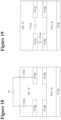
- FIG. 18 shows a simplified electrical model of a slide including electrodes (ITOs 81 to 84) in an SiO 2 layer 73.
- the ITOs 81 and 82 represent electrode pads in a first layer, e.g., row electrode pads.
- the ITOs 83 and 84 represent electrode pads in a second layer beneath the first layer, e.g., column electrode pads.
- the ITOs 81 to 84 are formed above a glass substrate 79, with an optional ITO layer 89 that serves as a bottommost, passivating layer. For simplicity, the portion of the electrode array used for pH modulation is not shown.
- the capacitance of the test solution is assumed to be equivalent to the capacitance of water (CW) since the test solution is, in practice, mostly water.
- CW capacitance of water
- the solution is in contact with the SiO 2 layer 73 and contributes to a series capacitance between ITOs 81 and 82.
- the SiO 2 layer 73 also contributes to the series capacitance, as represented by two capacitances CSiO 2 .
- the pH modulating portion of the electrode array has been omitted for the sake of simplicity.
- One way to perform pH modulation is to separate the pads of adjacent electrodes so as to form channels that collect the test solution.
- the channels allow the test solution to come into contact with the electrodes, so that the pH level of the solution can be adjusted by sending a current between the adjacent electrodes.
- the electrodes may be formed of any suitable conductive material, but are preferably indium tin oxide (ITO) because ITO is transparent and relatively colorless, making it suitable for experiments that involve optical measurements. This allows the entire measurement area 10 to be transparent.
- An oxide layer may be used as a passivating layer to cover the electrodes, similar to how the SiO 2 layer 73 covers the electrodes in Figure 18 and Figure 19 .
- the same oxide layer may be used over the electrodes in both the bubble detecting and the pH modulation portions of the electrode array.
- the oxide layer does not completely fill the channels, but instead a lateral portion of the electrodes is left exposed to allow for contact with the test solution.
- FIG 19 shows additional details regarding the electrical model of Figure 18 .
- the series capacitances are collectively represented as a mutual capacitance CL1,L1 between ITOs 81 and 82. Additionally, there exists a mutual capacitance between ITOs 81 and 83.
- bubbles are detected as a change in capacitance (e.g., in either of these mutual capacitances or in a self-capacitance) that results when the test solution is displaced by a bubble, which is typically formed of air. Since air has a much lower capacitance (the dielectric strength of air is approximately eighty times less than water), it is possible to detect a drop in capacitance associated with the presence of a bubble.
- each pad may be sized as small as possible while balancing performance parameters such as power consumption and maintaining inter-operative compatibility with the control unit 12.
- the pads are less than 2 millimeters wide, preferably 1 millimeter or less. This is substantially smaller than the size of electrodes typically used for conventional touch-screen applications or conventional bio-sensor applications.
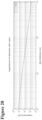
- Figure 20 is a simulated graph of self-capacitance along the x direction (from the top surface of the slide towards the glass substrate) when water covers a pad.
- the graph of Figure 20 was generated based on a square pad of size 1 mm x 1 mm. As shown, the capacitance decreases continuously from a value of approximately 2 ⁇ 10 -11 Farads at 10 -6 meters down to approximately 7 ⁇ 10 -14 Farads at 10 -3 meters.
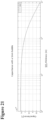
- Figure 21 is a simulated graph of self-capacitance along the x direction when a bubble having a diameter of 1 millimeter is present on a 1 mm ⁇ 1 mm pad.
- the capacitance values are substantially smaller than the corresponding capacitance values from Figure 20 between 10 -6 and 10 -3 meters. Specifically, the capacitance starts at approximately 7.6 ⁇ 10 -14 Farads and drops beginning around 3 ⁇ 10 -5 meters to approximately 5 ⁇ 10 -14 Farads. Therefore, the capacitance with water is several orders of magnitude greater for the majority of points between 10 -6 and 10 -3 meters.
- one way to detect bubbles is based on an evaluation of the value or the magnitude of a capacitance at any given pad, e.g., by comparing the value or magnitude to a predefined threshold value. A bubble would then correspond to a capacitance that is less than the threshold.
- Figure 20 and Figure 21 are provided to illustrate basic electromagnetic principles to detect bubbles based on changes in capacitance.
- Another way to detect bubbles is based on the percentage change in capacitance from water to a bubble.
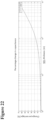
- the simulated graph in Figure 22 whose values were calculated using the values from Figure 20 and Figure 21 .
- the percentage change is initially small, but starts to increase at around 10 -5 meters. Therefore, detection may be based on the percentage change if the pads are suitably located, e.g., at a distance of 10 -5 meters or more from the top surface of the slide.
- detection can be based on a comparison of capacitance values associated with a plurality of pads. For example, capacitance values from a group of neighboring pads are compared to determine whether any of the capacitance values is unusually small relative to the other capacitance values. This comparison is advantageous because it does not require the use of a threshold value, which may need to be adjusted based on the design of the slide, e.g., parameters such as pad size, shape or location.
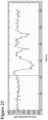
- Figure 23 is a graph showing actual test results from a prototype slide.
- the graph shows mutual capacitance values between a column electrode and a row electrode.
- a bubble was manually introduced at the intersection of these electrodes, beginning at around 50 seconds.
- the bubble was then removed and another bubble introduced at around 75 seconds. This process was repeated again, with another bubble at around 90 seconds. Each time a bubble was introduced, the capacitance dropped substantially.
- Control units exist for acquiring capacitance measurements in connection with touch-screen applications. These conventional control units are unsuitable because they tend to have a narrower detection range and lower sensitivity than what is required. In contrast, bubble detection requires the ability to capture large capacitance swings (e.g., a 400 pF change in going from water to bubble) in addition to a high resolution in order to capture the low capacitance values associated with bubbles.
- a typical capacitance value range for when a bubble exists could be between 20 fF to 40 ⁇ F.
- the large range is due to the fact that many choices are available as to the size of the electrodes and the thickness of the passivation layer on top of the electrodes (e.g., SiO 2 , TiO 2 , nitride, or no passivation layer at all).
- the passivation layer on top of the electrodes e.g., SiO 2 , TiO 2 , nitride, or no passivation layer at all.
- Figure 24 is a flowchart of a method 200 for detecting bubbles. The method 200 is performed using the system 100.
- a capacitance (self or mutual) is measured at an electrode or between two electrodes to measure a capacitance value and the value is output as raw data.
- the measurement is performed by outputting a control signal from the control unit 12, which control signal results in the application of an input pulse to an electrode being measured.
- the control unit 12 senses the electrical response of the electrode, e.g., by measuring a voltage or a current across the electrode, or between the electrode and another electrode, and calculates the capacitance as a function of this response.
- the calculation of self and mutual capacitances is known in the art of touch screen displays.
- Each measured capacitance can be output as a raw data value to the data processing unit 50 using the data acquisition unit 40.
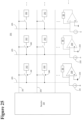
- FIG 25 is a simplified schematic of a circuit 201 for measuring capacitance, and is provided in support of the method 200.
- the circuit 201 includes a decoder 220, which may be included in the control unit 12 of Figure 14 .
- the decoder 220 is connected via a plurality of driving lines 203, over which the decoder 220 sends signals to activate switches 240.
- the switches 240 may be implemented as thin-film transistors (TFTs) and are switched to connect to respective electrodes 242 that form the electrode array.
- the switches 240 are controlled by the decoder 220 to perform the capacitance measurements, e.g., by driving a specific line 203 simultaneously with an adjacent line 203.
- the switches 240 are further connected to sensing lines 205, which in this example, form the columns of the array.
- Each sensing line 205 is connected to a respective amplifier 230.
- the amplifiers 230 are in a negative feedback configuration with a sensing line 205 and a capacitor 99 being connected to a negative amplifier input, which is also connected to ground via a current source 235.
- a positive input of each amplifier 230 is connected to reference voltage 233, which may also be ground.
- the voltages on the sensing lines 205 are influenced by the capacitances at the electrodes, which capacitances depend on whether a bubble is present. Thus, the voltage outputs of the amplifiers 230 correspond to measured capacitances.
- the measured capacitance is compared to a threshold value.
- the threshold value may vary depending on factors such as pad size, shape or location. However, given the design specifications of the slide, and in view of the above discussion on the bubble detection principles, one of ordinary skill in the art would be able to compute a suitable threshold value.
- the measured capacitance is compared to other measured capacitances, e.g., from a group of neighboring electrodes or the entire set of electrodes in the array, to detect unusually low capacitances.
- the results of the comparisons are evaluated at the data processing unit 60 to determine, based on the bubble detection principles described earlier, whether any bubbles exist, and if so, where the bubbles are located.
- the results are output for display at the display device 60.
- Raw data values are displayed in the form of a two-dimensional table. Each table entry corresponds to a measured capacitance value obtained from a corresponding electrode pad.
- the raw data may be displayed as a three-dimensional graph, e.g., a 3-D mesh where the x and y values correspond to electrode locations and the z values correspond to measured capacitance values.
- the graph is color coded, e.g., using a gradient scheme, e.g., a gray scale scheme or a heat map in which the color gradually changes until a bubble location is reached, at which point the color is changed to a color that contrasts the color(s) of non-bubble locations.
- color coding is used to show bubble locations on a two-dimensional graph in which the capacitance values are represented using changes in color.
- the data processing unit 60 processes the raw data by normalizing it to a predefined scale.
- the above described graphs can be displayed alone or together with additional values from other parameters that are the subject of the experiment, e.g., pH value and flow rate.
- the additional values are displayed on the same graph, e.g., using a different color scheme and superimposed onto the capacitance values.
- the graphical display of the capacitance values allows a user to quickly determine where bubbles are located, and to take appropriate corrective action in response to the presence of bubbles.
- the user may decide, for example, to keep those additional values (corresponding to one or more parameters being measured by the experiment) which are not associated with the locations of detected bubbles, while discarding values associated with bubble locations.
- the user may decide that the entire set of data should be discarded because there are too many bubbles, thus making the additional values unreliable as a whole.
- the capacitance values may be superimposed onto additional measurement data, which additional data is stored in association with layout data representing the physical configuration of the measurement area.
- the layout data may be stored in an electronic file in the form of an image (e.g., a scanned image of the measurement area) or text (e.g., a configuration file for a microarray spotter used to fabricate the array, or a GenePix Array List (GAL) file).
- the additional measurement data may also be image or text (e.g., measured pH values stored in a GAL file or measured pH values rendered in grayscale on a scanned image of the measurement area).
- a composite display may be generated in step 218, which display shows a graphical representation of the array together with the capacitance values superimposed onto the additional measurement values at corresponding locations in the array.
- the superimposition can be rendered as text-on-text, text-on-image or image-on-image.
- An example of text-on-text is displaying a capacitance value in one half of an array location and additional measurement data in the other half.
- An example of text-on-image is displaying the capacitances using a heat map while representing the additional measurement data as numerical values on the heat map.
- An example of image-on-image is displaying the capacitances using a heat map while representing the additional measurement data using a 3-D mesh.
- Superimposed data may be stored in the electronic layout file, prior to or in conjunction with the superimposed display.
- a processor on the slide or on an external computer is configured to automatically invalidate the additional measurement data (e.g., by replacing measurement values with null values) in response to detecting bubbles.
- the processor on the slide may detect bubble locations and output an indication of where the bubbles are located to the external computer, which then performs the invalidating based on the indicated locations. This spares the user from having to manually review the capacitance values to decide whether to keep the additional measurement data.
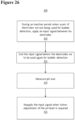
- Figure 26 is a flowchart of a method 300 for pH modulation. The method 300 is performed using the system 100.
- a pair of electrodes that are not currently being used for bubble detection are switched to a pH modulation mode of operation by applying an input signal, e.g., a pulsed current between the electrodes.
- the switches that control the mode of operation of the electrodes are implemented using TFTs, e.g., formed using amorphous silicon, polysilicon or indium gallium zinc oxide (IgZo).
- TFTs e.g., formed using amorphous silicon, polysilicon or indium gallium zinc oxide (IgZo).
- an input pulse can be applied, for example, to a single electrode.
- the input pulse for bubble detection may, but need not be identical in shape, magnitude or duration to the input pulse used for pH modulation. Changes in capacitance between water contact and bubble contact are detected by observing the electric response of the same electrode or in the case of mutual capacitance, the response of another electrode.
- the input signal applied at step 310 for pH modulation may be applied during a time in which the input pulse for the bubble detection is not being applied.
- the input pulse for pH modulation is applied between a pair of electrodes. This produces a current that, through oxidation and reduction of buffer components (e.g., quinones), changes the pH level of a test solution situated between the electrodes.
- buffer components e.g., quinones
- the input signal is ended before the electrodes are to be used again for bubble detection.
- the pH level of the test solution is measured to determine whether additional adjustment is required.
- the pH level can be calculated at the control unit 12.
- the pH level can be measured using a separate testing device.
- the input signal is reapplied by the control unit 12 in response to determining that further adjustment of the pH level is required.
- the control unit 12 is configured to apply the input signal multiple times, as a plurality of pH modulating pulses, before determining whether further adjustment is required.
- the plurality of pH modulating pulses can be applied to the same pair of electrodes or to a different electrode pair.
- the input signal may be reapplied at step 316 to the same or a different pair of electrodes.
- the pH modulating pulses may be applied to different electrode pairs in a sequential manner so that the entire electrode array is triggered over time to perform pH modulation.
- the electrodes can be used to perform functions in addition to bubble detection and pH modulation.
- electrodes can be used for temperature modulation.
- the capacitance measurements can be used to estimate the dielectric constant of the test solution, which dielectric constant is then correlated to a rate of cell growth or a rate with which the substance-on-interest binds to a biomolecule.
- Electrodes were arranged in two layers ( Figure 18 and Figure 19 ). However, it will be understood that the number of layers can be more or less. In fact, a single layer may be sufficient for both pH modulation and bubble detection. Additionally, not every electrode layer needs to be used for pH modulation or bubble detection. Instead, further electrode layers can be used for other purposes, in accordance with the usage of electrodes in conventional biosensors.
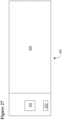
- FIG 27 shows a slide 400.
- the slide 400 includes a measurement area 405, a power source 410 and a processing circuit 420.
- the measurement area 405 may be formed of TFTs (for the switches) together with ITO (for the electrodes). Alternatively, the measurement area 405 may be formed using only ITO or ITO in combination with other metals.
- the power source 410 is analogous to the power source 14 in Figure 14 and may be a battery or a passive power source powered, e.g., using magnetic or RF coupling.
- the processing circuit 420 is analogous to the control unit 12 in Figure 14 and may perform preliminary signal processing. Additionally, the processing circuit 420 may perform some of the functions described earlier with respect to the data processing unit 50 (e.g., normalizing or scaling capacitance values or controlling pH modulation).
- the processing circuit 420 may include a processor (e.g., one or more CMOS chips) that processes the raw data obtained from measurement area 405.
- the processing circuit 420 may further include a memory storing instructions or data, used by the processor to process the raw data.
- the processing circuit 420 may be configured to arrange the raw data into a suitable format for output to an external computer, or to perform preliminary data analysis (e.g., bubble detection and invalidating data associated with bubbles).
- the processor may control the sensing operation of the measurement area 405 (e.g., driving and reading data out of the array), perform data compression, and perform wired or wireless transmission of the preliminarily processed data to an external computer. Post-processing and output of the data for display may be performed at the external computer.
- Figure 28 shows a slide 500.
- the components 505, 510 and 520 are analogous to and perform the same functions as the components 405, 410 and 420, respectively, in Figure 27 .
- the power source 510 and the processing circuit 520 are externally connected, e.g., on a peripheral circuit board 515 that fits into a hardware interface of the slide 500.
- Figure 29 shows a slide 600.
- the components 605, 610 and 620 are analogous to and perform the same functions as the components 405, 410 and 420, respectively, in Figure 27 .
- the power source 610 and the processing circuit are externally connected, similar to Figure 28 .
- the circuit board 615 includes a serial port connector for transmission of data and power between the board 615 and the external computer.
- the serial port may be used to transfer measurement data to the external computer, and to supply power for operating the measurement area 605 or for recharging the power source 610.
- a method for changing the pH of a solution by electronic control includes providing an amount of electric input to the solution using two or more electrodes to electrochemically generate and/or consume hydrogen ions in the solution.
- the generation and/or consumption of the hydrogen ions are achieved by an electrochemical reaction of one or more redox active species in the solution.
- the one or more redox active species is selected from the following: quinones, catechols, aminophenols hydrazines, and derivatives thereof. More preferably, the one or more redox active species is a quinone (See Thomas Finley, "Quinones," Kirk-Othmer Encyclopedia of Chemical Technology, 1-35 (2005 )).
- the one or more redox active species is selected from the following: hydroquinone, benzoquinone, naphthoquinonenaphthoquinone. Most preferably, the one or more redox active species is a quinone derivative, further defined below.
- the two or more electrodes comprise a sense electrode and a reference electrode (RE).
- the sense electrode also functions as a working electrode.
- the two or more electrodes are each independently made of metal oxide, gold, glassy carbon, graphene, silver, platinum, silver chloride, normal hydrogen, mercury drop, or saturated calomel.
- the solution is buffered, unbuffered, aqueous, organic, or a mixture thereof.
- the amount of electric input is provided by providing an amount of electric current.
- an electric source waveform is selected based on the amount of electric input to be provided.
- the electric source waveform is a galvanostatic waveform or a potentiostatic waveform. More preferably, the electric source waveform is selected from a predetermined map that maps electric input amounts to respective solution pH values.
- a method for controlling the pH of a solution using two or more electrodes includes obtaining the open circuit potential (OCP) of two or more electrodes in the solution while no electric input is being applied between the two or more electrodes, selecting an amount of electric input based on the OCP, and providing the amount of electric input to the solution between the two or more electrodes to change the pH of the solution.
- OCP open circuit potential
- the OCP is obtained by measuring the OCP of the two or more electrodes in the solution or calculated from a known or measured initial pH.
- the method also includes determining the pH of the solution based on the OCP of the two or more electrodes in solution.
- the method also includes selecting an electric source waveform based on the amount of electric input and the amount of electric input is provided according to the selected electric source waveform.
- the method further includes determining the pH of the solution based on a measured OCP of the two or more electrodes in the solution. In certain example embodiments of the present invention, the amount of electric input is selected based on the determined pH.
- a method for monitoring the pH of a solution using a sense electrode and a reference electrode includes selecting a target open circuit potential (OCP), characterizing an OCP of the solution between the reference electrode and the sense electrode while no electric input is being applied to the working electrode, and iteratively performing the following steps: selecting an amount of electric input to be applied to the working electrode in order to minimize a difference between the OCP of the solution and the target OCP; and applying the amount of electric input to the working electrode to adjust the OCP of the solution.
- OCP open circuit potential
- the target OCP is a fixed value and in other example embodiments, the target OCP is a variable value. In certain example embodiments of the present invention, the target OCP is a range with an upper bound and a lower bound or is a single value. Preferably, the target OCP is selected based on a target pH. Preferably, the target pH is user defined.
- the sense electrode also functions as the working electrode. Preferably, the distance between the sense electrode and the working electrode is 0 cm to 1cm.
- the electric input may be provided as an electric current or as an electric potential. Preferably, the amount of electric input is provided by applying an electric potential to the working electrode. More preferably, the electric potential is provided according to an electric source waveform.
- the electric source waveform is a galvanostatic waveform or a potentiostatic waveform. Even more preferably, the electric source waveform is selected from a predetermined map that maps electric input amounts to respective solution pH values.
- the sense electrode is coated with a pH sensitive coating and the OCP of the sense electrode and the pH sensitive coating is dominated by the H + ion concentration.
- the pH sensitive coating is an organic material.
- the pH sensitive coating is an inorganic material.
- the pH sensitive coating is made from a material that is selected from the group consisting of polyaniline, polypyrrole, and iridium oxide.
- the example embodiments involve monitoring and/or characterizing electrochemical parameters and using a detected signal as a feedback control to generate a desired pH waveform for a specific length of time. All the described methods involve the use of a redox couple to release H + ions, lowering pH, upon oxidation, and to consume H + ions, increasing pH, upon reduction based on the formula:
- a redox reaction is the reaction of quinone derivatives.
- quinone derivatives There are many different derivatives of quinone, each with specific oxidative and reductive peaks and the redox reaction rate has been shown to be dependent on the pH of the solution.
- OCP has been previously demonstrated to be dependent on the pH of the solution.
- a device for controlling the pH of a solution includes a controller, two or more electrodes, and a solution containing one or more redox active species.
- the device is configured to measure the OCP between the two or more electrodes in the solution to generate a measured OCP data and send the measured OCP data to the controller.
- the controller is configured to iteratively perform the following steps: select an amount of current or an electric source waveform based on a difference between the target OCP data and the measured OCP data, apply the selected amount of current to the solution by providing an electric current or an electric potential, according to the electric potential waveform, to one or more of the two or more electrodes, and send a request to the device for another measurement of the OCP.
- the one or more redox active species in the solution generates and/or consumes hydrogen ions through an electrochemical reaction induced by the electric current or the electric potential applied to the solution.
- the one or more redox active species is selected from the following: quinone, catechol, aminophenol, hydrazine, and derivatives thereof. More preferably, the one or more redox active species is a quinone. (See, Thomas Finley, "Quinones," Kirk-Othmer Encyclopedia of Chemical Technology, 1-35 (2005 )). Even more preferably, the quinone is selected from the following: hydroquinone, benzoquinone, naphthoquinone, and derivatives thereof.
- the one or more redox active species is a quinone derivative.
- the solution is buffered, unbuffered aqueous, organic, or a mixture thereof.
- the electric source waveform is a galvanostatic waveform or a potentiostatic waveform.
- the electric source waveform is selected from a predetermined map that maps electric inputs to respective solution pH values.
- the two or more electrodes are made of metal oxide, glassy carbon, graphene, gold, silver, or platinum.
- the two or more electrodes include a reference electrode and a sense electrode.
- the two or more electrodes further include a working electrode and/or a counter electrode.
- Each of the two of more electrodes is respectively made of metal oxide, gold, glassy carbon, graphene, silver, platinum, silver chloride, normal hydrogen, mercury drop, or saturated calomel.
- the sense electrode also functions as a working electrode.
- the sense electrode is coated with a pH sensitive coating and the OCP of the sense electrode and the pH sensitive coating is dominated by the H+ ion concentration.
- the pH sensitive coating is an organic or an inorganic material.
- the pH sensitive coating is made from a material that is selected the group consisting of polyaniline, polypyrrole, and iridium oxide.
- quinone derivatives that can be added to solutions and are suitable for electrochemical pH modulation in biological buffers, electrochemically active compositions comprising the quinone derivatives, methods of making the derivatives and/or compositions, and uses thereof.
- the electrochemically active composition comprising a quinone derivative, where the reactivity between a nucleophile and the quinone derivative is reduced compared to a reactivity between the nucleophile and an unsubstituted quinone from which the quinone derivative is derived, and the composition is configured such that the pH of the composition is electrochemically modulated via the quinone derivative. More preferably, the reactivity between the nucleophile and the quinone derivative is reduced by at least 50% compared to the reactivity between the nucleophile and the unsubstituted quinone from which the quinone derivative is derived.
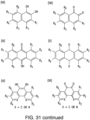
- the quinone derivative is defined by a chemical formula selected from the group consisting of:
- each R group is independently selected from the group consisting of: H, C n H 2n+1 , Cl, F, I, Br, OM, NO 2 , OH, OC n H 2n , OC n H 2n OH, O(C n H 2n O) y OH, O(CnH 2n O)yOCnH 2n+1 , O(C n H 2n O) y COOH, O(C n H 2n O) y COOM, COOH, COOM, COOC n H 2n+1 , CONHC n H 2n+1 , CON(C n H 2n+1 ) 2 , SO 3 H, SO 3 M, NH 2 , NHC n H 2n+1 , N(C n H 2n+1 ) 2 , NHC n H 2n OH, NHC n H 2n H 2n H 2n H 2n H 2n H 2
- the composition is an aqueous solution.
- the composition further comprises an additive selected from the group consisting of: an aqueous buffer, an organic solvent, an electrolyte, a buffer salt, a bioreagent, a biomolecule, a surfactant, a preservative, a cryoprotectant, and combinations thereof.
- the one or more nucleophiles are selected from the group consisting of: amines, thiols, amino acids, peptides, proteins, and combinations thereof.
- the reactivity between the nucleophile and the quinone derivative is reduced compared to the reactivity between the nucleophile and the unsubstituted quinone from which the quinone derivative is derived due to: (i) increased steric hindrance of a nucleophile binding site by one or more of the R groups; (ii) elimination of the nucleophile binding site by covalent bonding between the nucleophile binding site and one of the R groups.
- the reactivity between the nucleophile and the quinone derivative is reduced compared to the reactivity between the nucleophile and the unsubstituted quinone from which the quinone derivative is derived due both (i) and (ii).
- Also provided are methods comprising modifying a quinone having one or more R groups by substituting one or more of the R groups with a substituent to provide a quinone derivative, where the quinone derivative has a reduced reactivity with a nucleophile compared to a reactivity between the quinone and the nucleophile; and the substituent is independently selected from the group consisting of: H, C n H 2n+1 , Cl, F, I, Br, OM, NO 2 , OH, OC n H 2n , OC n H 2n OH, O(C n H 2n O) y OH, O(C n H 2n O) y OC n H 2n+1 , O(C n H 2n O) y COOH, O(C n H 2n O) y COOM, COOH, COOM, COOC n H 2n+1 , CONHC n H 2n+1 , CON(C n H 2n+1 ) 2 , SO 3
- the one or more R groups are substituted with a polar.
- the polar group has atoms containing lone pair electrons.
- the polar group is capable of forming hydrogen bonds with water.
- the polar group contains at least one of oxygen, nitrogen, and sulfur atoms. More preferably, the polar group is selected from the group consisting of: OH, CH 2 OH, OCH 3 , COOH, SO 3 H, NH 2 , NH 3 Cl, ONa, a sugar, an amino acid, and a peptide.
- Also provided are methods of synthesizing substituted methyl quinone comprising: (i) a halide substitution step of reacting a starting material with a hydrogen halide in the presence of acetic acid and an aldehyde; (ii) reacting a material produced by step (i) with a nucleophile of structure R-X; (iii) reacting a material produced by step (ii) with an oxidizing agent; and (iv) reacting a material produced by step (iii) with a reducing agent, where R is selected from the group consisting of: H, C n H 2n+1 , Cl, F, I, Br, OM, NO 2 , OH, OC n H 2n , OC n H 2n OH, O(C n H 2n O) y OH, O(C n H 2n O) y OC n H 2n+1 , O(C n H 2n O) y COOH, O(C n H 2
- the starting material is dialkoxybenzene and the result of the halide substitution step is an ortho -quinon, para -quinone, or a combination thereof.
- the number of halide groups per molecule of the ortho -quinone or para- quinone is 1, 2, 3, or 4.
- the starting material is dialkoxynaphthalene and the result of the halide substitution step is an ortho -naphthoquinone, para- naphthoquinone, or a combination thereof.
- the number of halide groups per molecule of the ortho- naphthoquinone or para -naphthoquinone is 1 or 2.
- the hydrogen halide is selected from the group consisting of: HCl, HBr, HI, and combinations thereof.
- the oxidizing agent is selected from the group consisting of: cerium ammonium nitrate, iodine, hydrogen peroxide, hypervalent iodine, iodobenzene diacetate, bromine compounds, and combinations thereof.
- the reducing agent is selected from the group consisting of: sodium borohydrate, potassium borohydrate, sodium hydrosulfite, trichlorosilane, and combinations thereof.
- Also provided are methods comprising: providing a biosensor comprising a support in an solution, the support comprising one or more electrodes and a biomolecule interface layer having one or more immobilized probes thereon, and the solution comprising a quinone derivative; adding a biomolecule analyte to the solution; electrochemically reacting the quinone derivative using the one or more electrodes to produce an amount of H + ions and/or an amount of OH - ions, wherein the pH of the solution close to the one or more electrodes is controlled by the amount of H + ions and/or the amount of OH - ions produced; collecting signals from the biosensor, where a reactivity between a nucleophile and the quinone derivative is reduced compared to a reactivity between the nucleophile and an unsubstituted quinone from which the quinone derivative is derived
- the pH of the solution before electrochemically reacting the quinone derivative using the one or more electrodes is 1 to 14.
- the pH of the solution after electrochemically reacting the quinone derivative using the one or more electrodes is 1 to 14.
- the solution contains one or more nucleophiles.
- the one or more nucleophiles are selected from the group consisting of: amines, thiols, amino acids, peptides, proteins, and combinations thereof.
- the solution contains a reduced quinone derivative and electrochemically reacting the quinone derivative results in an electrochemical oxidation reaction of the reduced quinone derivative to make the pH of the solution more acidic.
- the concentration of the reduced quinone derivative is 0 to 1M.
- the solution contains an oxidized quinone derivative and electrochemically reacting the quinone derivative results in an electrochemical reduction reaction of the oxidized quinone derivative to make the pH of the solution more basic.
- the concentration of the oxidized quinone derivative is 0 to 1M.
- the solution contains one or more buffer components provided in a concentration that is 0 to 1M.
- the one or more buffer components are selected from the group consisting of: organic solvents, electrolytes, bioreagents, biomolecules, surfactants, and combinations thereof.
- the method further comprises measuring the pH of the solution.
- the pH is measured continuously.
- the quinone derivative is electrochemically reacted by providing an amount of electric current.
- the pH is measured before providing the amount of electric current.
- the amount of electric current is selected based on the measured pH.
- Quinones are herein defined as unsubstituted quinones.
- the chemical structures I - XII would represent quinones if all of the R groups were hydrogen.
- Quinone derivatives are herein defined as compounds that are structurally similar to quinones except that at least one hydrogen is replaced by a substituent. In cases where more than one hydrogen is replaced by a substituent, the identity of the substituents may be independently selected but are not required to be unique.
- the quinone derivatives of the present invention have reduced reactivity with nucleophiles and the pH of the biological buffer containing the quinone derivatives is able to be electrochemically modulated.
- Also provided are methods for controlling a pH of a solution using two or more electrodes the method comprising measuring an open circuit potential (OCP) of the two or more electrodes in the solution while no current is being applied between the two or more electrodes, selecting an amount of current based on the measured OCP, and providing the selected amount of current to the solution, thereby changing the pH of the solution by at least one electrochemically generating or consuming hydrogen ions.
- OCP open circuit potential
- generation and/or consumption of the hydrogen ions are achieved by an electrochemical reaction of one or more redox active species in the solution.
- the one or more redox active species is selected from the group consisting of: quinones, catechols, aminophenols, hydrazines, derivatives thereof, and combinations thereof.
- the one or more redox active species is a quinone selected from the following: hydroquinone, benzoquinone, naphthaquinone, derivatives thereof, and combinations thereof.
- the two or more electrodes comprise a sense electrode and a reference electrode.
- the sense electrode is configured to also function as a working electrode.
- the two or more electrodes also comprise a counter electrode.
- the two or more electrodes are each independently made of a material selected from the group consisting of: metal oxide, gold, glassy carbon, graphene, silver, platinum, silver chloride, normal hydrogen, mercury drop, saturated calomel, and combinations thereof.
- the solution is buffered, unbuffered, aqueous, organic, or a mixture thereof.
- the method further comprises determining the pH of the solution based on the measured OCP of the two or more electrodes in the solution.
- selection of an electrical waveform is based on the determined pH.
- the method further comprises selecting an electrical waveform and providing the electrical waveform to the solution.
- the electrical waveform is either a galvanostatic waveform or a potentiostatic waveform.
- the electrical waveform is selected from a predetermined map that maps respective current amounts to respective electrical waveforms.
- a biosensor system comprising a support that includes an a sense electrode, a reference electrode, and a working electrode; an electrochemically active agent, wherein the biosensor is configured to control a change of a redox state of the electrochemically active agent, and the biosensor is configured to iteratively perform the following: selecting an amount of current to be applied to the working electrode in order to minimize a difference between the OCP of the solution and the target OCP; applying the selected amount of current to the working electrode to adjust the OCP of the solution; and measuring the OCP of the solution.
- the solution is an aqueous solution.
- the sense electrode also functions as the working electrode.
- the amount of current applied to the working electrode is provided by applying an electrical waveform.
- the electrical waveform is a galvanostatic waveform or a potentiostatic waveform.
- the electrical waveform is selected from a predetermined map that maps respective current amounts to respective electrical waveforms.
- the sense electrode is coated with a pH sensitive coating.
- the pH sensitive coating is an organic material or an inorganic material.
- the pH sensitive coating is made from a material selected from the group consisting of: polyaniline, polypyrrole, iridium oxide, and a combination thereof.
- Also provided are methods for monitoring pH of a solution using a sense electrode, a reference electrode, and a working electrode comprising selecting a target open circuit potential (OCP) based on a target pH for the solution; characterizing an OCP of the solution between the reference electrode and the sense electrode while no current is being applied to the working electrode; and iteratively performing the following: selecting an amount of current to be applied to the working electrode in order to minimize a difference between the OCP of the solution and the target OCP; applying the selected amount of current to the working electrode to adjust the OCP of the solution; and measuring the OCP of the solution.
- the solution is an aqueous solution.
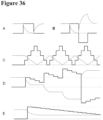
- the target pH is set by incorporating an electro-chemical delta-sigma-modulator.
- the output-signal of the electro-chemical delta-sigma-modulator is digitally filtered to get a digital representation of the charge needed to create the target pH.
- the target OCP is a range with an upper bound and a lower bound. More preferably, the target pH is a single target value.
- the sense electrode also functions as the working electrode.
- the amount of current applied to the working electrode is provided by applying an electrical waveform.
- the electrical waveform is a galvanostatic waveform or a potentiostatic waveform.
- the electrical waveform is selected from a predetermined map that maps respective current amounts to respective electrical waveforms.
- the sense electrode is coated with a pH sensitive coating.
- the pH sensitive coating is an organic material or an inorganic material.
- the pH sensitive coating is made from a material selected from the group consisting of: polyaniline, polypyrrole, iridium oxide, and combinations thereof.
- a device for controlling a pH of a solution comprising: a controller; two or more electrodes; and a solution containing one or more redox active species, wherein the device is configured to iteratively perform the following: measure an open circuit potential (OCP) between the two or more electrodes in the solution to generate a measured OCP data; select, using the controller, an amount of current or an electric potential waveform based on a difference between target OCP data and the measured OCP data; and apply, using the controller, the selected amount of current or the selected electric potential waveform to the solution via one or more of the two or more electrodes.
- OCP open circuit potential
- the solution is an aqueous solution.
- the one or more redox active species generates or consumes hydrogen ions through an electrochemical reaction induced by the electric current or the electric potential applied to the solution.
- the one or more redox active species is selected from the following: quinones, catechols, aminophenols hydrazines, derivatives thereof, and combinations thereof.
- the one or more redox active species is a quinone selected from the following: hydroquinone, benzoquinone, naphthaquinone, derivatives thereof, and combinations thereof.
- the solution is buffered, unbuffered aqueous, organic, or a mixture thereof.
- the electric potential waveform is a galvanostatic waveform or a potentiostatic waveform. More preferably, the electric potential waveform is selected from a predetermined map that maps respective current amounts to respective electric potential waveforms.
- the two or more electrodes comprise two or more of a reference electrode, working electrode, counter electrode, or sense electrode that is made of a material independently selected from the group consisting of: metal oxide, gold, glassy carbon, graphene, silver, platinum, silver chloride, normal hydrogen, mercury drop, saturated calomel, and combinations thereof.
- the sense electrode also functions as a working electrode.
- the sense electrode is coated with a pH sensitive coating.
- the pH sensitive coating is an organic material or an inorganic material.
- the pH sensitive coating is made from a material selected from the group consisting of: polyaniline, polypyrrole, iridium oxide, and combinations thereof.
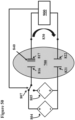
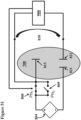
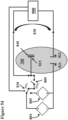
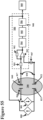
- FIG. 30 A drawing of a system having electrochemically active agent in solution, is presented in Figure 30 .
- the electrochemically active agent was attached to the electrode surface and not in solution.
- the system provides an anode electrode and an electrochemically active agent in solution. Applying a current to the electrode induces the electrochemically active agent to undergo an electrochemical redox reaction which makes the pH of the solution near the electrode more acidic. Having the electrochemically active agent in solution rather than attached to the electrode surface has many advantages.
- a more significant change can be inflicted on the surrounding environment if the amount of electrochemically active agent is not limited by the density of the surface layer, thereby increasing capacity of the device; fresh electrochemically active agent can be supplied to the electrode surface via diffusion from bulk solution, thereby allowing for cycling capability; and universal electrochemistry can be applied to all types of electrodes, which will not interfere with other surface chemistries such as attachment of anti-fouling reagents or biomolecules.
- the structure of the quinones were modified to satisfy the requirements for use in biological solutions.
- a molecule In order to be useful for pH modulation in biological buffers, a molecule should satisfy the following requirements: release or consume protons through electrochemical reaction upon electronic stimulation, sufficient water solubility, reduction and oxidation potential should be lower than the potential of water hydrolysis or other redox active species within the solution, stability in solution in the absence of electronic stimulation (i.e., no autooxidation/reduction), low reactivity towards nucleophiles, compatibility with biological samples (for example: proteins, peptides, cells, DNA, and enzymes).
- Figure 31 shows quinone derivatives that can be used for pH modulation in aqueous solutions,.
- Example 1- Electrochemical generation of H+ or OH- ions at electrode surfaces.
- Electrode material used The electrode material was indium tin oxide. This is a semiconducting electrode surface with very large potential window in an aqueous solution.
- Electro-oxidation of species to produce H + ions Oxidation of ascorbic acid at the electrode surfaces produced H + ions and changed the electrode surface pH to a more acidic state: AH 2 ⁇ A + 2H + + 2e - , where AH 2 is ascorbic acid (C 6 H 6 O 6 ) (as shown in Figure 5 ).
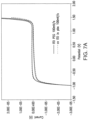
- the electrode potential at which it oxidizes was less than 0.5V for Indium tin oxide material vs Ag/AgCl reference electrode (as shown in Figure 7 ). This potential was less than the voltages needed for the oxygen evolution reaction in aqueous solution. Higher electrode potential (e.g > 1V for ITO electrodes in just phosphate buffer) can damage the PEG layer (as shown in Figure 8 ).
- the ascorbic acid also acted as a sacrificial species to prevent electrochemical degradation of the surface chemistry.
- Electro-reduction of species to produce OH- ions Reduction of benzoquinone (C 6 H 4 O 2 ) into Hydroquinone (C 6 H 6 O 2 ) can produce OH - ions at -0.1V: BQ + 2e - + 2H 2 O ⁇ HQ + 2OH - This reduction reaction increased the pH at the electrode interface.
- the amount of H + or OH - ions generated will depend on the concentration of species present in solution (nM-mM range), potential applied (-2V to +2V), type of waveform (pulse, constant, sawtooth, sinusoidal, square wave at different frequencies and duty cycles), and diffusion of the species (can be varied due to additives in the solution). These parameters can be optimized to get different pHs at the each of the electrode element present in the multisite biosensor.
- Enzymes such as oxidases, ureases or dehydrogenases have been known to consume or generate hydrogen during the reaction.
- Oxidation of glucose in the presence of glucose oxidase can produce H + ions that are used to change the pH near the proteins of interest.
- Example 3 Co-immobilization of enzymes along with biomolecular probes in a biomolecular interface layer
- Proteins are attached to micro/nanocavities of a solid surface on an electromagnet.
- the enzymes are separately attached to magnetic micro/nanoparticles in the solution. Controlling the electromagnet that is fabricated/placed underneath controls the local pH values. Then the enzymatic reaction is triggered by introducing the corresponding enzyme substrate (as shown in Figure 6 ). Alternatively electrochemically active enzymes are used. The pH change is localized on the cavities and the protein interactions are modulated.
- Example 5 Electrochemical modulation of pH as monitored by fluorescence intensity with Green Fluorescence Protein (GFP)
- Electrode material used The electrode material was indium tin oxide.
- the fluorescent protein used is GFP immobilized on a glass substrate which includes an array of electrodes. The GFP is applied as spots, each spot covers an area that overlaps with one electrode and an area that is not overlapping with an electrode.
- current 50 microamps
- Figure 10 is used as calibration curve to assess the pH values. After current was turned off, the pH recovered to neutral value within 50 seconds (as shown in Figures 11 and 12B ).
- Para-benzoquinones and ortho-benzoquinones are susceptible to nucleophilic attack at the double bond of the ring (positions 2, 3, 5 and 6 in structure 2 of Figure 31 , positions 3, 4, 5 and 6 in structure 4 of Figure 31 , and positions 2 and 3 in structure 6 of Figure 31 ). Introducing substituents at some or all of those positions can mitigate the problem of nucleophilic attack.
- 1,4-benzoquinone structure 2 in Figure 31 , where R1, R2, R3 and R4 are H
- undergoes Michael addition reaction with amino groups of proteins Loomis et al., Phytochemistry, 5, 423, (1966 ) and US6753312 B2 ).
- 2,5-disubstituted 1,4-benzoquinones do not show susceptibility to Michael addition reaction in the presence of proteins and are more suitable for use in biological buffers.
- Figure 32 demonstrates the effect of substitution on protein stability in the presence of benzoquinones. Fluorescence intensity of Green Fluorescent Protein (GFP) was measured after incubation with three different benzoquinones in phosphate buffered saline for 30 min (concentration of benzoquinones was 0.5mM). The difference in fluorescence intensity indicates the varied effect that the different substitutions in benzoquinones have on the stability of GFP.
- GFP Green Fluorescent Protein
- Fluorescence intensity of GFP is indicative of its structural integrity. Losses in fluorescence intensity usually indicate loss of its tertiary structure (protein denaturation) ( Yin D. X., Zhu L., Schimke R. T. Anal. Biochem. 1996, 235: 195-201 ). As shown in Figure 32 , GFP retains 100% of its fluorescence intensity after incubation with di-substituted benzoquinone for 30 min, while incubation with unsubstituted benzoquinone and mono-substituted benzoquinone causes 25% and 7% loss in fluorescence intensity, respectively.
- Water solubility of aromatic compounds can be improved by introducing charged groups or atoms with lone pair electrons that can participate in hydrogen bonding.
- groups are, for example, - OH, - CH 2 OH, - OCH 3 , - COOH, - SO 3 H, - NH 2 , - NH 3 Cl, - ONa.
- Sugars, amino acids, and peptides can also improve water solubility of quinones.
- Synthetic macromolecules such as polyethyleneglycoles can be used as substituents as well.
- Reduction/oxidation potential of quinones can be tuned to fit the needs of specific application.
- electron-donating groups such as alkyl, hydroxyl, alkoxy, methoxymethyl, morpholinomethyl, amino and chloro substituents
- electron-withdrawing groups such as nirto, cyano, carboxylic acid or carboxylic ester groups
- the mechanism of oxidation of hydroquinones in aqueous solutions involves two steps: transfer of electrons and transfer of protons.
- Introducing electron-withdrawing or electron-donating substituents addresses the first step of the process.
- Oxidation potential of hydroquinones can also be lowered by introducing substituents that are capable of forming intramolecular hydrogen bonds with hydroxyl groups of hydroquinone. Such hydrogen bonding weakens the bond between hydrogen and oxygen of hydroxyl group, therefore lowering an overall energy barrier for oxidation reaction.
- R groups are CH 2 OH, CH 2 OCH 3 , morpholinomethyl, and COOCH 3 .
- benzoquinones with low enough reduction potentials should be chosen for systems where reducing agents, like mercaptoethanol, glutathione, and dithiothreitol are present in solution. Examples of such applications are DNA synthesis, electrophoresis, and immunoassays.
- Scheme 1 shown in Figure 34 is a representation of a synthesis of substituted quinone.
- Paraformaldehyde (Aldrich, 4.27 g, 144.75 mmol) and HBr/AcOH (Fluka, 33%, 30 mL) were added slowly to a stirred solution of 1,4-dimethoxybenzene (Aldrich, 10.00 g, 72.37 mmol) in glacial acetic acid (Fisher, 50 mL). The mixture was stirred at 50°C for one hour, allowed to cool to room temperature, and then hydrolyzed in water (200 mL). The white solid was collected by filtration, suspended in CHCl 3 (50 mL), and refluxed for 10 min.
- a method termed open loop pH control, involves using electric current or electric potential shaping to maintain a desired pH of a solution close to the electrode.
- the method relies on an understanding of the electrochemical components of the system, the major constituents being the reduction/oxidation properties of the quinone, the starting pH of the solution, the electron transfer coefficient of the electrode material, the redox molecule concentration, the salt concentration, and the buffer composition and concentration. All these components impact how the electrochemical reaction changes the pH close to the electrode. With this understanding and by incorporating experimental data, a series of models can be used to define the waveforms to change the pH as required.
- Figure 35 shows an outcome from an open loop waveform experiment designed to hold the pH of the solution close to the electrode at pH 6.5 over 15 minutes.
- the stepped trace approximately extending between current values 3.12e -6 and 3.50e -6 correlates with the current applied to the system (right axis).
- the approximately straight trace correlates with the observed pH close to the electrode surface, which is measured by analyzing the pH dependent fluorescence of green fluorescent protein bound to the surface (left axis).
- Figure 36 shows four different examples of waveforms (A-E) usable to shape and control the pH of the solution.
- the black line is the current/potential driven input and the grey line is the resultant pH change in the solution close to the electrode surface plotted over time.
- the method can be implemented using various electrode systems, schematics of example setups are shown in Figure 40A-B .
- the method requires a minimum of 2 electrodes 815, 820.
- the open circuit potential of the solution close to the electrode 700 can be measured by applying zero current between the 2 electrodes 815, 820.
- one electrode acts as the sense electrode (SE) 815 and the second acts as a reference electrode (RE) 820.
- a current 800 Figure 40A
- an electric potential 804 Figure 40B
- one electrode 815 acts as a working electrode (WE) and the second electrode 820 acts as a counter electrode (CE).
- WE working electrode
- CE counter electrode
- closed loop pH control uses the open circuit potential as a feedback measurement to control the current or potential.
- FIG 38A illustrates a controlled OCP on the SE by using a closed loop feedback method with a single OCP V TARGET .
- the system is driven to apply a current from a current source 800 to increase the H + concentration in solution 700 until the V in 830 detected by the SE 817 reaches a single OCP V TARGET value.
- current source 800 is shut off using switch 802 and diffusion of the H + ions away from the SE 817 results in reduction of the H + concentration in solution 700.
- the system can be set to drive a decrease in the H + concentration until a OCP V TARGET value is reached and then diffusion of the H + ions towards the SE results in increase of the H + concentration (not shown).
- positive 800 and negative 802 current sources are used so that the system does not need to rely on diffusion to facilitate the change of pH.
- This system can actively change the pH in both a positive and negative direction.
- the system is driven to apply a positive current from a current source 800 to increase the H + concentration until the V in 830 reaches a single OCP V TARGET value and a changeover switch 803 is used to connect a negative current source 801 to the WE 816 to apply a negative current and drive the setup in reverse to reduce the H + concentration.
- a changeover switch 803 is used to connect a negative current source 801 to the WE 816 to apply a negative current and drive the setup in reverse to reduce the H + concentration.
- Figure 38 B shows experimental data of the OCP between the SE 817 and RE 822, which changes as current is applied to the WE 816.
- an upper and a lower target are pre-set via controller 900 for the value of the OCP on the SE 817.
- the feedback activates current driven pH change when the potential is below the lower bound and switch 802 cuts the current when above the upper bound.
- the data shows the OCP rising until the upper target is reached.
- the feedback then switches off the WE 816, which leads to a drop in the OCP as the buffer from the bulk starts to restore the local pH of solution 700.
- the current is re-initiated using switch 802 to increase the OCP again.
- This feedback mechanism allows a defined pH for solution 700 to be maintained close to the WE 816.
- the feedback can be activated to continuously change the OCP so that a positive current is applied to actively increase the OCP until the upper bound is reached and then a negative current in applied in reverse to actively decrease the OCP until a lower bound is reached. This way, the system does not rely on passive diffusion but actively monitors and adjusts the pH by electronic control.
- Figure 39 shows experimental results of the open circuit potential voltage measured on a sense electrode adjacent to a working electrode with applied current.
- the working electrode is in a closed loop feedback with the sense electrode.
- the open circuit potential (OCP) of the working electrode as detected by the sense electrode is analogous to the pH of the solution near the working electrode.
- the feedback has been set to apply current to the WE only when the sense electrode open circuit potential is below 0.2V.
- the feedback is then bound between 0.19V and 0.2V (target OCP), switching the potential on the working electrode ON below 0.19 and OFF above 0.2V.
- the shift at time 560s is a disruption caused by pipetting the bulk solution into the working electrode. This perturbs the pH gradient that was generated by the current applied to the working electrode causing the pH of the solution to immediately return to the pH of the bulk solution.
- the closed loop feedback system is able to restore and then maintain the target OCP.
- Figures 41-56 show schematics for a closed loop feedback setup, where the OCP between the sense electrode (SE) 816 and reference electrode (RE) 822 is provided as input to a controller 900 that regulates the current source(s) 800-801or potential source(s) 804-805 through one or more switches 802-803, 806-810.
- the system can be triggered on and off to increase or decrease the electrochemial generation/consumption of H + ions to balance the increase or decrease with the rate of diff-usion of buffering ions from bulk solution to achieve a specific pH value as defined by a target OCP (V TARGET ) between the SE 816 and RE 822.
- V TARGET target OCP
- Example 20 Use of a pH sensitive coating
- improved pH sensitivity can be incorporated by the addition of a pH sensitive coating 840 on the working and/or sense electrode 815, 816, 817.
- a pH sensitive coating 840 is PANI, which has been shown to have exceptional pH sensitivity.
- PANI contains charged groups that interact with the hydrogen ions and change the conductivity of the polymer.
- the response of PANI as a function of pH is close to the Nernstian limit of pH detection (59mV/pH).
- the change in open circuit potential of PANI is highly selective for H + ions, unlike just a bare electrode surface that is sensitive to other ions in solution other than just H + .
- Figure 37 shows a response of the open circuit potential (OCP) as a function of pH where the surface of the electrode is coated with a pH sensitive PANI coating.
- OCP open circuit potential
- the response of the OCP as a function of pH is shown by the slope of the line to be approximately 60mV/pH which is close to the Nernstian limit.
- Figure 40 shows example schematics of device designs utilizing the open loop method.
- a controlled current source is used while in part B a controlled voltage source is used.
- FIGS 41 , 43 , 45 , 47 , 49 , 51 , and 53 show various designs for the closed loop method with a single controlled current source 800
- Figures 42 , 44 , 46 , 48 , 50 , 52 , and 54-56 show alternative designs using a dual controlled current source 800, 801.
- the closed loop method can also be implemented on designs with a PANI coated 840 sense electrode 817 ( Figures 43 , 44 , 47-50 , and 53-56).
- the WE and SE may also be combined into a single electrode 815 that is able to function as both the sense and working electrodes ( Figures 45-48 ).
- switches 802-803, 806-810 are used to connect and disconnect the current 800-801 and voltage sources 804-805.
- Figures 41 , 43 , 45 , and 47 shows a simple switch 802 for connecting and disconnecting the current source 800.
- Figure 49 shows a similar switch 806 for connecting and disconnecting the voltage source 804.
- Figure 42 , 44 , 46 , and 48 shows a changeover switch 803 for switching between the positive current source 800 and negative current source 801.
- Figure 51 shows a similar changeover switch for switching between positive voltage source 804 and negative voltage source 805.
- switches 808-810 operate in conjunction with clock phases Phi1 and Phi2.
- Switches 808 and 810 operate in conjunction with clock phase Phi1 and switch 809 in conjunction with Phi2.
- the various switches which are controlled by the controller 900 based on feedback to allow for additional levels of control over the WE potential input and SE measurement output.
- FIG 55 schematically shows the system architecture with a closed loop controller.
- This system controls the pH with only one target value V TARGET 907.
- the same architecture can be applied to electrochemical cells with systems which use electric voltages instead of electric currents to modulate pH.
- the controller works as follows.
- the input voltage (V in ) 830 is sampled 901 and compared 902 to a target voltage V TARGET 907 and the difference is amplified 903 and processed by a loop filter 904.
- This could also be part of the loop filter and also be realized in different ways, e.g., as a switched capacitor amplifiers or a switched-capacitor loop filter.
- a loop filter 904 is a PID-controller with a proportional part (P), an integrating part (I) and a differentiating part (D).
- the output signal of the loop filter 904 is compared with a fixed threshold by a comparator 905.
- the output of the comparator 905 can be positive or negative. This is equivalent to a digital representation.
- This digital signal is then stored in a clocked module 906 like a flip-flop or a latch.
- the frequency of the clock 908 is much higher than the frequency which is determined by the inverse of the diffusion time constant of H + ions.
- the output signal of the flip-flop determines if a positive or negative unity current is applied to the WE 816.
- This scheme can also be applied to a system with only one current source 800 or to a system with voltage sources 804, 805 instead of current sources 800, 801.
- the system works as an "electrochemical delta-sigma-modulator," where the quantization error of the unity current sources is "shaped" by the transfer functions of the electrochemical cell and the transfer function of the electronic loop filter 904 and is distributed over a wide frequency spectrum determined by the frequency of the clock CLK 908.
- the one-bit-output of the comparator can be filtered by a digital filter 909, as shown in Figure 55 . This results in a digital representation of what the system has to apply to electrochemical cell in order to keep the pH at the target value.
- FIG 56 shows a second controller architecture where the main difference from that of Figure 55 being the way how the target value for pH is set.
- the target pH is set by an analog voltage V TARGET 907.
- This V TARGET 907 could be generated by a digital-to-analog converter (DAC).
- the input voltage V in 830 is digitized by an analog-to-digital converter (ADC) 911 and then compared 912 with a digital target value 910.
- ADC analog-to-digital converter
- the electronics is clocked at a frequency 908 much higher than the inverse of the diffusion time constant of the H + ions.
- the controllers in Figure 56 can also be used to "measure” using the closed loop method the electric current or voltage that is needed to set a certain target pH. This information can be used to characterize the system and derive stimuli for an open loop system.
- One example where this might be very useful is an array-structure of many sites where one site is used to "measure” the correct values using the closed loop, and those values are then applied according to the open-loop to many other "mirrored" sites.
- Figure 57 shows an illustration of example electrode configurations (routing not shown) for pH sensing.
- An illustration of the geometry of the working electrode and sense electrode includes: (A) sense electrode located adjacent to the working electrode, (B) sense electrodes located within the working electrode, (C) multiple sense electrodes for a single working electrode, and (D) interdigitated working and sense electrodes.
- the incorporation of the PANI surface is advantageous for improving the accuracy of closed loop pH control.
- the working electrode and sense electrode can also be one and the same by switching between active and passive/measuring steps.
Landscapes
- Chemical & Material Sciences (AREA)
- Life Sciences & Earth Sciences (AREA)
- Health & Medical Sciences (AREA)
- Physics & Mathematics (AREA)
- General Physics & Mathematics (AREA)
- General Health & Medical Sciences (AREA)
- Molecular Biology (AREA)
- Analytical Chemistry (AREA)
- Biochemistry (AREA)
- Immunology (AREA)
- Electrochemistry (AREA)
- Chemical Kinetics & Catalysis (AREA)
- Pathology (AREA)
- Engineering & Computer Science (AREA)
- Organic Chemistry (AREA)
- Wood Science & Technology (AREA)
- Zoology (AREA)
- Proteomics, Peptides & Aminoacids (AREA)
- Automation & Control Theory (AREA)
- Biotechnology (AREA)
- Genetics & Genomics (AREA)
- Biophysics (AREA)
- General Engineering & Computer Science (AREA)
- Bioinformatics & Cheminformatics (AREA)
- Microbiology (AREA)
- Apparatus Associated With Microorganisms And Enzymes (AREA)
- Investigating Or Analysing Biological Materials (AREA)
Claims (20)
- Procédé destiné à réguler un pH d'une solution, le procédé comprenant :a.) la sélection d'un potentiel en circuit ouvert cible sur la base d'un pH cible pour la solution ;b.) la mesure d'un potentiel en circuit ouvert d'au moins deux électrodes (2, ITO 81 - ITO 84, 242, 815 - 817, 820 - 822) dans la solution pendant qu'aucun courant n'est appliqué entre les au moins deux électrodes (2, ITO 81 - ITO 84, 242, 815 - 817, 820 - 822) ; etc.) la réalisation itérative des étapes suivantes :i.) sélection d'une quantité de courant sur la base du potentiel en circuit ouvert mesuré afin de minimiser une différence entre le potentiel en circuit ouvert mesuré et le potentiel en circuit ouvert cible ;ii.) fourniture de la quantité de courant sélectionnée à la solution par le biais d'une des au moins deux électrodes (2, ITO 81 - ITO 84, 242, 815 - 817, 820 - 822), ce qui provoque ainsi une réaction électrochimique dans laquelle une ou plusieurs espèces redox actives dans la solution génèrent ou consomment des ions hydrogène, modifiant ainsi le potentiel en circuit ouvert de la solution et le pH de la solution ; etiii.) mesure du potentiel en circuit ouvert des au moins deux électrodes (2, ITO 81 - ITO 84, 242, 815 - 817, 820 - 822) dans la solution,dans lequel les au moins deux électrodes (2, ITO 81 - ITO 84, 242, 815 - 817, 820 - 822) comprennent une électrode de détection et une électrode de référence,dans lequel l'électrode de détection est configurée pour fonctionner aussi comme une électrode de travail,et dans lequel l'électrode de référence est configurée pour fonctionner aussi comme une contre-électrode.
- Procédé selon la revendication 1, dans lequel la ou les espèces redox actives sont choisies dans le groupe constitué par : les quinones, les catéchols, les aminophénols, les hydrazines, les dérivés de ceux-ci et les combinaisons de ceux-ci, et éventuellement la ou les espèces redox actives sont une quinone choisie dans le groupe constitué par : l'hydroquinone, la benzoquinone, la naphtoquinone, les dérivés de celles-ci et les combinaisons de celles-ci.
- Procédé selon la revendication 1, dans lequel les au moins deux électrodes (2, ITO 81 - ITO 84, 242, 815 - 817, 820 - 822) sont chacune faites d'un matériau indépendamment choisi dans le groupe constitué par : un oxyde métallique, l'or, le carbone vitreux, le graphène, l'argent, le platine, le chlorure d'argent, l'hydrogène normal, les gouttes de mercure, le calomel saturé, et les combinaisons de ceux-ci.
- Procédé selon la revendication 1, dans lequel la quantité de courant sélectionnée fournie à la solution est fournie par une forme d'onde électrique.
- Procédé selon la revendication 4, dans lequel la forme d'onde électrique est une forme d'onde galvanostatique ou une forme d'onde potentiostatique.
- Procédé selon la revendication 4, dans lequel la forme d'onde électrique est choisie à partir d'une carte prédéterminée qui établit une correspondance entre des quantités de courant respectives et des formes d'onde électriques respectives.
- Procédé selon la revendication 1, dans lequel le pH cible est établi par incorporation d'un modulateur delta-sigma électrochimique.
- Procédé selon la revendication 7, dans lequel un signal de sortie du modulateur delta-sigma électrochimique est filtré numériquement pour obtenir une représentation numérique de la charge nécessaire pour créer le pH cible.
- Procédé selon la revendication 1, dans lequel le potentiel en circuit ouvert cible est une plage avec une limite supérieure et une limite inférieure.
- Procédé selon la revendication 1, dans lequel le pH cible est une valeur cible unique.
- Dispositif destiné à réguler un pH d'une solution comprenant :a.) un régulateur (12) ;b.) un support (1) qui comporte au moins deux électrodes (2, ITO 81 - ITO 84, 242, 815 - 817, 820 - 822) ; etc.) une ou plusieurs espèces redox actives contenues dans la solution,le dispositif étant configuré pour réaliser par itérations les étapes suivantes :i.) mesure d'un potentiel en circuit ouvert entre les au moins deux électrodes (2, ITO 81 - ITO 84, 242, 815 - 817, 820 - 822) ;ii.) sélection, au moyen du régulateur (12), d'une quantité de courant ou d'une forme d'onde de potentiel électrique sur la base d'une différence entre un potentiel en circuit ouvert cible et le potentiel en circuit ouvert mesuré, le potentiel en circuit ouvert cible étant basé sur un pH cible ; etiii.) application, au moyen du régulateur (12), de la quantité de courant sélectionnée ou de la forme d'onde de potentiel électrique sélectionnée à la solution par le biais d'une ou plusieurs électrodes parmi les au moins deux électrodes (2, ITO 81 - ITO 84, 242, 815 - 817, 820 - 822), ce qui induit ainsi une réaction électrochimique dans laquelle la ou les espèces redox actives génèrent ou consomment des ions hydrogène, ajustant ainsi le potentiel en circuit ouvert de la solution, ce qui modifie le pH qui se rapproche du pH cible,dans lequel les au moins deux électrodes (2, ITO 81 - ITO 84, 242, 815 - 817, 820 - 822) comprennent une électrode de détection et une électrode de référence,dans lequel l'électrode de détection est configurée pour fonctionner aussi comme une électrode de travail,et dans lequel l'électrode de référence est configurée pour fonctionner aussi comme une contre-électrode.
- Dispositif selon la revendication 11, dans lequel la ou les espèces redox actives sont choisies dans le groupe suivant constitué par : les quinones, les catéchols, les aminophénols, les hydrazines, les dérivés de ceux-ci et les combinaisons de ceux-ci, et éventuellement la ou les espèces redox actives sont une quinone choisie dans le groupe constitué par : l'hydroquinone, la benzoquinone, la naphtoquinone, les dérivés de celles-ci et les combinaisons de celles-ci.
- Dispositif selon la revendication 12, dans lequel les au moins deux électrodes (2, ITO 81 - ITO 84, 242, 815 - 817, 820 - 822) sont chacune faites d'un matériau indépendamment choisi dans le groupe constitué par : un oxyde métallique, l'or, le carbone vitreux, le graphène, l'argent, le platine, le chlorure d'argent, l'hydrogène normal, les gouttes de mercure, le calomel saturé, et les combinaisons de ceux-ci.
- Dispositif selon la revendication 13, dans lequel l'électrode de détection est recouverte d'un revêtement sensible au pH.
- Dispositif selon la revendication 14, dans lequel le revêtement sensible au pH est un matériau organique ou un matériau inorganique.
- Dispositif selon la revendication 14, dans lequel le revêtement sensible au pH est élaboré à partir d'un matériau choisi dans le groupe constitué par : la polyaniline, le polypyrrole, l'oxyde d'iridium, et les combinaisons de ceux-ci.
- Dispositif selon la revendication 11, dans lequel la solution est tamponnée, aqueuse, organique, ou un mélange de tout cela.
- Dispositif selon la revendication 11, dans lequel la solution n'est pas tamponnée.
- Dispositif selon la revendication 11, dans lequel la forme d'onde de potentiel électrique est une forme d'onde galvanostatique ou une forme d'onde potentiostatique.
- Dispositif selon la revendication 11, dans lequel la forme d'onde de potentiel électrique est choisie à partir d'une carte prédéterminée qui établit une correspondance entre des quantités de courant respectives et des formes d'onde de potentiel électrique respectives.
Applications Claiming Priority (2)
| Application Number | Priority Date | Filing Date | Title |
|---|---|---|---|
| US14/792,576 US10379080B2 (en) | 2015-07-06 | 2015-07-06 | Electronic control of the pH of a solution close to an electrode surfaces |
| PCT/EP2016/065249 WO2017005586A1 (fr) | 2015-07-06 | 2016-06-30 | Contrôle électronique du ph d'une solution à proximité d'une surface d'électrode |
Publications (2)
| Publication Number | Publication Date |
|---|---|
| EP3320410A1 EP3320410A1 (fr) | 2018-05-16 |
| EP3320410B1 true EP3320410B1 (fr) | 2024-09-25 |
Family
ID=56292728
Family Applications (1)
| Application Number | Title | Priority Date | Filing Date |
|---|---|---|---|
| EP16733549.6A Active EP3320410B1 (fr) | 2015-07-06 | 2016-06-30 | Contrôle électronique du ph d'une solution à proximité d'une surface d'électrode |
Country Status (3)
| Country | Link |
|---|---|
| US (2) | US10379080B2 (fr) |
| EP (1) | EP3320410B1 (fr) |
| WO (1) | WO2017005586A1 (fr) |
Families Citing this family (19)
| Publication number | Priority date | Publication date | Assignee | Title |
|---|---|---|---|---|
| US11867660B2 (en) | 2015-07-06 | 2024-01-09 | Robert Bosch Gmbh | Electronic control of the pH of a solution close to an electrode surface |
| US10379080B2 (en) | 2015-07-06 | 2019-08-13 | Robert Bosch Gmbh | Electronic control of the pH of a solution close to an electrode surfaces |
| US10843192B2 (en) | 2015-11-04 | 2020-11-24 | Robert Bosch Gmbh | Integration of electrochemical pH modulation with lab on a chip technologies |
| CN106293234B (zh) * | 2016-08-12 | 2019-12-17 | 京东方科技集团股份有限公司 | 显示基板及显示装置 |
| CN108130273B (zh) * | 2016-12-01 | 2021-10-12 | 京东方科技集团股份有限公司 | 检测基板及其制作方法、检测核酸的方法 |
| US20190018004A1 (en) * | 2017-07-12 | 2019-01-17 | Robert Bosch Gmbh | System and Method for Single-Step ELISA via Local pH Modulation |
| US10532356B2 (en) * | 2017-11-09 | 2020-01-14 | International Business Machines Corporation | pH control for analyte detection |
| US10801990B2 (en) * | 2018-04-17 | 2020-10-13 | Hach Company | Alkalinity measurement of an aqueous sample |
| EP3826762A1 (fr) | 2018-07-23 | 2021-06-02 | DNA Script | Synthèse enzymatique massivement parallèle de brins d'acides nucléiques |
| US11397179B2 (en) | 2018-12-31 | 2022-07-26 | Robert Bosch Gmbh | PH-modulated imaging of targets close to a solid surface |
| TWI843815B (zh) * | 2020-03-05 | 2024-06-01 | 群創光電股份有限公司 | 溶液感測器 |
| US20210364506A1 (en) | 2020-05-22 | 2021-11-25 | Robert Bosch Gmbh | Methods for detecting an amount of an analyte in a solution |
| US11592420B2 (en) | 2020-07-17 | 2023-02-28 | Robert Bosch Gmbh | Closed-loop PH control with differential sensor |
| CN116685846A (zh) * | 2020-07-17 | 2023-09-01 | 罗伯特·博世有限公司 | 靠近电极表面的溶液的pH的电子控制 |
| US11808733B2 (en) * | 2021-01-07 | 2023-11-07 | Hach Company | Square wave amperometry alkalinity measurement |
| RU2762516C1 (ru) * | 2021-02-12 | 2021-12-21 | Олег Александрович Поваляев | Измерительный модуль |
| US12292407B2 (en) | 2021-02-24 | 2025-05-06 | Robert Bosch Gmbh | Measuring ion strength using closed-loop electrochemical ph modulation |
| US12181470B2 (en) | 2021-09-22 | 2024-12-31 | Xerox Corporation | Regenerable affinity sensors and associated methods |
| WO2025245248A1 (fr) * | 2024-05-21 | 2025-11-27 | The Regents Of The University Of Colorado, A Body Corporate | Capteurs de ph sérigraphiés à deux bornes pour surveiller des milieux de culture |
Family Cites Families (44)
| Publication number | Priority date | Publication date | Assignee | Title |
|---|---|---|---|---|
| CN1038159C (zh) | 1993-08-06 | 1998-04-22 | 湖南大学 | 磷酸根离子选择性电极及其用途 |
| US6338790B1 (en) | 1998-10-08 | 2002-01-15 | Therasense, Inc. | Small volume in vitro analyte sensor with diffusible or non-leachable redox mediator |
| AU5253899A (en) | 1999-08-04 | 2001-03-05 | Andcare, Inc. | A printed circuit board, biosensor and method of using same |
| US6797152B2 (en) | 2000-07-31 | 2004-09-28 | California Institute Of Technology | Sensors and sensing methods for detecting analytes based on changes in pKa of a sensing polymer |
| US6887714B2 (en) | 2000-10-16 | 2005-05-03 | Board Of Trustees Of The University Of Arkansas, N.A. | Microvolume immunoabsorbant assays with amplified electrochemical detection |
| WO2002055058A2 (fr) | 2001-01-09 | 2002-07-18 | Microchips, Inc. | Dispositifs flexibles a micropuces a usage ophtalmique ou autre |
| US6753312B2 (en) | 2001-07-12 | 2004-06-22 | Cyvex Technologies, Inc. | Food products and dietary supplements containing phenolated proteins and process for preparing the same |
| US7195913B2 (en) | 2001-10-05 | 2007-03-27 | Surmodics, Inc. | Randomly ordered arrays and methods of making and using |
| US7799467B2 (en) | 2002-04-08 | 2010-09-21 | Massachusetts Institute Of Technology | Solid polymer electrolytes from ethylene oxide-containing, layer-by-layer assembled films |
| WO2004034025A2 (fr) | 2002-10-10 | 2004-04-22 | Nanosys, Inc. | Biocapteurs sur transistors a effet de champ a nanostructure chimique |
| US7785785B2 (en) | 2004-11-12 | 2010-08-31 | The Board Of Trustees Of The Leland Stanford Junior University | Charge perturbation detection system for DNA and other molecules |
| WO2006109311A2 (fr) | 2005-04-15 | 2006-10-19 | Ramot At Tel Aviv University Ltd. | Biocapteurs electrochimiques bases sur la canalisation d'enzymes |
| EP1900822B1 (fr) | 2005-05-24 | 2016-02-03 | Suzuki, Miho | Procédé d'analyse simultanée de réactions biologiques multiples ou de changements multiples en conditions in vivo |
| US9084546B2 (en) | 2005-08-31 | 2015-07-21 | The Regents Of The University Of Michigan | Co-electrodeposited hydrogel-conducting polymer electrodes for biomedical applications |
| DE102005060866B4 (de) | 2005-12-20 | 2009-01-15 | Bruker Biospin Gmbh | Kombinierte Titrations- und pH-Elektrode für die Präparation von flüssigen Messproben insbesondere für die NMR-Spektroskopie |
| WO2008066747A2 (fr) | 2006-11-22 | 2008-06-05 | The Board Of Trustees Of Michigan State University | Dispositif de détection de la fluorescence à base d'électroluminescence |
| US8262900B2 (en) | 2006-12-14 | 2012-09-11 | Life Technologies Corporation | Methods and apparatus for measuring analytes using large scale FET arrays |
| US8349167B2 (en) | 2006-12-14 | 2013-01-08 | Life Technologies Corporation | Methods and apparatus for detecting molecular interactions using FET arrays |
| GB2457851B (en) | 2006-12-14 | 2011-01-05 | Ion Torrent Systems Inc | Methods and apparatus for measuring analytes using large scale fet arrays |
| JP4967745B2 (ja) | 2007-03-27 | 2012-07-04 | カシオ計算機株式会社 | 生体高分子分析装置、生体高分子の分析方法、遺伝子の発現解析方法、及び抗原の検出方法 |
| WO2008154085A1 (fr) | 2007-06-06 | 2008-12-18 | Bio-Rad Laboratories, Inc. | Amplification de signal employant des sondes en épingle à cheveux circulaires |
| WO2009041917A1 (fr) | 2007-09-28 | 2009-04-02 | Agency For Science, Technology And Research | Procédé de détection électrique d'une molécule d'acide nucléique |
| WO2009103034A2 (fr) | 2008-02-13 | 2009-08-20 | Board Of Regents, The University Of Texas System | Système, procédé et appareil pour détecteur de ph à film d'oxyde d'iridium amorphe |
| JP5802910B2 (ja) | 2008-07-10 | 2015-11-04 | 国立大学法人宇都宮大学 | Dnaを素子としたバイオセンサー |
| US8234905B2 (en) | 2008-08-04 | 2012-08-07 | Sharp Laboratories Of America, Inc. | Selectively functionized transducer microarray |
| US20100035252A1 (en) | 2008-08-08 | 2010-02-11 | Ion Torrent Systems Incorporated | Methods for sequencing individual nucleic acids under tension |
| US8608922B2 (en) | 2008-11-07 | 2013-12-17 | The University Of Connecticut | Biosensor for continuous monitoring of metabolites and proteins and methods of manufacture thereof |
| US8436621B2 (en) | 2009-01-16 | 2013-05-07 | Kyungpook National University Industry-Academic Corporation Foundation | pH measurement system using glass pH sensor |
| CN102023181B (zh) | 2009-09-21 | 2014-03-05 | 清华大学 | 一种酶电极及其制备方法 |
| US9063138B2 (en) | 2009-10-15 | 2015-06-23 | Robert Bosch Gmbh | Device and method for indirect electronic condition control in biomolecule detection platforms |
| US9927435B2 (en) | 2009-10-15 | 2018-03-27 | Robert Bosch Gmbh | Multisite biosensor and associated method |
| JP5570803B2 (ja) | 2009-12-25 | 2014-08-13 | オリンパス株式会社 | 蛍光タンパク質およびpH測定方法 |
| US8648016B2 (en) | 2010-02-08 | 2014-02-11 | Robert Bosch Gmbh | Array with extended dynamic range and associated method |
| US9188585B2 (en) | 2010-05-13 | 2015-11-17 | Robert Bosch Gmbh | Device and method for indirect modulation of detection environment |
| WO2012076350A1 (fr) | 2010-12-08 | 2012-06-14 | Imec | Biocapteur employant un suivi impédimétrique en temps réel |
| US9142330B2 (en) | 2010-12-30 | 2015-09-22 | Ocean's King Lighting Science And Technology Co., Ltd. | Conductive polymer materials and preparing method and uses thereof |
| EP2492673A1 (fr) | 2011-02-28 | 2012-08-29 | Lexogen GmbH | Réseaux de biocapteurs formé par jonctions d'électrodes fonctionnalisées |
| WO2012122029A2 (fr) | 2011-03-04 | 2012-09-13 | The Regents Of The University Of California | Dispositif à nanopores pour une détection ou migration réversible d'ions et de molécules |
| US9810688B2 (en) | 2013-03-15 | 2017-11-07 | Robert Bosch Gmbh | Smart glass slide for microarrays |
| US9075041B2 (en) | 2012-07-06 | 2015-07-07 | Robert Bosch Gmbh | Methods for generating pH/ionic concentration gradient near electrode surfaces for modulating biomolecular interactions |
| US9983163B2 (en) * | 2013-04-30 | 2018-05-29 | Board Of Regents, The University Of Texas System | Integrated electro-analytical biosensor array |
| US20140367748A1 (en) | 2013-06-14 | 2014-12-18 | International Business Machines Corporation | EXTENDED GATE SENSOR FOR pH SENSING |
| US10379080B2 (en) | 2015-07-06 | 2019-08-13 | Robert Bosch Gmbh | Electronic control of the pH of a solution close to an electrode surfaces |
| US10532356B2 (en) | 2017-11-09 | 2020-01-14 | International Business Machines Corporation | pH control for analyte detection |
-
2015
- 2015-07-06 US US14/792,576 patent/US10379080B2/en active Active
-
2016
- 2016-06-30 WO PCT/EP2016/065249 patent/WO2017005586A1/fr not_active Ceased
- 2016-06-30 EP EP16733549.6A patent/EP3320410B1/fr active Active
-
2018
- 2018-12-20 US US16/227,466 patent/US11561198B2/en active Active
Also Published As
| Publication number | Publication date |
|---|---|
| US11561198B2 (en) | 2023-01-24 |
| US20190137444A1 (en) | 2019-05-09 |
| EP3320410A1 (fr) | 2018-05-16 |
| US20170010238A1 (en) | 2017-01-12 |
| US10379080B2 (en) | 2019-08-13 |
| WO2017005586A1 (fr) | 2017-01-12 |
Similar Documents
| Publication | Publication Date | Title |
|---|---|---|
| EP3320410B1 (fr) | Contrôle électronique du ph d'une solution à proximité d'une surface d'électrode | |
| EP3708673B1 (fr) | Methode et dispositif de controle electronique du ph d'une solution | |
| US9910008B2 (en) | Methods for generating pH/ionic concentration gradient near electrode surfaces for modulating biomolecular interactions | |
| US9874538B2 (en) | Methods for generating pH/ionic concentration gradient near electrode surfaces for modulating biomolecular interactions | |
| US9766197B2 (en) | Methods for generating pH/ionic concentration gradient near electrode surfaces for modulating biomolecular interactions, and bubble detection using electrodes | |
| US20180318834A1 (en) | Integration of electrochecmical ph modulation with lab on a chip technologies | |
| US12111315B2 (en) | Smart glass slide for microarrays | |
| Qi et al. | Increasing electrochemiluminescence intensity of a wireless electrode array chip by thousands of times using a diode for sensitive visual detection by a digital camera | |
| US11867660B2 (en) | Electronic control of the pH of a solution close to an electrode surface | |
| JP7493091B2 (ja) | 電極表面近傍の溶液のpHの電子制御 | |
| Ni et al. | Conductivity-regulated bipolar electrochemiluminescence sensing platform for indicator-free homogeneous bioassay | |
| EP3320332B1 (fr) | Procédés de génération de gradient de concentration ionique/de ph à proximité de surfaces d'électrode pour détection de bulles à l'aide d'électrodes | |
| WO2017005638A1 (fr) | Procédés de génération de gradient de concentration de ph/ionique à proximité de surfaces d'électrode pour la modulation d'interactions biomoléculaires | |
| WO2017005645A1 (fr) | Procédés de génération de gradient de concentration de ph/ionique à proximité de surfaces d'électrode pour la modulation d'interactions biomoléculaires | |
| WO2025123128A1 (fr) | Systèmes et procédés de détection rapide de molécules cibles à l'aide d'une plateforme de détection basée sur un transistor électrochimique organique |
Legal Events
| Date | Code | Title | Description |
|---|---|---|---|
| STAA | Information on the status of an ep patent application or granted ep patent |
Free format text: STATUS: THE INTERNATIONAL PUBLICATION HAS BEEN MADE |
|
| PUAI | Public reference made under article 153(3) epc to a published international application that has entered the european phase |
Free format text: ORIGINAL CODE: 0009012 |
|
| STAA | Information on the status of an ep patent application or granted ep patent |
Free format text: STATUS: REQUEST FOR EXAMINATION WAS MADE |
|
| 17P | Request for examination filed |
Effective date: 20180206 |
|
| AK | Designated contracting states |
Kind code of ref document: A1 Designated state(s): AL AT BE BG CH CY CZ DE DK EE ES FI FR GB GR HR HU IE IS IT LI LT LU LV MC MK MT NL NO PL PT RO RS SE SI SK SM TR |
|
| AX | Request for extension of the european patent |
Extension state: BA ME |
|
| RIN1 | Information on inventor provided before grant (corrected) |
Inventor name: JOHNSON, CHRISTOPHER Inventor name: LANG, CHRISTOPH Inventor name: RAGHUNATHAN, ASHWIN Inventor name: KAVUSI, SAM Inventor name: FOMINA, NADEZDA Inventor name: MARUNIAK, AUTUMN Inventor name: AHMAD, HABIB |
|
| RIN1 | Information on inventor provided before grant (corrected) |
Inventor name: KAVUSI, SAM Inventor name: MARUNIAK, AUTUMN Inventor name: JOHNSON, CHRISTOPHER Inventor name: RAGHUNATHAN, ASHWIN Inventor name: AHMAD, HABIB Inventor name: FOMINA, NADEZDA Inventor name: LANG, CHRISTOPH |
|
| DAV | Request for validation of the european patent (deleted) | ||
| DAX | Request for extension of the european patent (deleted) | ||
| RIN1 | Information on inventor provided before grant (corrected) |
Inventor name: KAVUSI, SAM Inventor name: RAGHUNATHAN, ASHWIN Inventor name: LANG, CHRISTOPH Inventor name: AHMAD, HABIB Inventor name: FOMINA, NADEZDA Inventor name: JOHNSON, CHRISTOPHER Inventor name: MARUNIAK, AUTUMN |
|
| STAA | Information on the status of an ep patent application or granted ep patent |
Free format text: STATUS: EXAMINATION IS IN PROGRESS |
|
| 17Q | First examination report despatched |
Effective date: 20190617 |
|
| RAP1 | Party data changed (applicant data changed or rights of an application transferred) |
Owner name: ROBERT BOSCH GMBH |
|
| GRAP | Despatch of communication of intention to grant a patent |
Free format text: ORIGINAL CODE: EPIDOSNIGR1 |
|
| STAA | Information on the status of an ep patent application or granted ep patent |
Free format text: STATUS: GRANT OF PATENT IS INTENDED |
|
| INTG | Intention to grant announced |
Effective date: 20240424 |
|
| GRAS | Grant fee paid |
Free format text: ORIGINAL CODE: EPIDOSNIGR3 |
|
| GRAA | (expected) grant |
Free format text: ORIGINAL CODE: 0009210 |
|
| STAA | Information on the status of an ep patent application or granted ep patent |
Free format text: STATUS: THE PATENT HAS BEEN GRANTED |
|
| AK | Designated contracting states |
Kind code of ref document: B1 Designated state(s): AL AT BE BG CH CY CZ DE DK EE ES FI FR GB GR HR HU IE IS IT LI LT LU LV MC MK MT NL NO PL PT RO RS SE SI SK SM TR |
|
| REG | Reference to a national code |
Ref country code: GB Ref legal event code: FG4D |
|
| REG | Reference to a national code |
Ref country code: CH Ref legal event code: EP |
|
| REG | Reference to a national code |
Ref country code: DE Ref legal event code: R096 Ref document number: 602016089538 Country of ref document: DE |
|
| REG | Reference to a national code |
Ref country code: IE Ref legal event code: FG4D |
|
| REG | Reference to a national code |
Ref country code: LT Ref legal event code: MG9D |
|
| PG25 | Lapsed in a contracting state [announced via postgrant information from national office to epo] |
Ref country code: NO Free format text: LAPSE BECAUSE OF FAILURE TO SUBMIT A TRANSLATION OF THE DESCRIPTION OR TO PAY THE FEE WITHIN THE PRESCRIBED TIME-LIMIT Effective date: 20241225 |
|
| PG25 | Lapsed in a contracting state [announced via postgrant information from national office to epo] |
Ref country code: GR Free format text: LAPSE BECAUSE OF FAILURE TO SUBMIT A TRANSLATION OF THE DESCRIPTION OR TO PAY THE FEE WITHIN THE PRESCRIBED TIME-LIMIT Effective date: 20241226 Ref country code: FI Free format text: LAPSE BECAUSE OF FAILURE TO SUBMIT A TRANSLATION OF THE DESCRIPTION OR TO PAY THE FEE WITHIN THE PRESCRIBED TIME-LIMIT Effective date: 20240925 |
|
| PG25 | Lapsed in a contracting state [announced via postgrant information from national office to epo] |
Ref country code: BG Free format text: LAPSE BECAUSE OF FAILURE TO SUBMIT A TRANSLATION OF THE DESCRIPTION OR TO PAY THE FEE WITHIN THE PRESCRIBED TIME-LIMIT Effective date: 20240925 |
|
| PG25 | Lapsed in a contracting state [announced via postgrant information from national office to epo] |
Ref country code: LV Free format text: LAPSE BECAUSE OF FAILURE TO SUBMIT A TRANSLATION OF THE DESCRIPTION OR TO PAY THE FEE WITHIN THE PRESCRIBED TIME-LIMIT Effective date: 20240925 |
|
| PG25 | Lapsed in a contracting state [announced via postgrant information from national office to epo] |
Ref country code: RS Free format text: LAPSE BECAUSE OF FAILURE TO SUBMIT A TRANSLATION OF THE DESCRIPTION OR TO PAY THE FEE WITHIN THE PRESCRIBED TIME-LIMIT Effective date: 20241225 |
|
| REG | Reference to a national code |
Ref country code: NL Ref legal event code: MP Effective date: 20240925 |
|
| PG25 | Lapsed in a contracting state [announced via postgrant information from national office to epo] |
Ref country code: RS Free format text: LAPSE BECAUSE OF FAILURE TO SUBMIT A TRANSLATION OF THE DESCRIPTION OR TO PAY THE FEE WITHIN THE PRESCRIBED TIME-LIMIT Effective date: 20241225 Ref country code: NO Free format text: LAPSE BECAUSE OF FAILURE TO SUBMIT A TRANSLATION OF THE DESCRIPTION OR TO PAY THE FEE WITHIN THE PRESCRIBED TIME-LIMIT Effective date: 20241225 Ref country code: LV Free format text: LAPSE BECAUSE OF FAILURE TO SUBMIT A TRANSLATION OF THE DESCRIPTION OR TO PAY THE FEE WITHIN THE PRESCRIBED TIME-LIMIT Effective date: 20240925 Ref country code: GR Free format text: LAPSE BECAUSE OF FAILURE TO SUBMIT A TRANSLATION OF THE DESCRIPTION OR TO PAY THE FEE WITHIN THE PRESCRIBED TIME-LIMIT Effective date: 20241226 Ref country code: FI Free format text: LAPSE BECAUSE OF FAILURE TO SUBMIT A TRANSLATION OF THE DESCRIPTION OR TO PAY THE FEE WITHIN THE PRESCRIBED TIME-LIMIT Effective date: 20240925 Ref country code: BG Free format text: LAPSE BECAUSE OF FAILURE TO SUBMIT A TRANSLATION OF THE DESCRIPTION OR TO PAY THE FEE WITHIN THE PRESCRIBED TIME-LIMIT Effective date: 20240925 |
|
| REG | Reference to a national code |
Ref country code: AT Ref legal event code: MK05 Ref document number: 1727173 Country of ref document: AT Kind code of ref document: T Effective date: 20240925 |
|
| PG25 | Lapsed in a contracting state [announced via postgrant information from national office to epo] |
Ref country code: NL Free format text: LAPSE BECAUSE OF FAILURE TO SUBMIT A TRANSLATION OF THE DESCRIPTION OR TO PAY THE FEE WITHIN THE PRESCRIBED TIME-LIMIT Effective date: 20240925 |
|
| PG25 | Lapsed in a contracting state [announced via postgrant information from national office to epo] |
Ref country code: IS Free format text: LAPSE BECAUSE OF FAILURE TO SUBMIT A TRANSLATION OF THE DESCRIPTION OR TO PAY THE FEE WITHIN THE PRESCRIBED TIME-LIMIT Effective date: 20250125 Ref country code: PT Free format text: LAPSE BECAUSE OF FAILURE TO SUBMIT A TRANSLATION OF THE DESCRIPTION OR TO PAY THE FEE WITHIN THE PRESCRIBED TIME-LIMIT Effective date: 20250127 |
|
| PG25 | Lapsed in a contracting state [announced via postgrant information from national office to epo] |
Ref country code: RO Free format text: LAPSE BECAUSE OF FAILURE TO SUBMIT A TRANSLATION OF THE DESCRIPTION OR TO PAY THE FEE WITHIN THE PRESCRIBED TIME-LIMIT Effective date: 20240925 Ref country code: SM Free format text: LAPSE BECAUSE OF FAILURE TO SUBMIT A TRANSLATION OF THE DESCRIPTION OR TO PAY THE FEE WITHIN THE PRESCRIBED TIME-LIMIT Effective date: 20240925 |
|
| PG25 | Lapsed in a contracting state [announced via postgrant information from national office to epo] |
Ref country code: ES Free format text: LAPSE BECAUSE OF FAILURE TO SUBMIT A TRANSLATION OF THE DESCRIPTION OR TO PAY THE FEE WITHIN THE PRESCRIBED TIME-LIMIT Effective date: 20240925 |
|
| PG25 | Lapsed in a contracting state [announced via postgrant information from national office to epo] |
Ref country code: EE Free format text: LAPSE BECAUSE OF FAILURE TO SUBMIT A TRANSLATION OF THE DESCRIPTION OR TO PAY THE FEE WITHIN THE PRESCRIBED TIME-LIMIT Effective date: 20240925 Ref country code: AT Free format text: LAPSE BECAUSE OF FAILURE TO SUBMIT A TRANSLATION OF THE DESCRIPTION OR TO PAY THE FEE WITHIN THE PRESCRIBED TIME-LIMIT Effective date: 20240925 |
|
| PG25 | Lapsed in a contracting state [announced via postgrant information from national office to epo] |
Ref country code: PL Free format text: LAPSE BECAUSE OF FAILURE TO SUBMIT A TRANSLATION OF THE DESCRIPTION OR TO PAY THE FEE WITHIN THE PRESCRIBED TIME-LIMIT Effective date: 20240925 Ref country code: CZ Free format text: LAPSE BECAUSE OF FAILURE TO SUBMIT A TRANSLATION OF THE DESCRIPTION OR TO PAY THE FEE WITHIN THE PRESCRIBED TIME-LIMIT Effective date: 20240925 |
|
| PG25 | Lapsed in a contracting state [announced via postgrant information from national office to epo] |
Ref country code: SK Free format text: LAPSE BECAUSE OF FAILURE TO SUBMIT A TRANSLATION OF THE DESCRIPTION OR TO PAY THE FEE WITHIN THE PRESCRIBED TIME-LIMIT Effective date: 20240925 Ref country code: IT Free format text: LAPSE BECAUSE OF FAILURE TO SUBMIT A TRANSLATION OF THE DESCRIPTION OR TO PAY THE FEE WITHIN THE PRESCRIBED TIME-LIMIT Effective date: 20240925 |
|
| REG | Reference to a national code |
Ref country code: DE Ref legal event code: R097 Ref document number: 602016089538 Country of ref document: DE |
|
| PG25 | Lapsed in a contracting state [announced via postgrant information from national office to epo] |
Ref country code: DK Free format text: LAPSE BECAUSE OF FAILURE TO SUBMIT A TRANSLATION OF THE DESCRIPTION OR TO PAY THE FEE WITHIN THE PRESCRIBED TIME-LIMIT Effective date: 20240925 |
|
| PGFP | Annual fee paid to national office [announced via postgrant information from national office to epo] |
Ref country code: GB Payment date: 20250620 Year of fee payment: 10 |
|
| PGFP | Annual fee paid to national office [announced via postgrant information from national office to epo] |
Ref country code: FR Payment date: 20250626 Year of fee payment: 10 |
|
| PLBE | No opposition filed within time limit |
Free format text: ORIGINAL CODE: 0009261 |
|
| STAA | Information on the status of an ep patent application or granted ep patent |
Free format text: STATUS: NO OPPOSITION FILED WITHIN TIME LIMIT |
|
| 26N | No opposition filed |
Effective date: 20250626 |
|
| PG25 | Lapsed in a contracting state [announced via postgrant information from national office to epo] |
Ref country code: SE Free format text: LAPSE BECAUSE OF FAILURE TO SUBMIT A TRANSLATION OF THE DESCRIPTION OR TO PAY THE FEE WITHIN THE PRESCRIBED TIME-LIMIT Effective date: 20240925 |
|
| PGFP | Annual fee paid to national office [announced via postgrant information from national office to epo] |
Ref country code: DE Payment date: 20250814 Year of fee payment: 10 |
|
| PG25 | Lapsed in a contracting state [announced via postgrant information from national office to epo] |
Ref country code: HR Free format text: LAPSE BECAUSE OF FAILURE TO SUBMIT A TRANSLATION OF THE DESCRIPTION OR TO PAY THE FEE WITHIN THE PRESCRIBED TIME-LIMIT Effective date: 20240925 |
|
| REG | Reference to a national code |
Ref country code: CH Ref legal event code: H13 Free format text: ST27 STATUS EVENT CODE: U-0-0-H10-H13 (AS PROVIDED BY THE NATIONAL OFFICE) Effective date: 20260127 |
|
| PG25 | Lapsed in a contracting state [announced via postgrant information from national office to epo] |
Ref country code: MC Free format text: LAPSE BECAUSE OF FAILURE TO SUBMIT A TRANSLATION OF THE DESCRIPTION OR TO PAY THE FEE WITHIN THE PRESCRIBED TIME-LIMIT Effective date: 20240925 |
|
| PG25 | Lapsed in a contracting state [announced via postgrant information from national office to epo] |
Ref country code: LU Free format text: LAPSE BECAUSE OF NON-PAYMENT OF DUE FEES Effective date: 20250630 |
|
| REG | Reference to a national code |
Ref country code: BE Ref legal event code: MM Effective date: 20250630 |
|
| PG25 | Lapsed in a contracting state [announced via postgrant information from national office to epo] |
Ref country code: IE Free format text: LAPSE BECAUSE OF NON-PAYMENT OF DUE FEES Effective date: 20250630 |
|
| PG25 | Lapsed in a contracting state [announced via postgrant information from national office to epo] |
Ref country code: BE Free format text: LAPSE BECAUSE OF NON-PAYMENT OF DUE FEES Effective date: 20250630 |
|
| PG25 | Lapsed in a contracting state [announced via postgrant information from national office to epo] |
Ref country code: CH Free format text: LAPSE BECAUSE OF NON-PAYMENT OF DUE FEES Effective date: 20250630 |