EP3320433B1 - Procédé et dispositif pour le calcul de la planification de ressources - Google Patents
Procédé et dispositif pour le calcul de la planification de ressources Download PDFInfo
- Publication number
- EP3320433B1 EP3320433B1 EP16824928.2A EP16824928A EP3320433B1 EP 3320433 B1 EP3320433 B1 EP 3320433B1 EP 16824928 A EP16824928 A EP 16824928A EP 3320433 B1 EP3320433 B1 EP 3320433B1
- Authority
- EP
- European Patent Office
- Prior art keywords
- hosts
- cluster
- host
- predicted
- migrated
- Prior art date
- Legal status (The legal status is an assumption and is not a legal conclusion. Google has not performed a legal analysis and makes no representation as to the accuracy of the status listed.)
- Active
Links
Images


Classifications
-
- G—PHYSICS
- G06—COMPUTING OR CALCULATING; COUNTING
- G06F—ELECTRIC DIGITAL DATA PROCESSING
- G06F9/00—Arrangements for program control, e.g. control units
- G06F9/06—Arrangements for program control, e.g. control units using stored programs, i.e. using an internal store of processing equipment to receive or retain programs
- G06F9/44—Arrangements for executing specific programs
- G06F9/455—Emulation; Interpretation; Software simulation, e.g. virtualisation or emulation of application or operating system execution engines
- G06F9/45533—Hypervisors; Virtual machine monitors
- G06F9/45558—Hypervisor-specific management and integration aspects
-
- G—PHYSICS
- G06—COMPUTING OR CALCULATING; COUNTING
- G06F—ELECTRIC DIGITAL DATA PROCESSING
- G06F9/00—Arrangements for program control, e.g. control units
- G06F9/06—Arrangements for program control, e.g. control units using stored programs, i.e. using an internal store of processing equipment to receive or retain programs
- G06F9/46—Multiprogramming arrangements
- G06F9/50—Allocation of resources, e.g. of the central processing unit [CPU]
- G06F9/5061—Partitioning or combining of resources
-
- G—PHYSICS
- G06—COMPUTING OR CALCULATING; COUNTING
- G06F—ELECTRIC DIGITAL DATA PROCESSING
- G06F9/00—Arrangements for program control, e.g. control units
- G06F9/06—Arrangements for program control, e.g. control units using stored programs, i.e. using an internal store of processing equipment to receive or retain programs
- G06F9/46—Multiprogramming arrangements
- G06F9/50—Allocation of resources, e.g. of the central processing unit [CPU]
- G06F9/5061—Partitioning or combining of resources
- G06F9/5077—Logical partitioning of resources; Management or configuration of virtualized resources
-
- H—ELECTRICITY
- H04—ELECTRIC COMMUNICATION TECHNIQUE
- H04L—TRANSMISSION OF DIGITAL INFORMATION, e.g. TELEGRAPHIC COMMUNICATION
- H04L47/00—Traffic control in data switching networks
- H04L47/70—Admission control; Resource allocation
- H04L47/83—Admission control; Resource allocation based on usage prediction
-
- H—ELECTRICITY
- H04—ELECTRIC COMMUNICATION TECHNIQUE
- H04L—TRANSMISSION OF DIGITAL INFORMATION, e.g. TELEGRAPHIC COMMUNICATION
- H04L67/00—Network arrangements or protocols for supporting network services or applications
- H04L67/01—Protocols
- H04L67/10—Protocols in which an application is distributed across nodes in the network
-
- H—ELECTRICITY
- H04—ELECTRIC COMMUNICATION TECHNIQUE
- H04L—TRANSMISSION OF DIGITAL INFORMATION, e.g. TELEGRAPHIC COMMUNICATION
- H04L67/00—Network arrangements or protocols for supporting network services or applications
- H04L67/14—Session management
- H04L67/148—Migration or transfer of sessions
-
- G—PHYSICS
- G06—COMPUTING OR CALCULATING; COUNTING
- G06F—ELECTRIC DIGITAL DATA PROCESSING
- G06F9/00—Arrangements for program control, e.g. control units
- G06F9/06—Arrangements for program control, e.g. control units using stored programs, i.e. using an internal store of processing equipment to receive or retain programs
- G06F9/44—Arrangements for executing specific programs
- G06F9/455—Emulation; Interpretation; Software simulation, e.g. virtualisation or emulation of application or operating system execution engines
- G06F9/45533—Hypervisors; Virtual machine monitors
- G06F9/45558—Hypervisor-specific management and integration aspects
- G06F2009/4557—Distribution of virtual machine instances; Migration and load balancing
-
- H—ELECTRICITY
- H04—ELECTRIC COMMUNICATION TECHNIQUE
- H04L—TRANSMISSION OF DIGITAL INFORMATION, e.g. TELEGRAPHIC COMMUNICATION
- H04L47/00—Traffic control in data switching networks
- H04L47/70—Admission control; Resource allocation
- H04L47/78—Architectures of resource allocation
- H04L47/783—Distributed allocation of resources, e.g. bandwidth brokers
- H04L47/785—Distributed allocation of resources, e.g. bandwidth brokers among multiple network domains, e.g. multilateral agreements
Definitions
- the present application relates to the field of cloud computing, and in particular, relates to a method and device for resource scheduling.
- Cloud computing is an Internet-based computing approach.
- a cloud computing service provider may divide the resources on a host (which may also be referred to as a cloud server) according to different demands of different users, so as to allocate different sizes of resources to different users.
- the resources may comprise a central processing unit (CPU), a memory, a storage space, and the like.
- the resources allocated to a user form an instance of the user, which may also be referred to as a virtual machine.
- resources on one host may be divided into a plurality of instances for a plurality of users to use.
- the cloud computing service provider generally configures a cluster comprising a plurality of hosts. At least one instance of the user runs on each host in the cluster. However, since the resource utilization rates of different instances are different, the resources of the host are not evenly allocated. As a result, the overall utilization rate of the cluster is imbalanced.
- US2014/019966 discloses a system and method for automatically reconfiguring a computing environment that comprises a consumption analysis server, a placement server, a deployment server in communication with a set of virtual machine monitors and a data warehouse in communication with a set of data collection agents, and a database.
- US2015/106811 discloses a technique for predictive distributed resource scheduling and distributed power management includes analyzing patterns in the workload, predicting future workloads, and making recommendations for changes to the virtual computing environment.
- US2013/212578 discloses a system and method that facilitates the migration of one or more Virtual Machines (VMs) throughout a communications network, such as a cloud network.
- VMs Virtual Machines
- the present disclosure provides a method and device for resource scheduling. According to some embodiments, the disclosed methods and devices solve the problem that the overall resource utilization of a cluster is imbalanced in the prior art.
- a method for resource scheduling is provided.
- the method is used for scheduling resources of a cluster comprising a plurality of current hosts, wherein each of the plurality of current hosts runs at least one instance, and the method includes: acquiring a resource parameter of the cluster; calculating a number of predicted hosts in the cluster according to the resource parameter; determining a to-be-migrated host and a target host from the current hosts in the cluster when the number of current hosts in the cluster is greater than the number of predicted hosts; and migrating an instance running on the to-be-migrated host to the target host.
- an apparatus for resource scheduling is provided.
- the apparatus is used for scheduling resources of a cluster including a plurality of current hosts, wherein each of the plurality of current hosts runs at least one instance, and the apparatus includes: an acquiring unit, configured to acquire a resource parameter of the cluster; a calculating unit, configured to calculate the number of predicted hosts in the cluster according to the resource parameter; a determining unit, configured to determine a to-be-migrated host and a target host from the current hosts in the cluster when the number of current hosts in the cluster is greater than the number of predicted hosts; and a scheduling unit, configured to migrate an instance running on the to-be-migrated host to the target host.
- each target host achieves a maximum improvement on a resource utilization rate, such that the overall resource utilization rate of the cluster is more balanced while the resource demands of the cluster are satisfied with a minimum migration cost.
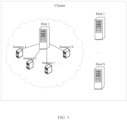
- FIG 1 is a schematic structural diagram illustrating an architecture of a cloud system for resource scheduling according to certain embodiments of the disclosure.
- the architecture of the cloud system as illustrated in FIG 1 is described by using one cluster as an example.
- a cloud computing server provider may be configured with a plurality of clusters.
- the cluster as illustrated in FIG 1 includes M hosts.
- the resources on each host can be described by using storage space as an example.
- the resources on each host can be allocated to different users.
- host 1 as an example, the storage space on host 1 is divided into N parts, which are provided to N users.
- the resource allocated to each user from host 1 is referred to as an instance of the user.
- N instances for example, can run on host 1.
- each target host achieves the maximum improvement on its resource utilization rate, such that the overall resource utilization rate of the cluster is more balanced while the resource demands of the cluster are satisfied with a minimum migration cost.
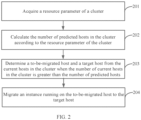
- FIG 2 is a flow diagram illustrating a method for resource scheduling according some embodiments of the disclosure.
- a resource parameter of the cluster is acquired.
- the resource parameter of the cluster in this step may include, for example, a resource configuration quantity of the host and actual resource utilization quantities of the instances running on the host.
- the resource configuration quantity is an inherited configuration parameter of the host.
- the resource configuration quantity may comprise a CPU parameter, a memory capacity, a storage space capacity, and the like.
- the configuration parameter of the hosts in the cluster may be directly collected as the resource configuration quantity.
- the actual resource utilization quantity of each instance running on each host may be collected.
- an actual storage space utilization quantity, an actual memory utilization quantity, and the like, of each instance may be collected.
- the number of predicted hosts in the cluster is calculated according to the resource parameter of the cluster.
- a predicted resource utilization quantity of each instance is acquired by performing a linear regression analysis on the actual resource utilization quantity of each instance.
- Linear regression analysis is a mathematical statistics approach, and is an analytical method to determine a mutually-dependent quantitative relationship between two or more variables.
- a maximum value of the resource utilization quantity in a prospective month may be predicted according to the resource utilization quantity of the instance on each day within a past month, for example, and used as the predicted resource utilization quantity of the instance.
- a sum of the predicted resource utilization quantities of all the instances on each host is used as the predicted resource utilization quantity of each host.
- a sum of the predicated resource utilization quantity of all the hosts in the cluster is calculated, and then used as the predicted resource utilization quantity of the cluster.
- the number of predicted hosts in the cluster is calculated according to the resource configuration quantities of the hosts and the predicted resource utilization quantity of the cluster. Still using storage space as an example, assume that the storage space of a host is 128 GB and a predicted storage space utilization quantity of the cluster is 300 GB, in order to satisfy the 300 GB storage space utilization quantity, at least three hosts are needed, and the number of predicted hosts in the cluster is 3.
- to-be-migrated hosts and target hosts are determined from the current hosts in the cluster when the number of current hosts in the cluster is greater than the number of predicted hosts.
- the current number of hosts in the cluster is the number of hosts online in the cluster.
- the current number of hosts is greater than the number of predicted hosts calculated in step S202, one or more of the hosts in the cluster are redundant, and host resources may be scheduled.
- a difference between the current number of hosts in the cluster and the number of predicted hosts may be calculated, and the difference may be used as a number of to-be-migrated hosts in the cluster.
- a migration cost value of each host in the cluster may be determined. For example, the number of instances running on each host and the total storage space of each instance may be acquired, a notification migration cost value of each host may be calculated according to the number of instances, a data migration cost value of all the instances on each host may be calculated according to the total storage space, and a sum of the notification migration cost value and the data migration cost value is used as the migration cost value of each host. Finally, the calculated number of to-be-migrated hosts is acquired according to an order of the migration cost values, and a same number of remaining hosts as the number of predicted hosts are used as the target hosts.
- step S204 instances running on the to-be-migrated hosts are migrated to the target hosts.
- the to-be-migrated instances running on the to-be-migrated hosts may be sequenced in a descending order of the predicted resource utilization quantities of the instances.
- To-be-migrated instances may be sequentially migrated to a target migration host in the target hosts according to the sequence, wherein the target migration host is a target host whose predicted resource utilization quantity achieves a maximum improvement after the to-be-migrated instance is migrated.
- the predicted resource utilization rate is a ratio of the predicted resource utilization quantity on the target host to the resource configuration quantity.
- the improvement of the predicted resource utilization rate is an improvement in the proportion of the predicted resource utilization rate of the host after a to-be-migrated instance is migrated to the target host.
- each target host by acquiring a resource parameter of the cluster, calculating the number of predicted hosts in the cluster, determining to-be-migrated hosts and target hosts from the current hosts in the cluster when the current number of hosts in the cluster is greater than the number of predicted hosts, and migrating instances running on the to-be-migrated hosts to the target hosts, each target host achieves a maximum improvement on resource utilization rate, such that the overall resource utilization rate of the cluster is more balanced while the resource demands of the cluster are satisfied with a minimum migration cost.
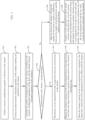
- FIG 3 is a flow diagram illustrating a method for resource scheduling according to some embodiments of the disclosure. Resource scheduling is described in detail in these embodiments.
- a resource configuration quantity of the host in the cluster is collected.
- the resource configuration quantity is an inherited configuration parameter of the host, generally referring to a hardware configuration parameter.
- the resource configuration quantity may comprise a CPU parameter, a memory capacity, a storage space capacity, and the like.
- the configuration parameter of the hosts in the cluster may be directly collected as the resource configuration quantity.
- an actual resource utilization quantity of the instance running on each host in the cluster is collected.
- the actual resource utilization quantity of each instance running on each host may be collected.
- an actual storage space utilization quantity, an actual memory utilization quantity, and the like, of each instance may be collected.
- the number of predicted hosts in the cluster is calculated according to the resource configuration quantities of the hosts and the actual resource utilization quantities of the instances.
- a predicted resource utilization quantity of each instance is acquired by performing a linear regression analysis on the actual resource utilization quantity of each instance.
- storage space utilization as an example, a storage space utilization on each day within a past one month may be acquired, and a linear regression analysis may be performed on the acquired storage space utilization to calculate a maximum value of the storage space utilization in a prospective month. The maximum value may be used as the predicted storage space utilization quantity of the instance.
- a memory utilization on each day within a past month may be acquired, and a linear regression analysis may be performed on the acquired memory utilization to calculate a maximum value of the memory utilization in a prospective month.
- the maximum value may be used as the predicted memory utilization quantity of the instance.
- the predicted resource utilization quantity of each instance After the predicted resource utilization quantity of each instance is acquired, a sum of the predicted resource utilization quantities of all the instances on each host is used as the predicted resource utilization quantity of each host. A sum of the predicated resource utilization quantities of all the hosts in the cluster is calculated and then used as the predicted resource utilization quantity of the cluster. Next, the number of predicted hosts in the cluster is calculated according to the resource configuration quantities of the hosts and the predicted resource utilization quantities of the cluster. Still using storage space as an example, assume that the storage space of a host is 128 GB and a predicted storage space utilization quantity of the cluster is 300 GB. In order to satisfy the 300 GB storage space utilization quantity, at least three hosts are needed, and the number of predicted hosts in the cluster is 3.
- the number of predicted hosts may be calculated with respect to each resource type, and a maximum number may be selected from a plurality of predicted numbers of hosts as the number of predicted hosts in the cluster. For example, if the number of predicted hosts acquired according to the storage space is 3, the number of predicted hosts acquired according to the CPU is 2, and the number of predicted hosts acquired according to the memory is 4, then it is determined that the number of predicted hosts in the cluster is 4.
- step S304 it is determined whether the current number of hosts in the cluster is greater than the number of predicted hosts. If the current number of hosts is greater than the number of predicted hosts, then step S305 is performed; otherwise, step S308 is performed.
- the current number of hosts in the cluster is the number of all hosts online in the cluster.
- the current number of hosts is greater than the number of predicted hosts calculated in step S303, one or more hosts in the cluster are redundant, and the host resources may be scheduled.
- the current number of hosts is smaller than the number of predicted hosts, the hosts in the cluster are insufficient, and new hosts need to be added.
- the to-be-migrated hosts and the target hosts are determined from the current hosts in the cluster.
- the difference between the number of current hosts in the cluster and the number of predicted hosts may be calculated.
- the difference may be used as the number of to-be-migrated hosts in the cluster.
- a migration cost value of each host in the cluster may be determined. For example, the number of instances running on each host and the total storage space of each instance may be acquired, a notification migration cost value of each host may be calculated according to the number of instances, a data migration cost value of all the instances running on each host may be calculated according to the total storage space, and a sum of the notification migration cost value and the data migration cost value may be used as the migration cost value of each host.
- the notification cost and data migration cost may be firstly determined, wherein the notification cost is the manpower cost consumed to notify the user corresponding to each to-be-migrated instance of a migration event, and the data migration cost is a sum of the network traffic transmission cost consumed to migrate each 1 GB of data and the loss cost caused due to input/output (I/O) operations performed for the hard disk when reading and writing data in the process of migrating the data on the to-be-migrated host to the target host.
- I/O input/output
- the notification cost is 1 yuan/instance
- the number of instances is b
- the data migration cost is c yuan/GB
- the total storage space is d GB
- the migration cost of the host is a*b+c*d.
- the to-be-migrated hosts may be acquired according to an order of the migration cost values.
- the number of acquired to-be-migrated hosts is the above calculated number of to-be-migrated hosts. Then, the remaining hosts are used as the target hosts, wherein the number of target hosts is consistent with the number of predicted hosts.
- step S306 the instances running on the to-be-migrated hosts are migrated to the target hosts, such that each target host achieves a maximum improvement on the resource utilization rate.
- the to-be-migrated instances running on the to-be-migrated host may be sequenced in a descending order of the predicted resource utilization quantities of the instances.
- To-be-migrated instances may be sequentially migrated to a target migration host in the target hosts according to the sequence, wherein the target migration host is a target host whose predicted resource utilization quantity achieves maximum improvement after the to-be-migrated instance is migrated to the target host.
- the predicted resource utilization rate of the target host is a ratio of the predicted resource utilization quantity on the target host to the resource configuration quantity.
- the improvement of the predicted resource utilization rate is an improvement in the proportion of the predicted resource utilization rate of the host after a to-be-migrated instance is migrated to the target host.
- a resource utilization rate threshold may be preset for the host to ensure that the actual resource utilization rate of the host is smaller than the preset utilization rate threshold. Therefore, in these embodiments, with respect to the target hosts, the actual resource utilization rate of each target host may be calculated in advance, the target host whose actual resource utilization rate exceeds the preset utilization rate threshold is determined as a first target host, and the remaining target hosts are determined as second target hosts; a first to-be-migrated instance is acquired from the first target host, such that the actual resource utilization rate of the first target host when the first to-be-migrated instance is migrated is smaller than the preset utilization rate threshold; and the first to-be-migrated instance is migrated to the second target host, such that the second target host achieves maximum improvement rate on the resource utilization rate.
- step S307 after the instances running on the to-be-migrated host are migrated to the target host, the to-be-migrated host is controlled to go offline. Then, the method ends.
- step S308 new hosts are added to the cluster, wherein the number of new hosts is equal to the difference between the number of predicted hosts and the number of current hosts.
- the difference between the number of predicted hosts in the cluster and the number of current hosts may be calculated and then used as the number of new hosts to be added to the cluster.
- a to-be-migrated host whose actual resource utilization rate exceeds a preset utilization rate threshold is acquired from the current hosts in the cluster, and at least one instance running on the to-be-migrated host is migrated to the new host such that neither of the actual resource utilization rates of the to-be-migrated host and the new host exceeds the preset utilization rate threshold. Then, the method ends.
- each target host by acquiring a resource parameter of the cluster, calculating the number of predicted hosts in the cluster, determining to-be-migrated hosts and target hosts from the current hosts in the cluster when the current number of hosts in the cluster is greater than the number of predicted hosts, and migrating instances running on the to-be-migrated hosts to the target hosts, each target host achieves maximum improvement on resource utilization rate, such that the overall resource utilization rate of the cluster is more balanced while the resource demands of the cluster are satisfied with a minimum migration cost.
- the present application further provides embodiments illustrating an apparatus and device for resource scheduling.
- the embodiment illustrating the device for resource scheduling is used for describing scheduling of resources of a cluster comprising a plurality of hosts, wherein at least one instance runs on each of the plurality of hosts.
- the apparatus embodiment may be practiced via software, or may be practiced via a combination of hardware and software.
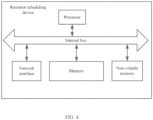
- the apparatus for resource scheduling is formed by reading the corresponding computer program instructions from a non-volatile memory to a memory for execution by using a processor of the device where the apparatus is configured.
- FIG 4 is a schematic structural diagram illustrating hardware of a device where the apparatus for resource scheduling is configured according to the present application.
- the device where the apparatus according to the embodiment is configured may typically further comprise other hardware according to the actual functions of the device, which is not further listed in FIG 4 .
- FIG 5 is a block diagram illustrating an apparatus for resource scheduling according to some embodiments of the disclosure.
- the apparatus includes an acquiring unit 510, a calculating unit 520, a determining unit 530, and a scheduling unit 540.
- the acquiring unit 510 is configured to acquire a resource parameter of the cluster.
- the calculating unit 520 is configured to calculate the number of predicted hosts in the cluster according to the resource parameter.
- the determining unit 530 is configured to determine a to-be-migrated host and a target host from the current hosts in the cluster when the number of current hosts in the cluster is greater than the number of predicted hosts.
- the scheduling unit 540 is configured to migrate an instance running on the to-be-migrated host to the target host.
- FIG 6 is a block diagram illustrating an apparatus for resource scheduling according to some embodiments of the disclosure.
- the apparatus includes an acquiring unit 610, a calculating unit 620, a determining unit 630, a scheduling unit 640, a control unit 650, and an adding unit 660.
- the acquiring unit 610 is configured to acquire a resource parameter of the cluster
- the calculating unit 620 is configured to calculate the number of predicted hosts in the cluster according to the resource parameter.
- the determining unit 630 is configured to determine to-be-migrated hosts and target hosts from the current hosts in the cluster when the number of current hosts in the cluster is greater than the number of predicted hosts.
- the scheduling unit 640 is configured to migrate an instance running on the to-be-migrated host to the target host.
- the control unit 650 is configured to control the to-be-migrated host to go offline from the cluster when the instance running on the to-be-migrated host is migrated to the target host.
- the adding unit 660 is configured to add a new host to the cluster when the current number of hosts in the cluster is smaller than the number of predicted hosts, the number of new hosts being a difference between the number of predicted hosts and the current number of hosts.
- the scheduling unit 640 is further configured to acquire a third host whose actual resource utilization rate exceeds a preset utilization rate threshold from the current hosts in the cluster, and migrate at least one instance running on the third host to the new host, such that neither of the actual resource utilization rates of the third host and the new host exceeds the preset utilization rate threshold.
- the acquiring unit 610 includes ( FIG 7 ):
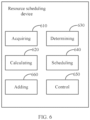
- the calculating unit 620 includes ( FIG 8 ):
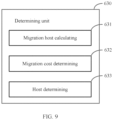
- the determining unit 630 may include ( FIG 9 ):
- the migration cost determining circuitry may be specifically configured to: acquire the number of instances running on each host and a total storage space of each instance; calculate a notification migration cost value of each host according to the number of instances, and calculate a data migration cost value of all the instances on each host according to the total storage space; and calculate a sum of the notification migration cost value and the data migration cost value, and use the sum as the migration cost value of each host.
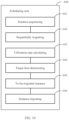
- the scheduling unit 640 may include ( FIG 10 ):
- the scheduling unit 640 may further include:
- the apparatus embodiments substantially correspond to the method embodiments, the apparatus embodiments are described simply, and the relevant part may be obtained with reference to the part of the description in the method embodiments.
- the above described apparatus embodiments are merely for illustration purposes only.
- the units which are described as separate components may be physically separated or may be not physically separated, and the components which are illustrated as units may be or may not be physical units, that is, the components may be located in the same position or may be distributed into a plurality of network units.
- a part or all the modules may be selected according to the actual needs to achieve the objectives of the technical solutions of the embodiments of the present application. Persons of ordinary skill in the art may understand and implement the present application without paying any creative effort.
- each target host when scheduling the resources in the cluster in this embodiment, by acquiring a resource parameter of the cluster, calculating a predicted number of hosts in the cluster, determining a to-be-migrated host and a target host from the current hosts in the cluster when the number of current hosts in the cluster is greater than the number of predicted hosts, and migrating an instance running on the to-be-migrated host to the target host, each target host achieves maximum improvement on resource utilization rate, such that the overall resource utilization rate of the cluster is more balanced while the resource demands of the cluster are satisfied with a minimum migration cost.
- a module or unit is a software, hardware, or firmware (or combinations thereof) system, process or functionality, or component thereof, that performs or facilitates the processes, features, and/or functions described herein (with or without human interaction or augmentation).
- a module can include sub-modules.
- Software components of a module may be stored on a computer readable medium for execution by a processor. Modules may be integral to one or more servers, or be loaded and executed by one or more servers. One or more modules may be grouped into an engine or an application.
- the term "user”, “subscriber” “consumer” or “customer” should be understood to refer to a consumer of data supplied by a data provider.
- the term “user” or “subscriber” can refer to a person who receives data provided by the data or service provider over the Internet in a browser session, or can refer to an automated software application which receives the data and stores or processes the data.
Landscapes
- Engineering & Computer Science (AREA)
- Software Systems (AREA)
- Theoretical Computer Science (AREA)
- Computer Networks & Wireless Communication (AREA)
- Signal Processing (AREA)
- Physics & Mathematics (AREA)
- General Engineering & Computer Science (AREA)
- General Physics & Mathematics (AREA)
- Debugging And Monitoring (AREA)
- Management, Administration, Business Operations System, And Electronic Commerce (AREA)
Claims (13)
- Procédé de planification de ressources comprenant :l'acquisition (201), par un dispositif de planification de ressources, d'un paramètre de ressources d'un cluster, le cluster comportant une pluralité d'hôtes, la pluralité d'hôtes comportant une pluralité d'hôtes courants exécutant chacun une ou plusieurs instances, dans lequel chaque instance comprend une machine virtuelle, ladite acquisition comprenant :la collecte d'une quantité de configuration de ressources de chacun de la pluralité d'hôtes dans le cluster ; etla collecte d'une quantité d'utilisation de ressources réelle de chacune des ou plusieurs instances s'exécutant sur chacun de la pluralité d'hôtes courants dans le cluster ;le calcul (202), par le dispositif de planification de ressources, d'un nombre d'hôtes prédits dans le cluster en fonction des paramètres de ressources par la prédiction des quantités d'utilisation de ressources d'instances dans le cluster et la comparaison d'une utilisation de ressources prédite à des quantités de configuration de ressources de la pluralité d'hôtes, ledit calcul comprenant :la réalisation d'une analyse de régression linéaire sur la quantité d'utilisation de ressources réelle de chacune des une ou plusieurs instances s'exécutant sur chacun de la pluralité d'hôtes courants pour acquérir une quantité d'utilisation de ressources prédite de chacune des ou plusieurs instances ;le calcul d'une somme des quantités d'utilisation de ressources prédites des une ou plusieurs instances s'exécutant sur chacun de la pluralité d'hôtes courants en tant que quantité d'utilisation de ressources prédite de chacun de la pluralité d'hôtes courants ;le calcul d'une somme des quantités d'utilisation de ressources prédites de la pluralité d'hôtes courants en tant que quantité d'utilisation de ressources prédite du cluster ; etle calcul du nombre d'hôtes prédits dans le cluster en fonction des quantités de configuration de ressources de la pluralité d'hôtes et de la quantité d'utilisation de ressources prédite du cluster ; eten réponse à une détermination que le nombre d'hôtes courants dans le cluster est supérieur au nombre d'hôtes prédits :i) la détermination (203), par le dispositif de planification de ressources, d'un ou plusieurs hôtes à migrer et d'un ou plusieurs hôtes cibles parmi les hôtes courants dans le cluster ; etii) la migration (204), par le dispositif de planification de ressources, d'instances s'exécutant sur un hôte à migrer parmi les un ou plusieurs hôtes à migrer vers un hôte cible parmi les un ou plusieurs hôtes cibles.
- Procédé selon la revendication 1, la réalisation d'une analyse de régression linéaire sur la quantité d'utilisation de ressources réelle de chacune des une ou plusieurs instances comprenant la réalisation de l'analyse de régression linéaire à l'aide d'une quantité d'utilisation de ressources réelle historique.
- Procédé selon la revendication 2, la réalisation d'une analyse de régression linéaire sur la quantité d'utilisation de ressources réelle de chacune des une ou plusieurs instances comprenant la sélection d'une valeur maximale générée par l'analyse de régression linéaire et l'utilisation de la valeur maximale en tant que la quantité d'utilisation de ressources prédite.
- Procédé selon la revendication 1, dans lequel la détermination des un ou plusieurs hôtes à migrer et des un ou plusieurs hôtes cibles comprend :le calcul d'une différence entre le nombre d'hôtes courants et le nombre d'hôtes prédits en tant que nombre d'hôtes à migrer dans le cluster ;le calcul d'une valeur de coût de migration pour chacun de la pluralité d'hôtes courants ; etla détermination des hôtes à migrer dans le cluster en fonction d'un ordre des valeurs de coût de migration de la pluralité d'hôtes courants et du nombre calculé d'hôtes à migrer, et d'un nombre d'hôtes courants restants dans le cluster en tant que les un ou plusieurs hôtes cibles.
- Procédé selon la revendication 4, dans lequel le calcul de la valeur de coût de migration comprend :l'acquisition d'un nombre d'instances et d'un espace de stockage total pour chacune des une ou plusieurs instances s'exécutant sur chacun de la pluralité d'hôtes courants ;le calcul d'une valeur de coût de migration de notification pour chacun de la pluralité d'hôtes courants en fonction du nombre d'instances ;le calcul d'une valeur de coût de migration de données pour chacun de la pluralité d'hôtes courants en fonction de l'espace de stockage total pour chacune des une ou plusieurs instances en cours d'exécution ; etle calcul d'une somme de la valeur de coût de migration de notification et de la valeur de coût de migration de données en tant que la valeur de coût de migration pour chacun de la pluralité d'hôtes courants.
- Procédé selon la revendication 1, comprenant en outre :le séquençage, par le dispositif de planification de ressources, des instances s'exécutant sur les un ou plusieurs hôtes à migrer en fonction d'un ordre décroissant des quantités d'utilisation de ressources prédites des instances respectives lorsque le nombre d'hôtes courants dans le cluster est supérieur au nombre d'hôtes prédits ; etle calcul séquentiellement, par le dispositif de planification de ressources lorsque le nombre d'hôtes courants dans le cluster est supérieur au nombre d'hôtes prédits, d'un hôte de migration cible correspondant parmi les un ou plusieurs hôtes cibles pour chaque instance s'exécutant sur les un ou plusieurs hôtes à migrer, l'hôte de migration cible étant un hôte parmi les un ou plusieurs hôtes cibles pour lequel une quantité d'utilisation de ressources prédite atteint une amélioration maximale après que l'instance respective est migrée vers l'hôte de migration cible, et la migration de chaque instance s'exécutant sur les un ou plusieurs hôtes à migrer vers l'hôte de migration cible respectif,dans lequel la migration d'instances s'exécutant sur l'hôte à migrer vers l'hôte cible est la migration d'une première instance s'exécutant sur un premier hôte à migrer vers l'hôte de migration cible correspondant.
- Procédé selon la revendication 1, la collecte d'une quantité de configuration de ressources de chacun de la pluralité d'hôtes dans le cluster comprenant la collecte d'un paramètre sélectionné dans le groupe se composant de paramètres de CPU, de capacités de mémoire et de capacités d'espace de stockage.
- Procédé selon la revendication 5, la collecte d'une quantité d'utilisation de ressources réelle de chacune des une ou plusieurs instances s'exécutant sur chacun de la pluralité d'hôtes courants dans le cluster comprenant la collecte d'une quantité sélectionnée dans le groupe se composant d'une quantité d'utilisation d'espace de stockage réelle et d'une quantité d'utilisation de mémoire réelle.
- Procédé selon la revendication 1, comprenant en outre :
la commande, par le dispositif de planification de ressources lorsque le nombre d'hôtes courants dans le cluster est supérieur au nombre d'hôtes prédits, à l'hôte à migrer parmi les un ou plusieurs hôtes de se déconnecter du cluster lorsque des instances s'exécutant sur l'hôte à migrer sont migrées vers l'hôte cible. - Procédé selon la revendication 1, comprenant en outre :le calcul, par le dispositif de planification de ressources lorsque le nombre d'hôtes courants dans le cluster est supérieur au nombre d'hôtes prédits, d'un taux d'utilisation de ressources réelle correspondant à chacun des un ou plusieurs hôtes cibles ;la détermination, par le dispositif de planification de ressources lorsque le nombre d'hôtes courants dans le cluster est supérieur au nombre d'hôtes prédits, d'un premier hôte cible parmi les un ou plusieurs hôtes cibles pour lequel un taux d'utilisation de ressources réelle dépasse un seuil de taux d'utilisation prédéfini ;la détermination, par le dispositif de planification de ressources lorsque le nombre d'hôtes courants dans le cluster est supérieur au nombre d'hôtes prédits, d'une première instance à migrer parmi les une ou plusieurs instances s'exécutant sur le premier hôte cible, de manière à déterminer que le taux d'utilisation de ressources réelle du premier hôte cible est inférieur au seuil de taux d'utilisation prédéfini après la migration de la première instance à migrer ; etla migration, par le dispositif de planification de ressources lorsque le nombre d'hôtes courants dans le cluster est supérieur au nombre d'hôtes prédits, de la première instance à migrer vers un deuxième hôte cible parmi les un ou plusieurs hôtes cibles, le deuxième hôte cible étant déterminé pour atteindre une amélioration maximale sur le taux d'utilisation de ressources après la migration de la première instance à migrer.
- Procédé selon la revendication 1, comprenant en outre :la détermination, par le dispositif de planification de ressources lorsque le nombre d'hôtes courants est inférieur au nombre d'hôtes prédits, d'un premier hôte courant parmi la pluralité d'hôtes courants pour lequel un taux d'utilisation de ressources réelle dépasse un seuil de taux d'utilisation prédéfini ;la détermination, par le dispositif de planification de ressources lorsque le nombre d'hôtes courants est inférieur au nombre d'hôtes prédits, d'un groupe d'instances parmi les une ou plusieurs instances s'exécutant sur le premier hôte courant, de manière à déterminer que le taux d'utilisation de ressources réelle du premier hôte courant est inférieur au seuil de taux d'utilisation prédéfini après la migration du groupe d'instances ; etl'ajout, par le dispositif de planification de ressources, d'un ou plusieurs nouveaux hôtes depuis le cluster, lorsque le nombre d'hôtes courants est inférieur au nombre d'hôtes prédits, un nombre des nouveaux hôtes étant égal à une différence entre le nombre d'hôtes prédits et le nombre d'hôtes courants, et la migration du groupe d'instances vers un deuxième hôte parmi les un ou plusieurs nouveaux hôtes, le deuxième hôte étant déterminé de sorte qu'un taux d'utilisation de ressources réelle du deuxième hôte ne dépasse pas le seuil de taux d'utilisation prédéfini après migration.
- Support lisible par ordinateur sur lequel sont stockées une pluralité d'instructions, la pluralité d'instructions comportant des instructions qui, lorsqu'elles sont exécutées par un processeur, amènent le processeur à réaliser les étapes d'un procédé selon l'une quelconque des revendications précédentes.
- Appareil adapté pour réaliser un procédé selon l'une quelconque des revendications 1 à 11.
Applications Claiming Priority (3)
| Application Number | Priority Date | Filing Date | Title |
|---|---|---|---|
| CN201510404937.XA CN106326002B (zh) | 2015-07-10 | 2015-07-10 | 资源调度方法、装置及设备 |
| US15/204,623 US10432550B2 (en) | 2015-07-10 | 2016-07-07 | Method and device for computing resource scheduling |
| PCT/US2016/041426 WO2017011282A1 (fr) | 2015-07-10 | 2016-07-08 | Procédé et dispositif pour le calcul de la planification de ressources |
Publications (3)
| Publication Number | Publication Date |
|---|---|
| EP3320433A1 EP3320433A1 (fr) | 2018-05-16 |
| EP3320433A4 EP3320433A4 (fr) | 2019-01-16 |
| EP3320433B1 true EP3320433B1 (fr) | 2024-08-21 |
Family
ID=57726097
Family Applications (1)
| Application Number | Title | Priority Date | Filing Date |
|---|---|---|---|
| EP16824928.2A Active EP3320433B1 (fr) | 2015-07-10 | 2016-07-08 | Procédé et dispositif pour le calcul de la planification de ressources |
Country Status (4)
| Country | Link |
|---|---|
| US (1) | US10432550B2 (fr) |
| EP (1) | EP3320433B1 (fr) |
| CN (1) | CN106326002B (fr) |
| WO (1) | WO2017011282A1 (fr) |
Families Citing this family (14)
| Publication number | Priority date | Publication date | Assignee | Title |
|---|---|---|---|---|
| CN107133087A (zh) * | 2016-02-29 | 2017-09-05 | 阿里巴巴集团控股有限公司 | 一种资源调度方法与设备 |
| CN109033007A (zh) * | 2017-02-28 | 2018-12-18 | 惠安县云点网络科技有限公司 | 一种动态计算装置 |
| CN107547622B (zh) * | 2017-06-28 | 2021-10-12 | 新华三技术有限公司 | 一种资源调整方法及装置 |
| CN109918189B (zh) * | 2017-12-12 | 2022-11-11 | 腾讯科技(深圳)有限公司 | 一种资源管理方法及相关设备 |
| CN110888733B (zh) * | 2018-09-11 | 2023-12-26 | 三六零科技集团有限公司 | 集群资源使用情况处理方法、装置及电子设备 |
| CN113407317A (zh) * | 2018-09-11 | 2021-09-17 | 华为技术有限公司 | 一种资源调度方法及装置 |
| CN110888898A (zh) * | 2018-09-11 | 2020-03-17 | 北京奇虎科技有限公司 | 集群资源使用情况处理方法、装置及电子设备 |
| CN111352721A (zh) * | 2018-12-21 | 2020-06-30 | 中国移动通信集团山东有限公司 | 一种业务的迁移方法及装置 |
| US10853084B2 (en) * | 2019-02-13 | 2020-12-01 | Abb Schweiz Ag | System and method for coordinating resources |
| CN109947531B (zh) * | 2019-02-27 | 2021-05-07 | 广东唯一网络科技有限公司 | 超融合一体机的存储容量扩展方法、装置及存储介质 |
| CN109976880B (zh) * | 2019-04-10 | 2021-08-31 | 上海东方财富证券投资咨询有限公司 | 一种虚拟机资源使用的方法及其系统 |
| CN111382141B (zh) * | 2020-02-29 | 2023-05-26 | 平安科技(深圳)有限公司 | 主从架构配置方法、装置、设备以及计算机可读存储介质 |
| US11438408B2 (en) * | 2021-01-20 | 2022-09-06 | EMC IP Holding Company LLC | Transferring applications from overutilized arrays of computer systems to underutilized arrays of computer systems |
| CN121173762B (zh) * | 2025-11-19 | 2026-03-27 | 浙江大华技术股份有限公司 | 一种数据恢复方法、设备及存储介质 |
Family Cites Families (65)
| Publication number | Priority date | Publication date | Assignee | Title |
|---|---|---|---|---|
| JP2002163590A (ja) | 2000-11-28 | 2002-06-07 | Sony Corp | 代行システム、代行方法、サービス代行サーバ、事業者サーバ、記録媒体 |
| US20030074606A1 (en) * | 2001-09-10 | 2003-04-17 | Udi Boker | Network-based control center for conducting performance tests of server systems |
| US7502859B2 (en) | 2003-09-19 | 2009-03-10 | Panasonic Corporation | Dynamic resource management for distributed retrieval system for security |
| US8078708B1 (en) | 2004-01-15 | 2011-12-13 | Nortel Networks Limited | Grid proxy architecture for network resources |
| CN1954565A (zh) | 2004-05-19 | 2007-04-25 | Kddi株式会社 | 内容分发控制系统及其分发计划方法,通信终端及其计算机程序 |
| US20110016214A1 (en) | 2009-07-15 | 2011-01-20 | Cluster Resources, Inc. | System and method of brokering cloud computing resources |
| US9015324B2 (en) * | 2005-03-16 | 2015-04-21 | Adaptive Computing Enterprises, Inc. | System and method of brokering cloud computing resources |
| TWI276322B (en) | 2005-12-28 | 2007-03-11 | Ind Tech Res Inst | A system and a method of request scheduling using request classification and allowable server resource for the differentiated quality of service |
| US8429630B2 (en) | 2005-09-15 | 2013-04-23 | Ca, Inc. | Globally distributed utility computing cloud |
| JP5238235B2 (ja) * | 2007-12-07 | 2013-07-17 | 株式会社日立製作所 | 管理装置及び管理方法 |
| US8903983B2 (en) * | 2008-02-29 | 2014-12-02 | Dell Software Inc. | Method, system and apparatus for managing, modeling, predicting, allocating and utilizing resources and bottlenecks in a computer network |
| US8345691B2 (en) | 2008-05-15 | 2013-01-01 | Cellco Partnership | Scheduling with quality of service support in wireless system |
| US20100076856A1 (en) | 2008-09-25 | 2010-03-25 | Microsoft Corporation | Real-Time Auction of Cloud Computing Resources |
| US8347302B1 (en) | 2008-10-09 | 2013-01-01 | Amazon Technologies, Inc. | System-aware resource scheduling |
| US9396042B2 (en) * | 2009-04-17 | 2016-07-19 | Citrix Systems, Inc. | Methods and systems for evaluating historical metrics in selecting a physical host for execution of a virtual machine |
| US8285681B2 (en) | 2009-06-30 | 2012-10-09 | Commvault Systems, Inc. | Data object store and server for a cloud storage environment, including data deduplication and data management across multiple cloud storage sites |
| US20110126197A1 (en) * | 2009-11-25 | 2011-05-26 | Novell, Inc. | System and method for controlling cloud and virtualized data centers in an intelligent workload management system |
| US8676949B2 (en) * | 2009-11-25 | 2014-03-18 | Citrix Systems, Inc. | Methods for interfacing with a virtualized computing service over a network using a lightweight client |
| US8402140B2 (en) * | 2010-01-13 | 2013-03-19 | Nec Laboratories America, Inc. | Methods and apparatus for coordinated energy management in virtualized data centers |
| US8959217B2 (en) | 2010-01-15 | 2015-02-17 | Joyent, Inc. | Managing workloads and hardware resources in a cloud resource |
| US9130912B2 (en) * | 2010-03-05 | 2015-09-08 | International Business Machines Corporation | System and method for assisting virtual machine instantiation and migration |
| US8826292B2 (en) | 2010-08-06 | 2014-09-02 | Red Hat Israel, Ltd. | Migrating virtual machines based on level of resource sharing and expected load per resource on candidate target host machines |
| AU2011293350B2 (en) * | 2010-08-24 | 2015-10-29 | Solano Labs, Inc. | Method and apparatus for clearing cloud compute demand |
| US8656023B1 (en) | 2010-08-26 | 2014-02-18 | Adobe Systems Incorporated | Optimization scheduler for deploying applications on a cloud |
| US9069610B2 (en) | 2010-10-13 | 2015-06-30 | Microsoft Technology Licensing, Llc | Compute cluster with balanced resources |
| US8768875B2 (en) | 2010-10-29 | 2014-07-01 | Nec Laboratories America, Inc. | Admission control in cloud databases under service level agreements |
| US8918784B1 (en) | 2010-12-21 | 2014-12-23 | Amazon Technologies, Inc. | Providing service quality levels through CPU scheduling |
| TW201227785A (en) | 2010-12-28 | 2012-07-01 | Nat Univ Tsing Hua | Devices and methods for appliance usage scheduling and control using on-line calendar services with open API |
| US8843933B1 (en) | 2011-05-25 | 2014-09-23 | Vmware, Inc. | System and method for managing a virtualized computing environment |
| CN102346460B (zh) | 2011-05-27 | 2013-11-13 | 运软网络科技(上海)有限公司 | 一种基于事务的服务控制系统及其控制方法 |
| US20130006793A1 (en) * | 2011-06-29 | 2013-01-03 | International Business Machines Corporation | Migrating Computing Environment Entitlement Contracts Based on Seller and Buyer Specified Criteria |
| US9760917B2 (en) * | 2011-06-29 | 2017-09-12 | International Business Machines Corporation | Migrating computing environment entitlement contracts between a seller and a buyer |
| EP2748705A4 (fr) * | 2011-08-25 | 2015-05-20 | Virtustream Inc | Systèmes et procédés de gestion de ressources compatibles avec l'hôte impliquant des réserves de ressources à base de grappes |
| US9135581B1 (en) | 2011-08-31 | 2015-09-15 | Amazon Technologies, Inc. | Resource constrained task scheduling |
| US8612599B2 (en) | 2011-09-07 | 2013-12-17 | Accenture Global Services Limited | Cloud service monitoring system |
| US8694644B2 (en) | 2011-09-29 | 2014-04-08 | Nec Laboratories America, Inc. | Network-aware coordination of virtual machine migrations in enterprise data centers and clouds |
| US8826277B2 (en) | 2011-11-29 | 2014-09-02 | International Business Machines Corporation | Cloud provisioning accelerator |
| US8863141B2 (en) * | 2011-12-14 | 2014-10-14 | International Business Machines Corporation | Estimating migration costs for migrating logical partitions within a virtualized computing environment based on a migration cost history |
| US8787154B1 (en) | 2011-12-29 | 2014-07-22 | Juniper Networks, Inc. | Multi-topology resource scheduling within a computer network |
| CN103197952B (zh) | 2012-01-09 | 2017-08-25 | 华为技术有限公司 | 基于云基础设施的针对应用系统维护部署的管理系统和方法 |
| US9170849B2 (en) | 2012-01-09 | 2015-10-27 | Microsoft Technology Licensing, Llc | Migration of task to different pool of resources based on task retry count during task lease |
| JP6019139B2 (ja) | 2012-02-06 | 2016-11-02 | エンパイア テクノロジー ディベロップメント エルエルシー | クラウドサービス間の転送時のアプリケーション性能の維持 |
| US8862744B2 (en) | 2012-02-14 | 2014-10-14 | Telefonaktiebolaget L M Ericsson (Publ) | Optimizing traffic load in a communications network |
| US9086929B2 (en) | 2012-04-06 | 2015-07-21 | International Business Machines Corporation | Dynamic allocation of a workload across a plurality of clouds |
| US9223634B2 (en) | 2012-05-02 | 2015-12-29 | Cisco Technology, Inc. | System and method for simulating virtual machine migration in a network environment |
| US9027024B2 (en) * | 2012-05-09 | 2015-05-05 | Rackspace Us, Inc. | Market-based virtual machine allocation |
| US8850432B2 (en) | 2012-05-30 | 2014-09-30 | Red Hat, Inc. | Controlling utilization in a multi-tenant platform-as-a-service (PaaS) environment in a cloud computing system |
| US8930948B2 (en) | 2012-06-21 | 2015-01-06 | Vmware, Inc. | Opportunistically proactive resource management using spare capacity |
| US9396008B2 (en) * | 2012-07-13 | 2016-07-19 | Ca, Inc. | System and method for continuous optimization of computing systems with automated assignment of virtual machines and physical machines to hosts |
| US9323577B2 (en) * | 2012-09-20 | 2016-04-26 | Amazon Technologies, Inc. | Automated profiling of resource usage |
| EP2775399A4 (fr) | 2012-12-26 | 2015-04-29 | Huawei Tech Co Ltd | Procédé de gestion de ressources de système de machine virtuelle, système de machine virtuelle et appareil |
| US9608933B2 (en) | 2013-01-24 | 2017-03-28 | Hitachi, Ltd. | Method and system for managing cloud computing environment |
| US9201706B2 (en) | 2013-03-11 | 2015-12-01 | International Business Machines Corporation | Minimizing workload migrations during cloud maintenance operations |
| US9454294B2 (en) * | 2013-03-15 | 2016-09-27 | International Business Machines Corporation | Creating, provisioning and managing virtual data centers |
| US20140280595A1 (en) | 2013-03-15 | 2014-09-18 | Polycom, Inc. | Cloud Based Elastic Load Allocation for Multi-media Conferencing |
| US9270624B2 (en) | 2013-05-10 | 2016-02-23 | Oracle International Corporation | Cloud messaging services optimization through adaptive message compression |
| US9350681B1 (en) | 2013-05-31 | 2016-05-24 | Gogrid, LLC | System and method for distributed management of cloud resources in a hosting environment |
| US9363190B2 (en) * | 2013-07-31 | 2016-06-07 | Manjrasoft Pty. Ltd. | System, method and computer program product for energy-efficient and service level agreement (SLA)-based management of data centers for cloud computing |
| CN103605574A (zh) * | 2013-11-18 | 2014-02-26 | 浪潮(北京)电子信息产业有限公司 | 一种服务器集群中的虚拟机资源调度方法及系统 |
| US9348654B2 (en) * | 2013-11-19 | 2016-05-24 | International Business Machines Corporation | Management of virtual machine migration in an operating environment |
| US9444695B2 (en) | 2014-01-30 | 2016-09-13 | Xerox Corporation | Methods and systems for scheduling a task |
| US10044795B2 (en) * | 2014-07-11 | 2018-08-07 | Vmware Inc. | Methods and apparatus for rack deployments for virtual computing environments |
| US9825881B2 (en) * | 2014-09-30 | 2017-11-21 | Sony Interactive Entertainment America Llc | Methods and systems for portably deploying applications on one or more cloud systems |
| US9921866B2 (en) | 2014-12-22 | 2018-03-20 | Intel Corporation | CPU overprovisioning and cloud compute workload scheduling mechanism |
| US9946564B2 (en) * | 2015-06-23 | 2018-04-17 | International Business Machines Corporation | Adjusting virtual machine migration plans based on alert conditions related to future migrations |
-
2015
- 2015-07-10 CN CN201510404937.XA patent/CN106326002B/zh active Active
-
2016
- 2016-07-07 US US15/204,623 patent/US10432550B2/en active Active
- 2016-07-08 WO PCT/US2016/041426 patent/WO2017011282A1/fr not_active Ceased
- 2016-07-08 EP EP16824928.2A patent/EP3320433B1/fr active Active
Also Published As
| Publication number | Publication date |
|---|---|
| US20170012892A1 (en) | 2017-01-12 |
| US10432550B2 (en) | 2019-10-01 |
| CN106326002A (zh) | 2017-01-11 |
| CN106326002B (zh) | 2020-10-20 |
| WO2017011282A1 (fr) | 2017-01-19 |
| EP3320433A1 (fr) | 2018-05-16 |
| EP3320433A4 (fr) | 2019-01-16 |
Similar Documents
| Publication | Publication Date | Title |
|---|---|---|
| US10432550B2 (en) | Method and device for computing resource scheduling | |
| EP3525096B1 (fr) | Procédé de commande d'équilibrage de charge de ressources et un ordonnanceur de cluster | |
| JP7304887B2 (ja) | 仮想マシンスケジューリング方法および装置 | |
| Van den Bossche et al. | Online cost-efficient scheduling of deadline-constrained workloads on hybrid clouds | |
| Moschakis et al. | A meta-heuristic optimization approach to the scheduling of bag-of-tasks applications on heterogeneous clouds with multi-level arrivals and critical jobs | |
| US20190158582A1 (en) | Resource allocation diagnosis on distributed computer systems | |
| US9037880B2 (en) | Method and system for automated application layer power management solution for serverside applications | |
| US20170109204A1 (en) | Cpu resource management in computer cluster | |
| US20230060445A1 (en) | Predictive scaling of datacenters | |
| US20220413941A1 (en) | Computing clusters | |
| US20190179944A1 (en) | Predictive scaling for cloud applications | |
| WO2009029496A1 (fr) | Virtualisation de système de planification | |
| US9423957B2 (en) | Adaptive system provisioning | |
| CN110618865B (zh) | Hadoop任务调度方法及装置 | |
| CN105045667B (zh) | 一种用于虚拟机vCPU调度的资源池管理方法 | |
| US20150286508A1 (en) | Transparently routing job submissions between disparate environments | |
| CN112000460A (zh) | 一种基于改进贝叶斯算法的服务扩缩容的方法及相关设备 | |
| CN119883631B (zh) | 资源分配方法、装置、电子设备及存储介质 | |
| US12045664B1 (en) | Classifying workloads for burstable compute platforms | |
| US12155671B2 (en) | Methods and systems for provisioning cloud computing services | |
| Moldovan et al. | MELA: elasticity analytics for cloud services | |
| HK1233001A (en) | Resource scheduling method, device and apparatus | |
| HK1233001A1 (en) | Resource scheduling method, device and apparatus | |
| Kumar et al. | Interface aware scheduling of tasks on cloud | |
| Ghiț et al. | An approximate bribe queueing model for bid advising in cloud spot markets |
Legal Events
| Date | Code | Title | Description |
|---|---|---|---|
| STAA | Information on the status of an ep patent application or granted ep patent |
Free format text: STATUS: THE INTERNATIONAL PUBLICATION HAS BEEN MADE |
|
| PUAI | Public reference made under article 153(3) epc to a published international application that has entered the european phase |
Free format text: ORIGINAL CODE: 0009012 |
|
| STAA | Information on the status of an ep patent application or granted ep patent |
Free format text: STATUS: REQUEST FOR EXAMINATION WAS MADE |
|
| 17P | Request for examination filed |
Effective date: 20171229 |
|
| AK | Designated contracting states |
Kind code of ref document: A1 Designated state(s): AL AT BE BG CH CY CZ DE DK EE ES FI FR GB GR HR HU IE IS IT LI LT LU LV MC MK MT NL NO PL PT RO RS SE SI SK SM TR |
|
| AX | Request for extension of the european patent |
Extension state: BA ME |
|
| DAV | Request for validation of the european patent (deleted) | ||
| DAX | Request for extension of the european patent (deleted) | ||
| A4 | Supplementary search report drawn up and despatched |
Effective date: 20181219 |
|
| RIC1 | Information provided on ipc code assigned before grant |
Ipc: G06F 15/173 20060101ALI20181213BHEP Ipc: H04W 72/08 20090101ALI20181213BHEP Ipc: G06F 17/50 20060101ALI20181213BHEP Ipc: H04W 72/10 20090101ALI20181213BHEP Ipc: G06F 9/50 20060101ALI20181213BHEP Ipc: G06F 9/455 20180101AFI20181213BHEP |
|
| STAA | Information on the status of an ep patent application or granted ep patent |
Free format text: STATUS: EXAMINATION IS IN PROGRESS |
|
| 17Q | First examination report despatched |
Effective date: 20200422 |
|
| P01 | Opt-out of the competence of the unified patent court (upc) registered |
Effective date: 20230418 |
|
| REG | Reference to a national code |
Ref country code: DE Ref legal event code: R079 Free format text: PREVIOUS MAIN CLASS: G06F0009455000 Ipc: H04L0067100000 Ref country code: DE Ref legal event code: R079 Ref document number: 602016089035 Country of ref document: DE Free format text: PREVIOUS MAIN CLASS: G06F0009455000 Ipc: H04L0067100000 |
|
| GRAP | Despatch of communication of intention to grant a patent |
Free format text: ORIGINAL CODE: EPIDOSNIGR1 |
|
| STAA | Information on the status of an ep patent application or granted ep patent |
Free format text: STATUS: GRANT OF PATENT IS INTENDED |
|
| RIC1 | Information provided on ipc code assigned before grant |
Ipc: G06F 9/50 20060101ALI20240215BHEP Ipc: G06F 9/455 20180101ALI20240215BHEP Ipc: H04L 47/83 20220101ALI20240215BHEP Ipc: H04L 67/148 20220101ALI20240215BHEP Ipc: H04L 47/70 20220101ALI20240215BHEP Ipc: H04L 47/785 20220101ALI20240215BHEP Ipc: H04L 67/10 20220101AFI20240215BHEP |
|
| INTG | Intention to grant announced |
Effective date: 20240318 |
|
| GRAS | Grant fee paid |
Free format text: ORIGINAL CODE: EPIDOSNIGR3 |
|
| GRAA | (expected) grant |
Free format text: ORIGINAL CODE: 0009210 |
|
| STAA | Information on the status of an ep patent application or granted ep patent |
Free format text: STATUS: THE PATENT HAS BEEN GRANTED |
|
| AK | Designated contracting states |
Kind code of ref document: B1 Designated state(s): AL AT BE BG CH CY CZ DE DK EE ES FI FR GB GR HR HU IE IS IT LI LT LU LV MC MK MT NL NO PL PT RO RS SE SI SK SM TR |
|
| REG | Reference to a national code |
Ref country code: GB Ref legal event code: FG4D |
|
| REG | Reference to a national code |
Ref country code: CH Ref legal event code: EP |
|
| REG | Reference to a national code |
Ref country code: DE Ref legal event code: R096 Ref document number: 602016089035 Country of ref document: DE |
|
| REG | Reference to a national code |
Ref country code: IE Ref legal event code: FG4D |
|
| REG | Reference to a national code |
Ref country code: LT Ref legal event code: MG9D |
|
| REG | Reference to a national code |
Ref country code: NL Ref legal event code: MP Effective date: 20240821 |
|
| PG25 | Lapsed in a contracting state [announced via postgrant information from national office to epo] |
Ref country code: NO Free format text: LAPSE BECAUSE OF FAILURE TO SUBMIT A TRANSLATION OF THE DESCRIPTION OR TO PAY THE FEE WITHIN THE PRESCRIBED TIME-LIMIT Effective date: 20241121 |
|
| REG | Reference to a national code |
Ref country code: AT Ref legal event code: MK05 Ref document number: 1716678 Country of ref document: AT Kind code of ref document: T Effective date: 20240821 |
|
| PG25 | Lapsed in a contracting state [announced via postgrant information from national office to epo] |
Ref country code: FI Free format text: LAPSE BECAUSE OF FAILURE TO SUBMIT A TRANSLATION OF THE DESCRIPTION OR TO PAY THE FEE WITHIN THE PRESCRIBED TIME-LIMIT Effective date: 20240821 Ref country code: GR Free format text: LAPSE BECAUSE OF FAILURE TO SUBMIT A TRANSLATION OF THE DESCRIPTION OR TO PAY THE FEE WITHIN THE PRESCRIBED TIME-LIMIT Effective date: 20241122 Ref country code: PL Free format text: LAPSE BECAUSE OF FAILURE TO SUBMIT A TRANSLATION OF THE DESCRIPTION OR TO PAY THE FEE WITHIN THE PRESCRIBED TIME-LIMIT Effective date: 20240821 Ref country code: PT Free format text: LAPSE BECAUSE OF FAILURE TO SUBMIT A TRANSLATION OF THE DESCRIPTION OR TO PAY THE FEE WITHIN THE PRESCRIBED TIME-LIMIT Effective date: 20241223 Ref country code: NL Free format text: LAPSE BECAUSE OF FAILURE TO SUBMIT A TRANSLATION OF THE DESCRIPTION OR TO PAY THE FEE WITHIN THE PRESCRIBED TIME-LIMIT Effective date: 20240821 |
|
| PG25 | Lapsed in a contracting state [announced via postgrant information from national office to epo] |
Ref country code: BG Free format text: LAPSE BECAUSE OF FAILURE TO SUBMIT A TRANSLATION OF THE DESCRIPTION OR TO PAY THE FEE WITHIN THE PRESCRIBED TIME-LIMIT Effective date: 20240821 |
|
| PG25 | Lapsed in a contracting state [announced via postgrant information from national office to epo] |
Ref country code: LV Free format text: LAPSE BECAUSE OF FAILURE TO SUBMIT A TRANSLATION OF THE DESCRIPTION OR TO PAY THE FEE WITHIN THE PRESCRIBED TIME-LIMIT Effective date: 20240821 |
|
| PG25 | Lapsed in a contracting state [announced via postgrant information from national office to epo] |
Ref country code: AT Free format text: LAPSE BECAUSE OF FAILURE TO SUBMIT A TRANSLATION OF THE DESCRIPTION OR TO PAY THE FEE WITHIN THE PRESCRIBED TIME-LIMIT Effective date: 20240821 Ref country code: IS Free format text: LAPSE BECAUSE OF FAILURE TO SUBMIT A TRANSLATION OF THE DESCRIPTION OR TO PAY THE FEE WITHIN THE PRESCRIBED TIME-LIMIT Effective date: 20241221 |
|
| PG25 | Lapsed in a contracting state [announced via postgrant information from national office to epo] |
Ref country code: HR Free format text: LAPSE BECAUSE OF FAILURE TO SUBMIT A TRANSLATION OF THE DESCRIPTION OR TO PAY THE FEE WITHIN THE PRESCRIBED TIME-LIMIT Effective date: 20240821 |
|
| PG25 | Lapsed in a contracting state [announced via postgrant information from national office to epo] |
Ref country code: RS Free format text: LAPSE BECAUSE OF FAILURE TO SUBMIT A TRANSLATION OF THE DESCRIPTION OR TO PAY THE FEE WITHIN THE PRESCRIBED TIME-LIMIT Effective date: 20241121 Ref country code: ES Free format text: LAPSE BECAUSE OF FAILURE TO SUBMIT A TRANSLATION OF THE DESCRIPTION OR TO PAY THE FEE WITHIN THE PRESCRIBED TIME-LIMIT Effective date: 20240821 |
|
| PG25 | Lapsed in a contracting state [announced via postgrant information from national office to epo] |
Ref country code: RS Free format text: LAPSE BECAUSE OF FAILURE TO SUBMIT A TRANSLATION OF THE DESCRIPTION OR TO PAY THE FEE WITHIN THE PRESCRIBED TIME-LIMIT Effective date: 20241121 Ref country code: PT Free format text: LAPSE BECAUSE OF FAILURE TO SUBMIT A TRANSLATION OF THE DESCRIPTION OR TO PAY THE FEE WITHIN THE PRESCRIBED TIME-LIMIT Effective date: 20241223 Ref country code: PL Free format text: LAPSE BECAUSE OF FAILURE TO SUBMIT A TRANSLATION OF THE DESCRIPTION OR TO PAY THE FEE WITHIN THE PRESCRIBED TIME-LIMIT Effective date: 20240821 Ref country code: NO Free format text: LAPSE BECAUSE OF FAILURE TO SUBMIT A TRANSLATION OF THE DESCRIPTION OR TO PAY THE FEE WITHIN THE PRESCRIBED TIME-LIMIT Effective date: 20241121 Ref country code: NL Free format text: LAPSE BECAUSE OF FAILURE TO SUBMIT A TRANSLATION OF THE DESCRIPTION OR TO PAY THE FEE WITHIN THE PRESCRIBED TIME-LIMIT Effective date: 20240821 Ref country code: LV Free format text: LAPSE BECAUSE OF FAILURE TO SUBMIT A TRANSLATION OF THE DESCRIPTION OR TO PAY THE FEE WITHIN THE PRESCRIBED TIME-LIMIT Effective date: 20240821 Ref country code: IS Free format text: LAPSE BECAUSE OF FAILURE TO SUBMIT A TRANSLATION OF THE DESCRIPTION OR TO PAY THE FEE WITHIN THE PRESCRIBED TIME-LIMIT Effective date: 20241221 Ref country code: HR Free format text: LAPSE BECAUSE OF FAILURE TO SUBMIT A TRANSLATION OF THE DESCRIPTION OR TO PAY THE FEE WITHIN THE PRESCRIBED TIME-LIMIT Effective date: 20240821 Ref country code: GR Free format text: LAPSE BECAUSE OF FAILURE TO SUBMIT A TRANSLATION OF THE DESCRIPTION OR TO PAY THE FEE WITHIN THE PRESCRIBED TIME-LIMIT Effective date: 20241122 Ref country code: FI Free format text: LAPSE BECAUSE OF FAILURE TO SUBMIT A TRANSLATION OF THE DESCRIPTION OR TO PAY THE FEE WITHIN THE PRESCRIBED TIME-LIMIT Effective date: 20240821 Ref country code: ES Free format text: LAPSE BECAUSE OF FAILURE TO SUBMIT A TRANSLATION OF THE DESCRIPTION OR TO PAY THE FEE WITHIN THE PRESCRIBED TIME-LIMIT Effective date: 20240821 Ref country code: BG Free format text: LAPSE BECAUSE OF FAILURE TO SUBMIT A TRANSLATION OF THE DESCRIPTION OR TO PAY THE FEE WITHIN THE PRESCRIBED TIME-LIMIT Effective date: 20240821 Ref country code: AT Free format text: LAPSE BECAUSE OF FAILURE TO SUBMIT A TRANSLATION OF THE DESCRIPTION OR TO PAY THE FEE WITHIN THE PRESCRIBED TIME-LIMIT Effective date: 20240821 |
|
| PG25 | Lapsed in a contracting state [announced via postgrant information from national office to epo] |
Ref country code: SM Free format text: LAPSE BECAUSE OF FAILURE TO SUBMIT A TRANSLATION OF THE DESCRIPTION OR TO PAY THE FEE WITHIN THE PRESCRIBED TIME-LIMIT Effective date: 20240821 Ref country code: DK Free format text: LAPSE BECAUSE OF FAILURE TO SUBMIT A TRANSLATION OF THE DESCRIPTION OR TO PAY THE FEE WITHIN THE PRESCRIBED TIME-LIMIT Effective date: 20240821 Ref country code: RO Free format text: LAPSE BECAUSE OF FAILURE TO SUBMIT A TRANSLATION OF THE DESCRIPTION OR TO PAY THE FEE WITHIN THE PRESCRIBED TIME-LIMIT Effective date: 20240821 |
|
| PG25 | Lapsed in a contracting state [announced via postgrant information from national office to epo] |
Ref country code: EE Free format text: LAPSE BECAUSE OF FAILURE TO SUBMIT A TRANSLATION OF THE DESCRIPTION OR TO PAY THE FEE WITHIN THE PRESCRIBED TIME-LIMIT Effective date: 20240821 |
|
| PG25 | Lapsed in a contracting state [announced via postgrant information from national office to epo] |
Ref country code: CZ Free format text: LAPSE BECAUSE OF FAILURE TO SUBMIT A TRANSLATION OF THE DESCRIPTION OR TO PAY THE FEE WITHIN THE PRESCRIBED TIME-LIMIT Effective date: 20240821 |
|
| PG25 | Lapsed in a contracting state [announced via postgrant information from national office to epo] |
Ref country code: SK Free format text: LAPSE BECAUSE OF FAILURE TO SUBMIT A TRANSLATION OF THE DESCRIPTION OR TO PAY THE FEE WITHIN THE PRESCRIBED TIME-LIMIT Effective date: 20240821 Ref country code: IT Free format text: LAPSE BECAUSE OF FAILURE TO SUBMIT A TRANSLATION OF THE DESCRIPTION OR TO PAY THE FEE WITHIN THE PRESCRIBED TIME-LIMIT Effective date: 20240821 |
|
| REG | Reference to a national code |
Ref country code: DE Ref legal event code: R097 Ref document number: 602016089035 Country of ref document: DE |
|
| PLBE | No opposition filed within time limit |
Free format text: ORIGINAL CODE: 0009261 |
|
| STAA | Information on the status of an ep patent application or granted ep patent |
Free format text: STATUS: NO OPPOSITION FILED WITHIN TIME LIMIT |
|
| 26N | No opposition filed |
Effective date: 20250522 |
|
| PG25 | Lapsed in a contracting state [announced via postgrant information from national office to epo] |
Ref country code: SE Free format text: LAPSE BECAUSE OF FAILURE TO SUBMIT A TRANSLATION OF THE DESCRIPTION OR TO PAY THE FEE WITHIN THE PRESCRIBED TIME-LIMIT Effective date: 20240821 |
|
| PGFP | Annual fee paid to national office [announced via postgrant information from national office to epo] |
Ref country code: DE Payment date: 20250724 Year of fee payment: 10 |
|
| PGFP | Annual fee paid to national office [announced via postgrant information from national office to epo] |
Ref country code: GB Payment date: 20250722 Year of fee payment: 10 |
|
| PGFP | Annual fee paid to national office [announced via postgrant information from national office to epo] |
Ref country code: FR Payment date: 20250722 Year of fee payment: 10 |
|
| REG | Reference to a national code |
Ref country code: CH Ref legal event code: H13 Free format text: ST27 STATUS EVENT CODE: U-0-0-H10-H13 (AS PROVIDED BY THE NATIONAL OFFICE) Effective date: 20260224 |
|
| PG25 | Lapsed in a contracting state [announced via postgrant information from national office to epo] |
Ref country code: LU Free format text: LAPSE BECAUSE OF NON-PAYMENT OF DUE FEES Effective date: 20250708 |
|
| REG | Reference to a national code |
Ref country code: BE Ref legal event code: MM Effective date: 20250731 |
|
| PG25 | Lapsed in a contracting state [announced via postgrant information from national office to epo] |
Ref country code: BE Free format text: LAPSE BECAUSE OF NON-PAYMENT OF DUE FEES Effective date: 20250731 |
|
| PG25 | Lapsed in a contracting state [announced via postgrant information from national office to epo] |
Ref country code: CH Free format text: LAPSE BECAUSE OF NON-PAYMENT OF DUE FEES Effective date: 20250731 |