EP3320963A1 - Procédé pour enlever un hydrocarbure aromatique d'un flux de gaz - Google Patents
Procédé pour enlever un hydrocarbure aromatique d'un flux de gaz Download PDFInfo
- Publication number
- EP3320963A1 EP3320963A1 EP16198907.4A EP16198907A EP3320963A1 EP 3320963 A1 EP3320963 A1 EP 3320963A1 EP 16198907 A EP16198907 A EP 16198907A EP 3320963 A1 EP3320963 A1 EP 3320963A1
- Authority
- EP
- European Patent Office
- Prior art keywords
- absorption medium
- aromatic hydrocarbon
- gas stream
- general formula
- compounds
- Prior art date
- Legal status (The legal status is an assumption and is not a legal conclusion. Google has not performed a legal analysis and makes no representation as to the accuracy of the status listed.)
- Withdrawn
Links
Images
Classifications
-
- B—PERFORMING OPERATIONS; TRANSPORTING
- B01—PHYSICAL OR CHEMICAL PROCESSES OR APPARATUS IN GENERAL
- B01D—SEPARATION
- B01D53/00—Separation of gases or vapours; Recovering vapours of volatile solvents from gases; Chemical or biological purification of waste gases, e.g. engine exhaust gases, smoke, fumes, flue gases, aerosols
- B01D53/14—Separation of gases or vapours; Recovering vapours of volatile solvents from gases; Chemical or biological purification of waste gases, e.g. engine exhaust gases, smoke, fumes, flue gases, aerosols by absorption
- B01D53/1487—Removing organic compounds
-
- B—PERFORMING OPERATIONS; TRANSPORTING
- B01—PHYSICAL OR CHEMICAL PROCESSES OR APPARATUS IN GENERAL
- B01D—SEPARATION
- B01D11/00—Solvent extraction
- B01D11/04—Solvent extraction of solutions which are liquid
- B01D11/0492—Applications, solvents used
-
- B—PERFORMING OPERATIONS; TRANSPORTING
- B01—PHYSICAL OR CHEMICAL PROCESSES OR APPARATUS IN GENERAL
- B01D—SEPARATION
- B01D53/00—Separation of gases or vapours; Recovering vapours of volatile solvents from gases; Chemical or biological purification of waste gases, e.g. engine exhaust gases, smoke, fumes, flue gases, aerosols
- B01D53/14—Separation of gases or vapours; Recovering vapours of volatile solvents from gases; Chemical or biological purification of waste gases, e.g. engine exhaust gases, smoke, fumes, flue gases, aerosols by absorption
- B01D53/1425—Regeneration of liquid absorbents
-
- B—PERFORMING OPERATIONS; TRANSPORTING
- B01—PHYSICAL OR CHEMICAL PROCESSES OR APPARATUS IN GENERAL
- B01D—SEPARATION
- B01D53/00—Separation of gases or vapours; Recovering vapours of volatile solvents from gases; Chemical or biological purification of waste gases, e.g. engine exhaust gases, smoke, fumes, flue gases, aerosols
- B01D53/14—Separation of gases or vapours; Recovering vapours of volatile solvents from gases; Chemical or biological purification of waste gases, e.g. engine exhaust gases, smoke, fumes, flue gases, aerosols by absorption
- B01D53/1493—Selection of liquid materials for use as absorbents
-
- B—PERFORMING OPERATIONS; TRANSPORTING
- B01—PHYSICAL OR CHEMICAL PROCESSES OR APPARATUS IN GENERAL
- B01D—SEPARATION
- B01D53/00—Separation of gases or vapours; Recovering vapours of volatile solvents from gases; Chemical or biological purification of waste gases, e.g. engine exhaust gases, smoke, fumes, flue gases, aerosols
- B01D53/14—Separation of gases or vapours; Recovering vapours of volatile solvents from gases; Chemical or biological purification of waste gases, e.g. engine exhaust gases, smoke, fumes, flue gases, aerosols by absorption
- B01D53/18—Absorbing units; Liquid distributors therefor
-
- B—PERFORMING OPERATIONS; TRANSPORTING
- B01—PHYSICAL OR CHEMICAL PROCESSES OR APPARATUS IN GENERAL
- B01D—SEPARATION
- B01D2252/00—Absorbents, i.e. solvents and liquid materials for gas absorption
- B01D2252/20—Organic absorbents
- B01D2252/205—Other organic compounds not covered by B01D2252/00 - B01D2252/20494
-
- B—PERFORMING OPERATIONS; TRANSPORTING
- B01—PHYSICAL OR CHEMICAL PROCESSES OR APPARATUS IN GENERAL
- B01D—SEPARATION
- B01D2252/00—Absorbents, i.e. solvents and liquid materials for gas absorption
- B01D2252/50—Combinations of absorbents
- B01D2252/504—Mixtures of two or more absorbents
-
- B—PERFORMING OPERATIONS; TRANSPORTING
- B01—PHYSICAL OR CHEMICAL PROCESSES OR APPARATUS IN GENERAL
- B01D—SEPARATION
- B01D2256/00—Main component in the product gas stream after treatment
- B01D2256/24—Hydrocarbons
-
- B—PERFORMING OPERATIONS; TRANSPORTING
- B01—PHYSICAL OR CHEMICAL PROCESSES OR APPARATUS IN GENERAL
- B01D—SEPARATION
- B01D2257/00—Components to be removed
- B01D2257/70—Organic compounds not provided for in groups B01D2257/00 - B01D2257/602
- B01D2257/702—Hydrocarbons
- B01D2257/7027—Aromatic hydrocarbons
Definitions
- Aromatic hydrocarbon laden gas streams may be produced, for example, during startup and shutdown of equipment, draining or venting reaction vessels, pipelines or tank farms, or in other industrial processes such as coking.
- Aromatic hydrocarbon may be, for example, benzene, toluene, xylenes or any mixture thereof. Due to the low water solubility of aromatic hydrocarbon, which is usually below 2 g / l at 20 ° C per contained compound, the separation from the loaded gas streams is usually carried out by absorption of the aromatic hydrocarbon in a suitable absorption medium.
- a vapor phase compound is incorporated in an absorption medium.
- the compound present in the gas phase also referred to as absorptive, is absorbed in the absorption medium, also referred to as the absorbent.
- the absorbent also referred to as the absorbent.
- the compound present in the gas phase can be depleted of the gas phase by absorption so far that the concentration of the compound in the gas phase is below its detection limit.
- the absorption medium is a liquid.
- the absorbed in Absorbtionsmedium connection is usually no chemical reaction with this one, but dissolves only in this.
- the absorbed in the absorption medium compound can be recovered by desorption, for example by stripping, from the absorption medium.
- the absorption medium loaded with the absorbed compound is brought into contact with a gas flow, whereby the compound absorbed in the absorption medium reverts to the gas phase.
- gases for the stripping for example, steam, nitrogen, air, carbon dioxide or any mixture of these can be used.
- the temperature can be additionally increased and / or the ambient pressure can be lowered.
- the compound absorbed in the absorption medium can be separated from it by desorption to the extent that the concentration of the compound in the absorption medium is below its detection limit.
- the loaded absorption medium can be regenerated by desorption and used repeatedly as an absorption medium. Thus, for example, there is the possibility of a circulation mode.
- mixtures of a plurality of mutually different compounds can also be depleted of the gas phase, or separated off.
- desorption the compounds contained in a loaded absorption medium can be separated from this again.
- all compounds contained in the mixture are removed from the absorption medium below the respective detection limit.
- the present disclosure has for its object to provide a method can be depleted with the aromatic hydrocarbon, in particular benzene, from a crude gas stream.
- the absorption medium used should also be easy to handle and regenerable. Furthermore, a low vapor pressure of the absorption medium may be advantageous in order to keep the solvent losses low.
- Another object of the disclosure is a device, especially for the depletion of aromatic hydrocarbon from a crude gas stream, in which the disclosed absorption medium is brought into direct or counter current with the raw gas stream in contact.
- the depletion of aromatic hydrocarbon from a crude gas stream is usually carried out by absorption of the aromatic hydrocarbon in an absorption medium.
- absorption of the aromatic hydrocarbon in the absorption medium this goes into the absorption medium.
- the transition of the aromatic hydrocarbon into the absorption medium can be considered as a dissolution of the aromatic hydrocarbon in the absorption medium.
- the aromatic hydrocarbon is present in gaseous form in the crude gas stream.
- the aromatic hydrocarbon is present as a finely divided liquid in the raw gas stream.
- the aromatic hydrocarbon may be present, for example, as a mist or aerosol in the raw gas stream.
- parts of the aromatic hydrocarbon are gaseous and parts of the aromatic hydrocarbon are liquid in the raw gas stream.
- the aromatic hydrocarbon is present in the raw gas stream, for example, the aromatic hydrocarbon itself, the concentration of the aromatic hydrocarbon in the raw gas stream, the temperature and / or be dependent on the ambient pressure.
- the absorption of the aromatic hydrocarbon in the absorption medium generally depends on various parameters, such as the temperature of the crude gas stream, the temperature of the absorption medium and / or the ambient pressure. By absorption in the absorption medium of the aromatic hydrocarbon is partially or completely depleted from the crude gas stream.
- Aromatic hydrocarbon may be an aromatic hydrocarbon or any mixture of various aromatic hydrocarbons. Since aromatic hydrocarbon may be any mixture of various aromatic hydrocarbons, one or more aromatic hydrocarbons of the mixture may be better depleted of the raw gas stream by absorption in the absorption medium than others. If one or more aromatic hydrocarbons are completely depleted from the crude gas stream, their concentration in the crude gas stream is generally below the respective detection limit or the respective detection limits.
- An aromatic hydrocarbon may have one or more aromatic rings. If an aromatic hydrocarbon has more than one aromatic ring, the aromatic rings can be fused, linked by alkyl bridges, by a direct bond and / or linked by heteroatoms.
- An aromatic hydrocarbon usually consists of carbon and hydrogen. However, an aromatic hydrocarbon may also have one or more heteroatoms in the aromatic ring.
- a heteroatom may be, for example, nitrogen, oxygen or sulfur.
- An aromatic hydrocarbon may have one or more substituents on the aromatic ring. With several substituents, the substituents may be different or identical from each other. For an aromatic hydrocarbon having more than one aromatic ring, each ring may independently have one or more substituents.
- a substituent on the aromatic ring may be, for example, C 1 -C 6 -alkyl.
- C 1 - to C 6 -alkyl may be straight-chain or branched.
- C 1 - to C 6 -alkyl may be methyl, ethyl, propyl, isopropyl, n-butyl, isobutyl, n-pentyl, 2-pentyl, 3-pentyl, 2-methylbutyl, 3-methylbutyl, 3 Methylbut-2-yl, 2-methylbut-2-yl, 2,2-dimethylpropyl, n-hexyl, 2-methylpentyl, 3-methylpentyl, 2,3-dimethylbutyl or 2,2-dimethylbutyl.
- C 1 to C 6 alkyl may also form a fused ring with the aromatic ring.
- a substituent on the aromatic ring may, for example, also be C 2 -C 6 -alkyl having at least one double bond in the alkyl chain.
- C 2 - to C 6 -alkyl having at least one double bond in the alkyl chain can be straight-chain or branched.
- C 2 to C 6 alkyl having at least one double bond in the alkyl chain may be vinyl or allyl.
- C 3 to C 6 alkyl having at least one double bond in the alkyl chain may also form a fused ring with the aromatic ring.
- a substituent on the aromatic ring may be, for example, C 1 to C 4 alkyl having at least one heteroatom in the alkyl chain.
- the heteroatom can be connected directly to the aromatic ring.
- C 1 to C 4 alkyl having at least one heteroatom in the alkyl chain may be methoxy, ethoxy, propoxy, iso-propoxy, n-butoxy, iso-butoxy, tert-butoxy, dimethylamino, methylthio or ethylthio.
- C 2 to C 4 alkyl having at least one heteroatom in the alkyl chain may also form a fused ring with the aromatic ring.
- a substituent on the aromatic ring may, for example, also be a heteroatom whose free valencies are saturated with hydrogen atoms.
- Heteroatom substituents whose free valences are saturated with hydrogen atoms can be, for example, -NH 2 , -OH or-SH.
- Aromatic hydrocarbon may be, for example, pyridine, quinoline, indole, thiophene, benzene, toluene, o-xylene, m-xylene, p-xylene, ethylbenzene, styrene, indane, indene, naphthalene, or any mixture thereof. Most of the aromatic hydrocarbon is benzene, toluene, o-xylene, m-xylene, p-xylene, ethylbenzene, styrene, indane, indene, or any mixture thereof. Specifically, aromatic hydrocarbon is benzene and / or toluene.
- a crude gas stream usually contains aromatic hydrocarbon and a carrier gas.
- a carrier gas may be air, nitrogen, oxygen, argon, helium, carbon dioxide or any mixture thereof. Most of the carrier gas is air, water vapor, nitrogen or any mixture thereof.
- a crude gas stream may, for example, benzene, toluene, o-xylene, m-xylene, p-xylene, ethylbenzene, styrene, indane, indene or any mixture of these and air and / or nitrogen.
- a crude gas stream contains benzene and / or toluene and air and / or nitrogen.
- a crude gas stream may be, for example, an exhaust gas stream or process gas stream.
- an exhaust gas stream may be produced by venting an aromatic hydrocarbon tank farm or venting a reactor or pipeline that has come into contact with aromatic hydrocarbons.
- an exhaust gas flow in no used further process step.
- a process gas stream may be incurred when starting up and shutting down plants that have come into contact with aromatic hydrocarbons, or in the coking industry, such as coking coal. It may be that a process gas stream is (further) used in a further, directly or indirectly subsequent, process step.
- the disclosed process is used to deplete aromatic hydrocarbon from a crude gas stream, the crude gas stream containing 10 to 100,000 mg / Nm 3 of aromatic hydrocarbon. It is preferable that the raw gas stream contains 20 to 80,000 mg / Nm 3 of aromatic hydrocarbon and further 30 to 60,000 mg / Nm 3 of aromatic hydrocarbon.
- an absorption medium comprises one or more compounds of general formula (I) and / or one or more compounds of general formula (II).
- the disclosed absorption medium may be an absorption medium for hydrocarbon and further for aromatic hydrocarbon.
- R 1a and R 1b are independently C 7 to C 12 alkyl.
- C 7 - to C 12 -alkyl may be straight-chain or branched.
- C 7 - to C 12 -alkyl n-heptyl, 1-methylhexyl, 2-methylhexyl, 1-ethylpentyl, 2-ethylpentyl, 1-propylbutyl, 1-ethyl-2-methylpropyl, n-octyl, isooctyl, 2 Ethylhexyl, n-nonyl, isononyl.
- R 2a and R 2b are independently C 8 to C 9 alkyl.
- C 8 - to C 9 -alkyl may be straight-chain or branched.
- C 8 to C 9 alkyl may be n-octyl, isooctyl, 2-ethylhexyl, n-nonyl, isononyl.
- R 2a and R 2b are independently C 7 to C 12 alkylene.
- C 7 - to C 12 -alkyl may be straight-chain or branched.
- C 7 - to C 12 -alkyl n-heptyl, 1-methylhexyl, 2-methylhexyl, 1-ethylpentyl, 2-ethylpentyl, 1-propylbutyl, 1-ethyl-2-methylpropyl, n-octyl, isooctyl, 2 Ethylhexyl, n-nonyl, isononyl.
- R 2a and R 2b are independently C 8 to C 9 alkyl.
- C 8 - to C 9 -alkyl may be straight-chain or branched.
- C 8 to C 9 alkyl may be n-octyl, isooctyl, 2-ethylhexyl, n-nonyl, isononyl.
- the disclosed absorption medium usually contains mostly one or more compounds of general formula (I) and / or formula (II).
- the content of one or more compounds of the general formula (I) and / or formula (II) in the disclosed absorption medium is generally at least 80% by weight, based on the total mass of the absorption medium. It may be preferred that the content of one or more compounds of the general formula (I) and / or formula (II) is at least 85% by weight and further at least 95% by weight.
- the absorption medium may also contain additives.
- additives can be selected to positively affect the absorption properties and / or stability and / or use properties of the absorption medium.
- the absorption medium may contain additives that lower the viscosity.
- Additives which have a positive influence on the use properties can be antifreeze agents or defoaming agents, for example.
- the absorption medium may contain one or more additives. In the choice of additives, the expert is based on the particular application-specific requirements.
- the absorption medium can also contain one or more compounds which are suitable for the absorption of hydrocarbon and in particular aromatic hydrocarbon and which are different from the compounds of general formula (I) or (II).
- a compound may be, for example, a compound of the general formula (III), a silicone oil, a paraffin, a high-boiling ester which is not a compound of the general formula (I), (II) or (III), or an ethylene glycol dialkyl ether or any mixtures to be one.
- a compound of general formula (III) is:
- R 3a and R 3b are independently C 7 to C 12 alkylene.
- C 7 to C 12 alkyl may be straight-chain or branched.
- C 7 to C 12 alkyl may be n-heptyl, 1-methylhexyl, 2-methylhexyl, 1-ethylpentyl, 2-ethylpentyl, 1-propylbutyl, 1-ethyl-2-methylpropyl, n-octyl, isooctyl, 2-ethylhexyl , n-nonyl, isononyl.
- a compound of general formula (III) may be, for example, di (2-ethylhexyl) terephthalate.
- the absorption medium contains one or more compounds of the general formula (I) or one or more compounds of the general formula (II). It may be further preferred that the absorption medium contains a compound of the general formula (I) and R 1a and R 1b are identical or contain a compound of the general formula (II) and R 2a and R 2b are identical. It may be particularly preferred that the absorption medium contains di- (isononyl) -1,2-cyclohexanedicarboxylate or di (2-ethylhexyl) adipate.
- the absorption medium contains at least 80% by weight, based on the total mass of the absorption medium, of a compound of general formula (I) or general formula (II). It may further be preferred that the absorption medium is at least 80% by weight identical to a compound of general formula (I) in R 1a and R 1b or is identical to a compound of general formula (II) wherein R 2a and R 2b are identical , It may be particularly preferred that the absorption medium contains at least 80% by weight of di- (isononyl) -1,2-cyclohexanedicarboxylic acid or 80% by weight of di (2-ethylhexyl) adipate.
- a process for depleting aromatic hydrocarbon from a crude gas stream may thus comprise; the use of an absorption medium containing one or more compounds of general formula (I) and or formula (II), or, the use of an absorption medium which contains one or more compounds of the general formula (I) and / or one or more compounds of the general formula (II), the aromatic hydrocarbon containing benzene and / or toluene or, the use of an absorption medium which contains a compound of the general formula (I) and R 1a and R 1b are identical, or which contains a compound of the general formula (II) and R 2a and R 2b are identical or, the use of an absorption medium which contains a compound of general formula (I) and R 1a and R 1b are identical, or which contains a compound of general formula (II) and R 2a and R 2b are identical, wherein the content of the compound of the general formula (I) or formula (II) in the absorption medium is at least 80% by weight or, the use of an absorption medium
- the disclosed process for depleting aromatic hydrocarbon from a crude gas stream may also be combined in combination with other gas purification processes.
- the disclosed method may be upstream and / or downstream of such a method.
- the disclosed process may be combined with a filtration process and / or condensation process and / or membrane process.
- the disclosed method may also be combined with other methods known to those skilled in the art or derived from the general knowledge.
- One or more compounds of the general formula (I) and / or formula (II) can accordingly be used as constituent of an absorption medium.
- one or more compounds of the general formula (I) and / or formula (II) may be used as a constituent of an absorption medium for hydrocarbon and further for aromatic hydrocarbon.
- a compound of the general formula (I), in R 1a and R 1b are identical, or a compound of the general formula (II) in which R 2a and R 2b are identical, is used as a constituent of an absorption medium.
- di (isononyl) -1,2-cyclohexanedicarboxylate or di (2-ethylhexyl) adipate is used as part of an absorption medium.
- the depletion of aromatic hydrocarbon from the crude gas stream with the disclosed absorption medium can be carried out in a scrubber. It is also possible to connect several scrubbers, for example two or more scrubbers, in series and / or in parallel. Several scrubbers may also be connected in series, the absorption medium being different in one or more scrubbers from the disclosed absorption medium, but the disclosed absorption medium being in at least one scrubber. The order of the series scrubbers with different absorption medium can be arbitrary. In the arrangement of the scrubbers, those skilled in the art will be guided by practical and process-specific considerations and / or general knowledge.
- the absorption medium in a first scrubber, may be the disclosed absorption medium, and in a second scrubber connected in series, the absorption medium may be different than the disclosed absorption medium.
- An absorption medium different from the disclosed absorption medium is free of compounds of general formula (I) and / or formula (II).
- An absorption medium different from the disclosed absorption medium may be polar or non-polar.
- An absorption medium different from the disclosed absorption medium can serve, for example, to further deplete organic compounds and in particular aromatic hydrocarbon from the crude gas stream.
- organic compounds may also be non-aromatic hydrocarbon, ketones, alcohols, esters, ethers or any mixture thereof.
- An absorption medium different from the disclosed absorption medium may comprise, for example, one or more compounds of the general formula (III), one or more silicone oils, one or more paraffins, one or more high-boiling esters, the high-boiling esters not comprising compounds of the general formula (I) II) or (III), one or more ethylene glycol dialkyl ethers, one or more pyrolidones or any mixture thereof.
- the present process for the depletion of aromatic hydrocarbon comprising the use of an absorption medium comprising one or more compounds of the general formula (I) and / or the general formula (II) may accordingly also comprise the use of a further absorption medium, which differs from the disclosed absorption medium is. It may be preferred that the absorption medium different from the disclosed absorption medium is used to deplete inorganic compounds from the crude gas stream.
- Such absorption medium may be, for example, water, methanol, ethanol or any mixture thereof. As a rule, water is preferred. Water can be used, for example, as demineralized water or process water. Also, it may be preferred that the disclosed absorption medium contain di- (isononyl) -1,2-cyclohexanedicarboxylate and that the absorption medium other than the disclosed absorption medium be used to deplete inorganic compounds from the raw gas stream. It may be further preferred that the disclosed absorption medium comprises di- (isononyl) -1,2-cyclohexanedicarboxylate and that the absorption medium other than the disclosed absorption medium is used to deplete inorganic compounds from the crude gas stream and contains water.
- the absorption medium different from the disclosed absorption medium is typically used in another process operation.
- Another method operation may be an upstream and / or downstream process operation.
- the depletion of inorganic compounds from the crude gas stream using a different absorption medium to the disclosed absorption medium can therefore be carried out in a further process operation.
- a scrubber may contain one or more countercurrent or co-current columns with packing, trays or structured packing, one or more sprayers, one or more bubble columns, or any combination thereof.
- a scrubber may be a mobile device or a fixed device. If the scrubber is a mobile device, the location of the scrubber can be varied. For example, the scrubber can be installed on a cart.
- a further subject of the disclosure can therefore also be a process for the depletion of aromatic hydrocarbon from a crude gas stream, comprising the use of an absorption medium containing one or more compounds of general formula (I) and / or formula (II), wherein the absorption medium and the Crude gas flow in cocurrent or countercurrent past each other or, a process for the depletion of aromatic hydrocarbon from a crude gas stream, comprising the use of an absorption medium containing di- (isononyl) -1,2-cyclohexankla, wherein the absorption medium and the crude gas stream are passed in cocurrent or countercurrent to each other, or a process for depleting aromatic hydrocarbon from a crude gas stream comprising the use of an absorption medium containing di- (isononyl) -1,2-cyclohexanedicarboxylic acid and another absorption medium other than the above absorption medium, for example water, wherein the absorption medium and the crude gas stream are passed in cocurrent or countercurrent to each other,
- an apparatus especially for the depletion of aromatic hydrocarbon from a crude gas stream in which the disclosed absorption medium is brought into contact with a crude gas stream in cocurrent or countercurrent is the subject of the disclosure.
- the disclosed apparatus may be a scrubber. But it may also be that one or more scrubbers are included in the device.
- the disclosed apparatus may also include one or more scrubbers and one or more regenerators.
- the depletion of aromatic hydrocarbon from the crude gas stream with the disclosed absorption medium may be dependent on the temperature of the crude gas stream and / or the temperature of the absorption medium.
- the crude gas stream In the depletion of aromatic hydrocarbon from the crude gas stream with the disclosed absorption medium of the raw gas stream usually ambient temperature.
- the raw gas stream can also be heated above ambient temperature or cooled below ambient temperature.
- the crude gas stream may have a temperature of -20 to 200 ° C.
- Most of the raw gas stream has a temperature of 0 to 60 ° C.
- the crude gas stream may have a temperature of 10 to 40 ° C.
- the absorption medium usually has ambient temperature.
- the absorption medium can also be heated above ambient temperature or cooled below ambient temperature.
- the absorption medium can have a temperature of -20 to 200 ° C.
- Most of the absorption medium has a temperature of 0 to 60 ° C.
- the absorption medium may have a temperature of 10 to 40 ° C.
- Crude gas stream and absorption medium can have different or the same temperatures. It may be preferred that the temperature of the crude gas stream is above the temperature of the absorption medium.
- the temperature of crude gas stream and absorption medium can essentially but not be different. For example, the temperature of raw gas stream and absorption medium may be different by 20 ° C or less.
- the depletion of aromatic hydrocarbon from the raw gas stream with the disclosed absorption medium may be dependent on the ambient pressure.
- the depletion of aromatic hydrocarbon from the crude gas stream can be carried out with the disclosed absorption medium, for example at overpressure.
- the depletion of aromatic hydrocarbon from the crude gas stream with the disclosed absorption medium takes place at atmospheric pressure or slight overpressure.
- Slight overpressure may be present when the pressure is above normal pressure.
- the pressure can be up to 80 mbar above normal pressure. It may be preferred that the pressure is up to 50 mbar above normal pressure. Further, it may be preferred that the pressure is up to 20 mbar above normal pressure.
- the absorption medium After absorption of the aromatic hydrocarbon in the disclosed absorption medium, the absorption medium is charged with aromatic hydrocarbon.
- the aromatic hydrocarbon loaded absorption medium can be discarded or regenerated.
- the absorption medium laden with aromatic hydrocarbon can, for example, be passed on to a torch and burnt.
- the loaded with aromatic hydrocarbon absorption medium for energy production can be thermally utilized. It may be advantageous that other fossil and / or bio-based energy sources are mixed with the loaded with aromatic hydrocarbon absorption medium before it is used thermally.
- the aromatic hydrocarbon loaded absorption medium can be regenerated.
- Regeneration can recover aromatic hydrocarbon and / or the absorption medium with less aromatic hydrocarbon or aromatic hydrocarbon-free loading. This may have the advantage that the absorption medium obtained after the regeneration can be repeatedly used for the depletion of aromatic hydrocarbon from a crude gas stream.
- the regeneration is usually carried out in a suitable regeneration device.
- a regeneration device may be a mobile device or a fixed device. If the regeneration device is a mobile device, the location of use of the regeneration device can be varied. For example, the regenerating device may be installed on a cart.
- the absorption medium in a process for depleting aromatic hydrocarbon from a crude gas stream comprising an absorption medium containing one or more compounds of general formula (I) or formula (II), the absorption medium can be regenerated. Also, in a process for depleting aromatic hydrocarbon from a crude gas stream comprising an absorption medium containing di- (isononyl) -1,2-cyclohexanedicarboxylate, the absorption medium can be regenerated.
- the regeneration of the loaded with aromatic hydrocarbon absorption medium can be done for example by desorption of the aromatic hydrocarbon.
- Desorption of the aromatic hydrocarbon can be carried out for example by stripping and / or temperature increase and / or pressure reduction.
- the aromatic hydrocarbon loaded absorption medium can be brought into contact with a stripping medium in a regeneration device.
- the absorbed in the absorption medium aromatic hydrocarbon is thereby partially or completely removed from the absorption medium and passes into the stripping medium.
- the aromatic hydrocarbon then contained in the stripping medium can for example be condensed out of it and thus recovered.
- a stripping medium may be non-condensable gases such as air, nitrogen or water vapor, carbon dioxide or any mixture thereof.
- the stripping medium is water vapor.
- the regeneration of the laden with aromatic hydrocarbon absorption medium can therefore be done for example by means of stripping with steam.
- stripping medium and loaded absorption medium are used in the Usually passed in cocurrent or countercurrent to each other. This is done in a regeneration device.
- the absorption medium In order to improve the contact between stripping medium and absorption medium, it may be advantageous for the absorption medium to have a large surface area. A large surface can be achieved, for example, by sputtering, or by the formation of a film of the absorption medium.
- a regeneration device may contain one or more countercurrent or co-current columns with packing, trays or structured packing, one or more spraying devices, one or more bubble columns, or any combination thereof.
- the regeneration of the aromatic hydrocarbon loaded absorption medium may depend on the temperature of the loaded absorption medium, the temperature of the stripping medium, the ratio of loaded absorption medium and stripping medium, and / or the ambient pressure / system pressure.
- the loaded absorption medium In the regeneration of the loaded with aromatic hydrocarbon absorption medium, the loaded absorption medium usually has a temperature of 20 to 100 ° C.
- the loaded absorption medium can be heated or cooled. It may be preferred that the loaded absorption medium has a temperature of from 25 to 80, and more preferably a temperature of from 30 to 70 ° C.
- the stripping medium generally has a temperature of 20 to 200 ° C. The stripping medium can be heated or cooled to this. It may be preferred that the stripping medium has a temperature of from 25 to 150 ° C and more preferably a temperature of from 30 to 145 ° C.
- the heating of the loaded absorption medium can be carried out by methods known per se to those skilled in the art, for example by heat exchangers. Upon heating the loaded absorption medium, it may further be advantageous for absorption and regeneration to be heat integrated.
- the loaded absorption medium and the stripping medium may have different or the same temperatures.
- the regeneration of the loaded with aromatic hydrocarbon absorption medium usually takes place at ambient pressure. However, it may also be preferred that the regeneration of the aromatic hydrocarbon loaded absorption medium take place at reduced pressure. Reduced pressure may mean that the pressure at which regeneration takes place is below normal pressure.
- the regeneration of the loaded with aromatic hydrocarbon absorption medium for example, in a Pressure of 20 mbar to normal pressure take place.
- the regeneration can take place at a pressure of 50 mbar to atmospheric pressure and more preferably at a pressure of 100 mbar to ambient pressure.
- the regeneration may take place at a pressure which is 80 mbar, 50 mbar or 20 mbar below normal pressure.
- aromatic hydrocarbon can be continuously depleted from a crude gas stream.
- the depletion of aromatic hydrocarbon from a crude gas stream with the disclosed absorption medium can generally also be discontinuous.
- the disclosed absorption medium is advantageously only poorly soluble in water, as a result of which it can be regenerated simply by stripping with steam. To be suitable for stripping, it is also advantageous if the disclosed absorption medium is stable under the conditions of stripping. Also, the disclosed absorption medium is advantageously not readily volatile at ambient temperature. An indication of high volatility may be high vapor pressure.
- the vapor pressure of the disclosed absorption medium is thus advantageously low. For example, a low vapor pressure may be less than 0.05 Pa at 25 ° C. It may be preferred that a low vapor pressure is less than 0.005 Pa at 25 ° C. It is a further advantage if the disclosed absorption medium can be easily obtained and used. If, for example, biodiesel is used as the absorption medium, it is subject to special conditions and regulations, since it is an energy-intensive substance that is also used to generate energy in other uses.
- the compounds of general formula (I) may either be obtained commercially or prepared by methods which are either known to those skilled in the art or are apparent to him by his general knowledge.
- the 1,2-cyclohexanedicarboxylic acid esters are usually obtained by nuclear hydrogenation of the corresponding phthalic acid esters.
- the nuclear hydrogenation can, for example, after the in the WO 99/32427 described method.
- a particularly suitable nuclear hydrogenation process describes, for example, the WO 2011/082991 A2 ,
- 1,2-cyclohexanedicarboxylic acid esters can be obtained, for example, by esterification of 1,2-cyclohexanedicarboxylic acid or suitable derivatives thereof with the corresponding alcohols.
- Methods and specific procedures are either known to the skilled person or are apparent to him by his general knowledge (see for example WO 2015/082676 , suitable esterification transesterification are the WO 2016/005357 to be taken analogously).
- the process for the preparation of the compounds of the general formula (I) has in common that starting from phthalic acid, 1,2-cyclohexanedicarboxylic acid or suitable derivatives thereof, an esterification or a transesterification is carried out, wherein the corresponding C 7 -C 12 alkanols as Educts are used.
- These alcohols are generally not pure substances, but mixtures of isomers, the composition and degree of purity of which depends on the particular process with which they are presented.
- C 7 -C 12 -alkanols which are used for the preparation of the compounds of the general formula (I) may be straight-chain or branched or consist of mixtures of straight-chain and branched C 7 -C 12 -alkanols. These include, for example, n-heptanol, isoheptanol, n-octanol, isooctanol, 2-ethylhexanol, n-nonanol, isononanol, isodecanol, 2-propylheptanol, n-undecanol, isoundecanol, n-dodecanol or isododecanol. It may be preferred that 2-ethylhexanol, isononanol and 2-propylheptanol are used as alkanols and further that isononanol be used.
- the compounds of general formula (II) may either be obtained commercially or prepared by methods which are either known to those skilled in the art or which are obvious to him from his general knowledge.
- the compounds of general formula (II) are obtained by esterification of adipic acid or suitable derivatives thereof with the corresponding alcohols.
- Methods and specific procedures are either known to those skilled in the art or are apparent to him by his general knowledge.
- the process for preparing the compounds of general formula (II) has in common that, starting from adipic acid or suitable derivatives thereof, an esterification or a transesterification is carried out, the corresponding C 7 - to C 12 -alkanols are used as starting materials.
- These alcohols are usually not pure substances, but mixtures of isomers whose composition and degree of purity depends on the particular method with which they are presented.
- Preferred C 7 - to C 12 -alkanols which are used for the preparation of the compounds of the general formula (II) may be straight-chain or branched or consist of mixtures of straight-chain and branched C 7 - to C 12 -alkanols. These include n-heptanol, isoheptanol, n-octanol, isooctanol, 2-ethylhexanol, n-nonanol, isononanol, isodecanol, 2-propylheptanol, n-undecanol, isoundecanol, n-dodecanol or isododecanol.
- C 7 to C 10 alkanols such as 2-ethylhexanol, isononanol and 2-propylheptanol are used, and more preferably that 2-ethylhexanol is used.
- dialkyl terephthalates are obtained by esterification of terephthalic acid or suitable derivatives thereof with the corresponding alcohols.
- Methods and specific procedures are either known to the skilled person or are apparent to him by his general knowledge (see for example WO 2015/162142 , suitable esterification transesterification are the WO 2016/005357 to be taken analogously).
- the process for the preparation of the compounds of general formula (III) has in common that starting from terephthalic acid or suitable derivatives thereof, an esterification or transesterification is carried out, the corresponding C 7 - to C 12 -alkanols are used as starting materials.
- These alcohols are usually not pure substances, but mixtures of isomers whose composition and degree of purity depends on the particular method with which they are presented.
- Preferred C 7 - to C 12 -alkanols which are used for the preparation of the compounds of the general formula (III) may be straight-chain or branched or consist of mixtures of straight-chain and branched C 7 - to C 12 -alkanols. These include n-heptanol, isoheptanol, n-octanol, isooctanol, 2-ethylhexanol, n-nonanol, isononanol, isodecanol, 2-propylheptanol, n-undecanol, isoundecanol, n-dodecanol or isododecanol.
- C 7 to C 10 alkanols such as 2-ethylhexanol, isononanol and 2-propylheptanol are used, and more preferably that 2-ethylhexanol is used.
- C 7 - to C 12 -alcohols Methods for the production of C 7 - to C 12 -alcohols are generally known to the person skilled in the art or can be deduced from their general knowledge. Most of the production of C 7 to C 12 alcohols is associated with the technical field of plasticizers (alcohols). The expert would therefore to questions concerning the production of C 7 - to C 12 alcohols, the technical Consult the field of plasticisers, or use publications in this field. The preparation of heptanols is for example in the WO2015 / 082676 described.
- octanols such as 2-ethylhexanol
- nonanols such as isononanol
- decanols undecanols or dodecanols described.
- di- (isononyl) -1,2-cyclohexanedicarboxylate was used as Hexamoll® DINCH®, di (2-ethylhexyl) adipate as Plastomoll® DOA and di (2-ethylhexyl) terephthalate as EASTMAN 168 TM.
- White oil was used as WINOG 70 from H & R KGaA.
- Table 1 shows the material properties of Hexamoll® DINCH® (di- (isononyl) -1,2-cyclohexanedicarboxylate), Plastomoll® DOA (di (2-ethylhexyl) adipate), Eastmann 168 TM (di- (2-ethylhexyl ) terephthalate) and Agnique® ME 18 RD-F (biodiesel).
- the composition of Agnique® ME 18 RD-F is shown in Table 2.
- water content ⁇ 0.02% ISO 4317 acid number ⁇ 0.5 mg KOH / g ISO 660 iodine 100 to 120 gl / 100g ISO 3961 density 0.87 to 0.89 g / cm 3
- ISO 6883 Fatty acid methyl ester C14: 0 ⁇ 0.2% ISO 5508 Fatty acid methyl ester C16 3.5 to 6.0%
- ISO 5508 Fatty acid methyl ester C20 1.0 to 2.0% ISO 5508 Fatty acid methyl ester C22 ⁇ 0.5% ISO 5508
- Hexamoll® DINCH® di- (isononyl) -1,2-cyclohexane dicarboxylate
- Plastomoll® DOA adipic acid di (2-ethylhexyl) ester
- Eastman 168 TM 2-ethylhexyl terephthalate
- Hexamoll® DINCH® (di- (isononyl) -1,2-cyclohexankladicarboxylat) with steam should be especially problematic, since Hexamoll® DINCH® (di- (isononyl) -1,2-cyclohexankladicarboxylat) already in the manufacturing process With Steam is stripped.
- Hexamoll® DINCH® (di- (isononyl) -1,2-cyclohexane dicarboxylate) is generally thermally stable up to 250 ° C.
- Hexamoll® DINCH® di- (isononyl) -1,2-cyclohexane dicarboxylate
- Plastomoll® DOA adipic di (2-ethylhexyl) ester
- Eastman 168 TM 2-ethyl hexyl terephthalate
- the raw gas is a charged with aromatic hydrocarbon gas stream, whereas the gas stream obtained after absorption in the respective absorbent is referred to as pure gas.
- the carrier gas used was nitrogen at a volume flow rate of 100 L / h in the standard state.
- a wash bottle was filled with 250 g of liquid BTX mixture.
- the BTX mixture used is a colorless to yellow liquid with a density of 830 kg / m 3 at 15 ° C (DIN 51757) and is sparingly soluble in water.
- the boiling point is 195 ° C (Directive 92/69 / EEC, A.2).
- the BTX mixture usually contains 1-15 wt .-% benzene, 5-25 wt .-% toluene, 7-16 wt .-% xylene, 8-17 wt .-% styrene, 0-2 wt.
- the wash bottle was filled with aromatic hydrocarbon with fresh 250 g from the same BTX mixture template to saturate the gas stream.
- the nitrogen stream (carrier gas) was dispersed in the liquid via a sintered glass frit to ensure a large mass transfer area.
- the test temperature was set at 23 ° C.
- the test duration was 60 min.
- the composition of the crude gas stream is shown in Table 3.
- the charged with aromatic hydrocarbon nitrogen stream was then passed into a filled with 200 g absorption medium absorption apparatus.
- a perforated dispersing device was used and an immersion depth of 160 mm was set. The liquid level was about 210 mm in total.
- the absorption medium was additionally stirred during the respective experiment.
- the depleted after flowing through the absorption medium of aromatic hydrocarbon gas stream (clean gas) was passed through two series-connected and each filled with about 150 g of N, N-dimethylacetamide washing bottles. The pressure at the exit of the last washing surface corresponded to the ambient pressure. In the absorption apparatus, a slight overpressure of 5 to 10 mbar may be present.
- the aromatic hydrocarbons dissolved in N, N-dimethylacetamide were determined by means of headspace GC. This resulted in the residual loading of the clean gas stream.
- the loading of the crude gas stream was determined analogously, wherein the absorption apparatus was not filled with an absorption medium.
- the absorption power of the individual absorption media was determined from the difference between the aromatic hydrocarbon absorbed in the N, N-dimethylacetamide from the crude gas and the aromatic hydrocarbon absorbed in the N, N-dimethylacetamide after flowing through the respective absorption medium.
- An absorption medium is usually better suited for absorption of aromatic hydrocarbon when the difference is high.
- Table 3 The composition of the crude gas stream and the compositions of the respective clean gas streams after absorption in the respective absorbent are shown in Table 3.
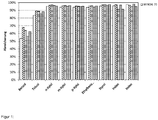
- Table 3 Raw gas stream (loaded nitrogen) Clean gas flow (after absorption in the respective absorbents) Hexamoll® DINCH® Plastomoll® DOA EASTMAN 168 TM Agnique ME 18 RD-F WINOG 70 mg / Nm 3 mg / Nm 3 mg / Nm 3 mg / Nm 3 mg / Nm 3 mg / Nm 3 mg / Nm 3 benzene 8390 2686 3001 3642 3138 3895 toluene 17105 1886 1899 2441 1973 2816 o-xylene 1042 34 30 38 45 51 m-xylene 2753 102 100 128 102 168 p-Xylene 1346 61 63 69 64 81 ethylbenzene 3578 155 136 208 155 229 styrene 4107 116 100 132 102 185 indan
- Table 3 and illustration 1 show that Hexamoll®DINCH®, Plastomoll®DOA and EASTMAN 168 TM in particular can deplete benzene and indane from the raw gas stream.
- the crude gas stream 10 is brought into contact with the absorption medium (25) in a scrubber (1) in countercurrent.
- the scrubber is operated at about atmospheric pressure and a temperature of 50 ° C.
- the aromatic hydrocarbon contained in the crude gas stream is depleted from the gas phase and passes into the absorption medium.
- the clean gas flow (11) leaves the scrubber overhead.
- the laden with aromatic hydrocarbon absorption medium (21) leaves the scrubber and is heated in an internal heat exchanger (2).
- the thus heated laden absorption medium (22) is brought in a regeneration device (3) in countercurrent with steam (12) as the stripping medium in contact.
- the aromatic hydrocarbon contained in the absorption medium is depleted from this and passes into the stripping medium.
- the stripping medium laden with aromatic hydrocarbon leaves the regeneration device via the top (13).
- the regenerated absorption medium (23) is cooled in a heat exchanger against the laden absorption medium.
- the cooled and regenerated absorption medium (24) is brought to the desired operating temperature in a cooler
- pressure-increasing machines 5, 6
- the gas-side pressure loss can be overcome, for example, by blowers before or after the scrubber.
- the absorption medium (25) used is Hexamoll®DINCH®, Plastomoll® DOA or EASTMAN 168 TM.
Landscapes
- Chemical & Material Sciences (AREA)
- Chemical Kinetics & Catalysis (AREA)
- Engineering & Computer Science (AREA)
- Analytical Chemistry (AREA)
- General Chemical & Material Sciences (AREA)
- Oil, Petroleum & Natural Gas (AREA)
- Gas Separation By Absorption (AREA)
- Organic Low-Molecular-Weight Compounds And Preparation Thereof (AREA)
Priority Applications (4)
| Application Number | Priority Date | Filing Date | Title |
|---|---|---|---|
| EP16198907.4A EP3320963A1 (fr) | 2016-11-15 | 2016-11-15 | Procédé pour enlever un hydrocarbure aromatique d'un flux de gaz |
| PCT/EP2017/078979 WO2018091385A1 (fr) | 2016-11-15 | 2017-11-13 | Procédé permettant un enrichissement en hydrocarbure aromatique à partir d'un flux de gaz brut |
| US16/349,725 US20190321774A1 (en) | 2016-11-15 | 2017-11-13 | Method for depleting aromatic hydrocarbon from a crude gas flow |
| EP17801655.6A EP3541495A1 (fr) | 2016-11-15 | 2017-11-13 | Procédé permettant un enrichissement en hydrocarbure aromatique à partir d'un flux de gaz brut |
Applications Claiming Priority (1)
| Application Number | Priority Date | Filing Date | Title |
|---|---|---|---|
| EP16198907.4A EP3320963A1 (fr) | 2016-11-15 | 2016-11-15 | Procédé pour enlever un hydrocarbure aromatique d'un flux de gaz |
Publications (1)
| Publication Number | Publication Date |
|---|---|
| EP3320963A1 true EP3320963A1 (fr) | 2018-05-16 |
Family
ID=57326253
Family Applications (2)
| Application Number | Title | Priority Date | Filing Date |
|---|---|---|---|
| EP16198907.4A Withdrawn EP3320963A1 (fr) | 2016-11-15 | 2016-11-15 | Procédé pour enlever un hydrocarbure aromatique d'un flux de gaz |
| EP17801655.6A Withdrawn EP3541495A1 (fr) | 2016-11-15 | 2017-11-13 | Procédé permettant un enrichissement en hydrocarbure aromatique à partir d'un flux de gaz brut |
Family Applications After (1)
| Application Number | Title | Priority Date | Filing Date |
|---|---|---|---|
| EP17801655.6A Withdrawn EP3541495A1 (fr) | 2016-11-15 | 2017-11-13 | Procédé permettant un enrichissement en hydrocarbure aromatique à partir d'un flux de gaz brut |
Country Status (3)
| Country | Link |
|---|---|
| US (1) | US20190321774A1 (fr) |
| EP (2) | EP3320963A1 (fr) |
| WO (1) | WO2018091385A1 (fr) |
Families Citing this family (1)
| Publication number | Priority date | Publication date | Assignee | Title |
|---|---|---|---|---|
| CN117269380A (zh) * | 2023-08-18 | 2023-12-22 | 复旦大学 | 一种高效萃取大气膜样品中有机组分的方法 |
Citations (10)
| Publication number | Priority date | Publication date | Assignee | Title |
|---|---|---|---|---|
| US4314946A (en) * | 1979-03-20 | 1982-02-09 | Ftalital Prodotti Chimici Speciali S.P.A. | Process for the continuous separation of maleic anhydride from process gases |
| CA1330337C (fr) * | 1987-11-20 | 1994-06-21 | Arthur James Ehrler | Solvant et procede faisant appel a ce solvant |
| WO1999032427A1 (fr) | 1997-12-19 | 1999-07-01 | Basf Aktiengesellschaft | Procede d'hydrogenation d'acides polycarboxyliques de benzene ou de leurs derives a l'aide d'un catalyseur a macropores |
| DE102005028752A1 (de) * | 2005-06-22 | 2007-01-04 | Oxeno Olefinchemie Gmbh | Gemisch von Diisononylestern der 1,2-Cyclohexandicarbonsäure, Verfahren zu deren Herstellung und Verwendung dieser Gemische |
| WO2009003644A1 (fr) | 2007-06-29 | 2009-01-08 | Uhde Gmbh | Procédé d'extraction d'hydrocarbures aromatiques de gaz de cokerie par absorption |
| WO2011025030A1 (fr) * | 2009-08-31 | 2011-03-03 | 株式会社根岸製作所 | Absorbant pour l'élimination de composés organiques volatils |
| WO2011082991A2 (fr) | 2009-12-15 | 2011-07-14 | Basf Se | Catalyseur et procédé d'hydrogénation de composés aromatiques |
| WO2015082676A1 (fr) | 2013-12-06 | 2015-06-11 | Basf Se | Composition de plastifiant qui contient des dérivés du tétrahydrofurane et de l'ester d'acide 1,2-cyclohexane dicarboxylique |
| WO2015162142A1 (fr) | 2014-04-24 | 2015-10-29 | Basf Se | Composition plastifiante contenant des dérivés de furane et de dialkylester d'acide téréphtalique |
| WO2016005357A1 (fr) | 2014-07-08 | 2016-01-14 | Basf Se | Composition de plastifiant contenant des esters d'acide dicarboxylique aliphatiques et des dialkylesters d'acide téréphtalique |
-
2016
- 2016-11-15 EP EP16198907.4A patent/EP3320963A1/fr not_active Withdrawn
-
2017
- 2017-11-13 US US16/349,725 patent/US20190321774A1/en not_active Abandoned
- 2017-11-13 WO PCT/EP2017/078979 patent/WO2018091385A1/fr not_active Ceased
- 2017-11-13 EP EP17801655.6A patent/EP3541495A1/fr not_active Withdrawn
Patent Citations (10)
| Publication number | Priority date | Publication date | Assignee | Title |
|---|---|---|---|---|
| US4314946A (en) * | 1979-03-20 | 1982-02-09 | Ftalital Prodotti Chimici Speciali S.P.A. | Process for the continuous separation of maleic anhydride from process gases |
| CA1330337C (fr) * | 1987-11-20 | 1994-06-21 | Arthur James Ehrler | Solvant et procede faisant appel a ce solvant |
| WO1999032427A1 (fr) | 1997-12-19 | 1999-07-01 | Basf Aktiengesellschaft | Procede d'hydrogenation d'acides polycarboxyliques de benzene ou de leurs derives a l'aide d'un catalyseur a macropores |
| DE102005028752A1 (de) * | 2005-06-22 | 2007-01-04 | Oxeno Olefinchemie Gmbh | Gemisch von Diisononylestern der 1,2-Cyclohexandicarbonsäure, Verfahren zu deren Herstellung und Verwendung dieser Gemische |
| WO2009003644A1 (fr) | 2007-06-29 | 2009-01-08 | Uhde Gmbh | Procédé d'extraction d'hydrocarbures aromatiques de gaz de cokerie par absorption |
| WO2011025030A1 (fr) * | 2009-08-31 | 2011-03-03 | 株式会社根岸製作所 | Absorbant pour l'élimination de composés organiques volatils |
| WO2011082991A2 (fr) | 2009-12-15 | 2011-07-14 | Basf Se | Catalyseur et procédé d'hydrogénation de composés aromatiques |
| WO2015082676A1 (fr) | 2013-12-06 | 2015-06-11 | Basf Se | Composition de plastifiant qui contient des dérivés du tétrahydrofurane et de l'ester d'acide 1,2-cyclohexane dicarboxylique |
| WO2015162142A1 (fr) | 2014-04-24 | 2015-10-29 | Basf Se | Composition plastifiante contenant des dérivés de furane et de dialkylester d'acide téréphtalique |
| WO2016005357A1 (fr) | 2014-07-08 | 2016-01-14 | Basf Se | Composition de plastifiant contenant des esters d'acide dicarboxylique aliphatiques et des dialkylesters d'acide téréphtalique |
Non-Patent Citations (3)
| Title |
|---|
| "Hexamoll DINCH (Technical Data Sheet)", 1 January 2009 (2009-01-01), pages 1 - 2, XP055016502, Retrieved from the Internet <URL:http://www2.basf.us/plasticizers/pdfs/products/TDS_DINCH.pdf> [retrieved on 20120113] * |
| BASF: "Ersetzt Ausgabe vom Januar 2008", 31 January 2012 (2012-01-31), XP055403548, Retrieved from the Internet <URL:http://www.weichmacher.basf.com/portal/load/fid228793/Plast_DOA_d_01_08.pdf> [retrieved on 20170904] * |
| SCHULTES; ABGASREINIGUNG; GEISTHARDT, K. CHEM. ENG. TECHNOL., vol. 12, 1989, pages 63 - 70 |
Also Published As
| Publication number | Publication date |
|---|---|
| EP3541495A1 (fr) | 2019-09-25 |
| US20190321774A1 (en) | 2019-10-24 |
| WO2018091385A1 (fr) | 2018-05-24 |
Similar Documents
| Publication | Publication Date | Title |
|---|---|---|
| EP2637766B1 (fr) | Milieu absorbant contenant des amines, méthode et installation pour l'absorption de gaz acides de melanges gazeuses | |
| EP1303345B1 (fr) | Procede de desacidification d'un courant de fluide et liquide de lavage destine a un tel procede | |
| EP2391435B1 (fr) | Absorbant comprenant des amines cycliques pour l'elimination de gaz acide | |
| DE3126136C2 (de) | Verfahren zur Entfernung saurer Bestandteile aus Gasgemischen | |
| DE3222282C2 (de) | Verfahren zum Entfernen von Schwefelwasserstoff und Kohlendioxid aus einem Gasgemisch | |
| DE2910940C2 (fr) | ||
| WO2013072147A1 (fr) | Procédé et dispositif servant à séparer des gaz acides à partir d'un mélange gazeux | |
| EP1289625B1 (fr) | Procede de desacidification d'un courant fluidique d'hydrocarbure | |
| DE2227071A1 (de) | Verfahren zum reinigen technischer brenn- und synthesegase | |
| WO2011082807A1 (fr) | Élimination du co2 présent dans des gaz dont la pression partielle du co2 est faible, au moyen de 1,2 diaminopropane | |
| DE3222281C2 (de) | Verfahren zum Entfernen von Kohlendioxid und, sofern vorhanden, Schwefelwasserstoff aus einem Gasgemisch | |
| DE2717779B2 (de) | Verfahren zur Rückgewinnung und Regenerierung von wasserlöslichen, sauerstoffhaltigen organischen Lösungsmitteln bei der Lösungsmittelextraktion von Aromaten | |
| DE102009056660B4 (de) | Verfahren und Anlage zur chemisorptiven Abtrennung von Kohlendioxid aus Bio- oder Klärgas mittels einer aminhaltigen Waschlösung und Regeneration der beladenen Waschlösung | |
| EP3356015A2 (fr) | Procédé d'élimination sélective de sulfure d'hydrogène | |
| EP3356011A1 (fr) | Amines cycliques pour l'élimination sélective de sulfure d'hydrogène | |
| EP1844126B1 (fr) | Procede d'augmentation de la selectivite de solvants a action physique lors de l'absorption de constituants gazeux a partir de gaz techniques | |
| EP3356012A1 (fr) | Composés amine pour l'élimination sélective de sulfure d'hydrogène | |
| EP3320963A1 (fr) | Procédé pour enlever un hydrocarbure aromatique d'un flux de gaz | |
| EP0216258B1 (fr) | Procédé pour purifier des gaz | |
| DE102018214336A1 (de) | Verfahren zur Herstellung von Dimethylcarbonat aus Methanol | |
| DE2654634C2 (de) | Verfahren zur Entfernung von flüchtigen Arsenderivaten aus Gasen | |
| EP2571599B1 (fr) | Procédé pour retirer le dioxyde de carbone (co2) d'un système de gaz en circulation | |
| EP4289498A1 (fr) | Procédé et dispositif de traitement du gaz contenant du méthane | |
| AT258862B (de) | Verfahren zur Reinigung von Flüssigkeiten bzw. Gasen | |
| DE2319812C3 (de) | Verfahren zur Entfernung von Acetylen, dessen Homologen und Dienen aus Olefinkohlenwasserstoffgas durch selektive Hydrierung |
Legal Events
| Date | Code | Title | Description |
|---|---|---|---|
| PUAI | Public reference made under article 153(3) epc to a published international application that has entered the european phase |
Free format text: ORIGINAL CODE: 0009012 |
|
| STAA | Information on the status of an ep patent application or granted ep patent |
Free format text: STATUS: THE APPLICATION HAS BEEN PUBLISHED |
|
| AK | Designated contracting states |
Kind code of ref document: A1 Designated state(s): AL AT BE BG CH CY CZ DE DK EE ES FI FR GB GR HR HU IE IS IT LI LT LU LV MC MK MT NL NO PL PT RO RS SE SI SK SM TR |
|
| AX | Request for extension of the european patent |
Extension state: BA ME |
|
| STAA | Information on the status of an ep patent application or granted ep patent |
Free format text: STATUS: REQUEST FOR EXAMINATION WAS MADE |
|
| 17P | Request for examination filed |
Effective date: 20181116 |
|
| RBV | Designated contracting states (corrected) |
Designated state(s): AL AT BE BG CH CY CZ DE DK EE ES FI FR GB GR HR HU IE IS IT LI LT LU LV MC MK MT NL NO PL PT RO RS SE SI SK SM TR |
|
| STAA | Information on the status of an ep patent application or granted ep patent |
Free format text: STATUS: THE APPLICATION IS DEEMED TO BE WITHDRAWN |
|
| 18D | Application deemed to be withdrawn |
Effective date: 20181117 |