EP3322864B1 - Hohlbodenelemente und verfahren zur herstellung eines hohlbodenelements - Google Patents
Hohlbodenelemente und verfahren zur herstellung eines hohlbodenelements Download PDFInfo
- Publication number
- EP3322864B1 EP3322864B1 EP16732936.6A EP16732936A EP3322864B1 EP 3322864 B1 EP3322864 B1 EP 3322864B1 EP 16732936 A EP16732936 A EP 16732936A EP 3322864 B1 EP3322864 B1 EP 3322864B1
- Authority
- EP
- European Patent Office
- Prior art keywords
- hollow
- semi
- hydrate
- floor
- load
- Prior art date
- Legal status (The legal status is an assumption and is not a legal conclusion. Google has not performed a legal analysis and makes no representation as to the accuracy of the status listed.)
- Active
Links
Images
Classifications
-
- E—FIXED CONSTRUCTIONS
- E04—BUILDING
- E04F—FINISHING WORK ON BUILDINGS, e.g. STAIRS, FLOORS
- E04F15/00—Flooring
- E04F15/02—Flooring or floor layers composed of a number of similar elements
- E04F15/024—Sectional false floors, e.g. computer floors
- E04F15/02405—Floor panels
-
- E—FIXED CONSTRUCTIONS
- E04—BUILDING
- E04F—FINISHING WORK ON BUILDINGS, e.g. STAIRS, FLOORS
- E04F15/00—Flooring
- E04F15/02—Flooring or floor layers composed of a number of similar elements
- E04F15/10—Flooring or floor layers composed of a number of similar elements of other materials, e.g. fibrous or chipped materials, organic plastics, magnesite tiles, hardboard, or with a top layer of other materials
- E04F15/107—Flooring or floor layers composed of a number of similar elements of other materials, e.g. fibrous or chipped materials, organic plastics, magnesite tiles, hardboard, or with a top layer of other materials composed of several layers, e.g. sandwich panels
-
- B—PERFORMING OPERATIONS; TRANSPORTING
- B32—LAYERED PRODUCTS
- B32B—LAYERED PRODUCTS, i.e. PRODUCTS BUILT-UP OF STRATA OF FLAT OR NON-FLAT, e.g. CELLULAR OR HONEYCOMB, FORM
- B32B13/00—Layered products comprising a a layer of water-setting substance, e.g. concrete, plaster, asbestos cement, or like builders' material
- B32B13/02—Layered products comprising a a layer of water-setting substance, e.g. concrete, plaster, asbestos cement, or like builders' material with fibres or particles being present as additives in the layer
-
- B—PERFORMING OPERATIONS; TRANSPORTING
- B32—LAYERED PRODUCTS
- B32B—LAYERED PRODUCTS, i.e. PRODUCTS BUILT-UP OF STRATA OF FLAT OR NON-FLAT, e.g. CELLULAR OR HONEYCOMB, FORM
- B32B13/00—Layered products comprising a a layer of water-setting substance, e.g. concrete, plaster, asbestos cement, or like builders' material
- B32B13/04—Layered products comprising a a layer of water-setting substance, e.g. concrete, plaster, asbestos cement, or like builders' material comprising such water setting substance as the main or only constituent of a layer, which is next to another layer of the same or of a different material
-
- B—PERFORMING OPERATIONS; TRANSPORTING
- B32—LAYERED PRODUCTS
- B32B—LAYERED PRODUCTS, i.e. PRODUCTS BUILT-UP OF STRATA OF FLAT OR NON-FLAT, e.g. CELLULAR OR HONEYCOMB, FORM
- B32B3/00—Layered products comprising a layer with external or internal discontinuities or unevennesses, or a layer of non-planar shape; Layered products comprising a layer having particular features of form
- B32B3/02—Layered products comprising a layer with external or internal discontinuities or unevennesses, or a layer of non-planar shape; Layered products comprising a layer having particular features of form characterised by features of form at particular places, e.g. in edge regions
- B32B3/06—Layered products comprising a layer with external or internal discontinuities or unevennesses, or a layer of non-planar shape; Layered products comprising a layer having particular features of form characterised by features of form at particular places, e.g. in edge regions for securing layers together; for attaching the product to another member, e.g. to a support, or to another product, e.g. groove/tongue, interlocking
-
- B—PERFORMING OPERATIONS; TRANSPORTING
- B32—LAYERED PRODUCTS
- B32B—LAYERED PRODUCTS, i.e. PRODUCTS BUILT-UP OF STRATA OF FLAT OR NON-FLAT, e.g. CELLULAR OR HONEYCOMB, FORM
- B32B7/00—Layered products characterised by the relation between layers; Layered products characterised by the relative orientation of features between layers, or by the relative values of a measurable parameter between layers, i.e. products comprising layers having different physical, chemical or physicochemical properties; Layered products characterised by the interconnection of layers
- B32B7/04—Interconnection of layers
- B32B7/12—Interconnection of layers using interposed adhesives or interposed materials with bonding properties
-
- E—FIXED CONSTRUCTIONS
- E04—BUILDING
- E04F—FINISHING WORK ON BUILDINGS, e.g. STAIRS, FLOORS
- E04F15/00—Flooring
- E04F15/02—Flooring or floor layers composed of a number of similar elements
- E04F15/08—Flooring or floor layers composed of a number of similar elements only of stone or stone-like material, e.g. ceramics, concrete; of glass or with a top layer of stone or stone-like material, e.g. ceramics, concrete or glass
-
- B—PERFORMING OPERATIONS; TRANSPORTING
- B32—LAYERED PRODUCTS
- B32B—LAYERED PRODUCTS, i.e. PRODUCTS BUILT-UP OF STRATA OF FLAT OR NON-FLAT, e.g. CELLULAR OR HONEYCOMB, FORM
- B32B2250/00—Layers arrangement
- B32B2250/02—2 layers
-
- B—PERFORMING OPERATIONS; TRANSPORTING
- B32—LAYERED PRODUCTS
- B32B—LAYERED PRODUCTS, i.e. PRODUCTS BUILT-UP OF STRATA OF FLAT OR NON-FLAT, e.g. CELLULAR OR HONEYCOMB, FORM
- B32B2262/00—Composition or structural features of fibres which form a fibrous or filamentary layer or are present as additives
- B32B2262/04—Cellulosic plastic fibres, e.g. rayon
-
- B—PERFORMING OPERATIONS; TRANSPORTING
- B32—LAYERED PRODUCTS
- B32B—LAYERED PRODUCTS, i.e. PRODUCTS BUILT-UP OF STRATA OF FLAT OR NON-FLAT, e.g. CELLULAR OR HONEYCOMB, FORM
- B32B2262/00—Composition or structural features of fibres which form a fibrous or filamentary layer or are present as additives
- B32B2262/10—Inorganic fibres
- B32B2262/101—Glass fibres
-
- B—PERFORMING OPERATIONS; TRANSPORTING
- B32—LAYERED PRODUCTS
- B32B—LAYERED PRODUCTS, i.e. PRODUCTS BUILT-UP OF STRATA OF FLAT OR NON-FLAT, e.g. CELLULAR OR HONEYCOMB, FORM
- B32B2419/00—Buildings or parts thereof
-
- E—FIXED CONSTRUCTIONS
- E04—BUILDING
- E04F—FINISHING WORK ON BUILDINGS, e.g. STAIRS, FLOORS
- E04F15/00—Flooring
- E04F15/02—Flooring or floor layers composed of a number of similar elements
- E04F15/02038—Flooring or floor layers composed of a number of similar elements characterised by tongue and groove connections between neighbouring flooring elements
-
- E—FIXED CONSTRUCTIONS
- E04—BUILDING
- E04F—FINISHING WORK ON BUILDINGS, e.g. STAIRS, FLOORS
- E04F2203/00—Specially structured or shaped covering, lining or flooring elements not otherwise provided for
- E04F2203/06—Specially structured or shaped covering, lining or flooring elements not otherwise provided for comprising two layers fixedly secured to one another, in offset relationship in order to form a rebate
- E04F2203/065—Specially structured or shaped covering, lining or flooring elements not otherwise provided for comprising two layers fixedly secured to one another, in offset relationship in order to form a rebate in offset relationship longitudinally as well as transversely
Definitions
- the invention relates to a method for manufacturing hollow-floor elements and to such elements.
- the invention relates to hollow-floor panels manufactured from gypsum fibreboards.
- Hollow-floor panels (cavity flooring) are known in the art.
- DE 40 21 963 A1 describes a hollow floor comprising individual support plates.
- US 5,632,848 describes a continuous manufacturing line for the preparation of gypsum fiberboards by means of a wet process. If a cavity is provided below the walk-on floor level, which is to be utilised for laying pipes and cables, the walk-on floor must have a support structure above the floor of the cavity.
- Such flooring is generally known as cavity flooring.
- Sheet-panelled access floors and raised access floors are hollow floors. The essential difference between sheet-panelled access floors and raised access floors consists in the way in which they are installed and in the size of their individual panels.
- a raised access floor consists of individual elements which are easy to handle, and which at their edges or even at the corners rest on a support structure. Individual elements are connected with each other in a detachable or non-detachable manner. With sheet-panelled access floors, on the other hand, individual elements are connected among each other forming a contiguous floor body. Individual elements may be connected, for example, by means of a tongue-and-groove system, wherein a fixed connection may be achieved by screwing and/or gluing. In the case of sheet-panelled access floors individual elements are fixedly installed and can no longer be removed again. As a rule individual elements of sheet-panelled access floors are twice as large as individual elements of raised access floors.
- a raised access floor is different from a sheet-panelled access floor in that it not only contains individual access hatches but in that all individual elements can in principle be removed again individually after the floor has been laid, in order to allow access to the cavity below the floor. Therefore access hatches are not necessary.
- Hollow-floor panels or individual elements of the hollow floor may be manufactured from several materials, for example from gypsum fibreboard.
- Gypsum fibreboards may be produced in several ways, i.e. by means of a so-called dry, semi-dry or wet process.
- the stability of gypsum fibreboards can be generally increased in three different ways, i.e. the strength/thickness of the panels can be increased; the density of the panels can be increased; the panels may contain reinforcing materials.
- the method steps of soaking the semi-hydrate fibre carpet and of sucking off the surplus water limit the thickness of the panels, which can be produced by this process.
- the water must be able to soak the carpet right through, and a large proportion of the excess water must be able to be syphoned off in a relatively short time. Therefore, for the process to be economical, the thickness of the carpet is limited.
- a further problem occurs when the soaked gypsum fibre carpet is subsequently compressed. Since the fibres are not laid in an oriented manner but essentially randomly, compression of the carpet is economically viable only up to a certain panel thickness. Normally, if the panels are manufactured by the dry or semi-dry process, the maximum panel thickness is 25 mm. This thickness is not sufficient, however, for manufacturing sufficiently stable panels for use, in particular, in raised access flooring.
- the minimum breaking load required for double-floor panels has been laid down in the standard DIN EN 12825 and is divided into six element classes. Class 1 stipulates a breaking load of larger than 4 kN; class 6 stipulates a breaking load of larger than 12 kN.
- the DIN EN 13213 regulates the minimum requirements for sheet-panelled access floors correspondingly.
- the requirement of the invention consists in providing hollow-floor elements, in particular gypsum fibreboards, which are manufactured by the dry or semi-dry process.
- a hollow-floor element manufactured according to the invention may be either a sheet-panelled access floor panel for a contiguous hollow floor or a double-floor panel for a raised access floor.
- the superimposed individual panels of the hollow-floor element are bonded, interlocked or screwed to each other.
- all types of individual panels known in the art which are suitable for use in hollow flooring or raised access flooring, may be used. These may be, for example, gypsum fibreboards, laminated boards, cement-bonded fibre panels or cement-bonded laminated panels. Provision is also made according to the invention for different panel types to be combined with each other. Preferably, however, at least one individual panel consists of a gypsum fibreboard.
- a load-bearing individual panel is understood to be a panel, which essentially contributes to the stability of the panel and, mainly for this reason, i.e. for the creation of sufficient stability, is integrated with the hollow-floor element.
- hollow-floor elements may have coatings, which, for example, are applied to a hollow-floor element for reasons of optical appearance and/or for ensuring sufficient resistance to abrasion / chemical resistance. Such coatings are not be understood as load-bearing individual panels in terms of the invention. But coatings may of course be applied additionally to a hollow-floor element according to the invention or may additionally exist.
- a hollow-floor element according to claim 7 comprising at least two superimposed load-bearing individual panels, wherein the at least two load-bearing panels are firmly connected with each other.
- Preferably individual panels are connected with each other by means of gluing, interlocking and/or screwing.
- the invention is particularly helpful in cases, in which the manufacture of the hollow-floor element is limited as regards the thickness of the panels.
- one of the load-bearing panels is e.g. a gypsum fibreboard, which has been produced by way of a dry process or semi-dry process
- this panel according to the present state of the art, can be produced with a thickness of max. approx. 25 mm in order to give it sufficient strength. Therefore a preferred embodiment of the invention comprises load-bearing individual panels with a thickness of between 9 and 25 mm. Gypsum fibreboards of this thickness can be produced on known plants without problems by way of a dry process or semi-dry process. There is no need for a retrofit.
- the at least two individual panels of the hollow-floor element are connected offset from each other.
- the two individual panels can be connected with each other in such a way that none of the edges of the superimposed panels finishes flush with the edges of the respectively other individual panel.
- the edges of the respective individual panels extend however parallel to each other, and the offset of the panels relative to each other is defined.
- the load-bearing individual panels are made from gypsum fibreboard, the following composition comprising at least the below-mentioned constituents, is preferred, i.e. a gypsum matrix with cellulose fibres and glass fibres.
- the gypsum matrix consists of 100% by weight or approx. 100% by weight dihydrate. Approx. 100% by weight means that only residual amounts of semi-hydrate, e.g. max. 5% by weight, may be present in the individual panel, after it is set.
- the gypsum matrix is obtained during manufacture from 80 to 95% by weight ⁇ -semi-hydrate and 5 to 20% by weight ⁇ -semi-hydrate, relative to the total amount of calcium sulphate semi-hydrate.
- the ⁇ -semi-hydrate is added in order to improve the dehydration of the calcium sulphate fibre carpet.
- ⁇ -semi-hydrate normally comprises larger crystals than ⁇ -semi-hydrate.
- ⁇ -semi-hydrate crystals are extremely stable against grain decay when coming into contact with water.
- ⁇ -semi-hydrate by contrast is very susceptible to grain decay when coming into contact with water.
- the use of ⁇ -semi-hydrate permits the removal by suction of a large proportion of the excess water by a filter belt, which is not required for converting the semi-hydrate into dihydrate. Its purpose is therefore to improve dehydration.
- This dehydration improver is instrumental in achieving a higher raw density and thickness of the panel, which in turn improves the stability of the finished panel.
- one gypsum fibre panel comprises cellulose fibres in an amount of 1 to 25% by weight, preferably 5 to 15% by weight and chopped glass fibres in an amount of 0.5 to 15% by weight, preferably 0.5 to 10% by weight and especially preferably 0.5 to 5% by weight, wherein the weightings refer to the mass of the mixture of all constituents.
- the glass fibres preferably have a length of 5 to 25 mm, preferably from 5 to 15 mm.
- Such a load-bearing individual panel is therefore manufactured from a mixture, comprising at least ⁇ -semi-hydrate, ⁇ -semi-hydrate as required, cellulose fibres, glass fibres and water.
- the cellulose fibres are preferably present in an amount of 1 to 25, especially preferably 5 to 15% by weight with reference to the total amount of the dry mixture.
- the glass fibres give additional toughness and stability to the gypsum fibreboard.
- the glass fibres may, for example, be chopped glass fibres, which are supplied in bunches of great length, also called rowing strands, which are chopped on site. What is essential for the manufacture of a bending-resistant and tension-resistant gypsum fibreboard, is the homogenous mixture of the dry constituents. The glass fibres must be chopped as required and then separated since they are functionally fully effective in the gypsum matrix only, if they have been separated.
- additives such as retarders, rheology additives and similar can be added, which are known to the expert.
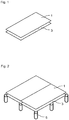
- Figure 1 shows a top view of a hollow-floor element, in this case a sheet-panelled access floor element, which consists of one first load-bearing panel 1 and one second load-bearing panel 3. Both individual panels 1, 3 are laid on top of each other and firmly joined together. The fixed connection is preferably accomplished by gluing the two individual panels together. It is, however possible, to use other ways of connecting the two panels such as by screwing, interlocking or other means known to the expert.
- the two load-bearing elements 1, 3 are gypsum fibreboards. It is of course also possible to produce a hollow-floor element from two or more panels of different materials firmly joined together.
- the two individual panels 1, 3 are superimposed and offset from one another. Due to the offset a defined overhang is produced on the longitudinal and/or the transverse sides of the hollow-floor element. This offset can be used for joining individual hollow-floor elements in a kind of tongue-and-groove joint together, thereby forming a contiguous floor.
- Figure 2 shows a cut-out from a sheet-panelled access floor, where the hollow-floor elements of Fig. 1 are joined together in a kind of tongue-and-groove system. Individual hollow-floor elements are resting with their lower corners and edges on supports 5.
- the gypsum fibreboards which are used for manufacturing the hollow-floor elements shown in Figs. 1 and 2 each are 18 mm thick. This results in an overall thickness of 36 mm of the finished hollow-floor elements.
- the individual panels are manufactured by means of the dry process.
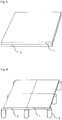
- a double-floor element which also consists of two individual panels 1, 3 firmly joined together, see Figs. 3, 4 .
- the double-floor elements are square-shaped, In order to remove them again at any time from the finished floor without efforts, the panels have smoothly polished slightly chamfered edges such that the floor surface comprises a bigger area than the floor lower surface.
- the individual panels 1, 3 lie flush on top of each other.
Landscapes
- Engineering & Computer Science (AREA)
- Architecture (AREA)
- Structural Engineering (AREA)
- Civil Engineering (AREA)
- General Engineering & Computer Science (AREA)
- Chemical & Material Sciences (AREA)
- Ceramic Engineering (AREA)
- Floor Finish (AREA)
Claims (13)
- Verfahren zur Herstellung eines Hohlbodenelements, umfassend mindestens zwei übereinanderliegende tragende Einzelplatten (1, 3), wobei das Verfahren das Aufeinanderlegen von mindestens zwei tragenden Einzelplatten (1, 3) und das fest miteinander Verbinden der mindestens zwei tragenden Einzelplatten (1, 3) umfasst, insbesondere durch Kleben, wobei mindestens eine der tragenden Einzelplatten (1, 3) eine Gipsfaserplatte umfassend eine Gipsmatrix ist, dadurch gekennzeichnet, dass das Verfahren den Schritt des Herstellens der Gipsmatrix der Gipsfaserplatte aus 80 bis 95 Gew.-% Calciumsulfat-β-Halbhydrat und 5 bis 20 Gew.-% Calciumsulfat-α-Halbhydrat, bezogen auf die Gesamtmenge an Calciumsulfat-Halbhydrat, umfasst.
- Verfahren nach Anspruch 1, wobei die Gipsfaserplatte mittels eines Trockenverfahrens oder Halbtrockenverfahrens hergestellt wird.
- Verfahren nach Anspruch 2, wobei die mindestens eine tragende Einzelplatte (1, 3) aus einer Mischung hergestellt wird, die mindestens β-Halbhydrat, α-Halbhydrat soweit benötigt, Zellulosefasern, Glasfasern und Wasser umfasst.
- Verfahren nach Anspruch 3, wobei die Mischung zur Herstellung der mindestens einen tragenden Einzelplatte (1, 3) β-Halbhydrat in einer Menge von 80 bis 95 Gew.-%, α-Halbhydrat in einer Menge von 5 bis 20 Gew.-%, bezogen auf die Gesamtmenge des Calciumsulfats, umfasst.
- Verfahren nach Anspruch 3 oder 4, wobei Cellulosefasern in einer Menge von 1 bis 25 Gew.-% und Schnittglasfasern in einer Menge von 0,5 bis 15 Gew.-%, bezogen auf die Mischung aller Trockenbestandteile, zu der Mischung zur Herstellung der mindestens einen tragenden Einzelplatte (1, 3) zugegeben werden, wobei die Schnittglasfasern vorzugsweise eine Länge zwischen 5 und 25 mm aufweisen.
- Verfahren nach einem der Ansprüche 1 bis 5, wobei das Verfahren das fest miteinander Verbinden der mindestens zwei Einzelplatten (1, 3) zueinander versetzt umfasst.
- Hohlbodenelement zur Verwendung in einem Hohlboden, wobei das Hohlbodenelement hergestellt ist gemäß Anspruch 1 und mindestens zwei übereinanderliegende tragende Einzelplatten (1, 3) umfasst, die fest miteinander verbunden, insbesondere verklebt sind, wobei mindestens eine der tragenden Einzelplatten (1, 3) eine Gipsfaserplatte umfassend eine Gipsmatrix ist, dadurch gekennzeichnet, dass die Gipsmatrix bei der Herstellung der Gipsfaserplatte aus 80 bis 95 Gew.-% Calciumsulfat-β-Halbhydrat und 5 bis 20 Gew.-% Calciumsulfat-α-Halbhydrat, bezogen auf die Gesamtmenge an Calciumsulfat-Halbhydrat, erhalten wird.
- Hohlbodenelement nach Anspruch 7, wobei die tragenden Einzelplatten (1, 3) jeweils eine Dicke zwischen 9 und 25 mm aufweisen.
- Hohlbodenelement nach Anspruch 7, wobei die Gipsmatrix Cellulosefasern und Glasfasern umfasst.
- Hohlbodenelement nach Anspruch 9, dadurch gekennzeichnet, dass die mindestens eine Einzelplatte (1, 3) Cellulosefasern in einer Menge von 1 bis 25 Gew.-% und Schnittglasfasern in einer Menge von 0,5 bis 15 Gew.-% umfasst, wobei sich die Gewichtsangaben auf die Mischung aller Bestandteile beziehen.
- Hohlbodenelement nach Anspruch 9 oder 10, wobei die Glasfasern eine Länge zwischen 5 und 25 mm aufweisen.
- Hohlbodenelement nach einem der Ansprüche 7 bis 11, wobei die Einzelplatten (1, 3) mittels eines Trockenverfahrens oder eines Halbtrockenverfahrens hergestellt sind.
- Hohlbodenelement nach einem der Ansprüche 7 bis 12, wobei die mindestens zwei Einzelplatten zueinander versetzt fest miteinander verbunden sind.
Priority Applications (1)
| Application Number | Priority Date | Filing Date | Title |
|---|---|---|---|
| PL16732936T PL3322864T3 (pl) | 2015-07-15 | 2016-05-25 | Elementy podłogi dystansowej i sposób wytwarzania elementu podłogi dystansowej |
Applications Claiming Priority (3)
| Application Number | Priority Date | Filing Date | Title |
|---|---|---|---|
| DE102015008916 | 2015-07-15 | ||
| DE102015009280 | 2015-07-21 | ||
| PCT/EP2016/000867 WO2017008869A1 (en) | 2015-07-15 | 2016-05-25 | Hollow-floor elements and method for manufacturing a hollow-floor element |
Publications (2)
| Publication Number | Publication Date |
|---|---|
| EP3322864A1 EP3322864A1 (de) | 2018-05-23 |
| EP3322864B1 true EP3322864B1 (de) | 2021-07-21 |
Family
ID=56289448
Family Applications (1)
| Application Number | Title | Priority Date | Filing Date |
|---|---|---|---|
| EP16732936.6A Active EP3322864B1 (de) | 2015-07-15 | 2016-05-25 | Hohlbodenelemente und verfahren zur herstellung eines hohlbodenelements |
Country Status (4)
| Country | Link |
|---|---|
| US (1) | US20180127988A1 (de) |
| EP (1) | EP3322864B1 (de) |
| PL (1) | PL3322864T3 (de) |
| WO (1) | WO2017008869A1 (de) |
Families Citing this family (2)
| Publication number | Priority date | Publication date | Assignee | Title |
|---|---|---|---|---|
| US10550585B1 (en) * | 2018-10-23 | 2020-02-04 | Gold Water International Inc. | Assemblable platform made of fiber-reinforced plastic (FRP) |
| JP2023151419A (ja) * | 2022-03-31 | 2023-10-16 | 三洋工業株式会社 | 床構造 |
Family Cites Families (6)
| Publication number | Priority date | Publication date | Assignee | Title |
|---|---|---|---|---|
| DE1805126C3 (de) * | 1968-10-25 | 1975-05-28 | H. & E. Boergardts Kg, 3425 Walkenried | Masse zur Herstellung von Arbeitsformen für die keramische Industrie |
| US5632848A (en) * | 1989-10-12 | 1997-05-27 | Georgia-Pacific Corporation | Continuous processing equipment for making fiberboard |
| DE4021963A1 (de) * | 1990-07-10 | 1992-01-16 | Lindner Ag | Hohlraumboden |
| US8850770B2 (en) * | 2001-06-21 | 2014-10-07 | Roger C. Roen | Structurally integrated accessible floor system |
| DE60118567D1 (de) * | 2001-10-18 | 2006-05-18 | Bresciana Graniti S P A | Verbundplatte für Doppelböden |
| JP6543702B2 (ja) * | 2014-12-22 | 2019-07-10 | クナーフ ギプス カーゲーKnauf Gips Kg | 石膏繊維板及び石膏繊維板の製造方法 |
-
2016
- 2016-05-25 PL PL16732936T patent/PL3322864T3/pl unknown
- 2016-05-25 WO PCT/EP2016/000867 patent/WO2017008869A1/en not_active Ceased
- 2016-05-25 EP EP16732936.6A patent/EP3322864B1/de active Active
-
2018
- 2018-01-10 US US15/867,294 patent/US20180127988A1/en not_active Abandoned
Non-Patent Citations (1)
| Title |
|---|
| None * |
Also Published As
| Publication number | Publication date |
|---|---|
| EP3322864A1 (de) | 2018-05-23 |
| PL3322864T3 (pl) | 2021-11-29 |
| WO2017008869A1 (en) | 2017-01-19 |
| US20180127988A1 (en) | 2018-05-10 |
Similar Documents
| Publication | Publication Date | Title |
|---|---|---|
| CN109025169B (zh) | 应用于榫槽连接的多层复合防火板材及其生产工艺 | |
| CN109689355A (zh) | 交叉层压木板板材 | |
| US20180127988A1 (en) | Hollow-floor elements and method for manufacturing a hollow-floor element | |
| CN111219032A (zh) | 一种人造结构木地板 | |
| CN210459872U (zh) | 一种复式结构三层实木复合地板 | |
| CN208992867U (zh) | 一种人造框剪结构的板芯和人造框剪结构板 | |
| JP2005502800A (ja) | 建築用タイル | |
| CN205704530U (zh) | 集装箱或车辆用地板 | |
| CN213859758U (zh) | 一种具有高强度的集成板 | |
| CN101748880A (zh) | 一种实木复合地板基板及其制造方法 | |
| CN114571812A (zh) | 一种排骨木芯复合地板及其制备方法 | |
| EP0884152A1 (de) | Steinplatte bekleidet mit Phenolharz-Mehrschichtpapier und Verfahren zu seiner Herstellung | |
| US20240149558A1 (en) | Hempcrete Wallboard Panel | |
| CN111114029A (zh) | 一种木心指接板及制作方法 | |
| EP4725692A1 (de) | Zweischichtige holzfussboden aus technischen materialien und herstellungsverfahren dafür | |
| EP4374027B1 (de) | Mehrschichtige holzfussbodenplatte | |
| US12044008B2 (en) | Building panel with sections | |
| RU2357053C2 (ru) | Строительная панель с декоративной отделкой | |
| WO2026018052A1 (en) | Wood-based board, in particular particle board, and method of manufacturing the wood-based board, in particular particle board | |
| CN203171745U (zh) | 一种以碾压丛生竹为原材料的竹木复合集装箱底板 | |
| EP1947005A1 (de) | Deckabdeckung | |
| US20130199119A1 (en) | Board and Batten Siding System | |
| EP1596028A2 (de) | Trockenestrichfussboden sowie bausatz für seine erstellung | |
| DE20208093U1 (de) | Fertigparkett mit Trittschalldämmung | |
| DE202020005188U1 (de) | Tafeln und Platten mit Schichten aus Wellpappe für die Fertigung von Wand- und Deckenelementen im Holzfertigbau |
Legal Events
| Date | Code | Title | Description |
|---|---|---|---|
| STAA | Information on the status of an ep patent application or granted ep patent |
Free format text: STATUS: THE INTERNATIONAL PUBLICATION HAS BEEN MADE |
|
| PUAI | Public reference made under article 153(3) epc to a published international application that has entered the european phase |
Free format text: ORIGINAL CODE: 0009012 |
|
| STAA | Information on the status of an ep patent application or granted ep patent |
Free format text: STATUS: REQUEST FOR EXAMINATION WAS MADE |
|
| 17P | Request for examination filed |
Effective date: 20180117 |
|
| AK | Designated contracting states |
Kind code of ref document: A1 Designated state(s): AL AT BE BG CH CY CZ DE DK EE ES FI FR GB GR HR HU IE IS IT LI LT LU LV MC MK MT NL NO PL PT RO RS SE SI SK SM TR |
|
| AX | Request for extension of the european patent |
Extension state: BA ME |
|
| DAV | Request for validation of the european patent (deleted) | ||
| DAX | Request for extension of the european patent (deleted) | ||
| STAA | Information on the status of an ep patent application or granted ep patent |
Free format text: STATUS: EXAMINATION IS IN PROGRESS |
|
| 17Q | First examination report despatched |
Effective date: 20190212 |
|
| REG | Reference to a national code |
Ref country code: DE Ref legal event code: R079 Ref document number: 602016060899 Country of ref document: DE Free format text: PREVIOUS MAIN CLASS: E04F0015024000 Ipc: E04F0015080000 |
|
| RIC1 | Information provided on ipc code assigned before grant |
Ipc: E04F 15/024 20060101ALI20201127BHEP Ipc: E04F 15/08 20060101AFI20201127BHEP |
|
| GRAP | Despatch of communication of intention to grant a patent |
Free format text: ORIGINAL CODE: EPIDOSNIGR1 |
|
| STAA | Information on the status of an ep patent application or granted ep patent |
Free format text: STATUS: GRANT OF PATENT IS INTENDED |
|
| INTG | Intention to grant announced |
Effective date: 20210201 |
|
| GRAS | Grant fee paid |
Free format text: ORIGINAL CODE: EPIDOSNIGR3 |
|
| GRAA | (expected) grant |
Free format text: ORIGINAL CODE: 0009210 |
|
| STAA | Information on the status of an ep patent application or granted ep patent |
Free format text: STATUS: THE PATENT HAS BEEN GRANTED |
|
| AK | Designated contracting states |
Kind code of ref document: B1 Designated state(s): AL AT BE BG CH CY CZ DE DK EE ES FI FR GB GR HR HU IE IS IT LI LT LU LV MC MK MT NL NO PL PT RO RS SE SI SK SM TR |
|
| REG | Reference to a national code |
Ref country code: GB Ref legal event code: FG4D |
|
| REG | Reference to a national code |
Ref country code: CH Ref legal event code: EP |
|
| REG | Reference to a national code |
Ref country code: DE Ref legal event code: R096 Ref document number: 602016060899 Country of ref document: DE |
|
| REG | Reference to a national code |
Ref country code: AT Ref legal event code: REF Ref document number: 1412750 Country of ref document: AT Kind code of ref document: T Effective date: 20210815 |
|
| REG | Reference to a national code |
Ref country code: IE Ref legal event code: FG4D |
|
| REG | Reference to a national code |
Ref country code: LT Ref legal event code: MG9D |
|
| REG | Reference to a national code |
Ref country code: NL Ref legal event code: MP Effective date: 20210721 |
|
| PG25 | Lapsed in a contracting state [announced via postgrant information from national office to epo] |
Ref country code: LT Free format text: LAPSE BECAUSE OF FAILURE TO SUBMIT A TRANSLATION OF THE DESCRIPTION OR TO PAY THE FEE WITHIN THE PRESCRIBED TIME-LIMIT Effective date: 20210721 Ref country code: NL Free format text: LAPSE BECAUSE OF FAILURE TO SUBMIT A TRANSLATION OF THE DESCRIPTION OR TO PAY THE FEE WITHIN THE PRESCRIBED TIME-LIMIT Effective date: 20210721 Ref country code: NO Free format text: LAPSE BECAUSE OF FAILURE TO SUBMIT A TRANSLATION OF THE DESCRIPTION OR TO PAY THE FEE WITHIN THE PRESCRIBED TIME-LIMIT Effective date: 20211021 Ref country code: PT Free format text: LAPSE BECAUSE OF FAILURE TO SUBMIT A TRANSLATION OF THE DESCRIPTION OR TO PAY THE FEE WITHIN THE PRESCRIBED TIME-LIMIT Effective date: 20211122 Ref country code: FI Free format text: LAPSE BECAUSE OF FAILURE TO SUBMIT A TRANSLATION OF THE DESCRIPTION OR TO PAY THE FEE WITHIN THE PRESCRIBED TIME-LIMIT Effective date: 20210721 Ref country code: ES Free format text: LAPSE BECAUSE OF FAILURE TO SUBMIT A TRANSLATION OF THE DESCRIPTION OR TO PAY THE FEE WITHIN THE PRESCRIBED TIME-LIMIT Effective date: 20210721 Ref country code: HR Free format text: LAPSE BECAUSE OF FAILURE TO SUBMIT A TRANSLATION OF THE DESCRIPTION OR TO PAY THE FEE WITHIN THE PRESCRIBED TIME-LIMIT Effective date: 20210721 Ref country code: SE Free format text: LAPSE BECAUSE OF FAILURE TO SUBMIT A TRANSLATION OF THE DESCRIPTION OR TO PAY THE FEE WITHIN THE PRESCRIBED TIME-LIMIT Effective date: 20210721 Ref country code: RS Free format text: LAPSE BECAUSE OF FAILURE TO SUBMIT A TRANSLATION OF THE DESCRIPTION OR TO PAY THE FEE WITHIN THE PRESCRIBED TIME-LIMIT Effective date: 20210721 |
|
| PG25 | Lapsed in a contracting state [announced via postgrant information from national office to epo] |
Ref country code: LV Free format text: LAPSE BECAUSE OF FAILURE TO SUBMIT A TRANSLATION OF THE DESCRIPTION OR TO PAY THE FEE WITHIN THE PRESCRIBED TIME-LIMIT Effective date: 20210721 Ref country code: GR Free format text: LAPSE BECAUSE OF FAILURE TO SUBMIT A TRANSLATION OF THE DESCRIPTION OR TO PAY THE FEE WITHIN THE PRESCRIBED TIME-LIMIT Effective date: 20211022 |
|
| REG | Reference to a national code |
Ref country code: DE Ref legal event code: R097 Ref document number: 602016060899 Country of ref document: DE |
|
| PG25 | Lapsed in a contracting state [announced via postgrant information from national office to epo] |
Ref country code: DK Free format text: LAPSE BECAUSE OF FAILURE TO SUBMIT A TRANSLATION OF THE DESCRIPTION OR TO PAY THE FEE WITHIN THE PRESCRIBED TIME-LIMIT Effective date: 20210721 |
|
| PLBE | No opposition filed within time limit |
Free format text: ORIGINAL CODE: 0009261 |
|
| STAA | Information on the status of an ep patent application or granted ep patent |
Free format text: STATUS: NO OPPOSITION FILED WITHIN TIME LIMIT |
|
| PG25 | Lapsed in a contracting state [announced via postgrant information from national office to epo] |
Ref country code: SM Free format text: LAPSE BECAUSE OF FAILURE TO SUBMIT A TRANSLATION OF THE DESCRIPTION OR TO PAY THE FEE WITHIN THE PRESCRIBED TIME-LIMIT Effective date: 20210721 Ref country code: SK Free format text: LAPSE BECAUSE OF FAILURE TO SUBMIT A TRANSLATION OF THE DESCRIPTION OR TO PAY THE FEE WITHIN THE PRESCRIBED TIME-LIMIT Effective date: 20210721 Ref country code: RO Free format text: LAPSE BECAUSE OF FAILURE TO SUBMIT A TRANSLATION OF THE DESCRIPTION OR TO PAY THE FEE WITHIN THE PRESCRIBED TIME-LIMIT Effective date: 20210721 Ref country code: EE Free format text: LAPSE BECAUSE OF FAILURE TO SUBMIT A TRANSLATION OF THE DESCRIPTION OR TO PAY THE FEE WITHIN THE PRESCRIBED TIME-LIMIT Effective date: 20210721 Ref country code: CZ Free format text: LAPSE BECAUSE OF FAILURE TO SUBMIT A TRANSLATION OF THE DESCRIPTION OR TO PAY THE FEE WITHIN THE PRESCRIBED TIME-LIMIT Effective date: 20210721 Ref country code: AL Free format text: LAPSE BECAUSE OF FAILURE TO SUBMIT A TRANSLATION OF THE DESCRIPTION OR TO PAY THE FEE WITHIN THE PRESCRIBED TIME-LIMIT Effective date: 20210721 |
|
| 26N | No opposition filed |
Effective date: 20220422 |
|
| PG25 | Lapsed in a contracting state [announced via postgrant information from national office to epo] |
Ref country code: IT Free format text: LAPSE BECAUSE OF FAILURE TO SUBMIT A TRANSLATION OF THE DESCRIPTION OR TO PAY THE FEE WITHIN THE PRESCRIBED TIME-LIMIT Effective date: 20210721 |
|
| REG | Reference to a national code |
Ref country code: BE Ref legal event code: MM Effective date: 20220531 |
|
| GBPC | Gb: european patent ceased through non-payment of renewal fee |
Effective date: 20220525 |
|
| PG25 | Lapsed in a contracting state [announced via postgrant information from national office to epo] |
Ref country code: MC Free format text: LAPSE BECAUSE OF FAILURE TO SUBMIT A TRANSLATION OF THE DESCRIPTION OR TO PAY THE FEE WITHIN THE PRESCRIBED TIME-LIMIT Effective date: 20210721 Ref country code: LU Free format text: LAPSE BECAUSE OF NON-PAYMENT OF DUE FEES Effective date: 20220525 |
|
| REG | Reference to a national code |
Ref country code: AT Ref legal event code: UEP Ref document number: 1412750 Country of ref document: AT Kind code of ref document: T Effective date: 20210721 |
|
| PG25 | Lapsed in a contracting state [announced via postgrant information from national office to epo] |
Ref country code: IE Free format text: LAPSE BECAUSE OF NON-PAYMENT OF DUE FEES Effective date: 20220525 Ref country code: FR Free format text: LAPSE BECAUSE OF NON-PAYMENT OF DUE FEES Effective date: 20220531 |
|
| PG25 | Lapsed in a contracting state [announced via postgrant information from national office to epo] |
Ref country code: GB Free format text: LAPSE BECAUSE OF NON-PAYMENT OF DUE FEES Effective date: 20220525 Ref country code: BE Free format text: LAPSE BECAUSE OF NON-PAYMENT OF DUE FEES Effective date: 20220531 |
|
| P01 | Opt-out of the competence of the unified patent court (upc) registered |
Effective date: 20230822 |
|
| PG25 | Lapsed in a contracting state [announced via postgrant information from national office to epo] |
Ref country code: HU Free format text: LAPSE BECAUSE OF FAILURE TO SUBMIT A TRANSLATION OF THE DESCRIPTION OR TO PAY THE FEE WITHIN THE PRESCRIBED TIME-LIMIT; INVALID AB INITIO Effective date: 20160525 |
|
| PG25 | Lapsed in a contracting state [announced via postgrant information from national office to epo] |
Ref country code: MK Free format text: LAPSE BECAUSE OF FAILURE TO SUBMIT A TRANSLATION OF THE DESCRIPTION OR TO PAY THE FEE WITHIN THE PRESCRIBED TIME-LIMIT Effective date: 20210721 Ref country code: CY Free format text: LAPSE BECAUSE OF FAILURE TO SUBMIT A TRANSLATION OF THE DESCRIPTION OR TO PAY THE FEE WITHIN THE PRESCRIBED TIME-LIMIT Effective date: 20210721 |
|
| PG25 | Lapsed in a contracting state [announced via postgrant information from national office to epo] |
Ref country code: MT Free format text: LAPSE BECAUSE OF FAILURE TO SUBMIT A TRANSLATION OF THE DESCRIPTION OR TO PAY THE FEE WITHIN THE PRESCRIBED TIME-LIMIT Effective date: 20210721 |
|
| PGFP | Annual fee paid to national office [announced via postgrant information from national office to epo] |
Ref country code: PL Payment date: 20250430 Year of fee payment: 10 Ref country code: DE Payment date: 20250529 Year of fee payment: 10 |
|
| PGFP | Annual fee paid to national office [announced via postgrant information from national office to epo] |
Ref country code: BG Payment date: 20250514 Year of fee payment: 10 |
|
| PGFP | Annual fee paid to national office [announced via postgrant information from national office to epo] |
Ref country code: CH Payment date: 20250601 Year of fee payment: 10 |
|
| PGFP | Annual fee paid to national office [announced via postgrant information from national office to epo] |
Ref country code: AT Payment date: 20250505 Year of fee payment: 10 |
|
| PG25 | Lapsed in a contracting state [announced via postgrant information from national office to epo] |
Ref country code: TR Free format text: LAPSE BECAUSE OF FAILURE TO SUBMIT A TRANSLATION OF THE DESCRIPTION OR TO PAY THE FEE WITHIN THE PRESCRIBED TIME-LIMIT Effective date: 20210721 |