EP3323085B1 - Prévision d'une réponse de récupération de pétrole améliorée - Google Patents
Prévision d'une réponse de récupération de pétrole améliorée Download PDFInfo
- Publication number
- EP3323085B1 EP3323085B1 EP16825178.3A EP16825178A EP3323085B1 EP 3323085 B1 EP3323085 B1 EP 3323085B1 EP 16825178 A EP16825178 A EP 16825178A EP 3323085 B1 EP3323085 B1 EP 3323085B1
- Authority
- EP
- European Patent Office
- Prior art keywords
- reservoir
- mineral
- rock
- oil recovery
- eds
- Prior art date
- Legal status (The legal status is an assumption and is not a legal conclusion. Google has not performed a legal analysis and makes no representation as to the accuracy of the status listed.)
- Active
Links
Images



Classifications
-
- G—PHYSICS
- G01—MEASURING; TESTING
- G01N—INVESTIGATING OR ANALYSING MATERIALS BY DETERMINING THEIR CHEMICAL OR PHYSICAL PROPERTIES
- G01N33/00—Investigating or analysing materials by specific methods not covered by groups G01N1/00 - G01N31/00
- G01N33/24—Earth materials
- G01N33/241—Earth materials for hydrocarbon content
-
- G—PHYSICS
- G01—MEASURING; TESTING
- G01N—INVESTIGATING OR ANALYSING MATERIALS BY DETERMINING THEIR CHEMICAL OR PHYSICAL PROPERTIES
- G01N15/00—Investigating characteristics of particles; Investigating permeability, pore-volume or surface-area of porous materials
- G01N15/08—Investigating permeability, pore-volume, or surface area of porous materials
- G01N15/088—Investigating volume, surface area, size or distribution of pores; Porosimetry
-
- G—PHYSICS
- G01—MEASURING; TESTING
- G01N—INVESTIGATING OR ANALYSING MATERIALS BY DETERMINING THEIR CHEMICAL OR PHYSICAL PROPERTIES
- G01N15/00—Investigating characteristics of particles; Investigating permeability, pore-volume or surface-area of porous materials
- G01N15/08—Investigating permeability, pore-volume, or surface area of porous materials
- G01N2015/0846—Investigating permeability, pore-volume, or surface area of porous materials by use of radiation, e.g. transmitted or reflected light
Definitions
- the disclosed methods relate generally to the fields of petrophysical property evaluation and fluid analysis of subsurface rock formations.
- a reservoir is a rock formation with substantially uniform rock mineral properties and spatial distribution of permeability such that the rock formation has the capability to store fluids, and has the capability for fluids to be moved therethrough by application of suitable pressure variations.
- Porosity, permeability, mineralogy and lithotype are key parameters when characterizing hydrocarbon-containing reservoirs.
- the interaction of reservoir fluids e.g. water, oil and gas
- the application of various microscopy techniques offers scientists and engineers a way to gain a better understanding of the materials and key parameters that define the pore geometry.
- a scanning electron microscope is a type of electron microscope that produces images of a sample by scanning it with a focused beam of electrons. The electrons interact with atoms in the sample, producing various signals that can be detected and that contain information about the sample's surface topography and composition. The electron beam is generally scanned in a raster scan pattern, and the beam's position is combined with the detected signal to produce an image.
- specimens can be observed in high vacuum, in low vacuum, in wet conditions (in environmental SEM), and at a wide range of cryogenic or elevated temperatures.
- the application of a high-energy electron beam with a material's surface results in a number of interactions that produce different types of released electromagnetic radiation and electrons that can be detected by a variety of sensors in the electron microscope.
- One type of detected energy is associated with secondary electrons that are emitted from surface or shallow interactions of the electron beam with the material.
- Another type of detected energy is associated with backscattered electrons that are emitted after elastic scattering interactions with the electron shell of atoms that respond to differences in atomic number. Detection of backscattered electrons therefore generates images that reflect atomic number or composition of the sample.
- Yet another type of detected energy are characteristic X-Rays that are produced when the incident electron beam excites ground-state electrons in an atom to another state. The change in energy states results in a distinct X-Ray spectrum for each element.
- the SEM image can be generated from three-dimensional (3D) surfaces such that it captures much of the topography of the sample.
- Another SEM image can be generated from two-dimensional (2D) planar surfaces that have the advantage of allowing measurement of any aerial property in a random plane, which can be considered equivalent to a 3D volume measurement.
- 2D two-dimensional planar surfaces
- the resolution of an SEM image depends upon the diameter of the electron beam and the size of the interaction volume between the electron beam and the sample material. Secondary electrons sense a very shallow volume of the sample and, therefore, have the greatest resolution of all the detected energies. Backscattered electrons are generated from a much larger volume due to their greater penetration depth, and therefore have less resolution. Characteristic X-Rays require higher electron beam energies, therefore larger electron beam diameters, such that they can interact with even larger volumes of the material thereby reducing their resolution to several square microns.
- EDS Energy-dispersive X-ray spectroscopy
- a high-energy beam of charged particles such as electrons or protons, or a beam of X-rays
- an atom within the sample contains ground state (or unexcited) electrons in discrete energy levels or electron shells bound to the nucleus.
- the incident beam may excite an electron in an inner shell, ejecting it from the shell while creating an electron hole where the electron was.
- An electron from an outer, higher-energy shell then fills the hole, and the difference in energy between the higher-energy shell and the lower energy shell may be released in the form of an X- ray.
- the number and energy of the X-rays emitted from a specimen can be measured by an energy-dispersive spectrometer. Because the energies of the X-rays are characteristic of the difference in energy between the two shells, and of the atomic structure of the element from which they were emitted, this allows the elemental composition of the specimen to be measured.
- An SEM combined with energy dispersive spectral analysis (EDS) capability can be used to make the 2D scans at nominally 1 micron resolution.
- the EDS spectrum generates a distinct chemical signature of the elements present at that point, which in turn can provide an interpretation of the mineralogy of each sampled point, such as clay minerals, pores, organic matter, calcite, quartz, plagiociase, pyrite, titanium dioxide, and estimates of similar materials and combinations thereof.
- the SEM image together with EDS data can be used to identify the pores, mineralogy and organic content of the sample. This is disclosed in James J. Howard et al.: “Mineral Distribution in Reservoir Rocks and its Impact on Enhanced oil recovery", SCA2011-57, 21 September 2011 .
- EOR enhanced oil recovery
- the disclosure describes methods of predicting reservoir rock response to enhanced oil recovery techniques using mineral maps. According to the invention, a method of forecasting an enhanced oil recovery process for a reservoir is provided in accordance with the appended claims.
- SEM scanning electron microscopy
- EDS energy dispersive spectrum
- the mineral composition of the reservoir rock will then be combined with results from enhanced oil recovery (EOR) laboratory test results to improve interpretation of fluid-rock interactions based on mineral composition.
- EOR enhanced oil recovery
- Reservoir rocks are typically sedimentary rocks composed of several different classes of inclusions and voids. Within a single geologic formation or stratigraphic unit, rocks will typically contain the same compositional classes, though the volume fractions of each class may vary. Since rocks within a single formation typically have the same compositional classes and similar pore-scale structure, rock samples from one location have often been used to predict relationships between properties at a different location in the same formation where a sample is not available.
- the mineral composition of a sample rock will be combined with laboratory test results to define critical zones and mineral compositions that influence the fluid-rock interactions. This can then be used to predict how a reservoir rock with similar properties will react to other enhance recovery treatments or to predict the effectiveness of such treatments in a reservoir.
- Fluid- rock interactions include but are not limited to the adsorption-desorption behavior of hydrocarbon liquids, or inorganic dissolved solids associated with the initial formation fluids or any introduced fluid, or other chemicals introduced to the formation fluids in an attempt to alter fluid-rock properties to enhance oil recovery.
- high magnification images are collected on rock samples that have been or will be undergoing laboratory testing.
- the source of the sample such as in the instance of a rock formation sample, is not particularly limited.
- the sample can be sidewall cores, whole cores, drill cuttings, outcrop quarrying samples, or other sample sources that can provide suitable samples for analysis using methods according to the present disclosure.
- Flat, polished surfaces of the reservoir rock samples are used for the SEM analysis. These can include petrographic thin sections of rocks used in optical microscope analysis, which can be of normal thickness (30 ⁇ m) or thicker (100 ⁇ m), if additional material is needed for other analysis such as laser ablation or other micro- analytical technique after SEM EDS analysis.
- EDS analysis is a method to determine the elemental composition of individual particles or grains in a SEM sample.
- the technique takes advantage of the generation of characteristic x-rays when the electron beam encounters a sample.
- the characteristic x-rays are displayed on spectrum, which provides the elemental composition of a particle. Quantities of elements can also be calculated from the spectrum.
- a mineral mapping procedure could employ a scanning electron microscope (SEM) equipped with energy dispersive X-ray (EDS) spectrometers and use a computer software that automates microscope operation and data acquisition for automated mineralogy.
- SEM scanning electron microscope
- EDS energy dispersive X-ray
- the SEM and EDS can also be purchased separately from different manufacturers.
- FEI, Jeol Instruments, Tescan, and Zeiss are examples of SEM manufacturers. Oxford Instalments offers an EDS for coupling with SEM, as does Bruker Instruments (Quantax EDS).
- the analytical data compilation and analysis can be performed with commercial software adapted for use on the SEM.
- These software programs allow for unattended data acquisition, including the collection of backscatter electron images of the rock surface that emphasizes compositional differences in the reservoir rock and the collection of EDS-based characteristic X-Ray spectra at multiple points on the surface. This data acquisition often requires control of the SEM's sample stage so as to position the sample under the electron beam for the collection of EDS spectra at discrete points,
- the distance between EDS sample points and the size of the sample grid is dependent upon the resolution of the electron beam, the size of the features of interest in the reservoir rock sample, and the time allowed for data collection.
- Electron beam resolution often defines a lower limit on the spacing between grid points of 2-4 microns, while larger grid spacing may be sufficient to capture sufficient detail in samples with pores and mineral grains that are 10s to 100s of microns in size.
- the generation of mineralogy-based maps can be acquired with software that accompanies most modern SEM systems as long it controls image collection, stage movement and EDS spectra collection.
- the software can have features that allow the user to interpret a mineral phase from the EDS spectrum that is collected at each grid point.
- the software can have features that allow the user to extract the abundance of each mineral identified in the sample or allow the user to extract spatial information from the two-dimensional mineral maps. These spatial information features include means to measure nearest neighbor properties, such as what minerals are adjacent to each other and to the void or pore space observed in the reservoir rock image. Any features that do not accompany the SEM system software can be added to the analysis by using other commercial image processing and analysis software or by writing individual code using commonly used algorithms.
- the obtained SEM/EDS images will also provide information on distinct features such as grains, pores and fractures. Composition, size, and shape are just some of the information expected for the distinct features. Additionally, quantitative spatial information of the mineral distribution of the sample can be gleamed from the images, particularly at the interface between solid mineral grains and void space that defines pores.
- composition and microstructure Physical properties of rocks depend, generally, on two factors: composition and microstructure.
- SEM-EDS techniques will provide information on the grains, pores or fracture, and interfaces, as well as the void spaces, and their composition.
- the laboratory testing will provide real data of fluid interactions with the rock. This combination of techniques will then provide information on how the fluid interacts with the grains, pores, fractures and interfaces, allowing for correlation of rock composition and interactions. This combination should not only enhance understanding of the reservoir's physical properties, but allow for prediction of how a reservoir will respond to different hydrocarbon recovery techniques.
- Special core analysis (SCAL) procedures can be performed before enhanced recovery testing.
- Special core analysis is distinguished from "routine or conventional core analysis" by adding more experiments, in particular including measurements of two-phase flow properties, determining relative permeability and capillary pressure.
- special core analysis is a procedure for conducting flow experiments on core plugs taken from a petroleum reservoir to elucidate the flow behavior of fluids in the porous media.
- SCAL usually involves measuring the reservoir characteristics to determine permeability, wettability and capillary pressure, and electrical characteristics to understand resistivity, formation factor and cation-exchange capacity, Petrographic studies and sieve analysis are also types of special core analysis that can be undertaken.
- Rock-fluid reaction procedures can also be performed. These can include salinity- related and rate-related tests. Salinity-related tests furnish direct indication of rock-water interaction. They allow evaluation of damage induced by drilling, completion, workover, and injection fluids. Salinity-related tests include: liquid permeability: depth of damage studies; capillary pressure; water shock; and critical cation concentration procedures. Rate-related tests measure the permeability reduction due to fines migration and can be determined in laboratory tests. These tests simulate the effect of high flow rates that exist near the wellbores of both injection and production wells. Rate-related tests can include: critical velocity; clay stabilizer effectiveness; and wettability of fines.
- core analyses are limited to enhanced oil recovery or improved oil recovery evaluation. This includes tests to determine relative permeability; recovery versus polymer (or other additive) concentration, flow rate, and/or water composition; compatibility of reservoir injected fluids; injectivity resistance; polymer and/or additive retardation, reactions of additive and brine with reservoir rock; and/or projections of oil recovery for specific secondary or tertiary oil production methods.
- Any enhanced or improved secondary or tertiary oil recovery technique can be evaluated including immiscible floods (water or gas), miscible floods (gas, solvents), chemical floods (alkaline, polymer, surfactant, foam, hybrids); and/or thermal (steam, water, solvent, hybrids) and the tests that are performed is dependent on the proposed recovery plan.
- immiscible floods water or gas
- miscible floods gas, solvents
- chemical floods alkaline, polymer, surfactant, foam, hybrids
- thermal steam, water, solvent, hybrids
- the quantitative spatial information on mineral distribution obtained from the SEM/EDS can then be used to identify critical regions of the pore walls and improved interpretation of a wide range of responses that occur as a result of fluid-rock interactions in the core analysis. Improved interpretation can be experienced with many interactions including, but are not limited to, wettability distribution in rocks, the response of water floods of varying brine composition that include formation damage and EOR, and various petrophysical responses, such as electrical, permeability, and NMR relaxation.
- results from larger scale testing can also be used in the present methods. Some applications require the larger scale testing and the presently described methods are not limited to a particular reservoir rock test size.
- SEM/EDS spectral data is collected from two or more locations along a sample rock to allow for complete compositional analysis of the entire sample.
- a plurality of sample rocks are collected from various points or locations in a given reservoir to allow for more complete analysis of the reservoir,
- the "formation" corresponds to a subterranean body of rock that is sufficiently distinctive and continuous.
- the word formation is often used interchangeably with the word reservoir.
- a "reservoir” is a formation or a portion of a formation that includes sufficient permeability and porosity to hold and transmit fluids, such as hydrocarbons or water or natural gas, and the like.
- the "porosity" of the reservoir is the pore space between the rock grains of the formation that may contain fluid.
- the "permeability" of the reservoir is a measurement of how readily fluid flows through the reservoir.
- a “core” is a sample of rock in the shape of a cylinder. Taken from the side of a drilled oil or gas well, a core is then dissected into multiple core plugs, or small cylindrical samples measuring about 1 inch in diameter and 3 inches long. These core plugs are then dried and various features measured.
- modal mineral abundance is a mineralogical assessment that depicts the volume percentages of minerals that comprise the rock.
- correlation is used to refer to a mutual or reciprocal relation between the pore wall and/or reservoir rock composition and the rock-fluid interactions.
- a “mineral map” refers to a two-dimensional representation of the distribution of various mineral phases, including the void space or porosity, in a reservoir rock.
- a "spatial profile" refers to the variations in mineralogy or composition along a linear trace that ranges from discrete mineral grains to void or pore space.
- a “critical region” is located near the interface between distinct mineral grains and void or pore space.
- the dimensions of this region vary according to the size of the individual grains and pores, but should be sufficiently large enough that the sub-areas of grain and pore can be readily identified such that the interface between the two is recognizable.
- the disclosure provides novel methods of predicting potential responses of a rock sample or reservoir to various enhanced oil recovery processes. Greater insights in the mechanisms involved in the fluid/rock interactions are also expected.
- the presently disclosed method combines the spatial information of a mineral distribution of a sample, obtained from SEM and EDS analytical techniques, with laboratory or field-scale testing results to determine to determine how a specific mineralogy reacts. This can then be used to identify compositions of the critical regions of a sample's pore wall. This information can be applied to other samples having similar critical regions or mineral distribution to predict how the sample will respond to future test and to predict the effectiveness of a secondary or tertiary oil recovery treatment.
- This disclosure describes a method for forecasting an enhanced oil recovery process for a reservoir as recited in claim 1.
- the EOR test can be a secondary recovery test or a tertiary recovery test.
- the response can be wettability distribution, formation damage, electrical conductivity, permeability, and other single or multiple fluid phase transport properties,
- the objective of coring and core analysis is to reduce uncertainty in reservoir evaluation by providing data representative of the reservoir at in situ conditions.
- Core derived data have been integrated with other field data to minimize reservoir uncertainties that cannot be addressed by other data sources such as well logging, well testing or seismic.
- the quality and reliability of core data have become more important with the ever-increasing pressure to optimize field development.
- a drawback of core analysis is the time needed to properly evaluate the reservoir. Attempts have been made to limit core analysis by building prediction models incorporating mineral composition data for the core. However, correlation of mineral composition to fluid-rock interactions have been limited to qualitative descriptions of pore wall mineral compositions to models predicting formation damage, wettability alteration, and geochemical reactivity during a chemical stimulation EOR process.
- the present methods address one or more of these needs by combining mineral composition information with real core data to identify critical regions that influence the rock's response to recovery methods and assign compositional information to these regions. This information can then be applied to subsequent samples to predict how the rock will respond to given stimuli.
- reservoir rock samples preferably core samples
- the cores will be cleaned and dried according to standard industry practice and routine properties such as porosity and permeability will be measured.
- Ubani et al. discuss many of these methods in "Advances in Coring and Core Analysis for Reservoir Formation Evaluation ".
- a small petrographic thin section of the sample core or rock will be removed for analysis using SEM and EDS. Typically, approximately 30 ⁇ m thick sample is needed. However, thicker samples may be necessary if destructive analytical techniques will be performed after the SEM/EDS analysis. The remaining core will then be prepared for laboratory testing.
- SEM/EDS spectral data will be collected for the sample reservoir rock.
- the SEM data will be images, an example of which is depicted in FIG. 1 , of the rock sample, including pore geometry and distributions of clay and/or other authigenic material associated with the pore system of the rock.
- the gray-scale on a backscattered electron image provides information on the relative density or composition of each grain or particle in the image wherein empty pores being black and mineral grains of increasing density defined by progressively lighter shades of gray.
- High resolution identification of mineral phases allows for the assignment of small amounts of minerals found adjacent to the pores, often referred to as the composition of the pore wall.
- the characteristic X-ray spectrum at each pixel is then assigned a mineral phase identification based on the "goodness-of-fit" between the spectrum and the spectra of a set of mineral standards, as shown in FIG 2 .
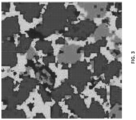
- the mineralogical analysis can be color coded, and overlaid over the SEM image, as shown in FIG. 3 .
- the characteristic x-rays in the EDS analysis can be used to generate a mineral map of the distribution of specific elements whose EDS spectral is known, as shown in FIG. 2 .
- This information will be used to identify and assign the mineralogy for each pixel and to determine distinct features such as grains and pores and the like. This is in contrast to the methods of overlaying a series of element maps over the original image and assigning a mineral phase based on a simple Boolean operation of combining minerals. This latter approach works with simple ore deposits (gold vs. silver vs. platinum), but not for minerals that have similar composition.
- a spatial profile of chemical mineralogy, particularly on the pore walls, detailing these features will be prepared.
- the distribution of mineral phases can be compared with the responses obtained from the laboratory tests. Any correlation amongst the type of mineral phase observed on the pore wall, or the relative abundance of any particular mineral on the pore wall, or the size of the pore, and any measure of the change in fluid-rock behavior of the laboratory core test, including but not limited to relative permeability of one fluid relative to another, or changes in hydrocarbon production effectiveness as determined by changes in amount of production or rate of production, can be used to develop predictive models. In some embodiments, a larger, field size test is also performed. Results for either the lab-scale or field-scale procedures can be used with the analytical techniques data.
- dead crude oil (crude oil without dissolved gas) is flowed into the reservoir rock core, and the core is aged at reservoir temperature for at least six weeks to restore wettability toward reservoir conditions.
- the dead crude oil flowed through the core will serve to measure oil permeability at initial water saturation.
- live crude oil (crude oil with dissolved gas) measured at temperatures and pressures approaching reservoir conditions.
- the core Once the core is prepared, it will be flooded with a "formation brine".
- the formation brine core flooding will set the baseline oil recovery compared to modified brines that are used in later laboratory experiments.
- the composition of the formation brine is not limited and can contain other additives that are needed to establish a baseline recovery.
- the relative differences between flood compositions i.e. formation brine and test solution
- the relative differences between flood compositions is expected to be representative of the order of magnitude of the impact the varying compositions would have when implemented in actual hydrocarbon recover)' operations.
- Subsequently solutions containing chemicals and additives used in various enhance recovery methods will be flowed through the core and the core's response will be monitored for comparison with SEM EDS mineral maps.
- the spatial profile of the rock sample will be compared with the results from one or more laboratory tests. Correlations between the rock's responses in the tests and the spatial profile can be determined. From there, critical regions of the pore wall that influence the fluid-rock interactions can be identified and the mineral composition can be determined. These correlations can then be applied to additional reservoir samples to negate the need for separate laboratory or field scale testing. In other applications, the correlations can be used to predict how the reservoir rock sample may response to testing with similar flood compositions.
- Information on the spatial distribution of minerals in a reservoir rock, especially those found adjacent to the pores can be used to predict a variety of responses associated with mineral-rock interactions during EOR processes, including but not restricted to estimating the amounts of surfactant that adsorbs to the pore wall surface, alterations in wettability due to specific adsorption of certain hydrocarbon molecules to specific mineral surfaces (for example certain asphaltenes and resins are known to adsorb preferentially to clay mineral and/or carbonate surfaces).
- Correlations between mineral distribution information and the results of an enhanced oil recovery test are developed from the summary statistics of each measurement.
- Enhanced oil recovery tests often produce estimates of incremental oil recovery following a specific treatment, or the final saturation after said treatment, or the amounts of residual fluids after said treatment, or other estimates of the efficiency of said test.
- the enhanced oil recovery results for a given sample or set of samples from the same reservoir are compared to the mineral distribution results, in particular the relative percentage of each mineral of interest that is adjacent or near the pores observed in the SEM images of the sample.
- the correlation can be improved by using samples for the SEM-based mineral analysis that are selected directly from the core plugs used in the enhanced oil recovery or other fluid-flow SCAL tests. Often a small piece taken from one end of the core plug is used for the SEM-based mineralogy analysis.
- the correlations and results from the one or more rock samples can then be applied to a reservoir model, and reservoir performance predicted.
- the best EOR method can then be applied to the reservoir itself.
- the present method is exemplified with respect to the enhanced oil recovery test for a waterflood described below.
- this is exemplary only, and the method can be broadly applied to any core analysis, both small and large scale.
- the following descriptions are intended to be illustrative only, and not unduly limit the scope of the appended claims.
- the present method was applied to suites of rock samples obtained from a sandstone reservoir under consideration for an enhanced oil recovery project.
- the enhance recovery method being considered was a low-salinity waterflood. This test shows how a set of sandstones from a reservoir being considered for an enhanced oil recovery project were evaluated with the spatial mineralogy process in order to gain a better understanding of the role in clay minerals in affecting ultimate recovery from that reservoir.
- a set of core plugs saturated with dead oil and at initial water saturation conditions was flooded with high-salinity water under standard laboratory core flooding procedures. After the production of oil leveled off and an end point or residual oil saturation was determined, a low-salinity brine was then introduced to the core flood experiment. The amount of incremental oil that was produced in addition to the original production was measured by the change in water saturation. The incremental oil increase from the low-salinity processed ranged from 0.01 to 0.07 fractional saturation units.
- Table 1 displays the mineral concentration adjacent to a large number of pores that can be further specified by selecting a range of pore diameters that are considered as critical.
- Table 1 Relative Mineral composition adjacent to a number of pores observed in a sandstone Mineral % Adjacent to Pore Quartz 30.8 Glauconite 20.0 Illite 10.0 Siderite 33.0
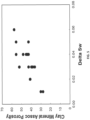
- the correlation observed in FIG 5 relative to the absence of any definable trend in FIG 4 illustrates how the spatial mineralogy information can be used to develop models that can predict fluid-rock interactions, including in this instance an estimate of enhanced oil recovery.
- the correlation in FIG 5 can be used to develop a single-variable linear model between the relative proportion of the pore walls associated with clay minerals and the improvement in oil recovery.
- These predictive models are not limited to single variables and linear trends, a multivariate, non-linear model can be constructed to predict a range of fluid-rock properties based on any number of experimental or theoretical parameters, including information on the spatial distribution of mineral phases relative to the pores.
- Such models can be applied to determine an optimal recovery technique and then that best EOR actually applied to the reservoir.
Landscapes
- Life Sciences & Earth Sciences (AREA)
- Chemical & Material Sciences (AREA)
- Health & Medical Sciences (AREA)
- Analytical Chemistry (AREA)
- Engineering & Computer Science (AREA)
- Pathology (AREA)
- Immunology (AREA)
- General Physics & Mathematics (AREA)
- General Health & Medical Sciences (AREA)
- Biochemistry (AREA)
- Physics & Mathematics (AREA)
- Geology (AREA)
- Medicinal Chemistry (AREA)
- Food Science & Technology (AREA)
- Remote Sensing (AREA)
- General Life Sciences & Earth Sciences (AREA)
- Environmental & Geological Engineering (AREA)
- Dispersion Chemistry (AREA)
- Analysing Materials By The Use Of Radiation (AREA)
Claims (1)
- Procédé comprenant les étapes consistant à :a) acquérir un échantillon de roche de réservoir provenant d'un réservoir d'intérêt ;b) obtenir des données d'images par microscopie électronique à balayage (SEM) en mode à électrons rétrodiffusés (BSE) et des données de spectre à dispersion d'énergie (EDS) dudit échantillon de roche de réservoir ;c) générer une carte minérale à partir desdites données de spectre EDS ;d) attribuer une minéralogie chimique dans ladite carte minérale ; ete) déterminer un profil spatial de minéralogie chimique d'une ou plusieurs parois poreuses dans ledit échantillon de roche de réservoir ;f) évaluer la réponse dudit échantillon de roche de réservoir à un ou plusieurs tests en laboratoire de récupération assistée du pétrole (EOR) sur ledit échantillon de roche de réservoir ; etg) comparer ledit profil spatial aux résultats de ladite étape d'évaluation f) pour identifier la composition d'une ou plusieurs régions critiques de parois poreuses, dans lequel une région critique est une région qui influence les interactions fluide-roche et est située à proximité de l'interface entre des grains minéraux distincts et des vides ou des espaces de pores et qui est suffisamment grande pour que des zones secondaires de grains et de pores puissent être identifiées de telle sorte que l'interface entre les deux soit reconnaissable ;caractérisé en ce que
le procédé est un procédé de prévision d'un processus de récupération assistée du pétrole portant sur un réservoir ; les étapes c) et d) comprennent les étapes consistant à :générer une carte minérale en combinant lesdites données d'images SEM et lesdites données de spectre EDS sur une base par pixel individuel ; etattribuer une minéralogie chimique de chaque pixel dans ladite carte minérale ; etle procédé comprend en outre l'étape consistant à :
h) prévoir une récupération assistée du pétrole pour une ou plusieurs régions dans ledit réservoir d'intérêt présentant la même région critique de composition de parois poreuses que ledit échantillon de roche de réservoir sur la base de ladite réponse obtenue à l'étape f.
Applications Claiming Priority (2)
| Application Number | Priority Date | Filing Date | Title |
|---|---|---|---|
| US201562192140P | 2015-07-14 | 2015-07-14 | |
| PCT/US2016/042282 WO2017011658A2 (fr) | 2015-07-14 | 2016-07-14 | Prévision d'une réponse de récupération de pétrole améliorée |
Publications (3)
| Publication Number | Publication Date |
|---|---|
| EP3323085A2 EP3323085A2 (fr) | 2018-05-23 |
| EP3323085A4 EP3323085A4 (fr) | 2018-08-08 |
| EP3323085B1 true EP3323085B1 (fr) | 2024-04-10 |
Family
ID=61951704
Family Applications (1)
| Application Number | Title | Priority Date | Filing Date |
|---|---|---|---|
| EP16825178.3A Active EP3323085B1 (fr) | 2015-07-14 | 2016-07-14 | Prévision d'une réponse de récupération de pétrole améliorée |
Country Status (1)
| Country | Link |
|---|---|
| EP (1) | EP3323085B1 (fr) |
Families Citing this family (1)
| Publication number | Priority date | Publication date | Assignee | Title |
|---|---|---|---|---|
| CN114813806B (zh) * | 2021-01-27 | 2025-09-30 | 中国石油化工股份有限公司 | 一种原生有机质和次生有机质的区分方法 |
Family Cites Families (1)
| Publication number | Priority date | Publication date | Assignee | Title |
|---|---|---|---|---|
| US9613253B2 (en) * | 2013-06-27 | 2017-04-04 | Cgg Services Sas | Pore-space measurement method apparatus and system |
-
2016
- 2016-07-14 EP EP16825178.3A patent/EP3323085B1/fr active Active
Also Published As
| Publication number | Publication date |
|---|---|
| EP3323085A4 (fr) | 2018-08-08 |
| EP3323085A2 (fr) | 2018-05-23 |
Similar Documents
| Publication | Publication Date | Title |
|---|---|---|
| CA2992290C (fr) | Prevision d'une reponse de recuperation de petrole amelioree | |
| Saif et al. | Multi-scale multi-dimensional microstructure imaging of oil shale pyrolysis using X-ray micro-tomography, automated ultra-high resolution SEM, MAPS Mineralogy and FIB-SEM | |
| Fang et al. | A new experimental methodology to investigate formation damage in clay-bearing reservoirs | |
| EP3077618B1 (fr) | Accord d'analyse numérique de carotte aux résultats de laboratoire | |
| Kim et al. | Permeability and porosity evolution of organic-rich shales from the Green River formation as a result of maturation | |
| Wang et al. | Multiscale characterization of the caney shale—an emerging play in Oklahoma | |
| Garum et al. | Ultrahigh-resolution 3D imaging for quantifying the pore nanostructure of shale and predicting gas transport | |
| Lai et al. | Pore scale heterogeneity in the mineral distribution and surface area of Berea sandstone | |
| Prakash et al. | Assessment of local phase to mechanical response link: application to the chemo-mechanical identification of rock phases subjected to reactive environments | |
| Ponomarev et al. | Application of core X-ray microtomography in oilfield geology | |
| Gao et al. | Pore-scale numerical investigation on chemical stimulation in coal and permeability enhancement for coal seam gas production | |
| Mukhametdinova et al. | Reservoir properties alteration in carbonate rocks after in-situ combustion | |
| EP3323085B1 (fr) | Prévision d'une réponse de récupération de pétrole améliorée | |
| Nie et al. | Determination of the thickness and fracture toughness of shale interfacial transition zone near various micromineral aggregates using nano-scratch tests | |
| Kumar et al. | Mapping 3D pore scale fluid distributions: how rock resistivity is influenced by wettability and saturation history | |
| Walters | Organic geochemistry at varying scales: from kilometres to ångstroms | |
| Kułynycz et al. | The application of X-Ray Computed Microtomography for estimation of petrophysical parameters of reservoir rocks | |
| Jin et al. | Multi-scale digital rock quantitative evaluation technology on complex reservoirs | |
| Huang et al. | Shale Mechanical Degradation in Supercritical CO₂ and Brine Formations: A Multiscale Experimental and Modeling Study: Shale Mechanical Degradation | |
| Al-Ajaj et al. | Visual Understanding of Rock Wettability Distribution to Contact Angle Regions and Oil Displacement Patterns in the Silty Sand Reservoir via 2D Pore-Scale Modeling | |
| US20240191623A1 (en) | Application of tof-sims for analysis of formation fluid samples and formation rock samples | |
| Major | Natural fractures in mudrocks and top seal integrity: insights from diagenesis, rock mechanics, and modeling applied to CO₂ sequestration and hydrocarbon exploration | |
| Gomez et al. | Quantifying fracture intensity: An example from the Piceance Basin | |
| Sun et al. | Multi-Scale Drill-Core Digitalization Technique and its Applications for Reservoir Characterization: A Case Study of an Unconventional Reservoir in China | |
| Sazali et al. | Mineralogical and Geochemical Studies of a Potential Co2 Storage Site's Core Samples Via Experimental and Digital Core Analyses–A case Study |
Legal Events
| Date | Code | Title | Description |
|---|---|---|---|
| STAA | Information on the status of an ep patent application or granted ep patent |
Free format text: STATUS: THE INTERNATIONAL PUBLICATION HAS BEEN MADE |
|
| PUAI | Public reference made under article 153(3) epc to a published international application that has entered the european phase |
Free format text: ORIGINAL CODE: 0009012 |
|
| STAA | Information on the status of an ep patent application or granted ep patent |
Free format text: STATUS: REQUEST FOR EXAMINATION WAS MADE |
|
| 17P | Request for examination filed |
Effective date: 20180124 |
|
| AK | Designated contracting states |
Kind code of ref document: A2 Designated state(s): AL AT BE BG CH CY CZ DE DK EE ES FI FR GB GR HR HU IE IS IT LI LT LU LV MC MK MT NL NO PL PT RO RS SE SI SK SM TR |
|
| AX | Request for extension of the european patent |
Extension state: BA ME |
|
| STAA | Information on the status of an ep patent application or granted ep patent |
Free format text: STATUS: EXAMINATION IS IN PROGRESS |
|
| A4 | Supplementary search report drawn up and despatched |
Effective date: 20180710 |
|
| RIC1 | Information provided on ipc code assigned before grant |
Ipc: G06K 9/32 20060101AFI20180704BHEP Ipc: G06K 9/68 20060101ALI20180704BHEP Ipc: G06K 9/46 20060101ALI20180704BHEP |
|
| 17Q | First examination report despatched |
Effective date: 20180723 |
|
| DAV | Request for validation of the european patent (deleted) | ||
| DAX | Request for extension of the european patent (deleted) | ||
| RAP1 | Party data changed (applicant data changed or rights of an application transferred) |
Owner name: CONOCOPHILLIPS COMPANY |
|
| RAP1 | Party data changed (applicant data changed or rights of an application transferred) |
Owner name: CONOCOPHILLIPS COMPANY |
|
| REG | Reference to a national code |
Ref legal event code: R079 Ipc: G01N0015080000 Ref country code: DE Ref document number: 602016086867 Country of ref document: DE Free format text: PREVIOUS MAIN CLASS: G06K0009320000 |
|
| P01 | Opt-out of the competence of the unified patent court (upc) registered |
Effective date: 20231207 |
|
| GRAP | Despatch of communication of intention to grant a patent |
Free format text: ORIGINAL CODE: EPIDOSNIGR1 |
|
| STAA | Information on the status of an ep patent application or granted ep patent |
Free format text: STATUS: GRANT OF PATENT IS INTENDED |
|
| RIC1 | Information provided on ipc code assigned before grant |
Ipc: G01N 33/24 20060101ALI20240116BHEP Ipc: G01N 15/08 20060101AFI20240116BHEP |
|
| INTG | Intention to grant announced |
Effective date: 20240201 |
|
| GRAS | Grant fee paid |
Free format text: ORIGINAL CODE: EPIDOSNIGR3 |
|
| GRAA | (expected) grant |
Free format text: ORIGINAL CODE: 0009210 |
|
| STAA | Information on the status of an ep patent application or granted ep patent |
Free format text: STATUS: THE PATENT HAS BEEN GRANTED |
|
| AK | Designated contracting states |
Kind code of ref document: B1 Designated state(s): AL AT BE BG CH CY CZ DE DK EE ES FI FR GB GR HR HU IE IS IT LI LT LU LV MC MK MT NL NO PL PT RO RS SE SI SK SM TR |
|
| REG | Reference to a national code |
Ref country code: GB Ref legal event code: FG4D |
|
| REG | Reference to a national code |
Ref country code: CH Ref legal event code: EP |
|
| REG | Reference to a national code |
Ref country code: DE Ref legal event code: R096 Ref document number: 602016086867 Country of ref document: DE |
|
| REG | Reference to a national code |
Ref country code: IE Ref legal event code: FG4D |
|
| REG | Reference to a national code |
Ref country code: LT Ref legal event code: MG9D |
|
| REG | Reference to a national code |
Ref country code: NL Ref legal event code: MP Effective date: 20240410 |
|
| REG | Reference to a national code |
Ref country code: AT Ref legal event code: MK05 Ref document number: 1675368 Country of ref document: AT Kind code of ref document: T Effective date: 20240410 |
|
| PG25 | Lapsed in a contracting state [announced via postgrant information from national office to epo] |
Ref country code: NL Free format text: LAPSE BECAUSE OF FAILURE TO SUBMIT A TRANSLATION OF THE DESCRIPTION OR TO PAY THE FEE WITHIN THE PRESCRIBED TIME-LIMIT Effective date: 20240410 |
|
| PG25 | Lapsed in a contracting state [announced via postgrant information from national office to epo] |
Ref country code: NL Free format text: LAPSE BECAUSE OF FAILURE TO SUBMIT A TRANSLATION OF THE DESCRIPTION OR TO PAY THE FEE WITHIN THE PRESCRIBED TIME-LIMIT Effective date: 20240410 |
|
| PG25 | Lapsed in a contracting state [announced via postgrant information from national office to epo] |
Ref country code: IS Free format text: LAPSE BECAUSE OF FAILURE TO SUBMIT A TRANSLATION OF THE DESCRIPTION OR TO PAY THE FEE WITHIN THE PRESCRIBED TIME-LIMIT Effective date: 20240810 |
|
| PG25 | Lapsed in a contracting state [announced via postgrant information from national office to epo] |
Ref country code: BG Free format text: LAPSE BECAUSE OF FAILURE TO SUBMIT A TRANSLATION OF THE DESCRIPTION OR TO PAY THE FEE WITHIN THE PRESCRIBED TIME-LIMIT Effective date: 20240410 |
|
| PG25 | Lapsed in a contracting state [announced via postgrant information from national office to epo] |
Ref country code: FI Free format text: LAPSE BECAUSE OF FAILURE TO SUBMIT A TRANSLATION OF THE DESCRIPTION OR TO PAY THE FEE WITHIN THE PRESCRIBED TIME-LIMIT Effective date: 20240410 Ref country code: HR Free format text: LAPSE BECAUSE OF FAILURE TO SUBMIT A TRANSLATION OF THE DESCRIPTION OR TO PAY THE FEE WITHIN THE PRESCRIBED TIME-LIMIT Effective date: 20240410 |
|
| PG25 | Lapsed in a contracting state [announced via postgrant information from national office to epo] |
Ref country code: GR Free format text: LAPSE BECAUSE OF FAILURE TO SUBMIT A TRANSLATION OF THE DESCRIPTION OR TO PAY THE FEE WITHIN THE PRESCRIBED TIME-LIMIT Effective date: 20240711 |
|
| PG25 | Lapsed in a contracting state [announced via postgrant information from national office to epo] |
Ref country code: PT Free format text: LAPSE BECAUSE OF FAILURE TO SUBMIT A TRANSLATION OF THE DESCRIPTION OR TO PAY THE FEE WITHIN THE PRESCRIBED TIME-LIMIT Effective date: 20240812 |
|
| PG25 | Lapsed in a contracting state [announced via postgrant information from national office to epo] |
Ref country code: ES Free format text: LAPSE BECAUSE OF FAILURE TO SUBMIT A TRANSLATION OF THE DESCRIPTION OR TO PAY THE FEE WITHIN THE PRESCRIBED TIME-LIMIT Effective date: 20240410 |
|
| PG25 | Lapsed in a contracting state [announced via postgrant information from national office to epo] |
Ref country code: AT Free format text: LAPSE BECAUSE OF FAILURE TO SUBMIT A TRANSLATION OF THE DESCRIPTION OR TO PAY THE FEE WITHIN THE PRESCRIBED TIME-LIMIT Effective date: 20240410 |
|
| PG25 | Lapsed in a contracting state [announced via postgrant information from national office to epo] |
Ref country code: PL Free format text: LAPSE BECAUSE OF FAILURE TO SUBMIT A TRANSLATION OF THE DESCRIPTION OR TO PAY THE FEE WITHIN THE PRESCRIBED TIME-LIMIT Effective date: 20240410 |
|
| PG25 | Lapsed in a contracting state [announced via postgrant information from national office to epo] |
Ref country code: LV Free format text: LAPSE BECAUSE OF FAILURE TO SUBMIT A TRANSLATION OF THE DESCRIPTION OR TO PAY THE FEE WITHIN THE PRESCRIBED TIME-LIMIT Effective date: 20240410 |
|
| PG25 | Lapsed in a contracting state [announced via postgrant information from national office to epo] |
Ref country code: PT Free format text: LAPSE BECAUSE OF FAILURE TO SUBMIT A TRANSLATION OF THE DESCRIPTION OR TO PAY THE FEE WITHIN THE PRESCRIBED TIME-LIMIT Effective date: 20240812 Ref country code: PL Free format text: LAPSE BECAUSE OF FAILURE TO SUBMIT A TRANSLATION OF THE DESCRIPTION OR TO PAY THE FEE WITHIN THE PRESCRIBED TIME-LIMIT Effective date: 20240410 Ref country code: LV Free format text: LAPSE BECAUSE OF FAILURE TO SUBMIT A TRANSLATION OF THE DESCRIPTION OR TO PAY THE FEE WITHIN THE PRESCRIBED TIME-LIMIT Effective date: 20240410 Ref country code: IS Free format text: LAPSE BECAUSE OF FAILURE TO SUBMIT A TRANSLATION OF THE DESCRIPTION OR TO PAY THE FEE WITHIN THE PRESCRIBED TIME-LIMIT Effective date: 20240810 Ref country code: HR Free format text: LAPSE BECAUSE OF FAILURE TO SUBMIT A TRANSLATION OF THE DESCRIPTION OR TO PAY THE FEE WITHIN THE PRESCRIBED TIME-LIMIT Effective date: 20240410 Ref country code: GR Free format text: LAPSE BECAUSE OF FAILURE TO SUBMIT A TRANSLATION OF THE DESCRIPTION OR TO PAY THE FEE WITHIN THE PRESCRIBED TIME-LIMIT Effective date: 20240711 Ref country code: FI Free format text: LAPSE BECAUSE OF FAILURE TO SUBMIT A TRANSLATION OF THE DESCRIPTION OR TO PAY THE FEE WITHIN THE PRESCRIBED TIME-LIMIT Effective date: 20240410 Ref country code: ES Free format text: LAPSE BECAUSE OF FAILURE TO SUBMIT A TRANSLATION OF THE DESCRIPTION OR TO PAY THE FEE WITHIN THE PRESCRIBED TIME-LIMIT Effective date: 20240410 Ref country code: BG Free format text: LAPSE BECAUSE OF FAILURE TO SUBMIT A TRANSLATION OF THE DESCRIPTION OR TO PAY THE FEE WITHIN THE PRESCRIBED TIME-LIMIT Effective date: 20240410 Ref country code: AT Free format text: LAPSE BECAUSE OF FAILURE TO SUBMIT A TRANSLATION OF THE DESCRIPTION OR TO PAY THE FEE WITHIN THE PRESCRIBED TIME-LIMIT Effective date: 20240410 Ref country code: RS Free format text: LAPSE BECAUSE OF FAILURE TO SUBMIT A TRANSLATION OF THE DESCRIPTION OR TO PAY THE FEE WITHIN THE PRESCRIBED TIME-LIMIT Effective date: 20240710 |
|
| REG | Reference to a national code |
Ref country code: DE Ref legal event code: R097 Ref document number: 602016086867 Country of ref document: DE |
|
| PG25 | Lapsed in a contracting state [announced via postgrant information from national office to epo] |
Ref country code: DK Free format text: LAPSE BECAUSE OF FAILURE TO SUBMIT A TRANSLATION OF THE DESCRIPTION OR TO PAY THE FEE WITHIN THE PRESCRIBED TIME-LIMIT Effective date: 20240410 |
|
| PG25 | Lapsed in a contracting state [announced via postgrant information from national office to epo] |
Ref country code: EE Free format text: LAPSE BECAUSE OF FAILURE TO SUBMIT A TRANSLATION OF THE DESCRIPTION OR TO PAY THE FEE WITHIN THE PRESCRIBED TIME-LIMIT Effective date: 20240410 |
|
| PG25 | Lapsed in a contracting state [announced via postgrant information from national office to epo] |
Ref country code: CZ Free format text: LAPSE BECAUSE OF FAILURE TO SUBMIT A TRANSLATION OF THE DESCRIPTION OR TO PAY THE FEE WITHIN THE PRESCRIBED TIME-LIMIT Effective date: 20240410 |
|
| PG25 | Lapsed in a contracting state [announced via postgrant information from national office to epo] |
Ref country code: RO Free format text: LAPSE BECAUSE OF FAILURE TO SUBMIT A TRANSLATION OF THE DESCRIPTION OR TO PAY THE FEE WITHIN THE PRESCRIBED TIME-LIMIT Effective date: 20240410 Ref country code: SK Free format text: LAPSE BECAUSE OF FAILURE TO SUBMIT A TRANSLATION OF THE DESCRIPTION OR TO PAY THE FEE WITHIN THE PRESCRIBED TIME-LIMIT Effective date: 20240410 |
|
| PG25 | Lapsed in a contracting state [announced via postgrant information from national office to epo] |
Ref country code: SM Free format text: LAPSE BECAUSE OF FAILURE TO SUBMIT A TRANSLATION OF THE DESCRIPTION OR TO PAY THE FEE WITHIN THE PRESCRIBED TIME-LIMIT Effective date: 20240410 |
|
| PG25 | Lapsed in a contracting state [announced via postgrant information from national office to epo] |
Ref country code: SM Free format text: LAPSE BECAUSE OF FAILURE TO SUBMIT A TRANSLATION OF THE DESCRIPTION OR TO PAY THE FEE WITHIN THE PRESCRIBED TIME-LIMIT Effective date: 20240410 Ref country code: SK Free format text: LAPSE BECAUSE OF FAILURE TO SUBMIT A TRANSLATION OF THE DESCRIPTION OR TO PAY THE FEE WITHIN THE PRESCRIBED TIME-LIMIT Effective date: 20240410 Ref country code: RO Free format text: LAPSE BECAUSE OF FAILURE TO SUBMIT A TRANSLATION OF THE DESCRIPTION OR TO PAY THE FEE WITHIN THE PRESCRIBED TIME-LIMIT Effective date: 20240410 Ref country code: EE Free format text: LAPSE BECAUSE OF FAILURE TO SUBMIT A TRANSLATION OF THE DESCRIPTION OR TO PAY THE FEE WITHIN THE PRESCRIBED TIME-LIMIT Effective date: 20240410 Ref country code: DK Free format text: LAPSE BECAUSE OF FAILURE TO SUBMIT A TRANSLATION OF THE DESCRIPTION OR TO PAY THE FEE WITHIN THE PRESCRIBED TIME-LIMIT Effective date: 20240410 Ref country code: CZ Free format text: LAPSE BECAUSE OF FAILURE TO SUBMIT A TRANSLATION OF THE DESCRIPTION OR TO PAY THE FEE WITHIN THE PRESCRIBED TIME-LIMIT Effective date: 20240410 |
|
| REG | Reference to a national code |
Ref country code: DE Ref legal event code: R119 Ref document number: 602016086867 Country of ref document: DE |
|
| PG25 | Lapsed in a contracting state [announced via postgrant information from national office to epo] |
Ref country code: IT Free format text: LAPSE BECAUSE OF FAILURE TO SUBMIT A TRANSLATION OF THE DESCRIPTION OR TO PAY THE FEE WITHIN THE PRESCRIBED TIME-LIMIT Effective date: 20240410 Ref country code: MC Free format text: LAPSE BECAUSE OF FAILURE TO SUBMIT A TRANSLATION OF THE DESCRIPTION OR TO PAY THE FEE WITHIN THE PRESCRIBED TIME-LIMIT Effective date: 20240410 |
|
| PLBE | No opposition filed within time limit |
Free format text: ORIGINAL CODE: 0009261 |
|
| STAA | Information on the status of an ep patent application or granted ep patent |
Free format text: STATUS: NO OPPOSITION FILED WITHIN TIME LIMIT |
|
| REG | Reference to a national code |
Ref country code: CH Ref legal event code: PL |
|
| PG25 | Lapsed in a contracting state [announced via postgrant information from national office to epo] |
Ref country code: LU Free format text: LAPSE BECAUSE OF NON-PAYMENT OF DUE FEES Effective date: 20240714 |
|
| 26N | No opposition filed |
Effective date: 20250113 |
|
| PG25 | Lapsed in a contracting state [announced via postgrant information from national office to epo] |
Ref country code: LU Free format text: LAPSE BECAUSE OF NON-PAYMENT OF DUE FEES Effective date: 20240714 |
|
| PG25 | Lapsed in a contracting state [announced via postgrant information from national office to epo] |
Ref country code: DE Free format text: LAPSE BECAUSE OF NON-PAYMENT OF DUE FEES Effective date: 20250201 |
|
| PG25 | Lapsed in a contracting state [announced via postgrant information from national office to epo] |
Ref country code: SI Free format text: LAPSE BECAUSE OF FAILURE TO SUBMIT A TRANSLATION OF THE DESCRIPTION OR TO PAY THE FEE WITHIN THE PRESCRIBED TIME-LIMIT Effective date: 20240410 Ref country code: CH Free format text: LAPSE BECAUSE OF NON-PAYMENT OF DUE FEES Effective date: 20240731 Ref country code: BE Free format text: LAPSE BECAUSE OF NON-PAYMENT OF DUE FEES Effective date: 20240731 |
|
| PG25 | Lapsed in a contracting state [announced via postgrant information from national office to epo] |
Ref country code: FR Free format text: LAPSE BECAUSE OF NON-PAYMENT OF DUE FEES Effective date: 20240731 |
|
| REG | Reference to a national code |
Ref country code: BE Ref legal event code: MM Effective date: 20240731 |
|
| PGFP | Annual fee paid to national office [announced via postgrant information from national office to epo] |
Ref country code: GB Payment date: 20250619 Year of fee payment: 10 |
|
| PGFP | Annual fee paid to national office [announced via postgrant information from national office to epo] |
Ref country code: NO Payment date: 20250623 Year of fee payment: 10 |
|
| PG25 | Lapsed in a contracting state [announced via postgrant information from national office to epo] |
Ref country code: IE Free format text: LAPSE BECAUSE OF NON-PAYMENT OF DUE FEES Effective date: 20240714 |
|
| PG25 | Lapsed in a contracting state [announced via postgrant information from national office to epo] |
Ref country code: SE Free format text: LAPSE BECAUSE OF FAILURE TO SUBMIT A TRANSLATION OF THE DESCRIPTION OR TO PAY THE FEE WITHIN THE PRESCRIBED TIME-LIMIT Effective date: 20240410 |
|
| PG25 | Lapsed in a contracting state [announced via postgrant information from national office to epo] |
Ref country code: CY Free format text: LAPSE BECAUSE OF FAILURE TO SUBMIT A TRANSLATION OF THE DESCRIPTION OR TO PAY THE FEE WITHIN THE PRESCRIBED TIME-LIMIT; INVALID AB INITIO Effective date: 20160714 |
|
| PG25 | Lapsed in a contracting state [announced via postgrant information from national office to epo] |
Ref country code: HU Free format text: LAPSE BECAUSE OF FAILURE TO SUBMIT A TRANSLATION OF THE DESCRIPTION OR TO PAY THE FEE WITHIN THE PRESCRIBED TIME-LIMIT; INVALID AB INITIO Effective date: 20160714 |