EP3323257B1 - Création et maintenance d'un réseau - Google Patents
Création et maintenance d'un réseau Download PDFInfo
- Publication number
- EP3323257B1 EP3323257B1 EP16742205.4A EP16742205A EP3323257B1 EP 3323257 B1 EP3323257 B1 EP 3323257B1 EP 16742205 A EP16742205 A EP 16742205A EP 3323257 B1 EP3323257 B1 EP 3323257B1
- Authority
- EP
- European Patent Office
- Prior art keywords
- subscriber
- cluster
- identifier
- subscribers
- connection
- Prior art date
- Legal status (The legal status is an assumption and is not a legal conclusion. Google has not performed a legal analysis and makes no representation as to the accuracy of the status listed.)
- Active
Links
Images


Classifications
-
- H—ELECTRICITY
- H04—ELECTRIC COMMUNICATION TECHNIQUE
- H04W—WIRELESS COMMUNICATION NETWORKS
- H04W40/00—Communication routing or communication path finding
- H04W40/24—Connectivity information management, e.g. connectivity discovery or connectivity update
- H04W40/32—Connectivity information management, e.g. connectivity discovery or connectivity update for defining a routing cluster membership
-
- H—ELECTRICITY
- H04—ELECTRIC COMMUNICATION TECHNIQUE
- H04W—WIRELESS COMMUNICATION NETWORKS
- H04W8/00—Network data management
- H04W8/005—Discovery of network devices, e.g. terminals
-
- H—ELECTRICITY
- H04—ELECTRIC COMMUNICATION TECHNIQUE
- H04W—WIRELESS COMMUNICATION NETWORKS
- H04W24/00—Supervisory, monitoring or testing arrangements
- H04W24/02—Arrangements for optimising operational condition
-
- H—ELECTRICITY
- H04—ELECTRIC COMMUNICATION TECHNIQUE
- H04W—WIRELESS COMMUNICATION NETWORKS
- H04W4/00—Services specially adapted for wireless communication networks; Facilities therefor
- H04W4/80—Services using short range communication, e.g. near-field communication [NFC], radio-frequency identification [RFID] or low energy communication
-
- H—ELECTRICITY
- H04—ELECTRIC COMMUNICATION TECHNIQUE
- H04W—WIRELESS COMMUNICATION NETWORKS
- H04W40/00—Communication routing or communication path finding
- H04W40/24—Connectivity information management, e.g. connectivity discovery or connectivity update
-
- H—ELECTRICITY
- H04—ELECTRIC COMMUNICATION TECHNIQUE
- H04W—WIRELESS COMMUNICATION NETWORKS
- H04W84/00—Network topologies
- H04W84/02—Hierarchically pre-organised networks, e.g. paging networks, cellular networks, WLAN [Wireless Local Area Network] or WLL [Wireless Local Loop]
- H04W84/10—Small scale networks; Flat hierarchical networks
- H04W84/14—WLL [Wireless Local Loop]; RLL [Radio Local Loop]
-
- H—ELECTRICITY
- H04—ELECTRIC COMMUNICATION TECHNIQUE
- H04W—WIRELESS COMMUNICATION NETWORKS
- H04W84/00—Network topologies
- H04W84/18—Self-organising networks, e.g. ad-hoc networks or sensor networks
- H04W84/20—Leader-follower arrangements
-
- Y—GENERAL TAGGING OF NEW TECHNOLOGICAL DEVELOPMENTS; GENERAL TAGGING OF CROSS-SECTIONAL TECHNOLOGIES SPANNING OVER SEVERAL SECTIONS OF THE IPC; TECHNICAL SUBJECTS COVERED BY FORMER USPC CROSS-REFERENCE ART COLLECTIONS [XRACs] AND DIGESTS
- Y02—TECHNOLOGIES OR APPLICATIONS FOR MITIGATION OR ADAPTATION AGAINST CLIMATE CHANGE
- Y02D—CLIMATE CHANGE MITIGATION TECHNOLOGIES IN INFORMATION AND COMMUNICATION TECHNOLOGIES [ICT], I.E. INFORMATION AND COMMUNICATION TECHNOLOGIES AIMING AT THE REDUCTION OF THEIR OWN ENERGY USE
- Y02D30/00—Reducing energy consumption in communication networks
- Y02D30/70—Reducing energy consumption in communication networks in wireless communication networks
Definitions
- the invention relates to a method for setting up and maintaining a network with two or more participants, based on radio connections between the participants according to a Bluetooth Low Energy Standard (BLE), according to the preamble of claim 1.
- BLE Bluetooth Low Energy Standard
- the invention further relates to an electronic subscriber in a BLE network with two or more electronic subscribers according to the preamble of claim 5.
- a method or an electronic participant of the type mentioned at the beginning are, for example, from US 2007/280 137 A1 known.
- US 2007/280 137 A1 From the " Specification of the Bluetooth System, Specification Volume 6, "June 30, 2010, pages 2165-2300 the conventional BLE standard for radio networks is known.
- Lee Taeyoung et al .: “Multiconnectivity strategy for agile service delivery with low power discovery", 2014, 25th Annual International Symposium on Personal, Indoor, and Mobile Radio Communication (PIMRC), IEEE, September 2, 2014, pages 2071-2075 describes the structure of a radio network based on a modified BLE discovery algorithm.
- the US 2013/003 630 A1 describes an ad-hoc radio network based on the conventional BLE standard.
- From the US 2002/103 893 A1 the construction and maintenance of an ad-hoc radio network is also known, but does not work according to the BLE standard.
- Bluetooth Low Energy Bluetooth LE or BLE
- BLE Bluetooth Low Energy
- the transmission takes place on 40 channels at 2.4 GHz in the ISM band.
- the channels are divided into advertising and data channels.
- the advertising channels are used to establish a BLE connection between two electronic participants and to send broadcasts, while larger amounts of data are transmitted via the data channels.
- advertising packets are sent permanently or advertising packets are constantly searched for, which leads to a comparatively high energy consumption.
- Devices with BLE interfaces can be interconnected to form piconets, in which a participant is connected as a master with one or more other participants acting as slaves.
- the disadvantage here is that the master must have greater resources. This applies to the hardware, but also to the energy supply in order to establish and maintain the connections to the other participants in the piconet.
- Beacons are small, mostly battery-operated electronic devices for transmitting data, preferably according to the Bluetooth LE standard.
- beacons with other energy supplies for example beacons connected to the voltage network
- Beacons can be designed for a variety of uses. They are used in sensors, for example in temperature sensors, for the transmission of measurement signals, as a signal transmitter for location functions (e.g. iBeacon from Apple), as a transmitter of data, for example advertising, for directing large flows of visitors, for example in stadiums, for transmitting information, for example in museums and exhibitions, and much more.
- the Bluetooth LE standard enables bidirectional data exchange.
- the disadvantage is that beacons usually only have a very low energy supply and other resources (transmission power, range, computing power, storage capacity, etc.). They are therefore not suitable as a connection coordinator in a network.
- the object of the invention relating to the method is achieved by the features of claim 1.
- the object of the invention relating to the electronic subscriber is achieved by the features of claim 5.
- the invention makes it possible to set up a mesh network without a centrally arranged connection coordinator.
- the network can thus be formed with participants who only have very few resources.
- the method makes it possible to set up a network with battery-operated or accumulator-operated participants with a low accumulator or battery capacity and to operate it over long periods of time. With the method according to the invention, smaller clusters are broken up, while larger clusters grow until all participants are connected in a cluster and thus a network.
- Bluetooth Low Energy Standard 4.1 Version 1.0
- the limitation to one input is advantageous because a participant connected via the input and thus operated as a slave must follow the connection parameters of the master connected to the input, which is ultimately only possible efficiently for one master.
- the procedure enables the establishment of a BLE network connection between two participants whose inputs are already occupied. To do this, the selected participant first disconnects from his cluster and then connects to the participant who selected him to establish a BLE network connection.
- each cluster is uniquely identified by a cluster identifier (cluster ID) and that a new BLE network connection is only established between two participants in different clusters. Ring networks can thus be avoided and there is a simple tree structure for the network obtained.
- the cluster identifier of the participant who set up the first BLE network connection of the present cluster can preferably be used as the cluster identifier (cluster ID).
- identification data Join-Me packet
- the identification data include at least the participant identification (node ID). and / or the number of free inputs and / or the number of free outputs of a respective participant and / or the cluster identifier (cluster ID) and / or a cluster size of the cluster to which the respective participant belongs that receiving participants from the Identifier data sent by different participants determine a rating number (connection score) for each of these participants and that a participant of a larger cluster selects a participant of a smaller cluster to establish a BLE network connection on the basis of the rating number (connection score) or that if the same size Clusters depending on the respective cluster identifier (cluster ID) and / or the each Depending on the subscriber identifier (node ID), a subscriber is specified who, based on the assessment number (connection score), selects a second subscriber to establish the
- the identification data can be sent using advertising packets provided for Bluetooth low energy applications.
- the evaluation number can then be determined from the identifier data, for example by means of a function (cluster score function).
- the participant in the larger cluster is responsible for selecting the connection partner. With the help of the rating number, the participants can select the most suitable connection partner and enter into a BLE network connection with this. If both clusters are of the same size, it can be provided that the cluster identifier (cluster ID) is used to decide which subscribers can decide to set up a BLE network connection.
- Knowledge of the cluster size is essential for setting up the network. This is preferably saved in each participant of a cluster. If a new participant is connected to the cluster, the cluster size can be increased by one and the new cluster size can be sent to the other participants in the cluster.
- the connection score takes a value that prevents a BLE network connection if the subscriber sending the identifier data (Join-Me packet) belongs to the same cluster as the subscriber subscribers receiving and evaluating the identifier data and / or if the sending subscriber belongs to a larger cluster than the receiving and evaluating subscriber. Accordingly, it can be provided that the connection score has a value that corresponds to a high evaluation of a possible BLE network connection if the sending subscriber has a free input and if the sending subscriber does not belong to the same cluster or a larger cluster . A connection is then made possible in which the selecting participant is switched as master and the selected participant as slave.
- a signal strength of the signal received from a subscriber can be evaluated to be taken into account when determining the evaluation number.
- RSSI Received Signal Strength Index
- BLE network connections are then preferably set up to subscribers with a high signal strength.
- a battery life and / or the device type is transmitted and used to determine the evaluation number. This means that connections are preferably set up to subscribers who have high battery resources and / or belong to a certain device class.
- the subscribers Before establishing a BLE network connection, participants must first recognize each other and evaluate a possible connection establishment. Therefore, it can be provided that during a discovery phase (discovery) of the network structure, the subscribers continuously send connection data with their identifier data (Join-Me packet) and receive connection data with identifier data from sending subscribers that receiving subscribers receive the Store the last received identifier data of the sending subscriber and that the frequency of the transmission of connection data and / or the search for connection data to be received is reduced or terminated if the received identifier data all have the same cluster identifier (cluster ID). Sending or scanning for data consumes a lot of energy. During the discovery phase, however, it is necessary to send or scan frequently in order to quickly identify participants in range and establish connections.
- cluster ID cluster identifier
- cluster ID cluster identifier
- the frequency of sending or searching for connection data to be received can then advantageously be reduced. This saves energy and significantly extends the operating time of battery-operated participants. If the transmission or reception frequency is reduced, new participants can be found and integrated into the network, possibly with an accepted delay. If the sending of or the search for connection data is completely stopped, the energy consumption can be further reduced, but no new participants can be recognized and accepted. According to a further embodiment of the invention, it can be provided that after a break in a BLE network connection, the frequency of sending and receiving connection data is increased again in order to enable a new connection to the lost subscriber.
- At least one beacon is used as a participant.
- Beacons are small, mostly battery or accumulator-operated and Bluetooth-enabled devices with a wide range of possible uses, for example as sensors, as Data sender for targeted advertising or navigation and much more.
- the mesh network that is formed is particularly suitable for this type of participant who only has low energy and hardware resources.
- a further embodiment of the invention provides that for each input and output of a participant the number of participants in a branch of the network that is connected to the respective input or output is saved by the participant (Connected Cluster Size) that the counter (Cluster Size) is reduced by the number of participants in the branch (Connected Cluster Size) if a BLE network connection to the branch is interrupted and that the new Value of the counter (cluster size) is sent to the other participants in the cluster.
- This new value can advantageously be sent as a change relative to the old value, in order to avoid possible concurrency problems. It can furthermore advantageously be provided that, if a BLE network connection is interrupted, a new cluster identifier (cluster ID) is assigned to the smaller cluster formed.
- a subscriber who is not yet connected to another subscriber is assigned its subscriber identifier (node ID) so that based on this subscriber identifier ( Node-ID) a cluster identifier (cluster ID) is generated and / or that a cluster size of one is assigned to the non-connected participant and / or that for the non-connected participant the number of per input and per output connected participants (Connect Cluster Size) is set to zero.
- node ID subscriber identifier
- cluster ID cluster identifier
- Connect Cluster Size the number of per input and per output connected participants
- a network identifier (network ID) is assigned to each network during the first phase (node initialization) and is stored in the subscribers already connected or to be connected in the respective network.
- the electronic participant is designed to set up a network with the other participants by means of BLE network connections and to reduce the frequency of the transmission of connection data and / or the search for connection data or to stop the transmission of connection data and / or the search for connection data if the subscribers located within range of a bidirectional BLE connection are integrated in the network.
- BLE network connections By reducing the frequency with which connection data is sent or scanned, the subscriber's energy consumption can be significantly reduced.
- networks can be set up with at least one or, preferably, several participants, which have a long operating time even with the limited energy resources of the participant.
- a mesh network can be set up in that the participant is designed to form a first cluster alone or together with at least one other participant connected via a BLE network connection, that the participant is designed to create a second participant from a smaller one or to select a second cluster of the same size and cause it to interrupt its BLE network connections to participants in the second cluster and that the participant is designed to set up a BLE network connection to the second participant.
- the electronic participant is preferably designed as a beacon.
- the data can thus be used to build and maintain the network.
- the beacon is designed to send identifier data (Join-Me packet) to other participants as connection data or as part of the connection data and to receive and receive identifier data from them that the identifier data include at least the subscriber identifier (node ID) and / or the number of free inputs and / or the number of free outputs of the beacon and / or the cluster identifier (cluster ID) and / or the cluster size (cluster Size) of the cluster to which the beacon or the other participant belongs.
- the possible participants in a network therefore have the data they need to establish a BLE network connection between two participants.
- the beacon can preferably be designed to use a function stored in the beacon (cluster score function) from the received identifier data (Join-Me packet) for each of the participants whose identifier data was received by the beacon To determine the evaluation number (connection score) and that the beacon is designed to use the evaluation number to select a participant for setting up a BLE network connection.
- the beacon can thus easily and quickly decide with which further participant, for example with which further beacon, it would prefer to establish a BLE network connection and then set it up accordingly.
- the cluster identifier cluster ID
- a signal strength of the received radio signal of the selected subscriber is taken into account. This can be done, for example, by taking into account a Received Signal Strength Index (RSSI). It will then preferably BLE network connections to participants with a high signal strength are set up.
- RSSI Received Signal Strength Index
- the beacon can preferably be used to carry out the described method.
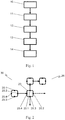
- FIG. 1 shows a flow chart for setting up a network.
- the flowchart provides, in succession, a node initialization phase 10, a discovery phase 11, a route setup phase 12, a route maintenance phase 13 and a routing phase 14.
- the network is included in the Figures 2 to 7 participants 20 shown based on Bluetooth Low Energy connections (BLE connections).
- BLE connections Bluetooth Low Energy connections
- the participants 20 can be identical or different electronic components.
- at least one of the participants is a beacon 23, as shown in FIG Figure 2 is shown executed.
- the individual phases can be run through multiple times and in different orders.
- the subscribers 20 are assigned a unique subscriber identifier (node ID) and a network identifier (network ID) before they connect to the network.
- node ID subscriber identifier
- network ID network identifier
- the participants 20 are also assigned a key for encrypting data.
- the network identifier (Network ID) enables several spatially overlapping networks to be operated.
- the participants Based on the participant identifiers (node ID), the participants generate 20 cluster identifiers (cluster ID). A cluster size is set for each participant (20, 21, 22, 25, 26, 27) to the initial value one.
- a subscriber 20 in the Bluetooth LE implementation used has three outputs 20.1, 20.2, 20.3 and one input 20.4.
- a value indicating the number of participants 20 in a branch of the network that is connected to a respective input 20.4 or output 20.1, 20.2, 20.3 of participant 20 (connected cluster size) is used for all inputs 20.4 and outputs 20.1, 20.2, 20.3 the participant 20 is set to zero.
- the initial values formed in this way are stored in the participants 20.
- the participants 20 successively send out broadcast messages in the form of advertising packets. Broadcast data are not addressed to a participant 20, but can be received by all participants 20 within range of the transmitter.
- the advertising packages contain connection data. Between sending, the participants 20 scan the advertising channels via which the broadcast messages are sent for connection data sent by other participants 20.
- the advertising packets sent transmit identification data (Join-Me packet) which describe the properties of the sending subscriber 20. These properties enable a receiving participant 20 to evaluate the sending participant 20 with regard to the establishment of a BLE network connection.
- the identifier data (Join-Me packet) preferably contain the subscriber identifier (node ID), the number of free inputs and the number of free outputs of the sending subscriber as well as the cluster identifier (cluster ID) and the cluster size ) one in the Figures 2 to 7 shown cluster 30 to which the respective participant 20 belongs.
- the advertising packet signals a possible connection if an input of the sending participant is free. If the input is occupied, the advertising packet signals that no direct connection is possible.
- Received advertising packets with identification data are stored by the respective subscriber 20 in a buffer.
- identification data is repeatedly received from a sending subscriber 20
- older data are overwritten with the newer data and the time of receipt is preferably also stored.
- the subscribers 20 determine the best connection partner in each case on the basis of the collected identification data (Join-Me packets). For each of the subscribers 20, whose identification data is available, a connection score is determined with the aid of a function (cluster score function).
- This evaluation number expresses the subscriber 20 with which a BLE network connection should preferably be established. The evaluation number is given a low value, preferably zero, if the sending participant 20 is integrated in the same or in a larger cluster 30 than the receiving and evaluating participant 20. A BLE network connection with such a participant 20 can then be used by the evaluating participant 20 cannot be initiated.
- cluster ID cluster ID
- node ID participant identifier
- the subscriber 20 After all the identification data have been evaluated, the subscriber 20 tries to establish a BLE network connection to the subscriber 20 with the highest evaluation number (connection score). For this purpose, a participant 20 will preferably select a further participant 20 who has a free input 20.4 and attempt to connect to this as a master.
- the two participants 20 concerned continue to exchange data (cluster welcome package) with their most recent and thus current identification data. If it turns out that both participants 20 already belong to the same cluster 30, the connection that has just been established is interrupted again. This makes it possible to avoid a participant 20 being connected to the same cluster 30 via several connections. Otherwise, the participant 20 of the smaller cluster 30 is arranged to interrupt all BLE network connections to the smaller cluster 30. A BLE network connection is then set up between the selecting and the selected subscriber 20. The new subscriber 20 stores his new cluster identifier (cluster ID) and his new cluster size (cluster size). This was increased by one compared to the cluster size of the larger cluster 30.
- cluster ID cluster identifier
- cluster size cluster size
- the accepted subscriber 20 then sends a cluster ACK packet, with which he confirms his entry into the new cluster 30. This is followed by a message (cluster update message) to the other participants in cluster 30 with the new cluster size.
- the cluster size is changed incrementally. This is advantageous because at a certain point in time not all participants 20 of a cluster 30, for example during a further handshake that is currently taking place, have stored the same cluster size.
- cluster size is reduced by the number of lost participants 20. This is also done incrementally. For this it is necessary that each participant 20 stores for each input or output 20.1, 20.2, 20.3, 20.4 how many participants 20 are contained in the branch connected to it (connected cluster size).
- cluster ID the smaller cluster 30 is formed on the basis of the subscriber identifier (Node ID) of the subscriber 20 whose connection was interrupted, a new cluster identifier (cluster ID) is generated. The larger cluster 30 retains its cluster identifier.
- Subscribers 20 of a larger cluster 30 can decide which connection they enter into. In this way, smaller clusters 30 are broken up until only one cluster 30 is left. A mesh network is thus formed without the need for a higher-level coordinator.
- all identifier data (Join-Me packets) have the same cluster identifiers (cluster ID). If this is the case, the participants 20 are switched to a slowed discovery phase (lower discovery mode) during the route maintenance phase 13. This is preferably done if there are no changes in the transmitted cluster identifiers over a longer period of time.
- the subscribers scan the network with a lower frequency and they send fewer advertising packets compared to the previously described Discovery 11 phase. It is also conceivable to switch off the discovery of further subscribers 20 completely. However, this has the disadvantage that new subscribers 20 can no longer be found and integrated into the network.
- connection to a subscriber 20 If the connection to a subscriber 20 is lost, his previous connection partner switches the network back to the Discovery phase with the correspondingly high transmission and search frequency. The network will thus reconnect subscribers 20 to whom the connection was interrupted. Alternative connection routes may be chosen. The network is thus self-healing. The separated subscriber 20 is very likely to be reconnected at the edge of the network. Subscribers 20 whose connection to the network is frequently interrupted are thus shifted to the edge of the network, which increases the stability of the network.
- data can then be sent over the network.
- the data can be forwarded from subscriber 20 to subscriber 20 to the addressee.
- Possible Messages are broadcast messages directed to all subscribers 20 or messages between two subscribers 20. Messages can also be sent to a connection point integrated in the network (sink or gateway) and from there to another network, or messages can be received from the connection point.
- Figure 2 shows a cluster 30 of a network with four participants 20.
- Each of the participants 20 has three outputs 20.1, 20.2, 20.3 and one input 20.4. on.
- the participants can enter into three connections as master and one connection as slave.
- One participant is designed as a beacon 23. Its input 20.4 is connected to a second output 20.2 of an upstream subscriber 20 via a BLE network connection.
- a branch with two participants 20 is connected to the first output 20.1 of the beacon 23.
- the second and third output 20.2, 20.3 of the beacon 23 are free and not connected to a further participant 20.
- Identification data are assigned to the beacon 23 and to the other participants 20 assigned to the cluster 30 shown. All these subscribers 20 connected in cluster 30 have the same network identifier (e.g. network ID: 1), the same cluster identifier (e.g. cluster ID: 7001) and the same cluster size, in the present exemplary embodiment cluster size: 4, on. Furthermore, each participant 20 is assigned its own participant identifier, for example node ID: 7 for the beacon 23. The number of subscribers 20 connected to it (connected cluster size) is also stored in each subscriber 20 for each input or output 20.1, 20.2, 20.3, 20.4. For the input 20.4 of the beacon 23 there is a connected cluster size of 1 in the example shown.
- the first output 20.1 of the beacon 23 is assigned a connected cluster size of 2, while the second and third outputs 20.2, 20.3 of the beacon 23 each have a connected Cluster Size of 0 is assigned. If the BLE network connection between the first output 20.1 of the beacon 23 and the following subscriber 20 is interrupted, the cluster size of the remaining cluster 30 becomes incremental according to the connected cluster size of 2 assigned to the first output. The new cluster size is then 2 (Cluster Size: 2).
- Figure 3 shows not yet networked participants 20 of a network to be formed.
- the individual subscribers 20 are each assigned a range 24 of their Bluetooth transmission module in the form of model-like concentric circles.
- the ranges 24 are different depending on the respective subscriber 20 and possibly the state of charge of his energy supply.
- a subscriber identifier node ID
- a network identifier network ID
- cluster ID cluster identifier
- the subscribers 20 are in the Discovery 11 phase. Accordingly, the subscribers 20 send identifier data (Join-Me packet) very frequently. Between sending the data, they receive identification data from subscribers 20 within whose range 24 they are located.
- identifier data Job-Me packet
- At least a large part of the participants 20 is preferably designed as beacons 23.
- FIG 4 shows the in Figure 3 The partially networked subscribers 20 shown here. Some subscribers 20 have connected via BLE network connections to form clusters 30 with a cluster size greater than 1.
- a cluster A 31 and a cluster B 32 are marked as an example. Cluster A 31 with three connected subscribers 20 is larger than cluster B 32 with only two subscribers 20.
- a subscriber A 21 is arranged at the end of cluster A 31, while a subscriber B 22 is connected at the end of cluster B 32.
- another neighboring subscriber C 25 is identified. Subscribers A 21 and B 22 are each within range 24 of the other subscriber A 21, B 22.
- both subscribers A 21, B 22 have the information that the cluster A 31 is larger than cluster B 32.
- Subscriber A 21 can thus decide whether subscriber B 22 should separate itself from cluster B 32 and enter into a BLE network connection with subscriber A 21. The same applies to a possible BLE network connection between subscriber A 21 and subscriber C 25.
- the decision as to whether and with which of the two subscribers A 22, C 25 a connection should be established is made by subscriber A 21 on the basis of the connection score, which he obtained with the help of a stored function (cluster score function) from the identifier data transmitted by participants B 22, C 25. Since subscriber B 22 has a free input 20.4, a comparatively high evaluation number is determined. This is above the evaluation number of the neighboring participant C 25, since his input 20.4 is occupied. Subscriber A 21 will thus preferably enter into a BLE network connection with subscriber B 22.
- the signal strength of a received transmission signal from a sending subscriber 20 can also be taken into account.
- connections are preferably set up to subscribers 20 from whom a strong transmission signal is present.
- the strength of a transmission signal can be taken into account, for example, in the form of a Received Signal Strength Index, RSSI.
- FIG 5 shows the in Figure 4 shown, further networked subscriber 20.
- Subscriber A 21 has, starting from Figure 4 , decided to establish a BLE network connection with subscriber B 22.
- the BLE network connection of subscriber B 22 to cluster B 32 was first disconnected.
- a BLE network connection was then established between an output 20.1, 20.2, 20.3 (see Figure 2 ) of participant A 21 and the input 20.4 of participant B 22.
- subscriber A 21 Since the input 20.4 of subscriber B 22 was free before the connection was established, it is alternatively also possible that subscriber A 21 does not remove subscriber B 22 from cluster B 32 before the connection is established. Instead, subscriber A 21 can establish a direct connection to subscriber B 22, in which subscriber A 21 is connected as master and subscriber B 22 as slave. In this way, the entire smaller cluster B 32 can be coupled to the larger cluster A 31.
- Figure 6 shows a network with the fully networked participants 20 Figure 5 .
- Subscriber A 21 has entered into a BLE network connection with subscriber C 25 for this purpose. Before the connection was established, input 20.4 of subscriber C 25 was occupied. Therefore, subscriber C 25 was first removed from its original cluster 30 and then connected to subscriber A 21. The method thus makes it possible for subscribers 20, whose inputs 20.4 are already occupied, to be transferred from smaller clusters 30 to larger ones.
- All participants 20 belong to Figure 6 a cluster 30 and accordingly have the same cluster identifier (cluster ID).
- the participants 20 then switch to a mode (lower discovery mode) in which advertising packets are sent less frequently and advertising packets are searched for less frequently. As a result, the energy consumption of the participants 20 can be significantly reduced.
- the mesh network formed does not require a coordinator or central master, but can be built up from participants 20 of the same type.
- a network can be set up with a large number of subscribers 20 with a low accumulator or battery capacity, for example with beacons. These network independently.
- the connection between the participants 20 takes place on a Bluetooth Low Energy Standard, preferably in accordance with the Bluetooth 4.1 specification.
- the subscribers 20 are programmed with appropriate application software. This controls the described phases of connection establishment and maintenance of the network.
- Figure 7 shows two clusters of different sizes D 33, E 34 during the construction of a network.
- Cluster D 33 has four participants 20 and cluster E 34 has three participants.
- a participant E 27 of the smaller cluster E 34 arranged at the end is within range 24 of an end participant D 26 of the larger cluster D 33.
- the participant E 27 of the smaller cluster E 34 with its range 24 does not reach the participant D 26 of the larger cluster D 33.
- the input 20.4 is occupied for both end-side participants D 26, E 27.
- the subscriber D 26 of the larger cluster D 33 detaches the subscriber E 27 of the smaller cluster E 34 from its cluster E 34 without subsequently being able to set up a BLE network connection between the two subscribers 20, since the range of participant E 27 is too low.
- This then means that the subscriber E 27 with the short range 24 is permanently not connected and is looking for connection options.
- the state of low search and transmission frequency cannot be achieved for the neighboring subscribers 20 either, which leads to high energy consumption.
- an ACK field to the identification data (Join-Me packet) which contains the subscriber identification (Node-ID).
- Subscriber D 26 can assign the subscriber ID of subscriber E 27 to this ACK field. This is only known to subscriber D 26 if he has previously received identification data (Join-Me packet) from subscriber E 27 and is therefore within range 24 of subscriber E 27.
- a participant 20 is therefore only removed from a cluster 30 by a further participant 20 if both participants 20 are within range 24 of the other participant 20.
Landscapes
- Engineering & Computer Science (AREA)
- Computer Networks & Wireless Communication (AREA)
- Signal Processing (AREA)
- Databases & Information Systems (AREA)
- Mobile Radio Communication Systems (AREA)
Claims (10)
- Procédé de mise en place et de maintenance d'un réseau avec deux ou plusieurs abonnés électroniques (20, 21, 22, 25, 26, 27), basé sur des connexions radio entre les abonnés (20, 21, 22, 25, 26, 27), chaque abonné (20, 21, 22, 25, 26, 27) étant identifié de manière unique par un identifiant d'abonné,
caractérisé en ce que
des clusters (30, 31, 32, 33, 34) sont formés avec une pluralité d'abonnés (20, 21, 22, 25, 26, 27) connectés au moyen de connexions Bluetooth Low Energy, BLE, en ce qu'un identificateur de cluster unique est attribué à chaque cluster (30, 31, 32, 33, 34), en ce qu'un premier abonné (20, 21, 22, 25, 26, 27) d'un premier cluster (30, 31, 32, 33, 34) sélectionne un deuxième abonné (20, 21, 22, 25, 26, 27), qui se trouve à portée d'une connexion BLE, dans un cluster plus petit ou de même taille (30, 31, 32, 33, 34), 27) à portée d'une connexion BLE, d'un second cluster (30, 31, 32, 33, 34) plus petit ou de même taille et provoquant le détachement de ce dernier du second cluster (30, 31, 32, 33, 34) par le second abonné qui interrompt ses connexions BLE avec les abonnés du second cluster, et son intégration dans le premier cluster (30, 31, 32, 33, 34) par l'établissement d'une connexion BLE avec le premier abonné (20, 21, 22, 25, 26, 27). - Méthode selon la revendication 1,
caractérisé en ce que
en ce que, avant l'établissement d'une connexion BLE, des données d'identification sont transmises entre les abonnés (20, 21, 22, 25, 26, 27) des clusters (30, 31, 32, 33, 34) qui sont présents, en ce que les données d'identification contiennent au moins l'identifiant de l'abonné et/ou le nombre d'entrées libres (20.1, 20.2, 20.3) et/ou le nombre de sorties libres (20. 4) d'un abonné respectif et/ou l'identifiant du cluster et/ou une taille de cluster du cluster auquel l'abonné respectif (20, 21, 22, 25, 26, 27) appartient, en ce que les abonnés récepteurs (20, 21, 22, 25, 26, 27) déterminent un numéro d'évaluation pour chacun de ces abonnés (20, 21, 22, 25, 26, 27) à partir des données d'identification envoyées par différents abonnés (20, 21, 22, 25, 26, 27), et en ce qu'un abonné (20, 21, 22, 25, 26, 27) d'un cluster plus grand (30, 31, 32, 33, 34) sélectionne, sur la base du numéro d'évaluation, un abonné (20, 21, 22, 25, 26, 27) d'un cluster (30, 31, 32, 33, 34) plus petit ou de même taille pour établir une connexion BLE, on détermine, en fonction de l'identificateur de cluster respectif et/ou de l'identificateur d'abonné respectif, un abonné (20, 21, 22, 25, 26, 27) qui sélectionne un deuxième abonné (20, 21, 22, 25, 26, 27) pour établir la connexion BLE sur la base du numéro d'évaluation. - Méthode selon la revendication 2,
caractérisé en ce que
pendant une phase de découverte de la configuration du réseau, les abonnés (20, 21, 22, 25, 26, 27) transmettent en permanence des données de connexion avec leurs données d'identification et reçoivent des données de connexion avec les données d'identification des abonnés émetteurs (20, 21, 22, 25, 26, 27), que les abonnés récepteurs (20, 21, 22, 25, 26, 27) stockent les données d'identification des abonnés émetteurs (20, 21, 22, 25, 26, 27) reçues en dernier dans chaque cas, et
en ce que la fréquence de transmission des données de connexion et/ou la recherche des données de connexion à recevoir est réduite ou interrompue si les données d'identification reçues ont toutes le même identifiant de cluster. - Une méthode selon l'une des revendications 1 à 3,
caractérisé en que
au moins un beacon (23) est utilisée comme abonné (20, 21, 22, 25, 26, 27). - Abonné électronique (20, 21, 22, 25, 26, 27) d'un réseau comprenant deux ou plusieurs abonnés électroniques (20, 21, 22, 25, 26, 27) basé sur des connexions radio entre les abonnés (20, 21, 22, 25, 26, 27), dans lequel l'abonné (20, 21, 22, 25, 26, 27) comprend un microprocesseur et une interface radio qui est destiné à établir la connexion radio avec au moins un autre abonné (20, 21, 22, 25, 26, 27), l'abonné (20, 21, 22, 25, 26, 27) et le au moins un autre abonné (20, 21, 22, 25, 26, 27) étant chacun identifié de manière unique au moyen d'un identifiant d'abonné,
caractérisé en ce que
les connexions radio sont des connexions Bluetooth Low Energy, BLE, en ce que l'abonné (20, 21, 22, 25, 26, 27) fait partie d'un premier cluster (30, 31, 32, 33, 34), en ce que plusieurs autres abonnés (20, 21, 22, 25, 26, 27) connectés au moyen de connexions BLE font partie d'un deuxième cluster (30, 31, 32, 33, 34) plus petit ou de même taille, en ce qu'un identificateur de cluster unique est attribué à chaque cluster (30, 31, 32, 33, 34), en ce que l'abonné (20, 21, 22, 25, 26, 27) du premier cluster (30, 31, 32, 33, 34) est conçu pour identifier un autre abonné (20, 21, 22, 25, 26, 27) à portée d'une connexion BLE du deuxième cluster (30, 31, 32, 33, 34) et de faire en sorte que l'abonné se déconnecte du deuxième cluster (30, 31, 32, 33, 34) en mettant fin à ses connexions BLE aux abonnés (20, 21, 22, 25, 26, 27) du deuxième cluster (30, 31, 32, 33, 34), 27) du deuxième cluster (30, 31, 32, 33, 34) et de l'intégrer dans le premier cluster (30, 31, 32, 33, 34) par l'abonné (20, 21, 22, 25, 26, 27) établissant une connexion BLE avec l'autre abonné (20, 21, 22, 25, 26, 27). - Abonné électronique (20, 21, 22, 25, 26, 27) selon la revendication 5,
caractérisé en que
l'abonné (20, 21, 22, 25, 26, 27) est conçu comme un beacon (23), en particulier un beacon alimentée par une batterie ou un accumulateur. - Abonné électronique (20, 21, 22, 25, 26, 27) selon la revendication 6,
caractérisé en ce que
le beacon (23) est conçue pour transmettre des données de connexion via la connexion BLE et pour rechercher les données de connexion d'autres abonnés (20, 21, 22, 25, 26, 27) transmises via la connexion BLE, en ce que le beacon (23) est conçue pour établir un réseau avec les autres abonnés (20, 21, 22, 25, 26, 27) au moyen de connexions BLE, et en ce que le beacon (23) est conçue pour de réduire la fréquence de la transmission des données de connexion et/ou de la recherche de données de connexion ou d'arrêter la transmission des données de connexion et/ou la recherche de données de connexion lorsque les autres abonnés (20, 21, 22, 25, 26, 27) situés à portée (24) d'une connexion BLE bidirectionnelle sont intégrés dans le réseau. - Abonné électronique (20, 21, 22, 25, 26, 27) selon la revendication 6 ou 7,
caractérisé en que
dans le beacon (23) est stocké un identifiant unique d'abonné et/ou un identifiant unique de cluster et/ou un identifiant unique de réseau et/ou une taille de cluster de le cluster à lequel le beacon (23) appartient et/ou le nombre d'abonnés (20, 21, 22, 25, 26, 27) dans une branche du réseau connectée à une entrée (20.1, 20.2, 20.3) ou une sortie (20.4) respective de le beacon (23). - Abonné électronique (20, 21, 22, 25, 26, 27) selon la revendication 8,
caractérisé en que
le beacon (23) est conçue pour envoyer des données d'identification comme données de connexion ou comme partie des données de connexion à d'autres abonnés (20, 21, 22, 25, 26, 27) situés à portée d'une connexion BLE et pour recevoir des données d'identification de leur part, et en ce que les données d'identification comprennent au moins l'identifiant de l'abonné et/ou le nombre d'entrées libres (20. 1, 20.2, 20.3) et/ou le nombre de sorties libres (20.4) de le beacon (23) et/ou l'identifiant de cluster et/ou la taille de le cluster à lequel le beacon (23) ou l'autre abonné (20, 21, 22, 25, 26, 27) appartient. - Abonné électronique (20, 21, 22, 25, 26, 27) selon la revendication 9,
caractérisé en que
le beacon (23) est conçue pour déterminer, à partir des données d'identification reçues, à l'aide d'une fonction stockée dans le beacon (23), pour chacun des abonnés (20, 21, 22, 25, 26, 27) dont les données d'identification ont été reçues par le beacon (23) et en ce que le beacon (23) est destinée à sélectionner, sur la base du numéro d'évaluation, un abonné (20, 21, 22, 25, 26, 27) pour l'intégration dans le premier cluster (30, 31, 32, 33, 34) et pour l'établissement d'une connexion BLE.
Priority Applications (1)
| Application Number | Priority Date | Filing Date | Title |
|---|---|---|---|
| PL16742205T PL3323257T3 (pl) | 2015-07-14 | 2016-07-13 | Tworzenie i utrzymanie sieci |
Applications Claiming Priority (2)
| Application Number | Priority Date | Filing Date | Title |
|---|---|---|---|
| DE102015111405.4A DE102015111405A1 (de) | 2015-07-14 | 2015-07-14 | Beacon und Verfahren zum Aufbau und zur Aufrechterhaltung eines Netzwerkes |
| PCT/EP2016/066605 WO2017009366A1 (fr) | 2015-07-14 | 2016-07-13 | Balise et procédé de création et de maintenance d'un réseau |
Publications (3)
| Publication Number | Publication Date |
|---|---|
| EP3323257A1 EP3323257A1 (fr) | 2018-05-23 |
| EP3323257B1 true EP3323257B1 (fr) | 2021-01-27 |
| EP3323257B8 EP3323257B8 (fr) | 2021-03-24 |
Family
ID=56550197
Family Applications (1)
| Application Number | Title | Priority Date | Filing Date |
|---|---|---|---|
| EP16742205.4A Active EP3323257B8 (fr) | 2015-07-14 | 2016-07-13 | Création et maintenance d'un réseau |
Country Status (6)
| Country | Link |
|---|---|
| US (2) | US10785702B2 (fr) |
| EP (1) | EP3323257B8 (fr) |
| DE (1) | DE102015111405A1 (fr) |
| ES (1) | ES2861376T3 (fr) |
| PL (1) | PL3323257T3 (fr) |
| WO (1) | WO2017009366A1 (fr) |
Families Citing this family (9)
| Publication number | Priority date | Publication date | Assignee | Title |
|---|---|---|---|---|
| DE102015111405A1 (de) * | 2015-07-14 | 2017-01-19 | M-Way Solutions Gmbh | Beacon und Verfahren zum Aufbau und zur Aufrechterhaltung eines Netzwerkes |
| US10070403B2 (en) | 2016-03-09 | 2018-09-04 | Mueller International, Llc | Time beacons |
| US10582347B2 (en) | 2016-04-14 | 2020-03-03 | Mueller International, Llc | SMS communication for cellular node |
| US10097411B2 (en) | 2016-05-23 | 2018-10-09 | Mueller International, Llc | Node migration |
| US10200947B2 (en) | 2016-07-11 | 2019-02-05 | Mueller International, Llc | Asymmetrical hail timing |
| US10178617B2 (en) | 2017-05-01 | 2019-01-08 | Mueller International, Llc | Hail and acceptance for battery-powered devices |
| US10267652B1 (en) | 2018-01-23 | 2019-04-23 | Mueller International, Llc | Node communication with unknown network ID |
| CN110312219B (zh) * | 2019-08-14 | 2022-07-01 | 南京矽力微电子技术有限公司 | 智能终端、遥控器及数据同步方法和电器控制系统 |
| US12219450B2 (en) * | 2022-06-27 | 2025-02-04 | Texas Instruments Incorporated | BLE channel aware operation parameters |
Family Cites Families (11)
| Publication number | Priority date | Publication date | Assignee | Title |
|---|---|---|---|---|
| US7120681B2 (en) * | 2001-01-30 | 2006-10-10 | International Business Machines Corporation | Cluster control in network systems |
| DE102004040069B3 (de) | 2004-08-18 | 2006-03-23 | Siemens Ag | Aufbau eines drahtungebundenen Kommunikationsnetzes unter Ermittlung lokaler Topologieinformation aus den Kennungen der Kommunikationsgeräte |
| US20130003715A1 (en) * | 2011-06-29 | 2013-01-03 | Texas Instruments Incorporated | Connection setup for low energy wireless networks based on master device packet that includes timing information |
| TWI484789B (zh) * | 2011-12-30 | 2015-05-11 | Ind Tech Res Inst | 主控裝置、被控裝置、及其網路通訊方法 |
| DE102012205355A1 (de) | 2012-04-02 | 2013-10-02 | Rohde & Schwarz Gmbh & Co. Kg | Verfahren zur Integration von Netzteilnehmern in ein ad-hoc-Netzwerk und zugehöriges ad-hoc-Netzwerk |
| US10003642B2 (en) * | 2013-06-28 | 2018-06-19 | Apple Inc. | Operating a cluster of peer-to-peer devices |
| WO2015054501A2 (fr) * | 2013-10-09 | 2015-04-16 | Stadson Technology | Système de sécurité utilisant des protocoles de communication sur un réseau personnel entre d'autres dispositifs |
| US9736870B1 (en) * | 2014-10-31 | 2017-08-15 | Aruba Networks, Inc. | Architecture of managing beacons using access points |
| US9820135B2 (en) * | 2014-12-22 | 2017-11-14 | Google Inc. | Systems and methods for reducing connection latency |
| US10080124B2 (en) * | 2015-06-29 | 2018-09-18 | Qualcomm Incorporated | Methods and apparatus for cluster management in DSRC cooperative safety systems |
| DE102015111405A1 (de) * | 2015-07-14 | 2017-01-19 | M-Way Solutions Gmbh | Beacon und Verfahren zum Aufbau und zur Aufrechterhaltung eines Netzwerkes |
-
2015
- 2015-07-14 DE DE102015111405.4A patent/DE102015111405A1/de active Pending
-
2016
- 2016-07-13 PL PL16742205T patent/PL3323257T3/pl unknown
- 2016-07-13 US US15/742,911 patent/US10785702B2/en active Active
- 2016-07-13 WO PCT/EP2016/066605 patent/WO2017009366A1/fr not_active Ceased
- 2016-07-13 ES ES16742205T patent/ES2861376T3/es active Active
- 2016-07-13 EP EP16742205.4A patent/EP3323257B8/fr active Active
-
2020
- 2020-06-08 US US16/895,668 patent/US11696212B2/en active Active
Non-Patent Citations (1)
| Title |
|---|
| None * |
Also Published As
| Publication number | Publication date |
|---|---|
| US11696212B2 (en) | 2023-07-04 |
| PL3323257T3 (pl) | 2021-07-05 |
| WO2017009366A1 (fr) | 2017-01-19 |
| DE102015111405A1 (de) | 2017-01-19 |
| ES2861376T3 (es) | 2021-10-06 |
| US20180220354A1 (en) | 2018-08-02 |
| EP3323257B8 (fr) | 2021-03-24 |
| EP3323257A1 (fr) | 2018-05-23 |
| US10785702B2 (en) | 2020-09-22 |
| US20200305060A1 (en) | 2020-09-24 |
Similar Documents
| Publication | Publication Date | Title |
|---|---|---|
| EP3323257B1 (fr) | Création et maintenance d'un réseau | |
| DE60224212T2 (de) | Netzwerk mit mehreren sub-netzwerken | |
| DE60105643T2 (de) | Verfahren und vorrichtung zur verbindung von endgeräten über ein ad-hoc funkkommunikationsnetzwerk | |
| DE69427404T2 (de) | Zuordnungsverfahren und Vorrichtung zur Wiederverwendung von Netzressourcen in einem drahtlosen Kommunikationssystem | |
| DE69923981T2 (de) | Verfahren und Anordnung in einem Telekommunikationsnetz | |
| DE10053809A1 (de) | Adhoc-Netzwerk mit mehreren Terminals zur Bestimmung von Terminals als Controller von Sub-Netzwerken | |
| EP2274935B1 (fr) | Procédé et dispositif de production d'au moins une extension d'un message d'attribution pour des réseaux maillés sans fil | |
| DE102009043403B4 (de) | Verfahren zum Aufbau eines bidirektionalen Kommunikationspfads in einem drahtlosen Netzwerk | |
| DE19752697A1 (de) | Drahtloses lokales Netzwerk mit Controller und wenigstens einem als Controller einsetzbaren Terminal | |
| DE10053854A1 (de) | Netzwerk mit mehreren Sub-Netzwerken zur Bestimmung von Brücken-Terminals | |
| DE19912547A1 (de) | Verfahren, Zentrale und Endgerät zur Übertragung von Mitteilungen an Endgeräte in einem Telekommunikatiossystem | |
| DE202005010770U1 (de) | Logische und physikalische Maschennetztrennung | |
| DE10138229B4 (de) | Verfahren zur Funkübertragung in einem Gefahrenmeldesystem | |
| DE60312045T2 (de) | Dynamischer netzaufbau für drahtlose ad-hoc netze | |
| EP1187397B1 (fr) | Reconfiguration d'un réseau ad hoc | |
| EP1246412A2 (fr) | Réseau avec adaptation de la structure de trame des sous-réseaux | |
| EP1881650B1 (fr) | Procédé d'établissement d'un réseau de communication auto-organisé | |
| DE102022214181A1 (de) | Verfahren für eine optimierte Auswahl der Zeitmaster-Rolle in 5G | |
| EP2859766B1 (fr) | Procédé et système de synchronisation temporelle dans un réseau ad hoc | |
| EP3525476B1 (fr) | Procede de determination de topologie d'un site de communication mobile et un site de communication mobile correspondant | |
| DE10107816A1 (de) | Netzwerk mit mehreren über Brücken-Terminals verbindbaren Sub-Netzwerken | |
| DE112017003386B4 (de) | Kommunikationssystem und Kommunikationsverfahren | |
| DE102009041821A1 (de) | Netzwerk | |
| DE10354943B4 (de) | Verfahren zum Betrieb einer Kommunikationsstrecke zwischen zumindest zwei Kommunikatonsendgeräten | |
| WO2004100460A2 (fr) | Procede pour faire fonctionner un systeme de radiocommunication |
Legal Events
| Date | Code | Title | Description |
|---|---|---|---|
| STAA | Information on the status of an ep patent application or granted ep patent |
Free format text: STATUS: THE INTERNATIONAL PUBLICATION HAS BEEN MADE |
|
| PUAI | Public reference made under article 153(3) epc to a published international application that has entered the european phase |
Free format text: ORIGINAL CODE: 0009012 |
|
| STAA | Information on the status of an ep patent application or granted ep patent |
Free format text: STATUS: REQUEST FOR EXAMINATION WAS MADE |
|
| 17P | Request for examination filed |
Effective date: 20180214 |
|
| AK | Designated contracting states |
Kind code of ref document: A1 Designated state(s): AL AT BE BG CH CY CZ DE DK EE ES FI FR GB GR HR HU IE IS IT LI LT LU LV MC MK MT NL NO PL PT RO RS SE SI SK SM TR |
|
| AX | Request for extension of the european patent |
Extension state: BA ME |
|
| DAV | Request for validation of the european patent (deleted) | ||
| DAX | Request for extension of the european patent (deleted) | ||
| STAA | Information on the status of an ep patent application or granted ep patent |
Free format text: STATUS: EXAMINATION IS IN PROGRESS |
|
| 17Q | First examination report despatched |
Effective date: 20190205 |
|
| REG | Reference to a national code |
Ref country code: DE Ref legal event code: R079 Ref document number: 502016012309 Country of ref document: DE Free format text: PREVIOUS MAIN CLASS: H04W0024020000 Ipc: H04W0008000000 |
|
| RIC1 | Information provided on ipc code assigned before grant |
Ipc: H04W 8/00 20090101AFI20200721BHEP Ipc: H04W 84/14 20090101ALI20200721BHEP Ipc: H04W 24/02 20090101ALI20200721BHEP |
|
| GRAP | Despatch of communication of intention to grant a patent |
Free format text: ORIGINAL CODE: EPIDOSNIGR1 |
|
| STAA | Information on the status of an ep patent application or granted ep patent |
Free format text: STATUS: GRANT OF PATENT IS INTENDED |
|
| INTG | Intention to grant announced |
Effective date: 20200901 |
|
| GRAS | Grant fee paid |
Free format text: ORIGINAL CODE: EPIDOSNIGR3 |
|
| GRAA | (expected) grant |
Free format text: ORIGINAL CODE: 0009210 |
|
| STAA | Information on the status of an ep patent application or granted ep patent |
Free format text: STATUS: THE PATENT HAS BEEN GRANTED |
|
| AK | Designated contracting states |
Kind code of ref document: B1 Designated state(s): AL AT BE BG CH CY CZ DE DK EE ES FI FR GB GR HR HU IE IS IT LI LT LU LV MC MK MT NL NO PL PT RO RS SE SI SK SM TR |
|
| REG | Reference to a national code |
Ref country code: GB Ref legal event code: FG4D Free format text: NOT ENGLISH |
|
| REG | Reference to a national code |
Ref country code: CH Ref legal event code: EP |
|
| REG | Reference to a national code |
Ref country code: DE Ref legal event code: R081 Ref document number: 502016012309 Country of ref document: DE Owner name: MWAY GROUP GMBH, DE Free format text: FORMER OWNER: M-WAY SOLUTIONS GMBH, 70372 STUTTGART, DE Ref country code: DE Ref legal event code: R082 Ref document number: 502016012309 Country of ref document: DE Representative=s name: HERRMANN PATENTANWAELTE, DE |
|
| REG | Reference to a national code |
Ref country code: AT Ref legal event code: REF Ref document number: 1359413 Country of ref document: AT Kind code of ref document: T Effective date: 20210215 |
|
| REG | Reference to a national code |
Ref country code: IE Ref legal event code: FG4D Free format text: LANGUAGE OF EP DOCUMENT: GERMAN |
|
| REG | Reference to a national code |
Ref country code: DE Ref legal event code: R096 Ref document number: 502016012309 Country of ref document: DE |
|
| REG | Reference to a national code |
Ref country code: CH Ref legal event code: PK Free format text: BERICHTIGUNG B8 |
|
| RAP2 | Party data changed (patent owner data changed or rights of a patent transferred) |
Owner name: MWAY GROUP GMBH |
|
| REG | Reference to a national code |
Ref country code: CH Ref legal event code: NV Representative=s name: DENNEMEYER AG, CH |
|
| REG | Reference to a national code |
Ref country code: NL Ref legal event code: FP |
|
| REG | Reference to a national code |
Ref country code: FI Ref legal event code: FGE |
|
| REG | Reference to a national code |
Ref country code: NO Ref legal event code: T2 Effective date: 20210127 |
|
| REG | Reference to a national code |
Ref country code: LT Ref legal event code: MG9D |
|
| PG25 | Lapsed in a contracting state [announced via postgrant information from national office to epo] |
Ref country code: HR Free format text: LAPSE BECAUSE OF FAILURE TO SUBMIT A TRANSLATION OF THE DESCRIPTION OR TO PAY THE FEE WITHIN THE PRESCRIBED TIME-LIMIT Effective date: 20210127 Ref country code: GR Free format text: LAPSE BECAUSE OF FAILURE TO SUBMIT A TRANSLATION OF THE DESCRIPTION OR TO PAY THE FEE WITHIN THE PRESCRIBED TIME-LIMIT Effective date: 20210428 Ref country code: PT Free format text: LAPSE BECAUSE OF FAILURE TO SUBMIT A TRANSLATION OF THE DESCRIPTION OR TO PAY THE FEE WITHIN THE PRESCRIBED TIME-LIMIT Effective date: 20210527 Ref country code: BG Free format text: LAPSE BECAUSE OF FAILURE TO SUBMIT A TRANSLATION OF THE DESCRIPTION OR TO PAY THE FEE WITHIN THE PRESCRIBED TIME-LIMIT Effective date: 20210427 Ref country code: LT Free format text: LAPSE BECAUSE OF FAILURE TO SUBMIT A TRANSLATION OF THE DESCRIPTION OR TO PAY THE FEE WITHIN THE PRESCRIBED TIME-LIMIT Effective date: 20210127 |
|
| PG25 | Lapsed in a contracting state [announced via postgrant information from national office to epo] |
Ref country code: RS Free format text: LAPSE BECAUSE OF FAILURE TO SUBMIT A TRANSLATION OF THE DESCRIPTION OR TO PAY THE FEE WITHIN THE PRESCRIBED TIME-LIMIT Effective date: 20210127 Ref country code: LV Free format text: LAPSE BECAUSE OF FAILURE TO SUBMIT A TRANSLATION OF THE DESCRIPTION OR TO PAY THE FEE WITHIN THE PRESCRIBED TIME-LIMIT Effective date: 20210127 Ref country code: SE Free format text: LAPSE BECAUSE OF FAILURE TO SUBMIT A TRANSLATION OF THE DESCRIPTION OR TO PAY THE FEE WITHIN THE PRESCRIBED TIME-LIMIT Effective date: 20210127 |
|
| PG25 | Lapsed in a contracting state [announced via postgrant information from national office to epo] |
Ref country code: IS Free format text: LAPSE BECAUSE OF FAILURE TO SUBMIT A TRANSLATION OF THE DESCRIPTION OR TO PAY THE FEE WITHIN THE PRESCRIBED TIME-LIMIT Effective date: 20210527 |
|
| REG | Reference to a national code |
Ref country code: ES Ref legal event code: FG2A Ref document number: 2861376 Country of ref document: ES Kind code of ref document: T3 Effective date: 20211006 |
|
| REG | Reference to a national code |
Ref country code: DE Ref legal event code: R097 Ref document number: 502016012309 Country of ref document: DE |
|
| PG25 | Lapsed in a contracting state [announced via postgrant information from national office to epo] |
Ref country code: SM Free format text: LAPSE BECAUSE OF FAILURE TO SUBMIT A TRANSLATION OF THE DESCRIPTION OR TO PAY THE FEE WITHIN THE PRESCRIBED TIME-LIMIT Effective date: 20210127 Ref country code: CZ Free format text: LAPSE BECAUSE OF FAILURE TO SUBMIT A TRANSLATION OF THE DESCRIPTION OR TO PAY THE FEE WITHIN THE PRESCRIBED TIME-LIMIT Effective date: 20210127 Ref country code: EE Free format text: LAPSE BECAUSE OF FAILURE TO SUBMIT A TRANSLATION OF THE DESCRIPTION OR TO PAY THE FEE WITHIN THE PRESCRIBED TIME-LIMIT Effective date: 20210127 |
|
| PG25 | Lapsed in a contracting state [announced via postgrant information from national office to epo] |
Ref country code: SK Free format text: LAPSE BECAUSE OF FAILURE TO SUBMIT A TRANSLATION OF THE DESCRIPTION OR TO PAY THE FEE WITHIN THE PRESCRIBED TIME-LIMIT Effective date: 20210127 Ref country code: DK Free format text: LAPSE BECAUSE OF FAILURE TO SUBMIT A TRANSLATION OF THE DESCRIPTION OR TO PAY THE FEE WITHIN THE PRESCRIBED TIME-LIMIT Effective date: 20210127 Ref country code: RO Free format text: LAPSE BECAUSE OF FAILURE TO SUBMIT A TRANSLATION OF THE DESCRIPTION OR TO PAY THE FEE WITHIN THE PRESCRIBED TIME-LIMIT Effective date: 20210127 |
|
| PLBE | No opposition filed within time limit |
Free format text: ORIGINAL CODE: 0009261 |
|
| STAA | Information on the status of an ep patent application or granted ep patent |
Free format text: STATUS: NO OPPOSITION FILED WITHIN TIME LIMIT |
|
| 26N | No opposition filed |
Effective date: 20211028 |
|
| PG25 | Lapsed in a contracting state [announced via postgrant information from national office to epo] |
Ref country code: AL Free format text: LAPSE BECAUSE OF FAILURE TO SUBMIT A TRANSLATION OF THE DESCRIPTION OR TO PAY THE FEE WITHIN THE PRESCRIBED TIME-LIMIT Effective date: 20210127 |
|
| PG25 | Lapsed in a contracting state [announced via postgrant information from national office to epo] |
Ref country code: SI Free format text: LAPSE BECAUSE OF FAILURE TO SUBMIT A TRANSLATION OF THE DESCRIPTION OR TO PAY THE FEE WITHIN THE PRESCRIBED TIME-LIMIT Effective date: 20210127 |
|
| PG25 | Lapsed in a contracting state [announced via postgrant information from national office to epo] |
Ref country code: MC Free format text: LAPSE BECAUSE OF FAILURE TO SUBMIT A TRANSLATION OF THE DESCRIPTION OR TO PAY THE FEE WITHIN THE PRESCRIBED TIME-LIMIT Effective date: 20210127 |
|
| REG | Reference to a national code |
Ref country code: BE Ref legal event code: MM Effective date: 20210731 |
|
| PG25 | Lapsed in a contracting state [announced via postgrant information from national office to epo] |
Ref country code: IS Free format text: LAPSE BECAUSE OF FAILURE TO SUBMIT A TRANSLATION OF THE DESCRIPTION OR TO PAY THE FEE WITHIN THE PRESCRIBED TIME-LIMIT Effective date: 20210527 Ref country code: LU Free format text: LAPSE BECAUSE OF NON-PAYMENT OF DUE FEES Effective date: 20210713 |
|
| PG25 | Lapsed in a contracting state [announced via postgrant information from national office to epo] |
Ref country code: IE Free format text: LAPSE BECAUSE OF NON-PAYMENT OF DUE FEES Effective date: 20210713 Ref country code: BE Free format text: LAPSE BECAUSE OF NON-PAYMENT OF DUE FEES Effective date: 20210731 |
|
| PG25 | Lapsed in a contracting state [announced via postgrant information from national office to epo] |
Ref country code: HU Free format text: LAPSE BECAUSE OF FAILURE TO SUBMIT A TRANSLATION OF THE DESCRIPTION OR TO PAY THE FEE WITHIN THE PRESCRIBED TIME-LIMIT; INVALID AB INITIO Effective date: 20160713 |
|
| PG25 | Lapsed in a contracting state [announced via postgrant information from national office to epo] |
Ref country code: CY Free format text: LAPSE BECAUSE OF FAILURE TO SUBMIT A TRANSLATION OF THE DESCRIPTION OR TO PAY THE FEE WITHIN THE PRESCRIBED TIME-LIMIT Effective date: 20210127 |
|
| PG25 | Lapsed in a contracting state [announced via postgrant information from national office to epo] |
Ref country code: MK Free format text: LAPSE BECAUSE OF FAILURE TO SUBMIT A TRANSLATION OF THE DESCRIPTION OR TO PAY THE FEE WITHIN THE PRESCRIBED TIME-LIMIT Effective date: 20210127 |
|
| P01 | Opt-out of the competence of the unified patent court (upc) registered |
Effective date: 20240408 |
|
| PG25 | Lapsed in a contracting state [announced via postgrant information from national office to epo] |
Ref country code: TR Free format text: LAPSE BECAUSE OF FAILURE TO SUBMIT A TRANSLATION OF THE DESCRIPTION OR TO PAY THE FEE WITHIN THE PRESCRIBED TIME-LIMIT Effective date: 20210127 |
|
| PG25 | Lapsed in a contracting state [announced via postgrant information from national office to epo] |
Ref country code: MT Free format text: LAPSE BECAUSE OF FAILURE TO SUBMIT A TRANSLATION OF THE DESCRIPTION OR TO PAY THE FEE WITHIN THE PRESCRIBED TIME-LIMIT Effective date: 20210127 |
|
| PGFP | Annual fee paid to national office [announced via postgrant information from national office to epo] |
Ref country code: NL Payment date: 20250721 Year of fee payment: 10 |
|
| PGFP | Annual fee paid to national office [announced via postgrant information from national office to epo] |
Ref country code: FI Payment date: 20250725 Year of fee payment: 10 Ref country code: ES Payment date: 20250826 Year of fee payment: 10 |
|
| PGFP | Annual fee paid to national office [announced via postgrant information from national office to epo] |
Ref country code: DE Payment date: 20250722 Year of fee payment: 10 |
|
| PGFP | Annual fee paid to national office [announced via postgrant information from national office to epo] |
Ref country code: NO Payment date: 20250725 Year of fee payment: 10 |
|
| PGFP | Annual fee paid to national office [announced via postgrant information from national office to epo] |
Ref country code: IT Payment date: 20250724 Year of fee payment: 10 Ref country code: PL Payment date: 20250710 Year of fee payment: 10 |
|
| PGFP | Annual fee paid to national office [announced via postgrant information from national office to epo] |
Ref country code: GB Payment date: 20250722 Year of fee payment: 10 |
|
| PGFP | Annual fee paid to national office [announced via postgrant information from national office to epo] |
Ref country code: FR Payment date: 20250725 Year of fee payment: 10 Ref country code: AT Payment date: 20250722 Year of fee payment: 10 |
|
| PGFP | Annual fee paid to national office [announced via postgrant information from national office to epo] |
Ref country code: CH Payment date: 20250801 Year of fee payment: 10 |