EP3323355A1 - Élément de suture - Google Patents
Élément de suture Download PDFInfo
- Publication number
- EP3323355A1 EP3323355A1 EP16836837.1A EP16836837A EP3323355A1 EP 3323355 A1 EP3323355 A1 EP 3323355A1 EP 16836837 A EP16836837 A EP 16836837A EP 3323355 A1 EP3323355 A1 EP 3323355A1
- Authority
- EP
- European Patent Office
- Prior art keywords
- suture
- loop portion
- tissue
- loop
- thread
- Prior art date
- Legal status (The legal status is an assumption and is not a legal conclusion. Google has not performed a legal analysis and makes no representation as to the accuracy of the status listed.)
- Withdrawn
Links
- 239000003550 marker Substances 0.000 claims description 4
- 238000000034 method Methods 0.000 description 35
- 239000000853 adhesive Substances 0.000 description 8
- 230000001070 adhesive effect Effects 0.000 description 8
- 230000000694 effects Effects 0.000 description 3
- 229920005989 resin Polymers 0.000 description 3
- 239000011347 resin Substances 0.000 description 3
- 239000004743 Polypropylene Substances 0.000 description 2
- -1 polypropylene Polymers 0.000 description 2
- 229920001155 polypropylene Polymers 0.000 description 2
- 238000012084 abdominal surgery Methods 0.000 description 1
- 238000007792 addition Methods 0.000 description 1
- 238000002357 laparoscopic surgery Methods 0.000 description 1
- 238000012986 modification Methods 0.000 description 1
- 230000004048 modification Effects 0.000 description 1
- 238000006467 substitution reaction Methods 0.000 description 1
Images







Classifications
-
- A—HUMAN NECESSITIES
- A61—MEDICAL OR VETERINARY SCIENCE; HYGIENE
- A61B—DIAGNOSIS; SURGERY; IDENTIFICATION
- A61B17/00—Surgical instruments, devices or methods
- A61B17/04—Surgical instruments, devices or methods for suturing wounds; Holders or packages for needles or suture materials
- A61B17/06—Needles ; Sutures; Needle-suture combinations; Holders or packages for needles or suture materials
- A61B17/06004—Means for attaching suture to needle
-
- A—HUMAN NECESSITIES
- A61—MEDICAL OR VETERINARY SCIENCE; HYGIENE
- A61B—DIAGNOSIS; SURGERY; IDENTIFICATION
- A61B17/00—Surgical instruments, devices or methods
- A61B17/04—Surgical instruments, devices or methods for suturing wounds; Holders or packages for needles or suture materials
- A61B17/0485—Devices or means, e.g. loops, for capturing the suture thread and threading it through an opening of a suturing instrument or needle eyelet
-
- A—HUMAN NECESSITIES
- A61—MEDICAL OR VETERINARY SCIENCE; HYGIENE
- A61B—DIAGNOSIS; SURGERY; IDENTIFICATION
- A61B17/00—Surgical instruments, devices or methods
- A61B17/04—Surgical instruments, devices or methods for suturing wounds; Holders or packages for needles or suture materials
- A61B17/06—Needles ; Sutures; Needle-suture combinations; Holders or packages for needles or suture materials
- A61B17/06066—Needles, e.g. needle tip configurations
-
- A—HUMAN NECESSITIES
- A61—MEDICAL OR VETERINARY SCIENCE; HYGIENE
- A61B—DIAGNOSIS; SURGERY; IDENTIFICATION
- A61B17/00—Surgical instruments, devices or methods
- A61B17/04—Surgical instruments, devices or methods for suturing wounds; Holders or packages for needles or suture materials
- A61B17/06—Needles ; Sutures; Needle-suture combinations; Holders or packages for needles or suture materials
- A61B17/06166—Sutures
-
- A—HUMAN NECESSITIES
- A61—MEDICAL OR VETERINARY SCIENCE; HYGIENE
- A61B—DIAGNOSIS; SURGERY; IDENTIFICATION
- A61B17/00—Surgical instruments, devices or methods
- A61B17/12—Surgical instruments, devices or methods for ligaturing or otherwise compressing tubular parts of the body, e.g. blood vessels or umbilical cord
- A61B17/12009—Implements for ligaturing other than by clamps or clips, e.g. using a loop with a slip knot
-
- A—HUMAN NECESSITIES
- A61—MEDICAL OR VETERINARY SCIENCE; HYGIENE
- A61B—DIAGNOSIS; SURGERY; IDENTIFICATION
- A61B17/00—Surgical instruments, devices or methods
- A61B17/04—Surgical instruments, devices or methods for suturing wounds; Holders or packages for needles or suture materials
- A61B17/0401—Suture anchors, buttons or pledgets, i.e. means for attaching sutures to bone, cartilage or soft tissue; Instruments for applying or removing suture anchors
-
- A—HUMAN NECESSITIES
- A61—MEDICAL OR VETERINARY SCIENCE; HYGIENE
- A61B—DIAGNOSIS; SURGERY; IDENTIFICATION
- A61B17/00—Surgical instruments, devices or methods
- A61B17/04—Surgical instruments, devices or methods for suturing wounds; Holders or packages for needles or suture materials
- A61B17/06—Needles ; Sutures; Needle-suture combinations; Holders or packages for needles or suture materials
- A61B17/062—Needle manipulators
Definitions
- the present invention relates to a suture member.
- a suture member in which a tissue is sutured using a suture needle and a suture thread.
- One end of the suture thread is connected to the suture needle and a loop portion is provided in the other end of the suture thread.
- a surgical suture needle that provides a clip at the loop portion has been suggested (for example, Patent Document 1).
- the clip provided in the loop portion is attached so as to be slidable with respect to the thread of the loop portion.
- the needle is passed through the loop portion and is pulled after the needle is penetrated through the body tissue to be sutured. Therefore, the loop portion gradually becomes smaller and the body tissue is bound by the suture thread.
- the end portion of the suture thread is pinched in the clip and the clip is deformed by being crushed. As a result, it is possible to prevent the suture thread from loosening by fixing the suture thread in the clip.
- Patent Document 1 Japanese Unexamined Patent Application, First Publication No. H10-337291
- the suture thread is held by the clip so that the suture thread does not loosen.
- it is very difficult to hold and fix the suture thread in clip in a state where tissues are contacted closely to each other. The number of people capable of doing so is limited.
- the present invention was made in view of the above-described situation, and has an object to provide a suture member that sutures the tissue easily and is hard to loosen.
- a suture member that suture a tissue includes: a suture needle of which a distal end is sharp; a suture thread which includes a first end portion and a second end portion, of which the first end portion is connected to the suture needle, and which sutures the tissue; a first loop portion which has a ring shape, through which the suture needle is capable of passing, and which is connected to the second end portion; and a second loop portion which has a ring shape, through which the suture needle is capable of passing, which is connected to the second end portion, and which is separated from the first loop.
- the suture member of the first aspect may further include: a first straight portion which is provided between the second end portion and the first loop portion; and a second straight portion which is provided between the second end portion and the second loop portion.
- a sum of a length of the first straight portion and a maximum length of the first loop portion in a longitudinal direction of the first straight portion may be larger than a sum of a length of the second straight portion and a maximum length of the second loop portion in a longitudinal direction of the second straight portion.
- a stopper that prevents the first loop portion and the second loop portion from being buried in the tissue may be provided to the second end portion.
- a visible marker may be provided in the second end portion.
- a suture member can suture the tissue easily and the suture member can be hard to loosen.
- a suture member according to a first embodiment of the present invention will be described with reference to FIGS. 1 to 15 .
- the suture member 10 includes a suture needle 11 which has a nearly straight shape and of which a distal end is sharp, a suture thread 12 that sutures a tissue, a first loop portion 13 that has a loop shape or a ring shape, and a second loop portion 14 that has a loop shape or a ring shape and that is provided to separate from the first loop.
- the first loop portion 13 and the second loop portion 14 have an internal diameter through which the suture needle 11 is capable of passing.
- the suture thread 12 includes a first end portion 12A and a second end portion 12B.
- the suture needle 11 is connected to the first end portion 12A of the suture thread 12.
- the suture member 10 further includes a first straight portion 21 that is provided between the second end portion 12B and the first loop portion 13, and a second straight portion 22 that is provided between the second end portion 12B and the second loop portion 14. That is, the second end portion 12B is a branching point at which the suture thread 12 is divided into the first straight portion 21 and the second straight portion 22.
- the suture thread 12 and the second straight portion 22 are formed integrally, and the first straight portion 21 is fixed to the second end portion 12B with an adhesive.
- An end of the first loop portion 13 is fixed to the first straight portion 21 with an adhesive, and a termination of the first loop portion 14 is fixed to the second straight portion 22 with an adhesive.
- the adhesive is preferably one of the group consisting of polypropylene resin, polypropylene resin, and biocompatible resin.
- a sum S1 (S1a+S1b) of a length S1a of the first straight portion 21 and a maximum length S1b of the first loop portion 13 in a longitudinal direction of the first straight portion 21 is larger than a sum S2 (S2a+S2b) of a length S2a of the second straight portion 22 and a maximum length S2b of the second loop portion 14 in a longitudinal direction of the second straight portion 22.
- a suture device 30 shown in FIG. 3 includes a first grasping member 31, a second grasping member 32, a longitudinal member 33, and a manipulation part (not shown).
- the first grasping member 31 and the second grasping member 32 are provided at a distal end of the longitudinal member 33.
- the above-mentioned suture member 10 is capable of engaging to the first grasping member 31 and the second grasping member 32.
- the longitudinal member 33 extends from a proximal end side of the first grasping member 31 and the second grasping member 32, and is connected to the manipulation part.
- the manipulation part is capable of opening and closing the first grasping member 31 and the second grasping member 32, and is capable of deliver the suture needle 11 of the suture member 10 from the first grasping member 31 side to the second grasping member 32 side.
- suture device is omitted as needed in order to simplifying the drawings when the procedure of a way of knotting using the suture thread 12 is described.
- the suture needle 11 of the suture member 10 is engaged to the first grasping member 31 and the second grasping member 32, and the first grasping member 31 and the second grasping member 32 are hold in a state of closing.
- An endoscope is penetrated through a body cavity by a well-known technique, a distal end of the endoscope is guided to a target to be treated, and the target to be sutured is caught in a field of the endoscope (not shown).
- the suture device 30 is protruded from the distal end of the endoscope.
- An operator causes the distal end of the suture device 30 to approach the target (perforation portion) in which the suture treatment is performed.
- the operator operates the manipulation part and the manipulation part causes the first grasping member 31 and the second grasping member 32 to contact to the target tissue in a state of opening the first grasping member 31 and the second grasping member 32. After that, the operator closes the first grasping member 31 and the second grasping member 32. Therefore, the tissue is grasped between the first grasping member 31 and the second grasping member 32.
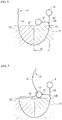
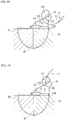
- the operator causes the suture needle 11 of the suture member 10 to penetrate from a first tissue T1 through a second tissue T2 by manipulating the manipulation part, as shown in FIG.
- the suture needle 11 and the suture thread 12 are protruded from the second tissue T2 side (step ST1).
- the first loop portion 13 and the second loop portion 14 do not enter into the first tissue T1 and expose.
- an piercing point at which the suture needle 11 is punctured is defined as P1
- a distance D1 from a contact face CF on which the first tissue T1 and the second tissue T2 are jointed to the piercing point P1 is longer than the length S1. Therefore, the first loop portion 13 does not exceed the contact face CF and is positioned at the first tissue T1 side.
- the operator manipulates the first grasping member 31 and the second grasping member 32 (not shown), passes the suture needle 11 through the first loop portion 13 from a back side of the first loop portion 13 twice, and causes the suture thread 12 to be entangled in the first loop portion 13. Therefore, the suture thread is a state of a half knot (step ST2).
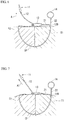
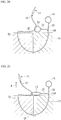
- the operator pulls the suture needle 11 toward a direction (arrow A direction) away from the tissue and tightens the suture thread 12. Therefore, the first loop portion 13 exceeds the contact face CF and moves to the second tissue T2 side (step ST3).
- the operator pulls the suture needle 11 toward the arrow A direction (obliquely upside with respect to tissues T1, T2), therefore the suture thread 12 is tightened. As a result, the first tissue T1 and the second tissue T2 are closely attached and the second end portion 12B is moved in the first tissue T1.
- the operator manipulates the first grasping member 31 and the second grasping member 32 (not shown), passes the suture needle 11 through the second loop portion 14 from the back side of the second loop portion 14 once, and makes a loop L1 by intersecting the suture thread 12 passing through the second loop portion 14 with the suture thread 12a extending from the first loop portion 13 toward the second loop portion 14 in the back side of the suture thread 12a (step ST4).
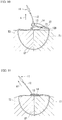
- the operator manipulates the first grasping member 31 and the second grasping member 32 (not shown), and passes the suture needle 11 through the loop L1 from a front side (a direction opposite to a direction in which the suture thread 12 is passed through the second loop portion 14) of the loop L1 once (step ST5).
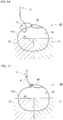
- the operator pulls the suture needle 11 toward a direction (the arrow A direction) away from the tissue, and tightens the suture thread 12 (step ST6). Therefore, the second loop portion 14 also exceeds the contact face CF and is closely attached to the first loop portion 13. As shown in FIG. 11 , the suture thread 12 is tightened by pulling the suture needle 11 toward an arrow A1 direction (obliquely upside with respect to tissues T1, T2) and a surgical knot is completed.
- a conventional suture member 40 as shown in FIG. 12 , includes a suture thread 41 and one loop portion 42.
- the operator causes the suture thread 41 to be entangled in the loop portion 42, after the operator causes the suture needle 11 of the suture member 40 to penetrate through the second tissue T2 from the first tissue T1.
- the suture needle 11 in order to inset the suture needle 11 in a next step, it is necessary to provide a gap G1 between the tissues T1, T2 and the loop portion 42.
- the operator makes a loop L2 by intersecting the suture thread 41 passing through the loop portion 42 with the suture thread 41 a toward the loop portion 42 in the back side of the suture thread 41 a toward the loop portion 42 and passes the suture thread 41 through the gap G1 from the back side of the gap G1.
- the operator passes the suture thread 41 though the loop L2 from the front side (see FIG. 14 ), pulls the suture thread 41 toward a direction (the arrow A direction) away from the tissue, and tightens the suture thread 41 (see FIG. 15 ).
- the gap G1 eventually remains after tightening the suture thread 41. Therefore, the first tissue T1 and the second tissue T2 cannot be tightened. As a result, the suture thread 41 is loosened.
- the tissues can be easily sutured using the treatment tool such as the suture device 30 introduced via the endoscope, because the suture member 10 of the present invention includes the first loop portion 13 and a second loop portion 14 that is provided away from the first loop portion 13. Furthermore, although the gap G1 is provided in the conventional suture member, it is not necessary to provide the gap G1 in the present invention. Therefore, the suture thread 12 is hard to loosen.
- the distance D1 from the contact face CF to the piercing point P1 is longer than the length S1, when the first tissue T1 and the second tissue T2 are tightened, the first loop portion 13 moves on the contact face CF or to the second tissue T2 side over the contact face CF by applying the tension toward the arrow A direction. Therefore, it is possible to apply a desired tension to the first tissue T1 and the second tissue T2.
- first straight portion 21 and the second straight portion 22 may be not provided.
- first loop portion 13 and the second loop portion 14 that is separated from the first loop portion 13 are directly provided in the second end portion 12B
- the suture thread 12 and the second straight portion 22 are formed integrally and the first straight portion 21 is adhered to the second end portion 12B
- a way of dividing into the first straight portion 21 and the second straight portion 22 from the second end portion 12B is not limited.
- the suture thread 12 and the first straight portion 21 may be formed integrally and the second straight portion 22 may be adhered to the second end portion 12B.
- the shape of the suture needle 11 is not limited and may be a shape according to the suture device.
- a curved needle (suture needle) 11A may be provided instead of a straight suture needle 11.
- the length S1 is longer than the length S2
- the length S1 may be same as the length S2. It is preferable that the rigidity of the second loop portion 14 is higher than the rigidity of the first loop portion 13 because eventually the suture thread 12 is passed through the second loop portion 14 and is tightened
- the method for suturing the suture member 10 according to the above present invention may be changed as below.
- a modified example 1 of the method for suturing using the suture member 10 according to the present invention will be described with reference to FIGS. 18 and 19 .
- a step ST4 of the modified example, as shown in FIG. 18 the operator passes the suture needle 11 through the second loop portion 14 from the front side of the second loop portion 14 once.
- the operator causes the suture thread 12 passing through the second loop portion 14 to intersect with the suture thread 12a extending from the first loop portion 13 toward the second loop portion 14 in the back side of the suture thread 12a.
- the operator passes the suture needle 11 through a loop L3 formed by the first loop portion 13, the suture thread 12a, the second loop portion 14, the first straight portion 21, and the second straight portion 22 from the back side of the loop L3.
- the operator passes the suture needle 11 through the loop L4 from the front side (step ST5), the loop L4 being formed by the suture thread 12 passing through the second loop portion 14 and the suture thread 12a that extends from the first loop portion 13 toward the second loop portion 14.
- a modified example 2 of the method for suturing using the suture member 10 according to the present invention will be described with reference to FIGS. 20 and 25 .
- the surgical knot is used.
- the way of passing the suture thread is different in the step ST2, the step ST4, and the step ST5. This point will be described below.
- the operator manipulates the first grasping member 31 and the second grasping member 32 (not shown), passes the suture needle 11 through the first loop portion 13 from a back side of the first loop portion 13 once, and causes the suture thread 12 to be entangled in the first loop portion 13.
- the operator passes the suture needle 11 through the second loop portion 14 from a back side of the second loop portion 14 once, and makes a loop L1 by intersecting the suture thread 12 passing through the second loop portion 14 with the suture thread 12a extending from the first loop portion 13 toward the second loop portion 14 in the back side of the suture thread 12a.
- the operator passes the suture needle 11 through the loop L1 from a front side (a direction opposite to a direction in which the suture thread 12 is passed through the second loop portion 14) of the loop L1 once (step ST5: see FIG. 23 ).
- step ST4 in the step ST4, as shown in FIG. 24 , the operator passes the suture needle 11 through the second loop portion 14 from a back side of the second loop portion 14 once, and makes a loop L1 by intersecting the suture thread 12 passing through the second loop portion 14 with the suture thread 12a extending from the first loop portion 13 toward the second loop portion 14 in the front side (step ST4).
- the operator passes the suture needle 11 through the loop L1 from the back side (a direction opposite to a direction in which the suture thread 12 is passed through the second loop portion 14) of the loop L1 once (step ST5: see FIG. 25 ).
- a suture member of a second embodiment of the present invention will be described with reference to FIGS. 26 and 27 .
- the suture member 50 of the present embodiment that includes a rubber ring (stopper) 51 is different from the suture member 10 of the first embodiment.
- the same reference numerals will be given to the equivalent configuration of the suture member 10 of the first embodiment, and the detailed description will be omitted.
- the rubber ring (stopper) 51 is provided to the second end portion 12B of the suture thread 12.
- the rubber ring (stopper) 51 is provided so as to cover the first straight portion 21 fixed to the second end portion 12B with the adhesive.
- the first straight portion 21 does not have to be fixed with the adhesive, but may be fixed by the rubber ring 51.
- the rubber ring 51 serves as a stopper, and prevents the first straight portion 21 and the second straight portion 22 that are arranged at the proximal end side than the rubber ring 51 from being buried in the first tissue T1.
- the suture member 50 of the present invention because the rubber ring 51 prevents the first straight portion 21 and the second straight portion 22 from being buried in the first tissue T1, the first loop portion 13 and the second loop portion 14 are definitely positioned on the first tissue T1. Therefore, even if the force is applied to the suture thread 12 more than needed, the suture can be definitely performed.
- the rubber ring 51 is marked with a visible marker. The operator uses the marker, while pulling the suture needle 11 or the suture thread 12 to prevent the first loop portion 13 and the second loop portion 14 from being buried in the first tissue T1.
- a suture member of a third embodiment of the present invention will be described with reference to FIGS. 28 and 29 .
- the suture member 60 of the present embodiment that includes loops more than three (for example, four loops) is different from the suture member 10 of the first embodiment.
- the same reference numerals will be given to the equivalent configuration of the suture member 10 of the first embodiment, and a detailed description will be omitted.
- the suture member 60 of the present invention includes a first loop portion 61, a second loop portion 62, a third loop portion 63, and a fourth loop portion 64 at the second end portion 12B of the suture thread 12.
- the suture member 60 includes a first straight portion 71 that is provided between the second end portion 12B and the first loop portion 61, a second straight portion 72 that is provided between the second end portion 12B and the second loop portion 62, a third straight portion 73 that is provided between the second end portion 12B and the third loop portion 63, and a fourth straight portion 74 that is provided between the second end portion 12B and the fourth loop portion 64. That is, the second end portion 12B is a branching point at which the suture thread 12 is divided into the first straight portion 71, the second straight portion 72, the third straight portion 73, and the fourth straight portion 74.
- the suture thread is formed by twisting together a plurality of threads, and the straight portions 71, 72, 73, 74 and the loop portions 61, 62, 63, 64 are formed by untwisting the twisting threads.
- the sum of the length of the second straight portion 72 and the maximum length of the second loop portion 62 in a longitudinal direction of the second straight portion 72 is the same as the sum of the length of the third straight portion 73 and the maximum length of the third loop portion 63 in a longitudinal direction of the third straight portion 73, and is the same as the sum of the length of the fourth straight portion 74 and the maximum length of the fourth loop portion 64 in a longitudinal direction of the fourth straight portion 74.
- the sum of a length S1 of the first straight portion 71 and the maximum length of the first loop portion 61 in a longitudinal direction of the first straight portion 71 is longer than the length S2.
- the operator passes the suture needle 11 through the first loop portion 61 twice.
- the operator passes the suture needle 11 through the second loop portion 62 once.
- the operator performs the steps ST3, ST4, and ST5 that are same as the first embodiment.
- the operator passes the suture needle 11 through the third loop portion 63 once.
- the operator performs the steps ST3, ST4, and ST5 that are same as those of the first embodiment.
- the operator passes the suture needle 11 through the fourth loop portion 64 once.
- the operator performs the steps ST3, ST4, and ST5 that are the same as those of the first embodiment. In this way, the suture of the tissues is completed.
- the suture member 60 includes the second loop portion 62, the third loop portion 63, and the fourth loop portion 64, the suture thread 12 is tightened using the step ST5 three times. Therefore, when the operator wants to increase a number of a knot, the suture member 60 can be used effectively.
- the operator in the case where the operator sutures the tissue shallowly, the operator wants a position at which the piercing point P1 is close to the contact face CF compared to suture the tissue deeply.
- the suture thread 12 is divided into the loop portions 61, 62, 63, 64 from the second end portion 12B, even if the piercing point P1 is close to the contact face CF, a distance D1 is longer than the length S1. Therefore, when the operator wants to suture the tissue shallowly, the suture member 60 can be used effectively.
- a suture member of a modified example of this embodiment will be described with reference to FIGS. 30 and 31 .
- the suture thread 12 is divided into the first straight portion 81 and the first loop portion 91, and the second straight portion 82 and the second loop portion 92 from the second end portion 12B.
- the third straight portion 83 and the third loop portion 93, and the fourth straight portion 84 and the fourth loop portion 94 are arranged in this order.
- the third straight portion 83 is fixed to the second loop portion 92 with an adhesive.
- the fourth straight portion 84 is fixed to the third loop portion 93 with an adhesive.
- the way of fixing the third straight portion 83 and the fourth straight portion 84 is not limited, the third straight portion 83 may be wound around the second loop portion 92.
- the third straight portion 84 may be wound around the third loop portion 93.
- the operator passes the suture needle 11 through the first loop portion 91 twice, and passes the suture needle 11 through the second loop portion 92 once. After that, the operator performs the steps ST3, ST4, and ST5 that are same as the first embodiment.
- the operator passes the suture needle 11 through the third loop portion 93 once. After that, the operator performs the steps ST3, ST4, and ST5 that are same as the first embodiment.
- the operator passes the suture needle 11 through the fourth loop portion 94 once. After that, the operator performs the steps ST3, ST4, and ST5 that are same as the first embodiment.
- the suture member 80 includes the second loop portion 92, the third loop portion 93, and the fourth loop portion 94, the suture thread 12 is tightened using the step ST5 three times. Therefore, when the operator wants to increase a number of a knot, the suture member 60 can be used effectively.
- the operator wants a position at which the piercing point P1 is away from the contact face CF compared to suture the tissue shallowly.
- the fourth loop portion 94 is positioned on or over the contact face CF because the second loop portion 92, the third loop portion 93, and the fourth loop portion 94 are connected tandemly. Therefore, it is possible to apply a desired tension to the first tissue T1 and the second tissue T2.
- the present invention can provide a suture member that sutures the tissue easily and such that the suture member is hard to loosen.
Landscapes
- Health & Medical Sciences (AREA)
- Life Sciences & Earth Sciences (AREA)
- Surgery (AREA)
- Molecular Biology (AREA)
- Engineering & Computer Science (AREA)
- Biomedical Technology (AREA)
- Heart & Thoracic Surgery (AREA)
- Medical Informatics (AREA)
- Nuclear Medicine, Radiotherapy & Molecular Imaging (AREA)
- Animal Behavior & Ethology (AREA)
- General Health & Medical Sciences (AREA)
- Public Health (AREA)
- Veterinary Medicine (AREA)
- Reproductive Health (AREA)
- Vascular Medicine (AREA)
- Surgical Instruments (AREA)
Applications Claiming Priority (2)
| Application Number | Priority Date | Filing Date | Title |
|---|---|---|---|
| JP2015161082 | 2015-08-18 | ||
| PCT/JP2016/064102 WO2017029845A1 (fr) | 2015-08-18 | 2016-05-12 | Élément de suture |
Publications (2)
| Publication Number | Publication Date |
|---|---|
| EP3323355A1 true EP3323355A1 (fr) | 2018-05-23 |
| EP3323355A4 EP3323355A4 (fr) | 2019-04-24 |
Family
ID=58051714
Family Applications (1)
| Application Number | Title | Priority Date | Filing Date |
|---|---|---|---|
| EP16836837.1A Withdrawn EP3323355A4 (fr) | 2015-08-18 | 2016-05-12 | Élément de suture |
Country Status (5)
| Country | Link |
|---|---|
| US (1) | US10595859B2 (fr) |
| EP (1) | EP3323355A4 (fr) |
| JP (1) | JP6161861B1 (fr) |
| CN (1) | CN107920815B (fr) |
| WO (1) | WO2017029845A1 (fr) |
Cited By (1)
| Publication number | Priority date | Publication date | Assignee | Title |
|---|---|---|---|---|
| EP3476304A1 (fr) * | 2017-10-26 | 2019-05-01 | Smith & Nephew, Inc. | Ensemble de suture et aiguille |
Families Citing this family (3)
| Publication number | Priority date | Publication date | Assignee | Title |
|---|---|---|---|---|
| JP2020531054A (ja) * | 2017-08-17 | 2020-11-05 | スマート スーチャーズ、エルエルシー | 渦巻き縫合装置および方法 |
| KR102066551B1 (ko) * | 2019-09-09 | 2020-01-15 | 이은영 | 다중 엔드 루프를 구비한 봉합사 |
| CN111588428B (zh) * | 2020-04-07 | 2022-01-25 | 上海市第六人民医院 | 一种带线缝合针 |
Family Cites Families (8)
| Publication number | Priority date | Publication date | Assignee | Title |
|---|---|---|---|---|
| US5178629A (en) * | 1992-03-03 | 1993-01-12 | Ethicon, Inc. | Method of forming a suture knot |
| JPH10337291A (ja) * | 1997-06-09 | 1998-12-22 | Motohiko Fukushima | 縫合手術用針 |
| CN2462861Y (zh) * | 2001-02-16 | 2001-12-05 | 淄博市妇幼保健院 | 一次性宫颈内口环扎术缝合针 |
| US20060293709A1 (en) * | 2005-06-24 | 2006-12-28 | Bojarski Raymond A | Tissue repair device |
| US7736376B2 (en) * | 2006-07-05 | 2010-06-15 | Olympus Medical Systems Corp. | Living body wall fixing tool used in endoscope |
| ES2612757T3 (es) * | 2010-11-09 | 2017-05-18 | Ethicon Llc | Suturas de autorretención de emergencia |
| CN103889340B (zh) * | 2011-03-23 | 2018-09-28 | 伊西康有限责任公司 | 自固位式可变套环缝合线 |
| US9872751B2 (en) * | 2013-03-11 | 2018-01-23 | Boston Scientific Scimed, Inc. | Implantable medical device and methods of delivering the implantable medical device |
-
2016
- 2016-05-12 CN CN201680048398.3A patent/CN107920815B/zh active Active
- 2016-05-12 JP JP2017522214A patent/JP6161861B1/ja active Active
- 2016-05-12 EP EP16836837.1A patent/EP3323355A4/fr not_active Withdrawn
- 2016-05-12 WO PCT/JP2016/064102 patent/WO2017029845A1/fr not_active Ceased
-
2018
- 2018-02-14 US US15/896,527 patent/US10595859B2/en active Active
Cited By (1)
| Publication number | Priority date | Publication date | Assignee | Title |
|---|---|---|---|---|
| EP3476304A1 (fr) * | 2017-10-26 | 2019-05-01 | Smith & Nephew, Inc. | Ensemble de suture et aiguille |
Also Published As
| Publication number | Publication date |
|---|---|
| CN107920815A (zh) | 2018-04-17 |
| JPWO2017029845A1 (ja) | 2017-08-17 |
| CN107920815B (zh) | 2021-03-23 |
| WO2017029845A1 (fr) | 2017-02-23 |
| US20180168571A1 (en) | 2018-06-21 |
| EP3323355A4 (fr) | 2019-04-24 |
| US10595859B2 (en) | 2020-03-24 |
| JP6161861B1 (ja) | 2017-07-12 |
Similar Documents
| Publication | Publication Date | Title |
|---|---|---|
| US12329390B2 (en) | Hemostatic clip with needle passer | |
| US6500184B1 (en) | Suturing apparatus and method of suturing | |
| US9138221B2 (en) | Anti-backup suture anchor | |
| US8845685B2 (en) | Anchor assembly and method of use | |
| EP2675364B1 (fr) | Dispositif à boucles multiples pour passer des extrémités de suture à travers un tampon chirurgical | |
| EP0587635B1 (fr) | Dispositifs chirurgicaux/medicaux | |
| CA2694650C (fr) | Dispositif chirurgical de suture, procede et outils utilises avec ce dispositif | |
| US10595859B2 (en) | Suture member | |
| US20070083235A1 (en) | Helical retainer, tool for using the helical retainer, and methods | |
| US9517071B2 (en) | Tissue ligating device | |
| KR20080031805A (ko) | 다수의 천공 바늘을 구비하는 의료 봉합 도구 | |
| US8734470B2 (en) | Surgical apparatus | |
| US9943303B2 (en) | Method of passing suture tails through a surgical pledget | |
| WO2010114591A2 (fr) | Dispositif pour sutures chirurgicales, procédé et instruments utilisés en association avec lui | |
| EP3232944B1 (fr) | Ensemble anse chirurgicale à boucles multiples | |
| US10172610B2 (en) | Device and method for tying a knot | |
| JP5977490B2 (ja) | 組織結紮デバイス | |
| US9706983B1 (en) | Method for suturing small skin wounds | |
| KR20200118799A (ko) | 매듭 전달 디바이스 | |
| KR101127193B1 (ko) | 복강경용 관통형 자궁 지혈 루프 | |
| JP6132944B2 (ja) | 組織結紮デバイス | |
| US20140194901A1 (en) | Assemblies for deploying fasteners in tissue and snares for use in such assemblies | |
| EP1977698A1 (fr) | Dispositif de chargement pour engin à demeure | |
| AU2013204680B2 (en) | Surgical suturing device, method and tools used therewith |
Legal Events
| Date | Code | Title | Description |
|---|---|---|---|
| STAA | Information on the status of an ep patent application or granted ep patent |
Free format text: STATUS: THE INTERNATIONAL PUBLICATION HAS BEEN MADE |
|
| PUAI | Public reference made under article 153(3) epc to a published international application that has entered the european phase |
Free format text: ORIGINAL CODE: 0009012 |
|
| STAA | Information on the status of an ep patent application or granted ep patent |
Free format text: STATUS: REQUEST FOR EXAMINATION WAS MADE |
|
| 17P | Request for examination filed |
Effective date: 20180214 |
|
| AK | Designated contracting states |
Kind code of ref document: A1 Designated state(s): AL AT BE BG CH CY CZ DE DK EE ES FI FR GB GR HR HU IE IS IT LI LT LU LV MC MK MT NL NO PL PT RO RS SE SI SK SM TR |
|
| AX | Request for extension of the european patent |
Extension state: BA ME |
|
| DAV | Request for validation of the european patent (deleted) | ||
| DAX | Request for extension of the european patent (deleted) | ||
| A4 | Supplementary search report drawn up and despatched |
Effective date: 20190322 |
|
| RIC1 | Information provided on ipc code assigned before grant |
Ipc: A61B 17/062 20060101ALN20190318BHEP Ipc: A61B 17/06 20060101AFI20190318BHEP |
|
| STAA | Information on the status of an ep patent application or granted ep patent |
Free format text: STATUS: THE APPLICATION HAS BEEN WITHDRAWN |
|
| 18W | Application withdrawn |
Effective date: 20190819 |