EP3323744A1 - Dispositif de pesage, transport et éttiquetage avec utilisation alternative d'imprimante - Google Patents
Dispositif de pesage, transport et éttiquetage avec utilisation alternative d'imprimante Download PDFInfo
- Publication number
- EP3323744A1 EP3323744A1 EP16199900.8A EP16199900A EP3323744A1 EP 3323744 A1 EP3323744 A1 EP 3323744A1 EP 16199900 A EP16199900 A EP 16199900A EP 3323744 A1 EP3323744 A1 EP 3323744A1
- Authority
- EP
- European Patent Office
- Prior art keywords
- label
- labeler
- operating state
- labeling
- labelers
- Prior art date
- Legal status (The legal status is an assumption and is not a legal conclusion. Google has not performed a legal analysis and makes no representation as to the accuracy of the status listed.)
- Granted
Links
Images


Classifications
-
- B—PERFORMING OPERATIONS; TRANSPORTING
- B65—CONVEYING; PACKING; STORING; HANDLING THIN OR FILAMENTARY MATERIAL
- B65C—LABELLING OR TAGGING MACHINES, APPARATUS, OR PROCESSES
- B65C9/00—Details of labelling machines or apparatus
- B65C9/40—Controls; Safety devices
-
- B—PERFORMING OPERATIONS; TRANSPORTING
- B32—LAYERED PRODUCTS
- B32B—LAYERED PRODUCTS, i.e. PRODUCTS BUILT-UP OF STRATA OF FLAT OR NON-FLAT, e.g. CELLULAR OR HONEYCOMB, FORM
- B32B37/00—Methods or apparatus for laminating, e.g. by curing or by ultrasonic bonding
- B32B37/0046—Methods or apparatus for laminating, e.g. by curing or by ultrasonic bonding characterised by constructional aspects of the apparatus
-
- B—PERFORMING OPERATIONS; TRANSPORTING
- B32—LAYERED PRODUCTS
- B32B—LAYERED PRODUCTS, i.e. PRODUCTS BUILT-UP OF STRATA OF FLAT OR NON-FLAT, e.g. CELLULAR OR HONEYCOMB, FORM
- B32B39/00—Layout of apparatus or plants, e.g. modular laminating systems
-
- B—PERFORMING OPERATIONS; TRANSPORTING
- B65—CONVEYING; PACKING; STORING; HANDLING THIN OR FILAMENTARY MATERIAL
- B65C—LABELLING OR TAGGING MACHINES, APPARATUS, OR PROCESSES
- B65C1/00—Labelling flat essentially-rigid surfaces
- B65C1/02—Affixing labels to one flat surface of articles, e.g. of packages, of flat bands
-
- B—PERFORMING OPERATIONS; TRANSPORTING
- B65—CONVEYING; PACKING; STORING; HANDLING THIN OR FILAMENTARY MATERIAL
- B65C—LABELLING OR TAGGING MACHINES, APPARATUS, OR PROCESSES
- B65C1/00—Labelling flat essentially-rigid surfaces
- B65C1/02—Affixing labels to one flat surface of articles, e.g. of packages, of flat bands
- B65C1/021—Affixing labels to one flat surface of articles, e.g. of packages, of flat bands the label being applied by movement of the labelling head towards the article
-
- B—PERFORMING OPERATIONS; TRANSPORTING
- B65—CONVEYING; PACKING; STORING; HANDLING THIN OR FILAMENTARY MATERIAL
- B65C—LABELLING OR TAGGING MACHINES, APPARATUS, OR PROCESSES
- B65C9/00—Details of labelling machines or apparatus
- B65C9/08—Label feeding
- B65C9/18—Label feeding from strips, e.g. from rolls
-
- B—PERFORMING OPERATIONS; TRANSPORTING
- B65—CONVEYING; PACKING; STORING; HANDLING THIN OR FILAMENTARY MATERIAL
- B65C—LABELLING OR TAGGING MACHINES, APPARATUS, OR PROCESSES
- B65C9/00—Details of labelling machines or apparatus
- B65C9/26—Devices for applying labels
-
- G—PHYSICS
- G01—MEASURING; TESTING
- G01G—WEIGHING
- G01G11/00—Apparatus for weighing a continuous stream of material during flow; Conveyor belt weighers
- G01G11/003—Details; specially adapted accessories
-
- B—PERFORMING OPERATIONS; TRANSPORTING
- B65—CONVEYING; PACKING; STORING; HANDLING THIN OR FILAMENTARY MATERIAL
- B65C—LABELLING OR TAGGING MACHINES, APPARATUS, OR PROCESSES
- B65C9/00—Details of labelling machines or apparatus
- B65C9/40—Controls; Safety devices
- B65C2009/408—Controls; Safety devices reading information before printing and applying a label
-
- B—PERFORMING OPERATIONS; TRANSPORTING
- B65—CONVEYING; PACKING; STORING; HANDLING THIN OR FILAMENTARY MATERIAL
- B65G—TRANSPORT OR STORAGE DEVICES, e.g. CONVEYORS FOR LOADING OR TIPPING, SHOP CONVEYOR SYSTEMS OR PNEUMATIC TUBE CONVEYORS
- B65G15/00—Conveyors having endless load-conveying surfaces, i.e. belts and like continuous members, to which tractive effort is transmitted by means other than endless driving elements of similar configuration
- B65G15/28—Conveyors with a load-conveying surface formed by a single flat belt, not otherwise provided for
Definitions
- the present invention relates to an alternate printer use weighing and labeling conveyor and method for operating a dual-use, alternate-use weighing and labeling conveyor.
- Weighing and labeling conveyors, so-called pricing printers, for labeling articles comprise a weighing belt for determining a weight value of an article, one or more transport devices, designed as a conveyor belt or conveyor belt, for transporting an article, a labeler with a printer for printing a label with information, in particular at least one related to the weight value of the article information and with an applicator for applying the label on the corresponding article.
- the articles to be labeled are, in particular, foods in tray trays, plastic film wrapped food, boxed or boxed food, or any products that are transported in plastic, paper or cardboard packaging on the weighing and labeling conveyor ,
- weighing and labeling conveyors which are to achieve high throughput comprise two labelers and thus two printers, wherein the labelers alternately print and apply a label for articles in the article stream on the transport device such that, for example, the first Labelers in the article sequence all odd articles labeled and the second labeler in the article sequence all straight articles labeled. Both labellers apply their labels in the same place on the articles, for example on the top or bottom of the packaging.
- the weighing and labeling conveyor is integrated in a production plant. If a malfunction occurs in the weighing and labeling conveyor, for example because the label roll in the printer is empty and has to be changed, the entire production line is shut down until the label roll is changed by an operator and thus until the fault in the printer is rectified ,
- the object of the invention is to propose an improved weighing and labeling conveyor.
- a weighing and labeling conveyor for labeling articles comprises a weighing conveyor for determining the weight of the articles.
- the weighing conveyor also knows the expert under the name füriliawaage.
- the weighing conveyor determines the weight of an article when it is guided over the weighing device by means of the conveyor.
- a transport device consisting of one or more conveyors is provided for transporting the articles from the beginning of the weighing and labeling conveyor to the end of the weighing and labeling conveyor.
- the weighing and labeling conveyor includes a labeling system for labeling the articles.
- the labeling system consists of three labellers. Each labeller includes an applicator.
- Each applicator of each labeler is adapted to be able to apply a label to a first point of application of an article while transporting the article on the transport device, wherein not every labeler of the labeling system actually applies a label to each article during operation. That is, each labeler is adapted to apply a label to the same location of an article, the so-called first application site.
- first application site The person skilled in the art will understand the same passage so that minimal deviations due to the tolerances of the system are also considered to be the same point.
- two labellers of the labeling system are in an active operating state and a labeller is in a passive operating state.
- the two labellers which are in the active operating state during normal operation, label successive articles on the transport device alternately, the label being applied to the first application site of the articles. That is, on successive articles, for example, one labeler applies a label to the first application site of the first, third, and fifth articles, and the other labeler applies a label to the second, fourth, and sixth articles, with a third labeler being present.
- This third labeler is in a passive operating state, that is to say in a standby operating state, and thus does not apply any labels to the articles. It serves as a back-up labeller for labellers who are currently in active mode.
- the weighing and labeling conveyor according to the invention has the advantage that a higher article throughput is achieved. Decisive for the article throughput is the printing time for the labels. By alternating use of second labelers, the article throughput can be increased. However, the failure is of a printer, for example by the end of a label roll, the whole system of weighing and labeling conveyor still.
- the labeling system according to the invention is designed such that in this case another printer is present, so that the article throughput of the weighing and labeling conveyor is not reduced and the system does not stand still.
- each labeler of the labeling system has a printer for printing the labels. Labels may also be partially pre-printed, so that only a portion of the labels, for example, with a weight information or information that is dependent on the weight value is printed.
- Each labeller includes a label holder for receiving a multi-label label roll. The label rolls are paper labels which are mounted on a backing paper and are pre-cut to decorative labels, transparent labels or a roll with linerless labels, ie an endless strip of labels without carrier tape. Furthermore, a labeller comprises a measuring unit for determining the remaining labels on the label roll.
- the measuring unit comprises, for example, a sensor unit which provides information about a number of revolutions of the pressure roller and a sensor unit which provides information about a number of revolutions of the label roll or of the label receiving tab on which the label roll is slipped.
- the evaluation of this information takes place in the measuring unit or in a control device of the labeler, the labeling system or the weighing and labeling conveyor system.
- the labeling system switches the operating state of two labelers.
- the labeller which is in a passive operating state prior to transient operation, is in an active operating state after transient operation.
- One of the labellers that is in an active state of operation prior to transient operation is in a passive operating state after transient operation.
- a labeller is in standby mode again (passive mode), but it is a different labeler than before transient operation.
- the transitional operation only lasts until the operating conditions of the labelers are changed. That is, in one embodiment, the labeling system is only a few milliseconds in transient mode. Transient operation does not slow down the frequency at which the labeling system labels.
- the weighing and labeling conveyor system includes a controller.
- the controller assigns two labellers an active operating state and a labeller a passive operating state. Which labeller is set to which operating state depends on the label stock on the label rolls and on the operating conditions of the individual labelers in the past.
- the assignment of the operating states follows according to one or more control schemas which are stored in the control device.
- the controller transfers the labeling system from a normal mode to a transient mode to change the operating states of at least one labeler.
- the control device comprises a label supply calculation unit.
- the label stock calculation unit calculates for each labeler the ratio of the number of revolutions of the pressure roller of the labelers and the number of revolutions of the label roll.
- the number of revolutions also includes fractions of revolutions.
- the number of revolutions of the pressure roller is proportional to the printed label length. If this label length is unwound from the label roll, this results from the number of revolutions of the label roll, in practice it is usually a fraction of a revolution, a radius of the outer label layer on the label roll. Thus, this information results in the label stock that is still available on the label roll is.
- the control device comprises a comparison unit which compares the calculated label stocks of the labelers of the labeling system, taking into account at least one comparison threshold, and / or compares the calculated label stocks with a lower limit value.
- the comparison unit supplies the underlying information for the initiation of the transitional operation.
- a labeller switches to a fault condition when the label stock of the labeller is exhausted.
- the controller controls the active and passive operating conditions of the labellers of the labeling system such that a labeller has the maximum time in the fault condition under the condition that the other two labellers do not switch to the fault condition. This has the advantage that an operator has the maximum time to change the label roll in a labeller before the label stock of a second labeller is used up.
- the controller controls the active and passive operating conditions of the labelers of the labeling system such that before a second labeler switches to the fault condition, the maximum number of labels of the labeling system is applied.
- the controller controls the active and passive operating conditions of the labellers of the labeling system such that after a first labeller switches to the fault state, a second labeller delays into the fault state by a defined changeover time.
- This has the advantage that it takes into account how long an operator needs to change a label roll of a labeller.
- the changeover time is the time required for it, possibly extended by a safety margin, Are defined. The operator can change the label roll during this time. Afterwards a second label roll has to be changed. In this respect, an operator is called to change the label roll when he can change the label rolls in succession with two labelers. This increases the efficiency of the labeling system.
- the weighing and labeling conveyor comprises further labelers.
- These labellers which do not belong to the labeling system of three labellers, apply additional labels to an article, but not to the first application site of the article.
- the other labellers may be bottom labellers if the three labellers of the labeller are top labellers.
- the other labellers may be top labellers if the three labellers of the labeller are bottom labellers. If the three labellers of the labeling system are top labellers, the other labellers may also be a top labeller that attaches a label to another location on the top of the article than the first site.
- a method according to the invention is suitable for operating a labeling conveyor with a transport device and a labeling system comprising three labelers.
- Each labeller includes a printer, an applicator, a label roll pick-up, and a measuring unit for determining the remaining labels on the label roll.
- the method includes a step of providing information about the label stock of each labeler of the labeling system. This step is performed once at the start of the procedure or at regular intervals.
- articles are labeled, the articles comprising a first point of application at the same position of the articles.
- a first labeller working in an active lab Operating state is located and a second labeler is in an active operating state apply alternately a label at the first point of application of successive articles.
- the third labeller is in a passive operating state.
- the label stock of at least the active labeler is determined periodically. In one embodiment, this determination of label stock takes place by evaluating the rotation of the pressure roller and the rotation of the label roll. In one embodiment, as the labeler consumes the labels, the current label stock of the labeler is calculated based on consumption and original label stock. The original label stock is fixed in particular when inserting a full label roll and can be entered by the operator. The method calculates the relationship between label stockers' labels and correlates that with each other.
- transient operation is initiated. In transient mode, the labeler, which is in a passive mode, switches to an active mode, and a labeler in an active mode switches to a passive mode. Which of the two labellers is switched to the passive operating state in an active operating state is determined by the label stocks of the two active labelers. After the transition operation, the normal operation is initiated.
- the information about the label stock of each labeler of the labeling system is generated at system start-up by each labeler printing a certain number of labels, thereby performing label stock detection. That is, the controller spends all labellers once in a short time in the active operating conditions to determine the label stocks.
- the operator gives the level of the Label roll in the weighing and labeling transport device. This makes sense especially when the operator inserts a full label roll. This is the norm in practice.
- the reaching of a lower limit of the label stock is detected in at least one labeler and issued a status message.
- the limit of the label supply is reached, for example, when there is only a small amount of labels left or when the label roll is empty.
- the status message is, for example, information that is forwarded via email or SMS to the operator to signal to him that the label roll now or at least soon must be changed.
- a status message is also, for example, a signal lamp on the labeling transport device or a status message on the terminal or operating display of the labeling transport device.
- the transient operation is initiated when the label supply of a labeller is depleted in the active operating state, and in transient operation this labeller is switched to the passive operating state.
- the transitional operation is initiated after a labeler has been loaded with a new label roll.
- the labelers with the largest and the smallest label supply are switched to an active operating state and the labeler with the middle label supply is switched to the passive operating state.
- This has the advantage that an operator who changes the label roll the maximum time to change the Has label roll.
- the labeler, which has used up the label roll can be in the fault state for the maximum time without another of the two labelers switching to the fault state, that is, without the label roll of a second labeler being used up.
- the predetermined ratio for initiating the transient operation is achieved as soon as the label stock of at least one of the labelers has reached only half of the labels of a full label roll in the active operating state.
- transient operation is then initiated only if a latency has elapsed since the last transition. This prevents two full label rolls, which become empty in parallel and reach one after the other half of the labels of a full label roll, the transition mode is switched on twice in succession. This process also maximizes the time an operator has to replace the label roll.
- the labeler with the smallest label stock is placed in the active mode. If the second smallest label stock is larger than half of a full label roll, the labeler with the second smallest label stock is placed in the active operating state. On the other hand, if the second smallest label stock is smaller than half of a full label roll, the labeler with the largest label stock is brought into the active operating state. If the label supply of the labeler with the second smallest label supply is smaller by a first comparison threshold than the label supply of the labeler with the largest label supply and is less than half of a full label roll, the transitional operation is initiated. The labeller with the second smallest label supply is switched to a passive operating state.
- the two labelers with the largest label stock taking into account the comparison threshold, are alternately brought into the active operating state while at the same time the labeler with the smallest label stock remains in the active operating state.
- the labels in the labeller with the smallest label stock are first used up to change that label roll before the other label rolls are also used up.
- the comparison threshold ensures that the two labelers with the largest label supply are not switched from the active to the passive operating state after each label.
- the two labelers with the largest label stock are placed in the active mode and the third labeler is placed in the passive mode. If the label supply of a labeller in the active operating state by a second comparison threshold is smaller than the label supply of the labeller in the passive operating state, the transitional operation is initiated and this labeller is switched to the passive operating state.
- a changeover time is provided for changing the label roll.
- the changeover time is the maximum time that a user normally needs to change the label roll from the notification to the label roll change.
- This changeover time may also include a safety margin in one embodiment.
- a minimum label stock for roll change is calculated based on the user's changeover time and the labeler's printing speed. Print speed is the speed at which the labeller actually prints and consumes label stock at current article throughput. It is not necessarily around the maximum printing speed of the labeller.
- the calculated minimum label stock is defined as the second comparison threshold. This has the advantage that, after a first labeller switches to the fault state, a second labeller delays into the fault state by a defined changeover time. Thus, an operator is notified when he needs to change a label roll. When he has finished changing the label roll, he must change a second label roll in a timely manner. Thus, the operator needs to change the labels of two labelers only once to the labeling without the labeling standstill.
- the described weighing and labeling conveyor performs a described method of operating a labeling conveyor.
- Fig. 1 shows a weighing and labeling conveyor 10 according to the invention.
- the weighing and labeling conveyor 10 comprises a plurality of conveyor belts, in particular a weighing belt 34, one or more Etikettierbs 28 and at least one feed belt (not shown).
- a weighing and labeling conveyor 10 may additionally comprise a monitoring system 30, for example a metal detector or an optical monitoring system.
- the weighing and labeling conveyor 10 comprises a weighing unit, consisting of the weighing belt 34, which is connected to a weighing cell 32, to weigh the weight of an article 38, for example a tray of food or another article to be weighed and marked to determine.
- the weighing belt 34 moves the article 38 in the conveying direction 40.
- the weighing and labeling conveyor 10 further comprises a labeling system 12 which consists of three labelers 14.
- a labeler 14 comprises a label holder 20 for receiving a label roll 18, a printer 22 comprising a pressure roller 24 for printing a label and an applicator 16 for applying the label to a first application site 42 of an article 38.
- Each labeler 14 comprises an operator and control device 26.
- the weighing and labeling conveyor 10 comprises a terminal 36 with a control device. The weight determined for an article 38 using the weighing unit is printed on a label by one of the labelers 14 of the labeling system 12 and applied to the first application site 42 of the article 38.
- a labeler 14 of the labeling system 12 is in a passive operating state (standby) and two labelers 14 of the labeling system 12 are in an active operating state.
- the labelers 14, which are in the active operating state label a stream of articles 38 that is transported across the labeling belt 28.
- the labels are applied to a first application point 42 of the article 38, wherein the first application point 42 is always located at an article 38 at the same location, regardless of which labeler 14 of the labeling 12, the label is applied.
- the weighing and labeling conveyor 10 may include other labelers (not shown) that are not associated with the labeling system 12.
- the Weighing and labeling conveyor 10 includes a labeling system 12 having three top labellers 14 as shown in FIG Fig. 1 and additionally include one or more bottom labellers that attach a label to the bottom of an article 38.
- the weighing and labeling conveyor 10 may include other top labellers that are not associated with the labeling system 12 and that attach the labels to the article 38 at a location other than the first application site 42.
- the labeling conveyor does not include a weighing unit.
- the labeling system 12 prints in this case no article-dependent weight value but information that may be the same for all articles 38, for example a date of expiration or item-specific information, for example a serial number.
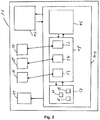
- Fig. 2 schematically shows a terminal 36 of a weighing and labeling conveyor 10.
- the functional blocks shown in the terminal 36 may be wholly or partially outsourced to other units of the weighing and labeling conveyor 10, for example, functional blocks in the weighing unit or be arranged in the labeling system.
- a labeler 14 of the labeling system 12 may be a master labeler that performs the function of functional blocks of the terminal.
- Fig. 2 a purely schematic rendering.
- the terminal comprises a display 42 for the information of the user, which is embodied for example as an LCD display or as a touch display and thus also serves as an input device.
- the control device comprises a weighing control device 46 for controlling the weighing unit with the weighing belt 34 and for evaluating the weight information from the weighing cell 32.
- the control device 44 comprises a labeling system control device 48 with labeler control devices 52, 54 56, which are each assigned to a labeler 14 of the labeling system 12.
- the control device 44 comprises a comparison unit 50, in FIG a first threshold value 58, a second threshold value 60 and a lower limit value 62 are stored.
- the comparing unit 50 compares the label stocks of the labelers with the first threshold value 58, the second threshold value 60 and / or the lower limit value 62, and returns this information to the label system controller 48.
- the labeling system controller 48 assigns a passive mode of operation to a labeler 14 in a normal operation and an active mode of operation to two labelers 14.
- the labeler 14 in passive mode is in standby.
- the labellers 14 in the active operating state label the articles 38 alternately.
- the labeler control devices 52, 54, 56 are each connected via an interface 66, 68, 70 with the operating and control devices 26 of the labelers 14. Through this interface, the labeler controllers 52, 54, 56 control the labelers 14 and receive status messages from the labelers, for example, the current label stock, or the labeler 14 is in an error condition because the label stock is depleted. This information is generated by the operating and control device 26 of the labelers 14.
- the control device 44 outputs a status message when at least one labeler reaches a lower limit value 62 of the label supply.
- the status message is forwarded by a message unit 64, for example via email or SMS to the operator to signal him that the label roll now or at least soon must be changed.
- a status message is also, for example, a signal lamp on the labeling transport device or a status message on the operating display 42 of the labeling transport device.
- the lower limit value 62 of the label supply is achieved, for example, when only a small amount of labels are left or when the label roll is empty.
- Fig. 3 illustrates the method of operating a weighing and labeling conveyor 10 by means of a flow chart. Only essential steps of the method are shown, for which, depending on the embodiment, modifications are described. In addition, the description will only deal with method steps necessary to select the labelers 14 from the labeling system 12, without going into details of how to implement the weighing, printing and application. The person skilled in the art knows how this is implemented.
- a method of operating a labeling conveyor 10 at step 72 determines the label stock of each labeler 14 of the labeling system 12. This information may be input by an operator or stored, for example, from the last operation of the weighing and labeling conveyor 10. The label stock is alternatively determinable by tagging with each labeler 14 a number of articles 38, that is, by placing each labeler 14 in the active operating state for a number of articles 38, thereby calculating the label stock.
- information about the number of revolutions of the printing roller 24 of the labeler 14 is set in relation to the number of revolutions of the label holder 20 and thus of the label roll 18. From the number of revolutions of the pressure roller 24, a length of the printed label can be derived. From the number of revolutions of the label roll 18, which are made for this label length, the diameter of the label roll 18 can be derived. From the diameter of the label roll 18, the label supply is derivable. The skilled person understands the number of revolutions of the pressure roller 24 and the label roll 18 as a rational number, so that fractions of revolutions are taken into account.
- the pressure roller will rotate several times, whereby the label roll 18 and thus the label holder 20 due to the size of the label roll 18 only a fraction of a Turn turns. Since the labeler 14 between the label roll 18 and printer 22 includes a guide unit for the labels, which is resilient, several labels are printed to accurately determine the label supply and an average of the above ratio formed. This information is used in a measuring unit to determine the label stock of a labeller. The measuring unit is located in the operating and control unit 26 of a labeler 14th
- the label roll may include linerless labels or paper labels with carrier tape or transparent labels, preferably with carrier tape.
- the weighing and labeling conveyor 10 may include other labelers having other types of labels.
- step 74 the controller 48 switches two labellers 14 to an active operating state and a labeller 14 to a passive operating state.
- step 76 the articles 38 are continuously labeled from the article stream.
- the labelers 14 In the active operating state, the labelers 14 continuously apply a label to each article at a first application site. The first application point is on the same spot on all articles, minus any tolerance that may be incurred due to labeling.
- the two labellers 14 in the active operating state label the articles 38 alternately, that is, each labeler 14 labels every second article 38 in the flow of articles.
- the label stock on the labelers 14 is determined in the active mode by one of the methods described above, with the label stock of the labeler 14 still being known in the passive mode because that labeler has not used any labels.
- the label stocks of the three Labelers 14 are ratioed by the comparison unit 50 in step 10.
- the labeling conveyor 10 is transferred from normal operation in a transitional operation in step 82, in which a labeller 14 is transferred in the active operating state in the passive operating state and the labeler 14 in the passive operating state in the active Operating state is transferred. Then the labeling conveyor is returned to normal operation.
- the selection of the labeler 14, which is transferred from the active operating state to the passive operating state will be described below.
- step 76 is re-executed and the articles 38 are labeled. If the comparison unit 50 determines in step 80 that the label supply of a labeler 14 has reached the lower limit value, a status message is output in step 84 by means of the reporting unit 64 in order to signal to the operator that at least one label roll has to be changed. Then step 76 is executed and this labeler 14 will continue to label until its label stock is depleted. If the compare unit 50 determines in step 80 that the particular label stock ratio of the labelers 14 has not been reached, then the method returns to step 76.
- the labeler conveyor is also placed in transition mode and, in step 82, the labelers 14 are placed in the associated active and passive operating conditions.
- the labeler 14, in which a new label roll has been inserted is placed in the active operating state.
- the labeler 14 with the smallest label stock and the labeler 14 with the largest one Label supply is put into the active operating state. If a full label roll has been inserted, also in this embodiment the labeler 14, in which a new label roll has been inserted, is in the active operating state.
- the status message is output in step 84 only when the label supply of a labeler 14 is exhausted. Then, in step 82, this labeler 14 is placed in the passive mode and the labeler 14, which until then is in the passive mode, is set in the active mode.
- step 74 and step 82 respectively place the labeler 14 with the smallest label stock and the labeler with the largest label stock in the active operating state.
- the predetermined ratio is reached in step 80 if a labeller 14 has only half of the labels of a full label roll in the active operating state. However, in one embodiment, the predetermined ratio is only achieved if a certain amount of latency has elapsed since the last transitional operation.
- the labeler 14 with the smallest label stock is set to the active operating state. If the label supply of the labeler 14 with the second smallest label stock is greater than half of the labels of a full label roll, this labeler is put into the active operating state. If, on the other hand, the label supply of the labeler 14 with the second smallest label supply is smaller than half of the labels of a full label roll, the labeler with the largest label supply is put into the active operating state.
- the predetermined ratio in step 80 for initiating transient operation is reached if the label stock of the Labeler with the second smallest label stock is smaller by a first comparison threshold than the label stock of the labeler with the largest label stock and is less than half of a full label roll. In step 80, the labeler with the second smallest label stock is switched to the passive mode.
- the first comparison threshold is a parameter for setting the labeling system 12.
- step 74 one of the two labelers 14 with the largest label stock is placed in the active mode and the labeler with the smallest label stock is also placed in the active mode.
- the predetermined ratio in step 80 is reached if the label supply of one of the labelers 14 in the active operating state is smaller by a second comparison threshold than the labeling supply of the labeler in the passive operating state. In this case, this criterion is only met if the label stock at time t of the labeler 14 in the active operating state is not yet smaller by a second comparison threshold and at time t + delta-t, the label supply of this labeler 14 is smaller by this second comparison threshold, where t + delta-t temporally shortly after the time t is settle. This labeler 14 is switched to the passive operating state.
- the changeover time consists of the time that the operator needs on average for this task and also includes the time it takes to provide a new roll of labels, for example by bringing them to the warehouse. Furthermore, this changeover time includes a safety time that can be defined if the operator does not manage to change the label at the average changeover time estimated for it.
- the comparison unit calculates from this the number of labels that the printer consumes after the operator has been informed that a Label roll must be changed until the time when he has actually implemented the label roll change. This minimum label stock is defined as the second comparison threshold. In this method, after the label stock of a labeler 14 is exhausted, the label stock of a second labeler is exhausted at this changeover time of the operator later. This allows the operator to change two label rolls directly one after the other.
- DSP digital signal processor
- ASIC application specific integrated circuit
- FPGA field programmable gate array
- ROM read only memory
- RAM random access memory
Landscapes
- Physics & Mathematics (AREA)
- General Physics & Mathematics (AREA)
- Labeling Devices (AREA)
Priority Applications (3)
| Application Number | Priority Date | Filing Date | Title |
|---|---|---|---|
| EP16199900.8A EP3323744B1 (fr) | 2016-11-21 | 2016-11-21 | Procédé et dispositif de pesage, transport et éttiquetage avec utilisation alternative d'imprimante |
| ES16199900T ES2959389T3 (es) | 2016-11-21 | 2016-11-21 | Procedimiento y dispositivo transportador de pesaje y etiquetado con uso alternativo de impresora |
| US15/728,514 US10669058B2 (en) | 2016-11-21 | 2017-10-10 | Weighing and labeling conveyor having alternating printer use |
Applications Claiming Priority (1)
| Application Number | Priority Date | Filing Date | Title |
|---|---|---|---|
| EP16199900.8A EP3323744B1 (fr) | 2016-11-21 | 2016-11-21 | Procédé et dispositif de pesage, transport et éttiquetage avec utilisation alternative d'imprimante |
Publications (2)
| Publication Number | Publication Date |
|---|---|
| EP3323744A1 true EP3323744A1 (fr) | 2018-05-23 |
| EP3323744B1 EP3323744B1 (fr) | 2023-08-02 |
Family
ID=57394374
Family Applications (1)
| Application Number | Title | Priority Date | Filing Date |
|---|---|---|---|
| EP16199900.8A Active EP3323744B1 (fr) | 2016-11-21 | 2016-11-21 | Procédé et dispositif de pesage, transport et éttiquetage avec utilisation alternative d'imprimante |
Country Status (3)
| Country | Link |
|---|---|
| US (1) | US10669058B2 (fr) |
| EP (1) | EP3323744B1 (fr) |
| ES (1) | ES2959389T3 (fr) |
Cited By (3)
| Publication number | Priority date | Publication date | Assignee | Title |
|---|---|---|---|---|
| EP3772466A1 (fr) * | 2019-08-08 | 2021-02-10 | Bizerba SE & Co. KG | Système de marquage de prix |
| CN115258331A (zh) * | 2022-07-13 | 2022-11-01 | 苏州富强科技有限公司 | 多工位贴标流水线 |
| DE102023103596A1 (de) * | 2023-02-15 | 2024-08-22 | Khs Gmbh | Anlage zum Behandeln von Behältern |
Citations (4)
| Publication number | Priority date | Publication date | Assignee | Title |
|---|---|---|---|---|
| DE202004009707U1 (de) * | 2004-06-19 | 2004-08-12 | Khs Maschinen- Und Anlagenbau Ag | Vorrichtung zum Etikettieren von Gefäßen |
| US20050067111A1 (en) * | 2003-09-30 | 2005-03-31 | Mcc-Dec Tech, L.L.C. | System and associated method for high output label application |
| EP2832651A1 (fr) * | 2013-08-01 | 2015-02-04 | Krones AG | Étiqueteuse dotée de modules d'étiquetage redondants |
| US20160052659A1 (en) * | 2012-10-04 | 2016-02-25 | Bell And Howell, Llc | Devices, systems, and methods for automatically printing and applying labels to products |
Family Cites Families (2)
| Publication number | Priority date | Publication date | Assignee | Title |
|---|---|---|---|---|
| JP2004054909A (ja) * | 2002-05-31 | 2004-02-19 | Canon Inc | 情報処理装置、印刷システム、情報処理装置の印刷制御方法、及び印刷制御プログラム |
| DE102007013333A1 (de) * | 2007-03-20 | 2008-09-25 | Bizerba Gmbh & Co. Kg | Verfahren zur Parametrierung und zum Betrieb von Waagen |
-
2016
- 2016-11-21 EP EP16199900.8A patent/EP3323744B1/fr active Active
- 2016-11-21 ES ES16199900T patent/ES2959389T3/es active Active
-
2017
- 2017-10-10 US US15/728,514 patent/US10669058B2/en active Active
Patent Citations (4)
| Publication number | Priority date | Publication date | Assignee | Title |
|---|---|---|---|---|
| US20050067111A1 (en) * | 2003-09-30 | 2005-03-31 | Mcc-Dec Tech, L.L.C. | System and associated method for high output label application |
| DE202004009707U1 (de) * | 2004-06-19 | 2004-08-12 | Khs Maschinen- Und Anlagenbau Ag | Vorrichtung zum Etikettieren von Gefäßen |
| US20160052659A1 (en) * | 2012-10-04 | 2016-02-25 | Bell And Howell, Llc | Devices, systems, and methods for automatically printing and applying labels to products |
| EP2832651A1 (fr) * | 2013-08-01 | 2015-02-04 | Krones AG | Étiqueteuse dotée de modules d'étiquetage redondants |
Cited By (4)
| Publication number | Priority date | Publication date | Assignee | Title |
|---|---|---|---|---|
| EP3772466A1 (fr) * | 2019-08-08 | 2021-02-10 | Bizerba SE & Co. KG | Système de marquage de prix |
| CN115258331A (zh) * | 2022-07-13 | 2022-11-01 | 苏州富强科技有限公司 | 多工位贴标流水线 |
| CN115258331B (zh) * | 2022-07-13 | 2023-07-04 | 苏州富强科技有限公司 | 多工位贴标流水线 |
| DE102023103596A1 (de) * | 2023-02-15 | 2024-08-22 | Khs Gmbh | Anlage zum Behandeln von Behältern |
Also Published As
| Publication number | Publication date |
|---|---|
| EP3323744B1 (fr) | 2023-08-02 |
| US10669058B2 (en) | 2020-06-02 |
| ES2959389T3 (es) | 2024-02-26 |
| US20180141696A1 (en) | 2018-05-24 |
Similar Documents
| Publication | Publication Date | Title |
|---|---|---|
| EP2822883B1 (fr) | Installation et procédé permettant d'usiner des lentilles optiques | |
| EP2295326B1 (fr) | Dispositif d'étiquetage et procédé d'étiquetage pour étiqueter des récipients | |
| EP3374170B1 (fr) | Procédé, installation et système pour le traitement de lentilles optiques | |
| DE3630876A1 (de) | Produktionsprozesssteuersystem fuer eine zeitungsdruckvorrichtung | |
| DE102011054080A1 (de) | Integrierte Qualitätskontrolle von Verbrauchsmaterialien für Verpackungsmaschinen | |
| DE102016117966B4 (de) | Wägevorrichtung und Verfahren zum Wiegen eines Produkts | |
| EP2344392B1 (fr) | Procédé de test pour dispositif de contrôle, en particulier pour dispositif de contrôle de position d étiquettes | |
| EP2323909A1 (fr) | Procédé et appareillage pour manipuler des récipients à boissons | |
| EP3323744A1 (fr) | Dispositif de pesage, transport et éttiquetage avec utilisation alternative d'imprimante | |
| EP2509903B1 (fr) | Dispositif de commande, produit de programme informatique, et procédé de commande d'une installation de traitement de produits d'impression | |
| DE102008049830A1 (de) | Verfahren zur Ermittlung des normierten Leimverbrauchs bei Etikettiermaschien sowie Etikettiermaschine | |
| DE102011112328C5 (de) | Verfahren zum Betrieb einer Etikettiereinrichtung einer Tiefziehverpackungsmaschine | |
| EP1872099B1 (fr) | Dispositif et procede de pesage | |
| EP1872098B1 (fr) | Machine d'emballage | |
| EP4175824A1 (fr) | Installation de conversion rfid et procédé de commande d'une pluralité de modules de distribution d'incrustations | |
| EP3294637A1 (fr) | Procédé et dispositif pour manipuler des récipients à boissons | |
| EP1260895A2 (fr) | Procédé et dispositif pour la liaison des données entre des étapes de production | |
| DE102021131911B3 (de) | RFID-Konvertierungsanlage und Steuerungsverfahren für eine Mehrzahl von Inlay-Spendemodulen | |
| DE102013226971B4 (de) | Rollenbahn mit parallel nebeneinander angeordneten Rolleneinheiten | |
| DE202021106614U1 (de) | RFID-Konvertierungsanlage | |
| DE2338850B2 (de) | Anordnung zum Steuern einer Förderanlage | |
| WO2025011821A1 (fr) | Détermination de cause de défaut pour une ligne de machine | |
| CH702987A1 (de) | Steuereinrichtung für eine verarbeitungsanlage zur produktion von kollektionen von druckereiprodukten. | |
| DE1958072A1 (de) | Etikettiermaschine | |
| EP1431219A2 (fr) | Tampon intermédiaire |
Legal Events
| Date | Code | Title | Description |
|---|---|---|---|
| PUAI | Public reference made under article 153(3) epc to a published international application that has entered the european phase |
Free format text: ORIGINAL CODE: 0009012 |
|
| STAA | Information on the status of an ep patent application or granted ep patent |
Free format text: STATUS: THE APPLICATION HAS BEEN PUBLISHED |
|
| AK | Designated contracting states |
Kind code of ref document: A1 Designated state(s): AL AT BE BG CH CY CZ DE DK EE ES FI FR GB GR HR HU IE IS IT LI LT LU LV MC MK MT NL NO PL PT RO RS SE SI SK SM TR |
|
| AX | Request for extension of the european patent |
Extension state: BA ME |
|
| STAA | Information on the status of an ep patent application or granted ep patent |
Free format text: STATUS: REQUEST FOR EXAMINATION WAS MADE |
|
| 17P | Request for examination filed |
Effective date: 20181115 |
|
| RBV | Designated contracting states (corrected) |
Designated state(s): AL AT BE BG CH CY CZ DE DK EE ES FI FR GB GR HR HU IE IS IT LI LT LU LV MC MK MT NL NO PL PT RO RS SE SI SK SM TR |
|
| STAA | Information on the status of an ep patent application or granted ep patent |
Free format text: STATUS: EXAMINATION IS IN PROGRESS |
|
| 17Q | First examination report despatched |
Effective date: 20211213 |
|
| GRAP | Despatch of communication of intention to grant a patent |
Free format text: ORIGINAL CODE: EPIDOSNIGR1 |
|
| STAA | Information on the status of an ep patent application or granted ep patent |
Free format text: STATUS: GRANT OF PATENT IS INTENDED |
|
| INTG | Intention to grant announced |
Effective date: 20230424 |
|
| GRAS | Grant fee paid |
Free format text: ORIGINAL CODE: EPIDOSNIGR3 |
|
| GRAA | (expected) grant |
Free format text: ORIGINAL CODE: 0009210 |
|
| STAA | Information on the status of an ep patent application or granted ep patent |
Free format text: STATUS: THE PATENT HAS BEEN GRANTED |
|
| AK | Designated contracting states |
Kind code of ref document: B1 Designated state(s): AL AT BE BG CH CY CZ DE DK EE ES FI FR GB GR HR HU IE IS IT LI LT LU LV MC MK MT NL NO PL PT RO RS SE SI SK SM TR |
|
| REG | Reference to a national code |
Ref country code: GB Ref legal event code: FG4D Free format text: NOT ENGLISH |
|
| REG | Reference to a national code |
Ref country code: CH Ref legal event code: EP |
|
| REG | Reference to a national code |
Ref country code: DE Ref legal event code: R096 Ref document number: 502016015985 Country of ref document: DE |
|
| REG | Reference to a national code |
Ref country code: IE Ref legal event code: FG4D Free format text: LANGUAGE OF EP DOCUMENT: GERMAN |
|
| REG | Reference to a national code |
Ref country code: LT Ref legal event code: MG9D |
|
| REG | Reference to a national code |
Ref country code: NL Ref legal event code: MP Effective date: 20230802 |
|
| PG25 | Lapsed in a contracting state [announced via postgrant information from national office to epo] |
Ref country code: GR Free format text: LAPSE BECAUSE OF FAILURE TO SUBMIT A TRANSLATION OF THE DESCRIPTION OR TO PAY THE FEE WITHIN THE PRESCRIBED TIME-LIMIT Effective date: 20231103 |
|
| PG25 | Lapsed in a contracting state [announced via postgrant information from national office to epo] |
Ref country code: IS Free format text: LAPSE BECAUSE OF FAILURE TO SUBMIT A TRANSLATION OF THE DESCRIPTION OR TO PAY THE FEE WITHIN THE PRESCRIBED TIME-LIMIT Effective date: 20231202 |
|
| PG25 | Lapsed in a contracting state [announced via postgrant information from national office to epo] |
Ref country code: SE Free format text: LAPSE BECAUSE OF FAILURE TO SUBMIT A TRANSLATION OF THE DESCRIPTION OR TO PAY THE FEE WITHIN THE PRESCRIBED TIME-LIMIT Effective date: 20230802 Ref country code: RS Free format text: LAPSE BECAUSE OF FAILURE TO SUBMIT A TRANSLATION OF THE DESCRIPTION OR TO PAY THE FEE WITHIN THE PRESCRIBED TIME-LIMIT Effective date: 20230802 Ref country code: PT Free format text: LAPSE BECAUSE OF FAILURE TO SUBMIT A TRANSLATION OF THE DESCRIPTION OR TO PAY THE FEE WITHIN THE PRESCRIBED TIME-LIMIT Effective date: 20231204 Ref country code: NO Free format text: LAPSE BECAUSE OF FAILURE TO SUBMIT A TRANSLATION OF THE DESCRIPTION OR TO PAY THE FEE WITHIN THE PRESCRIBED TIME-LIMIT Effective date: 20231102 Ref country code: NL Free format text: LAPSE BECAUSE OF FAILURE TO SUBMIT A TRANSLATION OF THE DESCRIPTION OR TO PAY THE FEE WITHIN THE PRESCRIBED TIME-LIMIT Effective date: 20230802 Ref country code: LV Free format text: LAPSE BECAUSE OF FAILURE TO SUBMIT A TRANSLATION OF THE DESCRIPTION OR TO PAY THE FEE WITHIN THE PRESCRIBED TIME-LIMIT Effective date: 20230802 Ref country code: LT Free format text: LAPSE BECAUSE OF FAILURE TO SUBMIT A TRANSLATION OF THE DESCRIPTION OR TO PAY THE FEE WITHIN THE PRESCRIBED TIME-LIMIT Effective date: 20230802 Ref country code: IS Free format text: LAPSE BECAUSE OF FAILURE TO SUBMIT A TRANSLATION OF THE DESCRIPTION OR TO PAY THE FEE WITHIN THE PRESCRIBED TIME-LIMIT Effective date: 20231202 Ref country code: HR Free format text: LAPSE BECAUSE OF FAILURE TO SUBMIT A TRANSLATION OF THE DESCRIPTION OR TO PAY THE FEE WITHIN THE PRESCRIBED TIME-LIMIT Effective date: 20230802 Ref country code: GR Free format text: LAPSE BECAUSE OF FAILURE TO SUBMIT A TRANSLATION OF THE DESCRIPTION OR TO PAY THE FEE WITHIN THE PRESCRIBED TIME-LIMIT Effective date: 20231103 Ref country code: FI Free format text: LAPSE BECAUSE OF FAILURE TO SUBMIT A TRANSLATION OF THE DESCRIPTION OR TO PAY THE FEE WITHIN THE PRESCRIBED TIME-LIMIT Effective date: 20230802 |
|
| REG | Reference to a national code |
Ref country code: ES Ref legal event code: FG2A Ref document number: 2959389 Country of ref document: ES Kind code of ref document: T3 Effective date: 20240226 |
|
| PG25 | Lapsed in a contracting state [announced via postgrant information from national office to epo] |
Ref country code: PL Free format text: LAPSE BECAUSE OF FAILURE TO SUBMIT A TRANSLATION OF THE DESCRIPTION OR TO PAY THE FEE WITHIN THE PRESCRIBED TIME-LIMIT Effective date: 20230802 |
|
| PG25 | Lapsed in a contracting state [announced via postgrant information from national office to epo] |
Ref country code: SM Free format text: LAPSE BECAUSE OF FAILURE TO SUBMIT A TRANSLATION OF THE DESCRIPTION OR TO PAY THE FEE WITHIN THE PRESCRIBED TIME-LIMIT Effective date: 20230802 Ref country code: RO Free format text: LAPSE BECAUSE OF FAILURE TO SUBMIT A TRANSLATION OF THE DESCRIPTION OR TO PAY THE FEE WITHIN THE PRESCRIBED TIME-LIMIT Effective date: 20230802 Ref country code: EE Free format text: LAPSE BECAUSE OF FAILURE TO SUBMIT A TRANSLATION OF THE DESCRIPTION OR TO PAY THE FEE WITHIN THE PRESCRIBED TIME-LIMIT Effective date: 20230802 Ref country code: DK Free format text: LAPSE BECAUSE OF FAILURE TO SUBMIT A TRANSLATION OF THE DESCRIPTION OR TO PAY THE FEE WITHIN THE PRESCRIBED TIME-LIMIT Effective date: 20230802 Ref country code: CZ Free format text: LAPSE BECAUSE OF FAILURE TO SUBMIT A TRANSLATION OF THE DESCRIPTION OR TO PAY THE FEE WITHIN THE PRESCRIBED TIME-LIMIT Effective date: 20230802 Ref country code: SK Free format text: LAPSE BECAUSE OF FAILURE TO SUBMIT A TRANSLATION OF THE DESCRIPTION OR TO PAY THE FEE WITHIN THE PRESCRIBED TIME-LIMIT Effective date: 20230802 |
|
| REG | Reference to a national code |
Ref country code: DE Ref legal event code: R097 Ref document number: 502016015985 Country of ref document: DE |
|
| PLBE | No opposition filed within time limit |
Free format text: ORIGINAL CODE: 0009261 |
|
| STAA | Information on the status of an ep patent application or granted ep patent |
Free format text: STATUS: NO OPPOSITION FILED WITHIN TIME LIMIT |
|
| REG | Reference to a national code |
Ref country code: CH Ref legal event code: PL |
|
| PG25 | Lapsed in a contracting state [announced via postgrant information from national office to epo] |
Ref country code: MC Free format text: LAPSE BECAUSE OF FAILURE TO SUBMIT A TRANSLATION OF THE DESCRIPTION OR TO PAY THE FEE WITHIN THE PRESCRIBED TIME-LIMIT Effective date: 20230802 |
|
| 26N | No opposition filed |
Effective date: 20240503 |
|
| PG25 | Lapsed in a contracting state [announced via postgrant information from national office to epo] |
Ref country code: LU Free format text: LAPSE BECAUSE OF NON-PAYMENT OF DUE FEES Effective date: 20231121 |
|
| PG25 | Lapsed in a contracting state [announced via postgrant information from national office to epo] |
Ref country code: CH Free format text: LAPSE BECAUSE OF NON-PAYMENT OF DUE FEES Effective date: 20231130 |
|
| PG25 | Lapsed in a contracting state [announced via postgrant information from national office to epo] |
Ref country code: MC Free format text: LAPSE BECAUSE OF FAILURE TO SUBMIT A TRANSLATION OF THE DESCRIPTION OR TO PAY THE FEE WITHIN THE PRESCRIBED TIME-LIMIT Effective date: 20230802 Ref country code: LU Free format text: LAPSE BECAUSE OF NON-PAYMENT OF DUE FEES Effective date: 20231121 Ref country code: CH Free format text: LAPSE BECAUSE OF NON-PAYMENT OF DUE FEES Effective date: 20231130 Ref country code: SI Free format text: LAPSE BECAUSE OF FAILURE TO SUBMIT A TRANSLATION OF THE DESCRIPTION OR TO PAY THE FEE WITHIN THE PRESCRIBED TIME-LIMIT Effective date: 20230802 |
|
| REG | Reference to a national code |
Ref country code: BE Ref legal event code: MM Effective date: 20231130 |
|
| REG | Reference to a national code |
Ref country code: IE Ref legal event code: MM4A |
|
| PG25 | Lapsed in a contracting state [announced via postgrant information from national office to epo] |
Ref country code: IE Free format text: LAPSE BECAUSE OF NON-PAYMENT OF DUE FEES Effective date: 20231121 |
|
| PG25 | Lapsed in a contracting state [announced via postgrant information from national office to epo] |
Ref country code: BE Free format text: LAPSE BECAUSE OF NON-PAYMENT OF DUE FEES Effective date: 20231130 |
|
| PG25 | Lapsed in a contracting state [announced via postgrant information from national office to epo] |
Ref country code: IE Free format text: LAPSE BECAUSE OF NON-PAYMENT OF DUE FEES Effective date: 20231121 Ref country code: BE Free format text: LAPSE BECAUSE OF NON-PAYMENT OF DUE FEES Effective date: 20231130 |
|
| PG25 | Lapsed in a contracting state [announced via postgrant information from national office to epo] |
Ref country code: BG Free format text: LAPSE BECAUSE OF FAILURE TO SUBMIT A TRANSLATION OF THE DESCRIPTION OR TO PAY THE FEE WITHIN THE PRESCRIBED TIME-LIMIT Effective date: 20230802 |
|
| PG25 | Lapsed in a contracting state [announced via postgrant information from national office to epo] |
Ref country code: BG Free format text: LAPSE BECAUSE OF FAILURE TO SUBMIT A TRANSLATION OF THE DESCRIPTION OR TO PAY THE FEE WITHIN THE PRESCRIBED TIME-LIMIT Effective date: 20230802 |
|
| REG | Reference to a national code |
Ref country code: AT Ref legal event code: MM01 Ref document number: 1594488 Country of ref document: AT Kind code of ref document: T Effective date: 20231121 |
|
| PG25 | Lapsed in a contracting state [announced via postgrant information from national office to epo] |
Ref country code: AT Free format text: LAPSE BECAUSE OF NON-PAYMENT OF DUE FEES Effective date: 20231121 |
|
| PG25 | Lapsed in a contracting state [announced via postgrant information from national office to epo] |
Ref country code: AT Free format text: LAPSE BECAUSE OF NON-PAYMENT OF DUE FEES Effective date: 20231121 |
|
| PG25 | Lapsed in a contracting state [announced via postgrant information from national office to epo] |
Ref country code: CY Free format text: LAPSE BECAUSE OF FAILURE TO SUBMIT A TRANSLATION OF THE DESCRIPTION OR TO PAY THE FEE WITHIN THE PRESCRIBED TIME-LIMIT; INVALID AB INITIO Effective date: 20161121 |
|
| PG25 | Lapsed in a contracting state [announced via postgrant information from national office to epo] |
Ref country code: HU Free format text: LAPSE BECAUSE OF FAILURE TO SUBMIT A TRANSLATION OF THE DESCRIPTION OR TO PAY THE FEE WITHIN THE PRESCRIBED TIME-LIMIT; INVALID AB INITIO Effective date: 20161121 |
|
| PG25 | Lapsed in a contracting state [announced via postgrant information from national office to epo] |
Ref country code: TR Free format text: LAPSE BECAUSE OF FAILURE TO SUBMIT A TRANSLATION OF THE DESCRIPTION OR TO PAY THE FEE WITHIN THE PRESCRIBED TIME-LIMIT Effective date: 20230802 |
|
| PGFP | Annual fee paid to national office [announced via postgrant information from national office to epo] |
Ref country code: DE Payment date: 20251118 Year of fee payment: 10 |
|
| PGFP | Annual fee paid to national office [announced via postgrant information from national office to epo] |
Ref country code: GB Payment date: 20251120 Year of fee payment: 10 |
|
| PGFP | Annual fee paid to national office [announced via postgrant information from national office to epo] |
Ref country code: IT Payment date: 20251128 Year of fee payment: 10 |
|
| PGFP | Annual fee paid to national office [announced via postgrant information from national office to epo] |
Ref country code: FR Payment date: 20251125 Year of fee payment: 10 |
|
| PGFP | Annual fee paid to national office [announced via postgrant information from national office to epo] |
Ref country code: ES Payment date: 20251216 Year of fee payment: 10 |