EP3324276A1 - Berührungseingabevorrichtung - Google Patents
Berührungseingabevorrichtung Download PDFInfo
- Publication number
- EP3324276A1 EP3324276A1 EP17178875.5A EP17178875A EP3324276A1 EP 3324276 A1 EP3324276 A1 EP 3324276A1 EP 17178875 A EP17178875 A EP 17178875A EP 3324276 A1 EP3324276 A1 EP 3324276A1
- Authority
- EP
- European Patent Office
- Prior art keywords
- connection line
- line pattern
- access portion
- touch
- pressure
- Prior art date
- Legal status (The legal status is an assumption and is not a legal conclusion. Google has not performed a legal analysis and makes no representation as to the accuracy of the status listed.)
- Granted
Links
Images








Classifications
-
- G—PHYSICS
- G06—COMPUTING OR CALCULATING; COUNTING
- G06F—ELECTRIC DIGITAL DATA PROCESSING
- G06F3/00—Input arrangements for transferring data to be processed into a form capable of being handled by the computer; Output arrangements for transferring data from processing unit to output unit, e.g. interface arrangements
- G06F3/01—Input arrangements or combined input and output arrangements for interaction between user and computer
- G06F3/03—Arrangements for converting the position or the displacement of a member into a coded form
- G06F3/041—Digitisers, e.g. for touch screens or touch pads, characterised by the transducing means
- G06F3/0416—Control or interface arrangements specially adapted for digitisers
- G06F3/04164—Connections between sensors and controllers, e.g. routing lines between electrodes and connection pads
-
- G—PHYSICS
- G06—COMPUTING OR CALCULATING; COUNTING
- G06F—ELECTRIC DIGITAL DATA PROCESSING
- G06F3/00—Input arrangements for transferring data to be processed into a form capable of being handled by the computer; Output arrangements for transferring data from processing unit to output unit, e.g. interface arrangements
- G06F3/01—Input arrangements or combined input and output arrangements for interaction between user and computer
- G06F3/03—Arrangements for converting the position or the displacement of a member into a coded form
- G06F3/041—Digitisers, e.g. for touch screens or touch pads, characterised by the transducing means
- G06F3/0414—Digitisers, e.g. for touch screens or touch pads, characterised by the transducing means using force sensing means to determine a position
-
- G—PHYSICS
- G06—COMPUTING OR CALCULATING; COUNTING
- G06F—ELECTRIC DIGITAL DATA PROCESSING
- G06F3/00—Input arrangements for transferring data to be processed into a form capable of being handled by the computer; Output arrangements for transferring data from processing unit to output unit, e.g. interface arrangements
- G06F3/01—Input arrangements or combined input and output arrangements for interaction between user and computer
- G06F3/03—Arrangements for converting the position or the displacement of a member into a coded form
- G06F3/041—Digitisers, e.g. for touch screens or touch pads, characterised by the transducing means
- G06F3/044—Digitisers, e.g. for touch screens or touch pads, characterised by the transducing means by capacitive means
- G06F3/0443—Digitisers, e.g. for touch screens or touch pads, characterised by the transducing means by capacitive means using a single layer of sensing electrodes
-
- G—PHYSICS
- G06—COMPUTING OR CALCULATING; COUNTING
- G06F—ELECTRIC DIGITAL DATA PROCESSING
- G06F3/00—Input arrangements for transferring data to be processed into a form capable of being handled by the computer; Output arrangements for transferring data from processing unit to output unit, e.g. interface arrangements
- G06F3/01—Input arrangements or combined input and output arrangements for interaction between user and computer
- G06F3/03—Arrangements for converting the position or the displacement of a member into a coded form
- G06F3/041—Digitisers, e.g. for touch screens or touch pads, characterised by the transducing means
- G06F3/0412—Digitisers structurally integrated in a display
-
- G—PHYSICS
- G06—COMPUTING OR CALCULATING; COUNTING
- G06F—ELECTRIC DIGITAL DATA PROCESSING
- G06F3/00—Input arrangements for transferring data to be processed into a form capable of being handled by the computer; Output arrangements for transferring data from processing unit to output unit, e.g. interface arrangements
- G06F3/01—Input arrangements or combined input and output arrangements for interaction between user and computer
- G06F3/03—Arrangements for converting the position or the displacement of a member into a coded form
- G06F3/041—Digitisers, e.g. for touch screens or touch pads, characterised by the transducing means
- G06F3/0414—Digitisers, e.g. for touch screens or touch pads, characterised by the transducing means using force sensing means to determine a position
- G06F3/04144—Digitisers, e.g. for touch screens or touch pads, characterised by the transducing means using force sensing means to determine a position using an array of force sensing means
-
- G—PHYSICS
- G06—COMPUTING OR CALCULATING; COUNTING
- G06F—ELECTRIC DIGITAL DATA PROCESSING
- G06F3/00—Input arrangements for transferring data to be processed into a form capable of being handled by the computer; Output arrangements for transferring data from processing unit to output unit, e.g. interface arrangements
- G06F3/01—Input arrangements or combined input and output arrangements for interaction between user and computer
- G06F3/03—Arrangements for converting the position or the displacement of a member into a coded form
- G06F3/041—Digitisers, e.g. for touch screens or touch pads, characterised by the transducing means
- G06F3/0416—Control or interface arrangements specially adapted for digitisers
-
- G—PHYSICS
- G06—COMPUTING OR CALCULATING; COUNTING
- G06F—ELECTRIC DIGITAL DATA PROCESSING
- G06F3/00—Input arrangements for transferring data to be processed into a form capable of being handled by the computer; Output arrangements for transferring data from processing unit to output unit, e.g. interface arrangements
- G06F3/01—Input arrangements or combined input and output arrangements for interaction between user and computer
- G06F3/03—Arrangements for converting the position or the displacement of a member into a coded form
- G06F3/041—Digitisers, e.g. for touch screens or touch pads, characterised by the transducing means
- G06F3/044—Digitisers, e.g. for touch screens or touch pads, characterised by the transducing means by capacitive means
-
- G—PHYSICS
- G06—COMPUTING OR CALCULATING; COUNTING
- G06F—ELECTRIC DIGITAL DATA PROCESSING
- G06F3/00—Input arrangements for transferring data to be processed into a form capable of being handled by the computer; Output arrangements for transferring data from processing unit to output unit, e.g. interface arrangements
- G06F3/01—Input arrangements or combined input and output arrangements for interaction between user and computer
- G06F3/03—Arrangements for converting the position or the displacement of a member into a coded form
- G06F3/041—Digitisers, e.g. for touch screens or touch pads, characterised by the transducing means
- G06F3/044—Digitisers, e.g. for touch screens or touch pads, characterised by the transducing means by capacitive means
- G06F3/0445—Digitisers, e.g. for touch screens or touch pads, characterised by the transducing means by capacitive means using two or more layers of sensing electrodes, e.g. using two layers of electrodes separated by a dielectric layer
-
- G—PHYSICS
- G06—COMPUTING OR CALCULATING; COUNTING
- G06F—ELECTRIC DIGITAL DATA PROCESSING
- G06F3/00—Input arrangements for transferring data to be processed into a form capable of being handled by the computer; Output arrangements for transferring data from processing unit to output unit, e.g. interface arrangements
- G06F3/01—Input arrangements or combined input and output arrangements for interaction between user and computer
- G06F3/03—Arrangements for converting the position or the displacement of a member into a coded form
- G06F3/041—Digitisers, e.g. for touch screens or touch pads, characterised by the transducing means
- G06F3/044—Digitisers, e.g. for touch screens or touch pads, characterised by the transducing means by capacitive means
- G06F3/0446—Digitisers, e.g. for touch screens or touch pads, characterised by the transducing means by capacitive means using a grid-like structure of electrodes in at least two directions, e.g. using row and column electrodes
-
- G—PHYSICS
- G06—COMPUTING OR CALCULATING; COUNTING
- G06F—ELECTRIC DIGITAL DATA PROCESSING
- G06F2203/00—Indexing scheme relating to G06F3/00 - G06F3/048
- G06F2203/041—Indexing scheme relating to G06F3/041 - G06F3/045
- G06F2203/04103—Manufacturing, i.e. details related to manufacturing processes specially suited for touch sensitive devices
-
- G—PHYSICS
- G06—COMPUTING OR CALCULATING; COUNTING
- G06F—ELECTRIC DIGITAL DATA PROCESSING
- G06F2203/00—Indexing scheme relating to G06F3/00 - G06F3/048
- G06F2203/041—Indexing scheme relating to G06F3/041 - G06F3/045
- G06F2203/04105—Pressure sensors for measuring the pressure or force exerted on the touch surface without providing the touch position
-
- G—PHYSICS
- G06—COMPUTING OR CALCULATING; COUNTING
- G06F—ELECTRIC DIGITAL DATA PROCESSING
- G06F2203/00—Indexing scheme relating to G06F3/00 - G06F3/048
- G06F2203/041—Indexing scheme relating to G06F3/041 - G06F3/045
- G06F2203/04111—Cross over in capacitive digitiser, i.e. details of structures for connecting electrodes of the sensing pattern where the connections cross each other, e.g. bridge structures comprising an insulating layer, or vias through substrate
-
- G—PHYSICS
- G06—COMPUTING OR CALCULATING; COUNTING
- G06F—ELECTRIC DIGITAL DATA PROCESSING
- G06F3/00—Input arrangements for transferring data to be processed into a form capable of being handled by the computer; Output arrangements for transferring data from processing unit to output unit, e.g. interface arrangements
- G06F3/01—Input arrangements or combined input and output arrangements for interaction between user and computer
- G06F3/03—Arrangements for converting the position or the displacement of a member into a coded form
- G06F3/041—Digitisers, e.g. for touch screens or touch pads, characterised by the transducing means
- G06F3/044—Digitisers, e.g. for touch screens or touch pads, characterised by the transducing means by capacitive means
- G06F3/0448—Details of the electrode shape, e.g. for enhancing the detection of touches, for generating specific electric field shapes, for enhancing display quality
-
- H—ELECTRICITY
- H05—ELECTRIC TECHNIQUES NOT OTHERWISE PROVIDED FOR
- H05K—PRINTED CIRCUITS; CASINGS OR CONSTRUCTIONAL DETAILS OF ELECTRIC APPARATUS; MANUFACTURE OF ASSEMBLAGES OF ELECTRICAL COMPONENTS
- H05K2201/00—Indexing scheme relating to printed circuits covered by H05K1/00
- H05K2201/10—Details of components or other objects attached to or integrated in a printed circuit board
- H05K2201/10007—Types of components
- H05K2201/10128—Display
Definitions
- the present disclosure relates to a touch input device, and more particularly to a touch input device which is configured to detect a touch position and a touch pressure and is capable of improving display quality and of more increasing a touch position sensing sensitivity and a touch pressure sensing sensitivity by reducing a noise effect among the touch position sensing, touch pressure sensing, and display.
- the input device includes a button, key, joystick and touch screen. Since the touch screen is easy and simple to operate, the touch screen is increasingly being used in operation of a computing system.
- a touch surface of a touch input device may be composed of a transparent panel including a touch-sensitive surface and of a touch sensor which is a touch input means.
- the touch sensor is attached to the front side of a display screen, so that the touch-sensitive surface may cover the visible side of the display screen.
- the touch sensor allows a user to simply touch the touch screen with user's finger, etc., and to operate the computing system.
- the computing system may recognize the touch and a position of the touch on the touch screen, and then analyze the touch and perform operations accordingly.
- a pressure sensing unit which is distinguished from the touch sensor is disposed in the touch input device.
- An attempt is being made to form directly the pressure sensing unit on a display panel for the purpose of minimizing the thickness increase of the touch input device due to the pressure sensing unit, of simplifying the manufacturing process, and of reducing the cost.
- a pressure sensor controller and the pressure sensing unit should be electrically connected to each other in order that the pressure sensor controller and the pressure sensing unit transmit and receive a drive signal and a reception signal for detecting the touch pressure. Since the pressure sensor controller is disposed on a PCB and the pressure sensing unit is directly formed on the display panel, it is difficult to connect a pattern formed directly in the display panel and a wiring formed on the PCB by using a typical connector.
- the touch input device includes: a display panel; a pressure sensing unit including a pressure sensor which used to detect the touch pressure; a pressure sensor controller connected electrically to the pressure sensing unit; and a first PCB.
- the pressure sensor is directly formed on the display panel.
- a first connection line pattern having a first access portion formed at one end thereof is formed on the first PCB.
- the other end of the first connection line pattern is electrically connected to the pressure sensor controller.
- a conductive trace which extends from the pressure sensor and includes a second access portion formed on one end thereof is directly formed on the display panel.
- the first access portion of the first connection line pattern and the second access portion of the conductive trace are electrically connected to each other by a conductive adhesive member disposed between the first access portion of the first connection line pattern and the second access portion of the conductive trace.
- a touch input device capable of detecting a pressure in accordance with the embodiment of the present invention will be described with reference to the accompanying drawings. While a capacitance type touch sensor 10 is exemplified below, the touch sensor 10 capable of detecting a touch position in any manner may be applied.
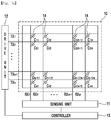
- Fig. 1 a is schematic views of a configuration of the capacitance type touch sensor 10 included in the touch input device according to the embodiment of the present invention and the operation of the capacitance type touch sensor.
- the touch sensor 10 may include a plurality of drive electrodes TX1 to TXn and a plurality of receiving electrodes RX1 to RXm, and may include a drive unit 12 which applies a drive signal to the plurality of the drive electrodes TX1 to TXn for the purpose of the operation of the touch sensor 10, and a sensing unit 11 which detects the touch and the touch position by receiving from the plurality of the receiving electrodes RX1 to RXm a sensing signal including information on a capacitance change amount changing according to the touch on a touch surface.
- the touch sensor 10 may include the plurality of drive electrodes TX1 to TXn and the plurality of receiving electrodes RX1 to RXm. While Fig. 1 a shows that the plurality of drive electrodes TX1 to TXn and the plurality of receiving electrodes RX1 to RXm of the touch sensor 10 form an orthogonal array, the present invention is not limited to this.
- the plurality of drive electrodes TX1 to TXn and the plurality of receiving electrodes RX1 to RXm has an array of arbitrary dimension, for example, a diagonal array, a concentric array, a 3-dimensional random array, etc., and an array obtained by the application of them.
- “n” and “m” are positive integers and may be the same as each other or may have different values. The magnitude of the value may be changed depending on the embodiment.
- the plurality of drive electrodes TX1 to TXn and the plurality of receiving electrodes RX1 to RXm may be arranged to cross each other.
- the drive electrode TX may include the plurality of drive electrodes TX1 to TXn extending in a first axial direction.
- the receiving electrode RX may include the plurality of receiving electrodes RX1 to RXm extending in a second axial direction crossing the first axial direction.
- the plurality of drive electrodes TX1 to TXn and the plurality of receiving electrodes RX1 to RXm may be formed in the same layer.
- the plurality of drive electrodes TX1 to TXn and the plurality of receiving electrodes RX1 to RXm may be formed on a top surface of a display panel 200A to be described later.
- the plurality of drive electrodes TX1 to TXn and the plurality of receiving electrodes RX1 to RXm may be formed in different layers.
- any one of the plurality of drive electrodes TX1 to TXn and the plurality of receiving electrodes RX1 to RXm may be formed on the top surface of the display panel 200A, and the other may be formed on a bottom surface of a cover to be described later or may be formed within the display panel 200A.
- the plurality of drive electrodes TX1 to TXn and the plurality of receiving electrodes RX1 to RXm may be made of a transparent conductive material (for example, indium tin oxide (ITO) or antimony tin oxide (ATO) which is made of tin oxide (SnO2), and indium oxide (In2O3), etc.), or the like.
- ITO indium tin oxide
- ATO antimony tin oxide
- the drive electrode TX and the receiving electrode RX may be also made of another transparent conductive material or an opaque conductive material.
- the drive electrode TX and the receiving electrode RX may include at least any one of silver ink, copper, and carbon nanotube (CNT).
- the drive electrode TX and the receiving electrode RX may be made of metal mesh.
- the drive unit 12 may apply a drive signal to the drive electrodes TX1 to TXn.
- one drive signal may be sequentially applied at a time to the first drive electrode TX1 to the n-th drive electrode TXn.
- the drive signal may be applied again repeatedly. This is only an example.
- the drive signal may be applied to the plurality of drive electrodes at the same time in accordance with the embodiment.
- the sensing unit 11 receives the sensing signal including information on a capacitance (Cm) 14 generated between the receiving electrodes RX1 to RXm and the drive electrodes TX1 to TXn to which the driving signal has been applied, thereby detecting whether or not the touch has occurred and where the touch has occurred.
- the sensing signal may be a signal coupled by the capacitance (Cm) 14 generated between the receiving electrode RX and the drive electrode TX to which the driving signal has been applied.
- the process of sensing the driving signal applied from the first drive electrode TX1 to the n-th drive electrode TXn through the receiving electrodes RX1 to RXm can be referred to as a process of scanning the touch sensor 10.
- the sensing unit 11 may include a receiver (not shown) which is connected to each of the receiving electrodes RX1 to RXm through a switch.
- the switch becomes the on-state in a time interval during which the signal of the corresponding receiving electrode RX is sensed, thereby allowing the receiver to sense the sensing signal from the receiving electrode RX.
- the receiver may include an amplifier (not shown) and a feedback capacitor coupled between the negative (-) input terminal of the amplifier and the output terminal of the amplifier, i.e., coupled to a feedback path.
- the positive (+) input terminal of the amplifier may be connected to the ground.
- the receiver may further include a reset switch which is connected in parallel with the feedback capacitor. The reset switch may reset the conversion from current to voltage that is performed by the receiver.
- the negative input terminal of the amplifier is connected to the corresponding receiving electrode RX and receives and integrates a current signal including information on the capacitance (Cm) 14, and then converts the integrated current signal into voltage.
- the sensing unit 11 may further include an analog to digital converter (ADC) (not shown) which converts the integrated data by the receiver into digital data. Later, the digital data may be input to a processor (not shown) and processed to obtain information on the touch on the touch sensor 10.
- ADC analog to digital converter
- the sensing unit 11 may include the ADC and processor as well as the receiver.
- a controller 13 may perform a function of controlling the operations of the drive unit 12 and the sensing unit 11. For example, the controller 13 generates and transmits a drive control signal to the drive unit 12, so that the driving signal can be applied to a predetermined drive electrode TX1 at a predetermined time. Also, the controller 13 generates and transmits the drive control signal to the sensing unit 11, so that the sensing unit 11 may receive the sensing signal from the predetermined receiving electrode RX at a predetermined time and perform a predetermined function.
- the drive unit 12 and the sensing unit 11 may constitute a touch detection device (not shown) capable of detecting whether the touch has occurred on the touch sensor 10 or not and where the touch has occurred.
- the touch detection device may further include the controller 13.
- the touch detection device may be integrated and implemented on a touch sensing integrated circuit (IC) corresponding to a below-described touch sensor controller 1100.
- the drive electrode TX and the receiving electrode RX included in the touch sensor 10 may be connected to the drive unit 12 and the sensing unit 11 included in the touch sensing IC through, for example, a conductive trace and/or a conductive pattern printed on a circuit board, or the like.
- the touch sensing IC may be placed on a circuit board on which the conductive pattern has been printed, for example, a touch circuit board (hereafter, referred to as a touch PCB) in Figs. 6a to 6i .
- a touch PCB a touch circuit board
- the touch sensing IC may be mounted on a main board for operation of the touch input device.
- a capacitance (Cm) with a predetermined value is generated at each crossing of the drive electrode TX and the receiving electrode RX.
- the value of the capacitance may be changed.
- the capacitance may represent a mutual capacitance (Cm).
- the sensing unit 11 senses such electrical characteristics, thereby being able to sense whether the touch has occurred on the touch sensor 10 or not and where the touch has occurred.
- the sensing unit 11 is able to sense whether the touch has occurred on the surface of the touch sensor 10 comprised of a two-dimensional plane consisting of a first axis and a second axis.
- the drive electrode TX to which the driving signal has been applied is detected, so that the position of the second axial direction of the touch can be detected.
- the capacitance change is detected from the reception signal received through the receiving electrode RX, so that the position of the first axial direction of the touch can be detected.
- the embodiment of the present invention is not limited to this. That is, as shown in Fig. 1b , it is also possible to detect the touch position on the basis of the change amount of a self-capacitance.
- Fig. 1b is schematic views of a configuration of another capacitance type touch sensor 10 included in the touch input device according to another embodiment of the present invention and the operation of the capacitance type touch sensor.
- a plurality of touch electrodes 30 are provided on the touch sensor 10 shown in Fig. 1 b.
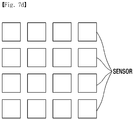
- the plurality of touch electrodes 30 may be, as shown in Fig. 7d , disposed at a regular interval in the form of a grid, the present invention is not limited to this.
- the drive control signal generated by the controller 13 is transmitted to the drive unit 12. On the basis of the drive control signal, the drive unit 12 applies the drive signal to the predetermined touch electrode 30 for a predetermined time period. Also, the drive control signal generated by the controller 13 is transmitted to the sensing unit 11. On the basis of the drive control signal, the sensing unit 11 receives the sensing signal from the predetermined touch electrode 30 for a predetermined time period.
- the sensing signal may be a signal for the change amount of the self-capacitance formed on the touch electrode 30.
- whether the touch has occurred on the touch sensor 10 or not and/or the touch position are detected by the sensing signal detected by the sensing unit 11. For example, since the coordinate of the touch electrode 30 has been known in advance, whether the touch of the object on the surface of the touch sensor 10 has occurred or not and/or the touch position can be detected.
- the drive unit 12 and the sensing unit 11 operate individually as a separate block.
- the operation to apply the drive signal to the touch electrode 30 and to receive the sensing signal from the touch electrode 30 can be also performed by one drive and sensing unit.
- the touch sensor 10 for detecting whether or not the touch has occurred and the touch position may be implemented by using not only the above-described method but also any touch sensing method such as a surface capacitance type method, a projected capacitance type method, a resistance film method, a surface acoustic wave (SAW) method, an infrared method, an optical imaging method, a dispersive signal technology, and an acoustic pulse recognition method, etc.
- a surface capacitance type method a projected capacitance type method
- a resistance film method a surface acoustic wave (SAW) method
- SAW surface acoustic wave
- Fig. 2 shows a control block for controlling the touch position, a touch pressure and a display operation in the touch input device according to the embodiment of the present invention.
- the control block may include the above-described touch sensor controller 1100 for detecting the touch position, a display controller 1200 for driving the display panel, and a pressure sensor controller 1300 for detecting the pressure.
- the display controller 1200 may include a control circuit which receives an input from an application processor (AP) or a central processing unit (CPU) on a main board for the operation of the touch input device 1000 and displays the contents that the user wants on the display panel 200A.
- the control circuit may be mounted on a display circuit board (hereafter, referred to as a display PCB).
- the control circuit may include a display panel control IC, a graphic controller IC, and a circuit required to operate other display panel 200A.
- the pressure sensor controller 1300 for detecting the pressure through a pressure sensing unit may be configured similarly to the touch sensor controller 1100, and thus, may operate similarly to the touch sensor controller 1100.
- the pressure sensor controller 1300 may include the drive unit, the sensing unit, and the controller, and may detect a magnitude of the pressure by the sensing signal sensed by the sensing unit.
- the pressure sensor controller 1300 may be mounted on the touch PCB on which the touch sensor controller 1100 has been mounted or may be mounted on the display PCB on which the display controller 1200 has been mounted.
- the touch sensor controller 1100, the display controller 1200, and the pressure sensor controller 1300 may be included as different components in the touch input device 1000.
- the touch sensor controller 1100, the display controller 1200, and the pressure sensor controller 1300 may be composed of different chips respectively.
- a processor 1500 of the touch input device 1000 may function as a host processor for the touch sensor controller 1100, the display controller 1200, and the pressure sensor controller 1300.
- the touch input device 1000 may include an electronic device including a display screen and/or a touch screen, such as a cell phone, a personal data assistant (PDA), a smartphone, a tablet personal computer (PC).
- a cell phone such as a cell phone, a personal data assistant (PDA), a smartphone, a tablet personal computer (PC).
- PDA personal data assistant
- PC tablet personal computer
- the touch sensor controller 1100, the display controller 1200, and the pressure sensor controller 1300 which are, as described above, formed separately from each other, may be integrated into one or more configurations in accordance with the embodiment of the present invention. In addition to this, these controllers can be integrated into the processor 1500 respectively. Also, according to the embodiment of the present invention, the touch sensor 10 and/or the pressure sensing unit may be integrated into the display panel 200A.
- the touch sensor 10 for detecting the touch position may be positioned outside or inside the display panel 200A.
- the display panel 200A of the touch input device 1000 according to the embodiment of the present invention may be a display panel included in a liquid crystal display (LCD), a plasma display panel (PDP), an organic light emitting diode (OLED), etc. Accordingly, a user may perform the input operation by touching the touch surface while visually identifying an image displayed on the display panel.
- LCD liquid crystal display
- PDP plasma display panel
- OLED organic light emitting diode
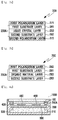
- Figs. 3a and 3b are conceptual views for describing a configuration of a display module 200 in the touch input device 1000 according to the embodiment of the present invention.
- the configuration of the display module 200 including the display panel 200A using an LCD panel will be described with reference to Fig. 3a .
- the display module 200 may include the display panel 200A that is an LCD panel, a first polarization layer 271 disposed on the display panel 200A, and a second polarization layer 272 disposed under the display panel 200A.
- the display panel 200A that is an LCD panel may include a liquid crystal layer 250 including a liquid crystal cell, a first substrate layer 261 disposed on the liquid crystal layer 250, and a second substrate layer 262 disposed under the liquid crystal layer 250.
- the first substrate layer 261 may be made of color filter glass
- the second substrate layer 262 may be made of TFT glass.
- at least one of the first substrate layer 261 and the second substrate layer 262 may be made of a bendable material such as plastic.
- the second substrate layer 262 may be comprised of various layers including a data line, a gate line, TFT, a common electrode, and a pixel electrode, etc. These electrical components may operate in such a manner as to generate a controlled electric field and orient liquid crystals located in the liquid crystal layer 250.
- the display module 200 may include the display panel 200A that is an OLED panel, and a first polarization layer 282 disposed on the display panel 200A.
- the display panel 200A that is an OLED panel may include an organic material layer 280 including an organic light-emitting diode (OLED), a first substrate layer 281 disposed on the organic material layer 280, and a second substrate layer 283 disposed under the organic material layer 280.
- the first substrate layer 281 may be made of encapsulation glass
- the second substrate layer 283 may be made of TFT glass.
- at least one of the first substrate layer 281 and the second substrate layer 283 may be made of a bendable material such as plastic.
- the OLED panel shown in Fig. 3b may include an electrode used to drive the display panel 200A, such as a gate line, a data line, a first power line (ELVDD), a second power line (ELVSS), etc.
- the organic light-emitting diode (OLED) panel is a self-light emitting display panel which uses a principle where, when current flows through a fluorescent or phosphorescent organic thin film and then electrons and electron holes are combined in the organic material layer, so that light is generated. The organic material constituting the light emitting layer determines the color of the light.
- the OLED uses a principle in which when electricity flows and an organic matter is applied on glass or plastic, the organic matter emits light. That is, the principle is that electron holes and electrons are injected into the anode and cathode of the organic matter respectively and are recombined in the light emitting layer, so that a high energy exciton is generated and the exciton releases the energy while falling down to a low energy state and then light with a particular wavelength is generated.
- the color of the light is changed according to the organic matter of the light emitting layer.
- the OLED includes a line-driven passive-matrix organic light-emitting diode (PM-OLED) and an individual driven active-matrix organic light-emitting diode (AM-OLED) in accordance with the operating characteristics of a pixel constituting a pixel matrix. None of them require a backlight. Therefore, the OLED enables a very thin display module to be implemented, has a constant contrast ratio according to an angle and obtains a good color reproductivity depending on a temperature. Also, it is very economical in that non-driven pixel does not consume power.
- PM-OLED passive-matrix organic light-emitting diode
- AM-OLED individual driven active-matrix organic light-emitting diode
- the PM-OLED emits light only during a scanning time at a high current
- the AM-OLED maintains a light emitting state only during a frame time at a low current. Therefore, the AM-OLED has a resolution higher than that of the PM-OLED and is advantageous for driving a large area display panel and consumes low power.
- a thin film transistor (TFT) is embedded in the AM-OLED, and thus, each component can be individually controlled, so that it is easy to implement a delicate screen.
- the organic material layer 280 may include a hole injection layer (HIL), a hole transport layer (HTL), an electron injection layer (EIL), an electron transport layer (ETL), and an light-emitting layer (EML).
- HIL hole injection layer
- HTL hole transport layer
- EIL electron injection layer
- ETL electron transport layer
- EML light-emitting layer
- HIL injects electron holes and is made of a material such as CuPc, etc.
- HTL functions to move the injected electron holes and mainly is made of a material having a good hole mobility.
- the HTL may be made of Arylamine, TPD, and the like.
- the EIL and ETL inject and transport electrons.
- the injected electrons and electron holes are combined in the EML and emit light.
- the EML represents the color of the emitted light and is composed of a host determining the lifespan of the organic matter and an impurity (dopant) determining the color sense and efficiency.
- This just describes the basic structure of the organic material layer 280 include in the OLED panel.
- the present invention is not limited to the layer structure or material, etc., of the organic material layer 280.
- the organic material layer 280 is inserted between an anode (not shown) and a cathode (not shown).
- a driving current is applied to the anode and the electron holes are injected, and the electrons are injected to the cathode. Then, the electron holes and electrons move to the organic material layer 280 and emit the light.
- the LCD panel or the OLED panel may further include other structures so as to perform the display function and may be transformed.
- the display module 200 of the touch input device 1000 may include the display panel 200A and a configuration for driving the display panel 200A.
- the display module 200 may include a backlight unit (not shown) disposed under the second polarization layer 272 and may further include a display panel control IC for operation of the LCD panel, a graphic control IC, and other circuits.
- the touch sensor 10 for detecting the touch position may be positioned outside or inside the display module 200.
- the touch sensor panel may be disposed on the display module 200, and the touch sensor 10 may be included in the touch sensor panel.
- the touch surface of the touch input device 1000 may be the surface of the touch sensor panel.
- the touch sensor 10 in the touch input device 1000 positioned inside the display module 200 the touch sensor 10 may be configured to be positioned outside the display panel 200A. Specifically, the touch sensor 10 may be formed on the top surfaces of the first substrate layers 261 and 281.
- the touch surface of the touch input device 1000 may be an outer surface of the display module 200 and may be the top surface or bottom surface in Figs. 3 and 3b .
- the touch sensor 10 in the touch input device 1000 positioned inside the display module 200 at least a portion of the touch sensor 10 may be configured to be positioned inside the display panel 200A, and at least a portion of the remaining touch sensor 10 may be configured to be positioned outside the display panel 200A.
- any one of the drive electrode TX and the receiving electrode RX, which constitute the touch sensor 10 may be configured to be positioned outside the display panel 200A, and the other may be configured to be positioned inside the display panel 200A.
- any one of the drive electrode TX and the receiving electrode RX, which constitute the touch sensor 10 may be formed on the top surface of the top surfaces of the first substrate layers 261 and 281, and the other may be formed on the bottom surfaces of the first substrate layers 261 and 281 or may be formed on the top surfaces of the second substrate layers 262 and 283.
- the touch sensor 10 may be configured to be positioned inside the display panel 200A.
- the touch sensor 10 may be formed on the bottom surfaces of the first substrate layers 261 and 281 or may be formed on the top surfaces of the second substrate layers 262 and 283.
- an electrode for operation of the touch sensor may be additionally disposed.
- various configurations and/or electrodes positioned inside the display panel 200A may be used as the touch sensor 10 for sensing the touch.
- the display panel 200A is the LCD panel
- at least any one of the electrodes included in the touch sensor 10 may include at least any one of a data line, a gate line, TFT, a common electrode (Vcom), and a pixel electrode.
- the display panel 200A is the OLED panel
- at least any one of the electrodes included in the touch sensor 10 may include at least any one of a data line, a gate line, a first power line (ELVDD), and a second power line (ELVSS).
- the touch sensor 10 may function as the drive electrode and the receiving electrode described in Fig. 1 a and may detect the touch position in accordance with the mutual capacitance between the drive electrode and the receiving electrode. Also, the touch sensor 10 may function as the single electrode 30 described in Fig. 1b and may detect the touch position in accordance with the self-capacitance of each of the single electrodes 30.
- the electrode included in the touch sensor 10 is used to drive the display panel 200A, the electrode may drive the display panel 200A in a first time interval and may detect the touch position in a second time interval different from the first time interval.
- an adhesive like an optically clear adhesive (OCA)
- lamination may occur between a cover layer 100 on which the touch sensor for detecting the touch position has been formed and the display module 200 including the display panel 200A.
- OCA optically clear adhesive
- Figs. 4a to 4e show an example in which the pressure sensor is formed in the in the touch input device according to the embodiment of the present invention.
- Fig. 4a it is shown that the display panel 200A is directly laminated on and attached to the cover layer 100. However, this is only for convenience of description.
- the display module 200 where the first polarization layers 271 and 282 is located on the display panel 200A may be laminated on and attached to the cover layer 100.
- the second polarization layer 272 and the backlight unit are omitted.
- the cover layer 100 in which the touch sensor has been formed is laminated on and attached to the display module 200 shown in Figs. 3a and 3b by means of an adhesive.
- the touch input device 1000 according to the embodiment of the present invention may include that the touch sensor 10 is disposed inside the display module 200 shown in Figs. 3a and 3b . More specifically, while Figs.
- the cover layer 100 where the touch sensor 10 has been formed covers the display module 200 including the display panel 200A
- the touch input device 1000 which includes the touch sensor 10 disposed inside the display module 200 and includes the display module 200 covered with the cover layer 100 like glass may be used as the embodiment of the present invention.
- the touch input device 1000 may include an electronic device including the touch screen, for example, a cell phone, a personal data assistant (PDA), a smart phone, a tablet personal computer, an MP3 player, a laptop computer, etc.
- PDA personal data assistant
- a smart phone for example, a cell phone, a personal data assistant (PDA), a smart phone, a tablet personal computer, an MP3 player, a laptop computer, etc.
- a substrate 300 may function to surround a mounting space 310, etc., where the circuit board and/or battery for operation of the touch input device 1000 are placed.
- the circuit board for operation of the touch input device 1000 may be a main board.
- a central processing unit (CPU), an application processor (AP) or the like may be mounted on the circuit board. Due to the substrate 300, the display module 200 is separated from the circuit board and/or battery for operation of the touch input device 1000. Due to the substrate 300, electrical noise generated from the display module 200 and noise generated from the circuit board can be blocked.
- the touch sensor 10 or the cover layer 100 of the touch input device 1000 may be formed wider than the display module 200, the substrate 300, and the mounting space 310.
- the housing 320 may be formed such that the housing 320, together with the touch sensor 10, surrounds the display module 200, the substrate 300, and the circuit board.
- the touch input device 1000 may detect the touch position through the touch sensor 10 and may detect the touch pressure by disposing a separate sensor which is different from the electrode used to detect the touch position and the electrode used to drive the display and by using the separate sensor as the pressure sensing unit.
- the touch sensor 10 may be disposed inside or outside the display module 200.
- the components for detecting the pressure are collectively referred to as the pressure sensing unit.
- the pressure sensing unit of the embodiment may include pressure sensors 450 and 460.
- the pressure sensing unit is formed to include, for example, a spacer layer 420 composed of an air gap. This will be described in detail with reference to Figs. 4a to 4d .
- the spacer layer 420 may be implemented by the air gap.
- the spacer layer 420 may be made of an impact absorbing material.
- the spacer layer 420 may be filled with a dielectric material.
- the spacer layer 420 may be made of a material having a restoring force by which the material contracts by applying the pressure and returns to its original shape by releasing the pressure.
- the spacer layer 420 may be made of elastic foam.
- the spacer layer since the spacer layer is disposed under the display module 200, the spacer layer may be made of a transparent material or an opaque material.
- a reference potential layer may be disposed under the display module 200.
- the reference potential layer may be formed on the substrate 300 disposed under the display module 200.
- the substrate 300 itself may serve as the reference potential layer.
- the reference potential layer may be disposed on the cover (not shown) which is disposed on the substrate 300 and under the display module 200 and functions to protect the display module 200.
- the cover itself may serve as the reference potential layer.
- the spacer layer may be disposed between the reference potential layer and the pressure sensor 450 and 460. Specifically, the spacer layer may be disposed between the display module 200 and the substrate 300 where the reference potential layer has been disposed or between the display module 200 and the cover where the reference potential layer has been disposed.
- the reference potential layer may be disposed inside the display module 200. Specifically, the reference potential layer may be disposed on the top surfaces or bottom surfaces of the first substrate layers 261 and 281 of the display panel 200A or on the top surfaces or bottom surfaces of the second substrate layers 262 and 283.
- the display panel 200A is bent. Due to the bending of the display panel 200A, the distance between the reference potential layer and the pressure sensor 450 and 460 may be changed.
- the spacer layer may be disposed between the reference potential layer and the pressure sensor 450 and 460. In the case of the touch input device 1000 shown in Figs. 3a and 3b , the spacer layer may be disposed on or inside the display panel 200A.
- the spacer layer may be implemented by the air gap.
- the spacer layer may be made of an impact absorbing material.
- the spacer layer may be filled with a dielectric material.
- the spacer layer may be made of a material having a restoring force by which the material contracts by applying the pressure and returns to its original shape by releasing the pressure.
- the spacer layer may be made of an elastic foam.
- the spacer layer since the spacer layer is disposed on or inside the display panel 200A, the spacer layer may be made of a transparent material.
- the spacer layer when the spacer layer is disposed inside the display module 200, the spacer layer may be the air gap which is included during the manufacture of the display panel 200A and/or the backlight unit.
- the one air gap may function as the spacer layer.
- the display panel 200A and/or the backlight unit includes a plurality of the air gaps, the plurality of air gaps may collectively function as the spacer layer.
- the sensors 450 and 460 for detecting the pressure are designated as pressure sensors 450 and 460.
- the pressure sensors 450 and 460 since the pressure sensors 450 and 460 are disposed in the rear side instead of in the front side of the display panel 200A, the pressure sensor 450 and 460 may be made of an opaque material as well as a transparent material.
- the pressure sensors 450 and 460 may be made of a transparent material such as ITO.
- a frame 330 having a predetermined height may be formed along the border of the upper portion of the substrate 300 in order to maintain the spacer layer 420 in which the pressure sensor 450 and 460 are disposed.
- the frame 330 may be bonded to the cover layer 100 by means of an adhesive tape (not shown). While Fig. 4b shows the frame 330 is formed on the entire border (e.g., four sides of the quadrangle) of the substrate 300, the frame 330 may be formed only on at least some (e.g., three sides of the quadrangle) of the border of the substrate 300.
- the frame 330 may be formed on the top surface of the substrate 300 may be integrally formed with the substrate 300 on the top surface of the substrate 300.
- the frame 330 may be made of an inelastic material.
- the display panel 200A when a pressure is applied to the display panel 200A through the cover layer 100, the display panel 200A, together with the cover layer 100, may be bent. Therefore, the magnitude of the touch pressure can be detected even though the frame 330 is not transformed by the pressure.
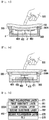
- Fig. 4c is a cross sectional view of the touch input device including the pressure sensor according to the embodiment of the present invention. As shown in Fig. 4c , the pressure sensors 450 and 460 according to the embodiment of the present invention may be formed within the spacer layer 420 and on the bottom surface of the display panel 200A.
- the pressure sensor for detecting the pressure may include the first sensor 450 and the second sensor 460.
- any one of the first sensor 450 and the second sensor 460 may be a drive sensor, and the other may be a receiving sensor.
- a drive signal is applied to the drive sensor, and a sensing signal including information on electrical characteristics changing by applying the pressure may be obtained through the receiving sensor. For example, when a voltage is applied, a mutual capacitance may be generated between the first sensor 450 and the second sensor 460.
- Fig. 4d is a cross sectional view when a pressure is applied to the touch input device 1000 shown in Fig. 4c .
- the top surface of the substrate 300 may have a ground potential so as to block the noise.
- a pressure is applied to the surface of the cover layer 100 by an object 500
- the cover layer 100 and the display panel 200A may be bent or pressed.
- a distance " d " between the ground potential surface and the pressure sensors 450 and 460 may be decreased to " d' ".
- the fringing capacitance is absorbed in the top surface of the substrate 300, so that the mutual capacitance between the first sensor 450 and the second sensor 460 may be reduced. Therefore, the magnitude of the touch pressure can be calculated by obtaining the reduction amount of the mutual capacitance from the sensing signal obtained through the receiving sensor.
- the reference potential layer may be disposed inside the display module 200.
- the cover layer 100 and the display panel 200A may be bent or pressed.
- a distance between the pressure sensors 450 and 460 and the reference potential layer disposed inside the display module 200 is changed. Therefore, the magnitude of the touch pressure can be calculated by obtaining the capacitance change amount from the sensing signal obtained through the receiving sensor.
- the display panel 200A may be bent or pressed by the touch applying the pressure.
- a position showing the biggest transformation may not match the touch position.
- the display panel 200A may be shown to be bent at least at the touch position.
- the touch position approaches close to the border, edge, etc., of the display panel 200A
- the most bent or pressed position of the display panel 200A may not match the touch position, however, the display panel 200A may be shown to be bent or pressed at least at the touch position.
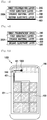
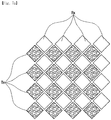
- each of the first sensor 450 and the second sensor 460 shown in Fig. 4c and 4d may be, as shown in Fig. 7a , composed of a plurality of lozenge-shaped sensors.
- the plurality of the first sensors 450 are connected to each other in the first axial direction
- the plurality of the second sensors 460 are connected to each other in the second axial direction orthogonal to the first axial direction.
- the lozenge-shaped sensors of at least one of the first sensor 450 and the second sensor 460 are connected to each other through a bridge, so that the first sensor 450 and the second sensor 460 may be insulated from each other.
- the first sensor 450 and the second sensor 460 shown in Fig. 5 may be composed of a sensor having a form shown in Fig. 7b .
- the touch pressure is detected from the change of the mutual capacitance between the first sensor 450 and the second sensor 460.
- the pressure sensing unit may be configured to include only any one of the first sensor 450 and the second sensor 460.
- it is possible to detect the magnitude of the touch pressure by detecting the change of the capacitance between the one pressure sensor and a ground layer (the reference potential layer disposed inside the display module 200 or the substrate 300), that is to say, the change of the self-capacitance.
- the drive signal is applied to the one pressure sensor, and the change of the self-capacitance between the pressure sensor and the ground layer can be detected by the pressure sensor.
- the pressure sensor may be configured to include only the first sensor 450.
- the magnitude of the touch pressure can be detected by the change of the capacitance between the first sensor 450 and the substrate 300, which is caused by a distance change between the substrate 300 and the first sensor 450. Since the distance " d " is reduced with the increase of the touch pressure, the capacitance between the substrate 300 and the first sensor 450 may be increased with the increase of the touch pressure.
- the pressure sensor should not necessary have a comb teeth shape or a trident shape, which is required to improve the detection accuracy of the mutual capacitance change amount.
- the pressure sensor may have a plate shape (e.g., quadrangular plate).
- the plurality of the first sensors 450 may be disposed at a regular interval in the form of a grid.
- Fig. 4e shows that the pressure sensors 450 and 460 are formed within the spacer layer 420 and on the top surface of the substrate 300 and on the bottom surface of the display panel 200A.
- the first sensor 450 may be formed on the bottom surface of the display panel 200A
- the second sensor 460 may be disposed on the top surface of the substrate 300 in the form of a sensor sheet in which the second sensor 460 is formed on a first insulation layer 470 and a second insulation layer 471 is formed on the second sensor 460.
- the cover layer 100 and the display panel 200A may be bent or pressed.
- a distance "d" between the first sensor 450 and the second sensor 460 may be reduced.
- the mutual capacitance between the first sensor 450 and the second sensor 460 may be increased with the reduction of the distance " d ". Therefore, the magnitude of the touch pressure can be calculated by obtaining the increase amount of the mutual capacitance from the sensing signal obtained through the receiving sensor.
- the first sensor 450 and the second sensor 460 since the first sensor 450 and the second sensor 460 are formed in different layers, the first sensor 450 and the second sensor 460 should not necessary have a comb teeth shape or a trident shape.
- Any one sensor of the first sensor 450 and the second sensor 460 may have a plate shape (e.g., quadrangular plate), and the other remaining plural sensors may be, as shown in Fig. 7d , disposed at a regular interval in the form of a grid.
- the pressure sensors 450 and 460 may be directly formed on the display panel 200A.
- Figs. 5a to 5c are cross sectional views showing an embodiment of the pressure sensor formed directly on various display panel of the touch input device according to the embodiment of the present invention.
- Fig. 5a shows the pressure sensors 450 and 460 formed on the display panel 200A using the LCD panel.
- the pressure sensors 450 and 460 may be formed on the bottom surface of the second substrate layer 262.
- the pressure sensors 450 and 460 may be formed on the bottom surface of the second polarization layer 272.
- a drive signal is applied to the drive sensor 450, and an electrical signal including information on the capacitance which is changed by the distance change between the pressure sensors 450 and 460 and the reference potential layer (not shown) separated from the pressure sensors 450 and 460 is received from the receiving sensor 460.
- a drive signal is applied to the pressure sensors 450 and 460, and an electrical signal including information on the capacitance which is changed by the distance change between the pressure sensors 450 and 460 and the reference potential layer (not shown) separated from the pressure sensors 450 and 460 is received from the pressure sensors 450 and 460.
- Fig. 5b shows the pressure sensors 450 and 460 formed on the bottom surface of the display panel 200A using the OLED panel (in particular, AM-OLED panel). Specifically, the pressure sensors 450 and 460 may be formed on the bottom surface of the second substrate layer 283.
- a method for detecting the pressure is the same as that described in Fig. 5a .
- the pressure sensors 450 and 460 which are formed on the bottom surface of the second substrate layer 283 disposed under the organic material layer 280 may be made of an opaque material. However, in this case, a pattern of the pressure sensors 450 and 460 formed on the bottom surface of the display panel 200A may be shown to the user. Therefore, for the purpose of directly forming the pressure sensors 450 and 460 on the bottom surface of the second substrate layer 283, a light shielding layer like black ink is applied on the bottom surface of the second substrate layer 283, and then the pressure sensors 450 and 460 may be formed on the light shielding layer.
- Fig. 5b shows that the pressure sensors 450 and 460 are formed on the bottom surface of the second substrate layer 283.
- a third substrate layer (not shown) may be disposed under the second substrate layer 283, and the pressure sensors 450 and 460 may be formed on the bottom surface of the third substrate layer.
- the third substrate layer which is not relatively easily bent may be disposed under the second substrate layer 283 because the display panel 200A composed of the first substrate layer 281, the organic material layer 280, and the second substrate layer 283 is very thin and easily bent.
- Fig. 5c shows the pressure sensors 450 and 460 formed inside the display panel 200A using the OLED panel.
- the pressure sensors 450 and 460 may be formed on the top surface of the second substrate layer 283.
- a method for detecting the pressure is the same as that described in Fig. 5a .
- the display panel 200A using the OLED panel has been described by taking an example thereof with reference to Fig. 5c , it is possible that the pressure sensors 450 and 460 are formed on the top surface of the second substrate layer 262 of the display panel 200A using the LCD panel.
- the pressure sensors 450 and 460 are formed on the top surfaces or bottom surfaces of the second substrate layers 262 and 283, it is possible that the pressure sensors 450 and 460 are formed on the top surfaces or bottom surfaces of the first substrate layers 261 and 281.
- the pressure sensors 450 and 460 for sensing the capacitance change amount may be, as described in Fig. 4e , composed of the first sensor 450 which is directly formed on the display panel 200A and the second sensor 460 which is configured in the form of a sensor sheet.
- the first sensor 450 may be, as described in Figs. 5a to 5c , directly formed on the display panel 200A
- second sensor 460 may be, as described in Fig. 4e , configured in the form of a sensor sheet and may be attached to the touch input device 1000.
- the drive signal may be applied to the first sensor 450 from the drive unit of the pressure sensor controller 1300, and the second sensor 460 may transmit the sensing signal to the sensing unit of the pressure sensor controller 1300.
- a controller of the IC may perform the scanning of the touch sensor 10 and simultaneously perform the scanning of the pressure sensing unit, or the controller of the IC may perform the time-sharing, and then may generate a control signal such that the scanning of the touch sensor 10 is performed in a first time interval and the scanning of the pressure sensing unit is performed in a second time interval different from the first time interval.
- the first electrode 450 and the second electrode 460 should be electrically connected to the drive unit and/or the sensing unit of the pressure sensor controller 1300.
- the pressure sensors 450 and 460 included in the pressure sensing unit may be electrically connected to the pressure sensor controller 1300 by any manner.
- a conductive adhesive member is disposed between a first access portion connected electrically to the pressure sensor controller 1300 and a second access portion connected electrically to the pressure sensors 450 and 460, and then the first access portion and the second access portion are pressed to be bonded to each other, so that the pressure sensing unit and the pressure sensor controller 1300 may be electrically connected to each other.
- the pressure sensors 450 and 460 may be connected to one end of a connection line pattern formed on a first PCB 160, and the other end of the connection line pattern may be electrically connected to the pressure sensor controller 1300.
- the first PCB 160 may be the touch PCB or the display PCB.
- Figs. 6a to 6m are views of a portion of the touch input device according to the embodiment of the present invention as viewed in an opposite direction of a touch surface.
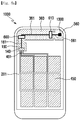
- Figs. 6a to 6m show that the pressure sensing unit including the pressure sensors 450 and 460 is directly formed on the bottom surface 201 of the display panel 200A.
- Figs. 6a to 6m show that the first PCB 160 on which the pressure sensor controller 1300 is mounted is disposed under a portion of the display panel 200A.
- a conductive trace 451 extending from the pressure sensors 450 and 460 respectively may be connected to the first PCB 160 through the anisotropic conductive film 170. Through this, the conductive trace 451 may be electrically connected to the pressure sensor controller 1300.
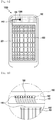
- Fig. 6a is a view for describing the connection of the pressure sensor controller and the pressure sensor composed of a plurality of channels by using the anisotropic conductive film.
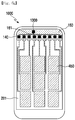
- Fig. 6b is a view for describing the connection of the pressure sensor controller and the pressure sensor composed of a single channel by using the anisotropic conductive film.
- Fig. 6c is a partial enlarged view showing that one end of the first PCB is spaced from the display panel in order to describe the method for connecting the pressure sensor and the pressure sensor controller of Fig. 6a .
- the anisotropic conductive film has a structure in which conductive particles are dispersed within an insulation adhesive film.
- the anisotropic conductive film has anisotropic electrical conductivity characteristics in which an electric current is applied to the anisotropic conductive film only in the direction of the electrode when the anisotropic conductive film is heated or pressed and has an insulating function between the electrodes.
- the conductive particle may be basically composed of Ni, Au/polymer, Ag, solder, etc.
- the insulating material may be composed of a thermosetting, thermoplastic insulating resin.
- a first connection portion 140 which is composed of a later-described first access portion 162 of a first connection line pattern 161 and a second access portion 452 of the conductive trace 451 is disposed on a portion of an area where the first PCB 160 and the display panel 200A overlap.
- the first connection line pattern 161 extending from the pressure sensor controller 1300 to the first connection portion 140 is formed on the first PCB 160, and the first access portion 162 is formed at the end of the first connection line pattern 161, which is included in the first connection portion 140.
- the conductive trace 451 extending from the pressure sensors 450 and 460 to the first connection portion 140 is formed on the bottom surface of the display panel 200A, and the second access portion 452 is formed at the end of the conductive trace 451, which is included in the first connection portion 140.
- the anisotropic conductive film 170 shown in Fig. 6c is disposed between the first access portion 162 of the first connection line pattern 161 and the second access portion 452 of the conductive trace, and the first connection portion 140 is heated and pressed from the above. As a result, an AFC bonding is performed.
- the anisotropic conductive film 170 becomes a semi-cured state, and by applying a predetermined pressure to the first connection portion 140, the anisotropic conductive film 170 between the first access portion 162 of the first connection line pattern 161 and the second access portion 452 of the conductive trace 451 is pressed. Then, the density of the pressed anisotropic conductive film 170 increases, so that a vertical electrical connection is made by the conductive particles.
- the portion where the electrical connection is made within the anisotropic conductive film 170 is a connection line which electrically connects the first access portion 162 of the first connection line pattern 161 and the second access portion 452 of the conductive trace 451.
- the anisotropic conductive film 170 can be applied to connect the pressure sensors 450 and 460 composed of a plurality of channels to the pressure sensor controller 1300. While Fig. 6 shows the pressure sensors 450 and 460 composed of 9 channels, there is no limitation to this.
- the first connection portion 140 which is required to connect the pressure sensors 450 and 460 composed of a larger number of channels to the pressure sensor controller 1300 is not big either.
- the AFC bonding process requires a heating and pressing process
- the first connection portion 140 when the first connection portion 140 is disposed under the display area, components required for driving the display may be affected. Therefore, it is desirable that the first connection portion 140 should be disposed on a non-display area, for example, the border of the display panel 200A. That is, it is desirable that the first access portion 162 of the first connection line pattern 161 and the second access portion 452 of the conductive trace 451 should be disposed at the border of the display panel.
- the conductive trace 451 extending from the pressure sensors 450 and 460 respectively may be connected to the first PCB 160 through the conductive ink 180, and through this, may be electrically connected to the pressure sensor controller 1300.
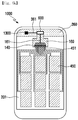
- Fig. 6d is a view for describing the connection of the pressure sensor controller and the pressure sensor composed of a plurality of channels by using the conductive ink.
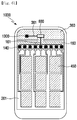
- Fig. 6e is a view for describing the connection of the pressure sensor controller and the pressure sensor composed of a single channel by using the conductive ink.
- Fig. 6f is a partial enlarged view showing that one end of the first PCB is spaced from the display panel in order to describe the method for connecting the pressure sensor and the pressure sensor controller of Fig. 6d .
- the conductive ink may be composed of a polymer material made of at least one kind selected from the group consisting of a cyanate ester resin, an epoxy resin, a polyimide resin, polyvinyl alcohol (PVA), polyvinyl butyral (PVB), an acrylic resin, etc., and the conductive particles including at least one kind selected from the group consisting of Cu, Ag, Cr, Ti, Pb, Zn, Sn, P, In, Al, Ni, etc.
- the first connection portion 140 which is composed of the later-described first access portion 162 of the first connection line pattern 161 and the second access portion 452 of the conductive trace 451 is disposed on a portion of an area where the first PCB 160 and the display panel 200A overlap.
- the first connection line pattern 161 extending from the pressure sensor controller 1300 to the first connection portion 140 is formed on the first PCB 160, and the first access portion 162 is formed at the end of the first connection line pattern 161, which is included in the first connection portion 140.
- the conductive trace 451 extending from the pressure sensors 450 and 460 to the first connection portion 140 is formed on the bottom surface of the display panel 200A, and the second access portion 452 is formed at the end of the conductive trace 451, which is included in the first connection portion 140.
- a bonding process using the conductive ink 180 is performed by applying the conductive ink 180 to the bottom surface of the first access portion 162 of the first connection line pattern 161 and by pressing the first connection portion 140 from the above.
- the conductive ink 180 is a connection line which electrically connects the first access portion 162 of the first connection line pattern 161 and the second access portion 452 of the conductive trace 451.
- first access portion 162 of the first connection line pattern 161 and the second access portion 452 of the conductive trace 451 are connected to each other by applying the conductive ink 180 to the bottom surface of the first access portion 162 of the first connection line pattern 161
- first access portion 162 of the first connection line pattern 161 and the second access portion 452 of the conductive trace 451 are connected to each other by applying the conductive ink 180 to the top surface of the second access portion 452 of the conductive trace 451.
- the conductive ink 180 By using the conductive ink 180, a high temperature firing process is not required, so that there is no limitation on the arrangement of the first connection portion 140. Also, although Fig. 6d shows the first connection portion 140 is arranged in a row, there is no limitation to this. For example, the first connection portion 140 can be arranged in the form of a square with 3 rows and 3 columns. The use of the conductive ink 180 requires the wider first connection portion 140 than that required by the use of the anisotropic conductive film 170.
- first connection portion 162 of the first connection line pattern 161 and the second access portion 452 of the conductive trace 451 by means of the first connection portion 140 that is smaller than the first connection portion 140 required by the use of a later-described conductive tape 190.
- the conductive trace 451 extending from the pressure sensors 450 and 460 respectively may be connected to the first PCB 160 through the conductive tape 190, and through this, may be electrically connected to the pressure sensor controller 1300.
- Fig. 6g is a view for describing the connection of the pressure sensor controller and the pressure sensor composed of a plurality of channels by using the conductive tape.
- Fig. 6h is a view for describing the connection of the pressure sensor controller and the pressure sensor composed of a single channel by using the conductive tape.
- Fig. 6h is a partial enlarged view showing that one end of the first PCB is spaced from the display panel in order to describe the method for connecting the pressure sensor and the pressure sensor controller of Fig. 6g .
- the conductive tape may be made of a material obtained by adding a conductive element to an acrylic adhesive or silicone adhesive.
- the conductive element may include a metallic material such as powdery, flake-like, fibrous Au, Ag, Cu, Ni, Pb, etc., or a carbon material such as graphite.
- the conductive element of which the weight percent is greater than 50%wt should be used because the powdery or flake-like metallic material has a high specific gravity, a low contact resistance can be implemented even by using the fibrous metallic material of which the weight percent is within 10%wt.
- the acrylic adhesive can be used at a lower temperature than the silicone adhesive can be.
- the first connection portion 140 which is composed of the later-described first access portion 162 of the first connection line pattern 161 and the second access portion 452 of the conductive trace 451 is disposed on a portion of an area where the first PCB 160 and the display panel 200A overlap.
- the first connection line pattern 161 extending from the pressure sensor controller 1300 to the first connection portion 140 is formed on the first PCB 160, and the first access portion 162 is formed at the end of the first connection line pattern 161, which is included in the first connection portion 140.
- the conductive trace 451 extending from the pressure sensors 450 and 460 to the first connection portion 140 is formed on the bottom surface of the display panel 200A, and the second access portion 452 is formed at the end of the conductive trace 451, which is included in the first connection portion 140.
- a bonding process using the conductive tape 190 is performed by removing a protective film on both sides of the conductive tape 190 and then attaching one side of the conductive tape 190 to the bottom surface of the first access portion 162 of each of the first connection line patterns 161 at a normal temperature and by applying a small pressure to the first connection portion 140 from the above.
- the conductive tape 190 is a connection line which electrically connects the first access portion 162 of the first connection line pattern 161 and the second access portion 452 of the conductive trace 451.
- first access portion 162 of the first connection line pattern 161 and the second access portion 452 of the conductive trace 451 are connected to each other by attaching the conductive tape 190 to the bottom surface of the first access portion 162 of the first connection line pattern 161
- first access portion 162 of the first connection line pattern 161 and the second access portion 452 of the conductive trace 451 are connected to each other by attaching the conductive tape 190 to the top surface of the second access portion 452 of the conductive trace 451.
- the first connection portion 140 By using the conductive tape 190, a high temperature and a high pressure are not required, so that there is no limitation on the arrangement of the first connection portion 140.
- Fig. 6d shows the first connection portion 140 is arranged in a row, there is no limitation to this.
- the first connection portion 140 can be arranged in the form of a square with 3 rows and 3 columns.
- the first connection portion 140 may be divided into a plurality of portions and a bonding process may be performed such that a separate pressing process may be performed on each pair of the first access portion 162 and the second access portion 452 corresponding to first access portion 162.
- Figs. 6j to 6l are views for describing the connection of the pressure sensor controller and the pressure sensor by using a second PCB.
- the pressure sensors 450 and 460 included in the pressure sensing unit is connected to the first PCB 160 on which the pressure sensor controller 1300 is mounted.
- the pressure sensors 450 and 460 are connected to the first connection line pattern 161 formed on the first PCB 160 where no pressure sensor controller 1300 is mounted, and the first connection line pattern 161 formed on the first PCB 160 is connected to a second connection line pattern 361 formed on the second PCB 360 where the pressure sensor controller 1300 is mounted.
- the pressure sensor controller 1300 and the touch sensor controller 1100 may be integrated into one IC and mounted on the touch PCB, and the second PCB 360 may be the touch PCB.
- the first connection portion 140 which is composed of the later-described first access portion 162 of the first connection line pattern 161 and the second access portion 452 of the conductive trace 451 is disposed on a portion of an area where the first PCB 160 and the display panel 200A overlap.
- the first connection line pattern 161 extending from a second connection portion 600 connected to the second PCB 360 to the first connection portion 140 is formed on the first PCB 160.
- the conductive trace 451 extending from the pressure sensors 450 and 460 to the first connection portion 140 is formed on the bottom surface of the display panel 200A, so that the pressure sensors 450 and 460 and the first connection line pattern 161 of the first PCB 160 may be, as described in Figs. 6a to 6i , electrically connected to each other.
- the first connection line pattern 161 may be connected to the second connection line pattern 361 formed on the second PCB 360.
- the second connection portion 600 is composed of the anisotropic conductive film, conductive ink, or conductive tape, thereby connecting the first connection line pattern 161 and the second connection line pattern 361.
- the second connection portion 600 is composed of a connector, thereby connecting the first connection line pattern 161 and the second connection line pattern 361.
- the second connection portion 600 composed of a later-described second access portion of the first connection line pattern 161 and a first access portion of the second connection line pattern 361 is disposed on a portion of an area where the first PCB 160 and the second PCB 360 overlap.
- the second connection line pattern 361 extending from the pressure sensor controller 1300 to the second connection portion 600 is formed on the second PCB 360, and the first access portion is formed at the end of the second connection line pattern 361, which is included in the second connection portion 600.
- the first connection line pattern 161 extending from the first connection portion 140 to the second connection portion 600 is formed on the first PCB 160, and the second access portion is formed at the end of the first connection line pattern 161, which is included in the second connection portion 600.
- the second access portion of the first connection line pattern 161 and the first access portion of the second connection line pattern 361 may be electrically connected to each other by the conductive adhesive member disposed between the second access portion of the first connection line pattern 161 and the first access portion of the second connection line pattern 361.
- the conductive adhesive member disposed between the second access portion of the first connection line pattern 161 and the first access portion of the second connection line pattern 361 may be any one of the anisotropic conductive film, conductive ink, and conductive tape.
- the second connection portion 600 should be disposed on a non-display area, for example, the border of the display panel 200A. That is, it is desirable that the second access portion of the first connection line pattern 161 and the first access portion of the second connection line pattern 361 should be disposed at the border of the display panel. Also, the second access portion of the first connection line pattern 161 and the first access portion of the second connection line pattern 361 may be electrically connected to each other by the connector.
- Fig. 6m is a view for describing the connection of the pressure sensor controller and the pressure sensor by using a third PCB.
- the pressure sensors 450 and 460 are connected to the first connection line pattern 161 formed on the first PCB 160 where no pressure sensor controller 1300 is mounted, the first connection line pattern 161 formed on the first PCB 160 is connected to the second connection line pattern 361 formed on another second PCB 360 where no pressure sensor controller 1300 is mounted, and the second connection line pattern 361 formed on the second PCB 360 is connected to a third connection line pattern 561 formed on the third PCB 560 where the pressure sensor controller 1300 is mounted.
- the pressure sensors 450 and 460 are electrically connected to the pressure sensor controller 1300.
- the pressure sensor controller 1300 and the touch sensor controller 1100 may be integrated into one IC and mounted on the touch PCB.
- the third PCB 560 may be the touch PCB
- the second PCB 360 may be the display PCB.
- the first connection portion 140 which is composed of the later-described first access portion 162 of the first connection line pattern 161 and the second access portion 452 of the conductive trace 451 is disposed on a portion of an area where the first PCB 160 and the display panel 200A overlap.
- the first connection line pattern 161 extending from the second connection portion 600 connected to the second PCB 360 to the first connection portion 140 is formed on the first PCB 160.
- the conductive trace 451 extending from the pressure sensors 450 and 460 to the first connection portion 140 is formed on the bottom surface of the display panel 200A, so that the pressure sensors 450 and 460 and the first connection line pattern 161 of the first PCB 160 may be, as described in Figs.
- connection line pattern 161 may be connected to the second connection line pattern 361 formed on the second PCB 360.
- second connection line pattern 361 may be connected to the third connection line pattern 561 formed on the third PCB 560.
- the third connection portion 610 composed of the later-described second access portion of the second connection line pattern 361 and the first access portion of the third connection line pattern 561 is a disposed on a portion of an area where the second PCB 360 and the third PCB 560 overlap.
- the third connection line pattern 561 extending from the pressure sensor controller 1300 to the third connection portion 610 is formed on the third PCB 560, and the first access portion is formed at the end of the third connection line pattern 561, which is included in the third connection portion 610.
- the second connection line pattern 361 extending from the second connection portion 600 to the third connection portion 610 is formed on the second PCB 360, and the second access portion is formed at the end of second connection line pattern 361, which is included in the third connection portion 610.
- the second access portion of the second connection line pattern 361 and the first access portion of the third connection line pattern 561 may be electrically connected to each other by the conductive adhesive member disposed between the second access portion of the second connection line pattern 361 and the first access portion of the third connection line pattern 561.
- the conductive adhesive member disposed between the second access portion of the second connection line pattern 361 and the first access portion of the third connection line pattern 561 may be any one of the anisotropic conductive film, conductive ink, and conductive tape.
- the third connection portion 610 should be disposed on a non-display area, for example, the border of the display panel 200A. That is, it is desirable that the second access portion of the second connection line pattern 361 and the first access portion of the third connection line pattern 561 should be disposed at the border of the display panel. Also, the second access portion of the second connection line pattern 361 and the first access portion of the third connection line pattern 561 may be electrically connected to each other by the connector.
- Fig. 6n is a view for describing the connection of the pressure sensor controller and the pressure sensor by using a strain gauge.
- the pressure sensors 450 and 460 included in the pressure sensing unit are composed of the electrodes and as the electrical characteristic sensed by the pressure sensing unit, the capacitance change amount due to the bending of the display panel 200A is detected, so that the magnitude of the pressure is detected.
- the capacitance change amount due to the bending of the display panel 200A is detected, so that the magnitude of the pressure is detected.
- Fig. 6n is a view for describing the connection of the pressure sensor controller and the pressure sensor by using a strain gauge.
- the pressure sensors 450 and 460 included in the pressure sensing unit are composed of the strain gauge and as the electrical characteristic sensed by the pressure sensing unit, the change amount of a resistance value which is changed by the bending of the display panel 200A is detected, so that the magnitude of the pressure is detected. Even in this case, the method described in Figs. 6a to 6m can be applied in the same manner to the connection of the pressure sensors 450 and 460 and the pressure sensor controller 1300.
- a chip on film (COF) structure in which the pressure sensor controller 1300 is formed on the first PCB 160.
- COF chip on film
- the embodiment of the present invention can be applied to the COF structure in which the pressure sensor controller 1300 is mounted on the mainboard within the mounting space 310 of the touch input device 1000.
Landscapes
- Engineering & Computer Science (AREA)
- General Engineering & Computer Science (AREA)
- Theoretical Computer Science (AREA)
- Human Computer Interaction (AREA)
- Physics & Mathematics (AREA)
- General Physics & Mathematics (AREA)
- Computer Networks & Wireless Communication (AREA)
- Position Input By Displaying (AREA)
Applications Claiming Priority (1)
| Application Number | Priority Date | Filing Date | Title |
|---|---|---|---|
| KR1020160155875A KR101956295B1 (ko) | 2016-11-22 | 2016-11-22 | 터치 입력 장치 |
Publications (2)
| Publication Number | Publication Date |
|---|---|
| EP3324276A1 true EP3324276A1 (de) | 2018-05-23 |
| EP3324276B1 EP3324276B1 (de) | 2022-01-26 |
Family
ID=59227662
Family Applications (1)
| Application Number | Title | Priority Date | Filing Date |
|---|---|---|---|
| EP17178875.5A Active EP3324276B1 (de) | 2016-11-22 | 2017-06-29 | Berührungseingabevorrichtung |
Country Status (6)
| Country | Link |
|---|---|
| US (1) | US10481714B2 (de) |
| EP (1) | EP3324276B1 (de) |
| JP (1) | JP6236186B1 (de) |
| KR (1) | KR101956295B1 (de) |
| CN (2) | CN207082096U (de) |
| WO (1) | WO2018097436A1 (de) |
Families Citing this family (3)
| Publication number | Priority date | Publication date | Assignee | Title |
|---|---|---|---|---|
| CN108052232B (zh) * | 2018-01-03 | 2021-03-19 | 上海天马微电子有限公司 | 一种显示装置 |
| US10760949B2 (en) * | 2018-09-11 | 2020-09-01 | Acertara Acoustic Laboratories, LLC | Piezoelectric pressure wave analysis |
| US11275460B2 (en) | 2019-04-26 | 2022-03-15 | Samsung Display Co., Ltd. | Display device |
Citations (3)
| Publication number | Priority date | Publication date | Assignee | Title |
|---|---|---|---|---|
| US20150324032A1 (en) * | 2012-12-18 | 2015-11-12 | Novalia Ltd | Capacitive touch device |
| EP2980685A2 (de) * | 2014-08-01 | 2016-02-03 | HiDeep Inc. | Berührungseingabevorrichtung |
| US20160291723A1 (en) * | 2014-11-26 | 2016-10-06 | Japan Display Inc. | Detection device and display device with detection function |
Family Cites Families (18)
| Publication number | Priority date | Publication date | Assignee | Title |
|---|---|---|---|---|
| KR100994608B1 (ko) * | 2008-04-18 | 2010-11-15 | (주)멜파스 | 전극 일체형 윈도우를 포함하는 접촉 감지 패널, 및 그 제조 방법 |
| KR20090112118A (ko) * | 2008-04-23 | 2009-10-28 | 엘지이노텍 주식회사 | 표시장치 |
| JP5075180B2 (ja) * | 2009-03-31 | 2012-11-14 | コリア・インスティテュート・オブ・サイエンス・アンド・テクノロジー | 導電性粒子及びこれを含む異方性導電フィルム |
| KR20120134955A (ko) | 2011-06-03 | 2012-12-12 | (주)네패스디스플레이 | 시인성이 향상된 터치 패널 및 그 제조방법 |
| US8994673B2 (en) * | 2011-12-09 | 2015-03-31 | Lg Display Co., Ltd. | Display device with integrated touch screen having electrical connections provided in inactive regions of display panel |
| KR101681305B1 (ko) * | 2014-08-01 | 2016-12-02 | 주식회사 하이딥 | 터치 입력 장치 |
| JP6142745B2 (ja) * | 2013-09-10 | 2017-06-07 | ソニー株式会社 | センサ装置、入力装置及び電子機器 |
| KR101712346B1 (ko) | 2014-09-19 | 2017-03-22 | 주식회사 하이딥 | 터치 입력 장치 |
| KR102187925B1 (ko) * | 2013-12-16 | 2020-12-07 | 엘지이노텍 주식회사 | 터치 패널 |
| KR102233188B1 (ko) | 2014-10-29 | 2021-03-30 | 삼성디스플레이 주식회사 | 표시 장치 |
| KR20160068439A (ko) * | 2014-12-05 | 2016-06-15 | 삼성전자주식회사 | 하이브리드 터치 기반 전자 장치 및 그 제어 방법 |
| KR102376442B1 (ko) * | 2015-01-22 | 2022-03-18 | 삼성디스플레이 주식회사 | 회로부를 포함하는 플렉서블 표시 장치 |
| KR101598412B1 (ko) * | 2015-02-11 | 2016-02-29 | 주식회사 하이딥 | 전극 시트 및 터치 입력 장치 |
| KR101633923B1 (ko) | 2015-06-19 | 2016-06-27 | 주식회사 하이딥 | 스마트폰 |
| KR102345612B1 (ko) * | 2015-07-08 | 2022-01-03 | 삼성디스플레이 주식회사 | 표시장치 |
| CN105068695A (zh) * | 2015-09-11 | 2015-11-18 | 京东方科技集团股份有限公司 | 具有压力检测功能的触控显示面板、显示装置及驱动方法 |
| CN205608352U (zh) * | 2016-05-13 | 2016-09-28 | 京东方科技集团股份有限公司 | 一种液晶显示面板、液晶显示器 |
| CN106055155B (zh) * | 2016-06-01 | 2020-05-22 | 厦门天马微电子有限公司 | 集成压力感应显示面板和电子设备 |
-
2016
- 2016-11-22 KR KR1020160155875A patent/KR101956295B1/ko active Active
-
2017
- 2017-06-15 WO PCT/KR2017/006229 patent/WO2018097436A1/ko not_active Ceased
- 2017-06-22 JP JP2017122057A patent/JP6236186B1/ja active Active
- 2017-06-29 US US15/637,473 patent/US10481714B2/en active Active
- 2017-06-29 EP EP17178875.5A patent/EP3324276B1/de active Active
- 2017-08-07 CN CN201720979519.8U patent/CN207082096U/zh active Active
- 2017-08-07 CN CN201710669487.6A patent/CN108089742B/zh active Active
Patent Citations (3)
| Publication number | Priority date | Publication date | Assignee | Title |
|---|---|---|---|---|
| US20150324032A1 (en) * | 2012-12-18 | 2015-11-12 | Novalia Ltd | Capacitive touch device |
| EP2980685A2 (de) * | 2014-08-01 | 2016-02-03 | HiDeep Inc. | Berührungseingabevorrichtung |
| US20160291723A1 (en) * | 2014-11-26 | 2016-10-06 | Japan Display Inc. | Detection device and display device with detection function |
Also Published As
| Publication number | Publication date |
|---|---|
| KR101956295B1 (ko) | 2019-03-08 |
| JP6236186B1 (ja) | 2017-11-22 |
| CN108089742A (zh) | 2018-05-29 |
| EP3324276B1 (de) | 2022-01-26 |
| CN108089742B (zh) | 2021-06-01 |
| JP2018085090A (ja) | 2018-05-31 |
| US10481714B2 (en) | 2019-11-19 |
| US20180143716A1 (en) | 2018-05-24 |
| KR20180057354A (ko) | 2018-05-30 |
| CN207082096U (zh) | 2018-03-09 |
| WO2018097436A1 (ko) | 2018-05-31 |
Similar Documents
| Publication | Publication Date | Title |
|---|---|---|
| EP3327554B1 (de) | Berührungseingabevorrichtung | |
| US11561636B2 (en) | Touch input device for detecting pressure with display noise compensation | |
| EP3324277B1 (de) | Druckmesseinheit und berührungseingabevorrichtung damit | |
| US20180232092A1 (en) | Touch input device | |
| KR102084467B1 (ko) | 터치 입력 장치 | |
| KR102044802B1 (ko) | 측면에 가해지는 압력을 감지하는 터치 입력 장치 | |
| EP3324276B1 (de) | Berührungseingabevorrichtung | |
| JP2020534593A (ja) | ストレインゲージを含むタッチ入力装置 | |
| US20180284925A1 (en) | Touch input device and method for measuring capacitance of the same | |
| KR101852413B1 (ko) | 복수의 압력을 감지할 수 있는 압력 감지부 및 이를 포함하는 터치 입력 장치 | |
| KR101865303B1 (ko) | 터치 입력 장치 | |
| KR101995815B1 (ko) | 압력 감지부 및 이를 포함하는 터치 입력 장치 | |
| KR101865302B1 (ko) | 터치 입력 장치 | |
| KR102044800B1 (ko) | 터치 입력 장치 | |
| KR102018155B1 (ko) | 터치 입력 장치 | |
| KR101864386B1 (ko) | 터치 입력 장치에서의 전화 연결 방법 |
Legal Events
| Date | Code | Title | Description |
|---|---|---|---|
| PUAI | Public reference made under article 153(3) epc to a published international application that has entered the european phase |
Free format text: ORIGINAL CODE: 0009012 |
|
| STAA | Information on the status of an ep patent application or granted ep patent |
Free format text: STATUS: REQUEST FOR EXAMINATION WAS MADE |
|
| 17P | Request for examination filed |
Effective date: 20170724 |
|
| AK | Designated contracting states |
Kind code of ref document: A1 Designated state(s): AL AT BE BG CH CY CZ DE DK EE ES FI FR GB GR HR HU IE IS IT LI LT LU LV MC MK MT NL NO PL PT RO RS SE SI SK SM TR |
|
| AX | Request for extension of the european patent |
Extension state: BA ME |
|
| RBV | Designated contracting states (corrected) |
Designated state(s): AL AT BE BG CH CY CZ DE DK EE ES FI FR GB GR HR HU IE IS IT LI LT LU LV MC MK MT NL NO PL PT RO RS SE SI SK SM TR |
|
| STAA | Information on the status of an ep patent application or granted ep patent |
Free format text: STATUS: EXAMINATION IS IN PROGRESS |
|
| 17Q | First examination report despatched |
Effective date: 20200414 |
|
| GRAP | Despatch of communication of intention to grant a patent |
Free format text: ORIGINAL CODE: EPIDOSNIGR1 |
|
| STAA | Information on the status of an ep patent application or granted ep patent |
Free format text: STATUS: GRANT OF PATENT IS INTENDED |
|
| INTG | Intention to grant announced |
Effective date: 20210923 |
|
| RIN1 | Information on inventor provided before grant (corrected) |
Inventor name: KIM, BONKEE Inventor name: KIM, SEYEOB Inventor name: CHOI, HYUKJAE |
|
| GRAS | Grant fee paid |
Free format text: ORIGINAL CODE: EPIDOSNIGR3 |
|
| GRAA | (expected) grant |
Free format text: ORIGINAL CODE: 0009210 |
|
| STAA | Information on the status of an ep patent application or granted ep patent |
Free format text: STATUS: THE PATENT HAS BEEN GRANTED |
|
| AK | Designated contracting states |
Kind code of ref document: B1 Designated state(s): AL AT BE BG CH CY CZ DE DK EE ES FI FR GB GR HR HU IE IS IT LI LT LU LV MC MK MT NL NO PL PT RO RS SE SI SK SM TR |
|
| REG | Reference to a national code |
Ref country code: GB Ref legal event code: FG4D |
|
| REG | Reference to a national code |
Ref country code: CH Ref legal event code: EP |
|
| REG | Reference to a national code |
Ref country code: AT Ref legal event code: REF Ref document number: 1465800 Country of ref document: AT Kind code of ref document: T Effective date: 20220215 |
|
| REG | Reference to a national code |
Ref country code: IE Ref legal event code: FG4D |
|
| REG | Reference to a national code |
Ref country code: DE Ref legal event code: R096 Ref document number: 602017052681 Country of ref document: DE |
|
| REG | Reference to a national code |
Ref country code: LT Ref legal event code: MG9D |
|
| REG | Reference to a national code |
Ref country code: NL Ref legal event code: MP Effective date: 20220126 |
|
| REG | Reference to a national code |
Ref country code: AT Ref legal event code: MK05 Ref document number: 1465800 Country of ref document: AT Kind code of ref document: T Effective date: 20220126 |
|
| PG25 | Lapsed in a contracting state [announced via postgrant information from national office to epo] |
Ref country code: NL Free format text: LAPSE BECAUSE OF FAILURE TO SUBMIT A TRANSLATION OF THE DESCRIPTION OR TO PAY THE FEE WITHIN THE PRESCRIBED TIME-LIMIT Effective date: 20220126 |
|
| PG25 | Lapsed in a contracting state [announced via postgrant information from national office to epo] |
Ref country code: SE Free format text: LAPSE BECAUSE OF FAILURE TO SUBMIT A TRANSLATION OF THE DESCRIPTION OR TO PAY THE FEE WITHIN THE PRESCRIBED TIME-LIMIT Effective date: 20220126 Ref country code: RS Free format text: LAPSE BECAUSE OF FAILURE TO SUBMIT A TRANSLATION OF THE DESCRIPTION OR TO PAY THE FEE WITHIN THE PRESCRIBED TIME-LIMIT Effective date: 20220126 Ref country code: PT Free format text: LAPSE BECAUSE OF FAILURE TO SUBMIT A TRANSLATION OF THE DESCRIPTION OR TO PAY THE FEE WITHIN THE PRESCRIBED TIME-LIMIT Effective date: 20220526 Ref country code: NO Free format text: LAPSE BECAUSE OF FAILURE TO SUBMIT A TRANSLATION OF THE DESCRIPTION OR TO PAY THE FEE WITHIN THE PRESCRIBED TIME-LIMIT Effective date: 20220426 Ref country code: LT Free format text: LAPSE BECAUSE OF FAILURE TO SUBMIT A TRANSLATION OF THE DESCRIPTION OR TO PAY THE FEE WITHIN THE PRESCRIBED TIME-LIMIT Effective date: 20220126 Ref country code: HR Free format text: LAPSE BECAUSE OF FAILURE TO SUBMIT A TRANSLATION OF THE DESCRIPTION OR TO PAY THE FEE WITHIN THE PRESCRIBED TIME-LIMIT Effective date: 20220126 Ref country code: ES Free format text: LAPSE BECAUSE OF FAILURE TO SUBMIT A TRANSLATION OF THE DESCRIPTION OR TO PAY THE FEE WITHIN THE PRESCRIBED TIME-LIMIT Effective date: 20220126 Ref country code: BG Free format text: LAPSE BECAUSE OF FAILURE TO SUBMIT A TRANSLATION OF THE DESCRIPTION OR TO PAY THE FEE WITHIN THE PRESCRIBED TIME-LIMIT Effective date: 20220426 |
|
| PG25 | Lapsed in a contracting state [announced via postgrant information from national office to epo] |
Ref country code: PL Free format text: LAPSE BECAUSE OF FAILURE TO SUBMIT A TRANSLATION OF THE DESCRIPTION OR TO PAY THE FEE WITHIN THE PRESCRIBED TIME-LIMIT Effective date: 20220126 Ref country code: LV Free format text: LAPSE BECAUSE OF FAILURE TO SUBMIT A TRANSLATION OF THE DESCRIPTION OR TO PAY THE FEE WITHIN THE PRESCRIBED TIME-LIMIT Effective date: 20220126 Ref country code: GR Free format text: LAPSE BECAUSE OF FAILURE TO SUBMIT A TRANSLATION OF THE DESCRIPTION OR TO PAY THE FEE WITHIN THE PRESCRIBED TIME-LIMIT Effective date: 20220427 Ref country code: FI Free format text: LAPSE BECAUSE OF FAILURE TO SUBMIT A TRANSLATION OF THE DESCRIPTION OR TO PAY THE FEE WITHIN THE PRESCRIBED TIME-LIMIT Effective date: 20220126 Ref country code: AT Free format text: LAPSE BECAUSE OF FAILURE TO SUBMIT A TRANSLATION OF THE DESCRIPTION OR TO PAY THE FEE WITHIN THE PRESCRIBED TIME-LIMIT Effective date: 20220126 |
|
| PG25 | Lapsed in a contracting state [announced via postgrant information from national office to epo] |
Ref country code: IS Free format text: LAPSE BECAUSE OF FAILURE TO SUBMIT A TRANSLATION OF THE DESCRIPTION OR TO PAY THE FEE WITHIN THE PRESCRIBED TIME-LIMIT Effective date: 20220526 |
|
| REG | Reference to a national code |
Ref country code: DE Ref legal event code: R097 Ref document number: 602017052681 Country of ref document: DE |
|
| PG25 | Lapsed in a contracting state [announced via postgrant information from national office to epo] |
Ref country code: SM Free format text: LAPSE BECAUSE OF FAILURE TO SUBMIT A TRANSLATION OF THE DESCRIPTION OR TO PAY THE FEE WITHIN THE PRESCRIBED TIME-LIMIT Effective date: 20220126 Ref country code: SK Free format text: LAPSE BECAUSE OF FAILURE TO SUBMIT A TRANSLATION OF THE DESCRIPTION OR TO PAY THE FEE WITHIN THE PRESCRIBED TIME-LIMIT Effective date: 20220126 Ref country code: RO Free format text: LAPSE BECAUSE OF FAILURE TO SUBMIT A TRANSLATION OF THE DESCRIPTION OR TO PAY THE FEE WITHIN THE PRESCRIBED TIME-LIMIT Effective date: 20220126 Ref country code: EE Free format text: LAPSE BECAUSE OF FAILURE TO SUBMIT A TRANSLATION OF THE DESCRIPTION OR TO PAY THE FEE WITHIN THE PRESCRIBED TIME-LIMIT Effective date: 20220126 Ref country code: DK Free format text: LAPSE BECAUSE OF FAILURE TO SUBMIT A TRANSLATION OF THE DESCRIPTION OR TO PAY THE FEE WITHIN THE PRESCRIBED TIME-LIMIT Effective date: 20220126 Ref country code: CZ Free format text: LAPSE BECAUSE OF FAILURE TO SUBMIT A TRANSLATION OF THE DESCRIPTION OR TO PAY THE FEE WITHIN THE PRESCRIBED TIME-LIMIT Effective date: 20220126 |
|
| PG25 | Lapsed in a contracting state [announced via postgrant information from national office to epo] |
Ref country code: AL Free format text: LAPSE BECAUSE OF FAILURE TO SUBMIT A TRANSLATION OF THE DESCRIPTION OR TO PAY THE FEE WITHIN THE PRESCRIBED TIME-LIMIT Effective date: 20220126 |
|
| PLBE | No opposition filed within time limit |
Free format text: ORIGINAL CODE: 0009261 |
|
| STAA | Information on the status of an ep patent application or granted ep patent |
Free format text: STATUS: NO OPPOSITION FILED WITHIN TIME LIMIT |
|
| 26N | No opposition filed |
Effective date: 20221027 |
|
| PG25 | Lapsed in a contracting state [announced via postgrant information from national office to epo] |
Ref country code: MC Free format text: LAPSE BECAUSE OF FAILURE TO SUBMIT A TRANSLATION OF THE DESCRIPTION OR TO PAY THE FEE WITHIN THE PRESCRIBED TIME-LIMIT Effective date: 20220126 |
|
| REG | Reference to a national code |
Ref country code: CH Ref legal event code: PL |
|
| REG | Reference to a national code |
Ref country code: BE Ref legal event code: MM Effective date: 20220630 |
|
| PG25 | Lapsed in a contracting state [announced via postgrant information from national office to epo] |
Ref country code: SI Free format text: LAPSE BECAUSE OF FAILURE TO SUBMIT A TRANSLATION OF THE DESCRIPTION OR TO PAY THE FEE WITHIN THE PRESCRIBED TIME-LIMIT Effective date: 20220126 |
|
| PG25 | Lapsed in a contracting state [announced via postgrant information from national office to epo] |
Ref country code: LU Free format text: LAPSE BECAUSE OF NON-PAYMENT OF DUE FEES Effective date: 20220629 Ref country code: LI Free format text: LAPSE BECAUSE OF NON-PAYMENT OF DUE FEES Effective date: 20220630 Ref country code: IE Free format text: LAPSE BECAUSE OF NON-PAYMENT OF DUE FEES Effective date: 20220629 Ref country code: CH Free format text: LAPSE BECAUSE OF NON-PAYMENT OF DUE FEES Effective date: 20220630 |
|
| PG25 | Lapsed in a contracting state [announced via postgrant information from national office to epo] |
Ref country code: BE Free format text: LAPSE BECAUSE OF NON-PAYMENT OF DUE FEES Effective date: 20220630 |
|
| PG25 | Lapsed in a contracting state [announced via postgrant information from national office to epo] |
Ref country code: IT Free format text: LAPSE BECAUSE OF FAILURE TO SUBMIT A TRANSLATION OF THE DESCRIPTION OR TO PAY THE FEE WITHIN THE PRESCRIBED TIME-LIMIT Effective date: 20220126 |
|
| P01 | Opt-out of the competence of the unified patent court (upc) registered |
Effective date: 20231208 |
|
| PG25 | Lapsed in a contracting state [announced via postgrant information from national office to epo] |
Ref country code: HU Free format text: LAPSE BECAUSE OF FAILURE TO SUBMIT A TRANSLATION OF THE DESCRIPTION OR TO PAY THE FEE WITHIN THE PRESCRIBED TIME-LIMIT; INVALID AB INITIO Effective date: 20170629 |
|
| PG25 | Lapsed in a contracting state [announced via postgrant information from national office to epo] |
Ref country code: MK Free format text: LAPSE BECAUSE OF FAILURE TO SUBMIT A TRANSLATION OF THE DESCRIPTION OR TO PAY THE FEE WITHIN THE PRESCRIBED TIME-LIMIT Effective date: 20220126 Ref country code: CY Free format text: LAPSE BECAUSE OF FAILURE TO SUBMIT A TRANSLATION OF THE DESCRIPTION OR TO PAY THE FEE WITHIN THE PRESCRIBED TIME-LIMIT Effective date: 20220126 |
|
| PG25 | Lapsed in a contracting state [announced via postgrant information from national office to epo] |
Ref country code: MT Free format text: LAPSE BECAUSE OF FAILURE TO SUBMIT A TRANSLATION OF THE DESCRIPTION OR TO PAY THE FEE WITHIN THE PRESCRIBED TIME-LIMIT Effective date: 20220126 |
|
| PGFP | Annual fee paid to national office [announced via postgrant information from national office to epo] |
Ref country code: GB Payment date: 20250626 Year of fee payment: 9 |
|
| PGFP | Annual fee paid to national office [announced via postgrant information from national office to epo] |
Ref country code: FR Payment date: 20250626 Year of fee payment: 9 |
|
| PGFP | Annual fee paid to national office [announced via postgrant information from national office to epo] |
Ref country code: DE Payment date: 20250819 Year of fee payment: 9 |
|
| PG25 | Lapsed in a contracting state [announced via postgrant information from national office to epo] |
Ref country code: TR Free format text: LAPSE BECAUSE OF FAILURE TO SUBMIT A TRANSLATION OF THE DESCRIPTION OR TO PAY THE FEE WITHIN THE PRESCRIBED TIME-LIMIT Effective date: 20220126 |