EP3324363B1 - Procédé et appareil permettant de rendre une courbe - Google Patents
Procédé et appareil permettant de rendre une courbe Download PDFInfo
- Publication number
- EP3324363B1 EP3324363B1 EP17196309.3A EP17196309A EP3324363B1 EP 3324363 B1 EP3324363 B1 EP 3324363B1 EP 17196309 A EP17196309 A EP 17196309A EP 3324363 B1 EP3324363 B1 EP 3324363B1
- Authority
- EP
- European Patent Office
- Prior art keywords
- curve
- processor
- gpu
- sub
- curves
- Prior art date
- Legal status (The legal status is an assumption and is not a legal conclusion. Google has not performed a legal analysis and makes no representation as to the accuracy of the status listed.)
- Active
Links
Images



Classifications
-
- G—PHYSICS
- G06—COMPUTING OR CALCULATING; COUNTING
- G06T—IMAGE DATA PROCESSING OR GENERATION, IN GENERAL
- G06T15/00—Three-dimensional [3D] image rendering
-
- G—PHYSICS
- G06—COMPUTING OR CALCULATING; COUNTING
- G06T—IMAGE DATA PROCESSING OR GENERATION, IN GENERAL
- G06T17/00—Three-dimensional [3D] modelling for computer graphics
- G06T17/20—Finite element generation, e.g. wire-frame surface description, tesselation
-
- G—PHYSICS
- G06—COMPUTING OR CALCULATING; COUNTING
- G06T—IMAGE DATA PROCESSING OR GENERATION, IN GENERAL
- G06T1/00—General purpose image data processing
- G06T1/20—Processor architectures; Processor configuration, e.g. pipelining
-
- G—PHYSICS
- G06—COMPUTING OR CALCULATING; COUNTING
- G06T—IMAGE DATA PROCESSING OR GENERATION, IN GENERAL
- G06T11/00—Two-dimensional [2D] image generation
- G06T11/20—Drawing from basic elements
- G06T11/23—Drawing from basic elements using straight lines or curves
-
- G—PHYSICS
- G06—COMPUTING OR CALCULATING; COUNTING
- G06T—IMAGE DATA PROCESSING OR GENERATION, IN GENERAL
- G06T15/00—Three-dimensional [3D] image rendering
- G06T15/005—General purpose rendering architectures
-
- G—PHYSICS
- G06—COMPUTING OR CALCULATING; COUNTING
- G06T—IMAGE DATA PROCESSING OR GENERATION, IN GENERAL
- G06T15/00—Three-dimensional [3D] image rendering
- G06T15/08—Volume rendering
-
- G—PHYSICS
- G06—COMPUTING OR CALCULATING; COUNTING
- G06T—IMAGE DATA PROCESSING OR GENERATION, IN GENERAL
- G06T17/00—Three-dimensional [3D] modelling for computer graphics
- G06T17/10—Constructive solid geometry [CSG] using solid primitives, e.g. cylinders, cubes
Definitions
- Inventive concepts relates to a method and apparatus for rendering a curve.
- US 7,868,887 B1 discloses a method, system, and computer-readable storage medium for rendering Bezier curves using a graphics processing unit (GPU).
- a respective set of barycentric coordinates may be assigned to each of the three vertices of a triangle.
- the triangle may comprise a control triangle for a quadratic Bezier curve, and the quadratic Bezier curve may be a rational quadratic Bezier curve.
- Each set of barycentric coordinates may comprise three values such as (1,0,0), (0,1,0) or (0,0,1).
- the quadratic Bezier curve may be rendered using the GPU.
- Rendering the quadratic Bezier curve may comprise evaluating a function of the barycentric coordinates using the GPU.
- US 2014/0320523 discloses methods, systems, and computer-storage media for efficiently tessellating two dimensional (2-D) curves using a graphics pipeline running on a graphics processing unit (GPU).
- a central processing unit (CPU) converts a geometry having one or more 2-D curves into an intermediate tessellation having at least one Bezier fan with a fan origin and four control points.
- the intermediate tessellation is sent on to the graphics pipeline.
- a hull shader in the graphics pipeline is configured to approximate the Bezier fan curve by subdividing the curve into a defined number of triangles based on a maximum value of a width or a height of a bounding box containing the four control points of the Bezier fan.
- a domain shader in the graphics pipeline is configured to determine a vertex position for each of the defined triangles along the curve of the Bezier fan.
- inventive concepts provide a method and apparatus for rendering a curve. Additionally, inventive concepts provide a computer-readable recording medium that stores a program that performs the above method when executed by a computer. However, inventive concepts are not limited thereto and may also provide other technical solutions.
- a method of rendering a curve including determining a tessellation level of dividing a curve based on a control point of the curve, generating at least one triangle and at least two first sub-curves corresponding to the curve based on the tessellation level, and rendering the at least two first sub-curves and the at least one triangle.
- a method of rendering a curve including determining a tessellation level based on a resource usage ratio of a central processing unit (CPU) and a resource usage ratio of a graphics processing unit (GPU), generating primitive data corresponding to a curve in response to the tessellation level, and rendering the curve by using the primitive data
- CPU central processing unit
- GPU graphics processing unit
- an apparatus for rendering a curve including a processor.
- the processor is configured to determine a tessellation level of dividing a curve based on a control point of the curve, and generate at least one triangle and at least two first sub-curves corresponding to the curve based on the tessellation level.
- an apparatus for rendering a curve including a processor.
- the processor is configured to determine a tessellation level based on a resource usage ratio of a central processing unit (CPU) and a resource usage ratio of a graphics processing unit (GPU), and generate primitive data corresponding to a curve based on the tessellation level.
- CPU central processing unit
- GPU graphics processing unit
- a system for rendering a curve including a central processing unit (CPU), and a graphics processing unit (GPU).
- the CPU is configured to determine a tessellation level based on a resource usage ratio of the CPU and a resource usage ratio of the GPU, at least one of the CPU and the GPU is configured to generate primitive data corresponding to a curve based on the tessellation level.
- the GPU is configured to render the curve by using the primitive data.
- a method of rendering a curve including determining a first tessellation level in response to a resource usage ratio of a first processing unit being greater than a resource usage ratio of a second processing unit times a scaling value, the scaling value being a real number greater than 0, and determining a second tessellation level, different from the first tessellation level, in response to the resource usage ratio of the first processing unit being less than or equal to the resource usage ratio of the second processing unit times the scaling value.
- inventive concepts are those general terms currently widely used in the art in consideration of functions in regard to inventive concepts, but the terms may vary according to the intentions of those of ordinary skill in the art, precedents, or new technology in the art. Also, in some cases, there may be terms that are optionally selected by the applicant, and the meanings thereof will be described in detail in the corresponding portions of the description of inventive concepts. Thus, the terms used herein should be understood not as simple names but based on the meaning of the terms and the overall description of inventive concepts.
- units and “modules” may refer to units that perform at least one function or operation, and the units may be implemented as hardware or software or a combination of hardware and software.
- inventive concepts will be described in detail with reference to the accompanying drawings so that those of ordinary skill in the art may easily implement the embodiments.
- inventive concepts may have different forms and should not be construed as being limited to the descriptions set forth herein.
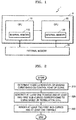
- FIG. 1 is a block diagram illustrating an example of a graphics processing system according to an example embodiment.
- a graphics processing system 1 may include processing units 5.
- the processing units 5 may include a central processing unit (CPU) 10, a graphics processing unit (GPU) 20.
- the graphics processing system 1 may include an external memory 30.
- the CPU 10 may include a CPU internal memory 110
- the GPU 20 may include a GPU internal memory 120.
- the CPU 10 may generate a draw call or draw command to be transmitted to the GPU 20 by using path data.
- the path may refer to an element of an object to be rendered.
- the object may include a closed path or a closed polygon formed by connecting one or more paths.
- the path may correspond to a line or a curve.
- the GPU 20 may receive the draw call and perform path rendering by using primitive data stored in the external memory 30 or the CPU internal memory 110. For example, the GPU 20 may calculate a color value of each of a plurality of pixels included in a frame by using the primitive data.
- the frame may correspond to an image to be displayed on a screen, and an image may be formed by setting a color for each of the pixels included in the frame.
- the GPU 20 may include a vertex shader, a rasterizer, a fragment shader, a pixel shader, and/or a frame buffer.
- the primitive may refer to an element for rendering.
- a path may include one or more consecutive primitives, and a primitive such as a curve may be divided into several primitives.
- the external memory 30 may store information or data necessary for operation of the CPU 10 and the GPU 20 and store data processing results of the CPU 10 and the GPU 20.
- the external memory 30 may include a dynamic random-access memory (DRAM).
- DRAM dynamic random-access memory
- the CPU internal memory 110 and/or the GPU internal memory 120 may store data expected to be frequently or immediately used by the CPU 10 and the GPU 20.
- the CPU internal memory 110 and/or the GPU internal memory 120 may include cache memories.
- the GPU 20 may perform rendering on a curve by using a Loop-Blinn method.
- the Loop-Blinn method may be a method of determining, through a Loop-Blinn equation, whether each of the pixels included in a triangle including control points of the curve is included in the curve and may refer to a method based on the contents of "Resolution Independent Curve Rendering using Programmable Graphics Hardware" co-authored by Charles Loop and Jim Blinn.
- the operation amount of the GPU 20 may increase as the number of pixels to which the Loop-Blinn equation is to apply increases.
- the CPU 10 may perform tessellation on a curve to be rendered.
- the tessellation may refer to a process of dividing a curve into a plurality of sub-curves.
- the operation amount of the CPU 10 may increase as the number of tessellations on a curve increases.
- a resource usage ratio U CPU of the CPU 10 and a resource usage ratio U GPU of the GPU 20 may be considered to determine a tessellation level.
- the resource usage ratio may refer to the ratio of the currently-used resource to the total resource capacity of the CPU 10 or the GPU 20.
- a tessellation level may be determined adaptively according to a resource usage ratio U CPU of the CPU 10 and a resource usage ratio U GPU of the GPU 20.
- FIG. 2 is a flow diagram illustrating an example of a method of rendering a curve according to an embodiment.
- the method of rendering a curve illustrated in FIG. 2 may be performed by the CPU 10 and/or may be performed by the GPU 20. Also, the method of rendering a curve illustrated in FIG. 2 may be performed by a hardware accelerator.
- the hardware accelerator may be embedded in the CPU 10 or the GPU 20 or may be provided as an independent device separate from the CPU 10 or the GPU 20.
- the processor may be included in the CPU 10, the GPU 20, or the hardware accelerator.
- the processor may determine a tessellation level of dividing a curve based on a control point of the curve.
- the curve may be implemented by a plurality of control points.
- the curve may include a quadratic curve implemented by three control points or a cubic curve implemented by four control points.
- the tessellation level may correspond to the number of times of dividing the curve. For example, when the tessellation level is 2, the processor divides the curve two times. For example, the processor may divide the curve based on the control point of the curve. For example, when the tessellation level is 1, the curve may be divided into two sub-curves and thus one triangle may be generated.
- two of the vertexes of the triangle may be identical to, or may correspond to, two of the control points of the curve.
- the processor may determine the tessellation level in consideration of the resource usage ratio U CPU of the CPU 10 and the resource usage ratio U GPU of the GPU 20. In an embodiment, the processor may increase the tessellation level when the resource usage ratio U CPU of the CPU 10 is greater than the resource usage ratio U GPU of the GPU 20. Also, the processor may decrease the tessellation level when the resource usage ratio U CPU of the CPU 10 is less than or equal to the resource usage ratio U GPU of the GPU 20.
- the processor may determine the tessellation level of the next-input curve in consideration of the tessellation level of the previously-input curve. For example, when the tessellation level of a first curve is determined and then the tessellation level of a second curve is determined, the processor may determine the tessellation level of the second curve according to increasing or decreasing the tessellation level of the first curve by a desired (or alternatively, predetermined) value.
- the desired (or alternatively, predetermined) value may be 0 or a natural number greater than or equal to 1.
- FIGS. 3A and 3B are diagrams illustrating examples of a curve according to an embodiment.
- FIG. 3A illustrates an example of a quadratic curve 310 implemented by three control points.
- FIG. 3B illustrates an example of a cubic curve 320 implemented by four control points.
- a curve 310 may be implemented by a control point Po, a control point P 2 , and a control point P 1 .
- a curve 320 may be implemented by a control point P 3 determining the start point of the curve 320, a control point P 6 determining the end point of the curve 320, and control points P 4 and P 5 determining the shape of the curve 320.
- the path data may include data about the geometry of a path and data about a style of the path.
- the path data may include information about coordinates of each of a plurality of vertexes included in the path and commands for constructing the path by combining the vertexes.
- the vertexes may include the vertex corresponding to the start point of the path and the vertex corresponding to the end point of the path.
- a control point determining the shape of the curve may be further included.
- the path data may include information about the color in which the path is to be represented.
- the processor may determine whether the path is a line or a curve, and when the path is a curve, the processor may be determined what control points implement the curve.
- the processor may determine the control points corresponding to the curves 310 and 320.
- the processor may divide the curves 310 and 320 based on the control points of the curves 310 and 320.
- the processor may divide the curve such that two of the vertexes of the triangle generated by dividing the curves 310 and 320 are identical to two of the control points of the curves 310 and 320.
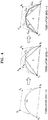
- FIG. 4 is a diagram illustrating an example of a tessellation level according to an embodiment.
- FIG. 4 illustrates an example of a case where the tessellation level is 0, 1, or 2.
- the tessellation level may correspond to the number of times of dividing a curve Cio. For example, when or if the tessellation level is 0, the curve Cio may not be divided; when or if the tessellation level is 1, the curve Cio may be divided one time; and when or if the tessellation level is 2, the curve Cio may be divided two times.
- the curve Cio may be divided one time.
- the curve Cio may be divided into two first sub-curves C 20 and C 21 .
- one triangle T 1 may be generated according as the curve Cio is divided. Accordingly, two vertexes of the triangle T 1 may be identical to control points P 3 and P 6 of the curve Cio.
- the curve Cio may be divided two times
- the curve Cio may be divided into four second sub-curves C 30 , C 31 , C 32 , and C 33 .
- the first sub-curve C 20 may be divided into the second sub-curves C 30 and C 31
- the first sub-curve C 21 may be divided into the second sub-curves C 32 and C 33 .
- Three triangles T 1 , T 2 , and T 3 may be generated according as the curve C 10 is divided two times. Accordingly, two vertexes of the triangle T 1 may be identical to control points P 3 and P 6 of the curve C 10 as described above.
- the curve C 10 may be divided three times according to the above method and thus eight third sub-curves and seven triangles may be generated.
- N is a natural number greater than or equal to 2
- at least one triangle and at least two Nth sub-curves corresponding to an (N-1)th sub-curve may be generated.
- the operation amount of the CPU 10 may increase as the tessellation level increases. For example, an overload may occur in the CPU 10.
- the operation amount of the GPU 20 may increase as the tessellation level decreases.
- the processor may determine the tessellation level in consideration of the resource usage ratio U CPU of the CPU 10 and the resource usage ratio U GPU of the GPU 20.
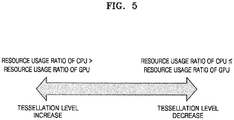
- FIG. 5 is a diagram illustrating an example in which a processor determines a tessellation level in consideration of a resource usage ratio U CPU of a CPU and a resource usage ratio U GPU of a GPU according to an embodiment.
- the processor may decrease the tessellation level when the resource usage ratio U CPU of the CPU 10 is greater than the resource usage ratio U GPU of the GPU 20.
- the processor may increase the tessellation level when the resource usage ratio U CPU of the CPU 10 is smaller than or equal to the resource usage ratio U GPU of the GPU 20.
- the processor may increase or decrease the tessellation level based on Equation 1 below. That is, when Equation 1 is satisfied, the processor may decrease the tessellation level, and when Equation 1 is not satisfied, the processor may increase the tessellation level.
- U CPU denotes the resource usage ratio of the CPU 10
- U GPU denotes the resource usage ratio of the GPU 20.
- ⁇ denotes a value that may be determined according to the applications and characteristics of the system including the CPU 10 and the GPU 20 and/or may be set by a user.
- ⁇ may be a scaling value.
- U CPU and U GPU may be real numbers between 0 and 1, and ⁇ may be a real number greater than 0.
- the resource usage ratio of the CPU 10 may need to be or be desired to be maintained below a certain ratio. Accordingly, when or if ⁇ is set to a real number less than 1, the resource usage ratio of the CPU 10 may be maintained to be smaller than the resource usage ratio of the GPU 20. On the other hand, in order to support real-time processing of 3-dimensional (3D) graphics in the GPU 20, the resource usage ratio of the GPU 20 may need to be maintained below a certain ratio. In this case, when ⁇ is set to a real number greater than or equal to 1, the resource usage ratio of the GPU 20 may be maintained to be smaller than the resource usage ratio of the CPU 10. The value of ⁇ may be changed dynamically according to applications instead of being fixed or specified in the system.
- the processor may decrease the tessellation level by one from a reference value.
- the processor may increase the tessellation level by one from a reference value.
- the processor may change the tessellation level to 0 instead of decreasing the tessellation level by one from a reference value.
- the reference value may refer to the tessellation level of the previous curve.
- FIG. 6 is a diagram illustrating an example in which a processor determines a tessellation level when a plurality of curves are sequentially input, according to an embodiment.
- FIG. 6 illustrates an example in which a first curve 610 is input first and then a second curve 620 is input sequentially.
- the processor is assumed to determine the tessellation level of the first curve 610, and then determines the tessellation level of the second curve 620.
- the processor may determine the tessellation levels of the curves 610 and 620 according to increasing or decreasing the tessellation level from a reference value, and the reference value may refer to the tessellation level of the previous curve.
- the reference value may be a specific (or alternatively, preset) value (e.g., 0).
- the tessellation level of the second curve 620 may increase or decrease by an integer k from 1. For example, k may be 1.
- the processor may store the tessellation levels of the curves 610 and 620. For example, the processor may transmit data representing the tessellation level to a memory to store the data in the memory.
- the processor may generate at least one triangle and at least two first sub-curves corresponding to the curve based on the tessellation level.
- the processor may generate the at least two first sub-curves and the at least one triangle by dividing the curve by using a De Casteljau algorithm.
- FIG. 7 is a diagram illustrating an example in which a processor divides a curve based on a tessellation level, according to an example embodiment.
- FIG. 7 illustrates an example in which a curve C 0 is divided when the tessellation level is 0, 1, or 2.
- the curve C 0 may not be divided as described above.
- the curve C 0 When or if the tessellation level is 1, the curve C 0 may be divided one time and thus two first sub-curves C 1 and C 2 and one triangle T 1 may be generated.
- the processor may generate 'Curve_list' including information about the first sub-curves C 1 and C 2 and may generate 'Tri_list' including information about the triangle T 1 .
- the curve C 0 may be divided two times and thus four second sub-curves C 3 , C 4 , C 5 , and C 6 and three triangles T 1 , T 2 , and T 3 may be generated.
- the processor may divide the curve C 0 to generate first sub-curves C 1 and C 2 and may divide the first sub-curves C 1 and C 2 to generate second sub-curves C 3 , C 4 , C 5 , and C 6 .
- the processor may generate 'Curve_list' including information about the second sub-curves C 3 , C 4 , C 5 , and C 6 , and may generate 'Tri_list' including information about the triangles T 1 , T 2 , and T 3 .
- the processor may store the 'Curve_list' and the 'Tri_list'.
- the processor may store data 'Curve_list' corresponding to the curve C 0 and the sub-curves C 1 , C 2 , C 3 , C 4 , C 5 , and C 6 and data 'Tri_list' corresponding to the triangles T 1 , T 2 , and T 3 .
- the processor may transmit the 'Curve_list' and the 'Tri_list' to a memory to store the same in the memory.
- primitive data the data 'Curve_list' corresponding to the curve (or sub-curves) and the data 'Tri_list' corresponding to the triangles.
- FIGS. 8A and 8B are diagrams illustrating an example in which a processor divides a curve by using a De Casteljau algorithm according to an embodiment.
- FIG. 8A illustrates a curve 810 before division. Also, FIG. 8B illustrates sub-curves 811 and 812 into which the curve 810 is divided. The tessellation level of the curve 810 is assumed to be 1.
- the processor may divide the curve 810 into the sub-curves 811 and 812 based on a De Casteljau algorithm.
- the De Casteljau algorithm may refer to an algorithm used to divide one Bezier curve into two or more Bezier curves. Detailed descriptions of the De Casteljau algorithm will be omitted herein.
- the processor may render the at least two first sub-curves and the at least one triangle.
- the processor may render the curve (or sub-curves) and the triangle separately.
- the processor may render the curve (or sub-curves) by using a Loop-Blinn method and may render the triangle by using a pipe-line of the GPU 20.
- FIG. 9 is a diagram illustrating an example in which a processor renders a curve (or sub-curve) and a triangle according to an embodiment.
- the processor may render the first sub-curves C 20 and C 21 and the triangle T 1 separately.
- the processor may render the first sub-curves C 20 and C 21 and the triangle T 1 by calling an OpenGL API (i.e., a Draw Call function).
- the processor may render the first sub-curves C 20 and C 21 by using a Loop-Blinn method and may render the triangle T 1 by using a pipe-line of the GPU 20.
- a process of rendering the first sub-curves C 20 and C 21 and the triangle T 1 by the processor may be performed in parallel.
- the processor may select candidate pixels corresponding to the first sub-curve C 20 with reference to 'Curve_list' among the primitive data. For example, as the candidate pixels, the processor may select the pixels in a triangle 910 constructed by control points Po, P 3 , and P 4 of the first sub-curve C 20 . Then, by using a Loop-Blinn equation, the processor may select pixels 920 located inside the first sub-curve C 20 among the candidate pixels. Then, the processor may render the first sub-curve C 20 by setting the color for the pixels 920 and store the results thereof in the frame buffer.
- the processor may render the first sub-curve C 21 in the same way as rendering the first sub-curve C 20 .
- the processor may select pixels 940 in the triangle T 1 with reference to 'Tri_list' among the primitive data. Then, the processor may render the triangle T 1 by setting the color for the pixels 940, and may store the results thereof in the frame buffer.
- Tri_List may be constructed in the form of GL_TRIANGLE_STRIP, and the processor may render the triangle T 1 by calling a draw call function.
- FIG. 10 is a flow diagram illustrating another example of a method of rendering a curve according to an embodiment.
- the method of rendering a curve illustrated in FIG. 10 may be performed by the CPU 10 or may be performed by the GPU 20. Also, the method of rendering a curve illustrated in FIG. 10 may be performed by a hardware accelerator.
- the hardware accelerator may be embedded in the CPU 10 or the GPU 20 or may be provided as an independent device separate from the CPU 10 or the GPU 20.
- the processor may be included in the CPU 10, the GPU 20, or the hardware accelerator.
- the processor may determine a tessellation level in consideration of the free resource of the CPU 10 and the free resource of the GPU 20.
- the processor may decrease the tessellation level when or if the resource usage ratio U CPU of the CPU 10 is greater than the resource usage ratio U GPU of the GPU 20.
- the processor may increase the tessellation level when or if the resource usage ratio U CPU of the CPU 10 is less than or equal to the resource usage ratio U GPU of the GPU 20.
- the tessellation level may correspond to the number of times of dividing the curve.
- the processor may transmit the tessellation level to a memory to store the same in the memory.
- the processor may generate primitive data corresponding to the curve based on the tessellation level.
- the processor may generate sub-curves and a triangle by dividing the curve by using a De Casteljau algorithm.
- the processor may generate 'Curve_list' including information about the curve and the sub-curves and generate 'Tri_list' including information about the triangle.
- the processor may transmit the primitive data ('Curve_list' and 'Tri_list') to a memory to store the same in the memory.
- An example of generating the primitive data by the processor is the same as described above with reference to FIGS. 7 and 8 .
- the processor may render the curve by using the primitive data.
- the processor may render the sub-curves and the triangle separately.
- the processor may render the sub-curves by using a Loop-Blinn method and may render the triangle by using a pipe-line of the GPU 20.
- a process of rendering the sub-curves and the triangle by the processor may be performed in parallel.
- the processor may determine the tessellation level adaptively according to the resource usage ratio U CPU of the CPU 10 and the resource usage ratio U GPU of the GPU 20.
- the occurrence of an overload in the CPU 10 and the GPU 20 may be prevented, mitigated, or reduced in likelihood of occurrence, and the curve rendering may be performed at high speed.
- FIG. 11 is a block diagram illustrating an example of a processor according to an embodiment.
- the processor 1100 may include a determiner unit 1110 and a generator unit 1120.
- the processor 1100 may be implemented by an array of logic gates, and/or may be implemented by a combination of a general-purpose microprocessor and a memory that stores a program executable in the general-purpose microprocessor. Also, the processor 1100 may be implemented by other types of hardware.
- the determiner unit 1110 may determine a tessellation level of dividing a curve based on a control point of the curve. In an example embodiment, the determiner unit 1110 may determine the tessellation level in consideration of the resource usage ratio U CPU of the CPU 10 and the resource usage ratio U GPU of the GPU 20. The determiner unit 1110 may transmit the tessellation level to a memory.
- the generator unit 1120 may generate at least one triangle and at least two first sub-curves corresponding to the curve based on the tessellation level. In an embodiment, the generator unit 1120 may generate primitive data corresponding to the curve based on the tessellation level. Then, the generator unit 1120 may transmit the primitive data to a memory.
- a method of rendering a curve may be performed by the processor; however, inventive concepts are not limited thereto.
- the method of rendering a curve may be performed by the CPU 10 or the GPU 20.
- FIGS. 12 to 15 are block diagrams illustrating various examples of a graphics processing system according to an embodiment.
- FIGS. 12 and 13 illustrate examples of generating primitive data by CPUs 1210 and 1310.
- FIGS. 14 and 15 illustrate examples of generating primitive data by GPUs 1420 and 1520.
- a processor 1211 of the CPU 1210 may determine curve data with reference to path data stored in a memory 1212. For example, the processor 1211 may determine whether a curve exists in a path. The processor 1211 may determine a tessellation level in consideration of the resource usage ratio U CPU of the CPU 1210 and the resource usage ratio U GPU of a GPU 1220. The processor 1211 may generate primitive data (Tri_List, Curve_List) by dividing the curve according to the tessellation level. Thereafter, the processor 1211 may store the primitive data (Tri_List, Curve_List) in the memory 1212. Thereafter, the processor 1211 may generate a draw call by using the primitive data (Tri_List, Curve_List), and the GPU 1220 may render a curve accordingly.
- Tri_List, Curve_List primitive data
- the primitive data may be stored in a memory located outside or external to a GPU 1320 and the CPU 1310.
- the operation performed by a processor 1311 of FIG. 13 may be the same as the operation performed by the processor 1211 of FIG. 12 .
- the processor 1311 may store the primitive data (Tri_List, Curve_List) in an external memory 1330 and may generate a draw call or a command to draw by using the primitive data (Tri_List, Curve_List) stored in the external memory 1330.
- an operation of determining a tessellation level by processors 1411 and 1511 may be the same as the operation of the processor 1211 of FIG. 12 .
- the processors 1411 and 1511 may request the GPUs 1420 and 1520 to divide the curve based on the tessellation level (i.e., to generate the primitive data).
- processors 1421 and 1521 of the GPUs 1420 and 1520 may generate the primitive data (Tri_List, Curve_List) by dividing the curve according to the tessellation level.
- the example illustrated in FIG. 14 and the example illustrated in FIG. 15 may be different from one another in terms of the positions where the primitive data (Tri_List, Curve_List) is stored.
- the primitive data (Tri_List, Curve_List) may be stored in a memory 1412 of a CPU 1410 or may be stored in a memory 1522 of the GPU 1520.
- the processor 1511 may generate a draw call by using the primitive data (Tri_List, Curve_List) stored in the memory 1522.
- the primitive data may be stored in a memory located outside the GPUs 1420 and 1520 and the CPUs 1410 and 1510.
- the tessellation level may be determined adaptively according to the free resource of the CPU and the free resource of the GPU.
- the occurrence of an overload in the CPU and the GPU may be prevented, mitigated, or reduced in likelihood of occurrence, and the curve rendering may be performed at high speed.
- the above method may be written as a program executable by a computer and may be implemented in a general-purpose digital computer that executes the program by using a computer-readable recording medium.
- the data structure used in the above method may be written on a computer-readable recording medium through various means.
- the computer-readable recording medium may include storage mediums such as magnetic storage mediums (e.g., ROMs, RAMs, USBs, floppy disks, and hard disks) and optical recording mediums (e.g., CD-ROMs and DVDs).
Landscapes
- Engineering & Computer Science (AREA)
- Physics & Mathematics (AREA)
- General Physics & Mathematics (AREA)
- Theoretical Computer Science (AREA)
- Computer Graphics (AREA)
- Geometry (AREA)
- Software Systems (AREA)
- Image Generation (AREA)
Claims (16)
- Procédé permettant de rendre une courbe, le procédé comprenant :la détermination d'un niveau de pavage de la division d'une courbe en une pluralité de sous-courbes, dans lequel la division de la courbe en une pluralité de sous-courbes est basée sur un point de contrôle de la courbe (210) ;la génération d'au moins un triangle et d'au moins deux premières sous-courbes correspondant à la courbe sur la base du niveau de pavage (220) ; etle rendu desdites au moins deux premières sous-courbes et dudit au moins un triangle (230) caractérisé en ce que la détermination inclut la détermination du niveau de pavage en tenant compte d'un taux d'utilisation des ressources UCPU d'une unité centrale de traitement (CPU) et d'un taux d'utilisation des ressources UGPU d'une unité de traitement graphique (GPU) selon la relation UCPU > UGPU * α, α étant une valeur de mise à l'échelle supérieure à 0 qui est déterminée en fonction d'applications et de caractéristiques d'un système incluant la CPU (10) et la GPU (20) et/ou est définie par un utilisateur.
- Procédé selon la revendication 1, dans lequel la détermination inclut la diminution du niveau de pavage de 1 d'une valeur de référence lorsque la relation est satisfaite et l'augmentation du niveau de pavage de 1 de la valeur de référence lorsque la relation n'est pas satisfaite, dans lequel la valeur de référence se rapporte à un niveau de pavage d'une courbe antérieure.
- Procédé selon la revendication 1, dans lequel la génération inclut la génération d'au moins un triangle et d'au moins deux Nièmes sous-courbes correspondant à une (N-1)ième sous-courbe en réponse au niveau de pavage étant N, où N est un nombre naturel supérieur ou égal à 2.
- Procédé selon la revendication 1, dans lequel la génération comprend la génération desdites au moins deux premières sous-courbes par division de la courbe en utilisant un algorithme de De Casteljau.
- Procédé selon la revendication 1, comprenant en outre :
le stockage du niveau de pavage. - Procédé selon la revendication 1, dans lequel le rendu inclut le rendu desdites au moins deux premières sous-courbes et dudit au moins un triangle séparément.
- Procédé selon la revendication 1, dans lequel le rendu inclut le rendu desdites au moins deux premières sous-courbes en utilisant un procédé de Loop-Blinn et le rendu dudit au moins un triangle en utilisant un pipeline d'une GPU.
- Procédé selon la revendication 1, comprenant en outre :
le stockage de données correspondant audit au moins un triangle et auxdites au moins deux premières sous-courbes. - Appareil (1) permettant de rendre une courbe, l'appareil comprenant :un processeur,dans lequel le processeur est configuré pourdéterminer un niveau de pavage de la division d'une courbe en une pluralité de sous-courbes, dans lequel la division de la courbe en une pluralité de sous-courbes est basée sur un point de contrôle de la courbe,générer au moins un triangle et au moins deux premières sous-courbes correspondant à la courbe sur la base du niveau de pavage, etrendre lesdites au moins deux premières sous-courbes et ledit au moins un triangle caractérisé en ce que le processeur est configuré pour déterminer le niveau de pavage en tenant compte d'un taux d'utilisation des ressources UCPU d'une unité centrale de traitement (CPU 10) et d'un taux d'utilisation des ressources UGPU d'une unité de traitement graphique (GPU 20) selon la relation UCPU > UGPU * α, α étant une valeur de mise à l'échelle supérieure à 0 qui est déterminée en fonction d'applications et de caractéristiques d'un système incluant la CPU 10 et la GPU 20 et/ou est définie par un utilisateur.
- Appareil selon la revendication 9, dans lequel le processeur est configuré pour diminuer le niveau de pavage de 1 d'une valeur de référence lorsque la relation est satisfaite et augmenter le niveau de pavage de 1 de la valeur de référence lorsque la relation n'est pas satisfaite, dans lequel la valeur de référence se rapporte à un niveau de pavage d'une courbe antérieure.
- Appareil selon la revendication 9, dans lequel le processeur est configuré pour générer au moins un triangle et au moins deux Nièmes sous-courbes correspondant à une (N-1)ième sous-courbe en réponse au niveau de pavage étant N, où N est un nombre naturel supérieur ou égal à 2.
- Appareil selon la revendication 9, dans lequel le processeur est configuré pour générer lesdites au moins deux premières sous-courbes par division de la courbe en utilisant un algorithme de De Casteljau.
- Appareil selon la revendication 9, dans lequel le processeur est configuré pour transmettre le niveau de pavage à une mémoire (110, 120).
- Appareil selon la revendication 9, dans lequel le processeur est configuré pour rendre lesdites au moins deux premières sous-courbes et ledit au moins un triangle séparément.
- Appareil selon la revendication 9, dans lequel le processeur est configuré pour rendre lesdites au moins deux premières sous-courbes en utilisant un procédé de Loop-Blinn et rendre ledit au moins un triangle en utilisant un pipeline d'une GPU.
- Appareil selon la revendication 9, dans lequel le processeur est configuré pour transmettre des données correspondant audit au moins un triangle et auxdites au moins deux premières sous-courbes à une mémoire (110, 120).
Applications Claiming Priority (1)
| Application Number | Priority Date | Filing Date | Title |
|---|---|---|---|
| KR1020160154882A KR102657587B1 (ko) | 2016-11-21 | 2016-11-21 | 커브 렌더링을 수행하는 방법 및 장치. |
Publications (2)
| Publication Number | Publication Date |
|---|---|
| EP3324363A1 EP3324363A1 (fr) | 2018-05-23 |
| EP3324363B1 true EP3324363B1 (fr) | 2019-06-19 |
Family
ID=60244839
Family Applications (1)
| Application Number | Title | Priority Date | Filing Date |
|---|---|---|---|
| EP17196309.3A Active EP3324363B1 (fr) | 2016-11-21 | 2017-10-13 | Procédé et appareil permettant de rendre une courbe |
Country Status (5)
| Country | Link |
|---|---|
| US (1) | US10297078B2 (fr) |
| EP (1) | EP3324363B1 (fr) |
| JP (1) | JP6936689B2 (fr) |
| KR (1) | KR102657587B1 (fr) |
| CN (1) | CN108090943B (fr) |
Families Citing this family (5)
| Publication number | Priority date | Publication date | Assignee | Title |
|---|---|---|---|---|
| JP6663468B1 (ja) * | 2018-10-15 | 2020-03-11 | Hapsモバイル株式会社 | 制御装置、プログラム、システム及び制御方法 |
| KR102699047B1 (ko) * | 2018-12-14 | 2024-08-27 | 삼성전자주식회사 | 경로를 포함하는 객체를 렌더링하는 장치, 이를 포함하는 컴퓨팅 장치 및 이의 렌더링 방법 |
| US11010939B2 (en) * | 2019-09-12 | 2021-05-18 | Adobe Inc. | Rendering of cubic Bezier curves in a graphics processing unit (GPU) |
| CN115272524B (zh) * | 2022-09-23 | 2023-01-03 | 安徽华云安科技有限公司 | 多曲线并行绘制方法、装置、设备以及存储介质 |
| CN118262067B (zh) * | 2024-05-30 | 2024-09-03 | 摩尔线程智能科技(北京)有限责任公司 | 曲面细分方法、装置、设备及存储介质 |
Family Cites Families (32)
| Publication number | Priority date | Publication date | Assignee | Title |
|---|---|---|---|---|
| US5995109A (en) * | 1997-04-08 | 1999-11-30 | Lsi Logic Corporation | Method for rendering high order rational surface patches |
| JPH1166328A (ja) | 1997-08-19 | 1999-03-09 | Murata Mach Ltd | 曲線描画装置 |
| US6147767A (en) * | 1997-09-05 | 2000-11-14 | Comtec Informations Systems, Inc. | Computer system for a printer which stores and operates multiple application programs |
| EP0952554A3 (fr) * | 1998-02-26 | 2003-01-08 | Canon Kabushiki Kaisha | Dispositif et méthode de traitement d'information |
| CA2345464A1 (fr) * | 1998-09-24 | 2000-03-30 | Brigit Ananya | Systeme et procede de construction de courbes sur ordinateur |
| US6809738B2 (en) * | 2001-12-21 | 2004-10-26 | Vrcontext S.A. | Performing memory management operations to provide displays of complex virtual environments |
| US8482559B2 (en) * | 2002-11-04 | 2013-07-09 | Ati Technologies Ulc | Method and apparatus for triangle tessellation |
| US7038682B2 (en) * | 2002-11-05 | 2006-05-02 | Brigit Ananya | Computer curve construction system II |
| US7212205B2 (en) * | 2002-11-12 | 2007-05-01 | Matsushita Electric Industrial Co., Ltd. | Curved surface image processing apparatus and curved surface image processing method |
| US8471852B1 (en) * | 2003-05-30 | 2013-06-25 | Nvidia Corporation | Method and system for tessellation of subdivision surfaces |
| US7564459B2 (en) | 2005-10-31 | 2009-07-21 | Microsoft Corporation | Resolution-independent curve rendering using programmable graphics hardware |
| US8244051B2 (en) | 2006-03-15 | 2012-08-14 | Microsoft Corporation | Efficient encoding of alternative graphic sets |
| US7868887B1 (en) * | 2007-10-18 | 2011-01-11 | Adobe Systems Incorporated | Rendering rational quadratic Bézier curves on a GPU |
| US8643644B2 (en) * | 2008-03-20 | 2014-02-04 | Qualcomm Incorporated | Multi-stage tessellation for graphics rendering |
| US8072452B1 (en) | 2008-04-18 | 2011-12-06 | Adobe Systems Incorporated | Efficient multi-resolution curve rendering |
| US8120607B1 (en) * | 2008-05-30 | 2012-02-21 | Nvidia Corporation | Boundary transition region stitching for tessellation |
| CN101894363B (zh) * | 2009-05-20 | 2012-06-06 | 新奥特(北京)视频技术有限公司 | 一种面片化的garbage mask边界渲染方法 |
| US8669990B2 (en) * | 2009-12-31 | 2014-03-11 | Intel Corporation | Sharing resources between a CPU and GPU |
| US8854365B2 (en) * | 2010-01-15 | 2014-10-07 | Microsoft Corporation | Rendering parametric surface patches |
| WO2012001893A1 (fr) * | 2010-06-30 | 2012-01-05 | パナソニック株式会社 | Dispositif de division de courbes, procédé de division de courbes, programme de division de courbes et circuit intégré |
| EP2523166B1 (fr) | 2011-05-12 | 2013-11-27 | BlackBerry Limited | Procédé et dispositif pour les zones délimitées par les courbes de rendu en utilisant un GPU |
| JP5842601B2 (ja) * | 2011-12-26 | 2016-01-13 | 富士通株式会社 | プログラム、情報処理方法及び情報処理装置 |
| US9240034B2 (en) * | 2012-06-08 | 2016-01-19 | Advanced Micro Devices, Inc. | Biomedical data analysis on heterogeneous platform |
| US9922442B2 (en) * | 2012-07-18 | 2018-03-20 | Arm Limited | Graphics processing unit and method for performing tessellation operations |
| US9105125B2 (en) | 2012-12-05 | 2015-08-11 | Advanced Micro Devices, Inc. | Load balancing for optimal tessellation performance |
| EP2750108B1 (fr) * | 2012-12-28 | 2019-05-01 | Dassault Systèmes | Paramétrage d'un objet modélisé en 3D pour mosaïque |
| US9401034B2 (en) | 2013-04-30 | 2016-07-26 | Microsoft Technology Licensing, Llc | Tessellation of two-dimensional curves using a graphics pipeline |
| KR102219294B1 (ko) | 2014-02-13 | 2021-02-23 | 삼성전자 주식회사 | 커브 렌더링 방법 및 장치 |
| KR102238651B1 (ko) | 2014-04-23 | 2021-04-09 | 삼성전자주식회사 | 경로 렌더링을 수행하는 방법 및 장치. |
| EP2985735B1 (fr) * | 2014-08-11 | 2019-12-04 | Samsung Electronics Co., Ltd | Procédé et appareil permettant d'effectuer un rendu de trajet à base de pavés |
| KR102329475B1 (ko) | 2014-08-27 | 2021-11-19 | 삼성전자주식회사 | 렌더링 퀄리티 제어 장치 및 방법 |
| KR102197064B1 (ko) * | 2014-10-10 | 2020-12-30 | 삼성전자 주식회사 | Lod를 조절할 수 있는 그래픽스 프로세싱 유닛, 이의 작동 방법, 및 상기 그래픽스 프로세싱 유닛을 포함하는 장치들 |
-
2016
- 2016-11-21 KR KR1020160154882A patent/KR102657587B1/ko active Active
-
2017
- 2017-07-18 US US15/652,610 patent/US10297078B2/en active Active
- 2017-10-12 JP JP2017198268A patent/JP6936689B2/ja active Active
- 2017-10-13 EP EP17196309.3A patent/EP3324363B1/fr active Active
- 2017-11-21 CN CN201711162811.1A patent/CN108090943B/zh active Active
Non-Patent Citations (1)
| Title |
|---|
| None * |
Also Published As
| Publication number | Publication date |
|---|---|
| KR102657587B1 (ko) | 2024-04-15 |
| CN108090943B (zh) | 2022-02-01 |
| KR20180056932A (ko) | 2018-05-30 |
| JP2018085103A (ja) | 2018-05-31 |
| JP6936689B2 (ja) | 2021-09-22 |
| US20180144544A1 (en) | 2018-05-24 |
| US10297078B2 (en) | 2019-05-21 |
| CN108090943A (zh) | 2018-05-29 |
| EP3324363A1 (fr) | 2018-05-23 |
Similar Documents
| Publication | Publication Date | Title |
|---|---|---|
| KR102651126B1 (ko) | 그래픽 프로세싱 장치 및 그래픽스 파이프라인에서 텍스처를 처리하는 방법 | |
| US7868887B1 (en) | Rendering rational quadratic Bézier curves on a GPU | |
| KR102477265B1 (ko) | 그래픽스 프로세싱 장치 및 그래픽스 파이프라인의 텍스쳐링을 위한 LOD(level of detail)를 결정하는 방법 | |
| US10332290B2 (en) | Fast, coverage-optimized, resolution-independent and anti-aliased graphics processing | |
| EP2831848B1 (fr) | Procédé d'estimation du niveau d'opacité dans une scène et dispositif correspondant | |
| US7928984B1 (en) | Efficient data packaging for rendering bézier curves on a GPU | |
| US20130120391A1 (en) | Triangulation for Accelerated Multi-Resolution Rendering of Stroked Paths | |
| EP3324363A1 (fr) | Procédé et appareil permettant de rendre une courbe | |
| US10169839B2 (en) | Method and apparatus for executing graphics pipeline | |
| EP3142074B1 (fr) | Procédé et appareil permettant d'effectuer un tracé de chemin | |
| US8068106B1 (en) | Rendering cubic Bézier curves as quadratic curves using a GPU | |
| US9401046B2 (en) | Micropolygon splatting | |
| US10192348B2 (en) | Method and apparatus for processing texture | |
| US10417736B2 (en) | Graphics processing unit and method of controlling cache bypass thereof | |
| KR102853920B1 (ko) | 텍스쳐 처리 방법 및 장치 | |
| US10311627B2 (en) | Graphics processing apparatus and method of processing graphics pipeline thereof |
Legal Events
| Date | Code | Title | Description |
|---|---|---|---|
| PUAI | Public reference made under article 153(3) epc to a published international application that has entered the european phase |
Free format text: ORIGINAL CODE: 0009012 |
|
| STAA | Information on the status of an ep patent application or granted ep patent |
Free format text: STATUS: THE APPLICATION HAS BEEN PUBLISHED |
|
| AK | Designated contracting states |
Kind code of ref document: A1 Designated state(s): AL AT BE BG CH CY CZ DE DK EE ES FI FR GB GR HR HU IE IS IT LI LT LU LV MC MK MT NL NO PL PT RO RS SE SI SK SM TR |
|
| AX | Request for extension of the european patent |
Extension state: BA ME |
|
| STAA | Information on the status of an ep patent application or granted ep patent |
Free format text: STATUS: REQUEST FOR EXAMINATION WAS MADE |
|
| 17P | Request for examination filed |
Effective date: 20181031 |
|
| RBV | Designated contracting states (corrected) |
Designated state(s): AL AT BE BG CH CY CZ DE DK EE ES FI FR GB GR HR HU IE IS IT LI LT LU LV MC MK MT NL NO PL PT RO RS SE SI SK SM TR |
|
| GRAP | Despatch of communication of intention to grant a patent |
Free format text: ORIGINAL CODE: EPIDOSNIGR1 |
|
| STAA | Information on the status of an ep patent application or granted ep patent |
Free format text: STATUS: GRANT OF PATENT IS INTENDED |
|
| INTG | Intention to grant announced |
Effective date: 20190104 |
|
| GRAS | Grant fee paid |
Free format text: ORIGINAL CODE: EPIDOSNIGR3 |
|
| GRAA | (expected) grant |
Free format text: ORIGINAL CODE: 0009210 |
|
| STAA | Information on the status of an ep patent application or granted ep patent |
Free format text: STATUS: THE PATENT HAS BEEN GRANTED |
|
| AK | Designated contracting states |
Kind code of ref document: B1 Designated state(s): AL AT BE BG CH CY CZ DE DK EE ES FI FR GB GR HR HU IE IS IT LI LT LU LV MC MK MT NL NO PL PT RO RS SE SI SK SM TR |
|
| REG | Reference to a national code |
Ref country code: GB Ref legal event code: FG4D |
|
| REG | Reference to a national code |
Ref country code: CH Ref legal event code: EP |
|
| REG | Reference to a national code |
Ref country code: IE Ref legal event code: FG4D |
|
| REG | Reference to a national code |
Ref country code: DE Ref legal event code: R096 Ref document number: 602017004650 Country of ref document: DE |
|
| REG | Reference to a national code |
Ref country code: AT Ref legal event code: REF Ref document number: 1146466 Country of ref document: AT Kind code of ref document: T Effective date: 20190715 |
|
| REG | Reference to a national code |
Ref country code: NL Ref legal event code: MP Effective date: 20190619 |
|
| PG25 | Lapsed in a contracting state [announced via postgrant information from national office to epo] |
Ref country code: LT Free format text: LAPSE BECAUSE OF FAILURE TO SUBMIT A TRANSLATION OF THE DESCRIPTION OR TO PAY THE FEE WITHIN THE PRESCRIBED TIME-LIMIT Effective date: 20190619 Ref country code: SE Free format text: LAPSE BECAUSE OF FAILURE TO SUBMIT A TRANSLATION OF THE DESCRIPTION OR TO PAY THE FEE WITHIN THE PRESCRIBED TIME-LIMIT Effective date: 20190619 Ref country code: HR Free format text: LAPSE BECAUSE OF FAILURE TO SUBMIT A TRANSLATION OF THE DESCRIPTION OR TO PAY THE FEE WITHIN THE PRESCRIBED TIME-LIMIT Effective date: 20190619 Ref country code: AL Free format text: LAPSE BECAUSE OF FAILURE TO SUBMIT A TRANSLATION OF THE DESCRIPTION OR TO PAY THE FEE WITHIN THE PRESCRIBED TIME-LIMIT Effective date: 20190619 Ref country code: NO Free format text: LAPSE BECAUSE OF FAILURE TO SUBMIT A TRANSLATION OF THE DESCRIPTION OR TO PAY THE FEE WITHIN THE PRESCRIBED TIME-LIMIT Effective date: 20190919 Ref country code: FI Free format text: LAPSE BECAUSE OF FAILURE TO SUBMIT A TRANSLATION OF THE DESCRIPTION OR TO PAY THE FEE WITHIN THE PRESCRIBED TIME-LIMIT Effective date: 20190619 |
|
| REG | Reference to a national code |
Ref country code: LT Ref legal event code: MG4D |
|
| PG25 | Lapsed in a contracting state [announced via postgrant information from national office to epo] |
Ref country code: LV Free format text: LAPSE BECAUSE OF FAILURE TO SUBMIT A TRANSLATION OF THE DESCRIPTION OR TO PAY THE FEE WITHIN THE PRESCRIBED TIME-LIMIT Effective date: 20190619 Ref country code: BG Free format text: LAPSE BECAUSE OF FAILURE TO SUBMIT A TRANSLATION OF THE DESCRIPTION OR TO PAY THE FEE WITHIN THE PRESCRIBED TIME-LIMIT Effective date: 20190919 Ref country code: RS Free format text: LAPSE BECAUSE OF FAILURE TO SUBMIT A TRANSLATION OF THE DESCRIPTION OR TO PAY THE FEE WITHIN THE PRESCRIBED TIME-LIMIT Effective date: 20190619 Ref country code: GR Free format text: LAPSE BECAUSE OF FAILURE TO SUBMIT A TRANSLATION OF THE DESCRIPTION OR TO PAY THE FEE WITHIN THE PRESCRIBED TIME-LIMIT Effective date: 20190920 |
|
| REG | Reference to a national code |
Ref country code: AT Ref legal event code: MK05 Ref document number: 1146466 Country of ref document: AT Kind code of ref document: T Effective date: 20190619 |
|
| PG25 | Lapsed in a contracting state [announced via postgrant information from national office to epo] |
Ref country code: RO Free format text: LAPSE BECAUSE OF FAILURE TO SUBMIT A TRANSLATION OF THE DESCRIPTION OR TO PAY THE FEE WITHIN THE PRESCRIBED TIME-LIMIT Effective date: 20190619 Ref country code: CZ Free format text: LAPSE BECAUSE OF FAILURE TO SUBMIT A TRANSLATION OF THE DESCRIPTION OR TO PAY THE FEE WITHIN THE PRESCRIBED TIME-LIMIT Effective date: 20190619 Ref country code: SK Free format text: LAPSE BECAUSE OF FAILURE TO SUBMIT A TRANSLATION OF THE DESCRIPTION OR TO PAY THE FEE WITHIN THE PRESCRIBED TIME-LIMIT Effective date: 20190619 Ref country code: NL Free format text: LAPSE BECAUSE OF FAILURE TO SUBMIT A TRANSLATION OF THE DESCRIPTION OR TO PAY THE FEE WITHIN THE PRESCRIBED TIME-LIMIT Effective date: 20190619 Ref country code: AT Free format text: LAPSE BECAUSE OF FAILURE TO SUBMIT A TRANSLATION OF THE DESCRIPTION OR TO PAY THE FEE WITHIN THE PRESCRIBED TIME-LIMIT Effective date: 20190619 Ref country code: PT Free format text: LAPSE BECAUSE OF FAILURE TO SUBMIT A TRANSLATION OF THE DESCRIPTION OR TO PAY THE FEE WITHIN THE PRESCRIBED TIME-LIMIT Effective date: 20191021 Ref country code: EE Free format text: LAPSE BECAUSE OF FAILURE TO SUBMIT A TRANSLATION OF THE DESCRIPTION OR TO PAY THE FEE WITHIN THE PRESCRIBED TIME-LIMIT Effective date: 20190619 |
|
| PG25 | Lapsed in a contracting state [announced via postgrant information from national office to epo] |
Ref country code: IT Free format text: LAPSE BECAUSE OF FAILURE TO SUBMIT A TRANSLATION OF THE DESCRIPTION OR TO PAY THE FEE WITHIN THE PRESCRIBED TIME-LIMIT Effective date: 20190619 Ref country code: ES Free format text: LAPSE BECAUSE OF FAILURE TO SUBMIT A TRANSLATION OF THE DESCRIPTION OR TO PAY THE FEE WITHIN THE PRESCRIBED TIME-LIMIT Effective date: 20190619 Ref country code: IS Free format text: LAPSE BECAUSE OF FAILURE TO SUBMIT A TRANSLATION OF THE DESCRIPTION OR TO PAY THE FEE WITHIN THE PRESCRIBED TIME-LIMIT Effective date: 20191019 Ref country code: SM Free format text: LAPSE BECAUSE OF FAILURE TO SUBMIT A TRANSLATION OF THE DESCRIPTION OR TO PAY THE FEE WITHIN THE PRESCRIBED TIME-LIMIT Effective date: 20190619 |
|
| PG25 | Lapsed in a contracting state [announced via postgrant information from national office to epo] |
Ref country code: TR Free format text: LAPSE BECAUSE OF FAILURE TO SUBMIT A TRANSLATION OF THE DESCRIPTION OR TO PAY THE FEE WITHIN THE PRESCRIBED TIME-LIMIT Effective date: 20190619 |
|
| PG25 | Lapsed in a contracting state [announced via postgrant information from national office to epo] |
Ref country code: PL Free format text: LAPSE BECAUSE OF FAILURE TO SUBMIT A TRANSLATION OF THE DESCRIPTION OR TO PAY THE FEE WITHIN THE PRESCRIBED TIME-LIMIT Effective date: 20190619 Ref country code: DK Free format text: LAPSE BECAUSE OF FAILURE TO SUBMIT A TRANSLATION OF THE DESCRIPTION OR TO PAY THE FEE WITHIN THE PRESCRIBED TIME-LIMIT Effective date: 20190619 |
|
| PG25 | Lapsed in a contracting state [announced via postgrant information from national office to epo] |
Ref country code: MC Free format text: LAPSE BECAUSE OF FAILURE TO SUBMIT A TRANSLATION OF THE DESCRIPTION OR TO PAY THE FEE WITHIN THE PRESCRIBED TIME-LIMIT Effective date: 20190619 Ref country code: IS Free format text: LAPSE BECAUSE OF FAILURE TO SUBMIT A TRANSLATION OF THE DESCRIPTION OR TO PAY THE FEE WITHIN THE PRESCRIBED TIME-LIMIT Effective date: 20200224 |
|
| REG | Reference to a national code |
Ref country code: DE Ref legal event code: R097 Ref document number: 602017004650 Country of ref document: DE |
|
| PLBE | No opposition filed within time limit |
Free format text: ORIGINAL CODE: 0009261 |
|
| STAA | Information on the status of an ep patent application or granted ep patent |
Free format text: STATUS: NO OPPOSITION FILED WITHIN TIME LIMIT |
|
| PG2D | Information on lapse in contracting state deleted |
Ref country code: IS |
|
| PG25 | Lapsed in a contracting state [announced via postgrant information from national office to epo] |
Ref country code: LU Free format text: LAPSE BECAUSE OF NON-PAYMENT OF DUE FEES Effective date: 20191013 |
|
| 26N | No opposition filed |
Effective date: 20200603 |
|
| REG | Reference to a national code |
Ref country code: BE Ref legal event code: MM Effective date: 20191031 |
|
| PG25 | Lapsed in a contracting state [announced via postgrant information from national office to epo] |
Ref country code: BE Free format text: LAPSE BECAUSE OF NON-PAYMENT OF DUE FEES Effective date: 20191031 Ref country code: SI Free format text: LAPSE BECAUSE OF FAILURE TO SUBMIT A TRANSLATION OF THE DESCRIPTION OR TO PAY THE FEE WITHIN THE PRESCRIBED TIME-LIMIT Effective date: 20190619 |
|
| PG25 | Lapsed in a contracting state [announced via postgrant information from national office to epo] |
Ref country code: FR Free format text: LAPSE BECAUSE OF NON-PAYMENT OF DUE FEES Effective date: 20191031 Ref country code: IE Free format text: LAPSE BECAUSE OF NON-PAYMENT OF DUE FEES Effective date: 20191013 |
|
| PG25 | Lapsed in a contracting state [announced via postgrant information from national office to epo] |
Ref country code: CY Free format text: LAPSE BECAUSE OF FAILURE TO SUBMIT A TRANSLATION OF THE DESCRIPTION OR TO PAY THE FEE WITHIN THE PRESCRIBED TIME-LIMIT Effective date: 20190619 |
|
| REG | Reference to a national code |
Ref country code: CH Ref legal event code: PL |
|
| PG25 | Lapsed in a contracting state [announced via postgrant information from national office to epo] |
Ref country code: CH Free format text: LAPSE BECAUSE OF FAILURE TO SUBMIT A TRANSLATION OF THE DESCRIPTION OR TO PAY THE FEE WITHIN THE PRESCRIBED TIME-LIMIT Effective date: 20201031 Ref country code: LI Free format text: LAPSE BECAUSE OF FAILURE TO SUBMIT A TRANSLATION OF THE DESCRIPTION OR TO PAY THE FEE WITHIN THE PRESCRIBED TIME-LIMIT Effective date: 20201031 |
|
| PG25 | Lapsed in a contracting state [announced via postgrant information from national office to epo] |
Ref country code: MT Free format text: LAPSE BECAUSE OF FAILURE TO SUBMIT A TRANSLATION OF THE DESCRIPTION OR TO PAY THE FEE WITHIN THE PRESCRIBED TIME-LIMIT Effective date: 20190619 Ref country code: HU Free format text: LAPSE BECAUSE OF FAILURE TO SUBMIT A TRANSLATION OF THE DESCRIPTION OR TO PAY THE FEE WITHIN THE PRESCRIBED TIME-LIMIT; INVALID AB INITIO Effective date: 20171013 |
|
| GBPC | Gb: european patent ceased through non-payment of renewal fee |
Effective date: 20211013 |
|
| PG25 | Lapsed in a contracting state [announced via postgrant information from national office to epo] |
Ref country code: MK Free format text: LAPSE BECAUSE OF FAILURE TO SUBMIT A TRANSLATION OF THE DESCRIPTION OR TO PAY THE FEE WITHIN THE PRESCRIBED TIME-LIMIT Effective date: 20190619 |
|
| PG25 | Lapsed in a contracting state [announced via postgrant information from national office to epo] |
Ref country code: GB Free format text: LAPSE BECAUSE OF NON-PAYMENT OF DUE FEES Effective date: 20211013 |
|
| P01 | Opt-out of the competence of the unified patent court (upc) registered |
Effective date: 20230520 |
|
| PGFP | Annual fee paid to national office [announced via postgrant information from national office to epo] |
Ref country code: DE Payment date: 20250827 Year of fee payment: 9 |