EP3325411B1 - Matériau thermoélectrique à base de sulfure de cobalt et d'antimoine dopé de type n - Google Patents
Matériau thermoélectrique à base de sulfure de cobalt et d'antimoine dopé de type n Download PDFInfo
- Publication number
- EP3325411B1 EP3325411B1 EP16757280.9A EP16757280A EP3325411B1 EP 3325411 B1 EP3325411 B1 EP 3325411B1 EP 16757280 A EP16757280 A EP 16757280A EP 3325411 B1 EP3325411 B1 EP 3325411B1
- Authority
- EP
- European Patent Office
- Prior art keywords
- cobalt
- antimony
- tellurium
- atomic percentage
- cosbs
- Prior art date
- Legal status (The legal status is an assumption and is not a legal conclusion. Google has not performed a legal analysis and makes no representation as to the accuracy of the status listed.)
- Not-in-force
Links
Images


Classifications
-
- C—CHEMISTRY; METALLURGY
- C01—INORGANIC CHEMISTRY
- C01G—COMPOUNDS CONTAINING METALS NOT COVERED BY SUBCLASSES C01D OR C01F
- C01G51/00—Compounds of cobalt
- C01G51/80—Compounds containing cobalt, with or without oxygen or hydrogen, and containing one or more other elements
- C01G51/82—Compounds containing cobalt, with or without oxygen or hydrogen, and containing two or more other elements
-
- H—ELECTRICITY
- H10—SEMICONDUCTOR DEVICES; ELECTRIC SOLID-STATE DEVICES NOT OTHERWISE PROVIDED FOR
- H10N—ELECTRIC SOLID-STATE DEVICES NOT OTHERWISE PROVIDED FOR
- H10N10/00—Thermoelectric devices comprising a junction of dissimilar materials, i.e. devices exhibiting Seebeck or Peltier effects
- H10N10/80—Constructional details
- H10N10/85—Thermoelectric active materials
- H10N10/851—Thermoelectric active materials comprising inorganic compositions
- H10N10/852—Thermoelectric active materials comprising inorganic compositions comprising tellurium, selenium or sulfur
-
- C—CHEMISTRY; METALLURGY
- C01—INORGANIC CHEMISTRY
- C01P—INDEXING SCHEME RELATING TO STRUCTURAL AND PHYSICAL ASPECTS OF SOLID INORGANIC COMPOUNDS
- C01P2002/00—Crystal-structural characteristics
- C01P2002/50—Solid solutions
- C01P2002/52—Solid solutions containing elements as dopants
-
- C—CHEMISTRY; METALLURGY
- C01—INORGANIC CHEMISTRY
- C01P—INDEXING SCHEME RELATING TO STRUCTURAL AND PHYSICAL ASPECTS OF SOLID INORGANIC COMPOUNDS
- C01P2002/00—Crystal-structural characteristics
- C01P2002/70—Crystal-structural characteristics defined by measured X-ray, neutron or electron diffraction data
- C01P2002/76—Crystal-structural characteristics defined by measured X-ray, neutron or electron diffraction data by a space-group or by other symmetry indications
-
- C—CHEMISTRY; METALLURGY
- C01—INORGANIC CHEMISTRY
- C01P—INDEXING SCHEME RELATING TO STRUCTURAL AND PHYSICAL ASPECTS OF SOLID INORGANIC COMPOUNDS
- C01P2002/00—Crystal-structural characteristics
- C01P2002/70—Crystal-structural characteristics defined by measured X-ray, neutron or electron diffraction data
- C01P2002/77—Crystal-structural characteristics defined by measured X-ray, neutron or electron diffraction data by unit-cell parameters, atom positions or structure diagrams
-
- C—CHEMISTRY; METALLURGY
- C01—INORGANIC CHEMISTRY
- C01P—INDEXING SCHEME RELATING TO STRUCTURAL AND PHYSICAL ASPECTS OF SOLID INORGANIC COMPOUNDS
- C01P2006/00—Physical properties of inorganic compounds
- C01P2006/32—Thermal properties
-
- C—CHEMISTRY; METALLURGY
- C01—INORGANIC CHEMISTRY
- C01P—INDEXING SCHEME RELATING TO STRUCTURAL AND PHYSICAL ASPECTS OF SOLID INORGANIC COMPOUNDS
- C01P2006/00—Physical properties of inorganic compounds
- C01P2006/40—Electric properties
Definitions
- the invention mainly relates to a thermoelectric material based on cobalt sulfide and antimony which is n-doped with tellurium.
- thermoelectric effect is a physical phenomenon present in certain materials that links the flow of heat that passes through them to the electric power that runs through them.
- Thermoelectric materials thus have the double capacity to generate electrical power when exposed to a temperature gradient (Seebeck effect), and to generate a heat flow when an electric current is applied to them in the mass (Peltier effect). .
- thermoelectric materials depends on the temperature range in which they are used.
- thermoelectric material For a so-called average temperature range of 0 to 400 ° C., a known effective thermoelectric material is composed of bismuth telluride of formula Bi x Te y .
- tellurium is a rare material whose high price is subject to important fluctuations. It is therefore important to develop thermoelectric materials that are not based on this element.
- the present invention aims at a thermoelectric material composed of abundant elements of lower cost, and sufficiently effective for the above-mentioned average temperature range.
- the thermoelectric material will also be a semiconductor and will have a large number of charge carriers.
- thermoelectric compound of the invention is based on cobalt sulphide and antimony which is n-doped with tellurium positioned on the site of antimony.
- the reference to the atomic percentage of the various dopants mentioned is understood as the percentage of atom of this dopant relative to the number of atoms of the element on which the dopant is positioned when this element is present in the dopant.
- cobalt sulfide and antimony sulfide stoichiometry i.e. starting cobalt and antimony sulfide.
- the invention relates primarily to a thermoelectric compound based on n-doped cobalt sulfide and antimony (CoSbS) on the site of antimony with tellurium.
- the thermoelectric compound can also be codoped on the cobalt site by nickel, palladium and / or platinum.
- the figure of merit ZT can also be expressed as follows: Or p is the electrical resistivity (in ⁇ .m)
- the ZT merit factor was designed to compare the performance of thermoelectric materials used in Peltier mode.
- thermoelectric materials of the invention are thus characterized by their power factor PF.
- thermoelectric compound of the invention An exemplary non-limiting embodiment of the thermoelectric compound of the invention is described below.
- thermoelectric compound CoSbS of the invention is carried out in two stages.
- the first step is to carry out the synthesis of CoSbS in a quartz ampoule (QA), then the second step to compact the CoSbS obtained at the end of the first step by a sintering method also called by the English term “Spark Plasma” Sintering (SPS) ".
- the cobalt, antimony, sulfur and dopant powders such as tellurium, cobalt, nickel, palladium and platinum are weighed to obtain the desired doping level.
- the required powder amounts are then mixed in an agate mortar to obtain homogeneous mixtures.
- the resulting mixtures are placed in quartz ampoules which are sealed under vacuum.
- the sealed ampules are then heated to reach the temperature of 923K, ie about 650 ° C, and maintained at this temperature for 48 hours. Then these bulbs are cooled until the return to room temperature.
- the cooled powders are crushed and passed through sieves with a mesh size of 150 ⁇ m to obtain powders having homogeneous particle sizes. These powders are then placed in a cylindrical mold between two pistons.
- the internal diameter of the mold is 10.5 millimeters and the pistons have a diameter of 10 millimeters.
- the difference of 0.5 millimeters between the internal diameter of the mold and the diameter the piston allows the addition of a graphite sheet between the powder and the pistons on the one hand and the mold on the other hand. This additional graphite sheet serves to protect the mold in case the powder reacts with the mold.
- These graphite sheets are also added to the faces of the pistons in contact with the powder. Without these graphite sheets, the prepared pellets would stick to the pistons after sintering and it would not be possible to separate them.
- the amount of powder added during compaction by SPS is chosen such that this compaction results in a pellet having a height of about 2.5 millimeters.
- the mold containing the powder is placed in the SPS chamber. Air is evacuated from the chamber until a secondary vacuum of about 10 -2 Pascal is reached.
- a pressure of 50 MPa is then applied to both pistons before starting the sintering.
- Sintering is carried out by first heating the powder to 575 ° C with a temperature increase rate of 100 ° C / min. Once the temperature of 575 ° C is reached, this temperature is maintained for 15 minutes.
- the crystalline structure of the tellurium-doped CoSbS is characterized by X-ray crystallography. Comparative measurements are made for CoSbS doped at 0.5, 2, 4 and 8 atomic percent of tellurium relative to the antimony present in the sulfide of cobalt and antimony in stoichiometry. It can be seen that for these atomic percentages of tellurium, the orthorhombic crystalline structure of the doped CoSbS is retained.
- the parameters of mesh a, b and c of the crystalline structure of CoSbS are evaluated for undoped CoSbS and CoSbS doped at the four atomic percentages of tellurium mentioned above.
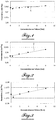
- the evolution of the mesh parameter a is characterized by the curve 1 of the figure 1
- the evolution of the parameter of mesh b is characterized by the curve 2 of the figure 2
- the evolution of the mesh parameter c is characterized by the curve 3 of the figure 3 .
- FIG. 4 represents the evolution of the power factor for undoped CoSbS (point curve 4), for CoSbS doped at 2 atomic percent of tellurium (curve of points 5) and for CoSbS doped at 4 atomic percent of tellurium with an antimony sub-stoichiometry of 4 atomic percent as well.
- the atomic percentage of tellurium added and the atomic percentage of antimony removed is preferably equal to optimize the insertion of tellurium into the crystalline structure of CoSbS.
- the points referenced 7 illustrate the evolution of the power factor at 60 ° C. of the tellurium-doped CoSbS with an atomic percentage sub-stoichiometry of atomic percentage equal to the atomic percentage of added tellurium, as a function of the atomic percentage of tellurium added.
- the points referenced 8 illustrate the evolution of the power factor at 60 ° C. of the tellurium-doped CoSbS without sub-stoichiometry of antimony, as a function of the atomic percentage of tellurium.
- the maximum obtained for a tellurium concentration of 4 atomic percent is 1621 ⁇ W.K -2 .m -1 .
- the values of the power factors of the points referenced 9 correspond to the maximum power factors obtained for temperatures ranging between 250 ° C. and 400 ° C.
- point 9a corresponds to a temperature of 250 ° C
- point 9b corresponds to a temperature of 350 ° C
- point 9c corresponds to a temperature of 397 ° C.
- the maximum obtained for a tellurium concentration of 4 atomic% is 2745 ⁇ W.K -2 .m -1 .
- the points referenced 10 illustrate the evolution of the power factor of the tellurium-doped CoSbS without sub-stoichiometry of antimony as a function of the atomic percentage of tellurium.
- the values of the points referenced 10 correspond to the maximum power factors obtained for temperatures ranging between about 300 ° C. and 400 ° C.
- point 10a corresponds to a temperature of 300 ° C
- point 10b corresponds to a temperature of 320 ° C
- point 10c corresponds to a temperature of 372 ° C
- point 10c corresponds to a temperature of 371 ° C .
- Point 11 illustrating the power factor of the undoped CoSbS is taken at a temperature of 258 ° C.
- the figure 6 illustrate the results obtained when the CoSbS is doped with tellurium at a content of 4 atomic percent at the antimony site and also doped with palladium at the cobalt site.
- Points 12 illustrate the performance of CoSbS only doped with tellurium as a function of temperature.
- the points 13 illustrate the performance of the tellurium-doped CoSbS and at 0.5 atomic percent of palladium.
- points 14 illustrate the performance of CoSbS doped with tellurium and 2 atomic percent of palladium.
- the invention thus also covers co-doping at the cobalt site. If only palladium codopage is shown on the figure 6 , equivalent performances with other cobalt elements, namely, for example, nickel and platinum, provide similar results. These results were obtained by ab initio calculations based on the density functional theory (DFT) and can be explained by the fact that these different codopage elements are of close electronic structure.
- DFT density functional theory
- thermoelectric compound The applications of this thermoelectric compound are numerous. These include its use in the human body, construction, power plants, factories, vehicles and in any type of apparatus and equipment where there is a heat flow or a thermal gradient.
Landscapes
- Chemical & Material Sciences (AREA)
- Inorganic Chemistry (AREA)
- Organic Chemistry (AREA)
- Inorganic Compounds Of Heavy Metals (AREA)
Description
- L'invention concerne principalement un matériau thermoélectrique à base de sulfure de cobalt et d'antimoine qui est dopé de type n par du tellure.
- L'effet thermoélectrique est un phénomène physique présent dans certains matériaux qui lie le flux de chaleur qui les traverse à la puissance électrique qui les parcourt.
- Les matériaux thermoélectriques ont ainsi la double capacité de générer une puissance électrique lorsqu'ils sont exposés à un gradient de température (effet Seebeck), et de générer un flux de chaleur lorsqu'un courant électrique leur est appliqué dans la masse (effet Peltier).
- Les performances des matériaux thermoélectriques dépendent de la gamme de température dans lesquelles ils sont utilisés.
- Pour une plage de température dite moyenne de 0 à 400°C environ, un matériau thermoélectrique efficace connu est composé de tellure de bismuth de formule BixTey.
- Mais le tellure est un matériau rare dont le prix élevé est soumis à d'importantes fluctuations. Il est donc important de développer des matériaux thermoélectriques qui ne sont pas élaborés à base de cet élément.
- Matériaux du type CoSbS sont connus de J. Therm. Anal. Calorim. (2011) 103:23-27 et J. Mater. Chim. C (2015) 3, 10442-10450.
- Dans ce contexte, la présente invention vise un matériau thermoélectrique composé d'éléments abondants de plus faible coût, et suffisamment efficace pour la gamme de température moyenne précitée. Le matériau thermoélectrique devra en outre être un semi-conducteur et devra avoir un grand nombre de porteurs de charge.
- À cet effet, le composé thermoélectrique de l'invention est à base de sulfure de cobalt et d'antimoine qui est dopé de type n par du tellure positionné sur le site de l'antimoine.
- Le composé thermoélectrique de l'invention peut également comporter les caractéristiques optionnelles suivantes considérées isolément ou selon toutes les combinaisons techniques possibles :
- le sulfure de cobalt et d'antimoine est en sous-stoechiométrie d'antimoine.
- le pourcentage atomique d'antimoine retiré est égal au pourcentage atomique de tellure ajouté, les pourcentages atomiques étant considérés par rapport à l'antimoine présent dans le sulfure de cobalt et d'antimoine en stoechiométrie.
- le pourcentage atomique de tellure par rapport à l'antimoine présent dans le sulfure de cobalt et d'antimoine en stoechiométrie est compris entre 2 et 6.
- le pourcentage atomique de tellure dans le sulfure de cobalt et d'antimoine est de 4.
- le composé présente une structure cristalline orthorhombique.
- le composé est en outre dopé par du nickel, du palladium et/ou du platine, lequel dopant est positionné sur le site du cobalt.
- l'élément dopant est du palladium.
- le pourcentage atomique du palladium par rapport au cobalt présent dans le sulfure de cobalt et d'antimoine en stoechiométrie est compris entre 0,2 et 3.
- D'autres caractéristiques et avantages de l'invention ressortiront clairement de la description qui en est donnée ci-dessous, à titre indicatif et nullement limitatif, en référence aux figures annexées parmi lesquelles :
- la
figure 1 est un graphique représentant l'évolution linéaire du paramètre de maille a de la structure cristalline du sulfure de cobalt et d'antimoine en fonction du pourcentage atomique de tellure ajouté, - la
figure 2 est un graphique représentant l'évolution linéaire du paramètre de maille b de la structure cristalline du sulfure de cobalt et d'antimoine en fonction du pourcentage atomique de tellure ajouté, - la
figure 3 est un graphique représentant l'évolution linéaire du paramètre de maille c de la structure cristalline du sulfure de cobalt et d'antimoine en fonction du pourcentage atomique de tellure ajouté, - la
figure 4 est un graphique comparant l'évolution du facteur de puissance selon la température pour du sulfure de cobalt et d'antimoine dopé à 2 et 4 pour cent atomique par du tellure, et l'évolution du facteur de puissance du sulfure de cobalt et d'antimoine non dopé, - la
figure 5 est un graphique comparant l'évolution du facteur de puissance selon le pourcentage atomique de tellure dans le sulfure de cobalt et d'antimoine en stoechiométrie d'antimoine et en sous-stoechiométrie d'antimoine pour une température de 60°C et pour une gamme de température comprise entre 250°C et 400°C plus élevée conférant un facteur de puissance maximum, et - la
figure 6 est un graphique comparant l'évolution du facteur de puissance selon la température pour du sulfure de cobalt et d'antimoine dopé à 4% atomique par du tellure avec et sans codopage au palladium. - Dans la description qui suit, la référence au pourcentage atomique des différents dopants cités s'entend par le pourcentage d'atome de ce dopant par rapport au nombre d'atomes de l'élément sur lequel est positionné le dopant lorsque cet élément est présent dans le sulfure de cobalt et d'antimoine en stoechiométrie, c'est-à-dire le sulfure de cobalt et d'antimoine de départ.
- L'invention se rapporte principalement à un composé thermoélectrique à base de sulfure de cobalt et d'antimoine (CoSbS) dopé de type n sur le site de l'antimoine par du tellure. Le composé thermoélectrique peut également être codopé sur le site du cobalt par du nickel, du palladium et/ou du platine.
- Un matériau thermoélectrique est caractérisé par sa figure de mérite ZT qui s'exprime de la façon suivante :

- Ou S est le coefficient de Seebeck µV.K-1)
- σ est la conductivité électrique (S.m-1)
- k est la conductivité thermique (W.K-1.m-1)
- T la température (K)
- La figure de mérite ZT peut également s'exprimer de la façon suivante :

- Le facteur de mérite ZT a été conçu pour comparer les performances des matériaux thermoélectriques utilisés dans le mode Peltier. Dans le cas de l'utilisation de matériaux thermoélectriques dans le mode Seebeck, c'est-à-dire pour la génération de puissance électrique à partir d'un gradient de température, les performances des matériaux électriques peuvent être illustrées par un facteur de puissance PF qui s'exprime de la façon suivante :

- Dans les exemples ci-dessous, les performances des matériaux thermoélectriques de l'invention sont ainsi caractérisées par leur facteur de puissance PF.
- On décrit ci-après un exemple de réalisation non limitatif du composé thermoélectrique de l'invention.
- La préparation du composé thermoélectrique CoSbS de l'invention est réalisée en deux étapes. La première étape consiste à réaliser la synthèse du CoSbS dans une ampoule en quartz (AQ), puis la seconde étape à compacter le CoSbS obtenu à l'issue de la première étape par une méthode de frittage également dénommée par le terme anglophone « Spark Plasma Sintering (SPS) ».
- Pour synthétiser le CoSbS dopé avec différents dopants, les poudres de cobalt, d'antimoine, de soufre et du dopant tel que le tellure, le cobalt, le nickel, le palladium et le platine sont pesées pour obtenir le taux de dopage souhaité.
- Les quantités de poudre requises sont ensuite mélangées dans un mortier en agate pour obtenir des mélanges homogènes. Les mélanges résultants sont placés dans des ampoules en quartz qui sont scellées sous vide.
- Les ampoules scellées sont alors chauffées pour atteindre la température de 923K, soit environ 650°C, et maintenues à cette température pendant 48h. Puis ces ampoules sont refroidies jusqu'au retour à la température ambiante.
- Pour préparer des pastilles par SPS, les poudres refroidies sont broyées et passées à travers des tamis avec une ouverture de maille de 150 µm pour obtenir des poudres présentant des tailles de particules homogènes. Ces poudres sont alors placées dans un moule cylindrique entre deux pistons. Le diamètre interne du moule est de 10,5 millimètres et les pistons ont un diamètre de 10 millimètres. La différence de 0,5 millimètres entre le diamètre interne du moule et le diamètre du piston permet l'addition d'une feuille de graphite entre la poudre et les pistons d'une part et le moule d'autre part. Cette feuille de graphite supplémentaire sert à protéger le moule dans le cas où la poudre réagirait avec le moule. Ces feuilles de graphite sont aussi ajoutées sur les faces des pistons en contact avec la poudre. Sans ces feuilles de graphite, les pastilles préparées colleraient aux pistons après le frittage et il ne serait pas possible de les séparer.
- La quantité de poudre ajoutée lors d'un compactage par SPS est choisie de telle sorte que ce compactage aboutisse à une pastille d'une hauteur d'environ 2,5 millimètres.
- Le moule contenant la poudre est placé dans la chambre SPS. L'air est évacué de la chambre jusqu'à ce qu'un vide secondaire d'environ 10-2 Pascal soit atteint.
- Une pression de 50 MPa est ensuite appliquée sur les deux pistons avant de démarrer le frittage.
- Le frittage est réalisé en chauffant d'abord la poudre jusque 575°C avec vitesse d'augmentation de la température de 100°C/min. Une fois la température de 575°C atteinte, cette température est maintenue pendant 15 minutes.
- Pour finir, le voltage et le courant ont été arrêtés pour permettre à l'échantillon de refroidir lentement jusqu'à la température ambiante. La surface des pastilles obtenues est ensuite polie pour être nettoyée.
- La structure cristalline du CoSbS dopé au tellure est caractérisée par cristallographie aux rayons X. Des mesures comparatives sont réalisées pour du CoSbS dopé à 0,5, 2, 4 et 8 pour cent atomique de tellure par rapport à l'antimoine présent dans le sulfure de cobalt et d'antimoine en stoechiométrie. On constate que pour ces pourcentages atomiques de tellure, la structure cristalline orthorhombique du CoSbS dopé est conservée.
- En référence aux
figures 1 à 3 , les paramètres de maille a, b et c de la structure cristalline du CoSbS sont évalués pour du CoSbS non dopé et du CoSbS dopé aux quatre pourcentages atomiques de tellure précités. L'évolution du paramètre de maille a est caractérisé par la courbe 1 de lafigure 1 , l'évolution du paramètre de maille b est caractérisé par la courbe 2 de lafigure 2 et l'évolution du paramètre de maille c est caractérisé par la courbe 3 de lafigure 3 . - On observe une augmentation quasi linéaire des trois paramètres de maille avec l'augmentation du pourcentage atomique de tellure, ce qui met en évidence la présence d'une solution solide dans la structure cristalline orthorhombique du CoSbS et confirme la réalisation du dopage.
- On se réfère à présent à la
figure 4 qui représente l'évolution du facteur de puissance pour du CoSbS non dopé (courbe de points 4), pour du CoSbS dopé à 2 pour cent atomique de tellure (courbe de points 5) et pour du CoSbS dopé à 4 pour cent atomique de tellure avec une sous-stoechiométrie en antimoine de 4 pour cent atomique également. - Le pourcentage atomique de tellure ajouté et le pourcentage atomique d'antimoine retiré est préférentiellement égal pour optimiser l'insertion du tellure dans la structure cristalline du CoSbS.
- On constate une augmentation substantielle des performances du CoSbS dopé au tellure quadruplant ces performances par rapport au CoSbS non volontairement dopé à 300°C pour un dopage de 2 pour cent atomique de tellure et les quintuplant pour un dopage à 4 pour cent atomique.
- La
figure 5 confirme ces résultats. - Les points référencés 7 illustrent l'évolution du facteur de puissance à 60°C du CoSbS dopé au tellure avec une sous-stoechiométrie en antimoine de pourcentage atomique égal au pourcentage atomique de tellure ajouté, en fonction du pourcentage atomique de tellure ajouté.
- Les points référencés 8 illustrent l'évolution du facteur de puissance à 60°C du CoSbS dopé au tellure sans sous-stoechiométrie en antimoine, en fonction du pourcentage atomique de tellure. Le maximum obtenu pour une concentration en tellure de 4 pour cent atomique est de 1621 µW.K-2.m-1.
- Les points références 9 qui présentent un facteur de puissance nettement plus élevé que les points référencés 7 et 8 illustrent l'évolution du facteur de puissance du CoSbS dopé au tellure avec une sous-stoechiométrie en antimoine de pourcentage atomique égal au pourcentage atomique de tellure ajouté, en fonction du pourcentage atomique de tellure ajouté. Les valeurs des facteurs de puissance des points référencés 9 correspondent aux facteurs de puissance maximum obtenus pour des températures variant entre 250°C et 400°C.
- Plus précisément, le point 9a correspond à une température de 250°C, le point 9b correspond à une température de 350°C et le point 9c correspond à une température de 397°C. Le maximum obtenu pour une concentration en tellure de 4% atomique est de 2745 µW.K-2.m-1.
- Enfin, les points référencés 10 illustrent l'évolution du facteur de puissance du CoSbS dopé au tellure sans sous-stoechiométrie en antimoine en fonction du pourcentage atomique de tellure. Les valeurs des points référencés 10 correspondent aux facteurs de puissance maximum obtenus pour des températures variant entre 300°C et 400°C environ.
- Plus précisément, le point 10a correspond à une température de 300°C, le point 10b correspond à une température de 320°C, le point 10c correspond à une température de 372°C et le point 10c correspond à une température de 371°C.
- Le point 11 illustrant le facteur de puissance du CoSbS non dopé est pris à une température de 258°C.
- On constate que quel que soit le critère considéré c'est à dire une température fixe de 60°C ou un facteur de puissance maximum, les performances maximum sont obtenues pour un pourcentage atomique de tellure qui avoisine les 4 pour cent atomique. On définit ainsi qu'un facteur de puissance maximum est obtenu lorsque le pourcentage atomique de tellure est compris entre 2 et 6 pour cent atomique, de préférence de 4 pour cent atomique.
- La
figure 6 illustrent les résultats obtenus lorsque le CoSbS est dopé par du tellure à une teneur de 4 pour cent atomique sur le site de l'antimoine et également dopé par du palladium sur le site du cobalt. - Les points 12 illustrent les performances du CoSbS uniquement dopé au tellure en fonction de la température. Les points 13 illustrent les performances du CoSbS dopé au tellure et à 0,5 pour cent atomique de palladium. Enfin les points 14 illustrent les performances du CoSbS dopé au tellure et à 2 pour cent atomique de palladium.
- On constate qu'un codopage sur le site du cobalt par le palladium permet de maintenir les hautes performances obtenues par le dopage du tellure.
- L'invention couvre ainsi également un codopage sur le site du cobalt. Si seul le codopage au palladium est illustré sur la
figure 6 , des performances équivalentes avec d'autres éléments voisins du cobalt, à savoir par exemple du nickel et du platine, permettent d'obtenir des résultats similaires. Ces résultats ont été obtenus par des calculs ab-initio basés sur la Théorie de la fonctionnelle de la densité (DFT) et s'expliquent par le fait que ces différents éléments de codopage sont de structure électronique proche. - Les applications de ce composé thermoélectrique sont nombreuses. On citera notamment son emploi dans le corps humain, la construction, les centrales, les usines, les véhicules et dans tout type d'appareil et d'appareillage où existe un flux de chaleur ou un gradient thermique.
Claims (9)
- Composé thermoélectrique à base de sulfure de cobalt et d'antimoine qui est dopé de type n par du tellure positionné sur le site de l'antimoine.
- Composé thermoélectrique selon la revendication 1, caractérisé en ce que le sulfure de cobalt et d'antimoine est en sous-stoechiométrie d'antimoine.
- Composé thermoélectrique selon la revendication 2, caractérisé en ce que le pourcentage atomique d'antimoine retiré est égal au pourcentage atomique de tellure ajouté, les pourcentages atomiques étant considérés par rapport à l'antimoine présent dans le sulfure de cobalt et d'antimoine en stoechiométrie.
- Composé thermoélectrique selon l'une quelconque des revendications 1 à 3, caractérisé en ce que le pourcentage atomique de tellure par rapport à l'antimoine présent dans le sulfure de cobalt et d'antimoine en stoechiométrie est compris entre 2 et 6.
- Composé thermoélectrique selon la revendication 4, caractérisé en ce que le pourcentage atomique de tellure dans le sulfure de cobalt et d'antimoine est de 4.
- Composé thermoélectrique selon l'une quelconque des revendications précédentes, caractérisé en ce qu'il présente une structure cristalline orthorhombique.
- Composé thermoélectrique selon l'une quelconque des revendications précédente, caractérisé en ce qu'il est en outre dopé par du nickel, du palladium et/ou du platine, lequel dopant est positionné sur le site du cobalt.
- Composé thermoélectrique selon la revendication 7, caractérisé en ce que l'élément dopant est du palladium.
- Composé thermoélectrique selon la revendication 9, caractérisé en ce que le pourcentage atomique du palladium par rapport au cobalt présent dans le sulfure de cobalt et d'antimoine en stoechiométrie est compris entre 0,2 et 3.
Applications Claiming Priority (2)
| Application Number | Priority Date | Filing Date | Title |
|---|---|---|---|
| FR1556861A FR3039320B1 (fr) | 2015-07-20 | 2015-07-20 | Materiau thermoelectrique a base de sulfure de cobalt et d'antimoine dope de type n. |
| PCT/FR2016/051849 WO2017013348A1 (fr) | 2015-07-20 | 2016-07-19 | Matériau thermoélectrique à base de sulfure de cobalt et d'antimoine dopé de type n |
Publications (2)
| Publication Number | Publication Date |
|---|---|
| EP3325411A1 EP3325411A1 (fr) | 2018-05-30 |
| EP3325411B1 true EP3325411B1 (fr) | 2019-05-08 |
Family
ID=54015099
Family Applications (1)
| Application Number | Title | Priority Date | Filing Date |
|---|---|---|---|
| EP16757280.9A Not-in-force EP3325411B1 (fr) | 2015-07-20 | 2016-07-19 | Matériau thermoélectrique à base de sulfure de cobalt et d'antimoine dopé de type n |
Country Status (3)
| Country | Link |
|---|---|
| EP (1) | EP3325411B1 (fr) |
| FR (1) | FR3039320B1 (fr) |
| WO (1) | WO2017013348A1 (fr) |
Families Citing this family (2)
| Publication number | Priority date | Publication date | Assignee | Title |
|---|---|---|---|---|
| KR102122572B1 (ko) | 2017-03-15 | 2020-06-12 | 주식회사 엘지화학 | 신규한 화합물 반도체 및 그 활용 |
| CN114843459B (zh) * | 2022-04-14 | 2023-12-15 | 中国科学院长春应用化学研究所 | 一种五硫化二锑基材料及其制备方法和应用 |
-
2015
- 2015-07-20 FR FR1556861A patent/FR3039320B1/fr not_active Expired - Fee Related
-
2016
- 2016-07-19 EP EP16757280.9A patent/EP3325411B1/fr not_active Not-in-force
- 2016-07-19 WO PCT/FR2016/051849 patent/WO2017013348A1/fr not_active Ceased
Non-Patent Citations (1)
| Title |
|---|
| None * |
Also Published As
| Publication number | Publication date |
|---|---|
| EP3325411A1 (fr) | 2018-05-30 |
| FR3039320A1 (fr) | 2017-01-27 |
| WO2017013348A1 (fr) | 2017-01-26 |
| FR3039320B1 (fr) | 2017-07-14 |
Similar Documents
| Publication | Publication Date | Title |
|---|---|---|
| Ning et al. | Enhanced thermoelectric performance of porous magnesium tin silicide prepared using pressure-less spark plasma sintering | |
| Pei et al. | High thermoelectric figure of merit in heavy hole dominated PbTe | |
| Suzumura et al. | Improvement in thermoelectric properties of Se-free Cu3SbS4 compound | |
| US8394729B2 (en) | Increasing the seebeck coefficient of semiconductors by HPHT sintering | |
| Chen et al. | Microstructure and thermoelectric properties of n-and p-type doped Mg2Sn compounds prepared by the modified bridgman method | |
| US9123856B2 (en) | Affecting the thermoelectric figure of merit (ZT) and the power factor by high pressure, high temperature sintering | |
| EP3325411B1 (fr) | Matériau thermoélectrique à base de sulfure de cobalt et d'antimoine dopé de type n | |
| KR101323319B1 (ko) | 은이 첨가된 비스무스-텔레리움-셀레니움계 열전재료의 제조방법 | |
| KR101534372B1 (ko) | 고압 고온 소결 처리가 열전 성능 지수(zt)에 미치는 영향 | |
| CN108231990A (zh) | 热电材料及其制备方法 | |
| EP3675191B1 (fr) | Matériau thermoélectrique et module thermoélectrique | |
| KR102269404B1 (ko) | 셀레늄 함량이 증가된 열전소재 | |
| Yu | The research of temperature dependences of electrical conductivity and thermopower of WS2 and WSe2 with partial replacement of W on Nb | |
| Isoda et al. | Effects of Al/Sb double doping on the thermoelectric properties of Mg2Si0. 75Sn0. 25 | |
| CN107195768B (zh) | 热电转换材料及其制造方法 | |
| EP3921875B1 (fr) | Composé thermoélectrique à base d'antimoniure de magnésium dopé de type n | |
| KR102273056B1 (ko) | 구리가 도핑된 열전소재 | |
| Singsoog et al. | Effecting the thermoelectric properties of p-MnSi1. 75 and n-Mg1. 98Ag0. 02Si module on power generation | |
| JP6617840B2 (ja) | p型熱電変換材料、熱電変換モジュール及びp型熱電変換材料の製造方法 | |
| Ebling et al. | Influence of group IV-Te alloying on nanocomposite structure and thermoelectric properties of Bi2Te3 compounds | |
| KR102657048B1 (ko) | 열전 재료 및 그 형성 방법 | |
| KR102808571B1 (ko) | Bi, Cu 및 In이 도핑된 GeTe계 열전재료 및 그 제조방법 | |
| Hwang et al. | Electronic and Thermal Transport Properties of Complex Structured Cu‐Bi‐Se Thermoelectric Compound with Low Lattice Thermal Conductivity | |
| WO2005098979A1 (fr) | Materiau thermoelectrique dans lequel des structures half heusler a base de zrnisn sont utilisees | |
| US3480554A (en) | Single phase lead telluride |
Legal Events
| Date | Code | Title | Description |
|---|---|---|---|
| STAA | Information on the status of an ep patent application or granted ep patent |
Free format text: STATUS: THE INTERNATIONAL PUBLICATION HAS BEEN MADE |
|
| PUAI | Public reference made under article 153(3) epc to a published international application that has entered the european phase |
Free format text: ORIGINAL CODE: 0009012 |
|
| STAA | Information on the status of an ep patent application or granted ep patent |
Free format text: STATUS: REQUEST FOR EXAMINATION WAS MADE |
|
| 17P | Request for examination filed |
Effective date: 20180213 |
|
| AK | Designated contracting states |
Kind code of ref document: A1 Designated state(s): AL AT BE BG CH CY CZ DE DK EE ES FI FR GB GR HR HU IE IS IT LI LT LU LV MC MK MT NL NO PL PT RO RS SE SI SK SM TR |
|
| AX | Request for extension of the european patent |
Extension state: BA ME |
|
| DAV | Request for validation of the european patent (deleted) | ||
| DAX | Request for extension of the european patent (deleted) | ||
| GRAP | Despatch of communication of intention to grant a patent |
Free format text: ORIGINAL CODE: EPIDOSNIGR1 |
|
| STAA | Information on the status of an ep patent application or granted ep patent |
Free format text: STATUS: GRANT OF PATENT IS INTENDED |
|
| INTG | Intention to grant announced |
Effective date: 20181120 |
|
| GRAS | Grant fee paid |
Free format text: ORIGINAL CODE: EPIDOSNIGR3 |
|
| GRAA | (expected) grant |
Free format text: ORIGINAL CODE: 0009210 |
|
| STAA | Information on the status of an ep patent application or granted ep patent |
Free format text: STATUS: THE PATENT HAS BEEN GRANTED |
|
| RIN1 | Information on inventor provided before grant (corrected) |
Inventor name: DENNLER, GILLES Inventor name: BHATTACHARYA, SANDIP Inventor name: MADSEN, GEORG Inventor name: PERE, DANIEL Inventor name: CHMIELOWSKI, RADOSLAW Inventor name: JACOB, STEPHANE |
|
| AK | Designated contracting states |
Kind code of ref document: B1 Designated state(s): AL AT BE BG CH CY CZ DE DK EE ES FI FR GB GR HR HU IE IS IT LI LT LU LV MC MK MT NL NO PL PT RO RS SE SI SK SM TR |
|
| REG | Reference to a national code |
Ref country code: GB Ref legal event code: FG4D Free format text: NOT ENGLISH |
|
| REG | Reference to a national code |
Ref country code: CH Ref legal event code: EP Ref country code: AT Ref legal event code: REF Ref document number: 1129866 Country of ref document: AT Kind code of ref document: T Effective date: 20190515 |
|
| REG | Reference to a national code |
Ref country code: DE Ref legal event code: R096 Ref document number: 602016013766 Country of ref document: DE Ref country code: IE Ref legal event code: FG4D Free format text: LANGUAGE OF EP DOCUMENT: FRENCH |
|
| REG | Reference to a national code |
Ref country code: NL Ref legal event code: MP Effective date: 20190508 |
|
| REG | Reference to a national code |
Ref country code: LT Ref legal event code: MG4D |
|
| PG25 | Lapsed in a contracting state [announced via postgrant information from national office to epo] |
Ref country code: AL Free format text: LAPSE BECAUSE OF FAILURE TO SUBMIT A TRANSLATION OF THE DESCRIPTION OR TO PAY THE FEE WITHIN THE PRESCRIBED TIME-LIMIT Effective date: 20190508 Ref country code: FI Free format text: LAPSE BECAUSE OF FAILURE TO SUBMIT A TRANSLATION OF THE DESCRIPTION OR TO PAY THE FEE WITHIN THE PRESCRIBED TIME-LIMIT Effective date: 20190508 Ref country code: HR Free format text: LAPSE BECAUSE OF FAILURE TO SUBMIT A TRANSLATION OF THE DESCRIPTION OR TO PAY THE FEE WITHIN THE PRESCRIBED TIME-LIMIT Effective date: 20190508 Ref country code: LT Free format text: LAPSE BECAUSE OF FAILURE TO SUBMIT A TRANSLATION OF THE DESCRIPTION OR TO PAY THE FEE WITHIN THE PRESCRIBED TIME-LIMIT Effective date: 20190508 Ref country code: SE Free format text: LAPSE BECAUSE OF FAILURE TO SUBMIT A TRANSLATION OF THE DESCRIPTION OR TO PAY THE FEE WITHIN THE PRESCRIBED TIME-LIMIT Effective date: 20190508 Ref country code: NL Free format text: LAPSE BECAUSE OF FAILURE TO SUBMIT A TRANSLATION OF THE DESCRIPTION OR TO PAY THE FEE WITHIN THE PRESCRIBED TIME-LIMIT Effective date: 20190508 Ref country code: NO Free format text: LAPSE BECAUSE OF FAILURE TO SUBMIT A TRANSLATION OF THE DESCRIPTION OR TO PAY THE FEE WITHIN THE PRESCRIBED TIME-LIMIT Effective date: 20190808 Ref country code: ES Free format text: LAPSE BECAUSE OF FAILURE TO SUBMIT A TRANSLATION OF THE DESCRIPTION OR TO PAY THE FEE WITHIN THE PRESCRIBED TIME-LIMIT Effective date: 20190508 Ref country code: PT Free format text: LAPSE BECAUSE OF FAILURE TO SUBMIT A TRANSLATION OF THE DESCRIPTION OR TO PAY THE FEE WITHIN THE PRESCRIBED TIME-LIMIT Effective date: 20190908 |
|
| PG25 | Lapsed in a contracting state [announced via postgrant information from national office to epo] |
Ref country code: LV Free format text: LAPSE BECAUSE OF FAILURE TO SUBMIT A TRANSLATION OF THE DESCRIPTION OR TO PAY THE FEE WITHIN THE PRESCRIBED TIME-LIMIT Effective date: 20190508 Ref country code: BG Free format text: LAPSE BECAUSE OF FAILURE TO SUBMIT A TRANSLATION OF THE DESCRIPTION OR TO PAY THE FEE WITHIN THE PRESCRIBED TIME-LIMIT Effective date: 20190808 Ref country code: GR Free format text: LAPSE BECAUSE OF FAILURE TO SUBMIT A TRANSLATION OF THE DESCRIPTION OR TO PAY THE FEE WITHIN THE PRESCRIBED TIME-LIMIT Effective date: 20190809 Ref country code: RS Free format text: LAPSE BECAUSE OF FAILURE TO SUBMIT A TRANSLATION OF THE DESCRIPTION OR TO PAY THE FEE WITHIN THE PRESCRIBED TIME-LIMIT Effective date: 20190508 |
|
| REG | Reference to a national code |
Ref country code: AT Ref legal event code: MK05 Ref document number: 1129866 Country of ref document: AT Kind code of ref document: T Effective date: 20190508 |
|
| PG25 | Lapsed in a contracting state [announced via postgrant information from national office to epo] |
Ref country code: AT Free format text: LAPSE BECAUSE OF FAILURE TO SUBMIT A TRANSLATION OF THE DESCRIPTION OR TO PAY THE FEE WITHIN THE PRESCRIBED TIME-LIMIT Effective date: 20190508 Ref country code: CZ Free format text: LAPSE BECAUSE OF FAILURE TO SUBMIT A TRANSLATION OF THE DESCRIPTION OR TO PAY THE FEE WITHIN THE PRESCRIBED TIME-LIMIT Effective date: 20190508 Ref country code: RO Free format text: LAPSE BECAUSE OF FAILURE TO SUBMIT A TRANSLATION OF THE DESCRIPTION OR TO PAY THE FEE WITHIN THE PRESCRIBED TIME-LIMIT Effective date: 20190508 Ref country code: EE Free format text: LAPSE BECAUSE OF FAILURE TO SUBMIT A TRANSLATION OF THE DESCRIPTION OR TO PAY THE FEE WITHIN THE PRESCRIBED TIME-LIMIT Effective date: 20190508 Ref country code: DK Free format text: LAPSE BECAUSE OF FAILURE TO SUBMIT A TRANSLATION OF THE DESCRIPTION OR TO PAY THE FEE WITHIN THE PRESCRIBED TIME-LIMIT Effective date: 20190508 Ref country code: SK Free format text: LAPSE BECAUSE OF FAILURE TO SUBMIT A TRANSLATION OF THE DESCRIPTION OR TO PAY THE FEE WITHIN THE PRESCRIBED TIME-LIMIT Effective date: 20190508 |
|
| REG | Reference to a national code |
Ref country code: DE Ref legal event code: R119 Ref document number: 602016013766 Country of ref document: DE |
|
| PG25 | Lapsed in a contracting state [announced via postgrant information from national office to epo] |
Ref country code: SM Free format text: LAPSE BECAUSE OF FAILURE TO SUBMIT A TRANSLATION OF THE DESCRIPTION OR TO PAY THE FEE WITHIN THE PRESCRIBED TIME-LIMIT Effective date: 20190508 Ref country code: IT Free format text: LAPSE BECAUSE OF FAILURE TO SUBMIT A TRANSLATION OF THE DESCRIPTION OR TO PAY THE FEE WITHIN THE PRESCRIBED TIME-LIMIT Effective date: 20190508 Ref country code: MC Free format text: LAPSE BECAUSE OF FAILURE TO SUBMIT A TRANSLATION OF THE DESCRIPTION OR TO PAY THE FEE WITHIN THE PRESCRIBED TIME-LIMIT Effective date: 20190508 |
|
| REG | Reference to a national code |
Ref country code: CH Ref legal event code: PL |
|
| PLBE | No opposition filed within time limit |
Free format text: ORIGINAL CODE: 0009261 |
|
| STAA | Information on the status of an ep patent application or granted ep patent |
Free format text: STATUS: NO OPPOSITION FILED WITHIN TIME LIMIT |
|
| PG25 | Lapsed in a contracting state [announced via postgrant information from national office to epo] |
Ref country code: TR Free format text: LAPSE BECAUSE OF FAILURE TO SUBMIT A TRANSLATION OF THE DESCRIPTION OR TO PAY THE FEE WITHIN THE PRESCRIBED TIME-LIMIT Effective date: 20190508 |
|
| 26N | No opposition filed |
Effective date: 20200211 |
|
| REG | Reference to a national code |
Ref country code: BE Ref legal event code: MM Effective date: 20190731 |
|
| PG25 | Lapsed in a contracting state [announced via postgrant information from national office to epo] |
Ref country code: DE Free format text: LAPSE BECAUSE OF NON-PAYMENT OF DUE FEES Effective date: 20200201 Ref country code: PL Free format text: LAPSE BECAUSE OF FAILURE TO SUBMIT A TRANSLATION OF THE DESCRIPTION OR TO PAY THE FEE WITHIN THE PRESCRIBED TIME-LIMIT Effective date: 20190508 |
|
| PG25 | Lapsed in a contracting state [announced via postgrant information from national office to epo] |
Ref country code: CH Free format text: LAPSE BECAUSE OF NON-PAYMENT OF DUE FEES Effective date: 20190731 Ref country code: SI Free format text: LAPSE BECAUSE OF FAILURE TO SUBMIT A TRANSLATION OF THE DESCRIPTION OR TO PAY THE FEE WITHIN THE PRESCRIBED TIME-LIMIT Effective date: 20190508 Ref country code: BE Free format text: LAPSE BECAUSE OF NON-PAYMENT OF DUE FEES Effective date: 20190731 Ref country code: LI Free format text: LAPSE BECAUSE OF NON-PAYMENT OF DUE FEES Effective date: 20190731 Ref country code: LU Free format text: LAPSE BECAUSE OF NON-PAYMENT OF DUE FEES Effective date: 20190719 |
|
| PG25 | Lapsed in a contracting state [announced via postgrant information from national office to epo] |
Ref country code: IE Free format text: LAPSE BECAUSE OF NON-PAYMENT OF DUE FEES Effective date: 20190719 |
|
| PGFP | Annual fee paid to national office [announced via postgrant information from national office to epo] |
Ref country code: FR Payment date: 20200729 Year of fee payment: 5 |
|
| GBPC | Gb: european patent ceased through non-payment of renewal fee |
Effective date: 20200719 |
|
| PG25 | Lapsed in a contracting state [announced via postgrant information from national office to epo] |
Ref country code: GB Free format text: LAPSE BECAUSE OF NON-PAYMENT OF DUE FEES Effective date: 20200719 |
|
| PG25 | Lapsed in a contracting state [announced via postgrant information from national office to epo] |
Ref country code: CY Free format text: LAPSE BECAUSE OF FAILURE TO SUBMIT A TRANSLATION OF THE DESCRIPTION OR TO PAY THE FEE WITHIN THE PRESCRIBED TIME-LIMIT Effective date: 20190508 |
|
| PG25 | Lapsed in a contracting state [announced via postgrant information from national office to epo] |
Ref country code: IS Free format text: LAPSE BECAUSE OF FAILURE TO SUBMIT A TRANSLATION OF THE DESCRIPTION OR TO PAY THE FEE WITHIN THE PRESCRIBED TIME-LIMIT Effective date: 20190908 |
|
| PG25 | Lapsed in a contracting state [announced via postgrant information from national office to epo] |
Ref country code: MT Free format text: LAPSE BECAUSE OF FAILURE TO SUBMIT A TRANSLATION OF THE DESCRIPTION OR TO PAY THE FEE WITHIN THE PRESCRIBED TIME-LIMIT Effective date: 20190508 Ref country code: HU Free format text: LAPSE BECAUSE OF FAILURE TO SUBMIT A TRANSLATION OF THE DESCRIPTION OR TO PAY THE FEE WITHIN THE PRESCRIBED TIME-LIMIT; INVALID AB INITIO Effective date: 20160719 |
|
| PG25 | Lapsed in a contracting state [announced via postgrant information from national office to epo] |
Ref country code: FR Free format text: LAPSE BECAUSE OF NON-PAYMENT OF DUE FEES Effective date: 20210731 |
|
| PG25 | Lapsed in a contracting state [announced via postgrant information from national office to epo] |
Ref country code: MK Free format text: LAPSE BECAUSE OF FAILURE TO SUBMIT A TRANSLATION OF THE DESCRIPTION OR TO PAY THE FEE WITHIN THE PRESCRIBED TIME-LIMIT Effective date: 20190508 |