EP3325482B1 - Procédés de préparation de dérivés de benzodiazépine cytotoxiques - Google Patents
Procédés de préparation de dérivés de benzodiazépine cytotoxiques Download PDFInfo
- Publication number
- EP3325482B1 EP3325482B1 EP16745598.9A EP16745598A EP3325482B1 EP 3325482 B1 EP3325482 B1 EP 3325482B1 EP 16745598 A EP16745598 A EP 16745598A EP 3325482 B1 EP3325482 B1 EP 3325482B1
- Authority
- EP
- European Patent Office
- Prior art keywords
- compound
- formula
- mmol
- equiv
- monomer
- Prior art date
- Legal status (The legal status is an assumption and is not a legal conclusion. Google has not performed a legal analysis and makes no representation as to the accuracy of the status listed.)
- Active
Links
- 0 COCc(nc(C*)c(I=C)c1IC)c1I Chemical compound COCc(nc(C*)c(I=C)c1IC)c1I 0.000 description 21
- OBYVSQNTHFQXAY-NSHDSACASA-N COc(c(O)c1)cc2c1NC[C@H](Cc1c3cccc1)N3C2=O Chemical compound COc(c(O)c1)cc2c1NC[C@H](Cc1c3cccc1)N3C2=O OBYVSQNTHFQXAY-NSHDSACASA-N 0.000 description 2
- CCEUADFQVNKYBZ-IBGZPJMESA-N COc(c(OCc1cc([N+]([O-])=O)cc(CCl)c1)c1)cc2c1NC[C@H](Cc1c3cccc1)N3C2=O Chemical compound COc(c(OCc1cc([N+]([O-])=O)cc(CCl)c1)c1)cc2c1NC[C@H](Cc1c3cccc1)N3C2=O CCEUADFQVNKYBZ-IBGZPJMESA-N 0.000 description 2
- ROVBYDCETXMZLN-NSHDSACASA-N COc(cc(c(N=C[C@H]1N2c3ccccc3C1)c1)C2=O)c1O Chemical compound COc(cc(c(N=C[C@H]1N2c3ccccc3C1)c1)C2=O)c1O ROVBYDCETXMZLN-NSHDSACASA-N 0.000 description 2
- YBDSTWIFQREVAS-UHFFFAOYSA-N CC(C)(C)OC(Nc1cc(C(OC)=O)cc(CCl)c1)=O Chemical compound CC(C)(C)OC(Nc1cc(C(OC)=O)cc(CCl)c1)=O YBDSTWIFQREVAS-UHFFFAOYSA-N 0.000 description 1
- UXMBWGPYFVJUFY-UHFFFAOYSA-N CC(C)(C)OC(Nc1cc(CO)cc(CCl)c1)=O Chemical compound CC(C)(C)OC(Nc1cc(CO)cc(CCl)c1)=O UXMBWGPYFVJUFY-UHFFFAOYSA-N 0.000 description 1
- SLNJFURRTZMWGB-UHFFFAOYSA-N CC(C)(CN(CCOCCOCCOC)c1cc(CO)c(C2OC2)c(CCl)c1)SSC Chemical compound CC(C)(CN(CCOCCOCCOC)c1cc(CO)c(C2OC2)c(CCl)c1)SSC SLNJFURRTZMWGB-UHFFFAOYSA-N 0.000 description 1
- XDPVXVFEQUTVDG-RSXQAXDFSA-N CC(C1)(C(O)=CC(N=C[C@H](C2)N3c4c2cccc4)=C1C3=O)OC Chemical compound CC(C1)(C(O)=CC(N=C[C@H](C2)N3c4c2cccc4)=C1C3=O)OC XDPVXVFEQUTVDG-RSXQAXDFSA-N 0.000 description 1
- YZBWPCZWMPQPAP-UHFFFAOYSA-N CCN(CCN1)c(cc(C)c(OC)c2)c2C1=O Chemical compound CCN(CCN1)c(cc(C)c(OC)c2)c2C1=O YZBWPCZWMPQPAP-UHFFFAOYSA-N 0.000 description 1
- AXWDDDFVYOSHBX-FQEVSTJZSA-N CCc(c([IH]C)c(COc(cc(c1c2)NC[C@H](Cc3ccccc33)N3C1=O)c2OC)cc1CCl)c1[I]=C Chemical compound CCc(c([IH]C)c(COc(cc(c1c2)NC[C@H](Cc3ccccc33)N3C1=O)c2OC)cc1CCl)c1[I]=C AXWDDDFVYOSHBX-FQEVSTJZSA-N 0.000 description 1
- VTYNRYJURYRRFX-LJAQVGFWSA-N CNc(c(C(N1c2ccccc2CC1)=O)c1)cc(OCc(cc(COc(c(OC)c2)cc(N=C[C@H]3N4c5ccccc5C3)c2C4=O)c([I]=C)c2I)c2[IH]C)c1OC Chemical compound CNc(c(C(N1c2ccccc2CC1)=O)c1)cc(OCc(cc(COc(c(OC)c2)cc(N=C[C@H]3N4c5ccccc5C3)c2C4=O)c([I]=C)c2I)c2[IH]C)c1OC VTYNRYJURYRRFX-LJAQVGFWSA-N 0.000 description 1
- DZRVTTDMJCMBCA-UHFFFAOYSA-N COc(c(O)c1)cc2c1NC(C1)C1(Cc1c3cccc1)N3C2=O Chemical compound COc(c(O)c1)cc2c1NC(C1)C1(Cc1c3cccc1)N3C2=O DZRVTTDMJCMBCA-UHFFFAOYSA-N 0.000 description 1
- DYPFZHNLKQOLFG-LXWOLXCRSA-N C[C@@H](C(N[C@@H](C)C(Nc1cc(CCl)cc(COc(c(OC)c2)cc(NC[C@H]3N4c5ccccc5C3)c2C4=O)c1)=O)=O)NC(CCCCC(OC)=O)=O Chemical compound C[C@@H](C(N[C@@H](C)C(Nc1cc(CCl)cc(COc(c(OC)c2)cc(NC[C@H]3N4c5ccccc5C3)c2C4=O)c1)=O)=O)NC(CCCCC(OC)=O)=O DYPFZHNLKQOLFG-LXWOLXCRSA-N 0.000 description 1
- SBJJKEMOEDKEMT-KBPBESRZSA-N C[C@@H](C(N[C@@H](C)C(Nc1cc(CO)cc(CO)c1)=O)=O)NC(CCCCC(OC)=O)=O Chemical compound C[C@@H](C(N[C@@H](C)C(Nc1cc(CO)cc(CO)c1)=O)=O)NC(CCCCC(OC)=O)=O SBJJKEMOEDKEMT-KBPBESRZSA-N 0.000 description 1
- DEHXFQDKONCKPZ-MOMDTQCHSA-N C[C@@H](C(N[C@@H](C)C(Nc1cc(COS(C)(=O)=O)cc(COc(c(OC)c2)cc(N=C[C@H](C3)N4c5c3cccc5)c2C4=O)c1)=O)=O)NC(CCCCC(OC)=O)=O Chemical compound C[C@@H](C(N[C@@H](C)C(Nc1cc(COS(C)(=O)=O)cc(COc(c(OC)c2)cc(N=C[C@H](C3)N4c5c3cccc5)c2C4=O)c1)=O)=O)NC(CCCCC(OC)=O)=O DEHXFQDKONCKPZ-MOMDTQCHSA-N 0.000 description 1
- SZMXMIDPBAQLHJ-LXWOLXCRSA-N C[C@@H](C(N[C@@H](C)C(Nc1cc(COc(c(OC)c2)cc(N=C[C@H](C3)N4c5c3cccc5)c2C4=O)cc(CCl)c1)=O)=O)NC(CCCCC(OC)=O)=O Chemical compound C[C@@H](C(N[C@@H](C)C(Nc1cc(COc(c(OC)c2)cc(N=C[C@H](C3)N4c5c3cccc5)c2C4=O)cc(CCl)c1)=O)=O)NC(CCCCC(OC)=O)=O SZMXMIDPBAQLHJ-LXWOLXCRSA-N 0.000 description 1
- FJQGDGHYQQYEML-MOMDTQCHSA-N C[C@@H](C(N[C@@H](C)C(Nc1cc(COc(c(OC)c2)cc(NC[C@H](C3)N4c5c3cccc5)c2C4=O)cc(COS(C)(=O)=O)c1)=O)=O)NC(CCCCC(OC)=O)=O Chemical compound C[C@@H](C(N[C@@H](C)C(Nc1cc(COc(c(OC)c2)cc(NC[C@H](C3)N4c5c3cccc5)c2C4=O)cc(COS(C)(=O)=O)c1)=O)=O)NC(CCCCC(OC)=O)=O FJQGDGHYQQYEML-MOMDTQCHSA-N 0.000 description 1
- XBXWVYOJSKWMES-JWZSAVIXSA-N C[C@@H](C(N[C@@H](C)C(Nc1cc(COc(c(OC)c2)cc(NC[C@H](C3)N4c5c3cccc5)c2C4=O)cc(COc(c(OC)c2)cc(N=C[C@H]3N4c5ccccc5C3)c2C4=O)c1)=O)=O)NC(CCCCC(OC)=O)=O Chemical compound C[C@@H](C(N[C@@H](C)C(Nc1cc(COc(c(OC)c2)cc(NC[C@H](C3)N4c5c3cccc5)c2C4=O)cc(COc(c(OC)c2)cc(N=C[C@H]3N4c5ccccc5C3)c2C4=O)c1)=O)=O)NC(CCCCC(OC)=O)=O XBXWVYOJSKWMES-JWZSAVIXSA-N 0.000 description 1
- QLCIDXLLJKOGML-UHFFFAOYSA-N Cc(c(CO)nc(C[O]#C)c1C)c1[IH]C Chemical compound Cc(c(CO)nc(C[O]#C)c1C)c1[IH]C QLCIDXLLJKOGML-UHFFFAOYSA-N 0.000 description 1
- BFSSQCKPYXOGFN-UHFFFAOYSA-N [O-][N+](c1cc(CCl)cc(CO)c1)=O Chemical compound [O-][N+](c1cc(CCl)cc(CO)c1)=O BFSSQCKPYXOGFN-UHFFFAOYSA-N 0.000 description 1
- HUJKBVZHTANBKQ-UHFFFAOYSA-N [O-][N+](c1cc(CO)cc(COP)c1)=O Chemical compound [O-][N+](c1cc(CO)cc(COP)c1)=O HUJKBVZHTANBKQ-UHFFFAOYSA-N 0.000 description 1
Images








Classifications
-
- C—CHEMISTRY; METALLURGY
- C07—ORGANIC CHEMISTRY
- C07K—PEPTIDES
- C07K5/00—Peptides containing up to four amino acids in a fully defined sequence; Derivatives thereof
- C07K5/04—Peptides containing up to four amino acids in a fully defined sequence; Derivatives thereof containing only normal peptide links
- C07K5/06—Dipeptides
- C07K5/06008—Dipeptides with the first amino acid being neutral
- C07K5/06017—Dipeptides with the first amino acid being neutral and aliphatic
-
- C—CHEMISTRY; METALLURGY
- C07—ORGANIC CHEMISTRY
- C07D—HETEROCYCLIC COMPOUNDS
- C07D519/00—Heterocyclic compounds containing more than one system of two or more relevant hetero rings condensed among themselves or condensed with a common carbocyclic ring system not provided for in groups C07D453/00 or C07D455/00
-
- A—HUMAN NECESSITIES
- A61—MEDICAL OR VETERINARY SCIENCE; HYGIENE
- A61K—PREPARATIONS FOR MEDICAL, DENTAL OR TOILETRY PURPOSES
- A61K31/00—Medicinal preparations containing organic active ingredients
- A61K31/33—Heterocyclic compounds
- A61K31/395—Heterocyclic compounds having nitrogen as a ring hetero atom, e.g. guanethidine or rifamycins
- A61K31/55—Heterocyclic compounds having nitrogen as a ring hetero atom, e.g. guanethidine or rifamycins having seven-membered rings, e.g. azelastine, pentylenetetrazole
- A61K31/551—Heterocyclic compounds having nitrogen as a ring hetero atom, e.g. guanethidine or rifamycins having seven-membered rings, e.g. azelastine, pentylenetetrazole having two nitrogen atoms, e.g. dilazep
- A61K31/5513—1,4-Benzodiazepines, e.g. diazepam or clozapine
- A61K31/5517—1,4-Benzodiazepines, e.g. diazepam or clozapine condensed with five-membered rings having nitrogen as a ring hetero atom, e.g. imidazobenzodiazepines, triazolam
-
- A—HUMAN NECESSITIES
- A61—MEDICAL OR VETERINARY SCIENCE; HYGIENE
- A61P—SPECIFIC THERAPEUTIC ACTIVITY OF CHEMICAL COMPOUNDS OR MEDICINAL PREPARATIONS
- A61P35/00—Antineoplastic agents
-
- C—CHEMISTRY; METALLURGY
- C07—ORGANIC CHEMISTRY
- C07C—ACYCLIC OR CARBOCYCLIC COMPOUNDS
- C07C303/00—Preparation of esters or amides of sulfuric acids; Preparation of sulfonic acids or of their esters, halides, anhydrides or amides
- C07C303/26—Preparation of esters or amides of sulfuric acids; Preparation of sulfonic acids or of their esters, halides, anhydrides or amides of esters of sulfonic acids
- C07C303/28—Preparation of esters or amides of sulfuric acids; Preparation of sulfonic acids or of their esters, halides, anhydrides or amides of esters of sulfonic acids by reaction of hydroxy compounds with sulfonic acids or derivatives thereof
-
- C—CHEMISTRY; METALLURGY
- C07—ORGANIC CHEMISTRY
- C07C—ACYCLIC OR CARBOCYCLIC COMPOUNDS
- C07C309/00—Sulfonic acids; Halides, esters, or anhydrides thereof
- C07C309/63—Esters of sulfonic acids
- C07C309/64—Esters of sulfonic acids having sulfur atoms of esterified sulfo groups bound to acyclic carbon atoms
- C07C309/65—Esters of sulfonic acids having sulfur atoms of esterified sulfo groups bound to acyclic carbon atoms of a saturated carbon skeleton
-
- C—CHEMISTRY; METALLURGY
- C07—ORGANIC CHEMISTRY
- C07D—HETEROCYCLIC COMPOUNDS
- C07D487/00—Heterocyclic compounds containing nitrogen atoms as the only ring hetero atoms in the condensed system, not provided for by groups C07D451/00 - C07D477/00
- C07D487/02—Heterocyclic compounds containing nitrogen atoms as the only ring hetero atoms in the condensed system, not provided for by groups C07D451/00 - C07D477/00 in which the condensed system contains two hetero rings
- C07D487/04—Ortho-condensed systems
-
- C—CHEMISTRY; METALLURGY
- C07—ORGANIC CHEMISTRY
- C07F—ACYCLIC, CARBOCYCLIC OR HETEROCYCLIC COMPOUNDS CONTAINING ELEMENTS OTHER THAN CARBON, HYDROGEN, HALOGEN, OXYGEN, NITROGEN, SULFUR, SELENIUM OR TELLURIUM
- C07F7/00—Compounds containing elements of Groups 4 or 14 of the Periodic Table
- C07F7/02—Silicon compounds
- C07F7/08—Compounds having one or more C—Si linkages
- C07F7/18—Compounds having one or more C—Si linkages as well as one or more C—O—Si linkages
- C07F7/1804—Compounds having Si-O-C linkages
- C07F7/1872—Preparation; Treatments not provided for in C07F7/20
- C07F7/188—Preparation; Treatments not provided for in C07F7/20 by reactions involving the formation of Si-O linkages
-
- C—CHEMISTRY; METALLURGY
- C07—ORGANIC CHEMISTRY
- C07K—PEPTIDES
- C07K5/00—Peptides containing up to four amino acids in a fully defined sequence; Derivatives thereof
- C07K5/04—Peptides containing up to four amino acids in a fully defined sequence; Derivatives thereof containing only normal peptide links
- C07K5/08—Tripeptides
- C07K5/0802—Tripeptides with the first amino acid being neutral
- C07K5/0804—Tripeptides with the first amino acid being neutral and aliphatic
-
- Y—GENERAL TAGGING OF NEW TECHNOLOGICAL DEVELOPMENTS; GENERAL TAGGING OF CROSS-SECTIONAL TECHNOLOGIES SPANNING OVER SEVERAL SECTIONS OF THE IPC; TECHNICAL SUBJECTS COVERED BY FORMER USPC CROSS-REFERENCE ART COLLECTIONS [XRACs] AND DIGESTS
- Y02—TECHNOLOGIES OR APPLICATIONS FOR MITIGATION OR ADAPTATION AGAINST CLIMATE CHANGE
- Y02P—CLIMATE CHANGE MITIGATION TECHNOLOGIES IN THE PRODUCTION OR PROCESSING OF GOODS
- Y02P20/00—Technologies relating to chemical industry
- Y02P20/50—Improvements relating to the production of bulk chemicals
- Y02P20/55—Design of synthesis routes, e.g. reducing the use of auxiliary or protecting groups
Definitions
- the present invention relates to novel methods for preparing cytotoxic indolinobenzodiazepine derivatives.
- cell-binding agent conjugates of indolinobenzodiazepine dimers that have one imine functionality and one amine functionality display a much higher therapeutic index (ratio of maximum tolerated dose to minimum effective dose) in vivo compared to previously disclosed benzodiazepine derivatives having two imine functionalities. See, for example, WO 2012/128868 .
- the previously disclosed method for making the indolinobenzodiazepine dimers with one imine functionality and one amine functionality involves partial reduction of indolinobenzodiazepine dimers having two imine functionalities. The partial reduction step generally leads to the formation of fully reduced by-product and unreacted starting material, which requires cumbersome purification step and results in low yield.
- the present invention provides various methods for preparing indolinobenzodiazepine dimer compounds and their synthetic precursors. Compared to the previously disclosed method, the methods of the present invention can produce the desired dimer compounds with higher yield without the need of cumbersome purification steps. These methods are more suitable for large scale manufacturing process.
- the present invention provides a method of preparing a compound of formula (17A): or a salt thereof, said method comprising reacting a compound of formula (14A) with a monomer compound of formula (d 1 ), wherein:
- the present invention provides a method of preparing a compound of formula (18A), or a pharmaceutically acceptable salt thereof, said method comprising reacting a compound of formula of (17A): with a monomer of formula (bl): wherein:
- the present invention provides a method of preparing a compound of formula (18A), or a pharmaceutically acceptable salt thereof, said method comprising the steps of:
- the present invention provides a method of preparing a compound of formula (18A), or a pharmaceutically acceptable salt thereof, said method comprising the steps of:
- the present invention provides a method of preparing a compound of formula (IA), or a pharmaceutically acceptable salt thereof, said method comprising the steps of:
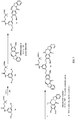
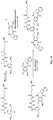
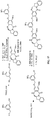
- FIGs. 17-19 show exemplary schemes for the methods of the present invention.
- cell-binding agent refers to a compound that can bind a cell ( e.g., on a cell-surface ligand) or bind a ligand associated with or proximate to the cell, preferably in a specific manner. In certain embodiments, binding to the cell or a ligand on or near the cell is specific.
- the CBA may include peptides and non-peptides.
- Linear or branched alkyl refers to a saturated linear or branched-chain monovalent hydrocarbon radical of one to twenty carbon atoms.
- alkyl include, but are not limited to, methyl, ethyl, 1-propyl, 2-propyl, 1-butyl, 2-methyl-1-propyl, -CH 2 CH(CH 3 ) 2 ), 2-butyl, 2-methyl-2-propyl, 1-pentyl, 2-pentyl 3-pentyl, 2-methyl-2-butyl, 3-methyl-2-butyl, 3-methyl-1-butyl, 2-methyl-1-butyl, 1-hexyl), 2-hexyl, 3-hexyl, 2-methyl-2-pentyl, 3-methyl-2-pentyl, 4-methyl-2-pentyl, 3-methyl-3-pentyl, 2-methyl-3-pentyl, 2,3-dimethyl-2-butyl, 3,3-dimethyl-2-butyl, 1-heptyl,
- the alkenyl has two to ten carbon atoms. More preferably, the alkyl has two to four carbon atoms.
- Linear or branched alkynyl refers to a linear or branched monovalent hydrocarbon radical of two to twenty carbon atoms with at least one site of unsaturation, i.e., a carbon-carbon, triple bond. Examples include, but are not limited to, ethynyl, propynyl, 1-butynyl, 2-butynyl, 1-pentynyl, 2-pentynyl, 3-pentynyl, hexynyl, and the like.
- the alkynyl has two to ten carbon atoms. More preferably, the alkynyl has two to four carbon atoms.
- carrier refers to a monovalent non-aromatic, saturated or partially unsaturated ring having 3 to 12 carbon atoms as a monocyclic ring or 7 to 12 carbon atoms as a bicyclic ring.
- Bicyclic carbocycles having 7 to 12 atoms can be arranged, for example, as a bicyclo [4,5], [5,5], [5,6], or [6,6] system, and bicyclic carbocycles having 9 or 10 ring atoms can be arranged as a bicyclo [5,6] or [6,6] system, or as bridged systems such as bicyclo[2.2.1]heptane, bicyclo[2.2.2]octane and bicyclo[3.2.2]nonane.
- monocyclic carbocycles include, but are not limited to, cyclopropyl, cyclobutyl, cyclopentyl, 1-cyclopent-1-enyl, 1-cyclopent-2-enyl, 1-cyclopent-3-enyl, cyclohexyl, 1-cyclohex-1-enyl, 1-cyclohex-2-enyl, 1-cyclohex-3-enyl, cyclohexadienyl, cycloheptyl, cyclooctyl, cyclononyl, cyclodecyl, cycloundecyl, cyclododecyl, and the like.
- cyclic alkyl and “cycloalkyl” can be used interchangeably. They refer to a monovalent saturated carbocyclic ring radical. Preferably, the cyclic alkyl is 3 to 7 membered monocyclic ring radical. More preferably, the cyclic alkyl is cyclohexyl.
- cyclic alkenyl refers to a carbocyclic ring radical having at least one double bond in the ring structure.
- cyclic alkynyl refers to a carbocyclic ring radical having at least one triple bond in the ring structure.
- Aryl means a monovalent aromatic hydrocarbon radical of 6-18 carbon atoms derived by the removal of one hydrogen atom from a single carbon atom of a parent aromatic ring system. Some aryl groups are represented in the exemplary structures as "Ar.” Aryl includes bicyclic radicals comprising an aromatic ring fused to a saturated, partially unsaturated ring, or aromatic carbocyclic or heterocyclic ring.
- Typical aryl groups include, but are not limited to, radicals derived from benzene (phenyl), substituted benzenes, naphthalene, anthracene, indenyl, indanyl, 1,2-dihydronapthalene, 1,2,3,4-tetrahydronapthyl, and the like.
- aryl is phenyl group.
- heterocycle refers to a saturated or a partially unsaturated (i.e., having one or more double and/or triple bonds within the ring) carbocyclic radical of 3 to 18 ring atoms in which at least one ring atom is a heteroatom selected from nitrogen, oxygen, phosphorus, and sulfur, the remaining ring atoms being C, where one or more ring atoms is optionally substituted independently with one or more substituents described below.
- a heterocycle may be a monocycle having 3 to 7 ring members (2 to 6 carbon atoms and 1 to 4 heteroatoms selected from N, O, P, and S) or a bicycle having 7 to 10 ring members (4 to 9 carbon atoms and 1 to 6 heteroatoms selected from N, O, P, and S), for example: a bicyclo [4,5], [5,5], [5,6], or [6,6] system.
- Heterocycles are described in Paquette, Leo A.; "Principles of Modern Heterocyclic Chemistry" (W. A.
- Heterocyclyl also includes radicals where heterocycle radicals are fused with a saturated, partially unsaturated ring, or aromatic carbocyclic or heterocyclic ring.
- heterocyclic rings include, but are not limited to, pyrrolidinyl, tetrahydrofuranyl, dihydrofuranyl, tetrahydrothienyl, tetrahydropyranyl, dihydropyranyl, tetrahydrothiopyranyl, piperidino, morpholino, thiomorpholino, thioxanyl, piperazinyl, homopiperazinyl, azetidinyl, oxetanyl, thietanyl, homopiperidinyl, oxepanyl, thiepanyl, oxazepinyl, diazepinyl, thiazepinyl, 2-pyrrolinyl, 3-pyrrolinyl, indolinyl, 2H-pyranyl, 4H-pyranyl, dioxanyl, 1,3-dioxolanyl, pyrazolinyl, dithianyl, dithiolan
- Spiro moieties are also included within the scope of this definition.
- heteroaryl refers to a monovalent aromatic radical of 5- or 6-membered rings, and includes fused ring systems (at least one of which is aromatic) of 5-18 atoms, containing one or more heteroatoms independently selected from nitrogen, oxygen, and sulfur.
- heteroaryl groups are pyridinyl (including, for example, 2-hydroxypyridinyl), imidazolyl, imidazopyridinyl, pyrimidinyl (including, for example, 4-hydroxypyrimidinyl), pyrazolyl, triazolyl, pyrazinyl, tetrazolyl, furyl, thienyl, isoxazolyl, thiazolyl, oxazolyl, isothiazolyl, pyrrolyl, quinolinyl, isoquinolinyl, indolyl, benzimidazolyl, benzofuranyl, cinnolinyl, indazolyl, indolizinyl, phthalazinyl, pyridazinyl, triazinyl, isoindolyl, pteridinyl, purinyl, oxadiazolyl, triazolyl, thiadiazolyl, furazanyl,
- the heterocycle or heteroaryl groups may be carbon (carbon-linked) or nitrogen (nitrogen-linked) attached where such is possible.
- carbon bonded heterocycles or heteroaryls are bonded at position 2, 3, 4, 5, or 6 of a pyridine, position 3, 4, 5, or 6 of a pyridazine, position 2, 4, 5, or 6 of a pyrimidine, position 2, 3, 5, or 6 of a pyrazine, position 2, 3, 4, or 5 of a furan, tetrahydrofuran, thiofuran, thiophene, pyrrole or tetrahydropyrrole, position 2, 4, or 5 of an oxazole, imidazole or thiazole, position 3, 4, or 5 of an isoxazole, pyrazole, or isothiazole, position 2 or 3 of an aziridine, position 2, 3, or 4 of an azetidine, position 2, 3, 4, 5, 6, 7, or 8 of a quinoline or position 1, 3, 4, 5, 6, 7,
- nitrogen bonded heterocycles or heteroaryls are bonded at position 1 of an aziridine, azetidine, pyrrole, pyrrolidine, 2-pyrroline, 3-pyrroline, imidazole, imidazolidine, 2-imidazoline, 3-imidazoline, pyrazole, pyrazoline, 2-pyrazoline, 3-pyrazoline, piperidine, piperazine, indole, indoline, 1H-indazole, position 2 of a isoindole, or isoindoline, position 4 of a morpholine, and position 9 of a carbazole, or O-carboline.
- heteroatoms present in heteroaryl or heterocyclcyl include the oxidized forms such as NO, SO, and SO 2 .
- halo or halogen refers to F, Cl, Br or I.
- alkyl, alkenyl, alkynyl, cyclic alkyl, cyclic alkenyl, cyclic alkynyl, carbocyclyl, aryl, heterocyclyl and heteroaryl described above can be optionally substituted with one more ( e.g., 2, 3, 4, 5, 6 or more) substituents.
- a non-hydrogen substituent is in the place of a hydrogen substituent on a carbon, oxygen, sulfur or nitrogen of the substituent.
- a substituted alkyl substituent is an alkyl substituent wherein at least one non-hydrogen substituent is in the place of a hydrogen substituent on the alkyl substituent.
- monofluoroalkyl is alkyl substituted with a fluoro substituent
- difluoroalkyl is alkyl substituted with two fluoro substituents. It should be recognized that if there is more than one substitution on a substituent, each non-hydrogen substituent may be identical or different (unless otherwise stated).
- substituent may be either (1) not substituted, or (2) substituted. If a carbon of a substituent is described as being optionally substituted with one or more of a list of substituents, one or more of the hydrogens on the carbon (to the extent there are any) may separately and/or together be replaced with an independently selected optional substituent. If a nitrogen of a substituent is described as being optionally substituted with one or more of a list of substituents, one or more of the hydrogens on the nitrogen (to the extent there are any) may each be replaced with an independently selected optional substituent.
- One exemplary substituent may be depicted as -NR'R", wherein R' and R" together with the nitrogen atom to which they are attached, may form a heterocyclic ring.
- the heterocyclic ring formed from R' and R" together with the nitrogen atom to which they are attached may be partially or fully saturated.
- the heterocyclic ring consists of 3 to 7 atoms.
- the heterocyclic ring is selected from the group consisting of pyrrolyl, imidazolyl, pyrazolyl, triazolyl, tetrazolyl, isoxazolyl, pyridyl and thiazolyl.
- a group of substituents are collectively described as being optionally substituted by one or more of a list of substituents, the group may include: (1) unsubstitutable substituents, (2) substitutable substituents that are not substituted by the optional substituents, and/or (3) substitutable substituents that are substituted by one or more of the optional substituents.
- a substituent is described as being optionally substituted with up to a particular number of non-hydrogen substituents, that substituent may be either (1) not substituted; or (2) substituted by up to that particular number of non-hydrogen substituents or by up to the maximum number of substitutable positions on the substituent, whichever is less.
- any heteroaryl with less than 3 substitutable positions would be optionally substituted by up to only as many non-hydrogen substituents as the heteroaryl has substitutable positions.
- the substituents for the optionally substituted alkyl, alkenyl, alkynyl, cyclic alkyl, cyclic alkenyl, cyclic alkynyl, carbocyclyl, aryl, heterocyclyl and heteroaryl described above include halogen, -CN, -NR 102 R 103 , -CF 3 , -OR 101 , aryl, heteroaryl, heterocyclyl, - SR 101 , -SOR 101 , -SO 2 R 101 and -SO 3 M.
- cytotoxic compound or "cytotoxic compound,” “cytotoxic dimer” and “cytotoxic dimer compound” are used interchangeably. They are intended to include compounds for which a structure or formula or any derivative thereof has been disclosed in the present invention.
- the term also includes, stereoisomers, geometric isomers, tautomers, solvates, metabolites, salts ( e.g ., pharmaceutically acceptable salts) and prodrugs, and prodrug salts of a compound of all the formulae disclosed in the present invention.
- the term also includes any solvates, hydrates, and polymorphs of any of the foregoing.
- linkable to a cell binding agent or “capable of covalently linking a cytotoxic compound to a cell binding agent” as used herein refers to the compounds described herein or derivates thereof comprising at least one linking group or a precursor thereof suitable to bond these compounds or derivatives thereof to a cell binding agent.
- precursor of a given group refers to any group which may lead to that group by any deprotection, a chemical modification, or a coupling reaction.
- chiral refers to molecules which have the property of non-superimposability of the mirror image partner, while the term “achiral” refers to molecules which are superimposable on their mirror image partner.
- stereoisomer refers to compounds which have identical chemical constitution and connectivity, but different orientations of their atoms in space that cannot be interconverted by rotation about single bonds.
- Diastereomer refers to a stereoisomer with two or more centers of chirality and whose molecules are not mirror images of one another. Diastereomers have different physical properties, e.g. melting points, boiling points, spectral properties, and reactivities. Mixtures of diastereomers may separate under high resolution analytical procedures such as crystallization, electrophoresis and chromatography.
- Enantiomers refer to two stereoisomers of a compound which are non-superimposable mirror images of one another. Stereochemical definitions and conventions used herein generally follow S. P. Parker, Ed., McGraw-Hill Dictionary of Chemical Terms (1984) McGraw-Hill Book Company, New York ; and Eliel, E. and Wilen, S., "Stereochemistry of Organic Compounds," John Wiley & Sons, Inc., New York, 1994 . The compounds of the invention may contain asymmetric or chiral centers, and therefore exist in different stereoisomeric forms.
- a compound prefixed with (+) or d is dextrorotatory.
- these stereoisomers are identical except that they are mirror images of one another.
- a specific stereoisomer may also be referred to as an enantiomer, and a mixture of such isomers is often called an enantiomeric mixture.
- a 50:50 mixture of enantiomers is referred to as a racemic mixture or a racemate, which may occur where there has been no stereoselection or stereospecificity in a chemical reaction or process.
- the terms “racemic mixture” and “racemate” refer to an equimolar mixture of two enantiomeric species, devoid of optical activity.
- tautomer or “tautomeric form” refers to structural isomers of different energies which are interconvertible via a low energy barrier.
- proton tautomers also known as prototropic tautomers
- Valence tautomers include interconversions by reorganization of some of the bonding electrons.
- imine reactive reagent refers to a reagent that is capable of reacting with an imine group.
- imine reactive reagent includes, but is not limited to, sulfites (H 2 SO 3 , H 2 SO 2 or a salt of HSO 3 - , SO 3 2- or HSO 2 - formed with a cation), metabisulfite (H 2 S 2 O 5 or a salt of S 2 O 5 2- formed with a cation), mono, di, tri, and tetra-thiophosphates (PO 3 SH 3 , PO 2 S 2 H 3 , POS 3 H 3 , PS 4 H 3 or a salt of PO 3 S 3- , PO 2 S 2 3- , POS 3 3- or PS 4 3- formed with a cation), thio phosphate esters ((R i O) 2 PS(OR i ), R i SH, R i SOH, R i SO 2 H, R i SO 3 H), various amines (hydroxyl amine),
- the cation is a monovalent cation, such as Na + or K + .
- the imine reactive reagent is selected from sulfites, hydroxyl amine, urea and hydrazine. More preferably, the imine reactive reagent is NaHSO 3 or KHSO 3 .
- the term "imine reducing reagent” refers to a reagent that is capable of reducing an imine functional group to an amine functional group.
- the imine reducing reagent is a hydride reducing reagent.
- imine reducing reagents include, but are not limited to, borohydrides (e.g., sodium borohydride, sodium triacetoxy borohydride, sodium cyanoborohydride, lithium borohydride (LiBH 4 ), potassium borohydride (KBH 4 )), hydrogen gas, and lithium aluminum hydride, ammonium formate, borane, 9-borabicyclo[3.3.1]nonane (9-BBN), diisobutylaluminium hydride (DIBAL), and sodium bis(2-methoxyethoxy)aluminumhydride (Red-Al).
- the imine reducing reagent is sodium triacetoxy borohydride.
- protecting group refers to a substituent that is commonly employed to block or protect a particular functionality while reacting other functional groups on the compound, a derivative thereof, or a conjugate thereof.
- an "amine protecting group” or an “amino-protecting moiety” is a substituent attached to an amino group that blocks or protects the amino functionality in the compound.
- Such groups are well known in the art (see for example P. Wuts and T. Greene, 2007, Protective Groups in Organic Synthesis, Chapter 7, J.
- carbamates such as methyl and ethyl carbamate, FMOC, substituted ethyl carbamates, carbamates cleaved by 1,6- ⁇ -elimination (also termed "self immolative "), ureas, amides, peptides, alkyl and aryl derivatives.
- Suitable amino-protecting groups include, but are not limited to, acetyl, trifluoroacetyl, t-butoxycarbonyl (BOC), benzyloxycarbonyl (CBZ) and 9-fluorenylmethylenoxycarbonyl (Fmoc), 2-trimethylsilylethyl,(2-phenyl-2-trimethylsilyl)ethyl, triisopropylsiloxy, 2-(trimethylsilyl)ethoxymethyl, allyloxycarbonyl, 9-fluorenylmethoxycarbonyl, 2-(trimethylsilyl)ethoxycarbonyl, or 2, 2,2,2-trichloroethoxycarbonyl.
- protecting groups and their use see P. G.M. Wuts & T. W. Greene, Protective Groups in Organic Synthesis, John Wiley & Sons, New York, 2007 .
- an "alcohol protecting group” or an “alcohol-protecting moiety” is a substituent attached to an alcohol group that blocks or protects the alcohol functionality in the compound.
- Such groups are well known in the art (see for example, P. Wuts and T. Greene, 2007, Protective Groups in Organic Synthesis, Chapter 2, J. Wiley & Sons, NJ ).
- Suitable alcohol protecting group include, but are not limited to, pivaloyl, methoxymethyl, 2-methoxyethoxymethyl, p -methoxybenzyl, 3,4-dimethyoxybenzyl, 2,6-dimethyoxybenzyl, diphenylmethyl, benzyloxymethyl, 2,2,2-trichloroethoxycarbonyl, tetrahydrofuranyl, tetrahydropyranyl, benzyl, benzoyl, para- phenylbenzoyl, 2,4,6-trimethylbenzoyl, para -bromobenzoyl, para -nitrobenzoyl, picolinoyl, nicotinoyl, 5-dibenzosuberyl, trityl/triphenylmethyl, or tris(4- tert- butylphenyl)methyl and various silyl protecting groups (for example, dimethylisopropylsilyl, diethylisopropylsily
- the alcohol protecting group is sterically hindered.
- the alcohol protecting group is preferably methoxymethyl, tetrahydropyranyl, 2-methoxyethoxymethyl, p-methoxybenzyl, benzyloxymethyl, or 2,2,2-trichloroethoxycarbonyl. More preferably, the alcohol protecting group is 2,2,2-trichloroethoxycarbonyl.
- the alcohol protecting group is a silyl protecting group, preferably, triethylsilyl, triisopropylsilyl, or tert-butyldimethylsilyl. More preferably, the alcohol protecting group is tert-butyldimethylsilyl.
- alcohol protecting reagent refers to a reagent that introduces an alcohol protecting group onto an alcohol group.
- an “acid labile alcohol protecting group” is an alcohol protecting group that is not stable under acidic condition and releases the alcohol protecting group to form free alcohol.
- Examples of an acid labile alcohol protecting group include, but are not limited to, acetate, allyl, methoxymethyl, tetrahydrofuranyl, tetrahydropyranyl, 5-dibenzosuberyl, 1-ethoxyethyl, 1-methyl-1methoxylethyl, 2-(phenylselenyl)ethyl, trityl/triphenylmethyl, tris(4- tert -butylphenyl)methyl, and various silyl protecting group (for example, dimethylisopropylsilyl, diethylisopropylsilyl, dimethylhexylsilyl, trimethylsilyl, triethylsilyl, triisopropylsilyl, tribenzylsilyl, triphenylsilyl, 2-norborn
- the alcohol protecting group is a silyl protecting group, preferably, triethylsilyl, triisopropylsilyl, or tert-butyldimethylsilyl. More preferably, the alcohol protecting group is tert-butyldimethylsilyl.
- alcohol deprotecting reagent refers to a reagent that is capable of cleaving an alcohol protecting group to form free alcohol.
- Such reagents are well known in the art (see for example P. Wuts and T. Greene, 2007, Protective Groups in Organic Synthesis, Chapter 2, J. Wiley & Sons, NJ ).
- alcohol deprotecting reagents include, but are not limited to, tetra-n-butylammonium fluoride, tris(dimethylamino)sulfonium difluorotrimethylsilicate, hydrogen fluoride or a solvate thereof, hydrogen fluoride pyridine, silicon tetrafluoride, hexafluorosilicic acid, cesium fluoride, hydrochloric acid, acetic acid, trifluoroacetic acid, pyridinium p-toluensulfonate, p-toluenesulfonic acid (p-TsOH), formic acid, periodic acid.
- tetra-n-butylammonium fluoride tris(dimethylamino)sulfonium difluorotrimethylsilicate
- hydrogen fluoride or a solvate thereof hydrogen fluoride pyridine, silicon tetrafluoride, hexafluorosilicic acid, cesium flu
- the alcohol deprotecting reagent is hydrochloric acid or tetra-n-butylammonium fluoride (TBAF). In certain embodiments, the alcohol deprotecting agent is hydrogen fluoride-pyridine (HF-pyridine).
- amine deprotecting group refers a reagent that is capable of cleaving an amine protecting group to form free amine.
- reagents are well known in the art (see for example P. Wuts and T. Greene, 2007, Protective Groups in Organic Synthesis, Chapter 7, J. Wiley & Sons, NJ ).
- Examples of such amine deprotecting reagents include, but are not limited to, tetra-n-butylammonium fluoride, acetic acid, hydrogen fluoride pyridine, cesium fluoride, piperidine, morpholine, or trifluoroacetic acid.
- alcohol activating agent refers a reagent that increases the reactivity of a hydroxyl group thereby making the hydroxyl group a better leaving group.
- examples of such alcohol activating agents include p-toluenesulfonyl chloride, thionyl chloride, triflic anhydride, mesyl chloride, mesyl anhydride, triphenylphosphine, acyl chloride, 4-dimethylaminopyridine, and others.
- the alcohol activating agent is thionyl chloride.
- the alcohol activating agent is triphenylphosphine.
- phrases "pharmaceutically acceptable salt” as used herein, refers to pharmaceutically acceptable organic or inorganic salts of a compound of the invention.
- Exemplary salts include, but are not limited, to sulfate, citrate, acetate, oxalate, chloride, bromide, iodide, nitrate, bisulfate, phosphate, acid phosphate, isonicotinate, lactate, salicylate, acid citrate, tartrate, oleate, tannate, pantothenate, bitartrate, ascorbate, succinate, maleate, gentisinate, fumarate, gluconate, glucuronate, saccharate, formate, benzoate, glutamate, methanesulfonate "mesylate,” ethanesulfonate, benzenesulfonate, p-toluenesulfonate, pamoate ( i.e., 1,1'-methylene-bis-
- a pharmaceutically acceptable salt may involve the inclusion of another molecule such as an acetate ion, a succinate ion or other counter ion.
- the counter ion may be any organic or inorganic moiety that stabilizes the charge on the parent compound.
- a pharmaceutically acceptable salt may have more than one charged atom in its structure. Instances where multiple charged atoms are part of the pharmaceutically acceptable salt can have multiple counter ions. Hence, a pharmaceutically acceptable salt can have one or more charged atoms and/or one or more counter ion.
- the desired pharmaceutically acceptable salt may be prepared by any suitable method available in the art, for example, treatment of the free base with an inorganic acid, such as hydrochloric acid, hydrobromic acid, sulfuric acid, nitric acid, methanesulfonic acid, phosphoric acid and the like, or with an organic acid, such as acetic acid, maleic acid, succinic acid, mandelic acid, fumaric acid, malonic acid, pyruvic acid, oxalic acid, glycolic acid, salicylic acid, a pyranosidyl acid, such as glucuronic acid or galacturonic acid, an alpha hydroxy acid, such as citric acid or tartaric acid, an amino acid, such as aspartic acid or glutamic acid, an aromatic acid, such as benzoic acid or cinnamic acid, a sulfonic acid, such as p-toluenesulfonic acid or ethanesulfonic acid
- an inorganic acid such as hydro
- the desired pharmaceutically acceptable salt may be prepared by any suitable method, for example, treatment of the free acid with an inorganic or organic base, such as an amine (primary, secondary or tertiary), an alkali metal hydroxide or alkaline earth metal hydroxide, or the like.
- suitable salts include, but are not limited to, organic salts derived from amino acids, such as glycine and arginine, ammonia, primary, secondary, and tertiary amines, and cyclic amines, such as piperidine, morpholine and piperazine, and inorganic salts derived from sodium, calcium, potassium, magnesium, manganese, iron, copper, zinc, aluminum and lithium.
- phrases "pharmaceutically acceptable” indicates that the substance or composition must be compatible chemically and/or toxicologically, with the other ingredients comprising a formulation, and/or the mammal being treated therewith.
- leaving group refers to a group of charged or uncharged moiety that departs during a nucleophilic substitution or displacement.
- leaving groups include, but not limited to, halogens, esters, alkoxy, hydroxyl, tosylates, triflates, mesylates, nitriles, azide, carbamate, disulfides, thioesters, thioethers and diazonium compounds.
- bifunctional crosslinking agent refers to modifying agents that possess two reactive groups; one of which is capable of reacting with a cell binding agent while the other one reacts with the cytotoxic compound to link the two moieties together.
- bifunctional crosslinkers are well known in the art (see, for example, Isalm and Dent in Bioconjugation chapter 5, p218-363, Groves Dictionaries Inc. New York, 1999 ).
- SMCC N -succinimidyl-4-(N-maleimidomethyl)-cyclohexane-1-carboxylate
- SIAB N -succinimidyl-4-(iodoacetyl)-aminobenzoate
- Other bifunctional crosslinking agents that introduce maleimido groups or haloacetyl groups on to a cell binding agent are well known in the art (see US Patent Applications 2008/0050310 , 20050169933 , available from Pierce Biotechnology Inc. P.O.
- BMPEO bis-maleimidopolyethyleneglycol
- BMPS N-( ⁇ -maleimidopropyloxy)succinimide ester
- GMBS ⁇ -maleimidobutyric acid N-succinimidyl ester
- EMCS ⁇ -maleimidocaproic acid N-hydroxysuccinimide ester
- NHS HBVS
- N-succinimidyl-4-(N-maleimidomethyl)-cyclohexane-1-carboxy-(6-amidocaproate which is a "long chain" analog of SMCC (LC-SMCC), m-maleimidobenzoyl-N-hydroxysuccinimide ester (MBS), 4-(4-N-maleimidophenyl)-butyric acid
- Heterobifunctional crosslinking agents are bifunctional crosslinking agents having two different reactive groups. Heterobifunctional crosslinking agents containing both an amine-reactive N -hydroxysuccinimide group (NHS group) and a carbonyl-reactive hydrazine group can also be used to link the cytotoxic compounds described herein with a cell-binding agent (e.g ., antibody). Examples of such commercially available heterobifunctional crosslinking agents include succinimidyl 6-hydrazinonicotinamide acetone hydrazone (SANH), succinimidyl 4-hydrazidoterephthalate hydrochloride (SHTH) and succinimidyl hydrazinium nicotinate hydrochloride (SHNH).
- SSH succinimidyl 6-hydrazinonicotinamide acetone hydrazone
- SHTH succinimidyl 4-hydrazidoterephthalate hydrochloride
- SHNH succinimidyl hydrazinium nicotinate hydro
- Conjugates bearing an acid-labile linkage can also be prepared using a hydrazine-bearing benzodiazepine derivative of the present invention.
- bifunctional crosslinking agents include succinimidyl-p-formyl benzoate (SFB) and succinimidyl-p-formylphenoxyacetate (SFPA).
- Bifunctional crosslinking agents that enable the linkage of cell binding agent with cytotoxic compounds via disulfide bonds are known in the art and include N -succinimidyl-3-(2-pyridyldithio)propionate (SPDP), N -succinimidyl-4-(2-pyridyldithio)pentanoate (SPP), N -succinimidyl-4-(2-pyridyldithio)butanoate (SPDB), N -succinimidyl-4-(2-pyridyldithio)2-sulfo butanoate (sulfo-SPDB) to introduce dithiopyridyl groups.
- SPDP N -succinimidyl-3-(2-pyridyldithio)propionate
- SPP N -succinimidyl-4-(2-pyridyldithio)pentanoate
- SPDB N -
- crosslinking agents that can be used to introduce disulfide groups are known in the art and are disclosed in U.S. Patents 6,913,748 , 6,716,821 and US Patent Publications 20090274713 and 20100129314 .
- crosslinking agents such as 2-iminothiolane, homocysteine thiolactone or S-acetylsuccinic anhydride that introduce thiol groups can also be used.
- linker refers to a moiety that connects two groups, such as a cell binding agent and a cytotoxic compound, together. Typically, the linker is substantially inert under conditions for which the two groups it is connecting are linked. In certain embodiments, the linking group is a part of the cytotoxic compound described herein.
- the linking group may comprise a reactive group, which can react with a cell binding agent, or a precursor thereof.
- the linking moiety may contain a chemical bond that allows for the release of the cytotoxic moiety at a particular site.
- Suitable chemical bonds are well known in the art and include disulfide bonds, thioether bonds, acid labile bonds, photolabile bonds, peptidase labile bonds and esterase labile bonds (see for example US Patents 5,208,020 ; 5,475,092 ; 6,441,163 ; 6,716,821 ; 6,913,748 ; 7,276,497 ; 7,276,499 ; 7,368,565 ; 7,388,026 and 7,414,073 ).
- Preferred are disulfide bonds, thioether and peptidase labile bonds.
- Non-cleavable linking moiety can also be used.
- a “reactive group” or “reactive moiety” as defined herein refers to a moiety that readily forms a covalent bond with a cell binding agent, e.g., an amide bond with lysine amine group on an antibody, or a bifunctional crosslinking agent, e.g. through thioether or disulfide bond.
- the reactive group is inert to reactions described in the methods of the present invention.
- functional groups that can be converted to the reactive group.
- a reactive group can be a N-hydroxysuccinimide ester or an methyl ester group that can be converted to a N-hydroxysuccinimide ester.
- a reactive group can be a thiol (-SH) group that can readily forms a covalent bond with a bifunctional crosslining agent through a disulfide bond or a thioether bond. It can also be an alkyldisulfide or pyridyldisulfide (R-S-S-, wherein R is alkyl or pyridyl) that can be converted to a thiol group.
- thiol thiol
- R-S-S- alkyldyldisulfide
- linking groups with a reactive group attached at one end such as a reactive ester, selected from the following:
- amino acid refers to naturally occurring amino acids or non-naturally occurring amino acid.
- the term "cation" refers to an ion with positive charge.
- the cation can be monovalent (e.g., Na + , K + , etc. ) , bi-valent (e.g., Ca 2+ , Mg 2+ , etc. ) or multi-valent (e.g., Al 3+ etc. ) .
- the cation is monovalent.
- halogenating reagent refers to a reagent that converts an alcohol group to a halide group.
- a "brominating reagent” is a reagent that converts an alcohol group to a bromide group.
- a "iodinating reagent” is a reagent that converts an alcohol group to a iodide group.
- a “chlorinating reagent” is a reagent that converts an alcohol group to a chloride group.
- Exemplary brominating reagents include, but are not limited to, bromine, hydrobromic acid, carbon tetrabromide, phosphorus tribromide, and potassium bromide.
- Exemplary iodinating reagent include, but are not limited to, hydroiodic acid, iodine, carbon tetraiodide, phosphorus triiodide, sodium iodide, or potassium iodide.
- Exemplary chlorinating reagent include, but are not limited to, carbon tetrachloride, methanesulfonyl chloride, sulfuryl chloride, thionyl chloride, cyanuric chloride, N -chlorosuccinimide, phosphorus(V) oxychloride, phosphorus pentachloride, and phosphorus trichloride.
- the chlorinating reagent is methanesulfonyl chloride.
- a "sulfonating reagent” refers to a reagent that converts an alcohol group to a sulfonate ester group.
- the sulfonating reagent is a sulfonic anhydride, such as methanesulfonic anhydride, or a sulfonic chloride, such as methanesulfonyl chloride (MsCl).
- an "activated ester” refers to an ester group that is readily displaced by a hydroxyl or an amine group.
- exemplary activated esters include, but are not limited to nitrophenyl (e.g., 2 or 4-nitrophenyl) ester, dinitrophenyl ( e.g., 2,4-dinitrophenyl) ester, sulfo-tetraflurophenyl ( e.g ., 4-sulfo-2,3,5,6-tetrafluorophenyl) ester, pentafluorophenyl ester, nitropyridyl ( e.g ., 4-nitropyridyl) ester, trifluoroacetate, and acetate.
- nitrophenyl e.g., 2 or 4-nitrophenyl
- dinitrophenyl e.g., 2,4-dinitrophenyl
- sulfo-tetraflurophenyl e.g
- an "esterification reagent” refers to a reagent that converts an alcohol group to an ester group.
- exemplary esterification reagent include, but are not limited to, nitrobenzoid acid (e.g., 2 or 4-nitrobenzoic acid), dinitrobenzoid acid (e.g., 2,4-dinitrobenzoic acid), sulfo-tetraflurobenzoid acid (e.g ., 4-sulfo-2,3,5,6-tetrafluorobenzoic acid), pentafluorobenzoic acid, nitropyridine carboxylic acid ( e.g., 4-nitro-2-pyridine carboxylic acid, trifluoroacetic acid, and acetic acid, or acyl chloride, acid anhydride or other activated carboxylic acid derivatives thereof.
- nitrobenzoid acid e.g., 2 or 4-nitrobenzoic acid
- dinitrobenzoid acid e.g., 2,4-dinitrobenzoic
- the present invention provides novel methods for preparing indolinobenzodiazepine dimer compounds that have one imine functionality and one amine functionality. As compared to the methods known in the art, the present methods can produce the desired dimer compounds with higher yield and without the use of HPLC purification.
- a method of preparing a compound of formula (2), or a salt thereof comprising introducing an alcohol protecting group onto one of the primary alcohols of a compound of formula (1) by reacting the compound of formula (I) with an alcohol protecting reagent, wherein:
- the compound of formula (1) may be represented by a formula selected from the the following: and wherein R 100 is a (C 1 -C 3 )alkoxy; and R 101 is a (C 1 -C 3 )alkyl, pyridyl or nitropyridyl ( e.g ., 4-nitropyridyl).
- the alcohol protecting group may be sterically hindered.
- the alcohol protecting group may be pivaloyl, methoxymethyl, 2-methoxyethoxymethyl, p -methoxybenzyl, 3,4-dimethyoxybenzyl, 2,6-dimethyoxybenzyl, diphenylmethyl, benzyloxymethyl, 2,2,2-trichloroethoxycarbonyl, tetrahydrofuranyl, tetrahydropyranyl, benzyl, benzoyl, para- phenylbenzoyl, 2,4,6-trimethylbenzoyl, para -bromobenzoyl, para -nitrobenzoyl, picolinoyl, nicotinoyl, 5-dibenzosuberyl, trityl/triphenylmethyl, or tris(4- tert- butylphenyl)methyl.
- the alcohol protecting group may be methoxymethyl, tetrahydropyranyl, 2-methoxyethoxymethyl, p-methoxybenzyl, benzyloxymethyl, or 2,2,2-trichloroethoxycarbonyl.
- the alcohol protecting group may be 2,2,2-trichloroethoxycarbonyl.
- the alcohol protecting group may be a silyl protecting group.
- the silyl protecting group may be dimethylisopropylsilyl, diethylisopropylsilyl, dimethylhexylsilyl, trimethylsilyl, triisopropylsilyl, tribenzylsilyl, triphenylsilyl, 2-norbornyldimethylsilyl, tert -butyldimethylsilyl, tert -butyldiphenylsilyl, 2-trimethyethylsilyl (TEOC), or [2-(trimethylsilyl)ethoxy]methyl.
- TEOC 2-trimethyethylsilyl
- the silyl protecting group may be triethylsilyl, triisopropylsilyl, or tert-butyldimethylsilyl.
- the silyl protecting group may be tert-butyldimethylsilyl.
- the silyl protecting group can be introduced by reacting the compound of formula (1) with R 3 -Cl, R 3 -Br, R 3 -I or R 3 -OSO 2 CF 3 (collectively the alcohol protecting reagent) in the presence of a base, wherein R 3 is dimethylisopropylsilyl, diethylisopropylsilyl, dimethylhexylsilyl, trimethylsilyl, triisopropylsilyl, tribenzylsilyl, triphenylsilyl, 2-norbornyldimethylsilyl, tert -butyldimethylsilyl, tert -butyldiphenylsilyl or [2-(trimethylsilyl)ethoxy]methyl.
- the molar ratio of the alcohol protecting reagent to the compound of formula (1) may be between 0.8-1.2, between 1 to 5, between 1 to 2, between 1 to 1.5, between 1 to 1.4, between 1 to 1.3, between 1 to 1.2, or between 1 to 1.1. Less than 2 molar equivalents of the alcohol protecting reagent may be used relative to the compound of formula (I). 1.5, 1.4, 1.3, 1.2, 1.1 or 1.0 molar equivalent of the alcohol protecting reagent relative to the compound of formula (1) may be used.
- the base can be a non-nucleophilic base.
- non-nucleophilic base include, but are not limited to, imidazole, triethylamine, diisopropylethylamine, pyridine, 2,6-lutidine, 1,8-diazabicycloundec-7-ene, or tetramethylpiperidine.
- the non-nucleophilic base may be imidazole. Molar excess amount of the base can be used. More than 2 molar equivalents of the base (e.g., non-nucleophilic base) may be used relative to the compound of formula (1).
- the reaction between the compound of formula (1) and R 3 -Cl, R 3 -Br, R 3 -I or R 3 -OSO 2 CF 3 may be carried out in the presence of a catalyst that facilitates the introduction of the silyl protecting group.
- a catalyst that facilitates the introduction of the silyl protecting group.
- Any suitable catalysts known in the art see, for example, P. Wuts and T. Greene, 2007, Protective Groups in Organic Synthesis, Chapter 2, J. Wiley & Sons, NJ ) can be used in the reaction.
- Exemplary catalysts include, but are not limited to, 4-dimethylaminopyridine (DMAP), 1,1,3,3-tetramethylguanidine and 1,8-diazabicyclo[5.4.0]undec-7-ene (DBU).
- Any suitable organic solvents can be used for the methods of the first disclosure.
- exemplary solvents include, but are not limited to, DMF, CH 2 Cl 2 , dichloroethane, THF, dimethylacetamide, etc. DMF may be used as the solvent.
- a method of preparing a compound of formula (3), or a salt thereof comprising reacting the compound of formula (2) with a halogenating reagent, a sulfonating reagent or an esterification reagent, wherein L', L", L''', G and P 1 are as defined in the first embodiment, and X 1 is a leaving group selected from the group consisting of: -Br, -I, -Cl, a sulfonate ester, and an activated ester.
- the compound of formula (2) is represented by a formula selected from the the following: and wherein R 100 is a (C 1 -C 3 )alkoxy; and R 101 is a (C 1 -C 3 )alkyl, pyridyl or nitropyridyl ( e.g ., 4-nitropyridyl).
- X 1 may be -Br, -I or a sulfonate ester.
- X 1 is mesylate, tosylate, brosylate, or triflate.
- X 1 may be mesylate.
- the method of the second embodiment may specifically comprise reacting the compound of formula (2) with a halogenating reagent.
- exemplary halogenating reagents include, but are not limited to, bromine, hydrobromic acid, carbon tetrabromide, phosphorus tribromide, potassium bromide, hydroiodic acid, iodine, carbon tetraiodide, phosphorus triiodide, sodium iodide, or potassium iodide.
- the method of the second embodiment may comprise reacting the compound of formula (2) with a sulfonating reagent.
- the sulfonating reagent may be a sulfonic anhydride, such as methanesulfonic anhydride, or a sulfonic chloride, such as methanesulfonyl chloride (MsCl).
- the reaction between the compound of formula (2) and the sulfonating reagent can be carried out in the presence of a base.
- the base may be a non-nucleophilic base.
- Exemplary non-nucleophilic bases include, but are not limited to, triethylamine, imidazole, triethylamine, diisopropylethylamine, pyridine, 2,6-lutidine, dimethylformamide, 1,8-diazabicyclo[5.4.0]undec-7-ene (DBU), or tetramethylpiperidine.
- the base may be triethylamine or diisopropylethylamine.
- the solvent may be dichloromethane.
- the compound of formula (7) may be represented by a formula selected from the the following: and wherein X 2 is a leaving group selected from the group consisting of: -Br, -I, -Cl, a sulfonate ester, and an activated ester; R 100 is a (C 1 -C 3 )alkoxy; and R 101 is a (C 1 -C 3 )alkyl, pyridyl or nitropyridyl ( e.g ., 4-nitropyridyl).
- X 2 may be -Br, -I or a sulfonate ester.
- the compound of formula (7) may be reacted with the monomer compound of formula (b) in the presence of a base.
- a base examples include, but are not limited to, sodium carbonate, potassium carbonate, cesium carbonate, sodium hydride, or potassium hydride.
- the base may be potassium carbonate.
- the solvent may be DMF.
- the compound of formula (10) may be represented by a formula selected from the the following: and wherein R 100 is a (C 1 -C 3 )alkoxy; and R 101 is a (C 1 -C 3 )alkyl, pyridyl or nitropyridyl ( e.g ., 4-nitropyridyl).
- P 3 may be H and the compound of (10) may be reacted with the monomer compound of (d) to form a compound of (I'):
- P 3 may be P 2 ; wherein the monomer compound is represented by formula (c): and the compound of formula (18) is represented by formula (11),
- the amine protecting group may be 2-trimethylsilylethyl,(2-phenyl-2-trimethylsilyl)ethyl, triisopropylsiloxy, 2-(trimethylsilyl)ethoxymethyl, allyloxycarbonyl, 9-fluorenylmethoxycarbonyl, 2-(trimethylsilyl)ethoxycarbonyl, or 2, 2,2,2-trichloroethoxycarbonyl.
- the compound of formula (10) may be reacted with the monomer compound of formula (d) or (c) in the presence of a base.
- a base include, but are not limited to sodium carbonate, potassium carbonate, cesium carbonate, sodium hydride, or potassium hydride.
- the solvent may be DMF.
- a method of preparing a compound of formula (I'), or a pharmaceutically acceptable salt thereof comprising reacting a compound of formula (11), with an amine deprotecting reagent, wherein the variables are as described above in the fourth disclosure.
- the compound of formula (11) may be represented by a formula selected from the the following: and wherein R 100 is a (C 1 -C 3 )alkoxy; and R 101 is a (C 1 -C 3 )alkyl, pyridyl or nitropyridyl ( e.g ., 4-nitropyridyl).
- the amine deprotecting reagent may be tetra-n-butylammonium fluoride, acetic acid, hydrogen fluoride pyridine, cesium fluoride, piperidine, morpholine, or trifluroacetic acid.
- a method of preparing a compound of formula (7'), or a salt thereof comprising reacting a compound of formula (10'), or a salt thereof, with an imine reducing agent, wherein X 1 is -Br, -I, -Cl, a sulfonate ester or an activated ester and the remaining variables are the same as described above.
- X 1 may be -Br, -I, or a sulfonate ester.
- a compound of formula (10') may be represented by one of the following formulas:
- X 1 may be a sulfonate ester.
- X 1 may be mesylate.
- the imine reducing reagent may be a hydride reducing reagent.
- the imine reducing reagent may be sodium borohydride, sodium triacetoxy borohydride, sodium cyanoborohydride, lithium aluminum hydride, hydrogen gas, ammonium formate, borane, 9-borabicyclo[3.3.1]nonane (9-BBN), diisobutylaluminium hydride (DIBAL), lithium borohydride (LiBH 4 ), potassium borohydride (KBH 4 ), or sodium bis(2-methoxyethoxy)aluminumhydride (Red-Al) .
- the imine reducing reagent may be sodium triacetoxy borohydride (NaBH(OAc) 3 ).
- the solvent may be dichloroethane.
- a method of preparing a compound of formula (13), or a salt thereof comprising reacting a chlorinating reagent with a compound of formula (2), wherein X 3 is Cl, and the remaining variables are the same as described above.
- the compound of formula (2) may be selected from the group consisting of: and wherein R 100 is a (C 1 -C 3 )alkoxy; and R 101 is a (C 1 -C 3 )alkyl, pyridyl or nitropyridyl ( e.g ., 4-nitropyridyl).
- the alcohol protecting group may be pivoloyl, methoxymethyl, 2-methoxyethoxymethyl, p -methoxybenzyl, 3,4-dimethyoxybenzyl, 2,6-dimethyoxybenzyl, diphenylmethyl, benzyloxymethyl, 2,2,2-trichloroethoxycarbonyl, tetrahydrofuranyl, tetrahydropyranyl, benzyl, benzoyl, para -phenylbenzoyl, 2,4,6-trimethylbenzoyl, para -bromobenzoyl, para -nitrobenzoyl, picolinoyl, nicotinoyl, 5-dibenzosuberyl, trityl/triphenylmethyl, or tris(4- tert -butylphenyl)methyl.
- the alcohol protecting group may be methoxymethyl, tetrahydropyranyl, 2-methoxyethoxymethyl, p-methoxybenzyl, benzyloxymethyl, or 2,2,2-trichloroethoxycarbonyl.
- the alcohol protecting group may be 2,2,2-trichloroethoxycarbonyl.
- the alcohol protecting group may be a silyl protecting group.
- the silyl protecting group may be dimethylisopropylsilyl, diethylisopropylsilyl, dimethylhexylsilyl, trimethylsilyl, triisopropylsilyl, tribenzylsilyl, triphenylsilyl, 2-norbornyldimethylsilyl, tert -butyldimethylsilyl, tert -butyldiphenylsilyl, 2-trimethyethylsilyl (TEOC), or [2-(trimethylsilyl)ethoxy]methyl.
- TEOC 2-trimethyethylsilyl
- the silyl protecting group may be triethylsilyl, triisopropylsilyl, or tert-butyldimethylsilyl.
- the silyl protecting group may be tert-butyldimethylsilyl.
- a base may be used.
- the base can be a non-nucleophilic base.
- non-nucleophilic base include, but are not limited to, triethylamine, imidazole, diisopropylethylamine (DIPEA), pyridine, 2,6-lutidine, dimethylformamide, 1,8-diazabicyclo[5.4.0]undec-7-ene (DBU), or tetramethylpiperidine .
- the non-nucleophilic base may be pyridine.
- Any suitable organic solvents can be used for the methods of the seventh disclosure.
- exemplary solvents include, but are not limited to, DMF, CH 2 Cl 2 , dichloroethane, THF, dimethylacetamide, etc. DMF may be used as the solvent.
- a method of preparing a compound of formula (14), or a salt thereof comprising reacting a compound of formula (13) with an alcohol deprotecting reagent, wherein the variables are the same as described in the seventh disclosure.
- the compound of formula (13) may be selected from the group consisting of: and wherein R 100 and R 101 are the same as defined above.
- the alcohol deprotecting reagent may be tetra-n-butylammonium fluoride, tris(dimethylamino)sulfonium difluorotrimethylsilicate, hydrogen fluoride or a solvate thereof, hydrogen fluoride pyridine, silicon tetrafluoride, hexafluorosilicic acid, cesium fluoride, hydrochloric acid, acetic acid, trifluoroacetic acid, pyridinium p-toluensulfonate, p-toluenesulfonic acid (p-TsOH), formic acid, or periodic acid.
- the alcohol deprotecting reagent may be hydrogen fluoride pyridine.
- the present invention provides a method of preparing a compound of formula (16): or a salt thereof, said method comprising reacting a compound of formula (14) with a monomer compound of formula (b), wherein the variables are the same as described above.
- the compound of formula (14) may be selected from the group consisting of: and and the monomer compound of formula (b) may be represented by the following formula: wherein R 100 is a (C 1 -C 3 )alkoxy; and R 101 is a (C 1 -C 3 )alkyl, pyridyl or nitropyridyl ( e.g. , 4-nitropyridyl).
- the compound of formula (14) may be reacted with a monomer of formula (b) in the presence of an alcohol activating agent.
- the alcohol activating agent may be a trialkylphosphine, triarylphosphine, or triheteroarylphosphine.
- the alcohol activating agent may be trimethylphosphine, tributylphosphine, tri(o-tolyl)phosphine, tri(m-tolyl)phosphine, tri(p-tolyl)phosphine, tri(2-pyridyl)phosphine, tri(3-pyridyl)phosphine, tri(4-pyridyl)phosphine, or [4-(3,3,4,4,5,5,6,6,7,7,8,8,9,9,10,10,10-Heptadecafluorodecyl)phenyl] diphenylphosphine.
- the alcohol activating agent can be a phosphine-like reagent, such as (tributylphosphoranylidene)acetonitrile, (cyanomethylene)tributylphosphorane (CMBP), or (cyanomethylene)trimethylphosphorane (CMMP). More specifically, the alcohol activating agent may be triphenylphosphine.
- the alcohol activating agent can be polymer-bound or polymer-supported, such as polymer-bound or polymer-supported trialkyl phosphine, triarylphosphine (e.g., triphenylphosphine), or triheteroarylphosphine.
- the compound of formula (14) may be reacted with a monomer of formula (b) in the presence of an azodicarboxylate.
- the azodicarboxylate may be selected from the group consisting of: diethyl azodicarboxylate (DEAD), diisopropyl azodicarboxylate (DIAD), 1,1'-(azodicarbonyl)dipiperidine (ADDP), ditertbutyl azodicarboxylate (DTAD), 1,6-dimethyl-1,5,7-hexahydro-1,4,6,7-tetrazocin-2,5-dione (DHTD), di-(4-chlorobenzyl)azodicarboxylate (DCAD), azodicarboxylic dimorpholide, N,N,N',N'- tetramethylazodicarboxamide (TMAD), N,N,N',N'- tetraisopropylazodicarboxamide (TIPA),
- the azodicarboxylate may be DIAD.
- the azodicarboxylate may be polymer-bound or polymer supported, such as polymer-supported alkylazodicarboxylate (e.g . polymer-bound DEAD, DIAD, DTAD or ADDP).
- the compound of formula (14) may be reacted with a monomer of formula (b) in the presence of triphenylphosphine and an azodicarboxylate.
- the azodicarboxylate may be selected from the group consisting of: diethyl azodicarboxylate (DEAD), diisopropyl azodicarboxylate (DIAD), 1,1'-(azodicarbonyl)dipiperidine (ADDP), and ditertbutyl azodicarboxylate (DTAD). More specifically, the azodicarboxylate may be DIAD.
- a method of preparing a compound of formula (18): a pharmaceutically acceptable salt thereof comprising reacting a compound of formula of (16): with a reduced monomer of formula (d):
- the compound of formula (16) may be selected from the group consisting of: and the reduced monomer of formula (d) may be represented by the following formula: wherein X 3 is -Cl; P 3 is H or an amine protecting group; R 100 and R 101 are the same as defined above.
- the reaction between the compound of formula (16d) or (16A) and the reduced monomer of formula (d 1 ) may be carried out in the presence of a base.
- the base may be sodium carbonate, potassium carbonate, cesium carbonate, sodium hydride, or potassiumhydride.
- the base may be potassium carbonate.
- Any suitable organic solvents can be used for the methods of the tenth disclosure.
- exemplary solvents include, but are not limited to, dimethylformamide (DMF), CH 2 Cl 2 , dichloroethane, THF, dimethylacetamide, etc.
- Dimethylformamide or dimethylacetamide may be used as the solvent.
- the compound of formula (16) may be reacted with reduced monomer of formula (d), wherien P 3 is H, to form a compound of formula (I'):
- P 3 may be an amine protecting group. Any suitable amine protecting group can be used in the method described above.
- the amine protecting group may be 2-trimethylsilylethyl,(2-phenyl-2-trimethylsilyl)ethyl, triisopropylsiloxy, 2-(trimethylsilyl)ethoxymethyl, allyloxycarbonyl, 9-fluorenylmethoxycarbonyl, 2-(trimethylsilyl)ethoxycarbonyl, or 2, 2,2,2-trichloroethoxycarbonyl.
- Suitable amine deprotecting reagent include, but are not limited to, the group consisting of tetra-n-butylammonium fluoride, acetic acid, hydrogen fluoride pyridine, cesium fluoride, piperidine, morpholine, or trifluroacetic acid.
- the present invention provides a method of preparing a compound of formula (17A): or a salt thereof, said method comprising reacting a compound of formula (14A) with a monomer compound of formula (d),
- the compound of formula (14A) is reacted with a monomer of formula (d 1 ) in the presence of an alcohol activating agent.
- the alcohol activating agent is a trialkylphosphine, triarylphosphine, or triheteroarylphosphine.
- the alcohol activating agent is trimethylphosphine, tributylphosphine, tri(o-tolyl)phosphine, tri(m-tolyl)phosphine, tri(p-tolyl)phosphine, tri(2-pyridyl)phosphine, tri(3-pyridyl)phosphine, tri(4-pyridyl)phosphine, or [4-(3,3,4,4,5,5,6,6,7,7,8,8,9,9,10,10,10-Heptadecafluorodecyl)phenyl] diphenylphosphine.
- the alcohol activating agent can be a phosphine-like reagent, such as (tributylphosphoranylidene)acetonitrile, (cyanomethylene)tributylphosphorane (CMBP), or (cyanomethylene)trimethylphosphorane (CMMP).
- CMBP cyanomethylenetributylphosphorane
- CMMP cyanomethylenetrimethylphosphorane
- the alcohol activating agent is triphenylphosphine.
- the alcohol activating agent can be polymer-bound or polymer-supported, such as polymer-bound or polymer-supported trialkyl phosphine, triarylphosphine (e.g., triphenylphosphine), or triheteroarylphosphine.
- the compound of formula (14A) is reacted with a monomer of formula (d 1 ) in the presence of an azodicarboxylate.
- the azodicarboxylate is selected from the group consisting of: diethyl azodicarboxylate (DEAD), diisopropyl azodicarboxylate (DIAD), 1,1'-(azodicarbonyl)dipiperidine (ADDP), ditertbutyl azodicarboxylate (DTAD), 1,6-dimethyl-1,5,7-hexahydro-1,4,6,7-tetrazocin-2,5-dione (DHTD), di-(4-chlorobenzyl)azodicarboxylate (DCAD), azodicarboxylic dimorpholide, N,N,N',N'- tetramethylazodicarboxamide (TMAD), N,N,N',N'- tetraisopropylazodicarboxamide (TMAD), N,N
- the azodicarboxylate is DIAD.
- the azodicarboxylate is polymer-bound or polymer supported, such as polymer-supported alkylazodicarboxylate (e.g. polymer-bound DEAD, DIAD, DTAD or ADDP).
- the compound of formula (14A) is reacted with a monomer of formula (d 1 ) in the presence of triphenylphosphine and an azodicarboxylate.
- the azodicarboxylate is selected from the group consisting of: diethyl azodicarboxylate (DEAD), diisopropyl azodicarboxylate (DIAD), 1,1'-(azodicarbonyl)dipiperidine (ADDP), and ditertbutyl azodicarboxylate (DTAD). More specifically, the azodicarboxylate is DIAD.
- the compound of formula (14A) is reacted with the monomer compound of formula (d 1 ), wherein P 3 is H, to form a compound of formula (17A'):
- P 3 is an amine protecting group and the method further comprises the step of reacting the compound of formula (17A) with an amine deprotecting reagent to form a compound of formula (17A'):
- Suitable amine deprotecting reagent include, but are not limited to, tetra-n-butylammonium fluoride, acetic acid, hydrogen fluoride pyridine, cesium fluoride, piperidine, morpholine, or trifluroacetic acid.
- the present invention provides a method of preparing a compound of formula (17'): or a salt thereof, said method comprising reacting a compound of formula (19) wherein X 3 is -Cl; the remaining variables are the same as described above.
- the compound of formula (19) may be selected from the group consisting of: wherein X 3 is -Cl; R 100 and R 101 are the same as defined above.
- the imine reducing agent may be a hydride reducing agent.
- suitable hydride reducing agents include, but are not limited to, odium borohydride, sodium triacetoxy borohydride, sodium cyanoborohydride, lithium aluminum hydride, hydrogen gas, ammonium formate, borane, 9-borabicyclo[3.3.1]nonane (9-BBN), diisobutylaluminium hydride (DIBAL), lithium borohydride (LiBH 4 ), potassium borohydride (KBH 4 ), or sodium bis(2-methoxyethoxy)aluminumhydride (Red-Al).
- the hydride reducing agent may be sodium triacetoxy borohydride (NaBH(OAc) 3 ).
- the present invention provides a method of preparing a compound of formula (18A), or a pharmaceutically acceptable salt thereof, said method comprising reacting a compound of formula of (17A): with a monomer of formula (b 1 ): wherein X 3 is -Cl; and P 3 is H or an amine protecting group.
- the compound of formula (17A) is reacted with a monomer compound of formula (b1) in the presence of a base.
- bases include, but are not limited to, sodium carbonate, potassium carbonate, cesium carbonate, sodium hydride, or potassium hydride.
- the base is potassium carbonate.
- the compound of formula (17A) is reacted with a monomer compound of formula (b1) in the presence of a polar aprotic solvent.
- a polar aprotic solvent include dimethylformamide or dimethylacetamide.
- the compound of formula (17A) is reacted with reduced monomer of formula (b1), wherien P 3 is H, to form a compound of formula (IA):
- P 3 is an amine protecting group.
- Suitable amine protecting groups include, but are not limited to, 2-trimethylsilylethyl,(2-phenyl-2-trimethylsilyl)ethyl, triisopropylsiloxy, 2-(trimethylsilyl)ethoxymethyl, allyloxycarbonyl, 9-fluorenylmethoxycarbonyl, 2-(trimethylsilyl)ethoxycarbonyl, or 2, 2,2,2-trichloroethoxycarbonyl.
- Suitable amine deprotecting reagent include, but are not limited to, the amine deprotecting reagent is selected from the group consisting of tetra-n-butylammonium fluoride, acetic acid, hydrogen fluoride pyridine, cesium fluoride, piperidine, morpholine, or trifluroacetic acid.
- the present invention provides a method of preparing a compound of formula (18A), or a pharmaceutically acceptable salt thereof, said method comprising the steps of:
- the method of the third aspect involves a method of preparing a compound of formula (IA), said method comprising the steps of:
- the present invention provides a method of preparing a compound of formula (18A), or a pharmaceutically acceptable salt thereof, said method comprising the steps of:
- the method of the fourth aspect involves a method of preparing a compound of formula (IA), said method comprising the steps of:
- the compound of formula (17A) is reacted with reduced monomer of formula (d 1 ), wherien P 3 is H, to form a compound of formula (IA):
- P 3 is an amine protecting group.
- the compound of formula (18A) is further reacted with an amine deprotecting reagent to form a compound of formula (IA):
- the present invention provides a method of preparing a compound of formula (IA), or a pharmaceutically acceptable salt thereof, said method comprising the steps of:
- the compound of formula (14A) or a salt thereof is prepared by a method comprising the steps of: (1) reacting a chlorinating reagent with a compound of formula (2A) to form a compound of formula (13A) or a salt thereof; and (2) reacting the compound of formula (13A) with an alcohol deprotecting reagent to form the compound of formula (14A) or a salt thereof.
- the compound of formula (2A) is prepared by reacting a compound of formula (1A) with an alcohol protecting reagent.
- a method of preparing a compound formula (IB) or a pharmaceutically acceptable salt thereof comprising the step of reacting the compound of formula (IA) with a reducing agent.
- a reducing agent Any suitable reducing agent can be used.
- the reducing agent may be selected from the group consisting of: hydrogen gas, sodium hydrosulfite, sodium sulfide, stanneous chloride, titanium (II) chloride, zinc, iron and samarium iodide.
- the reducing agent may be Fe/NH 4 Cl or Zn/NH 4 Cl.
- E may be -OH and the reaction of the compound of formula (IB) and the compound of formula (Lc') may be carried out in the presence of an activating agent.
- the activating agent may be a carbodiimide, a uronium, an active ester, a phosphonium, 2-alkyl-1-alkylcarbonyl-1,2-dihydroquinoline, 2-alkoxy-1-alkoxycarbonyl-1,2-dihydroquinoline, or alkylchloroformate.
- the activating agent may be a carbodiimide. More specifically, the activating agent may be dicyclohexylcarbodiimide (DCC), 1-ethyl-3-(3-dimethylaminopropyl)carbodiimide (EDC), or diisopropylcarbodiimide (DIC).
- DCC dicyclohexylcarbodiimide
- EDC 1-ethyl-3-(3-dimethylaminopropyl)carbodiimide
- DIC diisopropylcarbodiimide
- the activating agent may be N- ethoxycarbonyl-2-ethoxy
- R 101 may be methyl.
- the method of the present invention can also be any combination of the methods described above (e.g ., methods in the first, second, third, fourth, or fifth aspects.
- the variable definitions described in any of the specific embodiments below also apply to any combination of methods described above.
- the reactions described herein in the methods of the present invention can be carried out in any suitable solvent(s).
- the solvent is an organic solvent.
- organic solvents include, but are not limited to, dichloromethane, dichloroethane, DMF, DMA, acetone, acetonitrile, THF, DMSO, ethyl acetate etc., or a combination thereof.
- the reactions described herein in the methods of the present invention can be carried out at any suitable temperature.
- the reaction can be carried out at room temperature.
- the reaction can carried out at a low temperature, such as 0°C.
- the reaction can be carried out at an elevated temperature, such as about 40°C, about 50 °C etc.
- indolinobenzodiazepine dimer compound of formula (I') can be prepared according to Schemes 1 -12 shown below.
- the compounds in the methods of the present invention are compounds of formulas (1A), (2A), (13A), (14A), (16A), (17A), (17A'), (18A), (19A), (a 1 ), (b 1 ), (d 1 ), (IA), and (IB),wherein the variables are as described in the the first to fifth aspects.
- P 1 when present, P 1 may be a silyl protecting group; and the remaining variables may be as described in any one of the first to fifth aspects. More specifically, the silyl protecting group may be dimethylisopropylsilyl, diethylisopropylsilyl, dimethylhexylsilyl, trimethylsilyl, triisopropylsilyl, tribenzylsilyl, triphenylsilyl, 2-norbornyldimethylsilyl, tert-butyldimethylsilyl, tert-butyldiphenylsilyl, or [2-(trimethylsilyl)ethoxy]methyl.
- the silyl protecting group may be dimethylisopropylsilyl, diethylisopropylsilyl, dimethylhexylsilyl, trimethylsilyl, triisopropylsilyl, tribenzylsilyl, triphenylsilyl, 2-norbornyldi
- the silyl protecting group may be triethylsilyl, triisopropylsilyl, or tert-butyldimethylsilyl. Even more specifically, the silyl protecting group may be tert-butyldimethylsilyl.
- X 3 is chlorine; and the remaining variables are as described in any one of the first to fifth aspects.
- P 3 may be H or an amine protecting group selected from 2-trimethylsilylethyl,(2-phenyl-2-trimethylsilyl)ethyl, triisopropylsiloxy, 2-(trimethylsilyl)ethoxymethyl, and allyloxycarbonyl, , 9-fluorenylmethoxycarbonyl, 2-(trimethylsilyl)ethoxycarbonyl, and 2, 2,2,2-trichloroethoxycarbonyl; and the remaining variables may be as described in any one of the first to fifth aspects.
- Mass spectra were acquired on a Bruker Daltonics Esquire 3000 instrument and LCMS were acquired on an Agilent 1260 Infinity LC with an Agilent 6120 single quadrupole MS using electrospray ionization and UPLC were acquired on a Waters, Acquity system with a single quadrupole MS ZsprayTM (column: Acquity BEH C18, 2.1 x 50 mm, 1.7 ⁇ m, method: 2.5 min, flow rate 0.8 mL/min, solvent A: water, solvent B: MeCN, 5 to 95% of MeCN over 2.0 min and 95% MeCN for 0.5 min).
- Diol 1a (1.0 g, 3.04 mmol) was dissolved in DMF (10.12 mL). TBSCl (503 mg, 3.34 mmol) and imidazole (238 mg, 3.49 mmol) were added to the solution and the reaction was stirred at rt overnight. Additional TBSCl (600 mg) and imidazole (220 mg) were added to the reaction mixture and was stirred at rt for an additional 5 h. The reaction mixture was diluted with DCM and was washed with sat'd ammonium chloride, brine and was dried over sodium sulfate, filtered and concentrated.
Landscapes
- Chemical & Material Sciences (AREA)
- Organic Chemistry (AREA)
- Health & Medical Sciences (AREA)
- Medicinal Chemistry (AREA)
- Life Sciences & Earth Sciences (AREA)
- General Health & Medical Sciences (AREA)
- Chemical Kinetics & Catalysis (AREA)
- Public Health (AREA)
- Veterinary Medicine (AREA)
- Pharmacology & Pharmacy (AREA)
- Animal Behavior & Ethology (AREA)
- Biophysics (AREA)
- Biochemistry (AREA)
- Genetics & Genomics (AREA)
- Molecular Biology (AREA)
- Proteomics, Peptides & Aminoacids (AREA)
- General Chemical & Material Sciences (AREA)
- Nuclear Medicine, Radiotherapy & Molecular Imaging (AREA)
- Epidemiology (AREA)
- Pharmaceuticals Containing Other Organic And Inorganic Compounds (AREA)
- Organic Low-Molecular-Weight Compounds And Preparation Thereof (AREA)
- Nitrogen Condensed Heterocyclic Rings (AREA)
- Plural Heterocyclic Compounds (AREA)
- Nitrogen And Oxygen Or Sulfur-Condensed Heterocyclic Ring Systems (AREA)
- Low-Molecular Organic Synthesis Reactions Using Catalysts (AREA)
- Medicines That Contain Protein Lipid Enzymes And Other Medicines (AREA)
- Medicines Containing Antibodies Or Antigens For Use As Internal Diagnostic Agents (AREA)
- Medicinal Preparation (AREA)
- Pyridine Compounds (AREA)
Claims (15)
- Procédé de préparation d'un composé de la formule (17A) :
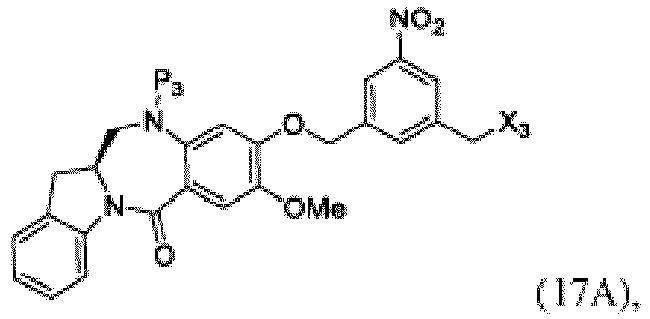

 X3 est -Cl ; etP3 est H ou un groupe de protection d'amine.
 - Procédé selon la revendication 1, dans lequel le composé de la formule (14A) est amené à réagir avec un monomère de la formule (d1) en présence d'un agent d'activation d'alcool et d'un azodicarboxylate.
- Procédé selon la revendication 2, dans lequel l'agent d'activation d'alcool est la triphénylphosphine.
- Procédé selon la revendication 2 ou 3, dans lequel l'azodicarboxylate est sélectionné parmi le groupe qui est constitué par: l'azodicarboxylate de diéthyle (DEAD), l'azodicarboxylate de diisopropyle (DIAD), la l,l'-(azodicarbonyl)dipipéridine (ADDP) et l'azodicarboxylate de ditertbutyle (DTAD).
- Procédé selon l'une quelconque des revendications 1 à 4, dans lequel le composé de la formule (14A) est amené à réagir avec le composé de monomère de la formule (d1), dans laquelle P3 est H, pour former un composé de la formule (17A') :

- Procédé selon l'une quelconque des revendications 1 à 4, dans lequel P3 est un groupe de protection d'amine et le procédé comprend en outre l'étape consistant à faire réagir le composé de la formule (17A) avec un réactif de déprotection d'amine pour former un composé de la formule (17A') :

- Procédé de préparation d'un composé de la formule (18A) :


 X3 est -Cl ; etP3 est H ou un groupe de protection d'amine.
 - Procédé selon la revendication 7, dans lequel le composé de la formule (17A) est amené à réagir avec un composé de monomère de la formule (b1) en présence d'une base.
- Procédé selon la revendication 8, dans lequel la base est le carbonate de sodium, le carbonate de potassium, le carbonate de césium, l'hydrure de sodium ou l'hydrure de potassium.
- Procédé de préparation d'un composé de la formule (18A) :
 (1) faire réagir le composé de la formule (14A) :

 (2) faire réagir le composé de la formule (16A) avec un monomère réduit de la formule (d1) :
 X3 est -Cl ; etP3 est H ou un groupe de protection d'amine.
 - Procédé de préparation d'un composé de la formule (18A) :
 (1) faire réagir un composé de la formule (14A) :

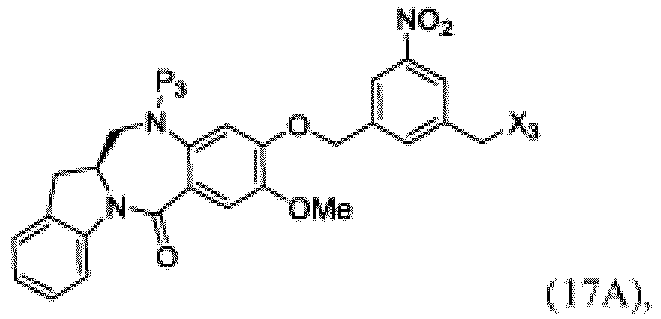 (2) faire réagir le composé de la formule (17A) avec un monomère de la formule (b1) :
 X3 est -Cl ; etP3 est H ou un groupe de protection d'amine.
 - Procédé selon les revendications 7, 8, 9 ou 11, dans lequel le composé de la formule (17A) est amené à réagir avec un monomère de la formule (b1), où P3 est H, pour former un composé de la formule (1A) :

- Procédé selon la revendication 7, 8, 9 ou 11, dans lequel P3 est un groupe de protection d'amine et le composé de la formule (18A) est en outre amené à réagir avec un réactif de déprotection d'amine pour former un composé de la formule (1A) :

- Procédé de préparation d'un composé de la formule (1A) :
 (1) faire réagir le composé de la formule (14A) :

 (2) faire réagir le composé de la formule (19A) avec un agent de réduction d'imine pour former un composé de la formule (17A') :
 (3) faire réagir le composé de la formule (17A') avec un monomère de la formule (a1) :pour former le composé de la formule (1A) ; où X3 est -Cl.
- Procédé selon l'une quelconque des revendications 1 à 6 et 10 à 14, dans lequel le composé de la formule (14A) ou un sel de celui-ci est préparé au moyen d'un procédé qui comprend les étapes consistant à :(1) faire réagir un composé de la formule (1A) avec un réactif de protection d'alcool

 (2) faire réagir un réactif de chlorination avec le composé de la formule (2A) pour former un composé de la formule (13A) :
 (3) faire réagir le composé de la formule (13A) avec un réactif de déprotection d'alcool pour former le composé de la formule (14A) ou un sel de celui-ci.
Priority Applications (7)
| Application Number | Priority Date | Filing Date | Title |
|---|---|---|---|
| EP20181645.1A EP3778602B1 (fr) | 2015-07-21 | 2016-07-21 | Procédés de préparation de dérivés de benzodiazépine cytotoxique |
| RS20201132A RS60840B1 (sr) | 2015-07-21 | 2016-07-21 | Postupci pripreme citotoksičnih derivata benzodiazepina |
| EP23183947.3A EP4286387A3 (fr) | 2015-07-21 | 2016-07-21 | Procédés de préparation de dérivés de benzodiazépine cytotoxique |
| SI201630923T SI3325482T1 (sl) | 2015-07-21 | 2016-07-21 | Postopki za pripravo citotoksičnih benzodiazepinskih derivatov |
| SM20200506T SMT202000506T1 (it) | 2015-07-21 | 2016-07-21 | Metodi per preparare derivati benzodiazepinici citotossici |
| HRP20201479TT HRP20201479T1 (hr) | 2015-07-21 | 2016-07-21 | Postupci pripreme citotoksičnih derivata benzodiazepina |
| PL16745598T PL3325482T3 (pl) | 2015-07-21 | 2016-07-21 | Sposoby otrzymywania cytotoksycznych pochodnych benzodiazepiny |
Applications Claiming Priority (3)
| Application Number | Priority Date | Filing Date | Title |
|---|---|---|---|
| US201562195023P | 2015-07-21 | 2015-07-21 | |
| US201662327973P | 2016-04-26 | 2016-04-26 | |
| PCT/US2016/043414 WO2017015502A1 (fr) | 2015-07-21 | 2016-07-21 | Procédés de préparation de dérivés de benzodiazépine cytotoxiques |
Related Child Applications (2)
| Application Number | Title | Priority Date | Filing Date |
|---|---|---|---|
| EP23183947.3A Division EP4286387A3 (fr) | 2015-07-21 | 2016-07-21 | Procédés de préparation de dérivés de benzodiazépine cytotoxique |
| EP20181645.1A Division EP3778602B1 (fr) | 2015-07-21 | 2016-07-21 | Procédés de préparation de dérivés de benzodiazépine cytotoxique |
Publications (2)
| Publication Number | Publication Date |
|---|---|
| EP3325482A1 EP3325482A1 (fr) | 2018-05-30 |
| EP3325482B1 true EP3325482B1 (fr) | 2020-06-24 |
Family
ID=56557925
Family Applications (7)
| Application Number | Title | Priority Date | Filing Date |
|---|---|---|---|
| EP16745598.9A Active EP3325482B1 (fr) | 2015-07-21 | 2016-07-21 | Procédés de préparation de dérivés de benzodiazépine cytotoxiques |
| EP16748205.8A Active EP3325485B1 (fr) | 2015-07-21 | 2016-07-21 | Procédés de préparation de dérivés de benzodiazépine cytotoxiques |
| EP22195446.4A Withdrawn EP4163284A1 (fr) | 2015-07-21 | 2016-07-21 | Procédés de préparation de dérivés de benzodiazépine cytotoxique |
| EP19200626.0A Active EP3653628B1 (fr) | 2015-07-21 | 2016-07-21 | Procédés de préparation de dérivés de benzodiazépine cytotoxique |
| EP20181645.1A Active EP3778602B1 (fr) | 2015-07-21 | 2016-07-21 | Procédés de préparation de dérivés de benzodiazépine cytotoxique |
| EP23183947.3A Withdrawn EP4286387A3 (fr) | 2015-07-21 | 2016-07-21 | Procédés de préparation de dérivés de benzodiazépine cytotoxique |
| EP16745961.9A Active EP3325483B1 (fr) | 2015-07-21 | 2016-07-21 | Procédés de préparation de dérivés de benzodiazépine cytotoxiques |
Family Applications After (6)
| Application Number | Title | Priority Date | Filing Date |
|---|---|---|---|
| EP16748205.8A Active EP3325485B1 (fr) | 2015-07-21 | 2016-07-21 | Procédés de préparation de dérivés de benzodiazépine cytotoxiques |
| EP22195446.4A Withdrawn EP4163284A1 (fr) | 2015-07-21 | 2016-07-21 | Procédés de préparation de dérivés de benzodiazépine cytotoxique |
| EP19200626.0A Active EP3653628B1 (fr) | 2015-07-21 | 2016-07-21 | Procédés de préparation de dérivés de benzodiazépine cytotoxique |
| EP20181645.1A Active EP3778602B1 (fr) | 2015-07-21 | 2016-07-21 | Procédés de préparation de dérivés de benzodiazépine cytotoxique |
| EP23183947.3A Withdrawn EP4286387A3 (fr) | 2015-07-21 | 2016-07-21 | Procédés de préparation de dérivés de benzodiazépine cytotoxique |
| EP16745961.9A Active EP3325483B1 (fr) | 2015-07-21 | 2016-07-21 | Procédés de préparation de dérivés de benzodiazépine cytotoxiques |
Country Status (23)
| Country | Link |
|---|---|
| US (11) | US9890179B2 (fr) |
| EP (7) | EP3325482B1 (fr) |
| JP (8) | JP2018522018A (fr) |
| KR (5) | KR20240055894A (fr) |
| CN (5) | CN113004288A (fr) |
| AU (7) | AU2016297607A1 (fr) |
| CA (4) | CA2992082A1 (fr) |
| CY (2) | CY1122553T1 (fr) |
| DK (2) | DK3325482T3 (fr) |
| ES (4) | ES2959741T3 (fr) |
| HK (1) | HK1252322A1 (fr) |
| HR (1) | HRP20201479T1 (fr) |
| HU (1) | HUE051541T2 (fr) |
| IL (10) | IL305279A (fr) |
| LT (2) | LT3325483T (fr) |
| PL (2) | PL3325482T3 (fr) |
| PT (2) | PT3325482T (fr) |
| RS (2) | RS59806B1 (fr) |
| RU (3) | RU2018105752A (fr) |
| SG (2) | SG10202009354SA (fr) |
| SI (2) | SI3325483T1 (fr) |
| SM (2) | SMT202000004T1 (fr) |
| WO (3) | WO2017015496A1 (fr) |
Families Citing this family (10)
| Publication number | Priority date | Publication date | Assignee | Title |
|---|---|---|---|---|
| EP3325482B1 (fr) * | 2015-07-21 | 2020-06-24 | ImmunoGen, Inc. | Procédés de préparation de dérivés de benzodiazépine cytotoxiques |
| KR102864278B1 (ko) | 2016-03-22 | 2025-09-30 | 에베 그룹 에. 탈너 게엠베하 | 기판을 결합하기 위한 방법 및 장치 |
| CN110177805B (zh) | 2016-10-19 | 2024-04-02 | 英温拉公司 | 抗体构建体 |
| AU2017383142A1 (en) | 2016-12-22 | 2019-07-04 | Università Degli Studi Magna Graecia Catanzaro | A monoclonal antibody targeting a unique sialoglycosilated cancer-associated epitope of CD43 |
| EP4148044A1 (fr) | 2017-01-25 | 2023-03-15 | ImmunoGen, Inc. | Procedes de preparation de derives de benzodiazepine cytotoxiques |
| CN120795120A (zh) | 2018-06-05 | 2025-10-17 | 伦敦大学国王学院 | 向胃肠系统递送酬载的btnl3/8导引构建体 |
| CN113166053A (zh) * | 2018-11-12 | 2021-07-23 | 伊缪诺金公司 | 制备细胞毒性苯二氮䓬衍生物的方法 |
| MA54228A (fr) * | 2018-11-12 | 2021-09-22 | Immunogen Inc | Procédés de préparation de dérivés de benzodiazépine cytotoxiques |
| CN113661172A (zh) * | 2019-03-29 | 2021-11-16 | 伊缪诺金公司 | 用于抑制异常细胞生长或治疗增生性疾病的细胞毒性双苯并二氮杂䓬衍生物及其与细胞结合剂的缀合物 |
| EP4548932A1 (fr) | 2022-06-30 | 2025-05-07 | Toray Industries, Inc. | Composition pharmaceutique pour le traitement et/ou la prévention du cancer |
Citations (1)
| Publication number | Priority date | Publication date | Assignee | Title |
|---|---|---|---|---|
| WO2012128868A1 (fr) * | 2011-02-15 | 2012-09-27 | Immunogen, Inc. | Dérivés cytotoxiques de benzodiazépine |
Family Cites Families (62)
| Publication number | Priority date | Publication date | Assignee | Title |
|---|---|---|---|---|
| US3763183A (en) | 1972-07-10 | 1973-10-02 | Sterling Drug Inc | 1,2,3,10,11,11a-hexahydro-5h-pyrrolo (2,1-c)(1,4)benzodiazepines |
| US3860600A (en) | 1972-07-10 | 1975-01-14 | Sterling Drug Inc | Octahydropyrrido{8 2,1-c{9 {8 1,4{9 benzodiazepines |
| US4678784A (en) | 1984-04-11 | 1987-07-07 | Mcneilab, Inc. | Method for the treatment of LHRH diseases and conditions |
| US5208020A (en) | 1989-10-25 | 1993-05-04 | Immunogen Inc. | Cytotoxic agents comprising maytansinoids and their therapeutic use |
| GB9205051D0 (en) | 1992-03-09 | 1992-04-22 | Cancer Res Campaign Tech | Pyrrolobenzodiazepine derivatives,their preparation,and compositions containing them |
| EP0563475B1 (fr) | 1992-03-25 | 2000-05-31 | Immunogen Inc | Conjugués d'agents ciblés et de dérivés du CC-1065 |
| DE69925133T2 (de) | 1998-08-27 | 2006-01-19 | Spirogen Ltd., Ryde | Pyrrolobenzodiazepine |
| GB9818731D0 (en) | 1998-08-27 | 1998-10-21 | Univ Portsmouth | Compounds |
| CA2388063C (fr) | 1999-11-24 | 2010-06-08 | Immunogen, Inc. | Agents cytotoxiques comprenant des taxanes et leur utilisation therapeutique |
| US6548042B2 (en) * | 2000-08-07 | 2003-04-15 | Arstad Erik | Bis-phosphonate compounds |
| UA75093C2 (en) * | 2000-10-06 | 2006-03-15 | Dimensional Pharm Inc | Aminopyridinyl-,aminoguanidinyl-, and alkoxyguanidinesubstituted phenylsubstituted phenylacetamides as protease inhibitors |
| US6441163B1 (en) | 2001-05-31 | 2002-08-27 | Immunogen, Inc. | Methods for preparation of cytotoxic conjugates of maytansinoids and cell binding agents |
| US6716821B2 (en) | 2001-12-21 | 2004-04-06 | Immunogen Inc. | Cytotoxic agents bearing a reactive polyethylene glycol moiety, cytotoxic conjugates comprising polyethylene glycol linking groups, and methods of making and using the same |
| US6756397B2 (en) | 2002-04-05 | 2004-06-29 | Immunogen, Inc. | Prodrugs of CC-1065 analogs |
| BR0313197A (pt) | 2002-08-02 | 2005-08-09 | Immunogen Inc | Agentes citotóxicos contendo potentes taxanos e seu uso terapêutico |
| DE60336149D1 (de) | 2002-08-16 | 2011-04-07 | Immunogen Inc | Vernetzer mit hoher reaktivität und löslichkeit und ihre verwendung bei der herstellung von konjugaten für die gezielte abgabe von kleinmolekularen arzneimitteln |
| CA2520897C (fr) | 2003-03-31 | 2010-08-24 | Council Of Scientific And Industrial Research | Dimeres de pyrrolo (2,1-c)(1,4) benzodiazepine en tant qu'agents antitumoraux et procede correspondant |
| ATE421967T1 (de) | 2003-03-31 | 2009-02-15 | Council Scient Ind Res | Nichtvernetzende pyrroloä2,1-cüä1, 4übenzodiazepine als potentielle antitumor- agentien und ihre herstellung |
| RU2338747C2 (ru) | 2003-03-31 | 2008-11-20 | Каунсил Оф Сайентифик Энд Индастриал Рисерч | ДИМЕРЫ ПИРРОЛО [2, 1-c][1, 4] БЕНЗОДИАЗЕПИНА В КАЧЕСТВЕ ПРОТИВООПУХОЛЕВЫХ СРЕДСТВ И СПОСОБ ИХ ПОЛУЧЕНИЯ |
| RU2314309C2 (ru) | 2003-03-31 | 2008-01-10 | Каунсил Оф Сайентифик Энд Индастриал Рисерч | Пирроло [2.1-c][1.4] бензодиазепины, способ их получения и фармацевтическая композиция на их основе |
| US8088387B2 (en) | 2003-10-10 | 2012-01-03 | Immunogen Inc. | Method of targeting specific cell populations using cell-binding agent maytansinoid conjugates linked via a non-cleavable linker, said conjugates, and methods of making said conjugates |
| US7276497B2 (en) | 2003-05-20 | 2007-10-02 | Immunogen Inc. | Cytotoxic agents comprising new maytansinoids |
| WO2005040170A2 (fr) | 2003-10-22 | 2005-05-06 | Government Of The United States Of America, Represented By The Secretary, Department Of Health And Human Services | Derives de pyrrolobenzodiazepine, compositions comprenant ces derives et methodes s'y rapportant |
| AU2003300718A1 (en) | 2003-12-31 | 2005-07-21 | Council Of Scientific And Industrial Research | Process for preparing pyrrolo(2, 1-c) (1, 4) benzodiazepine hybrids |
| WO2005085251A1 (fr) * | 2004-03-01 | 2005-09-15 | Spirogen Limited | Derives de 11-hydroxy-5h-pyrrolo[2,1-c][1,4] benzodiazepine-5-one en tant qu'intermediaires cles pour la preparation de pyrrolobenzodiazepines substituees c2 |
| GB0404578D0 (en) | 2004-03-01 | 2004-04-07 | Spirogen Ltd | Pyrrolobenzodiazepines |
| GB0410725D0 (en) | 2004-05-13 | 2004-06-16 | Spirogen Ltd | Pyrrolobenzodiazepine therapeutic agents |
| GB0412492D0 (en) * | 2004-06-04 | 2004-07-07 | Sterix Ltd | Compound |
| US7612062B2 (en) | 2005-04-21 | 2009-11-03 | Spirogen Limited | Pyrrolobenzodiazepines |
| GB0508084D0 (en) * | 2005-04-21 | 2005-06-01 | Spirogen Ltd | Pyrrolobenzodiazepines |
| US8637664B2 (en) | 2005-10-05 | 2014-01-28 | Spirogen Sarl | Alkyl 4- [4- (5-oxo-2,3,5, 11a-tetrahydo-5H-pyrrolo [2, 1-c] [1,4] benzodiazepine-8-yloxy)-butyrylamino]-1H-pyrrole-2-carboxylate derivatives and related compounds for the treatment of a proliferative disease |
| EP1979349B1 (fr) * | 2005-12-21 | 2010-07-28 | Abbott Laboratories | Composes antiviraux |
| RS52060B (sr) | 2006-01-25 | 2012-04-30 | Sanofi | Citotoksični agensi koji sadrže nove derivate tomaimicina |
| WO2007093873A1 (fr) | 2006-02-13 | 2007-08-23 | Council Of Scientific And Industrial Research | Nouveaux conjugués de bis-pyrrolo[2,1-c][1,4]benzodiazépine et d'anthraquinone et leur procédé de préparation |
| EP2032606B1 (fr) | 2006-05-30 | 2013-11-27 | Genentech, Inc. | Anticorps et immuno-conjugués, et leurs utilisations |
| SI2019104T1 (sl) | 2007-07-19 | 2013-12-31 | Sanofi | Citotoksična sredstva, ki obsegajo nove tomaimicinske derivate, in njihova terapevtska uporaba |
| JP5404624B2 (ja) | 2007-08-01 | 2014-02-05 | カウンスィル オブ サイエンティフィック アンド インダストリアル リサーチ | 選択的な抗腫瘍薬として有用なピロロ[2,1−c][1,4]ベンゾジアゼピン−グリコシドプロドラッグ |
| NZ610239A (en) | 2008-04-30 | 2014-11-28 | Immunogen Inc | Cross-linkers and their uses |
| SG189817A1 (en) | 2008-04-30 | 2013-05-31 | Immunogen Inc | Potent conjugates and hydrophilic linkers |
| GB0819095D0 (en) | 2008-10-17 | 2008-11-26 | Spirogen Ltd | Pyrrolobenzodiazepines |
| GB0822260D0 (en) * | 2008-12-05 | 2009-01-14 | Merten Christoph | Assay |
| KR101172638B1 (ko) * | 2008-12-30 | 2012-08-08 | 조선대학교산학협력단 | 신규한 티아졸리딘디온 유도체 및 그의 용도 |
| RU2683325C2 (ru) * | 2009-02-05 | 2019-03-28 | Иммьюноджен, Инк. | Новые производные бензодиазепина |
| CN102596922A (zh) | 2009-10-06 | 2012-07-18 | 免疫基因公司 | 有效的缀合物和亲水性连接体 |
| US8314250B2 (en) * | 2009-11-24 | 2012-11-20 | Hoffmann-La Roche Inc. | Sultam derivatives |
| EP2511260B1 (fr) * | 2009-12-08 | 2015-07-29 | Gifu University | Composé aromatique, vecteur de modification qui utilise celui-ci et est utilisé pour synthétiser un dérivé d'oligonucléotide, dérivé d'oligonucléotide, et construction d'oligonucléotide |
| US8962279B2 (en) * | 2009-12-30 | 2015-02-24 | Intel Corporation | Solid-phase chelators and electronic biosensors |
| PL3202460T3 (pl) * | 2010-02-11 | 2019-12-31 | Celgene Corporation | Pochodne arylometoksyizoindoliny i zawierające je kompozycje oraz sposoby ich zastosowania |
| TWI622402B (zh) | 2010-02-24 | 2018-05-01 | 免疫遺傳股份有限公司 | 葉酸受體1抗體類和免疫共軛物類及彼等之用途 |
| JP5875083B2 (ja) | 2010-04-15 | 2016-03-02 | メディミューン リミテッド | 増殖性疾患治療用ピロロベンゾジアゼピン |
| SI2528625T1 (sl) | 2010-04-15 | 2013-11-29 | Spirogen Sarl | Pirolobenzodiazepini in njihovi konjugati |
| CA2795349C (fr) * | 2010-04-15 | 2016-11-29 | Seattle Genetics, Inc. | Conjugues de pyrrolobenzodiazapine cibles |
| CN102234253B (zh) * | 2011-06-02 | 2013-07-03 | 重庆莱美药业股份有限公司 | 一种制备非布索坦中间体的方法 |
| HK1211208A1 (zh) | 2012-08-22 | 2016-05-20 | Immunogen, Inc. | 細胞毒性苯並二氮呯衍生物 |
| EP3052464B1 (fr) * | 2013-10-04 | 2020-04-15 | Novartis AG | 3'end caps pour des agents arni utilisés dans l'interférence d'arn |
| CN104628772A (zh) | 2013-11-07 | 2015-05-20 | 四川恒康发展有限责任公司 | 一种抗肿瘤前药及其激活剂、组合物和应用 |
| CN103664896B (zh) * | 2013-11-25 | 2016-03-02 | 济南精合医药科技有限公司 | 一种抗肿瘤分子靶向药物克里唑替尼的合成工艺方法 |
| KR102508023B1 (ko) * | 2014-09-03 | 2023-03-10 | 이뮤노젠 아이엔씨 | 세포-결합제 및 세포독성 약물을 포함하는 콘주게이트 |
| WO2016036804A1 (fr) | 2014-09-03 | 2016-03-10 | Immunogen, Inc. | Dérivés de benzodiazépine cytotoxique |
| AU2015311987B2 (en) | 2014-09-03 | 2020-06-04 | Immunogen, Inc. | Cytotoxic benzodiazepine derivatives |
| EP3325482B1 (fr) * | 2015-07-21 | 2020-06-24 | ImmunoGen, Inc. | Procédés de préparation de dérivés de benzodiazépine cytotoxiques |
| US20170189548A1 (en) * | 2015-11-25 | 2017-07-06 | Immunogen, Inc. | Pharmaceutical formulations and methods of use thereof |
-
2016
- 2016-07-21 EP EP16745598.9A patent/EP3325482B1/fr active Active
- 2016-07-21 RS RS20191647A patent/RS59806B1/sr unknown
- 2016-07-21 EP EP16748205.8A patent/EP3325485B1/fr active Active
- 2016-07-21 HR HRP20201479TT patent/HRP20201479T1/hr unknown
- 2016-07-21 RU RU2018105752A patent/RU2018105752A/ru not_active Application Discontinuation
- 2016-07-21 DK DK16745598.9T patent/DK3325482T3/da active
- 2016-07-21 AU AU2016297607A patent/AU2016297607A1/en not_active Abandoned
- 2016-07-21 LT LTEP16745961.9T patent/LT3325483T/lt unknown
- 2016-07-21 SG SG10202009354SA patent/SG10202009354SA/en unknown
- 2016-07-21 LT LTEP16745598.9T patent/LT3325482T/lt unknown
- 2016-07-21 WO PCT/US2016/043406 patent/WO2017015496A1/fr not_active Ceased
- 2016-07-21 CN CN202110219412.4A patent/CN113004288A/zh active Pending
- 2016-07-21 WO PCT/US2016/043414 patent/WO2017015502A1/fr not_active Ceased
- 2016-07-21 KR KR1020247012816A patent/KR20240055894A/ko not_active Withdrawn
- 2016-07-21 AU AU2016297087A patent/AU2016297087B2/en not_active Ceased
- 2016-07-21 JP JP2018502800A patent/JP2018522018A/ja not_active Withdrawn
- 2016-07-21 US US15/216,517 patent/US9890179B2/en not_active Expired - Fee Related
- 2016-07-21 JP JP2018502791A patent/JP6787995B2/ja not_active Expired - Fee Related
- 2016-07-21 SI SI201630578T patent/SI3325483T1/sl unknown
- 2016-07-21 EP EP22195446.4A patent/EP4163284A1/fr not_active Withdrawn
- 2016-07-21 IL IL305279A patent/IL305279A/en unknown
- 2016-07-21 HU HUE16745598A patent/HUE051541T2/hu unknown
- 2016-07-21 IL IL294651A patent/IL294651B2/en unknown
- 2016-07-21 JP JP2018502785A patent/JP6858745B2/ja not_active Expired - Fee Related
- 2016-07-21 SG SG10202106529XA patent/SG10202106529XA/en unknown
- 2016-07-21 PT PT167455989T patent/PT3325482T/pt unknown
- 2016-07-21 CN CN201680053093.1A patent/CN108026103B/zh not_active Expired - Fee Related
- 2016-07-21 KR KR1020187003181A patent/KR102659706B1/ko active Active
- 2016-07-21 CA CA2992082A patent/CA2992082A1/fr active Pending
- 2016-07-21 RS RS20201132A patent/RS60840B1/sr unknown
- 2016-07-21 IL IL283355A patent/IL283355B/en unknown
- 2016-07-21 AU AU2016297608A patent/AU2016297608B2/en not_active Ceased
- 2016-07-21 IL IL305989A patent/IL305989A/en unknown
- 2016-07-21 HK HK18111602.7A patent/HK1252322A1/zh unknown
- 2016-07-21 PT PT167459619T patent/PT3325483T/pt unknown
- 2016-07-21 CA CA3227588A patent/CA3227588A1/fr active Pending
- 2016-07-21 EP EP19200626.0A patent/EP3653628B1/fr active Active
- 2016-07-21 WO PCT/US2016/043402 patent/WO2017015495A1/fr not_active Ceased
- 2016-07-21 EP EP20181645.1A patent/EP3778602B1/fr active Active
- 2016-07-21 SM SM20200004T patent/SMT202000004T1/it unknown
- 2016-07-21 ES ES20181645T patent/ES2959741T3/es active Active
- 2016-07-21 KR KR1020247012991A patent/KR20240055903A/ko not_active Withdrawn
- 2016-07-21 SI SI201630923T patent/SI3325482T1/sl unknown
- 2016-07-21 KR KR1020187005041A patent/KR102660070B1/ko active Active
- 2016-07-21 SM SM20200506T patent/SMT202000506T1/it unknown
- 2016-07-21 CN CN202110366892.7A patent/CN113087763A/zh active Pending
- 2016-07-21 ES ES19200626T patent/ES2933376T3/es active Active
- 2016-07-21 ES ES16745598T patent/ES2820358T3/es active Active
- 2016-07-21 RU RU2018105756A patent/RU2727151C2/ru active
- 2016-07-21 KR KR1020187005040A patent/KR20180038460A/ko not_active Withdrawn
- 2016-07-21 DK DK16745961.9T patent/DK3325483T3/da active
- 2016-07-21 CN CN201680051138.1A patent/CN108290895B/zh not_active Expired - Fee Related
- 2016-07-21 RU RU2018105609A patent/RU2746322C2/ru active
- 2016-07-21 IL IL286788A patent/IL286788B2/en unknown
- 2016-07-21 EP EP23183947.3A patent/EP4286387A3/fr not_active Withdrawn
- 2016-07-21 CA CA2991326A patent/CA2991326A1/fr not_active Abandoned
- 2016-07-21 PL PL16745598T patent/PL3325482T3/pl unknown
- 2016-07-21 CN CN201680053120.5A patent/CN108055844A/zh active Pending
- 2016-07-21 PL PL16745961T patent/PL3325483T3/pl unknown
- 2016-07-21 ES ES16745961T patent/ES2764548T3/es active Active
- 2016-07-21 US US15/216,512 patent/US9873708B2/en active Active
- 2016-07-21 US US15/216,548 patent/US10081640B2/en active Active
- 2016-07-21 CA CA2991305A patent/CA2991305C/fr active Active
- 2016-07-21 EP EP16745961.9A patent/EP3325483B1/fr active Active
-
2017
- 2017-12-11 US US15/837,832 patent/US10370389B2/en active Active
-
2018
- 2018-01-03 US US15/860,864 patent/US10392407B2/en not_active Expired - Fee Related
- 2018-01-11 IL IL256854A patent/IL256854A/en unknown
- 2018-01-11 IL IL256861A patent/IL256861B/en active IP Right Grant
- 2018-01-11 IL IL256860A patent/IL256860B/en active IP Right Grant
- 2018-09-12 US US16/129,008 patent/US10899775B2/en active Active
-
2019
- 2019-06-06 US US16/433,117 patent/US10787463B2/en active Active
- 2019-06-21 US US16/448,261 patent/US20200017526A1/en not_active Abandoned
- 2019-12-30 CY CY20191101364T patent/CY1122553T1/el unknown
-
2020
- 2020-08-10 IL IL276631A patent/IL276631B/en unknown
- 2020-08-10 IL IL276630A patent/IL276630B/en active IP Right Grant
- 2020-08-12 US US16/991,700 patent/US11420982B2/en active Active
- 2020-09-23 CY CY20201100899T patent/CY1123390T1/el unknown
- 2020-10-28 JP JP2020180147A patent/JP6995178B2/ja not_active Expired - Fee Related
- 2020-11-23 US US17/101,942 patent/US20210171547A1/en not_active Abandoned
-
2021
- 2021-03-24 JP JP2021049502A patent/JP7337114B2/ja active Active
- 2021-04-20 AU AU2021202403A patent/AU2021202403B2/en not_active Ceased
- 2021-05-17 AU AU2021203148A patent/AU2021203148B2/en not_active Ceased
- 2021-12-14 JP JP2021202215A patent/JP7334228B2/ja active Active
-
2022
- 2022-12-14 US US18/080,973 patent/US20230257400A1/en not_active Abandoned
-
2023
- 2023-03-03 AU AU2023201339A patent/AU2023201339A1/en not_active Abandoned
- 2023-04-11 AU AU2023202221A patent/AU2023202221A1/en not_active Abandoned
- 2023-08-16 JP JP2023132536A patent/JP2023162264A/ja not_active Withdrawn
- 2023-08-22 JP JP2023134420A patent/JP2023166434A/ja not_active Withdrawn
Patent Citations (1)
| Publication number | Priority date | Publication date | Assignee | Title |
|---|---|---|---|---|
| WO2012128868A1 (fr) * | 2011-02-15 | 2012-09-27 | Immunogen, Inc. | Dérivés cytotoxiques de benzodiazépine |
Also Published As
Similar Documents
| Publication | Publication Date | Title |
|---|---|---|
| EP3325482B1 (fr) | Procédés de préparation de dérivés de benzodiazépine cytotoxiques | |
| HK40047253B (en) | Methods of preparing cytotoxic benzodiazepine derivatives | |
| HK40047253A (en) | Methods of preparing cytotoxic benzodiazepine derivatives | |
| HK1252321B (en) | Methods of preparing cytotoxic benzodiazepine derivatives | |
| HK40029973A (en) | Methods of preparing cytotoxic benzodiazepine derivatives | |
| HK1252323B (en) | Methods of preparing cytotoxic benzodiazepine derivatives |
Legal Events
| Date | Code | Title | Description |
|---|---|---|---|
| STAA | Information on the status of an ep patent application or granted ep patent |
Free format text: STATUS: THE INTERNATIONAL PUBLICATION HAS BEEN MADE |
|
| PUAI | Public reference made under article 153(3) epc to a published international application that has entered the european phase |
Free format text: ORIGINAL CODE: 0009012 |
|
| STAA | Information on the status of an ep patent application or granted ep patent |
Free format text: STATUS: REQUEST FOR EXAMINATION WAS MADE |
|
| 17P | Request for examination filed |
Effective date: 20180111 |
|
| AK | Designated contracting states |
Kind code of ref document: A1 Designated state(s): AL AT BE BG CH CY CZ DE DK EE ES FI FR GB GR HR HU IE IS IT LI LT LU LV MC MK MT NL NO PL PT RO RS SE SI SK SM TR |
|
| AX | Request for extension of the european patent |
Extension state: BA ME |
|
| DAV | Request for validation of the european patent (deleted) | ||
| PUAG | Search results despatched under rule 164(2) epc together with communication from examining division |
Free format text: ORIGINAL CODE: 0009017 |
|
| STAA | Information on the status of an ep patent application or granted ep patent |
Free format text: STATUS: EXAMINATION IS IN PROGRESS |
|
| 17Q | First examination report despatched |
Effective date: 20190226 |
|
| B565 | Issuance of search results under rule 164(2) epc |
Effective date: 20190226 |
|
| RIC1 | Information provided on ipc code assigned before grant |
Ipc: C07D 487/04 20060101AFI20190221BHEP |
|
| REG | Reference to a national code |
Ref country code: HK Ref legal event code: DE Ref document number: 1252321 Country of ref document: HK |
|
| GRAP | Despatch of communication of intention to grant a patent |
Free format text: ORIGINAL CODE: EPIDOSNIGR1 |
|
| STAA | Information on the status of an ep patent application or granted ep patent |
Free format text: STATUS: GRANT OF PATENT IS INTENDED |
|
| INTG | Intention to grant announced |
Effective date: 20200107 |
|
| GRAS | Grant fee paid |
Free format text: ORIGINAL CODE: EPIDOSNIGR3 |
|
| GRAA | (expected) grant |
Free format text: ORIGINAL CODE: 0009210 |
|
| STAA | Information on the status of an ep patent application or granted ep patent |
Free format text: STATUS: THE PATENT HAS BEEN GRANTED |
|
| AK | Designated contracting states |
Kind code of ref document: B1 Designated state(s): AL AT BE BG CH CY CZ DE DK EE ES FI FR GB GR HR HU IE IS IT LI LT LU LV MC MK MT NL NO PL PT RO RS SE SI SK SM TR |
|
| AX | Request for extension of the european patent |
Extension state: BA ME |
|
| REG | Reference to a national code |
Ref country code: GB Ref legal event code: FG4D |
|
| REG | Reference to a national code |
Ref country code: CH Ref legal event code: EP |
|
| REG | Reference to a national code |
Ref country code: AT Ref legal event code: REF Ref document number: 1283788 Country of ref document: AT Kind code of ref document: T Effective date: 20200715 |
|
| REG | Reference to a national code |
Ref country code: DE Ref legal event code: R096 Ref document number: 602016038725 Country of ref document: DE |
|
| REG | Reference to a national code |
Ref country code: IE Ref legal event code: FG4D |
|
| REG | Reference to a national code |
Ref country code: FI Ref legal event code: FGE |
|
| REG | Reference to a national code |
Ref country code: HR Ref legal event code: TUEP Ref document number: P20201479 Country of ref document: HR |
|
| REG | Reference to a national code |
Ref country code: PT Ref legal event code: SC4A Ref document number: 3325482 Country of ref document: PT Date of ref document: 20200924 Kind code of ref document: T Free format text: AVAILABILITY OF NATIONAL TRANSLATION Effective date: 20200917 |
|
| REG | Reference to a national code |
Ref country code: DK Ref legal event code: T3 Effective date: 20200922 |
|
| REG | Reference to a national code |
Ref country code: CH Ref legal event code: NV Representative=s name: SERVOPATENT GMBH, CH |
|
| REG | Reference to a national code |
Ref country code: NL Ref legal event code: FP |
|
| REG | Reference to a national code |
Ref country code: SE Ref legal event code: TRGR |
|
| REG | Reference to a national code |
Ref country code: NO Ref legal event code: T2 Effective date: 20200624 |
|
| REG | Reference to a national code |
Ref country code: EE Ref legal event code: FG4A Ref document number: E019758 Country of ref document: EE Effective date: 20200928 |
|
| REG | Reference to a national code |
Ref country code: HR Ref legal event code: ODRP Ref document number: P20201479 Country of ref document: HR Payment date: 20200916 Year of fee payment: 5 |
|
| REG | Reference to a national code |
Ref country code: SK Ref legal event code: T3 Ref document number: E 35386 Country of ref document: SK |
|
| REG | Reference to a national code |
Ref country code: HR Ref legal event code: T1PR Ref document number: P20201479 Country of ref document: HR |
|
| REG | Reference to a national code |
Ref country code: GR Ref legal event code: EP Ref document number: 20200402610 Country of ref document: GR Effective date: 20201116 |
|
| REG | Reference to a national code |
Ref country code: HU Ref legal event code: AG4A Ref document number: E051541 Country of ref document: HU |
|
| REG | Reference to a national code |
Ref country code: DE Ref legal event code: R097 Ref document number: 602016038725 Country of ref document: DE |
|
| REG | Reference to a national code |
Ref country code: ES Ref legal event code: FG2A Ref document number: 2820358 Country of ref document: ES Kind code of ref document: T3 Effective date: 20210420 |
|
| PLBE | No opposition filed within time limit |
Free format text: ORIGINAL CODE: 0009261 |
|
| STAA | Information on the status of an ep patent application or granted ep patent |
Free format text: STATUS: NO OPPOSITION FILED WITHIN TIME LIMIT |
|
| 26N | No opposition filed |
Effective date: 20210325 |
|
| REG | Reference to a national code |
Ref country code: HR Ref legal event code: ODRP Ref document number: P20201479 Country of ref document: HR Payment date: 20210705 Year of fee payment: 6 |
|
| REG | Reference to a national code |
Ref country code: HR Ref legal event code: ODRP Ref document number: P20201479 Country of ref document: HR Payment date: 20220711 Year of fee payment: 7 |
|
| P01 | Opt-out of the competence of the unified patent court (upc) registered |
Effective date: 20230529 |
|
| REG | Reference to a national code |
Ref country code: HR Ref legal event code: ODRP Ref document number: P20201479 Country of ref document: HR Payment date: 20230704 Year of fee payment: 8 |
|
| PGFP | Annual fee paid to national office [announced via postgrant information from national office to epo] |
Ref country code: NL Payment date: 20230726 Year of fee payment: 8 Ref country code: LU Payment date: 20230727 Year of fee payment: 8 |
|
| PGFP | Annual fee paid to national office [announced via postgrant information from national office to epo] |
Ref country code: TR Payment date: 20230707 Year of fee payment: 8 Ref country code: SM Payment date: 20230706 Year of fee payment: 8 Ref country code: RO Payment date: 20230707 Year of fee payment: 8 Ref country code: NO Payment date: 20230727 Year of fee payment: 8 Ref country code: MC Payment date: 20230706 Year of fee payment: 8 Ref country code: IT Payment date: 20230720 Year of fee payment: 8 Ref country code: IE Payment date: 20230727 Year of fee payment: 8 Ref country code: GB Payment date: 20230727 Year of fee payment: 8 Ref country code: FI Payment date: 20230725 Year of fee payment: 8 Ref country code: ES Payment date: 20230804 Year of fee payment: 8 Ref country code: EE Payment date: 20230703 Year of fee payment: 8 Ref country code: CZ Payment date: 20230711 Year of fee payment: 8 Ref country code: CY Payment date: 20230706 Year of fee payment: 8 Ref country code: CH Payment date: 20230802 Year of fee payment: 8 Ref country code: BG Payment date: 20230720 Year of fee payment: 8 Ref country code: AT Payment date: 20230705 Year of fee payment: 8 |
|
| PGFP | Annual fee paid to national office [announced via postgrant information from national office to epo] |
Ref country code: SK Payment date: 20230703 Year of fee payment: 8 Ref country code: SI Payment date: 20230705 Year of fee payment: 8 Ref country code: SE Payment date: 20230727 Year of fee payment: 8 Ref country code: RS Payment date: 20230706 Year of fee payment: 8 Ref country code: PT Payment date: 20230704 Year of fee payment: 8 Ref country code: PL Payment date: 20230710 Year of fee payment: 8 Ref country code: IS Payment date: 20230711 Year of fee payment: 8 Ref country code: HU Payment date: 20230713 Year of fee payment: 8 Ref country code: HR Payment date: 20230704 Year of fee payment: 8 Ref country code: GR Payment date: 20230727 Year of fee payment: 8 Ref country code: FR Payment date: 20230725 Year of fee payment: 8 Ref country code: DK Payment date: 20230727 Year of fee payment: 8 Ref country code: DE Payment date: 20230727 Year of fee payment: 8 Ref country code: BE Payment date: 20230727 Year of fee payment: 8 |
|
| PGFP | Annual fee paid to national office [announced via postgrant information from national office to epo] |
Ref country code: MT Payment date: 20230704 Year of fee payment: 8 Ref country code: LV Payment date: 20230712 Year of fee payment: 8 Ref country code: LT Payment date: 20230703 Year of fee payment: 8 |
|
| PGFP | Annual fee paid to national office [announced via postgrant information from national office to epo] |
Ref country code: AL Payment date: 20230715 Year of fee payment: 8 |
|
| PGFP | Annual fee paid to national office [announced via postgrant information from national office to epo] |
Ref country code: MK Payment date: 20230704 Year of fee payment: 8 |
|
| REG | Reference to a national code |
Ref country code: DE Ref legal event code: R119 Ref document number: 602016038725 Country of ref document: DE |
|
| REG | Reference to a national code |
Ref country code: HR Ref legal event code: PBON Ref document number: P20201479 Country of ref document: HR Effective date: 20240721 |
|
| PG25 | Lapsed in a contracting state [announced via postgrant information from national office to epo] |
Ref country code: MC Free format text: LAPSE BECAUSE OF NON-PAYMENT OF DUE FEES Effective date: 20240731 |
|
| REG | Reference to a national code |
Ref country code: LT Ref legal event code: MM4D Effective date: 20240721 |
|
| REG | Reference to a national code |
Ref country code: EE Ref legal event code: MM4A Ref document number: E019758 Country of ref document: EE Effective date: 20240731 Ref country code: DK Ref legal event code: EBP Effective date: 20240731 |
|
| REG | Reference to a national code |
Ref country code: SK Ref legal event code: MM4A Ref document number: E 35386 Country of ref document: SK Effective date: 20240721 |
|
| REG | Reference to a national code |
Ref country code: CH Ref legal event code: PL |
|
| REG | Reference to a national code |
Ref country code: SE Ref legal event code: EUG |
|
| REG | Reference to a national code |
Ref country code: NL Ref legal event code: MM Effective date: 20240801 |
|
| REG | Reference to a national code |
Ref country code: AT Ref legal event code: MM01 Ref document number: 1283788 Country of ref document: AT Kind code of ref document: T Effective date: 20240721 |
|
| PG25 | Lapsed in a contracting state [announced via postgrant information from national office to epo] |
Ref country code: LU Free format text: LAPSE BECAUSE OF NON-PAYMENT OF DUE FEES Effective date: 20240721 |
|
| GBPC | Gb: european patent ceased through non-payment of renewal fee |
Effective date: 20240721 |
|
| PG25 | Lapsed in a contracting state [announced via postgrant information from national office to epo] |
Ref country code: HU Free format text: LAPSE BECAUSE OF NON-PAYMENT OF DUE FEES Effective date: 20240722 |
|
| PG25 | Lapsed in a contracting state [announced via postgrant information from national office to epo] |
Ref country code: LU Free format text: LAPSE BECAUSE OF NON-PAYMENT OF DUE FEES Effective date: 20240721 Ref country code: HU Free format text: LAPSE BECAUSE OF NON-PAYMENT OF DUE FEES Effective date: 20240722 |
|
| PG25 | Lapsed in a contracting state [announced via postgrant information from national office to epo] |
Ref country code: DE Free format text: LAPSE BECAUSE OF NON-PAYMENT OF DUE FEES Effective date: 20250201 Ref country code: HR Free format text: LAPSE BECAUSE OF NON-PAYMENT OF DUE FEES Effective date: 20240721 Ref country code: PT Free format text: LAPSE BECAUSE OF NON-PAYMENT OF DUE FEES Effective date: 20250121 |
|
| PG25 | Lapsed in a contracting state [announced via postgrant information from national office to epo] |
Ref country code: LT Free format text: LAPSE BECAUSE OF NON-PAYMENT OF DUE FEES Effective date: 20240721 Ref country code: NL Free format text: LAPSE BECAUSE OF NON-PAYMENT OF DUE FEES Effective date: 20240801 Ref country code: RO Free format text: LAPSE BECAUSE OF NON-PAYMENT OF DUE FEES Effective date: 20240721 Ref country code: SM Free format text: LAPSE BECAUSE OF NON-PAYMENT OF DUE FEES Effective date: 20250211 Ref country code: FI Free format text: LAPSE BECAUSE OF NON-PAYMENT OF DUE FEES Effective date: 20240721 |
|
| REG | Reference to a national code |
Ref country code: AT Ref legal event code: UEP Ref document number: 1283788 Country of ref document: AT Kind code of ref document: T Effective date: 20200624 |
|
| PG25 | Lapsed in a contracting state [announced via postgrant information from national office to epo] |
Ref country code: BG Free format text: LAPSE BECAUSE OF NON-PAYMENT OF DUE FEES Effective date: 20240721 |
|
| PG25 | Lapsed in a contracting state [announced via postgrant information from national office to epo] |
Ref country code: NO Free format text: LAPSE BECAUSE OF NON-PAYMENT OF DUE FEES Effective date: 20240731 |
|
| PG25 | Lapsed in a contracting state [announced via postgrant information from national office to epo] |
Ref country code: CH Free format text: LAPSE BECAUSE OF NON-PAYMENT OF DUE FEES Effective date: 20240731 Ref country code: AT Free format text: LAPSE BECAUSE OF NON-PAYMENT OF DUE FEES Effective date: 20240721 Ref country code: LV Free format text: LAPSE BECAUSE OF NON-PAYMENT OF DUE FEES Effective date: 20240721 Ref country code: EE Free format text: LAPSE BECAUSE OF NON-PAYMENT OF DUE FEES Effective date: 20240731 Ref country code: BE Free format text: LAPSE BECAUSE OF NON-PAYMENT OF DUE FEES Effective date: 20240731 Ref country code: GR Free format text: LAPSE BECAUSE OF NON-PAYMENT OF DUE FEES Effective date: 20250205 |
|
| PG25 | Lapsed in a contracting state [announced via postgrant information from national office to epo] |
Ref country code: FR Free format text: LAPSE BECAUSE OF NON-PAYMENT OF DUE FEES Effective date: 20240731 Ref country code: CZ Free format text: LAPSE BECAUSE OF NON-PAYMENT OF DUE FEES Effective date: 20240721 |
|
| PG25 | Lapsed in a contracting state [announced via postgrant information from national office to epo] |
Ref country code: GB Free format text: LAPSE BECAUSE OF NON-PAYMENT OF DUE FEES Effective date: 20240721 Ref country code: SK Free format text: LAPSE BECAUSE OF NON-PAYMENT OF DUE FEES Effective date: 20240721 Ref country code: CY Free format text: LAPSE BECAUSE OF NON-PAYMENT OF DUE FEES Effective date: 20240721 |
|
| PG25 | Lapsed in a contracting state [announced via postgrant information from national office to epo] |
Ref country code: RS Free format text: LAPSE BECAUSE OF NON-PAYMENT OF DUE FEES Effective date: 20240721 |
|
| REG | Reference to a national code |
Ref country code: BE Ref legal event code: MM Effective date: 20240731 |
|
| PG25 | Lapsed in a contracting state [announced via postgrant information from national office to epo] |
Ref country code: DK Free format text: LAPSE BECAUSE OF NON-PAYMENT OF DUE FEES Effective date: 20240731 |
|
| PG25 | Lapsed in a contracting state [announced via postgrant information from national office to epo] |
Ref country code: IT Free format text: LAPSE BECAUSE OF NON-PAYMENT OF DUE FEES Effective date: 20240721 |
|
| PG25 | Lapsed in a contracting state [announced via postgrant information from national office to epo] |
Ref country code: IE Free format text: LAPSE BECAUSE OF NON-PAYMENT OF DUE FEES Effective date: 20240721 |
|
| REG | Reference to a national code |
Ref country code: SI Ref legal event code: KO00 Effective date: 20240722 |
|
| REG | Reference to a national code |
Ref country code: ES Ref legal event code: FD2A Effective date: 20250901 |
|
| PG25 | Lapsed in a contracting state [announced via postgrant information from national office to epo] |
Ref country code: ES Free format text: LAPSE BECAUSE OF NON-PAYMENT OF DUE FEES Effective date: 20240722 |
|
| PG25 | Lapsed in a contracting state [announced via postgrant information from national office to epo] |
Ref country code: SE Free format text: LAPSE BECAUSE OF NON-PAYMENT OF DUE FEES Effective date: 20240722 |
|
| PG25 | Lapsed in a contracting state [announced via postgrant information from national office to epo] |
Ref country code: PL Free format text: LAPSE BECAUSE OF NON-PAYMENT OF DUE FEES Effective date: 20240721 |