EP3325708B1 - Tissu présentant des caractéristiques de gestion de l'humidité - Google Patents
Tissu présentant des caractéristiques de gestion de l'humidité Download PDFInfo
- Publication number
- EP3325708B1 EP3325708B1 EP16751200.3A EP16751200A EP3325708B1 EP 3325708 B1 EP3325708 B1 EP 3325708B1 EP 16751200 A EP16751200 A EP 16751200A EP 3325708 B1 EP3325708 B1 EP 3325708B1
- Authority
- EP
- European Patent Office
- Prior art keywords
- fabric
- hydrophobic
- areas
- hydrophilic
- hydrophobic areas
- Prior art date
- Legal status (The legal status is an assumption and is not a legal conclusion. Google has not performed a legal analysis and makes no representation as to the accuracy of the status listed.)
- Active
Links
Images
Classifications
-
- D—TEXTILES; PAPER
- D06—TREATMENT OF TEXTILES OR THE LIKE; LAUNDERING; FLEXIBLE MATERIALS NOT OTHERWISE PROVIDED FOR
- D06M—TREATMENT, NOT PROVIDED FOR ELSEWHERE IN CLASS D06, OF FIBRES, THREADS, YARNS, FABRICS, FEATHERS OR FIBROUS GOODS MADE FROM SUCH MATERIALS
- D06M23/00—Treatment of fibres, threads, yarns, fabrics or fibrous goods made from such materials, characterised by the process
- D06M23/16—Processes for the non-uniform application of treating agents, e.g. one-sided treatment; Differential treatment
-
- B—PERFORMING OPERATIONS; TRANSPORTING
- B32—LAYERED PRODUCTS
- B32B—LAYERED PRODUCTS, i.e. PRODUCTS BUILT-UP OF STRATA OF FLAT OR NON-FLAT, e.g. CELLULAR OR HONEYCOMB, FORM
- B32B5/00—Layered products characterised by the non- homogeneity or physical structure, i.e. comprising a fibrous, filamentary, particulate or foam layer; Layered products characterised by having a layer differing constitutionally or physically in different parts
- B32B5/02—Layered products characterised by the non- homogeneity or physical structure, i.e. comprising a fibrous, filamentary, particulate or foam layer; Layered products characterised by having a layer differing constitutionally or physically in different parts characterised by structural features of a fibrous or filamentary layer
- B32B5/024—Woven fabric
-
- D—TEXTILES; PAPER
- D06—TREATMENT OF TEXTILES OR THE LIKE; LAUNDERING; FLEXIBLE MATERIALS NOT OTHERWISE PROVIDED FOR
- D06M—TREATMENT, NOT PROVIDED FOR ELSEWHERE IN CLASS D06, OF FIBRES, THREADS, YARNS, FABRICS, FEATHERS OR FIBROUS GOODS MADE FROM SUCH MATERIALS
- D06M2200/00—Functionality of the treatment composition and/or properties imparted to the textile material
- D06M2200/10—Repellency against liquids
- D06M2200/12—Hydrophobic properties
-
- D—TEXTILES; PAPER
- D06—TREATMENT OF TEXTILES OR THE LIKE; LAUNDERING; FLEXIBLE MATERIALS NOT OTHERWISE PROVIDED FOR
- D06M—TREATMENT, NOT PROVIDED FOR ELSEWHERE IN CLASS D06, OF FIBRES, THREADS, YARNS, FABRICS, FEATHERS OR FIBROUS GOODS MADE FROM SUCH MATERIALS
- D06M2400/00—Specific information on the treatment or the process itself not provided in D06M23/00-D06M23/18
- D06M2400/01—Creating covalent bondings between the treating agent and the fibre
-
- Y—GENERAL TAGGING OF NEW TECHNOLOGICAL DEVELOPMENTS; GENERAL TAGGING OF CROSS-SECTIONAL TECHNOLOGIES SPANNING OVER SEVERAL SECTIONS OF THE IPC; TECHNICAL SUBJECTS COVERED BY FORMER USPC CROSS-REFERENCE ART COLLECTIONS [XRACs] AND DIGESTS
- Y10—TECHNICAL SUBJECTS COVERED BY FORMER USPC
- Y10T—TECHNICAL SUBJECTS COVERED BY FORMER US CLASSIFICATION
- Y10T442/00—Fabric [woven, knitted, or nonwoven textile or cloth, etc.]
- Y10T442/20—Coated or impregnated woven, knit, or nonwoven fabric which is not [a] associated with another preformed layer or fiber layer or, [b] with respect to woven and knit, characterized, respectively, by a particular or differential weave or knit, wherein the coating or impregnation is neither a foamed material nor a free metal or alloy layer
- Y10T442/2164—Coating or impregnation specified as water repellent
-
- Y—GENERAL TAGGING OF NEW TECHNOLOGICAL DEVELOPMENTS; GENERAL TAGGING OF CROSS-SECTIONAL TECHNOLOGIES SPANNING OVER SEVERAL SECTIONS OF THE IPC; TECHNICAL SUBJECTS COVERED BY FORMER USPC CROSS-REFERENCE ART COLLECTIONS [XRACs] AND DIGESTS
- Y10—TECHNICAL SUBJECTS COVERED BY FORMER USPC
- Y10T—TECHNICAL SUBJECTS COVERED BY FORMER US CLASSIFICATION
- Y10T442/00—Fabric [woven, knitted, or nonwoven textile or cloth, etc.]
- Y10T442/20—Coated or impregnated woven, knit, or nonwoven fabric which is not [a] associated with another preformed layer or fiber layer or, [b] with respect to woven and knit, characterized, respectively, by a particular or differential weave or knit, wherein the coating or impregnation is neither a foamed material nor a free metal or alloy layer
- Y10T442/2484—Coating or impregnation is water absorbency-increasing or hydrophilicity-increasing or hydrophilicity-imparting
-
- Y—GENERAL TAGGING OF NEW TECHNOLOGICAL DEVELOPMENTS; GENERAL TAGGING OF CROSS-SECTIONAL TECHNOLOGIES SPANNING OVER SEVERAL SECTIONS OF THE IPC; TECHNICAL SUBJECTS COVERED BY FORMER USPC CROSS-REFERENCE ART COLLECTIONS [XRACs] AND DIGESTS
- Y10—TECHNICAL SUBJECTS COVERED BY FORMER USPC
- Y10T—TECHNICAL SUBJECTS COVERED BY FORMER US CLASSIFICATION
- Y10T442/00—Fabric [woven, knitted, or nonwoven textile or cloth, etc.]
- Y10T442/30—Woven fabric [i.e., woven strand or strip material]
Definitions
- the present invention relates to fabrics having moisture management features.
- it relates to fabrics and garments able to transfer sweat and moisture quickly from one side to the other side of the fabric, providing the fabric with fast drying properties, in order to keep the user, (i.e., the wearer), of a garment made with such a fabric dry and cool.
- the management of the moisture deriving from the wearer's body is a crucial aspect in the production of fabrics, especially in the production of fabrics for sport garments.
- fabrics should be designed and structured in order to promote the absorption of moisture and sweat from the skin of the user (at the level of the inner surface of the fabric), and to allow the evaporation of the absorbed moisture at the level of the outer surface of the fabric.
- cotton fabrics efficiently absorb the moisture and the sweat from the skin of the users, but the evaporation of the absorbed moisture is difficult.
- a cotton garment when used for example during sport activities, quickly absorbs the sweat, rapidly drenching, and thus becomes heavy and sticks to the skin. Additionally, wet cotton fabrics and garments take long time to dry.
- synthetic fibers can be used in fabrics and garments, in particular for sporting apparel.
- Hydrophobic synthetic fibers are chemically treated to produce wicking of liquid moisture in hydrophobic thermoplastic synthetic fabrics and garments. In this way, absorption of moisture is allowed in per se non-absorbing fabrics. However, these fabrics are generally less comfortable with respect to cotton fabrics.
- WO 02/27088 discloses a fabric which is treated only with a hydrophobic agent to provide a hydrophobic pattern.
- the wicking effect is due to the hydrophilic nature of the fibers used, namely cotton fibers, that absorb moisture in the areas free from hydrophobic agent.
- WO 2007/059590 discloses a fabric which is treated with hydrophobic and/or hydrophilic agents.
- the entire inner face of the fabric is treated with a hydrophobic agent.
- the hydrophobic agent is confined to the inner face, or can penetrate the inner face, such that the hydrophobic agent can extend from the inner face toward the outer face, without forming part of the outer face.
- the hydrophilic agent is confined to the outer face, or can penetrate the outer face, such that the hydrophilic agent can extend from the outer face toward the inner face, without forming part of the inner face.
- wicking effect i.e. the transfer of moisture from the inner side of the fabric (the side of the fabric which is in contact with the user's body) to the outer environment is not efficient enough.
- JP2013133572A discloses a partially water-absorbent knitting, in which a water-repellent resin is partially adhered and fixed onto one side surface of a knitted fabric.
- the partially water-absorbent knitting comprises water-repellent portions on which said water-repellent resin is penetrated and fixed.
- the pattern of hydrophobic areas comprises areas having curvilinear shape.
- JP2007162150A discloses a woven or knitted fabric comprising cotton fiber, wherein a water repellent is partially applied to at least one surface of both sides of the woven or knitted fabric, whereby the woven or knitted fabric has slight wetted feeling and hygroscopicity.
- JP2007162150A discloses, as preferable water repellent-applying pattern, pattern in which polygons are connected with each other at their corner and pattern in the shape of lattice.
- CN101649558A discloses a unidirectional wettable cashmere and cashmere blended woven or knitted fabric article, characterized in that the fabric article comprises a dual side structure formed by one side liquid application.
- the dual side structure is configured to exhibit different hydrophilic and hydrophobic properties on the front and back sides of the fabric article, wherein the whole front side of the fabric article (outer side of the fabric article) is hydrophilic and has good wettability, and the back side of the fabric article (inner side of the fabric article, which side is in contact with the skin or closest to the skin) has a plurality of discontinuously distributed hydrophobic regions with hydrophobic structure.
- CN104695235A discloses a woolen fabric with a unidirectional moisture conducting function.
- the woolen fabric of CN104695235A is characterized in that irregularly distributed water-repellent regions are formed on one surface of the fabric.
- CN104695235A discloses that the water-repellent regions are substantially round, oval or irregular in shape and are unequal in size.
- US2005/101209 A1 discloses a woven fabric that consists of a generally uniformly woven structure of hydrophobic and hydrophilic materials and has inner and outer exposed surfaces of hydrophobic and hydrophilic materials. The inner exposed surface is between 40% and 70% hydrophobic material, and the outer exposed surface is predominantly hydrophilic material.
- US2010/316842A1 discloses surfaces having tunable surface energy, in particular to articles that can have a surface with selected wetting properties for various liquids.
- An aim of the invention is to provide moisture management features to a fabric, in particular an elastic fabric, so that the fabric has an efficient moisture transfer from the inner side of the fabric (or garment) to its outer side.
- Another aim of the present invention is to provide a fabric which keeps the user of a garment made with said fabric (i.e., the fabric's wearer) dry and cool, even at high temperatures or during or after exercise, in order to avoid the feeling of wetness and the relevant discomfort.
- Another aim of the present invention is to provide a fabric which quickly dries, thus providing to the user a comfortable wearing experience.
- a further aim of the present invention is to provide a process for producing a fabric with moisture management features, as mentioned above.
- Still a further aim of the present invention is to provide a garment comprising a fabric with moisture management features, as mentioned above.
- Another object of the invention is a garment that includes a fabric as above defined, according to claim 16.
- An object of the present invention is a fabric having: a first side, a second side, a body extending from said first side to said second side; at least one hydrophobic agent, which is provided at least on said first side of said fabric, as a pattern of hydrophobic areas, wherein said fabric comprises at least one hydrophilic agent, which is provided on at least some regions of said first side of the fabric, whereby said first side has a pattern of hydrophobic areas and a pattern of hydrophilic areas, to transfer the moisture from said first side to said second side, wherein said pattern of hydrophobic areas comprises hydrophobic areas having a spiral shape.
- a fabric according to the invention has a first side, that is the side which contacts the skin of the user, that is provided with a pattern of hydrophobic areas and a pattern of hydrophilic areas.
- the side of the fabric which will be the one in contact with the user's skin comprises a plurality of different areas, wherein some of said areas are provided with at least one hydrophobic agent, and other areas are provided with at least one hydrophilic agent but with no hydrophobic agent, i.e. they are free from hydrophobic agents.
- a moisture contacting the first side of the fabric is repelled by the areas of the first side having a hydrophobic agent and is forced to move to the hydrophilic areas of the first side (i.e. the inner side) of the fabric, where it is absorbed by the body of the fabric and transferred from the first side of the fabric to the second side of the fabric, where the evaporation of the moisture occurs.
- the invention provides a fabric wherein a first side has areas containing at least one hydrophobic agent and areas containing at least one hydrophilic agent and free from hydrophobic agents; preferably, the areas containing one or more hydrophobic agent also contain a hydrophilic agent.
- the areas containing at least one hydrophobic agent show hydrophobic properties even though a hydrophilic agent is present in the same areas; the areas containing only hydrophilic agent(s) show hydrophilic properties.
- the other side of the fabric i.e. the second side, preferably has only hydrophilic properties.
- the body of the fabric may have hydrophobic regions containing both hydrophobic and hydrophilic agents.
- the first side of the fabric is the side that contacts the user's body.
- moisture and/or sweat generated on the skin of the user for example during exercise, or because of hot temperatures, will contact the inner side of the garment, i.e. the first side of the fabric.
- the simultaneous presence, on the first side of the fabric, of hydrophobic areas, and hydrophilic areas allows a quick removal and transport of the moisture from the skin of the user to the second side of the fabric which is the outer side of the fabric, for example, in contact with the external environment.
- the fabric of the present invention comprises at least one hydrophilic agent and at least one hydrophobic agent, preferably cross-linked or thermofixed to the fabric, the fabric is able to keep unaltered its moisture management properties, even after a long use and wear.
- the application of a hydrophilic agent first to the whole fabric makes the pattern of hydrophobic areas to be bound to the fabric stronger, i.e. more resistant to the use and wear.
- the fabric has yarns, namely warp yarns and weft yarns, that are made of fibers, or yarns, namely warp yarns and weft yarns, containing fibers, that are per se provided with hydrophilic properties;
- exemplary hydrophilic yarns are natural yarns such as e.g. cotton yarns and woollen yarns, and may be used as warp and/or weft yarns.
- the fabric is an elastic fabric.
- elastic fabric is used to refer to fabrics having elastic properties, i.e. fabrics that can be stretched (i.e. elongated) and that will substantially recover the initial status (such as length) once the stretching force is no longer applied to the fabric.
- Elastic fabrics are known in the art and usually comprise a plurality of elastic yarns; for example, the known elastic woven fabrics normally comprise elastic yarns at least as weft yarns or as warp yarns.
- the fabric of the invention is a fabric wherein the regions where said hydrophilic agent is provided, are at least in part overlapping the hydrophobic areas, to provide hydrophobic areas.
- the hydrophobic areas are in the form of a film.
- individual shapes which form the pattern of hydrophobic areas are preferably in the form of a film, preferably a continuous film.
- the fabric is preferably not covered by a perforated continuous film for its entirety, rather hydrophobic areas are provided, at least on the first side of the fabric of the invention, as individual portions of a continuous film.
- the fabric when a pattern of hydrophobic areas is provided according to the present invention, the fabric can be stretched and/or deformed, for example up to 100% of its initial length, without losing its effectiveness in moisture management, i.e. without jeopardizing the fabric's (or garment) wicking effect.
- the fabric of the invention may be an elastic fabric which is stretchable in weft direction, or in warp direction or both weftwise and warpwise.
- the fabric of the invention may be an elastic fabric (namely a woven fabric) that can be stretched along one direction (e.g. weft direction or warp direction) or a fabric that can be stretched along both the warp direction and the weft direction.
- the fabric of the invention is therefore suitable to be used for the production of a great variety of garments, such as garments for daily use, as well as garments for sport and physical exercising.
- the garments comprising the fabric of the invention may be at least in part elastic, and at least in part provided with moisture management properties.
- Another advantage of the invention for example when a pattern of hydrophobic areas is provided in the form of a flexible and elastic film, is that the area ratio between the hydrophilic and hydrophobic areas remains constant during and/or after the stretching of the fabric.
- Exemplary embodiments of fabrics according to the invention, suitable for garment making can have a hydrophobic area/total fabric area ratio ranging from 20% to 60%, preferably 20% to 50%.
- a hydrophobic area/total fabric area ratio of 25-30% is preferred for performance apparel, such as, for example, garments suitable to be used during sport and physical exercising.
- a fabric according to the invention can be a uni-stretch fabric (a fabric stretchable along one direction, e.g. along the warp direction or the weft direction), a bi-stretch fabric (a fabric stretchable along two directions, generally two orthogonal directions, such as, for example, along both the warp and weft direction), or a multiple-axis stretchable fabric.
- a uni-stretch fabric a fabric stretchable along one direction, e.g. along the warp direction or the weft direction
- a bi-stretch fabric a fabric stretchable along two directions, generally two orthogonal directions, such as, for example, along both the warp and weft direction
- a multiple-axis stretchable fabric a fabric stretchable along two directions, generally two orthogonal directions, such as, for example, along both the warp and weft direction
- the hydrophilic agent extends from said first side to the second side of the fabric and throughout the body of the fabric. In this preferred embodiment, the water absorption and transport through the cross-section of the fabric, from the first side to the second side of the fabric is particularly accelerated.
- the application of at least one hydrophilic agent may provide a protection of the dye which already exists on the fabric, preventing abrasion of the dye underneath.
- the hydrophilic agent allows a higher dye uptake if compared to a fabric which is not provided with at least one hydrophilic agent.
- a further advantage is that the application of at least one hydrophilic agent provides for a better "hand", i.e. a higher quality perception, to the fabric.
- said hydrophilic agent and said hydrophobic agent are compatible with each other.
- both the hydrophilic agent and the hydrophobic agent can be applied to the fabric in two successive steps without additional intermediate steps between providing the hydrophilic agent and the hydrophobic agent.
- a hydrophilic agent may be provided to the fabric and, subsequently, a hydrophobic agent can be provided to the fabric; once both the hydrophilic and hydrophobic agents have been applied, the fabric may be treated in order to fix the mentioned agents to the fabric.
- the hydrophilic agent and the hydrophobic agent are thermofixed to the fabric and/or crosslinked.
- Suitable hydrophilic agents are known in the art; e.g. they may be polysiloxanes, acrylic emulsions, polyurethanes, silicones or aminosilicones or mixtures thereof; the agents may have functional groups selected from the group comprising carboxylates, silicates, sulfonates, sulfates, hydroxyls, phosphates, epoxy, glycol, and mixtures thereof.
- Hydrophobic agents suitable for the purposes of the invention are known in the art and may be selected from fluoro-carbon and non-fluoro-carbon hydrophobic agents or their mixtures
- said hydrophobic agent is selected from the group comprising fluorocarbons, hydrocarbons, silicones, waxes, and mixtures thereof.
- hydrophobic and hydrophilic agents are disclosed e.g. in WO 2007/059590 and in EP 1116813 .
- the hydrophilic agent may extend from said first side to the second side of the fabric and throughout the body of the fabric.
- the fabric of the invention preferably comprises warp yarns and weft yarns; in other words, the fabric of the invention is a woven fabric, preferably an elastic woven fabric.
- the fabric of the invention may be a woven fabric that can be stretched 50% of its initial length, preferably, up to 75% of its initial length, more preferably up to 100% of its initial length, preferably both in weft and warp direction,
- a preferred fabric is a denim fabric, namely an elastic denim fabric.
- a fabric according to the invention can be, advantageously, an elastic fabric.
- the fabric is an elastic fabric that can be stretched 50% of its initial length, preferably the elastic fabric can be stretched in at least one direction up to 75% of its initial length, more preferably up to 100% of its initial length.
- these stretch values apply both in weft and warp direction.
- the fabric of the invention may present the same elasticity (i.e. stretchability) both in weft and warp direction.
- the fabric of the invention may be stretched 50% of its initial length both along the weft and warp direction.
- the fabric of the invention may present different elasticity in warp and in weft.
- the fabric of the invention may be stretched 50% of its initial length both along the warp direction, and up to 75% or 100% in weft direction. Stretch values may be measured according to ASTM D3107- (stretch, after 3 home washings).
- a sample may be stretched by means of a weight of 3.0 lb or 4.0 lb. It has been proven that there are no significant differences in the test results if either a 3.0 lb or 4.0 lb weight is used. In the present disclosure, stretch according to ASTM D3107 was measured by means of a 3.0 lb weight.
- the hydrophilic or hydrophobic nature of the areas of the fabric may be assessed in a known way, e.g. by measuring Water Vapor Transmission Rate of Sheet Materials Using Dynamic Relative Humidity Measurement according to ASTM E398 - 13.
- the hydrophilic agent extends through the body of the fabric, from one side to the other side of the fabric; hydrophobic areas extend from the first side of the fabric into the body of the fabric without reaching the opposite side of the fabric; preferably, the hydrophobic agent present in the corresponding hydrophobic areas, extends within the fabric for a depth ranging from 5% to 95%, preferably 20%-80%, more preferably 20% to 70%, even more preferably 30% to 60%, and even more preferably 30%-50% of the thickness of said body.
- hydrophilic pathways i.e. regions of the fabric wherein at least one hydrophilic agent is provided, and no hydrophobic agent is provided
- the moisture is absorbed by the hydrophilic areas on the first side of the fabric, and transported to the second side of the fabric through hydrophilic pathways into the body of the fabric.
- the body of the fabric can present a portion (i.e., a region), between the "upper" limit of the hydrophobic pattern, i.e. the limit of the extension depth of the hydrophobic areas into the body of the fabric, and the second side of the fabric, wherein only hydrophilic agent/s are provided.
- the thickness of the hydrophobic areas and the extension of each single hydrophobic area through the body of said fabric is different in different hydrophobic areas.
- the extension of the pattern of hydrophobic areas through the body of the fabric can be designed according to the fabric in view of the fabric and the wicking effect required.
- said pattern of hydrophobic areas comprises hydrophobic areas having the same shape and/or the same dimension.
- hydrophobic areas can have different shape, geometry, distribution, depth and hydrophilic/hydrophobic area ratio.
- the fabric of the invention may be provided on its first side with an "irregular" distribution and concentration of hydrophilic and hydrophobic areas. Accordingly, the fabric can be provided with regions having a majority of hydrophobic areas, and with other regions wherein a majority of hydrophilic areas is present.
- An “irregular” distribution may be obtained by having different distances between the hydrophobic areas.
- the maximum distance between two adjacent hydrophobic areas ranges from 1.6 to 2.1 mm in all directions. According to a preferred embodiment the minimum distance between two adjacent hydrophobic areas is in the range of 0.3 to 0.4 mm.
- an axis which cuts the fabric of the invention along the weft direction or along the warp direction cuts a plurality of hydrophobic areas that are separated by a plurality of different distance between a hydrophobic area and the adjacent one which is cut by the same axis.
- the pattern of hydrophobic areas comprises hydrophobic areas in the form of lines having a spiral shape.
- hydrophobic areas having a spiral shape are provided only to the first side of the fabric, that is the side which contacts the skin of the user in a garment comprising the fabric of the invention.
- the distance between two adjacent lines of the spiral is in the above mentioned minimum and maximum ranges of 0.3 to 0.4 mm and 1.6 to 2.1 mm.
- the distance between the lines of the spiral i.e. the "coils” of the spiral
- Such a spiral shape may resemble the shape of the shell of a snail, to provide a "snail-shell" shaped spiral.
- the spiral may follow a shape in accordance to the Fibonacci sequence.
- hydrophobic areas having irregular distribution having a spiral shape, provide a moisture wicking that is particularly fast and effective, and the fabric maintains the moisture wicking effect substantially at all stretch levels.
- hydrophobic pattern having hydrophobic areas with spiral shape provides a fabric which maintains substantially unaffected its capillary effect when it is stretched, maintaining substantially unaltered its moisture wicking effect.
- the spiral shape provides for a dynamic change of the distance of the lines of the spiral (and the distance between the different hydrophobic areas), which allows to maintain substantially unaltered the wicking effect of the fabric, even when the fabric is stretched.
- the areas between the lines (i.e. the "coils") of a hydrophobic area having spiral shape are provided with a hydrophilic agent, i.e. are hydrophilic areas.
- areas having a spiral shape having different dimensions, namely adjacent hydrophobic areas and/or adjacent hydrophilic areas have not the same dimension.
- the hydrophobic areas having spiral shape may be provided onto the fabric so that areas of the fabric having the same area extension have different hydrophilic/total area ratio.
- the pattern of hydrophobic areas comprises some hydrophobic areas having the same shape, geometry, distribution, depth and some hydrophobic areas having different shape, geometry, distribution, depth.
- Another object of the invention is a process for the production of a fabric comprising the following steps:
- said regions, where said hydrophobic agent is provided are at least in part overlapping said hydrophilic areas, to provide hydrophobic areas.
- At least one hydrophilic agent can be provided on the fabric and, subsequently, at least one hydrophobic agent can be provided as a pattern of hydrophobic areas, that can partially or entirely overlap with the regions where the hydrophilic agent was applied.
- the overlapping areas show hydrophobic behavior.
- the fabric may be impregnated with a hydrophilic agent and, subsequently, a hydrophobic agent can be provided to the fabric; once both the hydrophilic and hydrophobic agents have been applied, the fabric is treated to fix the mentioned agents to the fabric.
- the hydrophilic agent and the hydrophobic agent can be fixed to the fabric with a single-step process.
- said hydrophobic areas are in the form of a film on the first side of the fabric; the film is preferably a flexible film or an elastic film.
- said hydrophilic agent is provided in order to extend from the first side to the second side of the fabric and throughout the body of the fabric.
- the hydrophilic agent is extending from the first side to the second side of the fabric and throughout the body of the fabric
- the hydrophobic agent is provided in the form of discrete patches of continuous film, and is extending from the first side into the body of the fabric for a depth preferably of about 50% of the thickness of the fabric.
- hydrophilic agent as well as the hydrophobic agent, penetrates into the body of the fabric
- the extent to which the hydrophilic agent, as well as the hydrophobic agent, penetrates into the body of the fabric can be adjusted in view of the nature of the fabric to be treated, the required wicking effect and/or the nature of the agent/s to be provided.
- said hydrophilic agent and/or said hydrophobic agent is thermofixed and/or crosslinked to the fabric.
- the hydrophilic agent, or the hydrophobic agent, or both after having been provided to the fabric, can be thermofixed and/or crosslinked.
- At least one hydrophilic agent is thermofixed to the fabric; preferably, at least one hydrophilic agent is thermofixed to the fabric by means of a single-step process.
- a suitable crosslinking agent can be provided.
- said hydrophilic agent is provided in order to extend through the body of the fabric, and hydrophobic areas are provided to extend from said first side into said body of the fabric for a depth ranging from 5% to 95%, preferably 20% to 80%, more preferably 20% to 70%, even more preferably 30% to 60%, even more preferably 50% of said body's thickness.
- a hydrophobic pattern can be applied to a fabric previously treated with a hydrophilic agent to provide hydrophilic pathways through which moisture quickly reaches the second side of the fabric, where the evaporation of the moisture occurs.
- the depth to which the agents (hydrophilic and/or hydrophobic) penetrate into the body of the fabric can be varied and selected, in view of the nature of the fabric to be treated and/or the nature of the agent/s to be provided.
- Methods and techniques for providing a fabric with hydrophilic and hydrophobic agents, i.e. ways to apply the mentioned agents to a fabric, are known in the art.
- Still another object of the present invention is a garment comprising a fabric according to the above.
- a garment according to the invention can be, but is not limited to, jeans, jackets, trousers, shorts and sport garments in general.
- the fabric of the invention is suitable for the production of garments for daily use, without particular limitation to specific garments or to garments for specific use, e.g. sport garments.
- the fabric according to the invention has a first side, a second side, a body extending from said first side to said second side; at least one hydrophobic agent, provided at least on said first side of said fabric as a pattern of hydrophobic areas; at least one hydrophilic agent which is provided on at least some regions of said first side of the fabric, whereby said first side has a pattern of hydrophobic areas and a pattern of hydrophilic areas, to transfer the moisture from said first side to said second side, wherein said pattern of hydrophobic areas comprises hydrophobic areas having a spiral shape.
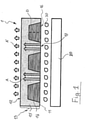
- Fig. 1 it is schematically shown a section of a preferred embodiment of the fabric of the invention. Specifically, a fabric 1, having a first side 11, a second side 12 and a body 13, is shown.
- hydrophilic agent 15 extends from the first side 11 to the second side 12 of the fabric 1 and throughout the body 13 of the fabric 1.
- Hydrophobic agent 14 is provided on the fabric 1, thus providing hydrophobic areas 16. Hydrophobic areas 16 extend from the first side 11 into the body 13 of the fabric 1 for a depth D (dashed line) of the thickness of body 13. In the embodiment of Fig. 1 , all the hydrophobic areas 16 extend into the body 13 of the fabric 1 for the same depth D of the thickness of body 13.
- Fig. 1 is illustrated an embodiment of the fabric 1 according to the invention, wherein the hydrophilic agent 15 extends from the first side 11 to the second side 12 of the fabric 1 and throughout the body 13 of the fabric 1; in other words, fabric 1 is impregnated with the hydrophilic agent 15.
- the hydrophilic agent 15 may be provided only on some regions of the first side 11 of the fabric 1.
- the hydrophilic agent 15, can therefore be provided on some regions of the first side 11 of the fabric 1 and can extend from the first side 11 throughout the body 13 without reaching the second side 12 of the fabric 1.
- Fig. 1 shows that first side 11 of fabric 1, is provided with a pattern of hydrophobic areas 16. Between the hydrophobic areas 16, a pattern of areas provided with the hydrophilic agent 15, i.e. a pattern of hydrophilic areas 17, is shown.
- the fabric 1 is shown to be closer to the user's skin 20; however, the fabric 1 can directly contact the skin of the user.
- the moisture 30 (herein shown as “droplets"), which forms between the skin 20 and the first side 11 of the fabric 1, is absorbed into the body 13 of the fabric 1 at the level of the hydrophilic areas 17 of the first side 11, i.e. the areas that are provided with the hydrophilic agent 15. Hydrophobic areas 16 repel the moisture 30, which therefore concentrates in correspondence of the areas of the first side 11 that are provided with the hydrophilic agent 15.
- the moisture 30 is absorbed into the body 13 of the fabric 1, and is transported through the body 13 of the fabric 1 by means of hydrophilic pathways, defined by the hydrophilic agent 15.
- hydrophobic areas 16 extend from said first side 11 into said body 13 of the fabric 1 for a depth D.
- Depth D can range from 5% to 95%, preferably 20% to 80%, more preferably 20% to 70%, even more preferably 30% to 60%. A most preferred value is about 50% of said body's 13 thickness.
- Depth D of the hydrophobic areas 16 can be designed according to the moisture management features desired.
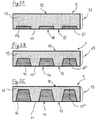
- Fig.s 2A, 2B and 2C show three embodiments of the fabric 1 of the present invention.
- hydrophilic agent 15 extends from the first side 11 to the second side 12 of the fabric 1 and throughout the body 13 of the fabric 1.
- Hydrophobic agent 14 is provided on the fabric 1, thus providing hydrophobic areas 16.
- a pattern of hydrophilic areas 17 is present between the hydrophobic areas 16.
- the provided hydrophobic areas 16 can extend from the first side 11 into the body 13 of the fabric 1 for depth D', D" and D'" (dashed lines) of the body's 13 thickness, different for each embodiment of the fabric 1.
- depth D' is about 20% of the body's 13 thickness; in Fig. 2B , depth D" is about 50% of the body's 13 thickness, and in Fig. 2C , depth D'" is about 80% of the body's 13 thickness.
- all the hydrophobic areas 16 have, in each embodiment, the same depth D' or D" or D′′′.
- the hydrophobic areas may have several different shapes, and/or dimensions and/or distribution in the fabric.
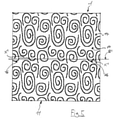
- the hydrophobic areas 16 of the hydrophobic pattern have a spiral shape; namely, the first side 11 presents hydrophobic areas 16 having a spiral shape, as shown in figures 4A-4B .
- hydrophilic areas/hydrophobic areas ratio can be designed according to the moisture management features desired.
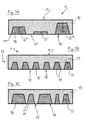
- Fig.s 3A, 3B and 3C show three other embodiments of the fabric 1 of the invention.
- hydrophilic agent 15 extends from the first side 11 to the second side 12 of the fabric 1 and throughout the body 13 of the fabric 1. Hydrophobic agent 14 is provided on the fabric 1, thus providing hydrophobic areas 16. A pattern of hydrophilic areas 17 is present between the hydrophobic areas 16.
- Fig. 3A shows that different hydrophobic areas 16 can extend from the first side 11, into the body 13 of the fabric 1 for a different depth D', D" or D'" (dashed lines) of the thickness of body 13, in the same fabric 1.
- Fig. 3B is shown an embodiment of fabric 1, wherein all the hydrophobic areas 16 in the fabric 1 extend from the first side 11, into the body 13 of the fabric 1, for the same depth D (dashed line) of the body's 13 thickness.
- Fig. 3B shows a fabric 1 wherein hydrophobic areas 16 are smaller and more numerous in comparison with the fabric 1 of, for example Fig.s 2A-2C and 3A and 3C .
- hydrophobic areas 16 can have different dimension, according to the moisture management features required.
- Fig. 3C is shown a fabric 1 in which all the hydrophobic areas 16 in the fabric 1 extend from the first side 11, into the body 13 of the fabric 1, for the same depth D (dashed line).
- Fig. 3C shows a fabric 1, where the hydrophobic areas 16 have a not homogeneous distribution in the fabric 1, and have also different dimensions.
- the fabric of the invention can be provided, for example, on its first side, with an "irregular" distribution and concentration of hydrophilic and hydrophobic areas.
- the hydrophobic areas having spiral shape may be distributed on the fabric (e.g. on the first side of the fabric) in order to provide a fabric wherein adjacent hydrophobic areas and/or adjacent hydrophilic areas have not the same dimensions.
- the fabric can be provided with regions wherein a majority of hydrophobic areas is present, and with other regions wherein a majority of hydrophilic areas is present.
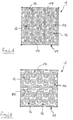
- Figures 4A, 4B and 5 show embodiments of the fabric having hydrophobic areas comprising lines having a spiral shape.
- Fig.s 4A, 4B and 5 shows two embodiments of the fabric 1, wherein a pattern of hydrophobic areas 16 having a spiral shape have been provided.
- hydrophobic areas 16 are applied on the first side 11 of the fabric 1.
- Figures 4A, 4B and 5 show that hydrophobic areas 16, which have a spiral shape, may have different structures and different dimensions (i.e. extension) in the same fabric 1.
- 4A shows an embodiment wherein the hydrophobic area/total fabric area ratio is higher than in Fig. 4B .
- Fig. 4A, 4B and 5 shows an embodiment wherein the first side 11 of the fabric 1 has been provided with a hydrophilic agent 15 to provide hydrophilic areas 17: in other words, in Fig. 4A, 4B and 5 , between and around hydrophobic areas 16, and between the lines (i.e. the "coils") of the hydrophobic spirals, hydrophilic areas 17 are provided.
- the hydrophobic areas 16 having spiral shape may be provided to the fabric so that areas of the fabric having the same extension have different hydrophilic/total area ratio.
- Fig. 5 an axis W', which cuts the fabric of the invention along the weft direction is shown.
- Fig. 5 shows that an axis which cuts the fabric of the invention along the weft direction (or, according to different embodiments, along the warp direction), cuts a plurality of hydrophobic areas 16 that are separated by a plurality of different distance X'; X" between a hydrophobic area and the adjacent one which is cut by the same axis W.
- Fig. 5 shows that axis W cuts two hydrophobic areas 16 that are separated by a first distance X', and also cuts two other hydrophobic areas 16 separated by a second distance X", which is smaller than first distance X'.
- Suitable methods for applying the agents to the fabric are, for example, impregnating the agent into the fabric, for the hydrophilic agent, and screen printing, for the hydrophobic agent.
- the agents are preferably applied to the fabric after its removal from the loom and before the fabric undergoes a washing; in other words, the pattern of the two agents is applied to a fabric before it is shrunk.
- the hydrophobic spiral pattern could be applied on a fabric free from hydrophilic agents.
- the above discussed spiral pattern could include open curved lines that do not follow a spiral shape, provided the same effect of maintaining capillarity when the garment is stretched is obtained.
- the invention also provides a garment comprising a fabric as above disclosed; a garment comprising the fabric of the invention is provided with the moisture management features of the fabric.
- the fabric of the invention in a garment, is confined to specifically selected parts of the garment; the rest of the garment can be therefore made of any other suitable material.
- the fabric of the invention can be provided with different moisture management features and efficiency, which can be modulated by adjusting some parameters, such as, for example, the geometry, shape, dimension, distribution and depth of, for example, the pattern of hydrophobic areas.
- a garment can be made of a "patchwork" of different embodiments of the fabric of the invention, thus providing to different parts of the garment, different moisture management feature.
- a garment according to the invention can be made of a fabric according to a single embodiment, i.e., the fabric has the same moisture management features over the all garment.
Landscapes
- Engineering & Computer Science (AREA)
- Textile Engineering (AREA)
- Woven Fabrics (AREA)
- Treatments For Attaching Organic Compounds To Fibrous Goods (AREA)
- Professional, Industrial, Or Sporting Protective Garments (AREA)
Claims (17)
- Tissu (1), ayant un premier côté (11), un second côté (12), un corps (13) s'étendant dudit premier côté (11) audit second côté (12) ; au moins un agent hydrophobe (14), prévu au moins sur ledit premier côté (11) dudit tissu (1) comme un motif de zones hydrophobes (16),
dans lequel ledit tissu (1) comprend :
au moins un agent hydrophile (15) qui est fourni sur au moins certaines régions dudit premier côté (11) du tissu (1), de sorte que ledit premier côté (11) a un motif de zones hydrophobes (16) et un motif de zones hydrophiles (17), pour transférer l'humidité (30) dudit premier côté (11) audit second côté (12), dans lequel ledit motif de zones hydrophobes (16) comprend des zones hydrophobes (16) ayant une forme de spirale. - Tissu (1) selon la revendication 1, dans lequel lesdites zones hydrophobes (16) comprennent un agent hydrophobe (14) et un agent hydrophile (15).
- Tissu (1) selon la revendication 2, dans lequel lesdites zones hydrophobes (16) comprennent un film sur le premier côté (11) du tissu (1).
- Tissu (1) selon l'une des revendications 1 à 3, dans lequel la distance minimale entre deux zones hydrophobes adjacentes est comprise entre 0,3 et 0,4 mm, et/ou dans lequel la distance maximale entre deux zones hydrophobes adjacentes est comprise entre 1,6 et 2,1 mm.
- Tissu (1) selon l'une quelconque des revendications précédentes, dans lequel ledit agent hydrophile (15) et/ou ledit agent hydrophobe (14) est thermofixé au tissu (1) et/ou réticulé.
- Tissu (1) selon l'une quelconque des revendications précédentes, dans lequel ledit tissu (1) est un tissu élastique qui peut être étiré à 50% de sa longueur initiale, de préférence, jusqu'à 75% de sa longueur initiale, plus préférablement jusqu'à 100% de sa longueur initiale, de préférence à la fois dans la direction de trame et de chaîne.
- Tissu (1) selon l'une quelconque des revendications précédentes, dans lequel ledit agent hydrophile (15) s'étend à travers le corps (13) du tissu (1) et dans lequel des zones hydrophobes (16) s'étendent depuis ledit premier côté (11) dans ledit corps (13) du tissu (1) pour une profondeur (D) allant de 5% à 95%, de préférence de 20% à 80%, plus préférablement de 20% à 70%, encore plus préférablement de 30% à 60%, encore plus préférablement de 30-50% de l'épaisseur dudit corps (13).
- Tissu (1) selon l'une quelconque des revendications précédentes, dans lequel lesdites zones hydrophobes (16) s'étendent à travers ledit corps (13) dudit tissu (1) pour différentes profondeurs (D).
- Tissu (1) selon l'une quelconque des revendications précédentes, dans lequel ledit tissu (1) est un tissu denim.
- Tissu (1) selon toute revendication précédente, dans lequel ledit motif de zones hydrophobes (16) a une distribution irrégulière, et/ou dans lequel ledit motif de zones hydrophobes (16) comprend des zones hydrophobes (16) ayant les mêmes formes et/ou la même dimension.
- Procédé pour la production d'un tissu (1) comprenant les étapes suivantes consistant à :a. fournir un tissu (1) comprenant un premier côté (11), un second côté (12), et un corps (13) s'étendant dudit premier côté (11) audit second côté (12),b. fournir au moins un agent hydrophile (15) sur au moins certaines régions dudit premier côté (11) du tissu (1), etc. fournir au moins un agent hydrophobe (14) au moins sur ledit premier côté (11) dudit tissu (1) comme un motif de zones hydrophobes (16), de sorte que ledit premier côté (11) a un motif de zones hydrophobes (16) et un motif de zones hydrophiles (17), pour transférer l'humidité (30) dudit premier côté (11) audit second côté (12), dans lequel ledit motif de zones hydrophobes (16) comprend des zones hydrophobes (16) ayant une forme de spirale.
- Procédé selon la revendication 11, dans lequel ledit agent hydrophile (15) et ledit agent hydrophobe (14) sont appliqués sur une même zone dudit premier côté (11) pour fournir des zones hydrophobes (16).
- Procédé selon la revendication 12, dans lequel ledit motif de zones hydrophobes est appliqué sur ledit tissu avant que le tissu ne soit rétréci par lavage.
- Procédé selon l'une quelconque des revendications 12 à 13, dans lequel ledit agent hydrophile (15) s'étend à travers le corps (13) du tissu (1) et dans lequel les zones hydrophobes (16) s'étendent à partir dudit premier côté (11) dans ledit corps (13) du tissu (1) pour une profondeur (D) allant de 5% à 95%, de préférence de 20% à 80%, plus préférablement de 20% à 70%, encore plus préférablement de 30% à 60%, encore plus préférablement de 30-50% de l'épaisseur dudit corps (13).
- Procédé selon l'une quelconque des revendications 12 à 14, dans lequel lesdites zones hydrophobes sont appliquées sur ledit tissu selon des lignes spiralées et courbes.
- Vêtement comprenant un tissu (1) selon l'une quelconque des revendications 1 à 10, dans lequel ledit tissu est de préférence un tissu denim.
- Vêtement selon la revendication 16, dans lequel ledit motif de zones hydrophobes (16) comprend des zones hydrophobes (16) ayant des formes différentes et/ou des dimensions différentes dans différentes zones du vêtement.
Priority Applications (1)
| Application Number | Priority Date | Filing Date | Title |
|---|---|---|---|
| PL16751200T PL3325708T3 (pl) | 2015-07-21 | 2016-07-21 | Tkanina mająca cechy regulacji wilgoci |
Applications Claiming Priority (2)
| Application Number | Priority Date | Filing Date | Title |
|---|---|---|---|
| EP15177759 | 2015-07-21 | ||
| PCT/EP2016/067470 WO2017013232A1 (fr) | 2015-07-21 | 2016-07-21 | Tissu présentant des caractéristiques de gestion d'humidité |
Publications (2)
| Publication Number | Publication Date |
|---|---|
| EP3325708A1 EP3325708A1 (fr) | 2018-05-30 |
| EP3325708B1 true EP3325708B1 (fr) | 2022-03-16 |
Family
ID=53783574
Family Applications (1)
| Application Number | Title | Priority Date | Filing Date |
|---|---|---|---|
| EP16751200.3A Active EP3325708B1 (fr) | 2015-07-21 | 2016-07-21 | Tissu présentant des caractéristiques de gestion de l'humidité |
Country Status (10)
| Country | Link |
|---|---|
| US (1) | US11008699B2 (fr) |
| EP (1) | EP3325708B1 (fr) |
| JP (1) | JP6761460B2 (fr) |
| CN (2) | CN117904881A (fr) |
| BR (1) | BR112018000480B1 (fr) |
| DK (1) | DK3325708T3 (fr) |
| ES (1) | ES2915387T3 (fr) |
| PL (1) | PL3325708T3 (fr) |
| PT (1) | PT3325708T (fr) |
| WO (1) | WO2017013232A1 (fr) |
Families Citing this family (8)
| Publication number | Priority date | Publication date | Assignee | Title |
|---|---|---|---|---|
| CA3078784A1 (fr) | 2017-11-01 | 2019-05-09 | Dryco, Inc. | Tissus a regulation amelioree de l'humidite |
| CN108130732B (zh) * | 2017-12-22 | 2020-09-08 | 福建恒安家庭生活用品有限公司 | 双亲非织造布及其制备方法 |
| CN111350080A (zh) * | 2018-12-24 | 2020-06-30 | 财团法人纺织产业综合研究所 | 布料 |
| TWI791720B (zh) * | 2018-12-24 | 2023-02-11 | 財團法人紡織產業綜合研究所 | 布料 |
| CN109927372B (zh) * | 2019-03-11 | 2024-05-31 | 青岛新维纺织研究院有限公司 | 一种速干功能织物 |
| US20220162797A1 (en) * | 2020-11-23 | 2022-05-26 | Taiwan Textile Research Institute | Moisture-sensed deforming fabric and moisture-proof and heat-insulating fabric |
| CN112704278A (zh) * | 2020-12-23 | 2021-04-27 | 厦门安踏体育用品有限公司 | 一种具有汗水管理功能的吸湿速干服装及其制备方法 |
| US12396900B2 (en) | 2021-04-05 | 2025-08-26 | Standard Textile Co., Inc. | Reusable pad |
Family Cites Families (13)
| Publication number | Priority date | Publication date | Assignee | Title |
|---|---|---|---|---|
| JP3793611B2 (ja) * | 1996-11-11 | 2006-07-05 | 大日本印刷株式会社 | 部分親水性シートの製造方法 |
| EP1116813A1 (fr) | 2000-01-10 | 2001-07-18 | Dow Corning Corporation | Adoussicant hydrophilie pour des textiles comprenant des polymères de epoxy glycol siloxane et des matériaux avec des fonctions amines |
| AU2001294888A1 (en) * | 2000-09-29 | 2002-04-08 | Cotton Incorporated | Cellulosic substrates with reduced absorbent capacity having the capability to wick liquids |
| US20030186610A1 (en) * | 2002-04-02 | 2003-10-02 | Tim Peters | Elastic hydrophobic/hydrophilic composite yarns and moisture management elastic fabrics made therefrom |
| US20050101209A1 (en) * | 2003-11-07 | 2005-05-12 | The Hong Kong Polytechnic University | Woven fabric with moisture management properties |
| WO2007059590A1 (fr) | 2005-11-25 | 2007-05-31 | Commonwealth Scientific And Industrial Research Organisation | Tissu a effet meche et procede de fabrication correspondant |
| JP2007162150A (ja) * | 2005-12-09 | 2007-06-28 | Teijin Fibers Ltd | ぬれ感の少ない織編物およびその製造方法および繊維製品 |
| US10202711B2 (en) * | 2007-05-09 | 2019-02-12 | Massachusetts Institute Of Technology | Tunable surface |
| CN101649558A (zh) * | 2009-07-09 | 2010-02-17 | 内蒙古鄂尔多斯羊绒集团有限责任公司 | 单向导湿羊绒及羊绒混纺机织或针织制品及其加工方法 |
| CN104695235A (zh) * | 2010-09-20 | 2015-06-10 | 江苏箭鹿毛纺股份有限公司 | 具有单向导湿功能的毛织物 |
| KR101224054B1 (ko) * | 2010-09-30 | 2013-01-22 | 엘지전자 주식회사 | 의류처리장치 및 의류처리장치의 운전방법 |
| JP6373548B2 (ja) * | 2011-12-27 | 2018-08-15 | 東レ株式会社 | 部分吸水編物および衣料 |
| CA2930568A1 (fr) * | 2013-12-10 | 2015-06-18 | Optimer Performance Fibers, Inc. | Melanges de fibres presentant des proprietes ameliorees de gestion de l'humidite |
-
2016
- 2016-07-21 BR BR112018000480-4A patent/BR112018000480B1/pt active IP Right Grant
- 2016-07-21 US US15/735,344 patent/US11008699B2/en active Active
- 2016-07-21 PT PT167512003T patent/PT3325708T/pt unknown
- 2016-07-21 CN CN202410094064.6A patent/CN117904881A/zh active Pending
- 2016-07-21 ES ES16751200T patent/ES2915387T3/es active Active
- 2016-07-21 JP JP2018502797A patent/JP6761460B2/ja active Active
- 2016-07-21 CN CN201680042182.6A patent/CN107923121A/zh active Pending
- 2016-07-21 EP EP16751200.3A patent/EP3325708B1/fr active Active
- 2016-07-21 WO PCT/EP2016/067470 patent/WO2017013232A1/fr not_active Ceased
- 2016-07-21 PL PL16751200T patent/PL3325708T3/pl unknown
- 2016-07-21 DK DK16751200.3T patent/DK3325708T3/da active
Non-Patent Citations (1)
| Title |
|---|
| None * |
Also Published As
| Publication number | Publication date |
|---|---|
| JP2018520276A (ja) | 2018-07-26 |
| ES2915387T3 (es) | 2022-06-22 |
| WO2017013232A1 (fr) | 2017-01-26 |
| DK3325708T3 (da) | 2022-05-30 |
| EP3325708A1 (fr) | 2018-05-30 |
| BR112018000480B1 (pt) | 2022-06-28 |
| PT3325708T (pt) | 2022-06-15 |
| CN117904881A (zh) | 2024-04-19 |
| US11008699B2 (en) | 2021-05-18 |
| BR112018000480A2 (pt) | 2018-09-18 |
| PL3325708T3 (pl) | 2022-07-11 |
| JP6761460B2 (ja) | 2020-09-23 |
| US20180179701A1 (en) | 2018-06-28 |
| CN107923121A (zh) | 2018-04-17 |
Similar Documents
| Publication | Publication Date | Title |
|---|---|---|
| EP3325708B1 (fr) | Tissu présentant des caractéristiques de gestion de l'humidité | |
| US10721976B2 (en) | Apparel including interconnected wicking structure | |
| US10640915B2 (en) | Moisture control fabrics | |
| KR101908434B1 (ko) | 이중 직조 구조의 흡습속건성 원단 | |
| CN110337247B (zh) | 衣服用布料及使用了该布料的衣服 | |
| KR101322602B1 (ko) | 흡수와 발수의 상반된 성질을 이용한 흡한속건성 원단 및 그 제조방법 | |
| CN109183241A (zh) | 一种表面具有凹凸形态的导湿快干织物 | |
| AU2012275136B2 (en) | Perspiration control glove | |
| WO2023158371A1 (fr) | Matériau composite, procédé de fabrication de celui-ci et vêtement comprenant le matériau composite | |
| CN113557328B (zh) | 用于潜水衣的织物和使用所述织物的潜水衣 | |
| US20110281088A1 (en) | Moisture absorptive and perspiratory cloth structure | |
| HK1253868B (en) | Fabric having moisture management features | |
| WO2019165556A1 (fr) | Textile à refroidissement par évaporation | |
| WO2007059590A1 (fr) | Tissu a effet meche et procede de fabrication correspondant | |
| HK40108698A (zh) | 具有水份管理特徵的织物 | |
| CN103205834B (zh) | 单向性吸湿排汗布料的结构及其制造方法 | |
| KR100504674B1 (ko) | 온도조절 기능을 갖는 인공지능 흡수속건성 원단 | |
| TWI539049B (zh) | 具單向性之吸濕排汗布料之結構及製造方法 | |
| US20210015190A1 (en) | Garment having at least one breathable region | |
| JP6560892B2 (ja) | 衣類用布帛 | |
| KR0145192B1 (ko) | 복합 재료 및 그의 제조 방법 | |
| HK40025019A (en) | Wetness indicator garment | |
| TW201338983A (zh) | 肌膚乾爽排汗紡織品及其製法 |
Legal Events
| Date | Code | Title | Description |
|---|---|---|---|
| STAA | Information on the status of an ep patent application or granted ep patent |
Free format text: STATUS: THE INTERNATIONAL PUBLICATION HAS BEEN MADE |
|
| PUAI | Public reference made under article 153(3) epc to a published international application that has entered the european phase |
Free format text: ORIGINAL CODE: 0009012 |
|
| STAA | Information on the status of an ep patent application or granted ep patent |
Free format text: STATUS: REQUEST FOR EXAMINATION WAS MADE |
|
| 17P | Request for examination filed |
Effective date: 20180220 |
|
| AK | Designated contracting states |
Kind code of ref document: A1 Designated state(s): AL AT BE BG CH CY CZ DE DK EE ES FI FR GB GR HR HU IE IS IT LI LT LU LV MC MK MT NL NO PL PT RO RS SE SI SK SM TR |
|
| AX | Request for extension of the european patent |
Extension state: BA ME |
|
| DAV | Request for validation of the european patent (deleted) | ||
| DAX | Request for extension of the european patent (deleted) | ||
| REG | Reference to a national code |
Ref country code: HK Ref legal event code: DE Ref document number: 1253868 Country of ref document: HK |
|
| STAA | Information on the status of an ep patent application or granted ep patent |
Free format text: STATUS: EXAMINATION IS IN PROGRESS |
|
| 17Q | First examination report despatched |
Effective date: 20201028 |
|
| GRAP | Despatch of communication of intention to grant a patent |
Free format text: ORIGINAL CODE: EPIDOSNIGR1 |
|
| STAA | Information on the status of an ep patent application or granted ep patent |
Free format text: STATUS: GRANT OF PATENT IS INTENDED |
|
| INTG | Intention to grant announced |
Effective date: 20210506 |
|
| GRAJ | Information related to disapproval of communication of intention to grant by the applicant or resumption of examination proceedings by the epo deleted |
Free format text: ORIGINAL CODE: EPIDOSDIGR1 |
|
| STAA | Information on the status of an ep patent application or granted ep patent |
Free format text: STATUS: EXAMINATION IS IN PROGRESS |
|
| INTC | Intention to grant announced (deleted) | ||
| GRAP | Despatch of communication of intention to grant a patent |
Free format text: ORIGINAL CODE: EPIDOSNIGR1 |
|
| STAA | Information on the status of an ep patent application or granted ep patent |
Free format text: STATUS: GRANT OF PATENT IS INTENDED |
|
| INTG | Intention to grant announced |
Effective date: 20211129 |
|
| GRAS | Grant fee paid |
Free format text: ORIGINAL CODE: EPIDOSNIGR3 |
|
| GRAA | (expected) grant |
Free format text: ORIGINAL CODE: 0009210 |
|
| STAA | Information on the status of an ep patent application or granted ep patent |
Free format text: STATUS: THE PATENT HAS BEEN GRANTED |
|
| AK | Designated contracting states |
Kind code of ref document: B1 Designated state(s): AL AT BE BG CH CY CZ DE DK EE ES FI FR GB GR HR HU IE IS IT LI LT LU LV MC MK MT NL NO PL PT RO RS SE SI SK SM TR |
|
| REG | Reference to a national code |
Ref country code: GB Ref legal event code: FG4D |
|
| REG | Reference to a national code |
Ref country code: CH Ref legal event code: EP |
|
| REG | Reference to a national code |
Ref country code: DE Ref legal event code: R096 Ref document number: 602016070067 Country of ref document: DE |
|
| REG | Reference to a national code |
Ref country code: IE Ref legal event code: FG4D |
|
| REG | Reference to a national code |
Ref country code: AT Ref legal event code: REF Ref document number: 1475955 Country of ref document: AT Kind code of ref document: T Effective date: 20220415 |
|
| REG | Reference to a national code |
Ref country code: DK Ref legal event code: T3 Effective date: 20220523 |
|
| REG | Reference to a national code |
Ref country code: SE Ref legal event code: TRGR |
|
| REG | Reference to a national code |
Ref country code: PT Ref legal event code: SC4A Ref document number: 3325708 Country of ref document: PT Date of ref document: 20220615 Kind code of ref document: T Free format text: AVAILABILITY OF NATIONAL TRANSLATION Effective date: 20220607 Ref country code: NL Ref legal event code: FP |
|
| REG | Reference to a national code |
Ref country code: ES Ref legal event code: FG2A Ref document number: 2915387 Country of ref document: ES Kind code of ref document: T3 Effective date: 20220622 |
|
| REG | Reference to a national code |
Ref country code: NO Ref legal event code: T2 Effective date: 20220316 |
|
| REG | Reference to a national code |
Ref country code: LT Ref legal event code: MG9D |
|
| PG25 | Lapsed in a contracting state [announced via postgrant information from national office to epo] |
Ref country code: RS Free format text: LAPSE BECAUSE OF FAILURE TO SUBMIT A TRANSLATION OF THE DESCRIPTION OR TO PAY THE FEE WITHIN THE PRESCRIBED TIME-LIMIT Effective date: 20220316 Ref country code: LT Free format text: LAPSE BECAUSE OF FAILURE TO SUBMIT A TRANSLATION OF THE DESCRIPTION OR TO PAY THE FEE WITHIN THE PRESCRIBED TIME-LIMIT Effective date: 20220316 Ref country code: HR Free format text: LAPSE BECAUSE OF FAILURE TO SUBMIT A TRANSLATION OF THE DESCRIPTION OR TO PAY THE FEE WITHIN THE PRESCRIBED TIME-LIMIT Effective date: 20220316 Ref country code: BG Free format text: LAPSE BECAUSE OF FAILURE TO SUBMIT A TRANSLATION OF THE DESCRIPTION OR TO PAY THE FEE WITHIN THE PRESCRIBED TIME-LIMIT Effective date: 20220616 |
|
| REG | Reference to a national code |
Ref country code: AT Ref legal event code: MK05 Ref document number: 1475955 Country of ref document: AT Kind code of ref document: T Effective date: 20220316 |
|
| PG25 | Lapsed in a contracting state [announced via postgrant information from national office to epo] |
Ref country code: LV Free format text: LAPSE BECAUSE OF FAILURE TO SUBMIT A TRANSLATION OF THE DESCRIPTION OR TO PAY THE FEE WITHIN THE PRESCRIBED TIME-LIMIT Effective date: 20220316 Ref country code: GR Free format text: LAPSE BECAUSE OF FAILURE TO SUBMIT A TRANSLATION OF THE DESCRIPTION OR TO PAY THE FEE WITHIN THE PRESCRIBED TIME-LIMIT Effective date: 20220617 Ref country code: FI Free format text: LAPSE BECAUSE OF FAILURE TO SUBMIT A TRANSLATION OF THE DESCRIPTION OR TO PAY THE FEE WITHIN THE PRESCRIBED TIME-LIMIT Effective date: 20220316 |
|
| PG25 | Lapsed in a contracting state [announced via postgrant information from national office to epo] |
Ref country code: SM Free format text: LAPSE BECAUSE OF FAILURE TO SUBMIT A TRANSLATION OF THE DESCRIPTION OR TO PAY THE FEE WITHIN THE PRESCRIBED TIME-LIMIT Effective date: 20220316 Ref country code: SK Free format text: LAPSE BECAUSE OF FAILURE TO SUBMIT A TRANSLATION OF THE DESCRIPTION OR TO PAY THE FEE WITHIN THE PRESCRIBED TIME-LIMIT Effective date: 20220316 Ref country code: RO Free format text: LAPSE BECAUSE OF FAILURE TO SUBMIT A TRANSLATION OF THE DESCRIPTION OR TO PAY THE FEE WITHIN THE PRESCRIBED TIME-LIMIT Effective date: 20220316 Ref country code: EE Free format text: LAPSE BECAUSE OF FAILURE TO SUBMIT A TRANSLATION OF THE DESCRIPTION OR TO PAY THE FEE WITHIN THE PRESCRIBED TIME-LIMIT Effective date: 20220316 Ref country code: CZ Free format text: LAPSE BECAUSE OF FAILURE TO SUBMIT A TRANSLATION OF THE DESCRIPTION OR TO PAY THE FEE WITHIN THE PRESCRIBED TIME-LIMIT Effective date: 20220316 Ref country code: AT Free format text: LAPSE BECAUSE OF FAILURE TO SUBMIT A TRANSLATION OF THE DESCRIPTION OR TO PAY THE FEE WITHIN THE PRESCRIBED TIME-LIMIT Effective date: 20220316 |
|
| PG25 | Lapsed in a contracting state [announced via postgrant information from national office to epo] |
Ref country code: IS Free format text: LAPSE BECAUSE OF FAILURE TO SUBMIT A TRANSLATION OF THE DESCRIPTION OR TO PAY THE FEE WITHIN THE PRESCRIBED TIME-LIMIT Effective date: 20220716 Ref country code: AL Free format text: LAPSE BECAUSE OF FAILURE TO SUBMIT A TRANSLATION OF THE DESCRIPTION OR TO PAY THE FEE WITHIN THE PRESCRIBED TIME-LIMIT Effective date: 20220316 |
|
| REG | Reference to a national code |
Ref country code: DE Ref legal event code: R097 Ref document number: 602016070067 Country of ref document: DE |
|
| PLBE | No opposition filed within time limit |
Free format text: ORIGINAL CODE: 0009261 |
|
| STAA | Information on the status of an ep patent application or granted ep patent |
Free format text: STATUS: NO OPPOSITION FILED WITHIN TIME LIMIT |
|
| 26N | No opposition filed |
Effective date: 20221219 |
|
| PG25 | Lapsed in a contracting state [announced via postgrant information from national office to epo] |
Ref country code: SI Free format text: LAPSE BECAUSE OF FAILURE TO SUBMIT A TRANSLATION OF THE DESCRIPTION OR TO PAY THE FEE WITHIN THE PRESCRIBED TIME-LIMIT Effective date: 20220316 Ref country code: MC Free format text: LAPSE BECAUSE OF FAILURE TO SUBMIT A TRANSLATION OF THE DESCRIPTION OR TO PAY THE FEE WITHIN THE PRESCRIBED TIME-LIMIT Effective date: 20220316 |
|
| REG | Reference to a national code |
Ref country code: CH Ref legal event code: PL |
|
| REG | Reference to a national code |
Ref country code: BE Ref legal event code: MM Effective date: 20220731 |
|
| PG25 | Lapsed in a contracting state [announced via postgrant information from national office to epo] |
Ref country code: LU Free format text: LAPSE BECAUSE OF NON-PAYMENT OF DUE FEES Effective date: 20220721 Ref country code: LI Free format text: LAPSE BECAUSE OF NON-PAYMENT OF DUE FEES Effective date: 20220731 Ref country code: CH Free format text: LAPSE BECAUSE OF NON-PAYMENT OF DUE FEES Effective date: 20220731 |
|
| PG25 | Lapsed in a contracting state [announced via postgrant information from national office to epo] |
Ref country code: BE Free format text: LAPSE BECAUSE OF NON-PAYMENT OF DUE FEES Effective date: 20220731 |
|
| P01 | Opt-out of the competence of the unified patent court (upc) registered |
Effective date: 20230419 |
|
| PG25 | Lapsed in a contracting state [announced via postgrant information from national office to epo] |
Ref country code: IE Free format text: LAPSE BECAUSE OF NON-PAYMENT OF DUE FEES Effective date: 20220721 |
|
| PG25 | Lapsed in a contracting state [announced via postgrant information from national office to epo] |
Ref country code: HU Free format text: LAPSE BECAUSE OF FAILURE TO SUBMIT A TRANSLATION OF THE DESCRIPTION OR TO PAY THE FEE WITHIN THE PRESCRIBED TIME-LIMIT; INVALID AB INITIO Effective date: 20160721 |
|
| PG25 | Lapsed in a contracting state [announced via postgrant information from national office to epo] |
Ref country code: MK Free format text: LAPSE BECAUSE OF FAILURE TO SUBMIT A TRANSLATION OF THE DESCRIPTION OR TO PAY THE FEE WITHIN THE PRESCRIBED TIME-LIMIT Effective date: 20220316 Ref country code: CY Free format text: LAPSE BECAUSE OF FAILURE TO SUBMIT A TRANSLATION OF THE DESCRIPTION OR TO PAY THE FEE WITHIN THE PRESCRIBED TIME-LIMIT Effective date: 20220316 |
|
| PG25 | Lapsed in a contracting state [announced via postgrant information from national office to epo] |
Ref country code: MT Free format text: LAPSE BECAUSE OF FAILURE TO SUBMIT A TRANSLATION OF THE DESCRIPTION OR TO PAY THE FEE WITHIN THE PRESCRIBED TIME-LIMIT Effective date: 20220316 |
|
| PGFP | Annual fee paid to national office [announced via postgrant information from national office to epo] |
Ref country code: NL Payment date: 20250726 Year of fee payment: 10 |
|
| PGFP | Annual fee paid to national office [announced via postgrant information from national office to epo] |
Ref country code: ES Payment date: 20250801 Year of fee payment: 10 Ref country code: PT Payment date: 20250702 Year of fee payment: 10 |
|
| PGFP | Annual fee paid to national office [announced via postgrant information from national office to epo] |
Ref country code: DK Payment date: 20250725 Year of fee payment: 10 Ref country code: DE Payment date: 20250714 Year of fee payment: 10 |
|
| PGFP | Annual fee paid to national office [announced via postgrant information from national office to epo] |
Ref country code: NO Payment date: 20250729 Year of fee payment: 10 |
|
| PGFP | Annual fee paid to national office [announced via postgrant information from national office to epo] |
Ref country code: TR Payment date: 20250711 Year of fee payment: 10 Ref country code: PL Payment date: 20250703 Year of fee payment: 10 Ref country code: IT Payment date: 20250709 Year of fee payment: 10 |
|
| PGFP | Annual fee paid to national office [announced via postgrant information from national office to epo] |
Ref country code: GB Payment date: 20250704 Year of fee payment: 10 |
|
| PGFP | Annual fee paid to national office [announced via postgrant information from national office to epo] |
Ref country code: FR Payment date: 20250725 Year of fee payment: 10 |
|
| PGFP | Annual fee paid to national office [announced via postgrant information from national office to epo] |
Ref country code: SE Payment date: 20250727 Year of fee payment: 10 |