EP3326419B1 - Procédé et entité de transmission dans un système de communication - Google Patents
Procédé et entité de transmission dans un système de communication Download PDFInfo
- Publication number
- EP3326419B1 EP3326419B1 EP15899038.2A EP15899038A EP3326419B1 EP 3326419 B1 EP3326419 B1 EP 3326419B1 EP 15899038 A EP15899038 A EP 15899038A EP 3326419 B1 EP3326419 B1 EP 3326419B1
- Authority
- EP
- European Patent Office
- Prior art keywords
- transmission
- type
- entity
- establishing
- channel assessment
- Prior art date
- Legal status (The legal status is an assumption and is not a legal conclusion. Google has not performed a legal analysis and makes no representation as to the accuracy of the status listed.)
- Active
Links
Images



Classifications
-
- H—ELECTRICITY
- H04—ELECTRIC COMMUNICATION TECHNIQUE
- H04W—WIRELESS COMMUNICATION NETWORKS
- H04W74/00—Wireless channel access
- H04W74/08—Non-scheduled access, e.g. ALOHA
- H04W74/0808—Non-scheduled access, e.g. ALOHA using carrier sensing, e.g. carrier sense multiple access [CSMA]
- H04W74/0816—Non-scheduled access, e.g. ALOHA using carrier sensing, e.g. carrier sense multiple access [CSMA] with collision avoidance
-
- H—ELECTRICITY
- H04—ELECTRIC COMMUNICATION TECHNIQUE
- H04W—WIRELESS COMMUNICATION NETWORKS
- H04W74/00—Wireless channel access
- H04W74/08—Non-scheduled access, e.g. ALOHA
- H04W74/0808—Non-scheduled access, e.g. ALOHA using carrier sensing, e.g. carrier sense multiple access [CSMA]
-
- H—ELECTRICITY
- H04—ELECTRIC COMMUNICATION TECHNIQUE
- H04W—WIRELESS COMMUNICATION NETWORKS
- H04W72/00—Local resource management
- H04W72/50—Allocation or scheduling criteria for wireless resources
- H04W72/56—Allocation or scheduling criteria for wireless resources based on priority criteria
- H04W72/566—Allocation or scheduling criteria for wireless resources based on priority criteria of the information or information source or recipient
-
- H—ELECTRICITY
- H04—ELECTRIC COMMUNICATION TECHNIQUE
- H04W—WIRELESS COMMUNICATION NETWORKS
- H04W16/00—Network planning, e.g. coverage or traffic planning tools; Network deployment, e.g. resource partitioning or cells structures
- H04W16/14—Spectrum sharing arrangements between different networks
-
- H—ELECTRICITY
- H04—ELECTRIC COMMUNICATION TECHNIQUE
- H04W—WIRELESS COMMUNICATION NETWORKS
- H04W84/00—Network topologies
- H04W84/02—Hierarchically pre-organised networks, e.g. paging networks, cellular networks, WLAN [Wireless Local Area Network] or WLL [Wireless Local Loop]
- H04W84/10—Small scale networks; Flat hierarchical networks
- H04W84/12—WLAN [Wireless Local Area Networks]
Definitions
- the technology disclosed herein relates generally to the field of wireless communications networks, and in particular to methods for handling transmissions in such networks.
- Wi-Fi also known as Wireless Local Area Network (WLAN) is a technology that currently mainly operates on the 2.4 GHz or the 5 GHz band.
- WLAN Wireless Local Area Network
- PHY physical
- MAC medium access layer
- Wi-Fi is generally operated in unlicensed bands, and as such, communication over Wi-Fi may be subject to interference sources from any number of known and unknown devices.
- Wi-Fi is commonly used as wireless extensions to fixed broadband access, e.g., in domestic environments and hotspots, like airports, train stations and restaurants.
- the WLAN technology relies on a procedure known as Carrier Sensing Multiple Access with Collision Avoidance (CSMA/CA) in order to efficiently and in a fair way share the wireless medium among the different WLAN entities (STAs) and among different Radio Access Technologies (RATs).
- CSMA/CA Carrier Sensing Multiple Access with Collision Avoidance
- STAs WLAN entities
- RATs Radio Access Technologies
- the CSMA/CA procedure applied in the WLAN system demands that each entity that wishes to send data senses the common communication channel before performing a transmission. Such sensing, or scanning, is done in order to avoid that simultaneous transmissions are made, which usually results in loss of data and need for retransmissions.
- FIG 1 illustrates, in a simplified manner, a clear channel assessment (CCA), applied by a STA that has a frame to transmit (box 1).
- CCA Clear Channel Assessment
- the STA In order to assess if a channel is busy, the STA starts scanning (box 2) the channel. If the STAdetects a transmission, it establishes the received signal strength thereof. If the received signal strength is higher than a pre-determined threshold, referred to as Clear Channel Assessment threshold (CCAT), then the STA deems the channel as busy and defers its own transmission (box 3). If the STA does not detect any such received signal strength, it assumes the channel to be idle and transmits the frame (box 4).
- CCAT Clear Channel Assessment threshold
- FIG. 2 illustrates an example of a Basic Serving Set (BSS) comprising an access point AP and a number of user entities (indicated STA A, STAB in the figure) located within a coverage area C1 (also denoted cell) being served by the AP.
- BSS Basic Serving Set
- the access point (AP) When, for instance, the access point (AP) has something to transmit, it performs the CCA procedure. All other transmitting entities STAA, STAB within its service area C1 will then, at least in a simplified propagation environment, cause the AP to defer its transmissions. It awaits a random back-off time period and then performs the CCA again.
- a common CCAT is defined for each AP to be used when performing channel sensing for transmission to any of the entities STA A, STA B, associated to the AP.
- the entities STA A, STAB also use this common CCAT as criterion for deciding whether or not to transmit a frame.
- a STA may refrain from accessing the wireless medium since it is also exposed to transmissions in neighboring AP areas, although simultaneous transmissions would be possible without increased risk of lost packets and subsequent retransmissions. This limits the performance of the current systems, especially as the CCAT used today is set rather conservatively to -82 dBm.
- An objective of the present teachings is to address the above issue and to solve the above mentioned problem.
- the objective is according to an aspect achieved by a method performed in an entity for transmitting in a communications system.
- the method comprises assessing a channel to be available for transmission by establishing an on-going transmission to have a received signal strength such as to allow simultaneous transmission in view of a first clear channel assessment threshold; establishing type of transmission of the on-going transmission; and determining, based on the established type of transmission, whether to transmit or to defer transmitting.
- the method provides a mechanism for e.g. a WLAN system to exclude certain types of high-impact transmissions from being subject to the trade-off between, on the one hand, spatially reusing the channel and thereby improving spectral efficiency and user and/or system throughput, and, on the other hand, increasing the number of failed transmissions, which is inherent to the channel access that is based on dynamic CCAT control.
- the determining comprises determining to defer transmitting if the type of transmission comprises a first type and else determining to transmit simultaneously.
- the first type of transmission may, for instance, comprise a transmission that is of high importance and/or high impact in some sense, e.g. a transmission comprising control information or a transmission to multiple users, which, if lost, would cause high impact by causing many retransmissions.
- An entity wanting to perform a transmission and checking if the channel is available will refrain from transmitting even though it would be allowed to transmit based on the use of dynamic adjustment of the CCAT. Thereby these high-importance or high-impact transmissions are protected from being subjected to increased interference and the accompanying increased risk of being lost.
- the determining is further based on a second clear channel assessment threshold and the determining comprises determining to transmit simultaneously if the on-going transmission has a received signal strength such as to allow simultaneous transmission in view of the second clear channel assessment threshold.
- the first clear channel assessment threshold may be a threshold of a dynamically adjusted CCAT method. If the on-going transmission is established to have a received signal strength such as to allow simultaneous transmission in view of the first CCAT (i.e. channel is clear), but that the type of transmission is such that the entity would need to defer its transmission, another check may be performed which is less aggressive in allowing channel reuse. The second check may use a conservative threshold whereby the transmission of the entity wishing to transmit would cause limited interference to the on-going transmission. An even further increased channel reuse is obtained while still protecting e.g. high-importance or high-impact transmissions.
- the objective is according to an aspect achieved by a computer program for an entity for handling transmissions.
- the computer program comprises computer program code, which, when executed on at least one processor on the entity causes the entity to perform the method as above.
- the objective is according to an aspect achieved by a computer program product comprising a computer program as above and a computer readable means on which the computer program is stored.
- the objective is according to an aspect achieved by an entity for transmitting in a communications system.
- the entity is configured to: assess a channel to be available for transmission by establishing an on-going transmission to have a received signal strength such as to allow simultaneous transmission in view of a first clear channel assessment threshold; establish type of transmission of the on-going transmission; and determine, based on the established type of transmission, whether to transmit or to defer transmitting.
- the inventors behind the present teachings have pinpointed an existing trade-off between possible channel reuse, i.e. possibility of performing a transmission simultaneously with on-going transmissions, and the creation of additional interference to the on-going transmissions, and provided methods and devices for improving on the situation for both parts, i.e. for the transmitting part and the part wanting to transmit simultaneously.
- high-impact transmissions are given special consideration when channel access is performed based on dynamic sensitivity thresholds adjustment. There may be various reasons for giving special consideration for certain types of transmission (and not to others).
- a transmission may for instance be categorized as a high-impact transmission based on the number of users being addressed by the particular transmission.
- the transmission may, for instance, be an orthogonal frequency division multiple access (OFDMA) transmission or multi-user multiple-input multiple-output (MU-MIMO) transmission.
- OFDMA orthogonal frequency division multiple access
- MU-MIMO multi-user multiple-input multiple-output
- Other examples on a high-impact transmission comprise the importance of the information being carried in the transmission, e.g. control messages such as request to send (RTS) message, clear to send (CTS) message, acknowledgement (ACK) messages, etc.
- RTS request to send
- CTS clear to send
- ACK acknowledgement
- a method for selective dynamic sensitivity threshold adjustment is provided, whereby channel access based on dynamic sensitivity threshold adjustment is disallowed if the on-going transmission is considered to be a high-impact transmission.
- channel access based on dynamic sensitivity threshold adjustment is disallowed if the on-going transmission is considered to be a high-impact transmission.
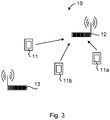
- FIG 3 illustrates schematically an environment in which embodiments according to the present teachings may be implemented.
- a wireless communications system 10 is illustrated, which may comprise e.g. a Wi-Fi network, also known as WLAN (the terms are used interchangeably herein).
- WLAN is standardized in the 802.11 specifications, in particular in IEEE Standard for Information technology-Telecommunications and information exchange between systems. Local and metropolitan area networks-Specific requirements. Part 11: Wireless LAN Medium Access Control (MAC) and Physical Layer (PHY) Specifications).
- MAC Wireless LAN Medium Access Control
- PHY Physical Layer
- a station may be an access point (AP) providing access to user stations or it may be a user station STA, i.e. a non-AP STA.
- AP access point
- non-AP STA user station STA
- the method described herein is applicable to, and may be implemented in, all entities (APs and non-APs) that want to transmit in a wireless communications system, e.g. a WLAN.
- the wireless communications system 10 may comprise a number of STAs 11, 11a, 11b, 12, 13, including APs 12, 13 as well as user stations 11, 11a, 11b (non-AP STAs). Each AP 12, 13 have a number of STAs 11a, 11b, 11c associated to it.
- the STAs 11, 12 of the wireless communications system 10 are arranged to (e.g. configured to) perform CCA based on dynamic adjustment of the used CCAT.
- the CCAT may be dynamically selected in various ways, e.g. depending on load in a STA (in particular load in AP), based on throughput for STAs, distance between transmitting and receiving STAs etc.
- the dynamic CCATs could, for instance, be set per frame or per some time unit.
- a STA 11, 12 when a STA 11, 12 (either an AP STA or a non-AP STA) performs a clear channel assessment, it employs a mechanism for selective dynamic sensitivity threshold adjustment, by which it applies an additional consideration, in particular considers the type of the on-going transmission that it has detected. If the on-going transmission is determined to be a high-impact transmission, it does not employ sensing threshold adjustment mechanisms.
- Figure 4 illustrates a first example of the selective dynamic sensitivity threshold adjustment algorithm 20 according to the present teachings.
- a STA 11, 12 has a transmission unit to transmit.
- the transmission unit is denoted a frame.
- the STA 11, 12 performs a CCA procedure for the channel(s) in order to establish whether it may go ahead and transmit the frame.
- the CCA procedure has a dynamically adjusted CCAT, as indicated in box 22 by "x dBm".
- the STA 11, 12 establishes whether any transmission can be found for which the received signal strength is stronger than the first CCAT, i.e. whether the channel is idle or busy. If, in box 22, it is determined that the channel is busy, flow continues to box 23 and the STA 11, 12 defers its transmission.
- the STA 11, 12 finds the channel to be idle in the sense that an on-going transmission has a received signal strength that is below the first CCAT value, flow continues to box 24. In box 24, even though the STA 11, 12 would be allowed to perform its transmission according to the first CCAT value, it checks fulfillment of a second criterion before actually performing the transmission. The STA 11, 12 checks whether the transmission that it detected is a high-impact transmission or not. If the detected transmission does not belong to this type of transmission, then flow continues to box 25 and the STA 11, 12 goes ahead with its transmission. If, on the other hand, the detected transmission is such a high-impact transmission, then the STA 11, 12 refrains from the transmission, and flow continues to box 23. In box 23, the STA 11, 12 defers its transmission, and may e.g. wait a random back-off period before again checking whether the transmission medium is deemed idle.
- Figure 5 illustrates another embodiment according to the present teachings, in particular, another example of the selective dynamic sensitivity threshold adjustment algorithm 30 according to the present teachings.
- a STA 11, 12 has a frame to transmit.
- the STA 11, 12 performs a CCA procedure for the channel(s) in order to establish whether it may go ahead and transmit the frame.
- the CCA procedure used has a CCAT that may be dynamically adjusted, as described earlier.
- the STA 11, 12 establishes whether any transmission can be found for which the received signal strength is stronger than the first CCAT, i.e. whether the channel is idle or busy. If, in box 32, it is determined that the channel is busy, flow continues to box 33 and the STA 11, 12 defers its transmission.
- the STA 11, 12 checks fulfillment of a second criterion before actually performing the transmission.
- the STA 11, 12 checks whether the transmission that it detected is a high-impact transmission or not, just like in the first algorithm described with reference to figure 4 . If the detected transmission is such a high-impact transmission, flow continues to box 36.
- a third criterion is applied to determine whether or not to transmit the frame.
- the STA 11, 12 uses a second CCAT value in order to determine whether or not to transmit its frame. If the received signal strength of the detected transmission is higher than the second CCAT value, then flow continues to box 33 and the STA 11, 12 defers its transmission.
- the second CCAT value may be a more conservatively set threshold value, e.g. as the legacy static legacy CCAT, while the dynamically set CCAT value (box 32) may be a more "aggressively" set threshold value, allowing a higher number of simultaneous transmissions.
- the STA 11, 12 goes ahead with the transmission of the frame anyway, i.e. simultaneously with the already on-going transmission.
- the second CCAT is a less aggressive (more conservative) threshold than the first CCAT (box 32), whereby it is ensured that the on-going transmission is "heard" by the STA 11, 12 at such low signal strength level that it is not likely that its transmission in turn would cause interference to the on-going transmission, at least not to such an extent that the on-going transmission would fail.
- the STA 11, 12 performing the check and the station with the on-going transmission may for instance be located far apart from each other and it may be assumed that the transmissions will not interfere with each other to any high extent.
- a STA 11, 12 when a STA 11, 12 evaluates the on-going transmission and determines that it is indeed a high-impact one, it employs a less aggressive channel reuse mechanism (i.e. mechanism for determining whether a simultaneous transmission would be too interfering or not). Assuming for instance, that the STA 11, 12 is using a dynamic sensitivity threshold algorithm that yields, for instance based on load of the AP, a CCAT value of-62 dBm to be used when assessing the channel for a simultaneous transmission. Then, after determining that a particular on-going transmission is a high-impact one, the STA 11, 12 may use a lower value ( ⁇ -62 dBm) for this particular simultaneous transmission occurrence.
- a less aggressive channel reuse mechanism i.e. mechanism for determining whether a simultaneous transmission would be too interfering or not.
- the STA 11, 12 is using a dynamic sensitivity threshold algorithm that yields, for instance based on load of the AP, a CCAT value of-62 dBm
- only particular types of transmissions are determined as being high-impact transmissions.
- One set of transmissions that may be classified as high-impact transmissions could be all multi user transmissions, i.e., transmissions that involve more than one receiving or transmitting device. These transmissions may, for instance, comprise all downlink and/or uplink OFDMA transmissions, and/or all downlink and/or uplink MU-MIMO transmissions.
- Another set of transmissions that could be classified as high-impact transmissions are transmissions related to control signaling, e.g. all IEEE 802.11 Control frames, comprising for instance request-to-send (RTS), clear-to-send (CTS), acknowledgements (ACKs), Poll frames, Very High Throughput Null Data Packet (VHT NDP) frames, etc.
- RTS request-to-send
- CTS clear-to-send
- ACKs acknowledgements
- Poll frames e.g. all IEEE 802.11 Control frames, comprising for instance request-to-send (RTS), clear-
- the STA 11, 12 may in different ways determine whether a particular transmission is to be considered as high-impact transmission.
- the STA 11, 12 may be configured to recognize the high-impact transmission types. One way to do this determination is to decode a MAC header of a frame from the on-going transmission and compare to a number of different types of frames that have been classified as high-impact frames. Another way is to decode a frame preceding the high-impact frames (i.e. high impact transmission) and thus acquire a priori information that a high-impact transmission will follow. For instance, many multi-user transmissions are preceded by a so-called "trigger frame", and a STA 11, 12 that wishes to perform a simultaneous transmission, could identify an up-coming high-impact transmission based on their "trigger frame".
- a physical layer (PHY) header is used in order to determine whether an overheard transmission (a frame thereof) is of a "high-impact" transmission type.
- the PHYheader may comprise information related to multi-user reception. For instance, one field of a VHT signal A (VHT-SIG-A) is the "Group ID" field. This field has a value of 0 or 63 for single user frames, while a value between 1 and 62 indicates that the frame is addressed to multiple receivers. Hence, the STA 11, 12 may deduce that the transmission is intended for multiple receivers and thus establish that it is a high-impact transmission.
- VHT-SIG-A VHT signal A
- the present teachings provide a method, and an entity performing the method, by which the channel access based on selectively applying dynamic sensitivity threshold adjustment is based also on type of on-going transmission. If the on-going transmission is considered to be a high-profile one (e.g., OFDMA, MU-MIMO, RTS/CTS/ACK frame, etc.) then dynamic sensitivity threshold adjustment is either not applied or less aggressive threshold values are used.
- a high-profile one e.g., OFDMA, MU-MIMO, RTS/CTS/ACK frame, etc.
- Figure 6 illustrates a flow chart over steps of an embodiment of a method in an entity in accordance with the present teachings.
- a method 50 for transmitting in a communications system 10 is provided that may be performed in an entity 11, 12.
- the method 50 comprises assessing 51 a channel to be available for transmission by establishing an on-going transmission to have a received signal strength such as to allow simultaneous transmission in view of a first clear channel assessment threshold.
- the method 50 comprises establishing 52 type of transmission of the on-going transmission.
- the method 50 comprises determining 53, based on the established type of transmission, whether to transmit or to defer transmitting.
- the determining 53 comprises determining to defer transmitting if the type of transmission comprises a first type and else determining to transmit simultaneously.
- the determining 53 is further based on a second clear channel assessment threshold.
- the establishing 52 comprises establishing that the on-going transmission is of a first type, and wherein the determining 53 comprises determining to transmit simultaneously if the on-going transmission has a received signal strength such as to allow simultaneous transmission in view of the second clear channel assessment threshold.
- the first type of transmission comprises one or more of: a transmission addressed to two or more recipients, a transmission carrying information classified as important, a transmission comprising a request-to-send message, a transmission comprising a clear-to-send message, a multi-user multiple input multiple output, MU-MIMO, transmission, an orthogonal frequency division multiple access, OFDMA, transmission, a beacon frame, a control frame, a trigger frame preceding a first type of transmission.
- the establishing 52 type of transmission comprises decoding a medium access control, MAC, header and establishing type of transmission based on information in the MAC header. In other embodiments, the establishing 52 type of transmission comprises decoding a physical layer, PHY, header and establishing type of transmission based on information in the PHY header.
- the establishing 52 type of transmission comprises decoding a trigger frame preceding a first type of transmission and establishing type of transmission based on the trigger frame.
- the assessing 51 comprises establishing the first clear channel assessment threshold by a dynamic sensitivity threshold adjustment method.
- Figure 7 illustrates schematically an entity and means for implementing embodiments of the method in accordance with the present teachings.
- the entity 11, 12 comprises a processor 60 comprising any combination of one or more of a central processing unit (CPU), multiprocessor, microcontroller, digital signal processor (DSP), application specific integrated circuit etc. capable of executing software instructions stored in a memory 61 which can thus be a computer program product 61.
- the processor 60 can be configured to execute any of the various embodiments of the method for instance as described in relation to figure 6 .
- the memory 61 can be any combination of read and write memory (RAM) and read only memory (ROM), Flash memory, magnetic tape, Compact Disc (CD)-ROM, digital versatile disc (DVD), Blu-ray disc etc.
- the memory 61 may also comprise persistent storage, which, for example, can be any single one or combination of magnetic memory, optical memory, solid state memory or even remotely mounted memory.
- the entity 11, 12 also comprises an input/output device 63 (indicated by I/O in figure 7 ) for communicating with other entities.
- Such input/output device 63 of the entity 11, 12 may comprise a wireless communication interface (e.g. radio interface) and/or wired communication interface.
- the entity 11, 12 may also comprise additional processing circuitry, schematically indicated at reference numeral 64, for implementing the various embodiments according to the present teachings.
- the present teachings provide computer programs 62 for the entity 11, 12.
- the computer program 62 comprises computer program code, which, when executed on at least one processor 60 of the entity 11, 12 causes the entity 11, 12 to perform the method 50 according to any of the described embodiments thereof.
- the present disclosure also encompasses computer program products 61 comprising a computer program 62 for implementing the embodiments of the method as described, and a computer readable means on which the computer program 62 is stored.
- the computer program product 41 may, as mentioned earlier, be any combination of random access memory (RAM) or read only memory (ROM), Flash memory, magnetic tape, Compact Disc (CD)-ROM, digital versatile disc (DVD), Blu-ray disc etc.
- An entity 11, 12 for transmitting in a communications system 10 is provided.
- the entity 11, 12 is configured to:
- the entity 11, 12 may be configured to perform the above steps e.g. by comprising one or more processors 60 and memory 61, the memory 61 containing instructions executable by the processor 60, whereby the entity 11, 12 is operative to perform the steps.
- processors 60 may be configured to perform all steps of the method 50 or only part of the steps.
- the entity 11, 12 is configured to determine to defer transmitting if the type of transmission comprises a first type and else to transmit simultaneously.
- the entity 11, 12 is configured to determine further based on a second clear channel assessment threshold.
- the entity 11, 12 is establish by establishing that the on-going transmission is of a first type, and configured to determine to transmit simultaneously if the on-going transmission has a received signal strength such as to allow simultaneous transmission in view of the second clear channel assessment threshold.
- the first type of transmission comprises one or more of: a transmission addressed to two or more recipients, a transmission carrying information classified as important, a transmission comprising a request-to-send message, a transmission comprising a clear-to-send message, a multi-user multiple input multiple output, MU-MIMO, transmission, an orthogonal frequency division multiple access, OFDMA, transmission, a beacon frame, a control frame, a trigger frame preceding a first type of transmission.
- the entity 11, 12 is configured to establish type of transmission by decoding a medium access control, MAC, header and configured to establish type of transmission based on information in the MAC header. In other embodiments, the entity 11, 12 is configured to establish type of transmission by decoding a physical layer, PHY, header and configured to establish type of transmission based on information in the PHYheader.
- MAC medium access control
- PHY physical layer
- the entity 11, 12 is configured to establish type of transmission by decoding a trigger frame preceding a first type of transmission and configured to establish type of transmission based on the trigger frame.
- the entity 11, 12 is configured to assess by establishing the first clear channel assessment threshold by a dynamic sensitivity threshold adjustment method.
- Figure 8 illustrates an entity comprising function modules/ software modules for implementing embodiments in accordance with the present teachings.
- means are provided, e.g. function modules or units, that can be implemented using software instructions such as computer program executing in a processor and/or using hardware, such as application specific integrated circuits, field programmable gate arrays, discrete logical components etc., or any combination thereof.
- An entity for transmitting in a communications system.
- the entity comprises a first unit 71 for assessing a channel to be available for transmission by establishing an on-going transmission to have a received signal strength such as to allow simultaneous transmission in view of a first clear channel assessment threshold.
- Such first unit 71 may for instance comprise processing circuitry adapted for assessing a channel to be available for transmission by establishing an on-going transmission to have a certain received signal strength (e.g. unit 61, 62 and/or 64 described with reference to figure 7 ).
- the entity comprises a second unit 72 for establishing type of transmission of the on-going transmission.
- Such second unit 72 may for instance comprise processing circuitry adapted for establishing type of transmission (e.g. unit 61, 62 and/or 64 described with reference to figure 7 ).
- the entity comprises a third unit 73 for determining, based on the established type of transmission, whether to transmit or to defer transmitting.
- Such third unit 73 may for instance comprise processing circuitry adapted for determining, based on the established type of transmission, whether to transmit or to defer transmitting (e.g. unit 61, 62 and/or 64 described with reference to figure 7 ).
Landscapes
- Engineering & Computer Science (AREA)
- Computer Networks & Wireless Communication (AREA)
- Signal Processing (AREA)
- Mobile Radio Communication Systems (AREA)
Claims (14)
- Procédé (50) effectué dans une entité (11, 12) pour transmettre dans un système de communication (10), le procédé (50) comprenant :- l'évaluation (51) si un canal est disponible pour une transmission par l'établissement qu'une force de signal reçu d'une transmission en cours permet une transmission simultanée compte tenu d'un premier seuil d'évaluation de canal libre, etcaractérisé en ce qu'il comprend en outre :- l'établissement (52) d'un premier type de transmission de la transmission en cours, et- la détermination (53), sur la base du type établi de transmission et d'un deuxième seuil d'évaluation de canal libre, s'il faut transmettre ou reporter la transmission et transmettre simultanément si la transmission en cours a une force de signal reçu permettant une transmission simultanée compte tenu du deuxième seuil d'évaluation de canal libre.
- Procédé (50) selon la revendication 1, dans lequel la détermination (53) comprend la détermination de reporter la transmission si le type de transmission comprend un premier type.
- Procédé (50) selon la revendication 2, dans lequel le premier type de transmission comprend une ou plusieurs de : une transmission adressée à au moins deux destinataires, une transmission portant des informations classées comme importantes, une transmission comprenant un message de demande d'envoi, une transmission comprenant un message de prêt à l'envoi, une transmission à entrées multiples et sorties multiples d'utilisateurs multiples, MU-MIMO, une transmission d'accès multiples par répartition de fréquence orthogonale, OFDMA, une trame de balise, une trame de commande, une trame de déclenchement précédant un premier type de transmission.
- Procédé (50) selon l'une quelconque des revendications précédentes, dans lequel l'établissement (52) du type de transmission comprend :- le décodage d'un en-tête de commande d'accès au support, MAC, et l'établissement du type de transmission sur la base d'informations dans l'en-tête MAC, ou- le décodage d'un en-tête de couche physique, PHY, et l'établissement du type de transmission sur la base d'informations dans l'en-tête PHY.
- Procédé (50) selon l'une quelconque des revendications précédentes, dans lequel l'établissement (52) du type de transmission comprend le décodage d'une trame de déclenchement précédant un premier type de transmission et l'établissement du type de transmission sur la base de la trame de déclenchement.
- Procédé (50) selon l'une quelconque des revendications précédentes, dans lequel l'évaluation (51) comprend l'établissement du premier seuil d'évaluation de canal libre par un procédé d'ajustement de seuil de sensibilité dynamique.
- Programme informatique (62) pour une entité (11, 12) pour gérer des transmissions, le programme informatique (62) comprenant un code de programme informatique qui, lorsqu'il est exécuté sur au moins un processeur sur l'entité (11, 12) amène l'entité (11, 12) à effectuer le procédé (50) selon l'une quelconque des revendications 1 à 6.
- Produit de programme informatique (61) comprenant un programme informatique (62) selon la revendication 7 et un moyen lisible par ordinateur sur lequel le programme informatique (62) est mémorisé.
- Entité (11, 12) pour transmettre dans un système de communication (10), l'entité (11, 12) étant configurée pour :- l'évaluation si un canal est disponible pour une transmission par l'établissement qu'une force de signal reçu d'une transmission en cours permet une transmission simultanée compte tenu d'un premier seuil d'évaluation de canal libre, et caractérisée en ce qu'elle est en outre configurée pour :- l'établissement d'un premier type de transmission de la transmission en cours, et- la détermination, sur la base du type établi de transmission et d'un deuxième seuil d'évaluation de canal libre, s'il faut transmettre ou reporter la transmission et transmettre simultanément si la transmission en cours a une force de signal reçu permettant une transmission simultanée compte tenu du deuxième seuil d'évaluation de canal libre.
- Entité (11, 12) selon la revendication 9, configurée pour la détermination de reporter la transmission si le type de transmission comprend un premier type.
- Entité (11, 12) selon la revendication 9, dans laquelle le premier type de transmission comprend une ou plusieurs de : une transmission adressée à au moins deux destinataires, une transmission portant des informations classées comme importantes, une transmission comprenant un message de demande d'envoi, une transmission comprenant un message de prêt à l'envoi, une transmission à entrées multiples et sorties multiples d'utilisateurs multiples, MU-MIMO, une transmission d'accès multiples par répartition de fréquence orthogonale, OFDMA, une trame de balise, une trame de commande, une trame de déclenchement précédant un premier type de transmission.
- Entité (11, 12) selon l'une quelconque des revendications 9 à 11, configurée pour l'établissement du type de transmission par :- le décodage d'un en-tête de commande d'accès au support, MAC, et configurée pour l'établissement du type de transmission sur la base d'informations dans l'en-tête MAC, ou- le décodage d'un en-tête de couche physique, PHY, et l'établissement du type de transmission sur la base d'informations dans l'en-tête PHY.
- Entité (11, 12) selon l'une quelconque des revendications 9 à 12, configurée pour l'établissement du type de transmission par le décodage d'une trame de déclenchement précédant un premier type de transmission et configurée pour l'établissement du type de transmission sur la base de la trame de déclenchement.
- Entité (11, 12) selon l'une quelconque des revendications 9 à 11, configurée pour l'évaluation par l'établissement du premier seuil d'évaluation de canal libre par un procédé d'ajustement de seuil de sensibilité dynamique.
Applications Claiming Priority (1)
| Application Number | Priority Date | Filing Date | Title |
|---|---|---|---|
| PCT/SE2015/050831 WO2017014684A1 (fr) | 2015-07-22 | 2015-07-22 | Procédé et entité de transmission dans un système de communication |
Publications (3)
| Publication Number | Publication Date |
|---|---|
| EP3326419A1 EP3326419A1 (fr) | 2018-05-30 |
| EP3326419A4 EP3326419A4 (fr) | 2018-08-01 |
| EP3326419B1 true EP3326419B1 (fr) | 2019-07-10 |
Family
ID=57835080
Family Applications (1)
| Application Number | Title | Priority Date | Filing Date |
|---|---|---|---|
| EP15899038.2A Active EP3326419B1 (fr) | 2015-07-22 | 2015-07-22 | Procédé et entité de transmission dans un système de communication |
Country Status (3)
| Country | Link |
|---|---|
| US (5) | US10375732B2 (fr) |
| EP (1) | EP3326419B1 (fr) |
| WO (1) | WO2017014684A1 (fr) |
Families Citing this family (4)
| Publication number | Priority date | Publication date | Assignee | Title |
|---|---|---|---|---|
| WO2018226537A1 (fr) | 2017-06-07 | 2018-12-13 | Spidercloud Wireless, Inc. | Systèmes et procédés de sélection dynamique de seuils de détection d'énergie (edts) dans des nœuds radio déployant une écoute avant une conversation dans un réseau coordonné pour améliorer le débit sur un spectre partagé |
| EP3451708A1 (fr) * | 2017-09-01 | 2019-03-06 | BlackBerry Limited | Procédé et système d'équilibrage de charge de capteurs |
| CN113489556B (zh) * | 2021-07-08 | 2023-07-28 | 维沃移动通信有限公司 | 信号接收方法、装置、电子设备和存储介质 |
| US12341723B2 (en) * | 2022-11-17 | 2025-06-24 | Morse Micro Pty. Ltd. | Methods and apparatuses for managing duty cycle in wireless local access networks (WLANS) |
Family Cites Families (23)
| Publication number | Priority date | Publication date | Assignee | Title |
|---|---|---|---|---|
| US6571084B1 (en) | 2000-05-03 | 2003-05-27 | Bellsouth Intellectual Property Corporation | Employing different signal thresholds based on type of information transmitted |
| US20070060155A1 (en) * | 2005-08-31 | 2007-03-15 | Emanuel Kahana | System and method to dynamically adapt a CCA threshold |
| JP4413934B2 (ja) | 2007-02-08 | 2010-02-10 | 株式会社東芝 | 無線通信装置及び無線通信方法 |
| US8942123B2 (en) * | 2011-09-02 | 2015-01-27 | Qualcomm Incorporated | Deferral mechanism for improved medium reuse in wireless networks with transmit power imbalances |
| EP2717644B1 (fr) * | 2012-10-08 | 2015-08-12 | VKR Holding A/S | Contrôle automatique de bâtiments sans fil robuste |
| US9282539B2 (en) | 2013-04-02 | 2016-03-08 | Qualcomm Incorporated | System and method for channel-dependent CCA thresholds to balance different use cases in wireless networks |
| MX347219B (es) * | 2013-05-02 | 2017-04-20 | Lg Electronics Inc | Método para detectar canal dinámicamente en el sistema lan inalámbrico y aparato para el mismo. |
| US9537688B2 (en) * | 2013-07-05 | 2017-01-03 | Qualcomm Incorporated | Methods and apparatus for clear channel assessment |
| TWI507075B (zh) * | 2013-07-26 | 2015-11-01 | Accton Technology Corp | 具動態調整當前空閒通道評估門檻值能力的存取點及其運作方法 |
| US9763262B2 (en) * | 2013-11-01 | 2017-09-12 | Qualcomm Incorporated | Wireless communications deferral based on transmission opportunity |
| US9521587B2 (en) * | 2013-12-11 | 2016-12-13 | Futurewei Technologies, Inc. | System and method for determining a clear channel assessment threshold |
| US9578657B2 (en) * | 2014-04-11 | 2017-02-21 | Realtek Semiconductor Corporation | Wireless communication method and device |
| CN106416412B (zh) * | 2014-05-26 | 2020-01-03 | 韦勒斯标准与技术协会公司 | 用于同时数据传送和接收的无线通信方法及装置 |
| KR102688940B1 (ko) * | 2014-05-26 | 2024-07-29 | 주식회사 윌러스표준기술연구소 | 광대역 링크 설정을 위한 무선 통신 방법 및 무선 통신 장치 |
| US9571257B2 (en) * | 2014-08-19 | 2017-02-14 | Newracom, Inc. | System and method for wireless channel assessment |
| WO2016040837A1 (fr) * | 2014-09-11 | 2016-03-17 | Interdigital Patent Holdings, Inc. | Procédé et appareil de partage spatial dans des systèmes de réseaux locaux sans fil (wlan) |
| US10142148B2 (en) * | 2014-11-07 | 2018-11-27 | Newracom, Inc. | Method for transmitting frame, clear channel assessment method, and apparatus implementing the same method |
| KR20160055718A (ko) * | 2014-11-10 | 2016-05-18 | 뉴라컴 인코포레이티드 | 무선랜에서 프레임 송수신 방법 및 장치 |
| KR102029849B1 (ko) * | 2015-01-27 | 2019-10-08 | 노키아 솔루션스 앤드 네트웍스 오와이 | 트래픽 흐름 모니터링 |
| US20170142753A1 (en) * | 2015-05-20 | 2017-05-18 | Telefonaktiebolaget Lm Ericsson (Publ) | Controlling access to a shared wireless medium |
| US10034304B2 (en) * | 2015-06-26 | 2018-07-24 | Intel IP Corporation | Fairness in clear channel assessment under long sensing time |
| EP3117806B1 (fr) * | 2015-07-16 | 2020-06-10 | Lohmann & Rauscher GmbH | Systeme de traitement des plaies |
| JP7263361B2 (ja) * | 2018-01-11 | 2023-04-24 | サムスン エレクトロニクス カンパニー リミテッド | サービス性能の監視および報告 |
-
2015
- 2015-07-22 US US15/746,722 patent/US10375732B2/en active Active
- 2015-07-22 WO PCT/SE2015/050831 patent/WO2017014684A1/fr not_active Ceased
- 2015-07-22 EP EP15899038.2A patent/EP3326419B1/fr active Active
-
2019
- 2019-06-27 US US16/454,992 patent/US11064525B2/en active Active
-
2021
- 2021-06-25 US US17/358,102 patent/US11751244B2/en active Active
-
2023
- 2023-07-28 US US18/227,385 patent/US12193057B2/en active Active
-
2024
- 2024-12-05 US US18/969,447 patent/US20250176023A1/en active Pending
Non-Patent Citations (1)
| Title |
|---|
| None * |
Also Published As
| Publication number | Publication date |
|---|---|
| EP3326419A1 (fr) | 2018-05-30 |
| US20250176023A1 (en) | 2025-05-29 |
| US20240023163A1 (en) | 2024-01-18 |
| US20210321459A1 (en) | 2021-10-14 |
| US10375732B2 (en) | 2019-08-06 |
| US20190320466A1 (en) | 2019-10-17 |
| US11064525B2 (en) | 2021-07-13 |
| EP3326419A4 (fr) | 2018-08-01 |
| US12193057B2 (en) | 2025-01-07 |
| US11751244B2 (en) | 2023-09-05 |
| WO2017014684A1 (fr) | 2017-01-26 |
| US20180220460A1 (en) | 2018-08-02 |
Similar Documents
| Publication | Publication Date | Title |
|---|---|---|
| US11997712B2 (en) | Techniques of improving EDCA mechanism in spatial reuse | |
| US12193057B2 (en) | Method and entity for transmitting in a communications system | |
| JP2025116136A (ja) | データの同時通信のための無線通信方法及びこれを利用した無線通信端末 | |
| KR102814666B1 (ko) | 클리어 채널 할당을 위한 무선 통신 단말 및 무선 통신 방법 | |
| US20250351178A1 (en) | Communication devices and methods | |
| JP7376669B2 (ja) | 無線ネットワークにおいて送信をスケジュールするための方法、装置およびデバイス可読媒体 | |
| EP3298850B1 (fr) | Commande d'accès à un support sans fil partagé | |
| EP3251459B1 (fr) | Premier noeud et procédé associé | |
| WO2019223709A1 (fr) | Procédés de commande de sensibilité dynamique dans des réseaux sans fil | |
| EP3661313B1 (fr) | Communication autonome avec signalisation de coordination pour un schéma de type listen-after-talk | |
| CN110313191B (zh) | 先说后听过程的重新配置 | |
| US12267866B2 (en) | Channel access method and related product | |
| WO2021254448A1 (fr) | Détection d'accès à un canal directionnel |
Legal Events
| Date | Code | Title | Description |
|---|---|---|---|
| STAA | Information on the status of an ep patent application or granted ep patent |
Free format text: STATUS: THE INTERNATIONAL PUBLICATION HAS BEEN MADE |
|
| PUAI | Public reference made under article 153(3) epc to a published international application that has entered the european phase |
Free format text: ORIGINAL CODE: 0009012 |
|
| STAA | Information on the status of an ep patent application or granted ep patent |
Free format text: STATUS: REQUEST FOR EXAMINATION WAS MADE |
|
| 17P | Request for examination filed |
Effective date: 20180110 |
|
| AK | Designated contracting states |
Kind code of ref document: A1 Designated state(s): AL AT BE BG CH CY CZ DE DK EE ES FI FR GB GR HR HU IE IS IT LI LT LU LV MC MK MT NL NO PL PT RO RS SE SI SK SM TR |
|
| AX | Request for extension of the european patent |
Extension state: BA ME |
|
| STAA | Information on the status of an ep patent application or granted ep patent |
Free format text: STATUS: EXAMINATION IS IN PROGRESS |
|
| A4 | Supplementary search report drawn up and despatched |
Effective date: 20180702 |
|
| RIC1 | Information provided on ipc code assigned before grant |
Ipc: H04W 74/08 20090101AFI20180626BHEP Ipc: H04W 74/00 20090101ALI20180626BHEP Ipc: H04W 72/02 20090101ALI20180626BHEP |
|
| 17Q | First examination report despatched |
Effective date: 20180717 |
|
| DAV | Request for validation of the european patent (deleted) | ||
| DAX | Request for extension of the european patent (deleted) | ||
| GRAP | Despatch of communication of intention to grant a patent |
Free format text: ORIGINAL CODE: EPIDOSNIGR1 |
|
| STAA | Information on the status of an ep patent application or granted ep patent |
Free format text: STATUS: GRANT OF PATENT IS INTENDED |
|
| INTG | Intention to grant announced |
Effective date: 20190219 |
|
| GRAS | Grant fee paid |
Free format text: ORIGINAL CODE: EPIDOSNIGR3 |
|
| GRAA | (expected) grant |
Free format text: ORIGINAL CODE: 0009210 |
|
| STAA | Information on the status of an ep patent application or granted ep patent |
Free format text: STATUS: THE PATENT HAS BEEN GRANTED |
|
| AK | Designated contracting states |
Kind code of ref document: B1 Designated state(s): AL AT BE BG CH CY CZ DE DK EE ES FI FR GB GR HR HU IE IS IT LI LT LU LV MC MK MT NL NO PL PT RO RS SE SI SK SM TR |
|
| REG | Reference to a national code |
Ref country code: GB Ref legal event code: FG4D |
|
| REG | Reference to a national code |
Ref country code: CH Ref legal event code: EP Ref country code: AT Ref legal event code: REF Ref document number: 1154918 Country of ref document: AT Kind code of ref document: T Effective date: 20190715 |
|
| REG | Reference to a national code |
Ref country code: IE Ref legal event code: FG4D |
|
| REG | Reference to a national code |
Ref country code: DE Ref legal event code: R096 Ref document number: 602015033779 Country of ref document: DE |
|
| REG | Reference to a national code |
Ref country code: NL Ref legal event code: MP Effective date: 20190710 |
|
| REG | Reference to a national code |
Ref country code: LT Ref legal event code: MG4D |
|
| REG | Reference to a national code |
Ref country code: AT Ref legal event code: MK05 Ref document number: 1154918 Country of ref document: AT Kind code of ref document: T Effective date: 20190710 |
|
| PG25 | Lapsed in a contracting state [announced via postgrant information from national office to epo] |
Ref country code: FI Free format text: LAPSE BECAUSE OF FAILURE TO SUBMIT A TRANSLATION OF THE DESCRIPTION OR TO PAY THE FEE WITHIN THE PRESCRIBED TIME-LIMIT Effective date: 20190710 Ref country code: LT Free format text: LAPSE BECAUSE OF FAILURE TO SUBMIT A TRANSLATION OF THE DESCRIPTION OR TO PAY THE FEE WITHIN THE PRESCRIBED TIME-LIMIT Effective date: 20190710 Ref country code: HR Free format text: LAPSE BECAUSE OF FAILURE TO SUBMIT A TRANSLATION OF THE DESCRIPTION OR TO PAY THE FEE WITHIN THE PRESCRIBED TIME-LIMIT Effective date: 20190710 Ref country code: NO Free format text: LAPSE BECAUSE OF FAILURE TO SUBMIT A TRANSLATION OF THE DESCRIPTION OR TO PAY THE FEE WITHIN THE PRESCRIBED TIME-LIMIT Effective date: 20191010 Ref country code: SE Free format text: LAPSE BECAUSE OF FAILURE TO SUBMIT A TRANSLATION OF THE DESCRIPTION OR TO PAY THE FEE WITHIN THE PRESCRIBED TIME-LIMIT Effective date: 20190710 Ref country code: BG Free format text: LAPSE BECAUSE OF FAILURE TO SUBMIT A TRANSLATION OF THE DESCRIPTION OR TO PAY THE FEE WITHIN THE PRESCRIBED TIME-LIMIT Effective date: 20191010 Ref country code: PT Free format text: LAPSE BECAUSE OF FAILURE TO SUBMIT A TRANSLATION OF THE DESCRIPTION OR TO PAY THE FEE WITHIN THE PRESCRIBED TIME-LIMIT Effective date: 20191111 Ref country code: NL Free format text: LAPSE BECAUSE OF FAILURE TO SUBMIT A TRANSLATION OF THE DESCRIPTION OR TO PAY THE FEE WITHIN THE PRESCRIBED TIME-LIMIT Effective date: 20190710 Ref country code: AT Free format text: LAPSE BECAUSE OF FAILURE TO SUBMIT A TRANSLATION OF THE DESCRIPTION OR TO PAY THE FEE WITHIN THE PRESCRIBED TIME-LIMIT Effective date: 20190710 |
|
| PG25 | Lapsed in a contracting state [announced via postgrant information from national office to epo] |
Ref country code: ES Free format text: LAPSE BECAUSE OF FAILURE TO SUBMIT A TRANSLATION OF THE DESCRIPTION OR TO PAY THE FEE WITHIN THE PRESCRIBED TIME-LIMIT Effective date: 20190710 Ref country code: GR Free format text: LAPSE BECAUSE OF FAILURE TO SUBMIT A TRANSLATION OF THE DESCRIPTION OR TO PAY THE FEE WITHIN THE PRESCRIBED TIME-LIMIT Effective date: 20191011 Ref country code: LV Free format text: LAPSE BECAUSE OF FAILURE TO SUBMIT A TRANSLATION OF THE DESCRIPTION OR TO PAY THE FEE WITHIN THE PRESCRIBED TIME-LIMIT Effective date: 20190710 Ref country code: RS Free format text: LAPSE BECAUSE OF FAILURE TO SUBMIT A TRANSLATION OF THE DESCRIPTION OR TO PAY THE FEE WITHIN THE PRESCRIBED TIME-LIMIT Effective date: 20190710 Ref country code: IS Free format text: LAPSE BECAUSE OF FAILURE TO SUBMIT A TRANSLATION OF THE DESCRIPTION OR TO PAY THE FEE WITHIN THE PRESCRIBED TIME-LIMIT Effective date: 20191110 Ref country code: AL Free format text: LAPSE BECAUSE OF FAILURE TO SUBMIT A TRANSLATION OF THE DESCRIPTION OR TO PAY THE FEE WITHIN THE PRESCRIBED TIME-LIMIT Effective date: 20190710 |
|
| REG | Reference to a national code |
Ref country code: CH Ref legal event code: PL |
|
| PG25 | Lapsed in a contracting state [announced via postgrant information from national office to epo] |
Ref country code: TR Free format text: LAPSE BECAUSE OF FAILURE TO SUBMIT A TRANSLATION OF THE DESCRIPTION OR TO PAY THE FEE WITHIN THE PRESCRIBED TIME-LIMIT Effective date: 20190710 |
|
| REG | Reference to a national code |
Ref country code: BE Ref legal event code: MM Effective date: 20190731 |
|
| PG25 | Lapsed in a contracting state [announced via postgrant information from national office to epo] |
Ref country code: PL Free format text: LAPSE BECAUSE OF FAILURE TO SUBMIT A TRANSLATION OF THE DESCRIPTION OR TO PAY THE FEE WITHIN THE PRESCRIBED TIME-LIMIT Effective date: 20190710 Ref country code: EE Free format text: LAPSE BECAUSE OF FAILURE TO SUBMIT A TRANSLATION OF THE DESCRIPTION OR TO PAY THE FEE WITHIN THE PRESCRIBED TIME-LIMIT Effective date: 20190710 Ref country code: IT Free format text: LAPSE BECAUSE OF FAILURE TO SUBMIT A TRANSLATION OF THE DESCRIPTION OR TO PAY THE FEE WITHIN THE PRESCRIBED TIME-LIMIT Effective date: 20190710 Ref country code: RO Free format text: LAPSE BECAUSE OF FAILURE TO SUBMIT A TRANSLATION OF THE DESCRIPTION OR TO PAY THE FEE WITHIN THE PRESCRIBED TIME-LIMIT Effective date: 20190710 Ref country code: DK Free format text: LAPSE BECAUSE OF FAILURE TO SUBMIT A TRANSLATION OF THE DESCRIPTION OR TO PAY THE FEE WITHIN THE PRESCRIBED TIME-LIMIT Effective date: 20190710 |
|
| PG25 | Lapsed in a contracting state [announced via postgrant information from national office to epo] |
Ref country code: SK Free format text: LAPSE BECAUSE OF FAILURE TO SUBMIT A TRANSLATION OF THE DESCRIPTION OR TO PAY THE FEE WITHIN THE PRESCRIBED TIME-LIMIT Effective date: 20190710 Ref country code: LI Free format text: LAPSE BECAUSE OF NON-PAYMENT OF DUE FEES Effective date: 20190731 Ref country code: SM Free format text: LAPSE BECAUSE OF FAILURE TO SUBMIT A TRANSLATION OF THE DESCRIPTION OR TO PAY THE FEE WITHIN THE PRESCRIBED TIME-LIMIT Effective date: 20190710 Ref country code: CH Free format text: LAPSE BECAUSE OF NON-PAYMENT OF DUE FEES Effective date: 20190731 Ref country code: IS Free format text: LAPSE BECAUSE OF FAILURE TO SUBMIT A TRANSLATION OF THE DESCRIPTION OR TO PAY THE FEE WITHIN THE PRESCRIBED TIME-LIMIT Effective date: 20200224 Ref country code: BE Free format text: LAPSE BECAUSE OF NON-PAYMENT OF DUE FEES Effective date: 20190731 Ref country code: MC Free format text: LAPSE BECAUSE OF FAILURE TO SUBMIT A TRANSLATION OF THE DESCRIPTION OR TO PAY THE FEE WITHIN THE PRESCRIBED TIME-LIMIT Effective date: 20190710 Ref country code: LU Free format text: LAPSE BECAUSE OF NON-PAYMENT OF DUE FEES Effective date: 20190722 Ref country code: CZ Free format text: LAPSE BECAUSE OF FAILURE TO SUBMIT A TRANSLATION OF THE DESCRIPTION OR TO PAY THE FEE WITHIN THE PRESCRIBED TIME-LIMIT Effective date: 20190710 |
|
| REG | Reference to a national code |
Ref country code: DE Ref legal event code: R097 Ref document number: 602015033779 Country of ref document: DE |
|
| PLBE | No opposition filed within time limit |
Free format text: ORIGINAL CODE: 0009261 |
|
| STAA | Information on the status of an ep patent application or granted ep patent |
Free format text: STATUS: NO OPPOSITION FILED WITHIN TIME LIMIT |
|
| PG2D | Information on lapse in contracting state deleted |
Ref country code: IS |
|
| PG25 | Lapsed in a contracting state [announced via postgrant information from national office to epo] |
Ref country code: IE Free format text: LAPSE BECAUSE OF NON-PAYMENT OF DUE FEES Effective date: 20190722 |
|
| 26N | No opposition filed |
Effective date: 20200603 |
|
| PG25 | Lapsed in a contracting state [announced via postgrant information from national office to epo] |
Ref country code: SI Free format text: LAPSE BECAUSE OF FAILURE TO SUBMIT A TRANSLATION OF THE DESCRIPTION OR TO PAY THE FEE WITHIN THE PRESCRIBED TIME-LIMIT Effective date: 20190710 |
|
| PG25 | Lapsed in a contracting state [announced via postgrant information from national office to epo] |
Ref country code: CY Free format text: LAPSE BECAUSE OF FAILURE TO SUBMIT A TRANSLATION OF THE DESCRIPTION OR TO PAY THE FEE WITHIN THE PRESCRIBED TIME-LIMIT Effective date: 20190710 |
|
| PG25 | Lapsed in a contracting state [announced via postgrant information from national office to epo] |
Ref country code: HU Free format text: LAPSE BECAUSE OF FAILURE TO SUBMIT A TRANSLATION OF THE DESCRIPTION OR TO PAY THE FEE WITHIN THE PRESCRIBED TIME-LIMIT; INVALID AB INITIO Effective date: 20150722 Ref country code: MT Free format text: LAPSE BECAUSE OF FAILURE TO SUBMIT A TRANSLATION OF THE DESCRIPTION OR TO PAY THE FEE WITHIN THE PRESCRIBED TIME-LIMIT Effective date: 20190710 |
|
| PG25 | Lapsed in a contracting state [announced via postgrant information from national office to epo] |
Ref country code: MK Free format text: LAPSE BECAUSE OF FAILURE TO SUBMIT A TRANSLATION OF THE DESCRIPTION OR TO PAY THE FEE WITHIN THE PRESCRIBED TIME-LIMIT Effective date: 20190710 |
|
| P01 | Opt-out of the competence of the unified patent court (upc) registered |
Effective date: 20230523 |
|
| PGFP | Annual fee paid to national office [announced via postgrant information from national office to epo] |
Ref country code: DE Payment date: 20250729 Year of fee payment: 11 |
|
| PGFP | Annual fee paid to national office [announced via postgrant information from national office to epo] |
Ref country code: GB Payment date: 20250728 Year of fee payment: 11 |
|
| PGFP | Annual fee paid to national office [announced via postgrant information from national office to epo] |
Ref country code: FR Payment date: 20250725 Year of fee payment: 11 |