EP3327378A1 - Dispositif d'appareil domestique - Google Patents
Dispositif d'appareil domestique Download PDFInfo
- Publication number
- EP3327378A1 EP3327378A1 EP17201980.4A EP17201980A EP3327378A1 EP 3327378 A1 EP3327378 A1 EP 3327378A1 EP 17201980 A EP17201980 A EP 17201980A EP 3327378 A1 EP3327378 A1 EP 3327378A1
- Authority
- EP
- European Patent Office
- Prior art keywords
- heat transfer
- home appliance
- housing
- appliance device
- transfer element
- Prior art date
- Legal status (The legal status is an assumption and is not a legal conclusion. Google has not performed a legal analysis and makes no representation as to the accuracy of the status listed.)
- Withdrawn
Links
- 238000010438 heat treatment Methods 0.000 claims abstract description 28
- 238000009413 insulation Methods 0.000 claims abstract description 27
- 239000004033 plastic Substances 0.000 claims description 12
- 229920003023 plastic Polymers 0.000 claims description 12
- 229920001169 thermoplastic Polymers 0.000 description 9
- 239000004416 thermosoftening plastic Substances 0.000 description 9
- 238000003860 storage Methods 0.000 description 8
- 229910052751 metal Inorganic materials 0.000 description 7
- 239000002184 metal Substances 0.000 description 7
- 238000001125 extrusion Methods 0.000 description 4
- 239000006260 foam Substances 0.000 description 4
- 238000000034 method Methods 0.000 description 3
- XEEYBQQBJWHFJM-UHFFFAOYSA-N Iron Chemical compound [Fe] XEEYBQQBJWHFJM-UHFFFAOYSA-N 0.000 description 2
- 229920005830 Polyurethane Foam Polymers 0.000 description 2
- 229910000831 Steel Inorganic materials 0.000 description 2
- 238000001746 injection moulding Methods 0.000 description 2
- 238000004519 manufacturing process Methods 0.000 description 2
- 229920000642 polymer Polymers 0.000 description 2
- 239000011496 polyurethane foam Substances 0.000 description 2
- 239000010959 steel Substances 0.000 description 2
- 239000000126 substance Substances 0.000 description 2
- 241000251468 Actinopterygii Species 0.000 description 1
- RYGMFSIKBFXOCR-UHFFFAOYSA-N Copper Chemical compound [Cu] RYGMFSIKBFXOCR-UHFFFAOYSA-N 0.000 description 1
- 239000000853 adhesive Substances 0.000 description 1
- 238000004026 adhesive bonding Methods 0.000 description 1
- 230000001070 adhesive effect Effects 0.000 description 1
- 235000013334 alcoholic beverage Nutrition 0.000 description 1
- 229910052782 aluminium Inorganic materials 0.000 description 1
- XAGFODPZIPBFFR-UHFFFAOYSA-N aluminium Chemical compound [Al] XAGFODPZIPBFFR-UHFFFAOYSA-N 0.000 description 1
- 238000005452 bending Methods 0.000 description 1
- 235000013361 beverage Nutrition 0.000 description 1
- 238000010411 cooking Methods 0.000 description 1
- 238000001816 cooling Methods 0.000 description 1
- 229910052802 copper Inorganic materials 0.000 description 1
- 239000010949 copper Substances 0.000 description 1
- 235000013365 dairy product Nutrition 0.000 description 1
- 230000001419 dependent effect Effects 0.000 description 1
- 238000011161 development Methods 0.000 description 1
- 230000018109 developmental process Effects 0.000 description 1
- 235000013399 edible fruits Nutrition 0.000 description 1
- 230000000694 effects Effects 0.000 description 1
- 230000002708 enhancing effect Effects 0.000 description 1
- 235000019688 fish Nutrition 0.000 description 1
- 239000012774 insulation material Substances 0.000 description 1
- 229910052742 iron Inorganic materials 0.000 description 1
- 235000013372 meat Nutrition 0.000 description 1
- 235000013336 milk Nutrition 0.000 description 1
- 239000008267 milk Substances 0.000 description 1
- 210000004080 milk Anatomy 0.000 description 1
- 238000005496 tempering Methods 0.000 description 1
- 235000013311 vegetables Nutrition 0.000 description 1
- 238000010792 warming Methods 0.000 description 1
- 238000003466 welding Methods 0.000 description 1
- 235000014101 wine Nutrition 0.000 description 1
Images
Classifications
-
- F—MECHANICAL ENGINEERING; LIGHTING; HEATING; WEAPONS; BLASTING
- F25—REFRIGERATION OR COOLING; COMBINED HEATING AND REFRIGERATION SYSTEMS; HEAT PUMP SYSTEMS; MANUFACTURE OR STORAGE OF ICE; LIQUEFACTION SOLIDIFICATION OF GASES
- F25D—REFRIGERATORS; COLD ROOMS; ICE-BOXES; COOLING OR FREEZING APPARATUS NOT OTHERWISE PROVIDED FOR
- F25D21/00—Defrosting; Preventing frosting; Removing condensed or defrost water
- F25D21/04—Preventing the formation of frost or condensate
-
- F—MECHANICAL ENGINEERING; LIGHTING; HEATING; WEAPONS; BLASTING
- F25—REFRIGERATION OR COOLING; COMBINED HEATING AND REFRIGERATION SYSTEMS; HEAT PUMP SYSTEMS; MANUFACTURE OR STORAGE OF ICE; LIQUEFACTION SOLIDIFICATION OF GASES
- F25D—REFRIGERATORS; COLD ROOMS; ICE-BOXES; COOLING OR FREEZING APPARATUS NOT OTHERWISE PROVIDED FOR
- F25D23/00—General constructional features
- F25D23/06—Walls
- F25D23/061—Walls with conduit means
Definitions
- the invention relates to a home appliance device, in particular a home chiller appliance device, according to claim 1.
- WO 2007/062909 discloses a home appliance device which comprises a housing delimiting an insulation space, a heating unit arranged inside the insulation space and a supporting element which supports the housing and is arranged inside the insulation space.
- An objective of the invention is, in particular, to provide a home appliance device with improved characteristics regarding efficiency. This objective is achieved, according to the invention, by the features of claim 1, while further implementations and further developments of the invention may be gathered from the dependent claims.
- a home appliance device in particular a home chiller appliance device, comprising: a housing delimiting an insulation space; a heating unit arranged inside the insulation space; and a heat transfer element which is arranged inside the insulation space and contacts at least partly the heating unit and at least partly the housing for transferring heat from the heating unit to the housing.
- an efficiency of the home appliance device can be improved.
- heat from the heating unit can be used to prevent further components of the home appliance device from icing up and/or condensing.
- energy efficiency can be improved, as heat can be directed to specific locations at the housing, without affecting an insulation effect.
- a “home appliance device” is in particular to be understood as a portion, preferably a sub-assembly group, of a home appliance.
- the home appliance is, in this context, in particular provided for storing and preferably tempering victuals such as beverages, in particular alcoholic beverages such as wine, meat, fish, vegetables, fruits, milk and/or dairy products in at least one operating state, advantageously for the purpose of enhancing a quality and/or a storage life of the stored victuals.
- the home appliance is embodied as a home chiller appliance, which is in at least one operating state configured for cooling victuals.
- the home chiller appliance could in particular be embodied as a climate cabinet, an ice-box, a wine-cooler, a freezer and/or a refrigerator-freezer combination.
- the home chiller appliance may be embodied as a refrigerator.
- the home appliance could also be embodied as a home appliance for warming and in particular for cooking victuals, e.g. an oven, a cooker and/or a microwave.
- the housing comprises in particular an inner liner and an outer liner.
- the inner liner delimits in particular a storage space of the home appliance device.
- the storage space is in particular a space inside the home appliance device, which is provided for storing victuals.
- the outer liner delimits the home appliance device to an environment.
- the inner liner and/or the outer liner are/is at least partly or at least mostly or entirely made of metal, in particular sheet metal.
- the inner liner and/or the outer liner may be at least partly or at least mostly or entirely made of plastic, in particular a thermoplastic.
- the term "at least mostly” with reference to an object is in particular to mean by more than 50 % or by more than 65 % or by more than 80 % or by more than 95 % of an object, in particular a surface area and/or a volume and/or a mass of the object.
- the housing comprises a door frame on which, in a closed state of the home appliance door, a home appliance door of the home appliance device may rest in a flat position.
- the door frame may preferably be directly connected to the inner liner and/or the outer liner.
- the door frame is at least partly, or at least mostly or entirely made of plastic, e.g. a thermoplastic.
- the inner liner and/or the outer liner may be at least partly, or at least mostly or entirely made of plastic, e.g. a thermoplastic.
- the housing comprises in particular a side element.
- the side element is in particular configured for reducing a heat transfer between the inner liner and the outer liner.
- the side element connects the door frame to the outer liner.
- the side element is in particular at least partly or at least mostly or entirely made of plastic, e.g. thermoplastic.
- the side element is manufactured by means of extrusion, in particular plastic extrusion.
- connection is in particular to mean connected in a form-fit and/or force-fit manner.
- fixed in a force-fit and/or form-fit manner is in particular to mean preferably fixed releasably, wherein a holding force between two structural components is preferably transferred via a geometric engagement of the structural components with each other and/or preferably via a friction force acting between the structural components.
- a connection may be provided by substance-to-substance bond, preferably an adhesive and/or cohesive connection.
- the inner liner, the side element, the door frame and/or the outer liner together define the insulation space.
- the insulation space is in particular configured for reducing a heat transfer from an environment of the home appliance device to the storage space of the home appliance device.
- the insulation space is in particular filled with an insulation means, in particular foam, preferably polymer foam, in particular polyurethane foam.
- a "heating unit” is in particular to be understood as a unit which is configured for producing heat and which is preferably specifically used to prevent further components of the home appliance device, in particular of the home appliance door and or the housing, in particular the side element, from condensing and/or icing up.
- the heating unit may be embodied as a heat pipe and may extend for example at least substantially parallel to a main extension direction of the housing. For example the heating unit extends alongside the door frame.
- "at least substantially parallel” is in particular to be understood as an orientation of a direction with respect to a reference direction, in particular in a plane, wherein the direction and the reference direction include an angle of 0°, the orientation in particular having a deviation of less than 15°, advantageously of less than 10° and particularly advantageously of less than 2°.
- a "heat transfer element” is in particular to be understood as an element which is configured for transferring heat and which comprises in particular a thermal conductivity of at least 10 W/(m ⁇ K) or of at least 50 W/(m ⁇ K) or of at last 100 W/(m ⁇ K) or of at least 200 W/(m ⁇ K).
- the heat transfer element is in particular implemented separately from the housing and/or the heating unit.
- the heat transfer element is in particular at least partly or at least mostly or entirely made of metal, e.g. iron, steel, aluminum and/or copper.
- a "contact” is in particular to be understood as a thermal contact of at least two objects, wherein preferably the thermal contact has a thermal contact conductivity of at least 1 W/(m ⁇ K) or of at least 10 W/(m ⁇ K) or of at least 50 W/(m ⁇ K) or of at least 100 W/(m ⁇ K).
- the heat transfer element in particular a cross section of the heat transfer element, can have at least one or at least two or a plurality of undulation/s.
- the undulation may for example comprise at least one or at least two or a plurality of, in particular different amplitudes and/or wavelengths.
- the undulation may at least section-wise at least be substantially meander-shaped.
- an undulation being "at least substantially meander-shaped" is in particular to be understood as an undulation which comprises at least two consecutive turns and/or twists.
- the undulation may have an amplitude extending at least substantially perpendicularly to a main extension of the heat transfer element.
- a "main extension" of an object is, in particular, to be understood as a largest extension of an imaginary rectangular cuboid which only just entirely encloses the object and which preferably extends through a geometric center of the object.
- "at least substantially perpendicular” is in particular to mean an orientation of a direction with respect to a reference direction, in particular in a plane, wherein the direction and the reference direction include an angle of 90°, the orientation having in particular a deviation of less than 15°, advantageously of less than 10° and particularly advantageously of less than 2°.
- the undulation may have an amplitude extending at least substantially perpendicularly to a main direction of a heat transfer.
- a "main direction of a heat transfer" is in particular to be understood as a direction of a shortest connecting route of two objects which are connected by means of the heat transfer element, the connecting route preferably comprising the greatest thermal conductivity and/or thermal contact conductivity.
- the heat transfer element may have at least one or at least two contact areas, in particular thermal contact areas, with the housing, in particular with the side element. As a result of this, in particular a heat transfer can be further improved.
- the heat transfer element can have a substantially constant cross-section along its main extension.
- substantially is in particular to be understood as not considering a different cross-section at one end region or both end regions of the heat transfer element, whereas an end region can be specified as 10% of the length of the heat transfer element measured from the respective end.
- substantially in this context shall not exclude recesses or openings or through-holes within the heat transfer element.
- the undulation or undulations shall be considered as forming the cross-section in this context.
- the housing in particular the side element, may comprise at least one or at least two or a plurality of protrusion/s, which protrude/s into the insulation space and provide/s at least one or at least two or a plurality of contact area/s, in particular the before-mentioned contact areas, for contacting the heat transfer element.
- the protrusion may have in particular an at least substantially square shaped cross-section.
- the home appliance device may further comprise a supporting element which supports the housing and which may at least partly or at least mostly or entirely embodied by the heat transfer element.
- the supporting element comprises in particular a main extension which is at least substantially parallel to a main extension of the housing.
- the home appliance device may further comprise a fixing unit for fixing the heat transfer element to the housing, in particular to the side element.
- the fixing unit may fix the heat transfer element to the housing, in particular to the side element, at least in a form-fit manner.
- the fixing unit may fix the heat transfer element to the housing, in particular to the side element, in a force-fit manner.
- the fixing unit may in particular be at least partly implemented integrally with the housing, in particular the side element, and/or the heat transfer element.
- “Implemented integrally" is in particular to mean, in this context, connected at least by substance-to-substance bond, e.g.
- the fixing unit comprises in particular a first fixing element and a corresponding second fixing element, which cooperate for fixing the heat transfer element to the housing, for example to the side element.
- the heat transfer element can comprise a second section which at least partly embodies the first fixing element.
- the housing in particular the side element, can comprise a first section which at least partly embodies the second fixing element.
- the second section can at least be substantially u-shaped.
- the side element may at least partly encompass the heat transfer element.
- the first section of the side element may encompass the second section of the heat transfer element.
- the home appliance device is not to be limited to the application and implementation described above.
- the home appliance device may comprise a number of respective elements, structural components and units that differs from the number mentioned herein.
- values within the limits mentioned are to be understood to be also disclosed and to be used as applicable.
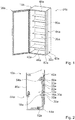
- Fig. 1 shows a home appliance 34a comprising a home appliance device, in a schematic perspective view.
- the home appliance 34a is embodied as a refrigerator.
- the home appliance 34a could further be embodied as any other home appliance deemed advantageous by someone skilled in the art, e.g. a climate cabinet, an ice-box, a freezer, a wine-cooler and/or a refrigerator-freezer combination.
- the home appliance device comprises a housing 10a.
- the housing 10a comprises two side walls 44a.
- the two side walls 44a are arranged opposite one another.
- the housing 10a further comprises a bottom wall 46a, a top wall 48a and a rear wall 50a.
- the home appliance device comprises a home appliance door 36a.
- the housing 10a comprises an inner liner 40a.
- the inner liner 40a delimits a storage space 38a of the home appliance device.
- the storage space 38a is a space inside the home appliance device and is provided for storing victuals.
- the inner liner 40a is at least partly, preferably at least mostly and advantageously entirely made of metal, in particular sheet metal.
- the inner liner and/or the outer liner may be at least partly, preferably at least mostly and advantageously entirely made of plastic, in particular a thermoplastic.
- the housing 10a comprises an outer liner 42a.
- the outer liner 42a delimits the home appliance device to an environment.
- the outer liner 42a is at least partly, preferably at least mostly and advantageously entirely made of metal, in particular sheet metal.
- the inner liner and/or the outer liner may be at least partly, preferably at least mostly and advantageously entirely made of plastic, in particular a thermoplastic.
- the housing 10a comprises a door frame 52a.
- the door frame is at least partly, preferably at least mostly and advantageously entirely made of plastic, in particular a thermoplastic.
- the inner liner and/or the outer liner may be at least partly, preferably at least mostly and advantageously entirely made of plastic, in particular a thermoplastic.
- the door frame 52a is directly connected to the inner liner 40a.
- the door frame 52a is indirectly connected to the outer liner 42a.
- the housing 10a comprises in particular a side element 32a.
- the side element 32a is in particular configured for reducing a heat transfer between the inner liner 40a and the outer liner 42a.
- the side element 32a connects the door frame 52a to the outer liner 42a.
- the side element 32a is at least partly, preferably at least mostly and advantageously entirely made of plastic, in particular thermoplastic.
- the side element 32a is manufactured by means of extrusion, in particular plastic extrusion.
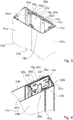
- Figs. 2 and 3 show different cross-sectional views of the side wall 44a of the home appliance device.
- the housing 10a in particular the outer liner 42a, the inner liner 40a, the side element 32a and/or the door frame 52a defines an insulation space 12a.
- the insulation space 12a is configured for reducing a heat transfer from an environment of the home appliance device to the storage space 38a of the home appliance device.
- the insulation space 12a is filled with an insulation means, in particular foam, preferably polymer foam, in particular polyurethane foam.
- the home appliance device comprises a heating unit 14a.
- the heating unit 14a is arranged inside the insulation space 12a.
- the heating unit 14a contacts the housing 10a, in particular the door frame 52a.
- the heating unit 14a is configured for producing heat and is specifically used to prevent further components of the home appliance device, in particular of the home appliance door 36a and/or the housing 10a, in particular the side element 32a, from condensing and/or icing up.
- the heating unit 14a is embodied as a heat pipe.
- the heating unit 14a extends at least substantially parallel to a main extension direction of the housing 10a. Further, the heating unit 14a extends alongside the door frame 52a.
- the home appliance device comprises a heat transfer element 16a.
- the heat transfer element 16a is arranged inside the insulation space 12a.
- the heat transfer element 16a is configured for transferring heat.
- the heat transfer element 16a has a thermal conductivity of at least 10 W/(m ⁇ K).
- the heat transfer element 16a is implemented separately from the housing 10a.
- the heat transfer element 16a is implemented separately from the heating unit 14a.
- the heat transfer element 16a is at least partly made of steel.
- the heat transfer element 16a contacts at least partly the heating unit 14a.
- the heat transfer element 16a contacts at least partly the housing 10a, in particular the side element 32a.
- the heat transfer element 16a transfers heat from the heating unit 14a to the housing 10a, in particular the side element 32a.
- the side element 32a comprises a plurality of protrusions 26a.
- the protrusions 26a protrude towards the insulation space 12a.
- the protrusions 26a each provide a contact area 22a for contacting the heat transfer element 16a.
- the heat transfer element 16a has at least two contact areas 22a with the side element 32a.
- the home appliance device comprises a fixing unit 33a for fixing the heat transfer element 16a to the housing 10a, in particular the side element 32a.
- the fixing unit 33a fixes the heat transfer element 16a to the housing 10a, in particular to the side element 32a, at least in a form-fit manner. Alternatively or additionally the fixing unit fixes the heat transfer element to the housing in a force-fit manner.
- the fixing unit 33a is in particular at least partly implemented integrally with the heat transfer element 16a and at least partly implemented integrally with the housing 10a, in particular the side element 32a.
- the fixing unit 33a comprises a first fixing element 54a.
- the fixing unit 33a comprises a second fixing element 56a.
- the second fixing element 56a contacts the first fixing element 54a.
- the first fixing element 54a and the second fixing element 56a cooperate for fixing the heat transfer element 16a to the housing 10a, in particular to the side element 32a.
- the side element 32a embodies the second fixing element 54a.
- the side element 32a comprises a first section which embodies the second fixing element 54a.
- the second fixing element 54a least partly encompassing the heat transfer element 16a.
- the heat transfer 16a embodies the first fixing element 56a.
- the heat transfer element 16a comprises a second section which at least partly embodies the first fixing element 56a. In particular the second section is at least substantially u-shaped.
- the second section of the heat transfer element 16a encompasses the first section of the side element 32a.
- the heat transfer element 16a has at least one undulation 18a.
- the undulation 18a is at least section-wise at least substantially meander-shaped.
- the undulation 18a has an amplitude 20a.
- the amplitude 20a extends at least substantially perpendicularly to a main extension of the heat transfer element 16a.
- the amplitude 20a extends at least substantially perpendicularly to a main direction of a heat transfer.
- the home appliance device further comprises a supporting element 30a.
- the supporting element 30a supports the housing 10a.
- the supporting element 30a is embodied by the heat transfer element 16a.
- Fig. 4 shows a further exemplary embodiment of the invention.
- the following description is substantially limited to the differences between the exemplary embodiments, wherein regarding structural elements, features and functions that remain the same, the description of the other exemplary embodiment, in particular the exemplary embodiment of figs. 1 to 3 , may be referred to.
- the letter a of the reference numerals in the exemplary embodiment of fig. 1 to 3 has been substituted by the letter b in the reference numerals of the exemplary embodiment of fig. 4 .
- structural elements having the same denomination in particular regarding structural elements having the same reference numerals, principally the drawing and/or the description of the other exemplary embodiment, in particular of the exemplary embodiment of figs. 1 to 3 , may be referred to.
- Fig. 4 shows a portion of a further home appliance device comprising a heat transfer element 16b.
- the exemplary embodiment of fig. 4 differs from the preceding exemplary embodiment at least substantially by the implementation of the heat transfer element 16b.
- the heat transfer element 16b contacts a heating unit 14b of the home appliance device from a lateral side.
- the heat transfer element 16b further contacts a door frame 52b.
- the heat transfer element 16b contacts the door frame 52b in a vicinity of a contact between the heat transfer element 16b and the heating unit 14b. In a vicinity of the door frame 52b the shape of the heat transfer element 16b is equivalent to a shape of the door frame 52b.
- the heat transfer element 16b comprises at least one embossed element 58b.
- the embossed element 58b is embodied by an undulation 18b of the heat transfer element 16b.
- the undulation 18b may in particular be produced by a stamping and/or bending process.
- the heat transfer element 16b comprises at least one recess 60b in form of an opening or through-hole.
- the heat transfer element 16b comprises four recesses 60b. These recesses 60b allow insulation material to enter a slit-like cavity formed between the side element 32b and the heat transfer element 16b.
- the heat transfer element 16b may comprise a different number of recesses 60b and/or embossed elements 58b, as considered advantageously to someone skilled in the art.
Landscapes
- Engineering & Computer Science (AREA)
- Chemical & Material Sciences (AREA)
- Combustion & Propulsion (AREA)
- Physics & Mathematics (AREA)
- Mechanical Engineering (AREA)
- Thermal Sciences (AREA)
- General Engineering & Computer Science (AREA)
- Refrigerator Housings (AREA)
Applications Claiming Priority (1)
| Application Number | Priority Date | Filing Date | Title |
|---|---|---|---|
| US15/359,688 US20180142938A1 (en) | 2016-11-23 | 2016-11-23 | Home Appliance Device |
Publications (1)
| Publication Number | Publication Date |
|---|---|
| EP3327378A1 true EP3327378A1 (fr) | 2018-05-30 |
Family
ID=60331478
Family Applications (1)
| Application Number | Title | Priority Date | Filing Date |
|---|---|---|---|
| EP17201980.4A Withdrawn EP3327378A1 (fr) | 2016-11-23 | 2017-11-16 | Dispositif d'appareil domestique |
Country Status (2)
| Country | Link |
|---|---|
| US (1) | US20180142938A1 (fr) |
| EP (1) | EP3327378A1 (fr) |
Cited By (1)
| Publication number | Priority date | Publication date | Assignee | Title |
|---|---|---|---|---|
| EP4023980A1 (fr) | 2020-12-30 | 2022-07-06 | BSH Hausgeräte GmbH | Appareil électroménager |
Families Citing this family (2)
| Publication number | Priority date | Publication date | Assignee | Title |
|---|---|---|---|---|
| TR202010143A2 (tr) * | 2020-06-29 | 2022-01-21 | Bsh Ev Aletleri San Ve Tic As | Sizdirmazlik elemani i̇çeren gövdeye sahi̇p bi̇r ev ci̇hazi |
| CN115200295B (zh) * | 2022-07-15 | 2024-02-20 | 温州市顶诺食品有限公司 | 一种冷库入料装置 |
Citations (6)
| Publication number | Priority date | Publication date | Assignee | Title |
|---|---|---|---|---|
| US2632313A (en) * | 1951-03-03 | 1953-03-24 | Gen Motors Corp | Refrigerating apparatus having means for preventing condensation |
| JPS6283175U (fr) * | 1985-11-15 | 1987-05-27 | ||
| US4881315A (en) * | 1989-01-18 | 1989-11-21 | General Electric Company | Method of assembling an anti-sweat heater in a refrigerator cabinet |
| US6393855B1 (en) * | 2001-04-24 | 2002-05-28 | Maytag Corporation | Methods and devices for retaining a heating element within a refrigeration cabinet |
| WO2007062909A1 (fr) | 2005-11-30 | 2007-06-07 | BSH Bosch und Siemens Hausgeräte GmbH | Appareil frigorifique a barre d'isolation pour l'isolation thermique des parois laterales |
| WO2012028998A2 (fr) * | 2010-08-31 | 2012-03-08 | BSH Bosch und Siemens Hausgeräte GmbH | Appareil réfrigérant |
Family Cites Families (3)
| Publication number | Priority date | Publication date | Assignee | Title |
|---|---|---|---|---|
| JPS5468562A (en) * | 1977-11-11 | 1979-06-01 | Hitachi Ltd | Refrigerator |
| WO2007018601A1 (fr) * | 2005-08-02 | 2007-02-15 | Rubicon Genomics, Inc. | Compositions et methodes de traitement et d'amplification d'adn consistant a utiliser plusieurs enzymes dans une seule reaction |
| US9970701B2 (en) * | 2014-01-07 | 2018-05-15 | Samsung Electronics Co., Ltd. | Refrigerator having a heating pipe |
-
2016
- 2016-11-23 US US15/359,688 patent/US20180142938A1/en not_active Abandoned
-
2017
- 2017-11-16 EP EP17201980.4A patent/EP3327378A1/fr not_active Withdrawn
Patent Citations (6)
| Publication number | Priority date | Publication date | Assignee | Title |
|---|---|---|---|---|
| US2632313A (en) * | 1951-03-03 | 1953-03-24 | Gen Motors Corp | Refrigerating apparatus having means for preventing condensation |
| JPS6283175U (fr) * | 1985-11-15 | 1987-05-27 | ||
| US4881315A (en) * | 1989-01-18 | 1989-11-21 | General Electric Company | Method of assembling an anti-sweat heater in a refrigerator cabinet |
| US6393855B1 (en) * | 2001-04-24 | 2002-05-28 | Maytag Corporation | Methods and devices for retaining a heating element within a refrigeration cabinet |
| WO2007062909A1 (fr) | 2005-11-30 | 2007-06-07 | BSH Bosch und Siemens Hausgeräte GmbH | Appareil frigorifique a barre d'isolation pour l'isolation thermique des parois laterales |
| WO2012028998A2 (fr) * | 2010-08-31 | 2012-03-08 | BSH Bosch und Siemens Hausgeräte GmbH | Appareil réfrigérant |
Cited By (2)
| Publication number | Priority date | Publication date | Assignee | Title |
|---|---|---|---|---|
| EP4023980A1 (fr) | 2020-12-30 | 2022-07-06 | BSH Hausgeräte GmbH | Appareil électroménager |
| US11740010B2 (en) | 2020-12-30 | 2023-08-29 | Bsh Hausgeraete Gmbh | Household appliance |
Also Published As
| Publication number | Publication date |
|---|---|
| US20180142938A1 (en) | 2018-05-24 |
Similar Documents
| Publication | Publication Date | Title |
|---|---|---|
| US10386111B2 (en) | Home appliance device and method for assembling a home appliance device | |
| US9823013B1 (en) | Home appliance device | |
| EP3327383A1 (fr) | Porte d'appareil domestique | |
| EP3327378A1 (fr) | Dispositif d'appareil domestique | |
| US10012430B2 (en) | Home appliance device | |
| US20150369530A1 (en) | Refrigeration unit having a container | |
| CN108088161A (zh) | 家用器具门 | |
| US20220341656A1 (en) | Refrigeration appliance device | |
| US11181313B2 (en) | Domestic appliance | |
| US20180149421A1 (en) | Home Appliance Device | |
| EP1918664A3 (fr) | Appareil de réfrigération | |
| EP3327385A1 (fr) | Dispositif d'appareil domestique | |
| WO2012028468A3 (fr) | Appareil frigorifique, notamment appareil frigorifique ménager | |
| EP3327381B1 (fr) | Porte d'appareil domestique | |
| EP4023980B1 (fr) | Appareil électroménager | |
| EP3327389B1 (fr) | Dispositif d'appareil domestique | |
| CN109405396B (zh) | 家用制冷器具装置 | |
| CN203928558U (zh) | 具有冷凝水收集容器的制冷器具 | |
| CN203478816U (zh) | 设有微波炉的冰箱 | |
| US10876784B2 (en) | Home appliance door | |
| US11493264B2 (en) | Home appliance device and method of manufacturing the home appliance device | |
| CN216897959U (zh) | 家用制冷器具装置 | |
| WO2011080089A2 (fr) | Dispositif de refroidissement | |
| EP3775730B1 (fr) | Appareil de refroidissement | |
| CN211290706U (zh) | 家用器具门 |
Legal Events
| Date | Code | Title | Description |
|---|---|---|---|
| PUAI | Public reference made under article 153(3) epc to a published international application that has entered the european phase |
Free format text: ORIGINAL CODE: 0009012 |
|
| AK | Designated contracting states |
Kind code of ref document: A1 Designated state(s): AL AT BE BG CH CY CZ DE DK EE ES FI FR GB GR HR HU IE IS IT LI LT LU LV MC MK MT NL NO PL PT RO RS SE SI SK SM TR |
|
| AX | Request for extension of the european patent |
Extension state: BA ME |
|
| STAA | Information on the status of an ep patent application or granted ep patent |
Free format text: STATUS: THE APPLICATION IS DEEMED TO BE WITHDRAWN |
|
| 18D | Application deemed to be withdrawn |
Effective date: 20181201 |