EP3327940A1 - Procédé de transmission d'informations de rétroaction, équipement d'utilisateur, et station de base - Google Patents
Procédé de transmission d'informations de rétroaction, équipement d'utilisateur, et station de base Download PDFInfo
- Publication number
- EP3327940A1 EP3327940A1 EP15901211.1A EP15901211A EP3327940A1 EP 3327940 A1 EP3327940 A1 EP 3327940A1 EP 15901211 A EP15901211 A EP 15901211A EP 3327940 A1 EP3327940 A1 EP 3327940A1
- Authority
- EP
- European Patent Office
- Prior art keywords
- pucch resource
- codebook
- downlink subframe
- downlink
- information
- Prior art date
- Legal status (The legal status is an assumption and is not a legal conclusion. Google has not performed a legal analysis and makes no representation as to the accuracy of the status listed.)
- Granted
Links
Images


Classifications
-
- H—ELECTRICITY
- H04—ELECTRIC COMMUNICATION TECHNIQUE
- H04W—WIRELESS COMMUNICATION NETWORKS
- H04W72/00—Local resource management
- H04W72/20—Control channels or signalling for resource management
-
- H—ELECTRICITY
- H04—ELECTRIC COMMUNICATION TECHNIQUE
- H04B—TRANSMISSION
- H04B7/00—Radio transmission systems, i.e. using radiation field
- H04B7/02—Diversity systems; Multi-antenna system, i.e. transmission or reception using multiple antennas
- H04B7/04—Diversity systems; Multi-antenna system, i.e. transmission or reception using multiple antennas using two or more spaced independent antennas
- H04B7/06—Diversity systems; Multi-antenna system, i.e. transmission or reception using multiple antennas using two or more spaced independent antennas at the transmitting station
- H04B7/0613—Diversity systems; Multi-antenna system, i.e. transmission or reception using multiple antennas using two or more spaced independent antennas at the transmitting station using simultaneous transmission
- H04B7/0615—Diversity systems; Multi-antenna system, i.e. transmission or reception using multiple antennas using two or more spaced independent antennas at the transmitting station using simultaneous transmission of weighted versions of same signal
- H04B7/0619—Diversity systems; Multi-antenna system, i.e. transmission or reception using multiple antennas using two or more spaced independent antennas at the transmitting station using simultaneous transmission of weighted versions of same signal using feedback from receiving side
- H04B7/0621—Feedback content
- H04B7/0626—Channel coefficients, e.g. channel state information [CSI]
-
- H—ELECTRICITY
- H04—ELECTRIC COMMUNICATION TECHNIQUE
- H04L—TRANSMISSION OF DIGITAL INFORMATION, e.g. TELEGRAPHIC COMMUNICATION
- H04L5/00—Arrangements affording multiple use of the transmission path
- H04L5/003—Arrangements for allocating sub-channels of the transmission path
- H04L5/0078—Timing of allocation
- H04L5/0082—Timing of allocation at predetermined intervals
-
- H—ELECTRICITY
- H04—ELECTRIC COMMUNICATION TECHNIQUE
- H04L—TRANSMISSION OF DIGITAL INFORMATION, e.g. TELEGRAPHIC COMMUNICATION
- H04L5/00—Arrangements affording multiple use of the transmission path
- H04L5/0091—Signalling for the administration of the divided path, e.g. signalling of configuration information
- H04L5/0094—Indication of how sub-channels of the path are allocated
-
- H—ELECTRICITY
- H04—ELECTRIC COMMUNICATION TECHNIQUE
- H04W—WIRELESS COMMUNICATION NETWORKS
- H04W72/00—Local resource management
- H04W72/04—Wireless resource allocation
- H04W72/044—Wireless resource allocation based on the type of the allocated resource
- H04W72/0466—Wireless resource allocation based on the type of the allocated resource the resource being a scrambling code
-
- H—ELECTRICITY
- H04—ELECTRIC COMMUNICATION TECHNIQUE
- H04L—TRANSMISSION OF DIGITAL INFORMATION, e.g. TELEGRAPHIC COMMUNICATION
- H04L5/00—Arrangements affording multiple use of the transmission path
- H04L5/0001—Arrangements for dividing the transmission path
- H04L5/0003—Two-dimensional division
- H04L5/0005—Time-frequency
- H04L5/0007—Time-frequency the frequencies being orthogonal, e.g. OFDM(A) or DMT
-
- H—ELECTRICITY
- H04—ELECTRIC COMMUNICATION TECHNIQUE
- H04L—TRANSMISSION OF DIGITAL INFORMATION, e.g. TELEGRAPHIC COMMUNICATION
- H04L5/00—Arrangements affording multiple use of the transmission path
- H04L5/003—Arrangements for allocating sub-channels of the transmission path
- H04L5/0053—Allocation of signalling, i.e. of overhead other than pilot signals
- H04L5/0055—Physical resource allocation for ACK/NACK
-
- H—ELECTRICITY
- H04—ELECTRIC COMMUNICATION TECHNIQUE
- H04W—WIRELESS COMMUNICATION NETWORKS
- H04W48/00—Access restriction; Network selection; Access point selection
- H04W48/16—Discovering, processing access restriction or access information
-
- H—ELECTRICITY
- H04—ELECTRIC COMMUNICATION TECHNIQUE
- H04W—WIRELESS COMMUNICATION NETWORKS
- H04W72/00—Local resource management
- H04W72/20—Control channels or signalling for resource management
- H04W72/21—Control channels or signalling for resource management in the uplink direction of a wireless link, i.e. towards the network
-
- H—ELECTRICITY
- H04—ELECTRIC COMMUNICATION TECHNIQUE
- H04W—WIRELESS COMMUNICATION NETWORKS
- H04W88/00—Devices specially adapted for wireless communication networks, e.g. terminals, base stations or access point devices
- H04W88/08—Access point devices
Definitions
- the present invention relates to the field of wireless communications, and in particular, to a feedback information sending method, user equipment, and a base station.
- Carrier aggregation means that a base station configures multiple consecutive or inconsecutive carriers for user equipment (User Equipment, UE), and the UE can perform uplink and downlink transmission simultaneously by using the multiple carriers, so as to increase a data transmission rate.
- the UE can detect a physical downlink control channel (Physical Downlink Control Channel, PDCCH) in a subframe of a carrier, and receive information on a downlink data channel or send information on an uplink data channel according to scheduling information carried on the PDCCH.
- PDCCH Physical Downlink Control Channel
- Hybrid Automatic Repeat Request Hybrid Automatic Repeat Request
- HARQ Hybrid Automatic Repeat Request
- UE after receiving downlink data that is sent by a base station by using a physical downlink shared channel (Physical Downlink Shared Channel, PDSCH), UE feeds back a response information codebook on a physical uplink control channel (Physical Uplink Control Channel, PUCCH).
- the response information codebook includes an acknowledgement (Acknowledgement, ACK) and a negative acknowledgement (Negative Acknowledgement, NACK). If the UE correctly decodes the downlink data received in a downlink subframe, the UE feeds back an ACK, or if the UE incorrectly decodes the downlink data, the UE feeds back a NACK.
- a feedback information sending method in the prior art is generally as follows:
- a base station configures M carriers in total for UE.
- the UE When the base station performs scheduling in N downlink subframes of the M carriers, the UE generates ACK/NACK codebooks according to the N downlink subframes of the M carriers, fills a NACK at a position of an ACK/NACK codebook corresponding to a downlink subframe in which scheduling is not performed, and then sends an ACK/NACK codebook on a PUCCH resource in an uplink subframe of a primary carrier.
- Embodiments of the present invention provide a feedback information sending method, user equipment, and a base station, to determine a bit quantity of an ACK/NACK codebook, and select, according to the bit quantity of the ACK/NACK codebook, a PUCCH resource corresponding to the bit quantity of the ACK/NACK codebook, so as to improve PUCCH resource utilization.
- a first aspect of the present invention provides UE, including:
- the codebook of the feedback information is a first codebook
- the processing module is specifically configured to: determine the first codebook according to a downlink assignment index DAI accumulation indication, where the DAI accumulation indication is located in each piece of scheduling information of the real-time scheduled downlink subframe subset, a value of the DAI accumulation indication is accumulatively counted according to a sequence of precedence of carriers over subframes in the real-time scheduled downlink subframe subset, the first codebook corresponds to the real-time scheduled downlink subframe subset, and the real-time scheduled downlink subframe subset is a set of downlink subframes that are currently actually scheduled and that are in the preconfigured downlink subframe set.
- the processing module is specifically configured to: determine the first codebook according to the DAI accumulation indication and a DAI total quantity indication, where the DAI total quantity indication is used to indicate a quantity of downlink subframes in the real-time scheduled downlink subframe subset.
- the processing module is specifically configured to: determine the first codebook according to a first status of the PUCCH resource indication information and the DAI accumulation indication.
- the processing module is specifically configured to determine a preconfigured PUCCH resource set in the uplink subframe; and determine the PUCCH resource in the resource set according to a bit quantity of the first codebook and the PUCCH resource indication information.
- the processing module is specifically configured to:
- the processing module is specifically configured to:
- the processing module is specifically configured to: determine a bit capacity interval according to the bit quantity of the first codebook; and determine the PUCCH resource in the resource set according to the bit capacity interval and the PUCCH resource indication information.
- the codebook of the feedback information is a second codebook
- the processing module is specifically configured to:
- the processing module is specifically configured to: determine the second codebook according to a second status of the PUCCH resource indication information and the preconfigured downlink subframe subset.
- the processing module is specifically configured to determine the PUCCH resource according to the PUCCH resource indication information and the preconfigured downlink subframe subset.
- the processing module is specifically configured to: determine the PUCCH resource according to the PUCCH resource indication information and a DAI total quantity indication.
- a second aspect of the present invention provides a base station, including:
- the scheduling information includes a downlink assignment index DAI accumulation indication, where the DAI accumulation indication is used to instruct the UE to determine a first codebook, the DAI accumulation indication is located in each piece of scheduling information of the real-time scheduled downlink subframe subset, a value of the DAI accumulation indication is accumulatively counted according to a sequence of precedence of carriers over subframes in the real-time scheduled downlink subframe subset, the first codebook corresponds to the real-time scheduled downlink subframe subset, and the real-time scheduled downlink subframe subset is a set of downlink subframes that are currently actually scheduled and that are in the preconfigured downlink subframe set.
- the scheduling information further includes a DAI total quantity indication, and the DAI total quantity indication is used to indicate a quantity of downlink subframes in the real-time scheduled downlink subframe subset.
- the scheduling information includes PUCCH resource indication information
- the PUCCH resource indication information is a first status of the PUCCH resource indication information
- the first status of the PUCCH resource indication information is used to instruct the UE to determine the first codebook.
- the scheduling information includes PUCCH resource indication information, and the PUCCH resource indication information and a bit quantity of the first codebook are used to indicate the PUCCH resource.
- the processing module is specifically configured to: determine a preconfigured downlink subframe subset, where the preconfigured downlink subframe subset belongs to the preconfigured downlink subframe set, the scheduling information belongs to the preconfigured downlink subframe subset, and the preconfigured downlink subframe subset is used by the UE to determine a second codebook.
- the scheduling information includes PUCCH resource indication information
- the PUCCH resource indication information is a second status of the PUCCH resource indication information
- the second status of the PUCCH resource indication information is used to instruct the UE to determine the second codebook.
- the scheduling information includes PUCCH resource indication information, and the PUCCH resource indication information and the preconfigured downlink subframe subset are used to instruct the UE to determine the PUCCH resource.
- the scheduling information includes PUCCH resource indication information and a DAI total quantity indication, and the DAI total quantity indication is used to instruct the UE to determine the PUCCH resource.
- a third aspect of the embodiments of the present invention provides a feedback information sending method, including:
- the codebook of the feedback information is a first codebook
- the determining, by the UE, a codebook of the feedback information includes: determining, by the UE, the first codebook according to a downlink assignment index DAI accumulation indication, where the DAI accumulation indication is located in each piece of scheduling information of the real-time scheduled downlink subframe subset, a value of the DAI accumulation indication is accumulatively counted according to a sequence of precedence of carriers over subframes in the real-time scheduled downlink subframe subset, the first codebook corresponds to the real-time scheduled downlink subframe subset, and the real-time scheduled downlink subframe subset is a set of downlink subframes that are currently actually scheduled and that are in the preconfigured downlink subframe set.
- the determining, by the UE, the first codebook according to a downlink assignment index DAI accumulation indication includes: determining, by the UE, the first codebook according to the DAI accumulation indication and a DAI total quantity indication, where the DAI total quantity indication is used to indicate a quantity of downlink subframes in the real-time scheduled downlink subframe subset.
- the determining, by the UE, the first codebook according to a DAI accumulation indication includes: determining, by the UE, the first codebook according to a first status of the PUCCH resource indication information and the DAI accumulation indication.
- the determining, by the UE, a PUCCH resource according to PUCCH resource indication information includes:
- the determining, by the UE, the PUCCH resource in the resource set according to a bit quantity of the first codebook and the PUCCH resource indication information includes:
- the determining, by the UE, the PUCCH resource in the resource set according to the bit quantity of the first codebook, a bit quantity of a CRC, and the PUCCH resource indication information includes:
- the determining, by the UE, the PUCCH resource in the resource set according to the bit quantity of the first codebook and the PUCCH resource indication information includes:
- the codebook of the feedback information is a second codebook
- the determining, by the UE, a codebook of the feedback information includes:
- the determining, by the UE, the second codebook according to the preconfigured downlink subframe subset includes: determining, by the UE, the second codebook according to a second status of the PUCCH resource indication information and the preconfigured downlink subframe subset.
- the determining, by the UE, a PUCCH resource according to PUCCH resource indication information includes: determining, by the UE, the PUCCH resource according to the PUCCH resource indication information and the preconfigured downlink subframe subset.
- the determining, by the UE, a PUCCH resource according to PUCCH resource indication information includes: determining, by the UE, the PUCCH resource according to the PUCCH resource indication information and a DAI total quantity indication.
- a fourth aspect of the present invention provides a feedback information receiving method, including:
- the scheduling information includes a downlink assignment index DAI accumulation indication, where the DAI accumulation indication is used to instruct the UE to determine a first codebook, the DAI accumulation indication is located in each piece of scheduling information of the real-time scheduled downlink subframe subset, a value of the DAI accumulation indication is accumulatively counted according to a sequence of precedence of carriers over subframes in the real-time scheduled downlink subframe subset, the first codebook corresponds to the real-time scheduled downlink subframe subset, and the real-time scheduled downlink subframe subset is a set of downlink subframes that are currently actually scheduled and that are in the preconfigured downlink subframe set.
- the scheduling information further includes a DAI total quantity indication, and the DAI total quantity indication is used to indicate a quantity of downlink sub frames in the real-time scheduled downlink subframe subset.
- the scheduling information includes PUCCH resource indication information
- the PUCCH resource indication information is a first status of the PUCCH resource indication information
- the first status of the PUCCH resource indication information is used to instruct the UE to determine the first codebook.
- the scheduling information includes PUCCH resource indication information, and the PUCCH resource indication information and a bit quantity of the first codebook are used to indicate the PUCCH resource.
- the method further includes: determining, by the base station, a preconfigured downlink subframe subset, where the preconfigured downlink subframe subset belongs to the preconfigured downlink subframe set, the scheduling information belongs to the preconfigured downlink subframe subset, and the preconfigured downlink subframe subset is used by the UE to determine a second codebook.
- the scheduling information includes PUCCH resource indication information
- the PUCCH resource indication information is a second status of the PUCCH resource indication information
- the second status of the PUCCH resource indication information is used to instruct the UE to determine the second codebook.
- the scheduling information includes PUCCH resource indication information, and the PUCCH resource indication information and the preconfigured downlink subframe subset are used to instruct the UE to determine the PUCCH resource.
- the scheduling information includes PUCCH resource indication information and a DAI total quantity indication, and the DAI total quantity indication is used to instruct the UE to determine the PUCCH resource.
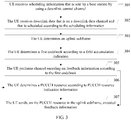
- the UE receives the scheduling information that is sent by the base station by using the downlink control channel, where the downlink control channel belongs to the preconfigured downlink subframe set; receives the downlink data that is on the downlink data channel and that is scheduled according to the scheduling information; determines the uplink subframe according to the downlink data, where the uplink subframe is used to send the feedback information, and the preconfigured downlink subframe set is a set of downlink subframes that are associated with the uplink subframe and that are of all carriers configured for the UE by the base station; determines the codebook of the feedback information; performs channel encoding on the feedback information according to the codebook of the feedback information; determines the PUCCH resource according to the PUCCH resource indication information; and sends, on the PUCCH resource in the uplink subframe, the encoded feedback information.
- the UE can determine an ACK/NACK codebook, and select, according to a bit quantity of the ACK/NACK, a PUCCH resource suitable for the bit quantity to transmit the feedback information. All or most of the feedback information is an ACK, thereby avoiding relatively low PUCCH resource utilization.
- an embodiment of the UE in an embodiment of the present invention includes a receiving module 101, a processing module 102, and a sending module 103.
- the receiving module 101 is configured to receive scheduling information that is sent by a base station by using a downlink control channel, where the downlink control channel belongs to a preconfigured downlink subframe set.
- the receiving module 101 is further configured to receive downlink data that is on a downlink data channel and that is scheduled according to the scheduling information.
- the processing module 102 is configured to determine an uplink subframe, where the uplink subframe is used to send feedback information corresponding to the downlink data, and the preconfigured downlink subframe set is a set of downlink subframes that are associated with the uplink subframe and that are of all carriers configured for the UE by the base station.
- the processing module 102 is further configured to determine a codebook of the feedback information.
- the processing module 102 is further configured to perform channel encoding on the feedback information according to the codebook of the feedback information.
- the processing module 102 is further configured to determine a PUCCH resource according to physical uplink control channel PUCCH resource indication information.
- the sending module 103 is configured to send, on the PUCCH resource in the uplink subframe, encoded feedback information.
- the receiving module 101 can receive the scheduling information that is sent by the base station by using the downlink control channel, where the downlink control channel belongs to the preconfigured downlink subframe set, and can further receive the downlink data that is on the downlink data channel and that is scheduled according to the scheduling information.
- the processing module 102 determines the uplink subframe according to the downlink data, where the uplink subframe is used to send the feedback information, where the preconfigured downlink subframe set is a set of downlink subframes that are associated with the uplink subframe and that are of all carriers configured for the UE by the base station.
- the processing module 102 determines the codebook of the feedback information, performs channel encoding on the feedback information according to the codebook of the feedback information, and determines the PUCCH resource according to the physical uplink control channel PUCCH resource indication information.
- the sending module 103 sends, on the PUCCH resource in the uplink subframe, the encoded feedback information.
- the processing module 102 can determine an ACK/NACK codebook, and select, according to a bit quantity of the ACK/NACK, a PUCCH resource suitable for the bit quantity to transmit feedback information. All or most of the feedback information is an ACK, thereby avoiding relatively low PUCCH resource utilization.
- the processing module 102 is specifically configured to: determine a first codebook according to a downlink assignment index (Downlink Assignment Index, DAI) accumulation indication, where the DAI accumulation indication is located in each piece of scheduling information of a real-time scheduled downlink subframe subset, a value of the DAI accumulation indication is accumulatively counted according to a sequence of precedence of carriers over subframes in the real-time scheduled downlink subframe subset, the first codebook corresponds to the real-time scheduled downlink subframe subset, and the real-time scheduled downlink subframe subset is a set of downlink subframes that are currently actually scheduled and that are in the preconfigured downlink subframe set.
- DAI Downlink Assignment Index
- the processing module 102 is specifically configured to: determine the first codebook according to the DAI accumulation indication and a DAI total quantity indication, where the DAI total quantity indication is used to indicate a quantity of downlink subframes in the real-time scheduled downlink subframe subset.
- the processing module 102 is specifically configured to: determine the first codebook according to a first status of the PUCCH resource indication information and the DAI accumulation indication.
- the processing module 102 is specifically configured to:
- the processing module 102 is specifically configured to:
- the processing module 102 is specifically configured to:
- the processing module 102 is specifically configured to:
- the codebook of the feedback information is a second codebook
- the processing module 102 is specifically configured to:
- the processing module 102 is specifically configured to: determine the second codebook according to a second status of the PUCCH resource indication information and the preconfigured downlink subframe subset.
- the processing module 102 is specifically configured to: determine the PUCCH resource according to the PUCCH resource indication information and the preconfigured downlink subframe subset.
- the processing module 102 is specifically configured to: determine the PUCCH resource according to the PUCCH resource indication information and a DAI total quantity indication.
- a function of the receiving module 101 may be implemented by a receiving apparatus
- a function of the processing module 102 may be implemented by a processor
- a function of the sending module 103 may be implemented by a sending apparatus.
- an embodiment of a base station in an embodiment of the present invention includes a sending module 201, a processing module 202, and a receiving module 203.
- the sending module 201 is configured to: send scheduling information to user equipment UE by using a downlink control channel, and send downlink data by using a downlink data channel, where the downlink control channel belongs to a preconfigured downlink subframe set, and the scheduling information is used to schedule the downlink data.
- the processing module 202 is configured to determine an uplink subframe, where the uplink subframe is used by UE to send feedback information corresponding to the downlink data, and the preconfigured downlink subframe set is a set of downlink subframes that are associated with the uplink subframe and that are of all carriers configured for the UE by the base station.
- the processing module 202 is further configured to determine a PUCCH resource.
- the receiving module 203 is configured to receive, on the PUCCH resource in the uplink subframe, encoded feedback information that is sent by the UE.
- the processing module 202 is further configured to decode the received encoded feedback information, to obtain a codebook of the feedback information.
- the scheduling information includes a downlink assignment index DAI accumulation indication, where the DAI accumulation indication is used to instruct the UE to determine a first codebook, the DAI accumulation indication is located in each piece of scheduling information of a real-time scheduled downlink subframe subset, a value of the DAI accumulation indication is accumulatively counted according to a sequence of precedence of carriers over subframes in the real-time scheduled downlink subframe subset, the first codebook corresponds to the real-time scheduled downlink subframe subset, and the real-time scheduled downlink subframe subset is a set of downlink subframes that are currently actually scheduled and that are in the preconfigured downlink subframe set.
- the scheduling information may further include a DAI total quantity indication, and the DAI total quantity indication is used to indicate a quantity of downlink subframes in the real-time scheduled downlink subframe subset.
- the scheduling information includes PUCCH resource indication information
- the PUCCH resource indication information is a first status of the PUCCH resource indication information
- the first status of the PUCCH resource indication information is used to instruct the UE to determine the first codebook.
- the scheduling information includes PUCCH resource indication information, and the PUCCH resource indication information and a bit quantity of the first codebook are used to indicate the PUCCH resource.
- the processing module 202 is specifically configured to: determine a preconfigured downlink subframe subset, where the preconfigured downlink subframe subset belongs to the preconfigured downlink subframe set, the scheduling information belongs to the preconfigured downlink subframe subset, and the preconfigured downlink subframe subset is used by the UE to determine a second codebook.
- the scheduling information includes PUCCH resource indication information
- the PUCCH resource indication information is a second status of the PUCCH resource indication information
- the second status of the PUCCH resource indication information is used to instruct the UE to determine the second codebook.
- the scheduling information includes PUCCH resource indication information, and the PUCCH resource indication information and the preconfigured downlink subframe subset are used to instruct the UE to determine the PUCCH resource.
- the scheduling information includes PUCCH resource indication information and a DAI total quantity indication, and the DAI total quantity indication is used to instruct the UE to determine the PUCCH resource.
- a function of the processing module 202 may be implemented by a processor
- a function of the receiving module 203 may be implemented by a receiving apparatus
- a function of the sending module 201 may be implemented by a sending apparatus.
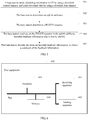
- a base station configures M carriers in total for UE and the base station performs scheduling once in a preconfigured downlink subframe set of the M carriers, there are N downlink subframes in total in the preconfigured downlink subframe set.
- the base station sends scheduling information and downlink data in the N downlink subframes of the M carriers, the UE may determine an uplink subframe corresponding to the downlink data, so as to send an ACK/NACK corresponding to the downlink data.
- the UE after receiving a PDSCH in a subframe n-4, the UE feeds back an ACK/NACK in a subframe n.
- n-7 is a downlink subframe 5
- n-6 is a downlink subframe 6.
- the UE generates an ACK/NACK codebook according to the N downlink subframes on the M carriers, where a bit quantity of the codebook is N, and performs channel encoding on an ACK/NACK according to the ACK/NACK codebook.
- the UE determines a PUCCH resource in the uplink subframe according to PUCCH resource indication information in the scheduling information, and sends encoded feedback information on the PUCCH resource.
- a carrier may include a downlink subframe, an uplink subframe, and a special subframe.
- Downlink data may be transmitted in a downlink subframe part DwPTS of the special subframe, and uplink data cannot be transmitted in an uplink subframe part UpPTS of the special subframe. Therefore, the special subframe may be considered as a downlink subframe.
- the base station configures a PUCCH resource of a new format for the UE to send an ACK/NACK.
- the new format is the PF3 format that can carry multiple resource blocks (Resource Block, RB), or may occupy one RB but capacity is expanded by compromising a code division multiplexing capability of the current PF3.
- ACK/NACK information is fed back by using a PUCCH resource that can carry a largest quantity of RBs, to ensure that all services are supported.
- the UE may determine the preconfigured downlink subframe subset in the preconfigured downlink subframe set.
- the preconfigured downlink subframe subset corresponds to a carrier occupied by the scheduling information.
- the UE determines the preconfigured downlink subframe subset according to a subframe in which the received scheduling information is located. It should be noted that downlink subframes in all preconfigured downlink subframe subsets in the preconfigured downlink subframe set do not overlap with each other.
- the preconfigured downlink subframe set is subframes 4, 5, 6, and 8 of carriers 1 to 10. It is assumed that a carrier on which the scheduling information is located is in downlink subframes 4, 5, 6, and 8 of carriers 1 to 5.
- the UE determines a second codebook according to the preconfigured downlink subframe subset.
- the UE sorts, according to a carrier-to-subframe or subframe-to-carrier sequence, ACKs/NACKs corresponding to the scheduling information. For a downlink subframe in which scheduling is not performed in the preconfigured downlink subframe subset, or for a downlink subframe in which the downlink data is not received, the UE fills 0 in the second codebook, so as to generate the second codebook.
- the second codebook corresponds to the preconfigured downlink subframe subset.
- the UE performs channel encoding on feedback information according to the second codebook.
- the UE After determining the second codebook, the UE performs channel encoding on the feedback information according to the second codebook.
- the UE determines a PUCCH resource according to PUCCH resource indication information.
- the determining, by the UE, a PUCCH resource according to PUCCH resource indication information may be specifically implemented in multiple manners. Refer to the following optional embodiments.
- the UE determines the PUCCH resource according to the PUCCH resource indication information and the preconfigured downlink subframe subset.
- the PUCCH resource indication information and the preconfigured downlink subframe subset are in preconfigured correspondences with the PUCCH resource.
- the UE receives the PUCCH indication information, and may determine a PUCCH resource subset according to a status of the PUCCH resource indication information, and then determine the PUCCH resource in the PUCCH resource subset according to the preconfigured downlink subframe subset.
- the UE determines a PUCCH resource subset according to the preconfigured downlink subframe subset, and then determines the PUCCH resource in the PUCCH resource subset according to a status of the PUCCH resource indication information.
- the UE determines the PUCCH resource according to the PUCCH resource indication information and a DAI total quantity indication.
- the DAI total quantity indication is used to indicate a quantity of downlink subframes in a real-time scheduled downlink subframe subset.
- the DAI total quantity indication stored in the field may be used to indicate the PUCCH resource.
- the PUCCH resource indication information and the DAI total quantity indication are in preconfigured correspondences with the PUCCH resource.
- the UE may determine a PUCCH resource subset according to a status of the PUCCH resource indication information, and then determine the PUCCH resource in the PUCCH resource subset according to the DAI total quantity indication. Alternatively, the UE determines a PUCCH resource subset according to the DAI total quantity indication, and then determines the PUCCH resource in the PUCCH resource subset according to a status of the PUCCH resource indication information.
- the UE sends, on the PUCCH resource in the uplink subframe, encoded feedback information.
- the UE After determining the PUCCH resource in the uplink subframe, the UE sends the encoded feedback information on the PUCCH resource.
- the UE when the base station performs scheduling in the preconfigured downlink subframe subset, the UE can determine the preconfigured downlink subframe subset. Both the base station and the UE can learn a bit quantity of the preconfigured downlink subframe subset, and the UE determines the PUCCH resource according to the second codebook fed back in the preconfigured downlink subframe subset.
- bit quantity of the preconfigured downlink subframe subset is less than a bit quantity of the preconfigured downlink subframe set, in comparison with the prior art in which an ACK/NACK codebook is determined according to a preconfigured downlink subframe set, NACKs that are in the second codebook determined according to the present invention and that are not scheduled are less than NACKs in the ACK/NACK codebook in the prior art.
- the UE sends less invalid information to the base station according to the PUCCH resource determined by using the second codebook, thereby improving PUCCH resource utilization.
- the base station may start a HARQ mechanism according to the preconfigured downlink subframe subset. Therefore, a case in which the base station incorrectly obtains information is avoided.
- the UE determines the second codebook according to a second status of the PUCCH resource indication information and the downlink subframe subset.
- the second status of the PUCCH resource indication information is used to indicate a codebook generation manner, and the second codebook corresponds to the downlink subframe subset.
- the UE may determine that a PUCCH resource subset corresponding to the scheduling information is 0a, 0b, and 0c. It is assumed that carriers corresponding to the scheduling information are 1 to 5. The UE may determine that the PUCCH resource is 0a.
- the determining, by the UE, the PUCCH resource according to the PUCCH resource indication information may be specifically implemented in the following manner: determining, by the UE, the PUCCH resource according to the PUCCH resource indication information and a DAI total quantity indication, where the DAI total quantity indication is used to indicate a quantity of downlink subframes in the real-time scheduled downlink subframe subset.
- a bit quantity of the second codebook is determined by a bit quantity of the downlink subframe subset, and there is no need to use a DAI total quantity.
- the scheduling information still includes the DAI total quantity indication signaling, and the signaling may be used to select the PUCCH resource from the resource set indicated by the second status.
- the UE may use the DAI total quantity indication and the downlink subframe subset to jointly indicate the PUCCH resource.
- the UE before performing channel encoding on the feedback information according to the second codebook, the UE does not need to add a CRC bit to the second codebook, because the second codebook in this case is a codebook corresponding to the preconfigured downlink subframe subset and is robuster than the first codebook that is determined based on the DAI. Moreover, in this case, if no CRC is added, overheads of the CRC may further be reduced, because the bit quantity of the second codebook is generally relatively small. In this case, in the embodiment of the first codebook, before encoding is performed, the CRC may always be added to the first codebook regardless of a bit quantity of the first codebook. Considering that a solution of determining the first codebook has a risk of missed check of a PDCCH, always adding the CRC can have a protection effect.
- a base station configures 15 carriers for UE, and the base station sends scheduling information and downlink data in a subframe 4 of a carrier 1 to a carrier 7, a subframe 5 of the carrier 1, a carrier 3, and a carrier 5, a subframe 6 of the carrier 1 to a carrier 6, and a subframe 8 of the carrier 1 to the carrier 5. It may be determined, according to downlink subframes 4, 5, 6, and 8 corresponding to the downlink data, that an uplink subframe by using which an ACK/NACK is sent is an uplink subframe 2.
- the UE may divide n downlink subframes of 10 carriers into multiple downlink subframe subsets, for example, a downlink subframe subset 1, a downlink subframe subset 2, and a downlink subframe subset 3.
- the downlink subframe subset 1 corresponds to downlink subframes 4, 5, 6, and 8 that are associated with the uplink subframe 2 and that are of the carrier 1 to the carrier 7; the downlink subframe subset 2 corresponds to downlink subframes 4, 5, 6, and 8 of carriers 8 to 10; and the downlink subframe subset 3 corresponds to downlink subframes 4, 5, 6, and 8 of carriers 11 to 15.
- the UE may determine, according to the scheduling information, that the downlink subframe subset is the downlink subframe subset 1, and detect the downlink data in the downlink subframe subset 1 according to a DAI accumulation indication.
- the UE When the UE has detected the downlink data in the downlink subframe subset, the UE generates an ACK represented by a binary character 1, or when the UE has not detected the downlink data, the UE generates a NACK represented by a binary character 0, so as to generate an ACK/NACK codebook and encode feedback information according to the codebook.
- a second status '00' of the PUCCH resource indication corresponds to three PUCCH resources (0a, 0b, and 0c). It is assumed that the UE determines that the downlink subframe subset is the downlink subframe subset 1, the UE may select a PUCCH resource 0a from the PUCCH resource set, to send the encoded feedback information.
- another embodiment of a feedback information receiving method in an embodiment of the present invention includes the following steps.
- a base station sends scheduling information to UE by using a downlink control channel, and sends downlink data by using a downlink data channel.
- the downlink control channel belongs to a preconfigured downlink subframe set
- the downlink data is sent to the UE by the base station by using the downlink data channel (PDSCH)
- the scheduling information is used to schedule the downlink data.
- the base station determines an uplink subframe.
- a correspondence between the downlink data channel and the uplink subframe by using which an ACK/NACK is fed back is preconfigured. Therefore, the base station may determine the uplink subframe by using the downlink data channel on which the downlink data is sent.
- the uplink subframe is used by the UE to send feedback information corresponding to the downlink data.
- the preconfigured downlink subframe set is a set of downlink subframes that are associated with the uplink subframe and that are of all carriers configured for the UE by the base station.
- the base station determines a PUCCH resource.
- the base station may configure one or more PUCCH resources for the UE by using the uplink subframe. After the UE determines the PUCCH resource, the base station may determine the PUCCH resource by means of interaction with the UE.
- the base station receives, on the PUCCH resource in the uplink subframe, encoded feedback information that is sent by the UE.
- the base station After the UE determines the feedback information according to the scheduling information, encodes the feedback information, and sends the encoded feedback information to the base station, the base station receives, on the PUCCH resource, the encoded feedback information.
- the base station decodes the received encoded feedback information, to obtain a codebook of the feedback information.
- the base station may send the scheduling information, and the UE may generate the feedback information according to the scheduling information, encode the feedback information, and send the encoded feedback information to the base station.
- the base station receives the encoded feedback information that is sent by the UE, and may decode the encoded feedback information, to obtain the codebook of the feedback information.
- the scheduling information includes a DAI accumulation indication, where the DAI accumulation indication is used to instruct the UE to determine a first codebook, the DAI accumulation indication is located in each piece of scheduling information of a real-time scheduled downlink subframe subset, a value of the DAI accumulation indication is accumulatively counted according to a sequence of precedence of carriers over subframes in the real-time scheduled downlink subframe subset, the first codebook corresponds to the real-time scheduled downlink subframe subset, and the real-time scheduled downlink subframe subset is a set of downlink subframes that are currently actually scheduled and that are in the preconfigured downlink subframe set.
- the UE may determine the first codebook according to the DAI accumulation indication. For a process of determining the first codebook by the UE according to the DAI accumulation indication, refer to the method embodiment shown in FIG. 3 .
- the scheduling information may further include a DAI total quantity indication, and the DAI total quantity indication is used to indicate a quantity of downlink subframes in the real-time scheduled downlink subframe subset.
- the scheduling information includes the DAI accumulation indication and the DAI total quantity indication
- the UE may determine the first codebook according to the DAI accumulation indication and the DAI total quantity indication. For a process of determining the first codebook by the UE according to the DAI accumulation indication and the DAI total quantity indication, refer to the method embodiment shown in FIG. 3 .
- the scheduling information includes PUCCH resource indication information
- the PUCCH resource indication information is a first status of the PUCCH resource indication information
- the first status of the PUCCH resource indication information is used to instruct the UE to determine the first codebook.
- the base station sends the PUCCH resource indication information to the UE, and when the PUCCH resource indication information is the first status, the UE determines the first codebook according to the DAI accumulation indication; or the UE determines the first codebook according to the DAI accumulation indication and the DAI total quantity indication.
- the scheduling information includes PUCCH resource indication information, and the PUCCH resource indication information and a bit quantity of the first codebook are used to indicate the PUCCH resource.
- the UE may determine the first codebook according to the first status of the PUCCH resource indication information, and obtain the bit quantity of the first codebook, so that the UE may determine the PUCCH resource in a preconfigured PUCCH resource set according to the PUCCH resource indication information and the bit quantity of the first codebook.
- the method further includes: determining, by the base station, a preconfigured downlink subframe subset, where the preconfigured downlink subframe subset belongs to the preconfigured downlink subframe set, the scheduling information belongs to the preconfigured downlink subframe subset, and the preconfigured downlink subframe subset is used by the UE to determine a second codebook.
- the base station may determine the preconfigured downlink subframe subset in the preconfigured downlink subframe set, and send the scheduling information to the UE in the preconfigured downlink subframe subset.
- the UE may determine the preconfigured downlink subframe subset according to a carrier or a subframe corresponding to the scheduling information, and determine the second codebook according to the preconfigured downlink subframe subset. For a process of determining the second codebook by the UE according to the preconfigured downlink subframe subset, refer to the method embodiment shown in FIG. 4 .
- the scheduling information includes PUCCH resource indication information
- the PUCCH resource indication information is a second status of the PUCCH resource indication information
- the second status of the PUCCH resource indication information is used to instruct the UE to determine the second codebook.
- the base station sends the scheduling information to the UE in the preconfigured downlink subframe subset.
- the scheduling information includes the PUCCH resource indication information.
- the UE may determine the second codebook.
- the scheduling information includes the PUCCH resource indication information.
- the PUCCH resource indication information and the preconfigured downlink subframe subset are used to instruct the UE to determine the PUCCH resource.
- the PUCCH resource indication information and the preconfigured downlink subframe subset are in correspondences with the PUCCH resource.
- the base station sends the scheduling information to the UE in the preconfigured downlink subframe subset
- the UE determines the preconfigured downlink subframe subset according to the carrier or the subframe corresponding to the scheduling information, determines the second codebook according to the preconfigured downlink subframe subset, and determines the PUCCH resource according to a bit quantity of the second codebook.
- the scheduling information includes the PUCCH resource indication information and a DAI total quantity indication.
- the DAI total quantity indication is used to instruct the UE to determine the PUCCH resource.
- the base station may send the PUCCH resource indication information and the DAI total quantity indication to the UE, and the UE may determine the PUCCH resource according to the PUCCH resource indication and the DAI total quantity indication.
- UE 600 in an embodiment of the present invention includes: a receiving apparatus 601, a sending apparatus 602, a processor 603, and a memory 604 (there may be one or more processors 603 in the UE 600, and there is, for example, one processor 603 in FIG. 6 ).
- the processor 603 and the memory 604 receive information outside the UE by using the receiving apparatus 601, and the processor 603 and the memory 604 send information from the UE by using the sending apparatus 602.
- the receiving apparatus 601, the sending apparatus 602, the processor 603, and the memory 604 may be connected through a bus or in another manner.
- the memory 604 may include a read-only memory and a random access memory, and provide an instruction and data for the processor 603.
- a part of the memory 604 may further include a RAM, or may further include a nonvolatile memory.
- An example in which the receiving apparatus 601, the sending apparatus 602, the processor 603, and the memory 604 are connected through a bus is used in FIG. 6 .
- the receiving apparatus 601 may be configured to implement a function of the receiving module 101 in the embodiment shown in FIG. 1 .
- the sending apparatus 602 may be configured to implement a function of the sending module 103 in the embodiment shown in FIG. 1 .
- the processor 603 may be configured to implement a function of the processing module 102 in the embodiment shown in FIG. 1 .
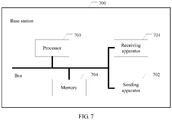
- a base station 700 in an embodiment of the present invention includes: a receiving apparatus 701, a sending apparatus 702, a processor 703, and a memory 704 (there may be one or more processors 703 in the UE 700, and there is, for example, one processor 703 in FIG. 7 ).
- the processor 703 and the memory 704 receive information outside the UE by using the receiving apparatus 701, and the processor 703 and the memory 704 send information from the UE by using the sending apparatus 702.
- the receiving apparatus 701, the sending apparatus 702, the processor 703, and the memory 704 may be connected through a bus or in another manner.
- the memory 704 may include a read-only memory and a random access memory, and provide an instruction and data for the processor 703. Apart of the memory 704 may further include a RAM, or may further include a nonvolatile memory. An example in which the receiving apparatus 701, the sending apparatus 702, the processor 703, and the memory 704 are connected through a bus is used in FIG. 7 .
- the receiving apparatus 701 may be configured to implement a function of the receiving module 203 in the embodiment shown in FIG. 2 .
- the sending apparatus 702 may be configured to implement a function of the sending module 201 in the embodiment shown in FIG. 2 .
- the processor 703 may be configured to implement a function of the processing module 202 in the embodiment shown in FIG. 2 .
- the disclosed system, apparatus, and method may be implemented in other manners.
- the described apparatus embodiment is merely an example.
- the unit division is merely logical function division and may be other division in actual implementation.
- a plurality of units or components may be combined or integrated into another system, or some features may be ignored or not performed.
- the displayed or discussed mutual couplings or direct couplings or communication connections may be implemented by using some interfaces.
- the indirect couplings or communication connections between the apparatuses or units may be implemented in electronic, mechanical, or other forms.
- the units described as separate parts may or may not be physically separate, and parts displayed as units may or may not be physical units, may be located in one position, or may be distributed on a plurality of network units. Some or all of the units may be selected according to actual requirements to achieve the objectives of the solutions of the embodiments.
- functional units in the embodiments of the present invention may be integrated into one processing unit, or each of the units may exist alone physically, or two or more units are integrated into one unit.
- the integrated unit may be implemented in a form of hardware, or may be implemented in a form of a software functional unit.
- the integrated unit When the integrated unit is implemented in the form of a software functional unit and sold or used as an independent product, the integrated unit may be stored in a computer-readable storage medium. Based on such an understanding, the technical solutions of the present invention essentially, or the part contributing to the prior art, or all or some of the technical solutions may be implemented in the form of a software product.
- the software product is stored in a storage medium and includes several instructions for instructing a computer device (which may be a personal computer, a server, or a network device) to perform all or some of the steps of the methods described in the embodiments of the present invention.
- the foregoing storage medium includes: any medium that can store program code, such as a USB flash drive, a removable hard disk, a read-only memory (ROM, Read-Only Memory), a random access memory (RAM, Random Access Memory), a magnetic disk, or an optical disc.
- program code such as a USB flash drive, a removable hard disk, a read-only memory (ROM, Read-Only Memory), a random access memory (RAM, Random Access Memory), a magnetic disk, or an optical disc.
Landscapes
- Engineering & Computer Science (AREA)
- Signal Processing (AREA)
- Computer Networks & Wireless Communication (AREA)
- Mobile Radio Communication Systems (AREA)
Applications Claiming Priority (1)
| Application Number | Priority Date | Filing Date | Title |
|---|---|---|---|
| PCT/CN2015/086939 WO2017028005A1 (fr) | 2015-08-14 | 2015-08-14 | Procédé de transmission d'informations de rétroaction, équipement d'utilisateur, et station de base |
Publications (3)
| Publication Number | Publication Date |
|---|---|
| EP3327940A1 true EP3327940A1 (fr) | 2018-05-30 |
| EP3327940A4 EP3327940A4 (fr) | 2018-07-18 |
| EP3327940B1 EP3327940B1 (fr) | 2022-10-05 |
Family
ID=58050596
Family Applications (1)
| Application Number | Title | Priority Date | Filing Date |
|---|---|---|---|
| EP15901211.1A Active EP3327940B1 (fr) | 2015-08-14 | 2015-08-14 | Procédé de transmission d'informations de rétroaction, équipement d'utilisateur, et station de base |
Country Status (5)
| Country | Link |
|---|---|
| US (2) | US10568123B2 (fr) |
| EP (1) | EP3327940B1 (fr) |
| JP (1) | JP6868001B2 (fr) |
| CN (2) | CN112040545B (fr) |
| WO (1) | WO2017028005A1 (fr) |
Families Citing this family (14)
| Publication number | Priority date | Publication date | Assignee | Title |
|---|---|---|---|---|
| EP3309986B1 (fr) * | 2015-08-10 | 2020-07-29 | Huawei Technologies Co., Ltd. | Procédé d'envoi et de réception d'informations de rétroaction, et équipement d'utilisateur et dispositif de réseau d'accès |
| CN112040545B (zh) | 2015-08-14 | 2025-06-03 | 华为技术有限公司 | 一种反馈信息的发送方法、用户设备和基站 |
| JP7093856B2 (ja) | 2018-06-28 | 2022-06-30 | オッポ広東移動通信有限公司 | フィードバック情報の伝送方法及び装置 |
| CN110808819B (zh) * | 2018-08-06 | 2021-03-30 | 华为技术有限公司 | 信息传输的方法和装置 |
| FI4358450T3 (fi) | 2018-11-11 | 2026-03-12 | Wilus Inst Standards & Tech Inc | Menetelmä harq-ack-koodikirjan luomiseksi langattomassa tietoliikennejärjestelmässä ja sitä käyttävä laite |
| CN111385080B (zh) * | 2018-12-28 | 2024-08-06 | 北京三星通信技术研究有限公司 | 发送上行控制信息的方法及设备 |
| US11381346B2 (en) * | 2019-04-02 | 2022-07-05 | Intel Corporation | Prioritization of services for control and data transmission for new radio systems |
| CN112311512B (zh) * | 2019-07-30 | 2021-11-09 | 中国移动通信有限公司研究院 | 混合自动重传码本的确定、指示方法、终端及网络设备 |
| WO2021022439A1 (fr) | 2019-08-05 | 2021-02-11 | Zte Corporation | Systèmes et procédés pour déterminer un livre de codes de rétroaction |
| WO2021022517A1 (fr) | 2019-08-07 | 2021-02-11 | 北京小米移动软件有限公司 | Procédé et appareil d'amélioration de rétroaction harq, dispositif de communication et support de stockage |
| CN113938244B (zh) * | 2020-06-29 | 2024-02-06 | 海能达通信股份有限公司 | 一种通信应答信号的传输方法、基站及终端 |
| FI20215659A1 (en) * | 2021-06-04 | 2022-04-04 | Nokia Solutions & Networks Oy | Improving link customization |
| CN115707123B (zh) * | 2021-08-04 | 2025-10-14 | 维沃移动通信有限公司 | 信道传输方法、装置、终端及网络设备 |
| CN116491180A (zh) * | 2021-09-04 | 2023-07-25 | 上海朗帛通信技术有限公司 | 一种被用于无线通信的节点中的方法和装置 |
Family Cites Families (26)
| Publication number | Priority date | Publication date | Assignee | Title |
|---|---|---|---|---|
| US10715209B2 (en) * | 2006-11-18 | 2020-07-14 | RF Micron, Inc. | Computing device for processing environmental sensed conditions |
| CN101369874B (zh) * | 2007-08-17 | 2013-04-24 | 华为技术有限公司 | 一种多用户反馈的方法、系统、基站及用户设备 |
| KR101467767B1 (ko) * | 2008-03-31 | 2014-12-03 | 엘지전자 주식회사 | 단말기 및 이것의 인스턴트 메시징 서비스 수행 방법 |
| CN102025466B (zh) | 2009-09-15 | 2013-10-02 | 华为技术有限公司 | 信令处理方法、基站以及用户设备 |
| CN101651995A (zh) * | 2009-09-21 | 2010-02-17 | 中兴通讯股份有限公司 | 一种下行控制信息的传输方法及传输系统 |
| CN107104780B (zh) * | 2009-10-01 | 2020-10-16 | 交互数字专利控股公司 | 上行链路控制数据传输 |
| CN102469596A (zh) * | 2010-11-08 | 2012-05-23 | 北京三星通信技术研究有限公司 | 支持信道选择的分配ack/nack信道资源的方法 |
| EP3570474B1 (fr) | 2010-11-11 | 2021-07-21 | LG Electronics Inc. | Procédé et dispositif d'émission/réception d'information de commande dans le sens montant dans un système de communication sans fil |
| US8830883B2 (en) * | 2010-11-16 | 2014-09-09 | Qualcomm Incorporated | Method and apparatus for improving acknowledgement/negative acknowledgement feedback |
| CN105610483B (zh) * | 2011-03-29 | 2019-03-12 | Lg电子株式会社 | 在无线通信系统中决定资源特定传输模式的方法及其设备 |
| US8885752B2 (en) * | 2012-07-27 | 2014-11-11 | Intel Corporation | Method and apparatus for feedback in 3D MIMO wireless systems |
| CN104885376B (zh) | 2012-08-03 | 2019-03-29 | Hmd全球公司 | 载波聚合中使用的方法和装置 |
| IN2015DN00786A (fr) | 2012-08-03 | 2015-07-03 | Nokia Siemens Networks Oy | |
| US20150236824A1 (en) * | 2012-09-28 | 2015-08-20 | Nokia Corporation | Uplink downlink assignment indicator ambiguity handling for inter-band time division duplex carrier aggregation |
| CN104704786B (zh) * | 2012-10-04 | 2018-01-26 | Lg电子株式会社 | 在无线通信系统中通过考虑天线端口关系收发下行链路信号的方法和设备 |
| CN104009785B (zh) * | 2013-02-25 | 2017-11-28 | 华为技术有限公司 | 码本反馈方法、用户设备和基站 |
| CN104144041B (zh) * | 2013-05-07 | 2017-12-19 | 电信科学技术研究院 | 一种下行数据的反馈信息传输方法及装置 |
| US9088397B2 (en) * | 2013-05-09 | 2015-07-21 | Nokia Solutions And Networks Oy | Carrier type for time division communication |
| EP3226633B1 (fr) * | 2014-12-31 | 2022-08-24 | Huawei Technologies Co., Ltd. | Dispositif d'utilisateur, dispositif de réseau d'accès et procédés d'envoi et de réception d'informations de rétroaction |
| EP3309986B1 (fr) | 2015-08-10 | 2020-07-29 | Huawei Technologies Co., Ltd. | Procédé d'envoi et de réception d'informations de rétroaction, et équipement d'utilisateur et dispositif de réseau d'accès |
| EP3324692B1 (fr) | 2015-08-12 | 2020-03-18 | Huawei Technologies Co., Ltd. | Procédé, appareil et système pour envoyer et recevoir des informations de commande de liaison montante |
| US10103849B2 (en) * | 2015-08-13 | 2018-10-16 | Lg Electronics Inc. | Method of transmitting or receiving uplink control information in wireless communication system and apparatus for the same |
| CN112040545B (zh) | 2015-08-14 | 2025-06-03 | 华为技术有限公司 | 一种反馈信息的发送方法、用户设备和基站 |
| EP3343987B1 (fr) * | 2015-09-22 | 2025-04-23 | Huawei Technologies Co., Ltd. | Procédé et dispositif de transmission d'informations de commande de liaison montante (uci) dans un scénario à agrégation de porteuses |
| CA3056577C (fr) * | 2017-03-17 | 2021-04-06 | Lg Electronics Inc. | Procede et dispositif permettant a un terminal de recevoir des donnees dans un systeme de communication sans fil |
| CN111034113B (zh) * | 2018-02-27 | 2022-09-16 | Lg电子株式会社 | 用于发送和接收harq-ack信号的方法和装置 |
-
2015
- 2015-08-14 CN CN202010710845.5A patent/CN112040545B/zh active Active
- 2015-08-14 CN CN201580082377.9A patent/CN107925445B/zh active Active
- 2015-08-14 WO PCT/CN2015/086939 patent/WO2017028005A1/fr not_active Ceased
- 2015-08-14 EP EP15901211.1A patent/EP3327940B1/fr active Active
- 2015-08-14 JP JP2018507567A patent/JP6868001B2/ja active Active
-
2018
- 2018-02-13 US US15/895,060 patent/US10568123B2/en active Active
-
2019
- 2019-12-27 US US16/728,996 patent/US11071134B2/en active Active
Also Published As
| Publication number | Publication date |
|---|---|
| WO2017028005A1 (fr) | 2017-02-23 |
| EP3327940B1 (fr) | 2022-10-05 |
| US10568123B2 (en) | 2020-02-18 |
| EP3327940A4 (fr) | 2018-07-18 |
| US20180176939A1 (en) | 2018-06-21 |
| US20200137784A1 (en) | 2020-04-30 |
| JP2018525928A (ja) | 2018-09-06 |
| CN107925445B (zh) | 2020-08-07 |
| CN112040545B (zh) | 2025-06-03 |
| CN107925445A (zh) | 2018-04-17 |
| US11071134B2 (en) | 2021-07-20 |
| CN112040545A (zh) | 2020-12-04 |
| JP6868001B2 (ja) | 2021-05-12 |
Similar Documents
| Publication | Publication Date | Title |
|---|---|---|
| US11071134B2 (en) | Feedback information receiving method, base station and user equipment | |
| US11018813B2 (en) | Uplink control information transmission method and apparatus | |
| US11240813B2 (en) | Method for sending control information, user equipment, and base station | |
| EP3657721B1 (fr) | Procédé d'envoi de livre de codes de rétroaction de harq-ack, appareil et dispositif | |
| EP2866371B1 (fr) | Procédé et appareil de codage et de traitement des informations d'accusé de réception | |
| EP3764574B1 (fr) | Procédés permettant d'envoyer et de recevoir des informations de rétroaction, équipement utilisateur et dispositif de réseau d'accès | |
| EP3343821B1 (fr) | Procédé permettant d'envoyer des informations de commande, et dispositif de communication | |
| EP3445083B1 (fr) | Procédé de réceprion d'informations, dispositif de réception et système | |
| US11418280B2 (en) | Feedback information sending method, feedback information receiving method, and apparatus | |
| KR20150002579A (ko) | Tdd 시스템에서의 소프트 버퍼 처리 방법 및 장치 | |
| CN111435847B (zh) | 传输信息的方法和装置 |
Legal Events
| Date | Code | Title | Description |
|---|---|---|---|
| STAA | Information on the status of an ep patent application or granted ep patent |
Free format text: STATUS: THE INTERNATIONAL PUBLICATION HAS BEEN MADE |
|
| PUAI | Public reference made under article 153(3) epc to a published international application that has entered the european phase |
Free format text: ORIGINAL CODE: 0009012 |
|
| STAA | Information on the status of an ep patent application or granted ep patent |
Free format text: STATUS: REQUEST FOR EXAMINATION WAS MADE |
|
| 17P | Request for examination filed |
Effective date: 20180219 |
|
| AK | Designated contracting states |
Kind code of ref document: A1 Designated state(s): AL AT BE BG CH CY CZ DE DK EE ES FI FR GB GR HR HU IE IS IT LI LT LU LV MC MK MT NL NO PL PT RO RS SE SI SK SM TR |
|
| AX | Request for extension of the european patent |
Extension state: BA ME |
|
| A4 | Supplementary search report drawn up and despatched |
Effective date: 20180618 |
|
| RIC1 | Information provided on ipc code assigned before grant |
Ipc: H04B 7/005 20060101AFI20180612BHEP Ipc: H04L 5/00 20060101ALI20180612BHEP |
|
| DAV | Request for validation of the european patent (deleted) | ||
| DAX | Request for extension of the european patent (deleted) | ||
| STAA | Information on the status of an ep patent application or granted ep patent |
Free format text: STATUS: EXAMINATION IS IN PROGRESS |
|
| 17Q | First examination report despatched |
Effective date: 20190531 |
|
| GRAP | Despatch of communication of intention to grant a patent |
Free format text: ORIGINAL CODE: EPIDOSNIGR1 |
|
| STAA | Information on the status of an ep patent application or granted ep patent |
Free format text: STATUS: GRANT OF PATENT IS INTENDED |
|
| INTG | Intention to grant announced |
Effective date: 20220428 |
|
| GRAS | Grant fee paid |
Free format text: ORIGINAL CODE: EPIDOSNIGR3 |
|
| GRAA | (expected) grant |
Free format text: ORIGINAL CODE: 0009210 |
|
| STAA | Information on the status of an ep patent application or granted ep patent |
Free format text: STATUS: THE PATENT HAS BEEN GRANTED |
|
| AK | Designated contracting states |
Kind code of ref document: B1 Designated state(s): AL AT BE BG CH CY CZ DE DK EE ES FI FR GB GR HR HU IE IS IT LI LT LU LV MC MK MT NL NO PL PT RO RS SE SI SK SM TR |
|
| REG | Reference to a national code |
Ref country code: GB Ref legal event code: FG4D |
|
| REG | Reference to a national code |
Ref country code: CH Ref legal event code: EP |
|
| REG | Reference to a national code |
Ref country code: AT Ref legal event code: REF Ref document number: 1523404 Country of ref document: AT Kind code of ref document: T Effective date: 20221015 |
|
| REG | Reference to a national code |
Ref country code: DE Ref legal event code: R096 Ref document number: 602015081110 Country of ref document: DE |
|
| REG | Reference to a national code |
Ref country code: IE Ref legal event code: FG4D |
|
| REG | Reference to a national code |
Ref country code: LT Ref legal event code: MG9D |
|
| REG | Reference to a national code |
Ref country code: NL Ref legal event code: MP Effective date: 20221005 |
|
| REG | Reference to a national code |
Ref country code: AT Ref legal event code: MK05 Ref document number: 1523404 Country of ref document: AT Kind code of ref document: T Effective date: 20221005 |
|
| PG25 | Lapsed in a contracting state [announced via postgrant information from national office to epo] |
Ref country code: NL Free format text: LAPSE BECAUSE OF FAILURE TO SUBMIT A TRANSLATION OF THE DESCRIPTION OR TO PAY THE FEE WITHIN THE PRESCRIBED TIME-LIMIT Effective date: 20221005 |
|
| PG25 | Lapsed in a contracting state [announced via postgrant information from national office to epo] |
Ref country code: SE Free format text: LAPSE BECAUSE OF FAILURE TO SUBMIT A TRANSLATION OF THE DESCRIPTION OR TO PAY THE FEE WITHIN THE PRESCRIBED TIME-LIMIT Effective date: 20221005 Ref country code: PT Free format text: LAPSE BECAUSE OF FAILURE TO SUBMIT A TRANSLATION OF THE DESCRIPTION OR TO PAY THE FEE WITHIN THE PRESCRIBED TIME-LIMIT Effective date: 20230206 Ref country code: NO Free format text: LAPSE BECAUSE OF FAILURE TO SUBMIT A TRANSLATION OF THE DESCRIPTION OR TO PAY THE FEE WITHIN THE PRESCRIBED TIME-LIMIT Effective date: 20230105 Ref country code: LT Free format text: LAPSE BECAUSE OF FAILURE TO SUBMIT A TRANSLATION OF THE DESCRIPTION OR TO PAY THE FEE WITHIN THE PRESCRIBED TIME-LIMIT Effective date: 20221005 Ref country code: FI Free format text: LAPSE BECAUSE OF FAILURE TO SUBMIT A TRANSLATION OF THE DESCRIPTION OR TO PAY THE FEE WITHIN THE PRESCRIBED TIME-LIMIT Effective date: 20221005 Ref country code: ES Free format text: LAPSE BECAUSE OF FAILURE TO SUBMIT A TRANSLATION OF THE DESCRIPTION OR TO PAY THE FEE WITHIN THE PRESCRIBED TIME-LIMIT Effective date: 20221005 Ref country code: AT Free format text: LAPSE BECAUSE OF FAILURE TO SUBMIT A TRANSLATION OF THE DESCRIPTION OR TO PAY THE FEE WITHIN THE PRESCRIBED TIME-LIMIT Effective date: 20221005 |
|
| PG25 | Lapsed in a contracting state [announced via postgrant information from national office to epo] |
Ref country code: RS Free format text: LAPSE BECAUSE OF FAILURE TO SUBMIT A TRANSLATION OF THE DESCRIPTION OR TO PAY THE FEE WITHIN THE PRESCRIBED TIME-LIMIT Effective date: 20221005 Ref country code: PL Free format text: LAPSE BECAUSE OF FAILURE TO SUBMIT A TRANSLATION OF THE DESCRIPTION OR TO PAY THE FEE WITHIN THE PRESCRIBED TIME-LIMIT Effective date: 20221005 Ref country code: LV Free format text: LAPSE BECAUSE OF FAILURE TO SUBMIT A TRANSLATION OF THE DESCRIPTION OR TO PAY THE FEE WITHIN THE PRESCRIBED TIME-LIMIT Effective date: 20221005 Ref country code: IS Free format text: LAPSE BECAUSE OF FAILURE TO SUBMIT A TRANSLATION OF THE DESCRIPTION OR TO PAY THE FEE WITHIN THE PRESCRIBED TIME-LIMIT Effective date: 20230205 Ref country code: HR Free format text: LAPSE BECAUSE OF FAILURE TO SUBMIT A TRANSLATION OF THE DESCRIPTION OR TO PAY THE FEE WITHIN THE PRESCRIBED TIME-LIMIT Effective date: 20221005 Ref country code: GR Free format text: LAPSE BECAUSE OF FAILURE TO SUBMIT A TRANSLATION OF THE DESCRIPTION OR TO PAY THE FEE WITHIN THE PRESCRIBED TIME-LIMIT Effective date: 20230106 |
|
| P01 | Opt-out of the competence of the unified patent court (upc) registered |
Effective date: 20230524 |
|
| REG | Reference to a national code |
Ref country code: DE Ref legal event code: R097 Ref document number: 602015081110 Country of ref document: DE |
|
| PG25 | Lapsed in a contracting state [announced via postgrant information from national office to epo] |
Ref country code: SM Free format text: LAPSE BECAUSE OF FAILURE TO SUBMIT A TRANSLATION OF THE DESCRIPTION OR TO PAY THE FEE WITHIN THE PRESCRIBED TIME-LIMIT Effective date: 20221005 Ref country code: RO Free format text: LAPSE BECAUSE OF FAILURE TO SUBMIT A TRANSLATION OF THE DESCRIPTION OR TO PAY THE FEE WITHIN THE PRESCRIBED TIME-LIMIT Effective date: 20221005 Ref country code: EE Free format text: LAPSE BECAUSE OF FAILURE TO SUBMIT A TRANSLATION OF THE DESCRIPTION OR TO PAY THE FEE WITHIN THE PRESCRIBED TIME-LIMIT Effective date: 20221005 Ref country code: DK Free format text: LAPSE BECAUSE OF FAILURE TO SUBMIT A TRANSLATION OF THE DESCRIPTION OR TO PAY THE FEE WITHIN THE PRESCRIBED TIME-LIMIT Effective date: 20221005 Ref country code: CZ Free format text: LAPSE BECAUSE OF FAILURE TO SUBMIT A TRANSLATION OF THE DESCRIPTION OR TO PAY THE FEE WITHIN THE PRESCRIBED TIME-LIMIT Effective date: 20221005 |
|
| PLBE | No opposition filed within time limit |
Free format text: ORIGINAL CODE: 0009261 |
|
| STAA | Information on the status of an ep patent application or granted ep patent |
Free format text: STATUS: NO OPPOSITION FILED WITHIN TIME LIMIT |
|
| PG25 | Lapsed in a contracting state [announced via postgrant information from national office to epo] |
Ref country code: SK Free format text: LAPSE BECAUSE OF FAILURE TO SUBMIT A TRANSLATION OF THE DESCRIPTION OR TO PAY THE FEE WITHIN THE PRESCRIBED TIME-LIMIT Effective date: 20221005 Ref country code: AL Free format text: LAPSE BECAUSE OF FAILURE TO SUBMIT A TRANSLATION OF THE DESCRIPTION OR TO PAY THE FEE WITHIN THE PRESCRIBED TIME-LIMIT Effective date: 20221005 |
|
| 26N | No opposition filed |
Effective date: 20230706 |
|
| PG25 | Lapsed in a contracting state [announced via postgrant information from national office to epo] |
Ref country code: SI Free format text: LAPSE BECAUSE OF FAILURE TO SUBMIT A TRANSLATION OF THE DESCRIPTION OR TO PAY THE FEE WITHIN THE PRESCRIBED TIME-LIMIT Effective date: 20221005 |
|
| PG25 | Lapsed in a contracting state [announced via postgrant information from national office to epo] |
Ref country code: MC Free format text: LAPSE BECAUSE OF FAILURE TO SUBMIT A TRANSLATION OF THE DESCRIPTION OR TO PAY THE FEE WITHIN THE PRESCRIBED TIME-LIMIT Effective date: 20221005 |
|
| REG | Reference to a national code |
Ref country code: CH Ref legal event code: PL |
|
| PG25 | Lapsed in a contracting state [announced via postgrant information from national office to epo] |
Ref country code: MC Free format text: LAPSE BECAUSE OF FAILURE TO SUBMIT A TRANSLATION OF THE DESCRIPTION OR TO PAY THE FEE WITHIN THE PRESCRIBED TIME-LIMIT Effective date: 20221005 |
|
| PG25 | Lapsed in a contracting state [announced via postgrant information from national office to epo] |
Ref country code: LU Free format text: LAPSE BECAUSE OF NON-PAYMENT OF DUE FEES Effective date: 20230814 |
|
| PG25 | Lapsed in a contracting state [announced via postgrant information from national office to epo] |
Ref country code: LU Free format text: LAPSE BECAUSE OF NON-PAYMENT OF DUE FEES Effective date: 20230814 Ref country code: CH Free format text: LAPSE BECAUSE OF NON-PAYMENT OF DUE FEES Effective date: 20230831 |
|
| REG | Reference to a national code |
Ref country code: BE Ref legal event code: MM Effective date: 20230831 |
|
| REG | Reference to a national code |
Ref country code: IE Ref legal event code: MM4A |
|
| PG25 | Lapsed in a contracting state [announced via postgrant information from national office to epo] |
Ref country code: IT Free format text: LAPSE BECAUSE OF FAILURE TO SUBMIT A TRANSLATION OF THE DESCRIPTION OR TO PAY THE FEE WITHIN THE PRESCRIBED TIME-LIMIT Effective date: 20221005 |
|
| PG25 | Lapsed in a contracting state [announced via postgrant information from national office to epo] |
Ref country code: IE Free format text: LAPSE BECAUSE OF NON-PAYMENT OF DUE FEES Effective date: 20230814 |
|
| PG25 | Lapsed in a contracting state [announced via postgrant information from national office to epo] |
Ref country code: IE Free format text: LAPSE BECAUSE OF NON-PAYMENT OF DUE FEES Effective date: 20230814 |
|
| PG25 | Lapsed in a contracting state [announced via postgrant information from national office to epo] |
Ref country code: BE Free format text: LAPSE BECAUSE OF NON-PAYMENT OF DUE FEES Effective date: 20230831 |
|
| PG25 | Lapsed in a contracting state [announced via postgrant information from national office to epo] |
Ref country code: BG Free format text: LAPSE BECAUSE OF FAILURE TO SUBMIT A TRANSLATION OF THE DESCRIPTION OR TO PAY THE FEE WITHIN THE PRESCRIBED TIME-LIMIT Effective date: 20221005 |
|
| PG25 | Lapsed in a contracting state [announced via postgrant information from national office to epo] |
Ref country code: BG Free format text: LAPSE BECAUSE OF FAILURE TO SUBMIT A TRANSLATION OF THE DESCRIPTION OR TO PAY THE FEE WITHIN THE PRESCRIBED TIME-LIMIT Effective date: 20221005 |
|
| PG25 | Lapsed in a contracting state [announced via postgrant information from national office to epo] |
Ref country code: CY Free format text: LAPSE BECAUSE OF FAILURE TO SUBMIT A TRANSLATION OF THE DESCRIPTION OR TO PAY THE FEE WITHIN THE PRESCRIBED TIME-LIMIT; INVALID AB INITIO Effective date: 20150814 |
|
| PG25 | Lapsed in a contracting state [announced via postgrant information from national office to epo] |
Ref country code: HU Free format text: LAPSE BECAUSE OF FAILURE TO SUBMIT A TRANSLATION OF THE DESCRIPTION OR TO PAY THE FEE WITHIN THE PRESCRIBED TIME-LIMIT; INVALID AB INITIO Effective date: 20150814 |
|
| PGFP | Annual fee paid to national office [announced via postgrant information from national office to epo] |
Ref country code: DE Payment date: 20250702 Year of fee payment: 11 |
|
| PGFP | Annual fee paid to national office [announced via postgrant information from national office to epo] |
Ref country code: GB Payment date: 20250703 Year of fee payment: 11 |
|
| PGFP | Annual fee paid to national office [announced via postgrant information from national office to epo] |
Ref country code: FR Payment date: 20250703 Year of fee payment: 11 |
|
| PG25 | Lapsed in a contracting state [announced via postgrant information from national office to epo] |
Ref country code: TR Free format text: LAPSE BECAUSE OF FAILURE TO SUBMIT A TRANSLATION OF THE DESCRIPTION OR TO PAY THE FEE WITHIN THE PRESCRIBED TIME-LIMIT Effective date: 20221005 |