EP3328247B1 - Faltbares kinderbett - Google Patents
Faltbares kinderbett Download PDFInfo
- Publication number
- EP3328247B1 EP3328247B1 EP16753271.2A EP16753271A EP3328247B1 EP 3328247 B1 EP3328247 B1 EP 3328247B1 EP 16753271 A EP16753271 A EP 16753271A EP 3328247 B1 EP3328247 B1 EP 3328247B1
- Authority
- EP
- European Patent Office
- Prior art keywords
- cot
- frame
- folding
- frames
- arm
- Prior art date
- Legal status (The legal status is an assumption and is not a legal conclusion. Google has not performed a legal analysis and makes no representation as to the accuracy of the status listed.)
- Not-in-force
Links
Images

Classifications
-
- A—HUMAN NECESSITIES
- A47—FURNITURE; DOMESTIC ARTICLES OR APPLIANCES; COFFEE MILLS; SPICE MILLS; SUCTION CLEANERS IN GENERAL
- A47D—FURNITURE SPECIALLY ADAPTED FOR CHILDREN
- A47D7/00—Children's beds
- A47D7/002—Children's beds foldable
Definitions
- the present description relates to a folding cot.
- Such a cot can be used, in particular, as a crib or a bed for an infant or a child to sleep in and can also be used as a playpen or play yard.
- a cot of this kind is highly suitable for a small child to sleep or play in, since it affords a good-sized space which is comfortable, safe and robust.
- the floor of this cot is raised, which not only makes it possible to insulate the child from the ground, but also prevents the parent from bending too much in order to place the child on the bottom of the cot or to remove the child therefrom.
- Another cot of this type is known from GB164886 A .
- umbrella-fold cots all comprise a separate mattress which has to be removed before the frame of the cot is folded and which then has to be wrapped around the folded frame. The folding/unfolding of the mattress therefore requires additional handling steps. Moreover, the mattress is not protected during transport unless a carrying bag in which the cot frame and the mattress are stored is used, thus requiring the provision of such a bag and additional handling steps.
- the invention relates to a folding cot that can take up an unfolded position and a folded position, comprising a cot base that is oriented horizontally in the unfolded position, a first frame that is oriented vertically in the unfolded position, and a second frame that is oriented vertically in the unfolded position.
- This cot comprises a first Sarrus mechanism or similar mechanism formed by the first frame, the second frame and at least two articulated arms, namely a lower arm and a side arm. Each arm connects the first and second frames together, and the arms guide the movement of these frames toward/away from one another during the folding/unfolding of the cot.
- the cot base is formed, at least in part, by the lower arm of the first mechanism.
- Such a folding cot can be used, notably, for a child, especially a baby or toddler, to lie in. In particular, it can be used as a crib or bed and/or as a playpen or play yard.
- This cot has the advantage of being very easy to fold or unfold thanks to the mechanism used.
- This mechanism makes it easier to fold/unfold the cot by guiding the movement of the frames of the cot toward/away from one another without requiring additional guiding elements and, thus, without complicating the structure of the cot.
- such a mechanism does not require a guide rail or slide for guiding the movement of the frames toward/away from one another.
- a Sarrus mechanism is generally defined as being a spatial mechanism comprising two plates (in this case the frames) that are interconnected by at least two articulated arms and can move toward/away from one another by way of a rectilinear movement.
- Each of the articulated arms comprises segments that are connected together and to the plates by pivot connections.
- the axes of these pivot connections are parallel to one another and perpendicular to the direction of the abovementioned rectilinear movement.
- the groups of axes of at least two of the arms have respective directions which are not parallel. In general, the directions of the groups of axes are perpendicular to one another.
- Such a mechanism has the advantage of having a single degree of mobility: the two plates can move with respect to one another only by way of the abovementioned rectilinear movement, i.e. by way of a translational movement.
- the first mechanism is a Sarrus mechanism.
- the invention is not limited to Sarrus mechanisms in the strict sense and encompasses similar mechanisms for converting the limited circular movement of a segment of one of the articulated arms of the mechanism into a substantially rectilinear movement of the plates (in this case the frames) toward or away from one another.
- the cot comprises a third vertical frame, and a second Sarrus mechanism or similar mechanism comprising the second frame, the third frame and at least two articulated arms, namely a lower arm and a side arm.
- Each arm connects the second and third frames together, and the arms guide the movement of the frames toward/away from one another during the folding/unfolding of the cot.
- the cot base is then formed in part by a lower arm of the second mechanism.
- the second mechanism is thus coupled to the first mechanism, the two mechanisms having the second frame in common, and the cot base is formed by the lower arms (i.e. the arms which are horizontal in the unfolded position) of the two mechanisms.
- the presence of the second frame between the first and third frames makes it possible to easily create a storage space for storing, notably, the bedding, such as a mattress, a sheet, a blanket and/or a duvet.
- the first mechanism is a Sarrus mechanism that allows the translational movement of the first frame with respect to the second frame along a longitudinal axis of the cot
- the second mechanism is a Sarrus mechanism that allows the translational movement of the third frame with respect to the second frame along said longitudinal axis.
- the first and second mechanisms are "aligned" and unfold in the lengthwise direction of the cot.
- the first and second mechanisms are Sarrus mechanisms. These mechanisms can be symmetrical with respect to the second frame.
- the top or vertex of the lower arm in the folded position, is situated below the vertical arm(s) of the mechanism. This makes it possible to avoid interactions between the arms during the folding of the cot and, thus, to make the latter easier. This also makes it possible to obtain compact folding.
- the cot comprises side barriers that extend between the frames and are oriented vertically in the unfolded position, and wherein the first and/or second mechanism comprises two side arms that form, at least in part, the side barriers of the cot.
- Such side barriers are useful for preventing a child from leaving the cot on their own.
- the first and second arms are disposed symmetrically with respect to the longitudinal median plane of the cot.
- the cot exhibits symmetry with respect to a longitudinal median plane, this plane being oriented vertically in the unfolded position.
- the vertices of the side arms are situated opposite one another and at a distance from one another. This distance makes it possible to avoid interactions between the side arms during the folding of the cot and, thus, to make the latter easier. This also makes it possible to obtain compact folding.
- the side arms can be situated at different heights such that, in the folded position, the arms are situated one above the other.
- the cot comprises a mattress and the mattress is accommodated inside one of the frames in the folded position.
- the thickness of the frame can be greater than the thickness of the mattress. This makes it possible to protect the mattress while the cot is being transported.
- the second frame comprises a lower cross member, and the cot base is formed in part by this lower cross member.
- the mattress is mounted in a pivoting manner on one of the frames.
- the mattress can be mounted in a pivoting manner at the bottom part of the frame.
- the mattress can be mounted in a pivoting manner on the second frame, at the lower cross member. This makes it possible not to have to remove the mattress from the cot before the latter is folded.
- a tie extends between the mattress and the lower arm, such that, starting from the unfolded position, the pivoting of the mattress with respect to the second frame brings about the folding of the lower arm. This makes it even easier to fold the cot.
- each of the frames has two side uprights and, in the unfolded position, these uprights are oriented vertically and a part of the uprights extends beneath the cot base so as to form the legs of the cot. This makes it possible to raise the cot base with respect to the ground and, thus, to separate the child from the ground, and to prevent the parent from bending too much in order to place the child on the bottom of the cot or to remove he child therefrom.
- At least the lower arm is formed by at least two segments that are hinged together and to the adjacent frames by hinges, a first hinge allowing one of the segments to rotate with respect to one of the frames about a first rotation axis, at least one second hinge allowing the segments to rotate with respect to one another about at least one second rotation axis, and a third hinge allowing another segment to rotate with respect to the other frame about a third rotation axis.
- the first, second and third rotation axis are parallel to one another.
- the lower arm can be formed from two segments that are hinged together.
- all of the arms of the mechanism(s) have the same configuration, with two hinged segments, as the lower arm.
- the segments are panels. These panels can be solid or provided with a cutout.
- At least one of the arms of the mechanism(s) is equipped with a stop system that prevents the arm from folding toward the outside of the cot in the unfolded position.
- the lower arm can be equipped with a stop system that prevents the arm from folding toward the outside of the cot in the unfolded position. In other words, since the lower arm is in a horizontal plane in the unfolded position, the stop system prevents this arm from folding downward beyond the horizontal plane.
- the side arm(s) can be equipped with a stop system that prevents the arm from folding toward the outside of the cot in the unfolded position. In other words, since the side arm is in a vertical plane in the unfolded position, the stop system prevents this arm from folding toward the outside beyond the vertical plane.
- the stop system can be situated at the hinges and, in particular, at the hinge that is situated between the segments of the arm. It may be, for example, a protrusion which is fixed to the end of one of the segments, bypassing the hinge, and against which the other segment comes into abutment in the unfolded position. It may also be a stop system integrated into the hinge. Generally, any system that is capable of preventing the rotation of the hinge in one direction from a predefined position of the hinge may be suitable.
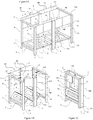
- Figure 1A shows the framework of an example of a folding cot, in the unfolded position.
- the folding cot is a small collapsible bed and can be used for chidren to sleep or play in. In other words, it can be used as a crib or a play yard.
- the framework of the cot comprises a U-shaped, rigid, central frame 1.
- the central frame 1 is an example of a "second frame" within the meaning of the invention.
- the central frame 1 comprises two uprights 2, 2', which are connected in their lower part by a lower cross member 3.
- the uprights 2, 2' are referred to as "central uprights” in the following text.
- the central uprights 2, 2' can be extended beneath the lower cross member 3 so as to form central legs 4, 4'.
- the central uprights 2, 2' are oriented vertically, whereas the cross member 3 is oriented horizontally.
- the horizontal and vertical directions are considered with reference to the unfolded position of the cot, under normal use conditions.
- the top and the bottom are defined in the vertical direction.
- the framework of the cot comprises two Sarrus mechanisms S1 and S2 which have the central frame 1 in common. These two mechanisms are symmetrical with respect to the central frame 1, i.e. with respect to the median plane of this frame 1.
- the first Sarrus mechanism S1 comprises, apart from the central frame 1:
- the end frame 5 is an example of a "first frame" within the meaning of the invention.
- the end frame 5 can be rigid and its dimensions can be similar to those of the central frame 1.
- the height of the corner uprights 6, 6' corresponds to the height of the central uprights 2, 2'
- the height of the legs 7, 7' corresponds to that of the central legs 4, 4'.
- the horizontal panels 10, 11 and the three hinges of axis AA', BB' and CC' form an articulated arm.
- This articulated arm is an example of a "lower arm” within the meaning of the invention, the two panels 10, 11 forming the "segments" of this arm.
- the two horizontal panels 10, 11 are rigid and the same size. They are positioned so as to form, in the unfolded position, a horizontal flat surface that is continuous with the upper surface of the central cross member 3, on which it is possible to arrange bedding (e.g. a mattress, a sheet, a blanket and/or a duvet).
- bedding e.g. a mattress, a sheet, a blanket and/or a duvet
- the two horizontal panels 10, 11 and the central cross member 3 form a part of the base of the cot.
- the horizontal panels 10, 11 can be solid or, by contrast, be hollowed out so as to limit the weight of the cot.
- the horizontal panels 10, 11 have an opening passing through their center and are in the form of a rectangular frame.
- the hinge of axis BB' which connects the horizontal panels 10, 11 is designed to allow the panels to fold upward when the axes AA' and CC' move toward one another.
- the hinge of axis BB' is equipped with a stop system (not shown) for blocking the horizontal panels 10, 11 such that they cannot descend beyond the horizontal position (i.e. the panels cannot fold downward beyond the horizontal plane in which they are located in the unfolded position).
- the axes AA', BB' and CC' are equidistant. This also makes it possible to obtain a compact structure in the folded position, the panels then substantially overlapping.
- the side panels 12, 13 and the three hinges of axis DD', EE' and FF' form an articulated arm.
- This articulated arm is an example of a "side arm" within the meaning of the invention, the two panels 12, 13 forming the "segments" of this arm.
- the side panels 12', 13' and the three hinges of axis GG', HH' and II' also form a articulated arm.
- This articulated arm is an example of a "side arm" within the meaning of the invention, the two panels 12, 13 forming the "segments" of this arm.
- the vertical panels 12, 13, 12', 13' are rigid and the same size.
- the hinges of axis EE' and HH' which connect the vertical panels 12, 13 and 12', 13', respectively, are designed to allow them to fold inward when the axes DD' and FF' move toward one another and the axes GG' and II' move toward one another, respectively.
- said hinges are equipped with a stop device (not shown) for preventing the vertical panels 12, 13, 12', 13' from folding outward beyond the vertical plane in which they are located in the unfolded position.
- the axes DD', EE' and FF' are equidistant, as are the axes GG', HH' and II'.
- the second Sarrus mechanism S2 is identical to the mechanism S1, and these mechanisms S1, S2 are symmetrical with respect to the median axis of the central frame 1. Therefore, for the sake of brevity, the mechanism S2 will not be described in more detail.
- the elements of the mechanism S2 that are similar to the elements of the mechanism S1 are provided with the same reference numerals increased by 100.
- the end frames 5, 105 are moved toward the central frame 1. This has the effect of causing the horizontal panels 10, 11, 110, 111 to fold upward and of causing the vertical panels 12, 13, 112, 113 and 12', 13', 112', 113' to fold inward.
- the panels are folded simultaneously and the end frames 5, 105 and the central frame 1 remain parallel to one another throughout folding.
- the corner uprights 6, 6' remain parallel to the central uprights 2, 2', while the upper cross member 8 and the lower cross member 9 of the end frame 5 remain parallel to the central cross member 3 of the central frame 1.
- the folding cot can be equipped with a locking device (not shown) for keeping it in the folded position.
- a locking device may be, for example, hooks for keeping the end frames 5, 105 close to or in contact with the central frame 1, or a strap surrounding these three frames 1, 5, 105.
- the folding cot can be equipped with a handle (not shown) for easily transporting it in the folded position.
- the height of the vertical panels 12, 13, 12', 13' (112, 113, 112', 113') is less than the height of the central uprights 2, 2', reduced by the span of each of the horizontal panels 10, 11 (110, 111).
- the vertical panels do not interfere with the horizontal panels during folding or unfolding.
- the vertex of the lower arm formed by the hinge of axis BB' situated between the panels 10 and 11 is situated below the side arms of the mechanism S1 (S2).
- the vertical panels 12, 13, 12', 13' (112, 113, 112', 113') therefore do not overlap the horizontal panels 10, 11 (110, 111) in the folded position.
- the vertical panels 12, 13 (112, 113) do not overlap the vertical panels 12', 13' (112', 113') in the folded position.
- the cot can also comprise a mattress 14 that rests, in the unfolded position, on the horizontal surface defined by the central cross member 3 and the horizontal panels 10, 11, 110, 111 of the mechanisms S1, S2.
- the framework of the cot forms a space that is free of any mechanical element inside the central frame 1, and delimited by the central uprights 2, 2' and the central cross member 3.
- This space can be used for storing the bedding and, in particular, a mattress.
- FIGs 2A to 2D show views in longitudinal section of the folding sequence of an example of a folding cot.
- This cot comprises the framework from figures 1A to 1C and a folding mattress 14.
- this mattress 14 is able to be folded so as to make it easier to store in the abovementioned free space.
- the mattress 14 can be more or less rigid; it can incorporate a base plate 16 for increasing its rigidity.
- the mattress 14 comprises:
- the pad 15 can be made of a resilient material, for example a foam, and have a rectangular shape, delimiting the bottom of the cot in the unfolded position.
- the pad 15 and the articulated base plate 16 can be held together, for example by means of a cover enclosing the two.
- the central strip 18 can be provided with a fastening device (not shown) for fastening it to the central frame 1 in order to limit the movements of the folding mattress 14 with respect to the framework of the cot, both in the unfolded and in the folded position.
- This fastening device can comprise, for example, hook-and-loop strips of the "Velcro" type, snap fasteners, zippers, etc.
- the mattress 14 can be symmetrical with respect to the median plane of the central frame 1.
- the mattress 14 can be folded before the structure of the cot is folded, as is shown in figures 2B and 2C . All that is necessary for this purpose is to lift each of the ends of the boards 17 and 117 ( figure 2B ).
- the bottom of the mattress 14 is equipped, on each side, with at least one tie, or tensioner 19 (119), that connects each of the boards 17 (117) to a point on the structure that is situated close to the hinge between the panels 10 and 11 (110 and 111).
- This point can be situated either on the panel 10 (110), as illustrated in figures 2A to 2C , or on the panel 11 (111), or on the hinge.
- the tensioners 19, 119 can be flexible elements, of the cable, chain, cord or strap type.
- the length of the tensioners 19, 119 is calculated such that they are tensioned when the boards 17 and 117 arrive in the almost vertical position, as illustrated in figure 2C .
- the folding of the boards 17 and 117 thus starts the upward folding of the panels 10 and 11, and consequently also the folding of the vertical panels 12, 13, 12', 13' inward. It is thus very easy to fold the entire framework by bringing one of the end frames 5, 105 toward the other, as described above and illustrated in figures 1B and 1C .
- the mattress 14 In the folded position (see figure 2D ), the mattress 14 is folded in two inside the central frame 1. In addition, the tensioners 19, 119 are slack again.
- each of the mechanisms S1, S2 can be equipped with one or more locking devices (not shown in the figures) for avoiding accidental folding of the cot.
- These locking devices can act on the vertical panels 12, 13, 12', 13', 112, 113, 112', 113' in order to keep them in the unfolded position.
- These locking devices are less useful on the horizontal panels 10, 11, 110, 111, which are naturally kept in the horizontal position by the combined weight of the mattress 14 and the child.
- One or more locking devices can, for example, be fitted on one of the following groups of hinges, or any combination of these areas:
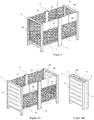
- figure 3 shows an example of a cot frame, in the unfolded position, equipped with a cover or cladding which mainly comprises:
- All of the textile panels 25, 125, 26, 126, 27 and 127 can be joined together to form a single internal lining of the folding cot.
- the textile side panels 26, 126, 27 and 127 are sufficiently flexible to allow the framework of the cot to be folded as described above and as shown in figures 1A to 1C .
- All or some of the textile end panels 25 and 125 or textile side panels 26, 126, 27 and 127 could be made of translucent fabric or mesh, so as to allow the child to see out of the cot, and conversely to allow the parent to monitor their child.
- Figures 4A and 4B show another example of a folding cot, which differs from the one in figure 3 in that the textile end panels 25 and 125 have been replaced by rigid panels 28 and 128, respectively.
- the folding cot in the folded position ( figure 4B ), the folding cot has the appearance of a flat rigid case, the rigid panels 28 and 128 effectively protecting the mattress 14 and the moving parts of the cot.
Landscapes
- Mattresses And Other Support Structures For Chairs And Beds (AREA)
Claims (14)
- Kinderfaltbett, dass eine auseinandergefaltete Position und eine zusammengefaltete Position einnehmen kann, umfassend:- einen Kinderbettboden, der sich in auseinandergefalteter Position in horizontaler Richtung erstreckt,- einen ersten Rahmen (5), der sich in auseinandergefalteter Position in vertikaler Richtung erstreckt,- einen zweiten Rahmen (1), der sich in auseinandergefalteter Position in vertikaler Richtung erstreckt,- einen dritten Rahmen (105), der sich in auseinandergefalteter Position in vertikaler Richtung erstreckt,- einen ersten Sarrus-Mechanismus (S1) oder ähnlichen Mechanismus, der den ersten Rahmen (5), den zweiten Rahmen (1) und wenigstens zwei Gelenkarme, nämlich einen unteren Arm und einen Seitenarm, umfasst, wobei die Arme jeweils den ersten und den zweiten Rahmen (1, 5) miteinander verbinden und die Bewegung dieser Rahmen (5, 1) aufeinander zu/voneinander weg während des Zusammenfaltens/Auseinanderfaltens des Kinderbettes führen, und- einen zweiten Sarrus-Mechanismus (S2) oder ähnlichen Mechanismus, der den zweiten Rahmen (1), den dritten Rahmen (105) und wenigstens zwei Gelenkarme, nämlich einen unteren Arm und einen Seitenarm, umfasst, wobei die Arme jeweils den zweiten und den dritten Rahmen (1, 105) miteinander verbinden und die Bewegung dieser Rahmen aufeinander zu/voneinander weg während des Zusammenfaltens/Auseinanderfaltens des Kinderbetts führen,wobei der Kinderbettboden zumindest teilweise von dem unteren Arm des ersten Mechanismus (S1) und dem unteren Arm des zweiten Mechanismus (S2) gebildet ist.
- Kinderfaltbett gemäß Anspruch 1, wobei der erste Mechanismus (S1) eine translatorische Bewegung des ersten Rahmens (5) in Bezug auf den zweiten Rahmen (1) entlang einer Längsachse des Kinderbettes erlaubt, und wobei der zweite Mechanismus (S2) eine translatorische Bewegung des dritten Rahmens (105) in Bezug auf den zweiten Rahmen (1) entlang der Längsachse erlaubt.
- Kinderfaltbett gemäß Anspruch 1 oder 2, wobei der erste und/oder der zweite Mechanismus (S1, S2) ein Sarrus-Mechanismus ist.
- Kinderfaltbett gemäß einem der Ansprüche 1 bis 3, wobei der erste und der zweite Mechanismus symmetrisch in Bezug auf den zweiten Rahmen (1) angeordnet sind.
- Kinderfaltbett gemäß einem der Ansprüche 1 bis 4, wobei der untere Arm und der erste und/oder zweite Mechanismus (S1, S2) hochgefaltet werden und wobei sich in zusammengefalteter Position das obere Ende des unteren Arms unterhalb des Seitenarms/der Seitenarme des Mechanismus befindet.
- Kinderfaltbett gemäß einem der Ansprüche 1 bis 5, wobei das Kinderbett seitliche Barrieren aufweist, die sich zwischen den Rahmen (1, 5, 105) erstrecken und sich in auseinandergefalteter Position in vertikaler Richtung erstrecken, und wobei der erste und/oder zweite Mechanismus (S1, S2) zwei Arme aufweist, die zumindest teilweise die seitlichen Barrieren des Kinderbetts bilden.
- Kinderfaltbett gemäß Anspruch 6, wobei in zusammengefalteter Position die Spitzen der beiden Seitenarme voneinander beabstandet einander gegenüberliegen.
- Kinderfaltbett gemäß einem der Ansprüche 1 bis 7, wobei das Kinderbett symmetrisch in Bezug auf eine Längsmittelebene ausgebildet ist, wobei sich diese Ebene in auseinandergefaltete Position in vertikaler Richtung erstreckt.
- Kinderfaltbett gemäß einem der Ansprüche 1 bis 8, wobei der zweite Rahmen (1) ein unteres Querelement (3) aufweist und wobei der Kinderbettboden teilweise von diesem unteren Querelement (3) gebildet ist.
- Kinderfaltbett gemäß einem der Ansprüche 1 bis 9, das des Weiteren eine Matratze (14) aufweist, wobei die Matratze (14) in der zusammengefalteten Position im Inneren eines der Rahmen (1) aufgenommen ist.
- Kinderfaltbett gemäß Anspruch 10, wobei die Matratze (14) schwenkbar an dem Rahmen (1) gehaltert ist.
- Kinderfaltbett gemäß Anspruch 11, wobei ein Verbindungselement (19, 119) sich zwischen der Matratze (14) und dem unteren Arm derart erstreckt, dass aus der auseinandergefalteten Position heraus ein Verschwenken der Matratze (14) in Bezug auf den Rahmen (1) ein Auseinanderfalten des unteren Arms bewirkt.
- Kinderfaltbett gemäß einem der Ansprüche 1 bis 12, wobei jeder der Gelenkarme aus zwei Segmenten (10, 11, 110, 111) gebildet ist, die gelenkig miteinander und den benachbarten Rahmen (1, 5, 105) mittels Scharnieren verbunden ist, wobei ein erstes Scharnier es einem der Segmente (10, 110) erlaubt, sich in Bezug auf einen der Rahmen (5, 105) um eine erste Rotationsachse (AA') zu drehen, ein zweites Scharnier es den Segmenten (10, 110, 11, 111) erlaubt, sich in Bezug auf einander um eine zweite Rotationsachse (BB') zu drehen und ein drittes Scharnier es dem anderen Segment (11, 111) erlaubt, sich in Bezug auf den anderen Rahmen (1) um eine dritte Rotationsachse (CC') zu drehen, wobei sich die erste, zweite und dritte Rotationsachse (AA', BB', CC') parallel zueinander erstrecken.
- Kinderfaltbett gemäß einem der Ansprüche 1 bis 13, wobei wenigstens einer der Arme mit einem Stoppsystem ausgebildet ist, das verhindert, dass sich der Arm in der auseinandergefalteten Position nach außen außerhalb des Kinderbetts faltet.
Applications Claiming Priority (2)
| Application Number | Priority Date | Filing Date | Title |
|---|---|---|---|
| FR1557185A FR3039384B1 (fr) | 2015-07-28 | 2015-07-28 | Lit pliable |
| PCT/EP2016/067953 WO2017017159A1 (en) | 2015-07-28 | 2016-07-27 | Folding cot |
Publications (2)
| Publication Number | Publication Date |
|---|---|
| EP3328247A1 EP3328247A1 (de) | 2018-06-06 |
| EP3328247B1 true EP3328247B1 (de) | 2019-05-01 |
Family
ID=54207552
Family Applications (1)
| Application Number | Title | Priority Date | Filing Date |
|---|---|---|---|
| EP16753271.2A Not-in-force EP3328247B1 (de) | 2015-07-28 | 2016-07-27 | Faltbares kinderbett |
Country Status (6)
| Country | Link |
|---|---|
| US (1) | US20180192783A1 (de) |
| EP (1) | EP3328247B1 (de) |
| CN (1) | CN107920672A (de) |
| ES (1) | ES2732658T3 (de) |
| FR (1) | FR3039384B1 (de) |
| WO (1) | WO2017017159A1 (de) |
Cited By (1)
| Publication number | Priority date | Publication date | Assignee | Title |
|---|---|---|---|---|
| EP3973824A1 (de) | 2020-09-25 | 2022-03-30 | Gilles Henry | Faltbares kinderbett |
Families Citing this family (6)
| Publication number | Priority date | Publication date | Assignee | Title |
|---|---|---|---|---|
| CN107255210B (zh) * | 2017-05-16 | 2019-02-26 | 西安电子科技大学 | 一种基于柔性Sarrus机构的恒力支撑机构 |
| US11770749B2 (en) | 2018-03-16 | 2023-09-26 | Telefonaktiebolaget Lm Ericsson (Publ) | Managing non-coordinated radio access networks |
| JP7106045B2 (ja) * | 2018-06-11 | 2022-07-26 | 株式会社アールエル | 携帯型ベビーベッド |
| US11903495B1 (en) * | 2020-04-20 | 2024-02-20 | Regalo International, Llc | Travel nursery apparatus |
| CN112493768B (zh) * | 2020-12-11 | 2022-05-03 | 好孩子儿童用品有限公司 | 儿童床 |
| US12239244B1 (en) * | 2021-04-12 | 2025-03-04 | Regalo International, Llc | Collapsible bassinet apparatus |
Family Cites Families (25)
| Publication number | Priority date | Publication date | Assignee | Title |
|---|---|---|---|---|
| US490952A (en) * | 1893-01-31 | Convertible furniture | ||
| US217716A (en) * | 1879-07-22 | Improvement in folding cribs | ||
| US1340694A (en) * | 1919-01-07 | 1920-05-18 | Winget Jasper Stanley | Child's folding combined bed and coop |
| GB164886A (en) * | 1920-03-26 | 1921-06-23 | Sidney Francis Allen | Improvements in cots and the like |
| US1788960A (en) * | 1926-12-03 | 1931-01-13 | John W Shaw | Crib |
| US2043072A (en) * | 1932-04-28 | 1936-06-02 | Schmitt | Folding crib |
| US2486054A (en) * | 1947-07-10 | 1949-10-25 | Morse Max | Collapsible crib |
| US2569937A (en) * | 1947-11-21 | 1951-10-02 | Lindgren Theodore Hjalmar | Folding crib |
| US2518904A (en) * | 1948-03-24 | 1950-08-15 | George L King | Foldable baby crib |
| US2769183A (en) * | 1953-05-18 | 1956-11-06 | Henry J Landry | Infant's folding utility structure |
| US2823390A (en) * | 1954-11-12 | 1958-02-18 | Hagelfeldt Lydia Adolfina | Foldable crib |
| US2851701A (en) * | 1955-01-10 | 1958-09-16 | Eino J Lukala | Folding play-yard |
| US2866983A (en) * | 1956-04-06 | 1959-01-06 | Rose Theophylus Foster | Baby pen |
| US3094714A (en) * | 1960-06-23 | 1963-06-25 | Russell Yealey | Folding baby crib |
| US3631548A (en) * | 1970-03-09 | 1972-01-04 | Disposit Products Inc | Combined folding child{40 s crib and playpen |
| US3703734A (en) * | 1971-03-26 | 1972-11-28 | Lottie Mae Carr | Elevated and confined floor area apparatus for the care of invalids and small children |
| US4811437A (en) | 1987-06-26 | 1989-03-14 | Graco Metal Products, Inc. | Foldable playyard |
| US5163191A (en) * | 1992-04-14 | 1992-11-17 | Chan Te Erh | Replaceable two-level crib drape |
| US6434767B1 (en) * | 2001-01-18 | 2002-08-20 | Kolcraft Enterprises, Inc. | Floor support for bassinet mounted in a play yard |
| US9370255B2 (en) * | 2002-12-17 | 2016-06-21 | Breathablebaby, Llc | Crib shield system and other breathable apparatus |
| US20070101493A1 (en) * | 2005-11-05 | 2007-05-10 | Campbell David E | Collapsible crib |
| US7587774B2 (en) * | 2007-01-09 | 2009-09-15 | Bernice Mayes | Diaper changing station having a collapsible frame |
| CN201509977U (zh) * | 2009-08-18 | 2010-06-23 | 邹学明 | 折叠式童床 |
| GB2534229A (en) * | 2015-01-19 | 2016-07-20 | Oxford Space Structures Ltd | Folding cot |
| US20160262512A1 (en) * | 2015-03-10 | 2016-09-15 | Angela Horton | Foldable and portable children's bed |
-
2015
- 2015-07-28 FR FR1557185A patent/FR3039384B1/fr not_active Expired - Fee Related
-
2016
- 2016-07-27 CN CN201680038335.XA patent/CN107920672A/zh active Pending
- 2016-07-27 EP EP16753271.2A patent/EP3328247B1/de not_active Not-in-force
- 2016-07-27 WO PCT/EP2016/067953 patent/WO2017017159A1/en not_active Ceased
- 2016-07-27 US US15/740,158 patent/US20180192783A1/en not_active Abandoned
- 2016-07-27 ES ES16753271T patent/ES2732658T3/es active Active
Non-Patent Citations (1)
| Title |
|---|
| None * |
Cited By (1)
| Publication number | Priority date | Publication date | Assignee | Title |
|---|---|---|---|---|
| EP3973824A1 (de) | 2020-09-25 | 2022-03-30 | Gilles Henry | Faltbares kinderbett |
Also Published As
| Publication number | Publication date |
|---|---|
| ES2732658T3 (es) | 2019-11-25 |
| EP3328247A1 (de) | 2018-06-06 |
| WO2017017159A1 (en) | 2017-02-02 |
| US20180192783A1 (en) | 2018-07-12 |
| FR3039384A1 (fr) | 2017-02-03 |
| FR3039384B1 (fr) | 2018-03-23 |
| CN107920672A (zh) | 2018-04-17 |
Similar Documents
| Publication | Publication Date | Title |
|---|---|---|
| EP3328247B1 (de) | Faltbares kinderbett | |
| US9763523B2 (en) | Bassinet support | |
| TWI732094B (zh) | 嬰兒床 | |
| ITMI20010759A1 (it) | Box convertibile multiuso a piu' livelli | |
| US10092113B2 (en) | Combination napper and changing table accessory | |
| US11779130B2 (en) | Child bassinet | |
| EP3247244B1 (de) | Faltbares kinderbett | |
| US6634038B2 (en) | Collapsible playpen with detachable cot | |
| US20180303250A1 (en) | Play yard | |
| WO2013039983A2 (en) | Corner assembly for a foldable child enclosure | |
| US4455697A (en) | Foldable crib or playpen of reduced encumbrance | |
| CN115399599B (zh) | 床架组件 | |
| US20250375046A1 (en) | Bassinet accessory for a playard | |
| CN204445034U (zh) | 用于儿童容置装置内的床垫 | |
| CN110150905A (zh) | 婴儿游戏床 | |
| US3195152A (en) | Play pen and bottom elevating means therefor | |
| JP7106045B2 (ja) | 携帯型ベビーベッド | |
| EP3973824A1 (de) | Faltbares kinderbett | |
| CN203914213U (zh) | 用于儿童容置装置中的床垫的支撑结构以及包含该支撑结构的儿童容置装置 | |
| US2553703A (en) | Portable folding crib | |
| EP2401942B1 (de) | Zusammenklappbare Liege | |
| CN201008469Y (zh) | 可收折婴儿床 | |
| CN204048897U (zh) | 摇篮车支撑装置 |
Legal Events
| Date | Code | Title | Description |
|---|---|---|---|
| STAA | Information on the status of an ep patent application or granted ep patent |
Free format text: STATUS: THE INTERNATIONAL PUBLICATION HAS BEEN MADE |
|
| PUAI | Public reference made under article 153(3) epc to a published international application that has entered the european phase |
Free format text: ORIGINAL CODE: 0009012 |
|
| STAA | Information on the status of an ep patent application or granted ep patent |
Free format text: STATUS: REQUEST FOR EXAMINATION WAS MADE |
|
| 17P | Request for examination filed |
Effective date: 20180116 |
|
| AK | Designated contracting states |
Kind code of ref document: A1 Designated state(s): AL AT BE BG CH CY CZ DE DK EE ES FI FR GB GR HR HU IE IS IT LI LT LU LV MC MK MT NL NO PL PT RO RS SE SI SK SM TR |
|
| AX | Request for extension of the european patent |
Extension state: BA ME |
|
| DAV | Request for validation of the european patent (deleted) | ||
| DAX | Request for extension of the european patent (deleted) | ||
| GRAJ | Information related to disapproval of communication of intention to grant by the applicant or resumption of examination proceedings by the epo deleted |
Free format text: ORIGINAL CODE: EPIDOSDIGR1 |
|
| GRAP | Despatch of communication of intention to grant a patent |
Free format text: ORIGINAL CODE: EPIDOSNIGR1 |
|
| GRAP | Despatch of communication of intention to grant a patent |
Free format text: ORIGINAL CODE: EPIDOSNIGR1 |
|
| STAA | Information on the status of an ep patent application or granted ep patent |
Free format text: STATUS: GRANT OF PATENT IS INTENDED |
|
| INTG | Intention to grant announced |
Effective date: 20181116 |
|
| GRAS | Grant fee paid |
Free format text: ORIGINAL CODE: EPIDOSNIGR3 |
|
| GRAA | (expected) grant |
Free format text: ORIGINAL CODE: 0009210 |
|
| STAA | Information on the status of an ep patent application or granted ep patent |
Free format text: STATUS: THE PATENT HAS BEEN GRANTED |
|
| 111L | Licence recorded |
Designated state(s): AL AT BE BG CH CY CZ DE DK EE ES FI FR GB GR HR HU IE IS IT LT LU LV MC MK MT NL NO PL PT RO RS SE SI SK SM TR Free format text: EXCLUSIVE LICENSE Name of requester: TEDIBER SAS, FR Effective date: 20190118 |
|
| 111L | Licence recorded |
Designated state(s): AL AT BE BG CH CY CZ DE DK EE ES FI FR GB GR HR HU IE IS IT LT LU LV MC MK MT NL NO PL PT RO RS SE SI SK SM TR Free format text: EXCLUSIVE LICENSE Name of requester: TEDIBER SAS, FR Effective date: 20190118 |
|
| AK | Designated contracting states |
Kind code of ref document: B1 Designated state(s): AL AT BE BG CH CY CZ DE DK EE ES FI FR GB GR HR HU IE IS IT LI LT LU LV MC MK MT NL NO PL PT RO RS SE SI SK SM TR |
|
| REG | Reference to a national code |
Ref country code: GB Ref legal event code: FG4D |
|
| REG | Reference to a national code |
Ref country code: CH Ref legal event code: EP Ref country code: AT Ref legal event code: REF Ref document number: 1125766 Country of ref document: AT Kind code of ref document: T Effective date: 20190515 |
|
| REG | Reference to a national code |
Ref country code: DE Ref legal event code: R096 Ref document number: 602016013323 Country of ref document: DE |
|
| REG | Reference to a national code |
Ref country code: IE Ref legal event code: FG4D |
|
| REG | Reference to a national code |
Ref country code: CH Ref legal event code: NV Representative=s name: FREIGUTPARTNERS IP LAW FIRM DR. ROLF DITTMANN, CH |
|
| REG | Reference to a national code |
Ref country code: SE Ref legal event code: TRGR |
|
| REG | Reference to a national code |
Ref country code: NL Ref legal event code: FP |
|
| REG | Reference to a national code |
Ref country code: LT Ref legal event code: MG4D |
|
| PG25 | Lapsed in a contracting state [announced via postgrant information from national office to epo] |
Ref country code: HR Free format text: LAPSE BECAUSE OF FAILURE TO SUBMIT A TRANSLATION OF THE DESCRIPTION OR TO PAY THE FEE WITHIN THE PRESCRIBED TIME-LIMIT Effective date: 20190501 Ref country code: LT Free format text: LAPSE BECAUSE OF FAILURE TO SUBMIT A TRANSLATION OF THE DESCRIPTION OR TO PAY THE FEE WITHIN THE PRESCRIBED TIME-LIMIT Effective date: 20190501 Ref country code: FI Free format text: LAPSE BECAUSE OF FAILURE TO SUBMIT A TRANSLATION OF THE DESCRIPTION OR TO PAY THE FEE WITHIN THE PRESCRIBED TIME-LIMIT Effective date: 20190501 Ref country code: PT Free format text: LAPSE BECAUSE OF FAILURE TO SUBMIT A TRANSLATION OF THE DESCRIPTION OR TO PAY THE FEE WITHIN THE PRESCRIBED TIME-LIMIT Effective date: 20190901 Ref country code: NO Free format text: LAPSE BECAUSE OF FAILURE TO SUBMIT A TRANSLATION OF THE DESCRIPTION OR TO PAY THE FEE WITHIN THE PRESCRIBED TIME-LIMIT Effective date: 20190801 Ref country code: AL Free format text: LAPSE BECAUSE OF FAILURE TO SUBMIT A TRANSLATION OF THE DESCRIPTION OR TO PAY THE FEE WITHIN THE PRESCRIBED TIME-LIMIT Effective date: 20190501 |
|
| REG | Reference to a national code |
Ref country code: ES Ref legal event code: FG2A Ref document number: 2732658 Country of ref document: ES Kind code of ref document: T3 Effective date: 20191125 |
|
| PG25 | Lapsed in a contracting state [announced via postgrant information from national office to epo] |
Ref country code: LV Free format text: LAPSE BECAUSE OF FAILURE TO SUBMIT A TRANSLATION OF THE DESCRIPTION OR TO PAY THE FEE WITHIN THE PRESCRIBED TIME-LIMIT Effective date: 20190501 Ref country code: GR Free format text: LAPSE BECAUSE OF FAILURE TO SUBMIT A TRANSLATION OF THE DESCRIPTION OR TO PAY THE FEE WITHIN THE PRESCRIBED TIME-LIMIT Effective date: 20190802 Ref country code: RS Free format text: LAPSE BECAUSE OF FAILURE TO SUBMIT A TRANSLATION OF THE DESCRIPTION OR TO PAY THE FEE WITHIN THE PRESCRIBED TIME-LIMIT Effective date: 20190501 Ref country code: BG Free format text: LAPSE BECAUSE OF FAILURE TO SUBMIT A TRANSLATION OF THE DESCRIPTION OR TO PAY THE FEE WITHIN THE PRESCRIBED TIME-LIMIT Effective date: 20190801 |
|
| REG | Reference to a national code |
Ref country code: AT Ref legal event code: MK05 Ref document number: 1125766 Country of ref document: AT Kind code of ref document: T Effective date: 20190501 |
|
| PG25 | Lapsed in a contracting state [announced via postgrant information from national office to epo] |
Ref country code: IS Free format text: LAPSE BECAUSE OF FAILURE TO SUBMIT A TRANSLATION OF THE DESCRIPTION OR TO PAY THE FEE WITHIN THE PRESCRIBED TIME-LIMIT Effective date: 20190901 |
|
| PG25 | Lapsed in a contracting state [announced via postgrant information from national office to epo] |
Ref country code: RO Free format text: LAPSE BECAUSE OF FAILURE TO SUBMIT A TRANSLATION OF THE DESCRIPTION OR TO PAY THE FEE WITHIN THE PRESCRIBED TIME-LIMIT Effective date: 20190501 Ref country code: CZ Free format text: LAPSE BECAUSE OF FAILURE TO SUBMIT A TRANSLATION OF THE DESCRIPTION OR TO PAY THE FEE WITHIN THE PRESCRIBED TIME-LIMIT Effective date: 20190501 Ref country code: EE Free format text: LAPSE BECAUSE OF FAILURE TO SUBMIT A TRANSLATION OF THE DESCRIPTION OR TO PAY THE FEE WITHIN THE PRESCRIBED TIME-LIMIT Effective date: 20190501 Ref country code: SK Free format text: LAPSE BECAUSE OF FAILURE TO SUBMIT A TRANSLATION OF THE DESCRIPTION OR TO PAY THE FEE WITHIN THE PRESCRIBED TIME-LIMIT Effective date: 20190501 Ref country code: AT Free format text: LAPSE BECAUSE OF FAILURE TO SUBMIT A TRANSLATION OF THE DESCRIPTION OR TO PAY THE FEE WITHIN THE PRESCRIBED TIME-LIMIT Effective date: 20190501 Ref country code: DK Free format text: LAPSE BECAUSE OF FAILURE TO SUBMIT A TRANSLATION OF THE DESCRIPTION OR TO PAY THE FEE WITHIN THE PRESCRIBED TIME-LIMIT Effective date: 20190501 |
|
| REG | Reference to a national code |
Ref country code: DE Ref legal event code: R097 Ref document number: 602016013323 Country of ref document: DE |
|
| PG25 | Lapsed in a contracting state [announced via postgrant information from national office to epo] |
Ref country code: SM Free format text: LAPSE BECAUSE OF FAILURE TO SUBMIT A TRANSLATION OF THE DESCRIPTION OR TO PAY THE FEE WITHIN THE PRESCRIBED TIME-LIMIT Effective date: 20190501 Ref country code: MC Free format text: LAPSE BECAUSE OF FAILURE TO SUBMIT A TRANSLATION OF THE DESCRIPTION OR TO PAY THE FEE WITHIN THE PRESCRIBED TIME-LIMIT Effective date: 20190501 |
|
| PLBE | No opposition filed within time limit |
Free format text: ORIGINAL CODE: 0009261 |
|
| STAA | Information on the status of an ep patent application or granted ep patent |
Free format text: STATUS: NO OPPOSITION FILED WITHIN TIME LIMIT |
|
| PG25 | Lapsed in a contracting state [announced via postgrant information from national office to epo] |
Ref country code: TR Free format text: LAPSE BECAUSE OF FAILURE TO SUBMIT A TRANSLATION OF THE DESCRIPTION OR TO PAY THE FEE WITHIN THE PRESCRIBED TIME-LIMIT Effective date: 20190501 |
|
| 26N | No opposition filed |
Effective date: 20200204 |
|
| PG25 | Lapsed in a contracting state [announced via postgrant information from national office to epo] |
Ref country code: PL Free format text: LAPSE BECAUSE OF FAILURE TO SUBMIT A TRANSLATION OF THE DESCRIPTION OR TO PAY THE FEE WITHIN THE PRESCRIBED TIME-LIMIT Effective date: 20190501 |
|
| PG25 | Lapsed in a contracting state [announced via postgrant information from national office to epo] |
Ref country code: SI Free format text: LAPSE BECAUSE OF FAILURE TO SUBMIT A TRANSLATION OF THE DESCRIPTION OR TO PAY THE FEE WITHIN THE PRESCRIBED TIME-LIMIT Effective date: 20190501 Ref country code: LU Free format text: LAPSE BECAUSE OF NON-PAYMENT OF DUE FEES Effective date: 20190727 |
|
| PG25 | Lapsed in a contracting state [announced via postgrant information from national office to epo] |
Ref country code: IE Free format text: LAPSE BECAUSE OF NON-PAYMENT OF DUE FEES Effective date: 20190727 |
|
| PGFP | Annual fee paid to national office [announced via postgrant information from national office to epo] |
Ref country code: FR Payment date: 20200611 Year of fee payment: 5 |
|
| PGFP | Annual fee paid to national office [announced via postgrant information from national office to epo] |
Ref country code: BE Payment date: 20200617 Year of fee payment: 5 |
|
| PGFP | Annual fee paid to national office [announced via postgrant information from national office to epo] |
Ref country code: NL Payment date: 20200715 Year of fee payment: 5 |
|
| PGFP | Annual fee paid to national office [announced via postgrant information from national office to epo] |
Ref country code: GB Payment date: 20200716 Year of fee payment: 5 Ref country code: ES Payment date: 20200803 Year of fee payment: 5 Ref country code: DE Payment date: 20200714 Year of fee payment: 5 |
|
| PGFP | Annual fee paid to national office [announced via postgrant information from national office to epo] |
Ref country code: SE Payment date: 20200710 Year of fee payment: 5 Ref country code: CH Payment date: 20200716 Year of fee payment: 5 Ref country code: IT Payment date: 20200610 Year of fee payment: 5 |
|
| PG25 | Lapsed in a contracting state [announced via postgrant information from national office to epo] |
Ref country code: CY Free format text: LAPSE BECAUSE OF FAILURE TO SUBMIT A TRANSLATION OF THE DESCRIPTION OR TO PAY THE FEE WITHIN THE PRESCRIBED TIME-LIMIT Effective date: 20190501 |
|
| PG25 | Lapsed in a contracting state [announced via postgrant information from national office to epo] |
Ref country code: MT Free format text: LAPSE BECAUSE OF FAILURE TO SUBMIT A TRANSLATION OF THE DESCRIPTION OR TO PAY THE FEE WITHIN THE PRESCRIBED TIME-LIMIT Effective date: 20190501 Ref country code: HU Free format text: LAPSE BECAUSE OF FAILURE TO SUBMIT A TRANSLATION OF THE DESCRIPTION OR TO PAY THE FEE WITHIN THE PRESCRIBED TIME-LIMIT; INVALID AB INITIO Effective date: 20160727 |
|
| REG | Reference to a national code |
Ref country code: DE Ref legal event code: R119 Ref document number: 602016013323 Country of ref document: DE |
|
| REG | Reference to a national code |
Ref country code: CH Ref legal event code: PL |
|
| REG | Reference to a national code |
Ref country code: NL Ref legal event code: MM Effective date: 20210801 |
|
| GBPC | Gb: european patent ceased through non-payment of renewal fee |
Effective date: 20210727 |
|
| REG | Reference to a national code |
Ref country code: BE Ref legal event code: MM Effective date: 20210731 |
|
| PG25 | Lapsed in a contracting state [announced via postgrant information from national office to epo] |
Ref country code: LI Free format text: LAPSE BECAUSE OF NON-PAYMENT OF DUE FEES Effective date: 20210731 Ref country code: GB Free format text: LAPSE BECAUSE OF NON-PAYMENT OF DUE FEES Effective date: 20210727 Ref country code: DE Free format text: LAPSE BECAUSE OF NON-PAYMENT OF DUE FEES Effective date: 20220201 Ref country code: CH Free format text: LAPSE BECAUSE OF NON-PAYMENT OF DUE FEES Effective date: 20210731 |
|
| PG25 | Lapsed in a contracting state [announced via postgrant information from national office to epo] |
Ref country code: SE Free format text: LAPSE BECAUSE OF NON-PAYMENT OF DUE FEES Effective date: 20210728 Ref country code: NL Free format text: LAPSE BECAUSE OF NON-PAYMENT OF DUE FEES Effective date: 20210801 Ref country code: FR Free format text: LAPSE BECAUSE OF NON-PAYMENT OF DUE FEES Effective date: 20210731 |
|
| PG25 | Lapsed in a contracting state [announced via postgrant information from national office to epo] |
Ref country code: MK Free format text: LAPSE BECAUSE OF FAILURE TO SUBMIT A TRANSLATION OF THE DESCRIPTION OR TO PAY THE FEE WITHIN THE PRESCRIBED TIME-LIMIT Effective date: 20190501 |
|
| PG25 | Lapsed in a contracting state [announced via postgrant information from national office to epo] |
Ref country code: IT Free format text: LAPSE BECAUSE OF NON-PAYMENT OF DUE FEES Effective date: 20210727 Ref country code: BE Free format text: LAPSE BECAUSE OF NON-PAYMENT OF DUE FEES Effective date: 20210731 |
|
| REG | Reference to a national code |
Ref country code: ES Ref legal event code: FD2A Effective date: 20220901 |
|
| PG25 | Lapsed in a contracting state [announced via postgrant information from national office to epo] |
Ref country code: ES Free format text: LAPSE BECAUSE OF NON-PAYMENT OF DUE FEES Effective date: 20210728 |