EP3328433B1 - Dispersion mit einem veresterten celluloseether - Google Patents
Dispersion mit einem veresterten celluloseether Download PDFInfo
- Publication number
- EP3328433B1 EP3328433B1 EP16741762.5A EP16741762A EP3328433B1 EP 3328433 B1 EP3328433 B1 EP 3328433B1 EP 16741762 A EP16741762 A EP 16741762A EP 3328433 B1 EP3328433 B1 EP 3328433B1
- Authority
- EP
- European Patent Office
- Prior art keywords
- cellulose ether
- esterified cellulose
- aqueous composition
- percent
- groups
- Prior art date
- Legal status (The legal status is an assumption and is not a legal conclusion. Google has not performed a legal analysis and makes no representation as to the accuracy of the status listed.)
- Not-in-force
Links
- 229920003086 cellulose ether Polymers 0.000 title claims description 119
- 239000006185 dispersion Substances 0.000 title claims description 94
- 239000000203 mixture Substances 0.000 claims description 135
- 229920000639 hydroxypropylmethylcellulose acetate succinate Polymers 0.000 claims description 104
- -1 alkaline earth metal salt Chemical class 0.000 claims description 91
- 239000002245 particle Substances 0.000 claims description 57
- 239000003945 anionic surfactant Substances 0.000 claims description 45
- 235000014113 dietary fatty acids Nutrition 0.000 claims description 43
- 239000000194 fatty acid Substances 0.000 claims description 43
- 229930195729 fatty acid Natural products 0.000 claims description 43
- 125000001273 sulfonato group Chemical group [O-]S(*)(=O)=O 0.000 claims description 40
- QAOWNCQODCNURD-UHFFFAOYSA-L Sulfate Chemical compound [O-]S([O-])(=O)=O QAOWNCQODCNURD-UHFFFAOYSA-L 0.000 claims description 39
- 150000004665 fatty acids Chemical class 0.000 claims description 39
- 150000003839 salts Chemical class 0.000 claims description 38
- 239000003085 diluting agent Substances 0.000 claims description 32
- 238000000034 method Methods 0.000 claims description 28
- 239000002775 capsule Substances 0.000 claims description 27
- 125000001931 aliphatic group Chemical group 0.000 claims description 21
- 230000008569 process Effects 0.000 claims description 21
- 238000000576 coating method Methods 0.000 claims description 19
- 239000002671 adjuvant Substances 0.000 claims description 18
- 238000000227 grinding Methods 0.000 claims description 18
- 125000002777 acetyl group Chemical group [H]C([H])([H])C(*)=O 0.000 claims description 17
- 239000011248 coating agent Substances 0.000 claims description 14
- 125000002252 acyl group Chemical group 0.000 claims description 13
- 238000000465 moulding Methods 0.000 claims description 13
- 239000002552 dosage form Substances 0.000 claims description 10
- 238000010438 heat treatment Methods 0.000 claims description 10
- 238000007598 dipping method Methods 0.000 claims description 9
- QGZKDVFQNNGYKY-UHFFFAOYSA-O Ammonium Chemical compound [NH4+] QGZKDVFQNNGYKY-UHFFFAOYSA-O 0.000 claims description 8
- UFHFLCQGNIYNRP-UHFFFAOYSA-N Hydrogen Chemical compound [H][H] UFHFLCQGNIYNRP-UHFFFAOYSA-N 0.000 claims description 8
- 150000001768 cations Chemical class 0.000 claims description 8
- 239000001257 hydrogen Substances 0.000 claims description 8
- 229910052739 hydrogen Inorganic materials 0.000 claims description 8
- 125000002029 aromatic hydrocarbon group Chemical group 0.000 claims description 7
- 230000001804 emulsifying effect Effects 0.000 claims description 7
- 238000001035 drying Methods 0.000 claims description 6
- 238000002156 mixing Methods 0.000 claims description 6
- 229910052783 alkali metal Inorganic materials 0.000 claims description 5
- 150000001340 alkali metals Chemical class 0.000 claims description 5
- 229910052784 alkaline earth metal Inorganic materials 0.000 claims description 5
- 238000001816 cooling Methods 0.000 claims description 5
- 239000000839 emulsion Substances 0.000 claims description 5
- ZQPPMHVWECSIRJ-UHFFFAOYSA-N Oleic acid Natural products CCCCCCCCC=CCCCCCCCC(O)=O ZQPPMHVWECSIRJ-UHFFFAOYSA-N 0.000 claims description 4
- 125000004063 butyryl group Chemical group O=C([*])C([H])([H])C([H])([H])C([H])([H])[H] 0.000 claims description 4
- QXJSBBXBKPUZAA-UHFFFAOYSA-N isooleic acid Natural products CCCCCCCC=CCCCCCCCCC(O)=O QXJSBBXBKPUZAA-UHFFFAOYSA-N 0.000 claims description 4
- 238000002844 melting Methods 0.000 claims description 4
- 230000008018 melting Effects 0.000 claims description 4
- 125000001501 propionyl group Chemical group O=C([*])C([H])([H])C([H])([H])[H] 0.000 claims description 4
- WRIDQFICGBMAFQ-UHFFFAOYSA-N (E)-8-Octadecenoic acid Natural products CCCCCCCCCC=CCCCCCCC(O)=O WRIDQFICGBMAFQ-UHFFFAOYSA-N 0.000 claims description 3
- LQJBNNIYVWPHFW-UHFFFAOYSA-N 20:1omega9c fatty acid Natural products CCCCCCCCCCC=CCCCCCCCC(O)=O LQJBNNIYVWPHFW-UHFFFAOYSA-N 0.000 claims description 3
- QSBYPNXLFMSGKH-UHFFFAOYSA-N 9-Heptadecensaeure Natural products CCCCCCCC=CCCCCCCCC(O)=O QSBYPNXLFMSGKH-UHFFFAOYSA-N 0.000 claims description 3
- 239000005642 Oleic acid Substances 0.000 claims description 3
- 235000021355 Stearic acid Nutrition 0.000 claims description 3
- ULUAUXLGCMPNKK-UHFFFAOYSA-N Sulfobutanedioic acid Chemical compound OC(=O)CC(C(O)=O)S(O)(=O)=O ULUAUXLGCMPNKK-UHFFFAOYSA-N 0.000 claims description 3
- QIQXTHQIDYTFRH-UHFFFAOYSA-N octadecanoic acid Chemical compound CCCCCCCCCCCCCCCCCC(O)=O QIQXTHQIDYTFRH-UHFFFAOYSA-N 0.000 claims description 3
- OQCDKBAXFALNLD-UHFFFAOYSA-N octadecanoic acid Natural products CCCCCCCC(C)CCCCCCCCC(O)=O OQCDKBAXFALNLD-UHFFFAOYSA-N 0.000 claims description 3
- 239000008117 stearic acid Substances 0.000 claims description 3
- 235000021122 unsaturated fatty acids Nutrition 0.000 claims description 3
- 229920006395 saturated elastomer Polymers 0.000 claims description 2
- 150000004671 saturated fatty acids Chemical class 0.000 claims description 2
- 150000004670 unsaturated fatty acids Chemical class 0.000 claims description 2
- ZQPPMHVWECSIRJ-KTKRTIGZSA-N oleic acid Chemical compound CCCCCCCC\C=C/CCCCCCCC(O)=O ZQPPMHVWECSIRJ-KTKRTIGZSA-N 0.000 claims 1
- ZUAAPNNKRHMPKG-UHFFFAOYSA-N acetic acid;butanedioic acid;methanol;propane-1,2-diol Chemical compound OC.CC(O)=O.CC(O)CO.OC(=O)CCC(O)=O ZUAAPNNKRHMPKG-UHFFFAOYSA-N 0.000 description 102
- 239000004094 surface-active agent Substances 0.000 description 39
- 230000000052 comparative effect Effects 0.000 description 32
- 239000008186 active pharmaceutical agent Chemical class 0.000 description 29
- HEMHJVSKTPXQMS-UHFFFAOYSA-M Sodium hydroxide Chemical compound [OH-].[Na+] HEMHJVSKTPXQMS-UHFFFAOYSA-M 0.000 description 24
- 125000005113 hydroxyalkoxy group Chemical group 0.000 description 22
- XLYOFNOQVPJJNP-UHFFFAOYSA-N water Substances O XLYOFNOQVPJJNP-UHFFFAOYSA-N 0.000 description 22
- 239000007787 solid Substances 0.000 description 18
- 238000003801 milling Methods 0.000 description 16
- 239000000243 solution Substances 0.000 description 15
- 229920002678 cellulose Polymers 0.000 description 14
- 239000001913 cellulose Substances 0.000 description 14
- 229920000642 polymer Polymers 0.000 description 14
- 238000006467 substitution reaction Methods 0.000 description 14
- 229920001249 ethyl cellulose Polymers 0.000 description 13
- 235000019325 ethyl cellulose Nutrition 0.000 description 13
- 229920003088 hydroxypropyl methyl cellulose Polymers 0.000 description 13
- RYYKJJJTJZKILX-UHFFFAOYSA-M sodium octadecanoate Chemical compound [Na+].CCCCCCCCCCCCCCCCCC([O-])=O RYYKJJJTJZKILX-UHFFFAOYSA-M 0.000 description 13
- 235000010979 hydroxypropyl methyl cellulose Nutrition 0.000 description 12
- 230000007704 transition Effects 0.000 description 12
- ZZSNKZQZMQGXPY-UHFFFAOYSA-N Ethyl cellulose Chemical compound CCOCC1OC(OC)C(OCC)C(OCC)C1OC1C(O)C(O)C(OC)C(CO)O1 ZZSNKZQZMQGXPY-UHFFFAOYSA-N 0.000 description 11
- 239000001866 hydroxypropyl methyl cellulose Substances 0.000 description 11
- DOOTYTYQINUNNV-UHFFFAOYSA-N Triethyl citrate Chemical compound CCOC(=O)CC(O)(C(=O)OCC)CC(=O)OCC DOOTYTYQINUNNV-UHFFFAOYSA-N 0.000 description 10
- 125000003545 alkoxy group Chemical group 0.000 description 10
- 235000019329 dioctyl sodium sulphosuccinate Nutrition 0.000 description 10
- 239000001856 Ethyl cellulose Substances 0.000 description 9
- PEDCQBHIVMGVHV-UHFFFAOYSA-N Glycerine Chemical compound OCC(O)CO PEDCQBHIVMGVHV-UHFFFAOYSA-N 0.000 description 9
- 239000003814 drug Substances 0.000 description 9
- UFVKGYZPFZQRLF-UHFFFAOYSA-N hydroxypropyl methyl cellulose Chemical compound OC1C(O)C(OC)OC(CO)C1OC1C(O)C(O)C(OC2C(C(O)C(OC3C(C(O)C(O)C(CO)O3)O)C(CO)O2)O)C(CO)O1 UFVKGYZPFZQRLF-UHFFFAOYSA-N 0.000 description 9
- 229940031704 hydroxypropyl methylcellulose phthalate Drugs 0.000 description 9
- 239000003960 organic solvent Substances 0.000 description 9
- 238000003860 storage Methods 0.000 description 9
- 239000001069 triethyl citrate Substances 0.000 description 9
- VMYFZRTXGLUXMZ-UHFFFAOYSA-N triethyl citrate Natural products CCOC(=O)C(O)(C(=O)OCC)C(=O)OCC VMYFZRTXGLUXMZ-UHFFFAOYSA-N 0.000 description 9
- 235000013769 triethyl citrate Nutrition 0.000 description 9
- 229910002012 Aerosil® Inorganic materials 0.000 description 8
- VYPSYNLAJGMNEJ-UHFFFAOYSA-N Silicium dioxide Chemical compound O=[Si]=O VYPSYNLAJGMNEJ-UHFFFAOYSA-N 0.000 description 8
- 238000005054 agglomeration Methods 0.000 description 8
- 230000002776 aggregation Effects 0.000 description 8
- 150000002148 esters Chemical class 0.000 description 8
- 125000002887 hydroxy group Chemical group [H]O* 0.000 description 8
- 229920003132 hydroxypropyl methylcellulose phthalate Polymers 0.000 description 8
- 238000004519 manufacturing process Methods 0.000 description 8
- 238000005259 measurement Methods 0.000 description 8
- 229920000609 methyl cellulose Polymers 0.000 description 8
- 235000010981 methylcellulose Nutrition 0.000 description 8
- URAYPUMNDPQOKB-UHFFFAOYSA-N triacetin Chemical compound CC(=O)OCC(OC(C)=O)COC(C)=O URAYPUMNDPQOKB-UHFFFAOYSA-N 0.000 description 8
- 229940079593 drug Drugs 0.000 description 7
- 239000004014 plasticizer Substances 0.000 description 7
- 229910001415 sodium ion Inorganic materials 0.000 description 7
- 239000003826 tablet Substances 0.000 description 7
- LFQSCWFLJHTTHZ-UHFFFAOYSA-N Ethanol Chemical compound CCO LFQSCWFLJHTTHZ-UHFFFAOYSA-N 0.000 description 6
- RVGRUAULSDPKGF-UHFFFAOYSA-N Poloxamer Chemical compound C1CO1.CC1CO1 RVGRUAULSDPKGF-UHFFFAOYSA-N 0.000 description 6
- DNIAPMSPPWPWGF-UHFFFAOYSA-N Propylene glycol Chemical compound CC(O)CO DNIAPMSPPWPWGF-UHFFFAOYSA-N 0.000 description 6
- DBMJMQXJHONAFJ-UHFFFAOYSA-M Sodium laurylsulphate Chemical compound [Na+].CCCCCCCCCCCCOS([O-])(=O)=O DBMJMQXJHONAFJ-UHFFFAOYSA-M 0.000 description 6
- RTZKZFJDLAIYFH-UHFFFAOYSA-N ether Substances CCOCC RTZKZFJDLAIYFH-UHFFFAOYSA-N 0.000 description 6
- TWNIBLMWSKIRAT-VFUOTHLCSA-N levoglucosan Chemical group O[C@@H]1[C@@H](O)[C@H](O)[C@H]2CO[C@@H]1O2 TWNIBLMWSKIRAT-VFUOTHLCSA-N 0.000 description 6
- TVZRAEYQIKYCPH-UHFFFAOYSA-N 3-(trimethylsilyl)propane-1-sulfonic acid Chemical compound C[Si](C)(C)CCCS(O)(=O)=O TVZRAEYQIKYCPH-UHFFFAOYSA-N 0.000 description 5
- 229920003171 Poly (ethylene oxide) Polymers 0.000 description 5
- ZFOZVQLOBQUTQQ-UHFFFAOYSA-N Tributyl citrate Chemical group CCCCOC(=O)CC(O)(C(=O)OCCCC)CC(=O)OCCCC ZFOZVQLOBQUTQQ-UHFFFAOYSA-N 0.000 description 5
- 239000004480 active ingredient Substances 0.000 description 5
- 125000004432 carbon atom Chemical group C* 0.000 description 5
- 239000001923 methylcellulose Substances 0.000 description 5
- 238000002360 preparation method Methods 0.000 description 5
- 230000003134 recirculating effect Effects 0.000 description 5
- 239000011734 sodium Substances 0.000 description 5
- 229960002622 triacetin Drugs 0.000 description 5
- CDOUZKKFHVEKRI-UHFFFAOYSA-N 3-bromo-n-[(prop-2-enoylamino)methyl]propanamide Chemical compound BrCCC(=O)NCNC(=O)C=C CDOUZKKFHVEKRI-UHFFFAOYSA-N 0.000 description 4
- 229920002153 Hydroxypropyl cellulose Polymers 0.000 description 4
- DGAQECJNVWCQMB-PUAWFVPOSA-M Ilexoside XXIX Chemical compound C[C@@H]1CC[C@@]2(CC[C@@]3(C(=CC[C@H]4[C@]3(CC[C@@H]5[C@@]4(CC[C@@H](C5(C)C)OS(=O)(=O)[O-])C)C)[C@@H]2[C@]1(C)O)C)C(=O)O[C@H]6[C@@H]([C@H]([C@@H]([C@H](O6)CO)O)O)O.[Na+] DGAQECJNVWCQMB-PUAWFVPOSA-M 0.000 description 4
- 229920013820 alkyl cellulose Polymers 0.000 description 4
- 238000004458 analytical method Methods 0.000 description 4
- 235000010977 hydroxypropyl cellulose Nutrition 0.000 description 4
- 239000004615 ingredient Substances 0.000 description 4
- ZWEHNKRNPOVVGH-UHFFFAOYSA-N 2-Butanone Chemical compound CCC(C)=O ZWEHNKRNPOVVGH-UHFFFAOYSA-N 0.000 description 3
- CSCPPACGZOOCGX-UHFFFAOYSA-N Acetone Chemical compound CC(C)=O CSCPPACGZOOCGX-UHFFFAOYSA-N 0.000 description 3
- WEVYAHXRMPXWCK-UHFFFAOYSA-N Acetonitrile Chemical compound CC#N WEVYAHXRMPXWCK-UHFFFAOYSA-N 0.000 description 3
- QGZKDVFQNNGYKY-UHFFFAOYSA-N Ammonia Chemical compound N QGZKDVFQNNGYKY-UHFFFAOYSA-N 0.000 description 3
- PYGXAGIECVVIOZ-UHFFFAOYSA-N Dibutyl decanedioate Chemical compound CCCCOC(=O)CCCCCCCCC(=O)OCCCC PYGXAGIECVVIOZ-UHFFFAOYSA-N 0.000 description 3
- YMWUJEATGCHHMB-UHFFFAOYSA-N Dichloromethane Chemical compound ClCCl YMWUJEATGCHHMB-UHFFFAOYSA-N 0.000 description 3
- XEKOWRVHYACXOJ-UHFFFAOYSA-N Ethyl acetate Chemical compound CCOC(C)=O XEKOWRVHYACXOJ-UHFFFAOYSA-N 0.000 description 3
- OKKJLVBELUTLKV-UHFFFAOYSA-N Methanol Chemical compound OC OKKJLVBELUTLKV-UHFFFAOYSA-N 0.000 description 3
- YXFVVABEGXRONW-UHFFFAOYSA-N Toluene Chemical compound CC1=CC=CC=C1 YXFVVABEGXRONW-UHFFFAOYSA-N 0.000 description 3
- 239000000654 additive Substances 0.000 description 3
- 150000001298 alcohols Chemical class 0.000 description 3
- 229910001413 alkali metal ion Inorganic materials 0.000 description 3
- 125000003342 alkenyl group Chemical group 0.000 description 3
- 125000006193 alkinyl group Chemical group 0.000 description 3
- 125000000217 alkyl group Chemical group 0.000 description 3
- 125000003178 carboxy group Chemical group [H]OC(*)=O 0.000 description 3
- 125000000753 cycloalkyl group Chemical group 0.000 description 3
- ZQPPMHVWECSIRJ-MDZDMXLPSA-N elaidic acid Chemical compound CCCCCCCC\C=C\CCCCCCCC(O)=O ZQPPMHVWECSIRJ-MDZDMXLPSA-N 0.000 description 3
- 125000004185 ester group Chemical group 0.000 description 3
- 239000000499 gel Substances 0.000 description 3
- 235000013773 glyceryl triacetate Nutrition 0.000 description 3
- 125000002768 hydroxyalkyl group Chemical group 0.000 description 3
- 239000001863 hydroxypropyl cellulose Substances 0.000 description 3
- 238000011068 loading method Methods 0.000 description 3
- 125000002496 methyl group Chemical group [H]C([H])([H])* 0.000 description 3
- 125000000896 monocarboxylic acid group Chemical group 0.000 description 3
- 229920001983 poloxamer Polymers 0.000 description 3
- 229960000502 poloxamer Drugs 0.000 description 3
- 235000010482 polyoxyethylene sorbitan monooleate Nutrition 0.000 description 3
- 229920000053 polysorbate 80 Polymers 0.000 description 3
- 229910001414 potassium ion Inorganic materials 0.000 description 3
- 125000001424 substituent group Chemical group 0.000 description 3
- 239000000758 substrate Substances 0.000 description 3
- JNYAEWCLZODPBN-JGWLITMVSA-N (2r,3r,4s)-2-[(1r)-1,2-dihydroxyethyl]oxolane-3,4-diol Chemical compound OC[C@@H](O)[C@H]1OC[C@H](O)[C@H]1O JNYAEWCLZODPBN-JGWLITMVSA-N 0.000 description 2
- YWWVWXASSLXJHU-AATRIKPKSA-N (9E)-tetradecenoic acid Chemical compound CCCC\C=C\CCCCCCCC(O)=O YWWVWXASSLXJHU-AATRIKPKSA-N 0.000 description 2
- QTBSBXVTEAMEQO-UHFFFAOYSA-M Acetate Chemical compound CC([O-])=O QTBSBXVTEAMEQO-UHFFFAOYSA-M 0.000 description 2
- IJGRMHOSHXDMSA-UHFFFAOYSA-N Atomic nitrogen Chemical compound N#N IJGRMHOSHXDMSA-UHFFFAOYSA-N 0.000 description 2
- BHPQYMZQTOCNFJ-UHFFFAOYSA-N Calcium cation Chemical compound [Ca+2] BHPQYMZQTOCNFJ-UHFFFAOYSA-N 0.000 description 2
- 229920000623 Cellulose acetate phthalate Polymers 0.000 description 2
- KFZMGEQAYNKOFK-UHFFFAOYSA-N Isopropanol Chemical compound CC(C)O KFZMGEQAYNKOFK-UHFFFAOYSA-N 0.000 description 2
- 239000002202 Polyethylene glycol Substances 0.000 description 2
- WYURNTSHIVDZCO-UHFFFAOYSA-N Tetrahydrofuran Chemical compound C1CCOC1 WYURNTSHIVDZCO-UHFFFAOYSA-N 0.000 description 2
- UYXTWWCETRIEDR-UHFFFAOYSA-N Tributyrin Chemical compound CCCC(=O)OCC(OC(=O)CCC)COC(=O)CCC UYXTWWCETRIEDR-UHFFFAOYSA-N 0.000 description 2
- 150000001242 acetic acid derivatives Chemical class 0.000 description 2
- IYKJEILNJZQJPU-UHFFFAOYSA-N acetic acid;butanedioic acid Chemical compound CC(O)=O.OC(=O)CCC(O)=O IYKJEILNJZQJPU-UHFFFAOYSA-N 0.000 description 2
- 239000002253 acid Substances 0.000 description 2
- 229910001420 alkaline earth metal ion Inorganic materials 0.000 description 2
- 230000015572 biosynthetic process Effects 0.000 description 2
- 239000000872 buffer Substances 0.000 description 2
- 229910001424 calcium ion Inorganic materials 0.000 description 2
- 229940081734 cellulose acetate phthalate Drugs 0.000 description 2
- 239000000919 ceramic Substances 0.000 description 2
- 238000006243 chemical reaction Methods 0.000 description 2
- GHVNFZFCNZKVNT-UHFFFAOYSA-N decanoic acid Chemical compound CCCCCCCCCC(O)=O GHVNFZFCNZKVNT-UHFFFAOYSA-N 0.000 description 2
- 230000003247 decreasing effect Effects 0.000 description 2
- 238000009826 distribution Methods 0.000 description 2
- UKMSUNONTOPOIO-UHFFFAOYSA-N docosanoic acid Chemical compound CCCCCCCCCCCCCCCCCCCCCC(O)=O UKMSUNONTOPOIO-UHFFFAOYSA-N 0.000 description 2
- POULHZVOKOAJMA-UHFFFAOYSA-N dodecanoic acid Chemical compound CCCCCCCCCCCC(O)=O POULHZVOKOAJMA-UHFFFAOYSA-N 0.000 description 2
- 239000002702 enteric coating Substances 0.000 description 2
- 238000009505 enteric coating Methods 0.000 description 2
- 125000001033 ether group Chemical group 0.000 description 2
- 150000002170 ethers Chemical class 0.000 description 2
- 238000002474 experimental method Methods 0.000 description 2
- 210000001035 gastrointestinal tract Anatomy 0.000 description 2
- 230000008570 general process Effects 0.000 description 2
- 239000007902 hard capsule Substances 0.000 description 2
- XMHIUKTWLZUKEX-UHFFFAOYSA-N hexacosanoic acid Chemical compound CCCCCCCCCCCCCCCCCCCCCCCCCC(O)=O XMHIUKTWLZUKEX-UHFFFAOYSA-N 0.000 description 2
- IPCSVZSSVZVIGE-UHFFFAOYSA-N hexadecanoic acid Chemical compound CCCCCCCCCCCCCCCC(O)=O IPCSVZSSVZVIGE-UHFFFAOYSA-N 0.000 description 2
- 229920013821 hydroxy alkyl cellulose Polymers 0.000 description 2
- 229960003943 hypromellose Drugs 0.000 description 2
- VKOBVWXKNCXXDE-UHFFFAOYSA-N icosanoic acid Chemical compound CCCCCCCCCCCCCCCCCCCC(O)=O VKOBVWXKNCXXDE-UHFFFAOYSA-N 0.000 description 2
- 230000000968 intestinal effect Effects 0.000 description 2
- OYHQOLUKZRVURQ-IXWMQOLASA-N linoleic acid Natural products CCCCC\C=C/C\C=C\CCCCCCCC(O)=O OYHQOLUKZRVURQ-IXWMQOLASA-N 0.000 description 2
- 239000007788 liquid Substances 0.000 description 2
- 239000000463 material Substances 0.000 description 2
- 125000000956 methoxy group Chemical group [H]C([H])([H])O* 0.000 description 2
- GRVDJDISBSALJP-UHFFFAOYSA-N methyloxidanyl Chemical group [O]C GRVDJDISBSALJP-UHFFFAOYSA-N 0.000 description 2
- 239000002736 nonionic surfactant Substances 0.000 description 2
- WWZKQHOCKIZLMA-UHFFFAOYSA-N octanoic acid Chemical compound CCCCCCCC(O)=O WWZKQHOCKIZLMA-UHFFFAOYSA-N 0.000 description 2
- SECPZKHBENQXJG-FPLPWBNLSA-N palmitoleic acid Chemical compound CCCCCC\C=C/CCCCCCCC(O)=O SECPZKHBENQXJG-FPLPWBNLSA-N 0.000 description 2
- 238000003921 particle size analysis Methods 0.000 description 2
- XNGIFLGASWRNHJ-UHFFFAOYSA-L phthalate(2-) Chemical compound [O-]C(=O)C1=CC=CC=C1C([O-])=O XNGIFLGASWRNHJ-UHFFFAOYSA-L 0.000 description 2
- FLKPEMZONWLCSK-UHFFFAOYSA-N phthalic acid di-n-ethyl ester Natural products CCOC(=O)C1=CC=CC=C1C(=O)OCC FLKPEMZONWLCSK-UHFFFAOYSA-N 0.000 description 2
- 239000004033 plastic Substances 0.000 description 2
- 229920003023 plastic Polymers 0.000 description 2
- 229920001451 polypropylene glycol Polymers 0.000 description 2
- 229940114930 potassium stearate Drugs 0.000 description 2
- ANBFRLKBEIFNQU-UHFFFAOYSA-M potassium;octadecanoate Chemical compound [K+].CCCCCCCCCCCCCCCCCC([O-])=O ANBFRLKBEIFNQU-UHFFFAOYSA-M 0.000 description 2
- BDERNNFJNOPAEC-UHFFFAOYSA-N propan-1-ol Chemical compound CCCO BDERNNFJNOPAEC-UHFFFAOYSA-N 0.000 description 2
- 238000011160 research Methods 0.000 description 2
- 229910052708 sodium Inorganic materials 0.000 description 2
- 229940083575 sodium dodecyl sulfate Drugs 0.000 description 2
- 229940057950 sodium laureth sulfate Drugs 0.000 description 2
- SXHLENDCVBIJFO-UHFFFAOYSA-M sodium;2-[2-(2-dodecoxyethoxy)ethoxy]ethyl sulfate Chemical compound [Na+].CCCCCCCCCCCCOCCOCCOCCOS([O-])(=O)=O SXHLENDCVBIJFO-UHFFFAOYSA-M 0.000 description 2
- 238000000527 sonication Methods 0.000 description 2
- 229910002076 stabilized zirconia Inorganic materials 0.000 description 2
- 239000000126 substance Substances 0.000 description 2
- KDYFGRWQOYBRFD-UHFFFAOYSA-L succinate(2-) Chemical compound [O-]C(=O)CCC([O-])=O KDYFGRWQOYBRFD-UHFFFAOYSA-L 0.000 description 2
- 239000003039 volatile agent Substances 0.000 description 2
- LNAZSHAWQACDHT-XIYTZBAFSA-N (2r,3r,4s,5r,6s)-4,5-dimethoxy-2-(methoxymethyl)-3-[(2s,3r,4s,5r,6r)-3,4,5-trimethoxy-6-(methoxymethyl)oxan-2-yl]oxy-6-[(2r,3r,4s,5r,6r)-4,5,6-trimethoxy-2-(methoxymethyl)oxan-3-yl]oxyoxane Chemical compound CO[C@@H]1[C@@H](OC)[C@H](OC)[C@@H](COC)O[C@H]1O[C@H]1[C@H](OC)[C@@H](OC)[C@H](O[C@H]2[C@@H]([C@@H](OC)[C@H](OC)O[C@@H]2COC)OC)O[C@@H]1COC LNAZSHAWQACDHT-XIYTZBAFSA-N 0.000 description 1
- QMMJWQMCMRUYTG-UHFFFAOYSA-N 1,2,4,5-tetrachloro-3-(trifluoromethyl)benzene Chemical compound FC(F)(F)C1=C(Cl)C(Cl)=CC(Cl)=C1Cl QMMJWQMCMRUYTG-UHFFFAOYSA-N 0.000 description 1
- RPZANUYHRMRTTE-UHFFFAOYSA-N 2,3,4-trimethoxy-6-(methoxymethyl)-5-[3,4,5-trimethoxy-6-(methoxymethyl)oxan-2-yl]oxyoxane;1-[[3,4,5-tris(2-hydroxybutoxy)-6-[4,5,6-tris(2-hydroxybutoxy)-2-(2-hydroxybutoxymethyl)oxan-3-yl]oxyoxan-2-yl]methoxy]butan-2-ol Chemical compound COC1C(OC)C(OC)C(COC)OC1OC1C(OC)C(OC)C(OC)OC1COC.CCC(O)COC1C(OCC(O)CC)C(OCC(O)CC)C(COCC(O)CC)OC1OC1C(OCC(O)CC)C(OCC(O)CC)C(OCC(O)CC)OC1COCC(O)CC RPZANUYHRMRTTE-UHFFFAOYSA-N 0.000 description 1
- CHHHXKFHOYLYRE-UHFFFAOYSA-M 2,4-Hexadienoic acid, potassium salt (1:1), (2E,4E)- Chemical compound [K+].CC=CC=CC([O-])=O CHHHXKFHOYLYRE-UHFFFAOYSA-M 0.000 description 1
- XLMXUUQMSMKFMH-UZRURVBFSA-N 2-hydroxyethyl (z,12r)-12-hydroxyoctadec-9-enoate Chemical compound CCCCCC[C@@H](O)C\C=C/CCCCCCCC(=O)OCCO XLMXUUQMSMKFMH-UZRURVBFSA-N 0.000 description 1
- YWWVWXASSLXJHU-UHFFFAOYSA-N 9E-tetradecenoic acid Natural products CCCCC=CCCCCCCCC(O)=O YWWVWXASSLXJHU-UHFFFAOYSA-N 0.000 description 1
- QZCLKYGREBVARF-UHFFFAOYSA-N Acetyl tributyl citrate Chemical compound CCCCOC(=O)CC(C(=O)OCCCC)(OC(C)=O)CC(=O)OCCCC QZCLKYGREBVARF-UHFFFAOYSA-N 0.000 description 1
- 235000021357 Behenic acid Nutrition 0.000 description 1
- FERIUCNNQQJTOY-UHFFFAOYSA-M Butyrate Chemical compound CCCC([O-])=O FERIUCNNQQJTOY-UHFFFAOYSA-M 0.000 description 1
- FERIUCNNQQJTOY-UHFFFAOYSA-N Butyric acid Natural products CCCC(O)=O FERIUCNNQQJTOY-UHFFFAOYSA-N 0.000 description 1
- 239000005632 Capric acid (CAS 334-48-5) Substances 0.000 description 1
- 239000005635 Caprylic acid (CAS 124-07-2) Substances 0.000 description 1
- 229920002134 Carboxymethyl cellulose Polymers 0.000 description 1
- ZAMOUSCENKQFHK-UHFFFAOYSA-N Chlorine atom Chemical compound [Cl] ZAMOUSCENKQFHK-UHFFFAOYSA-N 0.000 description 1
- KRKNYBCHXYNGOX-UHFFFAOYSA-K Citrate Chemical compound [O-]C(=O)CC(O)(CC([O-])=O)C([O-])=O KRKNYBCHXYNGOX-UHFFFAOYSA-K 0.000 description 1
- RDOFJDLLWVCMRU-UHFFFAOYSA-N Diisobutyl adipate Chemical compound CC(C)COC(=O)CCCCC(=O)OCC(C)C RDOFJDLLWVCMRU-UHFFFAOYSA-N 0.000 description 1
- QWDBCIAVABMJPP-UHFFFAOYSA-N Diisopropyl phthalate Chemical compound CC(C)OC(=O)C1=CC=CC=C1C(=O)OC(C)C QWDBCIAVABMJPP-UHFFFAOYSA-N 0.000 description 1
- IAYPIBMASNFSPL-UHFFFAOYSA-N Ethylene oxide Chemical compound C1CO1 IAYPIBMASNFSPL-UHFFFAOYSA-N 0.000 description 1
- 108010010803 Gelatin Proteins 0.000 description 1
- WQZGKKKJIJFFOK-GASJEMHNSA-N Glucose Chemical compound OC[C@H]1OC(O)[C@H](O)[C@@H](O)[C@@H]1O WQZGKKKJIJFFOK-GASJEMHNSA-N 0.000 description 1
- 229920000663 Hydroxyethyl cellulose Polymers 0.000 description 1
- 229920001479 Hydroxyethyl methyl cellulose Polymers 0.000 description 1
- 239000005639 Lauric acid Substances 0.000 description 1
- 235000021353 Lignoceric acid Nutrition 0.000 description 1
- CQXMAMUUWHYSIY-UHFFFAOYSA-N Lignoceric acid Natural products CCCCCCCCCCCCCCCCCCCCCCCC(=O)OCCC1=CC=C(O)C=C1 CQXMAMUUWHYSIY-UHFFFAOYSA-N 0.000 description 1
- OYHQOLUKZRVURQ-HZJYTTRNSA-N Linoleic acid Chemical compound CCCCC\C=C/C\C=C/CCCCCCCC(O)=O OYHQOLUKZRVURQ-HZJYTTRNSA-N 0.000 description 1
- OFOBLEOULBTSOW-UHFFFAOYSA-N Malonic acid Chemical compound OC(=O)CC(O)=O OFOBLEOULBTSOW-UHFFFAOYSA-N 0.000 description 1
- NTIZESTWPVYFNL-UHFFFAOYSA-N Methyl isobutyl ketone Chemical compound CC(C)CC(C)=O NTIZESTWPVYFNL-UHFFFAOYSA-N 0.000 description 1
- UIHCLUNTQKBZGK-UHFFFAOYSA-N Methyl isobutyl ketone Natural products CCC(C)C(C)=O UIHCLUNTQKBZGK-UHFFFAOYSA-N 0.000 description 1
- 229920000881 Modified starch Polymers 0.000 description 1
- 235000021314 Palmitic acid Nutrition 0.000 description 1
- 235000021319 Palmitoleic acid Nutrition 0.000 description 1
- 239000004698 Polyethylene Substances 0.000 description 1
- NPYPAHLBTDXSSS-UHFFFAOYSA-N Potassium ion Chemical compound [K+] NPYPAHLBTDXSSS-UHFFFAOYSA-N 0.000 description 1
- XBDQKXXYIPTUBI-UHFFFAOYSA-M Propionate Chemical compound CCC([O-])=O XBDQKXXYIPTUBI-UHFFFAOYSA-M 0.000 description 1
- GOOHAUXETOMSMM-UHFFFAOYSA-N Propylene oxide Chemical compound CC1CO1 GOOHAUXETOMSMM-UHFFFAOYSA-N 0.000 description 1
- 239000004373 Pullulan Substances 0.000 description 1
- 229920001218 Pullulan Polymers 0.000 description 1
- FKNQFGJONOIPTF-UHFFFAOYSA-N Sodium cation Chemical compound [Na+] FKNQFGJONOIPTF-UHFFFAOYSA-N 0.000 description 1
- BCKXLBQYZLBQEK-KVVVOXFISA-M Sodium oleate Chemical compound [Na+].CCCCCCCC\C=C/CCCCCCCC([O-])=O BCKXLBQYZLBQEK-KVVVOXFISA-M 0.000 description 1
- 229910000831 Steel Inorganic materials 0.000 description 1
- YSMRWXYRXBRSND-UHFFFAOYSA-N TOTP Chemical group CC1=CC=CC=C1OP(=O)(OC=1C(=CC=CC=1)C)OC1=CC=CC=C1C YSMRWXYRXBRSND-UHFFFAOYSA-N 0.000 description 1
- 235000021322 Vaccenic acid Nutrition 0.000 description 1
- UWHZIFQPPBDJPM-FPLPWBNLSA-M Vaccenic acid Natural products CCCCCC\C=C/CCCCCCCCCC([O-])=O UWHZIFQPPBDJPM-FPLPWBNLSA-M 0.000 description 1
- VJHCJDRQFCCTHL-UHFFFAOYSA-N acetic acid 2,3,4,5,6-pentahydroxyhexanal Chemical compound CC(O)=O.OCC(O)C(O)C(O)C(O)C=O VJHCJDRQFCCTHL-UHFFFAOYSA-N 0.000 description 1
- UTKBLLDLHPDWDU-ODZAUARKSA-N acetic acid;(z)-but-2-enedioic acid Chemical compound CC(O)=O.OC(=O)\C=C/C(O)=O UTKBLLDLHPDWDU-ODZAUARKSA-N 0.000 description 1
- GAMPNQJDUFQVQO-UHFFFAOYSA-N acetic acid;phthalic acid Chemical compound CC(O)=O.OC(=O)C1=CC=CC=C1C(O)=O GAMPNQJDUFQVQO-UHFFFAOYSA-N 0.000 description 1
- 230000002378 acidificating effect Effects 0.000 description 1
- 230000000996 additive effect Effects 0.000 description 1
- 238000005273 aeration Methods 0.000 description 1
- 150000004996 alkyl benzenes Chemical class 0.000 description 1
- 239000002168 alkylating agent Substances 0.000 description 1
- 229940100198 alkylating agent Drugs 0.000 description 1
- WQZGKKKJIJFFOK-UHFFFAOYSA-N alpha-D-glucopyranose Natural products OCC1OC(O)C(O)C(O)C1O WQZGKKKJIJFFOK-UHFFFAOYSA-N 0.000 description 1
- BTBJBAZGXNKLQC-UHFFFAOYSA-N ammonium lauryl sulfate Chemical compound [NH4+].CCCCCCCCCCCCOS([O-])(=O)=O BTBJBAZGXNKLQC-UHFFFAOYSA-N 0.000 description 1
- 229940063953 ammonium lauryl sulfate Drugs 0.000 description 1
- 239000003963 antioxidant agent Substances 0.000 description 1
- 239000007864 aqueous solution Substances 0.000 description 1
- QVGXLLKOCUKJST-UHFFFAOYSA-N atomic oxygen Chemical compound [O] QVGXLLKOCUKJST-UHFFFAOYSA-N 0.000 description 1
- 239000002585 base Substances 0.000 description 1
- 239000011324 bead Substances 0.000 description 1
- 229940116226 behenic acid Drugs 0.000 description 1
- 230000008901 benefit Effects 0.000 description 1
- 229920001400 block copolymer Polymers 0.000 description 1
- JEJBBWQXAMSBQT-UHFFFAOYSA-N butanedioic acid;propanoic acid Chemical compound CCC(O)=O.OC(=O)CCC(O)=O JEJBBWQXAMSBQT-UHFFFAOYSA-N 0.000 description 1
- DWKPZOZZBLWFJX-UHFFFAOYSA-L calcium;1,4-bis(2-ethylhexoxy)-1,4-dioxobutane-2-sulfonate Chemical compound [Ca+2].CCCCC(CC)COC(=O)CC(S([O-])(=O)=O)C(=O)OCC(CC)CCCC.CCCCC(CC)COC(=O)CC(S([O-])(=O)=O)C(=O)OCC(CC)CCCC DWKPZOZZBLWFJX-UHFFFAOYSA-L 0.000 description 1
- 239000007894 caplet Substances 0.000 description 1
- 229910052799 carbon Inorganic materials 0.000 description 1
- BVKZGUZCCUSVTD-UHFFFAOYSA-N carbonic acid Chemical compound OC(O)=O BVKZGUZCCUSVTD-UHFFFAOYSA-N 0.000 description 1
- 125000002915 carbonyl group Chemical group [*:2]C([*:1])=O 0.000 description 1
- 239000001768 carboxy methyl cellulose Substances 0.000 description 1
- 235000010948 carboxy methyl cellulose Nutrition 0.000 description 1
- 239000008112 carboxymethyl-cellulose Substances 0.000 description 1
- 229940105329 carboxymethylcellulose Drugs 0.000 description 1
- 230000015556 catabolic process Effects 0.000 description 1
- 230000008859 change Effects 0.000 description 1
- 239000003795 chemical substances by application Substances 0.000 description 1
- 239000000460 chlorine Substances 0.000 description 1
- 229910052801 chlorine Inorganic materials 0.000 description 1
- SECPZKHBENQXJG-UHFFFAOYSA-N cis-palmitoleic acid Natural products CCCCCCC=CCCCCCCCC(O)=O SECPZKHBENQXJG-UHFFFAOYSA-N 0.000 description 1
- 239000003086 colorant Substances 0.000 description 1
- 238000006731 degradation reaction Methods 0.000 description 1
- 238000013461 design Methods 0.000 description 1
- PCYQQSKDZQTOQG-NXEZZACHSA-N dibutyl (2r,3r)-2,3-dihydroxybutanedioate Chemical compound CCCCOC(=O)[C@H](O)[C@@H](O)C(=O)OCCCC PCYQQSKDZQTOQG-NXEZZACHSA-N 0.000 description 1
- 229940031769 diisobutyl adipate Drugs 0.000 description 1
- NIQCNGHVCWTJSM-UHFFFAOYSA-N dimethyl benzenedicarboxylate Natural products COC(=O)C1=CC=CC=C1C(=O)OC NIQCNGHVCWTJSM-UHFFFAOYSA-N 0.000 description 1
- FBSAITBEAPNWJG-UHFFFAOYSA-N dimethyl phthalate Natural products CC(=O)OC1=CC=CC=C1OC(C)=O FBSAITBEAPNWJG-UHFFFAOYSA-N 0.000 description 1
- GVGUFUZHNYFZLC-UHFFFAOYSA-N dodecyl benzenesulfonate;sodium Chemical compound [Na].CCCCCCCCCCCCOS(=O)(=O)C1=CC=CC=C1 GVGUFUZHNYFZLC-UHFFFAOYSA-N 0.000 description 1
- 238000005516 engineering process Methods 0.000 description 1
- 239000003623 enhancer Substances 0.000 description 1
- LUJQXGBDWAGQHS-UHFFFAOYSA-N ethenyl acetate;phthalic acid Chemical compound CC(=O)OC=C.OC(=O)C1=CC=CC=C1C(O)=O LUJQXGBDWAGQHS-UHFFFAOYSA-N 0.000 description 1
- 238000006266 etherification reaction Methods 0.000 description 1
- FARYTWBWLZAXNK-WAYWQWQTSA-N ethyl (z)-3-(methylamino)but-2-enoate Chemical compound CCOC(=O)\C=C(\C)NC FARYTWBWLZAXNK-WAYWQWQTSA-N 0.000 description 1
- 125000001495 ethyl group Chemical group [H]C([H])([H])C([H])([H])* 0.000 description 1
- 235000019326 ethyl hydroxyethyl cellulose Nutrition 0.000 description 1
- 229920003089 ethylhydroxy ethyl cellulose Polymers 0.000 description 1
- 238000001704 evaporation Methods 0.000 description 1
- 230000008020 evaporation Effects 0.000 description 1
- 239000003337 fertilizer Substances 0.000 description 1
- 239000000796 flavoring agent Substances 0.000 description 1
- 235000019634 flavors Nutrition 0.000 description 1
- 238000001595 flow curve Methods 0.000 description 1
- 239000012530 fluid Substances 0.000 description 1
- 229920001002 functional polymer Polymers 0.000 description 1
- 239000008273 gelatin Substances 0.000 description 1
- 229920000159 gelatin Polymers 0.000 description 1
- 235000019322 gelatine Nutrition 0.000 description 1
- 235000011852 gelatine desserts Nutrition 0.000 description 1
- 150000002314 glycerols Chemical class 0.000 description 1
- 239000001087 glyceryl triacetate Substances 0.000 description 1
- 150000002334 glycols Chemical class 0.000 description 1
- 239000008187 granular material Substances 0.000 description 1
- 150000008282 halocarbons Chemical class 0.000 description 1
- 229910052736 halogen Inorganic materials 0.000 description 1
- 150000002367 halogens Chemical class 0.000 description 1
- 239000004009 herbicide Substances 0.000 description 1
- 125000005842 heteroatom Chemical group 0.000 description 1
- 239000001341 hydroxy propyl starch Substances 0.000 description 1
- 235000019447 hydroxyethyl cellulose Nutrition 0.000 description 1
- 125000004029 hydroxymethyl group Chemical group [H]OC([H])([H])* 0.000 description 1
- 235000013828 hydroxypropyl starch Nutrition 0.000 description 1
- 230000002779 inactivation Effects 0.000 description 1
- 238000010348 incorporation Methods 0.000 description 1
- 230000007794 irritation Effects 0.000 description 1
- 150000002576 ketones Chemical class 0.000 description 1
- 210000002429 large intestine Anatomy 0.000 description 1
- OYHQOLUKZRVURQ-AVQMFFATSA-N linoelaidic acid Chemical compound CCCCC\C=C\C\C=C\CCCCCCCC(O)=O OYHQOLUKZRVURQ-AVQMFFATSA-N 0.000 description 1
- 235000020778 linoleic acid Nutrition 0.000 description 1
- 239000007937 lozenge Substances 0.000 description 1
- VZCYOOQTPOCHFL-UPHRSURJSA-N maleic acid Chemical compound OC(=O)\C=C/C(O)=O VZCYOOQTPOCHFL-UPHRSURJSA-N 0.000 description 1
- 239000012022 methylating agents Substances 0.000 description 1
- 229940029985 mineral supplement Drugs 0.000 description 1
- 235000020786 mineral supplement Nutrition 0.000 description 1
- 235000019426 modified starch Nutrition 0.000 description 1
- 235000021281 monounsaturated fatty acids Nutrition 0.000 description 1
- WQEPLUUGTLDZJY-UHFFFAOYSA-N n-Pentadecanoic acid Natural products CCCCCCCCCCCCCCC(O)=O WQEPLUUGTLDZJY-UHFFFAOYSA-N 0.000 description 1
- 150000002825 nitriles Chemical class 0.000 description 1
- 229910052757 nitrogen Inorganic materials 0.000 description 1
- 235000016709 nutrition Nutrition 0.000 description 1
- 229960002446 octanoic acid Drugs 0.000 description 1
- 239000003921 oil Substances 0.000 description 1
- 239000003605 opacifier Substances 0.000 description 1
- 230000003287 optical effect Effects 0.000 description 1
- 239000001301 oxygen Substances 0.000 description 1
- 229910052760 oxygen Inorganic materials 0.000 description 1
- 239000008188 pellet Substances 0.000 description 1
- 239000000575 pesticide Substances 0.000 description 1
- 239000000825 pharmaceutical preparation Substances 0.000 description 1
- 239000008363 phosphate buffer Substances 0.000 description 1
- MQHNKCZKNAJROC-UHFFFAOYSA-N phthalic acid dipropyl ester Natural products CCCOC(=O)C1=CC=CC=C1C(=O)OCCC MQHNKCZKNAJROC-UHFFFAOYSA-N 0.000 description 1
- 125000001557 phthalyl group Chemical group C(=O)(O)C1=C(C(=O)*)C=CC=C1 0.000 description 1
- 239000000049 pigment Substances 0.000 description 1
- 239000003495 polar organic solvent Substances 0.000 description 1
- 230000010287 polarization Effects 0.000 description 1
- 229920000573 polyethylene Polymers 0.000 description 1
- 229940068918 polyethylene glycol 400 Drugs 0.000 description 1
- 229920002689 polyvinyl acetate Polymers 0.000 description 1
- 239000011118 polyvinyl acetate Substances 0.000 description 1
- 229920002744 polyvinyl acetate phthalate Polymers 0.000 description 1
- XAEFZNCEHLXOMS-UHFFFAOYSA-M potassium benzoate Chemical compound [K+].[O-]C(=O)C1=CC=CC=C1 XAEFZNCEHLXOMS-UHFFFAOYSA-M 0.000 description 1
- ONQDVAFWWYYXHM-UHFFFAOYSA-M potassium lauryl sulfate Chemical compound [K+].CCCCCCCCCCCCOS([O-])(=O)=O ONQDVAFWWYYXHM-UHFFFAOYSA-M 0.000 description 1
- 229940116985 potassium lauryl sulfate Drugs 0.000 description 1
- 239000004302 potassium sorbate Substances 0.000 description 1
- 235000010241 potassium sorbate Nutrition 0.000 description 1
- 229940069338 potassium sorbate Drugs 0.000 description 1
- CACRHRQTJDKAPJ-UHFFFAOYSA-M potassium;1,4-bis(2-ethylhexoxy)-1,4-dioxobutane-2-sulfonate Chemical compound [K+].CCCCC(CC)COC(=O)CC(S([O-])(=O)=O)C(=O)OCC(CC)CCCC CACRHRQTJDKAPJ-UHFFFAOYSA-M 0.000 description 1
- 239000000843 powder Substances 0.000 description 1
- 238000012545 processing Methods 0.000 description 1
- 235000019423 pullulan Nutrition 0.000 description 1
- 239000008213 purified water Substances 0.000 description 1
- NNNVXFKZMRGJPM-KHPPLWFESA-N sapienic acid Chemical compound CCCCCCCCC\C=C/CCCCC(O)=O NNNVXFKZMRGJPM-KHPPLWFESA-N 0.000 description 1
- 235000003441 saturated fatty acids Nutrition 0.000 description 1
- 239000002002 slurry Substances 0.000 description 1
- ZIWRUEGECALFST-UHFFFAOYSA-M sodium 4-(4-dodecoxysulfonylphenoxy)benzenesulfonate Chemical compound [Na+].CCCCCCCCCCCCOS(=O)(=O)c1ccc(Oc2ccc(cc2)S([O-])(=O)=O)cc1 ZIWRUEGECALFST-UHFFFAOYSA-M 0.000 description 1
- APSBXTVYXVQYAB-UHFFFAOYSA-M sodium docusate Chemical compound [Na+].CCCCC(CC)COC(=O)CC(S([O-])(=O)=O)C(=O)OCC(CC)CCCC APSBXTVYXVQYAB-UHFFFAOYSA-M 0.000 description 1
- 229940080264 sodium dodecylbenzenesulfonate Drugs 0.000 description 1
- 238000001694 spray drying Methods 0.000 description 1
- 238000005507 spraying Methods 0.000 description 1
- 238000013097 stability assessment Methods 0.000 description 1
- 238000013112 stability test Methods 0.000 description 1
- 239000010959 steel Substances 0.000 description 1
- 238000003756 stirring Methods 0.000 description 1
- 210000002784 stomach Anatomy 0.000 description 1
- 150000003445 sucroses Chemical class 0.000 description 1
- 239000000829 suppository Substances 0.000 description 1
- 238000013268 sustained release Methods 0.000 description 1
- 239000012730 sustained-release form Substances 0.000 description 1
- 239000000454 talc Substances 0.000 description 1
- 229910052623 talc Inorganic materials 0.000 description 1
- 238000010998 test method Methods 0.000 description 1
- 238000012360 testing method Methods 0.000 description 1
- TUNFSRHWOTWDNC-HKGQFRNVSA-N tetradecanoic acid Chemical compound CCCCCCCCCCCCC[14C](O)=O TUNFSRHWOTWDNC-HKGQFRNVSA-N 0.000 description 1
- YLQBMQCUIZJEEH-UHFFFAOYSA-N tetrahydrofuran Natural products C=1C=COC=1 YLQBMQCUIZJEEH-UHFFFAOYSA-N 0.000 description 1
- 238000009210 therapy by ultrasound Methods 0.000 description 1
- VZCYOOQTPOCHFL-UHFFFAOYSA-N trans-butenedioic acid Natural products OC(=O)C=CC(O)=O VZCYOOQTPOCHFL-UHFFFAOYSA-N 0.000 description 1
- UWHZIFQPPBDJPM-BQYQJAHWSA-N trans-vaccenic acid Chemical compound CCCCCC\C=C\CCCCCCCCCC(O)=O UWHZIFQPPBDJPM-BQYQJAHWSA-N 0.000 description 1
- 229940001496 tribasic sodium phosphate Drugs 0.000 description 1
- 229920000428 triblock copolymer Polymers 0.000 description 1
- WEAPVABOECTMGR-UHFFFAOYSA-N triethyl 2-acetyloxypropane-1,2,3-tricarboxylate Chemical group CCOC(=O)CC(C(=O)OCC)(OC(C)=O)CC(=O)OCC WEAPVABOECTMGR-UHFFFAOYSA-N 0.000 description 1
- DQWPFSLDHJDLRL-UHFFFAOYSA-N triethyl phosphate Chemical group CCOP(=O)(OCC)OCC DQWPFSLDHJDLRL-UHFFFAOYSA-N 0.000 description 1
- XZZNDPSIHUTMOC-UHFFFAOYSA-N triphenyl phosphate Chemical compound C=1C=CC=CC=1OP(OC=1C=CC=CC=1)(=O)OC1=CC=CC=C1 XZZNDPSIHUTMOC-UHFFFAOYSA-N 0.000 description 1
- RYFMWSXOAZQYPI-UHFFFAOYSA-K trisodium phosphate Chemical compound [Na+].[Na+].[Na+].[O-]P([O-])([O-])=O RYFMWSXOAZQYPI-UHFFFAOYSA-K 0.000 description 1
- 229940088594 vitamin Drugs 0.000 description 1
- 239000011782 vitamin Substances 0.000 description 1
- 229930003231 vitamin Natural products 0.000 description 1
- 235000013343 vitamin Nutrition 0.000 description 1
- 238000001238 wet grinding Methods 0.000 description 1
Images
Classifications
-
- A—HUMAN NECESSITIES
- A61—MEDICAL OR VETERINARY SCIENCE; HYGIENE
- A61K—PREPARATIONS FOR MEDICAL, DENTAL OR TOILETRY PURPOSES
- A61K47/00—Medicinal preparations characterised by the non-active ingredients used, e.g. carriers or inert additives; Targeting or modifying agents chemically bound to the active ingredient
- A61K47/30—Macromolecular organic or inorganic compounds, e.g. inorganic polyphosphates
- A61K47/36—Polysaccharides; Derivatives thereof, e.g. gums, starch, alginate, dextrin, hyaluronic acid, chitosan, inulin, agar or pectin
- A61K47/38—Cellulose; Derivatives thereof
-
- A—HUMAN NECESSITIES
- A61—MEDICAL OR VETERINARY SCIENCE; HYGIENE
- A61K—PREPARATIONS FOR MEDICAL, DENTAL OR TOILETRY PURPOSES
- A61K47/00—Medicinal preparations characterised by the non-active ingredients used, e.g. carriers or inert additives; Targeting or modifying agents chemically bound to the active ingredient
- A61K47/06—Organic compounds, e.g. natural or synthetic hydrocarbons, polyolefins, mineral oil, petrolatum or ozokerite
- A61K47/08—Organic compounds, e.g. natural or synthetic hydrocarbons, polyolefins, mineral oil, petrolatum or ozokerite containing oxygen, e.g. ethers, acetals, ketones, quinones, aldehydes, peroxides
- A61K47/12—Carboxylic acids; Salts or anhydrides thereof
-
- A—HUMAN NECESSITIES
- A61—MEDICAL OR VETERINARY SCIENCE; HYGIENE
- A61K—PREPARATIONS FOR MEDICAL, DENTAL OR TOILETRY PURPOSES
- A61K47/00—Medicinal preparations characterised by the non-active ingredients used, e.g. carriers or inert additives; Targeting or modifying agents chemically bound to the active ingredient
- A61K47/06—Organic compounds, e.g. natural or synthetic hydrocarbons, polyolefins, mineral oil, petrolatum or ozokerite
- A61K47/20—Organic compounds, e.g. natural or synthetic hydrocarbons, polyolefins, mineral oil, petrolatum or ozokerite containing sulfur, e.g. dimethyl sulfoxide [DMSO], docusate, sodium lauryl sulfate or aminosulfonic acids
-
- A—HUMAN NECESSITIES
- A61—MEDICAL OR VETERINARY SCIENCE; HYGIENE
- A61K—PREPARATIONS FOR MEDICAL, DENTAL OR TOILETRY PURPOSES
- A61K9/00—Medicinal preparations characterised by special physical form
- A61K9/48—Preparations in capsules, e.g. of gelatin, of chocolate
- A61K9/4816—Wall or shell material
-
- A—HUMAN NECESSITIES
- A61—MEDICAL OR VETERINARY SCIENCE; HYGIENE
- A61K—PREPARATIONS FOR MEDICAL, DENTAL OR TOILETRY PURPOSES
- A61K9/00—Medicinal preparations characterised by special physical form
- A61K9/48—Preparations in capsules, e.g. of gelatin, of chocolate
- A61K9/50—Microcapsules having a gas, liquid or semi-solid filling; Solid microparticles or pellets surrounded by a distinct coating layer, e.g. coated microspheres, coated drug crystals
- A61K9/5005—Wall or coating material
- A61K9/5015—Organic compounds, e.g. fats, sugars
-
- A—HUMAN NECESSITIES
- A61—MEDICAL OR VETERINARY SCIENCE; HYGIENE
- A61K—PREPARATIONS FOR MEDICAL, DENTAL OR TOILETRY PURPOSES
- A61K9/00—Medicinal preparations characterised by special physical form
- A61K9/48—Preparations in capsules, e.g. of gelatin, of chocolate
- A61K9/50—Microcapsules having a gas, liquid or semi-solid filling; Solid microparticles or pellets surrounded by a distinct coating layer, e.g. coated microspheres, coated drug crystals
- A61K9/5005—Wall or coating material
- A61K9/5021—Organic macromolecular compounds
-
- B—PERFORMING OPERATIONS; TRANSPORTING
- B29—WORKING OF PLASTICS; WORKING OF SUBSTANCES IN A PLASTIC STATE IN GENERAL
- B29C—SHAPING OR JOINING OF PLASTICS; SHAPING OF MATERIAL IN A PLASTIC STATE, NOT OTHERWISE PROVIDED FOR; AFTER-TREATMENT OF THE SHAPED PRODUCTS, e.g. REPAIRING
- B29C39/00—Shaping by casting, i.e. introducing the moulding material into a mould or between confining surfaces without significant moulding pressure; Apparatus therefor
- B29C39/02—Shaping by casting, i.e. introducing the moulding material into a mould or between confining surfaces without significant moulding pressure; Apparatus therefor for making articles of definite length, i.e. discrete articles
- B29C39/04—Shaping by casting, i.e. introducing the moulding material into a mould or between confining surfaces without significant moulding pressure; Apparatus therefor for making articles of definite length, i.e. discrete articles using movable moulds not applied
-
- B—PERFORMING OPERATIONS; TRANSPORTING
- B29—WORKING OF PLASTICS; WORKING OF SUBSTANCES IN A PLASTIC STATE IN GENERAL
- B29C—SHAPING OR JOINING OF PLASTICS; SHAPING OF MATERIAL IN A PLASTIC STATE, NOT OTHERWISE PROVIDED FOR; AFTER-TREATMENT OF THE SHAPED PRODUCTS, e.g. REPAIRING
- B29C39/00—Shaping by casting, i.e. introducing the moulding material into a mould or between confining surfaces without significant moulding pressure; Apparatus therefor
- B29C39/22—Component parts, details or accessories; Auxiliary operations
- B29C39/38—Heating or cooling
-
- C—CHEMISTRY; METALLURGY
- C08—ORGANIC MACROMOLECULAR COMPOUNDS; THEIR PREPARATION OR CHEMICAL WORKING-UP; COMPOSITIONS BASED THEREON
- C08L—COMPOSITIONS OF MACROMOLECULAR COMPOUNDS
- C08L1/00—Compositions of cellulose, modified cellulose or cellulose derivatives
- C08L1/08—Cellulose derivatives
- C08L1/10—Esters of organic acids, i.e. acylates
- C08L1/14—Mixed esters, e.g. cellulose acetate-butyrate
-
- B—PERFORMING OPERATIONS; TRANSPORTING
- B29—WORKING OF PLASTICS; WORKING OF SUBSTANCES IN A PLASTIC STATE IN GENERAL
- B29K—INDEXING SCHEME ASSOCIATED WITH SUBCLASSES B29B, B29C OR B29D, RELATING TO MOULDING MATERIALS OR TO MATERIALS FOR MOULDS, REINFORCEMENTS, FILLERS OR PREFORMED PARTS, e.g. INSERTS
- B29K2001/00—Use of cellulose, modified cellulose or cellulose derivatives, e.g. viscose, as moulding material
- B29K2001/08—Cellulose derivatives
- B29K2001/12—Cellulose acetate
-
- B—PERFORMING OPERATIONS; TRANSPORTING
- B29—WORKING OF PLASTICS; WORKING OF SUBSTANCES IN A PLASTIC STATE IN GENERAL
- B29L—INDEXING SCHEME ASSOCIATED WITH SUBCLASS B29C, RELATING TO PARTICULAR ARTICLES
- B29L2031/00—Other particular articles
- B29L2031/712—Containers; Packaging elements or accessories, Packages
- B29L2031/7174—Capsules
-
- C—CHEMISTRY; METALLURGY
- C08—ORGANIC MACROMOLECULAR COMPOUNDS; THEIR PREPARATION OR CHEMICAL WORKING-UP; COMPOSITIONS BASED THEREON
- C08L—COMPOSITIONS OF MACROMOLECULAR COMPOUNDS
- C08L2203/00—Applications
- C08L2203/02—Applications for biomedical use
Definitions
- This invention concerns aqueous compositions comprising dispersed esterified cellulose ethers, processes for producing the compositions, and coated dosage forms and capsule shells made from the aqueous compositions.
- Esters of cellulose ethers are generally known in the art.
- Known methods of producing cellulose ether-esters include the reaction of a cellulose ether with an aliphatic monocarboxylic acid anhydride or a dicarboxylic acid anhydride or a combination thereof, for example as described in U.S Patent Nos. 4,226,981 and 4,365,060 .
- esterified cellulose ethers are useful as enteric polymers for pharmaceutical dosage forms, such as methylcellulose phthalate (MCP), hydroxypropyl methylcellulose phthalate (HPMCP), methylcellulose succinate (MCS), or hydroxypropyl methylcellulose acetate succinate (HPMCAS).
- MCP methylcellulose phthalate
- HPPMCP hydroxypropyl methylcellulose phthalate
- MCS methylcellulose succinate
- HPC hydroxypropyl methylcellulose acetate succinate
- enteric polymers protect the drug from inactivation or degradation in the acidic environment or prevent irritation of the stomach by the drug, but are dissolved in the intestinal canals to release the drug contained therein.
- US Patent No. 4,365,060 discloses enterosoluble capsules which are said to have excellent enterosolubility behavior.
- US 7,138,143 discloses a coating dispersion soluble in the lower digestive tract which is prepared by blending a hydroxypropyl methylcellulose acetate succinate (HPMCAS) soluble at around pH 7 with a conventional plasticizer and an anion surfactant and further adding an acid, wherein the HPMCAS has an average particle size of 10 mum or less and is dispersed at a concentration of 2 to 20% by weight, and the acid is used in an amount of 1 to 10 parts by weight per 100 parts by weight of HPMCAS, and a sustained release coated preparation capable of releasing a medicament in the large intestine at the lower digestive tract, which is prepared by coating a medicament-containing solid preparation such as a granular core with the coating dispersion.
- HPMCAS hydroxypropyl methylcellulose acetate succinate
- Enteric coatings or capsules can be prepared from organic or aqueous solutions of esterified cellulose ethers.
- European Patent Applications EP 0 662 323 and EP 0 677 322 disclose methods of preparing an aqueous emulsion for coating solid pharmaceutical preparations wherein a cellulosic polymer is dissolved in an organic solvent miscible with water or in a mixture of the organic solvent with water to give a polymer solution having a polymer concentration of not more than 10 wt. %, the solution is mixed with (additional) water to disperse the solution in water, and then organic solvent is removed.
- the published Japanese Patent Application JP7070203A discloses a process wherein a hydroxycarboxylic acid type cellulose derivative is spread in water and pulverised by a pulveriser having a specific design to produce a cellulose derivative having a mean particle size below 7 microns, especially below 5 microns.
- European Patent Application EP 0 648 487 discloses an aqueous dispersion comprising 5 to 15 wt. % of an enteric coating base, such as HPMCAS or HPMCP.
- the aqueous dispersion further comprises 15 - 40 wt.% of a plasticizer, such as triethyl citrate or triacetin, and 0.1 - 10 wt.% of an anionic surfactant, such as sodium alkyl sulfate, or a sodium or potassium salt of a fatty acid, such as sodium oleate or potassium sorbate, based on the weight of HPMCAS or HPMCP.
- a plasticizer such as triethyl citrate or triacetin
- an anionic surfactant such as sodium alkyl sulfate, or a sodium or potassium salt of a fatty acid, such as sodium oleate or potassium sorbate
- aqueous composition for the manufacture of capsule shells comprising 5 - 50 wt. % of a wide range of functional polymers.
- the capsules are produced from an Aquacoat CPD 30 dispersion, which is a 30 wt. % aqueous dispersion comprising 23 wt.% non-salified cellulose acetate phthalate (CAP) and 7 wt. % Poloxamer, optionally blended with a minor amount of a HPMCAS slurry. Often uniform films can be obtained.
- a HPMCAS dispersion comprising 14% solids is also disclosed. Although 20% triethyl citrate is used as a film forming aid, when pins are heated to 50 °C and dipped into the dispersion, the HPMCAS polymer aggregates but the film rapidly collapses and flows down.
- aqueous dispersion which comprises more than the 15 or 14 wt. % of HPMCAS or HPMCP as disclosed in EP-A- 0 648 487 and in WO 2013/164122 .
- a high concentration of HPMCAS or HPMCP would be desirable to increase the efficiency of preparing films and capsules.
- An increased concentration of HPMCAS or HPMCP would reduce the amount of liquid diluent that needs to be removed, e.g. by evaporation, when preparing films and capsules.
- an increased content of HPMCAS solids in the aqueous dispersion has the disadvantage of an increased viscosity at room temperature, i.e. at 20 °C.
- a sufficiently low viscosity at about 20 °C is highly desirable.
- the dispersion should have a reasonably good flowability at 20 °C to facilitate its handling. Cooling the dispersion below 20 °C adds complexity and increases energy costs and is therefore not desirable.
- HPMCAS particles generally become tacky and tend to agglomeration in aqueous dispersions at elevated temperatures. Finally the HPMCAS particles start to gel and the viscosity of the aqueous HPMCAS dispersion starts to significantly increase.
- the temperature at which the HPMCAS particles start to gel in the aqueous dispersion is designated hereafter as "phase transition temperature" of the dispersion.
- Tackiness and agglomeration of HPMCAS particles and a low phase transition temperature of the dispersion is undesirable when the HPMCAS particles are subjected to high shear, e.g. when HPMCAS particles are to be mixed with other materials during preparation of HPMCAS dispersions or when the esterified cellulose ether particles are subjected to grinding in the presence of water to produce the aqueous dispersion.
- a phase transition temperature at 21 °C or less and excessively tacky esterified cellulose ether dispersions at high shear can lead to operational failures during production, such as plugging of the milling or mixing apparatus used for producing the esterified cellulose ether dispersions.
- a viscosity increase of an aqueous dispersion comprising HPMCAS particles is often desirable when the aqueous dispersion is subjected to low shear, e.g. when the aqueous dispersion is gently agitated for producing coatings or for forming capsule shells on dipping pins.
- the viscosity increase of the aqueous dispersion improves adherence of the aqueous dispersion to a substrate, such as tablets to be coated or dipping pins.
- an aqueous composition comprising dispersed esterified cellulose ether particles
- the size of the dispersed esterified cellulose ether particles preferably remain about the same over an extended time period, such as several weeks.
- an aqueous dispersion of an esterified cellulose ether loses its storage stability, it solidifies accompanied by water exudation; then the dispersion loses its ability to flow under its own weight. It is preferred that an aqueous dispersion of an esterified cellulose ether can be stored for weeks or months while still maintaining its ability to flow under its own weight.
- One object of the present invention is to provide an aqueous composition comprising dispersed particles of an esterified cellulose ether which has a sufficiently low viscosity at a temperature of 20 °C to enable reasonably good flowability of the aqueous composition, even when the aqueous composition comprises at least 20 wt.% esterified cellulose ether. It is a preferred object of the present invention to provide an aqueous composition comprising dispersed esterified cellulose ethers particles which has a sufficiently low viscosity at a temperature of 20 °C, even when the aqueous composition comprises at least 25 wt.% or even at least 30 wt.% , or in preferred embodiments even at least 35 wt.% esterified cellulose ether particles.
- One aspect of the present invention is an aqueous composition which comprises
- Another aspect of the present invention is a process for producing the above-mentioned aqueous composition, wherein the process comprises the steps of grinding, in the presence of an aqueous diluent, an esterified cellulose ether comprising (i) groups of the formula -C(O)-R-COOA or (ii) a combination of aliphatic monovalent acyl groups and groups of the formula -C(O)-R-COOA, wherein R is a divalent aliphatic or aromatic hydrocarbon group and A is hydrogen or a cation, blending a salt of a fatty acid, an anionic surfactant comprising a sulfate or sulfonate group and optionally one or more adjuvants with the esterified cellulose ether before, during or after the grinding of the esterified cellulose ether, and choosing the amounts of aqueous diluent, esterified cellulose ether, salt of a fatty acid, anionic surfactant comprising a
- Yet another aspect of the present invention is a process for producing the above-mentioned aqueous composition, wherein the process comprises the steps of melting an esterified cellulose ether comprising (i) groups of the formula -C(O)-R-COOA or (ii) a combination of aliphatic monovalent acyl groups and groups of the formula -C(O)-R-COOA, wherein R is a divalent aliphatic or aromatic hydrocarbon group and A is hydrogen or a cation, and emulsifying the molten esterified cellulose ether in an aqueous diluent, adding a salt of a fatty acid and an anionic surfactant comprising a sulfate or sulfonate group and optionally one or more adjuvants before, during or after the step of emulsifying the molten esterified cellulose ether in the aqueous diluent, choosing the amounts of aqueous diluent, esterified
- Yet another aspect of the present invention is a dosage form which is coated with a coating prepared from the above-mentioned aqueous composition.
- Yet another aspect of the present invention is a capsule shell which is made from the above-mentioned aqueous composition.
- Yet another aspect of the present invention is a process for producing a capsule shell which comprises the steps of providing the above-mentioned aqueous composition, pre-heating molding pins to a temperature higher than the aqueous composition, dipping the pre-heating molding pins into the aqueous composition, forming a film on said molding pins by withdrawing said pins from said aqueous composition, and drying the film on the molding pins.
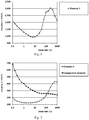
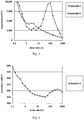
- Figures 1 - 4 illustrate the viscosity of five aqueous compositions of the present invention and of a comparative aqueous composition depending on the shear rate at which the compositions are sheared.
- new aqueous compositions which comprise at least 25 wt.%, preferably at least 30 wt.%, and in the most preferred embodiments even at least 35 wt.% of dispersed particles of an esterified cellulose ether as described below and which have a reasonably low viscosity at a temperature of 20 °C by incorporating into the aqueous composition from 0.1 to 15 percent of a salt of a fatty acid and from 0.02 to 7 percent of an anionic surfactant comprising a sulfate or sulfonate group, based on the weight of the dispersed esterified cellulose ether.
- a considerably higher concentration of particles of esterified cellulose ether can be incorporated into the aqueous composition while still maintaining a reasonable viscosity than when the composition comprises a comparable amount of another surfactant.
- the new aqueous compositions as described below do not exhibit undue tackiness or agglomeration of the esterified cellulose ether particles during preparation of the aqueous compositions under high shear, for example by grinding esterified cellulose ether particles in the presence of water, a salt of a fatty acid and an anionic surfactant comprising a sulfate or sulfonate group, at a temperature above 30 °C or even above 40 °C, and generally up to 50 °C.
- aqueous compositions comprising dispersed particles of an esterified cellulose ether is commonly done under high shear, which typically leads to the incorporation of air bubbles in the aqueous composition. It is highly desirable to minimize the content of air bubbles in the aqueous compositions, e.g. when they are used for producing capsules and coatings. It has surprisingly been found that less air bubbles are formed and/or formed air bubbles can be more easily removed from such compositions when the compositions comprise a surfactant combination of i) a salt of a fatty acid and ii) an anionic surfactant comprising a sulfate or sulfonate group than when the composition only comprises a salt of a fatty acid.
- aqueous compositions of the present invention have a good storage stability.
- aqueous compositions of the present invention exhibit dilatancy at low shear, i.e., the viscosity of the aqueous composition increases at constant temperature when increasing shear rate within a certain range.
- Low shear as used herein means a shear rate of not more than about 1000 sec -1 .
- Low shear is commonly applied in processes for coating substrates, such as tablets, or when dipping pins into the aqueous composition for preparing capsules.
- the viscosity increase at constant temperature, e.g. at 21 °C, is of great advantage as it increases the adherence of the composition to the surface of the substrate to be coated, such as tablets, or to dipping pins in the case of capsule production.
- the esterified cellulose ether comprised in the composition of the present invention has a cellulose backbone having ⁇ -1,4 glycosidically bound D-glucopyranose repeating units, designated as anhydroglucose units in the context of this invention.
- the esterified cellulose ether preferably is an esterified alkyl cellulose, hydroxyalkyl cellulose or hydroxyalkyl alkylcellulose. This means that in the esterified cellulose ether comprised in the composition of the present invention at least a part of the hydroxyl groups of the anhydroglucose units are substituted by alkoxyl groups or hydroxyalkoxyl groups or a combination of alkoxyl and hydroxyalkoxyl groups.
- the hydroxyalkoxyl groups are typically hydroxymethoxyl, hydroxyethoxyl and/or hydroxypropoxyl groups. Hydroxyethoxyl and/or hydroxypropoxyl groups are preferred. Typically one or two kinds of hydroxyalkoxyl groups are present in the esterified cellulose ether. Preferably a single kind of hydroxyalkoxyl group, more preferably hydroxypropoxyl, is present.
- the alkoxyl groups are typically methoxyl, ethoxyl and/or propoxyl groups. Methoxyl groups are preferred.
- esterified cellulose ethers are esterified alkylcelluloses, such as esterified methylcelluloses, ethylcelluloses, and propylcelluloses; esterified hydroxyalkylcelluloses, such as esterified hydroxyethylcelluloses, hydroxypropylcelluloses, and hydroxybutylcelluloses; and esterified hydroxyalkyl alkylcelluloses, such as esterified hydroxyethyl methylcelluloses, hydroxymethyl ethylcelluloses, ethyl hydroxyethylcelluloses, hydroxypropyl methylcelluloses, hydroxypropyl ethylcelluloses, hydroxybutyl methylcelluloses, and hydroxybutyl ethylcelluloses; and those having two or more hydroxyalkyl groups, such as esterified hydroxyethylhydroxypropyl methylcelluloses.
- the esterified cellulose ether is an esterified hydroxyalkyl methylcellulose
- the degree of the substitution of hydroxyl groups of the anhydroglucose units by hydroxyalkoxyl groups is expressed by the molar substitution of hydroxyalkoxyl groups, the MS(hydroxyalkoxyl).
- the MS(hydroxyalkoxyl) is the average number of moles of hydroxyalkoxyl groups per anhydroglucose unit in the esterified cellulose ether. It is to be understood that during the hydroxyalkylation reaction the hydroxyl group of a hydroxyalkoxyl group bound to the cellulose backbone can be further etherified by an alkylating agent, e.g. a methylating agent, and/or a hydroxyalkylating agent.
- hydroxyalkoxyl groups thus has to be interpreted in the context of the MS(hydroxyalkoxyl) as referring to the hydroxyalkoxyl groups as the constituting units of hydroxyalkoxyl substituents, which either comprise a single hydroxyalkoxyl group or a side chain as outlined above, wherein two or more hydroxyalkoxyl units are covalently bound to each other by ether bonding.
- the terminal hydroxyl group of a hydroxyalkoxyl substituent is further alkylated or not; both alkylated and non-alkylated hydroxyalkoxyl substituents are included for the determination of MS(hydroxyalkoxyl).
- the esterified cellulose ether generally has a molar substitution of hydroxyalkoxyl groups of at least 0.05, preferably at least 0.08, more preferably at least 0.12, and most preferably at least 0.15.
- the degree of molar substitution is generally not more than 1.00, preferably not more than 0.90, more preferably not more than 0.70, and most preferably not more than 0.50.
- the average number of hydroxyl groups substituted by alkoxyl groups, such as methoxyl groups, per anhydroglucose unit, is designated as the degree of substitution of alkoxyl groups, DS(alkoxyl).
- hydroxyl groups substituted by alkoxyl groups is to be construed within the present invention to include not only alkylated hydroxyl groups directly bound to the carbon atoms of the cellulose backbone, but also alkylated hydroxyl groups of hydroxyalkoxyl substituents bound to the cellulose backbone.
- the esterified cellulose ethers preferably have a DS(alkoxyl) of at least 1.0, more preferably at least 1.1, even more preferably at least 1.2, most preferably at least 1.4, and particularly at least 1.6.
- the DS(alkoxyl) is preferably not more than 2.5, more preferably not more than 2.4, even more preferably not more than 2.2, and most preferably not more than 2.05.
- esterified cellulose ether is an esterified hydroxypropyl methylcellulose having a DS(methoxyl) within the ranges indicated above for DS(alkoxyl) and an MS(hydroxypropoxyl) within the ranges indicated above for MS(hydroxyalkoxyl).
- the esterified cellulose ether utilized in the present invention has (i) groups of the formula -C(O)-R-COOA or (ii) a combination of aliphatic monovalent acyl groups and groups of the formula -C(O)-R-COOA, wherein R is a divalent aliphatic or aromatic hydrocarbon group and A is hydrogen or a cation.
- the cation preferably is an ammonium cation, such as NH 4 + or an alkali metal ion, such as the sodium or potassium ion, more preferably the sodium ion. Most preferably, A is hydrogen.
- the aliphatic monovalent acyl groups are preferably selected from the group consisting of acetyl, propionyl, and butyryl, such as n-butyryl or i-butyryl.
- the carbonyl group and the carboxylic group are preferably arranged in ortho-positions.
- Preferred esterified cellulose ethers are
- HPMCAS Hydroxypropyl methylcellulose acetate succinate
- the esterified cellulose ethers generally have a degree of substitution of aliphatic monovalent acyl groups, such as acetyl, propionyl, or butyryl groups, of not more than 1.75, preferably not more than 1.50, more preferably not more than 1.25, and most preferably not more than 1.00, or even not more than 0.65.
- the degree of substitution of aliphatic monovalent acyl groups can be zero, but preferably it is at least 0.05, more preferably at least 0.10, and most preferably at least 0.20.
- the esterified cellulose ethers generally have a degree of substitution of groups of formula -C(O)-R-COOA, such as succinoyl, of at least 0.05, preferably at least 0.10.
- the degree of substitution of groups of formula -C(O)-R-COOA generally is up to 1.6, preferably up to 1.30, more preferably up to 1.00, and most preferably up to 0.70 or even up to 0.60.
- the sum of i) the degree of substitution of aliphatic monovalent acyl groups and ii) the degree of substitution of groups of formula -C(O)-R-COOA is generally at least 0.05, preferably at least 0.10, more preferably at least 0.20, most preferably at least 0.30, and particularly at least 0.40.
- the mentioned sum is generally no more than 2.0, preferably no more than 1.4, more preferably no more than 1.15, most preferably no more than 1.10 and particularly no more than 1.00.
- the content of the acetate and succinate ester groups is determined according to " Hypromellose Acetate Succinate", United States Pharmacopeia and National Formulary, NF 29, pp. 1548-1550 . Reported values are corrected for volatiles (determined as described in section “loss on drying” in the above HPMCAS monograph). The method may be used in analogue manner to determine the content of propionyl, butyryl, phthalyl and other ester groups.
- the content of ether groups in the esterified cellulose ether is determined in the same manner as described for " Hypromellose", United States Pharmacopeia and National Formulary, USP 35, pp 3467-3469 .
- ether and ester groups obtained by the above analyses are converted to DS and MS values of individual substituents according to the formulas below.
- the formulas may be used in analogue manner to determine the DS and MS of substituents of other cellulose ether esters.
- the weight percent is an average weight percentage based on the total weight of the cellulose repeat unit, including all substituents.
- the content of the methoxyl group is reported based on the mass of the methoxyl group (i.e., -OCH 3 ).
- the content of the hydroxyalkoxyl group is reported based on the mass of the hydroxyalkoxyl group (i.e., -O-alkylene-OH); such as hydroxypropoxyl (i.e., +O-CH 2 CH(CH 3 )-OH).
- the content of the aliphatic monovalent acyl group is reported based on the mass of -C(O)-R 1 wherein R 1 is a monovalent aliphatic group, such as acetyl (-C(O)-CH 3 ).
- R 1 is a monovalent aliphatic group, such as acetyl (-C(O)-CH 3 ).
- the content of the group of formula -C(O)-R-COOH is reported based on the mass of this group, such as the mass of succinoyl groups (i.e., -C(O)-CH 2 -CH 2 -COOH).
- the esterified cellulose ether comprised in the composition of the present invention generally has a viscosity of at least 1.2 mPa ⁇ s, preferably least 1.8 mPa ⁇ s, and more preferably least 2.4 mPa ⁇ s, and generally no more than 200 mPa ⁇ s, preferably no more than 100 mPa ⁇ s, more preferably no more than 50 mPa ⁇ s, and most preferably no more than 30 mPa ⁇ s, measured as a 2.0 weight percent solution of the esterified cellulose ether in 0.43 wt% aqueous NaOH at 20°C according to " Hypromellose Acetate Succinate, United States Pharmacopia and National Formulary, NF 29, pp. 1548-1550 ".
- the aqueous composition of the present invention comprises at least 25 percent, preferably at least 30 percent, and most preferably even at least 35 percent of the esterified cellulose ether(s) in dispersed state in the aqueous composition.
- the aqueous composition of the present invention generally comprises up to 40 percent or in some cases even up to 43 percent of the esterified cellulose ether(s) in dispersed state in the aqueous composition. These percentages are based on the total weight of the composition.
- the aqueous composition further comprises from 0.1 to 15 percent of a salt of a fatty acid, and from 0.02 to 7 percent of an anionic surfactant comprising a sulfate or sulfonate group, each based on the weight of the dispersed esterified cellulose ether.
- the aqueous composition may comprise more than one salt of a fatty acid and/or more than one anionic surfactant comprising a sulfate or sulfonate group, provided that the total amount of fatty acid salts and the total amount of anionic surfactants comprising a sulfate or sulfonate group are within the above-mentioned weight ranges.
- the total amount of the salt(s) of a fatty acid is at least 0.1 percent, preferably at least 0.5 percent, most preferably at least 1.0 percent, and particularly at least 2.0 percent, based on the total weight of the esterified cellulose ether(s).
- the total amount of the salt(s) of a fatty acid is up to 15 percent, preferably up to 10 percent, most preferably up to 7.0 percent, and particularly only up to 5.0 percent, based on the total weight of the esterified cellulose ether(s).
- Preferred fatty acid salts are ammonium, alkali metal or alkaline earth metal salts.
- a preferred ammonium ion is NH 4 + .
- Preferred alkali metal ions are the sodium or potassium ions.
- a preferred alkaline earth metal ion is the calcium ion.
- the fatty acids can be saturated or unsaturated. Exemplary of saturated fatty acids are caprylic acid, capric acid, lauric acid, myristic acid, palmitic acid, stearic acid, arachidic acid, behenic acid, lignoceric acid and cerotic acid.
- the unsaturated fatty acids can be mono-, di- or triunsaturated fatty acids, mono-unsaturated and di- unsaturated fatty acids being preferred.
- Exemplary of mono-unsaturated fatty acids are myristoleic acid, palmitoleic acid, sapienic acid, oleic acid, elaidic acid and vaccenic acid.
- Exemplary of di-unsaturated fatty acids are linoleic acid and linoelaidic acid.
- Ammonium, alkali metal and alkaline earth metal salts of stearic acid or oleic acid are most preferred, particularly those salts mentioned above.
- the total amount of anionic surfactant(s) comprising a sulfate or sulfonate group is at least 0.02 percent, preferably at least 0.05 percent, most preferably at least 0.1 percent, and particularly at least 0.2 percent, based on the total weight of the esterified cellulose ether(s).
- the total amount of the anionic surfactant(s) comprising a sulfate or sulfonate group is up to 7 percent, preferably up to 5 percent, most preferably up to 3 percent, and particularly only up to 1.5 percent, based on the total weight of the esterified cellulose ether(s).
- ammonium, alkali metal or alkaline earth metal salts of the anionic surfactant comprising a sulfate or sulfonate group.
- the anionic surfactant can have one or more, preferably one or two, sulfate or sulfonate groups.
- a preferred ammonium ion is NH 4 + .
- Preferred alkali metal ions are the sodium or potassium ions.
- a preferred alkaline earth metal ion is the calcium ion.
- the anionic surfactant comprises one or more, preferably one or two, alkyl, alkenyl, alkinyl or cycloalkyl groups.
- the alkyl, alkenyl, alkinyl or cycloalkyl groups each independently comprise from 4 to 12 carbon atoms, more preferably from 6 to 8 carbon atoms.
- the total number of carbon atoms in the alkyl, alkenyl, alkinyl or cycloalkyl group(s) in the surfactant is preferably 8 to 24, more preferably 12 to 16. These groups can be branched or linear.
- Preferred anionic surfactants comprising a sulfate or sulfonate group are alkyl sulfate salts, such as ammonium lauryl sulfate, potassium lauryl sulfate, sodium dodecyl sulfate (SDS) or sodium laureth sulfate (SLES); or alkyl benzene sulphonates, such as sodium dodecylbenzenesulfonate, or alkyldiphenyloxide disulfonate salts, such as sodium dodecyl diphenyl ether disulfonate.
- alkyl sulfate salts such as ammonium lauryl sulfate, potassium lauryl sulfate, sodium dodecyl sulfate (SDS) or sodium laureth sulfate (SLES)
- alkyl benzene sulphonates such as sodium dodecylbenzenesulfonate
- More preferred anionic surfactants comprising a sulfate or sulfonate group are dialkyl, dialkenyl, dialkinyl or dicycloalkyl sulfosuccinates. Most preferred is a dialkyl sulfosuccinate, particularly dioctyl sodium sulfosuccinate (IUPAC name sodium 1,4-bis(2-ethylhexoxy)-1,4-dioxobutane-2-sulfonate), dioctyl potassium sulfosuccinate, or dioctyl calcium sulfosuccinate.
- IUPAC name sodium 1,4-bis(2-ethylhexoxy)-1,4-dioxobutane-2-sulfonate dioctyl potassium sulfosuccinate
- dioctyl calcium sulfosuccinate dioctyl calcium sulfosuccinate.
- the aqueous composition of the present invention is in the form of an aqueous dispersion, typically in the form of a stable dispersion.
- the median particle size, d50, of the dispersed esterified cellulose ether particles is typically up to 7 micrometers, more typically up to 5 micrometers, and even more typically up to 4 micrometers.
- the median particle size, d50, of the dispersed esterified cellulose ether particles is typically 0.3 micrometers or more, more typically 1.0 micrometers or more, and most typically 1.5 micrometers or more.
- the particle size is measured by laser diffraction particle size analysis, e.g., using a Beckman Coulter laser diffraction particle size analyzer which is commercially available from Beckman Coulter, California.
- the median particle size d50 is the diameter where 50 volume percent of the particles have a smaller equivalent diameter and 50 volume percent have a larger equivalent diameter.
- d90 is 1.0 micrometers or more, more typically 2.0 micrometers or more, and most typically 4.0 micrometers or more; and typically up to 12 micrometers, more typically up to 10 micrometers, and most typically up to 7 micrometers, d90 being the diameter where 90 volume percent of the particles have a smaller equivalent diameter and the other 10 volume percent have a larger equivalent diameter.
- the equivalent particle diameter d is the diameter of a sphere having the same volume as the volume of a given particle.
- the mean particle diameter is typically 0.5 micrometers or more, more typically 1.0 micrometers or more, and most typically 2.0 micrometers or more; and typically up to 8 micrometers, more typically up to 6 micrometers, and most typically even only up to 4 micrometers.
- the aqueous composition of the present invention comprises an aqueous diluent.
- the aqueous diluent is water, optionally mixed with a minor amount of an organic solvent.
- the aqueous diluent preferably consists of 50 - 100 weight percent, more preferably 65 - 100 weight percent, and most preferably 75 - 100 weight percent of water and preferably 0 - 50 weight percent, more preferably 0 - 35 weight percent, and most preferably 0 - 25 weight percent of an organic solvent, based on the total weight of water and the organic solvent.
- Useful organic solvents are polar organic solvents having one or more heteroatoms, such as oxygen, nitrogen or halogen like chlorine.
- More preferred organic solvents are alcohols, for example multifunctional alcohols, such as glycerol, or preferably monofunctional alcohols, such as methanol, ethanol, isopropanol or n-propanol; ethers, such as tetrahydrofuran, ketones, such as acetone; methyl ethyl ketone, or methyl isobutyl ketone; acetates, such as ethyl acetate; halogenated hydrocarbons, such as methylene chloride; or nitriles, such as acetonitrile.
- the aqueous composition of the present invention comprises water alone as aqueous diluent.
- the amount of the aqueous diluent is typically at least 50 percent, more typically at least 55 percent, based on the total weight of the aqueous composition.
- the amount of the aqueous diluent is typically no more than 79 percent, more typically no more than 75 percent, based on the total weight of the aqueous composition.
- the apparent viscosity of the aqueous composition of the present invention is generally 50 mPa ⁇ s or more, typically 100 mPa ⁇ s or more, measured at 20 ° C.
- the apparent viscosity of the aqueous composition of the present invention is generally no more than 5000 mPa ⁇ s, typically no more than 4000 mPa ⁇ s, measured at 20 ° C.
- the aqueous composition of the present invention may further comprise optional ingredients, for example active ingredients, such as fertilizers, herbicides, pesticides, or biologically active ingredients, such as vitamins, herbals or mineral supplements or drugs; or adjuvants such as one or more plasticizers, film forming aids, coloring agents, pigments, opacifiers, flavor or taste improvers, antioxidants, or any combination thereof.
- optional additives are preferably pharmaceutically acceptable.
- the amount of these optional ingredients is typically from 0 to 50 percent of the total weight of the ingredients of the aqueous composition excluding the aqueous diluent. Typically the amount is 1 percent or more, more typically 5 percent or more; and typically up to 40 percent, more typically up to 20 percent of the total weight of the ingredients of the aqueous composition excluding the aqueous diluent.
- the aqueous composition of the present invention further comprises at least one film forming aid.
- film forming aid comprises one or more plasticizers conventionally used in the manufacture of coatings or capsule shells, notably hard capsule shells, to ensure the formation of self-supported cohesive films and avoid capsule brittleness, and/or one or more viscosity enhancers at elevated temperature, i.e. natural as well as synthetic substances conventionally used to optimize aqueous compositions for coating purposes or the dip molding manufacture of hard capsule shells.
- Film forming aids that display plasticizing properties include: phthalic esters, such as dimethyl-, diethyl-, and diisopropyl-phthalate; citric esters, such as triethyl-, tributyl-, acetyltriethyl- and acetyltributyl-citrate; phosphoric esters, such as triethyl-, tricresyl, and triphenyl-phosphate; alkyl lactate; glycol esters; glycerol and glycerol esters, such as glycerol triacetate also known as triacetine; sucrose esters; oils and fatty acid esters; butyl stearate; dibutyl sebacate; dibutyl tartrate; diisobutyl adipate, tributyrin; propylene glycol; and mixtures thereof.
- phthalic esters such as dimethyl-, diethyl-, and diisopropyl-phthal
- film forming aids are cellulose ethers, such as carboxy methylcellulose, hydroxypropyl cellulose, ethyl cellulose, methylcellulose, hydroxypropylmethylcellulose (HPMC), e.g. HPMC types 2910, 2906 and/or 2208 as defined in USP30- NF25; gelatin, pullulan, non enteric starch derivatives, such as hydroxypropyl starch; polyvinyl acetate derivatives (PVAP); sorbitan monoesters; sorbitan polyoxyethylene esters; fatty acid esters; glycerol polyethylene, glycol ricinoleate; macrogolglycerides; triethyl citrate (TEC); acetyl trialkyl citrate; glycerol triacetate (triacetine); talc; and mixtures thereof.
- PVAP polyvinyl acetate derivatives
- PVAP polyvinyl acetate derivatives
- sorbitan monoesters sorbitan polyoxyethylene esters
- the aqueous composition of the present invention comprises at least 5 percent, more preferably at least 10 percent, even more preferably at least 13 percent, and most preferably at least 15 percent of one or more film forming aids, such as plasticizers, based on the weight of the dispersed esterified cellulose ether.
- the amount of said one or more film forming aids, such as plasticizers is generally up to 30 percent, preferably up to 25 percent, even more preferably up to 22 percent, and most preferably up to 20 percent, based on the weight of the dispersed esterified cellulose ether.
- the aqueous composition of the present invention can be prepared by various methods.
- One method includes grinding the esterified cellulose ether in the presence of an aqueous diluent and optionally in the presence of one or more adjuvants.
- Another method includes melting or softening the esterified cellulose ether at an elevated temperature, optionally in the presence of one or more adjuvants, and emulsifying the molten or softened mass in the aqueous diluent.
- esterified cellulose ethers Suitable and preferred types and amounts of esterified cellulose ethers, salts of fatty acids, anionic surfactants comprising a sulfate or sulfonate group, optional adjuvants and aqueous diluents in the processes for producing the aqueous composition of the present invention are described further above.
- Preparing an aqueous composition by simply physically blending an esterified cellulose ether, a salt of a fatty acid, an anionic surfactant comprising a sulfate or sulfonate group and an aqueous diluent at room temperature is not suitable for preparing a stable dispersion.
- the process for producing the aqueous composition of the present invention comprises the steps of grinding, in the presence of an above-described aqueous diluent, at least one esterified cellulose ether as described above, blending a salt of a fatty acid, an anionic surfactant comprising a sulfate or sulfonate group and optionally one or more adjuvants with the esterified cellulose ether before, during or after the grinding of the esterified cellulose ether, and choosing the amounts of aqueous diluent, esterified cellulose ether, salt of a fatty acid, anionic surfactant comprising a sulfate or sulfonate group and optionally one or more adjuvants such that the produced aqueous composition comprises a) at least 25 percent, based on the total weight of the aqueous composition, of the dispersed esterified cellulose ether, b) from 0.1 to 15 percent of the salt of a fatty acid, and
- the salt of a fatty acid, the anionic surfactant comprising a sulfate or sulfonate group and optional adjuvants are preferably added before or during the grinding of the esterified cellulose ether in the aqueous diluent.
- a salt of a fatty acid, an anionic surfactant comprising a sulfate or sulfonate group and optional adjuvants can also be added after the grinding of the esterified cellulose ether, but generally at least 50 percent of the salt of a fatty acid that is used for preparing the aqueous composition of the present invention is added before or during the grinding of the esterified cellulose ether.
- Any grinding device suitable for grinding esterified cellulose ethers in the presence of an aqueous diluent to a median particle size d50 as indicated further above can be used.
- Preferred grinding devices are wet grinding units such as media mills or bead mills.
- the grinding is typically conducted at a temperature of at least 10 °C, preferably of at least 30 °C, and typically at a temperature of up to 55 °C, more typically up to 50 °C. Grinding is generally conducted for a sufficient time period to achieve an above-mentioned median particle size, d50, of the dispersed esterified cellulose ether particles.
- aqueous composition of the present invention is achieved when the esterified cellulose ether, the salt of a fatty acid and optionally the anionic surfactant comprising a sulfate or sulfonate group are ground together in the presence of an aqueous diluent at a temperature of from 37 to 55 °C, more preferably at a temperature of from 40 to 55 °C.
- the grinding period is typically from 60 to 180 minutes.
- An aqueous dispersion of an esterified cellulose ether that has been prepared in such a manner can usually be stored more than 3 months, in the most preferred embodiments even more than 6 months, without losing its ability to flow under its own weight if it do not comprise a film forming aid.
- the process for producing the aqueous composition of the present invention comprises the steps of melting at least one esterified cellulose ether as described above and emulsifying the molten esterified cellulose ether in an aqueous diluent, adding a salt of a fatty acid and an anionic surfactant comprising a sulfate or sulfonate group and optionally one or more adjuvants before, during or after the step of emulsifying the molten esterified cellulose ether in the aqueous diluent, choosing the amounts of aqueous diluent, esterified cellulose ether, salt of a fatty acid, anionic surfactant comprising a sulfate or sulfonate group and optionally one or more adjuvants such that the produced aqueous composition comprises a) at least 25 percent, based on the total weight of the aqueous composition, of the dispersed esterified cellulose ether, b) from
- This embodiment of the process is preferably conducted in an extruder.
- a pressurized batch kneader can be used for conducting this embodiment of the invention.
- the general process conditions and equipment which are useful to perform the process are disclosed in U.S. Patent Nos. 5,539,021 and 7,763,676 , the disclosure of which is incorporated herein by reference.
- the aqueous composition of the present invention may be used for coating dosage forms, such as tablets, granules, pellets, caplets, lozenges, suppositories, pessaries or implantable dosage forms, to form a coated composition.
- dosage forms such as tablets, granules, pellets, caplets, lozenges, suppositories, pessaries or implantable dosage forms
- the aqueous composition of the present invention comprises an active ingredient, such as a drug
- drug layering can be achieved, i.e., the dosage form and the coating may comprise different active ingredients for different end-uses and/or having different release kinetics.
- the coating can be carried out in a known manner, for example by known dipping or spraying processes.
- the aqueous composition of the present invention may be used for the manufacture of capsules shells in a process which comprises the step of contacting the aqueous composition with dipping pins.
- the process for producing capsule shells comprises the steps of providing the aqueous composition of the present invention as described above, pre-heating molding pins to a temperature higher than the aqueous composition, dipping the pre-heated molding pins into the aqueous composition, forming a film on said molding pins by withdrawing said pins from said aqueous composition, and drying the film on the molding pins.
- the general process conditions and equipment which may be used to prepare capsules shells are described in International Patent Application Nos. WO 2013/164122 and WO 2013/164121 , the disclosures of which are incorporated herein by reference.
- the aqueous composition of the present invention is particularly useful for coating dosage forms including tablets, capsules and others, or for the formation of capsules shells, all preferably for enteric use, i.e., coatings or capsules shells that are dissolved in the intestinal canals to release the active ingredient like a drug contained in the dosage form or in the capsules.
- the content of ether groups in HPMCAS was determined in the same manner as described for " Hypromellose", United States Pharmacopeia and National Formulary, USP 35, pp 3467-3469 .
- the ester substitution with acetyl groups (-CO-CH 3 ) and the ester substitution with succinoyl groups (-CO-CH 2 -CH 2 -COOH) were determined according to Hypromellose Acetate Succinate, United States Pharmacopia and National Formulary, NF 29, pp. 1548-1550 ".
- Reported values for ester substitution were corrected for volatiles (determined as described in section "loss on drying" in the above HPMCAS monograph).
- the apparent viscosity of the aqueous dispersion comprising HPMCAS was measured at various temperatures according to a temperature sweep experiment performed with a Anton Paar MCR 301 rheometer with a CC-27 cup geometry and a 4-blade vane geometry ST26-4V-20 over a temperature range of 10 to 50 °C with a heating rate of 3 °C / min and a constant speed of the vane geometry of 40 rpm and a measurement point duration of 0.2721 min. Prior to this temperature sweep testing the material was treated with a SpeedMixerTM DAC 150.1 FV (FlackTek Inc.) at 2300 rpm for 1 min. A sample volume of 20 ml was used for these measurements. The samples had been stored at room temperature prior to the viscosity measurement.
- the obtained data of the apparent viscosity was used for this analysis.
- the phase transition temperature of the aqueous composition is the temperature at which the HPMCAS particles start to gel and the viscosity of the aqueous composition starts to significantly increase.
- the average viscosity of the aqueous composition at temperatures from 10 to 15 °C was calculated from the measured apparent viscosity data to determine the baseline viscosity of the aqueous composition.
- the standard deviation of the baseline viscosity was calculated. When the standard deviation was more than 25 %, this was an indication that there was no constant viscosity at a temperature range from 10 to 15 °C and that the phase transition temperature was below 15 °C.
- the phase transition temperature of the aqueous composition was determined to be the temperature at which the viscosity of the aqueous composition reached 150% of its baseline viscosity.
- the viscosity of the aqueous HPMCAS dispersion comprising HPMCAS was measured at 21 °C with a Haake RS600 rheometer (from Thermo Fischer Scientific, Karlruhe) with a cone & plate geometry (C-60/1°) in a steady shear flow curve experiment over a steady shear rate range from 0.1 - 1000 s -1 with 5 data points each decade.
- aqueous HPMCAS dispersion that had been produced as described below was diluted in 20 ml of purified water.
- the particle size in the diluted dispersion was measured by laser diffraction particle size analysis using a Beckman Coulter LS 13 320 laser diffraction particle size analyzer which is commercially available from Beckman Coulter, California.
- the Universal Liquid Module (ULM) with a Fraunhofer optical model, a Polarization Intensity Differential Scattering (PIDS) system and a sonication control unit were used.
- the HPMCAS dispersion was subjected to ultrasonic treatment for a time period of up to 120 seconds during the HPMCAS addition (about 30 seconds) and particle size measurement (about 90 seconds).
- the HPMCAS particle size measurement described above was repeated after about 2 weeks.
- the degree of changes in particle size was a clear indication of the stability of the aqueous HPMCAS dispersion.
- the dispersion was also visually inspected.
- the solids content was determined using a moisture balance (Mettler Toledo Advanced Moisture Analyzer, Model HB43-S). Instrument settings were as follows: 3 g dispersion using the Rapid drying program with a temperature set point of 120 °C (40% overshoot for first 3 minutes) with switch-off criteria 5 (less than 1 mg weight change over 140 seconds). Upon drying to remove water, the residual solids content (including all additives) was weighed.
- HPMCAS used for preparing the aqueous dispersion in Comp. Examples A - E and H
- HPMCAS used for preparing the aqueous dispersions in Examples 3 and 5
- HPMCAS used for preparing the aqueous dispersions in Examples 4 and 7
- HPMCAS dispersion water was loaded first and recirculated through a Netzsch LAB STAR media mill (1.4 mm Ytterum Stabilized Zirconia media, 0.7 mm screen size).
- HPMCAS solids and a surfactant as listed in Table 1 below were loaded gradually to water recirculating through the mill at a mill speed of 3600 rev/min.
- the HPMCAS and the surfactant were added at a predetermined weight ratio to provide a percentage of surfactant, based on HPMCAS, as listed in Table 1 below. Addition of HPMCAS and surfactant was continued until a total solids loading of 20-30% was achieved, based on the total weight of the composition.
- the percentage of HPMCAS, based on the total weight of the composition, was calculated from the measured solids content and the given weight ratio between HPMCAS and the surfactant. The results are listed in Table 1 below. Following the addition of all solids, milling continued until the final particle size was obtained.
- Comparative Examples A, B, D, E and F were completed using a similar procedure.
- Comparative Example C no dispersion was obtained as the viscosity of the dispersion caused a pressure in the mill that exceeded the allowable pressure system.
- Comparative Example A no additive, i.e. no surfactant, was used.
- Comparative Example B the well-known non-ionic surfactant polyoxyethylene (20) sorbitan monooleate, commercially available under the Trademark Tween 80 was used.
- Comparative Examples C and D sodium dodecyl sulfate (SDS) was used, which is a well-known anionic surfactant.
- Comparative Example E a block copolymer of ethylene oxide and propylene oxide, which is commercially available from BASF under the Trademark Pluronic L44 NF INH, was used as non-ionic surfactant.
- the dispersion of Comparative Example B had HPMCAS particles that were very large. In Comparative Example C no dispersion was obtained as the viscosity of the dispersion caused a pressure in the mill that exceeded the allowable system pressure.
- the dispersions of Comparative Examples A, B and D produced a dispersion with acceptable viscosity and particle size but with tendency to agglomerate upon storage for about 2 weeks.
- the dispersions of Comparative Examples A - E were not suitable for reasonably convenient handling and processing.
- Comparative Example F corresponds to Example 4 of the International co-pending patent application PCT/US15/018390 having a filing date of 03 March 2015 and a first priority date of 08 April 2014.
- Comparative Example F Comparative Example F was repeated, except that a Drais DCP-12 Advantis media mill (1.0 mmYtterum Stabilized Zirconia media, 0.5 mm screen size) was used. The mill speed was initially set at 1600 rpm and then reduced as necessary down to about 1300 rpm to control the mill outlet temperature. The amount of sodium stearate and the final solids content were altered as shown in Table 1 below.
- Comparative Example G and H correspond to Examples 8 and 9 of the co-pending International patent application PCT/US15/018390 having a filing date of 03 March 2015 and a first priority date of 08 April 2014.
- HPMCAS aqueous HPMCAS dispersion
- surfactant aqueous surfactant
- co-surfactant aqueous surfactant
- the mill speed was initially set at 1400-1500 rpm and then reduced as necessary down to about 1100-1400 rpm to control the mill outlet temperature.
- HPMCAS and surfactant were pre-blended at a weight ratio to provide a percentage of surfactant based on HPMCAS, as listed in Table 1 below.
- the pre-blend of HPMCAS and surfactant was loaded in portions to water recirculating through the mill.
- Co-surfactant was loaded in portions throughout to provide a percentage of co-surfactant based on HPMCAS as listed in Table 1 below.
- the co-surfactant Aerosil OT 75 PG used in Examples 1 and 2 was a 75 wt.-% solution of dioctyl sodium sulfosuccinate in propylene glycol and water comprising 0.12 wt. carboxymethyl cellulose. Aerosil OT 75 PG is commercially available from Cytec Industries Inc.
- the weight percent co-surfactant based on HPMCAS, as listed in Table 1 below refers to the total weight of Aerosil OT 75 PG. Addition continued until a total solids loading of 30-40% was achieved, based on the total weight of the composition. The percentage of HPMCAS, based on the total weight of the composition, was calculated from the measured solids content and the given weight ratio between HPMCAS, the surfactant and the optional co-surfactant. Following the addition of all solids, milling continued until the final particle size was obtained. The milling time was about 3 hours in Comparative Example I, about 3.5 hours in Example 1 and about 5 hours in Example 2. During the milling process, mild heat treatment was applied by adjusting the mill speed and the setpoint for the chiller system used to provide cooling to the mill jacket, tank and heat exchangers. The maximum temperature during milling was 39 - 41 °C.
- aqueous HPMCAS dispersion To produce an aqueous HPMCAS dispersion, the same mill as in Examples 1 and 2 was used. The mill speed was initially set at 1300 - 1400 rpm and then reduced as necessary down to about 1100 rpm to control the mill outlet temperature.
- HPMCAS and surfactant were pre-blended at a weight ratio to provide percentage of surfactant, based on HPMCAS, as listed in Table 1 below.
- the pre-blend of HPMCAS and surfactant was loaded in portions to water recirculating through the mill.
- Co-surfactant was loaded in portions throughout to provide a percentage of co-surfactant based on HPMCAS as listed in Table 1 below.
- the co-surfactant "DSS 50%" as listed in Table 1 below was a 50 wt.-% solution of dioctyl sodium sulfosuccinate in polyethylene glycol 400, NF.
- the weight percent co-surfactant based on HPMCAS, as listed in Table 1 below refers to the total weight of the 50% dioctyl sodium sulfosuccinate solution. Addition continued and mild heat treatment was applied during the subsequent milling as described in Examples 1 and 2. The temperature during milling was most of the time from 30 to 40 °C, but during about 50 min. the temperature was more than 40 °C, the maximum being about 46 °C. The total milling time was about 2 hours in Example 3.
- Example 4 was as a repetition of Example 3. The particle size distribution, the viscosity and the phase transition temperature of the freshly prepared dispersion of Example 4 was determined. The results of the analytical tests are listed in Table 1 below.
- Example 3 was repeated except that a different heat treatment was applied during milling than in Example 3.
- Example 5 the temperature during milling was 43 - 47 °C for 23 ⁇ 4 hours, for the remaining time the milling temperature was 35- 40°C. The total milling time was about 4.25 h.
- Example 6 the temperature during milling was 43 - 47 °C for about 4 hours. The total milling time was about 4.25 hours.
- Example 7 was as a repetition of Example 6. The particle size distribution, the viscosity and the phase transition temperature of the freshly prepared dispersion of Example 7 was determined. The results of the analytical tests are listed in Table 1 below.
- HPMCAS aqueous HPMCAS dispersion
- surfactant aqueous surfactant
- optionally ethylcellulose were preblended and added to water recirculating through a Drais DCP-12 Advantis media mill (1.0 mm ceramic media, 0.5 mm screen size). The mill speed was initially set at 1300-1450 rpm and then reduced as necessary down to about 1200-1400 rpm to control the mill outlet temperature. Co-surfactant was added periodically throughout the addition. The surfactant and co-surfactant were those as listed in Table 1 below.
- ethylcellulose was added that comprised 48.0 - 49.5 wt.% ethyl groups and had a viscosity of 9 - 11 mPa ⁇ s, measured as a 5% solution in 80% toluene and 20% ethanol at 25 °C in an Ubbelohde viscometer.
- the ethylcellulose is commercially available from The Dow Chemical Company as Ethocel Std. 10. It was used as a film forming aid.
- Example 8 the polymer weight consisted of HPMCAS.
- Example 9 the polymer weight consisted of a blend of 92 weight parts of HPMCAS and 5 weight parts of ethylcellulose.
- Example 10 the polymer weight consisted of a blend of 86.4 weight parts of HPMCAS and 10.4 weight parts of ethylcellulose.
- Table 1 illustrates that the dispersions of Comparative Examples A, B and E showed agglomeration upon storage for about 2 weeks. Also the dispersion of Comparative Example D showed some agglomeration upon storage for about 2 weeks.
- the dispersions of Comparative Example I and of Examples 1- 3 that had undergone a mild heat treatment in the mill could be stored for more than 3 months without losing their ability to flow under their own weight.
- the dispersions of Examples 5 and 6 that had undergone heat treatment for an extended time period in the mill could even be stored for more than 6 months without losing their ability to flow under their own weight.
- the dispersions of Examples 4 and 7 were freshly prepared; therefore the stability test data is lacking.
- Examples 1, 2, 6 and 7 illustrate that stable dispersions can be produced even at a very high HPMCAS concentrations of about 40 wt. %. Moreover, the dispersion of Example 7 has a viscosity in the same order of magnitude as that of Comparative Examples A, B and E, although the HPMCAS concentration in the dispersion of Example 7 is nearly twice as high as that in Comparative Examples A, B and E.
- Fig. 1 - 4 illustrate the viscosity of the dispersions of Comparative Example I and of Examples 1, 2, 3, 6 and 5 as function of the shear rate at a temperature of 21 °C. Typically the viscosity of most fluids is independent or decreasing with increasing shear rates. Surprisingly the dispersions of the present invention, such as those of Examples 1, 2, 3, 5 and 6 show an increase of the viscosity with increasing shear rate.
- Fig. 1 - 4 illustrate a linear plot of the viscosity as a function of the shear rate in log scale.
- This viscosity increase is at least 20 mPa*s, typically at least 70 mPa*s, most typically at least 100 mPa*s above the previous lower shear rate and this viscosity increase is at least stable for two sequential shear rates (including 5 data points each decade).
- Example 11 The dispersion of Example 8 was stirred at 22 °C for 5 min. at 200 rpm. Then 18.8 % triethyl citrate (TEC), based on the weight of HPMCAS, was added drop wise to the dispersion. The TEC addition decreased the phase transition temperature of the dispersion. The resulting solids content of the dispersion was 33.9%. Stirring under moderate shear continued for additional 20 - 45 min at 22 °C. Then the film was cast on a non-sticking plate and dried at 55 - 75 °C for about an hour. The thickness of the produced film was about 157 micrometers.
- TEC triethyl citrate
- Example 12 The dispersion of Example 10 was stirred at 22 °C for 5 min. at 200 rpm. Then a mixture of 24.2% of 34.8% tributyl citrate (TBC), 26.1% triethyl citrate (TEC), 34.8 % dibutyl sebacate (DBS) and 4.3 % of a poloxamer (plasticizer composition), based on the total weight of HPMCAS and ethyl cellulose, was added drop wise to the dispersion.
- TBC tributyl citrate
- TEC triethyl citrate
- DBS dibutyl sebacate
- 4.3 % of a poloxamer plasticizer composition
- the poloxamer was Pluronic L121, which is a poly(ethylene oxide) (PEO) - poly(propylene oxide) (PPO) - poly(ethylene oxide) (PEO) triblock copolymer of the structure PEO 5 -PPO 68 -PEO 5 and is commercially available from BASF Corporation.
- the resulting solids content of the dispersion was 35.4%.
- the film was cast on a non-sticking plate and dried as described in Example 11. The thickness of the produced film was about 152 micrometers.
- Film Disintegration The disintegration behavior of the films of Examples 11 and 12 was measured using a ball sample holder in conjunction with a disintegration tester QC-21 by Hanson Research (Chatsworth, CA). The instrument was equipped with a rigid basket-rack assembly supporting six cylindrical plastic tubes 77.5 mm long, 21.5 mm in internal diameter as described in the European Pharmacopeia (Seventh edition, 2011, Disintegration of Tablets and Capsules ). The film was held between sample holders that was described in details in Pharmaceutical Technology May 1, 2012 and US2015/0150817 . The film sample assembly with a steel ball placed on top of the film was then placed into the cylindrical plastic tube.
- the films of Examples 11 and 12 did not dissolve in 0.1 N HCl buffer.
- the films were immersed in a phosphate buffer of 0.2 M tribasic sodium phosphate that had been equilibrated to 37 ⁇ 0.5 °C and that had a pH of 6.8.
- the film of Example 11 dissolved in about 200 seconds.
- the film of Example 12 dissolved in about 300 seconds.
Landscapes
- Health & Medical Sciences (AREA)
- Chemical & Material Sciences (AREA)
- Medicinal Chemistry (AREA)
- Public Health (AREA)
- Veterinary Medicine (AREA)
- Pharmacology & Pharmacy (AREA)
- Epidemiology (AREA)
- Life Sciences & Earth Sciences (AREA)
- Animal Behavior & Ethology (AREA)
- General Health & Medical Sciences (AREA)
- Engineering & Computer Science (AREA)
- Chemical Kinetics & Catalysis (AREA)
- General Chemical & Material Sciences (AREA)
- Oil, Petroleum & Natural Gas (AREA)
- Inorganic Chemistry (AREA)
- Bioinformatics & Cheminformatics (AREA)
- Polymers & Plastics (AREA)
- Organic Chemistry (AREA)
- Medicinal Preparation (AREA)
- Polysaccharides And Polysaccharide Derivatives (AREA)
- Compositions Of Macromolecular Compounds (AREA)
Claims (15)
- Wässrige Zusammensetzung enthaltend:a) wenigstens 25 Prozent, bezogen auf das Gesamtgewicht der wässrigen Zusammensetzung, eines dispergierten veresterten Celluloseethers, der (i) Gruppen der Formel -C(O)-R-COOA oder (ii) eine Kombination von aliphatischen monovalenten Acylgruppen und Gruppen der Formel -C(O)-R-COOA enthält, worin R eine divalente aliphatische oder aromatische Kohlenwasserstoffgruppe ist und A Wasserstoff oder ein Kation ist,b) 0,1 bis 15 Prozent eines Salzes einer Fettsäure, bezogen auf das Gewicht des dispergierten veresterten Celluloseethers, undc) 0,02 bis 7 Prozent eines anionischen oberflächenaktiven Mittels, das eine Sulfat- oder Sulfonatgruppe enthält, bezogen auf das Gewicht des dispergierten veresterten Celluloseethers.
- Wässrige Zusammensetzung nach Anspruch 1, die 0,5 bis 10 Prozent eines Ammonium-, Alkalimetall- oder Erdalkalimetallsalzes einer gesättigten oder ungesättigten Fettsäure, bezogen auf das Gewicht des dispergierten veresterten Celluloseethers, enthält.
- Wässrige Zusammensetzung nach Anspruch 1 oder Anspruch 2, wobei das Salz einer Fettsäure ein Ammonium-, Alkalimetall- oder Erdalkalimetallsalz von Stearinsäure oder Ölsäure ist.
- Wässrige Zusammensetzung nach einem der Ansprüche 1 bis 3, die 0,05 bis 5 Gewichtsprozent eines anionischen oberflächenaktiven Mittels, das Sulfonatgruppen enthält, bezogen auf das Gewicht des dispergierten veresterten Celluloseethers, enthält.
- Wässrige Zusammensetzung nach einem der Ansprüche 1 bis 4, wobei das anionische oberflächenaktive Mittel, das eine Sulfat- oder Sulfonatgruppe enthält, ein Dialkylsulfosuccinat ist.
- Wässrige Zusammensetzung nach einem der Ansprüche 1 bis 5, wobei die Medianteilchengröße d50 des dispergierten veresterten Celluloseethers bis zu 7 Micrometer beträgt, wobei die Medianteilchengröße d50 die Größe ist, bei der 50 Volumenprozent der Teilchen einen kleineren äquivalenten Durchmesser und 50 Volumenprozent einen größeren äquivalenten Durchmesser aufweisen.
- Wässrige Zusammensetzung nach einem der Ansprüche 1 bis 6, die wenigstens 30 Gewichtsprozent dieses wenigstens einen dispergierten veresterten Celluloseethers, bezogen auf das Gesamtgewicht der wässrigen Zusammensetzung, enthält.
- Wässrige Zusammensetzung nach einem der Ansprüche 1 bis 7, wobei die aliphatischen monovalenten Acylgruppen in dem veresterten Celluloseether Acetyl-, Propionyl- oder Butyrylgruppen sind und die Gruppen der Formel -C(O)-R-COOA die Gruppen -C(O)-CH2-CH2-COOA, -C(O)-CH=CH-COOA oder -C(O)-C6H4-COOA Gruppen.
- Wässrige Zusammensetzung nach einem der Ansprüche 1 bis 8, wobei der veresterte Celluloseether Hydroxypropylmethylcelluloseacetatsuccinat ist.
- Verfahren zur Herstellung der wässrigen Zusammensetzung nach einem der Ansprüche 1 bis 9, umfassend die Schritte:Mahlen, in Gegenwart eines wässrigen Verdünnungsmittels, eines veresterten Celluloseethers, der (i) Gruppen der Formel -C(O)-R-COOA oder (ii) eine Kombination von aliphatischen monovalenten Acylgruppen und Gruppen der Formel -C(O)-R-COOA enthält, worin R eine divalente aliphatische oder aromatische Kohlenwasserstoffgruppe ist und A Wasserstoff oder ein Kation ist,Mischen eines Salzes einer Fettsäure, eines anionischen oberflächenaktiven Mittels, das eine Sulfat- oder Sulfonatgruppe enthält, und optional eines oder mehrerer Hilfsmittel mit dem veresterten Celluloseether vor, während oder nach dem Mahlen des veresterten Celluloseethers und Auswählen der Mengen des wässrigem Verdünnungsmittels, des veresterten Celluloseethers, des Salzes einer Fettsäure, des anionischen oberflächenaktiven Mittels, das eine Sulfat- oder Sulfonatgruppe enthält, und optional eines oder mehrerer Hilfsmittel, sodass die hergestellte wässrige Zusammensetzung a) wenigstens 25 Gewichtsprozent, bezogen auf das Gesamtgewicht der wässrigen Zusammensetzung, des dispergierten veresterten Celluloseethers, b) 0,1 bis 15 Gewichtsprozent des Salzes einer Fettsäure und c) 0,02 bis 7 Gewichtsprozent des anionischen oberflächenaktiven Mittels, das eine Sulfat- oder Sulfonatgruppe enthält, enthält, wobei die Prozentangaben der Komponenten b) und c) sich auf das Gewicht des dispergierten veresterten Celluloseethers beziehen.
- Verfahren nach Anspruch 10, wobei der veresterte Celluloseether, das Salz einer Fettsäure und optional das anionische oberflächenaktive Mittel, das eine Sulfat- oder Sulfonatgruppe enthält, zusammen in Gegenwart eines wässrigen Verdünnungsmittels bei einer Temperatur von 37 bis 55 °C gemahlen werden.
- Verfahren zur Herstellung der wässrigen Zusammensetzung nach einem der Ansprüche 1 bis 9, umfassend die Schritte:Schmelzen eines veresterten Celluloseethers, der (i) Gruppen der Formel -C(O)-R-COOA oder (ii) eine Kombination von aliphatischen monovalenten Acylgruppen und Gruppen der Formel -C(O)-R-COOA enthält, worin R eine divalente aliphatische oder aromatische Kohlenwasserstoffgruppe ist und A Wasserstoff oder ein Kation ist, undEmulgieren des geschmolzenen veresterten Celluloseethers in einem wässrigen Verdünnungsmittel,Zugeben eines Salzes einer Fettsäure und eines anionischen oberflächenaktiven Mittels, das eine Sulfat- oder Sulfonatgruppe enthält, und optional eines oder mehrerer Hilfsstoffe vor, während oder nach dem Schritt des Emulgierens des geschmolzenen veresterten Celluloseethers in dem wässrigen Verdünnungsmittel,Auswählen der Mengen an wässrigem Verdünnungsmittel, verestertem Celluloseether, Salz einer Fettsäure, anionischem oberflächenaktiven Mittels, das eine Sulfat- oder Sulfonatgruppe enthält, und optional von einem oder mehreren Hilfsmitteln, sodass die hergestellte wässrige Zusammensetzung a) wenigstens 25 Prozent, bezogen auf das Gesamtgewicht der wässrigen Zusammensetzung, des dispergierten veresterten Celluloseethers, b) 0,1 bis 15 Prozent des Salzes einer Fettsäure und c) 0,02 bis 7 Prozent des anionischen oberflächenaktiven Mittels, das eine Sulfat- oder Sulfonatgruppe enthält, enthält, wobei die Prozentangaben der Komponenten b) und c) sich auf das Gesamtgewicht des dispergierten veresterten Celluloseethers beziehen, und Abkühlen der Emulsion, um eine wässrige Dispersion zu bilden.
- Dosierform, beschichtet mit einer Beschichtung, hergestellt aus der wässrigen Zusammensetzung nach einem der Ansprüche 1 bis 9.
- Kapselschale, hergestellt aus der wässrigen Zusammensetzung nach einem der Ansprüche 1 bis 9.
- Verfahren zur Herstellung von Kapselschalen, umfassend die Schritte:Bereitstellen der wässrigen Zusammensetzung nach einem der Ansprüche 1 bis 9,Vorerwärmen der Formstifte auf eine Temperatur, die höher ist als die der wässrigen Zusammensetzung,Eintauchen der vorgewärmten Formstifte in die wässrige Zusammensetzung,Ausbilden eines Films auf diesen Formstiften durch Herausziehen der Stifte aus dieser wässrigen Zusammensetzung und Trocknen des Films auf den Formstiften.
Applications Claiming Priority (2)
| Application Number | Priority Date | Filing Date | Title |
|---|---|---|---|
| US201562197607P | 2015-07-28 | 2015-07-28 | |
| PCT/US2016/041460 WO2017019277A1 (en) | 2015-07-28 | 2016-07-08 | Dispersion comprising an esterified cellulose ether |
Publications (2)
| Publication Number | Publication Date |
|---|---|
| EP3328433A1 EP3328433A1 (de) | 2018-06-06 |
| EP3328433B1 true EP3328433B1 (de) | 2019-05-22 |
Family
ID=56507844
Family Applications (1)
| Application Number | Title | Priority Date | Filing Date |
|---|---|---|---|
| EP16741762.5A Not-in-force EP3328433B1 (de) | 2015-07-28 | 2016-07-08 | Dispersion mit einem veresterten celluloseether |
Country Status (7)
| Country | Link |
|---|---|
| US (1) | US20180207283A1 (de) |
| EP (1) | EP3328433B1 (de) |
| JP (1) | JP6426876B2 (de) |
| KR (1) | KR20180034479A (de) |
| CN (1) | CN108025079B (de) |
| BR (1) | BR112018001775A2 (de) |
| WO (1) | WO2017019277A1 (de) |
Families Citing this family (1)
| Publication number | Priority date | Publication date | Assignee | Title |
|---|---|---|---|---|
| JP2020511572A (ja) * | 2017-03-17 | 2020-04-16 | ダウ グローバル テクノロジーズ エルエルシー | 反応生成物混合物からのエステル化セルロースエーテルの回収方法 |
Family Cites Families (8)
| Publication number | Priority date | Publication date | Assignee | Title |
|---|---|---|---|---|
| JP3017906B2 (ja) * | 1993-10-08 | 2000-03-13 | 信越化学工業株式会社 | 腸溶性コーティング剤分散液 |
| JP4641696B2 (ja) * | 1999-09-30 | 2011-03-02 | 大塚製薬株式会社 | 消化管下部溶解性コーティング製剤 |
| US20040213847A1 (en) * | 2003-04-23 | 2004-10-28 | Matharu Amol Singh | Delayed release pharmaceutical compositions containing proton pump inhibitors |
| US20120093904A1 (en) * | 2009-07-30 | 2012-04-19 | Evonik Roehm Gmbh | Composition comprising an anionic polymeric material and the salt of a saturated monocarboxylic acid having 6 to 22 carbon atoms |
| WO2011102505A1 (ja) * | 2010-02-22 | 2011-08-25 | 第一三共株式会社 | 経口用徐放性固形製剤 |
| MX374548B (es) * | 2012-08-24 | 2025-03-06 | Dow Global Technologies Llc | Eteres de celulosa esterificados novedosos de alto peso molecular y homogeneidad. |
| EP2813218B1 (de) * | 2013-06-14 | 2022-08-24 | Shin-Etsu Chemical Co., Ltd. | Verfahren zur herstellung einer wässrigen enterischen beschichtungsflüssigkeit, feststoffpräparat und verfahren zur herstellung davon |
| ES2675002T3 (es) * | 2014-04-08 | 2018-07-05 | Dow Global Technologies Llc | Dispersión que comprende un éter de celulosa esterificado |
-
2016
- 2016-07-08 US US15/746,210 patent/US20180207283A1/en not_active Abandoned
- 2016-07-08 BR BR112018001775A patent/BR112018001775A2/pt not_active Application Discontinuation
- 2016-07-08 JP JP2018502783A patent/JP6426876B2/ja not_active Expired - Fee Related
- 2016-07-08 KR KR1020187004214A patent/KR20180034479A/ko not_active Withdrawn
- 2016-07-08 WO PCT/US2016/041460 patent/WO2017019277A1/en not_active Ceased
- 2016-07-08 CN CN201680052062.4A patent/CN108025079B/zh not_active Expired - Fee Related
- 2016-07-08 EP EP16741762.5A patent/EP3328433B1/de not_active Not-in-force
Non-Patent Citations (1)
| Title |
|---|
| None * |
Also Published As
| Publication number | Publication date |
|---|---|
| CN108025079A (zh) | 2018-05-11 |
| CN108025079B (zh) | 2019-07-19 |
| BR112018001775A2 (pt) | 2018-09-11 |
| WO2017019277A1 (en) | 2017-02-02 |
| EP3328433A1 (de) | 2018-06-06 |
| KR20180034479A (ko) | 2018-04-04 |
| JP2018523645A (ja) | 2018-08-23 |
| US20180207283A1 (en) | 2018-07-26 |
| JP6426876B2 (ja) | 2018-11-21 |
Similar Documents
| Publication | Publication Date | Title |
|---|---|---|
| EP3129060B1 (de) | Dispersion mit verestertem celluloseether | |
| EP3145498B1 (de) | Dispersion mit teilweise neutralisiertem, verestertem celluloseether | |
| EP3356421B1 (de) | Wässrige zusammensetzung mit dispergiertem esterifiziertem cellulose ether | |
| EP3328899B1 (de) | Verfahren zur herstellung einer dispersion von verestertem celluloseether | |
| EP3328433B1 (de) | Dispersion mit einem veresterten celluloseether | |
| EP3349801B1 (de) | In wasser redispergierbares polymerpulver |
Legal Events
| Date | Code | Title | Description |
|---|---|---|---|
| STAA | Information on the status of an ep patent application or granted ep patent |
Free format text: STATUS: THE INTERNATIONAL PUBLICATION HAS BEEN MADE |
|
| PUAI | Public reference made under article 153(3) epc to a published international application that has entered the european phase |
Free format text: ORIGINAL CODE: 0009012 |
|
| STAA | Information on the status of an ep patent application or granted ep patent |
Free format text: STATUS: REQUEST FOR EXAMINATION WAS MADE |
|
| 17P | Request for examination filed |
Effective date: 20180220 |
|
| AK | Designated contracting states |
Kind code of ref document: A1 Designated state(s): AL AT BE BG CH CY CZ DE DK EE ES FI FR GB GR HR HU IE IS IT LI LT LU LV MC MK MT NL NO PL PT RO RS SE SI SK SM TR |
|
| AX | Request for extension of the european patent |
Extension state: BA ME |
|
| DAV | Request for validation of the european patent (deleted) | ||
| DAX | Request for extension of the european patent (deleted) | ||
| GRAP | Despatch of communication of intention to grant a patent |
Free format text: ORIGINAL CODE: EPIDOSNIGR1 |
|
| STAA | Information on the status of an ep patent application or granted ep patent |
Free format text: STATUS: GRANT OF PATENT IS INTENDED |
|
| RIC1 | Information provided on ipc code assigned before grant |
Ipc: B29K 1/00 20060101ALI20181114BHEP Ipc: A61K 9/48 20060101ALI20181114BHEP Ipc: B29C 39/38 20060101ALI20181114BHEP Ipc: B29C 39/04 20060101ALI20181114BHEP Ipc: C08L 1/14 20060101ALI20181114BHEP Ipc: A61K 47/38 20060101ALI20181114BHEP Ipc: B29L 31/00 20060101ALI20181114BHEP Ipc: A61K 47/20 20060101ALI20181114BHEP Ipc: A61K 47/12 20060101AFI20181114BHEP |
|
| INTG | Intention to grant announced |
Effective date: 20181205 |
|
| GRAS | Grant fee paid |
Free format text: ORIGINAL CODE: EPIDOSNIGR3 |
|
| GRAA | (expected) grant |
Free format text: ORIGINAL CODE: 0009210 |
|
| STAA | Information on the status of an ep patent application or granted ep patent |
Free format text: STATUS: THE PATENT HAS BEEN GRANTED |
|
| AK | Designated contracting states |
Kind code of ref document: B1 Designated state(s): AL AT BE BG CH CY CZ DE DK EE ES FI FR GB GR HR HU IE IS IT LI LT LU LV MC MK MT NL NO PL PT RO RS SE SI SK SM TR |
|
| REG | Reference to a national code |
Ref country code: GB Ref legal event code: FG4D |
|
| REG | Reference to a national code |
Ref country code: CH Ref legal event code: EP |
|
| REG | Reference to a national code |
Ref country code: IE Ref legal event code: FG4D |
|
| REG | Reference to a national code |
Ref country code: AT Ref legal event code: REF Ref document number: 1135290 Country of ref document: AT Kind code of ref document: T Effective date: 20190615 |
|
| REG | Reference to a national code |
Ref country code: DE Ref legal event code: R096 Ref document number: 602016014363 Country of ref document: DE |
|
| REG | Reference to a national code |
Ref country code: CH Ref legal event code: NV Representative=s name: MURGITROYD AND COMPANY, CH |
|
| REG | Reference to a national code |
Ref country code: SE Ref legal event code: TRGR |
|
| REG | Reference to a national code |
Ref country code: NL Ref legal event code: MP Effective date: 20190522 |
|
| REG | Reference to a national code |
Ref country code: LT Ref legal event code: MG4D |
|
| PG25 | Lapsed in a contracting state [announced via postgrant information from national office to epo] |
Ref country code: ES Free format text: LAPSE BECAUSE OF FAILURE TO SUBMIT A TRANSLATION OF THE DESCRIPTION OR TO PAY THE FEE WITHIN THE PRESCRIBED TIME-LIMIT Effective date: 20190522 Ref country code: NL Free format text: LAPSE BECAUSE OF FAILURE TO SUBMIT A TRANSLATION OF THE DESCRIPTION OR TO PAY THE FEE WITHIN THE PRESCRIBED TIME-LIMIT Effective date: 20190522 Ref country code: LT Free format text: LAPSE BECAUSE OF FAILURE TO SUBMIT A TRANSLATION OF THE DESCRIPTION OR TO PAY THE FEE WITHIN THE PRESCRIBED TIME-LIMIT Effective date: 20190522 Ref country code: HR Free format text: LAPSE BECAUSE OF FAILURE TO SUBMIT A TRANSLATION OF THE DESCRIPTION OR TO PAY THE FEE WITHIN THE PRESCRIBED TIME-LIMIT Effective date: 20190522 Ref country code: FI Free format text: LAPSE BECAUSE OF FAILURE TO SUBMIT A TRANSLATION OF THE DESCRIPTION OR TO PAY THE FEE WITHIN THE PRESCRIBED TIME-LIMIT Effective date: 20190522 Ref country code: NO Free format text: LAPSE BECAUSE OF FAILURE TO SUBMIT A TRANSLATION OF THE DESCRIPTION OR TO PAY THE FEE WITHIN THE PRESCRIBED TIME-LIMIT Effective date: 20190822 Ref country code: PT Free format text: LAPSE BECAUSE OF FAILURE TO SUBMIT A TRANSLATION OF THE DESCRIPTION OR TO PAY THE FEE WITHIN THE PRESCRIBED TIME-LIMIT Effective date: 20190922 Ref country code: AL Free format text: LAPSE BECAUSE OF FAILURE TO SUBMIT A TRANSLATION OF THE DESCRIPTION OR TO PAY THE FEE WITHIN THE PRESCRIBED TIME-LIMIT Effective date: 20190522 |
|
| PG25 | Lapsed in a contracting state [announced via postgrant information from national office to epo] |
Ref country code: LV Free format text: LAPSE BECAUSE OF FAILURE TO SUBMIT A TRANSLATION OF THE DESCRIPTION OR TO PAY THE FEE WITHIN THE PRESCRIBED TIME-LIMIT Effective date: 20190522 Ref country code: RS Free format text: LAPSE BECAUSE OF FAILURE TO SUBMIT A TRANSLATION OF THE DESCRIPTION OR TO PAY THE FEE WITHIN THE PRESCRIBED TIME-LIMIT Effective date: 20190522 Ref country code: GR Free format text: LAPSE BECAUSE OF FAILURE TO SUBMIT A TRANSLATION OF THE DESCRIPTION OR TO PAY THE FEE WITHIN THE PRESCRIBED TIME-LIMIT Effective date: 20190823 Ref country code: BG Free format text: LAPSE BECAUSE OF FAILURE TO SUBMIT A TRANSLATION OF THE DESCRIPTION OR TO PAY THE FEE WITHIN THE PRESCRIBED TIME-LIMIT Effective date: 20190822 |
|
| REG | Reference to a national code |
Ref country code: AT Ref legal event code: MK05 Ref document number: 1135290 Country of ref document: AT Kind code of ref document: T Effective date: 20190522 |
|
| PG25 | Lapsed in a contracting state [announced via postgrant information from national office to epo] |
Ref country code: CZ Free format text: LAPSE BECAUSE OF FAILURE TO SUBMIT A TRANSLATION OF THE DESCRIPTION OR TO PAY THE FEE WITHIN THE PRESCRIBED TIME-LIMIT Effective date: 20190522 Ref country code: RO Free format text: LAPSE BECAUSE OF FAILURE TO SUBMIT A TRANSLATION OF THE DESCRIPTION OR TO PAY THE FEE WITHIN THE PRESCRIBED TIME-LIMIT Effective date: 20190522 Ref country code: SK Free format text: LAPSE BECAUSE OF FAILURE TO SUBMIT A TRANSLATION OF THE DESCRIPTION OR TO PAY THE FEE WITHIN THE PRESCRIBED TIME-LIMIT Effective date: 20190522 Ref country code: EE Free format text: LAPSE BECAUSE OF FAILURE TO SUBMIT A TRANSLATION OF THE DESCRIPTION OR TO PAY THE FEE WITHIN THE PRESCRIBED TIME-LIMIT Effective date: 20190522 Ref country code: AT Free format text: LAPSE BECAUSE OF FAILURE TO SUBMIT A TRANSLATION OF THE DESCRIPTION OR TO PAY THE FEE WITHIN THE PRESCRIBED TIME-LIMIT Effective date: 20190522 Ref country code: DK Free format text: LAPSE BECAUSE OF FAILURE TO SUBMIT A TRANSLATION OF THE DESCRIPTION OR TO PAY THE FEE WITHIN THE PRESCRIBED TIME-LIMIT Effective date: 20190522 |
|
| REG | Reference to a national code |
Ref country code: DE Ref legal event code: R097 Ref document number: 602016014363 Country of ref document: DE |
|
| PG25 | Lapsed in a contracting state [announced via postgrant information from national office to epo] |
Ref country code: SM Free format text: LAPSE BECAUSE OF FAILURE TO SUBMIT A TRANSLATION OF THE DESCRIPTION OR TO PAY THE FEE WITHIN THE PRESCRIBED TIME-LIMIT Effective date: 20190522 Ref country code: IT Free format text: LAPSE BECAUSE OF FAILURE TO SUBMIT A TRANSLATION OF THE DESCRIPTION OR TO PAY THE FEE WITHIN THE PRESCRIBED TIME-LIMIT Effective date: 20190522 Ref country code: MC Free format text: LAPSE BECAUSE OF FAILURE TO SUBMIT A TRANSLATION OF THE DESCRIPTION OR TO PAY THE FEE WITHIN THE PRESCRIBED TIME-LIMIT Effective date: 20190522 |
|
| PLBE | No opposition filed within time limit |
Free format text: ORIGINAL CODE: 0009261 |
|
| STAA | Information on the status of an ep patent application or granted ep patent |
Free format text: STATUS: NO OPPOSITION FILED WITHIN TIME LIMIT |
|
| PG25 | Lapsed in a contracting state [announced via postgrant information from national office to epo] |
Ref country code: TR Free format text: LAPSE BECAUSE OF FAILURE TO SUBMIT A TRANSLATION OF THE DESCRIPTION OR TO PAY THE FEE WITHIN THE PRESCRIBED TIME-LIMIT Effective date: 20190522 |
|
| REG | Reference to a national code |
Ref country code: BE Ref legal event code: MM Effective date: 20190731 |
|
| 26N | No opposition filed |
Effective date: 20200225 |
|
| PG25 | Lapsed in a contracting state [announced via postgrant information from national office to epo] |
Ref country code: PL Free format text: LAPSE BECAUSE OF FAILURE TO SUBMIT A TRANSLATION OF THE DESCRIPTION OR TO PAY THE FEE WITHIN THE PRESCRIBED TIME-LIMIT Effective date: 20190522 |
|
| PG25 | Lapsed in a contracting state [announced via postgrant information from national office to epo] |
Ref country code: LU Free format text: LAPSE BECAUSE OF NON-PAYMENT OF DUE FEES Effective date: 20190708 Ref country code: BE Free format text: LAPSE BECAUSE OF NON-PAYMENT OF DUE FEES Effective date: 20190731 Ref country code: SI Free format text: LAPSE BECAUSE OF FAILURE TO SUBMIT A TRANSLATION OF THE DESCRIPTION OR TO PAY THE FEE WITHIN THE PRESCRIBED TIME-LIMIT Effective date: 20190522 |
|
| PGFP | Annual fee paid to national office [announced via postgrant information from national office to epo] |
Ref country code: SE Payment date: 20200710 Year of fee payment: 5 |
|
| REG | Reference to a national code |
Ref country code: DE Ref legal event code: R082 Ref document number: 602016014363 Country of ref document: DE Representative=s name: FLEISCHER, ENGELS & PARTNER MBB, PATENTANWAELT, DE Ref country code: DE Ref legal event code: R081 Ref document number: 602016014363 Country of ref document: DE Owner name: NUTRITION & BIOSCIENCES USA 1, LLC, ROCHESTER, US Free format text: FORMER OWNER: DOW GLOBAL TECHNOLOGIES LLC, MIDLAND, MICH., US |
|
| REG | Reference to a national code |
Ref country code: CH Ref legal event code: NV Representative=s name: KELLER SCHNEIDER PATENT- UND MARKENANWAELTE AG, CH Ref country code: CH Ref legal event code: PUE Owner name: NUTRITION AND BIOSCIENCES USA 1, LLC, US Free format text: FORMER OWNER: DOW GLOBAL TECHNOLOGIES LLC, US |
|
| REG | Reference to a national code |
Ref country code: GB Ref legal event code: 732E Free format text: REGISTERED BETWEEN 20210318 AND 20210324 |
|
| REG | Reference to a national code |
Ref country code: GB Ref legal event code: 732E Free format text: REGISTERED BETWEEN 20210325 AND 20210331 |
|
| PG25 | Lapsed in a contracting state [announced via postgrant information from national office to epo] |
Ref country code: CY Free format text: LAPSE BECAUSE OF FAILURE TO SUBMIT A TRANSLATION OF THE DESCRIPTION OR TO PAY THE FEE WITHIN THE PRESCRIBED TIME-LIMIT Effective date: 20190522 |
|
| PG25 | Lapsed in a contracting state [announced via postgrant information from national office to epo] |
Ref country code: IS Free format text: LAPSE BECAUSE OF FAILURE TO SUBMIT A TRANSLATION OF THE DESCRIPTION OR TO PAY THE FEE WITHIN THE PRESCRIBED TIME-LIMIT Effective date: 20190922 |
|
| PG25 | Lapsed in a contracting state [announced via postgrant information from national office to epo] |
Ref country code: MT Free format text: LAPSE BECAUSE OF FAILURE TO SUBMIT A TRANSLATION OF THE DESCRIPTION OR TO PAY THE FEE WITHIN THE PRESCRIBED TIME-LIMIT Effective date: 20190522 Ref country code: HU Free format text: LAPSE BECAUSE OF FAILURE TO SUBMIT A TRANSLATION OF THE DESCRIPTION OR TO PAY THE FEE WITHIN THE PRESCRIBED TIME-LIMIT; INVALID AB INITIO Effective date: 20160708 |
|
| PGFP | Annual fee paid to national office [announced via postgrant information from national office to epo] |
Ref country code: FR Payment date: 20210611 Year of fee payment: 6 |
|
| PGFP | Annual fee paid to national office [announced via postgrant information from national office to epo] |
Ref country code: GB Payment date: 20210616 Year of fee payment: 6 |
|
| PGFP | Annual fee paid to national office [announced via postgrant information from national office to epo] |
Ref country code: IE Payment date: 20210712 Year of fee payment: 6 |
|
| PGFP | Annual fee paid to national office [announced via postgrant information from national office to epo] |
Ref country code: CH Payment date: 20210715 Year of fee payment: 6 Ref country code: DE Payment date: 20210608 Year of fee payment: 6 |
|
| PG25 | Lapsed in a contracting state [announced via postgrant information from national office to epo] |
Ref country code: SE Free format text: LAPSE BECAUSE OF NON-PAYMENT OF DUE FEES Effective date: 20210709 |
|
| PG25 | Lapsed in a contracting state [announced via postgrant information from national office to epo] |
Ref country code: MK Free format text: LAPSE BECAUSE OF FAILURE TO SUBMIT A TRANSLATION OF THE DESCRIPTION OR TO PAY THE FEE WITHIN THE PRESCRIBED TIME-LIMIT Effective date: 20190522 |
|
| REG | Reference to a national code |
Ref country code: DE Ref legal event code: R119 Ref document number: 602016014363 Country of ref document: DE |
|
| REG | Reference to a national code |
Ref country code: CH Ref legal event code: PL |
|
| GBPC | Gb: european patent ceased through non-payment of renewal fee |
Effective date: 20220708 |
|
| PG25 | Lapsed in a contracting state [announced via postgrant information from national office to epo] |
Ref country code: LI Free format text: LAPSE BECAUSE OF NON-PAYMENT OF DUE FEES Effective date: 20220731 Ref country code: FR Free format text: LAPSE BECAUSE OF NON-PAYMENT OF DUE FEES Effective date: 20220731 Ref country code: CH Free format text: LAPSE BECAUSE OF NON-PAYMENT OF DUE FEES Effective date: 20220731 |
|
| PG25 | Lapsed in a contracting state [announced via postgrant information from national office to epo] |
Ref country code: GB Free format text: LAPSE BECAUSE OF NON-PAYMENT OF DUE FEES Effective date: 20220708 Ref country code: DE Free format text: LAPSE BECAUSE OF NON-PAYMENT OF DUE FEES Effective date: 20230201 |
|
| PG25 | Lapsed in a contracting state [announced via postgrant information from national office to epo] |
Ref country code: IE Free format text: LAPSE BECAUSE OF NON-PAYMENT OF DUE FEES Effective date: 20220708 |