EP3328664B1 - Pneumatique à haute performance - Google Patents
Pneumatique à haute performance Download PDFInfo
- Publication number
- EP3328664B1 EP3328664B1 EP16754328.9A EP16754328A EP3328664B1 EP 3328664 B1 EP3328664 B1 EP 3328664B1 EP 16754328 A EP16754328 A EP 16754328A EP 3328664 B1 EP3328664 B1 EP 3328664B1
- Authority
- EP
- European Patent Office
- Prior art keywords
- copolymer
- equal
- elastomeric
- dalton
- styrene
- Prior art date
- Legal status (The legal status is an assumption and is not a legal conclusion. Google has not performed a legal analysis and makes no representation as to the accuracy of the status listed.)
- Active
Links
- LRNAWPPVDIYOQR-UHFFFAOYSA-K CC(C)(c1ccccc1)c1cc(C)cc(S2CCS(c(cc(C)cc3C(C)(C)c4ccccc4)c3O3)I)c1O[Tl]23(Cl)Cl Chemical compound CC(C)(c1ccccc1)c1cc(C)cc(S2CCS(c(cc(C)cc3C(C)(C)c4ccccc4)c3O3)I)c1O[Tl]23(Cl)Cl LRNAWPPVDIYOQR-UHFFFAOYSA-K 0.000 description 1
Images
Classifications
-
- B—PERFORMING OPERATIONS; TRANSPORTING
- B60—VEHICLES IN GENERAL
- B60C—VEHICLE TYRES; TYRE INFLATION; TYRE CHANGING; CONNECTING VALVES TO INFLATABLE ELASTIC BODIES IN GENERAL; DEVICES OR ARRANGEMENTS RELATED TO TYRES
- B60C1/00—Tyres characterised by the chemical composition or the physical arrangement or mixture of the composition
- B60C1/0016—Compositions of the tread
-
- C—CHEMISTRY; METALLURGY
- C08—ORGANIC MACROMOLECULAR COMPOUNDS; THEIR PREPARATION OR CHEMICAL WORKING-UP; COMPOSITIONS BASED THEREON
- C08F—MACROMOLECULAR COMPOUNDS OBTAINED BY REACTIONS ONLY INVOLVING CARBON-TO-CARBON UNSATURATED BONDS
- C08F212/00—Copolymers of compounds having one or more unsaturated aliphatic radicals, each having only one carbon-to-carbon double bond, and at least one being terminated by an aromatic carbocyclic ring
- C08F212/02—Monomers containing only one unsaturated aliphatic radical
- C08F212/04—Monomers containing only one unsaturated aliphatic radical containing one ring
- C08F212/06—Hydrocarbons
- C08F212/08—Styrene
-
- C—CHEMISTRY; METALLURGY
- C08—ORGANIC MACROMOLECULAR COMPOUNDS; THEIR PREPARATION OR CHEMICAL WORKING-UP; COMPOSITIONS BASED THEREON
- C08F—MACROMOLECULAR COMPOUNDS OBTAINED BY REACTIONS ONLY INVOLVING CARBON-TO-CARBON UNSATURATED BONDS
- C08F236/00—Copolymers of compounds having one or more unsaturated aliphatic radicals, at least one having two or more carbon-to-carbon double bonds
- C08F236/02—Copolymers of compounds having one or more unsaturated aliphatic radicals, at least one having two or more carbon-to-carbon double bonds the radical having only two carbon-to-carbon double bonds
- C08F236/04—Copolymers of compounds having one or more unsaturated aliphatic radicals, at least one having two or more carbon-to-carbon double bonds the radical having only two carbon-to-carbon double bonds conjugated
- C08F236/10—Copolymers of compounds having one or more unsaturated aliphatic radicals, at least one having two or more carbon-to-carbon double bonds the radical having only two carbon-to-carbon double bonds conjugated with vinyl-aromatic monomers
-
- C—CHEMISTRY; METALLURGY
- C08—ORGANIC MACROMOLECULAR COMPOUNDS; THEIR PREPARATION OR CHEMICAL WORKING-UP; COMPOSITIONS BASED THEREON
- C08L—COMPOSITIONS OF MACROMOLECULAR COMPOUNDS
- C08L21/00—Compositions of unspecified rubbers
-
- C—CHEMISTRY; METALLURGY
- C08—ORGANIC MACROMOLECULAR COMPOUNDS; THEIR PREPARATION OR CHEMICAL WORKING-UP; COMPOSITIONS BASED THEREON
- C08L—COMPOSITIONS OF MACROMOLECULAR COMPOUNDS
- C08L9/00—Compositions of homopolymers or copolymers of conjugated diene hydrocarbons
- C08L9/06—Copolymers with styrene
-
- C—CHEMISTRY; METALLURGY
- C08—ORGANIC MACROMOLECULAR COMPOUNDS; THEIR PREPARATION OR CHEMICAL WORKING-UP; COMPOSITIONS BASED THEREON
- C08F—MACROMOLECULAR COMPOUNDS OBTAINED BY REACTIONS ONLY INVOLVING CARBON-TO-CARBON UNSATURATED BONDS
- C08F4/00—Polymerisation catalysts
- C08F4/42—Metals; Metal hydrides; Metallo-organic compounds; Use thereof as catalyst precursors
- C08F4/44—Metals; Metal hydrides; Metallo-organic compounds; Use thereof as catalyst precursors selected from light metals, zinc, cadmium, mercury, copper, silver, gold, boron, gallium, indium, thallium, rare earths or actinides
- C08F4/60—Metals; Metal hydrides; Metallo-organic compounds; Use thereof as catalyst precursors selected from light metals, zinc, cadmium, mercury, copper, silver, gold, boron, gallium, indium, thallium, rare earths or actinides together with refractory metals, iron group metals, platinum group metals, manganese, rhenium technetium or compounds thereof
- C08F4/62—Refractory metals or compounds thereof
- C08F4/64—Titanium, zirconium, hafnium or compounds thereof
- C08F4/64003—Titanium, zirconium, hafnium or compounds thereof the metallic compound containing a multidentate ligand, i.e. a ligand capable of donating two or more pairs of electrons to form a coordinate or ionic bond
- C08F4/64168—Tetra- or multi-dentate ligand
- C08F4/64186—Dianionic ligand
- C08F4/64196—OSSO
Definitions
- the present invention relates to a high-performance tyre for the wheels of vehicles, in particular motor vehicles.
- the present invention relates to a high-performance tyre which comprises a tread including a crosslinked elastomeric material obtained by crosslinking a crosslinkable elastomeric composition.
- High-performance tyres are designed to be used at high speeds and must therefore ensure high grip under all conditions, above all during changes in direction at high speeds and on slippery asphalt.
- High-performance tyres commonly known as “HP” and “UHP” (“High Performance” and “Ultra-High Performance") are, in particular, but not exclusively, those belonging to the classes “T”, “U”, “H”, “V”, “ZR”, “W” and “Y” according to the E.T.R.T.O. classification, suitable for maximum speeds above 190 km/h and up to over 300 km/h, for which the working performance qualities at high temperatures are critical, and constitute one of the most important factors in their design and production.
- the elastomeric compositions used for the production of high-performance tyre treads may include large amounts of styrene-butadiene copolymers (SBR).
- SBR styrene-butadiene copolymers
- High-performance tyres are subjected, during use, in particular during driving and manoeuvring at high speed, to an appreciable increase in temperature, which may bring about weakness in the tread and have a negative impact on the grip. Consequently, it is necessary to ensure consistency of the mechanical properties and the performance qualities also when the temperature of the tyre increases.
- High hysteresis accompanied by high values for the mechanical properties may give the tyre tread high grip and high resistance to abrasion and to laceration to the benefit of the handling in even more demanding manoeuvres, but may lead to high rolling resistance. Conversely, a tread with little hysteresis ensures low rolling resistance, but, on the other hand, the grip is reduced.
- a high hysteresis value at high temperatures ensures good road holding when the tyre is used under particularly severe driving conditions.
- the hysteresis of the elastomeric material included in the tyre tread is advantageous for the hysteresis of the elastomeric material included in the tyre tread to be as low as possible at moderate temperatures.
- the tread should show reduced thermoplasticity, in other words it should remain sufficiently rigid as the working temperature increases.
- elastomeric materials for tyre treads were prepared using blends of elastomeric polymers and/or copolymers with various physicochemical characteristics.
- hysteresis may be obtained by introducing resins into the tread compound.
- the resins do not crosslink with the elastomeric polymers and/or copolymers which form the base elastomeric composition, consequently leading to degradation of the static-mechanical properties of the elastomeric composition. It is therefore possible for laceration of the tyre tread to take place, above all in the case of severe effort, even after a non-prolonged use of the tyre.
- raising the glass transition of the tread compound may be obtained by increasing the content of styrene used in the compound or by adding thermoplastic polymers or resins characterized by high transition temperatures, either of thermodynamic type such as the melting point, or of kinetic type such as the glass transition.
- block copolymers i.e. copolymers in which are present ten or more consecutive styrene units, which may have the typical glass transition temperature of polystyrene (+100°C).
- block copolymers are thermoplastic and therefore do not appear to be suitable for producing tyre treads, since their mechanical properties and abrasion resistance would be drastically compromised.
- Unsaturated thermoplastic polymers have the advantage of crosslinking with the polymers and/or copolymers that form the base elastomeric composition, but, on the other hand, do not considerably increase the hysteresis of the finished tyre tread since they do not have a high content of styrene. In this case, the finished tyre tread will have better resistance to laceration, but reduced grip, when compared with a tyre tread in which resins are added.
- low molecular weight (LMW) resins and polymers are often used together.
- LMW low molecular weight
- the combination of these materials does not make it possible fully to solve the problem of the resistance to wear (abrasion) of the tyre tread.
- a stereoregular styrene-butadiene elastomeric copolymer (in particular, with butadiene in trans conformation and styrene in isotactic configuration), with a styrene content higher than 30% by weight with respect to the total weight of copolymer and a molecular weight higher than 500,000, may be advantageously used as a mixture with one or more different natural and/or synthetic elastomeric polymers in the preparation of the elastomeric composition used in the production of a tyre tread to overcome the abovementioned drawbacks.
- a stereoregular styrene-butadiene elastomeric copolymer constituted by a sequence of butadiene in trans conformation and styrene in isotactic configuration is indicated by the term "iso-styrene/trans-butadiene elastomeric copolymer”.
- trans conformation of butadiene means the geometrical arrangement of butadiene monomers in which the two chain-propagating single bonds are arranged on opposite sides relative to the central double bond, as represented in the following structural formula:
- isotactic configuration of styrene means the isotactic arrangement of styrene monomers, i.e. the arrangement in which the carbon atoms bearing the styrene groups have the same relative configuration and the styrene groups have the same spatial arrangement relative to the plane, as represented in the following structural formula:
- the butadiene and styrene monomers are arranged in the polymer chain randomly, as represented, for non-limiting illustrative purposes, in the following graphic representation, in which B indicates the butadiene monomer and S indicates the styrene monomer. ...-S-B-(S)x-B-S-B-S-(B)y-S-B-... in which x and y are an integer from 1 to 4.
- the use of an elastomeric copolymer having the abovementioned characteristics in the preparation of the elastomeric composition used in the production of a tyre tread makes it possible to overcome the described drawbacks.
- the use of an elastomeric copolymer having the abovementioned characteristics in the preparation of the elastomeric composition used in the production of a tyre tread ensures a high supply of styrene in the elastomeric composition, avoiding the use of additives such as low molecular weight resins and polymers, which might reduce the mechanical performance qualities and/or the abrasion resistance.
- an iso-styrene/trans-butadiene elastomeric copolymer having the abovementioned characteristics makes it possible to obtain a tyre tread characterized by reduced thermoplasticity while maintaining high values for the mechanical characteristics at rupture and/or high elongation, with respect to compounds in which conventional oils and resins are used, and high rigidity at high temperatures together with high hysteresis values at high temperatures.
- a general decrease in the sensitivity of the tyre tread to the effects of temperature is thus obtained, above all to heating.
- the tyre tread shows less weakness, greater consistency of the performance qualities and improved resistance to laceration, even when subjected to severe effort, for example to high speed and/or during direction-change manoeuvres.
- the present invention thus relates to a tyre for vehicle wheels, comprising:
- the present invention relates to an iso-styrene/trans-butadiene elastomeric copolymer, in which said elastomeric copolymer is constituted by a random sequence of butadiene in trans conformation and styrene in isotactic configuration, having a styrene content equal to or higher than 30% by weight with respect to the total weight of said copolymer and a molecular weight higher than 500,000.
- said iso-styrene/trans-butadiene elastomeric copolymer has a styrene content equal to or higher than 40%, more preferably equal to or higher than 50%, by weight with respect to the total weight of copolymer.
- Said iso-styrene/trans-butadiene elastomeric copolymer has a 1,4-butadiene (i.e. butadiene polymerized in the 1-4 positions) content lower than 70%, preferably lower than 60% and more preferably lower than 50% by weight with respect to the total weight of copolymer.
- 1,4-butadiene i.e. butadiene polymerized in the 1-4 positions
- said iso-styrene/trans-butadiene elastomeric copolymer has a styrene content lower than 60% by weight and a 1,4-butadiene content equal to or higher than 40% by weight, with respect to the total weight of copolymer.
- said iso-styrene/trans-butadiene elastomeric copolymer may have a molecular weight higher than or equal to 600,000 Dalton, preferably higher than or equal to 700,000 Dalton, more preferably higher than or equal to 800,000 Dalton.
- said iso-styrene/trans-butadiene elastomeric copolymer may have a molecular weight lower than or equal to 1,500,000 Dalton, preferably lower than or equal to 1,250,000 Dalton and more preferably lower than or equal to 1,000,000 Dalton.
- the iso-styrene/trans-butadiene elastomeric copolymer is present in the elastomeric composition in an amount higher than 5 phr, more preferably higher than 10 phr.
- the iso-styrene/trans-butadiene elastomeric copolymer is present in the elastomeric composition in an amount lower than 50 phr, more preferably lower than 40 phr and even more preferably lower than 30 phr.
- the iso-styrene/trans-butadiene elastomeric copolymer is present in the elastomeric composition in an amount comprised between 15 and 25 phr.
- the iso-styrene/trans-butadiene elastomeric copolymer has an inflection point Tg value (inflection point Tg) comprised between -50°C and +20°C measured by DSC at 10°C/min.
- the iso-styrene/trans-butadiene elastomeric copolymer of the invention may be obtained by solution copolymerization using a homogeneous catalyst having the general formula (I): wherein
- X and X' which are the same or different, are a chloride or bromide atom, a linear or branched alkylaryl or arylalkyl group having from 1 to 10 carbon atoms in the alkyl part and from 6 to 14 carbon atoms in the aryl part, a linear or branched alkoxy group having from 1 to 10 carbon atoms. More preferably, X and X' are a chloride atom, a benzyl group or an isopropoxy group.
- R1 and R2 which are the same or different, are preferably a hydrogen atom or a linear or branched alkyl group having from 1 to 6 carbon atoms, more preferably from 1 to 3 carbon atoms.
- R3 to R6 which are the same or different, are preferably a hydrogen atom or a linear or branched alkyl group having from 1 to 6 carbon atoms, or a linear or branched arylalkyl group having from 7 to 10 carbon atoms.
- Y and Y' are the same and are chosen from oxygen and sulfur. More preferably, Y and Y' are both sulfur.
- D and D' are the same and are chosen from oxygen and sulfur. More preferably, D and D' are both oxygen.
- R7 is preferably a hydrogen atom or a linear or branched alkyl group having from 1 to 6 carbon atoms, more preferably from 1 to 3 carbon atoms.
- n is preferably an integer from 1 to 5.
- a third aspect of the present invention relates to a process for the copolymerization of styrene and butadiene, comprising (i) preparing a solution of said styrene and butadiene in a suitable solvent, and (ii) adding to said solution a homogeneous catalytic system, in which said homogeneous catalytic system comprises a homogeneous catalyst having the abovementioned formula (I), and in which said copolymerization process achieves the formation of an iso-styrene/trans-butadiene elastomeric copolymer having a styrene content higher than 30% by weight with respect to the total weight of copolymer and a molecular weight higher than 500,000 Dalton.
- R4 and R6 are linked to the benzene ring in the ortho position with respect to the D and D' substituent and are represented by a linear or branched arylalkyl group having from 7 to 14 carbon atoms
- R3 and R5 are linked to the benzene ring in the para position with respect to the D and D' substituent and are represented by an H atom or a linear or branched alkyl group having from 1 to 10 carbon atoms.
- the homogeneous catalyst is represented by the following formula (1):
- This catalyst has high catalytic activity and provides a high polymer yield (see, for example, those described by (i) P. Longo et al., "Chemoselectivity in 4-methyl-1,3-pentadiene polymerization in the presence of homogeneous Ti-based catalysts" Macromol. Rapid Commun. 18, 183-190 (1997 ), (ii) C. Capacchione et al., Macromolecules, 2011, 44, 7940-7947, "Living, Isoselective Polymerization of 4-Methyl-1,3-pentadiene and Styrenic Monomers and Synthesis of Highly Stereoregular Block Copolymers via Sequential Monomer Addition ", and (iii) A.
- the abovementioned catalyst may be used in a process at room temperature and at normal atmospheric pressure, with appreciable advantages as regards costs and safety of the industrial process.
- the copolymerization process is performed in a suitable solvent, preferably an aprotic solvent.
- aprotic solvents are, for example, aliphatic hydrocarbons, such as pentane, hexane and cyclohexane, aromatic hydrocarbons, such as benzene, toluene, xylene and ethylbenzene, and halogenated hydrocarbons, such as dichloromethane.
- the preferred solvents are aromatic hydrocarbons, in particular toluene. Obviously, mixtures of the abovementioned solvents may also be used.
- the starting concentration of each comonomer added is generally set at a value of between 0.001 and 10 mol per litre, preferably between 0.01 and 8 mol per litre.
- the reaction temperature may be within a relatively wide range depending on the solvent used.
- the reaction temperature is usually between 0°C and 100°C, and in particular preferably between 10°C and 40°C.
- the copolymerization process is performed at room temperature.
- the reaction is performed for a time period of between 15 minutes and 75 hours, preferably between 30 minutes and 30 hours.
- the reaction may be performed at pressures of between 0.1 and 10 atmospheres.
- the reaction is usually performed at pressures of between 0.5 and 5 atmospheres.
- the copolymerization process is performed at atmospheric pressure.
- the copolymerization process is preferably performed under controlled reaction conditions, i.e. with the exclusion of oxygen and moisture. If desired, an inert gas, such as argon or nitrogen, may be used.
- the polymerization reaction begins with the addition of the catalyst to the solution of the monomers.
- the catalyst is added to the solution of styrene and butadiene.
- the catalyst may be added as such or in solution.
- the copolymerization process preferably comprises the use of an activator, for instance aluminoxanes and alkylaluminiums, as known in the art.
- aluminoxane compounds include methylaluminoxanes (MAO), polymeric MAO (PMAO), ethylaluminoxane, diisobutylaluminoxane, and the like.
- suitable alkylaluminium compounds include triethylaluminium, diethylaluminium chloride, trimethylaluminium and triisobutylaluminium.
- the copolymerization process is stopped by adding a protic compound, for example a low molecular weight alcohol, such as methanol, ethanol or isopropanol, or by removing the solvent.
- the iso-styrene/trans-butadiene elastomeric copolymer thus obtained is generally solid and may be recovered from organic solvents via conventional techniques, such as decantation, filtration, centrifugation, and so on.
- the iso-styrene/trans-butadiene elastomeric copolymer may then be purified via conventional techniques, such as washing or steam extraction, to remove the impurities, typically represented by volatile organic compounds.
- the crosslinkable elastomeric composition comprises, as a mixture with the iso-styrene/trans-butadiene elastomeric copolymer that is useful in the present invention, at least one high molecular weight elastomeric polymer, preferably a dienic elastomeric polymer, of natural or synthetic origin.
- said elastomeric polymer is present in an amount lower than 95 phr, more preferably lower than 90 phr.
- said elastomeric polymer is present in an amount higher than 50 phr, more preferably higher than 70 phr.
- said elastomeric polymer is present in the elastomeric composition in an amount comprised between 85 and 75 phr.
- the term "phr" indicates the parts by weight of a certain component of the crosslinkable elastomeric composition per 100 parts by weight of elastomeric polymers or copolymers.
- said dienic elastomeric polymer is selected from the group comprising: cis-1,4-polyisoprene (natural or synthetic, preferably natural rubber), 3,4-polyisoprene, polybutadiene (in particular polybutadiene with a high 1,4-cis content), optionally halogenated isoprene/isobutene copolymers, 1,3-butadiene/acrylonitrile copolymers, styrene/1,3-butadiene copolymers, styrene/isoprene/1,3-butadiene copolymers, styrene/1,3-butadiene/acrylonitrile copolymers, or mixtures thereof.
- dienic elastomeric polymers described above may optionally be functionalized with suitable terminating or coupling agents.
- the crosslinkable elastomeric composition typically also comprises at least one reinforcing filler which may be selected from those commonly used for crosslinked manufactured products, in particular for tyres, for instance: carbon black, silica and silicates, alumina, calcium carbonate, or mixtures thereof. Carbon black, silica and mixtures thereof are particularly preferred.
- said reinforcing filler may be present in the crosslinkable elastomeric composition in an amount generally lower than 130 phr, preferably from 40 phr to 100 phr.
- said carbon black reinforcing filler may be selected from those with a surface area not lower than 20 m 2 /g (determined by STSA - Statistical Thickness Surface Area - according to ISO 18852:2005).
- said silica reinforcing filler may be, for example, precipitated silica.
- the silica reinforcing fillers that may advantageously be used according to the present invention preferably have a BET surface area of about 30 m 2 /g to 400 m 2 /g, more preferably from about 100 m 2 /g to about 250 m 2 /g, even more preferably from about 120 m 2 /g to about 220 m 2 /g.
- the pH of said silica reinforcing filler is generally from about 5.5 to about 7, preferably from about 5.5 to about 6.8.
- silica reinforcing fillers examples include the products known under the names Hi-Sil® 190, Hi-Sil® 210, Hi-Sil® 233, Hi-Sil® 243 available from PPG Industries (Pittsburgh, Pa); or the products known under the names Ultrasil® VN2, Ultrasil® VN3 from Evonik; or the product known under the name Zeosil® 1165MP from Rhodia.
- the elastomeric composition comprises at least one silane coupling agent that is capable of interacting with the reinforcing filler and bonding it to the elastomeric polymer during the vulcanization.
- the coupling agents that are preferably used are those based on silane, which may be identified, for example, by the following structural formula (VI): (R 2 ) 3 Si-C t H 2t -X (VI) in which the groups R 2 , which may be the same or different, are selected from: alkyl, alkoxy or aryloxy groups or from halogen atoms, on condition that at least one of the groups R 2 is an alkoxy or aryloxy group; t is an integer between 1 and 6, limits inclusive; X is a group selected from nitroso, mercapto, amino, epoxide, vinyl, imide, chloro, - (S) u C t H 2t -Si-(R 2 ) 3 or -S-COR 2 , in which u and t are integers from 1 to 6, limits inclusive, and the groups R 2 are defined as reported above.
- Coupling agents that are particularly preferred are: bis(3-triethoxysilylpropyl) tetrasulfide and bis(3-triethoxysilylpropyl) disulfide.
- Said coupling agents may be used as such or as a suitable mixture with an inert filler (for example carbon black) so as to facilitate their incorporation into the crosslinkable elastomeric composition.
- the coupling agent is added to the crosslinkable elastomeric composition in an amount of from 1% to 20% by weight, more preferably from 5% to 15% by weight and even more preferably from 8% to 12% by weight with respect to the weight of silica.
- the crosslinkable elastomeric composition mentioned above may be vulcanized according to the known techniques, in particular with sulfur-based vulcanization systems commonly used for elastomeric polymers.
- a sulfur-based vulcanizing agent is incorporated into the composition together with vulcanizing accelerators.
- the temperature is generally maintained below 120°C and preferably below 100°C, so as to avoid any undesired pre-crosslinking.
- the vulcanizing agent more advantageously used is sulfur or molecules containing sulfur (sulfur donors), with vulcanization activators, accelerators and retardants, which are known to those skilled in the art.
- Activators that are particularly effective are zinc compounds, and in particular ZnO, zinc salts of saturated or unsaturated fatty acids, for instance zinc stearate, which are preferably formed in situ in the elastomeric composition from ZnO and fatty acids.
- Useful activators may also be inorganic oxides or salts of Fe, Cu, Sn, Mo and Ni as described in patent application EP 1 231 079 .
- Stearic acid is typically used as activator with zinc oxide.
- Said vulcanization activators are preferably used in the crosslinkable elastomeric composition in an amount from about 0.5 phr to about 10 phr, more preferably from 1 phr to 5 phr.
- Accelerators that are commonly used may be selected from: dithiocarbamates, guanidine, thiourea, thiazoles, sulfenamides, thiourams, amines and xanthates, or mixtures thereof.
- the vulcanization retardants that are commonly used may be selected, for example, from: urea, N-cyclohexyl-2-benzothiazolyl sulfenamide, N-cyclohexylphthalimide, N-cyclohexylthiophthalimide, N-nitrosodiphenylamine, or mixtures thereof.
- Said vulcanization retardants are optionally used in the crosslinkable elastomeric composition in an amount of less than 1 phr, more preferably less than 0.5 phr and even more preferably from about 0.1 phr to about 0.3 phr.
- the crosslinkable elastomeric composition may comprise other additives commonly used on the basis of the specific application for which the composition will be used.
- the following may be added to the elastomeric composition: antioxidants, anti-ageing agents, plasticizers, adhesives, antiozonizers (in particular of the p-phenylenediamine type), waxes, modified resins, fibres (for example Kevlar® pulp), or mixtures thereof.
- the crosslinkable elastomeric composition mentioned above may be prepared by mixing the elastomeric base components together with the other additives optionally present, according to the techniques known in the art.
- the mixing phases may be performed, for example, by using an open mixer of the open blender type or an internal mixer of the type with tangential rotors (Banbury) or with co-penetrating rotors (Intermix), or in continuous mixers of the Ko-Kneader type (Buss), or of the co-rotating or counter-rotating twin impeller type.
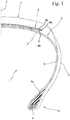
- Figure 1 shows a view in cross section of a portion of a tyre.
- the reference number 1 in Figure 1 indicates a tyre for vehicle wheels, which generally comprises a carcass structure 2 comprising at least one carcass ply 3 having respectively opposite end strips secured to respective annular anchoring structures 4, optionally associated with the elastomeric fillers 4a, incorporated into the zones 5 usually identified by the name "beads".
- the carcass structure 2 is associated with a belt structure 6 comprising one or more belt layers 6a, 6b located in radial superposition relative to each other and relative to the carcass ply 3, having reinforcing cords that are typically metallic. These reinforcing cords may have a crossed orientation relative to a circumferential direction of the tyre 1.
- the term "circumferential" direction means a direction generically given according to the direction of rotation of the tyre, or at least slightly inclined relative to the direction of rotation of the tyre.
- a tread band 7 made of elastomeric compound is applied in a radially outer position with respect to the belt structure 6, as are other constituent semi-finished parts of the tyre 1.
- Respective side walls 8 made of elastomeric compound are also applied in an axially outer position on the side surfaces of the carcass structure 2, each extending from one of the side edges of the tread band 7 up to the respective annular structure for anchoring to the beads 5.
- a radially inner surface of the tyre 1 is also preferably internally lined with a layer of elastomeric material that is substantially impermeable to air, referred to as the liner 9.
- the belt structure 6 also comprises at least one reinforcing layer 6c that is radially outer with respect to the belt layers 6a, 6b.
- the radially outer reinforcing layer 6c comprises textile or metal cords, arranged at a substantially zero angle relative to the circumferential direction of the tyre and immersed in the elastomeric material.
- the cords are arranged substantially parallel and side by side to form a plurality of coils. These coils are substantially oriented in the circumferential direction (typically with an angle of between 0° and 5°), this direction usually being referred to as "zero degrees" with reference to its position relative to the equatorial plane X-X of the tyre.
- the term "equatorial plane" of the tyre means a plane perpendicular to the axis of rotation of the tyre and which subdivides the tyre into two symmetrically equal parts.
- the tyre 1 for motor vehicles is of the HP (High Performance) or UHP (Ultra-High Performance) type, i.e. it is a tyre that is capable of withstanding maximum speeds of at least 190 km/h, up to over 300 km/h.
- HP High Performance
- UHP Ultra-High Performance
- tyres are those belonging to the classes "T", “U”, “H”, “V”, “ZR”, "W”, "Y” according to the E.T.R.T.O. classification.
- the manufacture of the tyre 1 as described above is performed by assembling the respective semi-finished parts on a moulding drum, not shown, performed by at least one assembling device.
- At least a part of the components intended to form the carcass structure 2 of the tyre 1 is constructed and/or assembled on the moulding drum. More particularly, the moulding drum serves to receive first the optional liner 9, and then the carcass ply 3. Next, devices, not shown, engage coaxially around each of the end strips of one of the annular anchoring structures 4, position an outer sleeve comprising the belt structure 6 and the tread band 7 in a coaxially centred position around the cylindrical carcass sleeve and conform the carcass sleeve in a toroidal configuration by radial dilation of the carcass ply 3, so as to apply it against a radially internal surface of the outer sleeve.
- a pressing and vulcanization treatment is performed, aimed at establishing structural stabilization of the tyre 1 by crosslinking of the elastomeric mixtures and also at imprinting on the tread band 7 a desired tread pattern and imprinting on the side walls 8 optional distinctive graphic signs.
- Example 1 Synthesis of iso-styrene/trans-butadiene copolymer of molecular weight 538,000 with 40% by weight of styrene (Polymer SBR-3)
- Styrene (109 g; 1.04 mol), butadiene (170 g; 3.3 mol; 4.6 M solution in toluene) and MAO (0.1 mol; 103 ml; 10 wt% solution in toluene) were placed in a 3000 ml round-bottomed flask equipped with a magnetic stirrer, under an inert atmosphere.
- the polymerization was stopped by pouring the contents of the flask into ethanol acidified with HCI and 2,6-di-tert-butyl-4-methylphenol (BHT) as antioxidant.
- BHT 2,6-di-tert-butyl-4-methylphenol
- the coagulated polymer was washed with ethanol, filtered and dried in a vacuum oven at 30-40°C.
- the yield was 93%.
- the resulting polymer had a molecular weight of about 538,000 Dalton measured by gel permeation chromatography (GPC).
- GPC gel permeation chromatography
- the measurement was performed at 35°C, using THF as solvent, at a flow rate of 1 ml/min, and using a refraction index revealer.
- the instrument allows for the use of 4 columns with variable pore sizes.
- Calibration is performed using polystyrene standards.
- the polydispersity index is equal to about 2.2, and the Tg is about -43°C.
- Example 2 Synthesis of iso-styrene/trans-butadiene of molecular weight 117,000 with 42% by weight of styrene (Polymer SBR-2)
- Styrene, butadiene, MAO and the catalyst of formula 2 described below dissolved in 10 ml of toluene were placed in a 2000 ml round-bottomed flask equipped with a magnetic stirrer, under an inert atmosphere, via a procedure similar to that described previously.
- the reaction mixture was left stirring at room temperature for 24 hours.
- the reaction was terminated by pouring the contents of the flask into ethanol acidified with HCI and BHT as antioxidant. After washing with fresh ethanol, the polymer was recovered by filtration and dried in a vacuum oven at 40°C for about 3 days.
- the yield was 92%.
- the resulting polymer had a molecular weight of about 117,000 Dalton with a polydispersity index equal to about 1.7 and a Tg of about -39°C.
- Catalyst of formula 1 Catalyst of formula 2
- the elastomeric compositions R1, R2 and I1 illustrated in Table 1 below were prepared, respectively, by using the branched styrene-butadiene polymer HP 755 from JSR (polymer SBR-1) composed of 39% by weight of styrene and 61% by weight of butadiene, supplemented with 37.5 phr of TDAE oil, obtained by an ionic synthesis in solution having molecular weights (Mw) of about 1,000 kDa with a polydispersity index of about 1.67 and a glass transition temperature measured by DSC (10°C/min) of about -31 °C and of about -21 °C for the pure polymer (after extraction of the TDAE oil), and the polymers SBR-2 and SBR-3 having the characteristics described above.
- JSR polymer SBR-1
- Mw molecular weights
- DSC glass transition temperature measured by DSC (10°C/min) of about -31 °C and of about -21 °C for the
- Composition R1 used as first reference, contains as solid polymer only the polymer SBR-1, which, being a polymer obtained by anionic synthesis, has no stereoregularity in the spatial arrangement of the butadiene and styrene monomers.
- the arrangement of the styrene monomers is entirely atactic, whereas the arrangement of the butadiene monomers is about 38% in position 1,2, and the remaining 62% arranged in position 1,4 is distributed randomly between the iso form and the trans form.
- Composition R2 used as second reference, comprises both the polymer SBR-1 and 20 phr of polymer SBR-2, with a low molecular weight (117 kDa).
- Composition 11 used in the tread of a tyre according to the invention comprises both the polymer SBR-1 and 20 phr of polymer SBR-3, with a high molecular weight (538 kDa).
- the polymers SBR-2 and SBR-3 obtained by stereoselective synthesis, have, on the other hand, a precise stereoregularity, in which the arrangement of the styrene monomers is isotactic, whereas the arrangement of the butadiene monomers is totally 1,4-trans and entirely free of 1,4- and 1,2-cis forms.
- compositions have the same total content of oil, as the sum of the polymer extender oil (37.5 phr for R1, 30 for R2 and 11) and the free oil (0 phr for R1, 7.5 for R2 and 11).
- the elastomeric composition was discharged at about 135°C and left to stand for 24 hours at room temperature. The mix was taken up and mixing was again performed (second phase), adding ZnO, 6PPD and carbon black. The vulcanization agents and accelerators were then successively added (finishing phase). Finally, the elastomeric composition was vulcanized in suitable moulds by means of a steam press via an isothermic cycle of 30 minutes at 151°C.
- Table 1 Compounds R1 R2 I1 FIRST PHASE SBR-1 137.5 110 110 SBR-2 - 20 - SBR-3 - - 20 TDAE - 7.5 7.5 Zeosil 1165 65 65 65 TESPT 8 8 8 Kristalex F85 10 10 10 Stearic acid 2.5 2.5 2.5 Wax 1.5 1.5 1.5 SECOND PHASE ZnO 1.5 1.5 1.5 6PPD 3 3 3 CB N115 10 10 10 FINISHING PHASE MBTS 1.2 1.2 1.2 TBBS 1.6 1.6 1.6 Sulfur 1.5 1.5 1.5 - Zeosil 1165: precipitated silica with a BET surface area equal to about 165 m 2 /g (Rhone-Poulenc); - TESPT: bis(3-triethoxysilylpropyl) tetrasulfide (Degussa-Hüls); - Kristalex F85: ⁇ -methylstyrene resin (Eastman
- the static mechanical properties (load at 50%, 100% and 300% of elongation, referred to respectively as CA05, CA1, CA3, breaking load and elongation at break) were measured according to standard ISO 37:2005, on samples of the previously described elastomeric compositions crosslinked at 151°C for 30 minutes.
- the dynamic mechanical properties were measured with a dynamic tensile testing machine of servo-hydraulic type in traction-compression mode according to the following methods.
- the dynamic mechanical properties are expressed in terms of the dynamic elastic modulus (E') and loss factor values (Tan ⁇ ).
- the Tan ⁇ value is calculated in the present case as the ratio between the viscous modulus (E") and the elastic modulus (E').
- the parameters that best predict the road behaviour of a tyre are the dynamic-mechanical properties of the elastomeric compositions, in particular the elastic modulus or storage modulus (E'), the viscous modulus or dissipative modulus (E") and the ratio between the viscous modulus and the elastic modulus, known as the tangent delta (Tan ⁇ ), which is an indicator of the hysteretic behaviour, and the static-mechanical properties of the elastomeric compositions, in particular the load at various levels of elongation, the breaking load and the percentage of elongation at break.
- E' elastic modulus or storage modulus
- E viscous modulus or dissipative modulus
- Tan ⁇ the ratio between the viscous modulus and the elastic modulus
- the Applicant considers that a high Tan ⁇ value at high temperatures (around and above 100°C) ensures good road holding when the tyre is used under particularly hard driving conditions.
- a high Tan ⁇ value at high temperatures (around and above 100°C) is directly correlated with the capacity of the tread compound to ensure high holding (high friction coefficient) and in general high performance under conditions of high thermal stress under extreme driving conditions (hard handling) to which the tyres of high-power and high-performance cars are typically subjected.
- the elastic modulus (E') undergoes an inevitable reduction in value due to the temperature effect, but the variation should be as limited as possible, so that at low temperature values (for example at 23°C) the value should not be excessively high, whereas at high temperatures, the value should be as high as possible.
- controlling the variation of the dynamic rigidity i.e. limiting the increase in the dynamic modulus E' at low temperature (23°C) and its decrease at high temperature (70°, 100° and 120°C) maintains the correct balance between developing grip at low temperature and obtaining performance and thrust under extreme driving conditions at high temperatures.
- static-mechanical properties on the basis of the Applicant's experience, it is considered that high load values at various levels of elongation and a high breaking energy give the compound suitable mechanical properties, in terms of resistance to laceration and wear resistance.
- a relatively low static modulus CA3 combined with a high tan ⁇ value at 70° and 100°C characterize compounds with high resistance to the initiation and propagation of laceration.
- the elastomeric composition I1 showed load values at 300% more in line with the R1 reference values relative to that observed for composition R2, ensuring an appreciable improvement in the breaking properties BL and EB relative to the latter.
- the surprising result of I1 may give a tyre comprising a tread made with such compositions an appreciable improvement in the resistance to laceration, and less abrasion, confirmed by the results of the specific test, with consequent improved durability of the tyre.
- the elastomeric composition I1 showed overall elastic modulus (E') values that were higher than the value for the reference compositions R1 and R2, but above all composition I1 showed a surprisingly high E' value at 100°C and 120°C as compared with an E' at 23° that tended to be lower than the values for R2.
- E' elastic modulus
- the elastomeric composition I1 showed high Tan ⁇ values at high temperatures (100°C and 120°C), ensuring good grip of the tyre under particularly hard driving conditions (high temperature), better than that for R1 and substantially in line with that for R2.
Landscapes
- Chemical & Material Sciences (AREA)
- Health & Medical Sciences (AREA)
- Chemical Kinetics & Catalysis (AREA)
- Medicinal Chemistry (AREA)
- Polymers & Plastics (AREA)
- Organic Chemistry (AREA)
- Engineering & Computer Science (AREA)
- Mechanical Engineering (AREA)
- Compositions Of Macromolecular Compounds (AREA)
- Tires In General (AREA)
- Addition Polymer Or Copolymer, Post-Treatments, Or Chemical Modifications (AREA)
- Materials Engineering (AREA)
Claims (16)
- Pneu pour roues de véhicule comprenant :- une structure de carcasse ;- une bande de roulement appliquée en position radialement extérieure par rapport à ladite structure de carcasse ;caractérisé en ce que ladite bande de roulement comprend un matériau élastomère réticulé obtenu par réticulation d'une composition élastomère réticulable, où ladite composition élastomère comprend au moins un copolymère élastomère d'iso-styrène/trans-butadiène ayant une teneur en styrène supérieure à 30% en poids par rapport au poids total du copolymère et un poids moléculaire supérieur à 500000 Daltons (g/mol).
- Pneu pour roues de véhicule selon la revendication 1, caractérisé en ce que ledit copolymère a une teneur en styrène supérieure ou égale à 40%, de préférence supérieure ou égale à 50% en poids par rapport au poids total du copolymère.
- Pneu pour roues de véhicule selon la revendication 1, caractérisé en ce que ledit copolymère a une teneur en 1,4-butadiène inférieure à 60%, de préférence inférieure à 50% en poids par rapport au poids total du copolymère.
- Pneu pour roues de véhicule selon la revendication 1, caractérisé en ce que ledit copolymère a un poids moléculaire supérieur ou égal à 600000 Daltons (g/mol), de préférence supérieur ou égal à 700000 Daltons (g/mol), plus préférablement supérieur ou égal à 800000 Daltons (g/mol).
- Pneu pour roues de véhicule selon la revendication 1, caractérisé en ce que ledit copolymère a un poids moléculaire inférieur ou égal à 1500000 Daltons (g/mol), de préférence inférieur ou égal à 1250000 Daltons (g/mol), plus préférablement inférieur ou égal à 1000000 Daltons (g/mol).
- Pneu pour roues de véhicule selon la revendication 1, caractérisé en ce que ladite composition élastomère comprend une quantité dudit copolymère supérieure à 5 phr, de préférence supérieure à 10 phr.
- Pneu pour roues de véhicule selon la revendication 1, caractérisé en ce que ladite composition élastomère comprend une quantité dudit copolymère inférieure à 50 phr, de préférence inférieure à 40 phr.
- Pneu pour roues de véhicule selon l'une quelconque des revendications précédentes 6 et 7, caractérisé en ce que ladite composition élastomère comprend une quantité dudit copolymère comprise entre 15 et 25 phr.
- Copolymère élastomère d'iso-styrène/trans-butadiène, dans lequel ledit copolymère est constitué d'une séquence aléatoire de butadiène en conformation trans et de styrène en configuration isotactique, ayant une teneur en styrène supérieure à 30% en poids par rapport au poids total dudit copolymère et un poids moléculaire supérieur à 500000 Daltons (g/mol).
- Copolymère élastomère selon la revendication 9, caractérisé en ce que ledit copolymère a une teneur en styrène supérieure ou égale à 40%, de préférence supérieure ou égale à 50% en poids par rapport au poids total du copolymère.
- Copolymère élastomère selon la revendication 9, caractérisé en ce que ledit copolymère a une teneur en 1,4-butadiène inférieure à 60%, de préférence inférieure à 50% en poids par rapport au poids total du copolymère.
- Copolymère élastomère selon la revendication 9, caractérisé en ce que ledit copolymère a un poids moléculaire supérieur ou égal à 600000 Daltons (g/mol), de préférence supérieur ou égal à 700000 Daltons (g/mol), plus préférablement supérieur ou égal à 800000 Daltons (g/mol).
- Copolymère élastomère selon la revendication 9, caractérisé en ce que ledit copolymère a un poids moléculaire inférieur ou égal à 1500000 Daltons (g/mol), de préférence inférieur ou égal à 1250000 Daltons (g/mol), plus préférablement inférieur ou égal à 1000000 Daltons (g/mol).
- Copolymère élastomère selon l'une quelconque des revendications précédentes 9 à 13, dans lequel ledit copolymère a une valeur Tg du point d'inflexion comprise entre -50°C et +20°C mesurée par DSC à 10°C/min.
- Procédé de copolymérisation de styrène et de butadiène comprenant le fait (i) de préparer une solution dudit styrène et dudit butadiène dans un solvant approprié, et (ii) d'ajouter à ladite solution un système catalytique homogène, où ledit système catalytique homogène comprend un catalyseur homogène ayant la formule (I) suivante,
 Tr représente un métal de transition,X et X', qui sont identiques ou différents, représentent un atome d'halogène,R1 et R2, qui sont identiques ou différents, représentent un atome de H ou un groupe alkyle linéaire ou ramifié ayant 1 à 10 atome(s) de carbone,R3 à R6, qui sont identiques ou différents, représentent un atome de H ou un groupe alkyle linéaire ou ramifié ayant 1 à 10 atome (s) de carbone, ou un groupe arylalkyle linéaire ou ramifié ayant 7 à 14 atomes de carbone,Y et Y', qui sont identiques ou différents, représentent un atome d'oxygène, de soufre, de sélénium ou de tellure, ou un groupe NR7 ou PR7,D et D', qui sont identiques ou différents, représentent un atome d'oxygène, de soufre, de sélénium ou de tellure, ou un groupe NR7 ou PR7,R7 représente un atome de H ou un groupe alkyle linéaire ou ramifié ayant 1 à 10 atome(s) de carbone,n est un nombre entier compris entre 1 et 10,où R4 et R6 sont liés au cycle benzène en position ortho par rapport aux substituants D et D', et sont représentés par un groupe arylalkyle linéaire ou ramifié ayant 7 à 14 atomes de carbone, et R3 et R5 sont liés au cycle benzène en position para par rapport aux substituants D et D', et sont représentés par un groupe alkyle linéaire ou ramifié ayant 1 à 10 atome(s) de carbone, etoù ledit procédé de copolymérisation permet la formation d'un copolymère élastomère d'iso-styrène/trans-butadiène ayant une teneur en styrène supérieure à 30% en poids par rapport au poids total dudit copolymère et un poids moléculaire supérieur à 500000 Daltons (g/mol).
 - Procédé de copolymérisation selon la revendication 15, dans lequel ledit catalyseur homogène est représenté par la formule (1) suivante :

Applications Claiming Priority (2)
| Application Number | Priority Date | Filing Date | Title |
|---|---|---|---|
| ITUB20152689 | 2015-07-31 | ||
| PCT/IB2016/054500 WO2017021828A1 (fr) | 2015-07-31 | 2016-07-28 | Pneumatique à haute performance |
Publications (2)
| Publication Number | Publication Date |
|---|---|
| EP3328664A1 EP3328664A1 (fr) | 2018-06-06 |
| EP3328664B1 true EP3328664B1 (fr) | 2020-02-12 |
Family
ID=54477109
Family Applications (1)
| Application Number | Title | Priority Date | Filing Date |
|---|---|---|---|
| EP16754328.9A Active EP3328664B1 (fr) | 2015-07-31 | 2016-07-28 | Pneumatique à haute performance |
Country Status (6)
| Country | Link |
|---|---|
| US (1) | US10759226B2 (fr) |
| EP (1) | EP3328664B1 (fr) |
| CN (1) | CN107921817B (fr) |
| BR (1) | BR112018001490B1 (fr) |
| MX (1) | MX2018000798A (fr) |
| WO (1) | WO2017021828A1 (fr) |
Families Citing this family (6)
| Publication number | Priority date | Publication date | Assignee | Title |
|---|---|---|---|---|
| MX2017012768A (es) | 2015-04-24 | 2018-06-04 | Pirelli | Neumatico de alto rendimiento. |
| WO2016170523A1 (fr) | 2015-04-24 | 2016-10-27 | Pirelli Tyre S.P.A. | Pneu hautes performances |
| JP7205131B2 (ja) * | 2018-09-21 | 2023-01-17 | 住友ゴム工業株式会社 | 空気入りタイヤ |
| WO2021224874A1 (fr) * | 2020-05-08 | 2021-11-11 | Pirelli Tyre S.P.A. | Pneumatique haute performance |
| WO2021250557A1 (fr) * | 2020-06-09 | 2021-12-16 | Pirelli Tyre S.P.A. | Pneumatique à haute performance |
| CN112194758B (zh) * | 2020-09-11 | 2022-05-31 | 青岛科技大学 | 一种异戊二烯-苯乙烯共聚物及其制备方法 |
Family Cites Families (28)
| Publication number | Priority date | Publication date | Assignee | Title |
|---|---|---|---|---|
| US3903019A (en) | 1973-07-16 | 1975-09-02 | Gen Tire & Rubber Co | Preparation of solution polymers using a barium di-tert alkoxide and a di-butyl magnesium catalyst complex |
| US4129705A (en) | 1975-02-02 | 1978-12-12 | Compagnie Generale Des Etablissements Michelin | Polymerization process |
| US4112210A (en) | 1975-02-27 | 1978-09-05 | Compagnie Generale Des Etablissements Michelin | Polymerization process |
| US4669518A (en) | 1985-04-15 | 1987-06-02 | Gencorp Inc. | Tire tread having high trans butadiene based elastomeric block copolymers and blends |
| US4933401A (en) | 1988-02-26 | 1990-06-12 | Japan Synthetic Rubber Co., Ltd. | Catalyst composition for polymerization of conjugated diene and process for producing conjugated diene polymer |
| US5100965A (en) | 1991-04-08 | 1992-03-31 | The Goodyear Tire & Rubber Company | Process for synthesizing high trans polymers |
| US5272220A (en) | 1992-09-14 | 1993-12-21 | The Goodyear Tire & Rubber Company | Process for preparing styrene-isoprene-butadiene rubber |
| JP3469363B2 (ja) * | 1995-07-11 | 2003-11-25 | 株式会社ブリヂストン | ゴム組成物 |
| US5753579A (en) | 1995-12-26 | 1998-05-19 | The Goodyear Tire & Rubber Company | Trans microstructure directing initiator system |
| EP0877034A1 (fr) | 1997-05-05 | 1998-11-11 | The Goodyear Tire & Rubber Company | SBR statistique à haute teneur en trans et à basse teneur en vinyl |
| US6429245B1 (en) | 1997-09-16 | 2002-08-06 | The Goodyear Tire & Rubber Company | Tire tread with elastomers of spatially defined Tg's |
| US6581659B1 (en) | 1999-10-11 | 2003-06-24 | The Goodyear Tire & Rubber Company | Tire with silica-reinforced tread comprised of trans 1,4-polybutadiene, solution, SBR polyisoprene and defined amount of carbon black and amorphous silica |
| ATE271978T1 (de) | 2001-02-07 | 2004-08-15 | Pirelli | Verfahrung zur herstellung von reifen, elastomerzusammensetzungen und reifen |
| US6627715B2 (en) | 2001-08-16 | 2003-09-30 | The Goodyear Tire & Rubber Company | Group IIa metal containing catalyst system |
| US6758251B2 (en) | 2002-08-21 | 2004-07-06 | The Goodyear Tire & Rubber Company | Pneumatic tire having a component containing high trans styrene-butadiene rubber |
| CA2502345A1 (fr) * | 2002-10-16 | 2004-04-29 | Michelin Recherche Et Technique S.A. | Copolymeres ethylene/ butadiene, system catalytique et les produires et production desdits polymers |
| US6889737B2 (en) | 2002-12-05 | 2005-05-10 | The Goodyear Tire & Rubber Company | Pneumatic tire having a component containing high trans styrene-butadiene rubber |
| US7091150B2 (en) * | 2003-12-19 | 2006-08-15 | The Goodyear Tire & Rubber Company | Synthetic polyisoprene rubber |
| DE602005000426T2 (de) | 2004-05-03 | 2007-10-31 | The Goodyear Tire & Rubber Co., Akron | Reifen mit Lauffläche aus speziellem trans-1,4-Polybutadien-Polymer und cis-1,4-Polyisopren-Naturkautschuk |
| EP2307468B1 (fr) | 2008-07-18 | 2012-06-13 | Pirelli Tyre S.P.A. | Pneu et composition élastomère réticulable comprenant un copolymère isotactique obtenu par catalyse homogène |
| FR2961818B1 (fr) | 2010-06-23 | 2012-07-20 | Michelin Soc Tech | Composition de caoutchouc comprenant une charge thermoplastique et un agent compatibilisant |
| CN101914183B (zh) * | 2010-09-04 | 2012-08-15 | 大连理工大学 | 稀土催化体系苯乙烯/异戊二烯/丁二烯三元无规共聚物及其制备方法 |
| IT1404141B1 (it) * | 2010-11-26 | 2013-11-15 | Pirelli | Pneumatico ad elevate prestazioni |
| US20120157568A1 (en) * | 2010-12-21 | 2012-06-21 | Paul Harry Sandstrom | Silica reinforced rubber composition with combination of functionalized elastomer, liquid polymer and resin and tire with tread thereof |
| US8937130B2 (en) | 2010-12-24 | 2015-01-20 | Zeon Corporation | Conjugated diene rubber, rubber composition, cross-linked rubber, and tire |
| WO2016170523A1 (fr) * | 2015-04-24 | 2016-10-27 | Pirelli Tyre S.P.A. | Pneu hautes performances |
| MX2017012768A (es) * | 2015-04-24 | 2018-06-04 | Pirelli | Neumatico de alto rendimiento. |
| ES2881753T3 (es) * | 2015-09-04 | 2021-11-30 | Adeka Corp | Composición de resina para plástico reforzado con fibra, un producto curado del mismo, plástico reforzado con fibra que contiene dicho producto curado y método para la producción de plástico reforzado con fibra |
-
2016
- 2016-07-28 CN CN201680043383.8A patent/CN107921817B/zh active Active
- 2016-07-28 WO PCT/IB2016/054500 patent/WO2017021828A1/fr not_active Ceased
- 2016-07-28 MX MX2018000798A patent/MX2018000798A/es unknown
- 2016-07-28 BR BR112018001490-7A patent/BR112018001490B1/pt active IP Right Grant
- 2016-07-28 US US15/747,346 patent/US10759226B2/en active Active
- 2016-07-28 EP EP16754328.9A patent/EP3328664B1/fr active Active
Non-Patent Citations (1)
| Title |
|---|
| None * |
Also Published As
| Publication number | Publication date |
|---|---|
| BR112018001490B1 (pt) | 2021-08-17 |
| WO2017021828A1 (fr) | 2017-02-09 |
| CN107921817B (zh) | 2020-02-28 |
| BR112018001490A2 (pt) | 2018-09-11 |
| US10759226B2 (en) | 2020-09-01 |
| US20180215202A1 (en) | 2018-08-02 |
| CN107921817A (zh) | 2018-04-17 |
| EP3328664A1 (fr) | 2018-06-06 |
| MX2018000798A (es) | 2018-05-15 |
Similar Documents
| Publication | Publication Date | Title |
|---|---|---|
| EP3286018B1 (fr) | Pneu à haute performance | |
| EP3328664B1 (fr) | Pneumatique à haute performance | |
| US10696824B2 (en) | High-performance tyre | |
| EP2643367B1 (fr) | Pneu haute performance | |
| US11732115B2 (en) | Tire for vehicle wheels | |
| EP4004103B1 (fr) | Pneu comprenant une composition de caoutchouc comprenant une résine hydrocarbonée particulière | |
| EP4004102B1 (fr) | Pneu comprenant une composition de caoutchouc comprenant une résine hydrocarbonée particulière | |
| US12606695B2 (en) | High-performance tyre | |
| WO2022161742A1 (fr) | Pneu incorporant une composition de caoutchouc comprenant une résine hydrocarbonée spécifique | |
| CN121057775A (zh) | 具有优异耐磨性和抓地力的用于车辆车轮的轮胎 |
Legal Events
| Date | Code | Title | Description |
|---|---|---|---|
| STAA | Information on the status of an ep patent application or granted ep patent |
Free format text: STATUS: THE INTERNATIONAL PUBLICATION HAS BEEN MADE |
|
| PUAI | Public reference made under article 153(3) epc to a published international application that has entered the european phase |
Free format text: ORIGINAL CODE: 0009012 |
|
| STAA | Information on the status of an ep patent application or granted ep patent |
Free format text: STATUS: REQUEST FOR EXAMINATION WAS MADE |
|
| 17P | Request for examination filed |
Effective date: 20180221 |
|
| AK | Designated contracting states |
Kind code of ref document: A1 Designated state(s): AL AT BE BG CH CY CZ DE DK EE ES FI FR GB GR HR HU IE IS IT LI LT LU LV MC MK MT NL NO PL PT RO RS SE SI SK SM TR |
|
| AX | Request for extension of the european patent |
Extension state: BA ME |
|
| DAV | Request for validation of the european patent (deleted) | ||
| DAX | Request for extension of the european patent (deleted) | ||
| STAA | Information on the status of an ep patent application or granted ep patent |
Free format text: STATUS: EXAMINATION IS IN PROGRESS |
|
| 17Q | First examination report despatched |
Effective date: 20190102 |
|
| GRAP | Despatch of communication of intention to grant a patent |
Free format text: ORIGINAL CODE: EPIDOSNIGR1 |
|
| STAA | Information on the status of an ep patent application or granted ep patent |
Free format text: STATUS: GRANT OF PATENT IS INTENDED |
|
| INTG | Intention to grant announced |
Effective date: 20190906 |
|
| GRAS | Grant fee paid |
Free format text: ORIGINAL CODE: EPIDOSNIGR3 |
|
| GRAA | (expected) grant |
Free format text: ORIGINAL CODE: 0009210 |
|
| STAA | Information on the status of an ep patent application or granted ep patent |
Free format text: STATUS: THE PATENT HAS BEEN GRANTED |
|
| AK | Designated contracting states |
Kind code of ref document: B1 Designated state(s): AL AT BE BG CH CY CZ DE DK EE ES FI FR GB GR HR HU IE IS IT LI LT LU LV MC MK MT NL NO PL PT RO RS SE SI SK SM TR |
|
| REG | Reference to a national code |
Ref country code: GB Ref legal event code: FG4D |
|
| REG | Reference to a national code |
Ref country code: CH Ref legal event code: EP |
|
| REG | Reference to a national code |
Ref country code: AT Ref legal event code: REF Ref document number: 1231609 Country of ref document: AT Kind code of ref document: T Effective date: 20200215 |
|
| REG | Reference to a national code |
Ref country code: IE Ref legal event code: FG4D |
|
| REG | Reference to a national code |
Ref country code: DE Ref legal event code: R096 Ref document number: 602016029582 Country of ref document: DE |
|
| PG25 | Lapsed in a contracting state [announced via postgrant information from national office to epo] |
Ref country code: NO Free format text: LAPSE BECAUSE OF FAILURE TO SUBMIT A TRANSLATION OF THE DESCRIPTION OR TO PAY THE FEE WITHIN THE PRESCRIBED TIME-LIMIT Effective date: 20200512 Ref country code: FI Free format text: LAPSE BECAUSE OF FAILURE TO SUBMIT A TRANSLATION OF THE DESCRIPTION OR TO PAY THE FEE WITHIN THE PRESCRIBED TIME-LIMIT Effective date: 20200212 Ref country code: RS Free format text: LAPSE BECAUSE OF FAILURE TO SUBMIT A TRANSLATION OF THE DESCRIPTION OR TO PAY THE FEE WITHIN THE PRESCRIBED TIME-LIMIT Effective date: 20200212 |
|
| REG | Reference to a national code |
Ref country code: LT Ref legal event code: MG4D |
|
| REG | Reference to a national code |
Ref country code: NL Ref legal event code: MP Effective date: 20200212 |
|
| PG25 | Lapsed in a contracting state [announced via postgrant information from national office to epo] |
Ref country code: BG Free format text: LAPSE BECAUSE OF FAILURE TO SUBMIT A TRANSLATION OF THE DESCRIPTION OR TO PAY THE FEE WITHIN THE PRESCRIBED TIME-LIMIT Effective date: 20200512 Ref country code: GR Free format text: LAPSE BECAUSE OF FAILURE TO SUBMIT A TRANSLATION OF THE DESCRIPTION OR TO PAY THE FEE WITHIN THE PRESCRIBED TIME-LIMIT Effective date: 20200513 Ref country code: IS Free format text: LAPSE BECAUSE OF FAILURE TO SUBMIT A TRANSLATION OF THE DESCRIPTION OR TO PAY THE FEE WITHIN THE PRESCRIBED TIME-LIMIT Effective date: 20200612 Ref country code: HR Free format text: LAPSE BECAUSE OF FAILURE TO SUBMIT A TRANSLATION OF THE DESCRIPTION OR TO PAY THE FEE WITHIN THE PRESCRIBED TIME-LIMIT Effective date: 20200212 Ref country code: LV Free format text: LAPSE BECAUSE OF FAILURE TO SUBMIT A TRANSLATION OF THE DESCRIPTION OR TO PAY THE FEE WITHIN THE PRESCRIBED TIME-LIMIT Effective date: 20200212 Ref country code: SE Free format text: LAPSE BECAUSE OF FAILURE TO SUBMIT A TRANSLATION OF THE DESCRIPTION OR TO PAY THE FEE WITHIN THE PRESCRIBED TIME-LIMIT Effective date: 20200212 |
|
| PG25 | Lapsed in a contracting state [announced via postgrant information from national office to epo] |
Ref country code: NL Free format text: LAPSE BECAUSE OF FAILURE TO SUBMIT A TRANSLATION OF THE DESCRIPTION OR TO PAY THE FEE WITHIN THE PRESCRIBED TIME-LIMIT Effective date: 20200212 |
|
| PG25 | Lapsed in a contracting state [announced via postgrant information from national office to epo] |
Ref country code: ES Free format text: LAPSE BECAUSE OF FAILURE TO SUBMIT A TRANSLATION OF THE DESCRIPTION OR TO PAY THE FEE WITHIN THE PRESCRIBED TIME-LIMIT Effective date: 20200212 Ref country code: CZ Free format text: LAPSE BECAUSE OF FAILURE TO SUBMIT A TRANSLATION OF THE DESCRIPTION OR TO PAY THE FEE WITHIN THE PRESCRIBED TIME-LIMIT Effective date: 20200212 Ref country code: PT Free format text: LAPSE BECAUSE OF FAILURE TO SUBMIT A TRANSLATION OF THE DESCRIPTION OR TO PAY THE FEE WITHIN THE PRESCRIBED TIME-LIMIT Effective date: 20200705 Ref country code: LT Free format text: LAPSE BECAUSE OF FAILURE TO SUBMIT A TRANSLATION OF THE DESCRIPTION OR TO PAY THE FEE WITHIN THE PRESCRIBED TIME-LIMIT Effective date: 20200212 Ref country code: SK Free format text: LAPSE BECAUSE OF FAILURE TO SUBMIT A TRANSLATION OF THE DESCRIPTION OR TO PAY THE FEE WITHIN THE PRESCRIBED TIME-LIMIT Effective date: 20200212 Ref country code: SM Free format text: LAPSE BECAUSE OF FAILURE TO SUBMIT A TRANSLATION OF THE DESCRIPTION OR TO PAY THE FEE WITHIN THE PRESCRIBED TIME-LIMIT Effective date: 20200212 Ref country code: EE Free format text: LAPSE BECAUSE OF FAILURE TO SUBMIT A TRANSLATION OF THE DESCRIPTION OR TO PAY THE FEE WITHIN THE PRESCRIBED TIME-LIMIT Effective date: 20200212 Ref country code: DK Free format text: LAPSE BECAUSE OF FAILURE TO SUBMIT A TRANSLATION OF THE DESCRIPTION OR TO PAY THE FEE WITHIN THE PRESCRIBED TIME-LIMIT Effective date: 20200212 |
|
| REG | Reference to a national code |
Ref country code: DE Ref legal event code: R097 Ref document number: 602016029582 Country of ref document: DE |
|
| REG | Reference to a national code |
Ref country code: AT Ref legal event code: MK05 Ref document number: 1231609 Country of ref document: AT Kind code of ref document: T Effective date: 20200212 |
|
| PLBE | No opposition filed within time limit |
Free format text: ORIGINAL CODE: 0009261 |
|
| STAA | Information on the status of an ep patent application or granted ep patent |
Free format text: STATUS: NO OPPOSITION FILED WITHIN TIME LIMIT |
|
| 26N | No opposition filed |
Effective date: 20201113 |
|
| PG25 | Lapsed in a contracting state [announced via postgrant information from national office to epo] |
Ref country code: AT Free format text: LAPSE BECAUSE OF FAILURE TO SUBMIT A TRANSLATION OF THE DESCRIPTION OR TO PAY THE FEE WITHIN THE PRESCRIBED TIME-LIMIT Effective date: 20200212 |
|
| PG25 | Lapsed in a contracting state [announced via postgrant information from national office to epo] |
Ref country code: SI Free format text: LAPSE BECAUSE OF FAILURE TO SUBMIT A TRANSLATION OF THE DESCRIPTION OR TO PAY THE FEE WITHIN THE PRESCRIBED TIME-LIMIT Effective date: 20200212 Ref country code: MC Free format text: LAPSE BECAUSE OF FAILURE TO SUBMIT A TRANSLATION OF THE DESCRIPTION OR TO PAY THE FEE WITHIN THE PRESCRIBED TIME-LIMIT Effective date: 20200212 Ref country code: PL Free format text: LAPSE BECAUSE OF FAILURE TO SUBMIT A TRANSLATION OF THE DESCRIPTION OR TO PAY THE FEE WITHIN THE PRESCRIBED TIME-LIMIT Effective date: 20200212 |
|
| REG | Reference to a national code |
Ref country code: CH Ref legal event code: PL |
|
| REG | Reference to a national code |
Ref country code: BE Ref legal event code: MM Effective date: 20200731 |
|
| PG25 | Lapsed in a contracting state [announced via postgrant information from national office to epo] |
Ref country code: CH Free format text: LAPSE BECAUSE OF NON-PAYMENT OF DUE FEES Effective date: 20200731 Ref country code: LI Free format text: LAPSE BECAUSE OF NON-PAYMENT OF DUE FEES Effective date: 20200731 Ref country code: LU Free format text: LAPSE BECAUSE OF NON-PAYMENT OF DUE FEES Effective date: 20200728 |
|
| PG25 | Lapsed in a contracting state [announced via postgrant information from national office to epo] |
Ref country code: BE Free format text: LAPSE BECAUSE OF NON-PAYMENT OF DUE FEES Effective date: 20200731 |
|
| PG25 | Lapsed in a contracting state [announced via postgrant information from national office to epo] |
Ref country code: IE Free format text: LAPSE BECAUSE OF NON-PAYMENT OF DUE FEES Effective date: 20200728 |
|
| PG25 | Lapsed in a contracting state [announced via postgrant information from national office to epo] |
Ref country code: TR Free format text: LAPSE BECAUSE OF FAILURE TO SUBMIT A TRANSLATION OF THE DESCRIPTION OR TO PAY THE FEE WITHIN THE PRESCRIBED TIME-LIMIT Effective date: 20200212 Ref country code: MT Free format text: LAPSE BECAUSE OF FAILURE TO SUBMIT A TRANSLATION OF THE DESCRIPTION OR TO PAY THE FEE WITHIN THE PRESCRIBED TIME-LIMIT Effective date: 20200212 Ref country code: CY Free format text: LAPSE BECAUSE OF FAILURE TO SUBMIT A TRANSLATION OF THE DESCRIPTION OR TO PAY THE FEE WITHIN THE PRESCRIBED TIME-LIMIT Effective date: 20200212 |
|
| PG25 | Lapsed in a contracting state [announced via postgrant information from national office to epo] |
Ref country code: MK Free format text: LAPSE BECAUSE OF FAILURE TO SUBMIT A TRANSLATION OF THE DESCRIPTION OR TO PAY THE FEE WITHIN THE PRESCRIBED TIME-LIMIT Effective date: 20200212 Ref country code: AL Free format text: LAPSE BECAUSE OF FAILURE TO SUBMIT A TRANSLATION OF THE DESCRIPTION OR TO PAY THE FEE WITHIN THE PRESCRIBED TIME-LIMIT Effective date: 20200212 |
|
| PGFP | Annual fee paid to national office [announced via postgrant information from national office to epo] |
Ref country code: DE Payment date: 20250729 Year of fee payment: 10 |
|
| PGFP | Annual fee paid to national office [announced via postgrant information from national office to epo] |
Ref country code: IT Payment date: 20250721 Year of fee payment: 10 |
|
| PGFP | Annual fee paid to national office [announced via postgrant information from national office to epo] |
Ref country code: GB Payment date: 20250728 Year of fee payment: 10 |
|
| PGFP | Annual fee paid to national office [announced via postgrant information from national office to epo] |
Ref country code: FR Payment date: 20250728 Year of fee payment: 10 |
|
| PGFP | Annual fee paid to national office [announced via postgrant information from national office to epo] |
Ref country code: RO Payment date: 20250707 Year of fee payment: 10 |