EP3330785A2 - Lichtsperrvorrichtung, verfahren zur herstellung davon und transparente anzeigevorrichtung damit - Google Patents
Lichtsperrvorrichtung, verfahren zur herstellung davon und transparente anzeigevorrichtung damit Download PDFInfo
- Publication number
- EP3330785A2 EP3330785A2 EP17204627.8A EP17204627A EP3330785A2 EP 3330785 A2 EP3330785 A2 EP 3330785A2 EP 17204627 A EP17204627 A EP 17204627A EP 3330785 A2 EP3330785 A2 EP 3330785A2
- Authority
- EP
- European Patent Office
- Prior art keywords
- electrode
- refractive index
- light blocking
- substrate
- blocking device
- Prior art date
- Legal status (The legal status is an assumption and is not a legal conclusion. Google has not performed a legal analysis and makes no representation as to the accuracy of the status listed.)
- Granted
Links
Images




Classifications
-
- G—PHYSICS
- G02—OPTICS
- G02F—OPTICAL DEVICES OR ARRANGEMENTS FOR THE CONTROL OF LIGHT BY MODIFICATION OF THE OPTICAL PROPERTIES OF THE MEDIA OF THE ELEMENTS INVOLVED THEREIN; NON-LINEAR OPTICS; FREQUENCY-CHANGING OF LIGHT; OPTICAL LOGIC ELEMENTS; OPTICAL ANALOGUE/DIGITAL CONVERTERS
- G02F1/00—Devices or arrangements for the control of the intensity, colour, phase, polarisation or direction of light arriving from an independent light source, e.g. switching, gating or modulating; Non-linear optics
- G02F1/01—Devices or arrangements for the control of the intensity, colour, phase, polarisation or direction of light arriving from an independent light source, e.g. switching, gating or modulating; Non-linear optics for the control of the intensity, phase, polarisation or colour
- G02F1/13—Devices or arrangements for the control of the intensity, colour, phase, polarisation or direction of light arriving from an independent light source, e.g. switching, gating or modulating; Non-linear optics for the control of the intensity, phase, polarisation or colour based on liquid crystals, e.g. single liquid crystal display cells
- G02F1/133—Constructional arrangements; Operation of liquid crystal cells; Circuit arrangements
- G02F1/1333—Constructional arrangements; Manufacturing methods
- G02F1/1335—Structural association of cells with optical devices, e.g. polarisers or reflectors
- G02F1/133502—Antiglare, refractive index matching layers
-
- G—PHYSICS
- G02—OPTICS
- G02B—OPTICAL ELEMENTS, SYSTEMS OR APPARATUS
- G02B5/00—Optical elements other than lenses
- G02B5/20—Filters
- G02B5/22—Absorbing filters
- G02B5/223—Absorbing filters containing organic substances, e.g. dyes, inks or pigments
-
- G—PHYSICS
- G02—OPTICS
- G02F—OPTICAL DEVICES OR ARRANGEMENTS FOR THE CONTROL OF LIGHT BY MODIFICATION OF THE OPTICAL PROPERTIES OF THE MEDIA OF THE ELEMENTS INVOLVED THEREIN; NON-LINEAR OPTICS; FREQUENCY-CHANGING OF LIGHT; OPTICAL LOGIC ELEMENTS; OPTICAL ANALOGUE/DIGITAL CONVERTERS
- G02F1/00—Devices or arrangements for the control of the intensity, colour, phase, polarisation or direction of light arriving from an independent light source, e.g. switching, gating or modulating; Non-linear optics
- G02F1/01—Devices or arrangements for the control of the intensity, colour, phase, polarisation or direction of light arriving from an independent light source, e.g. switching, gating or modulating; Non-linear optics for the control of the intensity, phase, polarisation or colour
- G02F1/13—Devices or arrangements for the control of the intensity, colour, phase, polarisation or direction of light arriving from an independent light source, e.g. switching, gating or modulating; Non-linear optics for the control of the intensity, phase, polarisation or colour based on liquid crystals, e.g. single liquid crystal display cells
- G02F1/133—Constructional arrangements; Operation of liquid crystal cells; Circuit arrangements
- G02F1/13306—Circuit arrangements or driving methods for the control of single liquid crystal cells
-
- G—PHYSICS
- G02—OPTICS
- G02F—OPTICAL DEVICES OR ARRANGEMENTS FOR THE CONTROL OF LIGHT BY MODIFICATION OF THE OPTICAL PROPERTIES OF THE MEDIA OF THE ELEMENTS INVOLVED THEREIN; NON-LINEAR OPTICS; FREQUENCY-CHANGING OF LIGHT; OPTICAL LOGIC ELEMENTS; OPTICAL ANALOGUE/DIGITAL CONVERTERS
- G02F1/00—Devices or arrangements for the control of the intensity, colour, phase, polarisation or direction of light arriving from an independent light source, e.g. switching, gating or modulating; Non-linear optics
- G02F1/01—Devices or arrangements for the control of the intensity, colour, phase, polarisation or direction of light arriving from an independent light source, e.g. switching, gating or modulating; Non-linear optics for the control of the intensity, phase, polarisation or colour
- G02F1/13—Devices or arrangements for the control of the intensity, colour, phase, polarisation or direction of light arriving from an independent light source, e.g. switching, gating or modulating; Non-linear optics for the control of the intensity, phase, polarisation or colour based on liquid crystals, e.g. single liquid crystal display cells
- G02F1/133—Constructional arrangements; Operation of liquid crystal cells; Circuit arrangements
- G02F1/1333—Constructional arrangements; Manufacturing methods
- G02F1/1334—Constructional arrangements; Manufacturing methods based on polymer dispersed liquid crystals, e.g. microencapsulated liquid crystals
-
- G—PHYSICS
- G02—OPTICS
- G02F—OPTICAL DEVICES OR ARRANGEMENTS FOR THE CONTROL OF LIGHT BY MODIFICATION OF THE OPTICAL PROPERTIES OF THE MEDIA OF THE ELEMENTS INVOLVED THEREIN; NON-LINEAR OPTICS; FREQUENCY-CHANGING OF LIGHT; OPTICAL LOGIC ELEMENTS; OPTICAL ANALOGUE/DIGITAL CONVERTERS
- G02F1/00—Devices or arrangements for the control of the intensity, colour, phase, polarisation or direction of light arriving from an independent light source, e.g. switching, gating or modulating; Non-linear optics
- G02F1/01—Devices or arrangements for the control of the intensity, colour, phase, polarisation or direction of light arriving from an independent light source, e.g. switching, gating or modulating; Non-linear optics for the control of the intensity, phase, polarisation or colour
- G02F1/13—Devices or arrangements for the control of the intensity, colour, phase, polarisation or direction of light arriving from an independent light source, e.g. switching, gating or modulating; Non-linear optics for the control of the intensity, phase, polarisation or colour based on liquid crystals, e.g. single liquid crystal display cells
- G02F1/133—Constructional arrangements; Operation of liquid crystal cells; Circuit arrangements
- G02F1/1333—Constructional arrangements; Manufacturing methods
- G02F1/1335—Structural association of cells with optical devices, e.g. polarisers or reflectors
- G02F1/133509—Filters, e.g. light shielding masks
- G02F1/133512—Light shielding layers, e.g. black matrix
-
- G—PHYSICS
- G02—OPTICS
- G02F—OPTICAL DEVICES OR ARRANGEMENTS FOR THE CONTROL OF LIGHT BY MODIFICATION OF THE OPTICAL PROPERTIES OF THE MEDIA OF THE ELEMENTS INVOLVED THEREIN; NON-LINEAR OPTICS; FREQUENCY-CHANGING OF LIGHT; OPTICAL LOGIC ELEMENTS; OPTICAL ANALOGUE/DIGITAL CONVERTERS
- G02F1/00—Devices or arrangements for the control of the intensity, colour, phase, polarisation or direction of light arriving from an independent light source, e.g. switching, gating or modulating; Non-linear optics
- G02F1/01—Devices or arrangements for the control of the intensity, colour, phase, polarisation or direction of light arriving from an independent light source, e.g. switching, gating or modulating; Non-linear optics for the control of the intensity, phase, polarisation or colour
- G02F1/13—Devices or arrangements for the control of the intensity, colour, phase, polarisation or direction of light arriving from an independent light source, e.g. switching, gating or modulating; Non-linear optics for the control of the intensity, phase, polarisation or colour based on liquid crystals, e.g. single liquid crystal display cells
- G02F1/133—Constructional arrangements; Operation of liquid crystal cells; Circuit arrangements
- G02F1/1333—Constructional arrangements; Manufacturing methods
- G02F1/1335—Structural association of cells with optical devices, e.g. polarisers or reflectors
- G02F1/13363—Birefringent elements, e.g. for optical compensation
-
- G—PHYSICS
- G02—OPTICS
- G02F—OPTICAL DEVICES OR ARRANGEMENTS FOR THE CONTROL OF LIGHT BY MODIFICATION OF THE OPTICAL PROPERTIES OF THE MEDIA OF THE ELEMENTS INVOLVED THEREIN; NON-LINEAR OPTICS; FREQUENCY-CHANGING OF LIGHT; OPTICAL LOGIC ELEMENTS; OPTICAL ANALOGUE/DIGITAL CONVERTERS
- G02F1/00—Devices or arrangements for the control of the intensity, colour, phase, polarisation or direction of light arriving from an independent light source, e.g. switching, gating or modulating; Non-linear optics
- G02F1/01—Devices or arrangements for the control of the intensity, colour, phase, polarisation or direction of light arriving from an independent light source, e.g. switching, gating or modulating; Non-linear optics for the control of the intensity, phase, polarisation or colour
- G02F1/13—Devices or arrangements for the control of the intensity, colour, phase, polarisation or direction of light arriving from an independent light source, e.g. switching, gating or modulating; Non-linear optics for the control of the intensity, phase, polarisation or colour based on liquid crystals, e.g. single liquid crystal display cells
- G02F1/133—Constructional arrangements; Operation of liquid crystal cells; Circuit arrangements
- G02F1/1333—Constructional arrangements; Manufacturing methods
- G02F1/1343—Electrodes
-
- G—PHYSICS
- G02—OPTICS
- G02F—OPTICAL DEVICES OR ARRANGEMENTS FOR THE CONTROL OF LIGHT BY MODIFICATION OF THE OPTICAL PROPERTIES OF THE MEDIA OF THE ELEMENTS INVOLVED THEREIN; NON-LINEAR OPTICS; FREQUENCY-CHANGING OF LIGHT; OPTICAL LOGIC ELEMENTS; OPTICAL ANALOGUE/DIGITAL CONVERTERS
- G02F1/00—Devices or arrangements for the control of the intensity, colour, phase, polarisation or direction of light arriving from an independent light source, e.g. switching, gating or modulating; Non-linear optics
- G02F1/01—Devices or arrangements for the control of the intensity, colour, phase, polarisation or direction of light arriving from an independent light source, e.g. switching, gating or modulating; Non-linear optics for the control of the intensity, phase, polarisation or colour
- G02F1/13—Devices or arrangements for the control of the intensity, colour, phase, polarisation or direction of light arriving from an independent light source, e.g. switching, gating or modulating; Non-linear optics for the control of the intensity, phase, polarisation or colour based on liquid crystals, e.g. single liquid crystal display cells
- G02F1/137—Devices or arrangements for the control of the intensity, colour, phase, polarisation or direction of light arriving from an independent light source, e.g. switching, gating or modulating; Non-linear optics for the control of the intensity, phase, polarisation or colour based on liquid crystals, e.g. single liquid crystal display cells characterised by the electro-optical or magneto-optical effect, e.g. field-induced phase transition, orientation effect, guest-host interaction or dynamic scattering
- G02F1/13718—Devices or arrangements for the control of the intensity, colour, phase, polarisation or direction of light arriving from an independent light source, e.g. switching, gating or modulating; Non-linear optics for the control of the intensity, phase, polarisation or colour based on liquid crystals, e.g. single liquid crystal display cells characterised by the electro-optical or magneto-optical effect, e.g. field-induced phase transition, orientation effect, guest-host interaction or dynamic scattering based on a change of the texture state of a cholesteric liquid crystal
-
- G—PHYSICS
- G02—OPTICS
- G02F—OPTICAL DEVICES OR ARRANGEMENTS FOR THE CONTROL OF LIGHT BY MODIFICATION OF THE OPTICAL PROPERTIES OF THE MEDIA OF THE ELEMENTS INVOLVED THEREIN; NON-LINEAR OPTICS; FREQUENCY-CHANGING OF LIGHT; OPTICAL LOGIC ELEMENTS; OPTICAL ANALOGUE/DIGITAL CONVERTERS
- G02F1/00—Devices or arrangements for the control of the intensity, colour, phase, polarisation or direction of light arriving from an independent light source, e.g. switching, gating or modulating; Non-linear optics
- G02F1/01—Devices or arrangements for the control of the intensity, colour, phase, polarisation or direction of light arriving from an independent light source, e.g. switching, gating or modulating; Non-linear optics for the control of the intensity, phase, polarisation or colour
- G02F1/13—Devices or arrangements for the control of the intensity, colour, phase, polarisation or direction of light arriving from an independent light source, e.g. switching, gating or modulating; Non-linear optics for the control of the intensity, phase, polarisation or colour based on liquid crystals, e.g. single liquid crystal display cells
- G02F1/137—Devices or arrangements for the control of the intensity, colour, phase, polarisation or direction of light arriving from an independent light source, e.g. switching, gating or modulating; Non-linear optics for the control of the intensity, phase, polarisation or colour based on liquid crystals, e.g. single liquid crystal display cells characterised by the electro-optical or magneto-optical effect, e.g. field-induced phase transition, orientation effect, guest-host interaction or dynamic scattering
- G02F1/13731—Devices or arrangements for the control of the intensity, colour, phase, polarisation or direction of light arriving from an independent light source, e.g. switching, gating or modulating; Non-linear optics for the control of the intensity, phase, polarisation or colour based on liquid crystals, e.g. single liquid crystal display cells characterised by the electro-optical or magneto-optical effect, e.g. field-induced phase transition, orientation effect, guest-host interaction or dynamic scattering based on a field-induced phase transition
- G02F1/13737—Devices or arrangements for the control of the intensity, colour, phase, polarisation or direction of light arriving from an independent light source, e.g. switching, gating or modulating; Non-linear optics for the control of the intensity, phase, polarisation or colour based on liquid crystals, e.g. single liquid crystal display cells characterised by the electro-optical or magneto-optical effect, e.g. field-induced phase transition, orientation effect, guest-host interaction or dynamic scattering based on a field-induced phase transition in liquid crystals doped with a pleochroic dye
-
- G—PHYSICS
- G02—OPTICS
- G02F—OPTICAL DEVICES OR ARRANGEMENTS FOR THE CONTROL OF LIGHT BY MODIFICATION OF THE OPTICAL PROPERTIES OF THE MEDIA OF THE ELEMENTS INVOLVED THEREIN; NON-LINEAR OPTICS; FREQUENCY-CHANGING OF LIGHT; OPTICAL LOGIC ELEMENTS; OPTICAL ANALOGUE/DIGITAL CONVERTERS
- G02F1/00—Devices or arrangements for the control of the intensity, colour, phase, polarisation or direction of light arriving from an independent light source, e.g. switching, gating or modulating; Non-linear optics
- G02F1/01—Devices or arrangements for the control of the intensity, colour, phase, polarisation or direction of light arriving from an independent light source, e.g. switching, gating or modulating; Non-linear optics for the control of the intensity, phase, polarisation or colour
- G02F1/13—Devices or arrangements for the control of the intensity, colour, phase, polarisation or direction of light arriving from an independent light source, e.g. switching, gating or modulating; Non-linear optics for the control of the intensity, phase, polarisation or colour based on liquid crystals, e.g. single liquid crystal display cells
- G02F1/137—Devices or arrangements for the control of the intensity, colour, phase, polarisation or direction of light arriving from an independent light source, e.g. switching, gating or modulating; Non-linear optics for the control of the intensity, phase, polarisation or colour based on liquid crystals, e.g. single liquid crystal display cells characterised by the electro-optical or magneto-optical effect, e.g. field-induced phase transition, orientation effect, guest-host interaction or dynamic scattering
- G02F1/139—Devices or arrangements for the control of the intensity, colour, phase, polarisation or direction of light arriving from an independent light source, e.g. switching, gating or modulating; Non-linear optics for the control of the intensity, phase, polarisation or colour based on liquid crystals, e.g. single liquid crystal display cells characterised by the electro-optical or magneto-optical effect, e.g. field-induced phase transition, orientation effect, guest-host interaction or dynamic scattering based on orientation effects in which the liquid crystal remains transparent
- G02F1/1396—Devices or arrangements for the control of the intensity, colour, phase, polarisation or direction of light arriving from an independent light source, e.g. switching, gating or modulating; Non-linear optics for the control of the intensity, phase, polarisation or colour based on liquid crystals, e.g. single liquid crystal display cells characterised by the electro-optical or magneto-optical effect, e.g. field-induced phase transition, orientation effect, guest-host interaction or dynamic scattering based on orientation effects in which the liquid crystal remains transparent the liquid crystal being selectively controlled between a twisted state and a non-twisted state, e.g. TN-LC cell
-
- G—PHYSICS
- G09—EDUCATION; CRYPTOGRAPHY; DISPLAY; ADVERTISING; SEALS
- G09G—ARRANGEMENTS OR CIRCUITS FOR CONTROL OF INDICATING DEVICES USING STATIC MEANS TO PRESENT VARIABLE INFORMATION
- G09G3/00—Control arrangements or circuits, of interest only in connection with visual indicators other than cathode-ray tubes
- G09G3/20—Control arrangements or circuits, of interest only in connection with visual indicators other than cathode-ray tubes for presentation of an assembly of a number of characters, e.g. a page, by composing the assembly by combination of individual elements arranged in a matrix no fixed position being assigned to or needed to be assigned to the individual characters or partial characters
- G09G3/34—Control arrangements or circuits, of interest only in connection with visual indicators other than cathode-ray tubes for presentation of an assembly of a number of characters, e.g. a page, by composing the assembly by combination of individual elements arranged in a matrix no fixed position being assigned to or needed to be assigned to the individual characters or partial characters by control of light from an independent source
- G09G3/36—Control arrangements or circuits, of interest only in connection with visual indicators other than cathode-ray tubes for presentation of an assembly of a number of characters, e.g. a page, by composing the assembly by combination of individual elements arranged in a matrix no fixed position being assigned to or needed to be assigned to the individual characters or partial characters by control of light from an independent source using liquid crystals
- G09G3/3611—Control of matrices with row and column drivers
- G09G3/3696—Generation of voltages supplied to electrode drivers
-
- H—ELECTRICITY
- H10—SEMICONDUCTOR DEVICES; ELECTRIC SOLID-STATE DEVICES NOT OTHERWISE PROVIDED FOR
- H10K—ORGANIC ELECTRIC SOLID-STATE DEVICES
- H10K50/00—Organic light-emitting devices
- H10K50/80—Constructional details
- H10K50/86—Arrangements for improving contrast, e.g. preventing reflection of ambient light
-
- H—ELECTRICITY
- H10—SEMICONDUCTOR DEVICES; ELECTRIC SOLID-STATE DEVICES NOT OTHERWISE PROVIDED FOR
- H10K—ORGANIC ELECTRIC SOLID-STATE DEVICES
- H10K59/00—Integrated devices, or assemblies of multiple devices, comprising at least one organic light-emitting element covered by group H10K50/00
- H10K59/50—OLEDs integrated with light modulating elements, e.g. with electrochromic elements, photochromic elements or liquid crystal elements
-
- H—ELECTRICITY
- H10—SEMICONDUCTOR DEVICES; ELECTRIC SOLID-STATE DEVICES NOT OTHERWISE PROVIDED FOR
- H10K—ORGANIC ELECTRIC SOLID-STATE DEVICES
- H10K59/00—Integrated devices, or assemblies of multiple devices, comprising at least one organic light-emitting element covered by group H10K50/00
- H10K59/80—Constructional details
- H10K59/8791—Arrangements for improving contrast, e.g. preventing reflection of ambient light
- H10K59/8792—Arrangements for improving contrast, e.g. preventing reflection of ambient light comprising light absorbing layers, e.g. black layers
-
- G—PHYSICS
- G02—OPTICS
- G02F—OPTICAL DEVICES OR ARRANGEMENTS FOR THE CONTROL OF LIGHT BY MODIFICATION OF THE OPTICAL PROPERTIES OF THE MEDIA OF THE ELEMENTS INVOLVED THEREIN; NON-LINEAR OPTICS; FREQUENCY-CHANGING OF LIGHT; OPTICAL LOGIC ELEMENTS; OPTICAL ANALOGUE/DIGITAL CONVERTERS
- G02F2201/00—Constructional arrangements not provided for in groups G02F1/00 - G02F7/00
- G02F2201/44—Arrangements combining different electro-active layers, e.g. electrochromic, liquid crystal or electroluminescent layers
-
- G—PHYSICS
- G02—OPTICS
- G02F—OPTICAL DEVICES OR ARRANGEMENTS FOR THE CONTROL OF LIGHT BY MODIFICATION OF THE OPTICAL PROPERTIES OF THE MEDIA OF THE ELEMENTS INVOLVED THEREIN; NON-LINEAR OPTICS; FREQUENCY-CHANGING OF LIGHT; OPTICAL LOGIC ELEMENTS; OPTICAL ANALOGUE/DIGITAL CONVERTERS
- G02F2202/00—Materials and properties
- G02F2202/04—Materials and properties dye
-
- G—PHYSICS
- G02—OPTICS
- G02F—OPTICAL DEVICES OR ARRANGEMENTS FOR THE CONTROL OF LIGHT BY MODIFICATION OF THE OPTICAL PROPERTIES OF THE MEDIA OF THE ELEMENTS INVOLVED THEREIN; NON-LINEAR OPTICS; FREQUENCY-CHANGING OF LIGHT; OPTICAL LOGIC ELEMENTS; OPTICAL ANALOGUE/DIGITAL CONVERTERS
- G02F2202/00—Materials and properties
- G02F2202/06—Materials and properties dopant
-
- G—PHYSICS
- G02—OPTICS
- G02F—OPTICAL DEVICES OR ARRANGEMENTS FOR THE CONTROL OF LIGHT BY MODIFICATION OF THE OPTICAL PROPERTIES OF THE MEDIA OF THE ELEMENTS INVOLVED THEREIN; NON-LINEAR OPTICS; FREQUENCY-CHANGING OF LIGHT; OPTICAL LOGIC ELEMENTS; OPTICAL ANALOGUE/DIGITAL CONVERTERS
- G02F2203/00—Function characteristic
- G02F2203/01—Function characteristic transmissive
-
- G—PHYSICS
- G02—OPTICS
- G02F—OPTICAL DEVICES OR ARRANGEMENTS FOR THE CONTROL OF LIGHT BY MODIFICATION OF THE OPTICAL PROPERTIES OF THE MEDIA OF THE ELEMENTS INVOLVED THEREIN; NON-LINEAR OPTICS; FREQUENCY-CHANGING OF LIGHT; OPTICAL LOGIC ELEMENTS; OPTICAL ANALOGUE/DIGITAL CONVERTERS
- G02F2203/00—Function characteristic
- G02F2203/64—Normally black display, i.e. the off state being black
-
- G—PHYSICS
- G09—EDUCATION; CRYPTOGRAPHY; DISPLAY; ADVERTISING; SEALS
- G09G—ARRANGEMENTS OR CIRCUITS FOR CONTROL OF INDICATING DEVICES USING STATIC MEANS TO PRESENT VARIABLE INFORMATION
- G09G2310/00—Command of the display device
- G09G2310/08—Details of timing specific for flat panels, other than clock recovery
-
- G—PHYSICS
- G09—EDUCATION; CRYPTOGRAPHY; DISPLAY; ADVERTISING; SEALS
- G09G—ARRANGEMENTS OR CIRCUITS FOR CONTROL OF INDICATING DEVICES USING STATIC MEANS TO PRESENT VARIABLE INFORMATION
- G09G2330/00—Aspects of power supply; Aspects of display protection and defect management
- G09G2330/02—Details of power systems and of start or stop of display operation
- G09G2330/021—Power management, e.g. power saving
-
- H—ELECTRICITY
- H10—SEMICONDUCTOR DEVICES; ELECTRIC SOLID-STATE DEVICES NOT OTHERWISE PROVIDED FOR
- H10K—ORGANIC ELECTRIC SOLID-STATE DEVICES
- H10K59/00—Integrated devices, or assemblies of multiple devices, comprising at least one organic light-emitting element covered by group H10K50/00
- H10K59/10—OLED displays
- H10K59/12—Active-matrix OLED [AMOLED] displays
Definitions
- the present disclosure relates to a display device, and more particularly, to a light blocking device, a method of manufacturing the same, and a transparent display device including the same, which realize a light transmitting mode and a light blocking mode.
- FPD devices examples include LCD devices, plasma display panel (PDP) devices, field emission display (FED) devices, electroluminescence display (ELD) devices, organic light emitting diode (OLED) display devices, etc.
- the FPD devices have good performances such as thinness, lightness, and low consumption power, and thus, the application fields of the FPD devices are continuously increasing. Particularly, in most electronic devices or mobile devices, the FPD devices are used as a type of user interface.
- transparent display devices which enable a user to look at a background or an object located behind the transparent display devices are being actively researched recently.
- the transparent display devices are advantageous in space availability, interior, and design and may be applied to various fields.
- the transparent display devices realize an information recognition function, an information processing function, and an information display function by using a transparent electronic device, thereby solving the spatial limitation and visual limitation of electronic devices.
- a transparent display device may be applied to windows of buildings or vehicles and thus may be implemented as a smart window which allows a background to be seen or displays an image.
- Some transparent display devices including an LCD device may be implemented by applying an edge type backlight, but is very low in transmittance. Also, transparent display devices using LCD technology has a problem where transparency is reduced due to a polarizer used for realizing black, and moreover, has inferiority in outdoor visibility.
- transparent display devices including an organic light emitting diode have high power consumption in comparison with LCD devices and are difficult to realize true black.
- a contrast ratio is not changed in a dark environment but is reduced in a normal environment having light.
- a method using a polymer dispersed liquid crystal (PLDC) has been proposed for a light blocking device applied to the transparent display devices including the OLED.
- PLDC polymer dispersed liquid crystal
- a liquid crystal is mixed with a monomer, and then, by converting the monomer into a polymer through ultraviolet (UV) curing, the liquid crystal is converted into a droplet in the polymer, thereby producing the PDLC.
- UV ultraviolet
- the PDLC may scatter or transmit light incident from the outside. That is, a device using the PDLC can scatter or transmit light even without the polarizer, and thus, may be applied as a light blocking device to the transparent display devices.
- the present disclosure is directed to provide a light blocking device, a method of manufacturing the same, and a transparent display device including the same that substantially obviate one or more problems due to limitations and disadvantages of the related art.
- An aspect of the present disclosure is directed to provide a light blocking device, a method of manufacturing the same, and a transparent display device including the same, which by using a PDLC layer where liquid crystals and dichroic dyes are twisted with each other in a droplet, increase a light blocking rate in a light blocking mode and increase a light transmittance in a light transmitting mode.
- Another aspect of the present disclosure is directed to provide a light blocking device which over-drives a PDLC layer by reflecting or overcoming a hysteresis of a light blocking rate and a light transmittance of liquid crystals and dichroic dyes twisted with each other, thereby preventing a driving voltage from increasing and preventing consumption power from increasing.
- Another aspect of the present disclosure is directed to provide a light blocking device which controls a twisted angle at which liquid crystals and dichroic dyes are twisted with each other, thereby increasing a light blocking rate in a light blocking mode.
- a light blocking device including a first substrate and a second substrate facing each other, a first electrode on the first substrate, a second electrode on the second substrate, and a polymer dispersed liquid crystal (PDLC) layer between the first electrode and the second electrode, wherein the PDLC layer comprises a droplet including liquid crystals and dichroic dyes, and the liquid crystals and the dichroic dyes are twisted with each other and aligned.
- PDLC polymer dispersed liquid crystal
- a transparent display device including a transparent display panel including a transmissive area, a non-transmissive area, and a plurality of pixels provided in the non-transmissive area to display an image and a light blocking device on at least one surface of the transparent display panel, wherein the light blocking device comprises a polymer dispersed liquid crystal (PDLC) layer driven in a light blocking mode of blocking incident light or a light transmitting mode of transmitting the incident light, based on a voltage supplied thereto, and the PDLC layer comprises a droplet including liquid crystals and dichroic dyes which are twisted with each other.
- PDLC polymer dispersed liquid crystal
- a method of manufacturing a light blocking device including forming a first electrode on the first substrate, forming a second electrode on the second substrate, forming a liquid crystal mixture, where liquid crystals, dichroic dyes, and a chiral dopant are mixed with a monomer, on the first electrode, bonding the second electrode to the liquid crystal mixture, and irradiating ultraviolet (UV) to form a polymer dispersed liquid crystal (PDLC) layer.
- UV ultraviolet
- first, second, etc. may be used herein to describe various elements, these elements should not be limited by these terms. These terms are only used to distinguish one element from another. For example, a first element could be termed a second element, and, similarly, a second element could be termed a first element, without departing from the scope of the present disclosure.
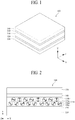
- FIG. 1 is a perspective view of a light blocking device 100 according to an aspect of the present disclosure.
- FIG. 2 is a cross-sectional view illustrating in detail an example of the light blocking device 100 of FIG. 1 .
- the light blocking device 100 may include a first substrate 110, a first electrode 120, a polymer dispersed liquid crystal (PDLC) layer 130, a second electrode 140, and a second substrate 150.
- PDLC polymer dispersed liquid crystal
- the first and second substrates 110 and 150 may each be a glass substrate, a plastic film, or the like.
- the first and second substrates 110 and 150 may each be a sheet or a film which includes cellulose resin such as triacetyl cellulose (TAC), diacetyl cellulose (DAC), or the like, cyclo olefin polymer (COP) such as norbornene derivatives or the like, acryl resin such as cyclo olefin copolymer (COC), poly(methylmethacrylate) (PMMA), or the like, polyolefin such as polycarbonate (PC), polyethylene (PE), polypropylene (PP), or the like, polyester such as polyvinyl alcohol (PVA), poly ether sulfone (PES), polyetheretherketone (PEEK), polyetherimide (PEI), polyethylenenaphthalate (PEN), polyethyleneterephthalate (PET), or the like, polyimide (PI), polysulfone (PSF), fluoride resin
- the first electrode 120 may be provided on the first substrate 110, and the second electrode 140 may be provided on the second substrate 150.
- Each of the first and second electrodes 120 and 140 may be transparent electrodes.
- each of the first and second electrodes 120 and 140 may be formed of silver oxide (for example, AgO, Ag 2 O, or Ag 2 O 3 ), aluminum oxide (for example, Al 2 O 3 ), tungsten oxide (for example, WO 2 , WO 3 , or W 2 O 3 ), magnesium oxide (for example, MgO), molybdenum oxide (for example, MoO 3 ), zinc oxide (for example, ZnO), tin oxide (for example, SnO 2 ), indium oxide (for example, In 2 O 3 ), chromium oxide (for example, CrO 3 or Cr 2 O 3 ), antimony oxide (for example, Sb 2 O 3 or Sb 2 O 5 ), titanium oxide (for example, TiO 2 ), nickel oxide (for example, NiO), copper oxide (for example, CuO or Cu 2 O),
- the PDLC layer 130 may be provided between the first substrate 110 and the second substrate 150, and the PDLC layer 130 may include a polymer 130a and droplets 130b.
- a PDLC applied to the light blocking device 100 for transparent display devices may scatter incident light according to liquid crystals and polymers which are randomly aligned in an initial state, thereby realizing a light blocking mode.
- the PDLC may transmit incident light as-is without scattering the incident light, thereby realizing a light transmitting mode.
- FIG. 1 only one PDLC layer 130 is illustrated, but the present aspect is not limited thereto. In other aspects, two or more PDLC layers may be provided between the first substrate 110 and the second substrate 150.
- the droplets 130b may each include a plurality of liquid crystals 130c. That is, the liquid crystals 130c may be dispersed to the droplets 130b by the polymer 130a.
- the liquid crystals 130c may be nematic liquid crystals of which alignment is changed by a vertical (a Y axis direction) electric field generated between the first electrode 120 and the second electrode 140, but are not limited thereto.
- the droplets 130b of the PDLC layer 130 may each include a plurality of liquid crystals 130c and dichroic dyes 130d. If the droplets 130b do not include the dichroic dyes 130d, light incident on the PDLC layer 130 may be merely scattered, and thus, a white-based light blocking mode may be realized.
- the light blocking device 100 according to an aspect of the present disclosure is applied to a transparent display device, if the transparent display device displays an image, light may be blocked based on black rather than light being blocked based on white, for increasing the quality of an image which is displayed by the transparent display device and is watched by a user. Therefore, in a case where the light blocking device 100 according to an aspect of the present disclosure is applied to a transparent display device, the droplets 130b may each include the dichroic dyes 130d, for increasing a light blocking effect and the image quality of the transparent display device.
- the liquid crystals 130c and the dichroic dyes 130d may be dispersed to the droplets 130b by the polymer 130a.
- the light blocking device 100 may realize a black state of the light blocking mode according to light being absorbed by the dichroic dyes 130d. That is, the light blocking device 100 may realize a light blocking state according to light being scattered by the PDLC layer 130 and absorbed by the dichroic dyes 130d.
- the liquid crystals 130c may be nematic liquid crystals aligned by the vertical electric field generated between the first electrode 120 and the second electrode 140, but are not limited thereto.
- the alignment of the dichroic dyes 130d, like the liquid crystals 130c, may be changed by the vertical electric field generated between the first electrode 120 and the second electrode 140.
- the dichroic dyes 130d may be dyes that absorb light.
- the dichroic dyes 130d may be black dyes, which absorbs all of light having a visible light wavelength range, or dyes which absorb light outside a wavelength range of a specific color (for example, red) and reflect light having the wavelength range of the specific color (for example, red).
- the dichroic dyes 130d may use black dyes so as to increase a light blocking effect of blocking light, but are not limited thereto.
- the droplets 130b of the PDLC layer 130 according to an aspect of the present disclosure may be provided in order for the liquid crystals 130c and the dichroic dyes 130d to be twisted with each other. That is, the liquid crystals 130c and the dichroic dyes 130d included in each of the droplets 130b of the PDLC layer 130 according to an aspect of the present disclosure may be aligned so as to be twisted with each other without being aligned in an arbitrary random direction. To this end, the PDLC layer 130 according to an aspect of the present disclosure may further include a chiral dopant which induces a twist structure of the liquid crystals 130c and the dichroic dyes 130d.
- liquid crystals 130c and the dichroic dyes 130d of each of the droplets 130b are aligned in an arbitrary direction, although it is unable to scatter or absorb incident light, liquid crystals 130c and dichroic dyes 130d included in different droplets 130b may be aligned in the same direction, or liquid crystals 130c and dichroic dyes 130d included in the same droplet 130b may be aligned in the same direction, with respect to all droplets 130b included in the PDLC layer 130. In this case, a scattering rate or an absorption rate of light incident on the PDLC layer 130 is lowered. Also, if a content of the dichroic dyes 130d increases for increasing a scattering rate or an absorption rate of incident light, a light transmittance is reduced in the light transmitting mode of the light blocking device 100.
- liquid crystals 130c and the dichroic dyes 130d are aligned so as to be twisted with each other in each of the droplets 130b, a scattering rate or an absorption rate of incident light increases.
- a more detailed feature of the droplets 130b according to an aspect of the present disclosure will be described below.
- FIG. 3 is an exemplary diagram illustrating a droplet of a PDLC layer.
- the inside of a droplet 130b may be in a liquid state, and the outside of the droplet 130b may be in a solid state due to a polymer 130a.
- Portions of the PDLC layer 130 except for the droplets 130b may be in a solid state due to the polymer 130a. Therefore, the PDLC layer 130 may be provided in plurality, and each of the PDLC layers 130 may maintain a cell gap between the first substrate 110 and the second substrate 150 even without a spacer or a partition wall. Accordingly, in an aspect of the present disclosure, a manufacturing process is simplified, and the manufacturing cost is reduced.
- the liquid crystals 130c and the dichroic dyes 130d may be twisted with each other and aligned.
- the liquid crystals 130c and the dichroic dyes 130d may be twisted at a predetermined reference angle and aligned by the chiral dopant in each of the droplets 130b.
- liquid crystals 130c and the dichroic dyes 130d may be twisted with each other at the reference angle (for example, an angle of 360 degrees to 3,600 degrees) and aligned in each of the droplets 130b
- An angle at which the liquid crystals 130c and the dichroic dyes 130d are twisted with each other may be adjusted based on the amount of chiral dopants included in the PDLC layer 130. In detail, by increasing the amount of chiral dopants, the angle at which the liquid crystals 130c and the dichroic dyes 130d are twisted with each other may increase.
- a helical twisted power (HTP) which induces the twist structure of the liquid crystals 130c and the dichroic dyes 130d may be changed depending on the kind of a chiral dopant, and thus, the amount of chiral dopants necessary for twisting the liquid crystals 130c and the dichroic dyes 130d at the same angle may be changed depending on the kinds of the chiral dopants.
- HTP helical twisted power
- the amount of chiral dopants which is to be added into the PDLC layer 130 of the light blocking device 100 may be set based on the following Equation (1):
- Chiral dopant g liquid crystal g pitch m ⁇ HTP % ⁇ m ⁇ 1 % ⁇ 1
- pitch denotes a value obtained through an arithmetic operation based on a depth/pitch
- depth denotes a size of each of the droplets 130b or a size of the cell gap between the second substrate 120 and the first substrate 110 including the PDLC layer 130
- pitch denotes an interval between the liquid crystals 130c and the dichroic dyes 130d twisted at 360 degrees. That is, depth/pitch denotes the number of times the liquid crystals 130c and the dichroic dyes 130d are fully twisted at 360 degrees in the cell gap or each of the droplets 130b.
- the PDLC layer 130 may include chiral dopants equal to an amount determined as a value inversely proportional to an HTP value of a chiral dopant and a pitch, and thus, the liquid crystals 130c and the dichroic dyes 130d may be twisted at the reference angle.
- the PDLC layer 130 may include the liquid crystals 130c and the dichroic dyes 130d which are twisted with each other and aligned in each of the droplets 130b, and moreover, the liquid crystals 130c and the dichroic dyes 130d may be twisted at an angle of 360 degrees to 3,600 degrees and aligned.
- the PDLC layer 130 may include the liquid crystals 130c and the dichroic dyes 130d which are twisted with each other and aligned in each of the droplets 130b, and moreover, the liquid crystals 130c and the dichroic dyes 130d may be twisted at an angle of 360 degrees to 3,600 degrees and aligned.
- Table 1 shows experiment data obtained by comparing transmittances and hazes in a light blocking mode and a light transmitting mode of a light blocking device including a PDLC layer having a structure where liquid crystals and dichroic dyes are not twisted, a light blocking device including a PDLC layer having a structure where liquid crystals and dichroic dyes are twisted with respect to a cell gap, and a light blocking device including a PDLC layer having a structure where liquid crystals and dichroic dyes are twisted with respect to a droplet.
- the twisted angle being 0 degrees denotes that the liquid crystals 130c and the dichroic dyes 130d of the PDLC layer 130 are not twisted as in an aspect of the present disclosure
- the twisted angle being provided with respect to the cell gap denotes that the liquid crystals 130c and the dichroic dyes 130d of the PDLC layer 130 are twisted with respect to the cell gap between the first substrate 110 and the second substrate 150
- the twisted angle being provided with respect to the droplet denotes that the liquid crystals 130c and the dichroic dyes 130d of the PDLC layer 130 are twisted in each of the droplets 130b.
- the liquid crystals 130c and the dichroic dyes 130d are twisted at a certain angle in each of the droplets 130b with respect to a corresponding droplet 130b, it is confirmed that in the light blocking mode, a transmittance is reduced and a haze increases.
- liquid crystals 130c and the dichroic dyes 130d are twisted at an angle of 360 degrees in each of the droplets 130b, it is confirmed that in the light blocking mode, a transmittance is lowered from 54.8% to 50.2%, and a haze increases from 85.4% to 92.5%, thereby improving a light blocking rate. Also, when the liquid crystals 130c and the dichroic dyes 130d are twisted at an angle of 720 degrees in each of the droplets 130b, it can be confirmed that in the light blocking mode, a transmittance is lowered from 54.8% to 49.2%, and a haze increases from 85.4% to 92.7%, thereby improving a light blocking rate.
- the liquid crystals 130c and the dichroic dyes 130d are twisted at a certain angle in each of the droplets 130b, it can be confirmed that as shown in Table 1, a light blocking rate is improved, and in the light transmitting mode, a change in transmittance or haze is not large.
- the light blocking device 100 due to a structure where the liquid crystals 130c and the dichroic dyes 130d are twisted in each of the droplets 130b, a light transmittance is not affected in the light transmitting mode, and a light blocking rate is improved in the light blocking mode.
- liquid crystals 130c and the dichroic dyes 130d of the PDLC layer 130 are twisted at an angle of 360 degrees to 3,600 degrees and aligned in each of the droplets 130b.
- the liquid crystals 130c and the dichroic dyes 130d are twisted at least once and aligned in each of the droplets 130b so as to improve a light blocking rate in the light blocking mode. That is, as described above, when the liquid crystals and the dichroic dyes are twisted with respect to the cell gap, the liquid crystals and the dichroic dyes are not twisted at an angle of 360 degrees in the droplet, and for this reason, a light blocking rate is not improved.
- the PDLC layer 130 may be implemented so that the liquid crystals 130c and the dichroic dyes 130d are twisted at an angle of 360 degrees or more in each of the droplets 130b, thereby improving a light blocking rate of the light blocking device 100.
- the liquid crystals 130c and the dichroic dyes 130d may be twisted at an angle of 3,600 degrees or less in each of the droplets 130b. That is, if an angle at which the liquid crystals 130c and the dichroic dyes 130d are twisted increases infinitely, due to the twist structure of the liquid crystals 130c and the dichroic dyes 130d, visible light is reflected, and a color is shown.
- the PDLC layer 130 may be implemented so that the liquid crystals 130c and the dichroic dyes 130d are twisted at an angle of 3,600 degrees or less in each of the droplets 130b, thereby solving a problem where visible light is reflected in the light blocking device 100.
- the light blocking device 100 may control a voltage applied to the first electrode 120 and the second electrode 140, and thus, may realize the light blocking mode of blocking light or the light transmitting mode of transmitting the light.
- the light blocking mode and the light transmitting mode of the light blocking device 100 will be described in detail with reference to FIGs. 4 and 5 .
- FIG. 4 is a cross-sectional view illustrating an example of a light blocking device in a light blocking mode
- FIG. 5 is a cross-sectional view illustrating an example of a light blocking device in a light transmitting mode.
- the light blocking device 100 may further include a voltage supply unit 160 that supplies a certain voltage to each of the first electrode 120 and the second electrode 140.
- the light blocking device 100 may control alignment of the liquid crystals 130c and the dichroic dyes 130d of the PDLC layer 130 according to a voltage applied to the first electrode 120 and a voltage applied to the second electrode 140, thereby realizing the light blocking mode of blocking incident light or the light transmitting mode of transmitting the incident light.
- the liquid crystals 130c and the dichroic dyes 130d of the PDLC layer 130 may maintain a state of being twisted at a certain angle, thereby realizing the light blocking mode of the light blocking device 100.
- the first threshold value may be set to a voltage difference between the voltage applied to the first electrode 120 and the voltage applied to the second electrode 140 so that a viewer discerns a transmission of light due to alignment of the liquid crystals 130c and the dichroic dyes 130d.
- the light blocking device 100 may realize the light blocking mode of blocking incident light.
- the dichroic dyes 130d are black dyes
- the light blocking device 100 may display a block-based color in the light blocking mode to block incident light. That is, in an aspect of the present disclosure, a specific color may be displayed based on the dichroic dyes 130d, and thus, a rear scene of the light blocking device is not shown.
- the light blocking device 100 may include a plurality of PDLC layers.
- incident light may be scattered by a first PDLC layer. Therefore, a light path for the scattered light may extend, and the scattered light having the extended light path may be incident on a PDLC layer subsequent thereto.
- the scattered light incident on the subsequent PDLC layer may be scattered by liquid crystals or may be absorbed by dichroic dyes. Accordingly, if the light blocking device 100 according to an aspect of the present disclosure includes the plurality of PDLC layers, a light blocking effect more increases than a case where light is blocked by one PDLC layer.
- FIG. 5 is a cross-sectional view illustrating an example of a light blocking device in a light transmitting mode.
- the liquid crystals 130c and the dichroic dyes 130d of the PDLC layer 130 may be aligned in a vertical direction (a Y axis direction) by a vertical electric field generated between the first electrode 120 and the second electrode 140, and thus, may transmit incident light as-is.
- the second threshold value may be a value which is equal to or greater than the first threshold value.
- the liquid crystals 130c and the dichroic dyes 130d may be aligned in a direction in which light is incident, and a refractive index between the liquid crystals 130c and the polymer 130a of the PDLC layer 130 may be minimized, whereby the scattering and absorbing of the light incident on the PDLC layer 130 are minimized. Accordingly, most of light incident on the light blocking device 100 may pass through the PDLC layer 130 as-is.
- the PDLC layer 130 including the liquid crystals 130c and the dichroic dyes 130d may transmit light in the light transmitting mode may scatter and absorb the light in the light blocking mode, and thus, the light blocking device 100 may transmit the light in the light transmitting mode and may block the light in the light blocking mode.
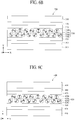
- FIG. 6A is a cross-sectional view illustrating in detail another example of the light blocking device of FIG. 1 .
- a light blocking device 200 may include a first substrate 210, a first electrode 220, a PDLC layer 230, a second electrode 240, a second substrate 250, a first refractive index correction layer 260, and a second refractive index correction layer 270.
- the first substrate 210, the first electrode 220, the PDLC layer 230, the second electrode 240, and the second substrate 250 of FIG. 6A are substantially the same as the first substrate 110, the first electrode 120, the PDLC layer 130, the second electrode 140, and the second substrate 150 of FIGS. 1 and 2 .
- detailed descriptions of the first substrate 210, the first electrode 220, the PDLC layer 230, the second electrode 240, and the second substrate 250 of FIG. 6A are omitted.
- the first refractive index correction layer 260 may be provided on a surface opposite to one surface of the first substrate 210 on which the first electrode 220 is provided. That is, the first electrode 220 may be provided on the one surface of the first substrate 210, and the first refractive index correction layer 260 may be provided on another surface corresponding to the surface opposite to the one surface of the first substrate 210.
- the reason that the light blocking device 200 according to another aspect of the present disclosure includes the first refractive index correction layer 260 is as follows. Fresnel reflection occurs due to a refractive index difference between air and the first substrate 210. For example, if there is the refractive index difference between the air and the first substrate 210, light incident on the first substrate 210 through the air may be reflected due to the refractive index difference between the air and the first substrate 210. Therefore, the first refractive index correction layer 260 may have a refractive index between the air and the first substrate 210 for decreasing the refractive index difference between the air and the first substrate 210.
- the first refractive index correction layer 260 may have a refractive index of 1.1 to 1.5 for decreasing the refractive index difference between the air and the first substrate 210.
- the second refractive index correction layer 270 may be provided on a surface opposite to one surface of the second substrate 250 on which the second electrode 250 is provided. That is, the second electrode 250 may be provided on the one surface of the second substrate 250, and the second refractive index correction layer 270 may be provided on another surface corresponding to the surface opposite to the one surface of the second substrate 250.
- the reason that the light blocking device 200 according to another aspect of the present disclosure includes the second refractive index correction layer 270 is as follows. Fresnel reflection occurs due to a refractive index difference between air and the second substrate 270. For example, in a case where there is the refractive index difference between the air and the second substrate 250, some of light passing through the second substrate 250 may be reflected due to a refractive index difference when the light is incident on the air. Therefore, the second refractive index correction layer 270 may have a refractive index between the air and the second substrate 250 for decreasing the refractive index difference between the air and the second substrate 250.
- the second refractive index correction layer 270 may have a refractive index of 1.1 to 1.5 for decreasing the refractive index difference between the air and the second substrate 250.
- Each of the first and second refractive index correction layers 260 and 270 may be formed of a transparent adhesive film such as an optically clear adhesive (OCA), an organic compound adhesive capable of thermal curing or ultraviolet (UV) curing, and/or the like.
- OCA optically clear adhesive
- UV ultraviolet
- FIG. 6B is a cross-sectional view illustrating in detail another example of the light blocking device of FIG. 1 .
- a light blocking device 300 may include a first substrate 310, a first electrode 320, a PDLC layer 330, a second electrode 340, a second substrate 350, a first refractive index correction layer 360, and a second refractive index correction layer 370.
- the first substrate 310, the first electrode 320, the PDLC layer 330, the second electrode 340, and the second substrate 350 of FIG. 6B are substantially the same as the first substrate 110, the first electrode 120, the PDLC layer 130, the second electrode 140, and the second substrate 150 of FIGS. 1 and 2 .
- detailed descriptions of the first substrate 310, the first electrode 320, the PDLC layer 330, the second electrode 340, and the second substrate 350 of FIG. 6B are omitted.
- the first refractive index correction layer 360 may be provided between the first substrate 310 and the second electrode 320.
- the reason that the light blocking device 300 according to another aspect of the present disclosure includes the first refractive index correction layer 360 is as follows. Fresnel reflection occurs due to a refractive index difference between the first substrate 310 and the first electrode 320. For example, in a case where there is the refractive index difference between the first substrate 310 and the first electrode 320, some of light passing through the first substrate 310 may be reflected due to a refractive index difference when the light is incident on the first electrode 320.
- the first refractive index correction layer 360 may have a refractive index between the first substrate 310 and the first electrode 320 for decreasing the refractive index difference between the first substrate 310 and the first electrode 320. For example, if a refractive index of the first substrate 310 is 1.6 and a refractive index of the first electrode 320 is 2, the first refractive index correction layer 360 may have a refractive index of 1.7 to 1.9 for decreasing the refractive index difference between the first substrate 310 and the first electrode 320.
- the second refractive index correction layer 370 may be provided between the second substrate 350 and the second electrode 340.
- the reason that the light blocking device 300 according to another aspect of the present disclosure includes the second refractive index correction layer 370 is as follows. Fresnel reflection occurs due to a refractive index difference between the second substrate 350 and the second electrode 340. For example, in a case where there is the refractive index difference between the second substrate 350 and the second electrode 340, some of light passing through the second electrode 340 may be reflected due to a refractive index difference when the light is incident on the second substrate 350.
- the second refractive index correction layer 370 may have a refractive index between the second substrate 350 and the second electrode 340 for decreasing the refractive index difference between the second substrate 350 and the second electrode 340.
- the second refractive index correction layer 370 may have a refractive index of 1.7 to 1.9 for decreasing the refractive index difference between the second substrate 350 and the second electrode 340.
- Each of the first and second refractive index correction layers 360 and 370 may be formed of a transparent adhesive film such as an OCA, an organic compound adhesive capable of thermal curing or UV curing, and/or the like.
- FIG. 6C is a cross-sectional view illustrating in detail another example of the light blocking device of FIG. 1 .
- a light blocking device 400 may include a first substrate 410, a first electrode 420, a PDLC layer 430, a second electrode 440, a second substrate 450, a first refractive index correction layer 460, and a second refractive index correction layer 470.
- the first substrate 410, the first electrode 420, the PDLC layer 430, the second electrode 440, and the second substrate 450 of FIG. 6C are substantially the same as the first substrate 110, the first electrode 120, the PDLC layer 130, the second electrode 140, and the second substrate 150 of FIGS. 1 and 2 .
- detailed descriptions of the first substrate 410, the first electrode 420, the PDLC layer 430, the second electrode 440, and the second substrate 450 of FIG. 6C are omitted.
- the first refractive index correction layer 460 may be provided between the first electrode 420 and the PDLC layer 430.
- the reason that the light blocking device 400 according to another aspect of the present disclosure includes the first refractive index correction layer 460 is as follows. Fresnel reflection occurs due to a refractive index difference between the first electrode 420 and the PDLC layer 430. For example, in a case where there is the refractive index difference between the first electrode 420 and the PDLC layer 430, some of light passing through the first electrode 420 may be reflected due to a refractive index difference when the light is incident on the PDLC layer 430. Therefore, the first refractive index correction layer 460 may have a refractive index between the first electrode 420 and the PDLC layer 430 for decreasing the refractive index difference between the first electrode 420 and the PDLC layer 430.
- the second refractive index correction layer 470 may be provided between the second electrode 440 and the PDLC layer 430.
- the reason that the light blocking device 400 according to another aspect of the present disclosure includes the second refractive index correction layer 470 is as follows. Fresnel reflection occurs due to a refractive index difference between the second electrode 440 and the PDLC layer 430. For example, in a case where there is the refractive index difference between the second electrode 440 and the PDLC layer 430, some of light passing through the second electrode 440 may be reflected due to a refractive index difference when the light is incident on the PDLC layer 430. Therefore, the second refractive index correction layer 470 may have a refractive index between the second electrode 440 and the PDLC layer 430 for decreasing the refractive index difference between the second electrode 440 and the PDLC layer 430.
- Each of the first and second refractive index correction layers 460 and 470 may be formed of a transparent adhesive film such as an OCA, an organic compound adhesive capable of thermal curing or UV curing, and/or the like.
- FIGs. 7A and 7B are diagrams showing a driving voltage characteristic for realizing a light blocking device according to an aspect of the present disclosure in a light transmitting mode.
- FIG. 7A shows a driving voltage characteristic of a light blocking device according to an aspect of the present disclosure, for implementing the light blocking device an aspect of the present disclosure in the light transmitting mode.
- FIG. 7B shows a driving voltage characteristic of a light blocking device according to another aspect of the present disclosure, for driving the light blocking device an aspect of the present disclosure in the light transmitting mode.
- driving the light blocking device 100 according to an aspect of the present disclosure described above with reference to FIGs. 1 to 5 will be described.
- a below-described driving method may be identically applied to the light blocking devices 200, 300, and 400 according to another aspect of the present disclosure.
- the voltage supply unit 160 may respectively apply voltages to the first electrode 120 and the second electrode 140 so that a voltage difference between a voltage applied to the first electrode 120 and a voltage applied to the second electrode 140 is greater than the second threshold value.
- the second threshold value may have a value which is higher than a case where the related art light blocking device is driven in the light transmitting mode.
- the liquid crystals and the dichroic dyes are not twisted, a relatively lower voltage is needed for aligning the liquid crystals and the dichroic dyes in a certain direction.
- a relatively higher voltage is needed for releasing the twist structure of the liquid crystals 130c and the dichroic dyes 130d and aligning the liquid crystals 130c and the dichroic dyes 130d in a certain direction.
- liquid crystals 130c and the dichroic dyes 130d are twisted with each other, a hysteresis exists in the transmittance and haze, based on an increase or a reduction in the voltages respectively applied to the first electrode 120 and the second electrode 140.
- the voltage supply unit 160 may be over-driven for a certain time, thereby preventing the driving voltage and consumption power from increasing.
- the voltage supply unit 160 may supply a voltage, where a voltage difference between a voltage applied to the first electrode 120 and a voltage applied to the second electrode 140 corresponds to a first reference value, for a first reference time Tref1, and when the first reference time Tref1 elapses, the voltage supply unit 160 may supply a voltage, where the voltage difference between the voltage applied to the first electrode 120 and the voltage applied to the second electrode 140 corresponds to a second reference value less than the first reference value, for a second reference time Tref2.
- the first reference time may be set shorter than the second reference time. Accordingly, since the first reference time for which an over voltage is applied is shorter than the second reference time, the light blocking device 100 may be driven without any increase in consumption power.
- a characteristic of the driving voltage which is applied without any change may be changed, a voltage having the first reference value corresponding to a voltage higher than a previous driving voltage may be supplied for the first reference time, and when the first reference time elapses, a voltage having the second reference value corresponding to a voltage lower than the previous driving voltage may be supplied for the second reference time, thereby reflecting or negating a hysteresis of the transmittance and haze.
- the light blocking device 100 including the PDLC layer 130 having a structure where the liquid crystals 130c and the dichroic dyes 130d are twisted may be driven in the light transmitting mode without any increase in the driving voltage or consumption power.
- FIG. 8 is a flowchart illustrating a method of manufacturing a light blocking device according to an aspect of the present disclosure.
- the first electrode 120 may be formed on the first substrate 110, and the second electrode 140 may be formed on the second substrate 150 in operation S101.
- the first substrate 110 and the second substrate 150 may each be a transparent glass substrate, a plastic film, or the like.
- the first substrate 110 and the second substrate 150 may each be a transparent electrode or the like.
- a liquid crystal mixture having a liquid state may be produced by mixing the liquid crystals 130c, the dichroic dyes 130d, and a chiral dopant with a monomer.
- the chiral dopant may be added in a case where the liquid crystals 130c and the dichroic dyes 130d are mixed in the monomer, and thus, the liquid crystals 130c and the dichroic dyes 130d may be twisted with each other.
- chiral dopants which enable the liquid crystals 130c and the dichroic dyes 130d to be twisted with each other at an angle of 360 degrees to 3,600 degrees in each of the droplets 130b may be mixed with the monomer along with the liquid crystals 130c and the dichroic dyes 130d.
- a mixing rate at which the monomer and the liquid crystals 130c are mixed in the liquid crystal mixture may be set within an appropriate range, based on scattering and absorbing of light.
- a photo initiator may be added into the liquid crystal mixture.
- the dichroic dyes 130d may be mixed with the liquid crystal mixture at a certain rate.
- the dichroic dyes 130d may be added by 0.5 wt% to 5 wt% of the liquid crystal mixture.
- the dichroic dyes 130d may be added by 0.5 wt% or more of the liquid crystal mixture.
- the dichroic dyes 130d may be absorb the UV, and thus, some of monomers included in the liquid crystal mixture cannot be cured to a polymer.
- the dichroic dyes 130d may be added by 5wt% of the liquid crystal mixture.
- the liquid crystal mixture may be coated on the first electrode 120, and the second electrode 140 of the second substrate 150 may be bonded to the liquid crystal mixture in operation S103.
- the present aspect is not limited thereto, and the second electrode 140 may be disposed on the liquid crystal mixture through lamination.
- the PDLC layer 130 may be formed in operation S104.
- a wavelength range of the UV which is irradiated for forming the PDLC layer 130 may be 10 nm to 200 nm, and for example, may be 320 nm to 380 nm.
- an UV irradiation duration may be 10 sec to 60 min.
- an intensity of the UV maybe 10 mW/cm 2 to 50 mW/cm 2 , and for example, maybe 10 mW/cm 2 to 20 mW/cm 2 .
- Operations S103 and S104 of FIG. 8 may be performed in a roll-to-roll method. That is, the first substrate 110 including the first electrode 120 may be moved by rollers, and a liquid crystal injecting device may coat the liquid crystal mixture on the first electrode 120.
- the first substrate 110 including the liquid crystal mixture may be moved by the rollers and may be bonded to the second substrate 150 including the second electrode 140.
- an UV irradiating device may irradiate the UV to cure the liquid crystal mixture, thereby forming the PDLC layer 130. UV energy irradiated for forming the PDLC layer 130 is as described above.
- the light blocking device 100 may be manufactured.
- the light blocking device 100 illustrated in FIG. 2 may be finished in the manufacturing method according to an aspect of the present disclosure illustrated in FIG. 8 .
- the light blocking devices 200, 300, and 400 according to another aspect of the present disclosure illustrated in FIGs. 6A to 6C may be manufactured in the manufacturing method according to an aspect of the present disclosure illustrated in FIG. 8 .
- a method of injecting a liquid crystal into a gap between the first substrate 110 and the second substrate 150 instead of a method of injecting a liquid crystal into a gap between the first substrate 110 and the second substrate 150, a method of coating the liquid crystal mixture on the first substrate 110 or the second substrate 150 and curing the liquid crystal mixture with UV may be used. Accordingly, according to an aspect of the present disclosure, a manufacturing process is simplified, and the cost is reduced.
- FIG. 9 is a perspective view illustrating a transparent display device according to an aspect of the present disclosure.
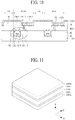
- FIG. 10 is a cross-sectional view illustrating in detail a lower substrate of a transparent display panel of FIG. 9 .
- the transparent display device may include a light blocking device 1000, a transparent display panel 1100, and an adhesive layer 1200.
- the light blocking device 1000 may be implemented as one of the light blocking devices 200, 300, and 400 according to another aspect of the present disclosure illustrated in FIGs. 6A to 6C . Therefore, the light blocking device 1000 may block incident light in the light blocking mode, and in the light transmitting mode, the light blocking device 1000 may transmit the incident light.
- the light blocking device 1000 according to an aspect of the present disclosure may include a PDLC layer including liquid crystals and dichroic dyes which are twisted with each other, and thus, may have an enhanced light blocking rate in the light blocking mode.
- the light blocking device 1000 may display a specific color by using the dichroic dyes, and thus, a rear scene of the light blocking device 1000 is not shown, thereby enabling a user to feel an aesthetic sense in addition to a light blocking function.
- the transparent display panel 1100 may include a transmissive area TA and a non-transmissive area NTA as in FIG. 10 .
- a plurality of pixels displaying an image may be provided in the non-transmissive area NTA.
- Each of the plurality of pixels, as in FIG. 10 may include a transistor T, an anode electrode AND, an organic layer EL, and a cathode electrode CAT.
- the transistor T may include an active layer ACT provided on a lower substrate 1101, a first insulation layer I1 provided on the active layer ACT, a gate electrode GE provided on the first insulation layer I1, a second insulation layer I2 provided on the gate electrode GE, and a source electrode SE and a drain electrode DE which are provided on the second insulation layer I2 and are connected to the active layer ACT through first and second contact holes CNT1 and CNT2.
- the transistor T is illustrated as being formed as a top gate type, but may be formed as a bottom gate type without being limited thereto.
- the anode electrode AND may be connected to the drain electrode DE of the transistor T through a third contact hole CNT3 passing through an interlayer dielectric ILD which is provided on the source electrode SE and the drain electrode DE. Accordingly, a partition wall W may be provided between adjacent anode electrodes AND to electrically insulate the adjacent anode electrodes AND.
- the organic layer EL may be provided on the anode electrode AND.
- the organic layer EL may include a hole transporting layer, an organic light emitting layer, and an electron transporting layer.
- the cathode electrode CAT may be provided on the organic layer EL and the partition wall W.
- a voltage is applied to the cathode electrode CAT and the anode electrode AND, a hole and an electron may move to the organic light emitting layer through the hole transporting layer and the electron transporting layer and are combined in the organic light emitting layer to emit light.
- the transparent display panel 1100 is illustrated as being implemented as a top emission type, but is not limited thereto. Alternatively, the transparent display panel 1100 may be implemented as a bottom emission type or a dual emission type. When the transparent display panel 1100 is implemented as the top emission type, the light blocking device 1000 may be disposed under the lower substrate 1101. When the transparent display panel 1100 is implemented as the bottom emission type, the light blocking device 1000 may be disposed on an upper substrate.
- the transparent display panel 1100 may be adhered to the light blocking device 1000 by the adhesive layer 1200.
- the adhesive layer 1200 may be a transparent adhesive film such as an OCA or the like.
- One surface of the adhesive layer 1200 may be adhered to a portion under the lower substrate 1101 of the transparent display panel 1100 or a portion on the upper substrate, and another surface of the adhesive layer 1200 may be adhered to the light blocking device 1000.
- the adhesive layer 1200 may have a refractive index of 1.4 to 1.9.
- the lower substrate 1101 or the upper substrate of the transparent display panel 1100 may be a second substrate of the light blocking device 1000.
- the second electrode 140 of the light blocking device 1000 may be provided on the lower substrate 1101 or the upper substrate of the transparent display panel 1100.
- the transparent display panel 1100 may be driven in a display mode, where the pixels display an image, and a non-display mode where the pixels do not display an image.
- the light blocking device 1000 may be driven in the light blocking mode where incident light is blocked through a rear surface of the transparent display panel 1100, for increasing the quality of an image.
- the light blocking device 1000 may be driven in the light blocking mode or the light transmitting mode.
- the transparent display device is shown in black to a user.
- the transparent display device may be transparently implemented, and thus, the user can see a rear scene of the transparent display device through the transparent display device.
- FIG. 11 is a perspective view of a transparent display device according to another aspect of the present disclosure.
- the transparent display device may include a first light blocking device 1000a, a second light blocking device 1000b, a transparent display panel 1100, a first adhesive layer 1200, and a second adhesive layer 1300.
- Each of the first and second light blocking devices 1000a and 1000b may be implemented as one of the light blocking devices 100, 200, 300, and 400 according to the aspects of the present disclosure described above with reference to FIGs. 1, 2 , and 6A to 6C . Therefore, each of the first and second light blocking devices 1000a and 1000b may block incident light in the light blocking mode, and in the light transmitting mode, each of the first and second light blocking devices 1000a and 1000b may transmit the incident light.
- Each of the first and second light blocking devices 1000a and 1000b enables a user to feel an aesthetic sense in addition to a light blocking function, based on dichroic dyes.
- the transparent display panel 1100 is substantially the same as described above with reference to FIGs. 9 and 10 . Thus, a detailed description of the transparent display panel 1100 is omitted.
- the transparent display panel 1100 may be adhered to the first light blocking device 1000a by the first adhesive layer 1200.
- the first adhesive layer 1200 may be a transparent adhesive film such as an OCA or the like.
- One surface of the first adhesive layer 1200 may be adhered to a portion under the lower substrate 1101 of the transparent display panel 1100 or a portion on the upper substrate, and another surface of the first adhesive layer 1200 may be adhered to the first light blocking device 1000a.
- the first adhesive layer 1200 may have a refractive index of 1.4 to 1.9.
- the transparent display panel 1100 may be adhered to the second light blocking device 1000b by the second adhesive layer 1300.
- the second adhesive layer 1300 may be a transparent adhesive film such as an OCA or the like.
- One surface of the second adhesive layer 1300 may be adhered to a portion under the lower substrate 1101 of the transparent display panel 1100 or a portion on the upper substrate, and another surface of the second adhesive layer 1300 may be adhered to the second light blocking device 1000b.
- the second adhesive layer 1300 may have a refractive index of 1.4 to 1.9.
- the transparent display panel 1100 may be driven in the display mode, where the pixels display an image, and the non-display mode where the pixels do not display an image.
- the first light blocking device 1000a may be driven in the light blocking mode where incident light is blocked through a rear surface of the transparent display panel 1100, for increasing the quality of an image.
- the first and second light blocking devices 1000a and 1000b may be driven in the light blocking mode or the light transmitting mode.
- the transparent display device is shown in black to a user.
- the transparent display device may be transparently implemented, and thus, the user can see a rear scene of the transparent display device through the transparent display device.
- the transparent display panel 1100 may be implemented as a double-sided transparent display panel for displaying an image in a double-sided direction.
- first and second light blocking devices 1000a and 1000b are driven in the light transmitting mode in the display mode where the double-sided transparent display panel displays an image in the double-sided direction, users can watch an image in the double-sided direction.
- one of the first and second light blocking devices 1000a and 1000b is driven in the light blocking mode in the display mode where the double-sided transparent display panel displays an image in the double-sided direction, users cannot watch an image in one direction of the double-sided direction.
- the light blocking device since the light blocking device includes the PDLC layer where liquid crystals and dichroic dyes are twisted with each other in a droplet, a light blocking rate increases in the light blocking mode, and a light transmittance increases in the light transmitting mode.
- the PDLC layer may be over-driven by reflecting or overcoming a hysteresis of a light blocking rate and a light transmittance of liquid crystals and dichroic dyes twisted with each other, thereby preventing a driving voltage from increasing.
- a light blocking rate increases in the light blocking mode.
- a cell gap is maintained even without a spacer or a partition wall. Accordingly, a manufacturing process is simplified, and the manufacturing cost is reduced.
- a method of injecting a liquid crystal into a gap between the first substrate and the second substrate instead of a method of injecting a liquid crystal into a gap between the first substrate and the second substrate, a method of forming a liquid crystal mixture on a substrate to cure the liquid crystal mixture with UV may be used, and thus, a manufacturing process is simplified, thereby reducing the cost.
- the light blocking device executes the light blocking mode of blocking light incident on a rear surface of the transparent display panel in the display mode where the pixels of the transparent display panel display an image, the quality of an image displayed by the transparent display panel is enhanced.
Landscapes
- Physics & Mathematics (AREA)
- Nonlinear Science (AREA)
- Chemical & Material Sciences (AREA)
- General Physics & Mathematics (AREA)
- Optics & Photonics (AREA)
- Crystallography & Structural Chemistry (AREA)
- Mathematical Physics (AREA)
- Dispersion Chemistry (AREA)
- Engineering & Computer Science (AREA)
- Liquid Crystal (AREA)
- Computer Hardware Design (AREA)
- Theoretical Computer Science (AREA)
Applications Claiming Priority (1)
| Application Number | Priority Date | Filing Date | Title |
|---|---|---|---|
| KR1020160161203A KR102648592B1 (ko) | 2016-11-30 | 2016-11-30 | 차광장치, 차광장치의 제조방법, 및 차광장치를 포함한 투명표시장치 |
Publications (3)
| Publication Number | Publication Date |
|---|---|
| EP3330785A2 true EP3330785A2 (de) | 2018-06-06 |
| EP3330785A3 EP3330785A3 (de) | 2018-07-11 |
| EP3330785B1 EP3330785B1 (de) | 2020-08-12 |
Family
ID=60582414
Family Applications (1)
| Application Number | Title | Priority Date | Filing Date |
|---|---|---|---|
| EP17204627.8A Active EP3330785B1 (de) | 2016-11-30 | 2017-11-30 | Lichtsperrvorrichtung und transparente anzeigevorrichtung damit |
Country Status (4)
| Country | Link |
|---|---|
| US (1) | US10394070B2 (de) |
| EP (1) | EP3330785B1 (de) |
| KR (1) | KR102648592B1 (de) |
| CN (1) | CN108121100B (de) |
Families Citing this family (23)
| Publication number | Priority date | Publication date | Assignee | Title |
|---|---|---|---|---|
| US20210063836A1 (en) | 2017-04-26 | 2021-03-04 | View, Inc. | Building network |
| US12603091B2 (en) | 2017-04-26 | 2026-04-14 | View Operating Corporation | Immersive collaboration of remote participants via media displays |
| US11467464B2 (en) | 2017-04-26 | 2022-10-11 | View, Inc. | Displays for tintable windows |
| EP3616189A4 (de) | 2017-04-26 | 2020-12-09 | View, Inc. | Tönbares fenstersystem für gebäudedienste |
| US12339557B2 (en) | 2017-04-26 | 2025-06-24 | View, Inc. | Configuration associated with media display of a facility |
| US11892738B2 (en) | 2017-04-26 | 2024-02-06 | View, Inc. | Tandem vision window and media display |
| US12147142B2 (en) | 2017-04-26 | 2024-11-19 | View, Inc. | Remote management of a facility |
| US11747698B2 (en) | 2017-04-26 | 2023-09-05 | View, Inc. | Tandem vision window and media display |
| US11747696B2 (en) | 2017-04-26 | 2023-09-05 | View, Inc. | Tandem vision window and media display |
| EP3756046A4 (de) * | 2018-09-18 | 2021-10-27 | Hewlett-Packard Development Company, L.P. | Sichtschutzfolien für elektronische bildschirme |
| CN109491125A (zh) * | 2018-12-21 | 2019-03-19 | 深圳市华星光电半导体显示技术有限公司 | 一种透明显示面板及透明显示器 |
| CN110133897A (zh) * | 2019-05-17 | 2019-08-16 | 深圳市华星光电半导体显示技术有限公司 | 透明显示装置 |
| CN110224080B (zh) * | 2019-06-18 | 2021-12-10 | 京东方科技集团股份有限公司 | 一种透明显示面板及其制备方法、显示装置 |
| CN112305825B (zh) * | 2019-08-01 | 2022-04-15 | 京东方科技集团股份有限公司 | 液晶复合材料、光切换器件、显示装置及其制作方法 |
| CN110865496A (zh) * | 2019-11-07 | 2020-03-06 | 深圳市华星光电半导体显示技术有限公司 | 显示面板及其制备方法、显示装置 |
| CN110794609A (zh) * | 2019-11-27 | 2020-02-14 | 深圳市华星光电半导体显示技术有限公司 | 显示装置、显示终端及背光调节方法 |
| KR102788730B1 (ko) * | 2019-12-19 | 2025-04-02 | 삼성디스플레이 주식회사 | 광 제어 패널 및 이를 포함하는 표시 장치 |
| CN111158195B (zh) * | 2020-01-02 | 2022-09-09 | 京东方科技集团股份有限公司 | 一种显示装置及其制备方法、驱动方法 |
| CN116413950B (zh) | 2020-02-19 | 2024-10-15 | 群创光电股份有限公司 | 电子装置 |
| TWI738417B (zh) * | 2020-07-10 | 2021-09-01 | 友達光電股份有限公司 | 顯示裝置以及驅動方法 |
| US11906828B2 (en) | 2020-09-30 | 2024-02-20 | Sioptica Gmbh | Switchable light filter and use thereof |
| JP2022129507A (ja) * | 2021-02-25 | 2022-09-06 | 日東電工株式会社 | 加飾フィルム |
| DE102023110269B3 (de) | 2023-04-21 | 2023-12-28 | Sioptica Gmbh | Schaltbarer Lichtfilter, Beleuchtungseinrichtung und Bildschirm |
Family Cites Families (22)
| Publication number | Priority date | Publication date | Assignee | Title |
|---|---|---|---|---|
| US5170271A (en) * | 1991-01-31 | 1992-12-08 | Hughes Aircraft Company | Shaped voltage pulse method for operating a polymer dispersed liquid crystal cell, and light valve employing the same |
| JPH07104257A (ja) * | 1993-10-07 | 1995-04-21 | Casio Comput Co Ltd | 高分子分散型液晶表示素子 |
| US5559615A (en) * | 1993-10-07 | 1996-09-24 | Casio Computer Co., Ltd. | Polymer dispersed liquid crystal display device |
| KR960004149A (ko) * | 1994-07-28 | 1996-02-23 | 김태구 | 자동차 사이드 판넬의 보강구조 |
| CN1242097A (zh) * | 1996-12-19 | 2000-01-19 | 科罗拉多微显公司 | 借助电极电压的调制以改变电光层状态的显示系统 |
| CA2355426A1 (en) * | 2001-08-17 | 2003-02-17 | Luther Haave | A system and method for asset tracking |
| JP3680783B2 (ja) * | 2001-11-01 | 2005-08-10 | ソニー株式会社 | 電子機器、通信システムおよび方法、情報処理端末および方法、情報処理装置および方法、並びにプログラム |
| US20060014597A1 (en) * | 2004-07-15 | 2006-01-19 | Roger Cantu | Bob stick |
| CN100446079C (zh) * | 2004-12-15 | 2008-12-24 | 日本电气株式会社 | 液晶显示装置、其驱动方法及其驱动电路 |
| JP2007249041A (ja) * | 2006-03-17 | 2007-09-27 | Fujifilm Corp | 調光材料 |
| US8446548B2 (en) * | 2006-05-19 | 2013-05-21 | Nlt Technologies, Ltd. | Light source device, display device, terminal device, and transparent/scattering state switching element |
| US20120256895A1 (en) * | 2009-12-28 | 2012-10-11 | Sharp Kabushiki Kaisha | Display device |
| DE102010032412B4 (de) * | 2010-07-27 | 2012-03-08 | Dkt Verwaltungs-Gmbh | Verfahren zum Herstellen einer Zündelektrode für eine Vorkammerzündkerze und Vorkammerzündkerze |
| EP2761360A4 (de) * | 2011-09-30 | 2015-06-10 | 3M Innovative Properties Co | Elektronisch umschaltbare privatsphärefolien und anzeigevorrichtung damit |
| US9304350B2 (en) * | 2012-06-01 | 2016-04-05 | Kent State University | Encapsulated polymer stabilized cholesteric texture light shutter |
| JP6057580B2 (ja) * | 2012-07-18 | 2017-01-11 | 株式会社アクシス | 把手付き不織布袋 |
| CN103197455B (zh) * | 2013-03-19 | 2014-01-01 | 清华大学 | 一种提高相控硅基液晶器件响应速度的方法 |
| US9989798B2 (en) | 2014-06-27 | 2018-06-05 | Lg Display Co., Ltd. | Light controlling apparatus, method of fabricating the light controlling apparatus and transparent display device including the light controlling apparatus with transparent mode and light shielding mode |
| EP2963488A1 (de) | 2014-06-30 | 2016-01-06 | LG Display Co., Ltd. | Lichtsteuerungsvorrichtung und transparente anzeige damit |
| KR102401938B1 (ko) * | 2014-06-30 | 2022-05-26 | 엘지디스플레이 주식회사 | 광 제어 장치와 이를 포함한 투명표시장치 |
| EP2983040B1 (de) | 2014-07-25 | 2019-05-22 | LG Display Co., Ltd. | Durchsichtige anzeige basierend auf einem "gast-wirt" (guest-host) cholesterischen flüssigkristallbauelement |
| EP3037931B1 (de) * | 2014-12-22 | 2018-06-20 | LG Display Co., Ltd. | Berührungsempfindliche vorrichtung und ansteuerungsverfahren von einer berührungsempfindlichen anzeigevorrichtung |
-
2016
- 2016-11-30 KR KR1020160161203A patent/KR102648592B1/ko active Active
-
2017
- 2017-11-24 CN CN201711194726.3A patent/CN108121100B/zh active Active
- 2017-11-29 US US15/825,897 patent/US10394070B2/en active Active
- 2017-11-30 EP EP17204627.8A patent/EP3330785B1/de active Active
Non-Patent Citations (1)
| Title |
|---|
| None |
Also Published As
| Publication number | Publication date |
|---|---|
| KR102648592B1 (ko) | 2024-03-15 |
| EP3330785B1 (de) | 2020-08-12 |
| CN108121100A (zh) | 2018-06-05 |
| US20180149908A1 (en) | 2018-05-31 |
| CN108121100B (zh) | 2021-06-15 |
| US10394070B2 (en) | 2019-08-27 |
| EP3330785A3 (de) | 2018-07-11 |
| KR20180061717A (ko) | 2018-06-08 |
Similar Documents
| Publication | Publication Date | Title |
|---|---|---|
| EP3330785B1 (de) | Lichtsperrvorrichtung und transparente anzeigevorrichtung damit | |
| US9804467B2 (en) | Light controlling apparatus and method of fabricating the same | |
| EP2960714B1 (de) | Transparente anzeigevorrichtung mit einer lichtsteuerungsvorrichtung | |
| US9971222B2 (en) | Light controlling apparatus and transparent display including the same | |
| US10228600B2 (en) | Light controlling apparatus and transparent display including the same | |
| US10423022B2 (en) | Light shielding apparatus, method of fabricating the same, and transparent display device including the same | |
| KR102314707B1 (ko) | 광 제어 장치, 상기 광 제어 장치의 제조방법, 및 상기 광 제어 장치를 포함한 투명표시장치 | |
| US10502999B2 (en) | Light controlling apparatus and method of fabricating the same | |
| US10054825B2 (en) | Light control device and transparent display device including the same | |
| US10317720B2 (en) | Light control apparatus, manufacturing method for light control apparatus, and display apparatus comprising light control apparatus | |
| US10345635B2 (en) | Light control device, method for manufacturing light control device and display device comprising light control device | |
| KR102388894B1 (ko) | 광 제어 장치 및 이의 제조 방법 | |
| KR102401938B1 (ko) | 광 제어 장치와 이를 포함한 투명표시장치 | |
| US10838260B2 (en) | Light controlling device and method for fabricating the same | |
| KR20150139424A (ko) | 차광장치, 차광장치의 제조방법, 및 차광장치를 포함한 투명표시장치 | |
| KR20160027890A (ko) | 광 제어 장치 및 이의 제조 방법 |
Legal Events
| Date | Code | Title | Description |
|---|---|---|---|
| PUAI | Public reference made under article 153(3) epc to a published international application that has entered the european phase |
Free format text: ORIGINAL CODE: 0009012 |
|
| STAA | Information on the status of an ep patent application or granted ep patent |
Free format text: STATUS: REQUEST FOR EXAMINATION WAS MADE |
|
| 17P | Request for examination filed |
Effective date: 20171130 |
|
| AK | Designated contracting states |
Kind code of ref document: A2 Designated state(s): AL AT BE BG CH CY CZ DE DK EE ES FI FR GB GR HR HU IE IS IT LI LT LU LV MC MK MT NL NO PL PT RO RS SE SI SK SM TR |
|
| AX | Request for extension of the european patent |
Extension state: BA ME |
|
| PUAL | Search report despatched |
Free format text: ORIGINAL CODE: 0009013 |
|
| AK | Designated contracting states |
Kind code of ref document: A3 Designated state(s): AL AT BE BG CH CY CZ DE DK EE ES FI FR GB GR HR HU IE IS IT LI LT LU LV MC MK MT NL NO PL PT RO RS SE SI SK SM TR |
|
| AX | Request for extension of the european patent |
Extension state: BA ME |
|
| RIC1 | Information provided on ipc code assigned before grant |
Ipc: G02F 1/1335 20060101ALI20180601BHEP Ipc: G02F 1/1334 20060101AFI20180601BHEP Ipc: G02F 1/137 20060101ALI20180601BHEP Ipc: G02F 1/133 20060101ALI20180601BHEP |
|
| RBV | Designated contracting states (corrected) |
Designated state(s): AL AT BE BG CH CY CZ DE DK EE ES FI FR GB GR HR HU IE IS IT LI LT LU LV MC MK MT NL NO PL PT RO RS SE SI SK SM TR |
|
| STAA | Information on the status of an ep patent application or granted ep patent |
Free format text: STATUS: EXAMINATION IS IN PROGRESS |
|
| 17Q | First examination report despatched |
Effective date: 20190520 |
|
| GRAP | Despatch of communication of intention to grant a patent |
Free format text: ORIGINAL CODE: EPIDOSNIGR1 |
|
| STAA | Information on the status of an ep patent application or granted ep patent |
Free format text: STATUS: GRANT OF PATENT IS INTENDED |
|
| INTG | Intention to grant announced |
Effective date: 20200226 |
|
| GRAS | Grant fee paid |
Free format text: ORIGINAL CODE: EPIDOSNIGR3 |
|
| GRAJ | Information related to disapproval of communication of intention to grant by the applicant or resumption of examination proceedings by the epo deleted |
Free format text: ORIGINAL CODE: EPIDOSDIGR1 |
|
| GRAL | Information related to payment of fee for publishing/printing deleted |
Free format text: ORIGINAL CODE: EPIDOSDIGR3 |
|
| STAA | Information on the status of an ep patent application or granted ep patent |
Free format text: STATUS: EXAMINATION IS IN PROGRESS |
|
| GRAR | Information related to intention to grant a patent recorded |
Free format text: ORIGINAL CODE: EPIDOSNIGR71 |
|
| STAA | Information on the status of an ep patent application or granted ep patent |
Free format text: STATUS: GRANT OF PATENT IS INTENDED |
|
| GRAA | (expected) grant |
Free format text: ORIGINAL CODE: 0009210 |
|
| STAA | Information on the status of an ep patent application or granted ep patent |
Free format text: STATUS: THE PATENT HAS BEEN GRANTED |
|
| INTC | Intention to grant announced (deleted) | ||
| INTG | Intention to grant announced |
Effective date: 20200701 |
|
| AK | Designated contracting states |
Kind code of ref document: B1 Designated state(s): AL AT BE BG CH CY CZ DE DK EE ES FI FR GB GR HR HU IE IS IT LI LT LU LV MC MK MT NL NO PL PT RO RS SE SI SK SM TR |
|
| REG | Reference to a national code |
Ref country code: CH Ref legal event code: EP |
|
| REG | Reference to a national code |
Ref country code: IE Ref legal event code: FG4D |
|
| REG | Reference to a national code |
Ref country code: DE Ref legal event code: R096 Ref document number: 602017021474 Country of ref document: DE |
|
| REG | Reference to a national code |
Ref country code: AT Ref legal event code: REF Ref document number: 1302131 Country of ref document: AT Kind code of ref document: T Effective date: 20200915 |
|
| REG | Reference to a national code |
Ref country code: LT Ref legal event code: MG4D |
|
| REG | Reference to a national code |
Ref country code: NL Ref legal event code: MP Effective date: 20200812 |
|
| PG25 | Lapsed in a contracting state [announced via postgrant information from national office to epo] |
Ref country code: HR Free format text: LAPSE BECAUSE OF FAILURE TO SUBMIT A TRANSLATION OF THE DESCRIPTION OR TO PAY THE FEE WITHIN THE PRESCRIBED TIME-LIMIT Effective date: 20200812 Ref country code: SE Free format text: LAPSE BECAUSE OF FAILURE TO SUBMIT A TRANSLATION OF THE DESCRIPTION OR TO PAY THE FEE WITHIN THE PRESCRIBED TIME-LIMIT Effective date: 20200812 Ref country code: GR Free format text: LAPSE BECAUSE OF FAILURE TO SUBMIT A TRANSLATION OF THE DESCRIPTION OR TO PAY THE FEE WITHIN THE PRESCRIBED TIME-LIMIT Effective date: 20201113 Ref country code: FI Free format text: LAPSE BECAUSE OF FAILURE TO SUBMIT A TRANSLATION OF THE DESCRIPTION OR TO PAY THE FEE WITHIN THE PRESCRIBED TIME-LIMIT Effective date: 20200812 Ref country code: NO Free format text: LAPSE BECAUSE OF FAILURE TO SUBMIT A TRANSLATION OF THE DESCRIPTION OR TO PAY THE FEE WITHIN THE PRESCRIBED TIME-LIMIT Effective date: 20201112 Ref country code: BG Free format text: LAPSE BECAUSE OF FAILURE TO SUBMIT A TRANSLATION OF THE DESCRIPTION OR TO PAY THE FEE WITHIN THE PRESCRIBED TIME-LIMIT Effective date: 20201112 Ref country code: LT Free format text: LAPSE BECAUSE OF FAILURE TO SUBMIT A TRANSLATION OF THE DESCRIPTION OR TO PAY THE FEE WITHIN THE PRESCRIBED TIME-LIMIT Effective date: 20200812 |
|
| REG | Reference to a national code |
Ref country code: AT Ref legal event code: MK05 Ref document number: 1302131 Country of ref document: AT Kind code of ref document: T Effective date: 20200812 |
|
| PG25 | Lapsed in a contracting state [announced via postgrant information from national office to epo] |
Ref country code: PL Free format text: LAPSE BECAUSE OF FAILURE TO SUBMIT A TRANSLATION OF THE DESCRIPTION OR TO PAY THE FEE WITHIN THE PRESCRIBED TIME-LIMIT Effective date: 20200812 Ref country code: LV Free format text: LAPSE BECAUSE OF FAILURE TO SUBMIT A TRANSLATION OF THE DESCRIPTION OR TO PAY THE FEE WITHIN THE PRESCRIBED TIME-LIMIT Effective date: 20200812 Ref country code: NL Free format text: LAPSE BECAUSE OF FAILURE TO SUBMIT A TRANSLATION OF THE DESCRIPTION OR TO PAY THE FEE WITHIN THE PRESCRIBED TIME-LIMIT Effective date: 20200812 Ref country code: RS Free format text: LAPSE BECAUSE OF FAILURE TO SUBMIT A TRANSLATION OF THE DESCRIPTION OR TO PAY THE FEE WITHIN THE PRESCRIBED TIME-LIMIT Effective date: 20200812 Ref country code: IS Free format text: LAPSE BECAUSE OF FAILURE TO SUBMIT A TRANSLATION OF THE DESCRIPTION OR TO PAY THE FEE WITHIN THE PRESCRIBED TIME-LIMIT Effective date: 20201212 |
|
| PG25 | Lapsed in a contracting state [announced via postgrant information from national office to epo] |
Ref country code: SM Free format text: LAPSE BECAUSE OF FAILURE TO SUBMIT A TRANSLATION OF THE DESCRIPTION OR TO PAY THE FEE WITHIN THE PRESCRIBED TIME-LIMIT Effective date: 20200812 Ref country code: EE Free format text: LAPSE BECAUSE OF FAILURE TO SUBMIT A TRANSLATION OF THE DESCRIPTION OR TO PAY THE FEE WITHIN THE PRESCRIBED TIME-LIMIT Effective date: 20200812 Ref country code: DK Free format text: LAPSE BECAUSE OF FAILURE TO SUBMIT A TRANSLATION OF THE DESCRIPTION OR TO PAY THE FEE WITHIN THE PRESCRIBED TIME-LIMIT Effective date: 20200812 Ref country code: CZ Free format text: LAPSE BECAUSE OF FAILURE TO SUBMIT A TRANSLATION OF THE DESCRIPTION OR TO PAY THE FEE WITHIN THE PRESCRIBED TIME-LIMIT Effective date: 20200812 Ref country code: RO Free format text: LAPSE BECAUSE OF FAILURE TO SUBMIT A TRANSLATION OF THE DESCRIPTION OR TO PAY THE FEE WITHIN THE PRESCRIBED TIME-LIMIT Effective date: 20200812 |
|
| REG | Reference to a national code |
Ref country code: DE Ref legal event code: R097 Ref document number: 602017021474 Country of ref document: DE |
|
| PG25 | Lapsed in a contracting state [announced via postgrant information from national office to epo] |
Ref country code: AT Free format text: LAPSE BECAUSE OF FAILURE TO SUBMIT A TRANSLATION OF THE DESCRIPTION OR TO PAY THE FEE WITHIN THE PRESCRIBED TIME-LIMIT Effective date: 20200812 Ref country code: AL Free format text: LAPSE BECAUSE OF FAILURE TO SUBMIT A TRANSLATION OF THE DESCRIPTION OR TO PAY THE FEE WITHIN THE PRESCRIBED TIME-LIMIT Effective date: 20200812 Ref country code: ES Free format text: LAPSE BECAUSE OF FAILURE TO SUBMIT A TRANSLATION OF THE DESCRIPTION OR TO PAY THE FEE WITHIN THE PRESCRIBED TIME-LIMIT Effective date: 20200812 |
|
| PLBE | No opposition filed within time limit |
Free format text: ORIGINAL CODE: 0009261 |
|
| STAA | Information on the status of an ep patent application or granted ep patent |
Free format text: STATUS: NO OPPOSITION FILED WITHIN TIME LIMIT |
|
| PG25 | Lapsed in a contracting state [announced via postgrant information from national office to epo] |
Ref country code: SK Free format text: LAPSE BECAUSE OF FAILURE TO SUBMIT A TRANSLATION OF THE DESCRIPTION OR TO PAY THE FEE WITHIN THE PRESCRIBED TIME-LIMIT Effective date: 20200812 Ref country code: MC Free format text: LAPSE BECAUSE OF FAILURE TO SUBMIT A TRANSLATION OF THE DESCRIPTION OR TO PAY THE FEE WITHIN THE PRESCRIBED TIME-LIMIT Effective date: 20200812 |
|
| REG | Reference to a national code |
Ref country code: CH Ref legal event code: PL |
|
| 26N | No opposition filed |
Effective date: 20210514 |
|
| PG25 | Lapsed in a contracting state [announced via postgrant information from national office to epo] |
Ref country code: LU Free format text: LAPSE BECAUSE OF NON-PAYMENT OF DUE FEES Effective date: 20201130 Ref country code: IT Free format text: LAPSE BECAUSE OF FAILURE TO SUBMIT A TRANSLATION OF THE DESCRIPTION OR TO PAY THE FEE WITHIN THE PRESCRIBED TIME-LIMIT Effective date: 20200812 |
|
| REG | Reference to a national code |
Ref country code: BE Ref legal event code: MM Effective date: 20201130 |
|
| PG25 | Lapsed in a contracting state [announced via postgrant information from national office to epo] |
Ref country code: CH Free format text: LAPSE BECAUSE OF NON-PAYMENT OF DUE FEES Effective date: 20201130 Ref country code: SI Free format text: LAPSE BECAUSE OF FAILURE TO SUBMIT A TRANSLATION OF THE DESCRIPTION OR TO PAY THE FEE WITHIN THE PRESCRIBED TIME-LIMIT Effective date: 20200812 Ref country code: LI Free format text: LAPSE BECAUSE OF NON-PAYMENT OF DUE FEES Effective date: 20201130 |
|
| REG | Reference to a national code |
Ref country code: IE Ref legal event code: MM4A |
|
| PG25 | Lapsed in a contracting state [announced via postgrant information from national office to epo] |
Ref country code: IE Free format text: LAPSE BECAUSE OF NON-PAYMENT OF DUE FEES Effective date: 20201130 |
|
| PG25 | Lapsed in a contracting state [announced via postgrant information from national office to epo] |
Ref country code: TR Free format text: LAPSE BECAUSE OF FAILURE TO SUBMIT A TRANSLATION OF THE DESCRIPTION OR TO PAY THE FEE WITHIN THE PRESCRIBED TIME-LIMIT Effective date: 20200812 Ref country code: MT Free format text: LAPSE BECAUSE OF FAILURE TO SUBMIT A TRANSLATION OF THE DESCRIPTION OR TO PAY THE FEE WITHIN THE PRESCRIBED TIME-LIMIT Effective date: 20200812 Ref country code: CY Free format text: LAPSE BECAUSE OF FAILURE TO SUBMIT A TRANSLATION OF THE DESCRIPTION OR TO PAY THE FEE WITHIN THE PRESCRIBED TIME-LIMIT Effective date: 20200812 |
|
| PG25 | Lapsed in a contracting state [announced via postgrant information from national office to epo] |
Ref country code: MK Free format text: LAPSE BECAUSE OF FAILURE TO SUBMIT A TRANSLATION OF THE DESCRIPTION OR TO PAY THE FEE WITHIN THE PRESCRIBED TIME-LIMIT Effective date: 20200812 |
|
| PG25 | Lapsed in a contracting state [announced via postgrant information from national office to epo] |
Ref country code: PT Free format text: LAPSE BECAUSE OF FAILURE TO SUBMIT A TRANSLATION OF THE DESCRIPTION OR TO PAY THE FEE WITHIN THE PRESCRIBED TIME-LIMIT Effective date: 20200812 Ref country code: BE Free format text: LAPSE BECAUSE OF NON-PAYMENT OF DUE FEES Effective date: 20201130 |
|
| PGFP | Annual fee paid to national office [announced via postgrant information from national office to epo] |
Ref country code: GB Payment date: 20250922 Year of fee payment: 9 |
|
| PGFP | Annual fee paid to national office [announced via postgrant information from national office to epo] |
Ref country code: FR Payment date: 20250925 Year of fee payment: 9 |
|
| PGFP | Annual fee paid to national office [announced via postgrant information from national office to epo] |
Ref country code: DE Payment date: 20250922 Year of fee payment: 9 |