EP3330908A1 - Système et procédé de distribution sécurisée de livraison de colis à différents destinataires au moyen d'un seul véhicule - Google Patents
Système et procédé de distribution sécurisée de livraison de colis à différents destinataires au moyen d'un seul véhicule Download PDFInfo
- Publication number
- EP3330908A1 EP3330908A1 EP16201961.6A EP16201961A EP3330908A1 EP 3330908 A1 EP3330908 A1 EP 3330908A1 EP 16201961 A EP16201961 A EP 16201961A EP 3330908 A1 EP3330908 A1 EP 3330908A1
- Authority
- EP
- European Patent Office
- Prior art keywords
- package
- robot
- delivery
- delivery recipient
- space
- Prior art date
- Legal status (The legal status is an assumption and is not a legal conclusion. Google has not performed a legal analysis and makes no representation as to the accuracy of the status listed.)
- Ceased
Links
Images




Classifications
-
- G—PHYSICS
- G06—COMPUTING OR CALCULATING; COUNTING
- G06Q—INFORMATION AND COMMUNICATION TECHNOLOGY [ICT] SPECIALLY ADAPTED FOR ADMINISTRATIVE, COMMERCIAL, FINANCIAL, MANAGERIAL OR SUPERVISORY PURPOSES; SYSTEMS OR METHODS SPECIALLY ADAPTED FOR ADMINISTRATIVE, COMMERCIAL, FINANCIAL, MANAGERIAL OR SUPERVISORY PURPOSES, NOT OTHERWISE PROVIDED FOR
- G06Q10/00—Administration; Management
- G06Q10/08—Logistics, e.g. warehousing, loading or distribution; Inventory or stock management
- G06Q10/083—Shipping
-
- B—PERFORMING OPERATIONS; TRANSPORTING
- B25—HAND TOOLS; PORTABLE POWER-DRIVEN TOOLS; MANIPULATORS
- B25J—MANIPULATORS; CHAMBERS PROVIDED WITH MANIPULATION DEVICES
- B25J9/00—Program-controlled manipulators
- B25J9/16—Program controls
- B25J9/1628—Program controls characterised by the control loop
- B25J9/163—Program controls characterised by the control loop learning, adaptive, model based, rule based expert control
-
- B—PERFORMING OPERATIONS; TRANSPORTING
- B25—HAND TOOLS; PORTABLE POWER-DRIVEN TOOLS; MANIPULATORS
- B25J—MANIPULATORS; CHAMBERS PROVIDED WITH MANIPULATION DEVICES
- B25J9/00—Program-controlled manipulators
- B25J9/16—Program controls
- B25J9/1656—Program controls characterised by programming, planning systems for manipulators
- B25J9/1661—Program controls characterised by programming, planning systems for manipulators characterised by task planning, object-oriented languages
-
- B—PERFORMING OPERATIONS; TRANSPORTING
- B25—HAND TOOLS; PORTABLE POWER-DRIVEN TOOLS; MANIPULATORS
- B25J—MANIPULATORS; CHAMBERS PROVIDED WITH MANIPULATION DEVICES
- B25J9/00—Program-controlled manipulators
- B25J9/16—Program controls
- B25J9/1679—Program controls characterised by the tasks executed
-
- B—PERFORMING OPERATIONS; TRANSPORTING
- B60—VEHICLES IN GENERAL
- B60W—CONJOINT CONTROL OF VEHICLE SUB-UNITS OF DIFFERENT TYPE OR DIFFERENT FUNCTION; CONTROL SYSTEMS SPECIALLY ADAPTED FOR HYBRID VEHICLES; ROAD VEHICLE DRIVE CONTROL SYSTEMS FOR PURPOSES NOT RELATED TO THE CONTROL OF A PARTICULAR SUB-UNIT
- B60W60/00—Drive control systems specially adapted for autonomous road vehicles
- B60W60/001—Planning or execution of driving tasks
- B60W60/0025—Planning or execution of driving tasks specially adapted for specific operations
- B60W60/00256—Delivery operations
-
- G—PHYSICS
- G06—COMPUTING OR CALCULATING; COUNTING
- G06Q—INFORMATION AND COMMUNICATION TECHNOLOGY [ICT] SPECIALLY ADAPTED FOR ADMINISTRATIVE, COMMERCIAL, FINANCIAL, MANAGERIAL OR SUPERVISORY PURPOSES; SYSTEMS OR METHODS SPECIALLY ADAPTED FOR ADMINISTRATIVE, COMMERCIAL, FINANCIAL, MANAGERIAL OR SUPERVISORY PURPOSES, NOT OTHERWISE PROVIDED FOR
- G06Q10/00—Administration; Management
- G06Q10/08—Logistics, e.g. warehousing, loading or distribution; Inventory or stock management
-
- G—PHYSICS
- G06—COMPUTING OR CALCULATING; COUNTING
- G06Q—INFORMATION AND COMMUNICATION TECHNOLOGY [ICT] SPECIALLY ADAPTED FOR ADMINISTRATIVE, COMMERCIAL, FINANCIAL, MANAGERIAL OR SUPERVISORY PURPOSES; SYSTEMS OR METHODS SPECIALLY ADAPTED FOR ADMINISTRATIVE, COMMERCIAL, FINANCIAL, MANAGERIAL OR SUPERVISORY PURPOSES, NOT OTHERWISE PROVIDED FOR
- G06Q10/00—Administration; Management
- G06Q10/08—Logistics, e.g. warehousing, loading or distribution; Inventory or stock management
- G06Q10/087—Inventory or stock management, e.g. order filling, procurement or balancing against orders
Definitions
- the invention relates to delivery of packages by a mobile robot. More particularly, the invention relates to security measures for robotic package delivery.
- a robot can run on electricity and require little energy, and it can also deliver at any time outside the normal working hours. Small robots operating on pedestrian walkways would not contribute to traffic and could efficiently take on last mile delivery.
- Several solutions for autonomous or semi-autonomous delivery are known already, as mentioned below.
- US Patent 9,256,852 discloses a package delivery platform.
- An autonomous road vehicle is operative to receive destination information, and to drive to a destination based on the destination information.
- a package securing subsystem is attached to the autonomous road vehicle and comprises at least one securable compartment. Each securable compartment is operative to secure at least one package therein. Each securable compartment is associated with compartment access information.
- An access subsystem comprising at least one access information interface. The access subsystem is operative, upon receipt through the access information interface of compartment access information, to permit access to the compartment associated with the received compartment access information.
- US patent application 2014/0254896 A1 describes a system and method for delivering mail and goods using a mobile robot drone system.
- the method may comprise self-moving the mobile robot drone system to a mail or goods receiving location. Itinerary to the mail or goods receiving location is determined based on itinerary data received from a GPS unit. In the location, the mobile robot drone system receives the mail or goods via a mail and goods compartment and then delivers the mail or goods to a predefined location. Based on user instructions, the mobile robot drone system electronically signs receipt verification documents or performs payment by displaying a payment barcode encoding user payment information. After delivering the mail or goods, the mobile robot drone system provides access to the mail and goods compartment.
- US patent 9,373,149 discloses an autonomous neighborhood vehicle controllable through a neighborhood social network.
- an autonomous neighborhood vehicle can autonomously navigate to a destination specified by a user of the neighborhood social network.
- a computer system of the autonomous neighborhood vehicle is communicatively coupled to the neighborhood social network through a wireless network to autonomously navigate to a destination specified by the user of the neighborhood social network.
- a navigation server provides a remote sensing capability to the autonomous neighborhood vehicle.
- a particular user of a third-party application is authenticated as being a verified user of the neighborhood social network having a verified residential address. An information of the particular user is communicated to the third-party application from the neighborhood social network based on a personal address privacy preference of the particular user.
- the present invention is intended for parcel delivery robots that transport parcels to recipients.
- Such robots can travel in a public area (streets, sidewalks, parks) or a private area (warehouses, campuses, shopping malls), and they could be remotely operated, semi-autonomous or autonomous (self-driving).
- Such robots usually have one or multiple cargo compartments where parcels are stored during transport.
- the compartment(s) are usually locked during transport, and the intended recipient is able to open the compartment(s). It is advantageous that such robots carry more than one parcel at a time, usually delivering them to different recipients; on an average, this allows to deliver more parcels per distance travelled, reducing energy usage.
- each parcel is stored in a separate compartment. This is the most secure arrangement, since each compartment could be individually locked, and each recipient could have physical access to only the one compartment that stores the parcels intended for him/her.
- each compartment needs to be sized to accommodate the maximum possible parcel size. Often, that maximum parcel size is many times larger than the average parcel size, leading to a large amount of wasted space in cargo compartments. This in turn leads to a large and heavy robot.
- the present invention describes an alternative arrangement, where parcels intended for multiple recipients are stored in the same compartment; in one case, the robot only has a single cargo compartment, where all the parcels are stored.
- This allows to significantly reduce the total size and weight of the robot (often by a factor of 2 or more), leading to reduced energy usage for transporting parcels.
- Safety is also improved: a lighter robot will cause less damage when (unintentionally) colliding with a person or an object.
- recipients have physical access to parcels not intended for them. Therefore, a recipient might take the wrong parcel, either intentionally (theft) or unintentionally (by mistake). Therefore, some technical measures are needed to reduce the chances of that happening.
- a multitude of such measures are described, which could be used individually or in combination with each other.
- the invention discloses a delivery method for delivering a first package to a first delivery recipient at a first delivery location.
- the method comprises providing a mobile robot comprising at least one package space containing at least first and second packages for delivery, at least one package sensor, at least one processing component and at least one communication component.
- the method further comprises the mobile robot travelling to the first delivery location and enabling access to the package space to the first delivery recipient.
- the delivery method also comprises identifying to the first delivery recipient the first package that the first delivery recipient is authorized to remove from the package space.
- the method further comprises verifying that the first delivery recipient only removed the first package, said verification performed using the at least one package sensor of the mobile robot.
- the method also comprises determining whether a second package intended for a second delivery recipient remains in the package space.
- the method further comprises the mobile robot travelling to a second delivery location only if the second package remains in the package space.
- the invention provides a mobile robot adapted to at least securely deliver a first package to a first delivery recipient at a first delivery location.
- the mobile robot can comprise at least one package space configured to hold at least two packages.
- the mobile robot can further comprise at least one package sensor adapted to at least measure first data reflective of the presence or absence of at least one package.
- the mobile robot can also comprise at least one processing component adapted to at least receive the package sensor's first data and process it.
- the mobile robot can further comprise at least one communication component adapted to at least send and receive second data.
- the package sensor can be adapted to measure first data relating to the package removed from the package space and/or first data relating to the packages within the package space. That is, such first data can comprise information about the contents of the package space and/or about the package that is no longer present within the package space. This first data can then be processed in order to ascertain that only the first package, that is, the correct package, has been removed from the package space.
- the correct or first package refers here to the package that the first delivery recipient is entitled to remove from the package space. That is, the package that is either addressed to them, and/or to a person within their household and/or business and/or to a person and/or business that has authorized the first delivery recipient to receive the package.
- the first delivery recipient's package or the correct package refers to the package that is to be delivered to the specific address and/or person and/or business at which the first delivery recipient receives the package.
- the package sensor can be adapted to measure first data reflective of the presence or absence of each of a plurality of packages in the package space, and also the identity of each such package by virtue of a package ID such as a barcode, a QR code or a similar code and/or other specific package characteristic such as dimensions, weight, visual characteristics, RF tags and so on.
- a package ID such as a barcode, a QR code or a similar code and/or other specific package characteristic such as dimensions, weight, visual characteristics, RF tags and so on.
- the processing component of the mobile robot is adapted to determine whether only the first package has been removed from the package space. This can be done by processing the package sensor's first data directly on the robot, and is described below in more detail. Note, that in some embodiments, the processing component of the robot is adapted to process the package sensor's first data only superficially in order to forward it to external processing means, such as an external server.
- the communication component of the mobile robot is adapted to communicate with at least one server.
- the communication component exchanges second data relating to the robot's packages with the server.
- the server can be a remote server, a cloud server and/or a collection of servers. It can be adapted to process second data received from the robot's communication component and output commands for the robot, and/or contact a remote terminal that can then control the robot. This is described below in more detail.
- the communication component of the robot can send sensor data and/or second data received either directly from the robot's sensors and/or from the processing component of the robot.
- first data refers to the data collected, obtained, extracted and/or measured by the package sensor.
- This first data can be related to the contents of the package space, that is, the packages present within it.
- This first data can also be related to the contents missing from the package space, that is, the ones that have been removed from the package space, for example by the delivery recipient.
- first data can refer to camera images taken by said camera.
- second data refers to the data that the communication component can send and/or receive. This second data can comprise first data in some embodiments.
- second data can comprise first data.
- Second data can also comprise processed and/or pre-processed data.
- the processing component of the robot can be adapted to pre-process and/or to process first data from the camera (that the package sensor can comprise), that is, camera images. This can, for example, mean compressing the images, changing the colour scheme of the images, performing preliminary analysis of the images, and or adding certain tags to the images such as a date, a time, a location and so on.
- the communication component can then send such pre-processed images to the server. This, then would also comprise second data.
- second data can also comprise information and/or commands that the server sends to the robot and that the communication component receives.
- the server can fully process the images taken by the camera (that the package sensor can comprise), reach a conclusion on whether the correct package has been retrieved, and send this information to the robot.
- the server can also send a command to the robot, such as "start an alarm” or “flash the lights” in case an incorrect package has been removed, or "close the lock” or “depart the delivery location” in case the correct package has been removed. Therefore, the term “second data” can refer to a plurality of data types that the robot's communication component can send and receive, preferably to and from the remote server.
- sensor data can refer herein to data from other sensors that the robot can comprise. That is, in some embodiments, the robot comprises sensors such as a GPS component, a plurality of cameras, accelerometers, Lidar sensors, ultrasonic sensors and other sensors for autonomous and/or semi-autonomous navigation.
- the communication component can also send data from those other sensors. This data is referred to herein, for clarity reasons, as "sensor data”.
- the robot's processing component is adapted to process sensor data (other than the package sensor) to determine subsequent course of action for the robot. That is, the processing component can be adapted to use the robot's sensor data to navigate to and from the delivery location, as well as control the delivering process itself.
- the sensors other than the package sensor that the mobile robot can comprise include but are not limited to at least one or more GPS modules, one or more visual modules such as cameras, one or more audio modules for two-way communication, one or more accelerometers, one or more gyroscopes, one or more compasses, one or more Time of Flight cameras, one or more ultrasonic sensors, one or more Lidar (light radar) components, one or more laser based sensors, one or more magnetometers, one or more stereo visual modules such as stereo cameras, one or more altitude sensors, and/or one or more odometers.
- the steps of the delivery method as described in the first embodiment can also be performed in a different order.
- the step of identifying the correct package to the delivery recipient among multiple packages can be performed before the step of the mobile robot travelling to a delivery location.
- This step in fact, can be performed as soon as the mobile robot is loaded with packages, for example, by taking a picture of the package space with the packages inside it, indicating on the picture and/or image (if the picture is processed for example) which package belongs to the first delivery recipient, and sending the picture with such identification to the first delivery recipient (additionally or alternatively, the picture can be taken of the first package itself outside of the package space to indicate what it looks like, and/or the delivery recipient can be sent a generated image of what the package looks like).
- each package can be provided with a certain visual and/or graphical identification making it easy to recognize for the first delivery recipient. For example, a package can be clearly marked with the name of the recipient, or, if privacy is a concern, with a certain graphical identifier such as a shape, a colour and/or a symbol.
- This visual and/or graphical identification or sign can then be sent to the first delivery recipient by the robot's communication component and/or by a server prior to package retrieval from the robot.
- This can be particularly advantageous if the package space is such that the packages can move within it during the robot's travel from an initial location to the first delivery location. In such cases, the final arrangement of different packages within the robot can be different than the one shown on the picture sent to the first delivery recipient, and it can be helpful to have an additional way of identifying the correct package.
- the recipient can be sent only a graphical sign that identifies the package (that is, the sign is present on the package). In some embodiments, the recipient can be prompted to select such a sign themselves.
- the step of the robot travelling to a delivery location comprises the robot semi-autonomously and/or autonomously driving from an initial location to the first delivery location. That is, the robot can be adapted to autonomously navigate in an outdoor environment. In some embodiments, the robot can navigate autonomously between 50 to 99% of the total delivery time and/or of the total distance travelled. That is, the robot can navigate and travel autonomously for most of the way from an initial location to the first delivery location and be controlled by an operator terminal and/or an external operator for the rest of the time / distance. In some embodiments, such an operator terminal can be a remote operator. This can be particularly advantageous in hazardous situations, such as the robot crossing a street with car traffic, or the robot engaging with pedestrians and/or cyclists.
- the remote operator can, for example, receive sensor data from the robot, interpret it, and send the robot a command for further operation.
- the remote operator can comprise a human operator. This can be advantageous, as humans can evaluate a situation quickly using multiple sensor input and resolve it, allowing the robot to continue operating autonomously.
- the remote operator can, for example, evaluate sensor data from the robot's sensors to determine whether it is safe to cross a car road.
- the remote operator can engage with the robot's surroundings such as pedestrians, for example via a microphone and speakers. This can be particularly advantageous when a pedestrian and/or a cyclist and/or a driver is trying to interact with the robot, for example by touching it.
- a remote operator can indicate that the robot is being surveyed and communicate with the pedestrian and/or cyclist and/or driver more effectively.
- the robot can switch back to an autonomous mode and continue autonomous navigation and travelling to its destination.
- Such a mode where the robot travels autonomously for some time and is being controlled by a remote operator for some time can be referred to as semi-autonomous mode, or semi-autonomous driving or semi-autonomous travel.
- a remote operator may also be a server and/or a computation engine and can be referred to as a remote terminal.
- the step of enabling access to the package space of the robot and/or within the robot comprises automatically detecting that the delivery location has been reached and opening a lid. That is, the robot's sensors such as a GPS module can detect that the robot is within a certain threshold of the delivery location and automatically open the lid of the package space. Additionally or alternatively, an electronic lid present on or around the lid may be opened when the robot detects that the delivery location has been reached. That is, the robot's processing component can unlock the electronic lock automatically. This can be advantageous, as it saves time for the delivery recipient who can then access the package space directly. Additionally or alternatively, the robot can unlock the electronic lock and/or open the lid of the package space when receiving an "open" input. Such an input can, for example originate from the delivery recipient.
- the delivery recipient has a personal computing device such as a mobile phone, a tablet, an electronic watch, electronic "smart” glasses, smart contact lenses and/or another computing device and gives an "open” input from such a personal computing device, for example via an app.
- a personal computing device such as a mobile phone, a tablet, an electronic watch, electronic "smart” glasses, smart contact lenses and/or another computing device and gives an "open” input from such a personal computing device, for example via an app.
- Such an "open” input can comprise a command and/or a signal, and can, in practice, be a certain button within an app on the delivery recipient's personal device that sends the "open” signal to the robot.
- the delivery recipient can use the personal computing device to request the delivery by the robot, for example request delivery at a certain time and location. This can also be done via an app or another interface on the delivery recipient's personal computing device.
- the delivery recipient can first approach the robot and then send the "open" signal to ensure that no unauthorized persons get access to the package space of the robot.
- Another advantage is that if the delivery recipient is for some reason unable to immediately approach the robot and remove their package, the package space will remain closed until the delivery recipient actively requests it to open.
- the robot can detect the vicinity of the delivery recipient, for example via the vicinity of their personal computing device.
- the "open" command or input can also originate from the remote terminal such as a remote operator. In this case, the remote terminal can detect that the robot has reached the desired delivery location and send the robot a command to unlock the electronic lock and/or to open the robot's lid.
- the remote operator can observe that the robot approached a correct house at the delivery location and that a person is standing in front of said house, deducing that the person is the delivery recipient and sending the robot the command to provide access to the package space.
- the remote operator can even address the person or persons they deem to be the delivery recipient in order to confirm their identity verbally, visually, via their personal computing device, and/or otherwise.
- the robot comprises a package sensor.
- a package sensor can comprise one or a combination of a plurality of sensors.
- the package sensor is referred to in the singular, but it can also comprise multiple sensors operating in concurrence and/or providing additional information and/or acting as failsafes in case one or more of the sensors that the package sensors comprises fails.
- the package sensor can be configured to measure first data reflective of the presence or absence of each of a plurality of packages in the package space, and the identity of each such package. That is, the package sensor can measure data which can be used to determine exactly which packages remain within the package space. Consequently, it can also be used to determine exactly which packages have been removed from the package space.
- the package sensor can comprise one or more cameras.
- the camera can be placed on the robot in such a way that the package space can be observed before and after the removal of the package by the first delivery recipient.
- the camera can then capture visual images of the package space, and, using image processing it can be determined whether the correct package has been extracted. This can either be done by the processing component of the robot, and/or by a server that receives images from the camera, and/or by a remote terminal such as a remote operator monitoring the process of package handover.
- the camera can be placed on the lid of the robot.
- the camera can be placed on the edge of the package space, or within it. There can be more than one camera to view the package space from multiple angles and provide more information concerning its contents. This can also be advantageous in case one of the cameras fails or becomes obscured.
- the package sensor can comprise one or more RFID (Radio Frequency Identification) readers.
- each package can comprise an RFID tag.
- the RFID tag can, for example, comprise a semiconductor chip with an antenna.
- the RFID reader can, for example, be an active reader. That is, the RFID reader can periodically send out radio frequency waves to its surroundings.
- the tags which can be passive, can use the energy of the received radio waves to send back a response. Said response can comprise some data stored on the RFID tag.
- the reader can also be passive and the tags active, or both can be active (a mix is also possible, where, for example, a tag is passive, but comprises a battery for actively sending back replies).
- the robot can comprise an RFID reader that periodically checks whether all of the packages are still within a certain distance from it, that is, still within the package space. This can be done by verifying whether all the packages respond to the signal sent out by the RFID reader. After providing access to the package space, the RFID reader can determine which package with its corresponding RFID tag has been removed, and pass on this information to the robot's processing component. The robot can then either process this itself, or forward the information via its communication component.
- This type of package sensor is particularly advantageous, as radio frequency identification allows for very fast information exchange without any visual input. That is, the orientation of packages within the package space has no effect on the RFID reader's ability to determine that they are there. Another advantage is that RFID allows for very precise identification, that is, the chance of misidentification is low.
- an RFID sensor only interacts with particular RFID tags, there is no privacy concern such as in the case of cameras, which can also capture the first delivery recipient.
- the location of the RFID sensor within or on the robot need not be in the vicinity or within the package space. As it operates using radio waves, an RFID sensor can be located whenever it is convenient to place it, and still be effective.
- the package sensor can also comprise a weight sensor, or a scale.
- the weight sensor can be implemented under the package space.
- the weight sensor can then periodically weigh the package space.
- the weight sensor can weigh the package space while the robot is loaded with each of the packages to be delivered, and then weigh the package space whenever access to it is provided. In this way, the exact weight of each package can be measured and transmitted to the robot's processing component for further manipulation and/or storage.
- the weight sensor can measure the weight of the package space and determine whether the package with the correct weight has been removed. This can be advantageous, as a weight sensor is simple to implement and can provide relatively accurate results in a simple and efficient way.
- the weight sensor does not rely on visual input, which may become blocked by other packages and/or by objects in front of the lens, or on the proximity of the object to the robot like the RFID sensor. That is, a weight sensor can determine whether the correct package has been removed while still in the vicinity of the first delivery recipient.
- the package sensor can also comprise a motion sensor.
- the motion sensor can be built into the robot in such a way that when the first delivery recipient removes a package, this motion is detected.
- the motion sensor can be built into the lid of the package space and/or into its walls, and/or placed on its edge.
- each package further comprises at least one package ID, such as a Barcode, a QR code, or the like.
- the first delivery recipient can be asked to scan such a package ID on their personal mobile device and/or on a scanner built into the robot.
- the robot and/or an external server can then determine whether the correct package has been removed. If the first delivery recipient reaches again into the package space, this motion can be detected by the motion sensor. If no subsequent package ID is scanned, or if a package ID belonging to a wrong package is scanned, the first delivery recipient can be prompted to return the incorrectly removed package, which can be detected by the motion sensor.
- the step of using first data from the package sensor to verify that the correct package has been removed comprises one or a combination of the following uses of different package sensors.
- the package space can be weighted with a weight sensor prior to and/or after the removal of the package by the first delivery recipient.
- a visual camera can take visual images of the package space prior to and after the removal of the package by the first delivery recipient. These visual images can be transferred to the robot's processing component. Additionally or alternatively, the visual images can be sent to a remote terminal such as a remote operator and/or to a computer vision system to identify whether the correct package has been removed. Additionally or alternatively, the package space can be prompted or scanned with an RFID scanner that is preferably equipped on the mobile robot and/or within it.
- the RFID scanner can determine whether the package with the correct RFID tag has been removed. Additionally or alternatively, motion within the package space or around it can be detected with a motion sensor to indicate that the first delivery recipient retrieved a parcel. The first delivery recipient can then be prompted to scan a package ID such as a barcode or a QR code or the like to verify that the correct package has been removed. This can be done via the first delivery recipient's personal computing device and/or via the robot itself using an integrated scanner.
- the package sensor can be a combination of several sensors operating under different principles.
- the step of using first data from the package sensor to verify whether the correct package has been removed can be a combination of using a plurality of sensors in different ways to confirm with a higher likelihood whether the correct package has been removed.
- the first data obtained by the package sensor is then processed by the robot's processing component.
- the processing component can comprise a system on a chip, a standard CPU and/or GPU or a combination thereof.
- the processing component can then process the first data obtained from the package sensor to determine or verify whether the correct package has been removed from the package space.
- the result of such processing can comprise a probabilistic evaluation for example.
- the processing component may determine that if the probability of the wrong or unauthorized package being removed exceeds a certain value, it is to be assumed that the wrong package has been removed.
- the robot can self-sufficiently assess the available first data and conclude that the first delivery recipient removed the wrong package. This can be advantageous, as the mobile robot can locally process the first data without sending it to a remote server or such and potentially speed up the verifying process. Additionally, it removes the need to centrally coordinate the delivery process by a remote server, leading to a system capable of modular functioning. Even further, if, for some reason, the robot's communication component is not operative during the package handover, the robot can still verify that the correct package has been removed.
- the communication component comprises one or more SIM cards or modems or network devices
- one or more of them could lose connectivity at the point of package handover, which would lead to the robot's inability to send and receive second data related to packages. Therefore, it can be particularly advantageous to have the robot locally evaluate the package sensor's first data.
- the robot's communication component can be adapted to exchange second data with a remote server.
- the communication component can, for example, send the first data collected or obtained by the package sensor to a remote server to be analysed (which is referred to as "second data" when sent by the communication component, as discussed above).
- the remote server can then analyse said second data and determine whether the correct package has been removed from the package space.
- the remote server can evaluate the package sensor's first data faster and/or more reliably. In some embodiments, this is also done in a probabilistic manner, as described above.
- the server can compute the probability of a wrong package having been removed from the package space. If said probability exceeds a certain threshold, the server can determine that the wrong package has been removed. The server can then send the result of this verification and/or computation to the robot's communication component. The server can also send a certain command to the robot based on the package sensor's first data. This command can relate to the further course of action. For example, if the server determines that the correct package has been removed, the command can comprise commanding the mobile robot to depart from the delivery location and proceed with further deliveries and/or return to an initial location if all planned delivery locations have been visited. If the server determines that an incorrect package has been removed, the command can comprise informing the first delivery recipient of unauthorized package removal, as described below.
- the robot's communication component can be adapted to exchange second data with an operator terminal or remote operator. This can be done either directly, or via the remote server.
- the remote operator can comprise a person that can control the robot during its semi-autonomous operation.
- the remote operator can also supervise the process of delivery handover. That is, the remote operator can receive first data from the robot's package sensor (sent by the communication component, and referred to as "second data" then) and determine whether the correct package has been retrieved. This can be advantageous, as it can be faster and more efficient for a human to evaluate the package sensor's first data.
- the remote operator can also send a command and/or a transmission to the mobile robot via its communication component.
- This command can be as described above, that is a command to depart the present delivery location and/or a command to engage the first delivery recipient and inform them that the wrong package has been removed as described below.
- the transmission from the remote operator can comprise directly engaging the first delivery recipient via the robot's two-way audio communication components such as speakers and a microphone for example. Note, that a combination of the robot's processing component, remote server and a remote operator evaluating the package sensor's first data is also possible.
- the robot's processing component can roughly pre-process the package sensor's data before sending it out, and the server could do a fine analysis.
- Other combinations are also possible, particularly in cases where it cannot be clearly determined whether the correct package has been removed. For example, if the robot cannot determine with a sufficiently high probability that a correct package has been removed, it can send a request to the server and/or to the remote operator to verify the package sensor's first data and/or to engage the first delivery recipient in order to obtain further data.
- the delivery method further comprises the step of informing the first delivery recipient that they removed a wrong package (that is, a package they are not authorized to remove, e.g. the second package addressed to the second delivery recipient) if the package sensor outputs that a wrong package has been removed. That is, when the robot's processing component and/or an external server and/or a remote operator receives output from the package sensor indicating that the wrong package has been removed, this can trigger either an automatic or a semi-automatic or a manual response. For example, the robot can emit a visual signal such as a light pattern and/or an audio signal such as a warning tone or an alarm indicating to the delivery recipient that an incorrect package has been retrieved.
- a visual signal such as a light pattern
- an audio signal such as a warning tone or an alarm indicating to the delivery recipient that an incorrect package has been retrieved.
- a recorded message could also be played in embodiments where the robot comprises speakers or a similar audio device.
- a remote server can send a message such as a text message or a notification to the first delivery recipient's mobile device indicating that the wrong package has been retrieved.
- the remote server and/or the remote operator can use the mobile robot to communicate with the first delivery recipient.
- the robot comprises speakers.
- an audio message could be played from them indicating that the wrong package has been retrieved.
- the operator terminal comprises a human, they can engage directly with the first delivery recipient through the robot's speakers and/or additionally a microphone. Additionally or alternatively, an automatic or a manual call could be placed on the first delivery recipient's personal computing device to inform them of unauthorized package removal.
- the method can further comprise prompting the first delivery recipient to return the second package to the package space. This can be done, for example, using the methods described above.
- the method can further comprise determining whether the second package has been returned to the package space. That is, the robot and/or the server and/or the remote operator can attempt to communicate with the first delivery recipient in order to recover the second package. During and/or after such attempts, the package sensor can measure further first data, and it can be determined whether the second package has been returned to the package space. This can be particularly advantageous, as the first delivery recipient could have taken the wrong package by mistake and would return it after prompting. In this case, the robot and/or the server and/or the remote operator can determine that the second package is present in the package space, and continue on to the second delivery recipient.
- the robot will know and/or check whether there is a second package in the package space, which is to be delivered to a second delivery recipient at a second delivery location. If the second package for the second delivery recipient is present in the package space, the robot proceeds to the second delivery location to deliver the second package. If, however, the first delivery recipient has erroneously taken the second delivery recipient's package and this has not been corrected as described above, the robot will not proceed to the second delivery location since there is no second package to be delivered to the second recipient.
- the initial location that the robot departs from to the first delivery location can comprise a hub.
- a hub can be any structure adapted to house, service, maintain, recharge and/or load the robot.
- the hub can comprise, for example a storage container.
- the hub can also comprise a warehouse, a garage, or a specific space within a business.
- the hub can also be mobile and comprise a truck or a trailer.
- the robot can be loaded with packages within the hub and then departs to various delivery locations from it. The robot can then return to the hub. Alternatively, the robot can return to a different hub.
- the processing component of the mobile robot can be further configured to navigate the mobile robot to a first delivery location. This can be done using a plurality of sensors attached to the robot and/or saved map data of the robot's path and/or external instructions from the server and/or from the operator terminal.
- the processing component can be further configured to enable access to the package space to the first delivery recipient. That is, the package space can be covered by a lid secured with an electronic lock.
- the processing component can be adapted to lock and/or unlock said lock upon reaching the first delivery location and/or upon some other external command and/or preprogramed circumstances.
- the processing component can be further configured to identify to the first delivery recipient the first package that the first delivery recipient is authorized to remove from the package space.
- the processing component can further be configured to verify that the first delivery recipient only removed the first package using the package sensor. That is, the processing component can process the package sensor's data to determine which package has been removed and/or the remaining contents of the package space. Note, that in some other embodiments, any of the tasks described in the above paragraph can also be performed by the server and/or by the remote operator.
- the processing component of the mobile robot can be further configured to determine whether a second package intended for a second delivery recipient remains in the package space. As mentioned above, this refers to the processing component using the package sensor data to determine the presence and/or absence of the second package.
- the processing component can be further configured to navigate the mobile robot to the second delivery location only if the second package is present in the package space. That is advantageous, as if the second package is no longer present in the package space, the mobile robot should not proceed to the second delivery location.
- the mobile robot can be adapted to reject planned travel to a second delivery location and/or receive a communication from the server and/or from the remote operator concerning further course of action.
- the mobile robot can proceed to further delivery locations to deliver them. If not, the mobile robot can return to an initial location and/or proceed to a final location (such as, for example a storage, maintenance and/or reloading place such as a hub).
- a final location such as, for example a storage, maintenance and/or reloading place such as a hub.
- the processing component can be further configured to prompt the delivery recipient to return the second package and to use further first data obtained by the package sensor to determine whether the second package has been returned to the package space. As described above, this is useful in case the first delivery recipient mistakenly takes the second package and returns it upon prompting.
- the package sensor can be adapted to measure first data reflective of the presence or absence of each of a plurality of packages in the package space, and the identity of each such package by virtue of a package ID such as a barcode, a QR code or a similar code and/or other specific package characteristic such as dimensions, weight, visual characteristics, RF tags and so on.
- a package ID such as a barcode, a QR code or a similar code and/or other specific package characteristic such as dimensions, weight, visual characteristics, RF tags and so on.
- first package and “second package” are used in the singular to refer to the respective packages that the mobile robot can deliver to the respective delivery recipients.
- first package can, in fact, refer to a plurality of packages all addressed to the first delivery recipient (or at least that the first delivery recipient is authorized to remove from the robot's package space).
- second package can, in fact, refer to a plurality of packages all addressed to the first delivery recipient (or at least that the first delivery recipient is authorized to remove from the robot's package space).
- the word "package” can refer to any deliverable item. That is, the package can comprise mail, parcels, groceries, purchases, plants, flowers, take-out or the like.
- FIGS 1a , 1b , 1c , and 1d depict embodiments of a mobile robot 1 according to one aspect of the invention.
- the mobile robot 1 comprises wheels 102 adapted to drive the mobile robot 1 at least to and from delivery locations.
- the robot 1 comprises six wheels 102, but the number can be variable.
- the mobile robot 1 can also comprise 3, 4, 5, 7, 8 or more wheels.
- the mobile robot 1 further comprises at least one package space 10.
- the package space 10 is depicted as a substantially rectangular box or cube, but it does not need to be. In some embodiments, the package space 10 can comprise rounded edges or comprise other shapes.
- the package space 10 can comprise, for example, a basket placed within a cavity of the robot 1. This can be advantageous to allow fast loading and unloading of the robot 1.
- the package space 10 can also comprise a compartment, cavity or slot within the robot 1.
- the mobile robot 1 further comprises packages 20, 22.
- the packages 20, 22 are placed within the package space 10. They are schematically depicted in the figure as rectangular boxes, but can comprise any other shape. In some embodiments, packages 20, 22 can comprise mail, documents, groceries, take-out, packages, and/or other items to be delivered.
- the mobile robot 1 further comprises at least one package sensor 30.
- the package sensor 30 can comprise one or a plurality of sensors.
- the package sensor 30 can be placed on a lid 40 of the mobile robot 1, on an inner wall of the package space 10, on the bottom surface of the package space 10, or anywhere else within the robot 1. The placement of the package sensor 30 can depend on its nature.
- the package sensor 30 comprises a visual camera 30
- the visual camera 30 can be advantageous to place the visual camera 30 on the inner surface of the lid 40.
- the visual camera 30 can also be placed on the inner wall of the package space 10, as schematically depicted in Figure 1b .
- the visual camera 30 can be adapted to record an image and/or a series of images at certain time intervals, and/or before and after the package space 10 is accessed by the first delivery recipient 60.
- the images can either be processed by the robot 1, transferred to a server via the robot's communication component (not depicted), and/or conveyed to a remote terminal, for example operated by a remote operator (not depicted) to be evaluated.
- the remote operator can, for example, visually recognize that more than one package has been retrieved, or that a wrong package has been retrieved.
- the images from the visual camera 30 can be processed via machine vision to determine whether the correct package has been retrieved.
- the package sensor 30 can comprise a weight sensor 30.
- the weight sensor 30 can be placed on the bottom surface of the package space 10 or under it within the robot 1. This is schematically depicted in Figure 1c .
- the weight sensor can be adapted to weigh the package space 10 and determine which packages have been retrieved. For example, if package 20 weights 500 g and package 22 weights 2 kg, the weight sensor can determine which packages have been retrieved by weighing the package space 10 before and after the first delivery recipient gains access to the package space 10.
- the package sensor 30 can comprise an RFID reader 30.
- the packages 20, 22 can comprise RFID tags.
- the placement of the RFID reader 30 in such embodiments can vary.
- the RFID reader can periodically verify that the packages with the correct RFID tags remain in the robot's package space 10.
- the package sensor 30 can comprise a motion sensor 30.
- Such motion sensor can be a passive infrared detector, a microwave detector, an ultrasonic detector or another motion sensor.
- Such motion sensor can be for example placed on the inner wall of the package space 10 as schematically depicted in Figure 1b , on the floor of the package space 10 as depicted in Figure 1c or elsewhere.
- the motion sensor 30 can detect when a first delivery recipient (60) has retrieved a package from the package space 10.
- the motion sensor can be combined with other sensors, such as the weight sensor for more precise data acquisition.
- the packages 20, 22 can comprise a package ID 32, such as a QR code 32 or a barcode 32 placed directly on the packages 20, 22.
- a package ID 32 such as a QR code 32 or a barcode 32 placed directly on the packages 20, 22.
- the first delivery recipient can, for example, scan the code with a mobile device to confirm that the correct package 20, 22 has been retrieved.
- the package sensor 30 can also comprise a combination of sensors. For example, a combination of a weight sensor 30 and a package ID 32 can be used.
- the first delivery recipient (not pictured) can be asked to scan a code on their package, and the robot can double check that only the package that was scanned was removed via weighing the package space 10 after package retrieval.
- a combination of a motion sensor 30 and a package ID 32 can be used.
- the motion sensor 30 can detect when the first delivery recipient retrieves a package 20, 22 and the first delivery recipient can then be asked to scan the package ID 32 on their mobile device. If the package ID 32 is not correct, the first delivery recipient can return the package 20, 22 to the package space 10 (which can be detected by the motion sensor 30) and then retrieve the correct package 20, 22 and scan it on their mobile device.
- the motion sensor 30 can also be combined with a weight sensor 30 allowing to implement a less sophisticated weight sensor 30. In this case, when the first delivery recipient retrieves the package 20, 22, the motion sensor 30 will detect this, and the weight sensor 30 can detect the weight difference and confirm that the correct package has been retrieved.
- the mobile robot 1 can further comprise a lid 40.
- the lid 40 is adapted to cover the package space 10 during the robot's travelling from an initial location to the first delivery location.
- the lid 40 is adapted to protect the packages within the package space 10 from the elements, that is from rain, snow, sun, hail, sand, dust or similar, as well as from theft, vandalism and/or damage.
- the robot 1 can further comprise a lock 50.
- the lock 50 can be an electronic lock.
- the lock 50 can be adapted to open when the delivery location is reached.
- the lock 50 can be adapted to open when the robot detects that the delivery location is reached, via a GPS sensor and/or another sensor.
- the lock 50 can be adapted to open when the robot 1 receives an "open" input from an outside source.
- the first delivery recipient (not pictured) can enter a code or a command on a mobile device that makes the lock 50 unlock.
- a remote terminal preferably with a remote operator monitoring the robot (not shown), could give the command to unlock lock 50.
- a server (not pictured) communicating with a communication component of the robot could also give said command.
- the lock 50 can be adapted to lock again once the package has been retrieved by the first delivery recipient.
- the lock 50 is schematically depicted on the outer surface of the robot 1, but can also be placed on the inner or outer surface of lid 40, between the lid 40 and the package space 10 or elsewhere.
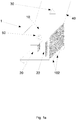
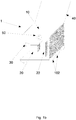
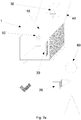
- Figures 2a and 2b depict one embodiment of the package sensor 10 operating.
- a first delivery recipient 60 has retrieved package 20 from the package space 10.
- the package sensor 30 detects that the first delivery recipient 60 has retrieved the correct package 20.
- package 20 is addressed to the first delivery recipient 60, but package 22 is not.
- the package sensor 30 can be adapted to detect that package 22, schematically representing all packages that are not addressed to the first delivery recipient 60, remains within the package space 10.
- the processing component of the robot (not depicted) can receive first data from the package sensor 30 and output that the correct package has been retrieved. The delivery process can thus be completed and the robot 1 can depart to deliver further packages 22.
- the first delivery recipient 60 retrieved package 22 instead of package 20 from the package space 10. This package is not addressed to the first delivery recipient 60.
- the package sensor 30 can then detect this and send the measurement data to the robot's processing component (not depicted). The processing component can then output that the wrong package has been retrieved.
- the first delivery recipient 60 can then be notified of the mistake and/or theft. For example, robot 1 can sound an alarm. Robot 1 can also transmit the notice of wrong package retrieval to a server and/or to a remote terminal (not depicted). The server and/or the remote terminal, or the remote operator can then contact the first delivery recipient 60 directly and/or through the robot.
- the server and/or the remote operator can send a message to a mobile device of the first delivery recipient 60, can call it and/or use speakers on the robot to notify the first delivery recipient 60 that a wrong package has been retrieved.
- the server and/or the remote operator can send a message to a mobile device of the first delivery recipient 60, can call it and/or use speakers on the robot to notify the first delivery recipient 60 that a wrong package has been retrieved.
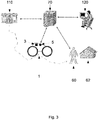
- Figure 3 depicts an embodiment of the communications in the secure delivery process according to one embodiment of the invention.
- Robot 1 can be adapted to travel from an initial location 110 to a first delivery location 62.
- the initial location 110 can comprise a home base, or robot base or hub. In some embodiments, this is the location where the robot can be stored, maintained and/or loaded and/or unloaded.
- the first delivery recipient 60 can be notified that the robot 1 has arrived at the delivery location 62 via a mobile device for example.
- a mobile device for example.
- This can be a cell phone, a tablet, a personal computer, a wearable device and/or a comparable device.
- the first delivery recipient 60 can be notified of which package within the package space 10 of the robot 1 is addressed to them. This can be done, for example, by sending an image or a picture of the package space 10 with the correct package 20 highlighted or otherwise indicated on the image. This can be advantageous, as the first delivery recipient 60 would know which package 20 is addressed to them even before accessing the package space 10, which reduces the possibility of mistake when retrieving a package, and speeds up the delivery process.
- the robot 1 can be adapted to communicate with a server 70 via a communication component 5.
- the server 70 can communicate with a remote terminal 120 and with the first delivery recipient 60.
- the robot 1 can also directly communicate with the remote terminal 120 and/or with the first delivery recipient 60 via the robot's communication component 5.
- the robot 1 can process this via a processing component 3 and send this second data to the server 70 and/or to the remote terminal 120 for further processing and/or actions via the communication component 5.
- the server 70 can send an automated message to the first delivery recipient 60 warning them that the wrong package has been removed.
- the remote terminal 120 can directly communicate with the first delivery recipient 60 via their mobile device for example in case of complications during the delivery process.
- the remote terminal 120 can, for example, supervise a plurality of mobile robots 1 simultaneously, ready to take action if a problem arises during the delivery process for one or a plurality of them.
- the remote terminal 120 can, for example comprise a remote operator, that is a person with a computing device.
- the first delivery recipient 60 can contact the server 70 and/or the remote terminal 120 if difficulty arises before, during or after the delivery process. For example, if they are unable to locate their package 20 (not shown) within the package space 10 (not shown), they can request automated or operator assistance.
- package sensor 30 can be adapted to measure first data reflective of the presence or absence of each of a plurality of packages 20, 22 in the package space 10, and the identity of each such package 20, 22 by virtue of the package ID 32 such as a barcode, a QR code or a similar code and/or other specific package characteristic such as dimensions, weight, visual characteristics, RF tags and so on.
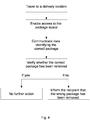
- Figure 4 shows a schematic embodiment of the delivery method according to one aspect of the invention.
- the robot 1 (not shown) can first travel from an initial location such as a robot home base, robot base and/or a hub to the delivery location 62 (not shown).
- the robot can then enable access to the package space 10 (not shown) for the first delivery recipient 60 (not shown).
- the robot 1 and/or the server 70 (not shown) and/or the remote terminal 120 (not shown) can communicate data identifying the correct package 20 (not shown) to the first delivery recipient. Note, that in general, the steps do not have to be performed in this order, and in particular, the step of identifying the correct package 20 to the first delivery recipient 60 can be done first.
- the robot 1 can then verify whether the correct package 20 has been retrieved. That is, whether the retrieved package 20 is the one addressed to the first delivery recipient 60. This can be done via the package sensor 30 (not shown). If only the correct package 20 has been removed, the delivery process can terminate and the robot 1 can depart the delivery location 62. If the wrong package 22 has been retrieved, the robot 1 can then notify the first delivery recipient of the mistake via different options. The robot 1 can sound an alarm and/or the robot 1 can contact the server 70 and/or the remote operator 120 who can then contact the first delivery recipient 60 via their mobile device and/or via the robot 1 directly. Once the mistake has been rectified and only the correct package 20 retrieved from the robot's package space 10, the delivery process can terminate, and the robot 1 can depart the delivery location 62.
- Figure 5 depicts a flowchart of a delivery method according to one embodiment of the invention.
- the mobile robot can travel to a delivery location or a first delivery location.
- the robot can travel autonomously and/or semi-autonomously using a plurality of sensors for navigation and/or localisation.
- the access to the package space can be enabled - either by the robot itself and/or by a remote server and/or by a remote operator.
- the first delivery recipient can then have access to the package space. In practice, this can simply mean that an electronic lock is unlocked, and a lid covering the package space can now be opened in order to access the package space.
- the first delivery recipient can be the recipient of one of the packages in the robot's package space and/or a person authorized to receive the package.
- the correct package can first be identified to the first delivery recipient. As previously discussed, this can be done prior to the mobile robot arriving to the delivery location.
- the first delivery recipient can be sent a picture or an image of the correct delivery either on its own or directly within the robot's package space (with the correct delivery clearly identified on the image).
- the correct delivery can be identified via a particular design, such as a colour, a picture and/or a symbol.
- a sticker and/or a label identifying the package can be fixed to the outside. This can be preferable to a sticker and/or a label identifying the first delivery recipient for privacy reasons.
- the first delivery recipient removes a particular package from the package space, it can be checked whether the correct package has been removed. (as shown in figure 4 )- This can be done by using the package sensor to obtain first data. This first data can then be processed and/or evaluated either by a processing component of the mobile robot, and/or by a remote server, and/or by a remote operator in order to determine whether the correct package has been removed. At this point, it can also be determined whether a second package intended for a second delivery recipient remains in the package space. That is, the first data obtained by the package sensor can be used not only to determine whether the correct package has been removed, but also to determine whether the second package remains in the package space.
- the mobile robot can proceed to travel to a second delivery location in order to deliver said second package. If, however, it is determined that the second package is not in the package space, the mobile robot can reject and/or abort travelling to a second delivery location. That is, in the case that the delivery recipient and/or a third party removed the second package, the robot can adjust the planned route by removing the second delivery location from it. Additionally or alternatively, the robot can request an input for further action from a remote server and/or from a remote operator.
- the robot and/or the server and/or the remote operator can inform the first delivery recipient and/or a third party that an unauthorized package has been removed in an attempt to recover said package.
- the process of verifying whether the second package remains in the package space can be repeated in order to determine whether it has been returned to the package space after a prompt to do so. If this is not the case after a certain number of potentially escalating prompts and/or a certain time interval, the robot and/or the server and/or the remote operator can then stop attempting to retrieve the second package and reject and/or abort travelling to a second delivery location. In this case, the robot can take several different courses of action.
- the robot can proceed to a further delivery location to deliver this package. If no further package is present, the robot can return to an initial location from which it started on its delivery route and/or return to a different final location according either to a pre-planned route and/or according to further instructions from the server and/or from the remote operator.
- elements pertaining to a device and elements pertaining to a method were discussed.
- elements relating to the device can be part of the method and elements pertaining to the method can be part of the device.
Landscapes
- Engineering & Computer Science (AREA)
- Business, Economics & Management (AREA)
- Economics (AREA)
- General Physics & Mathematics (AREA)
- Physics & Mathematics (AREA)
- Operations Research (AREA)
- Tourism & Hospitality (AREA)
- Theoretical Computer Science (AREA)
- Marketing (AREA)
- Entrepreneurship & Innovation (AREA)
- Quality & Reliability (AREA)
- Strategic Management (AREA)
- Development Economics (AREA)
- General Business, Economics & Management (AREA)
- Human Resources & Organizations (AREA)
- Mechanical Engineering (AREA)
- Robotics (AREA)
- Accounting & Taxation (AREA)
- Finance (AREA)
- Automation & Control Theory (AREA)
- Human Computer Interaction (AREA)
- Transportation (AREA)
- Management, Administration, Business Operations System, And Electronic Commerce (AREA)
- Aviation & Aerospace Engineering (AREA)
- Radar, Positioning & Navigation (AREA)
- Remote Sensing (AREA)
Priority Applications (4)
| Application Number | Priority Date | Filing Date | Title |
|---|---|---|---|
| EP16201961.6A EP3330908A1 (fr) | 2016-12-02 | 2016-12-02 | Système et procédé de distribution sécurisée de livraison de colis à différents destinataires au moyen d'un seul véhicule |
| PCT/EP2017/080720 WO2018099930A1 (fr) | 2016-12-02 | 2017-11-28 | Système et procédé de livraison sécurisée des colis à différents destinataires de livraison à l'aide d'un seul véhicule |
| US16/430,013 US11138545B2 (en) | 2016-12-02 | 2019-06-03 | System and method for securely delivering packages to different delivery recipients with a single vehicle |
| US17/476,522 US11983660B2 (en) | 2016-12-02 | 2021-09-16 | System and method for securely delivering packages to different delivery recipients with a single vehicle |
Applications Claiming Priority (1)
| Application Number | Priority Date | Filing Date | Title |
|---|---|---|---|
| EP16201961.6A EP3330908A1 (fr) | 2016-12-02 | 2016-12-02 | Système et procédé de distribution sécurisée de livraison de colis à différents destinataires au moyen d'un seul véhicule |
Publications (1)
| Publication Number | Publication Date |
|---|---|
| EP3330908A1 true EP3330908A1 (fr) | 2018-06-06 |
Family
ID=57758391
Family Applications (1)
| Application Number | Title | Priority Date | Filing Date |
|---|---|---|---|
| EP16201961.6A Ceased EP3330908A1 (fr) | 2016-12-02 | 2016-12-02 | Système et procédé de distribution sécurisée de livraison de colis à différents destinataires au moyen d'un seul véhicule |
Country Status (2)
| Country | Link |
|---|---|
| US (1) | US11138545B2 (fr) |
| EP (1) | EP3330908A1 (fr) |
Cited By (5)
| Publication number | Priority date | Publication date | Assignee | Title |
|---|---|---|---|---|
| CN110766880A (zh) * | 2019-08-30 | 2020-02-07 | 浙江百世技术有限公司 | 快递取放装置及快递取放方法 |
| WO2021110862A1 (fr) * | 2019-12-06 | 2021-06-10 | Starship Technologies Oü | Procédé et système d'authentification autonome |
| CN112997221A (zh) * | 2018-10-31 | 2021-06-18 | 日本电气株式会社 | 信息处理装置、信息处理方法、记录介质以及信息处理系统 |
| EP3926562A4 (fr) * | 2019-02-12 | 2022-04-06 | Kazunori Fujisawa | Procédés de tri de marchandises et de gestion d'emballage |
| WO2024015028A1 (fr) * | 2022-07-11 | 2024-01-18 | Delivers Ai Robotik Otonom Surus Bilgi Teknolojileri A.S. | Robot de livraison contenant une caméra à l'intérieur du couvercle et son procédé de commande |
Families Citing this family (32)
| Publication number | Priority date | Publication date | Assignee | Title |
|---|---|---|---|---|
| EP3400523A4 (fr) | 2016-01-05 | 2019-07-03 | United States Postal Service | Suivi précis de livraison d'articles au moyen d'un enregistreur d'événements de fiabilité |
| US11200532B2 (en) * | 2017-04-12 | 2021-12-14 | Caterpillar Inc. | Delivery robot and method of operation |
| US11361273B2 (en) * | 2017-10-09 | 2022-06-14 | United States Postal Service | Use of geospatial coordinate systems for tracking item delivery |
| JP6958306B2 (ja) * | 2017-12-07 | 2021-11-02 | トヨタ自動車株式会社 | 集配制御システム、及び集配制御方法 |
| JP2019104376A (ja) * | 2017-12-12 | 2019-06-27 | トヨタ自動車株式会社 | 車室内監視装置、格納装置、および車両 |
| US11173605B2 (en) * | 2018-02-26 | 2021-11-16 | dogugonggan Co., Ltd. | Method of controlling mobile robot, apparatus for supporting the method, and delivery system using mobile robot |
| US11983939B2 (en) * | 2018-03-09 | 2024-05-14 | Ford Global Technologies, Llc | Changing vehicle configuration based on vehicle storage compartment contents |
| US11491642B2 (en) | 2018-03-14 | 2022-11-08 | Fedex Corporate Services, Inc. | Methods of performing a dispatched store-to-consumer logistics operation for an ordered item and using a modular autonomous bot apparatus assembly and a dispatch server |
| US20210114628A1 (en) * | 2018-06-21 | 2021-04-22 | Daniel KHURGIN | Method of vehicle operation in a mixed mode |
| US11074542B2 (en) * | 2018-09-27 | 2021-07-27 | Intel Corporation | Automated delivery device and method for delivering a package |
| US11202526B2 (en) * | 2018-12-24 | 2021-12-21 | Paul R. Juhasz | Porch piracy parcel theft prevention system and method |
| US11565807B1 (en) * | 2019-06-05 | 2023-01-31 | Gal Zuckerman | Systems and methods facilitating street-level interactions between flying drones and on-road vehicles |
| US11782458B2 (en) * | 2019-06-14 | 2023-10-10 | Rebecca Romanucci | Parcel deploying apparatus and vehicle delivery |
| US11497335B2 (en) * | 2019-06-14 | 2022-11-15 | Rebecca Romanucci | Parcel safe remote vehicle alignment system |
| US20210362335A1 (en) * | 2019-07-12 | 2021-11-25 | Lg Electronics Inc. | Robot and method for manage item using same |
| EP4063300A4 (fr) * | 2019-11-19 | 2023-01-18 | DSC Logistics (Beijing) Co., Ltd. | Appareil de transport, robot de transport, procédé de comptage et système de comptage |
| US12175415B2 (en) | 2020-02-14 | 2024-12-24 | Zoox, Inc. | Mobile delivery vehicle management and routing |
| GB2592066A (en) * | 2020-02-17 | 2021-08-18 | Ford Global Tech Llc | Delivery optimisation |
| JP7363718B2 (ja) * | 2020-08-26 | 2023-10-18 | トヨタ自動車株式会社 | ルート決定システム、ルート決定方法及びルート決定プログラム |
| JP7018101B1 (ja) * | 2020-08-27 | 2022-02-09 | 大王製紙株式会社 | ピッキング補助ロボット、及び、ピッキング補助システム |
| JP7345444B2 (ja) * | 2020-08-27 | 2023-09-15 | 大王製紙株式会社 | 補充補助ロボット、及び、補充補助システム |
| US11609583B2 (en) * | 2020-10-09 | 2023-03-21 | Ford Global Technologies, Llc | Systems and methods for nighttime delivery mobile robot with hybrid infrared and flash lighting |
| CN112405520B (zh) * | 2020-10-14 | 2022-03-29 | 深圳优地科技有限公司 | 基于机器人的快递代收方法、装置、设备及存储介质 |
| US12103796B2 (en) | 2020-10-19 | 2024-10-01 | Monotony.ai, Inc. | Autonomous multi-tier racking and retrieval system for delivery vehicle |
| US11873174B2 (en) | 2020-10-29 | 2024-01-16 | Monotony.ai, Inc. | Autonomous devices, systems, and methods for queuing folded laundry |
| US11830312B2 (en) * | 2021-02-25 | 2023-11-28 | Gm Cruise Holdings Llc | Transparent cubby system for autonomous delivery services |
| US12380754B2 (en) * | 2021-02-25 | 2025-08-05 | Federal Express Corporation | Methods and apparatus for providing enhanced automated access to a dispatched personal delivery device operative to transport a shipment item |
| JP7203143B2 (ja) * | 2021-04-30 | 2023-01-12 | 楽天グループ株式会社 | 情報処理システム、情報処理装置、及び、方法 |
| US20230093977A1 (en) * | 2021-09-27 | 2023-03-30 | 7-Eleven, Inc. | Delivery vehicle selection based on location data and memory resource content |
| EP4424045A4 (fr) * | 2021-10-29 | 2025-07-30 | Verifone Inc | Systèmes, dispositifs et procédés de détection d'une condition d'altération potentielle d'un dispositif sécurisé |
| GB2616879A (en) * | 2022-03-23 | 2023-09-27 | Fox Robotics Ltd | An autonomous mobile robot and automated produce transportation system |
| US12174643B2 (en) * | 2022-04-11 | 2024-12-24 | Nishant Jacob George | Systems and methods for delivering packages using mobile robots |
Citations (7)
| Publication number | Priority date | Publication date | Assignee | Title |
|---|---|---|---|---|
| US20140254896A1 (en) | 2011-07-18 | 2014-09-11 | Tiger T G Zhou | Unmanned drone, robot system for delivering mail, goods, humanoid security, crisis negotiation, mobile payments, smart humanoid mailbox and wearable personal exoskeleton heavy load flying machine |
| WO2015160672A1 (fr) * | 2014-04-13 | 2015-10-22 | Vishal Gupta | Livraison aérienne de colis |
| WO2016019242A1 (fr) * | 2014-07-31 | 2016-02-04 | Farris Emmett | Système et procédé de commande de livraison par drone |
| US9256852B1 (en) | 2013-07-01 | 2016-02-09 | Google Inc. | Autonomous delivery platform |
| US20160068264A1 (en) * | 2014-09-08 | 2016-03-10 | Qualcomm Incorporated | Methods, Systems and Devices for Delivery Drone Security |
| US9373149B2 (en) | 2006-03-17 | 2016-06-21 | Fatdoor, Inc. | Autonomous neighborhood vehicle commerce network and community |
| US20160239798A1 (en) * | 2015-02-16 | 2016-08-18 | International Business Machines Corporation | Autonomous delivery of items |
Family Cites Families (56)
| Publication number | Priority date | Publication date | Assignee | Title |
|---|---|---|---|---|
| JPS5895005A (ja) | 1981-12-02 | 1983-06-06 | Hitachi Ltd | コンテナ−の自動倉庫 |
| EP0627371B1 (fr) | 1993-06-04 | 1997-12-10 | Ferag AG | Procédé pour la préparation de commandes et dispositif de mise en oeuvre de ce système |
| US5942869A (en) | 1997-02-13 | 1999-08-24 | Honda Giken Kogyo Kabushiki Kaisha | Mobile robot control device |
| US6543983B1 (en) | 1998-07-07 | 2003-04-08 | University Of Virginia Patent Foundation | Robotic pick up and deliver system |
| ATE248761T1 (de) | 2000-03-17 | 2003-09-15 | Witron Logistik & Inf Gmbh | System zum kommissionieren von in regallagern befindlichen artikeln |
| US6467293B1 (en) | 2001-08-20 | 2002-10-22 | The Kroger Company | Grocery delivery vehicle |
| US7931431B2 (en) | 2003-05-06 | 2011-04-26 | Bec Companies, Inc. | Automated material handling system with load transfer vehicles |
| US7073634B2 (en) | 2003-11-28 | 2006-07-11 | California Natural Products | Automated warehouse row cart and lift |
| JP4052650B2 (ja) | 2004-01-23 | 2008-02-27 | 株式会社東芝 | 障害物検出装置、方法及びプログラム |
| US20060237239A1 (en) | 2005-04-23 | 2006-10-26 | Daniel Bruner | Personal utility vehicle (PUV) |
| US9026301B2 (en) | 2005-10-14 | 2015-05-05 | Aethon, Inc. | Robotic ordering and delivery system software and methods |
| KR20110049894A (ko) | 2008-09-03 | 2011-05-12 | 디마틱 어카운팅 서비시즈 게엠베하 | 자동화된 입고/출고 시스템 |
| US8948914B2 (en) | 2008-12-05 | 2015-02-03 | Aethon, Inc. | System and method for securely transporting an item |
| DE102009043060B4 (de) | 2009-09-28 | 2017-09-21 | Sew-Eurodrive Gmbh & Co Kg | System von mobilen Robotern mit einer Basisstation sowie Verfahren zum Betreiben des Systems |
| CN101973031B (zh) | 2010-08-24 | 2013-07-24 | 中国科学院深圳先进技术研究院 | 云机器人系统及实现方法 |
| NL1038311C2 (en) | 2010-10-15 | 2012-04-17 | Lely Patent Nv | Autonomous movable vehicle having a fillable container and an assembly including the autonomous movable vehicle and a filling station. |
| GB2487529A (en) | 2011-01-19 | 2012-08-01 | Automotive Robotic Industry Ltd | Security system for controlling a plurality of unmanned ground vehicles |
| US8485285B2 (en) | 2011-03-22 | 2013-07-16 | Max Ferrigni | Mobile product retail system and methods thereof |
| US9147173B2 (en) | 2011-10-31 | 2015-09-29 | Harvest Automation, Inc. | Methods and systems for automated transportation of items between variable endpoints |
| PL2791748T3 (pl) | 2012-02-08 | 2021-04-06 | Omron Robotics And Safety Technologies, Inc. | System zarządzania zadaniami dla floty autonomicznych robotów mobilnych |
| US9230236B2 (en) | 2012-08-07 | 2016-01-05 | Daniel Judge Villamar | Automated delivery vehicle, systems and methods for automated delivery |
| US9008829B2 (en) | 2013-01-28 | 2015-04-14 | Amazon Technologies, Inc. | Inventory system with connectable inventory holders |
| US9020632B2 (en) | 2013-03-15 | 2015-04-28 | Intelligrated Headquarters, Llc | Storage, retrieval and sortation system |
| US10551851B2 (en) * | 2013-07-01 | 2020-02-04 | Steven Sounyoung Yu | Autonomous unmanned road vehicle for making deliveries |
| US9557740B2 (en) | 2013-07-02 | 2017-01-31 | David Crawley | Autonomous mobile platform for service applications |
| HK1226187B (zh) | 2013-10-03 | 2017-09-22 | Vendwatch Telematics, Llc | 贩卖系统 |
| IL230539A (en) | 2014-01-20 | 2017-05-29 | Israel Aerospace Ind Ltd | Locking device and closing mechanism inside |
| US10192189B2 (en) | 2014-02-13 | 2019-01-29 | Amazon Technologies, Inc. | Mobile pickup locations |
| WO2015151266A1 (fr) | 2014-04-03 | 2015-10-08 | 株式会社日立製作所 | Corps mobile autodirigé |
| US9336506B2 (en) | 2014-05-02 | 2016-05-10 | Google Inc. | Machine-readable delivery platform for automated package delivery |
| JP2016001464A (ja) | 2014-05-19 | 2016-01-07 | 株式会社リコー | 処理装置、処理システム、処理プログラム、及び、処理方法 |
| US9452883B1 (en) | 2014-09-26 | 2016-09-27 | Amazon Technologies, Inc. | Re-arrange stored inventory holders |
| US9244147B1 (en) | 2014-10-22 | 2016-01-26 | Google Inc. | Automated package delivery to a delivery receptacle |
| US9886799B2 (en) | 2014-11-22 | 2018-02-06 | TrueLite Trace, Inc. | Real-time cargo condition management system and method based on remote real-time vehicle OBD monitoring |
| US9984347B2 (en) | 2014-12-30 | 2018-05-29 | Frank Dreano, JR. | System and method for enhancing distribution logistics and increasing surveillance ranges with unmanned aerial vehicles and a dock network |
| US9856083B2 (en) | 2015-01-16 | 2018-01-02 | Symbotic, LLC | Storage and retrieval system |
| US9875503B2 (en) | 2015-03-06 | 2018-01-23 | Wal-Mart Stores, Inc. | Method and apparatus for transporting a plurality of stacked motorized transport units |
| US9561941B1 (en) | 2015-03-30 | 2017-02-07 | X Development Llc | Autonomous approach and object pickup |
| CN108290685B (zh) | 2015-06-02 | 2021-03-02 | 阿勒特创新股份有限公司 | 存取系统 |
| CN107635891B (zh) | 2015-06-09 | 2021-06-04 | 盖特法布瑞克有限公司 | 机器人库存处理 |
| US9868421B2 (en) | 2015-06-17 | 2018-01-16 | Ample, Inc. | Robot assisted modular battery interchanging system |
| US20150379468A1 (en) | 2015-09-12 | 2015-12-31 | Thomas Danaher Harvey | Methods for delivery to multiple locations using autonomous vehicles |
| US9776326B2 (en) | 2015-10-07 | 2017-10-03 | X Development Llc | Battery and hard drive exchange station for robots |
| US9682481B2 (en) | 2015-10-26 | 2017-06-20 | X Development Llc | Communication of information regarding a robot using an optical identifier |
| US9612123B1 (en) | 2015-11-04 | 2017-04-04 | Zoox, Inc. | Adaptive mapping to navigate autonomous vehicles responsive to physical environment changes |
| US10782686B2 (en) | 2016-01-28 | 2020-09-22 | Savioke, Inc. | Systems and methods for operating robots including the handling of delivery operations that cannot be completed |
| AU2017233541A1 (en) | 2016-03-16 | 2018-11-08 | Domino's Pizza Enterprises Limited | Autonomous food delivery vehicle |
| WO2017196759A1 (fr) | 2016-05-09 | 2017-11-16 | Lessels Peter | Système de distribution d'article |
| US20180005169A1 (en) | 2016-07-01 | 2018-01-04 | Wal-Mart Stores, Inc. | Apparatus and method for providing unmanned delivery vehicles with expressions |
| US10216188B2 (en) * | 2016-07-25 | 2019-02-26 | Amazon Technologies, Inc. | Autonomous ground vehicles based at delivery locations |
| US9791557B1 (en) | 2016-09-15 | 2017-10-17 | Qualcomm Incorporated | System and method for multi-area LIDAR ranging |
| US10248120B1 (en) * | 2016-09-16 | 2019-04-02 | Amazon Technologies, Inc. | Navigable path networks for autonomous vehicles |
| US10023434B2 (en) | 2016-09-19 | 2018-07-17 | Amazon Technologies, Inc. | Robotic enabled vertical lift |
| US10303171B1 (en) * | 2016-09-29 | 2019-05-28 | Amazon Technologies, Inc. | Autonomous ground vehicles providing ordered items in pickup areas |
| US9844879B1 (en) | 2017-05-17 | 2017-12-19 | Savioke, Inc. | System and method for utilizing non-local information to constrain robot services |
| US10775792B2 (en) * | 2017-06-13 | 2020-09-15 | United Parcel Service Of America, Inc. | Autonomously delivering items to corresponding delivery locations proximate a delivery route |
-
2016
- 2016-12-02 EP EP16201961.6A patent/EP3330908A1/fr not_active Ceased
-
2019
- 2019-06-03 US US16/430,013 patent/US11138545B2/en active Active
Patent Citations (7)
| Publication number | Priority date | Publication date | Assignee | Title |
|---|---|---|---|---|
| US9373149B2 (en) | 2006-03-17 | 2016-06-21 | Fatdoor, Inc. | Autonomous neighborhood vehicle commerce network and community |
| US20140254896A1 (en) | 2011-07-18 | 2014-09-11 | Tiger T G Zhou | Unmanned drone, robot system for delivering mail, goods, humanoid security, crisis negotiation, mobile payments, smart humanoid mailbox and wearable personal exoskeleton heavy load flying machine |
| US9256852B1 (en) | 2013-07-01 | 2016-02-09 | Google Inc. | Autonomous delivery platform |
| WO2015160672A1 (fr) * | 2014-04-13 | 2015-10-22 | Vishal Gupta | Livraison aérienne de colis |
| WO2016019242A1 (fr) * | 2014-07-31 | 2016-02-04 | Farris Emmett | Système et procédé de commande de livraison par drone |
| US20160068264A1 (en) * | 2014-09-08 | 2016-03-10 | Qualcomm Incorporated | Methods, Systems and Devices for Delivery Drone Security |
| US20160239798A1 (en) * | 2015-02-16 | 2016-08-18 | International Business Machines Corporation | Autonomous delivery of items |
Non-Patent Citations (3)
| Title |
|---|
| ANONYMOUS: "Radio-frequency identification - Wikipedia", 1 December 2016 (2016-12-01), XP055343659, Retrieved from the Internet <URL:https://en.wikipedia.org/w/index.php?title=Radio-frequency_identification&oldid=752391280> [retrieved on 20170208] * |
| ANONYMOUS: "Startup Developing Autonomous Delivery Robots That Travel on Sidewalks - IEEE Spectrum", 2 November 2015 (2015-11-02), XP055343599, Retrieved from the Internet <URL:http://spectrum.ieee.org/automaton/robotics/industrial-robots/starship-technologies-autonomous-ground-delivery-robots> [retrieved on 20170208] * |
| HOWSTUFFWORKS: "How UPS Works", YOUTUBE, 9 March 2007 (2007-03-09), pages 4 pp., XP054977150, Retrieved from the Internet <URL:https://www.youtube.com/watch?v=pcsk9nEKPGM> [retrieved on 20170213] * |
Cited By (6)
| Publication number | Priority date | Publication date | Assignee | Title |
|---|---|---|---|---|
| CN112997221A (zh) * | 2018-10-31 | 2021-06-18 | 日本电气株式会社 | 信息处理装置、信息处理方法、记录介质以及信息处理系统 |
| CN112997221B (zh) * | 2018-10-31 | 2023-06-16 | 日本电气株式会社 | 信息处理装置、信息处理方法、记录介质以及信息处理系统 |
| EP3926562A4 (fr) * | 2019-02-12 | 2022-04-06 | Kazunori Fujisawa | Procédés de tri de marchandises et de gestion d'emballage |
| CN110766880A (zh) * | 2019-08-30 | 2020-02-07 | 浙江百世技术有限公司 | 快递取放装置及快递取放方法 |
| WO2021110862A1 (fr) * | 2019-12-06 | 2021-06-10 | Starship Technologies Oü | Procédé et système d'authentification autonome |
| WO2024015028A1 (fr) * | 2022-07-11 | 2024-01-18 | Delivers Ai Robotik Otonom Surus Bilgi Teknolojileri A.S. | Robot de livraison contenant une caméra à l'intérieur du couvercle et son procédé de commande |
Also Published As
| Publication number | Publication date |
|---|---|
| US20190287051A1 (en) | 2019-09-19 |
| US11138545B2 (en) | 2021-10-05 |
Similar Documents
| Publication | Publication Date | Title |
|---|---|---|
| US11138545B2 (en) | System and method for securely delivering packages to different delivery recipients with a single vehicle | |
| US9741010B1 (en) | System and method for securely delivering packages to different delivery recipients with a single vehicle | |
| US11983660B2 (en) | System and method for securely delivering packages to different delivery recipients with a single vehicle | |
| US20230368120A1 (en) | Movable item receptacles | |
| US11759040B2 (en) | Storage box locking system | |
| US20210049722A1 (en) | System and method for controlling drone delivery or pick up during a delivery or pick up phase of drone operation | |
| CA2944814C (fr) | Procede de remise d'un envoi par l'intermediaire d'un moyen de transport sans pilote | |
| US11829136B2 (en) | Asset delivery system | |
| US20200156808A1 (en) | Package acceptance, guidance, and refuel system for drone technology | |
| US20190303860A1 (en) | System and method for item recovery by robotic vehicle | |
| US20190066032A1 (en) | Robotic Vehicle Item Delivery Security System | |
| CN110751443B (zh) | 移动拾取位置 | |
| US10997544B1 (en) | Delivery location identifiers | |
| US20190130349A1 (en) | Autonomously operated mobile locker banks | |
| CA3017153A1 (fr) | Systemes d'aeronefs sans pilote et procedes pour interagir avec des objets specifiquement prevus | |
| WO2018093553A1 (fr) | Systèmes d'emballage pouvant être connectés électroniquement conçus pour des articles d'expédition | |
| US11986114B2 (en) | Delivery system, control device, delivery method, and control method | |
| US10664788B2 (en) | Ad-hoc parcel delivery drop zone and hotspot |
Legal Events
| Date | Code | Title | Description |
|---|---|---|---|
| PUAI | Public reference made under article 153(3) epc to a published international application that has entered the european phase |
Free format text: ORIGINAL CODE: 0009012 |
|
| STAA | Information on the status of an ep patent application or granted ep patent |
Free format text: STATUS: THE APPLICATION HAS BEEN PUBLISHED |
|
| AK | Designated contracting states |
Kind code of ref document: A1 Designated state(s): AL AT BE BG CH CY CZ DE DK EE ES FI FR GB GR HR HU IE IS IT LI LT LU LV MC MK MT NL NO PL PT RO RS SE SI SK SM TR |
|
| AX | Request for extension of the european patent |
Extension state: BA ME |
|
| STAA | Information on the status of an ep patent application or granted ep patent |
Free format text: STATUS: REQUEST FOR EXAMINATION WAS MADE |
|
| 17P | Request for examination filed |
Effective date: 20181206 |
|
| RBV | Designated contracting states (corrected) |
Designated state(s): AL AT BE BG CH CY CZ DE DK EE ES FI FR GB GR HR HU IE IS IT LI LT LU LV MC MK MT NL NO PL PT RO RS SE SI SK SM TR |
|
| STAA | Information on the status of an ep patent application or granted ep patent |
Free format text: STATUS: EXAMINATION IS IN PROGRESS |
|
| 17Q | First examination report despatched |
Effective date: 20190819 |
|
| APBK | Appeal reference recorded |
Free format text: ORIGINAL CODE: EPIDOSNREFNE |
|
| APBN | Date of receipt of notice of appeal recorded |
Free format text: ORIGINAL CODE: EPIDOSNNOA2E |
|
| APBR | Date of receipt of statement of grounds of appeal recorded |
Free format text: ORIGINAL CODE: EPIDOSNNOA3E |
|
| APAF | Appeal reference modified |
Free format text: ORIGINAL CODE: EPIDOSCREFNE |
|
| APBX | Invitation to file observations in appeal sent |
Free format text: ORIGINAL CODE: EPIDOSNOBA2E |
|
| APBT | Appeal procedure closed |
Free format text: ORIGINAL CODE: EPIDOSNNOA9E |
|
| STAA | Information on the status of an ep patent application or granted ep patent |
Free format text: STATUS: THE APPLICATION HAS BEEN REFUSED |
|
| 18R | Application refused |
Effective date: 20240409 |