EP3334202B1 - System und verfahren zur drahtlosen umgebungsinformationserfassung - Google Patents
System und verfahren zur drahtlosen umgebungsinformationserfassung Download PDFInfo
- Publication number
- EP3334202B1 EP3334202B1 EP16833002.5A EP16833002A EP3334202B1 EP 3334202 B1 EP3334202 B1 EP 3334202B1 EP 16833002 A EP16833002 A EP 16833002A EP 3334202 B1 EP3334202 B1 EP 3334202B1
- Authority
- EP
- European Patent Office
- Prior art keywords
- wireless
- channel
- environment information
- communication
- measuring
- Prior art date
- Legal status (The legal status is an assumption and is not a legal conclusion. Google has not performed a legal analysis and makes no representation as to the accuracy of the status listed.)
- Active
Links
Images


Classifications
-
- H—ELECTRICITY
- H04—ELECTRIC COMMUNICATION TECHNIQUE
- H04W—WIRELESS COMMUNICATION NETWORKS
- H04W24/00—Supervisory, monitoring or testing arrangements
- H04W24/04—Arrangements for maintaining operational condition
-
- H—ELECTRICITY
- H04—ELECTRIC COMMUNICATION TECHNIQUE
- H04W—WIRELESS COMMUNICATION NETWORKS
- H04W24/00—Supervisory, monitoring or testing arrangements
- H04W24/08—Testing, supervising or monitoring using real traffic
-
- H—ELECTRICITY
- H04—ELECTRIC COMMUNICATION TECHNIQUE
- H04W—WIRELESS COMMUNICATION NETWORKS
- H04W24/00—Supervisory, monitoring or testing arrangements
- H04W24/10—Scheduling measurement reports ; Arrangements for measurement reports
-
- H—ELECTRICITY
- H04—ELECTRIC COMMUNICATION TECHNIQUE
- H04W—WIRELESS COMMUNICATION NETWORKS
- H04W16/00—Network planning, e.g. coverage or traffic planning tools; Network deployment, e.g. resource partitioning or cells structures
- H04W16/14—Spectrum sharing arrangements between different networks
-
- H—ELECTRICITY
- H04—ELECTRIC COMMUNICATION TECHNIQUE
- H04W—WIRELESS COMMUNICATION NETWORKS
- H04W24/00—Supervisory, monitoring or testing arrangements
-
- H—ELECTRICITY
- H04—ELECTRIC COMMUNICATION TECHNIQUE
- H04W—WIRELESS COMMUNICATION NETWORKS
- H04W24/00—Supervisory, monitoring or testing arrangements
- H04W24/02—Arrangements for optimising operational condition
-
- H—ELECTRICITY
- H04—ELECTRIC COMMUNICATION TECHNIQUE
- H04W—WIRELESS COMMUNICATION NETWORKS
- H04W74/00—Wireless channel access
- H04W74/08—Non-scheduled access, e.g. ALOHA
- H04W74/0808—Non-scheduled access, e.g. ALOHA using carrier sensing, e.g. carrier sense multiple access [CSMA]
-
- H—ELECTRICITY
- H04—ELECTRIC COMMUNICATION TECHNIQUE
- H04W—WIRELESS COMMUNICATION NETWORKS
- H04W74/00—Wireless channel access
- H04W74/08—Non-scheduled access, e.g. ALOHA
- H04W74/0808—Non-scheduled access, e.g. ALOHA using carrier sensing, e.g. carrier sense multiple access [CSMA]
- H04W74/0816—Non-scheduled access, e.g. ALOHA using carrier sensing, e.g. carrier sense multiple access [CSMA] with collision avoidance
-
- H—ELECTRICITY
- H04—ELECTRIC COMMUNICATION TECHNIQUE
- H04W—WIRELESS COMMUNICATION NETWORKS
- H04W84/00—Network topologies
- H04W84/02—Hierarchically pre-organised networks, e.g. paging networks, cellular networks, WLAN [Wireless Local Area Network] or WLL [Wireless Local Loop]
- H04W84/10—Small scale networks; Flat hierarchical networks
- H04W84/12—WLAN [Wireless Local Area Networks]
Definitions
- the present invention relates to a wireless environment information collection system and a wireless environment information collection method that acquire wireless environment information which includes channel utilization and a wireless station ID relating to the channel utilization and estimate throughput characteristics in a network in which access control that is based on Carrier Sense Multiple Access/ Collision Avoidance (CSMA/CA) is performed.
- CSMA/CA Carrier Sense Multiple Access/ Collision Avoidance
- Non-Patent Document 1 Wireless Local Area Network (LAN) systems that are stipulated in a standard IEEE 802.11 have been improved in throughput year after year, and have come into widespread use as one example of main wireless access. Because the wireless LAN system can be used in an unlicensed band that is a frequency band that does not require a license, various types of wireless terminals have come into widespread use. Particularly, the spread of smartphones remarkably increases an opportunity to use the wireless LAN system.
- a decrease in throughput is also due to a hidden terminal problem and an exposed terminal problem.
- These influences are determined by a communication situation of a wireless station in the vicinity or a condition in which wireless stations detect each other.
- an attempt is made to interpret throughput characteristics in the CSMA/CA using a contention graph in which wireless stations that possibly detect each other, which can be defined with a graph theory are linked using edges and in which a communication link that is made from wireless stations or wireless stations for transmission and reception is taken as a vertex.
- WO 2015/002656 A1 relates to the field of wireless networks and, in particular, to configuring and carrying out measurements in a wireless network.
- Some networks may employ restricted access windows (RAW) where a reduced set of wireless apparatuses of the wireless network may carry out channel contention.
- RAW restricted access windows
- An access node may define the RAW and a group of wireless apparatuses that are allowed to attempt the channel access within the RAW. Grouping allows partitioning of the wireless apparatuses into groups and restricting channel access only to wireless apparatuses belonging to a specified group at any given time period. In this matter, the grouping may help to reduce contention by restricting access to the medium only to a subset of the wireless apparatuses and may reduce the signaling overhead.
- the access node selecting a subset of the wireless apparatuses to a measurement group collectively controls the measurement group to report measurement results to the access node.
- the access node therefor causes transmission of a broadcast message in the wireless network, wherein the broadcast message comprises measurement group information specifying the selected subset of apparatuses.
- the access node further triggers reporting of measurements by causing transmission of a request-to-report message in the wireless network.
- the access node acquires a plurality of measurement reports from the selected subset of apparatuses as a response to the transmitted request-to-report message.
- Non-Patent Document 1 IEEE Std 802.11 ac(TM)-2013, "IEEE Standard for Information technology -Telecommunications and information exchange between systems Local and metropolitan area networks - Specific requirements, Part 11: Wireless LAN Medium Access Control (MAC) and Physical Layer (PHY) Specifications", December 2013
- a proposition is to provide a wireless environment information collection system and a wireless environment information collection method that are capable of reliably acquiring wireless environment information that includes channel utilization and a wireless station ID relating to the channel utilization and of estimating throughput characteristics in a wireless communication system in which wireless communication is performed using a CSMA/CA scheme.
- a wireless environment information collection system including a plurality of wireless stations performing wireless communication using a CSMA/CA scheme over a first frequency channel, and a wireless environment information management unit collecting wireless environment information of manage wireless stations being connected through a wired network or a wireless network among the plurality of wireless stations, in which the wireless environment information management unit includes a unit which generates and outputs a channel measurement frame which determines the wireless stations performing stopping of communication over the first frequency channel for a fixed time, starting of measuring of channel utilization of the first frequency channel, or the stopping of communication and the starting of measuring among the managed wireless stations; and the managed wireless stations include a unit which performs, at a time designated by the channel measurement frame from the wireless environment information management unit, the stopping of the communication over the first frequency channel, the measuring of the channel utilization of the first frequency channel, or the stopping of the communication and the measuring of the channel utilization, and which outputs the obtained wireless environment information to the wireless environment information management unit through the wired network or the wireless network.
- part of or all of the managed wireless stations may have a function of transferring the channel measurement frame and wireless environment information between each of the managed wireless stations using a second frequency channel.
- the wireless environment information management unit may include a unit which generates the channel measurement frame performing the measuring of the channel utilization to be started in a fixed amount of time after the stopping of the communication over first frequency channel.
- the managed wireless stations may include a notification unit which notifies a stop of a communication function to the wireless stations being a communication partner when the time to perform the stopping of the communication over the first frequency channel, the measuring of the channel utilization of the first frequency channel, or both the stopping of the communication and the measuring of the channel utilization is designated by the channel measurement frame from the wireless environment information management unit and when the designated time approaches.
- the managed wireless stations may include a unit which discards, during a period of designated time, a frame received from the wireless stations being a communication partner when the time to perform the stopping of the communication over the first frequency channel, the measuring of the channel utilization of the first frequency channel, or both the stopping of the communication and the measuring of the channel utilization is designated by the channel measurement frame from the wireless environment information management unit.
- the managed wireless stations may include a unit which measures, during a period of designated time, the channel utilization by excluding from a calculation of the channel utilization a time required to receive a frame and a time required to transmit a control signal from the wireless stations being a communication partner when the time to perform the stopping of the communication over the first frequency channel, the measuring of the channel utilization of the first frequency channel, or both the stopping of the communication and the measuring of the channel utilization is designated by the channel measurement frame from the wireless environment information management unit.
- the managed wireless stations may include a unit which notifies a change of an association wireless terminal ID to the wireless stations when the time to perform the stopping of the communication over the first frequency channel, the measuring of the channel utilization of the first frequency channel, or both the stopping of the communication and the measuring of the channel utilization is designated by the channel measurement frame from the wireless environment information management unit and when the designated time approaches.
- the wireless environment information management unit may include a channel measurement frame generator generating a channel measurement frame which assigns to immediately perform the stopping of the communication over the first frequency channel, the measuring of the channel utilization of the first frequency channel, or both the stopping of the communication and the measuring of the channel utilization; a database storing a delay time required for a signal to reach the managed wireless stations; and a network communication unit outputting the channel measurement frame to the managed wireless stations at a timing earlier than an amount of time which corresponds to the delay time.
- the wireless environment information management unit may include a unit which determines a schedule for the stopping the communication over the first frequency channel, the measuring the channel utilization of the first frequency channel, or both the stopping of the communication and the measuring of the channel utilization for the managed wireless stations using the second frequency channel, and which outputs a result of the determination as the channel measurement frame.
- a wireless environment information collection method collecting wireless environment information of managed wireless stations including a plurality of wireless stations performing wireless communication using a CSMA/CA scheme over a first frequency channel, and a wireless environment information management unit collecting the wireless environment information of the manage wireless stations being connected through a wired network or a wireless network among the plurality of wireless stations, in which the wireless environment information management unit generates and outputs a channel measurement frame which determines the wireless stations performing stopping of communication over the first frequency channel for a fixed time, starting of measuring channel utilization of the first frequency channel, or both the stopping of communication and the starting of measuring among the managed wireless stations; and the managed wireless stations perform, at a time designated by the channel measurement frame from the wireless environment information management unit, the stopping of the communication over the first frequency channel, the measuring of the channel utilization of the first frequency channel, or both the stopping of the communication and the measuring of the channel utilization, and outputs the obtained wireless environment information to the wireless environment information management unit through the wired network or the wireless network.
- a wireless station that causes stopping of communication over a first frequency channel, or measuring of channel utilization of the first frequency channel, or both these operations to be performed in a managed wireless station that performs wireless communication that is based on a CSMA/CA scheme, and thus a result of the measuring of the channel utilization can be prevented from exerting an influence on a frame of the managed wireless station, a frame collision probability can be decreased, and a failure in preamble reading or mixing of pieces of data that have a low correlation in terms of time can be prevented. Accordingly, acquisition of a preamble signal indicating a wireless station that transmits an observed frame or a wireless communication system to which the wireless station belongs can be reliably performed and wireless environment information can be collected in more detail.
- FIG. 1 illustrates an example of a basic configuration of a wireless environment information collection system according to an example.
- wireless stations are categorized into managed wireless stations 1-1 to 1-N that are connected to a wireless environment information management unit 2 through a wired or wireless network or a wired and wireless network, and unmanaged wireless stations 0-1 to 0-M that are not connected to the wireless environment information management unit 2.
- Each of the managed wireless stations 1-1 to 1-N and the unmanaged wireless stations 0-1 to 0-M has one or more unique wireless stations ID and possibly performs communication using every wireless station ID.
- the wireless station ID is any identifiable ID among a SSID, a MAC address, and an IP address, an ID of a carrier wave generator of the wireless station, a manufacture ID of the wireless station, and the like.
- a frequency channel over which communication is performed in compliance with the CSMA/CA scheme is defined as a first frequency channel
- a frequency channel over which the communication is performed using other schemes, for example, cellular communication is defined as a second frequency channel.
- the present example has the following feature.
- the wireless environment information management unit 2 individually performs stopping of communication over the first frequency channel or measuring of channel utilization of the first frequency channel, or control of both of the stopping and the measurement, on the managed wireless stations 1 -1 to 1-N, thereby measuring channel utilization of the first frequency, collecting wireless environment information that includes a wireless station ID, and estimating throughput characteristics of each managed wireless station.
- FIG. 2 illustrates a configuration of the wireless environment information collection system according to the present example.
- the managed wireless stations (1-1 to 1-N in FIG. 1 ) are categorized, by a connection relationship with the wireless environment information management unit 2 or by a frequency channel that is used, into managed wireless access points 1a and 1 b and managed wireless terminals 1c and 1d that belong to the managed wireless access points 1a and 1b, respectively.
- the managed wireless access points 1a and 1b are connected to the wireless environment information management unit 2 through a wired network.
- the managed wireless terminal 1c belongs to the managed wireless access point 1a and the managed wireless access point 1b, performs the wireless communication in compliance with the CSMA/CA scheme with the managed wireless access point 1a using the first frequency channel, and also possibly performs the wireless communication, which uses the cellular communication, with the managed wireless access point 1b using the second frequency channel.
- the managed wireless terminal 1d belongs to the managed wireless access point 1b and performs the wireless communication, which uses the cellular communication, using the second frequency channel, and also performs the wireless communication in compliance with the CSMA/CA scheme with the unmanaged wireless station 0 using the first frequency channel. Additionally, although not illustrated, the unmanaged wireless station 0 is present which performs the wireless communication in compliance with the CSMA/CA scheme using the first frequency channel without belonging to the managed wireless access points 1a and 1b.
- the wireless environment information management unit 2 can collect in advance information as to whether or not the managed wireless access point 1a that is connected in a wired or wireless network and the managed wireless terminals 1c and 1d that belong to the managed wireless access points 1a and 1b, respectively, perform the communication in compliance with the CSMA/CA scheme using the first frequency channel, a bandwidth that is used for the communication, a position of the wireless station, information on the network to which the wireless station is connected, a session initiation failure on the first frequency channel, a communication abnormality, such as a decrease in throughput on the first frequency channel, and information on the throughput that is obtained by the wireless station through the communication, as pieces of wireless environment information.
- the managed wireless terminal 1c that belongs to the managed wireless access point 1a cannot of itself select a frequency channel, and because of this, can also transfer a station function, such as a selectable frequency channel or bandwidth, as the wireless environment information, to the wireless environment information management unit 2.
- the wireless environment information management unit 2 may further collect connection station information on the managed wireless access point 1b that performs communication using the second frequency channel, application information of the station that is connected, traffic information on the second frequency channel, or throughput information on the second frequency channel, as the wireless environment information.
- the managed wireless access point 1a that sets the first frequency channel to be a primary channel, or the managed wireless terminal 1c that communicates with the managed wireless access point 1a is instructed to stop frame communication at the same time, or to start to measure the channel utilization, or to perform both these operations.
- the managed wireless terminal 1c may be instructed to stop the frame communication and the managed wireless access point 1a may be instructed to start to measure the channel utilization.
- wireless stations that set the first frequency channel to be the primary channel or a group of wireless stations that have a spatial relation to each other may be selected.
- the group of wireless stations that have the spatial relation to each other can be determined as follows.
- a timing or a schedule for measurement is determined.
- the timing for measurement is determined from the collected wireless environment information. However, for the timing for measurement, measuring time may be determined in advance such as 10:00 am, 12:00 am, 15:00 am, or 18:00 am, or time that is based on time tables for public transportation, such as a train or an airplane may be determined.
- the timing for measurement may be time at which the communication abnormality is reported or time that is a fixed amount of time earlier than time scheduled for the report, time at which the number of the managed wireless terminals 1c and 1d increases or time that is a fixed amount of time earlier than time scheduled for the increase, time at which the number of the managed wireless terminals 1c and 1d decreases, time at which traffic increases on the first frequency channel or time that is a fixed amount of time earlier than time scheduled for the increase, time at which the traffic decreases on the first frequency channel, and the like.
- the managed access point 1a and the managed wireless terminals 1c and 1d are instructed to stop the frame transmission over the first frequency channel or to start to measure the channel utilization of the first frequency channel, or to perform both these operations. Furthermore, one or more wireless stations in which the traffic does not occur may be selected, and the channel utilization of the first frequency channel may be measured. Furthermore, in a wireless station, when a wireless station that is subject to a specific condition, or the managed wireless access point 1 b that uses the second frequency channel is detected, the measuring of the first frequency channel may be performed on the wireless station.
- the wireless environment information management unit 2 a case where information on the group of wireless stations that have a spatial relationship with a wireless station ID xx22 is collected is assumed.
- the following conditions are considered: an amount of traffic in the ID xx22 is large, the number of wireless stations that are connected to ID xx22 is great, an amount of traffic in the managed wireless access point 1b that uses the second frequency channel in which the ID xx22 and a cell overlap is large, a backhaul network capacity of the ID xx22 is large, a connection type of the ID xx22 is convenient for causing the traffic to flow, and so forth.
- the wireless station ID xx22 performs the communication over the first frequency channel and that the wireless station ID xx22 detects wireless stations ID xx11 and ID xx33.
- the wireless environment information management unit 2 instructs the ID xx22, the ID xx11, and the ID xx33 to stop the frame transmission over the first frequency channel or to start to measure the channel utilization of the first frequency channel, or to perform both these operations.
- the group of wireless stations collection from the group of wireless stations, a wireless station that uses another frequency channel, which detects the ID xx22, the ID xx11, and the ID xx33, or a wireless station which detects that the managed wireless terminals 1c and 1d which detect a new group of wireless stations are present are performed.
- the wireless environment information management unit 2 checks conditions for measurable channel utilization, such as a condition in which, although the wireless station in the group of wireless stations performs the measuring of the channel utilization of the first frequency channel over which the wireless station ID xx22 performs the communication, this neither exerts any influence on user experience, not pose any problem in terms of a type of contract that is signed by an owner of the terminal wireless station, nor causes traffic on the first frequency channel to occur in a terminal wireless station, and then notifies the terminal wireless station of the measuring of the channel utilization of the first frequency channel. On this occasion, a notification signal that immediately causes the channel utilization to be measured may be transmitted, and the measurement may be performed at a specified time.
- a notification timing is made different for each wireless station, in such a manner that processing, such as measurement starting or communication stopping, is started at approximately the same time, considering a transfer delay between the wireless environment information management unit 2 and the wireless station that is a target which is instructed to stop the frame transmission over the first frequency channel or to start to measure the channel utilization of the first frequency channel, or to perform these both operations.
- the frequency channel that is measured in the second embodiment, and the timing or the schedule for measurement are determined from the collected wireless environment information.
- measuring time may be determined in advance such as 10:00 am, 12:00 am, 15:00 am, or 18:00 am, or time that is based on time tables for public transportation, such as a train or an airplane may be determined.
- the timing for measurement may be time at which the communication abnormality is reported or time that is a fixed amount of time earlier than time scheduled for the report, time at which the number of the managed wireless terminals 1c and 1d increases or time that is a fixed amount of time earlier than time scheduled for the increase, time at which the number of the managed wireless terminals 1c and 1d decreases, time at which traffic increases on the first frequency channel or time that is a fixed amount of time earlier than time scheduled for the increase, time at which the traffic decreases on the first frequency channel, and the like.
- the timing or the schedule at which the communication stopping or the measuring of the channel utilization is performed on the first frequency channel that is determined in the second embodiment may be determined for every managed wireless access point 1b that uses the second frequency channel.
- the managed wireless access point 1b may store in advance a channel measurement frame for providing an instruction to stop the communication over the first frequency channel or to measure the channel utilization of the first frequency channel, and may transmit the channel measurement frame at a timing for establishing communications with the managed wireless terminals 1c and 1d, or at a timing for transmitting a control signal.
- the measuring of the channel utilization is performed immediately or at a designated time.
- the third embodiment is different from the first embodiment or the second embodiment in that a channel dedicated apparatus is used.
- a measuring apparatus in the third embodiment is a wireless station ID that does not perform the communication at a certain time, a measuring apparatus that is capable of performing only the measuring of the frequency channel.
- the wireless environment information management unit 2 may determine which the wireless station ID is caused to operate as the measuring apparatus, or may determine an area where the measuring apparatus is necessary.
- a wireless station that is caused to operate as the measuring apparatus a wireless station that has a plurality of carrier wave generators (RFs) or a wireless station that includes a RF for measuring the wireless environment information can be designated.
- RFs carrier wave generators
- a wireless station in which the frequency with which the traffic occurs is low may be selected.
- the wireless station in which the frequency with which the traffic occurs is low may be determined for every time or day of the week, or every day of the month and thus may be changed.
- this determination may be made when a wireless station that has the capability to further perform the measuring of the channel utilization is not present for the reason that the traffic is heavy and the like, or when an amount of information in a database, which relates to a specific area or the wireless station is small.
- the wireless station that operates as the measuring apparatus may be installed in a place where a specific wireless station ID is detectable.
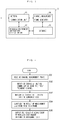
- FIG. 3 illustrates an example of a configuration of the wireless environment information management unit 2.
- the wireless environment information management unit 2 is configured with a network communication unit 21, a wireless environment information collection unit 22, a database 23, and a channel measurement frame generator 24.
- the wireless environment information collection unit 22 collects pieces of wireless environment information, such as the wireless station ID and the channel utilization, from the wireless station ahead of time, through the network communication unit 21 and builds the database 23.
- the wireless station ID that is detectable for every wireless station is stored in the database.
- the contention graph is a wireless station ID that has a spatial relationship as described above.
- the channel measurement frame generator 24 determines a plurality of wireless stations that are caused to perform the stopping of the communication over the first frequency channel for a fixed time or the starting of the measuring of the channel utilization, or both these operations, among wireless stations, and a timing for each of these operations, and generates the channel measurement frame. Furthermore, the time required for a signal to reach the wireless station may be stored in the database 23, and control that outputs the channel measurement frame at a timing that is the time corresponding to the delay time earlier may be performed.
- FIG. 4 illustrates an example of a procedure for processing for providing an instruction to measure the channel information or to temporarily stop the communication.
- the wireless environment information management unit 2 when determining the first frequency channel on which the measuring is performed, the wireless station that causes the communication over the first frequency channel to be stopped, and the wireless station that causes the measuring of the channel utilization to be performed, the wireless environment information management unit 2 outputs the channel measurement frame with the determined wireless station as a destination.
- a plurality of wireless stations neither necessarily need to be present, nor include the wireless station that performs the temporary stopping of the communication, but the channel measurement frame is generated in such a manner that the wireless station which performs the measuring of the channel utilization is necessarily present.
- the channel measurement frame is a signal for providing an instruction to temporarily stop the communication over the first frequency channel or to measure the channel utilization of the first frequency channel.
- the wireless environment information management unit 2 may output the channel measurement frame at a timing that is an amount of time earlier which increases in proportion to a length of latency in the wireless station, considering latency of the frame between the wireless environment information management unit 2 and the wireless station, in such a manner that a plurality of wireless stations receive the channel measurement frame and that the stopping of the designated communication or the measuring of the channel utilization is performed at approximately the same time.
- the wireless station when the wireless station receives the channel measurement frame (S001), according to the instruction that is provided by the channel measurement frame, the ending or the temporary stopping of the communication over the first frequency channel is notified (S002). For example, if user data is being transmitted, as soon as transmission of a frame that is being currently transmitted and replying with an ACK are finished, transmission of the next frame is awaited. Furthermore, if the user data is being received, the replying with the ACK is finished, and then a reply is stopped since reception of the next frame.
- the communication with the wireless station that has the likelihood of transmitting a frame to the wireless station to which the wireless environment information management unit 2 itself belongs is performed, notification of the stopping of the communication to the wireless station, the utilization of a sleep function, or the like may be performed. Furthermore, designation may be made in such a manner that switching to communication with another wireless station ID of the wireless station to which the wireless environment information management unit 2 itself belongs takes place. Furthermore, the channel utilization may be measured without performing spontaneous communication.
- the wireless station After performing necessary pre-processing such as changing of the frequency channel, the wireless station performs the measuring of the channel utilization or performs the stopping of the communication (S003).
- a measuring time section may also be designated by the wireless environment information management unit 2.
- the measuring time and the communication stopping time each are designated, a timing for starting the communication stopping is set to be earlier than the measuring time of the channel utilization, and a fixed time length is added to the timing.
- the wireless environment information management unit 2 can compensate for a gap in operation starting time for the wireless station due to the latency required for the channel measurement frame to arrive.
- processing such as quantization and, if necessary, compression, is performed on the measured channel utilization, or the channel utilization and information on the wireless station ID associated with the channel utilization, and then a result of the processing is stored in a frame (S004) and is output to the wireless environment information management unit 2 using a backhaul network or a wireless network (S005).
- FIG. 5 illustrates an example of a procedure for processing for providing an instruction to designate a timing for measuring the channel information or temporarily stopping the communication.
- the wireless environment information management unit 2 when determining the first frequency channel on which the measuring is performed, the wireless station that causes the communication over the first frequency channel to be stopped, the wireless station that causes the measuring of the channel utilization to be performed, and a timing for measuring the channel utilization, the wireless environment information management unit 2 outputs the channel measurement frame with the determined wireless station as a destination.
- a plurality of wireless stations neither necessarily need to be present, nor include the wireless station that performs the temporary stopping of the communication, but the channel measurement frame is generated in such a manner that the wireless station which performs the measuring of the channel utilization is necessarily present.
- the channel measurement frame is a signal for providing an instruction to temporarily stop the communication over the first frequency channel at a specified time or to measure the channel utilization of the first frequency channel.
- a measuring condition that includes a timing for designating the channel measurement frame is acquired (S102).
- the measuring conditions are a condition as to whether a wireless station has a specific function, a condition for a state, such as mobility of the wireless station/ power supply situation or mobility, network utilization conditions, and the like.
- the wireless environment information management unit 2 may be caused to determine whether the designated measuring condition is satisfied.
- the measuring condition is satisfied and a measuring timing draws near, the ending of the communication or the temporary stopping of the communication over the first frequency channel is broadcast a fixed amount of time before a designated time (S103).
- the channel utilization may be measured without performing the spontaneous communication.
- the measuring of the channel utilization is performed or the stopping of the communication is performed (S104).
- the timing for stopping the spontaneous communication over the first frequency channel or starting to measure the channel utilization of the first frequency channel may be individually designated.
- the timing for starting the communication stopping is set to be earlier than the measuring time of the channel utilization, and a fixed time length is added to the timing.
- the wireless environment information management unit 2 can compensate for a gap in operation starting time for the wireless station due to the latency required for the channel measurement frame to arrive.
- processing such as quantization and, if necessary, compression, is performed on the measured channel utilization, or the channel utilization and information on the wireless station ID associated with the channel utilization, and then a result of the processing is stored in a frame (S105) and is output to the wireless environment information management unit 2 using the backhaul network or the wireless network (S106).
- a plurality of managed wireless stations are caused to stop performing the frame transmission, and thus a wireless station ID and a communication situation of the unmanaged wireless station can be known with higher precision.
- Results of the measuring in every managed wireless station can be compared with each other with high precision by performing the measuring at the same time. For example, with the comparison of the results of the channel utilization, if the channel utilization that is measured in one wireless station is high in the communication between a pair of wireless stations that detect each other, there is a high likelihood that the hidden terminal problem will occur in the communication in which that wireless station is set to be the receiving side. That is, the result of the measuring of the channel utilization is easy to utilize for the determination of the hidden terminal.
- Pieces of data that are collected intermittently from a wireless station at different times are difficult to associate with each other.
- the pieces of data are pieces of information that are measured at the same time or at approximately the same time, the pieces of data can be stored in a state of being temporally associated with each other, and becomes data that is easy to use in an algorithm, such as one for machine learning.
- the contention graph that is obtained from the managed wireless station that has a spatial relationship, because a wireless resource usage situation of the unmanaged wireless station is acquired in a state where the traffic in the managed wireless station does not exert any influence, when traffic is imposed on the managed wireless station, it is easy to simulate what influence is exerted on the contention graph.
- Channel setting can be performed in such a manner that a system capacity on the managed wireless station side, or channel setting for the managed wireless station can be performed in such a manner that the contention graph showing that a specific managed wireless station to have an advantage is attained.
Landscapes
- Engineering & Computer Science (AREA)
- Computer Networks & Wireless Communication (AREA)
- Signal Processing (AREA)
- Mobile Radio Communication Systems (AREA)
Claims (10)
- Drahtloses Umgebungsinformationserfassungssystem, umfassend:eine Vielzahl von drahtlosen Stationen, die konfiguriert sind, drahtlose Kommunikation unter Verwendung eines CSMA/CA-Schemas über einen ersten Frequenzkanal durchzuführen; undeine drahtlose Umgebungsinformationsverwaltungseinheit (2), die konfiguriert ist, drahtlose Umgebungsinformationen verwalteter drahtloser Stationen (1-1 bis 1-N) unter der Vielzahl von drahtlosen Stationen zu erfassen, wobei die verwalteten drahtlosen Stationen (1-1 bis 1-N) konfiguriert sind, durch ein verdrahtetes Netzwerk oder ein drahtloses Netzwerk mit der drahtlosen Umgebungsinformationsverwaltungseinheit (2) verbunden zu werden, und wobei:die drahtlose Umgebungsinformationsverwaltungseinheit (2) eine Einheit beinhaltet, die konfiguriert ist, ein Kanalmessungsframe zu erzeugen und auszugeben, das konfiguriert ist, mindestens eine drahtlose Station unter den verwalteten drahtlosen Stationen (1-1 bis 1-N) zu ermitteln und die mindestens eine ermittelte drahtlose Station anzuweisen, zu einer vom Kanalmessungsframe ausgewiesenen Zeit, eines von Stoppen von Kommunikation über den ersten Frequenzkanal für eine feste Zeit, Starten einer Messung von Kanalnutzung des ersten Frequenzkanals und beides von dem Stoppen von Kommunikation und dem Starten einer Messung durchzuführen,wobei das Kanalmessungsframe zu einem Zeitpunkt ausgegeben wird, der einen Zeitwert früher als die Zeit ist, die vom Kanalmessungsframe ausgewiesen ist, und der Wert in Proportion zu einer Latenzlänge in der mindestens einen ermittelten drahtlosen Station zunimmt, wobei die Latenz die Latenz des Kanalmessungsframes zwischen der drahtlosen Umgebungsinformationsverwaltungseinheit und der mindestens einen ermittelten drahtlosen Station ist; unddie mindestens eine ermittelte drahtlose Station (1-1 bis 1-N) eine Einheit beinhaltet, die konfiguriert ist zum:Durchführen, zu einer Zeit, die vom Kanalmessungsframe von der drahtlosen Umgebungsinformationsverwaltungseinheit ausgewiesen ist, eines von dem Stoppen der Kommunikation über den ersten Frequenzkanal, dem Messen der Kanalnutzung des ersten Frequenzkanals und beides von dem Stoppen der Kommunikation und dem Messen der Kanalnutzung,Erhalten der drahtlosen Umgebungsinformationen, undAusgeben der erhaltenen drahtlosen Umgebungsinformationen an die drahtlose Umgebungsinformationsverwaltungseinheit (2) durch das verdrahtete Netzwerk oder das drahtlose Netzwerk.
- Drahtloses Umgebungsinformationserfassungssystem nach Anspruch 1, wobei
Teil oder alle der verwalteten drahtlosen Stationen (1-1 bis 1-N) konfiguriert sind, das Kanalmessungsframe und die drahtlosen Umgebungsinformationen zwischen jeder der verwalteten drahtlosen Stationen (1-1 bis 1-N) unter Verwendung eines zweiten Frequenzkanals zu übertragen. - Drahtloses Umgebungsinformationserfassungssystem nach Anspruch 1 oder 2, wobei
die drahtlose Umgebungsinformationsverwaltungseinheit (2) eine Einheit beinhaltet, die konfiguriert ist, das Kanalmessungsframe zu erzeugen, um das Durchführen des Messens der Kanalnutzung anzuweisen, mit einem festen Zeitwert nach dem Stoppen der Kommunikation über den ersten Frequenzkanal gestartet zu werden. - Drahtloses Umgebungsinformationserfassungssystem nach Anspruch 1 oder 2, wobei
die verwalteten drahtlosen Stationen (1-1 bis 1-N) eine Benachrichtigungseinheit beinhalten, die konfiguriert ist, einen Stopp einer Kommunikationsfunktion an die drahtlosen Stationen zu benachrichtigen, die ein Kommunikationspartner sind, wenn die Zeit, eines von dem Stoppen der Kommunikation über den ersten Frequenzkanal, dem Messen der Kanalnutzung des ersten Frequenzkanals und von beiden, dem Stoppen der Kommunikation und dem Messen der Kanalnutzung durchzuführen, vom Kanalmessungsframe von der drahtlosen Umgebungsinformationsverwaltungseinheit (2) ausgewiesen ist und wenn die ausgewiesene Zeit naht. - Drahtloses Umgebungsinformationserfassungssystem nach Anspruch 1 oder 2, wobei
die verwalteten drahtlosen Stationen (1-1 bis 1-N) eine Einheit beinhalten, die konfiguriert ist, während einer Periode ausgewiesener Zeit ein Frame zu verwerfen, das von den drahtlosen Stationen empfangen wird, die ein Kommunikationspartner sind, wenn die Zeit, eines von dem Stoppen der Kommunikation über den ersten Frequenzkanal, dem Messen der Kanalnutzung des ersten Frequenzkanals und von beiden, dem Stoppen der Kommunikation und dem Messen der Kanalnutzung durchzuführen, vom Kanalmessungsframe von der drahtlosen Umgebungsinformationsverwaltungseinheit ausgewiesen ist. - Drahtloses Umgebungsinformationserfassungssystem nach Anspruch 1 oder 2, wobei
die verwalteten drahtlosen Stationen (1-1 bis 1-N) eine Einheit beinhalten, die konfiguriert ist, während einer Periode ausgewiesener Zeit, die Kanalnutzung zu messen, indem aus einer Berechnung der Kanalnutzung eine Zeit, die benötigt wird, ein Frame zu empfangen, und eine Zeit, die benötigt wird, ein Steuersignal von den drahtlosen Stationen, die ein Kommunikationspartner sind, zu übertragen, ausgeschlossen wird, wenn die Zeit, eines von dem Stoppen der Kommunikation über den ersten Frequenzkanal, dem Messen der Kanalnutzung des ersten Frequenzkanals und von beiden, dem Stoppen der Kommunikation und dem Messen der Kanalnutzung durchzuführen, vom Kanalmessungsframe von der drahtlosen Umgebungsinformationsverwaltungseinheit ausgewiesen wird. - Drahtloses Umgebungsinformationserfassungssystem nach Anspruch 1 oder 2, wobei
die verwalteten drahtlosen Stationen (1-1 bis 1-N) eine Einheit beinhalten, die konfiguriert ist, eine Änderung einer drahtlosen Zuordnungsendgerätekennung an die drahtlosen Stationen, die ein Kommunikationspartner sind, zu benachrichtigen, wenn die Zeit, eines von dem Stoppen der Kommunikation über den ersten Frequenzkanal, dem Messen der Kanalnutzung des ersten Frequenzkanals und von beiden, dem Stoppen der Kommunikation und dem Messen der Kanalnutzung durchzuführen, vom Kanalmessungsframe von der drahtlosen Umgebungsinformationsverwaltungseinheit (2) ausgewiesen ist und wenn die ausgewiesene Zeit naht. - Drahtloses Umgebungsinformationserfassungssystem nach Anspruch 1 oder 2, wobei
die drahtlose Umgebungsinformationsverwaltungseinheit (2) beinhaltet:einen Kanalmessungsframeerzeuger (24), der konfiguriert ist, ein Kanalmessungsframe zu erzeugen, das zuweist, unmittelbar eines von dem Stoppen der Kommunikation über den ersten Frequenzkanal, dem Messen der Kanalnutzung des ersten Frequenzkanals und von beiden, dem Stoppen der Kommunikation und dem Messen der Kanalnutzung durchzuführen;eine Datenbank (23), die konfiguriert ist, eine Verzögerungszeit zu speichern, die für ein Signal benötigt wird, um die verwalteten drahtlosen Stationen (1-1 bis 1-N) zu erreichen; undeine Netzwerkkommunikationseinheit (2), die konfiguriert ist, das Kanalmessungsframe an die verwalteten drahtlosen Stationen (1-1 bis 1-N) zu einem Zeitpunkt früher als ein Zeitwert auszugeben, der der Verzögerungszeit entspricht. - Drahtloses Umgebungsinformationserfassungssystem nach Anspruch 2, wobei
die drahtlose Umgebungsinformationsverwaltungseinheit (2) eine Einheit beinhaltet, die konfiguriert ist,
einen Plan für eines von dem Stoppen der Kommunikation über den ersten Frequenzkanal, dem Messen der Kanalnutzung des ersten Frequenzkanals und von beiden, dem Stoppen der Kommunikation und dem Messen der Kanalnutzung für die verwalteten drahtlosen Stationen (1-1 bis 1-N) unter Verwendung des zweiten Frequenzkanals zu ermitteln, und
ein Ergebnis der Ermittlung als das Kanalmessungsframe auszugeben. - Drahtloses Umgebungsinformationserfassungsverfahren zur Verwendung in einem drahtlosen Umgebungsinformationserfassungssystem, das eine Vielzahl von drahtlosen Stationen und eine drahtlose Umgebungsinformationsverwaltungseinheit (2) umfasst, wobei das Verfahren umfasst:eine Vielzahl von drahtlosen Stationen, die drahtlose Kommunikation unter Verwendung eines CSMA/CA-Schemas über einen ersten Frequenzkanal durchführen; unddie drahtlose Umgebungsinformationsverwaltungseinheit (2), die drahtlose Umgebungsinformationen verwalteter drahtloser Stationen (1-1 bis 1-N) unter der Vielzahl von drahtlosen Stationen erfasst, wobei die verwalteten drahtlosen Stationen (1-1 bis 1-N) durch ein verdrahtetes Netzwerk oder ein drahtloses Netzwerk mit der drahtlosen Umgebungsinformationsverwaltungseinheit (2) verbunden sind, wobei das Verfahren weiter umfasst:Erzeugen und Ausgeben, durch die drahtlose Umgebungsinformationsverwaltungseinheit (2), eines Kanalmessungsframes, das mindestens eine drahtlose Station unter den verwalteten drahtlosen Stationen (1-1 bis 1-N) ermittelt und die mindestens eine ermittelte drahtlose Station anweist, zu einer vom Kanalmessungsframe ausgewiesenen Zeit, eines von Stoppen von Kommunikation über den ersten Frequenzkanal für eine feste Zeit, Starten von Messen von Kanalnutzung des ersten Frequenzkanals und von beiden, dem Stoppen der Kommunikation und Messen der Kanalnutzung durchzuführen,wobei das Kanalmessungsframe zu einem Zeitpunkt ausgegeben wird, der um einen Zeitwert früher als die Zeit ist, die vom Kanalmessungsframe ausgewiesen ist, und der Wert in Proportion zu einer Latenzlänge in der mindestens einen ermittelten drahtlosen Station zunimmt, wobei die Latenz die Latenz des Kanalmessungsframes zwischen der drahtlosen Umgebungsinformationsverwaltungseinheit und der mindestens einen ermittelten drahtlosen Station ist;und Durchführen, durch die mindestens eine ermittelte drahtlose Station, bei einer Zeit, die vom Kanalmessungsframe von der drahtlosen Umgebungsinformationsverwaltungseinheit ausgewiesen ist, von einem von dem Stoppen der Kommunikation über den ersten Frequenzkanal, dem Messen der Kanalnutzung des ersten Frequenzkanals und von beiden, dem Stoppen der Kommunikation und Messen der Kanalnutzung,Erhalten der drahtlosen Umgebungsinformationen, undAusgeben der erhaltenen drahtlosen Umgebungsinformationen an die drahtlose Umgebungsinformationsverwaltungseinheit (2) durch das verdrahtete Netzwerk oder das drahtlose Netzwerk.
Applications Claiming Priority (2)
| Application Number | Priority Date | Filing Date | Title |
|---|---|---|---|
| JP2015154479 | 2015-08-04 | ||
| PCT/JP2016/072541 WO2017022723A1 (ja) | 2015-08-04 | 2016-08-01 | 無線環境情報収集システムおよび方法 |
Publications (3)
| Publication Number | Publication Date |
|---|---|
| EP3334202A1 EP3334202A1 (de) | 2018-06-13 |
| EP3334202A4 EP3334202A4 (de) | 2018-12-26 |
| EP3334202B1 true EP3334202B1 (de) | 2020-12-02 |
Family
ID=57944220
Family Applications (1)
| Application Number | Title | Priority Date | Filing Date |
|---|---|---|---|
| EP16833002.5A Active EP3334202B1 (de) | 2015-08-04 | 2016-08-01 | System und verfahren zur drahtlosen umgebungsinformationserfassung |
Country Status (6)
| Country | Link |
|---|---|
| US (1) | US10638341B2 (de) |
| EP (1) | EP3334202B1 (de) |
| JP (1) | JP6498769B2 (de) |
| KR (1) | KR102002139B1 (de) |
| CN (1) | CN107925893B (de) |
| WO (1) | WO2017022723A1 (de) |
Families Citing this family (13)
| Publication number | Priority date | Publication date | Assignee | Title |
|---|---|---|---|---|
| CN107925893B (zh) * | 2015-08-04 | 2021-04-09 | 日本电信电话株式会社 | 无线环境信息收集系统以及方法 |
| WO2017026406A1 (ja) * | 2015-08-11 | 2017-02-16 | 京セラ株式会社 | 基地局及び無線端末 |
| US10962780B2 (en) * | 2015-10-26 | 2021-03-30 | Microsoft Technology Licensing, Llc | Remote rendering for virtual images |
| CN108633101B (zh) * | 2017-03-24 | 2021-01-12 | 华为技术有限公司 | 一种通信方法及装置 |
| JP7222224B2 (ja) * | 2018-11-14 | 2023-02-15 | 富士通株式会社 | 非管理波推定装置、非管理波推定システム及び非管理波推定方法 |
| JP7096968B2 (ja) * | 2019-04-09 | 2022-07-07 | 日本電信電話株式会社 | 無線通信システム、制御局装置および無線基地局装置 |
| JP7140039B2 (ja) * | 2019-04-16 | 2022-09-21 | 日本電信電話株式会社 | 無線通信システムの無線通信性能測定方法、無線通信性能測定システムおよび無線基地局 |
| JP7156156B2 (ja) * | 2019-04-22 | 2022-10-19 | 日本電信電話株式会社 | 無線通信性能測定方法および無線通信性能測定システム |
| JP7410618B2 (ja) * | 2019-10-30 | 2024-01-10 | キヤノン株式会社 | 通信装置、制御方法、およびプログラム |
| US10644789B1 (en) * | 2019-12-12 | 2020-05-05 | Cabin Management Solutions, Llc. | Vehicle communication system and method |
| US10644786B1 (en) | 2019-12-12 | 2020-05-05 | Cabin Management Solutions, Llc. | Plug-and-play vehicle communication system and method |
| WO2021250755A1 (ja) * | 2020-06-08 | 2021-12-16 | 日本電信電話株式会社 | 情報処理方法、情報処理装置、無線通信システム、及び情報処理プログラム |
| US20250211881A1 (en) * | 2023-12-21 | 2025-06-26 | Ciena Corporation | Spectrum assignment in optical networks utilizing a minimum representative set and a topology agnostic approach |
Family Cites Families (23)
| Publication number | Priority date | Publication date | Assignee | Title |
|---|---|---|---|---|
| US7295524B1 (en) * | 2003-02-18 | 2007-11-13 | Airwave Wireless, Inc | Methods, apparatuses and systems facilitating management of airspace in wireless computer network environments |
| KR100734993B1 (ko) * | 2003-04-16 | 2007-07-04 | 샤프 가부시키가이샤 | 무선 단말기, 베이스 기기, 와이어리스 시스템, 무선 단말기의 제어 방법, 무선 단말기의 제어 프로그램을 기록한 컴퓨터 판독가능한 기록 매체 |
| KR100606129B1 (ko) * | 2003-04-30 | 2006-07-28 | 삼성전자주식회사 | 광대역 무선 접속 통신 시스템에서 채널 품질 측정 및보고 방법 |
| JP2009055297A (ja) * | 2007-08-27 | 2009-03-12 | Mitsubishi Electric Corp | トラヒック情報提供システム |
| CN101803447B (zh) * | 2007-09-14 | 2013-10-30 | 皇家飞利浦电子股份有限公司 | 对媒体的访问的管理 |
| CN101364908B (zh) * | 2008-09-16 | 2011-12-21 | 杭州华三通信技术有限公司 | 一种评估无线信道质量的方法和装置 |
| EP2378804B1 (de) | 2009-01-09 | 2018-02-21 | NEC Corporation | Basisstationsgerät, mobilstationsgerät, kommunikationssystem, verfahren zur steuerung eines basisstationsgeräts, verfahren zur steuerung eines mobilstationsgeräts und speichermedium mit darauf gespeichertem programm |
| US9585043B2 (en) * | 2010-04-13 | 2017-02-28 | Interdigital Patent Holdings, Inc. | Group transmissions in wireless local area networks |
| US20120163279A1 (en) * | 2010-07-07 | 2012-06-28 | Xuan Mai Tran | Communication apparatus, communication terminal apparatus, communication system, and communication method |
| WO2012016187A2 (en) * | 2010-07-30 | 2012-02-02 | Board Of Regents | Distributed rate allocation and collision detection in wireless networks |
| US9497690B2 (en) * | 2010-12-09 | 2016-11-15 | Lg Electronics Inc. | Access method between a terminal and a base station in a wireless communication system and apparatus thereof |
| KR101565229B1 (ko) * | 2011-04-29 | 2015-11-02 | 엘지전자 주식회사 | 무선랜 시스템에서의 계층화 채널 접근 방법 및 장치 |
| CN102769516B (zh) * | 2011-05-06 | 2017-08-11 | 中兴通讯股份有限公司 | 一种信道测量信息反馈方法及系统 |
| JP5915003B2 (ja) * | 2011-06-20 | 2016-05-11 | 日本電気株式会社 | 無線システム、操作卓、無線局、無線システム制御方法、プログラム |
| JP5967768B2 (ja) * | 2012-06-12 | 2016-08-10 | 日本電信電話株式会社 | 無線通信システム及び無線通信方法 |
| US9184886B2 (en) | 2012-08-10 | 2015-11-10 | Blackberry Limited | TD LTE secondary component carrier in unlicensed bands |
| US9351297B2 (en) * | 2012-08-27 | 2016-05-24 | Huawei Technologies Co., Ltd. | System and method for a collaborative service set |
| EP2905983B1 (de) * | 2012-11-12 | 2018-07-18 | Nippon Telegraph and Telephone Corporation | Drahtlose kommunikationsvorrichtung, drahtloses kommunikationssystem und drahtloses kommunikationsverfahren |
| JP5852599B2 (ja) * | 2013-02-13 | 2016-02-03 | 日本電信電話株式会社 | 無線通信システム、及び電波測定方法 |
| WO2015002656A1 (en) | 2013-07-05 | 2015-01-08 | Nokia Corporation | Performing measurements in wireless network |
| US9456306B2 (en) * | 2013-09-30 | 2016-09-27 | Broadcom Corporation | Fine timing measurement transmissions between APs |
| GB2527837A (en) * | 2014-07-03 | 2016-01-06 | Dublin Inst Of Technology | A WLAN bandwidth controller |
| CN107925893B (zh) * | 2015-08-04 | 2021-04-09 | 日本电信电话株式会社 | 无线环境信息收集系统以及方法 |
-
2016
- 2016-08-01 CN CN201680045474.5A patent/CN107925893B/zh active Active
- 2016-08-01 EP EP16833002.5A patent/EP3334202B1/de active Active
- 2016-08-01 JP JP2017533063A patent/JP6498769B2/ja active Active
- 2016-08-01 US US15/744,215 patent/US10638341B2/en active Active
- 2016-08-01 WO PCT/JP2016/072541 patent/WO2017022723A1/ja not_active Ceased
- 2016-08-01 KR KR1020187003063A patent/KR102002139B1/ko active Active
Non-Patent Citations (1)
| Title |
|---|
| None * |
Also Published As
| Publication number | Publication date |
|---|---|
| US20180206134A1 (en) | 2018-07-19 |
| JP6498769B2 (ja) | 2019-04-10 |
| WO2017022723A1 (ja) | 2017-02-09 |
| JPWO2017022723A1 (ja) | 2018-05-10 |
| EP3334202A1 (de) | 2018-06-13 |
| EP3334202A4 (de) | 2018-12-26 |
| CN107925893A (zh) | 2018-04-17 |
| US10638341B2 (en) | 2020-04-28 |
| KR102002139B1 (ko) | 2019-07-19 |
| CN107925893B (zh) | 2021-04-09 |
| KR20180025918A (ko) | 2018-03-09 |
Similar Documents
| Publication | Publication Date | Title |
|---|---|---|
| EP3334202B1 (de) | System und verfahren zur drahtlosen umgebungsinformationserfassung | |
| KR101889515B1 (ko) | 전력 제어를 위한 시스템 및 방법 | |
| CN112154677A (zh) | Its频带中的模式3 v2x ue的改进保护 | |
| Chang et al. | Accuracy-aware interference modeling and measurement in wireless sensor networks | |
| US9072018B2 (en) | Wireless channel switching using co-located radios | |
| US9107205B2 (en) | System and method for beacon transmission timing control | |
| US10182413B2 (en) | Wireless positioning using scheduled transmissions | |
| CN105491641B (zh) | 一种发现信号的传输方法、小区发现的方法及装置 | |
| EP3915310B1 (de) | Kooperative netzwerkübergreifende kanalauswahl | |
| WO2016070772A1 (zh) | 一种进行载波调度的方法和设备 | |
| US9479891B2 (en) | Communication transmission system | |
| CN106385714A (zh) | 无线连接重建方法、用户设备和基站 | |
| CN104254102A (zh) | 一种测量报告的上报方法、通信节点和系统 | |
| CN101729162A (zh) | 用于通信网络中的无线电测量的方法和通信节点 | |
| US11924857B2 (en) | Channel coordination for optimization of IIoT device location and data services in WiFi network | |
| US20240251377A1 (en) | Positioning of terminal devices | |
| JP5406351B2 (ja) | 無線装置、無線通信システム、制御方法及び制御プログラム | |
| US12621848B2 (en) | Sidelink resource reselection | |
| US20260025851A1 (en) | Dynamic channel access mechanism for txop preemption | |
| WO2025156503A1 (en) | A method for event-triggered l1 measurement reporting | |
| KR101273192B1 (ko) | 2개의 라디오들을 사용하여 주파수 스캐닝하기 위한 디바이스 및 방법 | |
| EP4223065A1 (de) | Sidelink-ressourcenneuauswahl | |
| KR20150030589A (ko) | 무선랜 정보 전송 방법 및 네트워크 시스템 |
Legal Events
| Date | Code | Title | Description |
|---|---|---|---|
| STAA | Information on the status of an ep patent application or granted ep patent |
Free format text: STATUS: THE INTERNATIONAL PUBLICATION HAS BEEN MADE |
|
| PUAI | Public reference made under article 153(3) epc to a published international application that has entered the european phase |
Free format text: ORIGINAL CODE: 0009012 |
|
| STAA | Information on the status of an ep patent application or granted ep patent |
Free format text: STATUS: REQUEST FOR EXAMINATION WAS MADE |
|
| 17P | Request for examination filed |
Effective date: 20180118 |
|
| AK | Designated contracting states |
Kind code of ref document: A1 Designated state(s): AL AT BE BG CH CY CZ DE DK EE ES FI FR GB GR HR HU IE IS IT LI LT LU LV MC MK MT NL NO PL PT RO RS SE SI SK SM TR |
|
| AX | Request for extension of the european patent |
Extension state: BA ME |
|
| DAV | Request for validation of the european patent (deleted) | ||
| DAX | Request for extension of the european patent (deleted) | ||
| A4 | Supplementary search report drawn up and despatched |
Effective date: 20181127 |
|
| RIC1 | Information provided on ipc code assigned before grant |
Ipc: H04W 24/08 20090101ALI20181121BHEP Ipc: H04W 84/12 20090101ALI20181121BHEP Ipc: H04W 24/00 20090101AFI20181121BHEP Ipc: H04W 24/10 20090101ALI20181121BHEP Ipc: H04W 74/08 20090101ALI20181121BHEP |
|
| REG | Reference to a national code |
Ref country code: DE Ref legal event code: R079 Ref document number: 602016049168 Country of ref document: DE Free format text: PREVIOUS MAIN CLASS: H04W0024000000 Ipc: H04W0024100000 |
|
| GRAP | Despatch of communication of intention to grant a patent |
Free format text: ORIGINAL CODE: EPIDOSNIGR1 |
|
| STAA | Information on the status of an ep patent application or granted ep patent |
Free format text: STATUS: GRANT OF PATENT IS INTENDED |
|
| RIC1 | Information provided on ipc code assigned before grant |
Ipc: H04W 74/08 20090101ALN20200430BHEP Ipc: H04W 84/12 20090101ALN20200430BHEP Ipc: H04W 24/10 20090101AFI20200430BHEP Ipc: H04W 24/00 20090101ALI20200430BHEP |
|
| INTG | Intention to grant announced |
Effective date: 20200602 |
|
| GRAS | Grant fee paid |
Free format text: ORIGINAL CODE: EPIDOSNIGR3 |
|
| GRAA | (expected) grant |
Free format text: ORIGINAL CODE: 0009210 |
|
| STAA | Information on the status of an ep patent application or granted ep patent |
Free format text: STATUS: THE PATENT HAS BEEN GRANTED |
|
| AK | Designated contracting states |
Kind code of ref document: B1 Designated state(s): AL AT BE BG CH CY CZ DE DK EE ES FI FR GB GR HR HU IE IS IT LI LT LU LV MC MK MT NL NO PL PT RO RS SE SI SK SM TR |
|
| REG | Reference to a national code |
Ref country code: GB Ref legal event code: FG4D |
|
| REG | Reference to a national code |
Ref country code: AT Ref legal event code: REF Ref document number: 1342308 Country of ref document: AT Kind code of ref document: T Effective date: 20201215 Ref country code: CH Ref legal event code: EP |
|
| REG | Reference to a national code |
Ref country code: IE Ref legal event code: FG4D |
|
| REG | Reference to a national code |
Ref country code: DE Ref legal event code: R096 Ref document number: 602016049168 Country of ref document: DE |
|
| PG25 | Lapsed in a contracting state [announced via postgrant information from national office to epo] |
Ref country code: GR Free format text: LAPSE BECAUSE OF FAILURE TO SUBMIT A TRANSLATION OF THE DESCRIPTION OR TO PAY THE FEE WITHIN THE PRESCRIBED TIME-LIMIT Effective date: 20210303 Ref country code: FI Free format text: LAPSE BECAUSE OF FAILURE TO SUBMIT A TRANSLATION OF THE DESCRIPTION OR TO PAY THE FEE WITHIN THE PRESCRIBED TIME-LIMIT Effective date: 20201202 Ref country code: RS Free format text: LAPSE BECAUSE OF FAILURE TO SUBMIT A TRANSLATION OF THE DESCRIPTION OR TO PAY THE FEE WITHIN THE PRESCRIBED TIME-LIMIT Effective date: 20201202 Ref country code: NO Free format text: LAPSE BECAUSE OF FAILURE TO SUBMIT A TRANSLATION OF THE DESCRIPTION OR TO PAY THE FEE WITHIN THE PRESCRIBED TIME-LIMIT Effective date: 20210302 |
|
| REG | Reference to a national code |
Ref country code: NL Ref legal event code: MP Effective date: 20201202 |
|
| REG | Reference to a national code |
Ref country code: AT Ref legal event code: MK05 Ref document number: 1342308 Country of ref document: AT Kind code of ref document: T Effective date: 20201202 |
|
| PG25 | Lapsed in a contracting state [announced via postgrant information from national office to epo] |
Ref country code: BG Free format text: LAPSE BECAUSE OF FAILURE TO SUBMIT A TRANSLATION OF THE DESCRIPTION OR TO PAY THE FEE WITHIN THE PRESCRIBED TIME-LIMIT Effective date: 20210302 Ref country code: LV Free format text: LAPSE BECAUSE OF FAILURE TO SUBMIT A TRANSLATION OF THE DESCRIPTION OR TO PAY THE FEE WITHIN THE PRESCRIBED TIME-LIMIT Effective date: 20201202 Ref country code: PL Free format text: LAPSE BECAUSE OF FAILURE TO SUBMIT A TRANSLATION OF THE DESCRIPTION OR TO PAY THE FEE WITHIN THE PRESCRIBED TIME-LIMIT Effective date: 20201202 Ref country code: SE Free format text: LAPSE BECAUSE OF FAILURE TO SUBMIT A TRANSLATION OF THE DESCRIPTION OR TO PAY THE FEE WITHIN THE PRESCRIBED TIME-LIMIT Effective date: 20201202 |
|
| PG25 | Lapsed in a contracting state [announced via postgrant information from national office to epo] |
Ref country code: NL Free format text: LAPSE BECAUSE OF FAILURE TO SUBMIT A TRANSLATION OF THE DESCRIPTION OR TO PAY THE FEE WITHIN THE PRESCRIBED TIME-LIMIT Effective date: 20201202 Ref country code: HR Free format text: LAPSE BECAUSE OF FAILURE TO SUBMIT A TRANSLATION OF THE DESCRIPTION OR TO PAY THE FEE WITHIN THE PRESCRIBED TIME-LIMIT Effective date: 20201202 |
|
| REG | Reference to a national code |
Ref country code: LT Ref legal event code: MG9D |
|
| PG25 | Lapsed in a contracting state [announced via postgrant information from national office to epo] |
Ref country code: SK Free format text: LAPSE BECAUSE OF FAILURE TO SUBMIT A TRANSLATION OF THE DESCRIPTION OR TO PAY THE FEE WITHIN THE PRESCRIBED TIME-LIMIT Effective date: 20201202 Ref country code: RO Free format text: LAPSE BECAUSE OF FAILURE TO SUBMIT A TRANSLATION OF THE DESCRIPTION OR TO PAY THE FEE WITHIN THE PRESCRIBED TIME-LIMIT Effective date: 20201202 Ref country code: PT Free format text: LAPSE BECAUSE OF FAILURE TO SUBMIT A TRANSLATION OF THE DESCRIPTION OR TO PAY THE FEE WITHIN THE PRESCRIBED TIME-LIMIT Effective date: 20210405 Ref country code: SM Free format text: LAPSE BECAUSE OF FAILURE TO SUBMIT A TRANSLATION OF THE DESCRIPTION OR TO PAY THE FEE WITHIN THE PRESCRIBED TIME-LIMIT Effective date: 20201202 Ref country code: LT Free format text: LAPSE BECAUSE OF FAILURE TO SUBMIT A TRANSLATION OF THE DESCRIPTION OR TO PAY THE FEE WITHIN THE PRESCRIBED TIME-LIMIT Effective date: 20201202 Ref country code: EE Free format text: LAPSE BECAUSE OF FAILURE TO SUBMIT A TRANSLATION OF THE DESCRIPTION OR TO PAY THE FEE WITHIN THE PRESCRIBED TIME-LIMIT Effective date: 20201202 Ref country code: CZ Free format text: LAPSE BECAUSE OF FAILURE TO SUBMIT A TRANSLATION OF THE DESCRIPTION OR TO PAY THE FEE WITHIN THE PRESCRIBED TIME-LIMIT Effective date: 20201202 |
|
| PG25 | Lapsed in a contracting state [announced via postgrant information from national office to epo] |
Ref country code: AT Free format text: LAPSE BECAUSE OF FAILURE TO SUBMIT A TRANSLATION OF THE DESCRIPTION OR TO PAY THE FEE WITHIN THE PRESCRIBED TIME-LIMIT Effective date: 20201202 |
|
| REG | Reference to a national code |
Ref country code: DE Ref legal event code: R097 Ref document number: 602016049168 Country of ref document: DE |
|
| PG25 | Lapsed in a contracting state [announced via postgrant information from national office to epo] |
Ref country code: IS Free format text: LAPSE BECAUSE OF FAILURE TO SUBMIT A TRANSLATION OF THE DESCRIPTION OR TO PAY THE FEE WITHIN THE PRESCRIBED TIME-LIMIT Effective date: 20210402 |
|
| PLBE | No opposition filed within time limit |
Free format text: ORIGINAL CODE: 0009261 |
|
| STAA | Information on the status of an ep patent application or granted ep patent |
Free format text: STATUS: NO OPPOSITION FILED WITHIN TIME LIMIT |
|
| PG25 | Lapsed in a contracting state [announced via postgrant information from national office to epo] |
Ref country code: AL Free format text: LAPSE BECAUSE OF FAILURE TO SUBMIT A TRANSLATION OF THE DESCRIPTION OR TO PAY THE FEE WITHIN THE PRESCRIBED TIME-LIMIT Effective date: 20201202 Ref country code: IT Free format text: LAPSE BECAUSE OF FAILURE TO SUBMIT A TRANSLATION OF THE DESCRIPTION OR TO PAY THE FEE WITHIN THE PRESCRIBED TIME-LIMIT Effective date: 20201202 |
|
| 26N | No opposition filed |
Effective date: 20210903 |
|
| PG25 | Lapsed in a contracting state [announced via postgrant information from national office to epo] |
Ref country code: DK Free format text: LAPSE BECAUSE OF FAILURE TO SUBMIT A TRANSLATION OF THE DESCRIPTION OR TO PAY THE FEE WITHIN THE PRESCRIBED TIME-LIMIT Effective date: 20201202 Ref country code: SI Free format text: LAPSE BECAUSE OF FAILURE TO SUBMIT A TRANSLATION OF THE DESCRIPTION OR TO PAY THE FEE WITHIN THE PRESCRIBED TIME-LIMIT Effective date: 20201202 |
|
| PG25 | Lapsed in a contracting state [announced via postgrant information from national office to epo] |
Ref country code: ES Free format text: LAPSE BECAUSE OF FAILURE TO SUBMIT A TRANSLATION OF THE DESCRIPTION OR TO PAY THE FEE WITHIN THE PRESCRIBED TIME-LIMIT Effective date: 20201202 |
|
| REG | Reference to a national code |
Ref country code: CH Ref legal event code: PL |
|
| PG25 | Lapsed in a contracting state [announced via postgrant information from national office to epo] |
Ref country code: MC Free format text: LAPSE BECAUSE OF FAILURE TO SUBMIT A TRANSLATION OF THE DESCRIPTION OR TO PAY THE FEE WITHIN THE PRESCRIBED TIME-LIMIT Effective date: 20201202 |
|
| REG | Reference to a national code |
Ref country code: BE Ref legal event code: MM Effective date: 20210831 |
|
| PG25 | Lapsed in a contracting state [announced via postgrant information from national office to epo] |
Ref country code: LI Free format text: LAPSE BECAUSE OF NON-PAYMENT OF DUE FEES Effective date: 20210831 Ref country code: CH Free format text: LAPSE BECAUSE OF NON-PAYMENT OF DUE FEES Effective date: 20210831 |
|
| PG25 | Lapsed in a contracting state [announced via postgrant information from national office to epo] |
Ref country code: IS Free format text: LAPSE BECAUSE OF FAILURE TO SUBMIT A TRANSLATION OF THE DESCRIPTION OR TO PAY THE FEE WITHIN THE PRESCRIBED TIME-LIMIT Effective date: 20210402 Ref country code: LU Free format text: LAPSE BECAUSE OF NON-PAYMENT OF DUE FEES Effective date: 20210801 |
|
| PG25 | Lapsed in a contracting state [announced via postgrant information from national office to epo] |
Ref country code: IE Free format text: LAPSE BECAUSE OF NON-PAYMENT OF DUE FEES Effective date: 20210801 Ref country code: BE Free format text: LAPSE BECAUSE OF NON-PAYMENT OF DUE FEES Effective date: 20210831 |
|
| PG25 | Lapsed in a contracting state [announced via postgrant information from national office to epo] |
Ref country code: HU Free format text: LAPSE BECAUSE OF FAILURE TO SUBMIT A TRANSLATION OF THE DESCRIPTION OR TO PAY THE FEE WITHIN THE PRESCRIBED TIME-LIMIT; INVALID AB INITIO Effective date: 20160801 |
|
| PG25 | Lapsed in a contracting state [announced via postgrant information from national office to epo] |
Ref country code: CY Free format text: LAPSE BECAUSE OF FAILURE TO SUBMIT A TRANSLATION OF THE DESCRIPTION OR TO PAY THE FEE WITHIN THE PRESCRIBED TIME-LIMIT Effective date: 20201202 |
|
| PG25 | Lapsed in a contracting state [announced via postgrant information from national office to epo] |
Ref country code: MK Free format text: LAPSE BECAUSE OF FAILURE TO SUBMIT A TRANSLATION OF THE DESCRIPTION OR TO PAY THE FEE WITHIN THE PRESCRIBED TIME-LIMIT Effective date: 20201202 |
|
| PG25 | Lapsed in a contracting state [announced via postgrant information from national office to epo] |
Ref country code: MT Free format text: LAPSE BECAUSE OF FAILURE TO SUBMIT A TRANSLATION OF THE DESCRIPTION OR TO PAY THE FEE WITHIN THE PRESCRIBED TIME-LIMIT Effective date: 20201202 |
|
| PGFP | Annual fee paid to national office [announced via postgrant information from national office to epo] |
Ref country code: DE Payment date: 20250820 Year of fee payment: 10 |
|
| PGFP | Annual fee paid to national office [announced via postgrant information from national office to epo] |
Ref country code: GB Payment date: 20250821 Year of fee payment: 10 |
|
| PGFP | Annual fee paid to national office [announced via postgrant information from national office to epo] |
Ref country code: FR Payment date: 20250828 Year of fee payment: 10 |
|
| PG25 | Lapsed in a contracting state [announced via postgrant information from national office to epo] |
Ref country code: TR Free format text: LAPSE BECAUSE OF FAILURE TO SUBMIT A TRANSLATION OF THE DESCRIPTION OR TO PAY THE FEE WITHIN THE PRESCRIBED TIME-LIMIT Effective date: 20201202 |
|
| REG | Reference to a national code |
Ref country code: DE Ref legal event code: R081 Ref document number: 602016049168 Country of ref document: DE Owner name: NTT, INC., JP Free format text: FORMER OWNER: NIPPON TELEGRAPH AND TELEPHONE CORPORATION, TOKYO, JP Ref country code: DE Ref legal event code: R082 Ref document number: 602016049168 Country of ref document: DE Representative=s name: DENNEMEYER & ASSOCIATES RECHTSANWALTSGESELLSCH, DE |