EP3334258A1 - Dispositif de circuit imprimé - Google Patents
Dispositif de circuit imprimé Download PDFInfo
- Publication number
- EP3334258A1 EP3334258A1 EP17190322.2A EP17190322A EP3334258A1 EP 3334258 A1 EP3334258 A1 EP 3334258A1 EP 17190322 A EP17190322 A EP 17190322A EP 3334258 A1 EP3334258 A1 EP 3334258A1
- Authority
- EP
- European Patent Office
- Prior art keywords
- sheet
- mount
- circuit board
- board device
- resin portion
- Prior art date
- Legal status (The legal status is an assumption and is not a legal conclusion. Google has not performed a legal analysis and makes no representation as to the accuracy of the status listed.)
- Withdrawn
Links
Images







Classifications
-
- H—ELECTRICITY
- H05—ELECTRIC TECHNIQUES NOT OTHERWISE PROVIDED FOR
- H05K—PRINTED CIRCUITS; CASINGS OR CONSTRUCTIONAL DETAILS OF ELECTRIC APPARATUS; MANUFACTURE OF ASSEMBLAGES OF ELECTRICAL COMPONENTS
- H05K1/00—Printed circuits
- H05K1/02—Details
- H05K1/0201—Thermal arrangements, e.g. for cooling, heating or preventing overheating
- H05K1/0203—Cooling of mounted components
- H05K1/0209—External configuration of printed circuit board adapted for heat dissipation, e.g. lay-out of conductors, coatings
-
- H—ELECTRICITY
- H05—ELECTRIC TECHNIQUES NOT OTHERWISE PROVIDED FOR
- H05K—PRINTED CIRCUITS; CASINGS OR CONSTRUCTIONAL DETAILS OF ELECTRIC APPARATUS; MANUFACTURE OF ASSEMBLAGES OF ELECTRICAL COMPONENTS
- H05K1/00—Printed circuits
- H05K1/02—Details
- H05K1/0201—Thermal arrangements, e.g. for cooling, heating or preventing overheating
- H05K1/0203—Cooling of mounted components
- H05K1/0204—Cooling of mounted components using means for thermal conduction connection in the thickness direction of the substrate
-
- H—ELECTRICITY
- H05—ELECTRIC TECHNIQUES NOT OTHERWISE PROVIDED FOR
- H05K—PRINTED CIRCUITS; CASINGS OR CONSTRUCTIONAL DETAILS OF ELECTRIC APPARATUS; MANUFACTURE OF ASSEMBLAGES OF ELECTRICAL COMPONENTS
- H05K1/00—Printed circuits
- H05K1/02—Details
- H05K1/0213—Electrical arrangements not otherwise provided for
- H05K1/0216—Reduction of cross-talk, noise or electromagnetic interference
- H05K1/023—Reduction of cross-talk, noise or electromagnetic interference using auxiliary mounted passive components or auxiliary substances
- H05K1/0233—Filters, inductors or a magnetic substance
-
- H—ELECTRICITY
- H05—ELECTRIC TECHNIQUES NOT OTHERWISE PROVIDED FOR
- H05K—PRINTED CIRCUITS; CASINGS OR CONSTRUCTIONAL DETAILS OF ELECTRIC APPARATUS; MANUFACTURE OF ASSEMBLAGES OF ELECTRICAL COMPONENTS
- H05K3/00—Apparatus or processes for manufacturing printed circuits
- H05K3/0058—Laminating printed circuit boards onto other substrates, e.g. metallic substrates
- H05K3/0061—Laminating printed circuit boards onto other substrates, e.g. metallic substrates onto a metallic substrate, e.g. a heat sink
-
- H—ELECTRICITY
- H05—ELECTRIC TECHNIQUES NOT OTHERWISE PROVIDED FOR
- H05K—PRINTED CIRCUITS; CASINGS OR CONSTRUCTIONAL DETAILS OF ELECTRIC APPARATUS; MANUFACTURE OF ASSEMBLAGES OF ELECTRICAL COMPONENTS
- H05K3/00—Apparatus or processes for manufacturing printed circuits
- H05K3/22—Secondary treatment of printed circuits
- H05K3/28—Applying non-metallic protective coatings
- H05K3/284—Applying non-metallic protective coatings for encapsulating mounted components
-
- H—ELECTRICITY
- H05—ELECTRIC TECHNIQUES NOT OTHERWISE PROVIDED FOR
- H05K—PRINTED CIRCUITS; CASINGS OR CONSTRUCTIONAL DETAILS OF ELECTRIC APPARATUS; MANUFACTURE OF ASSEMBLAGES OF ELECTRICAL COMPONENTS
- H05K3/00—Apparatus or processes for manufacturing printed circuits
- H05K3/40—Forming printed elements for providing electric connections to or between printed circuits
- H05K3/42—Plated through-holes or plated via connections
- H05K3/429—Plated through-holes specially for multilayer circuits, e.g. having connections to inner circuit layers
-
- H—ELECTRICITY
- H05—ELECTRIC TECHNIQUES NOT OTHERWISE PROVIDED FOR
- H05K—PRINTED CIRCUITS; CASINGS OR CONSTRUCTIONAL DETAILS OF ELECTRIC APPARATUS; MANUFACTURE OF ASSEMBLAGES OF ELECTRICAL COMPONENTS
- H05K7/00—Constructional details common to different types of electric apparatus
- H05K7/20—Modifications to facilitate cooling, ventilating, or heating
- H05K7/2039—Modifications to facilitate cooling, ventilating, or heating characterised by the heat transfer by conduction from the heat generating element to a dissipating body
- H05K7/20436—Inner thermal coupling elements in heat dissipating housings, e.g. protrusions or depressions integrally formed in the housing
- H05K7/20445—Inner thermal coupling elements in heat dissipating housings, e.g. protrusions or depressions integrally formed in the housing the coupling element being an additional piece, e.g. thermal standoff
- H05K7/20454—Inner thermal coupling elements in heat dissipating housings, e.g. protrusions or depressions integrally formed in the housing the coupling element being an additional piece, e.g. thermal standoff with a conformable or flexible structure compensating for irregularities, e.g. cushion bags, thermal paste
-
- H—ELECTRICITY
- H05—ELECTRIC TECHNIQUES NOT OTHERWISE PROVIDED FOR
- H05K—PRINTED CIRCUITS; CASINGS OR CONSTRUCTIONAL DETAILS OF ELECTRIC APPARATUS; MANUFACTURE OF ASSEMBLAGES OF ELECTRICAL COMPONENTS
- H05K7/00—Constructional details common to different types of electric apparatus
- H05K7/20—Modifications to facilitate cooling, ventilating, or heating
- H05K7/2039—Modifications to facilitate cooling, ventilating, or heating characterised by the heat transfer by conduction from the heat generating element to a dissipating body
- H05K7/20436—Inner thermal coupling elements in heat dissipating housings, e.g. protrusions or depressions integrally formed in the housing
- H05K7/20445—Inner thermal coupling elements in heat dissipating housings, e.g. protrusions or depressions integrally formed in the housing the coupling element being an additional piece, e.g. thermal standoff
- H05K7/20463—Filling compound, e.g. potted resin
-
- H—ELECTRICITY
- H05—ELECTRIC TECHNIQUES NOT OTHERWISE PROVIDED FOR
- H05K—PRINTED CIRCUITS; CASINGS OR CONSTRUCTIONAL DETAILS OF ELECTRIC APPARATUS; MANUFACTURE OF ASSEMBLAGES OF ELECTRICAL COMPONENTS
- H05K7/00—Constructional details common to different types of electric apparatus
- H05K7/20—Modifications to facilitate cooling, ventilating, or heating
- H05K7/2039—Modifications to facilitate cooling, ventilating, or heating characterised by the heat transfer by conduction from the heat generating element to a dissipating body
- H05K7/20436—Inner thermal coupling elements in heat dissipating housings, e.g. protrusions or depressions integrally formed in the housing
- H05K7/20445—Inner thermal coupling elements in heat dissipating housings, e.g. protrusions or depressions integrally formed in the housing the coupling element being an additional piece, e.g. thermal standoff
- H05K7/20472—Sheet interfaces
-
- H—ELECTRICITY
- H05—ELECTRIC TECHNIQUES NOT OTHERWISE PROVIDED FOR
- H05K—PRINTED CIRCUITS; CASINGS OR CONSTRUCTIONAL DETAILS OF ELECTRIC APPARATUS; MANUFACTURE OF ASSEMBLAGES OF ELECTRICAL COMPONENTS
- H05K7/00—Constructional details common to different types of electric apparatus
- H05K7/20—Modifications to facilitate cooling, ventilating, or heating
- H05K7/2039—Modifications to facilitate cooling, ventilating, or heating characterised by the heat transfer by conduction from the heat generating element to a dissipating body
- H05K7/20436—Inner thermal coupling elements in heat dissipating housings, e.g. protrusions or depressions integrally formed in the housing
- H05K7/20445—Inner thermal coupling elements in heat dissipating housings, e.g. protrusions or depressions integrally formed in the housing the coupling element being an additional piece, e.g. thermal standoff
- H05K7/20472—Sheet interfaces
- H05K7/20481—Sheet interfaces characterised by the material composition exhibiting specific thermal properties
-
- H—ELECTRICITY
- H05—ELECTRIC TECHNIQUES NOT OTHERWISE PROVIDED FOR
- H05K—PRINTED CIRCUITS; CASINGS OR CONSTRUCTIONAL DETAILS OF ELECTRIC APPARATUS; MANUFACTURE OF ASSEMBLAGES OF ELECTRICAL COMPONENTS
- H05K7/00—Constructional details common to different types of electric apparatus
- H05K7/20—Modifications to facilitate cooling, ventilating, or heating
- H05K7/2039—Modifications to facilitate cooling, ventilating, or heating characterised by the heat transfer by conduction from the heat generating element to a dissipating body
- H05K7/205—Heat-dissipating body thermally connected to heat generating element via thermal paths through printed circuit board [PCB]
-
- H—ELECTRICITY
- H05—ELECTRIC TECHNIQUES NOT OTHERWISE PROVIDED FOR
- H05K—PRINTED CIRCUITS; CASINGS OR CONSTRUCTIONAL DETAILS OF ELECTRIC APPARATUS; MANUFACTURE OF ASSEMBLAGES OF ELECTRICAL COMPONENTS
- H05K7/00—Constructional details common to different types of electric apparatus
- H05K7/20—Modifications to facilitate cooling, ventilating, or heating
- H05K7/2039—Modifications to facilitate cooling, ventilating, or heating characterised by the heat transfer by conduction from the heat generating element to a dissipating body
- H05K7/20509—Multiple-component heat spreaders; Multi-component heat-conducting support plates; Multi-component non-closed heat-conducting structures
-
- H—ELECTRICITY
- H10—SEMICONDUCTOR DEVICES; ELECTRIC SOLID-STATE DEVICES NOT OTHERWISE PROVIDED FOR
- H10W—GENERIC PACKAGES, INTERCONNECTIONS, CONNECTORS OR OTHER CONSTRUCTIONAL DETAILS OF DEVICES COVERED BY CLASS H10
- H10W42/00—Arrangements for protection of devices
- H10W42/20—Arrangements for protection of devices protecting against electromagnetic or particle radiation, e.g. light, X-rays, gamma-rays or electrons
-
- H—ELECTRICITY
- H10—SEMICONDUCTOR DEVICES; ELECTRIC SOLID-STATE DEVICES NOT OTHERWISE PROVIDED FOR
- H10W—GENERIC PACKAGES, INTERCONNECTIONS, CONNECTORS OR OTHER CONSTRUCTIONAL DETAILS OF DEVICES COVERED BY CLASS H10
- H10W42/00—Arrangements for protection of devices
- H10W42/20—Arrangements for protection of devices protecting against electromagnetic or particle radiation, e.g. light, X-rays, gamma-rays or electrons
- H10W42/281—Arrangements for protection of devices protecting against electromagnetic or particle radiation, e.g. light, X-rays, gamma-rays or electrons characterised by their materials
- H10W42/284—Arrangements for protection of devices protecting against electromagnetic or particle radiation, e.g. light, X-rays, gamma-rays or electrons characterised by their materials shielding resins
-
- H—ELECTRICITY
- H05—ELECTRIC TECHNIQUES NOT OTHERWISE PROVIDED FOR
- H05K—PRINTED CIRCUITS; CASINGS OR CONSTRUCTIONAL DETAILS OF ELECTRIC APPARATUS; MANUFACTURE OF ASSEMBLAGES OF ELECTRICAL COMPONENTS
- H05K2201/00—Indexing scheme relating to printed circuits covered by H05K1/00
- H05K2201/02—Fillers; Particles; Fibers; Reinforcement materials
- H05K2201/0203—Fillers and particles
- H05K2201/0206—Materials
- H05K2201/0215—Metallic fillers
-
- H—ELECTRICITY
- H05—ELECTRIC TECHNIQUES NOT OTHERWISE PROVIDED FOR
- H05K—PRINTED CIRCUITS; CASINGS OR CONSTRUCTIONAL DETAILS OF ELECTRIC APPARATUS; MANUFACTURE OF ASSEMBLAGES OF ELECTRICAL COMPONENTS
- H05K2201/00—Indexing scheme relating to printed circuits covered by H05K1/00
- H05K2201/06—Thermal details
- H05K2201/066—Heatsink mounted on the surface of the printed circuit board [PCB]
-
- H—ELECTRICITY
- H05—ELECTRIC TECHNIQUES NOT OTHERWISE PROVIDED FOR
- H05K—PRINTED CIRCUITS; CASINGS OR CONSTRUCTIONAL DETAILS OF ELECTRIC APPARATUS; MANUFACTURE OF ASSEMBLAGES OF ELECTRICAL COMPONENTS
- H05K2201/00—Indexing scheme relating to printed circuits covered by H05K1/00
- H05K2201/09—Shape and layout
- H05K2201/09209—Shape and layout details of conductors
- H05K2201/095—Conductive through-holes or vias
-
- H—ELECTRICITY
- H05—ELECTRIC TECHNIQUES NOT OTHERWISE PROVIDED FOR
- H05K—PRINTED CIRCUITS; CASINGS OR CONSTRUCTIONAL DETAILS OF ELECTRIC APPARATUS; MANUFACTURE OF ASSEMBLAGES OF ELECTRICAL COMPONENTS
- H05K2201/00—Indexing scheme relating to printed circuits covered by H05K1/00
- H05K2201/09—Shape and layout
- H05K2201/09209—Shape and layout details of conductors
- H05K2201/095—Conductive through-holes or vias
- H05K2201/09581—Applying an insulating coating on the walls of holes
-
- H—ELECTRICITY
- H05—ELECTRIC TECHNIQUES NOT OTHERWISE PROVIDED FOR
- H05K—PRINTED CIRCUITS; CASINGS OR CONSTRUCTIONAL DETAILS OF ELECTRIC APPARATUS; MANUFACTURE OF ASSEMBLAGES OF ELECTRICAL COMPONENTS
- H05K2201/00—Indexing scheme relating to printed circuits covered by H05K1/00
- H05K2201/09—Shape and layout
- H05K2201/09818—Shape or layout details not covered by a single group of H05K2201/09009 - H05K2201/09809
- H05K2201/09872—Insulating conformal coating
-
- H—ELECTRICITY
- H05—ELECTRIC TECHNIQUES NOT OTHERWISE PROVIDED FOR
- H05K—PRINTED CIRCUITS; CASINGS OR CONSTRUCTIONAL DETAILS OF ELECTRIC APPARATUS; MANUFACTURE OF ASSEMBLAGES OF ELECTRICAL COMPONENTS
- H05K2201/00—Indexing scheme relating to printed circuits covered by H05K1/00
- H05K2201/10—Details of components or other objects attached to or integrated in a printed circuit board
- H05K2201/10613—Details of electrical connections of non-printed components, e.g. special leads
- H05K2201/10621—Components characterised by their electrical contacts
- H05K2201/10689—Leaded Integrated Circuit [IC] package, e.g. dual-in-line [DIL]
-
- H—ELECTRICITY
- H05—ELECTRIC TECHNIQUES NOT OTHERWISE PROVIDED FOR
- H05K—PRINTED CIRCUITS; CASINGS OR CONSTRUCTIONAL DETAILS OF ELECTRIC APPARATUS; MANUFACTURE OF ASSEMBLAGES OF ELECTRICAL COMPONENTS
- H05K2203/00—Indexing scheme relating to apparatus or processes for manufacturing printed circuits covered by H05K3/00
- H05K2203/13—Moulding and encapsulation; Deposition techniques; Protective layers
- H05K2203/1305—Moulding and encapsulation
- H05K2203/1311—Foil encapsulation, e.g. of mounted components
-
- H—ELECTRICITY
- H05—ELECTRIC TECHNIQUES NOT OTHERWISE PROVIDED FOR
- H05K—PRINTED CIRCUITS; CASINGS OR CONSTRUCTIONAL DETAILS OF ELECTRIC APPARATUS; MANUFACTURE OF ASSEMBLAGES OF ELECTRICAL COMPONENTS
- H05K2203/00—Indexing scheme relating to apparatus or processes for manufacturing printed circuits covered by H05K3/00
- H05K2203/13—Moulding and encapsulation; Deposition techniques; Protective layers
- H05K2203/1305—Moulding and encapsulation
- H05K2203/1316—Moulded encapsulation of mounted components
-
- H—ELECTRICITY
- H05—ELECTRIC TECHNIQUES NOT OTHERWISE PROVIDED FOR
- H05K—PRINTED CIRCUITS; CASINGS OR CONSTRUCTIONAL DETAILS OF ELECTRIC APPARATUS; MANUFACTURE OF ASSEMBLAGES OF ELECTRICAL COMPONENTS
- H05K2203/00—Indexing scheme relating to apparatus or processes for manufacturing printed circuits covered by H05K3/00
- H05K2203/13—Moulding and encapsulation; Deposition techniques; Protective layers
- H05K2203/1305—Moulding and encapsulation
- H05K2203/1322—Encapsulation comprising more than one layer
-
- H—ELECTRICITY
- H05—ELECTRIC TECHNIQUES NOT OTHERWISE PROVIDED FOR
- H05K—PRINTED CIRCUITS; CASINGS OR CONSTRUCTIONAL DETAILS OF ELECTRIC APPARATUS; MANUFACTURE OF ASSEMBLAGES OF ELECTRICAL COMPONENTS
- H05K2203/00—Indexing scheme relating to apparatus or processes for manufacturing printed circuits covered by H05K3/00
- H05K2203/14—Related to the order of processing steps
- H05K2203/1438—Treating holes after another process, e.g. coating holes after coating the substrate
-
- H—ELECTRICITY
- H05—ELECTRIC TECHNIQUES NOT OTHERWISE PROVIDED FOR
- H05K—PRINTED CIRCUITS; CASINGS OR CONSTRUCTIONAL DETAILS OF ELECTRIC APPARATUS; MANUFACTURE OF ASSEMBLAGES OF ELECTRICAL COMPONENTS
- H05K3/00—Apparatus or processes for manufacturing printed circuits
- H05K3/22—Secondary treatment of printed circuits
- H05K3/28—Applying non-metallic protective coatings
- H05K3/281—Applying non-metallic protective coatings by means of a preformed insulating foil
-
- H—ELECTRICITY
- H05—ELECTRIC TECHNIQUES NOT OTHERWISE PROVIDED FOR
- H05K—PRINTED CIRCUITS; CASINGS OR CONSTRUCTIONAL DETAILS OF ELECTRIC APPARATUS; MANUFACTURE OF ASSEMBLAGES OF ELECTRICAL COMPONENTS
- H05K3/00—Apparatus or processes for manufacturing printed circuits
- H05K3/30—Assembling printed circuits with electric components, e.g. with resistors
- H05K3/32—Assembling printed circuits with electric components, e.g. with resistors electrically connecting electric components or wires to printed circuits
- H05K3/34—Assembling printed circuits with electric components, e.g. with resistors electrically connecting electric components or wires to printed circuits by soldering
- H05K3/341—Surface mounted components
- H05K3/3415—Surface mounted components on both sides of the substrate or combined with lead-in-hole components
-
- H—ELECTRICITY
- H05—ELECTRIC TECHNIQUES NOT OTHERWISE PROVIDED FOR
- H05K—PRINTED CIRCUITS; CASINGS OR CONSTRUCTIONAL DETAILS OF ELECTRIC APPARATUS; MANUFACTURE OF ASSEMBLAGES OF ELECTRICAL COMPONENTS
- H05K3/00—Apparatus or processes for manufacturing printed circuits
- H05K3/30—Assembling printed circuits with electric components, e.g. with resistors
- H05K3/32—Assembling printed circuits with electric components, e.g. with resistors electrically connecting electric components or wires to printed circuits
- H05K3/34—Assembling printed circuits with electric components, e.g. with resistors electrically connecting electric components or wires to printed circuits by soldering
- H05K3/341—Surface mounted components
- H05K3/3421—Leaded components
- H05K3/3426—Leaded components characterised by the leads
Definitions
- Embodiments described herein relate generally to a circuit board device.
- a circuit board device is a circuit board device provided with a heat path that transfers heat of an electronic component mounted on a board to an external or other component(s).
- FIG 1 is a diagram illustrating the circuit board device 1 according to the first embodiment.
- the circuit board device 1 includes a mount board 10, a resin portion 20, a sheet 30, and a heat path 40.
- the heat path 40 includes a pair of heat paths 41 and 42.
- the mount board 10 is a board on which electronic components are mounted.
- FIG 2 illustrates only the mount board 10 removed from the circuit board device 1.
- the mount board 10 is a single-sided mount board having one surface serving as a mount surface and the other surface serving as a non-mount surface.
- the mount surface is a surface where the electronic components are mounted.
- the non-mount surface is a surface where no electronic component is mounted.
- the mount board 10 includes a printed circuit board 11 and electronic components 12.
- the printed circuit board 11 is a printed circuit board on which a conductive pattern formed of a copper foil or the like is provided on a plate-like insulation substrate. A thin insulation layer formed of epoxy resin or the like is laminated on a surface of the pattern.
- the printed circuit board 11 is formed of an insulation material having high thermal conductivity in order to efficiently transfer the heat of the electronic components 12 to the heat path 42.
- the printed circuit board 11 is formed of a high thermal conductive insulation substrate such as a ceramic substrate or a metal-based substrate.
- the metal-based substrate is a substrate formed of a high thermal conductive metal such as aluminum or copper.
- the metal-based substrate obtains an insulation property with resin (for example, epoxy resin to which an inorganic filler is added).
- the insulation substrate of the printed circuit board 11 is not limited to a high thermal conductive substrate.
- the insulation substrate of the printed circuit board 11 may be formed of a paper-epoxy substrate obtained by impregnating epoxy resin into a paper sheet, a glass-epoxy substrate obtained by impregnating epoxy resin into glass fiber fabrics, or the like.
- a through-hole penetrating through the printed circuit board 11 may be formed in a portion of the printed circuit board 11 where the electronic components are arranged.
- a high thermal conductive metal (such as copper) may be filled in the through-hole.
- the electronic components 12 include a resistor, a capacitor, a semiconductor package, and the like.
- a semiconductor package having a plurality of terminals protruding from lateral sides is mounted on the board.
- the electronic component 12 is a small-outline package (SOP) type or a quad flat package (QFP) type semiconductor package.
- SOP type semiconductor package is a package in which terminals protrude from both opposite sides of the package.
- QFP type semiconductor package is a package in which terminals protrude from all of four lateral sides of the package.
- FIG 2 illustrates a QFP type semiconductor package as an example of the electronic component 12.
- the semiconductor package having terminals protruding from the lateral sides will be referred to as a "lateral-projecting type semiconductor package.”
- a conductor exposure portion 13 is formed in the vicinity of the terminal 12a.
- the conductor exposure portion is a portion of the mount surface of the mount board 10 where a conductor is exposed to the board surface without being insulated.
- a land formed on a surface of the mount board 10 also serves as a conductor exposure portion.
- the resin portion 20 is formed of resin for transferring the heat of the electronic components 12 to the heat path 41.
- the resin portion 20 is formed of high heat resistant resin such as polybutylene terephthalate (PBT) or polyphenylene sulfide (PPS).
- PBT polybutylene terephthalate
- PPS polyphenylene sulfide
- the resin portion 20 is placed between the mount board 10 and the heat path 41.
- the sheet 30 is placed between the resin portion 20 and the mount board 10.
- the resin portion 20 does not directly make contact with the mount board 10.
- the resin portion 20 indirectly makes contact with the mount board 10 by interposing the sheet 30.
- the resin portion 20 is fixed between the sheet 30 and the heat path 41, for example, by injecting resin molten by heat onto the sheet 30 and solidifying the molten resin.
- the heat conductivity of the resin portion 20 may be improved by mixing metal powder (such as powder of high thermal conductive metal such as copper, iron, and aluminum). As a result, it is possible to more efficiently transfer the heat of the electronic component 12 to the heat path 41.
- the resin mixed with metal powder has conductivity in many cases. In a case where metal powder is mixed with the resin portion 20, the conductor exposure portions 13 may electrically connected to each other through the resin portion 20. Therefore, the sheet 30 is formed of an insulation sheet.
- the resin portion 20 may be formed of electromagnetic wave absorbent resin having electromagnetic wave absorbence.
- the resin portion 20 may be formed of resin having electromagnetic wave absorbence by mixing an electromagnetic wave absorbent material such as a carbon micro-coil.
- the electromagnetic wave absorbence refers to a property of absorbing electromagnetic waves, that is, attenuating electromagnetic energy.
- the electromagnetic wave absorbence is different from electromagnetic shield that blocks electromagnetic waves (that is, transmission is prevented by reflecting the electromagnetic energy).
- the resin portion 20 may be formed of various types of existing electromagnetic wave absorbent resin such as electromagnetic wave absorbent resin based on an electric conductor, electromagnetic wave absorbent resin based on a magnetic loss, and electromagnetic wave absorbent resin based on a dielectric loss.
- the resin portion 20 has the electromagnetic wave absorbence, it is possible to reduce influence of electromagnetic waves between the electronic components mounted on the mount board 10. Note that the electromagnetic wave absorbent resin has conductivity in many cases.
- the sheet 30 is formed of an insulation sheet.
- the sheet 30 is a sheet arranged on the mount surface of the mount board 10.
- the sheet 30 is formed of paper, fabric, or resin.
- the sheet 30 has one surface adjoining the mount board 10 and the other surface adjoining the resin portion 20.
- the sheet 30 has substantially the same size as that of the surface of the mount board 10.
- the sheet 30 is placed on the mount board 10 so as to make contact with the entire mount surface.
- the resin portion 20 is formed by injecting molten resin onto the sheet 30 and solidifying it, so that it is fixed on the sheet 30. For this reason, the sheet 30 is bonded to the surface of the resin portion 20 with a peel-extistance.
- the surface of the sheet 30 does not have adhesiveness.
- the "adhesiveness” refers to a property of bonding a pair of bonding target objects by chemical and/or physical forces.
- strong adhesiveness refers to a property of bonding a pair of bonding target objects with a peel-off resistance as a liquid adhesive is solidified.
- the adhesiveness also includes "stickiness" by which an object is bonded to a target surface even without a solvent or heat, and the object can be easily removed from the bonding surface.
- the sheet 30 may not have the adhesiveness on both surfaces or may not have adhesiveness on only one surface (that is, may have adhesiveness on only one surface). If the sheet 30 has only one surface having no adhesiveness, the mount surface side is used as the non-adhesive surface.
- any sheet has a certain degree of rigidity (stiffness). For this reason, even when a pressure is applied from the resin portion 20 on the sheet 30, the entire surface of the sheet 30 does not perfectly abut on the mount surface of the mount board 10. For example, a cavity A surrounded by the sheet 30 and the mount surface is formed in a step portion between the electronic component 12 and the printed circuit board 11 as illustrated in FIG 1 . As described above, in many circuit boards, the lateral-projecting type semiconductor package is mounted. Similarly, in this embodiment, a QFP type semiconductor package (electronic component 12 of FIG 1 ) in which terminals 12a are projected from four lateral sides is mounted on the mount board 10.
- the cavity A is formed at least in the vicinity of the terminal 12a (that is, in the vicinity of the conductor exposure portion 13).
- the cavity A is not limited to the space formed in a step portion between the lateral-projecting type semiconductor package and the printed circuit board 11.
- a space formed in a step portion between an electronic component other than the lateral-projecting type semiconductor package (for example, a capacitor, a resistor, other semiconductor packages, and the like) and the printed circuit board 11 may also be considered as the cavity A.
- the heat path 40 is a heat-radiating component capable of radiating heat of the electronic component 12 to the outside or a heat transfer component capable of transferring the heat of the electronic component 12 to other components.
- the heat path 40 may be a metal body directly or indirectly connected to the heat sink such as a heat dissipation fin.
- the heat path 40 may be a heat sink itself
- the heat path 40 may also be a casing of the circuit board device 1. A casing of a consumer product where the circuit board device 1 is mounted may also be considered as the heat path 40.
- the heat path 40 includes a heat path 41 and a heat path 42. Both the heat paths 41 and 42 have a plate shape and are arranged in parallel with each other by interposing the mount board 10. More specifically, the heat path 41 is arranged in parallel with the mount board 10 to a position facing the mount surface of the mount board 10. The heat path 42 is arranged in parallel with the mount board 10 to face the non-mount surface of the mount board 10.
- the heat paths 41 and 42 may be integrated into a single body or may be separate bodies.
- the heat path 40 is a rectangular parallelepiped casing. Each of the heat paths 41 and 42 is one surface of the casing thereof
- the heat path 40 is formed of metal having a high thermal conductivity such as aluminum or iron.
- the heat path 40 also serves as an electromagnetic shield capable of blocking external electromagnetic waves from intruding into the inside of the circuit board device 1.
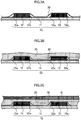
- FIGS. 3A to 3C are diagrams illustrating a manufacturing process of the circuit board device 1.
- the circuit board device 1 may be assembled manually with human hands or may also be assembled automatically using a mechanical machine such as a manufacturing robot. In the following description, it is assumed that the circuit board device 1 is assembled manually with human hands (hereinafter, referred to as a device manufacturer).
- the device manufacturer places a single flat sheet 30 on the mount surface of the mount board 10.
- the sheet 30 has substantially the same size as that of the surface of the mount board 10.
- the device manufacturer places the sheet 30 on the mount surface to cover the entire mount surface.
- the device manufacturer injects resin portion 20 molten by heat onto the sheet 30 as illustrated in FIG 3B .
- the device manufacturer may inject the resin portion 20 dividingly over several times while performing vacuum evacuation in order to prevent a void from remaining in the resin portion 20.
- the device manufacturer places the heat path 41 on the resin portion 20 before solidification of the resin portion 20 as illustrated in FIG 3C . If the heat paths 41 and 42 are separate bodies, the device manufacturer places the heat path 42 on the non-mount surface of the mount board 10 as illustrated in FIG 1 . As a result, the circuit board device 1 is completed.
- the heat path 41 may also be arranged before injecting the resin portion 20 onto the sheet 30.
- the device manufacturer may form the resin portion 20 by arranging the heat path 41 in a position far from the mount board 10 by a certain distance and then injecting the molten resin 20 into a gap between the sheet 30 and the heat path 41.
- the sheet 30 is arranged between the resin portion 20 and the mount board 10, the cavity A is formed between the resin portion 20 and the mount board 10. Even when the resin portion 20 is inflated by the heat generated from the electronic component 12, the pressure is alleviated by the cavity A. Therefore, a significant problem does not occur in the mount board 10.
- the electronic component 12 is a lateral-projecting type semiconductor package such as the SOP or QFP type package
- the cavity A is formed in the vicinity of the terminal 12a. For this reason, even when the resin portion 20 is inflated, a significant load is not applied to the terminal 12a. Therefore, the terminal 12a of the semiconductor package is not easily separated from the printed circuit board 11.
- FIG 4 illustrates a circuit board device 100 in which no sheet 30 is arranged between the resin portion 20 and the mount board 10.
- the reference symbol "B" denotes the void formed between the mount surface and the resin portion 20.
- the resin portion 20 is shrunken during the solidification. For this reason, even when the resin portion 20 is injected into the gap between the mount board 10 and the heat path 41 while performing vacuum evacuation, it is difficult to perfectly remove the void B from the mount board 10.
- the resin portion 20 is bonded to the surface of the mount board 10. For this reason, a void B is perfectly encapsulated on the electronic component 12 or the printed circuit board 11. If the resin portion 20 is inflated in this state, a significant pressure is applied to the void B, but the air inside the void B has no place to evacuate. As a result, an uneven pressure is applied to the mount board 10. Depending on how pressure is applied, there is a possibility that a significant problem may occur in the mount board 10. For example, in a case where a void B is formed on the electronic component 12, and the resin portion 20 is inflated, the pressure applied to the electronic component 12 is biased to one side of the upper surface of the electronic component 12. In addition, there is a possibility that the terminal 12a may be removed from the printed circuit board 11. Furthermore, in a case where the void B is formed on the printed circuit board 11, the printed circuit board 11 may be deformed, so that a pattern may be disconnected.
- the sheet 30 is provided between the resin portion 20 and the mount board 10. Since the surface of the resin portion 20 and the sheet 30 are bonded to each other as described above, the sheet 30 is deformed to match the shape of the surface of the resin portion 20 as illustrated in FIG 5 even when the resin portion 20 is shrunken. Since the sheet 30 remains to stick to the surface of the resin portion 20, a void is not easily formed between the sheet 30 and the resin portion 20. In addition, at least the mount surface side of the sheet 30 has nearly no adhesiveness.
- the resin portion 20 is bonded to the surface of the mount board 10. For this reason, it is very difficult to check a state of the mount board 10 by removing the mount board 10 from the circuit board device 100 after completely manufacturing the circuit board device 100.
- the circuit board device 1 according to this embodiment at least the mount surface side of the sheet 30 has no adhesiveness. For this reason, a user can easily disassemble the mount board 10 from the circuit board device 1 even after the manufacturing of the circuit board device 1. Therefore, it is possible to implement excellent maintainability of the circuit board device 1.
- a component generating a large amount of heat tends to have a short operating life, and also tends to have high frequency of part replacement. If the circuit board device has the component generating the large amount of heat, it is possible to facilitate part replacement.
- the mount board 10 can be easily disassembled. Therefore, part replacement becomes easy.
- the mount board 10 provided in the circuit board device 1 of the first embodiment is the single-sided mount board.
- the mount board 10 may be a double-sided mount board.
- a circuit board device 2 provided with a double-sided mount board 10 will now be described.
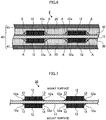
- FIG 6 is a diagram illustrating a circuit board device 2 according to the second embodiment.
- the circuit board device 2 has a mount board 10, a resin portion 20, a sheet 30, and a heat path 40.
- the heat path 40 includes a pair of heat paths 41 arranged in upper and lower sides by interposing the mount board 10.
- the mount board 10 is the double-sided mount board in which electronic components are mounted on both sides.
- FIG 7 illustrates only the mount board 10 removed from the circuit board device 2.
- the mount board 10 has a printed circuit board 11 and electronic components 12 mounted on both sides of the printed circuit board 11.
- the electronic components 12 are arranged on the same positions on both sides of the printed circuit board 11, and the mount board 10 is vertically symmetrical. Note that this embodiment is merely for illustrative purposes.
- the electronic components 12 may not be arranged in the same position on both sides of the printed circuit board 11.
- the resin portion 20 is formed of resin for transferring heat of the electronic component 12 to the heat path 41.
- the resin portions 20 are arranged on both sides of the mount board 10.
- the sheet 30 is arranged on the mount surface of the mount board 10. According to the second embodiment, both sides of the mount board 10 serve as the mount surface. For this reason, the sheets 30 are provided on both sides of the mount board 10. Similar to the first embodiment, a cavity A surrounded by the sheet 30 and the mount surface is formed in a step portion of the electronic component 12 (in the vicinity of the terminal 12a).
- mount board 10 Other configurations of the mount board 10, the resin portion 20, the sheet 30, and the heat path 40 are similar to those of the first embodiment.
- the heat paths 41, the sheets 30, and the resin portions 20 are arranged on both sides of the mount board 10. Therefore, even when the resin portion 20 is inflated, the pressures are applied from both sides of the mount board 10. For this reason, compared to a case where the resin portion 20 is provided on only one side, deformation of the mount board 10 is reduced. Therefore, a possibility of a significant problem occurring in the mount board 10 is reduced.
- the circuit board device 1 of the first embodiment has a single flat sheet 30.
- the sheet 30 is not limited to a flat sheet.
- the sheet 30 may have a concave portion.
- a circuit board device 3 having a sheet 30 provided with a concave portion will now be described.
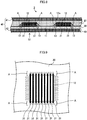
- FIG 8 is a diagram illustrating a circuit board device 3 according to a third embodiment.
- the circuit board device 3 has a mount board 10, a resin portion 20, a sheet 30, and a heat path 40. Similar to the first embodiment, the heat path 40 includes a heat path 41 and a heat path 42. Similar to the first embodiment, the mount board 10 is a single-sided mount board.
- the sheet 30 is arranged on a mount surface of the mount board 10.
- the sheet 30 is provided with a concave portion recessed as seen from the mount board 10 side.
- the concave portion 31 is formed, for example, by corrugating the sheet 30.
- FIG 9 is a diagram illustrating the sheet 30 as seen from the mount board 10 side (from S1 in FIG 8 ). That is, FIG 9 illustrates a mount surface side face of the sheet 30. In FIG 9 , the dotted line indicates a position of the electronic component 12.
- the concave portion 31 is illustrated as a plurality of lines (in the example of FIG 9 , straight lines) formed on the mount surface side face of the sheet 30 at equal intervals. More specifically, the concave portion 31 is formed in a stripe shape in a position corresponding to the upper surface of the electronic component 12. At least a part of the lines of the concave portion 31 are positioned in the vicinity of the cavity A.
- the cavity A is not limited to a space formed in a step portion between the lateral-projecting type semiconductor package and the printed circuit board 11.
- a space formed in a step portion between an electronic component other than the lateral-projecting type semiconductor and the printed circuit board 11 may also be considered as the cavity A.
- the concave portion 31 is formed only on a part of the upper surface of the electronic component 12 in FIGS. 8 and 9 , the concave portion 31 may also be formed in a part of the printed circuit board 11. In addition, the concave portion 31 may also be formed on the entire surface of the sheet 30.
- circuit board device 3 Other configurations of the circuit board device 3 are similar to those of the circuit board device 1 of the first embodiment.
- the circuit board device 3 may also be obtained by modifying the sheet 30 of the circuit board device 2 of the second embodiment.
- the circuit board device 3 may include a mount board 10 having both sides where electronic components 12 are mounted, and heat paths 41, sheets 30, and resin portions 20 arranged in both sides of the mount board 10.
- the concave portions 31 may be provided in both upper and lower sheets 30.
- the concave portion 31 is provided on the sheet 30. Therefore, even when the resin portion 20 is inflated, the space formed in the concave portion 31 alleviates the pressure. Therefore, a significant problem does not occur in the mount board 10.
- the concave portion 31 has a line shape, and a part of the lines are positioned in the cavity A. Even when a pressure is applied to the concave portion 31, the air inside the concave portion 31 can be easily evacuated to the cavity A, so that the air pressure inside the concave portion 31 does not easily increase. Therefore, a possibility that the concave portion 31 itself causes a problem is low.
- a void C maybe generated between the sheet 30 and the mount surface as illustrated in FIG 5 .
- the mount surface side of the sheet 30 has no adhesiveness. For this reason, even when a pressure is applied to the void C due to inflation of the resin portion 20, the air inside the void C is dispersed along the surface of the sheet 30. However, even in this case, it is certain that the sheet 30 is strongly pressed toward the mount surface by virtue of the pressure of the resin portion 20. Therefore, some resistance exists in the dispersion of the air.
- the concave portion 31 is provided on the sheet 30 of the circuit board device 3 according to the third embodiment.
- a gap formed between the mount board 10 and the resin portion 20 may generate a waveguide effect and serve as a passage of electromagnetic waves in some cases.
- an electromagnetic wave generated from one electronic component 12 is transmitted to the other electronic component 12 through the gap.
- a stronger electromagnetic wave is transmitted to the other electronic component 12, compared to a case where the resin portion 20 is not provided between the mount board 10 and the heat path 41.
- transmission of electromagnetic waves is suppressed by forming the sheet 30 from an electromagnetic wave absorption sheet.
- a circuit board device 4 provided with the sheet 30 as an electromagnetic wave absorption sheet will now be described.
- FIG 10 is a diagram illustrating the circuit board device 4 according to the fourth embodiment.
- the circuit board device 4 has a mount board 10, a resin portion 20, a sheet 30, and a heat path 40.
- the heat path 40 includes a heat path 41 and a heat path 42.
- the mount board 10 is a single-sided mount board.
- the sheet 30 is arranged on the mount surface of the mount board 10.
- the sheet 30 is the electromagnetic wave absorption sheet.
- the sheet 30 is formed of, for example, conductive fiber fabrics. Note that the sheet 30 may be any one of various existing electromagnetic wave absorption sheets without limiting to the conductive fiber fabrics.
- the electromagnetic wave absorption sheet has electric conductivity in many cases.
- an insulation film 32 is formed in a part of the surface of the sheet 30 facing the conductor exposure portion 13.
- circuit board device 4 Other configurations of the circuit board device 4 are similar to those of the circuit board device 1 of the first embodiment.
- the circuit board device 4 may also be obtained by modifying the sheet 30 of the circuit board device 2 of the second embodiment. That is, the circuit board device 4 may include a mount board 10 having both sides where electronic components 12 are mounted, and a heat path 41, a sheet 30, and the resin portion 20 arranged on both sides of the mount board 10. In this case, insulation films 32 are provided on both upper and lower sheets 30.
- the circuit board device 4 may also be obtained by modifying the sheet 30 of the circuit board device 3 of the third embodiment. That is, the sheet 30 of the circuit board device 4 may have a concave portion 31. Similarly, in this case, the sheet 30 is provided with the insulation film 32.
- the sheet 30 is the electromagnetic wave absorption sheet. Therefore, it is possible to reduce influence of electromagnetic waves between electronic components mounted on the mount board 10.
- the insulation film 32 is formed in a part of the surface of the sheet 30 facing the conductor exposure portion 13, a problem that may be generated when the conductor exposure portions 13 are electrically connected through the sheet 30 is also reduced.
- a means for preventing electric connection between the conductor exposure portions 13 is not limited to the insulation film 32.
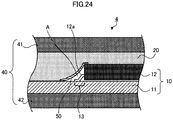
- an insulation material 50 may be arranged in a part of the surface of the sheet 30 facing the conductor exposure portion 13.
- FIG 11 illustrates an example in which an insulation sheet as the insulation material 50 is arranged in the part facing the conductor exposure portion 13.
- the insulation sheet may also be provided in a part of the sheet 30 facing the conductor exposure portion 13.
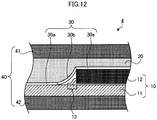
- FIG 12 illustrates an example in which the insulation sheet 30b is formed in the part of the sheet 30 facing the conductor exposure portion 13.
- parts other than the part facing the conductor exposure portion 13 serve as the electromagnetic wave absorption sheet 30a.
- the sheet 30 is formed, for example, by joining and bonding the electromagnetic wave absorption sheet 30a and the insulation sheet 30b.
- the circuit board devices of the first to fourth embodiments have the sheet 30 between the mount board 10 and the resin portion 20.
- the sheet 30 may not be provided between the mount board 10 and the resin portion 20.
- a circuit board device 5 having no sheet 30 between the mount board 10 and the resin portion 20 will now be described.
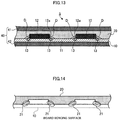
- FIG 13 is a diagram illustrating a circuit board device 5 according to a fifth embodiment.
- the circuit board device 5 includes a mount board 10, a resin portion 20, and a heat path 40. Similar to the first embodiment, the heat path 40 includes a heat path 41 and a heat path 42. Similar to the first embodiment, the mount board 10 is the single-sided mount board.
- the resin portion 20 is formed of resin for transferring heat of the electronic component 12 to the heat path 41.
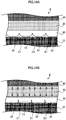
- FIG 14 illustrates only the resin portion 20 removed from the circuit board device 5.
- a surface of the resin portion 20 facing the heat path 41 is flattened to match the shape of the heat path 41.
- a surface of the resin portion 20 facing the mount board 10 (hereinafter, referred to as a board-bonding surface) has a shape that can be bonded to the mount surface of the mount board 10.
- the board-bonding surface is a non-adhesive surface.
- a non-bonding portion 21 for separating the resin portion 20 and the mount surface is provided on the board-bonding surface of the resin portion 20.
- the non-bonding portion 21 is a part of the resin portion 20 chamfered inward of the resin portion 20 from an expected contact surface in order to separate the resin portion 20 from the mount surface of the mount board 10 by a certain distance.
- the expected contact surface refers to a surface of the resin portion 20 expected to make contact with the mount surface when the resin portion 20 is bonded to the mount surface (that is, a surface where the mount surface is placed when the resin portion 20 is bonded to the mount surface).
- the non-bonding portion 21 is formed in a part of the mount surface facing the conductor exposure portion 13.
- the resin portion 20 is manufactured, for example, using a three-dimensional (3D) printer. Specifically, the resin portion 20 is manufactured in the following sequence. First, a device manufacturer performs 3D-scanning for the mount surface of the mount board 10 using a 3D-scanner. In addition, the device manufacturer processes the scan data with a computer to create 3D data of the resin portion 20. Then, the device manufacturer inputs the 3D data to the 3D printer and operates the 3D printer to manufacture the resin portion 20.
- 3D printer three-dimensional
- circuit board device 5 Other configurations of the circuit board device 5 are similar to those of the circuit board device 1 of the first embodiment.
- a cavity D is formed between the resin portion 20 and the mount board 10 by arranging the non-bonding portion 21 on the board-bonding surface of the resin portion 20. Even when the resin portion 20 is inflated by the heat generated from the electronic component 12, the pressure is alleviated by the cavity D. Therefore, a significant problem does not occur in the mount board 10.
- the board-bonding surface is the non-adhesive surface, a user can easily remove the mount board 10 from the circuit board device 5 even after the manufacturing of the circuit board device 5. Therefore, it is possible to provide excellent maintainability of the circuit board device 1.
- the sheet 30 of the circuit board device 1 of the first embodiment is the single flat sheet.
- the sheet 30 is not limited to the flat sheet.
- the sheet 30 may have a domical protrusion.
- a circuit board device 6 according to the sixth embodiment will now be described.
- FIG 17 is a diagram illustrating the circuit board device 6 according to the sixth embodiment.
- the circuit board device 6 has a mount board 10, a resin portion 20, a sheet 30, and a heat path 40. Similar to the first embodiment, the heat path 40 includes a heat path 41 and a heat path 42. Similar to the first embodiment, the mount board 10 is the single-sided mount board.
- the sheet 30 is arranged on a mount surface of the mount board 10.
- the sheet 30 is provided with a plurality of domical protrusions 33 protruding toward the mount board 10.
- the protrusions 33 are formed of a soft material such as rubber or sponge. If a base portion of the sheet 30 (flat portion other than the protrusions 33) is formed of paper, fabric, or resin, the protrusions 33 may be formed of the same material as that of the base portion of the sheet 30. In order to improve a heat transfer property, it is desirable that there is no cavity inside the protrusion 33.
- FIG 18 is a diagram illustrating the sheet 30 as seen from the mount board 10 side (from the arrow direction S1 in FIG 17 ). That is, FIG 18 illustrates a mount surface side face of the sheet 30.
- the protrusions 33 are formed across the entire surface of the sheet 30.
- the protrusion 33 has, for example, a circular shape as seen from the mount board 10 side.
- the protrusion 33 has, for example, a diameter of 1 to 3 mm. Naturally, the size of the protrusion 33 is not limited thereto.
- the shape of the protrusion 33 is not limited to the circular shape.
- the protrusion 33 may have a polygonal shape (such as rectangular, hexagonal, or octagonal shapes) as seen from the mount board 10 side. Note that, although the protrusions 33 are formed across the entire surface of the sheet 30 in FIGS. 17 and 18 , the protrusions 33 may be formed only on a portion facing the upper surface of the electronic component 12.
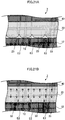
- FIG 19A is an enlarged view illustrating the vicinity of the sheet 30 while the electronic component 12 is not heated.
- the protrusion 33 has a domical shape protruding toward the mount board 10. That is, the apex portion T1 of the protrusion 33 has a curved face protruding toward the mount board 10. If the apex portion T1 of the protrusion 33 is flat, a void may be generated between the apex portion T and the electronic component 12 as illustrated in FIG 5 . The void may apply an excessive pressure to the electronic component 12. However, since the apex portion T1 of the protrusion 33 has the curved face, there is no worry about the void generated between the apex portion T1 and the electronic component 12.
- FIG 19B is an enlarged view illustrating the vicinity of the sheet 30 while the electronic component 12 is heated.
- the resin portion 20 is inflated by the heat of the electronic component 12. Then, the pressure from the resin portion 20 presses the protrusion 33, so that the pressure transmitted from the resin portion 20 to the electronic component 12 is alleviated.
- a cavity E1 provided between the protrusions 33 and 33 is reduced.
- a contact area between the apex portion T1 of the protrusion 33 and the electronic component 12 increases. As a result, heat transfer performance from the electronic component 12 to the sheet 30 is improved.
- circuit board device 6 may also be obtained by modifying the sheet 30 of the circuit board device 2 of the second embodiment. That is, the circuit board device 6 may include a mount board 10 having both sides where the electronic components 12 are mounted, and a heat path 41, a sheet 30, and a resin portion 20 arranged in both sides of the mount board 10. In this case, the protrusions 33 may be provided on both upper and lower sheets 30.
- the protrusions 33 are provided on the sheet 30. For this reason, even when the resin portion 20 is inflated by the heat of the electronic component 12, the protrusion 33 spreads to the space E1 to alleviate the pressure transmitted from the resin portion 20 to the electronic component 12. Therefore, a significant problem does not occur in the mount board 10. Even when the circuit board device 6 has the space E1 (air layer) that increases a heat transfer resistance, the protrusion 33 is pressed, and the space E1 is reduced as the electronic component 12 is heated. Therefore, the circuit board device 6 can maintain an excellent heat transfer property.
- a curvature of the protrusion 33 as seen from a horizontal direction of the sheet 30 is not limited to those illustrated in FIGS. 17 to 19B .
- the curvature of the protrusion 33 may be small as illustrated in FIG 20A . That is, the protrusions 33 may be shallower than those of FIGS. 17 to 19B .
- the curvature of the protrusion 33 may be larger as illustrated in FIG 20B . That is, the protrusions 33 may be deeper than those of FIGS. 17 to 19B .
- the surface of resin portion 20 of the mount board 10 side is flat.
- a domical protrusion may also be formed on the surface of the resin portion 20 of the mount board 10 side.
- the circuit board device 7 includes a mount board 10, a resin portion 20, and a heat path 40. Similar to the first embodiment, the heat path 40 includes a heat path 41 and a heat path 42. Similar to the first embodiment, the mount board 10 is the single-sided mount board.
- FIG 21A is an enlarged view illustrating the vicinity of the resin portion 20 while the electronic component 12 is not heated.
- the resin portion 20 is provided with a plurality of domical protrusions 23 protruding toward the mount board 10. That is, the apex portion T2 of the protrusion 23 has a curved face protruding toward the mount board 10.
- the protrusion 23 is formed of a soft material such as rubber or sponge.
- the protrusion 23 may also be formed of the same material as that of the substrate of the resin portion 20. In order to improve a heat transfer property, it is desirable that there is no cavity inside the protrusion 23. Similar to the protrusions 33 of FIGS. 20A and 20B , the protrusion 23 may be formed to be shallower or deeper. In addition, the size and the shape of the protrusion 23 may be similar to those of the protrusion 33 of the sixth embodiment.
- FIG 21B is an enlarged view illustrating the vicinity of the resin portion 20 while the electronic component 12 is heated.
- the resin portion 20 is inflated by the heat of the electronic component 12, the protrusion 23 is pressed.
- the pressure transmitted from the resin portion 20 to the electronic component 12 is alleviated.
- the protrusion 23 is pressed, the cavity E2 provided between the protrusions 23 and 23 is reduced.
- a contact area between the apex portion T2 of the protrusion 23 and the electronic component 12 increases. As a result, heat transfer performance from the electronic component 12 to the resin portion 20 is improved.
- the protrusions 23 are provided on the resin portion 20. For this reason, even when the resin portion 20 is inflated by the heat of the electronic component 12, the protrusion 23 spreads to the space E2 and is pressed to alleviate the pressure transmitted from the resin portion 20 to the electronic component 12. Therefore, a significant problem does not occur in the mount board 10. Even when the circuit board device 7 has the space E2 (air layer) that increases a heat transfer resistance, the protrusion 23 is pressed, and the space E2 is reduced as the electronic component 12 is heated. Therefore, the circuit board device 7 can maintain an excellent heat transfer property.
- the lateral-projecting type semiconductor package is not limited to the SOP and QFP types.
- the lateral-projecting type semiconductor package may include, for example, a dual inline package (DIP) type semiconductor package, a small outline J-leaded (SOJ) type semiconductor package, a plastic leaded chip carrier (PLCC) type semiconductor package, and the like.
- the mount surface side face of the sheet 30 is the non-adhesive surface in the first to fourth embodiments, the mount surface side face of the sheet 30 may also have stickiness (adhesiveness with weak peel-off resistance).
- the shape of the concave portion 31 is not limited to the straight line shape.
- the concave portion 31 may be formed in a dotted line shape.
- the concave portion 31 of the third embodiment is formed on the sheet 30 in a stripe shape, the shape of the concave portion 31 is not limited to the stripe shape.
- the concave portion 31 may be formed on the sheet 30 in a mesh shape.
- the board-bonding surface of the resin portion 20 is a non-adhesive surface in the fifth embodiment, the board-bonding surface of the resin portion 20 may have stickiness.
- the mount board 10 is a single-sided mount board in the circuit board device 5
- the mount board 10 may be a double-sided mount board.
- the heat paths 41 and the resin portions 20 may be arranged on both sides of the mount board 10 as illustrated in FIG 15 .
- the non-bonding portion 21 is provided in both the upper and lower resin portions 20. Even when the resin portion 20 is inflated, the pressure is applied from both sides of the mount board 10. Therefore, the mount board 10 is not easily significantly deformed. As a result, a possibility of a significant problem occurring in the mount board 10 is reduced.
- the concave portion 22 may be provided on the board-bonding surface of the resin portion 20 of the circuit board device 5.
- the concave portion 22 has a line shape, and a part of the lines are positioned in the cavity D. Even when the resin portion 20 is inflated, the space formed in the concave portion 22 alleviates the pressure. Therefore, a significant problem in the mount board 10 does not occur.
- the concave portion 22 has the line shape, and the part of the lines are positioned in the cavity D. Even when a pressure is applied to the concave portion 22, the air inside the concave portion 22 can be easily evacuated to the cavity A. Therefore, a possibility that the concave portion 22 itself causes a problem is low.
- the air inside the void is evacuated to the cavity A with nearly no resistance through the concave portion 22. Therefore, since an uneven pressure is not easily generated by the void, a possibility that a problem occurs in the mount board 10 is further lowered.
- the mount board 10 of FIG 16 is a single-side mount board
- the mount board 10 may be a double-sided mount board.
- the heat paths 41 and the resin portions 20 may be arranged in both sides of the mount board 10 of the circuit board device 5 of FIG 16 .
- the concave portions 22 may also be provided in both upper and lower resin portions 20.
- the space D is provided in the vicinity of the terminal of the electronic component 12 of the circuit board device 5 of the fifth embodiment, the space D in the vicinity of the terminal may be buried with insulation resin 51 as illustrated in FIG 22 . In this case, the space D other than the vicinity of the terminal may not be buried with the insulation resin 51. In addition, the periphery of the electronic component 12 may be covered by insulation resin 52 as illustrated in FIG 23 . Even when the resin portion 20 is formed of conductive resin, insulation between the terminals can be reliably obtained.
- the sheet 30 covers the surface of the mount board 10 in the circuit board device 4 of the fourth embodiment, the sheet 30 may not be provided.
- the sheet provided on the surface of the mount board 10 may include only the insulation material 50 (insulation sheet) that covers the terminal portion of the electronic component 12. Since the sheet area is reduced, it is possible to lower the cost. Even in this configuration, a cavity A is provided in a portion surrounded by the insulation material 50 and the mount surface. Therefore, the pressure alleviation effect does not disappear.
- the space (such as the cavity A and the space E1) between the sheet 30 and the mount board 10 described in the first to fourth and sixth embodiments may communicate with the outside. That is, a communication path (air path) that links the inner space and the outside may be provided in the circuit board devices 1 to 4 and 6. Since the air is evacuated to the outside through the communication path when the resin portion 20 is inflated, the pressure alleviation effect is further improved.
- a communication path air path
- the space (such as the cavity D and the space E2) between the resin portion 20 and the mount board 10 described in the fifth and seventh embodiments may communicate with the outside. That is, a communication path (air path) that links the inner space and the outside may be provided in the circuit board devices 5 and 7. Since the air is evacuated to the outside through the communication path when the resin portion 20 is inflated, the pressure alleviation effect is further improved.
Landscapes
- Engineering & Computer Science (AREA)
- Microelectronics & Electronic Packaging (AREA)
- Physics & Mathematics (AREA)
- Thermal Sciences (AREA)
- Manufacturing & Machinery (AREA)
- Electromagnetism (AREA)
- Cooling Or The Like Of Semiconductors Or Solid State Devices (AREA)
- Cooling Or The Like Of Electrical Apparatus (AREA)
- Structure Of Printed Boards (AREA)
- Non-Metallic Protective Coatings For Printed Circuits (AREA)
- Shielding Devices Or Components To Electric Or Magnetic Fields (AREA)
Applications Claiming Priority (1)
| Application Number | Priority Date | Filing Date | Title |
|---|---|---|---|
| JP2016237622A JP6612723B2 (ja) | 2016-12-07 | 2016-12-07 | 基板装置 |
Publications (1)
| Publication Number | Publication Date |
|---|---|
| EP3334258A1 true EP3334258A1 (fr) | 2018-06-13 |
Family
ID=59858886
Family Applications (1)
| Application Number | Title | Priority Date | Filing Date |
|---|---|---|---|
| EP17190322.2A Withdrawn EP3334258A1 (fr) | 2016-12-07 | 2017-09-11 | Dispositif de circuit imprimé |
Country Status (3)
| Country | Link |
|---|---|
| US (1) | US20180160525A1 (fr) |
| EP (1) | EP3334258A1 (fr) |
| JP (1) | JP6612723B2 (fr) |
Cited By (2)
| Publication number | Priority date | Publication date | Assignee | Title |
|---|---|---|---|---|
| EP3905860A1 (fr) * | 2020-04-28 | 2021-11-03 | Kyocera Corporation | Procédé de fabrication d'un composant électronique |
| WO2022220688A3 (fr) * | 2021-08-30 | 2023-01-26 | Nederlandse Organisatie Voor Toegepast-Natuurwetenschappelijk Onderzoek Tno | Conception recyclable d'un dispositif électronique |
Families Citing this family (7)
| Publication number | Priority date | Publication date | Assignee | Title |
|---|---|---|---|---|
| GB201805859D0 (en) * | 2018-04-09 | 2018-05-23 | Tdk Lambda Uk Ltd | Apparatus such as a power supply |
| CN108738234A (zh) * | 2018-07-31 | 2018-11-02 | 北京梦之墨科技有限公司 | 一种低熔点金属电路板及其制作方法 |
| JP6741257B2 (ja) * | 2018-11-20 | 2020-08-19 | Necプラットフォームズ株式会社 | 電子機器の放熱構造及び電子機器 |
| US12218370B2 (en) | 2021-04-06 | 2025-02-04 | United Parcel Service Of America, Inc. | Unmanned aerial vehicle (UAV) landing gear system for holding delivery canisters |
| US12156344B2 (en) * | 2021-07-09 | 2024-11-26 | Toyota Motor Engineering & Manufacturing North America, Inc. | Systems and methods of 3D-printing a circuit board on a heat sink assembly having power devices bonded thereto |
| WO2023027902A1 (fr) | 2021-08-26 | 2023-03-02 | United Parcel Service Of America, Inc. | Mécanisme de verrouillage et contenant pour la livraison d'articles |
| US12080907B2 (en) * | 2021-08-26 | 2024-09-03 | United Parcel Service Of America, Inc. | Locking mechanism and container for delivering items |
Citations (5)
| Publication number | Priority date | Publication date | Assignee | Title |
|---|---|---|---|---|
| US4818823A (en) * | 1987-07-06 | 1989-04-04 | Micro-Circuits, Inc. | Adhesive component means for attaching electrical components to conductors |
| EP0748152A2 (fr) * | 1995-06-06 | 1996-12-11 | Matsushita Electric Industrial Co., Ltd. | Méthode de montage d'un composant électronique sur un substrat à conducteurs et commutateur illuminé en utilisant cette méthode de montage |
| EP1796026A1 (fr) * | 2005-12-08 | 2007-06-13 | NRC International Inc. | Dispositif de fréquence radio |
| EP2293657A1 (fr) * | 2009-08-24 | 2011-03-09 | Schreiner Group GmbH & Co. KG | Composant électronique et procédé de formation de composant électronique |
| US20150036304A1 (en) * | 2013-07-31 | 2015-02-05 | Taiyo Yuden Co., Ltd. | Electronic device |
Family Cites Families (33)
| Publication number | Priority date | Publication date | Assignee | Title |
|---|---|---|---|---|
| EP0840369A4 (fr) * | 1995-06-30 | 2001-12-19 | Toshiba Kk | Composant electronique et son procede de fabrication |
| JP2000079772A (ja) * | 1998-01-09 | 2000-03-21 | Ricoh Co Ltd | 感熱孔版印刷用原紙、孔版印刷版、孔版製版印刷方法及び多色刷り孔版製版印刷方法 |
| JP2000059174A (ja) * | 1998-08-14 | 2000-02-25 | Hitachi Media Electoronics Co Ltd | 弾性表面波分波器及びそれを用いた移動体通信機器 |
| JP3269815B2 (ja) * | 1999-12-13 | 2002-04-02 | 富士通株式会社 | 半導体装置及びその製造方法 |
| JP4116238B2 (ja) * | 2000-05-19 | 2008-07-09 | 株式会社タイカ | 電磁波遮蔽性を有する熱伝導性シート |
| JP2002076040A (ja) * | 2000-08-30 | 2002-03-15 | Hitachi Ltd | 半導体装置及びその製造方法 |
| JP3492656B2 (ja) * | 2001-08-28 | 2004-02-03 | 埼玉日本電気株式会社 | 熱伝導シートの製造方法 |
| US7361844B2 (en) * | 2002-11-25 | 2008-04-22 | Vlt, Inc. | Power converter package and thermal management |
| SG157957A1 (en) * | 2003-01-29 | 2010-01-29 | Interplex Qlp Inc | Package for integrated circuit die |
| WO2004093187A1 (fr) * | 2003-04-16 | 2004-10-28 | Fujitsu Limited | Boitier pour composants electroniques, ensemble boitier pour composants electroniques et unite de circuit imprime |
| US7180745B2 (en) * | 2003-10-10 | 2007-02-20 | Delphi Technologies, Inc. | Flip chip heat sink package and method |
| JP2006100302A (ja) * | 2004-09-28 | 2006-04-13 | Sharp Corp | 高周波モジュールおよびその製造方法 |
| EP1860694A1 (fr) * | 2005-03-16 | 2007-11-28 | Yamaha Corporation | Dispositif semi-conducteur, procede de fabrication du dispositif semi-conducteur et structure de protection |
| JP2006269643A (ja) * | 2005-03-23 | 2006-10-05 | Japan Matekkusu Kk | 放熱シート |
| US20120273963A1 (en) * | 2005-10-06 | 2012-11-01 | Uri Mirsky | Microelectronic interconnect substrate and packaging techniques |
| JP2007109831A (ja) * | 2005-10-13 | 2007-04-26 | Towa Corp | 電子部品の樹脂封止成形方法 |
| KR100656751B1 (ko) * | 2005-12-13 | 2006-12-13 | 삼성전기주식회사 | 전자소자 내장 인쇄회로기판 및 그 제조방법 |
| US7440282B2 (en) * | 2006-05-16 | 2008-10-21 | Delphi Technologies, Inc. | Heat sink electronic package having compliant pedestal |
| US8212271B2 (en) * | 2007-10-11 | 2012-07-03 | Hitachi Chemical Co., Ltd. | Substrate for mounting an optical semiconductor element, manufacturing method thereof, an optical semiconductor device, and manufacturing method thereof |
| JP2009212390A (ja) * | 2008-03-05 | 2009-09-17 | Toshiba Corp | 発熱体搭載部品の取付構造 |
| US7787252B2 (en) * | 2008-12-04 | 2010-08-31 | Lsi Corporation | Preferentially cooled electronic device |
| US20110255250A1 (en) * | 2010-04-19 | 2011-10-20 | Richard Hung Minh Dinh | Printed circuit board components for electronic devices |
| US8558374B2 (en) * | 2011-02-08 | 2013-10-15 | Endicott Interconnect Technologies, Inc. | Electronic package with thermal interposer and method of making same |
| TWI525767B (zh) * | 2011-04-04 | 2016-03-11 | 羅姆電子股份有限公司 | Semiconductor device and method for manufacturing semiconductor device |
| WO2013094755A1 (fr) * | 2011-12-22 | 2013-06-27 | 京セラ株式会社 | Tableau de connexions et dispositif électronique |
| JP2013232516A (ja) * | 2012-04-27 | 2013-11-14 | Kitagawa Ind Co Ltd | 熱伝導性電磁波シールドシート |
| US9190341B2 (en) * | 2012-06-05 | 2015-11-17 | Texas Instruments Incorporated | Lidded integrated circuit package |
| MX369008B (es) * | 2014-03-27 | 2019-10-24 | Jubilant Generics Ltd | Un proceso mejorado para la preparación de exametazima. |
| JP6274058B2 (ja) * | 2014-09-22 | 2018-02-07 | 株式会社デンソー | 電子装置、及び電子装置を備えた電子構造体 |
| JP2016213308A (ja) * | 2015-05-08 | 2016-12-15 | キヤノン株式会社 | プリント回路板及びプリント配線板 |
| JP6548964B2 (ja) * | 2015-06-12 | 2019-07-24 | 株式会社東芝 | 基板装置 |
| JP6330788B2 (ja) * | 2015-11-18 | 2018-05-30 | 株式会社村田製作所 | 電子デバイス |
| US9899292B2 (en) * | 2016-02-05 | 2018-02-20 | Qorvo Us, Inc. | Top-side cooling of RF products in air cavity composite packages |
-
2016
- 2016-12-07 JP JP2016237622A patent/JP6612723B2/ja active Active
-
2017
- 2017-09-11 EP EP17190322.2A patent/EP3334258A1/fr not_active Withdrawn
- 2017-09-12 US US15/701,625 patent/US20180160525A1/en not_active Abandoned
Patent Citations (5)
| Publication number | Priority date | Publication date | Assignee | Title |
|---|---|---|---|---|
| US4818823A (en) * | 1987-07-06 | 1989-04-04 | Micro-Circuits, Inc. | Adhesive component means for attaching electrical components to conductors |
| EP0748152A2 (fr) * | 1995-06-06 | 1996-12-11 | Matsushita Electric Industrial Co., Ltd. | Méthode de montage d'un composant électronique sur un substrat à conducteurs et commutateur illuminé en utilisant cette méthode de montage |
| EP1796026A1 (fr) * | 2005-12-08 | 2007-06-13 | NRC International Inc. | Dispositif de fréquence radio |
| EP2293657A1 (fr) * | 2009-08-24 | 2011-03-09 | Schreiner Group GmbH & Co. KG | Composant électronique et procédé de formation de composant électronique |
| US20150036304A1 (en) * | 2013-07-31 | 2015-02-05 | Taiyo Yuden Co., Ltd. | Electronic device |
Cited By (4)
| Publication number | Priority date | Publication date | Assignee | Title |
|---|---|---|---|---|
| EP3905860A1 (fr) * | 2020-04-28 | 2021-11-03 | Kyocera Corporation | Procédé de fabrication d'un composant électronique |
| WO2022220688A3 (fr) * | 2021-08-30 | 2023-01-26 | Nederlandse Organisatie Voor Toegepast-Natuurwetenschappelijk Onderzoek Tno | Conception recyclable d'un dispositif électronique |
| EP4142438A1 (fr) * | 2021-08-30 | 2023-03-01 | Nederlandse Organisatie Voor Toegepast- Natuurwetenschappelijk Onderzoek Tno | Conception recyclable d'un dispositif électronique |
| US12349286B2 (en) | 2021-08-30 | 2025-07-01 | Nederlandse Organisatie Voor Toegepast-Natuurwetenschappelijk Onderzoek Tno | Recyclable electronic device |
Also Published As
| Publication number | Publication date |
|---|---|
| JP2018093138A (ja) | 2018-06-14 |
| US20180160525A1 (en) | 2018-06-07 |
| JP6612723B2 (ja) | 2019-11-27 |
Similar Documents
| Publication | Publication Date | Title |
|---|---|---|
| EP3334258A1 (fr) | Dispositif de circuit imprimé | |
| CN100454533C (zh) | 用于电子元件封装的emi屏蔽 | |
| US9706661B2 (en) | Electronic device module and manufacturing method thereof | |
| US10593656B2 (en) | Three-dimensional package structure | |
| CN104377176B (zh) | 电路模块 | |
| CN104425461B (zh) | 电路模块 | |
| JP7334169B2 (ja) | システムインパッケージアセンブリの電磁干渉からのシールド方法 | |
| JP2001024312A (ja) | 電子装置の製造方法及び電子装置並びに樹脂充填方法 | |
| CN101919053A (zh) | 具有经集成法拉第屏蔽的集成电路封装 | |
| JP2017199792A (ja) | 電子装置およびその製造方法 | |
| JP6237732B2 (ja) | 電子部品モジュールの製造方法 | |
| KR20150035251A (ko) | 외부접속단자부와 외부접속단자부를 갖는 반도체 패키지 및 그들의 제조방법 | |
| TWI455258B (zh) | 內埋元件封裝結構及製造方法 | |
| US10916520B2 (en) | Semiconductor device, and method of manufacturing the same | |
| KR20150076816A (ko) | 전자 부품 모듈 | |
| JP2015141904A (ja) | 電子回路モジュール及びその製造方法 | |
| KR101141443B1 (ko) | 반도체 패키지의 제조 방법 | |
| JP6548964B2 (ja) | 基板装置 | |
| KR20190077469A (ko) | 회로 모듈 및 그 제조 방법 | |
| KR102717135B1 (ko) | Mid와 mdm을 적용한 열전도 패드가 구비된 전자기기 및 그 제조방법 | |
| US20180145397A1 (en) | High-frequency module | |
| TWI596718B (zh) | 電路模組封裝結構及其封裝方法 | |
| CN223993771U (zh) | 多层基板 | |
| KR20160010105A (ko) | 반도체 패키지 및 제조방법 | |
| WO2008026247A1 (fr) | Structure de barrière à onde électromagnétique et son procédé de formation |
Legal Events
| Date | Code | Title | Description |
|---|---|---|---|
| PUAI | Public reference made under article 153(3) epc to a published international application that has entered the european phase |
Free format text: ORIGINAL CODE: 0009012 |
|
| 17P | Request for examination filed |
Effective date: 20170911 |
|
| AK | Designated contracting states |
Kind code of ref document: A1 Designated state(s): AL AT BE BG CH CY CZ DE DK EE ES FI FR GB GR HR HU IE IS IT LI LT LU LV MC MK MT NL NO PL PT RO RS SE SI SK SM TR |
|
| AX | Request for extension of the european patent |
Extension state: BA ME |
|
| STAA | Information on the status of an ep patent application or granted ep patent |
Free format text: STATUS: THE APPLICATION IS DEEMED TO BE WITHDRAWN |
|
| 18D | Application deemed to be withdrawn |
Effective date: 20181214 |