EP3334405B1 - Système vecteur permettant le passage dans la peau basé sur des tensio actifs à base de sucres positivement chargés. - Google Patents
Système vecteur permettant le passage dans la peau basé sur des tensio actifs à base de sucres positivement chargés. Download PDFInfo
- Publication number
- EP3334405B1 EP3334405B1 EP16757408.6A EP16757408A EP3334405B1 EP 3334405 B1 EP3334405 B1 EP 3334405B1 EP 16757408 A EP16757408 A EP 16757408A EP 3334405 B1 EP3334405 B1 EP 3334405B1
- Authority
- EP
- European Patent Office
- Prior art keywords
- extract
- oil
- delivery system
- phase
- acid
- Prior art date
- Legal status (The legal status is an assumption and is not a legal conclusion. Google has not performed a legal analysis and makes no representation as to the accuracy of the status listed.)
- Active
Links
Images


Classifications
-
- A—HUMAN NECESSITIES
- A61—MEDICAL OR VETERINARY SCIENCE; HYGIENE
- A61K—PREPARATIONS FOR MEDICAL, DENTAL OR TOILETRY PURPOSES
- A61K8/00—Cosmetics or similar toiletry preparations
- A61K8/18—Cosmetics or similar toiletry preparations characterised by the composition
- A61K8/72—Cosmetics or similar toiletry preparations characterised by the composition containing organic macromolecular compounds
- A61K8/73—Polysaccharides
-
- A—HUMAN NECESSITIES
- A61—MEDICAL OR VETERINARY SCIENCE; HYGIENE
- A61K—PREPARATIONS FOR MEDICAL, DENTAL OR TOILETRY PURPOSES
- A61K8/00—Cosmetics or similar toiletry preparations
- A61K8/02—Cosmetics or similar toiletry preparations characterised by special physical form
- A61K8/04—Dispersions; Emulsions
- A61K8/06—Emulsions
-
- A—HUMAN NECESSITIES
- A61—MEDICAL OR VETERINARY SCIENCE; HYGIENE
- A61K—PREPARATIONS FOR MEDICAL, DENTAL OR TOILETRY PURPOSES
- A61K8/00—Cosmetics or similar toiletry preparations
- A61K8/02—Cosmetics or similar toiletry preparations characterised by special physical form
- A61K8/11—Encapsulated compositions
-
- A—HUMAN NECESSITIES
- A61—MEDICAL OR VETERINARY SCIENCE; HYGIENE
- A61K—PREPARATIONS FOR MEDICAL, DENTAL OR TOILETRY PURPOSES
- A61K8/00—Cosmetics or similar toiletry preparations
- A61K8/02—Cosmetics or similar toiletry preparations characterised by special physical form
- A61K8/14—Liposomes; Vesicles
-
- A—HUMAN NECESSITIES
- A61—MEDICAL OR VETERINARY SCIENCE; HYGIENE
- A61K—PREPARATIONS FOR MEDICAL, DENTAL OR TOILETRY PURPOSES
- A61K8/00—Cosmetics or similar toiletry preparations
- A61K8/18—Cosmetics or similar toiletry preparations characterised by the composition
- A61K8/30—Cosmetics or similar toiletry preparations characterised by the composition containing organic compounds
- A61K8/33—Cosmetics or similar toiletry preparations characterised by the composition containing organic compounds containing oxygen
- A61K8/34—Alcohols
- A61K8/345—Alcohols containing more than one hydroxy group
-
- A—HUMAN NECESSITIES
- A61—MEDICAL OR VETERINARY SCIENCE; HYGIENE
- A61K—PREPARATIONS FOR MEDICAL, DENTAL OR TOILETRY PURPOSES
- A61K8/00—Cosmetics or similar toiletry preparations
- A61K8/18—Cosmetics or similar toiletry preparations characterised by the composition
- A61K8/30—Cosmetics or similar toiletry preparations characterised by the composition containing organic compounds
- A61K8/40—Cosmetics or similar toiletry preparations characterised by the composition containing organic compounds containing nitrogen
- A61K8/41—Amines
- A61K8/416—Quaternary ammonium compounds
-
- A—HUMAN NECESSITIES
- A61—MEDICAL OR VETERINARY SCIENCE; HYGIENE
- A61K—PREPARATIONS FOR MEDICAL, DENTAL OR TOILETRY PURPOSES
- A61K8/00—Cosmetics or similar toiletry preparations
- A61K8/18—Cosmetics or similar toiletry preparations characterised by the composition
- A61K8/30—Cosmetics or similar toiletry preparations characterised by the composition containing organic compounds
- A61K8/40—Cosmetics or similar toiletry preparations characterised by the composition containing organic compounds containing nitrogen
- A61K8/44—Aminocarboxylic acids or derivatives thereof, e.g. aminocarboxylic acids containing sulfur; Salts; Esters or N-acylated derivatives thereof
-
- A—HUMAN NECESSITIES
- A61—MEDICAL OR VETERINARY SCIENCE; HYGIENE
- A61K—PREPARATIONS FOR MEDICAL, DENTAL OR TOILETRY PURPOSES
- A61K8/00—Cosmetics or similar toiletry preparations
- A61K8/18—Cosmetics or similar toiletry preparations characterised by the composition
- A61K8/30—Cosmetics or similar toiletry preparations characterised by the composition containing organic compounds
- A61K8/49—Cosmetics or similar toiletry preparations characterised by the composition containing organic compounds containing heterocyclic compounds
- A61K8/4993—Derivatives containing from 2 to 10 oxyalkylene groups
-
- A—HUMAN NECESSITIES
- A61—MEDICAL OR VETERINARY SCIENCE; HYGIENE
- A61K—PREPARATIONS FOR MEDICAL, DENTAL OR TOILETRY PURPOSES
- A61K8/00—Cosmetics or similar toiletry preparations
- A61K8/18—Cosmetics or similar toiletry preparations characterised by the composition
- A61K8/30—Cosmetics or similar toiletry preparations characterised by the composition containing organic compounds
- A61K8/60—Sugars; Derivatives thereof
- A61K8/604—Alkylpolyglycosides; Derivatives thereof, e.g. esters
-
- A—HUMAN NECESSITIES
- A61—MEDICAL OR VETERINARY SCIENCE; HYGIENE
- A61K—PREPARATIONS FOR MEDICAL, DENTAL OR TOILETRY PURPOSES
- A61K8/00—Cosmetics or similar toiletry preparations
- A61K8/18—Cosmetics or similar toiletry preparations characterised by the composition
- A61K8/30—Cosmetics or similar toiletry preparations characterised by the composition containing organic compounds
- A61K8/67—Vitamins
- A61K8/671—Vitamin A; Derivatives thereof, e.g. ester of vitamin A acid, ester of retinol, retinol, retinal
-
- A—HUMAN NECESSITIES
- A61—MEDICAL OR VETERINARY SCIENCE; HYGIENE
- A61K—PREPARATIONS FOR MEDICAL, DENTAL OR TOILETRY PURPOSES
- A61K8/00—Cosmetics or similar toiletry preparations
- A61K8/18—Cosmetics or similar toiletry preparations characterised by the composition
- A61K8/72—Cosmetics or similar toiletry preparations characterised by the composition containing organic macromolecular compounds
- A61K8/84—Cosmetics or similar toiletry preparations characterised by the composition containing organic macromolecular compounds obtained by reactions otherwise than those involving only carbon-carbon unsaturated bonds
- A61K8/86—Polyethers
-
- A—HUMAN NECESSITIES
- A61—MEDICAL OR VETERINARY SCIENCE; HYGIENE
- A61Q—SPECIFIC USE OF COSMETICS OR SIMILAR TOILETRY PREPARATIONS
- A61Q1/00—Make-up preparations; Body powders; Preparations for removing make-up
- A61Q1/02—Preparations containing skin colorants, e.g. pigments
-
- A—HUMAN NECESSITIES
- A61—MEDICAL OR VETERINARY SCIENCE; HYGIENE
- A61Q—SPECIFIC USE OF COSMETICS OR SIMILAR TOILETRY PREPARATIONS
- A61Q15/00—Anti-perspirants or body deodorants
-
- A—HUMAN NECESSITIES
- A61—MEDICAL OR VETERINARY SCIENCE; HYGIENE
- A61Q—SPECIFIC USE OF COSMETICS OR SIMILAR TOILETRY PREPARATIONS
- A61Q17/00—Barrier preparations; Preparations brought into direct contact with the skin for affording protection against external influences, e.g. sunlight, X-rays or other harmful rays, corrosive materials, bacteria or insect stings
- A61Q17/04—Topical preparations for affording protection against sunlight or other radiation; Topical sun tanning preparations
-
- A—HUMAN NECESSITIES
- A61—MEDICAL OR VETERINARY SCIENCE; HYGIENE
- A61Q—SPECIFIC USE OF COSMETICS OR SIMILAR TOILETRY PREPARATIONS
- A61Q19/00—Preparations for care of the skin
-
- A—HUMAN NECESSITIES
- A61—MEDICAL OR VETERINARY SCIENCE; HYGIENE
- A61Q—SPECIFIC USE OF COSMETICS OR SIMILAR TOILETRY PREPARATIONS
- A61Q19/00—Preparations for care of the skin
- A61Q19/10—Washing or bathing preparations
-
- A—HUMAN NECESSITIES
- A61—MEDICAL OR VETERINARY SCIENCE; HYGIENE
- A61Q—SPECIFIC USE OF COSMETICS OR SIMILAR TOILETRY PREPARATIONS
- A61Q5/00—Preparations for care of the hair
-
- A—HUMAN NECESSITIES
- A61—MEDICAL OR VETERINARY SCIENCE; HYGIENE
- A61Q—SPECIFIC USE OF COSMETICS OR SIMILAR TOILETRY PREPARATIONS
- A61Q5/00—Preparations for care of the hair
- A61Q5/02—Preparations for cleaning the hair
-
- A—HUMAN NECESSITIES
- A61—MEDICAL OR VETERINARY SCIENCE; HYGIENE
- A61Q—SPECIFIC USE OF COSMETICS OR SIMILAR TOILETRY PREPARATIONS
- A61Q5/00—Preparations for care of the hair
- A61Q5/06—Preparations for styling the hair, e.g. by temporary shaping or colouring
-
- A—HUMAN NECESSITIES
- A61—MEDICAL OR VETERINARY SCIENCE; HYGIENE
- A61Q—SPECIFIC USE OF COSMETICS OR SIMILAR TOILETRY PREPARATIONS
- A61Q5/00—Preparations for care of the hair
- A61Q5/06—Preparations for styling the hair, e.g. by temporary shaping or colouring
- A61Q5/065—Preparations for temporary colouring the hair, e.g. direct dyes
-
- A—HUMAN NECESSITIES
- A61—MEDICAL OR VETERINARY SCIENCE; HYGIENE
- A61Q—SPECIFIC USE OF COSMETICS OR SIMILAR TOILETRY PREPARATIONS
- A61Q5/00—Preparations for care of the hair
- A61Q5/12—Preparations containing hair conditioners
-
- A—HUMAN NECESSITIES
- A61—MEDICAL OR VETERINARY SCIENCE; HYGIENE
- A61K—PREPARATIONS FOR MEDICAL, DENTAL OR TOILETRY PURPOSES
- A61K2800/00—Properties of cosmetic compositions or active ingredients thereof or formulation aids used therein and process related aspects
- A61K2800/40—Chemical, physico-chemical or functional or structural properties of particular ingredients
- A61K2800/41—Particular ingredients further characterized by their size
- A61K2800/412—Microsized, i.e. having sizes between 0.1 and 100 microns
-
- A—HUMAN NECESSITIES
- A61—MEDICAL OR VETERINARY SCIENCE; HYGIENE
- A61K—PREPARATIONS FOR MEDICAL, DENTAL OR TOILETRY PURPOSES
- A61K2800/00—Properties of cosmetic compositions or active ingredients thereof or formulation aids used therein and process related aspects
- A61K2800/40—Chemical, physico-chemical or functional or structural properties of particular ingredients
- A61K2800/41—Particular ingredients further characterized by their size
- A61K2800/413—Nanosized, i.e. having sizes below 100 nm
-
- A—HUMAN NECESSITIES
- A61—MEDICAL OR VETERINARY SCIENCE; HYGIENE
- A61K—PREPARATIONS FOR MEDICAL, DENTAL OR TOILETRY PURPOSES
- A61K2800/00—Properties of cosmetic compositions or active ingredients thereof or formulation aids used therein and process related aspects
- A61K2800/40—Chemical, physico-chemical or functional or structural properties of particular ingredients
- A61K2800/56—Compounds, absorbed onto or entrapped into a solid carrier, e.g. encapsulated perfumes, inclusion compounds, sustained release forms
-
- A—HUMAN NECESSITIES
- A61—MEDICAL OR VETERINARY SCIENCE; HYGIENE
- A61K—PREPARATIONS FOR MEDICAL, DENTAL OR TOILETRY PURPOSES
- A61K2800/00—Properties of cosmetic compositions or active ingredients thereof or formulation aids used therein and process related aspects
- A61K2800/40—Chemical, physico-chemical or functional or structural properties of particular ingredients
- A61K2800/59—Mixtures
- A61K2800/591—Mixtures of compounds not provided for by any of the codes A61K2800/592 - A61K2800/596
-
- A—HUMAN NECESSITIES
- A61—MEDICAL OR VETERINARY SCIENCE; HYGIENE
- A61K—PREPARATIONS FOR MEDICAL, DENTAL OR TOILETRY PURPOSES
- A61K2800/00—Properties of cosmetic compositions or active ingredients thereof or formulation aids used therein and process related aspects
- A61K2800/74—Biological properties of particular ingredients
- A61K2800/75—Anti-irritant
-
- A—HUMAN NECESSITIES
- A61—MEDICAL OR VETERINARY SCIENCE; HYGIENE
- A61K—PREPARATIONS FOR MEDICAL, DENTAL OR TOILETRY PURPOSES
- A61K2800/00—Properties of cosmetic compositions or active ingredients thereof or formulation aids used therein and process related aspects
- A61K2800/80—Process related aspects concerning the preparation of the cosmetic composition or the storage or application thereof
- A61K2800/805—Corresponding aspects not provided for by any of codes A61K2800/81 - A61K2800/95
Definitions
- the present invention relates generally to the field of cosmetic actives and delivery systems and more particularly to compositions comprising a positively charged water based penetrating sugar based delivery system with the ability to encapsulate at least one or a combination of oil soluble/oil miscible/oil dispersible cosmetic actives and their use in personal care compositions.
- the inventive compositions are capable of penetrating the skin thereby delivering the cosmetic actives into the skin.
- the present invention comprises a physically stable, positively charged water based composition consisting of a sugar based delivery system and at least one lipophilic/oil miscible/oil dispersible active ingredient encapsulated to be used in Personal Care products including Cosmetics.
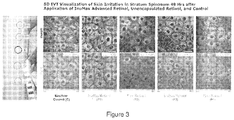
- the inventive delivery system has stabilizing effects on instable active ingredients as well as reduces the skin irritation potential of active ingredients (e,g., as confirmed by 5D Intravitaltomography). Stability is visually determined after exposing a delivery system to a temperature of 40C for a period of 30 days. A stable or stabilized mixture is one without layers or phase separation.
- the present invention relates to a physically stable and skin penetrating composition of positively charged Sugar based Delivery System (oil in water or o/w system) that encapsulates at least one oil soluble cosmetic active compound, and methods for making and using the encapsulated cosmetic active compound.
- the Delivery System is dispersed into an aqueous phase wherein the aqueous phase comprises about 10 to about 80wt.% of the composition, in some cases about 30 to about 80 wt.%, in some cases about 40 to about 80wt.% and in some cases about 40 to about 50wt.%.
- Figure 1 illustrates a composition of the invention wherein a lipophilic core comprising an oil soluble cosmetic active compound is encapsulated by a sugar based delivery system.
- the composition can be characterized as comprising an oil in water emulsion wherein the sugar backbone of delivery system extend into the hydrophilic membrane and theail portions (e.g., alkyl tail portions), of the delivery system extend into the lipophilic portion.
- the Delivery System comprises a sugar based emulsifier. a minimum of one coemulsifier or a combination of coemulsifiers chosen from coemulsifiers 1, 2 or 3, a positively charged molecule, solvent, a lipophilic/oil miscible/oil dispersible active ingredient as defined above and optional auxiliary material like chelating agents and/or preservatives and/or gelling and stabilizing agents.
- the lipophilic components are combined and the hydrophilic components are combined in the water phase and then the combinations are blended and homogenized under high pressure in order to form the inventive composition.
- the membrane comprises at least one sugar based emulsifier, at least one coemulsifier and a positively charged molecule.
- the sugar based emulsifier comprises a polysugar backbone selected from a polyfructose based inulin modified by linear C8-C22 alkyl groups.
- Molecular weight of the sugar based emulsifier is 5.000 - 500.000 g/mol, preferably 5.000 - 100.000 g/mol. Percentage of attached alkyl groups or degree of modification is 0.01 - 0.09, preferably 0.03 - 0,15.
- Typical amounts of the sugar based emulsifier are about 1 to about 20 wt% of the composition, and preferably about 1 to about 5 wt% of the composition.
- the optional sucrose based coemulsifier can be selected from a wide range of suitable modified sucrose molecules. It is preferably modified by linear or branched alkyl groups, preferably linear alkly groups from C8-C22.
- Preferred molecules are ⁇ -d-Glucopyranoside, ⁇ -d-fructofuranosyl, dodecanoate and ⁇ -d-Glucopyranoside, ⁇ -d-fructofuranosyl, mixed palmilates and stearates and ⁇ -d-Glucopyranoside, ⁇ -d-fructofuranosyl, monoteteradecanoate and ⁇ -d-Glucopyranoside, ⁇ -d-fructofuranosyl, mono[(Z)-9-octadecenoate] and ⁇ -d-Glucopyranoside, ⁇ -d-fructofuranosyl, didodecanoate and ⁇ -d-Glucopyranoside, ⁇ -d-
- Typical amounts of Coemulsifier 1 are about 0,01 to about 5 wt%, and preferably about 0,05 to about 0,5 wt% of the composition.
- the Coemulsifier 2 is a polyoxyethylene based coemulsifier comprising polysorbate molecule can be selected from a wide range of suitable molecules. It is consisting of 4-1000 oxyethylene groups esterified with fatty acids, It is preferably consisting of 4-100 oxyethylene groups esterified with 1-5 fatty acids (C8-C22), most preferably 20 oxyethylene groups esterified with 1 fatty acid (C8-C22). In special compositions it is also possible to use mixtures of the aforementioned polyoxyethyfene based coemulsifiers. Typical amounts of Coemulsifier 2 are 0.1-20 wt%, preferably 0,5-10 wt%.
- coemulsifier 3 enhances the penetration of active ingredients into the skin. Such activie ingredient penetration is a marked improvement over conventional delivery systems and is suprising and an unexpected result.
- the optional Coemulsifier 3 can be selected from a wide range of available emulsifiers: In products in which emulsifiers are employed, any suitable cosmetic emulsifier having a hydrophilic-lipophilic balance (HLB) in the range of about 1 to about 20 can be used.
- HLB hydrophilic-lipophilic balance
- the emulsifier can be nonionic, cationic, anionic, or amphoteric or a combination of such emulsifiers can be used.
- nonionic emulsifiers are at least one of laureths, e.g. laureth-4; ceteths, e.g, ceteths-1; polyethylene glycol cetyl ether: ceteareths, e.g. ceteareth-25; polyglycol fatty acid glycerides; hydroxylated lecithin; lactyl esters of fatty acids; and alkyl polyglycosides.
- cationic emulsifiers are at least one of cetyldimethyl-2-hydroxyethylammonium dihydrogenphosphate; cetyltrimonium chloride; cetyltrimonium bromide; cocotrimonium methosulfate; as well as emulsifiers that contain a quaternized nitrogen.
- Anionic emulsifiers include, for example, at least one of alkyl sulfates; alkyl ether sulfates; alkylsulfonates; alkylarylsulfonates; alkyl succinates; alkyl sulfosuccinates: N-alkylsarcosinates; acyl taurates; acyl isethionates; alkyl phosphates; alkyl ether phosphates; alkyl ether carboxylates; alpha-olefinsulfonates, and the alkali metal and alkaline earth metal salts of such materials (e.g, sodium, potassium, magnesium, calcium) as well as ammonium. trialkylamine. trialkanol amine, and alkylalkanol amine salts.
- the alkyl ether sulfates, alkyl ether phosphates and alkyl ether carboxylates may include ethylene oxide or propylene oxide units.
- Typical amounts of Coemulsifier 3 are about 0,1 to about 20 wt%, and preferably about 0,5 to about 10 wt% of the composition.
- the inventive composition comprises at least one positively charged molecule.
- the positively charged molecule is associated with membrane.
- the positively charged molecules can have a zeta potential of about 1 mV to about 150mV. about 10mV to about 100mV and in some cases about 20mV to about 50mV (as measured by zeta potential by means of laser Doppler electrophoresis as given later in the description).
- the optional positively charged molecule can be selected from one or more of the following charge donors a) to f):
- Typical amounts of the positively charged molecule are about 0,1 to about 10 wt%, and preferably, about 0,5 to about 2 wt% of the composition. While any suitable charged molecule can be used. desirable results can be obtained by using member a) and/or f) above. Oil
- At least one oil/emollient might be included in the composition being part of the inner core of the vesicle.
- Oil/emollients and solublizing agents can be comprising of volatile oils and/or nonvolatile oils.
- Nonvolatile oils mean those which remains on the surface of the skin at ambient temperature 25°C.
- These nonvolatile oils can be hydrocarbon oils, in particularly animal or vegetable origin, silicone oils or their mixtures.
- Hydrocarbon oil means an oil comprising hydrogen and carbon atoms and optionally oxygen, nitrogen sulphur and/or phosphorus atoms.
- the nonvolatile oils can in particularly be chosen from nonvolatile hydrocarbon oils, if appropriate fluorinated, and/or nonvolatile silicone oils. Hydrocarbon oils origin from animal, plants or synthetic, such as triglycerides composed of fatty acids and of glycerol.
- the fatty acid can be varied chain length from C4-C24. These chains can be saturated or unsaturated, and linear or branched.
- These oils can be triglyceride of heptanoic acid or octanoic acid, perhydrosqualene; hydrocarbon-based plant oils such as liquid triglycerides of fatty acids ranging from 4 to 24 carbon atoms, for instance heptanoic or octatonic acid triglyceride, or alternatively sunflower oil, maize oil, soybean oil, marrow oil grapeseed oil, sesame seed oil, hazelnut oil, apricot oil, macadamia oil, castor oil, avocado oil, caprylic/capric acid triglycerides, jojoba oil and shea butter; linear or branched hydrocarbons of mineral or synthetic origin, such as liquid paraffin and derivatives thereof, petroleum jelly, polydecenes, polybutenes and hydrogenated polyisobutene, such as sesam: synthetic
- polyol esters for instance propylene glycol dioctanoate, neopentyl glycol diheptanoate or diethylene glycol diisononanoate; and pentaerythritol esters.
- fatty alcohols comprising from 12 to 26 carbon atoms, for instance oetyldodecanol, 2-butyloctanol, 2-hexyldecanol, 2-undecylpentadecanol or oleyl alcohol; fluoro oils, optionally partially hydrocarbon-based and/or silicone-based; silicone oils, for instance volatile or non-volatile, linear or cyclic polydimethylsiloxanes (PDMSs); polydimethylsiloxanes comprising alkyl, alkoxy or phenyl groups, which may be pendent or at the end of a silicone chain, these groups comprising from 2 to 24 carbon atoms; phenyl silicones, for instance phenyl trimethicones, phenyl dimethicones, phenyl trimethylsiloxy diphenyl siloxanes. diphenyl dimethicones, diphenyl
- any natural or synthetic oil for cosmetic use is suitable for the composition of present invention.
- esters e.g., alkyl benzoates having between12 to 15 carbons
- triglycerides e.g., Caprylic/Caprytate triglyceride
- hydrocarbons e.g., mineral oil, Petroleum Jelly
- natural oils e.g., Jojoba Oil, Safflower Oil, Olive Oil, Sweet Almond Oil, Mango Butter, Sunflower Oil, Aloe Butter, Cocoa Butter, Shea Butter, Palm Kernel Flakes, Beeswax, Lanolin Butter. Sweet Orange Oil, Lemon Oil, avocado oil, Coconut Oil, Palm Oil.
- Suitable oils are also disclosed, for example, at column 3, line 37, to column 4, line 4, of U.S. Patent No. 5.738.125 : hereby incorporated by reference. Silicone oils may also be used as cosmetic oils.
- Suitable synthetic oils are at least one member selected from the group consisting of fatty alcohols; fatty acid esters such as isopropyl myristate, palmitate, stearate and isostearate; oleyl oleate; isocetyl stearate; hexyl laurate; dibutyl adipate; dioctyl adiphate; myristyl myristate; oleyl erucate; polyethylene glycol and it derivatives; polyglyceryl fatty acid esters; and cetyl palmitate, by way of example only.
- Silicone oils are also suitable.
- Useful silicone oils are non-volatile silicone oils known by INCl names that include dimethicone or dimethiconol, Volatile silicone oils such as cyclomethicones may also be used.
- Typical amounts of the oil/emoillent are about 1 to about 50 wt%, in some cases about 5 to about 40wt.% and in some cases about 15 to about 30wt.%, depending on the amount of active ingredient that is encapsulated Solvents
- the composition comprises at least one of water and water soluble solvents.
- Embodiments according to the invention include water and solvents from, but not limited to, the group of naturally-derived or synthetic alcohols, naturally-derived or synthetic glycols and naturally-derived or synthetic polyols, including triols, wherein alcohols comprise primary, secondary and tertiary alcohols that are commonly used and accepted in cosmetic formulations and compositions.
- Alcohols and glycols accepted in cosmetic products include, but are not limited to, ethanol, 1,2-propanediol, 1,3-propanediol, 1,3-butylene glycol, and polyols accepted in cosmetic products include, but are not limited to, glycerol.
- the solvent comprises lower monoalcohols comprising from 1 to carbon atoms, such as ethanol or isopropanol, glycols comprising from 2 to 8 carbon atoms, such as propylene glycol, ethylene glycol, 1,3-butyleneglycol or Dipropylene glycol, C ⁇ -C4ketones and C ⁇ -C4 aldehydes.
- 1 to carbon atoms such as ethanol or isopropanol
- glycols comprising from 2 to 8 carbon atoms, such as propylene glycol, ethylene glycol, 1,3-butyleneglycol or Dipropylene glycol, C ⁇ -C4ketones and C ⁇ -C4 aldehydes.
- the solvents comprising naturally-derived or synthetic alcohols may be combined with naturally-derived or synthetic glycols and/or naturally-derived or synthetic polyols in weight ratios (alcohol: glycol and/or polyol) from about 1 : 0.1 to about 1 : 10, in some cases from about 1 : 0.4 to about 1 : 6, and other cases from about 1 : 0.6 to about 1 : 4, and in yet other cases from about 1 : 1 to about 1 : 2.
- Typical amounts are about 1 to about 30 wt%, in some cases about 1 to about 20wt.% and in some cases about 1 to about 15wt.% of the composition.
- the encapsulated lipophilic or oil soluble active ingredient or oil-miscible or oil-dispersible active ingredient can be chosen from cosmetically suitable antioxidants, vitamins, plant extracts. synthetic materials with e.g. anti aging, skin soothing, skin tone, anti cellulite, anti inflammatory, whitening, improving overall skin condition properties.
- the lipophilic active ingredient comprises at least retinol.
- lipophilic or oil soluble or oil miscible or oil dispersible active ingredients and lipophilic or oil soluble or oil miscible or oil dispersible extracts might be selected from: Acacia famesiana extract, Acacia senegal, Açai, Acerola fruit extract, Acetyl carnitine HCL, Acetyl glucosamine, Acetyl hexapeptide-8, Acetyl octapeptide-3, Achillea millefolium, Acne soap, Actaea racemosa, Adenine, Adenosine, Adenosine triphosphate, Aerocarpus santalinus, Aesculus hippocastanum, Agaricus bisporus extract, Agrimonia eupatoria leaf extract, Ahnfeltia concinna extract, Ahnfeltia extract, Ajuga turkestanica extract, Alanine, Alaria esculenta, Alchomilla vulgaris, Aleurites moluccana seed
- Anethum graveolens Angelica archangelica root oil, Angelica polymorpha sinensis root extract, Anise, Annato extract, Anthemis nobis flower extract, Apple fruit extract, Apricot kernel oil, Aquaporins, Arachis hypogaea extract, Arbutin, Arctium lappa, Arctostaphylos uva ursi leaf, Argan oil, Argania spinosa, Arginine, Argireline, Arnica extract, Artemia extract, Artemisia absinthium extract, Artemisia vulgaris, Ascophyilum nodosum, Ascorbic acid, Ascorbyl Dipalmitate, Ascorbyl glucosamine, Ascorbyl glucoside, Ascorbyl methylsilanol pectinate, Ascorbyl Palmitate, Ascorbyl palmitate, Asparagine, Asparagopsis armata extract, Aspartic acid, Astragalus membranaceus, Astragalus sinic
- Awapuhi Azadirachta indica, Babassu oil, Bakuchiol, Balm mint extract, Balm oil, Balsam peru, Banana extract, Barberry, Barley extract, Bay leaf oil.
- Beeswax / Cera Alba Beet root extract, Behenic acid, Bellis perennis, Berberis aristata, Bergamot oil, Bertholletia excelsa extract, Beta and alpha Bisabolol, Beta hydroxy acid, Beta vulgaris root extract, Seta-carotene (provitamin A), Beta-sitosterol, Betula alba.
- BHA (beta hydroxy acid), Bilberry extract, Bioflavonoid, Biotin, Birch bark extract, Birch leaf extract, Bisabolol, Bitter orange flower, Black cohosh, Black currant oil.
- Carthamus tinctorius oil Carya illinoensis oil, Castanea sativa seed extract, Castor oil, Catalase, Caulerpa taxifolia extract, Coderwood, Celandine, Centaurea cyanus, Centalla asiatica.
- Copper gluconate Copper gluconate. Copper peptides, Corallina officinalis extract, Com Acid, Corn Glycerides, Corn oil, Commin, Comus extract, Corylus americana, Corylus avellana, Coumarin, Cranberry seed extract, Cranberry seed oil, Crataegus monogina extract, Creatine, Creatinine, Cucumber extract, Cucumis melo (melon) fruit extract, Cucumis sativus extract, Cucurbita pepo seed extract, Cucurbitea peponis, Curcuma longa root, Curcumin, Cyamopsis tatraganoloba, Cyanocobalamin, Cymbopogon citrates, Cymbopogon martini, Cysteine, Cystine, Daisy flower extract, Dandelion extract, Daucus carota, Decarboxy camosine HCL,Diethylhexyl syringylidenemalonate, Dill extract,Dioleyl Tocopheryl
- Dipotassium glycyrrhizate Dipotassium glycyrrhizinate, Dog rose, Dogwood, Dong qual, D-panthenol, Dulse, Durien, Durvillaea antarctica extract, Eicosapentaenoic acid, Elaeis guineensis, Elastin, Elderberry, Elecampane, Ellagic acid, Emp seed oil, English ivy extract, Enteromorpha compressa extract, Enzymes, Epidermal growth factor (EGF), Epigallocatechin gallate, Epilobium angustifolium extract, Equisetum arvense, Ergocalciferol, Ergothioneine, Eriobotrya japonica, Escin, Ester-C, Ethyl macadamiate, Ethyl vanillin, Ethylhexyl Myristate, Eucalyptus oil, Eugenia aromatica, Eugenia caryophyllus, Euphorbia
- Ficus carica fruit extract Fig, Filipendula glaberrima, Filipendula rubra, Fir needle oil, Fireweed extract, Flavonoid, Flax, Flaxseed oil, Foeniculum vulgare extract, Folic acid, Fu ling, Focus vesiculosus extract, Galactoarabinan, Gamma linolenic acid (GLA).
- GLA Gamma linolenic acid
- Ganoderma lucidum extract Gardenia florida extract, Gellidiela acerosa extract, Genistein, Gentiana lutea (Gentian) root extract, Geranium extract, Geranium oil, Ginger extract, Ginger oil.
- Ginkgo biloba leaf extract Ginseng, GLA, Glabridin, Glutamine, Glutathione, Glycine soja oil, Glycine soja seed extract, Glycine soja sterols, Glycogen, Glycol Ricinoleate, Glycolipid, Glycoproteins, Glycosphingolipid, Glycyrrhetic acid, Glycyrrhiza glabra, Glycyrrhiza uratensis root extract, Goldenseal, Gossypium herbacuem seed oil, Gotu kola, Grape seed extract, Grape seed oil, Grapefruit oil, Grapefruit peel extract, Green tea, Gromwell, Guaiac wood, Guaiacum officinale, Guarana, Haematococcus pluvialis extract, Hamamelis virginiana, Hamamelitannin, Haslea ostrearia extract, Hawthorn extract, Hayflower extract, Hedera helix, Helianthus annu
- Himanthalia elongate extract Hippophae rhamnoides, Histidine, Hops, Hordeum vulgare extract.
- Malva sylvestris extract Malvaceae extract, Mandarin orange oil or extract, Manganese gluconate, Mangifera indica (mango) seed butter, Mangifera indica root, Manuka oil, Mangold, Marionberry, Marjoram, Marshmallow, Mastocarpus stellatus, Mate extract, Matricaria flower extract, Matricaria oil, Meadowfoam seed oil, Meadowsweet extract, Medicago sativa, Melaleuca afternifolla, Melaleuca cajeputi oil, Melia azadirachta, Melibiose, Melissa officinalis, Mentha arvensis, Mentha piperita, Mentha spicata, Mentha viridis, Menthol, Methylsufonylsulfate, Microcystis aeruginosa, Milk protein, Milk vetch root, Millet seed extract, Mimosa oil or extract, Mint, Mitracarpe scaber extract, Mixed fruit extracts
- Neroli oil Nettle extract, Nordihydroguaiaretic acid, Nymphaea tetragona, Oak root extract, Oat bran extract, Oat kernel extract, Oatmeal, Oenothera biennis oil, Olea europaea fruit oil, Olea europaea oil unsaponifiables, Olive oil/olive fruit oil, Olive oil-derived fatty acids, Orange blossom, Orbignya martiana, Orbignya oleifera, Orchid, Origanum majorana, Origanum vulgare flower extract, Orris root, Oryza Sativa (Rice) Bran Oil, Oryza Sativa (Rice) Extract, Oryza Sativa (Rice) Germ Oil, Oryza sativa oil, Oryzanol, Oxidoreductase, Ozokerite, P.
- Elisabethae Padina pavonica extract Paeonia albiflora extract, Paeonia suffruticosa extract, Palmaria palmata extract, Palmarosa oil, Palmitoyl hexapeptide-12, Palmitoyl oligopeptide, Palmitoyl pentapeptide-3, Palmitoyl tetrapeptide-7, Palmitoyl tripeptide-1, Panax ginseng root extract, Panicum miliaceum, Pansy extract, Pantethine, Panthenol, Pantothenic acid, Papain, Papaver somniferum seed, Papaya extract, Passiflora edulis extract, Passiflora edulis seed oil.
- Pistachio seed oil Pistacia vera seed oil, Pisum sativum, Plankton extract, Plectranthus barbatus extract, Plum extract, Plum oil, Plum seed oil, Pogostemon cablin, Polygonum cuspidatum root extract. Pomegranate extract.
- Triticum vulgare (wheat) germ extract Triticum vulgare oil, Troxerutin, Tryptophan, Tussilago farfara, Ubiquinone, Ulmus fulva bark extract, Ulva lactuca extract, Uncaria tomentosa extract, Undaria pinnatifida, Urea, Urtica dioica, Uva ursi extract, Vaccinium macrocarpon fruit extract, Vaccinium myrtillus, Valine, Vanilla planifolia fruit extract, Verbena extract, Vetiver oil or extract, Viola tricolor extract, Visnaga vera extract, Vitamin A, Vitamin D, Vitamin E, Vitamin F, Vitis vinifera, Vitreoscilla ferment, Walnut extract, Walnut oil, Watercress extract, Watermelon fruit extract, Wheat germ oil, Wheat germ oil (triticum vulgare), Wheat protein, White nettle, White oak bark extract, White tea leaf extract.
- White willow Wild ginger, Wild yam extract, Willow bark, Willow herb, Wintergreen oil, Witch hazel, Xanthophyll, Xi xin, Ximenia americans oil, Yarrow extract, Yeast, Yeast extract, Verba mate extract, Ylang ylang, Yucca extract, Zanthoxylum piperitum, Zea Mays (Corn) Silk Extract, Zinc Myristate, Zingiber officinale roscoe, Zingiber zerumbet, Zingiberaceae, Zizyphus jujuba fruit extract, C 2 -C 18 esters of RETINOL, vitamin E, esters of vitamin E, 3,4-didehydro-RETINOL, plant extracts/essential oils, ursolic acid, oleanolic acid, oil-soluble licorice, and lipoic acid.
- Typical amounts are about 1 to about 50 wt%, in some cases about 1 to about 25wt.% and in some cases about 1 to about 10wt.%, depending on physical stability results.
- the Auxilliary Materials are typically water soluble and present in the water phase surrounding the encapsulated lipophilic core.
- the composition according to the invention comprises at least one chelating agent.
- the composition may contain less than about 5%, or from about 0.01 to about 3% of a chelant such as citrates, nitrogen-containing, P-free aminocarboxylates such as EDDS, ethylenediamintetraacetic acid (EDTA) and its salts e.g.
- disodium EDTA EDTA
- DTPA aminophosphonates such as diethylenetriamine pentamethylenephosphonic acid and ethylenediamine tetramethylenephosphoric acid
- nitrogen free phosphonates e.g., HEDP
- NTA nitrilotriacelic acid
- nitrogen or oxygen containing, P-free carboxylate-free chelants such as compounds of the general class of certain macrocylic N-ligands.
- Typical amounts are about 0,01 to about 2 wt%, and preferably about 0,01 to about 0.5 wt% depending on physical stability results.
- the composition according to the invention comprises at least one preservative.
- the at least one preservative is selected from but not limited to the group consisting of ethylparaben; imidazolidinyl urea; methylpareben, sorbic acid and its salts, O- phenylphenol; propylparaben: quatemium-14; quatemium- 5: sodium dehydroacetate; phenoxyethanol, phenoxyisopropanol, benzyl alcohol, polyaminopropyl biguanide, triethylene glycol, piroctone olamine, benzoic acid and its salts, dehydroacetic acid and its salts, diazolidinyl urea, iodopropynyl butylcarbamate, methylisothiazolinone, glyceryl caprylate, phenylethylalcohol, caprylyl glyco
- the preservatives may be used in any amount which is effective to prevent or retard microbial growth and typically about 0.01 wt% to about 5 wt%, and in some cases from about 0.05 wt% to about 3 wt%, based on the total weight of the composition.
- the gelling agents which can be used in the composition according to the invention can be polymeric gelling agents or organic lipophilic gelling agents.
- the polymeric or organic lipophilic gelling agents are partially or completely crosslinked or non crosslinked but able to create a three dimension structure such as Xanthan Gum, polyamide, silicone polyamides, silicone crosslinked polymers and acrylates including poly C10-30 alkyl acrylates and side-chain crystalline polymers (e.g., Example 23).
- Gelling agents can be present in the composition according to the invention in a content ranging from 0.1 to 10% by weight, preferably from 0.5% to 7% and most preferably 0.01 to 1%.
- the inventive composition can be used in a wide range of Personal Care products.
- the inventive composition typically comprises about 0,5 % to about 50 % and preferably about 2 to about 10 % of the Personal Care products.
- the inventive composition can be combined with other ingredients of a Personal Care product by using conventional equipment and methods.
- Water Phase consisting of water, sugar based emulsifier, at least one coemulsifier, positively charged molecule and optional auxiliary material are premixed in a stainless steel vessel at a temperature depending on the instructions given in the technical information of the chosen ingredients. This can vary from RT to 90 °C.
- ingredients of the oil phase constising of optional lipophilic active and/or optional oil and or optional coemulsfier are mixed at a temperature from RT to 90°C in a stainless steal vessel and added to the water phase while stirring followed by homogenization reagent with commercially available equipment (homogenization at high shear rates and/or high pressure homogenization from 100-1000 bar and typically about 600 bar and at a temperature ranging from about room temperature to less than 100°C; depending on the composition ingredients).
- Water Phase consisting of water, sugar based emulsifier, coemulsifiers, positively charged molecule and auxiliary materials are premixed in a stainless steel vessel at a temperature of 60°C, after that cooled to RT.
- the ingredients of the oil phase constising of lipophilic active and oil are mixed at RT in a stainless steel vessel and added to the water phase while stirring followed by homogenization rea with commercially available equipment (homogenization at high pressure homogenization from 100-1000 bar and typically about 600 bar at RT.
- Water Phase consisting of water, sugar based emulsifier, coemulsifier 1, positively charged molecule and auxiliary materials are premixed in a stainless steel vessel at a temperature of 60°C, after that cooled to RT.
- the ingredients of the oil phase constising of lipophilic active, coemulsifier 2 and oil are mixed at RT in a stainless steel vessel and added to the water phase while stirring followed by homogenization rea with commercially available equipment (homogenization at high pressure homogenization from 100-1000 bar and typically about 600 bar at RT.
- Water Phase consisting of water, inulin lauryl carbamate, sucrose laurate, behentrimonium chloride, isopropyl alcohol, glycerin were premixed in a stainless steel vessel at a temperature of 60°C, after that cooled to RT.
- the ingredients of the oil phase constising of retinol, caprylic/capric triglyceride, BHA, BHT and polysorbate 20 were mixed at RT in a stainless steel vessel and added to the water phase while stirring followed by homogenization pens with commercially available equipment (homogenization at high pressure homogenization of about 600 bar at RT.
- the particle size of the physically stable example was measured to be 64.6 nm and the zeta potential was +40-50 mV.
- Water Phase consisting of water, inulin lauryl carbamate, sucrose laurate, behentrimonium chloride, isopropyl alcohol, glycerin were premixed in a stainless steel vessel at a temperature of 60°C, after that cooled to RT.
- the ingredients of the oil phase cohstising of retinol, caprylic/capric triglyceride, BHA, BHT and polysorbate 20 were mixed at RT in a stainless steel vessel and added to the water phase while stirring followed by homogenization pens with commercially available equipment (homogenization at high pressure homogenization of about 600 bar at RT.
- the particle size of the physically stable example was measured to be 78.5 nm and the zeta potential was approximately +43 mV (alternatively: +40-50mV as given in previous samples).
- Water Phase consisting of water, sugar based emulsifier. coemulsifiers, optional positively charged molecule and auxiliary materials are premixed in a stainless steal vessel at a temperature of 6.0°C, after that cooled to RT.
- the ingredients of the oil phase constising of lipophilic active and oil are mixed at RT in a stainless steal vessel and added to the water phase while stirring followed by homogenization rea with commercially available equipment (homogenization at high pressure homogenization from 100-1000 bar and typically about 600 bar at RT.
- Water Phase consisting of water, inulin lauryl carbamate, sucrose laurate, behentrimonium chloride, isopropyl alcohol, glycerin, hydroxyproline and magnesium ascorbyl phosphate were premixed in a stainless steel vessel at a temperature of 60°C, after that cooled to RT.
- the ingredients of the oil phase constising of retinol, caprylic/capric triglyceride, BHA, BHT and polysorbate 20 were mixed at RT in a stainless steel vessel and added to the water phase while stirring followed by homogenization frac with commercially available equipment (homogenization at high pressure homogenization of about 600 bar at RT.
- the particle size of the physically stable example was measured to be 113.3 nm and the zeta potential was +20-30mV.
- Water Phase consisting of water, inulin lauryl carbamate, sucrose laurate, behentrimonium chloride, isopropyl alcohol, glycerin, hydroxyproline and magnesium ascorbyl phosphate were premixed in a stainless steel vessel at a temperature of 60°C, after that cooled to RT.
- the ingredients of the oil phase constising of retinol, caprylic/capric triglyceride, BHA, BHT and polysorbate 20 were mixed at RT in a stainless steel vessel and added to the water phase while stirring followed by homogenization frac with commercially available equipment (homogenization at high pressure homogenization of about 600 bar at RT.
- the particle size of the physically stable example was measured to be 94.1 nm and the zeta potential was +23.2mV (altematively: +20-30mV as given In previous samples)
- Water Phase consisting of water, inulin lauryl carbamate, sucrose laurate, behentrimonium chloride, isopropyl alcohol, glycerin, hydroxyproline and magnesium ascorbyl phosphate were premixed in a stainless steel vessel at a temperature of 60°C, after that cooled to RT.
- the ingredients of the oil phase constising of retinol, caprylic/capric triglyceride, BHA, BHT and polysorbate 20 were mixed at RT in a stainless steel vessel and added to the water phase white stirring followed by homogenilation frac with commercially available equipment (homogenization at high pressure homogenization of about 600 bar at RT.
- the particle size of the physically stable example was measured to be 102.6 nm and the zeta potential was +20-30mV.
- Particle Size of Delivery System can be from 10-1000 nm, in some cases from 50 - 500 nm.
- Particle Size refers to the averaged hydrodynamic diameter as measured from diluted aqueous solutions by Photon Correlation Spectroscopy, also referred to as Dynamic Light Scattering.
- the particle size of the examples of the sugar based delivery systems were measured by Photon Correlation Spectroscopy using a MALVERN Zetasizer Nano SZ90 by means of a 5 mW He-Ne laser (633 nm), with a measuring angle of 90° at a temperature of 25 °C +/- 0.5 °C, according to the procedure published in the MALVERN operating manual.
- Zeta Potential of Delivery System can be from 1-150 mV.
- Preferred lipid vesicles have a zeta potential from 10 to 100 mV.
- the term "zeta potential" describes the electric potential of a shear layer of a moving particle in a suspension. Measurement of the zeta potential can occur by moving particles through an applied electric field. The zeta potential can then be calculated from the resulting velocity in the particles.
- the zeta potential in conjunction with the present invention is determined by means of laser Doppler electrophoresis. The measurements then occur in strongly diluted aqueous salt solutions, in which case samples being measured are ordinarily present in concentrations of 0.01-0.1 wt % in 1 mM sodium chloride solution.
- the pH values of the sample solutions lie in the pH value specification range of the corresponding product being measured in which product-specific pH values in the range of about 4.5 to about 8.0. about 4.5 to about 6.5 and in some cases about 5.5 to about 7.5 are generally encountered.
- the zeta potential of the examples of the sugar based delivery systems were measured MALVERN Zetasiur Nano SZ90 following the afore-mentioned protocol and procedure according to the instruction manual of the equipment.
- inventive compositions For purposes of this invention, the epidermal delivery of active compounds incorporated within inventive compositions was investigated with in vivo 5D-IVT using a multiphoton tomography instrument manufactured by JenLab (JenLab GmbH, Jena, Germany) at ambient temperatures and atmospheric conditions.
- the inventive composition containing an active compound was non-occlusively applied to the inner forearm. After a period of up to about 5 hours from application of the inventive composition, the treated area was cleaned with a compress that was washed and subsequently dried with a clean, dry compress.
- the 5D-IVT probe was adjusted to the treated area on the inner forearm of the panelist and the skin was irradiated with near infrared radiation of a wavelength of 700 nm provided by a Titanium:Sapphire tuneable laser system (Mai Tai, Newport Spectra-Physics, USA).
- the excitation laser beam was attenuated by the use of a Glan calcite polarizer and scanned by two galvanometric mirrors. After passing a beam expander and collimator, the laser pulses are reflected by a dichroic beam splitter into a 40x oil immersion microscope objective with a numerical aperture of 1.3 (Cart Zeiss Jena GmbH, Jena, Germany).
- the emitted fluorescence light was transmitted and cleared by an additional shortwave-pass filter (F37-490 BrightLine HC 490/LP and F75-680 Muitiphoton-Emitter HC 680/SP, F39-461 BrightLine HC 460/60, F39-390 BrightLine HC 390/40; Semrock Inc., Rochester, NY, USA) and split up in three spectral regions by a set of dichroic beam splitters (F43-031 425DCXR, F33-499 4950CXR: Chroma Technology Corp., Bellows Falls, VT, USA).
- PMTs Three separate photomultipliers (PMTs) provided intensity images of the sample and each PMT was readout by time-correlated single photon counting to calculate wavelength-range-specific fluorescence lifetime values.
- the data of the PMTs were processed by a high-resolution time-correlated single photon counting imaging module (SPC 830, Becker & Hickl GmbH, Berlin, Germany) in order to monitor and record the in vivo fluorescence image of the human skin. Subsequently the relative dermal penetration of active compounds was determined based on the intensities of the characteristic Fluorescence-lifetime imaging signal.
- 5D-IVT instruments Any of various published modes of operation of 5D-IVT instruments, such as those described in " A comparative study of different instrumental concepts for spectrally and lifetime-resolved multiphoton intravital tomography (5D-IVT) in dermatological applications” (Proceedings of SPIE Vol. 7568 ), for example, may be suitable to image targeted topical epidermal delivery of active compounds.
- topical epidermal delivery may be established in a 5D-IVT image by a count of discrete domains within the image that are assigned to the active compound. In some cases, the count of discreet domains assigned to the active compound in an image area of 60 ⁇ m x 60 ⁇ m obtained at a depth of 1 ⁇ m to 100 ⁇ m is increased. Most preferable results were obtained by the encapsulation of retinol or Vitamin A given in Example 2c. Determination of stabilization of active ingredients
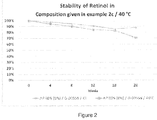
- Active ingredients can be detected by any known analytical test method which can be e.g. HPLC, GC, ESR depending on the composition. This effect depends on the active lipophilic ingredient encapsulated. Most preferable results were obtained by encapsulation of Retinol or vitamin A given in Example 2. These results illustrate that the instant invention can stabilize Retinol and thereby reduce, if not prevent, Retinol from decomposing or degrading. Accordingly the inventive composition enhances the amount of Retinol that is available for skin penetration (as well as the ability for Retinol to penetrate the skin).
- Figure 2 shows the results of the HPLC determination of retinol obtained for composition given in example 2c upon storage for 28 weeks.
- the encapsulation efficiency of some actives may be less than that achieved by other encapsulation approaches.
- some actives such as Retinol
- the invention as described in Example 2 can nonetheless manifest greater than expected color build associated with retinol degradation when exposed to elevated 40°C temperatures in as little as two weeks. This color build can be due to a much larger level of unencapsulated/residual Retinol within the system.
- the inventive delivery system imparts improved chemical stability to active ingredients such as retinol.
- HPLC analysis confirms that the inventive delivery system reduces chemical degration of retinol whereas unencapsulated retinol degrades.
- Reduction of irritation can be detected by any Known analytical test method which can be e.g. 5D IVT, ELISA, Patch Test, HET Cam Test using skin, skin models, cells. This effect depends on the active lipophilic ingredient encapsulated.
- the delivery system of the invention can achieve Tau values of about 100ps to about 3000ps, about 300ps to about 2500ps and in some cases about 500ps to about 1500ps in the Stratum granulosum and Stratum spinosum.
- Personal care products and exemplary formulations using Delivery Systems can achieve Tau values of about 100ps to about 3000ps, about 300ps to about 2500ps and in some cases about 500ps to about 1500ps in the Stratum granulosum and Stratum spinosum.
- Delivery System compositions disclosed herein may be employed as an ingredient in creating a Cosmetic or Personal Care product. Delivery System compositions may also provide delivery enhancement
- the Delivery System composition is generally present at about 0.1 to about 20% by weight in such products, in some cases between about 0.5 and about 15% by weight, and in still other cases is present between about 1 % and about 10% by weight.
- the composition can be used with a wide range of personal care products having a base media that can comprise at least one member selected from the group consisting of cosmetic oil (i.e. oils compatible for cosmetic uses), water, alcohol and combinations thereof, all by way of example only.
- the Delivery System composition can be added to Personal Care products as is, or as dispersion in water or any suitable organic solvent or combination of solvents and/or water.
- Exemplary cosmetic, toiletry and topical health care type personal care products in which the Delivery System composition may be employed include, without limitation, leave-on personal care products (i.e., products that are left on keratinous substrates after application); rinse-off personal care products (i.e., products that are washed or rinsed from keratinous substrates during or within a few minutes of application); at least one of shampoos; chemical and non-chemical hair curling and hair straightening products; hair style maintaining and hair conditioning products; lotions and creams for nails, hands, feet, face.
- leave-on personal care products i.e., products that are left on keratinous substrates after application
- rinse-off personal care products i.e., products that are washed or rinsed from keratinous substrates during or within a few minutes of application
- at least one of shampoos i.e., chemical and non-chemical hair curling and hair straightening products
- hair style maintaining and hair conditioning products i.e., lotions and creams for nails,
- scalp and/or body hair dye; face and body makeup: nail care products; astringents; deodorants; antiperspirants; anti-acne; antiaging; depilatories; colognes and perfumes; skin protective creams and lotions (such as sunscreens); skin and body cleansers; skin conditioners; skin toners; skin firming compositions; skin tanning and lightening compositions; liquid soaps; bar soaps; bath products; shaving products; and oral hygiene products (such as toothpastes, oral suspensions, and mouth care products), any or the foregoing of which may additionally contain pharmaceutical, ptrytopharmaceutical and/or neutraceutical ingredients.
- Such Personal Care products includes, without limitation, a liquid, gel, spray, emulsion (such as lotions and creams), shampoo, pomade, foam, tablet, stick (such as lip care products), makeup, suppositories, among others, any of which can be applied to the skin or hair and which typically are designed to remain in contact there with until removed, such as by rinsing with water or washing with shampoo or soap.
- emulsions can be oil-in-water, water-in-cil, water-and-silicone, or multiphase.
- Sprays can be non-pressurized aerosols delivered from manually pumped finger-actuated sprayers or can be pressurized aerosols.
- exemplary Delivery System composition are formulated in aerosol compositions such as mousse, spray, or foam forming formulation, where a chemical or gaseous propellant is used.
- Personal Care products containing a Delivery System can be broadly categorized as gel or emulsions products, water-in-oil emulsions, oil-in-water emulsions, or aqueous or alcohol based systems.
- Water-in-oil emulsions can be prepared by mixing together (1) a heated (i.e., melted) solution of the oil phase and (2) an aqueous phase, the aqueous phase being at a temperature similar to the oil (typically within about 10 °C); and then cooling the mixture while stirring. While bringing the temperature of emulsion down Delivery System composition could be added below 45C as emulsion been emulsified and in process of adding other temperature sensitive cosmetic ingredients like preservative, actives and fragrances. Alternativelyl, the Delivery System composition could be added to the aqueous phase if formulation is made without any heating like cold process formulations. Delivery System composition is generally added below 45 °C to room temperature in any cosmetic formulation. Regardless of the manner in which the Delivery System composition is added, the ratio of the aqueous phase to the oil phase can be, for example, about 0.5:1 to about 9:1.
- the amount of the inventive Delivery System employed can varying depending upon a given formulation.
- the amount of Delivery System can range from about 0.1 to about 4%, about 1 to about 20% and in some cases about 5 to about 14% of a formulation.
- the following are non-limiting examples of cosmetic formulations comprising water-in-oil emulsions that can include the inventive Composition / Delivery System for active cosmetic compounds:
- Oil-in-water emulsions are prepared by mixing together (1) a heated (i.e., melted) solution of the oil phase and (2) an aqueous phase, the aqueous phase being at a temperature similar to the emollient solution (typically within about 10 °C); and then cooling the mixture while stirring.
- the Delivery System composition may initially be added to the aqueous phase if formulation is cold processable or added post-emulsification below 45 °C.
- the ratio of the oil phase to the water phase can be, for example, about 0.1:1 to about 1;1.
- cosmetic formulations comprising oil-in-water emulsions:
- cosmetic formulations comprising alcohol or aqueous systems that can include the inventive compositions.
- any suitable emollient for use in cosmetic compositions can be used.
- suitable emollients include at least one of esters (e.g., C12-15 alkyl benzoate) and triglycerides (e.g., Caprylic/caprylate triglyceride); hydrocarbon oils (e.g., mineral oil), natural oil (e.g., Jojoba oil, safflower oil), tridecyl trimellitate, sunflower oil, castor oil, among other compounds used to impart desired or improved sensory or aesthetic properties of a personal care composition. Many emollients used in cosmetic compositions also fall within the category of cosmetic oils.
- any suitable cosmetic emulsifier having a hydrophilic-lipophilic balance (HLB) in the range of about 1 to about 20 can be used.
- the emulsifier can be nonionic, cationic, anionic, or amphoteric or a combination of such emuisifiers can be used.
- nonionic emulsifiers are at least one of laureths, e.g. laureth-4: ceteths, e.g. ceteths-1; polyethylene glycol cetyl ether; Cetearth, e.g. cetearth-25; polyglycol fatty acid glycerides; hydroxylated lecithin; lactyl esters of fatty acids; and alkyl polyglycosides.
- cationic emulsifiers are at least one of cetyldimethyl-2-hydroxyethylammonium dihydrogenphosphate; cetyltrimonium chloride; cetyltrimonium bromide; cocotrimonium methosulfate; as well as emulsifiers that contain quaternized nitrogen.
- Anionic emulsifiers include, for example, at least one of alkyl sulfates; alkyl ether sulfates; alkylsulfonates; alkylarylsulfonates; alkyl succinates; alkyl sulfosuccinates; N-alkylsarcosinates; acyl taurates; acyl isethionates: alkyl phosphates: alkyl ether phosphates; alkyl ether carboxylates; alpha-olefinsulfonates, and the alkali metal and alkaline earth metal salts of such materials (e.g.
- alkyl ether sulfates, alkyl ether phosphates and alkyl ether carboxylates may include ethylene oxide or propylene oxide units,
- Surfactants and/or foam boosters may also be employed and like the emulsifiers can be nonionic, cationic, anionic, or amphoteric or a combination of such surfactants can be used.
- Suitable anionic surfactants are for example, at least one of alkyl sulfates; alkyl ether sulfates; alkylsulfonates; alkylarylsulfonates; alkyl succinates; N-alkylsarcosinates; acyl taurates; acyl isethionates; alkyl phosphates; alkyl ether phosphates: alkyl ether carboxylates; alpha olefinsulfonates, and may include the alkali metal and alkaline earth metal salts of such materials (e.g.
- alkyl ether sulfates, alkyl ether phosphates and alkyl ether carboxylates may include ethylene oxide or propylene oxide units.
- Suitable amphoteric surfactants are, for example, at least one of alkylbetaines; alkylamidopropylbetaines; alkylsulfobetaines; alkyl glycinates; alkylcarboxyglycinates; alkyl amphoacetates or amphopropionates; and alkyl amphodiacetates or amphodipropionates.
- alkylbetaines alkylamidopropylbetaines
- alkylsulfobetaines alkyl glycinates
- alkylcarboxyglycinates alkyl amphoacetates or amphopropionates
- alkyl amphodiacetates or amphodipropionates alkyl amphodiacetates or amphodipropionates.
- cocodimethylsulfoprapylbetaine, laurylbetaine, and cocamidopropylbetaine or sodium cocamphopropionate as surfactants
- nonionic surfactants are the reaction products of aliphatic alcohols having between 6 and 20 carbon atoms in the alkyl chains, which can be linear or branched with ethylene oxide and/or propylene oxide. Also suitable are at least one of alkylamine oxides; mono- or dialkylalkanolamides; fatty acid esters of polyethylene glycols; alkyl polyglycosides and sorbitan ether esters.
- cationic surfactant examples include quaternary ammonium compounds, for example, cetyltrimethylammonium chloride, as well as other surfactants that contain a quaternized nitrogen.
- any one or more polymer(s) can be of any type, including those which are at least one of nonionic, amphoteric or zwitterionic, anionic, cationic or mixtures of such types of polymers.
- Exemplary synthetic polymers include at least one of vinyl pyrrolidone or acrylate homopolymer and copolymers, including carbomer, and those which have a vinyl acetate group or acrylate or acrylamide or taurate group.
- Natural non-ionic polymers suitable for the composition of the present invention can comprise at least one of cellulose, starches, chitosan, xanthan gum, guar gum, neutralized shellac and their derivatives. Cationic derivatives or chemical modified forms of natural polymers may also be included, such as chemically modifies starches, celluloses, guar and xanthan gum e.g., methylcellulose, hydroxyethylcellulose, quaternized guar.
- the polymer may also include silicone compounds, such as, for example, at least one of polydiorganosiloxanes, polydialkylsiloxanes, polyalkylsiloxanes, polyarylsiloxane, silicone resins, silicone gums or dimethicone copolyols and aminofunctional silicone compounds such as amodimethicone.
- silicone compounds include graft polymers of organosiloxane and polyethyloxazolines compounds known with the INCI name Polysilicone-9. Any polymeric compound having an INCI name including silicone, methicone, dimethicone, or siloxane as part of its name may be used.
- propellant or solvents may include at least one of isobutane, butane, dimethyl ether, and ethanol, among others.
- Additives or Actives include one or more of additive compounds, active compounds, and moisturizing and humectants compounds.
- additive compounds include one or more members selected from the group consisting of silicone based plasticizers, natural or synthetic compounds (e.g., polysaccharides, natural or synthetic gums, stabilizers, anionic and nonionic associative thickener or theology modifiers soluble in oil or water phase), among other compounds.
- the additives may include at least one compound selected from the group consisting of preservatives, stabilizers (e.g., Xanthan Gum), antioxidant (e.g., Vitamins), rheology modifiers, fragrances, and pigments, among other additives.
- active compounds that interact with or protect skin or hair can be included.
- active compounds include at least one of sunscreen compounds (e.g. zinc oxide, titanium dioxide, octinoxate, octocrylene, ethylhexyl salicylate, oxybenzone); skin whiteners (e.g.
- salicylic acid aloesin, ethyl ascorbic acid, arbutin
- anti-cellulite compounds e.g., polypeptides such as Argininie/Lysine, Argininie PCA, Aspergillus/Aspidosperma Quebracho Ferment, botanical actives, Bifida Ferment Lysate, Calophylum Inorhylum seed oil, camellia sinensis extract, ceramides, chlorella vulgaris extract, coriolus versicolor extract, corylus avelfana (hazel) seed extract, erythorbic acid, hydrolyzed elastins, hydrolyzed proteins, hydrolyzed soy flour, hydrolyzed peptides, and Vitamins A, E, C, K, B7, and B5 as well as Niacinamide); anti-acne compounds (e.g., salicylic acid, sodium salicylate, benzoyl peroxide); anti-cellulite
- Active compounds may also include at least one in vivo Fluorescent Dye. While an in vivo Fluorescent Dye may not interact with or protect skin or hair, it may be used as a model for cosmetic actives to allow for the assessment and prediction of epidermal penetration of cosmetic actives, in vivo Fluorescent Dyes include any fluorescent dye that meets regulatory and/or safety requirements for human in vivo skin penetration studies, and includes Fluorescein Alcon 10%, for example.
- moisturizing and humectants compounds that interact with or skin or hair could be simple or complex mixtures of chemical agents specially designed to make the external or upper layers of the skin (epidermis) softer and more pliable. They increase the skin's hydration or water content by reducing evaporation or by bringing moisture to the skin.
- Types of moisturizers and Humectants include, for example, naturally occurring skin lipids and sterols, as well as artificial or natural oils, emollients, lubricants.
- moisturizing or humectants compounds examples include glycol (e.g., glycerin, propylene glycol, dipropylene glycol, butylene glycol MP diol, sorbitol, and hexylene glycol), Polysaccharides (e.g., Hyaluronic acid and its salts, B-1, 3-glucans, Chitosan), Botanicals (e.g., Aloe vera, Ginkgo, green tea extract, rose extract, sugar extract).
- glycol e.g., glycerin, propylene glycol, dipropylene glycol, butylene glycol MP diol, sorbitol, and hexylene glycol
- Polysaccharides e.g., Hyaluronic acid and its salts, B-1, 3-glucans, Chitosan
- Botanicals e.g., Aloe vera, Ginkgo, green tea extract, rose extract, sugar extract.
- Natural oils e.g., coconut oil, grape seed oil, jojoba oil, olive oil, Argan oil
- polyethylene glycol ether of methyl glucose e.g., Methyl Gluceth-10
- green algae e.g., green algae, natural and herbal extract design for moisturization like alpha lipoic acid, peptides, proteins amino acids and collagens and betaine among others.
- Example Product 1 Skin Cream Containing Inventive Sugar based Delivery System
- phase A The ingredients of phase A were added together, mixed and heated to 75 °C.
- the ingredients of phase B were added to a separate container, heated to 75 °C until melted, and mixed.
- the phase B mixture was added to phase A while mixing, followed by homogenisation.
- the mixture was cooled to 60 °C and phase C was adding with gentle mixing.
- the mixture was further homogenised for a short time, cooled to 40 °C, and the Sugar based delivery system was added with gentle mixing until homogenous,
- Example Product 2 Second Skin Cream Containing Inventive Sugar based Delivery System
- a Skin Cream is prepared according to the composition and procedure of Example Product 1, with the Sugar based delivery system at 5 wt%.
- Example Product 3 Second Skin Cream Containing Inventive Sugar based Delivery System
- phase A The ingredients of phase A were added together, mixed and heated to 80 °C.
- the ingredients of phase 8 were added to a separate container, mixed and heated to 80 °C.
- the phase B mixture was added to phase A while mixing and homogenizing.
- the mixture was cooled to 40 °C and ingredients of phase C were added with gentle mixing until the cream was homogeneous.
- Example Product 4 Third Skin Cream Containing Inventive Sugar based Delivery System
- a Skin Cream is prepared according to the composition and procedure of Example Product 3, with the Sugar based delivery system at 5 wt%
- Example Product 5 Fourth Skin Cream Containing Inventive Sugar based Delivery System
- the Skin Cream was prepared according to the procedure of Example Product 3.
- Example Product 6 Fifth Skin Cream Containing Inventive Sugar based Delivery System
- a Skin Cream is prepared according to the composition and procedure of Example Product 5, except that the Sugar based delivery system is used at 5 wt%.
- Example Product 7 Sixth Skin Cream Containing Inventive Sugar based Delivery System
- the Skin Cream was prepared according to the procedure of Example Product 3.
- Example Product 8 Seventh Skin Cream Containing Inventive Sugar based Delivery System
- a Skin Cream is prepared according to the composition and procedure of Example Product 7, except that the Sugar based delivery system is used at 5 wt%.
- Example Product 9 Eighth Skin Cream Containing Inventive Sugar based Delivery System
- the Skin Cream was prepared according to the procedure of Example Product 3.
- Example Product 10 Ninth Skin Cream Containing Inventive Sugar based Delivery System
- a Skin Cream is prepared according to the composition and procedure of Example Product 9, except that the Sugar based delivery system is used at 5 wt%.
- Example Product 11 First Serum Containing Inventive Sugar based Delivery System
- Phase A Deionized Water balance Carbomer 1.3 Phase B Sodium Hydroxide, 10 wt% in Water 3.6 Phase C Sorbeth-30 5.0 Preservative of Phenoxyethanol (71-77 wt%), Benzoic Acid (11-13 wt%), Dehydroxyacetic Acid (6.5-7.5 wt%), Ethylhexylglycerin (1,4-11.4 wt%). Polyaminopropyl Biguanide (0.1-1.1 wt%) 0.5 Sugar based Delivery System 10.0
- phase A The ingredients of phase A were added together and mixed at room temperature until the Carbomer was fully dissolved.
- the ingredient of phase B was added to the mixture for neutralization, Ingredients of phase C were then added in the order given with gentle mixing until the serum was homogeneous.
- Example Product 12 Second Serum Containing inventive Sugar based Delivery System
- a Serum is prepared according to the composition and procedure of Example Product 11, except that the Sugar based delivery system is used at 5 wt%.
- Example Product 13 Tenth Skin Cream Containing inventive Sugar based Delivery System
- phase A The ingredients of phase A were added together, mixed and heated to 85 °C
- the ingredients of phase B were added to a separate container, mixed and heated to 85 °C.
- the phase B mixture was added to phase A and mixed for 3 minutes, cooled to 65 °C, and homogenized at 6000 rpm for 3 minutes.
- the mixture was cooled with stirring to between 40 °C and 20 °C, and ingredients of phase C were then added in the order given with gentle mixing until the cream was homogeneous.
- Example Product 14 Eleventh Skin Cream Containing inventive Sugar based Delivery System
- a Skin Cream is prepared according to the composition and procedure of Example Product 13, except that the Sugar based delivery system is used at 5 wt%.
- Example Product 15 Twelfth Skin Cream Containing Inventive Sugar based Delivery System
- the Skin Cream was prepared according to the procedure of Example Product 13.
- Example Product 16 Thirteenth Skin Cream Containing Inventive Sugar based Delivery System
- a Skin Cream is prepared according to the composition and procedure of Example Product 15, except that the Sugar based delivery system is used at 5 wt%.
- Example Product 17 Fourteenth Skin Cream Containing inventive Sugar based Delivery System
- the Skin Cream was prepared according to the procedure of Example Product 13.
- a Skin Cream is prepared according to the composition and procedure of Example Product 17, except that the Sugar based delivery system is used at 5 wt%.
- Example Product 19 Sunscreen (SPF 15) Containing inventive Sugar based Delivery System
- the Sunscreen is prepared according to the procedure of Example Product 13.
- Example Product 20 Hair Styling and Moisturizing Cream Containing Inventive Sugar based Delivery System
- the Hair Cream is prepared according to the procedure of Example Product 13.
- Example Product 21 Moisturizing BB Cream (Foundation) Containing Sugar Based Delivery System
- phase A The ingredients of phase A are added together, are mixed and heated to 85 °C.
- the ingredients of phase B are added to a separate container, are mixed and heated to 85 °C.
- the phase B mixture is added to phase A and is mixed for 3 minutes; the mixture is cooled to 65 °C, and is homogenized at 6000 rpm for 3 minutes.
- Phase C ingredients are then added to the mixture and mixing is continued until homogeneous.
- the mixture is cooled with stirring to between 40 C and 20 °C, and ingredients of phase D are then added with gentle mixing until the cream is homogeneous.
- Example Product 22 Hair Conditioner with Moisturization Containing Inventive Sugar Based Delivery System
- phase A The ingredients of phase A are added together and mixed until homogeneous.
- the ingredient of phase B are added together in a separate container and mixed until homogeneous.
- Phase B is added to phase A and mixed until the conditioner is homogeneous.
- Example Product 23 Luxuriously Deep Retinol Cream with Sugar-Based Delivery System and Intelimer® 13 Series Polymers (Formulaiton No. S068)
- phase A The ingredients of phase A are added together in a vessel. These ingredients are then mixed while heated to 80°C. In a separate vessel, Phase B water is added and begun to be mixed. Xanthan gum is then sifted into this water, while allowing the xanthan gum to fully disperse. Glycerin is then added to this, with continued mixing. The Phase B vessel is then heated to 80°C with continued mixing. Once 80°C temperature has been reached, Phase A was added into Phase B. The mixture was then mixed for 3 minutes and cooled, with mixing, to 65°C. This mixture was then homogenized for 3 minutes at 6000 rpm. The homogenizer was then removed and the mixture was mixed until it has cooled to room temperature. The Sugar-Based Delivery System and preservative system was then added to the mixture, with light mixing. If necessary, the pH of the formulation was then adjusted through the addition of 30% Sodium Hydroxide solution. The formulation can then be packaged.
Landscapes
- Health & Medical Sciences (AREA)
- Life Sciences & Earth Sciences (AREA)
- Veterinary Medicine (AREA)
- Animal Behavior & Ethology (AREA)
- General Health & Medical Sciences (AREA)
- Public Health (AREA)
- Birds (AREA)
- Epidemiology (AREA)
- Dermatology (AREA)
- Chemical & Material Sciences (AREA)
- Dispersion Chemistry (AREA)
- Emergency Medicine (AREA)
- Cosmetics (AREA)
Claims (4)
- Composition à base d'eau pénétrant la peau pour des applications cosmétiques comprenant des vésicules à base de sucre chargées positivement composées d'émulsifiants à base de sucre,d'au moins un coémulsifiant,de molécules chargées positivement,de solvants choisis parmi l'eau et des solvants solubles dans l'eau,de rétinol en tant qu'agent actif lipophile, éventuellement de matériaux auxiliaires comme des agents chélatants et des conservateurspossédant une taille de particule de 50 à 1 000 nm et un potentiel zêta de 1 à 150 mV,l'émulsifiant comprenant un squelette d'inuline modifié par des groupes alkyle linéaires en C8 à C22 et,le coémulsifiant à base de polyoxyéthylène comprenant une molécule de polysorbate.
- Composition selon la revendication 1 comprenant en outre un coémulsifiant possédant un équilibre hydrophile-lipophile (HLB) dans la plage d'environ 1 à environ 20 et qui est non ionique, cationique, anionique, ou amphotère ou une combinaison de ceux-ci de nature.
- Produit de soin personnel comprenant la composition selon la revendication 1.
- Produit cosmétique comprenant la composition selon la revendication 1.
Applications Claiming Priority (2)
| Application Number | Priority Date | Filing Date | Title |
|---|---|---|---|
| US201562203142P | 2015-08-10 | 2015-08-10 | |
| PCT/US2016/046313 WO2017027570A1 (fr) | 2015-08-10 | 2016-08-10 | Système de distribution de pénétration de la peau basé sur des émulsifiants de sucre à charge positive |
Publications (2)
| Publication Number | Publication Date |
|---|---|
| EP3334405A1 EP3334405A1 (fr) | 2018-06-20 |
| EP3334405B1 true EP3334405B1 (fr) | 2021-09-29 |
Family
ID=56801796
Family Applications (1)
| Application Number | Title | Priority Date | Filing Date |
|---|---|---|---|
| EP16757408.6A Active EP3334405B1 (fr) | 2015-08-10 | 2016-08-10 | Système vecteur permettant le passage dans la peau basé sur des tensio actifs à base de sucres positivement chargés. |
Country Status (6)
| Country | Link |
|---|---|
| US (2) | US20170042784A1 (fr) |
| EP (1) | EP3334405B1 (fr) |
| JP (1) | JP6906518B2 (fr) |
| KR (1) | KR102076480B1 (fr) |
| CN (1) | CN108135810A (fr) |
| WO (1) | WO2017027570A1 (fr) |
Families Citing this family (59)
| Publication number | Priority date | Publication date | Assignee | Title |
|---|---|---|---|---|
| US20170196801A1 (en) * | 2016-01-12 | 2017-07-13 | Flexxsonic Corp. | Application of topical product using a sonic device |
| WO2018081005A1 (fr) * | 2016-10-25 | 2018-05-03 | Access Business Group International Llc | Compositions de lithospermum erythrorhizon (racine de grémil), leurs procédés de fabrication et d'utilisation |
| US11827812B2 (en) | 2017-06-20 | 2023-11-28 | W.M. Barr & Company, Inc. | Paint remover composition and method of making |
| US12012572B2 (en) | 2017-10-09 | 2024-06-18 | W.M. Barr & Company, Inc. | Automotive paint remover composition and method of making |
| CN111417380A (zh) | 2017-10-27 | 2020-07-14 | 嘉吉公司 | 个人护理产品 |
| KR102281703B1 (ko) * | 2017-12-08 | 2021-07-23 | 워밀레스 코스메틱스 가부시키가이샤 | 카티온화 베시클 및 그 조성물 |
| CN108309828A (zh) * | 2018-03-19 | 2018-07-24 | 恒天量子(厦门)科技有限公司 | 一种含牡丹籽油护肤精油及其制备方法、化妆品 |
| CN108379107B (zh) * | 2018-04-17 | 2021-07-23 | 五池(珠海)日化科技有限公司 | 兼具保湿美白祛黄和防过敏功效的组合物及其制备方法 |
| US12509597B2 (en) * | 2018-04-27 | 2025-12-30 | W.M. Barr & Company, Inc. | Paint remover having reduced flammability |
| CN108813246A (zh) * | 2018-05-31 | 2018-11-16 | 陕西顾森健康科技有限公司 | 一种易吸收防流失的胶原蛋白肽抗衰组合物及其制备工艺 |
| KR102253457B1 (ko) * | 2019-04-23 | 2021-05-18 | 주식회사 메가코스 | 유효성분의 피부투과율 증가 및 피부 혈관을 강화시키는 화장료 조성물 |
| CN110157541A (zh) * | 2019-05-23 | 2019-08-23 | 河南农业大学 | 一种木本α-亚麻酸浓缩富集方法 |
| CN110075034B (zh) * | 2019-06-04 | 2022-02-22 | 上海美浮特生物科技有限公司 | 纯植物防腐剂组合物、其制备方法以及在面膜中的应用 |
| US12031061B2 (en) | 2019-06-21 | 2024-07-09 | W.M. Barr & Company, Inc. | Paint remover |
| FR3097750A1 (fr) * | 2019-06-28 | 2021-01-01 | Laboratoire Promicea | Nouvelle composition cosmétique anti-âge |
| US11633368B2 (en) | 2019-09-03 | 2023-04-25 | Milton D. Moore | Enhanced moisturizing lotion compositions |
| CN110772443B (zh) * | 2019-12-16 | 2023-03-14 | 广州倍健医疗用品有限公司 | 一种透明质酸保湿修复组合物及其制备方法 |
| KR20210096525A (ko) | 2020-01-28 | 2021-08-05 | 한밭대학교 산학협력단 | 다이아몬드 형태의 수용성 마이크로스피큘 조성물 및 이의 제조 방법 |
| US20210290506A1 (en) * | 2020-03-20 | 2021-09-23 | Honeywell International Inc. | Personal care compositions and methods comprising trans-1-chloro-3,3,3-trifluoropropene and trans-1,3,3,3-tetrafluoropropene |
| CN111603406A (zh) * | 2020-03-29 | 2020-09-01 | 韩后化妆品股份有限公司 | 含渗透促进剂的化妆品组合物、精华液及其制备方法 |
| CN111544564B (zh) * | 2020-04-29 | 2023-07-28 | 娇时日化(杭州)股份有限公司 | 一种婴儿尿布性皮炎药膏及其制备方法 |
| DE202020102789U1 (de) * | 2020-05-15 | 2020-05-29 | Peter Karpfl | Kosmetische Creme |
| CN111588650B (zh) * | 2020-05-26 | 2023-04-28 | 合肥卡迪尔生物科技有限公司 | 修护组合物、修护面膜液及修护面膜 |
| JP7735334B2 (ja) * | 2020-06-30 | 2025-09-08 | ロレアル | 安定化レチノールを有する化粧品組成物 |
| IL295386A (en) * | 2020-07-29 | 2022-10-01 | Karnak Tech Llc | Improved formulations of lipophilic subtances for cosmetic uses |
| CN111840101A (zh) * | 2020-08-14 | 2020-10-30 | 广州芸美生物科技有限公司 | 一种抗衰老组合物及其应用 |
| RU2749034C1 (ru) * | 2020-12-30 | 2021-06-03 | Федеральное государственное автономное образовательное учреждение высшего образования "Северо-Восточный федеральный университет имени М.К.Аммосова" | Антибактериальное туалетное мыло с содержанием экстрактов тимьяна ползучего |
| KR102233707B1 (ko) * | 2021-01-06 | 2021-03-29 | 김현숙 | 천연 추출물 및 천연 가루를 포함하는 화장료 조성물 |
| CN112924591B (zh) * | 2021-01-29 | 2022-10-28 | 宁夏农产品质量标准与检测技术研究所(宁夏农产品质量监测中心) | 一种枸杞中β-胡萝卜素的检测方法 |
| US20220287946A1 (en) * | 2021-03-11 | 2022-09-15 | Peace Out Inc. | Anhydrous skin care composition comprising retinol and/or bakuchiol |
| US20220323340A1 (en) * | 2021-04-12 | 2022-10-13 | Ivelisse Melendez | Hair restoration preparation |
| JP2024518639A (ja) | 2021-05-20 | 2024-05-01 | ロック オプコ リミテッド ライアビリティ カンパニー | ビタミンc化合物を含有する化粧品組成物及びその使用 |
| US11642305B2 (en) | 2021-06-03 | 2023-05-09 | Melissa Kadzai | Composition for a skin and hair product |
| CN113520966A (zh) * | 2021-07-21 | 2021-10-22 | 北京净嘉生物科技有限公司 | 一种长柔毛薯蓣抗衰精华液及其制备方法 |
| IT202100031400A1 (it) * | 2021-12-15 | 2023-06-15 | Cantassium Benessere 1968 S R L | Composizione cosmetica a base di sostanze naturali ristrutturante e tonificante della cute, in particolare dei tessuti cutanei mammari |
| WO2023114999A2 (fr) * | 2021-12-16 | 2023-06-22 | Motahari Zahra | Compositions hydratantes et leurs procédés de fabrication |
| CN114617813A (zh) * | 2022-03-11 | 2022-06-14 | 广州市南方医康生物科技有限公司 | 一种具有抗皱嫩肤效果的化妆品制作方法 |
| CN114652630B (zh) * | 2022-04-02 | 2023-03-24 | 浙江宜格企业管理集团有限公司 | 一种具有协同效果的抗氧化组合物 |
| CN114796059B (zh) * | 2022-05-27 | 2023-08-25 | 湖州嘉亨实业有限公司 | 一种保湿修复组合物、护肤品及护肤品制备方法 |
| CN115040467B (zh) * | 2022-07-29 | 2024-05-03 | 哈尔滨敷尔佳科技股份有限公司 | 一种舒缓抗敏组合物和制备方法及其用途 |
| CN115429710A (zh) * | 2022-09-05 | 2022-12-06 | 汕头市奇伟实业有限公司 | 一种含有天然防腐剂的保湿护肤品及其制备方法 |
| CN115364000B (zh) * | 2022-09-13 | 2024-05-31 | 诺斯贝尔化妆品股份有限公司 | 具有舒缓修护功效的化妆品组合物、冻干面膜及制备方法 |
| US12201717B2 (en) * | 2022-10-31 | 2025-01-21 | Skinfix Inc. | Compositions and methods for supporting skin barrier homeostasis |
| US12194131B2 (en) * | 2023-01-31 | 2025-01-14 | Julius Zecchino | Universal mineral based sunscreen and related methods of manufacture |
| CN116807928B (zh) * | 2023-02-08 | 2024-06-04 | 杭州清潭维艾国际贸易有限公司 | 一种含有植物精油的美白组合物及其制备方法 |
| CN115998649B (zh) * | 2023-02-16 | 2025-07-29 | 麦吉丽生物科技有限公司 | 一种具有紧致功效的组合物及其制备方法与应用 |
| CN116270349B (zh) * | 2023-03-13 | 2024-08-20 | 广州睿森生物科技有限公司 | 组合物及其制备方法和应用 |
| CN116370374B (zh) * | 2023-03-22 | 2024-12-13 | 广州多多化妆品有限公司 | 一种紫草双层修护磨砂二合一唇膜及其制备方法 |
| CN116392411B (zh) | 2023-04-25 | 2023-08-18 | 露乐健康科技股份有限公司 | 仿生胎脂及其制备方法和护肤品应用 |
| CN116672279B (zh) * | 2023-05-30 | 2026-02-13 | 广东雅丽洁生物科技有限公司 | 一种清爽稳定的高倍数防晒乳及其制备方法 |
| CN116966113B (zh) * | 2023-08-16 | 2024-07-19 | 广东丸美生物技术股份有限公司 | 一种双剂型卸妆制剂及其制备方法 |
| KR102599295B1 (ko) * | 2023-09-01 | 2023-11-06 | 이상협 | 호장근, 보골지(바쿠치올) 및 뽕나무잎 혼합 추출물을 유효성분으로 함유하는 피부 주름 개선용 화장료 조성물 |
| CN117517527B (zh) * | 2023-11-29 | 2026-04-10 | 上海市食品药品检验研究院 | 一种化妆品中间苯二酚、阿魏酸、苯乙基间苯二酚、过氧化苯甲酰的高效液相色谱检测方法 |
| CN117482033A (zh) * | 2023-12-14 | 2024-02-02 | 上海臻臣化妆品有限公司 | 改善光老化的组合物及其制备方法和应用 |
| CN117797081B (zh) * | 2024-01-02 | 2025-10-17 | 诺斯贝尔化妆品股份有限公司 | 一种控油舒缓祛痘组合物及其制备方法和应用 |
| US12247139B1 (en) | 2024-03-20 | 2025-03-11 | W. M. Barr & Company, Inc. | Paint remover compositions comprising tetrahydrofuran, alkanediol, and amine and methods of making and using the same |
| US12240998B1 (en) | 2024-03-20 | 2025-03-04 | W. M. Barr & Company, Inc. | Paint remover compositions comprising tetrahydrofuran, alkanediol, and amine and methods of making and using the same |
| KR102850114B1 (ko) * | 2025-02-12 | 2025-08-26 | 주식회사 파우(Fau) | 피부 광채 유지를 위한 화장료 조성물 및 이의 제조방법 |
| CN121896162B (zh) * | 2026-03-16 | 2026-06-16 | 江苏赛亿生物技术有限公司 | 一种细胞源性纳米囊泡的制备方法及用途 |
Family Cites Families (11)
| Publication number | Priority date | Publication date | Assignee | Title |
|---|---|---|---|---|
| JPS60150826A (ja) * | 1984-01-18 | 1985-08-08 | Lion Corp | 表面電荷をもつベシクル分散液 |
| CA2155765C (fr) * | 1993-02-09 | 1999-05-11 | Robert Francis Date | Compositions cosmetiques |
| JP3908969B2 (ja) * | 2002-03-18 | 2007-04-25 | ピアス株式会社 | 化粧料 |
| JP4610391B2 (ja) * | 2005-03-30 | 2011-01-12 | ピアス株式会社 | カチオン型高分子ミセル薬物担体を配合した皮膚外用剤、化粧料 |
| DE102009044891A1 (de) * | 2009-12-14 | 2011-06-16 | Gabriele Dr. Blume | Trägersystem zum Einschließen lipophiler Wirkstoffe und Öle in hoher Konzentration |
| DE102010001905A1 (de) * | 2010-02-12 | 2011-08-18 | ROVI Cosmetics International GmbH, 36381 | UV-Schutzmittel für die Haut oder die Haare mit einer in einem vesikulären Trägersystem verkapselten UV-Filtersubstanz |
| DE102010003000A1 (de) * | 2010-03-18 | 2011-09-22 | Bayerische Motoren Werke Aktiengesellschaft | Ansteuerung eines Range-Extenders in einem Elektrofahrzeug |
| JP5676319B2 (ja) * | 2010-04-07 | 2015-02-25 | 富士フイルム株式会社 | 水性化粧料の製造方法 |
| DE102010030000A1 (de) * | 2010-06-11 | 2011-02-10 | Rovi Cosmetics International Gmbh | Kosmetische Zusammensetzung zum Färben der Haare mit einem direktziehenden Haarfarbstoff und mit einem Trägersystem aus Polysacchariden |
| DE102011076149A1 (de) * | 2011-05-19 | 2012-11-22 | Rovi Cosmetics International Gmbh | Ladungsgeber für ein vesikuläres Trägersystem eines UV-Schutzmittels für die Haut oder die Haare |
| CN104606063B (zh) * | 2015-03-04 | 2021-07-16 | 王海龙 | 一种含有化妆品活性成分的脂质体及其制备方法和用途 |
-
2016
- 2016-08-10 EP EP16757408.6A patent/EP3334405B1/fr active Active
- 2016-08-10 JP JP2018527838A patent/JP6906518B2/ja active Active
- 2016-08-10 WO PCT/US2016/046313 patent/WO2017027570A1/fr not_active Ceased
- 2016-08-10 KR KR1020187007010A patent/KR102076480B1/ko active Active
- 2016-08-10 CN CN201680058897.0A patent/CN108135810A/zh active Pending
- 2016-08-10 US US15/233,184 patent/US20170042784A1/en not_active Abandoned
-
2023
- 2023-05-09 US US18/314,808 patent/US20230301896A1/en active Pending
Also Published As
| Publication number | Publication date |
|---|---|
| KR102076480B1 (ko) | 2020-02-13 |
| CN108135810A (zh) | 2018-06-08 |
| JP6906518B2 (ja) | 2021-07-21 |
| JP2018523706A (ja) | 2018-08-23 |
| US20230301896A1 (en) | 2023-09-28 |
| KR20180032653A (ko) | 2018-03-30 |
| US20170042784A1 (en) | 2017-02-16 |
| EP3334405A1 (fr) | 2018-06-20 |
| WO2017027570A1 (fr) | 2017-02-16 |
Similar Documents
| Publication | Publication Date | Title |
|---|---|---|
| US20230301896A1 (en) | Composition for penetrating sugar based delivery system | |
| US12285506B2 (en) | Method for improving the sensorial properties of oil-in-water emulsions, to reduce the adhesive effect of such glycerin-based oil-in-water emulsions | |
| JP6857359B2 (ja) | 新規糖誘導体ゲル化剤 | |
| EP2981243B1 (fr) | Compositions contenant des systèmes de délivrance à base des poudres végétales pour produits de soins personnels | |
| EP2197413B2 (fr) | Compositions et procédés pour la peau et les cheveux | |
| HK1215163A1 (zh) | 皮肤美白组合物 | |
| EP3589268A1 (fr) | Compositions cosmétiques de nettoyage | |
| CN111032009B (zh) | 美白剂、美白用皮肤外用剂以及皮肤的美白方法 | |
| EP3817712A1 (fr) | Composition de combinaison antimicrobienne comprenant des dérivés de glycérol et des composés bicycliques | |
| JP4088436B2 (ja) | 皮膚外用剤 | |
| JP7445383B2 (ja) | ヒト皮膚表皮の保湿状態を短期的に改善するための方法;新規保湿組成物 | |
| JP2004131401A (ja) | 皮膚化粧料 | |
| JP2025181549A (ja) | 皮膚用又はヘアケア用外用剤組成物 | |
| DE102006058611A1 (de) | Zusammensetzungen zur Verbesserung des optischen Erscheinungsbildes der Haut | |
| JP2024100565A (ja) | 皮膚用外用剤組成物 | |
| JP2026019947A (ja) | 皮膚用又はヘアケア用外用剤組成物 | |
| JP2025181550A (ja) | 皮膚用又はヘアケア用外用剤組成物 | |
| JP2025015355A (ja) | 皮膚用又はヘアケア用外用剤組成物 | |
| JP2024000465A (ja) | 皮膚用又はヘアケア用外用剤組成物 | |
| JP2024178876A (ja) | 皮膚用又はヘアケア用外用剤組成物 | |
| JP2026019946A (ja) | 皮膚用又はヘアケア用外用剤組成物 | |
| JP2024178877A (ja) | 皮膚用又はヘアケア用外用剤組成物 | |
| JP2024000467A (ja) | 皮膚用又はヘアケア用外用剤組成物 | |
| JP2026019945A (ja) | 皮膚用外用剤組成物 | |
| JP2025094862A (ja) | 皮膚用外用剤組成物 |
Legal Events
| Date | Code | Title | Description |
|---|---|---|---|
| STAA | Information on the status of an ep patent application or granted ep patent |
Free format text: STATUS: THE INTERNATIONAL PUBLICATION HAS BEEN MADE |
|
| PUAI | Public reference made under article 153(3) epc to a published international application that has entered the european phase |
Free format text: ORIGINAL CODE: 0009012 |
|
| STAA | Information on the status of an ep patent application or granted ep patent |
Free format text: STATUS: REQUEST FOR EXAMINATION WAS MADE |
|
| 17P | Request for examination filed |
Effective date: 20180216 |
|
| AK | Designated contracting states |
Kind code of ref document: A1 Designated state(s): AL AT BE BG CH CY CZ DE DK EE ES FI FR GB GR HR HU IE IS IT LI LT LU LV MC MK MT NL NO PL PT RO RS SE SI SK SM TR |
|
| AX | Request for extension of the european patent |
Extension state: BA ME |
|
| DAV | Request for validation of the european patent (deleted) | ||
| DAX | Request for extension of the european patent (deleted) | ||
| STAA | Information on the status of an ep patent application or granted ep patent |
Free format text: STATUS: EXAMINATION IS IN PROGRESS |
|
| 17Q | First examination report despatched |
Effective date: 20190319 |
|
| RAP1 | Party data changed (applicant data changed or rights of an application transferred) |
Owner name: EVONIK OPERATIONS GMBH |
|
| GRAP | Despatch of communication of intention to grant a patent |
Free format text: ORIGINAL CODE: EPIDOSNIGR1 |
|
| STAA | Information on the status of an ep patent application or granted ep patent |
Free format text: STATUS: GRANT OF PATENT IS INTENDED |
|
| INTG | Intention to grant announced |
Effective date: 20210416 |
|
| GRAS | Grant fee paid |
Free format text: ORIGINAL CODE: EPIDOSNIGR3 |
|
| GRAA | (expected) grant |
Free format text: ORIGINAL CODE: 0009210 |
|
| STAA | Information on the status of an ep patent application or granted ep patent |
Free format text: STATUS: THE PATENT HAS BEEN GRANTED |
|
| AK | Designated contracting states |
Kind code of ref document: B1 Designated state(s): AL AT BE BG CH CY CZ DE DK EE ES FI FR GB GR HR HU IE IS IT LI LT LU LV MC MK MT NL NO PL PT RO RS SE SI SK SM TR |
|
| REG | Reference to a national code |
Ref country code: GB Ref legal event code: FG4D |
|
| REG | Reference to a national code |
Ref country code: CH Ref legal event code: EP Ref country code: AT Ref legal event code: REF Ref document number: 1433581 Country of ref document: AT Kind code of ref document: T Effective date: 20211015 |
|
| REG | Reference to a national code |
Ref country code: DE Ref legal event code: R096 Ref document number: 602016064330 Country of ref document: DE |
|
| REG | Reference to a national code |
Ref country code: IE Ref legal event code: FG4D |
|
| REG | Reference to a national code |
Ref country code: LT Ref legal event code: MG9D |
|
| PG25 | Lapsed in a contracting state [announced via postgrant information from national office to epo] |
Ref country code: RS Free format text: LAPSE BECAUSE OF FAILURE TO SUBMIT A TRANSLATION OF THE DESCRIPTION OR TO PAY THE FEE WITHIN THE PRESCRIBED TIME-LIMIT Effective date: 20210929 Ref country code: SE Free format text: LAPSE BECAUSE OF FAILURE TO SUBMIT A TRANSLATION OF THE DESCRIPTION OR TO PAY THE FEE WITHIN THE PRESCRIBED TIME-LIMIT Effective date: 20210929 Ref country code: HR Free format text: LAPSE BECAUSE OF FAILURE TO SUBMIT A TRANSLATION OF THE DESCRIPTION OR TO PAY THE FEE WITHIN THE PRESCRIBED TIME-LIMIT Effective date: 20210929 Ref country code: FI Free format text: LAPSE BECAUSE OF FAILURE TO SUBMIT A TRANSLATION OF THE DESCRIPTION OR TO PAY THE FEE WITHIN THE PRESCRIBED TIME-LIMIT Effective date: 20210929 Ref country code: NO Free format text: LAPSE BECAUSE OF FAILURE TO SUBMIT A TRANSLATION OF THE DESCRIPTION OR TO PAY THE FEE WITHIN THE PRESCRIBED TIME-LIMIT Effective date: 20211229 Ref country code: LT Free format text: LAPSE BECAUSE OF FAILURE TO SUBMIT A TRANSLATION OF THE DESCRIPTION OR TO PAY THE FEE WITHIN THE PRESCRIBED TIME-LIMIT Effective date: 20210929 Ref country code: BG Free format text: LAPSE BECAUSE OF FAILURE TO SUBMIT A TRANSLATION OF THE DESCRIPTION OR TO PAY THE FEE WITHIN THE PRESCRIBED TIME-LIMIT Effective date: 20211229 |
|
| REG | Reference to a national code |
Ref country code: NL Ref legal event code: MP Effective date: 20210929 |
|
| REG | Reference to a national code |
Ref country code: AT Ref legal event code: MK05 Ref document number: 1433581 Country of ref document: AT Kind code of ref document: T Effective date: 20210929 |
|
| PG25 | Lapsed in a contracting state [announced via postgrant information from national office to epo] |
Ref country code: LV Free format text: LAPSE BECAUSE OF FAILURE TO SUBMIT A TRANSLATION OF THE DESCRIPTION OR TO PAY THE FEE WITHIN THE PRESCRIBED TIME-LIMIT Effective date: 20210929 Ref country code: GR Free format text: LAPSE BECAUSE OF FAILURE TO SUBMIT A TRANSLATION OF THE DESCRIPTION OR TO PAY THE FEE WITHIN THE PRESCRIBED TIME-LIMIT Effective date: 20211230 |
|
| PG25 | Lapsed in a contracting state [announced via postgrant information from national office to epo] |
Ref country code: AT Free format text: LAPSE BECAUSE OF FAILURE TO SUBMIT A TRANSLATION OF THE DESCRIPTION OR TO PAY THE FEE WITHIN THE PRESCRIBED TIME-LIMIT Effective date: 20210929 |
|
| PG25 | Lapsed in a contracting state [announced via postgrant information from national office to epo] |
Ref country code: IS Free format text: LAPSE BECAUSE OF FAILURE TO SUBMIT A TRANSLATION OF THE DESCRIPTION OR TO PAY THE FEE WITHIN THE PRESCRIBED TIME-LIMIT Effective date: 20220129 Ref country code: SK Free format text: LAPSE BECAUSE OF FAILURE TO SUBMIT A TRANSLATION OF THE DESCRIPTION OR TO PAY THE FEE WITHIN THE PRESCRIBED TIME-LIMIT Effective date: 20210929 Ref country code: RO Free format text: LAPSE BECAUSE OF FAILURE TO SUBMIT A TRANSLATION OF THE DESCRIPTION OR TO PAY THE FEE WITHIN THE PRESCRIBED TIME-LIMIT Effective date: 20210929 Ref country code: PT Free format text: LAPSE BECAUSE OF FAILURE TO SUBMIT A TRANSLATION OF THE DESCRIPTION OR TO PAY THE FEE WITHIN THE PRESCRIBED TIME-LIMIT Effective date: 20220131 Ref country code: PL Free format text: LAPSE BECAUSE OF FAILURE TO SUBMIT A TRANSLATION OF THE DESCRIPTION OR TO PAY THE FEE WITHIN THE PRESCRIBED TIME-LIMIT Effective date: 20210929 Ref country code: NL Free format text: LAPSE BECAUSE OF FAILURE TO SUBMIT A TRANSLATION OF THE DESCRIPTION OR TO PAY THE FEE WITHIN THE PRESCRIBED TIME-LIMIT Effective date: 20210929 Ref country code: ES Free format text: LAPSE BECAUSE OF FAILURE TO SUBMIT A TRANSLATION OF THE DESCRIPTION OR TO PAY THE FEE WITHIN THE PRESCRIBED TIME-LIMIT Effective date: 20210929 Ref country code: EE Free format text: LAPSE BECAUSE OF FAILURE TO SUBMIT A TRANSLATION OF THE DESCRIPTION OR TO PAY THE FEE WITHIN THE PRESCRIBED TIME-LIMIT Effective date: 20210929 Ref country code: CZ Free format text: LAPSE BECAUSE OF FAILURE TO SUBMIT A TRANSLATION OF THE DESCRIPTION OR TO PAY THE FEE WITHIN THE PRESCRIBED TIME-LIMIT Effective date: 20210929 Ref country code: AL Free format text: LAPSE BECAUSE OF FAILURE TO SUBMIT A TRANSLATION OF THE DESCRIPTION OR TO PAY THE FEE WITHIN THE PRESCRIBED TIME-LIMIT Effective date: 20210929 |
|
| REG | Reference to a national code |
Ref country code: DE Ref legal event code: R097 Ref document number: 602016064330 Country of ref document: DE |
|
| PG25 | Lapsed in a contracting state [announced via postgrant information from national office to epo] |
Ref country code: DK Free format text: LAPSE BECAUSE OF FAILURE TO SUBMIT A TRANSLATION OF THE DESCRIPTION OR TO PAY THE FEE WITHIN THE PRESCRIBED TIME-LIMIT Effective date: 20210929 |
|
| PLBE | No opposition filed within time limit |
Free format text: ORIGINAL CODE: 0009261 |
|
| STAA | Information on the status of an ep patent application or granted ep patent |
Free format text: STATUS: NO OPPOSITION FILED WITHIN TIME LIMIT |
|
| 26N | No opposition filed |
Effective date: 20220630 |
|
| PG25 | Lapsed in a contracting state [announced via postgrant information from national office to epo] |
Ref country code: SI Free format text: LAPSE BECAUSE OF FAILURE TO SUBMIT A TRANSLATION OF THE DESCRIPTION OR TO PAY THE FEE WITHIN THE PRESCRIBED TIME-LIMIT Effective date: 20210929 |
|
| PG25 | Lapsed in a contracting state [announced via postgrant information from national office to epo] |
Ref country code: MC Free format text: LAPSE BECAUSE OF FAILURE TO SUBMIT A TRANSLATION OF THE DESCRIPTION OR TO PAY THE FEE WITHIN THE PRESCRIBED TIME-LIMIT Effective date: 20210929 |
|
| REG | Reference to a national code |
Ref country code: CH Ref legal event code: PL |
|
| PG25 | Lapsed in a contracting state [announced via postgrant information from national office to epo] |
Ref country code: LU Free format text: LAPSE BECAUSE OF NON-PAYMENT OF DUE FEES Effective date: 20220810 Ref country code: LI Free format text: LAPSE BECAUSE OF NON-PAYMENT OF DUE FEES Effective date: 20220831 Ref country code: CH Free format text: LAPSE BECAUSE OF NON-PAYMENT OF DUE FEES Effective date: 20220831 |
|
| REG | Reference to a national code |
Ref country code: BE Ref legal event code: MM Effective date: 20220831 |
|
| P01 | Opt-out of the competence of the unified patent court (upc) registered |
Effective date: 20230524 |
|
| PG25 | Lapsed in a contracting state [announced via postgrant information from national office to epo] |
Ref country code: IE Free format text: LAPSE BECAUSE OF NON-PAYMENT OF DUE FEES Effective date: 20220810 |
|
| PG25 | Lapsed in a contracting state [announced via postgrant information from national office to epo] |
Ref country code: BE Free format text: LAPSE BECAUSE OF NON-PAYMENT OF DUE FEES Effective date: 20220831 |
|
| PG25 | Lapsed in a contracting state [announced via postgrant information from national office to epo] |
Ref country code: HU Free format text: LAPSE BECAUSE OF FAILURE TO SUBMIT A TRANSLATION OF THE DESCRIPTION OR TO PAY THE FEE WITHIN THE PRESCRIBED TIME-LIMIT; INVALID AB INITIO Effective date: 20160810 |
|
| PG25 | Lapsed in a contracting state [announced via postgrant information from national office to epo] |
Ref country code: SM Free format text: LAPSE BECAUSE OF FAILURE TO SUBMIT A TRANSLATION OF THE DESCRIPTION OR TO PAY THE FEE WITHIN THE PRESCRIBED TIME-LIMIT Effective date: 20210929 Ref country code: CY Free format text: LAPSE BECAUSE OF FAILURE TO SUBMIT A TRANSLATION OF THE DESCRIPTION OR TO PAY THE FEE WITHIN THE PRESCRIBED TIME-LIMIT Effective date: 20210929 |
|
| PG25 | Lapsed in a contracting state [announced via postgrant information from national office to epo] |
Ref country code: MK Free format text: LAPSE BECAUSE OF FAILURE TO SUBMIT A TRANSLATION OF THE DESCRIPTION OR TO PAY THE FEE WITHIN THE PRESCRIBED TIME-LIMIT Effective date: 20210929 |
|
| PG25 | Lapsed in a contracting state [announced via postgrant information from national office to epo] |
Ref country code: MT Free format text: LAPSE BECAUSE OF FAILURE TO SUBMIT A TRANSLATION OF THE DESCRIPTION OR TO PAY THE FEE WITHIN THE PRESCRIBED TIME-LIMIT Effective date: 20210929 |
|
| PGFP | Annual fee paid to national office [announced via postgrant information from national office to epo] |
Ref country code: DE Payment date: 20250820 Year of fee payment: 10 |
|
| PGFP | Annual fee paid to national office [announced via postgrant information from national office to epo] |
Ref country code: IT Payment date: 20250825 Year of fee payment: 10 |
|
| PGFP | Annual fee paid to national office [announced via postgrant information from national office to epo] |
Ref country code: GB Payment date: 20250821 Year of fee payment: 10 |
|
| PGFP | Annual fee paid to national office [announced via postgrant information from national office to epo] |
Ref country code: FR Payment date: 20250828 Year of fee payment: 10 |
|
| PG25 | Lapsed in a contracting state [announced via postgrant information from national office to epo] |
Ref country code: TR Free format text: LAPSE BECAUSE OF FAILURE TO SUBMIT A TRANSLATION OF THE DESCRIPTION OR TO PAY THE FEE WITHIN THE PRESCRIBED TIME-LIMIT Effective date: 20210929 |