EP3335794A1 - Dispositif et procédé pour détecter le dépôt d'un échantillon de liquide biologique sur un substrat - Google Patents
Dispositif et procédé pour détecter le dépôt d'un échantillon de liquide biologique sur un substrat Download PDFInfo
- Publication number
- EP3335794A1 EP3335794A1 EP17207144.1A EP17207144A EP3335794A1 EP 3335794 A1 EP3335794 A1 EP 3335794A1 EP 17207144 A EP17207144 A EP 17207144A EP 3335794 A1 EP3335794 A1 EP 3335794A1
- Authority
- EP
- European Patent Office
- Prior art keywords
- electrodes
- sample
- substrate
- biological liquid
- liquid sample
- Prior art date
- Legal status (The legal status is an assumption and is not a legal conclusion. Google has not performed a legal analysis and makes no representation as to the accuracy of the status listed.)
- Withdrawn
Links
Images




Classifications
-
- B—PERFORMING OPERATIONS; TRANSPORTING
- B01—PHYSICAL OR CHEMICAL PROCESSES OR APPARATUS IN GENERAL
- B01L—CHEMICAL OR PHYSICAL LABORATORY APPARATUS FOR GENERAL USE
- B01L3/00—Containers or dishes for laboratory use, e.g. laboratory glassware; Droppers
- B01L3/50—Containers for the purpose of retaining a material to be analysed, e.g. test tubes
- B01L3/502—Containers for the purpose of retaining a material to be analysed, e.g. test tubes with fluid transport, e.g. in multi-compartment structures
- B01L3/5027—Containers for the purpose of retaining a material to be analysed, e.g. test tubes with fluid transport, e.g. in multi-compartment structures by integrated microfluidic structures, i.e. dimensions of channels and chambers are such that surface tension forces are important, e.g. lab-on-a-chip
- B01L3/502715—Containers for the purpose of retaining a material to be analysed, e.g. test tubes with fluid transport, e.g. in multi-compartment structures by integrated microfluidic structures, i.e. dimensions of channels and chambers are such that surface tension forces are important, e.g. lab-on-a-chip characterised by interfacing components, e.g. fluidic, electrical, optical or mechanical interfaces
-
- G—PHYSICS
- G01—MEASURING; TESTING
- G01N—INVESTIGATING OR ANALYSING MATERIALS BY DETERMINING THEIR CHEMICAL OR PHYSICAL PROPERTIES
- G01N33/00—Investigating or analysing materials by specific methods not covered by groups G01N1/00 - G01N31/00
- G01N33/48—Biological material, e.g. blood, urine; Haemocytometers
- G01N33/483—Physical analysis of biological material
- G01N33/487—Physical analysis of biological material of liquid biological material
- G01N33/48785—Electrical and electronic details of measuring devices for physical analysis of liquid biological material not specific to a particular test method, e.g. user interface or power supply
- G01N33/48792—Data management, e.g. communication with processing unit
-
- A—HUMAN NECESSITIES
- A61—MEDICAL OR VETERINARY SCIENCE; HYGIENE
- A61B—DIAGNOSIS; SURGERY; IDENTIFICATION
- A61B5/00—Measuring for diagnostic purposes; Identification of persons
- A61B5/15—Devices for taking samples of blood
- A61B5/150007—Details
- A61B5/150015—Source of blood
- A61B5/150022—Source of blood for capillary blood or interstitial fluid
-
- A—HUMAN NECESSITIES
- A61—MEDICAL OR VETERINARY SCIENCE; HYGIENE
- A61B—DIAGNOSIS; SURGERY; IDENTIFICATION
- A61B5/00—Measuring for diagnostic purposes; Identification of persons
- A61B5/15—Devices for taking samples of blood
- A61B5/150007—Details
- A61B5/150358—Strips for collecting blood, e.g. absorbent
-
- G—PHYSICS
- G01—MEASURING; TESTING
- G01N—INVESTIGATING OR ANALYSING MATERIALS BY DETERMINING THEIR CHEMICAL OR PHYSICAL PROPERTIES
- G01N1/00—Sampling; Preparing specimens for investigation
- G01N1/28—Preparing specimens for investigation including physical details of (bio-)chemical methods covered elsewhere, e.g. G01N33/50, C12Q
- G01N1/2813—Producing thin layers of samples on a substrate, e.g. smearing, spinning-on
-
- G—PHYSICS
- G01—MEASURING; TESTING
- G01V—GEOPHYSICS; GRAVITATIONAL MEASUREMENTS; DETECTING MASSES OR OBJECTS; TAGS
- G01V3/00—Electric or magnetic prospecting or detecting; Measuring magnetic field characteristics of the earth, e.g. declination, deviation
- G01V3/36—Recording data
-
- B—PERFORMING OPERATIONS; TRANSPORTING
- B01—PHYSICAL OR CHEMICAL PROCESSES OR APPARATUS IN GENERAL
- B01L—CHEMICAL OR PHYSICAL LABORATORY APPARATUS FOR GENERAL USE
- B01L2200/00—Solutions for specific problems relating to chemical or physical laboratory apparatus
- B01L2200/02—Adapting objects or devices to another
- B01L2200/026—Fluid interfacing between devices or objects, e.g. connectors, inlet details
- B01L2200/027—Fluid interfacing between devices or objects, e.g. connectors, inlet details for microfluidic devices
-
- B—PERFORMING OPERATIONS; TRANSPORTING
- B01—PHYSICAL OR CHEMICAL PROCESSES OR APPARATUS IN GENERAL
- B01L—CHEMICAL OR PHYSICAL LABORATORY APPARATUS FOR GENERAL USE
- B01L2200/00—Solutions for specific problems relating to chemical or physical laboratory apparatus
- B01L2200/06—Fluid handling related problems
- B01L2200/0605—Metering of fluids
-
- B—PERFORMING OPERATIONS; TRANSPORTING
- B01—PHYSICAL OR CHEMICAL PROCESSES OR APPARATUS IN GENERAL
- B01L—CHEMICAL OR PHYSICAL LABORATORY APPARATUS FOR GENERAL USE
- B01L2200/00—Solutions for specific problems relating to chemical or physical laboratory apparatus
- B01L2200/06—Fluid handling related problems
- B01L2200/061—Counting droplets
-
- B—PERFORMING OPERATIONS; TRANSPORTING
- B01—PHYSICAL OR CHEMICAL PROCESSES OR APPARATUS IN GENERAL
- B01L—CHEMICAL OR PHYSICAL LABORATORY APPARATUS FOR GENERAL USE
- B01L2200/00—Solutions for specific problems relating to chemical or physical laboratory apparatus
- B01L2200/14—Process control and prevention of errors
- B01L2200/143—Quality control, feedback systems
-
- B—PERFORMING OPERATIONS; TRANSPORTING
- B01—PHYSICAL OR CHEMICAL PROCESSES OR APPARATUS IN GENERAL
- B01L—CHEMICAL OR PHYSICAL LABORATORY APPARATUS FOR GENERAL USE
- B01L2300/00—Additional constructional details
- B01L2300/02—Identification, exchange or storage of information
- B01L2300/023—Sending and receiving of information, e.g. using Bluetooth®
-
- B—PERFORMING OPERATIONS; TRANSPORTING
- B01—PHYSICAL OR CHEMICAL PROCESSES OR APPARATUS IN GENERAL
- B01L—CHEMICAL OR PHYSICAL LABORATORY APPARATUS FOR GENERAL USE
- B01L2300/00—Additional constructional details
- B01L2300/06—Auxiliary integrated devices, integrated components
- B01L2300/0627—Sensor or part of a sensor is integrated
- B01L2300/0645—Electrodes
-
- B—PERFORMING OPERATIONS; TRANSPORTING
- B01—PHYSICAL OR CHEMICAL PROCESSES OR APPARATUS IN GENERAL
- B01L—CHEMICAL OR PHYSICAL LABORATORY APPARATUS FOR GENERAL USE
- B01L2300/00—Additional constructional details
- B01L2300/06—Auxiliary integrated devices, integrated components
- B01L2300/069—Absorbents; Gels to retain a fluid
-
- B—PERFORMING OPERATIONS; TRANSPORTING
- B01—PHYSICAL OR CHEMICAL PROCESSES OR APPARATUS IN GENERAL
- B01L—CHEMICAL OR PHYSICAL LABORATORY APPARATUS FOR GENERAL USE
- B01L2300/00—Additional constructional details
- B01L2300/08—Geometry, shape and general structure
- B01L2300/0809—Geometry, shape and general structure rectangular shaped
- B01L2300/0816—Cards, e.g. flat sample carriers usually with flow in two horizontal directions
-
- B—PERFORMING OPERATIONS; TRANSPORTING
- B01—PHYSICAL OR CHEMICAL PROCESSES OR APPARATUS IN GENERAL
- B01L—CHEMICAL OR PHYSICAL LABORATORY APPARATUS FOR GENERAL USE
- B01L2300/00—Additional constructional details
- B01L2300/12—Specific details about materials
-
- B—PERFORMING OPERATIONS; TRANSPORTING
- B01—PHYSICAL OR CHEMICAL PROCESSES OR APPARATUS IN GENERAL
- B01L—CHEMICAL OR PHYSICAL LABORATORY APPARATUS FOR GENERAL USE
- B01L2300/00—Additional constructional details
- B01L2300/12—Specific details about materials
- B01L2300/126—Paper
-
- B—PERFORMING OPERATIONS; TRANSPORTING
- B01—PHYSICAL OR CHEMICAL PROCESSES OR APPARATUS IN GENERAL
- B01L—CHEMICAL OR PHYSICAL LABORATORY APPARATUS FOR GENERAL USE
- B01L2400/00—Moving or stopping fluids
- B01L2400/04—Moving fluids with specific forces or mechanical means
- B01L2400/0403—Moving fluids with specific forces or mechanical means specific forces
- B01L2400/0406—Moving fluids with specific forces or mechanical means specific forces capillary forces
-
- B—PERFORMING OPERATIONS; TRANSPORTING
- B01—PHYSICAL OR CHEMICAL PROCESSES OR APPARATUS IN GENERAL
- B01L—CHEMICAL OR PHYSICAL LABORATORY APPARATUS FOR GENERAL USE
- B01L3/00—Containers or dishes for laboratory use, e.g. laboratory glassware; Droppers
- B01L3/50—Containers for the purpose of retaining a material to be analysed, e.g. test tubes
- B01L3/502—Containers for the purpose of retaining a material to be analysed, e.g. test tubes with fluid transport, e.g. in multi-compartment structures
- B01L3/5023—Containers for the purpose of retaining a material to be analysed, e.g. test tubes with fluid transport, e.g. in multi-compartment structures with a sample being transported to, and subsequently stored in an absorbent for analysis
-
- G—PHYSICS
- G01—MEASURING; TESTING
- G01N—INVESTIGATING OR ANALYSING MATERIALS BY DETERMINING THEIR CHEMICAL OR PHYSICAL PROPERTIES
- G01N1/00—Sampling; Preparing specimens for investigation
- G01N1/28—Preparing specimens for investigation including physical details of (bio-)chemical methods covered elsewhere, e.g. G01N33/50, C12Q
-
- G—PHYSICS
- G01—MEASURING; TESTING
- G01N—INVESTIGATING OR ANALYSING MATERIALS BY DETERMINING THEIR CHEMICAL OR PHYSICAL PROPERTIES
- G01N1/00—Sampling; Preparing specimens for investigation
- G01N1/28—Preparing specimens for investigation including physical details of (bio-)chemical methods covered elsewhere, e.g. G01N33/50, C12Q
- G01N1/2813—Producing thin layers of samples on a substrate, e.g. smearing, spinning-on
- G01N2001/2826—Collecting by adsorption or absorption
-
- G—PHYSICS
- G01—MEASURING; TESTING
- G01N—INVESTIGATING OR ANALYSING MATERIALS BY DETERMINING THEIR CHEMICAL OR PHYSICAL PROPERTIES
- G01N33/00—Investigating or analysing materials by specific methods not covered by groups G01N1/00 - G01N31/00
- G01N33/48—Biological material, e.g. blood, urine; Haemocytometers
- G01N33/483—Physical analysis of biological material
- G01N33/487—Physical analysis of biological material of liquid biological material
- G01N33/49—Blood
Definitions
- the present invention relates to the manipulation of biological liquid samples, such as blood, for subsequent analysis. It more precisely relates to the detection of a deposition of a biological liquid sample on a substrate.
- Those steps typically include sample insertion in the device, metering, enrichment or depletion of sample constituents, filtration or separation of solid and liquid fraction, analysis, extraction or ejection of processed sample, etc.
- the detection of those steps plays an important role to ensure the standardization of samples and sampling procedure by enabling the minimization of pre-analytical variability, which is of paramount importance for applications where a quantitative measurement is to be performed on the sample considered. See for example Giuseppe Lippi et al., "Pre-analytical variability and quality of diagnostic testing. Looking at the moon and gazing beyond the finger," New Zealand Journal of Medical Laboratory Science, Vol. 69, No. 1, April 2015, pp. 4-8 , this reference herewith incorporated by reference in its entirety.
- Sample preparation at point of collection (SPPOC), a subset of Point Of Care (POC) devices, is attracting significant attention due to its cost effective pre-processing of samples to be analyzed.
- Typical advantage of sample preparation is the stabilization of sample to be analyzed for storage at room temperature, reduction of material to be transported, inactivation of biological hazards, purification of the sample, enrichment of molecules of interest, etc.
- a concrete example of SPPOC is the dry blood spot (DBS) and dry plasma spot (DPS) technologies, where a dry biological spot of fluid is formed on a substrate at the point of collection, for further analysis in a laboratory.
- the DBS sampling process is less invasive than conventional blood sampling because only a small volume (i.e. 20 ⁇ L) is collected and spotted onto a filter paper card after a small fingerprick. Because of the ease of collection, DBS can be obtained in a non-hospital environment by minimally trained technicians or potentially even at home by the patients themselves. In addition, most of the pathogenic agents are deactivated on the filter paper during drying, reducing the risk of infection to a minimum, whereas the analytes of interest are stable over further months at room temperature. Because blood can be maintained on a credit-card format sample at room temperature, the cost of shipping and storage of filter paper cards is substantially reduced.
- a device for detecting the deposition of a biological liquid sample for subsequent analysis including a substrate for receiving the biological liquid sample, and two electrodes, each electrode having a free end, the respective free ends configured to be near or in contact with a surface of the substrate, the distance between the electrodes being such that the sample or at least a part of the sample is located between them.
- a method for detecting and recording the deposition of a biological liquid sample on a substrate for subsequent analysis is provided.
- the method includes the steps of (a) transferring the biological liquid sample onto a substrate, (b) locating at least a part of the sample between electrodes, and (c) performing at least one of conductive and capacitive measurement with the electrodes to detect a presence of the biological liquid sample on the substrate.
- the herein presented device for detecting the deposition of a biological liquid sample provides several improvements with respect to the state of the art.
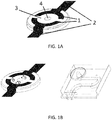
- the invention relates to a device for detecting the deposition of a biological liquid sample on a substrate for subsequent analysis, the device comprising two electrodes with respective free ends that are designed to be near or in contact with the surface of the substrate, the distance between the electrodes being such that the sample or at least a part of it may be located between them, as shown in FIGs. 1A-1E and 3 .
- Electrodes 1, and receiving substrate 3 are sized and positioned as to have the fluid significantly modifying the impedance of the space between the electrodes 1, occupied either by air or by the receiving substrate, during or after the fluid has been transferred to the receiving substrate.
- Indicative preferred dimensions of the elements are given, but not limited to:
- a home-based self-use blood collection device that has simplified logistics and cost effectiveness. Then, the device and method allows to relieve the burden of correct labeling, e.g. date, time, study number, from the patient, the device and method provides for a new tool to standardize and authenticate the collected samples, preventing wrong results caused by human. Also, the invention relates to a method of operating the device, and a system including at least one device as described above. In particular, according to another aspect of the present invention, the device and the method preferably focus on the direct detection of the act of transferring a pre-processed sample on a receiving substrate. The advantage of transferring the sample on a substrate being its long-term storage ability as a dried bio-fluid spot.
- the device furthermore includes a data logger unit that is adapted to at least record the time when the sample 5 has been positioned between the electrodes 1.
- a change in impedance between the electrodes 1, beyond a predefined threshold can be detected by the data logger unit, for example but not limited to a microprocessor having memory, communication interface, and a Real-Time Clock (RTC) associated thereto, and the data logger unit can be configured to trigger an interrupt.
- the data logger unit can be configured to measure the value of the impedance at electrodes 1 along with timestamp of from the embedded RTC and record them in non-volatile memory of the data logger unit.
- RTC Real-Time Clock
- the substrate is preferably an absorbing material but any other suitable material can be used. With an absorbing material, a dried spot may be generated, which facilitates the subsequent analysis. Also, any biological fluid can be used, for example but not limited to blood, plasma, serum, urine, tear, sputum, if a conductive path can be established between the electrodes.
- the conductance-based detection of the act of transferring the fluid sample on the substrate can be used to trigger various actions such as the recording of a time stamp in the data logger to capture the time the sample has been spotted, to trigger the beginning of recording of storage parameters, for example but not limited to temperature, relative humidity, or to give a signal to inform the user that the transfer has successfully occurred or for the integration in an automated quality control system in a production line.
- a time stamp in the data logger to capture the time the sample has been spotted
- storage parameters for example but not limited to temperature, relative humidity
- By using different set of resistors connecting the sensing electrodes and the conductance meter of a data logger it is possible to spatially discriminate where the transfer occurred.
- this setup allows to generate a time stamp when considered fluid is transferred on desired substrate with related electrical resistance/conductance/impedance identifying the set of channels that have contributed to the transfer.
- a method for detecting and recording the deposition of a biological liquid sample on a substrate for subsequent analysis comprising the use of the device as described herein in the various embodiments.
- the method includes the following steps:
- the method furthermore comprises a step of recording of at least the time when the sample 5 has been positioned between the electrodes 1.
- the method allows a precise detection of the time a sample is transferred on a desired substrate.
- the sensor can be highly integrated and miniaturized, and can be integrated either on the receiving substrate or on the dispensing element of a SPPOC, POC, In Vitro Diagnostics (IVD), or lab-on-chip device.
- the sensor provides a reliable readout that transfer from collection or sample pre-processing region of a device onto a receiving substrate has occurred, without the need for calibration or fine tuning of the sensing elements.
- the device may be advantageously used for the detection of transfer of fluid samples containing biological material, for example but not limited to cells, proteins, molecules, etc. from metering fluidic channel onto a filter paper and consequent generation of dry spots.
- biological material for example but not limited to cells, proteins, molecules, etc.
- the device and method may be used for the detection of transfer of biological fluid samples, for example but not limited to blood, plasma, serum, urine, saliva, sputum, tear, semen, interstitial fluid, from metering fluidic channel onto a filter paper and consequent generation of dry spots.
- biological fluid samples for example but not limited to blood, plasma, serum, urine, saliva, sputum, tear, semen, interstitial fluid
- Another preferred application of the device is the detection of transfer of blood, plasma and serum samples from metering microfluidic channels onto a filter paper and consequent generation of dry blood spots.
- Receiving substrate is typically a flat and open surface, but can also be contained within a channel, reservoir, or holding element.
- Substrate material can be cellulose, non-cellulose, absorbent, or non-absorbent material.
- the device can be designed to use the most conventional dried spot sampling substrates including #903TM brand paper (Whatman, Inc., New Jersey USA), bond elut dried matrix spotting (Agilent, Germany) or treated filter papers, such as FTA and FTA Elute brand paper or DMPK A, B or C card (Whatman, Inc., New Jersey USA).
- #903TM brand paper Whatman, Inc., New Jersey USA
- bond elut dried matrix spotting Algilent, Germany
- treated filter papers such as FTA and FTA Elute brand paper or DMPK A, B or C card (Whatman, Inc., New Jersey USA).
- the device includes a sensor having a sensing element including at least one of the following features:
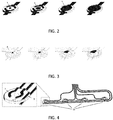
- FIGs. 2-3 shows different stages of the pair of electrodes 1 as a sequence representing the transfer and spread of biological liquid sample 5 inside the substrate 6.
- biological liquid sample 5 has been deposited or otherwise put into contact with the substrate 6, for example by a dispensing device, such as a pipetting device, shown on the left of FIGs. 2-3 .
- the biological liquid sample 5 begins to spread by capillary force provided by substrate 6, to increasingly cover an area between the two electrodes 1.
- substrate 6 is not porous, and biological liquid sample 5 spreads on a surface of substrate 6 due to the hydrophilic properties of the surface.
- the distance D is defined as a distance biological liquid sample 5 has to travel inside or on the substrate 6 to grant electrical conductivity between the electrodes 1 and such that a detection of the biological liquid sample 5 can be made, for example by measuring a resistance between electrodes 1.
- a capacity between the electrodes 1 can be measured to detect presence of biological liquid sample 5.
- distance D is chosen to be as small as possible but for preserving a gap between the electrodes 1 and the outlet 2. As shown in FIGs.
- the operation of the three (3) electrodes for detecting presence of the biological liquid sample 5 is such that there is one common electrode and two sensing electrodes (one per measurement circuit) therefore one electrode can act as a reference and the other is connected via the resistor to allow for backtrack identification.
- a separation area defined by distance D around the outlet that is not covered by a conductive material in physical or electrical contact of the sample to be transferred ensures an event is detected only when transfer of the sample to the substrate 3 has occurred.
- electrodes 1 do not necessarily have to be separated by the outlet 4 in between, and the electrodes 1 could be placed on one side of outlet 4, providing equivalent working principle.
- the dispensing element comprises several fluid channels placed in parallel, each of which have described sensor and different sets of resistors attached to the electrical circuit of the electrodes to discriminate the electrode or set of electrodes contributing to the signal detected by measuring the impedance of the circuit at selected frequency.
- the substrate alone has low electric conductivity and the fluid has a higher electric conductivity.
- the transfer of the conductive fluid induces a lowering in electric resistivity or impedance of the medium that is measured between the integrated electrodes.
- the substrate alone has low electric resistivity and the fluid has a lower electric conductivity.
- the transfer of the conductive fluid induces a lowering in electric conductivity or conductance of the medium that is measured between the integrated electrodes.
- the substrate is a porous medium with low electric conductivity and the fluid is a biological fluid with higher electric conductivity.
- the transfer of the conductive fluid induces a lowering in electric resistivity or impedance of the medium that is measured between the integrated electrodes.
- the measurement is performed through the electrodes only when triggered by a specific event such as but not limited to:
- the recording of a timestamp is triggered to register the date and time the sampling was performed.
- the recording of environmental parameters is triggered such as but not limited to:
- the electric based measurement is performed through the electrodes to discriminate the presence or absence of the sample on the receiving substrate.
- the electric based measurement can be based on at least one of the following list:
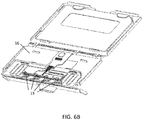
- FIGs. 6A and 6B shows a system where different sensing units are placed at the outlets of a sampling device 12 including four (4) microfluidic channels for sample collection and transfer on receiving substrate 6, held together by a casing 16.
- a sampling device 12 including four (4) microfluidic channels for sample collection and transfer on receiving substrate 6, held together by a casing 16.
- the sensing electrodes 1 that are a part of sensing units 13 are connected to the identification circuitry 11.
- Sensing units 13, identification circuitry 11, and antenna 15 are connected to a RFID data logging system on a chip 10 powered by a battery 14.
- Sampling device 12 includes microfluidic channels shown in FIGs.
- IB-IE, 6A-6B, and 7 each having an inlet to collect blood from a finger prick, a fluidic channel configured as a metering channel arranged between an inlet and an outlet to control the volume of the blood, and an outlet onto which a receiving substrate 3 such as a porous hydrophilic substrate can be applied to pull the metered sample out of the microfluidic channel by capillary forces.
- a device and a method for detecting the transfer of a fluid sample on a substrate is provided, e.g. on an absorbing material. It may be advantageously used for the detection of the transfer of a metered biological fluid, for example but not limited to blood, plasma, serum, urine, tear, sputum, on a paper based substrate to generate dried spot for further analysis.
- a metered biological fluid for example but not limited to blood, plasma, serum, urine, tear, sputum
- the device and the method focus on the direct detection of the act of transferring a pre-processed sample on a receiving substrate by using an electric based measurement method using a set of electrodes.
- the advantage of transferring the sample on a substrate being its long-term storage ability as a dried bio-fluid spot (DBS), in the context of sample preparation at point of collection (SPPOC).
- DBS dried bio-fluid spot
- SPPOC sample preparation at point of collection
- the device and method advantageously allow to trace back the date and time when sampling was made as well as the recording or datalogging of environmental parameters influencing the condition of storage of the sample and which may impair the integrity of the sample prior analysis.
Landscapes
- Health & Medical Sciences (AREA)
- Life Sciences & Earth Sciences (AREA)
- Engineering & Computer Science (AREA)
- Physics & Mathematics (AREA)
- Chemical & Material Sciences (AREA)
- General Health & Medical Sciences (AREA)
- Biomedical Technology (AREA)
- Hematology (AREA)
- Biophysics (AREA)
- Pathology (AREA)
- Analytical Chemistry (AREA)
- Molecular Biology (AREA)
- Medical Informatics (AREA)
- General Physics & Mathematics (AREA)
- Heart & Thoracic Surgery (AREA)
- Veterinary Medicine (AREA)
- Public Health (AREA)
- Animal Behavior & Ethology (AREA)
- Surgery (AREA)
- Immunology (AREA)
- Biochemistry (AREA)
- Chemical Kinetics & Catalysis (AREA)
- Clinical Laboratory Science (AREA)
- Dispersion Chemistry (AREA)
- Urology & Nephrology (AREA)
- Food Science & Technology (AREA)
- Medicinal Chemistry (AREA)
- Geophysics (AREA)
- Databases & Information Systems (AREA)
- Optics & Photonics (AREA)
- Human Computer Interaction (AREA)
- General Life Sciences & Earth Sciences (AREA)
- Remote Sensing (AREA)
- Geology (AREA)
- Environmental & Geological Engineering (AREA)
- Investigating Or Analyzing Materials By The Use Of Electric Means (AREA)
- Investigating Or Analysing Biological Materials (AREA)
- Ecology (AREA)
Applications Claiming Priority (1)
| Application Number | Priority Date | Filing Date | Title |
|---|---|---|---|
| IB2016057561 | 2016-12-13 |
Publications (1)
| Publication Number | Publication Date |
|---|---|
| EP3335794A1 true EP3335794A1 (fr) | 2018-06-20 |
Family
ID=60915194
Family Applications (1)
| Application Number | Title | Priority Date | Filing Date |
|---|---|---|---|
| EP17207144.1A Withdrawn EP3335794A1 (fr) | 2016-12-13 | 2017-12-13 | Dispositif et procédé pour détecter le dépôt d'un échantillon de liquide biologique sur un substrat |
Country Status (2)
| Country | Link |
|---|---|
| US (1) | US20180164281A1 (fr) |
| EP (1) | EP3335794A1 (fr) |
Cited By (1)
| Publication number | Priority date | Publication date | Assignee | Title |
|---|---|---|---|---|
| EP3951374A1 (fr) * | 2020-08-03 | 2022-02-09 | Consejo Superior de Investigaciones Científicas (CSIC) | Système de biocapteur pour la détection de biomarqueurs multiplexée |
Families Citing this family (2)
| Publication number | Priority date | Publication date | Assignee | Title |
|---|---|---|---|---|
| US10697917B2 (en) * | 2018-10-04 | 2020-06-30 | 3A Logics Co., Ltd. | IC and sensor for measuring salinity and method for measuring salinity using the sensor |
| US20240302249A1 (en) * | 2023-03-10 | 2024-09-12 | Lockcon Ag | Sample taking device, sample taking system and method of operating a sample taking device |
Citations (8)
| Publication number | Priority date | Publication date | Assignee | Title |
|---|---|---|---|---|
| EP1266612A2 (fr) * | 2001-06-15 | 2002-12-18 | Polartechnics Ltd | Dispositif de reconnaissance de types de tissu utilisant des techniques de mesure multiples |
| US20070062811A1 (en) * | 2005-09-21 | 2007-03-22 | Health & Life Co., Ltd | Bioelectrochemical sensor strip capable of taking trace samples |
| US20080057570A1 (en) * | 2006-08-29 | 2008-03-06 | International Business Machines Corporation | Micro-Fluidic Test Apparatus and Method |
| US20100200428A1 (en) * | 2007-07-26 | 2010-08-12 | I-Sens, Inc. | Microfluidic sensor complex structure |
| EP2602620A1 (fr) * | 2011-12-07 | 2013-06-12 | Nxp B.V. | Agencement et procédé de test de flux latéral électronique |
| WO2013144743A1 (fr) | 2012-03-31 | 2013-10-03 | Dbs System Sàrl | Dispositif et procédé pour l'analyse de gouttes de fluide séché |
| US20150260713A1 (en) * | 2014-03-12 | 2015-09-17 | Mc10, Inc. | Quantification of a change in assay |
| WO2015140740A1 (fr) | 2014-03-21 | 2015-09-24 | Dbs System Sàrl | Dispositif et méthode de séparation d'un fluide complexe comme le sang |
Family Cites Families (3)
| Publication number | Priority date | Publication date | Assignee | Title |
|---|---|---|---|---|
| WO2001018246A1 (fr) * | 1999-08-26 | 2001-03-15 | The Trustees Of Princeton University | Dispositifs electroniques microfluidiques et nanofluidiques permettant de detecter des modifications de la capacite de fluides et techniques d'utilisation |
| GB0030929D0 (en) * | 2000-12-19 | 2001-01-31 | Inverness Medical Ltd | Analyte measurement |
| EP2400039A3 (fr) * | 2005-04-30 | 2012-11-07 | Jae-Chern Yoo | Biodisque, appareil de bio-commande et procédé d'analyse l'utilisant |
-
2017
- 2017-12-13 EP EP17207144.1A patent/EP3335794A1/fr not_active Withdrawn
- 2017-12-13 US US15/839,902 patent/US20180164281A1/en not_active Abandoned
Patent Citations (9)
| Publication number | Priority date | Publication date | Assignee | Title |
|---|---|---|---|---|
| EP1266612A2 (fr) * | 2001-06-15 | 2002-12-18 | Polartechnics Ltd | Dispositif de reconnaissance de types de tissu utilisant des techniques de mesure multiples |
| US20070062811A1 (en) * | 2005-09-21 | 2007-03-22 | Health & Life Co., Ltd | Bioelectrochemical sensor strip capable of taking trace samples |
| US20080057570A1 (en) * | 2006-08-29 | 2008-03-06 | International Business Machines Corporation | Micro-Fluidic Test Apparatus and Method |
| US20100200428A1 (en) * | 2007-07-26 | 2010-08-12 | I-Sens, Inc. | Microfluidic sensor complex structure |
| EP2602620A1 (fr) * | 2011-12-07 | 2013-06-12 | Nxp B.V. | Agencement et procédé de test de flux latéral électronique |
| WO2013144743A1 (fr) | 2012-03-31 | 2013-10-03 | Dbs System Sàrl | Dispositif et procédé pour l'analyse de gouttes de fluide séché |
| US9795960B2 (en) | 2012-03-31 | 2017-10-24 | Dbs System Sa | Device and method for dried fluid spot analysis |
| US20150260713A1 (en) * | 2014-03-12 | 2015-09-17 | Mc10, Inc. | Quantification of a change in assay |
| WO2015140740A1 (fr) | 2014-03-21 | 2015-09-24 | Dbs System Sàrl | Dispositif et méthode de séparation d'un fluide complexe comme le sang |
Non-Patent Citations (3)
| Title |
|---|
| CARLOS HONRADO ET AL: "A Capacitive Touch Screen Sensor for Detection of Urinary Tract Infections in Portable Biomedical Devices", SENSORS, vol. 14, no. 8, 30 July 2014 (2014-07-30), pages 13851 - 13862, XP055423665, DOI: 10.3390/s140813851 * |
| GIUSEPPE LIPPI ET AL.: "Pre-analytical variability and quality of diagnostic testing. Looking at the moon and gazing beyond the finger", NEW ZEALAND JOURNAL OF MEDICAL LABORATORY SCIENCE, vol. 69, no. 1, April 2015 (2015-04-01), pages 4 - 8 |
| JAWOREK A ET AL: "Phase-shift detection for capacitance sensor measuring void fraction in two-phase flow", SENSORS AND ACTUATORS A: PHYSICAL, ELSEVIER BV, NL, vol. 160, no. 1-2, 28 April 2010 (2010-04-28), pages 78 - 86, XP027070296, ISSN: 0924-4247, [retrieved on 20100428], DOI: 10.1016/J.SNA.2010.04.003 * |
Cited By (2)
| Publication number | Priority date | Publication date | Assignee | Title |
|---|---|---|---|---|
| EP3951374A1 (fr) * | 2020-08-03 | 2022-02-09 | Consejo Superior de Investigaciones Científicas (CSIC) | Système de biocapteur pour la détection de biomarqueurs multiplexée |
| WO2022029013A1 (fr) * | 2020-08-03 | 2022-02-10 | Consejo Superior De Investigaciones Científicas (Csic) | Système de biocapteur pour une détection multiplexée de biomarqueurs |
Also Published As
| Publication number | Publication date |
|---|---|
| US20180164281A1 (en) | 2018-06-14 |
Similar Documents
| Publication | Publication Date | Title |
|---|---|---|
| US20250085252A1 (en) | Integrated ion sensing apparatus and methods | |
| US20040023364A1 (en) | Lateral flow test strip | |
| US20120028845A1 (en) | Sensor for Detecting Biological Agents in Fluid | |
| US20100200400A1 (en) | Embedded bodily fluid analysis device | |
| US10670579B2 (en) | Device and method for separating a fluid mixture such as blood | |
| KR20060044681A (ko) | 위치 전극을 구비한 미세유체 분석 시스템 | |
| WO2016100749A1 (fr) | Séquençage à base de nanopore avec stimulus de tension variable | |
| WO2013003705A1 (fr) | Procédés et dispositifs pour déterminer les capacités d'utilisation d'un dispositif de détection | |
| US10067083B2 (en) | Electrochemical sensor array and apparatus | |
| EP3335794A1 (fr) | Dispositif et procédé pour détecter le dépôt d'un échantillon de liquide biologique sur un substrat | |
| CN113899801B (zh) | 用于以电化学方式检测至少一个分析物的测试元件 | |
| EP3523626A1 (fr) | Système et procédé d'analyse pour tester un échantillon | |
| US9347909B2 (en) | Sample-retainable biosensor test strip | |
| US11237126B2 (en) | Fluid sensor, system for testing a sample and process | |
| US9039875B2 (en) | Liquid sample measuring device | |
| CN112384796B (zh) | 包含电导率传感器的流体通道中血细胞比容的测量方法 | |
| Chaurasia et al. | Dried saliva spot as an effective tool in the diagnosis and management of chronic disease. | |
| KR102145676B1 (ko) | 테스트 엘리먼트 분석 시스템 | |
| US20240210388A1 (en) | Sensing device and a method for detection of a characteristic of a substance at multiple time points | |
| US20170102378A1 (en) | Industrial design of stand-alone assay system | |
| WO2023076749A1 (fr) | Dosage/analyse à haut rendement de composés organiques volatils | |
| HK40048057A (en) | Methods of measuring hematocrit in fluidic channels including conductivity sensor | |
| HK1231432B (zh) | 用於诸如全血的流体试样的快速分子定量的胶囊 |
Legal Events
| Date | Code | Title | Description |
|---|---|---|---|
| PUAI | Public reference made under article 153(3) epc to a published international application that has entered the european phase |
Free format text: ORIGINAL CODE: 0009012 |
|
| STAA | Information on the status of an ep patent application or granted ep patent |
Free format text: STATUS: THE APPLICATION HAS BEEN PUBLISHED |
|
| AK | Designated contracting states |
Kind code of ref document: A1 Designated state(s): AL AT BE BG CH CY CZ DE DK EE ES FI FR GB GR HR HU IE IS IT LI LT LU LV MC MK MT NL NO PL PT RO RS SE SI SK SM TR |
|
| AX | Request for extension of the european patent |
Extension state: BA ME |
|
| STAA | Information on the status of an ep patent application or granted ep patent |
Free format text: STATUS: THE APPLICATION IS DEEMED TO BE WITHDRAWN |
|
| 18D | Application deemed to be withdrawn |
Effective date: 20181221 |