EP3336065A1 - Verfahren und system zur automatischen steuerung eines nitrifikations-denitrifikationsverfahren unter verwendung des redoxpotentials - Google Patents
Verfahren und system zur automatischen steuerung eines nitrifikations-denitrifikationsverfahren unter verwendung des redoxpotentials Download PDFInfo
- Publication number
- EP3336065A1 EP3336065A1 EP16382613.4A EP16382613A EP3336065A1 EP 3336065 A1 EP3336065 A1 EP 3336065A1 EP 16382613 A EP16382613 A EP 16382613A EP 3336065 A1 EP3336065 A1 EP 3336065A1
- Authority
- EP
- European Patent Office
- Prior art keywords
- value
- aeration means
- stage
- water
- orp
- Prior art date
- Legal status (The legal status is an assumption and is not a legal conclusion. Google has not performed a legal analysis and makes no representation as to the accuracy of the status listed.)
- Granted
Links
Images


Classifications
-
- C—CHEMISTRY; METALLURGY
- C02—TREATMENT OF WATER, WASTE WATER, SEWAGE, OR SLUDGE
- C02F—TREATMENT OF WATER, WASTE WATER, SEWAGE, OR SLUDGE
- C02F3/00—Biological treatment of water, waste water, or sewage
- C02F3/006—Regulation methods for biological treatment
-
- C—CHEMISTRY; METALLURGY
- C02—TREATMENT OF WATER, WASTE WATER, SEWAGE, OR SLUDGE
- C02F—TREATMENT OF WATER, WASTE WATER, SEWAGE, OR SLUDGE
- C02F3/00—Biological treatment of water, waste water, or sewage
- C02F3/30—Aerobic and anaerobic processes
- C02F3/302—Nitrification and denitrification treatment
-
- C—CHEMISTRY; METALLURGY
- C02—TREATMENT OF WATER, WASTE WATER, SEWAGE, OR SLUDGE
- C02F—TREATMENT OF WATER, WASTE WATER, SEWAGE, OR SLUDGE
- C02F2209/00—Controlling or monitoring parameters in water treatment
- C02F2209/005—Processes using a programmable logic controller [PLC]
-
- C—CHEMISTRY; METALLURGY
- C02—TREATMENT OF WATER, WASTE WATER, SEWAGE, OR SLUDGE
- C02F—TREATMENT OF WATER, WASTE WATER, SEWAGE, OR SLUDGE
- C02F2209/00—Controlling or monitoring parameters in water treatment
- C02F2209/04—Oxidation reduction potential [ORP]
-
- C—CHEMISTRY; METALLURGY
- C02—TREATMENT OF WATER, WASTE WATER, SEWAGE, OR SLUDGE
- C02F—TREATMENT OF WATER, WASTE WATER, SEWAGE, OR SLUDGE
- C02F2209/00—Controlling or monitoring parameters in water treatment
- C02F2209/22—O2
-
- Y—GENERAL TAGGING OF NEW TECHNOLOGICAL DEVELOPMENTS; GENERAL TAGGING OF CROSS-SECTIONAL TECHNOLOGIES SPANNING OVER SEVERAL SECTIONS OF THE IPC; TECHNICAL SUBJECTS COVERED BY FORMER USPC CROSS-REFERENCE ART COLLECTIONS [XRACs] AND DIGESTS
- Y02—TECHNOLOGIES OR APPLICATIONS FOR MITIGATION OR ADAPTATION AGAINST CLIMATE CHANGE
- Y02W—CLIMATE CHANGE MITIGATION TECHNOLOGIES RELATED TO WASTEWATER TREATMENT OR WASTE MANAGEMENT
- Y02W10/00—Technologies for wastewater treatment
- Y02W10/10—Biological treatment of water, waste water, or sewage
Definitions
- the present invention relates to a process and a system for automatically controlling a water treatment process in a matrix of water, specially adapted to sequentially activate and deactivate control aerations means in order to promote at least organic matter removal and nitrification; and denitrification stages, respectively, in the water.
- Aeration, sludge retention time and external carbon source addition have been identified as effective control parameters for on-line optimization of biological nitrogen removal from activated sludge systems.
- controlling aeration periods, based on air supply regulation, is a key factor to enhance the biological nitrogen removal.
- This invention aims at enhancing the biological nitrogen removal using a simple, low-cost and easy to operate control based on air supply regulation.
- ORP Oxidation Reduction Potential measurement
- the injection of oxygen as air or pure oxygen promotes the oxidation of carbon to carbon dioxide, CO 2 , and ammonium ions, NH4+, to nitrate, NO3-, by specific bacteria.
- the ammonium ions are first transformed to nitrite, NO2-, by ammonia oxidising bacteria, AOB, then nitrite are converted into nitrate by nitrites oxidising bacteria, NOB. This phase promotes nitrification.
- the extension of the anoxic phase leads to anaerobic phase, allowing for phosphorous removal or dephosphatation.
- the patent document ES 2361209 describes how, when subjecting the mass of water to anoxic conditions, when a fixed low level of ORP is reached, aeration is switched on until a reference value in Dissolved Oxygen, DO, is reached.
- EP 0703194 the ORP is continuously measured and the first derivative thereof is calculated. When the derivative tends towards zero, the derivative and the value of the oxidation-reduction potential are correlated to determine whether aeration should be started, continued, or stopped.
- the process according to EP 0703194 therefore uses ORP absolute reference values, which should be revised upon flow and quality changes in the influent. Additionally, the ORP value could vary in time, sensors subjected to drift, and between facilities which difficulties the implementation of this strategy with guarantees.
- EP 3028998 describes a method comprising cyclically subjecting a mass of water to aeration and non-aeration phases but preferably to promote nitrification and denitrification over nitrite, which allows suppressing N2O production that constitutes a major contribution to greenhouse gas production.
- This method implies suppressing the second step of nitrification, the conversion of nitrites into nitrates, and ammonia is thus converted into nitrite, but not into nitrate.
- the method is intended to be applied in a sequential batch reactor (SBR) and therefore would not be suitable for conventional continuous stirred tank reactors or continuous plug flow reactors and is required partial nitrified effluent with a ratio ammonium to nitrate 50:50. Indeed, the ammonium ions content of the effluent to be treated is determined and the supplying of effluent is stopped when said ammonium ions content is greater than a threshold value.
- SBR sequential batch reactor
- the method according to EP 3028998 comprises monitoring the DO and the ORP values within the reactor and calculating the DO first derivative dDO/dt and the ORP second derivative d2ORP/dt2 to respectively deactivate and activate the aeration means when they reach associated first and second reference threshold values.
- the use of derivatives signals allows the system to be relatively insensitive to possible drift of DO and ORP absolute values due to calibration default.
- An objective of the invention is to perform nitrification-denitrification over nitrite, not nitrate, limiting nitrite oxidizing bacteria growth (NOB) due to the simultaneous effects of ammonium inhibition, substrate privation and temperature.
- the first threshold value is determined by carrying out preliminary tests, or by calculating the optimal first threshold in order to have optimal nitrification performances and minimal N2O emissions based in particular on the features of the reactor and of the effluent to be treated. So, different first threshold values have to be used for different effluents.
- the second threshold value is also determined by carrying out preliminary tests, or by calculating the optimal second threshold in order to have optimal denitrification performances and minimal N2O emissions based in particular on the features of the reactor and of the effluent to be treated. Again, different second threshold values have to be used for different effluents.
- the process of the invention is intended for automatically controlling a water treatment process, specifically when the water comprises carbon and nitrogen, for example in the form of ammonium.
- the water treatment process comprises subjecting the water to successive working cycles each comprising at least a nitrification or oxic stage (carbon and ammonium oxidation) and a denitrification or anoxic stage (nitrate reduction).
- the aeration means are activated to end the denitrification stage of the working cycle and to begin a further nitrification stage of a following working cycle only once the d2ORP/dt2 of the ORP reaches at least a third zero value during the said denitrification stage.
- This process allows carrying out anoxic control by identifying a Nitrate Knee Point (NKP) indicative of that a total conversion of nitrate to nitrogen gas (N2) is achieved.
- N2 nitrogen gas
- IPs Redox Inflection Points
- ORP redox potential
- the invention takes advantage of an observed behavior of the ORP during a complete nitrification-denitrification cycle in full-scale WWTPs, not in pilot-scale plants, fed with domestic wastewater. This behavior revealed a typical profile with three IPs during the denitrification stage, the third one linked to the disappearance of nitrates.
- the invention is thus completely free from having to specify absolute values and also from ORP drift as only the shape of the curves is important.
- the aeration means are activated to end the denitrification stage of a working cycle and to begin a nitrification stage of a following working cycle only once the d2ORP/dt2 of the ORP reaches at least a third zero value during the said denitrification stage.
- the invention envisages that the aeration means are activated at the instant when the d2ORP/dt2 of the ORP reaches at least the said third zero value or at an instant afterwards.
- the process comprises the determination of the residual carbon and ammonium in the water immediately after the aeration means are deactivated preferably by dynamically measuring the Dissolved Oxygen (DO) in the water.
- the first derivative value dDO/dt of the Disolved Oxygen (DO) is calculated during the denitrification stage immediately after the aeration means are deactivated; and once the d2ORP/dt2 reaches at least the third zero value the aeration means are not activated to begin the nitrification stage of the next working cycle before a period T has elapsed, this period T being function of the value of the first derivative value of the DO calculated at the beginning of the denitrification step of the same working cycle.
- the estimation of the oxygen consumption velocity at the beginning of a denitrification stage is used to decide whether it is advantageous to prolong the anoxic conditions beyond the instant the NKP is detected.
- a previous set dDO/dt value can be used as a reference value to decide whether an extra period T is to be applied or not.
- the measure of the redox potential is used to define both oxic and anoxic times, this is to say the duration of the nitrification and the denitrification stages.
- This embodiment overcomes some drawbacks associated to the proposals that use the DO value, which can lead to an excess of aeration and therefore to an unnecessary consumption of energy; and gives an opportunity to control the process in partial nitrification modes.
- a system for automatically controlling a treatment process in a matrix of water comprises a first probe for dynamically measuring the redox potential, ORP, in the water; a programmable control unit in communication with the probe, wherein the control unit receives data from the first probe representing the measurement of the redox potential; and aerator means in communication with the control unit.
- this system is characterized in that the control unit has processor means able to filter the data received from the first probe; to calculate the second derivate value of the filtered data; to perform a Boolean comparison of the said second derivative value with a predetermined reference value; and to counter the times this second derivative value equals the predetermined reference value; and in that being the aeration means deactivated, the control unit is configured to not activate again the aeration means before the second derivative value equals at least three times the predetermined reference value.
- the processor means are able to calculate the first derivative value dORP/dt of the filtered data associated to the first probe; and to perform a Boolean comparison of the said first derivative value with a predetermined second reference value; and, being the aeration means activated, the control unit is configured to deactivate the aeration means when the first derivative value associated to the first probe equals or tends to zero.
- the invention also conceives that the system can be provided with a second probe for dynamically measuring the Dissolved Oxygen (DO) in the water; and that the processor means can filter the data received from this second probe and to calculate the first derivate value of the filtered data associated to this second probe. Additionally, being the aeration means deactivated, the control unit is configured to not activate again the aeration means until an extra period T has elapsed once the second derivative value equals at least three times the predetermined reference value, wherein this extra period T is a function of the first derivative value of the filtered data associated to the second probe.
- the control unit is configured to not activate again the aeration means until an extra period T has elapsed once the second derivative value equals at least three times the predetermined reference value, wherein this extra period T is a function of the first derivative value of the filtered data associated to the second probe.
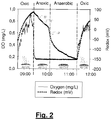
- Fig. 2 shows the ORP variation during an entire working cycle comprising oxic, anoxic and anaerobic stages.
- the graph of Fig. 2 has been obtained from practicing the process of the invention in a commercial plant whose details will be presented later.
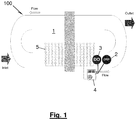
- the said reactor tank was provided with a DO sensor and a ORP sensor. Both sensors were disposed in the oxic basin but they could be alternatively arranged after the diffusers. The further the sensors are from the diffusers/aerated region the higher the delay in their response will be, which is not recommendable.
- Fig. 1 serves as an example only.
- the invention envisages to perform the process also in other type of reactors, such as in a Continuous Stirred Tank Reactor (CSTR).
- CSTR Continuous Stirred Tank Reactor
- the preferred location for the sensors would be also the oxic chamber, avoiding setting them up just over diffusers in order to minimize sensor noise.
- the reactor tank was also provided with aeration means and with a programmable control unit in communication with both the DO and ORP sensors and with the aeration means.
- the controlled parameters, DO and ORP were online monitored and collected every 10s. Additionally, both parameters were subjected to data filtering applying a first order filter with the aim of: in the case of DO, to partially remove noise and maintain low delay; and in the case of ORP, to completely remove noise.
- this filter based on Fourier transform, mathematically processes the signal until a stable and smooth signal is obtained in both time and amplitude of the measurement.
- the use of the ORP sensor allowed controlling oxidation-reduction cycles by changing the reactor tank conditions from oxic to anoxic.
- the aeration means are activated allowing carbon removal and nitrification processes and during the anoxic stage the same aeration means are deactivated leading to a denitrification process.
- the end of the oxic stage was controlled by indirect measurement of the oxidation rate (carbon and ammonium oxidation) by means of dORP/dt, and particularly by detecting when dORP/dt tended to zero.
- a dORP/dt set point value was defined in 1,5mV/min, this value indicating a residual presence of reduced forms (carbon and ammonium) and its practical total conversion to oxidised compounds. At this point, aeration means were deactivated leading to anoxic conditions.
- the set point value for dORP/dt can be "zero" (0), as an indicator that oxidation is fully achieved.
- this was not required.
- the invention envisages selecting a set point value between 0 and 2mV/min.
- Oxygen control during the oxic stage is of interest because an optimum control allows maintaining a stable DO concentration in the oxic chamber. Further, it is also required for indirect determination of the ratio of reduced forms (carbon and ammonium) vs. oxidized forms (nitrate). For this reason, a control based on Fuzzy Logic, known in the art, was used precisely to maintain the desired levels of DO.
- this control used the DO data collected by the DO sensor and it was based on a conventional feedback mechanism.
- Aeration means can easily be actuated, modifying their working frequency or turning on/off individually their blowers, if this is the case for example in 1+1 or 2+1 configurations.
- dOD/dt was measured (this is to say the "oxygen consumption") allowing indirect determination of the residual carbon and ammonium. In the case presented in Figure 2 , measured dOD/dt was 0,105mg/minL.
- this absolute value can be set around 0,15 mg/l.
- the denitrification (anoxic stage) was well determined by using a profile showing three inflection points (IPs). These IPs were identified by using ORP second derivative d2ORP/dt2. Specifically, the third IP corresponds to the end of denitrification, being total the consumption of N-NO3. This third IP point is the NKP point.
- the third IP (and therefore the NKP) was detected at ORP -26mV. Precisely because this specific value could change due to sensor drift, kinetics or as a function of the initial N-NO3 values, the identification of the third IP (by way of calculating the d2ORP/dt2) is used to identify the total consumption of N-NO3.
- the aeration means were activated again to begin the oxic (nitrification) stage of the following working cycle once the NKP was detected and after an extra period T of "extra-time off” had elapsed, the length of which depends on the previous measured dOD/dt or DO consumption.
- operators defined a maximum dOD/dt "set-point" of 0,14mg/L ⁇ min to apply this "extra time off” so if the measured dOD/dt was below 0,14mg/L ⁇ min a period T of "extra time off” was to be applied, leading to anaerobic conditions and removal of phosphorus from wastewater. Once this "extra time off” was exhausted aeration had to be turned on.
- set-point could be selected, but preferably in the range from 0,1 Omg/L ⁇ min to 0,30mg/L ⁇ min.
- a period T of 60 minutes was applied after denitrification or after the NKP, allowing biological phosphorous removal.
- the invention contemplates using other approaches, such as for example those based on linear, or in non-linear, regressions as an alternative to using previously tabulated dOD/dt values and their corresponding or associated "extra time off" periods T, based on empiric data or gained experience.
- the removal of phosphorus from wastewater involves the incorporation of phosphate into TSS and the subsequent removal of those solids.
- the "extra time off” allowed for anaerobic conditions (wherein nitrate and oxygen are absent) prior to the aeration (turn on aeration). Under these conditions a group of heterotrophic bacteria, called polyphosphate-accumulating organisms (PAO) are selectively enriched in the bacterial community within the activated sludge.
- PAO polyphosphate-accumulating organisms
- the duration of the oxic, anoxic and anaerobic cycles are identified in the Fig. 2 , these being delimited by the 41, 47 and 60 minutes, respectively, allowing application of "extra time OFF" not only for phosphorous removal but also for contributing to energy savings.
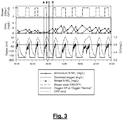
- FIG. 3 A 24-hour evaluation, from which the detailed cycle shown in the Fig. 2 was extracted, is presented in the Fig. 3 .
- the said Fig. 3 shows that the oxidation (carbon and ammonium removal) and denitrification is systematically achieved during a complete day without accumulation by using first (dORP/dt) and second ORP (d2ORP/dt2) derivative to deactivate and activate, respectively, the aeration means.
- This WWTP is based on a basic primary (grid chamber and sand and fat removal) followed by a secondary treatment designed to remove suspended solids, carbon and nutrients (nitrogen and phosphorous).
- the secondary treatment is based on a two-carrousel system in parallel with a unitary volume of 1.755 m3 (only one in operation).
- a carrousel basin is shaped like a racetrack and has a central, longitudinal partition wall. While the wastewater is circulating around the channel, microorganisms break down the organic compounds, nitrogen and phosphorus contained in the wastewater. In practical terms, it could be considered a CPFR.
- Aeration is supplied to both lines by a common air collector/pipe using two (2) rotatory piston blowers with a nominal power of 22kW.
- Each reactor is equipped with two (2) submerged flow-boosters propellers ("mixers") to maintain the required minimum flow velocity in the channels with a nominal power of 4 kW.
- DO and ORP were measured using Luminescent Dissolved Oxygen (LDO) sensor, LXV416.99.20001, and differential ORP sensor, DRD1R5.99 (Platinum ORP Electrode, Ryton Housing) respectively, both being low maintenance sensors and connected to a SC200 controller, supplied by HACH.
- LDO Luminescent Dissolved Oxygen
- LXV416.99.20001 LXV416.99.20001
- DRD1R5.99 Platinum ORP Electrode, Ryton Housing
- Fig. 4 presents a long-term evaluation, nine (9) days, of the same process already described in reference to the Figs. 2 and 3 , showing its robustness and stability. To make it simple, this time only: oxygen (-), ORP (•) and blower state, on/off (-) are presented.
- the shorter length during first half of the day (A) than during second half (B) is attributed to lower load in A, which supports feasibility of using first ORP derivative to control the oxidation stage.
- Fig. 4 shows the good response of using second ORP derivative (d2ORP/dt2) for detection of NKP.
- the mentioned previous control strategies consist on ON/OFF timer or. Specifically, constant time ON and OFF are defined based on experience leading to oxic and anoxic conditions without considering online data.
- ON/OFF control strategy and the invention allow carrying out a safety operation, and despite punctual COD peaks could be observed, in all cases complete reduction of COD was achieved, maintaining effluent below legal limits. Nevertheless, the conventional ON/OFF control strategy requires operating with high oxygen concentrations or with large aeration periods to ensure that the effluent quality is within the legal limits.
- Table 2 summarizes average values for Corvera WWTP, regarding the parameters presented below. Similar removal yields were obtained in all the cases; nevertheless, the process of the invention allowed improving the denitrification.
Landscapes
- Life Sciences & Earth Sciences (AREA)
- Biodiversity & Conservation Biology (AREA)
- Microbiology (AREA)
- Hydrology & Water Resources (AREA)
- Engineering & Computer Science (AREA)
- Environmental & Geological Engineering (AREA)
- Water Supply & Treatment (AREA)
- Chemical & Material Sciences (AREA)
- Organic Chemistry (AREA)
- Health & Medical Sciences (AREA)
- Molecular Biology (AREA)
- Purification Treatments By Anaerobic Or Anaerobic And Aerobic Bacteria Or Animals (AREA)
Priority Applications (3)
| Application Number | Priority Date | Filing Date | Title |
|---|---|---|---|
| EP16382613.4A EP3336065B1 (de) | 2016-12-16 | 2016-12-16 | Verfahren und system zur automatischen steuerung eines nitrifikations-denitrifikationsverfahren unter verwendung des redoxpotentials |
| ES16382613T ES2811334T3 (es) | 2016-12-16 | 2016-12-16 | Un proceso y un sistema para controlar automáticamente un proceso de nitrificación-desnitrificación utilizando el potencial redox |
| PT163826134T PT3336065T (pt) | 2016-12-16 | 2016-12-16 | Processo e sistema para o controlo automático de uma processo de nitrificação ¿ desnitrificação usando o potencial redox |
Applications Claiming Priority (1)
| Application Number | Priority Date | Filing Date | Title |
|---|---|---|---|
| EP16382613.4A EP3336065B1 (de) | 2016-12-16 | 2016-12-16 | Verfahren und system zur automatischen steuerung eines nitrifikations-denitrifikationsverfahren unter verwendung des redoxpotentials |
Publications (2)
| Publication Number | Publication Date |
|---|---|
| EP3336065A1 true EP3336065A1 (de) | 2018-06-20 |
| EP3336065B1 EP3336065B1 (de) | 2020-05-27 |
Family
ID=57570754
Family Applications (1)
| Application Number | Title | Priority Date | Filing Date |
|---|---|---|---|
| EP16382613.4A Active EP3336065B1 (de) | 2016-12-16 | 2016-12-16 | Verfahren und system zur automatischen steuerung eines nitrifikations-denitrifikationsverfahren unter verwendung des redoxpotentials |
Country Status (3)
| Country | Link |
|---|---|
| EP (1) | EP3336065B1 (de) |
| ES (1) | ES2811334T3 (de) |
| PT (1) | PT3336065T (de) |
Cited By (3)
| Publication number | Priority date | Publication date | Assignee | Title |
|---|---|---|---|---|
| CN110498502A (zh) * | 2019-08-21 | 2019-11-26 | 苏州首创嘉净环保科技股份有限公司 | 一种分段式好氧池自动控制间歇曝气装置 |
| CN117023802A (zh) * | 2023-09-15 | 2023-11-10 | 北控水务(中国)投资有限公司 | 基于过程orp的曝气控制方法、装置及电子设备 |
| EP3645469B1 (de) | 2017-06-30 | 2023-12-20 | Veolia Water Solutions & Technologies Support | Abwasseraufbereitungsanlage und verfahren zur ihren steuerung |
Citations (7)
| Publication number | Priority date | Publication date | Assignee | Title |
|---|---|---|---|---|
| EP0396057A1 (de) * | 1989-04-29 | 1990-11-07 | Gero Fröse | Steuerungsanordnung und Verfahren zur Steuerung der mikrobiellen Behandlung von Abwässern |
| EP0703194A1 (de) | 1994-09-20 | 1996-03-27 | Lyonnaise Des Eaux | Verfahren zur Steuerung der Belüftung eines Beckens für biologische Abwasseraufbereitung |
| US5582734A (en) * | 1993-09-14 | 1996-12-10 | H. David Stensel | Oxidation ditch modification and automated control system for nitrogen removal and sludge settling improvements |
| JP2002001388A (ja) * | 2000-06-15 | 2002-01-08 | National Institute For Rural Engineering | 汚水処理装置およびその方法 |
| ES2361209A1 (es) | 2009-12-03 | 2011-06-15 | Universidad De Extremadura | Procedimiento para controlar la aportación de oxígeno en sistemas biológicos. |
| US8323498B2 (en) * | 2010-10-04 | 2012-12-04 | Enviromix, Llc | Systems and methods for automated control of mixing and aeration in treatment processes |
| EP3028998A1 (de) | 2014-12-03 | 2016-06-08 | Institut National des Sciences Appliquées de Toulouse | Verfahren zur Behandlung von Abwasser durch Nitrifikation/Denitrifikation |
-
2016
- 2016-12-16 EP EP16382613.4A patent/EP3336065B1/de active Active
- 2016-12-16 PT PT163826134T patent/PT3336065T/pt unknown
- 2016-12-16 ES ES16382613T patent/ES2811334T3/es active Active
Patent Citations (7)
| Publication number | Priority date | Publication date | Assignee | Title |
|---|---|---|---|---|
| EP0396057A1 (de) * | 1989-04-29 | 1990-11-07 | Gero Fröse | Steuerungsanordnung und Verfahren zur Steuerung der mikrobiellen Behandlung von Abwässern |
| US5582734A (en) * | 1993-09-14 | 1996-12-10 | H. David Stensel | Oxidation ditch modification and automated control system for nitrogen removal and sludge settling improvements |
| EP0703194A1 (de) | 1994-09-20 | 1996-03-27 | Lyonnaise Des Eaux | Verfahren zur Steuerung der Belüftung eines Beckens für biologische Abwasseraufbereitung |
| JP2002001388A (ja) * | 2000-06-15 | 2002-01-08 | National Institute For Rural Engineering | 汚水処理装置およびその方法 |
| ES2361209A1 (es) | 2009-12-03 | 2011-06-15 | Universidad De Extremadura | Procedimiento para controlar la aportación de oxígeno en sistemas biológicos. |
| US8323498B2 (en) * | 2010-10-04 | 2012-12-04 | Enviromix, Llc | Systems and methods for automated control of mixing and aeration in treatment processes |
| EP3028998A1 (de) | 2014-12-03 | 2016-06-08 | Institut National des Sciences Appliquées de Toulouse | Verfahren zur Behandlung von Abwasser durch Nitrifikation/Denitrifikation |
Non-Patent Citations (3)
| Title |
|---|
| FATONE F ET AL: "Removal of nutrients and micropollutants treating low loaded wastewaters in a membrane bioreactor operating the automatic alternate-cycles process", DESALINATION, ELSEVIER, AMSTERDAM, NL, vol. 183, no. 1-3, 1 November 2005 (2005-11-01), pages 395 - 405, XP027691837, ISSN: 0011-9164, [retrieved on 20051101] * |
| KIM H ET AL: "PH AND OXIDATION-REDUCTION POTENTIAL CONTROL STRATEGY FOR OPTIMIZATION OF NITROGEN REMOVAL IN AN ALTERNATING AEROBIC-ANOXIC SYSTEM", RESEARCH JOURNAL OF THE WATER POLLUTION CONTROL FEDERATION, WATER POLLUTION CONTROL FEDERATION, ALEXANDRIA, VA, US, vol. 73, no. 1, 1 January 2001 (2001-01-01), pages 95 - 102, XP001043713, ISSN: 1047-7624 * |
| MARTN DE LA VEGA P T ET AL: "New contributions to the ORP & DO time profile characterization to improve biological nutrient removal", BIORESOURCE TECHNOLOGY, ELSEVIER BV, GB, vol. 114, 13 March 2012 (2012-03-13), pages 160 - 167, XP028422563, ISSN: 0960-8524, [retrieved on 20120321], DOI: 10.1016/J.BIORTECH.2012.03.039 * |
Cited By (4)
| Publication number | Priority date | Publication date | Assignee | Title |
|---|---|---|---|---|
| EP3645469B1 (de) | 2017-06-30 | 2023-12-20 | Veolia Water Solutions & Technologies Support | Abwasseraufbereitungsanlage und verfahren zur ihren steuerung |
| US12534391B2 (en) | 2017-06-30 | 2026-01-27 | Veolia Water Solutions & Technologies Support | Method of controlling a wastewater treatment plant |
| CN110498502A (zh) * | 2019-08-21 | 2019-11-26 | 苏州首创嘉净环保科技股份有限公司 | 一种分段式好氧池自动控制间歇曝气装置 |
| CN117023802A (zh) * | 2023-09-15 | 2023-11-10 | 北控水务(中国)投资有限公司 | 基于过程orp的曝气控制方法、装置及电子设备 |
Also Published As
| Publication number | Publication date |
|---|---|
| PT3336065T (pt) | 2020-07-13 |
| EP3336065B1 (de) | 2020-05-27 |
| ES2811334T3 (es) | 2021-03-11 |
Similar Documents
| Publication | Publication Date | Title |
|---|---|---|
| Gao et al. | Shortcut nitrification–denitrification by real-time control strategies | |
| Kim et al. | pH and oxidation–reduction potential control strategy for optimization of nitrogen removal in an alternating aerobic–anoxic system | |
| US8298422B2 (en) | Method and plant for the treatment of effluents containing nitrogen in a sequencing batch reactor | |
| US8916046B2 (en) | Method for controlling oxygen supply for treating wastewater, and facility for implementing same | |
| US9475715B2 (en) | Optimized process and aeration performance with an advanced control algorithm | |
| AU2011347092B2 (en) | Method and facility for treating water by nitritation/denitritation comprising at least one aerated step and one step for controlling the oxygen input during the aerated step | |
| Zipper et al. | Development of a new system for control and optimization of small wastewater treatment plants using oxidation-reduction potential (ORP) | |
| EP3028998B1 (de) | Verfahren zur Behandlung von Abwasser durch Nitrifikation/Denitrifikation | |
| US11339067B2 (en) | Controlled simultaneous nitrification and denitrification in wastewater treatment | |
| JP4931495B2 (ja) | 下水からのりん及び窒素の除去方法並びに除去装置 | |
| EP3336065B1 (de) | Verfahren und system zur automatischen steuerung eines nitrifikations-denitrifikationsverfahren unter verwendung des redoxpotentials | |
| WO2018136350A1 (en) | Mainstream deammonification process for treating wastewater that suppresses the growth of nitrite oxidizing bacteria | |
| KR100627874B1 (ko) | 하수 고도처리 제어 시스템 및 그 처리방법 | |
| US7335305B2 (en) | Sequential batch reactor and wastewater treatment process | |
| Wang et al. | Nitrification-denitrification via nitrite for nitrogen removal from high nitrogen soybean wastewater with on-line fuzzy control | |
| Zhan et al. | An aeration control strategy for oxidation ditch processes based on online oxygen requirement estimation | |
| JP2015208723A (ja) | 水処理プロセス制御システム | |
| JP6062328B2 (ja) | 排水の処理方法および排水の処理装置、並びに制御方法、制御装置、およびプログラム | |
| Sadowski et al. | Comparison of aeration strategies for optimization of nitrogen removal in an A/B process: DO, ABAC, and AvN control | |
| Yang et al. | Advanced nitrogen removal via nitrite from municipal wastewater in a pilot-plant sequencing batch reactor | |
| JPH07148496A (ja) | 活性汚泥循環変法の運転制御方法 | |
| JP3837758B2 (ja) | 硝化脱窒装置 | |
| JPH0475079B2 (de) | ||
| Pagacova et al. | Continually measured orp and Ph signal for control of nitrogen removal | |
| Magnaye et al. | Nitrous and nitric oxides and the effect of oxygen level and nitrite concentration on its emission from nitritation and nitrification-denitrification reactors |
Legal Events
| Date | Code | Title | Description |
|---|---|---|---|
| PUAI | Public reference made under article 153(3) epc to a published international application that has entered the european phase |
Free format text: ORIGINAL CODE: 0009012 |
|
| STAA | Information on the status of an ep patent application or granted ep patent |
Free format text: STATUS: THE APPLICATION HAS BEEN PUBLISHED |
|
| AK | Designated contracting states |
Kind code of ref document: A1 Designated state(s): AL AT BE BG CH CY CZ DE DK EE ES FI FR GB GR HR HU IE IS IT LI LT LU LV MC MK MT NL NO PL PT RO RS SE SI SK SM TR |
|
| AX | Request for extension of the european patent |
Extension state: BA ME |
|
| STAA | Information on the status of an ep patent application or granted ep patent |
Free format text: STATUS: REQUEST FOR EXAMINATION WAS MADE |
|
| 17P | Request for examination filed |
Effective date: 20181217 |
|
| RBV | Designated contracting states (corrected) |
Designated state(s): AL AT BE BG CH CY CZ DE DK EE ES FI FR GB GR HR HU IE IS IT LI LT LU LV MC MK MT NL NO PL PT RO RS SE SI SK SM TR |
|
| STAA | Information on the status of an ep patent application or granted ep patent |
Free format text: STATUS: EXAMINATION IS IN PROGRESS |
|
| 17Q | First examination report despatched |
Effective date: 20190918 |
|
| GRAP | Despatch of communication of intention to grant a patent |
Free format text: ORIGINAL CODE: EPIDOSNIGR1 |
|
| STAA | Information on the status of an ep patent application or granted ep patent |
Free format text: STATUS: GRANT OF PATENT IS INTENDED |
|
| INTG | Intention to grant announced |
Effective date: 20191213 |
|
| GRAS | Grant fee paid |
Free format text: ORIGINAL CODE: EPIDOSNIGR3 |
|
| GRAA | (expected) grant |
Free format text: ORIGINAL CODE: 0009210 |
|
| STAA | Information on the status of an ep patent application or granted ep patent |
Free format text: STATUS: THE PATENT HAS BEEN GRANTED |
|
| AK | Designated contracting states |
Kind code of ref document: B1 Designated state(s): AL AT BE BG CH CY CZ DE DK EE ES FI FR GB GR HR HU IE IS IT LI LT LU LV MC MK MT NL NO PL PT RO RS SE SI SK SM TR |
|
| REG | Reference to a national code |
Ref country code: GB Ref legal event code: FG4D |
|
| REG | Reference to a national code |
Ref country code: CH Ref legal event code: EP |
|
| REG | Reference to a national code |
Ref country code: DE Ref legal event code: R096 Ref document number: 602016036970 Country of ref document: DE |
|
| REG | Reference to a national code |
Ref country code: AT Ref legal event code: REF Ref document number: 1274388 Country of ref document: AT Kind code of ref document: T Effective date: 20200615 |
|
| REG | Reference to a national code |
Ref country code: PT Ref legal event code: SC4A Ref document number: 3336065 Country of ref document: PT Date of ref document: 20200713 Kind code of ref document: T Free format text: AVAILABILITY OF NATIONAL TRANSLATION Effective date: 20200706 |
|
| REG | Reference to a national code |
Ref country code: LT Ref legal event code: MG4D |
|
| PG25 | Lapsed in a contracting state [announced via postgrant information from national office to epo] |
Ref country code: FI Free format text: LAPSE BECAUSE OF FAILURE TO SUBMIT A TRANSLATION OF THE DESCRIPTION OR TO PAY THE FEE WITHIN THE PRESCRIBED TIME-LIMIT Effective date: 20200527 Ref country code: GR Free format text: LAPSE BECAUSE OF FAILURE TO SUBMIT A TRANSLATION OF THE DESCRIPTION OR TO PAY THE FEE WITHIN THE PRESCRIBED TIME-LIMIT Effective date: 20200828 Ref country code: NO Free format text: LAPSE BECAUSE OF FAILURE TO SUBMIT A TRANSLATION OF THE DESCRIPTION OR TO PAY THE FEE WITHIN THE PRESCRIBED TIME-LIMIT Effective date: 20200827 Ref country code: IS Free format text: LAPSE BECAUSE OF FAILURE TO SUBMIT A TRANSLATION OF THE DESCRIPTION OR TO PAY THE FEE WITHIN THE PRESCRIBED TIME-LIMIT Effective date: 20200927 Ref country code: LT Free format text: LAPSE BECAUSE OF FAILURE TO SUBMIT A TRANSLATION OF THE DESCRIPTION OR TO PAY THE FEE WITHIN THE PRESCRIBED TIME-LIMIT Effective date: 20200527 Ref country code: SE Free format text: LAPSE BECAUSE OF FAILURE TO SUBMIT A TRANSLATION OF THE DESCRIPTION OR TO PAY THE FEE WITHIN THE PRESCRIBED TIME-LIMIT Effective date: 20200527 |
|
| REG | Reference to a national code |
Ref country code: NL Ref legal event code: MP Effective date: 20200527 |
|
| PG25 | Lapsed in a contracting state [announced via postgrant information from national office to epo] |
Ref country code: RS Free format text: LAPSE BECAUSE OF FAILURE TO SUBMIT A TRANSLATION OF THE DESCRIPTION OR TO PAY THE FEE WITHIN THE PRESCRIBED TIME-LIMIT Effective date: 20200527 Ref country code: BG Free format text: LAPSE BECAUSE OF FAILURE TO SUBMIT A TRANSLATION OF THE DESCRIPTION OR TO PAY THE FEE WITHIN THE PRESCRIBED TIME-LIMIT Effective date: 20200827 Ref country code: HR Free format text: LAPSE BECAUSE OF FAILURE TO SUBMIT A TRANSLATION OF THE DESCRIPTION OR TO PAY THE FEE WITHIN THE PRESCRIBED TIME-LIMIT Effective date: 20200527 Ref country code: LV Free format text: LAPSE BECAUSE OF FAILURE TO SUBMIT A TRANSLATION OF THE DESCRIPTION OR TO PAY THE FEE WITHIN THE PRESCRIBED TIME-LIMIT Effective date: 20200527 |
|
| REG | Reference to a national code |
Ref country code: AT Ref legal event code: MK05 Ref document number: 1274388 Country of ref document: AT Kind code of ref document: T Effective date: 20200527 |
|
| PG25 | Lapsed in a contracting state [announced via postgrant information from national office to epo] |
Ref country code: NL Free format text: LAPSE BECAUSE OF FAILURE TO SUBMIT A TRANSLATION OF THE DESCRIPTION OR TO PAY THE FEE WITHIN THE PRESCRIBED TIME-LIMIT Effective date: 20200527 Ref country code: AL Free format text: LAPSE BECAUSE OF FAILURE TO SUBMIT A TRANSLATION OF THE DESCRIPTION OR TO PAY THE FEE WITHIN THE PRESCRIBED TIME-LIMIT Effective date: 20200527 |
|
| PG25 | Lapsed in a contracting state [announced via postgrant information from national office to epo] |
Ref country code: DK Free format text: LAPSE BECAUSE OF FAILURE TO SUBMIT A TRANSLATION OF THE DESCRIPTION OR TO PAY THE FEE WITHIN THE PRESCRIBED TIME-LIMIT Effective date: 20200527 Ref country code: EE Free format text: LAPSE BECAUSE OF FAILURE TO SUBMIT A TRANSLATION OF THE DESCRIPTION OR TO PAY THE FEE WITHIN THE PRESCRIBED TIME-LIMIT Effective date: 20200527 Ref country code: SM Free format text: LAPSE BECAUSE OF FAILURE TO SUBMIT A TRANSLATION OF THE DESCRIPTION OR TO PAY THE FEE WITHIN THE PRESCRIBED TIME-LIMIT Effective date: 20200527 Ref country code: AT Free format text: LAPSE BECAUSE OF FAILURE TO SUBMIT A TRANSLATION OF THE DESCRIPTION OR TO PAY THE FEE WITHIN THE PRESCRIBED TIME-LIMIT Effective date: 20200527 Ref country code: CZ Free format text: LAPSE BECAUSE OF FAILURE TO SUBMIT A TRANSLATION OF THE DESCRIPTION OR TO PAY THE FEE WITHIN THE PRESCRIBED TIME-LIMIT Effective date: 20200527 Ref country code: RO Free format text: LAPSE BECAUSE OF FAILURE TO SUBMIT A TRANSLATION OF THE DESCRIPTION OR TO PAY THE FEE WITHIN THE PRESCRIBED TIME-LIMIT Effective date: 20200527 Ref country code: IT Free format text: LAPSE BECAUSE OF FAILURE TO SUBMIT A TRANSLATION OF THE DESCRIPTION OR TO PAY THE FEE WITHIN THE PRESCRIBED TIME-LIMIT Effective date: 20200527 |
|
| PG25 | Lapsed in a contracting state [announced via postgrant information from national office to epo] |
Ref country code: PL Free format text: LAPSE BECAUSE OF FAILURE TO SUBMIT A TRANSLATION OF THE DESCRIPTION OR TO PAY THE FEE WITHIN THE PRESCRIBED TIME-LIMIT Effective date: 20200527 Ref country code: SK Free format text: LAPSE BECAUSE OF FAILURE TO SUBMIT A TRANSLATION OF THE DESCRIPTION OR TO PAY THE FEE WITHIN THE PRESCRIBED TIME-LIMIT Effective date: 20200527 |
|
| REG | Reference to a national code |
Ref country code: DE Ref legal event code: R097 Ref document number: 602016036970 Country of ref document: DE |
|
| REG | Reference to a national code |
Ref country code: ES Ref legal event code: FG2A Ref document number: 2811334 Country of ref document: ES Kind code of ref document: T3 Effective date: 20210311 |
|
| PLBE | No opposition filed within time limit |
Free format text: ORIGINAL CODE: 0009261 |
|
| STAA | Information on the status of an ep patent application or granted ep patent |
Free format text: STATUS: NO OPPOSITION FILED WITHIN TIME LIMIT |
|
| 26N | No opposition filed |
Effective date: 20210302 |
|
| PG25 | Lapsed in a contracting state [announced via postgrant information from national office to epo] |
Ref country code: SI Free format text: LAPSE BECAUSE OF FAILURE TO SUBMIT A TRANSLATION OF THE DESCRIPTION OR TO PAY THE FEE WITHIN THE PRESCRIBED TIME-LIMIT Effective date: 20200527 |
|
| REG | Reference to a national code |
Ref country code: DE Ref legal event code: R119 Ref document number: 602016036970 Country of ref document: DE |
|
| REG | Reference to a national code |
Ref country code: CH Ref legal event code: PL |
|
| PG25 | Lapsed in a contracting state [announced via postgrant information from national office to epo] |
Ref country code: MC Free format text: LAPSE BECAUSE OF FAILURE TO SUBMIT A TRANSLATION OF THE DESCRIPTION OR TO PAY THE FEE WITHIN THE PRESCRIBED TIME-LIMIT Effective date: 20200527 |
|
| REG | Reference to a national code |
Ref country code: BE Ref legal event code: MM Effective date: 20201231 |
|
| PG25 | Lapsed in a contracting state [announced via postgrant information from national office to epo] |
Ref country code: LU Free format text: LAPSE BECAUSE OF NON-PAYMENT OF DUE FEES Effective date: 20201216 Ref country code: IE Free format text: LAPSE BECAUSE OF NON-PAYMENT OF DUE FEES Effective date: 20201216 |
|
| PG25 | Lapsed in a contracting state [announced via postgrant information from national office to epo] |
Ref country code: DE Free format text: LAPSE BECAUSE OF NON-PAYMENT OF DUE FEES Effective date: 20210701 Ref country code: CH Free format text: LAPSE BECAUSE OF NON-PAYMENT OF DUE FEES Effective date: 20201231 Ref country code: LI Free format text: LAPSE BECAUSE OF NON-PAYMENT OF DUE FEES Effective date: 20201231 |
|
| PG25 | Lapsed in a contracting state [announced via postgrant information from national office to epo] |
Ref country code: TR Free format text: LAPSE BECAUSE OF FAILURE TO SUBMIT A TRANSLATION OF THE DESCRIPTION OR TO PAY THE FEE WITHIN THE PRESCRIBED TIME-LIMIT Effective date: 20200527 Ref country code: MT Free format text: LAPSE BECAUSE OF FAILURE TO SUBMIT A TRANSLATION OF THE DESCRIPTION OR TO PAY THE FEE WITHIN THE PRESCRIBED TIME-LIMIT Effective date: 20200527 Ref country code: CY Free format text: LAPSE BECAUSE OF FAILURE TO SUBMIT A TRANSLATION OF THE DESCRIPTION OR TO PAY THE FEE WITHIN THE PRESCRIBED TIME-LIMIT Effective date: 20200527 |
|
| PG25 | Lapsed in a contracting state [announced via postgrant information from national office to epo] |
Ref country code: MK Free format text: LAPSE BECAUSE OF FAILURE TO SUBMIT A TRANSLATION OF THE DESCRIPTION OR TO PAY THE FEE WITHIN THE PRESCRIBED TIME-LIMIT Effective date: 20200527 |
|
| PG25 | Lapsed in a contracting state [announced via postgrant information from national office to epo] |
Ref country code: BE Free format text: LAPSE BECAUSE OF NON-PAYMENT OF DUE FEES Effective date: 20201231 |
|
| REG | Reference to a national code |
Ref country code: ES Ref legal event code: PC2A Owner name: SUEZ INTERNATIONAL Effective date: 20221205 |
|
| REG | Reference to a national code |
Ref country code: GB Ref legal event code: 732E Free format text: REGISTERED BETWEEN 20230323 AND 20230329 |
|
| P01 | Opt-out of the competence of the unified patent court (upc) registered |
Effective date: 20230606 |
|
| PGFP | Annual fee paid to national office [announced via postgrant information from national office to epo] |
Ref country code: PT Payment date: 20251202 Year of fee payment: 10 |
|
| PGFP | Annual fee paid to national office [announced via postgrant information from national office to epo] |
Ref country code: GB Payment date: 20251229 Year of fee payment: 10 |
|
| PGFP | Annual fee paid to national office [announced via postgrant information from national office to epo] |
Ref country code: FR Payment date: 20251226 Year of fee payment: 10 |
|
| PGFP | Annual fee paid to national office [announced via postgrant information from national office to epo] |
Ref country code: ES Payment date: 20260102 Year of fee payment: 10 |