EP3336143A1 - Ethylen-alpha-olefin-copolymerkautschuk, kautschukzusammensetzung und verfahren zur herstellung von ethylen-alpha-olefin-copolymerkautschuk - Google Patents
Ethylen-alpha-olefin-copolymerkautschuk, kautschukzusammensetzung und verfahren zur herstellung von ethylen-alpha-olefin-copolymerkautschuk Download PDFInfo
- Publication number
- EP3336143A1 EP3336143A1 EP16835157.5A EP16835157A EP3336143A1 EP 3336143 A1 EP3336143 A1 EP 3336143A1 EP 16835157 A EP16835157 A EP 16835157A EP 3336143 A1 EP3336143 A1 EP 3336143A1
- Authority
- EP
- European Patent Office
- Prior art keywords
- ethylene
- copolymer rubber
- olefin
- mass
- unit
- Prior art date
- Legal status (The legal status is an assumption and is not a legal conclusion. Google has not performed a legal analysis and makes no representation as to the accuracy of the status listed.)
- Withdrawn
Links
Images
Classifications
-
- C—CHEMISTRY; METALLURGY
- C08—ORGANIC MACROMOLECULAR COMPOUNDS; THEIR PREPARATION OR CHEMICAL WORKING-UP; COMPOSITIONS BASED THEREON
- C08F—MACROMOLECULAR COMPOUNDS OBTAINED BY REACTIONS ONLY INVOLVING CARBON-TO-CARBON UNSATURATED BONDS
- C08F210/00—Copolymers of unsaturated aliphatic hydrocarbons having only one carbon-to-carbon double bond
- C08F210/04—Monomers containing three or four carbon atoms
- C08F210/06—Propene
-
- C—CHEMISTRY; METALLURGY
- C08—ORGANIC MACROMOLECULAR COMPOUNDS; THEIR PREPARATION OR CHEMICAL WORKING-UP; COMPOSITIONS BASED THEREON
- C08F—MACROMOLECULAR COMPOUNDS OBTAINED BY REACTIONS ONLY INVOLVING CARBON-TO-CARBON UNSATURATED BONDS
- C08F210/00—Copolymers of unsaturated aliphatic hydrocarbons having only one carbon-to-carbon double bond
- C08F210/16—Copolymers of ethene with alpha-alkenes, e.g. EP rubbers
-
- C—CHEMISTRY; METALLURGY
- C08—ORGANIC MACROMOLECULAR COMPOUNDS; THEIR PREPARATION OR CHEMICAL WORKING-UP; COMPOSITIONS BASED THEREON
- C08F—MACROMOLECULAR COMPOUNDS OBTAINED BY REACTIONS ONLY INVOLVING CARBON-TO-CARBON UNSATURATED BONDS
- C08F4/00—Polymerisation catalysts
- C08F4/42—Metals; Metal hydrides; Metallo-organic compounds; Use thereof as catalyst precursors
- C08F4/44—Metals; Metal hydrides; Metallo-organic compounds; Use thereof as catalyst precursors selected from light metals, zinc, cadmium, mercury, copper, silver, gold, boron, gallium, indium, thallium, rare earths or actinides
- C08F4/60—Metals; Metal hydrides; Metallo-organic compounds; Use thereof as catalyst precursors selected from light metals, zinc, cadmium, mercury, copper, silver, gold, boron, gallium, indium, thallium, rare earths or actinides together with refractory metals, iron group metals, platinum group metals, manganese, rhenium technetium or compounds thereof
- C08F4/62—Refractory metals or compounds thereof
- C08F4/68—Vanadium, niobium, tantalum or compounds thereof
-
- C—CHEMISTRY; METALLURGY
- C08—ORGANIC MACROMOLECULAR COMPOUNDS; THEIR PREPARATION OR CHEMICAL WORKING-UP; COMPOSITIONS BASED THEREON
- C08K—Use of inorganic or non-macromolecular organic substances as compounding ingredients
- C08K5/00—Use of organic ingredients
- C08K5/16—Nitrogen-containing compounds
- C08K5/17—Amines; Quaternary ammonium compounds
-
- C—CHEMISTRY; METALLURGY
- C08—ORGANIC MACROMOLECULAR COMPOUNDS; THEIR PREPARATION OR CHEMICAL WORKING-UP; COMPOSITIONS BASED THEREON
- C08K—Use of inorganic or non-macromolecular organic substances as compounding ingredients
- C08K5/00—Use of organic ingredients
- C08K5/16—Nitrogen-containing compounds
- C08K5/17—Amines; Quaternary ammonium compounds
- C08K5/18—Amines; Quaternary ammonium compounds with aromatically bound amino groups
-
- C—CHEMISTRY; METALLURGY
- C08—ORGANIC MACROMOLECULAR COMPOUNDS; THEIR PREPARATION OR CHEMICAL WORKING-UP; COMPOSITIONS BASED THEREON
- C08K—Use of inorganic or non-macromolecular organic substances as compounding ingredients
- C08K5/00—Use of organic ingredients
- C08K5/36—Sulfur-, selenium-, or tellurium-containing compounds
- C08K5/37—Thiols
- C08K5/378—Thiols containing heterocyclic rings
-
- C—CHEMISTRY; METALLURGY
- C08—ORGANIC MACROMOLECULAR COMPOUNDS; THEIR PREPARATION OR CHEMICAL WORKING-UP; COMPOSITIONS BASED THEREON
- C08L—COMPOSITIONS OF MACROMOLECULAR COMPOUNDS
- C08L23/00—Compositions of homopolymers or copolymers of unsaturated aliphatic hydrocarbons having only one carbon-to-carbon double bond; Compositions of derivatives of such polymers
- C08L23/02—Compositions of homopolymers or copolymers of unsaturated aliphatic hydrocarbons having only one carbon-to-carbon double bond; Compositions of derivatives of such polymers not modified by chemical after-treatment
- C08L23/16—Ethylene-propylene or ethylene-propylene-diene copolymers
-
- C—CHEMISTRY; METALLURGY
- C08—ORGANIC MACROMOLECULAR COMPOUNDS; THEIR PREPARATION OR CHEMICAL WORKING-UP; COMPOSITIONS BASED THEREON
- C08F—MACROMOLECULAR COMPOUNDS OBTAINED BY REACTIONS ONLY INVOLVING CARBON-TO-CARBON UNSATURATED BONDS
- C08F2800/00—Copolymer characterised by the proportions of the comonomers expressed
- C08F2800/20—Copolymer characterised by the proportions of the comonomers expressed as weight or mass percentages
Definitions
- the present invention relates to an ethylene- ⁇ -olefin-based copolymer rubber, a rubber composition, and a method for producing an ethylene- ⁇ -olefin-based copolymer rubber.
- Ethylene- ⁇ -olefin-based copolymer rubbers typified by an ethylene- ⁇ -olefin copolymer rubber or an ethylene- ⁇ -olefin-nonconjugated polyene copolymer rubber are widely used in applications such as automobile parts and building materials.
- Ethylene- ⁇ -olefin-based copolymer rubbers are used in, for example, applications of various kinds of rubber hoses such as a radiator hose for cooling engines, a drain hose for radiator overflow, a heater hose for indoor heating, an air conditioning drain hose, wiper water supply hose, a roof drain hose, and a protective hose, which are mounted on an automobile, a motorbike, an industrial machine, a construction machine, an agricultural machine, and the like.
- Patent Literature 1 a method for producing an ethylene- ⁇ -olefin-based copolymer rubber is described and specifically a method for producing an ethylene- ⁇ -olefin-based copolymer rubber in which a mixed solution is obtained by stirring and mixing a vanadium compound-containing solution and an alcohol-containing solution from 10 to 600 seconds, the mixed solution is immediately supplied to a polymerization tank containing an organic aluminum compound, and ethylene and an ⁇ -olefin or ethylene, an ⁇ -olefin, and a nonconjugated diene compound are copolymerized in the polymerization tank is described.
- Patent Literature 1 Japanese Unexamined Patent Application Publication No. H7-126326
- a molded body formed of a rubber composition containing a conventional ethylene- ⁇ -olefin-based copolymer rubber is not necessarily sufficient from the viewpoint of cold resistance of maintaining the properties as a rubber at a low temperature.
- the cold resistance is insufficient, for example, there is a case in which it is difficult for the molded body to sufficiently recover the original shape after being released from the load when the molded body is deformed under load at a low temperature.
- the present invention provides an ethylene- ⁇ -olefin-based copolymer rubber and a rubber composition that are capable of forming a molded body exhibiting excellent cold resistance, and a method for producing the ethylene- ⁇ -olefin-based copolymer rubber.
- An aspect of the present invention provides an ethylene- ⁇ -olefin-based copolymer rubber that contains an ethylene unit and an ⁇ -olefin unit having from 3 to 20 carbon atoms and satisfies the following requirements (a) and (b).
- a content of the ⁇ -olefin unit is 50% by mass or more and 70% by mass or less when a sum of a content of the ethylene unit and the content of the ⁇ -olefin unit is taken as 100% by mass;
- a proportion of an integral elution amount from -15°C to 40°C with respect to a total elution amount may be 80% or more and 100% or less when an elution amount of the ethylene- ⁇ -olefin-based copolymer rubber is measured at each elution temperature while stepwisely increasing the elution temperature from -15°C to 160°C by temperature gradient interaction chromatography.
- the ethylene- ⁇ -olefin-based copolymer rubber may further contain a nonconjugated polyene unit.
- Another aspect of the present invention provides a rubber composition containing an ethylene- ⁇ -olefin-based copolymer rubber satisfying the requirements (a) and (b) described above.
- the rubber composition may further contain an amine-based antioxidant and/or a sulfur-based antioxidant.
- Still another aspect of the present invention provides a method for producing an ethylene- ⁇ -olefin-based copolymer rubber satisfying the requirement (a) described above.
- This method includes a step of copolymerizing a monomer mixture containing ethylene and an ⁇ -olefin in the presence of a catalyst obtained by bringing a vanadium compound represented by the following formula (1) into contact with an organic aluminum compound represented by the following formula (2).
- VO(OR) m X 3-m ⁇ (1) wherein R represents a linear hydrocarbon group having from 1 to 8 carbon atoms, X represents a halogen atom, and m represents a number satisfying 0 ⁇ m ⁇ 3.
- R" j AlX" 3-j . (2) wherein R" represents a hydrocarbon group, X" represents a halogen atom, and j represents a number satisfying 0 ⁇ j ⁇ 3.
- an ethylene- ⁇ -olefin-based copolymer rubber capable of forming a molded body exhibiting excellent cold resistance.
- a rubber composition containing an ethylene- ⁇ -olefin-based copolymer rubber according to an aspect of the present invention can form a molded body exhibiting excellent cold resistance even at a low temperature of, for example, -20°C or lower.
- An ethylene- ⁇ -olefin-based copolymer rubber (hereinafter also referred to as a "component (A)") according to an embodiment contains an ethylene unit and an ⁇ -olefin unit having from 3 to 20 carbon atoms as main monomer units.
- the total content of the ethylene unit and the ⁇ -olefin unit in the ethylene- ⁇ -olefin-based copolymer rubber is preferably 60% by mass or more and 100% by mass or less, or 80% by mass or more and 100% by mass or less with respect to the total mass of the copolymer rubber.
- the ethylene- ⁇ -olefin-based copolymer rubber may be, for example, an ethylene- ⁇ -olefin-based copolymer rubber containing an ethylene unit and an ⁇ -olefin unit or an ethylene- ⁇ -olefin-nonconjugated polyene copolymer rubber containing an ethylene unit, an ⁇ -olefin unit, and a nonconjugated polyene unit.
- the term "monomer name + unit" such as the "ethylene unit", " ⁇ -olefin unit", or "nonconjugated polyene unit” means a "monomer unit based on the monomer".
- This ethylene- ⁇ -olefin-based copolymer rubber satisfies the following requirements (a) and (b).
- the content of the ⁇ -olefin unit is 50% by mass or more and 70% by mass or less when the sum of the content of the ethylene unit and the content of the ⁇ -olefin unit is taken as 100% by mass;
- ⁇ -olefin constituting the ethylene- ⁇ -olefin-based copolymer rubber may include linear olefins such as propylene, 1-butene, 1-pentene, 1-hexene, 1-heptene, 1-octene, 1-nonene, and 1-decene; branched chain olefins such as 3-methyl-1-butene, 3-methyl-1-pentene, and 4-methyl-1-pentene; and cyclic olefins such as vinylcyclohexane. These may be used singly or in combination.
- the ⁇ -olefin is preferably propylene and/or 1-butene and more preferably propylene from the viewpoint of obtaining a copolymer rubber capable of forming a molded body exhibiting superior cold resistance.
- the ethylene- ⁇ -olefin-based copolymer rubber may further contain a nonconjugated polyene unit from the viewpoint of obtaining a copolymer rubber capable of forming a molded body exhibiting superior cold resistance.
- the nonconjugated polyene is preferably a nonconjugated polyene having from 3 to 20 carbon atoms.
- nonconjugated polyene examples include chain unconjugated dienes such as 1,4-hexadiene, 1,6-octadiene, 2-methyl-1,5-hexadiene, 6-methyl-1,5-heptadiene and 7-methyl-1,6-octadiene; cyclic nonconjugated dienes such as cyclohexadiene, dicyclopentadiene, 5-vinylnorbomene, 5-ethylidene-2-norbornene, 5-(2-propenyl)-2-norbornene, 5-(3-butenyl)-2-norbornene, 5-(4-pentenyl)-2-norbornene, 5-(5-hexenyl)-2-norbornene, 5-(6-heptenyl)-2-norbornene, 5-(7-octenyl)-2-norbornene, 5-methylene-2-norbornene, and 6-chloro
- the content of the ⁇ -olefin unit in the ethylene- ⁇ -olefin-based copolymer rubber is 50% by mass or more and 70% by mass or less.
- the cold resistance of the molded body to be obtained can be improved as the content of the ⁇ -olefin unit is 50% by mass or more.
- the durability of the molded body to be obtained can be improved as the content of the ⁇ -olefin unit is 70% by mass or less.
- the content of the ⁇ -olefin unit is preferably 51% by mass or more and 65% by mass or less, and more preferably 52% by mass or more and 65% by mass or less.
- the content of the ethylene unit may be 30% by mass or more and 50% by mass or less, 35% by mass or more and 49% by mass or less, or 35% by mass or more and 48% by mass or less. These contents mean values when the sum of the content of the ethylene unit and the content of the ⁇ -olefin unit is taken as 100% by mass.
- the content of the nonconjugated polyene unit in the ethylene- ⁇ -olefin-based copolymer rubber may be 0 or more and 40 or less in terms of iodine value (unit: g/100 g of copolymer rubber).
- the weather resistance of the molded body to be obtained can be improved as the content of the nonconjugated polyene unit is 40 or less in terms of iodine value.
- the content of the nonconjugated polyene unit is preferably 0 or more and 35 or less, more preferably 0 or more and 30 or less, and still more preferably 0 or more and 25 or less in terms of iodine value.
- the product of the monomer reactivity ratios of the ethylene- ⁇ -olefin-based copolymer rubber is 0.70 or less.
- This product of the monomer reactivity ratios is a product rlr2 of a reactivity ratio r1 of ethylene and a reactivity ratio r2 of the ⁇ -olefin, and it is a standard indicator representing the degree of irregular polymerization in copolymers.
- the reactivity ratio r1 of the first monomer M1 is defined as the ratio of the probability that the polymer chain in which the first monomer M1 is positioned at the terminal (hereinafter also referred to as a "M1 terminal copolymer chain”) reacts with the first monomer M1 with respect to the probability that the M1 terminal copolymer chain reacts with the second monomer M2.
- r1 is larger than 1 means that the M1 terminal copolymer chain tends to easily react with the first monomer (M1).
- r1 is smaller than 1 means that the M1 terminal copolymer chain tends to easily react with the second monomer (M2).
- M1 monomer
- M2 second monomer
- r2 as well. The above consideration generally applies to the copolymerization leading to the ethylene- ⁇ -olefin-based copolymer rubber of the present embodiment.
- This reference further describes the product r1r2 of the monomer reactivity ratios.
- r1r2 is zero means that a completely alternating copolymer is formed.
- the fact that the numerical value of r1r2 is 1 means that a completely irregular copolymer is formed.
- the copolymer contains a block in which two or more ethylene or propylene are continuously bonded. It means that the blocking property of the copolymer increases, that is, the copolymer contains a block at a larger proportion as the numerical value of rlr2 increases.
- the mathematical derivation of rlr2 is described in the above reference.
- rlr2 of the ethylene- ⁇ -olefin-based copolymer rubber can be determined based on the nuclear magnetic resonance (NMR) spectrum, particularly the 13 C-NMR spectrum as described in Kakugo et al., Macromolecules 15 1150-1152 (1982 ). In the present embodiment, a determination method by the 13 C-NMR spectrum was employed. The details on the method for determining the product of reactivity ratios will be described in Examples later.
- NMR nuclear magnetic resonance
- the product rlr2 of the monomer reactivity ratios is 0.70 or less means that the ethylene- ⁇ -olefin-based copolymer rubber contains a moiety in which ethylene and an ⁇ -olefin are alternately copolymerized in a relatively large number.
- the fact that the product of the monomer reactivity ratios is 0.70 or less contributes to the improvement in cold resistance of the molded body.
- the product of the monomer reactivity ratios is preferably 0.60 or less, more preferably 0.50 or less, and still more preferably 0.40 or less.
- the lower limit value of the product of the monomer reactivity ratios is 0.
- the product of monomer reactivity ratios may be 0.01 or more.
- the molecular weight distribution (Mw/Mn) of the ethylene- ⁇ -olefin-based copolymer is preferably 1.5 or more and 5.0 or less, more preferably 1.8 or more and 4.0 or less, and still more preferably 2.0 or more and 3.0 or less.
- Favorable roll processability of the rubber composition is likely to be obtained when the molecular weight distribution is 1.5 or more. It is possible to further improve the cold resistance of the molded body when the molecular weight distribution is 5.0 or less. It is possible to adjust the molecular weight distribution by changing the polymerization conditions.
- the molecular weight distribution in the present specification is a ratio (Mw/Mn) calculated from the weight average molecular weight (Mw) and number average molecular weight (Mn) which are expressed in terms of polystyrene and measured by gel permeation chromatography (GPC method).
- Examples of the conditions for the measurement of weight average molecular weight and number average molecular weight by the GPC method may include the following conditions.
- the intrinsic viscosity of the ethylene- ⁇ -olefin-based copolymer rubber measured in tetralin at 135°C is preferably 1.0 dl/g or more and 4.0 dl/g or less, more preferably 1.5 dl/g or more and 3.0 dl/g or less, and still more preferably 1.5 dl/g or more and 2.5 dl/g or less.
- the cold resistance of the molded body tends to be further enhanced when the intrinsic viscosity is 1.0 dl/g or more.
- the roll processability of the rubber composition tends to be improved when the intrinsic viscosity is 4.0 dl/g or less.
- a W-T curve representing the relationship between the elution temperature T and the integral elution amount W which is a value obtained by integrating the elution amounts from -15°C to the respective elution temperatures T is determined, and further, a dW/dT-T curve (the ordinate: dW/dT and the abscissa: elution temperature T) representing the relationship between the elution temperature T and the value dW/dT obtained by differentiating the integral elution amount W with respect to the elution temperature T on the W-T curve is determined, it is possible to improve the cold resistance of the ethylene- ⁇ -olefin-based copo
- the peak height (maximum value) of the maximum peak indicated on the dW/dT-T curve is preferably 1 or more, more preferably 3 or more, still more preferably 4 or more, and particularly preferably 4.5 or more from the viewpoint of improvement in the cold resistance. From the same viewpoint, the peak height is preferably 10 or less, more preferably 7 or less, and still more preferably 6 or less.
- the peak top temperature of the maximum peak indicated on the dW/dT-T curve is preferably 0°C or higher and 50°C or lower, more preferably 0°C or higher and 40°C or lower, still more preferably 0°C or higher and 35°C or lower, and particularly preferably 0°C or higher and 30°C or lower from the viewpoint of improvement in the cold resistance.
- the peak top temperature means an elution temperature at which dW/dT at the peak indicated on the dW/dT-T curve has the maximum value.
- the proportion of the integral elution amount W from an elution temperature of -15°C to an elution temperature of 40°C with respect to the total elution amount is preferably 80% or more and 100% or less, more preferably 85% or more and 100% or less, still more preferably 90% or more and 99.9% or less, and particularly preferably 92% or more and 99.9% or less from the viewpoint of improvement in the cold resistance.
- the total elution amount means the integral elution amount from -15°C to 160°C.
- the difference (T(80) - T(20)) between the elution temperature (T(80)°C) at which the proportion of the integral elution amount W with respect to the total elution amount reaches 80% and the elution temperature (T(20)°C) at which the proportion of the integral elution amount W with respect to the total elution amount reaches 20% is preferably 1°C or higher and 40°C or lower, more preferably 1°C or higher and 30°C or lower, still more preferably 1°C or higher and 20°C or lower, particularly preferably 1°C or higher and 16°C or lower from the viewpoint of improvement in the cold resistance.
- TGIC is an analysis method (for example, see Cong, et al., Macromolecules, 2011, 44 (8), 3062-3072 ) that can be applied to a polymer having an amorphous region which is difficult to be analyzed by temperature rising elution fractionation (hereinafter also referred to as "TREF").
- TREF temperature rising elution fractionation
- Apparatus Automated 3D Analyzer CFC-2 manufactured by Polymer Characterization, S.A.
- TREF column Hypercarb Column for High Temperature (50 ⁇ 10 mm, 35005-059046) manufactured by Thermo Fisher Scientific Inc.
- GPC column three pieces of GMHHR-H(S) manufactured by Tosoh Corporation
- Infrared Spectrophotometer IR5 manufactured by Polymer Characterization, S.A.
- Elution temperature -15, -10, -5, 0, 4, 8, 12, 16, 20, 24, 28, 32, 36, 40, 43, 46, 49, 52, 55, 58, 61, 64, 67, 70, 73, 76, 79, 82, 85, 90, 95, 100, 110, 120, 140, 150, and 160°C.
- ethylene- ⁇ -olefin-based copolymer rubber examples include an ethylene-propylene copolymer rubber, an ethylene-propylene-5-ethylidene-2-norbornene copolymer rubber, an ethylene-propylene-dicyclopentadiene copolymer rubber, an ethylene-propylene-1,4-hexadiene copolymer rubber, an ethylene-propylene-1,6-octadiene copolymer rubber, an ethylene-propylene-2-methyl-1,5-hexadiene copolymer rubber, an ethylene-propylene-6-methyl-1,5-heptadiene copolymer rubber, an ethylene-propylene-7-methyl-1,6-octadiene copolymer rubber, an ethylene-propylene-cyclohexadiene copolymer rubber, an ethylene-propylene-5-vinyl norbornene copolymer rubber, an ethylene-propylene
- the component (A) preferably contains an ethylene-propylene copolymer rubber, an ethylene-propylene-5-ethylidene-2-norbornene copolymer rubber, an ethylene-propylene-dicyclopentadiene copolymer rubber, an ethylene-propylene-5-vinylnorbornene copolymer rubber, or any combination thereof and the component (A) more preferably contains an ethylene-propylene copolymer rubber and/or an ethylene-propylene-5-ethylidene-2-norbornene copolymer rubber.
- the content of the ethylene unit, the content of the ⁇ -olefin unit, and the iodine value described above are the values in the sum of the combination of these two or more kinds.
- the component (A) may be used as an oil extended rubber by adding a process oil such as a paraffin-based oil or a naphthene-based oil to the component (A).
- a process oil such as a paraffin-based oil or a naphthene-based oil
- the method for producing the ethylene- ⁇ -olefin-based copolymer rubber of the present embodiment is not particularly limited, and for example, it can include a step of copolymerizing a monomer mixture containing ethylene, an ⁇ -olefin, and if necessary, a nonconjugated polyene in the presence of a so-called Ziegler Natta catalyst or a catalyst such as a metallocene catalyst.
- a catalyst for the copolymerization it is preferable to use a catalyst obtained by bringing a vanadium compound represented by the following formula (1) into contact with an organic aluminum compound represented by the following formula (2).
- This makes it possible to easily produce an ethylene- ⁇ -olefin-based copolymer rubber having a lower product of monomer reactivity ratios.
- a catalyst obtained by bringing a vanadium compound represented by the following formula (1) into contact with an organic aluminum compound represented by the following formula (2).
- R represents a linear hydrocarbon group having from 1 to 8 carbon atoms
- X represents a halogen atom
- m represents a number satisfying 0 ⁇ m ⁇ 3.
- R" represents a hydrocarbon group
- X" represents a halogen atom
- j represents a number satisfying 0 ⁇ j ⁇ 3.
- R in the formula (1) examples include a methyl group, an ethyl group, a n-propyl group, a n-butyl group, a n-pentyl group, and a n-hexyl group.
- a linear alkyl group having from 1 to 3 carbon atoms is preferable.
- Examples of X include a fluorine atom and a chlorine atom.
- m is preferably a number satisfying 1 ⁇ m ⁇ 2.
- vanadium compound represented by the formula (1) may include VO(OCH 3 )Cl 2 , VO(OC 2 H 5 )Cl 2 , VO(O(n-C 3 H 7 ))Cl 2 , VO(O(n-C 4 H 9 ))Cl 2 , VO(O(n-C 5 H 11 ))Cl 2 , VO(O(n-C 6 H 13 ))Cl 2 , VO(O(n-C 7 H 15 ))Cl 2 , VO(O(n-C 8 H 17 ))Cl 2 , VO(OCH 3 ) 0.5 Cl 2.5 , VO(OC 2 H 5 ) 0.5 Cl 2.5 , VO(O(n-C 3 H 7 )) 0.5 Cl 2.5 , VO(O(n-C 4 H 9 )) 0.5 Cl 2.5 , VO(O(n-C 5 H 11 )) 0.5 Cl 2.5 , VO(O(n-C 6 H
- VO(OC 2 H 5 )Cl 2 VO(OC 2 H 5 ) 0.5 Cl 2.5 , VO(OC 2 H 5 ) 1.5 Cl 1.5 , VO(OC 2 H 5 ) 0.8 Cl 2.2 , and VO(OC 2 H 5 ) 1.8 Cl 1.2 are particularly preferable. These may be used singly or in combination.
- the vanadium compound represented by the formula (1) can be obtained, for example, by a method in which VOX 3 and ROH are reacted at a predetermined molar ratio.
- the reaction between VOCl 3 and C 2 H 5 OH is represented by the following formula.
- VOX 3 and ROH may be supplied to a polymerization tank to generate a vanadium compound represented by the formula (1) in the polymerization tank.
- R" in the formula (2) may be an alkyl group having from 1 to 10 carbon atoms, and specific examples thereof include a methyl group, an ethyl group, a n-propyl group, an iso-propyl group, a n-butyl group, an iso-butyl group, a pentyl group, and a hexyl group.
- Examples of X" include a fluorine atom and a chlorine atom.
- j is preferably a number satisfying 0 ⁇ j ⁇ 2.
- organic aluminum compound represented by the formula (2) may include (C 2 H 5 ) 2 AlCl, (n-C 4 H 9 ) 2 AlCl, (iso-C 4 H 9 ) 2 AlCl, (n-C 6 H 13 ) 2 AlCl, (C 2 H 5 ) 1.5 AlCl 1.5 , (n-C 4 H 9 ) 1.5 AlCl 1.5 , (iso-C 4 H 9 ) 1.5 AlCl 1.5 , (n-C 6 H 13 ) 1.5 AlCl 1.5 , C 2 H 5 AlCl 2 , (n-C 4 H 9 )AlCl 2 , (iso-C 4 H 9 )AlCl 2 , and (n-C 6 H 13 )AlCl 2 .
- (C 2 H 5 ) 2 AlCl, (C 2 H 5 ) 1.5 AlCl 1.5 , and C 2 H 5 AlCl 2 are particularly preferable. These may be used singly or in combination.
- the molar ratio (moles of organic aluminum compound/moles of vanadium compound) between the used amounts of the organic aluminum compound represented by the formula (2) and the vanadium compound represented by the formula (1) is preferably 0.1 or more and 50 or less, more preferably 1 or more and 30 or less, still more preferably 2 or more and 15 or less, and particularly preferably 3 or more and 10 or less.
- the molar ratio it is possible to adjust the intrinsic viscosity, Mw/Mn, Mz/Mn, and the like of the copolymer rubber.
- the intrinsic viscosity of the copolymer rubber tends to increase and Mw/Mn and Mz/Mn tend to decrease when the molar ratio is larger.
- the polymerization reaction can be conducted, for example, by a method in which polymerization is conducted by using one polymerization tank or by using two polymerization tanks connected in series. A monomer, a catalyst, and if necessary, other components are supplied to the polymerization tank, and the monomer can be polymerized in the polymerization tank.
- the polymerization reaction is usually conducted in a solvent.
- the solvent to be used in the polymerization include inert solvents such as aliphatic hydrocarbons such as propane, butane, isobutane, pentane, hexane, heptane, and octane; and alicyclic hydrocarbons such as cyclopentane and cyclohexane. These may be used singly or in combination. Among these, aliphatic hydrocarbons are preferable.
- the polymerization temperature may be usually 0°C or higher and 200°C or lower and is preferably 20°C or higher and 150°C or lower, and more preferably 30°C or higher and 120°C or lower.
- the polymerization pressure may be usually 0.1 MPa or more and 10 MPa or less and is preferably 0.1 MPa or more and 5 MPa or less, more preferably 0.1 MPa or more and 3 MPa or less. It is possible to adjust Mw/Mn and the like of the component (A) by adjusting the polymerization temperature. For example, Mw/Mn tends to decrease when the polymerization temperature is lower.
- hydrogen may be supplied to the polymerization tank as a molecular weight regulator if necessary.
- the amount of hydrogen supplied to the polymerization tank is preferably from 0.001 to 0.1 NL, more preferably from 0.005 to 0.05 NL, and still more preferably from 0.01 to 0.04 NL per 1 kg of the solvent supplied to the polymerization tank. It is possible to adjust Mw/Mn, intrinsic viscosity, and the like of the ethylene- ⁇ -olefin-based copolymer by adjusting the supply amount of hydrogen. For example, Mw/Mn tends to decrease when the supply amount of hydrogen is larger. The intrinsic viscosity tends to increase when the supply amount of hydrogen is smaller.
- the amount of the vanadium compound supplied to the polymerization tank is preferably 0.002 part by mass or more and 0.2 part by mass or less, more preferably 0.003 part by mass or more and 0.1 part by mass or less per 100 parts by mass of the solvent supplied to the polymerization tank. It is possible to adjust the intrinsic viscosity of the ethylene- ⁇ -olefin-based copolymer rubber by adjusting the amount of the vanadium compound with respect to the solvent. For example, there is a tendency that it is possible to increase the intrinsic viscosity by increasing the amount of the vanadium compound.
- the rubber composition according to an embodiment contains the ethylene- ⁇ -olefin-based copolymer rubber described above.
- the content of the ethylene- ⁇ -olefin-based copolymer rubber in the rubber composition may be 10% by mass or more and 90% by mass or less or 20% by mass or more and 80% by mass or less with respect to the total mass of the rubber composition.
- the rubber composition may further contain an amine-based antioxidant (hereinafter also referred to as a “component (B)”) and/or a sulfur-based antioxidant (hereinafter also referred to as a “component (C)".
- component (B) an amine-based antioxidant
- component (C) a sulfur-based antioxidant
- an amine-based antioxidant that is typically used in rubber compositions can be used.
- the amine-based antioxidant may include naphthylamine-based antioxidants such as phenyl- ⁇ -naphthylamine and phenyl- ⁇ -naphthylamine; diphenylamine-based antioxidants such as p-(p-toluenesulfonylamide)diphenylamine, 4,4'-bis( ⁇ , ⁇ -dimethylbenzyl)diphenylamine, alkylated diphenylamine (for example, octylated diphenylamine), dioctylated diphenylamine (for example, 4,4'-dioctyldiphenylamine), a high temperature reaction product of diphenylamine and acetone, a low temperature reaction product of diphenylamine and acetone, a low temperature reaction product of diphenylamine and aniline and acetone, and a reaction
- diphenylamine-based antioxidants are preferable, and 4,4'-bis( ⁇ , ⁇ -dimethylbenzyl)diphenylamine, N,N'-diphenyl-p-phenylenediamine, and N,N'-di-2-naphthyl-p-phenylenediamine are more preferable.
- the content of the amine-based antioxidant in the rubber composition is preferably 0.1 part by mass or more and 20 parts by mass or less when the content of the ethylene- ⁇ -olefin type copolymer rubber is taken as 100 parts by mass, and it is possible to improve the heat resistance of the molded body when the content of the amine-based antioxidant is 0.1 part by mass or more. There is a tendency that the molded body can maintain more favorable cold resistance when the content of the amine-based antioxidant is 20 parts by mass or less. From the same viewpoint, the content of the amine-based antioxidant is more preferably 1 part by mass or more and 15 parts by mass or less and still more preferably 2 parts by mass or more and 13 parts by mass or less.
- a sulfur-based antioxidant that is typically used in rubber compositions can be used.
- the sulfur-based antioxidant include imidazole-based antioxidants such as 2-mercaptobenzimidazole, a zinc salt of 2-mercaptobenzimidazole, 2-mercaptomethylbenzimidazole, a zinc salt of 2-mercaptomethylbenzimidazole, and a zinc salt of 2-mercaptomethylimidazole; and aliphatic thioether-based antioxidants such as dimyristyl thiodipropionate, dilauryl thiodipropionate, distearyl thiodipropionate, ditridecyl thiodipropionate, and pentaerythritol-tetrakis( ⁇ -lauryl-thiopropionate). These may be used singly or in combination.
- imidazole-based antioxidants are preferable, and 2-mercaptobenzimidazole, a zinc salt of 2-mercaptobenzimidazole, 2-mercaptomethylbenzimidazole, a zinc salt of 2-mercaptomethylbenzimidazole, or any combination thereof is particularly preferable.
- the content of the sulfur-based antioxidant in the rubber composition is preferably 0.1 part by mass or more and 20 parts by mass or less when the content of the ethylene- ⁇ -olefin type copolymer is taken as 100 parts by mass.
- the heat resistance of the molded body tends to be improved when the content of the sulfur-based antioxidant is 0.1 part by mass or more. There is a tendency that the molded body can maintain more favorable cold resistance when the content of the sulfur-based antioxidant is 20 parts by mass or less.
- the content of the sulfur-based antioxidant is more preferably 1 part by mass or more and 15 parts by mass or less and still more preferably 2 parts by mass or more and 13 parts by mass or less.
- the rubber composition contains both an amine-based antioxidant and a sulfur-based antioxidant.
- the mass ratio (content of amine-based antioxidant/content of sulfur-based antioxidant) of the content of the amine-based antioxidant to the content of the sulfur-based antioxidant is preferably 0.1 or more and 10 or less and more preferably 0.2 or more and 5 or less.
- the rubber composition may further contain an antioxidant other than the components (B) and (C) described above.
- the antioxidant other than the component (B) and the component (C) include styrenated phenol, 2,6-di-t-butylphenol, 2,6-di-t-butyl-4-methylphenol, 2,6-di-t-butyl-4-ethylphenol, 2,4,6-tri-t-butylphenol, butylhydroxyanisole, 1-hydroxy-3-methyl-4-isopropylbenzene, mono-t-butyl-p-cresol, mono-t-butyl-m-cresol, 2,4-dimethyl-6-t-butylphenol, butylated bisphenol A, 2,2'-methylene-bis(4-methyl-6-t-butylphenol), 2,2'-methylene-bis(4-ethyl-6-t-butylphenol), 2,2'-methylene-bis(4-methyl-6-t-nonylphenol), 2,2'-is
- the content of the antioxidant other than the components (B) and component (C) described above in the rubber composition is preferably 0.1 part by mass or more and 15 parts by mass or less and more preferably 0.5 part by mass or more and 10 parts by mass or less when the content of the ethylene- ⁇ -olefin-based copolymer rubber is taken as 100 parts by mass.
- the rubber composition of the present embodiment may contain additives such as a reinforcing agent, a softening agent, a vulcanizing agent, a vulcanization accelerator, a vulcanization aid, a processing aid, a silane coupling agent, or a rubber component other than the component (A) in addition to the components described above.
- additives such as a reinforcing agent, a softening agent, a vulcanizing agent, a vulcanization accelerator, a vulcanization aid, a processing aid, a silane coupling agent, or a rubber component other than the component (A) in addition to the components described above.
- a reinforcing agent refers to an additive which improves the mechanical properties of a vulcanizate of rubber by being blended in the rubber as described in Handbook of Rubber/Plastics Combined Chemicals (published by Rubber Digest Co., Ltd. on April 20, 1981 ).
- the reinforcing agent may include carbon black, dry process silica, wet process silica, synthetic silicate-based silica, colloidal silica, basic magnesium carbonate, activated calcium carbonate, heavy calcium carbonate, light calcium carbonate, mica, magnesium silicate, aluminum silicate, lignin, aluminum hydroxide, and magnesium hydroxide. These may be used singly or in combination.
- the content of the reinforcing agent in the rubber composition is preferably 20 parts by mass or more and 250 parts by mass or less, more preferably 30 parts by mass or less and 200 parts by mass or more, and still more preferably 40 parts by mass or more and 180 parts by mass or less when the content of the ethylene- ⁇ -olefin-based copolymer rubber is taken as 100 parts by mass.
- the softening agent may include process oil, lubricating oil, paraffin-based oils such as paraffin and liquid paraffin, naphthene-based oils, petroleum asphalt, Vaseline, coal tar pitch, castor oil, linseed oil, factice, dense wax, and ricinoleic acid. These may be used singly or in combination.
- the content of the softening agent in the case of containing a softening agent in the rubber composition is preferably 5 parts by mass or more and 250 parts by mass or less, more preferably 5 parts by mass or more and 150 parts by mass or less, and still more preferably 5 parts by mass or more and 80 parts by mass or less when the content of the ethylene- ⁇ -olefin-based copolymer rubber is taken as 100 parts by mass.
- the vulcanizing agent may include sulfur, a sulfur compound, and an organic peroxide.
- the vulcanizing agent preferably contains an organic peroxide. These may be used singly or in combination.
- Sulfur may be powder sulfur, precipitated sulfur, colloidal sulfur, surface-treated sulfur, insoluble sulfur, or the like.
- the content of the sulfur and sulfur-based compound in the rubber composition is preferably from 0.01 to 10 parts by mass and more preferably from 0.1 to 5 parts by mass when the content of the ethylene- ⁇ -olefin-based copolymer rubber is taken as 100 parts by mass.
- the organic peroxide may include dicumyl peroxide, 2,5-dimethyl-2,5-di-(t-butylperoxy)hexane, 2,5-dimethyl-2,5-di-(benzoylperoxy)hexane, 2,5-dimethyl-2,5-di-(t-butylperoxy)hexyne-3, di-t-butyl peroxide, di-t-butyl peroxide-3,3,5-trimethylcyclohexane, and t-butyl hydroperoxide.
- the organic peroxide is preferably dicumyl peroxide, di-t-butyl peroxide, and di-t-butyl peroxide-3,3,5-trimethylcyclohexane, and more preferably dicumyl peroxide.
- the blended amount of the organic peroxide is preferably from 0.1 to 15 parts by mass and more preferably from 1 to 8 parts by mass when the content of the ethylene- ⁇ -olefin-based copolymer rubber is taken as 100 parts by mass.
- the vulcanization accelerator may include tetramethylthiuram monosulfide, tetramethylthiuram disulfide, tetraethylthiuram disulfide, tetrabutylthiuram disulfide, dipentamethylenethiuram monosulfide, dipentamethylenethiuram disulfide, dipentamethylenethiuram tetrasulfide, N,N'-dimethyl-N,N'-diphenylthiuram disulfide, N,N'-dioctadecyl-N,N'-diisopropylthiuram disulfide, N-cyclohexyl-2-benzothiazole-sulfenamide, N-oxydiethylene-2-benzothiazole-sulfenamide, N,N-diisopropyl-2-benzothiazole-sulfenamide, 2-mercaptobenzothiazole, 2-(2,4-dinitroph
- the content of the vulcanization accelerator in the rubber composition is preferably 0.05 part by mass or more and 20 parts by mass or less and more preferably 0.1 part by mass or more and 8 parts by mass or less when the content of the ethylene- ⁇ -olefin-based copolymer rubber is taken as 100 parts by mass.
- the vulcanization aid may include triallyl isocyanurate, N,N'-m-phenylene bismaleimide, methacrylic acid, methyl methacrylate, ethyl methacrylate, propyl methacrylate, isopropyl methacrylate, n-butyl methacrylate, i-butyl methacrylate, sec-butyl methacrylate, t-butyl methacrylate, 2-ethylhexyl methacrylate, cyclohexyl methacrylate, isodecyl methacrylate, lauryl methacrylate, tridecyl methacrylate, stearyl methacrylate, 2-hydroxyethyl methacrylate, hydroxypropyl methacrylate, polyethylene glycol monomethacrylate, polypropylene glycol monomethacrylate, 2-ethoxyethyl methacrylate, tetrahydrofurfuryl methacrylate, allyl
- the content of the vulcanization aid in the rubber composition is preferably 0.05 part by mass or more and 15 parts by mass or less and more preferably 0.1 part by mass or more and 8 parts by mass or less when the content of the ethylene- ⁇ -olefin-based copolymer rubber is taken as 100 parts by mass.
- processing aid examples include fatty acids such as oleic acid, palmitic acid, and stearic acid; fatty acid metal salts such as zinc laurate, zinc stearate, barium stearate, and calcium stearate; fatty acid esters; glycols such as ethylene glycol and polyethylene glycol. It is possible to use these singly or in combination.
- the content of the processing aid in the rubber composition is preferably 0.2 part by mass or more and 10 parts by mass or less and more preferably 0.3 part by mass or more and 8 parts by mass or less when the content of the ethylene- ⁇ -olefin-based copolymer rubber is taken as 100 parts by mass.
- the silane coupling agent may include a silane-based silane coupling agent, a vinyl-based silane coupling agent, a methacrylic silane coupling agent, an epoxy-based silane coupling agent, a mercapto-based silane coupling agent, a sulfur-based silane coupling agent, an amino-based silane coupling agent, a ureido-based silane coupling agent, and an isocyanate-based silane coupling agent. These may be used singly or in combination.
- the content of the silane coupling agent in the rubber composition is preferably 0.1 part by mass or more and 10 parts by mass or less and more preferably 0.5 part by mass or more and 8 parts by mass or less when the content of the ethylene- ⁇ -olefin-based copolymer rubber is taken as 100 parts by mass.
- the rubber component which can be contained in the rubber composition and is a rubber component other than the component (A) may include natural rubber, isoprene rubber, butadiene rubber, styrene-butadiene rubber, and butyl rubber.
- the content of the rubber component other than the component (A) in the rubber composition is preferably 10 parts by mass or more and 40 parts by mass or less and more preferably 15 parts by mass or more and 30 parts by mass or less when the content of the ethylene- ⁇ -olefin-based copolymer rubber is taken as 100 parts by mass.
- the method for producing a molded body from a rubber composition according to the present embodiment can include molding a rubber composition to form a molded body and vulcanizing a rubber composition.
- the rubber composition may be vulcanized while forming a molded body, or the rubber composition forming the molded body may be vulcanized after the molded body is formed.
- the rubber composition can be obtained, for example, by kneading a mixture containing the ethylene- ⁇ -olefin-based copolymer rubber and other components to be added if necessary. Kneading can be conducted by using a sealed type kneader such as a mixer, a kneader, and a twin screw extruder. It is preferable to conduct kneading until the respective components are uniformly mixed.
- the kneading time is preferably 1 minute or longer and 60 minutes or shorter.
- the kneading temperature is preferably 40°C or higher and 200°C or lower.
- a vulcanized molded body by molding the vulcanizable rubber composition obtained in the kneading step while heating the rubber composition at 120°C or higher and 250°C or lower and preferably 140°C or higher and 220°C or lower for 1 minute or longer and 60 minutes or shorter by using a molding machine such as an injection molding machine, a compression molding machine, or a hot air vulcanizing device.
- a molding machine such as an injection molding machine, a compression molding machine, or a hot air vulcanizing device.
- the copolymer rubber was molded into a film having a thickness of about 0.1 mm by a hot press machine and the infrared absorption spectrum of the film was measured with an infrared spectrophotometer (IR-810 manufactured by JASCO Corporation).
- IR-810 manufactured by JASCO Corporation
- the content of the ethylene unit and the content of the propylene unit were determined from the infrared absorption spectrum according to the method described in the literature ( Characterization of Polyethylene by Infrared Absorption Spectrum written by Takayama, Usami et al. or Die Makromolekulare Chemie, 177, 461 (1976) written by Mc Rae, M.A., Maddam S, W. F. et al.).
- ethylene-propylene-5-ethylidene-2-norbornene copolymer rubbers having different iodine values were each molded into a film having a thickness of about 0.2 mm by a hot press machine in conformity to "JIS K 0070-1992 6. Iodine Value”.
- a peak (absorption peak at 1686 cm -1 ) derived from 5-ethylidene-2-norbornene of each film and a base peak (absorption peak at from 1664 to 1674 cm -1 ) were measured with an infrared spectrophotometer (IR-700 manufactured by JASCO Corporation), and the IR index was calculated by the following Equation (I).
- A is the transmittance of the base peak
- B the transmittance of the peak derived from 5-ethylidene-2-norbornene
- D (mm) is the thickness of the film.
- IR index Log A / B / D
- Equation (II) A calibration curve of iodine value represented by the following Equation (II) was obtained from the IR index and the known iodine value.
- Iodine value ⁇ ⁇ IR index + ⁇ ⁇ and ⁇ in Equation (II) are a constant, respectively.
- the carbon atoms of methylene in the copolymer are classified as ⁇ , ⁇ , ⁇ , ⁇ , and ⁇ by Greek letters chosen based on the distance from the nearest tertiary carbon atom on both sides.
- ⁇ , ⁇ , and ⁇ represent the positions of the first, second, and third atoms from the nearest tertiary carbon atom in the molecular chain, respectively.
- ⁇ represents the position of the fourth or subsequent atom from the nearest tertiary carbon atom in the molecular chain.
- the following figure shows an example of the classification of carbon atoms of methylene by these codes. In this figure, the partial structure of the copolymer is illustrated in a form in which the hydrogen atoms are omitted.
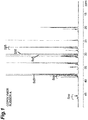
- the respective kinds of peaks derived from the carbon atoms of methylene by 13 C-NMR were identified as illustrated in FIG. 1 .
- the peak area S ⁇ of the ⁇ carbon atom, the peak area Say of the carbon atom of ⁇ , the peak area S ⁇ of the carbon atom of ⁇ , the peak area S ⁇ of the carbon atom of the ⁇ , and the peak area S ⁇ of the carbon atom ⁇ were determined from the 13 C-NMR spectrum.
- the respective peak areas determined from the spectrum of FIG. 1 were as follows.
- a peak area PP derived from a moiety in which the monomer units were bonded in the order of propylene unit-propylene unit, a peak area PE derived from a moiety in which the monomer units were bonded in the order of propylene unit-ethylene unit, and the peak area EE derived from a moiety in which the monomer units were bonded in the order of ethylene unit-ethylene unit were determined by the following Equations.
- the copolymer rubber contains an ⁇ -olefin unit other than the propylene unit and a case in which the copolymer contains two or more kinds of ⁇ -olefin units as well, it is possible to determine S ⁇ , S ⁇ , S ⁇ , S ⁇ , S ⁇ , and S ⁇ from the 13 C-NMR spectrum and determine the product of reactivity ratios using these in the same manner. For example, in a case in which a plurality of peaks of the carbon atoms at the position of ⁇ are observed to reflect the difference in the kinds of ⁇ -olefin units, it is possible to calculate the product of monomer reactivity ratios by taking the total area of these as S ⁇ .
- the reduced viscosity (viscosity number) of a copolymer solution of which the concentration was known was measured in tetralin at 135°C with a Ubbelohde viscometer.
- the intrinsic viscosity of the copolymer rubber was determined from the measurement results according to the calculation method described in " Polymer Solutions and Polymer Experiments 11" (1982, published by Kyoritsu Shuppan Co., Ltd.) page 491 .
- weight average molecular weight (Mw) and number average molecular weight (Mn) in terms of standard polystyrene were measured by gel permeation chromatography (GPC) under the following conditions.
- a cylindrical small specimen (diameter: 29.0 mm and thickness: 12.5 mm) prescribed in JIS K6262-1997 was compressed to a strain of 25% at room temperature with a compression device.
- compression of the small specimen was continuously conducted for 22 hours in a gear oven set at a temperature of -30°C as an ambient temperature. After 22 hours elapsed, compression of the small specimen was released at an ambient temperature of -30°C, the small specimen was left to stand at that temperature for 30 minutes, the thickness of the central part of the specimen was then measured, and the remaining strain (%) was determined.
- the proportion of this strain with respect to the initial strain, 25% was determined as the residual strain rate (%) of the specimen. It means that the cold resistance is superior as this residual strain rate is lower.
- the ethylene- ⁇ -olefin-based copolymer rubber was analyzed by TGIC.
- the TGIC analysis was conducted by cross-fractionation chromatography (CFC) equipped with a TREF column. The specific analysis procedure and analysis conditions are presented below.
- the elution amount of the ethylene- ⁇ -olefin-based copolymer rubber in the range of from -15°C to 160°C was measured by TGIC, the integral elution amount W was calculated by integrating the elution amounts from -15°C to the respective elution temperatures T, and a W-T curve representing the relationship between the integral elution amount W and the elution temperature T was created.
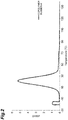
- dW/dT was calculated by differentiating the integral elution amount W with respect to the elution temperature T on the W-T curve, and a dW/dT-T curve (the ordinate: dW/dT and the abscissa: elution temperature) representing the relationship between dW/dT and the elution temperature T was created.
- the peak top temperature of the maximum peak on the dW/dT-T curve thus obtained and the maximum value (peak height) of dW/dT at the peak top temperature were determined.
- the peak top temperature is the elution temperature when dW/dT has the maximum value.
- FIG. 2 is a graph illustrating the dW/dT-T curve of the copolymer rubber-A.
- An elution temperature-elution amount curve (the ordinate: elution amount and the abscissa: elution temperature) representing the relationship between the elution amount and the elution temperature was created based on the elution amount measured in the range of from -15°C to 160°C.
- the proportion of the integral elution amount from -15°C to 40°C with respect to the total elution amount when the total elution amount was taken as 100% was calculated.
- the proportion of elution amount in a temperature region higher than 40°C was determined by subtracting the proportion thus obtained from 100%.
- the total elution amount means the integral value from -15°C to 160°C on the elution temperature-elution amount curve.
- the elution temperature (T(80)°C) at which the proportion of the integral elution amount with respect to the total elution amount reached 80% and the elution temperature (T(20)°C) at which the proportion of the integral elution amount with respect to the total elution amount reached 20% when the total elution amount was taken as 100% were determined, and the difference (T(80) - T(20)) between these temperatures was determined.
- the rubber composition was compression-molded at a set temperature of 170°C for 20 minutes with a 100 ton press (trade name: PSF-B010 manufactured by KANSAI ROLL Co., Ltd.), and molding and vulcanization were conducted at the same time, thereby fabricating a molded body having a thickness of 2 mm.
- the heat resistance was evaluated by a normal oven method having the following procedure in conformity to JIS K6257.
- the heat resistance is more favorable as this rate of change is closer to 0.
- Hexane, ethylene, and propylene were supplied to a first polymerization tank which was made of stainless steel and equipped with a stirrer at a rate of 637.6 g/(hr ⁇ L), 20.5 g/(hr ⁇ L), and 174.9 g/(hr ⁇ L) per unit time and unit volume of polymerization tank, respectively.
- VOCl 3 and ethanol were supplied to the polymerization tank at a rate of 25.9 mg/(hr ⁇ L) and 12.4 mg/(hr ⁇ L), respectively, while mixing and stirring these with a line mixer.
- EASC Ethylaluminum sesquichloride
- hydrogen was supplied to the polymerization tank at a rate of 155.3 mg/(hr ⁇ L) and 0.018 NL/(hr ⁇ L), respectively.
- the temperature of the polymerization tank was kept at 38°C.
- An ethylene-propylene copolymer rubber (hereinafter also referred to as a "copolymer rubber-A”) was generated in this polymerization tank at 26 g/(hr ⁇ L) per unit time and unit volume of polymerization tank.
- the content of the ethylene unit was 44% by mass and the content of the propylene unit was 56% by mass when the sum of the content of the ethylene unit and the content of the propylene unit in the copolymer rubber-A was taken as 100% by mass.
- the product of the monomer reactivity ratios of the copolymer rubber was 0.34.
- the resulting rubber composition was compression-molded at a set temperature of 170°C for 20 minutes with a 100 ton press (trade name: PSF-B010 manufactured by KANSAI ROLL Co., Ltd.), and molding and vulcanization were conducted at the same time, thereby fabricating a molded body as a small specimen prescribed in JIS K6262-1997.
- the evaluation results for the specimen are presented in the following Table 2 together with the blended proportion of the rubber composition.
- the heat resistance of the resultinhg molded body of the rubber composition was evaluated by the method described above, and as a result, the rate of change in breaking elongation of the molded body by a heat treatment was -31%.
- the heat resistance of the resulting molded body of the rubber composition was evaluated by the method described above, and as a result, the rate of change in breaking elongation of the molded body by a heat treatment was -32%.
- Hexane, ethylene, and propylene were supplied to a first polymerization tank which was made of stainless steel and equipped with a stirrer at a rate of 625.0 g/(hr ⁇ L), 18.7 g/(hr ⁇ L), and 189.4 g/(hr ⁇ L) per unit time and unit volume of polymerization tank, respectively.
- VOCl 3 and ethanol were supplied to the polymerization tank at a rate of 36.8 mg/(hr ⁇ L) and 17.7 mg/(hr ⁇ L), respectively, while mixing and stirring these with a line mixer.
- Ethylaluminum sesquichloride (EASC) was supplied to the polymerization tank at a rate of 221.0 mg/(hr ⁇ L).
- the temperature of the polymerization tank was kept at 38°C.
- An ethylene-propylene copolymer rubber (hereinafter also referred to as a "copolymer rubber-B") was generated in this polymerization tank at 28 g/(hr ⁇ L) per unit time and unit volume of polymerization tank.
- the content of the ethylene unit was 36% by mass and the content of the propylene unit was 64% by mass when the sum of the content of the ethylene unit and the content of the propylene unit in the copolymer rubber-B thus obtained was taken as 100% by mass.
- the product of the monomer reactivity ratios of the copolymer rubber-B was 0.34.
- a small specimen of a molded body was fabricated in the same manner as in (Preparation of Rubber Composition) and (Production of Molded Body) of Example 1 except that the copolymer rubber-B was used instead of the copolymer rubber-A.
- the heat resistance of the resulting molded body of the rubber composition was evaluated by the method described above, and as a result, the rate of change in breaking elongation of the molded body by a heat treatment was -24%.
- Hexane, ethylene, and propylene were supplied to a first polymerization tank which was made of stainless steel and equipped with a stirrer at a rate of 418.9 g/(hr ⁇ L), 30.5 g/(hr ⁇ L), and 275.6 g/(hr ⁇ L) per unit time and unit volume of polymerization tank, respectively.
- VOCl 3 and ethanol were supplied to the polymerization tank at a rate of 41.1 mg/(hr ⁇ L) and 19.7 mg/(hr ⁇ L), respectively, after being mixed and stirred with a line mixer.
- EASC Ethylaluminum sesquichloride
- hydrogen was supplied to the polymerization tank at a rate of 234.5 mg/(hr ⁇ L) and 0.006 NL/(hr ⁇ L).
- 5-ethylidene-2-norbornene was supplied to the polymerization tank at a rate of 3.1 g/(hr ⁇ L).
- the temperature of the polymerization tank was kept at 40°C.
- An ethylene-propylene-5-ethylidene-2-norbornene copolymer rubber (hereinafter also referred to as a "copolymer rubber-C”) was generated in this polymerization tank at 35 g/(hr ⁇ L) per unit time and unit volume of polymerization tank.
- the content of the ethylene unit was 47% by mass and the content of the propylene unit was 53% by mass when the sum of the content of the ethylene unit and the content of the propylene unit in the copolymer rubber-C thus obtained was taken as 100% by mass.
- the product of the monomer reactivity ratios of the copolymer rubber-C was 0.36.
- a small specimen of a molded body was fabricated in the same manner as in (Preparation of Rubber Composition) and (Production of Molded Body) of Example 2 except that the copolymer rubber-C was used instead of the copolymer rubber-A.
- Hexane, ethylene, and propylene were supplied to a first polymerization tank which was made of stainless steel and equipped with a stirrer at a rate of 352.3 g/(hr ⁇ L), 27.2 g/(hr ⁇ L), and 218.0 g/(hr ⁇ L) per unit time and unit volume of polymerization tank, respectively.
- VOCl 3 and ethanol were supplied to the polymerization tank at a rate of 31.0 mg/(hr ⁇ L) and 14.9 mg/(hr ⁇ L), respectively, after being mixed and stirred with a line mixer.
- EASC Ethylaluminum sesquichloride
- hydrogen was supplied to the polymerization tank at a rate of 176.7 mg/(hr ⁇ L) and 0.140 NL/(hr ⁇ L).
- 5-ethylidene-2-norbornene was supplied to the polymerization tank at a rate of 2.8 g/(hr ⁇ L).
- the temperature of the polymerization tank was kept at 42°C.
- An ethylene-propylene-5-ethylidene-2-norbornene copolymer rubber (hereinafter also referred to as a "copolymer rubber-L”) was generated in this polymerization tank at 31 g/(hr ⁇ L) per unit time and unit volume of polymerization tank.
- the content of the ethylene unit was 48% by mass and the content of the propylene unit was 52% by mass when the sum of the content of the ethylene unit and the content of the propylene unit in the copolymer rubber-L thus obtained was taken as 100% by mass.
- the product of the monomer reactivity ratios of the copolymer rubber-L was 0.34.
- a small specimen of a molded body was fabricated in the same manner as in (Preparation of Rubber Composition) and (Production of Molded Body) of Example 2 except that the copolymer rubber-L was used instead of the copolymer rubber-A.
- Hexane, ethylene, and propylene were supplied to a first polymerization tank which was made of stainless steel and equipped with a stirrer at a rate of 882.3 g/(hr ⁇ L), 19.5 g/(hr ⁇ L), and 93.8 g/(hr ⁇ L) per unit time and unit volume of polymerization tank, respectively.
- VOCl 3 and ethanol were supplied to the polymerization tank at a rate of 54.8 mg/(hr ⁇ L) and 26.3 mg/(hr ⁇ L), respectively, after being mixed and stirred with a line mixer.
- EASC Ethylaluminum sesquichloride
- hydrogen was supplied to the polymerization tank at a rate of 312.2 mg/(hr ⁇ L) and 0.030 NL/(hr ⁇ L).
- 5-ethylidene-2-norbornene was supplied to the polymerization tank at a rate of 4.6 g/(hr ⁇ L).
- the temperature of the polymerization tank was kept at 42°C.
- An ethylene-propylene-5-ethylidene-2-norbornene copolymer rubber (hereinafter also referred to as a "copolymer rubber-M”) was generated in this polymerization tank at 31 g/(hr ⁇ L) per unit time and unit volume of polymerization tank.
- the content of the ethylene unit was 48% by mass and the content of the propylene unit was 52% by mass when the sum of the content of the ethylene unit and the content of the propylene unit in the copolymer rubber-M thus obtained was taken as 100% by mass.
- the product of the monomer reactivity ratios of the copolymer rubber-M was 0.36.
- a small specimen of a molded body was fabricated in the same manner as in (Preparation of Rubber Composition) and (Production of Molded Body) of Example 2 except that the copolymer rubber-M was used instead of the copolymer rubber-A.
- Hexane, ethylene, and propylene were supplied to a first polymerization tank which was made of stainless steel and equipped with a stirrer at a rate of 448.3 g/(hr ⁇ L), 12.9 g/(hr ⁇ L), and 64.6 g/(hr ⁇ L) per unit time and unit volume of polymerization tank, respectively.
- VOCl 3 , ethylaluminum sesquichloride (EASC), and hydrogen were supplied to the polymerization tank at a rate of 26.3 mg/(hr ⁇ L), 68.5 mg/(hr ⁇ L), and 0.020 NL/(hr ⁇ L), respectively.
- the temperature of the polymerization tank was kept at 41°C.
- the polymerization solution withdrawn from the first polymerization tank was supplied to a second polymerization tank which was made of stainless steel and equipped with a stirrer and had the same volume as the first polymerization tank.
- Hexane, ethylene, and propylene were supplied to the second polymerization tank at a rate of 132.6 g/(hr ⁇ L), 7.4 g/(hr ⁇ L), and 53.0 g/(hr ⁇ L) per unit time and unit volume of polymerization tank, respectively.
- VOCl 3 and ethylaluminum sesquichloride (EASC) were supplied to the second polymerization tank at a rate of 16.6 mg/(hr ⁇ L) and 33.3 mg/(hr ⁇ L), respectively.
- the temperature of the second polymerization tank was kept at 45°C.
- An ethylene-propylene copolymer rubber (hereinafter also referred to as a "copolymer rubber-D”) was generated in the second polymerization tank at 34 g/(hr ⁇ L) per unit time and unit volume of polymerization tank.
- the polymerization solution withdrawn from the second polymerization tank was analyzed, and as a result, the content of the ethylene unit was 48% by mass and the content of the propylene unit was 52% by mass when the sum of the content of the ethylene unit and the content of the propylene unit in the copolymer rubber-D thus obtained was taken as 100% by mass.
- the product of the monomer reactivity ratios of the copolymer rubber-D was 0.74.
- a small specimen of a molded body was fabricated in the same manner as in (Preparation of Rubber Composition) and (Production of Molded Body) of Example 1 except that the copolymer rubber-D was used instead of the copolymer rubber-A.
- a small specimen of a molded body was fabricated in the same manner as in (Preparation of Rubber Composition) and (Production of Molded Body) of Example 2 except that the copolymer rubber-D was used instead of the copolymer rubber-A.
- Hexane, ethylene, and propylene were supplied to a first polymerization tank which was made of stainless steel and equipped with a stirrer at a rate of 491.0 g/(hr ⁇ L), 18.5 g/(hr ⁇ L), and 45.4 g/(hr ⁇ L) per unit time and unit volume of polymerization tank, respectively.
- VOCl 3 , ethylaluminum sesquichloride (EASC), and hydrogen were supplied to the polymerization tank at a rate of 15.5 mg/(hr ⁇ L), 93.1 mg/(hr ⁇ L), and 0.038 NL/(hr ⁇ L), respectively.
- 5-ethylidene-2-norbornene was supplied to the polymerization tank at a rate of 0.3 g/(hr ⁇ L).
- the temperature of the polymerization tank was kept at 45°C.
- the polymerization solution withdrawn from the first polymerization tank was supplied to a second polymerization tank which was made of stainless steel and equipped with a stirrer and had the same volume as the first polymerization tank.
- Hexane, ethylene, and propylene were supplied to the second polymerization tank at a rate of 131.8 g/(hr ⁇ L), 10.9 g/(hr ⁇ L), and 38.2 g/(hr ⁇ L) per unit time and unit volume of polymerization tank, respectively.
- VOCl 3 and ethylaluminum sesquichloride (EASC) were supplied to the second polymerization tank at a rate of 15.8 mg/(hr ⁇ L) and 47.3 mg/(hr ⁇ L), respectively.
- 5-ethylidene-2-norbornene was supplied to the second polymerization tank at a rate of 4.0 g/(hr ⁇ L).
- the temperature of the second polymerization tank was kept at 56°C.
- An ethylene-propylene-5-ethylidene-2-norbornene copolymer rubber (hereinafter also referred to as a "copolymer rubber-E") was generated in the second polymerization tank at 43 g/(hr ⁇ L) per unit time and unit volume of polymerization tank.
- the polymerization solution withdrawn from the second polymerization tank was analyzed, and as a result, the content of the ethylene unit was 68% by mass and the content of the propylene unit was 32% by mass when the sum of the content of the ethylene unit and the content of the propylene unit in the copolymer rubber-E thus obtained was taken as 100% by mass.
- the product of the monomer reactivity ratios of the copolymer rubber-E was 0.50.
- a small specimen of a molded body was fabricated in the same manner as in (Preparation of Rubber Composition) and (Production of Molded Body) of Example 1 except that the copolymer rubber-E was used instead of the copolymer rubber-A.
- Hexane, ethylene, and propylene were supplied to a first polymerization tank which was made of stainless steel and equipped with a stirrer at a rate of 425.5 g/(hr ⁇ L), 19.8 g/(hr ⁇ L), and 49.3 g/(hr ⁇ L) per unit time and unit volume of polymerization tank, respectively.
- VOCl 3 , ethylaluminum sesquichloride (EASC), and hydrogen were supplied to the polymerization tank at a rate of 30.0 mg/(hr ⁇ L), 150.2 mg/(hr ⁇ L), and 0.029 NL/(hr ⁇ L), respectively.
- 5-ethylidene-2-norbornene was supplied to the polymerization tank at a rate of 1.2 g/(hr ⁇ L). The temperature of the polymerization tank was kept at 54°C.
- the polymerization solution withdrawn from the first polymerization tank was supplied to a second polymerization tank which was made of stainless steel and equipped with a stirrer and had the same volume as the first polymerization tank.
- Hexane, ethylene, and propylene were supplied to the second polymerization tank at a rate of 124.9 g/(hr ⁇ L), 12.3 g/(hr ⁇ L), and 42.9 g/(hr ⁇ L) per unit time and unit volume of polymerization tank, respectively.
- VOCl 3 and ethylaluminum sesquichloride (EASC) were supplied to the second polymerization tank at a rate of 20.2 mg/(hr ⁇ L) and 40.4 mg/(hr ⁇ L), respectively.
- 5-ethylidene-2-norbornene was supplied to the second polymerization tank at a rate of 0.3 g/(hr ⁇ L).
- the temperature of the second polymerization tank was kept at 59°C.
- An ethylene-propylene-5-ethylidene-2-norbornene copolymer rubber (hereinafter also referred to as a "copolymer rubber-F") was generated in the second polymerization tank at 47 g/(hr ⁇ L) per unit time and unit volume of polymerization tank.
- the polymerization solution withdrawn from the second polymerization tank was analyzed, and as a result, the content of the ethylene unit was 69% by mass and the content of the propylene unit was 31% by mass when the sum of the content of the ethylene unit and the content of the propylene unit in the copolymer rubber-F thus obtained was taken as 100% by mass.
- the product of the monomer reactivity ratios of the copolymer rubber-F was 0.40.
- a small specimen of a molded body was fabricated in the same manner as in (Preparation of Rubber Composition) and (Production of Molded Body) of Example 2 except that the copolymer rubber-F was used instead of the copolymer rubber-A.
- Hexane, ethylene, and propylene were supplied to a first polymerization tank which was made of stainless steel and equipped with a stirrer at a rate of 332.1 g/(hr ⁇ L), 18.3 g/(hr ⁇ L), and 71.2 g/(hr ⁇ L) per unit time and unit volume of polymerization tank, respectively.
- VOCl 3 , ethylaluminum sesquichloride (EASC), and hydrogen were supplied to the polymerization tank at a rate of 41.2 mg/(hr ⁇ L), 247.5 mg/(hr ⁇ L), and 0.028 NL/(hr ⁇ L), respectively.
- EASC ethylaluminum sesquichloride
- 5-ethylidene-2-norbornene was supplied to the polymerization tank at a rate of 1.7 g/(hr ⁇ L). The temperature of the polymerization tank was kept at 41°C.
- the polymerization solution withdrawn from the first polymerization tank was supplied to a second polymerization tank which was made of stainless steel and equipped with a stirrer and had the same volume as the first polymerization tank.
- Hexane, ethylene, and propylene were supplied to the second polymerization tank at a rate of 110.7 g/(hr ⁇ L), 10.5 g/(hr ⁇ L), and 57.9 g/(hr ⁇ L) per unit time and unit volume of polymerization tank, respectively.
- VOCl 3 and ethylaluminum sesquichloride (EASC) were supplied to the second polymerization tank at a rate of 27.8 mg/(hr ⁇ L) and 83.5 mg/(hr ⁇ L), respectively.
- 5-ethylidene-2-norbornene was supplied to the second polymerization tank at a rate of 0.5 g/(hr ⁇ L).
- the temperature of the second polymerization tank was kept at 46°C.
- An ethylene-propylene-5-ethylidene-2-norbornene copolymer rubber (hereinafter also referred to as a "copolymer rubber-G") was generated in the second polymerization tank at 49 g/(hr ⁇ L) per unit time and unit volume of polymerization tank.
- the polymerization solution withdrawn from the second polymerization tank was analyzed, and as a result, the content of the ethylene unit was 52% by mass and the content of the propylene unit was 48% by mass when the sum of the content of the ethylene unit and the content of the propylene unit in the copolymer rubber-G thus obtained was taken as 100% by mass.
- the product of the monomer reactivity ratios of the copolymer rubber-G was 0.53.
- a small specimen of a molded body was fabricated in the same manner as in (Preparation of Rubber Composition) and (Production of Molded Body) of Example 2 except that the copolymer rubber-G was used instead of the copolymer rubber-A.
- the heat resistance of the molded body of the rubber composition thus obtained was evaluated by the method described above, and as a result, the rate of change in breaking elongation of the molded body by a heat treatment was -96%.
- Hexane, ethylene, and propylene were supplied to a first polymerization tank which was made of stainless steel and equipped with a stirrer at a rate of 458.6 g/(hr ⁇ L), 14.1 g/(hr ⁇ L), and 56.0 g/(hr ⁇ L) per unit time and unit volume of polymerization tank, respectively.
- VOCl 3 , ethylaluminum sesquichloride (EASC), and hydrogen were supplied to the polymerization tank at a rate of 31.9 mg/(hr ⁇ L), 127.6 mg/(hr ⁇ L), and 0.030 NL/(hr ⁇ L), respectively.
- 5-ethylidene-2-norbornene was supplied to the polymerization tank at a rate of 3.2 g/(hr ⁇ L). The temperature of the polymerization tank was kept at 41°C.
- the polymerization solution withdrawn from the first polymerization tank was supplied to a second polymerization tank which was made of stainless steel and equipped with a stirrer and had the same volume as the first polymerization tank.
- Hexane, ethylene, and propylene were supplied to the second polymerization tank at a rate of 123.7 g/(hr ⁇ L), 8.3 g/(hr ⁇ L), and 47.3 g/(hr ⁇ L) per unit time and unit volume of polymerization tank, respectively.
- VOCl 3 and ethylaluminum sesquichloride (EASC) were supplied to the second polymerization tank at a rate of 31.0 mg/(hr ⁇ L) and 62.0 mg/(hr ⁇ L), respectively.
- 5-ethylidene-2-norbornene was supplied to the second polymerization tank at a rate of 1.0 g/(hr ⁇ L).
- the temperature of the second polymerization tank was kept at 49°C.
- An ethylene-propylene-5-ethylidene-2-norbornene copolymer rubber (hereinafter also referred to as a "copolymer rubber-H") was generated in the second polymerization tank at 43 g/(hr ⁇ L) per unit time and unit volume of polymerization tank.
- the polymerization solution withdrawn from the second polymerization tank was analyzed, and as a result, the content of the ethylene unit was 55% by mass and the content of the propylene unit was 45% by mass when the sum of the content of the ethylene unit and the content of the propylene unit in the copolymer rubber-H thus obtained was taken as 100% by mass.
- the product of the monomer reactivity ratios of the copolymer rubber-H was 0.56.
- a small specimen of a molded body was fabricated in the same manner as in (Preparation of Rubber Composition) and (Production of Molded Body) of Example 2 except that the copolymer rubber-H was used instead of the copolymer rubber-A.
- a copolymer rubber with a trade name of "Mitsui EPT 9090M” manufactured by Mitsui Chemicals, Inc. was prepared as a copolymer rubber-I.
- a small specimen of a molded body was fabricated in the same manner as in Example 1 except that 100 parts by mass of the copolymer rubber-I, 1 part by mass of 2-mercaptobenzimidazole (trade name "ANTAGE MB” manufactured by KAWAGUCHI CHEMICAL INDUSTRY CO., LTD.) as the component (C), 100 parts by mass of carbon black (trade name "Asahi #50G” manufactured by ASAHI CARBON CO., LTD.), 60 parts by mass of process oil (trade name "Diana Process Oil PW-380” manufactured by Idemitsu Kosan Co., Ltd.), 0.5 part by mass of a 2,2,4-trimethyl-1,2-dihydroquinoline polymer (trade name "ANTAGE RD” manufactured by KAWAGUCHI CHEMICAL INDUSTRY CO
- a copolymer rubber with a trade name of "Mitsui EPT 8030M” manufactured by Mitsui Chemicals, Inc. was prepared as a copolymer rubber-J.
- a small specimen of a molded body was fabricated in the same manner as in Comparative Example 7 except that the copolymer rubber-J was used instead of the copolymer rubber-I.
- a copolymer rubber with a trade name of "Vistalon 8600” manufactured by Exxon Mobil Corporation was prepared as a copolymer rubber-K.
- a small specimen of a molded body was fabricated in the same manner as in Comparative Example 7 except that the copolymer rubber-K was used instead of the copolymer rubber-I.
- Example 1 Comp.
- Example 2 Comp.
- Example 3 Comp.
- Example 4 Comp.
- Example 5 Comp.
- Example 6 Comp.
- Example 7 Comp.
- Example 8 Comp.
- Example 9 Blended proportion of rubber composition Alternative component to component (A) Copolymer rubber-D 100 100 - - - - - - - - Copolymer rubber-E - - 100 - - - - - Copolymer rubber-F - - - 100 - - - - - Copolymer rubber-G - - - - 100 - - - - Copolymer rubber-H - - - - - - 100 - - - Copolymer rubber-I - - - - - - - 100 - - Copolymer rubber-J - - - - - - - 100 - Copolymer rubber-K - - - - - -
Landscapes
- Chemical & Material Sciences (AREA)
- Health & Medical Sciences (AREA)
- Chemical Kinetics & Catalysis (AREA)
- Medicinal Chemistry (AREA)
- Polymers & Plastics (AREA)
- Organic Chemistry (AREA)
- Engineering & Computer Science (AREA)
- Materials Engineering (AREA)
- Addition Polymer Or Copolymer, Post-Treatments, Or Chemical Modifications (AREA)
- Compositions Of Macromolecular Compounds (AREA)
- Transition And Organic Metals Composition Catalysts For Addition Polymerization (AREA)
Applications Claiming Priority (2)
| Application Number | Priority Date | Filing Date | Title |
|---|---|---|---|
| JP2015158836 | 2015-08-11 | ||
| PCT/JP2016/073349 WO2017026460A1 (ja) | 2015-08-11 | 2016-08-08 | エチレン-α-オレフィン系共重合体ゴム、ゴム組成物、エチレン-α-オレフィン系共重合体ゴムを製造する方法 |
Publications (2)
| Publication Number | Publication Date |
|---|---|
| EP3336143A1 true EP3336143A1 (de) | 2018-06-20 |
| EP3336143A4 EP3336143A4 (de) | 2019-03-20 |
Family
ID=57983850
Family Applications (1)
| Application Number | Title | Priority Date | Filing Date |
|---|---|---|---|
| EP16835157.5A Withdrawn EP3336143A4 (de) | 2015-08-11 | 2016-08-08 | Ethylen-alpha-olefin-copolymerkautschuk, kautschukzusammensetzung und verfahren zur herstellung von ethylen-alpha-olefin-copolymerkautschuk |
Country Status (7)
| Country | Link |
|---|---|
| US (1) | US20180230254A1 (de) |
| EP (1) | EP3336143A4 (de) |
| JP (1) | JP6698662B2 (de) |
| KR (1) | KR20180039664A (de) |
| CN (1) | CN107922698B (de) |
| TW (1) | TW201714900A (de) |
| WO (1) | WO2017026460A1 (de) |
Cited By (1)
| Publication number | Priority date | Publication date | Assignee | Title |
|---|---|---|---|---|
| EP4438640A4 (de) * | 2021-11-25 | 2025-11-26 | Lotte Chemical Corp | Ethylen-alpha-olefin-copolymer und harzzusammensetzung damit |
Families Citing this family (3)
| Publication number | Priority date | Publication date | Assignee | Title |
|---|---|---|---|---|
| TWI669210B (zh) * | 2018-10-11 | 2019-08-21 | 厚生股份有限公司 | Thermosetting soft non-yellowing light transmissive five-layer structure rubber leather and manufacturing method thereof |
| CN111533922B (zh) * | 2020-06-01 | 2021-04-13 | 南京工业大学 | 一种改性木质素增强型橡胶及其制备方法 |
| CN116018278A (zh) * | 2020-10-15 | 2023-04-25 | 三井化学株式会社 | 有机硅化合物接枝共聚物及包含该共聚物的轮胎用橡胶组合物 |
Family Cites Families (19)
| Publication number | Priority date | Publication date | Assignee | Title |
|---|---|---|---|---|
| IT1227341B (it) * | 1988-09-13 | 1991-04-08 | Ausimont Spa | Composizioni poliolefiniche plasto-elastomeriche e procedimento per la loro preparazione con metodi di vulcanizzazione dinamica |
| KR900009719A (ko) * | 1988-12-16 | 1990-07-05 | 엠. 데이비드 레오나이드 | 신규 에틸렌-프로필렌 공중합체 |
| EP0493070A3 (en) * | 1990-12-26 | 1993-03-10 | Shell Oil Company | Ethylene-propylene copolymer compositions |
| GB9116356D0 (en) * | 1991-07-29 | 1991-09-11 | Ici Plc | Scratch resistance polymer compositions and articles |
| IT1254547B (it) * | 1992-03-23 | 1995-09-25 | Montecatini Tecnologie Srl | Copolimeri elastomerici dell'etilene con alfa-olefine. |
| IT1264483B1 (it) * | 1993-06-30 | 1996-09-23 | Spherilene Srl | Copolimeri elastomerici dell'etilene con propilene |
| JP3364999B2 (ja) * | 1993-08-16 | 2003-01-08 | ジェイエスアール株式会社 | 押し出し加工性に優れたゴム組成物 |
| EP0863183B2 (de) * | 1995-11-24 | 2008-05-28 | Chisso Corporation | Propylenzusammensetzung, verfahren zu deren herstellung, polypropylenzusammensetzung und geformte gegenstände |
| JP2002146133A (ja) * | 2000-11-16 | 2002-05-22 | Mitsui Chemicals Inc | オレフィン系熱可塑性エラストマー組成物およびその組成物からなる成形体 |
| JP2003040934A (ja) * | 2001-07-26 | 2003-02-13 | Sumitomo Chem Co Ltd | エチレン−α−オレフィン−非共役ポリエン系共重合体ゴム及びその組成物 |
| JP2004143413A (ja) * | 2002-08-26 | 2004-05-20 | Sumitomo Chem Co Ltd | ポリプロピレン系樹脂組成物およびそれからなる射出成形体 |
| JP4742724B2 (ja) * | 2005-02-08 | 2011-08-10 | 住友化学株式会社 | 防振材 |
| CN101309939B (zh) * | 2005-11-15 | 2011-01-12 | 巴塞尔聚烯烃意大利有限责任公司 | 丙烯-乙烯共聚物及其制备方法 |
| JP2008150472A (ja) * | 2006-12-15 | 2008-07-03 | Sumitomo Chemical Co Ltd | エチレン−プロピレン共重合体 |
| US20090326157A1 (en) * | 2006-12-15 | 2009-12-31 | Sumitomo Chemical Company, Limited | Ethylene-propylene copolymer, and polypropylene resin composition comprising the same |
| CN106117819A (zh) * | 2009-02-27 | 2016-11-16 | 住友化学株式会社 | 共聚物橡胶组合物、模制品和汽车密封件 |
| JP5560765B2 (ja) * | 2009-02-27 | 2014-07-30 | 住友化学株式会社 | エチレン−α−オレフィン−非共役ポリエン系共重合体ゴム組成物の製造方法 |
| JP6265675B2 (ja) * | 2012-10-09 | 2018-01-24 | 住友化学株式会社 | ゴム組成物の製造方法、加硫されたゴム組成物成形体、および防振材 |
| EP3059291B1 (de) * | 2013-10-18 | 2019-12-18 | Mitsui Chemicals, Inc. | Haftmittel mit ethylen-(-olefin)-copolymer |
-
2016
- 2016-08-08 KR KR1020187006375A patent/KR20180039664A/ko not_active Ceased
- 2016-08-08 JP JP2017534453A patent/JP6698662B2/ja active Active
- 2016-08-08 CN CN201680046741.0A patent/CN107922698B/zh active Active
- 2016-08-08 WO PCT/JP2016/073349 patent/WO2017026460A1/ja not_active Ceased
- 2016-08-08 US US15/750,891 patent/US20180230254A1/en not_active Abandoned
- 2016-08-08 EP EP16835157.5A patent/EP3336143A4/de not_active Withdrawn
- 2016-08-10 TW TW105125420A patent/TW201714900A/zh unknown
Cited By (1)
| Publication number | Priority date | Publication date | Assignee | Title |
|---|---|---|---|---|
| EP4438640A4 (de) * | 2021-11-25 | 2025-11-26 | Lotte Chemical Corp | Ethylen-alpha-olefin-copolymer und harzzusammensetzung damit |
Also Published As
| Publication number | Publication date |
|---|---|
| US20180230254A1 (en) | 2018-08-16 |
| JPWO2017026460A1 (ja) | 2018-06-07 |
| EP3336143A4 (de) | 2019-03-20 |
| JP6698662B2 (ja) | 2020-05-27 |
| CN107922698B (zh) | 2021-01-05 |
| KR20180039664A (ko) | 2018-04-18 |
| WO2017026460A1 (ja) | 2017-02-16 |
| CN107922698A (zh) | 2018-04-17 |
| TW201714900A (zh) | 2017-05-01 |
Similar Documents
| Publication | Publication Date | Title |
|---|---|---|
| EP3336143A1 (de) | Ethylen-alpha-olefin-copolymerkautschuk, kautschukzusammensetzung und verfahren zur herstellung von ethylen-alpha-olefin-copolymerkautschuk | |
| US20030045624A1 (en) | Rubber compositions and their uses | |
| CN103131090B (zh) | 橡胶组合物 | |
| US20100222515A1 (en) | Copolymer rubber composition, molded product, and automotive sealant | |
| JP2011195808A (ja) | 防振ゴム用ゴム組成物及び防振ゴム | |
| JP3571030B2 (ja) | ゴム組成物及びその用途 | |
| KR101225869B1 (ko) | 고무 조성물의 가황된 성형 물품의 제조 방법 및 방진 재료 | |
| JP5952702B2 (ja) | ゴム組成物の製造方法、加硫されたゴム組成物成形体、および防振材 | |
| EP3626775A1 (de) | Kautschukzusammensetzung für direkte vulkanisationsverbindung und geformter metall-gummi-verbundstoff | |
| EP3085735B1 (de) | Kautschukzusammensetzung und formgegenstand | |
| US20230183461A1 (en) | Ethylene-copolymer rubbers | |
| JP7245790B2 (ja) | ゴム組成物 | |
| JP2006348095A (ja) | 防振ゴム用組成物及び防振ゴム製品 | |
| US20210371559A1 (en) | Ethylene-alpha-olefin-nonconjugated polyene copolymer rubber and rubber composition | |
| JP2021098787A (ja) | ゴム組成物 |
Legal Events
| Date | Code | Title | Description |
|---|---|---|---|
| STAA | Information on the status of an ep patent application or granted ep patent |
Free format text: STATUS: THE INTERNATIONAL PUBLICATION HAS BEEN MADE |
|
| PUAI | Public reference made under article 153(3) epc to a published international application that has entered the european phase |
Free format text: ORIGINAL CODE: 0009012 |
|
| STAA | Information on the status of an ep patent application or granted ep patent |
Free format text: STATUS: REQUEST FOR EXAMINATION WAS MADE |
|
| 17P | Request for examination filed |
Effective date: 20180309 |
|
| AK | Designated contracting states |
Kind code of ref document: A1 Designated state(s): AL AT BE BG CH CY CZ DE DK EE ES FI FR GB GR HR HU IE IS IT LI LT LU LV MC MK MT NL NO PL PT RO RS SE SI SK SM TR |
|
| AX | Request for extension of the european patent |
Extension state: BA ME |
|
| DAV | Request for validation of the european patent (deleted) | ||
| DAX | Request for extension of the european patent (deleted) | ||
| A4 | Supplementary search report drawn up and despatched |
Effective date: 20190214 |
|
| RIC1 | Information provided on ipc code assigned before grant |
Ipc: C08F 210/06 20060101ALI20190208BHEP Ipc: C08F 4/68 20060101ALI20190208BHEP Ipc: C08K 5/17 20060101ALI20190208BHEP Ipc: C08L 23/16 20060101AFI20190208BHEP |
|
| GRAP | Despatch of communication of intention to grant a patent |
Free format text: ORIGINAL CODE: EPIDOSNIGR1 |
|
| STAA | Information on the status of an ep patent application or granted ep patent |
Free format text: STATUS: GRANT OF PATENT IS INTENDED |
|
| INTG | Intention to grant announced |
Effective date: 20220118 |
|
| STAA | Information on the status of an ep patent application or granted ep patent |
Free format text: STATUS: THE APPLICATION IS DEEMED TO BE WITHDRAWN |
|
| 18D | Application deemed to be withdrawn |
Effective date: 20220531 |