EP3336178B1 - Verfahren zur kultivierung pluripotenter stammzellen, verfahren zur herstellung eines kulturgefässes, kulturgefäss und gerüstmaterial zur zellkultivierung - Google Patents
Verfahren zur kultivierung pluripotenter stammzellen, verfahren zur herstellung eines kulturgefässes, kulturgefäss und gerüstmaterial zur zellkultivierung Download PDFInfo
- Publication number
- EP3336178B1 EP3336178B1 EP16834853.0A EP16834853A EP3336178B1 EP 3336178 B1 EP3336178 B1 EP 3336178B1 EP 16834853 A EP16834853 A EP 16834853A EP 3336178 B1 EP3336178 B1 EP 3336178B1
- Authority
- EP
- European Patent Office
- Prior art keywords
- amino acid
- sequence
- culture vessel
- acid sequence
- bfgf
- Prior art date
- Legal status (The legal status is an assumption and is not a legal conclusion. Google has not performed a legal analysis and makes no representation as to the accuracy of the status listed.)
- Active
Links
- 238000000034 method Methods 0.000 title claims description 193
- 210000004027 cell Anatomy 0.000 title claims description 147
- 210000001778 pluripotent stem cell Anatomy 0.000 title claims description 103
- 238000012258 culturing Methods 0.000 title claims description 95
- 239000000463 material Substances 0.000 title claims description 61
- 238000004519 manufacturing process Methods 0.000 title claims description 32
- 102000003974 Fibroblast growth factor 2 Human genes 0.000 claims description 371
- 108090000379 Fibroblast growth factor 2 Proteins 0.000 claims description 371
- 229920001184 polypeptide Polymers 0.000 claims description 262
- 102000004196 processed proteins & peptides Human genes 0.000 claims description 262
- 108090000765 processed proteins & peptides Proteins 0.000 claims description 262
- 239000007788 liquid Substances 0.000 claims description 147
- 230000008569 process Effects 0.000 claims description 113
- 125000000539 amino acid group Chemical group 0.000 claims description 68
- 230000000694 effects Effects 0.000 claims description 52
- 230000021164 cell adhesion Effects 0.000 claims description 43
- 238000012217 deletion Methods 0.000 claims description 31
- 230000037430 deletion Effects 0.000 claims description 31
- 238000007792 addition Methods 0.000 claims description 28
- 238000006467 substitution reaction Methods 0.000 claims description 28
- 238000001035 drying Methods 0.000 claims description 23
- 230000000717 retained effect Effects 0.000 claims description 12
- 238000005470 impregnation Methods 0.000 claims description 9
- 125000003275 alpha amino acid group Chemical group 0.000 claims 40
- 150000001413 amino acids Chemical group 0.000 description 197
- 239000002609 medium Substances 0.000 description 144
- 239000000243 solution Substances 0.000 description 75
- 241000282414 Homo sapiens Species 0.000 description 44
- IYMAXBFPHPZYIK-BQBZGAKWSA-N Arg-Gly-Asp Chemical group NC(N)=NCCC[C@H](N)C(=O)NCC(=O)N[C@@H](CC(O)=O)C(O)=O IYMAXBFPHPZYIK-BQBZGAKWSA-N 0.000 description 31
- 108010031318 Vitronectin Proteins 0.000 description 22
- 102100035140 Vitronectin Human genes 0.000 description 22
- 230000036961 partial effect Effects 0.000 description 22
- 101000803709 Homo sapiens Vitronectin Proteins 0.000 description 21
- 239000000203 mixture Substances 0.000 description 19
- 239000007640 basal medium Substances 0.000 description 17
- 238000010899 nucleation Methods 0.000 description 17
- XSQUKJJJFZCRTK-UHFFFAOYSA-N Urea Chemical compound NC(N)=O XSQUKJJJFZCRTK-UHFFFAOYSA-N 0.000 description 16
- 230000035755 proliferation Effects 0.000 description 15
- 239000000126 substance Substances 0.000 description 15
- 235000001014 amino acid Nutrition 0.000 description 14
- 230000014509 gene expression Effects 0.000 description 13
- 238000011282 treatment Methods 0.000 description 13
- HTTJABKRGRZYRN-UHFFFAOYSA-N Heparin Chemical compound OC1C(NC(=O)C)C(O)OC(COS(O)(=O)=O)C1OC1C(OS(O)(=O)=O)C(O)C(OC2C(C(OS(O)(=O)=O)C(OC3C(C(O)C(O)C(O3)C(O)=O)OS(O)(=O)=O)C(CO)O2)NS(O)(=O)=O)C(C(O)=O)O1 HTTJABKRGRZYRN-UHFFFAOYSA-N 0.000 description 12
- FAPWRFPIFSIZLT-UHFFFAOYSA-M Sodium chloride Chemical compound [Na+].[Cl-] FAPWRFPIFSIZLT-UHFFFAOYSA-M 0.000 description 12
- 229960002897 heparin Drugs 0.000 description 12
- 229920000669 heparin Polymers 0.000 description 12
- 239000008055 phosphate buffer solution Substances 0.000 description 12
- 239000007983 Tris buffer Substances 0.000 description 11
- 210000004962 mammalian cell Anatomy 0.000 description 11
- LENZDBCJOHFCAS-UHFFFAOYSA-N tris Chemical compound OCC(N)(CO)CO LENZDBCJOHFCAS-UHFFFAOYSA-N 0.000 description 11
- 239000007864 aqueous solution Substances 0.000 description 10
- 239000000872 buffer Substances 0.000 description 9
- 230000000052 comparative effect Effects 0.000 description 9
- 239000004202 carbamide Substances 0.000 description 8
- 238000000502 dialysis Methods 0.000 description 8
- 238000005516 engineering process Methods 0.000 description 8
- 108090000623 proteins and genes Proteins 0.000 description 8
- 239000004793 Polystyrene Substances 0.000 description 7
- 230000015556 catabolic process Effects 0.000 description 7
- 238000006731 degradation reaction Methods 0.000 description 7
- 238000004925 denaturation Methods 0.000 description 7
- 230000036425 denaturation Effects 0.000 description 7
- 239000012634 fragment Substances 0.000 description 7
- 230000002779 inactivation Effects 0.000 description 7
- 239000002504 physiological saline solution Substances 0.000 description 7
- 229920002223 polystyrene Polymers 0.000 description 7
- 238000002835 absorbance Methods 0.000 description 6
- 238000004113 cell culture Methods 0.000 description 6
- 125000000151 cysteine group Chemical group N[C@@H](CS)C(=O)* 0.000 description 6
- 238000011156 evaluation Methods 0.000 description 6
- 125000001360 methionine group Chemical group N[C@@H](CCSC)C(=O)* 0.000 description 6
- 210000002966 serum Anatomy 0.000 description 6
- 239000011780 sodium chloride Substances 0.000 description 6
- 210000000130 stem cell Anatomy 0.000 description 6
- 239000006228 supernatant Substances 0.000 description 6
- 238000002965 ELISA Methods 0.000 description 5
- 230000002776 aggregation Effects 0.000 description 5
- 238000004220 aggregation Methods 0.000 description 5
- 230000004663 cell proliferation Effects 0.000 description 5
- 239000006285 cell suspension Substances 0.000 description 5
- 239000002801 charged material Substances 0.000 description 5
- 239000013604 expression vector Substances 0.000 description 5
- 230000002209 hydrophobic effect Effects 0.000 description 5
- 235000018102 proteins Nutrition 0.000 description 5
- 102000004169 proteins and genes Human genes 0.000 description 5
- XLYOFNOQVPJJNP-UHFFFAOYSA-N water Substances O XLYOFNOQVPJJNP-UHFFFAOYSA-N 0.000 description 5
- 239000006144 Dulbecco’s modified Eagle's medium Substances 0.000 description 4
- DGAQECJNVWCQMB-PUAWFVPOSA-M Ilexoside XXIX Chemical compound C[C@@H]1CC[C@@]2(CC[C@@]3(C(=CC[C@H]4[C@]3(CC[C@@H]5[C@@]4(CC[C@@H](C5(C)C)OS(=O)(=O)[O-])C)C)[C@@H]2[C@]1(C)O)C)C(=O)O[C@H]6[C@@H]([C@H]([C@@H]([C@H](O6)CO)O)O)O.[Na+] DGAQECJNVWCQMB-PUAWFVPOSA-M 0.000 description 4
- 239000000654 additive Substances 0.000 description 4
- 239000012228 culture supernatant Substances 0.000 description 4
- 229960000633 dextran sulfate Drugs 0.000 description 4
- 210000002744 extracellular matrix Anatomy 0.000 description 4
- 238000010348 incorporation Methods 0.000 description 4
- 230000001965 increasing effect Effects 0.000 description 4
- 239000012155 injection solvent Substances 0.000 description 4
- 239000002953 phosphate buffered saline Substances 0.000 description 4
- 238000009832 plasma treatment Methods 0.000 description 4
- 238000003752 polymerase chain reaction Methods 0.000 description 4
- 238000002360 preparation method Methods 0.000 description 4
- 238000005215 recombination Methods 0.000 description 4
- 229910052708 sodium Inorganic materials 0.000 description 4
- 239000011734 sodium Substances 0.000 description 4
- 210000001082 somatic cell Anatomy 0.000 description 4
- KCXVZYZYPLLWCC-UHFFFAOYSA-N EDTA Chemical compound OC(=O)CN(CC(O)=O)CCN(CC(O)=O)CC(O)=O KCXVZYZYPLLWCC-UHFFFAOYSA-N 0.000 description 3
- 238000008157 ELISA kit Methods 0.000 description 3
- 108010010803 Gelatin Proteins 0.000 description 3
- 101001052035 Homo sapiens Fibroblast growth factor 2 Proteins 0.000 description 3
- 230000000890 antigenic effect Effects 0.000 description 3
- 230000001580 bacterial effect Effects 0.000 description 3
- 230000010261 cell growth Effects 0.000 description 3
- 238000005119 centrifugation Methods 0.000 description 3
- 238000011109 contamination Methods 0.000 description 3
- 238000004132 cross linking Methods 0.000 description 3
- 238000012136 culture method Methods 0.000 description 3
- 239000008367 deionised water Substances 0.000 description 3
- 229910021641 deionized water Inorganic materials 0.000 description 3
- 230000004069 differentiation Effects 0.000 description 3
- 230000003203 everyday effect Effects 0.000 description 3
- 238000002474 experimental method Methods 0.000 description 3
- 229920000159 gelatin Polymers 0.000 description 3
- 239000008273 gelatin Substances 0.000 description 3
- 235000019322 gelatine Nutrition 0.000 description 3
- 235000011852 gelatine desserts Nutrition 0.000 description 3
- 239000011521 glass Substances 0.000 description 3
- 125000003630 glycyl group Chemical group [H]N([H])C([H])([H])C(*)=O 0.000 description 3
- 239000003102 growth factor Substances 0.000 description 3
- 239000012678 infectious agent Substances 0.000 description 3
- 230000002401 inhibitory effect Effects 0.000 description 3
- 238000012423 maintenance Methods 0.000 description 3
- 239000000047 product Substances 0.000 description 3
- 230000004850 protein–protein interaction Effects 0.000 description 3
- 125000003607 serino group Chemical group [H]N([H])[C@]([H])(C(=O)[*])C(O[H])([H])[H] 0.000 description 3
- 108091032973 (ribonucleotides)n+m Proteins 0.000 description 2
- CIWBSHSKHKDKBQ-JLAZNSOCSA-N Ascorbic acid Chemical compound OC[C@H](O)[C@H]1OC(=O)C(O)=C1O CIWBSHSKHKDKBQ-JLAZNSOCSA-N 0.000 description 2
- 108010037362 Extracellular Matrix Proteins Proteins 0.000 description 2
- 102000010834 Extracellular Matrix Proteins Human genes 0.000 description 2
- 239000012980 RPMI-1640 medium Substances 0.000 description 2
- 102000004887 Transforming Growth Factor beta Human genes 0.000 description 2
- 108090001012 Transforming Growth Factor beta Proteins 0.000 description 2
- 230000009471 action Effects 0.000 description 2
- 230000000996 additive effect Effects 0.000 description 2
- 125000003295 alanine group Chemical group N[C@@H](C)C(=O)* 0.000 description 2
- 230000015572 biosynthetic process Effects 0.000 description 2
- 238000007796 conventional method Methods 0.000 description 2
- 230000003247 decreasing effect Effects 0.000 description 2
- 238000001514 detection method Methods 0.000 description 2
- 230000002708 enhancing effect Effects 0.000 description 2
- 210000002950 fibroblast Anatomy 0.000 description 2
- 238000004108 freeze drying Methods 0.000 description 2
- 210000005260 human cell Anatomy 0.000 description 2
- 230000000977 initiatory effect Effects 0.000 description 2
- NOESYZHRGYRDHS-UHFFFAOYSA-N insulin Chemical compound N1C(=O)C(NC(=O)C(CCC(N)=O)NC(=O)C(CCC(O)=O)NC(=O)C(C(C)C)NC(=O)C(NC(=O)CN)C(C)CC)CSSCC(C(NC(CO)C(=O)NC(CC(C)C)C(=O)NC(CC=2C=CC(O)=CC=2)C(=O)NC(CCC(N)=O)C(=O)NC(CC(C)C)C(=O)NC(CCC(O)=O)C(=O)NC(CC(N)=O)C(=O)NC(CC=2C=CC(O)=CC=2)C(=O)NC(CSSCC(NC(=O)C(C(C)C)NC(=O)C(CC(C)C)NC(=O)C(CC=2C=CC(O)=CC=2)NC(=O)C(CC(C)C)NC(=O)C(C)NC(=O)C(CCC(O)=O)NC(=O)C(C(C)C)NC(=O)C(CC(C)C)NC(=O)C(CC=2NC=NC=2)NC(=O)C(CO)NC(=O)CNC2=O)C(=O)NCC(=O)NC(CCC(O)=O)C(=O)NC(CCCNC(N)=N)C(=O)NCC(=O)NC(CC=3C=CC=CC=3)C(=O)NC(CC=3C=CC=CC=3)C(=O)NC(CC=3C=CC(O)=CC=3)C(=O)NC(C(C)O)C(=O)N3C(CCC3)C(=O)NC(CCCCN)C(=O)NC(C)C(O)=O)C(=O)NC(CC(N)=O)C(O)=O)=O)NC(=O)C(C(C)CC)NC(=O)C(CO)NC(=O)C(C(C)O)NC(=O)C1CSSCC2NC(=O)C(CC(C)C)NC(=O)C(NC(=O)C(CCC(N)=O)NC(=O)C(CC(N)=O)NC(=O)C(NC(=O)C(N)CC=1C=CC=CC=1)C(C)C)CC1=CN=CN1 NOESYZHRGYRDHS-UHFFFAOYSA-N 0.000 description 2
- 108020004999 messenger RNA Proteins 0.000 description 2
- 238000000879 optical micrograph Methods 0.000 description 2
- 239000002243 precursor Substances 0.000 description 2
- 239000011347 resin Substances 0.000 description 2
- 229920005989 resin Polymers 0.000 description 2
- 238000010839 reverse transcription Methods 0.000 description 2
- 210000001988 somatic stem cell Anatomy 0.000 description 2
- UCSJYZPVAKXKNQ-HZYVHMACSA-N streptomycin Chemical compound CN[C@H]1[C@H](O)[C@@H](O)[C@H](CO)O[C@H]1O[C@@H]1[C@](C=O)(O)[C@H](C)O[C@H]1O[C@@H]1[C@@H](NC(N)=N)[C@H](O)[C@@H](NC(N)=N)[C@H](O)[C@H]1O UCSJYZPVAKXKNQ-HZYVHMACSA-N 0.000 description 2
- 239000013589 supplement Substances 0.000 description 2
- ZRKFYGHZFMAOKI-QMGMOQQFSA-N tgfbeta Chemical compound C([C@H](NC(=O)[C@H](C(C)C)NC(=O)CNC(=O)[C@H](CCC(O)=O)NC(=O)[C@H](CCCNC(N)=N)NC(=O)[C@H](CC(N)=O)NC(=O)[C@H](CC(C)C)NC(=O)[C@H]([C@@H](C)O)NC(=O)[C@H](CCC(O)=O)NC(=O)[C@H]([C@@H](C)O)NC(=O)[C@H](CC(C)C)NC(=O)CNC(=O)[C@H](C)NC(=O)[C@H](CO)NC(=O)[C@H](CCC(N)=O)NC(=O)[C@@H](NC(=O)[C@H](C)NC(=O)[C@H](C)NC(=O)[C@@H](NC(=O)[C@H](CC(C)C)NC(=O)[C@@H](N)CCSC)C(C)C)[C@@H](C)CC)C(=O)N[C@@H]([C@@H](C)O)C(=O)N[C@@H](C(C)C)C(=O)N[C@@H](CC=1C=CC=CC=1)C(=O)N[C@@H](C)C(=O)N1[C@@H](CCC1)C(=O)N[C@@H]([C@@H](C)O)C(=O)N[C@@H](CC(N)=O)C(=O)N[C@@H](CCC(O)=O)C(=O)N[C@@H](C)C(=O)N[C@@H](CC=1C=CC=CC=1)C(=O)N[C@@H](CCCNC(N)=N)C(=O)N[C@@H](C)C(=O)N[C@@H](CC(C)C)C(=O)N1[C@@H](CCC1)C(=O)N1[C@@H](CCC1)C(=O)N[C@@H](CCCNC(N)=N)C(=O)N[C@@H](CCC(O)=O)C(=O)N[C@@H](CCCNC(N)=N)C(=O)N[C@@H](CO)C(=O)N[C@@H](CCCNC(N)=N)C(=O)N[C@@H](CC(C)C)C(=O)N[C@@H](CC(C)C)C(O)=O)C1=CC=C(O)C=C1 ZRKFYGHZFMAOKI-QMGMOQQFSA-N 0.000 description 2
- 239000013598 vector Substances 0.000 description 2
- 150000003722 vitamin derivatives Chemical class 0.000 description 2
- 239000011534 wash buffer Substances 0.000 description 2
- 229910001868 water Inorganic materials 0.000 description 2
- DGVVWUTYPXICAM-UHFFFAOYSA-N β‐Mercaptoethanol Chemical compound OCCS DGVVWUTYPXICAM-UHFFFAOYSA-N 0.000 description 2
- 108010022452 Collagen Type I Proteins 0.000 description 1
- 102000012422 Collagen Type I Human genes 0.000 description 1
- 108010042086 Collagen Type IV Proteins 0.000 description 1
- 102000004266 Collagen Type IV Human genes 0.000 description 1
- 208000035473 Communicable disease Diseases 0.000 description 1
- 239000006145 Eagle's minimal essential medium Substances 0.000 description 1
- 201000009051 Embryonal Carcinoma Diseases 0.000 description 1
- 241000588724 Escherichia coli Species 0.000 description 1
- 108010067306 Fibronectins Proteins 0.000 description 1
- 102000016359 Fibronectins Human genes 0.000 description 1
- WQZGKKKJIJFFOK-GASJEMHNSA-N Glucose Natural products OC[C@H]1OC(O)[C@H](O)[C@@H](O)[C@@H]1O WQZGKKKJIJFFOK-GASJEMHNSA-N 0.000 description 1
- 108090000288 Glycoproteins Proteins 0.000 description 1
- 102000003886 Glycoproteins Human genes 0.000 description 1
- 102000004877 Insulin Human genes 0.000 description 1
- 108090001061 Insulin Proteins 0.000 description 1
- 108090000723 Insulin-Like Growth Factor I Proteins 0.000 description 1
- ODKSFYDXXFIFQN-BYPYZUCNSA-N L-arginine Chemical compound OC(=O)[C@@H](N)CCCN=C(N)N ODKSFYDXXFIFQN-BYPYZUCNSA-N 0.000 description 1
- 229930064664 L-arginine Natural products 0.000 description 1
- 235000014852 L-arginine Nutrition 0.000 description 1
- 229930182555 Penicillin Natural products 0.000 description 1
- JGSARLDLIJGVTE-MBNYWOFBSA-N Penicillin G Chemical compound N([C@H]1[C@H]2SC([C@@H](N2C1=O)C(O)=O)(C)C)C(=O)CC1=CC=CC=C1 JGSARLDLIJGVTE-MBNYWOFBSA-N 0.000 description 1
- 229920001213 Polysorbate 20 Polymers 0.000 description 1
- 102000007056 Recombinant Fusion Proteins Human genes 0.000 description 1
- 108010008281 Recombinant Fusion Proteins Proteins 0.000 description 1
- 238000012300 Sequence Analysis Methods 0.000 description 1
- 102000013275 Somatomedins Human genes 0.000 description 1
- 206010043276 Teratoma Diseases 0.000 description 1
- 102000004338 Transferrin Human genes 0.000 description 1
- 108090000901 Transferrin Proteins 0.000 description 1
- 229920004890 Triton X-100 Polymers 0.000 description 1
- 102000004142 Trypsin Human genes 0.000 description 1
- 108090000631 Trypsin Proteins 0.000 description 1
- 238000005411 Van der Waals force Methods 0.000 description 1
- IYOZTVGMEWJPKR-IJLUTSLNSA-N Y-27632 Chemical compound C1C[C@@H]([C@H](N)C)CC[C@@H]1C(=O)NC1=CC=NC=C1 IYOZTVGMEWJPKR-IJLUTSLNSA-N 0.000 description 1
- 238000010521 absorption reaction Methods 0.000 description 1
- XECAHXYUAAWDEL-UHFFFAOYSA-N acrylonitrile butadiene styrene Chemical compound C=CC=C.C=CC#N.C=CC1=CC=CC=C1 XECAHXYUAAWDEL-UHFFFAOYSA-N 0.000 description 1
- 229920000122 acrylonitrile butadiene styrene Polymers 0.000 description 1
- 239000004676 acrylonitrile butadiene styrene Substances 0.000 description 1
- 239000008186 active pharmaceutical agent Substances 0.000 description 1
- 239000003513 alkali Substances 0.000 description 1
- SHGAZHPCJJPHSC-YCNIQYBTSA-N all-trans-retinoic acid Chemical compound OC(=O)\C=C(/C)\C=C\C=C(/C)\C=C\C1=C(C)CCCC1(C)C SHGAZHPCJJPHSC-YCNIQYBTSA-N 0.000 description 1
- 239000003242 anti bacterial agent Substances 0.000 description 1
- 239000003963 antioxidant agent Substances 0.000 description 1
- 230000003078 antioxidant effect Effects 0.000 description 1
- 235000006708 antioxidants Nutrition 0.000 description 1
- 108010072041 arginyl-glycyl-aspartic acid Proteins 0.000 description 1
- 229960005070 ascorbic acid Drugs 0.000 description 1
- 235000010323 ascorbic acid Nutrition 0.000 description 1
- 239000011668 ascorbic acid Substances 0.000 description 1
- 239000002585 base Substances 0.000 description 1
- 230000008901 benefit Effects 0.000 description 1
- 239000012148 binding buffer Substances 0.000 description 1
- 230000003115 biocidal effect Effects 0.000 description 1
- 239000012620 biological material Substances 0.000 description 1
- 239000002981 blocking agent Substances 0.000 description 1
- 125000003178 carboxy group Chemical group [H]OC(*)=O 0.000 description 1
- 239000000919 ceramic Substances 0.000 description 1
- 238000006243 chemical reaction Methods 0.000 description 1
- 239000003153 chemical reaction reagent Substances 0.000 description 1
- 238000010367 cloning Methods 0.000 description 1
- 238000012733 comparative method Methods 0.000 description 1
- 239000002299 complementary DNA Substances 0.000 description 1
- 150000001875 compounds Chemical class 0.000 description 1
- 230000001419 dependent effect Effects 0.000 description 1
- 239000000385 dialysis solution Substances 0.000 description 1
- LOKCTEFSRHRXRJ-UHFFFAOYSA-I dipotassium trisodium dihydrogen phosphate hydrogen phosphate dichloride Chemical compound P(=O)(O)(O)[O-].[K+].P(=O)(O)([O-])[O-].[Na+].[Na+].[Cl-].[K+].[Cl-].[Na+] LOKCTEFSRHRXRJ-UHFFFAOYSA-I 0.000 description 1
- BVTBRVFYZUCAKH-UHFFFAOYSA-L disodium selenite Chemical compound [Na+].[Na+].[O-][Se]([O-])=O BVTBRVFYZUCAKH-UHFFFAOYSA-L 0.000 description 1
- VHJLVAABSRFDPM-QWWZWVQMSA-N dithiothreitol Chemical compound SC[C@@H](O)[C@H](O)CS VHJLVAABSRFDPM-QWWZWVQMSA-N 0.000 description 1
- 230000009881 electrostatic interaction Effects 0.000 description 1
- 238000010828 elution Methods 0.000 description 1
- 239000012149 elution buffer Substances 0.000 description 1
- 210000001671 embryonic stem cell Anatomy 0.000 description 1
- 238000000684 flow cytometry Methods 0.000 description 1
- 210000004602 germ cell Anatomy 0.000 description 1
- 210000001654 germ layer Anatomy 0.000 description 1
- 239000008103 glucose Substances 0.000 description 1
- 230000012010 growth Effects 0.000 description 1
- 238000004128 high performance liquid chromatography Methods 0.000 description 1
- 239000012510 hollow fiber Substances 0.000 description 1
- 229940088597 hormone Drugs 0.000 description 1
- 239000005556 hormone Substances 0.000 description 1
- 229910052739 hydrogen Inorganic materials 0.000 description 1
- 239000001257 hydrogen Substances 0.000 description 1
- 238000002169 hydrotherapy Methods 0.000 description 1
- 238000012744 immunostaining Methods 0.000 description 1
- 238000000338 in vitro Methods 0.000 description 1
- 210000004263 induced pluripotent stem cell Anatomy 0.000 description 1
- 208000015181 infectious disease Diseases 0.000 description 1
- 229910017053 inorganic salt Inorganic materials 0.000 description 1
- 238000003780 insertion Methods 0.000 description 1
- 230000037431 insertion Effects 0.000 description 1
- 229940125396 insulin Drugs 0.000 description 1
- 230000003993 interaction Effects 0.000 description 1
- 229930027917 kanamycin Natural products 0.000 description 1
- 229960000318 kanamycin Drugs 0.000 description 1
- SBUJHOSQTJFQJX-NOAMYHISSA-N kanamycin Chemical compound O[C@@H]1[C@@H](O)[C@H](O)[C@@H](CN)O[C@@H]1O[C@H]1[C@H](O)[C@@H](O[C@@H]2[C@@H]([C@@H](N)[C@H](O)[C@@H](CO)O2)O)[C@H](N)C[C@@H]1N SBUJHOSQTJFQJX-NOAMYHISSA-N 0.000 description 1
- 229930182823 kanamycin A Natural products 0.000 description 1
- 229940043355 kinase inhibitor Drugs 0.000 description 1
- 239000003550 marker Substances 0.000 description 1
- 238000002493 microarray Methods 0.000 description 1
- 239000007758 minimum essential medium Substances 0.000 description 1
- 210000002894 multi-fate stem cell Anatomy 0.000 description 1
- 229940028444 muse Drugs 0.000 description 1
- 235000015097 nutrients Nutrition 0.000 description 1
- 229940049954 penicillin Drugs 0.000 description 1
- 229920000515 polycarbonate Polymers 0.000 description 1
- 239000004417 polycarbonate Substances 0.000 description 1
- 229920000728 polyester Polymers 0.000 description 1
- 235000010486 polyoxyethylene sorbitan monolaurate Nutrition 0.000 description 1
- 239000000256 polyoxyethylene sorbitan monolaurate Substances 0.000 description 1
- 230000002265 prevention Effects 0.000 description 1
- 230000002062 proliferating effect Effects 0.000 description 1
- 239000003909 protein kinase inhibitor Substances 0.000 description 1
- 238000000746 purification Methods 0.000 description 1
- 238000003753 real-time PCR Methods 0.000 description 1
- 238000003259 recombinant expression Methods 0.000 description 1
- 108091008146 restriction endonucleases Proteins 0.000 description 1
- 229930002330 retinoic acid Natural products 0.000 description 1
- 150000003839 salts Chemical class 0.000 description 1
- 238000013207 serial dilution Methods 0.000 description 1
- 210000002363 skeletal muscle cell Anatomy 0.000 description 1
- 239000011781 sodium selenite Substances 0.000 description 1
- 229960001471 sodium selenite Drugs 0.000 description 1
- 235000015921 sodium selenite Nutrition 0.000 description 1
- 230000003381 solubilizing effect Effects 0.000 description 1
- 229960005322 streptomycin Drugs 0.000 description 1
- 125000000020 sulfo group Chemical group O=S(=O)([*])O[H] 0.000 description 1
- 230000001629 suppression Effects 0.000 description 1
- 230000017423 tissue regeneration Effects 0.000 description 1
- 239000012581 transferrin Substances 0.000 description 1
- 229960001727 tretinoin Drugs 0.000 description 1
- 239000012588 trypsin Substances 0.000 description 1
- VBEQCZHXXJYVRD-GACYYNSASA-N uroanthelone Chemical compound C([C@@H](C(=O)N[C@H](C(=O)N[C@@H](CS)C(=O)N[C@@H](CC(N)=O)C(=O)N[C@@H](CS)C(=O)N[C@H](C(=O)N[C@@H]([C@@H](C)CC)C(=O)NCC(=O)N[C@@H](CC=1C=CC(O)=CC=1)C(=O)N[C@@H](CO)C(=O)NCC(=O)N[C@@H](CC(O)=O)C(=O)N[C@@H](CCCNC(N)=N)C(=O)N[C@@H](CS)C(=O)N[C@@H](CCC(N)=O)C(=O)N[C@@H]([C@@H](C)O)C(=O)N[C@@H](CCCNC(N)=N)C(=O)N[C@@H](CC(O)=O)C(=O)N[C@@H](CC(C)C)C(=O)N[C@@H](CCCNC(N)=N)C(=O)N[C@@H](CC=1C2=CC=CC=C2NC=1)C(=O)N[C@@H](CC=1C2=CC=CC=C2NC=1)C(=O)N[C@@H](CCC(O)=O)C(=O)N[C@@H](CC(C)C)C(=O)N[C@@H](CCCNC(N)=N)C(O)=O)C(C)C)[C@@H](C)O)NC(=O)[C@H](CO)NC(=O)[C@H](CC(O)=O)NC(=O)[C@H](CC(C)C)NC(=O)[C@H](CO)NC(=O)[C@H](CCC(O)=O)NC(=O)[C@@H](NC(=O)[C@H](CC=1NC=NC=1)NC(=O)[C@H](CCSC)NC(=O)[C@H](CS)NC(=O)[C@@H](NC(=O)CNC(=O)CNC(=O)[C@H](CC(N)=O)NC(=O)[C@H](CC(C)C)NC(=O)[C@H](CS)NC(=O)[C@H](CC=1C=CC(O)=CC=1)NC(=O)CNC(=O)[C@H](CC(O)=O)NC(=O)[C@H](CC=1C=CC(O)=CC=1)NC(=O)[C@H](CO)NC(=O)[C@H](CO)NC(=O)[C@H]1N(CCC1)C(=O)[C@H](CS)NC(=O)CNC(=O)[C@H]1N(CCC1)C(=O)[C@H](CC=1C=CC(O)=CC=1)NC(=O)[C@H](CO)NC(=O)[C@@H](N)CC(N)=O)C(C)C)[C@@H](C)CC)C1=CC=C(O)C=C1 VBEQCZHXXJYVRD-GACYYNSASA-N 0.000 description 1
- 239000011782 vitamin Substances 0.000 description 1
- 235000013343 vitamin Nutrition 0.000 description 1
- 229930003231 vitamin Natural products 0.000 description 1
- 229940088594 vitamin Drugs 0.000 description 1
Images

Classifications
-
- C—CHEMISTRY; METALLURGY
- C12—BIOCHEMISTRY; BEER; SPIRITS; WINE; VINEGAR; MICROBIOLOGY; ENZYMOLOGY; MUTATION OR GENETIC ENGINEERING
- C12N—MICROORGANISMS OR ENZYMES; COMPOSITIONS THEREOF; PROPAGATING, PRESERVING, OR MAINTAINING MICROORGANISMS; MUTATION OR GENETIC ENGINEERING; CULTURE MEDIA
- C12N5/00—Undifferentiated human, animal or plant cells, e.g. cell lines; Tissues; Cultivation or maintenance thereof; Culture media therefor
- C12N5/06—Animal cells or tissues; Human cells or tissues
- C12N5/0602—Vertebrate cells
- C12N5/0696—Artificially induced pluripotent stem cells, e.g. iPS
-
- C—CHEMISTRY; METALLURGY
- C12—BIOCHEMISTRY; BEER; SPIRITS; WINE; VINEGAR; MICROBIOLOGY; ENZYMOLOGY; MUTATION OR GENETIC ENGINEERING
- C12M—APPARATUS FOR ENZYMOLOGY OR MICROBIOLOGY; APPARATUS FOR CULTURING MICROORGANISMS FOR PRODUCING BIOMASS, FOR GROWING CELLS OR FOR OBTAINING FERMENTATION OR METABOLIC PRODUCTS, i.e. BIOREACTORS OR FERMENTERS
- C12M1/00—Apparatus for enzymology or microbiology
-
- C—CHEMISTRY; METALLURGY
- C12—BIOCHEMISTRY; BEER; SPIRITS; WINE; VINEGAR; MICROBIOLOGY; ENZYMOLOGY; MUTATION OR GENETIC ENGINEERING
- C12M—APPARATUS FOR ENZYMOLOGY OR MICROBIOLOGY; APPARATUS FOR CULTURING MICROORGANISMS FOR PRODUCING BIOMASS, FOR GROWING CELLS OR FOR OBTAINING FERMENTATION OR METABOLIC PRODUCTS, i.e. BIOREACTORS OR FERMENTERS
- C12M23/00—Constructional details, e.g. recesses, hinges
- C12M23/20—Material Coatings
-
- C—CHEMISTRY; METALLURGY
- C12—BIOCHEMISTRY; BEER; SPIRITS; WINE; VINEGAR; MICROBIOLOGY; ENZYMOLOGY; MUTATION OR GENETIC ENGINEERING
- C12M—APPARATUS FOR ENZYMOLOGY OR MICROBIOLOGY; APPARATUS FOR CULTURING MICROORGANISMS FOR PRODUCING BIOMASS, FOR GROWING CELLS OR FOR OBTAINING FERMENTATION OR METABOLIC PRODUCTS, i.e. BIOREACTORS OR FERMENTERS
- C12M3/00—Tissue, human, animal or plant cell, or virus culture apparatus
-
- C—CHEMISTRY; METALLURGY
- C07—ORGANIC CHEMISTRY
- C07K—PEPTIDES
- C07K14/00—Peptides having more than 20 amino acids; Gastrins; Somatostatins; Melanotropins; Derivatives thereof
- C07K14/435—Peptides having more than 20 amino acids; Gastrins; Somatostatins; Melanotropins; Derivatives thereof from animals; from humans
- C07K14/475—Growth factors; Growth regulators
- C07K14/50—Fibroblast growth factor [FGF]
-
- C—CHEMISTRY; METALLURGY
- C07—ORGANIC CHEMISTRY
- C07K—PEPTIDES
- C07K14/00—Peptides having more than 20 amino acids; Gastrins; Somatostatins; Melanotropins; Derivatives thereof
- C07K14/435—Peptides having more than 20 amino acids; Gastrins; Somatostatins; Melanotropins; Derivatives thereof from animals; from humans
- C07K14/78—Connective tissue peptides, e.g. collagen, elastin, laminin, fibronectin, vitronectin or cold insoluble globulin [CIG]
-
- C—CHEMISTRY; METALLURGY
- C12—BIOCHEMISTRY; BEER; SPIRITS; WINE; VINEGAR; MICROBIOLOGY; ENZYMOLOGY; MUTATION OR GENETIC ENGINEERING
- C12N—MICROORGANISMS OR ENZYMES; COMPOSITIONS THEREOF; PROPAGATING, PRESERVING, OR MAINTAINING MICROORGANISMS; MUTATION OR GENETIC ENGINEERING; CULTURE MEDIA
- C12N2501/00—Active agents used in cell culture processes, e.g. differentation
- C12N2501/10—Growth factors
- C12N2501/115—Basic fibroblast growth factor (bFGF, FGF-2)
Definitions
- the present invention relates to a method for culturing pluripotent stem cells, a method for manufacturing a culture vessel, a culture vessel, and a scaffold material for culturing cells.
- bFGF basic fibroblast growth factor
- bFGF basic fibroblast growth factor
- JP5717311B and JP4613069B is used as a supplement in a liquid medium for culturing the pluripotent stem cells.
- bFGF is included in serum or a serum substitute, and even by adding the serum or the serum substitute to the liquid medium, bFGF can be used as a supplement in a liquid medium for culturing the pluripotent stem cells.
- a mouse fibroblast in the culture of pluripotent stem cells, a mouse fibroblast is used as a feeder cell.
- a scaffold for culturing pluripotent stem cells has been suggested as a substitute for the mouse fibroblast.
- WO2013/164970A and Biomaterials, 2010, Vol. 31, No. 32, pp. 8281-8288 suggest a recombinant polypeptide including a partial sequence of human vitronectin.
- WO 2014/117146 A1 relates to growth matrices for stem cell propagation in vitro and in tissue regeneration.
- bFGF is a substance having low stability in a liquid medium, and is gradually degraded, denatured, or deactivated in a liquid medium. Therefore, in order to cause stable proliferation of pluripotent stem cells while maintaining the undifferentiated state thereof, it is necessary to add a large amount of bFGF to a liquid medium, frequently replace the medium with a liquid medium containing bFGF, or replenish the liquid medium with bFGF during the culturing.
- An object of the embodiments of the present invention is to provide a method for culturing pluripotent stem cells, a method for manufacturing a culture vessel, a culture vessel, and a scaffold material for culturing cells by which the undifferentiated state of pluripotent stem cells is maintained, and pluripotent stem cells stably proliferate, even in a liquid medium which does not substantially contain bFGF or in a liquid medium in which the bFGF content is lower than a normal bFGF content.
- the problem of the embodiments is to achieve these objects.
- a method for culturing pluripotent stem cells a method for manufacturing a culture vessel, a culture vessel, and a scaffold material for culturing cells by which the undifferentiated state of pluripotent stem cells is maintained, and pluripotent stem cells stably proliferate, even in a liquid medium which does not substantially contain bFGF or in a liquid medium in which the bFGF content is lower than a normal bFGF content, are provided.
- process in a case where a process cannot be clearly distinguished from other processes, the process is included in the term "process" in the present specification, in addition to independent processes, as long as the intended object of the process is achieved.
- the amount of each component in a composition indicates the total amount of plural kinds of substances that exist in the composition, in a case where plural kinds of substances corresponding to each component exist in the composition, unless otherwise particularly specified.
- identity in relation to an amino acid sequence in the present specification refers to a value calculated using the BLAST package (refer to Ausubel et al., 1999, Short Protocols in Molecular Biology, 4th Ed-Chapter 18 ). For example, sharing identity of equal to or higher than 80% with an amino acid sequence represented by SEQ ID No: 3 means that the Max Identity value in the BLAST is equal to or higher than 80%.
- an expression such as "a corresponding amino acid residue" used for a specific amino acid residue in an amino acid sequence refers to, in a case where two or more amino acid sequences to be compared are aligned such that there is a maximum number of amino acid residues identical to each other using a method well-known in the present technical field while considering insertion, deletion, and substitution, an amino acid residue in an amino acid sequence of which the position coincides with the position of a specific amino acid residue in the other amino acid sequence which serves as a standard.
- a liquid medium or a liquid “does not substantially contain bFGF” means that the amount of bFGF which is contained as a component of a liquid medium or a liquid does not exceed the minimum amount that is required for maintaining the undifferentiated state of pluripotent stem cells and for stably proliferating the pluripotent stem cells.
- a concentration of bFGF in a liquid medium or a liquid is preferably lower than 5 ng/ml, more preferably lower than 1 ng/ml, and even more preferably equal to or lower than the detection limit.
- a polypeptide which has cell adhesion activity and includes a first domain for binding bFGF and a second domain for adhering to a culture vessel is referred to as a "specific polypeptide”
- a specific polypeptide in a case where bFGF is bound to the first domain of the specific polypeptide, the specific polypeptide is referred to as a "specific polypeptide/bFGF complex”.
- the present disclosure provides a first embodiment and a second embodiment as methods for culturing pluripotent stem cells. Hereinafter, these two embodiments will be described in order.
- a first embodiment is a method for culturing pluripotent stem cells including a culturing process, which is performed in a liquid medium which does not substantially contain bFGF: the process of bringing pluripotent stem cells into contact with a polypeptide having 80 to 250 amino acid residues which has cell adhesion activity and has a first domain, as defined in the claims, for binding bFGF and a second domain, as defined in the claims, for adhering to a culture vessel and culturing the pluripotent stem cells, in which bFGF is bound to the first domain, and the second domain is adhered to the culture vessel.
- a specific polypeptide/bFGF complex which is in the state of being adhered to the culture vessel is brought into contact with the pluripotent stem cells, and the pluripotent stem cells are cultured.
- the specific polypeptide/bFGF complex serves as a scaffold for proliferation of the pluripotent stem cells.
- degradation, denaturation, or inactivation of bFGF can be suppressed by the binding of bFGF to the specific polypeptide.
- the pluripotent stem cells are cultured while being in contact with the specific polypeptide/bFGF complex, the pluripotent stem cells are under the action of bFGF in the specific polypeptide/bFGF complex, and thus the undifferentiated state of the cells can be maintained and the cells can stably proliferate.
- the pluripotent stem cells can be cultured in the liquid medium that does not substantially contain bFGF, and it is not necessary to frequently replace the medium with a liquid medium containing bFGF and/or add bFGF to a liquid medium in the culture, for the purpose of replenishing the culture environment with bFGF.
- the amino acid sequence and the number of amino acid residues in a specific polypeptide is 80 to 250, and the specific polypeptide has cell adhesion activity and includes a first domain, as defined in the claims, for binding bFGF and a second domain, as defined in the claims, for adhering to a culture vessel.
- the expressions "binds bFGF” and “has the ability to bind bFGF” used for a polypeptide or the amino acid sequence thereof mean that the polypeptide binds or can bind bFGF through general protein-protein interactions (hydrogen bonding, ionic bonding, bonding due to an electrostatic interaction, a hydrophobic interaction, and Van der Waals forces, and the like).
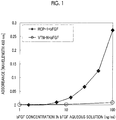
- whether a polypeptide has the ability to bind bFGF or not is determined by the following method.
- the polypeptide is brought into contact with bFGF at a concentration of 100 ng/ml.
- a solution in which the bFGF concentration is 100 ng/ml for example, a bFGF aqueous solution, or Essential 8 medium
- bFGF may be added to the polypeptide solution such that a concentration of bFGF becomes 100 ng/ml.
- Enzyme-Linked Immunosorbent Assay is performed using an antibody to bFGF, and detection of bFGF is carried out.
- a solution in which the bFGF concentration is 100 ng/ml for example, a bFGF aqueous solution or Essential 8 medium; since bFGF does not form a complex with other compounds in this solution, bFGF changes into a form that cannot be detected by ELISA in a case of being left to stand at 37°C for 24 hours)
- the expressions "adheres to a culture vessel” and “has the ability to adhere to a culture vessel” used for a polypeptide or the amino acid sequence thereof mean that the polypeptide adheres to or can adhere to a cell culture surface of the culture vessel (hereinafter, may be referred to as a "culture surface") without being subjected to a chemical treatment. Whether a polypeptide has the ability to adhere to the culture surface of a culture vessel or not is determined by the following method.
- a polypeptide-containing solution is introduced into a polystyrene culture vessel of which the inner surface has been subjected to a plasma treatment, such that the density becomes 200 pmol/cm 2 , and the solution is left to stand at 37°C for 2 hours. After being left to stand for 2 hours, the culture vessel is washed twice with a phosphate buffer solution (pH 7.4), and then whether the polypeptide remains on the culture surface at a density of 10 pmol/cm 2 or higher is determined.
- a phosphate buffer solution pH 7.4
- the amount of the polypeptide remaining on the culture surface is determined by ELISA using an antibody that recognizes the polypeptide or by High Performance Liquid Chromatography (HPLC) in which the adhered polypeptide is hydrolyzed, and the amount of amino acid, thus generated, is measured.
- HPLC High Performance Liquid Chromatography
- cell adhesion activity of a polypeptide or the amino acid sequence thereof is adhesion activity with respect to a cell which is the culture target, and can be confirmed by a known method.
- cells are seeded in a culture vessel of which the culture surface is coated with the polypeptide and incubated, and the number of cells that adhere to the culture surface is counted, so as to confirm the cell adhesion activity.
- Specific methods are described in, for example, Methods in Enzymology 82: 803-831, 1982 (Ruoslahti, E. et al.) and Nature 352: 438-441, 1991 (Williams, D. A. et al.).
- the specific polypeptide is preferably a polypeptide of which the first domain has a negative charge. Since bFGF has a positive charge, the first domain electrostatically binds bFGF in a case where the first domain has a negative charge. Whether the polypeptide or a portion of the polypeptide has a positive charge or a negative charge depends on the pH environment of the polypeptide or a portion of the polypeptide.
- the expression that the first domain "has a negative charge” means that the domain has a negative charge in a cell culture, for example, in a liquid medium of pH 7.4.
- Examples of the embodiment in which the first domain has a negative charge in the cell culture include an embodiment in which the isoelectric point of the first domain is 6 or lower, and an embodiment in which the isoelectric point of the first domain is 1 to 6 is preferable, and an embodiment in which the isoelectric point of the first domain is 2 to 5 is more preferable.
- Examples of the specific polypeptide desclosed herein include a natural protein such as vitronectin, fibronectin, type I collagen, and type IV collagen, a recombinant protein designed based on the amino acid sequences of these natural proteins, and a mixture thereof.
- the specific polypeptide can be used alone, or two or more kinds thereof may be used in combination.
- human vitronectin is preferable, and specifically, a polypeptide of 459 amino acid residues represented by SEQ ID No: 1 is preferable.
- Natural human vitronectin produced in a human body has been confirmed to be a glycoprotein in which sugar chains are bonded to some of the amino acids.
- Vitronectin represented by SEQ ID No: 1 includes a first domain for binding bFGF and a second domain for adhering to a culture vessel and has the ability to bind bFGF and the ability to adhere to the culture vessel.
- the vitronectin represented by SEQ ID No: 1 further includes a domain that exhibits cell adhesion activity and adheres to a cell that is a culture target.
- the specific polypeptide is preferably a recombinant designed based on an amino acid sequence of natural human vitronectin (SEQ ID No: 1), from the viewpoint of reducing the concern of contamination by an antigenic substance and an infectious agent.
- the recombinant may be referred to as a "recombinant vitronectin”.
- the specific polypeptide is a polypeptide having, as the first domain, a domain including any one of the following sequences A-1 to A-3, and, as the second domain, a domain including any one of the following sequences B-1 to B-3.
- the amino acid sequence represented by SEQ ID No: 2 consists of 42 amino acid residues which are the 1 st to 42 nd amino acid residues in SEQ ID No: 1 and corresponds to a somatomedin B-like domain.
- the amino acid sequence represented by SEQ ID No: 2 and an amino acid sequence which shares identity with the amino acid sequence represented by SEQ ID No: 2 may be referred to as an "SMB domain".
- the SMB domain has the ability to bind bFGF.
- the amino acid sequence represented by SEQ ID No: 3 consists of 32 amino acid residues which are the 342 nd to 373 rd amino acid residues in SEQ ID No: 1, corresponds to a heparin-binding domain, and is included in a part of hemopexin-like domain II.
- the amino acid sequence represented by SEQ ID No: 3 and an amino acid sequence which shares identity with the amino acid sequence represented by SEQ ID No: 3 may be referred to as a "heparin-binding domain".
- the heparin-binding domain has the ability to adhere to the culture vessel.
- the heparin-binding domain exhibits the effect of securing hydrophilicity of the polypeptide, thus inhibiting hydrophobic aggregation of the polypeptide.
- the sequence A-2 is an amino acid sequence which shares identity of equal to or higher than 80% with the amino acid sequence represented by SEQ ID No: 2, and is an amino acid sequence which preferably shares identity of equal to or higher than 85%, more preferably equal to or higher than 90%, and even more preferably equal to or higher than 95%, with the amino acid sequence represented by SEQ ID No: 2.
- the sequence A-3 is an amino acid sequence which is obtained by addition, substitution, or deletion of one or several amino acid residues in the amino acid sequence represented by SEQ ID No: 2, and is preferably an amino acid sequence which is obtained by addition, substitution, or deletion of 1 to 8 amino acids, and more preferably, 1 to 4 amino acids in the amino acid sequence represented by SEQ ID No: 2.
- the sequence B-2 is an amino acid sequence which shares identity of equal to or higher than 80% with the amino acid sequence represented by SEQ ID No: 3, and is an amino acid sequence which preferably shares identity of equal to or higher than 85%, more preferably equal to or higher than 90%, and even more preferably equal to or higher than 95%, with the amino acid sequence represented by SEQ ID No: 3.
- the sequence B-3 is an amino acid sequence which is obtained by addition, substitution, or deletion of one or several amino acid residues in the amino acid sequence represented by SEQ ID No: 3, and is preferably an amino acid sequence which is obtained by addition, substitution, or deletion of 1 to 6 amino acids, and more preferably, 1 to 3 amino acids in the amino acid sequence represented by SEQ ID No: 3.
- the specific polypeptide further includes an RGD motif.
- An RGD motif consists of Arg-Gly-Asp (arginine-glycine-aspartic acid) and is an amino acid sequence having cell adhesion activity.
- the RGD motif in natural human vitronectin is the 45 th to 47 th sequence in SEQ ID No: 1.
- the specific polypeptide exposes the RGD motif on the surface of the molecule, from the viewpoint of cell adhesion activity. Therefore, the amino acid sequences immediately before and immediately after the RGD motif in the specific polypeptide is preferably designed based on the amino acid sequence of a natural protein (for example, natural human vitronectin) which has cell adhesion activity due to an RGD motif. From this viewpoint, one embodiment of the specific polypeptide includes at least one of (a) or (b) immediately before or immediately after the RGD motif, and another embodiment of the specific polypeptide includes both (a) and (b) immediately before and immediately after the RGD motif.
- a natural protein for example, natural human vitronectin
- (a) is positioned immediately before the RGD motif, and (b) is positioned immediately after the RGD motif.
- (a) and (b) may be amino acid sequences which are obtained by addition, substitution, or deletion of one or two amino acids respectively, within a range that does not impair the cell adhesion activity of the RGD motif.
- Relative positions of the first domain and the second domain in the specific polypeptide are not particularly limited.
- the first domain is positioned on the N-terminal side of the second domain.
- the position of the RGD motif in the specific polypeptide is not particularly limited. In one embodiment of the specific polypeptide, the RGD motif is positioned between the first domain and the second domain.
- the specific polypeptide includes the first domain at the terminal of the molecule, from the viewpoint of enhancing the ability to bind bFGF and from the viewpoint of exposing bound bFGF on the surface of the molecule.
- the first domain is positioned at the N-terminal.
- a domain including the first domain and the RGD motif in the specific polypeptide preferably consists of the 1 st to 55 th amino acid sequence in SEQ ID No: 1 or an amino acid sequence which shares identity with this amino acid sequence. That is, the domain including the first domain and the RGD motif in the specific polypeptide is preferably a domain consisting of any one of the following sequences C-1 to C-3.
- the sequence C-2 is an amino acid sequence which shares identity of equal to or higher than 80% with the amino acid sequence represented by SEQ ID No: 4, and is an amino acid sequence which preferably shares identity of equal to or higher than 85%, more preferably equal to or higher than 90%, and even more preferably equal to or higher than 95%, with the amino acid sequence represented by SEQ ID No: 4.
- the sequence C-3 is an amino acid sequence which is obtained by addition, substitution, or deletion of one or several amino acid residues in the amino acid sequence represented by SEQ ID No: 4, and is preferably an amino acid sequence which is obtained by addition, substitution, or deletion of 1 to 10 amino acids, and more preferably, 1 to 5 amino acids in the amino acid sequence represented by SEQ ID No: 4.
- the domain consisting of any one of the sequences C-1 to C-3 is positioned at the N-terminal.
- the specific polypeptide of this embodiment is preferable, from the viewpoint of enhancing the ability to bind bFGF, from the viewpoint of exposing bound bFGF on the surface of the molecule, and from the viewpoint of exposing the RGD motif on the surface of the molecule.
- the specific polypeptide may include other amino acid sequences besides the first domain, the second domain, and the RGD motif, and the other amino acid sequences are preferably partial sequences of natural human vitronectin (SEQ ID No: 1). By the inclusion of a partial sequence of natural human vitronectin, the specific polypeptide can have the properties that resemble the properties of human vitronectin.
- the specific polypeptide includes the partial sequence of natural human vitronectin (SEQ ID No: 1) immediately before or immediately after the second domain, from the viewpoint of the ability to bind bFGF, the ability to adhere to the culture vessel, cell adhesion activity, or the suppression of aggregation.
- SEQ ID No: 1 the partial sequence of natural human vitronectin immediately before or immediately after the second domain, from the viewpoint of the ability to bind bFGF, the ability to adhere to the culture vessel, cell adhesion activity, or the suppression of aggregation.
- Examples of the partial sequence include the following sequences D-1 to D-3 and sequences E-1 to E-3.
- partial amino acid sequence refers to an amino acid sequence consisting of three or more consecutive amino acid residues that is a part of an amino acid sequence in a predetermined range.
- the sequence D-2 is a sequence which shares identity of equal to or higher than 80% with the amino acid sequence of the sequence d-1 or a partial amino acid sequence thereof, and for example, is an amino acid sequence which shares identity of equal to or higher than 85%, equal to or higher than 90%, or equal to or higher than 95%, with the amino acid sequence of the sequence d-1 or a partial amino acid sequence thereof.
- the sequence D-3 is an amino acid sequence which is obtained by addition, substitution, or deletion of one or several amino acid residues in the amino acid sequence of the sequence d-1 or a partial amino acid sequence thereof, and for example, is an amino acid sequence which is obtained by addition, substitution, or deletion of 1 to 20, 1 to 10, or 1 to 5 amino acids in the amino acid sequence of the sequence d-1 or a partial amino acid sequence thereof.
- the sequence E-2 is a sequence which shares identity of equal to or higher than 80% with the amino acid sequence of the sequence e-1 or a partial amino acid sequence thereof, and for example, is an amino acid sequence which shares identity of equal to or higher than 85%, equal to or higher than 90%, or equal to or higher than 95%, with the amino acid sequence of the sequence e-1 or a partial amino acid sequence thereof.
- the sequence E-3 is an amino acid sequence which is obtained by addition, substitution, or deletion of one or several amino acid residues in the amino acid sequence of the sequence e-1 or a partial amino acid sequence thereof, and for example, is an amino acid sequence which is obtained by addition, substitution, or deletion of 1 to 20, 1 to 10, or 1 to 5 amino acids in the amino acid sequence of the sequence e-1 or a partial amino acid sequence thereof.
- the other amino acid sequences may have an amino acid residue other than a cysteine residue at the cysteine residue position in the amino acid sequence represented by SEQ ID No: 1.
- the amino acid residue that substitutes for the cysteine residue include a serine residue, an alanine residue, a glycine residue, and the like. Among these, a serine residue and an alanine residue are preferable, from the viewpoint of having a structure similar to that of a cysteine residue.
- the specific polypeptide may not include the 56 th to 268 th amino acid residues in the amino acid sequence represented by SEQ ID No: 1. It is considered that this domain contributes little to the performance required for the specific polypeptide in the present disclosure.
- the specific polypeptide may include additional amino acid residues other than those described so far, within a range that does not impair cell adhesion activity, the ability to bind bFGF, and the ability to adhere to the culture vessel.
- amino acid residues include an additional sequence added for the preparation of the polypeptide by a recombination technology, and specific examples thereof include a methionine residue at the N-terminal, a tag sequence (for example, a GST tag, a FLAG tag, a His tag, and the like), a linker sequence between each domain (for example, a sequence formed by repetition of GGS, GGGS, GGGGS, or the like), and the like.
- the specific polypeptide disclosed herein consists of 80 to 500 amino acid residues.
- the specific polypeptide consists of 80 or more amino acid residues, the ability to bind bFGF, the ability to adhere to the culture vessel, cell adhesion activity, and cell proliferation activity are satisfactorily exhibited.
- the number of amino acid residues in the specific polypeptide is preferably 80 or more, more preferably 85 or more, even more preferably 90 or more, and still more preferably 100 or more.
- association, cross-linking, or aggregation between proteins do not easily occur.
- the number of amino acid residues in the specific polypeptide is preferably 500 or less, more preferably 480 or less, even more preferably 460 or less, still more preferably 400 or less, still more preferably 300 or less, still more preferably 250 or less, still more preferably 200 or less, still more preferably 180 or less, and still more preferably 150 or less. Any combinations of these upper limit values and lower limit values may be adopted.
- the specific polypeptide consists of 80 to 400 amino acid residues, 80 to 300 amino acid residues, 80 to 250 amino acid residues, 80 to 200 amino acid residues, 80 to 150 amino acid residues, or 100 to 150 amino acid residues.
- a Grand Average of Hydropathy (GRAVY) value of the specific polypeptide is preferably -2.0 to -0.95, from the viewpoint of excellent ability to adhere to the culture vessel and from the viewpoint of inhibiting hydrophobic aggregation.
- a high GRAVY value Kyte J., Doolittle R. F. (1982), J. Mol. Biol, 157: 105-132 ) indicates that hydrophobicity of a polypeptide is high. In a case where the GRAVY value is -0.95 or lower, hydrophobic aggregation does not easily occur.
- the GRAVY value of the specific polypeptide is preferably -0.95 or lower, more preferably -0.975 or lower, even more preferably -1.0 or lower, and still more preferably -1.10 or lower.
- the GRAVY value of the specific polypeptide is preferably -2.0 or higher, more preferably -1.70 or higher, and even more preferably -1.60 or higher.
- the GRAVY value of the specific polypeptide can be adjusted by increasing or decreasing the proportion of hydrophobic amino acids (for example, Trp, Tyr, Phe, Leu, Ile, Val, and Met) in the amino acid sequence, increasing or decreasing the number of amino acid residues, or the like.
- hydrophobic amino acids for example, Trp, Tyr, Phe, Leu, Ile, Val, and Met
- a polypeptide having the following (1) as the domain including the first domain and the RGD motif and the following (2) as the second domain, further having at least one of the following (3) or (4), and consisting of 80 to 500 amino acid residues is preferable, from the viewpoint of the ability to bind bFGF, the ability to adhere to the culture vessel, cell adhesion activity, cell proliferation activity, and undifferentiation maintaining properties.
- (1) to (4) are arranged in the order of (1), (3), (2) and (4) from the N-terminal side.
- amino acid sequence of the specific polypeptide include an amino acid sequence which is obtained by adding a methionine residue to the N-terminal of an amino acid sequence represented by any of SEQ ID Nos: 5 to 15.
- the methionine residue at the N-terminal is added, for example, in a case where the polypeptide is prepared by a recombination technology.
- the specific polypeptide can be manufactured by a gene recombination technology known to those skilled in the art.
- the specific polypeptide can be manufactured according to the method described in WO2013/164970A .
- a gene that encodes an amino acid sequence designed based on the amino acid sequence of natural human vitronectin is acquired and incorporated into an expression vector to prepare a recombinant expression vector, which is introduced into a suitable host so as to prepare a transformant.
- the obtained transformant is cultured in a suitable medium, to thereby produce a culture containing recombinant vitronectin, and the recombinant vitronectin is collected from the culture, whereby the recombinant vitronectin is obtained as the specific polypeptide.
- the liquid medium used in the first embodiment is not particularly limited, as long as the medium does not substantially contain bFGF.
- the liquid medium may contain components suitable to the type of pluripotent stem cells that become the culture target.
- a liquid medium which is a known basal medium for mammalian cells preferably a basal medium for human cells, and more preferably a basal medium for human stem cells
- a liquid medium obtained by removing bFGF from a known basal medium for mammalian cells preferably a basal medium for human cells, and more preferably a basal medium for human stem cells
- basal medium for mammalian cells examples include Dulbecco's Modified Eagle's Medium (DMEM), Dulbecco's Modified Eagle Medium: Nutrient Mixture F-12 (DMEM: F-12), Eagle's minimal essential medium (EMEM), Minimum Essential Medium Alpha (MEM ⁇ ), Basal Medium Eagle (BME), Roswell Park Memorial Institute 1640 Medium (RPMI 1640 Medium), E8 base medium ( Nature Protocols 7: 2029-2040, 2012 ), Skeletal Muscle Cell Basal Medium (SkBM), MCDB104, MCDB153, 199, L15, mTeSRI, TeSR2, and the like.
- DMEM Dulbecco's Modified Eagle's Medium
- DMEM Dulbecco's Modified Eagle Medium: Nutrient Mixture F-12
- EMEM Eagle's minimal essential medium
- MEM ⁇ Minimum Essential Medium Alpha
- Basal Medium Eagle BME
- RPMI 1640 Medium Roswell Park Memorial Institute 1640 Medium
- E8 base medium Nature Protocols
- a liquid medium for example, an antibiotic substance such as penicillin or streptomycin; a vitamin or a vitamin derivative such as ascorbic acid or retinoic acid; a sugar source such as glucose; an amino acid; an inorganic salt such as sodium selenite or sodium chloride; a protein such as transferrin; a hormone such as insulin; a cell growth factor such as transforming growth factor- ⁇ (TGF- ⁇ ) or epidermal growth factor (EGF); a differentiation inhibitory factor; an antioxidant such as 2-mercaptoethanol or dithiothreitol; and the like may be added to the liquid medium at usual concentrations.
- the components may be replenished to the liquid medium in the culture of pluripotent stem cells in order to maintain the concentrations of the components within a desired range throughout the entire culture period.
- the liquid medium does not contain serum and a serum substitute, from the viewpoint of suppressing incorporation of bFGF into the liquid medium and from the viewpoint of suppressing contamination of the pluripotent stem cells by foreign matters such as an antigenic substance and an infectious agent.
- a pH of the liquid medium is, for example, pH 7.0 to 8.0, and is preferably pH 7.3 to 7.4.
- a general condition may be adopted. For example, culturing in an incubator at a temperature of 37°C and 5% (v/v) CO 2 concentration is adopted. In a case of passaging the pluripotent stem cells, a general passage method may be adopted.
- a seeding density of the pluripotent stem cells is not particularly limited, and a general condition may be adopted.
- the seeding density may be approximately 1 ⁇ 10 3 cells/cm 2 to 1 ⁇ 10 5 cells/cm 2 .
- cell masses each having a size of 10 ⁇ m to 100 ⁇ m may be seeded at a seeding density of approximately 1 cell mass/cm 2 to 5 cell masses/cm 2 .
- the specific polypeptide/bFGF complex by adhering the specific polypeptide/bFGF complex to the culture vessel, the specific polypeptide/bFGF complex is not easily lost from the culture vessel in a case where the liquid medium is replaced.
- degradation, denaturation, or inactivation of bFGF in the specific polypeptide/bFGF complex is suppressed by the binding of bFGF to the specific polypeptide. Therefore, according to the first embodiment, the culturing of the pluripotent stem cells can be continued while replacing the liquid medium which does not substantially contain bFGF within the same culture vessel.
- liquid media used in a series of cultures may not have the same composition.
- culturing may be continued while substituting the liquid medium with a liquid medium having a different composition, as long as the pluripotent stem cells can be maintained in an undifferentiated state.
- feeder cells are not used, from the viewpoint of suppressing contamination of the pluripotent stem cells by foreign matters such as an antigenic substance and an infectious agent.
- feeder cells are not required.
- the pluripotent stem cells are undifferentiated cells that have "self-renewal ability” that allows cells to proliferate while maintaining the undifferentiated state and “multipotency” that allows differentiation of the cells into all three germ layers.
- Examples of the pluripotent stem cells include induced pluripotent stem cells (iPS cells), embryonic stem cells (ES cells), embryonic germ cells (EG cells), embryonal carcinoma cells (EC cells), multipotent adult progenitor cells (MAP cells), adult pluripotent stem cells (APS cells), multi-lineage differentiating stress enduring cells (Muse cells), and the like.
- iPS cells include the cells described in Nature 448: 313-317 (2007 ), and Cell 126: 663-676 (2006 ), or cells that are similar to these cells.
- Whether the pluripotent stem cells have maintained the undifferentiated state or not can be confirmed by a known method.
- the method include a method in which the expression of an undifferentiation marker is confirmed by flow cytometry or immunostaining, confirming the formation of a teratoma in a case of being subcutaneously injected into an immunodeficient mouse, and the like.
- the pluripotent stem cells may be feeder cell-dependent cells, but feeder cell-independent cells are preferable.
- the feeder cell-independent cells can be screened by, for example, performing passage operations several times under the absence of feeder cells, using a culture vessel of the present disclosure which will be described later.
- the culture vessel in the first embodiment includes, the specific polypeptide/bFGF complex adhered to the culture vessel as the scaffold for the proliferation of the cells, at least on the culture surface for performing the culturing of cells.
- Examples of a main body of the culture vessel used in the first embodiment include all known culture vessels used for culturing cells in the present technical field.
- Materials of the main body are not particularly limited, and examples of the materials include a resin (for example, polystyrene, polycarbonate, polyester, and an acrylonitrile-butadiene-styrene resin), glass, a porous filter, a hollow fiber, ceramic, and the like.
- Shapes of the main body are not particularly limited as well, and examples of the shapes include a multi-well plate, a Petri dish, a plate for microarray, a tube, a flask, a roller bottle, a bag, and the like.
- the main body of the culture vessel is a polystyrene culture vessel having a culture surface on which an electric charge treatment is performed by plasma discharge, from the viewpoint of adhesiveness of the specific polypeptide and the specific polypeptide/bFGF complex.
- the electric charge treatment performed by plasma discharge is referred to as a "plasma treatment”.
- the culturing process may be performed using a culture vessel prepared in advance.
- the culture vessel used in the first embodiment can be manufactured by a method for manufacturing a culture vessel of the present disclosure which will be described later.
- the first embodiment may include, before the culturing process, preparing the culture surface of the culture vessel by the following adhering process and binding process. According to this embodiment, the preparation of the culture vessel and the culturing of the pluripotent stem cells are continuously performed in order. This embodiment preferably further includes the following removing process, from the viewpoint of suppressing the incorporation of bFGF into the liquid medium.
- Adhering process a process of bringing the culture vessel into contact with the polypeptide (specific polypeptide) which has cell adhesion activity and includes the first domain for binding bFGF and the second domain for adhering to the culture vessel and adhering the second domain to the culture vessel
- Binding process a process of bringing the specific polypeptide into contact with a solution containing bFGF and allowing bFGF to be bound to the first domain
- Removing process a process of removing the solution which contains bFGF and has been brought into contact with the specific polypeptide
- the adhering process, the binding process, and the removing process are the same as the respective processes described in the section of ⁇ Method for Manufacturing Culture Vessel>, and preferable aspects thereof are also the same.
- a second aspect is a method for culturing pluripotent stem cells including a culturing process, which is performed in a liquid medium: the process of bringing pluripotent stem cells into contact bFGF which is directly or indirectly adhered to a culture vessel and a polypeptide which has cell adhesion activity and is adhered to the culture vessel and culturing the pluripotent stem cells.
- bFGF is directly or indirectly adhered to the culture vessel, whereas the polypeptide which has cell adhesion activity is adhered to the culture vessel without forming a complex with bFGF.
- degradation, denaturation, or inactivation of bFGF is suppressed by the direct adhesion of bFGF to the culture vessel or by the adhesion of bFGF to the culture vessel through other material.
- the polypeptide which has cell adhesion activity and is adhered to the culture vessel serves as a scaffold for proliferation of the pluripotent stem cells, and the pluripotent stem cells are cultured while being in contact with bFGF, the undifferentiated state of the pluripotent stem cells is maintained, and the pluripotent stem cells stably proliferate.
- the pluripotent stem cells can be cultured even in a liquid medium which does not substantially contain bFGF or in a liquid medium in which the bFGF content is lower than a normal bFGF content, and it is not necessary to frequently replace a liquid medium containing bFGF and/or add bFGF to the liquid medium in the culture, for the purpose of replenishing the culture environment with bFGF.
- the polypeptide in the second aspect is not particularly limited, as long as the polypeptide has the ability to adhere to the culture vessel and cell adhesion activity.
- Examples of the polypeptide in the second aspect include a polypeptide which is a known scaffold material for culturing pluripotent stem cells, such as vitronectin, a polypeptide derived from vitronectin, laminin, and a polypeptide derived from laminin.
- a polypeptide which is a known scaffold material for culturing pluripotent stem cells such as vitronectin, a polypeptide derived from vitronectin, laminin, and a polypeptide derived from laminin.
- One of these polypeptides can be used alone, or two or more kinds thereof may be used in combination.
- polypeptide derived from vitronectin is a polypeptide which consists of an amino acid sequence obtained by deletion of at least one of a part or the entirety of the 1 st to 44 th amino acid sequence or a part or the entirety of the 379 th to 449 th amino acid sequence from an amino acid sequence of human vitronectin (SEQ ID No: 1).
- polypeptide derived from vitronectin is a polypeptide which consists of an amino acid sequence obtained by deletion of a part or the entirety of the 1 st to 44 th amino acid sequence and a part or the entirety of the 379 th to 449 th amino acid sequence from the amino acid sequence of human vitronectin
- polypeptide derived from vitronectin is a polypeptide which consists of an amino acid sequence obtained by deletion of a part of the 1 st to 44 th amino acid sequence and a part of the 379 th to 449 th amino acid sequence from the amino acid sequence of human vitronectin.
- polypeptide derived from vitronectin is the following polypeptide.
- VTN-N manufactured by Life Technologies Corporation
- VTN-N commercially available recombinant vitronectin that can be suitably used in the second aspect.
- the polypeptide derived from laminin a polypeptide including the E8 fragment of human laminin ⁇ 5 ⁇ 1 ⁇ 1 or the E8 fragment of human laminin ⁇ 3 ⁇ 3 ⁇ 2 is preferable.
- the E8 fragment of human laminin ⁇ 5 ⁇ 1 ⁇ 1 refers to a fragment of human laminin ⁇ 5 ⁇ 1 ⁇ 1 that corresponds to the E8 fragment of mouse laminin ⁇ 1 ⁇ 1 ⁇
- the E8 fragment of human laminin ⁇ 3 ⁇ 3 ⁇ 2 refers to a fragment of human laminin ⁇ 3 ⁇ 3 ⁇ 2 that corresponds to mouse laminin 111E8.
- Specific examples of the polypeptide derived from laminin include iMatrix-511 (manufactured by Nippi. Inc.), which can be suitably used in the second embodiment.
- bFGF is directly or indirectly adhered to the culture vessel.
- any one of the following is preferable: (A) bFGF is indirectly adhered to the culture vessel by electrostatically being bound to a negatively charged material which is adhered to the culture vessel and (B) bFGF is directly adhered to the culture vessel by electrostatically being bound to the culture vessel having a negative charge.
- Examples of the negatively charged material for the indirect adhesion of bFGF to the culture vessel that has the ability to adhere to the culture vessel include alkali-treated gelatin. Whether the material has a positive charge or a negative charge depends on the pH environment of the material.
- the expression that the material "is negatively charged” means that the material has a negative charge in a cell culture, for example in a liquid medium of pH 7.4.
- the expressions that the material "is adhered to the culture vessel” and "has the ability to adhere to the culture vessel” mean that the material is adhered to or can be adhered to a cell culture surface of the culture vessel without any chemical treatment.
- the culture vessel used in the aspect (A) can be prepared by, for example, pouring a solution containing bFGF, the negatively charged material that has the ability to adhere to the culture vessel, and the polypeptide that has the ability to adhere to the culture vessel and cell adhesion activity into the culture vessel and incubating the solution.
- a main body of the above culture vessel is the same as the main body of the culture vessel in the first embodiment.
- the aspect (A) is carried out by, for example, accommodating a liquid medium in which the bFGF content is lower than a normal bFGF content or a liquid medium which does not substantially contain bFGF in the culture vessel prepared by the method described above.
- the aspect (A) may also be employed in a culture method in which the culturing of the pluripotent stem cells is initiated using the culture vessel to which the negatively charged material and the polypeptide having cell adhesion activity are adhered and a liquid medium containing bFGF.
- bFGF contained in the liquid medium during the initiation of the culturing is adhered to the culture vessel through the aforementioned material, and the liquid medium is either a liquid medium in which the bFGF content is lower than a normal bFGF content or a liquid medium which does not substantially contain bFGF.
- Examples of the culture vessel of which the culture surface for performing culturing of cells has a negative charge include a polystyrene culture vessel having a surface modified with a sulfo group and a polystyrene culture vessel having a surface modified with a carboxyl group.
- the culture vessel used in the aspect (B) can be prepared by, for example, pouring a solution containing bFGF and the polypeptide having the ability to adhere to the culture vessel and cell adhesion activity into the culture vessel of which the culture surface has a negative charge and incubating the solution.
- the aspect (B) is carried out by, for example, accommodating a liquid medium in which the bFGF content is lower than a normal bFGF content or a liquid medium which does not substantially contain bFGF in the culture vessel prepared by the method described above.
- the aspect (B) may also be employed in a culture method in which the culturing of the pluripotent stem cells is initiated using the culture vessel to which the polypeptide having cell adhesion activity is adhered and of which the culture surface has a negative charge and a liquid medium containing bFGF.
- bFGF contained in the liquid medium during the initiation of the culturing is adhered to the culture vessel, and the liquid medium is either a liquid medium in which the bFGF content is lower than a normal bFGF content or a liquid medium which does not substantially contain bFGF.
- a content of bFGF in the liquid medium is not particularly limited.
- a liquid medium in which the bFGF content is lower than a normal bFGF content is preferable, and a liquid medium which does not substantially contain bFGF is preferable.
- a method for manufacturing a culture vessel of the present disclosure includes the following adhering process and binding process.
- a polypeptide which has cell adhesion activity and to which bFGF is bound is disposed in a culture vessel through the following adhering process and binding process. That is, according to the method for manufacturing a culture vessel of the present disclosure, the culture vessel including a specific polypeptide/bFGF complex as a scaffold for proliferation of cells is provided.
- Adhering process a process of bringing the culture vessel into contact with a polypeptide (specific polypeptide) which has cell adhesion activity and includes a first domain for binding bFGF and a second domain for adhering to the culture vessel and adhering the second domain to the culture vessel
- Binding process a process of bringing the specific polypeptide into contact with a solution containing bFGF and allowing bFGF to be bound to the first domain
- the method for manufacturing a culture vessel of the present disclosure further includes the following removing process, from the viewpoint of suppressing incorporation of bFGF into a liquid medium used in a case of culturing the cells.
- Removing process a process of removing the solution which contains bFGF and has been brought into contact with the specific polypeptide
- the adhering process includes, for example, the following; a liquid containing the specific polypeptide (specific polypeptide-containing liquid) is poured into the culture vessel or applied onto a surface of the culture vessel and is left to stand at a temperature of 25°C to 40°C for 30 minutes to 24 hours.
- the specific polypeptide-containing liquid may be prepared by dissolving or dispersing the specific polypeptide in a phosphate buffer solution, a tris buffer solution, physiological saline, water, or the like.
- a concentration of the specific polypeptide in the specific polypeptide-containing liquid is, for example, 10 ⁇ g/mL to 1000 ⁇ g/mL. Since the specific polypeptide can adhere to the culture vessel through the second domain, a treatment of fixing the specific polypeptide onto the culture vessel through a chemical treatment is not required.
- the specific polypeptide adheres to the surface of the culture vessel at a density in a range of 1 pmol/cm 2 to 1000 pmol/cm 2 , and more preferably at a density in a range of 100 pmol/cm 2 to 300 pmol/cm 2 .
- the binding process includes, for example, the following; the specific polypeptide is brought into contact with the solution containing bFGF (bFGF-containing solution) and is left to stand at a temperature of 25°C to 40°C for 30 minutes to 24 hours.
- the bFGF-containing solution used in the binding process may be prepared by dissolving or dispersing bFGF in a phosphate buffer solution, a tris buffer solution, physiological saline, an injection solvent, deionized water, or the like.
- the liquid medium containing bFGF may be used as the bFGF-containing solution.
- a concentration of bFGF in the bFGF-containing solution is, for example, 1 ng/mL to 10000 ng/mL, preferably 10 ng/mL to 1000 ng/mL, and more preferably 100 ng/mL to 1000 ng/mL.
- the amount of the bFGF-containing solution used in the binding process is an amount that makes one molecule to 10 molecules of bFGF exist per 100 molecules of the specific polypeptide.
- the volume is equal to or larger than an amount that causes the specific polypeptide to be entirely soaked by the solution.
- the specific polypeptide may be adhered to the culture vessel by performing the adhering process first, and then the binding process of pouring the bFGF-containing solution into the culture vessel and leaving the solution to stand may be performed.
- the binding process may be performed by dissolving or dispersing the specific polypeptide in the bFGF-containing solution to prepare a mixture and leaving the mixture to stand, and then the adhering process may be performed by pouring the mixture into the culture vessel and leaving the mixture to stand.
- adhering process and the binding process may be performed together on the surface of the culture vessel by dissolving or dispersing the specific polypeptide in the bFGF-containing solution to prepare a mixture and pouring the mixture into the culture vessel and leaving the mixture to stand.
- the removing process includes suctioning the bFGF-containing solution used in the binding process using, for example, a glass instrument. After removing the bFGF-containing solution, the specific polypeptide/bFGF complex may be washed with a phosphate buffer solution, or the like.
- the method for manufacturing a culture vessel of the present disclosure may include a drying process of drying the specific polypeptide/bFGF complex adhered to the culture vessel. By performing the drying process, the culture vessel including the specific polypeptide/bFGF complex in a dry state is obtained.
- the drying process may also be performed together with the removing process. That is, the removing process of sufficiently removing the bFGF-containing solution also serves as the drying process, and through this process, the culture vessel including the specific polypeptide/bFGF complex in a dry state is obtained.
- the drying process may be a process of performing a drying treatment such as leaving the solution to stand in a low humidity environment, blast drying, and freeze-drying. These drying treatments may be performed after performing the adhering process and the binding process, or may be performed after performing the removing process.
- the method for manufacturing a culture vessel of the present disclosure may include an impregnation process of impregnating the specific polypeptide/bFGF complex adhered to the culture vessel with a liquid which does not substantially contain bFGF.
- an impregnation process of impregnating the specific polypeptide/bFGF complex adhered to the culture vessel with a liquid which does not substantially contain bFGF.
- the culture vessel including the specific polypeptide/bFGF complex that is in a wet state in which a liquid that does not substantially contain bFGF is retained is obtained.
- the impregnation process may be performed after the adhering process and the binding process, after the removing process, or after the drying process.
- liquid that does not substantially contain bFGF examples include a phosphate buffer solution, a tris buffer solution, and physiological saline; a basal medium for mammalian cells, which is a liquid medium not containing bFGF; a liquid medium obtained by removing bFGF from the basal medium for mammalian cells; and the like.
- the impregnation process is not necessarily required for obtaining the culture vessel including the specific polypeptide/bFGF complex that is in a wet state in which liquid that does not substantially contain bFGF is retained.
- the culture vessel including the specific polypeptide/bFGF complex that is in a wet state in which the liquid that does not substantially contain bFGF is retained is obtained.
- a culture vessel described below is obtained.
- a culture vessel of the present disclosure includes a polypeptide which has cell adhesion activity and includes a first domain for binding bFGF and a second domain for adhering to a culture vessel, in which bFGF is bound to the first domain and the second domain is adhered to the culture vessel. That is, the culture vessel of the present disclosure includes a specific polypeptide/bFGF complex adhered to the culture vessel as a scaffold for the proliferation of cells.
- the culture vessel of the present disclosure is, as one embodiment, used in the first embodiment of the culture method of the present disclosure. That is, the culture vessel of the present disclosure accommodates a liquid medium which does not substantially contain bFGF and is used to culture pluripotent stem cells.
- the specific polypeptide/bFGF complex included in the culture vessel of the present disclosure serves as the scaffold for the proliferation of the pluripotent stem cells.
- the use of the culture vessel of the present disclosure is not limited to the use in the culturing of the pluripotent stem cells, and the culture vessel may also be used in culturing of somatic stem cells, somatic cells that constitute the living body, precursor cells of somatic cells, or the like.
- the pluripotent stem cells are cultured while being in contact with the specific polypeptide/bFGF complex, the pluripotent stem cells are under the action of bFGF in the specific polypeptide/bFGF complex, and thus the undifferentiated state of the cells can be maintained and the cells can stably proliferate.
- the pluripotent stem cells can be cultured in a liquid medium which does not substantially contain bFGF, and it is not necessary to frequently replace a liquid medium containing bFGF and/or add bFGF to the liquid medium in the culture, for the purpose of replenishing the culture environment with bFGF.
- the specific polypeptide/bFGF complex is not easily lost from the culture vessel in a case where the liquid medium is replaced.
- the degradation, denaturation, or inactivation of bFGF in the specific polypeptide/bFGF complex is suppressed by the binding of bFGF to the specific polypeptide. Therefore, according to the culture vessel of the present disclosure, the culturing of the pluripotent stem cells can be continued while replacing the liquid medium which does not substantially contain bFGF within the same culture vessel.
- the scaffold for the proliferation of the cells may include other components besides the specific polypeptide/bFGF complex.
- the other components include the specific polypeptide itself (the specific polypeptide in a state of not binding bFGF); known extracellular matrix such as laminin and gelatin; a cell growth factor attached to these extracellular matrices; and the like.
- the specific polypeptide/bFGF complex adhered to the culture vessel, that is, the scaffold is in a dry state.
- the culture vessel of this embodiment is preferable, from the viewpoint that the degradation, denaturation, or inactivation of bFGF contained in the scaffold is suppressed by the scaffold being in the dry state.
- the specific polypeptide/bFGF complex adhered to the culture vessel, that is, the scaffold is in a wet state in which a liquid that does not substantially contain bFGF is retained.
- the culture vessel of this embodiment is preferable, from the viewpoint that a bond between the specific polypeptide and bFGF (that is, a bond formed by a general protein-protein interaction) is easily maintained by retaining a liquid in the scaffold.
- liquid that does not substantially contain bFGF examples include a phosphate buffer solution, a tris buffer solution, and physiological saline; a basal medium for mammalian cells, which is a liquid medium not containing bFGF; a liquid medium obtained by removing bFGF from the basal medium for mammalian cells; and the like.
- the term "dry state” used for the scaffold for the proliferation of the cells and a scaffold material for culturing cells refers to a state in which liquid components are lost such that the amount of the residual liquid components is less than or equal to the amount that can be realized in a removing process performed by a suction treatment after a binding process and a state in which the scaffold or the scaffold material has a liquid absorption performance, without being limited to the state in which the liquid components do not exist at all.
- the term “wet state” used for the scaffold for the proliferation of the cells and the scaffold material for culturing cells refers to a state that is not the "dry state” and a state in which the liquid is sufficiently absorbed.
- a scaffold material for culturing cells (simply referred to as a "scaffold material”) is also provided.
- the scaffold material of the present disclosure includes a polypeptide which has cell adhesion activity and has a first domain for binding bFGF and a second domain for adhering to a culture vessel, in which bFGF is bound to the first domain. That is, the scaffold material of the present disclosure is a scaffold material that includes a specific polypeptide/bFGF complex.
- the scaffold material of the present disclosure is used to provide a scaffold for proliferation of cells in the culture vessel.
- the scaffold that is provided in the culture vessel by the scaffold material of the present disclosure functions as a scaffold for maintaining undifferentiated state of pluripotent stem cells and allowing stable proliferation of the pluripotent stem cells.
- the use of the scaffold material of the present disclosure is not limited to the use in culturing of the pluripotent stem cells, and the scaffold material may also be used in culturing of somatic stem cells, somatic cells that constitute the living body, precursor cells of somatic cells, or the like.
- the undifferentiated state of the cells can be maintained and the cells can stably proliferate in a liquid medium which does not substantially contain bFGF.
- the scaffold material of the present disclosure may include other components besides the specific polypeptide/bFGF complex.
- the other components include the specific polypeptide itself (the specific polypeptide in a state of not binding bFGF); known extracellular matrix such as laminin and gelatin; a cell growth factor attached to these extracellular matrices; and the like.
- the scaffold material of the present disclosure is a scaffold material in a dry state.
- the scaffold material of this case is preferable, from the viewpoint that degradation, denaturation, or inactivation of bFGF contained in the scaffold material is suppressed by the scaffold material being in the dry state.
- Examples of an aspect of using the scaffold material of this case include dissolving or dispersing the scaffold material in a liquid (for example, a phosphate buffer solution), and then pouring the solution into the culture vessel or applying the solution onto the culture vessel. As a result, a scaffold including the specific polypeptide/bFGF complex adhered to the culture vessel is formed on a culture surface of the culture vessel.
- Another case of the scaffold material of the present disclosure is a scaffold material in a wet state in which a liquid that does not substantially contain bFGF is retained.
- the scaffold material of this case is preferable, from the viewpoint that a bond between the specific polypeptide and bFGF (that is, a bond formed by a general protein-protein interaction) is easily maintained by retaining a liquid.
- Examples of an aspect of using the scaffold material of this case include thinly placing or applying the scaffold material onto the culture surface of the culture vessel. As a result, a scaffold including the specific polypeptide/bFGF complex adhered to the culture vessel is formed on the culture surface of the culture vessel.
- liquid that does not substantially contain bFGF examples include a phosphate buffer solution, a tris buffer solution, and physiological saline; a basal medium for mammalian cells, which is a liquid medium not containing bFGF; a liquid medium obtained by removing bFGF from the basal medium for mammalian cells; and the like.
- the scaffold material of the present disclosure can be manufactured by a binding process of bringing the polypeptide (specific polypeptide) which has cell adhesion activity and has the first domain for binding bFGF and the second domain for adhering to the culture vessel into contact with a solution containing bFGF (bFGF-containing solution) and allowing bFGF to be bound to the first domain.
- This process includes, for example, bringing the specific polypeptide into contact with the bFGF-containing solution and leaving the polypeptide in contact with the solution to stand at a temperature of 25°C to 40°C for 30 minutes to 24 hours.
- the bFGF-containing solution used in the binding process may be prepared by dissolving or dispersing bFGF in a phosphate buffer solution, a tris buffer solution, physiological saline, an injection solvent, deionized water, or the like.
- a liquid medium containing bFGF may be used as the bFGF-containing solution.
- a concentration of bFGF in the bFGF-containing solution is, for example, 1 ng/mL to 10000 ng/mL, preferably 10 ng/mL to 1000 ng/mL, and more preferably 100 ng/mL to 1000 ng/mL.
- the amount of the bFGF-containing solution used in the binding process is an amount that makes one molecule to 10 molecules of bFGF exist per 100 molecules of the specific polypeptide.
- the volume is equal to or larger than an amount that causes the specific polypeptide to be entirely soaked by the solution.
- the manufacturing method described above further includes a removing process of removing the bFGF-containing solution that has been brought into contact with the specific polypeptide, from the viewpoint of suppressing incorporation of bFGF into the liquid medium used in the case of culturing the cells.
- This process includes, for example, suctioning the bFGF-containing solution using a glass instrument. After removing the bFGF-containing solution, the specific polypeptide/bFGF complex may be washed with a phosphate buffer solution.
- the manufacturing method described above may include a drying process of drying the specific polypeptide/bFGF complex. By performing this process, the scaffold material which is in the dry state is obtained.
- the drying process may be performed together with the removing process. That is, the removing process of sufficiently removing the bFGF-containing solution also serves as the drying process, and through this process, the scaffold material which is in the dry state is obtained.
- the drying process may be a process of performing a drying treatment such as leaving the solution to stand in a low humidity environment, blast drying, and freeze-drying. These drying treatments may be performed after performing the binding process, or may be performed after performing the removing process.
- the manufacturing method described above may include an impregnation process of impregnating the specific polypeptide/bFGF complex with the liquid which does not substantially contain bFGF. By performing this process, the scaffold material that is in the wet state in which the liquid that does not substantially contain bFGF is retained is obtained.
- the impregnation process may be performed after the binding process, after the removing process, or after the drying process.
- liquid that does not substantially contain bFGF examples include a phosphate buffer solution, a tris buffer solution, and physiological saline; a basal medium for mammalian cells, which is a liquid medium not containing bFGF; a liquid medium obtained by removing bFGF from the basal medium for mammalian cells; and the like.
- the impregnation process is not necessarily required for obtaining the scaffold material that is in the wet state in which the liquid that does not substantially contain bFGF is retained.
- the scaffold material that is in the wet state in which the liquid that does not substantially contain bFGF is retained is obtained.
- M used for a concentration of a substance represents a molar concentration
- 1 M 1 mol/L.
- % indicates “v/v%”, unless otherwise particularly specified.
- PBS refers to a phosphate buffer solution (phosphate buffered saline)
- EDTA refers to ethylenediaminetetraacetic acid
- bFGF recombinant bFGF (Wako Pure Chemical Industries, Ltd.) was used as bFGF.
- DNA that encodes an amino acid sequence represented by SEQ ID No: 16 was amplified by a conventional method in which Polymerase Chain Reaction (PCR) is used.
- PCR Polymerase Chain Reaction
- RCP-1 a polypeptide consisting of the amino acid sequence represented by SEQ ID No: 16 is referred to as RCP-1.
- the amino acid sequence of RCP-1 corresponds to the 1 st to 55 th , 270 th to 277 th , and 295 th and 373 rd amino acid residues in an amino acid sequence represented by SEQ ID No: 1, the cysteine residue which is the 274 th residue is substituted by a serine residue, and a methionine residue which is added in a case where a polypeptide is prepared by a recombination technology is added to the N-terminal (refer to Table 2; an SMB domain, an RGD motif, and a heparin-binding domain are underlined).
- the amino acid sequence of RCP-1 is a sequence obtained by adding a methionine residue to the N-terminal of an amino acid sequence represented by SEQ ID No: 9.
- the GRAVY value of RCP-1 is -1.072.
- An expression vector of RCP-1 was constructed by inserting DNA described above into a vector pET-28b (+) that has been cut by a restriction enzyme Ncol (TAKARA BIO INC.) in advance using In-Fusion Advantage PCR Cloning Kit (Clontech Laboratories, Inc.; "In-Fusion” is a registered trademark). The sequence of the expression vector was confirmed by sequence analysis.
- the RCP-1 expression vector thus prepared was introduced into an E. coli competent cell BL21(DE3)pLysS (Novagen) by a conventional method, which was then applied onto a kanamycin-containing LB plate and incubated at 37°C for 16 hours. After confirming the introduction of the vector by a colony direct PCR method, 1 mM isopropyl- ⁇ -thiogalactopyranoside (Wako Pure Chemical Industries, Ltd.) was added thereto, shake culturing was performed at 37°C for 5 hours, and the expression of the polypeptide was induced.
- Bacterial cells were collected by centrifugation, and the bacterial cells were resuspended in a wash buffer (20 mM Tris, 150 mM NaCl, and pH 7.6). The bacterial cells were subjected to ultrasonic breaking, centrifugation was performed at 4°C and at 15000 rpm for 30 minutes, and an insoluble fraction was collected. The insoluble fraction was washed with a wash buffer containing 0.5% Triton X100 and then resuspended in a low urea buffer (20 mM Tris, 150 mM NaCl, 2 M urea, and pH 7.6), and an ultrasonic wave was applied thereto.
- a wash buffer (20 mM Tris, 150 mM NaCl, 2 M urea, and pH 7.6
- a high urea buffer (High Urea Buffer: 20 mM Tris, 150 mM NaCl, 8 M urea, and pH 7.6) was added thereto, and an ultrasonic wave was applied, thereby solubilizing the insoluble fraction.
- the solution containing RCP-1 obtained by the method described above was purified using AKTA Explorer100 (GE Healthcare) and HiTrap Heparin HP 5 mL (GE Healthcare; "HiTrap” is a registered trademark). Stepwise elution was performed using a high urea buffer as a binding buffer and a high salt concentration adjusting buffer (20 mM Tris, 1 M NaCl, 8 M urea, and pH 7.6) as an elution buffer, so as to purify RCP-1.
- the purified RCP-1 solution was dialyzed using a disposable dialysis cassette Slide-A-Lyzer (molecular weight cutoff 3.5K) (Pierce Biotechnology Inc.; "Slide-A-Lyzer” is a registered trademark).
- a dialysis buffer (PBS, 1.5 M NaCl, 0.5 M L-arginine, 1 mM EDTA, and pH 7.4) served as the basic buffer of the of the outer dialysis fluid, and urea was removed in stepwise dialysis.
- the absorbance (wavelength 280 nm) of the final dialysis product was measured using a spectrophotometer NanoDrop (registered trademark, Thermo Fisher Scientific Inc.), so as to determine the concentration of RCP-1.
- Essential 8 medium containing bFGF at a concentration of 100 ng/mL; Life Technologies Corporation
- RCP-1 were mixed such that the concentration of RCP-1 becomes the concentrations shown in Table 3, and the mixture was left to stand at 37°C for 24 hours. After 24 hours, the amount of bFGF in the entire mixture was determined using Human bFGF ELISA Kit (RayBiotech, Inc.). The results are shown in Table 3.
- VTN-N heparin, sodium dextran sulfate, or commercially available recombinant vitronectin VTN-N (Life Technologies Corporation) instead of RCP-1.
- Heparin and sodium dextran sulfate are known to stabilize bFGF by binding to bFGF.
- the amino acid sequence of VTN-N corresponds to the 43 rd to 459 th amino acid residues of the amino acid sequence represented by SEQ ID No: 1.
- An RCP-1 solution in which the RCP-1 concentration was 25 ⁇ g/mL was prepared by adding RCP-1 to a dialysis buffer.
- a bFGF aqueous solution in which the bFGF concentration was 100 ng/mL was separately prepared by adding bFGF to an injection solvent, and a bFGF aqueous solution obtained by a two-fold serial dilution with the injection solvent, a 10-fold diluted bFGF aqueous solution, and a 100-fold diluted bFGF aqueous solution were also prepared.
- RCP-1 was adhered to the inner surface of each well of a polystyrene Falcon 96 well plate (Corning Incorporated; "Falcon” is a registered trademark) that has been subjected to a plasma treatment by adding 64 ⁇ L of the RCP-1 solution to each of the wells and leaving the solution to stand at 37°C for 2 hours. A supernatant was removed from each well by suction after leaving the solution to stand for 2 hours, 200 ⁇ L of the bFGF aqueous solution was added to each well, and the solution was left to stand at 37°C for 24 hours.
- Human iPS cells 201B7 provided by iPS PORTAL, Inc. (Kyoto Mikuruma, 448-5 Kajii-cho, Imadegawa-Sagaru, Kawaramachi-dori, Kamigyo-ku, Kyoto, Japan) were used as pluripotent stem cells.
- TeSR-E8 (STEMCELL Technologies Inc.; "TeSR” is a registered trademark) as a liquid medium and a culture vessel coated with recombinant vitronectin VTN-N (Life Technologies Corporation) in an incubator at temperature 37°C/CO 2 concentration 5% (v/v; the same applies hereinafter).
- the liquid medium was replaced every day except for the day after seeding of the iPS cells.
- a passage operation was performed by treating the cells with a trypsin replacement TrypLE Select (Invitrogen Corporation) at 37°C for 5 minutes and dissociating the cells into single cells.
- Y-27362 ((R)-(+)-trans-N-(4-pyridyl)-4-(1-aminoethyl)-cyclohexanecarboxamide.2HCl ⁇ H 2 O, Rho-associated protein kinase inhibitor, Wako Pure Chemical Industries, Ltd.) having a final concentration of 10 ⁇ M was added to the liquid medium in the case of dissociating the cells into single cells.
- a cell suspension was prepared by dissociating the human iPS cells that have been subjected to maintenance culture into single cells and suspending the cells in Essential 8 medium (containing bFGF at a concentration of 100 ng/mL) or Essential 7 medium (having the same composition as Essential 8, except for being free of bFGF).
- RCP-1 solution in which the RCP-1 concentration was 25 ⁇ g/mL was prepared by adding RCP-1 to a dialysis buffer.
- RCP-1 was adhered to the inner surface of each well of a polystyrene Falcon 6 well plate (Corning Incorporated; "Falcon” is a registered trademark) that has been subjected to a plasma treatment by adding 1 mL of the RCP-1 solution to each of the wells and leaving the solution to stand at 37°C for 2 hours.
- RCP-1 well Wells having RCP-1 on the inner surfaces thereof were obtained by performing the above treatment.
- supernatants were removed from some of the wells by suction, 2 mL of Essential 8 medium was added thereto, the mixture was left to stand at 37°C for 24 hours, and bFGF was allowed to bind to RCP-1 on the inner surface of each well.
- RCP-1 well the well having RCP-1
- bFGF-treated RCP-1 well a well treated with bFGF-treated RCP-1 well.
- VTN-N well a well having VTN-N
- bFGF-treated VTN-N well a well treated with bFGF
- the cell proliferation was further suppressed in the case of using the bFGF-treated VTN-N well, and the number of cells was 5.7 ⁇ 10 4 (approximately 23%).
- the cells stably proliferated in the case of using the bFGF-treated RCP-1 well, and the number of cells was 2.6 ⁇ 10 5 (approximately 108%).
- the human iPS cells had the form that was characteristic to human iPS cells (occupancy percentage of a nucleus was high, and the cell boundary was unclear), and the undifferentiated state thereof was maintained, in a case where the cells were cultured in the bFGF-free liquid medium (Essential 7 medium) using the bFGF-treated RCP-1 well.
- the bFGF-free liquid medium Essential 7 medium
- a liquid medium in which the bFGF concentration was 1000 ng/mL or 100 ng/mL was prepared by adding bFGF to Essential 7 medium.
- Example 4 Using the same method as in Example 4, a well having RCP-1 on the inner surface thereof (RCP-1 well) was prepared, 2 mL of the liquid medium was added to each well, and the medium was left to stand at 37°C for 24 hours, and bFGF was allowed to bind to RCP-1 on the inner surface of each well. Supernatants were removed by suction, and then a cell suspension obtained by suspending human iPS cells in Essential 7 medium was seeded in each well such that the number of cells became 50000 cells/well. Subsequently, the human iPS cells were cultured while replacing the liquid medium (Essential 7 medium) every day except for the day after the seeding. The numbers of cells five days after the seeding are shown in Table 5.
- the human iPS cells stably proliferated by using the well having RCP-1 to which bFGF is bound, even in a case where the liquid medium did not contain bFGF.
- RNA purification kit NucleoSpin RNA (TAKARA BIO INC.). mRNA thus obtained was subjected to reverse transcription using a reverse transcription reaction reagent PrimeScript RT Master Mix (TAKARA BIO INC.; "PrimeScript” is a registered trademark) so as to obtain cDNA, and comparative assessment of the expression levels of 90 kinds of genes was performed by a cycle comparative method ( ⁇ C T method) using a real time PCR system TaqMan Array Human Stem Cell Pluripotency Panel (Life Technologies Corporation; "TaqMan” is a registered trademark). The results are shown in Fig. 3 .
- the human iPS cells cultured in a bFGF-free liquid medium (Essential 7 medium) using an RCP-1 well and the human iPS cells cultured in a bFGF-containing liquid medium (Essential 8 medium) using the RCP-1 well are different in gene expression pattern, and this result indicates that differentiation of the human iPS cells has progressed in the absence of bFGF.
- the human iPS cells cultured in the bFGF-free liquid medium (Essential 7 medium) using a bFGF-treated RCP-1 well and the human iPS cells cultured in a bFGF-containing liquid medium (Essential 8 medium) using the RCP-1 well show the same gene expression pattern.
- This result shows that the bFGF-treated RCP-1 well has the ability to maintain the characteristics of the human iPS cells at the same level as the bFGF-containing liquid medium (Essential 8 medium).
- Human iPS cells that have been subjected to maintenance culturing were dissociated into single cells and suspended in Essential 8 medium or Essential 7 medium, so as to prepare a cell suspension.
- the cell suspension was seeded in the RCP-1 well and the bFGF-treated RCP-1 well such that the number of cells became 50000 cells/well.
- Culture supernatants were collected one day after the seeding, two days after the seeding, and three days after the seeding, absorbance (wavelength 450 nm) of each of the culture supernatants was measured using Human bFGF ELISA Kit (RayBiotech, Inc.), and amount of bFGF in each of the culture supernatants was determined. The results are shown in Table 6.
Landscapes
- Health & Medical Sciences (AREA)
- Life Sciences & Earth Sciences (AREA)
- Engineering & Computer Science (AREA)
- Chemical & Material Sciences (AREA)
- Bioinformatics & Cheminformatics (AREA)
- Zoology (AREA)
- Organic Chemistry (AREA)
- Wood Science & Technology (AREA)
- Biomedical Technology (AREA)
- Biotechnology (AREA)
- Genetics & Genomics (AREA)
- Microbiology (AREA)
- Biochemistry (AREA)
- General Engineering & Computer Science (AREA)
- General Health & Medical Sciences (AREA)
- Sustainable Development (AREA)
- Cell Biology (AREA)
- Transplantation (AREA)
- Developmental Biology & Embryology (AREA)
- Medicinal Chemistry (AREA)
- Virology (AREA)
- Immunology (AREA)
- Clinical Laboratory Science (AREA)
- Micro-Organisms Or Cultivation Processes Thereof (AREA)
- Peptides Or Proteins (AREA)
- Apparatus Associated With Microorganisms And Enzymes (AREA)
Claims (14)
- Verfahren zum Kultivieren pluripotenter Stammzellen, umfassend:einen Kultivierungsprozess, welcher in einem Flüssigmedium durchgeführt wird, welches im Wesentlichen keinen basischen Fibroblasten-Wachstumsfaktor (basic fibroblast growth factor) enthält: der Prozess des Inkontaktbringens von pluripotenten Stammzellen mit einem Polypeptid, welches Zelladhäsionsaktivität hat undeine erste Domäne einschließt, um den basischen Fibroblasten-Wachstumsfaktor zu binden, und eine zweite Domäne einschließt, um an ein Kulturgefäß zu adhärieren, und des Kultivierens der pluripotenten Stammzellen,wobei der basische Fibroblasten-Wachstumsfaktor an die erste Domäne gebunden ist, und die zweite Domäne an das Kulturgefäß adhäriert ist,wobei die Anzahl der Aminosäurereste des Polypeptids 80 bis 250 beträgt,wobei die erste Domäne irgendeine der folgenden einschließt: Sequenz A-1, Sequenz A-2 und Sequenz A-3, unddie zweite Domäne irgendeine der folgenden einschließt:Sequenz B-1, Sequenz B-2 und Sequenz B-3.Sequenz A-1: eine durch SEQ ID No: 2 repräsentierte AminosäuresequenzSequenz A-2: eine Aminosäuresequenz, welche eine Identität von gleich oder höher als 80% mit der durch SEQ ID No: 2 repräsentierten Aminosäuresequenz aufweist, und die Fähigkeit hat, den basischen Fibroblasten-Wachstumsfaktor zu bindenSequenz A-3: eine Aminosäuresequenz, welche durch Addition, Substitution oder Deletion eines oder mehrerer Aminosäurereste(s) in der durch SEQ ID No: 2 repräsentierten Aminosäuresequenz erhalten wird, und die Fähigkeit hat, den basischen Fibroblasten-Wachstumsfaktor zu bindenSequenz B-1: eine durch SEQ ID No: 3 repräsentierte AminosäuresequenzSequenz B-2: eine Aminosäuresequenz, welche eine Identität von gleich oder höher als 80% mit der durch SEQ ID No: 3 repräsentierten Aminosäuresequenz aufweist, und die Fähigkeit hat, an das Kulturgefäß zu adhärieren Sequenz B-3: eine Aminosäuresequenz, welche durch Addition, Substitution oder Deletion eines oder mehrerer Aminosäurereste(s) in der durch SEQ ID No: 3 repräsentierten Aminosäuresequenz erhalten wird, und die Fähigkeit hat, an das Kulturgefäß zu adhärieren.
- Verfahren zum Kultivieren pluripotenter Stammzellen gemäß Anspruch 1, wobei die erste Domäne eine negative Ladung aufweist.
- Verfahren zum Kultivieren pluripotenter Stammzellen gemäß irgendeinem der Ansprüche 1 oder 2,
wobei das Polypeptid weitergehend ein RGD-Motiv einschließt. - Verfahren zum Kultivieren pluripotenter Stammzellen gemäß irgendeinem der Ansprüche 1 bis 3, weitergehend umfassend, vor dem Kultivierungsprozess:einen Adhärierungsprozess des Inkontaktbringens des Kulturgefäßes mit dem Polypeptid, welches Zelladhäsionsaktivität hat und die erste Domäne einschließt, um den basischen Fibroblasten-Wachstumsfaktor zu binden, und die zweite Domäne einschließt, um an das Kulturgefäß zu adhärieren, und des Adhärierens der zweiten Domäne an das Kulturgefäß; undeinen Bindungsprozess des Inkontaktbringens des Polypeptids mit einer Lösung, welche den basischen Fibroblasten-Wachstumsfaktor enthält, und des Ermöglichens des basischen Fibroblasten-Wachstumsfaktors, an die erste Domäne gebunden zu sein, bevorzugt weitergehend umfassend, vor dem Kultivierungsprozess:
einen Entfernungsprozess des Entfernens der Lösung, welche mit dem Polypeptid in Kontakt gebracht wird. - Verfahren zum Herstellen eines Kulturgefäßes, durch welches ein Kulturgefäß hergestellt wird, welches ein Polypeptid einschließt, welches Zelladhäsionsaktivität hat und einen daran gebundenen basischen Fibroblasten-Wachstumsfaktor aufweist, das Verfahren umfassend:einen Adhärierungsprozess des Inkontaktbringens des Kulturgefäßes mit dem Polypeptid, welches Zelladhäsionsaktivität hat und eine erste Domäne einschließt, um den basischen Fibroblasten-Wachstumsfaktor zu binden, und eine zweite Domäne einschließt, um an das Kulturgefäß zu adhärieren, und des Adhärierens der zweiten Domäne an das Kulturgefäß; undeinen Bindungsprozess des Inkontaktbringens des Polypeptids mit einer Lösung, welche den basischen Fibroblasten-Wachstumsfaktor enthält, und des Ermöglichens des basischen Fibroblasten-Wachstumsfaktors, an die erste Domäne gebunden zu sein,wobei die Anzahl der Aminosäurereste des Polypeptids 80 bis 250 beträgt,wobei die erste Domäne irgendeine der folgenden einschließt: Sequenz A-1, Sequenz A-2 und Sequenz A-3, unddie zweite Domäne irgendeine der folgenden einschließt:Sequenz B-1, Sequenz B-2 und Sequenz B-3.Sequenz A-1: eine durch SEQ ID No: 2 repräsentierte AminosäuresequenzSequenz A-2: eine Aminosäuresequenz, welche eine Identität von gleich oder höher als 80% mit der durch SEQ ID No: 2 repräsentierten Aminosäuresequenz aufweist, und die Fähigkeit hat, den basischen Fibroblasten-Wachstumsfaktor zu bindenSequenz A-3: eine Aminosäuresequenz, welche durch Addition, Substitution oder Deletion eines oder mehrerer Aminosäurereste(s) in der durch SEQ ID No: 2 repräsentierten Aminosäuresequenz erhalten wird, und die Fähigkeit hat, den basischen Fibroblasten-Wachstumsfaktor zu bindenSequenz B-1: eine durch SEQ ID No: 3 repräsentierte AminosäuresequenzSequenz B-2: eine Aminosäuresequenz, welche eine Identität von gleich oder höher als 80% mit der durch SEQ ID No: 3 repräsentierten Aminosäuresequenz aufweist, und die Fähigkeit hat, an das Kulturgefäß zu adhärieren Sequenz B-3: eine Aminosäuresequenz, welche durch Addition, Substitution oder Deletion eines oder mehrerer Aminosäurereste(s) in der durch SEQ ID No: 3 repräsentierten Aminosäuresequenz erhalten wird, und die Fähigkeit hat, an das Kulturgefäß zu adhärieren.
- Verfahren zum Herstellen eines Kulturgefäßes gemäß Anspruch 5,
wobei ein Gehalt des basischen Fibroblasten-Wachstumsfaktors in der Lösung in einem Bereich von 100 ng/mL bis 1000 ng/mL liegt. - Verfahren zum Herstellen eines Kulturgefäßes gemäß irgendeinem der Ansprüche 5 oder 6, weitergehend umfassend:
einen Trocknungsprozess des Trocknens des Polypeptids, welches an das Kulturgefäß adhäriert ist, und an welches der basische Fibroblasten-Wachstumsfaktor gebunden ist; und/oder
einen Imprägnierungsprozess des Imprägnierens des Polypeptids, welches an das Kulturgefäß adhäriert ist und an welches der basische Fibroblasten-Wachstumsfaktor gebunden ist, mit einer Flüssigkeit, welche im Wesentlichen den basischen Fibroblasten-Wachstumsfaktor nicht enthält; und/oder
einen Entfernungsprozess des Entfernens der Lösung, welche mit dem Polypeptid in Kontakt gebracht wird. - Verfahren zum Herstellen eines Kulturgefäßes gemäß irgendeinem der Ansprüche 5 bis 7,
wobei das Polypeptid weitergehend ein RGD-Motiv einschließt. - Kulturgefäß, umfassend:ein Polypeptid, welches Zelladhäsionsaktivität hat und eine erste Domäne einschließt, um einen basischen Fibroblasten-Wachstumsfaktor zu binden, und eine zweite Domäne einschließt, um an ein Kulturgefäß zu adhärieren, wobei der basische Fibroblasten-Wachstumsfaktor an die erste Domäne gebunden ist und die zweite Domäne an das Kulturgefäß adhäriert ist,wobei die Anzahl der Aminosäurereste des Polypeptids 80 bis 250 beträgt,wobei die erste Domäne irgendeine der folgenden einschließt: Sequenz A-1, Sequenz A-2 und Sequenz A-3, unddie zweite Domäne irgendeine der folgenden einschließt:Sequenz B-1, Sequenz B-2 und Sequenz B-3.Sequenz A-1: eine durch SEQ ID No: 2 repräsentierte AminosäuresequenzSequenz A-2: eine Aminosäuresequenz, welche eine Identität von gleich oder höher als 80% mit der durch SEQ ID No: 2 repräsentierten Aminosäuresequenz aufweist, und die Fähigkeit hat, den basischen Fibroblasten-Wachstumsfaktor zu bindenSequenz A-3: eine Aminosäuresequenz, welche durch Addition, Substitution oder Deletion eines oder mehrerer Aminosäurereste(s) in der durch SEQ ID No: 2 repräsentierten Aminosäuresequenz erhalten wird, und die Fähigkeit hat, den basischen Fibroblasten-Wachstumsfaktor zu bindenSequenz B-1: eine durch SEQ ID No: 3 repräsentierte AminosäuresequenzSequenz B-2: eine Aminosäuresequenz, welche eine Identität von gleich oder höher als 80% mit der durch SEQ ID No: 3 repräsentierten Aminosäuresequenz aufweist, und die Fähigkeit hat, an das Kulturgefäß zu adhärierenSequenz B-3: eine Aminosäuresequenz, welche durch Addition, Substitution oder Deletion eines oder mehrerer Aminosäurereste(s) in der durch SEQ ID No: 3 repräsentierten Aminosäuresequenz erhalten wird, und die Fähigkeit hat, an das Kulturgefäß zu adhärieren.
- Kulturgefäß gemäß Anspruch 9,
wobei das Polypeptid in einem trockenen Zustand vorliegt, oder
wobei das Polypeptid in einem nassen Zustand vorliegt, in welchem eine Flüssigkeit gebunden ist, welche im Wesentlichen den basischen Fibroblasten-Wachstumsfaktor nicht enthält. - Kulturgefäß gemäß irgendeinem der Ansprüche 9 oder 10, wobei das Polypeptid weitergehend ein RGD-Motiv einschließt.
- Trägermaterial (scaffold material) zum Kultivieren von Zellen, umfassend:ein Polypeptid, welches Zelladhäsionsaktivität hat und eine erste Domäne einschließt, um einen basischen Fibroblasten-Wachstumsfaktor zu binden, und eine zweite Domäne einschließt, um an ein Kulturgefäß zu adhärieren,wobei der basische Fibroblasten-Wachstumsfaktor an die erste Domäne gebunden ist,wobei die Anzahl der Aminosäurereste des Polypeptids 80 bis 250 beträgt,wobei die erste Domäne irgendeine der folgenden einschließt: Sequenz A-1, Sequenz A-2 und Sequenz A-3, unddie zweite Domäne irgendeine der folgenden einschließt:Sequenz B-1, Sequenz B-2 und Sequenz B-3.Sequenz A-1: eine durch SEQ ID No: 2 repräsentierte AminosäuresequenzSequenz A-2: eine Aminosäuresequenz, welche eine Identität von gleich oder höher als 80% mit der durch SEQ ID No: 2 repräsentierten Aminosäuresequenz aufweist, und die Fähigkeit hat, den basischen Fibroblasten-Wachstumsfaktor zu bindenSequenz A-3: eine Aminosäuresequenz, welche durch Addition, Substitution oder Deletion eines oder mehrerer Aminosäurereste(s) in der durch SEQ ID No: 2 repräsentierten Aminosäuresequenz erhalten wird, und die Fähigkeit hat, den basischen Fibroblasten-Wachstumsfaktor zu bindenSequenz B-1: eine durch SEQ ID No: 3 repräsentierte AminosäuresequenzSequenz B-2: eine Aminosäuresequenz, welche eine Identität von gleich oder höher als 80% mit der durch SEQ ID No: 3 repräsentierten Aminosäuresequenz aufweist, und die Fähigkeit hat, an das Kulturgefäß zu adhärierenSequenz B-3: eine Aminosäuresequenz, welche durch Addition, Substitution oder Deletion eines oder mehrerer Aminosäurereste(s) in der durch SEQ ID No: 3 repräsentierten Aminosäuresequenz erhalten wird, und die Fähigkeit hat, an das Kulturgefäß zu adhärieren.
- Trägermaterial zum Kultivieren von Zellen gemäß Anspruch 12,
welches in einem trockenen Zustand vorliegt, oder welches in einem nassen Zustand vorliegt, in welchem eine Flüssigkeit gebunden ist, welche im Wesentlichen den basischen Fibroblasten-Wachstumsfaktor nicht enthält. - Trägermaterial zum Kultivieren von Zellen gemäß irgendeinem der Ansprüche 12 bis 13,
wobei das Polypeptid weitergehend ein RGD-Motiv einschließt.
Applications Claiming Priority (2)
| Application Number | Priority Date | Filing Date | Title |
|---|---|---|---|
| JP2015159967 | 2015-08-13 | ||
| PCT/JP2016/064757 WO2017026156A1 (ja) | 2015-08-13 | 2016-05-18 | 多能性幹細胞の培養方法、培養容器の製造方法、培養容器、及び細胞培養用の足場材料 |
Publications (3)
| Publication Number | Publication Date |
|---|---|
| EP3336178A1 EP3336178A1 (de) | 2018-06-20 |
| EP3336178A4 EP3336178A4 (de) | 2018-08-01 |
| EP3336178B1 true EP3336178B1 (de) | 2020-03-18 |
Family
ID=57984142
Family Applications (1)
| Application Number | Title | Priority Date | Filing Date |
|---|---|---|---|
| EP16834853.0A Active EP3336178B1 (de) | 2015-08-13 | 2016-05-18 | Verfahren zur kultivierung pluripotenter stammzellen, verfahren zur herstellung eines kulturgefässes, kulturgefäss und gerüstmaterial zur zellkultivierung |
Country Status (5)
| Country | Link |
|---|---|
| US (1) | US20180208902A1 (de) |
| EP (1) | EP3336178B1 (de) |
| JP (1) | JP6559239B2 (de) |
| CN (1) | CN107849539A (de) |
| WO (1) | WO2017026156A1 (de) |
Families Citing this family (3)
| Publication number | Priority date | Publication date | Assignee | Title |
|---|---|---|---|---|
| MX2019013210A (es) * | 2017-05-05 | 2020-07-20 | Trefoil Therapeutics Inc | Factores de crecimiento recombinantes modificados de fibroblastos y usos terapéuticos de los mismos. |
| CN110804100A (zh) * | 2019-11-01 | 2020-02-18 | 中国人民解放军陆军特色医学中心 | 融合多肽及其在增强干细胞归巢能力和抗凋亡能力中的应用和药物组合物 |
| CN116162150B (zh) * | 2022-09-07 | 2025-07-25 | 兰州大学 | 支持hPSCs体外贴壁和长期培养的变体多肽及其设计与应用 |
Family Cites Families (12)
| Publication number | Priority date | Publication date | Assignee | Title |
|---|---|---|---|---|
| JPH01179685A (ja) * | 1988-01-07 | 1989-07-17 | Kirin Brewery Co Ltd | 細胞培養容器とその内表面処理方法 |
| JP2007508816A (ja) * | 2003-10-10 | 2007-04-12 | ゲ・ミン・ルイ | 細胞培養および組織培養プラットフォームのための組成物および方法 |
| JP4632400B2 (ja) * | 2003-12-16 | 2011-02-16 | キヤノン株式会社 | 細胞培養用基板、その製造方法、それを用いた細胞スクリーニング法 |
| JP5008284B2 (ja) * | 2005-09-09 | 2012-08-22 | グンゼ株式会社 | 組織再生用基材 |
| CN104357381A (zh) * | 2008-10-31 | 2015-02-18 | 辛西斯有限责任公司 | 用于活化干细胞的方法和装置 |
| CN102600507B (zh) * | 2012-03-08 | 2014-08-20 | 天津大学 | 一种细胞培养支架材料及其制备方法 |
| CN104271593B (zh) * | 2012-05-01 | 2018-01-16 | 富士胶片株式会社 | 多能干细胞的培养方法及该方法中使用的多肽 |
| JP6351952B2 (ja) * | 2012-10-23 | 2018-07-04 | 国立研究開発法人産業技術総合研究所 | 多能性幹細胞培養方法 |
| CN103087914B (zh) * | 2012-11-13 | 2015-09-02 | 安沂华 | 用于神经干细胞培养的细胞培养载体 |
| CA2899638A1 (en) * | 2013-01-28 | 2014-07-31 | Rutgers, The State University Of New Jersey | Growth matrices for stem cell propagation in vitro and in tissue regeneration |
| JP6169710B2 (ja) * | 2013-09-10 | 2017-07-26 | 富士フイルム株式会社 | 多能性幹細胞の培養方法、培養用キット及び多能性幹細胞培養用培地 |
| WO2015064661A1 (ja) * | 2013-10-31 | 2015-05-07 | 富士フイルム株式会社 | ポリペプチド組成物およびこれを用いた多能性幹細胞の培養方法 |
-
2016
- 2016-05-18 WO PCT/JP2016/064757 patent/WO2017026156A1/ja not_active Ceased
- 2016-05-18 CN CN201680040780.XA patent/CN107849539A/zh active Pending
- 2016-05-18 JP JP2017534117A patent/JP6559239B2/ja not_active Expired - Fee Related
- 2016-05-18 EP EP16834853.0A patent/EP3336178B1/de active Active
-
2017
- 2017-12-20 US US15/849,552 patent/US20180208902A1/en not_active Abandoned
Non-Patent Citations (1)
| Title |
|---|
| None * |
Also Published As
| Publication number | Publication date |
|---|---|
| EP3336178A1 (de) | 2018-06-20 |
| JP6559239B2 (ja) | 2019-08-14 |
| CN107849539A (zh) | 2018-03-27 |
| WO2017026156A1 (ja) | 2017-02-16 |
| EP3336178A4 (de) | 2018-08-01 |
| US20180208902A1 (en) | 2018-07-26 |
| JPWO2017026156A1 (ja) | 2017-12-21 |
Similar Documents
| Publication | Publication Date | Title |
|---|---|---|
| JP7708651B2 (ja) | 幹細胞の製造に用いられるフィブロネクチンフラグメント | |
| EP3009502B1 (de) | Mit lamininfragmenten in trockenem zustand beschichtete zellkulturvorrichtung | |
| KR100882560B1 (ko) | 배지 첨가제 및 동물 세포 배양용 배지 | |
| JP6142038B2 (ja) | 多能性幹細胞の培養方法及びこれに用いるポリペプチド | |
| EP3336178B1 (de) | Verfahren zur kultivierung pluripotenter stammzellen, verfahren zur herstellung eines kulturgefässes, kulturgefäss und gerüstmaterial zur zellkultivierung | |
| JP6388872B2 (ja) | ポリペプチド組成物およびこれを用いた多能性幹細胞の培養方法 | |
| JP7285520B2 (ja) | 皮膚由来多能性前駆細胞の作製方法 | |
| JP4838710B2 (ja) | カルジオトロフィンの幹細胞増殖調節への使用 | |
| CN114599788A (zh) | 脑类器官和其用途 | |
| JP6169710B2 (ja) | 多能性幹細胞の培養方法、培養用キット及び多能性幹細胞培養用培地 | |
| CN105637086B (zh) | 多能干细胞的培养方法、该方法中所使用的多能干细胞的培养用试剂盒及培养基 | |
| JP2015173606A (ja) | ヒト多能性幹細胞の培養用の組成物、培地、及び培養方法 | |
| WO2019221039A1 (ja) | 細胞培養補助剤 | |
| JP2020015708A (ja) | 幹細胞接着性ペプチド及びその利用 |
Legal Events
| Date | Code | Title | Description |
|---|---|---|---|
| STAA | Information on the status of an ep patent application or granted ep patent |
Free format text: STATUS: THE INTERNATIONAL PUBLICATION HAS BEEN MADE |
|
| PUAI | Public reference made under article 153(3) epc to a published international application that has entered the european phase |
Free format text: ORIGINAL CODE: 0009012 |
|
| STAA | Information on the status of an ep patent application or granted ep patent |
Free format text: STATUS: REQUEST FOR EXAMINATION WAS MADE |
|
| 17P | Request for examination filed |
Effective date: 20180130 |
|
| AK | Designated contracting states |
Kind code of ref document: A1 Designated state(s): AL AT BE BG CH CY CZ DE DK EE ES FI FR GB GR HR HU IE IS IT LI LT LU LV MC MK MT NL NO PL PT RO RS SE SI SK SM TR |
|
| AX | Request for extension of the european patent |
Extension state: BA ME |
|
| A4 | Supplementary search report drawn up and despatched |
Effective date: 20180702 |
|
| RIC1 | Information provided on ipc code assigned before grant |
Ipc: C12N 5/073 20100101ALI20180625BHEP Ipc: C07K 14/78 20060101ALI20180625BHEP Ipc: C12N 5/10 20060101AFI20180625BHEP Ipc: C12M 3/00 20060101ALI20180625BHEP Ipc: C12N 5/074 20100101ALI20180625BHEP Ipc: C07K 14/50 20060101ALI20180625BHEP Ipc: C12M 1/00 20060101ALI20180625BHEP Ipc: C12N 5/071 20100101ALI20180625BHEP |
|
| DAV | Request for validation of the european patent (deleted) | ||
| DAX | Request for extension of the european patent (deleted) | ||
| STAA | Information on the status of an ep patent application or granted ep patent |
Free format text: STATUS: EXAMINATION IS IN PROGRESS |
|
| 17Q | First examination report despatched |
Effective date: 20190221 |
|
| GRAP | Despatch of communication of intention to grant a patent |
Free format text: ORIGINAL CODE: EPIDOSNIGR1 |
|
| GRAJ | Information related to disapproval of communication of intention to grant by the applicant or resumption of examination proceedings by the epo deleted |
Free format text: ORIGINAL CODE: EPIDOSDIGR1 |
|
| GRAP | Despatch of communication of intention to grant a patent |
Free format text: ORIGINAL CODE: EPIDOSNIGR1 |
|
| GRAP | Despatch of communication of intention to grant a patent |
Free format text: ORIGINAL CODE: EPIDOSNIGR1 |
|
| STAA | Information on the status of an ep patent application or granted ep patent |
Free format text: STATUS: GRANT OF PATENT IS INTENDED |
|
| INTG | Intention to grant announced |
Effective date: 20191125 |
|
| GRAS | Grant fee paid |
Free format text: ORIGINAL CODE: EPIDOSNIGR3 |
|
| GRAA | (expected) grant |
Free format text: ORIGINAL CODE: 0009210 |
|
| STAA | Information on the status of an ep patent application or granted ep patent |
Free format text: STATUS: THE PATENT HAS BEEN GRANTED |
|
| AK | Designated contracting states |
Kind code of ref document: B1 Designated state(s): AL AT BE BG CH CY CZ DE DK EE ES FI FR GB GR HR HU IE IS IT LI LT LU LV MC MK MT NL NO PL PT RO RS SE SI SK SM TR |
|
| REG | Reference to a national code |
Ref country code: GB Ref legal event code: FG4D |
|
| REG | Reference to a national code |
Ref country code: DE Ref legal event code: R096 Ref document number: 602016032252 Country of ref document: DE |
|
| REG | Reference to a national code |
Ref country code: AT Ref legal event code: REF Ref document number: 1245928 Country of ref document: AT Kind code of ref document: T Effective date: 20200415 Ref country code: IE Ref legal event code: FG4D |
|
| PG25 | Lapsed in a contracting state [announced via postgrant information from national office to epo] |
Ref country code: RS Free format text: LAPSE BECAUSE OF FAILURE TO SUBMIT A TRANSLATION OF THE DESCRIPTION OR TO PAY THE FEE WITHIN THE PRESCRIBED TIME-LIMIT Effective date: 20200318 Ref country code: NO Free format text: LAPSE BECAUSE OF FAILURE TO SUBMIT A TRANSLATION OF THE DESCRIPTION OR TO PAY THE FEE WITHIN THE PRESCRIBED TIME-LIMIT Effective date: 20200618 Ref country code: FI Free format text: LAPSE BECAUSE OF FAILURE TO SUBMIT A TRANSLATION OF THE DESCRIPTION OR TO PAY THE FEE WITHIN THE PRESCRIBED TIME-LIMIT Effective date: 20200318 |
|
| REG | Reference to a national code |
Ref country code: NL Ref legal event code: MP Effective date: 20200318 |
|
| PG25 | Lapsed in a contracting state [announced via postgrant information from national office to epo] |
Ref country code: HR Free format text: LAPSE BECAUSE OF FAILURE TO SUBMIT A TRANSLATION OF THE DESCRIPTION OR TO PAY THE FEE WITHIN THE PRESCRIBED TIME-LIMIT Effective date: 20200318 Ref country code: SE Free format text: LAPSE BECAUSE OF FAILURE TO SUBMIT A TRANSLATION OF THE DESCRIPTION OR TO PAY THE FEE WITHIN THE PRESCRIBED TIME-LIMIT Effective date: 20200318 Ref country code: LV Free format text: LAPSE BECAUSE OF FAILURE TO SUBMIT A TRANSLATION OF THE DESCRIPTION OR TO PAY THE FEE WITHIN THE PRESCRIBED TIME-LIMIT Effective date: 20200318 Ref country code: GR Free format text: LAPSE BECAUSE OF FAILURE TO SUBMIT A TRANSLATION OF THE DESCRIPTION OR TO PAY THE FEE WITHIN THE PRESCRIBED TIME-LIMIT Effective date: 20200619 Ref country code: BG Free format text: LAPSE BECAUSE OF FAILURE TO SUBMIT A TRANSLATION OF THE DESCRIPTION OR TO PAY THE FEE WITHIN THE PRESCRIBED TIME-LIMIT Effective date: 20200618 |
|
| REG | Reference to a national code |
Ref country code: LT Ref legal event code: MG4D |
|
| PG25 | Lapsed in a contracting state [announced via postgrant information from national office to epo] |
Ref country code: NL Free format text: LAPSE BECAUSE OF FAILURE TO SUBMIT A TRANSLATION OF THE DESCRIPTION OR TO PAY THE FEE WITHIN THE PRESCRIBED TIME-LIMIT Effective date: 20200318 |
|
| PG25 | Lapsed in a contracting state [announced via postgrant information from national office to epo] |
Ref country code: SK Free format text: LAPSE BECAUSE OF FAILURE TO SUBMIT A TRANSLATION OF THE DESCRIPTION OR TO PAY THE FEE WITHIN THE PRESCRIBED TIME-LIMIT Effective date: 20200318 Ref country code: RO Free format text: LAPSE BECAUSE OF FAILURE TO SUBMIT A TRANSLATION OF THE DESCRIPTION OR TO PAY THE FEE WITHIN THE PRESCRIBED TIME-LIMIT Effective date: 20200318 Ref country code: IS Free format text: LAPSE BECAUSE OF FAILURE TO SUBMIT A TRANSLATION OF THE DESCRIPTION OR TO PAY THE FEE WITHIN THE PRESCRIBED TIME-LIMIT Effective date: 20200718 Ref country code: CZ Free format text: LAPSE BECAUSE OF FAILURE TO SUBMIT A TRANSLATION OF THE DESCRIPTION OR TO PAY THE FEE WITHIN THE PRESCRIBED TIME-LIMIT Effective date: 20200318 Ref country code: LT Free format text: LAPSE BECAUSE OF FAILURE TO SUBMIT A TRANSLATION OF THE DESCRIPTION OR TO PAY THE FEE WITHIN THE PRESCRIBED TIME-LIMIT Effective date: 20200318 Ref country code: PT Free format text: LAPSE BECAUSE OF FAILURE TO SUBMIT A TRANSLATION OF THE DESCRIPTION OR TO PAY THE FEE WITHIN THE PRESCRIBED TIME-LIMIT Effective date: 20200812 Ref country code: EE Free format text: LAPSE BECAUSE OF FAILURE TO SUBMIT A TRANSLATION OF THE DESCRIPTION OR TO PAY THE FEE WITHIN THE PRESCRIBED TIME-LIMIT Effective date: 20200318 Ref country code: SM Free format text: LAPSE BECAUSE OF FAILURE TO SUBMIT A TRANSLATION OF THE DESCRIPTION OR TO PAY THE FEE WITHIN THE PRESCRIBED TIME-LIMIT Effective date: 20200318 |
|
| REG | Reference to a national code |
Ref country code: AT Ref legal event code: MK05 Ref document number: 1245928 Country of ref document: AT Kind code of ref document: T Effective date: 20200318 |
|
| REG | Reference to a national code |
Ref country code: DE Ref legal event code: R097 Ref document number: 602016032252 Country of ref document: DE |
|
| PLBE | No opposition filed within time limit |
Free format text: ORIGINAL CODE: 0009261 |
|
| STAA | Information on the status of an ep patent application or granted ep patent |
Free format text: STATUS: NO OPPOSITION FILED WITHIN TIME LIMIT |
|
| PG25 | Lapsed in a contracting state [announced via postgrant information from national office to epo] |
Ref country code: ES Free format text: LAPSE BECAUSE OF FAILURE TO SUBMIT A TRANSLATION OF THE DESCRIPTION OR TO PAY THE FEE WITHIN THE PRESCRIBED TIME-LIMIT Effective date: 20200318 Ref country code: MC Free format text: LAPSE BECAUSE OF FAILURE TO SUBMIT A TRANSLATION OF THE DESCRIPTION OR TO PAY THE FEE WITHIN THE PRESCRIBED TIME-LIMIT Effective date: 20200318 Ref country code: LI Free format text: LAPSE BECAUSE OF NON-PAYMENT OF DUE FEES Effective date: 20200531 Ref country code: DK Free format text: LAPSE BECAUSE OF FAILURE TO SUBMIT A TRANSLATION OF THE DESCRIPTION OR TO PAY THE FEE WITHIN THE PRESCRIBED TIME-LIMIT Effective date: 20200318 Ref country code: CH Free format text: LAPSE BECAUSE OF NON-PAYMENT OF DUE FEES Effective date: 20200531 Ref country code: IT Free format text: LAPSE BECAUSE OF FAILURE TO SUBMIT A TRANSLATION OF THE DESCRIPTION OR TO PAY THE FEE WITHIN THE PRESCRIBED TIME-LIMIT Effective date: 20200318 Ref country code: AT Free format text: LAPSE BECAUSE OF FAILURE TO SUBMIT A TRANSLATION OF THE DESCRIPTION OR TO PAY THE FEE WITHIN THE PRESCRIBED TIME-LIMIT Effective date: 20200318 |
|
| 26N | No opposition filed |
Effective date: 20201221 |
|
| PG25 | Lapsed in a contracting state [announced via postgrant information from national office to epo] |
Ref country code: PL Free format text: LAPSE BECAUSE OF FAILURE TO SUBMIT A TRANSLATION OF THE DESCRIPTION OR TO PAY THE FEE WITHIN THE PRESCRIBED TIME-LIMIT Effective date: 20200318 |
|
| REG | Reference to a national code |
Ref country code: BE Ref legal event code: MM Effective date: 20200531 |
|
| PG25 | Lapsed in a contracting state [announced via postgrant information from national office to epo] |
Ref country code: LU Free format text: LAPSE BECAUSE OF NON-PAYMENT OF DUE FEES Effective date: 20200518 |
|
| PG25 | Lapsed in a contracting state [announced via postgrant information from national office to epo] |
Ref country code: IE Free format text: LAPSE BECAUSE OF NON-PAYMENT OF DUE FEES Effective date: 20200518 |
|
| PG25 | Lapsed in a contracting state [announced via postgrant information from national office to epo] |
Ref country code: BE Free format text: LAPSE BECAUSE OF NON-PAYMENT OF DUE FEES Effective date: 20200531 Ref country code: SI Free format text: LAPSE BECAUSE OF FAILURE TO SUBMIT A TRANSLATION OF THE DESCRIPTION OR TO PAY THE FEE WITHIN THE PRESCRIBED TIME-LIMIT Effective date: 20200318 |
|
| PG25 | Lapsed in a contracting state [announced via postgrant information from national office to epo] |
Ref country code: TR Free format text: LAPSE BECAUSE OF FAILURE TO SUBMIT A TRANSLATION OF THE DESCRIPTION OR TO PAY THE FEE WITHIN THE PRESCRIBED TIME-LIMIT Effective date: 20200318 Ref country code: MT Free format text: LAPSE BECAUSE OF FAILURE TO SUBMIT A TRANSLATION OF THE DESCRIPTION OR TO PAY THE FEE WITHIN THE PRESCRIBED TIME-LIMIT Effective date: 20200318 Ref country code: CY Free format text: LAPSE BECAUSE OF FAILURE TO SUBMIT A TRANSLATION OF THE DESCRIPTION OR TO PAY THE FEE WITHIN THE PRESCRIBED TIME-LIMIT Effective date: 20200318 |
|
| PG25 | Lapsed in a contracting state [announced via postgrant information from national office to epo] |
Ref country code: MK Free format text: LAPSE BECAUSE OF FAILURE TO SUBMIT A TRANSLATION OF THE DESCRIPTION OR TO PAY THE FEE WITHIN THE PRESCRIBED TIME-LIMIT Effective date: 20200318 Ref country code: AL Free format text: LAPSE BECAUSE OF FAILURE TO SUBMIT A TRANSLATION OF THE DESCRIPTION OR TO PAY THE FEE WITHIN THE PRESCRIBED TIME-LIMIT Effective date: 20200318 |
|
| PGFP | Annual fee paid to national office [announced via postgrant information from national office to epo] |
Ref country code: GB Payment date: 20230330 Year of fee payment: 8 |
|
| P01 | Opt-out of the competence of the unified patent court (upc) registered |
Effective date: 20230515 |
|
| PGFP | Annual fee paid to national office [announced via postgrant information from national office to epo] |
Ref country code: FR Payment date: 20230411 Year of fee payment: 8 Ref country code: DE Payment date: 20230331 Year of fee payment: 8 |
|
| REG | Reference to a national code |
Ref country code: DE Ref legal event code: R119 Ref document number: 602016032252 Country of ref document: DE |
|
| GBPC | Gb: european patent ceased through non-payment of renewal fee |
Effective date: 20240518 |
|
| PG25 | Lapsed in a contracting state [announced via postgrant information from national office to epo] |
Ref country code: DE Free format text: LAPSE BECAUSE OF NON-PAYMENT OF DUE FEES Effective date: 20241203 |
|
| PG25 | Lapsed in a contracting state [announced via postgrant information from national office to epo] |
Ref country code: FR Free format text: LAPSE BECAUSE OF NON-PAYMENT OF DUE FEES Effective date: 20240531 |
|
| PG25 | Lapsed in a contracting state [announced via postgrant information from national office to epo] |
Ref country code: GB Free format text: LAPSE BECAUSE OF NON-PAYMENT OF DUE FEES Effective date: 20240518 |