EP3336730B1 - Procédé de réalisation d'un modèle compatible avec un simulateur - Google Patents
Procédé de réalisation d'un modèle compatible avec un simulateur Download PDFInfo
- Publication number
- EP3336730B1 EP3336730B1 EP17204564.3A EP17204564A EP3336730B1 EP 3336730 B1 EP3336730 B1 EP 3336730B1 EP 17204564 A EP17204564 A EP 17204564A EP 3336730 B1 EP3336730 B1 EP 3336730B1
- Authority
- EP
- European Patent Office
- Prior art keywords
- model
- compatible
- technical system
- incompatible
- container unit
- Prior art date
- Legal status (The legal status is an assumption and is not a legal conclusion. Google has not performed a legal analysis and makes no representation as to the accuracy of the status listed.)
- Active
Links
Images


Classifications
-
- G—PHYSICS
- G05—CONTROLLING; REGULATING
- G05B—CONTROL OR REGULATING SYSTEMS IN GENERAL; FUNCTIONAL ELEMENTS OF SUCH SYSTEMS; MONITORING OR TESTING ARRANGEMENTS FOR SUCH SYSTEMS OR ELEMENTS
- G05B17/00—Systems involving the use of models or simulators of said systems
- G05B17/02—Systems involving the use of models or simulators of said systems electric
-
- G—PHYSICS
- G06—COMPUTING OR CALCULATING; COUNTING
- G06F—ELECTRIC DIGITAL DATA PROCESSING
- G06F11/00—Error detection; Error correction; Monitoring
- G06F11/36—Prevention of errors by analysis, debugging or testing of software
- G06F11/3698—Environments for analysis, debugging or testing of software
-
- G—PHYSICS
- G06—COMPUTING OR CALCULATING; COUNTING
- G06F—ELECTRIC DIGITAL DATA PROCESSING
- G06F30/00—Computer-aided design [CAD]
- G06F30/20—Design optimisation, verification or simulation
-
- G—PHYSICS
- G06—COMPUTING OR CALCULATING; COUNTING
- G06F—ELECTRIC DIGITAL DATA PROCESSING
- G06F30/00—Computer-aided design [CAD]
- G06F30/30—Circuit design
- G06F30/32—Circuit design at the digital level
- G06F30/33—Design verification, e.g. functional simulation or model checking
-
- G—PHYSICS
- G06—COMPUTING OR CALCULATING; COUNTING
- G06F—ELECTRIC DIGITAL DATA PROCESSING
- G06F8/00—Arrangements for software engineering
- G06F8/10—Requirements analysis; Specification techniques
-
- G—PHYSICS
- G06—COMPUTING OR CALCULATING; COUNTING
- G06F—ELECTRIC DIGITAL DATA PROCESSING
- G06F9/00—Arrangements for program control, e.g. control units
- G06F9/06—Arrangements for program control, e.g. control units using stored programs, i.e. using an internal store of processing equipment to receive or retain programs
- G06F9/44—Arrangements for executing specific programs
- G06F9/455—Emulation; Interpretation; Software simulation, e.g. virtualisation or emulation of application or operating system execution engines
-
- G—PHYSICS
- G06—COMPUTING OR CALCULATING; COUNTING
- G06F—ELECTRIC DIGITAL DATA PROCESSING
- G06F9/00—Arrangements for program control, e.g. control units
- G06F9/06—Arrangements for program control, e.g. control units using stored programs, i.e. using an internal store of processing equipment to receive or retain programs
- G06F9/44—Arrangements for executing specific programs
- G06F9/455—Emulation; Interpretation; Software simulation, e.g. virtualisation or emulation of application or operating system execution engines
- G06F9/45533—Hypervisors; Virtual machine monitors
-
- G—PHYSICS
- G06—COMPUTING OR CALCULATING; COUNTING
- G06F—ELECTRIC DIGITAL DATA PROCESSING
- G06F9/00—Arrangements for program control, e.g. control units
- G06F9/06—Arrangements for program control, e.g. control units using stored programs, i.e. using an internal store of processing equipment to receive or retain programs
- G06F9/46—Multiprogramming arrangements
- G06F9/54—Interprogram communication
- G06F9/541—Interprogram communication via adapters, e.g. between incompatible applications
-
- G—PHYSICS
- G06—COMPUTING OR CALCULATING; COUNTING
- G06F—ELECTRIC DIGITAL DATA PROCESSING
- G06F2117/00—Details relating to the type or aim of the circuit design
- G06F2117/08—HW-SW co-design, e.g. HW-SW partitioning
Definitions
- the present invention relates to the development of control devices as they are, for. B. in the automotive industry or in the aviation industry to control technical systems such. B. motors or brakes can be used.
- the present invention relates to simulation devices used in the development process of the control device.
- control units have become a highly complex process. New control devices or new control functions should be tested as early as possible in the development process in order to check the general functionality and to specify the further development direction. Towards the end of the development process, it is important to test the already well developed control unit as comprehensively as possible in order to make the necessary modifications based on the test results before the control unit goes into use or goes into series production so that it works as desired in later operation under all circumstances. Three exemplary steps in the development process are described below.
- HIL simulators So-called hardware-in-the-loop simulators (HIL simulators) are used at a very late stage in the development process.
- HIL simulators contain a model of the technical system to be controlled, the model being available in software.
- the HIL simulator also contains an input / output interface to which the already well developed control device, which is already present in hardware, can be connected, also referred to as a device implementation of the control device.
- the functionality of the control device can now be tested in various simulation runs, whereby the reactions of the model of the technical system to be controlled to the signals of the control device and the reactions of the control device to events predetermined by the model of the technical system to be controlled can be observed.
- the HIL simulator is an example of a simulation device set up for ECU development.
- the so-called Rapid Control Prototyping is a development step that is more at the beginning of the development process.
- the simulation device is used on the control unit side.
- the simulation device contains a test model of the control device. Due to the early stage of development, the test model of the control unit is still quite rudimentary compared to the later final control unit. There is also usually no hardware implementation of the control unit rather, the test model of the control device present in the simulation device is a software model.
- the simulation device can be connected via an input / output interface to the technical system to be controlled itself or to the previously existing control device for the technical system to be controlled.
- the previously existing control device is the technical system to be controlled by the RCP simulation device.
- This control of the previously existing control device leads to a modification of the control method of the previously existing control device, whereby new control functionality can be tested by means of the externally connected RCP simulation device.
- This process can also be referred to as "bypassing".
- the RCP simulation device is another example of a simulation device set up for ECU development.
- a basic test model of the control unit is created in software, which can be tested without a physical connection to the technical system to be controlled.
- the test can be carried out in such a way that the behavior of the basic test model as such, i.e. the internal states of the basic test model, or the behavior of the basic test model in interaction with a computer-aided model of the later environment of the control unit is observed and evaluated.
- computer-aided development environments such as Simulink ®, for creating basic test models of ECUs and the aforementioned models of the ECU environment.
- Such development environments also allow the basic test models to be tested in the modeled environment.
- VEOS ® For detailed tests of basic test models in modeled environments, there are specialized products such as VEOS ®.
- Computers equipped with such development environments are further examples of simulation devices set up for control device development.
- the aforementioned basic test models of control units are also referred to as virtual control units, so-called “Virtual Electronic Control Units” (V-ECUs), in particular in the field of control unit development in the automotive industry.
- V-ECUs Virtual Electronic Control Units
- basic test models can also be used to advance certain tests of HIL simulations and thus to keep the test scope low during the HIL test phase.
- EP 3 001 313 A1 discloses a method for executing a first application program of a first control device on a computer, the first application program being used to execute functions for controlling actuators and / or sensors and / or functions for processing and / or providing data from actuators and / or sensors, wherein the first control device has a control device hardware with at least one first computing kernel of a first computing kernel type, the Computer has computer hardware with at least one second computing kernel of a second computing kernel type, the first computing kernel type and the second computing kernel type differing at least with regard to the instruction set used, a source code of a control device operating system is present, whereby the control device Operating system, a first interface is formed between the control device hardware and the first application program of the control device, a source code of the first application program is available, the source code of the control device operating system and the source code of the first application program are compiled for executability on the second type of computing kernel, with the compilation a first virtual control device operating system and a first virtual application program are generated.
- a model of a technical system to be controlled is connected to a control device or a model of a control device, which can also be a basic test model, for example, is connected to a technical system to be controlled, or a model of a control device is connected to a model of one to be controlled technical system, also referred to as the environment model (s).
- the configuration effort is further increased by the fact that in many simulations not only the two devices / models mentioned are connected to one another, but further models are integrated.
- One example is a test of an engine control unit that is connected to an HIL simulator on which a model of the engine with which the engine control unit interacts is executed.
- one or more further models of technical systems can be executed on the HIL simulator, e.g. a model of a transmission, whereby the interaction with the further model (s) is included in the simulation.
- the often desired consideration of many models increases the risk that some models are not compatible with the simulation device and therefore may not be able to be integrated.
- Exemplary embodiments of the invention include a method for creating a model of a technical system that is compatible with a simulation device according to claim 1, a method for testing a control device with a hardware-in-the-loop simulator according to claim 6 and one with a hardware-in the loop simulator compatible container unit according to claim 11. Further embodiments are given in the dependent claims.
- Exemplary embodiments of the invention include a method for creating a model of a technical system that is compatible with a simulation device, the simulation device being a simulation device set up for control device development and the compatible model being executable on the simulation device, the method having the following steps: (a) Providing a model of the technical system that is incompatible with the simulation device; (b) providing a virtual execution environment, wherein the model of the technical system that is incompatible with the simulation device can be executed in the virtual execution environment; and (c) encapsulating the model of the technical system that is incompatible with the simulation device and of the virtual execution environment in a compatible container unit which forms the compatible model of the technical system, the incompatible model of the technical system via the compatible container unit and the virtual Execution environment is addressable on the simulation device.
- the method according to the invention makes it possible to adapt or process models of technical systems that are incompatible with a certain simulation device and which are to be integrated into a simulation as environment models, for example, in such a way that they become compatible with the simulation device and can become part of a simulation in control device development.
- the fund of models of technical systems that are available for a specific simulation is no longer limited to inherently compatible models.
- the set of models of technical systems that can be integrated is expanded by existing models that are incompatible in their original form.
- Models of technical systems can be incompatible with a particular simulation device for a variety of reasons.
- a model can exist in precompiled form and can therefore only be executed on a specific operating system or on a specific type of operating system. If the simulation device then does not have such an operating system, the model is incompatible with the simulation device.
- the same can also apply to models that require a specific processor or a specific type of processor and / or a specific memory or a specific type of memory for execution.
- the compatible model of the technical system is compatible with the conditions of the simulation device, such as the operating system, processor and memory.
- the method according to the invention makes incompatible models of technical systems compatible for execution on a simulation device. For the preparation of a simulation or a test, this can mean a considerable reduction in effort and preparation time. Pre-compiled and / or encrypted models of technical systems that can only be executed in selected execution environments are widespread. One of the reasons for this is that many manufacturers of certain components, such as suppliers in the automotive industry, only provide precompiled and / or encrypted models of their components for simulation purposes. In this way, the manufacturers of the components want to protect the details of their products. As a result of the method according to the invention, it is no longer necessary, instead of an incompatible model, to have a compatible model produced for a specific simulation in a complex manner.
- the incompatible model can be encapsulated in a compatible container unit and executed via the virtual execution environment. Recompiling a high-language model of the technical system, which often only the manufacturer of the component can do, can be made superfluous. The effort and the time frame for the preparation of a simulation can thus be reduced.
- the simulation device set up for control device development is an HIL simulator.
- the compatible container unit is designed in accordance with an interface specification, which can be standardized.
- an interface specification which can be standardized.
- the compatible container unit can be conveniently addressed on the simulation device and conveniently configured during the preparation of the simulation.
- a comparatively uncomplicated integration of the compatible container unit, which forms the compatible model of the technical system, can be achieved.
- a generally specified or standardized container format, in particular a standardized container file format, can be provided for the compatible container unit.
- the compatible unit can be designed in accordance with the functional mock-up interface (FMI). This interface specializes in coupling simulation software, especially software models.
- FMI functional mock-up interface
- This embodiment according to the invention relates to interfaces which, according to version 2.0 of July 25, 2014 or version 1.0 of January 26, 2010 (FMI for Model Exchange: https://svn.modelica.org/fmi/branches/public/specifications/ v1.0 / FMI_for_ModelExc hange_v1.0.pdf) or October 12, 2010 (FMI for Co-Simulation: https://svn.modelica.org/fmi/branches/public/specifications/v1.0/FMI_for_CoSimula tion_v1.0 .pdf) and to all previous and / or future specification versions.
- the encapsulation in the compatible container unit comprises coupling the compatible container unit and the virtual execution environment by means of an interface bridge.
- the interface bridge can be viewed as a coupling of the external interface of the virtual execution environment with the internal interface of the compatible container unit. Effective encapsulation, including effective integration, can thus be achieved.
- the interface bridge is able to implement calls between the execution environment of the simulation device, such as the operating system of the simulation device, and the virtual execution environment.
- the virtual execution environment comprises an operating system on which the model of the technical system that is incompatible with the simulation device can be executed.
- the model of the technical system that is incompatible with the simulation device is a model that is compatible with the operating system of the virtual execution environment.
- the operating system of the virtual execution environment can remove the step between incompatibility and compatibility can be made.
- the term virtual execution environment generally denotes a software environment, which, however, feels like hardware compatible with the model in relation to the incompatible model and thus enables the incompatible model to be executed.
- the virtual execution environment furthermore has a processor and / or a storage medium and / or a local license server.
- the virtual execution environment has at least one of the components processor, storage medium and local license server.
- these components are also available virtually, i.e. in software. For the executed incompatible model of the technical system, however, these components look like corresponding hardware components and behave accordingly during the interaction.
- one or more processors or processor cores and / or dedicated memory modules or memory areas to be assigned to the virtual execution environment on the simulation device. Even if these components are part of the hardware of the simulation device, they become part of the virtual execution environment through the assignment to the virtual execution environment for the simulation.
- the virtual execution environment furthermore has hardware components and / or software components that are required for executing the incompatible model but are not present on the simulation device.
- These hardware components that are not present on the simulation device from the outset can be, for example, a processor (with a special set of instructions) and / or a storage medium that are emulated.
- the software components that are not present on the simulation device from the outset can be a license mechanism and / or a further simulation environment and / or a database.
- a license mechanism can provide licenses required by the model, for example in the form of a (local) license server.
- the databases can provide information that the model needs for execution, for example parameters of technical systems to be simulated.
- Another simulation environment or simulation software can be provided in order to be able to simulate models that require special simulation environments for execution that are not available on the simulation device because these models are in a simulation language or simulation syntax that is not supported by the simulation device from the outset.
- the incompatible model of the technical system has a precompiled model of the technical system which is embedded in an output container unit.
- the output container unit is also referred to as the original container unit, since it forms the output format when the compatible model is created, the compatible container unit being the end product which is executed on the simulation device.
- Such an output container unit is a format in which models can be conveniently made available.
- the incompatible model of the technical system can be pre-compiled, but the output container unit can be processed more easily than a compilation.
- the output container unit is designed in accordance with an interface standard.
- the output container unit can be conveniently addressed in the virtual execution environment.
- the fact that the output container unit has a standardized interface does not contradict the fact that the precompiled model of the technical system which is embedded in the output container unit is incompatible with the simulation device.
- the output container unit can represent a unit that can be addressed in a standardized manner from the outside, but which for the precompiled model of the technical system mainly represents a transport vehicle from which the precompiled model of the technical system is loaded into an execution environment. Depending on the execution environment, the precompiled model of the technical system can then be incompatible with the execution environment.
- the output container unit can be designed in accordance with the Functional Mock-up Interface (FMI) standard.
- FMI Functional Mock-up Interface
- the incompatible model of the technical system is an environment model for a control device.
- the incompatible model can be a model of a technical system addressed directly by the control device, in particular a model of a technical system to be controlled.
- the incompatible model of the technical system is an environment model of the extended environment of the control device.
- it can be a model of a technical system with which the control unit and / or the technical system to be controlled interacts.
- It can also be a model of a technical system that is even further away, which interacts with the control device and / or the technical system to be controlled via interposed technical systems.
- different levels of environment models can be integrated.
- Exemplary embodiments of the invention further include a method for testing a control device or a control device model with a simulation device, the control device or the control device model interacting with a compatible model of a technical system present on the simulation device, the method having the following steps: (a) Execution of the compatible model on the simulation device, the compatible model being a compatible container unit in which a model of the technical system that is incompatible with the simulation device and a virtual execution environment are embedded, (b) addressing the compatible model by the control device or the control device model by means of interface calls that are directed to the compatible container unit, and (c) converting the interface calls into adapted interface calls, the virtual execution environment the incompatible model of the technical system by means of the a responds to customized interface calls.
- the method according to the invention for testing a control device or control device model enables an originally incompatible model of a technical system to be addressed seamlessly during the simulation.
- the simulation device can address the originally incompatible model as if it were a compatible model from the start.
- the simulation device can carry out a test in the usual way without any special adaptation. It is possible that the method can be used both when testing a control unit, ie when testing a device-based implementation of a control, e.g. as part of an HIL simulation, and when testing a control unit model, ie when testing a software model of a control, e.g. in As part of an RCP test.
- step (c) includes converting the interface calls into adapted interface calls by means of an interface bridge between the compatible container unit and the virtual execution environment on. In this way, an effective coupling between the external interface of the virtual execution environment and the internal interface of the compatible container unit can be provided.
- the method furthermore has the following steps: (d) addressing the control device or the control device model by the incompatible model by means of second interface calls directed to the virtual execution environment; and (e) converting the second interface calls into second adapted interface calls, the compatible container unit addressing the control device or the control device model by means of the second adapted interface calls.
- the incompatible model can address the control device or the control device model in the manner inherent in the incompatible model, the compatibility with the control device or control device model in turn being provided by the implementation of the interface calls.
- the second adapted interface calls are compatible with the simulation device and thus enable interaction with models available on the simulation device as well as with devices connected to the simulation device, such as control devices or technical systems to be controlled.
- step (e) comprises converting the second interface calls into second adapted interface calls by means of an interface bridge between the virtual execution environment and the compatible container unit.
- the interface bridge mentioned here can be an additional interface bridge to the interface bridge discussed above with regard to step (c). It is also possible that the same interface bridge is involved, which is then designed to be bidirectional.
- the compatible container unit is designed in accordance with an interface standard, in particular in accordance with the Functional Mock-up Interface (FMI) standard.
- FMI Functional Mock-up Interface
- the incompatible model of the technical system has a precompiled model of the technical system which is embedded in an output container unit.
- the output container unit is designed in accordance with an interface standard, in particular in accordance with the Functional Mock-up Interface (FMI) standard.
- FMI Functional Mock-up Interface
- the compatible model of the technical system is an environment model for a control device, in particular a model of a technical system to be controlled.
- Exemplary embodiments of the invention further include a container unit compatible with a simulation device, the simulation device being a simulation device set up for control device development and the compatible container unit forming a compatible model of a technical system that can be executed on the simulation device, the compatible Container unit contains: a model of the technical system that is incompatible with the simulation device, and a virtual execution environment in which the incompatible model of the technical system can be executed, the incompatible model of the technical system via the compatible container unit and the virtual execution environment on the Simulation device is responsive.
- Fig. 1 shows a simulation device 2, which is an HIL simulator 2 in the present case.
- the HIL simulator 2 has a physical interface 4 via which external devices can be connected to the HIL simulator 2.
- an engine control device 10 is connected to the physical interface 4.
- the HIL simulator 2 is set up for testing the engine control device 10.
- the HIL simulator 2 contains a model 6 of an engine.
- the model 6 of the engine is a model of a system to be controlled.
- the model 6 of the engine is a model of the technical system to be controlled by the engine control unit 10.
- the model 6 of the motor is available as a software model and can exchange data with the physical interface 4. This results in a data connection between the engine control unit 10 and the model 6 of the engine, as a result of which the interaction of these two components can be simulated and tested.
- the physical interface 4 takes over the transition between the physical signals transmitted from and to the control device and the logical, i.e. software-based, signals exchanged within the HIL simulator 2.
- the HIL simulator 2 also contains a model 8 of a transmission.
- the model 8 of the transmission is also involved in the test of the engine control unit 10.
- the engine control unit 10 is thus tested in interaction with the model 6 of the engine and further in interaction with the model 8 of the transmission.
- the model 8 of the transmission is connected to the model 6 of the engine and connected to the engine control unit 10 via the physical interface 4. In this way, interactions between the gearbox and engine can be simulated, and the coupling between the gearbox and engine control unit, which is often present in reality, can be mapped. In this way, a more realistic and comprehensive test of the engine control unit 10 is possible than if the model 8 of the transmission were not available.
- FIG Fig. 1 For the clearest possible illustration of an exemplary embodiment of the invention, only the interaction of engine control unit 10, engine and transmission is shown in FIG Fig. 1 shown. However, it is clear to the person skilled in the art that further models of technical systems can be present in the HIL simulator, which can interact with the engine control unit 10 and / or with the models already described.
- a model of the engine control can also be present.
- the interaction between engine control, engine and transmission can be simulated using models of all three components. It is also possible that models of engine control and transmission are available and their behavior is tested when connected to a real engine.
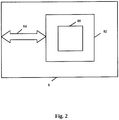
- Fig. 2 shows the model 8 of the transmission, which in the HIL simulator of Fig. 1 is provided in a block diagram with further details.
- the model 8 of the transmission is a model of a technical system that is compatible with the simulation device 2.
- the model 8 of the transmission can be executed on the simulation device 2, ie on the HIL simulator 2, as a compatible model.
- the operating system 2 of the HIL simulator 2 can address the compatible model 8 of the transmission and easily interact with it.
- Compatible Model 8 transmission contains encapsulated components as described below. Therefore, the compatible model 8 of the transmission can also be described and referred to as a compatible container unit.
- the compatible model 8 of the transmission has a model 80 of the transmission that is incompatible with the simulation device 2.
- the incompatible model 80 of the transmission is incompatible with the simulation device 2 insofar as it cannot be executed on the simulation device 2.
- the incompatible model 80 of the transmission is a precompiled model that has been compiled for an operating system other than the operating system of the simulation device 2.
- the virtual execution environment is also used as the runtime platform for the incompatible model of the technical system.
- the simulation device or the operating system of the simulation device is the target platform on which the compatible model of the technical system is addressed.
- the compatible model 8 of the transmission furthermore has a virtual execution environment 82 in which the incompatible model 80 of the transmission can be executed. From the point of view of the incompatible model 80 of the transmission, the virtual execution environment 82 behaves like hardware on which the precompiled model can be executed. However, the virtual execution environment 82 is software that emulates such compatible hardware for the incompatible model 80. This software in turn runs on the simulation device 2. For this purpose, the virtual execution environment 82 can use the resources of the simulation device, in particular the processor (s) and the memory of the simulation device.
- the compatible model 8 of the transmission also has an interface bridge 84.
- the interface bridge 84 is bidirectional.
- the interface bridge 84 is an example of a structure that enables communication between the virtual execution environment 82 and the other components of the simulation device 2, such as the model 6 of the engine and the physical interface 4.
- the interface bridge 84 connects the external interface of the virtual execution environment 82 with the internal interface of the compatible model 8 of the transmission. Communication of the compatible model 8 of the transmission to the outside is still possible via this internal interface.
- the compatible model 8 of the transmission can be created, for example, in the following manner.
- the incompatible model 80 of the transmission is provided.
- the incompatible model 80 of the transmission can be called up or loaded from a database of existing, precompiled models.
- the virtual execution environment 82 is provided. So that the incompatible model 80 of the transmission is linked to the execution environment and can be executed in this, the incompatible model 80 of the transmission can be loaded into the virtual execution environment 82 using an import tool, for example.
- the incompatible model 80 of the transmission and the virtual execution environment 82 are encapsulated in a compatible container unit which represents the compatible model 8 of the transmission.
- the interface bridge 84 is provided, which is used for the subsequent simulation Interface calls from / to outside the compatible model 8 of the transmission and interface calls to / from the incompatible model 80 of the transmission are enabled, the second-mentioned interface calls being able to be processed by the virtual execution environment 82.
- Fig. 3 illustrates the data flow in the compatible model 8 of the transmission, as it can take place, for example, during a test of a control unit, in a block diagram.
- the entirety of the blocks of the Fig. 3 shows the compatible model 8 of the transmission.
- the incompatible model 80 of the transmission consists of an output container unit in which the precompiled model is embedded.
- the output container unit is designed or organized according to the Functional Mock-up Interface Standard. According to this standard, the output container unit has an interface for interface calls and a high-level language description of the interfaces and the internal parameters of the embedded model that are important for the environment. In the example of the transmission, such an internal parameter is, for example, the gear engaged.
- the incompatible model 80 communicates via the interface of the output container unit by means of adapted interface calls 86, as will be described below.
- the aforementioned high-level description of the interfaces and parameters of the incompatible model 80 is also provided at the "front" end of the compatible model 8 of the transmission.
- This high-level language description of the interfaces and parameters is provided there with reference numeral 90.
- the compatible model 8 of the transmission is created, the high-level language description of the interfaces and parameters 90 from the output container unit, which forms the incompatible model 80 of the transmission, is copied into the compatible model 8 of the transmission. In this way, the interfaces and parameters for the other components of the simulation device 2 can be seen in a high-level description.
- the compatible model 8 of the transmission communicates with the other components of the simulation device 2 via interface calls 88.
- the interface calls 88 are such that they are compatible with the other components of the simulation device 2 and can be processed on the simulation device 2.
- the compatible model 8 of the transmission is also after the functional mock-up Interface standard trained. At its “front” end, the compatible model 8 of the transmission has the described interface for interface calls 88 and the high-level description of the interfaces and parameters 90 described.
- the interface bridge 84 is provided for the implementation of interface calls 88 and adapted interface calls 86.
- the adapted interface calls 86 are designated as adapted in order to distinguish them from the interface calls 88 and to express that they are modified with respect to the interface calls that can be processed by the simulation device 2, so that they can be processed by the incompatible model 80 of the transmission.
- the interface calls 88 can also be referred to as adapted interface calls for interface calls originating from the incompatible model 80.
- the interface bridge 84 is surrounded by a first envelope function 92 and a second envelope function 94.
- the first wrapping function 92 and the second wrapping function 94 have the task of packing or unpacking the interface calls 88 and the adapted interface calls 86 in such a way that they can be processed by the interface bridge 84 after packing in a defined format or after unpacking are in the format expected from the incompatible model 80 of the transmission or from the environment of the compatible model 8 of the transmission.
- the conversion or transformation between the interface calls 88, which can be processed by the simulation device 2 and the compatible model 8 of the transmission, and the interface calls 86, which can be processed by the incompatible model 80, takes place in the interface bridge 84.
- the flow of data is off Fig. 3 an example of how seamless interaction between the simulation device 2 and the originally incompatible model 80 of a technical system is made possible.
- the interface calls 88 and the customized interface calls 86 can be application programming interface (API) interface calls.
- the interface bridge 84 can also be viewed as a means of synchronizing the interface calls. Furthermore, an optimization of the interaction can take place in the interface bridge 84. For example, with the help of an internal buffer memory, associated interface calls can be bundled, which are then passed on to the virtual execution environment or to the simulation device for joint processing.
Landscapes
- Engineering & Computer Science (AREA)
- Theoretical Computer Science (AREA)
- Physics & Mathematics (AREA)
- Software Systems (AREA)
- General Physics & Mathematics (AREA)
- General Engineering & Computer Science (AREA)
- Computer Hardware Design (AREA)
- Evolutionary Computation (AREA)
- Geometry (AREA)
- Automation & Control Theory (AREA)
- Quality & Reliability (AREA)
- Debugging And Monitoring (AREA)
Claims (11)
- Procédé de création d'un modèle (8) d'un système technique compatible avec un dispositif de simulation (2), dans lequel le dispositif de simulation (2) est un simulateur Hardware-in-the-Loop, simulateur HIL, conçu pour le développement de dispositifs de commande, auquel un dispositif de commande (10) à tester peut être connecté, et dans lequel le modèle compatible (8) peut être exécuté sur le dispositif de simulation (2),
dans lequel le procédé comprend les étapes suivantes :(a) fournir un modèle (80) du système technique qui est incompatible avec le simulateur HIL (2), dans lequel le modèle incompatible (80) du système technique comprend un modèle précompilé du système technique et dans lequel le modèle incompatible (80) du système technique est un modèle d'environnement pour le dispositif de commande (10) à tester, dans lequel le modèle d'environnement est un modèle d'un système technique à contrôler ;(b) fournir un environnement d'exécution virtuel (82), dans lequel le modèle de système technique (80) incompatible avec le simulateur HIL (2) est exécutable dans l'environnement d'exécution virtuel (82) ; et(c) encapsuler le modèle de système technique (80) incompatible avec le simulateur HIL (2) et l'environnement d'exécution virtuel (82) dans une unité de conteneur compatible formant le modèle de système technique compatible (8), dans lequel le modèle incompatible (80) du système technique est adressable sur le simulateur HIL (2) via l'unité de conteneur compatible et l'environnement d'exécution virtuel (82), dans lequel l'unité de conteneur compatible est formée selon la norme Functional Mock-up Interface, FMI. - Procédé de la revendication 1, dans lequel l'encapsulation dans l'unité conteneur compatible comprend le couplage de l'unité conteneur compatible et de l'environnement d'exécution virtuel (82) au moyen d'un pont d'interface (84).
- Procédé selon l'une quelconque des revendications précédentes, dans lequel l'environnement d'exécution virtuel (82) comprend un système d'exploitation sur lequel le modèle (80) du système technique incompatible avec le simulateur HIL (2) est exécutable, dans lequel l'environnement d'exécution virtuel comprend de préférence en outre un processeur et/ou un support de stockage et/ou un serveur de licences local.
- Procédé de l'une quelconque des revendications précédentes, dans lequel le modèle précompilé du système d'ingénierie est intégré dans une unité de conteneur de sortie.
- Procédé de la revendication 4, dans lequel l'unité de conteneur de sortie est formée selon une norme d'interface, en particulier selon la norme Functional Mock-up Interface (FMI).
- Procédé de test d'un dispositif de commande (10) avec un simulateur de matériel dans la boucle, simulateur HIL, (2) dans lequel le dispositif de commande (10) interagit avec un modèle compatible (8) d'un système d'ingénierie présent sur le simulateur HIL (2),
le procédé comprenant les étapes suivantes :(a) exécuter le modèle compatible (8) sur le simulateur HIL (2), dans lequel le modèle compatible (8) est une unité de conteneur compatible dans laquelle un modèle (80) du système technique incompatible avec le simulateur HIL (2) et un environnement d'exécution virtuel (82) sont intégrés, dans lequel le modèle de système technique incompatible (80) comprend un modèle de système technique précompilé, et dans lequel le modèle de système technique incompatible (80) est un modèle d'environnement pour le dispositif de commande (10), le modèle d'environnement étant un modèle d'un système technique à contrôler ;(b) adressage du modèle compatible (8) par le dispositif de commande (10) avec des appels d'interface (88) dirigés vers l'unité de conteneur compatible, dans lequel l'unité de conteneur compatible est formée selon la norme Functional Mock-up Interface, FMI, et(c) convertir les appels d'interface (88) en appels d'interface personnalisés (86), dans lequel l'environnement d'exécution virtuel (82) traite le modèle incompatible (80) du système technique au moyen des appels d'interface personnalisés (86). - Procédé de la revendication 6, dans lequel l'étape (c) comprend la conversion des appels d'interface (88) en appels d'interface personnalisés (86) en utilisant un pont d'interface (84) entre l'unité de conteneur compatible et l'environnement d'exécution virtuel (82).
- Procédé de la revendication 6 ou 7, comprenant en outre les étapes suivantes:(d) adresser le dispositif de commande (10) par le modèle incompatible (80) en utilisant des seconds appels d'interface dirigés vers l'environnement d'exécution virtuel (82) ; et(e) convertir les seconds appels d'interface en seconds appels d'interface personnalisés, dans lequel l'unité de conteneur compatible adresse le dispositif de commande (10) en utilisant les seconds appels d'interface personnalisés.
- Procédé de la revendication 8, dans lequel l'étape (e) comprend la conversion des seconds appels d'interface en seconds appels d'interface personnalisés en utilisant un pont d'interface entre l'environnement d'exécution virtuel et l'unité de conteneur compatible.
- Procédé de l'une quelconque des revendications 6 à 9, dans lequel le modèle précompilé du système d'ingénierie est intégré dans une unité de conteneur de sortie.
- Unité de conteneur compatible avec un simulateur Hardware-in-the-Loop, simulateur HIL (2), dans laquelle le simulateur HIL (2) est conçu pour le développement d'unités de commande, dans laquelle un dispositif de commande (10) à tester peut être connectée au simulateur HIL (2) et dans laquelle l'unité de conteneur compatible forme un modèle compatible (8) d'un système technique qui peut être exécuté sur le simulateur HIL (2),dans lequel l'unité de conteneur compatible comprendun modèle incompatible (80) du système technique avec le simulateur HIL (2), dans lequel le modèle incompatible (80) du système technique comprend un modèle précompilé du système technique et dans lequel le modèle incompatible (80) du système technique est un modèle d'environnement pour le dispositif de commande (10), le modèle d'environnement étant un modèle d'un système technique à contrôler, etun environnement d'exécution virtuel (82) dans lequel le modèle incompatible (80) du système technique est exécutable,
dans lequel le modèle incompatible (80) du système technique est adressable sur le simulateur HIL (2) via l'unité de conteneur compatible et l'environnement d'exécution virtuel (82), dans lequel l'unité de conteneur compatible est conçue selon la norme Functional Mock-up Interface, FMI.dans lequel le modèle incompatible (80) du système technique est adressable via l'unité de conteneur compatible et l'environnement d'exécution virtuel (82) sur le simulateur HIL (2), dans lequel l'unité de conteneur compatible est formée selon la norme Functional Mock-up Interface, FMI.
Applications Claiming Priority (1)
| Application Number | Priority Date | Filing Date | Title |
|---|---|---|---|
| DE102016124623.9A DE102016124623A1 (de) | 2016-12-16 | 2016-12-16 | Verfahren zum Erstellen eines mit einem Simulationsgerät kompatiblen Modells |
Publications (2)
| Publication Number | Publication Date |
|---|---|
| EP3336730A1 EP3336730A1 (fr) | 2018-06-20 |
| EP3336730B1 true EP3336730B1 (fr) | 2021-09-22 |
Family
ID=60781462
Family Applications (1)
| Application Number | Title | Priority Date | Filing Date |
|---|---|---|---|
| EP17204564.3A Active EP3336730B1 (fr) | 2016-12-16 | 2017-11-30 | Procédé de réalisation d'un modèle compatible avec un simulateur |
Country Status (4)
| Country | Link |
|---|---|
| US (1) | US10909285B2 (fr) |
| EP (1) | EP3336730B1 (fr) |
| CN (1) | CN108205263B (fr) |
| DE (1) | DE102016124623A1 (fr) |
Families Citing this family (8)
| Publication number | Priority date | Publication date | Assignee | Title |
|---|---|---|---|---|
| DE102019111953A1 (de) * | 2019-05-08 | 2020-11-12 | Dspace Digital Signal Processing And Control Engineering Gmbh | Virtuelles Steuergerät |
| CN111367511B (zh) * | 2020-03-02 | 2023-05-23 | 北京中科宇航技术有限公司 | 一种仿真模型接口适配开发系统及其工作方法 |
| CN111767652B (zh) * | 2020-06-30 | 2023-06-23 | 北京世冠金洋科技发展有限公司 | 一种仿真运算方法、装置及电子设备 |
| CN113238491B (zh) * | 2021-04-12 | 2023-05-05 | 湖南三一智能控制设备有限公司 | 执行机构的仿真测试方法、装置、智能臂架及工程车辆 |
| CN113220309B (zh) * | 2021-04-13 | 2022-05-06 | 三峡大学 | 多语言的Modelica组件批量生成系统和方法 |
| CN115291587B (zh) * | 2022-07-18 | 2024-07-23 | 重庆长安汽车股份有限公司 | 一种基于多hil测试系统的平台化软件模型架构、汽车、计算机可读存储介质、电子设备 |
| WO2025170587A1 (fr) * | 2024-02-08 | 2025-08-14 | Siemens Industry Software Inc. | Procédé de simulation par ordinateur d'un système |
| AT528055A1 (de) * | 2024-02-29 | 2025-09-15 | Avl List Gmbh | Verfahren zum Konfigurieren und Integrieren eines Simulationsmodells aus einem Ausgangstestsystem in ein Zieltestsystem |
Family Cites Families (21)
| Publication number | Priority date | Publication date | Assignee | Title |
|---|---|---|---|---|
| JP2590267B2 (ja) * | 1989-06-30 | 1997-03-12 | 株式会社日立製作所 | 仮想計算機における表示制御方式 |
| US7680637B1 (en) * | 2003-04-16 | 2010-03-16 | The Mathworks, Inc. | Automated linearization analysis |
| DE102006000943A1 (de) * | 2006-01-07 | 2007-07-26 | Deutsche Telekom Ag | HiL-System und -Verfahren zum Testen von Steuergeräten eines Steuersystems |
| KR100686359B1 (ko) * | 2006-04-20 | 2007-02-26 | 성균관대학교산학협력단 | 이씨유 임베디드 시스템을 위한 3차원 자동차 시뮬레이터시스템 및 시뮬레이션 방법 |
| US8630829B1 (en) * | 2007-07-19 | 2014-01-14 | The Mathworks, Inc. | Computer aided design environment with electrical and electronic features |
| JP5153465B2 (ja) * | 2008-06-09 | 2013-02-27 | インターナショナル・ビジネス・マシーンズ・コーポレーション | シミュレーション方法、システム及びプログラム |
| US8868396B1 (en) * | 2009-10-23 | 2014-10-21 | Xilinx, Inc. | Verification and debugging using heterogeneous simulation models |
| US10037443B2 (en) * | 2011-03-07 | 2018-07-31 | Rockwell Automation Technologies, Inc. | Industrial simulation using redirected I/O module configurations |
| US8813051B2 (en) * | 2011-04-14 | 2014-08-19 | International Business Machines Corporation | Running multiple copies of native code in a Java Virtual Machine |
| CN102331777A (zh) * | 2011-11-09 | 2012-01-25 | 海博瑞德(北京)汽车技术有限公司 | 一种ecu硬件在环测试台及其控制方法 |
| KR20140098602A (ko) * | 2013-01-31 | 2014-08-08 | 한국전자통신연구원 | 분산 시뮬레이션 수행 시스템 및 방법 |
| EP2770434B1 (fr) * | 2013-02-21 | 2016-09-14 | dSPACE digital signal processing and control engineering GmbH | Procédé de réalisation d'un inventaire des composants matériels rattachés à un système de test d'appareils de commande |
| EP2801872B1 (fr) * | 2013-05-06 | 2018-06-06 | dSPACE digital signal processing and control engineering GmbH | Dispositif de test pour le test d'un appareil de commande virtuel |
| US10275542B2 (en) * | 2013-08-02 | 2019-04-30 | Dspace Digital Signal Processing And Control Engineering Gmbh | Configuration tool for configuring a model of a technical system |
| EP2851815A1 (fr) * | 2013-09-18 | 2015-03-25 | dSPACE digital signal processing and control engineering GmbH | Dispositif de test pour le test en temps réel d'un appareil de commande virtuel |
| CN103488098B (zh) * | 2013-09-24 | 2016-08-17 | 南京航空航天大学 | 航空发动机控制系统的快速原型仿真方法 |
| US11972177B2 (en) * | 2013-11-08 | 2024-04-30 | Rockwell Automation Technologies, Inc. | Interface for data exchange between industrial controllers and simulation applications for simulating a machine |
| EP3001313A1 (fr) | 2014-09-23 | 2016-03-30 | dSPACE digital signal processing and control engineering GmbH | Procédé de simulation d'un programme d'application d'un appareil de commande électronique sur un ordinateur |
| CN104794258A (zh) * | 2015-03-03 | 2015-07-22 | 联合汽车电子有限公司 | 汽车硬件在环仿真系统 |
| CN105159188B (zh) * | 2015-08-14 | 2018-03-02 | 广州智维电子科技有限公司 | 一种新能源整车异构网络仿真器及控制方法 |
| KR101745456B1 (ko) * | 2016-05-12 | 2017-06-09 | 아주대학교산학협력단 | HiL 시뮬레이션 환경에서 대용량 데이터를 전송하기 위한 전자제어 장치, 이를 포함하는 시스템 및 그 방법 |
-
2016
- 2016-12-16 DE DE102016124623.9A patent/DE102016124623A1/de not_active Ceased
-
2017
- 2017-11-30 EP EP17204564.3A patent/EP3336730B1/fr active Active
- 2017-12-15 CN CN201711343357.XA patent/CN108205263B/zh active Active
- 2017-12-18 US US15/845,272 patent/US10909285B2/en active Active
Also Published As
| Publication number | Publication date |
|---|---|
| US10909285B2 (en) | 2021-02-02 |
| CN108205263B (zh) | 2022-07-15 |
| EP3336730A1 (fr) | 2018-06-20 |
| DE102016124623A1 (de) | 2018-06-21 |
| US20180173831A1 (en) | 2018-06-21 |
| CN108205263A (zh) | 2018-06-26 |
Similar Documents
| Publication | Publication Date | Title |
|---|---|---|
| EP3336730B1 (fr) | Procédé de réalisation d'un modèle compatible avec un simulateur | |
| DE19781804B4 (de) | Vorrichtung zur Simulation einer Echtzeit-Prozesssteuerung | |
| EP2801872B1 (fr) | Dispositif de test pour le test d'un appareil de commande virtuel | |
| DE102005026040B4 (de) | Parametrierung eines Simulations-Arbeitsmodells | |
| EP2685382B1 (fr) | Procédé et dispositif de création et de test d'un programme d'appareil de commande | |
| EP3001313A1 (fr) | Procédé de simulation d'un programme d'application d'un appareil de commande électronique sur un ordinateur | |
| DE102016119320A1 (de) | Verfahren zum Konfigurieren eines realen oder virtuellen elektronischen Steuergerätes | |
| WO2013004389A1 (fr) | Procédé et dispositif de programmation et de configuration d'un automate programmable industriel | |
| EP3650970B1 (fr) | Procédé et dispositif de simulation assistée par ordinateur d'un système technique modulaire | |
| DE102018110020A1 (de) | Verfahren zum Erzeugen eines auf einem Testgerät ausführbaren Modells eines technischen Systems und Testgerät | |
| EP3285165A1 (fr) | Modification et simulation du logiciel d'exploitation d'un systeme technique | |
| DE102017120016A1 (de) | Verfahren zur Konfiguration eines zum Testen eines elektronischen Steuergeräts eingerichteten Testgeräts sowie Konfigurationssystem | |
| DE102018110018A1 (de) | Verfahren zum Bereitstellen eines integrierten Prozesses für die Steuergerätentwicklung und Simulationsvorrichtung für die Steuergerätentwicklung | |
| EP3306295A1 (fr) | Procédé et dispositif d'essai de commandes électroniques, en particulier d'essai de commandes automobiles | |
| DE102020123506A1 (de) | Verfahren zur Erzeugung von Quellcode mit servicebasierter Kommunikation | |
| DE102011077318A1 (de) | Simulationssystem, Verfahren zur Durchführung einer Simulation, Leitsystem und Computerprogrammprodukt | |
| DE102014219711A1 (de) | Verfahren zur Kraftwerkssimulation | |
| EP4375869A1 (fr) | Procédé de création et de fourniture d'une simulation de construction fpga d'un modèle fpga | |
| DE102018206762A1 (de) | Feature-Development-Framework und Feature-Integration-Framework zum Implementieren physikalischer Funktionsfeatures in einem Zielgerät | |
| DE102004057727A1 (de) | Engineeringsystem mit automatischer Generierung von Instanzvorlagen | |
| EP1936452A1 (fr) | Procédé et dispositif destinés au traitement dynamique d'objets d'un modèle de simulation | |
| WO2015124320A1 (fr) | Commande à programme enregistré dynamique servant à émuler un appareil de commande | |
| DE102016115314A1 (de) | Modifizieren und Simulieren der Betriebssoftware eines technischen Systems | |
| DE102004012315A1 (de) | Verfahren zur automatischen Anpassung von Software | |
| DE102022206374A1 (de) | Kooperatives steuern einer verteilten simulation |
Legal Events
| Date | Code | Title | Description |
|---|---|---|---|
| PUAI | Public reference made under article 153(3) epc to a published international application that has entered the european phase |
Free format text: ORIGINAL CODE: 0009012 |
|
| STAA | Information on the status of an ep patent application or granted ep patent |
Free format text: STATUS: THE APPLICATION HAS BEEN PUBLISHED |
|
| AK | Designated contracting states |
Kind code of ref document: A1 Designated state(s): AL AT BE BG CH CY CZ DE DK EE ES FI FR GB GR HR HU IE IS IT LI LT LU LV MC MK MT NL NO PL PT RO RS SE SI SK SM TR |
|
| AX | Request for extension of the european patent |
Extension state: BA ME |
|
| STAA | Information on the status of an ep patent application or granted ep patent |
Free format text: STATUS: REQUEST FOR EXAMINATION WAS MADE |
|
| 17P | Request for examination filed |
Effective date: 20181220 |
|
| RBV | Designated contracting states (corrected) |
Designated state(s): AL AT BE BG CH CY CZ DE DK EE ES FI FR GB GR HR HU IE IS IT LI LT LU LV MC MK MT NL NO PL PT RO RS SE SI SK SM TR |
|
| STAA | Information on the status of an ep patent application or granted ep patent |
Free format text: STATUS: EXAMINATION IS IN PROGRESS |
|
| 17Q | First examination report despatched |
Effective date: 20190827 |
|
| REG | Reference to a national code |
Ref country code: DE Ref legal event code: R079 Ref document number: 502017011551 Country of ref document: DE Free format text: PREVIOUS MAIN CLASS: G06F0017500000 Ipc: G06F0009455000 |
|
| GRAP | Despatch of communication of intention to grant a patent |
Free format text: ORIGINAL CODE: EPIDOSNIGR1 |
|
| STAA | Information on the status of an ep patent application or granted ep patent |
Free format text: STATUS: GRANT OF PATENT IS INTENDED |
|
| RIC1 | Information provided on ipc code assigned before grant |
Ipc: G06F 117/08 20200101ALN20210520BHEP Ipc: G06F 30/20 20200101ALI20210520BHEP Ipc: G05B 17/02 20060101ALI20210520BHEP Ipc: G05B 17/00 20060101ALI20210520BHEP Ipc: G06F 9/54 20060101ALI20210520BHEP Ipc: G06F 11/36 20060101ALI20210520BHEP Ipc: G06F 8/10 20180101ALI20210520BHEP Ipc: G06F 9/455 20180101AFI20210520BHEP |
|
| INTG | Intention to grant announced |
Effective date: 20210617 |
|
| GRAS | Grant fee paid |
Free format text: ORIGINAL CODE: EPIDOSNIGR3 |
|
| GRAA | (expected) grant |
Free format text: ORIGINAL CODE: 0009210 |
|
| STAA | Information on the status of an ep patent application or granted ep patent |
Free format text: STATUS: THE PATENT HAS BEEN GRANTED |
|
| AK | Designated contracting states |
Kind code of ref document: B1 Designated state(s): AL AT BE BG CH CY CZ DE DK EE ES FI FR GB GR HR HU IE IS IT LI LT LU LV MC MK MT NL NO PL PT RO RS SE SI SK SM TR |
|
| REG | Reference to a national code |
Ref country code: GB Ref legal event code: FG4D Free format text: NOT ENGLISH |
|
| REG | Reference to a national code |
Ref country code: IE Ref legal event code: FG4D Free format text: LANGUAGE OF EP DOCUMENT: GERMAN |
|
| REG | Reference to a national code |
Ref country code: DE Ref legal event code: R096 Ref document number: 502017011551 Country of ref document: DE |
|
| REG | Reference to a national code |
Ref country code: CH Ref legal event code: EP Ref country code: AT Ref legal event code: REF Ref document number: 1432854 Country of ref document: AT Kind code of ref document: T Effective date: 20211015 |
|
| REG | Reference to a national code |
Ref country code: DE Ref legal event code: R081 Ref document number: 502017011551 Country of ref document: DE Owner name: DSPACE GMBH, DE Free format text: FORMER OWNER: DSPACE DIGITAL SIGNAL PROCESSING AND CONTROL ENGINEERING GMBH, 33102 PADERBORN, DE Ref country code: LT Ref legal event code: MG9D Ref country code: DE Ref legal event code: R081 Ref document number: 502017011551 Country of ref document: DE Owner name: DSPACE SE & CO KG, DE Free format text: FORMER OWNER: DSPACE DIGITAL SIGNAL PROCESSING AND CONTROL ENGINEERING GMBH, 33102 PADERBORN, DE |
|
| RAP4 | Party data changed (patent owner data changed or rights of a patent transferred) |
Owner name: DSPACE GMBH |
|
| REG | Reference to a national code |
Ref country code: NL Ref legal event code: MP Effective date: 20210922 |
|
| PG25 | Lapsed in a contracting state [announced via postgrant information from national office to epo] |
Ref country code: BG Free format text: LAPSE BECAUSE OF FAILURE TO SUBMIT A TRANSLATION OF THE DESCRIPTION OR TO PAY THE FEE WITHIN THE PRESCRIBED TIME-LIMIT Effective date: 20211222 Ref country code: LT Free format text: LAPSE BECAUSE OF FAILURE TO SUBMIT A TRANSLATION OF THE DESCRIPTION OR TO PAY THE FEE WITHIN THE PRESCRIBED TIME-LIMIT Effective date: 20210922 Ref country code: NO Free format text: LAPSE BECAUSE OF FAILURE TO SUBMIT A TRANSLATION OF THE DESCRIPTION OR TO PAY THE FEE WITHIN THE PRESCRIBED TIME-LIMIT Effective date: 20211222 Ref country code: FI Free format text: LAPSE BECAUSE OF FAILURE TO SUBMIT A TRANSLATION OF THE DESCRIPTION OR TO PAY THE FEE WITHIN THE PRESCRIBED TIME-LIMIT Effective date: 20210922 Ref country code: SE Free format text: LAPSE BECAUSE OF FAILURE TO SUBMIT A TRANSLATION OF THE DESCRIPTION OR TO PAY THE FEE WITHIN THE PRESCRIBED TIME-LIMIT Effective date: 20210922 Ref country code: RS Free format text: LAPSE BECAUSE OF FAILURE TO SUBMIT A TRANSLATION OF THE DESCRIPTION OR TO PAY THE FEE WITHIN THE PRESCRIBED TIME-LIMIT Effective date: 20210922 Ref country code: HR Free format text: LAPSE BECAUSE OF FAILURE TO SUBMIT A TRANSLATION OF THE DESCRIPTION OR TO PAY THE FEE WITHIN THE PRESCRIBED TIME-LIMIT Effective date: 20210922 |
|
| PG25 | Lapsed in a contracting state [announced via postgrant information from national office to epo] |
Ref country code: LV Free format text: LAPSE BECAUSE OF FAILURE TO SUBMIT A TRANSLATION OF THE DESCRIPTION OR TO PAY THE FEE WITHIN THE PRESCRIBED TIME-LIMIT Effective date: 20210922 Ref country code: GR Free format text: LAPSE BECAUSE OF FAILURE TO SUBMIT A TRANSLATION OF THE DESCRIPTION OR TO PAY THE FEE WITHIN THE PRESCRIBED TIME-LIMIT Effective date: 20211223 |
|
| PG25 | Lapsed in a contracting state [announced via postgrant information from national office to epo] |
Ref country code: IS Free format text: LAPSE BECAUSE OF FAILURE TO SUBMIT A TRANSLATION OF THE DESCRIPTION OR TO PAY THE FEE WITHIN THE PRESCRIBED TIME-LIMIT Effective date: 20220122 Ref country code: SK Free format text: LAPSE BECAUSE OF FAILURE TO SUBMIT A TRANSLATION OF THE DESCRIPTION OR TO PAY THE FEE WITHIN THE PRESCRIBED TIME-LIMIT Effective date: 20210922 Ref country code: RO Free format text: LAPSE BECAUSE OF FAILURE TO SUBMIT A TRANSLATION OF THE DESCRIPTION OR TO PAY THE FEE WITHIN THE PRESCRIBED TIME-LIMIT Effective date: 20210922 Ref country code: PT Free format text: LAPSE BECAUSE OF FAILURE TO SUBMIT A TRANSLATION OF THE DESCRIPTION OR TO PAY THE FEE WITHIN THE PRESCRIBED TIME-LIMIT Effective date: 20220124 Ref country code: PL Free format text: LAPSE BECAUSE OF FAILURE TO SUBMIT A TRANSLATION OF THE DESCRIPTION OR TO PAY THE FEE WITHIN THE PRESCRIBED TIME-LIMIT Effective date: 20210922 Ref country code: NL Free format text: LAPSE BECAUSE OF FAILURE TO SUBMIT A TRANSLATION OF THE DESCRIPTION OR TO PAY THE FEE WITHIN THE PRESCRIBED TIME-LIMIT Effective date: 20210922 Ref country code: ES Free format text: LAPSE BECAUSE OF FAILURE TO SUBMIT A TRANSLATION OF THE DESCRIPTION OR TO PAY THE FEE WITHIN THE PRESCRIBED TIME-LIMIT Effective date: 20210922 Ref country code: EE Free format text: LAPSE BECAUSE OF FAILURE TO SUBMIT A TRANSLATION OF THE DESCRIPTION OR TO PAY THE FEE WITHIN THE PRESCRIBED TIME-LIMIT Effective date: 20210922 Ref country code: CZ Free format text: LAPSE BECAUSE OF FAILURE TO SUBMIT A TRANSLATION OF THE DESCRIPTION OR TO PAY THE FEE WITHIN THE PRESCRIBED TIME-LIMIT Effective date: 20210922 Ref country code: AL Free format text: LAPSE BECAUSE OF FAILURE TO SUBMIT A TRANSLATION OF THE DESCRIPTION OR TO PAY THE FEE WITHIN THE PRESCRIBED TIME-LIMIT Effective date: 20210922 |
|
| REG | Reference to a national code |
Ref country code: DE Ref legal event code: R097 Ref document number: 502017011551 Country of ref document: DE |
|
| PG25 | Lapsed in a contracting state [announced via postgrant information from national office to epo] |
Ref country code: MC Free format text: LAPSE BECAUSE OF FAILURE TO SUBMIT A TRANSLATION OF THE DESCRIPTION OR TO PAY THE FEE WITHIN THE PRESCRIBED TIME-LIMIT Effective date: 20210922 |
|
| REG | Reference to a national code |
Ref country code: CH Ref legal event code: PL |
|
| PG25 | Lapsed in a contracting state [announced via postgrant information from national office to epo] |
Ref country code: LU Free format text: LAPSE BECAUSE OF NON-PAYMENT OF DUE FEES Effective date: 20211130 Ref country code: DK Free format text: LAPSE BECAUSE OF FAILURE TO SUBMIT A TRANSLATION OF THE DESCRIPTION OR TO PAY THE FEE WITHIN THE PRESCRIBED TIME-LIMIT Effective date: 20210922 Ref country code: BE Free format text: LAPSE BECAUSE OF NON-PAYMENT OF DUE FEES Effective date: 20211130 |
|
| PLBE | No opposition filed within time limit |
Free format text: ORIGINAL CODE: 0009261 |
|
| STAA | Information on the status of an ep patent application or granted ep patent |
Free format text: STATUS: NO OPPOSITION FILED WITHIN TIME LIMIT |
|
| REG | Reference to a national code |
Ref country code: BE Ref legal event code: MM Effective date: 20211130 |
|
| GBPC | Gb: european patent ceased through non-payment of renewal fee |
Effective date: 20211222 |
|
| 26N | No opposition filed |
Effective date: 20220623 |
|
| PG25 | Lapsed in a contracting state [announced via postgrant information from national office to epo] |
Ref country code: IE Free format text: LAPSE BECAUSE OF NON-PAYMENT OF DUE FEES Effective date: 20211130 Ref country code: GB Free format text: LAPSE BECAUSE OF NON-PAYMENT OF DUE FEES Effective date: 20211222 |
|
| PG25 | Lapsed in a contracting state [announced via postgrant information from national office to epo] |
Ref country code: SI Free format text: LAPSE BECAUSE OF FAILURE TO SUBMIT A TRANSLATION OF THE DESCRIPTION OR TO PAY THE FEE WITHIN THE PRESCRIBED TIME-LIMIT Effective date: 20210922 Ref country code: FR Free format text: LAPSE BECAUSE OF NON-PAYMENT OF DUE FEES Effective date: 20211130 |
|
| PG25 | Lapsed in a contracting state [announced via postgrant information from national office to epo] |
Ref country code: IT Free format text: LAPSE BECAUSE OF FAILURE TO SUBMIT A TRANSLATION OF THE DESCRIPTION OR TO PAY THE FEE WITHIN THE PRESCRIBED TIME-LIMIT Effective date: 20210922 |
|
| PG25 | Lapsed in a contracting state [announced via postgrant information from national office to epo] |
Ref country code: HU Free format text: LAPSE BECAUSE OF FAILURE TO SUBMIT A TRANSLATION OF THE DESCRIPTION OR TO PAY THE FEE WITHIN THE PRESCRIBED TIME-LIMIT; INVALID AB INITIO Effective date: 20171130 |
|
| P01 | Opt-out of the competence of the unified patent court (upc) registered |
Effective date: 20230523 |
|
| PG25 | Lapsed in a contracting state [announced via postgrant information from national office to epo] |
Ref country code: CY Free format text: LAPSE BECAUSE OF FAILURE TO SUBMIT A TRANSLATION OF THE DESCRIPTION OR TO PAY THE FEE WITHIN THE PRESCRIBED TIME-LIMIT Effective date: 20210922 |
|
| PG25 | Lapsed in a contracting state [announced via postgrant information from national office to epo] |
Ref country code: SM Free format text: LAPSE BECAUSE OF FAILURE TO SUBMIT A TRANSLATION OF THE DESCRIPTION OR TO PAY THE FEE WITHIN THE PRESCRIBED TIME-LIMIT Effective date: 20210922 Ref country code: LI Free format text: LAPSE BECAUSE OF NON-PAYMENT OF DUE FEES Effective date: 20220630 Ref country code: CH Free format text: LAPSE BECAUSE OF NON-PAYMENT OF DUE FEES Effective date: 20220630 |
|
| REG | Reference to a national code |
Ref country code: AT Ref legal event code: MM01 Ref document number: 1432854 Country of ref document: AT Kind code of ref document: T Effective date: 20221130 |
|
| PG25 | Lapsed in a contracting state [announced via postgrant information from national office to epo] |
Ref country code: AT Free format text: LAPSE BECAUSE OF NON-PAYMENT OF DUE FEES Effective date: 20221130 |
|
| PG25 | Lapsed in a contracting state [announced via postgrant information from national office to epo] |
Ref country code: MK Free format text: LAPSE BECAUSE OF FAILURE TO SUBMIT A TRANSLATION OF THE DESCRIPTION OR TO PAY THE FEE WITHIN THE PRESCRIBED TIME-LIMIT Effective date: 20210922 |
|
| PG25 | Lapsed in a contracting state [announced via postgrant information from national office to epo] |
Ref country code: MT Free format text: LAPSE BECAUSE OF FAILURE TO SUBMIT A TRANSLATION OF THE DESCRIPTION OR TO PAY THE FEE WITHIN THE PRESCRIBED TIME-LIMIT Effective date: 20210922 |
|
| PG25 | Lapsed in a contracting state [announced via postgrant information from national office to epo] |
Ref country code: TR Free format text: LAPSE BECAUSE OF FAILURE TO SUBMIT A TRANSLATION OF THE DESCRIPTION OR TO PAY THE FEE WITHIN THE PRESCRIBED TIME-LIMIT Effective date: 20210922 |
|
| PGFP | Annual fee paid to national office [announced via postgrant information from national office to epo] |
Ref country code: DE Payment date: 20251119 Year of fee payment: 9 |
|
| REG | Reference to a national code |
Ref country code: DE Ref legal event code: R081 Ref document number: 502017011551 Country of ref document: DE Owner name: DSPACE SE & CO KG, DE Free format text: FORMER OWNER: DSPACE GMBH, 33102 PADERBORN, DE |