EP3336748B1 - Detektieren von starkregen durch zeitliches messen der unscharfe von kanten - Google Patents
Detektieren von starkregen durch zeitliches messen der unscharfe von kanten Download PDFInfo
- Publication number
- EP3336748B1 EP3336748B1 EP16465560.7A EP16465560A EP3336748B1 EP 3336748 B1 EP3336748 B1 EP 3336748B1 EP 16465560 A EP16465560 A EP 16465560A EP 3336748 B1 EP3336748 B1 EP 3336748B1
- Authority
- EP
- European Patent Office
- Prior art keywords
- images
- blur
- edges
- vehicle
- heavy rain
- Prior art date
- Legal status (The legal status is an assumption and is not a legal conclusion. Google has not performed a legal analysis and makes no representation as to the accuracy of the status listed.)
- Active
Links
Images




Classifications
-
- G—PHYSICS
- G06—COMPUTING OR CALCULATING; COUNTING
- G06V—IMAGE OR VIDEO RECOGNITION OR UNDERSTANDING
- G06V20/00—Scenes; Scene-specific elements
- G06V20/50—Context or environment of the image
- G06V20/56—Context or environment of the image exterior to a vehicle by using sensors mounted on the vehicle
-
- G—PHYSICS
- G06—COMPUTING OR CALCULATING; COUNTING
- G06T—IMAGE DATA PROCESSING OR GENERATION, IN GENERAL
- G06T7/00—Image analysis
- G06T7/40—Analysis of texture
- G06T7/41—Analysis of texture based on statistical description of texture
- G06T7/42—Analysis of texture based on statistical description of texture using transform domain methods
-
- G—PHYSICS
- G06—COMPUTING OR CALCULATING; COUNTING
- G06T—IMAGE DATA PROCESSING OR GENERATION, IN GENERAL
- G06T7/00—Image analysis
- G06T7/97—Determining parameters from multiple pictures
-
- G—PHYSICS
- G06—COMPUTING OR CALCULATING; COUNTING
- G06V—IMAGE OR VIDEO RECOGNITION OR UNDERSTANDING
- G06V10/00—Arrangements for image or video recognition or understanding
- G06V10/40—Extraction of image or video features
- G06V10/44—Local feature extraction by analysis of parts of the pattern, e.g. by detecting edges, contours, loops, corners, strokes or intersections; Connectivity analysis, e.g. of connected components
-
- G—PHYSICS
- G06—COMPUTING OR CALCULATING; COUNTING
- G06T—IMAGE DATA PROCESSING OR GENERATION, IN GENERAL
- G06T2207/00—Indexing scheme for image analysis or image enhancement
- G06T2207/10—Image acquisition modality
- G06T2207/10016—Video; Image sequence
-
- G—PHYSICS
- G06—COMPUTING OR CALCULATING; COUNTING
- G06T—IMAGE DATA PROCESSING OR GENERATION, IN GENERAL
- G06T2207/00—Indexing scheme for image analysis or image enhancement
- G06T2207/30—Subject of image; Context of image processing
- G06T2207/30248—Vehicle exterior or interior
- G06T2207/30252—Vehicle exterior; Vicinity of vehicle
Definitions
- the present invention relates to a method and a device for detecting heavy rain in images.
- the invention is used in a vehicle.
- Rain detection by means of image processing of images taken by a camera which is focused on a windshield is known. Such rain detection can be realized by looking for droplets on the windshield.
- a disadvantage of such rain detection is that the camera needs to be focused on the windshield, whereas cameras used as sensor for advanced driver assistance systems in vehicles are used to monitor the surroundings of the vehicle and are therefore focused to infinity or almost to infinity.
- WO 2006/024247 A1 discloses a method for detecting precipitation, especially rain and fog, on a windscreen, which is not based on an active illumination of the windscreen or a measurement of the reflectivity, but on a camera using a plurality of adjacent pixels for detecting an image of a target area.
- Said target area is located in the surroundings of the vehicle, and the windscreen is thus represented in a blurred manner.
- raindrops or fog on the windscreen produce a soft-focus effect in the image.
- the sharpness of the image and/or the difference in contrast of adjacent pixels is evaluated and the presence of precipitation is detected therefrom, the image is then preferably subjected to a two-dimensional Fourier transformation and the spatial frequencies are evaluated.
- a first image is recorded especially for a low contrast target area, a windscreen wiper passing over the windscreen in the visual region of the camera or a heating process is activated, and a second image is then recorded, and both images are evaluated according to changes.
- US 7860275 B2 discloses a method for detecting raindrops on a windscreen, which uses a camera, which is fitted inside the vehicle opposite the windscreen and which is focused at infinite.
- the method comprises steps of acquiring images by a camera through the windscreen, camera preferably focused at infinite, retrieving the contours of the spots present on the acquired images, and realizing the histogram of the widths of contours of the spots. It has been proven that a spot corresponding to a droplet of water on the windscreen could be distinguished from other spots (corresponding for example to an object of the landscape outside the vehicle) due to its width of contour, which may be quantified by a certain number of pixels.
- the droplets of water on a windscreen indeed present a contour, which is relatively wider than other spots. Establishing a histogram of these widths of contour makes it possible to select the contour points corresponding to the droplets, then eventually "to reconstruct" these droplets in the images by processing, in order to characterize them finally.
- DE 102011055343 A1 discloses a method for the detection of rain from an image of a camera that is partially focused on the windscreen of a vehicle.
- the method involves detecting an edge in an evaluation area of the camera image, and determining a measurement of the increase of the edge.
- the edge with a steep rise is classified as part of the potential raindrop on the disk imaged in the evaluation area.
- the span width and standard deviation of intensity values (X-1 to X-9) inside a window are evaluated with adjacent pixels for determination of the increase of edge at a pixel position (p-11 to p-45), where the pixel position lies in the center of the window.
- Nashashibi et al. present in their publication "Detection of Unfocused Raindrops on a Windscreen using Low Level Image Processing”. International Conference on Control, Automation, Robotics and Vision: ICARCV'2010 Dec 2010, Singapore, pp. 1410-1415 , a method where the camera is focused at infinity and rain is detected via image processing. The detection of rain in this publication is based on local intensity of the pixels and number of edges change when there is a drop on the windshield.
- US 2015/310304 A1 relates to a method of raindrop detection on a vehicle windshield by capturing images using a camera which is focused on the windshield.
- the problem to be solved by the present invention is to provide a method to determine the quality of an image by detecting heavy rain on a windshield of a vehicle with a camera.
- a starting point of the present invention is the idea to detect "Heavy Rain” based on the effect produced on the windshield by the combination of heavy rain and wiper movements.
- a situation in which rain is so intense, that the windshield of a vehicle is wetted in such amounts that a camera inside the vehicle (and the driver) can hardly see any objects outside the vehicle is called heavy rain.
- the control unit of the camera can output a blockage signal in order to inform the system and/or the driver that camera detection is actually blocked and driver assistance functions or automated vehicle functions requiring camera signals cannot be maintained.
- the camera is disposed behind a pane, in particular in the interior of a vehicle e.g. behind a windscreen, and is focused onto a far range that lies in front of the pane.
- the camera preferably comprises an objective for focusing and an image sensor, e.g. a CCD or CMOS sensor.
- the invention provides a reliable method to determine the quality of an image by detecting heavy rain with a vehicle camera, in particular with a driver assistance camera.
- the camera may be placed such that its field of view through the pane is wiped over by the wipers of the vehicle.
- a threshold value is used to detect a transition between images having a local minimum blur value and subsequent images having a local maximum blur value or vice versa.
- a useful threshold can be determined from a set of curves of blur values recorded in different realistic scenarios (rainy conditions). The threshold is used in order to distinguish real blur transitions from measured (recorded) noise fluctuations.
- a state of heavy rain is detected, if the number of transitions detected within a determined time period is exceeding a threshold ratio. Also this threshold ratio can be determined from a set of curves of blur values recorded in different realistic scenarios (e.g. with heavy rain, with light rain, without rain, at daytime, at nighttime).
- the area of interest represents a part of a road surface in an image.
- the area of interest that is evaluated may be chosen (or predetermined) such that usually a part of the road surface may be the content of this area within a recorded image. For example lane markings on the road surface or other vehicles on the road may then serve as objects providing edges in the image.
- the measure of blur is calculated from edges found in the area of interest.
- DE 102011055343 A1 shows that the steepness of edges can evaluated in order to detect focused objects represented by edges with a steep intensity gradient while for other objects the less focused they are the smoother the intensity gradient of their edges in the image becomes.
- a measure of blur can be defined, as blur corresponds to smoothed intensity gradients.
- Other methods to calculate blur can be used as well and as will be described herein in more detail.
- edges are found using HAAR transform.
- edges are classified as Dirac, Roof, Astep or Gstep types, as presented by Tong et al.
- the measure of blur proposed by Tong et al. takes into account the classified edges and is called "BlurExtent" or blur confident coefficient. Details of this approach will be discussed later in this description.
- a device for detecting heavy rain in images according to claim 4.
- the device is further comprising a camera configured to record the series of images and transmit the recorded images to the input unit.
- the camera is not focused on the pane (e.g. the windscreen) of the vehicle. In other words, the camera may be focused to infinity or close to infinity.
- a computer program performing the method of the present invention may be stored on a computer-readable medium.
- a computer-readable medium may be a floppy disk, a hard disk, a CD, a DVD, an USB (Universal Serial Bus) storage device, a RAM (Random Access Memory), a ROM (Read Only Memory) or an EPROM (Erasable Programmable Read Only Memory).
- a computer-readable medium may also be a data communication network, for example the Internet, which allows downloading a program code.
- DSP Digital Signal Processor
- ASIC application specific integrated circuit
- CPLD complex programmable logic device
- FPGA field programmable gate arry
- the present invention can be implemented in digital electronic circuitry or in computer hardware, firmware, software, or in combinations thereof, for instance in available hardware of conventional medical imaging devices or in new hardware dedicated for processing the methods described herein.
- Fig. 1 shows an image 1 of a camera mounted in a vehicle looking through the windscreen.
- the blur is computed in an area of interest (AOI) consisting of a part of the image.
- the area of interest (AOI) is chosen in a way that it contains a part of the surface of the road 2 in front of the vehicle. While in Fig. 1 the AOI contains two adjacent rectangles of different size, this is not necessarily the case for the purpose of the proposed method.
- the AOI could be a single rectangle, a single square or a different geometric area as well.
- Detection of blur comprises utilisation of a Haar wavelet transform.
- the Haar wavelet transform is utilised to detect blur in an area-of-interest within an image.
- the outside scene will be characterised by features that are in the absence of rain on the pane in focus and as such have sharp edges, strong gradients etc.
- a region of the image where there is rain on the pane will suffer to a certain extent "blur" or be out of focus as the rain (additional optical element) changes the focus of the camera.
- An AOI of a wetted pane will be characterised by edges that are not as sharp as the AOI of a dry pane and gradients that are not as strong as the AOI of an image recorded with a dry pane.
- the processing unit uses image processing algorithms to analyse the AOI, at an appropriate spatial scale, to determine if that the AOI is blurred or not. This determination can be called 'self contained', in that the determination can be made on the basis of the analysis of the AOI.
- edges present in the image A good way to indicate the blurriness degree is represented by the edges present in the image. Indeed, cases in which no edges may occur (examples include a dark night and / or a cloudless blue summer sky) are possible, but unlikely in a series of images recorded, especially from a camera of a driving vehicle.
- edges are of interest in order to analyze an image's blurriness. These edges are:
- an ideal image with a dry pane will have edges of types Dirac and Astep. In case of limited frequencies due to rain on the pane, they become of types b) and d) - blurry. As such an image edge analysis is used to reveal information regarding the blurriness in the area of interest within an image.
- a Haar algorithm is used to establish the blurriness of the image.
- Performing a Haar wavelet transform will result in a hierarchical pyramid like structure.
- the decomposition level in this case is 3.
- the AOI is then divided in NxN windows/tiles, each being a power of 2 (in fact this is the reason why the block's dimensions are 16x16).
- a block (which is often referred to as a tile) is considered if there is a change (an edge) in horizontal, vertical or diagonal directions. However, for each of them there is a threshold. For a specific block, if the change exceeds the threshold, the said block is considered to be an edge point.
- Changes exceeding a threshold are considered in all directions in order to compute one value for each image (the original one plus two pyramidal images). Several rules apply once these values are found. For every block labeled an edge point, if the computed value in the original image exceeds the value computed in the level 1 image and the level 1 image exceeds the level 2 image computed value, the block is a Dirac or Astep structure, otherwise it is a GStep or Roof edge. If the first level value is greater than the other two, the block is a Roof edge.
- ⁇ 0 ⁇ ⁇ ⁇ ⁇ /2 ) indicating the sharpness of the edge: the larger is ⁇ the sharper the edge is.
- a Roof- or Gstep-structure more likely to be in a blurred image it can be determined whether a Roof- or Gstep-structure more likely to be in a blurred image.
- the percentage of Roof- and Gstep-structures which are more likely to be in a blurred image is used as a measure of blur (blur extent).
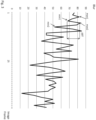
- Fig. 3 shows a measurement example of the calculated blur values on 50 consecutive images recorded with a vehicle camera.
- the graph contains several increase-decrease iterations. Local maxima and minima can be seen.
- Water in the form of raindrops or a water film on the windshield will blur the image acquired by the camera. After a wiper of the vehicle swept over the windscreen the blur will be reduced significantly.
- the blur value will increase to a local maximum and then decrease to a local minimum with a period depending on the speed of the wipers.
- a certain threshold blur value can be used to discriminate a transition between a blur and a sharp state or vice versa caused by the effect of accumulation of water on the glass pane or wiping the water off the glass pane from smaller blur changes caused by noise.
- Fig. 3 one can see a first local maximum blur value max1 at image frame number 3, followed by a local minimum blur value min1 at image frame number 5.
- a second local maximum blur value max2 exists, followed by another local minimum blur value min2 at image frame number 8.
- a suitable threshold value ⁇ BT is shown as well in Fig. 3 .
- a transition can be detected where a local maximum of the blur value exceeds a preceding local minimum of the blur value at least for the threshold value or a local minimum value goes below at least the threshold value less than the preceding local maximum value.
- the wiper speed was controlled by an additional rain sensor independent of the camera, the cycle time is not necessarily constant but may depend on the amount of rain sensed by the rain sensor.
- a next step of the method one can count how many transitions exceeding the defined threshold ratio exist during a given time interval (e.g. per minute).
- Figs. 4 and 5 show measured examples of such counted transitions per time interval over time.
- Fig. 4 shows three different curves showing the number of transitions measured during three different rain/ambient conditions: Circles: heavy rain was present, slowly changing to medium rain in the end.
- This curve shows the highest number of blur/deblur transitions per time interval. It is starting with about 40 transitions, varying between about 45 to 15 (in the end), the majority having more than 30 transitions.
- This curve varies between about 0 and 20 transitions per time interval, the majority having not more than 5 transitions. Solid line: very light rain.
- This curve shows permanently more than 0 transitions, between about 1 and 20 transitions per time interval, the majority having more than 5 transitions.
- Fig. 5 shows another three curves showing the number of transitions measured during three different rain/ambient conditions:
- This curve shows between about 0 and 10 transitions per time interval.
- This curve is starting with about 5 transitions, rapidly decreasing to 0 transitions.
- the detection depends on the road illumination, mainly provided by the headlights of the own vehicle.
- Objects that still account for transitions being objects passing through the area of interest e.g. reflective road markers, other reflecting elements or active external light sources.
- a suitable threshold ratio should be approximately between 20 and 30 transitions per time interval. While it is important to detect heavy rain in a robust way, false positive detections should be avoided, if there are only single transition rates higher than the threshold rate. Therefore, it might be helpful to use a threshold ratio of 25 or even 30 transitions per time interval. Otherwise camera based driver assistance functions could be turned off already in light or medium rain situations.
- a computer program or computer program element is provided that is characterized by being configured to execute the method steps of the method according to one of the preceding embodiments, on an appropriate system.
- the computer program element might therefore be stored on a computer unit, which might also be part of an embodiment.
- This computing unit may be configured to perform or induce performing of the steps of the method described above. Moreover, it may be configured to operate the components of the above described apparatus and/or system.
- the computing unit can be configured to operate automatically and/or to execute the orders of a user.
- a computer program may be loaded into a working memory of a data processor. The data processor may thus be equipped to carry out the method according to one of the preceding embodiments.
- a computer readable medium such as a CD-ROM
- the computer readable medium has a computer program element stored on it which computer program element is described by the preceding section.
Landscapes
- Engineering & Computer Science (AREA)
- Physics & Mathematics (AREA)
- General Physics & Mathematics (AREA)
- Theoretical Computer Science (AREA)
- Computer Vision & Pattern Recognition (AREA)
- Multimedia (AREA)
- Probability & Statistics with Applications (AREA)
- Image Analysis (AREA)
- Image Processing (AREA)
Claims (5)
- Verfahren zum Erkennen von starkem Regen in Bildern (1), umfassend:a) Bereitstellen einer Reihe von Bildern (1) als Eingangsinformationen, wobei die Bilder (1) eine Szene außerhalb eines Fahrzeugs betreffen, die durch eine Scheibe des Fahrzeugs betrachtet und unter Verwendung einer Kamera erfasst wird, die in weite Entfernung fokussiert ist, die vor der Scheibe des Fahrzeugs liegt;b) Auswerten eines Maßes für Verschwommenheit in einem interessierenden Bereich AOI in den Bildern (1), wobei der AOI einen Teil einer Oberfläche einer Straße (2) vor dem Fahrzeug enthält, wobei das Maß für Verschwommenheit aus in dem interessierenden Bereich gefundenen Rändern berechnet wird, wobei die Ränder unter Verwendung von HAAR-Wavelettransformation gefunden werden und wobei ein Prozentsatz von Roof- und Gstep-Rändern als ein Maß für Verschwommenheit genommen wird;c) Erkennen von Übergängen zwischen Bildern (1) mit niedrigen Verschwommenheitswerten und Bildern (1) mit hohen Verschwommenheitswerten oder umgekehrt durch Analysieren des Verlaufs der gemessenen Verschwommenheitswerte über die Zeit hinweg;d) Erkennen von starkem Regen aus den detektierten Übergängen, wobei ein Zustand starken Regens erkannt wird, wenn die Anzahl der innerhalb eines bestimmten Zeitraums detektierten Übergänge ein Schwellenverhältnis übersteigt; unde) Bereitstellen einer Ausgangsinformation, falls starker Regen erkannt wird.
- Verfahren nach Anspruch 1 wobei in Schritt c) ein Schwellwert verwendet wird, um einen Übergang zwischen Bildern mit einem Lokal-Minimum-Verschwommenheitswert und nachfolgenden Bildern (1) mit einem Lokal-Maximum-Verschwommenheitswert oder umgekehrt zu erkennen.
- Verfahren nach Anspruch 1, wobei Ränder als die Typen Dirac, Roof, Astep oder Gstep klassifiziert werden.
- Vorrichtung zum Erkennen von starkem Regen in Bildern (1), umfassend:- eine Eingangseinheit;- eine Verarbeitungseinheit; und- eine Ausgangseinheit;wobei die Eingangseinheit dafür ausgelegt ist, der Verarbeitungseinheit eine Reihe von Bildern (1) bereitzustellen, wobei die Bilder eine Szene außerhalb eines Fahrzeugs betreffen, die durch eine Scheibe des Fahrzeugs betrachtet und unter Verwendung einer Kamera erfasst wird, die in weite Entfernung fokussiert ist, die vor der Scheibe des Fahrzeugs liegt;wobei die Verarbeitungseinheit ausgelegt ist zum Messen von Verschwommenheit in einem interessierenden Bereich AOI in den Bildern (1), wobei der AOI einen Teil einer Oberfläche einer Straße (2) vor dem Fahrzeug enthält, wobei das Maß für Verschwommenheit aus in dem interessierenden Bereich gefundenen Rändern berechnet wird, wobei die Ränder unter Verwendung von HAAR-Wavelettransformation gefunden werden und wobei ein Prozentsatz von Roof- und Gstep-Rändern als ein Maß für Verschwommenheit genommen wird;Erkennen von Übergängen zwischen Bildern (1) mit niedrigen Verschwommenheitswerten und Bildern (1) mit hohen Verschwommenheitswerten oder umgekehrt durch Analysieren des Verlaufs der gemessenen Verschwommenheitswerte über die Zeit hinweg;Erkennen von starkem Regen aus den detektierten Übergängen, wobei ein Zustand starken Regens erkannt wird, wenn die Anzahl der innerhalb eines bestimmten Zeitraums detektierten Übergänge ein Schwellenverhältnis übersteigt; undwobei die Ausgangseinheit ausgelegt ist zum Bereitstellen einer Information, falls starker Regen erkannt wird.
- Vorrichtung nach Anspruch 4, die ferner eine Kamera umfasst, die dafür ausgelegt ist, die Reihen von Bildern (1) aufzuzeichnen und die aufgezeichneten Bilder (1) zu der Eingangseinheit zu senden.
Priority Applications (2)
| Application Number | Priority Date | Filing Date | Title |
|---|---|---|---|
| EP16465560.7A EP3336748B1 (de) | 2016-12-13 | 2016-12-13 | Detektieren von starkregen durch zeitliches messen der unscharfe von kanten |
| US15/834,500 US10650250B2 (en) | 2016-12-13 | 2017-12-07 | Determination of low image quality of a vehicle camera caused by heavy rain |
Applications Claiming Priority (1)
| Application Number | Priority Date | Filing Date | Title |
|---|---|---|---|
| EP16465560.7A EP3336748B1 (de) | 2016-12-13 | 2016-12-13 | Detektieren von starkregen durch zeitliches messen der unscharfe von kanten |
Publications (2)
| Publication Number | Publication Date |
|---|---|
| EP3336748A1 EP3336748A1 (de) | 2018-06-20 |
| EP3336748B1 true EP3336748B1 (de) | 2023-02-08 |
Family
ID=57749812
Family Applications (1)
| Application Number | Title | Priority Date | Filing Date |
|---|---|---|---|
| EP16465560.7A Active EP3336748B1 (de) | 2016-12-13 | 2016-12-13 | Detektieren von starkregen durch zeitliches messen der unscharfe von kanten |
Country Status (2)
| Country | Link |
|---|---|
| US (1) | US10650250B2 (de) |
| EP (1) | EP3336748B1 (de) |
Families Citing this family (2)
| Publication number | Priority date | Publication date | Assignee | Title |
|---|---|---|---|---|
| CN112466124A (zh) * | 2020-11-30 | 2021-03-09 | 重庆长安汽车股份有限公司 | 前视摄像头使用场景优化方法、系统、车辆及存储介质 |
| US11310464B1 (en) * | 2021-01-24 | 2022-04-19 | Dell Products, Lp | System and method for seviceability during execution of a video conferencing application using intelligent contextual session management |
Family Cites Families (9)
| Publication number | Priority date | Publication date | Assignee | Title |
|---|---|---|---|---|
| US332265A (en) * | 1885-12-15 | Eudolph w | ||
| WO2006024247A1 (de) | 2004-09-03 | 2006-03-09 | Adc Automotive Distance Control Systems Gmbh | Verfahren zur detektion von niederschlag auf einer scheibe |
| FR2901218B1 (fr) | 2006-05-22 | 2009-02-13 | Valeo Vision Sa | Procede de detection de pluie sur un parebrise |
| US9230189B2 (en) * | 2010-03-04 | 2016-01-05 | Valeo Schalter Und Sensoren Gmbh | Method of raindrop detection on a vehicle windscreen and driving assistance device |
| DE102011055343A1 (de) | 2011-11-15 | 2013-05-16 | Continental Automotive Gmbh | Verfahren zur Regendetektion mittels einer Kamera |
| US9113143B2 (en) * | 2012-06-29 | 2015-08-18 | Behavioral Recognition Systems, Inc. | Detecting and responding to an out-of-focus camera in a video analytics system |
| WO2014104183A1 (ja) * | 2012-12-26 | 2014-07-03 | 株式会社日本自動車部品総合研究所 | 境界線認識装置及び分岐路判定装置 |
| KR102366402B1 (ko) * | 2015-05-21 | 2022-02-22 | 엘지전자 주식회사 | 운전자 보조 장치 및 그 제어방법 |
| US9602762B2 (en) * | 2015-06-12 | 2017-03-21 | Sharp Laboratories Of America, Inc. | Fallback in frame rate conversion system |
-
2016
- 2016-12-13 EP EP16465560.7A patent/EP3336748B1/de active Active
-
2017
- 2017-12-07 US US15/834,500 patent/US10650250B2/en active Active
Also Published As
| Publication number | Publication date |
|---|---|
| US10650250B2 (en) | 2020-05-12 |
| US20180165523A1 (en) | 2018-06-14 |
| EP3336748A1 (de) | 2018-06-20 |
Similar Documents
| Publication | Publication Date | Title |
|---|---|---|
| CN109840911B (zh) | 确定干净或脏污的拍摄图像的方法、系统和计算机可读存储介质 | |
| US9205810B2 (en) | Method of fog and raindrop detection on a windscreen and driving assistance device | |
| JP6117634B2 (ja) | レンズ付着物検知装置、レンズ付着物検知方法、および、車両システム | |
| US9616851B2 (en) | Method and apparatus for recognizing directional structures on a window pane of a vehicle | |
| US8797417B2 (en) | Image restoration method in computer vision system, including method and apparatus for identifying raindrops on a windshield | |
| JP2005515565A (ja) | 画像センサシステムにおける視界妨害物の識別方法および識別装置 | |
| CN110544211A (zh) | 一种镜头付着物的检测方法、系统、终端和存储介质 | |
| US20140241589A1 (en) | Method and apparatus for the detection of visibility impairment of a pane | |
| KR102521656B1 (ko) | 객체를 인식하는 방법 및 장치 | |
| CN104823214A (zh) | 车载图像处理装置 | |
| US11514595B2 (en) | Depth acquisition device and depth acquisition method including estimating a depth of a dust region based on a visible light image | |
| CN110427026B (zh) | 一种轮胎道路摩擦的确定方法及装置 | |
| JP2011174794A (ja) | 路面状態検出装置及び方法 | |
| KR100818317B1 (ko) | 차영상을 이용한 이동 차량 인식 방법 | |
| CN104512329B (zh) | 倒车安全辅助方法、装置及汽车 | |
| EP3336748B1 (de) | Detektieren von starkregen durch zeitliches messen der unscharfe von kanten | |
| EP3336747A1 (de) | Regendetektion mit einer kamera | |
| Hamzeh et al. | Effect of adherent rain on vision-based object detection algorithms | |
| US9230189B2 (en) | Method of raindrop detection on a vehicle windscreen and driving assistance device | |
| JP4887540B2 (ja) | 車両周辺監視装置、車両、車両周辺監視用プログラム、車両周辺監視方法 | |
| JP2020109595A (ja) | 付着物検出装置および付着物検出方法 | |
| US20180061008A1 (en) | Imaging system and method | |
| Yeo et al. | Seeing through the rain: An empirical assessment of short-wave infrared imaging on enhancing autonomous vehicle perception under rainy weather | |
| CN117094900A (zh) | 车辆及控制车辆的方法 | |
| EP3306522A1 (de) | Vorrichtung zur bestimmung eines interessierenden bereiches auf und/oder in einer fahrzeugscheibe |
Legal Events
| Date | Code | Title | Description |
|---|---|---|---|
| PUAI | Public reference made under article 153(3) epc to a published international application that has entered the european phase |
Free format text: ORIGINAL CODE: 0009012 |
|
| STAA | Information on the status of an ep patent application or granted ep patent |
Free format text: STATUS: THE APPLICATION HAS BEEN PUBLISHED |
|
| AK | Designated contracting states |
Kind code of ref document: A1 Designated state(s): AL AT BE BG CH CY CZ DE DK EE ES FI FR GB GR HR HU IE IS IT LI LT LU LV MC MK MT NL NO PL PT RO RS SE SI SK SM TR |
|
| AX | Request for extension of the european patent |
Extension state: BA ME |
|
| STAA | Information on the status of an ep patent application or granted ep patent |
Free format text: STATUS: REQUEST FOR EXAMINATION WAS MADE |
|
| 17P | Request for examination filed |
Effective date: 20181220 |
|
| RBV | Designated contracting states (corrected) |
Designated state(s): AL AT BE BG CH CY CZ DE DK EE ES FI FR GB GR HR HU IE IS IT LI LT LU LV MC MK MT NL NO PL PT RO RS SE SI SK SM TR |
|
| STAA | Information on the status of an ep patent application or granted ep patent |
Free format text: STATUS: EXAMINATION IS IN PROGRESS |
|
| 17Q | First examination report despatched |
Effective date: 20190715 |
|
| RAP1 | Party data changed (applicant data changed or rights of an application transferred) |
Owner name: CONTINENTAL AUTOMOTIVE GMBH |
|
| RAP1 | Party data changed (applicant data changed or rights of an application transferred) |
Owner name: CONTINENTAL AUTONOMOUS MOBILITY GERMANY GMBH |
|
| REG | Reference to a national code |
Ref country code: DE Ref legal event code: R079 Ref document number: 602016077766 Country of ref document: DE Free format text: PREVIOUS MAIN CLASS: G06K0009000000 Ipc: G06V0010440000 |
|
| GRAP | Despatch of communication of intention to grant a patent |
Free format text: ORIGINAL CODE: EPIDOSNIGR1 |
|
| STAA | Information on the status of an ep patent application or granted ep patent |
Free format text: STATUS: GRANT OF PATENT IS INTENDED |
|
| RIC1 | Information provided on ipc code assigned before grant |
Ipc: G06V 20/56 20220101ALI20220906BHEP Ipc: G06V 10/44 20220101AFI20220906BHEP |
|
| INTG | Intention to grant announced |
Effective date: 20220927 |
|
| GRAS | Grant fee paid |
Free format text: ORIGINAL CODE: EPIDOSNIGR3 |
|
| GRAA | (expected) grant |
Free format text: ORIGINAL CODE: 0009210 |
|
| STAA | Information on the status of an ep patent application or granted ep patent |
Free format text: STATUS: THE PATENT HAS BEEN GRANTED |
|
| AK | Designated contracting states |
Kind code of ref document: B1 Designated state(s): AL AT BE BG CH CY CZ DE DK EE ES FI FR GB GR HR HU IE IS IT LI LT LU LV MC MK MT NL NO PL PT RO RS SE SI SK SM TR |
|
| REG | Reference to a national code |
Ref country code: GB Ref legal event code: FG4D |
|
| REG | Reference to a national code |
Ref country code: CH Ref legal event code: EP Ref country code: AT Ref legal event code: REF Ref document number: 1547636 Country of ref document: AT Kind code of ref document: T Effective date: 20230215 |
|
| REG | Reference to a national code |
Ref country code: DE Ref legal event code: R096 Ref document number: 602016077766 Country of ref document: DE |
|
| REG | Reference to a national code |
Ref country code: IE Ref legal event code: FG4D |
|
| REG | Reference to a national code |
Ref country code: SE Ref legal event code: TRGR |
|
| REG | Reference to a national code |
Ref country code: LT Ref legal event code: MG9D |
|
| REG | Reference to a national code |
Ref country code: NL Ref legal event code: MP Effective date: 20230208 |
|
| REG | Reference to a national code |
Ref country code: AT Ref legal event code: MK05 Ref document number: 1547636 Country of ref document: AT Kind code of ref document: T Effective date: 20230208 |
|
| PG25 | Lapsed in a contracting state [announced via postgrant information from national office to epo] |
Ref country code: RS Free format text: LAPSE BECAUSE OF FAILURE TO SUBMIT A TRANSLATION OF THE DESCRIPTION OR TO PAY THE FEE WITHIN THE PRESCRIBED TIME-LIMIT Effective date: 20230208 Ref country code: PT Free format text: LAPSE BECAUSE OF FAILURE TO SUBMIT A TRANSLATION OF THE DESCRIPTION OR TO PAY THE FEE WITHIN THE PRESCRIBED TIME-LIMIT Effective date: 20230609 Ref country code: NO Free format text: LAPSE BECAUSE OF FAILURE TO SUBMIT A TRANSLATION OF THE DESCRIPTION OR TO PAY THE FEE WITHIN THE PRESCRIBED TIME-LIMIT Effective date: 20230508 Ref country code: NL Free format text: LAPSE BECAUSE OF FAILURE TO SUBMIT A TRANSLATION OF THE DESCRIPTION OR TO PAY THE FEE WITHIN THE PRESCRIBED TIME-LIMIT Effective date: 20230208 Ref country code: LV Free format text: LAPSE BECAUSE OF FAILURE TO SUBMIT A TRANSLATION OF THE DESCRIPTION OR TO PAY THE FEE WITHIN THE PRESCRIBED TIME-LIMIT Effective date: 20230208 Ref country code: LT Free format text: LAPSE BECAUSE OF FAILURE TO SUBMIT A TRANSLATION OF THE DESCRIPTION OR TO PAY THE FEE WITHIN THE PRESCRIBED TIME-LIMIT Effective date: 20230208 Ref country code: HR Free format text: LAPSE BECAUSE OF FAILURE TO SUBMIT A TRANSLATION OF THE DESCRIPTION OR TO PAY THE FEE WITHIN THE PRESCRIBED TIME-LIMIT Effective date: 20230208 Ref country code: ES Free format text: LAPSE BECAUSE OF FAILURE TO SUBMIT A TRANSLATION OF THE DESCRIPTION OR TO PAY THE FEE WITHIN THE PRESCRIBED TIME-LIMIT Effective date: 20230208 Ref country code: AT Free format text: LAPSE BECAUSE OF FAILURE TO SUBMIT A TRANSLATION OF THE DESCRIPTION OR TO PAY THE FEE WITHIN THE PRESCRIBED TIME-LIMIT Effective date: 20230208 |
|
| PG25 | Lapsed in a contracting state [announced via postgrant information from national office to epo] |
Ref country code: PL Free format text: LAPSE BECAUSE OF FAILURE TO SUBMIT A TRANSLATION OF THE DESCRIPTION OR TO PAY THE FEE WITHIN THE PRESCRIBED TIME-LIMIT Effective date: 20230208 Ref country code: IS Free format text: LAPSE BECAUSE OF FAILURE TO SUBMIT A TRANSLATION OF THE DESCRIPTION OR TO PAY THE FEE WITHIN THE PRESCRIBED TIME-LIMIT Effective date: 20230608 Ref country code: GR Free format text: LAPSE BECAUSE OF FAILURE TO SUBMIT A TRANSLATION OF THE DESCRIPTION OR TO PAY THE FEE WITHIN THE PRESCRIBED TIME-LIMIT Effective date: 20230509 Ref country code: FI Free format text: LAPSE BECAUSE OF FAILURE TO SUBMIT A TRANSLATION OF THE DESCRIPTION OR TO PAY THE FEE WITHIN THE PRESCRIBED TIME-LIMIT Effective date: 20230208 |
|
| PG25 | Lapsed in a contracting state [announced via postgrant information from national office to epo] |
Ref country code: SM Free format text: LAPSE BECAUSE OF FAILURE TO SUBMIT A TRANSLATION OF THE DESCRIPTION OR TO PAY THE FEE WITHIN THE PRESCRIBED TIME-LIMIT Effective date: 20230208 Ref country code: RO Free format text: LAPSE BECAUSE OF FAILURE TO SUBMIT A TRANSLATION OF THE DESCRIPTION OR TO PAY THE FEE WITHIN THE PRESCRIBED TIME-LIMIT Effective date: 20230208 Ref country code: EE Free format text: LAPSE BECAUSE OF FAILURE TO SUBMIT A TRANSLATION OF THE DESCRIPTION OR TO PAY THE FEE WITHIN THE PRESCRIBED TIME-LIMIT Effective date: 20230208 Ref country code: DK Free format text: LAPSE BECAUSE OF FAILURE TO SUBMIT A TRANSLATION OF THE DESCRIPTION OR TO PAY THE FEE WITHIN THE PRESCRIBED TIME-LIMIT Effective date: 20230208 Ref country code: CZ Free format text: LAPSE BECAUSE OF FAILURE TO SUBMIT A TRANSLATION OF THE DESCRIPTION OR TO PAY THE FEE WITHIN THE PRESCRIBED TIME-LIMIT Effective date: 20230208 |
|
| REG | Reference to a national code |
Ref country code: DE Ref legal event code: R097 Ref document number: 602016077766 Country of ref document: DE |
|
| PG25 | Lapsed in a contracting state [announced via postgrant information from national office to epo] |
Ref country code: SK Free format text: LAPSE BECAUSE OF FAILURE TO SUBMIT A TRANSLATION OF THE DESCRIPTION OR TO PAY THE FEE WITHIN THE PRESCRIBED TIME-LIMIT Effective date: 20230208 |
|
| PLBE | No opposition filed within time limit |
Free format text: ORIGINAL CODE: 0009261 |
|
| STAA | Information on the status of an ep patent application or granted ep patent |
Free format text: STATUS: NO OPPOSITION FILED WITHIN TIME LIMIT |
|
| 26N | No opposition filed |
Effective date: 20231109 |
|
| PG25 | Lapsed in a contracting state [announced via postgrant information from national office to epo] |
Ref country code: SI Free format text: LAPSE BECAUSE OF FAILURE TO SUBMIT A TRANSLATION OF THE DESCRIPTION OR TO PAY THE FEE WITHIN THE PRESCRIBED TIME-LIMIT Effective date: 20230208 |
|
| PG25 | Lapsed in a contracting state [announced via postgrant information from national office to epo] |
Ref country code: IT Free format text: LAPSE BECAUSE OF FAILURE TO SUBMIT A TRANSLATION OF THE DESCRIPTION OR TO PAY THE FEE WITHIN THE PRESCRIBED TIME-LIMIT Effective date: 20230208 |
|
| REG | Reference to a national code |
Ref country code: CH Ref legal event code: PL |
|
| PG25 | Lapsed in a contracting state [announced via postgrant information from national office to epo] |
Ref country code: LU Free format text: LAPSE BECAUSE OF NON-PAYMENT OF DUE FEES Effective date: 20231213 |
|
| PG25 | Lapsed in a contracting state [announced via postgrant information from national office to epo] |
Ref country code: MC Free format text: LAPSE BECAUSE OF FAILURE TO SUBMIT A TRANSLATION OF THE DESCRIPTION OR TO PAY THE FEE WITHIN THE PRESCRIBED TIME-LIMIT Effective date: 20230208 |
|
| GBPC | Gb: european patent ceased through non-payment of renewal fee |
Effective date: 20231213 |
|
| REG | Reference to a national code |
Ref country code: BE Ref legal event code: MM Effective date: 20231231 |
|
| PG25 | Lapsed in a contracting state [announced via postgrant information from national office to epo] |
Ref country code: MC Free format text: LAPSE BECAUSE OF FAILURE TO SUBMIT A TRANSLATION OF THE DESCRIPTION OR TO PAY THE FEE WITHIN THE PRESCRIBED TIME-LIMIT Effective date: 20230208 Ref country code: LU Free format text: LAPSE BECAUSE OF NON-PAYMENT OF DUE FEES Effective date: 20231213 |
|
| REG | Reference to a national code |
Ref country code: IE Ref legal event code: MM4A |
|
| PG25 | Lapsed in a contracting state [announced via postgrant information from national office to epo] |
Ref country code: IE Free format text: LAPSE BECAUSE OF NON-PAYMENT OF DUE FEES Effective date: 20231213 |
|
| PG25 | Lapsed in a contracting state [announced via postgrant information from national office to epo] |
Ref country code: GB Free format text: LAPSE BECAUSE OF NON-PAYMENT OF DUE FEES Effective date: 20231213 |
|
| PG25 | Lapsed in a contracting state [announced via postgrant information from national office to epo] |
Ref country code: BE Free format text: LAPSE BECAUSE OF NON-PAYMENT OF DUE FEES Effective date: 20231231 |
|
| PG25 | Lapsed in a contracting state [announced via postgrant information from national office to epo] |
Ref country code: CH Free format text: LAPSE BECAUSE OF NON-PAYMENT OF DUE FEES Effective date: 20231231 |
|
| PG25 | Lapsed in a contracting state [announced via postgrant information from national office to epo] |
Ref country code: IE Free format text: LAPSE BECAUSE OF NON-PAYMENT OF DUE FEES Effective date: 20231213 Ref country code: GB Free format text: LAPSE BECAUSE OF NON-PAYMENT OF DUE FEES Effective date: 20231213 Ref country code: CH Free format text: LAPSE BECAUSE OF NON-PAYMENT OF DUE FEES Effective date: 20231231 Ref country code: BE Free format text: LAPSE BECAUSE OF NON-PAYMENT OF DUE FEES Effective date: 20231231 |
|
| PG25 | Lapsed in a contracting state [announced via postgrant information from national office to epo] |
Ref country code: BG Free format text: LAPSE BECAUSE OF FAILURE TO SUBMIT A TRANSLATION OF THE DESCRIPTION OR TO PAY THE FEE WITHIN THE PRESCRIBED TIME-LIMIT Effective date: 20230208 |
|
| PG25 | Lapsed in a contracting state [announced via postgrant information from national office to epo] |
Ref country code: BG Free format text: LAPSE BECAUSE OF FAILURE TO SUBMIT A TRANSLATION OF THE DESCRIPTION OR TO PAY THE FEE WITHIN THE PRESCRIBED TIME-LIMIT Effective date: 20230208 |
|
| REG | Reference to a national code |
Ref country code: DE Ref legal event code: R081 Ref document number: 602016077766 Country of ref document: DE Owner name: AUMOVIO AUTONOMOUS MOBILITY GERMANY GMBH, DE Free format text: FORMER OWNER: CONTINENTAL AUTONOMOUS MOBILITY GERMANY GMBH, 85057 INGOLSTADT, DE |
|
| PG25 | Lapsed in a contracting state [announced via postgrant information from national office to epo] |
Ref country code: CY Free format text: LAPSE BECAUSE OF FAILURE TO SUBMIT A TRANSLATION OF THE DESCRIPTION OR TO PAY THE FEE WITHIN THE PRESCRIBED TIME-LIMIT; INVALID AB INITIO Effective date: 20161213 |
|
| PG25 | Lapsed in a contracting state [announced via postgrant information from national office to epo] |
Ref country code: HU Free format text: LAPSE BECAUSE OF FAILURE TO SUBMIT A TRANSLATION OF THE DESCRIPTION OR TO PAY THE FEE WITHIN THE PRESCRIBED TIME-LIMIT; INVALID AB INITIO Effective date: 20161213 |
|
| PG25 | Lapsed in a contracting state [announced via postgrant information from national office to epo] |
Ref country code: TR Free format text: LAPSE BECAUSE OF FAILURE TO SUBMIT A TRANSLATION OF THE DESCRIPTION OR TO PAY THE FEE WITHIN THE PRESCRIBED TIME-LIMIT Effective date: 20230208 |
|
| PGFP | Annual fee paid to national office [announced via postgrant information from national office to epo] |
Ref country code: FR Payment date: 20251223 Year of fee payment: 10 |
|
| PGFP | Annual fee paid to national office [announced via postgrant information from national office to epo] |
Ref country code: SE Payment date: 20251222 Year of fee payment: 10 |
|
| PGFP | Annual fee paid to national office [announced via postgrant information from national office to epo] |
Ref country code: DE Payment date: 20251231 Year of fee payment: 10 |