EP3336835A1 - Melodiebass-a-system - Google Patents
Melodiebass-a-system Download PDFInfo
- Publication number
- EP3336835A1 EP3336835A1 EP17207446.0A EP17207446A EP3336835A1 EP 3336835 A1 EP3336835 A1 EP 3336835A1 EP 17207446 A EP17207446 A EP 17207446A EP 3336835 A1 EP3336835 A1 EP 3336835A1
- Authority
- EP
- European Patent Office
- Prior art keywords
- column
- note
- columns
- buttons
- pattern
- Prior art date
- Legal status (The legal status is an assumption and is not a legal conclusion. Google has not performed a legal analysis and makes no representation as to the accuracy of the status listed.)
- Granted
Links
Images








Classifications
-
- G—PHYSICS
- G10—MUSICAL INSTRUMENTS; ACOUSTICS
- G10H—ELECTROPHONIC MUSICAL INSTRUMENTS; INSTRUMENTS IN WHICH THE TONES ARE GENERATED BY ELECTROMECHANICAL MEANS OR ELECTRONIC GENERATORS, OR IN WHICH THE TONES ARE SYNTHESISED FROM A DATA STORE
- G10H1/00—Details of electrophonic musical instruments
- G10H1/32—Constructional details
- G10H1/34—Switch arrangements, e.g. keyboards or mechanical switches specially adapted for electrophonic musical instruments
-
- G—PHYSICS
- G10—MUSICAL INSTRUMENTS; ACOUSTICS
- G10D—STRINGED MUSICAL INSTRUMENTS; WIND MUSICAL INSTRUMENTS; ACCORDIONS OR CONCERTINAS; PERCUSSION MUSICAL INSTRUMENTS; AEOLIAN HARPS; SINGING-FLAME MUSICAL INSTRUMENTS; MUSICAL INSTRUMENTS NOT OTHERWISE PROVIDED FOR
- G10D11/00—Accordions, concertinas or the like; Keyboards therefor
-
- G—PHYSICS
- G10—MUSICAL INSTRUMENTS; ACOUSTICS
- G10H—ELECTROPHONIC MUSICAL INSTRUMENTS; INSTRUMENTS IN WHICH THE TONES ARE GENERATED BY ELECTROMECHANICAL MEANS OR ELECTRONIC GENERATORS, OR IN WHICH THE TONES ARE SYNTHESISED FROM A DATA STORE
- G10H1/00—Details of electrophonic musical instruments
- G10H1/32—Constructional details
- G10H1/34—Switch arrangements, e.g. keyboards or mechanical switches specially adapted for electrophonic musical instruments
- G10H1/344—Structural association with individual keys
-
- G—PHYSICS
- G10—MUSICAL INSTRUMENTS; ACOUSTICS
- G10H—ELECTROPHONIC MUSICAL INSTRUMENTS; INSTRUMENTS IN WHICH THE TONES ARE GENERATED BY ELECTROMECHANICAL MEANS OR ELECTRONIC GENERATORS, OR IN WHICH THE TONES ARE SYNTHESISED FROM A DATA STORE
- G10H2210/00—Aspects or methods of musical processing having intrinsic musical character, i.e. involving musical theory or musical parameters or relying on musical knowledge, as applied in electrophonic musical tools or instruments
- G10H2210/571—Chords; Chord sequences
-
- G—PHYSICS
- G10—MUSICAL INSTRUMENTS; ACOUSTICS
- G10H—ELECTROPHONIC MUSICAL INSTRUMENTS; INSTRUMENTS IN WHICH THE TONES ARE GENERATED BY ELECTROMECHANICAL MEANS OR ELECTRONIC GENERATORS, OR IN WHICH THE TONES ARE SYNTHESISED FROM A DATA STORE
- G10H2220/00—Input/output interfacing specifically adapted for electrophonic musical tools or instruments
- G10H2220/155—User input interfaces for electrophonic musical instruments
- G10H2220/221—Keyboards, i.e. configuration of several keys or key-like input devices relative to one another
- G10H2220/231—Alphanumeric, used for musical purposes or with additional musical features, e.g. typewriter or pc-type keyboard reconfigured such that letters or symbols are assigned to musical notes
-
- G—PHYSICS
- G10—MUSICAL INSTRUMENTS; ACOUSTICS
- G10H—ELECTROPHONIC MUSICAL INSTRUMENTS; INSTRUMENTS IN WHICH THE TONES ARE GENERATED BY ELECTROMECHANICAL MEANS OR ELECTRONIC GENERATORS, OR IN WHICH THE TONES ARE SYNTHESISED FROM A DATA STORE
- G10H2220/00—Input/output interfacing specifically adapted for electrophonic musical tools or instruments
- G10H2220/155—User input interfaces for electrophonic musical instruments
- G10H2220/221—Keyboards, i.e. configuration of several keys or key-like input devices relative to one another
- G10H2220/251—Keyboards, i.e. configuration of several keys or key-like input devices relative to one another arranged as 2D or 3D arrays; Keyboards ergonomically organised for playing chords or for transposing, e.g. Janko keyboard
-
- G—PHYSICS
- G10—MUSICAL INSTRUMENTS; ACOUSTICS
- G10H—ELECTROPHONIC MUSICAL INSTRUMENTS; INSTRUMENTS IN WHICH THE TONES ARE GENERATED BY ELECTROMECHANICAL MEANS OR ELECTRONIC GENERATORS, OR IN WHICH THE TONES ARE SYNTHESISED FROM A DATA STORE
- G10H2230/00—General physical, ergonomic or hardware implementation of electrophonic musical tools or instruments, e.g. shape or architecture
- G10H2230/045—Special instrument [spint], i.e. mimicking the ergonomy, shape, sound or other characteristic of a specific acoustic musical instrument category
- G10H2230/245—Spint accordion, i.e. mimicking accordions; Electrophonic instruments with one or more typical accordion features, e.g. special accordion keyboards or bellows, electrophonic aspects of mechanical accordions, Midi-like control therefor
Definitions
- the present invention relates to an accordion and more specifically to an electronic accordion.
- the limitation in the accordion is note layout patterns.
- the note layout patterns have many layout patterns which can be selected according to accordionist's characteristic such as, for example, physiology of accordionist (left hand, fingers and wrist) and accordionist's skill and/or song format such as speed of tempo, beats, key of the note and Scale.
- accordionist's characteristic such as, for example, physiology of accordionist (left hand, fingers and wrist)
- accordionist's skill and/or song format such as speed of tempo, beats, key of the note and Scale.
- all of the note layout patterns cannot be a right answer for all accordionists. This is mainly because this note layout pattern has been played for over 100 years.
- Old traditional accordion patterns have to be improved by changing from a mechanism accordion to an electronic accordion.
- the electronic accordions are still using the same note layout pattern of the mechanism accordion.
- an accordion may include a right hand play side, a left hand play side, and a bellow provided between the right hand play side and the left hand play side.
- the accordion further includes a plurality of columns of buttons which are provided on at least one of the right hand play side and the left hand play side.
- Each of the plurality of columns has at least three buttons to which three single pitches are assigned, said three single pitches constituting a triad major chord.
- an accordion may include a right hand play side, a left hand play side, a bellow provided between the right hand play side and the left hand play side, and a plurality of columns of buttons which are provided on at least one of the right hand play side and the left hand play side.
- the accordion further includes a controller configured to assign three single pitches to at least three buttons of each of the plurality of columns, the three single pitches constituting a triad major chord.
- Embodiments of the present invention provide a user-friendly system for accordionists that can also cover more than 90% of the accordion songs being public in the world.
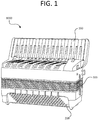
- FIG.1 illustrates a perspective view of an embodiment of an accordion 1000.
- the accordion 1000 has a right hand play side 100, a left hand play side 200, and a bellow 300.
- the accordion 1000 is a musical instrument which is played by compressing or expanding the bellow 300 while pressing buttons or keys on the right hand play side 100 and/or the left hand play side 200.
- the bellow 300 allows air to flow across strips of brass or steel, called reeds, which vibrate in order to produce sounds inside the accordion's body.
- the right hand play side 100 uses a musical keyboard similar to a piano-style keyboard and/or an organ-style keyboard by compressing or expanding the bellow 300 while pressing button or keys on the right hand play side 100.
- the right hand play side 100 is normally used for playing the melody.
- Each system has different claimed benefits by those who prefer it.
- the left hand play side 200 includes buttons or keys on the left hand play side 200.
- the left hand play side 200 is normally used for playing the accompaniment. These almost always use distinct bass buttons and often have buttons with concavities or studs to help an accordionist navigate the layout despite not being able to see the buttons while playing.
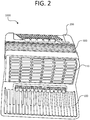
- the right hand play side 100 includes a musical keyboard similar to a piano-style keyboard and/or an organ-style keyboard.
- the right hand play side 100 further includes a speaker 110.
- the speaker 110 is a channel for sound by compressing or expanding the bellow 300 while pressing button or keys on the right hand play side 100 and/or left hand play side 200.
- FIG.3 illustrates a perspective view of an embodiment of a left hand configuration of accordion 1000 of the present invention.
- the left hand play side 100 of this embodiment includes a musical keyboard similar to a piano-style keyboard and/or an organ-style keyboard and speaker 110.
- the speaker 110 is a channel for sound by compressing or expanding the bellow 300 while pressing button or keys in the right 100 and/or left hand play side 200.
- FIG.4 an exploded perspective view of a functional equation is schematically depicted.
- the functional equation according to the embodiments of the present invention may include a function to explain a method of this invention.
- the functional equation is based on a clock that has a cycle and 12 numbers.
- the 12 numbers start from 1 to 12. Arrangements of the 12 numbers are clockwise.
- the 12 numbers are arranged inside the circle.
- the functional equation has notes on the outside of the cycle.
- a first row outside of the cycle shows the 12 notes which are C note key (C chromatic Scale) as shown in FIG.5 .
- the chromatic Scale has 12 notes, and uses every half-tone / semitone position.
- the C chromatic Scale may include C, C#, D, D#, E, F, F#, G, G#, A, A# and B.
- the arrangement of C chromatic Scale starts on the C note at a number 1 position.
- the direction of the C chromatic Scale is clockwise.
- a second note is a C# note at a number 2 position
- a third note is a D note at a number 3 position
- a last note is a B note at a number 12 position.
- the functional equation has a last explanation on the outside of the cycle.
- a second row outside of the cycle illustrates an X function.
- the X function has a method for arranging 12 notes.
- a direction of X function is clockwise by X, X+1, X+2, X+3, X+4, X+5, X+6, X+7, X+8, X+9, X+10 and X+11.
- the X is placed in a starting note position.
- the starting note X can be any note of this position.
- Chromatic Scale The set of 12 notes called "Chromatic Scale” is rarely used to compose songs. There are some experimental songs that may use chromatic scale in all part but the songs are not popular for public audience. To compose a song, Chromatic scale is used only partially for making the sounds or songs more interesting. Human's ears prefer to hear pleasant songs rather than atonal music (unpleasant song). All kind of western music mainly use "Major Scale” or “Minor Scale” to compose songs. About 98%-99% of the produced songs in the world use only these 2 scales.
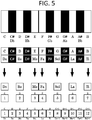
- FIG.5 illustrates the Chromatic Scale.
- the piano keyboard is one of the classic ways of viewing the Chromatic Scale.
- the white keys play the simple notes and the black keys play the altered notes which add sharps or flats.
- the whole pattern of note names repeats after every 12 notes with different octave.
- the sequence of white keys consists of C, C#, D, D#, E, F, F#, G, A, A# and B.
- C is corresponding to Do note
- D is corresponding to Re note
- E is corresponding to Me note
- F is corresponding to Fa note
- G is corresponding to Sol note
- A is corresponding to La note
- B is corresponding to Ti note.
- Most classical western music is built around the octave (do-re-mi).
- Chromatic scales are often used in composing modern, atonal music. They are also commonly used in jazz compositions. Some Indian and Chinese music are also built around a 12-note scale. It's important to note that contemporary symphonic instruments are almost always tuned to a scale of 12 equal tones. In the past, however, even western instruments were tuned in different ways, with unequal gaps between tones.
- the seven-note Major scale is such a dominant force in western music that it provides the foundation for the naming of notes and chords, even with music using different scale types.
- a scale type When a scale type is played from a particular starting note (also known as the root or key note) it becomes a scale.
- Scales of a certain type may contain 12 different sets of notes, depending on the starting note.
- the scale of a song defines its melodic structure, by identifying which notes can be used in the melody (or tune) of the song.
- the scale also strongly influences the harmonic structure of a song, mainly because the same notes are generally used for building chords to accompany the melody. This may not be a fixed rule, as many songs use notes outside of their scale, but these are considered to be exceptions. They are called "accidental notes", and in music sheets they are specially marked to show that they do not belong to the scale.
- FIG.6 illustrates an exploded view of the Chord Tone Pattern.
- the Chord Tone Pattern of the present embodiment includes six rows of buttons 620.
- the six rows of button 620 are arranged in lines in a direction substantially orthogonal to an expansion and contraction direction of the bellow 300.
- Columns 610 contain from 12 columns 613, 16 columns 614 and 20 columns 615.
- the six rows of button 620 with 12 columns 613 contain about 72 basses.
- the six rows of button 620 with 16 columns 614 contain about 96 basses.
- the six rows of button 620 with 20 columns 615 contain about 120 basss.
- buttons 620 include 12 columns 613 consisting of X-5, X-4, X-3, X-2, X-1, X, X+1, X+2, X+3, X+4, X+5 and X+6.
- the six rows of buttons 620 include 16 columns 614 consisting of X-7, X-6, X-5, X-4, X-3, X-2, X-1, X, X+1, X+2, X+3, X+4, X+5, X+6, X+7 and X+8.
- buttons 620 include 20 columns 615 consisting of X-9, X-8, X-7, X-6, X-5, X-4, X-3, X-2, X-1, X, X+1, X+2, X+3, X+4, X+5, X+6, X+7, X+8, X+9 and X+10.
- Row#1 621 and Row#2 622 are assigned to base notes 611.
- Row#3 623, Row#4 624, Row#5 625 and Row#6 626 are assigned to present chords 612 (triads).
- buttons from the six rows of buttons 620 a number appears after a note.
- These numbers are octave numbers which are used for identifying the pitches in an octave.
- the octave number increases or decreases by one. A greater number refers to a higher octave while a smaller number refers to a lower octave.
- a "C2" button 616 is a C Root note, which is assigned as a middle C and is located in Row#2 622 and Column X, in order to solve the problem when playing the triad with the close contiguous 3 fingers by arranging 3 notes of major triad or minor triad in the column.
- This "C2" button 616 allows more extension of directions both following the circle of fifths and the circle of fourths (Moving counterclockwise in the direction of the circle of fifths).
- the Row#1 621 includes up to 20 buttons of bass consisting of four flat notes, seven natural notes, seven sharp notes and two double-sharp notes.
- Db2 is located in Column X-9; Ab1 is located in Column X-8; Eb2 is located in Column X-7; Bb1 is located in Column X-6; F2 is located in Column X-5; C2 is located in Column X-4; G2 is located in Column X-3; D2 is located in Column X-2; A2 is located in Column X-1; E2 is located in Column X (center); B2 is located in Column X+1; F#2 is located in Column X+2; C#3 is located in Column X+3; G#2 is located in Column X+4; D#3 is located in Column X+5; A#2 is located in Column X+6; E#3(F3) is located in Column X+7; B#2(C3) is located in Column X+8; F
- F2, C2, G2, D2, A2, E2, B2, F#2, C#3, G#2, D#3 and A#2 are elements of all patterns, i.e., the first pattern 613 (72 buttons in 12 columns), the second pattern 614 (96 buttons in 16 columns) as well as the last pattern 615 (120 buttons in 20 columns).
- Eb2 Cold X-7
- Bb1 Coldumn X-6
- E#3(F3) Coldumn X+7)
- B#2(C3) Coldumn X+8
- Db2 Cold X-9
- Ab1 Cold X-8
- F##3(G3) Cold X+9)
- C##2(D3) Cold X+10
- the note formulation in 20 columns 610 of Row#1 621 is the 3 rd note in major scale count from root (major third note).
- the Row#2 622 includes 20 buttons of bass consisting of one double-flat note, seven flat notes, seven natural notes and five sharp notes.
- Bbb1(A1) is located in Column X-9; Fb1(E1) is located in Column X-8; Cb2(B1) is located in Column X-7; Gb1(F#1) is located in Column X-6; Db2(C#2) is located in Column X-5; Ab1 is located in Column X-4; Eb2 is located in Column X-3; Bb1 is located in Column X-2; F2 is located in Column X-1; C2 is located in Column X (center); G2 is located in Column X+1; D2 is located in Column X+2; A2 is located in Column X+3; E2 is located in Column X+4; B2 is located in Column X+5; F#2 is located in Column X+6; C#3 is located in Column X+7; G#2 is located
- Db2(C#2), Ab1, Eb2, Bb2, F2, C2, G2, D2, A2, E2, B2 and F#2 are elements of all patterns, i.e., the first pattern 613 (72 buttons in 12 columns), the second pattern 614 (96 buttons in 16 columns) as well as the last pattern 615 (120 buttons in 20 columns).
- Cb2(B1) (Column X-7), Gb1(F#1) (Column X-6), C#3 (Column X+7) and G#2 (Column X+8) are additional notes from the first pattern 613, the second pattern 614 (96 buttons in 16 columns) as well as the last pattern 615 (120 buttons in 20 columns).
- Bbb1(A1) (Column X-9), Fb1(E1) (Column X-8), D#3 (Column X+9) and A#2 (Column X+10) are additional notes from the second pattern 614 (96 buttons in 16 columns) in the last pattern 615 (120 buttons in 20 columns).
- the note formulation in 20 columns 610 of Row#2 622 is a root of scale and chord.
- the Row#3 623 includes 20 buttons of preset chords (triads) consisting of four flat notes, seven natural notes, seven sharp notes and two double-sharp notes.
- Db3 is located in Column X-9; Ab2 is located in Column X-8; Eb3 is located in Column X-7; Bb2 is located in Column X-6; F3 is located in Column X-5; C3 is located in Column X-4; G3 is located in Column X-3; D3 is located in Column X-2; A3 is located in Column X-1; E3 is located in Column X (center); B3 is located in Column X+1; F#3 is located in Column X+2; C#4 is located in Column X+3; G#3 is located in Column X+4; D#4 is located in Column X+5; A#3 is located in Column X+6; E#4(F4) is located in Column X+7; B#3(C4) is located in Column
- F3, C3, G3, D3, A3, E3, B3, F#3, C#4, G#3, D#4 and A#3 are elements of all patterns, i.e., the first pattern 613 (72 buttons in 12 columns), the second pattern 614 (96 buttons in 16 columns) as well as the last pattern 615 (120 buttons in 20 columns).
- Eb3 Cold X-7
- Bb2 Coldumn X-6
- E#4(F4) Coldumn X+7)
- B#3(C4) Coldumn X+8
- Db3 (Column X-9), Ab2 (Column X-8), F##3(G4) (Column X+9) and C##3(D4) (Column X+10) are additional notes from the second pattern 614 (96 buttons in 16 columns) in the last pattern 615 (120 buttons in 20 columns).
- 16 preset chords (triads) in the second pattern 614 (96 buttons in 16 columns)
- 20 preset chords (triads) in the last pattern 615 120 buttons in 20 columns.
- the note formulation in 20 columns 610 of Row#3 623 is the Major 10 th of scale, Major 3 rd note (major third of next higher octave).
- the Row#4 624 includes 20 buttons of preset chords (triads) consisting of one double-flat note, seven flat notes, seven natural notes and five sharp notes.
- Bbb2(A2) is located in Column X-9; Fb2(E2) is located in Column X-8; Cb3(B2) is located in Column X-7; Gb2(F#2) is located in Column X-6; Db3(C#3) is located in Column X-5; Ab2(G#2) is located in Column X-4; Eb3 is located in Column X-3; Bb2 is located in Column X-2; F3 is located in Column X-1; C3 is located in Column X (center); G3 is located in Column X+1; D3 is located in Column X+2; A3 is located in Column X+3; E3 is located in Column X+4; B3 is located in Column X+5; F#3 is located in Column X+6; C#4 is located in Column X+6; C#4 is
- Db3(C#3), Ab2(G#2), Eb3, Bb2, F3, C3, G3, D3, A3, E3, B3 and F#3 are elements of all patterns, i.e., the first pattern 613 (72 buttons in 12 columns), the second pattern 614 (96 buttons in 16 columns) as well as the last pattern 615 (120 buttons in 20 columns).
- Cb3(B2) (Column X-7), Gb2(F#2) (Column X-6), C#4 (Column X+7) and G#3 (Column X+8) are additional notes from the first pattern 613, the second pattern 614 (96 buttons in 16 columns) as well as the last pattern 615 (120 buttons in 20 columns).
- Bbb2(A2) (Column X-9), Fb2(E2) (Column X-8), D#4 (Column X+9) and A#3 (Column X+10) are additional notes from the second pattern 614 (96 buttons in 16 columns) in the last pattern 615 (120 buttons in 20 columns).
- 16 preset chords (triads) in the second pattern 614 (96 buttons in 16 columns)
- 20 preset chords (triads) in the last pattern 615 120 buttons in 20 columns.
- the note formulation in 20 columns 610 of Row#4 624 is the 8 th common note (Octaved note).
- the Row#5 625 includes 20 buttons of preset chords (triads) consisting of seven flat notes, seven natural notes and six sharp notes.
- Fb2(E2) is located in Column X-9; Cb2(B1) is located in Column X-8; Gb2(F#2) is located in Column X-7; Db2(C#1) is located in Column X-6; Ab2(G#2) is located in Column X-5; Eb2(D#1) is located in Column X-4; Bb2 is located in Column X-3; F2 is located in Column X-2; C3 is located in Column X-1; G2 is located in Column X (center); D3 is located in Column X+1; A2 is located in Column X+2; E3 is located in Column X+3; B2 is located in Column X+4; F#3 is located in Column X+5; C#3 is located in Column X+6; G#3 is located in Column X+7
- Ab2(G#2), Eb2(D#1), Bb2, F2, C3, G2, D3, A2, E3, B2, F#3 and C#3 are elements of all patterns, i.e., the first pattern 613 (72 buttons in 12 columns), the second pattern 614 (96 buttons in 16 columns) as well as the last pattern 615 (120 buttons in 20 columns).
- Gb2(F#2) (Column X-7), Db2(C#1) (Column X-6), G#3 (Column X+7) and D#3 (Column X+8) are additional notes from the first pattern 613, the second pattern 614 (96 buttons in 16 columns) as well as the last pattern 615 (120 buttons in 20 columns).
- Fb2(E2) (Column X-9), Cb2(B1) (Column X-8), A#3 (Column X+9) and E#3(F3) (Column X+10) are additional notes from the second pattern 614 (96 buttons in 16 columns) in the last pattern 615 (120 buttons in 20 columns).
- 16 preset chords (triads) in the second pattern 614 (96 buttons in 16 columns)
- 20 preset chords (triads) in the last pattern 615 120 buttons in 20 columns.
- the note formulation in 20 columns 610 of Row#5 625 is the 5 th common note in Major and minor scale (Perfect Fifth Note).
- the Row#6 626 includes 20 buttons of preset chords (triads) consisting of 12 natural notes, six flat notes, and two sharp notes.
- C2 is located in Column X-9; G1 is located in Column X-8; D2 is located in Column X-7; (A1) is located in Column X-6; Fb2(E2) is located in Column X-5; B1 is located in Column X-4; Gb2(F#2) is located in Column X-3; Db2(C#2) is located in Column X-2; Ab2(G#2) is located in Column X-1; Eb2(D#2) is located in Column X (center); Bb2 is located in Column X+1; F2 is located in Column X+2; C3 is located in Column X+3; G2 is located in Column X+4; D3 is located in Column X+5; A2 is located in Column X+6; E3 is located in Column X+7; B2 is located
- Fb2(E2), B1, Gb2(F#2), Db2(C#2), Ab2(G#2), Eb2(D#2), Bb2, F2, C3, G2, D3 and A2 are elements of all forms i.e. the first pattern 613 (72 buttons in 12 columns), the second pattern 614 (96 buttons in 16 columns) as well as the last pattern 615 (120 buttons in 20 columns).
- D2 (Column X-7), (A1) (Column X-6), E3 (Column X+7) and B2 (Column X+8) are additional notes from the first pattern 613, the second pattern 614 (96 buttons in 16 columns) as well as the last pattern 615 (120 buttons in 20 columns).
- C2 Cold X-9
- G1 Cold X-8
- F#3 Cold X+9
- C#3 Cold X+10
- C2 Cold X-9
- G1 Cold X-8
- F#3 Cold X+9
- C#3 Cold X+10
- C2 Cold X-9
- G1 Cold X-8
- F#3 Cold X+9
- C#3 Cold X+10
- C2 Cold X-9
- G1 Cold X-8
- F#3 Cold X+9
- C#3 Cold X+10
- the pattern will be D2-A2-D3-A2-F#3-A2-D3-A2-D2. Or if the starting note is E2, the pattern will be E2-B2-E3-B2-G#3-B2-E2-B2-E2.
- the Major and Minor chords in Arpeggio Style by ignore 3 rd or 10 th note that can identify chord quality of major or minor.
- the Minor chord by fingering pattern of 1-b3-5-8-5-b3-1 (Arpeggio Style).
- This note layout can fairly played minor chord in Arpeggio style or arpeggio scale as 1-5-8-5-b10-5-8-5-1, Arpeggio style of diminished chord (1, b3, b5, bb7(6)) for 2 octaves and have the alternative notes in adjacent columns to create dim chord, Chromatic scale 12 notes, Major of minor scale 1.5-2 octaves, Adaptable to use 5-line notation to communicate or record how to play notes in a song (Solmization). Using this note layout might be difficult for fingering to play Major 9 th , 11 th block chord by using only 2-3 pitches combination.
- Chromatic Scale there are 2 octaves that can be played, 2 different shapes for 12 keys. It is very easy to remember this note layout since it contains only 2 shapes of scale but it is not easy to practice from the starting note (1 st note) of scale to 10 th note or 11 th note of Chromatic scale, mainly because each note located too far from each other. Partial of Chromatic Scale 4-5-6 notes scale; there are within 2 octaves that can be played scale.
- this note layout contains only 2 shapes of scale and moderate to practice the fingering from starting note (1 st note) of scale to 4 th or 5 th or 6 th notes of chromatic scale, as the notes are not located too far from each other.
- Major scale there are 2 octaves for 6 keys (Fb, Gb, Ab, Bb, C, D, E, F#, G# and A#) and 1.5 octaves for 6 keys (A, B, Db, Eb, F, G, A, B, C# and D#).
- the uniform of fingering is using row of 1-4 to play by 2 different shapes for 12 keys.
- chord pitches mean the mixture of several notes.
- FIG.7 illustrates an exploded view of the Chord Tone Pattern with 1 higher octave.
- the Chord Tone Pattern includes six rows of buttons 720.
- the six rows of button 720 are arranged in lines in a direction substantially orthogonal to an expansion and contraction direction of the bellow 300.
- Columns 710 contain from 12 columns 713, 16 columns 714 and 20 columns 715.
- the six rows of button 720 with 12 columns 713 contain about 72 basses.
- the six rows of button 720 with 16 columns 714 contain about 96 basses.
- the six rows of button 720 with 20 columns 715 contain about 120 basss.
- buttons 720 include 12 columns 713 consisting of X-5, X-4, X-3, X-2, X-1, X, X+1, X+2, X+3, X+4, X+5 and X+6.
- the six rows of buttons 720 include 16 columns 714 consisting of X-7, X-6, X-5, X-4, X-3, X-2, X-1, X, X+1, X+2, X+3, X+4, X+5, X+6, X+7 and X+8.
- buttons 720 include 20 columns 715 consisting of X-9, X-8, X-7, X-6, X-5, X-4, X-3, X-2, X-1, X, X+1, X+2, X+3, X+4, X+5, X+6, X+7, X+8, X+9 and X+10.
- Row#1 721 and Row#2 722 are assigned to base notes 711.
- Row#3 723, Row#4 724, Row#5 725 and Row#6 726 are assigned to present chords 712 (triads).
- buttons 720 For each buttons from the six rows of buttons 720 a number appears after a note. These numbers are octave numbers which are used for identifying the pitches in an octave. The octave number increases or decreases by one. A greater number refers to a higher octave while a smaller number refers to a lower octave.
- a "C3" button 716 is a C Root note, which is assigned as a middle C and is located in Row#2 722 and Column X, in order to solve the problem when playing the triad with the close contiguous 3 fingers by arranging 3 notes of major triad or minor triad in the column.
- This "C3" button 716 allows more extension of directions both following the circle of fifths and the circle of fourths (Moving counterclockwise in the direction of the circle of fifths).
- the Row#1 721 includes up to 20 buttons of bass consisting of four flat notes, seven natural notes, seven sharp notes and two double-sharp notes.
- Db3 is located in Column X-9; Ab2 is located in Column X-8; Eb3 is located in Column X-7; Bb2 is located in Column X-6; F3 is located in Column X-5; C3 is located in Column X-4; G3 is located in Column X-3; D3 is located in Column X-2; A3 is located in Column X-1; E3 is located in Column X (center); B3 is located in Column X+1; F#3 is located in Column X+2; C#4 is located in Column X+3; G#3 is located in Column X+4; D#4 is located in Column X+5; A#3 is located in Column X+6; E#4(F4) is located in Column X+7; B#3(C4) is located in Column X+8; F
- F3, C3, G3, D3, A3, E3, B3, F#3, C#4, G#3, D#4 and A#3 are elements of all patterns, i.e., the first pattern 713 (72 buttons in 12 columns), the second pattern 714 (96 buttons in 16 columns) as well as the last pattern 715 (120 buttons in 20 columns).
- Eb3 Cold X-7
- Bb2 Coldumn X-6
- E#4(F4) Coldumn X+7)
- B#3(C4) Coldumn X+8
- Db3 (Column X-9), Ab2 (Column X-8), F##4(G4) (Column X+9) and C##3(D4) (Column X+10) are additional notes from the second pattern 714 (96 buttons in 16 columns) in the last pattern 715 (120 buttons in 20 columns).
- there are 12 bass notes in the first pattern 713 72 buttons in 12 columns
- 16 bass notes in the second pattern 714 (96 buttons in 16 columns)
- 20 bass notes in the last pattern 715 120 buttons in 20 columns.
- the note formulation in 20 columns 710 of Row#1 721 is the 3 rd note in Major scale count from root (Major third note).
- the Row#2 722 includes 20 buttons of bass consisting of one double-flat note, seven flat notes, seven natural notes and five sharp notes.
- Bbb2(A2) is located in Column X-9; Fb2(E2) is located in Column X-8; Cb3(B2) is located in Column X-7; Gb2(F#2) is located in Column X-6; Db3(C#3) is located in Column X-5; Ab2 is located in Column X-4; Eb3 is located in Column X-3; Bb2 is located in Column X-2; F3 is located in Column X-1; C3 is located in Column X (center); G3 is located in Column X+1; D3 is located in Column X+2; A3 is located in Column X+3; E3 is located in Column X+4; B3 is located in Column X+5; F#3 is located in Column X+6; C#4 is located in Column X+7; G#3 is located
- Db3(C#3), Ab2, Eb3, Bb2, F3, C3, G3, D3, A3, E3, B3 and F#3 are elements of all patterns, i.e., the first pattern 713 (72 buttons in 12 columns), the second pattern 714 (96 buttons in 16 columns) as well as the last pattern 715 (120 buttons in 20 columns).
- Cb3(B2) (Column X-7), Gb2(F#2) (Column X-6), C#4 (Column X+7) and G#3 (Column X+8) are additional notes from the first pattern 713, the second pattern 714 (96 buttons in 16 columns) as well as the last pattern 715 (120 buttons in 20 columns) and Bbb2(A2) (Column X-9), Fb2(E2) (Column X-8), D#4 (Column X+9).
- A#3 (Column X+10) are additional notes from the second pattern 714 (96 buttons in 16 columns) in the last pattern 715 (120 buttons in 20 columns).
- the note formulation in 20 columns 710 of Row#2 722 is a root of scale and chord.
- the Row#3 723 includes 20 buttons of preset chords (triads) consisting of four flat notes, seven natural notes, seven sharp notes and two double-sharp notes.
- Db4 is located in Column X-9; Ab3 is located in Column X-8; Eb4 is located in Column X-7; Bb3 is located in Column X-6; F4 is located in Column X-5; C4 is located in Column X-4; G4 is located in Column X-3; D4 is located in Column X-2; A4 is located in Column X-1; E4 is located in Column X (center); B4 is located in Column X+1; F#4 is located in Column X+2; C#5 is located in Column X+3; G#4 is located in Column X+4; D#5 is located in Column X+5; A#4 is located in Column X+6; E#5(F5) is located in Column X+7; B#4(C5) is located in Column
- F4, C4, G4, D4, A4, E4, B4, F#4, C#5, G#4, D#5 and A#4 are elements of all patterns, i.e., the first pattern 713 (72 buttons in 12 columns), the second pattern 714 (96 buttons in 16 columns) as well as the last pattern 715 (120 buttons in 20 columns).
- Eb4 Cold X-7
- Bb3 Cold X-6
- E#5(F5) Coldumn X+7)
- B#4(C5) Coldumn X+8
- Db4 Cold X-9
- Ab3 Cold X-8
- F##4(G5) Cold X+9
- C##4(D5) Cold X+10) are additional notes from the second pattern 714 (96 buttons in 16 columns) in the last pattern 715 (120 buttons in 20 columns).
- 16 preset chords (triads) in the second pattern 714 (96 buttons in 16 columns)
- 20 preset chords triads in the last pattern 715 (120 buttons in 20 columns).
- the note formulation in 20 columns 710 of Row#3 723 is the Major 10 th of scale, Major 3 rd note (major third of next higher octave).
- the Row#4 724 includes 20 buttons of preset chords (triads) consisting of one double-flat note, seven flat notes, seven natural notes and five sharp notes.
- Bbb3(A3) is located in Column X-9; Fb3(E3) is located in Column X-8; Cb4(B3) is located in Column X-7; Gb3(F#3) is located in Column X-6; Db4(C#4) is located in Column X-5; Ab3(G#3) is located in Column X-4; Eb4 is located in Column X-3; Bb3 is located in Column X-2; F4 is located in Column X-1; C4 is located in Column X (center); G4 is located in Column X+1; D4 is located in Column X+2; A4 is located in Column X+3; E4 is located in Column X+4; B4 is located in Column X+5; F#4 is located in Column X+6; C#5 is located
- Db4(C#4), Ab3(G#3), Eb4, Bb4, F4, C4, G4, D4, A4, E4, B4 and F#4 are elements of all patterns, i.e., the first pattern 713 (72 buttons in 12 columns), the second pattern 714 (96 buttons in 16 columns) as well as the last pattern 715 (120 buttons in 20 columns).
- Cb4(B3) (Column X-7), Gb3(F#3) (Column X-6), C#5 (Column X+7) and G#4 (Column X+8) are additional notes from the first pattern 713, the second pattern 714 (96 buttons in 16 columns) as well as the last pattern 715 (120 buttons in 20 columns).
- Bbb3(A3) (Column X-9), Fb3(E3) (Column X-8), D#5 (Column X+9) and A#4 (Column X+10) are additional notes from the second pattern 714 (96 buttons in 16 columns) in the last pattern 715 (120 buttons in 20 columns).
- 20 preset chords (triads) in the last pattern 715 120 buttons in 20 columns.
- the note formulation in 20 columns 710 of Row#4 724 is the 8 th common note (Octaved note).
- the Row#5 725 includes 20 buttons of preset chords (triads) consisting of seven flat notes, seven natural notes and six sharp notes.
- Fb4(E3) is located in Column X-9; Cb3(B2) is located in Column X-8; Gb3(F#3) is located in Column X-7; Db3(C#2) is located in Column X-6; Ab3(G#3) is located in Column X-5; Eb3(D#2) is located in Column X-4; Bb3 is located in Column X-3; F3 is located in Column X-2; C4 is located in Column X-1; G3 is located in Column X (center); D4 is located in Column X+1; A3 is located in Column X+2; E4 is located in Column X+3; B3 is located in Column X+4; F#4 is located in Column X+5; C#4 is located in Column X+6; G#4 is located in Column X+7
- Ab3(G#3), Eb3(D#2), Bb3, F3, C4, G3, D4, A3, E4, B3, F#4 and C#4 are elements of all patterns, i.e., the first pattern 713 (72 buttons in 12 columns), the second pattern 714 (96 buttons in 16 columns) as well as the last pattern 715 (120 buttons in 20 columns).
- Gb3(F#3) (Column X-7), Db3(C#2) (Column X-6), G#4 (Column X+7) and D#4 (Column X+8) are additional notes from the first pattern 713, the second pattern 714 (96 buttons in 16 columns) as well as the last pattern 715 (120 buttons in 20 columns).
- Fb3(E3) (Column X-9), Cb3(B2) (Column X-8), A#4 (Column X+9) and E#4(F4) (Column X+10) are additional notes from the second pattern 714 (96 buttons in 16 columns) in the last pattern 715 (120 buttons in 20 columns).
- the note formulation in 20 columns 710 of Row#5 725 is the 5 th common note in Major and Minor scale (Perfect Fifth Note).
- the Row#6 726 includes 20 buttons of preset chords (triads) consisting of 12 natural notes, six flat notes, and two sharp notes.
- C4 is located in Column X-9; G4 is located in Column X-8; D4 is located in Column X-7; (A2) is located in Column X-6; Fb3(E3) is located in Column X-5; B2 is located in Column X-4; Gb3(F#3) is located in Column X-3; Db3(C#3) is located in Column X-2; Ab3(G#3) is located in Column X-1; Eb3(D#3) is located in Column X (center); Bb3 is located in Column X+1; F3 is located in Column X+2; C4 is located in Column X+3; G3 is located in Column X+4; D4 is located in Column X+5; A3 is located in Column X+6; E4 is located in Column X+7; B3 is located
- Fb3(E3), B2, Gb3(F#3), Db3(C#3), Ab3(G#3), Eb3(D#3), Bb3, F3, C4, G3, D4 and A3 are elements of all forms, i.e., the first pattern 713 (72 buttons in 12 columns), the second pattern 714 (96 buttons in 16 columns) as well as the last pattern 715 (120 buttons in 20 columns).
- D4 (Column X-7), (A2) (Column X-6), E4 (Column X+7) and B3 (Column X+8) are additional notes from the first pattern 713, the second pattern 714 (96 buttons in 16 columns) as well as the last pattern 715 (120 buttons in 20 columns).
- C4 Cold X-9
- G4 Cold X-8
- F#4 Cold X+9
- C#4 Cold X+10
- the pattern will be D3-A3-D4-A3-F#4-A3-D4-A3-D3. Or if the starting note is E3, the pattern will be E3-B3-E4-B3-G#4-B3-E3-B3-E3.
- the Major and Minor chords in Arpeggio Style by ignore 3 rd or 10 th note that can identify chord quality of major or minor.
- the Minor chord by fingering of 1-b3-5-8-5-b3-1 (Arpeggio Style).
- This note layout can fairly played minor chord in Arpeggio style or arpeggio scale as 1-5-8-5-b10-5-8-5-1, Arpeggio style of diminished chord (1, b3, b5, bb7(6)) for 2 octaves and have the alternative notes in adjacent columns to create dim chord, Chromatic scale 12 notes, Major of minor scale 1.5-2 octaves, Adaptable to use 5-line notation to communicate or record how to play notes in a song (Solmization). Using this note layout might be difficult for fingering to play Major 9 th , 11 th block chord by using only 2-3 pitches combination.
- Chromatic Scale there are 2 octaves that can be played, 2 different shapes for 12 keys. It is very easy to remember this note layout since it contains only 2 shapes of scale but it is not easy to practice from the starting note (1 st note) of scale to 10 th note or 11 th note of Chromatic scale, mainly because each note located too far from each other. Partial of Chromatic Scale 4-5-6 notes scale; there are within 2 octaves that can be played scale.
- this note layout contains only 2 shapes of scale and moderate to practice the fingering from starting note (1 st note) of scale to 4 th or 5 th or 6 th notes of chromatic scale, as the notes are not located too far from each other.
- Major scale there are 2 octaves for 6 keys (Fb, Gb, Ab, Bb, C, D, E, F#, G# and A#) and 1.5 octaves for 6 keys (A, B, Db, Eb, F, G, A, B, C# and D#).
- the uniform of fingering is using row of 1-4 to play by 2 different shapes for 12 keys.
- FIG.8 illustrates an exploded view of the Chord Tone Pattern with double notes by fixed Row 1-5.
- the Chord Tone Pattern of this embodiment includes six rows of buttons 820.
- the six rows of button 820 are arranged in lines in a direction substantially orthogonal to an expansion and contraction direction of the bellow 300.
- Columns 810 contain from 12 columns 813, 16 columns 814 and 20 columns 815.
- the six rows of button 820 with 12 columns 813 contain about 72 basses.
- the six rows of button 820 with 16 columns 814 contain about 96 basses.
- the six rows of button 820 with 20 columns 815 contain about 120 basss.
- buttons 820 include 12 columns 813 consisting of X-5, X-4, X-3, X-2, X-1, X, X+1, X+2, X+3, X+4, X+5 and X+6.
- the six rows of buttons 820 include 16 columns 814 consisting of X-7, X-6, X-5, X-4, X-3, X-2, X-1, X, X+1, X+2, X+3, X+4, X+5, X+6, X+7 and X+8.
- buttons 820 include 20 columns 815 consisting of X-9, X-8, X-7, X-6, X-5, X-4, X-3, X-2, X-1, X, X+1, X+2, X+3, X+4, X+5, X+6, X+7, X+8, X+9 and X+10.
- Row#1 821 and Row#2 822 are assigned to base notes 811.
- Row#3 823, Row#4 824, Row#5 825 and Row#6 826 are assigned to present chords 812 (triads).
- buttons 820 For each buttons from the six rows of buttons 820 a number appears after a note. These numbers are octave numbers which are used for identifying the pitches in an octave. The octave number increases or decrease by one. A greater number refers to a higher octave while a smaller number refers to a lower octave.
- a "C2" button 816 is a C Root note, which is assigned as a middle C and is located in Row#2 822 and Column X, in order to solve the problem when playing the triad with the close contiguous 3 fingers by arranging 3 notes of major triad or minor triad in the column.
- This "C2" button 816 allows more extension of directions both following the circle of fifths and the circle of fourths (Moving counterclockwise the in direction of the circle of fifths).
- the Row#1 821 includes up to 20 buttons of bass consisting of four flat notes, seven natural notes, seven sharp notes and two double-sharp notes.
- Db2 is located in Column X-9; Ab1 is located in Column X-8; Eb2 is located in Column X-7; Bb1 is located in Column X-6; F2 is located in Column X-5; C2 is located in Column X-4; G2 is located in Column X-3; D2 is located in Column X-2; A2 is located in Column X-1; E2 is located in Column X (center); B2 is located in Column X+1; F#2 is located in Column X+2; C#3 is located in Column X+3; G#2 is located in Column X+4; D#3 is located in Column X+5; A#2 is located in Column X+6; E#3(F3) is located in Column X+7; B#2(C3) is located in Column X+8; F
- F2, C2, G2, D2, A2, E2, B2, F#2, C#3, G#2, D#3 and A#2 are elements of all patterns, i.e., the first pattern 813 (72 buttons in 12 columns), the second pattern 814 (96 buttons in 16 columns) as well as the last pattern 815 (120 buttons in 20 columns).
- Eb2 Cold X-7
- Bb1 Coldumn X-6
- E#3(F3) Coldumn X+7)
- B#2(C3) Coldumn X+8
- Db2 Cold X-9
- Ab1 Cold X-8
- F##3(G3) Cold X+9)
- C##2(D3) Cold X+10
- the note formulation in 20 columns 810 of Row#1 821 is the 3 rd note in major scale count from root (major third note).
- the Row#2 822 includes 20 buttons of bass consisting of one double-flat note, seven flat notes, seven natural notes and five sharp notes.
- Bbb1(A1) is located in Column X-9; Fb1(E1) is located in Column X-8; Cb2(B1) is located in Column X-7; Gb1(F#1) is located in Column X-6; Db2(C#2) is located in Column X-5; Ab1 is located in Column X-4; Eb2 is located in Column X-3; Bb1 is located in Column X-2; F2 is located in Column X-1; C2 is located in Column X (center); G2 is located in Column X+1; D2 is located in Column X+2; A2 is located in Column X+3; E2 is located in Column X+4; B2 is located in Column X+5; F#2 is located in Column X+6; C#3 is located in Column X+7; G#2 is located
- Db2(C#2), Ab1, Eb2, Bb1, F2, C2, G2, D2, A2, E2, B2 and F#2 are elements of all patterns, i.e., the first pattern 813 (72 buttons in 12 columns), the second pattern 814 (96 buttons in 16 columns) as well as the last pattern 815 (120 buttons in 20 columns).
- Cb2(B1) (Column X-7), Gb1(F#1) (Column X-6), C#3 (Column X+7) and G#2 (Column X+8) are additional notes from the first pattern 813, the second pattern 814 (96 buttons in 16 columns) as well as the last pattern 815 (120 buttons in 20 columns).
- Bbb1(A1) (Column X-9), Fb1(E1) (Column X-8), D#3 (Column X+9) and A#2 (Column X+10) are additional notes from the second pattern 814 (96 buttons in 16 columns) in the last pattern 815 (120 buttons in 20 columns).
- the note formulation in 20 columns 810 of Row#2 822 is a root of scale and chord.
- the Row#3 823 includes 20 buttons of preset chords (triads) consisting of one combination of double flat note with flat note, three combination of flat note with flat note, three combination of flat note with natural note, four combination of natural note with natural note, five combination of natural note with sharp note, four combination of sharp note with sharp note. As shown in the embodiment depicted in FIG.
- Ebb3+Fb3(C#3+E3) is located in Column X-9; Ab2+Cb3(Ab2+B2) is located in Column X-8; Eb3+Gb3 is located in Column X-7; Bb2+Db3 is located in Column X-6; F3+Ab3 is located in Column X-5; C3+Eb3 is located in Column X-4; G3+Bb3 is located in Column X-3; D3+F3 is located in Column X-2; A3+C4 is located in Column X-1; E3+G3 is located in Column X (center); B3+D4 is located in Column X+1; F#3+A3 is located in Column X+2; C#4+E4 is located in Column X+3; G#3+B3 is located in Column X+4; D#4+F##4 is located in Column X+5; A#3+C#4 is located in Column X+6; E#4+G#4 is
- F3+Ab3, C3+Eb3, G3+Bb3, D3+F3, A3+C4, E3+G3, B3+D4, F#3+A3, C#4+E4, G#3+B3 and A#3+C#4 are elements of all patterns, i.e., the first pattern 813 (72 buttons in 12 columns), the second pattern 814 (96 buttons in 16 columns) as well as the last pattern 815 (120 buttons in 20 columns).
- Eb3+Gb3 (Column X-7), Bb2+Db3 (Column X-6), E#4+G#4 (Column X+7) and B#3+D#4 (Column X+8) are additional notes from the first pattern 813, the second pattern 814 (96 buttons in 16 columns) as well as the last pattern 815 (120 buttons in 20 columns).
- Ebb3+Fb3(C#3+E3) (Column X-9), Ab2+Cb3(Ab2B2) (Column X-8), G4+A#4(G4+Bb4)(Column X+9) and D4+E#4(D4+F4)(Column X+10) are additional notes from the second pattern 814 (96 buttons in 16 columns) in the last pattern 815 (120 buttons in 20 columns).
- 16 preset chords (triads) in the second pattern 814 (96 buttons in 16 columns)
- 20 preset chords (triads) in the last pattern 815 120 buttons in 20 columns).
- the note formulation in 20 columns 810 of Row#3 823 is the Major Chord (Root form exclude root note), 3 rd combines with 5 th of Major chord.
- the Row#4 824 includes 20 buttons of preset chords (triads) consisting of one combination of double flat note with natural note, three combination of double flat note with flat note, four combination of flat note with flat note, three combination of flat note with natural note, four combination of natural note with natural note, three combination of natural note with flat note, two combination of sharp note with sharp note. As shown in the embodiment depicted in FIG.
- Bbb2+C3(A2+C3) is located in Column X-9; Fb3+Abb3(E3+G3) is located in Column X-8; Cb3+Ebb3(B2+D3) is located in Column X-7; Gb3+Bbb3(Gb3+A3) is located in Column X-6; Db3+Fb3(Db3+E3) is located in Column X-5; Ab3+Cb4(Ab3+B3) is located in Column X-4; Eb3+Gb3 is located in Column X-3; Bb3+Db4 is located in Column X-2; F3+Ab3 is located in Column X-1; C4+Eb4 is located in Column X (center); G3+Bb3 is located in Column X+1; D4+F4 is located in Column X+2; A3+C4 is located in Column X+3; E4+G4 is located in Column X+4; B3+D4 is located in Column X
- Db3+Fb3(Db3+E3), Ab3+Cb4(Ab3+B3), Eb3+Gb3, Bb3+Db4, F3+Ab3, C4+Eb4, G3+Bb3, D4+F4, A3+C4, E4+G4, B3+D4 and F#4+A4 are elements of all patterns, i.e., the first pattern 813 (72 buttons in 12 columns), the second pattern 814 (96 buttons in 16 columns) as well as the last pattern 815 (120 buttons in 20 columns).
- Cb3+Ebb3(B2+D3) (Column X-7)
- Gb3+Bbb3(Gb3+A3) (Column X-6)
- C#4+E4 (Column X+7)
- G#4+B4 (Column X+8) are additional notes from the first pattern 813, the second pattern 814 (96 buttons in 16 columns) as well as the last pattern 815 (120 buttons in 20 columns).
- Bbb2+C3(A2+C3) (Column X-9), Fb3+Abb3(E2+G3) (Column X-8), D#4+F#4 (Column X+9) and A#3+C#4(Bb3+C#4) (Column X+10) are additional notes from the second pattern 814 (96 buttons in 16 columns) in the last pattern 815 (120 buttons in 20 columns).
- the note formulation in 20 columns 810 of Row#4 824 is Minor chord (Root form exclude 5th) 1 st combines with 3 rd of minor chord.
- the Row#5 825 includes 20 buttons of preset chords (triads) consisting of one combination of double flat note with double flat note, three combination of flat note with flat note, four combination of flat note with natural note, three combination of natural note with natural note, four combination of natural note with flat note, three combination of sharp note with sharp note, two combination of double flat note with flat note. As shown in the embodiment depicted in FIG.
- Bbb2+Ebb3(A2+C#3) is located in Column X-9; Fb2+Ab2(E2+Ab2) is located in Column X-8; Cb3+Eb3(B2+Eb3) is located in Column X-7; Gb2+Bb2 is located in Column X-6; Db3+F3 is located in Column X-5; Ab2+C3 is located in Column X-4; Eb3+G3 is located in Column X-3; Bb2+D3 is located in Column X-2; F3+A3 is located in Column X-1; C3+E3 is located in Column X (center); G3+B3 is located in Column X+1; D3+F#3 is located in Column X+2; A3+C#4 is located in Column X+3; E3+G#3 is located in Column X+4; B3+D#4 is located in Column X+5; F#3+A#3 is located in Column X+6;
- Db3+F3, Ab2+C3, Eb3+G3, Bb2+D3, F3+A3, C3+E3, G3+B3, D3+F#3, A3+C#4, E3+G#3, B3+D#4 and F#3+A#3 are elements of all patterns, i.e., the first pattern 813 (72 buttons in 12 columns), the second pattern 814 (96 buttons in 16 columns) as well as the last pattern 815 (120 buttons in 20 columns).
- Cb3+Eb3(B2+Eb3) (Column X-7), Gb2+Bb2 (Column X-6), C#4+E#4(C#4+F4) (Column X+7) and G#3+B#3(G#3+C4) (Column X+8) are additional notes from the first pattern 813, the second pattern 814 (96 buttons in 16 columns) as well as the last pattern 815 (120 buttons in 20 columns).
- Bbb2+Ebb3(A2+C#3) (Column X-9)
- Fb2+Ab2(E2+Ab2) (Column X-8)
- D#4+F##4(D#4+G4) (Column X+9)
- A#3+C##4(Bb3#D4) (Column X+10) are additional notes from the second pattern 814 (96 buttons in 16 columns) in the last pattern 815 (120 buttons in 20 columns).
- This note layout has the ability to play fundamental chords of diatonic scale. It is very easy to play with Major Arpeggio sound alike by using single note or double notes that belong to Major chord , Minor Arpeggio sound alike by using single note or double notes that belong to minor, Dominant 7 th Arpeggio sound alike by using Single note or Double Notes that belong to Dominant 7 th Chord, Diminished Arpeggio Triad sound alike by using Single note or Double Notes that belong to Half Diminished Chord, Full Diminished Arpeggio sound alike by using Single note or Double Notes that belong to Full Diminished Chord, Minor Block Chord or Arpeggio with difference position or difference Column (optional Position).
- This note layout has the ability to play extended chord by using only fixed Row1- Row5. It is very easy to play Minor Major 7 th Arpeggio sound alike by using Single note or Double Notes that belong to Major Chord, Major 7 th Arpeggio sound alike by using Single note or Double Notes that belong to Major Chord, Major 9 th Arpeggio sound alike by using Single note or Double Notes that belong to Major Chord, but Difficult to play Minor 7 th flat 5 th Triad Arpeggio sound alike by using Single note or Double Notes that belong to Minor 7 th flat 5 th Triad Chord.
- This note layout can easily play Chord progression by using this note layout, it can also play ii-V(7)-I of Major Scale and I-IV-V and ii , iii , vi of Major Scale. But, ability to play ii7b5-V-I of Minor Scale is moderate since it uses ii Dim (Triad) instead of ii7b5.
- Chord forms (Root form and inversion form) by using only fixed row 1- row 5. It is easy to play Major chord by using root form 2 nd inversion, Minor by using root form (use optional position), Dominant 7 th by using Root form 2 nd inversion, Half Diminished by using root form 2 nd inversion, Major 7 th by using root form 2 nd inversion, and Minor 7 th by using root form 2 nd inversion.
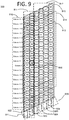
- FIG.9 illustrates an exploded view of the Chord Tone Pattern with double notes by fixed Row 1-5 by Row#6 is root note with 2 higher octave.
- the Chord Tone Pattern of the present embodiment includes six rows of buttons 920.
- the six rows of button 920 are arranged in lines in a direction substantially orthogonal to an expansion and contraction direction of the bellow 300.
- Columns 910 contain from 12 columns 913, 16 columns 914 and 20 columns 915.
- the six rows of button 920 with 12 columns 913 contain about 72 basses.
- the six rows of button 920 with 16 columns 914 contain about 96 basses.
- the six rows of button 920 with 20 columns 915 contain about 120 basss.
- buttons 920 include 12 columns 913 consisting of X-5, X-4, X-3, X-2, X-1, X, X+1, X+2, X+3, X+4, X+5 and X+6.
- the six rows of buttons 920 include 16 columns 914 consisting of X-7, X-6, X-5, X-4, X-3, X-2, X-1, X, X+1, X+2, X+3, X+4, X+5, X+6, X+7 and X+8.
- buttons 920 include 20 columns 915 consisting of X-9, X-8, X-7, X-6, X-5, X-4, X-3, X-2, X-1, X, X+1, X+2, X+3, X+4, X+5, X+6, X+7, X+8, X+9 and X+10.
- Row#1 921 and Row#2 922 are assigned to base notes 911.
- Row#3 923, Row#4 924, Row#5 925 and Row#6 926 are assigned to present chords 912 (triads).
- buttons 920 For each buttons from the six rows of buttons 920 a number appears after a note. These numbers are octave numbers which are used for identifying the pitches in an octave. The octave number increases or decreases by one. A greater number refers to a higher octave while a smaller number refers to a lower octave.
- a "C2" button 916 is a C Root note, which is assigned as a middle C and is located in Row#2 922 and Column X, in order to solve the problem when playing the triad with the close contiguous 3 fingers by arranging 3 notes of major triad or minor triad in the column.
- This "C2" button 916 allows more extension of directions both following the circle of fifths and the circle of fourths (Moving counterclockwise in the direction of the circle of fifths).
- the Row#1 921 includes up to 20 buttons of bass consisting of four flat notes, seven natural notes, seven sharp notes and two double-sharp notes.
- Db2 is located in Column X-9; Ab1 is located in Column X-8; Eb2 is located in Column X-7; Bb1 is located in Column X-6; F2 is located in Column X-5; C2 is located in Column X-4; G2 is located in Column X-3; D2 is located in Column X-2; A2 is located in Column X-1; E2 is located in Column X (center); B2 is located in Column X+1; F#2 is located in Column X+2; C#3 is located in Column X+3; G#2 is located in Column X+4; D#3 is located in Column X+5; A#2 is located in Column X+6; E#3(F3) is located in Column X+7; B#2(C3) is located in Column X+8; F
- F2, C2, G2, D2, A2, E2, B2, F#2, C#3, G#2, D#3 and A#2 are elements of all patterns, i.e., the first pattern 913 (72 buttons in 12 columns), the second pattern 914 (96 buttons in 16 columns) as well as the last pattern 915 (120 buttons in 20 columns).
- Eb2 Cold X-7
- Bb1 Coldumn X-6
- E#3(F3) Coldumn X+7)
- B#2(C3) Coldumn X+8
- Db2 Cold X-9
- Ab1 Cold X-8
- F##3(G3) Cold X+9)
- C##2(D3) Cold X+10
- the note formulation in 20 columns 910 of Row#1 921 is the 3 rd note in Major scale count from root (major third note).
- the Row#2 922 includes 20 buttons of bass consisting of one double-flat note, seven flat notes, seven natural notes and five sharp notes.
- Bbb1(A1) is located in Column X-9; Fb1(E1) is located in Column X-8; Cb2(B1) is located in Column X-7; Gb1(F#1) is located in Column X-6; Db2(C#2) is located in Column X-5; Ab1 is located in Column X-4; Eb2 is located in Column X-3; Bb1 is located in Column X-2; F2 is located in Column X-1; C2 is located in Column X (center); G2 is located in Column X+1; D2 is located in Column X+2; A2 is located in Column X+3; E2 is located in Column X+4; B2 is located in Column X+5; F#2 is located in Column X+6; C#3 is located in Column X+7; G#2 is located
- Db2(C#2), Ab1, Eb2, Bb1, F2, C2, G2, D2, A2, E2, B2 and F#2 are elements of all patterns, i.e., the first pattern 913 (72 buttons in 12 columns), the second pattern 914 (96 buttons in 16 columns) as well as the last pattern 915 (120 buttons in 20 columns).
- Cb2(B1) (Column X-7), Gb1(F#1) (Column X-6), C#3 (Column X+7) and G#2 (Column X+8) are additional notes from the first pattern 913, the second pattern 914 (96 buttons in 16 columns) as well as the last pattern 915 (120 buttons in 20 columns).
- Bbb1(A1) (Column X-9), Fb1(E1) (Column X-8), D#3 (Column X+9) and A#2 (Column X+10) are additional notes from the second pattern 914 (96 buttons in 16 columns) in the last pattern 915 (120 buttons in 20 columns).
- the note formulation in 20 columns 910 of Row#2 922 is a root of scale and chord.
- the Row#3 923 includes 20 buttons of preset chords (triads) consisting of one combination of double flat note with flat note, three combination of flat note with flat note, three combination of flat note with natural note, four combination of natural note with natural note, five combination of natural note with sharp note, four combination of sharp note with sharp note. As shown in the embodiment depicted in FIG.
- Ebb3+Fb3(C#3+E3) is located in Column X-9; Ab2+Cb3(Ab2+B2) is located in Column X-8; Eb3+Gb3 is located in Column X-7; Bb2+Db3 is located in Column X-6; F3+Ab3 is located in Column X-5; C3+Eb3 is located in Column X-4; G3+Bb3 is located in Column X-3; D3+F3 is located in Column X-2; A3+C4 is located in Column X-1; E3+G3 is located in Column X (center); B3+D4 is located in Column X+1; F#3+A3 is located in Column X+2; C#4+E4 is located in Column X+3; G#3+B3 is located in Column X+4; D#4+F##4 is located in Column X+5; A#3+C#4 is located in Column X+6; E#4+G#4 is
- F3+Ab3, C3+Eb3, G3+Bb3, D3+F3, A3+C4, E3+G3, B3+D4, F#3+A3, C#4+E4, G#3+B3 and A#3+C#4 are elements of all patterns, i.e., the first pattern 913 (72 buttons in 12 columns), the second pattern 914 (96 buttons in 16 columns) as well as the last pattern 915 (120 buttons in 20 columns).
- Eb3+Gb3 (Column X-7), Bb2+Db3 (Column X-6), E#4+G#4 (Column X+7) and B#3+D#4 (Column X+8) are additional notes from the first pattern 913, the second pattern 914 (96 buttons in 16 columns) as well as the last pattern 915 (120 buttons in 20 columns).
- Ebb3+Fb3(C#3+E3) (Column X-9), Ab2+Cb3(Ab2B2) (Column X-8), G4+A#4(G4+Bb4)(Column X+9) and D4+E#4(D4+F4)(Column X+10) are additional notes from the second pattern 914 (96 buttons in 16 columns) in the last pattern 915 (120 buttons in 20 columns).
- 16 preset chords (triads) in the second pattern 914 (96 buttons in 16 columns)
- 20 preset chords (triads) in the last pattern 915 120 buttons in 20 columns).
- the note formulation in 20 columns 910 of Row#3 923 is the Major Chord (Root form exclude root note), 3 rd combines with 5 th of Major chord.
- the Row#4 924 includes 20 buttons of preset chords (triads) consisting of one combination of double flat note with natural note, three combination of double flat note with flat note, four combination of flat note with flat note, three combination of flat note with natural note, four combination of natural note with natural note, three combination of natural note with flat note, two combination of sharp note with sharp note. As shown in the embodiment depicted in FIG.
- Bbb2+C3(A2+C3) is located in Column X-9; Fb3+Abb3(E3+G3) is located in Column X-8; Cb3+Ebb3(B2+D3) is located in Column X-7; Gb3+Bbb3(Gb3+A3) is located in Column X-6; Db3+Fb3(Db3+E3) is located in Column X-5; Ab3+Cb4(Ab3+B3) is located in Column X-4; Eb3+Gb3 is located in Column X-3; Bb3+Db4 is located in Column X-2; F3+Ab3 is located in Column X-1; C4+Eb4 is located in Column X (center); G3+Bb3 is located in Column X+1; D4+F4 is located in Column X+2; A3+C4 is located in Column X+3; E4+G4 is located in Column X+4; B3+D4 is located in Column X
- Db3+Fb3(Db3+E3), Ab3+Cb4(Ab3+B3), Eb3+Gb3, Bb3+Db4, F3+Ab3, C4+Eb4, G3+Bb3, D4+F4, A3+C4, E4+G4, B3+D4 and F#4+A4 are elements of all patterns, i.e., the first pattern 913 (72 buttons in 12 columns), the second pattern 914 (96 buttons in 16 columns) as well as the last pattern 915 (120 buttons in 20 columns).
- Cb3+Ebb3(B2+D3) (Column X-7)
- Gb3+Bbb3(Gb3+A3) (Column X-6)
- C#4+E4 (Column X+7)
- G#4+B4 (Column X+8) are additional notes from the first pattern 913, the second pattern 914 (96 buttons in 16 columns) as well as the last pattern 915 (120 buttons in 20 columns).
- Bbb2+C3(A2+C3) (Column X-9), Fb3+Abb3(E2+G3) (Column X-8), D#4+F#4 (Column X+9) and A#3+C#4(Bb3+C#4) (Column X+10) are additional notes from the second pattern 914 (96 buttons in 16 columns) in the last pattern 915 (120 buttons in 20 columns).
- the note formulation in 20 columns 910 of Row#4 924 is Minor chord (Root form exclude 5th) 1 st combines with 3 rd of Minor chord.
- the Row#5 925 includes 20 buttons of preset chords (triads) consisting of one combination of double flat note with double flat note, three combination of flat note with flat note, four combination of flat note with natural note, three combination of natural note with natural note, four combination of natural note with flat note, three combination of sharp note with sharp note, two combination of double flat note with flat note. As shown in the embodiment depicted in FIG.
- Bbb2+Ebb3(A2+C#3) is located in Column X-9; Fb2+Ab2(E2+Ab2) is located in Column X-8; Cb3+Eb3(B2+Eb3) is located in Column X-7; Gb2+Bb2 is located in Column X-6; Db3+F3 is located in Column X-5; Ab2+C3 is located in Column X-4; Eb3+G3 is located in Column X-3; Bb2+D3 is located in Column X-2; F3+A3 is located in Column X-1; C3+E3 is located in Column X (center); G3+B3 is located in Column X+1; D3+F#3 is located in Column X+2; A3+C#4 is located in Column X+3; E3+G#3 is located in Column X+4; B3+D#4 is located in Column X+5; F#3+A#3 is located in Column X+6;
- Db3+F3, Ab2+C3, Eb3+G3, Bb2+D3, F3+A3, C3+E3, G3+B3, D3+F#3, A3+C#4, E3+G#3, B3+D#4 and F#3+A#3 are elements of all patterns, i.e., the first pattern 913 (72 buttons in 12 columns), the second pattern 914 (96 buttons in 16 columns) as well as the last pattern 915 (120 buttons in 20 columns).
- Cb3+Eb3(B2+Eb3) (Column X-7), Gb2+Bb2 (Column X-6), C#4+E#4(C#4+F4) (Column X+7) and G#3+B#3(G#3+C4) (Column X+8) are additional notes from the first pattern 913, the second pattern 914 (96 buttons in 16 columns) as well as the last pattern 915 (120 buttons in 20 columns).
- Bbb2+Ebb3(A2+C#3) (Column X-9)
- Fb2+Ab2(E2+Ab2) (Column X-8)
- D#4+F##4(D#4+G4) (Column X+9)
- A#3+C##4(Bb3#D4) (Column X+10) are additional notes from the second pattern 914 (96 buttons in 16 columns) in the last pattern 915 (120 buttons in 20 columns).
- the Row#6 926 includes 20 buttons of preset chords (triads) consisting of one double flat note, seven flat note, seven natural note and four sharp note.
- Bbb0(A0) is located in Column X-9; Fb0(EO) is located in Column X-8; Cb1(B0) is located in Column X-7; Gb0 is located in Column X-6; Db1 is located in Column X-5; Ab0 is located in Column X-4; Eb1 is located in Column X-3; Bb0 is located in Column X-2; F1 is located in Column X-1; C1 is located in Column X (center); G1 is located in Column X+1; D1 is located in Column X+2; A1 is located in Column X+3; E1 is located in Column X+4; B1 is located in Column X+5; F#1 is located in Column X+6; C#2 is located in Column X+7; G#1 is
- Db1, Ab0, Eb1, Bb0, F1, C1, G1, D1, A1, E1, B1 and F#1 are elements of all patterns, i.e., the first pattern 913 (72 buttons in 12 columns), the second pattern 914 (96 buttons in 16 columns) as well as the last pattern 915 (120 buttons in 20 columns).
- Cb1(B0) (Column X-7), Gb0 (Column X-6), C#2 (Column X+7) and G#1 (Column X+8) are additional notes from the first pattern 913, the second pattern 914 (96 buttons in 16 columns) as well as the last pattern 915 (120 buttons in 20 columns).
- Bbb0(A0) (Column X-9), Fb0(E0) (Column X-8), D#2 (Column X+9) and A#1 (Column X+10) are additional notes from the second pattern 914 (96 buttons in 16 columns) in the last pattern 915 (120 buttons in 20 columns).
- the note formulation in 20 columns 910 of Row#6 926 is lower octave of root in Row#2 922
- This note layout has the ability to play fundamental chords of diatonic scale. It is very easy to play with Major Arpeggio sound alike by using single note or double notes that belong to Major chord, Very easy to play Minor Arpeggio sound alike by using single note or double notes that belong to minor, Very easy to play Dominant 7 th Arpeggio sound alike by using Single note or Double Notes that belong to Dominant 7 th Chord, Very easy to play Diminished Arpeggio Triad sound alike by using Single note or Double Notes that belong to Half Diminished Chord, Very easy to play Full Diminished Arpeggio sound alike by using Single note or Double Notes that belong to Full Diminished Chord, Very easy to play Minor Block Chord or Arpeggio with difference position or difference Column (optional Position).
- This note layout has the ability to play extended chord by using only fixed Row1-Row5. It is very easy to play Minor Major 7 th Arpeggio sound alike by using Single note or Double Notes that belong to Major Chord, Difficult to play Minor 7 th flat 5 th Triad Arpeggio sound alike by using Single note or Double Notes that belong to Minor 7th flat 5 th Triad Chord, Very easy to Major 7 th Arpeggio sound alike by using Single note or Double Notes that belong to Major Chord, Very easy to play Major 9 th Arpeggio sound alike by using Single note or Double Notes that belong to Major Chord.
- This note layout has the ability to play Chord progression by using this note layout, it can also play ii-V(7)-I of Major Scale and I-IV-V and ii, iii , vi of Major Scale. But, its ability to play ii7b5-V-I of Minor Scale is moderate since it uses ii Dim (Triad) instead of ii7b5.
- Chord forms (Root form and inversion form) by using only fixed row 1- row 5. It is easy to play Major chord by using root form 2 nd inversion, Minor by using root form (use optional position), Dominant 7 th by using Root form 2 nd inversion, Half Diminished by using root form 2 nd inversion, Major 7 th by using root form 2 nd inversion, and Minor 7 th by using root form 2 nd inversion.
- This note layout has an additional ability in that by using Row 6 to work with Row 1 - Row 5. It can also play Minor chord 2 nd inversion, disco rhythm by using lower octave root in Row#2 922, and higher octave root in Row#6 926. This layout is good for music style such as Pop, Folk, and Light Classical.
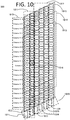
- FIG.10 illustrates an exploded view of the Chord Tone Pattern with double notes by fixed Row 1-5 by Row 6 is 5 th note combines with Root higher octave.
- the Chord Tone Pattern as shown of the present embodiment includes six rows of buttons 1020.
- the six rows of button 1020 are arranged in lines in a direction substantially orthogonal to an expansion and contraction direction of the bellow 300.
- Columns 1010 contain from 12 columns 1013, 16 columns 1014 and 20 columns 1015.
- the six rows of button 1020 with 12 columns 1013 contain about 72 basses.
- the six rows of button 1020 with 16 columns 1014 contain about 96 basses.
- the six rows of button 1020 with 20 columns 1015 contain about 120 basss.
- buttons 1020 include 12 columns 1013 consisting of X-5, X-4, X-3, X-2, X-1, X, X+1, X+2, X+3, X+4, X+5 and X+6.
- the six rows of buttons 1020 include 16 columns 1014 consisting of X-7, X-6, X-5, X-4, X-3, X-2, X-1, X, X+1, X+2, X+3, X+4, X+5, X+6, X+7 and X+8.
- buttons 1020 include 20 columns 1015 consisting of X-9, X-8, X-7, X-6, X-5, X-4, X-3, X-2, X-1, X, X+1, X+2, X+3, X+4, X+5, X+6, X+7, X+8, X+9 and X+10.
- Row#1 1021 and Row#2 1022 are assigned to base notes 1011.
- Row#3 1023, Row#4 1024, Row#5 1025 and Row#6 1026 are assigned to present chords 1012 (triads).
- buttons 1020 For each buttons from the six rows of buttons 1020 a number appears after a note. These numbers are octave numbers which are used for identifying the pitches in an octave. The octave number increases or decreases by one. A greater number refers to a higher octave while a smaller number refers to a lower octave.
- a "C2" button 1016 is a C Root note, which is assigned as a middle C and located in Row#2 1022 and Column X, in order to solve the problem when playing the triad with the close contiguous 3 fingers by arranging 3 notes of major triad or minor triad in the column.
- This "C2" button 1016 allows more extension of directions both following the circle of fifths and the circle of fourths (Moving counterclockwise in the direction of the circle of fifths).
- the Row#1 1021 includes up to 20 buttons of bass consisting of four flat notes, seven natural notes, seven sharp notes and two double-sharp notes.
- Db2 is located in Column X-9; Ab1 is located in Column X-8; Eb2 is located in Column X-7; Bb1 is located in Column X-6; F2 is located in Column X-5; C2 is located in Column X-4; G2 is located in Column X-3; D2 is located in Column X-2; A2 is located in Column X-1; E2 is located in Column X (center); B2 is located in Column X+1; F#2 is located in Column X+2; C#3 is located in Column X+3; G#2 is located in Column X+4; D#3 is located in Column X+5; A#2 is located in Column X+6; E#3(F3) is located in Column X+7; B#2(C3) is located in Column X+8; F
- F2, C2, G2, D2, A2, E2, B2, F#2, C#3, G#2, D#3 and A#2 are elements of all patterns, i.e., the first pattern 1013 (72 buttons in 12 columns), the second pattern 1014 (96 buttons in 16 columns) as well as the last pattern 1015 (120 buttons in 20 columns).
- Eb2 Cold X-7
- Bb1 Coldumn X-6
- E#3(F3) Coldumn X+7)
- B#2(C3) Coldumn X+8
- Db2 Cold X-9
- Ab1 Cold X-8
- F##3(G3) Cold X+9)
- C##2(D3) Cold X+10
- the note formulation in 20 columns 1010 of Row#1 1021 is the 3 rd note in major scale count from root (major third note).
- the Row#2 1022 includes 20 buttons of bass consisting of one double-flat note, seven flat notes, seven natural notes and five sharp notes.
- Bbb1(A1) is located in Column X-9; Fb1(E1) is located in Column X-8; Cb2(B1) is located in Column X-7; Gb1(F#1) is located in Column X-6; Db2(C#2) is located in Column X-5; Ab1 is located in Column X-4; Eb2 is located in Column X-3; Bb1 is located in Column X-2; F2 is located in Column X-1; C2 is located in Column X (center); G2 is located in Column X+1; D2 is located in Column X+2; A2 is located in Column X+3; E2 is located in Column X+4; B2 is located in Column X+5; F#2 is located in Column X+6; C#3 is located in Column X+7; G#2 is located
- Db2(C#2), Ab1, Eb2, Bb1, F2, C2, G2, D2, A2, E2, B2 and F#2 are elements of all patterns, i.e., the first pattern 1013 (72 buttons in 12 columns), the second pattern 1014 (96 buttons in 16 columns) as well as the last pattern 1015 (120 buttons in 20 columns).
- Cb2(B1) (Column X-7), Gb1(F#1) (Column X-6), C#3 (Column X+7) and G#2 (Column X+8) are additional notes from the first pattern 1013, the second pattern 1014 (96 buttons in 16 columns) as well as the last pattern 1015 (120 buttons in 20 columns).
- Bbb1(A1) (Column X-9), Fb1(E1) (Column X-8), D#3 (Column X+9) and A#2 (Column X+10) are additional notes from the second pattern 1014 (96 buttons in 16 columns) in the last pattern 1015 (120 buttons in 20 columns).
- the note formulation in 20 columns 1010 of Row#2 1022 is a root of scale and chord.
- the Row#3 1023 includes 20 buttons of preset chords (triads) consisting of one combination of double flat note with flat note, three combination of flat note with flat note, three combination of flat note with natural note, four combination of natural note with natural note, five combination of natural note with sharp note, four combination of sharp note with sharp note. As shown in the embodiment depicted in FIG.
- Ebb3+Fb3(C#3+E3) is located in Column X-9; Ab2+Cb3(Ab2+B2) is located in Column X-8; Eb3+Gb3 is located in Column X-7; Bb2+Db3 is located in Column X-6; F3+Ab3 is located in Column X-5; C3+Eb3 is located in Column X-4; G3+Bb3 is located in Column X-3; D3+F3 is located in Column X-2; A3+C4 is located in Column X-1; E3+G3 is located in Column X (center); B3+D4 is located in Column X+1; F#3+A3 is located in Column X+2; C#4+E4 is located in Column X+3; G#3+B3 is located in Column X+4; D#4+F##4 is located in Column X+5; A#3+C#4 is located in Column X+6; E#4+G#4 is
- F3+Ab3, C3+Eb3, G3+Bb3, D3+F3, A3+C4, E3+G3, B3+D4, F#3+A3, C#4+E4, G#3+B3 and A#3+C#4 are elements of all patterns, i.e., the first pattern 1013 (72 buttons in 12 columns), the second pattern 1014 (96 buttons in 16 columns) as well as the last pattern 1015 (120 buttons in 20 columns).
- Eb3+Gb3 (Column X-7), Bb2+Db3 (Column X-6), E#4+G#4 (Column X+7) and B#3+D#4 (Column X+8) are additional notes from the first pattern 1013, the second pattern 1014 (96 buttons in 16 columns) as well as the last pattern 1015 (120 buttons in 20 columns).
- Ebb3+Fb3(C#3+E3) (Column X-9), Ab2+Cb3(Ab2B2) (Column X-8), G4+A#4(G4+Bb4)(Column X+9) and D4+E#4(D4+F4)(Column X+10) are additional notes from the second pattern 1014 (96 buttons in 16 columns) in the last pattern 1015 (120 buttons in 20 columns).
- 16 preset chords (triads) in the second pattern 1014 (96 buttons in 16 columns)
- 20 preset chords (triads) in the last pattern 1015 120 buttons in 20 columns).
- the note formulation in 20 columns 1010 of Row#3 1023 is the Major Chord (Root form exclude root note), 3 rd combines with 5 th of Major chord.
- the Row#4 1024 includes 20 buttons of preset chords (triads) consisting of one combination of double flat note with natural note, three combination of double flat note with flat note, four combination of flat note with flat note, three combination of flat note with natural note, four combination of natural note with natural note, three combination of natural note with flat note, two combination of sharp note with sharp note. As shown in the embodiment depicted in FIG.
- Bbb2+C3(A2+C3) is located in Column X-9; Fb3+Abb3(E3+G3) is located in Column X-8; Cb3+Ebb3(B2+D3) is located in Column X-7; Gb3+Bbb3(Gb3+A3) is located in Column X-6; Db3+Fb3(Db3+E3) is located in Column X-5; Ab3+Cb4(Ab3+B3) is located in Column X-4; Eb3+Gb3 is located in Column X-3; Bb3+Db4 is located in Column X-2; F3+Ab3 is located in Column X-1; C4+Eb4 is located in Column X (center); G3+Bb3 is located in Column X+1; D4+F4 is located in Column X+2; A3+C4 is located in Column X+3; E4+G4 is located in Column X+4; B3+D4 is located in Column X
- Db3+Fb3(Db3+E3), Ab3+Cb4(Ab3+B3), Eb3+Gb3, Bb3+Db4, F3+Ab3, C4+Eb4, G3+Bb3, D4+F4, A3+C4, E4+G4, B3+D4 and F#4+A4 are elements of all patterns, i.e., the first pattern 1013 (72 buttons in 12 columns), the second pattern 1014 (96 buttons in 16 columns) as well as the last pattern 1015 (120 buttons in 20 columns).
- Cb3+Ebb3(B2+D3) (Column X-7)
- Gb3+Bbb3(Gb3+A3) (Column X-6)
- C#4+E4 (Column X+7)
- G#4+B4 (Column X+8) are additional notes from the first pattern 1013, the second pattern 1014 (96 buttons in 16 columns) as well as the last pattern 1015 (120 buttons in 20 columns).
- Bbb2+C3(A2+C3) (Column X-9), Fb3+Abb3(E2+G3) (Column X-8), D#4+F#4 (Column X+9) and A#3+C#4(Bb3+C#4) (Column X+10) are additional notes from the second pattern 1014 (96 buttons in 16 columns) in the last pattern 1015 (120 buttons in 20 columns).
- the note formulation in 20 columns 1010 of Row#4 1024 is Minor chord (Root form exclude 5th) 1 st combines with 3 rd of Minor chord.
- the Row#5 1025 includes 20 buttons of preset chords (triads) consisting of one combination of double flat note with double flat note, three combination of flat note with flat note, four combination of flat note with natural note, three combination of natural note with natural note, four combination of natural note with flat note, three combination of sharp note with sharp note, two combination of double flat note with flat note. As shown in the embodiment depicted in FIG.
- Bbb2+Ebb3(A2+C#3) is located in Column X-9; Fb2+Ab2(E2+Ab2) is located in Column X-8; Cb3+Eb3(B2+Eb3) is located in Column X-7; Gb2+Bb2 is located in Column X-6; Db3+F3 is located in Column X-5; Ab2+C3 is located in Column X-4; Eb3+G3 is located in Column X-3; Bb2+D3 is located in Column X-2; F3+A3 is located in Column X-1; C3+E3 is located in Column X (center); G3+B3 is located in Column X+1; D3+F#3 is located in Column X+2; A3+C#4 is located in Column X+3; E3+G#3 is located in Column X+4; B3+D#4 is located in Column X+5; F#3+A#3 is located in Column X+6;
- Db3+F3, Ab2+C3, Eb3+G3, Bb2+D3, F3+A3, C3+E3, G3+B3, D3+F#3, A3+C#4, E3+G#3, B3+D#4 and F#3+A#3 are elements of all patterns, i.e., the first pattern 1013 (72 buttons in 12 columns), the second pattern 1014 (96 buttons in 16 columns) as well as the last pattern 1015 (120 buttons in 20 columns).
- Cb3+Eb3(B2+Eb3) (Column X-7), Gb2+Bb2 (Column X-6), C#4+E#4(C#4+F4) (Column X+7) and G#3+B#3(G#3+C4) (Column X+8) are additional notes from the first pattern 1013, the second pattern 1014 (96 buttons in 16 columns) as well as the last pattern 1015 (120 buttons in 20 columns).
- Bbb2+Ebb3(A2+C#3) (Column X-9)
- Fb2+Ab2(E2+Ab2) (Column X-8)
- D#4+F##4(D#4+G4) (Column X+9)
- A#3+C##4(Bb3#D4) (Column X+10) are additional notes from the second pattern 1014 (96 buttons in 16 columns) in the last pattern 1015 (120 buttons in 20 columns).
- the note formulation in 20 columns 1010 of Row#5 1025 is the Major chord (Root Exclude 5 th note) 1 st note combines with 3 rd note of Major chord without 5th note.
- the Row#6 1026 includes 20 buttons of preset chords (triads) consisting of one combination of natural note with double flat note, six combination of flat note with flat note, one combination of flat note with natural note, six combination of natural note with natural note, one combination of natural note with flat note, five combination of sharp note with sharp note. As shown in the embodiment depicted in FIG.
- E3+Bbb4(E3+A3) is located in Column X-9; Cb3+Fb3(B2+E3) is located in Column X-8; Gb3+Cb4(Gb3+B3) is located in Column X-7; Db3+Gb3 is located in Column X-6; Ab3+Db4 is located in Column X-5; Eb3+Ab3 is located in Column X-4; Bb3+Eb4 is located in Column X-3; F3+Bb3 is located in Column X-2; C4+F4 is located in Column X-1; G3+C4 is located in Column X (center); D4+G4 is located in Column X+1; A3+D4 is located in Column X+2; E4+A4 is located in Column X+3; B3+E4 is located in Column X+4; F#4+B4 is located in Column X+5; C#4+F#4 is located in Column X+6; G#4
- Ab3+Db4, Eb3+Ab3, Bb3+Eb4, F3+Bb3, C4+F4, G3+C4, D4+G4, A3+D4, E4+A4, B3+E4, F#4+B4 and C#4+F#4 are elements of all patterns, i.e., the first pattern 1013 (72 buttons in 12 columns), the second pattern 1014 (96 buttons in 16 columns) as well as the last pattern 1015 (120 buttons in 20 columns).
- Gb3+Cb4(Gb3+B3) (Column X-7), Db3+Gb3 (Column X-6), G#4+C#5 (Column X+7) and D#4+G#4 (Column X+8) are additional notes from the first pattern 1013, the second pattern 1014 (96 buttons in 16 columns) as well as the last pattern 1015 (120 buttons in 20 columns).
- E3+Bbb4(E3+A3) (Column X-9), Cb3+Fb3(B2+E3) (Column X-8), A#4+D#5 (Column X+9) and E#4+A#4 (Column X+10) are additional notes from the second pattern 1014 (96 buttons in 16 columns) in the last pattern 1015 (120 buttons in 20 columns).
- the note formulation in 20 columns 1010 of Row#6 1026 is the 5 th note combines with 2 higher octave of root note.
- This note layout has the ability to play fundamental chords of diatonic scale. It is very easy to play with Major Arpeggio sound alike by using single note or double notes that belong to Major chord, Very easy to play Minor Arpeggio sound alike by using single note or double notes that belong to minor, Very easy to play Dominant 7 th Arpeggio sound alike by using Single note or Double Notes that belong to Dominant 7 th Chord, Very easy to play Diminished Arpeggio Triad sound alike by using Single note or Double Notes that belong to Half Diminished Chord, Very easy to play Full Diminished Arpeggio sound alike by using Single note or Double Notes that belong to Full Diminished Chord, Very easy to play Minor Block Chord or Arpeggio with difference position or difference Column (optional Position).
- This note layout has the ability to play extended chord by using only fixed Row1- Row5. It is very easy to play Minor Major 7 th Arpeggio sound alike by using Single note or Double Notes that belong to Major Chord, Difficult to play Minor 7 th flat 5 th Triad Arpeggio sound alike by using Single note or Double Notes that belong to Minor 7th flat 5 th Triad Chord, Very easy to Major 7 th Arpeggio sound alike by using Single note or Double Notes that belong to Major Chord, Very easy to play Major 9 th Arpeggio sound alike by using Single note or Double Notes that belong to Major Chord.
- Chord forms (Root form and inversion form) by using only fixed row 1- row 5. It is easy to play Major chord by using root form 2 nd inversion, Minor by using root form (use optional position), Dominant 7 th by using Root form 2 nd inversion, Half Diminished by using root form 2 nd inversion, Major 7 th by using root form 2 nd inversion, and Minor 7 th by using root form 2 nd inversion.
- This note layout has an additional ability in that by using Row 6 to work with Row 1 - Row 5. It can also play 1st inversion of Major Chord, nice Suspended Chord on the left-hand, and Have Major Fourth interval as ingredient to create a new chord or to use as harmony of right hand melody. This layout is good for music style such as Pop, and Light Classical.
- FIG.11 illustrates an exploded view of the Chord Tone Pattern with double notes by fixed Row 1-5 by Row 6 is higher octave of Row 5.
- the Chord Tone Pattern of the present embodiment includes six rows of buttons 1120.
- the six rows of button 1120 are arranged in lines in a direction substantially orthogonal to an expansion and contraction direction of the bellow 300.
- Columns 1110 contain from 12 columns 1113, 16 columns 1114 and 20 columns 1115.
- the six rows of button 1120 with 12 columns 1113 contain about 72 basses.
- the six rows of button 1120 with 16 columns 1114 contain about 96 basses.
- the six rows of button 1120 with 20 columns 1115 contain about 120 basss.
- buttons 1120 include 12 columns 1113 consisting of X-5, X-4, X-3, X-2, X-1, X, X+1,X+2, X+3, X+4, X+5 and X+6.
- the six rows of buttons 1120 include 16 columns 1114 consisting of X-7, X-6, X-5, X-4, X-3, X-2, X-1, X, X+1,X+2, X+3, X+4, X+5, X+6, X+7 and X+8.
- buttons 1120 include 20 columns 1115 consisting of X-9, X-8, X-7, X-6, X-5, X-4, X-3, X-2, X-1, X, X+1, X+2, X+3, X+4, X+5, X+6, X+7, X+8, X+9 and X+10.
- Row#1 1121 and Row#2 1122 are assigned to base notes 1110.
- Row#3 1123, Row#4 1124, Row#5 1125 and Row#6 1126 are assigned to present chords 1112 (triads).
- buttons 1120 For each buttons from the six rows of buttons 1120 a number appears after a note. These numbers are octave numbers which are used for identifying the pitches in an octave. The octave number increases or decreases by one. sA greater number refers to a higher octave while a smaller number refers to a lower octave.
- a "C2" button 1116 is a C Root note, which is assigned as a middle C and is located in Row#2 1122 and Column X, in order to solve the problem when playing the triad with the close contiguous 3 fingers by arranging 3 notes of major triad or minor triad in the column.
- This "C2" button 1116 allows more extension of directions both following the circle of fifths and the circle of fourths (Moving counterclockwise in the direction of the circle of fifths).
- the Row#1 1121 includes up to 20 buttons of bass consisting of four flat notes, seven natural notes, seven sharp notes and two double-sharp notes.
- Db2 is located in Column X-9; Ab1 is located in Column X-8; Eb2 is located in Column X-7; Bb1 is located in Column X-6; F2 is located in Column X-5; C2 is located in Column X-4; G2 is located in Column X-3; D2 is located in Column X-2; A2 is located in Column X-1; E2 is located in Column X (center); B2 is located in Column X+1; F#2 is located in Column X+2; C#3 is located in Column X+3; G#2 is located in Column X+4; D#3 is located in Column X+5; A#2 is located in Column X+6; E#3(F3) is located in Column X+7; B#2(C3) is located in Column X+8; F
- F2, C2, G2, D2, A2, E2, B2, F#2, C#3, G#2, D#3 and A#2 are elements of all patterns, i.e., the first pattern 1113 (72 buttons in 12 columns), the second pattern 1114 (96 buttons in 16 columns) as well as the last pattern 1115 (120 buttons in 20 columns).
- Eb2 Cold X-7
- Bb1 Coldumn X-6
- E#3(F3) Coldumn X+7)
- B#2(C3) Coldumn X+8
- Db2 Cold X-9
- Ab1 Cold X-8
- F##3(G3) Cold X+9)
- C##2(D3) Cold X+10
- the note formulation in 20 columns 1110 of Row#1 1121 is the 3 rd note in major scale count from root (major third note).
- the Row#2 1122 includes 20 buttons of bass consisting of one double-flat note, seven flat notes, seven natural notes and five sharp notes.
- Bbb1(A1) is located in Column X-9; Fb1(E1) is located in Column X-8; Cb2(B1) is located in Column X-7; Gb1(F#1) is located in Column X-6; Db2(C#2) is located in Column X-5; Ab1 is located in Column X-4; Eb2 is located in Column X-3; Bb1 is located in Column X-2; F2 is located in Column X-1; C2 is located in Column X (center); G2 is located in Column X+1; D2 is located in Column X+2; A2 is located in Column X+3; E2 is located in Column X+4; B2 is located in Column X+5; F#2 is located in Column X+6; C#3 is located in Column X+7; G#2 is located
- Db2(C#2), Ab1, Eb2, Bb1, F2, C2, G2, D2, A2, E2, B2 and F#2 are elements of all patterns, i.e., the first pattern 1113 (72 buttons in 12 columns), the second pattern 1114 (96 buttons in 16 columns) as well as the last pattern 1115 (120 buttons in 20 columns).
- Cb2(B1) (Column X-7), Gb1(F#1) (Column X-6), C#3 (Column X+7) and G#2 (Column X+8) are additional notes from the first pattern 1113, the second pattern 1114 (96 buttons in 16 columns) as well as the last pattern 1115 (120 buttons in 20 columns).
- Bbb1(A1) (Column X-9), Fb1(E1) (Column X-8), D#3 (Column X+9) and A#2 (Column X+10) are additional notes from the second pattern 1114 (96 buttons in 16 columns) in the last pattern 1115 (120 buttons in 20 columns).
- the note formulation in 20 columns 1110 of Row#2 1122 is a root of scale and chord.
- the Row#3 1123 includes 20 buttons of preset chords (triads) consisting of one combination of double flat note with flat note, three combination of flat note with flat note, three combination of flat note with natural note, four combination of natural note with natural note, five combination of natural note with sharp note, four combination of sharp note with sharp note. As shown in the embodiment depicted in FIG.
- Ebb3+Fb3(C#3+E3) is located in Column X-9; Ab2+Cb3(Ab2+B2) is located in Column X-8; Eb3+Gb3 is located in Column X-7; Bb2+Db3 is located in Column X-6; F3+Ab3 is located in Column X-5; C3+Eb3 is located in Column X-4; G3+Bb3 is located in Column X-3; D3+F3 is located in Column X-2; A3+C4 is located in Column X-1; E3+G3 is located in Column X (center); B3+D4 is located in Column X+1; F#3+A3 is located in Column X+2; C#4+E4 is located in Column X+3; G#3+B3 is located in Column X+4; D#4+F##4 is located in Column X+5; A#3+C#4 is located in Column X+6; E#4+G#4 is
- F3+Ab3, C3+Eb3, G3+Bb3, D3+F3, A3+C4, E3+G3, B3+D4, F#3+A3, C#4+E4, G#3+B3 and A#3+C#4 are elements of all patterns, i.e., the first pattern 1113 (72 buttons in 12 columns), the second pattern 1114 (96 buttons in 16 columns) as well as the last pattern 1115 (120 buttons in 20 columns).
- Eb3+Gb3 (Column X-7), Bb2+Db3 (Column X-6), E#4+G#4 (Column X+7) and B#3+D#4 (Column X+8) are additional notes from the first pattern 1113, the second pattern 1114 (96 buttons in 16 columns) as well as the last pattern 1115 (120 buttons in 20 columns).
- Ebb3+Fb3(C#3+E3) (Column X-9), Ab2+Cb3(Ab2B2) (Column X-8), G4+A#4(G4+Bb4)(Column X+9) and D4+E#4(D4+F4)(Column X+10) are additional notes from the second pattern 1114 (96 buttons in 16 columns) in the last pattern 1115 (120 buttons in 20 columns).
- 16 preset chords (triads) in the second pattern 1114 (96 buttons in 16 columns)
- 20 preset chords (triads) in the last pattern 1115 120 buttons in 20 columns.
- the note formulation in 20 columns 1110 of Row#3 1123 is the Major Chord (Root form exclude root note), 3 rd combines with 5 th of Major chord.
- the Row#4 1124 includes 20 buttons of preset chords (triads) consisting of one combination of double flat note with natural note, three combination of double flat note with flat note, four combination of flat note with flat note, three combination of flat note with natural note, four combination of natural note with natural note, three combination of natural note with flat note, two combination of sharp note with sharp note. As shown in the embodiment depicted in FIG.
- Bbb2+C3(A2+C3) is located in Column X-9; Fb3+Abb3(E3+G3) is located in Column X-8; Cb3+Ebb3(B2+D3) is located in Column X-7; Gb3+Bbb3(Gb3+A3) is located in Column X-6; Db3+Fb3(Db3+E3) is located in Column X-5; Ab3+Cb4(Ab3+B3) is located in Column X-4; Eb3+Gb3 is located in Column X-3; Bb3+Db4 is located in Column X-2; F3+Ab3 is located in Column X-1; C4+Eb4 is located in Column X (center); G3+Bb3 is located in Column X+1; D4+F4 is located in Column X+2; A3+C4 is located in Column X+3; E4+G4 is located in Column X+4; B3+D4 is located in Column X
- Db3+Fb3(Db3+E3), Ab3+Cb4(Ab3+B3), Eb3+Gb3, Bb3+Db4, F3+Ab3, C4+Eb4, G3+Bb3, D4+F4, A3+C4, E4+G4, B3+D4 and F#4+A4 are elements of all patterns, i.e., the first pattern 1113 (72 buttons in 12 columns), the second pattern 1114 (96 buttons in 16 columns) as well as the last pattern 1115 (120 buttons in 20 columns).
- Cb3+Ebb3(B2+D3) (Column X-7)
- Gb3+Bbb3(Gb3+A3) (Column X-6)
- C#4+E4 (Column X+7)
- G#4+B4 (Column X+8) are additional notes from the first pattern 1113, the second pattern 1114 (96 buttons in 16 columns) as well as the last pattern 1115 (120 buttons in 20 columns).
- Bbb2+C3(A2+C3) (Column X-9), Fb3+Abb3(E2+G3) (Column X-8), D#4+F#4 (Column X+9) and A#3+C#4(Bb3+C#4) (Column X+10) are additional notes from the second pattern 1114 (96 buttons in 16 columns) in the last pattern 1115 (120 buttons in 20 columns).
- the note formulation in 20 columns 1110 of Row#4 1124 is Minor chord (Root form exclude 5th) 1 st combines with 3 rd of Minor chord.
- the Row#5 1125 includes 20 buttons of preset chords (triads) consisting of one combination of double flat note with double flat note, three combination of flat note with flat note, four combination of flat note with natural note, three combination of natural note with natural note, four combination of natural note with flat note, three combination of sharp note with sharp note, two combination of double flat note with flat note. As shown in the embodiment depicted in FIG.
- Bbb2+Ebb3(A2+C#3) is located in Column X-9; Fb2+Ab2(E2+Ab2) is located in Column X-8; Cb3+Eb3(B2+Eb3) is located in Column X-7; Gb2+Bb2 is located in Column X-6; Db3+F3 is located in Column X-5; Ab2+C3 is located in Column X-4; Eb3+G3 is located in Column X-3; Bb2+D3 is located in Column X-2; F3+A3 is located in Column X-1; C3+E3 is located in Column X (center); G3+B3 is located in Column X+1; D3+F#3 is located in Column X+2; A3+C#4 is located in Column X+3; E3+G#3 is located in Column X+4; B3+D#4 is located in Column X+5; F#3+A#3 is located in Column X+6;
- Db3+F3, Ab2+C3, Eb3+G3, Bb2+D3, F3+A3, C3+E3, G3+B3, D3+F#3, A3+C#4, E3+G#3, B3+D#4 and F#3+A#3 are elements of all patterns, i.e., the first pattern 1113 (72 buttons in 12 columns), the second pattern 1114 (96 buttons in 16 columns) as well as the last pattern 1115 (120 buttons in 20 columns).
- Cb3+Eb3(B2+Eb3) (Column X-7), Gb2+Bb2 (Column X-6), C#4+E#4(C#4+F4) (Column X+7) and G#3+B#3(G#3+C4) (Column X+8) are additional notes from the first pattern 1113, the second pattern 1114 (96 buttons in 16 columns) as well as the last pattern 1115 (120 buttons in 20 columns).
- Bbb2+Ebb3(A2+C#3) (Column X-9)
- Fb2+Ab2(E2+Ab2) (Column X-8)
- D#4+F##4(D#4+G4) (Column X+9)
- A#3+C##4(Bb3#D4) (Column X+10) are additional notes from the second pattern 1114 (96 buttons in 16 columns) in the last pattern 1115 (120 buttons in 20 columns).
- the Row#6 1126 includes 20 buttons of preset chords (triads) consisting of one combination of double flat note with double flat note, three combination of flat note with flat note, four combination of flat note with natural note, three combination of natural note with natural note, four combination of natural note with flat note, three combination of sharp note with sharp note, two combination of double flat note with flat note. As shown in the embodiment depicted in FIG.
- Bbb3+Ebb4(A3+C#4) is located in Column X-9; Fb3+Ab3(E3+Ab3) is located in Column X-8; Cb4+Eb4(B3+Eb4) is located in Column X-7; Gb3+Bb3 is located in Column X-6; Db4+F4 is located in Column X-5; Ab3+C4 is located in Column X-4; Eb4+G4 is located in Column X-3; Bb3+D4 is located in Column X-2; F4+A4 is located in Column X-1; C4+E4 is located in Column X (center); G4+B4 is located in Column X+1; D4+F#4 is located in Column X+2; A4+C#5 is located in Column X+3; E4+G#4 is located in Column X+4; B4+D#5 is located in Column X+5; F#4+A#4 is located in Column X+6;
- Db4+F4, Ab3+C4, Eb4+G4, Bb3+D4, F4+A4, C4+E4, G4+B4, D4+F#4, A4+C#5, E4+G#4, B4+D#5, F#4+A#4 are elements of all patterns, i.e., the first pattern 1113 (72 buttons in 12 columns), the second pattern 1114 (96 buttons in 16 columns) as well as the last pattern 1115 (120 buttons in 20 columns).
- Cb4+Eb4(B3+Eb4) (Column X-7), Gb3+Bb3 (Column X-6), C#5+E#5(C#5+F5) (Column X+7) and G#4+B#4(G#4+C5) (Column X+8) are additional notes from the first pattern 1113, the second pattern 1114 (96 buttons in 16 columns) as well as the last pattern 1115 (120 buttons in 20 columns).
- Bbb3+Ebb4(A3+C#4) (Column X-9), Fb3+Ab3(E3+Ab3) (Column X-8), D#5+F##5(D#5+G5) (Column X+9) and A#4+C##5(Bb4+D5) (Column X+10) are additional notes from the second pattern 1114 (96 buttons in 16 columns) in the last pattern 1115 (120 buttons in 20 columns).
- This note layout has the ability to play fundamental chords of diatonic scale. It is very easy to play with Major Arpeggio sound alike by using single note or double notes that belong to Major chord, Very easy to play Minor Arpeggio sound alike by using single note or double notes that belong to minor, Very easy to play Dominant 7 th Arpeggio sound alike by using Single note or Double Notes that belong to Dominant 7 th Chord, Very easy to play Diminished Arpeggio Triad sound alike by using Single note or Double Notes that belong to Half Diminished Chord, Very easy to play Full Diminished Arpeggio sound alike by using Single note or Double Notes that belong to Full Diminished Chord, Very easy to play Minor Block Chord or Arpeggio with difference position or difference Column (optional Position).
- This note layout has the ability to play extended chord by using only fixed Row1- Row5. It is very easy to play Minor Major 7 th Arpeggio sound alike by using Single note or Double Notes that belong to Major Chord, Difficult to play Minor 7 th flat 5 th Triad Arpeggio sound alike by using Single note or Double Notes that belong to Minor 7th flat 5 th Triad Chord, Very easy to Major 7 th Arpeggio sound alike by using Single note or Double Notes that belong to Major Chord, Very easy to play Major 9 th Arpeggio sound alike by using Single note or Double Notes that belong to Major Chord.
- t is easy to play Major chord by using root form 2 nd inversion, Minor by using root form (use optional position), Dominant 7 th by using Root form 2 nd inversion, Half Diminished by using root form 2 nd inversion, Major 7 th by using root form 2 nd inversion, and Minor 7 th by using root form 2 nd inversion.
- This note layout has an additional ability in that by using Row 6 to work with Row 1 - Row 5. It can also play Major Chord with wider Octave sound. Additionally, it can play Major 7 th with Root and 2 nd inversion form for all chords. This layout is good for music style such as jazz.
- FIG.12 illustrates an exploded view of the Chord Tone Pattern with double notes by fixed Row 1-5 by Row 6 is lower octave Minor 7 th combines with 5 th of root.
- the Chord Tone Pattern of the present embodiment includes six rows of buttons 1220.
- the six rows of button 1220 are arranged in lines in a direction substantially orthogonal to an expansion and contraction direction of the bellow 300.
- Columns 1210 contain from 12 columns 1213, 16 columns 1214 and 20 columns 1215.
- the six rows of button 1220 with 12 columns 1213 contain about 72 basses.
- the six rows of button 1220 with 16 columns 1214 contain about 96 basses.
- the six rows of button 1220 with 20 columns 1215 contain about 120 basss.
- buttons 1220 include 12 columns 1213 consisting of X-5, X-4, X-3, X-2, X-1, X, X+1, X+2, X+3, X+4, X+5 and X+6.
- the six rows of buttons 1220 include 16 columns 1214 consisting of X-7, X-6, X-5, X-4, X-3, X-2, X-1, X, X+1, X+2, X+3, X+4, X+5, X+6, X+7 and X+8.
- buttons 1220 include 20 columns 1215 consisting of X-9, X-8, X-7, X-6, X-5, X-4, X-3, X-2, X-1, X, X+1,X+2, X+3, X+4, X+5, X+6, X+7, X+8, X+9 and X+10.
- Rot#1 1221 and Row#2 1222 are assigned to base notes 1210.
- Row#3 1223, Row#4 1224, Row#5 1225 and Row#6 1226 are assigned to present chords 1212 (triads).
- buttons 1220 For each buttons from the six rows of buttons 1220 a number appears after a note. These numbers are octave numbers which are used for identifying the pitches in an octave. The octave number increases or decreases by one. A greater number refers to a higher octave while a smaller number refers to a lower octave.
- a "C2" button 1216 is a C Root note, which is assigned as a middle C and is located in Row#2 1222 and Column X, in order to solve the problem when playing the triad with the close contiguous 3 fingers by arranging 3 notes of major triad or minor triad in the column.
- This "C2" button 1216 allows more extension of directions both following the circle of fifths and the circle of fourths (Moving counterclockwise in the direction of the circle of fifths).
- the Row#1 1221 includes up to 20 buttons of bass consisting of four flat notes, seven natural notes, seven sharp notes and two double-sharp notes.
- Db2 is located in Column X-9; Ab1 is located in Column X-8; Eb2 is located in Column X-7; Bb1 is located in Column X-6; F2 is located in Column X-5; C2 is located in Column X-4; G2 is located in Column X-3; D2 is located in Column X-2; A2 is located in Column X-1; E2 is located in Column X (center); B2 is located in Column X+1; F#2 is located in Column X+2; C#3 is located in Column X+3; G#2 is located in Column X+4; D#3 is located in Column X+5; A#2 is located in Column X+6; E#3(F3) is located in Column X+7; B#2(C3) is located in Column X+8; F
- F2, C2, G2, D2, A2, E2, B2, F#2, C#3, G#2, D#3 and A#2 are elements of all patterns, i.e., the first pattern 1213 (72 buttons in 12 columns), the second pattern 1214 (96 buttons in 16 columns) as well as the last pattern 1215 (120 buttons in 20 columns).
- Eb2 Cold X-7
- Bb1 Coldumn X-6
- E#3(F3) Coldumn X+7)
- B#2(C3) Coldumn X+8
- Db2 Cold X-9
- Ab1 Cold X-8
- F##3(G3) Cold X+9)
- C##2(D3) Cold X+10
- the note formulation in 20 columns 1210 of Row#1 1221 is the 3 rd note in major scale count from root (major third note).
- the Row#2 1222 includes 20 buttons of bass consisting of one double-flat note, seven flat notes, seven natural notes and five sharp notes.
- Bbb1(A1) is located in Column X-9; Fb1(E1) is located in Column X-8; Cb2(B1) is located in Column X-7; Gb1(F#1) is located in Column X-6; Db2(C#2) is located in Column X-5; Ab1 is located in Column X-4; Eb2 is located in Column X-3; Bb1 is located in Column X-2; F2 is located in Column X-1; C2 is located in Column X (center); G2 is located in Column X+1; D2 is located in Column X+2; A2 is located in Column X+3; E2 is located in Column X+4; B2 is located in Column X+5; F#2 is located in Column X+6; C#3 is located in Column X+7; G#2 is located
- Db2(C#2), Ab1, Eb2, Bb1, F2, C2, G2, D2, A2, E2, B2 and F#2 are elements of all patterns, i.e., the first pattern 1213 (72 buttons in 12 columns), the second pattern 1214 (96 buttons in 16 columns) as well as the last pattern 1215 (120 buttons in 20 columns).
- Cb2(B1) (Column X-7), Gb1(F#1) (Column X-6), C#3 (Column X+7) and G#2 (Column X+8) are additional notes from the first pattern 1213, the second pattern 1214 (96 buttons in 16 columns) as well as the last pattern 1215 (120 buttons in 20 columns).
- Bbb1(A1) (Column X-9), Fb1(E1) (Column X-8), D#3 (Column X+9) and A#2 (Column X+10) are additional notes from the second pattern 1214 (96 buttons in 16 columns) in the last pattern 1215 (120 buttons in 20 columns).
- the note formulation in 20 columns 1210 of Row#2 1222 is a root of scale and chord.
- the Row#3 1223 includes 20 buttons of preset chords (triads) consisting of one combination of double flat note with flat note, three combination of flat note with flat note, three combination of flat note with natural note, four combination of natural note with natural note, five combination of natural note with sharp note, four combination of sharp note with sharp note. As shown in the embodiment depicted in FIG.
- Ebb3+Fb3(C#3+E3) is located in Column X-9; Ab2+Cb3(Ab2+B2) is located in Column X-8; Eb3+Gb3 is located in Column X-7; Bb2+Db3 is located in Column X-6; F3+Ab3 is located in Column X-5; C3+Eb3 is located in Column X-4; G3+Bb3 is located in Column X-3; D3+F3 is located in Column X-2; A3+C4 is located in Column X-1; E3+G3 is located in Column X (center); B3+D4 is located in Column X+1; F#3+A3 is located in Column X+2; C#4+E4 is located in Column X+3; G#3+B3 is located in Column X+4; D#4+F##4 is located in Column X+5; A#3+C#4 is located in Column X+6; E#4+G#4 is
- F3+Ab3, C3+Eb3, G3+Bb3, D3+F3, A3+C4, E3+G3, B3+D4, F#3+A3, C#4+E4, G#3+B3 and A#3+C#4 are elements of all patterns, i.e., the first pattern 1213 (72 buttons in 12 columns), the second pattern 1214 (96 buttons in 16 columns) as well as the last pattern 1215 (120 buttons in 20 columns).
- Eb3+Gb3 (Column X-7), Bb2+Db3 (Column X-6), E#4+G#4 (Column X+7) and B#3+D#4 (Column X+8) are additional notes from the first pattern 1213, the second pattern 1214 (96 buttons in 16 columns) as well as the last pattern 1215 (120 buttons in 20 columns).
- Ebb3+Fb3(C#3+E3) (Column X-9), Ab2+Cb3(Ab2B2) (Column X-8), G4+A#4(G4+Bb4)(Column X+9) and D4+E#4(D4+F4)(Column X+10) are additional notes from the second pattern 1214 (96 buttons in 16 columns) in the last pattern 1215 (120 buttons in 20 columns).
- the note formulation in 20 columns 1210 of Row#3 1223 is the Major Chord (Root form exclude root note), 3 rd combines with 5 th of Major chord.
- the Row#4 1224 includes 20 buttons of preset chords (triads) consisting of one combination of double flat note with natural note, three combination of double flat note with flat note, four combination of flat note with flat note, three combination of flat note with natural note, four combination of natural note with natural note, three combination of natural note with flat note, two combination of sharp note with sharp note. As shown in the embodiment depicted in FIG.
- Bbb2+C3(A2+C3) is located in Column X-9; Fb3+Abb3(E3+G3) is located in Column X-8; Cb3+Ebb3(B2+D3) is located in Column X-7; Gb3+Bbb3(Gb3+A3) is located in Column X-6; Db3+Fb3(Db3+E3) is located in Column X-5; Ab3+Cb4(Ab3+B3) is located in Column X-4; Eb3+Gb3 is located in Column X-3; Bb3+Db4 is located in Column X-2; F3+Ab3 is located in Column X-1; C4+Eb4 is located in Column X (center); G3+Bb3 is located in Column X+1; D4+F4 is located in Column X+2; A3+C4 is located in Column X+3; E4+G4 is located in Column X+4; B3+D4 is located in Column X
- Db3+Fb3(Db3+E3), Ab3+Cb4(Ab3+B3), Eb3+Gb3, Bb3+Db4, F3+Ab3, C4+Eb4, G3+Bb3, D4+F4, A3+C4, E4+G4, B3+D4 and F#4+A4 are elements of all patterns, i.e., the first pattern 1213 (72 buttons in 12 columns), the second pattern 1214 (96 buttons in 16 columns) as well as the last pattern 1215 (120 buttons in 20 columns).
- Cb3+Ebb3(B2+D3) (Column X-7)
- Gb3+Bbb3(Gb3+A3) (Column X-6)
- C#4+E4 (Column X+7)
- G#4+B4 (Column X+8) are additional notes from the first pattern 1213, the second pattern 1214 (96 buttons in 16 columns) as well as the last pattern 1215 (120 buttons in 20 columns).
- Bbb2+C3(A2+C3) (Column X-9), Fb3+Abb3(E2+G3) (Column X-8), D#4+F#4 (Column X+9) and A#3+C#4(Bb3+C#4) (Column X+10) are additional notes from the second pattern 1214 (96 buttons in 16 columns) in the last pattern 1215 (120 buttons in 20 columns).
- the note formulation in 20 columns 1210 of Row#4 1224 is Minor chord (Root form exclude 5 th ) 1 st combines with 3 rd of Minor chord.
- the Row#5 1225 includes 20 buttons of preset chords (triads) consisting of one combination of double flat note with double flat note, three combination of flat note with flat note, four combination of flat note with natural note, three combination of natural note with natural note, four combination of natural note with flat note, three combination of sharp note with sharp note, two combination of double flat note with flat note. As shown in the embodiment depicted in FIG.
- Bbb2+Ebb3(A2+C#3) is located in Column X-9; Fb2+Ab2(E2+Ab2) is located in Column X-8; Cb3+Eb3(B2+Eb3) is located in Column X-7; Gb2+Bb2 is located in Column X-6; Db3+F3 is located in Column X-5; Ab2+C3 is located in Column X-4; Eb3+G3 is located in Column X-3; Bb2+D3 is located in Column X-2; F3+A3 is located in Column X-1; C3+E3 is located in Column X (center); G3+B3 is located in Column X+1; D3+F#3 is located in Column X+2; A3+C#4 is located in Column X+3; E3+G#3 is located in Column X+4; B3+D#4 is located in Column X+5; F#3+A#3 is located in Column X+6;
- Db3+F3, Ab2+C3, Eb3+G3, Bb2+D3, F3+A3, C3+E3, G3+B3, D3+F#3, A3+C#4, E3+G#3, B3+D#4 and F#3+A#3 are elements of all patterns, i.e., the first pattern 1213 (72 buttons in 12 columns), the second pattern 1214 (96 buttons in 16 columns) as well as the last pattern 1215 (120 buttons in 20 columns).
- Cb3+Eb3(B2+Eb3) (Column X-7), Gb2+Bb2 (Column X-6), C#4+E#4(C#4+F4) (Column X+7) and G#3+B#3(G#3+C4) (Column X+8) are additional notes from the first pattern 1213, the second pattern 1214 (96 buttons in 16 columns) as well as the last pattern 1215 (120 buttons in 20 columns).
- Bbb2+Ebb3(A2+C#3) (Column X-9)
- Fb2+Ab2(E2+Ab2) (Column X-8)
- D#4+F##4(D#4+G4) (Column X+9)
- A#3+C##4(Bb3#D4) (Column X+10) are additional notes from the second pattern 1214 (96 buttons in 16 columns) in the last pattern 1215 (120 buttons in 20 columns).
- the note formulation in 20 columns 1210 of Row#5 1225 is the Major chord (Root Exclude 5 th note) 1 st note combines with 3 rd note of Major chord without 5 th note.
- the Row#6 1226 includes 20 buttons of preset chords (triads) consisting of four combination of flat note with flat note, five combination of natural note with natural note, five combination of natural note with flat note, three combination of natural note with sharp note, three combination of natural note with sharp note. As shown in the embodiment depicted in FIG.
- G2+E3 is located in Column X-9; D2+Cb3 is located in Column X-8; A2+Gb3 is located in Column X-7; Fb2+Db3 is located in Column X-6; Cb3+Ab3 is located in Column X-5; Gb2+Eb3 is located in Column X-4; Db3+Bb3 is located in Column X-3; Ab2+F3 is located in Column X-2; Eb3+C4 is located in Column X-1; Bb2+G3 is located in Column X (center); F3+D4 is located in Column X+1; C3+A3 is located in Column X+2; G3+E4 is located in Column X+3; D3+B3 is located in Column X+4; A3+F#4 is located in Column X+5; E3+C#4 is located in Column X+6; B3+G#4 is located in Column X+7; F#3+D#4 is located in
- E3+C#4 are elements of all patterns, i.e., the first pattern 1213 (72 buttons in 12 columns), the second pattern 814 (96 buttons in 16 columns) as well as the last pattern 1215 (120 buttons in 20 columns).
- A2+Gb3 (Column X-7), Fb2+Db3 (Column X-6), B3+G#4 (Column X+7) and F#3+D#4 (Column X+8) are additional notes from the first pattern 1213, the second pattern 1214 (96 buttons in 16 columns) as well as the last pattern 1215 (120 buttons in 20 columns).
- G2+E3 (Column X-9), D2+Cb3 (Column X-8), C#4+A#4 (Column X+9) and G#3+E#4 Column X+10) are additional notes from the second pattern 1214 (96 buttons in 16 columns) in the last pattern 1215 (120 buttons in 20 columns).
- This note layout has the ability to play fundamental chords of diatonic scale. It is very easy to play with Major Arpeggio sound alike by using single note or double notes that belong to Major chord, Very easy to play Minor Arpeggio sound alike by using single note or double notes that belong to minor, Very easy to play Dominant 7 th Arpeggio sound alike by using Single note or Double Notes that belong to Dominant 7 th Chord, Very easy to play Diminished Arpeggio Triad sound alike by using Single note or Double Notes that belong to Half Diminished Chord, Very easy to play Full Diminished Arpeggio sound alike by using Single note or Double Notes that belong to Full Diminished Chord, Very easy to play Minor Block Chord or Arpeggio with difference position or difference Column (optional Position).
- This note layout has the ability to play extended chord by using only fixed Row1- Row5. It is very easy to play Minor Major 7 th Arpeggio sound alike by using Single note or Double Notes that belong to Major Chord, Difficult to play Minor 7 th flat 5 th Triad Arpeggio sound alike by using Single note or Double Notes that belong to Minor 7th flat 5 th Triad Chord, Very easy to Major 7 th Arpeggio sound alike by using Single note or Double Notes that belong to Major Chord, Very easy to play Major 9 th Arpeggio sound alike by using Single note or Double Notes that belong to Major Chord.
- This note layout can easily play Chord progression by using this note layout, it can also play ii-V(7)-I of Major Scale and I-IV-V and ii, iii, vi of Major Scale. But, the ability to play ii7b5-V-I of Minor Scale is moderate since it used ii Dim (Triad) instead of ii7b5.
- Chord forms (Root form and inversion form) by using only fixed row 1- row 5. It is easy to play Major chord by using root form 2 nd inversion, Minor by using root form (use optional position), Dominant 7 th by using Root form 2 nd inversion, Half Diminished by using root form 2 nd inversion, Major 7 th by using root form 2 nd inversion, and Minor 7 th by using root form 2 nd inversion.
- This note layout has an additional ability in that by using Row 6 to work with Row 1 - Row 5. It can Play Dominant 7 th Chord with 2 Inversions (forms) for all chord , and half of that can play Dominant 7th with 3 Inversions (forms), It has Major Sixth interval as ingredient to create new chord or to use as harmony of right hand melody. This layout is good for music style such as Pop, jazz and Blues.
- FIG.13 illustrates an exploded view of the Chord Tone Pattern with double notes by fixed Row 1-5 by Row 6 is lower octave of Minor 7 th combines with root note.
- the Chord Tone Pattern of the present embodiment includes six rows of buttons 1320.
- the six rows of button 1320 are arranged in lines in a direction substantially orthogonal to an expansion and contraction direction of the bellow 300.
- Columns 1310 contain from 12 columns 1313, 16 columns 1314 and 20 columns 1315.
- the six rows of button 1320 with 12 columns 1313 contain about 72 basses.
- the six rows of button 1320 with 16 columns 1314 contain about 96 basses.
- the six rows of button 1320 with 20 columns 1315 contain about 120 basss.
- buttons 1320 include 12 columns 1313 consisting of X-5, X-4, X-3, X-2, X-1, X, X+1, X+2, X+3, X+4, X+5 and X+6.
- the six rows of buttons 1320 include 16 columns 1314 consisting of X-7, X-6, X-5, X-4, X-3, X-2, X-1, X, X+1, X+2, X+3, X+4, X+5, X+6, X+7 and X+8.
- buttons 1320 include 20 columns 1315 consisting of X-9, X-8, X-7, X-6, X-5, X-4, X-3, X-2, X-1, X, X+1, X+2, X+3, X+4, X+5, X+6, X+7, X+8, X+9 and X+10.
- Row#1 1321 and Row#2 1322 are assigned to base notes 1310.
- Row#3 1323, Row#4 1324, Row#5 1325 and Row#6 1326 are assigned to present chords 1312 (triads).
- buttons 1320 For each buttons from the six rows of buttons 1320 a number appears after a note. These numbers are octave numbers which are used for identifying the pitches in an octave. The octave number increases or decreases by one. A greater number refers to a higher octave while a smaller number refers to a lower octave.
- a "C2" button 1316 is a C Root note, which is assigned as a middle C and is located in Row#2 1322 and Column X, in order to solve the problem when playing the triad with the close contiguous 3 fingers by arranging 3 notes of major triad or minor triad in the column.
- This "C2" button 1316 allows more extension of directions both following the circle of fifths and the circle of fourths (Moving counterclockwise in the direction of the circle of fifths).
- the Row#1 1321 includes up to 20 buttons of bass consisting of four flat notes, seven natural notes, seven sharp notes and two double-sharp notes.
- Db2 is located in Column X-9; Ab1 is located in Column X-8; Eb2 is located in Column X-7; Bb1 is located in Column X-6; F2 is located in Column X-5; C2 is located in Column X-4; G2 is located in Column X-3; D2 is located in Column X-2; A2 is located in Column X-1; E2 is located in Column X (center); B2 is located in Column X+1; F#2 is located in Column X+2; C#3 is located in Column X+3; G#2 is located in Column X+4; D#3 is located in Column X+5; A#2 is located in Column X+6; E#3(F3) is located in Column X+7; B#2(C3) is located in Column X+8; F
- F2, C2, G2, D2, A2, E2, B2, F#2, C#3, G#2, D#3 and A#2 are elements of all patterns, i.e., the first pattern 1313 (72 buttons in 12 columns), the second pattern 1314 (96 buttons in 16 columns) as well as the last pattern 1315 (120 buttons in 20 columns).
- Eb2 Cold X-7
- Bb1 Coldumn X-6
- E#3(F3) Coldumn X+7)
- B#2(C3) Coldumn X+8
- Db2 Cold X-9
- Ab1 Cold X-8
- F##3(G3) Cold X+9)
- C##2(D3) Cold X+10
- the note formulation in 20 columns 1310 of Row#1 1321 is the 3 rd note in major scale count from root (major third note).
- the Row#2 1322 includes 20 buttons of bass consisting of one double-flat note, seven flat notes, seven natural notes and five sharp notes.
- Bbb1(A1) is located in Column X-9; Fb1(E1) is located in Column X-8; Cb2(B1) is located in Column X-7; Gb1(F#1) is located in Column X-6; Db2(C#2) is located in Column X-5; Ab1 is located in Column X-4; Eb2 is located in Column X-3; Bb1 is located in Column X-2; F2 is located in Column X-1; C2 is located in Column X (center); G2 is located in Column X+1; D2 is located in Column X+2; A2 is located in Column X+3; E2 is located in Column X+4; B2 is located in Column X+5; F#2 is located in Column X+6; C#3 is located in Column X+7; G#2 is located
- Db2(C#2), Ab1, Eb2, Bb1, F2, C2, G2, D2, A2, E2, B2 and F#2 are elements of all patterns, i.e., the first pattern 1313 (72 buttons in 12 columns), the second pattern 1314 (96 buttons in 16 columns) as well as the last pattern 1315 (120 buttons in 20 columns).
- Cb2(B1) (Column X-7), Gb1(F#1) (Column X-6), C#3 (Column X+7) and G#2 (Column X+8) are additional notes from the first pattern 1313, the second pattern 1314 (96 buttons in 16 columns) as well as the last pattern 1315 (120 buttons in 20 columns).
- Bbb1(A1) (Column X-9), Fb1(E1) (Column X-8), D#3 (Column X+9) and A#2 (Column X+10) are additional notes from the second pattern 1314 (96 buttons in 16 columns) in the last pattern 1315 (120 buttons in 20 columns).
- the note formulation in 20 columns 1310 of Row#2 1322 is a root of scale and chord.
- the Row#3 1323 includes 20 buttons of preset chords (triads) consisting of one combination of double flat note with flat note, three combination of flat note with flat note, three combination of flat note with natural note, four combination of natural note with natural note, five combination of natural note with sharp note, four combination of sharp note with sharp note. As shown in the embodiment depicted in FIG.
- Ebb3+Fb3(C#3+E3) is located in Column X-9; Ab2+Cb3(Ab2+B2) is located in Column X-8; Eb3+Gb3 is located in Column X-7; Bb2+Db3 is located in Column X-6; F3+Ab3 is located in Column X-5; C3+Eb3 is located in Column X-4; G3+Bb3 is located in Column X-3; D3+F3 is located in Column X-2; A3+C4 is located in Column X-1; E3+G3 is located in Column X (center); B3+D4 is located in Column X+1; F#3+A3 is located in Column X+2; C#4+E4 is located in Column X+3; G#3+B3 is located in Column X+4; D#4+F##4 is located in Column X+5; A#3+C#4 is located in Column X+6; E#4+G#4 is
- F3+Ab3, C3+Eb3, G3+Bb3, D3+F3, A3+C4, E3+G3, B3+D4, F#3+A3, C#4+E4, G#3+B3 and A#3+C#4 are elements of all patterns, i.e., the first pattern 1313 (72 buttons in 12 columns), the second pattern 1314 (96 buttons in 16 columns) as well as the last pattern 1315 (120 buttons in 20 columns).
- Eb3+Gb3 (Column X-7), Bb2+Db3 (Column X-6), E#4+G#4 (Column X+7) and B#3+D#4 (Column X+8) are additional notes from the first pattern 1313, the second pattern 1314 (96 buttons in 16 columns) as well as the last pattern 1315 (120 buttons in 20 columns).
- Ebb3+Fb3(C#3+E3) (Column X-9), Ab2+Cb3(Ab2B2) (Column X-8), G4+A#4(G4+Bb4)(Column X+9) and D4+E#4(D4+F4)(Column X+10) are additional notes from the second pattern 1314 (96 buttons in 16 columns) in the last pattern 1315 (120 buttons in 20 columns).
- 16 preset chords (triads) in the second pattern 1314 (96 buttons in 16 columns)
- 20 preset chords (triads) in the last pattern 1315 120 buttons in 20 columns).
- the note formulation in 20 columns 1310 of Row#3 1323 is the Major Chord (Root form exclude root note), 3 rd combines with 5 th of Major chord.
- the Row#4 1324 includes 20 buttons of preset chords (triads) consisting of one combination of double flat note with natural note, three combination of double flat note with flat note, four combination of flat note with flat note, three combination of flat note with natural note, four combination of natural note with natural note, three combination of natural note with flat note, two combination of sharp note with sharp note. As shown in the embodiment depicted in FIG.
- Bbb2+C3(A2+C3) is located in Column X-9; Fb3+Abb3(E3+G3) is located in Column X-8; Cb3+Ebb3(B2+D3) is located in Column X-7; Gb3+Bbb3(Gb3+A3) is located in Column X-6; Db3+Fb3(Db3+E3) is located in Column X-5; Ab3+Cb4(Ab3+B3) is located in Column X-4; Eb3+Gb3 is located in Column X-3; Bb3+Db4 is located in Column X-2; F3+Ab3 is located in Column X-1; C4+Eb4 is located in Column X (center); G3+Bb3 is located in Column X+1; D4+F4 is located in Column X+2; A3+C4 is located in Column X+3; E4+G4 is located in Column X+4; B3+D4 is located in Column X
- Db3+Fb3(Db3+E3), Ab3+Cb4(Ab3+B3), Eb3+Gb3, Bb3+Db4, F3+Ab3, C4+Eb4, G3+Bb3, D4+F4, A3+C4, E4+G4, B3+D4 and F#4+A4 are elements of all patterns, i.e., the first pattern 1313 (72 buttons in 12 columns), the second pattern 1314 (96 buttons in 16 columns) as well as the last pattern 1315 (120 buttons in 20 columns).
- Cb3+Ebb3(B2+D3) (Column X-7)
- Gb3+Bbb3(Gb3+A3) (Column X-6)
- C#4+E4 (Column X+7)
- G#4+B4 (Column X+8) are additional notes from the first pattern 1313, the second pattern 1314 (96 buttons in 16 columns) as well as the last pattern 1315 (120 buttons in 20 columns).
- Bbb2+C3(A2+C3) (Column X-9), Fb3+Abb3(E2+G3) (Column X-8), D#4+F#4 (Column X+9) and A#3+C#4(Bb3+C#4) (Column X+10) are additional notes from the second pattern 1314 (96 buttons in 16 columns) in the last pattern 1315 (120 buttons in 20 columns).
- the note formulation in 20 columns 1310 of Row#4 1324 is Minor chord (Root form exclude 5 th ) 1 st combines with 3 rd of Minor chord.
- the Row#5 1325 includes 20 buttons of preset chords (triads) consisting of one combination of double flat note with double flat note, three combination of flat note with flat note, four combination of flat note with natural note, three combination of natural note with natural note, four combination of natural note with flat note, three combination of sharp note with sharp note, two combination of double flat note with flat note. As shown in the embodiment depicted in FIG.
- Bbb2+Ebb3(A2+C#3) is located in Column X-9; Fb2+Ab2(E2+Ab2) is located in Column X-8; Cb3+Eb3(B2+Eb3) is located in Column X-7; Gb2+Bb2 is located in Column X-6; Db3+F3 is located in Column X-5; Ab2+C3 is located in Column X-4; Eb3+G3 is located in Column X-3; Bb2+D3 is located in Column X-2; F3+A3 is located in Column X-1; C3+E3 is located in Column X (center); G3+B3 is located in Column X+1; D3+F#3 is located in Column X+2; A3+C#4 is located in Column X+3; E3+G#3 is located in Column X+4; B3+D#4 is located in Column X+5; F#3+A#3 is located in Column X+6;
- Db3+F3, Ab2+C3, Eb3+G3, Bb2+D3, F3+A3, C3+E3, G3+B3, D3+F#3, A3+C#4, E3+G#3, B3+D#4 and F#3+A#3 are elements of all patterns, i.e., the first pattern 1313 (72 buttons in 12 columns), the second pattern 1314 (96 buttons in 16 columns) as well as the last pattern 1315 (120 buttons in 20 columns).
- Cb3+Eb3(B2+Eb3) (Column X-7), Gb2+Bb2 (Column X-6), C#4+E#4(C#4+F4) (Column X+7) and G#3+B#3(G#3+C4) (Column X+8) are additional notes from the first pattern 1313, the second pattern 1314 (96 buttons in 16 columns) as well as the last pattern 1315 (120 buttons in 20 columns).
- Bbb2+Ebb3(A2+C#3) (Column X-9)
- Fb2+Ab2(E2+Ab2) (Column X-8)
- D#4+F##4(D#4+G4) (Column X+9)
- A#3+C##4(Bb3#D4) (Column X+10) are additional notes from the second pattern 1314 (96 buttons in 16 columns) in the last pattern 1315 (120 buttons in 20 columns).
- the Row#6 1326 includes 20 buttons of preset chords (triads) consisting of eight combination of natural note with natural note, three combination of natural note with flat note, four combination of flat note with flat note, two combination of natural note with sharp note and three combination of sharp note with sharp note. As shown in the embodiment depicted in FIG.
- G2+A2 is located in Column X-9; D2+E2 is located in Column X-8; A2+B2 is located in Column X-7; (E+Bb2) is located in Column X-6; Cb3+Db3 is located in Column X-5; Gb2+Ab2 is located in Column X-4; Db3+Eb3 is located in Column X-3; Ab2+Bb2 is located in Column X-2; Eb3+F3 is located in Column X-1; Bb2+C3 is located in Column X (center); F3+G3 is located in Column X+1; C3+D5 is located in Column X+2; G3+A3 is located in Column X+3; D3+E3 is located in Column X+4; A3+B3 is located in Column X+5; E3+F#3 is located in Column X+6; B3+C#4 is located in Column X+7; F#3+G#3 is located in Column X-9;
- Cb3+Db3, Gb2+Ab2, Db3+Eb3, Ab2+Bb2, Eb3+F3, Bb2+C3, F3+G3, C3+D5, G3+A3, D3+E3, A3+B3 and E3+F#3 are elements of all patterns, i.e., the first pattern 1313 (72 buttons in 12 columns), the second pattern 1314 (96 buttons in 16 columns) as well as the last pattern 1315 (120 buttons in 20 columns).
- A2+B2 (Column X-7), (E+Gb2) (Column X-6), B3+C#4 (Column X+7) and F#3+G#3 (Column X+8) are additional notes from the first pattern 1313, the second pattern 1314 (96 buttons in 16 columns) as well as the last pattern 1315 (120 buttons in 20 columns).
- G2+A2 (Column X-9), D2+E2 (Column X-8), C#4+D#4 (Column X+9) and G#3+A#3 (Column X+10) are additional notes from the second pattern 1314 (96 buttons in 16 columns) in the last pattern 1315 (120 buttons in 20 columns).
- This note layout has the ability to play fundamental chords of diatonic scale. It is very easy to play with Major Arpeggio sound alike by using single note or double notes that belong to Major chord, Very easy to play Minor Arpeggio sound alike by using single note or double notes that belong to minor, Very easy to play Dominant 7 th Arpeggio sound alike by using Single note or Double Notes that belong to Dominant 7 th Chord, Very easy to play Diminished Arpeggio Triad sound alike by using Single note or Double Notes that belong to Half Diminished Chord, Very easy to play Full Diminished Arpeggio sound alike by using Single note or Double Notes that belong to Full Diminished Chord, Very easy to play Minor Block Chord or Arpeggio with difference position or difference Column (optional Position).
- This note layout has the ability to play extended chord by using only fixed Row1- Row5. It is very easy to play Minor Major 7 th Arpeggio sound alike by using Single note or Double Notes that belong to Major Chord, Difficult to play Minor 7 th flat 5 th Triad Arpeggio sound alike by using Single note or Double Notes that belong to Minor 7th flat 5 th Triad Chord, Very easy to Major 7 th Arpeggio sound alike by using Single note or Double Notes that belong to Major Chord, Very easy to play Major 9 th Arpeggio sound alike by using Single note or Double Notes that belong to Major Chord.
- This note layout can easily play Chord progression by using this note layout, it can play ii-V(7)-I of Major Scale and I-IV-V and ii, iii, vi of Major Scale. But, the ability to play ii7b5-V-I of Minor Scale is moderate since it used ii Dim (Triad) instead of ii7b5.
- Chord forms (Root form and inversion form) by using only fixed row 1- row 5. It is easy to play Major chord by using root form 2 nd inversion, Minor by using root form (use optional position), Dominant 7 th by using Root form 2 nd inversion, Half Diminished by using root form 2 nd inversion, Major 7 th by using root form 2 nd inversion, and Minor 7 th by using root form 2 nd inversion.
- This note layout has an additional ability in that by using Row 6 to work with Row 1 - Row 5. It can play Dominant 7 th Chord with 2 Inversions (forms) for all chord, and half of that can play Dominant 7 th with 3 Inversions (forms), also have Major 2 nd interval as ingredient to create new chord or to use as harmony of right hand melody. This layout is good for music style such as Pop, jazz and Blues.
- FIG.14 illustrates an exploded view of the Chord Tone Pattern with double notes by fixed Row 1-5 by Row 6 is Root in Row with 1 higher octave.
- the Chord Tone Pattern of the present embodiment includes six rows of buttons 1420.
- the six rows of button 1420 are arranged in lines in a direction substantially orthogonal to an expansion and contraction direction of the bellow 300.
- Columns 1410 contain from 12 columns 1413, 16 columns 1414 and 20 columns 1415.
- the six rows of button 1420 with 12 columns 1413 contain about 72 basses.
- the six rows of button 1420 with 16 columns 1414 contain about 96 basses.
- the six rows of button 1420 with 20 columns 1415 contain about 120 basss.
- buttons 1420 include 12 columns 1413 consisting of X-5, X-4, X-3, X-2, X-1, X, X+1, X+2, X+3, X+4, X+5 and X+6.
- the six rows of buttons 1420 include 16 columns 1414 consisting of X-7, X-6, X-5, X-4, X-3, X-2, X-1, X, X+1, X+2, X+3, X+4, X+5, X+6, X+7 and X+8.
- buttons 1420 include 20 columns 1415 consisting of X-9, X-8, X-7, X-6, X-5, X-4, X-3, X-2, X-1, X, X+1, X+2, X+3, X+4, X+5, X+6, X+7, X+8, X+9 and X+10.
- Row#1 1421 and Row#2 1422 are assigned to base notes 1410.
- Row#3 1423, Row#4 1424, Row#5 1425 and Row#6 1426 are assigned to present chords 1412 (triads).
- buttons 1420 For each buttons from the six rows of buttons 1420 a number appears after a note. These numbers are octave numbers which are used for identifying the pitches in an octave. The octave number increases or decreases by one. A greater number refers to a higher octave while a smaller number refers to a lower octave.
- a "C2" button 1416 is a C Root note, which is assigned as a middle C and is located in Row#2 1422 and Column X, in order to solve the problem when playing the triad with the close contiguous 3 fingers by arranging 3 notes of major triad or minor triad in the column.
- This "C2" button 1416 allows more extension of directions both following the circle of fifths and the circle of fourths (Moving counterclockwise in the direction of the circle of fifths).
- the Row#1 1421 includes up to 20 buttons of bass consisting of four flat notes, seven natural notes, seven sharp notes and two double-sharp notes.
- Db2 is located in Column X-9; Ab1 is located in Column X-8; Eb2 is located in Column X-7; Bb1 is located in Column X-6; F2 is located in Column X-5; C2 is located in Column X-4; G2 is located in Column X-3; D2 is located in Column X-2; A2 is located in Column X-1; E2 is located in Column X (center); B2 is located in Column X+1; F#2 is located in Column X+2; C#3 is located in Column X+3; G#2 is located in Column X+4; D#3 is located in Column X+5; A#2 is located in Column X+6; E#3(F3) is located in Column X+7; B#2(C3) is located in Column X+8; F
- F2, C2, G2, D2, A2, E2, B2, F#2, C#3, G#2, D#3 and A#2 are elements of all patterns, i.e., the first pattern 1413 (72 buttons in 12 columns), the second pattern 1414 (96 buttons in 16 columns) as well as the last pattern 1415 (120 buttons in 20 columns).
- Eb2 Cold X-7
- Bb1 Coldumn X-6
- E#3(F3) Coldumn X+7)
- B#2(C3) Coldumn X+8
- Db2 Cold X-9
- Ab1 Cold X-8
- F##3(G3) Cold X+9)
- C##2(D3) Cold X+10
- the note formulation in 20 columns 1410 of Row#1 1421 is the 3 rd note in major scale count from root (major third note).
- the Row#2 1422 includes 20 buttons of bass consisting of one double-flat note, seven flat notes, seven natural notes and five sharp notes.
- Bbb1(A1) is located in Column X-9; Fb1(E1) is located in Column X-8; Cb2(B1) is located in Column X-7; Gb1(F#1) is located in Column X-6; Db2(C#2) is located in Column X-5; Ab1 is located in Column X-4; Eb2 is located in Column X-3; Bb1 is located in Column X-2; F2 is located in Column X-1; C2 is located in Column X (center); G2 is located in Column X+1; D2 is located in Column X+2; A2 is located in Column X+3; E2 is located in Column X+4; B2 is located in Column X+5; F#2 is located in Column X+6; C#3 is located in Column X+7; G#2 is located
- Db2(C#2), Ab1, Eb2, Bb1, F2, C2, G2, D2, A2, E2, B2 and F#2 are elements of all patterns, i.e., the first pattern 1413 (72 buttons in 12 columns), the second pattern 1414 (96 buttons in 16 columns) as well as the last pattern 1415 (120 buttons in 20 columns).
- Cb2(B1) (Column X-7), Gb1(F#1) (Column X-6), C#3 (Column X+7) and G#2 (Column X+8) are additional notes from the first pattern 1413, the second pattern 1414 (96 buttons in 16 columns) as well as the last pattern 1415 (120 buttons in 20 columns).
- Bbb1(A1) (Column X-9), Fb1(E1) (Column X-8), D#3 (Column X+9) and A#2 (Column X+10) are additional notes from the second pattern 1414 (96 buttons in 16 columns) in the last pattern 1415 (120 buttons in 20 columns).
- the note formulation in 20 columns 1410 of Row#2 1422 is a root of scale and chord.
- the Row#3 1423 includes 20 buttons of preset chords (triads) consisting of one combination of double flat note with flat note, three combination of flat note with flat note, three combination of flat note with natural note, four combination of natural note with natural note, five combination of natural note with sharp note, four combination of sharp note with sharp note. As shown in the embodiment depicted in FIG.
- Ebb3+Fb3(C#3+E3) is located in Column X-9; Ab2+Cb3(Ab2+B2) is located in Column X-8; Eb3+Gb3 is located in Column X-7; Bb2+Db3 is located in Column X-6; F3+Ab3 is located in Column X-5; C3+Eb3 is located in Column X-4; G3+Bb3 is located in Column X-3; D3+F3 is located in Column X-2; A3+C4 is located in Column X-1; E3+G3 is located in Column X (center); B3+D4 is located in Column X+1; F#3+A3 is located in Column X+2; C#4+E4 is located in Column X+3; G#3+B3 is located in Column X+4; D#4+F##4 is located in Column X+5; A#3+C#4 is located in Column X+6; E#4+G#4 is
- F3+Ab3, C3+Eb3, G3+Bb3, D3+F3, A3+C4, E3+G3, B3+D4, F#3+A3, C#4+E4, G#3+B3 and A#3+C#4 are elements of all patterns, i.e., the first pattern 1413 (72 buttons in 12 columns), the second pattern 1414 (96 buttons in 16 columns) as well as the last pattern 1415 (120 buttons in 20 columns).
- Eb3+Gb3 (Column X-7), Bb2+Db3 (Column X-6), E#4+G#4 (Column X+7) and B#3+D#4 (Column X+8) are additional notes from the first pattern 1413, the second pattern 1414 (96 buttons in 16 columns) as well as the last pattern 1415 (120 buttons in 20 columns).
- Ebb3+Fb3(C#3+E3) (Column X-9), Ab2+Cb3(Ab2B2) (Column X-8), G4+A#4(G4+Bb4)(Column X+9) and D4+E#4(D4+F4)(Column X+10) are additional notes from the second pattern 1414 (96 buttons in 16 columns) in the last pattern 1415 (120 buttons in 20 columns).
- 16 preset chords (triads) in the second pattern 1414 (96 buttons in 16 columns)
- 20 preset chords (triads) in the last pattern 1415 120 buttons in 20 columns).
- the note formulation in 20 columns 1410 of Row#3 1423 is the Major Chord (Root form exclude root note), 3 rd combines with 5 th of Major chord.
- the Row#4 1424 includes 20 buttons of preset chords (triads) consisting of one combination of double flat note with natural note, three combination of double flat note with flat note, four combination of flat note with flat note, three combination of flat note with natural note, four combination of natural note with natural note, three combination of natural note with flat note, two combination of sharp note with sharp note. As shown in the embodiment depicted in FIG.
- Bbb2+C3(A2+C3) is located in Column X-9; Fb3+Abb3(E3+G3) is located in Column X-8; Cb3+Ebb3(B2+D3) is located in Column X-7; Gb3+Bbb3(Gb3+A3) is located in Column X-6; Db3+Fb3(Db3+E3) is located in Column X-5; Ab3+Cb4(Ab3+B3) is located in Column X-4; Eb3+Gb3 is located in Column X-3; Bb3+Db4 is located in Column X-2; F3+Ab3 is located in Column X-1; C4+Eb4 is located in Column X (center); G3+Bb3 is located in Column X+1; D4+F4 is located in Column X+2; A3+C4 is located in Column X+3; E4+G4 is located in Column X+4; B3+D4 is located in Column X
- Db3+Fb3(Db3+E3), Ab3+Cb4(Ab3+B3), Eb3+Gb3, Bb3+Db4, F3+Ab3, C4+Eb4, G3+Bb3, D4+F4, A3+C4, E4+G4, B3+D4 and F#4+A4 are elements of all patterns, i.e., the first pattern 1413 (72 buttons in 12 columns), the second pattern 1414 (96 buttons in 16 columns) as well as the last pattern 1415 (120 buttons in 20 columns).
- Cb3+Ebb3(B2+D3) (Column X-7)
- Gb3+Bbb3(Gb3+A3) (Column X-6)
- C#4+E4 (Column X+7)
- G#4+B4 (Column X+8) are additional notes from the first pattern 1413, the second pattern 1414 (96 buttons in 16 columns) as well as the last pattern 1415 (120 buttons in 20 columns).
- Bbb2+C3 (A2+C3) (Column X-9), Fb3+Abb3 (E2+G3) (Column X-8), D#4+F#4 (ColumnX+9) and A#3+C#4 (Bb3+C#4) (Column X+10) are additional notes from the second pattern 1414 (96 buttons in 16 columns) in the last pattern 1415 (120 buttons in 20 columns).
- the note formulation in 20 columns 1410 of Row#4 1424 is Minor chord (Root form exclude 5 th ) 1 st combines with 3 rd of Minor chord.
- the Row#5 1425 includes 20 buttons of preset chords (triads) consisting of one combination of double flat note with double flat note, three combination of flat note with flat note, four combination of flat note with natural note, three combination of natural note with natural note, four combination of natural note with flat note, three combination of sharp note with sharp note, two combination of double flat note with flat note. As shown in the embodiment depicted in FIG.
- Bbb2+Ebb3(A2+C#3) is located in Column X-9; Fb2+Ab2(E2+Ab2) is located in Column X-8; Cb3+Eb3(B2+Eb3) is located in Column X-7; Gb2+Bb2 is located in Column X-6; Db3+F3 is located in Column X-5; Ab2+C3 is located in Column X-4; Eb3+G3 is located in Column X-3; Bb2+D3 is located in Column X-2; F3+A3 is located in Column X-1; C3+E3 is located in Column X (center); G3+B3 is located in Column X+1; D3+F#3 is located in Column X+2; A3+C#4 is located in Column X+3; E3+G#3 is located in Column X+4; B3+D#4 is located in Column X+5; F#3+A#3 is located in Column X+6;
- Db3+F3, Ab2+C3, Eb3+G3, Bb2+D3, F3+A3, C3+E3, G3+B3, D3+F#3, A3+C#4, E3+G#3, B3+D#4 and F#3+A#3 are elements of all patterns, i.e., the first pattern 1413 (72 buttons in 12 columns), the second pattern 1414 (96 buttons in 16 columns) as well as the last pattern 1415 (120 buttons in 20 columns).
- Cb3+Eb3(B2+Eb3) (Column X-7), Gb2+Bb2 (Column X-6), C#4+E#4(C#4+F4) (Column X+7) and G#3+B#3(G#3+C4) (Column X+8) are additional notes from the first pattern 1413, the second pattern 1414 (96 buttons in 16 columns) as well as the last pattern 1415 (120 buttons in 20 columns).
- Bbb2+Ebb3(A2+C#3) (Column X-9)
- Fb2+Ab2(E2+Ab2) (Column X-8)
- D#4+F##4(D#4+G4) (Column X+9)
- A#3+C##4(Bb3#D4) (Column X+10) are additional notes from the second pattern 1414 (96 buttons in 16 columns) in the last pattern 1415 (120 buttons in 20 columns).
- the note formulation in 20 columns 1410 of Row#5 1425 is the Major chord (Root Exclude 5 th note) 1 st note combines with 3 rd note of Major chord without 5 th note.
- the Row#6 1426 includes 20 buttons of preset chords (triads) consisting of one double flat note, seven flat note, seven natural note, and five sharp note.
- Bbb2(A2) is located in Column X-9; Fb2(E2) is located in Column X-8; Cb3(B2) is located in Column X-7; Gb2 is located in Column X-6; Db3 is located in Column X-5; Ab2 is located in Column X-4; Eb3 is located in Column X-3; Bb2 is located in Column X-2; F3 is located in Column X-1; C3 is located in Column X (center); G3 is located in Column X+1; D3 is located in Column X+2; A3 is located in Column X+3; E3 is located in Column X+4; B3 is located in Column X+5; F#3 is located in Column X+6; C#4 is located in Column X+7; G#3 is located
- Db3, Ab2, Eb3, Bb2, F3, C3, G3, D3, A3, E3, B3, and F#3 are elements of all patterns, i.e., the first pattern 1413 (72 buttons in 12 columns), the second pattern 1414 (96 buttons in 16 columns) as well as the last pattern 1415 (120 buttons in 20 columns).
- Cb3(B2) (Column X-7), Gb2 (Column X-6), C#4 (Column X+7) and G#3 (Column X+8) are additional notes from the first pattern 1413, the second pattern 1414 (96 buttons in 16 columns) as well as the last pattern 1415 (120 buttons in 20 columns).
- Bbb2(A2) (Column X-9), Fb2(E2) (Column X-8), D#4 (Column X+9) and A#3 (Column X+10) are additional notes from the second pattern 1414 (96 buttons in 16 columns) in the last pattern 1415 (120 buttons in 20 columns).
- 16 preset chords (triads) in the second pattern 1414 (96 buttons in 16 columns)
- 20 preset chords (triads) in the last pattern 1415 120 buttons in 20 columns.
- the note formulation in 20 columns 1410 of Row#6 1426 is containing same pattern with Row#2 1422 but 1 higher octave.
- This note layout has the ability to play fundamental chords of diatonic scale. It is very easy to play with Major Arpeggio sound alike by using single note or double notes that belong to Major chord , Very easy to play Minor Arpeggio sound alike by using single note or double notes that belong to minor, Very easy to play Dominant 7 th Arpeggio sound alike by using Single note or Double Notes that belong to Dominant 7 th Chord, Very easy to play Diminished Arpeggio Triad sound alike by using Single note or Double Notes that belong to Half Diminished Chord, Very easy to play Full Diminished Arpeggio sound alike by using Single note or Double Notes that belong to Full Diminished Chord, Very easy to play Minor Block Chord or Arpeggio with difference position or difference Column (optional Position).
- This note layout has the ability to play extended chord by using only fixed Row1- Row5. It is very easy to play Minor Major 7 th Arpeggio sound alike by using Single note or Double Notes that belong to Major Chord, Difficult to play Minor 7 th flat 5 th Triad Arpeggio sound alike by using Single note or Double Notes that belong to Minor 7th flat 5 th Triad Chord, Very easy to Major 7 th Arpeggio sound alike by using Single note or Double Notes that belong to Major Chord, Very easy to play Major 9 th Arpeggio sound alike by using Single note or Double Notes that belong to Major Chord.
- Chord forms (Root form and inversion form) by using only fixed row 1- row 5. It is easy to play Major chord by using root form 2 nd inversion, Minor by using root form (use optional position), Dominant 7 th by using Root form 2 nd inversion, Half Diminished by using root form 2 nd inversion, Major 7 th by using root form 2 nd inversion, and Minor 7 th by using root form 2 nd inversion.
- This note layout has an additional ability in that by using Row 6 to work with Row 1 - Row 5. It can play Minor Chord in 2 nd Inversion and play Disco Rhythm by using lower Octave of Root in Row 2 and Higher Scripte Root in Row 6.
- FIG.15 illustrates an exploded view of the Chord Tone Pattern.
- the Chord Tone Pattern of the present embodiment includes six rows of buttons 1520.
- the six rows of button 1520 are arranged in lines in a direction substantially orthogonal to an expansion and contraction direction of the bellow 300.
- Columns 1510 contain 12 columns 1510 about 72 basses.
- the six rows of buttons 1520 include 12 columns 1510 consisting of X-5, X-4, X-3, X-2, X-1, X, X+1, X+2, X+3, X+4, X+5 and X+6.
- Row#1 1521 and Row#2 1522 are assigned to bass notes 1511.
- Row#3 1523, Row#4 1524, Row#5 1525 and Row#6 1526 are assigned to present cords 1512 (triads).
- buttons 1520 For each buttons from the six rows of buttons 1520 a number appears after a note. These numbers are octave numbers which are used for identifying the pitches in an octave. The octave number increases by one upon an ascension from B to C. A greater number refers to a higher note while a smaller number refers to a lower note.
- a "C3" button 1513 is a C Root note, which is assigned as a middle C and is located in Row#2 1522 and Column X, in order to solve the problem when playing the triad with the close contiguous 3 fingers by arranging 3 notes of major triad or minor triad in the column.
- This "C3" 1513 allows more extension of directions both following the circle of fifths and the circle of fourths (Moving counterclockwise in the direction of the circle of fifths).
- the Row#1 1521 includes up to 12 buttons of bass consisting of seven natural notes and five sharp notes.
- F3 is located in Column X-5; C3 is located in Column X-4; D3 is located in Column X-3; D3 is located in Column X-2; A3 is located in Column X-1; E3 is located in Column X (center); B3 is located in Column X+1; F#3 is located in Column X+2; C#3 is located in Column X+3; G#3 is located in Column X+4; D#4 is located in Column X+5; and A#3 is located in Column X+6.
- F3, C3, D3, D3, A3, E3, B3, F#3, C#3, G#3, D#4 and A#3 are elements of this pattern.
- the note formulation in 12 columns 1510 of Row#1 1521 is the 3rd note in major scale count from root (major third note).
- the Row#2 1522 includes up to 12 buttons of bass consisting of four flat notes, seven natural notes and one sharp notes.
- Db3 is located in Column X-5; Ab2 is located in Column X-4; Eb3 is located in Column X-3; Bb2 is located in Column X-2; F3 is located in Column X-1; C3 is located in Column X (center); G3 is located in Column X+1; D3 is located in Column X+2; A3 is located in Column X+3; E3 is located in Column X+4; B3 is located in Column X+5; and F#3 is located in Column X+6.
- Db3, Ab2, Eb3, Bb2, F3, C3, G3, D3, A3, E3, B3 and F#3 are elements of this pattern.
- the note formulation in 12 columns 1510 of Row#2 1522 is the root of scale and chord.
- the Row#3 1523 includes up to 12 buttons of bass consisting of five flat notes and seven natural notes.
- E3 is located in Column X-5; B2 is located in Column X-4; Gb3 is located in Column X-3; Db2 is located in Column X-2; Ab3 is located in Column X-1; Eb3 is located in Column X (center); Bb3 is located in Column X+1; F3 is located in Column X+2; C4 is located in Column X+3; G3 is located in Column X+4; D4 is located in Column X+5; and A3 is located in Column X+6.
- E3, B2, Gb3, Db2, Ab3, Eb3, Bb3, F3, C4, G3, D4 and A3 are elements of this pattern.
- the note formulation in 12 columns 1510 of Row#3 1523 is the 3 rd note in minor scale count from root (Minor third note).
- the Row#4 1524 includes up to 12 buttons of bass consisting of three flat notes, seven natural notes and two sharp notes.
- Gb3 is located in Column X-5; Eb3 is located in Column X-4; Bb3 is located in Column X-3; F3 is located in Column X-2; C3 is located in Column X-1; G3 is located in Column X (center); D3 is located in Column X+1; A4 is located in Column X+2; E4 is located in Column X+3; B3 is located in Column X+4; F#4 is located in Column X+5; and C#3 is located in Column X+6.
- Gb3, Eb3, Bb3, F3, C3, G3, D3, A4, E4, B3, F#4 and C#3 are elements of this pattern.
- the note formulation in 12 columns 1510 of Row#4 1524 is the 5 th common note in major and minor scale count from root (Perfect fifth note).
- the Row#5 1525 includes up to 12 buttons of bass consisting of eight natural notes and four sharp notes.
- F4 is located in Column X-5; C4 is located in Column X-4; G4 is located in Column X-3; D4 is located in Column X-2; A4 is located in Column X-1; E4 is located in Column X (center); B4 is located in Column X+1; F#4 is located in Column X+2; C#5 is located in Column X+3; G#4 is located in Column X+4; D5 is located in Column X+5; and A#4 is located in Column X+6.
- F4, C4, G4, D4, A4, E4, B4, F#4, C#5, G#4, D5 and A#4 are elements of this pattern.
- the note formulation in 12 columns 1510 of Row#5 1525 is the 10 th note in major scale count from root (Major third of next octave).
- the Row#6 1526 includes up to 12 buttons of bass consisting of four flat notes, seven natural notes and one sharp notes.
- Db4 is located in Column X-5; Ab3 is located in Column X-4; Eb4 is located in Column X-3; Bb3 is located in Column X-2; F4 is located in Column X-1; C4 is located in Column X (center); G4 is located in Column X+1; D4 is located in Column X+2; A4 is located in Column X+3; E4 is located in Column X+4; B4 is located in Column X+5; and F#4 is located in Column X+6.
- Db4, Ab3, Eb4, Bb3, F4, C4, G4, D4, A4, E4, B4 and F#4 are elements of this pattern.
- the note formulation in 12 columns 1510 of Row#6 1526 is the 8 th common note in major and minor scale count from root (octaved note).
- the pattern will be D3-A3-D4-A3-F#4-A3-D4-A3-D3.
- the pattern will be E3-B3-E4-B3-G#4-B3-E3-B3-E3.
- the Major and Minor Chords in Arpeggio Style ignore 3 rd or 10 th Note that can identify chord quality of Major or Minor with the following pattern; 1-5-8-5-1. If the starting note is C3. The pattern will be C3-G3-C4-G3-C3. If the starting note is D3, the pattern will be D3-A3-D4-A3-D3.
- the pattern will be E3-B3-E4-B3-E3.
- the Arpeggio style of Major 7 th chord by fingering of pattern 1-3-5-7.
- Fifth, 3 Notes (Pattern of 1-b3-5 or b3-5-8) of Minor Triad are contiguously arranged in the column (easy to play Triad Minor Block Chord with close contiguous 3 fingers).
- Diminished Block Chord (1, b3, b5) is easy to play with.
- This note layout can fairly play with the following pattern and style; First, Arpeggio style of Dominant 7 th Chord 1-3-5-b7, 1-5-b7-8. Second, Arpeggio style of Diminished Chord [1, b3, b5] or [1, b3, b5, bb7 (or 6)] or [1, b3, bb7 (6)] and having alternative notes in adjacent columns to create Dim Chord. Third, Arpeggio style of Diminished Chord [1, b3, b5, bb7 (or 6)] for 2 Octaves and having alternative notes in adjacent columns to create Dim Chord). Fourth, 3 Notes Block Chord (1-3-5 or 3-5-8 or 5-8-10) of Major Triad or The shape of 3 notes are contiguously arranged in the same column.
- Chromatic Scale 12 Notes, Major of Minor Scale with 1.5-2 Octave, and Compatible or Adaptable to use 5-Line Notation to communicate or record how to play notes in a song. (Solmization). It is very difficult to play using this note layout for Minor Chord in Arpeggio Style (or Arpeggio Scale), Arpeggio style of Minor Chord by pattern of (1-b3-5-8-5-b3-1), and Major 9 th , Major 11 th block chord by using only 2-3 buttons combination.
- FIG.16 illustrates an exploded view of the Chord Tone Pattern.
- the Chord Tone Pattern of the present embodiment includes six rows of buttons 1620.
- the six rows of button 1620 are arranged in lines in a direction substantially orthogonal to an expansion and contraction direction of the bellow 300.
- Columns 1610 contain 12 columns 1610 about 72 basses.
- the six rows of buttons 1620 include 12 columns 1610 consisting of X-5, X-4, X-3, X-2, X-1, X, X+1, X+2, X+3, X+4, X+5 and X+6.
- Row#1 1621 and Row#2 1622 are assigned to bass notes 1611.
- Row#3 1623, Row#4 1624, Row#5 1625 and Row#6 1626 are assigned to present cords 1612 (triads).
- buttons 1620 For each buttons from the six rows of buttons 1620 a number appears after a note. These numbers are octave numbers which are used for identifying the pitches in an octave. The octave number increases by one upon an ascension from B to C. A greater number refers to a higher note while a smaller number refers to a lower note.
- a "C3" button 1613 is a C Root note, which is assigned as a middle C and is located in Row#2 1622 and Column X, in order to solve the problem when playing the triad with the close contiguous 3 fingers by arranging 3 notes of major triad or minor triad in the column.
- This "C3" button 1613 allows more extension of directions both following the circle of fifths and the circle of fourths (Moving counterclockwise in the direction of the circle of fifths).
- the Row#1 1621 includes up to 12 buttons of bass consisting of seven natural notes and five sharp notes.
- F3 is located in Column X-5; C3 is located in Column X-4; D3 is located in Column X-3; D3 is located in Column X-2; A3 is located in Column X-1; E3 is located in Column X (center); B3 is located in Column X+1; F#3 is located in Column X+2; C#3 is located in Column X+3; G#3 is located in Column X+4; D#4 is located in Column X+5; and A#3 is located in Column X+6.
- F3, C3, D3, D3, A3, E3, B3, F#3, C#3, G#3, D#4 and A#3 are elements of this pattern.
- the note formulation in 12 columns 1610 of Row#1 1621 is the 3 rd note in major scale count from root (major third note).
- the Row#2 1622 includes up to 12 buttons of bass consisting of four flat notes, seven natural notes and one sharp notes.
- Db3 is located in Column X-5; Ab2 is located in Column X-4; Eb3 is located in Column X-3; Bb2 is located in Column X-2; F3 is located in Column X-1; C3 is located in Column X (center); G3 is located in Column X+1; D3 is located in Column X+2; A3 is located in Column X+3; E3 is located in Column X+4; B3 is located in Column X+5; and F#3 is located in Column X+6.
- Db3, Ab2, Eb3, Bb2, F3, C3, G3, D3, A3, E3, B3 and F#3 are elements of this pattern.
- the note formulation in 12 columns 1610 of Row#2 1622 is the root of scale and chord.
- the Row#3 1623 includes up to 12 buttons of bass consisting of five flat notes and seven natural notes.
- E4 is located in Column X-5; B4 is located in Column X-4; Gb4 is located in Column X-3; Db4 is located in Column X-2; Ab4 is located in Column X-1; Eb4 is located in Column X (center); Bb4 is located in Column X+1; F4 is located in Column X+2; C5 is located in Column X+3; G4 is located in Column X+4; D5 is located in Column X+5; and A4 is located in Column X+6.
- E4, B4, Gb4, Db4, Ab4, Eb4, Bb4, F4, C5, G4, D5 and A4 are elements of this pattern.
- the note formulation in 12 columns 1610 of Row#3 1623 is the 3 rd note in minor scale count from root (Minor third note).
- the Row#4 1624 includes up to 12 buttons of bass consisting of three flat notes, seven natural notes and two sharp notes.
- Gb3 is located in Column X-5; Eb3 is located in Column X-4; Bb3 is located in Column X-3; F3 is located in Column X-2; C3 is located in Column X-1; G3 is located in Column X (center); D3 is located in Column X+1; A3 is located in Column X+2; E4 is located in Column X+3; B3 is located in Column X+4; F#4 is located in Column X+5; and C#3 is located in Column X+6.
- Gb3, Eb3, Bb3, F3, C3, G3, D3, A3, E4, B3, F#4 and C#3 are elements of this pattern.
- the note formulation in 12 columns 1610 of Row#4 1624 is the 5 th common note in major and minor scale count from root (Perfect fifth note).
- the Row#5 1625 includes up to 12 buttons of bass consisting of eight natural notes and four sharp notes.
- F4 is located in Column X-5; C4 is located in Column X-4; G4 is located in Column X-3; D4 is located in Column X-2; A4 is located in Column X-1; E4 is located in Column X (center); B4 is located in Column X+1; F#4 is located in Column X+2; C#5 is located in Column X+3; G#4 is located in Column X+4; D5 is located in Column X+5; and A#4 is located in Column X+6.
- F4, C4, G4, D4, A4, E4, B4, F#4, C#5, G#4, D5 and A#4 are elements of this pattern.
- the note formulation in 12 columns 1610 of Row#5 1625 is the 10 th note in major scale count from root (Major third of next octave).
- the Row#6 1626 includes up to 12 buttons of bass consisting of four flat notes, seven natural notes and one sharp notes.
- Db4 is located in Column X-5; Ab3 is located in Column X-4; Eb4 is located in Column X-3; Bb3 is located in Column X-2; F4 is located in Column X-1; C4 is located in Column X (center); G4 is located in Column X+1; D4 is located in Column X+2; A4 is located in Column X+3; E4 is located in Column X+4; B4 is located in Column X+5; and F#4 is located in Column X+6.
- Db4, Ab3, Eb4, Bb3, F4, C4, G4, D4, A4, E4, B4 and F#4 are elements of this pattern.
- the note formulation in 12 columns 1610 of Row#6 1626 is the 8 th common note in major and minor scale count from root (octaved note).
- the individual notes are fairly compatible with this note layout in case of accordion designs shutters that can switch from a standard chord note chart into new note chart by using sound register switch.
- This individual notes or set of notes in each rows belong to set of notes in preset chord standard system.
- This note layout is very easy to play with many fingering patterns and can help beginners to learn the accordion easier.
- the Major chord in Arpeggio style (Wide Scripte Arpeggio Scale) i.e.; the fingering of 1-5-8-5-10-5-8-5-1, if the starting note is C3.
- the pattern will be C3-G3-C4-G3-E4-G3-C4-G3-C3.
- the pattern will be D3-A3-D4-A3-F#4-A3-D4-A3-D3.
- the pattern will be E3-B3-E4-B3-G#4-B3-E3-B3-E3.
- the Major and Minor Chords in Arpeggio Style ignore 3rd or 10th Note that can identify chord quality of Major or Minor with the following pattern; 1-5-8-5-1. If the starting note is C3, the pattern will be C3-G3-C4-G3-C3. If the starting note is D3, the pattern will be D3-A3-D4-A3-D3.
- the pattern will be E3-B3-E4-B3-E3.
- This note layout can fairly play with the following pattern and style; First, Arpeggio Style of Minor Chord with the pattern of 1-b3-5-8-5-b3-1. Second, Arpeggio style of Dominant 7 th Chord 1-3-5-b7, 1-5-b7-8. Third, Arpeggio style of Diminished Chord [1, b3, b5] or [1, b3, b5, bb7(or 6)] or [1, b3, bb7(6)] and having alternative notes in beside columns to create Dim Chord. Fourth, 3 Notes (Pattern of 1-b3-5 or b3-5-8) of Minor Triad are contiguous arranged in the column (easy to play Triad Minor Block Chord with close contiguous 3 fingers). Fifth, 3 Notes Block Chord (1-3-5 or 3-5-8 or 5-8-10) of Major Triad or The shape of 3 notes are contiguous arranged in the same column.
- FIG.17 illustrates an exploded view of the Chord Tone Pattern.
- the Chord Tone Pattern of the present embodiment includes six rows of buttons 1720.
- the six rows of button 1720 are arranged in lines in a direction substantially orthogonal to an expansion and contraction direction of the bellow 300.
- Columns 1710 contain 12 columns 1710 about 72 basses.
- the six rows of buttons 1720 include 12 columns 1710 consisting of X-5, X-4, X-3, X-2, X-1, X, X+1, X+2, X+3, X+4, X+5 and X+6.
- Row#1 1721 and Row#2 1722 are assigned to bass notes 1711.
- Row#3 1723, Row#4 1724, Row#5 1725 and Row#6 1726 are assigned to present cords 1712 (triads).
- buttons 1720 For each buttons from the six rows of buttons 1720 a number appears after a note. These numbers are octave numbers which are used for identifying the pitches in an octave. The octave number increases by one upon an ascension from B to C. A greater number refers to a higher note while a smaller number refers to a lower note.
- a "C3" button 1713 is a C Root note, which is assigned as a middle C and is located in Row#2 1722 and Column X, in order to solve the problem when playing the triad with the close contiguous 3 fingers by arranging 3 notes of major triad or minor triad in the column.
- This "C3" button 1713 allows more extension of directions both following the circle of fifths and the circle of fourths (Moving counterclockwise in the direction of the circle of fifths).
- the Row#1 1721 includes up to 12 buttons of bass consisting of seven natural notes and five sharp notes.
- F3 is located in Column X-5; C3 is located in Column X-4; D3 is located in Column X-3; D3 is located in Column X-2; A3 is located in Column X-1; E3 is located in Column X (center); B3 is located in Column X+1; F#3 is located in Column X+2; C#3 is located in Column X+3; G#3 is located in Column X+4; D#4 is located in Column X+5; and A#3 is located in Column X+6.
- F3, C3, D3, D3, A3, E3, B3, F#3, C#3, G#3, D#4 and A#3 are elements of this pattern.
- the note formulation in 12 columns 1710 of Row#1 1721 is the 3 rd note in major scale count from root (major third note).
- the Row#2 1722 includes up to 12 buttons of bass consisting of four flat notes, seven natural notes and one sharp notes.
- Db3 is located in Column X-5; Ab2 is located in Column X-4; Eb3 is located in Column X-3; Bb2 is located in Column X-2; F3 is located in Column X-1; C3 is located in Column X (center); G3 is located in Column X+1; D3 is located in Column X+2; A3 is located in Column X+3; E3 is located in Column X+4; B3 is located in Column X+5; and F#3 is located in Column X+6.
- Db3, Ab2, Eb3, Bb2, F3, C3, G3, D3, A3, E3, B3 and F#3 are elements of this pattern.
- the note formulation in 12 columns 1710 of Row#2 1722 is the root of scale and chord.
- the Row#3 1723 includes up to 12 buttons of bass consisting of five flat notes and seven natural notes.
- E4 is located in Column X-5; B4 is located in Column X-4; Gb4 is located in Column X-3; Db4 is located in Column X-2; Ab4 is located in Column X-1; Eb4 is located in Column X (center); Bb4 is located in Column X+1; F4 is located in Column X+2; C5 is located in Column X+3; G4 is located in Column X+4; D5 is located in Column X+5; and A4 is located in Column X+6.
- E4, B4, Gb4, Db4, Ab4, Eb4, Bb4, F4, C5, G4, D5 and A4 are elements of this pattern.
- the note formulation in 12 columns 1710 of Row#3 1723 is the 10 th note in minor scale count from root (Minor tenth note).
- the Row#4 1724 includes up to 12 buttons of bass consisting of eight natural notes and four sharp notes. As shown in the embodiment depicted in FIG. 17 , F4 is located in Column X-5; C4 is located in Column X-4; G4 is located in Column X-3; D4 is located in Column X-2; A4 is located in Column X-1; E4 is located in Column X (center); B4 is located in Column X+1; F#4 is located in Column X+2; C#5 is located in Column X+3; G#4 is located in Column X+4; D5 is located in Column X+5; and C#4 is located in Column X+6.
- F4, C4, G4, D4, A4, E4, B4, F#4, C#5, G#4, D5 and C#4 are elements of this pattern.
- the note formulation in 12 columns 1710 of Row#4 1724 is the 10 th note in Major scale count from root (Major tenth note).
- the Row#5 1725 includes up to 12 buttons of bass consisting of three flat notes, seven natural notes and two sharp notes.
- Gb3 is located in Column X-5; Eb3 is located in Column X-4; Bb3 is located in Column X-3; F3 is located in Column X-2; C3 is located in Column X-1; G3 is located in Column X (center); D3 is located in Column X+1; A3 is located in Column X+2; E4 is located in Column X+3; B3 is located in Column X+4; F#4 is located in Column X+5; and C#3 is located in Column X+6.
- Gb3, Eb3, Bb3, F3, C3, G3, D3, A3, E4, B3, F#4 and C#3 are elements of this pattern.
- the note formulation in 12 columns 1710 of Row#4 1725 is the 5 th common note in major and minor scale count from root (Perfect fifth note).
- the Row#6 1726 includes up to 12 buttons of bass consisting of four flat notes, seven natural notes and one sharp notes.
- Db4 is located in Column X-5; Ab3 is located in Column X-4; Eb4 is located in Column X-3; Bb3 is located in Column X-2; F4 is located in Column X-1; C4 is located in Column X (center); G4 is located in Column X+1; D4 is located in Column X+2; A4 is located in Column X+3; E4 is located in Column X+4; B4 is located in Column X+5; and F#4 is located in Column X+6.
- Db4, Ab3, Eb4, Bb3, F4, C4, G4, D4, A4, E4, B4 and F#4 are elements of this pattern.
- the note formulation in 12 columns 1710 of Row#6 1726 is the 8 th common note in major and minor scale count from root (octaved note).
- the Note layout of FIG.17 is very easy to play with many fingering patterns and can help beginners to learn the accordion easier.
- the Major and Minor Chords in Arpeggio Style ignition 3rd or 10th Note that can identify chord quality of Major or Minor
- the following pattern 1-5-8-5-1. If the starting note is C3, the pattern will be C3-G3-C4-G3-C3. If the starting note is D3, the pattern will be D3-A3-D4-A3-D3. Or, if the starting note is E3, the pattern will be E3-B3-E4-B3-E3.
- This note layout can easy play with the following pattern and style; First, Major chord in Arpeggio style (Wide Octave Arpeggio Scale) i.e.; the fingering of 1-5-8-5-10-5-8-5-1, if the starting note is C3, the pattern will be C3-G3-C4-G3-E4-G3-C4-G3-C3. If the starting note is D3, the pattern will be D3-A3-D4-A3-F#4-A3-D4-A3-D3. Or, if the starting note is E3, the pattern will be E3-B3-E4-B3-G#4-B3-E3-B3-E3.
- the difficulty of pattern or style to play with this note layout are the following; Arpeggio style of Minor Chord with pattern of (1-b3-5-8-5-b3-1), Arpeggio style of Diminished Chord [1, b3, b5, bb7 (or 6)] for 2 Octaves and having alternative notes in beside columns to create Dim Chord), Diminished Block Chord [1, b3, b5], Chromatic Scale 12 Notes, Major of Minor Scale for 1.5-2 Octave, and compatible to use 5-Line Notation to communicate or record how to play notes in a song. (Solmization). It is very difficult to play Major 9 th , Major 11 th block chord by using only 2-3 buttons combination.
- FIG.18 illustrates an exploded view of the Chord Tone Pattern.
- the Chord Tone Pattern of the present embodiment includes six rows of buttons 1820.
- the six rows of button 1820 are arranged in lines in a direction substantially orthogonal to an expansion and contraction direction of the bellow 300.
- Columns 1810 contain 12 columns 1810 about 72 basses.
- the six rows of buttons 1820 include 12 columns 1810 consisting of X-5, X-4, X-3, X-2, X-1, X, X+1, X+2, X+3, X+4, X+5 and X+6.
- Row#1 1821 and Row#2 1822 are assigned to bass notes 1811.
- Row#3 1823, Row#4 1824, Row#5 1825 and Row#6 1826 are assigned to present cords 1812 (triads).
- buttons 1820 For each buttons from the six rows of buttons 1820 a number appears after a note. These numbers are octave numbers which are used for identifying the pitches in an octave. The octave number increases by one upon an ascension from B to C. A greater number refers to a higher note while a smaller number refers to a lower note.
- a "C3" button 1813 is a C Root note, which is assigned as a middle C and is located in Row#2 1822 and Column X, in order to solve the problem when playing the triad with the close contiguous 3 fingers by arranging 3 notes of major triad or minor triad in the column.
- This "C3" button 1813 allows more extension of directions both following the circle of fifths and the circle of fourths (Moving counterclockwise in the direction of the circle of fifths).
- the Row#1 1821 includes up to 12 buttons of bass consisting of seven natural notes and five sharp notes.
- F3 is located in Column X-5; C3 is located in Column X-4; D3 is located in Column X-3; D3 is located in Column X-2; A3 is located in Column X-1; E3 is located in Column X (center); B3 is located in Column X+1; F#3 is located in Column X+2; C#3 is located in Column X+3; G#3 is located in Column X+4; D#4 is located in Column X+5; and A#3 is located in Column X+6.
- F3, C3, D3, D3, A3, E3, B3, F#3, C#3, G#3, D#4 and A#3 are elements of this pattern.
- the note formulation in 12 columns 1810 of Row#1 1821 is the 3 rd note in major scale count from root (major third note).
- the Row#2 1822 includes up to 12 buttons of bass consisting of four flat notes, seven natural notes and one sharp notes.
- Db3 is located in Column X-5; Ab2 is located in Column X-4; Eb3 is located in Column X-3; Bb2 is located in Column X-2; F3 is located in Column X-1; C3 is located in Column X (center); G3 is located in Column X+1; D3 is located in Column X+2; A3 is located in Column X+3; E3 is located in Column X+4; B3 is located in Column X+5; and F#3 is located in Column X+6.
- Db3, Ab2, Eb3, Bb2, F3, C3, G3, D3, A3, E3, B3 and F#3 are elements of this pattern.
- the note formulation in 12 columns 1810 of Row#2 1822 is the root of scale and chord.
- the Row#3 1823 includes up to 12 buttons of bass consisting of five flat notes and seven natural notes.
- E4 is located in Column X-5; B4 is located in Column X-4; Gb4 is located in Column X-3; Db4 is located in Column X-2; Ab4 is located in Column X-1; Eb4 is located in Column X (center); Bb4 is located in Column X+1; F4 is located in Column X+2; C5 is located in Column X+3; G4 is located in Column X+4; D5 is located in Column X+5; and A4 is located in Column X+6.
- E4, B4, Gb4, Db4, Ab4, Eb4, Bb4, F4, C5, G4, D5 and A4 are elements of this pattern.
- the note formulation in 12 columns 1810 of Row#3 1823 is the 3 rd note in minor scale count from root (Minor third note).
- the Row#4 1824 includes up to 12 buttons of bass consisting of eight natural notes and four sharp notes. As shown in the embodiment depicted in FIG. 18 , F4 is located in Column X-5; C4 is located in Column X-4; G4 is located in Column X-3; D4 is located in Column X-2; A4 is located in Column X-1; E4 is located in Column X (center); B4 is located in Column X+1; F#4 is located in Column X+2; C#5 is located in Column X+3; G#4 is located in Column X+4; D5 is located in Column X+5; and A#4 is located in Column X+6.
- F4, C4, G4, D4, A4, E4, B4, F#4, C#5, G#4, D5 and A#4 are elements of this pattern.
- the note formulation in 12 columns 1810 of Row#4 1824 is the 10 th note in minor scale count from root (minor third note).
- the Row#5 1825 includes up to 12 buttons of bass consisting of four flat notes, seven natural notes and one sharp notes.
- Db4 is located in Column X-5; Ab3 is located in Column X-4; Eb4 is located in Column X-3; Bb3 is located in Column X-2; F4 is located in Column X-1; C4 is located in Column X (center); G4 is located in Column X+1; D4 is located in Column X+2; A4 is located in Column X+3; E4 is located in Column X+4; B4 is located in Column X+5; and F#4 is located in Column X+6.
- Db4, Ab3, Eb4, Bb3, F4, C4, G4, D4, A4, E4, B4 and F#4 are elements of this pattern.
- the note formulation in 12 columns 1810 of Row#5 1825 is the 8 th common note in major and minor scale count from root (octaved note).
- the Row#6 1826 includes up to 12 buttons of bass consisting of three flat notes, seven natural notes and two sharp notes. As shown in the embodiment depicted in FIG. 18 , Gb3 is located in Column X-5; Eb3 is located in Column X-4; Bb3 is located in Column X-3; F3 is located in Column X-2; C3 is located in Column X-1; G3 is located in Column X (center); D3 is located in Column X+1; A3 is located in Column X+2; E4 is located in Column X+3; B3 is located in Column X+4; F#4 is located in Column X+5; and C#3 is located in Column X+6.
- Gb3, Eb3, Bb3, F3, C3, G3, D3, A3, E4, B3, F#4 and C#3 are elements of this pattern.
- the note formulation in 12 columns 1810 of Row#6 1826 is the 5 th common note in major and minor scale count from root (Perfect fifth note).
- the individual notes are slightly difficult to be compatible with this note layout in case of accordion designs shutters that can switch from a standard chord note chart into a new note chart by using a sound register switch.
- This individual notes or set of notes in each rows belong to set of notes in preset chord standard system.
- This note layout is very easy to play with many fingering patterns and can help beginners to learn the accordion easier.
- the Major chord in Arpeggio style i.e.; the fingering of 1-5-8-5-10-5-8-5-1, if the starting note is C3, the pattern will be C3-G3-C4-G3-E4-G3-C4-G3-C3.
- the pattern will be D3-A3-D4-A3-F#4-A3-D4-A3-D3.
- the pattern will be E3-B3-E4-B3-G#4-B3-E3-B3-E3.
- the Minor Chord in Arpeggio Style or Arpeggio Scale.
- the Major and the Minor Chord in Arpeggio Style ignore 3 rd or 10 th Note that can identify chord quality of Major or Minor with the following pattern; 1-5-8-5-1. If the starting note is C3, the pattern will be C3-G3-C4-G3-C3.
- the pattern will be D3-A3-D4-A3-D3. Or, if the starting note is E3, the pattern will be E3-B3-E4-B3-E3.
- Arpeggio style of Diminished Chord [1, b3, b5, bb7 (or 6)] for 2 Octaves and having alternative notes in beside columns to create Dim Chord) and Diminished Block's Chord (1, b3, b5) are fairly difficult to play with this note layout.
- FIG.19 illustrates an exploded view of the Chord Tone Pattern.
- the Chord Tone Pattern of the present embodiment includes six rows of buttons 1920.
- the six rows of button 1920 are arranged in lines in a direction substantially orthogonal to an expansion and contraction direction of the bellow 300.
- Columns 11910 contain 12 columns 1910 about 72 basses.
- the six rows of buttons 1920 include 12 columns 1910 consisting of X-5, X-4, X-3, X-2, X-1, X, X+1, X+2, X+3, X+4, X+5 and X+6.
- Row#1 1921 and Row#2 1922 are assigned to bass notes 1911.
- Row#3 1923, Row#4 1924, Row#5 1925 and Row#6 1926 are assigned to present cords 1912 (triads).
- buttons from the six rows of buttons 620 a number appears after a note.
- These numbers are octave numbers which are used for identifying the pitches in an octave.
- the octave number increases by one upon an ascension from B to C. A greater number refers to a higher note while a smaller number refers to a lower note.
- a "C3" button 1913 is a C Root note, which is assigned as a middle C and is located in Row#2 1922 and Column X, in order to solve the problem when playing the triad with the close contiguous 3 fingers by arranging 3 notes of major triad or minor triad in the column.
- This "C3" button 1913 allows more extension of directions both following the circle of fifths and the circle of fourths (Moving counterclockwise in the direction of the circle of fifths).
- the Row#1 1921 includes up to 12 buttons of bass consisting of seven natural notes and five sharp notes.
- F3 is located in Column X-5; C3 is located in Column X-4; D3 is located in Column X-3; D3 is located in Column X-2; A3 is located in Column X-1; E3 is located in Column X (center); B3 is located in Column X+1; F#3 is located in Column X+2; C#3 is located in Column X+3; G#3 is located in Column X+4; D#4 is located in Column X+5; and A#3 is located in Column X+6.
- F3, C3, D3, D3, A3, E3, B3, F#3, C#3, G#3, D#4 and A#3 are elements of this pattern.
- the note formulation in 12 columns 1910 of Row#1 1921 is the 3 rd note in major scale count from root (major third note).
- the Row#2 1922 includes up to 12 buttons of bass consisting of four flat notes, seven natural notes and one sharp notes.
- Db3 is located in Column X-5; Ab2 is located in Column X-4; Eb3 is located in Column X-3; Bb2 is located in Column X-2; F3 is located in Column X-1; C3 is located in Column X (center); G3 is located in Column X+1; D3 is located in Column X+2; A3 is located in Column X+3; E3 is located in Column X+4; B3 is located in Column X+5; and F#3 is located in Column X+6.
- Db3, Ab2, Eb3, Bb2, F3, C3, G3, D3, A3, E3, B3 and F#3 are elements of this pattern.
- the note formulation in 12 columns 1910 of Row#2 1922 is the root of scale and chord.
- the Row#3 1923 includes up to 12 buttons of bass consisting of eight natural notes and four sharp notes.
- F4 is located in Column X-5; C4 is located in Column X-4; G4 is located in Column X-3; D4 is located in Column X-2; A4 is located in Column X-1; E4 is located in Column X (center); B4 is located in Column X+1; F#4 is located in Column X+2; C#5 is located in Column X+3; G#4 is located in Column X+4; D5 is located in Column X+5; and A#4 is located in Column X+6.
- F4, C4, G4, D4, A4, E4, B4, F#4, C#5, G#4, D5 and A#4 are elements of this pattern.
- the note formulation in 12 columns 1910 of Row#3 1923 is the 10 th note in major scale count from root (major third of next octave).
- the Row#4 1924 includes up to 12 buttons of bass consisting of four flat notes, seven natural notes and one sharp notes.
- Db4 is located in Column X-5; Ab3 is located in Column X-4; Eb4 is located in Column X-3; Bb3 is located in Column X-2; F4 is located in Column X-1; C4 is located in Column X (center); G4 is located in Column X+1; D4 is located in Column X+2; A4 is located in Column X+3; E4 is located in Column X+4; B4 is located in Column X+5; and F#4 is located in Column X+6.
- Db4, Ab3, Eb4, Bb3, F4, C4, G4, D4, A4, E4, B4 and F#4 are elements of this pattern.
- the note formulation in 12 columns 1910 of Row#4 1924 is the 8 th common note in major and minor scale count from root (octaved note).
- the Row#5 1925 includes up to 12 buttons of bass consisting of three flat notes, seven natural notes and two sharp notes.
- Gb3 is located in Column X-5; Eb3 is located in Column X-4; Bb3 is located in Column X-3; F3 is located in Column X-2; C3 is located in Column X-1; G3 is located in Column X (center); D3 is located in Column X+1; A3 is located in Column X+2; E4 is located in Column X+3; B3 is located in Column X+4; F#4 is located in Column X+5; and C#3 is located in Column X+6.
- Gb3, Eb3, Bb3, F3, C3, G3, D3, A3, E4, B3, F#4 and C#3 are elements of this pattern.
- the note formulation in 12 columns 1910 of Row#5 1925 is the 5 th common note in major and minor scale count from root (Perfect fifth note).
- the Row#6 1926 includes up to 12 buttons of bass consisting of five flat notes and seven natural notes.
- E4 is located in Column X-5; B4 is located in Column X-4; Gb4 is located in Column X-3; Db4 is located in Column X-2; Ab4 is located in Column X-1; Eb4 is located in Column X (center); Bb4 is located in Column X+1; F4 is located in Column X+2; C5 is located in Column X+3; G4 is located in Column X+4; D5 is located in Column X+5; and A4 is located in Column X+6.
- E4, B4, Gb4, Db4, Ab4, Eb4, Bb4, F4, C5, G4, D5 and A4 are elements of this pattern.
- the note formulation in 12 columns 1910 of Row#6 1926 is the 10 th note in minor scale count from root (Minor tenth note).
- the individual notes are slightly difficult to be compatible with this note layout in case of accordion designs shutters that can switch from a standard chord note chart into a new note chart by using a sound register switch.
- This individual notes or set of notes in each rows belong to set of notes in preset chord standard system.
- This note layout is very easy to play with many fingering patterns and can help beginners to learn the accordion easier.
- the Major chord in Arpeggio style i.e.; the fingering of 1-5-8-5-10-5-8-5-1, if the starting note is C3, the pattern will be C3-G3-C4-G3-E4-G3-C4-G3-C3.
- the pattern will be D3-A3-D4-A3-F#4-A3-D4-A3-D3.
- the pattern will be E3-B3-E4-B3-G#4-B3-E3-B3-E3.
- the Major and Minor Chords in Arpeggio Style ignore 3rd or 10th Note that can identify chord quality of Major or Minor with the following pattern; 1-5-8-5-1. If the starting note is C1, the pattern will be C1-G1-C2-G1-C1. If the starting note is C3, the pattern will be C3-G3-C4-G3-C3.
- the pattern will be D3-A3-D4-A3-D3. Or if the starting note is E3, the pattern will be E3-B3-E4-B3-E3.
- Fig. 20 illustrates a block diagram of an embodiment of an electronic accordion 2000 without external device.
- the electronic accordion 2000 of this embodiment may include a left hand notes layout key 2010, a central processing unit (CPU) 2020, a memory 2030 in which a Software is stored, and a speaker 2040.
- the left hand notes layout key 2010 includes four to six rows of buttons and/or two rows of buttons.
- the input of the CPU 2020 is a channel for importing data from the left hand notes layout key 2010 to the CPU (controller) 2020 using a wire or a cable or circuit on board (main board or mother board).
- the CPU (controller) 2020 and the Software 2030 constitute a core of the electronic accordion 2000 to process the data input from the left hand notes layout key 2010.
- the CPU (controller) 2020 will process the data by the Software 2030 to analyze the data from the left hand notes layout key 2010.
- the CPU (controller) 2020 is configured to assign a plurality of pitches to the buttons of left hand play side such that the note layout pattern of the electronic accordion 2000 becomes as the note layout pattern described in Fig. 4 through Fig. 18 . That is, the CPU (controller) 2020 is configured to assign a first continuous four pitches (for example, X, X+1, X+2, X+3) to a first column of the four rows of buttons.
- the CPU (controller) 2020 is further configured to assign a second continuous four pitches (for example, X+4, X+5, X+6, X+7) to a second column of the four rows of buttons.
- the second continuous four pitches are adjacent to the first continuous four pitches.
- the second column is provided adjacent to the first column.
- the CPU (controller) 2020 is further configured to assign a third continuous four pitches (for example, X+8, X+9, X+10, X+11) to a third column of the four rows of buttons.
- Third continuous four pitches are adjacent to the second continuous pitches.
- the third column is provided adjacent to the second column.
- the CPU (controller) 2020 is configured to assign the first continuous four pitches such that the first continuous four pitches become higher in order in a direction approaching to the bellow 300 or away from the bellow 300.
- the CPU (controller) 2020 is further configured to assign the second continuous four pitches such that the second continuous four pitches become higher in order in a direction approaching to the bellow 300 or away from the bellow 300.
- the CPU (controller) 2020 is further configured to assign the third continuous four pitches such that the third continuous four pitches become higher in order in a direction approaching to the bellow or away from the bellow 300.
- the CPU (controller) 2020 is further configured to assign a plurality of octaves (for example, octave 2 to octave 6) to a plurality of columns of the four rows of buttons such that the plurality of octaves become gradually higher or lower from a top side of the electronic accordion 2000 to a bottom side of the electronic accordion 2000.
- a plurality of octaves for example, octave 2 to octave 6
- Each of the plurality of octaves has twelve pitches.
- the twelve pitches are assigned in the same manner as the first, second, and third continuous four pitches. However, the twelve pitches have different octave from the first, second, and third continuous four pitches.
- the CPU (controller) 2020 is further configured to assign a first continuous two pitches to a first column of the two rows of buttons.
- the CPU (controller) 2020 is then configured to assign a second continuous two pitches to a second column of the two rows of buttons.
- the second continuous two pitches are adjacent to the first continuous two pitches.
- the second column of the two rows of buttons is provided adjacent to the first column of the two rows of buttons.
- the CPU (controller) 2020 is further configured to assign a third continuous two pitches to a third column of the two rows of buttons.
- the third continuous two pitches are adjacent to the second continuous two pitches.
- the third column of the two rows of buttons is provided adjacent to the second column of the two rows of buttons.
- the CPU (controller) 2020 is further configured to assign a fourth continuous two pitches to a fourth column of the two rows of buttons.
- the fourth continuous two pitches are adjacent to the third continuous two pitches.
- the fourth column of the two rows of buttons is provided adjacent to the third column of the two rows of buttons.
- the CPU (controller) 2020 is further configured to assign a fifth continuous two pitches to a fifth column of the two rows of buttons.
- the fifth continuous two pitches are adjacent to the fourth continuous two pitches.
- the fifth column of the two rows of buttons is provided adjacent to the fourth column of the two rows of buttons.
- the CPU (controller) 2020 is further configured to assign a sixth continuous two pitches to a sixth column of the two rows of buttons.
- the sixth continuous two pitches are adjacent to the fifth continuous two pitches.
- the sixth column of the two rows of buttons is provided adjacent to the fifth column of the two rows of buttons.
- the CPU (controller) 2020 is further configured to assign a plurality of octaves to a plurality of columns of the two rows of buttons such that the plurality of octaves become gradually higher from a top side of the electronic accordion 2000 to a bottom side of the electronic accordion 2000.
- Each of the plurality of octaves has twelve pitches.
- the twelve pitches are assigned in the same manner as the first, second, third, fourth, fifth, and sixth continuous two pitches. However, the twelve pitches have different octave from the first, second, third, fourth, fifth, and sixth continuous two pitches.
- the Speaker 2040 produces sound from a signal which is transferred from the CPU (controller) 2020.
- the CPU (controller) 2020 When the CPU (controller) 2020 has already analyzed the data by the Software 2030, the CPU (controller) 2020 will select a sound from the Software 2030. If the accordionist would like to change the note sound, the accordionist can change the note sound by the CPU 2020.
- Fig. 21 illustrates a block diagram of an embodiment of an electronic accordion 2100 with external device 2140.
- the electronic accordion 2100 of this embodiment may include a left hand notes layout key 2110, a central processing unit (CPU) and a memory 2120 in which a Software is stored, and a speaker 2130.
- the left hand notes layout key 2110 includes four to six rows of buttons and/or two rows of buttons.
- the input of the CPU and the memory 2120 is a channel for importing data from the left hand notes layout key 2110 to the central processing unit (CPU) and a memory 2120 using a wire or a cable or circuit on board (main board or mother board).
- the CPU (controller) and Software 2120 constitute a core of the electronic accordion 2100 to process the data input from the left hand notes layout key 2110.
- the CPU (controller) 2120 will process the data by the Software 2120 to analyze the data from the left hand notes layout key 2110.
- Flash drive 2140 is an external device that has a sound data to connect with the electronic accordion 2100 by USB port (Universal Serial Bus).
- the Speaker 2130 produces sound from a signal which is transferred from the CPU (controller) 2120.
- the CPU (controller) 2120 When the CPU (controller) 2120 has already analyzed the data by the Software 2120, the CPU (controller) 2120 will select a sound from the Flash drive 2140. If the accordionist would like to change the note sound, the accordionist can change the note sound by the CPU 2120.
- Fig. 22 illustrates a block diagram of an embodiment of an electronic accordion 2200 and a personal computer (PC) 2220.
- the electronic accordion 2200 is connected to a personal computer (PC) 2220.
- the electronic accordion 2200 includes a left hand notes layout key 2210.
- the personal computer (PC) 2220 includes a Software 2230 installed in the personal computer (PC) 2220 and an amplifier 2240.
- the input of the PC 2220 is a channel for importing data from the left hand notes layout key 2210 of the electronic accordion 2200 to a USB port (Universal Serial Bus) of the PC 2220 via a wire or a cable.
- the PC 2220 is a general-purpose computer which is intended to be operated directly by an end-user with no intervening computer operator.
- the Software 2230 (a computer program product) is a collection of instructions that enable the user to interact with the computer to perform specific tasks for the PC 2220 to process the data input from the left hand notes layout key 2210.
- the PC 2220 will process the data by the Software 2230 to analyze the data input from the left hand notes layout key 2210 of the electronic accordion 2200.
- the Software 2230 (computer program) is configured to cause the PC 2220 (CPU) to perform operation of assigning a plurality of pitches to the buttons of left hand play side of the electronic accordion 2200 such that the note layout pattern of the electronic accordion 2200 becomes as the note layout patterns described in Fig. 6 through Fig. 14 . That is, the software 2230 is configured to cause the PC 2220 to assign a plurality of pitches to the buttons of left hand play side as well as an performing an assigning process executed by the CPU 2020.
- the Amplifier 2240 is configured to increase the voltage, current, or power of the electrical signal, e.g., produced sound, which is transferred from the PC 2220. When the PC 2220 has already analyzed the data by the Software 2230, the PC 2220 will select a sound from the Software 2230. If the accordionist would like to change the note sound, the accordionist can change the note sound by the PC 2220.
Landscapes
- Physics & Mathematics (AREA)
- Engineering & Computer Science (AREA)
- Acoustics & Sound (AREA)
- Multimedia (AREA)
- Display Devices Of Pinball Game Machines (AREA)
- Electrophonic Musical Instruments (AREA)
Applications Claiming Priority (1)
| Application Number | Priority Date | Filing Date | Title |
|---|---|---|---|
| US201662434403P | 2016-12-14 | 2016-12-14 |
Publications (2)
| Publication Number | Publication Date |
|---|---|
| EP3336835A1 true EP3336835A1 (de) | 2018-06-20 |
| EP3336835B1 EP3336835B1 (de) | 2021-06-23 |
Family
ID=60781552
Family Applications (1)
| Application Number | Title | Priority Date | Filing Date |
|---|---|---|---|
| EP17207446.0A Active EP3336835B1 (de) | 2016-12-14 | 2017-12-14 | Melodiebass-a-system |
Country Status (3)
| Country | Link |
|---|---|
| US (1) | US10515616B2 (de) |
| EP (1) | EP3336835B1 (de) |
| CN (1) | CN108231042A (de) |
Citations (9)
| Publication number | Priority date | Publication date | Assignee | Title |
|---|---|---|---|---|
| FR815098A (fr) * | 1936-12-16 | 1937-07-05 | Mécanisme de basse pour accordéons | |
| US2138749A (en) * | 1935-08-17 | 1938-11-29 | Skudies Viktor | Hand harmonica |
| US3776089A (en) * | 1971-05-12 | 1973-12-04 | A Cohen | Musical instrument, similar to the accordion and the like, for easily producing rapid harmonic sequences |
| DE19515954C1 (de) * | 1995-05-02 | 1996-06-27 | Bjoern Knudsen | Akkordeon |
| CN2273036Y (zh) * | 1996-09-19 | 1998-01-21 | 王峰 | 手风琴双系统贝司机 |
| WO2009035171A1 (en) * | 2007-09-13 | 2009-03-19 | Gum Chol Che | Left hand harmony-switching system for an accordion |
| FR2926390A1 (fr) * | 2008-01-10 | 2009-07-17 | Le Piano A Bretelles Soc Respo | Claviers boutons pour instruments de musique type accordeon permettant l'inclusion de quart de ton et l'abandon des accords pre-composes |
| AT508837A1 (de) * | 2009-10-21 | 2011-04-15 | Dzida Klaus | Elektronische tonerzeugungsvorrichtung |
| EP2420998A1 (de) * | 2010-08-16 | 2012-02-22 | Klaus Dzida | Spielanalysevorrichtung für ein Tasteninstrument |
Family Cites Families (5)
| Publication number | Priority date | Publication date | Assignee | Title |
|---|---|---|---|---|
| US3402251A (en) * | 1965-06-30 | 1968-09-17 | Bergen Lab Inc | Electrical accordion-organ |
| CN2051765U (zh) * | 1989-01-24 | 1990-01-24 | 马志正 | 手风琴伴奏式电子琴 |
| ITBO20010255A1 (it) * | 2001-04-27 | 2002-10-27 | Roland Europ Spa | Metodo per la riproduzione elettronica del suono di una fisarmonica |
| WO2009034661A1 (en) * | 2007-09-12 | 2009-03-19 | Toppan Printing Co., Ltd. | Method for diagnosis and induction of resistance to virus |
| US9520112B1 (en) * | 2015-10-22 | 2016-12-13 | Tanate Ua-Aphithorn | Accordion, electronic accordion, and computer program product |
-
2017
- 2017-12-14 CN CN201711339945.6A patent/CN108231042A/zh active Pending
- 2017-12-14 US US15/842,447 patent/US10515616B2/en not_active Expired - Fee Related
- 2017-12-14 EP EP17207446.0A patent/EP3336835B1/de active Active
Patent Citations (9)
| Publication number | Priority date | Publication date | Assignee | Title |
|---|---|---|---|---|
| US2138749A (en) * | 1935-08-17 | 1938-11-29 | Skudies Viktor | Hand harmonica |
| FR815098A (fr) * | 1936-12-16 | 1937-07-05 | Mécanisme de basse pour accordéons | |
| US3776089A (en) * | 1971-05-12 | 1973-12-04 | A Cohen | Musical instrument, similar to the accordion and the like, for easily producing rapid harmonic sequences |
| DE19515954C1 (de) * | 1995-05-02 | 1996-06-27 | Bjoern Knudsen | Akkordeon |
| CN2273036Y (zh) * | 1996-09-19 | 1998-01-21 | 王峰 | 手风琴双系统贝司机 |
| WO2009035171A1 (en) * | 2007-09-13 | 2009-03-19 | Gum Chol Che | Left hand harmony-switching system for an accordion |
| FR2926390A1 (fr) * | 2008-01-10 | 2009-07-17 | Le Piano A Bretelles Soc Respo | Claviers boutons pour instruments de musique type accordeon permettant l'inclusion de quart de ton et l'abandon des accords pre-composes |
| AT508837A1 (de) * | 2009-10-21 | 2011-04-15 | Dzida Klaus | Elektronische tonerzeugungsvorrichtung |
| EP2420998A1 (de) * | 2010-08-16 | 2012-02-22 | Klaus Dzida | Spielanalysevorrichtung für ein Tasteninstrument |
Non-Patent Citations (1)
| Title |
|---|
| ANONYMOUS: "Stradella bass system", 27 May 2016 (2016-05-27), XP055459014, Retrieved from the Internet <URL:https://en.wikipedia.org/w/index.php?title=Stradella_bass_system&oldid=722299584> [retrieved on 20180313] * |
Also Published As
| Publication number | Publication date |
|---|---|
| EP3336835B1 (de) | 2021-06-23 |
| US10515616B2 (en) | 2019-12-24 |
| US20180166052A1 (en) | 2018-06-14 |
| CN108231042A (zh) | 2018-06-29 |
Similar Documents
| Publication | Publication Date | Title |
|---|---|---|
| Sebesky | The contemporary arranger | |
| US9620093B2 (en) | Simple music—next generation keyboard | |
| US9747875B2 (en) | Accordion and electronic accordion | |
| US20080173163A1 (en) | Musical instrument input device | |
| EP2884485B1 (de) | Vorrichtung und verfahren zur aussprachenzuordnung | |
| US9520112B1 (en) | Accordion, electronic accordion, and computer program product | |
| US12014706B1 (en) | Hand board musical instrument | |
| EP3336835B1 (de) | Melodiebass-a-system | |
| GB2131592A (en) | Arrangements of notes on musical instruments | |
| US4241636A (en) | Electronic musical instrument | |
| JP7279756B2 (ja) | 電子楽器、電子機器、およびプログラム | |
| EP0108783A1 (de) | Gitarrenähnliches saiteninstrument. | |
| JP2019207339A (ja) | 電子楽器のキー配列と演奏音の伝送・出音機器 | |
| PL190195B1 (pl) | Klawiszowy instrument muzyczny | |
| US10573287B2 (en) | Four-pedal bass keyboard | |
| JP3181690U (ja) | 鍵盤楽器、鍵盤打楽器、クロマチックハーモニカ。 | |
| US20120325074A1 (en) | Music machine | |
| CN212624775U (zh) | 一种电子琴键盘 | |
| CN221040502U (zh) | 容易演奏全音阶及/或半音阶的弦乐器 | |
| JPS6226791Y2 (de) | ||
| WO2024123342A1 (en) | Chord board musical instrument | |
| Bloch et al. | Ondes Martenot | |
| WO1999021163A1 (en) | Chromatic keyboard for musical instruments | |
| JP3206231U (ja) | 楽器 | |
| US20150325220A1 (en) | Combination Guitar and Bass |
Legal Events
| Date | Code | Title | Description |
|---|---|---|---|
| PUAI | Public reference made under article 153(3) epc to a published international application that has entered the european phase |
Free format text: ORIGINAL CODE: 0009012 |
|
| STAA | Information on the status of an ep patent application or granted ep patent |
Free format text: STATUS: THE APPLICATION HAS BEEN PUBLISHED |
|
| AK | Designated contracting states |
Kind code of ref document: A1 Designated state(s): AL AT BE BG CH CY CZ DE DK EE ES FI FR GB GR HR HU IE IS IT LI LT LU LV MC MK MT NL NO PL PT RO RS SE SI SK SM TR |
|
| AX | Request for extension of the european patent |
Extension state: BA ME |
|
| STAA | Information on the status of an ep patent application or granted ep patent |
Free format text: STATUS: REQUEST FOR EXAMINATION WAS MADE |
|
| 17P | Request for examination filed |
Effective date: 20181220 |
|
| RBV | Designated contracting states (corrected) |
Designated state(s): AL AT BE BG CH CY CZ DE DK EE ES FI FR GB GR HR HU IE IS IT LI LT LU LV MC MK MT NL NO PL PT RO RS SE SI SK SM TR |
|
| STAA | Information on the status of an ep patent application or granted ep patent |
Free format text: STATUS: EXAMINATION IS IN PROGRESS |
|
| 17Q | First examination report despatched |
Effective date: 20190828 |
|
| GRAP | Despatch of communication of intention to grant a patent |
Free format text: ORIGINAL CODE: EPIDOSNIGR1 |
|
| STAA | Information on the status of an ep patent application or granted ep patent |
Free format text: STATUS: GRANT OF PATENT IS INTENDED |
|
| INTG | Intention to grant announced |
Effective date: 20200618 |
|
| GRAS | Grant fee paid |
Free format text: ORIGINAL CODE: EPIDOSNIGR3 |
|
| RAP3 | Party data changed (applicant data changed or rights of an application transferred) |
Owner name: UA-APITORN, TANATE |
|
| GRAA | (expected) grant |
Free format text: ORIGINAL CODE: 0009210 |
|
| STAA | Information on the status of an ep patent application or granted ep patent |
Free format text: STATUS: THE PATENT HAS BEEN GRANTED |
|
| AK | Designated contracting states |
Kind code of ref document: B1 Designated state(s): AL AT BE BG CH CY CZ DE DK EE ES FI FR GB GR HR HU IE IS IT LI LT LU LV MC MK MT NL NO PL PT RO RS SE SI SK SM TR |
|
| REG | Reference to a national code |
Ref country code: GB Ref legal event code: FG4D |
|
| REG | Reference to a national code |
Ref country code: CH Ref legal event code: EP |
|
| REG | Reference to a national code |
Ref country code: DE Ref legal event code: R096 Ref document number: 602017040711 Country of ref document: DE Ref country code: AT Ref legal event code: REF Ref document number: 1404991 Country of ref document: AT Kind code of ref document: T Effective date: 20210715 |
|
| REG | Reference to a national code |
Ref country code: IE Ref legal event code: FG4D |
|
| REG | Reference to a national code |
Ref country code: LT Ref legal event code: MG9D |
|
| PG25 | Lapsed in a contracting state [announced via postgrant information from national office to epo] |
Ref country code: LT Free format text: LAPSE BECAUSE OF FAILURE TO SUBMIT A TRANSLATION OF THE DESCRIPTION OR TO PAY THE FEE WITHIN THE PRESCRIBED TIME-LIMIT Effective date: 20210623 Ref country code: FI Free format text: LAPSE BECAUSE OF FAILURE TO SUBMIT A TRANSLATION OF THE DESCRIPTION OR TO PAY THE FEE WITHIN THE PRESCRIBED TIME-LIMIT Effective date: 20210623 Ref country code: HR Free format text: LAPSE BECAUSE OF FAILURE TO SUBMIT A TRANSLATION OF THE DESCRIPTION OR TO PAY THE FEE WITHIN THE PRESCRIBED TIME-LIMIT Effective date: 20210623 Ref country code: BG Free format text: LAPSE BECAUSE OF FAILURE TO SUBMIT A TRANSLATION OF THE DESCRIPTION OR TO PAY THE FEE WITHIN THE PRESCRIBED TIME-LIMIT Effective date: 20210923 |
|
| REG | Reference to a national code |
Ref country code: AT Ref legal event code: MK05 Ref document number: 1404991 Country of ref document: AT Kind code of ref document: T Effective date: 20210623 |
|
| PG25 | Lapsed in a contracting state [announced via postgrant information from national office to epo] |
Ref country code: RS Free format text: LAPSE BECAUSE OF FAILURE TO SUBMIT A TRANSLATION OF THE DESCRIPTION OR TO PAY THE FEE WITHIN THE PRESCRIBED TIME-LIMIT Effective date: 20210623 Ref country code: SE Free format text: LAPSE BECAUSE OF FAILURE TO SUBMIT A TRANSLATION OF THE DESCRIPTION OR TO PAY THE FEE WITHIN THE PRESCRIBED TIME-LIMIT Effective date: 20210623 Ref country code: NO Free format text: LAPSE BECAUSE OF FAILURE TO SUBMIT A TRANSLATION OF THE DESCRIPTION OR TO PAY THE FEE WITHIN THE PRESCRIBED TIME-LIMIT Effective date: 20210923 Ref country code: GR Free format text: LAPSE BECAUSE OF FAILURE TO SUBMIT A TRANSLATION OF THE DESCRIPTION OR TO PAY THE FEE WITHIN THE PRESCRIBED TIME-LIMIT Effective date: 20210924 Ref country code: LV Free format text: LAPSE BECAUSE OF FAILURE TO SUBMIT A TRANSLATION OF THE DESCRIPTION OR TO PAY THE FEE WITHIN THE PRESCRIBED TIME-LIMIT Effective date: 20210623 |
|
| REG | Reference to a national code |
Ref country code: NL Ref legal event code: MP Effective date: 20210623 |
|
| PG25 | Lapsed in a contracting state [announced via postgrant information from national office to epo] |
Ref country code: SK Free format text: LAPSE BECAUSE OF FAILURE TO SUBMIT A TRANSLATION OF THE DESCRIPTION OR TO PAY THE FEE WITHIN THE PRESCRIBED TIME-LIMIT Effective date: 20210623 Ref country code: SM Free format text: LAPSE BECAUSE OF FAILURE TO SUBMIT A TRANSLATION OF THE DESCRIPTION OR TO PAY THE FEE WITHIN THE PRESCRIBED TIME-LIMIT Effective date: 20210623 Ref country code: AT Free format text: LAPSE BECAUSE OF FAILURE TO SUBMIT A TRANSLATION OF THE DESCRIPTION OR TO PAY THE FEE WITHIN THE PRESCRIBED TIME-LIMIT Effective date: 20210623 Ref country code: EE Free format text: LAPSE BECAUSE OF FAILURE TO SUBMIT A TRANSLATION OF THE DESCRIPTION OR TO PAY THE FEE WITHIN THE PRESCRIBED TIME-LIMIT Effective date: 20210623 Ref country code: CZ Free format text: LAPSE BECAUSE OF FAILURE TO SUBMIT A TRANSLATION OF THE DESCRIPTION OR TO PAY THE FEE WITHIN THE PRESCRIBED TIME-LIMIT Effective date: 20210623 Ref country code: PT Free format text: LAPSE BECAUSE OF FAILURE TO SUBMIT A TRANSLATION OF THE DESCRIPTION OR TO PAY THE FEE WITHIN THE PRESCRIBED TIME-LIMIT Effective date: 20211025 Ref country code: NL Free format text: LAPSE BECAUSE OF FAILURE TO SUBMIT A TRANSLATION OF THE DESCRIPTION OR TO PAY THE FEE WITHIN THE PRESCRIBED TIME-LIMIT Effective date: 20210623 Ref country code: RO Free format text: LAPSE BECAUSE OF FAILURE TO SUBMIT A TRANSLATION OF THE DESCRIPTION OR TO PAY THE FEE WITHIN THE PRESCRIBED TIME-LIMIT Effective date: 20210623 Ref country code: ES Free format text: LAPSE BECAUSE OF FAILURE TO SUBMIT A TRANSLATION OF THE DESCRIPTION OR TO PAY THE FEE WITHIN THE PRESCRIBED TIME-LIMIT Effective date: 20210623 |
|
| PG25 | Lapsed in a contracting state [announced via postgrant information from national office to epo] |
Ref country code: PL Free format text: LAPSE BECAUSE OF FAILURE TO SUBMIT A TRANSLATION OF THE DESCRIPTION OR TO PAY THE FEE WITHIN THE PRESCRIBED TIME-LIMIT Effective date: 20210623 |
|
| REG | Reference to a national code |
Ref country code: DE Ref legal event code: R097 Ref document number: 602017040711 Country of ref document: DE |
|
| PG25 | Lapsed in a contracting state [announced via postgrant information from national office to epo] |
Ref country code: DK Free format text: LAPSE BECAUSE OF FAILURE TO SUBMIT A TRANSLATION OF THE DESCRIPTION OR TO PAY THE FEE WITHIN THE PRESCRIBED TIME-LIMIT Effective date: 20210623 |
|
| PLBE | No opposition filed within time limit |
Free format text: ORIGINAL CODE: 0009261 |
|
| STAA | Information on the status of an ep patent application or granted ep patent |
Free format text: STATUS: NO OPPOSITION FILED WITHIN TIME LIMIT |
|
| 26N | No opposition filed |
Effective date: 20220324 |
|
| PG25 | Lapsed in a contracting state [announced via postgrant information from national office to epo] |
Ref country code: AL Free format text: LAPSE BECAUSE OF FAILURE TO SUBMIT A TRANSLATION OF THE DESCRIPTION OR TO PAY THE FEE WITHIN THE PRESCRIBED TIME-LIMIT Effective date: 20210623 |
|
| REG | Reference to a national code |
Ref country code: DE Ref legal event code: R119 Ref document number: 602017040711 Country of ref document: DE |
|
| PG25 | Lapsed in a contracting state [announced via postgrant information from national office to epo] |
Ref country code: MC Free format text: LAPSE BECAUSE OF FAILURE TO SUBMIT A TRANSLATION OF THE DESCRIPTION OR TO PAY THE FEE WITHIN THE PRESCRIBED TIME-LIMIT Effective date: 20210623 Ref country code: IT Free format text: LAPSE BECAUSE OF FAILURE TO SUBMIT A TRANSLATION OF THE DESCRIPTION OR TO PAY THE FEE WITHIN THE PRESCRIBED TIME-LIMIT Effective date: 20210623 |
|
| REG | Reference to a national code |
Ref country code: CH Ref legal event code: PL |
|
| GBPC | Gb: european patent ceased through non-payment of renewal fee |
Effective date: 20211214 |
|
| REG | Reference to a national code |
Ref country code: BE Ref legal event code: MM Effective date: 20211231 |
|
| PG25 | Lapsed in a contracting state [announced via postgrant information from national office to epo] |
Ref country code: LU Free format text: LAPSE BECAUSE OF NON-PAYMENT OF DUE FEES Effective date: 20211214 Ref country code: IE Free format text: LAPSE BECAUSE OF NON-PAYMENT OF DUE FEES Effective date: 20211214 Ref country code: GB Free format text: LAPSE BECAUSE OF NON-PAYMENT OF DUE FEES Effective date: 20211214 Ref country code: DE Free format text: LAPSE BECAUSE OF NON-PAYMENT OF DUE FEES Effective date: 20220701 |
|
| PG25 | Lapsed in a contracting state [announced via postgrant information from national office to epo] |
Ref country code: FR Free format text: LAPSE BECAUSE OF NON-PAYMENT OF DUE FEES Effective date: 20211231 Ref country code: BE Free format text: LAPSE BECAUSE OF NON-PAYMENT OF DUE FEES Effective date: 20211231 |
|
| PG25 | Lapsed in a contracting state [announced via postgrant information from national office to epo] |
Ref country code: LI Free format text: LAPSE BECAUSE OF NON-PAYMENT OF DUE FEES Effective date: 20211231 Ref country code: CH Free format text: LAPSE BECAUSE OF NON-PAYMENT OF DUE FEES Effective date: 20211231 |
|
| PG25 | Lapsed in a contracting state [announced via postgrant information from national office to epo] |
Ref country code: HU Free format text: LAPSE BECAUSE OF FAILURE TO SUBMIT A TRANSLATION OF THE DESCRIPTION OR TO PAY THE FEE WITHIN THE PRESCRIBED TIME-LIMIT; INVALID AB INITIO Effective date: 20171214 |
|
| PG25 | Lapsed in a contracting state [announced via postgrant information from national office to epo] |
Ref country code: CY Free format text: LAPSE BECAUSE OF FAILURE TO SUBMIT A TRANSLATION OF THE DESCRIPTION OR TO PAY THE FEE WITHIN THE PRESCRIBED TIME-LIMIT Effective date: 20210623 |
|
| PG25 | Lapsed in a contracting state [announced via postgrant information from national office to epo] |
Ref country code: MK Free format text: LAPSE BECAUSE OF FAILURE TO SUBMIT A TRANSLATION OF THE DESCRIPTION OR TO PAY THE FEE WITHIN THE PRESCRIBED TIME-LIMIT Effective date: 20210623 |
|
| PG25 | Lapsed in a contracting state [announced via postgrant information from national office to epo] |
Ref country code: MT Free format text: LAPSE BECAUSE OF FAILURE TO SUBMIT A TRANSLATION OF THE DESCRIPTION OR TO PAY THE FEE WITHIN THE PRESCRIBED TIME-LIMIT Effective date: 20210623 |
|
| PG25 | Lapsed in a contracting state [announced via postgrant information from national office to epo] |
Ref country code: TR Free format text: LAPSE BECAUSE OF FAILURE TO SUBMIT A TRANSLATION OF THE DESCRIPTION OR TO PAY THE FEE WITHIN THE PRESCRIBED TIME-LIMIT Effective date: 20210623 |