EP3337055A1 - Verfahren und vorrichtung zur strahlungsverwaltung in einem drahtloskommunikationssystem - Google Patents
Verfahren und vorrichtung zur strahlungsverwaltung in einem drahtloskommunikationssystem Download PDFInfo
- Publication number
- EP3337055A1 EP3337055A1 EP17203456.3A EP17203456A EP3337055A1 EP 3337055 A1 EP3337055 A1 EP 3337055A1 EP 17203456 A EP17203456 A EP 17203456A EP 3337055 A1 EP3337055 A1 EP 3337055A1
- Authority
- EP
- European Patent Office
- Prior art keywords
- serving
- request
- drx
- valid
- serving beam
- Prior art date
- Legal status (The legal status is an assumption and is not a legal conclusion. Google has not performed a legal analysis and makes no representation as to the accuracy of the status listed.)
- Granted
Links
Images











Classifications
-
- H—ELECTRICITY
- H04—ELECTRIC COMMUNICATION TECHNIQUE
- H04W—WIRELESS COMMUNICATION NETWORKS
- H04W74/00—Wireless channel access
- H04W74/08—Non-scheduled access, e.g. ALOHA
- H04W74/0833—Random access procedures, e.g. with 4-step access
-
- H—ELECTRICITY
- H04—ELECTRIC COMMUNICATION TECHNIQUE
- H04B—TRANSMISSION
- H04B7/00—Radio transmission systems, i.e. using radiation field
- H04B7/02—Diversity systems; Multi-antenna system, i.e. transmission or reception using multiple antennas
- H04B7/04—Diversity systems; Multi-antenna system, i.e. transmission or reception using multiple antennas using two or more spaced independent antennas
- H04B7/06—Diversity systems; Multi-antenna system, i.e. transmission or reception using multiple antennas using two or more spaced independent antennas at the transmitting station
- H04B7/0686—Hybrid systems, i.e. switching and simultaneous transmission
- H04B7/0695—Hybrid systems, i.e. switching and simultaneous transmission using beam selection
- H04B7/06952—Selecting one or more beams from a plurality of beams, e.g. beam training, management or sweeping
-
- H—ELECTRICITY
- H04—ELECTRIC COMMUNICATION TECHNIQUE
- H04W—WIRELESS COMMUNICATION NETWORKS
- H04W52/00—Power management, e.g. Transmission Power Control [TPC] or power classes
- H04W52/02—Power saving arrangements
- H04W52/0209—Power saving arrangements in terminal devices
- H04W52/0212—Power saving arrangements in terminal devices managed by the network, e.g. network or access point is leader and terminal is follower
- H04W52/0216—Power saving arrangements in terminal devices managed by the network, e.g. network or access point is leader and terminal is follower using a pre-established activity schedule, e.g. traffic indication frame
-
- H—ELECTRICITY
- H04—ELECTRIC COMMUNICATION TECHNIQUE
- H04B—TRANSMISSION
- H04B7/00—Radio transmission systems, i.e. using radiation field
- H04B7/02—Diversity systems; Multi-antenna system, i.e. transmission or reception using multiple antennas
- H04B7/04—Diversity systems; Multi-antenna system, i.e. transmission or reception using multiple antennas using two or more spaced independent antennas
- H04B7/0408—Diversity systems; Multi-antenna system, i.e. transmission or reception using multiple antennas using two or more spaced independent antennas using two or more beams, i.e. beam diversity
-
- H—ELECTRICITY
- H04—ELECTRIC COMMUNICATION TECHNIQUE
- H04B—TRANSMISSION
- H04B7/00—Radio transmission systems, i.e. using radiation field
- H04B7/02—Diversity systems; Multi-antenna system, i.e. transmission or reception using multiple antennas
- H04B7/04—Diversity systems; Multi-antenna system, i.e. transmission or reception using multiple antennas using two or more spaced independent antennas
- H04B7/06—Diversity systems; Multi-antenna system, i.e. transmission or reception using multiple antennas using two or more spaced independent antennas at the transmitting station
- H04B7/0613—Diversity systems; Multi-antenna system, i.e. transmission or reception using multiple antennas using two or more spaced independent antennas at the transmitting station using simultaneous transmission
- H04B7/0615—Diversity systems; Multi-antenna system, i.e. transmission or reception using multiple antennas using two or more spaced independent antennas at the transmitting station using simultaneous transmission of weighted versions of same signal
- H04B7/0617—Diversity systems; Multi-antenna system, i.e. transmission or reception using multiple antennas using two or more spaced independent antennas at the transmitting station using simultaneous transmission of weighted versions of same signal for beam forming
-
- H—ELECTRICITY
- H04—ELECTRIC COMMUNICATION TECHNIQUE
- H04B—TRANSMISSION
- H04B7/00—Radio transmission systems, i.e. using radiation field
- H04B7/02—Diversity systems; Multi-antenna system, i.e. transmission or reception using multiple antennas
- H04B7/04—Diversity systems; Multi-antenna system, i.e. transmission or reception using multiple antennas using two or more spaced independent antennas
- H04B7/06—Diversity systems; Multi-antenna system, i.e. transmission or reception using multiple antennas using two or more spaced independent antennas at the transmitting station
- H04B7/0686—Hybrid systems, i.e. switching and simultaneous transmission
- H04B7/0695—Hybrid systems, i.e. switching and simultaneous transmission using beam selection
- H04B7/06952—Selecting one or more beams from a plurality of beams, e.g. beam training, management or sweeping
- H04B7/06958—Multistage beam selection, e.g. beam refinement
-
- H—ELECTRICITY
- H04—ELECTRIC COMMUNICATION TECHNIQUE
- H04B—TRANSMISSION
- H04B7/00—Radio transmission systems, i.e. using radiation field
- H04B7/02—Diversity systems; Multi-antenna system, i.e. transmission or reception using multiple antennas
- H04B7/04—Diversity systems; Multi-antenna system, i.e. transmission or reception using multiple antennas using two or more spaced independent antennas
- H04B7/08—Diversity systems; Multi-antenna system, i.e. transmission or reception using multiple antennas using two or more spaced independent antennas at the receiving station
- H04B7/0868—Hybrid systems, i.e. switching and combining
- H04B7/088—Hybrid systems, i.e. switching and combining using beam selection
-
- H—ELECTRICITY
- H04—ELECTRIC COMMUNICATION TECHNIQUE
- H04W—WIRELESS COMMUNICATION NETWORKS
- H04W16/00—Network planning, e.g. coverage or traffic planning tools; Network deployment, e.g. resource partitioning or cells structures
- H04W16/24—Cell structures
- H04W16/28—Cell structures using beam steering
-
- H—ELECTRICITY
- H04—ELECTRIC COMMUNICATION TECHNIQUE
- H04W—WIRELESS COMMUNICATION NETWORKS
- H04W24/00—Supervisory, monitoring or testing arrangements
- H04W24/08—Testing, supervising or monitoring using real traffic
-
- H—ELECTRICITY
- H04—ELECTRIC COMMUNICATION TECHNIQUE
- H04W—WIRELESS COMMUNICATION NETWORKS
- H04W72/00—Local resource management
- H04W72/02—Selection of wireless resources by user or terminal
-
- H—ELECTRICITY
- H04—ELECTRIC COMMUNICATION TECHNIQUE
- H04W—WIRELESS COMMUNICATION NETWORKS
- H04W72/00—Local resource management
- H04W72/04—Wireless resource allocation
- H04W72/044—Wireless resource allocation based on the type of the allocated resource
- H04W72/046—Wireless resource allocation based on the type of the allocated resource the resource being in the space domain, e.g. beams
-
- H—ELECTRICITY
- H04—ELECTRIC COMMUNICATION TECHNIQUE
- H04W—WIRELESS COMMUNICATION NETWORKS
- H04W72/00—Local resource management
- H04W72/20—Control channels or signalling for resource management
- H04W72/23—Control channels or signalling for resource management in the downlink direction of a wireless link, i.e. towards a terminal
-
- H—ELECTRICITY
- H04—ELECTRIC COMMUNICATION TECHNIQUE
- H04W—WIRELESS COMMUNICATION NETWORKS
- H04W76/00—Connection management
- H04W76/20—Manipulation of established connections
- H04W76/27—Transitions between radio resource control [RRC] states
-
- H—ELECTRICITY
- H04—ELECTRIC COMMUNICATION TECHNIQUE
- H04W—WIRELESS COMMUNICATION NETWORKS
- H04W72/00—Local resource management
- H04W72/04—Wireless resource allocation
- H04W72/044—Wireless resource allocation based on the type of the allocated resource
- H04W72/0446—Resources in time domain, e.g. slots or frames
-
- H—ELECTRICITY
- H04—ELECTRIC COMMUNICATION TECHNIQUE
- H04W—WIRELESS COMMUNICATION NETWORKS
- H04W74/00—Wireless channel access
- H04W74/002—Transmission of channel access control information
- H04W74/004—Transmission of channel access control information in the uplink, i.e. towards network
-
- H—ELECTRICITY
- H04—ELECTRIC COMMUNICATION TECHNIQUE
- H04W—WIRELESS COMMUNICATION NETWORKS
- H04W76/00—Connection management
- H04W76/20—Manipulation of established connections
- H04W76/28—Discontinuous transmission [DTX]; Discontinuous reception [DRX]
-
- Y—GENERAL TAGGING OF NEW TECHNOLOGICAL DEVELOPMENTS; GENERAL TAGGING OF CROSS-SECTIONAL TECHNOLOGIES SPANNING OVER SEVERAL SECTIONS OF THE IPC; TECHNICAL SUBJECTS COVERED BY FORMER USPC CROSS-REFERENCE ART COLLECTIONS [XRACs] AND DIGESTS
- Y02—TECHNOLOGIES OR APPLICATIONS FOR MITIGATION OR ADAPTATION AGAINST CLIMATE CHANGE
- Y02D—CLIMATE CHANGE MITIGATION TECHNOLOGIES IN INFORMATION AND COMMUNICATION TECHNOLOGIES [ICT], I.E. INFORMATION AND COMMUNICATION TECHNOLOGIES AIMING AT THE REDUCTION OF THEIR OWN ENERGY USE
- Y02D30/00—Reducing energy consumption in communication networks
- Y02D30/70—Reducing energy consumption in communication networks in wireless communication networks
Definitions
- This disclosure generally relates to wireless communication networks, and more particularly, to a method and apparatus for beam management in a wireless communication system.
- IP Internet Protocol
- An exemplary network structure is an Evolved Universal Terrestrial Radio Access Network (E-UTRAN).
- E-UTRAN Evolved Universal Terrestrial Radio Access Network
- the E-UTRAN system can provide high data throughput in order to realize the above-noted voice over IP and multimedia services.
- a new radio technology for the next generation e.g., 5G
- 5G next generation
- changes to the current body of 3GPP standard are currently being submitted and considered to evolve and finalize the 3GPP standard.
- the method includes receiving a configuration, wherein the configuration indicates whether the UE performs a beam management during a specific period of time.
- the method also includes determining whether to perform the beam management during the specific period of time based on at least the configuration.
- Wireless communication systems are widely deployed to provide various types of communication such as voice, data, and so on. These systems may be based on code division multiple access (CDMA), time division multiple access (TDMA), orthogonal frequency division multiple access (OFDMA), 3GPP LTE (Long Term Evolution) wireless access, 3GPP LTE-A or LTE-Advanced (Long Term Evolution Advanced), 3GPP2 UMB (Ultra Mobile Broadband), WiMax, or some other modulation techniques.
- CDMA code division multiple access
- TDMA time division multiple access
- OFDMA orthogonal frequency division multiple access
- 3GPP LTE Long Term Evolution
- 3GPP LTE-A or LTE-Advanced Long Term Evolution Advanced
- 3GPP2 UMB Ultra Mobile Broadband
- WiMax Worldwide Interoperability for Mobile communications
- the exemplary wireless communication systems devices described below may be designed to support one or more standards such as the standard offered by a consortium named "3rd Generation Partnership Project” referred to herein as 3GPP, including: R2-162366, "Beam Forming Impacts", Nokia and Alcatel-Lucent; R2-163716, "Discussion on terminology of beamforming based high frequency NR", Samsung; R2-162709, “Beam support in NR", Intel; R2-162762, “Active Mode Mobility in NR: SINR drops in higher frequencies", Ericsson; R3-160947, TR 38.801 V0.1.0, “Study on New Radio Access Technology; Radio Access Architecture and Interfaces”; R2-164306, “Summary of email discussion [93bis#23][NR] Deployment scenarios", NTT DOCOMO; 3GPP RAN2#94 meeting minute; R2-163879, "RAN2 Impacts in HF-NR", MediaTeK; R2-162210, "Beam level management ⁇ -> Cell level
- the exemplary wireless communication systems devices described below may be designed to the wireless technology discussed in the various documents, including: TS 5G.211 v2.6, “KT 5G Physical channels and modulation (Release 1)”; TS 5G.212 v2.3, “KT 5G Physical Layer Multiplexing and channel coding (Release 1)”; TS 5G.213 v1.9, “KT 5G Physical layer procedures (Release 1)”; and TS 5G.321 v1.2, “KT 5G MAC protocol specification (Release 1)”.
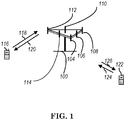
- FIG. 1 shows a multiple access wireless communication system according to one embodiment of the invention.
- An access network 100 includes multiple antenna groups, one including 104 and 106, another including 108 and 110, and an additional including 112 and 114. In FIG. 1 , only two antennas are shown for each antenna group, however, more or fewer antennas may be utilized for each antenna group.
- Access terminal 116 is in communication with antennas 112 and 114, where antennas 112 and 114 transmit information to access terminal 116 over forward link 120 and receive information from access terminal 116 over reverse link 118.
- Access terminal (AT) 122 is in communication with antennas 106 and 108, where antennas 106 and 108 transmit information to access terminal (AT) 122 over forward link 126 and receive information from access terminal (AT) 122 over reverse link 124.
- communication links 118, 120, 124 and 126 may use different frequency for communication.
- forward link 120 may use a different frequency then that used by reverse link 118.
- antenna groups each are designed to communicate to access terminals in a sector of the areas covered by access network 100.
- the transmitting antennas of access network 100 may utilize beamforming in order to improve the signal-to-noise ratio of forward links for the different access terminals 116 and 122. Also, an access network using beamforming to transmit to access terminals scattered randomly through its coverage causes less interference to access terminals in neighboring cells than an access network transmitting through a single antenna to all its access terminals.
- An access network may be a fixed station or base station used for communicating with the terminals and may also be referred to as an access point, a Node B, a base station, an enhanced base station, an evolved Node B (eNB), or some other terminology.
- An access terminal may also be called user equipment (UE), a wireless communication device, terminal, access terminal or some other terminology.
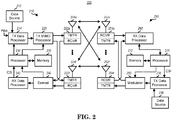
- FIG. 2 is a simplified block diagram of an embodiment of a transmitter system 210 (also known as the access network) and a receiver system 250 (also known as access terminal (AT) or user equipment (UE)) in a MIMO system 200.
- a transmitter system 210 also known as the access network
- a receiver system 250 also known as access terminal (AT) or user equipment (UE)
- traffic data for a number of data streams is provided from a data source 212 to a transmit (TX) data processor 214.
- TX transmit
- each data stream is transmitted over a respective transmit antenna.
- TX data processor 214 formats, codes, and interleaves the traffic data for each data stream based on a particular coding scheme selected for that data stream to provide coded data.
- the coded data for each data stream may be multiplexed with pilot data using OFDM techniques.
- the pilot data is typically a known data pattern that is processed in a known manner and may be used at the receiver system to estimate the channel response.
- the multiplexed pilot and coded data for each data stream is then modulated (i.e., symbol mapped) based on a particular modulation scheme (e.g., BPSK, QPSK, M-PSK, or M-QAM) selected for that data stream to provide modulation symbols.
- a particular modulation scheme e.g., BPSK, QPSK, M-PSK, or M-QAM
- the data rate, coding, and modulation for each data stream may be determined by instructions performed by processor 230.
- TX MIMO processor 220 may further process the modulation symbols (e.g., for OFDM).
- TX MIMO processor 220 then provides N T modulation symbol streams to N T transmitters (TMTR) 222a through 222t.
- TMTR TX MIMO processor 220 applies beamforming weights to the symbols of the data streams and to the antenna from which the symbol is being transmitted.
- Each transmitter 222 receives and processes a respective symbol stream to provide one or more analog signals, and further conditions (e.g., amplifies, filters, and upconverts) the analog signals to provide a modulated signal suitable for transmission over the MIMO channel.
- N T modulated signals from transmitters 222a through 222t are then transmitted from N T antennas 224a through 224t, respectively.
- the transmitted modulated signals are received by N R antennas 252a through 252r and the received signal from each antenna 252 is provided to a respective receiver (RCVR) 254a through 254r.
- Each receiver 254 conditions (e.g., filters, amplifies, and downconverts) a respective received signal, digitizes the conditioned signal to provide samples, and further processes the samples to provide a corresponding "received" symbol stream.
- An RX data processor 260 then receives and processes the N R received symbol streams from N R receivers 254 based on a particular receiver processing technique to provide N T "detected" symbol streams.
- the RX data processor 260 then demodulates, deinterleaves, and decodes each detected symbol stream to recover the traffic data for the data stream.
- the processing by RX data processor 260 is complementary to that performed by TX MIMO processor 220 and TX data processor 214 at transmitter system 210.
- a processor 270 periodically determines which pre-coding matrix to use (discussed below). Processor 270 formulates a reverse link message comprising a matrix index portion and a rank value portion.
- the reverse link message may comprise various types of information regarding the communication link and/or the received data stream.
- the reverse link message is then processed by a TX data processor 238, which also receives traffic data for a number of data streams from a data source 236, modulated by a modulator 280, conditioned by transmitters 254a through 254r, and transmitted back to transmitter system 210.
- the modulated signals from receiver system 250 are received by antennas 224, conditioned by receivers 222, demodulated by a demodulator 240, and processed by a RX data processor 242 to extract the reserve link message transmitted by the receiver system 250.
- Processor 230 determines which pre-coding matrix to use for determining the beamforming weights then processes the extracted message.
- FIG. 3 shows an alternative simplified functional block diagram of a communication device according to one embodiment of the invention.
- the communication device 300 in a wireless communication system can be utilized for realizing the UEs (or ATs) 116 and 122 in FIG. 1 or the base station (or AN) 100 in FIG. 1 , and the wireless communications system is preferably the LTE system.
- the communication device 300 may include an input device 302, an output device 304, a control circuit 306, a central processing unit (CPU) 308, a memory 310, a program code 312, and a transceiver 314.
- the control circuit 306 executes the program code 312 in the memory 310 through the CPU 308, thereby controlling an operation of the communications device 300.
- the communications device 300 can receive signals input by a user through the input device 302, such as a keyboard or keypad, and can output images and sounds through the output device 304, such as a monitor or speakers.
- the transceiver 314 is used to receive and transmit wireless signals, delivering received signals to the control circuit 306, and outputting signals generated by the control circuit 306 wirelessly.
- the communication device 300 in a wireless communication system can also be utilized for realizing the AN 100 in FIG. 1 .
- FIG. 4 is a simplified block diagram of the program code 312 shown in FIG. 3 in accordance with one embodiment of the invention.
- the program code 312 includes an application layer 400, a Layer 3 portion 402, and a Layer 2 portion 404, and is coupled to a Layer 1 portion 406.
- the Layer 3 portion 402 generally performs radio resource control.
- the Layer 2 portion 404 generally performs link control.
- the Layer 1 portion 406 generally performs physical connections.
- next generation access technology aims to support the following three families of usage scenarios for satisfying both the urgent market needs and the more long-term requirements set forth by the ITU-R IMT-2020:
- an objective of the 5G study item on new radio access technology is to identify and develop technology components needed for new radio systems which should be able to use any spectrum band ranging at least up to 100 GHz.
- Supporting carrier frequencies up to 100GHz brings a number of challenges in the area of radio propagation. As the carrier frequency increases, the path loss also increases.
- the required cell coverage may be provided by forming a wide sector beam for transmitting downlink common channels.
- the cell coverage is reduced with same antenna gain.
- higher antenna gain is needed to compensate the increased path loss.
- larger antenna arrays with number of antenna elements ranging from tens to hundreds) are used to form high gain beams.
- the high gain beams are narrow compared to a wide sector beam so multiple beams for transmitting downlink common channels are needed to cover the required cell area.
- the number of concurrent high gain beams that an access point is able to form may be limited by the cost and complexity of the utilized transceiver architecture. In practice, on higher frequencies, the number of concurrent high gain beams is much less than the total number of beams required to cover the cell area. In other words, the access point is able to cover only part of the cell area by using a subset of beams at any given time.
- beamforming is a signal processing technique used in antenna arrays for directional signal transmission/reception.
- a beam can be formed by combining elements in a phased array of antennas in such a way that signals at particular angles experience constructive interference while others experience destructive interference.
- Different beams can be utilized simultaneously using multiple arrays of antennas.
- an eNB may have multiple TRPs (either centralized or distributed). Each TRP (Transmission/Reception Point) can form multiple beams. The number of beams and the number of simultaneous beams in the time/frequency domain depend on the number of antenna array elements and the RF (Radio Frequency) at the TRP.
- NR New Radio
- SINR Signal to Interference Plus Noise Ratio
- the random access procedure is performed for the following events related to the Pcell (Primary Cell):
- the random access procedure is also performed on a SCell (Secondary Cell) to establish time alignment for the corresponding sTAG (Secondary TAG). Furthermore, the random access procedure takes two distinct forms:
- Normal DL/UL (Downlink/Uplink) transmission can take place after the random access procedure.
- the four steps of a contention based random access procedure are:
- a UE which detects RA success and does not has a C-RNTI, promotes the Temporary C-RNTI to C-RNTI.
- a UE which detects RA success and already has a C-RNTI, resumes using its C-RNTI and drops the Temporary C-RNTI.
- the three steps of a non-contention based random access procedure are:
- the MAC entity may be configured by RRC with a DRX functionality that controls the UE's PDCCH monitoring activity for the MAC entity's C-RNTI, TPC-PUCCH-RNTI, TPC-PUSCH-RNTI, Semi-Persistent Scheduling C-RNTI (if configured), eIMTA-RNTI (if configured) and SL-RNTI (if configured).
- RRC_CONNECTED if DRX is configured, the MAC entity is allowed to monitor the PDCCH discontinuously using the DRX operation specified in this subclause; otherwise the MAC entity monitors the PDCCH continuously.
- the MAC entity shall also monitor PDCCH according to requirements found in other subclauses of this specification.
- RRC controls DRX operation by configuring the timers onDurationTimer, drx-InactivityTimer, drx-RetransmissionTimer (one per DL HARQ process except for the broadcast process), drx-ULRetransmissionTimer (one per asynchronous UL HARQ process), the longDRX-Cycle, the value of the drxStartOffset and optionally the drxShortCycleTimer and shortDRX-Cycle.
- a HARQ RTT timer per DL HARQ process except for the broadcast process
- UL HARQ RTT Timer per asynchronous UL HARQ process is also defined (see subclause 7.7).
- the Active Time includes the time while:
- the MAC entity shall for each subframe:
- the MAC entity receives and transmits HARQ feedback and transmits type-1-triggered SRS [2] when such is expected.
- the downlink transmitting beams are acquired from beam reference signals. Up to 8 antenna ports are supported for beam reference signal (BRS).
- BRS beam reference signal
- a UE tracks downlink transmitting beams through the periodic BRS measurements.
- the BRS transmission period is configured by a 2 bit indicator in xPBCH.
- the BRS transmission period is the necessary time to sweep the whole downlink beams transmitted via BRS.
- BSI beam state information
- BI beam index
- BRSRP beam reference signal received power
- 5GNode may send BSI request in DL DCI, UL DCI, and RAR grant.
- UE When reporting BSI on xPUCCH, UE reports BSI for a beam with the highest BRSRP in the candidate beam set.
- UE When reporting BSI on xPUSCH, UE reports BSIs for N ⁇ 1,2,4 ⁇ beams in the candidate beam set, where N is provided in the 2-bit BSI request from 5G Node.
- the BSI reports are sorted in decreasing order of BRSRP.
- Beam switch procedures There are two beam switch procedures, which are MAC-CE based beam switch procedure and DCI based beam switch procedure associated with BRS.
- 5G Node For the MAC-CE based beam switch procedure [4], 5G Node transmits a MAC-CE containing a BI to the UE.
- the UE shall, upon receiving the MAC-CE, switch the serving beam at the UE to match the beam indicated by the MAC-CE.
- the UE shall assume that the 5G Node beam associated with xPDCCH, xPDSCH, CSI-RS, xPUCCH, xPUSCH, and xSRS is switched to the beam indicated by the MAC-CE from the beginning of subframe n + kbeam-switch-delay-mac.
- 5G Node For the DCI based beam switch procedure, 5G Node requests a BSI report via DCI and the beam_switch_indication field is set to 1 in the same DCI.
- the UE shall, upon receiving such a DCI, switch the serving beam at the UE to match the beam indicated by the first BI reported by the UE in the BSI report corresponding to this BSI request.
- beam_switch_indication field 0 in the DCI the UE is not required to switch the serving beam at the UE.
- the serving beam is chosen that is associated with the most recently received subframe containing the MAC-CE (for MAC-CE based procedure) or the DCI (for DCI based procedure).
- a UE is not expected to receive multiple requests for beam switching in the same subframe.
- BRRS is triggered by DCI.
- a UE can also request BRRS using SR [4].
- the UE transmits the scheduling request preamble where the higher layer configured preamble resource ⁇ u,v, f ', and NSR ⁇ is dedicated for beam refinement reference signal initiation request.
- BTI Beam Refinement Information
- BRRS-RI BRRS Resource Index
- BRRS-RP BRRS reference power
- a UE can be configured with 4 Beam Refinement (BR) processes by higher layers.
- BR Beam Refinement
- a 2-bit resource allocation field and a 2 bit process indication field in the DCI are described in Table 5.2-1 and Table 5.2-2, respectively.
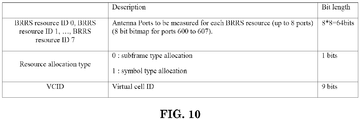
- a BR process comprises of up to eight BRRS resources, a resource allocation type and a VCID, and is configured via RRC signalling.
- a BRRS resource comprises of a set of antenna ports to be measured.
- a BRRS transmission can span 1, 2, 5 or 10 OFDM symbols, and is associated with a BRRS resource allocation, BRRS process indication, and a BR process configuration as in Table 5.2-1, 5.2.-2 and 5.2.-3.
- a BRI reported by the UE corresponds to one BR process that is associated with up to eight BRRS resources. The UE shall assume that BRRS mapped to the BRRS resource ID 0 in each BRRS process is transmitted by the serving beam.
- Beam switch procedures There are two beam switch procedures, which are MAC-CE based beam switch procedure and DCI based beam switch procedure associated with BRRS.
- 5G Node For the MAC-CE based beam switch procedure [4], 5G Node transmits a MAC-CE containing a BRRS resource ID and the associated BR process ID to the UE.
- the UE shall, upon receiving the MAC-CE, switch the serving beam at the UE to match the beam indicated by the MAC-CE.
- the UE shall assume that the 5G Node beam associated with xPDCCH, xPDSCH, CSI-RS, xPUCCH, xPUSCH, and xSRS is switched to the beam indicated by the MAC-CE from the beginning of subframe n+k beam-switch-delay-mac.
- 5G Node For the DCI based beam switch procedure, 5G Node requests a BRI report via DCI and the beam_switch_indication field is set to 1 in the same DCI.
- the UE shall, upon receiving such a DCI, switch the serving beam at the UE to match the beam indicated by the first BRRS-RI reported by the UE in the BRI report corresponding to this BRI request.
- beam_switch_indication field 0 in the DCI the UE is not required to switch the serving beam at the UE.
- the serving beam is chosen that is associated with the most recently received subframe containing the MAC-CE (for MAC-CE based procedure) or the DCI (for DCI based procedure).
- a UE is not expected to receive multiple requests for beam switching in the same subframe.
- a UE If a UE detects the current serving beam is misaligned [4] and has BSIs for beam recovery, the UE shall perform beam recovery process.
- the UE transmits scheduling request by scheduling request preamble where the preamble resource ⁇ u, v, f' and N SR ⁇ is dedicated for beam recovery as configured by higher layers.
- 5G Node may initiate BSI reporting procedure as described in section 8.3.
- the UE transmits random access preamble for contention based random access. If the UE is scheduled by RAR triggering BSI reporting, the UE reports N BSIs in Msg3 as UCI multiplexing in [3].
- 5G Node reports BSI on xPUCCH or xPUSCH as indicated by 5G Node.
- 5G Node can send BSI request in DL DCI, UL DCI, and RAR grant.
- a UE receives BSI request in DL DCI, the UE reports a BSI on xPUCCH.
- the time/frequency resource for xPUCCH is indicated in the DL DCI.
- UE reports a BSI for a beam with the highest BRSRP in the candidate beam set.
- UE If UE receives BSI request in UL DCI or in RAR grant, UE reports BSIs on xPUSCH.
- the time/frequency resource for xPUSCH is indicated in the UL DCI or RAR grant that requests BSI report.
- UE When reporting BSI on xPUSCH, UE reports BSI for N ⁇ ⁇ 1,2,4 ⁇ beams with the highest BRSRP in the candidate beam set, where N is provided in the DCI.
- UE reports BSI on xPUSCH only and discards the xPUCCH trigger.
- N ⁇ ⁇ 1,2,4 ⁇ The number of BSIs to report, N ⁇ ⁇ 1,2,4 ⁇ , is indicated in UL DCI.
- a UE shall report N BSIs corresponding to N beams in the candidate beam set.
- a BSI report contains N BIs and corresponding BRSRPs.
- a UE shall report wideband BRSRPs.
- a UE is not expected to receive more than one request for BSI reporting on xPUSCH for a given subframe.
- UE When reporting BSI on xPUCCH, UE reports BSI for a beam with the highest BRSRP in the candidate beam set.
- a BSI report contains BI and corresponding BRSRP.
- a UE shall report wideband BRSRP.
- a UE is not expected to receive more than one request for BSI reporting on xPUCCH for a given subframe.
- the BRSRP indices and their interpretations are given in Table 8.3.3.1-1.
- the reporting range of BRSRP is defined from -140 dBm to -44 dBm with 1 dB resolution as shown in Table 8.3.3.1-1.
- the UE shall derive BRSRP values from the beam measurements based on BRS defined in 5G.211.
- the UE shall derive BRSRP index from the measured BRSRP value.
- Each BRSRP index is mapped to its corresponding binary representation using 7 bits.
- the BI indicates a selected beam index.
- the BI is the logical beam index associated with antenna port, OFDM symbol index and BRS transmission period [2], which is indicated by 9 bits.
- a BRI report is associated with one BR process that is indicated in the uplink DCI for the UE.
- a UE shall report wideband BRRS-RP values and BRRS-RI values corresponding to the best NBRRS BRRS resource ID where NBRRS is configured by higher layers
- the UE shall report BRRS-RP and BRRS-RI corresponding to all the configured BRRS resources.
- a UE is not expected to receive more than one BRI report request for a given subframe.
- a BRI report is associated with one BRRS process that is indicated in the downlink DCI for the UE.
- a UE shall report a wideband BRRS-RP value and a BRRS-RI value corresponding to the best BRRS resource ID.
- a UE is not expected to receive more than one BRI report request for a given subframe.
- the reporting range of BRRS-RP is defined from -140 dBm to -44 dBm with 1 dB resolution.
- mapping of BRRS-RP to 7 bits is defined in Table 8.4.3.1-1.. Each BRRS-RP index is mapped to its corresponding binary representation using 7 bits.
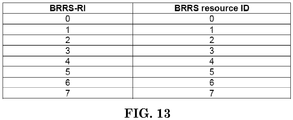
- BRRS-RI indicates a selected BRRS resource ID.
- a BR process may comprise of a maximum of 8 BRRS resource IDs.
- the selected BRRS resource ID is indicated by 3 bits as in Table 8.4.3.2-1.
- the beam feedback procedure is used to report beam measurement results to the servingg cell.
- BRS beam reference signal
- BRRS beam refinement reference signal
- the BRS-based beam state information (BSI) reports initiated by xPDCCH order are transmitted through UCI on xPUCCH/xPUSCH as scheduled by the corresponding DCI[1]; event triggered BSI reports are transmitted through BSI Feedback MAC Control Element defined in subclause 6.1.3.11 using normal SR or contention-based RACH procedure, where BSI consists of Beam Index (BI) and beam reference signal received power (BRSRP). BSI reports are based on BRS transmitted by the serving cell.
- BSI Beam Index
- BRSRP beam reference signal received power
- the BSI reports initiated by xPDCCH order are based on the latest measurement results obtained from the 5G physical layer.
- the BSI reports initiated by 5G-MAC are based on an event trigger.
- BRI consists of a Refined Beam Index (RBI) and a BRSRP which are based on BRRS transmitted by the serving cell.
- the beam change procedure is used by the serving cell to change the serving beam for the UE.
- the serving cell initiates the procedure by xPDCCH order, by BRS Beam Change Indication MAC Control Element, or by BRRS Beam Change Indication MAC Control Element.
- the 5G-MAC entity shall:
- the Beam Adjustment Request (BAR) is used to request the serving cell to transmit BRRS (Beam Refinement Reference Signal).
- BAR Beam Adjustment Request
- UE measures the BRRS in the scheduled subframe(s) to determine the serving cell.
- 5G-RRC controls the BAR by configuring the timer prohibitBAR-Timer, which limits the interval between two consecutive BARs.
- UE can trigger BAR based on any UE implementation specific conditions.
- a BAR shall be triggered if prohibitBAR-Timer is not running and any UE implementation specific condition is met.
- the 5G-MAC entity may be configured by 5G-RRC with a DRX functionality that controls the UE's xPDCCH monitoring activity for the 5G-MAC entity's C-RNTI.
- 5G-RRC_CONNECTED if DRX is configured, the 5G-MAC entity is allowed to monitor the xPDCCH discontinuously using the DRX operation specified in this subclause; otherwise the 5G-MAC entity monitors the xPDCCH continuously.
- the 5GMAC entity shall also monitor xPDCCH according to requirements found in other subclauses of this specification.
- 5GRRC controls DRX operation by configuring the timers onDurationTimer, drx-InactivityTimer, drx-RetransmissionTimer (one per DL HARQ process except for the broadcast process), the longDRX-Cycle, the value of the drxStartOffset and optionally the drxShortCycleTimer and shortDRX-Cycle.
- a HARQ RTT timer per DL HARQ process (except for the broadcast process) is also defined.
- the Active Time includes the time while:
- the 5G-MAC entity shall for each subframe:
- the 5G-MAC entity receives and transmits HARQ feedback (ACK/NACK information) and transmits SRS when such is expected.
- HARQ feedback ACK/NACK information
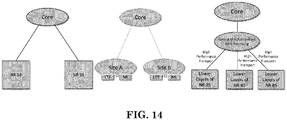
- FIGS. 14 and 15 could be considered for support by the NR radio network architecture.
- 3GPP R2-164306 the following scenarios of cell layout for standalone NR are captured to be studied:
- 1 NR eNB corresponds to 1 or many TRPs.
- 5G systems are expected to rely more heavily on “beam based mobility", in addition to regular handover based UE mobility, to handle UE mobility.
- Technologies like MIMO, fronthauling, C-RAN and NFV will allow the coverage area controlled by one "5G Node" to grow, thus increasing the possibilities for beam level management and reducing the need for cell level mobility. All mobility within the coverage area of one 5G node could in theory be handled based on beam level management, which would leave handovers only to be used for mobility to the coverage area of another 5G Node.
- FIGS. 16 to 19 show examples of a cell in 5G NR.
- FIG. 16 is a reproduction of a portion of Figure 1 of 3GPP R2-163879, and shows an exemplary deployment with single TRP cell.
- FIG. 17 is a reproduction of a portion of Figure 1 of 3GPP R2-163879, and shows an exemplary deployment with multiple TRP cells.
- FIG. 18 is a reproduction of Figure 3 of 3GPP R2-162210, and shows an exemplary 5G cell comprising a 5G node with multiple TRPs.
- FIG. 19 is a reproduction of Figure 1 of 3GPP R2-163471, and shows a comparison between a LTE cell and a NR cell.
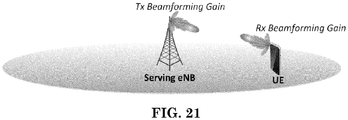
- a 5G UE could adapt the serving beam to maintain 5G connectivity subject to beam quality fluctuation or UE intra-cell mobility. To do so, 5G Node-B and UE could track and change the serving beam properly (called beam tracking hereafter).
- FIG. 21 which is a reproduction of Figure 3 of 3GPP R2-162251, illustrates gain compensation by beamforming.
- FIG. 22 which is a reproduction of Figure 4 of 3GPP R2-162251, illustrates weakened interference by beamforming.
- the UE When the UE is in connected state, the UE may move among different beams or TRPs of the same serving cell. Besides, if UE beamforming is used, UE beam(s) may also change over time, e.g., due to UE rotation.
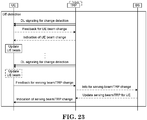
- An exemplary case of mobility in connected state without cell change has the following steps:
- Change of UE beam(s), serving beam(s) of serving TRP(s), and serving TRP(s) may be detected by a UE and/or a network node.
- a signaling periodically transmitted by TRP(s) or the UE could be used.
- TRP(s) periodically performs beam sweeping for reception or transmission of the signaling. If UE beamforming is used, the UE periodically performs beam sweeping for reception or transmission of the signaling.
- the UE itself may select proper UE beam(s) for the following reception (and transmission, e.g., for TDD).
- the UE needs to provide feedback to the network node and the network node could provide an indication of UE beam change from the network node to the UE.
- indication of UE beam change from the network node to the UE may be required.
- the UE uses UE beam(s) indicated by the network node for the following transmission (and reception, e.g., for TDD).
- the UE After the UE receives the signaling for change detection, the UE needs to provide feedback to the network node and the network node could decide whether to change (DL) serving beam(s) and/or serving TRP(s) for the UE. On the other hand, after TRP(s) receives the signaling for change detection, the network node could decide whether to change serving beam(s) and/or serving TRP(s) for the UE.
- FIGS. 23 and 24 illustrate exemplary flow charts for mobility in connected state without cell change.
- a new state (e.g., inactive state) is considered in addition to RRC connected state and RRC idle state that already exist in LTE.
- the new state may be a sub-state of RRC connected state, a sub-state of RRC idle state, or an independent state that does not belong to connected state or idle state.
- the new state may be referred as inactive state, connected inactive state, RAN controlled state.
- the characteristics of the new state are described in 3GPP R2-168856 as follows:
- a UE could perform beam management to maintain at least one (network node) beam that is usable for transmission and/or reception, e.g., serving beam.
- the beam management may comprise but is not limited to the following procedures discussed in 3GPP TS 5G.321:
- a UE could perform DRX to control the DL control channel (e.g., PDCCH) monitoring so that UE battery consumption can be reduced.
- DRX active time is specified in 3GPP TS 36.321, TS 36.300, and TS 5G.321, "KT 5G MAC protocol specification (Release 1)".
- DRX inactive time the time other than DRX active time may be referred to as DRX inactive time.
- beam management may be continued during DRX inactive time. Beam management requires continuous BRS (Beam Reference Signal) measurement that consumes UE power.
- BRS Beam Reference Signal
- a UE needs to initiate a random access procedure for BSI reporting when uplink is not synchronized (i.e. time alignment timer is not running). Therefore, it may not always be beneficial to continue beam management during DRX inactive time, e.g., for stationary UEs, UEs without traffic ongoing, or UEs without active service.
- a UE e.g., in connected state
- a UE could stop beam management during DRX inactive time. For example, the UE does not perform BRS measurement and BSI reporting during DRX inactive time.
- continuing beam management during DRX inactive time may have the benefit of reduced latency for the following data transfer since the UE knows which beam to use when there is a need for data transfer. This may be helpful for services with sensitive latency requirement.
- whether to continue beam management during DRX inactive time could be configured or controlled by the network node.
- the network node e.g., gNB
- the network node could configure or control it based on the QoS of the current active service of the UE.
- whether to perform beam management is at least based on UL synchronization state.
- the UE could stop performing beam management when the UL becomes not synchronized.
- Similar issues may also occur for the UE in inactive state. Based on the same reason discussed above, it may not always be beneficial to continue beam management during inactive state. To solve the issue, the above method could apply to the case when the UE is in inactive state. For example, a UE could stop beam management during (DRX inactive time in) inactive state. Alternatively, whether to continue beam management during (DRX inactive time in) inactive state could be configured or controlled by the network node.
- beam management could be used to maintain the serving beam of a UE.
- the UE should perform measurement on the serving beam to determine whether the current serving beam is valid or not.
- the measurement result may be reported to the network node.
- the network node may change the serving beam based on the measurement result.
- the beam management may not continue.
- the UE has no idea about whether the current serving beam is still valid or not. A method for the UE to determine whether the current serving beam is valid is considered below.
- a timer could be used to determine whether the current serving beam is valid or not.
- the timer may be called a serving beam validity timer.
- a UE may maintain a timer for the serving beam(s).
- the length of the timer may be configured by the network node. The length may be zero or infinity. Handling of the timer may comprise but is not limited to the following actions:
- the UE When the timer is running, the UE could consider the current serving beam(s) as valid. The UE could use the serving beam(s) for data transmission and/or reception when there is a need for data transfer. When the timer is not running, the UE could consider the associated serving beam(s) as invalid, and may need to find at least a new serving beam first before data transmission and/or reception (when there is a need for data transfer).
- a UE could monitor DL control signaling on a DL control channel (e.g., PDCCH, xPDCCH) via the serving beam(s) of the UE.
- a DL control channel e.g., PDCCH, xPDCCH
- a UE could assume that xPDCCH, xPDSCH, CSI-RS, xPUCCH, xPUSCH, and xSRS is transmitted and/or received via the serving beam of the UE. If the serving beam(s) of the UE is considered as invalid or if the UE does not have any valid serving beam, it is not clear which beam the UE monitors a DL control channel (e.g., xPDCCH).
- a DL control channel e.g., xPDCCH
- the UE could monitor a DL control channel via the best beam of the UE.
- the UE may find the best beam by measuring BRS.
- the best beam may be a beam with highest RSRP (Reference Signal Receiving Power).
- the network node may need to sweep beams for transmitting the DL control channel to make sure the UE can receive it if there is no valid serving beam.
- the UE may monitor a DL control channel at multiple timings corresponding to different beams of a network node.
- the multiple timings may cover all beams of the network node.
- the UE may monitor the DL control channel to receive a signaling for indicating a new serving beam, or a signaling for initiating a procedure for finding a suitable beam to be a serving beam (e.g., BSI reporting or BRI reporting).
- a signaling for indicating a new serving beam or a signaling for initiating a procedure for finding a suitable beam to be a serving beam (e.g., BSI reporting or BRI reporting).
- the UE may need to request some uplink resource to transmit the data, e.g. via a scheduling request as discussed in 3GPP TS 36.321.
- the UE could maintain at least one serving beam that can be used for data transmission and/or reception.
- the UE could initiate a normal scheduling request procedure via the serving beam(s).
- the UE may not have any valid serving beam when the UE has a need for uplink data transfer.
- uplink data is available for transmission during DRX inactive time if beam management does not continue during DRX inactive time or when the serving beam validity timer is not running.
- Beam management e.g., beam feedback
- the UE may consider the serving beam as invalid, and the normal scheduling request procedure cannot be used since no valid serving beam can be used. Handling of uplink data arrival when the UE has no valid serving beam is considered below.
- the UE could find at least a specific beam in order to transmit a request to acquire UL resources.
- the UE may be UL synchronized.
- the UE may find the specific beam by measuring BRS.
- the specific beam may be a best beam among beams measured by the UE.
- the best beam may be a beam with highest RSRP.
- the beams may belong to the same cell, e.g., serving cell of the UE.
- the request may be transmitted via the specific beam.
- the request may be a scheduling request.
- the request may be a scheduling request preamble, a BSI report, or a BRI report as discussed in TS 5G.213, "KT 5G Physical layer procedures (Release 1)" and 5G.321, "KT 5G MAC protocol specification (Release 1)".
- the UE could monitor a response of the request via the specific beam.
- the network node may transmit the response via the specific beam.
- the response may be a random access response.
- the response may be a beam update command or may notify the UE to report BSI or BRI so that the network node can determine the new serving beam(s) for the UE.
- the response may include an uplink grant.
- the UE may just transmit the request at multiple timings corresponding to different beams of the network node to make sure the network node can receive the request.
- the multiple timings cover all beams of the network node.
- the UE could monitor a response of the request via the specific beam.
- the network node may transmit the response via the specific beam.
- the UE could initiate a random access procedure as specified in TS 5G.213, "KT 5G Physical layer procedures (Release 1)", during which the serving beam(s) can be determined.
- the network node may transmit a downlink assignment to the UE via a serving beam of the UE.
- the UE could perform DL data reception based on the downlink assignment.
- the downlink assignment could be transmitted to the UE during DRX active time when the UE is UL synchronized.
- the UE could maintain at least one serving beam that can be used for data transmission and/or reception.
- the UE may not have a valid serving beam when the network node has downlink data to be transmitted to the UE.
- beam management may not be continued when the UE does not have UL synchronized, when the UE is in DRX inactive time, or when the UE is in inactive state. In such cases, downlink assignment cannot be transmitted to the UE via the serving beam of the UE. Handling of downlink data arrival when the UE has no valid serving beam or when the serving beam validity timer is not running is considered below.
- the network node could transmit a request for UL transmission to the UE (e.g., using beam sweeping).
- the request may be a request for a scheduling request preamble, a request for initiating a random access procedure, a request for a BSI report, or a request for a BRI report as discussed in TS 5G.213, "KT 5G Physical layer procedures (Release 1)" and 5G.321, "KT 5G MAC protocol specification (Release 1)".
- the UE may monitor the request via a specific beam.
- the specific beam may be determined by measuring BRS.
- the specific beam may also be a best beam among beams measured by the UE.
- the best beam may be a beam with highest RSRP.
- the beams may belong to the same cell (e.g., serving cell of the UE).
- the UE may determine the specific beam and/or monitor the request via the specific beam in at least one of the following timing: during or about to enter DRX active time (e.g., on-duration), when the UE needs to monitor a physical layer signaling (e.g., downlink assignment) on a physical downlink control channel (e.g., PDCCH), or when the UE leaves a period (e.g., DRX inactive time) where beam feedback is not performed.
- the PDCCH may be addressed to a C-RNTI of the UE or a P-RNTI (i.e. an RNTI for paging reception). After reception of a PDCCH addressed to the P-RNTI, the UE further receives a paging message on a PDSCH associated with the PDCCH, wherein the paging message includes information indicating downlink data arrival.
- the UE may monitor to receive the request at multiple timings corresponding to different beams of the network node to make sure the UE can receive the request.
- the multiple timings could cover all beams of the network node.
- the UE may transmit a scheduling request preamble, a BSI report, or a BRI report, as discussed in TS 5G.213, "KT 5G Physical layer procedures (Release 1)" and 5G.321, “KT 5G MAC protocol specification (Release 1)", at the timing corresponding to the beam on which the request is received.
- the network node may receive the response using beam sweeping.
- Beam recovery procedure for a UL synchronized UE may comprise the following steps:
- a UE assumes that xPDCCH, xPDSCH, CSI-RS, xPUCCH, xPUSCH, and xSRS are transmitted and/or received via the serving beam of the UE.
- xPDCCH, xPDSCH, CSI-RS, xPUCCH, xPUSCH, and xSRS are transmitted and/or received via the serving beam of the UE.
- CSI-RS xPUCCH
- xPUSCH xPUSCH
- xSRS xSRS
- the UE may needs to transmit the scheduling request preamble at multiple timings corresponding to different beams of the network node to make sure the network node can receive the scheduling request preamble.
- the multiple timings could cover all beams of the network node.
- the network node may transmits the DL control signaling (e.g., xPDCCH order) via the beam on which the scheduling request preamble is received.
- the UE may report BSI via the beam on which the DL control signaling is received.
- FIG. 25 is a flow chart 2500 according to one exemplary embodiment from the perspective of a network node.
- the network node transmits a configuration to a UE, wherein the configuration indicates whether the UE performs beam management during a specific period of time.
- the device 300 includes a program code 312 stored in the memory 310.
- the CPU 308 could execute program code 312 to enable the network node to transmits a configuration to a UE, wherein the configuration indicates whether the UE performs beam management during a specific period of time.
- the CPU 308 can execute the program code 312 to perform all of the above-described actions and steps or others described herein.
- FIG. 26 is a flow chart 2600 according to one exemplary embodiment from the perspective of a UE.
- the UE receives a configuration, wherein the configuration indicates whether the UE performs beam management during a specific period of time.
- the UE determines whether to perform the beam management during the specific period of time based on the configuration.
- the device 300 includes a program code 312 stored in the memory 310.
- the CPU 308 could execute program code 312 (i) to receive a configuration, wherein the configuration indicates whether the UE performs beam management during a specific period of time, and (ii) to determine whether to perform the beam management during the specific period of time based on the configuration.
- the CPU 308 can execute the program code 312 to perform all of the above-described actions and steps or others described herein.
- the specific period of time could be DRX inactive time.
- the specific period of time could be the time duration when the UE is in inactive state.
- the UE could perform beam management during the specific period of time.
- the UE does not perform beam management during the specific period of time.
- the UE performs beam management during the period of time.
- the UE does not perform beam management during the period of time.
- FIG. 27 is a flow chart 2700 according to one exemplary embodiment from the perspective of a UE.
- the UE maintains at least a serving beam.
- the UE considers the serving beam as invalid when a timer associated with the serving beam expires or stops.
- the timer could be associated with the serving beam of the UE.
- the serving beam could be considered as invalid when the timer expires.
- the timer could be started or restarted when the serving beam is determined or updated, when beam tracking or beam management is done, when beam measurement on a current serving beam is done, and/or when a measurement result is reported.
- the measurement result could indicate the radio condition of a current serving beam.
- the measurement result could be a BRI report and/or a BSI report discussed in TS 5G.213, "KT 5G Physical layer procedures (Release 1)" and 5G.321, "KT 5G MAC protocol specification (Release 1)".
- the timer could be stopped when the UE detects that the current serving beam does not fulfil the criteria of being a serving beam (e.g., radio quality is not good enough). The timer could be stopped when beam management is stopped.
- the length of the timer could be configured by the network node. Alternatively, the length of the timer could be zero.
- the device 300 includes a program code 312 stored in the memory 310.
- the CPU 308 could execute program code 312 (i) to maintain at least a serving beam, and (ii) to consider the serving beam as invalid when a timer associated with the serving beam expires or stops. Furthermore, the CPU 308 can execute the program code 312 to perform all of the above-described actions and steps or others described herein.
- FIG. 28 is a flow chart 2800 according to one exemplary embodiment from the perspective of a UE.
- the UE determines whether there is a valid serving beam when uplink data is available for transmission.
- the UE selects a specific beam and transmits a request via the specific beam if the UE has no valid serving beam.
- the device 300 includes a program code 312 stored in the memory 310.
- the CPU 308 could execute program code 312 (i) to determine whether there is a valid serving beam when uplink data is available for transmission, and (ii) to select a specific beam and to transmit a request via the specific beam if the UE has no valid serving beam. Furthermore, the CPU 308 can execute the program code 312 to perform all of the above-described actions and steps or others described herein.
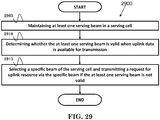
- FIG. 29 is a flow chart 2900 according to one exemplary embodiment from the perspective of a UE.
- the UE maintains at least one serving beam in a serving cell.
- the UE determines whether the at least one serving beam is valid when uplink data is available for transmission.
- the UE selects a specific beam of the serving cell and transmits a request for uplink resource via the specific beam if the at least one serving beam is not valid.
- the device 300 includes a program code 312 stored in the memory 310.
- the CPU 308 could execute program code 312 (i) to maintain at least one serving beam in a serving cell, (ii) to determine whether the at least one serving beam is valid when uplink data is available for transmission, and (iii) to select a specific beam of the serving cell and to transmit a request for uplink resource via the specific beam if the at least one serving beam is not valid.
- the CPU 308 can execute the program code 312 to perform all of the above-described actions and steps or others described herein.
- the UE could select the specific beam based on BRS measurement.
- the specific beam could be the best beam measured by the UE.
- the best beam could be a beam with highest RSRP.
- the request could be used to request uplink resources.
- the request could be a scheduling request, a random access preamble, a BSI report, or a BRI report.
- the UE could transmit the request via the at least one serving beam if the at least one serving beam is valid.
- FIG. 30 is a flow chart 3000 according to one exemplary embodiment from the perspective of a UE.
- the UE determines whether there is a valid serving beam when the UE needs to monitor a downlink control channel.
- the UE selects a specific beam and monitors the downlink control channel via the specific beam if the UE has no valid serving beam.
- the device 300 includes a program code 312 stored in the memory 310.
- the CPU 308 could execute program code 312 (i) to determine whether there is a valid serving beam when the UE needs to monitor a downlink control channel, and (ii) to select a specific beam and to monitor the downlink control channel via the specific beam if the UE has no valid serving beam.
- the CPU 308 can execute the program code 312 to perform all of the above-described actions and steps or others described herein.
- FIG. 31 is a flow chart 3100 according to one exemplary embodiment from the perspective of a UE.
- the UE maintains at least one serving beam in a serving cell.
- the UE determines whether the at least one serving beam is valid when the UE needs to monitor a downlink control channel.
- the UE selects a specific beam of the serving cell and monitors the downlink control channel to receive a request for transmitting a random access preamble via the specific beam if the at least one serving beam is not valid.
- the device 300 includes a program code 312 stored in the memory 310.
- the CPU 308 could execute program code 312 (i) to maintain at least one serving beam in a serving cell, (ii) to determine whether the at least one serving beam is valid when the UE needs to monitor a downlink control channel, and (iii) to select a specific beam of the serving cell and to monitor the downlink control channel to receive a request for transmitting a random access preamble via the specific beam if the at least one serving beam is not valid.
- the CPU 308 can execute the program code 312 to perform all of the above-described actions and steps or others described herein.
- the UE could select the specific beam based on BRS measurement.
- the specific beam could be the best beam measured by the UE.
- the best beam could be a beam with highest RSRP.
- the uplink of the UE may be not synchronized. If the UE receives a request via the downlink control channel, the UE could transmit a response.
- the response could be a random access preamble, a scheduling request preamble, a BSI report, or a BRI report.
- the downlink control channel could be a physical downlink control channel (e.g., PDCCH).
- the UE could monitor the downlink control channel during DRX active time (e.g., on duration).
- the beam management could include measuring the beams of a serving cell and neighbor cells.
- the beam management could include tracking whether the current serving beam is good enough and/or whether there is a need to change serving beam.
- the beam management could include a beam feedback procedure, a beam change procedure, and/or a beam adjustment request procedure.
- the network node could utilize beamforming for data transmission and/or reception.
- the UE could be in connected mode.
- the uplink timing could be synchronized for the UE.
- the timing alignment timer of the UE could be running.
- the UE could perform measurement on the at least one serving beam to determine whether the at least one serving beam is valid or not.
- the at least one serving beam could be invalid during DRX (Discontinuous Reception) inactive time if a beam feedback procedure is not continued during the DRX inactive time.
- the at least one serving beam could be invalid if a beam feedback procedure is not continued when uplink of the UE is not synchronized.
- a timer could be used to determine whether the at least one serving beam is valid or not.
- the UE could transmit the random access preamble in response to the request.
- concurrent channels may be established based on pulse repetition frequencies.
- concurrent channels may be established based on pulse position or offsets.
- concurrent channels may be established based on time hopping sequences.
- concurrent channels may be established based on pulse repetition frequencies, pulse positions or offsets, and time hopping sequences.
- the various illustrative logical blocks, modules, and circuits described in connection with the aspects disclosed herein may be implemented within or performed by an integrated circuit ("IC"), an access terminal, or an access point.
- the IC may comprise a general purpose processor, a digital signal processor (DSP), an application specific integrated circuit (ASIC), a field programmable gate array (FPGA) or other programmable logic device, discrete gate or transistor logic, discrete hardware components, electrical components, optical components, mechanical components, or any combination thereof designed to perform the functions described herein, and may execute codes or instructions that reside within the IC, outside of the IC, or both.
- a general purpose processor may be a microprocessor, but in the alternative, the processor may be any conventional processor, controller, microcontroller, or state machine.
- a processor may also be implemented as a combination of computing devices, e.g., a combination of a DSP and a microprocessor, a plurality of microprocessors, one or more microprocessors in conjunction with a DSP core, or any other such configuration.
- a software module e.g., including executable instructions and related data
- other data may reside in a data memory such as RAM memory, flash memory, ROM memory, EPROM memory, EEPROM memory, registers, a hard disk, a removable disk, a CD-ROM, or any other form of computer-readable storage medium known in the art.
- a sample storage medium may be coupled to a machine such as, for example, a computer/processor (which may be referred to herein, for convenience, as a "processor") such the processor can read information (e.g., code) from and write information to the storage medium.
- a sample storage medium may be integral to the processor.
- the processor and the storage medium may reside in an ASIC.
- the ASIC may reside in user equipment.
- the processor and the storage medium may reside as discrete components in user equipment.
- any suitable computer-program product may comprise a computer-readable medium comprising codes relating to one or more of the aspects of the disclosure.
- a computer program product may comprise packaging materials.
Landscapes
- Engineering & Computer Science (AREA)
- Computer Networks & Wireless Communication (AREA)
- Signal Processing (AREA)
- Mobile Radio Communication Systems (AREA)
- Physics & Mathematics (AREA)
- Mathematical Physics (AREA)
Applications Claiming Priority (1)
| Application Number | Priority Date | Filing Date | Title |
|---|---|---|---|
| US201662433444P | 2016-12-13 | 2016-12-13 |
Publications (3)
| Publication Number | Publication Date |
|---|---|
| EP3337055A1 true EP3337055A1 (de) | 2018-06-20 |
| EP3337055A3 EP3337055A3 (de) | 2018-10-03 |
| EP3337055B1 EP3337055B1 (de) | 2023-07-05 |
Family
ID=60627400
Family Applications (1)
| Application Number | Title | Priority Date | Filing Date |
|---|---|---|---|
| EP17203456.3A Active EP3337055B1 (de) | 2016-12-13 | 2017-11-24 | Verfahren und vorrichtung zur strahlungsverwaltung in einem drahtloskommunikationssystem |
Country Status (7)
| Country | Link |
|---|---|
| US (2) | US11240753B2 (de) |
| EP (1) | EP3337055B1 (de) |
| JP (3) | JP2018098783A (de) |
| KR (2) | KR20180068282A (de) |
| CN (1) | CN108462515B (de) |
| ES (1) | ES2953534T3 (de) |
| TW (2) | TWI681645B (de) |
Cited By (9)
| Publication number | Priority date | Publication date | Assignee | Title |
|---|---|---|---|---|
| WO2019049047A1 (en) * | 2017-09-08 | 2019-03-14 | Nokia Technologies Oy | NEW DISCONTINUOUS RECEIVE RADIO BEAM MANAGEMENT REPORT OPERATION IN CONNECTED MODE |
| WO2020007295A1 (zh) * | 2018-07-02 | 2020-01-09 | 中国移动通信有限公司研究院 | 上报及接收参考信号的方法和设备 |
| WO2020089072A1 (en) * | 2018-10-31 | 2020-05-07 | Sony Mobile Communications Inc. | Beam management in disconnected mode |
| US10772151B2 (en) | 2018-01-05 | 2020-09-08 | Ofinno, Llc | Beam management in discontinuous reception |
| US10784944B2 (en) | 2018-01-09 | 2020-09-22 | Ofinno, Llc | Timing advance in beam failure recovery request transmission |
| WO2021066406A1 (en) | 2019-10-03 | 2021-04-08 | Samsung Electronics Co., Ltd. | Methods and systems for reducing beam search space for selection of an optimal beam |
| US11039499B2 (en) | 2017-08-11 | 2021-06-15 | Qualcomm Incorporated | Discontinuous reception wake up procedures |
| US12244492B2 (en) | 2019-02-14 | 2025-03-04 | Telefonaktiebolaget Lm Ericsson (Publ) | Centralized unit-distributed unit communication associated to radio link failure report and beam failure recovery attempts |
| EP3589057B1 (de) * | 2017-03-22 | 2025-10-22 | Huawei Technologies Co., Ltd. | Verfahren zur übertragung von daten und endgerätevorrichtung |
Families Citing this family (64)
| Publication number | Priority date | Publication date | Assignee | Title |
|---|---|---|---|---|
| TWI720052B (zh) * | 2015-11-10 | 2021-03-01 | 美商Idac控股公司 | 無線傳輸/接收單元和無線通訊方法 |
| US10541741B2 (en) * | 2016-05-26 | 2020-01-21 | Qualcomm Incorporated | System and method for beam switching and reporting |
| US10651899B2 (en) | 2016-05-26 | 2020-05-12 | Qualcomm Incorporated | System and method for beam switching and reporting |
| US10181891B2 (en) | 2016-05-26 | 2019-01-15 | Qualcomm Incorporated | System and method for beam switching and reporting |
| US10498406B2 (en) * | 2016-05-26 | 2019-12-03 | Qualcomm Incorporated | System and method for beam switching and reporting |
| CN106714126A (zh) * | 2016-12-30 | 2017-05-24 | 北京小米移动软件有限公司 | 下行数据传输方法、装置和设备 |
| EP3352382A1 (de) * | 2017-01-19 | 2018-07-25 | Nokia Solutions and Networks Oy | Verfahren, system und vorrichtung |
| KR102571341B1 (ko) * | 2017-02-03 | 2023-08-29 | 주식회사 아이티엘 | 무선 통신 시스템에서 단말의 이동성을 지원하는 네트워크 및 단말의 동작 방법 및 장치 |
| CN110089061B (zh) * | 2017-03-23 | 2021-11-12 | Lg 电子株式会社 | 接收下行链路信号的方法和用户设备 |
| CN110832787A (zh) * | 2017-07-04 | 2020-02-21 | 瑞典爱立信有限公司 | Ue波束训练期间的ue rx波束切换 |
| EP3665792A1 (de) | 2017-08-09 | 2020-06-17 | IDAC Holdings, Inc. | Verfahren und systeme zur strahlwiederherstellung und -verwaltung |
| JP2019033420A (ja) * | 2017-08-09 | 2019-02-28 | シャープ株式会社 | 端末装置、通信方法、および、集積回路 |
| US10993183B2 (en) * | 2017-08-11 | 2021-04-27 | Qualcomm Incorporated | Wake up procedure using pseudo-omni beam |
| US11184848B2 (en) * | 2017-08-11 | 2021-11-23 | Qualcomm Incorporated | Connected discontinuous reception wake up procedure |
| EP3669587A1 (de) * | 2017-08-16 | 2020-06-24 | Telefonaktiebolaget LM Ericsson (publ.) | Energieeffizientes camping mit optimaler strahlfindung vor zugriff |
| WO2019042567A1 (en) * | 2017-09-01 | 2019-03-07 | Telefonaktiebolaget Lm Ericsson (Publ) | BEAM MANAGEMENT IN A CELL |
| US10567064B2 (en) * | 2017-09-08 | 2020-02-18 | At&T Intellectual Property I, L.P. | Beam recovery for partial control channel failure |
| US10477553B2 (en) * | 2017-10-31 | 2019-11-12 | Qualcomm Incorporated | Aggressive beam selection during handover procedure |
| TWI650037B (zh) * | 2017-12-05 | 2019-02-01 | 財團法人工業技術研究院 | 一種集中式無線存取網路控制方法 |
| KR20190099841A (ko) * | 2018-02-20 | 2019-08-28 | 삼성전자주식회사 | 무선 통신 시스템에서 제어 채널을 전송하는 방법 및 장치 |
| US11722916B2 (en) * | 2018-07-12 | 2023-08-08 | Huawei Technologies Co., Ltd. | System and method for power saving in discontinuous reception operation |
| US11729810B2 (en) | 2018-07-13 | 2023-08-15 | Huawei Technologies Co., Ltd. | System and method for power savings in discontinuous transmission operation |
| US11812449B2 (en) * | 2018-08-10 | 2023-11-07 | Qualcomm Incorporated | Active beam management, configuration, and capability signaling |
| TWI750499B (zh) * | 2018-08-21 | 2021-12-21 | 美商Idac控股公司 | 無線傳輸/接收單元(wtru)功率控制方法及裝置 |
| WO2020042160A1 (zh) * | 2018-08-31 | 2020-03-05 | 富士通株式会社 | 随机接入方法,数据接收方法及其装置、通信系统 |
| US11019627B2 (en) | 2018-09-28 | 2021-05-25 | At&T Intellectual Property I, L.P. | Facilitation of signal alignment for 5G or other next generation network |
| US10855345B2 (en) | 2018-09-28 | 2020-12-01 | At&T Intellectual Property I, L.P. | Generalized beam management framework |
| US11089549B2 (en) | 2018-10-12 | 2021-08-10 | Qualcomm Incorporated | Power-efficient DRX for multi-link communication |
| KR20210087485A (ko) | 2018-11-01 | 2021-07-12 | 콘비다 와이어리스, 엘엘씨 | 비-실패된 셀에 대한 빔 장애 복구 |
| CN112970204B (zh) * | 2018-11-15 | 2024-07-09 | 英特尔公司 | 用于定时感知波束管理的系统和方法 |
| TWI698111B (zh) * | 2018-11-21 | 2020-07-01 | 國立交通大學 | 功能分割無線前端通訊下品質體驗導向的跨層資料存取控制與波束分配之通訊系統 |
| CN111294891B (zh) * | 2018-12-07 | 2021-06-22 | 成都华为技术有限公司 | 一种天线面板及波束的管理方法和设备 |
| CN111328139A (zh) * | 2018-12-14 | 2020-06-23 | 华为技术有限公司 | 波束管理的方法和装置 |
| KR102706848B1 (ko) | 2018-12-20 | 2024-09-19 | 삼성전자주식회사 | 배열 안테나를 구비한 전자 장치 및 안테나 집합체의 전력 백오프 방법 |
| US11304156B2 (en) * | 2019-01-04 | 2022-04-12 | Qualcomm Incorporated | Physical layer aspects for hierarchical mobility |
| CN113424461B (zh) * | 2019-02-11 | 2025-03-14 | 苹果公司 | 用于增强波束恢复的装置和方法 |
| CN113439454A (zh) * | 2019-02-14 | 2021-09-24 | 瑞典爱立信有限公司 | 早期测量中的波束信息 |
| CN113348719B (zh) * | 2019-02-15 | 2022-10-28 | 华为技术有限公司 | 一种监听方法及装置 |
| WO2020171387A1 (ko) * | 2019-02-22 | 2020-08-27 | 엘지전자 주식회사 | 사이드링크를 지원하는 무선통신시스템에서 단말이 빔 스위핑을 수행하는 방법 및 이를 위한 장치 |
| BR112021021688A2 (pt) * | 2019-05-01 | 2021-12-21 | Nokia Technologies Oy | Sinalização de capacidades de equipamento de usuário otimizada incluindo recuperação de falha de banco de dados |
| US11664871B2 (en) * | 2019-06-10 | 2023-05-30 | Qualcomm Incorporated | Methods and apparatus for UE initiated beam reporting |
| CN114208346A (zh) * | 2019-08-02 | 2022-03-18 | 索尼集团公司 | 预配置资源中的上行链路传输 |
| US20210051651A1 (en) * | 2019-08-15 | 2021-02-18 | Qualcomm Incorporated | Media access control procedures for beam index indications |
| US11750351B2 (en) * | 2019-08-30 | 2023-09-05 | Qualcomm Incorporated | Communicating on a sidelink channel using a MAC-CE |
| EP4055900B1 (de) * | 2019-11-07 | 2026-01-28 | Apple Inc. | Aufwecksignalisierung während eines diskontinuierlichen empfangszyklus |
| US11516652B2 (en) * | 2019-12-13 | 2022-11-29 | Qualcomm Incorporated | User equipment capability and enablement indication for downlink control information (DCI) based beam and path loss (PL) reference signal (RS) activation |
| CN118714666A (zh) * | 2020-02-12 | 2024-09-27 | 苹果公司 | 用于非连续接收(drx)操作的波束管理增强 |
| KR102733240B1 (ko) * | 2020-02-20 | 2024-11-21 | 엘지전자 주식회사 | 사이드링크를 지원하는 무선통신시스템에서 단말이 빔 관리 신호를 전송하는 방법 및 이를 위한 장치 |
| US12040876B2 (en) * | 2020-03-31 | 2024-07-16 | Sony Group Corporation | Beam management for device-to-device communication |
| JP7609885B2 (ja) * | 2020-04-08 | 2025-01-07 | ノキア テクノロジーズ オサケユイチア | データ送信によってトリガーされるビーム報告 |
| US11909477B2 (en) * | 2020-05-27 | 2024-02-20 | Nokia Technologies Oy | Uplink beam reconfiguration |
| CN116405081A (zh) * | 2020-06-05 | 2023-07-07 | 中兴通讯股份有限公司 | 无线通信中的波束状态更新 |
| PL3934346T3 (pl) * | 2020-07-01 | 2024-10-21 | Nokia Technologies Oy | Działanie urządzenia użytkownika w stanie nieaktywnym |
| WO2022016394A1 (zh) * | 2020-07-21 | 2022-01-27 | 北京小米移动软件有限公司 | 信息传输方法、装置、通信设备和存储介质 |
| CN111833612A (zh) * | 2020-07-30 | 2020-10-27 | 合肥智企达信息科技有限公司 | 智能交通系统中的图像预警信息的传输方法及系统 |
| CN115087081B (zh) * | 2021-03-15 | 2025-10-31 | 维沃移动通信有限公司 | 传输处理方法及相关设备 |
| US20240334527A1 (en) * | 2021-07-09 | 2024-10-03 | Nokia Technologies Oy | Beam management for small data transmission |
| US12401407B2 (en) * | 2021-08-18 | 2025-08-26 | Nokia Technologies Oy | Facilitating explicit latency mode determination in beam switching |
| WO2023250124A1 (en) | 2022-06-23 | 2023-12-28 | Ofinno, Llc | Beam indication and application with multiple carriers |
| US20240373360A1 (en) * | 2023-05-05 | 2024-11-07 | Qualcomm Incorporated | Groupcast configuration deactivation |
| WO2025024156A1 (en) * | 2023-07-21 | 2025-01-30 | Kyocera Corporation | Methods, apparatuses and systems for beam selection based on unsupervised learning |
| CN122029767A (zh) * | 2023-09-10 | 2026-05-12 | Lg 电子株式会社 | 用于在无线通信系统中的网络节能的方法和装置 |
| WO2025100155A1 (ja) * | 2023-11-09 | 2025-05-15 | パナソニック インテレクチュアル プロパティ コーポレーション オブ アメリカ | アクセスポイント、端末、及び、通信方法 |
| WO2025173261A1 (ja) * | 2024-02-16 | 2025-08-21 | 株式会社Nttドコモ | 端末、無線通信方法及び基地局 |
Citations (1)
| Publication number | Priority date | Publication date | Assignee | Title |
|---|---|---|---|---|
| EP3264631A1 (de) * | 2016-07-01 | 2018-01-03 | ASUSTek Computer Inc. | Verfahren und vorrichtung zur verwaltung einer kommunikation, wenn ein dienststrahl in einem drahtloskommunikationssystem ungültig wird |
Family Cites Families (19)
| Publication number | Priority date | Publication date | Assignee | Title |
|---|---|---|---|---|
| EP1695475A4 (de) * | 2003-11-24 | 2009-02-11 | Interdigital Tech Corp | Verfahren und vorrichtung zur verwendung einer richtungsstrahlantenne in einer drahtlosen sende-/empfangseinheit |
| US20060264184A1 (en) * | 2005-02-17 | 2006-11-23 | Interdigital Technology Corporation | Method and apparatus for selecting a beam combination of multiple-input multiple-output antennas |
| US8606336B2 (en) | 2008-03-20 | 2013-12-10 | Blackberry Limited | System and method for uplink timing synchronization in conjunction with discontinuous reception |
| US20130064195A1 (en) | 2011-09-08 | 2013-03-14 | Po-Yu Chang | Method of Handling Random Access Procedure on Secondary Cell when Primary Cell Time Alignment Timer Expires |
| KR101868865B1 (ko) * | 2012-03-19 | 2018-06-19 | 주식회사 골드피크이노베이션즈 | 무선통신 시스템에서 기기 내 공존 간섭을 제어하는 장치 및 방법 |
| WO2014106539A1 (en) | 2013-01-03 | 2014-07-10 | Huawei Technologies Co., Ltd. | Method of adaptive antenna beam forming for wireless base station in-channel self-backhauling |
| US9565631B2 (en) | 2013-01-18 | 2017-02-07 | Telefonaktiebolaget Lm Ericsson (Publ) | Method and arrangement for controlling discontinuous reception by a user equipment |
| EP2987385A2 (de) * | 2013-04-15 | 2016-02-24 | Interdigital Patent Holdings, Inc. | Schemata für diskontinuierlichen empfang für duale millimeterwellenlängen-konnektivität |
| KR102087663B1 (ko) | 2013-04-17 | 2020-03-11 | 삼성전자주식회사 | 무선 통신 시스템에서의 빔 성형장치 및 방법 |
| KR102071372B1 (ko) | 2013-09-16 | 2020-01-30 | 삼성전자 주식회사 | 무선 통신 시스템에서 빔 포밍을 고려한 drx 제어 방법 및 장치 |
| CN107210797A (zh) | 2015-01-22 | 2017-09-26 | 华为技术有限公司 | 获取ue位置的方法和装置 |
| EP3048853B1 (de) * | 2015-01-26 | 2021-05-26 | ASUSTek Computer Inc. | Verfahren und vorrichtung zur handhabung der übertragung in einem drahtlosen kommunikationssystem |
| WO2016155776A1 (en) | 2015-03-30 | 2016-10-06 | Telefonaktiebolaget Lm Ericsson (Publ) | Selection of a serving cell taking into consideration beamforming gains |
| CN106162673B (zh) * | 2015-04-17 | 2020-02-14 | 华为技术有限公司 | 波束选择方法及终端设备 |
| WO2017027055A1 (en) * | 2015-08-10 | 2017-02-16 | Intel IP Corporation | Enhanced sounding reference signaling for uplink beam tracking |
| US10700752B2 (en) * | 2016-01-14 | 2020-06-30 | Samsung Electronics Co., Ltd. | System, method, and apparatus of beam-tracking and beam feedback operation in a beam-forming based system |
| US10224994B2 (en) * | 2016-02-26 | 2019-03-05 | Samsung Electronics Co., Ltd. | System and method of connected mode discontinuous operation in beamformed system |
| EP3433946A1 (de) * | 2016-03-24 | 2019-01-30 | Nokia Solutions and Networks Oy | Strahlbasierte kommunikationsvorrichtung und zugangspunkt |
| US10728950B2 (en) * | 2016-08-26 | 2020-07-28 | Qualcomm Incorporated | Beam training for discontinuous reception (DRX) mode operation |
-
2017
- 2017-11-24 EP EP17203456.3A patent/EP3337055B1/de active Active
- 2017-11-24 TW TW107138092A patent/TWI681645B/zh active
- 2017-11-24 US US15/822,017 patent/US11240753B2/en active Active
- 2017-11-24 ES ES17203456T patent/ES2953534T3/es active Active
- 2017-11-24 KR KR1020170158875A patent/KR20180068282A/ko not_active Ceased
- 2017-11-24 TW TW106141059A patent/TWI644530B/zh not_active IP Right Cessation
- 2017-11-24 JP JP2017225322A patent/JP2018098783A/ja active Pending
- 2017-11-24 CN CN201711193533.6A patent/CN108462515B/zh active Active
-
2019
- 2019-08-06 KR KR1020190095626A patent/KR102204020B1/ko active Active
- 2019-08-29 JP JP2019156276A patent/JP2019220982A/ja active Pending
-
2021
- 2021-12-03 JP JP2021196570A patent/JP7320044B2/ja active Active
- 2021-12-20 US US17/555,981 patent/US20220116869A1/en not_active Abandoned
Patent Citations (1)
| Publication number | Priority date | Publication date | Assignee | Title |
|---|---|---|---|---|
| EP3264631A1 (de) * | 2016-07-01 | 2018-01-03 | ASUSTek Computer Inc. | Verfahren und vorrichtung zur verwaltung einer kommunikation, wenn ein dienststrahl in einem drahtloskommunikationssystem ungültig wird |
Non-Patent Citations (3)
| Title |
|---|
| HUAWEI HISILICON: "UE power saving mechanism in High Frequency", vol. RAN WG2, no. Reno, Nevada, USA; 20161114 - 20161118, 13 November 2016 (2016-11-13), XP051177620, Retrieved from the Internet <URL:http://www.3gpp.org/ftp/Meetings_3GPP_SYNC/RAN2/Docs/> [retrieved on 20161113] * |
| NATIONAL TAIWAN UNIVERSITY: "Discussion on Power Saving for HF NR", vol. RAN WG2, no. Reno, USA; 20161114 - 20161118, 14 November 2016 (2016-11-14), XP051178415, Retrieved from the Internet <URL:http://www.3gpp.org/ftp/Meetings_3GPP_SYNC/RAN2/Docs/> [retrieved on 20161114] * |
| SAMSUNG: "NR Connected DRX Operation with Beamforming", vol. RAN WG2, no. Reno, USA; 20161114 - 20161118, 14 November 2016 (2016-11-14), XP051178384, Retrieved from the Internet <URL:http://www.3gpp.org/ftp/Meetings_3GPP_SYNC/RAN2/Docs/> [retrieved on 20161114] * |
Cited By (18)
| Publication number | Priority date | Publication date | Assignee | Title |
|---|---|---|---|---|
| EP3589057B1 (de) * | 2017-03-22 | 2025-10-22 | Huawei Technologies Co., Ltd. | Verfahren zur übertragung von daten und endgerätevorrichtung |
| US11039499B2 (en) | 2017-08-11 | 2021-06-15 | Qualcomm Incorporated | Discontinuous reception wake up procedures |
| WO2019049047A1 (en) * | 2017-09-08 | 2019-03-14 | Nokia Technologies Oy | NEW DISCONTINUOUS RECEIVE RADIO BEAM MANAGEMENT REPORT OPERATION IN CONNECTED MODE |
| US11291074B2 (en) | 2017-09-08 | 2022-03-29 | Nokia Technologies Oy | Radio beam management reporting operation with connected mode discontinuous reception |
| US10772151B2 (en) | 2018-01-05 | 2020-09-08 | Ofinno, Llc | Beam management in discontinuous reception |
| US11968740B2 (en) | 2018-01-05 | 2024-04-23 | Ofinno, Llc | Layer 1 reference signal received power reporting during a discontinuous reception operation |
| US11582831B2 (en) | 2018-01-05 | 2023-02-14 | Ofinno, Llc | Layer 1 reference signal received power reporting during a discontinuous reception operation |
| US12317365B2 (en) | 2018-01-05 | 2025-05-27 | Ofinno, Llc | Transmission of layer 1 reference signal received power in channel state information during a discontinuous operation |
| US10784944B2 (en) | 2018-01-09 | 2020-09-22 | Ofinno, Llc | Timing advance in beam failure recovery request transmission |
| US11664873B2 (en) | 2018-01-09 | 2023-05-30 | Resmed Inc. | Aborting a beam failure recovery procedure based on an expiry of a time alignment timer |
| CN110677225B (zh) * | 2018-07-02 | 2021-01-15 | 中国移动通信有限公司研究院 | 一种上报及接收参考信号的方法和设备 |
| WO2020007295A1 (zh) * | 2018-07-02 | 2020-01-09 | 中国移动通信有限公司研究院 | 上报及接收参考信号的方法和设备 |
| CN110677225A (zh) * | 2018-07-02 | 2020-01-10 | 中国移动通信有限公司研究院 | 一种上报及接收参考信号的方法和设备 |
| WO2020089072A1 (en) * | 2018-10-31 | 2020-05-07 | Sony Mobile Communications Inc. | Beam management in disconnected mode |
| US11963018B2 (en) | 2018-10-31 | 2024-04-16 | Sony Group Corporation | Beam management in disconnected mode |
| US12244492B2 (en) | 2019-02-14 | 2025-03-04 | Telefonaktiebolaget Lm Ericsson (Publ) | Centralized unit-distributed unit communication associated to radio link failure report and beam failure recovery attempts |
| EP4022797A4 (de) * | 2019-10-03 | 2023-02-22 | Samsung Electronics Co., Ltd. | Verfahren und systeme zum reduzieren des strahlsuchraums zur auswahl eines optimalen strahls |
| WO2021066406A1 (en) | 2019-10-03 | 2021-04-08 | Samsung Electronics Co., Ltd. | Methods and systems for reducing beam search space for selection of an optimal beam |
Also Published As
| Publication number | Publication date |
|---|---|
| JP2018098783A (ja) | 2018-06-21 |
| EP3337055A3 (de) | 2018-10-03 |
| CN108462515A (zh) | 2018-08-28 |
| EP3337055B1 (de) | 2023-07-05 |
| CN108462515B (zh) | 2022-07-05 |
| KR102204020B1 (ko) | 2021-01-18 |
| US11240753B2 (en) | 2022-02-01 |
| US20220116869A1 (en) | 2022-04-14 |
| KR20180068282A (ko) | 2018-06-21 |
| TWI644530B (zh) | 2018-12-11 |
| TW201904214A (zh) | 2019-01-16 |
| JP2022031847A (ja) | 2022-02-22 |
| US20180167883A1 (en) | 2018-06-14 |
| TW201822484A (zh) | 2018-06-16 |
| ES2953534T3 (es) | 2023-11-14 |
| JP7320044B2 (ja) | 2023-08-02 |
| TWI681645B (zh) | 2020-01-01 |
| KR20190095230A (ko) | 2019-08-14 |
| JP2019220982A (ja) | 2019-12-26 |
Similar Documents
| Publication | Publication Date | Title |
|---|---|---|
| EP3337055B1 (de) | Verfahren und vorrichtung zur strahlungsverwaltung in einem drahtloskommunikationssystem | |
| US11025333B2 (en) | Method and user equipment for executing beam recovery, and method and base station for supporting same | |
| JP6960443B2 (ja) | 無線通信システムにおけるランダムアクセス手順のmsg3送信を改善するための方法及び装置 | |
| US10701734B2 (en) | Method and apparatus of selecting bandwidth part for random access (RA) procedure in a wireless communication system | |
| US11013006B2 (en) | Method and apparatus for beam tracking in a wireless communication system | |
| US20210235247A1 (en) | Method for transmitting/receiving d2d signal in wireless communication system and apparatus therefor | |
| EP3273612B1 (de) | Random-zugriffsverfahren und -vorrichtung in einem drahtloskommunikationssystem | |
| CN107113116B (zh) | 用于共享频谱中的不连续发送(dtx)的小区切换的方法、装置和计算机可读介质 | |
| EP4362570A2 (de) | Verfahren und vorrichtung zur handhabung des zeitvorlaufs für uplink-übertragung in einem drahtloskommunikationssystem | |
| CN101641982B (zh) | 无线通信中的切换 | |
| JP2018074584A (ja) | 無線通信システムにおいて上りタイミングアドバンスを識別するための方法及び装置 | |
| CN121400020A (zh) | 用于移动性的定时提前 | |
| CN121773673A (zh) | 层1/2触发的移动性过程 | |
| WO2025136954A1 (en) | Monitoring and detecting of low power wake-up signal | |
| WO2025072681A1 (en) | On-demand synchronization signal block transmission in a bandwidth part |
Legal Events
| Date | Code | Title | Description |
|---|---|---|---|
| PUAI | Public reference made under article 153(3) epc to a published international application that has entered the european phase |
Free format text: ORIGINAL CODE: 0009012 |
|
| STAA | Information on the status of an ep patent application or granted ep patent |
Free format text: STATUS: THE APPLICATION HAS BEEN PUBLISHED |
|
| AK | Designated contracting states |
Kind code of ref document: A1 Designated state(s): AL AT BE BG CH CY CZ DE DK EE ES FI FR GB GR HR HU IE IS IT LI LT LU LV MC MK MT NL NO PL PT RO RS SE SI SK SM TR |
|
| AX | Request for extension of the european patent |
Extension state: BA ME |
|
| PUAB | Information related to the publication of an a document modified or deleted |
Free format text: ORIGINAL CODE: 0009199EPPU |
|
| PUAF | Information related to the publication of a search report (a3 document) modified or deleted |
Free format text: ORIGINAL CODE: 0009199SEPU |
|
| D17D | Deferred search report published (deleted) | ||
| PUAL | Search report despatched |
Free format text: ORIGINAL CODE: 0009013 |
|
| RIC1 | Information provided on ipc code assigned before grant |
Ipc: H04W 76/28 20180101ALI20180821BHEP Ipc: H04B 7/06 20060101AFI20180821BHEP Ipc: H04B 7/08 20060101ALI20180821BHEP |
|
| AK | Designated contracting states |
Kind code of ref document: A3 Designated state(s): AL AT BE BG CH CY CZ DE DK EE ES FI FR GB GR HR HU IE IS IT LI LT LU LV MC MK MT NL NO PL PT RO RS SE SI SK SM TR |
|
| AX | Request for extension of the european patent |
Extension state: BA ME |
|
| STAA | Information on the status of an ep patent application or granted ep patent |
Free format text: STATUS: REQUEST FOR EXAMINATION WAS MADE |
|
| 17P | Request for examination filed |
Effective date: 20190115 |
|
| RBV | Designated contracting states (corrected) |
Designated state(s): AL AT BE BG CH CY CZ DE DK EE ES FI FR GB GR HR HU IE IS IT LI LT LU LV MC MK MT NL NO PL PT RO RS SE SI SK SM TR |
|
| STAA | Information on the status of an ep patent application or granted ep patent |
Free format text: STATUS: EXAMINATION IS IN PROGRESS |
|
| 17Q | First examination report despatched |
Effective date: 20190708 |
|
| GRAP | Despatch of communication of intention to grant a patent |
Free format text: ORIGINAL CODE: EPIDOSNIGR1 |
|
| STAA | Information on the status of an ep patent application or granted ep patent |
Free format text: STATUS: GRANT OF PATENT IS INTENDED |
|
| INTG | Intention to grant announced |
Effective date: 20230418 |
|
| GRAS | Grant fee paid |
Free format text: ORIGINAL CODE: EPIDOSNIGR3 |
|
| GRAA | (expected) grant |
Free format text: ORIGINAL CODE: 0009210 |
|
| STAA | Information on the status of an ep patent application or granted ep patent |
Free format text: STATUS: THE PATENT HAS BEEN GRANTED |
|
| AK | Designated contracting states |
Kind code of ref document: B1 Designated state(s): AL AT BE BG CH CY CZ DE DK EE ES FI FR GB GR HR HU IE IS IT LI LT LU LV MC MK MT NL NO PL PT RO RS SE SI SK SM TR |
|
| P01 | Opt-out of the competence of the unified patent court (upc) registered |
Effective date: 20230525 |
|
| RAP3 | Party data changed (applicant data changed or rights of an application transferred) |
Owner name: ASUSTEK COMPUTER INC. |
|
| REG | Reference to a national code |
Ref country code: CH Ref legal event code: EP |
|
| REG | Reference to a national code |
Ref country code: AT Ref legal event code: REF Ref document number: 1585773 Country of ref document: AT Kind code of ref document: T Effective date: 20230715 |
|
| REG | Reference to a national code |
Ref country code: DE Ref legal event code: R096 Ref document number: 602017070886 Country of ref document: DE |
|
| REG | Reference to a national code |
Ref country code: IE Ref legal event code: FG4D |
|
| REG | Reference to a national code |
Ref country code: NL Ref legal event code: FP |
|
| REG | Reference to a national code |
Ref country code: LT Ref legal event code: MG9D |
|
| REG | Reference to a national code |
Ref country code: ES Ref legal event code: FG2A Ref document number: 2953534 Country of ref document: ES Kind code of ref document: T3 Effective date: 20231114 |
|
| REG | Reference to a national code |
Ref country code: AT Ref legal event code: MK05 Ref document number: 1585773 Country of ref document: AT Kind code of ref document: T Effective date: 20230705 |
|
| PG25 | Lapsed in a contracting state [announced via postgrant information from national office to epo] |
Ref country code: GR Free format text: LAPSE BECAUSE OF FAILURE TO SUBMIT A TRANSLATION OF THE DESCRIPTION OR TO PAY THE FEE WITHIN THE PRESCRIBED TIME-LIMIT Effective date: 20231006 |
|
| PG25 | Lapsed in a contracting state [announced via postgrant information from national office to epo] |
Ref country code: IS Free format text: LAPSE BECAUSE OF FAILURE TO SUBMIT A TRANSLATION OF THE DESCRIPTION OR TO PAY THE FEE WITHIN THE PRESCRIBED TIME-LIMIT Effective date: 20231105 |
|
| PG25 | Lapsed in a contracting state [announced via postgrant information from national office to epo] |
Ref country code: SE Free format text: LAPSE BECAUSE OF FAILURE TO SUBMIT A TRANSLATION OF THE DESCRIPTION OR TO PAY THE FEE WITHIN THE PRESCRIBED TIME-LIMIT Effective date: 20230705 Ref country code: RS Free format text: LAPSE BECAUSE OF FAILURE TO SUBMIT A TRANSLATION OF THE DESCRIPTION OR TO PAY THE FEE WITHIN THE PRESCRIBED TIME-LIMIT Effective date: 20230705 Ref country code: PT Free format text: LAPSE BECAUSE OF FAILURE TO SUBMIT A TRANSLATION OF THE DESCRIPTION OR TO PAY THE FEE WITHIN THE PRESCRIBED TIME-LIMIT Effective date: 20231106 Ref country code: NO Free format text: LAPSE BECAUSE OF FAILURE TO SUBMIT A TRANSLATION OF THE DESCRIPTION OR TO PAY THE FEE WITHIN THE PRESCRIBED TIME-LIMIT Effective date: 20231005 Ref country code: LV Free format text: LAPSE BECAUSE OF FAILURE TO SUBMIT A TRANSLATION OF THE DESCRIPTION OR TO PAY THE FEE WITHIN THE PRESCRIBED TIME-LIMIT Effective date: 20230705 Ref country code: LT Free format text: LAPSE BECAUSE OF FAILURE TO SUBMIT A TRANSLATION OF THE DESCRIPTION OR TO PAY THE FEE WITHIN THE PRESCRIBED TIME-LIMIT Effective date: 20230705 Ref country code: IS Free format text: LAPSE BECAUSE OF FAILURE TO SUBMIT A TRANSLATION OF THE DESCRIPTION OR TO PAY THE FEE WITHIN THE PRESCRIBED TIME-LIMIT Effective date: 20231105 Ref country code: HR Free format text: LAPSE BECAUSE OF FAILURE TO SUBMIT A TRANSLATION OF THE DESCRIPTION OR TO PAY THE FEE WITHIN THE PRESCRIBED TIME-LIMIT Effective date: 20230705 Ref country code: GR Free format text: LAPSE BECAUSE OF FAILURE TO SUBMIT A TRANSLATION OF THE DESCRIPTION OR TO PAY THE FEE WITHIN THE PRESCRIBED TIME-LIMIT Effective date: 20231006 Ref country code: FI Free format text: LAPSE BECAUSE OF FAILURE TO SUBMIT A TRANSLATION OF THE DESCRIPTION OR TO PAY THE FEE WITHIN THE PRESCRIBED TIME-LIMIT Effective date: 20230705 Ref country code: AT Free format text: LAPSE BECAUSE OF FAILURE TO SUBMIT A TRANSLATION OF THE DESCRIPTION OR TO PAY THE FEE WITHIN THE PRESCRIBED TIME-LIMIT Effective date: 20230705 |
|
| PG25 | Lapsed in a contracting state [announced via postgrant information from national office to epo] |
Ref country code: PL Free format text: LAPSE BECAUSE OF FAILURE TO SUBMIT A TRANSLATION OF THE DESCRIPTION OR TO PAY THE FEE WITHIN THE PRESCRIBED TIME-LIMIT Effective date: 20230705 |
|
| REG | Reference to a national code |
Ref country code: DE Ref legal event code: R097 Ref document number: 602017070886 Country of ref document: DE |
|
| PG25 | Lapsed in a contracting state [announced via postgrant information from national office to epo] |
Ref country code: SM Free format text: LAPSE BECAUSE OF FAILURE TO SUBMIT A TRANSLATION OF THE DESCRIPTION OR TO PAY THE FEE WITHIN THE PRESCRIBED TIME-LIMIT Effective date: 20230705 Ref country code: RO Free format text: LAPSE BECAUSE OF FAILURE TO SUBMIT A TRANSLATION OF THE DESCRIPTION OR TO PAY THE FEE WITHIN THE PRESCRIBED TIME-LIMIT Effective date: 20230705 Ref country code: EE Free format text: LAPSE BECAUSE OF FAILURE TO SUBMIT A TRANSLATION OF THE DESCRIPTION OR TO PAY THE FEE WITHIN THE PRESCRIBED TIME-LIMIT Effective date: 20230705 Ref country code: DK Free format text: LAPSE BECAUSE OF FAILURE TO SUBMIT A TRANSLATION OF THE DESCRIPTION OR TO PAY THE FEE WITHIN THE PRESCRIBED TIME-LIMIT Effective date: 20230705 Ref country code: CZ Free format text: LAPSE BECAUSE OF FAILURE TO SUBMIT A TRANSLATION OF THE DESCRIPTION OR TO PAY THE FEE WITHIN THE PRESCRIBED TIME-LIMIT Effective date: 20230705 Ref country code: SK Free format text: LAPSE BECAUSE OF FAILURE TO SUBMIT A TRANSLATION OF THE DESCRIPTION OR TO PAY THE FEE WITHIN THE PRESCRIBED TIME-LIMIT Effective date: 20230705 |
|
| PLBE | No opposition filed within time limit |
Free format text: ORIGINAL CODE: 0009261 |
|
| STAA | Information on the status of an ep patent application or granted ep patent |
Free format text: STATUS: NO OPPOSITION FILED WITHIN TIME LIMIT |
|
| 26N | No opposition filed |
Effective date: 20240408 |
|
| REG | Reference to a national code |
Ref country code: CH Ref legal event code: PL |
|
| PG25 | Lapsed in a contracting state [announced via postgrant information from national office to epo] |
Ref country code: MC Free format text: LAPSE BECAUSE OF FAILURE TO SUBMIT A TRANSLATION OF THE DESCRIPTION OR TO PAY THE FEE WITHIN THE PRESCRIBED TIME-LIMIT Effective date: 20230705 |
|
| PG25 | Lapsed in a contracting state [announced via postgrant information from national office to epo] |
Ref country code: LU Free format text: LAPSE BECAUSE OF NON-PAYMENT OF DUE FEES Effective date: 20231124 |
|
| PG25 | Lapsed in a contracting state [announced via postgrant information from national office to epo] |
Ref country code: CH Free format text: LAPSE BECAUSE OF NON-PAYMENT OF DUE FEES Effective date: 20231130 |
|
| PG25 | Lapsed in a contracting state [announced via postgrant information from national office to epo] |
Ref country code: MC Free format text: LAPSE BECAUSE OF FAILURE TO SUBMIT A TRANSLATION OF THE DESCRIPTION OR TO PAY THE FEE WITHIN THE PRESCRIBED TIME-LIMIT Effective date: 20230705 Ref country code: LU Free format text: LAPSE BECAUSE OF NON-PAYMENT OF DUE FEES Effective date: 20231124 Ref country code: CH Free format text: LAPSE BECAUSE OF NON-PAYMENT OF DUE FEES Effective date: 20231130 Ref country code: SI Free format text: LAPSE BECAUSE OF FAILURE TO SUBMIT A TRANSLATION OF THE DESCRIPTION OR TO PAY THE FEE WITHIN THE PRESCRIBED TIME-LIMIT Effective date: 20230705 |
|
| REG | Reference to a national code |
Ref country code: BE Ref legal event code: MM Effective date: 20231130 |
|
| REG | Reference to a national code |
Ref country code: IE Ref legal event code: MM4A |
|
| PG25 | Lapsed in a contracting state [announced via postgrant information from national office to epo] |
Ref country code: IE Free format text: LAPSE BECAUSE OF NON-PAYMENT OF DUE FEES Effective date: 20231124 |
|
| PG25 | Lapsed in a contracting state [announced via postgrant information from national office to epo] |
Ref country code: BE Free format text: LAPSE BECAUSE OF NON-PAYMENT OF DUE FEES Effective date: 20231130 |
|
| PG25 | Lapsed in a contracting state [announced via postgrant information from national office to epo] |
Ref country code: IE Free format text: LAPSE BECAUSE OF NON-PAYMENT OF DUE FEES Effective date: 20231124 Ref country code: BE Free format text: LAPSE BECAUSE OF NON-PAYMENT OF DUE FEES Effective date: 20231130 |
|
| PG25 | Lapsed in a contracting state [announced via postgrant information from national office to epo] |
Ref country code: BG Free format text: LAPSE BECAUSE OF FAILURE TO SUBMIT A TRANSLATION OF THE DESCRIPTION OR TO PAY THE FEE WITHIN THE PRESCRIBED TIME-LIMIT Effective date: 20230705 |
|
| PG25 | Lapsed in a contracting state [announced via postgrant information from national office to epo] |
Ref country code: BG Free format text: LAPSE BECAUSE OF FAILURE TO SUBMIT A TRANSLATION OF THE DESCRIPTION OR TO PAY THE FEE WITHIN THE PRESCRIBED TIME-LIMIT Effective date: 20230705 |
|
| PG25 | Lapsed in a contracting state [announced via postgrant information from national office to epo] |
Ref country code: CY Free format text: LAPSE BECAUSE OF FAILURE TO SUBMIT A TRANSLATION OF THE DESCRIPTION OR TO PAY THE FEE WITHIN THE PRESCRIBED TIME-LIMIT; INVALID AB INITIO Effective date: 20171124 |
|
| PG25 | Lapsed in a contracting state [announced via postgrant information from national office to epo] |
Ref country code: HU Free format text: LAPSE BECAUSE OF FAILURE TO SUBMIT A TRANSLATION OF THE DESCRIPTION OR TO PAY THE FEE WITHIN THE PRESCRIBED TIME-LIMIT; INVALID AB INITIO Effective date: 20171124 |
|
| PGFP | Annual fee paid to national office [announced via postgrant information from national office to epo] |
Ref country code: IT Payment date: 20250908 Year of fee payment: 9 Ref country code: NL Payment date: 20250908 Year of fee payment: 9 |
|
| PGFP | Annual fee paid to national office [announced via postgrant information from national office to epo] |
Ref country code: GB Payment date: 20250901 Year of fee payment: 9 |
|
| PGFP | Annual fee paid to national office [announced via postgrant information from national office to epo] |
Ref country code: FR Payment date: 20250901 Year of fee payment: 9 |
|
| PG25 | Lapsed in a contracting state [announced via postgrant information from national office to epo] |
Ref country code: TR Free format text: LAPSE BECAUSE OF FAILURE TO SUBMIT A TRANSLATION OF THE DESCRIPTION OR TO PAY THE FEE WITHIN THE PRESCRIBED TIME-LIMIT Effective date: 20230705 |
|
| PGFP | Annual fee paid to national office [announced via postgrant information from national office to epo] |
Ref country code: DE Payment date: 20250821 Year of fee payment: 9 |
|
| PGFP | Annual fee paid to national office [announced via postgrant information from national office to epo] |
Ref country code: ES Payment date: 20260112 Year of fee payment: 9 |