EP3337460B1 - Zusammensetzungen mit tricyclischen heterocyclischen verbindungen - Google Patents
Zusammensetzungen mit tricyclischen heterocyclischen verbindungen Download PDFInfo
- Publication number
- EP3337460B1 EP3337460B1 EP16756765.0A EP16756765A EP3337460B1 EP 3337460 B1 EP3337460 B1 EP 3337460B1 EP 16756765 A EP16756765 A EP 16756765A EP 3337460 B1 EP3337460 B1 EP 3337460B1
- Authority
- EP
- European Patent Office
- Prior art keywords
- alkyl
- composition
- formula
- composition according
- compound
- Prior art date
- Legal status (The legal status is an assumption and is not a legal conclusion. Google has not performed a legal analysis and makes no representation as to the accuracy of the status listed.)
- Active
Links
Images

Classifications
-
- A—HUMAN NECESSITIES
- A61—MEDICAL OR VETERINARY SCIENCE; HYGIENE
- A61K—PREPARATIONS FOR MEDICAL, DENTAL OR TOILETRY PURPOSES
- A61K9/00—Medicinal preparations characterised by special physical form
- A61K9/20—Pills, tablets, discs, rods
- A61K9/2004—Excipients; Inactive ingredients
- A61K9/2013—Organic compounds, e.g. phospholipids, fats
- A61K9/2018—Sugars, or sugar alcohols, e.g. lactose, mannitol; Derivatives thereof, e.g. polysorbates
-
- A—HUMAN NECESSITIES
- A61—MEDICAL OR VETERINARY SCIENCE; HYGIENE
- A61K—PREPARATIONS FOR MEDICAL, DENTAL OR TOILETRY PURPOSES
- A61K31/00—Medicinal preparations containing organic active ingredients
- A61K31/33—Heterocyclic compounds
- A61K31/395—Heterocyclic compounds having nitrogen as a ring hetero atom, e.g. guanethidine or rifamycins
- A61K31/535—Heterocyclic compounds having nitrogen as a ring hetero atom, e.g. guanethidine or rifamycins having six-membered rings with at least one nitrogen and one oxygen as the ring hetero atoms, e.g. 1,2-oxazines
- A61K31/5375—1,4-Oxazines, e.g. morpholine
- A61K31/5377—1,4-Oxazines, e.g. morpholine not condensed and containing further heterocyclic rings, e.g. timolol
-
- A—HUMAN NECESSITIES
- A61—MEDICAL OR VETERINARY SCIENCE; HYGIENE
- A61K—PREPARATIONS FOR MEDICAL, DENTAL OR TOILETRY PURPOSES
- A61K31/00—Medicinal preparations containing organic active ingredients
- A61K31/33—Heterocyclic compounds
- A61K31/395—Heterocyclic compounds having nitrogen as a ring hetero atom, e.g. guanethidine or rifamycins
- A61K31/495—Heterocyclic compounds having nitrogen as a ring hetero atom, e.g. guanethidine or rifamycins having six-membered rings with two or more nitrogen atoms as the only ring heteroatoms, e.g. piperazine or tetrazines
- A61K31/505—Pyrimidines; Hydrogenated pyrimidines, e.g. trimethoprim
- A61K31/519—Pyrimidines; Hydrogenated pyrimidines, e.g. trimethoprim ortho- or peri-condensed with heterocyclic rings
-
- A—HUMAN NECESSITIES
- A61—MEDICAL OR VETERINARY SCIENCE; HYGIENE
- A61K—PREPARATIONS FOR MEDICAL, DENTAL OR TOILETRY PURPOSES
- A61K31/00—Medicinal preparations containing organic active ingredients
- A61K31/33—Heterocyclic compounds
- A61K31/395—Heterocyclic compounds having nitrogen as a ring hetero atom, e.g. guanethidine or rifamycins
- A61K31/535—Heterocyclic compounds having nitrogen as a ring hetero atom, e.g. guanethidine or rifamycins having six-membered rings with at least one nitrogen and one oxygen as the ring hetero atoms, e.g. 1,2-oxazines
- A61K31/5375—1,4-Oxazines, e.g. morpholine
- A61K31/5386—1,4-Oxazines, e.g. morpholine spiro-condensed or forming part of bridged ring systems
-
- A—HUMAN NECESSITIES
- A61—MEDICAL OR VETERINARY SCIENCE; HYGIENE
- A61K—PREPARATIONS FOR MEDICAL, DENTAL OR TOILETRY PURPOSES
- A61K9/00—Medicinal preparations characterised by special physical form
- A61K9/20—Pills, tablets, discs, rods
- A61K9/2004—Excipients; Inactive ingredients
- A61K9/2022—Organic macromolecular compounds
- A61K9/2027—Organic macromolecular compounds obtained by reactions only involving carbon-to-carbon unsaturated bonds, e.g. polyvinyl pyrrolidone, poly(meth)acrylates
-
- A—HUMAN NECESSITIES
- A61—MEDICAL OR VETERINARY SCIENCE; HYGIENE
- A61K—PREPARATIONS FOR MEDICAL, DENTAL OR TOILETRY PURPOSES
- A61K9/00—Medicinal preparations characterised by special physical form
- A61K9/20—Pills, tablets, discs, rods
- A61K9/2004—Excipients; Inactive ingredients
- A61K9/2022—Organic macromolecular compounds
- A61K9/205—Polysaccharides, e.g. alginate, gums; Cyclodextrin
- A61K9/2054—Cellulose; Cellulose derivatives, e.g. hydroxypropyl methylcellulose
-
- A—HUMAN NECESSITIES
- A61—MEDICAL OR VETERINARY SCIENCE; HYGIENE
- A61K—PREPARATIONS FOR MEDICAL, DENTAL OR TOILETRY PURPOSES
- A61K9/00—Medicinal preparations characterised by special physical form
- A61K9/20—Pills, tablets, discs, rods
- A61K9/2095—Tabletting processes
-
- A—HUMAN NECESSITIES
- A61—MEDICAL OR VETERINARY SCIENCE; HYGIENE
- A61P—SPECIFIC THERAPEUTIC ACTIVITY OF CHEMICAL COMPOUNDS OR MEDICINAL PREPARATIONS
- A61P19/00—Drugs for skeletal disorders
- A61P19/02—Drugs for skeletal disorders for joint disorders, e.g. arthritis, arthrosis
-
- A—HUMAN NECESSITIES
- A61—MEDICAL OR VETERINARY SCIENCE; HYGIENE
- A61P—SPECIFIC THERAPEUTIC ACTIVITY OF CHEMICAL COMPOUNDS OR MEDICINAL PREPARATIONS
- A61P29/00—Non-central analgesic, antipyretic or antiinflammatory agents, e.g. antirheumatic agents; Non-steroidal antiinflammatory drugs [NSAID]
-
- A—HUMAN NECESSITIES
- A61—MEDICAL OR VETERINARY SCIENCE; HYGIENE
- A61P—SPECIFIC THERAPEUTIC ACTIVITY OF CHEMICAL COMPOUNDS OR MEDICINAL PREPARATIONS
- A61P35/00—Antineoplastic agents
-
- A—HUMAN NECESSITIES
- A61—MEDICAL OR VETERINARY SCIENCE; HYGIENE
- A61P—SPECIFIC THERAPEUTIC ACTIVITY OF CHEMICAL COMPOUNDS OR MEDICINAL PREPARATIONS
- A61P35/00—Antineoplastic agents
- A61P35/02—Antineoplastic agents specific for leukemia
-
- A—HUMAN NECESSITIES
- A61—MEDICAL OR VETERINARY SCIENCE; HYGIENE
- A61P—SPECIFIC THERAPEUTIC ACTIVITY OF CHEMICAL COMPOUNDS OR MEDICINAL PREPARATIONS
- A61P37/00—Drugs for immunological or allergic disorders
- A61P37/02—Immunomodulators
-
- A—HUMAN NECESSITIES
- A61—MEDICAL OR VETERINARY SCIENCE; HYGIENE
- A61P—SPECIFIC THERAPEUTIC ACTIVITY OF CHEMICAL COMPOUNDS OR MEDICINAL PREPARATIONS
- A61P37/00—Drugs for immunological or allergic disorders
- A61P37/02—Immunomodulators
- A61P37/06—Immunosuppressants, e.g. drugs for graft rejection
Definitions
- the present invention relates to a formulation comprising compounds which act as inhibitors of the class IA phosphoinositide 3-kinase enzymes, PI3K-p110 ⁇ and p110 ⁇ , for the treatment of cancer, immune and inflammatory diseases.
- the phosphoinositide 3-kinases constitute a family of lipid kinases involved in the regulation of a network of signal transduction pathways that control a range of cellular processes.
- PI3Ks are classified into three distinct subfamilies, named class I, II, and III based upon their substrate specificities.
- Class IA PI3Ks possess a p110 ⁇ , p110 ⁇ , or p110 ⁇ catalytic subunit complexed with one of three regulatory subunits, p85 ⁇ , p85 ⁇ or p55 ⁇ .
- Class IA PI3Ks are activated by receptor tyrosine kinases, antigen receptors, G-protein coupled receptors (GPCRs), and cytokine receptors.
- the class IA PI3Ks primarily generate phosphatidylinositol-3,4,5-triphosphate (PI(3,4,5)P 3 ), a second messenger that activates the downstream target AKT.
- AKT phosphatidylinositol-3,4,5-triphosphate
- PI3K activity has been implicated in endocrinology, cardiovascular disease, immune disorders and inflammation. It has been established that PI3K-p110 ⁇ plays a critical role in the recruitment and activation of immune and inflammatory cells. PI3K-p110 ⁇ is also upregulated in a number of human tumours and plays a key role in tumour cell proliferation and survival.
- WO 2011/021038 A1 discloses tricyclic heterocyclic compounds which are inhibitors of PI3K-p110 ⁇ .
- WO 2010/052569 A2 discloses phosphoinositide PI3K and mTOR inhibitor triazine, pyrimidine and pyridine-based compounds.
- WO 2015/121657 A1 published on 20 August 2015 , discloses the synthesis of compounds according to formula I which is shown herein below.
- PI3K compounds In order to deliver the optimum amount of an active pharmaceutical ingredient to a patient, it is necessary to optimize physiochemical properties that include, but are not restricted to, solubility. Therefore, it is important to formulate such PI3K compounds into a form in which they can be readily dispensed to patients and/or used in clinical studies.
- the present invention relates to a pharmaceutical composition
- a pharmaceutical composition comprising a compound of formula I in its succinate salt form, and at least one pharmaceutical excipient selected from the group consisting of fillers, binders, disintegrants, glidants and lubricants.
- the present invention also relates to a pharmaceutical composition comprising 1 to 50 wt% of a compound of formula I or a pharmaceutically acceptable salt thereof, and 10 to 90 wt% of at least one filler; 0.1 to 20 wt% of at least one binder; 1 to 20 wt% of at least one disintegrant; and 0.1 to 10 wt% of at least one lubricant or glidant.
- Disclosed compositions may have increased activity and/or bioavailability over the compounds described in WO 2011/021038 .
- the compound according to formula I preferably in its salt form, will herein be referred to as the active pharmaceutical ingredient (API).
- the formula I is represented by: or a pharmaceutically acceptable salt thereof, wherein:
- alkyl means a C 1 -C 10 alkyl group, which can be linear or branched. Preferably, it is a C 1 -C 6 alkyl moiety. More preferably, it is a C 1 -C 4 alkyl moiety. Examples include methyl, ethyl, n-propyl and t-butyl. It may be divalent, e.g. propylene.
- alkenyl means a C 2 -C 10 alkenyl group. Preferably, it is a C 2 -C 6 alkenyl group. More preferably, it is a C 2 -C 4 alkenyl group.
- the alkenyl radicals may be mono- or di-saturated, more preferably monosaturated. Examples include vinyl, allyl, 1-propenyl, isopropenyl and 1-butenyl. It may be divalent, e.g. propenylene.
- alkynyl is a C 2 -C 10 alkynyl group which can be linear or branched. Preferably, it is a C 2 -C 4 alkynyl group or moiety. It may be divalent.
- Each of the C 1 -C 10 alkyl, C 2 -C 10 alkenyl and C 2 -C 10 alkynyl groups may be optionally substituted with each other, i.e. C 1 -C 10 alkyl optionally substituted with C 2 -C 10 alkenyl. They may also be optionally substituted with aryl, cycloalkyl (preferably C 3 -C 10 ), aryl or heteroaryl. They may also be substituted with halogen (e.g. F, CI), NH 2 , NO 2 or hydroxyl. Preferably, they may be substituted with up to 10 halogen atoms or more preferably up to 5 halogens.
- halogen e.g. F, CI
- halogen atoms may be substituted by 1, 2, 3, 4 or 5 halogen atoms.
- the halogen is fluorine.
- they may be substituted with CF 3 , CHF 2 , CH 2 CF 3 , CH 2 CHF 2 or CF 2 CF 3 .
- fluoro C 1 -C 10 alkyl means a C 1 -C 10 alkyl substituted with one or more fluorine atoms. Preferably, one, two, three, four or five fluorine atoms. Examples of “fluoro C 1 -C 10 alkyl” are CF 3 , CHF 2 , CH 2 F, CH 2 CF 3 , CH 2 CHF 2 or CF 2 CF 3 .
- aryl means a monocyclic, bicyclic, or tricyclic monovalent or divalent (as appropriate) aromatic radical, such as phenyl, biphenyl, naphthyl, anthracenyl, which can be optionally substituted with up to five substituents preferably selected from the group of C 1 -C 6 alkyl, hydroxy, C 1 -C 3 hydroxyalkyl, C 1 -C 3 alkoxy, C 1 -C 3 haloalkoxy, amino, C 1 -C 3 mono alkylamino, C 1 -C 3 bis alkylamino, C 1 -C 3 acylamino, C 1 -C 3 aminoalkyl, mono (C 1 -C 3 alkyl) amino C 1 -C 3 alkyl, bis(C 1 -C 3 alkyl) amino C 1 -C 3 alkyl, C 1 -C 3 -acylamino, C 1 -C 3 alkyl sulfon
- heteroaryl means a monocyclic, bicyclic or tricyclic monovalent or divalent (as appropriate) aromatic radical containing up to four heteroatoms selected from oxygen, nitrogen and sulfur, such as thiazolyl, isothiazolyl, tetrazolyl, imidazolyl, oxazolyl, isoxazolyl, thienyl, pyrazolyl, pyridinyl, pyrazinyl, pyrimidinyl, indolyl, quinolyl, isoquinolyl, triazolyl, thiadiazolyl, oxadiazolyl, said radical being optionally substituted with up to three substituents preferably selected from the group of C 1 -C 6 alkyl, hydroxy, C 1 -C 3 hydroxyalkyl, C 1 -C 3 alkoxy, C 1 -C 3 haloalkoxy, amino, C 1 -C 3 mono alkylamino, C 1 -
- heterocycle or “heterocycloalkyl” is a mono- or divalent carbocyclic radical containing up to 4 heteroatoms selected from oxygen, nitrogen and sulfur. Preferably, it contains one or two heteroatoms. Preferably, at least one of the heteroatoms is nitrogen. It may be monocyclic or bicyclic. It is preferably saturated. Examples of heterocycles are piperidine, piperazine, thiomorpholine, morpholine, azetidine or oxetane. More preferably, the heterocycle is morpholine.
- the heterocyclic ring may be mono- or di-unsaturated.
- the radical may be optionally substituted with up to three substituents independently selected from C 1 -C 6 alkyl, hydroxy, C 1 -C 3 hydroxyalkyl, C 1 -C 3 alkoxy, C 1 -C 3 haloalkoxy, amino, C 1 -C 3 mono alkylamino, C 1 -C 3 bis alkylamino, C 1 -C 3 acylamino, C 1 -C 3 aminoalkyl, mono (C 1 -C 3 alkyl) amino C 1 -C 3 alkyl, bis (C 1 -C 3 alkyl) amino C 1 -C 3 alkyl, C 1 -C 3 -acylamino, C 1 -C 3 alkyl sulfonylamino, halo (e.g.
- C 1 -C 3 -haloalkyl e.g. CF 3
- C 1 -C 3 alkoxycarbonyl aminocarbonyl, mono C 1 -C 3 alkyl aminocarbonyl, bis C 1 -C 3 alkyl aminocarbonyl, -SO 3 H, C 1 -C 3 alkylsulfonyl, aminosulfonyl, mono C 1 -C 3 alkyl aminosulfonyl and bis C 1 -C 3 -alkyl aminosulfonyl.
- each of the groups defined above may be optionally substituted with up to three substituents preferably selected from the group of C 1 -C 6 alkyl, hydroxy, C 1 -C 3 hydroxyalkyl, C 1 -C 3 alkoxy, C 1 -C 3 haloalkoxy, amino, C 1 -C 3 mono alkylamino, C 1 -C 3 bis alkylamino, C 1 -C 3 acylamino, C 1 -C 3 aminoalkyl, mono (C 1 -C 3 alkyl) amino C 1 -C 3 alkyl, bis (C 1 -C 3 alkyl) amino C 1 -C 3 alkyl, C 1 -C 3 -acylamino, C 1 -C 3 alkyl sulfonylamino, acyl, halo (e
- -NH-C 1 -C 10 alkyl, NH-acyl, NH-C(O)-NH-C 1 -C 10 alkyl and C(O)-NH-C 1 -C 10 alkyl can also be written as -N-C 1 -C 10 alkyl, N-acyl, N-C(O)-N-C 1 -C 10 alkyl and C(O)-N-C 1 -C 10 alkyl.
- the above groups can be followed by the suffix -ene. This means that the group is divalent, i.e. a linker group.
- fused is intended to take its usual meaning within the art of organic chemistry. Fused systems, for example fused bicyclic systems, are those in which two rings share two and only two atoms.
- bridged is intended to take its usual meaning within the art of organic chemistry.
- Bridged compounds are compounds which contain interlocking rings.
- the atoms of the bridged non-aromatic group which form the bridgehead is either a tertiary carbon atom (when the remaining atom is hydrogen) or a quaternary carbon atom (when the remaining atom is not hydrogen).
- the bridge can be considered to be a chain of atoms (for example, alkyl) or a single atom (for example, O, S, N, C) connecting two bridgeheads.
- spirocyclic is intended to take its usual meaning within the art of organic chemistry.
- a spirocyclic compound is a bicycle whose rings are attached through just one atom (known as a spiroatom).
- the rings may be different in size, or they may be the same size.
- the two rings which are joined via the same atom are non-aromatic heterocycles, preferably heterocycloalkyls.
- the spirocyclic non-aromatic group of Formula I may be a bicycle wherein both rings are heterocycloalkyl and are attached through the same atom, preferably a carbon atom.
- Compounds with which the invention is concerned which may exist in one or more stereoisomeric form, because of the presence of asymmetric atoms or rotational restrictions, can exist as a number of stereoisomers with R or S stereochemistry at each chiral centre or as atropisomeres with R or S stereochemistry at each chiral axis.
- the invention includes all such enantiomers and diastereoisomers and mixtures thereof.
- enteric coatings or polymers used to coat pharmaceutical dosage forms include cellulose, vinyl, and acrylic derivatives.
- Enteric polymeric materials are primarily weak acids containing acidic functional groups, which are capable of ionization at elevated pH.
- the enteric coating may coat a core of a solid dosage form disclosed herein and controls the location in the digestive tract where the active agent contained in the solid dosage form's core is released and absorbed.
- the enteric coating is in the form of one or more components selected from the group including polymers, fatty acids, waxes, shellac, plastics, and plant fibers.
- the enteric coating may comprise one or more of the following: acrylates and acrylate copolymers, including methacrylic acid/methacrylic acid methylester copolymer and methacrylic acid/ethyl acrylate copolymer; cellulose esters, including cellulose acetate phthalate, cellulose acetate trimellitate, and cellulose acetate succinate; hydroxypropyl methylcellulose phthalate; hydroxypropyl methylcellulose acetate succinate; polyvinyl derivatives, including polyvinyl acetate phthalate; and carboxymethyl ethyl cellulose.
- acrylates and acrylate copolymers including methacrylic acid/methacrylic acid methylester copolymer and methacrylic acid/ethyl acrylate copolymer
- cellulose esters including cellulose acetate phthalate, cellulose acetate trimellitate, and cellulose acetate succinate
- hydroxypropyl methylcellulose phthalate hydroxyprop
- the enteric coating includes one or more components sold under trade names, for example EMCOAT 120 N, MARCOAT 125, AQUACOAT CPD ® , SEPIFILM TM, AQUACOAT ® ECD, METOLOSE ®, SURETERIC ®, and EUDRAGIT ® .
- the enteric coating may comprise colorants.
- the enteric coating may further comprise a plasticizer.
- the plasticizer will influence, i.e., increase or decrease, the rate of dissolution of the enteric coating.
- the plasticizer may be lipophilic. In other embodiments, the plasticizer may be hydrophilic.
- the plasticizer may comprise one or more of the group including cetanol, triacetin, citric acid esters such as triethyl citrate, phthalic acid esters such as diethyl phthalate and dibutyl phthalate, dibutyl succinate, propylene glycol, polyethylene glycol (PEG), and oils and glycerides such as fractional coconut oil.
- citric acid esters such as triethyl citrate
- phthalic acid esters such as diethyl phthalate and dibutyl phthalate
- dibutyl succinate dibutyl succinate
- propylene glycol polyethylene glycol (PEG)
- oils and glycerides such as fractional coconut oil.
- the pharmaceutical composition may also comprise an antioxidant.
- Antioxidants are used to protect ingredients within the composition that are susceptible to oxidation by oxidising agents that are also included within the composition.
- antioxidants include water soluble antioxidants such as ascorbic acid, sodium sulfite, metabisulfite, sodium miosulfite, sodium formaldehyde, sulfoxylate, isoascorbic acid, isoascorbic acid, cysteine hydrochloride, 1 ,4-diazobicyclo-(2,2,2)-octane, and mixtures thereof.
- oil-soluble antioxidants include ascorbyl palmitate, butylated hydroxyanisole, butylated hydroxytoluene, potassium propyl gallate, octyl gallate, dodecyl gallate, phenyl-a-napthyl-amine, and tocopherols such as a- tocopherol.
- Buffering agents may also be added to maintain an established pH of the composition.
- buffering agents include, but are not limited to, sodium citrate, calcium acetate, potassium metaphosphate, potassium phosphate monobasis and tartaric acid.
- a bulking agent may also be added to the composition in order to provide bulk to the composition.
- bulking agents include, but are not limited to, PEGs, mannitol, dextran, cyclodextrins, trehalose, lactose, sucrose, polyvinyl pyrrolidone, glycine and derivatives thereof.
- disintegrant may be an intra or extra granular disintegrant.
- the disintegrant may be selected from the group consisting of starches, e.g. sodium carboxymethyl starch; clays; celluloses, e.g. low substitute hydroxy propyl cellulose; alginates; gums; cross-linked polymers, e.g., crosslinked polyvinyl pyrrolidone or crospovidone, e.g., POLYPLASDONE XL from International Specialty Products (Wayne, NJ); cross-linked sodium carboxymethylcellulose or croscarmellose sodium, e.g., AC-DI-SOL from FMC; and cross-linked calcium carboxymethylcellulose; soy polysaccharides; and guar gum.
- the disintegrant used in the present invention comprises crospovidone or crosslinked sodium carboxymethyl cellulose, more preferably crospovidone.
- filler or diluent may be selected from the group consisting of microcrystalline cellulose, spray-dried lactose, mannitol DC, pregelatinised starch colloidal silicon dioxide, starches such as pregelatinized starch, calcium carbonate, confectioner sugar, compressible sugar, dextrates, dextrin, dextrose, lactose, powdered cellulose, sorbitol, sucrose, talc, calcium phosphate, calcium hydrogen phosphate dihydrate, ethyl cellulose, mannitol, magnesium carbonate, magnesium oxide, and sodium chloride.
- a binder may be selected from the group consisting of hydroxypropyl cellulose, hydroxypropyl methyl cellulose, sucrose, polysaccharides, lactose, starches, cellulose, microcrystalline cellulose, cellulose ethers, methyl cellulose, xylitol, sorbitol, and maltitol, gelatin, polyvinylpyrrolidone, polyethylene glycol, acacia, alginate, sodium alginate, alginic acid, candelilla wax, carnuba wax, corn starch, copolyvidone, povidone, a copolymer of 1-vinyl-2-pyrrolidone and vinyl acetate, and polyethylene oxide.
- the formulation may further comprise a surfactant.
- the surfactant is selected from the group consisting of non-ionic, anionic, cationic and zwitterionic surfactants and combinations thereof.
- These surfactants may include non-ionic surfactants such as fatty acid esters or amides or ether analogues, or hydrophilic derivatives thereof. Monoesters or diesters, or hydrophilic derivatives thereof; or mixtures thereof. Monoglycerides or diglycerides, or hydrophilic derivatives thereof; or mixtures thereof.
- Surfactants can also be ionic or zwitterionic surfactants such as fatty acid salts, bile salts, sulfates, sulfonates, sulfosuccinates, carboxylates, lactylates, phospholipids and derivatives, quaternary ammonium salts, amine salts, polyethoxylated ammonium salts, or mixtures thereof.
- ionic or zwitterionic surfactants such as fatty acid salts, bile salts, sulfates, sulfonates, sulfosuccinates, carboxylates, lactylates, phospholipids and derivatives, quaternary ammonium salts, amine salts, polyethoxylated ammonium salts, or mixtures thereof.
- the present invention includes the use of surfactants selected from sodium lauryl sulfate, sodium taurocholate, lecithin, lyso-lecithin, phosphatidyl glycerol, polyethylene glycol-phosphatidyl ethanolamine, cetyl trimethyl ammonium bromide, lauryl betaine, sucrose esters, polysorbates, sorbitan fatty acid esters, polyethylene glycosylated glycerides, PEGylated glycerides and combinations thereof.
- surfactants selected from sodium lauryl sulfate, sodium taurocholate, lecithin, lyso-lecithin, phosphatidyl glycerol, polyethylene glycol-phosphatidyl ethanolamine, cetyl trimethyl ammonium bromide, lauryl betaine, sucrose esters, polysorbates, sorbitan fatty acid esters, polyethylene glycosylated glycerides, PEGylated g
- non-ionic surfactants may include mixtures of monoglycerides, diglycerides, and triglycerides and monoesters and diesters of polyethylene glycol, polyethylene glycosylated almond glycerides, polyethylene glycosylated corn glycerides, polyethylene glycosylated caprylic/capric triglyceride, polysorbate 20, polysorbate 60, polysorbate 80, Polyoxyl 20 Cetostearyl Ether, Polyoxyl 10 Oleyl Ether and combinations thereof.
- non-ionic surfactants include PEG stearate, PEG hydrogenated castor oil, PEG laurate, PEG apricot kernel oil esters, PEG caprylate, PEG caprate, PEG myristate, PEG palmitate, and PEG oleate and combinations thereof.
- a surfactant used in the composition of the present invention is sodium lauryl sulfate or glyceryl monostearate. More preferably, the surfactant used in the composition of the present invention is sodium lauryl sulfate.
- Such surfactants can be used in combination with other surfactants as co-surfactants.
- Suitable co-surfactants include surfactants selected from the above list having an HLB lower than 10.
- glidant may be selected from the group consisting of colloidal silicon dioxide, fumed silica, talc and magnesium carbonate.
- lubricants may be selected from the group consisting of minerals, such as talc and silica, and fats and fatty acids, such as vegetable stearin, magnesium stearate, stearic acid, calcium stearate, castor oil, glyceryl behenate, mineral oil, poloxamers, sodium lauryl sulfate, and sodium stearyl fumarate.
- the lubricant may also be selected from the group consisting of colloidal silica, magnesium trisilicate, starches, tribasic calcium phosphate, aluminium stearate, calcium stearate, magnesium carbonate, magnesium oxide, polyethylene glycol powdered cellulose and microcrystalline cellulose.
- the lubricant used in the present invention comprises magnesium stearate.
- a glidant is generally used in combination with a lubricant. They are used to promote powder flow by reducing interparticle friction and cohesion. Examples include, but are not limited to, fumed silica, talc, magnesium carbonate along with those listed above under those recited as lubricants.
- a preservative may also be added to the composition according to the present invention.
- Preservatives are added in order to protect the composition from degradation and/or microbial contamination.
- examples of preservatives include include liquipar oil, phenoxyethanol, methyl paraben, propyl paraben, butyl paraben, isopropyl paraben, isobutyl paraben, diazolidinyl urea, imidazolidinyl urea, diazolindyl urea, benzalkonium chloride, benzethonium chloride, phenol, and mixtures thereof (e.g., liquipar oil).
- compositions disclosed herein may be manufactured by any acceptable or art-recognized method including but not limited to: granulation of the core components to form a tablet mix prior to core formation using dry granulation, wet granulation, low shear wet granulation, high shear wet granulation, and fluid bed granulation; granule lubrication; compression of the tablet mix in a tablet press to form the core; coating of the core with an enteric coating using coating pans, spray coating, fluid-bed coating, dry coating, and the like.
- the pharmaceutical composition and solid dosage form of the present invention is prepared using a wet granulation process. This process of tablet formation is well known to those skilled in the art.
- the pharmaceutical composition of the invention is a composition suitable for oral administration, for example tablets and capsules.
- the active pharmaceutical ingredient i.e. the compound according to Formula I
- the composition comprises at least one filler in an amount of from 10 to 90 wt% based on the total weight of the composition, more preferably 10 to 64 wt% or 10 to 50 wt% based on the total weight of the composition.
- the composition comprises at least one binder in an amount of from 0.1 to 20 wt% based on the total weight of the composition, more preferably 1 to 20 wt% or 1 to 10 wt%.
- the composition comprises at least one disintegrant in an amount of from 1 to 20 wt% based in the total weight of the composition. More preferably, 1 to 10 wt%
- the composition comprises at least one lubricant or glidant in an amount of from 0.1 to 10 wt% based on the total weight of the composition. More preferably, the composition comprises at least one lubricant in an amount of from 0.5 to 5 wt%.
- composition comprises:
- composition comprises:
- the active pharmaceutical ingredient is in its salt form, preferably the succinate salt when in tablet form.
- the composition when formulated as a tablet form, does not contain any antioxidant or preservatives.
- the composition further comprises 0.1 to 5 wt% of at least one surfactant, more preferably 0.1 to 1 wt% of surfactant, based on the total weight of the composition.
- the particle/granule size is screened such that only particles/granules of less than 1000 ⁇ m are used, more preferably less than 500 ⁇ m. In other words, only particles/granules having a largest diameter size of less than 1000 ⁇ m, preferably less than 500 ⁇ m are used. This eliminates oversized particles that may interfere with rapid disintegration.
- the pharmaceutical composition is preferably a solid dosage form (e.g. a powder, caplet, pill, tablet or capsule) and is preferably an oral solid dosage form.
- the composition is preferably in tablet form. Alternatively, the composition may be in capsule form. Any suitable tablet form can be used, as described in more detail below.
- Compressed Tablets such tablets are formed by compression and contain no special coating. They are made from powdered, crystalline, or granular materials, alone or in combination with binders, disintegrants, controlled-release polymers, lubricants, diluents and sometimes colourants.
- Film-Coated Tablets - such tablets are compressed tablets containing a sugar coating.
- Such coatings may be coloured and are beneficial in covering up drug compounds having an undesirable taste to the patient.
- Such coatings also protect materials in the tablet that can be sensitive to oxidation.
- Enteric-Coated Tablets are compressed tablets coated with a substance that resists solution in the gastric fluid, but disintegrate in the intestine. Such enteric coatings are generally used in combination with drug compounds that are inactivated or destroyed in the stomach, or as a means for delayed release of the drug.
- Multiple Compressed Tablets are tablets that are made by multiple compression cycles. For example, layered tablets or press-coated tablets. Layered tablets are prepared by compressing additional tablet granulation on a previously compressed granulation. This may be repeated to produce multi-layered tablets. Press-coated tablets are prepared by feeding previously compressed tablets into a tableting machine and compressing a further granulation layer around the preformed tablets. They are generally used to separate incompatible drug substances.
- Controlled-Release Tablets - compressed tablets can be formulated so as to release a drug slowly over a prolonged period of time. It is of course also possible to prepare tablets whereby release of the API is immediate or delayed.
- Coatings may be used such that the integrity of the dosage form is protected.
- the composition according to the present invention comprises one or more pharmaceutically acceptable excipients, such as diluent, binder, filler, disintegrant, surfactant, glidant or lubricant.
- excipients such as diluent, binder, filler, disintegrant, surfactant, glidant or lubricant.
- the excipients of the present invention are well known to those of ordinary skill in the art, and details can be found, for example, in Handbook of Pharmaceutical Excipients, 5th Ed., Rowe et al. (eds.), Pharmaceutical Press (2005 ); Remington: The Science and Practice of Pharmacy, 21st Ed., Lippincott Williams & Wilkins (2005 ); Current Protocols in Pharmacology, Enna et al. (eds.), John Wiley and Sons, Inc., Hoboken, N.J. (2011 ).
- Fillers and excipients are commercially available from companies such as Fisher, DFE Pharma, Ashland, Honeywill and Stein, Peter Greven, Aldrich Chemical Co., FMC Corp, Bayer, BASF, Alexi Fres, Witco, Mallinckrodt, Rhodia, ISP, and others.
- a provided compound of the invention is as defined in claim 1.
- Disclosed herein is additionally a compound where at least one R 3 is NH 2 .
- R 1 is represented by any of the following structures:
- R is morpholine.
- W is oxygen or sulfur, preferably oxygen.
- X is CH.
- R 3 is H, C 1 -C 10 alkyl, halogen or fluoro C 1 -C 10 alkyl. More preferably R 3 is H.
- the 6,5-ring system in Formula I is an indole.
- R 3 is hydrogen and X is CH.
- R 2 may be attached to any suitable atom on the aryl group, as depicted in general formula I. However, it is preferred that R 2 is attached to the metaposition of the pyridine ring. For example, if the nitrogen atom of the pyridine is labelled as atom number 1, then R 2 is attached in the 3-position.
- R 2 is LY.
- L is C 1 -C 10 alkylene, preferably methylene.
- Y is an optionally substituted bridged or spirocyclic heterocycloalkyl group containing up to 4 heteroatoms selected from N or O, and comprising 5 to 12 atoms in total.
- Y contains one or two heteroatoms, preferably two heteroatoms. More preferably, at least one of the heteroatoms is nitrogen and Y is bonded to L through the nitrogen atom, as depicted in the preferable Y groups below: or wherein:
- A is O or C 1 -C 3 alkylene, most preferably methylene.
- B is O or CH 2 , most preferably O.
- R 4 is preferably H, C 1 -C 3 alkyl or C 1 -C 3 halofluoroalkyl.
- R 4 is H.
- each m and n is selected so as to form 5-, 6- or 7-membered nitrogen containing heterocycloalkyl groups.
- p is 1. In particular, when A is O, S or NR 4 , p is 1.
- Y is preferably bicyclic, more preferably bridged bicyclic or spirocyclic bicyclic.
- Y is selected from one of the following groups:
- provided herein are compounds represented by: where Y and R 3 are defined above.
- compositions that include compounds represented by: and pharmaceutically acceptable salts thereof, wherein:
- R 44 and R 45 when taken together with the nitrogen to which they are attached may form a 7 -8 membered spirocyclic heterocycle represented by: wherein D is O, S or NR 55 ,; E is O or (CH 2 ) r , wherein r is 1 or 2, and V is O or NR 55 , wherein R 55 is H or C 1-3 alkyl.
- R 44 and R 45 when taken together with the nitrogen to which they are attached form a 7 -10 membered spirocycle having one additional heteroatom selected from O or NR 55 , wherein R 55 is H or C 1-3 alkyl.
- R 44 and R 45 taken together with the nitrogen to which they are attached may be a Y substituent as described above.
- compositions examples include a compound selected from:
- a pharmaceutical composition of the invention typically contains up to 85 wt% of a disclosed compound. More typically, it contains up to 50 wt% of a disclosed compound.
- Preferred pharmaceutical compositions are sterile and pyrogen-free.
- the pharmaceutical compositions provided by the invention typically contain a compound of the invention which is a substantially pure optical isomer.
- the pharmaceutical composition comprises a pharmaceutically acceptable salt form of a compound of the invention.
- contemplated herein is a pharmaceutically acceptable composition comprising a disclosed compound and a pharmaceutically acceptable excipient.
- a pharmaceutically acceptable salt is a salt with a pharmaceutically acceptable acid or base.
- Pharmaceutically acceptable acids include both inorganic acids such as hydrochloric, sulfuric, phosphoric, diphosphoric, hydrobromic or nitric acid and organic acids such as citric, fumaric, maleic, malic, ascorbic, succinic, tartaric, benzoic, acetic, methanesulfonic, ethanesulfonic, salicylic, stearic, benzenesulfonic or p -toluenesulfonic acid.
- Pharmaceutically acceptable bases include alkali metal (e.g. sodium or potassium) and alkali earth metal (e.g. calcium or magnesium) hydroxides and organic bases such as alkyl amines, aryl amines or heterocyclic amines.
- the compounds of the invention may be prepared by synthetic routes that will be apparent to those skilled in the art, e.g. based on the Examples.
- the compounds of the invention can be administered orally, for example as tablets, capsules, troches, lozenges, aqueous or oily suspensions, dispersible powders or granules.
- Preferred pharmaceutical compositions of the invention are compositions suitable for oral administration, for example tablets and capsules.
- the compounds of the invention may also be administered by sublingual administration.
- the present invention therefore also provides a sublingual tablet comprising a compound of the invention.
- a compound of the invention may also be formulated with an agent which reduces degradation of the substance by processes other than the normal metabolism of the patient, such as anti-bacterial agents, or inhibitors of protease enzymes which might be the present in the patient or in commensural or parasite organisms living on or within the patient, and which are capable of degrading the compound.
- an agent which reduces degradation of the substance by processes other than the normal metabolism of the patient such as anti-bacterial agents, or inhibitors of protease enzymes which might be the present in the patient or in commensural or parasite organisms living on or within the patient, and which are capable of degrading the compound.
- the compounds of the present invention can be used in both the treatment and prevention of cancer and can be used in a monotherapy or in a combination therapy.
- the compounds of the present invention are typically used together with small chemical compounds such as platinum complexes, anti-metabolites, DNA topoisomerase inhibitors, radiation, antibody-based therapies (for example herceptin and rituximab), anticancer vaccination, gene therapy, cellular therapies, hormone therapies or cytokine therapy.
- a compound of the invention is used in combination with another chemotherapeutic or antineoplastic agent in the treatment of a cancer.
- chemotherapeutic or antineoplastic agents include platinum complexes including cisplatin and carboplatin, mitoxantrone, vinca alkaloids for example vincristine and vinblastine, anthracycline antibiotics for example daunorubicin and doxorubicin, alkylating agents for example chlorambucil and melphalan, taxanes for example paclitaxel, antifolates for example methotrexate and tomudex, epipodophyllotoxins for example etoposide, camptothecins for example irinotecan and its active metabolite SN38 and DNA methylation inhibitors for example the DNA methylation inhibitors disclosed in WO02/085400 .
- products which contain a compound of the invention and another chemotherapeutic or antineoplastic agent as a combined preparation for simultaneous, separate or sequential use in alleviating a cancer.
- a compound of the invention in the manufacture of a medicament for use in the alleviation of cancer by coadministration with another chemotherapeutic or antineoplastic agent.
- the compound of the invention and the said other agent may be administrated in any order. In both these cases the compound of the invention and the other agent may be administered together or, if separately, in any order as determined by a physician.
- the PI3K inhibitors of the present invention may also be used to treat abnormal cell proliferation due to insults to body tissue during surgery in a human patient. These insults may arise as a result of a variety of surgical procedures such as joint surgery, bowel surgery, and cheloid scarring. Diseases that produce fibrotic tissue that may be treated using the PI3K inhibitors of the present invention include emphysema. Repetitive motion disorders that may be treated using the present invention include carpal tunnel syndrome. An example of a cell proliferative disorder that may be treated using the invention is a bone tumour.
- Proliferative responses associated with organ transplantation that may be treated using PI3K inhibitors of the invention include proliferative responses contributing to potential organ rejections or associated complications. Specifically, these proliferative responses may occur during transplantation of the heart, lung, liver, kidney, and other body organs or organ systems.
- Abnormal angiogenesis that may be treated using this invention include those abnormal angiogenesis accompanying rheumatoid arthritis, ischemicreperfusion related brain edema and injury, cortical ischemia, ovarian hyperplasia and hypervascularity, polycystic ovary syndrome, endometriosis, psoriasis, diabetic retinopathy, and other ocular angiogenic diseases such as retinopathy of prematurity (retrolental fibroplastic), macular degeneration, corneal graft rejection, neuroscular glaucoma and Osler-Weber-Rendu syndrome.
- abnormal angiogenesis accompanying rheumatoid arthritis, ischemicreperfusion related brain edema and injury, cortical ischemia, ovarian hyperplasia and hypervascularity, polycystic ovary syndrome, endometriosis, psoriasis, diabetic retinopathy, and other ocular angiogenic diseases such as
- diseases associated with uncontrolled angiogenesis include, but are not limited to, retinal/choroidal neovascularisation and corneal neovascularisation.
- diseases which include some component of retinal/choroidal neovascularisation include, but are not limited to, Best's diseases, myopia, optic pits, Stargart's diseases, Paget's disease, vein occlusion, artery occlusion, sickle cell anaemia, sarcoid, syphilis, pseudoxanthoma elasticum carotid apo structive diseases, chronic uveitis/vitritis, mycobacterial infections, Lyme's disease, systemic lupus erythematosus, retinopathy of prematurity, Eale's disease, diabetic retinopathy, macular degeneration, Bechet's diseases, infections causing a retinitis or chroiditis, presumed ocular histoplasmosis, pars plan
- corneal neovascularisation examples include, but are not limited to, epidemic keratoconjunctivitis, Vitamin A deficiency, contact lens overwear, atopic keratitis, superior limbic keratitis, pterygium keratitis sicca, Sjogrens, acne rosacea, phylectenulosis, diabetic retinopathy, retinopathy of prematurity, corneal graft rejection, Mooren ulcer, Terrien's marginal degeneration, marginal keratolysis, polyarteritis, Wegener sarcoidosis, scleritis, periphigoid radial keratotomy, neovascular glaucoma and retrolental fibroplasia, syphilis, mycobacteria infections, lipid degeneration, chemical burns, bacterial ulcers, fungal ulcers, Herpes simplex infections, Herpes zoster infections, protozoan infections and Kaposi sarcoma
- Chronic inflammatory diseases associated with uncontrolled angiogenesis may also be treated using PI3K inhibitors of the present invention.
- Chronic inflammation depends on continuous formation of capillary sprouts to maintain an influx of inflammatory cells. The influx and presence of the inflammatory cells produce granulomas and thus maintains the chronic inflammatory state. Inhibition of angiogenesis using a PI3K inhibitor alone or in conjunction with other anti-inflammatory agents may prevent the formation of the granulomas and thus alleviate the disease.
- Examples of chronic inflammatory diseases include, but are not limited to, inflammatory bowel diseases such as Crohn's disease and ulcerative colitis, psoriasis, sarcoidosis, and rheumatoid arthritis.
- Inflammatory bowel diseases such as Crohn's disease and ulcerative colitis are characterised by chronic inflammation and angiogenesis at various sites in the gastrointestinal tract.
- Crohn's disease occurs as a chronic transmural inflammatory disease that most commonly affects the distal ileum and colon but may also occur in any part of the gastrointestinal tract from the mouth to the anus and perianal area.
- Patients with Crohn's disease generally have chronic diarrhoea associated with abdominal pain, fever, anorexia, weight loss and abdominal swelling.
- Ulcerative colitis is also a chronic, nonspecific, inflammatory and ulcerative disease arising in the colonic mucosa and is characterised by the presence of bloody diarrhoea.
- inflammatory bowel diseases are generally caused by chronic granulomatous inflammation throughout the gastrointestinal tract, involving new capillary sprouts surrounded by a cylinder of inflammatory cells. Inhibition of angiogenesis by these inhibitors should inhibit the formation of the sprouts and prevent the formation of granulomas. Inflammatory bowel diseases also exhibit extra intestinal manifestations, such as skin lesions. Such lesions are characterized by inflammation and angiogenesis and can occur at many sites other than the gastrointestinal tract. Inhibition of angiogenesis by PI3K inhibitors according to the present invention can reduce the influx of inflammatory cells and prevent lesion formation.
- Sarcoidosis another chronic inflammatory disease, is characterized as a multisystem granulomatous disorder.
- the granulomas of this disease can form anywhere in the body. Thus, the symptoms depend on the site of the granulomas and whether the disease is active.
- the granulomas are created by the angiogenic capillary sprouts providing a constant supply of inflammatory cells.
- PI3K inhibitors according to the present invention to inhibit angiogenesis, such granulomas formation can be inhibited.
- Psoriasis also a chronic and recurrent inflammatory disease, is characterised by papules and plaques of various sizes. Treatment using these inhibitors alone or in conjunction with other anti-inflammatory agents should prevent the formation of new blood vessels necessary to maintain the characteristic lesions and provide the patient relief from the symptoms.
- Rheumatoid arthritis is also a chronic inflammatory disease characterised by non-specific inflammation of the peripheral joints. It is believed that the blood vessels in the synovial lining of the joints undergo angiogenesis. In addition to forming new vascular networks, the endothelial cells release factors and reactive oxygen species that lead to pannus growth and cartilage destruction. The factors involved in angiogenesis may actively contribute to, and help maintain, the chronically inflamed state of rheumatoid arthritis. Treatment using PI3K inhibitors according to the present invention alone or in conjunction with other anti-RA agents may prevent the formation of new blood vessels necessary to maintain the chronic inflammation.
- the condition is cancer, notably leukaemias including chronic myelogenous leukaemia and acute myeloid leukaemia, lymphomas, solid tumours, and PTEN-negative and/or PTEN-defective tumours including PTEN-negative haematological, breast, lung, endometrial, skin, brain and prostate cancers (where PTEN refers to "phosphatase and tensin homolog deleted on chromosome 10").
- leukaemias including chronic myelogenous leukaemia and acute myeloid leukaemia, lymphomas, solid tumours
- PTEN-negative and/or PTEN-defective tumours including PTEN-negative haematological, breast, lung, endometrial, skin, brain and prostate cancers (where PTEN refers to "phosphatase and tensin homolog deleted on chromosome 10").
- the condition to be treated in a patient in need thereof by administering an effective amount of a disclosed compound is a disorder selected from rheumatoid arthritis, asthma, chronic obstructive pulmonary disease (COPD), multiple sclerosis, psoriasis and other inflammatory skin disorders, systemic lupus erythematosus, inflammatory bowel disease, and organ transplant rejection.
- a disclosed compound selected from rheumatoid arthritis, asthma, chronic obstructive pulmonary disease (COPD), multiple sclerosis, psoriasis and other inflammatory skin disorders, systemic lupus erythematosus, inflammatory bowel disease, and organ transplant rejection.
- leukaemias including e.g., chronic myelogenous leukaemia and acute myeloid leukaemia
- lymphoma e.g., lymphoma
- a solid tumour cancer such as breast, lung, or prostate cancer
- PTEN-negative tumours including PTEN-negative haematological, breast, lung, endometrial, skin, brain and prostate cancers (where PTEN refers to "phosphatase
- Reagents and conditions 1) K 2 CO 3 , ethyl glycolate, DMF, 115°C; 2) (i) chlorosulfonyl isocyanate, CH 2 Cl 2 , 0-10°C then rt (ii) water, 75°C (iii) NaOH max temp 40°C; 3) POCl 3 , N,N-dimethylaniline, 107°C; 4) morpholine, MeOH, rt; 5) N,N,-dimethylacrylamide, PdCl 2 (PPh 3 ) 2 , NaOAc, DMF, 110°C; 6) NaIO 4 , OsO 4 , THF, water, rt; 7) indole-4-boronic acid pinacol ester, PdCl 2 (PPh 3 ) 2 , sodium carbonate, dioxane, water, 102°C.
- the reaction was cooled to 0-10°C and the pH adjusted to 5-6 using 5M HCl ( ⁇ 1L). The reaction was stirred for 30mins, then filtered. The solid was washed with water (2.3L) and pulled dry. Further drying in a vacuum oven at 40°C yielded the product as a brown solid (193g, 76%). This procedure was repeated twice.
- (2E)-3-[4-chloro-6-(morpholin-4-yl)-8-oxa-3,5,10-triazatricyclo[7.4.0.0 2,7 ]trideca-1(9),2(7),3,5,10,12-hexaen-12-yl]-N,N-dimethylprop-2-enamide (124.0g, 0.39mol, 1eq) was dissolved in THF (12.4L) at 65°C. Once cooled to 35°C, water (4.1L), NaIO 4 (205.4g, 1.17mol, 3eq) and OsO 4 (2.5wt% in t BuOH, 80.3mL, 2%) were added. The reaction was stirred at rt for 60h.
- Disclosed compounds have increased bioavailability and reduced clearance (data below for mice).
- Example B solution formulation in 20% propylene glycol, 50% of PEG 400 and 30% of 20% HP ⁇ CD in water via tail vein at a dose of 3 mg/kg.
- Animals in Group 2 were administered with oral solution formulation of Example B in 20% propylene glycol, 50% of PEG 400 and 30% of 20% HP ⁇ CD in water at a dose of 10 mg/kg; Dosing: 10mg/kg P.O. and 3mg/kg I.V.
- Example G Animals in Group 1 were administered intravenously with Example G solution formulation in 5% NMP, 5% solutol HS-15 in 90% HP ⁇ CD solution (20% HP ⁇ CD in RO water) at 3 mg/kg dose.
- Plasma PK Summary Parameters - IV, 3mg/kg Value - Mesylate Salt t 1/2 (hr) 0.59 C max (ng/mL) 2205.80 AUC last (hr*ng.mL) 1918.37 AUC inf (hr*ng/mL) 1935.24 Clearance (mL/hr/Kg) 1550.4 Vss (L/Kg) 1.25 Parameters - PO, 10mg/kg Value - Mesylate Salt T max (hr) 0.25 C max (ng/mL) 833.35 AUC last (hr*ng/mL) 1892.53 AUC inf (hr* ng/mL) 2144.97 F 30%
- Formulations are examined to provide optimal delivery of API.
- the different formulations examined are shown in Tables 1 to 7 below.
- the formulations each contain the API in its succinate salt form.
- the API used in these formulation studies was the succinate salt form of Example A above.
- Each formulation that was subjected to dissolution studies was prepared in a solid compressed tablet form. In particular, wet granulated tablet forms were used.
- Formulation 7 is identical to Formulation 3, except that it was screened to ensure that a particle size fraction of ⁇ 500 ⁇ m was used. This was done so as to eliminate oversized particles, which may not disintegrate rapidly.
- Table 1 Formulation 1 Material Formula (% w/w) mg per tablet Active Pharmaceutical Ingredient (API) 25.4 190.42 salt (150.0 free base) Lactose monohydrate 49.6 372.08 Microcrystalline cellulose 15.0 112.5 Crospovidone 5.0 37.5 Hydroxypropyl cellulose 4.0 30.0 Magnesium stearate 1.0 7.5
- Table 2 Formulation 2 Material Formula (% w/w) mg per tab API 25.4 190.42 salt (150.0 free base) Silicon dioxide 0.5 3.75 Lactose monohydrate 49.1 368.25 Microcrystalline cellulose 15.0 112.5 Crospovidone 5.0 37.5 Hydroxypropyl cellulose 4.0 30.0 Magnesium stearate 1.0 7.5
- Table 3 Formulation 3 Material Formula (% w/w) mg per tab API 25.4
- Table 8 Equipment used for manufacturing and testing succinate salt tablets Equipment name Function Balances Weighing Timer Timing Turbula Blender Mixing Kenwood Mini-chopper Granulation Oven Drying Moisture balance Loss on drying Sieves 1000 and 250 ⁇ m Screening materials Syringe Addition of water Manesty F-press Compression 12mm Normal Round Concave (nrc) tooling Compression Disintegration batch Disintegration Dissolution apparatus (paddles) Dissolution Tap Density Meter Density determination of blend
- Dissolution was performed in 450 ml fasted state simulated gastric fluid (FaSSGF) at pH 1.6 with a stirring speed of 75 rpm (USP apparatus II).
- the mean dissolution results for the 3 formulations tested versus a suspension formulation (2% Methocel, 100 mg/ml (as free base), 1.5 ml) (Formulation 5) are given in Table 10.
- Table 10 Mean dissolution data for Formulations 1 to 3, and 5 Formulation 5 min 10 min 15 min 30 min 5 95 96 96 96 1 59 65 67 70 2 25 28 31 35 3 68 72 73 78
- Formulation 7 granules were screened post lubrication so that only granules having a particle size of ⁇ 500 ⁇ m were used. The yield of these granules was 92.5% indicating good granulation control.
- the mean dissolution data (FaSSGF) is given in Table 12.
- the data show that 100% release can be achieved from a tablet formulation of a compound according for formula I (specifically the succinate salt form of Example A above).
- the additional and finer disintegrant did not show such an effect, but the formulations with fine particles and additional surfactant do perform well in this dissolution test.
- Formulation 7 performs the best in disintegration and dissolution, but there is a potential for a decreased yield.
- formulation 6 was selected as the lead formulation because it gave suitable dissolution and did not require the additional screening process step and potential loss of yield compared to formulation 7.
- Table 12 Mean dissolution data for Formulation 6 to 8 Formulation 5 min 10 min 15 min 30 min 6 88 94 95 96 7 89 98 99 100 8 69 72 74 83
- Figure 1 is a flow chart illustrating the process used for preparing a batch quantity of 1.2 kg of Example A in tablet form.
- Example A The intra-granular excipients and Example A were sieved using a 1000 ⁇ m screen directly into a 6 L granulation bowl. The blend was mixed for 2 minutes at 200 rpm and the initial loss on drying (LOD) recorded using an Infra-Red (IR) moisture balance set at 105°C.
- LOD initial loss on drying
- the binder fluid was prepared by dissolving sodium lauryl sulfate (SLS) in water using a magnetic stirrer mixing gently to minimise aeration. Water is sampled for conductivity and microbiological testing.
- SLS sodium lauryl sulfate
- the mixer was set with an impeller speed of 75 rpm and a chopper speed of 500 rpm.
- the SLS solution was sprayed onto the powder bed at a target addition speed of 20g per minute using a previously calibrated peristaltic pump. The appearance of the granules was noted. If the appearance of the granules was not suitable (under-granulated or dusty), up to an additional 1 minute of mixing was permitted. The additional mixing time and final appearance are recorded.
- the granules were transferred to the fluid bed dryer.
- the inlet temperature was set to 60 ⁇ 5°C and the granules dried using the minimum airflow required to fluidise the bed.
- the temperature was adjusted manually as required to stay within the temperature set point range.
- the drying parameters were recorded initially and then every 10 minutes.
- a 5 g representative sample was taken after 20 minutes and the moisture content determined using an LOD IR moisture balance set at 105°C.
- the moisture content should be within 0.5% w/w of the initial value. If drying is incomplete and the target moisture content is not achieved, continue drying until the target moisture content is achieved.
- the granules were transferred into a clean plastic bag and the gross and net weight calculated.
- the granules were milled using a conical mill with 813 ⁇ m screen. The net weight of any material that does not pass through the screen is recorded and rejected.
- the milled granules were transferred into a clean, labelled 10 or 20 L blender vessel.
- the magnesium stearate adjusted for the dry granule yield, was co-screened with an equal or greater than equal portion of the blend through a 500 ⁇ m mesh into the 10 or 20 L blending shell and mixed for 1 minute at 30 ⁇ 2 rpm. The blending time, speed and net weight of contents were recorded.
- the blend was tested for bulk and tapped densities.
- the Riva Piccola (or equivalent) tablet press was set up as follows for the different size of tablet required: For 750 mg caplets (containing 150 mg of Example A free base): the tablet press is set up using 16.0 x 8.0 mm capsule shaped tooling. The granules are compressed on the compression machine to a bulk hardness of 16 kP.
- the tablet press is set up using 14.0 x 7.0 mm capsule shaped tooling.
- the granules are compressed on the compression machine to a bulk hardness of 15.5 kP.
- the tablet press is set up using 12.0 x 6.0 mm capsule shaped tooling.
- the granules are compressed on the compression machine to a bulk hardness of 13 kP.
- Compressed tablets are de-dusted and passed through a metal detector prior to bulk packaging.
- Early drug substance stability data, binary mix compatibility data and a 4 week pre-formulation study on qualitatively similar tablets demonstrated that the tablets are chemically stable.
Landscapes
- Health & Medical Sciences (AREA)
- Life Sciences & Earth Sciences (AREA)
- Pharmacology & Pharmacy (AREA)
- Veterinary Medicine (AREA)
- Public Health (AREA)
- General Health & Medical Sciences (AREA)
- Chemical & Material Sciences (AREA)
- Animal Behavior & Ethology (AREA)
- Medicinal Chemistry (AREA)
- Epidemiology (AREA)
- General Chemical & Material Sciences (AREA)
- Organic Chemistry (AREA)
- Nuclear Medicine, Radiotherapy & Molecular Imaging (AREA)
- Chemical Kinetics & Catalysis (AREA)
- Immunology (AREA)
- Molecular Biology (AREA)
- Biophysics (AREA)
- Engineering & Computer Science (AREA)
- Bioinformatics & Cheminformatics (AREA)
- Rheumatology (AREA)
- Oncology (AREA)
- Pain & Pain Management (AREA)
- Orthopedic Medicine & Surgery (AREA)
- Physical Education & Sports Medicine (AREA)
- Hematology (AREA)
- Transplantation (AREA)
- Pharmaceuticals Containing Other Organic And Inorganic Compounds (AREA)
- Medicinal Preparation (AREA)
- Nitrogen And Oxygen Or Sulfur-Condensed Heterocyclic Ring Systems (AREA)
- Nitrogen Condensed Heterocyclic Rings (AREA)
Claims (18)
- Pharmazeutische Zusammensetzung, enthaltend eine Verbindung der Formel I in Form ihres Succinatsalzes, und mindestens einen pharmazeutischen Hilfsstoff ausgewählt aus der Gruppe bestehend aus Füllstoffen, Bindemitteln, Sprengmitteln, Gleitmitteln und Gleitmitteln, wobei die Verbindung gemäß Formel I durch Folgendes dargestellt wird:
 W O, N-H, N-(C1-C10-Alkyl) oder S ist;jedes X unabhängig CH oder N ist;R1 ein 5- bis 7-gliedriger gesättigter oder ungesättigter, gegebenenfalls substituierter Heterocyclus ist, der mindestens 1 aus N oder O ausgewähltes Heteroatom enthält;R2 LY ist;jedes L eine direkte Bindung, C1-C10-Alkylen, C2-C10-Alkenylen oder C2-C10-Alkinylen ist;Y ein gegebenenfalls substituierter kondensierter, überbrückter oder spirocyclischer nicht-aromatischer 5-bis 12-gliedriger Heterocyclus ist, der bis zu 4 aus N oder O ausgewählte Heteroatome enthält; undjedes R3 unabhängig H, C1-C10-Alkyl, Halogen, Fluor-C1-C10-Alkyl, O-C1-C10-Alkyl, NH-C1-C10-Alkyl, S-C1-C10-Alkyl, O-Fluor-C1-C10-Alkyl, NH-Acyl, NH-C(O)-NH-C1-C10-Alkyl, C(O)-NH-C1-C10-Alkyl, Aryl oder Heteroaryl ist.
 - Zusammensetzung nach Anspruch 1, wobei die Verbindung gemäß Formel I in einer Menge von 0,1 bis 50 Gew.-%, bezogen auf das Gesamtgewicht der Zusammensetzung, vorzugsweise 5 bis 30 Gew.-%, bezogen auf das Gesamtgewicht der Zusammensetzung vorhanden ist.
- Zusammensetzung nach Anspruch 1 oder 2, wobei ein Füllstoff in einer Menge von 10 bis 90 Gew.-%, bezogen auf das Gesamtgewicht der Zusammensetzung, vorhanden ist, und/oder wobei ein Bindemittel in einer Menge von 0,1 bis 20 Gew.-%, bezogen auf das Gesamtgewicht der Zusammensetzung, vorhanden ist, und/oder wobei ein Sprengmittel in einer Menge von 1 bis 20 Gew.-%, bezogen auf das Gesamtgewicht der Zusammensetzung, vorhanden ist, und/oder worin ein Gleitmittel in einer Menge von 0,1 bis 10 Gew.-%, vorzugsweise 0,5 bis 5 Gew.-%, bezogen auf das Gesamtgewicht der Zusammensetzung, vorhanden ist.
- Zusammensetzung nach einem der vorhergehenden Ansprüche, wobei die Zusammensetzung Folgendes umfasst:1 bis 50 Gew.-% einer Verbindung nach Anspruch 1;10 bis 90 Gew.-% mindestens eines Füllstoffs;0,1 bis 20 Gew.-% mindestens eines Bindemittels;1 bis 20 Gew.-% mindestens eines Sprengmittels; und0,1 bis 10 Gew.-% mindestens eines Schmier- oder Gleitmittels.
- Pharmazeutische Zusammensetzung, enthaltend eine Verbindung der Formel I oder ein pharmazeutisch verträgliches Salz davon, und mindestens einen pharmazeutischen Hilfsstoff ausgewählt aus der Gruppe bestehend aus Füllstoffen, Bindemitteln, Sprengmitteln, Gleitmitteln und Gleitmitteln, wobei die Verbindung gemäß Formel I durch Folgendes dargestellt wird:
 W O, N-H, N-(C1-C10-Alkyl) oder S ist;jedes X unabhängig CH oder N ist;R1 ein 5- bis 7-gliedriger gesättigter oder ungesättigter, gegebenenfalls substituierter Heterocyclus ist, der mindestens 1 aus N oder O ausgewähltes Heteroatom enthält;R2 ist LY;jedes L eine direkte Bindung, C1-C10-Alkylen, C2-C10-Alkenylen oder C2-C10-Alkinylen ist;Y ein gegebenenfalls substituierter kondensierter, überbrückter oder spirocyclischer nicht-aromatischer 5-bis 12-gliedriger Heterocyclus ist, der bis zu 4 aus N oder O ausgewählte Heteroatome enthält;jedes R3 unabhängig H, C1-C10-Alkyl, Halogen, Fluor-C1-C10-Alkyl, O-C1-C10-Alkyl, NH-C1-C10-Alkyl, S-C1-C10-Alkyl, O-Fluor-C1-C10-Alkyl, NH-Acyl, NH-C(O)-NH-C1-C10-Alkyl, C(O)-NH-C1-C10-Alkyl, Aryl oder Heteroaryl ist;die Zusammensetzung Folgendes umfasst:1 bis 50 Gew.-% der Verbindung der Formel I oder eines pharmazeutisch annehmbaren Salzes davon;10 bis 90 Gew.-% mindestens eines Füllstoffs;0,1 bis 20 Gew.-% mindestens eines Bindemittels;1 bis 20 Gew.-% mindestens eines Sprengmittels; und0,1 bis 10 Gew.-% mindestens eines Schmier- oder Gleitmittels.
 - Zusammensetzung nach Anspruch 5, wobei die Verbindung gemäß Formel I in ihrer Succinatsalzform vorliegt.
- Zusammensetzung nach einem der vorangehenden Ansprüche, ferner umfassend ein Tensid, vorzugsweise in einer Menge von 0,1 bis 5 Gew.-%, bezogen auf das Gesamtgewicht der Zusammensetzung.
- Zusammensetzung nach einem der vorhergehenden Ansprüche, wobei die Zusammensetzung eine feste Dosierungsform, vorzugsweise eine orale feste Dosierungsform, vorzugsweise in Form einer Tablette oder Kapsel ist.
- Zusammensetzung nach einem der vorhergehenden Ansprüche, wobei die Zusammensetzung mindestens zwei oder mindestens drei pharmazeutische Hilfsstoffe umfasst.
- Zusammensetzung nach einem der Ansprüche 5 bis 9, wobei ein Gleitmittel in einer Menge von 0,5 bis 5 Gew.-%, bezogen auf das Gesamtgewicht der Zusammensetzung, vorhanden ist.
- Zusammensetzung nach einem der vorhergehenden Ansprüche, wobei R1 durch eine der folgenden Strukturen dargestellt wird:
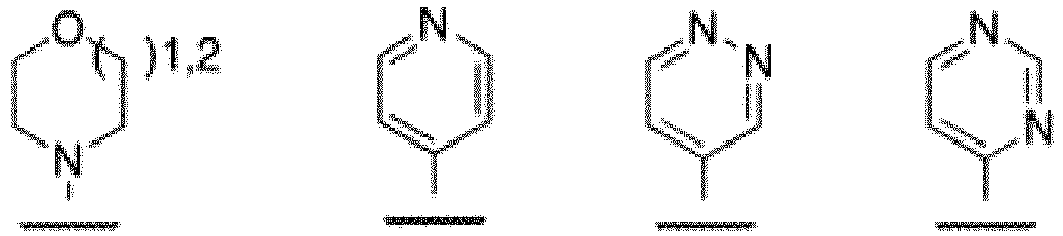
- Zusammensetzung nach einem der vorhergehenden Ansprüche, wobei W O oder S ist, vorzugsweise wobei W O ist, und/oder wobei X CH ist, und/oder wobei R3 H ist, und/oder wobei L C1-C10-Alkylen, vorzugsweise Methylen ist.
- Zusammensetzung nach einem der vorhergehenden Ansprüche, wobei Y ein oder zwei Heteroatome, vorzugsweise zwei Heteroatome enthält.
- Zusammensetzung nach einem der vorhergehenden Ansprüche, wobei Y ausgewählt ist aus:
 A ausgewählt ist aus O, S, NR4 oder gegebenenfalls substituiertem C1-C3-Alkylen, C2-C3-Alkenylen oder C2-C3-Alkinylen;B NR4, O oder CH2 ist;wobei R4 H oder gegebenenfalls substituiertes C1-C10-Alkyl, C2-C10-Alkenyl oder C2-C10-Alkinyl ist;p ausgewählt ist aus 0 oder 1;jedes m unabhängig ausgewählt ist aus 0, 1 oder 2; undjedes n unabhängig ausgewählt ist aus 1, 2 oder 3.
 - Zusammensetzung nach einem der vorhergehenden Ansprüche, wobei die Verbindung gemäß Formel I durch eine der folgenden Strukturen veranschaulicht wird:


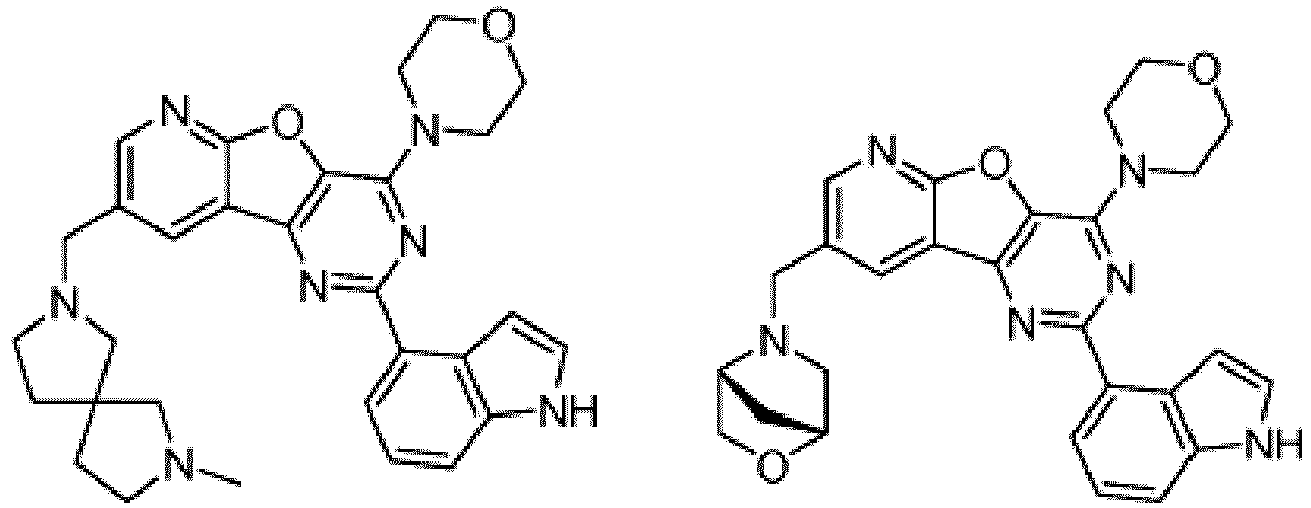

- Zusammensetzung nach einem der vorhergehenden Ansprüche zur Verwendung in der Therapie.
- Zusammensetzung zur Verwendung nach Anspruch 16, wobei die Therapie für Krebs, vorzugsweise eine Leukämie oder ein PTEN-negativer solider Tumor, eine Immunstörung oder eine entzündliche Störung, vorzugsweise rheumatoide Arthritis ist.
- Verfahren zur Herstellung einer pharmazeutischen Zusammensetzung nach einem der Ansprüche 1 bis 15, umfassend:a) Mischen einer Verbindung gemäß Formel I mit mindestens einem pharmazeutischen Hilfsstoff, ausgewählt aus der Gruppe, bestehend aus Füllstoffen, Bindemitteln, Sprengmitteln, Gleitmitteln und Schmiermitteln, um eine Mischung zu bilden;b) Verarbeiten der Mischung zu einer pharmazeutischen Zusammensetzung; undc) Komprimieren der Zusammensetzung aus Schritt (b) zu einer Tablette,
optional, wobei Schritt (b) ferner Sieben umfasst, um eine Teilchengröße von weniger als 1000 µm, vorzugsweise weniger als 500 µm sicherzustellen.
Priority Applications (2)
| Application Number | Priority Date | Filing Date | Title |
|---|---|---|---|
| SI201631671T SI3337460T1 (sl) | 2015-08-19 | 2016-08-19 | Sestavki, ki vsebujejo triciklične heterociklične spojine |
| HRP20230362TT HRP20230362T1 (hr) | 2015-08-19 | 2016-08-19 | Kompozicije koje sadrže triciklične heterorociklične spojeve |
Applications Claiming Priority (2)
| Application Number | Priority Date | Filing Date | Title |
|---|---|---|---|
| GBGB1514758.0A GB201514758D0 (en) | 2015-08-19 | 2015-08-19 | Formulation |
| PCT/GB2016/052577 WO2017029518A1 (en) | 2015-08-19 | 2016-08-19 | Compositions comprising tricyclic heterocyclic compounds |
Publications (2)
| Publication Number | Publication Date |
|---|---|
| EP3337460A1 EP3337460A1 (de) | 2018-06-27 |
| EP3337460B1 true EP3337460B1 (de) | 2023-02-15 |
Family
ID=54258857
Family Applications (1)
| Application Number | Title | Priority Date | Filing Date |
|---|---|---|---|
| EP16756765.0A Active EP3337460B1 (de) | 2015-08-19 | 2016-08-19 | Zusammensetzungen mit tricyclischen heterocyclischen verbindungen |
Country Status (17)
| Country | Link |
|---|---|
| US (2) | US20180235974A1 (de) |
| EP (1) | EP3337460B1 (de) |
| JP (1) | JP6986757B2 (de) |
| KR (1) | KR20180066041A (de) |
| CN (1) | CN108135855B (de) |
| AU (1) | AU2016307886B9 (de) |
| CA (1) | CA2995896A1 (de) |
| DK (1) | DK3337460T3 (de) |
| ES (1) | ES2941741T3 (de) |
| GB (1) | GB201514758D0 (de) |
| HR (1) | HRP20230362T1 (de) |
| IL (1) | IL257501B (de) |
| LT (1) | LT3337460T (de) |
| MX (1) | MX2018001925A (de) |
| PT (1) | PT3337460T (de) |
| SI (1) | SI3337460T1 (de) |
| WO (1) | WO2017029518A1 (de) |
Families Citing this family (8)
| Publication number | Priority date | Publication date | Assignee | Title |
|---|---|---|---|---|
| MX2012002059A (es) | 2009-08-20 | 2012-04-19 | Karus Therapeutics Ltd | Compestos heterociclicos triciclicos como inhibidores de fosfoionositida 3-quinasa. |
| GB201204125D0 (en) | 2012-03-08 | 2012-04-25 | Karus Therapeutics Ltd | Compounds |
| GB201402431D0 (en) | 2014-02-12 | 2014-03-26 | Karus Therapeutics Ltd | Compounds |
| GB201514758D0 (en) | 2015-08-19 | 2015-09-30 | Karus Therapeutics Ltd | Formulation |
| GB201514754D0 (en) | 2015-08-19 | 2015-09-30 | Karus Therapeutics Ltd | Compounds |
| GB201514760D0 (en) | 2015-08-19 | 2015-09-30 | Karus Therapeutics Ltd | Compounds and method of use |
| GB201514751D0 (en) | 2015-08-19 | 2015-09-30 | Karus Therapeutics Ltd | Compounds |
| GB201909468D0 (en) | 2019-07-01 | 2019-08-14 | Karus Therapeutics Ltd | Compounds for treating cancer |
Family Cites Families (54)
| Publication number | Priority date | Publication date | Assignee | Title |
|---|---|---|---|---|
| DE1445742A1 (de) | 1963-11-06 | 1968-12-19 | Bayer Ag | Verfahren zur Herstellung von 2-Stellung substituierten Benzoxazinonen |
| US4017500A (en) | 1973-07-16 | 1977-04-12 | Schering Corporation | Certain 8-amino-1,7-naphthyridines |
| BE786081A (fr) | 1971-07-13 | 1973-01-10 | Uniroyal Sa | Appareil et procede pour maintenir les tringles des bourrelets de pneu |
| US5703075A (en) | 1988-12-21 | 1997-12-30 | Pharmacia & Upjohn Company | Antiatherosclerotic and antithrombotic 1-benzopyran-4-ones and 2-amino-1,3-benzoxazine-4-ones |
| PT1200090E (pt) * | 1999-08-03 | 2013-11-25 | Icos Corp | Formulação farmacêutica à base de um beta-carbolina e seu uso para tratar a disfunção sexual. |
| KR100774855B1 (ko) | 2000-04-27 | 2007-11-08 | 아스텔라스세이야쿠 가부시키가이샤 | 축합 헤테로아릴 유도체 |
| US6608053B2 (en) | 2000-04-27 | 2003-08-19 | Yamanouchi Pharmaceutical Co., Ltd. | Fused heteroaryl derivatives |
| WO2002002551A1 (en) | 2000-06-30 | 2002-01-10 | Sugen, Inc. | 4-heteroaryl-3-heteroarylidenyl-2-indolinones and their use as protein kinase inhibitors |
| US6905669B2 (en) | 2001-04-24 | 2005-06-14 | Supergen, Inc. | Compositions and methods for reestablishing gene transcription through inhibition of DNA methylation and histone deacetylase |
| US7576074B2 (en) | 2002-07-15 | 2009-08-18 | Rice Kenneth D | Receptor-type kinase modulators and methods of use |
| FR2846657B1 (fr) | 2002-11-05 | 2004-12-24 | Servier Lab | Nouveaux composes pyridopyrimidinone, leur procede de preparation et les compositions pharmaceutiques qui les contiennent |
| CA2557541C (en) | 2004-02-26 | 2014-12-16 | Aska Pharmaceutical Co., Ltd. | Pyrimidine derivatives |
| WO2005117889A1 (en) | 2004-05-25 | 2005-12-15 | Icos Corporation | Methods for treating and/or preventing aberrant proliferation of hematopoietic |
| GB0423653D0 (en) | 2004-10-25 | 2004-11-24 | Piramed Ltd | Pharmaceutical compounds |
| EP2354140A1 (de) | 2005-05-20 | 2011-08-10 | Vertex Pharmaceuticals Incorporated | Pyrrolopyridine als Kinaseinhibitoren |
| WO2007084667A2 (en) | 2006-01-19 | 2007-07-26 | Osi Pharmaceutical, Inc. | Fused heterobicyclic kinase inhibitors |
| TW200801012A (en) | 2006-04-26 | 2008-01-01 | Piramed Ltd | Phosphoinositide 3-kinase inhibitor compounds and methods of use |
| KR20090021155A (ko) | 2006-04-26 | 2009-02-27 | 에프. 호프만-라 로슈 아게 | Pi3k 억제제로서의 피리미딘 유도체 |
| WO2008001076A1 (en) | 2006-06-26 | 2008-01-03 | Ucb Pharma S.A. | Fused thiazole derivatives as kinase inhibitors |
| KR20090087027A (ko) | 2006-11-13 | 2009-08-14 | 일라이 릴리 앤드 캄파니 | 염증 질환 및 암의 치료를 위한 티에노피리미디논 |
| EP2120909A2 (de) | 2006-12-15 | 2009-11-25 | Ordway Research Institute | Behandlung von therapierefraktären erkrankungen, umfassend arzneimittelkombinationen |
| AU2008210455A1 (en) | 2007-01-31 | 2008-08-07 | Vertex Pharmaceuticals Incorporated | 2-aminopyridine derivatives useful as kinase inhibitors |
| EP2139332A4 (de) | 2007-03-28 | 2010-04-21 | Merck Sharp & Dohme | Substituierte pyrido[2,3-d]pyrimidinderivate als cannabinoid-1-rezeptormodulatoren |
| WO2008150827A1 (en) | 2007-05-29 | 2008-12-11 | Smithkline Beecham Corporation | Naphthyridine, derivatives as p13 kinase inhibitors |
| GB0710528D0 (en) | 2007-06-01 | 2007-07-11 | Glaxo Group Ltd | Novel compounds |
| US20110201608A1 (en) | 2008-08-05 | 2011-08-18 | Boehringer Ingelheim International Gmbh | Substituted naphthyridines and use thereof as medicines |
| WO2010037765A2 (en) | 2008-10-03 | 2010-04-08 | Merck Serono S.A. | 4-morpholino-pyrido[3,2-d]pyrimidines |
| GB2465405A (en) | 2008-11-10 | 2010-05-19 | Univ Basel | Triazine, pyrimidine and pyridine analogues and their use in therapy |
| EP2459543B1 (de) | 2009-07-29 | 2017-08-30 | Karus Therapeutics Limited | Benzo[e][1,3]oxazin-4-on-derivate als phosphoinositid 3-kinase-hemmer |
| MX2012002059A (es) * | 2009-08-20 | 2012-04-19 | Karus Therapeutics Ltd | Compestos heterociclicos triciclicos como inhibidores de fosfoionositida 3-quinasa. |
| WO2011079231A1 (en) | 2009-12-23 | 2011-06-30 | Gatekeeper Pharmaceutical, Inc. | Compounds that modulate egfr activity and methods for treating or preventing conditions therewith |
| GB201007347D0 (en) | 2010-04-30 | 2010-06-16 | Karus Therapeutics Ltd | Compounds |
| EP2518070A1 (de) * | 2011-04-29 | 2012-10-31 | Almirall, S.A. | Pyrrolotriazinonderivate als PI3K-Inhibitoren |
| EP4119551A1 (de) | 2011-07-27 | 2023-01-18 | Astrazeneca AB | 2-(2,4,5-substituierte anilino)pyrimidinverbindungen |
| WO2013017480A1 (en) | 2011-07-29 | 2013-02-07 | Cellzome Limited | Pyrazolo[4,3-c]pyridine derivatives as jak inhibitors |
| GB201204125D0 (en) * | 2012-03-08 | 2012-04-25 | Karus Therapeutics Ltd | Compounds |
| WO2014081718A1 (en) | 2012-11-20 | 2014-05-30 | Genentech, Inc. | Aminopyrimidine compounds as inhibitors of t790m containing egfr mutants |
| PT2994465T (pt) | 2013-05-10 | 2018-10-25 | Karus Therapeutics Ltd | Novos inibidores de histona desacetilase |
| CA2914284A1 (en) | 2013-05-30 | 2014-12-04 | Infinity Pharmaceuticals, Inc. | Treatment of cancers using pi3 kinase isoform modulators |
| WO2014210354A1 (en) | 2013-06-28 | 2014-12-31 | Genentech, Inc. | Azaindazole compounds as inhibitors of t790m containing egfr mutants |
| WO2015054099A1 (en) | 2013-10-08 | 2015-04-16 | Acetylon Pharmaceuticals, Inc. | Combinations of histone deacetylase inhibitors and either her2 inhibitors or pi3k inhibitors |
| ES2818933T3 (es) | 2013-10-10 | 2021-04-14 | Acetylon Pharmaceuticals Inc | Inhibidores de la HDAC en combinación con los inhibidores de la pi3k, para el tratamiento del linfoma no Hodgkin |
| GB201321728D0 (en) | 2013-12-09 | 2014-01-22 | Ucb Pharma Sa | Therapeutic agents |
| GB201321730D0 (en) | 2013-12-09 | 2014-01-22 | Ucb Pharma Sa | Therapeutic agents |
| GB201321729D0 (en) | 2013-12-09 | 2014-01-22 | Ucb Pharma Sa | Therapeutic agents |
| GB201321738D0 (en) | 2013-12-09 | 2014-01-22 | Ucb Pharma Sa | Therapeutic Agents |
| GB201402431D0 (en) | 2014-02-12 | 2014-03-26 | Karus Therapeutics Ltd | Compounds |
| MA40933A (fr) * | 2014-11-11 | 2017-09-19 | Piqur Therapeutics Ag | Difluorométhyl-aminopyridines et difluorométhyl-aminopyrimidines |
| GB201514760D0 (en) | 2015-08-19 | 2015-09-30 | Karus Therapeutics Ltd | Compounds and method of use |
| GB201514754D0 (en) | 2015-08-19 | 2015-09-30 | Karus Therapeutics Ltd | Compounds |
| GB201514756D0 (en) | 2015-08-19 | 2015-09-30 | Karus Therapeutics Ltd | Compound and method of use |
| GB201514758D0 (en) | 2015-08-19 | 2015-09-30 | Karus Therapeutics Ltd | Formulation |
| GB201514751D0 (en) | 2015-08-19 | 2015-09-30 | Karus Therapeutics Ltd | Compounds |
| GB201909468D0 (en) | 2019-07-01 | 2019-08-14 | Karus Therapeutics Ltd | Compounds for treating cancer |
-
2015
- 2015-08-19 GB GBGB1514758.0A patent/GB201514758D0/en not_active Ceased
-
2016
- 2016-08-19 CN CN201680057451.6A patent/CN108135855B/zh active Active
- 2016-08-19 EP EP16756765.0A patent/EP3337460B1/de active Active
- 2016-08-19 MX MX2018001925A patent/MX2018001925A/es unknown
- 2016-08-19 ES ES16756765T patent/ES2941741T3/es active Active
- 2016-08-19 LT LTEPPCT/GB2016/052577T patent/LT3337460T/lt unknown
- 2016-08-19 HR HRP20230362TT patent/HRP20230362T1/hr unknown
- 2016-08-19 AU AU2016307886A patent/AU2016307886B9/en not_active Ceased
- 2016-08-19 CA CA2995896A patent/CA2995896A1/en not_active Abandoned
- 2016-08-19 PT PT167567650T patent/PT3337460T/pt unknown
- 2016-08-19 JP JP2018508752A patent/JP6986757B2/ja active Active
- 2016-08-19 DK DK16756765.0T patent/DK3337460T3/da active
- 2016-08-19 KR KR1020187007560A patent/KR20180066041A/ko not_active Withdrawn
- 2016-08-19 US US15/753,359 patent/US20180235974A1/en not_active Abandoned
- 2016-08-19 SI SI201631671T patent/SI3337460T1/sl unknown
- 2016-08-19 WO PCT/GB2016/052577 patent/WO2017029518A1/en not_active Ceased
-
2018
- 2018-02-13 IL IL257501A patent/IL257501B/en not_active IP Right Cessation
-
2020
- 2020-10-15 US US17/071,543 patent/US11779586B2/en active Active
Also Published As
| Publication number | Publication date |
|---|---|
| HK1251465A1 (en) | 2019-02-01 |
| GB201514758D0 (en) | 2015-09-30 |
| HRP20230362T1 (hr) | 2023-06-09 |
| IL257501A (en) | 2018-04-30 |
| US20210275537A1 (en) | 2021-09-09 |
| CA2995896A1 (en) | 2017-02-23 |
| SI3337460T1 (sl) | 2023-04-28 |
| CN108135855A (zh) | 2018-06-08 |
| JP6986757B2 (ja) | 2021-12-22 |
| JP2018523688A (ja) | 2018-08-23 |
| ES2941741T3 (es) | 2023-05-25 |
| US20180235974A1 (en) | 2018-08-23 |
| AU2016307886A1 (en) | 2018-03-08 |
| PT3337460T (pt) | 2023-04-21 |
| US11779586B2 (en) | 2023-10-10 |
| WO2017029518A1 (en) | 2017-02-23 |
| DK3337460T3 (en) | 2023-04-11 |
| IL257501B (en) | 2020-03-31 |
| KR20180066041A (ko) | 2018-06-18 |
| LT3337460T (lt) | 2023-03-27 |
| AU2016307886B2 (en) | 2019-07-18 |
| EP3337460A1 (de) | 2018-06-27 |
| CN108135855B (zh) | 2021-04-02 |
| AU2016307886B9 (en) | 2019-11-21 |
| MX2018001925A (es) | 2018-06-19 |
Similar Documents
| Publication | Publication Date | Title |
|---|---|---|
| US11779586B2 (en) | Compounds comprising tricyclic heterocyclic compounds | |
| ES2966336T3 (es) | Formulaciones de inhibidores de cinasa amorfos y métodos de uso de las mismas | |
| ES2647583T3 (es) | Dispersiones sólidas extrudidas en estado fundido que contienen un agente inductor de apoptosis | |
| ES2699205T3 (es) | Dispersiones sólidas que contienen un agente que induce la apoptosis | |
| EP3102213B1 (de) | Pharmazeutische zusammensetzungen zur behandlung von entzündungserkrankungen | |
| US11951100B2 (en) | Formulations of RBP4 inhibitors and methods of use | |
| KR20110086886A (ko) | 페닐알라닌 유도체의 고체 분산체 또는 고체 분산체 의약 제제 | |
| WO2022037661A1 (en) | Pharmaceutical formulations comprising a malt1 inhibitor and a mixture of polyethylene glycol with a fatty acid | |
| AU2020225342A1 (en) | Pharmaceutical formulations | |
| HK1251465B (en) | Compositions comprising tricyclic heterocyclic compounds | |
| KR20230024389A (ko) | 우티델론의 고체 경구용 제제 | |
| CN122003419A (zh) | 治疗化合物、其制备方法及其用途 | |
| BR122024022942A2 (pt) | Composições farmaceuticamente aceitáveis para administração oral, comprimidos farmaceuticamente aceitáveis, usos relacionados, processo para a preparação de uma dispersão sólida, dispersão sólida e kit compreendendo a composição | |
| TW202543622A (zh) | Csf-1r抑制劑之調配物 | |
| BR112022013109B1 (pt) | Composições farmaceuticamente aceitáveis para administração oral, comprimidos farmaceuticamente aceitáveis e usos relacionados | |
| EA047065B1 (ru) | Препараты аморфного ингибитора киназы и способы их применения | |
| BR122024022942B1 (pt) | Composições farmaceuticamente aceitáveis para administração oral, comprimidos farmaceuticamente aceitáveis, usos relacionados, processo para a preparação de uma dispersão sólida, dispersão sólida e kit compreendendo a composição |
Legal Events
| Date | Code | Title | Description |
|---|---|---|---|
| STAA | Information on the status of an ep patent application or granted ep patent |
Free format text: STATUS: THE INTERNATIONAL PUBLICATION HAS BEEN MADE |
|
| PUAI | Public reference made under article 153(3) epc to a published international application that has entered the european phase |
Free format text: ORIGINAL CODE: 0009012 |
|
| STAA | Information on the status of an ep patent application or granted ep patent |
Free format text: STATUS: REQUEST FOR EXAMINATION WAS MADE |
|
| 17P | Request for examination filed |
Effective date: 20180316 |
|
| AK | Designated contracting states |
Kind code of ref document: A1 Designated state(s): AL AT BE BG CH CY CZ DE DK EE ES FI FR GB GR HR HU IE IS IT LI LT LU LV MC MK MT NL NO PL PT RO RS SE SI SK SM TR |
|
| AX | Request for extension of the european patent |
Extension state: BA ME |
|
| RIN1 | Information on inventor provided before grant (corrected) |
Inventor name: BONE, ELIZABETH ANN Inventor name: SILVA, FRANCK ALEXANDRE Inventor name: SHUTTLEWORTH, STEPHEN JOSEPH Inventor name: CECIL, ALEXANDER RICHARD LIAM |
|
| DAV | Request for validation of the european patent (deleted) | ||
| DAX | Request for extension of the european patent (deleted) | ||
| REG | Reference to a national code |
Ref country code: HK Ref legal event code: DE Ref document number: 1251465 Country of ref document: HK |
|
| STAA | Information on the status of an ep patent application or granted ep patent |
Free format text: STATUS: EXAMINATION IS IN PROGRESS |
|
| 17Q | First examination report despatched |
Effective date: 20190221 |
|
| RIC1 | Information provided on ipc code assigned before grant |
Ipc: A61P 37/06 20060101ALI20220720BHEP Ipc: A61P 37/02 20060101ALI20220720BHEP Ipc: A61P 35/02 20060101ALI20220720BHEP Ipc: A61P 29/00 20060101ALI20220720BHEP Ipc: A61P 19/02 20060101ALI20220720BHEP Ipc: A61P 35/00 20060101ALI20220720BHEP Ipc: A61K 31/5377 20060101ALI20220720BHEP Ipc: A61K 31/5386 20060101ALI20220720BHEP Ipc: A61K 31/519 20060101ALI20220720BHEP Ipc: A61K 9/20 20060101AFI20220720BHEP |
|
| GRAP | Despatch of communication of intention to grant a patent |
Free format text: ORIGINAL CODE: EPIDOSNIGR1 |
|
| STAA | Information on the status of an ep patent application or granted ep patent |
Free format text: STATUS: GRANT OF PATENT IS INTENDED |
|
| INTG | Intention to grant announced |
Effective date: 20220907 |
|
| RAP1 | Party data changed (applicant data changed or rights of an application transferred) |
Owner name: CONVALIFE (SHANGHAI) CO. LIMITED |
|
| GRAS | Grant fee paid |
Free format text: ORIGINAL CODE: EPIDOSNIGR3 |
|
| GRAA | (expected) grant |
Free format text: ORIGINAL CODE: 0009210 |
|
| STAA | Information on the status of an ep patent application or granted ep patent |
Free format text: STATUS: THE PATENT HAS BEEN GRANTED |
|
| AK | Designated contracting states |
Kind code of ref document: B1 Designated state(s): AL AT BE BG CH CY CZ DE DK EE ES FI FR GB GR HR HU IE IS IT LI LT LU LV MC MK MT NL NO PL PT RO RS SE SI SK SM TR |
|
| REG | Reference to a national code |
Ref country code: CH Ref legal event code: EP Ref country code: GB Ref legal event code: FG4D |
|
| REG | Reference to a national code |
Ref country code: DE Ref legal event code: R096 Ref document number: 602016077829 Country of ref document: DE |
|
| REG | Reference to a national code |
Ref country code: AT Ref legal event code: REF Ref document number: 1547898 Country of ref document: AT Kind code of ref document: T Effective date: 20230315 Ref country code: IE Ref legal event code: FG4D |
|
| REG | Reference to a national code |
Ref country code: DK Ref legal event code: T3 Effective date: 20230405 |
|
| REG | Reference to a national code |
Ref country code: PT Ref legal event code: SC4A Ref document number: 3337460 Country of ref document: PT Date of ref document: 20230421 Kind code of ref document: T Free format text: AVAILABILITY OF NATIONAL TRANSLATION Effective date: 20230417 |
|
| REG | Reference to a national code |
Ref country code: SE Ref legal event code: TRGR |
|
| REG | Reference to a national code |
Ref country code: ES Ref legal event code: FG2A Ref document number: 2941741 Country of ref document: ES Kind code of ref document: T3 Effective date: 20230525 |
|
| REG | Reference to a national code |
Ref country code: HR Ref legal event code: T1PR Ref document number: P20230362 Country of ref document: HR |
|
| P01 | Opt-out of the competence of the unified patent court (upc) registered |
Effective date: 20230424 |
|
| REG | Reference to a national code |
Ref country code: NL Ref legal event code: MP Effective date: 20230215 |
|
| PG25 | Lapsed in a contracting state [announced via postgrant information from national office to epo] |
Ref country code: RS Free format text: LAPSE BECAUSE OF FAILURE TO SUBMIT A TRANSLATION OF THE DESCRIPTION OR TO PAY THE FEE WITHIN THE PRESCRIBED TIME-LIMIT Effective date: 20230215 Ref country code: NO Free format text: LAPSE BECAUSE OF FAILURE TO SUBMIT A TRANSLATION OF THE DESCRIPTION OR TO PAY THE FEE WITHIN THE PRESCRIBED TIME-LIMIT Effective date: 20230515 Ref country code: NL Free format text: LAPSE BECAUSE OF FAILURE TO SUBMIT A TRANSLATION OF THE DESCRIPTION OR TO PAY THE FEE WITHIN THE PRESCRIBED TIME-LIMIT Effective date: 20230215 Ref country code: LV Free format text: LAPSE BECAUSE OF FAILURE TO SUBMIT A TRANSLATION OF THE DESCRIPTION OR TO PAY THE FEE WITHIN THE PRESCRIBED TIME-LIMIT Effective date: 20230215 |
|
| PG25 | Lapsed in a contracting state [announced via postgrant information from national office to epo] |
Ref country code: PL Free format text: LAPSE BECAUSE OF FAILURE TO SUBMIT A TRANSLATION OF THE DESCRIPTION OR TO PAY THE FEE WITHIN THE PRESCRIBED TIME-LIMIT Effective date: 20230215 Ref country code: IS Free format text: LAPSE BECAUSE OF FAILURE TO SUBMIT A TRANSLATION OF THE DESCRIPTION OR TO PAY THE FEE WITHIN THE PRESCRIBED TIME-LIMIT Effective date: 20230615 Ref country code: GR Free format text: LAPSE BECAUSE OF FAILURE TO SUBMIT A TRANSLATION OF THE DESCRIPTION OR TO PAY THE FEE WITHIN THE PRESCRIBED TIME-LIMIT Effective date: 20230516 Ref country code: FI Free format text: LAPSE BECAUSE OF FAILURE TO SUBMIT A TRANSLATION OF THE DESCRIPTION OR TO PAY THE FEE WITHIN THE PRESCRIBED TIME-LIMIT Effective date: 20230215 |
|
| REG | Reference to a national code |
Ref country code: HR Ref legal event code: ODRP Ref document number: P20230362 Country of ref document: HR Payment date: 20230804 Year of fee payment: 8 |
|
| PG25 | Lapsed in a contracting state [announced via postgrant information from national office to epo] |
Ref country code: SM Free format text: LAPSE BECAUSE OF FAILURE TO SUBMIT A TRANSLATION OF THE DESCRIPTION OR TO PAY THE FEE WITHIN THE PRESCRIBED TIME-LIMIT Effective date: 20230215 Ref country code: RO Free format text: LAPSE BECAUSE OF FAILURE TO SUBMIT A TRANSLATION OF THE DESCRIPTION OR TO PAY THE FEE WITHIN THE PRESCRIBED TIME-LIMIT Effective date: 20230215 Ref country code: EE Free format text: LAPSE BECAUSE OF FAILURE TO SUBMIT A TRANSLATION OF THE DESCRIPTION OR TO PAY THE FEE WITHIN THE PRESCRIBED TIME-LIMIT Effective date: 20230215 Ref country code: CZ Free format text: LAPSE BECAUSE OF FAILURE TO SUBMIT A TRANSLATION OF THE DESCRIPTION OR TO PAY THE FEE WITHIN THE PRESCRIBED TIME-LIMIT Effective date: 20230215 |
|
| REG | Reference to a national code |
Ref country code: DE Ref legal event code: R097 Ref document number: 602016077829 Country of ref document: DE |
|
| PG25 | Lapsed in a contracting state [announced via postgrant information from national office to epo] |
Ref country code: SK Free format text: LAPSE BECAUSE OF FAILURE TO SUBMIT A TRANSLATION OF THE DESCRIPTION OR TO PAY THE FEE WITHIN THE PRESCRIBED TIME-LIMIT Effective date: 20230215 |
|
| REG | Reference to a national code |
Ref country code: AT Ref legal event code: UEP Ref document number: 1547898 Country of ref document: AT Kind code of ref document: T Effective date: 20230215 |
|
| PLBE | No opposition filed within time limit |
Free format text: ORIGINAL CODE: 0009261 |
|
| STAA | Information on the status of an ep patent application or granted ep patent |
Free format text: STATUS: NO OPPOSITION FILED WITHIN TIME LIMIT |
|
| 26N | No opposition filed |
Effective date: 20231116 |
|
| PG25 | Lapsed in a contracting state [announced via postgrant information from national office to epo] |
Ref country code: MC Free format text: LAPSE BECAUSE OF FAILURE TO SUBMIT A TRANSLATION OF THE DESCRIPTION OR TO PAY THE FEE WITHIN THE PRESCRIBED TIME-LIMIT Effective date: 20230215 |
|
| PG25 | Lapsed in a contracting state [announced via postgrant information from national office to epo] |
Ref country code: MC Free format text: LAPSE BECAUSE OF FAILURE TO SUBMIT A TRANSLATION OF THE DESCRIPTION OR TO PAY THE FEE WITHIN THE PRESCRIBED TIME-LIMIT Effective date: 20230215 |
|
| REG | Reference to a national code |
Ref country code: HR Ref legal event code: ODRP Ref document number: P20230362 Country of ref document: HR Payment date: 20240717 Year of fee payment: 9 |
|
| PG25 | Lapsed in a contracting state [announced via postgrant information from national office to epo] |
Ref country code: CY Free format text: LAPSE BECAUSE OF FAILURE TO SUBMIT A TRANSLATION OF THE DESCRIPTION OR TO PAY THE FEE WITHIN THE PRESCRIBED TIME-LIMIT; INVALID AB INITIO Effective date: 20160819 |
|
| PG25 | Lapsed in a contracting state [announced via postgrant information from national office to epo] |
Ref country code: HU Free format text: LAPSE BECAUSE OF FAILURE TO SUBMIT A TRANSLATION OF THE DESCRIPTION OR TO PAY THE FEE WITHIN THE PRESCRIBED TIME-LIMIT; INVALID AB INITIO Effective date: 20160819 |
|
| PGFP | Annual fee paid to national office [announced via postgrant information from national office to epo] |
Ref country code: LU Payment date: 20250724 Year of fee payment: 10 |
|
| REG | Reference to a national code |
Ref country code: HR Ref legal event code: ODRP Ref document number: P20230362 Country of ref document: HR Payment date: 20250721 Year of fee payment: 10 |
|
| PGFP | Annual fee paid to national office [announced via postgrant information from national office to epo] |
Ref country code: PT Payment date: 20250718 Year of fee payment: 10 Ref country code: ES Payment date: 20250908 Year of fee payment: 10 |
|
| PGFP | Annual fee paid to national office [announced via postgrant information from national office to epo] |
Ref country code: LT Payment date: 20250722 Year of fee payment: 10 Ref country code: DK Payment date: 20250729 Year of fee payment: 10 Ref country code: DE Payment date: 20250812 Year of fee payment: 10 |
|
| PGFP | Annual fee paid to national office [announced via postgrant information from national office to epo] |
Ref country code: TR Payment date: 20250808 Year of fee payment: 10 Ref country code: IT Payment date: 20250808 Year of fee payment: 10 |
|
| PGFP | Annual fee paid to national office [announced via postgrant information from national office to epo] |
Ref country code: BE Payment date: 20250826 Year of fee payment: 10 Ref country code: BG Payment date: 20250724 Year of fee payment: 10 Ref country code: GB Payment date: 20250826 Year of fee payment: 10 |
|
| PGFP | Annual fee paid to national office [announced via postgrant information from national office to epo] |
Ref country code: HR Payment date: 20250721 Year of fee payment: 10 |
|
| PGFP | Annual fee paid to national office [announced via postgrant information from national office to epo] |
Ref country code: FR Payment date: 20250828 Year of fee payment: 10 Ref country code: AT Payment date: 20250722 Year of fee payment: 10 |
|
| PGFP | Annual fee paid to national office [announced via postgrant information from national office to epo] |
Ref country code: CH Payment date: 20250901 Year of fee payment: 10 Ref country code: SE Payment date: 20250826 Year of fee payment: 10 |
|
| PGFP | Annual fee paid to national office [announced via postgrant information from national office to epo] |
Ref country code: IE Payment date: 20250728 Year of fee payment: 10 |
|
| PGFP | Annual fee paid to national office [announced via postgrant information from national office to epo] |
Ref country code: SI Payment date: 20250721 Year of fee payment: 10 |