EP3338298B1 - Nouveaux procédés d'évaluation des performances d'un système d'ionisation à pression atmosphérique - Google Patents
Nouveaux procédés d'évaluation des performances d'un système d'ionisation à pression atmosphérique Download PDFInfo
- Publication number
- EP3338298B1 EP3338298B1 EP16839874.1A EP16839874A EP3338298B1 EP 3338298 B1 EP3338298 B1 EP 3338298B1 EP 16839874 A EP16839874 A EP 16839874A EP 3338298 B1 EP3338298 B1 EP 3338298B1
- Authority
- EP
- European Patent Office
- Prior art keywords
- ion
- cluster
- api
- ionization
- cluster ion
- Prior art date
- Legal status (The legal status is an assumption and is not a legal conclusion. Google has not performed a legal analysis and makes no representation as to the accuracy of the status listed.)
- Active
Links
Images


















Classifications
-
- H—ELECTRICITY
- H01—ELECTRIC ELEMENTS
- H01J—ELECTRIC DISCHARGE TUBES OR DISCHARGE LAMPS
- H01J49/00—Particle spectrometers or separator tubes
- H01J49/0009—Calibration of the apparatus
-
- G—PHYSICS
- G01—MEASURING; TESTING
- G01N—INVESTIGATING OR ANALYSING MATERIALS BY DETERMINING THEIR CHEMICAL OR PHYSICAL PROPERTIES
- G01N27/00—Investigating or analysing materials by the use of electric, electrochemical, or magnetic means
- G01N27/62—Investigating or analysing materials by the use of electric, electrochemical, or magnetic means by investigating the ionisation of gases, e.g. aerosols; by investigating electric discharges, e.g. emission of cathode
- G01N27/622—Ion mobility spectrometry
- G01N27/623—Ion mobility spectrometry combined with mass spectrometry
-
- H—ELECTRICITY
- H01—ELECTRIC ELEMENTS
- H01J—ELECTRIC DISCHARGE TUBES OR DISCHARGE LAMPS
- H01J49/00—Particle spectrometers or separator tubes
- H01J49/02—Details
- H01J49/025—Detectors specially adapted to particle spectrometers
- H01J49/027—Detectors specially adapted to particle spectrometers detecting image current induced by the movement of charged particles
-
- H—ELECTRICITY
- H01—ELECTRIC ELEMENTS
- H01J—ELECTRIC DISCHARGE TUBES OR DISCHARGE LAMPS
- H01J49/00—Particle spectrometers or separator tubes
- H01J49/02—Details
- H01J49/10—Ion sources; Ion guns
- H01J49/16—Ion sources; Ion guns using surface ionisation, e.g. field-, thermionic- or photo-emission
- H01J49/165—Electrospray ionisation
-
- H—ELECTRICITY
- H01—ELECTRIC ELEMENTS
- H01J—ELECTRIC DISCHARGE TUBES OR DISCHARGE LAMPS
- H01J49/00—Particle spectrometers or separator tubes
- H01J49/02—Details
- H01J49/10—Ion sources; Ion guns
- H01J49/16—Ion sources; Ion guns using surface ionisation, e.g. field-, thermionic- or photo-emission
- H01J49/168—Ion sources; Ion guns using surface ionisation, e.g. field-, thermionic- or photo-emission field ionisation, e.g. corona discharge
-
- H—ELECTRICITY
- H01—ELECTRIC ELEMENTS
- H01J—ELECTRIC DISCHARGE TUBES OR DISCHARGE LAMPS
- H01J49/00—Particle spectrometers or separator tubes
- H01J49/26—Mass spectrometers or separator tubes
- H01J49/28—Static spectrometers
- H01J49/30—Static spectrometers using magnetic analysers, e.g. Dempster spectrometer
-
- G—PHYSICS
- G01—MEASURING; TESTING
- G01R—MEASURING ELECTRIC VARIABLES; MEASURING MAGNETIC VARIABLES
- G01R19/00—Arrangements for measuring currents or voltages or for indicating presence or sign thereof
- G01R19/0046—Arrangements for measuring currents or voltages or for indicating presence or sign thereof characterised by a specific application or detail not covered by any other subgroup of G01R19/00
- G01R19/0061—Measuring currents of particle-beams, currents from electron multipliers, photocurrents, ion currents; Measuring in plasmas
-
- H—ELECTRICITY
- H01—ELECTRIC ELEMENTS
- H01J—ELECTRIC DISCHARGE TUBES OR DISCHARGE LAMPS
- H01J49/00—Particle spectrometers or separator tubes
- H01J49/02—Details
- H01J49/10—Ion sources; Ion guns
Definitions
- ion suppression or ion enhancement which is observed in electrospray ionization (ESI), atmospheric pressure chemical ionization (APCI), and other ambient ionization techniques.
- ESI electrospray ionization
- APCI atmospheric pressure chemical ionization
- matrix effect is caused by a number of conditions including the presence of high concentrations of non-volatile compounds (including, for example, salts, ion-pairing agents, endogenous compounds, and co-eluting compounds) that are present in samples being evaluated by mass spectrometry.
- the matrix effect causes changes in the efficiency of droplet formation or evaporation during the ionization process, and ultimately results in an altered amount of charged analytes that reach the detector of the mass spectrometer.
- stable isotope labeled internal standards that co-elute with the analyte of interest may be added to the sample, thus compensating for any ion suppression or enhancement.
- SAM standard addition method
- US 2011/0101215 A1 discloses a mass spectrometry-based quantitative analysis method, wherein occurence of quantitative analysis-inhibitory factors is detected.
- US 4,769,540 discloses an atmospheric pressure ionization mass spectrometer with improved sensitivity.
- the operation of the API system comprises quantitative or qualitative analysis.
- the abundance of the at least one cluster ion in (a), and/or the presence or absence of at least one cluster ion in (b) indicates that matrix effects do not significantly affect the API dependent process.
- the abundance of the at least one cluster ion in (a), and/or the presence or absence of at least one cluster ion in (b) indicates that matrix effects significantly affect the API dependent process.
- the method further comprises changing one or more operating parameters of the API system so that matrix effects do not significantly affect the API dependent process.
- Clusters are fundamental to the generation of charged particles at atmospheric pressure and nearly room temperature thermal energies.
- Low mass/charge (“m/z”) cluster ions are formed in all API processes.
- charges present in the atmosphere attract solvent molecules to create non-covalent charged complexes described as "cluster ions,” which are held together by a combination of static charge, hydrogen bonds and van der Waals forces.
- Clusters may also be the result of the disintegration of larger original charged droplets, as is the case for droplets formed by electrospray and nebulized electrospray.
- the fundamental theory of ion formation at atmospheric pressure results in the generation of cluster ions in great abundance. Many of the clusters have a core charged molecule that can be liberated by declustering.
- ion-molecule cluster ions are formed under the same conditions that give rise to analytically useful pseudomolecular and molecular ions characteristic of modern mass spectrometry.
- cluster ions are observed at a relatively constant abundance.
- the parameters of operation of the API are voluntarily or involuntarily changed whereby its ability to form ions drifts, cluster ion abundance is also disturbed. Since ions at atmospheric pressure and thermal energies tolerated by complex organic molecules always result in the formation of charged solvent and vapor clusters, the abundance of such cluster ions is an indicator of how well the API system is functioning.
- the use of the ion current for cluster ions comprised of components already part of the sample thus allows for continuous monitoring of any API system and its ability to form ions.
- monitoring a particular cluster ion abundance using an API system allows for evaluation of the API's ability to form any type of ion, including target analyte ions. In other embodiments, monitoring a particular cluster ion abundance using an API system allows for the evaluation of overall performance of the API system and identification of matrix effects present in the analysis.
- the methods of the invention which in certain aspects comprise measuring ion currents generated by ion-molecule clusters formed in the API process, are a simple and convenient means of identifying any changes in overall ionization system performance.
- the methods of the present invention allow for monitoring performance of an API system on a continuous basis without the need for sample spiking or infusion. Since the methods of the invention require no specific additives, the quantitative integrity of the analytical system is maintained.
- the cluster ions contemplated within the invention are formed during vaporization of the sample to be analyzed.
- the chemical nature of the cluster ions may be modified by varying specific experimental conditions, such as instrumental variables including but not limited to: voltage and current used to generate ions by API, overall ion source gas pressure, identity of gases and vapors present during the ionization process, composition of the solvent system being vaporized, and the like. Any cluster ion of specific size and charge is contemplated within the invention.
- the cluster ion is selected by modifying and/or circumventing parameters built into commercial mass spectrometers designed specifically to remove cluster ions.
- cluster ions are considered only as a source of chemical noise in API-MS, and as such great effort is given to reducing or removing signals from cluster ions.
- Such parameters include, but are not limited to, curtain gas, declustering potential, low mass filters, differential pumping, molecular beam skimmers, heated capillary temperature, size and construction material, entrance potential and other sources of energy that are applied to the clusters to break them apart, such as, but not limited to, low energy electrons from various sources, IR radiation, microwave radiation and laser light.
- the curtain gas and declustering potential are set to their lowest feasible values to permit low m/z cluster ions into the mass spectrometer. Further adjustment of collision cell voltages and collision gas thickness allows for selected reaction monitoring of some cluster ions. Other cluster ions can be monitored using other modes of mass spectrometry, such as but not limited to selected ion monitoring and others.
- the characteristic abundance and behavior of the signal generated for the cluster ion depends on the specific set of API conditions and the fluid delivery system.
- the abundance and behavior of the ion current for the cluster ion may be determined using the API system. For an LC-MS analysis, this may comprise injecting a solvent blank followed by gradient elution from an HPLC column. This control experiment may help establish the cluster ion pattern to be expected for all subsequent analyses done with that API system.
- the ion current for the at least one cluster ion is monitored using a commercially available mass spectrometer and/or ion mobility spectrometer that is tuned to maximize the formation, transmission and detection of the selected ion-molecule cluster ion(s). Comparison of the ion current for the cluster ion(s) and the ion current for the analyte(s) of interest, as a function of time, allows one to determine if there is a time-dependent change of sensitivity of the instrument to the analyte(s) and the ion-molecule cluster ion(s).
- the instrument parameters are set up such that monitoring of the ion current for the cluster ions is alternated with monitoring of the ion current for the analyte.
- the frequency of the switching depends on the specific mass spectrometer used and the scan mode being used but typically ranges from 1 millisecond to several seconds.
- Such set-up allows monitoring and identifying any time-dependent variation in ion current for the cluster ion and the analyte, thus allowing the determination of whether matrix effects or instrumental driftings are taking place.
- the instrument parameters are set up such that monitoring of the ion current for cluster ions is run at preselected time points, whereas at other times the instrument is set up to monitor the ion current for the analyte. These set-ups allow monitoring and identifying any time-dependent variation in ion current for the cluster ion and the analyte, thus determining whether matrix effects or instrumental driftings are taking place.
- ion-molecule cluster ions formed during the API process are monitored, measured and/or recorded using a mass spectrometer, and the corresponding results are used as an indication of the ability of the API system to form ions of any type.
- Monitoring, measuring and/or recording the rate or extent of ion formation by API processes may be accomplished using any of the available mass spectrometry means based on the separation and detection of the m/z ratio of an ionized species related to the cluster ion.
- the ionized species related to the cluster ion include fragment ions, smaller and larger cluster ions, or any other charged chemical species derived from the original cluster ion formed in the API process.
- the ionized species related to the cluster ion does not include the desolvated ions typically detected by mass spectrometry and ion mobility, such as molecular ions, pseudomolecular ions, and fragments thereof.
- a deviation from the expected instrumental response for a specific cluster ion under specific experimental conditions indicates a change in the performance of the API process, and this change may also affect processes and measurements reliant upon the API system, such as but not limited to LC-MS detection of samples for qualitative or quantitative analytical purposes.
- the change in instrumental response for the cluster ions can then be used as an indicator of systemic changes in the API process that affect the response of analyte ions.
- the time and degree of change relative to the elution time of the analyte and the expected response at that time is used to establish one of the following results: (a) the API system is working as expected and no action is required, (b) a change or drift has occurred in the API system that may impact the accuracy or precision of the analytical results, and (c) a change or drift has occurred in the API system that impacts the response for the target analyte and action must be taken, such as troubleshooting the analytical system, recalibrating the API system and/or reanalyzing the sample containing the analyte.
- ion-molecule cluster ions formed during the API process are monitored, measured and/or recorded by ion mobility spectrometry, such as, but not limited to, differential ion mobility (DMS) and high field asymmetric ion mobility spectrometry (FAIMS), and used as an indication of the ability of the API system to form ions of any type.
- ion mobility spectrometry such as, but not limited to, differential ion mobility (DMS) and high field asymmetric ion mobility spectrometry (FAIMS)
- Monitoring, measuring and/or recording the rate or extent of ion formation by API processes may be accomplished using any of the available means based on the separation and detection of ionized species related in any fashion to the cluster ion. This includes fragment ions, smaller and larger cluster ions or any other charged chemical species derived from the original cluster ion formed in the API process.
- the measurement of the ion current associated with charged cluster ions is used to monitor an API-based continuous process.
- paints and coating are often applied using API processes to assure thin and even coverage.
- changes in the abundance and overall pattern of the cluster ions observed indicate a change or drift in the API process that may affect the quality of the overall process.
- the information about change in the API-based process may be used in real time to make adjustments to the parameters associated with the API system, such as, but not limited to, current, voltage, flow rate, and the like, with the objective of ensuring that the process is run under uniform and stable conditions.
- the information might also be used to stop an uncontrolled and/or unstable process and troubleshoot causes for the cluster ion abundance change.
- the invention further comprises apparatus that are adapted to implement the methods of the invention. These apparatus allow for monitoring the ion currents of a cluster ion as a function of time, and may be generated by modifying preexistent part(s) of commercially available MS instruments. Alternatively, the apparatus may be attached to commercially available MS instruments and/or replace specific part(s) of commercially available MS instruments.
- charged aerosol detection might be used in conjunction with API as a means of measuring cluster ion current.
- Gas dynamics might also be the basis for separation of clusters from the remainder of the gas jet with detection by any available charge or current detection device such as a Faraday cup, charge coupled device, image current device, ionization gauge or any other detector of ionized species.
- the invention further comprises software that is adapted to implement the methods of the invention in a commercially available MS instrument.
- software may include: software that monitors cluster response and then adjusts instrumental parameters to maintain cluster response at a fixed level; software that evaluates cluster response as a function of time compared to an expected function of response over time and reports response differences in the overall pattern, specific time windows, response levels over various time segments, and/or response levels over various time ranges (seconds, minutes, hours, days, weeks, months, years); software that calculates statistical parameters of the cluster response over time, samples, and scans; software that calculates process integrity over time, between methods, functions, and procedures based on cluster ion abundance monitoring; software that evaluates binary results based on cluster ion measurements such as good/bad; software that evaluates cluster ion abundance monitoring data and relates it to quantitative measurements of other ions detected by the same API process giving rise to the analyte ions; software that provides troubleshooting guidance for methods and procedures and processes based on cluster ion abundance measurements; software that detects
- the methods of the invention can be used to evaluate and monitor the quality of an atmospheric pressure ionization and/or the performance of a system running atmospheric pressure ionization.
- the methods of the invention can be further used to develop methods that use atmospheric pressure ionization.
- the methods of the invention can be further used to perform quality control of processes reliant upon atmospheric pressure ionization and/or analyses dependent upon atmospheric pressure ionization.
- the methods of the invention can be further used as a means of identifying changes in the atmospheric pressure ionization performance; measuring and evaluating the effect of system tuning and optimization; correcting response changes found in measurements reliant upon atmospheric pressure ionization; and/or evaluating the magnitude of changes observed with the use of atmospheric pressure ionization.
- the invention further includes software programs that evaluate results generated through the use of the methods of the invention; and/or predict the shape and completion of an event or process reliant upon the methods of the invention.
- the invention further allows for creating and applying information derived from the methods of the invention as applied to non-cluster ions, generated by atmospheric pressure ionization.
- the invention further allows for a means of universal detection based on the methods of the invention, as well as extending the useful concentration dynamic range of analyses performed using the methods of the invention.
- the invention further allows for evaluating the overall system production or release of substances that might potentially interfere with ion production by API.
- the articles “a” and “an” refer to one or to more than one (i.e. to at least one) of the grammatical object of the article.
- an element means one element or more than one element.
- the term “about” will be understood by persons of ordinary skill in the art and will vary to some extent on the context in which it is used. As used herein when referring to a measurable value such as an amount, a temporal duration, and the like, the term “about” is meant to encompass variations of ⁇ 20% or ⁇ 10%, more preferably ⁇ 5%, even more preferably ⁇ 1%, and still more preferably ⁇ 0.1% from the specified value, as such variations are appropriate to perform the disclosed methods.
- the term "accuracy” refers to the degree of closeness of the determined value to the nominal or known true value under prescribed conditions. This is sometimes termed trueness.
- analyte refers to a specific chemical moiety being measured.
- the analyte is an intact drug, a biomolecule or any derivative thereof, a metabolite, and/or a degradation product in a biologic matrix.
- APCI atmospheric pressure chemical ionization
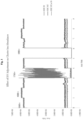
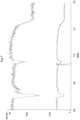
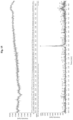
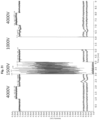
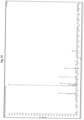
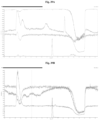
- Fig. 20 shows results obtained for the same system described in Fig. 18 .
- the cluster ion monitoring has the expected appearance, while the analyte labetalol was not detected in the data.
- the API source was functioning as indicated by the cluster ion monitoring, the lack of analyte may be due to an injection solution problem or an injector malfunction.
- the injector was set to inject to waste rather than to the column.
- the example demonstrates the utility of the methods of the invention for troubleshooting problems not directly caused by the API process, but that involve systems reliant upon API such as the LC-MS/MS system used in this example.
- the ionization sources used for API often rely upon various physical inputs that must be optimized for each analyses.
- the degree of optimization required depends on the particular analysis. Best practice recommendations from analytical instrument manufacturers are to infuse the analyte of interest and optimize the source settings to produce the optimum signal for the analyte of interest.
- the source optimization is a combination of parameters that mainly affect the liquid spray and those that affect the declustering of the analyte ion.
- the methods of the invention are ideally suited to optimization of the spray parameters, as they provide a continuous readout on the performance of the API system.
- source conditions are set to produce high abundance and steady output of solvent cluster ions, those are also conditions that efficiently ionize other sample components.
- Optimization of cluster ion monitoring is by definition optimization of the ion source's ability to form ions.
- the data that follows demonstrates the utility of the methods of the invention for the optimization of API source conditions.
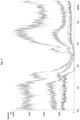
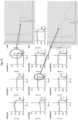
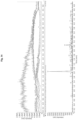
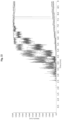
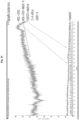
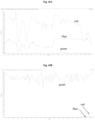
- Fig. 21 shows the effect on solvent cluster ions chosen for the positive ion water/acetonitrile mobile phase system as a function of ionization voltage.
- the changes in intensity of the solvent cluster ions follow the expected pattern for the corresponding change in ionization voltage.
- the data demonstrate the utility of the methods of the invention for detecting changes in ionization voltage as well as the utility for optimization of the ionization voltage.
- the data was collected using continuous 50 ⁇ l/min flow of 5% acetonitrile in water with 0.1% formic acid into a Sciex 5500 Qtrap mass spectrometer operating in positive ion electrospray.
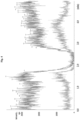
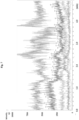
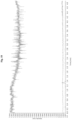
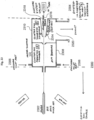
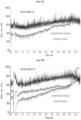
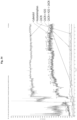
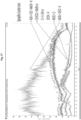
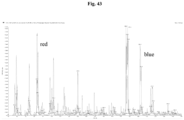
- Fig. 22 shows the response for the solvent cluster ions chosen for cluster ion monitoring for the acetonitrile (0.1% formic acid) : water (0.1% formic acid) mobile phase in positive ion electrospray ionization as the electrospray voltage was ramped in 250 volt steps from 0 volts to 4750 volts.
- a number of features demonstrate the utility of the methods of the invention for optimization of source temperature and ionization voltage.
- the stepwise increase in response as a function of voltage was readily observed.
- the saturation of the detection system was evident in the pink and blue traces, while the lower responding ions red, green, light blue and gray (bottom four traces) continued to increase with increasing ionization voltage.
- the steady difference in response as a function of source temperature was also evident in the cluster ion monitoring, with the 450 °C temperature giving a consistently higher response than the 350 °C temperature.
- the data was collected using continuous 50 ⁇ l/min flow of 5% acetonitrile in water with 0.1% formic acid into a Sciex 5500 Qtrap mass spectrometer operating in positive ion electrospray.
- API is routinely used for quantification of a variety sample types and analytes.
- quantification using electrospray and related ion sources is plagued by variability in analyte response due to factors other than the amount or the concentration of analyte.
- the interference in the rate and extent of ion formation has been called ion suppression, matrix effect, ionization suppression and ionization enhancement.
- Ionization such as desorption electrospray ionization, extractive electrospray spray, and ion spray all operate on electrospray ionization (ESI) mechanisms and as such are susceptible to ion suppression.
- ESI electrospray ionization
- an ideal monitoring tool is capable of detecting changes in the system that alter the rate or extent of ion formation. It requires neither additional time, additional equipment nor added chemistry.
- the present invention identifies solvent cluster ions as indicators of the health of the atmospheric pressure ionization system. Cluster ions are favored at atmospheric pressure in a vapor saturated environment. Charged particles in vapor at or above atmospheric pressure spontaneously form solvated charge or cluster ions.
- Solvent clusters can provide a continuous readout on the health of the ionization system, because a factor that changes the response for the cluster ions also produces a change in all ions.
- cluster ions are formed in high abundance when the source is working properly. When cluster ions are no longer being formed at the same rate, a changed that affects the formation rate of all ions, including analyte ions, is detected. Careful adjustment of the instrument settings permits solvent cluster ions to be observed and used as indicators of the performance of the API-MS system.
- a Sciex 5500Qtrap mass spectrometer with an Eksigent microLC 200 system connected to the TurboV Ionspray source was used. Data were collected in the Manual Tune mode of the Sciex Analyst 1.6.2 software. The data were collected at a flow rate of 50 ⁇ l/min composed of 50% water (A) and 50% acetonitrile (B) each containing 0.1% formic acid.
- the built in Harvard infusion pump supplied a constant 7 ⁇ l/min flow of 10 ⁇ g/mL acetaminophen through the tee-junction on the TurboV ion source. The combined flow from the Eksigent pumps and the infusion pump entered the ion source as a single, mixed stream.
- the instrument was operated in positive ion mode with curtain gas setting of 40, source temperature of 350° C, gas 1 at setting 30, gas 2 at setting 50, and an entrance potential of 10 volts (V).
- Acetaminophen was monitored by SRM with a mass transition from m/z 152 to m/z 110 at a collision energy (CE) of 30 V and declustering potential (DP) of 60 V.
- the cluster ion at m/z 83 was monitored using a pseudo-SRM transition from m/z 83 to m/z 83 at a CE of 5 V and DP of 20 V. Data was acquired for approximately 30 seconds at each ion spray voltage setting tested. Similar data sets were acquired for a range of source gas and temperature settings.
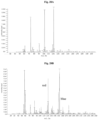
- Single quadrupole full scan spectra and neutral loss spectra were obtained by summing ten scans at each of the evaluated declustering potentials at a scan rate of 200 Da/sec.
- Product ions of potential cluster species were acquired with a collision energy of 5 V and a collision cell exit potential of 15 V unless otherwise noted.
- Polyethylene glycol 1000 PEG 1000
- BSA bovine serum albumin
- PBS Phosphate buffered saline
- MtBE HPLC grade acetonitrile
- MtBE methyl-t-butyl ether
- Control plasma treated with K 2 EDTA was purchased from Lampire Biological Laboratories (Ottsville, PA, USA). The data were collected on a Sciex 5500 Qtrap mass spectrometer interfaced to a Perkin Elmer series 200 autosampler and series 200 micro pumps.
- a protein precipitation was prepared from 300 ⁇ l of control K 2 EDTA treated human plasma with an addition of 600 ⁇ l of acetonitrile containing 0.1% formic acid. The sample was vortex-mixed and centrifuged at 4000 rpm for ten minutes. The supernatant was removed to a clean plastic tube and evaporated to dryness under air at 50° C. Extracts were reconstituted in 100 ⁇ l of 20% acetonitrile/water for injection.
- Incompletely desolvated cluster ions formed during the ionization process provide a convenient way to monitor the consistency of the ionization process.
- cluster ion formation collected in the experiments described elsewhere herein can be applied to any solvent system, with any ionization source and polarity, to identify potential cluster ions for monitoring. Perhaps the most direct test of the idea that cluster ions can inform on the overall ionization process is to observe their behavior as settings on the ion source are changed.
- the cluster ion signal can be used to report on sample-by-sample ionization performance.
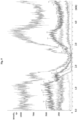
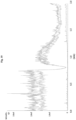
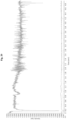
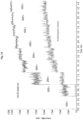
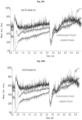
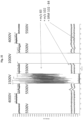
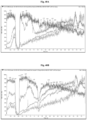
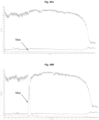
- Fig. 27 illustrates the difference in the m/z 83 cluster ion abundance shown by the black trace in a QC sample from panel a and a study sample shown in panel b.
- the QC samples were made by spiking control dog plasma with a known amount of angiotensin I (trace not shown ) and SIL-angiotensin I internal standard (displayed as the red trace). Near the LC peak for the SIL-angiotensin I there was a region of signal suppression detected by the cluster ion. The presence and magnitude of this negative suppression peak varied with both time point and with study subject.
- Cluster ions appear to report on the major causes of ionization suppression as shown by the model systems and the plasma sample extracts.
- the demonstrated sensitivity of cluster ion abundance to ionization suppression paves the way for continuous monitoring of ionization performance throughout each chromatographic run, each individual sample, and over all data collected.
- cluster ion monitoring does not require that extra chemistry or hardware be added to the system.
- Cluster ion monitoring simply requires monitoring events that are already occurring in API-MS.
- the present results show the potential for this approach to inform on the ion formation process and act as an indication of changes in API performance. Adopting this approach can improve the confidence level and the quality of quantitative data generated by API-MS.
Landscapes
- Chemical & Material Sciences (AREA)
- Physics & Mathematics (AREA)
- Analytical Chemistry (AREA)
- Spectroscopy & Molecular Physics (AREA)
- Health & Medical Sciences (AREA)
- Life Sciences & Earth Sciences (AREA)
- Plasma & Fusion (AREA)
- Engineering & Computer Science (AREA)
- General Health & Medical Sciences (AREA)
- Biochemistry (AREA)
- General Physics & Mathematics (AREA)
- Immunology (AREA)
- Pathology (AREA)
- Electrochemistry (AREA)
- Chemical Kinetics & Catalysis (AREA)
- Molecular Biology (AREA)
- Other Investigation Or Analysis Of Materials By Electrical Means (AREA)
Claims (16)
- Procédé d'évaluation des performances d'ionisation d'un système d'ionisation à pression atmosphérique (API), le procédé comprenant la surveillance du courant ionique pour une espèce chargée liée à un solvant et à un ion cluster ion-molécule de vapeur formé dans le système API, dans lequel les performances d'ionisation sont évaluées sur la base de l'abondance de ladite espèce chargée.
- Procédé selon la revendication 1, dans lequel l'espèce chargée comprend l'ion cluster, un fragment de celui-ci ou un agrégat comprenant l'ion cluster.
- Procédé selon la revendication 1, dans lequel la nature de l'ion cluster est modifiée en faisant varier au moins un paramètre sélectionné dans le groupe constitué du potentiel électrique d'ionisation du système API, de l'intensité du champ électrique du système API, de la pression dans le système API, du gaz et de la vapeur dans le système API, et du solvant présenté au système API.
- Procédé selon la revendication 1, dans lequel la surveillance comprend la mesure du courant ionique à l'aide d'au moins un paramètre sélectionné dans le groupe constitué d'un spectromètre de mobilité ionique, d'un spectromètre de masse et d'un détecteur d'aérosol chargé.
- Procédé selon la revendication 4, dans lequel le spectromètre de mobilité ionique comprend au moins un spectromètre sélectionné dans le groupe constitué d'un spectromètre de mobilité ionique différentiel et d'un spectromètre de mobilité ionique asymétrique à haut champ.
- Procédé selon la revendication 4, dans lequel la source d'ions du spectromètre de masse comprend au moins une source d'ions sélectionnée dans le groupe constitué d'une source d'ions de spectromètre de masse à ionisation électrospray, d'une source d'ions de spectromètre de masse à ionisation chimique à pression atmosphérique et d'une source d'ions de spectromètre de masse à ionisation par photoionisation à pression atmosphérique.
- Procédé selon la revendication 4, dans lequel le système API est l'unité de vaporisation d'au moins un système sélectionné dans le groupe constitué d'un système de chromatographie liquide avec spectromètre de masse (LC-MS/MS), d'un LC-MS à étage unique, et d'un appareil d'électrophorèse capillaire.
- Procédé selon la revendication 1, en outre dans lequel une valeur de courant ionique de référence pour l'espèce chargée liée à l'ion cluster est déterminée dans des conditions où aucun effet de matrice n'est observé.
- Procédé selon la revendication 8, dans lequel, si le courant ionique mesuré s'écarte de plus de 5 % environ de la valeur du courant ionique de référence, les paramètres de fonctionnement du système API sont modifiés de sorte que le courant ionique pour l'espèce chargée liée à l'ion cluster se situe à 5 % environ de la valeur du courant ionique de référence ; ou dans lequel, si le courant ionique mesuré s'écarte de plus de 1 % environ de la valeur du courant ionique de référence, les paramètres de fonctionnement du système API sont modifiés de sorte que le courant ionique pour l'espèce chargée liée à l'ion cluster se situe à 1 % environ de la valeur du courant ionique de référence.
- Procédé selon la revendication 1, appliqué dans un procédé d'analyse d'un échantillon comprenant un analyte en utilisant la spectrométrie de masse API, dans lequel la lecture du courant ionique par le spectromètre de masse est surveillée pour les effets de matrice,le procédé comprenant les étapes de vaporisation de l'échantillon en utilisant le système API, la mesure du courant ionique pour une espèce chargée liée à l'analyte en utilisant le spectromètre de masse, et la mesure du courant ionique pour une espèce chargée liée à un solvant et à un ion cluster ion-molécule de vapeur formé dans le système API en utilisant le spectromètre de masse,dans lequel la présence d'effets de matrice est évaluée sur la base de l'abondance de ladite espèce chargée liée à l'ion cluster ion-molécule ; etdans lequel l'échantillon n'est de préférence pas prétraité avec un dérivé marqué de l'analyte ou une quantité connue de l'analyte avant que l'analyse n'ait lieu ;le spectromètre de masse est réglé de telle sorte que la surveillance du courant ionique pour les espèces chargées liées à l'ion cluster est effectuée en continu, en alternance avec la surveillance du courant ionique pour les espèces chargées liées à l'analyte, ou à des intervalles présélectionnés au cours de l'analyse de l'échantillon.
- Procédé selon la revendication 10, dans lequel le spectromètre de masse est configuré de telle sorte que la surveillance du courant ionique pour les espèces chargées liées à l'ion cluster est alternée avec la surveillance du courant ionique pour les espèces chargées liées à l'analyte ; ou dans lequel le spectromètre de masse est configuré de telle sorte que la surveillance du courant ionique pour les espèces chargées liées à l'ion cluster est exécutée à des intervalles présélectionnés au cours de l'analyse de l'échantillon.
- Procédé selon la revendication 11, en outre dans lequel une valeur de courant ionique de référence pour l'espèce chargée liée à l'ion cluster est déterminée dans des conditions où aucun effet de matrice n'est observé.
- Procédé selon la revendication 12, dans lequel, si le courant ionique mesuré pour l'espèce chargée liée à l'ion cluster s'écarte de plus de 5 % environ de la valeur de courant ionique de référence, les paramètres de fonctionnement du système API sont manipulés de telle sorte que le courant ionique pour l'espèce liée à l'ion cluster se situe à moins de 5 % de la valeur de courant ionique de référence ; ou dans lequel, si le courant ionique mesuré pour l'espèce chargée liée à l'ion cluster s'écarte de plus de 1 % environ de la valeur de courant ionique de référence, les paramètres de fonctionnement du système API sont manipulés de telle sorte que le courant ionique pour l'espèce liée à l'ion cluster se situe à moins de 1 % de la valeur de courant ionique de référence.
- Appareil permettant d'évaluer en continu la performance d'ionisation d'un système d'ionisation à pression atmosphérique (API), l'appareil comprenant(i) un dispositif de détection de charge ou de courant,(ii) un moyen adapté pour surveiller le courant ionique pour une espèce chargée liée à un solvant et à un ion cluster ion-molécule de vapeur formé dans le système API, dans lequel la performance d'ionisation est évaluée sur la base de l'abondance de ladite espèce chargée, et(ii) un moyen permettant de séparer au moins partiellement au moins un ion cluster de solvant d'au moins un ion sélectionné dans le groupe constitué par les ions pseudomoléculaires et moléculaires, le gaz non chargé, la vapeur, le liquide et la matière solide.
- Procédé mis en œuvre par ordinateur pour évaluer discrètement ou continuellement la performance d'ionisation d'un système d'ionisation à pression atmosphérique (API) ou pour évaluer discrètement ou continuellement un processus dépendant de l'API pour des effets de matrice basés sur l'abondance d'au moins un ion cluster de solvant et de vapeur généré pendant le fonctionnement du système API, le procédé comprenant au moins l'un des éléments suivants :(a) comparer l'abondance telle que prévue par une mesure de commande ou une expérience de modélisation, et l'abondance telle qu'indiquée par un relevé d'instrument pour au moins un ion cluster généré pendant le fonctionnement du système API ;(b) comparer la présence ou l'absence, telle que prévue par une mesure de commande ou une expérience de modélisation, et la présence ou l'absence, telle qu'indiquée par un relevé d'instrument, d'au moins une espèce d'ion cluster susceptible d'être générée pendant le fonctionnement du système API ;(c) comparer l'abondance, la présence et/ou l'absence de motifs d'ions clusters comprenant le temps, le m/z, l'intensité, la mobilité ionique, l'état de charge, ou tout sous-ensemble de ceux-ci, tel que prévu par une mesure de commande ou une expérience de modélisation, et l'abondance, la présence et/ou l'absence de motifs d'ions clusters tels qu'indiqués par une lecture de l'instrument.
- Procédé selon la revendication 15,dans lequel l'opération du système API comprend une analyse quantitative ou qualitative ;dans lequel l'abondance d'au moins un ion cluster en (a) ou la présence ou l'absence d'au moins un ion cluster en (b) indique que les effets de matrice n'affectent pas de manière significative le processus dépendant de l'API ; dans lequel l'abondance d'au moins un ion cluster en (a) ou la présence ou l'absence d'au moins un ion cluster en (b) indique que les effets de matrice affectent de manière significative le processus dépendant de l'API, comprenant en outre l'étape de modification des paramètres de fonctionnement du système API de manière à ce que les effets de matrice n'affectent pas de manière significative le processus dépendant de l'API ; dans lequel l'abondance d'au moins un ion cluster en (a) ou la présence ou l'absence d'au moins un ion cluster en (b) indique que la performance du système API se situe dans les niveaux opérationnels souhaités ; oudans lequel l'abondance de l'au moins un ion cluster en (a) ou la présence ou l'absence d'au moins un ion cluster en (b) indique que la performance du système API ne se situe pas dans les niveaux opérationnels souhaités, comprenant en outre l'étape supplémentaire consistant à modifier les paramètres de fonctionnement du système API pour amener la performance du système API dans les niveaux opérationnels souhaités.
Applications Claiming Priority (4)
| Application Number | Priority Date | Filing Date | Title |
|---|---|---|---|
| US201562208119P | 2015-08-21 | 2015-08-21 | |
| US201562255105P | 2015-11-13 | 2015-11-13 | |
| US201662293634P | 2016-02-10 | 2016-02-10 | |
| PCT/US2016/047749 WO2017034972A1 (fr) | 2015-08-21 | 2016-08-19 | Nouveaux procédés d'évaluation des performances d'un système d'ionisation à pression atmosphérique |
Publications (4)
| Publication Number | Publication Date |
|---|---|
| EP3338298A1 EP3338298A1 (fr) | 2018-06-27 |
| EP3338298A4 EP3338298A4 (fr) | 2019-04-17 |
| EP3338298B1 true EP3338298B1 (fr) | 2025-07-09 |
| EP3338298C0 EP3338298C0 (fr) | 2025-07-09 |
Family
ID=58100824
Family Applications (1)
| Application Number | Title | Priority Date | Filing Date |
|---|---|---|---|
| EP16839874.1A Active EP3338298B1 (fr) | 2015-08-21 | 2016-08-19 | Nouveaux procédés d'évaluation des performances d'un système d'ionisation à pression atmosphérique |
Country Status (5)
| Country | Link |
|---|---|
| US (2) | US11049703B2 (fr) |
| EP (1) | EP3338298B1 (fr) |
| AU (1) | AU2016310491B2 (fr) |
| CA (1) | CA2995475A1 (fr) |
| WO (1) | WO2017034972A1 (fr) |
Families Citing this family (8)
| Publication number | Priority date | Publication date | Assignee | Title |
|---|---|---|---|---|
| EP3338298B1 (fr) * | 2015-08-21 | 2025-07-09 | Pharmacadence Analytical Services, LLC | Nouveaux procédés d'évaluation des performances d'un système d'ionisation à pression atmosphérique |
| EP3836190A4 (fr) * | 2018-08-07 | 2022-05-18 | Hitachi High-Tech Corporation | Dispositif de spectrométrie de masse et procédé de spectrométrie de masse |
| US12191132B2 (en) | 2019-08-30 | 2025-01-07 | Dh Technologies Development Pte. Ltd. | Method for mass spectrometry |
| WO2021038418A1 (fr) | 2019-08-30 | 2021-03-04 | Dh Technologies Development Pte. Ltd. | Procédé de spectrométrie de masse |
| CN111223740B (zh) * | 2020-01-19 | 2021-03-19 | 清华大学 | 调控质谱仪离子阱质量分析器中离子数量的方法及系统 |
| EP3992627B1 (fr) | 2020-10-28 | 2025-01-22 | Roche Diagnostics GmbH | Chromatographie liquide - équivalence de flux par étalonnage à flux unique |
| CN112668839A (zh) * | 2020-12-10 | 2021-04-16 | 宁波大学 | 离子化装置性能的评价方法及装置 |
| JP7462075B2 (ja) * | 2020-12-17 | 2024-04-04 | 株式会社日立ハイテク | 質量分析装置の制御方法 |
Family Cites Families (23)
| Publication number | Priority date | Publication date | Assignee | Title |
|---|---|---|---|---|
| JPH07118295B2 (ja) | 1985-10-30 | 1995-12-18 | 株式会社日立製作所 | 質量分析計 |
| US5381008A (en) * | 1993-05-11 | 1995-01-10 | Mds Health Group Ltd. | Method of plasma mass analysis with reduced space charge effects |
| US5432343A (en) * | 1993-06-03 | 1995-07-11 | Gulcicek; Erol E. | Ion focusing lensing system for a mass spectrometer interfaced to an atmospheric pressure ion source |
| JP2774774B2 (ja) | 1994-06-14 | 1998-07-09 | 東京都 | 高速液体クロマトグラフィーと質量分析計を組み合わせた定量分析装置、およびその試料イオン化用コロナ放電電極針 |
| US6294779B1 (en) * | 1994-07-11 | 2001-09-25 | Agilent Technologies, Inc. | Orthogonal ion sampling for APCI mass spectrometry |
| DE19635646C1 (de) | 1996-09-03 | 1997-12-04 | Bruker Franzen Analytik Gmbh | Korrektur der Massenbestimmung mit MALDI-Flugzeitmassenspektrometern |
| US6639214B1 (en) * | 2000-05-09 | 2003-10-28 | Air Products And Chemicals, Inc. | Method of improving the performance of an ion mobility spectrometer used to detect trace atmospheric impurities in gases |
| JP4527353B2 (ja) * | 2000-10-23 | 2010-08-18 | サイモン フレーザー ユニバーシティー | 個別液滴を生成する方法及び機器 |
| US7015466B2 (en) * | 2003-07-24 | 2006-03-21 | Purdue Research Foundation | Electrosonic spray ionization method and device for the atmospheric ionization of molecules |
| MX2008008231A (es) * | 2005-12-20 | 2008-11-26 | Univ Ohio State Res Found | Sustratos nanoporosos para metodos analiticos. |
| WO2007079589A1 (fr) * | 2006-01-11 | 2007-07-19 | Mds Inc., Doing Business Through Its Mds Sciex Division | Fragmentation d'ions en spectrometrie de masse |
| US20080169417A1 (en) * | 2006-05-11 | 2008-07-17 | Massachusetts Institute Of Technology | Compact high performance chemical detector |
| US20090283674A1 (en) * | 2006-11-07 | 2009-11-19 | Reinhold Pesch | Efficient Atmospheric Pressure Interface for Mass Spectrometers and Method |
| US20090095899A1 (en) | 2007-10-16 | 2009-04-16 | Whitehouse Craig M | Atmospheric pressure ion source performance enhancement |
| WO2009123297A1 (fr) * | 2008-04-03 | 2009-10-08 | 株式会社日立ハイテクノロジーズ | Procédé d'analyse quantitative au moyen d'un spectromètre de masse |
| GB0907619D0 (en) | 2009-05-01 | 2009-06-10 | Shimadzu Res Lab Europe Ltd | Ion analysis apparatus and method of use |
| US9177774B2 (en) * | 2010-01-15 | 2015-11-03 | California Institute Of Technology | Continuous flow mobility classifier interface with mass spectrometer |
| US8344319B2 (en) * | 2010-04-05 | 2013-01-01 | Purdue Research Foundation | Laser-induced acoustic desorption/atmospheric pressure chemical ionization of compounds |
| EP2783387B1 (fr) * | 2011-11-21 | 2018-05-23 | DH Technologies Development Pte. Ltd. | Système de spectromètre de masse avec flux de gaz faisant rideau |
| EP2786399B1 (fr) * | 2011-11-29 | 2019-10-09 | Thermo Finnigan LLC | Procédé pour le contrôle et le réglage automatiques de l'étalonnage d'un spectromètre de masse |
| CA2870439C (fr) * | 2012-04-19 | 2018-02-06 | New Objective, Inc. | Preparation d'echantillon et spectrometrie de masse a ionisation par nano-electronebulisation |
| EP2741312A1 (fr) * | 2012-12-05 | 2014-06-11 | Tofwerk AG | Procédé d'étalonnage des mesures d'un rapport masse-charge obtenues à partir d'un spectromètre de masse relié en communication fluidique avec un système d'analyse destiné à distribuer un échantillon changeant dans le temps |
| EP3338298B1 (fr) * | 2015-08-21 | 2025-07-09 | Pharmacadence Analytical Services, LLC | Nouveaux procédés d'évaluation des performances d'un système d'ionisation à pression atmosphérique |
-
2016
- 2016-08-19 EP EP16839874.1A patent/EP3338298B1/fr active Active
- 2016-08-19 AU AU2016310491A patent/AU2016310491B2/en active Active
- 2016-08-19 US US15/753,621 patent/US11049703B2/en active Active
- 2016-08-19 WO PCT/US2016/047749 patent/WO2017034972A1/fr not_active Ceased
- 2016-08-19 CA CA2995475A patent/CA2995475A1/fr active Pending
-
2021
- 2021-06-11 US US17/345,070 patent/US11610767B2/en active Active
Also Published As
| Publication number | Publication date |
|---|---|
| CA2995475A1 (fr) | 2017-03-02 |
| EP3338298A1 (fr) | 2018-06-27 |
| AU2016310491B2 (en) | 2021-11-04 |
| WO2017034972A1 (fr) | 2017-03-02 |
| EP3338298A4 (fr) | 2019-04-17 |
| EP3338298C0 (fr) | 2025-07-09 |
| US20190237314A1 (en) | 2019-08-01 |
| US11049703B2 (en) | 2021-06-29 |
| US20220139688A1 (en) | 2022-05-05 |
| US11610767B2 (en) | 2023-03-21 |
| AU2016310491A1 (en) | 2018-03-15 |
Similar Documents
| Publication | Publication Date | Title |
|---|---|---|
| US11610767B2 (en) | Methods of evaluating performance of an atmospheric pressure ionization system | |
| Guo et al. | Liquid chromatography-mass spectrometric multiple reaction monitoring-based strategies for expanding targeted profiling towards quantitative metabolomics | |
| Picó et al. | Identification of unknown pesticides in fruits using ultra-performance liquid chromatography–quadrupole time-of-flight mass spectrometry: Imazalil as a case study of quantification | |
| Niessen et al. | Introduction to mass spectrometry, a tutorial | |
| Erve et al. | Rapid metabolite identification with sub parts‐per‐million mass accuracy from biological matrices by direct infusion nanoelectrospray ionization after clean‐up on a ZipTip and LTQ/Orbitrap mass spectrometry | |
| US11536726B2 (en) | Mass spectrometry assay method for detection and quantitation of liver function metabolites | |
| US12313589B2 (en) | Liquid chromatography-mass spectrometry (LC-MS) methods for analyzing ampholyte lot variation | |
| Beach et al. | Linear and nonlinear regimes of electrospray signal response in analysis of urine by electrospray ionization-high field asymmetric waveform ion mobility spectrometry-MS and implications for nontarget quantification | |
| Pozo et al. | Comparison between triple quadrupole, time of flight and hybrid quadrupole time of flight analysers coupled to liquid chromatography for the detection of anabolic steroids in doping control analysis | |
| Xu et al. | Rapid LC/MS/MS method development for drug discovery | |
| CN112601958B (zh) | 质量校正 | |
| Chaudhary et al. | LC-MS/MS: a powerful tool for modern analytical science: Fundamentals, techniques, applications and innovations | |
| Hopfgartner et al. | New approaches for quantitative analysis in biological fluids using mass spectrometric detection | |
| Honour | Benchtop mass spectrometry in clinical biochemistry | |
| Ghosh et al. | Ionization polarity as a cause of matrix effects, its removal and estimation in ESI-LC-MS/MS bio-analysis | |
| Yang et al. | Fragmentation study and analysis of benzoylurea insecticides and their analogs by liquid chromatography–electrospray ionization-mass spectrometry | |
| US20180313858A1 (en) | Quantification of drugs in biological samples | |
| Zhang et al. | Brain and plasma exposure profiling in early drug discovery using cassette administration and fast liquid chromatography-tandem mass spectrometry | |
| Blokland et al. | Confirmatory analysis of Trenbolone using accurate mass measurement with LC/TOF-MS | |
| Leib et al. | Direct quantitation of peptide mixtures without standards using clusters formed by electrospray ionization mass spectrometry | |
| Nair | Application specific implementation of mass spectrometry platform in clinical laboratories | |
| Norwood et al. | Analytical techniques for identification and quantitation of extractables and leachables | |
| Pereira et al. | Analysis of dihydropyridine calcium channel blockers using negative ion photoionization mass spectrometry | |
| Wagner et al. | Sensitive and stable pre-calibrated solid-phase extraction columns for environmental and forensic quantification using isotope dilution mass spectrometry | |
| Dubland | Mass Spectrometry-Based Metabolomics for the Clinical Laboratory |
Legal Events
| Date | Code | Title | Description |
|---|---|---|---|
| STAA | Information on the status of an ep patent application or granted ep patent |
Free format text: STATUS: THE INTERNATIONAL PUBLICATION HAS BEEN MADE |
|
| PUAI | Public reference made under article 153(3) epc to a published international application that has entered the european phase |
Free format text: ORIGINAL CODE: 0009012 |
|
| STAA | Information on the status of an ep patent application or granted ep patent |
Free format text: STATUS: REQUEST FOR EXAMINATION WAS MADE |
|
| 17P | Request for examination filed |
Effective date: 20180302 |
|
| AK | Designated contracting states |
Kind code of ref document: A1 Designated state(s): AL AT BE BG CH CY CZ DE DK EE ES FI FR GB GR HR HU IE IS IT LI LT LU LV MC MK MT NL NO PL PT RO RS SE SI SK SM TR |
|
| AX | Request for extension of the european patent |
Extension state: BA ME |
|
| DAV | Request for validation of the european patent (deleted) | ||
| DAX | Request for extension of the european patent (deleted) | ||
| REG | Reference to a national code |
Ref country code: DE Ref legal event code: R079 Free format text: PREVIOUS MAIN CLASS: H01J0049000000 Ipc: H01J0049100000 |
|
| A4 | Supplementary search report drawn up and despatched |
Effective date: 20190318 |
|
| RIC1 | Information provided on ipc code assigned before grant |
Ipc: H01J 49/00 20060101ALI20190312BHEP Ipc: H01J 49/10 20060101AFI20190312BHEP |
|
| STAA | Information on the status of an ep patent application or granted ep patent |
Free format text: STATUS: EXAMINATION IS IN PROGRESS |
|
| 17Q | First examination report despatched |
Effective date: 20211220 |
|
| P01 | Opt-out of the competence of the unified patent court (upc) registered |
Effective date: 20230511 |
|
| GRAP | Despatch of communication of intention to grant a patent |
Free format text: ORIGINAL CODE: EPIDOSNIGR1 |
|
| STAA | Information on the status of an ep patent application or granted ep patent |
Free format text: STATUS: GRANT OF PATENT IS INTENDED |
|
| INTG | Intention to grant announced |
Effective date: 20250207 |
|
| GRAS | Grant fee paid |
Free format text: ORIGINAL CODE: EPIDOSNIGR3 |
|
| GRAA | (expected) grant |
Free format text: ORIGINAL CODE: 0009210 |
|
| STAA | Information on the status of an ep patent application or granted ep patent |
Free format text: STATUS: THE PATENT HAS BEEN GRANTED |
|
| AK | Designated contracting states |
Kind code of ref document: B1 Designated state(s): AL AT BE BG CH CY CZ DE DK EE ES FI FR GB GR HR HU IE IS IT LI LT LU LV MC MK MT NL NO PL PT RO RS SE SI SK SM TR |
|
| REG | Reference to a national code |
Ref country code: GB Ref legal event code: FG4D |
|
| REG | Reference to a national code |
Ref country code: CH Ref legal event code: EP |
|
| REG | Reference to a national code |
Ref country code: DE Ref legal event code: R096 Ref document number: 602016092864 Country of ref document: DE |
|
| REG | Reference to a national code |
Ref country code: IE Ref legal event code: FG4D |
|
| U01 | Request for unitary effect filed |
Effective date: 20250729 |
|
| U07 | Unitary effect registered |
Designated state(s): AT BE BG DE DK EE FI FR IT LT LU LV MT NL PT RO SE SI Effective date: 20250804 |
|
| U20 | Renewal fee for the european patent with unitary effect paid |
Year of fee payment: 10 Effective date: 20250828 |
|
| PGFP | Annual fee paid to national office [announced via postgrant information from national office to epo] |
Ref country code: GB Payment date: 20250930 Year of fee payment: 10 |
|
| PG25 | Lapsed in a contracting state [announced via postgrant information from national office to epo] |
Ref country code: IS Free format text: LAPSE BECAUSE OF FAILURE TO SUBMIT A TRANSLATION OF THE DESCRIPTION OR TO PAY THE FEE WITHIN THE PRESCRIBED TIME-LIMIT Effective date: 20251109 |
|
| PG25 | Lapsed in a contracting state [announced via postgrant information from national office to epo] |
Ref country code: NO Free format text: LAPSE BECAUSE OF FAILURE TO SUBMIT A TRANSLATION OF THE DESCRIPTION OR TO PAY THE FEE WITHIN THE PRESCRIBED TIME-LIMIT Effective date: 20251009 |
|
| PG25 | Lapsed in a contracting state [announced via postgrant information from national office to epo] |
Ref country code: HR Free format text: LAPSE BECAUSE OF FAILURE TO SUBMIT A TRANSLATION OF THE DESCRIPTION OR TO PAY THE FEE WITHIN THE PRESCRIBED TIME-LIMIT Effective date: 20250709 |
|
| PG25 | Lapsed in a contracting state [announced via postgrant information from national office to epo] |
Ref country code: GR Free format text: LAPSE BECAUSE OF FAILURE TO SUBMIT A TRANSLATION OF THE DESCRIPTION OR TO PAY THE FEE WITHIN THE PRESCRIBED TIME-LIMIT Effective date: 20251010 |
|
| PG25 | Lapsed in a contracting state [announced via postgrant information from national office to epo] |
Ref country code: PL Free format text: LAPSE BECAUSE OF FAILURE TO SUBMIT A TRANSLATION OF THE DESCRIPTION OR TO PAY THE FEE WITHIN THE PRESCRIBED TIME-LIMIT Effective date: 20250709 |
|
| PG25 | Lapsed in a contracting state [announced via postgrant information from national office to epo] |
Ref country code: RS Free format text: LAPSE BECAUSE OF FAILURE TO SUBMIT A TRANSLATION OF THE DESCRIPTION OR TO PAY THE FEE WITHIN THE PRESCRIBED TIME-LIMIT Effective date: 20251009 |
|
| PG25 | Lapsed in a contracting state [announced via postgrant information from national office to epo] |
Ref country code: ES Free format text: LAPSE BECAUSE OF FAILURE TO SUBMIT A TRANSLATION OF THE DESCRIPTION OR TO PAY THE FEE WITHIN THE PRESCRIBED TIME-LIMIT Effective date: 20250709 |
|
| REG | Reference to a national code |
Ref country code: CH Ref legal event code: H13 Free format text: ST27 STATUS EVENT CODE: U-0-0-H10-H13 (AS PROVIDED BY THE NATIONAL OFFICE) Effective date: 20260324 |
|
| PG25 | Lapsed in a contracting state [announced via postgrant information from national office to epo] |
Ref country code: SM Free format text: LAPSE BECAUSE OF FAILURE TO SUBMIT A TRANSLATION OF THE DESCRIPTION OR TO PAY THE FEE WITHIN THE PRESCRIBED TIME-LIMIT Effective date: 20250709 |
|
| PG25 | Lapsed in a contracting state [announced via postgrant information from national office to epo] |
Ref country code: CZ Free format text: LAPSE BECAUSE OF FAILURE TO SUBMIT A TRANSLATION OF THE DESCRIPTION OR TO PAY THE FEE WITHIN THE PRESCRIBED TIME-LIMIT Effective date: 20250709 Ref country code: CH Free format text: LAPSE BECAUSE OF NON-PAYMENT OF DUE FEES Effective date: 20250831 |
|
| PG25 | Lapsed in a contracting state [announced via postgrant information from national office to epo] |
Ref country code: SK Free format text: LAPSE BECAUSE OF FAILURE TO SUBMIT A TRANSLATION OF THE DESCRIPTION OR TO PAY THE FEE WITHIN THE PRESCRIBED TIME-LIMIT Effective date: 20250709 |