EP3338460B1 - Lautsprecher mit einem trichter und verfahren zur erzeugung eines homogenen tons mit dem lautsprecher - Google Patents
Lautsprecher mit einem trichter und verfahren zur erzeugung eines homogenen tons mit dem lautsprecher Download PDFInfo
- Publication number
- EP3338460B1 EP3338460B1 EP16852022.9A EP16852022A EP3338460B1 EP 3338460 B1 EP3338460 B1 EP 3338460B1 EP 16852022 A EP16852022 A EP 16852022A EP 3338460 B1 EP3338460 B1 EP 3338460B1
- Authority
- EP
- European Patent Office
- Prior art keywords
- horn
- loudspeaker
- reflector
- sound
- growth
- Prior art date
- Legal status (The legal status is an assumption and is not a legal conclusion. Google has not performed a legal analysis and makes no representation as to the accuracy of the status listed.)
- Active
Links
Images





Classifications
-
- H—ELECTRICITY
- H04—ELECTRIC COMMUNICATION TECHNIQUE
- H04R—LOUDSPEAKERS, MICROPHONES, GRAMOPHONE PICK-UPS OR LIKE ACOUSTIC ELECTROMECHANICAL TRANSDUCERS; ELECTRIC HEARING AIDS; PUBLIC ADDRESS SYSTEMS
- H04R1/00—Details of transducers, loudspeakers or microphones
- H04R1/20—Arrangements for obtaining desired frequency or directional characteristics
- H04R1/32—Arrangements for obtaining desired frequency or directional characteristics for obtaining desired directional characteristic only
- H04R1/34—Arrangements for obtaining desired frequency or directional characteristics for obtaining desired directional characteristic only by using a single transducer with sound reflecting, diffracting, directing or guiding means
- H04R1/345—Arrangements for obtaining desired frequency or directional characteristics for obtaining desired directional characteristic only by using a single transducer with sound reflecting, diffracting, directing or guiding means for loudspeakers
-
- G—PHYSICS
- G10—MUSICAL INSTRUMENTS; ACOUSTICS
- G10K—SOUND-PRODUCING DEVICES; METHODS OR DEVICES FOR PROTECTING AGAINST, OR FOR DAMPING, NOISE OR OTHER ACOUSTIC WAVES IN GENERAL; ACOUSTICS NOT OTHERWISE PROVIDED FOR
- G10K11/00—Methods or devices for transmitting, conducting or directing sound in general; Methods or devices for protecting against, or for damping, noise or other acoustic waves in general
- G10K11/02—Mechanical acoustic impedances; Impedance matching, e.g. by horns; Acoustic resonators
- G10K11/025—Mechanical acoustic impedances; Impedance matching, e.g. by horns; Acoustic resonators horns for impedance matching
-
- G—PHYSICS
- G10—MUSICAL INSTRUMENTS; ACOUSTICS
- G10K—SOUND-PRODUCING DEVICES; METHODS OR DEVICES FOR PROTECTING AGAINST, OR FOR DAMPING, NOISE OR OTHER ACOUSTIC WAVES IN GENERAL; ACOUSTICS NOT OTHERWISE PROVIDED FOR
- G10K11/00—Methods or devices for transmitting, conducting or directing sound in general; Methods or devices for protecting against, or for damping, noise or other acoustic waves in general
- G10K11/18—Methods or devices for transmitting, conducting or directing sound
- G10K11/26—Sound-focusing or directing, e.g. scanning
- G10K11/28—Sound-focusing or directing, e.g. scanning using reflection, e.g. parabolic reflectors
-
- H—ELECTRICITY
- H04—ELECTRIC COMMUNICATION TECHNIQUE
- H04R—LOUDSPEAKERS, MICROPHONES, GRAMOPHONE PICK-UPS OR LIKE ACOUSTIC ELECTROMECHANICAL TRANSDUCERS; ELECTRIC HEARING AIDS; PUBLIC ADDRESS SYSTEMS
- H04R1/00—Details of transducers, loudspeakers or microphones
- H04R1/20—Arrangements for obtaining desired frequency or directional characteristics
- H04R1/22—Arrangements for obtaining desired frequency or directional characteristics for obtaining desired frequency characteristic only
- H04R1/30—Combinations of transducers with horns, e.g. with mechanical matching means, i.e. front-loaded horns
-
- H—ELECTRICITY
- H04—ELECTRIC COMMUNICATION TECHNIQUE
- H04R—LOUDSPEAKERS, MICROPHONES, GRAMOPHONE PICK-UPS OR LIKE ACOUSTIC ELECTROMECHANICAL TRANSDUCERS; ELECTRIC HEARING AIDS; PUBLIC ADDRESS SYSTEMS
- H04R1/00—Details of transducers, loudspeakers or microphones
- H04R1/20—Arrangements for obtaining desired frequency or directional characteristics
- H04R1/32—Arrangements for obtaining desired frequency or directional characteristics for obtaining desired directional characteristic only
- H04R1/323—Arrangements for obtaining desired frequency or directional characteristics for obtaining desired directional characteristic only for loudspeakers
-
- H—ELECTRICITY
- H04—ELECTRIC COMMUNICATION TECHNIQUE
- H04R—LOUDSPEAKERS, MICROPHONES, GRAMOPHONE PICK-UPS OR LIKE ACOUSTIC ELECTROMECHANICAL TRANSDUCERS; ELECTRIC HEARING AIDS; PUBLIC ADDRESS SYSTEMS
- H04R1/00—Details of transducers, loudspeakers or microphones
- H04R1/20—Arrangements for obtaining desired frequency or directional characteristics
- H04R1/32—Arrangements for obtaining desired frequency or directional characteristics for obtaining desired directional characteristic only
- H04R1/34—Arrangements for obtaining desired frequency or directional characteristics for obtaining desired directional characteristic only by using a single transducer with sound reflecting, diffracting, directing or guiding means
-
- H—ELECTRICITY
- H04—ELECTRIC COMMUNICATION TECHNIQUE
- H04R—LOUDSPEAKERS, MICROPHONES, GRAMOPHONE PICK-UPS OR LIKE ACOUSTIC ELECTROMECHANICAL TRANSDUCERS; ELECTRIC HEARING AIDS; PUBLIC ADDRESS SYSTEMS
- H04R1/00—Details of transducers, loudspeakers or microphones
- H04R1/20—Arrangements for obtaining desired frequency or directional characteristics
- H04R1/32—Arrangements for obtaining desired frequency or directional characteristics for obtaining desired directional characteristic only
- H04R1/40—Arrangements for obtaining desired frequency or directional characteristics for obtaining desired directional characteristic only by combining a number of identical transducers
- H04R1/403—Arrangements for obtaining desired frequency or directional characteristics for obtaining desired directional characteristic only by combining a number of identical transducers loud-speakers
-
- H—ELECTRICITY
- H04—ELECTRIC COMMUNICATION TECHNIQUE
- H04R—LOUDSPEAKERS, MICROPHONES, GRAMOPHONE PICK-UPS OR LIKE ACOUSTIC ELECTROMECHANICAL TRANSDUCERS; ELECTRIC HEARING AIDS; PUBLIC ADDRESS SYSTEMS
- H04R31/00—Apparatus or processes specially adapted for the manufacture of transducers or diaphragms therefor
-
- H—ELECTRICITY
- H04—ELECTRIC COMMUNICATION TECHNIQUE
- H04R—LOUDSPEAKERS, MICROPHONES, GRAMOPHONE PICK-UPS OR LIKE ACOUSTIC ELECTROMECHANICAL TRANSDUCERS; ELECTRIC HEARING AIDS; PUBLIC ADDRESS SYSTEMS
- H04R9/00—Transducers of moving-coil, moving-strip, or moving-wire type
- H04R9/06—Loudspeakers
-
- H—ELECTRICITY
- H04—ELECTRIC COMMUNICATION TECHNIQUE
- H04R—LOUDSPEAKERS, MICROPHONES, GRAMOPHONE PICK-UPS OR LIKE ACOUSTIC ELECTROMECHANICAL TRANSDUCERS; ELECTRIC HEARING AIDS; PUBLIC ADDRESS SYSTEMS
- H04R2201/00—Details of transducers, loudspeakers or microphones covered by H04R1/00 but not provided for in any of its subgroups
- H04R2201/02—Details casings, cabinets or mounting therein for transducers covered by H04R1/02 but not provided for in any of its subgroups
- H04R2201/029—Manufacturing aspects of enclosures transducers
Definitions
- One or more embodiments relate generally to loudspeakers, and in particular, to a three hundred and sixty degree (360°) horn for an omnidirectional loudspeaker.
- a loudspeaker reproduces audio when connected to a receiver (e.g., a stereo receiver, a surround receiver, etc.), a television (TV) set, a radio, a music player, an electronic sound producing device (e.g., a smartphone), video players, etc.
- a loudspeaker may comprise a speaker cone, a horn or another type of device that forwards most of the audio reproduced towards the front of the loudspeaker.
- a conventional directional horn for a loudspeaker has a throat and a mouth.
- a shape of an area of the horn at any position along a centerline may have infinite degrees of freedom.
- a shape of an area of the horn may be square, rectangular, circular, oval or any other shape, depending on an application of the horn.
- DE 1079675 B discusses a loudspeaker arrangement for producing all-round sound in a room.
- EP 0474029 A2 discusses an omnidirectional siren having a plurality of hollow modules supported in vertical alignment on a single, central pole.
- US 2014/029781 A1 discusses a spherical sound source comprising two coaxial loudspeakers and two mid-high frequency compression drivers.
- An omnidirectional loudspeaker comprising a first axisymmetric reflector, a second axisymmetric reflector, a sound source in the first axisymmetric reflector or the second axisymmetric reflector, and a horn including a straight section and a growth section extending from a distal end of the straight section.
- the growth section comprises one or more curves that are scaled with a radial coordinate and that expands sound waves generated by the sound source.
- the horn is a three hundred and sixty degree horn that is rotationally symmetric about an axis of symmetry.
- the end faces of the two reflectors are flat and perpendicular to the axis of symmetry.
- the one or more curves grow as the radial coordinate increases.
- the growth section expands exponentially.
- the outer periphery (c1, c2) of the curved surface of each axisymmetric reflector defines an outer circumference of the respective reflector, the outer circumferences of the two reflectors being the same size.
- One embodiment provides an omnidirectional loudspeaker comprising a first axisymmetric reflector, a second axisymmetric reflector, a sound source in the first axisymmetric reflector or the second axisymmetric reflector, and a horn including a straight section and a growth section extending from a distal end of the straight section.
- the growth section comprises one or more curves that are scaled with a radial coordinate and that expands sound waves generated by the sound source.
- the horn device for an omnidirectional loudspeaker.
- the horn device comprises a straight section and a growth section extending from a distal end of the straight section.
- the growth section comprises one or more curves that are scaled with a radial coordinate and that expands sound waves generated by a sound source of the loudspeaker.
- One embodiment provides a method for producing a horn for an omnidirectional loudspeaker.
- the method comprises identifying resonances and acoustic nulls in a straight slot of the omnidirectional loudspeaker to remove, determining a horn profile suitable for removing the identified resonances and acoustic nulls based on an application and a size of the omnidirectional loudspeaker, and fabricating a horn for the omnidirectional loudspeaker in accordance with the horn profile determined.
- the horn has a straight section and a growth section extending from a distal end of the straight section.
- the growth section comprises one or more curves that are scaled with a radial coordinate and that expands sound waves generated by a sound source of the omnidirectional loudspeaker.
- Another embodiment provides a method for creating uniform sound in a horizontal plane and a vertical plane.
- the method comprises generating, utilizing a sound source of an omnidirectional loudspeaker, sound waves that propagate radially along a straight section of a horn for the omnidirectional loudspeaker.
- the method further comprises forcing the sound waves, within the straight section, to become cylindrical sound waves with a wave front that is parallel to an axis of symmetry.
- the method further comprises forcing the sound waves to grow exponentially within a growth section of the horn until the sound waves exit an outer circumference of the horn.
- a directional loudspeaker comprises one or more sound-radiating elements, the elements spatially arranged such that each element faces the same direction.
- the spatial arrangement of the elements produces optimal sound in a narrow spatial region, such that a listener must be positioned within the narrow spatial region in order to experience the optimal sound.
- Conventional horn-type loudspeakers can be designed to have certain beam widths in the horizontal plane and/or in the vertical plane.
- An omnidirectional loudspeaker produces optimal sound in all directions, such that a listener can enjoy the optimal sound regardless of his/her position relative to the loudspeaker.
- a conventional omnidirectional loudspeaker typically focuses on delivering sound evenly in a horizontal plane, resulting in sound power distribution in vertical planes having large peaks and dips.
- a listener standing close to the loudspeaker, with ears directly above the tweeter, will hear a different sound from another listener whose ears are level with the loudspeaker, especially at higher frequencies.
- An omnidirectional horn's beamwidth in the horizontal plane is 360 degrees by definition, which results in a reduction of degrees of freedom for the design of the horn shape.
- a traditional directional loudspeaker horn is used to direct sound into a specific direction, and the extent to which the sound can be directed by the horn increases with frequency.
- Conventional omnidirectional/axisymmetric loudspeakers have a high peak in sound power directly on axis of symmetry, and the magnitude of the peak typically increases with frequency.
- One or more embodiments of the invention provide a three hundred and sixty degree (360°) horn for an omnidirectional loudspeaker, the horn having optimal directivity in horizontal and vertical directions. With increasing frequency, the horn directs more and more sound power in a radial direction instead of an axial direction, thereby counterbalancing axial beaming in current omnidirectional loudspeakers.
- the horn provides a more evenly balanced sound field, i.e., the sound will be perceived the same, independent of horizontal and vertical position of a listener relative to the loudspeaker.
- the shape of the cross-section of the horn comprises a combination of a straight channel with continually growing curves that are scaled with a radial coordinate representing a radius extending from an axis of symmetry.
- One or more embodiments of the invention extend the advantages of existing omnidirectional loudspeakers to the vertical plane.
- One or more embodiments of the invention allow the loudspeaker to be used with the axis of symmetry in horizontal direction, while maintaining optimal directivity in horizontal and vertical direction.
- One or more embodiments of the invention provide omnidirectional sound distribution in horizontal and vertical directions.
- One or more embodiments of the invention improve the directivity of the sound in the vertical plane of an omnidirectional loudspeaker.
- One or more embodiments of the invention may be implemented without costly additional driver units.
- a continual growth or wave front area in the waveguide produces a smooth impedance match between the driver unit and the free air surrounding the loudspeaker.
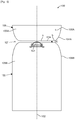
- FIG. 1 illustrates a cross-section of an example omnidirectional loudspeaker 100, in accordance with one embodiment.
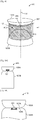
- FIG. 2A illustrates a three-dimensional (3D) cutaway of the omnidirectional loudspeaker 100 in operation with sound pressure wave fronts at a particular frequency around the loudspeaker, in accordance with one embodiment.
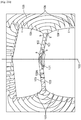
- FIG. 2B illustrates a cross-section of the omnidirectional loudspeaker 100 in operation with sound pressure wave fronts at a particular frequency around the loudspeaker, in accordance with one embodiment.
- the loudspeaker 100 is rotationally symmetric about an axis of symmetry 102.
- the loudspeaker 100 comprises multiple axisymmetric loudspeaker reflectors (i.e., enclosures) 105 ( FIG. 2A ).
- the multiple axisymmetric loudspeaker reflectors 105 include a first axisymmetric cup-shaped reflector ("first reflector") 105A and a second axisymmetric cup-shaped reflector (“second reflector”) 105B.
- a sound source 101 (e.g., a tweeter loudspeaker driver, a woofer loudspeaker driver, etc.) is disposed within the reflector 105.
- the sound source 101 is positioned/mounted axially in either the first reflector 105A or the second reflector 105B (as shown in FIGS. 1 , 2A-2B ).
- the sound source 101 lies flush inside a reflector 105 (as shown in FIG. 5C ).
- the sound source 101 protrudes from a reflector 105 (as shown in FIG. 5B ).
- Each reflector 105 has an outer circumference 106 ( FIG. 2A ).
- the first reflector 105A and the second reflector 105B has a first outer circumference 106A and a second outer circumference 106B, respectively.
- each reflector 105A, 105B combined form a horn 107 that is rotated 360° around the axis of symmetry 102.
- Each reflector 105A, 105B is rotationally symmetric about the axis of symmetry 102.
- each reflector 105A, 105B comprises: (1) a straight section 103 ( FIG. 2A ) extending between points a and b ( FIG. 2A ) of the reflector, and (2) a growth section 104 ( FIG. 2A ) extending between points b and c of the reflector.
- the growth section 104 may have varying rates of area growth.
- the first reflector 105A comprises: (1) a straight section 103A extending between a first point a 1 and a second point b 1 of the first reflector 105A, and (2) a growth section 104A extending between the second point b 1 and a third point c 1 of the first reflector 105A.
- the second point b 1 represents a distal end of the straight section 103A.
- the second reflector 105B comprises: (1) a straight section 103B ( FIG. 2B ) extending between a first point a 2 ( FIG. 2B ) and a second point b 2 ( FIG. 2B ) of the second reflector 105B, and (2) a growth section 104B ( FIG. 2B ) extending between the second point b 2 and a third point c 2 ( FIG. 2B ) of the second reflector 105B.
- the second point b 2 represents a distal end of the straight section 103B.
- An axisymmetric cylinder may be described using a cylindrical coordinate system.
- a radial coordinate represents a distance between the axis of symmetry 102 and a point along a radius perpendicular to the axis of symmetry 102 (i.e., how far the point is from the axis of symmetry 102).
- An axial coordinate measures a location of a normal projection of a point onto the axis of symmetry 102, wherein the point is along a radius perpendicular to the axis of symmetry 102.
- Each growth section 104A, 104B has continually growing curves shaped to expand sound waves produced by the sound source 101.
- the continually growing curves are shaped such that a distance in axial direction between the growth sections 104A and 104B increases as the radial coordinate increases.
- the continually growing curves are scaled based on a radial coordinate and an area growth function corresponding to an application of the loudspeaker 100.
- FIG. 2C illustrates sound pressure in horizontal and vertical planes around the omnidirectional loudspeaker 100 in operation, in accordance with one embodiment.
- the loudspeaker 100 provides true omnidirectional sound in both a vertical plane 111 and a horizontal plane 112.
- the geometry of the reflectors 105A, 105B causes sound from the sound source 101 to radiate in a radial direction, thereby creating uniform sound in the horizontal plane 112 and the vertical plane 111.
- Sound waves 108 from the sound source 101 form concentric circles in both the horizontal plane 112 and the vertical plane 111.
- the sound source 101 generates sound waves that propagate radially along the each straight section 103A, 103B.
- the straight sections 103A and 103B generate cylindrical sound waves 108 that propagate along a radial direction.
- the straight sections 103A, 103B force the sound waves to become cylindrical sound waves with a wave front 108A ( FIG. 2A ) that is parallel to the axis of symmetry 102.
- the growth sections 104A and 104B focuses the sound waves to the radial direction, thereby counteracting axial focusing of a straight slot 50 ( FIG. 1 ).
- the cylindrical sound waves enter the growth sections 104A and 104B that forces the wave front to grow exponentially until the sound waves exit the outer circumference 106 of the reflector 105.
- FIG. 3A illustrates a side view of the first reflector 105A of the omnidirectional loudspeaker 100, in accordance with one embodiment.
- FIG. 3B illustrates a bottom view of the first reflector 105A of the omnidirectional loudspeaker 100, in accordance with one embodiment.
- FIG. 3C illustrates a side view of the second reflector 105B of the omnidirectional loudspeaker 100, in accordance with one embodiment.
- FIG. 3D illustrates a top view of the second reflector 105B of the omnidirectional loudspeaker 100, in accordance with one embodiment.
- a portion of the sound source 101 that is disposed in the second reflector 105B may protrude outwards from the second reflector 105B (as shown in FIGS.
- the first reflector 105A may further comprise a recess 109 shaped for receiving the protruding portion of the sound source 101 (e.g., a dimple-shaped recess).
- FIG. 4 illustrates a schematic drawing of the loudspeaker 100, in accordance with one embodiment.
- the horn 107 formed by the reflectors 105A and 105B has a throat ("horn throat") 206 and a mouth ("horn mouth”) 207.
- A(r) generally denote an area function for an area of sound waves generated by each reflector 105A, 105B at a radial coordinate r.
- the height function h(r) must grow faster than 1/r in order for the area function A(r) to grow continuously (i.e., d(h)/d(r) > 1 for all points between b and c of the reflector).
- constants C and B may be computed in accordance with equations (2.1) and (2.2) provided below:
- r t is a radial coordinate the horn throat 206 at a point on the reflector (e.g., point b 1 )
- h t is a height of the horn throat 206 at the radial coordinate r t
- r m is a radial coordinate of the horn mouth 207 at a point on the reflector (e.g., point c 1 )
- h m is a height of the horn mouth 207 at the radial coordinate r
- FIG. 5A illustrates another example omnidirectional loudspeaker 400, in accordance with one embodiment.
- the loudspeaker 400 is identical to the loudspeaker 100 in FIG. 1 , with the exception that the sound source 101 in the loudspeaker 400 is positioned/ mounted axially in the first reflector 105A.
- the alternative placement of the sound source 101 within the first reflector 105A may minimize the amount of dust that gets trapped by the loudspeaker 400.
- FIG. 5B illustrates another example omnidirectional loudspeaker 410 comprising a sound source 101 positioned differently with respect to each straight section 103 of each reflector 105, in accordance with one embodiment.
- the loudspeaker 410 is identical to the loudspeaker 100 in FIG. 1 , with the exception that an axial location of each straight section 103A, 103B of the loudspeaker 410 relative to the sound source 101 is variable based on an application and type/size/shape of the loudspeaker 410 and/or sound source 101.
- the axial location of the straight sections 103A, 103B balances resonances and acoustic nulls in the straight slot 50 ( FIG. 1 ) optimally.
- FIG. 5C illustrates another example omnidirectional loudspeaker 420 comprising multiple sound sources 101, in accordance with one embodiment.
- the loudspeaker 420 is identical to the loudspeaker 100 in FIG. 1 , with the exception that the loudspeaker 420 comprises a first sound source 101 and a second sound source 101 positioned/ mounted axially in the first reflector 105A and the second reflector 105B, respectively.
- the loudspeaker 420 has more than one sound source 101 to increase total sound output (i.e., total emitted sound power).
- a phase relationship between each sound source 101 may be controlled to positively affect resonance behavior in the straight slot 50 ( FIG. 1 ).
- FIG. 5D illustrates an omnidirectional loudspeaker 430 including growth sections 104A, 104B with varying rates of area growth, in accordance with one embodiment.
- the loudspeaker 430 is identical to the loudspeaker 100 in FIG. 1 , with the exception that the straight sections 103A and 103B in the loudspeaker 430 have different lengths than the straight sections 103A and 103B in the loudspeaker 100.
- the straight sections 103A and 103B in the loudspeaker 430 are shorter than the straight sections 103A and 103B in the loudspeaker 100.
- the straight sections 103A and 103B in the loudspeaker 430 are longer than the straight sections 103A and 103B in the loudspeaker 100.
- a gentler (i.e., slower) or sharper (i.e., faster/more aggressive) rate of area growth is preferable for the continually growing curves of the growth sections 104A and 104B.
- a gentler rate of area growth results in a smoother frequency response of the loudspeaker 430, but sound directivity along a vertical plane may be sub-optimal.
- a sharper rate of area growth results in optimal sound directivity, but the resulting impedance match between the sound source 101 and air surrounding the loudspeaker 430 will be less gradual and may also result in unwanted resonant behavior of the horn 107.
- B ⁇ r 0 represents a rate of area growth of a growth section of a loudspeaker, wherein B is a constant that is based on a height of a horn throat of the loudspeaker and a height of a horn mouth of the loudspeaker, and r 0 is a nominal radius of the loudspeaker.
- a gentler rate of area growth may be in the range 1 ⁇ B ⁇ r 0 ⁇ 5.
- a sharper rate of area growth may be in the range 7 ⁇ B ⁇ r 0 ⁇ 15.
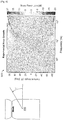
- FIG. 6 is an example graph 500 illustrating sound power level in a vertical plane around an omnidirectional loudspeaker 100 including growth sections 104 with an exponential rate of area growth, in accordance with one embodiment.
- Each growth section 104 of each reflector 105 forces the wave front of sound waves generated by the sound source 101 to grow exponentially until the sound waves exit the outer circumference 106 of the reflector 105. Further, total emitted sound power of the loudspeaker 100 is relatively consistent over a range of frequencies and vertical angles ⁇ in the vertical plane of the loudspeaker 100.
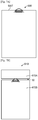
- FIG. 7A illustrates an example conventional flat top loudspeaker 600. Unlike the loudspeaker 100 in FIG. 1 , the loudspeaker 600 has a flat top 600T. The loudspeaker 600 does not have any reflectors to form a straight slot.
- FIG. 7B illustrates an example conventional straight slot loudspeaker 610.
- the loudspeaker 610 comprises a first reflector 615A and a second reflector 615B that together form a straight slot 50.
- the reflectors 615A and 615B in FIG. 7B do not have any growth sections (i.e., each reflector 615A, 615B comprises straight sections only).
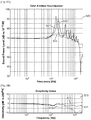
- FIG. 8A is an example graph 520 comparing total emitted sound power of the loudspeaker 100 ( FIG. 1 ) against total emitted sound power of the flat top loudspeaker 600 ( FIG. 7A ) and the straight slot loudspeaker 610 ( FIG. 7B ), in accordance with an embodiment of the invention.
- the graph 520 comprises a first curve 521 representing total emitted sound power of the straight slot loudspeaker 610, a second curve 523 representing total emitted sound power of the flat top loudspeaker 600, and a third curve 522 representing total emitted sound power of the loudspeaker 100.
- FIG. 8B is an example graph 510 comparing sound directivity of the loudspeaker 100 ( FIG. 1 ) against sound directivity of the flat top loudspeaker 600 ( FIG. 7A ) and the straight slot loudspeaker 610 ( FIG. 7B ), in accordance with an embodiment of the invention.
- the graph 510 comprises a first curve 511 representing sound directivity of the straight slot loudspeaker 610, a second curve 513 representing sound directivity of the flat top loudspeaker 600, and a third curve 512 representing sound directivity of the loudspeaker 100.
- the curves 511-513 sound directivity of the loudspeaker 100 is relatively consistent over a range of frequencies in comparison to sound directivity of the straight slot loudspeaker 610 and the flat top loudspeaker 600.
- FIG. 9A is an example graph 540 illustrating different horn profiles for a horn 107 including a tall horn throat 206 and a medium horn mouth 207, in accordance with an embodiment of the invention.
- a horn 107 formed by the reflectors 105A and 105B has a tall horn throat 206 and a medium horn mouth 207.
- each reflector 105A, 105B has an exit radius (i.e., outer circumference 106) of about 100mm
- a height of the tall horn throat 206 is about 30mm
- a height of the medium horn mouth 207 is about 75mm.
- the horn 107 with the tall horn throat 206 and the medium horn mouth 207 may be designed in accordance with a first horn profile comprising shape A1 for the first reflector 105A and shape A2 for the second reflector 105A.
- Each shape A1, A2 comprises a straight section AS and a growth section AG.
- the horn 107 with the tall horn throat 206 and the medium horn mouth 207 may be designed in accordance with a second horn profile comprising shape B1 for the first reflector 105A and shape B2 for the second reflector 105A.
- Each shape B1, B2 comprises a straight section BS and a growth section BG.
- straight section AS is shorter than straight section BS.
- growth section AG has a gentler rate of area growth than growth section BG (i.e., growth section AG has a slower rate of area growth compared to growth section BG which has a more aggressive rate of area growth).
- the rates of area growth for growth sections AG and BG are about 3.1 and 5.7, respectively.
- FIG. 9B is an example graph 550 illustrating different horn profiles for a horn 107 including a short horn throat 206 and a short horn mouth 207, in accordance with an embodiment of the invention.
- a horn 107 formed by the reflectors 105A and 105B has a short horn throat 206 and a short horn mouth 207.
- each reflector 105A, 105B has an exit radius (i.e., outer circumference 106) of about 100mm
- a height of the short horn throat 206 is about 5mm
- a height of the short horn mouth 207 is about 20mm.
- the horn 107 with the short horn throat 206 and the short horn mouth 207 may be designed in accordance with a first horn profile comprising shape C1 for the first reflector 105A and shape C2 for the second reflector 105A.
- Each shape C1, C2 comprises a straight section CS and a growth section CG.
- the horn 107 with the short horn throat 206 and the short horn mouth 207 may be designed in accordance with a second horn profile comprising shape D1 for the first reflector 105A and shape D2 for the second reflector 105A.
- Each shape D1, D2 comprises a straight section DS and a growth section DG.
- straight section CS is shorter than straight section DS.
- growth section CG has a gentler rate of area growth than growth section DG (i.e., growth section CG has a slower rate of area growth compared to growth section DG which has a more aggressive rate of area growth).
- the rates of area growth for growth sections CG and DG are about 3.7 and 14.9, respectively.
- FIG. 9C is an example graph 560 illustrating different horn profiles for a horn 107 including a medium horn throat 206 and a tall horn mouth 207, in accordance with an embodiment of the invention.
- a horn 107 formed by the reflectors 105A and 105B has a medium horn throat 206 and a tall horn mouth 207.
- each reflector 105A, 105B has an exit radius (i.e., outer circumference 106) of about 100mm
- a height of the medium horn throat 206 is about 10mm
- a height of the tall horn mouth 207 is about 120mm.
- the horn 107 with the medium horn throat 206 and the tall horn mouth 207 may be designed in accordance with a first horn profile comprising shape E1 for the first reflector 105A and shape E2 for the second reflector 105A.
- Each shape E1, E2 comprises a straight section ES and a growth section EG.
- the horn 107 with the medium horn throat 206 and the tall horn mouth 207 may be designed in accordance with a second horn profile comprising shape F1 for the first reflector 105A and shape F2 for the second reflector 105A.
- Each shape F1, F2 comprises a straight section FS and a growth section FG.
- straight section ES is shorter than straight section FS.
- growth section EG has a gentler rate of area growth than growth section FG (i.e., growth section EG has a slower rate of area growth compared to growth section FG which has a more aggressive rate of area growth).
- the rates of area growth for growth sections EG and FG are about 5.2 and 11.1, respectively.
- FIG. 9D is an example graph 570 illustrating different asymmetric horn profiles for a horn 107, in accordance with an embodiment of the invention.
- the horn 107 may be designed in accordance with a first asymmetric horn profile comprising shape G1 for the first reflector 105A and shape G2 for the second reflector 105A.
- shapes G1 and G2 have horn mouths with different heights.
- shape G1 has a corresponding horn mouth with height GH1 that is taller than height GH2 for a horn mouth corresponding to shape G2.
- the rates of area growth for growth sections of G1 and G2 are 5.1 and 4.2, respectively.
- the horn 107 may be designed in accordance with a second asymmetric horn profile comprising shape H1 for the first reflector 105A and shape H2 for the second reflector 105A.
- shapes H1 and H2 have straight sections with different lengths. Specifically, shape H1 has a corresponding straight section HS1 that is shorter than a straight section HS2 corresponding to shape H2. Further, shape H1 has a corresponding growth section HG1 that has a sharper rate of area growth than growth section HG2 (i.e., growth section HG1 has a more aggressive rate of area growth compared to growth section HG2 which has a gentler rate of area growth). In one embodiment, the rates of area growth for growth sections HG1 and HG2 are about 7.8 and 4.7, respectively.
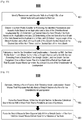
- FIG. 10 is an example flowchart of a manufacturing process 800 for producing a horn for an omnidirectional loudspeaker, in accordance with an embodiment of the invention.
- process block 801 identify resonances and acoustic nulls in a straight slot of the omnidirectional loudspeaker to remove.
- process block 802 determine a horn profile suitable for removing the identified resonances and acoustic nulls based on an application and a size of the omnidirectional loudspeaker by (1) determining a desired size of a horn throat of the horn based on the application and size, (2) determining a desired size of a horn mouth of the horn based on the application and size, and (3) determining a length of the straight section and a rate of area growth of the growth section based on the desired size of the horn throat and the desired size of the horn mouth.
- process block 803 fabricate a horn for the omnidirectional loudspeaker in accordance with the horn profile determined, where the horn has a straight section and a growth section extending from a distal end of the straight section, and the growth section comprises one or more curves that are scaled with a radial coordinate and that expands sound waves generated by a sound source of the omnidirectional loudspeaker.
- FIG. 11 is an example flowchart 900 for creating uniform sound in a horizontal plane and a vertical plane, in accordance with an embodiment of the invention.
- process block 901 generate, utilizing a sound source of an omnidirectional loudspeaker, sound waves that propagate radially along a straight section of a horn for the omnidirectional loudspeaker.
- process block 902 force the sound waves, within the straight section, to become cylindrical sound waves with a wave front that is parallel to an axis of symmetry.
- process block 903 force the sound waves to grow exponentially within a growth section of the horn until the sound waves exit an outer circumference of the horn.
Landscapes
- Engineering & Computer Science (AREA)
- Physics & Mathematics (AREA)
- Acoustics & Sound (AREA)
- Health & Medical Sciences (AREA)
- Otolaryngology (AREA)
- Signal Processing (AREA)
- Multimedia (AREA)
- Manufacturing & Machinery (AREA)
- Obtaining Desirable Characteristics In Audible-Bandwidth Transducers (AREA)
Claims (6)
- Omnidirektionaler Lautsprecher zur Bereitstellung einer gleichmäßigen Schalldistribution in eine vertikale Ebene und in eine horizontale Ebene, umfassend:erste und zweite achsensymmetrische Reflektoren (105a, 105b) mit einer gemeinsamen Symmetrieachse (102), wobei jeder Reflektor die Form eines konvexen Körpers mit einer gekrümmten Oberfläche (104a, 104b) aufweist, welche eine Stirnseite umgibt, wobei die beiden Stirnseiten (103a, 103b) zueinander ausgerichtet sind und dazwischen einen geraden Abschnitt (50) eines Horns des Lautsprechers definieren, wobei der gerade Abschnitt durch gerade Seiten (103a, 103b) definiert ist, die durch die zwei Stirnseiten bereitgestellt werden, wobei sich der gerade Abschnitt von einer äußeren Peripherie (b) in Richtung der gemeinsamen Achse (102) einwärts erstreckt, wobei sich die gekrümmten Oberflächen (104a, 104b) von den äußeren Peripherien des geraden Abschnitts zu äußeren Peripherien (c1, c2) der gekrümmten Oberflächen (104a, 104b) und voneinander weg erstrecken, so dass der Abstand zwischen ihnen in die axiale Richtung mit zunehmendem radialen Abstand von der Symmetrieachse (102) zunimmt, und wobei dazwischen ein Zunahmeabschnitt des Horns definiert ist, der zu einem Hornausgang an den äußeren Peripherien (c1, c2) der gekrümmten Oberflächen führt;wobei eine oder beide achsensymmetrischen Reflektoren (105a, 105b) in ihrer Stirnseite eine Öffnung aufweist bzw. aufweisen sowie eine Schallquelle (101), die so angeordnet ist, dass sie Schall durch die Öffnung und in den geraden Abschnitt (50) des Horns emittiert, wobei die oder jede Schallquelle und Öffnung sich auf der Symmetrieachse (102) und auf dieser zentriert befindet;wobei die zwei gekrümmten Oberflächen so geformt sind, dass von der äußeren Peripherie (b) des geraden Abschnitts zu den äußeren Peripherien (c1, c2) der gekrümmten Oberflächen die Ableitung des axialen Abstands zwischen den gekrümmten Oberflächen in Bezug auf den radialen Abstand von der Symmetrieachse größer ist als 1;wobei die Anordnung derart ist, dass zwischen der oder jeder Schallquelle (101) und dem Hornausgang der durch die oder jede Schallquelle (101) emittierte Schall durch die Geometrie der ersten und zweiten Reflektoren geführt und reflektiert wird, um die gleichmäßige Schalldistribution sowohl in eine vertikale Ebene als auch in eine horizontale Ebene bereitzustellen;wobei der axiale Abstand zwischen dem ersten achsensymmetrischen Reflektor und dem zweiten achsensymmetrischen Reflektor auf der Basis des radialen Abstands r von der Symmetrieachse variiert; undwobei der axiale Abstand mit C/r∗exp(B∗r) zunimmt, wobei C und B Konstanten auf der Basis einer oder mehrerer Dimensionen eines Halses oder einer Mündung des Horns bezeichnen.
- Omnidirektionaler Lautsprecher nach Anspruch 1, wobei das Horn ein 360-Grad-Horn ist, das um die Symmetrieachse rotationssymmetrisch ist.
- Omnidirektionaler Lautsprecher nach Anspruch 1, wobei die Stirnseiten der zwei Reflektoren flach und senkrecht zu der Symmetrieachse sind.
- Omnidirektionaler Lautsprecher nach Anspruch 1, wobei sich der Zunahmeabschnitt des Horns exponentiell mit Zunahme des radialen Abstands von der Symmetrieachse (102) erweitert.
- Omnidirektionaler Lautsprecher nach Anspruch 1, wobei die äußere Peripherie (c1, c2) der gekrümmten Oberfläche jedes achsensymmetrischen Reflektors einen äußeren Umfang des entsprechenden Reflektors definiert, wobei die äußeren Umfänge der zwei Reflektoren die gleiche Größe aufweisen.
- Omnidirektionaler Lautsprecher nach Anspruch 1, wobei zwei Schallquellen (101) vorgesehen sind, eine in jedem der achsensymmetrischen Reflektoren.
Applications Claiming Priority (3)
| Application Number | Priority Date | Filing Date | Title |
|---|---|---|---|
| US201562233959P | 2015-09-28 | 2015-09-28 | |
| US15/141,611 US10469942B2 (en) | 2015-09-28 | 2016-04-28 | Three hundred and sixty degree horn for omnidirectional loudspeaker |
| PCT/KR2016/010650 WO2017057876A1 (en) | 2015-09-28 | 2016-09-23 | An loudspeaker comprising a horn and a method for creating uniform sound using loudspeaker |
Publications (3)
| Publication Number | Publication Date |
|---|---|
| EP3338460A1 EP3338460A1 (de) | 2018-06-27 |
| EP3338460A4 EP3338460A4 (de) | 2018-08-01 |
| EP3338460B1 true EP3338460B1 (de) | 2020-04-22 |
Family
ID=58407595
Family Applications (1)
| Application Number | Title | Priority Date | Filing Date |
|---|---|---|---|
| EP16852022.9A Active EP3338460B1 (de) | 2015-09-28 | 2016-09-23 | Lautsprecher mit einem trichter und verfahren zur erzeugung eines homogenen tons mit dem lautsprecher |
Country Status (5)
| Country | Link |
|---|---|
| US (1) | US10469942B2 (de) |
| EP (1) | EP3338460B1 (de) |
| KR (1) | KR101979804B1 (de) |
| CN (1) | CN108141661B (de) |
| WO (1) | WO2017057876A1 (de) |
Families Citing this family (10)
| Publication number | Priority date | Publication date | Assignee | Title |
|---|---|---|---|---|
| CN115550821A (zh) * | 2014-09-30 | 2022-12-30 | 苹果公司 | 具有减小的由来自表面的反射导致的音频染色的扬声器 |
| US10034081B2 (en) | 2015-09-28 | 2018-07-24 | Samsung Electronics Co., Ltd. | Acoustic filter for omnidirectional loudspeaker |
| US10257608B2 (en) | 2016-09-23 | 2019-04-09 | Apple Inc. | Subwoofer with multi-lobe magnet |
| CN108471577B (zh) * | 2018-03-28 | 2021-05-18 | 汉桑(南京)科技有限公司 | 一种声学装置 |
| KR102340898B1 (ko) | 2018-03-30 | 2021-12-16 | 주식회사 엘지에너지솔루션 | 조립성이 향상된 버스바 프레임을 구비한 배터리 모듈 |
| RU2716287C1 (ru) * | 2019-03-12 | 2020-03-11 | Владимир Борисович Комиссаренко | Электроакустический преобразователь |
| CN112188355B (zh) * | 2019-07-01 | 2023-03-31 | 杨国安 | 由三个美化声音的装置排列组合而成的音柱 |
| US11445303B2 (en) * | 2020-10-16 | 2022-09-13 | Harman International Industries, Incorporated | Omnidirectional loudspeaker and compression driver therefor |
| EP4228284A4 (de) | 2021-03-08 | 2024-05-15 | Samsung Electronics Co., Ltd. | Tonausgabevorrichtung |
| US12407980B2 (en) | 2023-03-01 | 2025-09-02 | Qsc, Llc | Customizable waveguides and associated systems and methods |
Citations (1)
| Publication number | Priority date | Publication date | Assignee | Title |
|---|---|---|---|---|
| US5298690A (en) * | 1990-11-08 | 1994-03-29 | Commissariat A L'energie Atomique | Sound distributor with symmetry of revolution |
Family Cites Families (63)
| Publication number | Priority date | Publication date | Assignee | Title |
|---|---|---|---|---|
| DE1079675B (de) | 1957-02-22 | 1960-04-14 | Philips Patentverwaltung | Lautsprecheranordnung |
| US3477540A (en) * | 1966-01-03 | 1969-11-11 | Patron Alfonso R | Speaker system |
| US3649776A (en) | 1969-07-22 | 1972-03-14 | William D Burton | Omnidirectional horn loudspeaker |
| US4336861A (en) | 1972-08-23 | 1982-06-29 | Peter B Keith | Speaker system |
| US3912866A (en) | 1974-01-30 | 1975-10-14 | Showsound Inc | Folded bass horn speaker |
| IT1086464B (it) | 1977-09-06 | 1985-05-28 | Selmin Sas | Metodo e dispositivi per l'irradiazione omnidirezionale di onde acustiche |
| US4348549A (en) | 1978-02-06 | 1982-09-07 | Emmanuel Berlant | Loudspeaker system |
| US4157741A (en) | 1978-08-16 | 1979-06-12 | Goldwater Alan J | Phase plug |
| US4348750A (en) | 1979-08-06 | 1982-09-07 | Schwind David R | Energy control device |
| JPS6135699A (ja) | 1984-07-27 | 1986-02-20 | Nec Corp | 無指向性スピ−カシステム |
| SE451223B (sv) | 1985-12-23 | 1987-09-14 | Satt Communications Ab | En rundstralande ljudsendare med separata ljudkellor som innefattar var sitt trattformigt horn |
| US4876723A (en) | 1988-11-30 | 1989-10-24 | Peter Tsung-Hou Fei | Loudspeaker system |
| US5115882A (en) | 1989-03-29 | 1992-05-26 | Woody D Grier | Omnidirectional dispersion system for multiway loudspeakers |
| NL8902831A (nl) | 1989-11-16 | 1991-06-17 | Philips Nv | Luidsprekersysteem bevattende een helmholtz resonator gekoppeld met een akoestische buis. |
| US5146508A (en) | 1990-09-07 | 1992-09-08 | Federal Signal Corporation | Omindirectional modular siren |
| US5451726A (en) | 1991-06-25 | 1995-09-19 | Eclipse Research Corporation | Omnidirectional speaker system |
| US5306880A (en) | 1991-06-25 | 1994-04-26 | Eclipse Research Corporation | Omnidirectional speaker system |
| US5521983A (en) | 1993-10-28 | 1996-05-28 | Vectra Corporation | Speaker system for use in high background noise environments |
| US5673329A (en) | 1995-03-23 | 1997-09-30 | Wiener; David | Omni-directional loudspeaker system |
| DE29602961U1 (de) | 1996-02-20 | 1996-04-04 | Apfel, Thomas, 61267 Neu-Anspach | Schall-Licht-Kombinationsgerät |
| US5995634A (en) | 1997-06-02 | 1999-11-30 | Zwolski; Scott A. | Speaker and lamp combination |
| CN1247045C (zh) | 1997-10-10 | 2006-03-22 | 三星电子株式会社 | 万向扬声器系统 |
| US5952620A (en) | 1997-10-22 | 1999-09-14 | Sonic Systems, Inc. | Omni-directional sub-bass loudspeaker |
| US6026928A (en) | 1999-04-06 | 2000-02-22 | Maharaj; Ashok A. | Apparatus and method for reduced distortion loudspeakers |
| GB2366683A (en) | 1999-05-01 | 2002-03-13 | Brand Marketing & Comm Group I | Loudspeaker system |
| US7433483B2 (en) | 2001-02-09 | 2008-10-07 | Thx Ltd. | Narrow profile speaker configurations and systems |
| AUPR317901A0 (en) | 2001-02-16 | 2001-03-15 | Arnstein, Barry | Electro-acoustic converter |
| US7236606B2 (en) | 2001-03-07 | 2007-06-26 | Harman International Industries, Incorporated | Sound system having a HF horn coaxially aligned in the mouth of a midrange horn |
| GB0202284D0 (en) | 2002-01-31 | 2002-03-20 | Martin Audio Ltd | Directional loudspeaker |
| US6820718B2 (en) | 2002-10-04 | 2004-11-23 | Lacarrubba Emanuel | Acoustic reproduction device with improved directional characteristics |
| US20040208325A1 (en) | 2003-04-15 | 2004-10-21 | Cheung Kwok Wai | Method and apparatus for wireless audio delivery |
| JP2004343229A (ja) | 2003-05-13 | 2004-12-02 | Falcon Kk | 全指向性スピーカーシステム |
| US7203329B2 (en) | 2004-02-11 | 2007-04-10 | Soundtube Entertainment, Inc. | Audio speaker system employing an axi-symmetrical horn with wide dispersion angle characteristics over an extended frequency range |
| US7614479B2 (en) | 2004-05-12 | 2009-11-10 | Jan Plummer | Sound enhancement module |
| WO2006029378A2 (en) | 2004-09-09 | 2006-03-16 | Guenther Godehard A | Loudspeaker and systems |
| US8116500B2 (en) | 2004-10-15 | 2012-02-14 | Lifesize Communications, Inc. | Microphone orientation and size in a speakerphone |
| US7920712B2 (en) | 2005-06-10 | 2011-04-05 | Loud Technologies Inc. | Coaxial mid-frequency and high-frequency loudspeaker |
| US8081766B2 (en) | 2006-03-06 | 2011-12-20 | Loud Technologies Inc. | Creating digital signal processing (DSP) filters to improve loudspeaker transient response |
| GB2437125B (en) | 2006-04-13 | 2011-02-09 | Gp Acoustics | Phase plug for compression driver |
| US20080107291A1 (en) | 2006-10-23 | 2008-05-08 | Livingston David W | Omni directional adjustable acoustic lens |
| WO2008059587A1 (en) | 2006-11-17 | 2008-05-22 | Pioneer Corporation | Speaker |
| US8014545B2 (en) | 2006-12-18 | 2011-09-06 | Dei Headquarters, Inc. | Ceiling or wall-mounted loudspeaker system with anti-diffraction wave launch device |
| US20080192972A1 (en) | 2007-02-13 | 2008-08-14 | Vernon Lewallen | Phasing plug for acoustic compression drivers |
| US8280091B2 (en) | 2008-06-11 | 2012-10-02 | Harman International Industries, Incorporated | Dual compression drivers and phasing plugs for compression drivers |
| US8130994B2 (en) | 2008-06-17 | 2012-03-06 | Harman International Industries, Incorporated | Waveguide |
| BRPI0917410A2 (pt) | 2008-08-14 | 2015-12-01 | Harman Int Ind | tampão de fase e lente acústica para alto-falante de radiação direta |
| WO2010049867A1 (en) | 2008-10-28 | 2010-05-06 | Koninklijke Philips Electronics N.V. | An audio speaker arrangement |
| US8199953B2 (en) | 2008-10-30 | 2012-06-12 | Avago Technologies Wireless Ip (Singapore) Pte. Ltd. | Multi-aperture acoustic horn |
| EP2409499A4 (de) | 2009-03-20 | 2016-06-01 | Meyer Sound Lab Inc | Lautsprecher mit passiver niedrigfrequenz-richtungssteuerung |
| US9653064B2 (en) | 2009-07-23 | 2017-05-16 | Curtis E. Graber | Blended waveguide and reflector |
| US8467557B2 (en) | 2009-09-24 | 2013-06-18 | MS Electronics LLC | Coaxial speaker system with improved transition between individual speakers |
| EP2491726B1 (de) | 2009-10-23 | 2017-12-06 | Blueprint Acoustics Pty Ltd | Lautsprecheranordnung und -system |
| SG170641A1 (en) | 2009-10-30 | 2011-05-30 | Dream Infotainment Resources Pte Ltd | Omnidirectional speaker |
| US8857559B2 (en) | 2011-06-14 | 2014-10-14 | Chris Reviel | Speaker cabinet and method for fabrication |
| WO2012174611A1 (en) | 2011-06-22 | 2012-12-27 | Krix Loudspeakers Pty Ltd | Acoustic horn arrangement |
| US9173018B2 (en) | 2012-06-27 | 2015-10-27 | Bose Corporation | Acoustic filter |
| US8670585B2 (en) * | 2012-07-30 | 2014-03-11 | Plamen Ivanov Valtchev | Spherical sound source for acoustic measurements |
| US8638959B1 (en) | 2012-10-08 | 2014-01-28 | Loring C. Hall | Reduced acoustic signature loudspeaker (RSL) |
| SG2013094784A (en) * | 2013-12-20 | 2015-07-30 | Dream Audiolab Pte Ltd | Improved omnidirectional speaker with soundwave deflectors |
| US9282398B2 (en) | 2014-03-19 | 2016-03-08 | Dana Monroe | Speaker system having wide bandwidth and wide high-frequency dispersion |
| KR101510692B1 (ko) | 2014-04-01 | 2015-04-09 | 주식회사 위드조이 | 무지향성 스피커 |
| US9544681B2 (en) | 2015-01-31 | 2017-01-10 | Bose Corporation | Acoustic deflector for omni-directional speaker system |
| US10034081B2 (en) | 2015-09-28 | 2018-07-24 | Samsung Electronics Co., Ltd. | Acoustic filter for omnidirectional loudspeaker |
-
2016
- 2016-04-28 US US15/141,611 patent/US10469942B2/en active Active
- 2016-09-23 CN CN201680056572.9A patent/CN108141661B/zh not_active Expired - Fee Related
- 2016-09-23 KR KR1020187008878A patent/KR101979804B1/ko not_active Expired - Fee Related
- 2016-09-23 WO PCT/KR2016/010650 patent/WO2017057876A1/en not_active Ceased
- 2016-09-23 EP EP16852022.9A patent/EP3338460B1/de active Active
Patent Citations (1)
| Publication number | Priority date | Publication date | Assignee | Title |
|---|---|---|---|---|
| US5298690A (en) * | 1990-11-08 | 1994-03-29 | Commissariat A L'energie Atomique | Sound distributor with symmetry of revolution |
Also Published As
| Publication number | Publication date |
|---|---|
| CN108141661A (zh) | 2018-06-08 |
| KR20180037066A (ko) | 2018-04-10 |
| CN108141661B (zh) | 2020-09-08 |
| EP3338460A1 (de) | 2018-06-27 |
| KR101979804B1 (ko) | 2019-08-28 |
| US20170094406A1 (en) | 2017-03-30 |
| US10469942B2 (en) | 2019-11-05 |
| EP3338460A4 (de) | 2018-08-01 |
| WO2017057876A1 (en) | 2017-04-06 |
Similar Documents
| Publication | Publication Date | Title |
|---|---|---|
| EP3338460B1 (de) | Lautsprecher mit einem trichter und verfahren zur erzeugung eines homogenen tons mit dem lautsprecher | |
| EP3755003B1 (de) | Hornlautsprecher mit mehreren treibern zur horizontalen strahlsteuerung | |
| EP3824651B1 (de) | Wellenleiter für glatte ausseraxiale frequenzreaktion | |
| EP3041265B1 (de) | Lautsprecher mit verbessertem direktionalen verhalten und reduzierung akustischer interferenz | |
| EP3135043B1 (de) | Koaxiallautsprechervorrichtung | |
| US7039211B2 (en) | Horn-loaded compression driver system | |
| US10469943B2 (en) | Loudspeaker assembly | |
| US9693141B2 (en) | Fluted and elongated aperture for acoustic transducer | |
| CN111386712B (zh) | 扬声器和具有该扬声器的声音输出设备 | |
| AU2019249835A1 (en) | Playback devices having waveguides | |
| GB2546067A (en) | Loudspeaker | |
| US10547934B2 (en) | Speaker assemblies with wide dispersion patterns | |
| EP3420738B1 (de) | Planarlautsprecherverteiler für verbesserte schalldispersion | |
| US10405087B2 (en) | Radial acoustic speaker | |
| US10341761B2 (en) | Acoustic waveguide for audio speaker | |
| KR102670204B1 (ko) | 라우드 스피커 및 이를 포함하는 음향 출력 장치 | |
| Peng et al. | Ultra-broadband acoustic metamaterial lens for loudspeaker directivity control |
Legal Events
| Date | Code | Title | Description |
|---|---|---|---|
| STAA | Information on the status of an ep patent application or granted ep patent |
Free format text: STATUS: THE INTERNATIONAL PUBLICATION HAS BEEN MADE |
|
| PUAI | Public reference made under article 153(3) epc to a published international application that has entered the european phase |
Free format text: ORIGINAL CODE: 0009012 |
|
| STAA | Information on the status of an ep patent application or granted ep patent |
Free format text: STATUS: REQUEST FOR EXAMINATION WAS MADE |
|
| 17P | Request for examination filed |
Effective date: 20180315 |
|
| AK | Designated contracting states |
Kind code of ref document: A1 Designated state(s): AL AT BE BG CH CY CZ DE DK EE ES FI FR GB GR HR HU IE IS IT LI LT LU LV MC MK MT NL NO PL PT RO RS SE SI SK SM TR |
|
| AX | Request for extension of the european patent |
Extension state: BA ME |
|
| A4 | Supplementary search report drawn up and despatched |
Effective date: 20180704 |
|
| RIC1 | Information provided on ipc code assigned before grant |
Ipc: H04R 9/06 20060101ALI20180628BHEP Ipc: H04R 1/34 20060101AFI20180628BHEP Ipc: G10K 11/28 20060101ALI20180628BHEP Ipc: H04R 1/32 20060101ALI20180628BHEP |
|
| DAV | Request for validation of the european patent (deleted) | ||
| DAX | Request for extension of the european patent (deleted) | ||
| STAA | Information on the status of an ep patent application or granted ep patent |
Free format text: STATUS: EXAMINATION IS IN PROGRESS |
|
| 17Q | First examination report despatched |
Effective date: 20190327 |
|
| RIC1 | Information provided on ipc code assigned before grant |
Ipc: H04R 1/34 20060101AFI20191127BHEP Ipc: H04R 1/30 20060101ALI20191127BHEP Ipc: G10K 11/02 20060101ALI20191127BHEP Ipc: H04R 1/32 20060101ALI20191127BHEP Ipc: H04R 9/06 20060101ALI20191127BHEP Ipc: G10K 11/28 20060101ALI20191127BHEP |
|
| GRAP | Despatch of communication of intention to grant a patent |
Free format text: ORIGINAL CODE: EPIDOSNIGR1 |
|
| STAA | Information on the status of an ep patent application or granted ep patent |
Free format text: STATUS: GRANT OF PATENT IS INTENDED |
|
| INTG | Intention to grant announced |
Effective date: 20200107 |
|
| GRAS | Grant fee paid |
Free format text: ORIGINAL CODE: EPIDOSNIGR3 |
|
| GRAA | (expected) grant |
Free format text: ORIGINAL CODE: 0009210 |
|
| STAA | Information on the status of an ep patent application or granted ep patent |
Free format text: STATUS: THE PATENT HAS BEEN GRANTED |
|
| AK | Designated contracting states |
Kind code of ref document: B1 Designated state(s): AL AT BE BG CH CY CZ DE DK EE ES FI FR GB GR HR HU IE IS IT LI LT LU LV MC MK MT NL NO PL PT RO RS SE SI SK SM TR |
|
| REG | Reference to a national code |
Ref country code: CH Ref legal event code: EP |
|
| REG | Reference to a national code |
Ref country code: IE Ref legal event code: FG4D |
|
| REG | Reference to a national code |
Ref country code: DE Ref legal event code: R096 Ref document number: 602016034777 Country of ref document: DE |
|
| REG | Reference to a national code |
Ref country code: AT Ref legal event code: REF Ref document number: 1261732 Country of ref document: AT Kind code of ref document: T Effective date: 20200515 |
|
| REG | Reference to a national code |
Ref country code: LT Ref legal event code: MG4D |
|
| REG | Reference to a national code |
Ref country code: NL Ref legal event code: MP Effective date: 20200422 |
|
| PG25 | Lapsed in a contracting state [announced via postgrant information from national office to epo] |
Ref country code: FI Free format text: LAPSE BECAUSE OF FAILURE TO SUBMIT A TRANSLATION OF THE DESCRIPTION OR TO PAY THE FEE WITHIN THE PRESCRIBED TIME-LIMIT Effective date: 20200422 Ref country code: NO Free format text: LAPSE BECAUSE OF FAILURE TO SUBMIT A TRANSLATION OF THE DESCRIPTION OR TO PAY THE FEE WITHIN THE PRESCRIBED TIME-LIMIT Effective date: 20200722 Ref country code: GR Free format text: LAPSE BECAUSE OF FAILURE TO SUBMIT A TRANSLATION OF THE DESCRIPTION OR TO PAY THE FEE WITHIN THE PRESCRIBED TIME-LIMIT Effective date: 20200723 Ref country code: IS Free format text: LAPSE BECAUSE OF FAILURE TO SUBMIT A TRANSLATION OF THE DESCRIPTION OR TO PAY THE FEE WITHIN THE PRESCRIBED TIME-LIMIT Effective date: 20200822 Ref country code: PT Free format text: LAPSE BECAUSE OF FAILURE TO SUBMIT A TRANSLATION OF THE DESCRIPTION OR TO PAY THE FEE WITHIN THE PRESCRIBED TIME-LIMIT Effective date: 20200824 Ref country code: SE Free format text: LAPSE BECAUSE OF FAILURE TO SUBMIT A TRANSLATION OF THE DESCRIPTION OR TO PAY THE FEE WITHIN THE PRESCRIBED TIME-LIMIT Effective date: 20200422 Ref country code: NL Free format text: LAPSE BECAUSE OF FAILURE TO SUBMIT A TRANSLATION OF THE DESCRIPTION OR TO PAY THE FEE WITHIN THE PRESCRIBED TIME-LIMIT Effective date: 20200422 Ref country code: LT Free format text: LAPSE BECAUSE OF FAILURE TO SUBMIT A TRANSLATION OF THE DESCRIPTION OR TO PAY THE FEE WITHIN THE PRESCRIBED TIME-LIMIT Effective date: 20200422 |
|
| REG | Reference to a national code |
Ref country code: AT Ref legal event code: MK05 Ref document number: 1261732 Country of ref document: AT Kind code of ref document: T Effective date: 20200422 |
|
| PG25 | Lapsed in a contracting state [announced via postgrant information from national office to epo] |
Ref country code: RS Free format text: LAPSE BECAUSE OF FAILURE TO SUBMIT A TRANSLATION OF THE DESCRIPTION OR TO PAY THE FEE WITHIN THE PRESCRIBED TIME-LIMIT Effective date: 20200422 Ref country code: BG Free format text: LAPSE BECAUSE OF FAILURE TO SUBMIT A TRANSLATION OF THE DESCRIPTION OR TO PAY THE FEE WITHIN THE PRESCRIBED TIME-LIMIT Effective date: 20200722 Ref country code: LV Free format text: LAPSE BECAUSE OF FAILURE TO SUBMIT A TRANSLATION OF THE DESCRIPTION OR TO PAY THE FEE WITHIN THE PRESCRIBED TIME-LIMIT Effective date: 20200422 Ref country code: HR Free format text: LAPSE BECAUSE OF FAILURE TO SUBMIT A TRANSLATION OF THE DESCRIPTION OR TO PAY THE FEE WITHIN THE PRESCRIBED TIME-LIMIT Effective date: 20200422 |
|
| PG25 | Lapsed in a contracting state [announced via postgrant information from national office to epo] |
Ref country code: AL Free format text: LAPSE BECAUSE OF FAILURE TO SUBMIT A TRANSLATION OF THE DESCRIPTION OR TO PAY THE FEE WITHIN THE PRESCRIBED TIME-LIMIT Effective date: 20200422 |
|
| REG | Reference to a national code |
Ref country code: DE Ref legal event code: R097 Ref document number: 602016034777 Country of ref document: DE |
|
| PG25 | Lapsed in a contracting state [announced via postgrant information from national office to epo] |
Ref country code: ES Free format text: LAPSE BECAUSE OF FAILURE TO SUBMIT A TRANSLATION OF THE DESCRIPTION OR TO PAY THE FEE WITHIN THE PRESCRIBED TIME-LIMIT Effective date: 20200422 Ref country code: DK Free format text: LAPSE BECAUSE OF FAILURE TO SUBMIT A TRANSLATION OF THE DESCRIPTION OR TO PAY THE FEE WITHIN THE PRESCRIBED TIME-LIMIT Effective date: 20200422 Ref country code: SM Free format text: LAPSE BECAUSE OF FAILURE TO SUBMIT A TRANSLATION OF THE DESCRIPTION OR TO PAY THE FEE WITHIN THE PRESCRIBED TIME-LIMIT Effective date: 20200422 Ref country code: IT Free format text: LAPSE BECAUSE OF FAILURE TO SUBMIT A TRANSLATION OF THE DESCRIPTION OR TO PAY THE FEE WITHIN THE PRESCRIBED TIME-LIMIT Effective date: 20200422 Ref country code: EE Free format text: LAPSE BECAUSE OF FAILURE TO SUBMIT A TRANSLATION OF THE DESCRIPTION OR TO PAY THE FEE WITHIN THE PRESCRIBED TIME-LIMIT Effective date: 20200422 Ref country code: AT Free format text: LAPSE BECAUSE OF FAILURE TO SUBMIT A TRANSLATION OF THE DESCRIPTION OR TO PAY THE FEE WITHIN THE PRESCRIBED TIME-LIMIT Effective date: 20200422 Ref country code: RO Free format text: LAPSE BECAUSE OF FAILURE TO SUBMIT A TRANSLATION OF THE DESCRIPTION OR TO PAY THE FEE WITHIN THE PRESCRIBED TIME-LIMIT Effective date: 20200422 Ref country code: CZ Free format text: LAPSE BECAUSE OF FAILURE TO SUBMIT A TRANSLATION OF THE DESCRIPTION OR TO PAY THE FEE WITHIN THE PRESCRIBED TIME-LIMIT Effective date: 20200422 |
|
| PG25 | Lapsed in a contracting state [announced via postgrant information from national office to epo] |
Ref country code: SK Free format text: LAPSE BECAUSE OF FAILURE TO SUBMIT A TRANSLATION OF THE DESCRIPTION OR TO PAY THE FEE WITHIN THE PRESCRIBED TIME-LIMIT Effective date: 20200422 Ref country code: PL Free format text: LAPSE BECAUSE OF FAILURE TO SUBMIT A TRANSLATION OF THE DESCRIPTION OR TO PAY THE FEE WITHIN THE PRESCRIBED TIME-LIMIT Effective date: 20200422 |
|
| PLBE | No opposition filed within time limit |
Free format text: ORIGINAL CODE: 0009261 |
|
| STAA | Information on the status of an ep patent application or granted ep patent |
Free format text: STATUS: NO OPPOSITION FILED WITHIN TIME LIMIT |
|
| 26N | No opposition filed |
Effective date: 20210125 |
|
| REG | Reference to a national code |
Ref country code: CH Ref legal event code: PL |
|
| PG25 | Lapsed in a contracting state [announced via postgrant information from national office to epo] |
Ref country code: SI Free format text: LAPSE BECAUSE OF FAILURE TO SUBMIT A TRANSLATION OF THE DESCRIPTION OR TO PAY THE FEE WITHIN THE PRESCRIBED TIME-LIMIT Effective date: 20200422 |
|
| REG | Reference to a national code |
Ref country code: BE Ref legal event code: MM Effective date: 20200930 |
|
| PG25 | Lapsed in a contracting state [announced via postgrant information from national office to epo] |
Ref country code: LU Free format text: LAPSE BECAUSE OF NON-PAYMENT OF DUE FEES Effective date: 20200923 |
|
| PG25 | Lapsed in a contracting state [announced via postgrant information from national office to epo] |
Ref country code: LI Free format text: LAPSE BECAUSE OF NON-PAYMENT OF DUE FEES Effective date: 20200930 Ref country code: IE Free format text: LAPSE BECAUSE OF NON-PAYMENT OF DUE FEES Effective date: 20200923 Ref country code: CH Free format text: LAPSE BECAUSE OF NON-PAYMENT OF DUE FEES Effective date: 20200930 Ref country code: BE Free format text: LAPSE BECAUSE OF NON-PAYMENT OF DUE FEES Effective date: 20200930 |
|
| PGFP | Annual fee paid to national office [announced via postgrant information from national office to epo] |
Ref country code: FR Payment date: 20210824 Year of fee payment: 6 |
|
| PG25 | Lapsed in a contracting state [announced via postgrant information from national office to epo] |
Ref country code: TR Free format text: LAPSE BECAUSE OF FAILURE TO SUBMIT A TRANSLATION OF THE DESCRIPTION OR TO PAY THE FEE WITHIN THE PRESCRIBED TIME-LIMIT Effective date: 20200422 Ref country code: MT Free format text: LAPSE BECAUSE OF FAILURE TO SUBMIT A TRANSLATION OF THE DESCRIPTION OR TO PAY THE FEE WITHIN THE PRESCRIBED TIME-LIMIT Effective date: 20200422 Ref country code: CY Free format text: LAPSE BECAUSE OF FAILURE TO SUBMIT A TRANSLATION OF THE DESCRIPTION OR TO PAY THE FEE WITHIN THE PRESCRIBED TIME-LIMIT Effective date: 20200422 |
|
| PG25 | Lapsed in a contracting state [announced via postgrant information from national office to epo] |
Ref country code: MK Free format text: LAPSE BECAUSE OF FAILURE TO SUBMIT A TRANSLATION OF THE DESCRIPTION OR TO PAY THE FEE WITHIN THE PRESCRIBED TIME-LIMIT Effective date: 20200422 Ref country code: MC Free format text: LAPSE BECAUSE OF FAILURE TO SUBMIT A TRANSLATION OF THE DESCRIPTION OR TO PAY THE FEE WITHIN THE PRESCRIBED TIME-LIMIT Effective date: 20200422 |
|
| PGFP | Annual fee paid to national office [announced via postgrant information from national office to epo] |
Ref country code: GB Payment date: 20220822 Year of fee payment: 7 Ref country code: DE Payment date: 20220621 Year of fee payment: 7 |
|
| PG25 | Lapsed in a contracting state [announced via postgrant information from national office to epo] |
Ref country code: FR Free format text: LAPSE BECAUSE OF NON-PAYMENT OF DUE FEES Effective date: 20220930 |
|
| REG | Reference to a national code |
Ref country code: DE Ref legal event code: R119 Ref document number: 602016034777 Country of ref document: DE |
|
| GBPC | Gb: european patent ceased through non-payment of renewal fee |
Effective date: 20230923 |
|
| PG25 | Lapsed in a contracting state [announced via postgrant information from national office to epo] |
Ref country code: GB Free format text: LAPSE BECAUSE OF NON-PAYMENT OF DUE FEES Effective date: 20230923 |
|
| PG25 | Lapsed in a contracting state [announced via postgrant information from national office to epo] |
Ref country code: GB Free format text: LAPSE BECAUSE OF NON-PAYMENT OF DUE FEES Effective date: 20230923 Ref country code: DE Free format text: LAPSE BECAUSE OF NON-PAYMENT OF DUE FEES Effective date: 20240403 |