EP3338536A1 - Pflanzsystem und verfahren zum umpflanzen einer pflanze - Google Patents
Pflanzsystem und verfahren zum umpflanzen einer pflanze Download PDFInfo
- Publication number
- EP3338536A1 EP3338536A1 EP16206634.4A EP16206634A EP3338536A1 EP 3338536 A1 EP3338536 A1 EP 3338536A1 EP 16206634 A EP16206634 A EP 16206634A EP 3338536 A1 EP3338536 A1 EP 3338536A1
- Authority
- EP
- European Patent Office
- Prior art keywords
- hollow cylinder
- planting
- plant
- receptacle
- planting system
- Prior art date
- Legal status (The legal status is an assumption and is not a legal conclusion. Google has not performed a legal analysis and makes no representation as to the accuracy of the status listed.)
- Withdrawn
Links
- 238000000034 method Methods 0.000 title claims abstract description 14
- 239000002689 soil Substances 0.000 claims abstract description 30
- 239000000463 material Substances 0.000 claims description 30
- 239000004033 plastic Substances 0.000 claims description 9
- 229920003023 plastic Polymers 0.000 claims description 9
- XLYOFNOQVPJJNP-UHFFFAOYSA-N water Substances O XLYOFNOQVPJJNP-UHFFFAOYSA-N 0.000 claims description 5
- 241000196324 Embryophyta Species 0.000 description 66
- 229920000642 polymer Polymers 0.000 description 7
- 235000008216 herbs Nutrition 0.000 description 5
- -1 muck Substances 0.000 description 5
- 240000008415 Lactuca sativa Species 0.000 description 4
- 238000006065 biodegradation reaction Methods 0.000 description 4
- 235000012045 salad Nutrition 0.000 description 4
- 239000002699 waste material Substances 0.000 description 4
- 238000005452 bending Methods 0.000 description 3
- 230000001419 dependent effect Effects 0.000 description 3
- 239000004698 Polyethylene Substances 0.000 description 2
- 239000004743 Polypropylene Substances 0.000 description 2
- 229920000704 biodegradable plastic Polymers 0.000 description 2
- 239000002131 composite material Substances 0.000 description 2
- 239000003292 glue Substances 0.000 description 2
- 239000000203 mixture Substances 0.000 description 2
- 235000015097 nutrients Nutrition 0.000 description 2
- 239000011087 paperboard Substances 0.000 description 2
- 229920000573 polyethylene Polymers 0.000 description 2
- 229920001155 polypropylene Polymers 0.000 description 2
- 239000004576 sand Substances 0.000 description 2
- 241000894006 Bacteria Species 0.000 description 1
- OKTJSMMVPCPJKN-UHFFFAOYSA-N Carbon Chemical compound [C] OKTJSMMVPCPJKN-UHFFFAOYSA-N 0.000 description 1
- 229910052799 carbon Inorganic materials 0.000 description 1
- 239000000919 ceramic Substances 0.000 description 1
- 239000003795 chemical substances by application Substances 0.000 description 1
- 239000002361 compost Substances 0.000 description 1
- 238000005034 decoration Methods 0.000 description 1
- 230000007423 decrease Effects 0.000 description 1
- 230000000694 effects Effects 0.000 description 1
- 230000002708 enhancing effect Effects 0.000 description 1
- 210000003608 fece Anatomy 0.000 description 1
- 239000003337 fertilizer Substances 0.000 description 1
- 235000013305 food Nutrition 0.000 description 1
- 238000010413 gardening Methods 0.000 description 1
- 239000003864 humus Substances 0.000 description 1
- 239000010871 livestock manure Substances 0.000 description 1
- 244000005700 microbiome Species 0.000 description 1
- 230000008635 plant growth Effects 0.000 description 1
- 239000000126 substance Substances 0.000 description 1
- 244000045561 useful plants Species 0.000 description 1
- 238000004078 waterproofing Methods 0.000 description 1
Images


Classifications
-
- A—HUMAN NECESSITIES
- A01—AGRICULTURE; FORESTRY; ANIMAL HUSBANDRY; HUNTING; TRAPPING; FISHING
- A01G—HORTICULTURE; CULTIVATION OF VEGETABLES, FLOWERS, RICE, FRUIT, VINES, HOPS OR SEAWEED; FORESTRY; WATERING
- A01G9/00—Cultivation in receptacles, forcing-frames or greenhouses; Edging for beds, lawn or the like
- A01G9/02—Receptacles, e.g. flower-pots or boxes; Glasses for cultivating flowers
-
- A—HUMAN NECESSITIES
- A01—AGRICULTURE; FORESTRY; ANIMAL HUSBANDRY; HUNTING; TRAPPING; FISHING
- A01G—HORTICULTURE; CULTIVATION OF VEGETABLES, FLOWERS, RICE, FRUIT, VINES, HOPS OR SEAWEED; FORESTRY; WATERING
- A01G9/00—Cultivation in receptacles, forcing-frames or greenhouses; Edging for beds, lawn or the like
- A01G9/02—Receptacles, e.g. flower-pots or boxes; Glasses for cultivating flowers
- A01G9/029—Receptacles for seedlings
- A01G9/0291—Planting receptacles specially adapted for remaining in the soil after planting
-
- A—HUMAN NECESSITIES
- A01—AGRICULTURE; FORESTRY; ANIMAL HUSBANDRY; HUNTING; TRAPPING; FISHING
- A01G—HORTICULTURE; CULTIVATION OF VEGETABLES, FLOWERS, RICE, FRUIT, VINES, HOPS OR SEAWEED; FORESTRY; WATERING
- A01G9/00—Cultivation in receptacles, forcing-frames or greenhouses; Edging for beds, lawn or the like
- A01G9/08—Devices for filling-up flower-pots or pots for seedlings; Devices for setting plants or seeds in pots
- A01G9/086—Devices for repotting
Definitions
- the present invention relates to a planting system and a method for transplanting a plant according to the preambles of the appended independent claims.
- a typical planting system comprises a planting receptacle and a hollow cylinder for receiving a root ball of a plant, the hollow cylinder being arranged at least partly inside the planting receptacle in such a manner that the axis of the hollow cylinder is essentially perpendicular to a bottom of the planting receptacle, and soil arranged in a space between the planting receptacle and the hollow cylinder.
- the planting system facilitates transplanting of a plant.
- transplanting is used to refer to the practice of re-planting, in which a plant in one location is planted elsewhere.
- the planting system according to the invention can be used for transplanting variety kinds of plants, for example, flowers and vegetables.
- the planting system can be used for transplanting pre-grown herbs and salads with a root ball.
- the planting system provides a planting receptacle with a ready-fitted hollow cylinder inside which a root ball of a plant is to be inserted.
- a correct amount and composition of soil is compressed. After transplanting, the roots of the plant can freely grow to the soil.
- the planting system according to the invention the plant can be easily transplanted to a straight and correct position without special equipment and accessories. This makes transplanting and further growing of the plants easy and effortless.
- the planting receptacle according to the invention can be, for example, a planting pot or a balcony box.
- the planting receptacle may have any shape.
- the shape of the bottom of the planting receptacle is round or rectangle and the bottom is flat.
- the inner diameter or the side length of the planting receptacle can be, for example, in the range of 60 to 1000 mm.
- the height of the planting receptacle can be, for example, in the range of 50 to 1000 mm.
- the hollow cylinder is a receiving part for the root ball of the plant.
- the hollow cylinder is a cylinder having a through hole in a direction of its longitudinal axis.
- the hollow cylinder has parallel first and second ends, which are preferably perpendicular to the axis of the cylinder.
- the root ball of the plant is to be inserted into the hollow cylinder through the first end.
- An outer surface of the hollow cylinder defines an outer diameter of the hollow cylinder and an inner surface of the hollow cylinder defines an inner diameter of the hollow cylinder.
- the inner diameter of the hollow cylinder may be constant or alternate from the first end to the second end.
- a wall of the hollow cylinder remains between the outer surface and the inner surface.
- the inner diameter of the hollow cylinder is preferably equivalent to the diameter of the root ball.
- the inner diameter of the hollow cylinder can be, for example, in the range of 30 to 500 mm.
- the wall thickness of the hollow cylinder can be, for example, less than 5 mm.
- the wall of the hollow cylinder may comprise through holes for enabling the roots of the plant to grow into the soil.
- the hollow cylinder is arranged at least partly into the planting receptacle in such a manner that the second end of the hollow cylinder is towards the bottom of the planting receptacle.
- the axis of the hollow cylinder is essentially perpendicular to the bottom of the planting receptacle.
- the hollow cylinder may be arranged in the center of the planting receptacle.
- the hollow cylinder is arranged completely inside the planting receptacle and the second end of the hollow cylinder is against the bottom of the planting receptacle.
- the height of the hollow cylinder can be, for example, in the range of 50 to 1000 mm.
- the hollow cylinder may also be arranged to be movable in a direction perpendicular to the bottom of the planting receptacle. In that case, the height of the hollow cylinder can be adjusted with the height of the planting receptacle.
- the movable hollow cylinder may also be used for supporting a stem part of the plant by lifting up the hollow cylinder. This prevents the stems of the plant from falling and being damaged.
- the space between the inner surface of the planting receptacle and the outer surface of the hollow cylinder is filled with soil.
- the soil can be arranged also to the bottom of the receptacle in which case, the second end of the hollow cylinder is arranged onto the soil.
- the used soil may be any substance or media in which vegetation may take root and grow, and includes not only earth but also compost, manure, muck, humus, sand and the like, adapted to support plant growth.
- the soil regardless of its composition, may be filled into the planting receptacle either dry or in the presence of moisture.
- the soil may also comprise fertilizers for enhancing the rooting and growing of the transplanted plant.
- the hollow cylinder is made of a biodegradable material.
- biodegradable refers to the materials which are capable of being broken down (decomposed) by the action of living microorganisms, usually bacteria.
- Suitable materials for the hollow cylinder are, for example, recycled biodegradable pulp, biodegradable plastics, board or a combination of those.
- An advantage of using the biodegradable material is that the hollow cylinder decomposes to soil after watering of the transplanted plant and enables better and faster rooting of the plant. Biodegradability of the hollow cylinder enables also the hollow cylinder to be recycled with soil.
- the biodegradation time can vary depending on the used material.
- the biodegradation time of the hollow cylinder can be, for example, in the range of 1 to 4 weeks.
- the hollow cylinder is made of a plastic material which is hard and recyclable.
- the used material may be any suitable recyclable plastic material, which can be formed to a shape of the hollow cylinder and has sufficient hardness, for example, polymer, composite or combinations of those.
- the hollow cylinder is made of polymer, such as polyethylene or polypropylene. If the hollow cylinder is made of a non-biodegradable material, the wall of the hollow cylinder may comprise through holes for the better rooting of the plant.
- the hollow cylinder made of polymer can be re-used for planting or recycled with the plastics waste.
- the inner diameter of the hollow cylinder is less than 500 mm.
- the inner diameter of the hollow cylinder may be constant from the first end of the hollow cylinder to the second end.
- the inner diameter of the first end of the hollow cylinder may be different than the inner diameter of the second end of the hollow cylinder in such a manner that the inner diameter of the first end is larger than the inner diameter of the second end.
- the inner diameter of the hollow cylinder is the same as the diameter of the root ball of the plant. This ensures good fit and support for the plant.
- the hollow cylinder comprises a detachable cover for covering the first end of the hollow cylinder.
- the cover prevents the access of the soil into the hollow cylinder during the filling of the planting receptacle or during the storage.
- the cover may be made of a biodegradable material or any suitable recyclable plastic material, such as polymer, composite or combination of these.
- the cover is made of the same material as the hollow cylinder.
- the planting system comprises a base plate attached to the second end of the hollow cylinder for supporting the hollow cylinder in a perpendicular manner.
- the base plate according to an embodiment of the invention comprises a first surface and a second surface.
- the hollow cylinder is attached to the base plate in such a manner that the second end of the hollow cylinder is against the first surface of the base plate.
- the hollow cylinder is preferably located in the center of the first surface and the axis of the hollow cylinder is preferably perpendicular to the first surface of the base plate.
- the base plate supports the hollow cylinder to straight position.
- the hollow cylinder may be attached to the base plate, for example, with glue or tape.
- the hollow cylinder attached to the base plate may be arranged into the planting receptacle in such a manner that the second surface of the base plate is essentially parallel with the bottom of the planting receptacle.
- the hollow cylinder and the base plate are a uniform piece. Due to the uniform structure, there are no joints between the hollow cylinder and the base plate, which makes the structure stronger.
- the shape of the base plate is round or rectangle.
- the shape of the base plate is the same as the shape of the bottom of the planting receptacle.
- the size of the base plate may be the same or bigger than the size of the second end of the hollow cylinder.
- the base plate has the same size as the bottom of the planting receptacle.
- the base plate has the same size as the bottom of the planting receptacle at least in one direction. In a case where the shape of the bottom of the planting receptacle is round, the base plate may have a same diameter as the diameter of the bottom of the planting receptacle.
- the base plate may have a same side length as the bottom of the receptacle in at least one direction.
- the base plate may have at least the same width or the same depth than the bottom of the box.
- the base plate is made of a biodegradable material or a plastic material. Suitable materials for the base plate are, for example, recycled biodegradable pulp, biodegradable plastics, board or a combination of those. If the base plate is made of the biodegradable material it can decompose to soil after watering of the transplanted plant and enables better and faster rooting of the plant. Biodegradability of the base plate enables also the base plate to be recycled with soil.
- the biodegradation time can vary depending on the used material.
- the biodegradation time of the base plate can be, for example, in the range of 1 to 4 weeks.
- the base plate may also be made of any other suitable recyclable plastic material having a sufficient hardness, such as polymer, ceramics or combinations of those.
- the base plate is made of polymer, such as polyethylene or polypropylene.
- the base plate made of polymer can be re-used for planting or recycled with plastics waste.
- the planting receptacle comprises a space for excess water between the hollow cylinder and the bottom of the planting receptacle.
- the planting receptacle may comprise an intermediate floor or clips for the base plate.
- the planting receptacle comprises a drainage material at the bottom of the planting receptacle.
- the soil is to be arranged over the drainage material.
- the used drainage material can be, for example, coarse sand, gravel, pebbles or pot shards.
- the drainage material allows water in the soil to drain freely, so, adequate air is available for the roots.
- the hollow cylinder can be placed over the drainage material or the drainage material can be arranged around the second end of the hollow cylinder, when the hollow cylinder is against the bottom of the planting receptacle.
- the planting system comprises a detachable cover for covering the planting receptacle.
- the cover prevents the access of the soil from the planting receptacle during the storage and enables the planting receptacles to be stored one on the other.
- the cover may be made of the recyclable waterproof board, preferably paperboard.
- the planting receptacle is made of a recyclable waterproof board.
- the used board may be any board material which can be recycled, for example, paperboard or cardboard.
- the board may be coated to be waterproof or treated with a waterproofing agent, in which case it will not disintegrate when exposed to moisture for long durations.
- At least the inner surface of the planting receptacle is coated or treated to remain relatively unaffected by water.
- the empty planting receptacle may be recycled with the board waste.
- the outer surface of the planting receptacle may be patterned or colored for a decoration purposes.
- the present invention also relates to a method for transplanting a plant.
- a typical method according to the invention comprises providing a planting system according to the invention, and inserting a root ball of the plant into the hollow cylinder of the planting system. After inserting the root ball of the plant to the hollow cylinder, the roots of the plant can grow to the soil.
- the hollow cylinder supports the plant to a straight and correct position.
- the method comprises lifting the hollow cylinder for supporting a stem part of the plant. This prevents the stems of the plant from bending and being damaged. At the same time, the soil can spread under the hollow cylinder, which enables an access of nutrients to the plant and enhances the rooting.
- the hollow cylinder can also be removed from the planting receptacle before transplanting a plant.
- the root ball of the plant may be inserted to the hole, which has been generated to the soil and the soil may be compressed around the root ball.
- An advantage of using the planting system according to the invention for transplanting a plant is that a life span of the plants, for example, potted herbs or salads, becomes longer when they can be further grown in the planting system. Because of this, an amount of waste and rubbish is reduced. Thus, using the planting system for further growing of the plants is more ecological choice than throwing the viable plant to rubbish bin after the first time of use. An outdoor garden, special equipment and accessories are not necessarily needed. Thus, regardless of the residential form, the planting system is suited for home-growing of the plants.
- Fig. 1 illustrates an example of a hollow cylinder.
- the hollow cylinder 101 has a first end 102 and a second end 103. A root ball of a plant can be inserted into the hollow cylinder 101 through the first end 102.
- the hollow cylinder 101 supports the plant to a straight and the correct position.
- the hollow cylinder 101 has an outer surface 104 defining an outer diameter and an inner surface 105 defining an inner diameter. The area between the inner and the outer surfaces is a wall 106.
- the inner diameter of the hollow cylinder 101 is constant from the first end 102 to the second end 103.
- Fig. 2 illustrates an example of a combination of a hollow cylinder and a base plate.
- the hollow cylinder 201 has parallel first and second ends 202 and 203.
- a root ball of a plant is to be inserted into the hollow cylinder 201 through the first end 202.
- An outer surface 204 of the hollow cylinder 201 defines an outer diameter and an inner surface 205 of the hollow cylinder 201 defines an inner diameter.
- the inside of the hollow cylinder 201 has a shape of a truncated cone.
- the inner diameter of the hollow cylinder 201 decreases from the first end 202 to the second end 203.
- a base plate 206 is attached to the second end 203 of the hollow cylinder 201 with glue.
- the hollow cylinder 201 is perpendicular to the base plate 206.
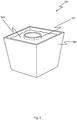
- Fig. 3 illustrates a planting system according to an embodiment of the invention.
- the planting system 301 comprises a planting receptacle 302, a hollow cylinder 101 as presented in fig. 1 and soil 303.
- the hollow cylinder 101 is arranged inside the planting receptacle 302 in such a manner that the axis of the hollow cylinder 101 is essentially perpendicular to a bottom of the planting receptacle 302.
- the hollow cylinder 101 is essentially in the center of the planting receptacle 302.
- a space between the planting receptacle 302 and the hollow cylinder 101 is filled with soil 303.
- the planting system 301 facilitates transplanting of a plant.
- a root ball of the plant can be inserted inside the hollow cylinder 101.
- the roots of the plant can grow to the soil 303 and the hollow cylinder 101 supports the plant to a straight and correct position.
- the planting system 301 is a ready-made set for transplanting and further growing of, for example, potted
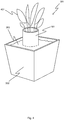
- Fig. 4 illustrates the planting system of fig. 3 with a plant.
- the plant 401 is inserted into the hollow cylinder 101.
- the hollow cylinder 101 is lifted up in direction perpendicular to the bottom of the planting receptacle 302.
- the hollow cylinder 101 supports the stem part of the plant 401 and prevents it from bending and being damaged.
- the soil 303 can spread under the hollow cylinder 101, which enables an access of nutrients to the plant and enhances rooting.
Landscapes
- Life Sciences & Earth Sciences (AREA)
- Environmental Sciences (AREA)
- Cultivation Receptacles Or Flower-Pots, Or Pots For Seedlings (AREA)
Priority Applications (1)
| Application Number | Priority Date | Filing Date | Title |
|---|---|---|---|
| EP16206634.4A EP3338536A1 (de) | 2016-12-23 | 2016-12-23 | Pflanzsystem und verfahren zum umpflanzen einer pflanze |
Applications Claiming Priority (1)
| Application Number | Priority Date | Filing Date | Title |
|---|---|---|---|
| EP16206634.4A EP3338536A1 (de) | 2016-12-23 | 2016-12-23 | Pflanzsystem und verfahren zum umpflanzen einer pflanze |
Publications (1)
| Publication Number | Publication Date |
|---|---|
| EP3338536A1 true EP3338536A1 (de) | 2018-06-27 |
Family
ID=57680123
Family Applications (1)
| Application Number | Title | Priority Date | Filing Date |
|---|---|---|---|
| EP16206634.4A Withdrawn EP3338536A1 (de) | 2016-12-23 | 2016-12-23 | Pflanzsystem und verfahren zum umpflanzen einer pflanze |
Country Status (1)
| Country | Link |
|---|---|
| EP (1) | EP3338536A1 (de) |
Cited By (4)
| Publication number | Priority date | Publication date | Assignee | Title |
|---|---|---|---|---|
| CN111919646A (zh) * | 2020-09-17 | 2020-11-13 | 西藏俊富环境恢复有限公司 | 一种自稳定型植树装置和植树方法 |
| CN112703914A (zh) * | 2019-10-25 | 2021-04-27 | 江苏爱丽普特新材料科技有限公司 | 可降解花盆的制作方法及其生产设备 |
| US20230320280A1 (en) * | 2022-04-12 | 2023-10-12 | Ronald E. Zillmer | System and method for growing and installing a plant |
| EP4285713A1 (de) * | 2022-05-31 | 2023-12-06 | SPC Sunflower Plastic Compound GmbH | Wurzelschutzhülle |
Citations (4)
| Publication number | Priority date | Publication date | Assignee | Title |
|---|---|---|---|---|
| US4791754A (en) * | 1987-07-13 | 1988-12-20 | Demars Jr George H | Plant assisting device |
| GB2366712A (en) * | 2000-09-18 | 2002-03-20 | Russell Rymel Morris | Planter |
| US20110120000A1 (en) * | 2009-11-24 | 2011-05-26 | James Barrie Ogilvie | Covers for plant-growing media |
| US20120227316A1 (en) * | 2011-03-07 | 2012-09-13 | Brenda Ptak | Planting apparatus and methods |
-
2016
- 2016-12-23 EP EP16206634.4A patent/EP3338536A1/de not_active Withdrawn
Patent Citations (4)
| Publication number | Priority date | Publication date | Assignee | Title |
|---|---|---|---|---|
| US4791754A (en) * | 1987-07-13 | 1988-12-20 | Demars Jr George H | Plant assisting device |
| GB2366712A (en) * | 2000-09-18 | 2002-03-20 | Russell Rymel Morris | Planter |
| US20110120000A1 (en) * | 2009-11-24 | 2011-05-26 | James Barrie Ogilvie | Covers for plant-growing media |
| US20120227316A1 (en) * | 2011-03-07 | 2012-09-13 | Brenda Ptak | Planting apparatus and methods |
Cited By (4)
| Publication number | Priority date | Publication date | Assignee | Title |
|---|---|---|---|---|
| CN112703914A (zh) * | 2019-10-25 | 2021-04-27 | 江苏爱丽普特新材料科技有限公司 | 可降解花盆的制作方法及其生产设备 |
| CN111919646A (zh) * | 2020-09-17 | 2020-11-13 | 西藏俊富环境恢复有限公司 | 一种自稳定型植树装置和植树方法 |
| US20230320280A1 (en) * | 2022-04-12 | 2023-10-12 | Ronald E. Zillmer | System and method for growing and installing a plant |
| EP4285713A1 (de) * | 2022-05-31 | 2023-12-06 | SPC Sunflower Plastic Compound GmbH | Wurzelschutzhülle |
Similar Documents
| Publication | Publication Date | Title |
|---|---|---|
| US5311700A (en) | Container for plants | |
| US6412218B2 (en) | Planting device and system and method of growing plants utilizing bags of growing medium | |
| US7946078B1 (en) | Starter tray and planting and method using a tray | |
| US9414547B2 (en) | Methods to grow, deliver, and plant young trees in a removable tubular container | |
| US6378247B1 (en) | Method for afforestation of sands and the like | |
| WO2013019105A2 (en) | A plant tray for propagating plants, a tray, a cup, and methods | |
| EP3338536A1 (de) | Pflanzsystem und verfahren zum umpflanzen einer pflanze | |
| US20160227712A1 (en) | Pyramidal Nursery Pot | |
| US20210092909A1 (en) | Plant care tubes and method for using plant care tubes | |
| JP3157622U (ja) | 肥料用容器 | |
| WO1998023143A1 (en) | Horticultural container and method of use | |
| EP3545753B1 (de) | Pflanzsystem und verfahren zur montage des pflanzsystems | |
| EP3338538A1 (de) | Pflanzadapter, pflanzsystem und verfahren zum umpflanzen einer pflanze | |
| JP5525666B1 (ja) | 栽培用土充填済みソイルブロックと、植物栽培方法と、ソイルブロック栽培植物 | |
| KR101360222B1 (ko) | 수경재배용 연결포트 및 이를 이용한 육묘방법 | |
| EP2042030A1 (de) | Pflanztopf | |
| US5918414A (en) | Metamorphic damping-off guard | |
| JP3233838U (ja) | 育苗用具 | |
| JP2002070020A (ja) | 生分解性プラスチック植栽容器、該容器を用いた植栽物の育苗方法、及び緑化工法 | |
| AU750856B2 (en) | Horticultural container and method of use | |
| NL2007198C2 (en) | A plant tray for propagating plants, a tray, and methods. | |
| KR200195623Y1 (ko) | 화분 | |
| AU751639B2 (en) | Method for afforestation of sandy ground and the like structure used for the method | |
| JP2004222549A (ja) | 植栽方法 | |
| US20260114382A1 (en) | Device for cultivating and for protecting forest and/or crop plants, use of the device, and method for producing the device for cultivating and for protecting forest and/or crop plants |
Legal Events
| Date | Code | Title | Description |
|---|---|---|---|
| PUAI | Public reference made under article 153(3) epc to a published international application that has entered the european phase |
Free format text: ORIGINAL CODE: 0009012 |
|
| AK | Designated contracting states |
Kind code of ref document: A1 Designated state(s): AL AT BE BG CH CY CZ DE DK EE ES FI FR GB GR HR HU IE IS IT LI LT LU LV MC MK MT NL NO PL PT RO RS SE SI SK SM TR |
|
| AX | Request for extension of the european patent |
Extension state: BA ME |
|
| STAA | Information on the status of an ep patent application or granted ep patent |
Free format text: STATUS: THE APPLICATION IS DEEMED TO BE WITHDRAWN |
|
| 18D | Application deemed to be withdrawn |
Effective date: 20190103 |