EP3338554A1 - Procédé et composition pour prévenir la formation de dépôts dans un système d'irrigation à goutte-à-goutte - Google Patents
Procédé et composition pour prévenir la formation de dépôts dans un système d'irrigation à goutte-à-goutte Download PDFInfo
- Publication number
- EP3338554A1 EP3338554A1 EP16206280.6A EP16206280A EP3338554A1 EP 3338554 A1 EP3338554 A1 EP 3338554A1 EP 16206280 A EP16206280 A EP 16206280A EP 3338554 A1 EP3338554 A1 EP 3338554A1
- Authority
- EP
- European Patent Office
- Prior art keywords
- weight
- treatment composition
- ppm
- hydrogen peroxide
- hydroxyethylidene
- Prior art date
- Legal status (The legal status is an assumption and is not a legal conclusion. Google has not performed a legal analysis and makes no representation as to the accuracy of the status listed.)
- Withdrawn
Links
- 239000000203 mixture Substances 0.000 title claims abstract description 121
- 230000002262 irrigation Effects 0.000 title claims abstract description 63
- 238000003973 irrigation Methods 0.000 title claims abstract description 63
- 230000015572 biosynthetic process Effects 0.000 title claims abstract description 20
- 238000000034 method Methods 0.000 title claims description 24
- MHAJPDPJQMAIIY-UHFFFAOYSA-N Hydrogen peroxide Chemical compound OO MHAJPDPJQMAIIY-UHFFFAOYSA-N 0.000 claims abstract description 159
- DBVJJBKOTRCVKF-UHFFFAOYSA-N Etidronic acid Chemical compound OP(=O)(O)C(O)(C)P(O)(O)=O DBVJJBKOTRCVKF-UHFFFAOYSA-N 0.000 claims abstract description 63
- XLYOFNOQVPJJNP-UHFFFAOYSA-N water Substances O XLYOFNOQVPJJNP-UHFFFAOYSA-N 0.000 claims abstract description 34
- 229910052785 arsenic Inorganic materials 0.000 claims abstract description 30
- RQNWIZPPADIBDY-UHFFFAOYSA-N arsenic atom Chemical compound [As] RQNWIZPPADIBDY-UHFFFAOYSA-N 0.000 claims abstract description 30
- XEEYBQQBJWHFJM-UHFFFAOYSA-N Iron Chemical compound [Fe] XEEYBQQBJWHFJM-UHFFFAOYSA-N 0.000 claims description 25
- 239000007864 aqueous solution Substances 0.000 claims description 24
- 239000000243 solution Substances 0.000 claims description 23
- 229910052742 iron Inorganic materials 0.000 claims description 13
- 235000015097 nutrients Nutrition 0.000 claims description 13
- 238000002156 mixing Methods 0.000 claims description 10
- OKTJSMMVPCPJKN-UHFFFAOYSA-N Carbon Chemical compound [C] OKTJSMMVPCPJKN-UHFFFAOYSA-N 0.000 claims description 9
- VEXZGXHMUGYJMC-UHFFFAOYSA-M Chloride anion Chemical compound [Cl-] VEXZGXHMUGYJMC-UHFFFAOYSA-M 0.000 claims description 9
- 229910052799 carbon Inorganic materials 0.000 claims description 8
- 238000010790 dilution Methods 0.000 claims description 4
- 239000012895 dilution Substances 0.000 claims description 4
- 230000000052 comparative effect Effects 0.000 description 17
- KFSLWBXXFJQRDL-UHFFFAOYSA-N Peracetic acid Chemical compound CC(=O)OO KFSLWBXXFJQRDL-UHFFFAOYSA-N 0.000 description 15
- 150000002978 peroxides Chemical class 0.000 description 13
- 239000002253 acid Substances 0.000 description 12
- 239000003621 irrigation water Substances 0.000 description 12
- 241000196324 Embryophyta Species 0.000 description 9
- OSVXSBDYLRYLIG-UHFFFAOYSA-N dioxidochlorine(.) Chemical compound O=Cl=O OSVXSBDYLRYLIG-UHFFFAOYSA-N 0.000 description 9
- 230000012010 growth Effects 0.000 description 9
- 238000009826 distribution Methods 0.000 description 8
- 238000003860 storage Methods 0.000 description 8
- 230000032770 biofilm formation Effects 0.000 description 7
- 229910052500 inorganic mineral Inorganic materials 0.000 description 7
- 239000011707 mineral Substances 0.000 description 7
- YDONNITUKPKTIG-UHFFFAOYSA-N [Nitrilotris(methylene)]trisphosphonic acid Chemical compound OP(O)(=O)CN(CP(O)(O)=O)CP(O)(O)=O YDONNITUKPKTIG-UHFFFAOYSA-N 0.000 description 6
- 230000000903 blocking effect Effects 0.000 description 6
- OSGAYBCDTDRGGQ-UHFFFAOYSA-L calcium sulfate Chemical compound [Ca+2].[O-]S([O-])(=O)=O OSGAYBCDTDRGGQ-UHFFFAOYSA-L 0.000 description 6
- 235000019398 chlorine dioxide Nutrition 0.000 description 6
- 238000001223 reverse osmosis Methods 0.000 description 5
- 239000004155 Chlorine dioxide Substances 0.000 description 4
- YZCKVEUIGOORGS-NJFSPNSNSA-N Tritium Chemical compound [3H] YZCKVEUIGOORGS-NJFSPNSNSA-N 0.000 description 4
- 239000000654 additive Substances 0.000 description 4
- 229910052802 copper Inorganic materials 0.000 description 4
- 239000010949 copper Substances 0.000 description 4
- 229910052750 molybdenum Inorganic materials 0.000 description 4
- 238000001556 precipitation Methods 0.000 description 4
- 239000000126 substance Substances 0.000 description 4
- 239000011701 zinc Substances 0.000 description 4
- 229910052725 zinc Inorganic materials 0.000 description 4
- OYPRJOBELJOOCE-UHFFFAOYSA-N Calcium Chemical compound [Ca] OYPRJOBELJOOCE-UHFFFAOYSA-N 0.000 description 3
- ZAMOUSCENKQFHK-UHFFFAOYSA-N Chlorine atom Chemical compound [Cl] ZAMOUSCENKQFHK-UHFFFAOYSA-N 0.000 description 3
- RYGMFSIKBFXOCR-UHFFFAOYSA-N Copper Chemical compound [Cu] RYGMFSIKBFXOCR-UHFFFAOYSA-N 0.000 description 3
- 241000227653 Lycopersicon Species 0.000 description 3
- 235000007688 Lycopersicon esculentum Nutrition 0.000 description 3
- ZOKXTWBITQBERF-UHFFFAOYSA-N Molybdenum Chemical compound [Mo] ZOKXTWBITQBERF-UHFFFAOYSA-N 0.000 description 3
- YSMRWXYRXBRSND-UHFFFAOYSA-N TOTP Chemical compound CC1=CC=CC=C1OP(=O)(OC=1C(=CC=CC=1)C)OC1=CC=CC=C1C YSMRWXYRXBRSND-UHFFFAOYSA-N 0.000 description 3
- HCHKCACWOHOZIP-UHFFFAOYSA-N Zinc Chemical compound [Zn] HCHKCACWOHOZIP-UHFFFAOYSA-N 0.000 description 3
- 230000000996 additive effect Effects 0.000 description 3
- 239000011575 calcium Substances 0.000 description 3
- 239000003795 chemical substances by application Substances 0.000 description 3
- 239000000460 chlorine Substances 0.000 description 3
- 229910052801 chlorine Inorganic materials 0.000 description 3
- DUYCTCQXNHFCSJ-UHFFFAOYSA-N dtpmp Chemical compound OP(=O)(O)CN(CP(O)(O)=O)CCN(CP(O)(=O)O)CCN(CP(O)(O)=O)CP(O)(O)=O DUYCTCQXNHFCSJ-UHFFFAOYSA-N 0.000 description 3
- 230000005764 inhibitory process Effects 0.000 description 3
- 229910052748 manganese Inorganic materials 0.000 description 3
- 239000011572 manganese Substances 0.000 description 3
- 239000011733 molybdenum Substances 0.000 description 3
- 239000002689 soil Substances 0.000 description 3
- 238000005979 thermal decomposition reaction Methods 0.000 description 3
- SMZOUWXMTYCWNB-UHFFFAOYSA-N 2-(2-methoxy-5-methylphenyl)ethanamine Chemical compound COC1=CC=C(C)C=C1CCN SMZOUWXMTYCWNB-UHFFFAOYSA-N 0.000 description 2
- NIXOWILDQLNWCW-UHFFFAOYSA-N 2-Propenoic acid Natural products OC(=O)C=C NIXOWILDQLNWCW-UHFFFAOYSA-N 0.000 description 2
- HGINCPLSRVDWNT-UHFFFAOYSA-N Acrolein Chemical compound C=CC=O HGINCPLSRVDWNT-UHFFFAOYSA-N 0.000 description 2
- QGZKDVFQNNGYKY-UHFFFAOYSA-O Ammonium Chemical compound [NH4+] QGZKDVFQNNGYKY-UHFFFAOYSA-O 0.000 description 2
- 241000894006 Bacteria Species 0.000 description 2
- ZOXJGFHDIHLPTG-UHFFFAOYSA-N Boron Chemical compound [B] ZOXJGFHDIHLPTG-UHFFFAOYSA-N 0.000 description 2
- 241000233866 Fungi Species 0.000 description 2
- VEXZGXHMUGYJMC-UHFFFAOYSA-N Hydrochloric acid Chemical compound Cl VEXZGXHMUGYJMC-UHFFFAOYSA-N 0.000 description 2
- FYYHWMGAXLPEAU-UHFFFAOYSA-N Magnesium Chemical compound [Mg] FYYHWMGAXLPEAU-UHFFFAOYSA-N 0.000 description 2
- PWHULOQIROXLJO-UHFFFAOYSA-N Manganese Chemical compound [Mn] PWHULOQIROXLJO-UHFFFAOYSA-N 0.000 description 2
- 229910002651 NO3 Inorganic materials 0.000 description 2
- NHNBFGGVMKEFGY-UHFFFAOYSA-N Nitrate Chemical compound [O-][N+]([O-])=O NHNBFGGVMKEFGY-UHFFFAOYSA-N 0.000 description 2
- NBIIXXVUZAFLBC-UHFFFAOYSA-N Phosphoric acid Chemical compound OP(O)(O)=O NBIIXXVUZAFLBC-UHFFFAOYSA-N 0.000 description 2
- OAICVXFJPJFONN-UHFFFAOYSA-N Phosphorus Chemical compound [P] OAICVXFJPJFONN-UHFFFAOYSA-N 0.000 description 2
- 229920000388 Polyphosphate Polymers 0.000 description 2
- ZLMJMSJWJFRBEC-UHFFFAOYSA-N Potassium Chemical compound [K] ZLMJMSJWJFRBEC-UHFFFAOYSA-N 0.000 description 2
- QAOWNCQODCNURD-UHFFFAOYSA-L Sulfate Chemical compound [O-]S([O-])(=O)=O QAOWNCQODCNURD-UHFFFAOYSA-L 0.000 description 2
- 150000007513 acids Chemical class 0.000 description 2
- 229910052796 boron Inorganic materials 0.000 description 2
- 229910052791 calcium Inorganic materials 0.000 description 2
- 238000004140 cleaning Methods 0.000 description 2
- 150000001875 compounds Chemical class 0.000 description 2
- 229920001577 copolymer Polymers 0.000 description 2
- 238000002425 crystallisation Methods 0.000 description 2
- 230000008025 crystallization Effects 0.000 description 2
- 238000000354 decomposition reaction Methods 0.000 description 2
- 238000007865 diluting Methods 0.000 description 2
- 238000004821 distillation Methods 0.000 description 2
- 230000000694 effects Effects 0.000 description 2
- 231100001261 hazardous Toxicity 0.000 description 2
- BHEPBYXIRTUNPN-UHFFFAOYSA-N hydridophosphorus(.) (triplet) Chemical compound [PH] BHEPBYXIRTUNPN-UHFFFAOYSA-N 0.000 description 2
- 238000004255 ion exchange chromatography Methods 0.000 description 2
- 239000011777 magnesium Substances 0.000 description 2
- 229910052749 magnesium Inorganic materials 0.000 description 2
- NBIIXXVUZAFLBC-UHFFFAOYSA-K phosphate Chemical compound [O-]P([O-])([O-])=O NBIIXXVUZAFLBC-UHFFFAOYSA-K 0.000 description 2
- 150000003013 phosphoric acid derivatives Chemical class 0.000 description 2
- 239000011574 phosphorus Substances 0.000 description 2
- 229910052698 phosphorus Inorganic materials 0.000 description 2
- 230000008635 plant growth Effects 0.000 description 2
- 229920000867 polyelectrolyte Polymers 0.000 description 2
- -1 polyethylene Polymers 0.000 description 2
- 239000001205 polyphosphate Substances 0.000 description 2
- 235000011176 polyphosphates Nutrition 0.000 description 2
- 229920000137 polyphosphoric acid Polymers 0.000 description 2
- 239000011591 potassium Substances 0.000 description 2
- 229910052700 potassium Inorganic materials 0.000 description 2
- 239000000047 product Substances 0.000 description 2
- 239000000758 substrate Substances 0.000 description 2
- SZHQPBJEOCHCKM-UHFFFAOYSA-N 2-phosphonobutane-1,2,4-tricarboxylic acid Chemical compound OC(=O)CCC(P(O)(O)=O)(C(O)=O)CC(O)=O SZHQPBJEOCHCKM-UHFFFAOYSA-N 0.000 description 1
- 206010002660 Anoxia Diseases 0.000 description 1
- 241000976983 Anoxia Species 0.000 description 1
- DJHGAFSJWGLOIV-UHFFFAOYSA-K Arsenate3- Chemical compound [O-][As]([O-])([O-])=O DJHGAFSJWGLOIV-UHFFFAOYSA-K 0.000 description 1
- 235000009849 Cucumis sativus Nutrition 0.000 description 1
- 240000008067 Cucumis sativus Species 0.000 description 1
- YZCKVEUIGOORGS-OUBTZVSYSA-N Deuterium Chemical compound [2H] YZCKVEUIGOORGS-OUBTZVSYSA-N 0.000 description 1
- MYMOFIZGZYHOMD-UHFFFAOYSA-N Dioxygen Chemical compound O=O MYMOFIZGZYHOMD-UHFFFAOYSA-N 0.000 description 1
- 206010021143 Hypoxia Diseases 0.000 description 1
- JLVVSXFLKOJNIY-UHFFFAOYSA-N Magnesium ion Chemical compound [Mg+2] JLVVSXFLKOJNIY-UHFFFAOYSA-N 0.000 description 1
- 229910019142 PO4 Inorganic materials 0.000 description 1
- 239000004698 Polyethylene Substances 0.000 description 1
- 239000004743 Polypropylene Substances 0.000 description 1
- XSQUKJJJFZCRTK-UHFFFAOYSA-N Urea Chemical compound NC(N)=O XSQUKJJJFZCRTK-UHFFFAOYSA-N 0.000 description 1
- 238000009825 accumulation Methods 0.000 description 1
- 229910000147 aluminium phosphate Inorganic materials 0.000 description 1
- 150000003863 ammonium salts Chemical class 0.000 description 1
- 230000007953 anoxia Effects 0.000 description 1
- 229940000489 arsenate Drugs 0.000 description 1
- QVGXLLKOCUKJST-UHFFFAOYSA-N atomic oxygen Chemical compound [O] QVGXLLKOCUKJST-UHFFFAOYSA-N 0.000 description 1
- 230000001580 bacterial effect Effects 0.000 description 1
- 239000012267 brine Substances 0.000 description 1
- 229910001424 calcium ion Inorganic materials 0.000 description 1
- 239000004202 carbamide Substances 0.000 description 1
- 239000003638 chemical reducing agent Substances 0.000 description 1
- 238000005660 chlorination reaction Methods 0.000 description 1
- 238000010960 commercial process Methods 0.000 description 1
- 230000000536 complexating effect Effects 0.000 description 1
- 239000008139 complexing agent Substances 0.000 description 1
- 239000007857 degradation product Substances 0.000 description 1
- 239000008367 deionised water Substances 0.000 description 1
- 229910021641 deionized water Inorganic materials 0.000 description 1
- 229910001882 dioxygen Inorganic materials 0.000 description 1
- 238000002474 experimental method Methods 0.000 description 1
- 239000003337 fertilizer Substances 0.000 description 1
- 238000011010 flushing procedure Methods 0.000 description 1
- 239000000383 hazardous chemical Substances 0.000 description 1
- 235000014666 liquid concentrate Nutrition 0.000 description 1
- 230000007774 longterm Effects 0.000 description 1
- 229910001425 magnesium ion Inorganic materials 0.000 description 1
- WPBNNNQJVZRUHP-UHFFFAOYSA-L manganese(2+);methyl n-[[2-(methoxycarbonylcarbamothioylamino)phenyl]carbamothioyl]carbamate;n-[2-(sulfidocarbothioylamino)ethyl]carbamodithioate Chemical compound [Mn+2].[S-]C(=S)NCCNC([S-])=S.COC(=O)NC(=S)NC1=CC=CC=C1NC(=S)NC(=O)OC WPBNNNQJVZRUHP-UHFFFAOYSA-L 0.000 description 1
- 238000005259 measurement Methods 0.000 description 1
- 229910052751 metal Inorganic materials 0.000 description 1
- 239000002184 metal Substances 0.000 description 1
- 229910021645 metal ion Inorganic materials 0.000 description 1
- 150000002739 metals Chemical class 0.000 description 1
- 230000002906 microbiologic effect Effects 0.000 description 1
- 244000005700 microbiome Species 0.000 description 1
- 239000011785 micronutrient Substances 0.000 description 1
- 235000013369 micronutrients Nutrition 0.000 description 1
- 239000011490 mineral wool Substances 0.000 description 1
- 150000002823 nitrates Chemical class 0.000 description 1
- 239000000618 nitrogen fertilizer Substances 0.000 description 1
- 239000006259 organic additive Substances 0.000 description 1
- 229920000620 organic polymer Polymers 0.000 description 1
- 230000001590 oxidative effect Effects 0.000 description 1
- 239000001301 oxygen Substances 0.000 description 1
- 229910052760 oxygen Inorganic materials 0.000 description 1
- 230000001706 oxygenating effect Effects 0.000 description 1
- 239000010452 phosphate Substances 0.000 description 1
- UEZVMMHDMIWARA-UHFFFAOYSA-M phosphonate Chemical compound [O-]P(=O)=O UEZVMMHDMIWARA-UHFFFAOYSA-M 0.000 description 1
- 150000003009 phosphonic acids Chemical class 0.000 description 1
- PTMHPRAIXMAOOB-UHFFFAOYSA-N phosphoramidic acid Chemical compound NP(O)(O)=O PTMHPRAIXMAOOB-UHFFFAOYSA-N 0.000 description 1
- 229920000573 polyethylene Polymers 0.000 description 1
- 229920001155 polypropylene Polymers 0.000 description 1
- 229920000915 polyvinyl chloride Polymers 0.000 description 1
- 239000004800 polyvinyl chloride Substances 0.000 description 1
- XAEFZNCEHLXOMS-UHFFFAOYSA-M potassium benzoate Chemical compound [K+].[O-]C(=O)C1=CC=CC=C1 XAEFZNCEHLXOMS-UHFFFAOYSA-M 0.000 description 1
- 238000002360 preparation method Methods 0.000 description 1
- 230000002265 prevention Effects 0.000 description 1
- 230000008653 root damage Effects 0.000 description 1
- 150000003839 salts Chemical class 0.000 description 1
- 239000002455 scale inhibitor Substances 0.000 description 1
- 239000013049 sediment Substances 0.000 description 1
- UKLNMMHNWFDKNT-UHFFFAOYSA-M sodium chlorite Chemical compound [Na+].[O-]Cl=O UKLNMMHNWFDKNT-UHFFFAOYSA-M 0.000 description 1
- 229960002218 sodium chlorite Drugs 0.000 description 1
- HPALAKNZSZLMCH-UHFFFAOYSA-M sodium;chloride;hydrate Chemical compound O.[Na+].[Cl-] HPALAKNZSZLMCH-UHFFFAOYSA-M 0.000 description 1
- 239000003381 stabilizer Substances 0.000 description 1
- 230000000087 stabilizing effect Effects 0.000 description 1
- 238000004659 sterilization and disinfection Methods 0.000 description 1
- 239000011550 stock solution Substances 0.000 description 1
- 238000004448 titration Methods 0.000 description 1
- 231100000331 toxic Toxicity 0.000 description 1
- 230000002588 toxic effect Effects 0.000 description 1
- 238000011179 visual inspection Methods 0.000 description 1
Images



Classifications
-
- C—CHEMISTRY; METALLURGY
- C02—TREATMENT OF WATER, WASTE WATER, SEWAGE, OR SLUDGE
- C02F—TREATMENT OF WATER, WASTE WATER, SEWAGE, OR SLUDGE
- C02F5/00—Softening water; Preventing scale; Adding scale preventatives or scale removers to water, e.g. adding sequestering agents
- C02F5/08—Treatment of water with complexing chemicals or other solubilising agents for softening, scale prevention or scale removal, e.g. adding sequestering agents
- C02F5/083—Mineral agents
-
- A—HUMAN NECESSITIES
- A01—AGRICULTURE; FORESTRY; ANIMAL HUSBANDRY; HUNTING; TRAPPING; FISHING
- A01N—PRESERVATION OF BODIES OF HUMANS OR ANIMALS OR PLANTS OR PARTS THEREOF; BIOCIDES, e.g. AS DISINFECTANTS, AS PESTICIDES OR AS HERBICIDES; PEST REPELLANTS OR ATTRACTANTS; PLANT GROWTH REGULATORS
- A01N59/00—Biocides, pest repellants or attractants, or plant growth regulators containing elements or inorganic compounds
-
- A—HUMAN NECESSITIES
- A01—AGRICULTURE; FORESTRY; ANIMAL HUSBANDRY; HUNTING; TRAPPING; FISHING
- A01N—PRESERVATION OF BODIES OF HUMANS OR ANIMALS OR PLANTS OR PARTS THEREOF; BIOCIDES, e.g. AS DISINFECTANTS, AS PESTICIDES OR AS HERBICIDES; PEST REPELLANTS OR ATTRACTANTS; PLANT GROWTH REGULATORS
- A01N59/00—Biocides, pest repellants or attractants, or plant growth regulators containing elements or inorganic compounds
- A01N59/16—Heavy metals; Compounds thereof
- A01N59/22—Arsenic
-
- C—CHEMISTRY; METALLURGY
- C01—INORGANIC CHEMISTRY
- C01B—NON-METALLIC ELEMENTS; COMPOUNDS THEREOF; METALLOIDS OR COMPOUNDS THEREOF NOT COVERED BY SUBCLASS C01C
- C01B15/00—Peroxides; Peroxyhydrates; Peroxyacids or salts thereof; Superoxides; Ozonides
- C01B15/01—Hydrogen peroxide
- C01B15/037—Stabilisation by additives
-
- C—CHEMISTRY; METALLURGY
- C02—TREATMENT OF WATER, WASTE WATER, SEWAGE, OR SLUDGE
- C02F—TREATMENT OF WATER, WASTE WATER, SEWAGE, OR SLUDGE
- C02F1/00—Treatment of water, waste water, or sewage
- C02F1/66—Treatment of water, waste water, or sewage by neutralisation; pH adjustment
-
- C—CHEMISTRY; METALLURGY
- C02—TREATMENT OF WATER, WASTE WATER, SEWAGE, OR SLUDGE
- C02F—TREATMENT OF WATER, WASTE WATER, SEWAGE, OR SLUDGE
- C02F1/00—Treatment of water, waste water, or sewage
- C02F1/72—Treatment of water, waste water, or sewage by oxidation
- C02F1/722—Oxidation by peroxides
-
- C—CHEMISTRY; METALLURGY
- C02—TREATMENT OF WATER, WASTE WATER, SEWAGE, OR SLUDGE
- C02F—TREATMENT OF WATER, WASTE WATER, SEWAGE, OR SLUDGE
- C02F2303/00—Specific treatment goals
- C02F2303/20—Prevention of biofouling
-
- C—CHEMISTRY; METALLURGY
- C02—TREATMENT OF WATER, WASTE WATER, SEWAGE, OR SLUDGE
- C02F—TREATMENT OF WATER, WASTE WATER, SEWAGE, OR SLUDGE
- C02F2303/00—Specific treatment goals
- C02F2303/22—Eliminating or preventing deposits, scale removal, scale prevention
Definitions
- the invention relates to a composition and a method for preventing deposit formation in a drip irrigation system which can prevent both biofilm formation and mineral scale formation by addition of a single storage-stable composition to the irrigation water.
- Drip irrigation systems are used for irrigating crops in arid climates and for irrigating plants cultivated in greenhouses.
- Drip irrigation systems in general have conduits with a multitude of emitters through which the irrigation water is distributed and are usually operated at low flow rates with long duration of flows, often extending for days or weeks.
- conduits are operated in parallel, feeding irrigation water with a single feed pump and a manifold to which the conduits are connected.
- Drip irrigation systems are sensitive to deposit formation in the conduits and the emitters, because deposits in the conduits can lead to maldistribution of irrigation water to the conduits and blocking of conduits and emitters will have the effect that some of the plants are insufficiently irrigated or not irrigated at all, which reduces crop yields.
- Deposits can form by growth of microorganisms, such as bacteria and fungi, which leads to biofilm deposits. Deposits can also form by precipitation of water-insoluble minerals from irrigation water containing multiply charged metal ions, such as calcium or magnesium ions.
- US 7,601,266 describes a method for providing unrestricted flow of irrigation water through an irrigation network by adding a solution containing chlorine dioxide as a biofilm reducing agent and a phosphonate as a mineral deposit distorting agent to the irrigation water.
- the solution containing chlorine dioxide is generated on site by mixing a solution, containing hydrochloric acid, water and phosphonobutanetricarboxylic acid or 1-hydroxyethylidene-1,1-diphosphonic acid with an aqueous solution of sodium chlorite.
- AU 3 505 999 A1 describes an agent for inhibition and removal of built ups and sediments in irrigation systems comprising polyphosphoric acid or a polyphosphate and a mixture of peroxoacetic acid and hydrogen peroxide.
- the document teaches that separate liquid concentrates of the complexing phosphate and of the oxidizing additive have to be used to ensure long term efficiency and a long shelf life.
- EP 0 380 171 describes an agent for the cleaning of irrigation systems containing an acrylic acid homo- or copolymer polyelectrolyte and hydrogen peroxide.
- the document also describes a process of cleaning of irrigation systems in which the polyelectrolyte and the hydrogen peroxide are successively introduced through the system in arbitrary order.
- compositions containing hydrogen peroxide are marketed for preventing biofilm formation in drip irrigation systems under the trade names EcoClearProx ® , HydroClean, OXY-PLUS, LOXYDE ® and FREEBAC-CLEAROXYL ® .
- Chlorine and chlorine dioxides are hazardous chemicals that have to be generated on site. Chlorine, chlorine dioxide and peroxyacetic acid are also highly volatile and can give rise to irritating and even toxic vapors during handling.
- the additives used in the prior art methods also have the disadvantage that they are either not sufficiently storage stable or have to be stored separately for preventing decomposition during storage. Therefore, there is still a need for a method for preventing deposit formation in a drip irrigation system that can be carried out by adding a single storage-stable concentrated composition to the irrigation water, which composition does not form hazardous vapors.
- US 2004/0101461 A1 discloses compositions consisting essentially of hydrogen peroxide, one or more complexing agents based on phosphonic acids in an amount from 10 to 60 % by weight based on the amount of hydrogen peroxide, water, and up to 10 % by weight, based on the amount of hydrogen peroxide, of further components. US 2004/0101461 A1 teaches these compositions to be useful for preparing stabilized soil oxygenating or micronutrient solutions containing hydrogen peroxide and dissolved Fe, Mn, Cu, Mo and Zn.
- a concentrated composition containing hydrogen peroxide and 1-hydroxyethylidene-1,1-diphosphonic acid (HEDP) is efficient for preventing deposit formation in drip irrigation systems, providing hydrogen peroxide concentrations sufficient for preventing biofilm formation and concentrations of HEDP sufficient for preventing mineral scale formation throughout the entire drip irrigation system even at low flow rates.
- HEDP 1-hydroxyethylidene-1,1-diphosphonic acid
- the inventors have further found that such compositions having a low content of arsenic show superior storage stability compared to compositions prepared from commercial grades of HEDP marketed for stabilizing hydrogen peroxide which have a higher content of arsenic.
- Subject of the invention is therefore a treatment composition for preventing deposit formation in a drip irrigation system, containing from 10 to 50 % by weight hydrogen peroxide, from 1 to 5 % by weight 1-hydroxyethylidene-1,1-diphosphonic acid and up to 0.5 ppm by weight arsenic as well as the use of this treatment composition for preventing deposit formation in a drip irrigation system.
- a further subject of the invention is a method for preventing deposit formation in a drip irrigation system, wherein a treatment composition containing from 10 to 50 % by weight hydrogen peroxide, from 1 to 5 % by weight 1-hydroxyethylidene-1,1-diphosphonic acid and up to 0.5 ppm by weight arsenic is added to a water stream introduced into the drip irrigation system in an amount providing a concentration of from 5 to 100 ppm by weight hydrogen peroxide and from 0.5 to 10 ppm by weight 1-hydroxyethylidene-1,1-diphosphonic acid in the water stream.
- the treatment composition of the invention contains from 10 to 50 % by weight hydrogen peroxide, from 1 to 5 % by weight 1-hydroxyethylidene-1,1-diphosphonic acid and up to 0.5 ppm by weight arsenic.
- the treatment composition preferably contains from 25 to 50 % by weight hydrogen peroxide and from 2 to 4 % by weight 1-hydroxyethylidene-1,1-diphosphonic acid and most preferably about 30 % by weight hydrogen peroxide and about 3 % by weight 1-hydroxyethylidene-1,1-diphosphonic acid.
- the treatment composition preferably contains hydrogen peroxide and 1-hydroxyethylidene-1,1-diphosphonicacid in a weight ratio of from 2:1 to 50:1, more preferably in a weight ratio of from 5:1 to 25:1 and most preferably in a weight ratio of about 10:1.
- the treatment composition preferably contains from 0.01 to 0.5 ppm by weight arsenic. The amount of arsenic is calculated for elemental arsenic, although the arsenic will typically be present in the composition in dissolved form, typically as dissolved arsenate.
- the treatment composition of the invention is preferably prepared by mixing hydrogen peroxide with an aqueous solution of 1-hydroxyethylidene-1,1-diphosphonic acid, which aqueous solution contains less than 70 ppm chloride, less than 20 ppm iron and less than 10 ppm arsenic, each based on the weight of 1-hydroxyethylidene-1,1-diphosphonic acid contained in the aqueous solution.
- Suitable aqueous solutions of 1-hydroxyethylidene-1,1-diphosphonic acid with low contents of chloride, iron and arsenic are commercially available from Italmatch Chemicals S.p.A. under the trade name Dequest ® 2010 LC.
- the treatment composition of the invention is preferably prepared by mixing an aqueous hydrogen peroxide solution having a total organic carbon content of less than 100 mg/kg with an aqueous solution of 1-hydroxyethylidene-1,1-diphosphonic acid.
- An aqueous hydrogen peroxide solution with a total organic carbon content of less than 100 mg/kg may be obtained by distillation, crystallization or reverse osmosis, with reverse osmosis being preferred.
- the compositions obtainable by these preparation methods are preferred embodiments of the treatment composition of the invention.
- the treatment composition of the invention has a high storage stability which is superior to the stability of a composition obtained by mixing hydrogen peroxide with a commercially available aqueous solution of 1-hydroxyethylidene-1,1-diphosphonic acid containing more than 70 ppm chloride, 20 ppm iron and 10 ppm arsenic, each based on the weight of 1-hydroxyethylidene-1,1-diphosphonic acid contained in the aqueous solution, which is typically used as a hydrogen peroxide stabilizer.
- the treatment composition of the invention can be used for preventing deposit formation in a drip irrigation system, preferably by using the treatment composition of the invention in the method of the invention.
- a treatment composition of the invention is added to a water stream introduced into the drip irrigation system.
- the treatment composition contains from 10 to 50 % by weight hydrogen peroxide, from 1 to 5 % by weight 1-hydroxyethylidene-1,1-diphosphonic acid, and up to 0.5 ppm by weight arsenic.
- the treatment composition preferably contains from 25 to 50 % by weight hydrogen peroxide and from 2 to 4 % by weight 1-hydroxyethylidene-1,1-diphosphonic acid.
- the treatment composition contains about 30 % by weight hydrogen peroxide and about 3 % by weight 1-hydroxyethylidene-1,1-diphosphonic acid.
- the treatment composition preferably contains from 0.01 to 0.5 ppm arsenic.
- the treatment composition preferably comprises less than 10 ppm arsenic based on the weight of 1-hydroxyethylidene-1,1-diphosphonic acid.
- a low content of arsenic in the treatment composition prevents or reduces uptake of arsenic into an irrigated crop.
- the treatment composition may further comprise phosphoric acid or a phosphate salt, preferably in an amount providing a phosphorus content calculated as orthophosphate of from 0.1 to 50 mg/kg based on the weight of hydrogen peroxide.
- the treatment composition is added to a water stream introduced into a drip irrigation system.
- the treatment composition may be added directly to the water stream, i.e. without previous dilution, or it may be added to the water stream after dilution.
- the treatment composition may be diluted with water or with an aqueous nutrient solution before it is added to the water stream.
- the concentration of hydrogen peroxide after dilution is preferably from 0.05 to 1.0 % by weight.
- the aqueous nutrient solution may comprise a nitrogen fertilizer, such as an ammonium salt, a nitrate salt, urea or a combination of these compounds.
- the aqueous nutrient solution may also comprise a potassium salt, a phosphorus fertilizer, such as a phosphate salt, or a combination of these compounds.
- the aqueous nutrient solution may further comprise salts of essential metals selected from iron, copper, molybdenum, zinc and manganese. Diluting the treatment composition with an aqueous nutrient solution has the advantage that the method of the invention can be carried out without extra dosing equipment in a drip irrigation system comprising a dosing unit for aqueous nutrient solution.
- the treatment composition may be added to the water stream continuously or intermittently, with continuous addition being preferred.
- the treatment composition is added intermittently, the treatment composition is added during at least 50 % of the time the water stream is flowing.
- Such continuous or extended intermittent addition prevents the formation of biofilms and mineral deposits at concentrations of hydrogen peroxide and 1-hydroxyethylidene-1,1-diphosphonic acid that are much lower than the concentrations needed for removing already formed biofilms and mineral deposits.
- the treatment composition is added to the water stream in an amount providing a concentration of from 5 to 100 ppm by weight hydrogen peroxide and from 0.5 to 10 ppm by weight 1-hydroxyethylidene-1,1-diphosphonic acid in the water stream, preferably in an amount providing a concentration of from 5 to 50 ppm by weight hydrogen peroxide and from 0.5 to 5 ppm by weight 1-hydroxyethylidene-1,1-diphosphonic acid.
- concentrations refer to the composition of the water stream immediately after addition of the treatment composition.
- the treatment composition is added in an amount providing a concentration of at least 0.5 ppm by weight hydrogen peroxide throughout the entire drip irrigation system, i.e. the concentration of hydrogen peroxide in the irrigation water leaving the drip irrigation system at the emitter furthest away from the point where the treatment composition is added shall be at least 0.5 ppm by weight.
- the drip irrigation system may be a sub-surface irrigation system or an above surface irrigation system.
- the conduits of the drip irrigation system preferably have an inner surface made from an organic polymer, such as polyethylene, polypropylene or polyvinylchloride.
- the drip irrigation system preferably has a single feed point for irrigation water and the treatment composition is added to a water stream introduced at this feed point.
- the treatment composition is preferably added to the water stream with a dosing pump, which preferably provides a constant dosing rate or is controlled based on a flow measurement of the water stream to provide a constant ratio between the addition rate and the water flow rate.
- the dosing pump preferably comprises a safety device which stops addition of the treatment composition when the flow of the water stream stops.
- the treatment composition may be added with any dosing pump suitable for dosing a hydrogen peroxide solution, where the dosing pump is designed to prevent excess pressure build-up from oxygen gas formed by hydrogen peroxide decomposition.
- the method of the invention is preferably carried out with a treatment composition that has been prepared by mixing hydrogen peroxide with an aqueous solution of 1-hydroxyethylidene-1,1-diphosphonicacid, which aqueous solution contains less than 70 ppm chloride, less than 20 ppm iron and less than 10 ppm arsenic, each based on the weight of 1-hydroxyethylidene-1,1-diphosphonic acid contained in the aqueous solution.
- the method of the invention is preferably carried out with a treatment composition that has been prepared by mixing an aqueous hydrogen peroxide solution having a total organic carbon content of less than 100 mg/kg with an aqueous solution of 1-hydroxyethylidene-1,1-diphosphonic acid.
- An aqueous hydrogen peroxide solution with a total organic carbon content of less than 100 mg/kg may be obtained by distillation, crystallization or reverse osmosis, with reverse osmosis being preferred.
- a treatment composition prepared from an aqueous hydrogen peroxide solution having a total organic carbon content of less than 100 mg/kg prevents accumulation of alkylanthraquinones and of degradation products of alkylanthraquinones, used in the commercial process for producing hydrogen peroxide, in soil irrigated with the treated water stream.
- the method of the invention efficiently prevents the formation of deposits, both from biofilms and from mineral scale, without negatively affecting the growth of irrigated plants.
- plant growth is stimulated by hydrogen peroxide providing oxygen at the plant roots, thus preventing harm to the roots by anoxia.
- Deposit formation can be prevented throughout the entire drip irrigation system, even for systems with a slow flow of water, where it can take more than 10 hours for water introduced into the drip irrigation system to reach the most distant irrigation emitter, because the combination of hydrogen peroxide and 1-hydroxyethylidene-1,1-diphosphonic acid provides better stability of the peroxide in the drip irrigation system than commercially used compositions comprising hydrogen peroxide without additive or with another additive.
- the method of the invention can be carried out safely without a risk of exposing operating personnel to hazardous vapors, such as vapors containing chlorine, chlorine dioxide or peroxyacetic acid.
- organophosphonic acid was 1-hydroxyethylidene-1,1-diphosphonic acid (HEDP) supplied by Italmatch Chemicals S.p.A. under the trade name Dequest ® 2010 LC, which contained 22 ppm chloride, less than 0.4 ppm iron and less than 0.2 ppm arsenic, each based on the weight of 1-hydroxyethylidene-1,1-diphosphonic acid.
- HEDP 1-hydroxyethylidene-1,1-diphosphonic acid
- Dequest ® 2010 LC which contained 22 ppm chloride, less than 0.4 ppm iron and less than 0.2 ppm arsenic, each based on the weight of 1-hydroxyethylidene-1,1-diphosphonic acid.
- the organophosphonic acid was amino-tris(methylenephosphonic acid) (ATMP) supplied by Zschimmer & Schwarz Mohsdorf GmbH & Co. KG under the trade name Cublen ® AP1.
- the organophosphonic acid was diethylenetriamine-penta(methylenephosphonic acid) (DTPMP) supplied by Zschimmer & Schwarz Mohsdorf GmbH & Co. KG under the trade name Cublen ® DNC 450.
- Table 1 shows the concentrations of hydrogen peroxide and charged organophosphonic acid determined by ion chromatography.
- Solutions containing 30 % by weight of hydrogen peroxide and 3 % by weight of organophosphonic acid were prepared starting from a hydrogen peroxide stock solution purified by reverse osmosis.
- 1-hydroxyethylidene-1,1-diphosphonic acid (HEDP) supplied by Italmatch Chemicals S.p.A. under the trade name Dequest 2010 LC was used, which contained 22 ppm chloride, less than 0.4 ppm iron and less than 0.2 ppm arsenic, each based on the weight of 1-hydroxyethylidene-1,1-diphosphonic acid contained in the product.
- HEDP supplied by Connect Chemicals GmbH under the trade name HEDP was used, which contained 73 ppm chloride, 27 ppm iron and 90 ppm arsenic.
- PBTC 2-phosphonobutane-1,2,4-tricarboxylic acid
- Cublen ® P 50 was used.
- amino-tris(methylenephosphonic acid) (ATMP) supplied by Zschimmer & Schwarz Mohsdorf GmbH & Co. KG under the trade name Cublen ® AP1 was used.
- no organophosphonic acid was added to the hydrogen peroxide.
- thermal decomposition was determined by diluting the solution with deionized water to about 16 % by weight hydrogen peroxide, storing samples for 24 h at 20 °C and 96 °C, determining the hydrogen peroxide content in the stored samples by cerimetric titration and calculating the thermal decomposition as the concentration difference between the samples stored at different temperatures divided by the concentration of the sample stored at 20 °C.
- Table 2 summarizes the results. The results demonstrate that a composition containing hydrogen peroxide and 1-hydroxyethylidene-1,1-diphosphonic acid with a low content of arsenic has a high thermal stability.
- treatment composition A was used, which was an aqueous solution containing 30 % by weight hydrogen peroxide and 3 % by weight 1-hydroxyethylidene-1,1-diphosphonic acid.
- treatment composition B was used, which was an aqueous solution containing hydrogen peroxide supplied by Aquamar Disinfection Products BV under the trade name Freebac-Clearoxyl ® .
- treatment composition C was used, which was an aqueous solution containing hydrogen peroxide supplied by de Jong Eco-Services under the trade name LOXYDE ® .
- treatment composition D was used, which was an equilibrium peroxyacetic acid solution containing 2 % by weight peroxyacetic acid, 47 % by weight hydrogen peroxide and 2 % by weight polyphosphoric acid.
- treatment composition E was used, which was an equilibrium peroxyacetic acid solution containing 5 % by weight peroxyacetic acid, 25 % by weight hydrogen peroxide and 3 % by weight of a copolymer of acrylic acid and acrolein.
- the efficiency for preventing the precipitation of calcium sulfate from aqueous solution was determined with the calcium sulfate precipitation test of NACE standard TM0374-2007.
- a composition prepared as in example 1 was added in amounts providing the concentrations of hydrogen peroxide and HEDP in the test brine given in table 4. The hydrogen peroxide and the HEDP used for making the composition were tested for comparison.
- Treatment compositions were tested in a greenhouse for soilless cultivation of cucumbers on a rock wool substrate using a drip irrigation system with parallel distribution conduits and 25 drippers along each conduit, with the drippers inserted into the substrate and connected to the conduits through dripper valves. Irrigation was carried out during daytime with a nutrient solution containing 0.7 mmol/l ammonium, 13.3 mmol/l potassium, 6.7 mmol/l calcium, 2.3 mmol/l magnesium, 2.2 mmol/l sulfate, 25.1 mmol/l nitrate, 2.4 mmol/l phosphorous, 18.8 ⁇ mol/l iron, 50.0 ⁇ mol/l boron, 1.1 ⁇ mol/l copper, 0.5 ⁇ mol/l molybdenum, 10.0 ⁇ mol/l zinc and 12.5 ⁇ mol/l manganese, using irrigation cycles of 4 min each, increasing irrigation from 3-4 cycles per day to 10-11 cycles during the 76 day growth period.
- the treatment compositions A to E used in examples 9-13 were dosed to different parallel conduits of the drip irrigation system during each irrigation cycle in an amount providing a concentration of 50 mg/l of peroxide in the irrigation water stream. Due to the hold-up of the distribution conduits, it took one irrigation cycle for the water stream to pass from the point of dosing the treatment composition to the first dripper of the conduit, about two irrigation cycles to dripper 12 and up to 6 irrigation cycles to the last dripper of the conduit.
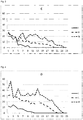
- Loss of peroxide in the distribution conduits was determined by an experiment, where the first irrigation cycle of the day was 16 h after the last previous irrigation cycle. Concentrations of peroxide were determined with Quantofix® peroxide test strips using a Quantofix® reader for each dripper before the first irrigation cycle (graph I), and about 10 min after the second and the third irrigation cycle (graphs II and III).
- Fig. 1 to 4 show the peroxide concentrations in mg/l along the distribution conduits to which treatment compositions A to D were added, with dripper 1 being the first and dripper 25 being the last dripper along the conduit.
- the distribution conduits were flushed and the amount of deposits flushed from the conduits was rated visually on a scale from 0 (no deposit) to 10 (much deposit). Ratings were 0 for treatment composition A and a distribution conduit to which no treatment composition was added, 3 for treatment compositions B and D, 5 for treatment composition C and 8 for treatment composition E.
- the deposits were mainly biofilms containing bacteria and fungi. A visual inspection of the plant roots showed no root damage.
- treatment composition A according to the invention prevents biofilm formation without damaging plant roots, whereas other treatment compositions containing hydrogen peroxide or peroxyacetic acid can lead to biofilm formation due to insufficient stability of the peroxide in the drip irrigation system and organic additives which serve as a carbon source for microbiological growth.
- Treatment compositions were tested in a greenhouse for cultivation of tomatoes on soil using the same drip irrigation system as in example 14. Irrigation was carried out during daytime with the nutrient solution of examples 9-13, increasing the irrigation time from 5 minutes per day to about 25 minutes per day during the 6.5 months growth period.
- the treatment compositions A to E used in examples 9-13 were dosed to different parallel conduits of the drip irrigation system during irrigation in an amount providing a concentration of 25 mg/l of peroxide in the water stream.
- the total weight of tomatoes harvested per plant was determined for the plants irrigated with addition of different treatment compositions and is given in table 5.
- treatment composition A according to the invention prevents biofilm formation and improves plant growth.
Landscapes
- Life Sciences & Earth Sciences (AREA)
- Chemical & Material Sciences (AREA)
- Engineering & Computer Science (AREA)
- Organic Chemistry (AREA)
- Inorganic Chemistry (AREA)
- Wood Science & Technology (AREA)
- Environmental Sciences (AREA)
- Plant Pathology (AREA)
- Dentistry (AREA)
- General Health & Medical Sciences (AREA)
- Pest Control & Pesticides (AREA)
- Zoology (AREA)
- Health & Medical Sciences (AREA)
- Agronomy & Crop Science (AREA)
- General Chemical & Material Sciences (AREA)
- Hydrology & Water Resources (AREA)
- Environmental & Geological Engineering (AREA)
- Water Supply & Treatment (AREA)
- Chemical Kinetics & Catalysis (AREA)
- Agricultural Chemicals And Associated Chemicals (AREA)
- Removal Of Specific Substances (AREA)
Priority Applications (3)
| Application Number | Priority Date | Filing Date | Title |
|---|---|---|---|
| EP16206280.6A EP3338554A1 (fr) | 2016-12-22 | 2016-12-22 | Procédé et composition pour prévenir la formation de dépôts dans un système d'irrigation à goutte-à-goutte |
| PCT/EP2017/082520 WO2018114494A1 (fr) | 2016-12-22 | 2017-12-13 | Composition et procédé pour empêcher la formation de dépôts dans un système d'irrigation goutte à goutte |
| ARP170103642A AR110572A1 (es) | 2016-12-22 | 2017-12-22 | Composición y procedimiento para evitar la formación de sedimento en un sistema de riego por goteo |
Applications Claiming Priority (1)
| Application Number | Priority Date | Filing Date | Title |
|---|---|---|---|
| EP16206280.6A EP3338554A1 (fr) | 2016-12-22 | 2016-12-22 | Procédé et composition pour prévenir la formation de dépôts dans un système d'irrigation à goutte-à-goutte |
Publications (1)
| Publication Number | Publication Date |
|---|---|
| EP3338554A1 true EP3338554A1 (fr) | 2018-06-27 |
Family
ID=57588931
Family Applications (1)
| Application Number | Title | Priority Date | Filing Date |
|---|---|---|---|
| EP16206280.6A Withdrawn EP3338554A1 (fr) | 2016-12-22 | 2016-12-22 | Procédé et composition pour prévenir la formation de dépôts dans un système d'irrigation à goutte-à-goutte |
Country Status (3)
| Country | Link |
|---|---|
| EP (1) | EP3338554A1 (fr) |
| AR (1) | AR110572A1 (fr) |
| WO (1) | WO2018114494A1 (fr) |
Citations (6)
| Publication number | Priority date | Publication date | Assignee | Title |
|---|---|---|---|---|
| EP0380171A1 (fr) | 1989-01-23 | 1990-08-01 | Paulus Wilhelmus Nicolaas Maria Kok | Agent et procédé de nettoyage des systèmes d'irrigation ou de distribution d'eau, notamment dans l'agriculture ou l'horticulture |
| US5930950A (en) * | 1993-04-22 | 1999-08-03 | Ch20 Incorporated | Method of inhibiting the formation of crystalline mineral deposits in soil |
| AU3505999A (en) | 1999-06-17 | 2000-12-21 | Helica | Agent for regeneration of growing media and inhibition and removal of build ups and sediments in water systems used for plant nutrition |
| US20040101461A1 (en) | 2002-11-22 | 2004-05-27 | Lovetro David C. | Chemical composition and method |
| US20070257127A1 (en) * | 2006-04-20 | 2007-11-08 | Iverson Carl E | Method of promoting unrestricted flow of irrigation water through irrigation networks |
| US20130203849A1 (en) * | 2010-09-14 | 2013-08-08 | Nimrod Ben Yehuda | Compositions and methods of treating edible matter and substrates therefor |
-
2016
- 2016-12-22 EP EP16206280.6A patent/EP3338554A1/fr not_active Withdrawn
-
2017
- 2017-12-13 WO PCT/EP2017/082520 patent/WO2018114494A1/fr not_active Ceased
- 2017-12-22 AR ARP170103642A patent/AR110572A1/es unknown
Patent Citations (7)
| Publication number | Priority date | Publication date | Assignee | Title |
|---|---|---|---|---|
| EP0380171A1 (fr) | 1989-01-23 | 1990-08-01 | Paulus Wilhelmus Nicolaas Maria Kok | Agent et procédé de nettoyage des systèmes d'irrigation ou de distribution d'eau, notamment dans l'agriculture ou l'horticulture |
| US5930950A (en) * | 1993-04-22 | 1999-08-03 | Ch20 Incorporated | Method of inhibiting the formation of crystalline mineral deposits in soil |
| AU3505999A (en) | 1999-06-17 | 2000-12-21 | Helica | Agent for regeneration of growing media and inhibition and removal of build ups and sediments in water systems used for plant nutrition |
| US20040101461A1 (en) | 2002-11-22 | 2004-05-27 | Lovetro David C. | Chemical composition and method |
| US20070257127A1 (en) * | 2006-04-20 | 2007-11-08 | Iverson Carl E | Method of promoting unrestricted flow of irrigation water through irrigation networks |
| US7601266B2 (en) | 2006-04-20 | 2009-10-13 | Ch2O Incorporated | Method of promoting unrestricted flow of irrigation water through irrigation networks |
| US20130203849A1 (en) * | 2010-09-14 | 2013-08-08 | Nimrod Ben Yehuda | Compositions and methods of treating edible matter and substrates therefor |
Non-Patent Citations (2)
| Title |
|---|
| "GUIDELINES FOR IRRIGATION SYSTEMS MAINTENANCE 2012", 1 January 2012 (2012-01-01), pages 1 - 46, XP055255234, Retrieved from the Internet <URL:http://www.netafimusa.com/files/literature/agriculture/other-literature/crop-applications/Preventive-Maintenance-Guide.pdf> [retrieved on 20160304] * |
| BHATTARAI SURYA P ET AL: "Oxygation unlocks yield potentials of crops in oxygen-limited soil environments", ADVANCES IN AGRONOMY, ACADEMIC PRESS, SAN DIEGO, CA, US, 1 January 2005 (2005-01-01), pages 313 - 377, XP009101873, ISSN: 0065-2113, DOI: 10.1016/S0065-2113(05)88008-3 * |
Also Published As
| Publication number | Publication date |
|---|---|
| AR110572A1 (es) | 2019-04-10 |
| WO2018114494A1 (fr) | 2018-06-28 |
Similar Documents
| Publication | Publication Date | Title |
|---|---|---|
| USRE45550E1 (en) | Method of promoting unrestricted flow of irrigation water through irrigation networks | |
| EP1487266B1 (fr) | Procede de preparation d'un biocide contenant un hypochlorite stabilise et d'une source d'ions de bromure et procede de regulation d'un encrassement microbien a l'aide de cette source | |
| CN103097321B (zh) | 电化学处理的营养液 | |
| JP2010189393A (ja) | 次亜臭素酸の安定化された溶液 | |
| JP2012191873A (ja) | 水耕栽培方法および水耕栽培装置 | |
| JP5453600B2 (ja) | オゾン水を用いた養液栽培設備および養液栽培方法 | |
| EP3338554A1 (fr) | Procédé et composition pour prévenir la formation de dépôts dans un système d'irrigation à goutte-à-goutte | |
| AU708033B2 (en) | A method and composition for inhibiting biological fouling in an irrigation system | |
| EP4330195A1 (fr) | Procédé et système pour éliminer des microbes pathogènes en suspension dans l'eau d'un système d'eau hydroponique pendant la saison de croissance | |
| Liu et al. | How to reduce clogging problems in fertigation: HS1202/HS1202, 6/2012 | |
| JP4456410B2 (ja) | 植物の育成方法 | |
| WO2018143450A1 (fr) | Dispositif hydroponique et procédé hydroponique | |
| CA2624961C (fr) | Composition pour detruire des algues filamenteuses | |
| JP6726570B2 (ja) | オゾン供給制御方法、追肥量制御方法及び養液栽培装置 | |
| JP4385251B2 (ja) | 潅水チューブ用洗浄剤及びそれを用いた潅水チューブの洗浄方法 | |
| EP4070646A1 (fr) | Installation horticole comprenant une boucle d'eau | |
| WO2009122013A1 (fr) | Eau pour arrosage et pulvérisation de plantes, et procédé de peréparation correspondant | |
| AU3505999A (en) | Agent for regeneration of growing media and inhibition and removal of build ups and sediments in water systems used for plant nutrition | |
| CA3123049A1 (fr) | Methode d'elimination des fluorides et des chlorures de l'eau a boire pour ameliorer l'arrosage des plantes | |
| ES2868783T3 (es) | Procedimiento de implementación de una composición nutritiva inorgánica de hierro | |
| Daum et al. | EXTENT AND N2O/N2 RATIO OF GASEOUS NITROGEN LOSSES FROM A SOILLESS CULTURE SYSTEM (REFEREED) | |
| JP2015043729A (ja) | 植物栽培用水、植物栽培用水の製造方法、植物栽培用水製造設備、及び、植物栽培システム |
Legal Events
| Date | Code | Title | Description |
|---|---|---|---|
| PUAI | Public reference made under article 153(3) epc to a published international application that has entered the european phase |
Free format text: ORIGINAL CODE: 0009012 |
|
| AK | Designated contracting states |
Kind code of ref document: A1 Designated state(s): AL AT BE BG CH CY CZ DE DK EE ES FI FR GB GR HR HU IE IS IT LI LT LU LV MC MK MT NL NO PL PT RO RS SE SI SK SM TR |
|
| AX | Request for extension of the european patent |
Extension state: BA ME |
|
| STAA | Information on the status of an ep patent application or granted ep patent |
Free format text: STATUS: THE APPLICATION IS DEEMED TO BE WITHDRAWN |
|
| 18D | Application deemed to be withdrawn |
Effective date: 20190103 |