EP3342851A1 - Nukleinsäuredetektionsvorrichtung und nukleinsäuredetektionsverfahren - Google Patents
Nukleinsäuredetektionsvorrichtung und nukleinsäuredetektionsverfahren Download PDFInfo
- Publication number
- EP3342851A1 EP3342851A1 EP16839366.8A EP16839366A EP3342851A1 EP 3342851 A1 EP3342851 A1 EP 3342851A1 EP 16839366 A EP16839366 A EP 16839366A EP 3342851 A1 EP3342851 A1 EP 3342851A1
- Authority
- EP
- European Patent Office
- Prior art keywords
- nucleic acid
- control
- target
- detection portion
- probe
- Prior art date
- Legal status (The legal status is an assumption and is not a legal conclusion. Google has not performed a legal analysis and makes no representation as to the accuracy of the status listed.)
- Granted
Links
Images






Classifications
-
- C—CHEMISTRY; METALLURGY
- C12—BIOCHEMISTRY; BEER; SPIRITS; WINE; VINEGAR; MICROBIOLOGY; ENZYMOLOGY; MUTATION OR GENETIC ENGINEERING
- C12Q—MEASURING OR TESTING PROCESSES INVOLVING ENZYMES, NUCLEIC ACIDS OR MICROORGANISMS; COMPOSITIONS OR TEST PAPERS THEREFOR; PROCESSES OF PREPARING SUCH COMPOSITIONS; CONDITION-RESPONSIVE CONTROL IN MICROBIOLOGICAL OR ENZYMOLOGICAL PROCESSES
- C12Q1/00—Measuring or testing processes involving enzymes, nucleic acids or microorganisms; Compositions therefor; Processes of preparing such compositions
- C12Q1/68—Measuring or testing processes involving enzymes, nucleic acids or microorganisms; Compositions therefor; Processes of preparing such compositions involving nucleic acids
- C12Q1/6876—Nucleic acid products used in the analysis of nucleic acids, e.g. primers or probes
-
- C—CHEMISTRY; METALLURGY
- C12—BIOCHEMISTRY; BEER; SPIRITS; WINE; VINEGAR; MICROBIOLOGY; ENZYMOLOGY; MUTATION OR GENETIC ENGINEERING
- C12Q—MEASURING OR TESTING PROCESSES INVOLVING ENZYMES, NUCLEIC ACIDS OR MICROORGANISMS; COMPOSITIONS OR TEST PAPERS THEREFOR; PROCESSES OF PREPARING SUCH COMPOSITIONS; CONDITION-RESPONSIVE CONTROL IN MICROBIOLOGICAL OR ENZYMOLOGICAL PROCESSES
- C12Q1/00—Measuring or testing processes involving enzymes, nucleic acids or microorganisms; Compositions therefor; Processes of preparing such compositions
- C12Q1/68—Measuring or testing processes involving enzymes, nucleic acids or microorganisms; Compositions therefor; Processes of preparing such compositions involving nucleic acids
- C12Q1/6813—Hybridisation assays
- C12Q1/6834—Enzymatic or biochemical coupling of nucleic acids to a solid phase
-
- C—CHEMISTRY; METALLURGY
- C12—BIOCHEMISTRY; BEER; SPIRITS; WINE; VINEGAR; MICROBIOLOGY; ENZYMOLOGY; MUTATION OR GENETIC ENGINEERING
- C12M—APPARATUS FOR ENZYMOLOGY OR MICROBIOLOGY; APPARATUS FOR CULTURING MICROORGANISMS FOR PRODUCING BIOMASS, FOR GROWING CELLS OR FOR OBTAINING FERMENTATION OR METABOLIC PRODUCTS, i.e. BIOREACTORS OR FERMENTERS
- C12M1/00—Apparatus for enzymology or microbiology
- C12M1/34—Measuring or testing with condition measuring or sensing means, e.g. colony counters
-
- C—CHEMISTRY; METALLURGY
- C12—BIOCHEMISTRY; BEER; SPIRITS; WINE; VINEGAR; MICROBIOLOGY; ENZYMOLOGY; MUTATION OR GENETIC ENGINEERING
- C12Q—MEASURING OR TESTING PROCESSES INVOLVING ENZYMES, NUCLEIC ACIDS OR MICROORGANISMS; COMPOSITIONS OR TEST PAPERS THEREFOR; PROCESSES OF PREPARING SUCH COMPOSITIONS; CONDITION-RESPONSIVE CONTROL IN MICROBIOLOGICAL OR ENZYMOLOGICAL PROCESSES
- C12Q1/00—Measuring or testing processes involving enzymes, nucleic acids or microorganisms; Compositions therefor; Processes of preparing such compositions
- C12Q1/68—Measuring or testing processes involving enzymes, nucleic acids or microorganisms; Compositions therefor; Processes of preparing such compositions involving nucleic acids
-
- G—PHYSICS
- G01—MEASURING; TESTING
- G01N—INVESTIGATING OR ANALYSING MATERIALS BY DETERMINING THEIR CHEMICAL OR PHYSICAL PROPERTIES
- G01N33/00—Investigating or analysing materials by specific methods not covered by groups G01N1/00 - G01N31/00
- G01N33/48—Biological material, e.g. blood, urine; Haemocytometers
- G01N33/50—Chemical analysis of biological material, e.g. blood, urine; Testing involving biospecific ligand binding methods; Immunological testing
- G01N33/53—Immunoassay; Biospecific binding assay; Materials therefor
-
- G—PHYSICS
- G01—MEASURING; TESTING
- G01N—INVESTIGATING OR ANALYSING MATERIALS BY DETERMINING THEIR CHEMICAL OR PHYSICAL PROPERTIES
- G01N33/00—Investigating or analysing materials by specific methods not covered by groups G01N1/00 - G01N31/00
- G01N33/48—Biological material, e.g. blood, urine; Haemocytometers
- G01N33/50—Chemical analysis of biological material, e.g. blood, urine; Testing involving biospecific ligand binding methods; Immunological testing
- G01N33/53—Immunoassay; Biospecific binding assay; Materials therefor
- G01N33/543—Immunoassay; Biospecific binding assay; Materials therefor with an insoluble carrier for immobilising immunochemicals
-
- C—CHEMISTRY; METALLURGY
- C12—BIOCHEMISTRY; BEER; SPIRITS; WINE; VINEGAR; MICROBIOLOGY; ENZYMOLOGY; MUTATION OR GENETIC ENGINEERING
- C12N—MICROORGANISMS OR ENZYMES; COMPOSITIONS THEREOF; PROPAGATING, PRESERVING, OR MAINTAINING MICROORGANISMS; MUTATION OR GENETIC ENGINEERING; CULTURE MEDIA
- C12N15/00—Mutation or genetic engineering; DNA or RNA concerning genetic engineering, vectors, e.g. plasmids, or their isolation, preparation or purification; Use of hosts therefor
- C12N15/09—Recombinant DNA-technology
Definitions
- the present invention relates to a nucleic acid detection device and a nucleic acid detection method.
- the genetic test is generally composed of a step of collecting a specimen, a step of preparing a nucleic acid from the specimen, a nucleic acid amplification reaction step and/or a nucleic acid labeling reaction step, and a step of detecting the amplified and/or labeled nucleic acid.
- nucleic acid detection devices such as lateral flow-type (Patent Literature 1), dip stick-type (Patent Literature 2) and array-type (Patent Literature 3) nucleic acid detection devices, which are capable of capturing and/or detecting the amplified and/or labeled nucleic acid on a solid phase carrier, have been developed and utilized.
- these nucleic acid detection devices each comprise a target detection portion for detecting the amplified and/or labeled reaction product of the target nucleic acid, and a control detection portion for detecting the amplified and/or labeled reaction product of a control nucleic acid (internal standard substance) that has been added as a control in advance.
- the control detection portion is used to evaluate whether the amplification reaction and/or labeling reaction have normally progressed. Specifically, detecting signals in the control detection portion can evaluate whether reagents such as enzymes have functioned normally and whether experimental operations have been implemented appropriately without problems, and the reliability of the test results can be confirmed.
- the present inventors have surprisingly elucidated that when large quantities of target nucleic acids are present in a reaction system, for example, in multiplex PCR, etc., there is a case where the target nucleic acids are preferentially amplified, and the amplification reaction and/or labeling reaction of control nucleic acids are inhibited, so that signals from a control detection portion would disappear or weaken.
- the present inventors have found that when not only a control nucleic acid, but also at least one type of target nucleic acid is captured and/or detected in the control detection portion of a nucleic acid detection device, the disappearance or reduction of signals from the control detection portion can be prevented, and high signals can be stably obtained. Furthermore, the present inventors have provided a nucleic acid detection device utilizing this finding, thereby completed the present invention.
- the present invention is as follows.
- the present description includes the contents as disclosed in Japanese Patent Application No. 2015-167198 , which is a priority document of the present application.
- the disappearance or reduction of signals from a control detection portion in a nucleic acid detection device can be prevented and high signals can be stably obtained, the reliability of test results can be easily confirmed.
- the specimen used as an analyte, in which the presence of a target nucleic acid is to be detected is not particularly limited, as long as it is a sample possibly containing the nucleic acid.
- a specimen include animal or plant cells, tissues, whole blood, serum, body fluids such as lymph fluid, bone marrow fluid, tissue fluid, urine, sperm, vaginal fluid, amniotic fluid, tear, saliva, sweat or milk juice, cell-derived vesicles such as exosome, feces, throat swab, phlegm, bacteria, virus, and viroid.
- various types of conventionally known methods can be used.
- the nucleic acid used in the present invention is broadly classified into natural nucleic acid and non-natural nucleic acid.
- the "natural nucleic acid” is a polynucleotide comprising nucleotides as basic portions, wherein the nucleotides are bound to one another by a phosphodiester bond that is a linkage between the 3' carbon atom of one sugar molecule and the 5' carbon atom of another sugar.
- Examples of the natural nucleic acid include deoxyribonucleotides such as DNA or RNA, and polymers of ribonucleotides.
- the "non-natural nucleic acid” is a nucleic acid comprising non-natural nucleotides, instead of or in addition to the above-described natural nucleotides.
- the non-natural nucleotide indicates a nucleotide, the basic portion or other portion of which has been artificially modified, or an artificially produced nucleotide analog having properties similar to those of a nucleotide.
- Examples of the non-natural nucleotide include xanthosines and diaminopyrimidines.
- the target nucleic acid used in the present invention is a nucleic acid to be detected.
- the present target nucleic acid is not particularly limited, as long as it comprises a target sequence.
- Examples of the present target nucleic acid include the aforementioned specimen-derived genomic DNA, plasmid DNA, ctDNA (cfDNA), mRNA, miRNA, IncRNA, and an amplicon.
- an amplification reaction product obtained by amplification of a target nucleic acid contained in a specimen may also be referred to as a "target nucleic acid.”
- the control nucleic acid used in the present invention is a nucleic acid used as an internal standard for confirming that operations or reagents are not problematic upon detection of a target nucleic acid.
- the present control nucleic acid is not particularly limited, as long as it exhibits the aforementioned function.
- an amplification reaction product obtained by amplification of a control nucleic acid added as a template nucleic acid to a nucleic acid amplification reaction system may also be referred to as a "control nucleic acid.”
- a nucleic acid may be extracted, or separated and/or purified from a specimen.
- the means are not particularly limited.
- the extraction method include physical disintegration such as the use of heat or ultrasonic waver, disintegration using drugs such as an alkaline reagent, an organic solvent or a surfactant, and disintegration using enzymes such as lysozyme or proteinase K.
- the separation and/or purification include a bind-elute method, a treatment using an ion exchange resin such as zeolite, and centrifugation.
- the step of preparing a nucleic acid from a specimen is not particularly limited, as long as the prepared nucleic acid can be used as a template nucleic acid and the subsequent biochemical reactions such as a nucleic acid amplification reaction can progress without problems. Moreover, it is also possible to omit the present step and to directly subject a specimen as a supply source of a template nucleic acid to the subsequent nucleic acid amplification reaction.
- Step (a))
- Step (a) of the method of the present invention is a step of using primers, a template nucleic acid and a nucleic acid amplification reaction reagent (nucleic acid amplification reagent) to simultaneously perform a nucleic acid amplification reaction in a single reaction vessel, so as to amplify the above-described at least one target nucleic acid and the above-described control nucleic acid.
- the template nucleic acid comprises nucleic acids possibly including target nucleic acids (typically, nucleic acids derived from the above-described specimen) and a control nucleic acid.
- the control nucleic acid which is to be added as a template nucleic acid to the nucleic acid amplification reaction system, is also referred to as a "control template nucleic acid.”
- primers used in step (a) include a primer set capable of amplifying each of one or more target nucleic acids and a primer set capable of amplifying a control nucleic acid.
- Step (a) is preferably a step of performing a nucleic acid amplification reaction, using a set of tagged primers as the above-described primers, so as to prepare an amplification reaction product, to which two types of tags have been added.
- the tagged primer means a primer used in nucleic acid amplification, to which a tag is added. This tagged primer can be used for the purpose of preparing a tagged amplification reaction product.
- the primer used in the present invention is a single-stranded nucleic acid consisting of 5 to 80 nucleotides, which specifically recognizes a target nucleic acid or a control nucleic acid and serves as an origin of elongation in a nucleic acid amplification reaction.
- the nucleotide sequence of each primer is a sequence hybridizable with the 3'-terminal side of the target nucleotide sequence (the nucleotide sequence as an amplification target) of a target nucleic acid or a control nucleic acid, or with the 3'-terminal side of the complementary nucleotide sequence of the target nucleotide sequence, and in general, it is a nucleotide sequence complementary to the nucleotide sequence of the 3-terminal side of the target nucleotide sequence, or a nucleotide sequence complementary to the 3'-terminal side of the complementary nucleotide sequence of the target nucleotide sequence.
- the "target nucleotide sequence” means a nucleotide sequence to be detected, or a complementary nucleotide sequence thereof.
- the target nucleotide sequence means the nucleotide sequence of either one strand of the double-stranded nucleic acid.
- the primer may have a deletion or insertion of nucleotides, and a mismatch portion.
- the "3'-terminal side" of a predetermined nucleotide sequence means a partial nucleotide sequence consisting of a plurality of consecutive nucleotides (typically, 5 to 80 nucleotides) comprising the nucleotide at the 3'-terminus of the predetermined nucleotide sequence.
- nucleotide sequence X is 'hybridizable' with nucleotide sequence Y
- a polynucleotide (in particular, DNA) comprising the nucleotide sequence X is hybridized with a polynucleotide (in particular, DNA) comprising the nucleotide sequence Y under stringent conditions, and that the polynucleotide comprising the nucleotide sequence X is not hybridized with a polynucleotide that does not comprise the nucleotide sequence Y. That is to say, the term “hybridize” means specific hybridization.
- stringent conditions mean conditions in which, what is called, a specific hybrid is formed and a non-specific hybrid is not formed.
- the stringent conditions can be determined depending on, for example, the melting temperature Tm (°C) of the primer used in the present invention and a complementary strand thereof, and the salt concentration in a hybridization solution.
- Tm melting temperature
- Such stringent conditions can be determined with reference to, for example, Green and Sambrook, Molecular Cloning, 4th Ed (2012), Cold Spring Harbor Laboratory Press .
- the stringent conditions can be determined based on the temperature and the salt concentration in a solution, which are applied during Southern hybridization, and the temperature and the salt concentration in a solution, which are applied during the washing step of Southern hybridization.
- the stringent conditions which are applied, for example, in a hybridization step, are a sodium concentration of 25 to 500 mM, and preferably 25 to 300 mM, and a temperature that is slightly lower than Tm determined from the polynucleotide sequence (e.g., a temperature that is 0°C to approximately 5°C lower than Tm), for example, 40°C to 68°C, and preferably 40°C to 65°C.
- hybridization can be carried out at 1 to 7 x SSC, at 0.02% to 3% SDS, and at a temperature of 40°C to 60°C.
- a washing step may be carried out. Such a washing step can be carried out, for example, at 0.1 to 2 x SSC, at 0.1% to 0.3% SDS, and at a temperature of 50°C to 65°C.
- Primers for amplifying a target nucleic acid are configured to generate a target nucleic acid, to which a labeling tag and a tag for binding to a solid phase carrier bind, as an amplification reaction product. Accordingly, a pair of tagged primers can be used herein as primers. In addition, in a case where a tag is not added to either one of or both of a pair of primers, a nucleic acid amplification reaction reagent comprising a tagged nucleotide source can be used, such that the amplification reaction of a target nucleic acid can generate an amplification reaction product comprising tagged nucleotides.
- primers for amplifying a control nucleic acid are configured to generate a control nucleic acid, to which a labeling tag and a tag for binding to a solid phase carrier bind, as an amplification reaction product.
- a pair of tagged primers can be used herein as primers.
- a nucleic acid amplification reaction reagent comprising a tagged nucleotide source can be used, such that the amplification reaction of a control nucleic acid can generate an amplification reaction product comprising tagged nucleotides.
- labeling tag means a tag capable of binding to the below-described labeled probe.
- tag for binding to a solid phase carrier means a tag capable of binding to a probe immobilized on the below-described solid phase carrier.
- the tag is a substance used to label an amplification reaction product or a substance used to bind an amplification reaction product to a solid phase, wherein the substance does not generate signals by itself.
- a tag include a nucleic acid, a biotin, a hapten such as DIG (digoxigenin) or FITC (fluorescein isothiocyanate), and a sugar chain.
- a spacer structure consisting of a polymerase reaction inhibition region between a tag and a primer, such that the nucleic acid cannot be converted to a double-stranded nucleic acid by a nucleic acid amplification reaction.
- the spacer structure consisting of a polymerase reaction inhibition region is not particularly limited, as long as it is able to inhibit a nucleic acid elongation reaction by polymerase and is able to keep the single-stranded structure of the tag.
- Examples of the spacer structure include insertion of various types of natural or non-natural modifications, such as azobenzene modification, alkylene chain or polyoxyalkylene chain modification, and inverted nucleotide modification.
- the number of nucleotides in the nucleic acid used as a tag is not particularly limited. The number of nucleotides can be, for example, 5 to 80.
- Examples of the tagged nucleotide source include dNTPs (dUTP, dCTP, etc.) to which biotin or the above-described hapten is bound.
- the nucleic acid amplification reaction used in the present invention includes a PCR method as a typical example.
- the present nucleic acid amplification reaction is not particularly limited, as long as it amplifies a specific nucleic acid sequence.
- examples of the nucleic acid amplification reaction include known methods such as LCR (Ligase Chain Reaction) method, SDA (Strand Displacement Amplification) method, RCA (Rolling Circle Amplification) method, CPT (Cycling Probe Technology) method, Q-Beta Replicase Amplification Technology method, ICAN (Isothermal and Chimeric primer-initiated Amplification of Nucleic Acids) method, LAMP (Loop-Mediated Isothermal Amplification of DNA) method, NASBA (Nucleic acid Sequence-based Amplification method) method, TMA (Transcription mediated amplification method) method, RPA (Recombinase Polymerase Amplification) method, and SIBA (Strand Invasion Based Amplification) method.
- LCR
- the Q-Beta Replicase Amplification Technology method, the RCA method, the NASBA method, the SDA method, the TMA method, the LAMP method, the ICAN method, the RPA method, the SIBA method and the like are methods in which an amplification reaction is carried out at a constant temperature.
- Other methods, such as the PCR method or the LCR method, are methods in which an amplification reaction is carried out in a temperature cycling system.
- the nucleic acid amplification reaction reagent used in the nucleic acid amplification reaction comprises a nucleic acid amplification enzyme and other components necessary for the nucleic acid amplification reaction.
- the enzyme used in the nucleic acid amplification reaction is not particularly limited, and commercially available polymerase or other enzymes can be preferably used.
- the nucleic acid amplification enzyme include E. coli -derived DNA polymerase I, T4 DNA polymerase, T7 DNA polymerase, Taq DNA polymerase, KOD DNA polymerase, Pfu DNA polymerase, Bst DNA polymerase, Bsu DNA polymerase, Phi29 DNA polymerase, Bca BEST DNA polymerase, reverse transcriptase, SP6 RNA polymerase, T7 RNA polymerase, and T3 RNA polymerase, but are not limited thereto.
- nucleic acid amplification reaction reagent Other components comprised in the nucleic acid amplification reaction reagent will be described later.
- step (a) at least one target nucleic acid (in a case where target nucleic acids are present in the template nucleic acids) and a control nucleic acid, to each of which two types of tags have been added, are obtained as nucleic acid amplification products.
- the above-described two types of tags are a labeling tag and a tag used for binding to a solid phase carrier, as described above.
- the nucleic acid amplification products of each target nucleic acid and control nucleic acid obtained in step (a) are generally nucleic acid amplification products, in which each target nucleic acid or control nucleic acid has been double-stranded, and the above-described two types of tags have been added thereto.
- the nucleic acid detection method of the present invention comprises the following step (b), (c) and (d), in addition to the above described step (a):
- steps (b), (c) and (d), which are carried out after completion of the step (a), is not particularly limited, and a part of or all of these steps may be simultaneously carried out.
- steps (b), (c) and (d) are collectively referred to as a "nucleic acid detection step.”
- one tag of the two types of tags-added amplification reaction products (target nucleic acids and a control nucleic acid) obtained in the above-described amplification step is first allowed to bind to a labeled probe to form a complex, and thereafter, the other tag is used to capture the complex on a solid phase carrier, so that signals derived from the amplification reaction products are detected.
- the probe used in the present invention is a substance capable of specifically binding to a tag.
- the probe include an antibody reacting with a hapten tag such as DIG or FITC, avidin reacting with a biotin tag (which may also be streptavidin), and a complementary strand reacting with a single-stranded nucleic acid.
- the probe is not limited to the aforementioned substances, as long as it specifically recognizes and binds to the tag.
- the probe used in the present invention is preferably a protein such as an antibody or avidin, or a nucleic acid such as a complementary strand reacting with a single-stranded nucleic acid tag.
- the number of nucleotides in the nucleic acid used as a probe is not particularly limited, and it is, for example, 5 to 80.
- the labeled probe used in the present invention is a probe that binds to a labeling substance emitting signals for detection.
- a labeling substance a conventionally known substance can be selected, as appropriate, and can be used.
- the labeling substance include a fluorescent compound, a radioisotope, an electrochemically active compound, colloidal gold particles, colored particles, and coloring agents such as a pigment or a dye.
- Detection of signals in the step (d) may be carried out by a method that depends on a labeling substance. Detection of signals can be carried out using a measurement device or by visual inspection. For example, when colloidal gold particles are used as labeling substances, a red color generated as a result of agglutination of the colloidal gold particles is detected as signals.
- the amplification reaction product (which may be a complex of the amplification reaction product and a labeled probe) is captured on a solid phase carrier by the binding of one tag added to the amplification reaction product with a probe immobilized on the solid phase carrier.
- the method of immobilizing a probe on the solid phase carrier is not particularly limited in the present invention.
- a single-stranded nucleic acid probe may be immobilized on the carrier via the 3'-terminus thereof, may also be immobilized thereon via the 5'-terminus thereof, may also be immobilized thereon via a portion other than each-terminal portion thereof, may also be immobilized via one or more portions thereof, or may also be immobilized thereon via a protein.
- An example of the immobilization method involving the use of a protein is a method of utilizing, what is called, a biotin-avidin reaction, wherein the method comprises coating a solid phase carrier with streptavidin and then immobilizing a biotin-modified probe thereon.
- the probe immobilized on the solid phase carrier may have a suitable spacer, with respect to the surface of the carrier.
- a schematic figure of a lateral flow-type device (100) is shown (the plan view is shown in Figure 1 and the cross-sectional view is shown in Figure 13 ).
- the shape of the device is not particularly limited, as long as it is able to detect a tagged amplification reaction product.
- Examples of the shape of the device other than the lateral flow-type device include a dip stick-type device ( Figure 2 ) and an array-type device ( Figure 3 ).
- the nucleic acid detection devices in these embodiments are all examples of a chromatographic device.
- the chromatographic device means a nucleic acid detection device having the shape of a chromatography carrier.
- the lateral flow-type device (100) shown in Figure 1 is configured by successively laminating a sample pad (1) to which a tagged amplification reaction product is to be added, a conjugate pad (2) in which a labeled probe is disposed, a solid phase carrier (3) and an absorbent pad (6), on a base material (110) made of plastic.
- the solid phase carrier (3) has at least one target detection portion (4) and a control detection portion (5), which are each independently disposed.
- the side of the sample pad is defined as upstream, and the side of the absorbent pad is defined as downstream, for convenience.
- the target detection portion (4) mean a portion, in which a probe specifically capturing the tagged amplification reaction product derived from a target nucleic acid is immobilized.
- the control detection portion (5) means a portion, in which at least one probe specifically capturing target nucleic acid-derived amplification reaction products, as well as a probe specifically capturing the tagged amplification reaction product derived from a control nucleic acid, are immobilized.
- the type and number of target nucleic acid-derived amplification reaction products captured by the control detection portion are not particularly limited.
- the position of the control detection portion is not particularly limited.
- the control detection portion is preferably positioned downstream of the target detection portion.
- the sample pad (1), the conjugate pad (2), the solid phase carrier (3) and the absorbent pad (6) each consist of a material such as plastic, glass, cellulose, nitrocellulose, nylon, polyether sulfone, polyvinylidene fluoride, or a porous body such as a filter.
- the aforementioned components may be constituted with the same material, or may also be constituted with different materials.
- the shape of the carrier is not particularly limited, and it is preferably a tabular shape.
- the amplification reaction product to which two types of tags have been added, obtained by the nucleic acid amplification step, is added to the sample pad (1).
- the reaction solution obtained after completion of the nucleic acid amplification reaction may be directly added dropwise to the sample pad, or the obtained reaction solution may be mixed with a suitable development solution (e.g., a phosphate buffer, a Tris buffer, a Good's buffer, or an SSC buffer) and the mixed solution may be then added dropwise to the sample pad.
- the development solution can further comprise a surfactant, salts, a protein, a sugar, a nucleic acid, and the like, as necessary.
- the tagged amplification reaction product added to the sample pad (1) is developed by capillary phenomenon from the direction of the sample pad (1) to the absorbent pad (6), as shown in Figure 1 .
- the amplification reaction product to which two types of tags have been added, is allowed to come into contact with a labeled probe, when it is passed through the conjugate pad (2) containing the labeled probe, and the amplification reaction product binds to the labeled probe via one tag thereof.
- the labeled probe-bound amplification reaction product is passed through the solid phase carrier (3), it is captured on the solid phase carrier via the binding of the other tag thereof with a probe immobilized on the solid phase carrier.
- the control nucleic acid-derived amplification reaction product is captured only in the control detection portion (5) on the solid phase carrier, whereas the target nucleic acid-derived amplification reaction product is captured both in the target detection portion (4) and in the control detection portion (5) on the solid phase carrier.
- the target nucleic acids are preferentially amplified under conditions in which large quantities of target nucleic acids are present in the reaction system, and even in a case where the amplification reaction of the control nucleic acid is inhibited, target nucleic acid-derived amplification reaction products are captured not only in the target detection portion, but also in the control detection portion, and the products emit signals. Thus, it becomes possible to prevent the disappearance or reduction of signals from the control detection portion.
- the means for achieving the object is not limited only to the means for providing a device in which two or more types of probes are immobilized on a control detection portion. Any means preventing the disappearance or reduction of signals from a control detection portion may be employed.
- the present technical problem can be solved also by using a device, in which one type of probe is immobilized on the control detection portion.
- Tagged primers are designed in such a manner that a target nucleic acid is amplified to produce two types of amplified products of the target nucleic acid, namely, a tagged target nucleic acid to be specifically captured on the target detection portion and a tagged target nucleic acid to be specifically captured on the control detection portion, and thus, a multiplex PCR system can be constructed. Thereby, even if there is used a device in which one type of probe is immobilized on the control detection portion, one of the aforementioned two types of amplification reaction products is captured on the detection portion. Therefore, it becomes possible to solve the problem by the aforementioned means.
- signals derived from the target nucleic acid and the control nucleic acid, which have been subjected to the amplification and/or labeling reactions are detected using a measurement device or by visual inspection, and the judgment is then carried out based on the obtained results. For example, when colloidal gold particles are used as labeling substances, red coloration occurring with agglutination of the colloidal gold particles is detected as signals, and the judgment is then carried out.
- nucleic acid detection device of the present invention examples include a dip stick-type nucleic acid detection device (100) shown in Figure 2 and an array-type nucleic acid detection device (100) shown in Figure 3 .
- a plurality of array compartments (4,5) are established on the solid phase carrier (3) of the lateral flow-type device (100) or the dip stick-type device (100).
- the same probes may be immobilized, or different probes may also be immobilized.
- the shape of the nucleic acid detection device can also be designed, while taking into consideration the aspect of capturing and/or detection.
- the device in the case of the dip stick-type device (100), the device preferably has a width and a shape, with which the tip of the device (in the illustrated example, the tip on the side of the sample pad (1)) can be immersed in a solution of amplified and/or labeled products, which is to be supplied to a commonly used microtube.
- the nucleic acid detection device of the present invention may be a detection kit comprising reagents necessary for nucleic acid detection, such as a control template nucleic acid, a nucleic acid amplification enzyme, a nucleic acid amplification reaction reagent, and a nucleic acid detection reaction reagent, in addition to the nucleic acid detection device.
- reagents necessary for nucleic acid detection such as a control template nucleic acid, a nucleic acid amplification enzyme, a nucleic acid amplification reaction reagent, and a nucleic acid detection reaction reagent, in addition to the nucleic acid detection device.
- the preservation state of the control template nucleic acid comprised in the present kit is not particularly limited, and it is any state such as a liquid, a frozen product, or a dried product.
- the detection kit may further comprise the above-described primers.
- the nucleic acid amplification reaction reagent comprises components such as a nucleic acid amplification enzyme, a substrate and a buffer.
- the substrate include dATP, dTTP, dCTP, dGTP, dUTP, biotin-labeled dCTP, and biotin-labeled dUTP, but are not limited thereto.
- a buffer a buffer containing, for example, magnesium, potassium, a buffer agent, a surfactant, a reducing agent is preferable.
- the preservation state of the nucleic acid amplification reaction reagent is not particularly limited, and it is any state such as a liquid state, a frozen state, a dried state, or a freeze-dried state.
- the nucleic acid detection reaction reagent is not particularly limited, as long as it is a reagent used in detection.
- examples of the nucleic acid detection reaction reagent include the aforementioned development solution, a labeled antibody solution, a coloring substrate solution, and a fluorescent substrate solution, but are not limited thereto.
- the preservation state may be any state such as a liquid state or a frozen state.
- nucleic acid detection device 100 having the embodiment shown in Figure 1 was produced and used.
- the obtained solution was defined as a labeled probe solution, in which thiolated DNA bound to colloidal gold particles.
- the prepared solution was added to a glass fiber-made pad, so that the solution became homogeneous, and it was then dried in a vacuum dryer.
- the resultant was defined as a conjugate pad 2 comprising a labeled probe.
- the following thiolated DNA was used in the present step.
- the nucleic acid detection device 100 used in the present example has a target detection portion 4 and a control detection portion 5, which are disposed in a line from upstream of a solid phase carrier 3.
- the target detection portion 4 was produced by applying, in a line, a mixed solution of 200 ⁇ l of 100 ⁇ M probe A (SEQ ID NO: 2), 200 ⁇ l of 2.5 mg/ml streptavidin, 100 ⁇ l of 1% BSA solution and 500 ⁇ l of 5 mM phosphate buffer to two sites on a nitrocellulose membrane 3 (brand name: Hi-Flow 180, manufactured by Millipore) used as a solid phase carrier, using a dispenser, and then air-drying at 40°C for 30 minutes.
- a mixed solution of 200 ⁇ l of 100 ⁇ M probe A (SEQ ID NO: 2), 200 ⁇ l of 2.5 mg/ml streptavidin, 100 ⁇ l of 1% BSA solution and 500 ⁇ l of 5 mM phosphate buffer to two sites on a nitrocellulose membrane 3 (brand name: Hi-Flow 180, manufactured by Millipore) used as a solid phase carrier, using a dispenser, and then air-drying at 40°C for 30 minutes.
- the control detection portion 5 was produced by applying, in a line, a mixed solution of 200 ⁇ l of 100 ⁇ M probe A (SEQ ID NO: 2), 200 ⁇ l of 100 ⁇ M probe B (SEQ ID NO: 3), 200 ⁇ l of 2.5 mg/ml streptavidin, 100 ⁇ l of 1% BSA solution and 300 ⁇ l of 5 mM phosphate buffer to two sites on the nitrocellulose membrane 3 used as a solid phase carrier, using a dispenser, and then air-drying at 40°C for 30 minutes.
- a mixed solution of 200 ⁇ l of 100 ⁇ M probe A (SEQ ID NO: 2), 200 ⁇ l of 100 ⁇ M probe B (SEQ ID NO: 3), 200 ⁇ l of 2.5 mg/ml streptavidin, 100 ⁇ l of 1% BSA solution and 300 ⁇ l of 5 mM phosphate buffer to two sites on the nitrocellulose membrane 3 used as a solid phase carrier, using a dispenser, and then air-drying at 40°C for 30 minutes
- the nitrocellulose membrane 3 used as a solid phase carrier produced in the above (2) of the present example, the conjugate pad 2 produced in the above (1) of present example, a commonly used sample pad 1 used as a sample addition portion, and an absorbent pad 6 for absorbing the developed sample or labeling substance were adhered to a base material 110 consisting of a backing sheet, so as to produce a nucleic acid detection device 100 capable of detecting an amplification reaction product obtained by the amplification step.
- a nucleic acid detection device 100 was produced by the same method as that applied in Example 1, with the exception that a mixed solution of 200 ⁇ l of 100 ⁇ M probe B (SEQ ID NO: 3), 200 ⁇ l of 2.5 mg/ml streptavidin, 100 ⁇ l of 1% BSA solution and 300 ⁇ l of 5 mM phosphate buffer was applied in a line to the control detection portion 5.
- the nucleic acid detection device 100 of Comparative Example 1 has the same structure as that of the nucleic acid detection device 100 of Example 1, with the exception that the probe disposed in the control detection portion 5 was different from that in Example 1.
- pUC19 (manufactured by Takara Bio, Inc.) shown in SEQ ID NO: 4 was employed as a target nucleic acid that is a detection target
- ⁇ phage DNA (manufactured by Eurofins Genomics K. K.) shown in SEQ ID NO: 5 was employed as a control nucleic acid.
- These nucleic acids were used as templates and subjected to PCR using single-stranded nucleic acid tagged primers.
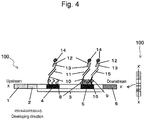
- the amplification reaction products were then applied to the device 100 produced in Example 1, and color signals emitted from a complex formed by binding the amplification reaction products with a labeled probe were then detected.
- the detection is illustrated in Figure 4 .
- a plan view of the nucleic acid device 100 is shown on the right side, and a schematic figure of the X-X' cross-section of the plan view is shown on the left side.
- the base material 110 is omitted, and the ratio of the dimensions of the sample pad 1, the conjugate pad 2, the solid phase carrier 3, the target detection portion 4, the control detection portion 5 and the absorbent pad 6 is appropriately changed for convenience.
- the single-stranded nucleic acid tagged primer used in the present study consists of a primer part able to bind to each nucleic acid to be amplified, and a single-stranded nucleic acid tag that has been added to the 5'-terminal side of the primer part via a polymerase reaction inhibition region (X).
- a pUC19 forward primer SEQ ID NO: 6
- a pUC19 reverse primer SEQ ID NO: 7
- each primer part a single-stranded nucleic acid tag was bound via azobenzene used as a polymerase reaction inhibition region (X), so as to design a single-stranded nucleic acid tagged primer.
- azobenzene used as a polymerase reaction inhibition region (X)
- a primer T1-X-F1 (SEQ ID NO: 10), in which a single-stranded nucleic acid tag T1 (SEQ ID NO: 8) was added to the 5'-terminal side of the pUC19 forward primer via azobenzene
- a primer T2-X-R1 (SEQ ID NO: 11), in which a single-stranded nucleic acid tag T2 (SEQ ID NO: 9) was added to the pUC19 reverse primer
- a primer T3-X-F2 (SEQ ID NO: 15), in which a single-stranded nucleic acid tag T3 (SEQ ID NO: 14) was added to the ⁇ phage DNA forward primer
- a primer T2-X-R2 (SEQ ID NO: 16), in which a single-stranded nucleic acid tag T2 (SEQ ID NO: 9) was added to the ⁇ phage DNA reverse primer
- X is represented by the following formula (X).
- PCR was carried out. 15 pg of the primer set shown in SEQ ID NOs: 10 and 11 and 15 pg of the primer set shown in SEQ ID NOs: 15 and 16, 10 pg of pUC19, and 1 pg of ⁇ phage DNA were added into a 0.2-ml PCR tube, and 100 ⁇ l of PCR sample solution (A) was prepared according to the instruction manual of TaKaRa Ex Taq (R) (manufactured by Takara Bio, Inc.).
- PCR sample solution (B) comprising the above-described primer set, 100 pg of pUC19 and 1 pg of ⁇ phage DNA
- PCR sample solution (C) comprising the above-described primer set, 1000 pg of pUC19 and 1 pg of ⁇ phage DNA
- each tube was equipped into a thermal cycler (GeneAmp PCR System 9700 (manufactured by Applied Biosystem)).
- the sample solution was subjected to a heat treatment at 95°C for 5 minutes, and was then treated at 95°C for 30 seconds, at 55°C for 30 seconds, and at 72°C for 30 seconds, for 35 cycles, so as to obtain an amplification reaction product.
- a solution comprising sterilized water and 1 pg of ⁇ phage DNA, instead of pUC19, was prepared, and PCR was then carried out thereon in the same manner as described above, so as to obtain a negative control (D).
- the amplification reaction products prepared from the samples (A) to (D) in the above (2) of the present example were not denatured by any denaturing treatment such as heating, but were directly applied to a sample pad 1 of the nucleic acid detection device 100 produced in Example 1, and thereafter, a detection test was carried out.
- the results were judged by measuring the color intensity of a line using a chromatoreader C10066-10 (manufactured by Hamamatsu Photonics K. K.) 10 minutes after application of each product.
- the results are shown in Table 1.
- the judgment criteria for the measurement values obtained by the chromatoreader are shown in Table 2. In Table 2, the symbol
- a conjugate pad 2 was produced by the same method as that applied in Example 1(1).
- a mixed solution of 200 ⁇ l of 100 ⁇ M probe A (SEQ ID NO: 2), 200 ⁇ l of 1 M NaCl, 100 ⁇ l of 1% BSA solution and 500 ⁇ l of 5 mM phosphate buffer was applied to a target detection portion 4, and a mixed solution of 200 ⁇ l of 100 ⁇ M probe A (SEQ ID NO: 2), 200 ⁇ l of 100 ⁇ M probe B (SEQ ID NO: 3), 200 ⁇ l of 1 M NaCl, 100 ⁇ l of 1% BSA solution and 300 ⁇ l of 5 mM phosphate buffer was applied to a control detection portion 5, and thereafter, each probe-immobilized solid phase carrier 3 was produced by the same method as that applied in Example 1(2).
- a nucleic acid detection device 100 was produced by the same method as that applied in Example 1(3), using a base material 110 consisting of a backing sheet, a nitrocellulose membrane 3 on which the probe produced in Example 1(2) was immobilized, and the conjugate pad 2 produced in the above (1) of the present example.
- a nucleic acid detection device 100 was produced by the same method as that applied in Example 3, with the exception that a mixed solution of 200 ⁇ l of 100 ⁇ M probe B (SEQ ID NO: 3), 200 ⁇ l of 1 M NaCl, 100 ⁇ l of 1% BSA solution and 300 ⁇ l of 5 mM phosphate buffer was applied in a line to the control detection portion 5.
- Example 2 As with Example 2, pUC19 (manufactured by Takara Bio, Inc.) was employed as a target nucleic acid to be detected, and ⁇ phage DNA (manufactured by Eurofins Genomics K. K.) was employed as a control nucleic acid. Using each of these nucleic acids as a template, PCR was carried out with a single-stranded nucleic acid tagged forward primer and a biotin-modified reverse primer. Thereafter, the amplification reaction product was applied to the device 100 produced in Example 3, and color signals emitted from a complex formed by binding the amplification reaction product with a labeled probe were detected. The detection is illustrated in Figure 6 .
- a pUC19 forward primer the primer shown in SEQ ID NO: 10, which had been designed in Example 2(1), was selected.
- a primer Biotinylated-R1 SEQ ID NO: 17
- a primer Biotinylated-R2 SEQ ID NO: 18
- the primer set designed in the present study is shown below.
- the samples (A) to (D) were prepared according to the preparation method described in Example 2(2), using the primer set shown in SEQ ID NOs: 10 and 17 and the primer set shown in SEQ ID NOs: 15 and 18, which had been designed in the above (1). Thereafter, PCR was carried out under the same conditions as those in Example 2(2).
- the amplification reaction products prepared from the samples (A) to (D) in the above (2) of the present example were not denatured by any denaturing treatment such as heating, but were directly applied to a sample pad 1 of the nucleic acid detection device 100 produced in Example 3, and thereafter, a detection test was carried out.
- the results were judged by measuring the color intensity of a line using a chromatoreader C10066-10 (manufactured by Hamamatsu Photonics K. K.) 10 minutes after application of each product. The results are shown in Table 3.
- large quantities of target nucleic acids e.g. 1000 pg
- pUC19 (manufactured by Takara Bio, Inc.) was employed as a target nucleic acid
- ⁇ phage DNA (manufactured by Eurofins Genomics K. K.) was employed as a control nucleic acid.
- These nucleic acids were used as templates.
- a primer set, and dNTP comprising biotin-labeled 16-dUTP (manufactured by Roche Applied Science) as a reaction substrate, PCR was carried out. Thereafter, the amplification reaction product was applied to the device 100 produced in Example 3, and color signals emitted from a complex formed by binding the amplification reaction product with a labeled probe were detected.
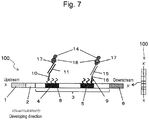
- the detection using the device 100 produced in Example 3 is illustrated in Figure 8 .
- the primer shown in SEQ ID NO: 10 was selected, and as a pUC19 reverse primer, the primer shown in SEQ ID NO: 7 was selected.
- the primer shown in SEQ ID NO: 15 was selected, and as a ⁇ phage DNA reverse primer, the primer shown in SEQ ID NO: 13 was selected.
- PCR was carried out using the above-described primer set.
- the samples (A) to (D) were prepared according to the preparation method described in Example 2(2), using the primer set shown in SEQ ID NOs: 7 and 10, the primer set shown in SEQ ID NOs: 13 and 15, dNTP included with TaKaRa Ex Taq (R) (manufactured by Takara Bio, Inc.), and also, biotin-labeled 16-dUTP (manufactured by Roche Applied Science). Thereafter, PCR was carried out under the same conditions as those in Example 2(2).
- the amplification reaction products prepared from the samples (A) to (D) in the above (2) of the present example were not denatured by any denaturing treatment such as heating, but were directly applied to a sample pad 1 of the nucleic acid detection device 100 produced in Example 3, and thereafter, a detection test was carried out.
- the results were judged by measuring the color intensity of a line using a chromatoreader C10066-10 (manufactured by Hamamatsu Photonics K. K.) 10 minutes after application of each product. The results are shown in Table 4.
- large quantities of target nucleic acids e.g. 1000 pg
- a solution comprising a 2.0 mg/ml of anti-DIG antibody (manufactured by Roche Applied Science), 2.5% sucrose, and 20 mM TBS (pH 8.0) was prepared.
- a probe mixed solution to be used in the control detection portion 5 a solution comprising a 1.0 mg/ml of anti-DIG antibody (manufactured by Roche Applied Science) and an anti-FITC antibody (manufactured by Roche Applied Science), 2.5% sucrose, and 20 mM TBS (pH 8.0) was prepared.
- a probe-immobilized solid phase carrier 3 was produced by the same method as that applied in Example 1(2).
- a nucleic acid detection device 100 was produced by the same method as that applied in Example 1(3), using a base material 110 consisting of a backing sheet, the nitrocellulose membrane 3 as a solid phase carrier produced in the above (1) of the present example, and the conjugate pad 2 produced in Example 1(1).
- a nucleic acid detection device 100 was produced by the same method as that applied in Example 6, with the exception that, as a probe mixed solution used in the control detection portion 5, a mixed solution comprising 2.0 mg/ml of anti-FITC antibody (manufactured by Roche Applied Science), 2.5% sucrose and 20 mM TBS (pH 8.0) was applied in a line to the control detection portion 5.
- a probe mixed solution used in the control detection portion 5 a mixed solution comprising 2.0 mg/ml of anti-FITC antibody (manufactured by Roche Applied Science), 2.5% sucrose and 20 mM TBS (pH 8.0) was applied in a line to the control detection portion 5.
- Example 2 As with Example 2, pUC19 (manufactured by Takara Bio, Inc.) was employed as a target nucleic acid, and ⁇ phage DNA (manufactured by Eurofins Genomics K. K.) was employed as a control nucleic acid. These nucleic acids were used as templates. Using the templates and a primer set, PCR was carried out. Thereafter, the amplification reaction product was applied to the device 100 produced in Example 6, and color signals emitted from a complex formed by binding the amplification reaction product with a labeled probe were detected. The detection using the device 100 produced in Example 6 is illustrated in Figure 10 .
- a primer DIG-F1 (SEQ ID NO: 19), in which the 5'-terminal side of a primer part was modified with DIG, was designed.
- a pUC19 reverse primer the primer shown in SEQ ID NO: 11 was selected.
- a primer FITC-F2 (SEQ ID NO: 20), in which the 5'-terminal side of a primer part was modified with FITC, was designed.
- a ⁇ phage DNA reverse primer the primer shown in SEQ ID NO: 16 was selected.
- DIG-modified primers FITC-modified primers and single-stranded nucleic acid tagged primers were synthesized by TSUKUBA OLIGO SERVICE CO., LTD., and were then acquired from the company.
- the primer set designed in the present study is shown below.
- PCR was carried out using the above-described primer set.
- the samples (A) to (D) were prepared according to the preparation method described in Example 2(2), using the primer set shown in SEQ ID NOs: 11 and 19, and the primer set shown in SEQ ID NOs: 16 and 20. Thereafter, PCR was carried out under the same conditions as those in Example 2(2).
- the amplification reaction products prepared from the samples (A) to (D) in the above (2) of present example were not denatured by any denaturing treatment such as heating, but were directly applied to a sample pad 1 of the nucleic acid detection device 100 produced in Example 6, and thereafter, a detection test was carried out.
- the results were judged by measuring the color intensity of a line using a chromatoreader C10066-10 (manufactured by Hamamatsu Photonics K. K.) 10 minutes after application of each product. The results are shown in Table 5.
- large quantities of target nucleic acids e.g. 1000 pg
- tagged primers were designed, such that two types of amplified products of a target nucleic acid, namely, a target nucleic acid having a tag to be specifically captured on a target detection portion 4 and a target nucleic acid having a tag to be specifically captured on a control detection portion 5 were amplified, and such that one of the two types of amplified products is captured on the control detection portion 5.
- the detection of the present example is illustrated in Figure 12 . As shown in Figure 12 , the amplification reaction product of either one of the aforementioned two types of target nucleic acids was captured on the control detection portion 5.
- pUC19 manufactured by Takara Bio, Inc.
- ⁇ phage DNA manufactured by Eurofins Genomics K. K.
- the amplification reaction product was applied to the device 100 produced in Comparative Example 1, and color signals emitted from a complex formed by binding the amplification reaction product with a labeled probe were detected.
- primers shown in SEQ ID NOs: 10 and 11 were selected.
- a primer T3-X-F1 was designed by adding a single-stranded nucleic acid tag T3 (SEQ ID NO: 14) to the 5'-terminal side of the forward primer shown in SEQ ID NO: 6 via azobenzene used as a polymerase reaction inhibition region (X).
- SEQ ID NO: 14 primers shown in SEQ ID NO: 14
- primers shown in SEQ ID NOs: 11 and 21 were selected.
- a primer set shown in SEQ ID NOs: 15 and 16 was selected.
- the samples (A) to (D) were prepared according to the preparation method described in Example 2(2), using the three types of primer sets, namely, the primer set shown in SEQ ID NOs: 10 and 11, the primer set shown in SEQ ID NOs: 11 and 21, the primer set shown in SEQ ID NOs: 15 and 16, which had been designed in the above (1) of the present example. Using these samples, PCR was carried out under the same conditions as those applied in Example 2(2).
- the amplification reaction products prepared from the samples (A) to (D) in the above (2) of the present example were not denatured by any denaturing treatment such as heating, but were directly applied to a sample pad 1 of the nucleic acid detection device 100 produced in Comparative Example 1, and thereafter, a detection test was carried out.
- the results were judged by measuring the color intensity of a line using a chromatoreader C10066-10 (manufactured by Hamamatsu Photonics K. K.) 10 minutes after application of each product. The results are shown in Table 6.
- Example 8 two types of target nucleic acids, namely, a target nucleic acid having a tag to be specifically captured on a target detection portion 4 and a target nucleic acid having a tag to be specifically captured on a control detection portion 5, were prepared.
- a detection device 100 a device, in which one type of probe was immobilized both on the target detection portion 4 and on the control detection portion 5, was used.
- target nucleic acids were detected not only in the target detection portion 4, but also in the control detection portion 5.
- signals derived from the target nucleic acids could be detected in the control detection portion 5, even under conditions in which 1000 pg of the target nucleic acids and 1 pg of the control nucleic acid were present.
- the present invention is described with reference to embodiments and comparative embodiments.
- the present invention is not limited to the above-described embodiments and comparative embodiments.
- the present embodiment can also be carried out by applying a detection method using the dip stick-type device 100 or the array-type device 100, or a detection method comprising subjecting the amplified and/or labeled product to a heat treatment and then detecting it in the form of a single strand, or a method of using a sugar chain as a tag and using lection as a probe to be immobilized on a carrier.
Landscapes
- Health & Medical Sciences (AREA)
- Life Sciences & Earth Sciences (AREA)
- Chemical & Material Sciences (AREA)
- Engineering & Computer Science (AREA)
- Immunology (AREA)
- Organic Chemistry (AREA)
- Zoology (AREA)
- Wood Science & Technology (AREA)
- Biotechnology (AREA)
- Molecular Biology (AREA)
- Analytical Chemistry (AREA)
- General Health & Medical Sciences (AREA)
- Microbiology (AREA)
- Biochemistry (AREA)
- Bioinformatics & Cheminformatics (AREA)
- Biomedical Technology (AREA)
- Proteomics, Peptides & Aminoacids (AREA)
- Physics & Mathematics (AREA)
- Urology & Nephrology (AREA)
- Hematology (AREA)
- Genetics & Genomics (AREA)
- General Engineering & Computer Science (AREA)
- Medicinal Chemistry (AREA)
- Biophysics (AREA)
- Cell Biology (AREA)
- Food Science & Technology (AREA)
- General Physics & Mathematics (AREA)
- Pathology (AREA)
- Sustainable Development (AREA)
- Measuring Or Testing Involving Enzymes Or Micro-Organisms (AREA)
- Apparatus Associated With Microorganisms And Enzymes (AREA)
Applications Claiming Priority (2)
| Application Number | Priority Date | Filing Date | Title |
|---|---|---|---|
| JP2015167198 | 2015-08-26 | ||
| PCT/JP2016/074953 WO2017034019A1 (ja) | 2015-08-26 | 2016-08-26 | 核酸検出用デバイス及び核酸検出方法 |
Publications (3)
| Publication Number | Publication Date |
|---|---|
| EP3342851A1 true EP3342851A1 (de) | 2018-07-04 |
| EP3342851A4 EP3342851A4 (de) | 2019-04-03 |
| EP3342851B1 EP3342851B1 (de) | 2022-11-30 |
Family
ID=58100562
Family Applications (1)
| Application Number | Title | Priority Date | Filing Date |
|---|---|---|---|
| EP16839366.8A Active EP3342851B1 (de) | 2015-08-26 | 2016-08-26 | Nukleinsäuredetektionsvorrichtung und nukleinsäuredetektionsverfahren |
Country Status (5)
| Country | Link |
|---|---|
| US (1) | US20180251835A1 (de) |
| EP (1) | EP3342851B1 (de) |
| JP (1) | JP6829198B2 (de) |
| CN (1) | CN107922908A (de) |
| WO (1) | WO2017034019A1 (de) |
Families Citing this family (2)
| Publication number | Priority date | Publication date | Assignee | Title |
|---|---|---|---|---|
| DE102018222357A1 (de) * | 2018-12-19 | 2020-06-25 | Fraunhofer-Gesellschaft zur Förderung der angewandten Forschung e.V. | In-vitro-Verfahren zum Nachweis von mindestens einer Nukleinsäure, die sich bei einem Lebewesen im Vollblut außerhalb der Blutzellen befindet und Vorrichtung und Kit hierzu |
| CN116064945A (zh) * | 2022-09-05 | 2023-05-05 | 深圳市研元生物科技有限公司 | 一种快速检测宠物病原体核酸检测的试剂、试剂盒及其应用 |
Family Cites Families (14)
| Publication number | Priority date | Publication date | Assignee | Title |
|---|---|---|---|---|
| CN1136319C (zh) * | 1999-08-23 | 2004-01-28 | 谢佐福 | 一种基因快速诊断金标试条及其制备方法 |
| EP1737985B1 (de) * | 2004-04-07 | 2015-12-30 | Access Bio, Inc. | System für den nachweis von nukleinsäuren |
| JP4268944B2 (ja) * | 2005-01-21 | 2009-05-27 | 株式会社カイノス | 核酸の検出あるいは定量方法 |
| WO2007116298A2 (en) * | 2006-04-10 | 2007-10-18 | 3M Innovative Properties Company | Nucleic acid detection using lateral flow methods |
| WO2009027932A1 (en) * | 2007-08-27 | 2009-03-05 | Koninklijke Philips Electronics N.V. | Assay substrate and a method for preparation |
| WO2010139767A1 (de) * | 2009-06-04 | 2010-12-09 | Qiagen Gmbh | Amplifikation komplexer nukleinsäuren |
| US9121054B2 (en) * | 2009-12-08 | 2015-09-01 | Biohelix Corporation | Detection of nucleic acid amplification products in the presence of an internal control sequence on an immunochromatographic strip |
| CN101818200A (zh) * | 2010-03-04 | 2010-09-01 | 宁波博奥生物工程有限公司 | 创伤弧菌核酸定量检测试纸条 |
| MY150966A (en) * | 2010-03-08 | 2014-03-31 | Universiti Sains Malaysia Usm | Lateral flow device and method of detection of nucleic acid sequence |
| SG190377A1 (en) * | 2010-11-24 | 2013-06-28 | Kaneka Corp | Amplified nucleic acid detection method and detection device |
| JP5918981B2 (ja) * | 2011-11-18 | 2016-05-18 | 日本碍子株式会社 | 標的ポリヌクレオチドの検出用剤及びその利用 |
| WO2013122453A1 (en) * | 2012-02-15 | 2013-08-22 | Universiti Sains Malaysia | Device and method for detection of nucleic acid(s) |
| DE102013000682B3 (de) * | 2013-01-08 | 2013-10-31 | Rainer Hintsche | Verfahren zur Detektion von Molekülen |
| CN104099413B (zh) * | 2014-06-18 | 2016-03-09 | 苏州市外来有害生物防控技术中心 | 美国白蛾恒温核酸检测试剂盒及其检测方法 |
-
2016
- 2016-08-26 CN CN201680049370.1A patent/CN107922908A/zh active Pending
- 2016-08-26 JP JP2017536487A patent/JP6829198B2/ja active Active
- 2016-08-26 WO PCT/JP2016/074953 patent/WO2017034019A1/ja not_active Ceased
- 2016-08-26 EP EP16839366.8A patent/EP3342851B1/de active Active
-
2018
- 2018-02-26 US US15/905,497 patent/US20180251835A1/en not_active Abandoned
Also Published As
| Publication number | Publication date |
|---|---|
| WO2017034019A1 (ja) | 2017-03-02 |
| JPWO2017034019A1 (ja) | 2018-06-07 |
| EP3342851B1 (de) | 2022-11-30 |
| JP6829198B2 (ja) | 2021-02-10 |
| US20180251835A1 (en) | 2018-09-06 |
| EP3342851A4 (de) | 2019-04-03 |
| CN107922908A (zh) | 2018-04-17 |
Similar Documents
| Publication | Publication Date | Title |
|---|---|---|
| JP5409360B2 (ja) | 酵素反応における試料中のcDNAの合成方法 | |
| US7244567B2 (en) | Double ended sequencing | |
| US20030175706A1 (en) | Nucleic acid amplification methods | |
| EP3550032B1 (de) | Analytanreicherungsverfahren und -zusammensetzungen | |
| CA2975088A1 (en) | Method for detecting a target nucleic acid in a sample using a downstream detector oligo and an upstream detector oligo | |
| CN104838014A (zh) | 用于标靶核酸富集的组合物、方法、系统和试剂盒 | |
| EP1343916A2 (de) | Nukleinsäureamplifikationsverfahren | |
| JP2012055311A (ja) | 増幅用一般バッファー | |
| US20040137484A1 (en) | Nucleic acid amplification methods | |
| EP1162278B1 (de) | Verfahren zur Quantifizierung von spezifischen Nukleinsäuren durch isomere Primerverlängerung | |
| EP3342851B1 (de) | Nukleinsäuredetektionsvorrichtung und nukleinsäuredetektionsverfahren | |
| JP2009543582A (ja) | 一般化された方法―特異的な配列補完(dsf)により可能になる連続的アダプター連結および増幅を用いたハイスループット突然変異スクリーニング法およびキット | |
| EP3303637B1 (de) | Probe zur sequenzierung | |
| EP1275734A1 (de) | Verfahren zur zufällige Synthese und Amplifikation komplementäres DNA | |
| JP2010535525A (ja) | 酵素反応においてサンプル中でcDNAを合成するための方法 | |
| EP2743355B1 (de) | HAV-Detektion | |
| EP2660332B1 (de) | Positives Steuerkonzept | |
| JP7651477B2 (ja) | プライマーセット及びそれを用いて標的核酸を検出する方法 | |
| US20050227261A1 (en) | Method for sequencing-by-synthesis | |
| US20090081650A1 (en) | Method for Identifying Nucleotide Sequences, Use of the Method and Test Kit | |
| WO2005061722A1 (en) | Nucleic acid amplification methods | |
| WO2005060345A2 (en) | New method for sequencing-by-synthesis | |
| EP1679381A1 (de) | Verfahren zur isomeren Primerverlängerung und Reagenziensatz zum Nachweis und zur Quantifizierung von spezifischen Nukleinsäuren | |
| WO2018077891A1 (en) | Method for detecting rsv by strand-invasion based dna amplification |
Legal Events
| Date | Code | Title | Description |
|---|---|---|---|
| STAA | Information on the status of an ep patent application or granted ep patent |
Free format text: STATUS: THE INTERNATIONAL PUBLICATION HAS BEEN MADE |
|
| PUAI | Public reference made under article 153(3) epc to a published international application that has entered the european phase |
Free format text: ORIGINAL CODE: 0009012 |
|
| STAA | Information on the status of an ep patent application or granted ep patent |
Free format text: STATUS: REQUEST FOR EXAMINATION WAS MADE |
|
| 17P | Request for examination filed |
Effective date: 20180226 |
|
| AK | Designated contracting states |
Kind code of ref document: A1 Designated state(s): AL AT BE BG CH CY CZ DE DK EE ES FI FR GB GR HR HU IE IS IT LI LT LU LV MC MK MT NL NO PL PT RO RS SE SI SK SM TR |
|
| AX | Request for extension of the european patent |
Extension state: BA ME |
|
| DAV | Request for validation of the european patent (deleted) | ||
| DAX | Request for extension of the european patent (deleted) | ||
| A4 | Supplementary search report drawn up and despatched |
Effective date: 20190304 |
|
| RIC1 | Information provided on ipc code assigned before grant |
Ipc: C12Q 1/68 20180101ALI20190226BHEP Ipc: C12M 1/34 20060101AFI20190226BHEP Ipc: G01N 33/543 20060101ALI20190226BHEP Ipc: C12Q 1/6834 20180101ALI20190226BHEP Ipc: C12N 15/09 20060101ALI20190226BHEP Ipc: G01N 33/53 20060101ALI20190226BHEP |
|
| STAA | Information on the status of an ep patent application or granted ep patent |
Free format text: STATUS: EXAMINATION IS IN PROGRESS |
|
| 17Q | First examination report despatched |
Effective date: 20220301 |
|
| REG | Reference to a national code |
Ref country code: DE Ref legal event code: R079 Ref document number: 602016076658 Country of ref document: DE Free format text: PREVIOUS MAIN CLASS: C12M0001340000 Ipc: C12Q0001680000 |
|
| GRAP | Despatch of communication of intention to grant a patent |
Free format text: ORIGINAL CODE: EPIDOSNIGR1 |
|
| STAA | Information on the status of an ep patent application or granted ep patent |
Free format text: STATUS: GRANT OF PATENT IS INTENDED |
|
| RIC1 | Information provided on ipc code assigned before grant |
Ipc: C12N 15/09 20060101ALI20220523BHEP Ipc: G01N 33/543 20060101ALI20220523BHEP Ipc: G01N 33/53 20060101ALI20220523BHEP Ipc: C12M 1/34 20060101ALI20220523BHEP Ipc: C12Q 1/6834 20180101ALI20220523BHEP Ipc: C12Q 1/68 20180101AFI20220523BHEP |
|
| INTG | Intention to grant announced |
Effective date: 20220627 |
|
| GRAS | Grant fee paid |
Free format text: ORIGINAL CODE: EPIDOSNIGR3 |
|
| GRAA | (expected) grant |
Free format text: ORIGINAL CODE: 0009210 |
|
| STAA | Information on the status of an ep patent application or granted ep patent |
Free format text: STATUS: THE PATENT HAS BEEN GRANTED |
|
| AK | Designated contracting states |
Kind code of ref document: B1 Designated state(s): AL AT BE BG CH CY CZ DE DK EE ES FI FR GB GR HR HU IE IS IT LI LT LU LV MC MK MT NL NO PL PT RO RS SE SI SK SM TR |
|
| REG | Reference to a national code |
Ref country code: CH Ref legal event code: EP Ref country code: GB Ref legal event code: FG4D |
|
| REG | Reference to a national code |
Ref country code: AT Ref legal event code: REF Ref document number: 1534715 Country of ref document: AT Kind code of ref document: T Effective date: 20221215 |
|
| REG | Reference to a national code |
Ref country code: IE Ref legal event code: FG4D |
|
| REG | Reference to a national code |
Ref country code: DE Ref legal event code: R096 Ref document number: 602016076658 Country of ref document: DE |
|
| REG | Reference to a national code |
Ref country code: LT Ref legal event code: MG9D |
|
| REG | Reference to a national code |
Ref country code: NL Ref legal event code: MP Effective date: 20221130 |
|
| PG25 | Lapsed in a contracting state [announced via postgrant information from national office to epo] |
Ref country code: SE Free format text: LAPSE BECAUSE OF FAILURE TO SUBMIT A TRANSLATION OF THE DESCRIPTION OR TO PAY THE FEE WITHIN THE PRESCRIBED TIME-LIMIT Effective date: 20221130 Ref country code: PT Free format text: LAPSE BECAUSE OF FAILURE TO SUBMIT A TRANSLATION OF THE DESCRIPTION OR TO PAY THE FEE WITHIN THE PRESCRIBED TIME-LIMIT Effective date: 20230331 Ref country code: NO Free format text: LAPSE BECAUSE OF FAILURE TO SUBMIT A TRANSLATION OF THE DESCRIPTION OR TO PAY THE FEE WITHIN THE PRESCRIBED TIME-LIMIT Effective date: 20230228 Ref country code: LT Free format text: LAPSE BECAUSE OF FAILURE TO SUBMIT A TRANSLATION OF THE DESCRIPTION OR TO PAY THE FEE WITHIN THE PRESCRIBED TIME-LIMIT Effective date: 20221130 Ref country code: FI Free format text: LAPSE BECAUSE OF FAILURE TO SUBMIT A TRANSLATION OF THE DESCRIPTION OR TO PAY THE FEE WITHIN THE PRESCRIBED TIME-LIMIT Effective date: 20221130 Ref country code: ES Free format text: LAPSE BECAUSE OF FAILURE TO SUBMIT A TRANSLATION OF THE DESCRIPTION OR TO PAY THE FEE WITHIN THE PRESCRIBED TIME-LIMIT Effective date: 20221130 |
|
| REG | Reference to a national code |
Ref country code: AT Ref legal event code: MK05 Ref document number: 1534715 Country of ref document: AT Kind code of ref document: T Effective date: 20221130 |
|
| PG25 | Lapsed in a contracting state [announced via postgrant information from national office to epo] |
Ref country code: RS Free format text: LAPSE BECAUSE OF FAILURE TO SUBMIT A TRANSLATION OF THE DESCRIPTION OR TO PAY THE FEE WITHIN THE PRESCRIBED TIME-LIMIT Effective date: 20221130 Ref country code: PL Free format text: LAPSE BECAUSE OF FAILURE TO SUBMIT A TRANSLATION OF THE DESCRIPTION OR TO PAY THE FEE WITHIN THE PRESCRIBED TIME-LIMIT Effective date: 20221130 Ref country code: LV Free format text: LAPSE BECAUSE OF FAILURE TO SUBMIT A TRANSLATION OF THE DESCRIPTION OR TO PAY THE FEE WITHIN THE PRESCRIBED TIME-LIMIT Effective date: 20221130 Ref country code: IS Free format text: LAPSE BECAUSE OF FAILURE TO SUBMIT A TRANSLATION OF THE DESCRIPTION OR TO PAY THE FEE WITHIN THE PRESCRIBED TIME-LIMIT Effective date: 20230330 Ref country code: HR Free format text: LAPSE BECAUSE OF FAILURE TO SUBMIT A TRANSLATION OF THE DESCRIPTION OR TO PAY THE FEE WITHIN THE PRESCRIBED TIME-LIMIT Effective date: 20221130 Ref country code: GR Free format text: LAPSE BECAUSE OF FAILURE TO SUBMIT A TRANSLATION OF THE DESCRIPTION OR TO PAY THE FEE WITHIN THE PRESCRIBED TIME-LIMIT Effective date: 20230301 |
|
| PG25 | Lapsed in a contracting state [announced via postgrant information from national office to epo] |
Ref country code: NL Free format text: LAPSE BECAUSE OF FAILURE TO SUBMIT A TRANSLATION OF THE DESCRIPTION OR TO PAY THE FEE WITHIN THE PRESCRIBED TIME-LIMIT Effective date: 20221130 |
|
| PG25 | Lapsed in a contracting state [announced via postgrant information from national office to epo] |
Ref country code: SM Free format text: LAPSE BECAUSE OF FAILURE TO SUBMIT A TRANSLATION OF THE DESCRIPTION OR TO PAY THE FEE WITHIN THE PRESCRIBED TIME-LIMIT Effective date: 20221130 Ref country code: RO Free format text: LAPSE BECAUSE OF FAILURE TO SUBMIT A TRANSLATION OF THE DESCRIPTION OR TO PAY THE FEE WITHIN THE PRESCRIBED TIME-LIMIT Effective date: 20221130 Ref country code: EE Free format text: LAPSE BECAUSE OF FAILURE TO SUBMIT A TRANSLATION OF THE DESCRIPTION OR TO PAY THE FEE WITHIN THE PRESCRIBED TIME-LIMIT Effective date: 20221130 Ref country code: DK Free format text: LAPSE BECAUSE OF FAILURE TO SUBMIT A TRANSLATION OF THE DESCRIPTION OR TO PAY THE FEE WITHIN THE PRESCRIBED TIME-LIMIT Effective date: 20221130 Ref country code: CZ Free format text: LAPSE BECAUSE OF FAILURE TO SUBMIT A TRANSLATION OF THE DESCRIPTION OR TO PAY THE FEE WITHIN THE PRESCRIBED TIME-LIMIT Effective date: 20221130 Ref country code: AT Free format text: LAPSE BECAUSE OF FAILURE TO SUBMIT A TRANSLATION OF THE DESCRIPTION OR TO PAY THE FEE WITHIN THE PRESCRIBED TIME-LIMIT Effective date: 20221130 |
|
| PG25 | Lapsed in a contracting state [announced via postgrant information from national office to epo] |
Ref country code: SK Free format text: LAPSE BECAUSE OF FAILURE TO SUBMIT A TRANSLATION OF THE DESCRIPTION OR TO PAY THE FEE WITHIN THE PRESCRIBED TIME-LIMIT Effective date: 20221130 Ref country code: AL Free format text: LAPSE BECAUSE OF FAILURE TO SUBMIT A TRANSLATION OF THE DESCRIPTION OR TO PAY THE FEE WITHIN THE PRESCRIBED TIME-LIMIT Effective date: 20221130 |
|
| REG | Reference to a national code |
Ref country code: DE Ref legal event code: R097 Ref document number: 602016076658 Country of ref document: DE |
|
| PLBE | No opposition filed within time limit |
Free format text: ORIGINAL CODE: 0009261 |
|
| STAA | Information on the status of an ep patent application or granted ep patent |
Free format text: STATUS: NO OPPOSITION FILED WITHIN TIME LIMIT |
|
| 26N | No opposition filed |
Effective date: 20230831 |
|
| PG25 | Lapsed in a contracting state [announced via postgrant information from national office to epo] |
Ref country code: SI Free format text: LAPSE BECAUSE OF FAILURE TO SUBMIT A TRANSLATION OF THE DESCRIPTION OR TO PAY THE FEE WITHIN THE PRESCRIBED TIME-LIMIT Effective date: 20221130 |
|
| PG25 | Lapsed in a contracting state [announced via postgrant information from national office to epo] |
Ref country code: MC Free format text: LAPSE BECAUSE OF FAILURE TO SUBMIT A TRANSLATION OF THE DESCRIPTION OR TO PAY THE FEE WITHIN THE PRESCRIBED TIME-LIMIT Effective date: 20221130 |
|
| REG | Reference to a national code |
Ref country code: CH Ref legal event code: PL |
|
| PG25 | Lapsed in a contracting state [announced via postgrant information from national office to epo] |
Ref country code: MC Free format text: LAPSE BECAUSE OF FAILURE TO SUBMIT A TRANSLATION OF THE DESCRIPTION OR TO PAY THE FEE WITHIN THE PRESCRIBED TIME-LIMIT Effective date: 20221130 |
|
| PG25 | Lapsed in a contracting state [announced via postgrant information from national office to epo] |
Ref country code: LU Free format text: LAPSE BECAUSE OF NON-PAYMENT OF DUE FEES Effective date: 20230826 |
|
| PG25 | Lapsed in a contracting state [announced via postgrant information from national office to epo] |
Ref country code: LU Free format text: LAPSE BECAUSE OF NON-PAYMENT OF DUE FEES Effective date: 20230826 Ref country code: CH Free format text: LAPSE BECAUSE OF NON-PAYMENT OF DUE FEES Effective date: 20230831 |
|
| REG | Reference to a national code |
Ref country code: BE Ref legal event code: MM Effective date: 20230831 |
|
| REG | Reference to a national code |
Ref country code: IE Ref legal event code: MM4A |
|
| PG25 | Lapsed in a contracting state [announced via postgrant information from national office to epo] |
Ref country code: IT Free format text: LAPSE BECAUSE OF FAILURE TO SUBMIT A TRANSLATION OF THE DESCRIPTION OR TO PAY THE FEE WITHIN THE PRESCRIBED TIME-LIMIT Effective date: 20221130 |
|
| PG25 | Lapsed in a contracting state [announced via postgrant information from national office to epo] |
Ref country code: IE Free format text: LAPSE BECAUSE OF NON-PAYMENT OF DUE FEES Effective date: 20230826 |
|
| PG25 | Lapsed in a contracting state [announced via postgrant information from national office to epo] |
Ref country code: IE Free format text: LAPSE BECAUSE OF NON-PAYMENT OF DUE FEES Effective date: 20230826 |
|
| PG25 | Lapsed in a contracting state [announced via postgrant information from national office to epo] |
Ref country code: BE Free format text: LAPSE BECAUSE OF NON-PAYMENT OF DUE FEES Effective date: 20230831 |
|
| PG25 | Lapsed in a contracting state [announced via postgrant information from national office to epo] |
Ref country code: BG Free format text: LAPSE BECAUSE OF FAILURE TO SUBMIT A TRANSLATION OF THE DESCRIPTION OR TO PAY THE FEE WITHIN THE PRESCRIBED TIME-LIMIT Effective date: 20221130 |
|
| PG25 | Lapsed in a contracting state [announced via postgrant information from national office to epo] |
Ref country code: BG Free format text: LAPSE BECAUSE OF FAILURE TO SUBMIT A TRANSLATION OF THE DESCRIPTION OR TO PAY THE FEE WITHIN THE PRESCRIBED TIME-LIMIT Effective date: 20221130 |
|
| PG25 | Lapsed in a contracting state [announced via postgrant information from national office to epo] |
Ref country code: CY Free format text: LAPSE BECAUSE OF FAILURE TO SUBMIT A TRANSLATION OF THE DESCRIPTION OR TO PAY THE FEE WITHIN THE PRESCRIBED TIME-LIMIT; INVALID AB INITIO Effective date: 20160826 |
|
| PG25 | Lapsed in a contracting state [announced via postgrant information from national office to epo] |
Ref country code: HU Free format text: LAPSE BECAUSE OF FAILURE TO SUBMIT A TRANSLATION OF THE DESCRIPTION OR TO PAY THE FEE WITHIN THE PRESCRIBED TIME-LIMIT; INVALID AB INITIO Effective date: 20160826 |
|
| PGFP | Annual fee paid to national office [announced via postgrant information from national office to epo] |
Ref country code: DE Payment date: 20250702 Year of fee payment: 10 |
|
| PGFP | Annual fee paid to national office [announced via postgrant information from national office to epo] |
Ref country code: GB Payment date: 20250703 Year of fee payment: 10 |
|
| PGFP | Annual fee paid to national office [announced via postgrant information from national office to epo] |
Ref country code: FR Payment date: 20250703 Year of fee payment: 10 |
|
| PG25 | Lapsed in a contracting state [announced via postgrant information from national office to epo] |
Ref country code: TR Free format text: LAPSE BECAUSE OF FAILURE TO SUBMIT A TRANSLATION OF THE DESCRIPTION OR TO PAY THE FEE WITHIN THE PRESCRIBED TIME-LIMIT Effective date: 20221130 |