EP3342899A1 - Matière première de dépôt chimique en phase vapeur comprenant un complexe binucléaire du ruthénium et procédé de dépôt chimique en phase vapeur faisant appel à la matière première de dépôt chimique en phase vapeur - Google Patents
Matière première de dépôt chimique en phase vapeur comprenant un complexe binucléaire du ruthénium et procédé de dépôt chimique en phase vapeur faisant appel à la matière première de dépôt chimique en phase vapeur Download PDFInfo
- Publication number
- EP3342899A1 EP3342899A1 EP16839260.3A EP16839260A EP3342899A1 EP 3342899 A1 EP3342899 A1 EP 3342899A1 EP 16839260 A EP16839260 A EP 16839260A EP 3342899 A1 EP3342899 A1 EP 3342899A1
- Authority
- EP
- European Patent Office
- Prior art keywords
- raw material
- vapor deposition
- chemical vapor
- ruthenium
- thin film
- Prior art date
- Legal status (The legal status is an assumption and is not a legal conclusion. Google has not performed a legal analysis and makes no representation as to the accuracy of the status listed.)
- Withdrawn
Links
- 0 CCC(C)N*(*)* Chemical compound CCC(C)N*(*)* 0.000 description 1
Images
Classifications
-
- C—CHEMISTRY; METALLURGY
- C07—ORGANIC CHEMISTRY
- C07F—ACYCLIC, CARBOCYCLIC OR HETEROCYCLIC COMPOUNDS CONTAINING ELEMENTS OTHER THAN CARBON, HYDROGEN, HALOGEN, OXYGEN, NITROGEN, SULFUR, SELENIUM OR TELLURIUM
- C07F15/00—Compounds containing elements of Groups 8, 9, 10 or 18 of the Periodic Table
-
- C—CHEMISTRY; METALLURGY
- C23—COATING METALLIC MATERIAL; COATING MATERIAL WITH METALLIC MATERIAL; CHEMICAL SURFACE TREATMENT; DIFFUSION TREATMENT OF METALLIC MATERIAL; COATING BY VACUUM EVAPORATION, BY SPUTTERING, BY ION IMPLANTATION OR BY CHEMICAL VAPOUR DEPOSITION, IN GENERAL; INHIBITING CORROSION OF METALLIC MATERIAL OR INCRUSTATION IN GENERAL
- C23C—COATING METALLIC MATERIAL; COATING MATERIAL WITH METALLIC MATERIAL; SURFACE TREATMENT OF METALLIC MATERIAL BY DIFFUSION INTO THE SURFACE, BY CHEMICAL CONVERSION OR SUBSTITUTION; COATING BY VACUUM EVAPORATION, BY SPUTTERING, BY ION IMPLANTATION OR BY CHEMICAL VAPOUR DEPOSITION, IN GENERAL
- C23C16/00—Chemical coating by decomposition of gaseous compounds, without leaving reaction products of surface material in the coating, i.e. chemical vapour deposition [CVD] processes
- C23C16/06—Chemical coating by decomposition of gaseous compounds, without leaving reaction products of surface material in the coating, i.e. chemical vapour deposition [CVD] processes characterised by the deposition of metallic material
- C23C16/18—Chemical coating by decomposition of gaseous compounds, without leaving reaction products of surface material in the coating, i.e. chemical vapour deposition [CVD] processes characterised by the deposition of metallic material from metallo-organic compounds
-
- C—CHEMISTRY; METALLURGY
- C07—ORGANIC CHEMISTRY
- C07F—ACYCLIC, CARBOCYCLIC OR HETEROCYCLIC COMPOUNDS CONTAINING ELEMENTS OTHER THAN CARBON, HYDROGEN, HALOGEN, OXYGEN, NITROGEN, SULFUR, SELENIUM OR TELLURIUM
- C07F15/00—Compounds containing elements of Groups 8, 9, 10 or 18 of the Periodic Table
- C07F15/0006—Compounds containing elements of Groups 8, 9, 10 or 18 of the Periodic Table compounds of the platinum group
- C07F15/0046—Ruthenium compounds
-
- C—CHEMISTRY; METALLURGY
- C09—DYES; PAINTS; POLISHES; NATURAL RESINS; ADHESIVES; COMPOSITIONS NOT OTHERWISE PROVIDED FOR; APPLICATIONS OF MATERIALS NOT OTHERWISE PROVIDED FOR
- C09D—COATING COMPOSITIONS, e.g. PAINTS, VARNISHES OR LACQUERS; FILLING PASTES; CHEMICAL PAINT OR INK REMOVERS; INKS; CORRECTING FLUIDS; WOODSTAINS; PASTES OR SOLIDS FOR COLOURING OR PRINTING; USE OF MATERIALS THEREFOR
- C09D1/00—Coating compositions, e.g. paints, varnishes or lacquers, based on inorganic substances
-
- C—CHEMISTRY; METALLURGY
- C09—DYES; PAINTS; POLISHES; NATURAL RESINS; ADHESIVES; COMPOSITIONS NOT OTHERWISE PROVIDED FOR; APPLICATIONS OF MATERIALS NOT OTHERWISE PROVIDED FOR
- C09D—COATING COMPOSITIONS, e.g. PAINTS, VARNISHES OR LACQUERS; FILLING PASTES; CHEMICAL PAINT OR INK REMOVERS; INKS; CORRECTING FLUIDS; WOODSTAINS; PASTES OR SOLIDS FOR COLOURING OR PRINTING; USE OF MATERIALS THEREFOR
- C09D5/00—Coating compositions, e.g. paints, varnishes or lacquers, characterised by their physical nature or the effects produced; Filling pastes
- C09D5/24—Electrically-conducting paints
-
- C—CHEMISTRY; METALLURGY
- C23—COATING METALLIC MATERIAL; COATING MATERIAL WITH METALLIC MATERIAL; CHEMICAL SURFACE TREATMENT; DIFFUSION TREATMENT OF METALLIC MATERIAL; COATING BY VACUUM EVAPORATION, BY SPUTTERING, BY ION IMPLANTATION OR BY CHEMICAL VAPOUR DEPOSITION, IN GENERAL; INHIBITING CORROSION OF METALLIC MATERIAL OR INCRUSTATION IN GENERAL
- C23C—COATING METALLIC MATERIAL; COATING MATERIAL WITH METALLIC MATERIAL; SURFACE TREATMENT OF METALLIC MATERIAL BY DIFFUSION INTO THE SURFACE, BY CHEMICAL CONVERSION OR SUBSTITUTION; COATING BY VACUUM EVAPORATION, BY SPUTTERING, BY ION IMPLANTATION OR BY CHEMICAL VAPOUR DEPOSITION, IN GENERAL
- C23C16/00—Chemical coating by decomposition of gaseous compounds, without leaving reaction products of surface material in the coating, i.e. chemical vapour deposition [CVD] processes
- C23C16/06—Chemical coating by decomposition of gaseous compounds, without leaving reaction products of surface material in the coating, i.e. chemical vapour deposition [CVD] processes characterised by the deposition of metallic material
- C23C16/16—Chemical coating by decomposition of gaseous compounds, without leaving reaction products of surface material in the coating, i.e. chemical vapour deposition [CVD] processes characterised by the deposition of metallic material from metal carbonyl compounds
-
- C—CHEMISTRY; METALLURGY
- C23—COATING METALLIC MATERIAL; COATING MATERIAL WITH METALLIC MATERIAL; CHEMICAL SURFACE TREATMENT; DIFFUSION TREATMENT OF METALLIC MATERIAL; COATING BY VACUUM EVAPORATION, BY SPUTTERING, BY ION IMPLANTATION OR BY CHEMICAL VAPOUR DEPOSITION, IN GENERAL; INHIBITING CORROSION OF METALLIC MATERIAL OR INCRUSTATION IN GENERAL
- C23C—COATING METALLIC MATERIAL; COATING MATERIAL WITH METALLIC MATERIAL; SURFACE TREATMENT OF METALLIC MATERIAL BY DIFFUSION INTO THE SURFACE, BY CHEMICAL CONVERSION OR SUBSTITUTION; COATING BY VACUUM EVAPORATION, BY SPUTTERING, BY ION IMPLANTATION OR BY CHEMICAL VAPOUR DEPOSITION, IN GENERAL
- C23C16/00—Chemical coating by decomposition of gaseous compounds, without leaving reaction products of surface material in the coating, i.e. chemical vapour deposition [CVD] processes
- C23C16/44—Chemical coating by decomposition of gaseous compounds, without leaving reaction products of surface material in the coating, i.e. chemical vapour deposition [CVD] processes characterised by the method of coating
- C23C16/455—Chemical coating by decomposition of gaseous compounds, without leaving reaction products of surface material in the coating, i.e. chemical vapour deposition [CVD] processes characterised by the method of coating characterised by the method used for introducing gases into reaction chamber or for modifying gas flows in reaction chamber
- C23C16/45523—Pulsed gas flow or change of composition over time
- C23C16/45525—Atomic layer deposition [ALD]
- C23C16/45553—Atomic layer deposition [ALD] characterized by the use of precursors specially adapted for ALD
-
- H—ELECTRICITY
- H10—SEMICONDUCTOR DEVICES; ELECTRIC SOLID-STATE DEVICES NOT OTHERWISE PROVIDED FOR
- H10D—INORGANIC ELECTRIC SEMICONDUCTOR DEVICES
- H10D64/00—Electrodes of devices having potential barriers
- H10D64/01—Manufacture or treatment
- H10D64/013—Manufacture or treatment of electrodes having a conductor capacitively coupled to a semiconductor by an insulator
- H10D64/01302—Manufacture or treatment of electrodes having a conductor capacitively coupled to a semiconductor by an insulator the insulator being formed after the semiconductor body, the semiconductor being silicon
- H10D64/01332—Making the insulator
- H10D64/01336—Making the insulator on single crystalline silicon, e.g. chemical oxidation using a liquid
- H10D64/01342—Making the insulator on single crystalline silicon, e.g. chemical oxidation using a liquid by deposition, e.g. evaporation, ALD or laser deposition
-
- H—ELECTRICITY
- H10—SEMICONDUCTOR DEVICES; ELECTRIC SOLID-STATE DEVICES NOT OTHERWISE PROVIDED FOR
- H10P—GENERIC PROCESSES OR APPARATUS FOR THE MANUFACTURE OR TREATMENT OF DEVICES COVERED BY CLASS H10
- H10P14/00—Formation of materials, e.g. in the shape of layers or pillars
- H10P14/40—Formation of materials, e.g. in the shape of layers or pillars of conductive or resistive materials
- H10P14/418—Formation of materials, e.g. in the shape of layers or pillars of conductive or resistive materials the conductive layers comprising transition metals
-
- H—ELECTRICITY
- H10—SEMICONDUCTOR DEVICES; ELECTRIC SOLID-STATE DEVICES NOT OTHERWISE PROVIDED FOR
- H10P—GENERIC PROCESSES OR APPARATUS FOR THE MANUFACTURE OR TREATMENT OF DEVICES COVERED BY CLASS H10
- H10P14/00—Formation of materials, e.g. in the shape of layers or pillars
- H10P14/40—Formation of materials, e.g. in the shape of layers or pillars of conductive or resistive materials
- H10P14/412—Deposition of metallic or metal-silicide materials
-
- H—ELECTRICITY
- H10—SEMICONDUCTOR DEVICES; ELECTRIC SOLID-STATE DEVICES NOT OTHERWISE PROVIDED FOR
- H10P—GENERIC PROCESSES OR APPARATUS FOR THE MANUFACTURE OR TREATMENT OF DEVICES COVERED BY CLASS H10
- H10P14/00—Formation of materials, e.g. in the shape of layers or pillars
- H10P14/40—Formation of materials, e.g. in the shape of layers or pillars of conductive or resistive materials
- H10P14/42—Formation of materials, e.g. in the shape of layers or pillars of conductive or resistive materials using a gas or vapour
- H10P14/43—Chemical deposition, e.g. chemical vapour deposition [CVD]
Definitions
- the present invention relates to a chemical vapor deposition raw material including a dinuclear ruthenium complex, which is used for producing a ruthenium thin film or a ruthenium compound thin film by a chemical deposition method such as a CVD method or an ALD method.
- a chemical vapor deposition raw material which is capable of forming a ruthenium thin film or the like that is liquid at normal temperature while having moderate thermal stability.
- Ruthenium (Ru) thin films or ruthenium compound thin films are used as electrodes in various devices such as transistors (FETs) and flash memories which are incorporated in integrated circuits (LSI, ULSI and CPU).
- FETs transistors
- LSI integrated circuits
- ULSI integrated circuits
- structural modifications such as micronization and solidification, and use of a ruthenium thin film freed of impurities for reduction of resistance are required.
- chemical deposition methods chemical vapor deposition method (CVD method) and atomic layer deposition method (ALD method) are used.
- Patent Document 1 discloses dodecacarbonyltriruthenium Ru 3 (CO) 12 in which twelve carbonyl ligands are coordinated to ruthenium.
- Patent Document 2 discloses a tetrakis( ⁇ -carboxy)diruthenium derivative to which a ligand represented by the following formula is coordinated.
- the complex disclosed in Patent Document 1 is a trinuclear complex containing three rutheniums
- the complex disclosed in Patent Document 2 is a dinuclear complex containing two rutheniums. These dinuclear complexes have a metal-metal bond, and therefore it is considered that a high-purity ruthenium thin film is easily obtained.
- metal-metal bond when a metal-metal bond is present, transition from a molecular state to a bulk state (metallization) may more easily occur in formation of a thin film as compared to a mononuclear complex including one ruthenium, and also, presence of a metal-metal bond accordingly reduces the number of ligands bonded to a metal, so that the ratio of the metal in the raw material (metal concentration) is increased.
- the complexes disclosed in Patent Documents 1 and 2 a high-purity ruthenium thin film can be produced, but the complexes are not necessarily satisfactory when required properties of a chemical vapor deposition raw material are taken into consideration. That is, the chemical vapor deposition raw material has preferably all of a plurality of required properties in a well-balanced manner, but the complexes disclosed in the above-mentioned patent documents do not have some of the required properties.
- the chemical vapor deposition raw material has a low melting point, is preferably liquid at normal temperature, is stably vaporized without being deposited during vaporization, and is easily decomposed during formation of a thin film, so that a high-purity thin film can be formed.
- the complexes disclosed in the above-mentioned patent documents have a relatively high melting point, and are solid at normal temperature.
- the raw material disclosed in Patent Document 1 has low thermal stability although a solid in the raw material is melted by heating during formation of a thin film at 154 to 155°C, and therefore the compound is decomposed concurrently with the melting, so that it is difficult to stably vaporize the raw material.
- the raw material in Patent Document 2 has a high melting point, and is therefore used as a liquid with the raw material dissolved in an organic solvent etc. during formation of a thin film, and thus ingress of impurities derived from the organic solvent, and harmfulness and combustibility of the organic solvent itself become a problem.
- an object of the present invention is to provide a chemical vapor deposition raw material which has a low melting point, is preferably liquid at normal temperature, has moderate thermal stability, and is capable of forming a high-purity ruthenium thin film or ruthenium compound thin film.
- a ruthenium complex including a plurality of carbonyl ligands As described above, a ruthenium complex including a plurality of carbonyl ligands releases ligands as a gas during decomposition, and easily forms a high-purity ruthenium thin film.
- the present inventors have found that when an organic ligand containing one nitrogen atom is bridge-coordinated in a dinuclear ruthenium complex having two rutheniums as a central metal, the dinuclear ruthenium complex has a low melting point and moderate thermal stability, and is thus suitable as a chemical vapor deposition raw material and have conceived the present invention.
- the present invention relates to a chemical vapor deposition raw material for producing a ruthenium thin film or a ruthenium compound thin film by a chemical deposition method, including a dinuclear ruthenium complex in which carbonyl and a nitrogen-containing organic ligand (L) are coordinated to metallically bonded two rutheniums, the dinuclear ruthenium complex being represented by the following formula (1): wherein L represents an organic ligand containing one nitrogen atom, the ligand being represented by the following formula (L-1) or (L-2): wherein * represents a position of an atom bridge-coordinated to ruthenium; and R 1 to R 8 may be the same or different, and each represent any one of a hydrogen atom and an alkyl group with a carbon number of 1 or more and 4 or less.
- the chemical vapor deposition raw material of the present invention is a dinuclear ruthenium complex including metallically bonded two rutheniums as a central metal of the complex, and at the central metal, an organic ligand (L) and a carbonyl ligand (-CO) bridge-coordinated to ruthenium are present as ligands.
- the complex serves as a chemical vapor deposition raw material which has a low melting point and is easily liquefied at normal temperature and which has moderate thermal stability in formation of a ruthenium thin film.
- a raw material having a suitable vapor pressure and melting point as a chemical vapor deposition raw material can be obtained by arbitrarily designing the total number of carbon atoms in the organic ligand (L) and each of substituents R 1 to R 8 as described later.
- the central metal is one in which two rutheniums are metallically bonded to each other.
- the raw material has a metallic bond of rutheniums, and thus when a thin film is formed from such a raw material, a high-purity ruthenium thin film is easily obtained.
- L represents a monoimine containing one nitrogen atom.
- the reason why a monoimine is applied as described above is that it has been found that introduction of a nitrogen atom tends to easily vary the thermal stability and vapor pressure of the complex.
- a ligand having no nitrogen atom tends to have low thermal stability, and on the other hand, when a ligand having one amine is applied as in the present invention, a raw material having high thermal stability is easily obtained.
- any one of organic ligands (L-1 and L-2) of structures as shown below can be applied as an organic ligand.
- One ligand is bridge-coordinated to two rutheniums at two positions in the ligand.
- the term "bridge-coordinated" means that one organic ligand is three-dimensionally coordinated to two rutheniums so as to bridge the rutheniums.
- the ligand is coordinated to rutheniums at two positions represented by * in the organic ligand (L-1 or L-2) to be bridge-coordinated (one ligand is bridge-coordinated to two rutheniums).
- Substituents R 1 to R 8 in the organic ligand (L) will now be described.
- a raw material having a suitable melting point and suitable thermal stability can be obtained as a chemical vapor deposition raw material by arbitrarily designing the total number of carbon atoms in the organic ligand L.
- the total number of carbon atoms in the organic ligand L is preferably 3 or more and 10 or less in terms of the total number of carbon atoms in substituents R 1 to 3 for the organic ligand L-1.
- the total number of carbon atoms in substituents R 4 to R 8 is preferably 2 or more and 10 or less for the organic ligand L-2.
- Substituents R 1 to R 8 may be the same or different, and each represents any one of a hydrogen atom and an alkyl group with a carbon number of 1 or more and 4 or less.
- substituents R 1 to R 8 is an alkyl group
- the alkyl group may be either linear or branched.
- the alkyl group is preferably any one of a methyl group, an ethyl group, a propyl group and a butyl group.
- R 1 and R 3 may be the same or different, and at least one of the substituents is preferably an ethyl group, a propyl group or a butyl group. Each of R 1 and R 3 is also preferably a branched alkyl group.
- an ethyl group, an n-propyl group, an iso-propyl group, an n-butyl group, an iso-butyl group, a sec-butyl group, a tert-butyl group or the like can be applied, and an ethyl group, an iso-propyl group, an iso-butyl group, a sec-butyl group or a tert-butyl group is preferable.
- R 2 is preferably a hydrogen atom or a methyl group, especially preferably a hydrogen atom.
- the substituent R 2 is positioned in a three-dimensional direction with respect to a plane on which ruthenium is metallically bonded at the time when the organic ligand L is bridge-coordinated to ruthenium, and when the substituent has a small number of carbon atoms, a complex apt to be stably vaporized is easily obtained.
- the substituent R 4 is preferably any one of an ethyl group, a propyl group and a butyl group.
- the substituent R 4 is also preferably a branched alkyl group.
- an ethyl group, an n-propyl group, an iso-propyl group, an n-butyl group, an iso-butyl group, a sec-butyl group, a tert-butyl group or the like can be applied, and an ethyl group, an iso-propyl group, an iso-butyl group, a sec-butyl group or a tert-butyl group is preferable.
- R 5 , R 6 , R 7 and R 8 may be the same or different, and are each preferably a hydrogen atom or a methyl group, especially preferably a hydrogen atom.
- the substituents (R 5 , R 6 , R 7 and R 8 ) are each positioned in a three-dimensional direction with respect to a plane on which ruthenium is metallically bonded at the time when the organic ligand L is bridge-coordinated to ruthenium, and when the substituents have a small number of carbon atoms, a complex apt to be stably vaporized is easily obtained.
- the carbonyl ligand (-CO) will now be described.
- the complex in the present invention six carbonyls (CO) in total are coordinated, and three carbonyls are coordinated to each ruthenium.
- the carbonyl ligand (-CO) is easily released as a gas during decomposition, and more easily separated from the central metal as compared to the organic ligand (L).
- the complex in the present invention contains carbonyl ligands in a relatively large amount, and consequently forms a compound which has a small molecular weight, and is easily vaporized as a chemical vapor deposition raw material, and also the complex is hardly thermally decomposed in a vaporization stage before film formation, so that stable vaporization is easily attained.
- dinuclear ruthenium complexes for the above-described chemical vapor deposition raw material of the present invention are listed below as examples.
- the chemical vapor deposition raw material of the present invention can be produced by, for example, a method in which a ruthenium compound as a starting material is reacted with aldimine added as an imine compound.
- a ruthenium compound for example, dodecacarbonyltriruthenium or the like can be used.
- the above-described chemical vapor deposition raw material according to the present invention is useful for formation of a ruthenium thin film by a CVD method.
- This thin film formation method includes preparing a reaction gas by vaporizing a raw material including an organic ruthenium compound, introducing the reaction gas to a substrate surface, and decomposing the organic ruthenium compound to deposit ruthenium.
- the ruthenium compound according to the present invention is used as a raw material.
- the reaction atmosphere during formation of ruthenium is preferably a reducing atmosphere.
- the raw material of the present invention tends to exhibit favorable low-temperature film formation property particularly in a reducing atmosphere.
- oxidation of other metal thin film that is formed together with ruthenium can also be suppressed when a three-dimensional electrode of FET is formed.
- As a reducing atmosphere it is preferable to introduce hydrogen or ammonia, especially preferably hydrogen as a reaction gas.
- the heating temperature for film formation reaction is preferably 100°C to 400°C.
- the heating temperature is lower than 100°C, the film formation hardly proceeds, and thus a required thickness is hard to obtain.
- the heating temperature is higher than 400°C, formation of a uniform thin film is difficult.
- a ruthenium complex as a chemical vapor deposition raw material according to the present invention is capable of producing a high-purity ruthenium thin film, and has a low melting point and moderate thermal stability.
- the raw material according to the present invention is applicable not only to a CVD method but also to a chemical deposition method such as an atomic layer deposition method (ALD method).
- the following ruthenium complexes were each synthesized, and evaluated for physical properties, and a film formation test of a ruthenium thin film was conducted with the synthesized complex as a chemical vapor deposition raw material.
- Hexacarbonyl[ ⁇ -[(1,2- ⁇ )-N-ethyl-3-methyl-1-butene-1-aminato- ⁇ C 2 , ⁇ N 1 : ⁇ N 1 ]]dirut henium (Ru-Ru) was produced.
- the synthesis reaction formula is as described below. Hereinafter, the production process will be described in detail.
- Hexacarbonyl[ ⁇ -[(1,2- ⁇ )-3-methyl-N-(1-methylethyl)-1-butene-1-aminato- ⁇ C 2 , ⁇ N : ⁇ N]]diruthenium (Ru-Ru) was produced.
- the synthesis reaction formula is as described below. Hereinafter, the production process will be described in detail.
- Hexacarbonyl[ ⁇ -[(1,2- ⁇ )-3-methyl-N-(1-methylpropyl)-1-butene-1-aminato- ⁇ C 2 , ⁇ N 1 : ⁇ N 1 ]]diruthenium (Ru-Ru) was produced.
- the synthesis reaction formula is as described below. Hereinafter, the production process will be described in detail.
- Hexacarbonyl[ ⁇ -[ ⁇ : ⁇ 3 -1-[[(1-methylethyl)imino]ethenylidene]-1,2-ethanediyl-N]]di ruthenium (Ru-Ru) was produced.
- the synthesis reaction formula is as described below. Hereinafter, the production process will be described in detail.
- Hexacarbonyl[ ⁇ -[ ⁇ : ⁇ 3 -1-[[(1-methylpropyl)imino]ethenylidene]-1,2-ethanediyl-N]] diruthenium (Ru-Ru) was produced.
- the synthesis reaction formula is as described below. Hereinafter, the production process will be described in detail.
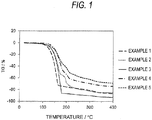
- TG in Fig. 1 and Table 1 indicate that the complexes of Examples 1 to 5 were thermally decomposed at a temperature of about 165 to 200°C, and each had improved thermal stability as compared to the complex of the comparative example.
- the amount of residues after heating was small, and thus excellent vaporization property was exhibited.
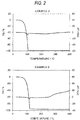
- Example 5 showing the largest amount of residues after heating
- Example 3 showing the smallest amount of residues after heating in Fig. 1
- the result showed that in each of Examples 3 and 5, there were little residues after heating, and thus excellent vaporization property was exhibited.
- a ruthenium thin film was formed on a Ta/TH-Ox/Si substrate.
- a film formation apparatus a hot wall type thermal CVD apparatus was used.
- a reaction gas was fed at a constant flow rate by use of a mass flow controller. Film formation conditions are as described below.
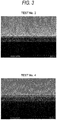
- a SEM observation photograph of the formed ruthenium thin film is shown in Fig. 3 .
- the results of measuring the thickness of the thin film are shown in the table below.
- a raw material according to the present Invention is capable of producing a high-purity ruthenium thin film, and has a low melting point and moderate thermal stability.
- the raw material according to the present invention is suitable for use in electrodes of various kinds of devices.
Landscapes
- Chemical & Material Sciences (AREA)
- Organic Chemistry (AREA)
- Engineering & Computer Science (AREA)
- Materials Engineering (AREA)
- General Chemical & Material Sciences (AREA)
- Chemical Kinetics & Catalysis (AREA)
- Metallurgy (AREA)
- Mechanical Engineering (AREA)
- Life Sciences & Earth Sciences (AREA)
- Wood Science & Technology (AREA)
- Inorganic Chemistry (AREA)
- Chemical Vapour Deposition (AREA)
- Electrodes Of Semiconductors (AREA)
- Crystallography & Structural Chemistry (AREA)
Applications Claiming Priority (2)
| Application Number | Priority Date | Filing Date | Title |
|---|---|---|---|
| JP2015165340A JP6027657B1 (ja) | 2015-08-25 | 2015-08-25 | 複核ルテニウム錯体からなる化学蒸着用原料及び該化学蒸着用原料を用いた化学蒸着法 |
| PCT/JP2016/074465 WO2017033913A1 (fr) | 2015-08-25 | 2016-08-23 | Matière première de dépôt chimique en phase vapeur comprenant un complexe binucléaire du ruthénium et procédé de dépôt chimique en phase vapeur faisant appel à la matière première de dépôt chimique en phase vapeur |
Publications (2)
| Publication Number | Publication Date |
|---|---|
| EP3342899A1 true EP3342899A1 (fr) | 2018-07-04 |
| EP3342899A4 EP3342899A4 (fr) | 2018-08-08 |
Family
ID=57326651
Family Applications (1)
| Application Number | Title | Priority Date | Filing Date |
|---|---|---|---|
| EP16839260.3A Withdrawn EP3342899A4 (fr) | 2015-08-25 | 2016-08-23 | Matière première de dépôt chimique en phase vapeur comprenant un complexe binucléaire du ruthénium et procédé de dépôt chimique en phase vapeur faisant appel à la matière première de dépôt chimique en phase vapeur |
Country Status (7)
| Country | Link |
|---|---|
| US (1) | US10815260B2 (fr) |
| EP (1) | EP3342899A4 (fr) |
| JP (1) | JP6027657B1 (fr) |
| KR (1) | KR102161522B1 (fr) |
| CN (1) | CN107923038B (fr) |
| TW (1) | TWI599674B (fr) |
| WO (1) | WO2017033913A1 (fr) |
Families Citing this family (5)
| Publication number | Priority date | Publication date | Assignee | Title |
|---|---|---|---|---|
| CN104792842B (zh) * | 2015-04-24 | 2017-12-15 | 北京师范大学 | 双核钌配合物薄膜的制备方法和应用 |
| KR101973549B1 (ko) * | 2017-04-19 | 2019-04-29 | 영남대학교 산학협력단 | 루테늄 박막 형성 방법 |
| JP7372353B2 (ja) * | 2020-01-31 | 2023-10-31 | 田中貴金属工業株式会社 | 有機ルテニウム化合物からなる化学蒸着用原料及び該化学蒸着用原料を用いた化学蒸着法 |
| WO2021153639A1 (fr) * | 2020-01-31 | 2021-08-05 | 田中貴金属工業株式会社 | Matiere premiere de compose organique de ruthenium pour depot chimique en phase vapeur et procede de depot chimique en phase vapeur mettant en oeuvre cette matiere premiere pour depot chimique en phase vapeur |
| JP2023178560A (ja) * | 2022-06-06 | 2023-12-18 | 嶺南大學校 産學協力團 | 化学蒸着法によるルテニウム薄膜又はルテニウム化合物薄膜の製造方法及びルテニウム薄膜又はルテニウム化合物薄膜 |
Family Cites Families (8)
| Publication number | Priority date | Publication date | Assignee | Title |
|---|---|---|---|---|
| US5314727A (en) * | 1992-07-28 | 1994-05-24 | Minnesota Mining & Mfg. Co./Regents Of The University Of Minnesota | Chemical vapor deposition of iron, ruthenium, and osmium |
| JP2000103797A (ja) * | 1998-09-29 | 2000-04-11 | Mitsubishi Chemicals Corp | ロジウム−(二座キレート配位子)二核錯体 |
| US20040215030A1 (en) * | 2003-04-22 | 2004-10-28 | Norman John Anthony Thomas | Precursors for metal containing films |
| JP4425028B2 (ja) * | 2004-03-09 | 2010-03-03 | 三洋電機株式会社 | 有機エレクトロルミネッセンス素子 |
| KR20070058439A (ko) * | 2004-09-30 | 2007-06-08 | 동경 엘렉트론 주식회사 | 금속 카르보닐 전구체를 이용한 루테늄 및 레늄 금속층의저압 증착 방법 |
| US20060068588A1 (en) * | 2004-09-30 | 2006-03-30 | Tokyo Electron Limited | Low-pressure deposition of ruthenium and rhenium metal layers from metal carbonyl precursors |
| JP5293930B2 (ja) | 2007-03-22 | 2013-09-18 | Jsr株式会社 | 化学気相成長材料及び化学気相成長方法 |
| KR102336102B1 (ko) * | 2013-12-20 | 2021-12-08 | 가부시키가이샤 아데카 | 루테늄 화합물, 박막 형성용 원료 및 박막의 제조 방법 |
-
2015
- 2015-08-25 JP JP2015165340A patent/JP6027657B1/ja active Active
-
2016
- 2016-08-05 TW TW105124992A patent/TWI599674B/zh active
- 2016-08-23 WO PCT/JP2016/074465 patent/WO2017033913A1/fr not_active Ceased
- 2016-08-23 EP EP16839260.3A patent/EP3342899A4/fr not_active Withdrawn
- 2016-08-23 KR KR1020187001534A patent/KR102161522B1/ko active Active
- 2016-08-23 US US15/744,751 patent/US10815260B2/en active Active
- 2016-08-23 CN CN201680048587.0A patent/CN107923038B/zh active Active
Also Published As
| Publication number | Publication date |
|---|---|
| JP2017043796A (ja) | 2017-03-02 |
| US10815260B2 (en) | 2020-10-27 |
| US20180201636A1 (en) | 2018-07-19 |
| TW201712139A (zh) | 2017-04-01 |
| CN107923038A (zh) | 2018-04-17 |
| KR102161522B1 (ko) | 2020-10-05 |
| WO2017033913A1 (fr) | 2017-03-02 |
| EP3342899A4 (fr) | 2018-08-08 |
| JP6027657B1 (ja) | 2016-11-16 |
| KR20180019197A (ko) | 2018-02-23 |
| CN107923038B (zh) | 2020-01-07 |
| TWI599674B (zh) | 2017-09-21 |
Similar Documents
| Publication | Publication Date | Title |
|---|---|---|
| JP6596737B2 (ja) | アミドイミン配位子を含む金属複合体 | |
| EP3342899A1 (fr) | Matière première de dépôt chimique en phase vapeur comprenant un complexe binucléaire du ruthénium et procédé de dépôt chimique en phase vapeur faisant appel à la matière première de dépôt chimique en phase vapeur | |
| EP2032529A1 (fr) | Composés de tétra-amidinate de métal (iv) et leur utilisation dans le dépôt en phase vapeur | |
| JP2009503247A (ja) | β‐ジケチミナート配位子源およびその金属含有化合物、およびそれらを含むシステムと方法 | |
| EP3348667A1 (fr) | Matière première pour dépôt chimique en phase vapeur comprenant un composé organique de ruthénium, et procédé de dépôt chimique en phase vapeur utilisant ladite matière première pour dépôt chimique en phase vapeur | |
| TW201425630A (zh) | 由釕錯合物所構成的化學蒸鍍原料及其製造方法和化學蒸鍍法 | |
| WO2016181918A1 (fr) | Matière de départ de dépôt chimique en phase vapeur comprenant un complexe polynucléaire hétérogène, et procédé de dépôt chimique en phase vapeur utilisant ladite matière de départ de dépôt chimique en phase vapeur | |
| WO2013015947A2 (fr) | Précurseurs hétéroleptiques de type (allyl)(pyrroles-2-aldiminate) contenant un métal, leur synthèse et dépôt en phase vapeur de ceux-ci pour déposer des films contenant du métal | |
| US8911827B2 (en) | Chemical vapor deposition method using an organoplatinum compound | |
| EP3296425A1 (fr) | Matière première de dépôt chimique en phase vapeur comprenant un composé organique du platine et procédé de dépôt chimique en phase vapeur utilisant ladite matière première de dépôt chimique en phase vapeur | |
| US11084837B2 (en) | Chemical deposition raw material including iridium complex and chemical deposition method using the chemical deposition raw material | |
| JP5952460B1 (ja) | 有機白金化合物からなる化学蒸着用原料及び該化学蒸着用原料を用いた化学蒸着法 | |
| TW201823262A (zh) | 產生薄無機膜的方法 | |
| JP2006063065A (ja) | アルキルテトラゾール誘導体及び該誘導体を用いた窒素含有膜の製造方法並びにアルキルテトラゾール誘導体の精製方法 | |
| KR20200013712A (ko) | 유기 백금 화합물을 포함하는 기상 증착용 원료 및 해당 기상 증착용 원료를 사용한 기상 증착법 |
Legal Events
| Date | Code | Title | Description |
|---|---|---|---|
| PUAI | Public reference made under article 153(3) epc to a published international application that has entered the european phase |
Free format text: ORIGINAL CODE: 0009012 |
|
| 17P | Request for examination filed |
Effective date: 20180201 |
|
| AK | Designated contracting states |
Kind code of ref document: A1 Designated state(s): AL AT BE BG CH CY CZ DE DK EE ES FI FR GB GR HR HU IE IS IT LI LT LU LV MC MK MT NL NO PL PT RO RS SE SI SK SM TR |
|
| AX | Request for extension of the european patent |
Extension state: BA ME |
|
| A4 | Supplementary search report drawn up and despatched |
Effective date: 20180709 |
|
| RIC1 | Information provided on ipc code assigned before grant |
Ipc: C23C 16/16 20060101ALI20180703BHEP Ipc: C07F 15/00 20060101ALI20180703BHEP Ipc: C23C 16/18 20060101ALI20180703BHEP Ipc: H01L 21/28 20060101ALI20180703BHEP Ipc: H01L 21/285 20060101AFI20180703BHEP |
|
| DAV | Request for validation of the european patent (deleted) | ||
| DAX | Request for extension of the european patent (deleted) | ||
| STAA | Information on the status of an ep patent application or granted ep patent |
Free format text: STATUS: THE APPLICATION HAS BEEN WITHDRAWN |
|
| 18W | Application withdrawn |
Effective date: 20190221 |