EP3343396A1 - Dispositif de gestion de base de données et procédé associé - Google Patents
Dispositif de gestion de base de données et procédé associé Download PDFInfo
- Publication number
- EP3343396A1 EP3343396A1 EP16838935.1A EP16838935A EP3343396A1 EP 3343396 A1 EP3343396 A1 EP 3343396A1 EP 16838935 A EP16838935 A EP 16838935A EP 3343396 A1 EP3343396 A1 EP 3343396A1
- Authority
- EP
- European Patent Office
- Prior art keywords
- element data
- data
- field
- specifying information
- plural
- Prior art date
- Legal status (The legal status is an assumption and is not a legal conclusion. Google has not performed a legal analysis and makes no representation as to the accuracy of the status listed.)
- Withdrawn
Links
Images





















Classifications
-
- G—PHYSICS
- G06—COMPUTING OR CALCULATING; COUNTING
- G06F—ELECTRIC DIGITAL DATA PROCESSING
- G06F16/00—Information retrieval; Database structures therefor; File system structures therefor
- G06F16/20—Information retrieval; Database structures therefor; File system structures therefor of structured data, e.g. relational data
- G06F16/24—Querying
- G06F16/245—Query processing
- G06F16/2455—Query execution
- G06F16/24553—Query execution of query operations
-
- G—PHYSICS
- G06—COMPUTING OR CALCULATING; COUNTING
- G06F—ELECTRIC DIGITAL DATA PROCESSING
- G06F16/00—Information retrieval; Database structures therefor; File system structures therefor
- G06F16/90—Details of database functions independent of the retrieved data types
- G06F16/901—Indexing; Data structures therefor; Storage structures
- G06F16/9024—Graphs; Linked lists
-
- G—PHYSICS
- G06—COMPUTING OR CALCULATING; COUNTING
- G06F—ELECTRIC DIGITAL DATA PROCESSING
- G06F16/00—Information retrieval; Database structures therefor; File system structures therefor
- G06F16/20—Information retrieval; Database structures therefor; File system structures therefor of structured data, e.g. relational data
- G06F16/22—Indexing; Data structures therefor; Storage structures
- G06F16/2282—Tablespace storage structures; Management thereof
-
- G—PHYSICS
- G06—COMPUTING OR CALCULATING; COUNTING
- G06F—ELECTRIC DIGITAL DATA PROCESSING
- G06F16/00—Information retrieval; Database structures therefor; File system structures therefor
- G06F16/20—Information retrieval; Database structures therefor; File system structures therefor of structured data, e.g. relational data
- G06F16/24—Querying
- G06F16/242—Query formulation
- G06F16/2433—Query languages
-
- G—PHYSICS
- G06—COMPUTING OR CALCULATING; COUNTING
- G06F—ELECTRIC DIGITAL DATA PROCESSING
- G06F16/00—Information retrieval; Database structures therefor; File system structures therefor
- G06F16/20—Information retrieval; Database structures therefor; File system structures therefor of structured data, e.g. relational data
- G06F16/28—Databases characterised by their database models, e.g. relational or object models
- G06F16/289—Object oriented databases
Definitions
- This invention relates to a database management system, and, more particularly, to a database management system having a novel data structure.
- the type of data is determined according to the grammar and subjected to data processing. For example, 1) the word “eat” is a verb and takes an object, and 2) the word “apple” is a noun and has attributes including color, size and production area.
- the types of data are organized into a table to form a data structure of a relational database having items for each word.
- Patent Literature 1 JP Hei 08-077013 A discloses a database employing object orientation for use in place of such a relational database.
- Patent Literature 1 even the method of Patent Literature 1 after all requires creation of classes, for example, in each time.
- master element data refer to element data that are located superior to slave element data when expressed as a meaning tree Monad among element-associated data.
- an ID 61[61] corresponds to master element data with respect to an ID 161[51] (apple) in FIG. 6A
- an ID 51 (apple) corresponds to master element data with respect to an ID 191[61] (HONDA Risa) in FIG. 6B .
- a search request specifying a master element data ID is given is a concept including not only a case where a search condition specifying master element data is directly given from a database user but also a case where master element data are reached as a result of searching from another search condition and then another search is made from the master element data.
- the element data ID field, the upper element data field, the link attribute element data field, the attribute value data field and the referential element data field correspond to the ID field 61, the connection field 63, the relation field 64, the meaning field 62 and the reference field 65, respectively, in the embodiments.
- the meaning element data correspond to a top Monad of a meaning tree in the embodiments.
- the individual element data correspond to each record in the embodiments.
- the link knowledge data correspond to a top Monad and a group of lower Monads linked thereto in the embodiments.
- the relationship between the upper record and the lower record includes both a case where two or more records are associated in parallel and a case where two or more records are associated hierarchically.
- the label element data correspond to a top Monad of a reference tree in the embodiments.
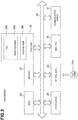
- FIG. 1 shows a functional block diagram of a database management system 1 according to the present invention.
- the database management system 1 includes a table 10 having an element-associated data storing part 3, a plural element group data storing part 4 and a plural element group data linking data storing part 5, extracting means 6, and writing means 7.
- the data structure of the table 10 is described with reference to FIG. 2 .
- the table 10 comprises a plurality of records, and each record has an element data ID field 41, a content element data field 42, an upper element data field 43 and a link attribute element data field 44.
- an element data ID of given element data is stored.
- an upper element data ID which is the ID of upper element data located superior to the given element data
- a link attribute element data ID which is the ID of link attribute element data representing a link attribute between the given element data and the upper element data
- a content element data ID specifying content element data representing a content of the link attribute is stored.
- the element-associated data 56 are data specifying an association between master element data and slave element data, and having an element data ID of the slave element data in the content element data field 42, an element data ID of the master element data in the upper element data field 43, and an element data ID representing inverse predication relationship information, which is predication relationship information of the slave element data to the master element data, in the link attribute element data field 44.
- the plural element group data 50 have at least source element data 52, goal element data 54 and path element data 53, and plural element group uppermost element data 51 linking the source element data 52, the goal element data 54 and the path element data 53.
- the plural element group uppermost element data 51 have an element data ID of the given element data in the element data ID field 41 and content element data field 42.
- the source element data 52 have the element data ID of the master element data in the content element data field 42, an element data ID of the uppermost element data in the upper element data field 43, and an element data ID that means a source case in the link attribute element data field 44.
- the goal element data 54 have the element data ID of the slave element data in the content element data field 42, the element data ID of the uppermost element data in the upper element data field 43, and an element data ID that means a goal case in the link attribute element data field 44.
- the path element data 53 have an element data ID representing predication relationship information of the master element data to the slave element data in the content element data field 42, the element data ID of the uppermost element data in the upper element data field 43, and an element data ID that means a path case in the link attribute element data field 44.
- the plural element group data linking data 58 have a plural element group uppermost element data ID of the plural element group data 50 in the content element data field 42, the element data ID of the element-associated data in the upper element data field 43, and a link attribute ID of a focus attribute representing that the plural element group uppermost element data are linked to the element-associated data in the link attribute element data field 44.
- the extracting means 6 shown in FIG. 1 extracts element-associated data including the master element data, extracts plural element group data linking data 58 including the element data ID of the extracted element-associated data, and extracts plural element group data 50 specified by the extracted plural element group data linking data to extract linked element data.
- the writing means 7 performs a plural element group data generating step, an element-associated data generating step and a plural element group data linking data generating step as described below.
- the writing means 7 In the plural element group data generating step, the writing means 7 generates plural element group uppermost element data 51 of the source element data 52, the goal element data 54 and the path element data 53, and writes the plural element group uppermost element data 51 together with the given source element data 52, goal element data 54 and path element data 53 in the table 10 as plural element group data 50.
- the writing means 7 In the element-associated data generating step, the writing means 7 generates element-associated data 56 having the element data ID in the content element data field of the source element data in the upper element data field, the element data ID in the content element data field of the goal element data in the content element data field, and an element data ID in an inverse relationship with the element data ID in the content element data field of the path element data in the link attribute element data field, and writes the element-associated data 56 in the table 10.
- the writing means 7 In the plural element group data linking data generating step, the writing means 7 generates plural element group data linking data 58 having the element data ID of the generated plural element group uppermost element data in the content element data field 42, the element data ID of the generated element-associated data in the upper element data field 43, and the element data ID of the link attribute of the focus attribute in the link attribute element data field 44, and writes the plural element group data linking data 58 in the table 10.
- FIG. 3 shows one example of the hardware configuration of the database management system 1 constituted using a CPU.
- the database management system 1 includes a CPU 23, a memory 27, a hard disk 26, a monitor 30, an optical drive 25, an input device 28, a communication board 31, and a bus line 29.
- the CPU 23 controls each part via the bus line 29 according to various programs stored in the hard disk 26.
- an operating system program 26o (which is hereinafter referred simply as "OS) and a main program 26p are stored.
- the processing executed by the main program 26p is the same as conventional processing in a general database management processing except data write processing and search (extraction) processing.
- the write processing and search processing are described later.
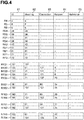
- a table as shown in FIG. 4 is stored in a data storing part 26k.
- An ID field 61, a meaning field 62, a connection field 63 and a relation field 64 correspond to the element data ID field 41, the content element data field 42, the upper element data field 43 and the link attribute element data field 44, respectively, in FIG. 2 .
- a reference field 65 is a field representing a referential destination.
- Each record comprises such five-dimension data is named as "Monad” in this embodiment. Data are not necessarily contained in all the five dimensions, and there may be fields containing nothing.
- records R4 to R72 are definition Monads.
- a definition Monad is a Monad having the same ID in the ID field 61 and the meaning field 62 and nothing in the other fields.
- each ID in the meaning field 62 corresponds to a "place.”
- the record R26 in FIG. 4 is a Monad having a "place” in the meaning field 62.
- a record R161 is a master-slave Monad.
- a master-slave Monad is a Monad having the hierarchical link relationship between two definition Monads in the connection field and a link attribute of the link relationship in the relation field.
- a master-slave Monad corresponds to the element-associated data 56 in FIG. 2 .
- Records R131 to 135 are narrative clause constituting Monads, and correspond to the plural element group data 50 in FIG. 2 .
- the record R131 is an uppermost Monad
- the record R132 is a source Monad
- the record R133 is a path Monad
- the record R134 is a goal Monad.
- a source Monad, a path Monad and a goal Monad correspond to the source element data 52, the path element data 53 and the goal element data 54, respectively, in FIG. 2 .
- the record R135 is a narrative clause constituting Monad to which the Monad of the record R132 (source Monad) is linked.
- a record R162 is a narrative clause link Monad, which corresponds to the plural element group data linking data 58 in FIG. 2 .
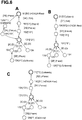
- the main program can generate tree-structured data (which are hereinafter referred to as "meaning tree") as shown in FIG. 6A by reading the records R131 to R135 and R161 to R164 and linking the Monads to each other. This processing is described later.
- a meaning tree as shown in FIG. 6B can be generated by reading the records R131 to R135, R191 and R192 and linking the Monads to each other
- a meaning tree as shown in FIG. 6C can be generated by reading the records R131 to R135, R193 and R194 and linking the Monads to each other.
- FIG. 6 The way of representation in FIG. 6 is described.
- the uppermost Monad in a meaning tree is called top Monad.
- FIG. 6A “61[61] (HONDA Risa)” is shown. This means that the record with an ID 61 has “61” in the meaning field.
- the text (HONDA Risa) in brackets is the words corresponding to "61” taken from the correspondence table in FIG. 5 for ease of understanding of the relationship between the Monads in the meaning tree.
- a Monad with an ID 161 is linked to the downside of the Monad with an ID 61.
- the Monad with an ID 161 is marked with "161[51] (apple).” This means that the record with an ID 161 has "51” in the meaning field 62.
- the text “apple” in brackets is the word (apple) corresponding to "51” taken from the correspondence table in FIG. 5 .
- the representation "[34] (-eat)” is given to represent the relationship of the Monad with an ID 61[61] (HONDA Risa) to the Monad with an ID 61[51] (apple).
- LINUX (trademark or trade name) is employed as the operating system program (OS) 26o in this embodiment, the present invention is not limited thereto.
- Each of the above programs is read from a CD-ROM 25a containing the programs via the optical drive 25 and installed into the hard disk 26.
- the programs may be installed into the hard disk from a computer-readable recording medium such as a flexible disk (FD) or IC card in place of a CD-ROM.
- the programs may be downloaded through a communication line.
- the programs are installed into the hard disk 26 from a CD-ROM to cause a computer to execute the programs stored in the CD-ROM indirectly.
- the computer may execute the programs stored in a CD-ROM directly from the optical drive 25.
- Programs executable by a computer include not only programs that can be directly executed when installed in unchanged form but also programs that once need conversion to a different form (decompression of compressed data, for example) and programs that can be executed when combined with another module portion.
- the CPU 23 extracts records having the search target ID in the connection field 63 as master-slave Monads (step S1). In this case, because "HONDA Risa" has an ID "61,” records having "61" in the connection field 63 are extracted. In the case of FIG. 4 , the records R161 and R163 are extracted.
- the CPU 23 extracts the upper Monad of the master-slave Monads as a top Monad (step S2).
- the records R161 and R163 has an ID "61" in the connection field 63.
- the record R61 is extracted as a top Monad.
- the CPU 23 initializes a processing number i (step S3), and extracts the entire narrative clause link Monads of the extracted i-th master-slave Monad (step S4).
- whether a Monad is a narrative clause link Monad is determined based on whether it has the record ID of the master-slave Monad in the connection field 63 and whether it is a record having "focus" in the relation field. In this case, referring to FIG. 5 , " 24 " means "focus.”
- a record R162 which has the record ID "161" of the extracted 0th master-slave Monad R161 in the connection field 63 and "24" in the relation field 64, is extracted as the narrative clause link Monad.
- the CPU 23 initializes a processing number j (step S5).
- the CPU 23 extracts the uppermost Monad of the narrative clause constituting Monads connected to a j-th narrative clause link Monad out of the extracted narrative clause link Monads (step S7).
- the record R162 as the 0th narrative clause link Monad has "131" in the meaning field.
- the record R131 is extracted as the corresponding uppermost Monad of the narrative clause constituting Monad.
- the CPU 23 determines whether the ID of the extracted uppermost Monad has already been extracted (step S9). In this case, it has not been extracted yet, the CPU 23 extracts records having the ID of the extracted uppermost Monad in the connection field 63 and determines their link relationships (step S11).
- the CPU 23 extracts records R132 to R134 having "131,” which is in the meaning field 62 of the record R131, in the connection field 63. Because the records R132 to R134 have “131” in the connection field 63, it is apparent that they are located inferior to the record R131. In addition, the record R132 has "4" in the relation field 64 and "61" in the meaning field 62. Thus, referring to FIG. 5 , it is apparent that "HONDA Risa” is connected to the downside of the record 131 with the status of a source case S. Similarly, in records R133 and R134, it is apparent that "eat” is connected to the downside of the record R131 with the status of a path case P, and “apple” is connected to the downside of the record R131 with the status of a goal case G.
- the CPU 23 determines whether there are any Monads connected to the extracted narrative clause constituting Monads (step S13 in FIG. 7 ). Specifically, the CPU 23 determines whether there are records having the ID of any of the records R132 to R134 extracted as narrative clause constituting Monads stored in the connection field 63.
- the CPU 23 determines whether processing has been completed for all the narrative clause link Monads (step S16). In this case, because processing has been completed for all the narrative clause link Monads, the CPU 23 determines whether processing has been completed for all the master-slave Monads (step S17). In this case, because the processing has not been completed for the record 163, the CPU 23 increments the processing number i (step S18) and advances to step S4.
- the CPU 23 extracts all the narrative clause link Monads of a 1st master-slave Monad (step S4).
- a record R164 which has the record ID "163" of the extracted 1st master-slave Monad R163 in the connection field 63 and "24" in the relation field 64, is extracted as the narrative clause link Monad.
- the CPU 23 initializes the processing number j (step S5), and extracts the uppermost Monad of the narrative clause constituting Monads connected to the 0th narrative clause link Monad out of the extracted narrative clause link Monads (step S7).
- the record R164 as the 0th narrative clause link Monad has "131" in the meaning field.
- the record R131 is extracted as the corresponding uppermost Monad of the narrative clause constituting Monads (step S7).
- the CPU 23 determines whether the ID of the extracted uppermost Monad has already been extracted (step S9). In this case, the record R131 has already been extracted, the CPU 23 determines whether processing has been completed for all the narrative clause link Monads without executing the processing in step S11, step S13 and step S15 (step S16). In this case, processing has been completed for all the narrative clause link Monads, the CPU 23 determines whether processing has been completed for all the master-slave Monads (step S17).
- the CPU 23 because processing has been completed for all the master-slave Monads, the CPU 23 generates a knowledge database in which the extracted Monads are linked (step S20).
- the extracted records are simply connected with the link relationships determined in step S11 and step S15. As a result, a meaning tree as shown in FIG. 6A can be obtained.
- Successive linkage of data can be achieved by repeating such read processing to further expand the link relationship.
- the record with an ID 161 has an ID 51 in the meaning field 62.
- a record R191 is extracted.
- the processing in and after step S2 in FIG. 7 is simply executed using the extracted record as a master-slave Monad.
- data of link relationship among a plurality of meaning trees as shown in FIG. 8a can be obtained.
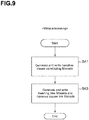
- the CPU 23 generates and writes narrative clause constituting Monads (step S41 in FIG. 9 ). Details of step S41 are shown in FIG. 10 .
- the CPU 23 determines a source Monad, a path Monad and a goal Monad (step S51 in FIG. 10 ). Specifically, the CPU 23 extracts data to which a "source case,” a “goal case,” or a “path case” is attached as an attribute out of the given data "HONDA Risa,” “orange,” “eat” and "cafeteria.”
- the CPU 23 determines whether there are Monad candidate data other than "source case,” “goal case” and “path case” (step S53). In this case, because there are Monad candidate data in addition to "HONDA Risa” (source case), “orange” (goal case) and “eat” (path case), "cafeteria” is determined as an SPG-linked Monad.
- the CPU 23 advances to step S57, and generates an uppermost Monad and writes narrative clause constituting Monads.
- the CPU 23 executes the following processing. First, the CPU 23 determines an ID for the uppermost Monad. An empty ID is used for the ID. Here, an ID "125” is used. The CPU 23 writes “125” in the ID field 61 and the meaning field 62. Next, the CPU 23 determines an ID for the source Monad. Again, an empty ID is used. Here, an ID "126” is used. The CPU 23 recognizes with reference to FIG. 5 that "HONDA Risa" and “source case” correspond to "61" and "4,” respectively. Thus, the CPU 23 writes “126” in the ID field 61, "61” in the meaning field 62, "125", which is the ID of the uppermost Monad, in the connection field 63, and "4" in the relation field 64.
- Each Monad that was not extracted as "source case,” “goal case,” or “path case” is regarded as a Monad that is linked to any of the source Monad, the path Monad and the goal Monad based on predetermined rules.
- a "place” is linked to the source Monad and the goal Monad, and "time” and “tool” are linked to the path Monad.
- the Monads as the destinations of link may be changeable.
- "time” is attribute information about the date and time or time of the day
- “tool” is attribute information about a tool as in "with a knife.”
- a "place" is associated only with the source Monad in order to avoid redundancy.
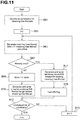
- step S43 the CPU 23 generates meaning tree Monads and narrative clause link Monads and writes them in the table (step S43 in FIG. 9 ). Details of step S43 are described with reference to FIG. 11 .
- the CPU 23 determines candidates for meaning tree Monads (step S61 in FIG. 11 ).
- two types of Monads are selected as candidates for meaning tree Monads.
- First candidates are master-slave Monads.
- a master-slave Monad is a Monad representing the association between a Monad specified by an ID in the meaning field 62 of a source Monad of narrative clause constituting Monads and a Monad specified by an ID in the meaning field 62 of a goal Monad.
- two types of master-slave Monads are generated.
- One of the master-slave Monads is a Monad representing that "orange” is linked to the upside of “HONDA Risa” and the relationship of "HONDA Risa” to “orange” is a predication relationship connected by "eat.”
- the other is a Monad representing that, contrary to the above, "HONDA Risa” is linked to the upside of “orange” and the relationship of "orange” to “HONDA Risa” is an inverse predication relationship connected by "minus (which is hereinafter represented by "-”) eat.”
- predication relationship information refers to information representing the predication relationship of a definition Monad specified by the ID in the meaning field 62 of a source Monad to a definition Monad specified by the ID in the meaning field 62 of a goal Monad.
- inverse predication relationship information refers to information representing the predication relationship of a definition Monad specified by the ID in the meaning field 62 of a goal Monad to a definition Monad specified by the ID in the meaning field 62 of a source Monad.
- "-eat” represents a predication relationship in the opposite direction with respect to "eat.”
- the Monad with the ID in the connection field 63 is located superior to the Monad with the ID in the meaning field 62, and the Monad with the ID in the relation field 64 represents the relationship between them seen from the side of the Monad with the ID in the meaning field 62.
- a predication relationship is defined between two Monads
- an inverse predication relationship is defined between them if their hierarchical relationship is inverted.
- two types of master-slave Monads can be generated.
- a detail Monad is a Monad that is associated with any of the source Monad, the path Monad, and the goal Monad that constitute the narrative clause constituting Monads.
- Monads with ID 365 to ID 368 in FIG. 16 which are described later, are detail Monads.
- a Monad having "place,” “time” or “tool” as an attribute in the relation field is defined as a detail Monad.
- "cafeteria” has an attribute "place.”
- a "place” is associated with a source Monad as has been described above, a Monad representing that "cafeteria” is associated with "HONDA Risa,” which is a Monad specified by the ID in the meaning field 62 of a source Monad, by "place” is also regarded as a candidate for a meaning tree Monad.
- the CPU 23 initializes a processing number i (step S63 in FIG. 11 ), and generates a meaning tree Monad from a 0th meaning tree Monad candidate (step S65).
- a Monad representing that the Monad candidate "orange” determined in step S61 is connected to "HONDA Risa” by "-eat” is generated.
- IDs representing "orange,” “HONDA Risa” and “-eat” are stored in the meaning field 62, the connection field 63 and the relation field 64, respectively.
- a meaning tree Monad is generated.
- the CPU 23 determines whether the generated meaning tree Monad already exists in the table (step S67 in FIG. 11 ). In this case, because the generated meaning tree Monad does not exist in the table, the CPU 23 writes it in the table (step S69). An empty ID is used for the Monad to be written. Here, an ID "166" is used.
- the CPU 23 recognizes with reference to FIG. 5 that "HONDA Risa,” “orange” and “-eat” correspond to "61,” “72” and "34,” respectively. Thus, the CPU 23 writes “166” in the ID field 61, "72” in the meaning field 62, "61” in the connection field 63 and "34” in the relation field 64.
- a narrative clause link Monad is a Monad that links the uppermost Monad of narrative clause constituting Monads and a meaning tree Monad.
- the ID of the uppermost Monad of narrative clause constituting Monads is "125”
- the ID of the meaning tree Monad to be connected is "166.”
- an attribute "focus” is employed as an attribute representing such a relationship.
- the CPU 23 writes "167" "125,” “166” and "24” in the ID field 61, the meaning field 62, the connection field 63 and the relation field 64, respectively, of an empty ID "167.”
- the CPU 23 determines whether processing has been completed for all the candidates determined in step S61 (step S72 in FIG. 11 ). In this case, processing has not been completed for all the candidates, the CPU 23 increments the processing number i (step S73), and generates a meaning tree Monad from a 1st candidate (step S65).
- a Monad representing that the Monad candidate "HONDA Risa” determined in step S61 is connected to “orange” by “eat” is generated.
- the IDs representing "HONDA Risa,” “orange” and “eat” are stored in the meaning field 62, the connection field 63 and the relation field 64, respectively.
- a meaning tree Monad is generated.
- the CPU 23 determines whether the generated meaning tree Monad already exists in the table (step S67 in FIG. 11 ). In this case, because the generated meaning tree Monad does not exist in the table, the CPU 23 writes it in the table (step S69). An empty ID is used for the Monad to be written. Here, an ID "195" is used.
- the CPU 23 recognizes with reference to FIG. 5 that "orange,” “HONDA Risa” and “eat” correspond to "72,” “61” and “31,” respectively. Thus, the CPU 23 writes “195,” “61,” “72” and “31” in the ID field 61, the meaning field 62, the connection field 63 and the relation field 64, respectively.
- the CPU 23 generates and writes a narrative clause link Monad for the meaning tree Monad written in step S69 (step S70).
- the ID of the uppermost Monad of the narrative clause constituting Monads is "125” and the ID of the generated meaning tree Monad is "195.”
- the CPU 23 writes "196,” “125,” “195” and “24” in the ID field 61, the meaning field 62, the connection field 63 and the relation field 64, respectively, of an empty ID "196.”
- the CPU 23 determines whether processing has been completed for all the candidates determined in step S61 (step S72 in FIG. 11 ). In this case, processing has not been completed for all the candidates, the CPU 23 increments the processing number i (step S73), and generates a meaning tree Monad for a 2nd candidate (step S65).
- the CPU 23 determines whether the generated meaning tree Monad already exists in the table (step S67 in FIG. 11 ). In this case, because the generated meaning tree Monad (having "71,” “61” and “26” in the meaning field 62, the connection field 63 and the relation field 64, respectively) exists in the table (record R163), the CPU 23 generates a narrative clause link Monad that links the existing meaning tree Monad (record R163) to the narrative clause constituting Monads without writing the meaning tree Monad in the table, and writes it (step S77).
- the ID of the uppermost Monad of narrative clause constituting Monads is "125” and the ID of the existing meaning tree Monad is "163.”
- the CPU 23 writes "197,” “125,” “163” and “24” in the ID field 61, the meaning field 62, the connection field 63 and the relation field 64, respectively, of an empty ID "197.”
- the CPU 23 turns on an omission flag for the existing meaning tree Monad (record R163) (step S78).
- the omission flag is described later.
- the CPU 23 determines whether processing has been completed for all the candidates determined in step S61 (step S72 in FIG. 11 ). In this case, processing has not been completed for all the candidates, the CPU 23 increments the processing number i (step S73), and generates a meaning tree Monad for a 3rd candidate (step S65).
- the CPU 23 determines whether the generated meaning tree Monad already exists in the table (step S67 in FIG. 11 ). In this case, there exists a record R193 having the same data as the generated meaning tree Monad (having "61,” “71” and “42” in the meaning field 62, the connection field 63 and the relation field 64, respectively) in the table 10. Thus, the CPU 23 generates a narrative clause link Monad that links the existing meaning tree Monad (record R193) to the narrative clause constituting Monads without writing the generated meaning tree Monad in the table, and writes it (step S77).
- the ID of the uppermost Monad of narrative clause constituting Monads is "125” and the ID of the existing meaning tree Monad is "193.”
- the CPU 23 writes "198,” “125,” “193” and “24” in the ID field 61, the meaning field 62, the connection field 63 and the relation field 64, respectively, of an empty ID "198.”
- the CPU 23 turns on an omission flag for the existing meaning tree Monad (record R163) (step S78).
- the CPU 23 determines whether processing has been completed for all the candidates determined in step S61 (step S72 in FIG. 11 ). In this case, because processing has been completed for all the four generated candidates, the CPU 23 terminates the write processing.
- the generated meaning tree Monad is not redundantly written in the table. This is because treating as a weight as described later is more effective to eliminate duplicated data, to improve the search speed and to reduce data capacity than having a plurality of meaning tree Monads having the same combination.
- a new meaning tree By performing read processing as has been described above on the generated data in the table, a new meaning tree can be obtained. For example, when the term "HONDA Risa” is searched, a meaning tree as shown in FIG. 12 can be obtained. This is a meaning tree obtained by adding information about "orange” to the meaning tree shown in FIG. 6A .
- a meaning tree as shown in FIG. 13B can be obtained. This is a meaning tree obtained by adding narrative clause data about the association between "cafeteria” and "HONDA Risa” to the meaning tree shown in FIG. 6C .
- master-slave Monads are determined on the assumption that a "source case” and a “goal case” are connected by a "path case,” and only records having connection with other records, in other words, records from which a meaning tree as shown in FIG. 6 can be generated are stored as detail Monads in the table. However, if there are three Monads, records from which a meaning tree Monad that defines the relationship between them is generated can be generated from the Monads.
- a weight Monad and a time Monad are assigned to each Monad when it is written or read.
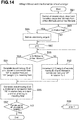
- a weight Monad and a time Monad are written by executing the processing of flowchart shown in FIG. 14 after step S43 in FIG. 9 in the first embodiment. Before describing the processing, description is made of what difference is made when data are read to form a meaning tree between a case where weights are assigned and a case where no weight is assigned.
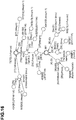
- FIG. 15 shows a meaning tree in which meaning tree Monads are associated with each other without weights as in the case of the first embodiment.
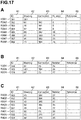
- the data stored in each field of each record corresponding to FIG. 15 are shown in FIGs. 17A and 17B .
- the data in individual records are the same as those in the first embodiment.
- the meaning of each ID in each record is shown in FIG. 5 as has been described above and is not repeated here. In the following, description is made using the meaning tree in FIG. 15 .
- a Monad with an ID 304[81] (Tamiflu) is associated with a Monad with an ID 73[73] (influenza) by [74] (therapeutic agent).
- a Monad with an ID 374[67] (TAKAHASHI Shiro) is associated with a Monad with an ID 73[73] (influenza) by [77] (-disease).
- a Monad with an ID 305[361] which is a narrative clause link Monad, is associated with a Monad with an ID 304[81] (Tamiflu) by [24] (focus).
- the uppermost Monad with an ID 361 of narrative clause constituting Monads is associated with a Monad with an ID 362[62] (MURAKAMI Saburo) with the status of "4[4] (S)," with a Monad with an ID 363[35] (treat) with the status of "5[5] (P),” and with a Monad with an ID 364[67] (TAKAHASHI Shiro) with the status of "6[6] (G).”
- a Monad with an ID 362[62] (MURAKAMI Saburo) is associated with a Monad with an ID 365[68] (Kyoto Hospital) with the status of [26] (place).
- a Monad with an ID 363[35] (treat) is associated with a Monad with an ID 366[81] (Tamiflu) with the status of [74] (therapeutic agent), and with a Monad with a Monad with an ID 367[91] (2014/11/5) with the status of [25] (time).
- a Monad with an ID 364[67] (TAKAHASHI Shiro) is associated with a Monad with an ID 368[73] (influenza) with the status of [75] (disease).
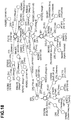
- FIG. 16 A meaning tree obtained by assigning weight Monads and time Monads to the meaning tree Monad shown in FIG. 15 is shown in FIG. 16 .
- a weight Monad and a time Monad are assigned to all the Monad except the narrative clause constituting Monads.
- the time Monad the date when the data were written, 2014/11/6, is used.
- a weight Monad with an ID 505[43] (weight 1) is linked by [27] (weight) and a time Monad with an ID 404[92] (2014/11/6) is linked by [25] (time).
- a weight Monad and a time Monad are linked to the Monad with an ID 73[73] (influenza), the Monad with an ID 304[81] (Tamiflu) and the Monad with an ID 305[361].
- a record R505 which is a weight Monad, has "374" in the connection field 63, "43” in the meaning field 62 and “27” in the relation field 64.
- a record R404 which is a time Monad, has "374" in the connection field 63, "92” in the meaning field 62 and "25” in the relation field 64.
- FIG. 17A shows narrative clause constituting Monads
- FIG. 17B shows a master-slave Monad, a detail Monad and a narrative clause link Monad.
- FIG. 15 shows a meaning tree that is formed when associating [81] (Tamiflu) with [73] (influenza) by [74] (therapeutic agent) is defined.
- the CPU 23 extracts all master-slave Monads, detail Monads and narrative clause link Monads from the written Monads and extracts all the top Monads (step S81 in FIG. 14 ).
- Monads with ID 304, ID 305, ID 374 and ID 73 are extracted from FIGs. 17A and 17B .
- the CPU 23 determines whether there is an omission flag (step S83 in FIG. 14 ). This is to add a weight Monad and a time Monad to existing Monads because a duplicated Monad is not generated in step S77 in FIG. 11 when the same Monad already exists.
- step S87 the CPU 23 advances to step S87, initializes a processing number p (step S87 in FIG. 14 ), and determines whether the 0th Monad is a written Monad (step S89).
- the CPU 23 generates a record having the ID 304 of the 0th Monad in the connection field, "27" in the relation field and "43" (weight 1) in the meaning field.
- An empty ID is simply used for the record.
- an ID 503 is used.
- the CPU 23 generates a record having the ID "304" of the 0th Monad in the connection field 63, "25” in the relation field 64 and the ID of the Monad representing the date and time in the meaning field 62 (step S95).
- the CPU 23 determines whether processing has been completed for all the processing target Monads (step S97). In this case, processing has not been completed for all the processing target Monads, the CPU 23 increments the processing number p and repeats the processing in and after step S89.
- the CPU 23 Because the 1st Monad is a written Monad with an ID 305, the CPU 23 generates a record having the ID "305" of the 1st Monad in the connection field, "27” in the relation field and "43” (weight 1) in the meaning field (step S91). Here, an ID 504 is used.
- the CPU 23 generates a record having the ID "305" of the 1st Monad in the connection field 63, "25” in the relation field 64 and the ID of the Monad representing the date and time in the meaning field 62 (step S95).
- the CPU 23 determines whether processing has been completed for all the processing target Monads (step S97). In this case, processing has not been completed for all the processing target Monads, the CPU 23 increments the processing number p and repeats the processing in and after step S89.
- FIG. 17C The records for the added weight Monads and time Monads are shown in FIG. 17C . When these are added, meaning tree Monads as shown in FIG. 16 can be read when data are read for an ID 73.
- step S77 the CPU 23 generates a narrative clause link Monad for the existing meaning tree Monad and writes it as a record. In this case, a Monad with an ID 370 is generated. Then, the CPU 23 turns on an omission flag for the Monad with an ID 304 (step S78).
- the CPU 23 advances from step S83 to step S85 in FIG. 14 , and adds the Monad with an ID 304 as a processing target. Also, because the Monad ID 304 becomes a processing target Monad, the CPU 23 advances from step S89 to step S93, and increments (+1) the weight of the records having the ID of this Monad in the connection field 63 and "27" in the relation field 64. For example, in this case, the ID 503 is incremented to "44," which represents "weight 2.” For such procedure, the ID of the Monad representing the weight (such as weight 2) resulting from incrementing the weight by one is simply determined in advance.
- a weight is assigned to all the Monads stored in the table except narrative clause constituting Monads.
- the weights of the Monad with an ID 73[73] (influenza) and the Monad with an ID 304[81] (Tamiflu) are increased as represented by a Monad with ID 501[44] (weight 2) and a Monad with an ID 503[44] (weight 2), respectively.
- a flowchart of the processing for adding a weight Monad and a time Monad in the read processing is described.
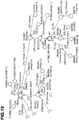
- the weights of the weight Monads are increased and time Monads are added as shown in FIG. 20 .
- the ID 501 [43] (weight 1) of the ID 73[73] (influenza) is changed to an ID 501[44] (weight 2), and an ID 422[97] (2015/12/6) is added to the ID 73[73] (influenza).
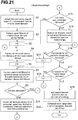
- FIG. 21 is different from FIG. 7 in that step S19 is added between step S17 and step S20.
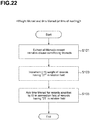
- step S19 Details of step S19 are shown in FIG. 22 .
- the CPU 23 extracts all the Monads except narrative clause constituting Monads from the read Monad (step S101). In this case, because the Monads shown in FIG. 20 have been extracted, Monads with ID 305, ID 304 and ID 43 are read.
- the CPU 23 increments (+1) the weight of the records having "27" in the relation field 64 (step S103). Specifically, the CPU 23 simply changes the data in the meaning field 62 to a record ID representing a weight that is greater by one than the previous one. In this case, the ID in the meaning field 62 of Monads with ID 501, ID 505, ID 503 and ID 504 are all changed to an ID 44, which represents "weight 2.”
- the CPU 23 extracts all the records having "25" in the relation field 64, and adds a time Monad to records specified by the ID in the connection field 63 of the extracted records (step S105).
- a time Monad representing the date on which the data are read "December 6, 2015” is added to the Monads with ID 73, ID 374, ID 304 and ID 305.
- the database allows for automatic diagnoses. For example, advancement in medicine is so fast that the construction of a system containing medical data necessary for automatic diagnoses cannot catch up with the advancement in medicine. With this system, however, if approximately 60% of basic information is stored in advance, the system grows by accepting examples of use from many users and becomes able to make automatic diagnoses with an accuracy of close to 100%.
- weight Monads and time Monads are assigned both at times of reading the searched data and at time of writing, and the weight of each weight Monad is increased by one at a time.
- different weights may be added at the time of reading and at the time of writing.
- records corresponding to meaning tree Monads are generated for preset combinations of not only directly linked narrative clause constituting Monads but also indirectly linked narrative clause constituting Monads.
- Associated Monads may be generated for anything possible without limitation from such settings.
- weight Monads are added.
- the uppermost Monad of the narrative clause constituting Monads is connected to the master-slave Monad by a narrative clause link Monad without writing the generated Monad.
- the writing frequency can be known by counting the number of uppermost Monads of narrative clause constituting Monads connected by such focus Monads.
- the database can be used as a knowledge database without contradiction.
- a Monad having an ID representing green peppers in the meaning field, an ID representing HONDA Risa in the connection field and an ID representing "-dislike (is disliked)" in the relation field is generated, and linked to the given narrative clause constituting Monads by a narrative clause link Monad.
- Contradictory concepts can be dealt with by reading a meaning tree with higher writing frequency as described above. The same holds true for reading.
- the date is employed for a time Monad. However, even the time of day may be stored.
- time Monads may be utilized for weighting.
- Such a coefficient may be varied dynamically.
- a lighter weight may be added as the total of differences between the times represented by all the time Monads and the time of writing, instead of the difference between the time represented by the latest time Monad and the time of writing, is larger.
- a heavier weight may be added to a Monad that is frequently used recently. The same may be applied to reading.
- the following method is simply used including: 1) extracting all the top Monads of meaning tree Monads; 2) selecting one top Monad and extracting all the slave Monads dependent on this top Monad; 3) adding only the narrative clause data if there is the same slave Monad; 4) perform this on all the slave Monads; and 5) repeating these procedures to all the top Monads.
- a CPU is used to accomplish the functions shown in FIG. 1 and software is used to realize it.
- part or all of the functions may be achieved by hardware such as a logic circuit.
- Part of processing of the above program may be executed by an operating system (OS).
- OS operating system
- writing narrative clause link Monads and narrative clause constituting Monads is not essential.
- narrative clause link Monads and narrative clause constituting Monads may not be written if the database is simple.
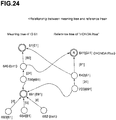
- Such label data may be generated and stored in the reference field 65 (refer to FIG. 4 ) as shown in FIG. 23 .
- the label data can be read with reference to the record ID thereof.
- a straight line arrow represents a link relationship and a curved line arrow represents a referential relationship.
- referential relationships There are three types of referential relationships: references between different meaning trees, references between a meaning tree and a reference tree, and references between reference trees. These are described later.
- the IDs stored in the meaning field 62 are enclosed in [ ] and their corresponding texts are enclosed in () in the same manner as in the first embodiment.
- the IDs in the relation field 64 are represented by [ ] placed in the vicinity of the straight line arrows.
- the texts stored in the reference field 65 are enclosed in « republic
- an attribute value can be a label, or it can be a meaning.
- records R80, R81 and R641 are referential definition Monads.
- a referential definition Monad is a Monad having the same ID in the ID field 61 and the meaning field 62, nothing in the connection field 63 and the relation field 64 and referential target data in the reference field 65.
- the referential target data in the reference field 65 comprises a text in this embodiment, the present invention is not limited thereto.
- such a text may be a file specifying ID that represents the location where specific image data or audio data are stored, such as a URI.
- a record R640 is a referential master-slave Monad.
- a referential master-slave Monad is a Monad having the hierarchical link relationship between two definition Monads in the connection field 63, nothing in the meaning field 62, in which an attribute value specifying ID specifying an attribute value representing a value of the link attribute is stored, an attribute of the link relationship in the relation field 64, and an ID of represented data of the link relationship in the reference field 65.
- a definition Monad is defined as a Monad having the same ID in the ID field 61 and the meaning field 62 and nothing in the other fields.
- Monads having data in the reference field 65 are included in the definition Monads.
- the individual element data specified by a record R641 is a definition Monad.
- Records R691 to 694 are narrative clause constituting Monads, and a record R700 is a narrative clause link Monad. These are the same as those in the first embodiment.
- a meaning tree as shown in FIG. 25 is formed when these records are read.
- a case where records as shown in FIG. 23 have been additionally stored and a meaning tree and a reference tree as shown in FIG. 26 are formed when these records are read is described. Because the hardware configuration is the same as that in the first embodiment, its description is omitted.
- the part ⁇ 1 encircled by a dashed line in FIG. 26 represents the tree added to the tree state shown in FIG. 25 .
- the Monads with ID 51 and ID 163 are shown as 51[51] (apple) and 163[71] (cafeteria), respectively, in the same manner as in the first embodiment. This is for ease of understanding. In reality, their labels are referenced in the reference tree as in the case of the label "HONDA Risa.”
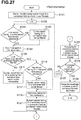
- FIG. 27 shows the flowchart of this processing.
- the CPU 23 extracts records having the search target ID in the connection field 63 as master-slave Monads (step S101 in FIG. 27 ).
- the search target ID is "61”
- records having "61" in the connection field 63 i.e., a record R640 in FIG. 23 is extracted together with records R161 and R163 in FIG. 4 .
- the CPU 23 initializes a processing number i (step S103), and determines whether the record having the ID in the connection field of the i-th master-slave Monad has been already extracted (step S105). Because the record R161 is the 0th master-slave Monad, the ID "61" in its connection field has not been extracted yet. Thus, the record, which has the ID in the connection field of the record R161, is extracted as a top Monad (step S107).
- the CPU 23 determines that the records R161 and R61 are in a position link relationship (step S108).
- the CPU 23 determines whether the 0th master-slave Monad is a referential master-slave Monad (step S109). Whether a record is a referential master-slave Monad can be determined based on whether it has nothing in the meaning field 62. In this case, because the record R161 has data in the meaning field 62, the CPU 23 extracts the record 51, which has the ID "51" in the meaning field of the record R161, as a link target and determines it as having a semantic link relationship (step S111).
- the CPU 23 extracts records constituting the narrative clause of the 0th master-slave Monad (step S123).
- FIG. 28 is almost the same as step S7 to step S22 in FIG. 7 but is described briefly below.
- the CPU 23 initializes a narrative clause processing number j (step S130).
- the CPU 23 extracts the j-th narrative clause link Monad of the i-th master-slave Monad (step S131). Whether a Monad is a narrative clause link Monad is determined in the same manner as in the first embodiment. In this case, a record R162, which has the record ID "161" of the extracted 0th master-slave Monad R161 in the connection field 63 and "24" in the relation field 64 is extracted as a narrative clause link Monad.
- the CPU 23 extracts the uppermost Monad of narrative clause constituting Monads connected to this narrative clause link Monad (step S133).
- the record R162 as the 0th narrative clause link Monad has "131" in the meaning field.
- a record R131 is extracted as the uppermost Monad of the corresponding narrative clause constituting Monads.
- the CPU 23 determines whether the ID of the extracted uppermost Monad has already been extracted (step S135). In this case, because the ID has not been extracted yet, the CPU 23 extracts records having the ID of the extracted uppermost Monad in the connection field 63, and determines their link relationships (step S137).
- the CPU 23 determines whether there are any Monads connected to the extracted narrative clause constituting Monads (step S139). In this case, a record R135, which has "132" in the connection field 63, exists in FIG. 4 . Thus, the CPU 23 extracts the record R135 and determines its link relationship (step S141).
- the CPU 23 determines whether all the narrative clause link Monads of the i-th master-slave Monad have been extracted (step S145). If there remains any, the CPU 23 increments the narrative clause processing number j (step S147) and repeats the processing in and after step S131. In this case, all the narrative clause link Monads have been extracted, the CPU 23 determines whether processing has been completed for all the master-slave Monads when processing for extracting records constituting the narrative clause is completed (step S125 in FIG. 27 ).
- step S127 the CPU 23 increments the processing number i (step S127) and advances to step S105.
- the CPU 23 performs the processing in and after step S105 on the record R163 as the 1st master-slave Monad. In this case, the processing is the same as that performed on the record R161 except the following points.
- step S107 Because the ID "61" in the connection field has already been extracted in step S105 in FIG. 27 , the processing in step S107 is not executed. Also, because the record R131 has already been extracted in step S135 in FIG. 28 , the link relationship between the narrative clause link Monad and each narrative clause constituting Monad is determined without executing step S137 to step S141 (step S143).
- the CPU 23 determines whether processing has been completed for all the master-slave Monads (step S125 in FIG. 27 ). In this case, because processing has not been completed for a record R640, the CPU 23 increments the processing number i (step S127) and advances to step S105.
- the CPU 23 performs processing in and after step S105 on the record R640 at the 2nd master-slave Monad.
- the CPU 23 determines whether the record having the ID in the connection field of the 2nd master-slave Monad has been already extracted (step S105). In this case, because the ID "61" in the connection field of the record R640 has already been extracted, the CPU 23 advances to step S108 and determines the position link relationship between the 2nd master-slave Monad and the top Monad, which has been already extracted.
- the CPU 23 determines whether this master-slave Monad is a referential master-slave Monad (step S109). In this case, the record R640 has nothing in the meaning field 62. Thus, the CPU 23 advances to step S115, and determines whether the record having the ID in the reference field 65 of the record R640 has been extracted. In this case, because the record 641, which has the ID "641" in the reference field 65 of the record R640, has not been extracted yet, the CPU 23 extracts the ID "641" in the reference field 65 as a top Monad (step S117). The CPU 23 determines that the extracted top Monad and the referential master-slave Monad are in a referential link relationship (step S119).
- the CPU 23 extracts records having the ID 641 of the extracted top Monad in the connection field as additional master-slave Monads and adds them (step S121). In this case, a record R642 (refer to FIG. 23B ) is extracted and added as an additional master-slave Monad.
- the CPU 23 extracts records constituting the narrative clause having the record R640 as a master-slave Monad (step S123). This step is performed as follows.
- the CPU 23 initializes the narrative clause processing number j (step S130 in FIG. 28 ).
- the CPU 23 extracts the 0th narrative clause link Monad of the 2nd master-slave Monad (step S131 in FIG. 28 ).
- a record R700 which has the ID 640 in the connection field 63 and "24" in the relation field 64 (refer to FIG. 23A ), is extracted as the 0th narrative clause link Monad.
- the CPU 23 extracts the uppermost Monad of the narrative clause constituting Monads connected to this narrative clause link Monad (step S133).
- the record R700 has "691" in the meaning field.
- a record R691 is extracted as the uppermost Monad of the corresponding narrative clause constituting Monads.
- the CPU 23 determines whether the ID of the extracted uppermost Monad has already been extracted (step S135). In this case, because the ID has not been extracted yet, the CPU 23 extracts records having the ID of the extracted uppermost Monad in the connection field 63, and determines their link relationships (step S137).
- the CPU 23 determines whether there are any Monads connected to the extracted narrative clause constituting Monads (step S139). In this case, there is no record having the ID of any of the extracted narrative clause constituting Monads in the connection field 63. Thus, the CPU 23 terminates the narrative clause processing.
- the CPU 23 determines the link relationship (step S141).
- the CPU 23 determines whether all the narrative clause link Monads of the i-th master-slave Monad have been extracted (step S145). If there remains any, the CPU 23 increments the narrative clause processing number j (step S147), and repeats the processing in and after step S131. In this case, all the narrative clause link Monads have been extracted, the CPU 23 determines whether processing has been completed for all the master-slave Monads when processing for extracting records constituting the narrative clause is completed (step S125 in FIG. 27 ). In this case, processing has not been completed for the record R642 added in step S115, the CPU 23 increments the processing number i (step S123) and advances to step S105.
- the CPU 23 determines that the records R641 and R642 are in a position link relationship (step S108).
- the CPU 23 determines whether the 3rd master-slave Monad is a referential master-slave Monad (step S109). In this case, because the record R642 has data in the meaning field 62, the CPU 23 extracts the record, which has the ID "61" in the meaning field of the record R642, as a link target and determines it as having a semantic link relationship (step S111).
- the CPU 23 extracts records constituting the narrative clause having the record R642 as a master-slave Monad (step S123). Specifically, the CPU 23 extracts the narrative clause link Monad of the 3rd master-slave Monad (step S131 in FIG. 28 ). In this case, a record R703, which has the ID 642 in the connection field 63 and "24" in the relation field 64, is extracted as the narrative clause link Monad.
- the CPU 23 extracts the uppermost Monad of the narrative clause constituting Monads connected to this narrative clause link Monad (step S133).
- the record R703 has "691" in the meaning field.
- the record R691 is extracted as the uppermost Monad of the corresponding narrative clause constituting Monads.
- the CPU 23 determines whether the ID of the extracted uppermost Monad has already been extracted (step S135). In this case, the ID has already been extracted, the CPU 23 determines the link relationships between the narrative clause link Monad and the narrative clause constituting Monads (step S143).
- Records having the target ID not in the connection field 64 but in the reference field 65 may be extracted.
- the CPU 23 determines whether processing has been completed for all the master-slave Monads (step S125 in FIG. 27 ). In this case, processing has been completed for all the master-slave Monads, the CPU 23 generates a knowledge database in which extracted Monads are linked (step S129).
- the elements are linked based on the position link relationships, the semantic link relationships and the referential link relationships.
- a position link relationship is represented by a straight line
- a semantic link relationship or a referential link relationship is represented by a curved line.
- the link relationships as shown in FIG. 26 can be obtained. While top Monads are shown by a double circle and a letter "R" is placed in the double circle for the top Monad of a reference tree in FIG. 26 , the present invention is not limited thereto.
- a position link relationship refers to a relationship in which two elements are connected with their hierarchical relationship and their link attribute is determined. In this case, a value is in their meaning fields or reference fields.
- a semantic link relationship refers to a relationship in which two elements are linked by the ID in their meaning fields and a referential link relationship refers to a relationship in which two elements are linked by the ID in their reference fields.
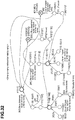
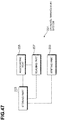
- one referential link relationship is formed from each of a plurality of substances to one reference tree. Specifically, as shown in FIG. 30 , referential links are formed from Monads with ID 640 and ID 1062 to a Monad with ID 641.
- At least one piece of lower individual element data (ID 640) among a plurality of pieces of lower individual element data associated with upper individual element data of first link knowledge data do not have the attribute value data and individual element data (Monad with an ID 641) referenced by the element data ID of individual element data of the referential destination are associated therewith; at least one piece of lower individual element data (Monad with an ID 1062) among a plurality of pieces of lower individual element data associated with upper individual element data of second link knowledge data do not have the attribute value data and individual element data (Monad with an ID 641) referenced by the element data ID of the individual element data of the referential destination are associated therewith; and the individual element data of these referential destinations are the same individual element data (Monad with an ID 641).
- a Monad with an ID 641 is referenced from the meaning tree having a Monad with an ID 61 as the top Monad, and a meaning tree having a Monad with an ID 1061 as the top Monad can be derived from this Monad.
- the Monad with an ID 61 has two Monads, Monads with ID 1100 and ID 1110, and referential links are formed from the Monad with an ID 1100 and the Monad with an ID 1110 to the Monad with an ID 632 and Monad with an ID 631, respectively.
- the substance with an ID 61 has two labels.
- At least two or more pieces of individual element data (in this case, the reference tree having the Monad with an ID 632 as a top Monad and the reference tree having the Monad with an ID 631 as a top Monad) among the plurality of pieces of link knowledge data stored in the storage means (in this case, the meaning tree having the Monad with an ID 61 as a top Monad, and the reference tree having the Monad with an ID 632 as a top Monad and the reference tree having the Monad with an ID 631 as a top Monad) fulfil the following conditions.
- a meaning tree having the Monad with an ID 61 as a top Monad can be linked from the Monad with an ID 632 and the Monad with ID 631 can be further referenced from its lower Monad, for example.
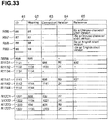
- the trees ⁇ 1, a2 and a3 in FIG. 34 are parts constructed from the records shown in FIG. 33 .
- the trees ⁇ 1 and a2 are reference trees and the tree ⁇ 3 is a meaning tree.
- FIG. 34 only the uppermost Monads of narrative clause constituting data are shown and the other narrative clause constituting data are omitted from illustration.
- the curved line arrows representing the reference from lower Monads with ID 1125, ID 1223, ID 1121 and ID 1211 of the Monads with ID 631 and ID 632 are omitted from illustration.
- At least two or more pieces of link knowledge data among the plurality of pieces of link knowledge data store, in the storage means, individual element data that fulfil the following conditions.
- First and second lower individual element data (the Monad with an ID 1100 and the Monad with an ID 1110) among a plurality of pieces of lower individual element data associated with upper individual element data (the Monad with an ID 61) of first link knowledge data (the meaning tree having the Monad with an ID 61 as a top Monad) do not have the attribute value data; individual element data (the Monads with ID 632 and ID 631) referenced by the element data IDs of individual element data of the referential destinations are associated therewith; and the first and second lower individual element data reference different individual element data (the Monads with ID 632 and ID 631).
- At least two pieces of lower individual element data (the Monads with ID 1131 and ID 1141) among a plurality of pieces of lower individual element data associated with upper individual element data (the Monad with an ID 656) of second link knowledge data (the meaning tree having the Monad with an ID 656 as a top Monad) do not have the attribute value data
- one of the two pieces of lower individual element data are third lower individual element data (the Monad with an ID 1131) associated with individual element data (the Monad with an ID 632) with which the first lower individual element data (the Monad with an ID 1100) are associated and the other piece of lower individual element data are fourth lower individual element data (the Monad with an ID 1141) are associated with individual element data (the Monad with an ID 631) with which the second lower individual element data (the Monad with an ID 1110) are associated.
- a Monad with an ID 641 can be extracted when a search is performed in the reference field 65 for the text "HONDA Risa.”
- records R642 and R1066 are extracted.
- the IDs in their meaning fields 63 are tracked, the Monads with ID 61 and ID 1061 can be reached.
- Records having this ID 641 in the reference field 65 may be extracted.
- the target top Monad can be reached within a shorter period of time if the search is limited to records having nothing in the meaning field 62.
- HONDA is a Japanese script version of the family name of HONDA Risa, who works under Toyoda Ichiro.
- the CPU 23 displays a template entry screen for data entry (step S151 in FIG. 37 ).
- FIG. 38 shows one example of it.
- a template representing a relationship "The family name XX is a Japanese script version of a family name for the possessor XX of the family name.” has been previously stored. This is read to prompt the user to enter the text of the subject and object.
- a plurality of candidate templates may be stored to prompt the user to select one.
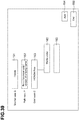
- the user enters the family name " HONDA " in the entry box 151 and the target "HONDA Risa” in an entry box 153. Because the target "HONDA Risa” has a modifier "who works under Toyoda Ichiro," the user selects an icon 154.
- the CPU 23 determines whether an end button 159 has been selected (step S153). In this case, because the end button 159 has not been selected, the CPU 23 advances to step S155 and determines whether the add button has been selected. In this case, because the icon 154 has been selected, the CPU 23 prompts the user to select the entry box to be modified (step S157). While the message "Select the entry box to be modified.” is displayed on the screen in this embodiment, the present invention is not limited thereto.
- the CPU 23 displays additional entry boxes representing the modification relationship for the selected entry box (step S159).
- additional entry boxes representing the modification relationship for the selected entry box.
- FIG. 39 One example in this case is shown in FIG. 39 .
- the CPU 23 determines whether the end button 159 has been selected (step S153). In this case, because the end button 159 has been selected, the CPU 23 performs a label search (step S161) and determines whether there already exists the label entered in the entry box (step S163). Specifically, the CPU 23 simply determines whether there is the corresponding text in the reference field 65 of the table.
- step S165 is simply repeated.
- the CPU 23 associates the label with a substance (step S167). This is because there may be a case where one label, such as "HONDA Risa,” is associated with a plurality of substances, such as substances with ID 61 and ID 1061, as shown in FIG. 30 . In this embodiment, when there are two or more substances, the CPU 23 displays the link attributes of the substances represented by their meaning trees on the screen to help the user's selection.
- the present invention is not limited thereto.
- the Monad with an ID 61 is selected by the user.
- the source case S is determined to require entry of a label by the verb in "be a Japanese script version of a family name" employed as a template, the label " HONDA " is not associated with a substance.
- “Toyoda Ichiro” is associated with a substance in the same manner as above. In this case, the Monad of the record with an ID 63 is selected.
- the time of determination may not be limited thereto.
- the presence of such records may be determined when an entry is made in the entry box. The same applies to the association of a label with a substance.
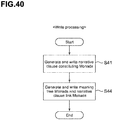
- the CPU 23 generates and writes narrative clause constituting Monads (step S41 in FIG. 40 ).
- the processing for generating narrative clause constituting Monads is described with reference to FIG. 41 .
- the CPU 23 determines a source Monad, a path Monad and a goal Monad (step S171 in FIG. 41 ).
- a source case S, a path case P and a goal case G are determined.
- a source Monad, a path Monad and a goal Monad can be determined without a morphological analysis as in the first embodiment.
- the given data " HONDA ,” "be a Japanese script version of a family name” and "HONDA Risa” correspond to a source case S, a path case P and a goal case G, respectively.
- the CPU 23 generates and writes an ID of the uppermost Monad (step S173).
- An empty ID is used for the ID.
- an ID "1102” is used.
- the CPU 23 writes "1102" in the meaning field 62 of a record "1102."
- the CPU 23 determines whether the source case S requires entry of a label (step S175). Whether entry of a label is required is determined based on whether the source case S is determined to require entry of a label by the verb as a path case P (in this case, "be a Japanese script version of a family name"). Thus, whether the source case S or goal case G requires entry of a label is stored for each verb (not shown).
- the CPU 23 turns on an other-referential Monad flag (a flag representing that this is a Monad referencing a reference Monad), and generates a Monad specified by the ID in the reference field 65 and writes it (step S177).
- the CPU 23 writes "-(blank)," the ID "1102" of the upper Monad, the ID "4" of the “source case” and the ID “632" of "HONDA” in the meaning field 62, the connection field 63, the relation field 64 and the reference field 65, respectively, of an empty ID "1103.”
- the ID of the "HONDA” can be found if a search is performed for a text "HONDA” in the reference field 65.
- the CPU 23 writes a record of the path case P (step S181).
- "be a Japanese script version of a family name” has an ID "82”
- the path case P has an ID "5"
- the upper Monad has an ID "1102.”
- the CPU 23 writes "82,” the ID "1102” of the upper Monad, the ID "5" of the "path case P” and "-(blank)” in the meaning field 62, the connection field 63, the relation field 64 and the reference field 65, respectively, of the next empty ID "1104."
- the CPU 23 determines whether the goal case G requires entry of a label (step S183). Whether entry of a label is required is determined by the verb as described above. In this case, it is determined that the goal case G does not require entry of a label, the CPU 23 generates a Monad specified by the ID in the meaning field 62 and writes it (step S187). In this case, the CPU 23 writes the ID "61" representing the substance HONDA Risa, the ID "1102" of the upper Monad, the ID "6" of the goal case G and "-(blank)" in the meaning field 62, the connection field 63, the relation field 64 and the reference field 65, respectively, of an empty ID "1105.”
- the CPU 23 advances to FIG. 42 , and repeats step S193 to step S199 while there remain any extended Monads (step S191 to step S199).
- An extended Monad refers to a Monad candidate except the source case, goal case and path case.
- the CPU 23 determines that there are extended Monads. Specifically, the CPU 23 selects "Toyoda Ichiro,” which is the source case, as an extended Monad out of "Toyoda Ichiro” and “works under” modifying HONDA Risa.
- the CPU 23 determines whether the extended Monad requires entry of a label (step S193). In this case, because the path case P "works under,” corresponding to the extended Monad “Toyoda Ichiro" does not require entry of a label, the CPU 23 advances to step S195, and generate a Monad specified by the ID in the meaning field 62 and writes it.
- the CPU 23 determines in step S199 whether there remain any extended Monads. In this case, because the number of extended Monads is one, the processing for writing narrative clause constituting Monads is terminated.
- each Monad is determined to be a Monad having a value in the meaning field or a Monad having a value in the reference field when it is written.
- a verb is dealt with as having at least a source case, a goal case and a path case.
- an intransitive verb sentence “HONDA Risa runs.” is dealt with as being a sentence "HONDA Risa causes HONDA Risa to run.”
- a Be verb sentence “Apples are red.” is dealt with using a verb "have a color” as in “Apples have a red color.”
- a verb is dealt with as a "path case" seen from the side of lower individual element data as in the first embodiment.
- the CPU 23 performs processing for writing tree Monads and narrative clause link Monads (step S44 in FIG. 40 ).
- the term "tree Monads” is a general term to cover both meaning tree Monads and reference tree Monads. This embodiment is different from the first embodiment in that it is determined whether a Monad referencing a reference Monad (which is hereinafter referred to as "other-referential Monad") is written as described below.
- step S44 determines candidates for tree Monads (step S201 in FIG. 43 ).
- the CPU 23 determines candidates for tree Monads (step S201 in FIG. 43 ).
- the two types of master-slave Monads are Monads having a substance as a top Monad and Monads having a label as a top Monad.
- the former are meaning tree Monads, and the latter are reference tree Monads.
- the former are further divided into two types, Monads that reference a label and Monads that do not reference a label.
- the processing that is performed when a label is not referenced and the processing that is performed when there are detail Monads at that time are the same as those in the first embodiment, their description is omitted.
- the CPU 23 initializes the processing number i (step S203 in FIG. 43 ), and determines whether a flag referencing a reference Monad for the 0th tree Monad candidate (other-referential Monad flag) is on (step S205). In this case, the other-referential Monad flag for the 0th tree Monad candidate "HONDA" has been turned on in step S197 in FIG. 42 , the CPU 23 generates a Monad that references another Monad by the ID in the reference field 65 (step S209 in FIG. 43 ).
- the CPU 23 determines whether the generated other-referential Monad exists in the table (step S211). In this case, because the generated other-referential Monad does not exist in the table, the CPU 23 writes it in the table (step S213). An empty ID is used for the Monad to be written. Here, an ID "1100" is used.
- the CPU 23 generates a narrative clause link Monad and writes it in the table (step S215).
- the narrative clause link Monad is written in the same manner as in the first embodiment.
- the ID determined in step S213 is "1100” and the uppermost Monad of narrative clause constituting Monads to be connected has an ID "1102."
- the CPU 23 writes "1102,” “1100” and “24” in the meaning field 62, the connection field 63 and the relation field 64, respectively, of an empty ID "1101."
- an inverse Monad tree is a Monad that is in an inverse predication relationship with an i-th tree Monad candidate.
- a tree Monads for a narrative clause "apple” "is eaten (-eat)" by "HONDA Risa,” which is in inverse relationship with "HONDA Risa” "eats” an “apple,” is generated.
- a tree Monads representing that the substance "HONDA Risa" is connected to the label "HONDA” by "-be a Japanese script version of a family name” is generated.
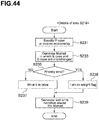
- a reference tree Monad having the reference Monad as a top Monad is generated as a Monad in an inverse predication relationship with the meaning tree Monad having an other-referential Monad flag being on.
- step S216 Details of step S216 are shown in FIG. 44 .
- the CPU 23 specifies "-be a Japanese script version of a family name" in an inverse relationship with the path case P "be a Japanese script version of a family name” out of the source case S, the path case P and the goal case G (step S231).
- the CPU 23 generates a Monad in which the source case S and the goal case G are interchanged (step S233).
- "61,” “632” the ID "83” representing "-be a Japanese script version of a family name” and "-” are stored in the meaning field 62, the connection field 63, the relation field 64 and the reference field 65, respectively.
- the CPU 23 determines whether the Monad already exists (step S235). In this case, because the Monad does not exist, the CPU 23 writes it in the table (step S237). Specifically, the CPU 23 writes "61,” “632" and “83” in the meaning field 62, the connection field 63 and the relation field 64 , respectively,of an empty ID "1121.” As a result, a reference tree Monad is generated.
- the CPU 23 generates a narrative clause link Monad that links the narrative clause link Monad generated in step S215 in FIG. 43 and writes it (step S239). Because this step is the same as step S215, detailed description is omitted.
- the ID determined in step S213 is "1121” and the uppermost Monad of the connected narrative clause constituting Monads is "1102."
- the CPU 23 writes "1102,” "1121” and "24” in the meaning field 62, the connection field 63 and the relation field 64, respectively, of an empty ID "1122.”
- step S235 If the Monad already exists in step S235, a weight flag is turned on (step S238). Because this step is the same as step S221 in FIG. 43 , description is omitted.
- the CPU 23 determines whether processing has been completed for all the candidates determined in step S201 in FIG. 43 (step S217 in FIG. 43 ). In this case, because processing has been completed for all the candidates, the CPU 23 returns to FIG. 40 and terminates the write processing. In this case, the records R1100, R1101, R1121 and R1122 in FIG. 36 are written.
- FIG. 35 The records before the records shown in FIG. 36 are added are shown in FIG. 35 .
- a meaning tree and a reference tree shown in FIG. 45 are obtained.
- the records shown in FIG. 36 are added thereto by the above write processing.
- the tree structure shown in FIG. 46 is obtained.
- Step S221 in FIG. 43 is the same as step S78 in FIG. 11 .
- a Monad in an inverse relationship is generated in step S216 in FIG. 44 .
- a Monad in an inverse relationship may be generated as a tree Monad by repetitive processing as in the first embodiment.
- the processing in step S216 may be provided in the first embodiment.
- the path case P "be a capitalized version" requires both the source case S and the goal case G to be a label.
- a Monad specified by the ID in the reference field 65 is written in both step S177 and step S185 in FIG. 41 .
- a Monad in an inverse relationship may be generated in the same manner as in the above embodiments (refer to step S216 in FIG. 44 ).
- a weight Monad and a time Monad are also applicable to the third embodiment in the same manner.
- a translation result reflecting the frequency of use or the recent usage trend can be obtained in the same manner as described in the second embodiment.
- the weight and time Monads are also applicable not only to meaning trees but also reference trees.
- the rule that the source case S and/or goal case G need to be a label is stored for each Monad constituting a path case P, and it is determined that the Monad has no association with a substance if it falls under the rule.
- the present invention is not limited thereto. For example, whether a Monad is linked by the ID in the meaning field or by the ID in the reference field may be changed depending on whether it is associated with a substance. Naturally, such an attribute can be simply stored with a similar tree structure.
- FIG. 47 shows a functional block diagram of the database management system 1 according to the third embodiment.
- the database management system 1 includes a storing part 203, an associating part 205, a reading part 207, and a writing part 209.
- a table which comprises at least the following five fields a1) to a5) and in which one record comprises one piece of element data is stored:
- the associating part 205 positions a record having an ID in the meaning field of a certain record in the upper element data field as a lower record having the certain record as an upper record and associates the upper record with the lower record by defining a link attribute represented by link attribute element data in the link attribute element data field of the lower record as having an attribute value in the attribute value data field of the lower record.
- the associating part 205 specifies a record referenced by the ID in the referential element data field, and associates the data in the referential element data field of the specified record as a label of the record having nothing in the meaning field.
- the reading part 207 reads link knowledge data in which a plurality of lower records is linked to the upper record by causing the associating part 205 to repeat the associating.
- the writing part 209 When an upper element ID of a writing target element, and link attribute element data in a link attribute with the upper element and an attribute value thereof are given, the writing part 209 writes the upper element ID in the upper element data field, the link attribute element data in the link attribute element data field, and the attribute value thereof in the attribute value data field. In addition, when an upper element ID of a writing target element, and link attribute element data in a link attribute with the upper element and an element data ID of a referential destination are given, the writing part 209 writes the upper element ID in the upper element data field, the link attribute element data in the link attribute element data field, and the element data ID of the referential destination in the referential element data field.
- the invention of the first embodiment can be also specified as follows.
- a database management system is a database management system having
- a database management system is a database management system having
Landscapes
- Engineering & Computer Science (AREA)
- Theoretical Computer Science (AREA)
- Databases & Information Systems (AREA)
- Physics & Mathematics (AREA)
- General Engineering & Computer Science (AREA)
- General Physics & Mathematics (AREA)
- Data Mining & Analysis (AREA)
- Software Systems (AREA)
- Computational Linguistics (AREA)
- Mathematical Physics (AREA)
- Information Retrieval, Db Structures And Fs Structures Therefor (AREA)
- Computing Systems (AREA)
Applications Claiming Priority (3)
| Application Number | Priority Date | Filing Date | Title |
|---|---|---|---|
| JP2015166698 | 2015-08-26 | ||
| JP2016087849 | 2016-04-26 | ||
| PCT/JP2016/070089 WO2017033588A1 (fr) | 2015-08-26 | 2016-07-07 | Dispositif de gestion de base de données et procédé associé |
Publications (2)
| Publication Number | Publication Date |
|---|---|
| EP3343396A1 true EP3343396A1 (fr) | 2018-07-04 |
| EP3343396A4 EP3343396A4 (fr) | 2019-01-02 |
Family
ID=58099803
Family Applications (1)
| Application Number | Title | Priority Date | Filing Date |
|---|---|---|---|
| EP16838935.1A Withdrawn EP3343396A4 (fr) | 2015-08-26 | 2016-07-07 | Dispositif de gestion de base de données et procédé associé |
Country Status (5)
| Country | Link |
|---|---|
| US (1) | US20180089274A1 (fr) |
| EP (1) | EP3343396A4 (fr) |
| JP (2) | JP6092493B1 (fr) |
| CN (1) | CN107924417B (fr) |
| WO (1) | WO2017033588A1 (fr) |
Families Citing this family (4)
| Publication number | Priority date | Publication date | Assignee | Title |
|---|---|---|---|---|
| CN108897811A (zh) * | 2018-06-19 | 2018-11-27 | 广州地铁集团有限公司 | 一种地铁设备维修数据的标准化方法及装置 |
| CN109918472B (zh) | 2019-02-27 | 2026-02-27 | 北京百度网讯科技有限公司 | 存储和查询数据的方法、装置、设备和介质 |
| KR20210063862A (ko) | 2019-11-25 | 2021-06-02 | 에스케이하이닉스 주식회사 | 키-값 기반의 데이터 저장 장치 및 이를 포함하는 시스템 |
| CN113094415B (zh) * | 2019-12-23 | 2024-03-29 | 北京懿医云科技有限公司 | 数据抽取方法、装置、计算机可读介质及电子设备 |
Family Cites Families (10)
| Publication number | Priority date | Publication date | Assignee | Title |
|---|---|---|---|---|
| JPS61220027A (ja) * | 1985-03-27 | 1986-09-30 | Hitachi Ltd | 文書ファイリングシステム及び情報記憶検索システム |
| US7461077B1 (en) * | 2001-07-31 | 2008-12-02 | Nicholas Greenwood | Representation of data records |
| US7284010B2 (en) * | 2003-10-23 | 2007-10-16 | Microsoft Corporation | System and method for storing and retrieving a field of a user defined type outside of a database store in which the type is defined |
| US9104779B2 (en) * | 2005-03-30 | 2015-08-11 | Primal Fusion Inc. | Systems and methods for analyzing and synthesizing complex knowledge representations |
| JP4998237B2 (ja) * | 2007-12-06 | 2012-08-15 | 富士通株式会社 | 論理構造モデル作成支援プログラム、論理構造モデル作成支援装置および論理構造モデル作成支援方法 |
| CN100492370C (zh) * | 2007-12-14 | 2009-05-27 | 清华大学 | 面向集成化企业模型的文档管理方法 |
| US9805020B2 (en) * | 2009-04-23 | 2017-10-31 | Deep Sky Concepts, Inc. | In-context access of stored declarative knowledge using natural language expression |
| US20110191320A1 (en) * | 2010-02-02 | 2011-08-04 | Game Plan Technologies, Inc. | Digital asset management system |
| WO2014114761A1 (fr) * | 2013-01-25 | 2014-07-31 | Face Recording And Measurements Ltd. | Système de gestion de données |
| CN103455606B (zh) * | 2013-09-03 | 2016-07-06 | 何云坤 | 一种大数据库创建及数据管理方法 |
-
2016
- 2016-07-07 JP JP2016568076A patent/JP6092493B1/ja active Active
- 2016-07-07 CN CN201680049061.4A patent/CN107924417B/zh not_active Expired - Fee Related
- 2016-07-07 WO PCT/JP2016/070089 patent/WO2017033588A1/fr not_active Ceased
- 2016-07-07 EP EP16838935.1A patent/EP3343396A4/fr not_active Withdrawn
-
2017
- 2017-02-08 JP JP2017020895A patent/JP2017199348A/ja active Pending
- 2017-11-20 US US15/817,529 patent/US20180089274A1/en not_active Abandoned
Also Published As
| Publication number | Publication date |
|---|---|
| EP3343396A4 (fr) | 2019-01-02 |
| CN107924417B (zh) | 2022-04-15 |
| WO2017033588A1 (fr) | 2017-03-02 |
| CN107924417A (zh) | 2018-04-17 |
| JP6092493B1 (ja) | 2017-03-08 |
| US20180089274A1 (en) | 2018-03-29 |
| JPWO2017033588A1 (ja) | 2017-08-24 |
| JP2017199348A (ja) | 2017-11-02 |
Similar Documents
| Publication | Publication Date | Title |
|---|---|---|
| Zhu et al. | A review of auditing methods applied to the content of controlled biomedical terminologies | |
| US8700589B2 (en) | System for linking medical terms for a medical knowledge base | |
| JP2021007031A (ja) | 電子診療レコードからの医学的状態および事実の自動的特定および抽出 | |
| WO2020139861A1 (fr) | Établissement d'un graphe de connaissances utilisant de multiples sous-graphes et une couche de liaison comprenant de multiples nœuds de liaison | |
| Gerstmair et al. | Intelligent image retrieval based on radiology reports | |
| Zhang et al. | Overview of current herb–drug interaction databases | |
| CN103020453A (zh) | 基于本体技术的结构化电子病历生成方法 | |
| Yu et al. | NILE: fast natural language processing for electronic health records | |
| EP3343396A1 (fr) | Dispositif de gestion de base de données et procédé associé | |
| Koznov et al. | Clone detection in reuse of software technical documentation | |
| Bond et al. | Some issues with building a multilingual wordnet | |
| KR101375221B1 (ko) | 의료 프로세스 모델링 및 검증 방법 | |
| Möller et al. | A Generic Framework for Semantic Medical Image Retrieval. | |
| Navare et al. | Ontology based disease diagnosis using natural language processing, sparql and protégé from patient symptoms | |
| Cenikj et al. | CafeteriaSA corpus: scientific abstracts annotated across different food semantic resources | |
| WO2015177861A1 (fr) | Dispositif et procédé de génération de données d'apprentissage | |
| Baneyx et al. | Methodology to build medical ontology from textual resources | |
| Nunes et al. | MeSHx-notes: web-system for clinical notes | |
| KR101088483B1 (ko) | 이종 분류체계들을 매핑시키는 방법 및 장치 | |
| Roa-Martínez et al. | Digital Image Representation Model Enriched with Semantic Web Technologies: Visual and Non-Visual Information | |
| Ruangrajitpakorn et al. | A data-oriented ontology generation using Thai semi-structured data | |
| Javadi Koushesh | Development of a Fused Graph Database For Non-Small-Cell Lung Cancer: Designing and Implementation of a Graph-Driven Integration | |
| Ruangrajitpakorn et al. | Ontology Generation and Instance Extraction of Medicine Information from Thai Semi-structured Data | |
| Iorio et al. | Analysing and Discovering Semantic Relations in Scholarly Data | |
| Leite et al. | Knowledge-Aware Clinical Narrative Extraction Using Ontologies and Knowledge Graphs |
Legal Events
| Date | Code | Title | Description |
|---|---|---|---|
| PUAI | Public reference made under article 153(3) epc to a published international application that has entered the european phase |
Free format text: ORIGINAL CODE: 0009012 |
|
| 17P | Request for examination filed |
Effective date: 20180305 |
|
| AK | Designated contracting states |
Kind code of ref document: A1 Designated state(s): AL AT BE BG CH CY CZ DE DK EE ES FI FR GB GR HR HU IE IS IT LI LT LU LV MC MK MT NL NO PL PT RO RS SE SI SK SM TR |
|
| AX | Request for extension of the european patent |
Extension state: BA ME |
|
| DAV | Request for validation of the european patent (deleted) | ||
| DAX | Request for extension of the european patent (deleted) | ||
| A4 | Supplementary search report drawn up and despatched |
Effective date: 20181205 |
|
| RIC1 | Information provided on ipc code assigned before grant |
Ipc: G06F 17/30 20060101AFI20181129BHEP |
|
| STAA | Information on the status of an ep patent application or granted ep patent |
Free format text: STATUS: THE APPLICATION HAS BEEN WITHDRAWN |
|
| 18W | Application withdrawn |
Effective date: 20190604 |